

Submitted:
25 February 2025
Posted:
26 February 2025
You are already at the latest version
Abstract
Fluoride contamination in water sources presents critical public health challenges, particularly in regions where groundwater exhibits elevated fluoride levels. Chronic exposure can result in dental and skeletal fluorosis, necessitating efficient and sustainable remediation strategies. This study investigates the Spherical Agglomeration Technique (SAT) as an alternative fluoride removal method, assessing the performance of sunflower oil versus n-heptane as humectants and evaluating the synergistic effects of Agave durangensis leaf extract. A factorial experimental design optimized dosage parameters in aqueous models and well water samples, ensuring reliable fluoride removal. Sunflower oil significantly outperformed n-heptane, achieving fluoride removal efficiencies of up to 95.19% under optimal conditions (5 mL Hum/g TMC at pH 6.5). Incorporating A. durangensis extract sustained high fluoride removal while reducing the required extract dosage to 0.5 g Extr/g TMC. When applied to well water samples, SAT consistently maintained an 88.9% fluoride removal efficiency. Compared to conventional methods such as coagulation-flocculation and adsorption, SAT demonstrated enhanced effectiveness with a lower environmental foot-print. These findings reinforce the viability of sunflower oil and A. durangensis extract as eco-friendly alternatives to n-heptane, positioning SAT as a scalable, cost-effective solution for large-scale fluoride remediation.
Keywords:
Fluoride removal
; Spherical agglomeration technique
; Sunflower oil
; Agave durangensis extract
; Sustainable water treatment
1. Introduction
Access to safe drinking water is essential for human health and sustainable development [1,2]. Globally, over 200 million people are regularly exposed to fluoride-contaminated drinking water, particularly in regions such as India, China, East Africa,, and the north-central region of Mexico [3,4]. This widespread exposure represents substantial challenges to both water quality and public health. Fluoride contamination originates from multiple sources, including leaching from mines, industrial activity, and natural contamination from prolonged interactions between groundwater and fluoride-rich rocks, often leading to elevated fluoride levels that pose significant health risks [5,6]. In this context, their presence in high concentrations can seriously affect ecosystems and human health [7].
Only 0.8% of the world’s water is available for human consumption, mainly as groundwater. This limited drinking water supply faces constant threats, including fluoride contamination [5,7,8,9]. Overexploitation of aquifers, poor recharge, and natural contamination are leading causes of fluorides in the water supply [5,7]. As a result, entire communities are exposed to dangerous levels of fluoride, posing significant public health concerns [6,10]. In addition, aquatic ecosystems can also suffer damage due to the accumulation and biomagnification of fluoride along the food chain, affecting aquatic fauna and flora [11].
Previous studies explored a wide variety of methods for fluoride removal, including coagulation-flocculation that uses aluminum-based salts, adsorption using activated alumina, and membrane filtration [12]. Nonetheless, these approaches frequently encounter challenges, including elevated operational costs, considerable sludge generation, and limited material reusability [13]. With the growing recognition of the health hazards of fluoride contamination, efforts to investigate and create more efficient and sustainable removal technologies have gained interest [14]. To resolve these challenges, recent studies have explored alternative methods like electrocoagulation and reverse osmosis; however, these approaches also encounter technical and economic constraints in specific contexts. Even with these developments, there remains a significant necessity to improve the efficiency, sustainability, and accessibility of these technologies, especially in areas where safe drinking water is limited [14].
Considering these limitations, a novel approach to fluoride removal is the spherical agglomeration technique (SAT), which enhances contaminant removal by promoting the formation of solid aggregates in liquid media through hydrophobic interactions [15]. This method is governed by controlled physicochemical parameters such as temperature, pH, and agitation speed. It comprises four fundamental stages. In the first stage, precipitation-adsorption, Ca(OH)2 is dosed in a controlled manner within a specific pH range to generate particles of colloidal size [16,17]. The next stage, hydrophobization, involves changing the hydrophilic nature of the particles through natural surfactants [18]. Subsequently, the wetting stage involves the application of agents that enhance cohesion among hydrophobic particles by integrating the hydrophobic chains of the surfactant. These agents can be either industrial or natural, including n-heptane and vegetable oils [19]. Finally, in the agglomeration stage, an initiating agent (Ca2+) is used to change and redistribute the charges of the agglomerate [15]. SAT has proven effective in removing various contaminants; using n-heptane as a humectant and vegetable oils is now considered a safer and more sustainable alternative [20,21]. Comparative studies show that edible and non-edible vegetable oils can be used equally efficiently as binders [22]. Although SAT has shown efficacy in removing arsenic from water, further research is still required to improve its environmental and economic efficiency [18]. In this regard, vegetable oils emerge as promising candidates for use as wetting agents, offering a sustainable alternative [23].
This study aims to address the challenges of fluoride contamination and contribute to sustainable water management by evaluating the efficacy of the SAT process through natural agents, including A. durangensis extract and sunflower oil. In the initial stage, sunflower oil was compared to n-heptane as a humectant and assessed as a sustainable alternative. Subsequent stages demonstrated that sun-flower oil can effectively reduce fluoride concentration in both aqueous models and well water. The results showed a fluoride removal efficiency of 95.19% in aqueous models and 88.86% in well water, highlighting the capacity of sunflower oil to con-tribute to sustainable practices in water treatment. The transition from industrial to natural agents underscores the potential to develop more efficient and sustainable technologies for water treatment, representing new opportunities to enhance the performance of industrial water treatment processes. The study demonstrates that natural wetting agents, like sunflower oil, can promote large-scale water treatment while reducing operational costs and environmental impacts.
Considering these limitations, a novel approach to fluoride removal is the spherical agglomeration technique (SAT), which enhances contaminant removal by promoting the formation of solid aggregates in liquid media through hydrophobic interactions [15]. This method is governed by controlled physicochemical parameters such as temperature, pH, and agitation speed. It comprises four fundamental stages. In the first stage, precipitation-adsorption, Ca(OH)2 is dosed in a controlled manner within a specific pH range to generate particles of colloidal size [16,17]. The next stage, hydrophobization, involves changing the hydrophilic nature of the particles through natural surfactants [18]. Subsequently, the wetting stage involves the application of agents that enhance cohesion among hydrophobic particles by integrating the hydrophobic chains of the surfactant. These agents can be either industrial or natural, including substances like n-heptane and vegetable oils [19], respectively. Finally, in the agglomeration stage, an initiating agent (Ca2+) is used to change and redistribute the charges of the agglomerate [15]. SAT has proven effective in removing various contaminants, using n-heptane as a humectant, and the use of vegetable oils is now considered a safer and more sustainable alternative [20,21]. Comparative studies show that both edible and non-edible vegetable oils can be used with equal efficiency as binders [22]. Although SAT has shown efficacy in removing arsenic from water, further research is still required to improve its environmental and economic efficiency [18]. In this regard, vegetable oils emerge as promising candidates to be used as wetting agents, offering a sustainable alternative [23].
The objective of this study is to address the challenges of fluoride contamination and contribute to sustainable water management by evaluating the efficacy of the SAT through the use of natural agents, including A. durangensis extract and sunflower oil. In the initial stage, experiments evaluated sunflower oil and n-heptane as humectants, considering their viability as a sustainable alternative. Subsequent stages demonstrated that sunflower oil can effectively reduce fluoride concentration in both aqueous models and well water. The results showed a fluoride removal efficiency of 95.19% in aqueous models and 88.86% in well water, highlighting the capacity of sunflower oil to contribute to sustainable practices in water treatment. Unlike prior studies that predominantly depend on synthetic humectants, such as n-heptane, this work introduces a novel and sustainable approach by utilizing sunflower oil as a viable alternative. This pioneering methodology not only demonstrates the practical feasibility of sunflower oil in real-world applications but also significantly enhances fluoride removal efficiency. Furthermore, this innovation aligns with global sustainability initiatives aimed at reducing the environmental footprint of water treatment processes, offering a greener and more eco-friendly solution to water purification challenges.
2. Materials and Methods
2.1. Reagents and Equipment
Fluoride removal studies utilized a meticulously prepared fluoride solution with a concentration of 5.0 mg L−1, prepared from a 1000 µg L−1 fluoride standard (HANNA Instruments, HI 4010-03) and deionized water to ensure optimal precision. Freshly prepared aluminum hydroxide (Al(OH)₃) was synthesized for the adsorption studies and the SAT precipitation stage through the reaction between AlCl₃ (Fermont, CAS No. 10025-77-1 MEX) and Ca(OH)₂ (Jalmek, CAS No. 1305-62-0 MEX). During the hydrophobization phase, Agave durangensis Gentry (A. durangensis) extract underwent preparation through ethanolic extraction [18], employing 100% ethyl alcohol (Fermont, CAS No. 64-17-5 MEX). The wetting and agglomeration stages incorporated commercial sunflower oil, n-heptane (SIGMA CHEMICAL), and CaCl₂ (Fermont, CAS No. 10043-52-4 MEX), with all reagents meeting analytical-grade standards and exceeding 99% purity. Samples and standard solutions underwent dilution in a 1:1 ratio with the buffer. The fluoride concentration underwent measurement using an ORION VERSA STAR PRO multiparameter meter (Thermo Fisher Scientific Inc, USA) equipped with a specific ion electrode (ORION 9609NWP) and a total ionic strength adjustment buffer (TISAB with CDTA, Orion 940909).
2.2. Application of the Spherical Agglomeration Technique (SAT)
Fluoride removal experiments took place at room temperature (20 ± 3 °C), using 500 mL baffled vessels and 3.5 × 2.5 cm stainless steel stirrers, in 250 mL of solution at 22 °C and with constant stirring at 600 rpm [17]. The first stage of SAT, precipitation-adsorption, lasted 15 minutes, adding AlCl3 and Ca(OH)2 and adjusting to pH 6.5 with the latter reagent to obtain freshly prepared aluminum hydroxide precipitates (Al(OH)3), which adsorb fluoride. A dose of 1 g/L of Al(OH)3 was added. Optimal precipitation occurs after adding Ca(OH)2 until the specified pH is reached [25,26]. The solids formed, resulting from the reaction between AlCl3, Ca(OH)2, and the adsorbed fluoride, was called “Total Mixture Components” (TMC). The hydrophobization stage (second stage) proceeds without interruption to the reaction, with the surfactant A. durangensis leaf extract added at doses of 0, 0.25, 0.5, 0.75, or 1.0 g Ext/g TMC for aqueous models and 0.25, 0.5, or 0.75 g Ext/g TMC for well water. In the wetting stage (third stage) the process involved applying either n-heptane or sunflower oil as wetting agents to coat the hydrophobic colloids formed in the second stage, selecting the most effective option. The experimental design determined the appropriate doses, using 2.5, 5.0, 6.3, 7.5, or 10 mL Hum/g TMC. [15,27]. Finally, the crystal nucleus growth stage (agglomeration stage) took place by adding 10 mL of 1 M CaCl₂ solution per mole of fluoride present in the aqueous solution. [23]. After the process, Whatman #40 filter paper was used to retain the agglomerates from the solution, and fluoride concentrations in the filtered aqueous medium were quantified using a specific ion electrode, adhering to NMX-AA-051-SCFI-2001 standards [24].
2.3. Experimental Design for Fluoride Removal in Aqueous Models and Groundwater
A 5×2 factorial design served to evaluate the effect of humectant type on fluoride removal efficiency. This factorial design enabled a comparative analysis of how effectively sunflower oil and n-heptane stabilize agglomerates and contribute to fluoride removal. The final fluoride concentration in solution was the response variable, measured after the agglomeration process.
The second experimental phase employed a 5×4 factorial design to evaluate the interaction between surfactant and humectant dosages. The independent variables included surfactant dosage (0.25, 0.50, 0.75, 1.00, and 1.25 g Ext/g TMC) and humectant dosage (2.5, 5.0, 7.5, and 10.0 mL Hum/g TMC). The experimental conditions remained consistent with those established in the previous stage, the combined effects of humectant and surfactant concentrations on fluoride removal, its effectiveness and the development of stable hydrophobic agglomerates underwent careful evaluation using this factorial design. The application of statistical analysis to the collected results (as described in Section 2.5) enabled the identification of significant variable interactions, ensuring a precise assessment of sunflower oil’s effectiveness in fluoride removal.
2.4. Fluoride Removal from Well Water by SAT
The groundwater utilized in this study was obtained from Durango, Dgo., Mexico (Durango City), Mexico, characterized by fluoride concentrations surpassing both national and international regulatory thresholds. Alongside fluoride, the water contains various dissolved ions, including bicarbonates, sulfates, and calcium, which may significantly influence the adsorption dynamics [4]. A bibliographic analysis of water samples from the Valle del Guadiana aquifer from Durango City, provided the basis for determining the fluoride concentration in aqueous models. The aquifer exhibits fluoride concentrations that exceed the limits established by the Mexican NOM-127-SSA1-1994 requirements (>1.5 mg L−1) as well as those recommended by the World Health Organization (WHO). A bibliographic analysis of historical and recent data (2014 - 2024) from Aguas del Municipio de Durango (AMD) identified the wells with the highest fluoride concentrations, ranging from 2.8 to 5.2 mg L⁻¹. These levels are attributed to the natural interaction of groundwater with fluoride-rich geological formations. For this study, synthetic water models (aqueous models) were prepared using a 1000 mg L⁻¹ fluoride standard in deionized water to simulate the fluoride levels found in the most contaminated well in Durango City. The fluoride content of the solution was verified through multiple measurements using an ORION VERSA STAR PRO multiparameter meter (Thermo Fisher Scientific Inc, USA) equipped with a specific ion electrode (ORION 9609NWP) to guarantee consistency and accuracy. The aqueous models served in factorial experimental designs to improve the SAT parameters for fluoride removal, maintaining consistency with real environmental conditions, finally, the analysis of residual fluoride concentrations in treated water determined the effectiveness of the optimized SAT in fluoride removal.
2.5. Statistical Analysis
An ANOVA test evaluated the assumptions of homogeneity, independence, and normality of variance to confirm the statistical reliability of the experimental data. This analysis verified the model’s accuracy, robustness, and suitability for describing the SAT within the established operating limits. Additionally, ANOVA quantified the variance attributed to the independent variables and determined their statistical significance in fluoride removal.
The evaluation of the model’s goodness of fit involved estimating Pearson’s determination coefficient (R²) using Statistica 7 for Windows [28]. A high R² value indicated strong predictive reliability, validating the model’s ability to represent the experimental relationships effectively. The application of Fisher’s least significant difference (LSD) test enabled the identification of statistically significant differences among extract dosages (ED), humectant dosages (HD), and their interaction effects. The experimental data validated the development of a quadratic response surface model to describe the relationships between independent variables (ED and HD) and fluoride concentration (dependent variable)., facilitating a predictive understanding of the system’s behavior and the optimization of operational conditions.
3. Results and discussion
3.1. Determination of Fluoride Concentration Used in Aqueous Models
Fluoride concentration in the most contaminated wells in the northeastern region supplying the city of Durango, based on data from Aguas del Municipio de Durango (AMD), is consistently beyond the Maximum Permissible Limits (MPL) established by Mexican regulations and WHO recommendations. The data registered a peak value of 8.2 mg L⁻¹ in 2014, aligning with findings from previous studies. [29,30], which is consistent with other studies conducted in the field, nonetheless, the prevailing trend indicates that the limits for fluoride concentration remain outside the established regulations. The Seminario well (No. 50), recorded in bibliographical sources with the highest fluoride levels (5.3–8.2 mg L⁻¹), served as the sample source for this study, measuring a fluoride concentration of 5.0 mg L⁻¹, comparable to the amount reported by AMD data. Based on this concentration, fluoride aqueous models provided a controlled medium for fluoride removal studies with the SAT, identifying the key removal parameters for this element.
3.2. Fluoride Removal in Aqueous Models by SAT Application
3.2.1. Comparison between n-Heptane and Sunflower Oil as Humectant Agent
A comparison of n-heptane and sunflower oil during the third stage of the Spherical Agglomeration Technique (SAT) demonstrated that both humectants effectively improve fluoride removal by promoting interfacial adhesion and enabling stable particle clustering (Table 1). N-heptane demonstrated removal rates between approximately 91.85% and 93.40%, while sunflower oil exhibited rates of about 92.53% to 95.19%. The increased efficiency can be attributed to sunflower oil’s capacity to create stronger hydrophobic layers that promote encapsulating colloids with adsorbed fluoride within agglomerates and reducing reagent wastage. The optimized SAT using sunflower oil achieved a final fluoride concentration of 0.26 mg/L, well below WHO and Mexican NOM-SSA-127-2021 limits (1.0 mg/L). Unlike conventional adsorption and coagulation-flocculation methods, which often require multiple treatment stages, SAT provides a single-step, low-waste alternative suitable for decentralized water treatment facilities. This efficiency highlights the practical application of SAT in rural or resource-limited areas, where access to complex treatment infrastructure is restricted. Additional studies validate that vegetable oils exhibiting amphiphilic characteristics act as efficient binding agents in agglomeration processes, facilitating significant fluoride removal efficiencies [31,32]. As a result, the interaction between the oil’s hydrophobic regions and the adsorbent particles enhances fluoride capture, which indicates its effectiveness as a sustainable and practical alternative to traditional n-heptane, particularly at moderate dosages.
On the other hand, the first stage of the SAT, which involves the adsorption of fluoride onto freshly prepared Al(OH)₃, is key for the effectiveness of the whole process. This phase involves the electrostatic interactions that occur between the negatively charged fluoride ions and the positively charged aluminum species, which promote the immobilization of fluoride. At the same time, hydrophobic interactions contribute to the stability of the complex. Previous studies indicate that the integration of modified diatomite with Al(OH)₃ achieves removal efficiencies greater than 88%, highlighting the importance of effective adsorbent design in fluoride capture [33]. Similarly, adsorption-based methods have achieved fluoride removal rates of up to 89% [34,35], which remains lower than the 95.2% efficiency attained in this study. Other research on seashell-derived adsorbents reported a removal efficiency of 92% [36], while aluminum/alumina composite systems reached 92.6% at pH 6.5 [37]. These findings highlight the critical role of strong electrostatic interactions and hydrophobic mechanisms in enhancing the adsorption capacity of Al(OH)₃ during the initial SAT stage, contributing to its superior performance in fluoride removal.
All treatments consistently met the established regulatory standards, including NOM-SSA-127-2021 and WHO guidelines [2022], which set a maximum allowable fluoride concentration of 1.0 mg L⁻¹ and a permissible pH range of 6.5–8.0. Throughout all tests, fluoride concentrations varied from 0.25 to 0.44 mg L⁻¹ and pH measurements between 7.04 and 7.25 demonstrated compliance with the established guidelines (Table 1). The results align with previous studies [38,39], which demonstrate that vegetable oil-based humectants performed similarly to n-heptane in reducing interfacial tension and enhancing emulsification. Amphiphilic compounds are crucial for creating stable agglomerates with carbonaceous particles, facilitating effective fluoride encapsulation in aqueous environments. The mechanism relies on the formation of stable agglomerates via hydrophobic interactions, with amphiphilic compounds facilitating the encapsulation of colloids that include adsorbed fluoride. This process reduces the redispersion of contaminants by promoting coalescence between the surfactant-oil matrix and colloidal particles [40]. While n-heptane achieved similar results, the negligible performance differences highlight sunflower oil as a sustainable, cost-effective alternative, particularly when the amphiphilic properties of the surfactant-humectant are optimized.
Likewise, Table 1 highlights the effective removal of fluoride using A. durangensis extract (0.5 g Ext/g TMC) as a biosurfactant and sunflower oil as the humectant. Emulsion stability is crucial for ensuring uniform dispersion of the biosurfactant and enhancing its interaction with fluoride ions, consistent with prior findings [41]. The hydrophilic-lipophilic balance (HLB) significantly influences system stability, particularly through the role of unsaturated fatty acids in modifying interfacial properties [42]. Under optimal conditions, the fluoride concentration achieved a minimum of 0.26 mg L⁻¹ with the application of 5 mL Hum/g TMC of sunflower oil, in contrast, a concentration of 0.27 mg L⁻¹ was obtained with 2.5 mL Hum/g TMC of n-heptane. The pH of the treated water remained within 7.0–7.25, complying with both NOM-SSA-127-2021 and WHO standards, ensuring its safety for use. The findings underscore the critical role of optimizing surfactant-humectant interactions, driven by hydrophobic and emulsification mechanisms, in enhancing fluoride removal efficiency while adhering to regulatory standards. Sunflower oil demonstrates superior performance compared to n-heptane, consistently achieving lower final fluoride concentrations and ensuring compliance with established guidelines. Additionally, its reduced environmental footprint and comparable cost-effectiveness establish sunflower oil as a more sustainable and practical alternative for large-scale implementation in water treatment processes.
3.2.2. SAT Optimization for Fluoride Removal in Aqueous Models, Using Different Surfactant and Humectant Doses
Table 2 presents fluoride removal yields between 0.26 and 0.67 mg L⁻¹ of final fluoride concentration (86.6 to 94.8% removal), highlighting the effectiveness of SAT under optimized humectant and surfactant conditions. The lowest final fluoride concentration observed resulted in 0.26 mg L⁻¹, applying a dosage of 0.50 g Ext/g TMC of A. durangensis extract as a surfactant and 5.0 mL Hum/g TMC of sunflower oil as a humectant. The findings comply with the NOM-SSA-127-2021 standard, which establishes a maximum fluoride concentration of 1.0 mg L⁻¹ and requires a final pH approximately 7.0, highlighting the effectiveness of SAT for drinking water treatment.
The effectiveness of SAT is primarily attributed to the precipitation-adsorption mechanism, in which fluoride ions are adsorbed onto Al(OH)₃ via the regulated formation of aluminum colloids. This is consistent with earlier investigations showing fluoride removal efficiencies surpassing 85% when utilizing metal-organic framework (MOF) adsorbents [42]. The removal percentages achieved, which range from 94 to 97%, are similar to those documented in membrane-based processes [43,44]. Similarly, the adsorption of fluoride through calcium and zirconium-modified acid-activated alumina (CAZ) in batch reactors has shown an 85.8% removal rate [45]. SAT also achieved higher efficiency than the 89.0% obtained using graphene nanostructure-supported manganese oxide (GO-MnO₂) under similar pH conditions [46].
On the other hand, the process modified the hydrophobic affinity of the precipitated colloidal particles by introducing A. durangensis leaf extract, which facilitated the transition toward agglomeration. Prior research indicates that optimized micellar and bridging liquid ultrafiltration techniques can reach removal efficiencies of 95% [47,48]. In this stage, fluoride-laden particles aggregate, forming stable nuclei that initiate the nucleation of hydrophobic colloidal clusters, ultimately leading to spherical agglomerates. This process is in agreement with coagulation-flocculation methodologies, where fluoride removal rates above 99% have been documented [49,50]. The mechanism involves the incorporation of fluoride ions into the metal hydroxide phase (Al(OH)₃), followed by co-precipitation and subsequent separation through filtration [51].
The addition of CaCl₂ in a 1:1 molar ratio enhanced particle cohesion by creating bridges with hydroxyl groups on the hydrophilic segment of the surfactant, thus strengthening the agglomeration process. This interaction strengthens structural integrity and increase the efficiency of the agglomeration phase, as evidenced by previous studies [15,52]. By stabilizing the agglomerated particles, CaCl₂ enhances the overall performance of SAT, ensuring reliable removal efficiency under the specified conditions. The findings underscore the effectiveness of SAT in fluoride remediation, showcasing its promise as a dependable approach for treating potable water
3.3. Removal of Fluoride from Well Water Using the Spherical Agglomeration Technique
3.3.1. Groundwater Sampling and Analysis in the City of Durango, Mexico
A bibliographic review of data provided by Aguas del Municipio de Durango (AMD) and previous studies indicated significant variations in fluoride concentrations among urban wells of Durango City. Concentrations observed varied between 2.8 and 5.2 mg L-1, surpassing the allowable limits set by the Mexican NOM-127-SSA1-1994 standard as well as those established by the World Health Organization (WHO). Among the wells analyzed, Well No. 50, commonly known as "El Seminario," exhibited the highest fluoride concentrations. The bibliographic findings led to an in-situ sampling campaign to validate the reported concentrations. The analysis of samples from Well No. 50 revealed a fluoride concentration of 5.0 ± 0.1 mg L-1. This value aligns with historical data, reinforcing the classification of the well as the most fluoride-contaminated source in the urban water supply. The natural leaching of fluoride-rich geological formations into the groundwater caused the increased fluoride concentrations, a phenomenon attributed to the geochemical characteristics of the region, a phenomenon that has been recognized as a major factor affecting local water quality challenges [4,29,30]. The analysis resulted in the development of aqueous models intended to replicate fluoride concentrations in Well No. 50 (a solution of 5.0 mg L-1 fluoride concentration). This facilitated controlled experimentation by employing the SAT to enhance fluoride removal, ensuring that remediation strategies are in accordance with actual conditions
3.3.2. Fluoride Removal from Well Water by SAT
As shown in Table 3, the Spherical Agglomeration Technique (SAT) effectively removed fluoride from well water, which demonstrates the significance of sunflower oil as a humectant in achieving regulatory compliance (Table 3). The results indicate that final efficiency can be attributed to the encapsulation of colloidal particles throughout the process, which is enhanced by the hydrophobic affinity and lipophilic interactions between the hydrophobized colloids and sunflower oil [53,54]. A stable agglomeration is further encouraged by previous particle hydrophobization via surfactant application, which increases surface hydrophobicity and strengthens contact with the humectant [55]. The combined impact of surfactants and humectants in SAT is essential for maximizing fluoride removal, as it improves particle adhesion and agglomeration, resulting in more effective separation.
The results from the groundwater study demonstrate significant fluoride removal using SAT, with removal efficiencies ranging from 85.5% to 88.9%. Final fluoride concentrations of 0.55 to 0.71 mg L⁻¹ were obtained, surpassing the removal efficiencies reported in previous studies. For instance, an online coagulation-adsorption process achieved 83% removal in groundwater [54], while electrocoagulation using Fe(0) reached 85% removal [56]. The findings indicate that achieving fluoride concentrations within regulatory limits is feasible with an aluminum hydroxide dosage of 30 g Al(OH)₃/g F¯Tot, in combination with a humectant (sunflower oil) dosage of 9.0 mL Hum/g TMC. In contrast, aqueous models achieved over 90% removal using lower adsorbent and humectant doses. This variation is attributed to the complex and heterogeneous nature of well water, where the presence of competing ions and organic matter can interfere with fluoride adsorption [57].
The results align with findings from electrocoagulation studies that reported an 85.6% removal rate [57]. The presence of competing ions in groundwater, such as bicarbonates and sulphates, affects fluoride adsorption capacity, necessitating higher adsorbent and humectant doses compared to controlled aqueous systems. The interaction between surfactants and humectants in SAT ensures that fluoride removal is maintained despite these interferences. The improved agglomeration and stabilisation mechanisms facilitate effective fluoride separation, reinforcing SAT as a robust technique for real-world water treatment applications.
Furthermore, these findings underscore the potential of SAT as a scalable and adaptable method for fluoride mitigation in various water sources. The technique’s ability to achieve regulatory fluoride limits highlights its applicability in large-scale water treatment processes. The incorporation of surfactants and humectants in SAT significantly enhances agglomeration efficiency while enabling the reduction of fluoride concentrations to achieve regulatory-compliant levels in just one treatment. This advantage positions SAT as a competitive alternative to conventional methods, particularly in areas with high fluoride contamination and limited access to advanced water treatment infrastructure.
3.4. Statistical Analysis
3.4.1. Statistical Analysis for Sunflower Oil and n-Heptane Treatment in Aqueous Models
The analysis of variance (ANOVA) conducted in a 5x2 experimental design evaluated the fluoride removal efficacy utilizing two humectants: n-heptane (derived from hydrocarbons) and sunflower oil (derived from vegetables). The results revealed significant differences in removal efficiency based on the type of humectant and the administered dosage (2.5, 5, 6.3, 7.5 and 10 mL Hum/g TMC). The results indicated that sunflower oil surpassed n-heptane in fluoride removal in aqueous models, it also suggests that sunflower oil is a viable alternative to n-heptane and improves fluoride removal effectiveness corroborating previous study that identifies it as a suitable alternative for agglomerate formation in spherical agglomeration procedures (Table S1 in the supplementary material).
The general linear model employed in this experimental design met the criteria of normality, independence, and homogeneity of variance, with a coefficient of determination (R²) of 0.9342, indicating its reliability at a 95% confidence level.
Fisher’s LSD test indicated that the 10 mL Hum/g TMC dose of n-heptane resulted in a fluoride removal of 93.40 %, with a residual concentration of 0.36 mg L-1 (Table S2 in the supplementary material). In the use of sunflower oil, the 5 mL Hum/g TMC dosage achieved the maximum efficacy, yielding to a removal efficiency of 95.19 % and a residual concentration of 0.26 mg L-1. Sunflower oil demonstrated greater effectiveness than n-heptane throughout all tested doses, offering an excellent alternative in the humectation process within SAT (Figure 1).
3.4.2. Statistical Analysis for Fluoride Removal in Aqueous Models
The experimental design for fluoride removal in aqueous models utilized a 5×4 factorial approach, evaluating the interaction between five surfactant dosages (0.1, 0.3, 0.5, 1.0, and 2.0 g Ext/g TMC) and four humectant dosages (1.5, 3.0, 5.0, and 7.5 mL Hum/g TMC). An analysis of variance (ANOVA) determined the significance of the primary influences and their interaction on fluoride removal efficiency. The findings demonstrated that both the surfactant dosage (p < 0.001) and the humectant dosage (p < 0.01) showed statistically significant impacts on fluoride removal. A notable interaction effect (p < 0.05) became evident, indicating that optimal performance depended on the combined dosages rather than on either variable independently (Table S3 in the supplementary material). Tests for homogeneity, independence, and normality validated the ANOVA results, supporting that the assumptions were satisfied and confirming the reliability of the results. Response surface exhibited a non-linear trend, with removal efficiency increasing up to an optimal dosage of 0.5 g Ext/g TMC of surfactant and 7.5 mL Hum/g TMC of humectant. Beyond these optimal dosages, the efficiency stabilized, indicating saturation effects. A Least Significant Difference (LSD) test evaluated specific dosage combinations to enhance the accuracy of the findings. (Table S4 in the supplementary material), the test demonstrated that the optimal dosage resulted in significantly higher fluoride removal compared to both lower and higher dosages (p < 0.05), corroborating the interaction results from the ANOVA. The statistical studies confirmed that precise control of reagent doses is a requirement for optimizing fluoride removal efficiency. The factorial design provided reliable insights into the synergistic effects of surfactant and humectant dosages, establishing a solid basis for the development of the Spherical Agglomeration Technique in well water treatment applications.
3.4.3. Response Surface Graph for Fluoride Removal in Aqueous Models
The response surface illustrated in Figure 2 demonstrates how fluoride removal efficiency varies with different dosages of surfactant and humectant in aqueous models using the Spherical Agglomeration Technique (SAT). The non-linear response indicates significant interactions between A. durangensis extract (surfactant) and sunflower oil (humectant). The mathematical model illustrated in Equation 1 determines the response surface behavior displayed in Figure 2, capturing the complex interaction between surfactant and humectant concentrations, additionally the ideal parameters, as specified in Equation 1, involved 0.5 g Ext/g TMC of ED and 7.5 mL Hum/g TMC of HD, achieving a maximum fluoride removal of 95.19%.
89.2945 + 17.9153 * ED - 0.3442 * HD + 17.4956 * ED2 + 0.636 ED * HD + 0.0049 * HD2
The response surface trends indicate that at lower dosages, limited hydrophobization and humectation restrict the formation of stable agglomerates, thereby reducing effectiveness. In contrast, higher dosages result in reagent inefficiency due to saturation effects and decreased cohesion within the system. Moreover, an increase in surfactant dosage beyond the optimal point leads to excessive micellization, which prevents effective fluoride entrapment by destabilizing hydrophobic aggregates. Similarly, elevated humectant concentrations beyond the threshold diminish system performance by altering the interfacial tension, further disrupting the aggregation mechanism necessary for fluoride removal.
In contrast to these results, coagulation-flocculation processes employing aluminium salts have demonstrated removal efficiencies between 89% and 92% under optimal conditions [5]. Similarly, surfactant-modified zeolites have been reported to achieve fluoride removal efficiencies close to 90% [58], while biosurfactant-based adsorption methods have attained efficiencies of up to 93% [59]. However, the superior removal performance observed in this study can be attributed to the specific mechanisms involved in the Surface Agglomeration Technique (SAT), which integrates hydrophobization and kinetic collisions to generate stable agglomerates, enhancing fluoride encapsulation and separation [23]. In contrast, coagulation-flocculation primarily relies on charge neutralisation and particle bridging, which can be less effective for fluoride ions in certain water matrices [60]. Adsorption-based techniques, while effective, are inherently limited by the adsorbents’ surface area, porosity, and eventual saturation, which can impede long-term efficiency [58].
SAT represents a highly efficient approach to fluoride removal, primarily due to its ability to rapidly form hydrophobic agglomerates. This efficiency is enhanced by the synergistic effect of surfactants and humectants, which improve surface interactions and minimize reagent wastage. Consequently, SAT is particularly advantageous in scenarios with elevated fluoride concentrations, such as those reported in Durango. The application of biosurfactants in fluoride removal has demonstrated comparable advantages, underscoring the significant role of amphiphilic compounds in enhancing fluoride removal. Conversely, coagulation-flocculation methods necessitate higher chemical dosages and generate considerable sludge, reducing their viability in high-contaminant environments. Meanwhile, adsorption techniques employing modified adsorbents often experience challenges related to material saturation and limited reusability.
The enhanced efficiency of SAT is primarily due to the physicochemical mechanisms governing the formation of stable agglomerates. Surfactants lower interfacial tension, facilitating the aggregation of fluoride-laden particles, while humectants optimize moisture retention, improving particle cohesion. This dual-action process not only enhances fluoride capture but also mitigates reagent loss, making it a more sustainable alternative. Notably, biosurfactant-based methods operate under similar principles, where amphiphilic molecules mediate the adsorption and separation of fluoride from aqueous solutions [61]. However, coagulation-flocculation remains dependent on charge interactions, which can be less efficient in matrices with variable ionic compositions. Additionally, the substantial sludge generation further limits its application in large-scale treatments [62]. Similarly, adsorption-based techniques, despite their initial effectiveness, are constrained by the saturation of active sites and the declining adsorption capacity over time [63].
3.4.4. Statistical Analysis for Fluoride Removal in Well Water
The analysis of variance (ANOVA) conducted on a 3x2 randomized block factorial design in triplicate using well water indicates significant differences in fluoride removal via the SAT (Table S5 in the supplementary material), affected by surfactant doses (0.25, 0.5, 0.75 g Ext/g TMC) and humectant doses (2.5, 5, 7.5 mL Hum/g TMC), as well as the interaction between both of these variables, at a 95% confidence interval (p<0.05).
The model’s validation, via residual analysis of the General Linear Model, confirms that the assumptions of normality, independence, and homogeneity of variance are satisfied. A coefficient of determination (R²) of 0.9693 demonstrates a strong model fit, indicating high predictive reliability (p<0.05). The Homogeneity, independence, and normality of variance tests confirm the normality of the distribution and the homogeneity of variances, with p-values over 0.05, supporting the robustness of the factorial design. The least significant difference test (Fisher’s LSD) indicates significant differences between the means of final fluoride concentrations for both the surfactant (A. durangensis extract) and humectant (sunflower oil) dosages (Table S6 in the supplementary material). Optimal fluoride removal is achieved with 0.75 g Ext/g TMC of ED and 7.5 mL Hum/g TMC of HD, resulting in residual fluoride concentrations of 0.56, 0.59, and 0.61 mg L-1, corresponding to removals above 87%. All treatments administered remained within the maximum allowable limits set by NOM-127-SSA1-2021 and WHO guidelines, confirming the efficacy of the experimental design and the chemicals employed for fluoride removal in well water by SAT. The results suggest that both A. durangensis extract and sunflower oil effectively remove fluoride from well water by SAT, utilizing particular dosage combinations that optimize performance and adhere to established water quality criteria.
3.4.5. Response Surface Graph for Fluoride Removal in Well Water
The response surface figure describes the system’s dynamics under different surfactant and humectant doses, validating significant trends noted in fluoride removal efficiency. The mathematical representation in Equation 2 describes this behavior, highlighting the interactions among the reagents and correlating with the graphical trends observed in Figure 3. The response surface demonstrates that fluoride removal efficiency increases with rising ED and HD up to an optimal point, beyond which a plateau effect is observed. This trend suggests that excessive reagent concentrations may not further enhance removal efficiency due to micellar saturation and competitive ion effects. Experimental results indicate that the optimized parameters of the Spherical Agglomeration Technique (SAT) effectively enhance a significant fluoride removal from well water. A removal efficiency of 88.86% was achieved with a surfactant dosage of 0.75 g Ext/g TMC and a humectant dosage of 7.5 mL Hum/g TMC, in this way, the treatment resulted in a final fluoride concentration of 0.55 mg L⁻¹, which was significantly lower than the maximum permissible limit (MPL) of 1.0 mg L⁻¹ set by the World Health Organization (WHO) and the Mexican NOM-127-SSA1-2021 standards. The results indicate the effectiveness of the SAT in ensuring compliance with regulatory standards under various reagent conditions, reinforcing the predictive capabilities of the response surface model.
90.5481 - 16.2222 * ED - 0.4356 * HD + 13.5111 * ED2 + 1.04 ED * HD + 0.0124 * HD2
A notable observation is the absence of saturation effects, even at elevated reagent doses. This behavior is primarily attributed to the intricate composition of well water, which contains a substantial concentration of dissolved ions and organic compounds. Specifically, the presence of competitive ions, such as bicarbonates and sulphates, disrupts the formation of micelles in surfactants, thereby limiting the development of stable hydrophobic aggregates. This inhibition stems from electrostatic interactions that reduce the effective concentration of surfactant monomers required for micelle formation. Similarly, humectant saturation is restricted because the hydrophobic chains of oil molecules are unable to establish nucleation points, as their organization is disrupted by other dissolved species. The interruption of these aggregation processes prevents the formation of a uniform hydrophobic phase, thereby maintaining available binding sites and enhancing active hydrophobic interactions within the agglomeration system. Consequently, fluoride removal efficiency continues to improve, even at high reagent concentrations [64].
Further supporting this observation, it has been documented that competitive ions impede adsorption onto reactive surfaces by altering electrostatic interactions, effectively reducing available active sites [65]. Additionally, hydrophobic aggregation processes are highly sensitive to the ionic composition of water matrices, as variations in ionic strength can modify interfacial tension and disrupt aggregate stability [66]. These findings highlight the necessity of understanding water chemistry when optimizing reagent doses in natural water treatment applications.
Comparatively, findings from arsenic removal via spherical agglomeration techniques (SAT) indicate that increasing surfactant and humectant concentrations enhances removal efficiency without reaching saturation, a phenomenon attributed to the persistence of competitive anions that modify adsorption equilibria [67]. This suggests that the efficiency of hydrophobic interactions in multi-contaminant systems is influenced by the specific ionic environment, requiring tailored reagent dosages to achieve optimal removal across various species. The complexity of such interactions underscores the importance of designing treatment protocols that account for both competitive effects and the physicochemical nature of contaminants in well water systems. The relevance of these findings extends beyond fluoride removal, as they provide insight into broader treatment strategies applicable to a range of contaminants in complex aqueous environments.
The results indicate that optimizing the dosages of both surfactants and humectants in SAT leads to higher fluoride removal rates, all while adhering to regulatory standards. The method’s adaptability in handling intricate water matrices indicates its potential use in extensive water treatment processes. Moreover, the identified trends underscore the impact of competitive interactions on system dynamics, inhibiting saturation and maintaining removal efficiency. The results indicate that optimizing the surfactant and humectant dosages in SAT enhances fluoride removal rates while maintaining compliance to regulatory standards. Sunflower oil demonstrated greater efficacy as a humectant in comparison to n-heptane, enhancing fluoride removal efficiency and reducing adverse environmental effects. The interaction between fluoride and multiple dissolved ions in water, such as bicarbonates and sulphates, could influence removal efficiency, underscoring the necessity for further research on chemical dynamics related to complex water matrices. In addition, subsequent investigations should to explore the potential presented by alternative biosurfactants to enhance process sustainability and improve fluoride removal efficiency. Despite its proven efficacy, SAT has challenges with the long-term stability of humectants and biosurfactants in different water conditions. Moreover, the integration of SAT with hybrid treatment systems, including membrane filtration or electrocoagulation, has the potential to enhance its adaptability for different water sources. Future efforts must focus on scaling SAT to pilot scale, evaluating operational feasibility, energy usage, and cost efficiency.
4. Conclusions
This study demonstrates the efficacy of SAT process as a viable and sustainable fluoride removal process, achieving high efficiencies in both aqueous models and well water. The results underscore the potential of sunflower oil as a sustainable wetting agent (humectant), providing an eco-friendly alternative to industrial-based solvents while maintaining comparable or superior performance to n-heptane. The optimized SAT, which integrates A. durangensis extract as a surfactant and sunflower oil as a humectant, achieved fluoride removal efficiencies of 95.19% in aqueous models and 88.86% in well water, effectively enhancing fluoride removal while minimizing environmental impact. Response surface analysis identified optimal reagent dosages (0.5 g Ext/g TMC of surfactant and 7.5 mL Hum/g TMC of humectant) as critical for achieving maximal fluoride removal. Through hydrophobization and kinetic collisions, SAT promotes stable agglomerates, enhancing encapsulation and separation of colloids with adsorbed fluoride. Replacing n-heptane with sunflower oil enhances the potential of sustainable alternatives in water treatment, minimizing environmental hazards while maintaining effectiveness. These results validate SAT as an economical and sustainable method for fluoride remediation in regions such as Durango, Mexico, where fluoride levels are critically high. Replacing n-heptane with sunflower oil, combined with A. durangensis extract, enhances fluoride removal while reducing environmental impact. The process promotes the adoption of greener, cost-effective water treatment technologies, while ensuring stability in real-world conditions through pilot-scale testing before full-scale implementation, demonstrating its scalability and reliability. Future studies should explore the potential of SAT for removing other metallic and non-metallic contaminants, to enhance its effectiveness in water purification systems, while exploring the integration of SAT with hybrid treatment technologies to enhance its effectiveness in different water matrices. This study demonstrates high fluoride removal efficiencies and significant environmental benefits, positioning SAT as a robust, scalable, and sustainable methodology to enhancing water quality and public health in fluoride-affected regions.
Supplementary Materials
The following supplementary materials provide additional data supporting the findings of this study.Table S1. ANOVA results for the residual fluoride concentration in the 5×2 factorial arrangement design (comparison between n-heptane and sunflower oil).Table S2. Least significant difference analysis comparing humectant types (n-heptane and sunflower oil) at different dosages for fluoride removal using the SAT aqueous models.Table S3. ANOVA results for the residual fluoride concentration in the 5×4 factorial arrangement design in aqueous models.Table S4. Least significant difference analysis of humectant and surfactant dosages interaction in fluoride removal using SAT in aqueous models.Table S5. ANOVA results for the residual fluoride concentration in the 3² factorial arrangement design applied to well water.Table S6. Least significant difference analysis of humectant and surfactant dosages interaction in fluoride removal using SAT in well water.
Author Contributions
Conceptualization, F.A.A.M.; methodology, A.G.Z. and F.A.A.M; software, F.A.A.M. and J.C.R.M.; validation, A.G.Z., M.T.A.H and M.D.J.R.R.,; formal analysis, M.T.A.H, and M.D.J.R.R.; investigation, A.G.Z., M.T.A.H. J.C.R.M., M.D.J.R.R. and F.A.A.M; resources, M.D.J.R.R, and F.A.A.M.; data curation, A.G.Z., M.T.A.H. J.C.R.M., M.D.J.R.R. and F.A.A.M; writing—original draft preparation, A.G.Z. and F.A.A.M.; writing—review and editing, A.G.Z., M.T.A.H. J.C.R.M., M.D.J.R.R. and F.A.A.M.; visualization, A.G.Z., J.C.R.M. and F.A.A.M.; supervision, A.G.Z. and F.A.A.M.; project administration, F.A.A.M.; funding acquisition, F.A.A.M. All authors have read and agreed to the published version of the manuscript.
Funding
This research was funded by Consejo de Ciencia y Tecnología del Estado de Durango (COCyTED), by Secretaría de Ciencia, Humanidades, Tecnología e Innovación (SECIHTI) (CVU: 998133, first author and 228505, corresponding author), and by the TecNM/Instituto Tecnológico de Durango.
Data Availability Statement
We encourage all authors of articles published in MDPI journals to share their research data. In this section, please provide details regarding where data supporting reported results can be found, including links to publicly archived datasets analyzed or generated during the study. Where no new data were created, or where data is unavailable due to privacy or ethical restrictions, a statement is still required. Suggested Data Availability Statements are available in section “MDPI Research Data Policies” at https://www.mdpi.com/ethics.
Acknowledgments
The authors thank Dr. Sergio Valle-Cervantes for their thoughtful advice and support during the project’s development. They also thank CIMAV Durango, especially M.C. José Rafael Irigoyen-Campuzano, for his helpful discussions and suggestions and M.S.A. Luis Arturo Torres-Castañon for their kind assistance and support during the project’s development.
Conflicts of Interest
There are no conflicts of interest between the authors and the funders of this research
Abbreviations
The following abbreviations are used in this manuscript:
| ANOVA | Analyzes of variance |
| ED | Extract dosage (mL Ext/g TMC) |
| F- | Fluoride ion |
| HD | Humectant dosage (mL Hum/g TMC) |
| TMC | Total Mixture Component (formed by the reaction between AlCl3, Ca(OH)2) |
| R2 | Pearson determination coefficient |
| SAT | Spherical agglomeration technique |
References
- Ahmad, S.; Singh, R.; Arfin, T.; Neeti, K. Fluoride contamination, consequences and removal techniques in water: a review.Environ. Sci. Adv. 2022, 1(5), 620–661. [CrossRef]
- Shaji, E.; Sarath, K.V.; Santosh, M.; Krishnaprasad, P.K.; Arya, B.K.; Babu, M.S. Fluoride contamination in groundwater: A global review of the status, processes, challenges, and remedial measures. Geosci. Front. 2024, 15(2), 101734. [CrossRef]
- World Health Organization (WHO). Guidelines for Drinking-Water Quality: Incorporating the First and Second Addenda; WHO: Geneva, Switzerland, 2022.
- Gutiérrez, M.; -Herrera, M.T. Fluoride in groundwater in the north-central region of Mexico and its possible origin. Rev. Int. Contam. Ambient. 2022, 38. https://doi.org/10.20937/rica.54307.
- Kumar, S.; Singh, R.; Venkatesh, A.S.; Udayabhanu, G.; Sahoo, P.R. Medical Geological assessment of fluoride contaminated groundwater in parts of Indo-Gangetic Alluvial plains. Sci. Rep. 2019, 9(1), 16243. [CrossRef]
- Ashong, G.W.; Ababio, B.A.; Kwaansa-Ansah, E.E.; Koranteng, S.K.; Muktar, G.D.H. Investigation of fluoride concentrations, water quality, and non-carcinogenic health risks of borehole water in bongo district, northern Ghana. Heliyon 2024, 10(6). [CrossRef]
- Podgorski, J.; Berg, M. Global analysis and prediction of fluoride in groundwater. Nat. Commun. 2022, 13(1), 4232. [CrossRef]
- Ali, S.; Thakur, S.K.; Sarkar, A.; Shekhar, S. Worldwide contamination of water by fluoride. Environ. Chem. Lett. 2016, 14, 291–315. [CrossRef]
- Guth, S.; Hüser, S.; Roth, A.; Degen, G.; Diel, P.; Edlund, K.; Hengstler, J.G. Toxicity of fluoride: critical evaluation of evidence for human developmental neurotoxicity in epidemiological studies, animal experiments and in vitro analyses. Arch. Toxicol. 2020, 94, 1375–1415. [CrossRef]
- Rasool, A.; Farooqi, A.; Xiao, T.; Ali, W.; Noor, S.; Abiola, O.; Nasim, W. A review of global outlook on fluoride contamination in groundwater with prominence on the Pakistan current situation. Environ. Geochem. Health, 2018, 40, 1265–1281 . [CrossRef]
- Roy Chowdhury, N.; Majumder, S.; Ghosh, S.; Satheesh Babu, S.; Vidyadharan, V.; Samanta, J.; Roychowdhury, T. A Vivid Picture of the Distribution, Impact, and Consequences of Fluoride in Indian Perspective. In Ground Water Contamination in India: Adverse Effects on Habitats. Springer Nature: Cham, Switzerland, 2024; pp. 83–103. [CrossRef]
- El Messaoudi, N.; Franco, D.S.P.; Gubernat, S.; Georgin, J.; Şenol, Z.M.; Ciğeroğlu, Z.; El Hajam, M. Advances and future perspectives of water defluoridation by adsorption technology: A review. Environ. Res. 2024, 118857. [CrossRef]
- Soni, J.; Bansal, N.; Gupta, M. Impact and removal techniques of fluoride from the drinking water. Int. J. Pharm. Chem. Biol. Sci. 2020, 10(2).
- Yadav, A.K.; Shirin, S.; Singh, V.P. (Eds.) Advanced Treatment Technologies for Flouride Removal in Water; Springer: Singapore, 2023. [CrossRef]
- Bailón-Salas, A.M.; Ordaz-Díaz, L.A.; Cháirez-Hernández, I.; Alvarado-de la Peña, A.; Proal-Nájera, J.B. Lead and copper removal from groundwater by spherical agglomeration using a biosurfactant extracted from Yucca decipiens Trel. Chemosphere 2018, 207, 278–284. [CrossRef]
- Chauhan, V.; Dalvadi, H. A Systematic Review of Spherical Agglomeration by Particle Design of Drug Formulation. Pharmacophore 2022, 13(1–2022), 83–90. [CrossRef]
- Proal-Nájera, J.B.; Tabche, L.M.; Mueller, M. Estudio sobre el tratamiento de aguas residuales industriales altamente concentradas en metales pesados bajo aglomeración esférica. J. Mex. Chem. Soc. 1997, 41(2), 51–56.
- Gonzalez-Valdez, L.S.; Almaraz-Abarca, N.; Proal-Nájera, J.B.; Robles-Martinez, F.; Valencia-Del-Toro, G.; Quintos-Escalante, M. Surfactant properties of the saponins of Agave durangensis, application on arsenic removal. Int. J. Eng. 2013, 4(2), 8269.
- Alcázar-Medina, F.A.; Valle-Cervantes, S.; Alcazar-Medina, T.L.; Rodríguez-Rosales, M.D.J. Optimization of copper removal through spherical agglomeration: Effect of pH-precipitation and the use of Agave spp. leaf extracts as biosurfactants. Rev. Mex. Ing. Quim. 2024, 23(1). [CrossRef]
- Pitt, K.; Peña, R.; Tew, J.D.; Pal, K.; Smith, R.; Nagy, Z.K.; Litster, J.D. Particle design via spherical agglomeration: A critical review of controlling parameters, rate processes and modelling. Powder Technol. 2018, 326, 327–343. [CrossRef]
- Gryglewicz, S.; Grabas, K.; Gryglewicz, G. Use of vegetable oils and fatty acid methyl esters in the production of spherical activated carbons. Bioresour. Technol. 2000, 75(3), 213–218. [CrossRef]
- Ahmed, B.; Arjmandi-Tash, O.; Litster, J.D.; Smith, R.M. Mechanistic modelling of spherical agglomeration processes. Powder Technol. 2023, 417, 118254. [CrossRef]
- Torres-Corral, O.A.; Rojas-Montes, J.C.; Valle-Cervantes, S.; Alcazar-Medina, F.A. Arsenic removal by Spherical Agglomeration Technique in groundwater using vegetable oil instead of n-heptane. Environ. Technol. Innov. 2025, 37, 103955. [CrossRef]
- Secretaría de Economía. NMX-AA-051-SCFI-2001. Water Analysis—Determination of Fluorides (Ion-Selective Electrode Method); Secretaría de Economía: Mexico City, Mexico, 2001.
- Velazquez-Jimenez, L.H.; Vences-Alvarez, E.; Flores-Arciniega, J.L.; Flores-Zuniga, H.; Rangel-Mendez, J.R. Water defluoridation with special emphasis on adsorbents-containing metal oxides and/or hydroxides: a review. Sep. Purif. Technol. 2015, 150, 292–307. [CrossRef]
- Li, Y.; Zhang, P.; Du, Q.; Peng, X.; Liu, T.; Wang, Z.; Wu, D. Adsorption of fluoride from aqueous solution by graphene. J. Colloid Interface Sci. 2011, 363, 348–354. [CrossRef]
- Wu, X.; Zhang, Y.; Dou, X.; Zhao, B.; Yang, M. Fluoride adsorption on an Fe–Al–Ce trimetal hydrous oxide: characterization of adsorption sites and adsorbed fluorine complex species. Chem. Eng. J. 2013, 223, 364–370.. [CrossRef]
- StatSoft, Inc. STATISTICA (Data Analysis Software System), Version 7; StatSoft: Tulsa, OK, USA, 2004.
- Irigoyen-Campuzano, J.R.; Barraza-Barraza, D.; Gutiérrez, M.; Torres-Castañón, L.A.; Reynoso-Cuevas, L.; Alarcón-Herrera, M.T. Hydrogeochemical Characterization of an Intermontane Aquifer Contaminated with Arsenic and Fluoride via Clustering Analysis. Hydrology 2024, 11(6), 76. [CrossRef]
- Martínez-Cruz, D.A.; Alarcón-Herrera, M.T.; Reynoso-Cuevas, L.; Torres-Castañón, L.A. Space-time variation of arsenic and fluoride in groundwater in the city of Durango, Mexico. Tecnol. Cienc. Agua 2020, 11, 309–340. [CrossRef]
- Chary, G.H.V.C.; Dastidar, M.G. Comprehensive study of process parameters affecting oil agglomeration using vegetable oils. Fuel 2013, 106, 285–292. [CrossRef]
- Aktaş, Z. Some Factors Affecting Spherical Oil Agglomeration Performance of Coal Fines. Int. J. Miner. Process. 2002, 65, 177–190. [CrossRef]
- Akafu, T.; Chimdi, A.; Gomoro, K. Removal of fluoride from drinking water by sorption using diatomite modified with aluminum hydroxide. J. Anal. Methods Chem. 2019, 2019, 4831926. [CrossRef]
- Abbasi, A.; Memon, S.A.; Qureshi, R.F.; Mehdi, M.; Khatri, M.; Ahmed, F.; Kim, I.S. Adsorptive defluoridation from aqueous solution using a novel blend of eggshell powder and chitosan nanofibers. Mater. Res. Express 2020. 7(12), 125005. [CrossRef]
- Hashemkhani, M.; Rezvani Ghalhari, M.; Bashardoust, P.; Hosseini, S.S.; Mesdaghinia, A.; Mahvi, A.H. Fluoride removal from aqueous solution via environmentally friendly adsorbent derived from seashell. Sci. Rep. 2022. 12(1), 9655. [CrossRef]
- Alhassan, S.I.; Huang, L.; He, Y.; Yan, L.; Wu, B.; Wang, H. Fluoride removal from water using alumina and aluminum-based composites: A comprehensive review of progress. Crit. Rev. Environ. Sci. Technol. 2021. 51(18), 2051–2085. [CrossRef]
- Eow, J.S.; Ghadiri, M. The behaviour of a liquid–liquid interface and drop-interface coalescence under the influence of an electric field. Colloids Surf. A Physicochem. Eng. Asp. 2003, 215(1–3), 101–123. [CrossRef]
- Ünal, İ.; Aktaş, Z. Effect of various bridging liquids on coal fines agglomeration performance. Fuel Process. Technol. 2001, 69(2), 141–155. [CrossRef]
- Garcia, A.B.; Martinez-Tarazona, M.R.; Vega, J.G. Cleaning of Spanish high-rank coals by agglomeration with vegetable oils. Fuel 1996, 75(7), 885–890. [CrossRef]
- Gebre, S.H. Synthesis and Potential Applications of Trimetallic Nanostructures. New J. Chem. 2022, 46(12), 5438–5459. [CrossRef]
- Kampa, J.; Frazier, R.; Rodriguez-Garcia, J. Physical and chemical characterisation of conventional and nano/emulsions: Influence of vegetable oils from different origins. Foods 2022, 11(5), 681. [CrossRef]
- Tolkou, A.K.; Zouboulis, A.I. Fluoride removal from water sources by adsorption on MOFs. Separations 2023, 10(9), 467. [CrossRef]
- Rathi, B.S.; Kumar, P.S.; Rangasamy, G.; Badawi, M.; Aminabhavi, T.M. Membrane-based removal of fluoride from groundwater. Chem. Eng. J. 2024, 150880. [CrossRef]
- Huang, H.; Zhang, H.; Xiao, F.; Liang, J.; Wu, Y. Efficient removal of fluoride ion by the composite forward osmosis membrane with modified cellulose nanocrystal interlayer. Results Eng. 2023, 20, 101449. [CrossRef]
- Zhao, M.; Wang, Q.; Krua, L.S.N.; Yi, R.; Zou, R.; Li, X.; Huang, P. Application Progress of New Adsorption Materials for Removing Fluorine from Water. Water 2023, 15, 646. [CrossRef]
- Tolkou, A.K.; Trikkaliotis, D.G.; Kyzas, G.Z.; Katsoyiannis, I.A.; Deliyanni, E.A. Simultaneous removal of As(III) and fluoride ions from water using manganese oxide supported on graphene nanostructures (GO-MnO2). Sustainability 2023, 15(2), 1179. https://www.mdpi.com/2071-1050/15/2/1179.
- Beolchini, F.; Pagnanelli, F.; De Michelis, I.; Veglio, F. Treatment of concentrated arsenic (V) solutions by micellar enhanced ultrafiltration with high molecular weight cut-off membrane. J. Hazard. Mater. 2007, 148, 116–121 . [CrossRef]
- Iqbal, J.; Kim, H.J.; Yang, J.S.; Baek, K.; Yang, J.W. Removal of arsenic from groundwater by micellar-enhanced ultrafiltration (MEUF). Chemosphere 2007, 66, 970–976. [CrossRef]
- Deng, J.; Gu, Z.; Wu, L.; Zhang, Y.; Tong, Y.; Meng, F.; Liu, H. Efficient purification of graphite industry wastewater by a combined neutralization-coagulation-flocculation process strategy: Performance of flocculant combinations and defluoidation mechanism. Sep. Purif. Technol. 2023, 326, 124771. [CrossRef]
- Pigatto, R.S.; Bizi, A.; Miyashiro, C.S.; Peruch, M.; Schadeck Netto, R.; Oliveira, V.L.; Mignoni, M.L. Thermally treated sludge obtained from a coagulation–flocculation water treatment process as a low-cost and eco-friendly adsorbent for water defluorination. Braz. J. Chem. Eng. 2021, 38, 451–460. [CrossRef]
- Mohapatra, M.; Anand, S.; Mishra, B.K.; Giles, D.E.; Singh, P. Review of fluoride removal from drinking water. J. Environ. Manage. 2009, 91(1), 67–77. [CrossRef]
- Verma, A.K.; Dash, R.R.; Bhunia, P. A review on chemical coagulation/flocculation technologies for removal of colour from textile wastewaters. J. Environ. Manage. 2012, 93, 154–168. [CrossRef]
- Xu, M.; Zhou, Y.; Hao, Y.; Cao, Y.; Xing, Y.; Gui, X. Enhancing Flotation Performance of Low-Rank Coal Using Environment-Friendly Vegetable Oil. Minerals 2023, 13(6), 717. [CrossRef]
- Ozairi, N.; Mousavi, S.A.; Samadi, M.T.; Seidmohammadi, A.; Nayeri, D. Removal of fluoride from water using coagulation-flocculation process: A comparative study. Desalin. Water Treat. 2020, 180, 265–270. [CrossRef]
- Vuorte, M.; Kuitunen, S.; Van Tassel, P.R.; Sammalkorpi, M. Equilibrium state model for surfactants in oils: Colloidal assembly and adsorption. J. Colloid Interface Sci. 2023, 630, 783–794. [CrossRef]
- Mureth, R.; Machunda, R.; Njau, K.N.; Dodoo-Arhin, D. Assessment of fluoride removal in a batch electrocoagulation process: A case study in the Mount Meru Enclave. Sci. Afr. 2021, 12, e00737. [CrossRef]
- Zhang, M.; Tan, X.; Ding, W.; Jiang, Z.; He, K.; Zhao, B.; Huang, Y. Aluminum-based electrocoagulation for residual fluoride removal during per- and polyfluoroalkyl substances (PFASs) wastewater treatment. Sep. Purif. Technol. 2023, 308, 122989. [CrossRef]
- Habuda-Stanić, M.; Ergović Ravančić, M.; Flanagan, A. A review on adsorption of fluoride from aqueous solution. Materials 2014, 7(9), 6317–6366. [CrossRef]
- Sivarajasekar, N.; Paramasivan, T.; Subashini, R.; Kandasamy, S.; Prakash Maran, J. Central Composite Design Optimization of Fluoride Removal by Spirogyra Biomass. Asian J. Microbiol. Biotech. Env. Sc. 2017, 19, S130–S137.
- Kumar, R.; Sharma, P.; Aman, A.K.; Singh, R.K. Equilibrium sorption of fluoride on the activated alumina in aqueous solution. Desalin. Water Treat. 2020, 197, 224–236. [CrossRef]
- Maity, J.P.; Hsu, C.M.; Lin, T.J.; Lee, W.C.; Bhattacharya, P.; Bundschuh, J.; Chen, C.Y. Removal of Fluoride from Water through Bacterial-Surfactin Mediated Novel Hydroxyapatite Nanoparticle and Its Efficiency Assessment: Adsorption Isotherm, Adsorption Kinetic and Adsorption Thermodynamics. Environ. Nanotechnol. Monit. Manag. 2018, 9, 18–28. [CrossRef]
- Solanki, Y.S.; Agarwal, M.; Maheshwari, K.; Gupta, S.; Shukla, P.; Gupta, A.B. Investigation of plausible mechanism of the synthesized inorganic polymeric coagulant and its application toward fluoride removal from drinking water. Ind. Eng. Chem. Res. 2020, 59(20), 9679–9687. [CrossRef]
- Tripathy, S.S.; Bersillon, J.L.; Gopal, K. Removal of Fluoride from Drinking Water by Adsorption onto Alum-Impregnated Activated Alumina. Sep. Purif. Technol. 2006, 50, 310–317. [CrossRef]
- Aung, S.H.; Nam, K.C. Impact of humectants on physicochemical and functional properties of jerky: A meta-analysis. Food Sci. Anim. Resour. 2024, 44(2), 464. [CrossRef]
- Liu, X.; Xu, X.; Dong, X.; Park, J. Competitive adsorption of heavy metal ions from aqueous solutions onto activated carbon and agricultural waste materials. Pol. J. Environ. Stud. 2020, 29(1), 749–761. [CrossRef]
- Jiang, L.; Cao, S.; Cheung, P.P.H.; Zheng, X.; Leung, C.W.T.; Peng, Q.; Huang, X. Real-time monitoring of hydrophobic aggregation reveals a critical role of cooperativity in hydrophobic effect. Nat. Commun. 2017, 8(1). [CrossRef]
- Solayman, H.M.; Hossen, M.A.; Abd Aziz, A.; Yahya, N.Y.; Leong, K.H.; Sim, L.C.; Zoh, K.D. Performance evaluation of dye wastewater treatment technologies: A review. J. Environ. Chem. Eng. 2023, 11(3), 109610. [CrossRef]
Figure 1.
Comparison of Fluoride Removal Efficiency Between Sunflower Oil and n-Heptane as Humectants in SAT.
Figure 1.
Comparison of Fluoride Removal Efficiency Between Sunflower Oil and n-Heptane as Humectants in SAT.
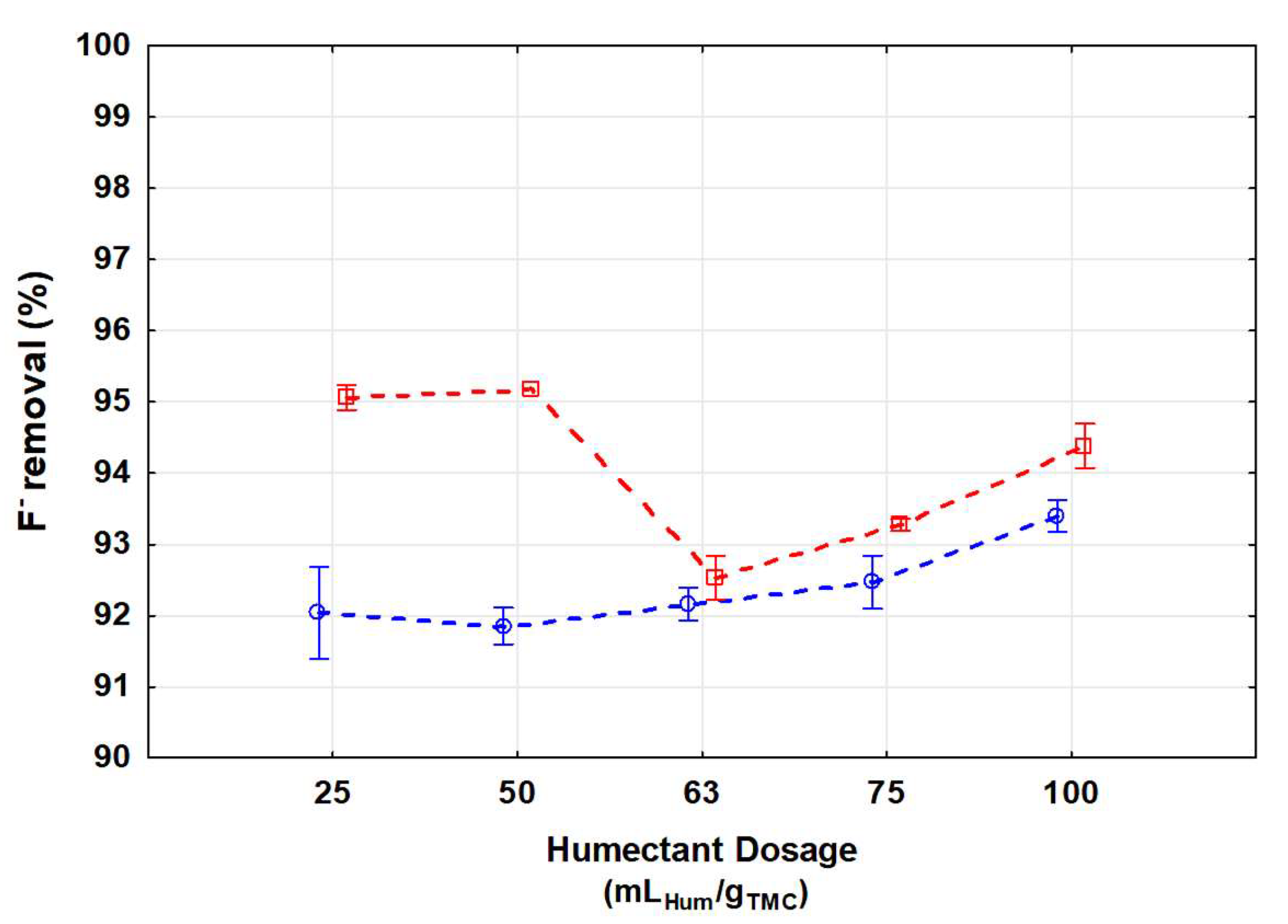
Figure 2.
Response surface for the percentage removal of F¯ present in groundwater using sunflower oil as wetting agent in the SAT.
Figure 2.
Response surface for the percentage removal of F¯ present in groundwater using sunflower oil as wetting agent in the SAT.
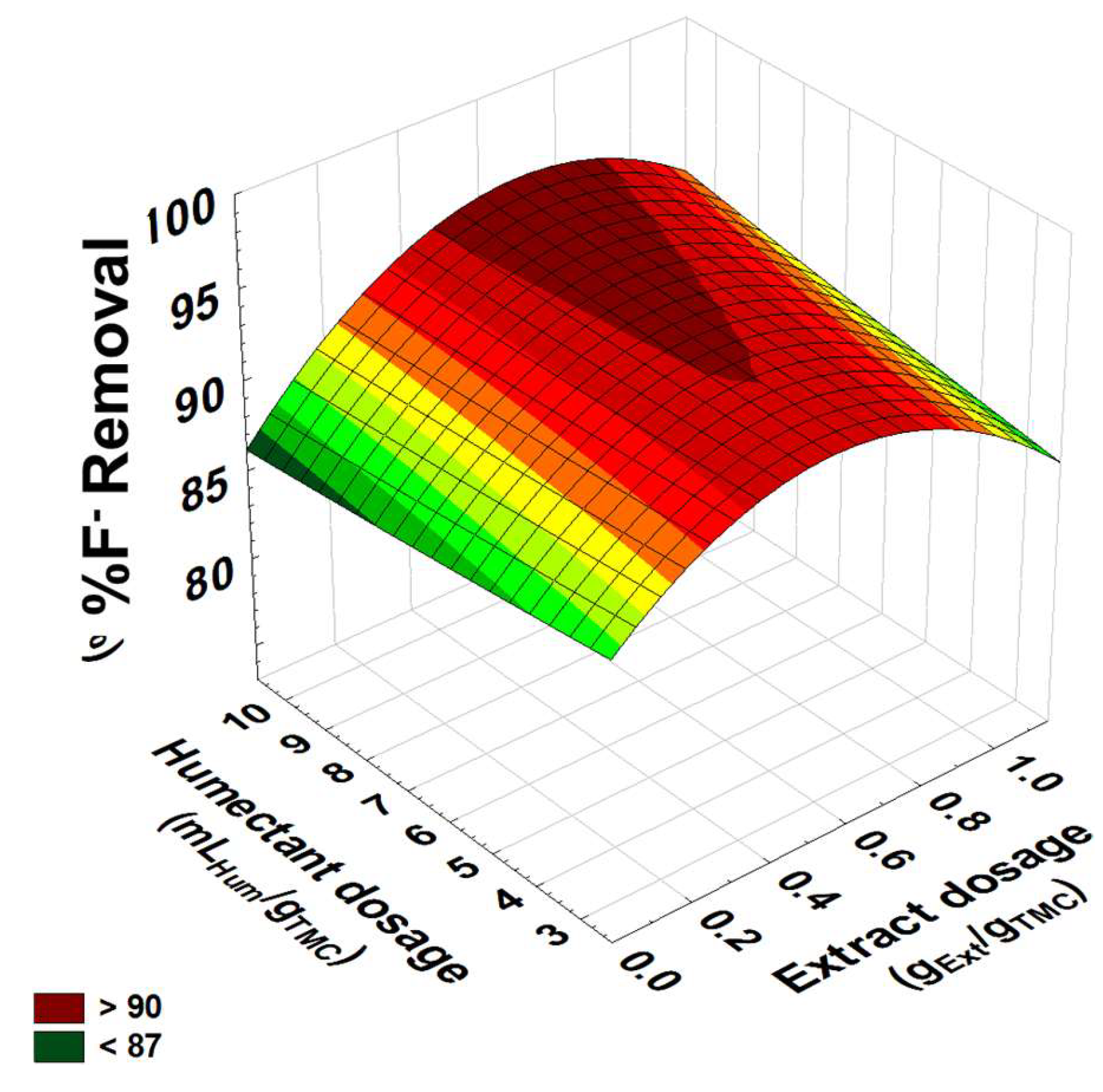
Figure 3.
Response surface for the percentage removal of F¯ present in well water using sunflower oil as wetting agent in the SAT.
Figure 3.
Response surface for the percentage removal of F¯ present in well water using sunflower oil as wetting agent in the SAT.
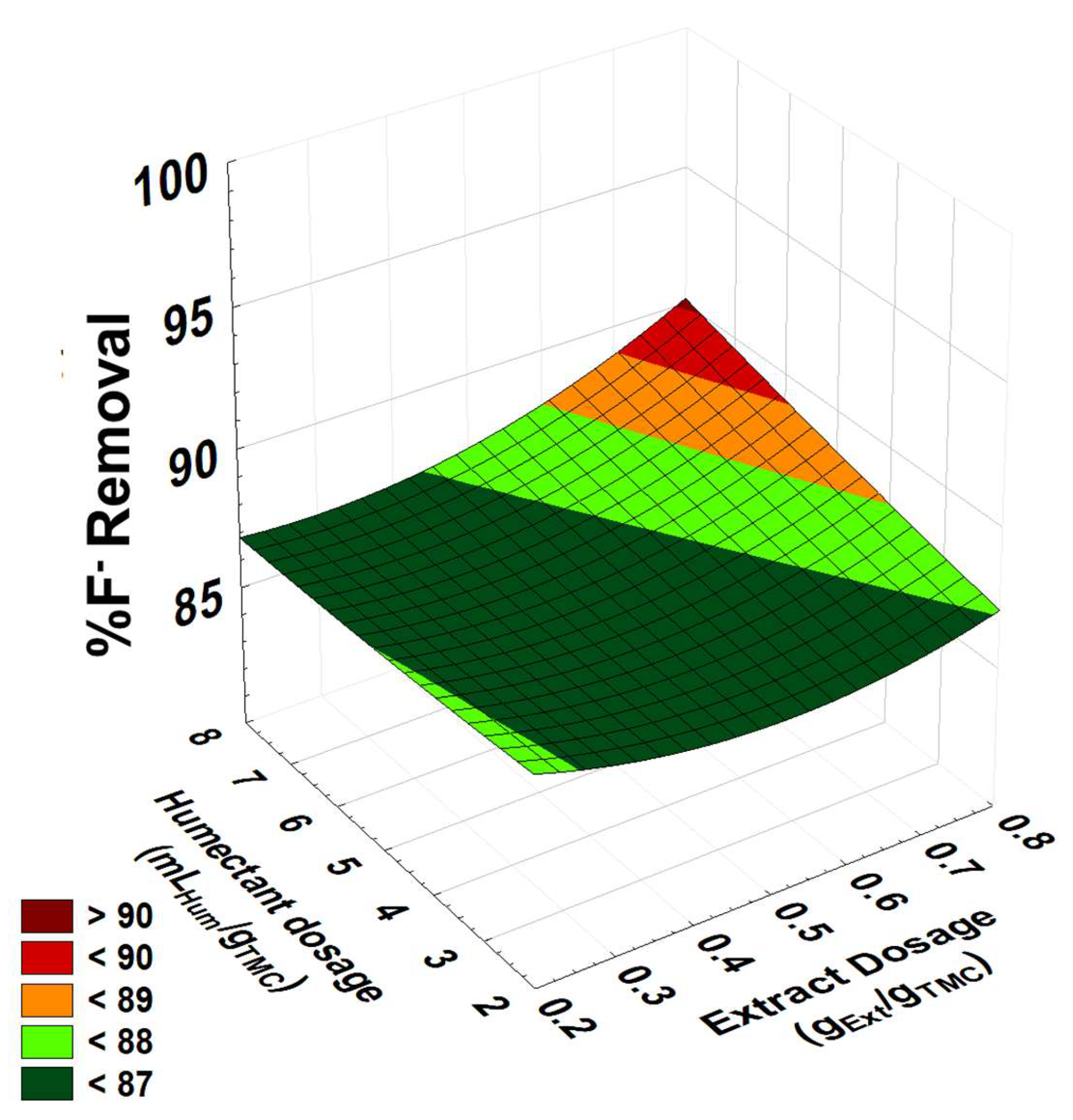

Table 1.
Comparison of Fluoride Removal Efficiency Between n-Heptane and Sunflower Oil During the Third Stage of SAT process
Table 1.
Comparison of Fluoride Removal Efficiency Between n-Heptane and Sunflower Oil During the Third Stage of SAT process
| n-Heptane | |||||
|---|---|---|---|---|---|
|
Humectant dosage (mLHum/gTMC) |
pHfinal |
[F−]final (mg/L) |
|||
| 2.5 | 7.04 | 0.43* | ± | 0.04 | |
| 5 | 7.1 | 0.44* | ± | 0.02 | |
| 6.3 | 7.11 | 0.42* | ± | 0.02 | |
| 7.5 | 7.09 | 0.41* | ± | 0.03 | |
| 10 | 7.11 | 0.36* | ± | 0.02 | |
| Sunflower oil | |||||
|
Humectant dosage (mLHum/gTMC) |
pHfinal |
[F−]final (mg/L) |
|||
| 2.5 | 7.1 | 0.27* | ± | 0.01 | |
| 5 | 7.15 | 0.26* | ± | 0.01 | |
| 6.3 | 7.04 | 0.40* | ± | 0.02 | |
| 7.5 | 7.12 | 0.36* | ± | 0.01 | |
| 10 | 7.05 | 0.30* | ± | 0.02 | |
| - Initial fluoride concentration: 5.0 mg/L; * Values below NOM-SSA-127-SSA1–2021 (1.0 µg/L); pH between 6.5 and 8. | |||||
Table 2.
Fluoride removal efficiency under optimized humectant and surfactant conditions using SAT
| Surfactant dosage (g Ext/g TMC) |
Humectant dosage (mL Hum/gTMC) |
pHfinal | [F−]final (mg/L) |
||
|---|---|---|---|---|---|
| 1 | 2.5 | 7.14* | 0.61* | ± | 0.01 |
| 0.75 | 2.5 | 7.12* | 0.34* | ± | 0.03 |
| 0.5 | 2.5 | 7.10* | 0.27* | ± | 0.01 |
| 0.25 | 2.5 | 7.14* | 0.41* | ± | 0.02 |
| 0 | 2.5 | 7.0* | 0.67* | ± | 0.01 |
| 1 | 5 | 7.2* | 0.37* | ± | 0.01 |
| 0.75 | 5 | 7.25* | 0.38* | ± | 0.01 |
| 0.5 | 5 | 7.15* | 0.26* | ± | 0.04 |
| 0.25 | 5 | 7.12* | 0.45* | ± | 0.02 |
| 0 | 5 | 7.14* | 0.67* | ± | 0.01 |
| 1 | 7.5 | 7.0* | 0.51* | ± | 0.01 |
| 0.75 | 7.5 | 7.0* | 0.28* | ± | 0.02 |
| 0.5 | 7.5 | 7.12* | 0.36* | ± | 0.02 |
| 0.25 | 7.5 | 7.15* | 0.50* | ± | 0.02 |
| 0 | 7.5 | 7.11* | 0.68* | ± | 0.02 |
| 1 | 10 | 7.1* | 0.31* | ± | 0.01 |
| 0.75 | 10 | 7.09* | 0.30* | ± | 0.01 |
| 0.5 | 10 | 7.05* | 0.30* | ± | 0.01 |
| 0.25 | 10 | 7.0* | 0.57* | ± | 0.01 |
| 0 | 10 | 7.04* | 0.65* | ± | 0.02 |
* Values below NOM-SSA-127-SSA1–2021 (1.0 µg/L); pH between 6.5 and 8.
Table 3.
Fluoride Removal Efficiency in Well Water Using the Spherical Agglomeration Technique (SAT) with Sunflower Oil as a Humectant
Table 3.
Fluoride Removal Efficiency in Well Water Using the Spherical Agglomeration Technique (SAT) with Sunflower Oil as a Humectant
| Dosis surfactante (gExt/gTMC) |
Dosis humectante (mLHum/gTMC) |
pHfinal | [F−]final (mg/L) |
||
|---|---|---|---|---|---|
| 0.25 | 2.5 | 7.0* | 0.63* | ± | 0.02 |
| 0.25 | 5 | 7.03* | 0.66* | ± | 0.01 |
| 0.25 | 7.5 | 7.05* | 0.67* | ± | 0.01 |
| 0.5 | 2.5 | 7.07* | 0.71* | ± | 0.02 |
| 0.5 | 5 | 7.03* | 0.68* | ± | 0.01 |
| 0.5 | 7.5 | 7.02* | 0.61* | ± | 0.02 |
| 0.75 | 2.5 | 7.03* | 0.64* | ± | 0.01 |
| 0.75 | 5 | 7.0* | 0.58* | ± | 0.01 |
| 0.75 | 7.5 | 7.04* | 0.55* | ± | 0.02 |
* Values below NOM-SSA-127-SSA1–2021 (1.0 µg/L); pH between 6.5 y 8.
Disclaimer/Publisher’s Note: The statements, opinions and data contained in all publications are solely those of the individual author(s) and contributor(s) and not of MDPI and/or the editor(s). MDPI and/or the editor(s) disclaim responsibility for any injury to people or property resulting from any ideas, methods, instructions or products referred to in the content. |
© 2025 by the authors. Licensee MDPI, Basel, Switzerland. This article is an open access article distributed under the terms and conditions of the Creative Commons Attribution (CC BY) license (http://creativecommons.org/licenses/by/4.0/).
Copyright: This open access article is published under a Creative Commons CC BY 4.0 license, which permit the free download, distribution, and reuse, provided that the author and preprint are cited in any reuse.


