

Submitted:
21 February 2025
Posted:
24 February 2025
You are already at the latest version
Abstract
Objectives: The purpose of this investigation was to review the cardiovascular responses after experimental conditions of massage – manual (MM) or with foam rolling (FR) – combined or not with strength training in healthy adults. Methods: A search was performed in CINAHL, Cochrane Library, PubMed®, and SciELO databases on January 29, 2025. Results: Among the 214 studies retrieved in the database search, 6 were selected for the present review. The included studies pointed to an improvement in cardiovascular responses characterized reduced in arterial stiffness and blood pressure and an increase in nitric oxide concentration and blood flow. These findings suggest that physical exercise prescribers should consider the cardiovascular effects promoted by massage (MM or FR). Conclusions: A change in arterial compliance, followed by a hypotensive effect on systolic blood pressure, reinforces the role of physical activity as a non-pharmacological agent and highlights the need for inclusion in the different groups that need adjuvant help for blood pressure control.
Keywords:
exercise cardiology
; post-exercise hypotension
; myofascial release
; manual therapy
1. Introduction
Chronic elevation in blood pressure (BP) is associated with an increased risk of cardiovascular events [1,2], raising worldwide concern as a public health issue [3,4]. Non-pharmacological strategies that acutely lower BP have been investigated, with temporary BP reductions being reported to prevent chronic hypertension. The American College of Sports Medicine [5] promotes regular physical activity as an important non-pharmacological intervention for improving and maintaining health, as well as promoting acute and chronic BP reductions [6], including the prevention of hypertension in people with optimal blood pressure [7]. Regarding acute BP reductions, different strategies have been tested to promote post-exercise hypotension (PEH) [8], with aerobic exercise being the most studied and recommended one [9]. In recent years, the evidence for strength training (ST) has increased; of notice, that a single ST session can result in a decrease in resting BP after the session [10].
Similar PEH effects, but in smaller studies, are observed when using foam rolling (FR) [11,12]. Liao et al. [13] conducted a systematic review with meta-analysis and observed that the classic massage therapy technique promotes PEH in systolic blood pressure (SBP) (-7.39 mmHg; effect size = -0.728) and diastolic blood pressure (DBP) (-5.04 mmHg; effect size = -0.334). These findings support a similar responsive hypothesis for the manual massage (MM) technique given the similarity in the application of both techniques (FR vs. MM – pressure and tissue sliding). Despite the differences between the two intervention strategies, it can be argued that both FR and MM may have similar effects [14]. It is hypothesized that mechanoreceptors within muscle and fascia when activated, have inhibitory effects such as decreased muscle tone [14]. This reduced muscle tone can promote a shift from sympathetic to parasympathetic dominance, facilitating the processes for PEH to occur. Thus, FR could be a useful tool to acutely reduce BP values.
Nevertheless, little is known in the literature about the BP response to the different combinations of FR and ST. Thus, the initial BP response is well-established [15]. An acute transient increase occurs during exercise [16,17], generated by the interaction of all BP regulatory mechanisms to meet the increased energy demand [18,19,20] and to overcome the dramatic acute increase in total peripheral resistance during exercise [17]. After such transient changes and once the exercise is finished, BP returns to resting levels or below [21], reflecting, among many other factors, the change in total peripheral resistance. However, these reductions in BP are immediate and short-term, with the later resting periods (>30 min after exercise) receiving limited attention in the literature, particularly in women. Nonetheless, it seems that a delayed BP reduction may occur.
Since ST and FR provide different initial stimuli to the nervous system related to acute BP regulation after these activities, the combination of ST and FR may have additive effects on BP responses. If such synergy exists for the BP response in normotensive individuals, it could suggest an additional benefit of adding FR to an ST routine, particularly if the recommended dose of ST to produce the hypotensive effect cannot be attained. Thus, the purpose of this investigation was to review the cardiovascular responses after experimental conditions of massage – manual (MM) or with foam rolling (FR) – combined or not with strength training in healthy adults.
2. Materials and Methods
Experimental Approach to the Problem
This scoping review adheres to the Preferred Reporting Items for Systematic Reviews and Meta-Analyses for Scoping Reviews (PRISMA-ScR) guidelines [22]. The steps outlined by Arksey and O'Malley [23] were employed for the current scoping review. According to Munn et al. [24], a scoping review can be conducted in place of a systematic review when the objective is to identify knowledge gaps, evaluate a body of literature, clarify concepts, or investigate research behavior.
Stage 1: Identification of the Research Question/Objective
The purpose of the current scoping review was to examine the cardiovascular responses after experimental conditions of massage (MM or FR) combined or not with ST in healthy adults.
Stage 2: Identification of Relevant Studies
Studies were retrieved through electronic database searches and a comprehensive scan of the reference lists of included studies. The search was conducted on January 29th, 2025, using the following databases: Nursing and Allied Health (CINAHL), Cochrane Library, PubMed®, and SciELO.
Stage 3: Study Selection
The five PICOS criteria were employed [25]: (P) a physically active population of both sexes aged between 18 and 59 years; (I) interventions of MM and FR performed in combination or separately with strength training; (C) compared to a no intervention approach (control group); (O) assessing autonomic responses (heart rate variability), hemodynamic responses (blood pressure, heart rate, double product), cardiac output, and arterial vascular perfusion as outcomes; (S) studies with randomized controlled or crossover counterbalanced designs were included.
The inclusion criteria adopted for study selection were: (1) original studies published without temporal restrictions; (2) interventions based on MM and FR, along with strength training; (3) studies assessing at least one of the outcomes of interest; (4) studies with randomized controlled or crossover counterbalanced designs. The exclusion criteria were: (1) duplicate studies; (2) studies not written in English or Portuguese languages; (3) studies that did not isolate or combine the effects of MM, FR, and strength training; (4) studies that tested the effects of MM, FR, and strength training in populations with specific health conditions (e.g., hypertensive individuals and pregnant women); (5) studies involving animal models.
The search strategy combined the following descriptors and Boolean operators (AND/OR/NOT): (‘myofascial release’ OR ‘self-myofascial release’ OR ‘massage’ OR ‘manual massage’ OR ‘foam rolling’ OR ‘rolling massage’) AND (‘resistance training’ OR ‘resistance exercise’ OR ‘strength training’ OR ‘strength exercise’ OR ‘weight training’ OR ‘weight exercise’ OR ‘weightlifting’ OR ‘weight-lifting’ OR ‘weight lifting’) AND (‘blood pressure’ OR ‘hemodynamic response’ OR ‘autonomic response’ OR ‘heart rate’ OR ‘heart rate variability’ OR ‘rate product pressure’ OR ‘cardiac output’ OR ‘arterial function’ OR ‘arterial tissue perfusion’ OR ‘vascular tissue perfusion’) NOT (‘review’) with its respective translation to the Portuguese.
Stage 4: Data Mapping
The studies retrieved from each database were imported into EndNote X9 software (Clarivate Analytics, Philadelphia, USA), and duplicate studies were automatically and manually removed. Titles and abstracts were assessed according to eligibility criteria by two independent researchers. Conflicts were resolved by a third reviewer. Researchers were not blinded to authors, institutions, or journals. Abstracts lacking decisive information were selected for full-text inspection.
Two reviewers extracted data from the full texts using a standardized and pre-structured protocol. The collected data included participants' characteristics (sample size, age, height, body mass, training status, and sex) and treatment protocols (study, objective, interventions, and results). The data extracted by both reviewers were compared, and any discrepancies were resolved through consensus. Whenever possible, data were directly copied and pasted to avoid any misinterpretation.
The methodological quality of the selected studies was assessed using the Centre of Evidence-Based Physiotherapy proposal [26]. The PEDro scale comprises a list of 11 criteria. Clear and unambiguous meetings of a criterion result in the award of 1 point. Scores between 6 and 10 points, 4 and 5 points, and 0 and 3 points are classified as high, moderate, and low quality, respectively. Two authors applied the scale, and any disagreements regarding the PEDro scores classification were resolved through a consensus discussion among the authors. In cases where a consensus could not be reached, a third researcher was invited to provide their opinion. It's important to note that the PEDro scale classification was limited to describing the study quality and was not used as a criterion for study inclusion or exclusion.
Stage 5: Gathering, Summarizing, and Reporting the Results
The "descriptive-analytic" method of the narrative tradition was employed, involving the application of a common analytical framework to all included research reports and the collection of standard information in each review.
3. Results
Figure 1 presents the flowchart summarizing the outcome of each stage of the research.
Among the 214 studies retrieved from the database search, 6 were selected for the current review. The details of the characteristics of the 75 participants and the 6 included studies are presented in Table 1 and Table 2, respectively.
Study Quality
The specific score attained by each investigation according to the PEDro scale criteria is depicted in Table 2. The results of the PEDro scale showed a moderate to high rating for the studies included in this review. We observed no substantive variation in the quality among the selected studies.
Hemodynamic Response
Five included studies point to an improvement in hemodynamic responses, promoting a reduction in arterial stiffness [12], increased vasodilatory responses due to higher nitric oxide concentration [12], increased blood flow between elbow and ankle [11], and a reduction in SBP [21,27,28] following interventions of manual massage, whether with FR [11,12,21,27,28] or manual [21]. However, Monteiro et al. [29] did not observe PEH in SBP or DBP either when FR was performed alone or combined with ST.
Autonomic Response
Only one study [27] has explored the effects of heart rate variability after the isolated application of FR. The authors showed improved sympathovagal control, tending towards reduced sympathetic activity.
4. Discussion
This scoping review summarized the acute effects of massage (MM or FR) conducted alone or combined with ST on cardiovascular responses in healthy adults. The main findings reveal a positive influence on cardiovascular responses after MM or FR [11,12,21,27,28,29]. Specifically, these findings are consistent with prior literature that addressed different techniques but elicited similar response patterns.
Walaszek [30] implemented ten sessions of massage therapy on the lower limbs of elderly hypertensive women and observed significant post-exercise hypotension in SBP. Similarly, Givi et al. [31] also observed post-exercise hypotension in SBP in 50 pre-hypertensive women who underwent Swedish Therapeutic Massage intervention with non-aromatic topical lotion on the face, neck, shoulders, and upper chest, using both superficial and deep strokes, three times per week (morning to noon, 8 am to 12 pm) for 10-15 minutes each session, over a period of 10 sessions within 3.5 weeks, in the supine position. Liao et al. [13] conducted a systematic review with meta-analysis and concluded that different massage therapy techniques (Swedish Therapeutic Massage, chair massage, light touch massage, and soothing touch massage) significantly contribute to the reduction of both SBP (-7.39 mmHg; SE = -0.728) and DBP (-5.04 mmHg; SE = -0.334). Altogether, these studies [13,31,32] support the main observations found in this review. However, they were not included in this review because they employed different techniques from those targeted in this review. Therefore, the fact that different techniques elicit similar central responses suggests that such effects stem from therapeutic touch [33,34,35], which triggers responses at the central nervous system level. For example, White and Raven [36] indicate that during exercise, there is a reversal in the action of the autonomic nervous system in controlling cardiac activity, attempting to maintain homeostasis, thus reducing vagal control. Hence, it is hypothesized that mechanoreceptors located within the muscle and fascia, when activated, decrease muscle tone, promoting an increase in parasympathetic response and the release of neuropeptides and endocannabinoids with subsequent reduction in blood pressure [14].
Despite different techniques, in addition to the event of responses, different stretching strategies also present a significant hypotensive effect, highlighting the importance of touch perception in both strategies (manual massage and stretching). For example, Inami et al. [20] observed that SBP was higher during the application of static stretching (SS), but this increase was transient, returning to baseline values immediately after the intervention. An additional investigation conducted by Da Silva Araújo et al. [37] observed a 6.1% decrease in SBP after isolated SS. Da Silva Araújo et al. [37] also investigated the combination of ST with SS and whether the order in which they are performed influences the magnitude of the BP response, and they reported a significantly positive HPE response regardless of the order. Souza et al. [38] reported similar findings, observing reductions of up to 12.2 mmHg over 60 minutes post-ST+SS. One potential mechanism that seems to explain these findings is that SS can reduce blood flow by reducing the diameter of blood vessels through mechanical obstruction generated by muscle contractions and also by nutrient supply. This mechanism was reported by Kruse and Scheuermann [39], who observed that at the beginning of stretching, mechanical vascular deformation along with stimulation of group III afferent fibers initiates a cascade of events resulting in peripheral vasodilation and an increase in heart rate, cardiac output, blood pressure, and blood flow.
Our findings indicate positive cardiovascular responses, even when massage (MM or FR) was performed in isolation. Lastova et al. [27] investigated BP response 10 and 30 minutes after a FR session for the thigh (adductors, posterior, anterior, and lateral), calf (gastrocnemius), and back (upper and lower). The authors observed a significant decrease in SBP with a concomitant increase in vagal modulation up to 30 minutes after FR. This finding is consistent with that of Monteiro et al. [28], who observed substantial reductions (d = -0.98 to -3.26) in SBP with FR, supporting the results of Lastova et al. [27]. Both findings for FR (whether isolated or combined with strength training) provide important insights that may have clinical implications, especially in population groups who are unable to exercise regularly or meet the minimum recommended exercise dose for health improvement due to their characteristics, such as physical limitations, frailty, lack of physical condition, or cardiovascular problems.
Lastly, it is worth noting that Lastova et al. [27] measured BP only 30 minutes after FR, leaving a gap in interpretation as to whether this reduction may persist beyond that time point. The specific physiological mechanisms underlying the BP response to FR are only beginning to be elucidated. Okamoto et al. [12] observed a higher concentration of nitric oxide after FR, indicating a greater vasodilatory effect that could reduce SBP, double product, and heart rate. Hotfiel et al. [11] observed increased local arterial perfusion in the lateral thigh region after FR. The authors also associate these modifications with vasodilation caused by increased nitric oxide after FR.
The present review was reported following the guidelines of the Preferred Reporting Items for Systematic Reviews and Meta-Analyses for Scoping Reviews (PRISMA-ScR) [22], which helps minimize potential limitations related to the reproducibility of our findings. However, some potential limitations are noted. First, the search was conducted in four major electronic databases (Nursing and Allied Health (CINAHL), Cochrane Library, PubMed®, and SciELO), but no other databases or "gray literature" were searched. Therefore, relevant additional studies may have been missed. Second, only 6 articles met the inclusion criteria and were included in this review. While this number may be seen as a potential limitation, it represents the state-of-the-art literature in the searched databases. Third, we excluded articles published in preprint databases due to the lack of peer review.
5. Conclusions
The findings of this scoping review indicate positive responses in cardiovascular variables, which may help influence the decision-making of professionals prescribing exercise to cardiovascular responses in normotensive and hypertensive participants. Although the investigations included in this review were acute, the observed data suggest that both MM and FR can be powerful tools for improving cardiovascular aspects. However, it is emphasized that longitudinal studies are essential for a better understanding of these parameters.
Author Contributions
Conceptualization, E.R.M., V.G.C.N., and J.d.S.N.; methodology, E.R.M., V.G.C.N., A.d.S.F., and J.d.S.N.; formal analysis, E.R.M., M.R.-A., G.d.S.A., V.G.C.N., A.d.S.F., and J.d.S.N.; investigation, E.R.M., V.G.C.N., L.M.A., J.d.S.N.; resources, E.R.M., V.G.C.N., L.M.A., J.d.S.N.; data curation, E.R.M., V.G.C.N., L.M.A., J.d.S.N.; writing—original draft preparation, E.R.M., M.R.-A., G.d.S.A., V.G.C.N., L.M.A., C.M.B., J.V.-A., V.M.R., D.G.M., A.d.S.F., and J.d.S.N.; writing—review and editing, E.R.M., M.R.-A., G.d.S.A., V.G.C.N., L.M.A., C.M.B., J.V.-A., V.M.R., D.G.M., A.d.S.F., and J.d.S.N.; visualization, E.R.M., M.R.-A., G.d.S.A., V.G.C.N., L.M.A., C.M.B., J.V.-A., V.M.R., D.G.M., A.d.S.F., and J.d.S.N.; supervision, V.G.C.N., and J.d.S.N. All authors have read and agreed to the published version of the manuscript.
Funding
MRA acknowledges the financial support received from the Spanish Ministry of Universities through the Grants for the Recalibration of the Spanish University System under the Postdoctoral Margarita Salas Programme (RSUC.UDC.MS09), funded by the European Union – Next Generation. This study was supported by the Fundação Carlos Chagas Filho de Apoio à Pesquisa do Estado do Rio de Janeiro (FAPERJ, No. E-26/211.104/2021) and Coordenação de Aperfeiçoamento de Pessoal (CAPES, Finance Code 001; No. 88881.708719/2022-01, and No. 88887.708718/2022-00).
Institutional Review Board Statement
Not applicable.
Informed Consent Statement
Not applicable.
Data Availability Statement
Not applicable.
Acknowledgments
We would like to acknowledge the contributions of all participating.
Conflicts of Interest
The authors declare no conflicts of interest.
Abbreviations
The following abbreviations are used in this manuscript:
| BP | Blood Pressure |
| PEH | Post-Exercise Hypotension |
| ST | Strength Training |
| SBP | Systolic Blood Pressure |
| DBP | Diastolic Blood Pressure |
| MM | Manual Massage |
| FR | Foam Rolling |
| PRISMA-ScR | Preferred Reporting Items for Systematic Reviews and Meta-Analyses for Scoping Reviews |
| CINAHL | Nursing and Allied Health |
| SS | Static Stretching |
References
- Schiffrin, E.L. Immune mechanisms in hypertension and vascular injury. Clin Sci (Lond) 2014, 126, 267–274. [Google Scholar] [CrossRef] [PubMed]
- Whelton, P.K.; Carey, R.M.; Aronow, W.S.; Casey, D.E.; Collins, K.J.; Hilmmerfab, C.D.; DePalma, S.M.; Gidding, S.; Jamerson, K.A.; Jones, D.W.; et al. 2017. ACC/AHA/AAPA/ABC/ACPM/AGS/APhA/ASH/ASPC/NMA/PCN. A Guideline for the Prevention, Detection, Evaluation, and Management of high blood pressure in adults: executive summary. A report of the American College of Cardiology/American Heart Association, Task Force on Clinical Practice Guidelines. Circulation 2018, 138, 426–483.
- Macdonald, H.V.; Johnson, B.T.; Huedo-Medina, T.B.; Livingston, J.; Forsyth, K.C.; Kraemer, W.J. Dynamic resistance training as stand-alone antihypertensive lifestyle therapy: a meta-analysis. J Am Heart Assoc 2016, 5, e003231. [Google Scholar] [CrossRef] [PubMed]
- Mills, K.T.; Bundy, J.D.; Kelly, T.N.; Reed, J.E.; Keaney, P.M.; Reynolds, K.; Chen, J.; He, Jiang, He. Global disparities of hypertension prevalence and control: a systematic analysis of population-based studies from 90 countries. Circulation 2016, 134, 441–450.
- American College of Sports Medicine - Position Stand. Quantity and quality of exercise for developing and maintaining cardiorespiratory, musculoskeletal, and neuromotor fitness in apparently healthy adults: Guidance for prescribing exercise. Med Sci Sport Exerc 2011, 43, 1334–1359. [CrossRef]
- Brook, R.D.; Appes, L.J.; Rubenfire, M.; Ogedegbe, G.; Bisognano, J.D.; Elliott, W.J.; Fuchs, F.D.; Hughes, J.W.; Lacland, D.T.; Staffileno, B.A.; et al. Beyond medications and diet: alternative approaches to lowering blood pressure: a scientific statement from the American Heart Association. Hypertension 2013, 61, 1360–1383. [Google Scholar] [CrossRef]
- Arnett, D.D.; Blumenthal, R.S.; Albert, M.A.; Buroker, A.B.; Goldberger, Z.D.; Hahn, E.J. ACC/AHA Guideline on the Primary Prevention of Cardiovascular Disease: A Report of the American College of Cardiology/American Heart Association Task Force on Clinical Practice Guidelines. Circulation 2019, 140, e596–e646. [Google Scholar]
- Pescatello, L.S.; Buchner, D.M.; Jakicic, J.M.; Powell, K.E.; Kraus, W.E.; Bloodgood, B.; Campbell, W.W.; Dietz, S.; Dipietro, L.; George, S.M.; et al. Physical activity to prevent and treat hypertension: a systematic review. Med Sci Sports Exerc 2019, 51, 1314–1323. [Google Scholar] [CrossRef]
- Fidalgo, A.S.F.; Farinatti, P.; Borges, J.P.; De Paula, T.; Monteiro, W. Institutional Guidelines for Resistance Exercise Training in Cardiovascular Disease: A Systematic Review. Sports Med 2019, 49, 463–475. [Google Scholar] [CrossRef]
- Casonatto, J.; Goessler, K.F.; Cornelissen, V.A.; Cardoso, J.R.; Polito, M.D. The blood pressure-lowering effect of a single bout of resistance exercise: A systematic review and meta-analysis of randomised controlled trials. Eur J Prev Cardiol 2016, 23, 1700–1714. [Google Scholar] [CrossRef]
- Hotfiel, T.; Swoboda, B.; Krinner, S.; Grim, C.; Engelhardt, M.; Uder, M.; Heiss, R.U. Acute effects of lateral thigh foam rolling on arterial tissue perfusion determined by spectral doppler and power doppler ultrasound. J Strength Cond Res 2017, 31, 893–900. [Google Scholar] [CrossRef] [PubMed]
- Okamoto, T.; Masuhara, M.; Ikuta, K. Acute effects of self-myofascial release using a foam roller on arterial function. J Strength Cond Res 2014, 28, 69–73. [Google Scholar] [CrossRef] [PubMed]
- Liao, I.C.; Chen, S.L.; Wang, M.Y.; Tsai, P.S. Effects of massage on blood pressure in patients with hypertension and prehypertension: a meta-analysis of randomized controlled trials. J Cardiovasc Nurs 2016, 31, 73–83. [Google Scholar] [CrossRef] [PubMed]
- Beardsley, C.; Škarabot, J. Effects of self-myofascial release: A systematic review. J Bodyw Mov Ther 2015, 19, 747–758. [Google Scholar] [CrossRef]
- Fisher, M.M. The effect of resistance exercise on recovery blood pressure in normotensive and borderline hypertensive women. J Strength Cond Res 2001, 15, 210–216. [Google Scholar]
- Figueiredo, T.; Willardson, J.M.; Miranda, H.; Bentes, C.M.; Reis, V.M.; De Salles, B.F.; Simão, R. Influence of rest interval length between sets on blood pressure and heart rate variability after a strength training session performed by pre hypertensive men. J Strength Cond Res 2016, 30, 1813–1824. [Google Scholar] [CrossRef]
- Mayo, J.J.; Kravitz, L. A Review of the Acute Cardiovascular Responses to Resistance Exercise of Healthy Young and Older Adults. J Strength Cond Res 1999, 13, 90–96. [Google Scholar]
- Antonio, C.L. Antonio, C. L. Nobrega, Donal O'Leary, Bruno Moreira Silva, Elisabetta Marongiu, Massimo F. Piepoli, and Antonio Crisafulli, “Neural Regulation of Cardiovascular Response to Exercise: Role of Central Command and Peripheral Afferents,” BioMed Research International, vol. 2014, Article ID 478965, 20 pages, 2014. [CrossRef]
- Gladwell, V.F.; Coote, J.H. Heart rate at the onset of muscle contraction and during passive muscle stretch in humans: a role for mechanoreceptors. J Physiol 2002, 540, 1095–1102. [Google Scholar] [CrossRef]
- Inami, T.; Bara, R.; Nakagari, A.; Shimizu, T. Acute changes in peripheral vascular tonus and systemic circulation during static stretching. Res Sports Med 2015, 23, 167–178. [Google Scholar] [CrossRef]
- Monteiro, E.R.; Pescatello, L.S.; Winchester, J.B.; Corrêa Neto, V.G.; Brown, A.F.; Budde, H.; Marchetti, P.H.; Silva, J.G.; Vianna, J.M.; Novaes, J.S. Effects of manual therapies and resistance exercise on postexercise hypotension in women with normal blood pressure. J Strength Cond Res 2022, 36, 948–954. [Google Scholar] [CrossRef]
- Tricco, A.C.; Lillie, E.; Zarin, W.; O´Brien, K.K.; Colquhoun, H.; Levac, D.; Moher, D.; Peters, M.D.J.; Horsley, T.; Weeks, L.; et al. PRISMA Extension for Scoping Reviews (PRISMA-ScR): Checklist and Explanation. Ann Intern Med 2018, 169, 467–473. [Google Scholar] [CrossRef] [PubMed]
- Arksey, H.; O’Malley, L. Scoping studies: towards a methodological framework. Int J Soc Res Methodol Theory Pract 2005, 8, 19–32. [Google Scholar] [CrossRef]
- Munn, Z.; Peters, M.D.J.; Tufanaru, C.; McArthur, A.; Aromataris, E. Systematic review or scoping review? Guidance for authors when choosing between a systematic or scoping review approach. BMC Med Res Methodol 2018, 18, 143. [Google Scholar] [CrossRef] [PubMed]
- Brown, P.; Brunnhuber, K.; Chalkidou, K.; Chalmers, I.; Clarke, M.; Fenton, M.; Forbes, C.; Glanville, J.; Hickes, N.J.; Moody, J.; et al. How to formulate research recommendations. BMJ 2006, 333, 804–806. [Google Scholar] [CrossRef]
- Center for Evidence-Based Physiotherapy, 2024. Physiotherapy Evidence Database (PEDro). Available online: https://pedro.org.au/english/resources/pedro-scale/ (accessed on 29 January 2025).
- Lastova, K.; Nordvall, M.; Walters-Edwards, M.; Allnutt, A.; Wong, A. Cardiac autonomic and blood pressure responses to an acute foam rolling session. J Strength Cond Res 2018, 32, 2825–2830. [Google Scholar] [CrossRef]
- Monteiro, E.R.; Vingren, J.L.; Pescatello, L.S.; Corrêa Neto, V.G.; Brown, A.F.; Kingsley, J.D.; Silva, J.G.; Vianna, J.M.; Novaes, J.S. Effects of foam rolling and strength training on post exercise hypotension in normotensive women: a cross-over study. J Bodyw Mov Therapies 2023, 34, 81–86. [Google Scholar] [CrossRef]
- Monteiro, E.R.; Pescatello, L.S.; Leitão, L.; De Miranda, M.J.C.; Marchetti, P.H.; Novaes, M.R.; Araújo, G.S.; Corrêa Neto, V.G.; Novaes, J.S. Muscular Performance and Blood Pressure After Different Pre-Strength Training Strategies in Recreationally Strength-Trained Women: Cross-Over Trial. J Cardiovasc Dev Dis 2024, 12, 7. [Google Scholar] [CrossRef]
- Walaszek, R. Impact of classic massage on blood pressure in patients with clinically diagnosed hypertension. J Tradit Chin Med 2015, 35, 396–401. [Google Scholar] [CrossRef]
- Givi, M.; Sadeghi, M.; Garakyaragui, M.; Eshghinezhad, A.; Moeini, M.; Ghasempour, Z. Long-term effect of massage therapy on blood pressure prehypertensive women. J Educ Health Promot 2018, 7, 54. [Google Scholar] [CrossRef]
- Mills, K.T.; Stefanescu, A.; He, J. The global epidemiology of hypertension. Nat Rev Nephrol 2020, 16, 223–237. [Google Scholar] [CrossRef]
- Berkley, K.J.; Hubscher, C.H. Are there separate central nervous system pathways for touch and pain? Nat Med 1995, 1, 766–773. [Google Scholar] [CrossRef] [PubMed]
- McGlone, F.; Valbo, A.B.; Olausson, H.; Loken, L.; Wessberg, J. Discriminative touch and emotional touch. Can J Exp Psychol 2007, 61, 173–183. [Google Scholar] [CrossRef] [PubMed]
- Preusser, S.; Thiel, S.D.; Rook, C.; Roggenhofer, E.; Kosatschek, A.; Draganski, B.; Blankenburg, F.; Driver, J.; Villringer, A.; Pleger, B. The perception of touch and the ventral somatosensory pathway. Brain 2015, 138, 540–548. [Google Scholar] [CrossRef]
- White, D.W.; Raven, P.B. Autonomic neural control of heart rate during dynamic exercise: revisited. J Physiol 2014, 592, 2491–2500. [Google Scholar] [CrossRef]
- Da Silva Araújo, G.; Behm, D.G.; Monteiro, E.R.; De Melo Fiuza, A.G.F.; Gomes, T.M.; Vianna, J.M.; Reis, M.S.; Novaes, J.S. Order effects of resistance and stretching exercises on heart rate variability and blood pressure in healthy adults. J Strength Cond Res 2019, 33, 2684–2693. [Google Scholar] [CrossRef]
- Souza, A.C.; Gomes, T.M.; Sousa, M.S.; Saraiva, A.R.; Araújo, S.A.; Figueiredo, T.; Novaes, J.S. Static stretch performed after strength training session induces hypotensive response in trained men. J Strength Cond Res 2019, 33, 2981–2990. [Google Scholar] [CrossRef]
- Kruse, N.T.; Scheuermann, B.W. Cardiovascular responses to skeletal muscle stretching: “stretching” the truth or a new exercise paradigm for cardiovascular medicine? Sports Med 2017, 47, 2507–2520. [Google Scholar] [CrossRef]
Figure 1.
Flowchart.
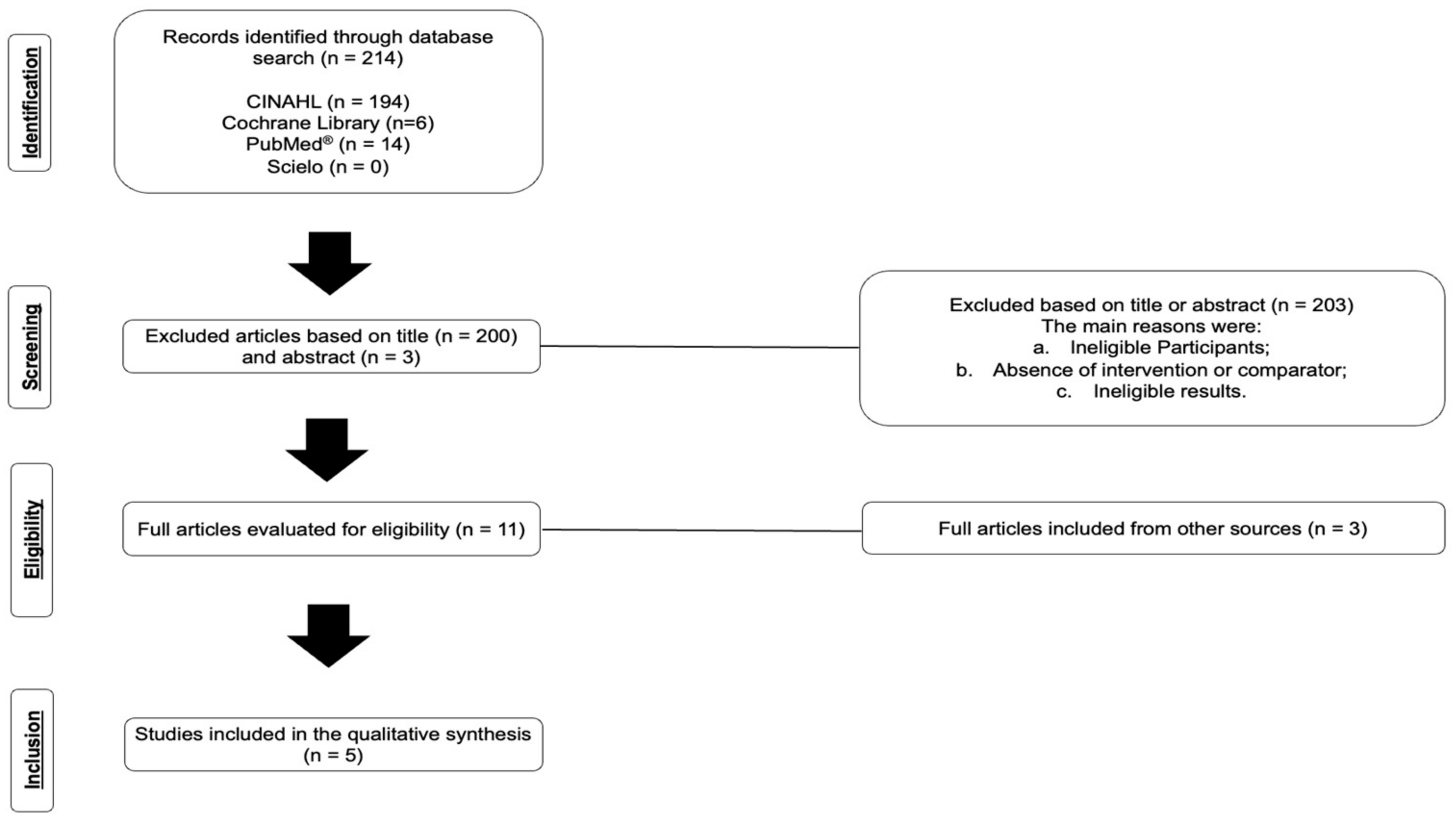

Table 1.
Characteristics of the participants (n = 6 studies).
| Studies | Sample Size (n = 75) | Age (years) | Height | Body Mass (kg) | Training Status | Sex |
|---|---|---|---|---|---|---|
| Okamoto et al. [12] | 10 (7 men and 3 women) | 19.9 ± 0.3 | 162.7 ± 8.1 cm | 60.6 ± 11.2 | Recreational strength training | Both sexes |
| Hotfiel et al. [11] | 21 (12 men and 9 women) | 25 ± 2 | 177 ± 9 cm | 74 ± 9 | Recreational strength training | Both sexes |
| Lastova et al. [27] | 15 (8 men and 7 women) | 21.55 ± 0.52 | 1.72 ± 0.02 m | 74.79 ± 2.88 | N/A | Both sexes |
| Monteiro et al. [21] | 16 | 25.1 ± 2.9 | 158.9 ± 4.1 cm | 59.5 ± 4.9 | Recreational strength training | Women |
| Monteiro et al. [28] | 16 | 25.5 ± 2.0 | 155.7 ± 4.4 cm | 61.2 ± 5.4 | Recreational strength training | Women |
| Monteiro et al. [29] | 12 | 27.2 ± 3.3 | 164.8 ± 5.5 cm | 69.8 ± 6.0 | Recreational strength training | Women |
N/A = not applicable.
Table 2.
Summary and characteristics of the studies included in the review (n = 5 studies).
| Studies | Objective | Interventions | Results | PEDro |
|---|---|---|---|---|
| Okamoto et al. [12] | Investigate the acute effect of foam rolling on arterial stiffness and vascular endothelial function. | The foam rolling condition was performed on the adductors, hamstrings, quadriceps, iliotibial band, and trapezius regions. Each participant practiced 2 or 3 times to learn the correct foam rolling technique with the guidance of a coach and performed 20 repetitions in each region with 1-minute intervals. The pressure was self-adjusted by applying body weight to the roller and using hands and feet to regulate pressure as needed. The roller was placed under the target tissue area, and the body was moved back and forth along the roller. In the control condition, participants rested in a quiet, temperature-controlled room while lying supine. |
The ankle-brachial pulse wave velocity significantly decreased (from 1202 ± 105 to 1074 ± 110 cm/s), and plasma nitric oxide concentration significantly increased (from 20.4 ± 6.9 to 34.4 ± 17.2 μmol/L) after the myofascial release condition with foam rolling (both p < 0.05), but neither of them differed significantly after the control condition. | 5 (moderate) |
| Hotfiel et al. [11] | Evaluate the effect of foam rolling on arterial blood flow in the lateral thigh region. | The exercise protocol consisted of 3 sets, each with 45 seconds of foam rolling on the lateral thigh region in the sagittal plane (with 20 seconds of rest between sets). | Arterial tissue perfusion was assessed using Spectral Doppler and Power Doppler Ultrasonography, represented by peak flow velocity, time-averaged maximum velocity, time-averaged mean velocity, and resistive index. Ultrasound data were evaluated under resting conditions (after 20 minutes of rest in a horizontal position) to establish baseline values. The second and third measurements were taken immediately after and 30 minutes after the foam rolling intervention. |
5 (moderate) |
| Lastova et al. [27] | Assess the effects of an acute foam rolling session on heart rate variability and blood pressure in healthy individuals. | In the foam rolling condition, individuals completed 10 repetitions of foam rolling per target area of the body (adductors, hamstrings, quadriceps, iliotibial band, gastrocnemius, and upper trapezius), followed by 1 minute of rest. Each repetition involved moving the target tissue across the roller in a smooth motion at a rate of 2 seconds down and 2 seconds up, as determined by a metronome. The control condition only involved measurements without the application of other experimental conditions. |
Measurement of systolic and diastolic blood pressure, as well as heart rate variability, was conducted at 10 and 30 minutes. The authors observed significant increases (p<0.01) in markers of vagal tone (normalized high-frequency power) 30 minutes after foam rolling, while no changes were observed after the control condition. There were also significant reductions (p<0.05) in markers of sympathetic activity (normalized low-frequency power) and sympathovagal balance (normalized low-frequency to high-frequency ratio). |
7 (high) |
| Monteiro et al. [21] | Examine the acute effects of resistance exercise and different manual therapies (static stretching and manual massage) performed separately or combined on blood pressure responses during recovery in normotensive women. | The control condition consisted solely of measurements without applying any other experimental conditions. Isolated strength training comprised three sets of bench press, back squat, and leg press at an intensity controlled to 80% of 10RM. The isolated static stretching and isolated manual massage conditions were applied unilaterally in two sets of 120 seconds for each quadriceps, hamstrings, and calf region. In the combined condition of strength training and static stretching, stretching was performed immediately after strength training, following the same descriptions as above. In the combined condition of strength training and manual massage, the massage was conducted immediately after strength training, following the same descriptions as above. |
Measurement of systolic and diastolic blood pressure at rest and every 10 minutes after each protocol (Post-0, Post-10, Post-20, Post-30, Post-40, Post-50, and Post-60). Post-exercise hypotension was observed in the experimental conditions of isolated strength training at Post-50 (p = 0.038; d = -2.24; ∆ = -4.0 mmHg), isolated static stretching at Post-50 (p = 0.021; d = -2.67; ∆ = -5.0 mmHg), and Post-60 (p = 0.008; d = -2.88; ∆ = -5.0 mmHg), and isolated manual massage at Post-50 (p = 0.011; d = -2.61; ∆ = -4.0 mmHg) and Post-60 (p = 0.011; d = -2.74; ∆ = -4.0 mmHg). Post-exercise hypotension was also observed in the combined condition of strength training and static stretching at Post-60 (p = 0.024; d = -3.12; ∆ = -5.0 mmHg). |
7 (high) |
| Monteiro et al. [28] | Examine the acute effects of resistance exercise and foam rolling performed separately or combined on blood pressure responses during recovery in normotensive women. | The control condition consisted solely of measurements without applying any other experimental conditions. Isolated strength training comprised three sets of bench press, back squat, lateral pulldown, and leg press at an intensity controlled to 80% of 10RM. In the isolated foam rolling condition, foam rolling was performed unilaterally in two sets of 120 seconds for each quadriceps, hamstrings, and calf region. In the combined condition of strength training and foam rolling, foam rolling was conducted immediately after strength training, following the same descriptions as above. |
Measurement of systolic and diastolic blood pressure at rest and every 10 minutes after each protocol (Post-0, Post-10, Post-20, Post-30, Post-40, Post-50, and Post-60). Post-exercise hypotension was observed in the experimental conditions of isolated strength training at Post-50 (p < 0.001; d = -2.14) and Post-60 (p = 0.008; d = -2.88), and in isolated foam rolling at Post-60 (p = 0.020; d = -2.14). Post-exercise hypotension was also observed in the combined condition of strength training and foam rolling at Post-50 (p = 0.001; d = -2.03) and Post-60 (p < 0.001; d = -2.38). |
7 (high) |
| Monteiro et al. [29] | Examine the acute effects of different pre-strength training strategies on total training volume, maximum repetition performance, fatigue index, and blood pressure responses in recreationally strength-trained women. | 10RM test and retest for bench press 45°, front squat, lat pull-down, leg press, shoulder press, and leg extension. Strength Training = 80% of 10RM load with self-suggested rest interval. Foam Rolling and Stretching Exercise = Applied, unilaterally, in randomized order, in single set of 90s to the lateral torso of the trunk, anterior and posterior thigh, and calf regions. Aerobic Exercise = Walking on the treadmill with intensity between 30% and 60% of the heart rate reserve. Specific Warm-Up = Two sets of 15 repetitions with 40%10RM with 90s rest interval. Blood pressure was measured at baseline, Post-10, Post-20, Post-30, Post-40, Post-50, and Post-60 minutes. |
No significant reductions were observed for systolic and diastolic blood pressure with effect sizes magnitude ranging between trivial and large. | 7 (high) |
Disclaimer/Publisher’s Note: The statements, opinions and data contained in all publications are solely those of the individual author(s) and contributor(s) and not of MDPI and/or the editor(s). MDPI and/or the editor(s) disclaim responsibility for any injury to people or property resulting from any ideas, methods, instructions or products referred to in the content. |
© 2025 by the authors. Licensee MDPI, Basel, Switzerland. This article is an open access article distributed under the terms and conditions of the Creative Commons Attribution (CC BY) license (http://creativecommons.org/licenses/by/4.0/).
Copyright: This open access article is published under a Creative Commons CC BY 4.0 license, which permit the free download, distribution, and reuse, provided that the author and preprint are cited in any reuse.


