

Submitted:
21 February 2025
Posted:
24 February 2025
You are already at the latest version
Abstract
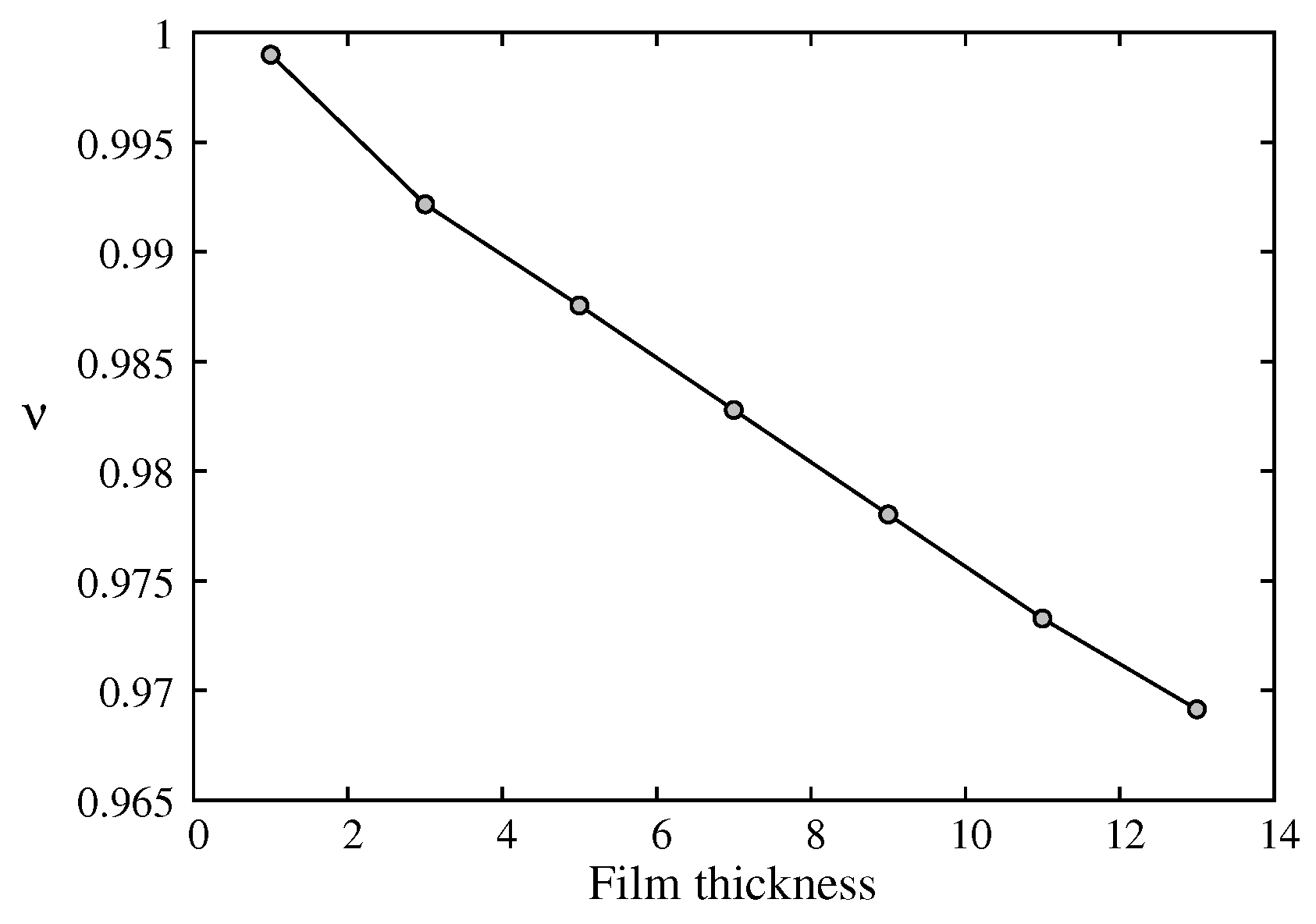
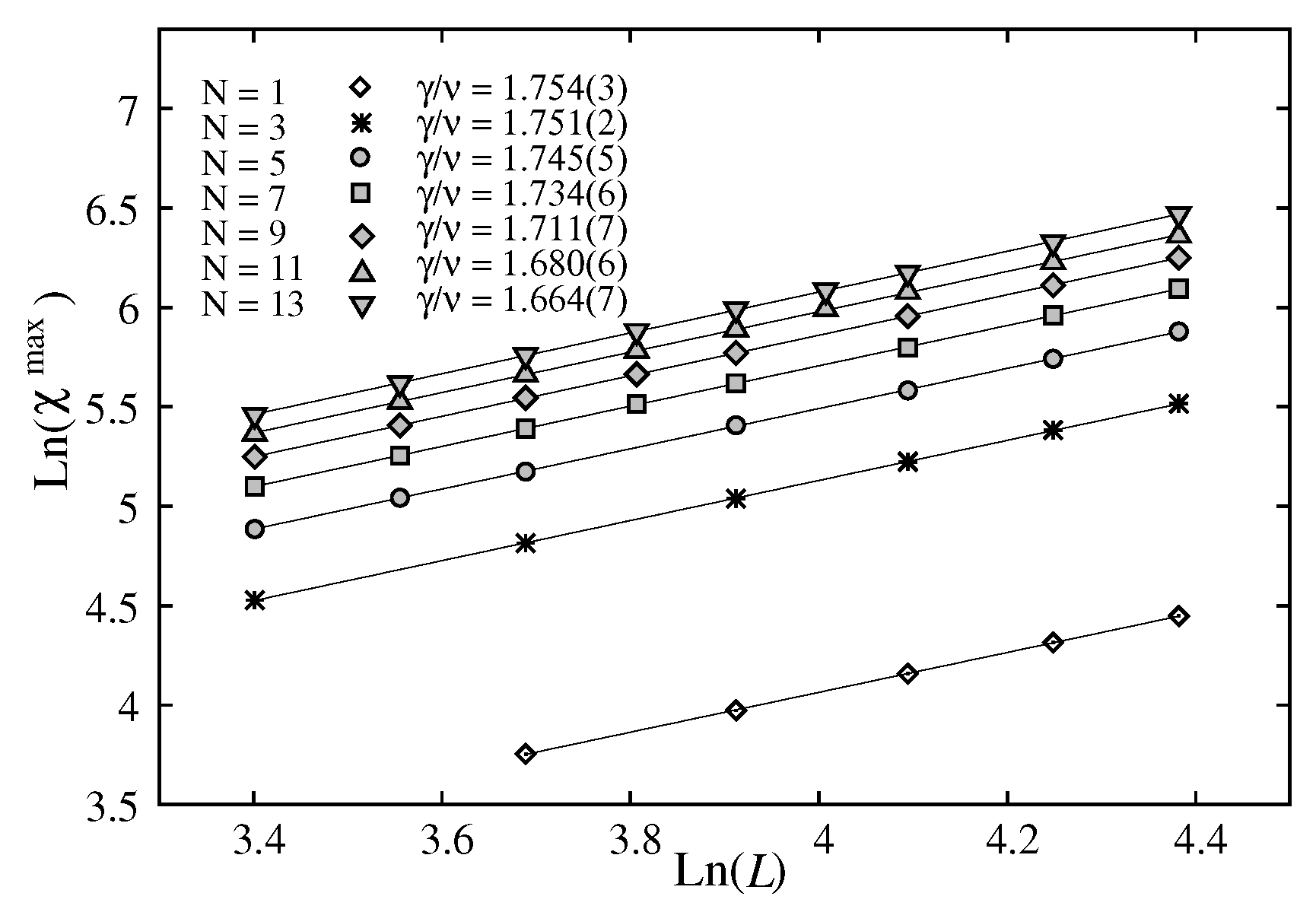
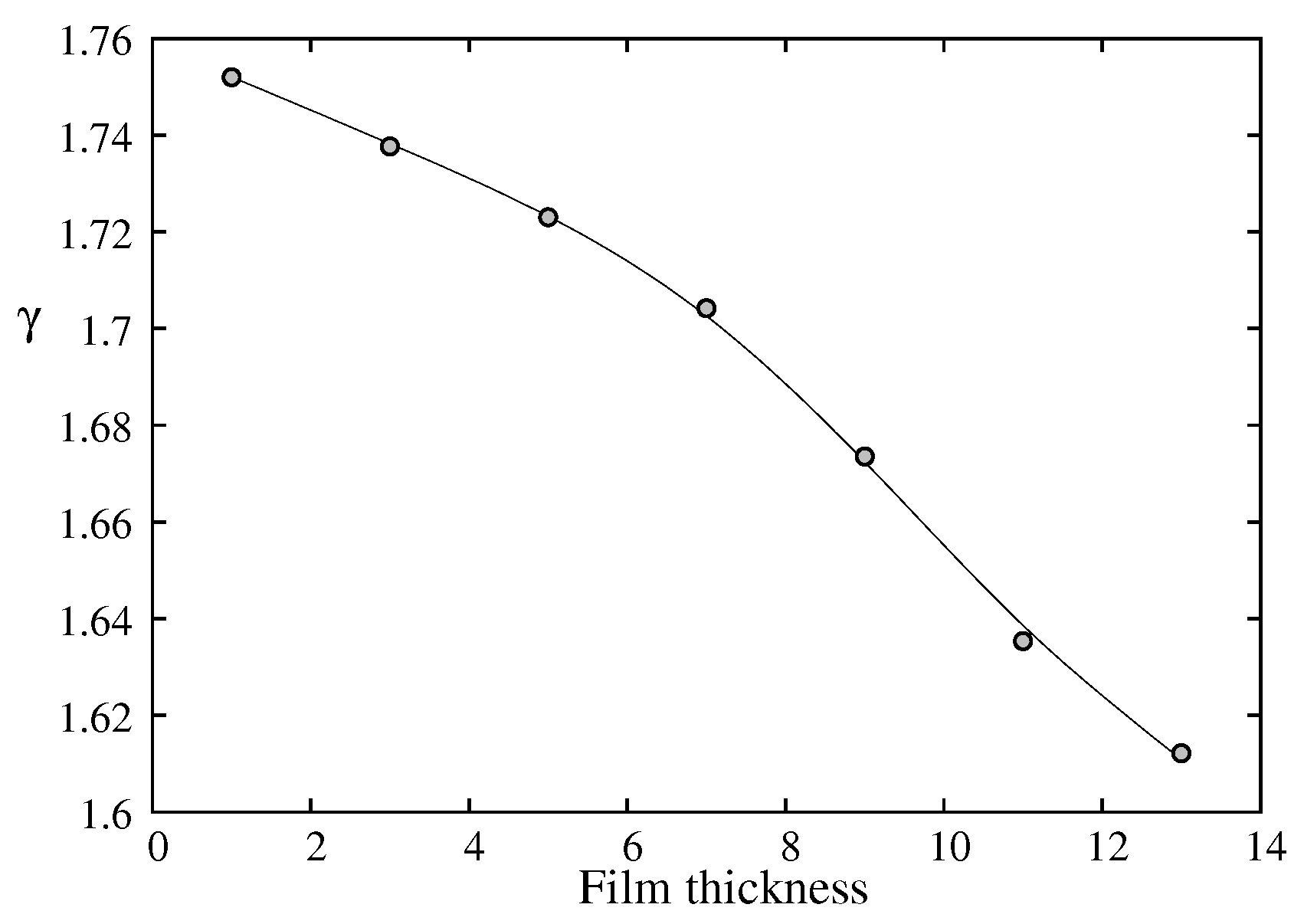
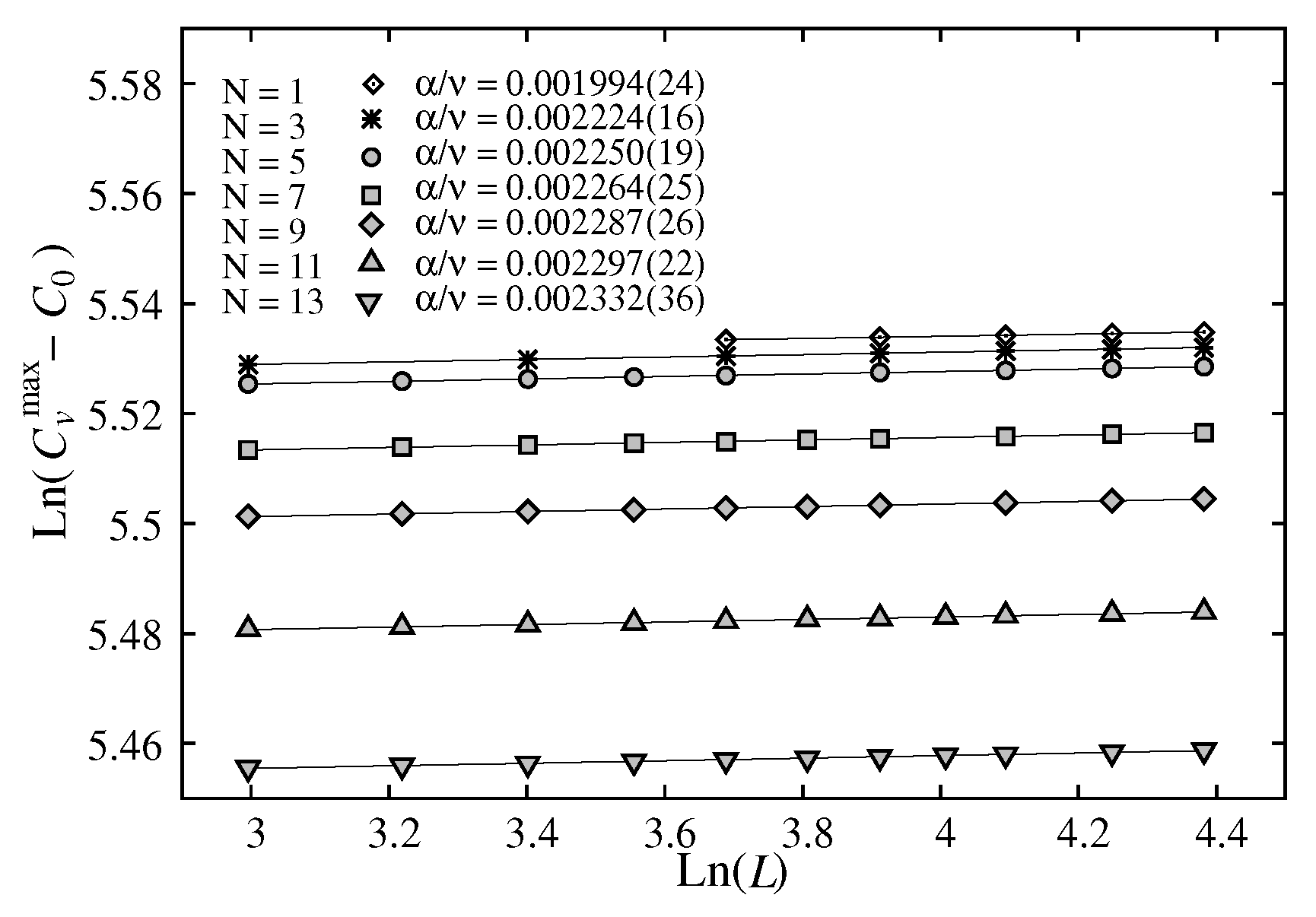
In this review, we show our results with new interpretation on the critical exponents of thin films obtained by high-performance multi-histogram Monte Carlo simulations. The film thickness Nz consists of a few layers up to a dozen of layers in the z direction. The free boundary condition is applied in this direction while in the xy plane periodic boundary conditions are used. The large xy plane size, from 702 to 1602, is used for finite-size scaling. The Ising model is used with nearest-neighbor (NN) interaction. When Nz=1, namely the two-dimensional (2D) system, we find strictly the critical exponents given by the renormalization group. While, for Nz>1, the critical exponents calculated with the high-precision multi-histogram technique show that they deviate systematically from the 2D values and get closer to the 3D critical exponents for Nz>13 . If we argue that as long as the thickness Nz is small enough, the correlation length in the z direction is finite, it does not affect the nature of the phase transition, namely it remains in the 2D universality class. This argument is in contradiction with our numerical results which show a systematic deviation from 2D values: If we use these values of critical exponents in the hyperscaling relation with d=2, then the hyperscaling relation is violated. However, if we use the hyperscaling relation and the critical exponents obtained for Nz>1 to calculate the dimension of the system, we find the system dimension between 2 and 3. This can be viewed as an "effective" dimension. More discussion is given in the paper. We also show the cross-over between the first- and second-order transition while varying the film thickness. In addition, we will show evidence that when a 2D system has two order-parameters of different symmetries with a single transition, the critical exponents are new, suggesting a universality class of coupled two-symmetry breakings. In this case, the 2D hyperscaling does not hold. Another case is the 3D Ising model coupled to the lattice vibration: the critical exponents deviate from the 3D Ising ones, the results suggest the violation of the hyperscaling.
Keywords:
1. Introduction
2. Critical Behavior of Thin Films
2.1. Model
2.2. Multi-Histogram Technique
3. Results
3.1. Finite Size Scaling
3.2. Critical Exponents Obtained with Finite-Size Scaling
3.3. Corrections to Scaling
3.4. Summary of Our Results
3.5. Discussion
4. Cross-Over from First- to Second-Order Transition with Varying Film Thickness
5. Other Cases Violating the Hyperscaling Relation?
5.1. Fully Frustrated XY Square Lattice
5.2. Effect of Magneto-Elastic Coupling on Criticality
6. Concluding Remarks
Funding
Acknowledgments
Conflicts of Interest
References
- Diep, H. T. Theory of Magnetism, World Scientific, World Scientific: Singapore, 2014.
- Baxter, R. J. Exactly Solved Models in Statistical Mechanics, Academic Press Limited, London (U.K.) 1982.
- Wilson, K. G. Renormalization Group and Critical Phenomena. I. Renormalization Group and the Kadanoff Scaling Picture. Phys. Rev. B 1971, 4, 3174. [Google Scholar]
- Wilson, K. G. Renormalization Group and Critical Phenomena. II. Phase-Space Cell Analysis of Critical Behavior Phys. Rev. B 1971 4, 3184.
- Cardy, J. Scaling and renormalization in statistical physics, Cambridge University Press: Cambridge (U.K.), 1996.
- Young, A. P. Violations of Hyperscaling in Finite-Size Scaling above the Upper Critical Dimension, Entropy 2024 26(6), 509; https://doi.org/10.3390/e26060509 (this present Special Issue: Violations of Hyperscaling in Phase Transitions and Critical Phenomena—in Memory of Prof. Ralph Kenna). [CrossRef]
- Honchar, Yu.; Berche, B.; Holovatch, Yu.; Kenna, R. When correlations exceed system size: finite-size scaling in free boundary conditions above the upper critical dimension, Condensed Matter Physics 2024, 27, 13603:1-15.
- Ferrenberg, A. M. ; Swendsen, R. H. New Monte Carlo technique for studying phase transitions, Phys. Rev. Let. 1988 61, 2635. Erratum Phys. Rev. Lett. 1989 63, 1658.
- Ferrenberg, A. M.; Swendsen, R. H. Optimized Monte Carlo data analysis, Phys. Rev. Let. 1989, 63, 1195. [Google Scholar]
- A. Bunker, A.; Gaulin, B. D.; Kallin, C. Multiple-histogram Monte Carlo study of the Ising antiferromagnet on a stacked triangular lattice, Phys. Rev. B 1993 48, 15861-15872.
- Pham-Phu, X.-T.; Ngo, V.-Thanh; Diep, H. T. Critical behavior of magnetic thin films, Surface Science 2009 603, 109–116.
- Capehart, T. W.; Fisher, M. E. Susceptibility scaling functions for ferromagnetic Ising thin films, Phys. Rev. B 1976, 1976, 5021–5038. [Google Scholar]
- Binder, K. The Monte Carlo Method for the Study of Phase Transitions: A Review of Some Recent Progress, J. of Computational Physics 1985 59, pp. 1-55.
- Ferrenberg, A.M.; Landau, D.P. Critical behavior of the three-dimensional Ising model: A high-resolution Monte Carlo study, it Phys. Rev. B 1991, 44, 5081–5091. [Google Scholar]
- Diep, H. T.; Levy, J.C.S.; Nagai, O. Effects of Surface Spin Waves and Surface Anisotropy in Magnetic Thin Films at Finite Temperatures. Phys. Stat. Solidi (b) 1979, 93, 351–361. [Google Scholar]
- Diep, H.T. Temperature-Dependent Surface Magnetization and Critical Temperature of Ferromagnetic Thin Films. Phys. Stat. Solidi (b) 1981, 103, 809–815. [Google Scholar]
- Diep, H. T. Quantum theory of helimagntic thin films, Phys. Rev. B 2015 91, 014436 (12 pp.).
- El Hog, S.; Diep, H. T.; Puszkarski, H. Theory of magnons in spin systems with Dzyaloshinskii–Moriya interaction, J. Phys.: Condens. Matter 2017 29 305001 (10pp.).
- Sharafullin, I.; Kharrasov, M. Kh.; Diep, H. T. Dzyaloshinskii-Moriya interaction in magnetoferroelectric superlattices: Spin waves and skyrmions, Phys. Rev. B 2019 99, 214420 (14 pp.).
- Schilbe, P.; Siebentritt, S.; and Rieder, K. H. Monte Carlo calculations on the dimensional crossover of thin Ising films Phys. Lett. A 1996, 21, 20–25. [Google Scholar]
- Wang, F.; Landau, D.P. Efficient, Multiple-Range Random Walk Algorithm to Calculate the Density of States, Phys. Rev. Lett. 2001, 86, 2050–2053. [Google Scholar]
- Brown, G.; Schulhess, T. C. Wang–Landau estimation of magnetic properties for the Heisenberg model. J. Appl. Phys. 2005, 97, 10E303. [Google Scholar] [CrossRef]
- B. J. Schulz, B. J.; Binder, K.; Müller, M.; Landau, D.P. Avoiding boundary effects in Wang-Landau sampling, Phys. Rev. E 2003 67, 067102 (2 pp.).
- Malakis, A.; Martinos, S.S.; Hadjiagapiou, I.A.; Fytas, N.G.; Kalozoumis, P. Entropic sampling via Wang-Landau random walks in dominant energy subspaces, Phys. Rev. E 2005 72, 066120 (11 pp.).
- Ngo, V. T.; Diep, H.T. , Phase Transition in Heisenberg Stacked Triangular Antiferromagnets: End of a Controversy. Phys. Rev. E 2008, 7, 031119. [Google Scholar]
- Ngo, V.T.; Diep, H. T. Stacked Triangular XY Antiferromagnets: End of a Controversial Issue on the Phase Transition. J. Appl. Phys. 2008, 103, 07C712. [Google Scholar] [CrossRef]
- Ngo, V.T.; Hoang, D.-Tien; Diep, H. T. First-Order Transition in XY Fully Frustrated Simple Cubic Lattice, Phys. Rev. E 2010 82, 041123 (5 pages).
- Pham-Phu, X. T.; Ngo, V. T.; Diep, H. T. Cross-Over from First- to Second-Order Transition in Frustrated Ising Antiferromagnetic Films, Phys. Rev. E 2009 79, 061106 (8 pp.).
- Boubcheur, E. H.; Diep, H. T. Critical behavior of the two-dimensional fully frustrated XY model. Phys. Rev. B 1998, 1998, 5163–5165. [Google Scholar] [CrossRef]
- Boubcheur, E. H.; Diep, H. T. Effect of elastic interaction on critical behavior of three-dimensional Ising model. J. Appl. Physics 1999, 85, 6085–6087. [Google Scholar] [CrossRef]
- Boubcheur, E. H.; Massimino, P.; Diep, H. T. Effects of magnetoelastic coupling: critical behavior and structure deformation, Journal of Magnetism and Magnetic Materials bf 2001 223, 163-168.
- Berge, B.; Diep, H. T.; Ghazali, A.; Lallemand, P. Phase transitions in two-dimensional uniformly frustrated XYspin systems. Phys. Rev. B 1986, 34, 3177–3184. [Google Scholar] [CrossRef]
- Granato, E.; Nightingale, M. P. Chiral exponents of the square-lattice frustrated XY model: a Monte Carlo transfer-matrix calculation. Phys. Rev. B 1993, 48, 7438–7444. [Google Scholar] [CrossRef]
- Lee, J.; Kosterlitz, J. M.; Granato, E. Monte Carlo study of frustrated XY models on a triangular and square lattice. Phys. Rev. B 1991, 43, 11531–11534. [Google Scholar] [CrossRef]
- Granato, E.; Kosterlitz, J.M.; Lee, J.; Nightingale, M. P. Phase transitions in coupled XY-Ising systems. Phys. Rev. Lett. 1991, 66, 1090–1093. [Google Scholar] [CrossRef]
- Olsson, P. Two Phase Transitions in the Fully Frustrated XY Model. Phys. Rev. Lett. 1995, 7, 2758–2761. [Google Scholar] [CrossRef]
- Jeon, G. S.; Park, S. Y.; Choi, M. Y. Double transitions in the fully frustrated XY model. Phys. Rev. B 1997, 55, 14088–14091. [Google Scholar] [CrossRef]
- Lee, S.; Lee, K.C. Phase transitions in the fully frustrated XY model studied with use of the microcanonical Monte Carlo technique. Phys. Rev. B 1994, 49, 15184–15189. [Google Scholar] [CrossRef]
- Ramirez-Santiago, G; Jose, J. V. Critical exponents of the fully frustrated two-dimensional XY model, Phys. Rev. B1994 49, 9567-9582.
- Antenonko, S. A.; Sokolov, A. I. Critical exponents for a three-dimensional O(n)-symmetric model with n>3. Phys. Rev. E 1995, 51, 1894–1898. [Google Scholar]
- Le Guillou, J. C.; Zinn-Justin, J. Accurate critical exponents from the ϵ-expansion, J. Phys. (France) Lett. 1985 46, L137-141.
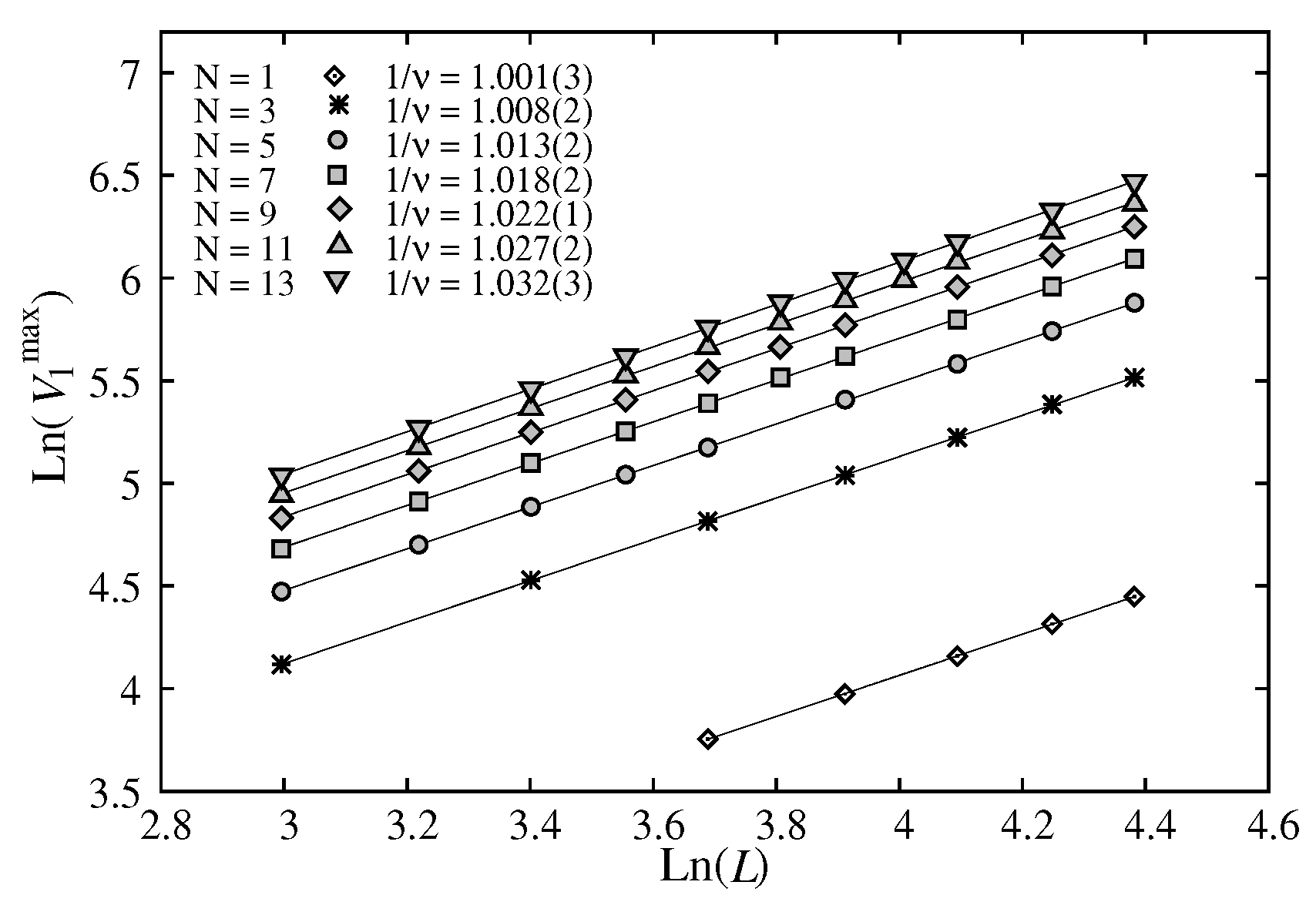



| 1 | ||||||
| 3 | ||||||
| 5 | ||||||
| 7 | ||||||
| 9 | ||||||
| 11 | ||||||
| 13 |
Disclaimer/Publisher’s Note: The statements, opinions and data contained in all publications are solely those of the individual author(s) and contributor(s) and not of MDPI and/or the editor(s). MDPI and/or the editor(s) disclaim responsibility for any injury to people or property resulting from any ideas, methods, instructions or products referred to in the content. |
© 2025 by the authors. Licensee MDPI, Basel, Switzerland. This article is an open access article distributed under the terms and conditions of the Creative Commons Attribution (CC BY) license (http://creativecommons.org/licenses/by/4.0/).