
Submitted:
20 February 2025
Posted:
21 February 2025
You are already at the latest version
Preprints on COVID-19 and SARS-CoV-2
Abstract
The COVID-19 pandemic significantly impacted material sciences, particularly polymer composites, which played a crucial role in personal protective equipment (PPE), medical devices, and packaging. This study explores the modifications and advancements in polymer materials developed to meet the urgent demands of the pandemic. Key innovations include enhanced filtration efficiency in PPE, integration of antimicrobial nanoparticles, and the development of biopolymer alternatives to address environmental concerns. The incorporation of silver, copper oxide, zinc oxide, and titanium dioxide nanoparticles improved antiviral and antibacterial properties, while polymer modifications enhanced durability, thermal resistance, and recyclability. Additionally, research into biodegradable polymers such as polylactic acid (PLA) and polyhydroxyalkanoates (PHAs) gained momentum as sustainable alternatives to fossil-based plastics. The findings underscore the necessity of material innovation during global crises and highlight the future potential of modified polymer composites in healthcare and environmental sustainability.
Keywords:
COVID-19
; pandemic
; polymers
; biopolymers
; composites
; nanoparticles
1. Introduction
The COVID-19 pandemic, triggered by the emergence of the novel coronavirus SARS-CoV-2, was first identified in late 2019 and swiftly evolved into an unprecedented global health crisis. By early 2020, the World Health Organization (WHO) officially declared it a pandemic, underscoring the scale and severity of its impact [1]. This event marked one of the most consequential public health emergencies in modern history, affecting virtually every aspect of human life. The pandemic has profoundly influenced societies, economies, and scientific endeavors, compelling nations to reevaluate their priorities and exposing critical vulnerabilities in healthcare systems, infrastructure, and governance worldwide. Its far-reaching effects have catalyzed significant shifts in global policies and practices, with implications that continue to unfold.
COVID-19 placed unprecedented pressure on medical sciences. Healthcare systems faced shortages of personal protective equipment (PPE), ventilators, and hospital beds. Frontline healthcare workers were stretched thin, often working under perilous conditions. At the same time, the pandemic disrupted routine healthcare services, delaying treatments for non-COVID-19 conditions and impacting preventative care such as vaccination programs [2].
Research priorities shifted dramatically toward understanding SARS-CoV-2, developing diagnostic tools, and producing effective therapeutics and vaccines. However, this rapid pivot often came at the expense of ongoing research in other areas. Clinical trials for non-COVID-19-related treatments were delayed or canceled most funding streams were redirected toward pandemic-related initiatives. The pandemic also spurred innovations, such as telemedicine and digital health tools, which have since become integral components of healthcare delivery [3].
The material sciences sector faced unique challenges and opportunities during the pandemic. The demand for materials used in PPE, such as polymers for masks and gowns, skyrocketed, leading to supply chain constraints [4]. The need for antiviral coatings and filters stimulated innovation in materials engineering, with researchers exploring novel nanomaterials and biopolymers to enhance the efficacy of protective equipment [5]. Additive manufacturing techniques such as 3D printing played a pivotal role in addressing supply shortages. Rapid prototyping capabilities enabled the production of critical components, such as face shields and ventilator parts, highlighting the value of decentralized manufacturing systems in emergency responses [6,7]. Disruptions and delays in global supply chains revealed the vulnerabilities of material procurement and logistics, prompting calls for more resilient and sustainable production methods [8,9].
1.1. The Role of Polymers in the COVID-19 Era
Polymers played an indispensable role during the COVID-19 pandemic, providing critical solutions across healthcare, personal protective equipment, medical devices, and packaging [10]. The versatility of polymer materials, combined with their scalable production and cost-effectiveness, made them a cornerstone in the global response to the crisis. However, the unique demands of the pandemic also highlighted the need for tailored modifications in polymer properties to meet emerging and urgent requirements [11]. The increased use of polymer-based products during the COVID-19 pandemic led to a significant rise in plastic waste, much of which is difficult or impossible to recycle [12]. Single-use items such as masks, gloves, and packaging materials became essential but contributed substantially to environmental pollution [13]. This surge in plastic consumption coincided with a slowdown in legislative efforts aimed at reducing single-use plastics, including bans on traditional polymer products. Many initiatives targeting the transition to sustainable alternatives were delayed as governments prioritized immediate public health and economic challenges. Consequently, the pandemic exacerbated the global plastic waste crisis, underscoring the urgent need for innovative and sustainable solutions in polymer science and waste management [14,15].
The pandemic underscored the critical role of polymers in healthcare systems worldwide. In medical devices, polymers were extensively used in the manufacturing of syringes, tubing, catheters, blood bags, and ventilator components. The properties such as flexibility, durability and low price of materials like polyvinyl chloride (PVC), polyethylene (PE), and thermoplastic elastomers (TPEs) made them integral to these applications [15]. Polymers also served as substrates for numerous diagnostic tools, including rapid antigen and polymerase chain reaction (PCR) test kits, which were essential in tracking and controlling the spread of SARS-CoV-2 [16].
Traditional polymers enabled the mass production of disposable medical products such as gloves, face masks, and gowns. The single-use nature of these items, primarily made from PE, polypropylene (PP) and polyethylene terephthalate (PET), minimized cross-contamination risks, safeguarding healthcare workers and patients alike [17]. Beyond these applications, polymer-based hydrogels and nanomaterials contributed to the development of drug delivery systems and vaccine stabilization technologies, supporting the accelerated rollout of lifesaving treatments and immunizations [18,19].
The sudden surge in demand for PPE during the pandemic placed immense pressure on global supply chains, bringing polymers to the forefront of protective solutions. Polypropylene, a widely used polymer in nonwoven fabric production, became a key material for manufacturing surgical masks and N95 respirators [20,21]. Nonwoven PP provided an effective combination of filtration efficiency, breathability, and lightweight properties, crucial for long-term use [22].
Polymers also enabled the creation of flexible and impact-resistant materials for face shields, typically fabricated from polycarbonate (PC) or PET [23]. Additionally, the hydrophobic nature of many polymers enhanced their role as barriers against viral particles, while ongoing research explored the incorporation of antimicrobial and antiviral additives to further improvement of safety features of PPE devices [24,25].
During the COVID-19 pandemic, the role of polymers in packaging expanded significantly due to heightened concerns about hygiene and contamination [26]. Single-use polymer packaging materials, such as low-density polyethylene (LDPE), high-density polyethylene (HDPE), and PET, ensured the safe transport and storage of medical supplies, pharmaceuticals, and food products [27]. In the pharmaceutical industry, polymers were critical in vaccine packaging, including syringe barrels and multi-dose vials, which required precise material performance to maintain sterility and prevent leakage. The pandemic also spurred innovations in flexible packaging, leveraging multilayer polymer films to create robust, lightweight, and airtight solutions for critical goods [28].
1.2. Modification of Polymer Properties to Meet Emerging Requirements
Challenges posed by the pandemic necessitated advancements in polymer technologies to address specific needs. Research and development efforts focused on enhancing the mechanical, thermal, and antimicrobial properties of polymers to optimize their performance across diverse applications. In PPE production, modifications in polymer microstructure were pivotal in achieving higher filtration efficiencies without compromising breathability. For instance, electrostatic charging techniques were applied to polypropylene fibers in masks to improve their ability to trap aerosolized particles. Similarly, surface treatments and blending with nanomaterials increased durability, allowing extended or repeated use of protective equipment in resource-constrained environment [29,30,31]. Another major innovation during the COVID-19 era was the integration of antimicrobial and antiviral agents into polymer materials. Silver nanoparticles, copper oxide, and zinc oxide were incorporated into materials and surface coatings to create self-sterilizing materials capable of reducing viral loads [32,33]. These functionalized polymers found applications not only in protective gear but also in high-touch surfaces in healthcare facilities, public transport, and packaging [34]. The surge in polymer use during the pandemic raised concerns about environmental sustainability, particularly regarding single-use plastics. In response, researchers explored biodegradable and bio-based polymers, such as polylactic acid (PLA) and polyhydroxyalkanoates (PHA), as alternatives to conventional materials [35,36]. While these solutions are not yet widely adopted due to cost and scalability challenges, the pandemic catalyzed interest and investment in sustainable biopolymer technologies development [37]. Sterilization and reuse of medical equipment became critical in addressing shortages during the pandemic. Polymers with high thermal and chemical resistance, such as polyetherimide (PEI) [38,39] and polysulfone (PSU) [40,41], were utilized in applications requiring autoclaving or exposure to strong disinfectants. Tailored polymer blends and coatings further enhanced resistance properties, enabling repeated decontamination cycles without material degradation [42,43,44].
2. Polymers in Personal Protective Equipment (PPE)
2.1. Common Polymers Used in PPE
Polymers are essential for personal protective equipment (PPE) they provide durability flexibility chemical resistance and comfort [45]. This text reviews polymers used in PPE discussing their properties applications and recent improvements. It also examines environmental sustainability challenges and strategies to enhance performance and reduce ecological impact. The study emphasizes the crucial role of polymers in PPE across healthcare manufacturing and environmental protection industries while exploring future directions for greener and more efficient materials.
2.1.1. Polypropylene, Polyesters, Polyurethane
Polypropylene
Polypropylene (PP) is a polymer extensively utilized in Personal Protective Equipment (PPE). It possesses remarkable chemical resistance coupled with affordability and straightforward processing. This material finds widespread application in the manufacturing of masks, gowns, and protective covers. PP exhibits exceptional durability while striking an optimal balance between flexibility and strength rendering it well-suited for diverse protective gear applications [46] New research examines methods to improve plastic’s ability to be recycled and decrease its negative effect on the environment [47]. Studies exploring environmentally-friendly methods for manufacturing PP are increasing. The goal is to enhance the material’s green credentials [48].
Polyethylene
Polyethylene (PE) is a common material used in PPE. It is valued because it resists moisture and chemicals well. This makes it suitable for protective clothing like gloves and aprons. PE is widely utilized in medical and industrial protective gear due to its low cost and durability. PE’s impact on the environment has led researchers to explore biodegradable options as potential replacements [49]. New ways of mixing polyethylene with other plastics are looking good. It’s improve performance but stay environmentally friendly [50].
Polyvinyl Chloride
Polyvinyl chloride (PVC) is a material utilized in personal protective equipment like protective suits and gloves. It provides strong resistance against chemicals and physical damage [51]. New work focused on lowering PVC’s harm to the environment. This led to making PVC from biological sources and plasticizers that are environmentally friendly [52,53]. Studies continue to investigate possible replacements for PVC that could reduce its impact on the environment.
Polyurethane
Polyurethane (PU) gets used for personal protective equipment because it’s flexible. It combines toughness and stretchiness. People often choose PU for demanding jobs like making gloves shoes, and protective pads. [54]. PU provides great resistance against abrasion. However its lack of biodegradability poses a challenge. Scientists study bioPU and PU composites to improve sustainability [55]. Recent advancements in PU-based personal protective equipment aim to enhance recyclability and minimize the material’s environmental footprint [56].
Silicone
Silicone is a very useful material employed in personal protective equipment due to its ability to bend, resist chemicals and work well with living things. This makes it perfect for medical-grade items such as masks and seals [57]. It endures intense heat and tough conditions. This makes it very helpful for industrial purposes [58,59]. Recycling silicone is still problematic. Researchers continue exploring ways to make silicone protective equipment less harmful for the environment [60].
Polycarbonate
Polycarbonate (PC) is a material prized for its transparency and ability to withstand impacts. These qualities make it well-suited for protective gear like face shields and goggles [46]. PC offers excellent safeguarding from physical dangers. It is a lightweight choice for personal protective equipment. Yet its rather high price and problems with ultraviolet deterioration have driven research into ultraviolet-resistant coatings and other protective options [61]
2.2. Polymer Modifications for Enhanced Protection
2.2.1. Surface Modifications to Improve Antiviral and Antimicrobial Properties
Antimicrobial coatings stop infections from spreading. They make protective gear safer. This is important in healthcare places. Silver nanoparticles (Ag), copper oxide (CuO), and other antimicrobial substances get added to polymers used in protective gear [62]. The coatings provide durable defense from bacteria viruses fungi. They work well for medical gowns gloves masks [50]. Incorporating Ag particles into surfaces provides a broad-spectrum antimicrobial effect, as seen in studies that confirm their ability to disrupt microbial growth and biofilm formation [63]. Quaternary Ammonium Compounds (QACs) work by disrupting microbial membranes, delivering long-lasting protection. Coatings made with titanium dioxide (TiO2) utilize UV light to generate reactive oxygen species that effectively neutralize pathogens to increase antimicrobial properties, photocatalytic coatings or chemical-resistant coatings are used coatings made with TiO2 utilize UV light to generate reactive oxygen species that effectively neutralize pathogens [64,65]. Chemical-resistant coatings are essential for protecting surfaces from harsh disinfectants. Materials like polytetrafluoroethylene (PTFE) and other fluoropolymers boast outstanding resistance to chemical degradation and wear. Epoxy formulations create strong, impermeable barriers that resist the penetration of disinfectants. The flexible polyurethane coatings can endure both mechanical strain and chemical exposure. Self-healing coatings possess the ability to autonomously repair minor damages, ensuring the preservation of surface integrity and enhancing longevity. They contain encapsulated healing agents, such as polymerizable monomers, that get activated by cracks or scratches to seal any defects. For instance, coatings infused with Diels-Alder-based polymers have shown effective crack sealing insimulated environmental conditions [66].
2.2.2.1. Hydrophobic and Hydrophilic Adjustments for Improved Breathability and Filtration Efficiency
Hydrophobic surfaces are manufactured in a way that resists water and other liquid contaminations. This characteristic is frequently determined through contact angle measurements, where a contact angle greater than 90º stands for greater hydrophobicity. Adding and adopting methods such as chemical vapor deposition (CVD), behavour towards of the surface through plasma enhancement, or merely coating the desired surfaces with hydrophobic materials such as fluoropolymers and silanes has been quite common [67]. That being said, the use of hydrophobic surfaces is desirable because they can minimize the contact of water, thus enhancing airflow and filtration efficiency. On the other hand also, hydrophilic surfaces have the capacity to draw water and ‘soak’ the moistures quickly, followed by spreading them across the surface. This is especially helpful in settings where condensate or sweat sedation can disrupt breathability. For hydrophilic modifications, grafting of polymers which are hydrophilic such as polyethylene glycol onto surfaces, treating surfaces via a plasma, oxygen or nitrogen species or adding hygroscopic additives into the material matrix have been used [68]
2.2.2.2. Impact on Breathability and Filtration, Efficiency, Breathability
Breathability is the faculty of a material to let air flow through while still acting as a barrier against contaminants. Hydrophobic treatments help prevent water from blocking the pores, ensuring that airflow remains uninterrupted. Conversely, hydrophilic treatments effectively manage moisture, stopping the creation of vapor barriers that could obstruct air movement [69]. Filtration efficiency is determined by how well a material can capture particles while keeping airflow resistance low. Hydrophobic treatments improve the material’s ability to repel liquid aerosols, which can cause pore clogging. Hydrophilic surfaces are beneficial fortrapping water-soluble particles, like salts and bioaerosols, thereby enhancing the material’s performance in humid conditions [70].
2.2.2.3. Methodologies for Adjusting Hydrophobicity and Hydrophilicity Plasma Treatments, Chemical Coatings, Nanostructuring, Material Blends
Plasma processes, including oxygen or argon plasma, can alter surface energy to enhance eitherhydrophilicity or hydrophobicity. These techniques are super environmentally friendly and adaptable, making them suitable for a variety of materials [71]. Surface coatings, for instance fluorinated compounds for hydrophobicity or hydrophilic polymers, can be applied using methods such as dip-coating, spray-coating, or spin-coating [68]. Creating micro- or nanoscale surface textures can, enhance to the natural hydrophobic or hydrophilic characteristics of materials. For example, the Lotus Effect, which mimics the surface of lotus leaves, enhances hydrophobicity [72]. Combining hydrophobic and hydrophilic elements within one material allows for adjustable performance depending on environmental conditions. Layered structures can also leverage the advantages of both properties [73].
2.2.2.4. Applications and Environmental Protection
Healthcare in medical masks and gowns, it is essential to achieve the right balance of breathability and filtration efficiency. Hydrophobic surfaces help prevent fluid penetration, while hydrophilic layers draw away sweat for added comfort [68]. Air and water filtration systems can benefit from these modifications to address pollutants in different humidity levels. Hydrophilic layers improve the removal of water-soluble contaminants, while hydrophobic layers help prevent clogging from liquid pollutants.
2.2.3. Use of Nanocomposites and Biopolymer Coatings
Use of nanocomposites and biopolymer coatings has become increasingly common in the realm of material science and engineering. These innovative materials provide considerable advancements in a variety of applications, including packaging, automotive, and medical sectors. The combined effect of nanofillers in biopolymeric matrices leads to the creation of cutting-edge and eco-friendly protective solutions. Polymers play a crucial role in many industries, yet their performance, especially regarding durability and protection, often requires enhancement. Traditional methods for improving polymer performance involve adding nanomaterials and applying biopolymeric coatings. Nanocomposites, which integrate polymers with nanoscale fillers like nanoparticles, nanotubes, or nanoclays, have demonstrated significant gains in mechanical, thermal, and barrier properties. Concurrently, biopolymer coatings are increasingly employed to offer protective layers that are both effective and environmentally responsible. These enhancements are becoming a vital component of strategies aimed at developing sustainable and efficient protective materials [72,76]
Nanocomposites are defined as materials that feature a polymer matrix combined with nanoscale fillers. By integrating nanoparticles into the polymer matrix, various properties can be significantly improved, such as mechanical strength, thermal stability, and barrier performance The interaction between the nanofillers and the polymer matrix plays a crucial role in enhancing dispersion, interfacial bonding, and the overall performance of the composite material. One of the main advantages of nanocomposites is their enhanced mechanical strength. Nanofillers like carbon nanotubes (CNTs) and graphene oxide (GO) can significantly boost the tensile strength and elongation of the base polymer [77]. Additionally, these nanomaterials improve the thermal stability of the polymer, making nanocomposites ideal for high-temperature applications. For instance, adding CNTs to epoxy resins leads to better thermal conductivity and enhanced thermal stability, which is vital in sectors such as electronics [68]. Nanocomposites also provide improved barrier properties, which are critical in applications like food packaging, where protecting contents from moisture, oxygen, and other environmental factors is essential. The addition of nanoclays, such as montmorillonite, to a polymer matrix greatly enhances its resistance to gases and liquids [78]. These enhanced barrier properties arise from the tight packing of nanofillers within the polymer matrix, which restricts the permeation of small molecules [79]
Biopolymer coatings for environmentally friendly protection, sourced from renewable biological materials like starch, cellulose, and proteins, are gaining traction for their sustainable and eco-friendly characteristics. These coatings are mainly utilized to shield surfaces from environmental threats such as moisture, UV radiation, and microbial degradation. Biopolymers as protective coatings serving as a green alternative to conventional synthetic coatings that often depend on petrochemical materials, biopolymer coatings boast biodegradability and low toxicity. This makes them particularly suitable for packaging and agricultural uses. For example, chitosan, a biopolymer obtained from chitin, is widely used in food packaging as it effectively curbs microbial growth and prolongs shelf life [80]. Antimicrobial and UV protection beyond their biodegradable properties, biopolymer coatings also offer antimicrobial protection. Chitosan, cellulose, and other biopolymers can be enhanced with antimicrobial agents, boosting their effectiveness in preventing microbial growth on surfaces [74]. Additionally, these coatings can be fortified with UV-blocking agents, safeguarding the underlying materials from harmful UV radiation. This feature is especially beneficial for outdoor coatings and agricultural films. The combination of nanocomposites and biopolymer coatings has shown significant potential in improving the protective qualities of polymers. For example, adding nanocellulose to a biopolymer matrix has been demonstrated to greatly increase its mechanical strength, making it ideal for high-strength packaging materials. The synergistic interaction between nanomaterials and biopolymers facilitates the creation of advanced materials that are both high-performing and sustainable. These innovations are leading us toward a future where the environmental footprint of polymer-based products is reduced, all while maintaining or even enhancing their functionality. Furthermore, the medical field benefits from the antimicrobial properties of biopolymer coatings, which are applicable in wound dressings and surgical implants.
Despite the promising advantages, the development of nanocomposites and biopolymer coatings encounters several challenges. These include concerns regarding production scalability, the cost of raw materials, and achieving uniform dispersion of nanofillers within the polymer matrix. Additionally, the long-term stability and environmental implications of nanocomposites are ongoing areas of research. Future advancements in this field are essential for overcoming these hurdles and unlocking the full potential of these innovative materials.
2.3. Challenges and Innovations in Reusability
The development of reusable PPE continues. It happens because of the need to reduce medical waste, lower healthcare expenses and ensure sustainable infection control methods. However, making PPE reusable in medical settings faces several difficulties. At the same time, innovations in materials sterilization techniques and design are being utilized.
2.3.1. Challenges in Reusability of PPE
Sterilization and Infection Control
Challenge: Reusable protective equipment like face masks, gowns and gloves require proper sterilization methods to guarantee their safety for multiple uses. However, repeated exposure to sterilization processes such as autoclaving or chemical disinfection can weaken the material properties. This impacts their mechanical durability and ability to act as an effective barrier [81]. Another worry exists about the risk of improper sterilization which might allow the spread of disease-causing agentsm [82].
Material Durability
Challenge: Frequent cleaning and sanitizing of personal protective equipment can damage the materials. This leads to reduced protection. For example the non-woven fabrics used in medical masks and gowns may lose their ability to filter properly after being sterilized multiple times [85].
Solution: New materials like strong plastics body-friendly mixtures, germ-fighting fibers make reusable protective gear last longer and work better. Adding tiny particles of silver helps kill germs and prevents wear [86].
Comfort and Fit
Challenge: An important factor for personal protective equipment working well is how comfortable and well-fitting it is especially for extended use in medical facilities. Repeated sterilization can make materials less flexible and stretchy which may impact comfort and the protective equipment’s effectiveness [87]. Achieving a secure fit is highly crucial for face masks. It prevents any leakage from occurring.
Solution: New materials like memory alloys and shape-memory polymers enable protective gear that keeps its shape and feels comfortable even after repeated sterilization [88]. Designs with separate parts like straps or filters that can be swapped out or adjusted make protective equipment more comfortable and last longer [89].
Cost and Accessibility
Challenge: Reusable protective gear brings financial advantages over time. However the upfront expense of quality materials and specialized sterilization tools can be too much for some healthcare facilities. This challenge is greater in areas with limited resources [90].
Solution: Finding ways to mass-produce reusable protective gear in a cost-effective manner along with setting up centralized sterilization facilities could lower expenses. Affordable solutions involve using inexpensive biodegradable materials that offer adequate protection while being environmentally friendly [91].
Innovations in PPE Reusability
Coatings for Extended Lifespan and Antimicrobial Resistance:
Innovation: Antimicrobial coatings applied to personal protective equipment can greatly improve reusability. They prevent the growth of bacteria viruses and fungi. These coatings allow the protective gear to last longer. They also reduce how often disinfection is needed [92]. Coatings made from silver and copper have proven effective at preventing microbial growth on the surface of personal protective equipment materials [93].
Application: Coatings that fight microbes decrease contamination. They also improve the toughness of materials by limiting the growth of biofilms which can cause material breakdown [94].
Self-Sterilizing and Smart Materials
Innovation: Materials that can sterilize themselves like coatings that use light to break down harmful microbes provide a new way for protective gear to destroy pathogens on its own when exposed to light [95]. The arrival of intelligent personal protective equipment with built-in sensors for detecting contamination or material deterioration transformed how we monitor the condition of protective gear [96]
Example: Certain materials like titanium dioxide can break down harmful microbes when exposed to ultraviolet light. These materials are used to make protective equipment that takes advantage of this ability.Smart masks have sensors built into them. These sensors can check the air quality. The sensors will let you know when the mask requires replacement or cleaning.
Modular and Reusable PPE Designs
Innovation: Designs with separate parts allow replacing or cleaning certain components of protective gear like filters, straps and gloves. This extends the overall usable life of the equipment [97]. This method cuts down on waste. It also permits improved customization of personal protective equipment for various healthcare duties.
Eco-Friendly and Chemical-Free Disinfection Methods
Innovation: Non-chemical disinfection techniques like UV-C light ozone treatment and electrostatic disinfection are becoming more popular. They sterilize personal protective equipment without harming the environment like chemical disinfectants [99]. The techniques mentioned are both efficient and environmentally sound. They provide a green approach for reusing personal protective equipment.
Example: UV-C light systems can deactivate various harmful microbes on protective equipment surfaces. These systems are environmentally friendly and pose little risk to healthcare staff [100].
The move to reusable PPE marks an important step for sustainability and cost savings in healthcare systems around the world. Challenges exist with sterilization, material durability, comfort, and cost. However, new developments in antimicrobial coatings self-sterilizing materials and smart designs could solve these issues. As research continues, sustainable and cost-effective reusable solutions for protective equipment will emerge. This will help reduce medical waste and improve safety for healthcare workers globally.
3. Traditional Polymers in Medical Devices and Equipment
Polymers are universal materials in healthcare because of their ability to meet stringent medical standards while providing design flexibility and scalability in production [101]. Their light weight, sterility, and ability to be shaped into complex forms make them suitable for a wide array of devices. Additionally, polymers can be engineered to possess specific mechanical, thermal, or biological properties, allowing for tailored solutions in diverse medical fields [102]. The use of polymers in catheters, surgical instruments, and prosthetics ensures patient comfort and safety, while their role in packaging medical products protects sterility and extends shelf life. In diagnostic applications, fossil based polymers provide the structural base for testing kits and imaging devices, enabling accurate and reliable results. Medical market is dominated by several traditional polymers mainly due to their proven performance, availability and low price (Table 1). Polyvinyl Chloride (PVC) is widely used in blood bags, IV tubing, and oxygen masks due to its flexibility and clarity. PVC is highly resistant to chemicals and can be sterilized, making it ideal for fluid-contact applications [103,104]. Common in disposable syringes, surgical masks, and medical containers is application of polypropylene (PP), thanks to its lightweight, mechanical strength, and resistance to autoclaving and irradiation it is considered a perfect material for single-use items [105,106]. Another fossil based polymer used widely in medical devices is polyethylene (PE). It can be found in applications such as implantable devices, catheter tubing, and medical devices packaging [107]. PE is found to be biocompatible and chemical resistant what makes it valuable in medical devices requiring direct-contact with tissues [108]. Another interesting example of adaptation of unique polymers properties to tailored applications is polymethyl methacrylate (PMMA), which is utilized in intraocular lenses, dental prosthetics, and medical imaging equipment due to its optical clarity and mechanical strength [109,110]. One of the oldest materials applied in medicine is natural and silicone rubber. It can be found in implants, tubing, and seals, its flexibility, thermal stability, and biocompatibility are essential for applications involving prolonged bodily contact [111].
The global demand for medical devices and equipment is substantial and continues to grow, particularly as healthcare systems expand and populations age the COVID-19 was a important factor in this case. Disposable medical devices account for a significant portion of this volume. Over 16 billion injections are administered annually worldwide, with each syringe contributing to medical waste. An estimated 129 billion face masks and 65 billion gloves were used monthly at the height of the COVID-19 pandemic. The healthcare sector is responsible for 4-5% of total global plastic waste, which was approximately 300 million tons in 2020, but during the pandemic time, monthly use of disposable items like masks, gloves, and gowns surged dramatically, with some estimates adding 2.6 million tons of medical plastic waste per month to the global what accounted for approximately 10-15% of the global increase in single-use plastic waste [112].
3.1. Modification of Polymers for COVID-19 Applications
The COVID-19 pandemic underscored the importance of fossil-based polymers, such as PP, PE, and PVC, in the production of personal protective equipment (PPE), medical devices, and packaging. These polymers were critical due to their availability, cost-effectiveness, and versatile properties. However, the unique demands of the pandemic highlighted the need for specific modifications to enhance their performance, safety, and utility in combating the virus (Table 2) [113].
Enhanced filtration efficiency was a critical polymer modification during the SARS-CoV-2 pandemic as it directly impacted the effectiveness of personal protective equipment (PPE). By improving the ability of polymer-based materials, such as polypropylene, to capture aerosolized particles, these modifications reduced the risk of infection for healthcare workers and the public. Effective filtration minimized the spread of the virus in high-risk settings, ensuring the safety of frontline responders.
Fossil-based polymers, particularly PP, were pivotal in the manufacture of nonwoven fabrics for surgical masks and N95 respirators. To improve the filtration efficiency of these materials against aerosolized viral particles, several modifications were developed. Melt-blown PP fibers were treated with an electrostatic charge to enhance their ability to attract and trap airborne particles. This modification, known as the electret process, improved the masks’ efficiency in filtering particles as small as 0.3 microns without increasing the material’s density or compromising breathability [106]. Another modification which took place was in case of PP was adjustments in the manufacturing process that allowed for creating finer fibers and increasing materials surface area. Such a modification allowed to improve the physical barrier properties of nonwoven fabrics. This modification was achieved through advanced melt-blown and spun-bond techniques, optimizing the polymer’s structural attributes for enhanced performance [114,115]. Fossil-based polymers were often combined with other materials, such as nanofibers or hydrophobic coatings, to create multilayer structures that offered superior filtration and resistance to fluid penetration. These composites addressed the dual needs of respiratory protection and durability under extended use.
The integration of antimicrobial and antiviral properties into fossil-based polymers became a priority during the pandemic to reduce surface contamination and viral transmission risks.
Additives such as silver (Ag), copper (Cu), and zinc oxide (Zn) nanoparticles were embedded into PE, PP, and PVC matrices. These metals are known for their broad-spectrum antimicrobial activity, including efficacy against SARS-CoV-2. The nanoparticles disrupted viral membranes or inhibited replication upon contact, making the polymers self-sanitizing [116,117,118,119]. Another antimicrobial enhancement was reached thanks to quaternary ammonium salts which were chemically bonded to the surface of polymers or incorporated during polymerization process. This approach enhanced the sterilizing capabilities of PPE and medical devices without compromising their mechanical properties [120,121]. To enhance the antimicrobial properties of selected materials titanium dioxide (TiO₂) and similar photocatalytic agents were applied to PP and PE surfaces to create materials that actively degraded organic contaminants under UV light, including viruses and bacteria. This innovation was particularly relevant for high-touch surfaces and reusable protective equipment [122,123].
The reuse and sterilization of medical devices and PPE became critical in addressing supply shortages during the pandemic. Modifications were made to materials to enhance their resistance to autoclaving, gamma irradiation, and exposure to strong disinfectants. Crosslinking agents were introduced to improve the thermal and chemical stability of PE and PP, enabling them to withstand repeated sterilization cycles [124]. Polymer blends, such as PP with polycarbonate (PC), nitrile butadien or polyetherimide (PEI), provided improved mechanical strength and heat resistance, allowing devices to endure high-temperature decontamination processes [125,126,127].
3.2. Biopolymers Development in Era of COVID-19
The COVID-19 pandemic catalyzed numerous advancements across diverse scientific fields, and biopolymer research stands out as one of the most impactful beneficiaries of this global crisis. The pandemic accelerated research into biopolymer-based medical devices, such as syringes, catheters, and drug delivery systems. Polylactide (PLA [128] and polycaprolactone (PCL) were used in 3D-printed components, enabling rapid prototyping and localized production of essential medical supplies [129]. Pandemic significantly accelerated research into different type of biopolymers, namely polyhydroxyalkanoates (PHAs) due to their biodegradability and potential to replace conventional plastics in critical applications. PHAs, a class of biopolyesters synthesized by microorganisms [36], garnered attention for use in PPE, medical devices, and packaging solutions. The increased demand for disposable PPE led to the exploration of PHA-based masks and gowns that could degrade in natural environments, reducing the ecological footprint of pandemic-related waste. Additionally, PHAs’ biocompatibility and antimicrobial potential were investigated for applications in drug delivery systems and wound dressings [130,131].
Research efforts during the pandemic focused on enhancing the scalability and cost-efficiency of PHA production by optimizing microbial fermentation processes and utilizing waste feedstocks. Innovations included tailoring PHA properties to improve flexibility, thermal resistance, and barrier capabilities, making them suitable for food and medical packaging. The pandemic also highlighted the need for robust supply chains, driving partnerships between academia and industry to develop sustainable PHA production technologies [132]. These advancements have positioned PHAs as a key material in addressing both pandemic-driven demands and long-term environmental challenges.
PLA emerged as a critical material during the COVID-19 pandemic due to its biodegradability, biocompatibility, and versatility. However, PLA’s inherent limitations, including brittleness, low thermal resistance, and limited antimicrobial properties, necessitated modifications to expand its utility. The pandemic catalyzed research efforts to overcome these limitations, enabling PLA to address urgent needs in medical devices, PPE, and sustainable packaging.
Researchers focused mainly on improving PLA’s mechanical, thermal, and functional properties to meet the heightened demands of pandemic-related applications [133,134].
To meet the stringent requirements for medical applications, researchers modified PLA by blending it with additives such as PCL or PHAs. These blends improved PLA’s flexibility, impact resistance, and thermal stability, making it suitable for applications like 3D-printed face shields, ventilator components, and surgical instruments. Nanocomposite integration, including the incorporation of graphene and silica nanoparticles, further enhanced PLA’s mechanical and barrier properties, ensuring durability under prolonged use. The functionalization of PLA with agents such as Ag nanoparticles, Zn oxide, and chitosan imparted antiviral and antibacterial properties to PLA, enabling its use in PPE like masks and gowns. Studies demonstrated the effectiveness of these functionalized materials in reducing pathogen transmission [135,136]. The integration of pure and modified PLA with 3D printing technologies was a significant development during the pandemic. PLA’s ease of processing and biocompatibility made it a preferred material for rapid prototyping and localized production of medical components. Efforts to develop high-performance PLA filaments involved optimizing polymer chain orientation and incorporating nucleating agents, resulting in improved print quality and functionality [137,138].
Biopolymers also became pivotal in vaccine delivery systems. Nanotechnology-driven biopolymer platforms, including those based on chitosan, alginate, and polyethylene glycol (PEG), were instrumental in developing advanced vaccine formulations [139]. For instance, these materials were used to create stable and efficient nanoparticles for mRNA vaccine delivery, enhancing immune responses and ensuring safe distribution. The flexibility and biocompatibility of biopolymers allowed for the development of innovative drug delivery systems, including hydrogels and nanofibers, which were tailored to improve therapeutic efficacy and patient outcomes [140]. Another area of growth during the pandemic was the use of biopolymers in diagnostic tools and therapeutic devices. Biopolymer-based biosensors were developed for rapid and accurate detection of SARS-CoV-2, utilizing materials such as silk [141] fibroin and graphene-enhanced biopolymers [142]. These sensors offered advantages like high sensitivity, reduced cost, and environmental sustainability compared to traditional diagnostic methods.
4. Antibacterial Properties of Selected Particles Commonly Used for Polymer Modification
In the era of the coronavirus pandemic, the importance of antibacterial and antiviral materials, including particles with antimicrobial properties, has increased significantly. The pandemic has highlighted how crucial it is to control the spread of pathogens in public and private spaces. Threats in the coronavirus pandemic are presented in Figure 1. The antibacterial properties of particles are now widely used to limit the transmission of bacteria, viruses and fungi. These materials eliminate microorganisms through a variety of mechanisms, including generating reactive oxygen forms, damaging cell membranes, and interfering with the metabolic processes of pathogens [143,144,145]. The selected antibacterial particles are listed in Figure 2.
This means they can act both prophylactically and in response to existing microbiological threats. Antimicrobial coatings and additives have found application in the production of textiles, packaging, medical equipment and touch surfaces. Their effectiveness and durability make them an attractive solution in places with a high risk of infection, such as hospitals, public transport and offices. A key advantage of these materials is the ability to provide continuous protection, which is an important complement to traditional disinfection methods, which are limited to momentary action [146].
The pandemic has also changed society’s perception of hygiene and safety. There has been an increased demand for technologies that can reduce contact with pathogens in everyday life. Antibacterial materials significantly contribute to reducing the risk of infections by creating microbiological barriers. With the advancement of technology, it has become possible to produce materials that are both effective and ecological, which responds to the growing need for sustainable development.
Nowadays, particles with antimicrobial properties are also used in construction materials such as polymer composites or metal coatings [147]. Their inclusion in such products improves both their functional properties and health safety. This allows us to create materials that are not only durable, but also actively limit the spread of microorganisms.
The future of antimicrobial materials lies in their adaptation to dynamically changing market and health requirements. Developing materials that are resistant to repeated washing and use is a challenge for materials engineers. At the same time, it is important to ensure their effectiveness against a wide range of microorganisms, including resistant strains. Antimicrobial materials are also a response to the growing demand for innovation in medicine, where their use can contribute to improving patient’s safety [148,149].
The pandemic has highlighted the need for interdisciplinary research in this field, combining knowledge from chemistry, biology and materials engineering. This approach allows for the design of materials with precisely tailored properties. This makes it possible to develop new generations of materials that are not only effective, but also compliant with the principles of the circular economy. As a result, the development of antimicrobial materials is a significant step towards improving the quality of life and protecting public health in the face of current and future epidemiological threats. Some of the most popular antimicrobial particles are silver, copper oxide, zinc oxide, titanium oxide, gold, aluminum oxide, and magnesium oxide. The action and detailed application of these particles will be described below.
4.1. Silver Nanoparticles
One of the most popular and widespread nanoparticles are silver nanoparticles (AgNPs). They have the ability to destroy a wide range of gram-positive and gram-negative bacteria. AgNPs exhibit strong antimicrobial properties that result from their ability to interact with bacterial and viral cells at several levels. First, Ag nanoparticles release Ag ions (Ag⁺), which react with thiol groups in microbial membrane proteins, disrupting their biological functions, such as ion transport and cellular respiration [150]. Secondly, Ag nanoparticles can attach directly to the surface of bacterial cell membranes, leading to their destabilization and increased permeability, which causes leakage of cellular contents. In the case of viruses, these nanoparticles can bind to glycoproteins on their envelopes, hindering their entry into host cells. Furthermore, AgNPs can generate reactive oxygen species (ROS), such as hydrogen peroxide and hydroxyl radicals, which damage DNA, RNA, and microbial proteins [151]. This mechanism leads to the inhibition of microbial replication and their death. In particular, Ag nanoparticles can penetrate into the bacteria or virus, where they directly interact with nucleic acids, causing disruptions in gene expression and replication. Their small size and large specific surface area allow for effective binding to microorganisms and high antimicrobial activity even at low concentrations. Due to the synergy of these mechanisms, Ag NPs are an effective antimicrobial agent that has found application in medicine, textiles, cosmetics and packaging. However, it is necessary to use them carefully, because excessive exposure can lead to the development of microbial resistance and potential side effects for higher organisms [152,153]. Range of Ag applications is presented in Figure 3.
In the era of the coronavirus pandemic, not only antimicrobial particles have become popular and often used, but also plastic products have been and are used on a mass scale. Traditional polymer composites have often been used during the pandemic due to their good mechanical properties in relation to density and disinfection speed. The lack of a rough surface makes them safer than other substitutes. What’s more, these materials provide an excellent barrier against microorganisms, making them ideal for masks, gloves, and protective clothing. Additionally, their lightweight nature and ability to be molded into a variety of shapes make them easier to manufacture medical equipment such as ventilators, face shields, and sample containers. Plastics such as polypropylene (PP) are also used in HEPA filters, key to ventilation systems, and FFP2/FFP3 masks. Their low cost and ability to be manufactured quickly and on a large scale have made them an indispensable material in the fight against the pandemic.
There are many works in the literature on the modification of plastics using AgNPs [154,155,156]. One of these works is the work of Oliani et al. who studied PP modified with AgNPs from 0.1%; 0.25%; 0.5%; 1.0%; 1.0% 2.0% to 4.0% by wt% [157]. The films were tested against the following bacteria Pseudomonas aeruginosa (P. aeruginosa) and Staphylococcus aureus (S. aureus). The studies showed that the addition of AgNPs resulted in the reduction of 100% of the tested bacteria. The work on the research on determining the effect of the SARS-Co-2 virus was the work of Medvevev et al. [17]. PP fibers made by the melt-blown method were characterized for antibacterial, antifungal and antiviral activity. Samples with Ag concentrations of 0.1–1.0 g m−2 were prepared. Ag-modified materials have shown antibacterial and antifungal activity, especially at high Ag concentrations, and have proven effective against the SARS-CoV-2 virus. Another work on the effect of AgNPs on the SARS-CoV-2 virus is the work of Assis et al. [158]. The addition of AgNPs ranged from 0.5, 1.0 and 3.0 wt%. The antimicrobial activity of the composites was tested against the Gram-negative bacterium Escherichia coli, the Gram-positive bacterium Staphylococcus aureus and the fungus Candida albicans. The best antimicrobial efficacy was achieved by the composite with α-Ag2WO4, which completely eliminated microorganisms within up to 4 hours of exposure. The composites were also tested for inhibition of the SARS-CoV-2 virus, showing an antiviral efficacy higher than 98% within just 10 minutes.
4.2. Copper Oxide
Another metal that exhibits antimicrobial properties is copper oxide (CuO). CuO exhibits strong antimicrobial properties through several mechanisms of action that effectively eliminate bacteria and viruses. First, CuO releases copper ions (Cu²⁺), which interact with microbial cell membranes, causing damage and increased permeability [159]. Secondly, Cu ions can disrupt enzymatic functions in microbial cells by binding to thiol groups in key proteins, leading to disruption of metabolism and death of microorganisms [160]. In the case of viruses, CuO binds to the protein coat of the virus or its RNA, preventing replication and infection of host cells. Additionally, CuO nanoparticles generate reactive oxygen species (ROS), such as hydroxyl radicals or hydrogen peroxide, which cause damage to DNA, RNA and membrane lipids of microorganisms [161]. ROS can also fragment the genetic material of microorganisms, preventing their further functioning and proliferation. The small size of CuO nanoparticles increases their reaction surface, which allows for effective interaction with microorganisms even at low concentrations. Their ability to release Cu ions permanently and their chemical stability make CuO effective in the long term, making them effective in antimicrobial applications. It is worth adding that these mechanisms work synergistically, increasing the effectiveness of CuO against both bacteria and viruses. As a result, CuO nanoparticles are used in protective coatings, textiles, filtration systems and medicine. However, their use requires control to prevent potential toxic effects on higher organisms and the environment. Applications of CuO were presented in Figure 4.
4.3. Zinc Oxide
Zinc oxide (ZuO) has become a versatile material supporting hygiene and public health protection in difficult pandemic conditions [162]. ZnO is an inorganic chemical compound that occurs as a white powder with a wide range of applications. Its crystal structure is usually wurtzite (hexagonal), although it can also take the form of sphalerite (cubic) under certain conditions. The physical and chemical properties of ZnO include high thermal stability, a wide energy gap (approx. 3.3 eV), and the ability to generate reactive oxygen species (ROS) under the influence of UV light, making it an effective semiconductor and photocatalytic material [163,164,165] ZnO is insoluble in water, but it reacts in acidic and alkaline environments, forming zinc salts or complexes, respectively [166]. It occurs naturally in the form of zincite mineral, but for industrial purposes it is most often synthesized.
ZnO reduces bacteria and viruses due to its unique physicochemical properties, acting in several synergistic ways. First, ZnO releases zinc ions (Zn²⁺), which can penetrate the cell membrane of microorganisms, disrupting enzyme function and metabolic processes [167,168]. Secondly, ZnO nanoparticles generate ROS such as hydrogen peroxide, hydroxyl radicals and singlet oxygen, which damage lipid membranes, proteins and microbial DNA or RNA [169]. In the case of viruses, ROS can degrade their protein envelopes and prevent replication in host cells [170]. ZnO can also bind to the surface of microorganisms, destabilizing their structure and leading to leakage of cytoplasmic content in the case of bacteria. Due to their semiconducting properties and wide energy gap, ZnO nanoparticles exhibit enhanced photocatalytic activity under the influence of UV light, which additionally increases the production of ROS. The small scale of ZnO nanoparticles provides a large reaction surface, which increases the effectiveness of their antimicrobial activity. In addition, their chemical stability and the possibility of sustained release of Zn²⁺ allow for long-term activity in various environments. These mechanisms together lead to effective inactivation of bacteria and viruses, which is why ZnO has found applications in medicine, water filters, protective coatings and cosmetics. However, it is important to control their applications to minimize potential side effects on the environment and higher organisms. Applications of ZnO were presented in Figure 5.
The antibacterial activity of ZnO in polymer composites is widely described in the literature. Prasert et al. studied the effect of ZnO on the mechanical and antibacterial properties of PP [171]. The samples were produced by injection molding and the ZnO content ranged from 0.5 to 2 wt.%. The antibacterial test results indicated that the nanocomposites had better antibacterial properties than unmodified PP. Another work on ZnO was that of Zhang et al. who produced PP fibers with a content of 1-5 wt.% [172]. The degradation of PP fibers under the influence of UV radiation, antibacterial activity and mechanical properties were characterized. PP fibers filled with 3 wt.% ZnO nanoparticles showed better bactericidal efficacy against S. aureus and E. coli, with inhibition degree exceeding 99%. Not only PP was modified with ZnO but also polyethylene (PE). PE played a key role as a material for medical applications during the pandemic. Rojas et al. produced nanocomposites based on low density PE (3, 5 and 8 wt.%) with ZnO [173]. The antimicrobial properties of UV-irradiated LDPE/ZnO nanocomposites reached 99.99% efficacy against E. coli, regardless of the nanoparticle concentration and surface modification. Moreover, the antimicrobial properties of white light-irradiated nanocomposites were closely correlated with the nanoparticle concentration, reaching high antimicrobial properties of 96–99% against E. coli for nanocomposites containing 8 wt.% ZnO and Mod-ZnO. The release of Zn cations was associated with the antimicrobial properties. Active antibacterial films based on LDPE with ZnO were investigated by Souza et al. [174]. They evaluated physical properties and antibacterial activity against foodborne pathogens (Staphylococcus aureus, Salmonella Typhimurium and Pseudomonas aeruginosa) using liquid and agar disk diffusion tests. Active films contained 1.0, 2.5 and 5.5 wt.% ZnO. The best results were obtained for composites with 2.5 and 5 wt.% modifier.
4.4. Titanium Dioxide
Titanium dioxide (TiO₂) has played a key role in the fight against the COVID-19 pandemic, becoming one of the most valued antimicrobial materials. Its unique photocatalytic properties mean that, when exposed to UV light, it generates reactive oxygen species (ROS), which effectively destroy bacteria, viruses and fungi. It is this ability to inactivate pathogens that has made it so popular in the face of the SARS-CoV-2 virus threat.
TiO₂ is widely used in creating self-cleaning surfaces that not only eliminate microorganisms but also decompose organic pollutants. During the pandemic, the possibility of using such coatings in public spaces such as hospitals, offices or means of transport has become particularly important. Its chemical and mechanical durability makes it a material that is exceptionally resistant to wear, making it an ideal addition to paints, ceramics, glass and polymer composites [175,176].
In medicine, TiO₂ has been used in antibacterial coatings of medical equipment and surgical instruments, which has contributed to reducing hospital infections [177]. It is also used in air and water disinfection systems, including devices using UV light, which synergistically enhances its photocatalytic effect. TiO₂ is non-toxic, so it can be safely used in products that come into contact with food or skin.
In addition, its ability to reduce pollutants makes it an environmentally friendly material, which fits into the growing requirements of sustainable development. Studies on the effectiveness of TiO₂ against SARS-CoV-2 have shown its ability to quickly inactivate the virus, which has contributed to the growing popularity of this material during the pandemic. Titanium oxide is also widely available and relatively cheap, which allows for its use on a mass scale, from buildings to everyday products. Applications of TiO2 were presented in Figure 6.
TiO₂ is not only efficient, but also compatible with modern technologies, making it a material of the future [178]. When combined with other antimicrobial compounds, such as CuO or Ag, it creates systems with even higher effectiveness. Its popularity in the pandemic is a result of not only high efficiency, but also multi-faceted usefulness, from medicine to environmental protection.
There are currently very few modifications of TiO2 polymer composites in the literature. They most often concern antibacterial films [179,180,181]. One of the few works is the work of Gonzalez et al. describing composites based on polylactide (PLA) modified with TiO2 [182]. Characterization was performed depending on the particle size (21 nm and <100 nm) and particle content (0%, 1%, 5%, 10% and 20%, wt.%). The behavior of the materials with respect to bacterial growth and biofilm development showed that the presence of TiO2 nanoparticles significantly reduced the amount of extracellular polymeric substance and slightly changed the size of bacteria. With regard to the effect of particle size on the antibacterial efficacy of the nanoparticles, the results obtained in the Kirby-Bauer diffusion test were inconclusive.
4.5. Gold
Gold (Au) has gained importance during the COVID-19 pandemic, both as a technological material and a strategic raw material. Its unique chemical and physical properties have made it play an important role in various fields [183,184]. Firstly, Au is a material biocompatible for mammalian cells while simultaneously beingantibacterial, making it ideal for medical applications [185]. During the pandemic, it was used in antibacterial coatings that improved the hygiene of medical devices, such as diagnostic equipment and surgical instruments. In addition, Au played a key role in diagnostic technology. Au nanoparticles were widely used in SARS-CoV-2 tests, such as antigen and serological tests [186]. Due to their ability to be easily functionalized and their high conductivity, Au nanoparticles enabled the creation of rapid and effective diagnostic tests that were irreplaceable in the fight against the pandemic.
Au particles, especially in the form of nanoparticles, exhibit unique antibacterial properties, which make them a promising material in the fight against bacterial or viral infections. Their mechanism of action is based on the ability to interact with bacterial cell membranes. Au nanoparticles can destabilize the cell membrane, leading to its damage and leakage of cellular components, which ultimately causes the death of bacteria [187]. In the presence of light, Au nanoparticles generate ROS, which damage intracellular structures such as DNA, RNA, and proteins. Another important mechanism is the ability of Au nanoparticles to bind to thiol groups in bacterial enzymes, which inhibits their activity and disrupts key metabolic processes [188]. In the presence of light, Au nanoparticles generate ROS, which damage intracellular structures such as DNA, RNA, and proteins. Another important mechanism is the ability of Au nanoparticles to bind to thiol groups in bacterial enzymes, which inhibits their activity and disrupts key metabolic processes. Au can also interact directly with bacterial DNA, preventing its replication and transcription, which stops bacterial growth and reproduction. It is worth emphasizing that Au nanoparticles act selectively and do not show toxicity to human cells at appropriate concentrations, which makes them a safe material for medical applications. Applications of Au were presented in Figure 7.
Due to economic and availability reasons, Au is not used as a modifier for polymer composites, it is most often used for implants or membranes [189,190,191]. One of the few works concerning Au-doped composites is written byof Ryan et al. [192] in which they described the production of crosslinked chitosan with the addition of Ag and Au. It appears that the addition of Ag and Au NPs has no effect on the degree of bacterial adhesion, indicating that the metal NPs do not contribute to the antimicrobial activity, perhaps because they are not being released from the membrane in neutral conditions.
5. Biodegradable and Sustainable Polymer Innovations
Personal protective gear plays a vital role in safety measures across various sectors like healthcare, construction and manufacturing. As environmental concerns escalate, the demand for sustainable and biodegradable alternatives to traditional protective equipment materials has become paramount.
Environmental damage and health issues have raised the need for protective gear in many fields. Gear like gloves masks, face shields, and gowns often use materials like polyvinyl chloride (PVC), polypropylene (PP), polyethylene (PE). These materials do not break down easily and lack proper recycling methods which harms the environment [59] (Yao et al., 2022). The need for environmentally friendly, long-lasting options for personal protective equipment (PPE) materials has become crucial in the fields of materials science and engineering. Environmental worries about plastic waste are increasing. Researchers focus heavily on biodegradable polymers for PPE. Materials like polylactic acid (PLA) and polyhydroxyalkanoates (PHAs) get explored. They could replace non-biodegradable plastics used in protective gear [193]. The eco-friendly materials lower the lasting environmental impact of PPE. This benefit applies mainly to single-use items like masks and gloves [194]. Progress has been achieved in enhancing the efficiency and eco-friendliness of PPE materials. However, issues persist regarding expenses large-scale production, and recycling capabilities. Incorporating nanomaterials and biodegradable elements into protective gear presents financial and manufacturing hurdles [90,195].
5.1. Traditional Materials in PPE and Their Environmental Implications
Personal safety gear mostly uses man-made plastics like PVC PP, and PE. These materials are cheap, long-lasting and easy to produce. They provide key qualities such as bendability, water resistance, and simple sterilization, making them suitable for protective uses [90,195]. The use of certain materials has major impacts on the environment. Employing PVC for gloves results in long-lasting pollutants. PVC proves extremely challenging to recycle [196].
Many regular protective gear does not break down easily. It stays in landfills for a very long time. This adds to plastic pollution issues. There are few good ways to get rid of or recycle this gear. This makes the environmental impact worse. The buildup of used protective gear during health crises like COVID-19 shows we need sustainable solutions quickly [197].
5.1.1. Challenges with Traditional Polymers
Traditional petroleum-based plastics have several key drawbacks that contribute to their environmental burden:
Non-Biodegradability: Plastics do not break down easily in nature. This leads to long-term pollution issues. Plastics remain in oceans, landfills and animal habitats for extended periods. This persistence of plastics in the environment raises significant concerns [198].
Plastic Pollution: Plastic materials pollute oceans & land environments. They harm animals by getting eaten or tangling them up. Small plastic pieces from larger plastics breaking down are everywhere in water, dirt and air. These microplastics enter food chains and may risk human health [199].
Resource Depletion: Making regular plastics depends a lot on petroleum resources that cannot be replaced. Extracting and processing fossil fuels harms the environment by destroying habitats and releasing carbon emissions [200].
Recycling Limitations: Some plastics get recycled but many materials have low recycling rates. The recycling process requires a lot of energy. Also mixing different materials together contaminates the recycling streams. This reduces how well recycling programs work [201].
5.2. Sustainable Alternatives for PPE Materials
New eco-friendly options are being created to replace regular protective gear materials. These alternatives include polymers from natural sources composites that can break down, and cutting-edge nanomaterials.
5.2.1. Bio-Based Polymers
Polymers made from renewable sources like plant starch cellulose and chitin provide an appealing substitute for plastics derived from petroleum [202]. PLA has been studied for use in different personal protective equipment applications. This is because it can break down naturally and comes from renewable sources [203]. Protective equipment made from PLA is appealing for disposable items such as face masks and gloves. These items get thrown away after one use. Although PLA can biodegrade its weaknesses in strength and resistance to moisture mean it needs further improvement for use in crucial protective equipment applications. PHAs are a type of bio-based polymers [204]. They have potential because they can break down naturally. Their mechanical properties are similar to regular plastics [205]. Scientists study PHA to use in medical equipment and protective gear for industries. Early findings show PHA performs well in tough conditions [206].
5.2.2. Biodegradable and Hybrid Composites
A significant research focus involves creating composite materials that can break down naturally. These composites usually mix bio-based polymers with reinforcing agents like natural fibers or nanomaterials. For instance cellulose nanofibers have reinforced biodegradable plastics, enhancing their mechanical strength while retaining their environmental advantages [207]. Materials combining natural fibers & bio-based plastics offer potential for personal protective equipment needing higher durability like protective clothing and safety footwear. Nanocomposites mix tiny materials like carbon nanotubes or graphene with degradable polymers. They boost strength fight microbes, and improve protective gear performance [90]. The modern materials have possibilities for delivering top capabilities required for vital safety uses. At the same time they decrease environmental damage.
5.3. Recycling and Upcycling of PPE Materials
Reusing protective equipment materials poses a major obstacle. Standard recycling methods frequently cannot handle composite materials or contaminated items. Nevertheless recent progress in material science offers new possibilities for recycling protective equipment. Experts study ways to chemically recycle plastics. They break down plastics into small parts. These parts get reused for making new protective gear. This method follows circular economy ideas. It reduces need for new raw materials [208]. Turning old protective equipment into new products has become popular lately. For example old face shields and gowns can be made into strong building materials or other high-quality items [196]. Those techniques help the environment. They also create chances to earn money by cutting waste and making protective gear last longer.
5.4. Discussion on the Environmental Burden of Single-Use Plastics During COVID-19 (PPE, Packaging)
5.4.1. Challenges and Future Directions
Advancements occurred in creating sustainable protective equipment materials. However difficulties persist. Key issues involve confirming biodegradable materials perform well and last long enough in actual protective equipment uses. Also, sustainable materials must overcome high production costs and improve scalability for widespread adoption. Further research analyzing the full lifecycle impact of bio-based and recyclable protective equipment materials is necessary. This analysis should cover environmental effects from production through disposal.
More studies should look at combining sustainability with performance and cost-effectiveness. Creating advanced materials like strong biodegradable composites and self-healing materials could solve many issues with eco-friendly PPE. Further improvements in recycling tech and waste management will also help lower the environmental impact of PPE.
The need for protective equipment has increased, especially due to global health issues. This has highlighted the environmental impact of traditional materials used in making protective gear. Plastics like PVC, PP and PE have been widely used, but they have drawbacks for the environment. Exploring sustainable alternatives is necessary. Bio-based polymers, biodegradable composites, and innovative nanomaterials show potential for reducing the environmental impact of protective equipment. Also, advancements in recycling and upcycling technologies offer ways to create a more circular economy for these materials. Ongoing research and development in these areas are crucial to strike a balance between performance sustainability, and environmental responsibility in producing protective equipment.
The environmental impact of traditional plastics, especially single-use plastics, has become a major global issue. Conventional polymers derived from petroleum resources contribute to long-term environmental damage, harm to wildlife, and resource depletion. The COVID-19 pandemic worsened the situation with increased use of single-use personal protective equipment and packaging.
Plastics are very important in today’s world. They are used in packaging medical products, electronics, and many other consumer goods. However, their widespread use has caused serious environmental problems. Traditional plastics like PE PP, polystyrene (PS) do not break down easily. They remain in the environment for hundreds of years contributing to the growing plastic waste issue. As more people become aware of these problems, researchers are exploring biodegradable and sustainable alternatives to replace conventional plastics. This is especially relevant during the COVID-19 pandemic when the use of single-use plastics for personal protective equipment and packaging increased dramatically.
5.4.2. The Environmental Burden of Single-Use Plastics During the COVID-19 Pandemic
The coronavirus outbreak increased the environmental issues caused by single-use plastics. Worries about health and safety led to a rise in using disposable items made from regular plastics. Main areas impacted include:
Personal Protective Equipment (PPE): The frequent utilization of single-use face coverings, hand protectors and protective garments alongside facial barriers led to an extraordinary surge in plastic waste accumulation. Approximations indicate that during the peak periods of the pandemic, global consumption exceeded 129 billion face masks and 65 billion gloves on a monthly basis [209].
Packaging Waste: Restaurants shutting down & people shopping online more caused higher demand for single-use packaging. Takeout boxes, delivery bags & food wraps mostly made of plastic added to the increasing waste issue [210]
Healthcare Waste: Hospitals produced huge quantities of plastic trash. This included syringes packaging for medical supplies, other single-use objects. A significant portion was considered dangerous waste requiring special disposal methods [211].
Disrupted Waste Management Systems: The pandemic put a lot of pressure on waste management systems, making it hard to collect & properly get rid of the larger amounts of personal protective equipment & other plastic waste. In many situations, these materials could not be recycled making the challenges of waste disposal even worse [212].
5.4.3. Biodegradable and Sustainable Polymer Innovations
Scientists created new materials to replace plastic. These materials can break down naturally or get reused. The goal is to reduce plastic waste harming the environment.
PLA is a biodegradable plastic produced from renewable sources like corn or sugarcane. It has been widely utilized for food packaging, disposable utensils, and medical equipment [36]. However PLA needs industrial composting conditions to break down properly, restricting its application in areas lacking such facilities [213].
PHAs represent a category of biodegradable polymers created by bacteria through the fermentation of renewable resources. These materials offer a promising substitute for petroleum-based plastics in applications like packaging and medical products. PHAs degrade in natural environments making them an appealing choice for decreasing plastic pollution [214].
Starch-Based polymers obtained from crops like corn or potatoes are biodegradable. They find use in food packaging and disposable products. However these bioplastics lack durability compared to traditional plastics. They may not work well for all applications [215].
Plant-Based bio-PE gets created from renewable plant sources like sugarcane. It possesses comparable qualities to regular polyethylene. Although not biodegradable bio-PE offers a more sustainable option. This is because it originates from renewable resources and generates a smaller carbon footprint compared to petroleum-based polyethylene [216].
5.4.4. Recyclable Polymers
New progress aims at making polymers that fit current recycling systems. This involves creating “closed-loop” setups for materials like polyethylene terephthalate (PET) which can undergo multiple recycling cycles without quality loss.
5.4.5. Challenges and Future Directions
Materials made from natural sources that can break down offer potential benefits. However some issues need attention before widespread use:
Material Performance: Biodegradable polymers need to perform similarly to regular plastics regarding strength flexibility and durability. Striking this balance is crucial for widespread use in industries like packaging and medical applications [217].
Economic Considerations: Eco-friendly plastics frequently involve higher manufacturing expenses in contrast to regular plastics. To encourage their utilization financial incentives or regulatory actions like prohibitions on single-use plastics or subsidies for sustainable options could be essential [199].
Recycling Infrastructure: Increasing recycling efforts to handle biodegradable and sustainable plastics is important for reducing waste. Funding for recycling technology and facilities will be needed to ensure these materials can be reused or composted properly [218].
Consumer Education: People need to understand the good things about biodegradable and sustainable plastics. This will help reduce the use of regular plastics. Education programs, labels can guide consumers to make better choices [217].
The coronavirus crisis showed that we must act quickly to deal with the environmental problems caused by single-use plastics. Biodegradable and sustainable polymers could be good alternatives but we need to work on improving their performance cost and infrastructure. Governments industries and consumers must work together. To move to a more sustainable plastic economy we need to develop new materials expand recycling systems and change behaviors across society. By working together we can reduce plastic pollution & build a more sustainable future.
6. Conclusions
The presented content analyzed the impact of COVID-19 pandemic on the development and modification of polymer composites, which is crucial for modern materials engineering. It integrates knowledge on nanotechnology, biodegradable polymers and their applications in healthcare. The publication discusses how the pandemic has accelerated the development of new materials, especially those used in personal protective equipment (PPE) and medical equipment. The content is also important because addresses the problems associated with polymer waste and the need to develop more sustainable solutions. It presents a comprehensive view of polymer modification processes, combining chemical, physical and ecological aspects.
One of the topics covered in the content is the use of silver (Ag) nanoparticles, copper oxide (CuO), zinc oxide (ZnO) and titanium dioxide (TiO2) to give polymers antimicrobial properties. Another key issue is the improvement of mechanical and thermal properties of polymers, which allows for their wider use in health care and the medical industry. The authors also discuss the development od biodegradable alternatives, such as polylactide (PLA) and polyhydroxyalkanoates (PHA), which can replace traditional petrochemical polymers. The fourth important topic is polymer surface modification techniques, including self-sterilizing and hydrophobic coatings, which increase the effectiveness of personal protection. The publication analyses the impact of the pandemic on global polymer raw material supply chains, highlighting the need to develop more resilient and sustainable production methods.
The prospects for further development indicate the growing importance of sustainable and ecological polymer, which can reduce the negative impact of synthetic materials on the environment. Research into new nanomaterials antiviral properties will continue, which will allow the development of even more effective solutions for the medical and healthcare sector. Further development of recycling and reuse methods of polymers is also foreseen to reduce waste generation. In the future, special emphasis will be placed on the integration of smart materials that will be able to dynamically adapt their properties to changing conditions of use. In addition, the growing interest in biomaterials may lead to the development of new, more advanced polymer composites that will find applications not only in medicine but also in other industrial sectors.
References
- Ciotti, M.; Ciccozzi, M.; Terrinoni, A.; Jiang, W.-C.; Wang, C.-B.; Bernardini, S. The COVID-19 Pandemic. Crit Rev Clin Lab Sci 2020, 57, 365–388. [Google Scholar] [CrossRef] [PubMed]
- Khanna, R.; Cicinelli, M.; Gilbert, S.; Honavar, S.; Murthy, G. V COVID-19 Pandemic: Lessons Learned and Future Directions. Indian J Ophthalmol 2020, 68, 703. [Google Scholar] [CrossRef] [PubMed]
- Ftouni, R.; AlJardali, B.; Hamdanieh, M.; Ftouni, L.; Salem, N. Challenges of Telemedicine during the COVID-19 Pandemic: A Systematic Review. BMC Med Inform Decis Mak 2022, 22, 207. [Google Scholar] [CrossRef] [PubMed]
- Tang, Z.; Kong, N.; Zhang, X.; Liu, Y.; Hu, P.; Mou, S.; Liljeström, P.; Shi, J.; Tan, W.; Kim, J.S.; et al. A Materials-Science Perspective on Tackling COVID-19. Nat Rev Mater 2020, 5, 847–860. [Google Scholar] [CrossRef]
- Yu, Y.; Bu, F.; Zhou, H.; Wang, Y.; Cui, J.; Wang, X.; Nie, G.; Xiao, H. Biosafety Materials: An Emerging New Research Direction of Materials Science from the COVID-19 Outbreak. Mater Chem Front 2020, 4, 1930–1953. [Google Scholar] [CrossRef]
- Irfan Ul Haq, M.; Khuroo, S.; Raina, A.; Khajuria, S.; Javaid, M.; Farhan Ul Haq, M.; Haleem, A. 3D Printing for Development of Medical Equipment amidst Coronavirus (COVID-19) Pandemic—Review and Advancements. Research on Biomedical Engineering 2022, 38, 305–315. [Google Scholar] [CrossRef]
- Longhitano, G.A.; Nunes, G.B.; Candido, G.; da Silva, J.V.L. The Role of 3D Printing during COVID-19 Pandemic: A Review. Progress in Additive Manufacturing 2021, 6, 19–37. [Google Scholar] [CrossRef]
- Magableh, G.M. Supply Chains and the COVID-19 Pandemic: A Comprehensive Framework. European Management Review 2021, 18, 363–382. [Google Scholar] [CrossRef]
- Chowdhury, P.; Paul, S.K.; Kaisar, S.; Moktadir, Md.A. COVID-19 Pandemic Related Supply Chain Studies: A Systematic Review. Transp Res E Logist Transp Rev 2021, 148, 102271. [Google Scholar] [CrossRef]
- Corrêa, H.L.; Corrêa, D.G. Polymer Applications for Medical Care in the COVID-19 Pandemic Crisis: Will We Still Speak Ill of These Materials? Front Mater 2020, 7. [Google Scholar] [CrossRef]
- Mallakpour, S.; Azadi, E.; Hussain, C.M. Recent Breakthroughs of Antibacterial and Antiviral Protective Polymeric Materials during COVID-19 Pandemic and after Pandemic: Coating, Packaging, and Textile Applications. Curr Opin Colloid Interface Sci 2021, 55, 101480. [Google Scholar] [CrossRef] [PubMed]
- Khoo, K.S.; Ho, L.Y.; Lim, H.R.; Leong, H.Y.; Chew, K.W. Plastic Waste Associated with the COVID-19 Pandemic: Crisis or Opportunity? J Hazard Mater 2021, 417, 126108. [Google Scholar] [CrossRef] [PubMed]
- Ardusso, M.; Forero-López, A.D.; Buzzi, N.S.; Spetter, C.V.; Fernández-Severini, M.D. COVID-19 Pandemic Repercussions on Plastic and Antiviral Polymeric Textile Causing Pollution on Beaches and Coasts of South America. Science of The Total Environment 2021, 763, 144365. [Google Scholar] [CrossRef]
- Vanapalli, K.R.; Sharma, H.B.; Ranjan, V.P.; Samal, B.; Bhattacharya, J.; Dubey, B.K.; Goel, S. Challenges and Strategies for Effective Plastic Waste Management during and Post COVID-19 Pandemic. Science of The Total Environment 2021, 750, 141514. [Google Scholar] [CrossRef]
- Benson, N.U.; Bassey, D.E.; Palanisami, T. COVID Pollution: Impact of COVID-19 Pandemic on Global Plastic Waste Footprint. Heliyon 2021, 7, e06343. [Google Scholar] [CrossRef]
- Aragaw, T.A.; Mekonnen, B.A. Understanding Disposable Plastics Effects Generated from the PCR Testing Labs during the COVID-19 Pandemic. Journal of Hazardous Materials Advances 2022, 7, 100126. [Google Scholar] [CrossRef]
- Parashar, N.; Hait, S. Plastics in the Time of COVID-19 Pandemic: Protector or Polluter? Science of The Total Environment 2021, 759, 144274. [Google Scholar] [CrossRef]
- Pishva, P.; Yüce, M. Nanomaterials to Tackle the COVID-19 Pandemic. Emergent Mater 2021, 4, 211–229. [Google Scholar] [CrossRef]
- Xiao, M.-F.; Zeng, C.; Li, S.-H.; Yuan, F.-L. Applications of Nanomaterials in COVID-19 Pandemic. Rare Metals 2022, 41, 1–13. [Google Scholar] [CrossRef]
- Armentano, I.; Barbanera, M.; Carota, E.; Crognale, S.; Marconi, M.; Rossi, S.; Rubino, G.; Scungio, M.; Taborri, J.; Calabrò, G. Polymer Materials for Respiratory Protection: Processing, End Use, and Testing Methods. ACS Appl Polym Mater 2021, 3, 531–548. [Google Scholar] [CrossRef]
- O’Dowd, K.; Nair, K.M.; Forouzandeh, P.; Mathew, S.; Grant, J.; Moran, R.; Bartlett, J.; Bird, J.; Pillai, S.C. Face Masks and Respirators in the Fight Against the COVID-19 Pandemic: A Review of Current Materials, Advances and Future Perspectives. Materials 2020, 13, 3363. [Google Scholar] [CrossRef] [PubMed]
- Kilmartin-Lynch, S.; Saberian, M.; Li, J.; Roychand, R.; Zhang, G. Preliminary Evaluation of the Feasibility of Using Polypropylene Fibres from COVID-19 Single-Use Face Masks to Improve the Mechanical Properties of Concrete. J Clean Prod 2021, 296, 126460. [Google Scholar] [CrossRef] [PubMed]
- Zeng, F.; Liu, D.; Xiao, C.; Li, K.; Qian, X.; He, Y.; Giesy, J.P.; Mu, Y.; Wang, M. Advances and Perspectives on the Life-Cycle Impact Assessment of Personal Protective Equipment in the Post-COVID-19 Pandemic. J Clean Prod 2024, 437, 140783. [Google Scholar] [CrossRef]
- Mouritz, A.P.; Galos, J.; Linklater, D.P.; Ladani, R.B.; Kandare, E.; Crawford, R.J.; Ivanova, E.P. Towards Antiviral Polymer Composites to Combat COVID-19 Transmission. Nano Select 2021, 2, 2061–2071. [Google Scholar] [CrossRef]
- Nasri, N.; Rusli, A.; Teramoto, N.; Jaafar, M.; Ku Ishak, K.M.; Shafiq, M.D.; Abdul Hamid, Z.A. Past and Current Progress in the Development of Antiviral/Antimicrobial Polymer Coating towards COVID-19 Prevention: A Review. Polymers (Basel) 2021, 13, 4234. [Google Scholar] [CrossRef]
- de Oliveira, W.Q.; de Azeredo, H.M.C.; Neri-Numa, I.A.; Pastore, G.M. Food Packaging Wastes amid the COVID-19 Pandemic: Trends and Challenges. Trends Food Sci Technol 2021, 116, 1195–1199. [Google Scholar] [CrossRef]
- Ramakanth, D.; Singh, S.; Maji, P.K.; Lee, Y.S.; Gaikwad, K.K. Advanced Packaging for Distribution and Storage of COVID-19 Vaccines: A Review. Environ Chem Lett 2021, 19, 3597–3608. [Google Scholar] [CrossRef]
- Barshikar, R. Covid 19 – Impact and New Normal for Pharmaceutical Industry (Part – I). Journal of Generic Medicines: The Business Journal for the Generic Medicines Sector 2020, 16, 112–119. [Google Scholar] [CrossRef]
- Yip, K.; Yip, Y. Use of Thin Silicone Dressings for Prolonged Use of Filtering Facepiece Respirators: Lessons from the Universal Community Testing Programme during the <scp>COVID</Scp> -19. Int Wound J 2022, 19, 1188–1196. [Google Scholar] [CrossRef]
- Seidi, F.; Deng, C.; Zhong, Y.; Liu, Y.; Huang, Y.; Li, C.; Xiao, H. Functionalized Masks: Powerful Materials against COVID-19 and Future Pandemics. Small 2021, 17. [Google Scholar] [CrossRef]
- Leung, W.W.F.; Sun, Q. Electrostatic Charged Nanofiber Filter for Filtering Airborne Novel Coronavirus (COVID-19) and Nano-Aerosols. Sep Purif Technol 2020, 250, 116886. [Google Scholar] [CrossRef] [PubMed]
- Furka, S.; Furka, D.; Dadi, N.C.T.C.T.; Palacka, P.; Hromníková, D.; Dueñas Santana, J.A.; Pineda, J.D.; Casas, S.D.; Bujdák, J. Novel Antimicrobial Materials Designed for the 3D Printing of Medical Devices Used during the COVID-19 Crisis. Rapid Prototyp J 2021, 27, 890–904. [Google Scholar] [CrossRef]
- Balasubramaniam, B.; Prateek; Ranjan, S.; Saraf, M.; Kar, P.; Singh, S.P.; Thakur, V.K.; Singh, A.; Gupta, R.K.Antibacterial and Antiviral Functional Materials: Chemistry and Biological Activity toward Tackling COVID-19-like Pandemics. ACS Pharmacol Transl Sci 2021, 4, 8–54. [CrossRef] [PubMed]
- Singh Siwal, S.; Zhang, Q.; Kumar Saini, A.; Kumar Thakur, V. Antimicrobial Materials: New Strategies to Tackle Various Pandemics. J Renew Mater 2020, 8, 1543–1563. [Google Scholar] [CrossRef]
- Haraźna, Szyk-Warszyńska, Liliana, Witko, Małgorzata, K. Preparation, Characterisation and Modification of Bacterial Polyhydroxyoctanoate for Construction of Wound Patches. In 7th International Seminar including Special session “Recent Advances in Polymer Nanocomposites and Hybrid Materials”; Krzysztof Pielichowski, Ed.; 2019; pp. 139–152. ISBN 978-83-937270-6-3.
- Witko, T.; Solarz, D.; Feliksiak, K.; Haraźna, K.; Rajfur, Z.; Guzik, M. Insights into in Vitro Wound Closure on Two Biopolyesters –Polylactide and Polyhydroxyoctanoate. Materials 2020, 13, 2793. [Google Scholar] [CrossRef]
- Morganti, P.; Morganti, G. Post-COVID-19: An Opportunity to Produce Biodegradable Goods & Surgical Masks to Save the Environment. Journal of Health Care and Research 2020, 1, 157–165. [Google Scholar] [CrossRef]
- Seifert, B.; Mihanetzis, G.; Groth, T.; Albrecht, W.; Richau, K.; Missirlis, Y.; Paul, D.; Von Sengbusch, G. Polyetherimide: A New Membrane-Forming Polymer for Biomedical Applications. Artif Organs 2002, 26, 189–199. [Google Scholar] [CrossRef]
- Johnson, R.O.; Burlhis, H.S. Polyetherimide: A New High-performance Thermoplastic Resin. Journal of Polymer Science: Polymer Symposia 1983, 70, 129–143. [Google Scholar] [CrossRef]
- Ijadi Bajestani, M.; Ahmadzadeh, H. Modified Polysulfone Membrane Facilitates Rapid Separation of Plasma from Whole Blood for an Effective Anti-SARS-CoV-2-IgM Diagnosis. Sci Rep 2023, 13, 13712. [Google Scholar] [CrossRef]
- Park, S.-J.; Kim, H.-C. Thermal Stability and Toughening of Epoxy Resin with Polysulfone Resin. J Polym Sci B Polym Phys 2001, 39, 121–128. [Google Scholar] [CrossRef]
- Torgbo, S.; Sukyai, P. Biodegradation and Thermal Stability of Bacterial Cellulose as Biomaterial: The Relevance in Biomedical Applications. Polym Degrad Stab 2020, 179, 109232. [Google Scholar] [CrossRef]
- Vanderfleet, O.M.; Cranston, E.D. Production Routes to Tailor the Performance of Cellulose Nanocrystals. Nat Rev Mater 2020, 6, 124–144. [Google Scholar] [CrossRef]
- Khodadadi Yazdi, M.; Seidi, F.; Hejna, A.; Zarrintaj, P.; Rabiee, N.; Kucinska-Lipka, J.; Saeb, M.R.; Bencherif, S.A. Tailor-Made Polysaccharides for Biomedical Applications. ACS Appl Bio Mater 2024, 7, 4193–4230. [Google Scholar] [CrossRef]
- Singh, R.; Kaur, J.; Gupta, K.; Singh, M.; Kanaoujiya, R.; Kaur, N. Recent Advances and Applications of Polymeric Materials in Healthcare Sector and COVID-19 Management. Mater Today Proc 2022, 62, 2878–2882. [Google Scholar] [CrossRef]
- Ma, J.; Chen, F.; Xu, H.; Jiang, H.; Liu, J.; Li, P.; Chen, C.C.; Pan, K. Face Masks as a Source of Nanoplastics and Microplastics in the Environment: Quantification, Characterization, and Potential for Bioaccumulation. Environmental Pollution 2021, 288, 117748. [Google Scholar] [CrossRef]
- Vuppaladadiyam, S.S.V.; Vuppaladadiyam, A.K.; Sahoo, A.; Urgunde, A.; Murugavelh, S.; Šrámek, V.; Pohořelý, M.; Trakal, L.; Bhattacharya, S.; Sarmah, A.K.; et al. Waste to Energy: Trending Key Challenges and Current Technologies in Waste Plastic Management. Science of the Total Environment 2024, 913. [Google Scholar] [CrossRef]
- Alsabri, A.; Tahir, F.; Al-Ghamdi, S.G. Environmental Impacts of Polypropylene (PP) Production and Prospects of Its Recycling in the GCC Region. Mater Today Proc 2022, 2245–2251. [Google Scholar] [CrossRef]
- Verma, P.; Dumka, A.; Bhardwaj, A.; Ashok, A.; Kestwal, M.C.; Kumar, P. A Statistical Analysis of Impact of COVID19 on the Global Economy and Stock Index Returns. SN Comput Sci 2021, 2. [Google Scholar] [CrossRef]
- Gupta, D.K.; Vishwakarma, A.; Singh, A. Release of Microplastics from Disposable Face Mask in Tropical Climate. Reg Stud Mar Sci 2023, 61. [Google Scholar] [CrossRef]
- Kumar, D.; Joshi, R. Optimization of Process Parameters in Extrusion of PVC Pipes, Using Taguchi Method Experiment Findings; 2019. 2019. [Google Scholar]
- El Aal, A.A.; Abdullah, G.M.S.; Qadri, S.M.T.; Abotalib, A.Z.; Othman, A. Advances on Concrete Strength Properties after Adding Polypropylene Fibers from Health Personal Protective Equipment (PPE) of COVID-19: Implication on Waste Management and Sustainable Environment. Physics and Chemistry of the Earth 2022, 128. [Google Scholar] [CrossRef]
- Yousif, E.; Ahmed, D.; Zainulabdeen, K.; Jawad, A. Photo-Physical and Morphological Study of Polymers: A Review. Physical Chemistry Research 2023, 11, 409–424. [Google Scholar] [CrossRef]
- Miri, Z.; Farè, S.; Ma, Q.; Haugen, H.J. Updates on Polyurethane and Its Multifunctional Applications in Biomedical Engineering. Progress in Biomedical Engineering 2023, 5. [Google Scholar] [CrossRef]
- Armentano, I.; Barbanera, M.; Carota, E.; Crognale, S.; Marconi, M.; Rossi, S.; Rubino, G.; Scungio, M.; Taborri, J.; Calabrò, G. Polymer Materials for Respiratory Protection: Processing, End Use, and Testing Methods. ACS Appl Polym Mater 2021, 3, 531–548. [Google Scholar] [CrossRef]
- Patel, R.; Sainani, P.; Brar, M.; Patel, R.; Li, X.; Drozd, J.; Chishtie, F.A.; Benterki, A.; Scott, T.C.; Valluri, S.R. Modelling of COVID-19 Using Fractional Differential Equations.
- Wang, S.; Li, J.; Wang, W.; Wang, X.; Li, H.; Sun, J.; Fei, B.; Gu, X.; Zhang, S. Silicone Filled Halloysite Nanotubes for Polypropylene Composites: Flame Retardancy, Smoke Suppression and Mechanical Property. Compos Part A Appl Sci Manuf 2021, 140. [Google Scholar] [CrossRef]
- Otto, P.; Großkreutz, T.; Köberich, S. Silicone Adhesive Multilayer Foam Dressings for Preventing Facial Pressure Injuries in COVID-19 Patients in Prone Position. J Intensive Care Soc 2023, 24, 332–334. [Google Scholar] [CrossRef]
- Chen, L.; Wen, J.; Zhang, P.; Yu, B.; Chen, C.; Ma, T.; Lu, X.; Kim, S.H.; Qian, L. Nanomanufacturing of Silicon Surface with a Single Atomic Layer Precision via Mechanochemical Reactions. Nat Commun 2018, 9. [Google Scholar] [CrossRef]
- Abhilash; Inamdar, I. Recycling of Plastic Wastes Generated from COVID-19: A Comprehensive Illustration of Type and Properties of Plastics with Remedial Options. Science of the Total Environment 2022, 838.
- Varsani, V.G.; Vyas, S.J.; Parmar, V.; Dudhagara, D.; Gamit, S.; Ali, D.; Yadav, V.K.; Sahoo, D.K.; Patel, A. Efficient and Eco-Friendly Treatment of Wastewater through Sustainable Purification Using Agricultural Waste and Coagulation Kinetic Modelling. Front Environ Sci 2023, 11. [Google Scholar] [CrossRef]
- Pereira, D.; Ferreira, S.; Ramírez-Rodríguez, G.B.; Alves, N.; Sousa, Â.; Valente, J.F.A. Silver and Antimicrobial Polymer Nanocomplexes to Enhance Biocidal Effects. Int J Mol Sci 2024, 25. [Google Scholar] [CrossRef]
- Jeremiah, S.S.; Miyakawa, K.; Morita, T.; Yamaoka, Y.; Ryo, A. Potent Antiviral Effect of Silver Nanoparticles on SARS-CoV-2. Biochem Biophys Res Commun 2020, 533, 195–200. [Google Scholar] [CrossRef]
- Hirota, M.; Sugita, Y.; Ishijima, M.; Ikeda, T.; Saruta, J.; Maeda, H.; Ogawa, T. UV Photocatalytic Activity of Titanium Dioxide (TiO2) Surface Contaminated with Bacterial Biofilm: Implications for Photo-Restoration of Osteoconductivity. Mater Today Adv 2021, 12, 100182. [Google Scholar] [CrossRef]
- Pilaquinga, F.; Morey, J.; Torres, M.; Seqqat, R.; Piña, M. de las N. Silver Nanoparticles as a Potential Treatment against SARS-CoV-2: A Review. Wiley Interdiscip Rev Nanomed Nanobiotechnol 2021, 13.
- Fortunato, G.; van den Tempel, P.; Bose, R.K. Advances in Self-Healing Coatings Based on Diels-Alder Chemistry. Polymer (Guildf) 2024, 294. [Google Scholar] [CrossRef]
- Gou, L.; Qiu, M.; Ke, W.; Chen, X.; Fan, Y. Serial-Module with Hydrophilic and Hydrophobic Membranes Applied for Oil Recovery from O/W Emulsion. Sep Purif Technol 2024, 334, 126073. [Google Scholar] [CrossRef]
- Liu, R.; Mabury, S.A. Single-Use Face Masks as a Potential Source of Synthetic Antioxidants to the Environment. Environ Sci Technol Lett 2021, 8, 651–655. [Google Scholar] [CrossRef]
- Bagheri, M.H.; Khalaji, I.; Azizi, A.; Loibl, R.T.; Manzo, S.; Gorrepati, M.L.; Mehendale, S.; Mohr, C.; Schiffres, S. Filtration Efficiency, Breathability, and Reusability of Improvised Materials for Face Masks 2020.
- Antonov, D. V.; Islamova, A.G.; Strizhak, P.A. Hydrophilic and Hydrophobic Surfaces: Features of Interaction with Liquid Drops. Materials 2023, 16. [Google Scholar] [CrossRef]
- Mozetič, M. Plasma-stimulated Super-hydrophilic Surface Finish of Polymers. Polymers (Basel) 2020, 12, 1–15. [Google Scholar] [CrossRef]
- Wu, H.; Fahy, W.P.; Kim, S.; Kim, H.; Zhao, N.; Pilato, L.; Kafi, A.; Bateman, S.; Koo, J.H. Recent Developments in Polymers/Polymer Nanocomposites for Additive Manufacturing. Prog Mater Sci 2020, 111. [Google Scholar] [CrossRef]
- Bellissent-Funel, M.C. Hydrophilic–Hydrophobic Interplay: From Model Systems to Living Systems. Comptes Rendus Geoscience 2005, 337, 173–179. [Google Scholar] [CrossRef]
- Bustamante-Torres, M.; Arcentales-Vera, B.; Estrella-Nuñez, J.; Yánez-Vega, H.; Bucio, E. Antimicrobial Activity of Composites-Based on Biopolymers. Macromol 2022, 2, 258–283. [Google Scholar] [CrossRef]
- Gou, L.; Qiu, M.; Ke, W.; Chen, X.; Fan, Y. Serial-Module with Hydrophilic and Hydrophobic Membranes Applied for Oil Recovery from O/W Emulsion. Sep Purif Technol 2024, 334, 126073. [Google Scholar] [CrossRef]
- Pathak, R.; Punetha, V.D.; Bhatt, S.; Punetha, M. Multifunctional Role of Carbon Dot-Based Polymer Nanocomposites in Biomedical Applications: A Review. J Mater Sci 2023, 58, 6419–6443. [Google Scholar] [CrossRef]
- Verma, R.K.; Kesarwani, S.; Xu, J.; Davim, J.P. Polymer Nanocomposites: Fabrication to Applications; CRC Press, 2023; ISBN 9781000952186.
- Patel, H.A.; Somani, R.S.; Bajaj, H.C.; Jasra, R. V. Nanoclays for Polymer Nanocomposites, Paints, Inks, Greases and Cosmetics Formulations, Drug Delivery Vehicle and Waste Water Treatment. Bulletin of Materials Science 2006, 29, 133–145. [Google Scholar] [CrossRef]
- Bhat, A.; Budholiya, S.; Raj, S.A.; Sultan, M.T.H.; Hui, D.; Shah, A.U.M.; Safri, S.N.A. Review on Nanocomposites Based on Aerospace Applications. Nanotechnol Rev 2021, 10, 237–253. [Google Scholar] [CrossRef]
- Jayarathna, S.; Andersson, M.; Andersson, R. Recent Advances in Starch-Based Blends and Composites for Bioplastics Applications. Polymers (Basel) 2022, 14. [Google Scholar] [CrossRef]
- Jinia, A.J.; Sunbul, N.B.; Meert, C.A.; Miller, C.A.; Clarke, S.D.; Kearfott, K.J.; Matuszak, M.M.; Pozzi, S.A. Review of Sterilization Techniques for Medical and Personal Protective Equipment Contaminated With SARS-CoV-2. IEEE Access 2020, 8, 111347–111354. [Google Scholar] [CrossRef]
- Rengasamy, K.R.; Mahomoodally, M.F.; Aumeeruddy, M.Z.; Zengin, G.; Xiao, J.; Kim, D.H. Bioactive Compounds in Seaweeds: An Overview of Their Biological Properties and Safety. Food and Chemical Toxicology 2020, 135. [Google Scholar] [CrossRef]
- Sakudo, A.; Yagyu, Y.; Onodera, T. Disinfection and Sterilization Using Plasma Technology: Fundamentals and Future Perspectives for Biological Applications. Int J Mol Sci 2019, 20. [Google Scholar] [CrossRef]
- Oral, E.; Wannomae, K.K.; Connolly, R.; Gardecki, J.; Leung, H.M.; Muratoglu, O.; Griffiths, A.; Honko, A.N.; Avena, L.E.; McKay, L.G.A.; et al. Vapor H 2 O 2 Sterilization as a Decontamination Method for the Reuse of N95 Respirators in the COVID-19 Emergency 2020.
- Scheier, T.; Saleschus, D.; Dunic, M.; Fröhlich, M.R.; Schüpbach, R.; Falk, C.; Sax, H.; Kuster, S.P.; Schreiber, P.W. Implementation of Daily Chlorhexidine Bathing in Intensive Care Units for Reduction of Central Line-Associated Bloodstream Infections. Journal of Hospital Infection 2021, 110, 26–32. [Google Scholar] [CrossRef]
- Vasiliev, G.; Kubo, A.L.; Vija, H.; Kahru, A.; Bondar, D.; Karpichev, Y.; Bondarenko, O. Synergistic Antibacterial Effect of Copper and Silver Nanoparticles and Their Mechanism of Action. Sci Rep 2023, 13. [Google Scholar] [CrossRef]
- Longo, C.; Savaris, M.; Zeni, M.; Brandalise, R.N.; Grisa, A.M.C. Degradation Study of Polypropylene (PP) and Bioriented Polypropylene (BOPP) in the Environment. Materials Research 2011, 14, 442–448. [Google Scholar] [CrossRef]
- Liu, C.; Qin, H.; Mather, P.T. Review of Progress in Shape-Memory Polymers. J Mater Chem 2007, 17, 1543–1558. [Google Scholar] [CrossRef]
- Defianna, S.R.; Santosa, A.; Probandari, A.; Dewi, F.S.T. Gender Differences in Prevalence and Risk Factors for Hypertension among Adult Populations: A Cross-Sectional Study in Indonesia. Int J Environ Res Public Health 2021, 18, 6259. [Google Scholar] [CrossRef]
- Baker, N.; Bromley-Dulfano, R.; Chan, J.; Gupta, A.; Herman, L.; Jain, N.; Taylor, A.L.; Lu, J.; Pannu, J.; Patel, L.; et al. COVID-19 Solutions Are Climate Solutions: Lessons From Reusable Gowns. Front Public Health 2020, 8. [Google Scholar] [CrossRef]
- Rowan, N.J. Challenges and Future Opportunities to Unlock the Critical Supply Chain of Personal and Protective Equipment (PPE) Encompassing Decontamination and Reuse under Emergency Use Authorization (EUA) Conditions during the COVID-19 Pandemic: Through a Reflective Circularity and Sustainability Lens. Science of The Total Environment 2023, 866, 161455. [Google Scholar] [CrossRef]
- Mahapatra, P.S.; Chatterjee, S.; Tiwari, M.K.; Ganguly, R.; Megaridis, C.M. Surface Treatments to Enhance the Functionality of PPEs. Transactions of the Indian National Academy of Engineering 2020, 5, 333–336. [Google Scholar] [CrossRef]
- Arjun, P.N.J.; Sankar, B.; Shankar, K. V.; Kulkarni, N. V.; Sivasankaran, S.; Shankar, B. Silver and Silver Nanoparticles for the Potential Treatment of COVID-19: A Review. Coatings 2022, 12. [Google Scholar] [CrossRef]
- Kang, X.; Yang, X.; He, Y.; Guo, C.; Li, Y.; Ji, H.; Qin, Y.; Wu, L. Strategies and Materials for the Prevention and Treatment of Biofilms. Mater Today Bio 2023, 23, 100827. [Google Scholar] [CrossRef]
- Schutte-Smith, M.; Erasmus, E.; Mogale, R.; Marogoa, N.; Jayiya, A.; Visser, H.G. Using Visible Light to Activate Antiviral and Antimicrobial Properties of TiO2 Nanoparticles in Paints and Coatings: Focus on New Developments for Frequent-Touch Surfaces in Hospitals. J Coat Technol Res 2023. [Google Scholar] [CrossRef]
- Gallo, G.; Di Rienzo, F.; Garzelli, F.; Ducange, P.; Vallati, C. A Smart System for Personal Protective Equipment Detection in Industrial Environments Based on Deep Learning at the Edge. IEEE Access 2022, 10, 110862–110878. [Google Scholar] [CrossRef]
- Pelzer, R.J.; Magdeleyns, E.J.; Savelkoul, P.H.; Van Alphen, L.B. van A.; Van der Zwet, W.C. Reuse of Disposable Gowns for COVID-19 Personal Protective Equipment Purposes in Times of Scarcity: Results of an Experimental Study with Hydrogen Peroxide Vaporization. Int J Infect Control 2021, 17. [Google Scholar] [CrossRef]
- Hossain, M.; Liao, Z. An Additively Manufactured Silicone Polymer: Thermo-Viscoelastic Experimental Study and Computational Modelling. Addit Manuf 2020, 35. [Google Scholar] [CrossRef]
- Patel, K.D.; Kim, H.W.; Knowles, J.C.; Poma, A. Molecularly Imprinted Polymers and Electrospinning: Manufacturing Convergence for Next-Level Applications. Adv Funct Mater 2020, 30. [Google Scholar] [CrossRef]
- Trzaska, O.; Wróblewski, R.; Czekaj, A.; Czyż, J.; Kaczmar, J.W. The Effect of Methods of Surface Treatment of Metal Elements on Their Surface Free Energy, with a View to the Formation of Polymer–Metal Hybrid Elements. Polimery/Polymers 2020, 65, 816–821. [Google Scholar] [CrossRef]
- McKeen, L.W. Plastics Used in Medical Devices. In Handbook of Polymer Applications in Medicine and Medical Devices; Elsevier, 2014; pp. 21–53.
- Czuba, L. Application of Plastics in Medical Devices and Equipment. In Handbook of Polymer Applications in Medicine and Medical Devices; Elsevier, 2014; pp. 9–19.
- Larsson, L.; Sandgren, P.; Ohlsson, S.; Derving, J.; Friis-Christensen, T.; Daggert, F.; Frizi, N.; Reichenberg, S.; Chatellier, S.; Diedrich, B.; et al. Non-phthalate Plasticizer DEHT Preserves Adequate Blood Component Quality during Storage in PVC Blood Bags. Vox Sang 2021, 116, 60–70. [Google Scholar] [CrossRef]
- Latini, G.; Ferri, M.; Chiellini, F. Materials Degradation in PVC Medical Devices, DEHP Leaching and Neonatal Outcomes. Curr Med Chem 2010, 17, 2979–2989. [Google Scholar] [CrossRef]
- Selcan Turker, N.; Yekta Özer, A.; Kutlu, B.; Nohutcu, R.; Colak, S.; Ekizoglu, M.; Özalp, M. The Effect of Different Sterilization Methods on Polypropylene Syringes. J Med Device 2018, 12. [Google Scholar] [CrossRef]
- Râpă, M.; Matei, E.; Ghioca, P.N.; Cincu, C.; Niculescu, M. Structural Changes of Modified Polypropylene with Thermoplastic Elastomers for Medical Devices Applications. J Adhes Sci Technol 2016, 30, 1727–1740. [Google Scholar] [CrossRef]
- Paxton, N.C.; Allenby, M.C.; Lewis, P.M.; Woodruff, M.A. Biomedical Applications of Polyethylene. Eur Polym J 2019, 118, 412–428. [Google Scholar] [CrossRef]
- Marchant, R.E.; Anderson, J.M.; Dillingham, E.O. In Vivo Biocompatibility Studies. VII. Inflammatory Response to Polyethylene and to a Cytotoxic Polyvinylchloride. J Biomed Mater Res 1986, 20, 37–50. [Google Scholar] [CrossRef]
- Gozum, N.; Safgonul Unal, E.; Altan-Yaycioglu, R.; Gucukoglu, A.; Ozgun, C. Visual Performance of Acrylic and PMMA Intraocular Lenses. Eye 2003, 17, 238–242. [Google Scholar] [CrossRef]
- Frazer, R.Q.; Byron, R.T.; Osborne, P.B.; West, K.P. PMMA: An Essential Material in Medicine and Dentistry. J Long Term Eff Med Implants 2005, 15, 629–639. [Google Scholar] [CrossRef]
- Rahimi, A.; Mashak, A. Review on Rubbers in Medicine: Natural, Silicone and Polyurethane Rubbers. Plastics, Rubber and Composites 2013, 42, 223–230. [Google Scholar] [CrossRef]
- Shams, M.; Alam, I.; Mahbub, M.S. Plastic Pollution during COVID-19: Plastic Waste Directives and Its Long-Term Impact on the Environment. Environmental Advances 2021, 5, 100119. [Google Scholar] [CrossRef] [PubMed]
- Muzata, T.S.; Gebrekrstos, A.; Ray, S.S. Recent Progress in Modified Polymer-Based PPE in Fight Against COVID-19 and Beyond. ACS Omega 2021, 6, 28463–28470. [Google Scholar] [CrossRef] [PubMed]
- Nayak, R.; Kyratzis, I.L.; Truong, Y.B.; Padhye, R.; Arnold, L. Structural and Mechanical Properties of Polypropylene Nanofibres Fabricated by Meltblowing. The Journal of The Textile Institute 2015, 106, 629–640. [Google Scholar] [CrossRef]
- Pu, Y.; Zheng, J.; Chen, F.; Long, Y.; Wu, H.; Li, Q.; Yu, S.; Wang, X.; Ning, X. Preparation of Polypropylene Micro and Nanofibers by Electrostatic-Assisted Melt Blown and Their Application. Polymers (Basel) 2018, 10, 959. [Google Scholar] [CrossRef]
- da Silva, D.J.; Gramcianinov, G.B.; Jorge, P.Z.; Malaquias, V.B.; Mori, A.A.; Hirata, M.H.; Lopes, S.A.M.; Bueno, L.A.; Champeau, M.; Carastan, D.J. PVC Containing Silver Nanoparticles with Antimicrobial Properties Effective against SARS-CoV-2. Front Chem 2023, 11. [Google Scholar] [CrossRef]
- Tavakoli, A.; Ataei-Pirkooh, A.; MM Sadeghi, G.; Bokharaei-Salim, F.; Sahrapour, P.; Kiani, S.J.; Moghoofei, M.; Farahmand, M.; Javanmard, D.; Monavari, S.H. Polyethylene Glycol-Coated Zinc Oxide Nanoparticle: An Efficient Nanoweapon to Fight Against Herpes Simplex Virus Type 1. Nanomedicine 2018, 13, 2675–2690. [Google Scholar] [CrossRef]
- Nageh, H.; Emam, M.H.; Ali, F.; Abdel Fattah, N.F.; Taha, M.; Amin, R.; Kamoun, E.A.; Loutfy, S.A.; Kasry, A. Zinc Oxide Nanoparticle-Loaded Electrospun Polyvinylidene Fluoride Nanofibers as a Potential Face Protector against Respiratory Viral Infections. ACS Omega 2022, 7, 14887–14896. [Google Scholar] [CrossRef]
- Medvedev, A.Zh.; Bokhonov, B.B.; Kiselev, O.S.; Ukhina, A. V.; Dudina, D. V.; Alekseev, A.Y.; Adamenko, L.S.; Solomatina, M. V.; Shestopalov, A.M. Silver Nanoparticle-Modified Melt-Blown Polypropylene: Antibacterial and Antifungal Properties and Antiviral Activity against SARS-CoV-2. Mater Lett 2023, 346, 134557. [Google Scholar] [CrossRef]
- Xue, Y.; Xiao, H.; Zhang, Y. Antimicrobial Polymeric Materials with Quaternary Ammonium and Phosphonium Salts. Int J Mol Sci 2015, 16, 3626–3655. [Google Scholar] [CrossRef]
- Fu, X.; Zhang, Y.; Jia, X.; Wang, Y.; Chen, T. Research Progress on Typical Quaternary Ammonium Salt Polymers. Molecules 2022, 27, 1267. [Google Scholar] [CrossRef] [PubMed]
- Prakash, J.; Krishna, S.B.N.; Kumar, P.; Kumar, V.; Ghosh, K.S.; Swart, H.C.; Bellucci, S.; Cho, J. Recent Advances on Metal Oxide Based Nano-Photocatalysts as Potential Antibacterial and Antiviral Agents. Catalysts 2022, 12, 1047. [Google Scholar] [CrossRef]
- Hamza, R.Z.; Gobouri, A.A.; Al-Yasi, H.M.; Al-Talhi, T.A.; El-Megharbel, S.M. A New Sterilization Strategy Using TiO2 Nanotubes for Production of Free Radicals That Eliminate Viruses and Application of a Treatment Strategy to Combat Infections Caused by Emerging SARS-CoV-2 during the COVID-19 Pandemic. Coatings 2021, 11, 680. [Google Scholar] [CrossRef]
- Liao, Q.; Kim, E.J.; Tang, Y.; Xu, H.; Yu, D.; Song, W.; Kim, B.J. Rational Design of Hyper-crosslinked Polymers for Biomedical Applications. Journal of Polymer Science 2024, 62, 1517–1535. [Google Scholar] [CrossRef]
- Bora, D.; Dutta, H.; Saha, B.; Kumar Reddy, Y.A.; Patel, R.; Verma, S.Kr.; Sellamuthu, P.S.; Sadiku, R.; Jayaramudu, J. A Review on the Modification of Polypropylene Carbonate (PPC) Using Different Types of Blends/Composites and Its Advanced Uses. Mater Today Commun 2023, 37, 107304. [Google Scholar] [CrossRef]
- Liu, Q.-X.; Zhang, Y.-Y.; Sun, Z.; Li, Y.-Q.; Guan, B.-W.; Guan, T.; Fu, Y.-T.; Mo, X.-L.; Fu, S.-Y. High Mechanical Performance Short Carbon Fiber Reinforced Polyetherimide Composites via Solution Mixing Process. Compos Sci Technol 2023, 244, 110296. [Google Scholar] [CrossRef]
- Guezzout, Z.; Boublia, A.; Haddaoui, N. Enhancing Thermal and Mechanical Properties of Polypropylene-Nitrile Butadiene Rubber Nanocomposites through Graphene Oxide Functionalization. Journal of Polymer Research 2023, 30, 207. [Google Scholar] [CrossRef]
- Soo, X.Y.D.; Wang, S.; Yeo, C.C.J.; Li, J.; Ni, X.P.; Jiang, L.; Xue, K.; Li, Z.; Fei, X.; Zhu, Q.; et al. Polylactic Acid Face Masks: Are These the Sustainable Solutions in Times of COVID-19 Pandemic? Science of The Total Environment 2022, 807, 151084. [Google Scholar] [CrossRef]
- Rezaei, F.S.; Khorshidian, A.; Beram, F.M.; Derakhshani, A.; Esmaeili, J.; Barati, A. 3D Printed Chitosan/Polycaprolactone Scaffold for Lung Tissue Engineering: Hope to Be Useful for COVID-19 Studies. RSC Adv 2021, 11, 19508–19520. [Google Scholar] [CrossRef]
- Diniz, M.S. da F.; Mourão, M.M.; Xavier, L.P.; Santos, A.V. Recent Biotechnological Applications of Polyhydroxyalkanoates (PHA) in the Biomedical Sector—A Review. Polymers (Basel) 2023, 15, 4405. [Google Scholar] [CrossRef]
- Ladhari, S.; Vu, N.-N.; Boisvert, C.; Saidi, A.; Nguyen-Tri, P. Recent Development of Polyhydroxyalkanoates (PHA)-Based Materials for Antibacterial Applications: A Review. ACS Appl Bio Mater 2023, 6, 1398–1430. [Google Scholar] [CrossRef] [PubMed]
- Kaur, P.; Bhola, S.; Kumar, P.; Kumar, V.; Kulshreshtha, S.; Sharma, A.; Park, S.; Choi, K. Recent Development in Urban Polyhydroxyalkanoates Biorefineries. ChemBioEng Reviews 2023, 10, 441–461. [Google Scholar] [CrossRef]
- De Maio, F.; Rosa, E.; Perini, G.; Augello, A.; Niccolini, B.; Ciaiola, F.; Santarelli, G.; Sciandra, F.; Bozzi, M.; Sanguinetti, M.; et al. 3D-Printed Graphene Polylactic Acid Devices Resistant to SARS-CoV-2: Sunlight-Mediated Sterilization of Additive Manufactured Objects. Carbon N Y 2022, 194, 34–41. [Google Scholar] [CrossRef] [PubMed]
- Hazarika, D.; Kalita, N.K.; Kumar, A.; Katiyar, V. Functionalized Poly(Lactic Acid) Based Nano-Fabric for Anti-Viral Applications. RSC Adv 2021, 11, 32884–32897. [Google Scholar] [CrossRef]
- Salimi, F.; Ahari, H.; Anvar, S.A.; Motallebi Moghanjoghi, A. A Comparative Study on the Anti-bacterial Properties of Three Types of Silver Nano Packaging Based on ( PLA, TiO2, PE) on Husinae Acipenseridae (Huso Huso). SPE Polymers 2024, 5, 590–609. [Google Scholar] [CrossRef]
- Zaniolo, K.; Biaggio, S.; Cirelli, J.; Cominotte, M.; Bocchi, N.; Rocha-Filho, R.; de Souza, C. Production and Characterization of Bioactive and Antimicrobial Titanium Oxide Surfaces with Silver Nanoparticles and a Poly(Lactic Acid) Microfiber Coating. J Braz Chem Soc 2024. [Google Scholar] [CrossRef]
- Barcena, A.J.R.; Ravi, P.; Kundu, S.; Tappa, K. Emerging Biomedical and Clinical Applications of 3D-Printed Poly(Lactic Acid)-Based Devices and Delivery Systems. Bioengineering 2024, 11, 705. [Google Scholar] [CrossRef]
- Wang, X.; Huang, L.; Li, Y.; Wang, Y.; Lu, X.; Wei, Z.; Mo, Q.; Zhang, S.; Sheng, Y.; Huang, C.; et al. Research Progress in Polylactic Acid Processing for 3D Printing. J Manuf Process 2024, 112, 161–178. [Google Scholar] [CrossRef]
- Pereira, L.F.T.; Tredus, J.G.R.; Corá, L.O.; Novacki, L.L.; Oliveira, G.E.D.; Vodiani, M.; Dias, I.P.; Filho, R.X.V.; Picheth, G.F. Advanced Biopolymeric Materials and Nanosystems for RNA/DNA Vaccines: A Review. Nanomedicine 2024, 19, 2027–2043. [Google Scholar] [CrossRef]
- Franck, C.O.; Fanslau, L.; Bistrovic Popov, A.; Tyagi, P.; Fruk, L. Biopolymer-based Carriers for DNA Vaccine Design. Angewandte Chemie International Edition 2021, 60, 13225–13243. [Google Scholar] [CrossRef]
- Song, Y.; Hu, C.; Wang, Z.; Wang, L. Silk-Based Wearable Devices for Health Monitoring and Medical Treatment. iScience 2024, 27, 109604. [Google Scholar] [CrossRef] [PubMed]
- Abdel-Karim, R. Nanotechnology-Enabled Biosensors: A Review of Fundamentals, Materials, Applications, Challenges, and Future Scope. Biomedical Materials & Devices 2024, 2, 759–777. [Google Scholar] [CrossRef]
- Shrestha, A.; Kishen, A. Antibacterial Nanoparticles in Endodontics: A Review. J Endod 2016, 42, 1417–1426. [Google Scholar] [CrossRef]
- Vimbela, G. V.; Ngo, S.M.; Fraze, C.; Yang, L.; Stout, D.A. Antibacterial Properties and Toxicity from Metallic Nanomaterials. Int J Nanomedicine 2017, 12, 3941–3965. [Google Scholar] [CrossRef]
- Stankic, S.; Suman, S.; Haque, F.; Vidic, J. Pure and Multi Metal Oxide Nanoparticles: Synthesis, Antibacterial and Cytotoxic Properties. Journal of Nanobiotechnology 2016 14:1 2016, 14, 1–20. [Google Scholar] [CrossRef]
- Moritz, M.; Geszke-Moritz, M. The Newest Achievements in Synthesis, Immobilization and Practical Applications of Antibacterial Nanoparticles. Chemical Engineering Journal 2013, 228, 596–613. [Google Scholar] [CrossRef]
- Seil, J.T.; Webster, T.J. Antimicrobial Applications of Nanotechnology: Methods and Literature. Int J Nanomedicine 2012, 7, 2767–2781. [Google Scholar] [CrossRef]
- Beović, B. The Issue of Antimicrobial Resistance in Human Medicine. Int J Food Microbiol 2006, 112, 280–287. [Google Scholar] [CrossRef]
- Sun, D.; Babar Shahzad, M.; Li, M.; Wang, G.; Xu, D. Antimicrobial Materials with Medical Applications. Materials Technology 2015, 30, B90–B95. [Google Scholar] [CrossRef]
- Wang, L.; Periyasami, G.; Aldalbahi, A.; Fogliano, V. The Antimicrobial Activity of Silver Nanoparticles Biocomposite Films Depends on the Silver Ions Release Behaviour. Food Chem 2021, 359, 129859. [Google Scholar] [CrossRef]
- Flores-López, L.Z.; Espinoza-Gómez, H.; Somanathan, R. Silver Nanoparticles: Electron Transfer, Reactive Oxygen Species, Oxidative Stress, Beneficial and Toxicological Effects. Mini Review. Journal of Applied Toxicology 2019, 39, 16–26. [Google Scholar] [CrossRef] [PubMed]
- Dos Santos, C.A.; Seckler, M.M.; Ingle, A.P.; Gupta, I.; Galdiero, S.; Galdiero, M.; Gade, A.; Rai, M. Silver Nanoparticles: Therapeutical Uses, Toxicity, and Safety Issues. J Pharm Sci 2014, 103, 1931–1944. [Google Scholar] [CrossRef] [PubMed]
- Tlili, A.; Cornut, J.; Behra, R.; Gil-Allué, C.; Gessner, M.O. Harmful Effects of Silver Nanoparticles on a Complex Detrital Model System. Nanotoxicology 2016, 10, 728–735. [Google Scholar] [CrossRef] [PubMed]
- Goli, K.K.; Gera, N.; Liu, X.; Rao, B.M.; Rojas, O.J.; Genzer, J. Generation and Properties of Antibacterial Coatings Based on Electrostatic Attachment of Silver Nanoparticles to Protein-Coated Polypropylene Fibers. ACS Appl Mater Interfaces 2013, 5, 5298–5306. [Google Scholar] [CrossRef]
- Cao, G.; Lin, H.; Kannan, P.; Wang, C.; Zhong, Y.; Huang, Y.; Guo, Z. Enhanced Antibacterial and Food Simulant Activities of Silver Nanoparticles/Polypropylene Nanocomposite Films. Langmuir 2018, 34, 14537–14545. [Google Scholar] [CrossRef]
- Fages, E.; Pascual, J.; Fenollar, O.; García-Sanoguera, D.; Balart, R. Study of Antibacterial Properties of Polypropylene Filled with Surfactant-Coated Silver Nanoparticles. Polym Eng Sci 2011, 51, 804–811. [Google Scholar] [CrossRef]
- Oliani, W.L.; Parra, D.F.; Komatsu, L.G.H.; Lincopan, N.; Rangari, V.K.; Lugao, A.B. Fabrication of Polypropylene/Silver Nanocomposites for Biocidal Applications. Materials Science and Engineering: C 2017, 75, 845–853. [Google Scholar] [CrossRef]
- Assis, M.; Ribeiro, L.K.; Gonçalves, M.O.; Staffa, L.H.; Paiva, R.S.; Lima, L.R.; Coelho, D.; Almeida, L.F.; Moraes, L.N.; Rosa, I.L.V.; et al. Polypropylene Modified with Ag-Based Semiconductors as a Potential Material against SARS-CoV-2 and Other Pathogens. ACS Appl Polym Mater 2022, 4, 7102–7114. [Google Scholar] [CrossRef]
- Karlsson, H.L.; Cronholm, P.; Hedberg, Y.; Tornberg, M.; De Battice, L.; Svedhem, S.; Wallinder, I.O. Cell Membrane Damage and Protein Interaction Induced by Copper Containing Nanoparticles-Importance of the Metal Release Process. Toxicology 2013, 313, 59–69. [Google Scholar] [CrossRef]
- Dalecki, A.G.; Crawford, C.L.; Wolschendorf, F. Copper and Antibiotics: Discovery, Modes of Action, and Opportunities for Medicinal Applications. Adv Microb Physiol 2017, 70, 193–260. [Google Scholar] [CrossRef]
- Kung, M.L.; Hsieh, S.L.; Wu, C.C.; Chu, T.H.; Lin, Y.C.; Yeh, B.W.; Hsieh, S. Enhanced Reactive Oxygen Species Overexpression by CuO Nanoparticles in Poorly Differentiated Hepatocellular Carcinoma Cells. Nanoscale 2015, 7, 1820–1829. [Google Scholar] [CrossRef] [PubMed]
- Hamdi, M.; Abdel-Bar, H.M.; Elmowafy, E.; El-Khouly, A.; Mansour, M.; Awad, G.A.S. Investigating the Internalization and COVID-19 Antiviral Computational Analysis of Optimized Nanoscale Zinc Oxide. ACS Omega 2021, 6, 6848–6860. [Google Scholar] [CrossRef] [PubMed]
- Pashkevich, A. V.; Fedotov, A.K.; Kasyuk, Yu. V.; Bliznyuk, L.A.; Fedotova, J.A.; Basov, N.A.; Fedotov, A.S.; Svito, I.A.; Poddenezhny, E.N. Structure and Electric Properties of Zink Oxide−based Ceramics Doped with Iron. MEE 2019, 21, 133–145. [Google Scholar] [CrossRef]
- Levine, K.L.; Iroh, J.O.; Kosel, P.B. Synthesis and Properties of the Nanocomposite of Zink Oxide and Poly(Amic Acid). Appl Surf Sci 2004, 230, 24–33. [Google Scholar] [CrossRef]
- Xia, T.; Kovochich, M.; Liong, M.; Mädler, L.; Gilbert, B.; Shi, H.; Yeh, J.I.; Zink, J.I.; Nel, A.E. Comparison of the Mechanism of Toxicity of Zinc Oxide and Cerium Oxide Nanoparticles Based on Dissolution and Oxidative Stress Properties. ACS Nano 2008, 2, 2121–2134. [Google Scholar] [CrossRef]
- Wahab, R.; Kim, Y.S.; Shin, H.S. Synthesis, Characterization and Effect of PH Variation on Zinc Oxide Nanostructures. Mater Trans 2009, 50, 2092–2097. [Google Scholar] [CrossRef]
- Long, S.; Wang, X.; Jing, Y.; He, S.; Chen, T.; Liu, Y.; Pan, Y.; Li, J.; Cheng, L.; He, Y. Enhanced Surface Antimicrobial, Biocompatible and Mechanical Properties of 3D Printed Titanium Alloys by Electrophoretic Deposition of Chitosan/ZnO. Colloids Surf B Biointerfaces 2025, 245, 114274. [Google Scholar] [CrossRef]
- Sabir, S.; Arshad, M.; Chaudhari, S.K. Zinc Oxide Nanoparticles for Revolutionizing Agriculture: Synthesis and Applications. Scientific World Journal 2014, 2014. [Google Scholar] [CrossRef]
- Yin, H.; Casey, P.S.; McCall, M.J.; Fenech, M. Effects of Surface Chemistry on Cytotoxicity, Genotoxicity, and the Generation of Reactive Oxygen Species Induced by ZnO Nanoparticles. Langmuir 2010, 26, 15399–15408. [Google Scholar] [CrossRef]
- Yu, K.N.; Yoon, T.J.; Minai-Tehrani, A.; Kim, J.E.; Park, S.J.; Jeong, M.S.; Ha, S.W.; Lee, J.K.; Kim, J.S.; Cho, M.H. Zinc Oxide Nanoparticle Induced Autophagic Cell Death and Mitochondrial Damage via Reactive Oxygen Species Generation. Toxicology in Vitro 2013, 27, 1187–1195. [Google Scholar] [CrossRef]
- Prasert, A.; Sontikaew, S.; Sriprapai, D.; Chuangchote, S. Polypropylene/ZnO Nanocomposites: Mechanical Properties, Photocatalytic Dye Degradation, and Antibacterial Property. Materials 2020, Vol. 13, Page 914 2020, 13, 914. [Google Scholar] [CrossRef] [PubMed]
- Zhang, G.; Xiao, Y.; Yan, J.; Xie, N.; Liu, R.; Zhang, Y. Ultraviolet Light-Degradation Behavior and Antibacterial Activity of Polypropylene/ZnO Nanoparticles Fibers. Polymers 2019, Vol. 11, Page 1841 2019, 11, 1841. [Google Scholar] [CrossRef] [PubMed]
- Rojas, K.; Canales, D.; Amigo, N.; Montoille, L.; Cament, A.; Rivas, L.M.; Gil-Castell, O.; Reyes, P.; Ulloa, M.T.; Ribes-Greus, A.; et al. Effective Antimicrobial Materials Based on Low-Density Polyethylene (LDPE) with Zinc Oxide (ZnO) Nanoparticles. Compos B Eng 2019, 172, 173–178. [Google Scholar] [CrossRef]
- de Souza, R.C.; de Moraes, J.O.; Haberbeck, L.U.; de Araújo, P.H.H.; Ribeiro, D.H.B.; Carciofi, B.A.M. Antibacterial Activity of Low-Density Polyethylene and Low-Density Polyethylene-Co-Maleic Anhydride Films Incorporated with ZnO Nanoparticles. Food Bioproc Tech 2021, 14, 1872–1884. [Google Scholar] [CrossRef]
- Shimabukuro, M. Antibacterial Property and Biocompatibility of Silver, Copper, and Zinc in Titanium Dioxide Layers Incorporated by One-Step Micro-Arc Oxidation: A Review. Antibiotics 2020, Vol. 9, Page 716 2020, 9, 716. [Google Scholar] [CrossRef]
- Chouirfa, H.; Bouloussa, H.; Migonney, V.; Falentin-Daudré, C. Review of Titanium Surface Modification Techniques and Coatings for Antibacterial Applications. Acta Biomater 2019, 83, 37–54. [Google Scholar] [CrossRef]
- Ferraris, S.; Spriano, S. Antibacterial Titanium Surfaces for Medical Implants. Materials Science and Engineering: C 2016, 61, 965–978. [Google Scholar] [CrossRef]
- Metryka, O.; Wasilkowski, D.; Nowak, A.; Adamczyk-Habrajska, M.; Mrozik, A. Impact of an Engineered Copper-Titanium Dioxide Nanocomposite and Parent Substrates on the Bacteria Viability, Antioxidant Enzymes and Fatty Acid Profiling. International Journal of Molecular Sciences 2020, Vol. 21, Page 9089 2020, 21, 9089. [Google Scholar] [CrossRef]
- Sun, S.Q.; Sun, B.; Zhang, W.; Wang, D. Preparation and Antibacterial Activity of Ag-TiO2 Composite Film by Liquid Phase Deposition (LPD) Method. Bulletin of Materials Science 2008, 31, 61–66. [Google Scholar] [CrossRef]
- Joost, U.; Juganson, K.; Visnapuu, M.; Mortimer, M.; Kahru, A.; Nõmmiste, E.; Joost, U.; Kisand, V.; Ivask, A. Photocatalytic Antibacterial Activity of Nano-TiO2 (Anatase)-Based Thin Films: Effects on Escherichia Coli Cells and Fatty Acids. J Photochem Photobiol B 2015, 142, 178–185. [Google Scholar] [CrossRef]
- Skorb, E. V.; Antonouskaya, L.I.; Belyasova, N.A.; Shchukin, D.G.; Möhwald, H.; Sviridov, D. V. Antibacterial Activity of Thin-Film Photocatalysts Based on Metal-Modified TiO2 and TiO2:In2O3 Nanocomposite. Appl Catal B 2008, 84, 94–99. [Google Scholar] [CrossRef]
- González, E.A.S.; Olmos, D.; Lorente, M. ángel; Vélaz, I.; González-Benito, J. Preparation and Characterization of Polymer Composite Materials Based on PLA/TiO2 for Antibacterial Packaging. Polymers (Basel) 2018, 10, 1365. [Google Scholar] [CrossRef]
- Mobed, A.; Hasanzadeh, M.; Seidi, F. Anti-Bacterial Activity of Gold Nanocomposites as a New Nanomaterial Weapon to Combat Photogenic Agents: Recent Advances and Challenges. RSC Adv 2021, 11, 34688–34698. [Google Scholar] [CrossRef]
- Gu, X.; Xu, Z.; Gu, L.; Xu, H.; Han, F.; Chen, B.; Pan, X. Preparation and Antibacterial Properties of Gold Nanoparticles: A Review. Environ Chem Lett 2021, 19, 167–187. [Google Scholar] [CrossRef]
- da Silva, A.B.; Rufato, K.B.; de Oliveira, A.C.; Souza, P.R.; da Silva, E.P.; Muniz, E.C.; Vilsinski, B.H.; Martins, A.F. Composite Materials Based on Chitosan/Gold Nanoparticles: From Synthesis to Biomedical Applications. Int J Biol Macromol 2020, 161, 977–998. [Google Scholar] [CrossRef]
- Wang, J.; Drelich, A.J.; Hopkins, C.M.; Mecozzi, S.; Li, L.; Kwon, G.; Hong, S. Gold Nanoparticles in Virus Detection: Recent Advances and Potential Considerations for SARS-CoV-2 Testing Development. Wiley Interdiscip Rev Nanomed Nanobiotechnol 2022, 14, e1754. [Google Scholar] [CrossRef]
- Okoampah, E.; Mao, Y.; Yang, S.; Sun, S.; Zhou, C. Gold Nanoparticles–Biomembrane Interactions: From Fundamental to Simulation. Colloids Surf B Biointerfaces 2020, 196, 111312. [Google Scholar] [CrossRef]
- Zhang, Y.; Shareena Dasari, T.P.; Deng, H.; Yu, H. Antimicrobial Activity of Gold Nanoparticles and Ionic Gold. Journal of Environmental Science and Health, Part C 2015, 33, 286–327. [Google Scholar] [CrossRef]
- Zhu, G.; Sun, Z.; Hui, P.; Chen, W.; Jiang, X. Composite Film with Antibacterial Gold Nanoparticles and Silk Fibroin for Treating Multidrug-Resistant E. Coli-Infected Wounds. ACS Biomater Sci Eng 2021, 7, 1827–1835. [Google Scholar] [CrossRef]
- Zhan, X.; Yan, J.; Tang, H.; Xia, D.; Lin, H. Antibacterial Properties of Gold Nanoparticles in the Modification of Medical Implants: A Systematic Review. Pharmaceutics 2022, Vol. 14, Page 2654 2022, 14, 2654. [Google Scholar] [CrossRef]
- Rabeeh, V.P.M.; Rahim, S.A.; Kinattingara Parambath, S.; Rajanikant, G.K.; Hanas, T. Iron-Gold Composites for Biodegradable Implants: In Vitro Investigation on Biodegradation and Biomineralization. ACS Biomater Sci Eng 2023, 9, 4255–4268. [Google Scholar] [CrossRef] [PubMed]
- Ryan, C.; Alcock, E.; Buttimer, F.; Schmidt, M.; Clarke, D.; Pemble, M.; Bardosova, M. Synthesis and Characterisation of Cross-Linked Chitosan Composites Functionalised with Silver and Gold Nanoparticles for Antimicrobial Applications. Sci Technol Adv Mater 2017, 18, 528–540. [Google Scholar] [CrossRef] [PubMed]
- Lyu, L.; Bagchi, M.; Markoglou, N.; An, C. Innovations and Development of Sustainable Personal Protective Equipment: A Path to a Greener Future. Environmental Systems Research 2024, 13, 22. [Google Scholar] [CrossRef] [PubMed]
- Cubas, A.L.V.; Moecke, E.H.S.; Provin, A.P.; Dutra, A.R.A.; Machado, M.M.; Gouveia, I.C. The Impacts of Plastic Waste from Personal Protective Equipment Used during the COVID-19 Pandemic. Polymers (Basel) 2023, 15. [Google Scholar] [CrossRef]
- Pattanaik, P.; Venkatraman, P.D.; Tripathy, H.P.; Butler, J.A.; Mishra, D.K.; Holderbaum, W. Next Generation Self-Sanitising Face Coverings: Nanomaterials and Smart Thermo-Regulation Systems. Textiles 2024, 5, 1. [Google Scholar] [CrossRef]
- Chen, L.; Wen, J.; Zhang, P.; Yu, B.; Chen, C.; Ma, T.; Lu, X.; Kim, S.H.; Qian, L. Nanomanufacturing of Silicon Surface with a Single Atomic Layer Precision via Mechanochemical Reactions. Nat Commun 2018, 9, 1542. [Google Scholar] [CrossRef]
- Kumar, R.; Verma, A.; Shome, A.; Sinha, R.; Sinha, S.; Jha, P.K.; Kumar, R.; Kumar, P.; Shubham; Das, S.; et al. Impacts of Plastic Pollution on Ecosystem Services, Sustainable Development Goals, and Need to Focus on Circular Economy and Policy Interventions. Sustainability (Switzerland) 2021, 13.
- Andrady, A.L. The Plastic in Microplastics: A Review. Mar Pollut Bull 2017, 119, 12–22. [Google Scholar] [CrossRef]
- Geyer, R.; Jambeck, J.R.; Law, K.L. Production, Use, and Fate of All Plastics Ever Made; 2017.
- Geyer, R. Production, Use, and Fate of Synthetic Polymers. In Plastic Waste and Recycling; Elsevier, 2020; pp. 13–32.
- Hopewell, J.; Dvorak, R.; Kosior, E. Plastics Recycling: Challenges and Opportunities. Philosophical Transactions of the Royal Society B: Biological Sciences 2009, 364, 2115–2126. [Google Scholar] [CrossRef]
- Atiwesh, G.; Mikhael, A.; Parrish, C.C.; Banoub, J.; Le, T.-A.T. Environmental Impact of Bioplastic Use: A Review. Heliyon 2021, 7, e07918. [Google Scholar] [CrossRef]
- Balla, E.; Daniilidis, V.; Karlioti, G.; Kalamas, T.; Stefanidou, M.; Bikiaris, N.D.; Vlachopoulos, A.; Koumentakou, I.; Bikiaris, D.N. Poly(Lactic Acid): A Versatile Biobased Polymer for the Future with Multifunctional Properties-from Monomer Synthesis, Polymerization Techniques and Molecular Weight Increase to PLA Applications. Polymers (Basel) 2021, 13. [Google Scholar] [CrossRef]
- Witko, T.; Solarz, D.; Feliksiak, K.; Rajfur, Z.; Guzik, M. Cellular Architecture and Migration Behavior of Fibroblast Cells on Polyhydroxyoctanoate (PHO): A Natural Polymer of Bacterial Origin. Biopolymers 2019. [Google Scholar] [CrossRef] [PubMed]
- Sofińska, K.; Barbasz, J.; Witko, T.; Dryzek, J.; Haraźna, K.; Witko, M.; Kryściak-Czerwenka, J.; Guzik, M. Structural, Topographical, and Mechanical Characteristics of Purified Polyhydroxyoctanoate Polymer. J Appl Polym Sci 2019, 136, 47192. [Google Scholar] [CrossRef]
- Akinmulewo, A.B.; Nwinyi, O.C. Polyhydroxyalkanoate: A Biodegradable Polymer (a Mini Review). In Proceedings of the Journal of Physics: Conference Series; Institute of Physics Publishing, December 18 2019; Vol. 1378.
- Geyer, R. Production, Use, and Fate of Synthetic Polymers. In Plastic Waste and Recycling; Elsevier, 2020; pp. 13–32.
- Yang, C.; Jiang, X.; Gao, X.; Wang, H.; Li, L.; Hussain, N.; Xie, J.; Cheng, Z.; Li, Z.; Yan, J.; et al. Saving 80% Polypropylene in Facemasks by Laser-Assisted Melt-Blown Nanofibers. Nano Lett 2022, 22, 7212–7219. [Google Scholar] [CrossRef] [PubMed]
- Patrício Silva, A.L.; Prata, J.C.; Walker, T.R.; Duarte, A.C.; Ouyang, W.; Barcelò, D.; Rocha-Santos, T. Increased Plastic Pollution Due to COVID-19 Pandemic: Challenges and Recommendations. Chemical Engineering Journal 2021, 405, 126683. [Google Scholar] [CrossRef]
- Zhou, L.Y.; Fu, J.; He, Y. A Review of 3D Printing Technologies for Soft Polymer Materials. Adv Funct Mater 2020, 30. [Google Scholar] [CrossRef]
- Zikhathile, T.; Atagana, H.; Bwapwa, J.; Sawtell, D. A Review of the Impact That Healthcare Risk Waste Treatment Technologies Have on the Environment. Int J Environ Res Public Health 2022, 19. [Google Scholar] [CrossRef]
- Yuan, X.; Yang, C.; He, Q.; Chen, J.; Yu, D.; Li, J.; Zhai, S.; Qin, Z.; Du, K.; Chu, Z.; et al. Current and Perspective Diagnostic Techniques for COVID-19. ACS Infect Dis 2020, 6, 1998–2016. [Google Scholar] [CrossRef]
- Farah, S.; Anderson, D.G.; Langer, R. Physical and Mechanical Properties of PLA, and Their Functions in Widespread Applications — A Comprehensive Review. Adv Drug Deliv Rev 2016, 107, 367–392. [Google Scholar] [CrossRef]
- Raza, Z.A.; Khalil, S.; Abid, S. Recent Progress in Development and Chemical Modification of Poly(Hydroxybutyrate)-Based Blends for Potential Medical Applications. Int J Biol Macromol 2020, 160, 77–100. [Google Scholar] [CrossRef]
- Zhu, N.; Hu, X.; Fang, Z.; Guo, K. Chemoselective Polymerizations. Prog Polym Sci 2021, 117. [Google Scholar] [CrossRef]
- Siracusa, V.; Blanco, I. Bio-Polyethylene (Bio-PE), Bio-Polypropylene (Bio-PP) and Bio-Poly(Ethylene Terephthalate) (Bio-PET): Recent Developments in Bio-Based Polymers Analogous to Petroleum-Derived Ones for Packaging and Engineering Applications. Polymers (Basel) 2020, 12, 1641. [Google Scholar] [CrossRef] [PubMed]
- Filiciotto, L.; Rothenberg, G. Biodegradable Plastics: Standards, Policies, and Impacts. ChemSusChem 2021, 14, 56–72. [Google Scholar] [CrossRef] [PubMed]
- Sambyal, P.; Najmi, P.; Sharma, D.; Khoshbakhti, E.; Hosseini, H.; Milani, A.S.; Arjmand, M. Plastic Recycling: Challenges and Opportunities. Canadian Journal of Chemical Engineering 2024. [Google Scholar] [CrossRef]
Figure 1.
Threats in the coronavirus pandemic.
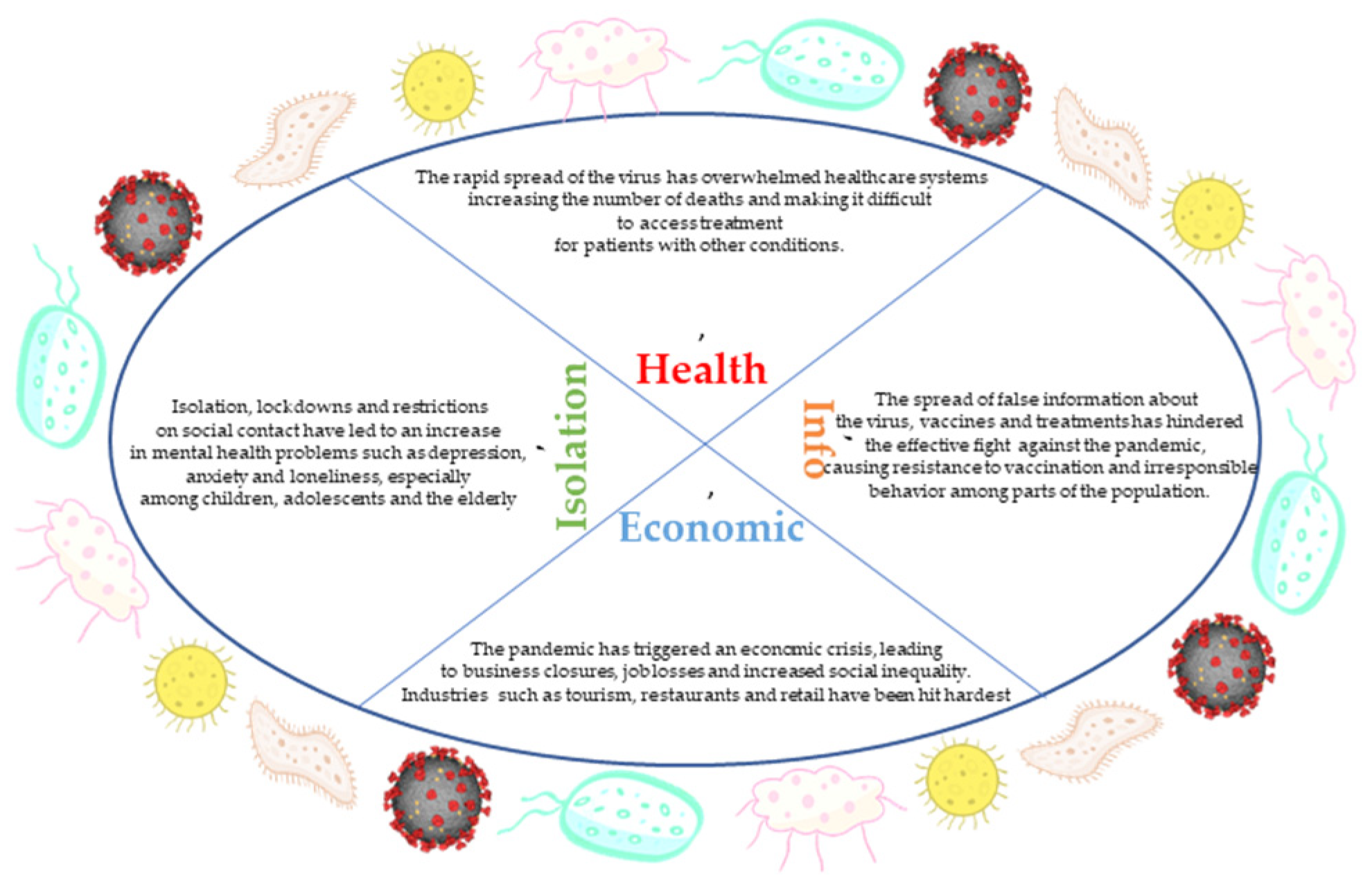
Figure 2.
Selected antibacterial particles.
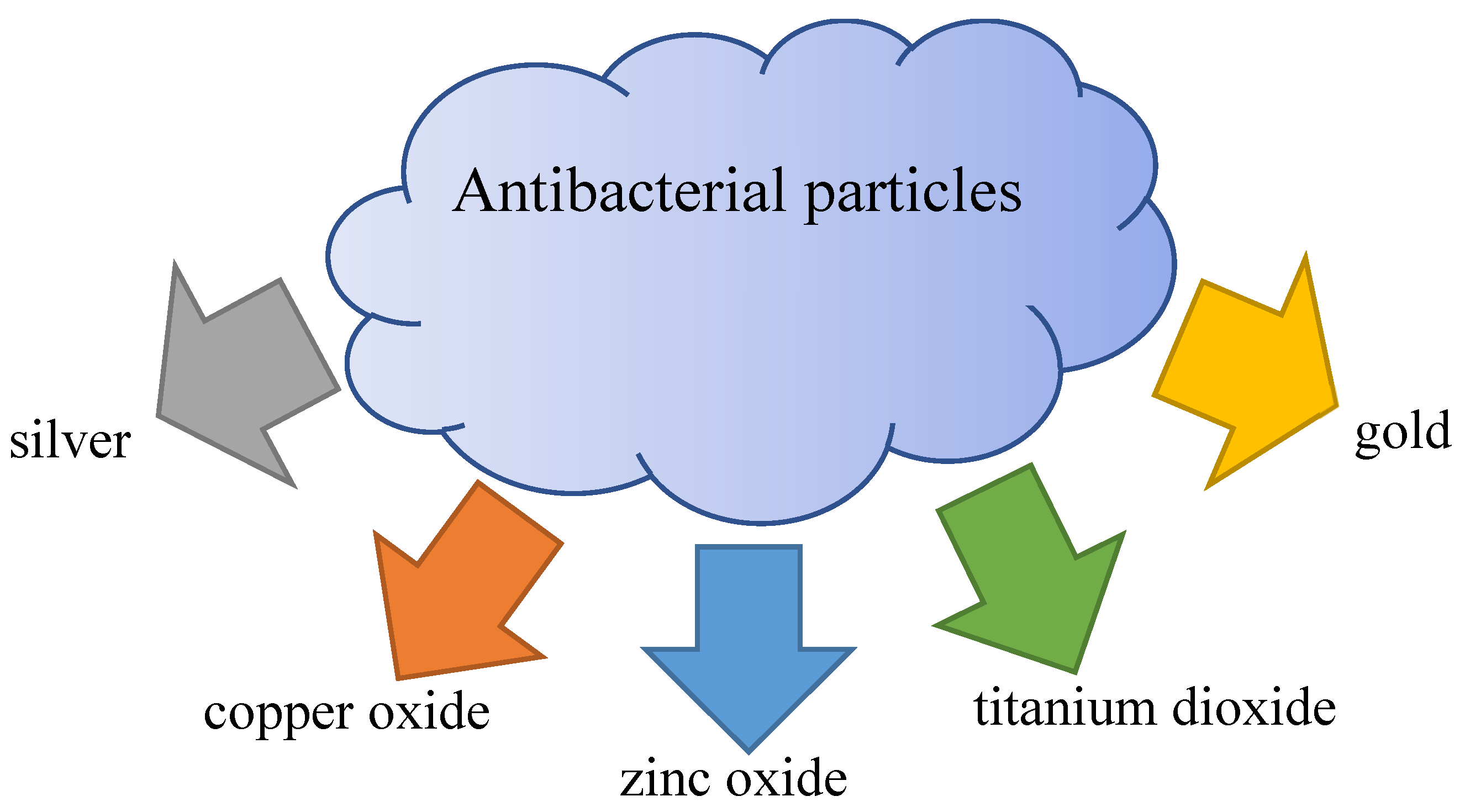
Figure 3.
Applications of AgNPs.
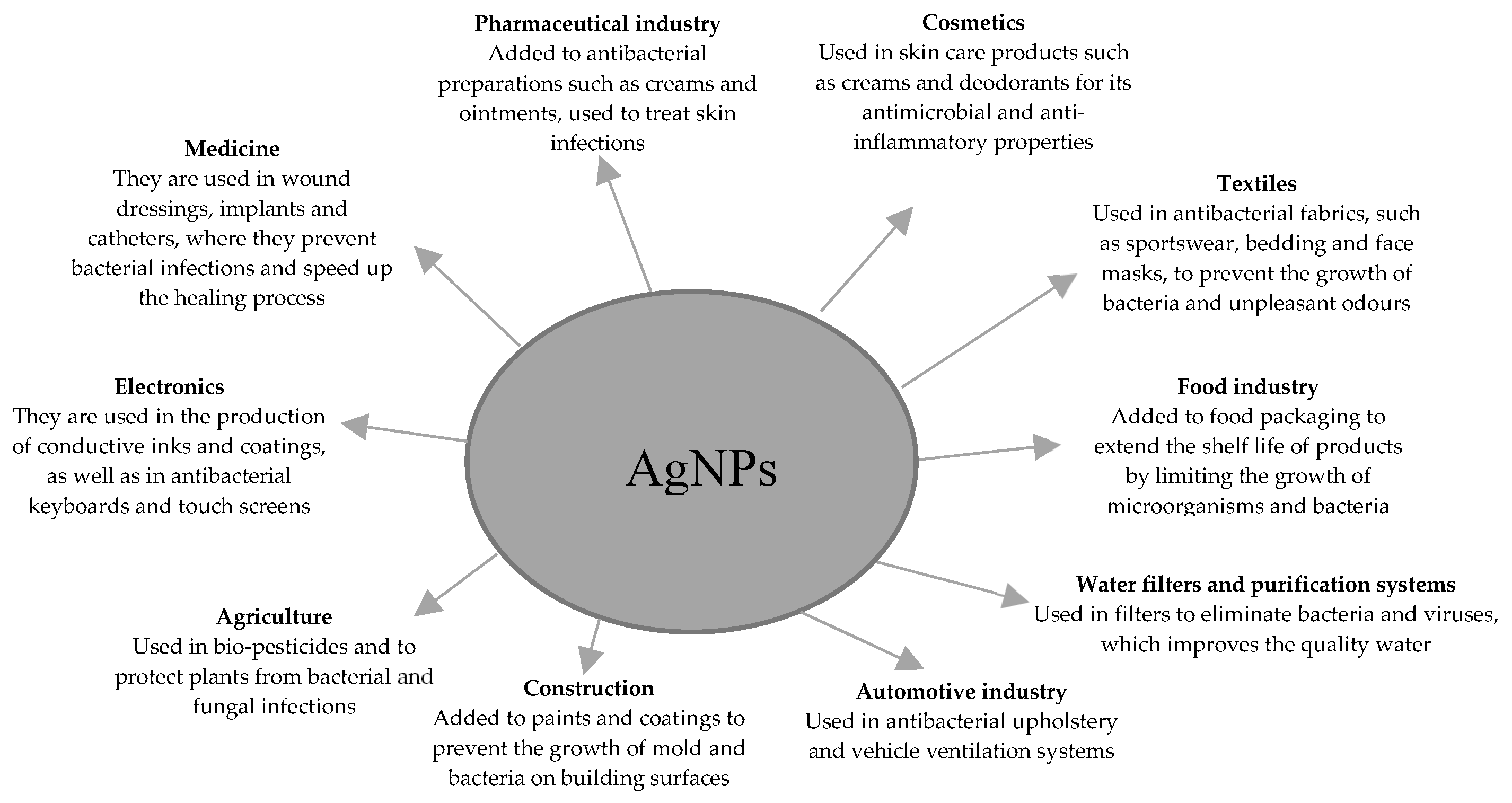
Figure 4.
Appliactions of CuO.
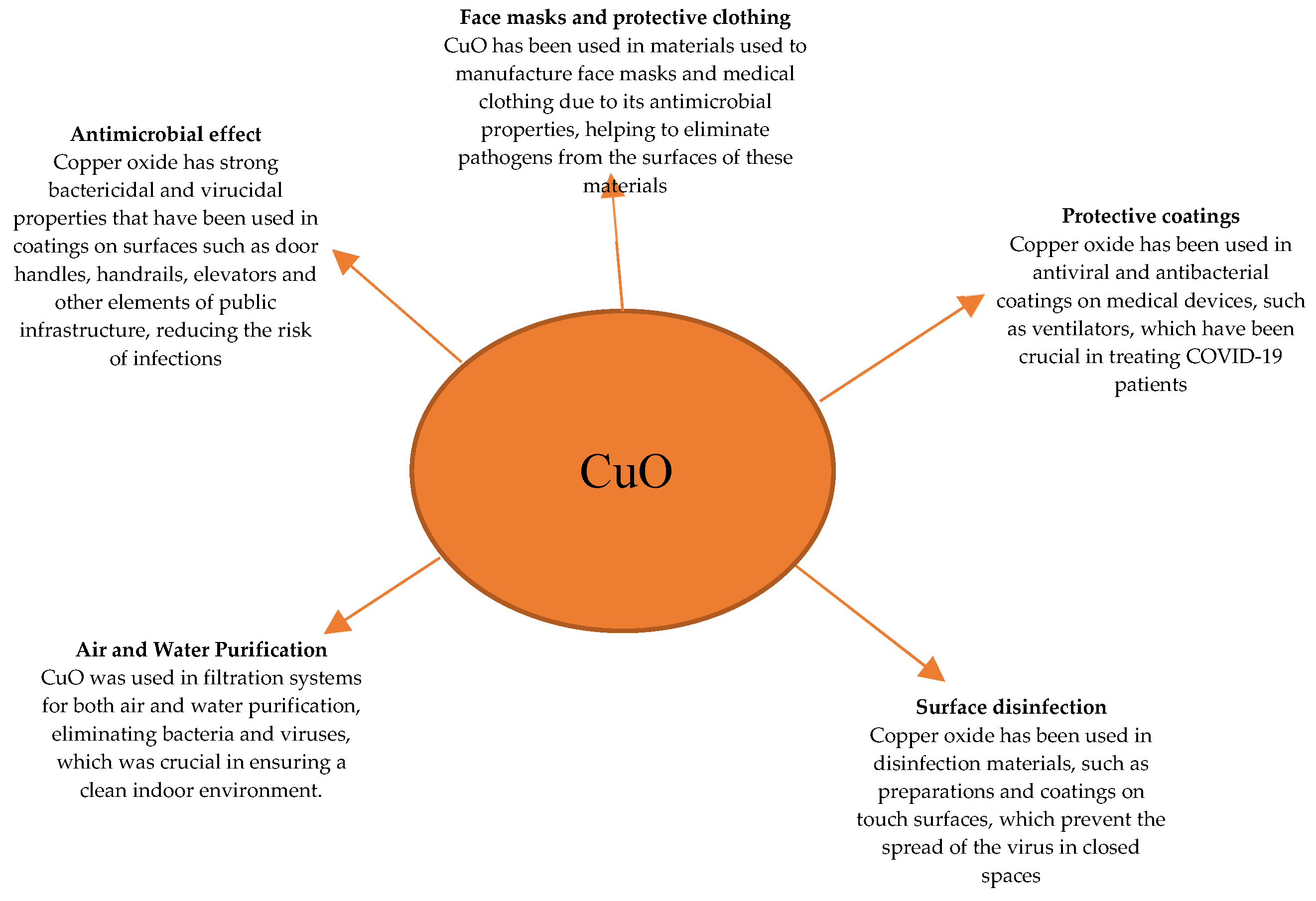
Figure 5.
Applications of ZnO.
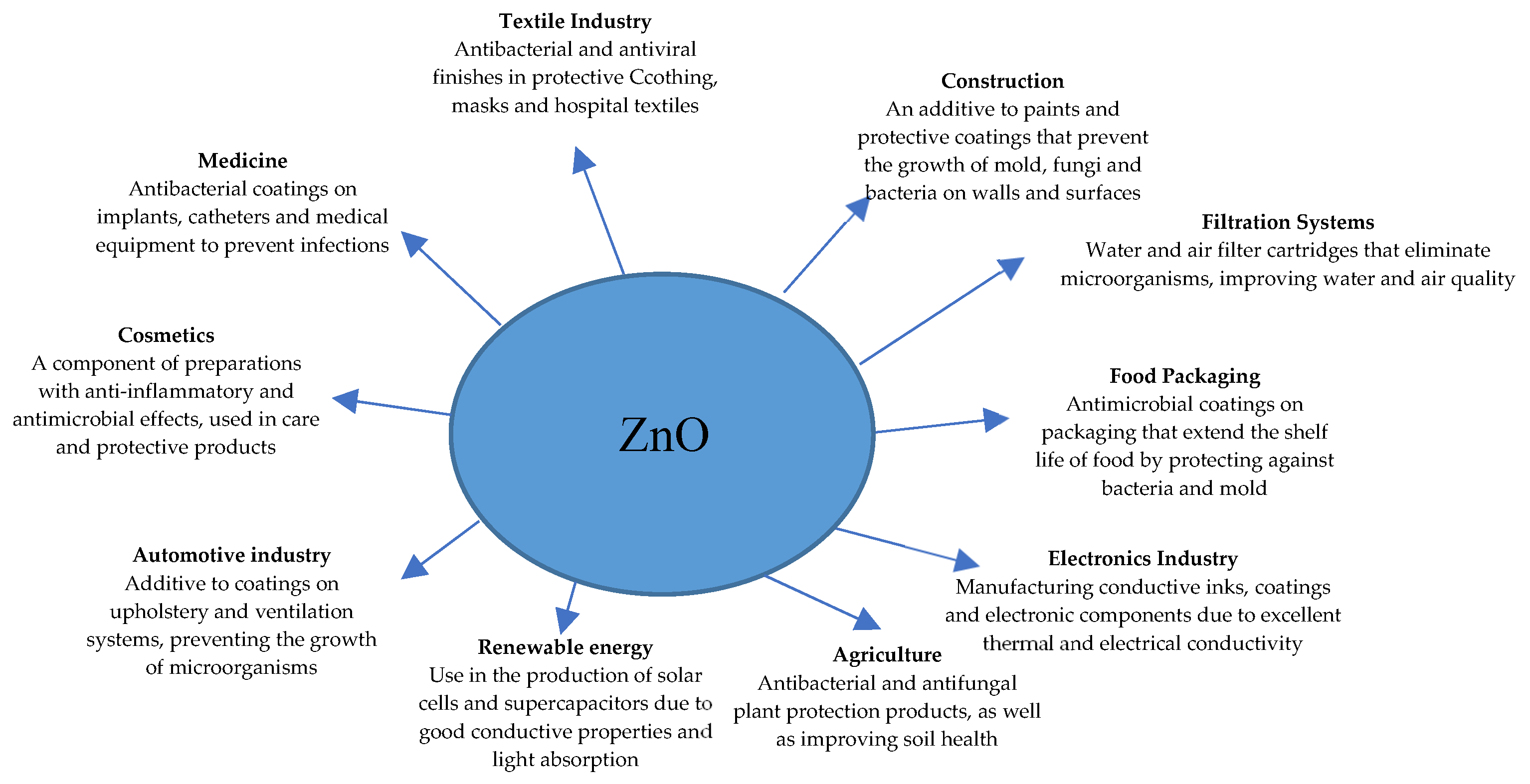
Figure 6.
Applications of TiO2.
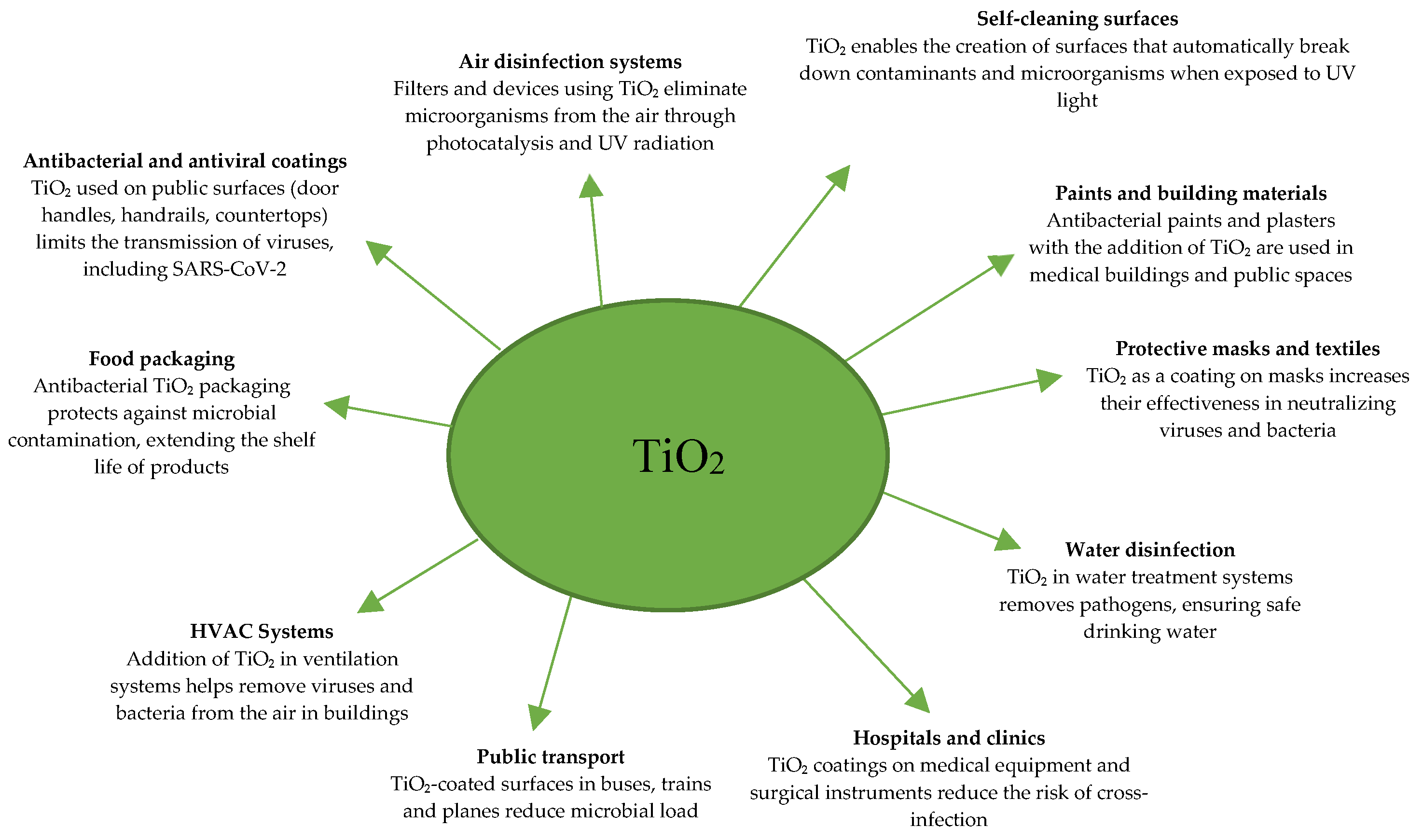
Figure 7.
Applications of Au.
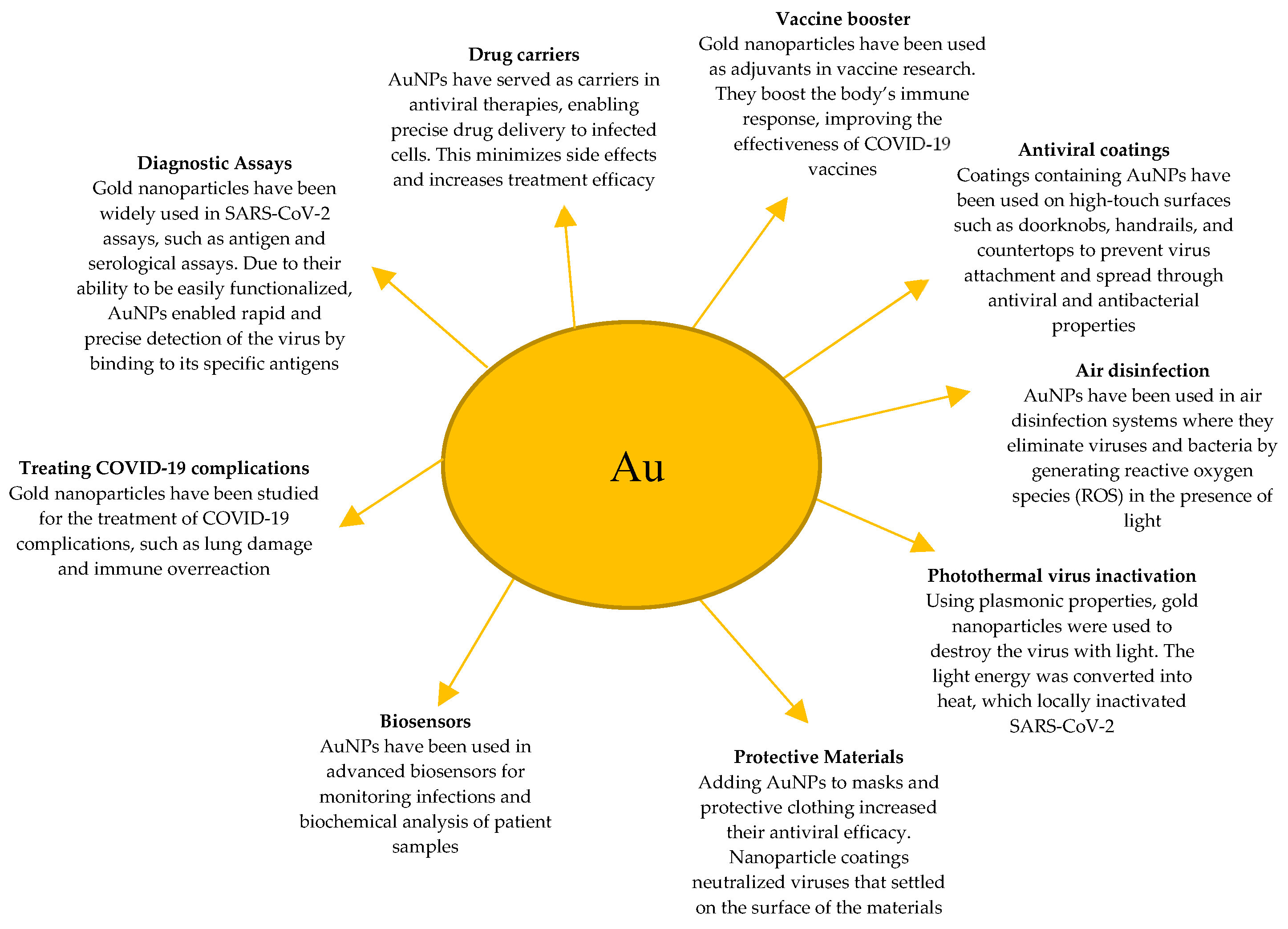

Table 1.
Applications of selected polymers in medical devices.
| Type of Polymer | Medical Devices/Applications | Key Properties |
| Polyvinyl Chloride (PVC) | IV tubing, blood bags, oxygen masks, catheter systems | Flexibility, transparency, chemical resistance |
| Polypropylene (PP) | Syringes, surgical masks, N95 respirators, medical containers, gowns | Lightweight, strength, sterilizability, low cost |
| Polyethylene (PE) | Implantable devices, catheter tubing, drug delivery systems, packaging | Biocompatibility, chemical resistance, flexibility |
| Polymethyl Methacrylate (PMMA) | Intraocular lenses, dental prosthetics, medical imaging devices | Optical clarity, rigidity, impact resistance |
| Silicone Rubber | Implants, tubing, seals, prosthetics | Flexibility, thermal stability, biocompatibility |
| Polycarbonate (PC) | Face shields, dialysis equipment, incubator housings, surgical instruments | High impact resistance, transparency, sterilizability |
| Polyetherimide (PEI) | Autoclavable medical devices, surgical trays | High thermal resistance, mechanical strength |
| Polyurethane (PU) | Wound dressings, catheter coatings, pacemaker leads | Flexibility, durability, wear resistance |
| Polytetrafluoroethylene (PTFE) | Vascular grafts, catheter linings, surgical meshes | Non-stick properties, chemical inertness, biocompatibility |
Table 2.
The most popular techniques for polymer modification to enhance their properties.
| Polymer Type | Type of Modification | Enhanced Properties |
|---|---|---|
| Polypropylene (PP) | Electrostatic charging | Filtration efficiency, particle trapping ability |
| Polypropylene (PP) | Advanced fiber morphology (melt-blown, spun-bond techniques) | Filtration efficiency, breathability, lightweight |
| Polyethylene (PE) | Crosslinking | Thermal stability, chemical resistance |
| Polypropylene (PP) | Nanoparticle incorporation (silver, copper, zinc oxide) | Antimicrobial/antiviral activity |
| Polyethylene (PE), Polypropylene (PP) | Addition of quaternary ammonium compounds | Antimicrobial/antiviral activity |
| Polypropylene (PP), Polyethylene (PE) | Photocatalytic coatings (e.g., titanium dioxide) | Self-cleaning, viral degradation under UV light |
| Polyethylene (PE), Polypropylene (PP) |
Blending with high-performance polymers (e.g., PC, PEI) | Heat resistance, mechanical strength |
| Polyvinyl Chloride (PVC), Polypropylene (PP) | Surface modifications for enhanced recyclability | Environmental sustainability |
| Polyethylene (PE), Polypropylene (PP) |
Lightweighting | Material efficiency, reduced raw material usage |
| Polyvinyl Chloride (PVC), Polypropylene (PP) | Incorporation of recycled content | Sustainability, reduced environmental impact |
Disclaimer/Publisher’s Note: The statements, opinions and data contained in all publications are solely those of the individual author(s) and contributor(s) and not of MDPI and/or the editor(s). MDPI and/or the editor(s) disclaim responsibility for any injury to people or property resulting from any ideas, methods, instructions or products referred to in the content. |
© 2025 by the authors. Licensee MDPI, Basel, Switzerland. This article is an open access article distributed under the terms and conditions of the Creative Commons Attribution (CC BY) license (https://creativecommons.org/licenses/by/4.0/).
Copyright: This open access article is published under a Creative Commons CC BY 4.0 license, which permit the free download, distribution, and reuse, provided that the author and preprint are cited in any reuse.


