

Submitted:
20 February 2025
Posted:
21 February 2025
You are already at the latest version
Abstract
Forests today face significant challenges from climate change, biodiversity loss, and increasing socio-economic and political pressures, all of which intensify with the impacts of military conflicts. This paper focuses on Ukraine and examines the root causes and impacts of the ongoing war in Ukraine on forest socio-ecological systems to identify potential recovery pathways. We use a multi-method approach to examine the socio-economic, environmental, and governance factors affecting Ukraine’s forest socio-ecological systems and to assess the impacts of the war. Through a review of relevant literature and interviews with forest sector experts, we identify key pathways for post-war recovery. Pathway 1 emphasises increased forest use for sustainable low-carbon recovery, using timber for housing reconstruction and green small-scale energy production. Pathway 2 suggests `close-to-nature and close-to-people` approach leveraging digital tools and innovations for climate-resilient management. Pathway 3 highlights anticipatory governance, refining policies, enhancing transparency, and fostering socio-ecological innovations to ensure sustainable forest management aligned with environmental and socio-economic goals. Relying on a single recovery pathway risks long-term vulnerability, yet integrating multiple recovery pathways and anticipatory governance creates synergies. We emphasise the importance of integration of innovative approaches into co-designed sustainable management practices. Our findings emphasise that addressing the ongoing crisis in Ukraine requires coordinated efforts from all levels of Ukraine’s stakeholders and international policy actors. We believe that the findings shared in this paper, aligned with the "build back better" principles, could not only support the post-war recovery in Ukraine but also offer valuable insights potentially useful for other conflict-affected regions worldwide.
Keywords:
war and military conflict
; climate change and wildfires
; ecosystem restoration
; resilience
; anticipatory governance
; nature-based and climate smart solutions
1. Introduction
Military conflicts have historically impacted forests, affecting not only their ecosystems but also forest-dependent communities and other users of natural assets. These conflicts disrupt decision-making structures, processes, and institutions, influencing the entire forest socio-ecological system (SES), which integrates ecological processes with socio-political and economic dynamics (as conceptualised, e.g., by [1,2,3,4,5,6]). Post-war recovery of forest SES typically involves several key patterns including demining, forest restoration, reforestation with involvement of different stakeholders and local communities, land use changes, conservation, or even land abandonment [7,8,9,10,11,12]. These recovery processes often reshape the landscape and affect not only ecological functions but also social and economic dimensions, as communities rely on forests for resources and livelihoods. Recovery efforts can also provoke conflicts among land users, which can lead to significant changes in land tenure and its administration, affecting short-term and long-term sustainability [13,14,15].
This paper analyses Ukraine’s forest SES, focusing on pre-war challenges, war-induced impacts on forest natural assets and the provision of ecosystem services. It also explores recovery pathways across ecological, socio-economic, and governance dimensions, with an emphasis on resilience and alignment with trends in global, EU and national policies.
Indeed, lessons learnt from past conflicts suggest that recovery of forest SES is not an easy task. In Europe after World War II, different countries adopted a combination of strategies to deal with post-war recovery challenges. Germany, Poland, and France, as well as Ukraine implemented large-scale reforestation projects aimed at restoring timber supplies and preventing soil erosion [16]. These efforts were primarily state-driven and aimed at stabilising the forest sectors [17,18]. In the Ukrainian Carpathian region, along with the excessive use of forests (in 1956–1960, the annual volume of timber harvest exceeded the average increment by almost double), extensive reforestation took place [16]. Reforestation efforts with widespread planting of spruce (Picea abies), often on non-endemic sites, led to increasing vulnerability to pests, pathogens, and drought [19,20,21].
After the post-independence period in Ukraine, the abandonment of marginal agricultural lands became increasingly common [22]. Many of these lands underwent natural regeneration, eventually giving rise to new forest types on previously unmanaged land [19]. In the Carpathian region, nature recovery processes were observed on communally owned land [23]. Similar patterns of natural forest recovery (natural reforestation) have been observed in countries like Bosnia and El Salvador. In these cases, forests have regrown after wars due to the cessation of agricultural activities and land-use discontinuation, often because of land contamination [24,25]. In many cases, however, the socio-economic functions of these forests remain diminished, as the presence of mines and UXO hinder activities such as timber harvesting and outdoor recreation.
Post-war shifts in power relations have often led to institutional changes in forestry. The collapse of communist regimes in Eastern Europe in the late 1980s to early 1990s, resulted in privatisation of forestland and creation of new governance systems in several countries, including Romania and Poland, with varying continuity of sustainable forest management [23,26]. Elsewhere in the world, lessons from Cambodia, Thailand, Bolivia, and Brazil also highlight the need for institutional changes. They call for strengthening forest governance through active community participation—beyond just formal land rights—as crucial elements in putting post-war forestry on a sustainable path [24,27,28].
A critical challenge in post-war recovery is contamination of forests by unexploded ordnance (UXO), which severely restricts access to forests [11,29]. In Bosnia and Herzegovina, large areas ten years after the war still remain contaminated, hindering recovery efforts and delaying the delivery of economic and social benefits from forest SES [25,30,31]. In Croatia, Serbia, Armenia, and Ukraine, landmines also limit forest management and use. Also, forestland, wood and biomass often contain projectile fragments, leaving them unsuitable for use [32,33].
In Ukraine, ongoing warfare and forest contamination have significantly affected forest health and vitality and the provision of ecosystem goods and services [11,34,35,36,37,38,39,40]. Numerous mines have restricted access to forests and limited logging operations, reforestation, and ecosystem restoration efforts, as well as the delivery of non-wood forest products (e.g., collection of mushrooms and berries), and recreational activities in woodlands [10,25,41,42]. The war has resulted in the worst crisis in the history of Ukraine’s forest sector [43]. According to the [44]UNEP (2022), there is an unprecedented need to avert cascading impacts of the war and build resilience in Ukraine, which “is now facing a compounded, multi-dimensional environmental crisis that has either exacerbated existing issues or added new ones” [44:p6]. Indeed, “environment is always the silent victim of military conflicts” [45] (see also [46]) and requires significant efforts for recovery.
This paper explores Ukraine’s forest SES prior to the war (Section 3.1), by applying the multi-method approach presented in Section 2. It explains the root causes and impacts of the war on forest SES and the resulting crisis in Ukraine (Section 3.2 and 3.3). It then identifies pathways for the recovery of forest SES (Section 3.4) and discusses how these sustainability pathways align with current policies and trends in the EU and globally (Section 4), emphasizing the need for synergies across diverse initiatives to ensure resilience despite ongoing geopolitical pressures.
2. Materials and Methods
Our study employs a multi-method approach to analyse socio-economic, environmental, and governance drivers and pressures on Ukraine’s forest SES. This analysis adapts the analytical framework proposed by Bergström et al. [47] (2016): (1) system dimension, (2) system scope, and (3) system resolution. These dimensions were adapted to the Ukrainian context to examine the crisis caused by the war, as the Nature of the Crisis, Scope of the Crisis, and Resolution of the Crisis (see Table 1).
By integrating a literature review with insights from expert interviews, we examine both pre-war challenges and war-induced impacts on Ukraine’s forests. The time frame of the analysis covers the period from 2010 till 2024. This approach and the time frame allow us to develop plausible recovery pathways grounded in both empirical evidence and expert perspectives. The literature review provided a foundational understanding of the forestry challenges and potential recovery strategies in Ukraine. Using Web of Science and Google Scholar, we conducted searches with keywords such as “forest”, “forestry,” “forest sector,” “war,” “recovery,” “socio-ecological,” “forest governance,” “biodiversity,” “timber,” “harvesting,” “sustainable forest management,” “Ukraine,” and a Boolean combination of these. We reviewed titles and abstracts to identify studies focused on Ukraine’s forest economy, forest-dependent communities, social dynamics, biodiversity, timber production, harvesting practices, sustainable forest management, governance, ecological resilience, stakeholder engagement, and post-war recovery. Additional context was drawn from grey literature such as the IUFRO Report on Ukraine Forest Science and Research, the State Forest Resources Agency of Ukraine (SFRA), and the FAO Forestry Support Strategy for Ukraine (2023–2027). This line of reasoning shaped the design of interview questions and provided a comparative basis for interpreting stakeholder interviews (Appendix A). We conducted semi-structured interviews with seven Ukrainian forestry experts (n=7), including researchers, government officials, and representatives from forest-related NGOs. These participants were selected for their direct involvement in forest recovery efforts. The interviews, conducted in 2024, addressed governance, ecological impacts, and socio-economic pressures, allowing us to capture diverse viewpoints essential for accurately reflecting on the complexities in forest SES.
Nature of the crisis. This dimension of our analysis defines key challenges and governance issues through the literature review and expert interviews. The selected experts, who are central to Ukraine’s forest recovery efforts, offered in-depth insights into both current challenges and strategic opportunities. Their perspectives were instrumental in identifying nuanced governance and operational issues that affect the forest sector’s resilience and sustainability (Table 1).
Scope of the crisis. The Scope dimension establishes the boundaries of the crisis, addressing what, where, when, and how much has been affected. This step enabled us to uncover the root causes impacting Ukraine’s forest SES, particularly those associated with war and institutional factors. Our analysis encompassed spatial and temporal impacts, drawing on data such as satellite imagery from the ZOI Environmental Network, land cover data from the Copernicus Dynamic Land Cover Map, and data from the State Emergency Service of Ukraine (SESU) and the Regional Eastern European Fire Monitoring Center (REEFMC). We also examined socio-economic factors, including the increased demand for timber due to war-related reconstruction needs, to understand the most acute pressures on Ukraine’s forest sector (Table 1).
Resolution of the crisis: Developing recovery pathways. The Resolution dimension addresses the how, where, and when of implementing post-war recovery pathways for Ukraine’s forest sector. We developed strategic interventions aimed at building resilient SES, strengthening governance frameworks, and promoting participatory decision-making through social innovations. To structure these recovery strategies, we applied thematic analysis [55], focusing on three critical sustainability pathways: socio-economic, technological, and environmental as outlined in Beland Lindahl et al. [56]. Using QDA Miner Lite, an open-source qualitative analysis tool, we categorised interview responses to identify key themes, including governance challenges, forest health, and economic recovery. These themes were grouped into broader categories that corresponded to the three identified recovery pathways: socio-economic, technological, and environmental [56,57]. To substantiate and validate these pathways, we compared the interview-derived themes with findings from the literature review, which enhanced the accuracy and reliability of our recommendations. Despite the limited sample size of expert interviews, our multi-method approach increased the credibility and validity of research findings. Drawing from both published research and direct input from experts, we thus provided a comprehensive outline of sustainability pathways to address Ukraine’s distinct socio-ecological challenges. This triangulation helps to ensure that the identified pathways are not only relevant and contextually grounded but also offer insights that could apply to comparable forestry settings elsewhere.
3. Results
Ukraine’s forest SES are under severe strain, with the war intensifying ecological, socio-economic, and institutional challenges.
3.1. Baseline Assessment: Contextual Review of Ukraine’s Forest Socio-Ecological Systems
Forests in Ukraine cover 10.4 million hectares (15.9% of the country) placing it ninth in Europe by forest area (SFRA 2023a). Ukraine’s forests are predominantly publicly owned (86.5%) and under the management of the State Specialized Forest Enterprise “Forests of Ukraine”. The enterprise is not financed by the state budget and independently sustains its economic activities. It consists of the central office, 9 regional offices with 144 branches. Around 13% of forestland is communal and managed by communal forest enterprises and only 0.1% of forests are in small-scale, private property [58]. The State Forest Resource Agency (SFRA) is responsible for elaboration and implementation of the state policy in the field of forestry and hunting, forest management planning, issuing harvesting permissions, international activities, inter alia, but not directly for forest management. Forest distribution varies regionally, with the highest forest cover in the Carpathian Mountains (52%) and Polissia regions (40–42%) in west and north-west Ukraine, respectively. In Ukraine, forests are vital for biodiversity, climate regulation, and supporting local livelihoods, as well as for providing timber and other ecosystem services [6,59,60,61]. Productive forests dominate the north-west and west of the country, while in the steppes of central and southern Ukraine, forest cover is sparse (5–12%), yet shelterbelts are critical in protecting larger agricultural fields from windblown erosion, providing habitat for biodiversity at smaller scales, and accommodating traditional land-uses [62,63].
Ukraine’s forests are categorised for various uses: 38% are designated as commercial, 33% as protective, 15% for recreational purposes, and 14% as natural reserves for scientific and cultural preservation [64]. The estimated timber volume stands at 1736 million m³, with an annual increment of 35 million m³ and an annual harvesting rate of 20 million m³. Forest management is conducted by professionally trained foresters. According to the Forest Stewardship Council (FSC), in October 2021, Ukraine has certified 3.72 million hectares of forests, with 118 forest management and chain of custody (FM/CoC) certificates issued [65].
Forestry contributes approximately 0.3% to Ukraine’s GDP. The sector saw substantial growth in 2022, with timber sales reaching UAH 21,583.4 million (USD 584.4 million), primarily driven by exports of unprocessed timber [58]. In the period 2010–2023, of the total volume of harvested timber, 41% was used for industrial purposes and 48% for firewood, primarily for heating and energy [52]. Beyond economic contributions, forests provide essential ecosystem services and support around 36,000 jobs [52]. Forests also play a critical role in the country’s rural livelihood [65,66]. Local communities rely on forest resources, e.g., by working in forest industry or tourism, and especially from using non-timber forest products (NTFPs) such as berries and mushrooms [67], which have seasonal and cyclical yields [5,68,69].
The forest sector in Ukraine does not fully meet high and changing societal expectations [6]. Issues like illegal logging, cases of corruption, as well as rather low consideration of multiple ecosystem services other than timber in decision-making, and a lack of transparency in forest management have raised concerns among scientists, NGOs, media and local communities [70]. While institutional transformations have begun and positive trends are observed, the rules of the game have not changed significantly [60,61]. Despite the introduction of open consultations and public boards to advise regional and central offices of the SFRA, forest governance in Ukraine is predominantly centralised and with a rigid top-down approach [5,60,69]. Decentralisation of forest management—giving local forest enterprises more control over their operations and finances to ensure profitability—has not yet been fully realised. Efforts to transfer administrative and financial independence to these enterprises remain incomplete [53,71]. Lack of policy coordination and weak cross-sectoral collaboration can be observed [59,72]. Although market instruments and forest certification efforts have increased, there is a need for greater involvement from government, civil society, and private sector actors [53,61,65].
Forest policy has increasingly become aligned with the European Union standards, emphasising sustainability, biodiversity conservation, and compliance with EU environmental directives [73]. The Forest Code of Ukraine, established in 1994 and last amended in 2024, serves as the primary regulatory framework for forest management. However, its implementation has been constrained by limited resources [74] and institutional capacity, hindering the practical uptake of sustainable forest management [75]. Current policy priorities—e.g., the [76]—include decentralising forest management, promoting public-private partnerships, dividing governance and business power among different actors, and advancing a green economy approach in line with the EU Association Agreement [77].
While the Baseline Assessment outlines the foundational characteristics of Ukraine’s forest socio-ecological systems, the next section (3.2.) explores the multi-dimensional challenges that have compounded these vulnerabilities, both before and during the war.
3.2. Nature of the Crisis
While Section 3.1 outlines the general context of Ukraine’s forest socio-ecological systems, this subsection focuses on the specific pre-war challenges that amplified vulnerabilities and limited the sector’s capacity to respond to future crises.
3.2.1. Pre-War challenges
Building on the Baseline Assessment (3.1.), this subsection focuses on the pre-war challenges that limited the forest sector’s capacity to respond to crises and highlights factors that compounded existing vulnerabilities.
Ukraine’s forest sector faced significant challenges even before the current conflict, including the impacts of climate change, land use changes, and institutional and financial constraints. Limited participatory governance and cases of corruption, primarily associated with timber logging, further exacerbated these issues [60,70,78,79]. These factors contributed to a sometimes-negative societal perception of forestry and foresters [70].
Between 2019 and 2022, climate change and associated natural disturbances caused the dieback of approximately 800,000 hectares of forest, including 420,000 hectares of pine forests severely affected by bark beetle infestations [35,80]. Since the early 2010s, Ukraine has experienced extreme weather events with more frequent heatwaves and droughts, and snowless winters creating conditions highly favourable for large-scale fires [35,54,80,81]. The fire seasons of 2014, 2015, and 2020 were particularly severe, with human activities contributing to widespread wildfires across the country. The fire season of 2020 was the worst in Ukraine’s history, with large fires affecting the Chornobyl Exclusion Zone (67,000 ha), Zhytomyr oblast (43,000 ha), Kharkiv oblast (8000 ha), and Luhansk oblast (39,500 ha). In July 2020, fire in Eastern Ukraine destroyed more than 730 houses, resulting in 17 fatalities and 861 injuries. In 2020, forest fires in the north-west Polissja region affected 7 villages, damaging 82 houses. In north-east Kharkiv oblast, forest fires destroyed 22 private houses [82]. In the Chornobyl Exclusion Zone, wildfire damage to natural ecosystems was estimated at approximately USD 205 million [82].
Institutional challenges, such as declining state funding, and the overreliance on state control, have hampered management operations and innovations in the forest economy [50,83]. Problems stemming from the separation of forest management from policymaking and the lack of transparency have led to increased risks of corruption, illegal logging, limited cross-sectoral collaboration, and outdated information systems, all of which have hindered the sector’s sustainability [60,61,70], further eroding public trust [5,6,61,69,84].
Recent reforms in the forest sector [85] aimed at addressing existing challenges by prioritising sustainable management practices, including close-to-nature forest management approaches. These reforms also focused on increasing transparency through more active public participation and enhanced collaboration of different stakeholders through consultations and public dialogs. Digital tools were also introduced such as auctions in the timber market and implementing a tracking system of harvested timber to reduce illegal logging and trade [60,70]. The reforms also led to the separation of policymaking and management functions through the creation of the specialised forest enterprise, “Forest of Ukraine,” responsible for operations and forest management, and the mentioned State Forest Resource Agency focused on policy [76]. The reforms implemented by the Ukrainian Government [85] aimed to enhance community involvement in forest management, governance and use, but they remain limited in scope and impact. Our experts noted that “these reforms primarily emphasised increasing economic efficiency through too centralised management functions, which raises the risk of disconnection from local communities” (Expert 3). However, innovations in forest governance, with new social initiatives emerging, have been observed in recent years, marking a positive shift towards more active engagement of civil society actors in reconfiguration of social practices in addressing contemporary challenges [6,60].
Significant positive advancements have been observed in the promotion of information technology and innovative digital platforms in the sector, enabling online auctions and societal monitoring of timber harvesting and trading. Importantly, there has been growing recognition of the need to enhance integrative, multifunctional forestry and certify non-timber ecosystem services [65].
3.2.2. War-Induced Crises
The Russian full-scale war in Ukraine is exacerbating challenges [53]. The war has cost USD 71 billion in environmental damage and led to the equivalent of some 180 million tons of carbon emissions in 1,000 days of war announced at COP29 in November 2024 [86]. Approximately one-third of Ukraine’s forests, spanning 2.9 million hectares, have been impacted [71], with around 1.3 million hectares contaminated by UXO, rendering these areas hazardous for humans, animals, and the ecosystems [58]. Protected areas suffer extensive damage, with large-scale fires reported in regions experiencing active military operations [58]. As of June 2023, war-related economic losses in the sector were estimated at USD 530.8 million [58].
The war has significantly disrupted forest restoration efforts announced in 2021, such as implementation of the Green Country project, which targets planting 1 million hectares over 10 years to increase forest area (Decree 2021, [71]. Tree planting has decreased from 54,500 hectares in 2021 to 36,900 hectares by early 2023 [52,87], while timber demand has increased.
The war is severely impacting forest research, management and education with many students and researchers forced to relocate. This leads to significant disruptions in forest research capacity and impacts forest professionals. The forest sector is facing a severe shortage of skilled professionals, with 2390 foresters mobilised for military service. As of mid-2024, the State Forest Agency of Ukraine reports that the war has resulted in the deaths of 128 foresters, the loss of 524 pieces of forestry equipment, and the elimination of 2738 workplaces [54].
The direct damage to SES from warfare is severe [44]. Also, biodiversity and soil health are being impacted by extensive fires, soil erosion, and the destruction of shelterbelts (windbreaks) around agricultural fields [88]. In the central-east of Ukraine, the shelterbelts were historically established on agricultural lands, to play a crucial role in agroforestry systems, primarily reducing wind speed to mitigate erosion, protect crops, and retain soil moisture. They are now heavily impacted by the war [62]. Protective and regulatory forest functions are especially important in semi-arid regions where they help prevent soil degradation and conserve water. In conditions of the changing climate and increasing droughts, these shelterbelts have become vital nature-based solutions for preserving soil fertility and ensuring food security. However, during the war, many shelterbelts have been repurposed for warfare and become strategic areas for military operations or serve as burial sites [37]. This leaves the affected regions even more vulnerable to environmental risks.
In areas such as the Ukrainian Carpathians, where forests are not directly impacted by the war, climate-driven disturbances like wildfires, pest outbreaks, and other ecological stressors are worsening forest health [35,80]. These forests also face additional pressures because of the relocated businesses and an increase in the number of people currently residing in the region due to their internal displacement from the east of the country [89,90,91].
The challenges described here provide the foundation for understanding the full scope of the crisis, which is examined in the following section (3.3.) through the lens of structural drivers and their far-reaching impacts.
3.3. Scope of the Crisis
3.3.1. Root Causes
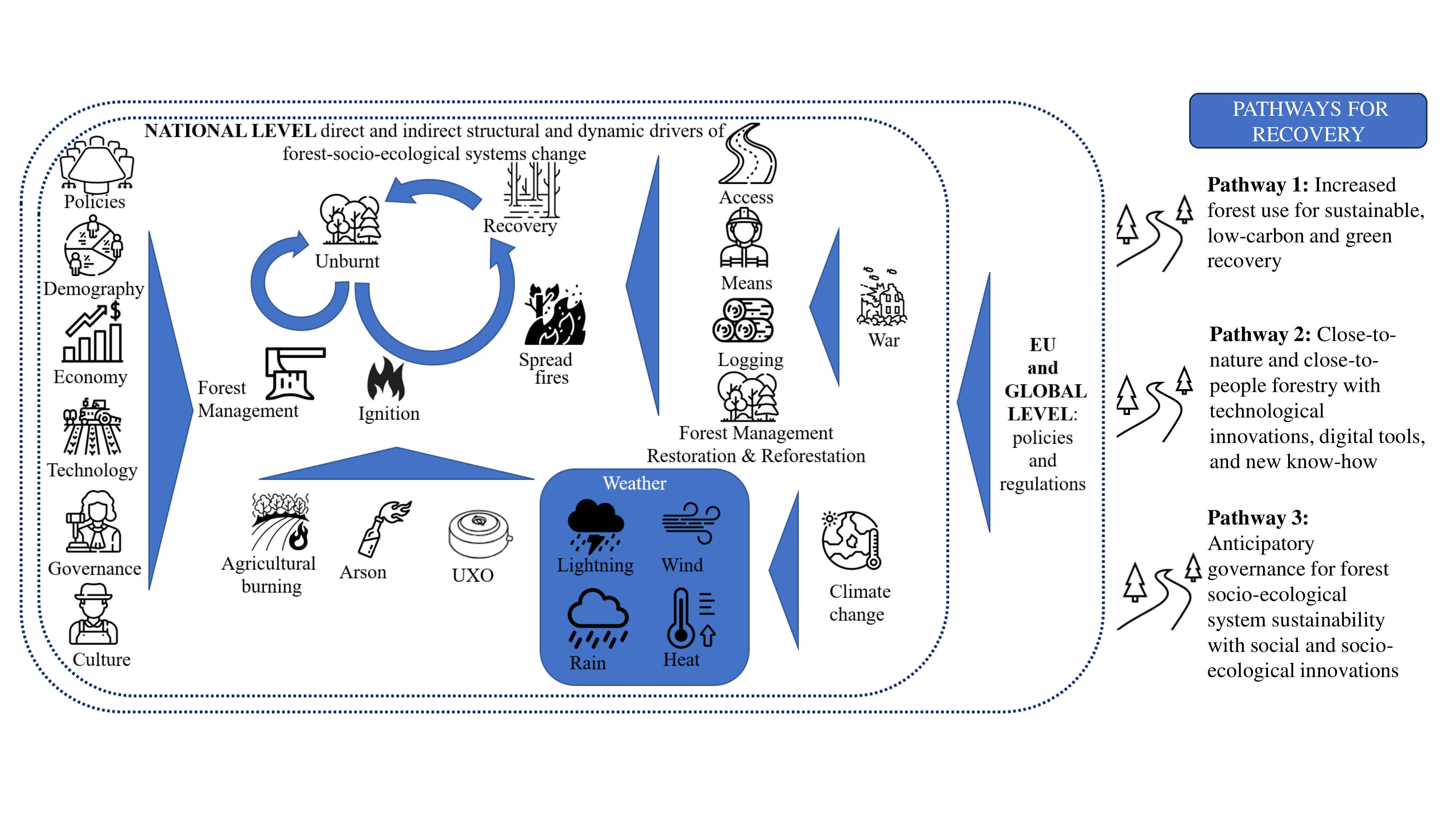
The results of our analysis provide evidence that root causes of the crisis in Ukraine’s forest SES are driven by a complex interplay of structural and systemic factors, with war being the main one (Figure 1). Ukraine’s forest SES are shaped by natural processes (e.g., climate change), land use changes, management decisions (which could be unsustainable, see Section 4.2.2.) and anthropogenic disturbances (e.g., wildfires). Forestry practices, influenced by underlying natural conditions, demography, politics, economy, technology, governance, and societal expectations affect the SES. Human actions, such as unmanaged agricultural burnings or illegal logging, and more recently and critically, warfare, war-related arson, and shelling—with often long-lasting presence of UXO—have significantly intensified pressures on forest SES. Military actions, with explosives, rockets and drone attacks, and large vehicle movements, spark fires with devastating impacts. Climate change exacerbates these challenges by altering weather patterns, affecting forest growth, and raising further wildfire risks. Forest fires that increased because of continuous shelling, human-caused ignition, contamination of land with UXO, and other factors pose significant threats. They also hinder access to firefighting resources and complicate fire management, including fire prevention and suppression efforts [80].
Forests in the northern, eastern, and southern regions have been particularly vulnerable [58,92]. The warfare has led to widespread habitat destruction, further threatening biodiversity and exacerbating the already challenging task of sustainable forest management. Experts 1, 4, 6: “Fire ignition and spread are mainly not influenced by natural factors such as lightning and wind but shaped by continuous shelling, as well as human decisions related to land use and forest management, such as arson and burning of agricultural fields.”
Importantly, “the ongoing war has led to significant increase of demand for timber” (Expert 4) primarily driven by the need of wood for military fortifications and for energy due to its shortages in Ukraine. Interviewed experts anticipate a further increase in timber demand, driven by the need to support reconstruction efforts, comply with EU policy legislation for achieving the net zero target [93], and promote the shift to “green energy sources” highlighted by Ukraine’s government [94].
3.3.2. Impact
Forest Fires and Biodiversity Loss
The proximity of populated areas to forests, combined with intensive agricultural activities, enlarges risk of wildfires. Extreme droughts in some regions, exacerbated by climate change and often linked to heatwaves, increase their frequency and scale [95]. Also, military activities are responsible for a significant number of forest fires [35]. The Russian aggression against Ukraine, which started in 2014 (with the full-scale war launched by the Russian Federation on 24 February 2022) has escalated both the number and extent of wildfires, especially in the eastern, southern and central-northern regions of the country (Figure 2).
The war has caused a significant threat to biodiversity. Approximately 900 protected areas—including Ramsar sites, river deltas, and critical Steppe ecosystems—have been affected by military activities such as shelling, bombing, and oil spills. as well as soil pollution with heavy metals [96]. Since 2022, landscape fires in protected areas (e.g., Emerald) have burned 329,672 hectares, with 44.2% in occupied by Russia territories and within a 30-km frontline buffer zone [35,54,80,81,97].
The full-scale war has significantly exacerbated environmental damage, with fires resulting from active combat operations thus far affecting 1.3 million hectares. Between the start of the full-scale war and August 2024, 115,700 hectares of forest within active military zones and occupied territories were affected by fires, accounting for approximately 90% of all forest fires in Ukraine during this period [35,54,80,81,97]. Fire connectivity, fuel availability, and access to firefighting (which in Ukraine is often limited) are important preconditions for governing of landscape fires. However, from 2010 to 2023, the country was losing due to wildfires an average of 5000 hectares of forest annually (plus 14,000 hectares to pests, diseases, and extreme weather conditions) (Figure 3).
Landscape fires over more than two years of the full-scale war in Ukraine have released nearly 6 million tonnes of carbon into the atmosphere coming from burning organic biomass, including forest, and resulting in over 15 million tonnes of greenhouse gas (GHG) emissions [98]. Long-term impact projections indicate that biomass losses from damaged forests in Ukraine due to the war might result in 11-18 million tonnes of additional carbon emissions, with nearly 85% of these are projected to originate from forests located in the frontline [98,99].
Socio-Economic and Market Dynamics in Forestry
The war has inflicted substantial socio-economic impacts and market challenges in Ukraine. In 2022, its GDP saw a historic 29% drop, primarily driven by widespread damage to industrial infrastructure and natural capital, including forests [100]. As of November 2024, due to the warfare, 20 forest enterprises mainly in east-north of Ukraine have suspended their economic activities, including two in Donetsk oblast (i.e., administrative territory, like province), three in Zaporizhzhia oblast, seven in Luhansk oblast, two in Kharkiv oblast, and six in Kherson oblast [92]. Forest area of 0.5 million hectares on territories liberated from Russian occupation requires demining [58]. Nearly 0.8 million hectares of forest land is under occupation and information about these forests is missing. 20% of Ukraine’s nature reserves, encompassing 812 protected areas, are significantly damaged [101] and not suitable for use for recreational, research and educational purposes.
Logging volumes remained relatively stable from 2010 to 2021, with an average of 20.7 million m3 and maximum variations up to 15% range. However, in 2022 and 2023, when Russia’s full-scale war against Ukraine began, harvesting volumes decreased by 23–24% (Figure 4, [52]). Because most forests are concentrated in the northern and western regions of Ukraine, forest management is still possible despite the war. In the south and east of the country, the main part of which is under occupation, forests (covering an area of approximately 0.8 mln ha or 7.7% of the territory) have no significant commercial value. In the territories that were previously temporarily occupied (north Ukraine), economic activities have been partially restored, except for the area of 0.5 million hectares that requires demining [58].
Economic pressures on the forest sector are exacerbated by challenges in wood processing and timber marketing due to limited electricity supply since the war started, disrupted logistics, increased fuel prices, and decreased area of FSC-certified forests.
Timber production has faced significant strains with a marked shift in 2022 toward fuel wood, which accounted for 61.7% of total timber sales [102]. This trend reflects a rising demand for heating and burning wood instead of fossil fuel. Experts 6 noted that “... ’fuel wood’ includes not only firewood for household use but also fuel wood designated for both industrial and non-industrial applications within industry”. While fuel wood sales stabilised at 57.8% in 2023 [58], the continued dominance of this segment points to market disruptions and underscores the need for strategic realignment. Market access challenges also persist, especially for sustainably managed forest products that lack consumer premiums, and the sector suffers from lack of entrepreneurial development for non-timber forest products, despite the high value of such resources in some regions [53].
Restricted forest access, increased fuel wood demand, and illegal logging have escalated. Illegal timber logging volumes in 2023 exceeded pre-war levels [58], particularly in southern and eastern regions, where logging also emerged to support defence efforts and satisfy immediate demand of local populations in energy due to distributions in energy supply as a result of destroyed energy infrastructure by Russia. Results from a survey conducted in late 2022 by [103], involving 51 respondents from five stakeholder groups—civil society activists, NGO environmental experts, forestry workers, wood processing workers, and institutional environmentalists—indicated that 66.7% believed the war had a significant impact on the daily operations of state forestry enterprises, admitting disruptions across the sector. Interviewed by us experts highlighted that Ukraine’s forestry faces “convergence of socio-economic and market challenges requiring sustained intervention, market monitoring, and a green recovery strategy that addresses immediate needs while paving the way for sustainable forest management and bioeconomy transitions” (Expert 7).
Forest Governance and Management
Russia`s war in Ukraine necessitated substantial refinement of Ukraine’s forest policy and strategic goals. The updated State Strategy of Forest Governance of Ukraine until 2035 includes new provisions aimed at restoring forest management in areas contaminated by explosive ordnance and rehabilitating forests damaged by armed conflict. However, forested areas are not designated as a priority for demining efforts, limiting the practical effectiveness of these provisions and rendering much of the policy declarative rather than actionable. Only 0.1% of the required demining area, or 232 hectares, has been addressed by the State Specialized Forest Enterprise “Forests of Ukraine”, indicating significant gaps in operational capacity and financial support for demining efforts.
Voluntary forest certification, such as by Forest Stewardship Council (FSC), helps maintain responsible forest management in “non-in-the-conflict” areas, ensuring supply chain integrity and compliance with sustainable practices. For forest management units in potentially hazardous zones, the updated Forest Stewardship Standard proposes excluding contaminated areas from certification [65]. Certified forestry enterprises are required to implement comprehensive measures, including identifying and mapping contaminated areas, clearly delineating these zones, adapting management plans and monitoring systems, and ensuring public access to non-confidential information. These measures support safety, integrity, and sustainability while addressing the complexities introduced by explosive contamination. Management practices are also adapted to ensure High Conservation Value (HCV) areas remain protected, preventing forest products from contaminated areas from entering FSC-certified supply chains.
While voluntary certification partially compensates for gaps in mandatory policy, regulatory challenges persist. The Ukrainian government has also adjusted logging regulations during the wartime, imposing new restrictions but simultaneously removing seasonal logging bans. This change raises sustainability concerns, especially given that clear-cutting accounts for 89% of logging activities [52]. Such legislative adjustments could undermine conservation efforts critical to Ukraine’s obligations under the Bern Convention and its alignment with European environmental standards. Analysis of laws, governmental programs, and their implementation shows that previous policies and strategies did not fully consider the range of ecosystem services, expectations of the society to be included in the decision-making and the impacts of climate change on forest management [70]. While recent policies indicate progress, the evolving regulatory landscape continues to reflect the challenges of balancing immediate needs with long-term sustainability objectives in forest governance.
3.4. Resolution: Pathways for Recovery
We identified three strategic pathways for addressing the complex challenges of post-war recovery. The first pathway centres on using forest resources to drive immediate economic recovery. The second emphasises sustainable, long-term forest restoration, focusing on biodiversity and climate resilience. The third pathway prioritises decentralised recovery strategies with decision-making authority vested in local governments. Key to this pathway is participatory governance with the promotion of social and institutional innovations to enhance transparency, combat risks of corruption, and foster local community engagement in forest management. The findings also show that the devastation in eastern Ukraine, including the losses of life including forestry personnel, destruction of facilities, vehicles, and resources, including natural capital, vital for forest management and use, means that the basic recovery (of financing, infrastructure, human and man-made capital, etc.) must take precedence before the more advanced pathways outlined below in this paper can be realistically pursued.
Pathway 1: Increased Forest Use for Sustainable, Low-Carbon and Green Recovery
Pathway 1 emphasises the domestic use of Ukraine’s wood to meet urgent needs in building material, primarily for housing reconstruction and new construction of residential houses and infrastructure with green and low-carbon construction materials, such as wood [65]. It is also envisaged that timber will be used for ensuring “green” energy supplies, focused on small-scale (residential and municipal) green energy production and high efficiency wood biomass applications (e.g., [104,105]. The rationale behind an increase in volumes of timber production for wood construction, wooden value-added products and energy was highlighted by e.g., EU New Bauhaus objectives and Ukraine` Green Deal and Green Policies accordingly [106]. However, “while timber is critical for rebuilding” (and small scale, green energy projects) “it is essential to ensure that economic recovery efforts do not compromise long-term sustainability” (Expert 1).
Vital for increasing wood supply would be to meet the demand for timber without jeopardising other critical ecosystem services of forests. These services of forest include windbreaks and soil protection, e.g., in eastern Ukraine (where agricultural land dominates), flood protection in western Ukraine, with steep slopes of the Carpathian Mountains, and where clear-cutting has proven to reduce water regulation, soil protection, habitat provisioning, and climate regulation functions. Thus, meeting the objective of spurring timber production should be achieved only via the widespread adoption of sustainable forest management practices.
We recommend a nationwide timber sourcing and sustainability feasibility study i) to assess the types and quantities of wood needed for post-war reconstruction and increased demand of using wood for energy; ii) determine the production capacity in different forest regions consistent with harvesting, transportation, processing and manufacturing capabilities; iii) refine estimates of production capacity after applying spatial filters and sustainability criteria, which would address, at a minimum, protection of High Conservation Value forests and biodiversity, hydrologic regulation, and climate resilience; and iv) provide recommendations for appropriate sourcing of timber locally, regionally, and nationally consistent with production capacity and sustainability.
The development of value-added forest products will also be essential to meet the demand for wood and create economic resilience and reduce the dependency on raw timber extraction. Beyond wood, increased use of non-wood forest products could enlarge the capacity for local food supply (through developing short-supply chains and value-added products). Monetization of non-wood forest products and industries like ecotourism can contribute to economic growth, green job creation, improving health and wealth of people, and helping to diversify local economies.
However, the first step in implementing Pathways 1 would be addressing war-related damage, such as demining of unexploded ordnance and restoration of damaged forest enterprise and infrastructure. This would require substantial investment. including in modern forestry equipment. Expert 6 stressed that “Rebuilding the sector will require not just economic investment but also a focus on forest health (and vitality) through (developing and using of) modernised (and eco-friendly forest) management practices.”
Pathway 2: Close-to-Nature and Close-to-People Forestry with Technological Innovations, Digital Tools, and New Know-How
`Close-to-nature and close to people forestry` pathway emphasises long-term ecological restoration and the development of climate-resilient landscapes through close-to-nature forestry, incorporating contemporary digital planning and modelling tools and innovative silvicultural approaches addressing a full range of ecosystem services [67,107,108,109]. It follows principles of an integrated landscape approach, incorporating nature-based and climate-smart solutions [110,111,112,113,114] and highlighting the active participation of local communities in forest management decisions [115].
Given the impacts of the war, such as fire damage and land contamination, the efforts should start with demining, improved fire management, nature regeneration, and planting of native species to restore damaged forest ecosystems and ensure forest health. This pathway prioritises restoring biodiversity and enhancing climate resilience. Close-to-nature forestry with multifunctional and sustainable silviculture approaches promotes forest reforestation with native species and aims to mitigate the risk of fires and pest infestations [116,117]. Expert 4 emphasised that “restoring forest ecosystems with native species ensures not only biodiversity but also climate adaptation, reducing vulnerability to fires and extreme weather events.”
Pathways 2 offers slower but more sustainable economic gains by focusing on green jobs creation and benefits from forest ecosystem services other than timber (e.g., non-timber forest ecosystem services, goods and value-added products). “Ecotourism, agroforestry, forest playing a role as a shelterbelt for agriculture, and forest-based value-added businesses offer diversified income sources that align with ecological goals” (Expert 3). These sectors would also provide well-being and resilience for rural communities and people involved.
Decentralisation of forest management and empowering local communities is key to this pathway’s success. The Environmental Impact Assessment Law (Law of Ukraine No. 2059-VIII, updated on January 4, 2024) and National Forest Inventory Program [118] provide the necessary regulatory framework to ensure that community-led efforts are aligned with national ecological goals. Expert 5 stated “Local communities should play a central role in decision-making to ensure forest governance reflects both local needs and national priorities”.
To enhance forest health and vitality, this pathway focuses on maintaining ecosystem services through proactive monitoring and adaptive management. Preventative measures for fire management and the restoration of war-damaged forests will require continuous investment in forest health technologies. Expert 6 noted that, “Long-term monitoring and adaptive management will be critical in ensuring that forest ecosystems remain healthy and resilient.”
Digitalization and new technologies have significant potential to support sustainable, multifunctional, and nature-based forest ecosystem management [107,114]. Expert 7 admitted that “digital tools must be fully integrated into the recovery process for forest demining, inventory, and sustainable management, enabling real-time monitoring of forest health and regeneration”. Tools like terrestrial and airborne laser scanning, remotely sensed imagery, geographic information systems, decision support systems (such as Marteloscope platforms), and simulation modelling enable integrated, long-term forest planning and monitoring. They aid managers in balancing multiple objectives, as well as anticipating climate vulnerabilities and risks. Knowledge exchange enables sharing of practical experiences, improving evidence-based understanding of forest dynamics and silvicultural techniques, and keeping people well-informed about forest health and management practices. Fostering collaboration among forestry stakeholders is crucial for adapting to ongoing challenges, such as climate change.
Pathway 3: Anticipatory Governance for Forest Socio-Ecological System Sustainability with Social and Socio-Ecological Innovations
Pathway 3 focuses on refining Ukraine’s forest policies and “strengthening forest governance, enhancing transparency, and ensuring compliance with sustainable practices to align economic activities with environmental goals” (Expert 7). It emphasises the building of accountability through regulatory and anti-corruption reforms and leveraging international partnerships to enhance governance capacity. The reforms and their implementation are necessary to prevent overexploitation of natural assets, and promote responsible, integrative and sustainable forest management. Innovative, anticipatory forest governance is deemed to improve transparency, address corruption, and promote decentralised and more deliberative decision-making (e.g., as seen in [119]). In this regard, the Program on Anti-Corruption Measures in Forestry [120], which is under implementation, is a critical step in preventing overexploitation of natural capital and steering sustainable governance and management of forests. “Strong governance prevents deforestation and forest degradation by enforcing sustainable practices and reducing the influence of corrupt actors” (Expert 3).
Transparency in forest management practices (e.g., through digitalization) is essential for achieving these goals. Technical or technological innovation, offering digital solutions, such as the Digital Tracking and Certification System introduced in Ukraine in 2022 play a crucial role in enabling real-time monitoring of timber harvesting, and thus increasing the transparency and accountability of forestry operations. “The use of digital tools to track timber harvesting and sales is essential to maintain transparency and protect forests from over-exploitation” (Expert 4). Digital wood tracking systems, actively promoted within EU policies like the FLEGT Action Plan [121], can prevent illegal logging and ensure promotion of transparency in the management and use of timber resources. Continued efforts of decentralization, following the Law on Decentralization (2015), could empower local governments to take a more active role in decision-making, creating a more responsive and transparent governance. Expert 5 emphasised “decentralisation allows local authorities to manage forest resources more effectively, improving accountability and transparency”. Collaborative forest policy frameworks that involve multi-level engagement of multiple stakeholders contribute to building robust regulatory systems [49,50,51,52,53]. Capacity building and empowering local stakeholders is a prerequisite for transferring more decision-making powers to local forest authorities and communities. Women are to play an important role in this process [122,123], including by enabling social and socio-ecological innovations.
Innovative and anticipatory forest governance, built on these collaborative efforts, can strengthen social capital further and steering the diffusion of social innovations [124,125,126]. Social and socio-ecological innovation (along with other types of innovation, e.g., technological, digital, financial, governance, institutional) can help address challenges by fostering community participation, rethinking governance structures, and enabling a more integrated decision-making process that incorporates environmental, social and economic considerations. Social innovation might be new rules (formal or informal), governance arrangements, practices, relationships and institutional frameworks. It strives to foster collaborations among actors, strengthening human agency [127,128]. Social innovation is about the reconfiguration of social practices and introducing new ones [129], e.g., of social entrepreneurships [130]. In favourable institutional settings, it is capable to strengthen sustainable forestry initiatives by aligning them with local needs, promoting biodiversity, and supporting rural livelihoods [6,61,131,132,133,134].
Social initiatives in Ukraine’s forestry have started developing and might indeed help to enhance climate change adaptation and mitigation, promote social justice and inclusion, the creation of jobs and value-added products and services and alleviate biodiversity losses [60,61,69,135,136,137].
Social, socio-ecological and institutional innovations are the focal points of Pathway 3, as they have a potential to promote civic values and foster transformative changes [125,138,139,140,141]. They are closely linked to the promotion of anticipatory governance of nature and steering sustainability through the development of strong human agency [6,142]. Anticipatory governance is expected to unlock a great potential for developing forest circular economy and bioeconomy and encouraging high technology and the production of value-added products [143,144]. Anticipatory governance refers to governance processes that use foresight to address uncertain futures, guiding decision-making, and actions in the present (e.g., [145]). “Better governance will allow Ukraine’s forests to contribute more sustainably to the economy, developing a full value-added chain rather than relying on raw timber extraction” (Expert 2). The economic benefits of anticipatory forest governance also include better timber pricing, increased trust in timber certification, and expanded market access as well as innovative forest products. In addressing Ukraine`s future challenges, anticipatory governance is also needed to protect ecosystems from over-exploitation during and following the war and manage possible conflicts among stakeholders due to land-use changes, including those, driven by the changing climate, which escalates problems associated with wildfires caused by warfare. Expert 4 emphasised that “the future of Ukraine’s forests lies in sustainable landscape management with modern fire-resilient strategies, focusing on both suppression and prevention, particularly in war-affected zones”.
The principles of ecological economics should provide a foundation for creating effective policies, governance, and management practices for Ukraine’s forest SES recovery (see also [70]). These principles would help forest policy meet societal expectations, with a focus on integrating natural capital considerations into decision-making and stimulating innovations to successfully address government and market failures, currently being observed. Social expectations from governance innovation concern the provision of multiple ecosystem services from forests. This needs to be prioritised, because of the importance of nature for people`s well-being, and as (among other societal benefits) forests play an important role in mental health recovery in post-war times (as seen in [146]).
4. Discussions
Forests Are Cornerstones of Resilient Post-War Recovery
Forests are an integral part of Ukraine`s landscape, cultural heritage, and economy. They provide essential habitat for biodiversity and contribute to the well-being of communities through provisioning of timber and non-timber products. Outdoor recreation, flood control, and climate regulation are other important forest-derived services [6]. However, challenges in forest SES highlight the need to address and implement rapid forest recovery solutions [49,53,94]. The solutions must be implemented taking into consideration lessons learnt from other post-war countries [147], emphasising resilience in SES, as seen in both agricultural [33] and forest sectors [54].
Anticipatory forest governance, which incorporates foresight in decision-making, could empower Ukraine to respond to climate change and its economic, and socio-environmental impacts [145,148]. It could enable Ukrainian forest governance and management to balance the ecological component of sustainability with its economic and social imperatives, supporting long-term resilience of SES. Regulated commercial forest management generates the needed short-term economic value, such as providing timber as a renewable resource for wood-based construction, emphasised by the European Commission [149] in new EU Bauhaus initiative. Close-to-nature, multifunctional forestry ensures these activities are balanced with ecological sustainability, resulting in an integrated approach that would advance both socio-economic and environmental objectives in Ukraine’s post-war recovery (as outlined in [86,93,150].
War-related pressures on Ukraine’s SES and economy include not only the destruction and contamination of forests [36], particularly in the eastern and central regions, but also a rising demand for timber, especially for reconstruction [151], which combined with increasing needs for energy from forest biomass further exacerbates the situation [105,152]. Moreover, in Ukraine, many of the destroyed forests served as shelterbelts or windbreaks, protecting huge agricultural fields, thus supporting food provision and security [62,63]. Ukraine’s forests previously made substantial and cost-efficient contributions to climate change mitigation [153]. However, today, they have become a source of carbon emissions due to the increased number of forest fires [80.
Finally, conserving, restoring, and sustainably managing Ukraine’ forests are crucial objectives not only for this country but also to meet the strategic objectives of EU and international policies, such as the Green Deal, The New EU Forest Strategy, The Forest Restoration Law and others [50,154,155,156,157,158].
Forests Offer Diverse Values Beyond Timber Extraction
Post-war conditions often require rapid recovery to stabilise human health and well-being. Natural resource extraction through large-scale industrial logging can drive economic growth and support recovery. In Finland, intensive forestry practices after World War II contributed significantly to recovery, with forests becoming a foundational asset for growth [159]. Today, many forest ecosystems have declined, biodiversity lost, and carbon sequestration in forests has decreased [160]. Nevertheless, industrial forestry was and still is important for the Finnish economy.
Ukraine is in a different situation. Similar to the recovery needs of its agricultural sector, Ukraine’s forestry can leverage integrated, resilient practices to support sustainable growth, balancing immediate economic requirements with long-term sustainability objectives, for meeting which ecosystem health and vitality are important [33]. Beyond timber production, Ukraine’s forests offer other economic opportunities (e.g., carbon markets). While industrial timber production and carbon forestry can provide an important source of jobs, income, and economic growth, it is not the only way for forests to contribute to long-term sustainability, particularly under the climatic and other conditions of Ukraine where forests provide important regulatory and protective functions. Thus, combining timber production with multipurpose close-to-nature forestry, can provide a variety of societal gains, especially at the local level. These include protecting high-value agricultural lands (e.g., through agroforestry; [88] and enhancing cultural and traditional values provided by wooded landscapes [161].
Advancing forest research and education is central in this regard. Strategic forest science efforts build an evidence base for guiding recovery strategies, while innovations in education and academic exchange equip new forest professionals to meet Ukraine’s challenges [48,54].
Important considerations need to be made to the current market imbalance, characterised by the shift toward fuel wood as a dominant segment within Ukraine’s timber market. It reflects complex underlying dynamics that go beyond simple supply and demand. While domestic market forces and local economic pressures contribute to this trend, broader geopolitical factors likely play a role [51]. With Ukraine aiming for EU integration, there is an incentive to align with Europe’s movement away from fossil fuels and non-renewable energy. This transition has created increased demand for energy wood, potentially putting pressure on Ukraine’s forest resources particularly the Carpathian forests, which are unique for their biodiversity and non-market values [162], as well as being economically accessible and conveniently located for export. The situation and results of our analysis suggest that wood extraction in Ukraine may be influenced by external market demands and geopolitical motivations, adding a political layer to what might otherwise seem a domestic issue. Although this analysis focuses on Ukraine’s internal market conditions, the broader context highlights the need for a balanced approach that considers environmental sustainability and the long-term impact of increased forest utilisation for energy.
Often a clear link between socio-economic resilience and nature restoration, particularly for social groups or communities that are dependent on forests for their livelihoods need to be considered in recovery practices [163,164]. The Ukrainian case demonstrates that investments and aid from the EU, based on green practices, create an additional link between ecological and socio-economic resilience, extending beyond the local level. The alignment of Ukrainian forest management with EU biodiversity and climate goals can increase access to EU funding, like green and climate finance, which can be important sources of financial aid and investments in the future. Furthermore, the lure of short-term economic gains from industrial timber production and using wood for energy could compromise both ecological sustainability and economic opportunities in the long term. Maintaining the carbon sequestration and storage capacity of Ukraine’s forests [153], including for helping to offset emissions from post-war reconstruction is important within an integrated forest management framework [110,165].
Relying on a Single Recovery Pathway Risks Long-Term Vulnerability
Integrating multiple recovery pathways and anticipatory governance creates synergies. Recent research emphasises the pivotal role of institutional and governance arrangements, alongside stakeholder engagement and social innovations in fostering resilience within forest SES [5,6,61,126,128,133,134,166]. Socio-ecological innovations can emerge by reconfiguring traditional governance practices and integrating societal expectations into policies and institutions [6]. This approach can help tackle the complex challenges of post-war forest recovery in times of crises, like in Ukraine [128,133,134,167].
Self-reinforcing feedback mechanisms are vital for building resilience. They help SES maintain their core functions or adapt to disruptions in ways that preserve their integrity over time [168,169]. Resilience comes in different forms. Sometimes it’s about bouncing back recovering to a prior state. But other times, it is about bouncing forward—adapting, learning, and transforming into something ‘better,’ more sustainable [170,171]. For Ukraine, the latter is key. Recovery here is not just about forests; it is about securing socio-economic well-being and creating space for people to shape the future through inclusive decision-making.
This is where anticipatory governance comes in. At its core, it is about acting today to navigate the uncertainties of tomorrow [119]. It does not rely on rigid plans but explores multiple possibilities, aligning present-day actions with long-term goals. In Ukraine’s case, this means grappling with a range of challenges—physical infrastructure, the social fabric of rural communities, and human lives shattered by the war; climate change; increasing demand for timber and energy under “green” policies; market shifts; and shifting societal expectations for forests. The way forward demands evidence-based strategies, collaborative policymaking, and active engagement with stakeholders at every level.
Anticipatory governance (e.g., improving future-preparedness to navigate uncertainties) strengthens resilience [119,145,172], aligning Ukrainian forest policy with EU policies [49,53]. Here, we observe that the three identified pathways—“Increased forest use for sustainable, low-carbon and green rebuilding for housing reconstruction, and for small scale, green energy production,” “Close-to-nature and close-to-people forestry with technological innovations, digital tools, and new know-how,” and “Anticipatory governance for forest socio-ecological system sustainability with social and socio-ecological innovations”—have linkages to one another, and when they occur simultaneously it will reinforce resilient recovery. The three pathways, when combined, have the potential to create reinforcing feedback loops that enhance the resilience and multifunctionality of forests (similar to [173].
Governance reforms provide a regulatory foundation for transparency [72] and fostering public-private partnerships that align with community needs and promote social justice in resource distribution [174]. These reforms, when deliberately embracing social innovation, can promote equitable resource distribution and encourage community involvement in forest management, ensuring sustainable use of resources [141]. Capacity building, along with the development and sharing of knowledge [141], including new technologies and approaches, is likely a key driver in shaping innovative solutions [122,135,175]. Sustainable and inclusive landscape governance dialogues, which adopts a holistic perspective by considering the intricate interconnections between the environment, economy, and society, should be firmly rooted in principles of inclusiveness, transparency, and collaboration [109,115].
Institutional reforms will play a vital role in boosting the economy, strengthening public-private partnerships in forest use, and creating robust forest management rules [14]—such as measures to prevent the re-emergence of pre-war issues like illegal logging or risks of non-transparent governance [61]. Social innovations and the development of “green” jobs, as well as the promotion of new business opportunities are integral to fostering resilience [125]. Attention to forest as a provider of opportunities for mental health recovery and community well-being is also essential, as these factors contribute to social cohesion and the overall sustainability of recovery efforts [146,154,156].
There is a need to continue advancing a multidisciplinary strategy for Ukraine’s recovery, integrating sustainable forest management (of which close-to-nature forestry can be an important component) and governance reform. This approach emphasises diverse pathways and adaptable policies to address environmental, social, and economic challenges, building resilience by supporting ecosystem services, biodiversity, and economic growth [173,176]. It is crucial to recognize the costs and trade-offs involved, reinforcing multiple strategies rather than reliance on a single pathway. International commitments and technological innovations should be leveraged to guide the recovery. However, transformative change occurs when anticipatory governance is implemented [148], nature is recognized as central to our economy [143], the diverse values of nature are incorporated into decision-making [69,177], and the values, beliefs, knowledge [178], and agency of all stakeholders are recognised and integrated [69,179].
Concluding Remarks
In response to Ukraine’s urgent post-war recovery needs, efforts must balance immediate timber demands with sustainable approaches for landscapes recovery, and close-to-nature forestry practices that align with EU climate and biodiversity goals. Emphasising adaptive strategies, we suggest that recovery should integrate strong participation and enable social innovations. Ukraine`s forest SES recovery must envisage forest (circular) bioeconomy, creating green jobs, supporting multipurpose and climate smart forestry, and advancing policies that promote forest SES resilience. To meet future challenges, anticipatory forest governance will be crucial, incorporating foresight to address the impacts of climate change, socio-environmental pressures, and the demands of post-war reconstruction. Forest science and education are central to ensure this, helping to elaborate robust evidence-based strategies integrating digital solutions, latest know-how and technologies and preparing the next generation of professionals for sustainable forest management, including better integration of women in the forest sector and overall recovery process. Engaging in international research and policy networks, as identified in the recent IUFRO Forum, can support Ukraine’s forestry integration into EU and international forest policy and governance standards, promote science-based recovery strategies and enable international support.
Appropriate integration of building blocks from the different recovery pathways, identified in this paper, and enabling green policies, social innovations and anticipatory governance will create synergies and strengthen the recovery of forest SES especially under ongoing geopolitical pressures, climate change challenges and market fluctuations. Active involvement of diverse stakeholders in the recovery process is a prerequisite for achieving a sustainable, resilient and multifunctional forest SES in post-war Ukraine.
Author Contributions
Mariana Melnykovych: Writing—review & editing, Writing—original draft, Conceptualization, Methodology, Investigation, Formal analysis, Data curation, Project administration, Funding acquisition. Maria Nijnik: Writing—review & editing, Writing—original draft, Conceptualization, Contribution to Methodology. Oleksandr Soshenskyi: Writing—original draft, Investigation, Formal analysis, Visualization, Data curation, Validation. Sergiy Zibtsev: Writing—original draft, Investigation, Formal analysis, Validation. Ganna Lobchenko: Writing—original draft, Investigation, Validation. Simo Sarkki: Writing—review & editing, Writing—original draft. Natalia Voloshyn: Writing—original draft, Investigation, Validation. Ihor Soloviy: Writing—original draft, Investigation, Validation. Pavlo Kravets: Writing—original draft, Investigation, Formal analysis, Validation. Yevhenii Khan: Writing—original draft, Investigation, Validation. Roman Yaroshchuk: Writing—review & editing, Validation. William S. Keeton: Writing—review & editing. Christian Rosset: Writing—review & editing. Bernhard Pauli: Writing—review & editing. Claude A. Garcia: Writing—review & editing, Visualization. Patrick O. Waeber: Writing—review & editing, Writing—original draft, Methodology, Investigation, Conceptualization.
Informed Consent Statement
All authors have personally and actively contributed to the significant work that led to the drafting of this manuscript and will take public responsibility for its content. Written informed consent has been obtained from all co-authors.
Acknowledgement
This research is led by the Bern University of Applied Sciences BFH, School of Agriculture, Forest and Food Sciences HAFL. The manuscript was prepared in collaboration with Ukrainian colleagues and colleagues from the UK, US, and Finland. This research was initiated during Ukraine Mobility Programs (in 2023 and 2024), as well as a Training School (in August 2024) organised by BFH-HAFL to support capacity building for post-war Ukraine recovery. We are grateful to the BFH Global Office and the Swiss State Secretariat for Education, Research, and Innovation SERI, as well as to the Swiss State Secretariat for Economic Affairs SECO for co-financing research activities that contributed to the production of this manuscript. This research was also supported by the European Union under its Horizon Europe Project RURACTIVE—Empowering rural communities to act for change (2023–2027), grant agreement No. 101084377 (the Swiss State Secretariat for Education, Research and Innovation contract No. 23.00395 and the UK Research and Innovation contract No. 10069340), and under the RIA Horizon 2020 project FirEUrisk—Developing a Holistic, Risk-Wise Strategy for European Wildfire Management, grant agreement No. 101003890. The support of British partner contribution to this research by the Scottish Government through its Strategic Research Programme (2022–2027) under JHI D5-1 and JHI D5-2 projects in The Natural Capital Topic is also gratefully acknowledged. This research aligns with the IUFRO Forum on Ukraine Forest Science and Education: Needs and Priorities for Collaboration (2023), in which BFH-HAFL actively participated in the organization and was a member of the Scientific Committee. The Forum highlighted the need for strengthening forest science in Ukraine to support evidence-based post-war forest recovery strategies, fostering innovation in forestry research and education, and building international partnerships to enhance collaboration with Ukrainian partners. This manuscript is part of activities in IUFRO Working Party 4.05.05—Social Innovation and Entrepreneurship, and the S4C Science for the Carpathians (S4C) Eastern Europe Research Network.
Conflicts of Interest
The authors declare that they have no known competing financial interests or personal relationships that could have appeared to influence the work reported in this paper.
Appendix A. Questionnaire applied to interview forestry experts in Ukraine
Dear Experts,
We at the School of Agriculture, Forestry and Food Sciences HAFL at the Bern University of Applied Sciences BFH, are conducting a questionnaire to understand major challenges that forest socio-ecological systems in Ukraine have been facing in 2004-2024. We seek your insights to understand the complexities of Ukraine's forestry during this period and in post-war time.
Your expertise will contribute to improving of our understanding of the state of the affairs and identification of potential pathways for recovery.
This questionnaire is built on the five-steps (sections) analytical framework that includes defining the nature of the crisis (What?), assessing impacts (How Much?), identifying root causes (Why?), evaluating actions (Who?), and developing recommendations (Where?).
Please kindly answer the following questions:
Section 1: Understanding the Challenges associated with Ukraine’s forests and forestry
1. Before the war in Ukraine, in years 2004-2024, what, in your view, were the challenges faced by Ukraine's forestry sector? (list please and describe with some examples and links/ references)
1.1. How did these challenges affect the forest ecosystems in Ukraine before the war?
1.2. How did these challenges affect the forest economy?
1.3. What were the influences of these challenges on forest-dependent communities and society prior to the war?
1.4. How did these challenges influence forest policies and governance in Ukraine before the full-scale war?
2. What are the five biggest impacts of the war on the forest sector? (list, prioritise and describe with some examples)
3. How does the war influence the forestsector? (can you please provide some examples? Share references or links to the information?)
3.1. What is the influence of the war on Ukraine’s forest ecosystems?
3.2. What is the influence on forest economy
3.3. What is the influence of the war on forest-dependent communities and society?
3.4. What is the influence of the war on Ukraine’s forest policies and governance?
4. What is your perspective on the ongoing forestry reforms, and how do you evaluate their impact?
4.1. Which specific aspects of the forestry reforms do you view as positive, and why?
4.2. Conversely, which aspects of the forestry reforms do you consider negative, and why?
Section 2: Key Actors and Interactions
5. Can you list the specific institutions or organisations that are important players in addressing the challenges you have identified? (see Questions 1 and 3)
Section 3: Recommendations and Opportunities for the Future
6. Based on your understanding of the challenges, what recommendations or strategies would you propose to prepare the forest sector for post-war times in Ukraine?
7. What do you think are the most needed changes in the forest sector to address the challenges?
8. How do you envision the forest sector contribution to the post-war recovery of Ukraine?
Thank you for the interview. Your interview will be analysed and kept confidential.
International Forest Policy Team
School of Agriculture, Forestry and Food Sciences HAFL
Bern University of Applied Sciences BFH
References
- Folke, C., Hahn, T., Olsson, P., Norberg, J., 2005. Adaptive governance of social-ecological systems. Annu. Rev. Environ. Resour. 30, 441–473. [CrossRef]
- Ostrom, E., 2009. A general framework for analyzing sustainability of social-ecological systems. Science 325, 419–422. [CrossRef]
- Palomo, I., Montes, C., Martín-López, B., González, J.A., García-Llorente, M., Alcorlo, P., García Mora, M.R., 2014. Incorporating the social–ecological approach in protected areas in the Anthropocene. BioScience 64(3), 181–191. [CrossRef]
- Sarkki, S., Ficko, A., Wielgolaski, F.E., Abraham, E.M., Bratanova-Doncheva, S., Grunewald, K., Hofgaard, A., Holtmeier, F.-K., Kyriazopoulos, A.P., Broll, G., Nijnik, M., Sutinen, M.-L., 2017. Assessing the resilient provision of ecosystem services by social-ecological systems: Introduction and theory. Climate Research 73, 7–15. [CrossRef]
- Sarkki, S., Parpan, T., Melnykovych, M., et al., 2019a. Beyond participation! Social innovations facilitating movement from authoritative state to participatory forest governance in Ukraine. Landsc. Ecol. 34, 1601–1618. [CrossRef]
- Melnykovych, M., Nijnik, M., Soloviy, I., Nijnik, A., Sarkki, S., Bihun, Y., 2018. Social-ecological innovation in remote mountain areas: Adaptive responses of forest-dependent communities to the challenges of a changing world. Sci. Total Environ. 613–614, 894–906. [CrossRef]
- Walters, B.B., 2017. Explaining rural land use change and reforestation: A causal-historical approach. Land Use Policy 67, 608–624. [CrossRef]
- Grima, N., Singh, S.J., 2019. How the end of armed conflicts influence forest cover and subsequently ecosystem services provision? An analysis of four case studies in biodiversity hotspots. Land Use Policy 81, 267–275. [CrossRef]
- Rudel, T.K., Meyfroidt, P., Chazdon, R., et al., 2020. Whither the forest transition? Climate change, policy responses, and redistributed forests in the twenty-first century. Ambio 49, 74–84. [CrossRef]
- Leal Filho, W., Eustachio, J.H.P.P., Fedoruk, M., Lisovska, T., 2024a. War in Ukraine: An overview of environmental impacts and consequences for human health. Front. Sustain. Resour. Manag. 3, Article 1423444. [CrossRef]
- Leal Filho, W., Fedoruk, M., Eustachio, J.H.P.P., Splodytel, A., Smaliychuk, A., Szynkowska-Jóźwik, M.I., 2024b. The environment as the first victim: The impacts of the war on the preservation areas in Ukraine. J. Environ. Manag. 364, Article 121399. [CrossRef]
- Meaza, H., Ghebreyohannes, T., Nyssen, J., Tesfamariam, Z., Demissie, B., Poesen, J., Gebrehiwot, M., Weldemichel, T.G., Deckers, S., Gidey, D.G., Vanmaercke, M., 2024. Managing the environmental impacts of war: What can be learned from conflict-vulnerable communities? Sci. Total Environ. 171974. [CrossRef]
- Unruh, J., Williams, R.C., (Eds.), 2013. Lessons learned in land tenure and natural resource management in post-conflict societies. In: Land and Post-Conflict Peacebuilding. Routledge, London, UK, pp. 535–576.
- Vanegas-Cubillos, M., Sylvester, J., Villarino, E., Pérez-Marulanda, L., Ganzenmüller, R., Löhr, K., Bonatti, M., Castro-Nunez, A., 2022. Forest cover changes and public policy: A literature review for post-conflict Colombia. Land Use Policy 114, 105981. [CrossRef]
- Flower, B.C., Ganepola, P., Popuri, S., Turkstra, J., 2023. Securing tenure for conflict-affected populations: A case study of land titling and fit-for-purpose land administration in post-conflict Sri Lanka. Land Use Policy 125, 106438. [CrossRef]
- Gensiruk, S., 2002. Forests of Ukraine. Scientific Society named after Shevchenko, Lviv (in Ukrainian).
- Redo, D.J., Grau, H.R., Aide, T.M., Clark, M.L., 2012. Asymmetric forest transition driven by the interaction of socioeconomic development and environmental heterogeneity in Central America. Proc. Natl. Acad. Sci. USA 109(23), 8839–8844. [CrossRef]
- Forino, G., Ciccarelli, S., Bonamici, S., Perini, L., Salvati, L., 2015. Developmental policies, long-term land-use changes and the way towards soil degradation: Evidence from Southern Italy. Scott. Geogr. J. 131(2), 123–140. [CrossRef]
- Kuemmerle, T., Hostert, P., Radeloff, V.C., Perzanowski, K., Kruhlov, I., 2007. Post-socialist forest disturbance in the Carpathian border region of Poland, Slovakia, and Ukraine. Ecol. Appl. 17(5), 1279–1295. [CrossRef]
- Keeton, W.S., Angelstam, P., Baumflek, M., Bihun, Y., Chernyavskyy, M., Crow, S.M., Deyneka, A., Elbakidze, M., Farley, J., Kovalyshyn, V., Mahura, B., Myklush, S., Nunery, J.R., Solovity, I., Zahvoyska, L., 2013. Sustainable forest management alternatives for the Carpathian Mountain region, with a focus on Ukraine. In: Kozak, J., Ostapowicz, K., Bytnerowicz, A., Wyzga, B. (Eds.), The Carpathians: Integrating Nature and Society Towards Sustainability. Springer-Verlag, Berlin and Heidelberg, Germany, pp. 331–352.
- Kholiavchuk, D., Gurgiser, W., Mayr, S., 2023. Carpathian forests: Past and recent developments. Forests 15(1), 65. [CrossRef]
- Baumann, M., Kuemmerle, T., Elbakidze, M., Ozdogan, M., Radeloff, V.C., Keuler, N.S., Prishchepov, A.V., Kruhlov, I., Hostert, P., 2011. Patterns and drivers of post-socialist farmland abandonment in Western Ukraine. Land Use Policy 28(3), 552–562. [CrossRef]
- Smaliychuk, A., Müller, D., Prishchepov, A.V., Levers, C., Kruhlov, I., Kuemmerle, T., 2016. Recultivation of abandoned agricultural lands in Ukraine: Patterns and drivers. Glob. Environ. Change 38, 70–81. [CrossRef]
- Le Billon, P., 2000. The political ecology of transition in Cambodia 1989–1999: war, peace and forest exploitation. Dev. Change 31, 785–805. [CrossRef]
- Musa, S., Šiljković, Ž. and Šakić, D., 2017. Geographical reflections of mine pollution in Bosnia and Herzegovina and Croatia. Journal for Geography/Revija za Geografijo, 12(2), 53–70.
- Knorn, J., Kuemmerle, T., Radeloff, V.C., Keeton, W.S., Gancz, V., Biriș, I.-A., Svoboda, M., Griffiths, P., Hagatis, A., Hostert, P., 2013. Continued loss of temperate old-growth forests in the Romanian Carpathians despite an increasing protected area network. Environ. Conserv. 40(2), 182–193. [CrossRef]
- Cronkleton, P., Bray, D.B., Medina, G., 2011. Community forest management and the emergence of multi-scale governance institutions: Lessons for REDD+ development from Mexico, Brazil and Bolivia. Forests 2, 451–473. [CrossRef]
- Jenke, M., 2024. Community-based forest management moderates the impact of deforestation pressure in Thailand. Land Use Policy 147, 107351. [CrossRef]
- OECD, 2022. Environmental impacts of the war in Ukraine and prospects for a green reconstruction. OECD Policy Responses on the Impacts of the War in Ukraine. OECD Publishing, Paris. [CrossRef]
- Henig, D., 2012. Iron in the soil: Living with military waste in Bosnia-Herzegovina. Anthropology Today 28, 21–23. [CrossRef]
- Baselt, I., Skejic, A., Zindovic, B., Bender, J., 2023. Geologically-driven migration of landmines and explosive remnants of war—A feature focusing on the Western Balkans. Geosciences 13, 178. [CrossRef]
- WWF, 2023. The role of nature-based solutions in Ukraine’s forest recovery: Building resilience for biodiversity and climate adaptation. World Wide Fund for Nature Report.
- Nehrey, M., Finger, R., 2024. Assessing the initial impact of the Russian invasion on Ukrainian agriculture: Challenges, policy responses, and future prospects. Heliyon. [CrossRef]
- Prins, K., 2022. War in Ukraine, and extensive forest damage in central Europe: Supplementary challenges for forests and timber or the beginning of a new era? For. Policy Econ. 140, 102736. [CrossRef]
- Zibtsev, S., Myroniuk, V., Soshenskyi, O., Sydorenko, S., Bogomolov, V., Kalchuk, Ye., Zibtseva, I., 2023a. Ukraine Fire Perimeters 2022 (Ver. 1) [Data set]. Zenodo. [CrossRef]
- Pereira, P., Bašić, F., Bogunovic, I., Barcelo, D., 2022. Russian-Ukrainian war impacts the total environment. Sci. Total Environ. 837, 155865. [CrossRef]
- Irland, L.C., Iavorivska, L., Zibtsev, S., Myroniuk, V., Roth, B., Bilous, A., 2023. Russian invasion: rapid assessment of impact on Ukraine’s forests. Proc. For. Acad. Sci. Ukr. 25, 146–155. [CrossRef]
- Shumilo, L., Skakun, S., Gore, M.L., Shelestov, A., Kussul, N., Hurtt, G., Karabchuk, D., Yarotskiy, V., 2023. Conservation policies and management in the Ukrainian Emerald Network have maintained reforestation rate despite the war. Commun. Earth Environ. 4, 443. [CrossRef]
- Matsala, M., Odruzhenko, A., Hinchuk, T., Myroniuk, V., Drobyshev, I., Sydorenko, S., Zibtsev, S., Milakovsky, B., Schepaschenko, D., Kraxner, F., Bilous, A., 2024. War drives forest fire risks and highlights the need for more ecologically-sound forest management in post-war Ukraine. Sci. Rep. 14, 4131. [CrossRef]
- Myroniuk, V., Weinreich, A., von Dosky, V., Melnychenko, V., Shamrai, A., Matsala, M., Gregory, M.J., Bell, D.M., Davis, R., 2024. Nationwide remote sensing framework for forest resource assessment in war-affected Ukraine. For. Ecol. Manag. 569, 122156. [CrossRef]
- Hryhorczuk, D., Levy, B.S., Prodanchuk, M., et al., 2024. The environmental health impacts of Russia’s war on Ukraine. J. Occup. Med. Toxicol. 19, 1. [CrossRef]
- Flamm, P., Kroll, S., 2024. Environmental (in)security, peacebuilding, and green economic recovery in the context of Russia’s war against Ukraine. Environ. Secur. 2(1), 21–46. [CrossRef]
- CEO & Zoï [Conflict and Environment Observatory and Zoï Environment Network], 2024. The Environmental Consequences of the War against Ukraine. Preliminary twelve-month assessment (February 2022–February 2023). https://zoinet.org/wp-content/uploads/2018/01/OSCE-Ukraine-env-cons_EN.pdf.
- UNEP, 2022. United Nations Environment Programme. The Environmental Impact of the Conflict in Ukraine: A Preliminary Review. UNEP, Nairobi, Kenya. URL: https://wedocs.unep.org/20.500.11822/40746.
- UNEP, 2019. Rooting for the environment in times of conflict and war. URL: https://www.unep.org/news-and-stories/story/rooting-environment-times-conflict-and-war?utm_source=chatgpt.com.
- Jacobsson and Lehto, 2020.
- Bergström, J., Uhr, C., Frykmer, T., 2016. A complexity framework for studying disaster response management. J. Contingencies Crisis Manag. 24(3), 124–135. [CrossRef]
- IUFRO report from Forum on Ukraine Forest Science and Education: Needs and Priorities for Collaboration (2024).
- Forest Europe, 2023. Ukraine Forestry Strategy 2030: Sustainable Management and Biodiversity Conservation for Post-War Recovery. Ministerial Conference on the Protection of Forests in Europe. Bonn, Germany.
- World Bank, 2020. Ukraine Country Forest Note: Growing Green and Sustainable Opportunities. URL: https://documents.worldbank.org/en/publication/documents-reports/documentdetail/938941593413817490/ukraine-country-forest-note-growing-green-and-sustainable-opportunities.
- World Bank, GoU, EC, United Nations (UN), 2024. Ukraine Rapid Damage and Needs Assessment: February 2022–December 2023. Available at: https://euneighbourseast.eu/wp-content/uploads/2024/02/p1801741bea12c012189ca16d95d8c2556a-compressed-1.pdf.
- SSSU, 2024. State Statistics Service of Ukraine. Economic statistics, economic activity, agriculture, forestry, and fisheries. (in Ukrainian) URL: https://www.ukrstat.gov.ua/.
- FAO, 2023. FAO Forestry Support Strategy for Ukraine 2023–2027. FAO, Kyiv.
- Zibtsev, S., Burns, J., Buck, A., Kraxner, F., (Eds.), 2024a. Forest science and education in Ukraine: Priorities for action. Findings from the Forum on Ukraine Forest Science and Education: Needs and Priorities for Collaboration. 21–22 November 2023, International Institute for Applied Systems Analysis (IIASA), Laxenburg, Austria. [CrossRef]
- Adu, P., 2019. A Step-by-Step Guide to Qualitative Data Coding. Routledge, London.
- Beland Lindahl, K., Baker, S., Rist, L., Zachrisson, A., 2015. Theorising pathways to sustainability. Int. J. Sustain. Dev. World Ecol. 23, 399–411. [CrossRef]
- Beland Lindahl, K., Sandström, C., Sténs, A., 2017. Alternative pathways to sustainability? Comparing forest governance models. For. Policy Econ. 77, 69–78. [CrossRef]
- SFRA, 2024a. State Forest Resources Agency of Ukraine. List of State Forest Agency enterprises temporarily suspended. Retrieved November 11, 2024.
- Soloviy, I., Melnykovych, M., 2019. Illegal logging in Ukraine: The role of corruption and the need for governance reforms. J. Sustain. For. 38(7), 592–609.
- Nijnik, M., Kluvánková, T., Nijnik, A., Kopiy, S., Melnykovych, M., Sarkki, S., Barlagne, C., Brnkaláková, S., Kopiy, L., Fizyk, I., et al., 2020. Is there a scope for social innovation in Ukrainian forestry? Sustainability 12, 9674. [CrossRef]
- Nijnik, M., Kluvánková, T., Melnykovych, M., Nijnik, A., Kopiy, S., Brnkaláková, S., Sarkki, S., Kopiy, L., Fizyk, I., Barlagne, C., et al., 2021. An institutional analysis and reconfiguration framework for sustainability research on post-transition forestry—A focus on Ukraine. Sustainability 13, 4360. [CrossRef]
- Yukhnovskyi, V., Polishchuk, O., Lobchenko, G., et al., 2021. Aerodynamic properties of windbreaks of various designs formed by thinning in central Ukraine. Agrofor. Syst. 95, 855–865. [CrossRef]
- Yaroshchuk, S., Yaroshchuk, R., Grenz, J., Melnykovych, M., 2023. Das Leid der Bauern = La souffrance des paysan-ne-s. InfoHAFL: Das fundierte Magazin zur Land-, Wald- und Lebensmittelwirtschaft = Le magazine d’actualités agricoles, forestières et al.imentaires (1), 8–11. Berner Fachhochschule, Hochschule für Agrar-, Forst- und Lebensmittelwissenschaften HAFL.
- SFRA 2024c. State Forest Resources Agency of Ukraine. State Forest Cadastre Records as of January 1, 2011 [Dataset, updated May 13, 2024]. Ukrainian Open Data Portal. URL: https://data.gov.ua/dataset/341e5bd6-3855-4507-9a53-f95a9a1e3035.
- FSC, 2024. FSC Forest Stewardship Standard for Ukraine (FSC-STD-UKR-01.1-2024, Version 1-1). Forest Stewardship Council. https://connect.fsc.org/document-centre/documents/resource/428.
- Melnykovych, M., Nijnik, M., Soloviy, I., 2016. Non-wood forest products and the well-being of rural communities: Bringing cultural or provisioning ecosystem services to the surface? In: Proceedings of the COST Action FP1203 European Non-Wood Forest Products. URL: https://nwfps.eu/wp-content/uploads/2012/07/Mariana-Melnykovych-call3.pdf.
- Vacik, H., Wiersum, F., Mutke, S., Kurttila, M., Sheppard, J., Wong, J., de Miguel, S., Nijnik, M., Spiecker, H., Miina, J., Huber, P., Melnykovych, M., Tsioras, P., Abraham, E., Enescu, M., Kyriazopoulos, A., 2020. Considering NWFP in multipurpose forest management. In: Vacik, H., et al. (Eds.), Non-Wood Forest Products in Europe: Ecology and Management of Mushrooms, Tree Products, Understory Plants, and Animal Products. Outcomes of the COST Action FP1203 on European NWFPs. BoD, Norderstedt, pp. 79–123.
- Melnykovych, M., Soloviy, I., Nijnik, M., Nijnik, A., 2017. Ecosystem services, well-being, and social innovations: What the concepts mean for forest-dependent communities. Proceedings of the 12th Conference of the European Society for Ecological Economics, Budapest, Hungary, 20–23 June 2017, pp. 337–339.
- Sarkki, S., Ficko, A., Miller, D.R., Barlagne, C., Melnykovych, M., Jokinen, M., Soloviy, I., Nijnik, M., 2019b. Human values as catalysts and consequences of social innovations. For. Policy Econ. 104, 33–44. [CrossRef]
- Soloviy, I.P., Nijnik, M., Deyneka, A.M., Melnykovych, M.P., 2017. Reimagining forest policy, institutions, and instruments through concepts of ecosystem services and social innovations: Ukraine in the focus. Sci. Bull. UNFU 27(8), 82–87. [CrossRef]
- Poliakova, L., Abruscato, S., 2023. Supporting the recovery and sustainable management of Ukrainian forests and Ukraine’s forest sector. FOREST EUROPE. URL: https://foresteurope.org/rapid-response-mechanism/#ukraine_forests.
- FLEG, 2010. Forest law enforcement and governance (FLEG). World Bank Group, Washington, D.C. http://documents.worldbank.org/curated/en/819561468339554023/Forest-law-enforcement-and-governance-FLEG-3.
- Lesiuk, H., Soloviy, I., 2024. The role of Ukraine’s forest sector in the national post-war recovery plan and the European Green Deal: A preliminary analysis. Econ. Ukr. 67(8), 88–104. [CrossRef]
- Dykan, V. V., Khoroshko, O. V., 2022. The modern investment management model of the forestry complex of Ukraine. Econ. Bull. Natl. Tech. Univ. Ukraine Kyiv Polytech. Inst. 24. [CrossRef]
- Dubovich, I., Lesiuk, H., Soloviy, I., Soloviy, V., 2019. Long way from government to governance: Meta-analysis of Ukrainian forestry reformation. In: Proceedings of the Biennial International Symposium “Forest and Sustainable Development,” 8th Edition, 25–27 October 2018, Brașov, Romania, pp. 117–118.
- State Forest Strategy 2023. The State Strategy of Forest Management in Ukraine up to 2035. Adopted by Governmental Decree 1777-p on 29.12.2021, pp. 74. Available at Прo схвалення Державнoї страт... | від 29.12.2021 № 1777-р.
- Khvesyk, M., Bystriakov, I., Stepanets, M., 2019. Conceptual basis of transformation of ecological and economic relations in the forest sector of Ukraine in the context of European integration. Folia For. Pol., Ser. A For. 61(2), 97–111. [CrossRef]
- Denisova-Schmidt, E., Huber, M., Prytula, Y., 2019. The effects of anti-corruption videos on attitudes toward corruption in a Ukrainian online survey. Eurasian Geogr. Econ. 60(3), 304–332. [CrossRef]
- Gisladottir, J., Sigurgeirsdottir, S., Ragnarsdóttir, K.V., Stjernquist, I., 2021. Economies of scale and perceived corruption in natural resource management: A comparative study between Ukraine, Romania, and Iceland. Sustainability 13(13), 7363. [CrossRef]
- Zibtsev, S., Soshenskyi, O., Melnykovych, M., Blaser, J., Waeber, P.O., Garcia, C., 2023b. Ukrainische Wälder im Fokus von Klimakrise, Krieg und Brandkatastrophen. Schweiz. Z. Forstwes. 174(2), 115–117. [CrossRef]
- Zibtsev, S., Myroniuk, V., Soshenskyi, O., Kalchuk, Ye., Zibtseva, I., 2024b. Ukraine Fire Perimeters 2023 [Data set]. Zenodo. [CrossRef]
- Soshenskyi, O., Zibtsev, S., Kalchuk, Ye., 2023. Risks reduction of forest fires for settlements in Ukraine. In: Food and Environmental Protection in the Context of War and Post-War Reconstruction: Challenges for Ukraine and the World. International Scientific and Practical Conference, May 25, 2023, Kyiv, Ukraine. Section 2: Post-war Restoration of Plant Resources and Environmental Protection of the Country, pp. 480–481. URL: https://nubip.edu.ua/sites/default/files/u381/sekciya_2.pdf.
- Nijnik, M., Oskam, A., 2004. Governance in Ukrainian forestry: trends, impacts and remedies. International Journal of Agricultural Resources, Governance and Ecology, 3(1–2), 116–133. [CrossRef]
- Hrynyk, Y., Biletskyi, A., Cabrejo le Roux, A., 2023. How corruption threatens the forests of Ukraine: Typology and case studies on corruption and illegal logging. Working Paper 43, Environmental Corruption Deep Dive Series, Basel Institute on Governance. URL: https://baselgovernance.org/publications/deepdive1-ukraine.
- CMU, 2021. Cabinet Ministry of Ukraine: The order CMU of Ukraine N 1777-р 29.12.2021 “About approval of State Forest Governance Strategy of Ukraine until 2035.” Available in Ukrainian. URL: https://zakon.rada.gov.ua/laws/show/1777-2021-%D1%80.
- Ministry of Environmental Protection, 2024. Ministry of Environmental Protection and Natural Resources of Ukraine. 71 billion dollars in losses and 180 million tons of emissions: At COP29, Ukraine announced the scale of environmental damage in 1,000 days of war. Gov. Portal Ukr. Published November 19, 2024. Available from: https://www.kmu.gov.ua/news/71-mlrd-dolariv-zbytkiv-ta-180-mln-tonn-vykydiv-na-sor29-ukraina-nazvala-masshtab-shkody-pryrodi-za-1000-dniv-viiny.
- Green Country Project (2021–2031). Available at https://zelenakraina.gov.ua/.
- Elbakidze, M., Angelstam, P., Sandström, C., 2024. Seven reasons to invest in agroforestry for post-war reconstruction and reform efforts in Ukraine. Agrofor. Netw. Available at: https://agroforestrynetwork.org/wp-content/uploads/2024/04/AgroforestryUkraina_2024-120324-final.pdf.
- Melnykovych, M., Nijnik, M., Zibtsev, S., Soshenskyi, O., Loyko, L., Jaroschuk, R., Ustych, R., Lavnyy, V., Živojinović, I., Garcia, C., Waeber, P.O., 2024a. Seeing the forest for the trees: A multi-actor approach to trigger sustainable forest governance in post-war Ukraine. In: IUFRO World Congresses 2024. T4.20 Managing Safety and Resilience of Forests and Forestry Affected by Armed Conflicts and the Climate Crisis: Past and Future Contribution of Forest Science, 23–29 June 2024, Stockholm, Sweden, p. 3021. URL: https://www.iufro.org/fileadmin/material/events/iwc24/iwc24-abstracts.pdf.
- Mitrofanenko, T., Melnykovych, M., Kubal-Czerwińska, M., Kuraś, K., Vetier, M., Halada, L., Zawiejska, J., Nijnik, M., 2024. Bridging science, policy and practice for collaborations towards sustainable development in the Carpathian region. In: Safeguarding Mountain Social-Ecological Systems, Vol. 2: Building Transformative Resilience in Mountain Regions Worldwide. Elsevier, pp. 207–217. [CrossRef]
- Wypych, A., Bautista, C., Cooley, T., Fischer, E., Halada, L., Kaim, D., Keeton, W., Kholiavchuk, D., Melnykovych, M., Mikolajczyk, P., Mitrofanenko, T., Mráz, P., Zawiejska, J., 2024. Recommendations from Forum Carpaticum 2023 relevant for the CBF based on the CFB strategic objectives. 15th Meeting of the Carpathian Convention Working Group on Biodiversity, 17–18 June 2024, Vienna, Austria. Science4Carpathians.
- SFRA, 2024b. State Forest Resources Agency of Ukraine: Public report of the head of the State Forest Resources Agency of Ukraine for 2023. URL: https://forest.gov.ua/agentstvo/komunikaciyi-z-gromadskistyu/publichni-zviti-derzhlisagentstva.
- Plan for the Recovery of Ukraine, 2024. URL: https://recovery.gov.ua/en.
- Lugano Declaration, 2022. Final document of the International Conference on the Recovery of Ukraine: URC 2022. July 4–5, 2022. URL: https://www.eda.admin.ch/eda/en/fdfa/fdfa/aktuell/dossiers/urc2022-lugano.html.
- Soshenskyi, O., Zibtsev, S., Gumeniuk, V., Goldammer, J.G., Vasylyshyn, R., Blyshchyk, V., 2021a. The current landscape fire management in Ukraine and strategy for its improvement. Environ. Socio-econ. Stud. 9(2), 39–51. [CrossRef]
- Solokha, M., Pereira, P., Symochko, L., Vynokurova, N., Demyanyuk, O., Sementsova, K., Inacio, M., Barcelo, D., 2023. Russian-Ukrainian war impacts on the environment. Evidence from the field on soil properties and remote sensing. Sci. Total Environ. 902, 166122. [CrossRef]
- REEFMC, 2024. Regional Eastern Europe Fire Monitoring Center. National University of Life and Environmental Sciences of Ukraine. Monitoring of landscape fires in Ukraine. URL: https://nubip.edu.ua/node/9083/3 (in Ukrainian).
- De Klerk, L., Shlapak, M., Gassan-zade, O., Korthuis, A., Zibtsev, S., Myroniuk, V., Soshenskyi, O., Vasylyshyn, R., Krakovska, S., Kryshtop, L., 2024. Climate damage caused by Russia’s war in Ukraine. Initiative on GHG Accounting of War. 120 p. URL: https://en.ecoaction.org.ua/wp-content/uploads/2024/06/Climate-Damage-Caused-by-War-24-months-EN.pdf.
- Bun, R., Marland, G., Oda, T., See, L., Puliafito, E., Nahorski, Z., Jonas, M., Kovalyshyn, V., Ialongo, I., Yashchun, O., Romanchuk, Z., 2024. Tracking unaccounted greenhouse gas emissions due to the war in Ukraine since 2022. Sci. Total Environ. 914, 169879. [CrossRef]
- Rawtani, D., Gupta, G., Khatri, N., Rao, P.K., Hussain, C.M., 2022. Environmental damages due to war in Ukraine: A perspective. Sci. Total Environ. 850, 157932. [CrossRef]
- Ministry of Environmental Protection, 2023. Over 20% of Ukraine’s protected areas affected by war. Government Portal. URL: https://www.kmu.gov.ua/news/mindovkillia-viinoiu-urazheno-ponad-20-pryrodookhoronnykh-terytorii-ukrainy.
- SFRA, 2023. State Forest Resources Agency of Ukraine: Public report of the head of the State Forest Resources Agency of Ukraine for 2022. State Forest Agency of Ukraine, Kyiv.
- ForestCom (2022).
- Mika, A., Keeton, W.S., 2015. Net carbon fluxes at stand and landscape scales from wood bioenergy harvests in the U.S. Northeast. Glob. Change Biol. Bioenergy 7(3), 438–454. [CrossRef]
- Soloviy, I., Melnykovych, M., Björnsen Gurung, A., Hewitt, R. J., Ustych, R., Maksymiv, L., Brang, P., Meessen, H., & Kaflyk, M., 2019. Innovation in the use of wood energy in the Ukrainian Carpathians: Opportunities and threats for rural communities. Forest Policy and Economics, 104, 160–169. [CrossRef]
- The European Green Deal 2024. The European Green Deal: Impact on Ukraine’s Energy, Climate and Environment Policies and Legislation. Policy Brief. Resource and Analysis Center “Society and Environment,” DiXi Group, 2024. Available at: https://rac.org.ua/wp-content/uploads/2024/11/racse-policy-brief-european-green-deal-september-2024-eng.pdf.
- Rosset, C., 2021. The added value of digitalisation: More information, connection, and agility. Schweiz. Z. Forstwes. 172(4), 198–204. [CrossRef]
- Aszalós, R., Thom, D., Aakala, T., Angelstam, P., Brūmelis, G., Gálhidy, L., Gratzer, G., Hlásny, T., Katzensteiner, K., Kovács, B., Knoke, T., Larrieu, L., Motta, R., Müller, J., Ódor, P., Roženbergar, D., Paillet, Y., Pitar, D., Standovár, T., Svoboda, M., Szwagrzyk, J., Toscani, P., Keeton, W.S., 2022. Natural disturbance regimes as a guide for sustainable forest management in Europe. Ecol. Appl. 32, e2596. [CrossRef]
- Garcia, C.A., Savilaakso, S., Verburg, R.W., Stoudmann, N., Fernbach, P., Sloman, S.A., Peterson, G.D., Araújo, M.B., Bastin, J.-F., Blaser, J., Boutinot, L., Crowther, T.W., Dessard, H., Dray, A., Francisco, S., Ghazoul, J., Feintrenie, L., Hainzelin, E., Kleinschroth, F., Naimi, B., Novotny, I.P., Oszwald, J., Pietsch, S.A., Quétier, F., Waeber, P.O., 2022. Strategy games to improve environmental policymaking. Nat. Sustain. 5, 464–471. [CrossRef]
- Verkerk, P.J., Costanza, R., Hetemäki, L., Kubiszewski, I., Leskinen, P., Nabuurs, G.J., Potočnik, J., Palahí, M., 2020. Climate-smart forestry: The missing link. For. Policy Econ. 115, 102164. [CrossRef]
- Mathys, A.S., Bottero, A., Stadelmann, G., Thürig, E., Ferretti, M., Temperli, C., 2021. Presenting a climate-smart forestry evaluation framework based on national forest inventories. Ecol. Indic. 133, 108459. [CrossRef]
- Seddon, N., Smith, A., Smith, P., Key, I., Chausson, A., Girardin, C., House, J., Srivastava, S., Turner, B., 2021. Getting the message right on nature-based solutions to climate change. Glob. Change Biol. 27(2), 239–251. [CrossRef]
- Cooper, L., MacFarlane, D., 2023. Climate-smart forestry: Promise and risks for forests, society, and climate. PLOS Clim. 2(6), e0000212. [CrossRef]
- Wellmann, T., Andersson, E., Knapp, S., Lausch, A., Palliwoda, J., Priess, J., Scheuer, S., Haase, D., 2023. Reinforcing nature-based solutions through tools providing social-ecological-technological integration. Ambio 52(3), 489–507. [CrossRef]
- Waeber, P.O., Carmenta, R., Carmona, N.E., Garcia, C.A., Falk, T., Fellay, A., Ghazoul, J., Reed, J., Willemen, L., Zhang, W., Kleinschroth, F., 2023. Structuring the complexity of integrated landscape approaches into selectable, scalable, and measurable attributes. Environ. Sci. Policy 147, 67–77. [CrossRef]
- Krynytskyi, H.T., Chernyavskyi, M.V., Krynytska, O., Dejneka, A.M., Kolisnyk, B., Tselen, Ya.P., 2017. Close-to-nature forestry as the basis for sustainable forest management in Ukraine. Sci. Bull. UNFU 27, 26–31.
- Spathelf et al. 2024.
- Cabinet of Ministers of Ukraine. (2021). National Forest Inventory Program: On approval of the procedure for conducting the national forest inventory and amendments to the annex to the Regulation on the datasets subject to disclosure as open data. Resolution No. 392, April 21, 2021, Kyiv. Updated April 28, 2023. Retrieved from https://zakon.rada.gov.ua/laws/show/392-2021-%D0%BF#Text.
- Muiderman, K., Gupta, A., Vervoort, J., Biermann, F., 2020. Four approaches to anticipatory climate governance: Different conceptions of the future and implications for the present. Wiley Interdiscip. Rev.: Clim. Change 11(6), e673. [CrossRef]
- Program on Anti-Corruption Measures in Forestry, 2023. Anti-corruption programme of the State Enterprise ‘Forests of Ukraine’ for 2023–2025. Available at: https://e-forest.gov.ua/wp-content/uploads/2024/09/Antykoruptsijna-prohrama.pdf.
- Villanueva, F.D.P., Tegegne, Y.T., Winkel, G., Cerutti, P.O., Ramcilovic-Suominen, S., McDermott, C.L., Zeitlin, J., Sotirov, M., Cashore, B., Wardell, D.A., Haywood, A., 2023. Effects of EU illegal logging policy on timber-supplying countries: A systematic review. J. Environ. Manag. 327, 116874. [CrossRef]
- CAS Rebuild Ukraine, 2024. [Certificate of Advanced Studies Rebuild Ukraine]. Bern University of Applied Sciences. https://www.bfh.ch/de/weiterbildung/cas/wiederaufbau-ukraine/.
- Sarkki, S., Ludvig, A., Fransala, J., Melnykovych, M., Živojinović, I., Ravazzoli, E., Bengoumi, M., Nijnik, M., Dalla Torre, C., Górriz-Mifsud, E., Labidi, A., Sfeir, P., López Marco, L., Valero López, D.E., Joyce, K., Chorti, H., 2024. Women-led social innovation initiatives contribute to gender equality in rural areas: Grounded theory on five initiatives from three continents. Eur. Countrys. 16(4). [CrossRef]
- SCU, 2014. Science Communication Unit. Science for Environment Policy In-depth Report: Social Innovation and the Environment. University of the West of England, Bristol. Report produced for the European Commission DG Environment, February 2014. Available at: http://ec.europa.eu/science-environment-policy.
- SIMRA, 2020. Social innovation in marginalised rural areas. Innovative, sustainable, and inclusive bioeconomy, Topic ISIB-03-2015. Unlocking the growth potential of rural areas through enhanced governance and social innovation. European Union Framework Programme Horizon 2020, Final report, Brussels.
- Nijnik, M., Kluvánková, T., Melnykovych, M., 2022. The power of social innovation to steer sustainable governance of nature. Environ. Policy Gov. 32, 453–458. [CrossRef]
- Lukesch, R., Ludvig, A., Slee, B., Weiss, G., Živojinović, I., 2020. Social innovation, societal change, and the role of policies. Sustainability 12, 7407. [CrossRef]
- Weiss, T., Fischer, M., Fischer, C., Drescher, M., 2021. Forest innovation governance: A systematic literature review. For. Policy Econ. 126, 102506. [CrossRef]
- Kluvankova, T., Nijnik, M., Spacek, M., Sarkki, S., Perlik, M., Lukesch, R., Melnykovych, M., Valero, D., Brnkalakova, S., 2021. Social innovation for sustainability transformation and its diverging development paths in marginalised rural areas. Sociol. Ruralis 61(1), 122–147. [CrossRef]
- Górriz-Mifsud, E., Melnykovych, M., Marini Govigli, V., Alkhaled, S., Arnesen, T., Barlagne, C., Bjerk, M., Burlando, C., Jack, S., Rodríguez Fernández-Blanco, C., Prokofieva, I., Sfeir, P., Slee, B., Miller, D., 2019. Report on lessons learned from social innovation actions in marginalised rural areas (Deliverable 7.3). In: Soc. Innov. Marginalised Rural Areas. Horizon 2020: Innovative, Sustainable and Inclusive Bioeconomy, 54 pp. Available at : https://ec.europa.eu/research/participants/documents/downloadPublic?documentIds=080166e5ca57ae27&appId=PPGMS.
- Barlagne, C., Melnykovych, M., Miller, D., Hewitt, R.J., Secco, L., Pisani, E., Nijnik, M., 2021. What are the impacts of social innovation? A synthetic review and case study of community forestry in the Scottish Highlands. Sustainability 13(8), 4359. [CrossRef]
- Brnkalakova, S., Melnykovych, M., Nijnik, M., Barlagne, C., Pavelka, M., Udovc, A., Marek, M., Kovac, U., Kluvánková, T., 2022. Collective forestry regimes to enhance transition to climate-smart forestry. Environ. Policy Gov. 32(6), 492–503. [CrossRef]
- Winkel, G., Lovrić, M., Muys, B., Katila, P., Lundhede, T., Pecurul, M., Pettenella, D., Pipart, N., Plieninger, T., Prokofieva, I., Parra, C., 2022. Governing Europe’s forests for multiple ecosystem services: Opportunities, challenges, and policy options. For. Policy Econ. 145, 102849. [CrossRef]
- Živojinović, I., Rogelja, T., Weiss, G., Ludvig, A., Secco, L., 2023. Institutional structures impeding forest-based social innovation in Serbia and Slovenia. For. Policy Econ. 151, 102971. [CrossRef]
- Melnykovych, M., Böttinger, E., Waeber, P., Bertuca, A., De Luca, C., Domínguez, X., Fuentemilla, S., Hernández, S., Heikkinen, H., Kottawa Hewamanage, L., Nijnik, M., Pilla, F., Sarkki, S., Selva, C., Wilson, R., Valero, D., Miller, D., 2024b. Learning needs and gaps of rural communities. Report D.3.1. Horizon Europe Project RURACTIVE—Empowering Rural Communities to Act for Change (2023–2027). GA no. 101084377, pp. 122.
- RURACTIVE, 2023. Empowering rural communities to act for change (2023-2027). Programmes: HORIZON.2.6—Food, Bioeconomy, Natural Resources, Agriculture and Environment; HORIZON.2.6.3—Agriculture, Forestry and Rural Areas. Topic: HORIZON-CL6-2022-COMMUNITIES-02-01-two-stage—Smart solutions for smart rural communities: empowering rural communities and smart villages to innovate for societal change. European Union Framework Programme Horizon Europe. [CrossRef]
- Brantschen, E., Coleman, E., Boillat, S., Feurer, M., Garcia, C.A., Markovic, J., Melnykovych, M., Wilkes-Allemann, J., Waeber, P.O., 2023. An integrated landscape approach to the conservation and restoration of forest landscapes. Schweiz. Z. Forstwes. 174(S1), s12–s20. [CrossRef]
- Baker, S., Mehmood, A., 2015. Social innovation and the governance of sustainable places. Local Environ. 20(3), 321–334. [CrossRef]
- Haxeltine, A., Avelino, F., Wittmayer, J.M., Kunze, I., Longhurst, N., Dumitru, A., O’Riordan, T., 2017. Conceptualising the role of social innovation in sustainability transformations. In: Social Innovation and Sustainable Consumption. Routledge, pp. 12–25.
- Castro-Arce, K., Vanclay, F., 2020. Transformative social innovation for sustainable rural development: An analytical framework to assist community-based initiatives. J. Rural Stud. 74, 45–54. [CrossRef]
- Kluvánková, T., Brnkaľáková, S., Špaček, M., Slee, B., Nijnik, M., Valero, D., Miller, D., Bryce, R., Kozová, M., Polman, N., Szabo, T., Gežík, V., 2018. Understanding social innovation for the well-being of forest-dependent communities: A preliminary theoretical framework. For. Policy Econ. 97, 163–174. [CrossRef]
- Dalla Torre, C., Ravazzoli, E., Dijkshoorn-Dekker, M., Polman, N., Melnykovych, M., Pisani, E., Gori, F., Da Re, R., Vicentini, K., & Secco, L., 2020. The role of agency in the emergence and development of social innovations in rural areas: Analysis of two cases of social farming in Italy and The Netherlands. Sustainability, 12, 4440. [CrossRef]
- Palahí, M., Pantsar, M., Costanza, R., Kubiszewski, I., Potočnik, J., Stuchtey, M., Nasi, R., Lovins, H., Giovannini, E., Fioramonti, L., Dixson-Declève, S., McGlade, J., Pickett, K., Wilkinson, R., Holmgren, J., Trebeck, K., Wallis, S., Ramage, M., Berndes, G., Akinnifesi, F.K., Ragnarsdóttir, K.V., Muys, B., Safonov, G., Nobre, A.D., Nobre, C., Ibañez, D., Wijkman, A., Snape, J., Bas, L., 2020. Investing in nature as the true engine of our economy: A 10-point action plan for a circular bioeconomy of wellbeing. Knowledge to Action 02, European Forest Institute. [CrossRef]
- Hetemäki, L., Hurmekoski, E., 2020. Forest bioeconomy development: markets and industry structures. In: Nikolakis, W., Innes, J. (Eds.), The Wicked Problem of Forest Policy. Cambridge University Press. [CrossRef]
- Boyd, E., Nykvist, B., Borgström, S., Stacewicz, I.A., 2015. Anticipatory governance for social-ecological resilience. AMBIO 44, 149–161. [CrossRef]
- Poulsen, D.V., Stigsdotter, U.K., Refshage, A.D., 2015. Whatever happened to the soldiers? Nature-assisted therapies for veterans diagnosed with post-traumatic stress disorder: A literature review. Urban For. Urban Green. 14(2), 438–445. [CrossRef]
- da Costa, J.P., Silva, A.L., Barcelò, D., Rocha-Santos, T., Duarte, A., 2023. Threats to sustainability in face of post-pandemic scenarios and the war in Ukraine. Sci. Total Environ. 892, 164509. [CrossRef]
- Muiderman, K., Zurek, M., Vervoort, J., Gupta, A., Hasnain, S., & Driessen, P. (2022). The anticipatory governance of sustainability transformations: Hybrid approaches and dominant perspectives. Global Environmental Change, 73, 102452. [CrossRef]
- European Commission, 2022. European Commission: European Research Executive Agency, New European Bauhaus—Beautiful—Sustainable—Together. Publications Office of the European Union. [CrossRef]
- Ministry of Economy of Ukraine, 2024. Ukraine Facility Plan 2024–2027. URL: https://www.ukrainefacility.me.gov.ua/en/.
- Milakovsky, B., 2024. The role of wood construction in Ukraine’s recovery: Overview of strategies and initiatives. March 2024 Report. URL: https://ua.fsc.org/sites/default/files/2024-05/Wood_in_recovery_EN_web.pdf.
- Melnykovych, M., Nijnik, M., Sarkki, S., 2020. A perspective of innovative multifunctional forestry for societal benefits: a focus on Ukrainian Carpathians. IUFRO Conference, 7–8 October 2020, Bolzano. https://www.iufro2020.eurac.edu/.
- Nijnik, M., 2010. Carbon capture and storage in forests. In: Hester, R.E., Harrison, R.M. (Eds.), Carbon Capture: Sequestration and Storage. Issues in Environmental Science and Technology, vol. 29. The Royal Society of Chemistry, Cambridge, pp. 203–238.
- United Nations, 2015. Transforming our world: the 2030 Agenda for Sustainable Development. URL: https://sdgs.un.org/sites/default/files/publications/21252030%20Agenda%20for%20Sustainable%20Development%20web.pdf.
- UNECE, FAO, 2021. Forest Landscape Restoration in Eastern and South-East Europe. Background Study for the Ministerial Roundtable on Forest Landscape Restoration and the Bonn Challenge. ECE/TIM/DP/87. URL: https://unece.org/sites/default/files/2021-07/2106522E_WEB.pdf.
- UNEP, FAO, 2021. United Nations Decade on Ecosystem Restoration 2021–2030. URL: https://www.decadeonrestoration.org/.
- European Commission, 2023. European Commission: Directorate-General for Environment, Guidelines on closer-to-nature forest management. Publications Office of the European Union. [CrossRef]
- Achasova, A.O., Achasov, A.B., 2024. The European Green Deal and prospects for Ukraine. Man Environ. Issues Neoecol. (41), 33–56. [CrossRef]
- Metsähallitus, 2024. History of forestry. Available at: https://www.metsa.fi/en/about-us/organisation/history/history-of-forestry/ (accessed 15 October 2024).
- Määttänen, A.M., Virkkala, R., Leikola, N., Aalto, J., Heikkinen, R.K., 2023. Combined threats of climate change and land use to boreal protected areas with red-listed forest species in Finland. Glob. Ecol. Conserv. 41, e02348. [CrossRef]
- Martino, S., Martinat, S., Joyce, K., Poskitt, S., Nijnik, M., 2024. A classification and interpretation of methodological approaches to pursue natural capital valuation in forest research. Forests 15, 1716. [CrossRef]
- Hamor, F., 2023. Ecodiamonds of Europe: History of beech primeval forests nomination to the UNESCO World Heritage List. Prostir, Lviv, pp. 299.
- Adams, C., Rodrigues, S.T., Calmon, M., Kumar, C., 2016. Impacts of large-scale forest restoration on socioeconomic status and local livelihoods: What we know and do not know. Biotropica 48(6), 731–744. [CrossRef]
- Padovezi, A., Secco, L., Adams, C., Chazdon, R.L., 2022. Bridging social innovation with forest and landscape restoration. Environ. Policy Gov. 32(6), 520–531. [CrossRef]
- Kruhlov, I., Thom, D., Chaskovskyy, O., Keeton, W.S., Scheller, R.M., 2018. Future forest landscapes of the Carpathians: Vegetation and carbon dynamics under climate change. Reg. Environ. Change 18, 1555–1567. [CrossRef]
- Ludvig, A., Rogelja, T., Asamer-Handler, M., Weiss, G., Wilding, M., Živojinović, I., 2020. Governance of social innovation in forestry. Sustainability 12, 1065. [CrossRef]
- Secco, L., Favero, M., Masiero, M., Pettenella, D.M., 2017. Failures of political decentralization in promoting network governance in the forest sector: Observations from Italy. Land Use Policy 62, 79–100. [CrossRef]
- Olsson, P., Folke, C., Berkes, F., 2004. Adaptive comanagement for building resilience in social–ecological systems. Environ. Manag. 34, 75–90. [CrossRef]
- Chaffin, B.C., Gunderson, L.H., 2016. Emergence, institutionalization and renewal: rhythms of adaptive governance in complex social-ecological systems. J. Environ. Manag. 165, 81–87. [CrossRef]
- Gunderson, L.H., Holling, C.S. (Eds.), 2002. Panarchy: Understanding Transformations in Human and Natural Systems. Island Press, Washington, DC, USA.
- Walker, B.H., Gunderson, L.H., Kinzig, A.P., Folke, C., Carpenter, S.R., Schultz, L., 2006. A handful of heuristics and some propositions for understanding resilience in social-ecological systems. Ecol. Soc. 11(1), 13. Available from: http://www.ecologyandsociety.org/vol11/iss1/art13/.
- Spitz, R., 2024. How anticipatory governance can help us with unpredictability. World Economic Forum. URL: https://www.weforum.org.
- Katila, P., et al. (Eds.), 2024. Restoring forests and trees for sustainable development: Policies, practices, impacts, and ways forward. Oxford Academic, New York, NY. [CrossRef]
- Loveridge, R., Marshall, A.R., Pfeifer, M., Rushton, S., Nnyiti, P.P., Fredy, L., Sallu, S.M., 2023. Pathways to win-wins or trade-offs? How certified community forests impact forest restoration and human wellbeing. Philos. Trans. R. Soc. B 378(1867), 20210080. [CrossRef]
- Špaček, M., Melnykovych, M., Kozová, M., Pauditšová, E., Kluvánková, T., 2022. The role of knowledge in supporting the revitalization of traditional landscape governance through social innovation in Slovakia. Environ. Policy Gov. 32(6), 560–574. [CrossRef]
- Chan, K.M.A., Balvanera, P., Benessaiah, K., Chapman, M., Díaz, S., Gómez-Baggethun, E., Gould, R., Hannahs, N., Jax, K., Klain, S., Luck, G.W., Martín-López, B., Muraca, B., Norton, B., Ott, K., Pascual, U., Satterfield, T., Tadaki, M., Taggart, J., Turner, N., 2016. Why protect nature? Rethinking values and the environment. Proc. Natl. Acad. Sci. U. S. A. 113(6), 1462–1465. [CrossRef]
- Gómez-Baggethun, E., Corbera, E., Reyes-García, V., 2013. Traditional ecological knowledge and global environmental change: Research findings and policy implications. Ecol. Soc. 18(4), 72. [CrossRef]
- Palomo, I., González-García, A., Ferraro, P.J., et al., 2024. Business-as-usual trends will largely miss 2030 global conservation targets. Ambio. [CrossRef]
- Garcia, C.A., Savilaakso, S., Verburg, R.W., Gutierrez, V., Wilson, S.J., Krug, C.B., Sassen, M., Robinson, B.E., Moersberger, H., Naimi, B., Rhemtulla, J.M., Dessard, H., Gond, V., Vermeulen, C., Trolliet, F., Oszwald, J., Quétier, F., Pietsch, S.A., Bastin, J.-F., Waeber, P.O., 2020. The global forest transition as a human affair. One Earth 2(5), 417–428. [CrossRef]
Figure 1.
Root causes highlight the structural and systemic drivers of change within Ukraine’s forest socio-ecological systems. Note: The figure emphasises fire as a dominant disturbance process, which, in pre-war times, was primarily relevant to fire-prone systems, such as Scots pine (Pinus sylvestris) forests in Ukraine’s north (e.g., the Polissia region and the Chernobyl Exclusion Zone). Other forest types, such as those in the Carpathian region, were more strongly influenced by wind, insects, and pathogen disturbances. During the war, however, fire has emerged as a key disturbance factor, as illustrated in the figure. Its impact on forest SES is the most severe in frontline regions, where forest fires are nearly unstoppable. Underlying or indirect factors, such as policies, demography, economy, technology, governance, culture, EU and global regulations, along with climate change, create conditions that influence forest management and resilience. Direct factors driving changes in SES include practices for restoration and reforestation, existing forest management strategies, and the occurrence of fire-prone events and actions, such as war-related arsons, UXO, shelling, and uncontrolled agricultural burning by local people. Additionally, fuel availability and weather conditions—such as increased due to climate change extreme events, prolonged dry seasons with decreased precipitation—play a significant role in exacerbating landscape fires.
Figure 1.
Root causes highlight the structural and systemic drivers of change within Ukraine’s forest socio-ecological systems. Note: The figure emphasises fire as a dominant disturbance process, which, in pre-war times, was primarily relevant to fire-prone systems, such as Scots pine (Pinus sylvestris) forests in Ukraine’s north (e.g., the Polissia region and the Chernobyl Exclusion Zone). Other forest types, such as those in the Carpathian region, were more strongly influenced by wind, insects, and pathogen disturbances. During the war, however, fire has emerged as a key disturbance factor, as illustrated in the figure. Its impact on forest SES is the most severe in frontline regions, where forest fires are nearly unstoppable. Underlying or indirect factors, such as policies, demography, economy, technology, governance, culture, EU and global regulations, along with climate change, create conditions that influence forest management and resilience. Direct factors driving changes in SES include practices for restoration and reforestation, existing forest management strategies, and the occurrence of fire-prone events and actions, such as war-related arsons, UXO, shelling, and uncontrolled agricultural burning by local people. Additionally, fuel availability and weather conditions—such as increased due to climate change extreme events, prolonged dry seasons with decreased precipitation—play a significant role in exacerbating landscape fires.
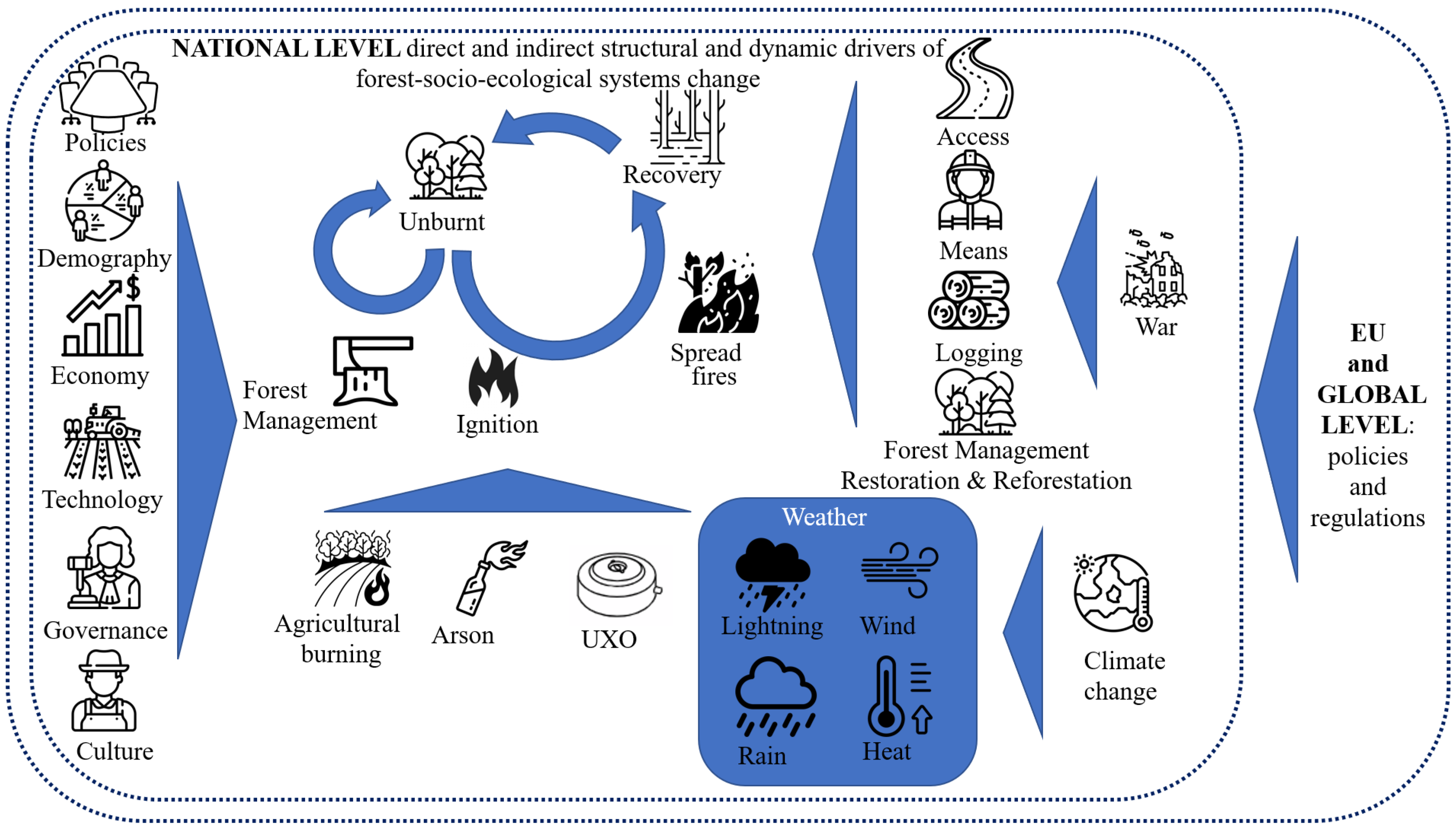
Figure 2.
Map of forest and landscape fires across Ukraine from 1 January 2022 to 31 August 2024. Note: Wildfires affect different types of land cover, including forests, grasslands, and agricultural lands, resulting in environmental impacts such as loss of biodiversity, soil degradation, and contribution to air pollution, including with GHG emissions. Cumulative fires are shown on the map, with fires marked in black, forests in green, water bodies in blue, and active war or occupied zones (as of June 2024) in grey.
Figure 2.
Map of forest and landscape fires across Ukraine from 1 January 2022 to 31 August 2024. Note: Wildfires affect different types of land cover, including forests, grasslands, and agricultural lands, resulting in environmental impacts such as loss of biodiversity, soil degradation, and contribution to air pollution, including with GHG emissions. Cumulative fires are shown on the map, with fires marked in black, forests in green, water bodies in blue, and active war or occupied zones (as of June 2024) in grey.
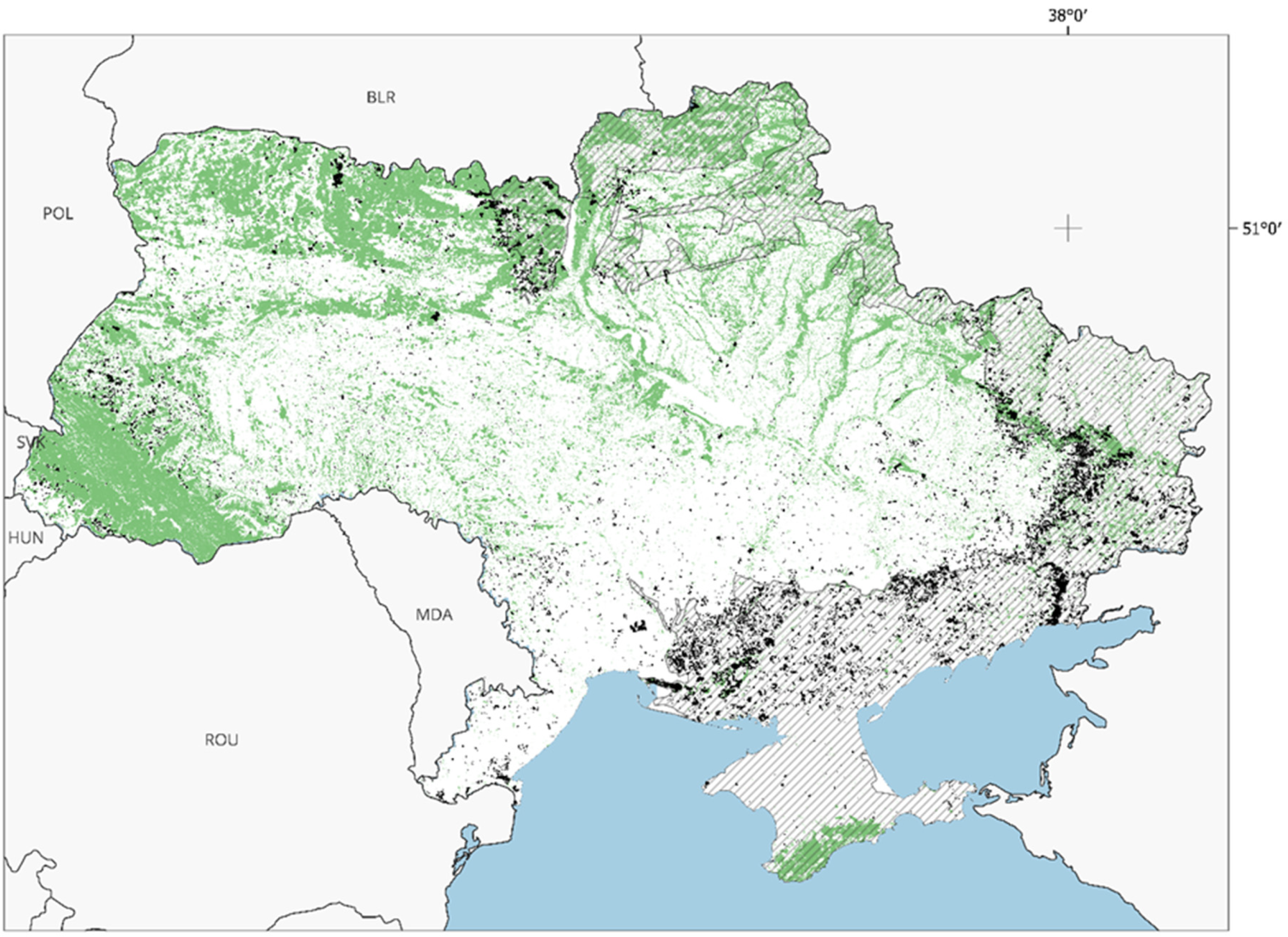
Figure 3.
Forest fires in Ukraine (1990–2023). Note: The figure shows the number of forest fires (line, in thousands) and the area affected by forest fires in thousands of hectares (bars). Data for 2000–2021 are based on official government statistics (SSSU, 2000–2021), while 2022–2023 data were calculated by Zibtsev et al. (2023a, b, 2024a, b) using remote sensing methods (https://nubip.edu.ua/en/node/9087/2). Note the change in scale for the area affected by fires. The inset box displays the Canadian Fire Weather Index (FWI), which, according to the European Forest Fire Information System (EFFIS) (https://effis.jrc.ec.europa.eu/), has shown a doubling trend since 1990, based on SSSU 2024 data.
Figure 3.
Forest fires in Ukraine (1990–2023). Note: The figure shows the number of forest fires (line, in thousands) and the area affected by forest fires in thousands of hectares (bars). Data for 2000–2021 are based on official government statistics (SSSU, 2000–2021), while 2022–2023 data were calculated by Zibtsev et al. (2023a, b, 2024a, b) using remote sensing methods (https://nubip.edu.ua/en/node/9087/2). Note the change in scale for the area affected by fires. The inset box displays the Canadian Fire Weather Index (FWI), which, according to the European Forest Fire Information System (EFFIS) (https://effis.jrc.ec.europa.eu/), has shown a doubling trend since 1990, based on SSSU 2024 data.
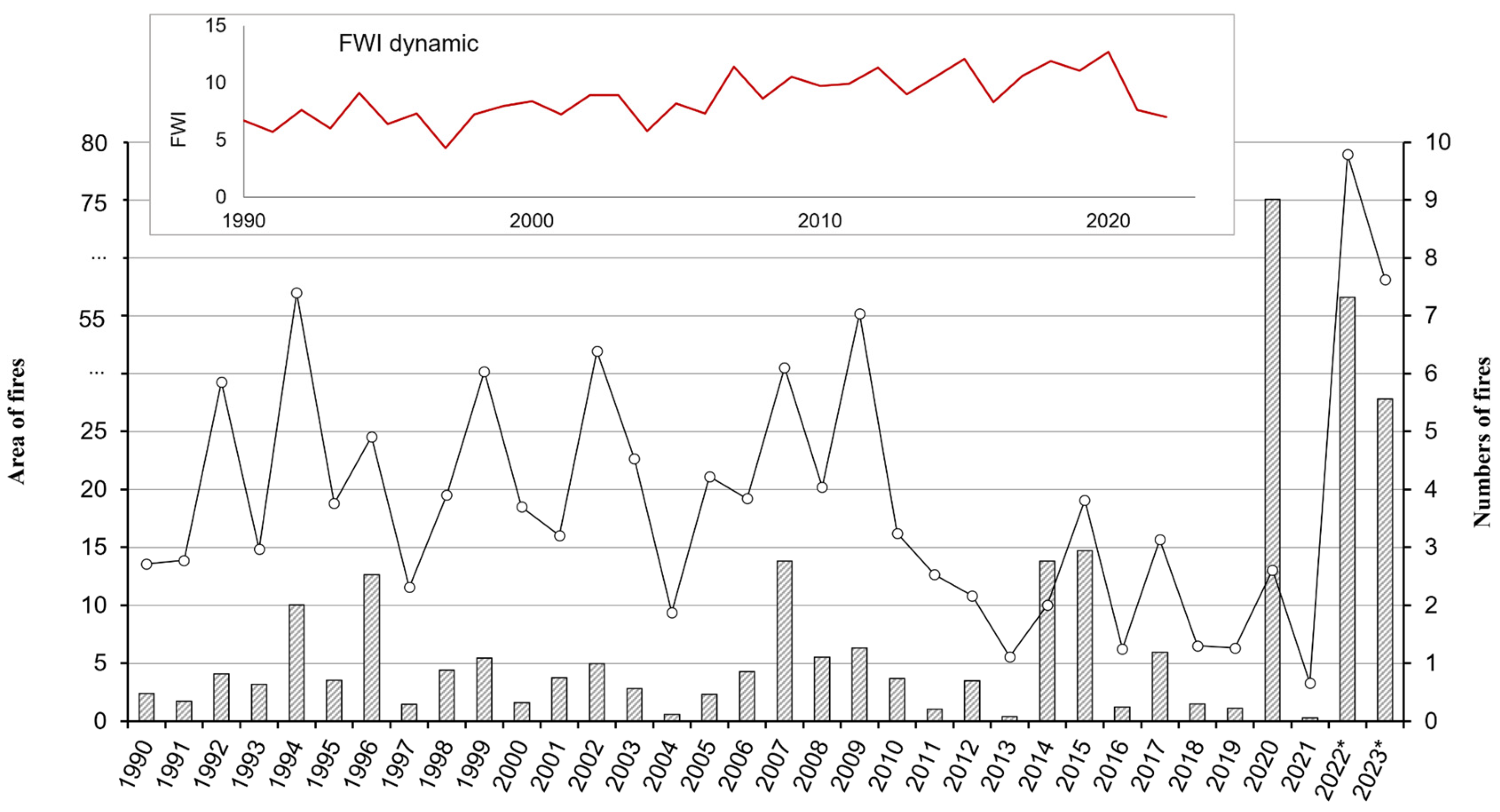
Figure 4.
Dynamics of timber harvesting in Ukraine (2010–2023). Note: Illiquid wood is referred to wood that is difficult to sell or trade due to its poor condition or other factors.
Figure 4.
Dynamics of timber harvesting in Ukraine (2010–2023). Note: Illiquid wood is referred to wood that is difficult to sell or trade due to its poor condition or other factors.
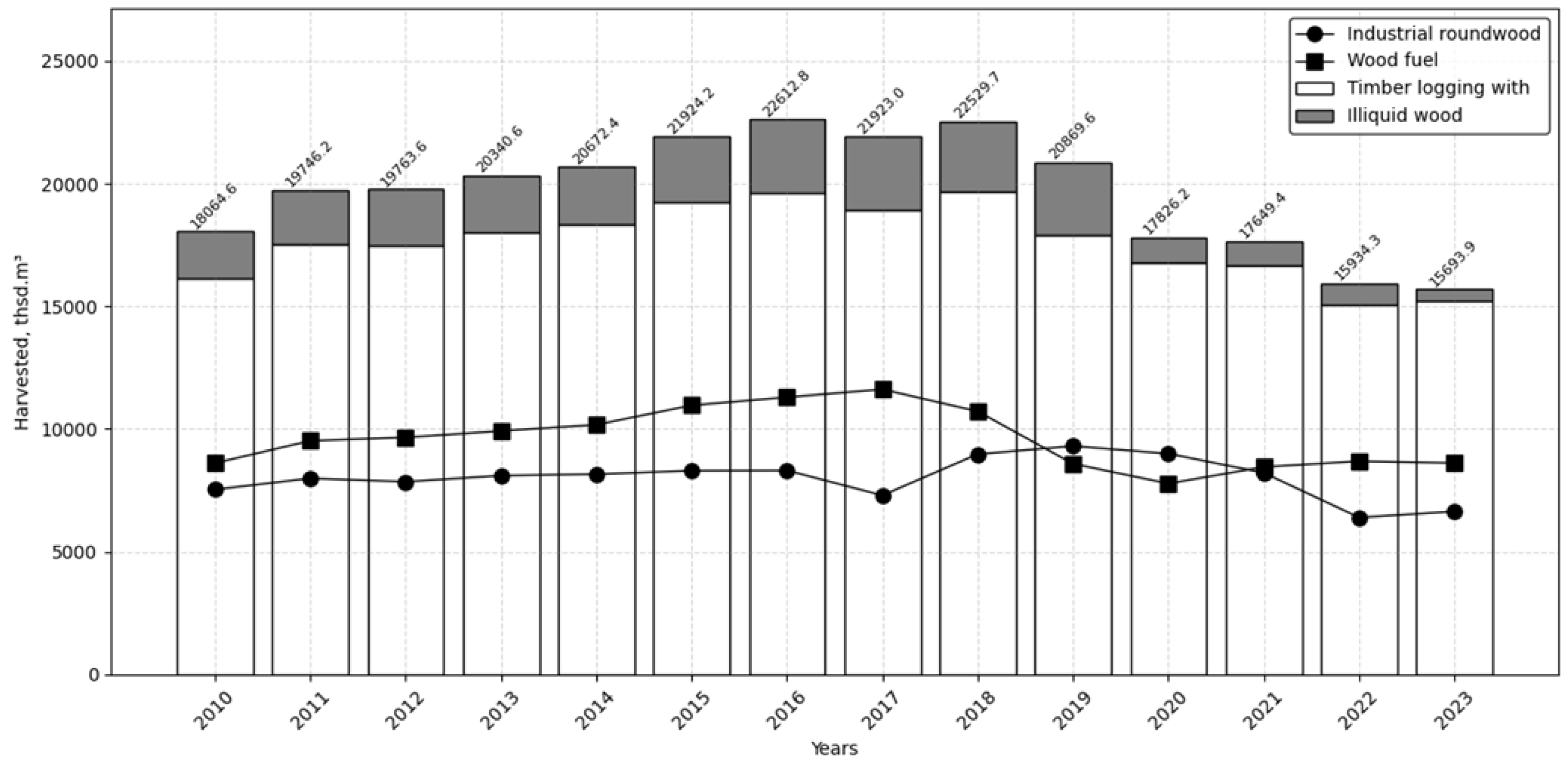

Table 1.
Key dimensions of Nature of the Crisis, Scope of the Crisis, and Resolution of the Crisis and their analytical explanations.
Table 1.
Key dimensions of Nature of the Crisis, Scope of the Crisis, and Resolution of the Crisis and their analytical explanations.
| Dimensions | Steps | Type of analysis | Sources of information |
| Nature of the crisis | Definition (pre-war challenges and war-induced crises) | Literature review (scientific publications and grey literature) | Web of Science; Google Scholar; government websites |
| Expert interviews | Ukrainian researchers, government officials and representatives of NGOs, n=7 | ||
| Forest policy document analysis Data from National Statistics |
IUFRO report from Forum on Ukraine Forest Science and Education: Needs and Priorities for Collaboration (2024) [48]; FOREST EUROPE report on Ukraine`s forest recovery [49], WB reports on Ukraine [50,51], OECD report on Ukraine, State Forest Management Strategy of Ukraine until 2035 [52]; FAO Forestry Support Strategy for Ukraine 2023–2027 [53]. Official information on forests of Ukraine—https://forest.gov.ua/en |
||
|
Scope of the crisis |
Identification of root causes | Literature review (scientific publications and grey literature) | Web of Science, Google Scholar, survey of peer-reviewed publications, Ukrainian government and NGOs reports |
| Assessment of the impacts | Forest cover change | Official data from Ecozagroza online platform; data from SFRA; website of the Ukrainian state forest management planning association “Ukrderzhlisproekt”—Remote Sensing Based Inventory—National Forest Inventory | |
| Fires and area burned | State Emergency Service of Ukraine (SESU) Regional Eastern Europe Fire Monitoring Center (REEFMC) Landscape Fires Advisory Bulletin—https://nubip.edu.ua/node/9087/2 |
||
| Society | ZOI Environmental Network, Copernicus Dynamic Land Cover map, Emerald Network, grey literature, and expert interviews (n=7) | ||
| Economy | Forest statistics, UKRstat webpage | ||
| Governance | Scientific publications, IUFRO report on Ukraine Forum “Forest Science and Education: Needs and Priorities for Collaboration” [54], and results of the discussion hold during special session at IUFRO World Congress on Ukraine`s forest (2024); Ukraine`s forest policy regulations and amendments to law due to martial order (2022–2024); reports of international organisations and programs (e.g., FAO, WB, WWF, UNECE) |
||
| Resolution of the crisis: Recovery pathways | Evaluation of actions/ responses in place; suggestion of recovery pathways |
Literature review and current policies; expert interviews Thematic analysis (QDA Miner Lite) |
Web of Science; Google Scholar Reports [48,49,50,51,52,53] Interview with Ukrainian researchers, forest related professionals and government and NGOs representatives (n=7) |
| Notes: Analytical framework based on three system dimensions. Each aspect can consist of one or more steps and each step details the analysis and sources of information. | |||
Disclaimer/Publisher’s Note: The statements, opinions and data contained in all publications are solely those of the individual author(s) and contributor(s) and not of MDPI and/or the editor(s). MDPI and/or the editor(s) disclaim responsibility for any injury to people or property resulting from any ideas, methods, instructions or products referred to in the content. |
© 2025 by the authors. Licensee MDPI, Basel, Switzerland. This article is an open access article distributed under the terms and conditions of the Creative Commons Attribution (CC BY) license (http://creativecommons.org/licenses/by/4.0/).
Copyright: This open access article is published under a Creative Commons CC BY 4.0 license, which permit the free download, distribution, and reuse, provided that the author and preprint are cited in any reuse.