

Submitted:
20 February 2025
Posted:
20 February 2025
You are already at the latest version
Abstract
This study examines the Chemical Engineering and Technology major at Nanjing Forestry University as a case study to explore a sustainable improvement and development model for the major, grounded in the principles of outcome-based education (OBE) and the plan-do-check-act (PDCA) framework. In the context of new engineering education and integrating the core concepts of engineering professional education accreditation, this research merges the OBE concept with the PDCA model to promote the sustainable enhancement of Chemical Engineering and Technology major. The objective is to assess the effectiveness of this professional construction model, based on the OBE and PDCA framework, in fostering the sustainable development of students. The findings indicate that by establishing a cultivation system aligned with the new economy, restructuring the interdisciplinary curriculum, and implementing a diversified evaluation system, it is feasible to nurture high-quality technical engineering talents equipped with social responsibility, teamwork skills, innovative thinking, and an awareness of sustainable development. This study demonstrates that this professional construction mechanism and model significantly contribute to developing sustainable education, enhancing engineering practice and innovative awareness, and cultivating applied innovative talents among students. Furthermore this study not only offers new insights for specialty construction but also serves as a practical reference for improving teaching quality and meeting societal demands.
Keywords:
sustainable improvement mechanism
; major
; PDCA model
; engineering education
1. Introduction
With the advancement of international exchanges and cooperation, the demand for high-quality engineering technical talent in China is becoming increasingly urgent [1]. The core concepts of engineering education accreditation-student-centered, outcome-oriented, and continuous improvement-have emerged as guiding principles for educational reform [2]. The outcome-based education (OBE) concept, combined with the plan-do-check-act (PDCA) framework, provides an effective approach to cultivating high-quality interdisciplinary engineering talents [3].
Engineering education accreditation serves as an internationally recognized quality assurance system for engineering education and a standard for the mutual recognition of engineering education and professional qualifications on a global scale [4]. Since the Ministry of Education of China launched the pilot program for engineering education accreditation in 2006, and with China officially becoming a member of the Washington Accord in 2016, this marks a significant progress in the field of higher education’s openness to the outside world [5]. Engineering education accreditation has not only become an inevitable trend in the construction of engineering programs at universities but also serves as an important means and effective pathway to promote the development of new engineering fields [6].
The teaching quality of undergraduate programs directly affects the overall educational quality of universities and the effectiveness of talent development. In this context the Chemical Engineering and Technology major, as an interdisciplinary discipline, has become increasingly prominent in its status and importance. With the growing societal demand for this major, there is an urgent need for Chemical Engineering and Technology programs to undergo engineering accreditation to assess and address the issues present in the professional development process [7].
A significant characteristic of the Chemical Engineering and Technology major is the high demand for students’ engineering practice and innovation capabilities [8]. The national demand for talent in this field is expected to be long-term and sustained, necessitating guidance from national needs, motivation from scientific and technological advancements [9], and a stable foundation in professional development to cultivate high-quality technical talent required for sustainable development [10]. Therefore, conducting relevant research not only holds significant theoretical value but also has far-reaching practical implications.
2. Literature Review
Current engineering education faces several challenges, including unclear training objectives, insufficient graduation requirements, and a lack of innovation in curriculum design [11]. The Chemical Engineering and Technology major, characterized by high difficulty and strong practicality, often struggles with outdated curriculum content and insufficient integration of new technologies [12]. These issues hinder students’ ability to adapt to the working environment after graduation.
(1) The positioning of training objectives is not sufficiently clear.
Local colleges and universities must align with the local economic and social development and clarify the goal of cultivating high-quality applied talents [13]. However, current engineering education is not effectively linked to the rapidly evolving emerging industries and new economies, resulting in incomplete talent cultivation models and systems, along with a uniform singular training model that suffers from significant homogenization [14]. This also causes students to lack effective problem-solving abilities when confronted with real engineering challenges, thereby impacting their innovative capacity [15].
(2) Graduation requirements are not comprehensive enough.
Graduation requirements should reflect the knowledge, skills, and abilities that students should possess upon graduation in the field of Chemical Engineering and Technology [16]. However, most specialty talent training programs do not adequately detail the breakdown according to the twelve graduation requirements of engineering education accreditation and lack corresponding benchmark points and curriculum support frameworks [17]. Furthermore, there is a general deficiency in effective dialogue, interaction between teachers and students, and the cultivation of critical thinking [18]. Consequently, the talent produced often fails to meet the development needs of the new economy and emerging engineering fields [19].
(3) The curriculum structure needs improvement, and the connectivity of courses needs to be strengthened.
The curriculum system, teaching syllabus, and teaching process have not kept pace with the development of the times [20]. The speed of updating curriculum content has not met the demands of industry development, leading to students having difficulty quickly adapting to the working environment after graduation [21]. Textbook content still primarily focuses on traditional and foundational knowledge, failing to effectively stimulate students’ interest in the profession [22], resulting in a lack of awareness regarding professional prospects and forming barriers that are insufficient to solve complex engineering problems [23].
(4) There is a lack of a scientific and effective teaching quality evaluation system, making it difficult to effectively improve teaching methods.
The evaluation results reflect the level of program development and educational quality to a certain extent and can diagnose the problems and shortcomings existing in professional construction within higher education institutions, thereby promoting the healthy development of the program [24]. However, the current engineering education has not yet established a complete evaluation system and urgently needs to improve the evaluation mechanism to objectively evaluate students’ comprehensive abilities [25].
In the context of the new era, how to construct a thinking approach and knowledge structure that meet requirements, as well as how to effectively cultivate students’ practical abilities and innovative capacities, has become an urgent topic for discussion in the reform of engineering education in higher education institutions [26]. Therefore, this research will analyze the specific problems now present in education from the dual perspectives of students’ learning experiences and teachers’ instructional guidance, proposing corresponding improvement measures in conjunction with the design and implementation of diversified engineering training programs. Additionally, the study will implement systematic reforms to the assessment and evaluation mechanisms to ensure that the quality of education is effectively enhanced. In particular, the research mechanism will emphasize that the professional training program should be dynamically adjusted and optimized according to social needs and industry standards, ensuring that students can meet the various role requirements of engineers upon graduation. Through continuous improvement, we can promptly adjust educational strategies to adapt to changes in industry demands and social development, thereby significantly enhancing the adaptability and foresight of education [27].
Based on this, this study reveals the issues present in the teaching process of the Chemical Engineering and Technology major by analyzing domestic and international engineering education accreditation standards and the practical training of professional talents in higher education institutions. It proposes a continuous improvement mechanism based on the OBE-PDCA concept, by establishing training objectives that align with sustainable social and economic development and regularly analyzing the achievement of these objectives, as well as evaluating the implementation of the curriculum system, course objectives, and graduation requirements, we can promptly identify and address various issues in the educational process, providing a scientific basis and theoretical support for the in-depth reform of engineering education.
3. Materials and Methods
This research employs a mixed-methods approach, incorporating qualitative and quantitative methodologies, to analyze the teaching situation and student learning outcomes of the Chemical Engineering and Technology major at Nanjing Forestry University. The study integrates the OBE concept with the PDCA model to establish a dynamic monitoring system for continuous improvement. The curriculum system has been restructured to align with sustainable development goals, emphasizing interdisciplinary collaboration and practical ability cultivation.
3.1. New Concept: Comprehensive Teaching Quality Monitoring Mechanism Based on the OBE-PDCA Concept
This research aims to achieve engineering education objectives and establish a talent cultivation model guided by these twelve standards, fostering students’ fundamental engineering abilities, teamwork and communication skills, personal abilities and professional ethics, as well as the capabilities of Plan-Do-Check-Act in enterprise or engineering environments [28]. To ensure the effective implementation of the continuous improvement mechanism for professional courses, this research utilizes the OBE-PDCA comprehensive quality management concept to establish a dynamic monitoring system of monitoring control-evaluation feedback-continuous improvement [29]. Concurrently, the continuous improvement working group will deploy and implement improvement measures based on the feedback received, track the outcomes of these improvements, and create a closed-loop feedback mechanism. As illustrated in Figure 1, the organizational structure of teaching management is presented, clarifying the responsibilities and interrelationships of various organizational levels. This structure ensures comprehensive monitoring and continuous improvement of teaching quality.
3.2. High Standards: Developing Training Programs That Align with Sustainable Development in the New Economy and Establishing Clear Goals
To cultivate interdisciplinary and innovative talents that align with the development needs of new engineering disciplines, it is crucial to design training programs that correspond with the university’s position and support the sustainable development of the social economy [30]. The Chemical Engineering and Technology major actively embraces educational philosophies centered on ecological awareness and green development, regarding moral cultivation, students should achieve comprehensive development in ethics, intelligence, physical fitness, aesthetics, and labor, establishing a correct worldview, outlook on life, and patriotic spirit. In terms of engineering competence, students should be able to integrate their acquired knowledge and skills to analyze and solve complex chemical engineering and process problems, proposing reasonable solutions [31]. Simultaneously, they should demonstrate innovative awareness and capabilities in the research, development, and design of new technologies and processes, actively engaging with and focusing on the international frontiers of their professional fields, and possessing a global perspective [32]. In terms of professional qualities, students must adhere to engineering professional ethics, consciously follow professional standards, maintain public health and safety in engineering practice, and consistently uphold the concept of sustainable development [33]. Finally, concerning self-development, students should have the capacity for lifelong learning, proactively enhancing and expanding their professional capabilities through various means, while maintaining good physical and mental health, political awareness, and moral cultivation to adapt to the continuous development and changes in society.
3.3. New Content: Restructuring the Professional Curriculum System Guided by Engineering Education Accreditation
Based on the aforementioned cultivation goals and requirements, the curriculum for Chemical Engineering and Technology has been systematically restructured with engineering education accreditation as the guiding principle, forming a topology diagram of the curriculum as shown in Figure 2, which clearly illustrates the logical relationships and hierarchical structure between courses, aiding students and teachers in understanding the connectivity and progression of course content.
3.4. New Format: A Diversified Teaching Quality Evaluation System to Establish a Robust Feedback Mechanism
This study has developed a reasonable evaluation system aimed at comprehensively and objectively assessing teaching quality and its effectiveness. Centered on teaching quality monitoring and course quality evaluation, a complete evaluation mechanism for achieving graduation requirements has been established, covering the entire process from the management of teaching documents and execution of teaching activities to teaching evaluation, thus forming a robust mechanism for evaluating and providing feedback on teaching quality. Figure 3 presents the flow chart of the curriculum system rationality evaluation and teaching quality evaluation and feedback mechanism.
In terms of evaluation methods, taking the assessment of course goal achievement as an example, this study employs a combination of direct and indirect evaluation approaches. Direct evaluation is primarily achieved through the analysis of assessment scores and credit recognition, whereas indirect evaluation relies on student self-assessment.
(1) Direct evaluation using assessment score analysis.
According to the teaching syllabus requirements, by calculating the average scores of students on each course goal and combining these with the preset support scores, the achievement value of course goals is further obtained. In general, the data used to evaluate course goals includes, but is not limited to, the following: regular scores, examination papers, course design reports, experimental training reports, internship reports, and thesis or design projects. According to the requirements of the course syllabus, the achievement evaluation value ГMi of the i course objective for Course M is calculated using the assessment score analysis method, specifically as follows:
where , ,etc.,
represents the average score of the i-th course objective in each assessment
component (such as exam scores, assignment scores, experiment scores, etc.);
X,Y, etc., are the supporting scores for the i-th course objective in each
assessment component are specified in the course syllabus; α, β,
etc., denote the score weight ratios of the different assessment components for
the i-th course objective as stipulated in the course syllabus,and (α+β+…)=1.
(2) Indirect evaluation using student self-assessment
Student self-assessment serves as the primary method of indirect evaluation, intended to complement the aforementioned direct evaluation. At the end of the academic year, the program director distributes a questionnaire to gather qualitative feedback from students regarding the effectiveness of course learning and the attainment of course objectives using tools such as Tencent Docs. Student satisfaction is categorized into five levels: very satisfied, satisfied, basically satisfied, dissatisfied, and very dissatisfied, which are assigned scores of 5, 4, 3, 2, and 1, respectively. In particular, if a student is self-assessing as dissatisfied or indicates very low satisfaction, they are required to provide specific reasons for further in-depth analysis and continuous improvement. Based on the data from the survey, the attainment value ψ of the i-th course objective for M course is calculated using a weighted average. The calculation formula is as follows:
Fji
represents the questionnaire score for the i-th course objective given
by the j-th survey respondent, and is the total number of
respondents.
3.5. Strict Design: Continuous Improvement Based on Evaluation Results to Enhance Talent Development Quality
Moreover, engineering education must incorporate a mechanism and practical measures for continuous improvement to ensure the ongoing enhancement of educational and teaching quality [34]. This study has established a professional continuous improvement mechanism based on internal and external evaluations and their feedback, as illustrated in Figure 4. This mechanism clarifies the points of input for improvement (i.e., the basis for improvement) and the points for implementation (i.e., the objects of improvement), adhering to the OBE-PDCA comprehensive quality management philosophy, and forming a talent development quality assurance system consisting of objective requirements-teaching implementation-evaluation feedback-improvement enhancement.
Based on the evaluation results of the training objectives, graduation requirements, course objective attainment, and the rationality of the curriculum system, we will conduct a thorough diagnosis of existing issues and implement targeted improvement measures. Specifically, we will revise the training objectives and graduation requirements, carry out continuous improvements across various stages of the professional talent development process, refine the assessment mechanism, and establish a feedback mechanism for teaching outcomes. This aims to ensure that course teaching objectives remain aligned with the established professional training direction, thereby fostering a virtuous interaction between teaching evaluation and teaching improvement, laying a solid foundation for students’ graduation requirements and ensuring the long-term enhancement of talent development quality.
4. Results and Discussion
This section will explore the sustainable improvement mechanism of the Chemical Engineering and Technology major based on the OBE concept and PDCA framework, particularly its influence on discipline competitiveness and graduate employment rates. To effectively assess the sustainable development of the Chemical Engineering and Technology major, we employ a combined approach of both internal and external evaluations, as well as qualitative and quantitative assessments. This dual evaluation mechanism complements each other effectively, forming a comprehensive assessment of the reasonableness of professional training objectives, curriculum system, and graduation requirements [35].
Ultimately, through the statistical analysis of surveys conducted with graduates and employers, a systematic mechanism for sustainable improvement and development pathways for the program is established. Such surveys not only yield firsthand information regarding employers’ recognition of graduates but also provide strong evidence for our analysis of the attainment of professional training objectives, thereby assisting in evaluating whether graduates meet market demands and professional alignment, and offering empirical support for revising training goals.
4.1. Establishing a Quality Monitoring Mechanism for the Teaching Process, Regularly Evaluating and Analyzing the Attainment of the Curriculum System, Course Objectives, and Graduation Requirements
(1) Evaluation analysis of curriculum system rationality
The latest round of evaluation questionnaires regarding the rationality of the curriculum system was distributed to graduates in June 2022. The evaluation results indicate that the curriculum system is widely recognized by graduates, with over 76% expressing strong agreement with its rationality. The specific data summary is shown in Table 1. The results indicate that graduates widely recognize the rationality of the curriculum system in their major.
Through expert validation meetings, faculty discussions, and a questionnaire survey conducted with the 2022 graduating class, the following suggestions were collected: First of all, gradually increase the difficulty of the courses to enhance the role of extracurricular activities; secondly, strengthen the cultivation of students’ innovative abilities to improve their capacity to solve complex engineering problems; finally, better reflect the characteristics of the institution and cultivate chemical engineering and technology professionals who are more aligned with societal needs.
(2) Evaluation and analysis of course objective achievement
Since the enrollment of students in 2017, we have implemented evaluations of course objective achievement in the Chemical Engineering and Technology major. After each academic year’s course assessments, the teaching staff calculates and analyzes the degree of achievement of the course objectives, producing relevant reports. The evaluation work group summarizes and analyzes the core courses taken by the graduates each June. Table 2 presents statistical data on the course objective achievement of the Chemical Engineering and Technology major over the past four sessions. Through this table, we can track trends in course objective achievement, identify objectives needing further improvement, and assess the effectiveness of improvement measures.
(3) Analysis of graduation requirement achievement evaluation results.
Regarding indirect evaluation, a total of 22 questionnaires were distributed, all of which were returned validly, and the statistical results presented students’ satisfaction ratings and feedback suggestions concerning the various graduation requirements. Table 3 compares the direct and indirect evaluation results for the graduation requirements of the 2022 graduates. The analysis results indicate that the graduates of Chemical Engineering and Technology major from 2022 scored achieved for all 12 graduation requirement evaluations. At the same time, the average score for indirect evaluation (0.818) was similar to that of direct evaluation (0.806). This not only reflects high student satisfaction with their learning outcomes but also showcases their diligent and responsible learning attitudes.
The comparison between direct and indirect evaluations is clearly illustrated in Figure 5, providing a basis for a more comprehensive understanding of graduates’ learning achievements. Among these, the evaluation scores of personal and teamwork and communication and expression were relatively high, indicating that graduates received strong training in these areas. However, the evaluation scores of engineering and society and engineering knowledge was comparatively low, suggesting an urgent need to enhance capabilities in these two graduation requirements. Moreover, these results demonstrate that the student training model oriented towards engineering education certification is effective, supporting the sustainable development of the program.
4.2. Establishing Graduate Tracking Feedback and Social Evaluation Mechanisms to Analyze the Achievement of Educational Objectives
To enhance the graduate tracking feedback mechanism and the social evaluation mechanism involving employers, we regularly conduct surveys to gather feedback and suggestions from graduates and employers regarding the achievement of educational objectives. Recent survey results indicate that, from the perspectives of graduates and employers, the achievement of program objectives is satisfactory, aligns with societal needs, and supports students’ career development within five years post-graduation.
The latest graduate tracking feedback was conducted in July 2023, this program focused on the educational objectives of the 2018 curriculum plan, which incorporates the OBE concept, as the subject of the survey. A total of 30 questionnaires were distributed, with 24 valid responses collected. Social evaluation primarily relies on feedback from employers. We employ various methods, such as questionnaires, discussion forums, and on-site visits, to gain a deeper understanding of graduates’ employment situations and professional development. During this process, we pay attention to employers’ evaluations of graduates’ moral integrity, knowledge base, engineering competencies, and professional qualities, and actively seek their suggestions for talent cultivation. A summary of the specific results from the surveys conducted with graduates and social employers regarding the achievement of educational objectives can be found in Table 4.
It is evident that the self-satisfaction evaluation results of graduates generally align with the satisfaction evaluation results of employers. In the three dimensions of moral cultivation, self-development, and professional quality, both graduates and employers expressed high levels of satisfaction. However, regarding engineering ability, with some graduates and employers rating this aspect as basically satisfied. Through an in-depth analysis of specific evaluation indicators, combined with feedback and suggestions from both graduates and employers concerning the professional training objectives, it was found that graduates’ performance in the areas of engineering knowledge, problem analysis, and design/developing solutions is not satisfactory.
4.3. Evaluation Results Confirm That the OBE-PDCA Engineering Certification Concept Is Advantageous for the Continuous Improvement and Development of the Program
Based on the previously mentioned survey data from graduates and employers, along with the feedback received, this study conducted a thorough causal analysis to identify key issues and implement corrective measures. These measures include revising the curriculum, clarifying graduation requirements, adjusting course arrangements, and optimizing the scheduling of teaching activities to enhance students’ core competitiveness and promote better attainment of the training objectives. Through empirical analysis, we validated the effectiveness of the professional development model based on the OBE-PDCA concept in fostering the comprehensive development of students’ knowledge, skills, and abilities.
According to the employment situation of graduates over the past four years (see Table 5) and the categorized employment status (see Table 6), this data provides a visual representation of graduates’ employment conditions and assists in analyzing and assessing the alignment between the achievement of professional training objectives and societal demands. Overall, graduates from this program enjoy a favorable employment situation, achieving a final employment rate of 100%. Among them, an average of 44% of graduates opted to pursue further education, while the majority secured employment in sectors such as materials, chemical engineering, and government institutions. All graduates met the graduation requirements and obtained the corresponding degree certificates. This reflects a strong demand for graduates from this program in society, with the employment rate maintained at over 95% since the program’s inception, stabilizing at 100% in recent years.
We propose the following improvement measures to continuously enhance the construction and development of the major:
1. Carefully design teaching elements to incorporate content such as legal awareness, professional ethics, engineering ethics, and ecological civilization, emphasizing cultural awareness. The aim is to cultivate modern engineers with a strong sense of patriotism, social responsibility, and a commitment to excellence.
2. Utilize emerging educational platforms such as Rain Classroom and Mooc Classroom to effectively guide students in pre-class preparation and review, encouraging them to engage in immediate post-class exercises. This promotes students’ mastery and understanding of foundational knowledge. Additionally, increase online tutoring, strengthen after-class guidance and problem-solving explanations, and assist students in deepening their understanding of theory through problem-solving.
3. Actively encourage students to participate in chemical engineering design competitions, chemical experiment competitions, and other innovative practical activities to further enhance their ability to design and develop solutions through these experiences.
The main contributions of this research are reflected in the following areas:
1. This study focuses on students’ learning outcomes, placing students at the center of the learning process to achieve specific educational goals and ensure that engineering education meets industry requirements and future career development needs. Under the guidance of the OBE-PDCA engineering education accreditation concept, students have significantly improved in practical abilities, innovative capabilities, and integrated application of knowledge, demonstrating the effectiveness of the OBE concept in practical teaching.
2. This research establishes a sustainable quality assessment system within the OBE-PDCA framework to enhance students’ understanding of sustainable development. Through this system, students not only gain a deeper insight into sustainability and its significance but also cultivate exceptional talents for the country’s economic growth and technological innovation, thereby improving their practical capabilities for sustainable development.
3. In light of the context of engineering education professional accreditation, the research emphasizes three fundamental concepts: student-contriteness, outcome-orientation, and continuous improvement, which drive ongoing reforms in university teaching. This transformation enhances teaching effectiveness and quality, enabling educators to design courses more effectively and adopt more suitable teaching methods, while continually improving teaching effectiveness through the assessment of student performance.
4. The research closely aligns with national strategies and industrial needs, exploring a training system oriented towards the new economy, restructuring courses to promote multidisciplinary collaboration, and implementing a diversified evaluation system. In constructing the Chemical Engineering and Technology major, a new engineering talent cultivation standard termed value-oriented, profound foundational theory, strong innovative consciousness, and comprehensive core competency literacy is proposed to foster deep integration of industry and education. This new concept and practice of engineering education offers fresh developmental insights for major construction.
Additionally, the goal-oriented sustainable teaching model has significantly enhanced student employment status and competitiveness. According to graduate employment statistics, over the past three years, the employment rate, graduate school enrollment rate, and overseas study rate at this institution have all increased, indicating that courses utilizing the sustainable teaching model demonstrate superior teaching quality across various fields compared to those not employing this model, further validating the success of the sustainable teaching model within the OBE-PDCA engineering education accreditation framework.
5. Conclusions
This research demonstrates that the OBE-PDCA engineering education philosophy effectively fosters students’ comprehensive development in knowledge, skills, and competencies. By establishing a quality monitoring mechanism and regularly evaluating curriculum achievement, this study constructs a systematic sustainable improvement mechanism for program development. In the future, we will continue to deepen the OBE-PDCA engineering education philosophy and further optimize program developmentto meet the diverse demands of society.
Author Contributions
Q.Y. prepared the first draft; conceptualization, investigation,data collection and analysis, Q.Y. and L.L.; methodology, validation, research design and supervision, M.C. and X.G.; writing-original draft preparation, writing-review and editing, Q.Y., L.L., M.C. and X.G. All authors have read and agreed to the published version of the manuscript.
Funding
This research was funded by Philosophy and Social Science Research of colleges and universities in Jiangsu Province (Grant No. 2021SJA0145).
References
- Miranda, J.; Navarrete, C.; Noguez, J.; Molina-Espinosa, J.-M.; Ramírez-Montoya, M.-S.; Navarro-Tuch, S.A.; Bustamante-Bello, M.-R.; Rosas-Fernández, J.-B.; Molina, A. The core components of education 4.0 in higher education: Three case studies in engineering education. 2021, 93, 107278. [CrossRef]
- Yuan, X.; Wan, J.; An, D.; Lu, J.; Yuan, P. Multi-method integrated experimental teaching reform of a programming course based on the OBE-CDIO model under the background of engineering education. Sci. Rep. 2024, 14, 1–17. [CrossRef]
- Peças, P.; Encarnação, J.; Gambôa, M.; Sampayo, M.; Jorge, D. PDCA 4.0: A New Conceptual Approach for Continuous Improvement in the Industry 4.0 Paradigm. Appl. Sci. 2021, 11, 7671. [CrossRef]
- Gutierrez-Bucheli, L.; Kidman, G.; Reid, A. Sustainability in engineering education: A review of learning outcomes. J. Clean. Prod. 2021, 330, 129734. [CrossRef]
- Liang, J. “OBE” Concept for New Training Mode of Electronic Information Science and Technology Professionals under Big Data Analysis. Comput. Intell. Neurosci. 2022, 2022, 1–10. [CrossRef]
- Hadgraft, R.G.; Kolmos, A. Emerging learning environments in engineering education. Australas. J. Eng. Educ. 2020, 25, 3–16. [CrossRef]
- Serafini, P.G., Morais de Moura, J., Rodrigues de Almeida, M., Dantas de Rezende, J.F. Sustainable Development Goals in Higher Education Institutions: A systematic literature review, J. Clean. Prod. 370 (2022) 133473.
- Tisdale, J.K.; Bielefeldt, A.R. Instructors’ Perspectives on Enhancing Sustainability’s Diffusion into Mechanical Engineering Courses. Sustainability 2023, 16, 53. [CrossRef]
- Benavides L.M.C., Tamayo Arias J.A., Arango Serna M.D., Branch Bedoya J.W., Burgos D, Digital Transformation in Higher Education Institutions: A Systematic Literature Review, Sensors. 20 (2020) 3291.
- Abduganiev, O.I.; Abdurakhmanov, G.Z. Ecological Education For The Purposes Sustainable Development. Am. J. Soc. Sci. Educ. Innov. 2020, 2, 280–284. [CrossRef]
- Li Y W, Zhang H F, Zhang T Y, et al., Exploration and Practice of Cultivating Innovative Talents in Pharma-ceutical Specialty Based on Deep Integration of Industry–University–Research, Journal of Chemical Education. 101 (8) (2024) 3126-3134.
- Zhang, Y.; Yang, G.; Mao, F. Research on the Connotation, Difficulty and Path Choice of the High-quality Development of Modern Industrial Colleges in Applied Universities, Jiangsu Higher Education. 7 (2023) 52-59.
- Shanshan W, Jingjing W U, Research on the Reform of Application-Oriented Innovative Talents in Universities Based on the Concept of “Industry-University-Research-Application” Collaborative Education, The Theory and Practice of Innovation and Entrepreneurship. 6 (20) (2023) 113.
- Gutiérrez-Martínez, Y.; Bustamante-Bello, R.; Navarro-Tuch, S.A.; López-Aguilar, A.A.; Molina, A.; Longoria, I.Á.-I. A Challenge-Based Learning Experience in Industrial Engineering in the Framework of Education 4.0. Sustainability 2021, 13, 9867. [CrossRef]
- Wei, L.; Zhang, W.; Lin, C. Multidimensional Characteristics of Design-Based Engineering Learning: A Grounded Theory Study. Sustainability 2023, 15, 3389. [CrossRef]
- Wu, B.; Cai, Y.; Zheng, G.; Liu, J.; Wu, D, Thoughts on the Construction of “Production-University-Research” Platform to Cultivate Innovative Talents in Pharmacy, The Guide of Science & Education. 35 (2022) 78-80.
- Shi X.Q., Design and Implementation of Course Teaching Based on the Concept of Outcome-based Education, Research in Higher Education of Engineering. 5 (2018) 154-160..
- Liu S.Y., Engineering Education Certification and Curriculum Development: Practice Demands, Standards and Mechanism, Heilongjiang Researches on Higher Education. 39 (7) (2021) 32-36..
- Lima, R.M.; Andersson, P.H.; Saalman, E. Active Learning in Engineering Education: a (re)introduction. Eur. J. Eng. Educ. 2016, 42, 1–4. [CrossRef]
- Zuo X.H., Lu X.J., Huang W.D, et al., Exploration on Cultivation Objectives of Chemical Engineering and Technology Major with the Background of Engineering Education Accreditation, Journal of Hubei Polytechnic University. 38 (02) (2022) 61-64.
- Neves, R.M.; Lima, R.M.; Mesquita, D. Teacher Competences for Active Learning in Engineering Education. Sustainability 2021, 13, 9231. [CrossRef]
- Li L., Wei M.J., Han Z.F., et al., Discussion on Construction of Course System of Chemical Engineering and Technology under the Background of Engineering Education Accreditation, Guangzhou Chemical Industry. 50 (1) (2022):135-137.
- Martinez, E., Pegalajar, M.C., Burgos-Garcia, A, Active methodologies and curricular sustainability in teacher training, Int. J. Sustain. High. Educ. 24 (2023) 1364-1380.
- Bai Y.H., The Reform and Vision of Higher Engineering Education in New China, China Higher Education Research.12 (2019) 60-64..
- Mintz K., Tal T., The place of content and pedagogy in shaping sustainability learning outcomes in higher education, Environ. Educ. Res. 24 (2016) 207-229.
- Kondoyanni, M.; Loukatos, D.; Arvanitis, K.G.; Lygkoura, K.-A.; Symeonaki, E.; Maraveas, C. Adding Machine-Learning Functionality to Real Equipment for Water Preservation: An Evaluation Case Study in Higher Education. Sustainability 2024, 16, 3261. [CrossRef]
- Rodríguez-Luna, D.; Rubilar, O.; Alvear, M.; Vera, J.; Riquelme, M.Z. Implementation of Environmental Engineering Clinics: A Proposal for an Active Learning Methodology for Undergraduate Students. Sustainability 2023, 16, 365. [CrossRef]
- Yao, D., Zhang, X. & Liu, Y, Teaching reform in C programming course from the perspective of sustainable development: Con struction and 9-year practice of “Three Classrooms-Four Integrations–Five Combinations” teaching model, Sustainability. 14 (22) (2022) 15226.
- Bo Wang , Research onthequality evaluation system of talent cultivation in applied universities based on the OBE concept, Journal of Science & Technology Economics Guide. 28 (30) (2020) 195-196.
- Torabi, Z.; Ardekani, S.S.; Hataminasab, S.H. A New Model in Designing the Professional Competence System of the Petrochemical Industry with a Sustainable Development Approach. South Afr. J. Chem. Eng. 2021, 37, 110–117. [CrossRef]
- Lyu, Z.; Gao, M.; Wang, G.; Qu, R. Research on the Deep Integration Mode of Theoretical Teaching and Practical Training of Road and Bridge Majors under the Background of Engineering Education Professional Certification. Open J. Soc. Sci. 2022, 10, 272–282. [CrossRef]
- Zheng, W.; Wen, S.; Lian, B.; Nie, Y. Research on a Sustainable Teaching Model Based on the OBE Concept and the TSEM Framework. Sustainability 2023, 15, 5656. [CrossRef]
- Li, M.; Wang, T.; Lu, W.; Wang, M. Optimizing the Systematic Characteristics of Online Learning Systems to Enhance the Continuance Intention of Chinese College Students. Sustainability 2022, 14, 11774. [CrossRef]
- Chen X., Zhao B.C., Fan C X, et al., Design and Implementation of Engineering Curriculum Continuous Quality Improvement Mechanism Based on the Concept of Outcome-based Education, Research and Exploration in Laboratory. 42 (12) (2023) 161-169.
- Byrne, E.P. The evolving engineer; professional accreditation sustainability criteria and societal imperatives and norms. Educ. Chem. Eng. 2023, 43, 23–30. [CrossRef]
Figure 1.
Teaching management organization.
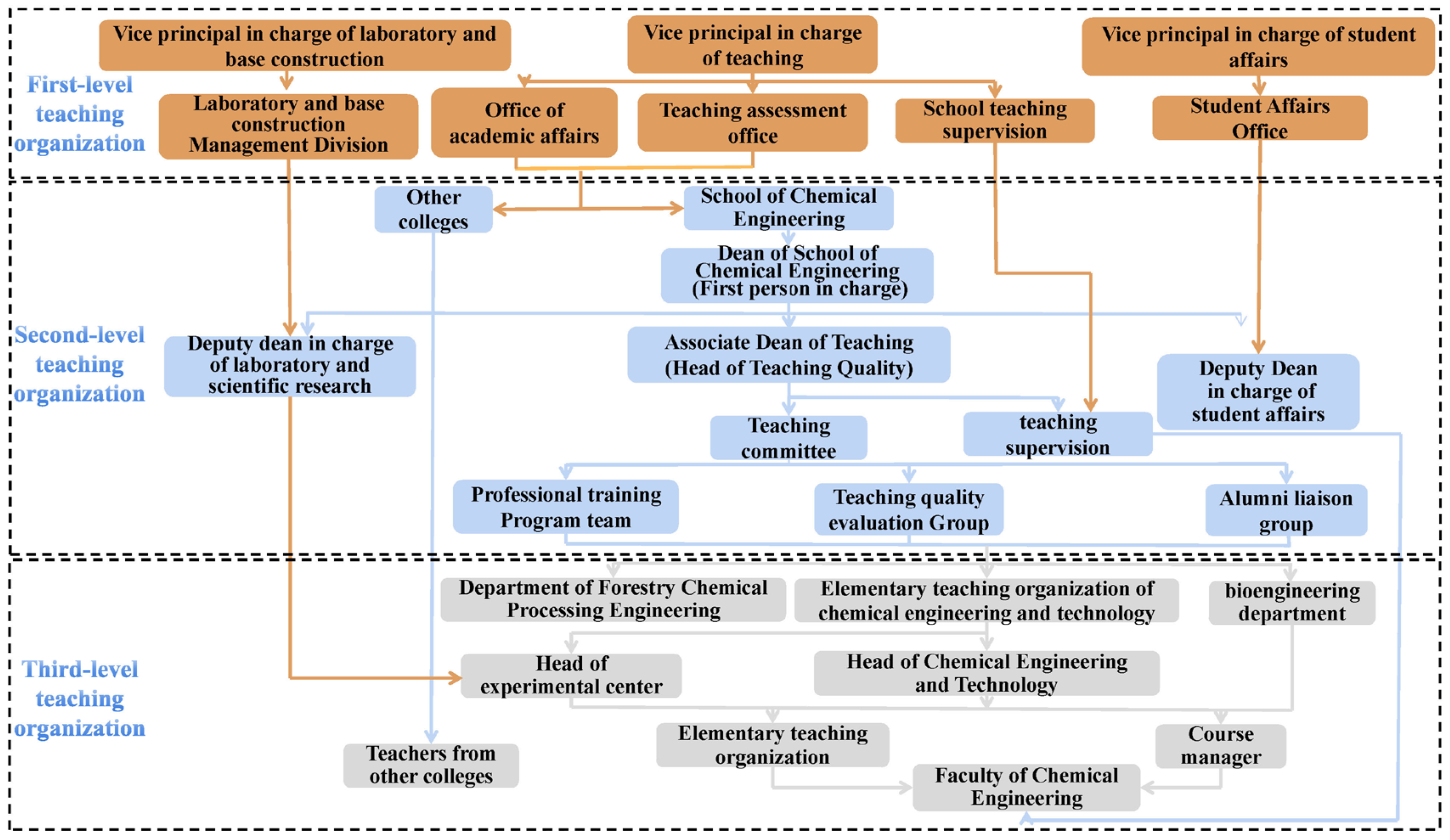
Figure 2.
Topological relationship diagram of curriculum system for the major of Chemical Engineering and Technology. Remarks: Blue-compulsory courses for general education; Red-basic courses of professional disciplines; Green-professional core and specialty courses; Yellow-intensive practice class.
Figure 2.
Topological relationship diagram of curriculum system for the major of Chemical Engineering and Technology. Remarks: Blue-compulsory courses for general education; Red-basic courses of professional disciplines; Green-professional core and specialty courses; Yellow-intensive practice class.
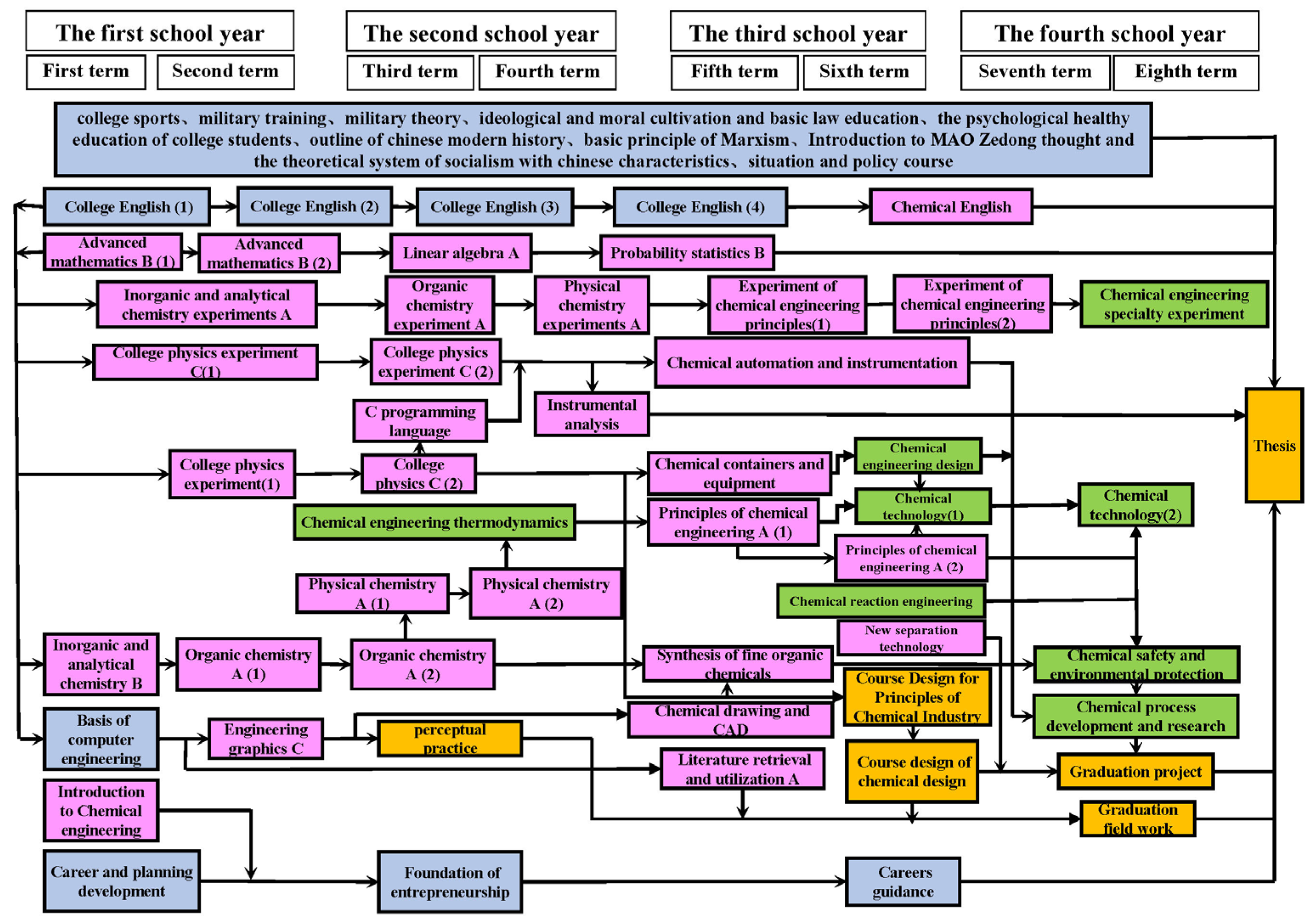
Figure 3.
Evaluation and feedback mechanism at each stage of curriculum setting.
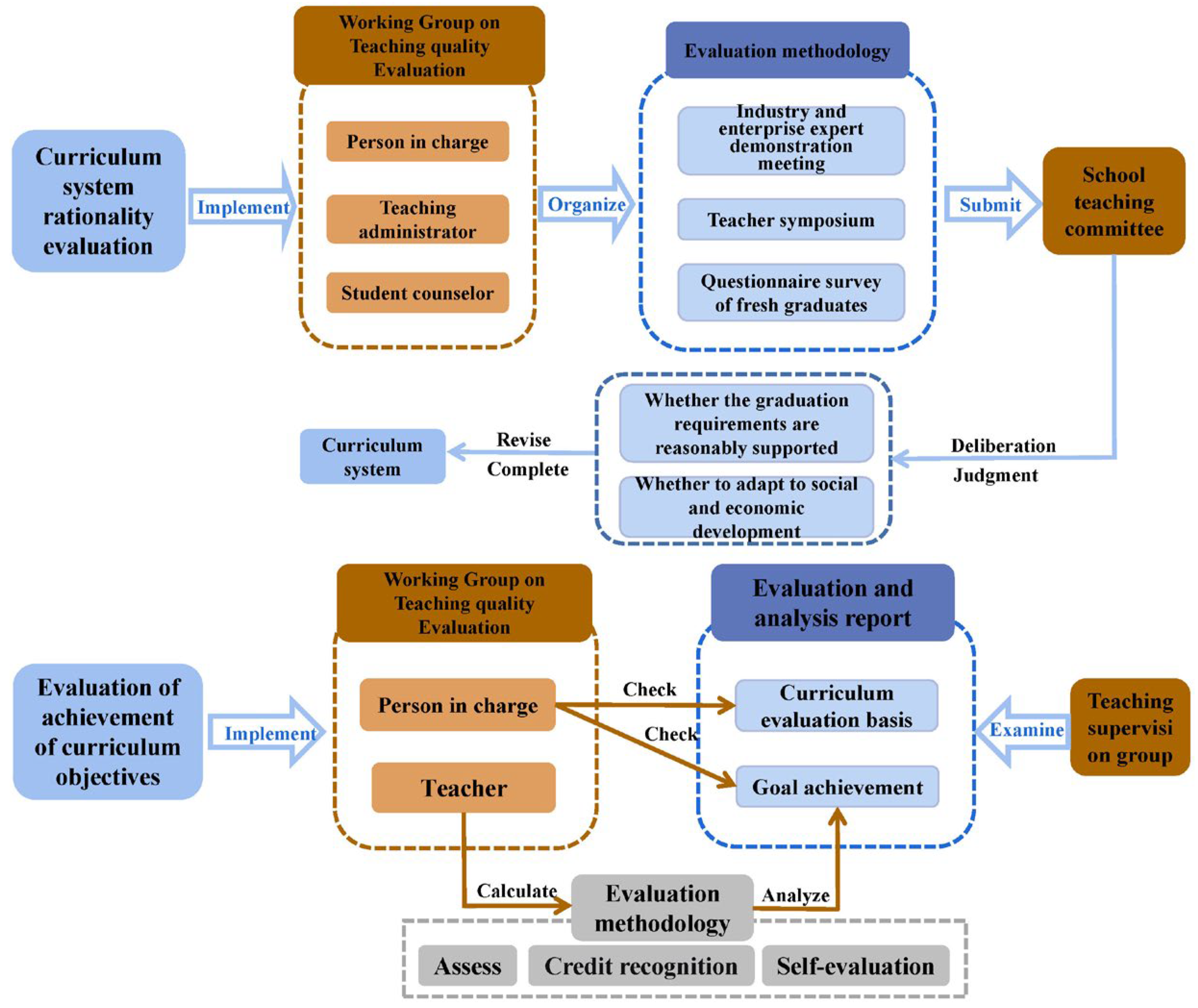
Figure 4.
the logical relationship diagram of continuous improvement work.
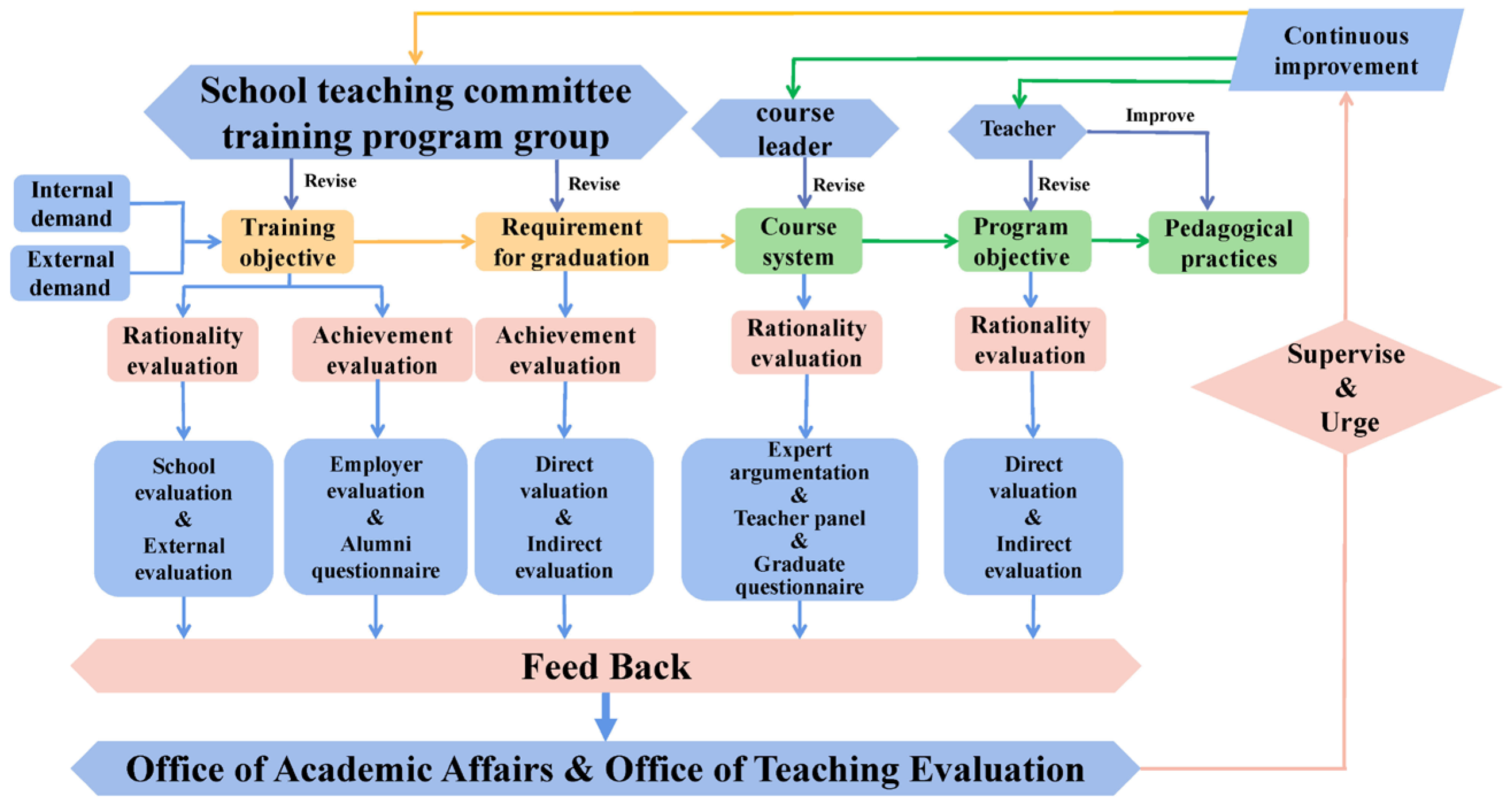
Figure 5.
Direct and Indirect Evaluation of 2022 Graduates’ Achievement Degree.
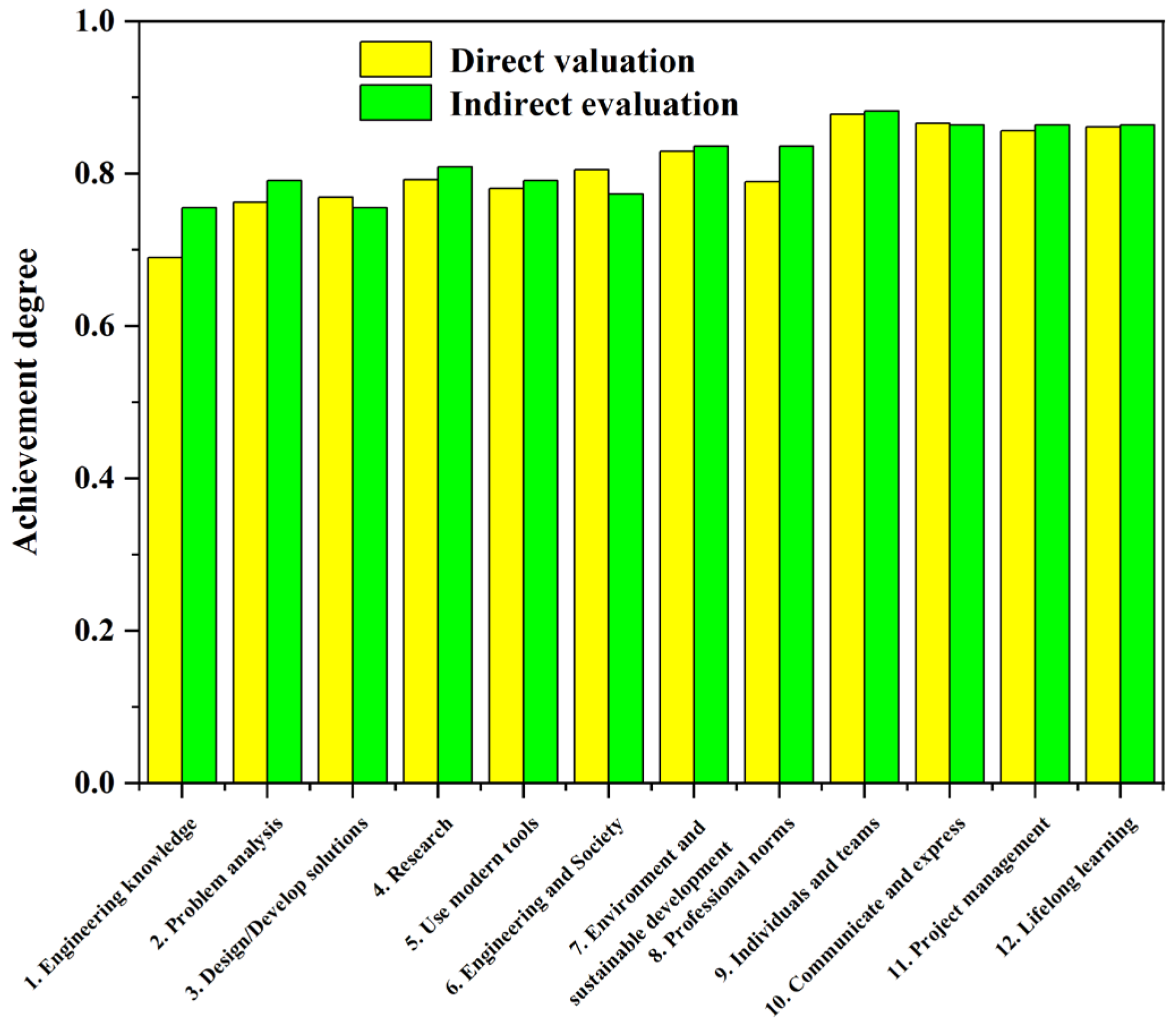

Table 1.
Survey questionnaire of curriculum system rationality of the graduates.
| Curriculum System | Number | Evaluation Index | a | b | c | d | e |
|---|---|---|---|---|---|---|---|
| 1. Curriculum Provision | 1 | The teaching plan conforms to the law of progressive achievement of ability. | 18 | 4 | 0 | 0 | 0 |
| 2 | The courses such as compulsory courses, elective courses and practical courses are set reasonably. | 18 | 4 | 0 | 0 | 0 | |
| 3 | Related courses can effectively link up and cooperate closely. | 15 | 6 | 1 | 0 | 0 | |
| 4 | The course credits and hours are arranged reasonably. | 16 | 6 | 0 | 0 | 0 | |
| 5 | The theoretical link of the course corresponds to and connects with practice and practice. | 19 | 3 | 0 | 0 | 0 | |
| 6 | Reflect the characteristics of the school. | 15 | 7 | 0 | 0 | 0 | |
| 2. Content of Courses | 7 | Course objectives can correspond to relevant graduation requirements observation points. | 19 | 3 | 0 | 0 | 0 |
| 8 | The teaching content can support the course objectives. | 17 | 5 | 0 | 0 | 0 | |
| 9 | Integrate new technology and new methods into the teaching process. | 13 | 8 | 1 | 0 | 0 | |
| 10 | Focus on the ability to solve complex chemical engineering and process problems. | 17 | 5 | 0 | 0 | 0 | |
| 3. Course Assessment | 11 | Assessment methods and grading standards can support the evaluation of curriculum objectives. | 17 | 5 | 0 | 0 | 0 |
| 12 | The assessment content and results can support the evaluation of curriculum objectives. | 17 | 5 | 0 | 0 | 0 | |
| 4. Graduation Project (Thesis) | 13 | The topic selection is consistent with the development of the times and the industry. | 17 | 5 | 0 | 0 | 0 |
| 14 | Considering humanistic, environmental, ethical, economic, safety and other factors, the ability to comprehensively apply the knowledge is improved. | 18 | 4 | 0 | 0 | 0 | |
| 5. Innovation Practice Ability | 15 | The cultivation of innovative practical ability permeates the teaching process. | 19 | 3 | 0 | 0 | 0 |
| 16 | The second classroom activity reflects the cultivation of innovation ability. | 14 | 7 | 1 | 0 | 0 | |
| Proportion(100%) | 76.4% | 22.7% | 0.9% | 0 | 0 | ||
| Note: The numbers in the table are the total number of people who selected the item. | |||||||
Table 2.
Course objective achievement degree of chemical engineering and technology major in the past four sessions.
Table 2.
Course objective achievement degree of chemical engineering and technology major in the past four sessions.
| Number | Course Title | The degree of achievement in 2020 | The degree of achievement in 2021 | The degree of achievement in 2022 | The degree of achievement in 2023 |
|---|---|---|---|---|---|
| 1 | Principles of chemical industry A1 | 0.79 | 0.80 | 0.81 | 0.80 |
| 2 | Principles of chemical industry A2 | 0.82 | 0.82 | 0.81 | 0.83 |
| 3 | Chemical engineering thermodynamics | 0.65 | 0.75 | 0.77 | 0.79 |
| 4 | Chemical reaction engineering A | 0.78 | 0.82 | 0.82 | 0.83 |
| 5 | Chemical engineering design | 0.83 | 0.88 | 0.89 | 0.88 |
| 6 | Introduction to chemical engineering | 0.87 | 0.88 | 0.88 | 0.90 |
| 7 | Chemical technology | 0.72 | 0.75 | 0.78 | 0.76 |
| 8 | Chemical process research and development | - | 0.76 | 0.77 | 0.79 |
| 9 | Chemical container equipment | 0.84 | 0.82 | 0.83 | 0.85 |
| 10 | New separation technology | 0.76 | 0.79 | 0.77 | 0.80 |
| 11 | Technical economy of chemical industry | 0.78 | 0.88 | 0.86 | 0.85 |
| 12 | Chemical safety and environmental protection | 0.83 | 0.79 | 0.83 | 0.85 |
| 13 | Synthesis of fine organic chemicals | 0.80 | 0.82 | 0.82 | 0.84 |
| 14 | Chemical English | 0.87 | 0.89 | 0.88 | 0.87 |
| 15 | Experiment of chemical engineering principles | 0.82 | 0.82 | 0.84 | 0.85 |
| 16 | Graduation thesis | 0.83 | 0.85 | 0.84 | 0.85 |
| 17 | Graduation project | 0.83 | 0.81 | 0.84 | 0.85 |
| 18 | Graduation field work | 0.83 | 0.91 | 0.88 | 0.87 |
| 19 | Course design of chemical design | 0.85 | 0.77 | 0.84 | 0.86 |
| 20 | Course Design for Principles of Chemical Industry | 0.82 | 0.80 | 0.83 | 0.84 |
| 21 | Chemical engineering specialty experiment | 0.87 | 0.90 | 0.88 | 0.89 |
Table 3.
Comparison of Direct and Indirect Evaluation Results of Graduation Requirement Achievement Situation of 2022 Graduates.
Table 3.
Comparison of Direct and Indirect Evaluation Results of Graduation Requirement Achievement Situation of 2022 Graduates.
| Requirement for graduation | Direct evaluation achievement evaluation value | Indirect evaluation achievement evaluation value | The results of assessment |
|---|---|---|---|
| 1.Engineering knowledge | 0.690 | 0.755 | reach |
| 2.Problem analysis | 0.762 | 0.791 | reach |
| 3.Design/develop solutions | 0.769 | 0.755 | reach |
| 4.Research | 0.792 | 0.809 | reach |
| 5.Use modern tools | 0.780 | 0.791 | reach |
| 6.Engineering and society | 0.805 | 0.773 | reach |
| 7.Environment and sustainable development | 0.829 | 0.836 | reach |
| 8.Professional norm | 0.789 | 0.836 | reach |
| 9.Individual and team | 0.878 | 0.882 | reach |
| 10.Communication and expression | 0.866 | 0.864 | reach |
| 11.Project management | 0.856 | 0.864 | reach |
| 12.Lifelong learning | 0.861 | 0.864 | reach |
Table 4.
Summary of Evaluation Results of Training Objective Achievement by Graduates (Alumni) and Employers.
Table 4.
Summary of Evaluation Results of Training Objective Achievement by Graduates (Alumni) and Employers.
| Training objective | Num. | Evaluation content | Graduate (alumni) self-satisfaction |
Employer satisfaction evaluation | ||||||||
|---|---|---|---|---|---|---|---|---|---|---|---|---|
| a | b | c | d | e | a | b | c | d | e | |||
| Moral cultivation | 1 | Have a correct world outlook, outlook on life and patriotism. | 17 | 7 | 0 | 0 | 0 | 20 | 0 | 0 | 0 | 0 |
| 2 | Have a good sense of humanities and social sciences and social responsibility, abide by engineering professional ethics, and adhere to the concept of sustainable development in engineering practice. | 11 | 13 | 0 | 0 | 0 | 10 | 10 | 0 | 0 | 0 | |
| Engineering ability | 3 | According to industry norms and project requirements, while considering economic, environmental and other factors, chemical process design, reflecting a certain sense of innovation and ability. | 9 | 13 | 2 | 0 | 0 | 11 | 9 | 0 | 0 | 0 |
| 4 | Ability to analyze and solve complex engineering problems in chemical engineering. | 9 | 13 | 2 | 0 | 0 | 7 | 13 | 0 | 0 | 0 | |
| 5 | Chemical product quality testing and evaluation ability. | 10 | 13 | 1 | 0 | 0 | 14 | 5 | 1 | 0 | 0 | |
| Professional quality | 6 | Have an international vision, be able to cross industry, cross culture communication. | 7 | 11 | 6 | 0 | 0 | 10 | 8 | 2 | 0 | 0 |
| 7 | With good organizational and management ability and team consciousness, able to carry out appropriate project management and effective communication and cooperation between teams. | 11 | 9 | 4 | 0 | 0 | 13 | 7 | 0 | 0 | 0 | |
| Self-development | 8 | Take the initiative to improve personal physical and mental health, political consciousness, moral cultivation and so on through various means. | 11 | 11 | 2 | 0 | 0 | 18 | 2 | 0 | 0 | 0 |
| 9 | Continue to improve their own ability through further study or independent learning, to achieve the work ability and professional technical level of the corresponding title. | 16 | 8 | 0 | 0 | 0 | 17 | 3 | 0 | 0 | 0 | |
Table 5.
Graduation rates and degree awarding rates over the last four years.
| Year | Number of graduates | Overall graduation rate | Overall degree attainment rate | Primary employment rate | Final employment rate |
|---|---|---|---|---|---|
| 2020 | 24 | 100% | 100% | 96.2% | 100% |
| 2021 | 22 | 100% | 100% | 100% | 100% |
| 2022 | 76 | 100% | 100% | 99.6% | 100% |
| 2023 | 106 | 100% | 100% | 100% | 100% |
Note: The statistical time of the first employment rate is August 31 of the year, and the final employment rate is December 31 of the year. The total graduation rate and total degree obtaining rate are the expiration time of the flexible academic system.
Table 6.
Classified employment status of students majoring in Chemical Engineering and Technology over the last four years.
Table 6.
Classified employment status of students majoring in Chemical Engineering and Technology over the last four years.
| Year | Number of graduates | Engaged in production, research and development, design and other related fields of chemical industry | Other (government, finance, Internet and other industries) | Postgraduate study (at home and abroad) | Waiting for employment | ||||
| Number of people | Percentage(%) | Number of people | Percentage(%) | Number of people | Percentage(%) | Number of people | Percentage(%) | ||
| 2020 | 24 | 14 | 58.3% | 4 | 16.7% | 6 | 25.0% | 0 | 0 |
| 2021 | 22 | 11 | 50.0% | 2 | 9.1% | 9 | 40.9% | 0 | 0 |
| 2022 | 76 | 44 | 57.9% | 14 | 18.4% | 18 | 23.7% | 0 | 0 |
| 2023 | 106 | 63 | 59.4% | 24 | 22.6% | 19 | 18.0% | 0 | 0 |
Note: Government institutions include national and local grassroots projects, western plans, selected and transferred students, village officials, conscripts, etc. Graduate self-employment can be classified into the corresponding employment types. The data was collected on August 31 of that year.
Disclaimer/Publisher’s Note: The statements, opinions and data contained in all publications are solely those of the individual author(s) and contributor(s) and not of MDPI and/or the editor(s). MDPI and/or the editor(s) disclaim responsibility for any injury to people or property resulting from any ideas, methods, instructions or products referred to in the content. |
© 2025 by the authors. Licensee MDPI, Basel, Switzerland. This article is an open access article distributed under the terms and conditions of the Creative Commons Attribution (CC BY) license (http://creativecommons.org/licenses/by/4.0/).
Copyright: This open access article is published under a Creative Commons CC BY 4.0 license, which permit the free download, distribution, and reuse, provided that the author and preprint are cited in any reuse.


