

Submitted:
19 March 2025
Posted:
20 March 2025
Read the latest preprint version here
Abstract
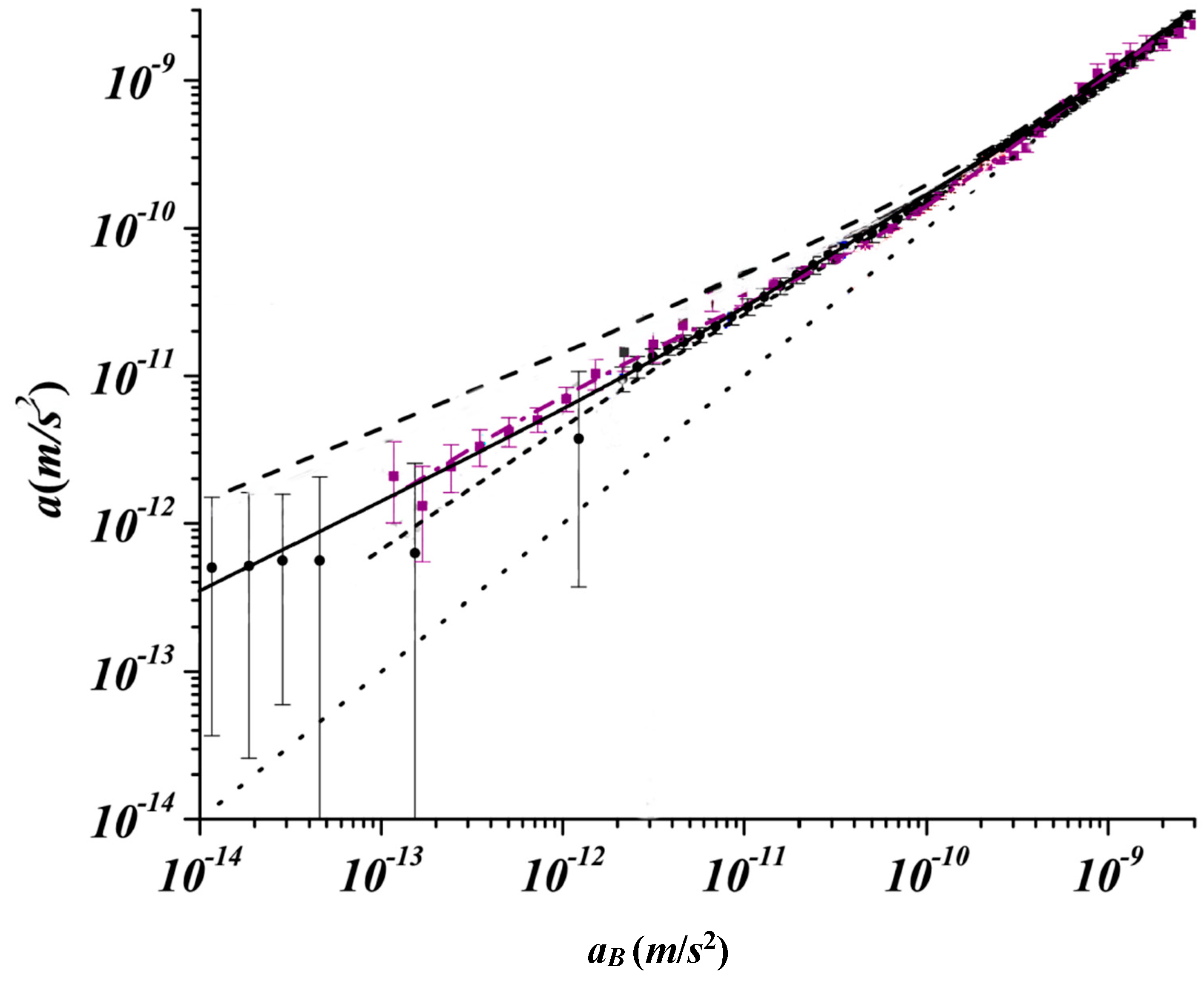
Inspired by the idea in Ref. [16], which introduced a viscosity coefficient into the ΛCDM model to describe the expansion of universe, we also attempt to introduce such a positive viscosity coefficient into the rotational motion equation describing the disk galaxies, and then studies what will happen. Surprisingly, we obtained all the formulas assumed in MOND, including a concrete interpolation function between the centripetal acceleration and the Newtonian acceleration, which however is empirical in MOND. But at the same time, something different from MOND was also obtained, that is, the critical acceleration, a0 in MOND, does not need to be a constant, but increases with the mass of the galaxy increases, and with the action of viscosity coefficient, the rotational galaxies will gradually expand radially over time at a extreme small expansion rate, just like the expansion of universe. However, unlike MOND, the model in this paper cannot rule out the existence of dark matter assumed in ΛCDM (in fact, we tend to consider the idea of this paper to be a further optimization of ΛCDM rather than an alternative to ΛCDM). Instead, the mass of dark matter can be used to help to adjust the value of A0 (here it just to distinguish from a0 in MOND, and A0 and a0 have the same meaning in the equation), thereby helping to better fit the radial acceleration relation (RAR) curve of galaxies. However, unlike ΛCDM, even if dark matter exists, it does not need to be carefully adjusted to meet the asymptotically flat rotational velocity curve of disk galaxies, which adjustment is considered to be unnatural by Milgrom and leading to the proposal of MOND. And the rotational curve of disk galaxies with this characteristic can be also achieved naturally under the viscous dynamics of the galaxy itself.
Keywords:
1. Introduction
2. Newtonian Dynamics with Dissipation Term
3. Models Comparison
4. Summary
Data Availability Statement
Conflicts of Interest
References
- Covi, L. , The European Physical Journal C-Particles and Fields, 15(1-4), 143-144 (2007).
- Ade, P.A.R.; et al. [Planck Collaboration]. Planck 2015 results. XIII. Cosmological parameters. Astron. Astrophys, 594, A13 (2016).
- E.J. Copeland, M. E.J. Copeland, M. Sami, S. Tsujikawa, Int. J. Mod. Phys. D 15, 1753 (2006).
- G. Bertone, D. G. Bertone, D. Hooper, Rev. Mod. Phys., 90, 045002(2018).
- M. Milgrom, Astrophys. J., 270, 365 (1983).
- B. Famaey, S. S. B. Famaey, S. S. McGaugh, Liv. Rev. Rel., 15, 10 (2012).
- Y. Zhu,, H.-X. Ma, X.-B. Dong, et al., MNRAS, 519, 4479 (2023).
- K.-H. Chae, ApJ, 960, 114 (2024).
- X. Hernandez, V. X. Hernandez, V. Verteletskyi, L. Nasser, et al., MNRAS, 528, 4720 (2023).
- F. Lelli, S. S. F. Lelli, S. S. McGaugh, J. M. Schombert, et al., ApJ, 836, 152 (2017).
- T. Mistele, S. T. Mistele, S. McGaugh, F. Lelli, et al. 2024. [Google Scholar]
- R. Scarpa, R. R. Scarpa, R. Falomo, A. Treves, MNRAS, 512, 544 (2022).
- S.S. McGaugh, J. M. S.S. McGaugh, J. M. Schombert, F. Lelli, ApJ, 976, 13 (2024).
- M. Milgrom, Phys. Rev. Lett., 111, 041105 (2013).
- T. Mistele, S. T. Mistele, S. McGaugh, F. Lelli, JCAP, 2024, 020 (2024).
- J. Hu, H. J. Hu, H. Hu, Eur. Phys. J. Plus, 135, 718 (2020).
- S.S. McGaugh, J.M. S.S. McGaugh, J.M. Schombert, G.D. Bothun, et al., Astrophys. J. Lett., 533, L99–L102 (2000).
- F. Lelli, S.S. F. Lelli, S.S. McGaugh and J.M. Schombert, The Astrophysical Journal Letters, 816, L14 (2002).
- F. Lelli, S.S. F. Lelli, S.S. McGaugh, J.M. Schombert, et al., Mon. Not. Roy. Astron. Soc., 484, 3267-3278 (2019).
- Toky Randriamampandry, C. Carignan, Physics, 439(2), 2132-2145 (2014).
- J.F. Navarro, C.S. J.F. Navarro, C.S. Frenk, S.D.M. White, ApJ, 462, 563 (1996).
- R.H. Sanders, E. R.H. Sanders, E. Noordermeer, Mon. Not. Roy. Astron. Soc., 379, 702 (2007).
- D. Dai, G. D. Dai, G. Starkman, D. Stojkovic, Physical review D, 105 104067 (2022).
- K.G. Begeman, A.H. K.G. Begeman, A.H. Broeils and R.H.Sanders, Month. Not. Roy. Astron. Soc. 249, 523 (1991).
- M. Milgrom and E. Braun, Astrophys. Journ. 334, 130 (1988).
- S.S. McGaugh and E. de Blok, Astrophys. Journ. 499, 66 (1998).
- Begum, and J.N. Chengalur, Astron. and Astrophys. 413, 525 (2004).
- Federico, Lelli, Stacy, S., McGaug, et al., The Astrophysical Journal, 836, 2 (2017).

| Serial Number | The assumed value of λ | The assumed initial condition (v0, r0) | The obtained A0 | The obtained μ’ | |
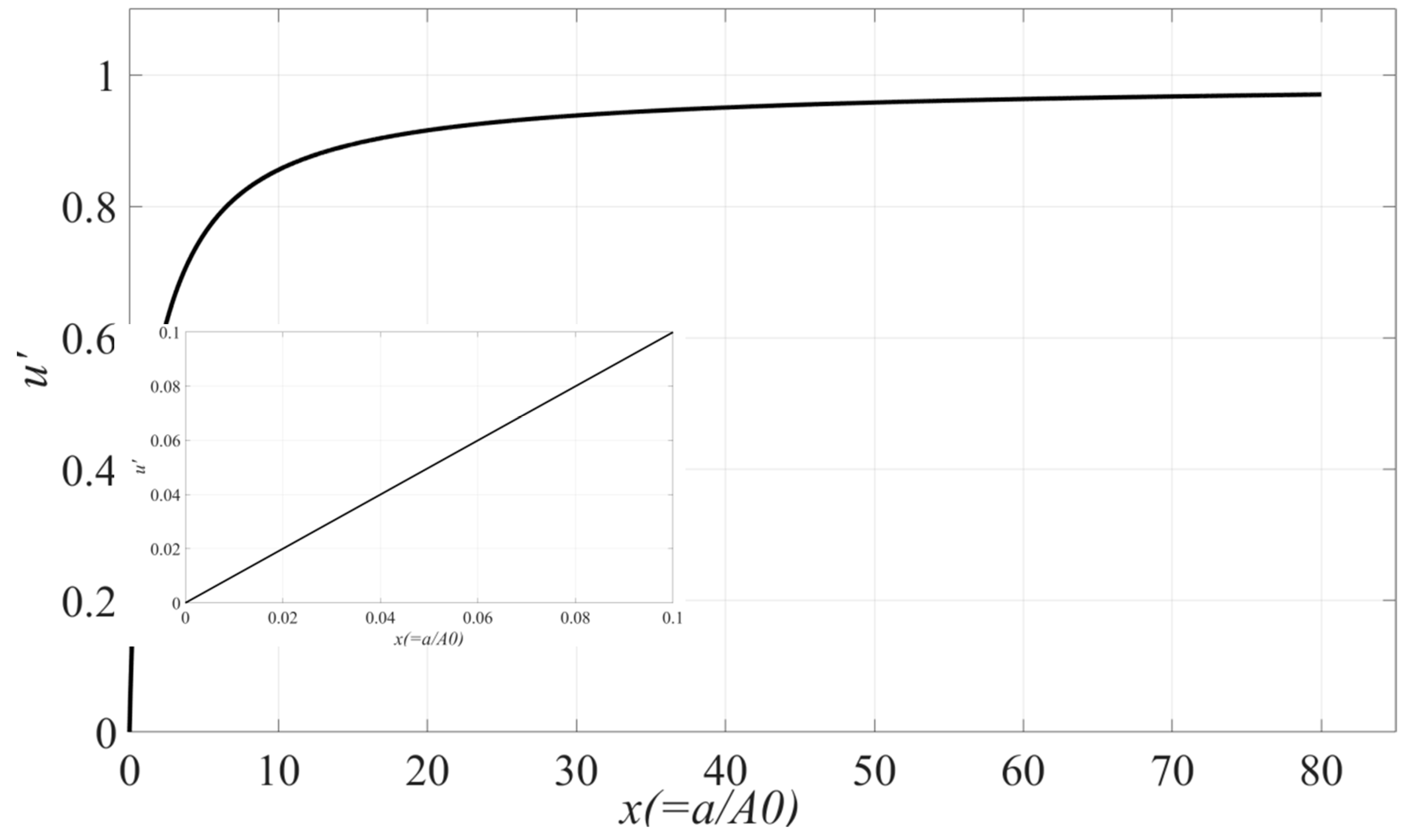
| 1 | λ=1×10⁻⁷ | v0=1 | r0=1 | 1.0038×10⁻¹⁰ | See Figure 1 |
| 2 | λ=1×10⁻⁷ | v0=10 | r0=1 | 4.7323×10⁻¹⁰ | |
| 3 | λ=1×10⁻⁷ | v0=100 | r0=1 | 2.1986×10⁻⁹ | |
| 4 | λ=1×10⁻⁷ | v0=1000 | r0=1 | 1.02257×10⁻⁸ | |
| 5 | λ=1×10⁻⁷ | v0=0.1 | r0=1 | 2.0005×10⁻¹¹ | |
| 6 | λ=1×10⁻⁷ | v0=10 | r0=0.01 | 1.0021×10⁻¹⁰ | |
| 7 | λ=1×10⁻⁷ | v0=50 | r0=0.0004 | 1.0028×10⁻¹⁰ | |
| 8 | λ=1×10⁻⁷ | v0=100 | r0=0.0001 | 1.0025×10⁻¹⁰ | |
| 9 | λ=5×10⁻⁷ | v0=1 | r0=1 | 8.6415×10⁻¹⁰ | |
| 10 | λ=5×10⁻⁷ | v0=10 | r0=0.01 | 8.6519×10⁻¹⁰ | |
| 11 | λ=5×10⁻⁷ | v0=50 | r0=0.0004 | 8.6945×10⁻¹⁰ | |
| 12 | λ=5×10⁻⁷ | v0=100 | r0=0.0001 | 8.7017×10⁻¹⁰ | |
| 13 | λ=1×10⁻⁶ | v0=1 | r0=1 | 2.1844×10⁻⁹ | |
| 14 | λ=1×10⁻⁶ | v0=10 | r0=0.01 | 2.1879×10⁻⁹ | |
| 15 | λ=1×10⁻⁶ | v0=50 | r0=0.0004 | 2.1902×10⁻⁹ | |
| 16 | λ=1×10⁻⁶ | v0=100 | r0=0.0001 | 2.1931×10⁻⁹ | |
| 17 | λ=1×10⁻⁶ | v0=100 | r0=1 | 4.7171×10⁻⁸ | |
| 18 | λ=2×10⁻⁶ | v0=100 | r0=1 | 1.1933×10⁻⁷ | |
| 19 | λ=5×10⁻⁶ | v0=10 | r0=0.01 | 1.8766×10⁻⁸ | |
| 20 | λ=5×10⁻⁶ | v0=100 | r0=0.0001 | 1.8777×10⁻⁸ | |
| 21 | λ=5×10⁻⁶ | v0=1000 | r0=1×10⁻⁶ | 1.8776×10⁻⁸ | |
Disclaimer/Publisher’s Note: The statements, opinions and data contained in all publications are solely those of the individual author(s) and contributor(s) and not of MDPI and/or the editor(s). MDPI and/or the editor(s) disclaim responsibility for any injury to people or property resulting from any ideas, methods, instructions or products referred to in the content. |
© 2025 by the authors. Licensee MDPI, Basel, Switzerland. This article is an open access article distributed under the terms and conditions of the Creative Commons Attribution (CC BY) license (http://creativecommons.org/licenses/by/4.0/).


