

Submitted:
19 February 2025
Posted:
20 February 2025
You are already at the latest version
Abstract
The objective of the study was to investigate factors that influence people’s intention to adopt biogas technology in Malawi. The study adopted variables of the diffusion of innovation theory (DIT) (relative advantage, compatibility, complexity and observability) and the theory of planned behavior (TPB) (subjective norms, perceived behavioral control and attitude) to assess the intention. The study utilized a quantitative methodology, gathering primary data from 98 potential biogas adopters in five districts in Malawi using a questionnaire with a five-point Lik-ert scale. After data collection, a reliability test was conducted to determine the questionnaire's reliability. A multiple regression analysis was performed to establish the relationship between independent and dependent variables. The subjective norms, perceived behavioral control, and attitude were taken as independent variables while the intention to adopt biogas technology was the dependent variable. The study's results indicated that only compatibility and subjective norms were significant predictors and independently contributed to predicting individuals' in-tentions to adopt biogas technology. This will assist policy makers to provide technologies that will be compatible to people’s culture and lifestyle hence preventing wasting of resources. At the same time, involvement of important people in the society will help in raising awareness of the importance of biogas technology
Keywords:
Biogas
; adoption
; diffusion
; innovation
; relative advantage
; compatibility
; complexity
; subjective norms
; perceived behavioral control
; attitude
1. Introduction
In developing countries, people have traditionally depended on firewood and charcoal as their primary sources of fuel [1]. It is estimated that approximately 2.5 billion people (35) residing in economically developing countries cook daily with solid fuels such as crop residues, charcoal, coal, wood and manure [2]. In Malawi, more than 97% of homes rely on firewood or charcoal for heating and cooking, placing Malawi among the countries with the highest dependence on biomass energy globally [3]. Hence, biogas technology has been recognized as a practical solution for combating deforestation and energy poverty in Malawi [4]. Despite being introduced approximately 20 years ago, Malawi's sustained use of biogas digesters is almost non-existent [3]. To address the challenge, numerous research studies have been conducted to identify suitable biogas technology for Malawi, focusing on affordability and user-friendliness [5,6]. However, the situation has remained the same over the past years with an increased number of failed biogas systems. It is argued by [7] that spreading of knowledge regarding the existence of technology cannot influence the behavior and patterns of people. Therefore, having suitable and acceptable technologies is not the only factor influencing a household’s choice to accept a technology. The study's objective was to investigate the use of diffusion of innovation and theory of planned behavior as models for adopting biogas technology and explore which factors in the models influence adoption. By understanding people's intention toward adopting biogas technology, policymakers can design policies to encourage biogas adoption by understanding people's intentions through innovation diffusion. The will aid in avoiding the waste of resources resulting from the promotion of inappropriate technologies, thereby enhancing their contribution to economic development. Furthermore, taking into account the involvement of influential people in a community and their mindset, the promotion of biogas will be easy since community leaders will facilitate awareness campaigns.
Theoretical Framework and Formulation of Hypothesis
It has been established that consumers' decision-making is a multi-faceted process with various social, psychological, and economic factors influencing a final purchase decision [8]. Scientists have proposed several study frameworks to understand the complicated nature of consumers' buying intentions [9]. For example, the theory of reasoned action, , self-efficacy theory, theory of planned behavior, social cognitive theory and many others [10,11]. For the present study, two theories were used: the diffusion of innovations theory and the theory of planned behavior. These theories explain factors influencing human behavior and perceptions toward Innovative technology [12]. For example, the Diffusion of innovations theory emphasizes the importance of people’s perceptions of innovation in terms of ease of use and compatibility with their knowledge and experiences as one of the factors influencing adoption [13]. On the other hand, the theory of planned behavior focuses on how people’s values, beliefs, and norms influence their behaviors.
1.2. Theory of Innovation of Diffusion
The theory of innovation diffusion was introduced in 1958 by Rogers following his doctoral thesis at Iowa State University in the USA, which focused on the introduction of agricultural innovations. Rogers defines technological innovation as something perceived as new by an individual, with the adoption of innovation depending on the characteristics of that individual [14]. Technological innovation, according to Rogers, is something that a person perceives as novel; the degree to which this innovation is adopted depends on the individual's traits. According to the theory, an individual's inclination to purchase a new product or service is influenced by their perception of the product's innovative characteristics. These include compatibility, relative advantage, observability, complexity, and trialability.
Firstly, technology should have a relative advantage. Relative advantage is the extent to which an innovation is perceived to be better than to the concept it substitutes and is and it is frequently stated in terms of financial gain, social standing, or other ad-vantages [13]. It can be evaluated by comparing the amount of money, time, and effort saved [15]. For biogas technology to be adopted, the users should first consider it to be better than other existing technologies or alternative sources of energy such as charcoal and fuel wood. According to a study conducted in the USA, there were several perceived advantages and drawbacks to renewable energy technologies [16]. The study also found that short-term benefits were outweighed by long-term benefits of using renewable energy. Hence, it was recommended that for technology to be adopted swiftly, it is necessary to emphasize the benefits of technology over people’s current energy use such as employment, self-sufficiency, and environmental and economic advantages. The study further recommended that apart from addressing relative advantages, relative disadvantages should also be considered. Another study done in Uganda on mini grids and renewable energy recommended that technology should be able to provide a reliable service to the users as unreliable services decrease relative advantage, leading to low adoption [17]. The study found that people preferred electricity from mini grids because it provided brighter light than kerosene lamps and offered health benefits compared to kerosene lamps and fuel wood. These perceptions of people increased the adoption of mini-grid technology. Based on these arguments, the first hypothesis was developed:
H1: There is a significant relationship between relative advantage and people’s intention to adopt biogas technology.
Secondly, the innovation should have compatibility. Rogers et al. [13] defined compatibility as the extent to which an innovation is thought to be in line with the needs, prior experiences, and values of potential adopters. A more compatible idea is less uncertain for potential users and is better suited to the individual's life situation. Such compatibility enables people to interpret the novel concept in a way that makes it seem familiar. People are more likely to opt for biogas technology if it meets their energy needs and is in line with their beliefs and values. This means that individuals tend to evaluate whether a technology will be suitable for their culture and requirements before embracing it. When they feel secure, they are more inclined to use biogas technology. Several studies have proven that compatibility had a positive significance with the adoption of technologies [18,19,20]. However, according to [16], most residents in Michigan did not consider alternative energy sources compatible with their lifestyle. One example is when a respondent declined to have a windmill in their backyard. The second hypothesis was developed based on the arguments mentioned above.
H2: There is a significant relationship between compatibility and people’s intention to adopt biogas technology.
The third characteristic of an innovation is complexity. Complexity is the degree to which a new idea is thought to be hard to understand and use [13]. Easy-to-use innovations have a higher chance of being adopted than difficult ones [21]. Based on the above arguments, the third hypothesis was devised based on these arguments:
H3: There is a significant relationship between complexity and people’s intention to adopt biogas technology.
Fourthly, the technology should have trialability. Trialability refers to the degree to which an innovation can be tested before its final introduction [13]. If potential adopters can test an innovation before embracing it, the likelihood of it being adopted increases [16]. The technology should be tried and evaluated by the individuals before being fully adopted, if it is too hard, then it can be rejected [15]. Once an innovation is tried on a small scale and succeeds, people are willing to adopt it. Al-Gahtani [18] found a significant positive correlation between trialability and computer adoption and use. People are more likely to buy a product if they see a demonstration of its functionality before making a purchase [13,19]. Given the financial costs involved in adopting renewable energy initiatives, it is challenging to implement trialability at the individual adoption level [16]. For this reason and because of the characteristics of biogas technology, trialability was excluded from the analysis, as it does not pertain to this technology [22].
Lastly, technology should have observability. The term "observability" describes how easily others can see the results of an innovation [13]. Individuals observing the technology may elicit positive or negative reactions, leading to either rejection or adoption. Diffusion of an innovation happens quickly when people can see the results and advantages [21]. Several studies have demonstrated a strong correlation between observability and people's intention to adopt innovations [18,21]. In light of the aforementioned arguments, the fourth hypothesis was developed.
H4: There is significant relationship between Observability and the people’s intention “to adopt biogas technology.
1.3. Theory of Planned Behavior
Having suitable and acceptable technologies is not the only factor that can influence the household’s decision to adopt a technology. It is argued by [7] that the spreading of knowledge regarding the existence of technology cannot influence the behavior and patterns of people. However, it is further urged that technology acceptance is highly influenced by the decisions of important people in a community such as household heads. This assertion is supported by the Theory of Planned Behavior (TPB) developed by Icek Ajzen, which aims to predict and explicate human behavior toward the acceptance of technology [10]. The theory proposes that rather than focusing on teaching technical knowledge of technology, it is significant to recognize the individual’s beliefs and how the beliefs impact their intentions and actions. Ajzen also suggested that an individual's likelihood of adopting biogas technology is higher when they have a positive attitude and subjective norm towards the behavior, along with a strong sense of perceived control [23]. This theory assumes that if an individual has a more positive attitude and subjective norm toward a behavior, along with a high perceived behavioral control, their intention to perform that behavior will be stronger [10].
An individual's attitude towards behavior evaluates how positively or negatively they assess their performance. Individuals' attitude reflects whether they hold a positive or negative view towards a specific behavior or action. Within the theory of planned behavior, the concept of attitude is associated with consumers' approach to embracing renewable energy such as biogas technology [24]. According to [23], people had a positive attitude regarding biogas technology believing it would contribute to a reduction in atmospheric emissions, reduce the amount of waste that ends up in landfills, and provide renewable energy for domestic use. Consequently, this would lower the price of purchasing energy. As a result, respondents were interested in the environment's quality or improvement. Based on the above arguments, the fifth hypothesis was devised based on these arguments:
H5: There is a significant relationship between attitude and the people’s intention to adopt biogas technology.
Subjective norm is the individuals' subjective standards that involve their perception of the opinions of important people in their lives regarding whether they should engage in a particular behavior [10]. According to [25] there is a relationship between subjective norms and willingness of consumers to adopt renewable energy technologies. Subjective norms can be ascertained through the perceived influence of social pressure on an individual, prompting them to adopt certain behaviors and actions [24]. Malawi people live in a very close society, and the opinions of others can have important impact on their decision to adopt a technology. Based on the above arguments, the sixth hypothesis was devised based on these arguments:
H6: There is a significant relationship between subjective norms and people’s intention to adopt biogas technology.
The term perceived behavioural control (PBC) describes how someone feels about their capacity to carry out a specific behaviour and how challenging it is [10]. It relates to an individual's belief about whether a specific behavior is easy or difficult [24]. The challenge of utilizing technology is one aspect that could influence customers' PBC [25]. According to [26], the consumer-friendly aspect of renewable energy products has a positive impact on willingness of consumers to buy and use renewable energy. Items like solar panels can be easily installed and are likely to have a positive impact on how consumers feel about their ability to adopt green energy [24]. Consequently, the seventh hypothesis was developed using the following justifications:
H7: There is a significant relationship between perceived behavioral control and people’s intention to adopt biogas technology.
2. Materials and Methods
To collect data, the study used a survey design. In this study, the researcher compared several variables simultaneously using a cross-sectional methodology to gather data at a particular point in time [27]. Data was collected through the use of a closed-ended, structured questionnaire. The questionnaire included questions which measured demographic variables, the theory of planned behavior variables (attitudes, subjective norms, and perceived behavioral control), and diffusion of innovation theory (relative advantage, compatibility, observability, complexity). The questionnaire consisted of two sections. The first part of the questionnaire collected demographic information, including gender, education level, age, occupation, and monthly income. The second section collected data on variables related to the theory of planned behavior and the diffusion of innovation theory. The questionnaire used A 5-point Likert scale of 1 (strongly agree) to 5 (strongly disagree). To obtain validity in the study, the questionnaire was submitted to five (5) experts in the field of biogas technology from the Ministry of Energy [28]. The experts evaluated the degree of internal and external validity of collecting relevant data. Their observations were incorporated into the questionnaire before being used on the ground. After, reviewing the questionnaire, a pilot research was carried out in January 2023 in Mchinji district in the central region on households with similar characteristics as the study sample but were not part of the sample population [29]. Piloting helped in determining whether proposed methods or questionnaire were appropriate or too complicated. After the piloting, the questionnaire was corrected and questions reframed to ensure they were well understood by the respondents, and those that were irrelevant were deleted. Further, a Cronbach’s alpha was calculated from the collected data to check if multiple question Likert scale survey was reliable [30]. The consistency of the questionnaire was evaluated using reliability analysis. The questionnaire's reliability was evaluated through the Cronbach's alpha score. Values typically 0.7 or higher are considered satisfactory [31].
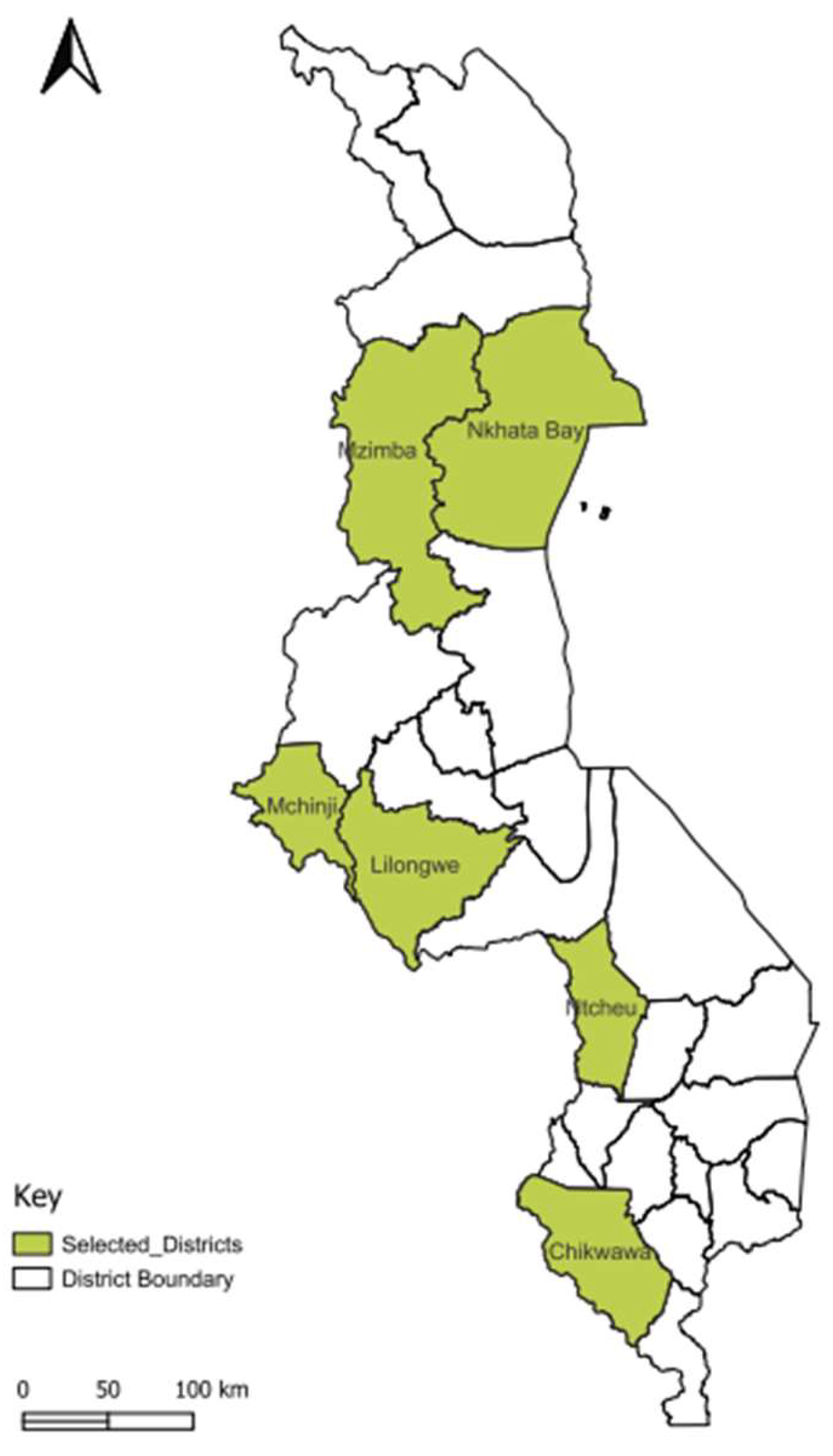
The main study commenced in March 2023 and completed in June 2023. The study identified 16 districts that had biogas systems installed at the time of the survey. The study targeted potential adopters to get their perspective on biogas technology. Potential adopters were those who had not adopted biogas technology but lived close to those with biogas systems, either functional or not. Random sampling was employed to choose districts for the survey. The selected districts were Nkhatabay, Mzimba, Ntcheu, Chikwawa, and Lilongwe as indicated in figure 1. To select respondents, convenience sampling was used. Convenience sampling was employed, taking into account the user's geographic boundaries, time of convenience, and preparedness to engage in the survey [32]. A total of 98 potential adopters were interviewed. Before the interview, the research purpose and questionnaire were thoroughly explained to the respondents to ensure their understanding of the research questions and to provide accurate answers reflecting the collected data. Consent was sought from the respondents, and only those willing to take part in the research were interviewed. The research study was approved by and follows the ethical guidelines of the National Commission for Science and Technology (NCST) before the commencement of the fieldwork. The respondents' demographic characteristics were analyzed using descriptive statistics. The hypotheses were tested using multiple regression techniques in IBM SPSS Statistics version 22. The. In this case, the intention to adopt biogas technology was regressed on relative advantage, observability, compatibility, complexity, attitude, subjective norm, and perceived behavioral control.
Figure 1.
Map of Malawi depicting study areas.
3. Results
3.1. Respondent Descriptive Analysis
Table 1 displays the demographic features of the participants in the study. According to the findings, the age group ages 31 to 40 had the most representation in the sample (52%), followed by the age group ages 41 to 50 (28%). Considering gender, females comprised 52% and males 48%. In terms of the education variable, 23% of the respondents were primary school dropouts, whereas 64% of the respondents reported having a secondary school certificate. Only 11% had reached tertiary level of education. In terms of the employment variable, 39% of the respondents were farmers, and 47% of the respondents were business owners, constituting the largest representation of the study sample. An additional factor looked at in the study was the monthly earnings of respondents, with 79.59% making over 20,000 Malawi Kwacha. This was then followed by individuals earning 10,000–20,000 Malawi Kwacha monthly, making up 13.27% of all survey participants.
3.2. Reliability Test Results for Study Variables
The findings from the reliability analysis are outlined in Table 2. The results indicate that the values are considered satisfactory, therefore the questionnaire was deemed reliable and consistent.
3.3. Hypothesis Testing
The hypotheses were tested using multiple regression techniques in IBM SPSS Statistics version 22. The intention to adopt biogas technology was regressed on attitude, subjective norm, perceived behavioral control, relative advantage, compatibility, and complexity. Table 3 presents analysis of the regression.
Table 2's findings demonstrate that all factors—aside from compatibility and subjective norm—have significance levels larger than 0.05, which strongly supports the acceptance of hypotheses H2 and H5. (detailed results in Appendix A). Table 4 explains the regression analysis.
Table 4 above indicates that all 9 demographic characteristics except gender and number of livestock did not affect biogas adoption intention. Gender and number of livestock (β = .261, p <.05) and (β = .290, p <.05) significantly affected the intention to adopt biogas technology.
4. Discussion
This study's primary goal was to determine the key elements affecting Malawi's adoption of biogas technology. This study adopted the diffusion of innovation theory and the theory of planned behavior as the main frameworks to explain adoption intention. The study hypothesized that relative advantage, compatibility, complexity, observability, attitude, subjective norm, and perceived behavioral control would significantly predict the intention to adopt biogas technology. The study revealed that only subjective norm and compatibility significantly predicted adoption intention.
4.1. Relationship Between Subjective Norm and Adoption of Biogas Technology
The findings of this study found that people's intentions to use biogas technology were significantly influenced by their family, friends, neighbors, community chiefs, politicians, and religious leaders. These results are in line with a related study carried out by [23]. It was observed that respondents had respect for people considered important in their lives, and that their intentions to use biogas technology might have been impacted by these people's opinions. According to these findings, family members, friends, neighbours, community leaders, politicians, and church leaders all contribute to the dynamics when developing interventions aimed at persuading heads of households to embrace biogas technology. They may also play a significant role in raising awareness of the adoption of biogas technology. Hence, there is need to engage important people in the community when introducing new technologies. Hence, the study accepted hypothesis H5.
4.2. Relationship Between Compatibility and Adoption of Biogas Technology
The study found that technological compatibility predicted the adoption of technology in Malawi. The study supported H2, which stated a significant relationship exists between compatibility and people’s intention to adopt biogas technology. This was consistent with the study by [33], which demonstrated that compatibility was another significant predictor of solar technology adoption. The study above indicated that individuals who believe that solar technology aligns with their culture were more inclined to adopt it. This is the same with the current study where compatibility influenced people’s intention to use biogas technology.
4.3. Relationship Between Relative Advantage and Adoption of Biogas Technology
The findings of this study rejected hypothesis H1 as the results indicated a negative relationship between relative advantage and the intention of people to utilize biogas technology. This is in line with a study done by [33] which did not find a higher relative advantage to using renewable energy on a small scale. Several respondents of the above study did not place relative advantage highly. Regarding the study's findings, relative advantage did not influence the adoption and utilization of biogas. The possible explanation for the findings is that potential adopters did not find biogas technology better than other energy sources such as charcoal and wood fuel as it did not provide a reliable energy source to users. According to the study done by [34] on opportunities and barriers of biogas technology in Malawi, it was discovered that biogas adopters continued to use firewood and charcoal as biogas technology was not providing enough gas to cook Nsima (Malawi Stable food). This finding explains one of the reasons behind the low adoption of biogas technology in Malawi. The potential adopters had witnessed challenges adaptors faced and developed bad attitudes towards the technology, leading to low interest. As indicated earlier, for technology to have a high relative advantage, it should be able to provide a reliable source of energy, failure to do that relative advantage decreases hence leading to low adoption. To overcome the challenges, there is a need for the government to conduct awareness campaigns to remove negative perceptions of biogas technology.
4.4. Relationship Between Complexity and Adoption of Biogas Technology
The study's outcome rejected H3 that stated that there is a positive relationship between complexity and the intention of people to adopt biogas technology. The study showed that as complexity increases, it is possible that people will not adopt biogas technology. The results of the study indicate that the rate of adoption of bio-gas is adversely correlated with complexity. The study agrees with the study that was done in Saudi Arabia [18]] and Brazil [21]. This means that if the technology is more complex it might be more likely be rejected than adopted. As such, technologies that are introduced in Malawi should be simple and not complicate to use if the intended beneficiaries are from rural communities. There is a need for more research to develop easy, simple-to-operate, and maintainable technologies appropriate for the people of Malawi.
4.5. Relationship Between Observability and Adoption of Biogas Technology
There was no significant relationship between observability and intention to adopt biogas technology in the study, contrary to H4. According to the study results, people's intention to adopt biogas technology was negatively dependent upon observability. The results were in line with studies by [19] and [20] who found that observability had no relationship to the adoption of innovation. According to [34] most biogas systems installed in Malawi were installed as demonstration plants for people to learn and appreciate the use of biogas and develop an interest in adopting the technology. However, most systems were not fully functional and did not function as expected. Therefore, most potential users were not convinced that the technology was useful or important and were discouraged from adopting it. We need demonstration sites with well-operated systems to remove negative perceptions of the technology and instill confidence in people. As a result, people will be able to see the advantage of biogas technology, thereby increasing their intentions to use it.
4.6. Relationship Between Attitude and Adoption of Biogas Technology
It was observed that there was no significant relationship between attitude and intention to adopt biogas technology, according to the study. The results contradict the findings of [23], who found that people had a positive attitude towards biogas technology. According to their research, biogas technology was perceived as a method to reduce atmospheric emissions, decrease waste volumes in landfill/dump sites, and provide renewable energy for domestic purposes. This, in turn, would reduce the cost of buying energy. However, the current results observed that people had a negative attitude towards biogas technology which led to low uptake of the technology. The negative attitudes of people emanated from poor performance of installed biogas systems [34]. There is a need for the Government and stakeholders to provide programs and activities that will develop positive attitudes of people towards the technology. Positive attitudes towards biogas technology by people can be enhanced through public awareness and setting up demonstration plants where people would appreciate the advantages of biogas technology. Hence, the study rejected H5.
4.7. Relationship Between Perceived Behavior and Adoption of Biogas Technology
The study also rejected H7 which stated that there was a significant relationship between perceived behavioral control and the people’s intention to adopt biogas technology. This was corroborated by a related study by [23], which discovered that perceived control factors, such as the initial investment cost for installing a biogas plant, ongoing maintenance costs, and the capacity of service providers (human resource), negatively impacted household heads' intentions to adopt biogas technology. The study suggested that to encourage people to adopt biogas technology, interventions should identify and address the resources considered insufficient or absent.
4.8. Relationship Between Demographic Characteristics and Adoption of Biogas Technology
The study results indicated that all demographic characteristics except for gender and number of livestock did not influence adoption of biogas technology. In this study, women compared to men are more likely to adopt biogas technology. According to Uhunamure et al 2019, household gender had either a negative or positive effect on biogas adoption depending on gender tasks. Even though men have the majority ownership, access, and control over home production resources and investment in Africa [35], this did not prevent women from embracing the technology. Further, women are the ones responsible for domestic energy supply such as fuelwood collection, hence embracing biogas technology was easier for them than men as it lessened their workload burden [36]. The study further observed that number of livestock either positive or negative effect on adoption of biogas technology in Malawi. This is in line with findings from the study on analysis of biogas technology adoption among households in Kilifi County [37], which found that all households that adopted biogas technology had cattle. This indicated that households with livestock are potential adopters of biogas technology as the main important basic material needed for operation of biogas digester is readily available [38].
5. Conclusions
The study aimed to investigate the use of diffusion of innovation and theory of planned behavior to identify factors that influence adoption of biogas technology in Malawi. The study sought to generalize the effect of psychological constructs such as relative advantage, compatibility, observability, complexity, beliefs, attitudes, subjective norms, and perceived behavioral control on the intention to adopt biogas technology. The study results indicate that only compatibility and subjective norms significantly affect the intention to use biogas technology. So, to accelerate intake of biogas technology, the systems promoted should be aligned with the culture, values, and requirements of the people. The system should also be observable, have a high relative advantage, and be less complex. Simultaneously, it is crucial to involve important community members from the beginning of the project when disseminating the technology. Further, perceived behavioral control factors such as cultural beliefs, lack of funds, inadequate dung or water, labor shortages, shortages of spare parts, lack of livestock, ignorance of the advantages of biogas technology, and a lack of technical experts and maintenance services should be minimized. The existence of these barriers would hinder the adoption of biogas technology in Malawi, so it is crucial to reduce or eliminate these barriers. By taking those measures, resource wastage will be minimized, thereby affecting economic growth.
Author Contributions
Conceptualization, materials organizations, text preparation, writing and original draft preparation, R.K.; review, editing and supervision, H.W.T.M., G.G., R.B. and S.M. All authors have read and agreed to the published version of the manuscript.
Funding
The research received no external funding.
Data Availability Statement
Data sharing not applicable.
Acknowledgments
The authors express their gratitude to the anonymous reviewers for their constructive suggestions.
Conflicts of Interest
The authors declare no conflict of interest.
Appendix 1: Explanation of results of regression analysis
| Independent Variable | Value | Hypothesis testing results at 95% confidence interval | Interpretation |
| Subjective Norm | < 0.05 | the hypothesis is accepted (0.001< 0.05) | There is a strong connection between people's subjective norms and their intention to adopt biogas technology. This is because the significant value is 0.0000, which is lower than the acceptable value of 0.05. This means that with a 1% increase in the subjective norm, the adoption will increase by 0.444 (B Value). This indicates a strong correlation between people's intention to adopt biogas technology and their subjective norms. As the subjective norm increases, it is more likely that people will adopt biogas technology. |
| Perceived Behavior Control | 0.789 | the hypothesis is rejected (0.789 > 0.05) | There is no significant relationship between perceived behavior control and intention to adopt biogas technology. This is because Sign. value is 0.789, which is more than the acceptable value of 0.05. The unstandardized coefficient (B) obtained for the PCB is -0.051. This means that when the PCB increases by one unit, the consumer's intention for adoption decreases by -0.051 units. This indicates a negative correlation between perceived behavioral control and individuals' intention to adopt biogas technology. As the price of PCB increases, likely, people will not adopt biogas technology. |
| Attitude | 0.745 | The hypothesis is rejected (0.745 > 0.05) | There is no significant relationship between attitude and intention to adopt biogas technology. This is because sign. value is 0.745, which is more than the acceptable value of 0.05. The unstandardized coefficient (B) obtained for the attitude is -0.060. This means that when the attitude increases by one unit, the consumer's intention for adoption decreases by -0.060 units. This means that there is a negative relationship between attitude and people’s intention to adopt biogas technology. As negative attitude increase, there is likely that people will not adopt biogas technology. |
| Observability | 0.788 | The hypothesis is rejected (0.788 > 0.05) | There is no significant relationship between observability and intention to adopt biogas technology. This is because Sign. Value is 0.788, which is more than the acceptable value of 0.05. The unstandardized coefficient (B) obtained for the observability is 0.043. This means that when the attitude increases by one unit, the consumer's intention for adoption decreases by 0.043 units. This means that there is negative relationship between observability and people’s intention to adopt biogas technology. |
| Relative advantage | -0.084 | The hypothesis is rejected (-0.084 < 0.05) | There is a negative relationship between relative advantage and intention to adopt biogas technology. This is because the significant value is -0.084, which is less than the acceptable value of 0.05. With a 1% increase in the Relative Advantage, the adoption will increase by 0.425 (B Value). The unstandardized coefficient (B) obtained for the relative advantage is 0.411. This means that when the attitude increases by one unit, the consumer's intention for adoption decreases by -0.084 units. This means that there is a negative relationship between altitude and people’s intention to adopt biogas technology. This means that there is a negative relationship between relative advantage and intention of people to adopt biogas technology. |
| Complexity | 0.322 | The hypothesis is rejected (0.322 > 0.05) | There is no significant relationship between complexity and intention to adopt biogas technology. This is because Sign. Value is 0.322, which is more than the acceptable value of 0.05. The unstandardized coefficient (B) obtained for the complexity is -0.129. This means that when the attitude increases by one unit, the consumer's intention for adoption decreases by -0.129 units. This indicates a negative correlation between complexity and the intention of individuals to adopt biogas technology. As complexity increases, likely that people will not adopt biogas technology. |
| Compatibility | 0.043 | The hypothesis is accepted (0.043 < 0.05) | There is a significant relationship between Compatibility and intention to adopt biogas technology. This is because Sign. Value is 0.043, which is less than the acceptable value of 0.05. With a 1% increase in compatibility, the adoption will increase by -0.225 (B Value). This implies a direct link between compatibility and people's willingness to adopt biogas technology. As compatibility increases, there is likely that people will adopt biogas technology. |
References
- French, D. Confronting an Unsolvable Problem: Deforestation in Malawi. World Dev. 1986, 14, 531–40. [Google Scholar] [CrossRef]
- Wright, C.; Sathre, R.; Buluswar, S. The global challenge of clean cooking systems. Food Secur. 2020, 12, 1219–40. [Google Scholar] [CrossRef]
- Government of Malawi. National Energy Policy. Ministry of Natural Resources, Energy and Mining; 2018.
- Gausi, E.; Mlatho, J.S.P.; Mikeka, C. A Low-Cost Tubular Biogas Digester for Rural Households in Malawi. Malawi Journal Science and Technology. 2020, 12, 18–42. [Google Scholar]
- Kawelamzenje, N.A.; Twizerimana, M.; Bernadette,D. ; Bakundukize, A. Design of a Co-Digestion Biogas Plant to Curb Deforestation-Case Study of Phalombe Secondary School in Malawi. OALib. 2021, 8, 1–28. [Google Scholar] [CrossRef]
- Gifford, R.; Nilsson, A. Personal and social factors that influence pro-environmental concern and behaviour: Arview: Pesonal and Social Factors That Influence Pro-Environmental Behaviour. Int J Psychol. 2014, 49, 141–157. [Google Scholar] [CrossRef] [PubMed]
- Olshavsky, R.W.; Granbois, D.H. Consumer Decision Making-Fact or Fiction? J Consum Res. 1979, 6, 93–100. [Google Scholar] [CrossRef]
- Shakeel, S.R.; Rahman, S.U. Towards the establishment of renewable energy technologies’ market: An assessment of public acceptance and use in Pakistan. J Renew Sustain Energy. 2018, 10, 045907. [Google Scholar] [CrossRef]
- Ajzen, I. The Theory of Planned Behavior. Organ Behav Hum Decis Process. 1991, 50, 179–211. [Google Scholar] [CrossRef]
- Ajzen I, Fishbein M. A Bayesian analysis of attribution processes. Psychol Bull. 1975, 1, 261–77. [Google Scholar]
- Yasmin, N.; Grundmann, P. Pre- and Post-Adoption Beliefs about the Diffusion and Continuation of Biogas-Based Cooking Fuel Technology in Pakistan. Energies. 2019, 12, 1–16. [Google Scholar] [CrossRef]
- Rogers, E.M.; Singhal, A.; Quinlan, M.M. Diffusion of innovations. In: An integrated approach to communication theo-ry and research. Available online:https://www.taylorfrancis.com/chapters/edit/10.4324/9780203887011-36/diffusion-innovations-everett-rogers-arvind-singhal- margaret-quinlan (accessed 2 October 2024].
- Menon, N.M.; Sujatha, I. Influence of Rogers’ theory of innovation of diffusion on customer’s purchase intention – a case study of solar photovoltaic panels. Mater Sci Eng. 2020, 1–7. [Google Scholar] [CrossRef]
- Gulbrandsen, L. Development implications and sustainability of biogas plants in Njombe District, Tanzania. Masters, Norwegian University of Life Sciences, Norway, 2011.
- Silk, K.J.; Hurley,A. ; Pace, K.; Maloney, E.K.; Lapinski, M. A Diffusion of Innovations Approach to Understand Stake-holder Per-ceptions of Renewable Energy Initiatives. Sci Commun. 2014, 36, 646–69. [Google Scholar] [CrossRef]
- Eder, J.M.; Mutsaerts, C.F.; Sriwannawit, P. Mini-grids and renewable energy in rural Africa: How diffusion theory ex-plains adoption of electricity in Uganda. Energy Res Soc Sci. 2015, 5, 45–54. [Google Scholar] [CrossRef]
- Al-Gahtani, S.S. Computer technology adoption in Saudi Arabia: Correlates of perceived innovation attributes. Inf Tech-nol Dev. 2003, 10, 57–69. [Google Scholar] [CrossRef]
- Li, Q.; Wagan,S. A.; Wang, Y. An analysis on determinants of farmers’ willingness for resource utilization of livestock manure. Waste Manag. 2021, 120, 708–15. [Google Scholar] [CrossRef] [PubMed]
- Tapaninen, A.; Seppanen, M.; Makinen, S. Characteristics of innovation: a customer-centric view of barriers to the adoption of a renewable energy system. Int J Agile Syst Manag. 2009, 4, 98–113. [Google Scholar] [CrossRef]
- Martins, C.B.M.J.; Steil, A.V.; Todesco, J.L. Factors influencing the adoption of the Internet as a teaching tool at foreign language schools. Comput Educ. 2004, 42, 353–74. [Google Scholar] [CrossRef]
- Elmustapha, H.; Hoppe, T.; Bressers, H. Consumer renewable energy technology adoption decision-making; comparing models on perceived attributes and attitudinal constructs in the case of solar water heaters in Lebanon. J Clean Prod. 2018, 172, 347–57. [Google Scholar] [CrossRef]
- Osei-Marfo, M.; de Vries, N.; Awuah, E. ; Dynamics of household heads’ intentions to adopt biogas technology in Gha-na. Journal of Energy Research and Review. 2020, 4, 4–56.s. [Google Scholar]
- Wall, W.P.; Khalid, B.; Urbański, M.; Kot, M. Factors Influencing Consumer’s Adoption of Renewable Energy. Energies. 2021, 14, 1–19. [Google Scholar] [CrossRef]
- Irfan, M.; Zhao, Z.Y.; Li, H.; Rehman, A. The influence of consumers’ intention factors on willingness to pay for renew-able energy: a structural equation modeling approach. Environ Sci Pollut Res. 2020, 27, 21747–61. [Google Scholar] [CrossRef] [PubMed]
- Makki, A.A.; Mosly, I. Factors affecting public willingness to adopt renewable energy technologies: an exploratory analysis. Sustainability. 2020, 12, 1–11. [Google Scholar] [CrossRef]
- Tashakkori, A.; Teddlie, C. Handbook of mixed methods in social & behavioral research, 2nd ed.; SAGE publication Limited: Califonia, USA, 2003; pp. 1–883. [Google Scholar]
- Mackison, D.; Wrieden, W,; Anderson, A. Validity and reliability testing of a short questionnaire developed to assess con-sumers’ use, understanding and perception of food labels. Eur J Clin Nutr. 2009, 64, 210–7. [Google Scholar] [CrossRef] [PubMed]
- Stockemer, D. Quantitative Methods for the Social Sciences: A Practical Introduction with Examples in SPSS and Stata. Springer International Publishing; Cham: Switzerland, 2019; pp. 1–181. [Google Scholar]
- Croasmun, J. T, Ostrom L. Using Likert-Type Scales in the Social Sciences. Journal of Adult Education. 2011, 40, 19–22. [Google Scholar]
- Heale, R.; Twycross, A. Validity and reliability in quantitative studies. Evid Based Nurs. 2015, 18, 66–7. [Google Scholar] [CrossRef] [PubMed]
- Lopez, V.; Whitehead, D. Sampling data and data collection in qualitative research. Nursing and Midwifery research. 2012, 123–140. [Google Scholar]
- Alam,S.S.; Rashid,M. Intention To Use Renewable Energy: Mediating Role Of Attitude. Energy Res J. 2012, 37–44.
- Kulugomba, R.; Mapoma, H.W.T.; Gamula, G.; Blanchard. R.; Mlatho, S. Opportunities and Barriers to Biogas Adoption in Malawi. Energies. 2024, 17, 2591. [Google Scholar] [CrossRef]
- Uhunamure, S. E.; Nethengwe, N. S.; Tinarwo, D. Correlating the factors influencing household decisions on adoption and utilisation of biogas technology in South Africa. Renewable and Sustainable Energy Reviews. 2019, 107, 264–273. [Google Scholar] [CrossRef]
- Karekezi, S. Renewables in Africa—Meeting the Energy Needs of the Poor. Energy Policy. 2002, 30, 1059–1069. [Google Scholar] [CrossRef]
- Jan, I.; Akram, W. Willingness of rural communities to adopt biogas systems in Pakistan: Critical factors and policy implications. Renew Sustain Energy Rev. 2018, 81, 3178–85. [Google Scholar] [CrossRef]
- Walekhwa, P.N.; Mugisha, J.; Drake, L. Biogas energy from family-sized digesters in Uganda: Critical factors and policy implications. Energy Policy. 2009, 37, 2754–2762. [Google Scholar] [CrossRef]

Table 1.
Demographics of the Study Respondents.
| Attribute | Frequency | Percent | |
| Age | 21-30 years | 11 | 11.22 |
| 31-40 years | 51 | 52.04 | |
| 41-50 years | 28 | 28.57 | |
| above 50 | 7 | 7.14 | |
| Gender | Male | 47 | 47.96 |
| Female | 51 | 52.04 | |
| Education | Primary | 24 | 24.49 |
| Secondary | 63 | 64.29 | |
| Tertiary (Certificate, Diploma, Degree, Masters, PhD) | 11 | 11.22 | |
| Occupation | Business | 46 | 46.94 |
| Farmer | 38 | 38.78 | |
| Formal employment | 10 | 10.2 | |
| Unskilled labor | 3 | 3.06 | |
| Skilled labor | 1 | 1.02 | |
| Monthly Income | Above 20,000 MWK | 78 | 79.59 |
| 10,000-20,000 MWK | 13 | 13.27 | |
| 5,000-10,000 MWK | 6 | 6.12 | |
| Less than 5,000 MWK | 1 | 1.02 | |
| Above 20,000 MWK | 78 | 79.59 |
Source: Field Survey (2023).
Table 2.
Reliability results.
| Attributes | Number of variables (questions) | Cronbach’s Alpha Potential Adopters |
| Attitude | 8 | 0.96 |
| Subjective Norm | 7 | 0.892 |
| Perceived Behavior Control | 12 | 0.904 |
| Observability | 6 | 0.824 |
| Relative advantage | 11 | 0.954 |
| Compatibility | 7 | 0.776 |
| Complexity | 5 | 0.769 |
| Dependent Variable – people’s Intention for the adoption of biogas technology | 3 | 0.744 |
Table 3.
Summary Coefficients of Attitude, Subjective Norms, Perceived Behavioral Control and Intention to Adopt Biogas technology.
Table 3.
Summary Coefficients of Attitude, Subjective Norms, Perceived Behavioral Control and Intention to Adopt Biogas technology.
| Model | Unstandardized Coefficients | Standardized Coefficients | t | Sig. | 95.0% Confidence Interval for B | |||
| B | Std. Error | Beta | Lower Bound | Upper Bound | ||||
| 1 | (Constant) | 1.618 | 0.815 | 1.985 | 0.050 | -0.002 | 3.238 | |
| Subjective Norm | 0.444 | 0.118 | 0.353 | 3.767 | 0.000 | 0.210 | 0.679 | |
| Perceived Behavior Control | -0.051 | 0.189 | -0.026 | -0.269 | 0.789 | -0.425 | 0.324 | |
| Attitude | -0.060 | 0.183 | -0.064 | -0.326 | 0.745 | -0.423 | 0.304 | |
| Observability | 0.043 | 0.161 | 0.041 | 0.269 | 0.788 | -0.277 | 0.364 | |
| Relative advantage | 0.411 | 0.235 | 0.425 | 1.747 | 0.084 | -0.056 | 0.879 | |
| Complexity | -0.129 | 0.130 | -0.084 | -0.996 | 0.322 | -0.387 | 0.129 | |
| Compatibility | -0.225 | 0.110 | -0.165 | -2.053 | 0.043 | -0.443 | -0.007 | |
Dependent Variable: Intentional
Table 4.
Summary of Coefficients of the effect of demographics on intention to adopt biogas technology.
Table 4.
Summary of Coefficients of the effect of demographics on intention to adopt biogas technology.
| Model | Unstandardized Coefficients | Standardized Coefficients | t | Sig. | 95.0% Confidence Interval for B | |||
| B | Std. Error | Beta | Lower Bound | Upper Bound | ||||
| 1 | (Constant) | 1.852 | .824 | 2.247 | .027 | .213 | 3.492 | |
| Gender | .434 | .179 | .261 | 2.428 | .017 | .079 | .789 | |
| Age | -.131 | .151 | -.122 | -.866 | .389 | -.430 | .169 | |
| Education | .060 | .170 | .041 | .353 | .725 | -.278 | .398 | |
| Maritial_status | -.003 | .189 | -.002 | -.013 | .989 | -.379 | .373 | |
| Size_of_household | -.206 | .174 | -.136 | -1.186 | .239 | -.551 | .139 | |
| Occupation | .045 | .087 | .056 | .514 | .609 | -.129 | .219 | |
| Monthly_income | .248 | .138 | .188 | 1.792 | .077 | -.027 | .522 | |
| Number_of_livestock | .286 | .112 | .290 | 2.545 | .013 | .063 | .510 | |
| Land_size | -.229 | .159 | -.151 | -1.440 | .154 | -.545 | .087 | |
| a. Dependent Variable: Intentional | ||||||||
Disclaimer/Publisher’s Note: The statements, opinions and data contained in all publications are solely those of the individual author(s) and contributor(s) and not of MDPI and/or the editor(s). MDPI and/or the editor(s) disclaim responsibility for any injury to people or property resulting from any ideas, methods, instructions or products referred to in the content. |
© 2025 by the authors. Licensee MDPI, Basel, Switzerland. This article is an open access article distributed under the terms and conditions of the Creative Commons Attribution (CC BY) license (http://creativecommons.org/licenses/by/4.0/).
Copyright: This open access article is published under a Creative Commons CC BY 4.0 license, which permit the free download, distribution, and reuse, provided that the author and preprint are cited in any reuse.


