Preprint
Article

This version is not peer-reviewed.

Climatic Structure Analysis of Olive Growing in Extremadura, South-West Spain

A peer-reviewed article of this preprint also exists.

Submitted:

17 February 2025

Posted:

18 February 2025

You are already at the latest version

Abstract

This study analysed the climatic characteristics of olive growing in Extremadura, a region in western Spain with some of the largest areas and production in Europe. A daily database was created from 47 weather stations located throughout Extremadura during the olive growing season from 1990-2021. To characterise and determine the olive growing climatology in Extremadura, the climatic variables and ten bioclimatic-physiological indices that provide information on the be-haviour of the olive tree have been calculated. The correlation between the fourteen variables used was carried out, a reduction was made and the number of minimum factors was determined using principal component analysis (PCA) and, in order to obtain homogeneous groups, cluster analysis was carried out. The result of index reduction revealed that annual rainfall (Rr), annual water re-quirement (AWR), mean annual temperature (Tavg), degree days above 14.4 °C accumulated in the olive growing period (GDD14.4) and the number of days with optimal temperatures for carbohy-drate synthesis in leaves (NDCHS) were sufficient to characterise the agricultural regions of Ex-tremadura, explaining between them 97.24% of the observed variability. The results indicate the presence of two principal components, one pertaining to thermal-physiological factors (PC1) and the other to hydric variables (PC2). Three homogeneous groups were determined by cluster analysis, one of which had cooler thermal conditions and no water requirements. The study found that an increase in the olive growing season or a shortening of the dormant period could result in a higher water input during the growing season and a lack of accumulation of chilling hours during the dormant period, causing crop maintenance problems in warmer locations. Climate change is expected to have significant impacts on this crop where climatic conditions are already very hot and dry. In the future, it is possible that the current olive growing areas in Extremadura will move to other areas where the temperature is cooler.

Keywords: 
;  ;  ;  ;  

1. Introduction

Climate is a complex system that influences the growth and maturation of plants, which in turn impacts the quality and yield of products. The Mediterranean region, for example, has specific climatic conditions, including a temperate and humid climate in winter and a hot and dry climate in summer, with considerable interannual variability. These conditions have a significant impact on vegetation, limiting the cultivation of certain crops such as vines and olive trees.
The Mediterranean region provides a clear illustration of the distinctive relationship between climate and crops, characterised by specific climatic conditions. These include a temperate and humid climate during the winter and a hot and dry climate during the summer [1], with considerable inter-annual variability. These climatic conditions have had a significant impact on the vegetation, with the result that only a limited range of crops can be cultivated in these conditions. The olive tree (Olea europea L.) is particularly important in the Mediterranean region in terms of area and economic importance, being mainly distributed between latitudes 30° and 45° in both hemispheres [3]. Climate is a crucial element in fruit growing, influencing the quality of the fruits produced and their relationship with the climatic variables and indices under which the species are grown. Temperature is the most important environmental factor limiting olive growing areas, while water availability is the most important factor limiting plantation yields [4].
The relationship between climatic factors and woody crops such as olives has been the subject of study at various levels and in a range of geographical contexts. This includes research conducted at the global scale, across different continents [5,6,7], as well as in countries with a longstanding agricultural tradition, such as Spain and Portugal [8,9]. Other studies have sought to characterise and differentiate between regions, including agricultural districts or regions [10,11,12] recognised as protected designations of origin (PDOs). For instance, studies have been conducted by Honorio et al. [13] and Moral et al. [14] on olive cultivation and vineyards, respectively. These studies endeavour to elucidate the intricate and interwoven relationship between the biological processes of plants or crops and climate, employing algorithms and mathematical expressions to encapsulate the data through the use of indices. The mathematical models entail parameters or variables encompassing climatic, hydric and physiological elements [8,13,14,15]. Climate exerts a significant influence on the formation of the fruit and on the quality and characteristics of the resulting processed products. In the case of the olive tree, environmental variability can be more important than genetic variability with regard to biological processes, influencing the growth rate at any stage of the olive tree and the composition and organoleptic characteristics of the oil produced from its fruits [16].
For instance, the synthesis of carbohydrates in olive leaves is a crucial process for their growth and development. This process can impact the production cycle of the olive tree, modifying growth, yield and resistance to adverse conditions.
Areas deemed suitable for this crop have an average annual temperature of 15–20 °C, with a minimum of 4 °C and a maximum of 35–40 °C [17,18]. In general, the optimum temperature for vegetative growth is between 10 °C and 30 °C, with the highest olive leaf carbohydrate production occurring between 20 °C and 30 °C [19]. However, the minimum winter temperature should not fall below –7 °C, as it can cause significant damage to the trees, even leading to mortality if it falls below –12 °C [20]. In this regard, one of the most significant climatic factors influencing the development of the olive crop is the occurrence of low temperatures and frosts, particularly during the spring season. In some instances, these conditions have been known to determine the viability of the crop [21,22]. The sensitivity of shoots and inflorescences to spring frosts has been well documented [23]. Furthermore, the efficacy of pollination is significantly reduced when temperatures fall below 10°C during the flowering period [24].
While olive trees have been observed to thrive in regions with an annual rainfall of 200 mm [25], this threshold is likely to be surpassed in most cases. Indeed, studies have shown that values of 600, 800 and 1000 mm per year are considered sufficient, moderate and good, respectively [19]. Nevertheless, 500 mm per year, represents the minimum level of rainfall required for commercial olive yield under rainfed conditions [26]. The concentration of carbohydrates in leaves is higher in water-stressed olive trees, underscoring the pivotal role of carbohydrates in environmental adaptation [27,28]. The water requirements of the olive tree are largely determined by temperature and precipitation, which affect the balance between evapotranspiration and precipitation [29]. In general, water deficit has a negative effect on yield, fruit dry mass and oil accumulation [30,31], as well as on phenolic composition and ripening phenology.
The phenology of the olive tree is strongly influenced by temperature, as it enters a period of winter dormancy, essential to develop resistance to winter cold and accumulate the cold necessary for germination [32]. López Bernal et al. [33] identified, under controlled conditions, that the olive tree enters dormancy when the temperature drops below 14.4 °C, suggesting that this dormancy can be interrupted by exposure to warmer temperatures. This temperature threshold has been employed by Paniagua et al. [34] to delineate the olive growing period, the mean temperature during this period, and its duration in days in the cultivation regions of Spain.
Heat accumulation, as a thermal integral, has been widely used to understand the thermal requirements of crops to reach flowering, growth and fruit development in olive [35]. One of the most effective, simple and commonly used agroclimatic indices is the Growing Degree Day (GDD) index. The GDD index is based on the idea that the plant will develop if the air temperature exceeds a specific base value for a given period of time (number of days). Therefore, each plant type and variety develops best above its specific base temperature (Tbase) [36]. A considerable number of agroclimatic studies have employed GDD requirements to characterise crops, taking into account physiological attributes, phenological observations and growth stages [37,38,39,40,41,42]. The GDD index can be considered a classical agroclimatic index, well established and applicable due to its widespread use and straightforward calculations based on accessible parameters such as air temperature [43].
In the case of olive, the proposed threshold temperature varies greatly depending on the varieties and areas investigated. In this regard, GDDs with a threshold ranging from 6 to 9 °C have been used to investigate olive flowering stages in Italy [44,45,46,47]. Orlandi et al. [48] en two Mediterranean regions located at the same latitude consider entre 5-7 °C, De Melo-Abreu et al. [49] carried out a study in three locations between Spain and Portugal using a base temperature of 9.1°C. On the other hand, a study carried out in Cordoba (Spain) found that the most suitable threshold temperature for predicting flowering was 12.5°C [50] coinciding with Hackett and Hartmann [51] who found the threshold temperature between 10 °C and 13 °C. Aguilera et al. [52] found that the temperature thresholds for heat accumulation depended on both the study area and the varieties grown in them and ranged from 16 °C in Perugia (Italy) to 18–22°C in Cordoba and Jaén (Spain).
However, the relationship between these climatic variables and olive cultivation has not been adequately understood in important agricultural regions such as Extremadura in Spain, one of the most extensive olive-growing areas in Europe. The use of multiple indices can lead to information saturation and inconvenient data management, leading to redundant information and uncertainty in selecting the most appropriate index [53]. The characterisation of a territory and the crops grown there may be compromised by the use of a single index, which may lack the necessary detail to provide a comprehensive representation.
Principal component analysis (PCA) is a fundamental statistical technique in scientific research, reducing the dimensionality of data while retaining the majority of the original variability [54]. By identifying linear combinations of variables that explain the majority of the variability in a dataset, PCA assists in the revelation of underlying patterns and structures that may not be evident in a univariate analysis [55]. This is particularly beneficial in fields such as biology, where data are often intricate and high-dimensional. It enables researchers to concentrate their efforts on the most pertinent variables, thereby enhancing the reliability of their conclusions [56].
The objective of this study is to gain a deeper understanding of the climatic conditions that are conducive to olive cultivation in Extremadura. To characterise the olive-growing climatology of its territory by means of bioclimatic indices that affect the development of olive growing. To propose a reduction of the indices studied, with the aim of explaining the greatest climatic variability observed with the smallest number of indices. The study employs a classification approach, delineating agricultural areas with homogeneous climatic properties, in order to detect the potential for occupying new areas for olive growing. Furthermore, trends were examined to investigate potential alterations in regional climatic variability regarding olive cultivation. This study provides a graphical representation of the observed variability and can be used as a decision support tool for the olive sector in Extremadura. This information may offer new insights into the characteristics and potential of olive growing in one of the westernmost olive-growing regions in Europe.

2. Materials and Methods

In order to perform a bioclimatic assessment and characterise climate variability in the olive sector in Extremadura, a series of indices derived from meteorological variables have been employed. The application of these indices enables the delineation of areas exhibiting analogous climatic attributes, thereby facilitating their differentiation from other regions. Some of the indices employed in this study are based on temperature, as it is the primary variable regulating olive phenology, enabling the identification of vegetative growth and dormancy periods [35]. Furthermore, rainfall-based indices facilitate the characterization of the water requirements of the olive grove, as the availability of water at specific dates is crucial for enhancing yields [57]. The utilization of bioclimatic indices incorporating temperature and precipitation is of paramount importance in a region such as Extremadura, where aridity conditions are anticipated to fluctuate from Mediterranean to semi-arid by the end of the 21st century [58].

2.1. Study Area and Climatic Data

Extremadura is situated in the southwestern region of Spain, between latitudes 37°57' and 40°29'N and longitudes 4°39' and 7°33'W, with Portugal forming its southern border (Figure 1). The region is comprised of two major provinces, Cáceres and Badajoz, which encompass 19,868 km² and 21,766 km², respectively. These two provinces are the largest in Spain. In terms of topographical characteristics, the region has an average elevation of 425 metres above sea level (a.s.l.), with a maximum of 2,091 metres and a minimum of 116 metres. The majority of the region's surface area is situated within the Tagus and Guadiana river basins (Figure 1). The region of Extremadura has a total reservoir water capacity of 14,447 hm³, which represents 25.7% of the total capacity in Spain [59]. As a consequence of the precipitation levels observed during the current hydrological period (2023-2024), the region currently has 68.52% of its total water capacity in reservoirs [59,60], with a portion of this water being allocated for the irrigation of crops. The region boasts a rich rural heritage, with olive cultivation representing a significant economic activity. Olive cultivation occupies an area of 271,404 ha, representing 10.30% of the total area of Spain. It is the third autonomous community in terms of surface area dedicated to olive cultivation and olive oil production and the second in terms of table olives [61].
Extremadura is divided into 21 agricultural regions, 10 in the province of Cáceres and 11 in the province of Badajoz [62]. The surface area dedicated to olive cultivation is mainly located at altitudes ranging between 200-600 m a.s.l.. The average annual temperature is 16.5 °C, ranging from 10.4 °C minimum to 22.5 °C maximum [63], both temperatures being suitable for olive cultivation [64]. The inter-annual variability of rainfall can be a constraint on olive cultivation, since 50% of the olive-growing area receives less rainfall than is considered adequate for optimum production [63]. In the province of Badajoz, 81.2% of Extremadura's olive-growing area is cultivated and the predominant cultivation system is extensive and rainfed. The Tierra de Barros region stands out with 23.5%. In recent years there has been a notable increase in the area under irrigation and super-intensive plantations with mechanised harvesting, mainly located in the region of Vegas del Guadiana with 26.1% of the total area of Extremadura [62]. Extremadura has three Protected Designations of Origin (PDO): Gata-Hurdes virgin olive oil, Monterrubio virgin olive oil and Aceites Villuercas-Ibores-Jara.
The daily data of the climatological variables were obtained from the 47 meteorological stations of the Spanish State Meteorological Agency (AEMET) [65], which are located in the Extremadura region (Figure 1). The daily climatic variables analyzed were the mean temperature (Tavg), the mean annual maximum (Tx) and minimum (Tn) temperatures, and the annual precipitation (Rr) over the 32-year study period (1990-2021). The daily data were subjected to quality control procedures in accordance with the standards set forth by the World Meteorological Organization [66] and the Royal Netherlands Meteorological Institute (KNMI) [67]. To guarantee the quality of the data, any missing data were completed and a homogenisation process was applied using the R package CLIMATOL [68] (https://www.climatol.eu/, accessed 27 February 2024). The analysis was conducted using the statistical software SPSS 25.0.
The elevation data was obtained using Digital Elevation Model of Spain (DEM200) with a resolution of 200 m for the analysis of the topographic variables. The representation of the surface dedicated to the olive orchards (Figure 1) was obtained from the Spanish Land Use and Land Cover Information System (SIOSE ) [69].

2.2. Bioclimatic Indices

A total of 14 indices have been employed in this research, based on the climatic database, to calculate the annual average for the period under study (1990-2021) for each of the stations located in the agricultural regions. The indices encompass a range of categories.
The climatic indices calculated from the climatic database were the minimum (Tn), maximum (Tx) and average (Tavg) temperature, and the average annual rainfall (Rr) for the period under study. To account for the impact of low temperatures on olive trees, the number of days with minimum temperatures below 0 °C and –4.7 °C was calculated, in accordance with the methodology proposed by Lodolini et al. [70], this resulted in the frost days index (FD) and the severe frost days index (SF), respectively. The indices that account for the water requirements of the olive crop is the potential evapotranspiration (PET), which in this study is calculated using the Hargreaves method [71], and the annual crop water requirement (AWR), which is defined as the difference between crop PET and effective precipitation, rainwater actually used by a soil according to USDA criteria [72]:
PET = 0.0023 R a ( T max + T min 2 + 17.8 ) ( T max T min ) 0.5
where PET refers to the daily evapotranspiration; Tmax and Tmin are the maximum and minimum daily temperatures, respectively; and Ra is the extraterrestrial radiation.
In order to apply the various bioclimatic indices, the olive growing cycle in Extremadura [73] was taken into account, which comprises the following phases:
The first phase, which commences with the onset of budbreak and concludes with stone hardening, spans from March to June. The second phase encompasses fruit growth from July to August, while the third phase extends from veraison to harvest, occurring from September to November. The resting period, designated Phase 0, encompasses the months between December and February. Accordingly, the active growth period of the olive cycle encompasses Phases 1, 2, and 3. To ascertain these periods, the study conducted by López-Bernal et al. [33] was consulted. This study determined the resting period of the olive tree when the mean daily temperature was below 14.4 °C, thus establishing that the active growth period occurs when the mean daily temperature is above this threshold. Two bioclimatic indices were employed to ascertain the resting period: the mean temperature of the number of days at rest (TagvRep14.4) and the number of days at rest when the mean daily temperature is below 14.4 °C (NDRep14.4), by the following formula:
NDRep 14.4   = d = 1 n [ ( T max + T min ) 2 ] n   14.4 º C
During the active growing season, the indices used were Olive Growing Season Temperature (OGST) [34], defined as the number of days with mean temperature above 14.4 °C (NOGST14.4), and the mean temperature of the number of days in active growth (TavgOGS 14.4):
NOGST 14.4   = d = 1 n [ ( T max + T min ) 2 ] n   + 14.4 º C
For the active growth phase, an index of daily accumulation of heat units [74], the Growing Degree Days (GDD), has also been used to describe the growth suitability of crops in different climates. In this case applied to the olive tree as the olive growing degree day index (OGDD14.4), it is calculated by subtracting the average temperature recorded each day from the base temperature of the olive tree (14.4 °C), and summing the daily values during the active period, by the following formula:
GDD = ∑ (T daily mean temperature—T threshold)
In order to include a bioclimatic index that plays a significant role in plant nutrition and fruit fat formation, the index of the number of days with optimal temperatures for carbohydrate synthesis in leaves during the period of active growth (NDCHS) has been established. The optimal range for this index is when the average daily temperature is between 20 °C and 30 °C [64]:
N D S H C = d = 1 n 20 º   C T m 30   º   C  

2.3. Multivariate Statistical Analysis

Multivariate information synthesis techniques are essential, especially in studies where climatological data are present [75]. A two-stage multivariate procedure [76] was implemented to sort, discriminate and synthesise the information coming from the 14 indices, with the purpose of better understanding the variations of these in the 47 meteorological stations (locations) located in Extremadura and to be able to identify the indices that differentiate them in order to later establish homogeneous groups in terms of these indices.
In the first stage, it was proposed to determine the minimum number of bioclimatic indices needed to explain the climatic variability of olive growing in Extremadura, among all the bioclimatic indices used, on the condition that they explain more than 90% of the variability found. A factor analysis was carried out using the method of Principal Component Extraction (PCA), with a correlation matrix of the data from each location and applying a varimax rotation to eliminate the redundancy associated with dealing with many indices. In the second stage, a cluster analysis (CA) was carried out using K-means clustering, as this is the optimal technique for grouping cases into subgroups based on their similarity, in order to classify the sites and obtain homogeneous groups of sites that are similar to each other but different from others. The results of the previous PCA were used as input data for the CA, in order to reduce the number of variables and to avoid both the standardisation of the variables to a common scale and the existence of strong correlations between them. Consequently, the results of the PCA and the CA were used to analyse the redundancy of the bioclimatic indices, to select the most significant components that explain the climatic patterns in Extremadura and to identify areas with similar climatic characteristics from the perspective of olive growing. The non-parametric Mann-Kendall test was used to determine the trends of the main components over time, as recommended by the World Meteorological Organisation (WMO) [77], and Sen's slope estimator [78] was used to determine the slope and its direction. Table 1 shows the definitions of the variables used. The analysis was carried out using SPSS 25.0 statistical software.

3. Results and Discussion

3.1. Descriptive Analysis of Data

Data distribution was analyzed using classical descriptive statistics, with mean and median values being similar for the different bioclimatic indices. Skewness values were negative for temperature-based indices, except for NDRep14.4, indicating some localities with lower data values. However, frost FD and SF values obtained positive and relatively high values, especially SF, indicating large differences between median and mean values. Rr and SF data fit a lognormal distribution, with higher skewness values indicating a positively skewed distribution.
For all temperature-based indices the median was higher than the mean, with the exception of SF and NDRep14.4, so their distributions were shifted to higher values. The same is also true for the indices with a hydric component, with the exception of Rr, indicating that there are localities where lower values are obtained with respect to rainfall. The coefficients of variation obtained low and positive mean values except for Rr, FD, SF and AWR which obtained high values, indicating significant variability in terms of locations, suggesting a potential for defining different groups.
The application of multivariate techniques led to the selection of five indices: mean temperatura (Tavg), mean annual precipitation (Rr), annual water requirement (AWR), degree days in the olive growing season above 14.4 °C (GDD14.4) and number of 370 days with optimal temperatures for carbohydrate synthesis in leaves (NDSHC). These indices explain 97.24% of the variability observed in the Extremaduran localities.
The correlation coefficient between climatic variables is presented in Table 3. The correlation coefficient between climatic variables was found to be high, with the three bioclimatic indices based on temperature, Tavg, GDD14.4 and NDCHS, showing a strong correlation. The average annual precipitation of the period (Rr) is negatively related to all other variables, primarily with AWR. Consequently, areas with higher rainfall accumulate less heat (GDD14.4) and have a lower number of days for carbohydrate assimilation in leaves (NDCHS). In contrast, areas with higher average temperatures allow for a greater number of days for carbohydrate accumulation in leaves during the olive growth period [80]. However, a weaker correlation was found with AWR. The AWR index shows positive values with the temperature-based bioclimatic indices, indicating that the annual water requirements for olive cultivation are higher in regions where the bioclimatic indices Tavg, GDD14.4 and NDCHS have higher values.

3.2. Principal Component and Clustering Analyses. Definition of Climatic Groups

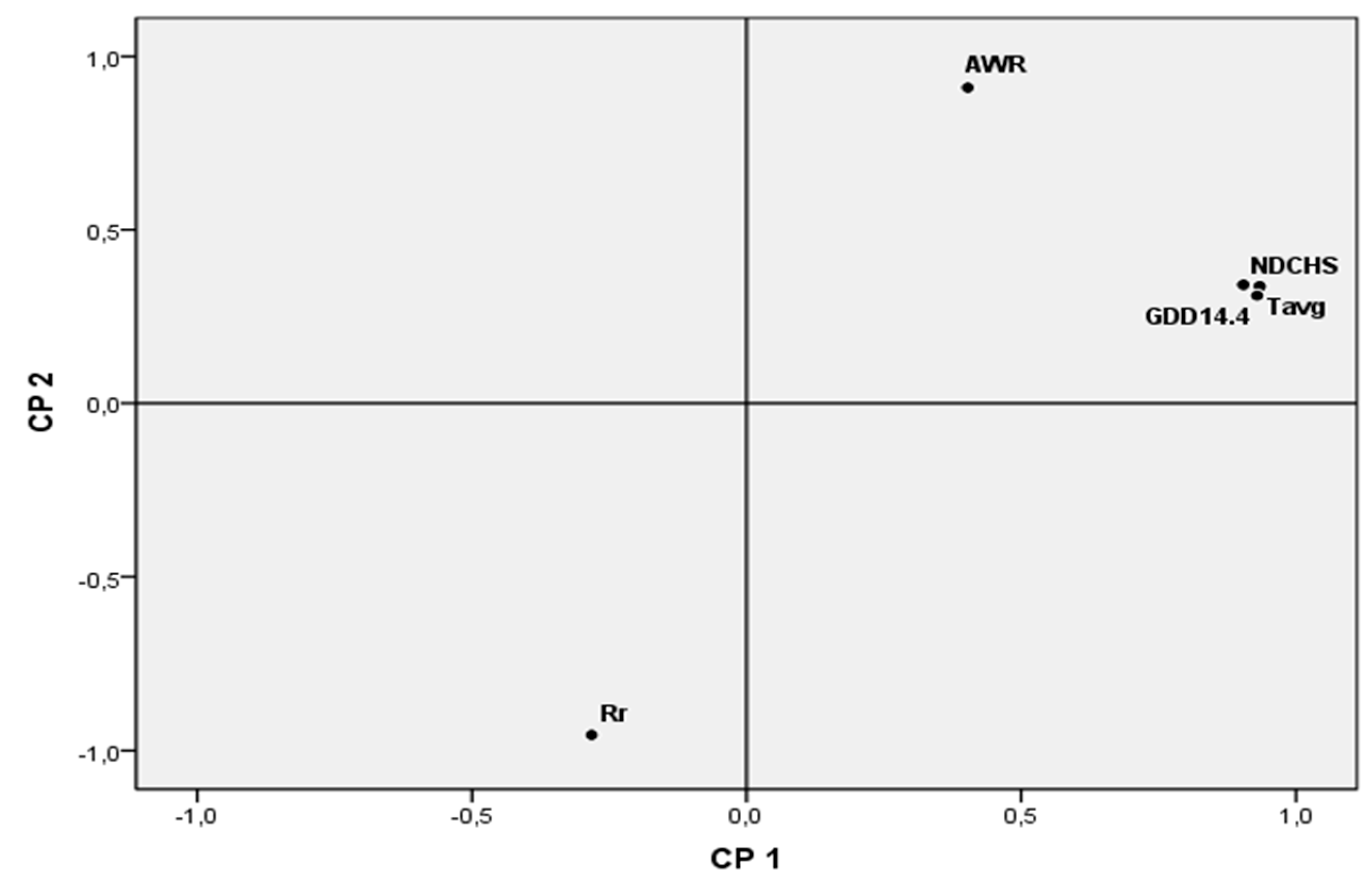
The existence of important correlations between the bioclimatic variables indicated that PCA should be conducted to find the main sources of variability in the data coming from the weather stations. The PCA results (Table 4 and Figure 2) found that principal component 1 (PC1) explained 80.42 % of the total variance. Principal component 2 (PC2) explained an addition to 16.82 % of the total variance, and both PC1 and PC2 explained a significant portion of the total variance (97.24 %). PC1 was mainly dominated by the three temperature-related indices (Tavg, GDD14.4, and NDCHS), with a small negative contribution of Rr and positive median contribution of AWR, which was expected due to their relationship, so it can be defined as a thermal component. PC2 represents the hydric conditions, annual precipitation (Rr) and annual water requirement (AWR) with high negative and positive load contributions respectively, and small negative contributions from the thermal bioclimatic indices. Therefore, component 2 (PC2) can be defined as the hydric component.
The main component PC1, indicates that there are locations with high values in the bioclimatic indices, they are warm locations with high heat accumulation and number of days with optimal temperatures for carbohydrate synthesis, but with low rainfall and a high deficit in the annual water requirement, on the contrary the component PC2 indicates that there are locations with high levels of AWR and with the annual rainfall Rr, higher than the hydric need for the good development of the olive tree.
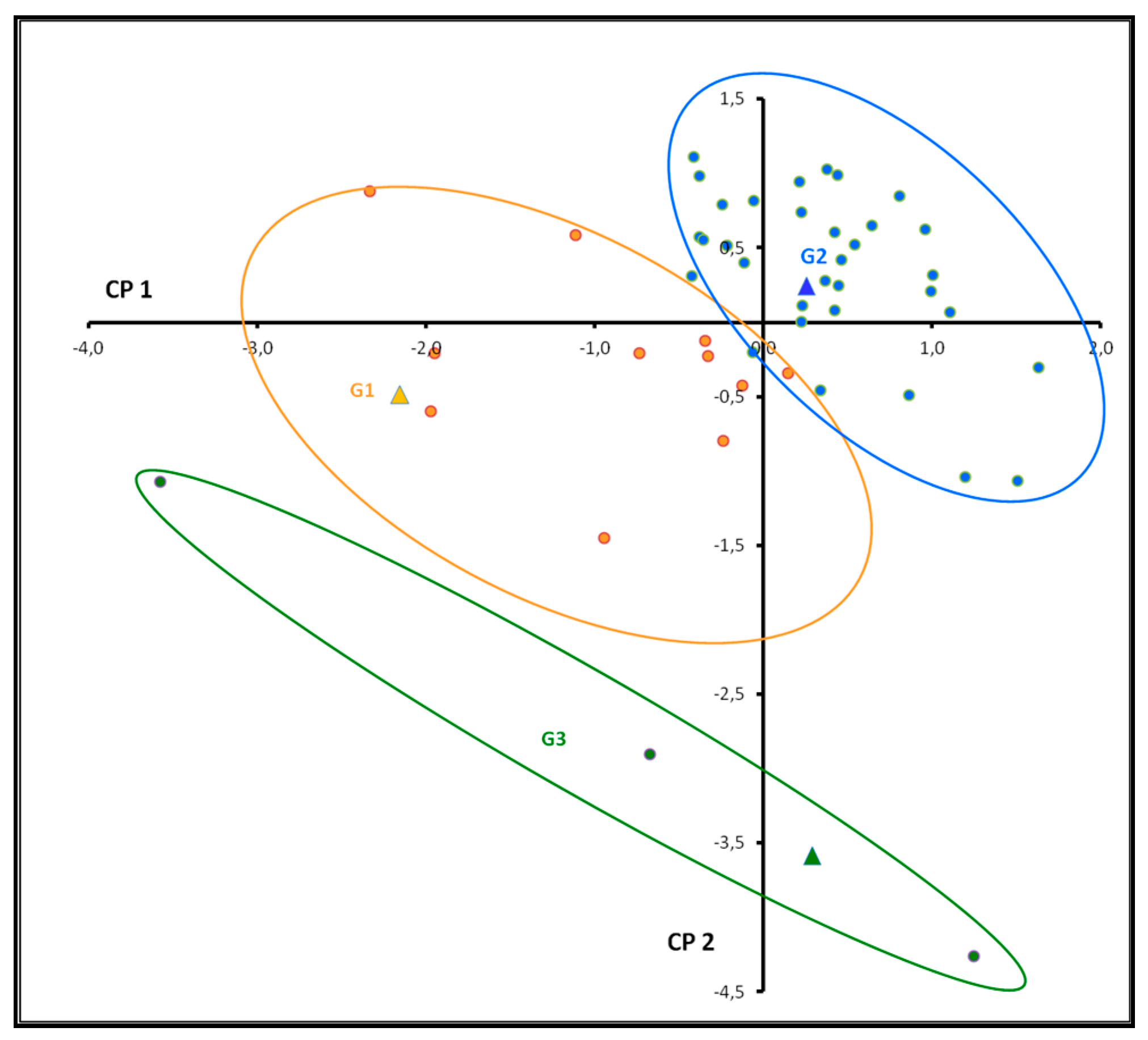
A principal component analysis (PCA) was performed to find the main sources of variability in the data from the weather stations. The first two principal components, PC1 and PC2, were chosen to define homogeneous groups. After performing the hierarchical classification, three clusters or climatic groups were delimited. Figure 3 shows the centroids of each cluster and the positions of the weather stations according to both principal components. Cluster G1 is characterised by an intermediate position in the components PC1 and PC2, and consequently, by average values in the bioclimatic and hydrological indices. The differences between the other two groups are determined in G3 by a higher rainfall and no annual water requirement and also by lower values in the biothermal indices. The G2 group obtains values close in some stations to those of the G1 group for the PC1 component, however this group is defined by presenting high values in the PC1 component and obtaining in the PC2 component negative values in Rr and positive values in AWR, consequently, it presents locations with a high deficit in the water requirement and in the annual rainfall.
The G3 group is characterised by the PC2 component, as it obtained in the studied period, values in AWR and Rr necessary to obtain good hydric conditions for the development of the olive tree. Significant climatic properties were highlighted in each group, and differences in their climatic potential for olive cultivation were found. Table 5 shows the mean, maximum and minimum values of the indices for each group and the statistical significance of differences between means after a Tukey's test. Significant differences were found between the three groups for all indices, except GDD14.4. The groups G1 and G3 do not show significant differences for GDD14.4, so both of them obtain close values in heat accumulation, or thermal integral, during the vegetative period. On the other hand, there are no significant differences in altitude between groups G1 and G3 for GDD14.4.
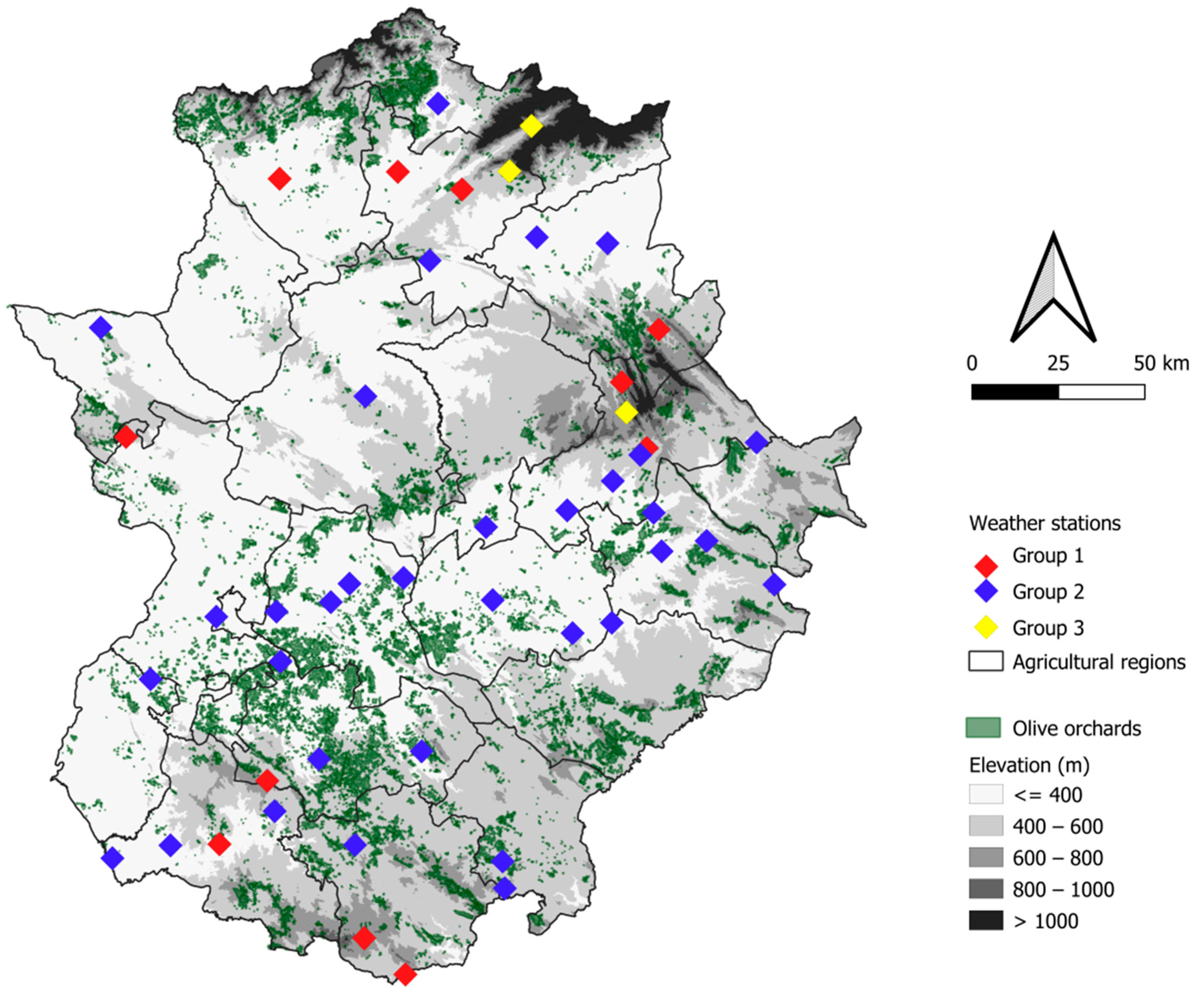
Figure 4 shows the spatial distribution in Extremadura of the weather stations of each climatic group. Group G1 is formed by 11 weather stations located in the areas with an intermediate elevation (mean elevation = 526 m a.s.l.), being distributed both in the north and in the south of Extremadura, located in the foothills of the mountainous areas. This group presents locations with great variability in the values of the different indices, presenting climatic stations close to groups G2 and G3, thus indicating that it obtains values similar to the indices of this group (Table 5).
Group G2 is the most numerous group, consisting of 33 climatic stations located mainly in the valley areas, occupying mainly the central area of Extremadura, and coincides for the most part with the area of Extremadura in which olive trees are grown (Figure 4). Consequently, these olive trees present the characteristics defined by the values of these indices in this group G2. The mean elevation of their locations is the lowest (mean elevation = 366 m a.s.l.) of the three groups. These areas have high Tavg values, but deficient AWR. It is recommended to provide water to cover water needs and obtain a good development of olive cultivation, coinciding with the work carried out by Moral et al [14] in Extremadura. Another aspect to be taken into account in this group is the NDCHS, since the work carried out by Hueso et al. [27] shows that olive trees grown in Toledo (Spain) under the effect of deficit irrigation had higher carbohydrate contents in leaves.
Group G3 is composed of three localities at the highest altitude (maximun elevation = 750 m a.s.l.), where there is little area dedicated to olive cultivation (Figure 4). Altitude is another factor limiting the development of olive trees, with altitudes above 800 m a.s.l. being unsuitable for olive cultivation due to the incidence of frost and short growing seasons [18].This group is characterised by having the needs for olive cultivation covered in terms of the hydric component PC2, on the contrary, they present low thermal values, indicating that in these areas, olive cultivation does not cover the needs for heat accumulation (GDD14.4) nor of the days for the accumulation of carbohydrates in leaves during the growing period, which may lead to a lower fat yield in the fruit, as shown by the work carried out by Mousa et al. [81] in which they showed that both the fatty acid composition and the phenolic content of the olives varied according to the altitude of the olive trees.

3.3. Trends of Principal Components

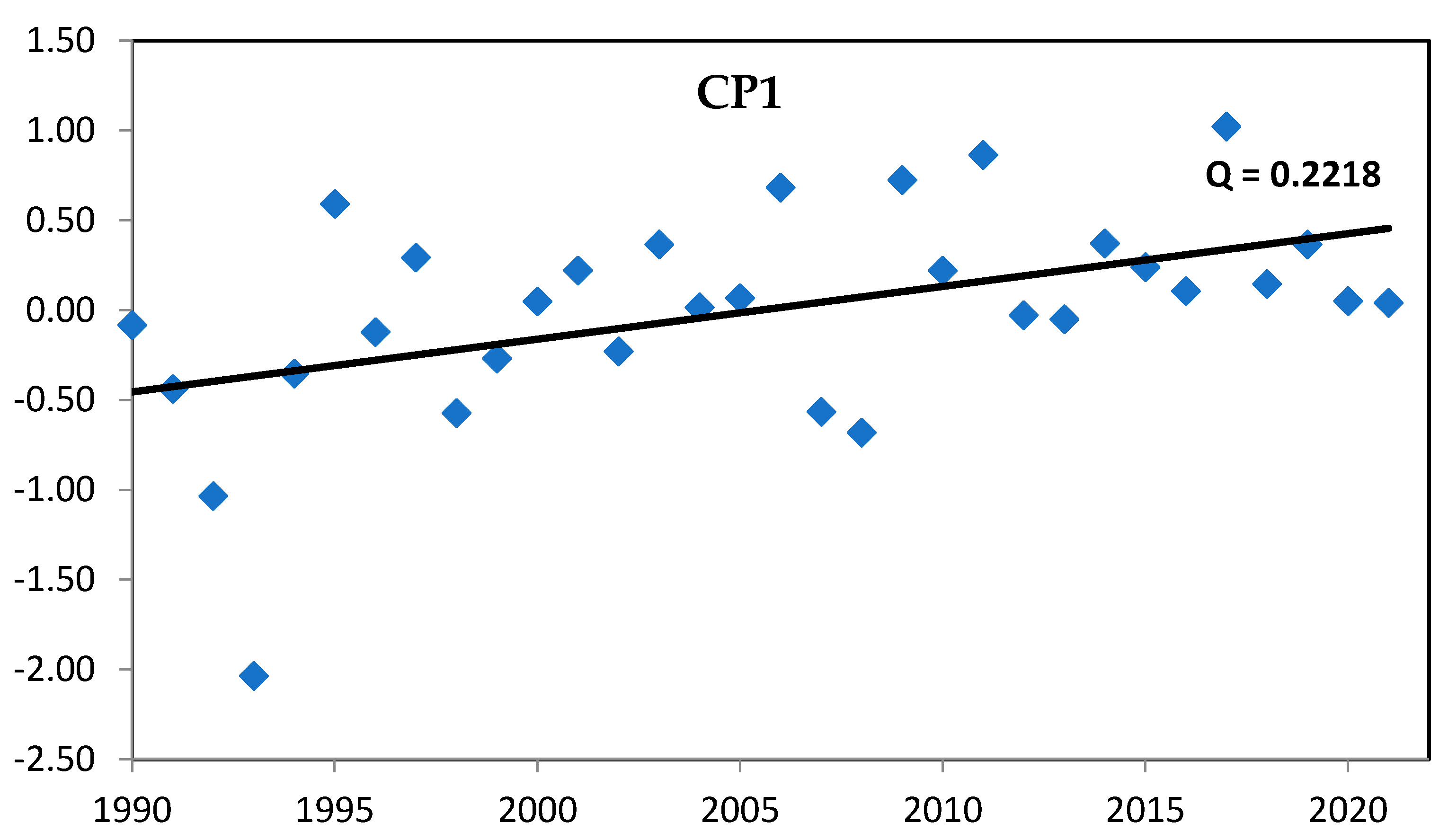
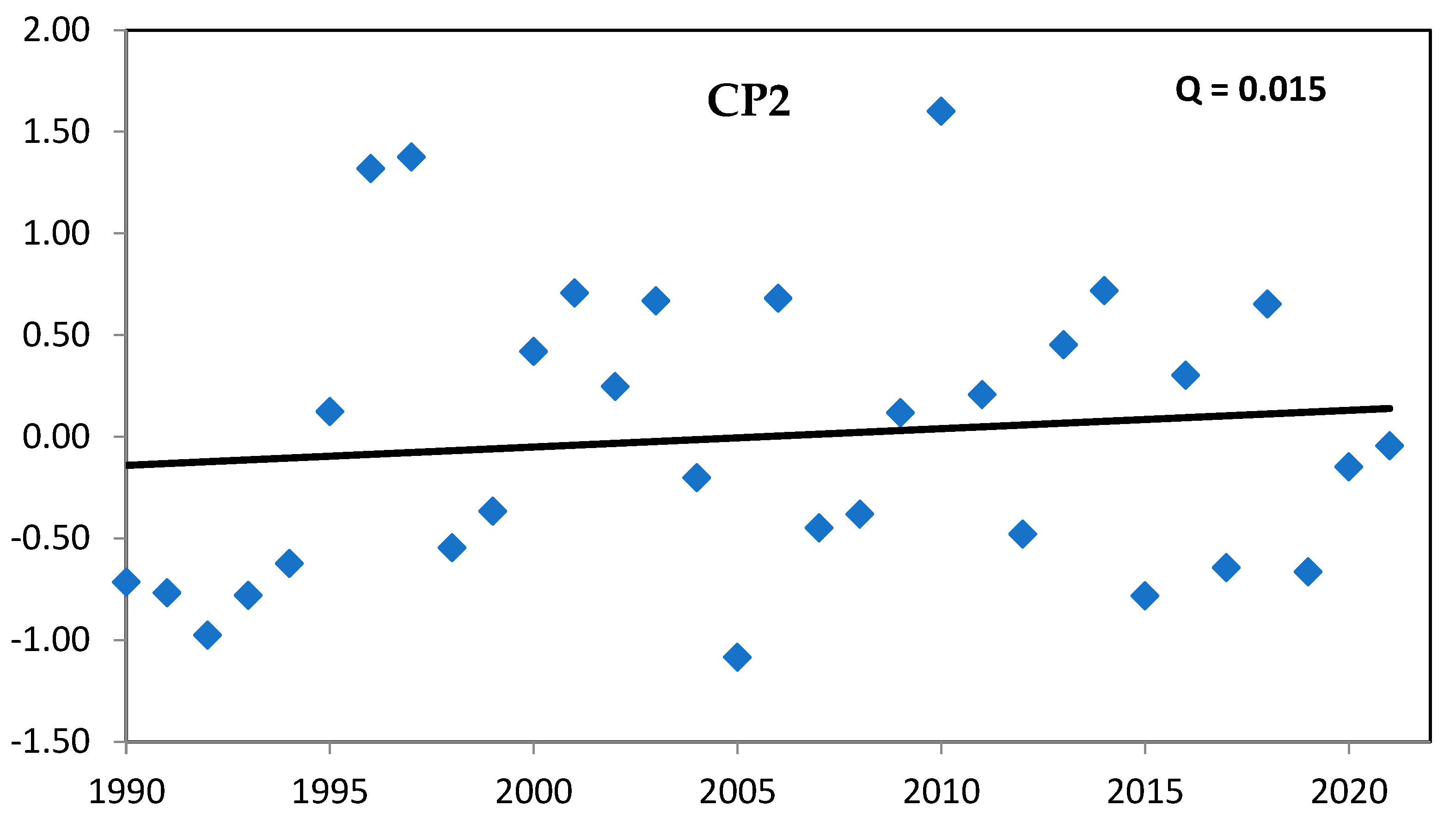
The study also examines the possible effects of climate change on the principal components CP1 and CP2 (Table 6). The results show a significant increase in the trend of the principal component PC1, while the principal component PC2 shows no significant value. The principal component PC1 increased its seasonal mean values, which led to an increase in the annual mean temperature, the heat accumulation index and the NDCHS index during the growing season. In contrast, the component PC2 has a positive slope but a much lower value.
Figure 5 shows an increase in the seasonal mean values for the main component PC1 during the study period, with a positive slope value (Q = 0.021). Consequently, the thermal indices have undergone an increase in the mean annual temperature (Tvag), the heat accumulating index (GDD14.4) and in the NDCHS index in the growing season. In contrast, the PC2 component (Figure 6) has a positive slope but with a much lower value (Q = 0.015). Therefore, it can be deduced that in the studied period there has been a decompensation between the annual water requirement of the olive tree, AWR, the annual precipitation Rr, and the increase in the crop water needs caused by the trend of the temperature-based indices (Tavg, GDD14.4, NDCHS), creating a cumulative annual water deficit during the 32 years of study.
The biothermal index and the thermophysiological index show a positive trend during the study period, suggesting an increase in the olive growing period in Extremadura. This circumstance, which can occur with greater or lesser incidence, depending on the location, of passing days from the resting period to the growing period, can cause maintenance problems in the crop due to the need for a greater supply of water in the olive crop. On the other hand, it can cause a lack of cold accumulation in the resting period, producing an inadequate flowering, and consequently, a decrease in fruiting and a lack of yield, causing losses in production. Therefore, in the future there may be a possibility that olive growing areas in Extremadura will move to other areas where the temperature is cooler [12,14].

4. Conclusions

A rational classification based on climatic characteristics and their description was carried out in Extremadura, a large region in western Spain with numerous olive growing areas. Initially, fourteen bioclimatic indices were considered for the period 1990-2021 in the 47 climatic stations located in Extremadura. These indices cover water needs, thermal requirements and carbohydrate synthesis in leaves during the growing period. The study employs a classification approach, delineating agricultural areas with homogeneous climatic properties, in order to detect the potential for occupying new areas for olive growing cultivation.
Very dry conditions during the growing season are the main characteristic in many climatic seasons, typical of the Mediterranean climate of the region, except at higher elevations, where the potential water deficit is lower. A significant variability of bioclimatic indices has been found, so that a differentiation between locations can be established.
Many of the climate variables considered in this study are highly correlated; consequently, a principal component analysis was performed to analyze the main sources of variability. Five indices were found to be sufficient to explain 97.24 % of the total observed variability. The indices were mean annual temperature (Tavg), mean annual precipitation (Rr), annual water requirement (AWR), degree days above 14.4 °C accumulated in the growing season (GDD14.4) and number of days with optimum temperatures for leaf carbohydrate synthesis (NDCHS).
A principal component analysis (PCA) was performed, resulting in two main components. PC1, or thermal component, is characterised by being composed of the 3 bioclimatic indices Tavg, GDD14.4 and NDCHS. PC2 is characterised by the two hydric indices Rr and AWR with negative and positive contribution respectively.
Three homogeneous groups were determined by cluster analysis, one of them having cooler thermal conditions and no water requirements. The study found that an increase in the olive growing season, or a shortening of the dormant period, could result in higher water input during the growing season and a lack of accumulation of chilling hours during the dormant period, causing crop maintenance problems in warmer locations.
As a novelty, the trends of the two main components during the period 1990-2021 have been carried out. Significant results were found for PC1 with an increasing average trend, but for the PC2 or hydric component, the trend was low. Therefore, an increase in the growing period of the olive tree, or in other words a shortening of the resting period, can be expected. This circumstance may lead to a higher water supply in the growing period and a lack of accumulation of chilling hours in the dormant period, causing crop maintenance problems in warmer locations. Climate change is expected to have significant impacts on this crop in hot and dry conditions. Therefore, in the future there may be a possibility that the current olive growing areas in Extremadura will move to other areas where the temperature is cooler.
This study provides a graphical representation of the observed variability, and the classification carried out can be used as a decision support tool for the olive sector in Extremadura and as a useful basis for a better understanding of the climatic characteristics and the potential for olive growing in Extremadura. In addition, data from the most recent time period (1990 to 2021) covering numerous stations in the region have been used to establish one of the most robust temporal studies of climatic structure in any olive-growing region.

Author Contributions

: Conceptualization F.H.; methodology, F.H. and A.G.-M.; software, F.H., C.A. and L.L.P.; validation, F.H. and A.G.M.; formal analysis, F.H., C.A., L.L.P.; investigation, F.H., C.A., L.L.P., A.G.-M.; resources, C.A. and L.L.P.; data curation, C.A. and F.H.; writing—original draft preparation, F.H. and A.G.M..; writing—review and editing, F.H.; visualization, C.A. and F.H.; supervision, F.H.; project administration F.H.; funding acquisition, F.H. and A.G.-M. All authors have read and agreed to the published version of the manuscript.

Funding

This research was funded by the Junta de Extremadura and the European Regional Development Fund (ERDF) through the project IB20056 (“Impacto del cambio climático en el cultivo del olivo en Extremadura. Caracterización, zonificación y futuros escenarios”), and GR18088 (Research Group RNM028).

Data Availability Statement

Not applicable.

Acknowledgments

This study has been possible thanks to the collaboration of the Agencia Estatal de Meteorología (AEMET).

Conflicts of Interest

The authors declare no conflict of interest.

References

  1. Giorgi. F.. Lionello. P. (2008). Climate change projections for the Mediterranean region. Glob. Planet Chang. 2008. 63. 90–104.
  2. Braudel. F. (1979). La Mediterranée et le monde mediterranéena l’époque de Philippe II. tome premier. 4th edn.. Paris.
  3. Böhm. J.. Antunes. M.T. (2013). A evolução da espécie olea europaea. In O Grande Livro da Oliveira e do Azeite; Dinalivro; Lisboa. Portugal. 2013; pp 89-175.
  4. Di Vaio. C.; Nocerino. S.; Paduano. A.; Sacchi. R. Influence of Some Environmental Factors on Drupe Maturation and Olive Oil Composition. J. Sci. Food Agric. 2013. 93. 1134–1139.
  5. Andrade. C.; Fonseca. A.; Santos. J.A.; Bois. B.; Jones. G.V. Historic Changes and Future Projections in Köppen–Geiger Climate Classifications in Major Wine Regions Worldwide. Climate 2024. 12. 94. [CrossRef]
  6. Malheiro A.C.. Santos J.A.. Fraga H. and Pinto J.G. Climate change scenarios applied to viticultural zoning in Europe. Climate Research 2010. 43. 163-177.
  7. Tscholl1. S.; Candiago. S.; Marsoner. T.; Fraga. H.; Giupponi. C. and Egarter. L. Assessing the climate change vulnerability of European winegrowing regions by combining exposure. sensitivity and adaptative capacity indicators. In Proceedings of the terclim 2022. XIVth International Terroir Congress and Climate Wine Symposium. Bordeaux. France. July 3-8. 2022.
  8. Honorio. F.; García-Martín. A.; Moral. F.J.; Paniagua. L.L.; Rebollo. F.J. Spanish Vineyard Classification According to Bioclimatic Indexes. Australian Journal of Grape and Wine Research. 2018. 24. 335–344.
  9. Fraga. H; Santos. JA; Moutinho-Pereira. J; et al. Statistical modelling of grapevine phenology in Portuguese wine regions: observed trends and climate change projections. The Journal of Agricultural Science 2016;154(5):795-811. [CrossRef]
  10. Malheiro. A.C.; Campos. R.; Fraga. H; Eiras-Dias. J; Silvestre. J; and Santos. J.A. Winegrape phenology and temperature relationships in the Lisbon wine region. Portugal. Journal International des Sciences de la Vigne et du Vin. 2013. 47. n°4. 287-299.
  11. Adão. F.; Fraga. H.; Fonseca.A.; Malheiro. A.C.; Santos. J.A. The Relationship between Land Surface Temperature and Air Temperature in the Douro Demarcated Region. Portugal. Remote Sens. 2023. 15. 5373. [CrossRef]
  12. Fraga. H.; Guimarães. N.; Freitas. T.R.; Malheiro. A.C.; Santos. J.A. Future Scenarios for Olive Tree and Grapevine Potential Yields in the World Heritage Côa Region. Portugal. Agronomy 2022. 12. 350. [CrossRef]
  13. Honorio. F.; Aguirado. C.; Paniagua. L.L.; García-Martín. A.; Rebollo. L.; Rebollo. F.J. Exploring the Climate and Topography of Olive Orchards in Extremadura. Southwestern Spain. Land 2024. 13. 495. [CrossRef]
  14. Moral. F.J.; Rebollo. F.J.; García-Martín. A.; Paniagua. L.L.; Honorio. F. Spatial and Temporal Analysis of Water Resources in the Olive-Growing Areas of Extremadura. Southwestern Spain. Land 2024. 13. 1294. [CrossRef]
  15. López-Bernal. Á; Morales. A; García-Tejera. O; Testi. L; Orgaz. F; De Melo-Abreu. J.P. and Villalobos F.J. OliveCan: A Process-Based Model of Development. Growth and Yield of Olive Orchards. Frontiers in Plant Science. 2018. 9:632. [CrossRef]
  16. Masmoudi-Charfi. C.. Ben Mechlia. N. Changes in olive tree height growth during the first years of cultivation. Advances in Horticultural Science . 2008.
  17. Krishna. K.R. (2013). Agroecosystems: Soils. Climate. Crops. Nutrient Dynamics and Productivity (1st ed.). Apple Academic Press. New York. EE.UU. 2013. [CrossRef]
  18. Therios. I.N. Climatic and soil conditions. In Olives: Crop Production Science in Horticulture 18. CABI Publishing. Wallingford. UK: 2009. pp 51-80. [CrossRef]
  19. Tombesi A.. Tombesi S. Orchard planning and planting. In: Sbitri M.O.. Serafini F.. editors. Production Techniques in Olive Growing. International Olive Council; Madrid. Spain 2007 pp. 17–40.
  20. Larcher. W. Temperature stress and survival ability of Mediterranean sclerophyllous plants. Plant Biosyst.2000 134 (2000). pp. 279-295.
  21. Bartolozzi. F.. Cerquaglia. L.. Coppari. G.. Fontanazza. G. (2002). Frost tolerance induced by cold acclimation in olive (Olea europaea L.) (ISHS Acta Horticulturae 586: IV International Symposium on Olive Growing). [CrossRef]
  22. Petruccelli. R.. Bartolini. G.. Ganino. T.. Zelasco. S.. Lombardo. L.. Perri. E.. et al. Cold stress. freezing adaptation. varietal susceptibility of olea europaea L.: A review. Plants 2022, 11. 1367. [CrossRef]
  23. Morettini. A.. Olivicoltura. Ramo Editoriale degli Agricoltori. Eds.. Roma. 1972.
  24. Griggs. W. H.. Hartmann. H. T.. Bradley. M. V.. Iwakini. B. T. and Whisler. J. Olive pollination in California. Calif. Agric. Exp.. Stn. Bull. 1975,869..
  25. Guerrero A. Nueva Olivicultura. 5th ed. Ediciones Mundi-Prensa; Madrid. Spain: 2002. [Google Scholar].
  26. Ponti L.. Gutierrez A.P.. Basso B.. Neteler M.. Ruti P.M.. Dell’Aquila A.. Iannetta M. Olive agroecosystems in the Mediterranean Basin: Multitrophic analysis of climate effects with process-based representation of soil water balance. Procedia Environ. Sci. 2013;19:122–131. [CrossRef]
  27. Hueso. A.; Tentacoste. E.R.; Ruiz. C.; De la Rosa. J.M.; Gómez-del-Campo. M. Effect of deficit irrigation during the oil synthesis period on carbohydrate content in olive “Arbequina” hedgerows. Acta Horticulturae. 2018. Vol. 1199. pp 75-79.
  28. García. J.M.; Hueso. A.; Gómez-del- Campo. M. Deficit irrigation during the oil synthesis period affects olive oil quality in high-density orchards (cv. Arbequina). Agricultural Water Management.2020. Volume 230. ISSN 0378-3774. [CrossRef]
  29. Tanasijevic. L.; Todorovic. M.; Pereira. L.S.; Pizzigalli. C.; Lionello. P. Impacts of Climate Change on Olive Crop Evapotranspirationand Irrigation Requirements in the Mediterranean Region. Agric. Water Manag. 2014. 144. 54–68.
  30. Greven M.. Neal S.. Green S.. Dichio B.. Clothier B. The effects of drought on the water use. fruit development and oil yield from young olive trees. Agric. Water Manag. 2009;96:1525–1531. [CrossRef]
  31. Fernandes-Silva A.A.. Ferreira T.C.. Correia C.M.. Malheiro A.. Villalobos F.J. Influence of different irrigation regimes on crop yield and water use efficiency of olive. Plant Soil. 2010;333:35–47. [CrossRef]
  32. Van der Schoot.C; P.L. Rinne Dormancy cycling at the shoot apical meristem: transitioning between self-organization and self-arrest Plant Sci. 180 (1) (2011). pp. 120-131.
  33. Lopez-Bernal. A.; Garcia-Tejera. O.; Testi. L.; Orgaz. F.; Villalobos. F.J. Studying and modelling winter dormancy in olive trees. Agricultural and Forest Meteorology. 2020. 280. 107776. [CrossRef]
  34. Paniagua. L.L.; García-Martín. A.; Aguirado. C.; Honorio. F.; Moral. F.J. and Rebollo. F.J. (2023). Temperature trends of the olive tree cultivation period in the producing areas of Spain (1981-2019). Acta Hortic. 1372. 209-214. [CrossRef]
  35. Pérez-López. D.; Ribas. F.; Moriana. A.; Rapoport. H.F.; De Juan. A. Influence of Temperature on the Growth and Development of Olive (Olea europaea L.) Trees. J. Hortic. Sci. Biotechnol. 2008. 83. 171–176.
  36. Ballesteros. R.; Ortega. J.F.; Hernandez. D.; del Campo. A.; Moreno. M.A. Combined Use of Agro-Climatic and Very High-Resolution Remote Sensing Information for Crop Monitoring. Int. J. Appl. Earth Obs. Geoinformation 2018. 72. 66–75.
  37. Qian. B.; Zhang. X.; Chen. K.; Feng. Y.; O’Brien. T. Observed Long-Term Trends for Agroclimatic Conditions in Canada. J. Appl. Meteorol. Climatol. 2010. 49. 604–618.
  38. Kenealy. L.; Reighard. G.; Rauh. B.; Bridges. W.. Jr. Predicting Peach Maturity Dates in South Carolina with a Growing Degree Day Model. Acta Hortic. 2015. 1084. 479–752.
  39. Asseng. S.; Ewert. F.; Martre. P.; Rötter. R.P.; Lobell. D.B.; Cammarano. D.; Kimball. B.A.; Ottman. M.J.; Wall. G.W.; White. J.W.; et al. Rising Temperatures Reduce Global Wheat Production. Nat. Clim. Change 2015. 5. 143–147.
  40. Zhang. S.; Tao. F.; Zhang. Z. Changes in Extreme Temperatures and Their Impacts on Rice Yields in Southern China from 1981 to 2009. Field Crops Res. 2016, 189, 43–50.
  41. Liu. Y.; Su. L.; Wang. Q.; Zhang. J.; Shan. Y.; Deng. M. Chapter Six—Comprehensive and Quantitative Analysis of Growth Characteristics of Winter Wheat in China Based on Growing Degree Days. In Advances in Agronomy; Sparks. D.L.. Ed.; Academic Press: Cambridge. MA. USA. 2020; Volume 159. pp. 237–273. [Google Scholar].
  42. Anandhi. A. Growing Degree Days—Ecosystem Indicator for Changing Diurnal Temperatures and Their Impact on Corn Growth Stages in Kansas. Ecol. Indic. 2016, 61, 149–158.
  43. Haralampopoulos, I.; Polychroni. I.; Droulia. F.; Nastos. P.T. The Spatiotemporal Evolution of the Growing Degree Days Agroclimatic Index for Viticulture over the Northern Mediterranean Basin. Atmosphere 2024. 15. 485. [CrossRef]
  44. Bonofiglio, T.; Orlandi. F.: Sgromo. C.; Romano. B. & Fornaciari. M. Influence of temperature and rainfall on timing of olive (Olea europaea) flowering in southern Italy. New Zealand journal of crop and horticultural science. 2008. 36, 59-69.
  45. Lombardo, L.; Fila, G.; Lombardo, N.; Epifani, C.; Duffy, D.H., III; Godino, G.; Salimonti, A.; Zelasco, S. Uncovering Olive Biodiversity through Analysis of Floral and Fruiting Biology and Assessment of Genetic Diversity of 120 Italian Cultivars with Minor or Marginal Diffusion. Biology 2019, 8, 62. [CrossRef]
  46. Orlandi, F.; Lanari, D.; Romano, B. & Fornaciari, M. New model to predict the timing of olive (Olea europaea) flowering: A case study in central Italy. New Zealand Journal of Crop and Horticultural Science, 2006 34(1), 93–99. [CrossRef]
  47. Orlandi, F.; Avolio, E.; Bonofiglio, T.; Federico, S.; Romano, B.; Fornaciari, M. Potential shifts in olive flowering according to climate variations in Southern Italy. Meteorol. Appl. 2013, 20, 497–503. [CrossRef]
  48. Orlandi, F.; Vazquez Ezquerra, L.; Ruga, L.; Bonofiglio, T.; Fornaciari, M.; Garcia Mozo, H.; Dominquez, E.; Romano, B.; Galán, C. Bio climatic requirements for olive flowering in two Mediterranean regions located at the same latitude (Andalucia. Spain and Sicily. Italy). Ann Agric Environ Med 2005 12:47–52.
  49. De Melo-Abreu, J.P.; Barranco, D.; Cordeiro, A. M.; Tous, J.; Rogado, B. M. & Villalobos, F. J. Modelling olive flowering date using chilling for dormancy release and thermal time. Agricultural and Forest Meteorology 2004, 125(1-2). 117-127. [CrossRef]
  50. Alcalá, A.R.; and Barranco, D. Prediction of flowering time in olive for the Cordoba olive collection. American Society for Horticultural Science 1992. 27(11). 1205-1207. [CrossRef]
  51. Hackett. W. P. & Hartmann. H. T. Inflorescence formation in olive as influenced by low temperature. photoperiod. and leaf area. Botanical Gazette 1964. 125(1). 65-72.
  52. Aguilera. F.; Ruiz. L.; Fornaciari. M.; Romano. B.; Galán C.; Oteros. J.; Dhiab. A.; Msallen. M.; Orlandi. F. Heat accumulation period in the Mediterranean region: phenological response of the olive in different climate areas (Spain. Italy and Tunisia). International journal of biometeorology. 2014.58. 867-876.
  53. Hidalgo Fernandez-Cano. L; Hidalgo Togores. J. Tratado de viticultura. 5rd ed; Mundiprensa: Madrid. Spain. 2019; pp135-176.
  54. Jolliffe. I. T.. & Cadima. J. Principal component analysis: A review and recent developments. Philosophical Transactions of the Royal Society A: Mathematical. Physical and Engineering Sciences. 2016. 374(2065). 20150202.
  55. Ringnér. M. (2008). What is principal component analysis? Nature Biotechnology. 26(3). 303-304.
  56. Zou. H.. Hastie. T.. & Tibshirani. R. Sparse principal component analysis. Journal of Computational and Graphical Statistics. 2006. 15(2). 265-286.
  57. Moral. F.J.; Rebollo. F.J.; García-Martín. A.; Paniagua. L.L.; Honorio. F. Spatial and Temporal Analysis of Water Resources in the Olive-Growing Areas of Extremadura. Southwestern Spain. Land 2024. 13. 1294. [CrossRef]
  58. Moral. F.J.; Rebollo. F.J.; Paniagua. L.L.; García Martín. A.; Honorio. F. Spatial distribution and comparison of aridity indices in Extremadura. southwestern Spain. Theor Appl Climatol 2016. 126. 801–814. [CrossRef]
  59. SNCZI. S.N. de C. y Z.I. Inventario de Presas y Embalses Available online: https://www.sig.mapama.gob.es/snczi/index.html?herramienta=EstadisticasPresas (accessed on 29 May 2024).
  60. Ministerio para la Transición Ecológica y el Reto Demográfico, MITECO. Evaluación de los recursos hídricos. Boletín Hidrológico Available online: https://www.miteco.gob.es/es/agua/temas/evaluacion-de-los-recursos-hidricos/boletin-hidrologico.html.
  61. Ministerio de agricultura pesca y alimentación. Anuario de Estadística. Available online: https://www.mapa.gob.es/es/estadistica/temas/publicaciones/anuario-de-estadistica/2023/default.aspx?parte=3&capitulo=07 (accessed on 29 May 2024).
  62. Ministerio para la Transición Ecológica y el Reto Demográfico, MITECO. Caracterización de las comarcas agrarias de España Avaible online: hHttps://www.miteco.gob.es/en/ministerio/servicios/publicaciones/comarcas_agrarias-tomos.html.
  63. Honorio. F.; Aguirado. C.; Paniagua. L.L.; García-Martín. A.; Rebollo. L.; Rebollo. F.J. Exploring the Climate and Topography of Olive Orchards in Extremadura. Southwestern Spain. Land 2024. 13. 495. [CrossRef]
  64. Tombesi. A.; Tombesi. S.; Sbitri. M.O.; Serafini. F. Orchard Planning and Planting. In Production Tecniques in Olive Growing. International Olive Council. Madrid-Spain 2007. 17–40.
  65. AEMET Agencia Estatal de Meteorología (AEMET) Available online: https://www.aemet.es/es/portada (accessed on 16 February 2024).
  66. WMO. World Meteorological Organization Annual Report of the World Meteorological Organization 1966; WMO; Geneva. Switzerland. 1967.
  67. KNMI Royal Netherlands Meteorological Institute; ECAD European Climate Assessment & Dataset. Algorithm Theoretical Basis Document; Royal Netherlands Meteorological Institute KNMI: Utrecht. The Netherlands. 2013.
  68. Guijarro. J. Homogenization of Climatic Series with Climatol; CLIMATOL. AEMET: Balearic Islands. Spain. 2018; Available online: https://climatol.eu/ (accessed on 8 April 2024).
  69. Sistema de Información sobre Ocupación del Suelo de España, SIOSE (2014). In http://www.siose.es/web/guest/descargar (accessed on 16 October 2024).
  70. Lodolini. E.M.; Alfei. B.; Cioccolanti. T.; Zucchini. M.; Neri. D. Comparison of Frost Damages in Eleven Olive Cultivars after Two Freezing Events in Central Italy. Acta Hortic 2022. 161–168. [CrossRef]
  71. Hargreaves. G.H.; Samani. Z.A. Reference crop evapotranspiration from temperature. Appl. Eng. Agric. 1985. 1. 96–99.
  72. United States Department of Agriculture. USDA. National Engineering Handbook. Irrigation Guide. Available online: https://www.nrcs.usda.gov/sites/default/files/2022-11/WA-Irrigation-Guide_4.pdf (accessed on 14 October 2024).
  73. Pérez-Rodríguez. J.M.; Parras. J.; Lara. E.; Prieto. M.H. Manual Práctico de Riego Olivar de Almazara; Centro de Investigaciones Científicas y Tecnológicas de Extremadura. CICYTEX: Badajoz. Spain. 2014. https://cicytex.juntaex.es/manuales.
  74. McMaster. G.S.; Wilhelm. W.W. Growing degree-days: one equation. two interpretations. Agricultural and Forest Meteorology. 1997. 87. 4. 291-300. 68-1923. [CrossRef]
  75. Bretherton CS. Smith C. Wallace JM. An intercomparison of methods for finding coupled patterns in climate data. Journal of Climate 1992. 5: 541–560. [CrossRef]
  76. Moral. F.J.. Rebollo. F.J.. Paniagua. L.L.; García. A.; Martínez de Salazar. E. Application of climatic indices to analyse viticultural suitability in Extremadura. south-western Spain. Theor Appl Climatol 2016. 123. 277–289. [CrossRef]
  77. World Meteorological Organization. WMO. Guide to Hydrological Practices. Volume II—Management of Water Resources and Application of Hydrological Practices. 6th ed.; WMO-No. 168; World Meteorological Organization: Geneva. Switzerland. 2009.
  78. Sen. P.K. Estimates of the Regression Coefficient Based on Kendall’s Tau. J. Am. Stat. Assoc. 1968. 63. 1379–1389.
  79. García-Martín. A.; Paniagua. L.L.; Moral. F.J.; Rebollo. F.J.; Rozas. M.A. Spatiotemporal Analysis of the Frost Regime in the Iberian Peninsula in the Context of Climate Change (1975–2018). Sustainability 2021. 13. 8491.
  80. Ayton, J.: Mailer, R. J.; Robards, K.; Orchard, B. and M. Vonarx. Oil concentration and composition of olives during fruit maturation in south-western New South Wales. Australian Journal of Experimental Agriculture 2001. 41(6) 815 – 821. [CrossRef]
  81. Mousa, M. Y.; Gerasopoulos, D.; Metzidakis, I.; Kiritsakis, A. Effect of Altitude on Fruit and Oil Quality Characteristics of ‘Mastoides’ Olives. Journal of the Sciencie of Food and Agricture 1996, 71, 345–350. [CrossRef]
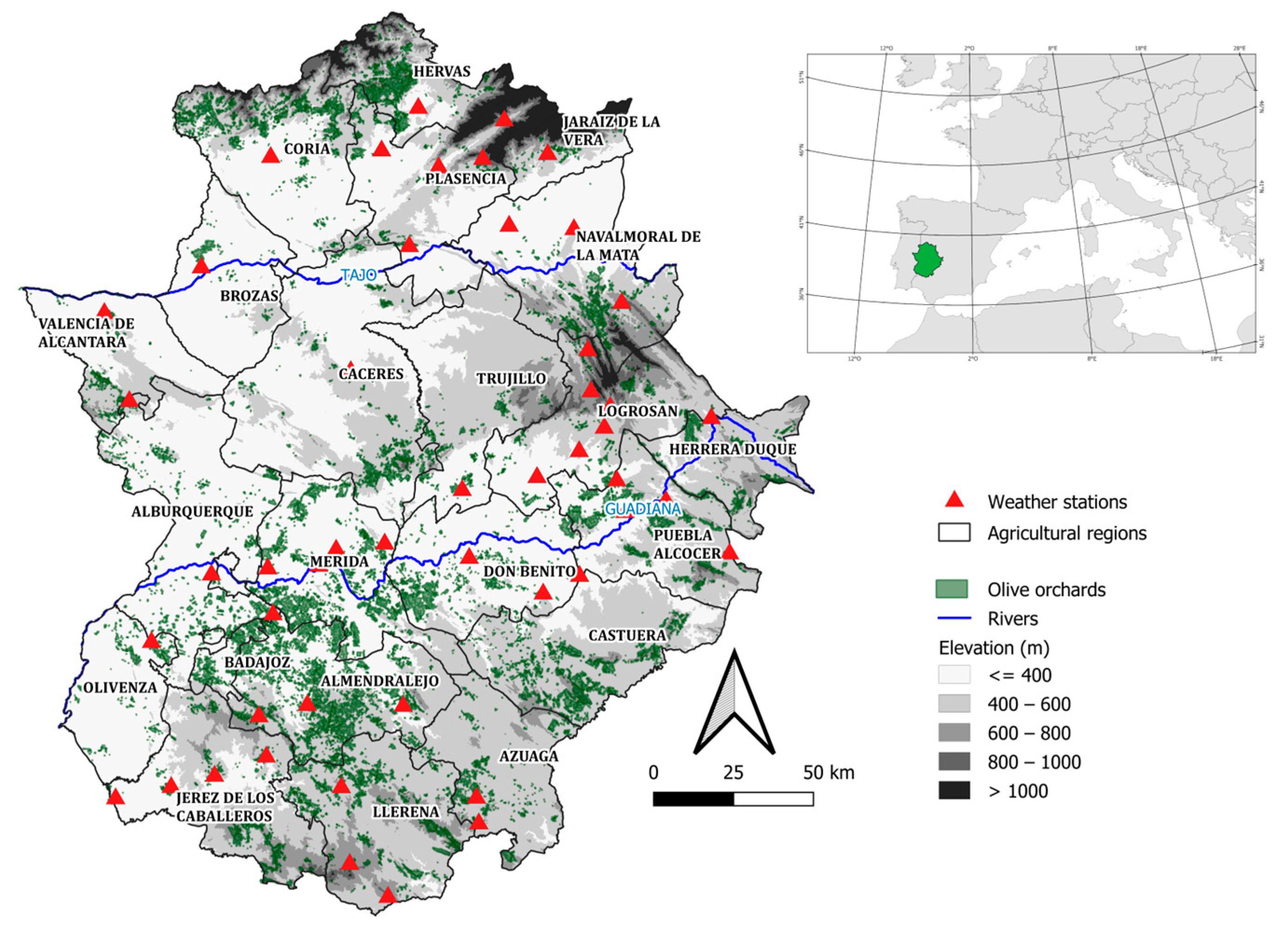
Figure 1. Digital elevation model of Extremadura, showing olive groves and weather stations used in this study.
Preprints 149650 g001
Figure 2. Position of the five bioclimatic indices used in the study with respect to the first and second principal components.
Preprints 149650 g002
Figure 3. Position of the climatic groups with respect to the first and second principal components, the centroids of each group are indicated with a triangle and the meteorological stations are indicated with a circle with a different color depending on their group.
Preprints 149650 g003
Figure 4. Distribution in Extremadura of the weather stations for the three climatic groups.
Preprints 149650 g004
Figure 5. Annual averages of the 47 climate stations for the CP1 component in Extremadura in the period 1990-2021.
Preprints 149650 g005
Figure 6. Annual averages of the 47 climate stations for the CP2 component in Extremadura in the period 1990-2021.
Preprints 149650 g006
Table 1. Acronyms and definitions of the climatic and bioclimatic variables used in this research in the period 1990-2021.
Variables Definition of variables Source
Tx (°C) Average maximum temperature AEMET [65]
Tn (°C) Average minimum temperature AEMET [65]
Tavg (°C) Average temperature for the period AEMET [65]
Rr (mm) Average annual precipitation for the period AEMET [65]
FD (n° day) Number of frost days: number of days with minimum temperature below 0 °C García-Martín et al. [79]
SF (n° day) Number of severe frost days: No. of days with minimum temperature below -4.7 °C Lodolini et al. [70]
AWR (mm) Annual water requirement (USDA) [71]
ETO Potential evapotranspiration Hargreaves method [71]
NDRep14.4 Number of days at rest, with average daily temperature
below 14.4 °C
López-Bernal et al. [33]
(n° day)
TavgRep14.4 Average temperature of the number of days at rest López-Bernal et al. [33]
(n° day)
NOGST14.4 Number of days of active growth, with average daily temperature above 14.4 °C Paniagua et al. [34]
(n° day)
TavgOGS14.4 Average temperature of the number of days in active growth Paniagua et al. [34]
(°C)
GDD14.4 Degree days during the olive tree growth period above 14.4 °C McMaster et al. [74]
(degree days)
NDCHS Number of days with optimal temperatures for carbohydrate synthesis in leaves during the active growth period when the average daily temperature is between 20 °C and 30 °C Tombesi et al. [64]
(n° day)
Table 2. Descriptive statistics of the climate variables from 47 weather stations in Extremadura and along its boundaries in period 1990-2021.
Variable Mean Median SD Min Max CV (%) Skewness Kurtosis
Tn 10.43 10.47 0.92 7.15 12.19 8.78 -0.88 2.28
Tx 22.57 22.84 1.23 19.17 24.28 5.45 -1.09 1.02
Tavg 16.50 16.68 0.92 13.26 17.96 5.55 -1.43 2.63
Rr 604.23 556.97 185.19 389.53 1304.77 30.65 1.97 4.72
FD 15.93 16.06 9.32 3.44 48.66 58.48 1.33 2.66
SF 3.07 2.47 3.34 0.19 17.47 108.93 2.74 8.93
AWR 241.38 297.73 201.34 -426.13 475.02 83.41 1.65 2.90
ETO 3.54 3.55 0.22 2.90 3.88 6.17 -0.68 0.26
NDRep14.4 162.72 159.00 15.04 133.97 210.84 9.24 1.11 1.52
TavgRep14.4 9.76 9.89 0.50 8.29 11.01 5.13 -0.90 1.67
NOGST14.4 202.53 206.25 15.04 154.41 231.28 7.43 -1.11 1.52
TavgOGS14.4 21.94 21.97 0.49 20.08 22.87 2.22 -1.06 3.47
GDD14.4 1529.67 1564.15 188.51 870.98 1808.54 12.32 -1.19 2.14
NDCHS 112.22 113.69 10.48 70.81 130.66 9.34 -1.65 4.63
The acronyms of the variables are indicated in Table 1. SD standard deviation. CV coefficient of variation.
Table 3. Correlation matrix between bioclimatic indices in Extremadura.
Index Tavg Rr AWR GDD14.4 NDCHS
Tavg 1
Rr -0.587** 1
AWR 0.681** -0,974** 1
GDD14.4 0.976** -0.562** 0.655** 1
NDCHS 0.942** -0.577** 0.677** 0.901** 1
** Coefficients are significant at level P<0.01.
Table 4. Results of the principal component analysis for the five bioclimatic indices derived from the 47 climate stations used in the analysis.
Principal component Eigenvalue Component loading Cumulative loading
PC1 4.02 80.42 80.42
PC2 0.84 16.82 97.24
PC3 0.10 2.07 99.31
PC4 0.02 0.37 99.68
PC5 0.02 0.32 100.00
PC loadings for each variable
Tavg Rr AWR GDD14,4 NDCHS
PC1 0.934 -0.282 0.402 0.929 0.904
PC2 0.337 -0.955 0.910 0.310 0.342
Tavg, Average temperature for the period; Rr, Average annual precipitation for the period; AWR, Annual water requirement; GDD14.4, Degree days during the olive tree growth period above 14.4 °C; NDCHS, Number of days with optimal temperatures for carbohydrate synthesis in leaves.
Table 5. Descriptive statistics of climatic indices of the three climatic groups in Extremadura for the period 1990-2021.
Group Elevation Tavg Rr
Mean Min Max Mean Min Max Mean Min Max
G1 526.0 ab 261.0 750.0 15.7 a 14.6 16.6 694.4 a 555.08 908,7
G2 365.7 a 185.0 573.0 16.9 b 16.1 18.0 524.3 b 389,5 730,5
G3 680.0 b 515.0 796.0 14.8 c 13.2 16.2 1153.0 c 1006,7 1304,8
Group GDD14.4 NDCHS AWR
Mean Min Max Mean Min Max Mean Min Max
G1 1339.7 a 1156.8 1489.5 103.5 a 90.3 113.7 114.4 a -104,3 274,7
G2 1623.2 b 1455.5 1808.5 116.9 b 106.9 130.7 335.6 b 106.8 475,0
G3 1197.5 a 8701.0 1464.5 93.0 c 70.8 111.0 -329.5 c -426,1 -209,7
Means in the same column followed by different letters indicate significant differences according to Tukey’s test (P<0.05). Tavg, Average temperature for the period; Rr, Average annual precipitation for the period; AWR, Annual water requirement; GDD14.4, Degree days during the olive tree growth period above 14.4 °C; NDCHS, Number of days with optimal temperatures for carbohydrate synthesis in leaves.
Table 6. Mann-Kendall test statistic for principal components for the 47 weather stations in Extremadura for the period 1990-2021.
Principal Mann-Kendall trend Sen's slope estimate
component Test Z Signific. Q
PC1 2.51 ** 0.021
PC2 0.89 0.015
**Significance trend at the level 0.01.
Disclaimer/Publisher’s Note: The statements, opinions and data contained in all publications are solely those of the individual author(s) and contributor(s) and not of MDPI and/or the editor(s). MDPI and/or the editor(s) disclaim responsibility for any injury to people or property resulting from any ideas, methods, instructions or products referred to in the content.
Copyright: This open access article is published under a Creative Commons CC BY 4.0 license, which permit the free download, distribution, and reuse, provided that the author and preprint are cited in any reuse.
Prerpints.org logo

Preprints.org is a free preprint server supported by MDPI in Basel, Switzerland.

Subscribe

Disclaimer

Terms of Use

Privacy Policy

Privacy Settings

© 2025 MDPI (Basel, Switzerland) unless otherwise stated