

Submitted:
17 February 2025
Posted:
18 February 2025
You are already at the latest version
Abstract
Achilles mid-portion tendinopathy is defined as a painful thickening of the tendon, identified also on different imagistic examinations, occurring in sport people as well in inactively middle-aged individuals. The chronic and/or relapsing evolution interfere with daily living and alter the quality of life. Eccentric physical exercise is a cornerstone in her management and several injectable agents are used in clinical settings to reduce pain and improve function. According to the presumed pathogenic mechanisms, many classes of agents are in use: corticosteroids, protease inhibitors, sclerosing agents, pro-inflammatory agents, autologous products. The modalities of administration, either intra- or peritendon, the timing and number of sessions are displayed. The association with rest, tendon protection and eccentric exercise are underlined.
Keywords:
midportion Achilles tendinopathy
; injection
; intra tendon
; peri tendon
1. Introduction
Chronic midportion Achilles tendinopathy is defined as a painful thickening of the tendon 2 – 6 cm proximally from the calcaneus insertion, often accompanied by paratendinopathy and featured as a structural abnormality on ultrasound and MRI. It usually spans over at least 3 months, producing pain, swelling and disability. It affects sport people as well as inactively middle-aged individuals. Etiology is related to trauma, either acute or chronic and repetitive. Disturbance of metalloproteases and associated degenerative changes within the tendon, ingrowth of new vessels and nerves from the ventral side of the tendon are some of the presumed mechanisms of pain. [1]
Management starts with a conservative approach and includes rest, local analgesia, physical agents (including extracorporeal shock wave therapy, laser therapy). Eccentric muscle training has become the dominant conservative intervention strategy over the past decade. [2] Alfredsson, in 1998, organized the eccentric training into a coherent program and since then, it has been considered a gold standard in conservative management. Apart from this, several innovative injectable therapies emerged and were associated with or compared with eccentric training. [3]
2. Materials and Methods
The primary objective of the actual research was to identify the spectrum of injectable agents for chronic and/or refractory mid-portion Achilles tendinopathy. Secondary objectives were to follow the methodology of therapeutic management of these agents within the general strategies, including number and timing of administrations, rest and exercise.
We included research published since ever up to December 2024 on databases (Embase, Google Scholar, PubMed, Cochrane) following the MeSH terms: midportion Achilles tendinopathy/tendonitis and injection. All types of papers were included, i.e. pilot studies, case reports, longitudinal observational and controlled trials. A total of 4215 papers were found and, after excluding duplicates, 3890 papers were left. We excluded reviews and were left with 1560 papers. Then, we excluded research on cell cultures and animal models, research on insertional tendinopathy, studies on Achilles tendinopathy as a manifestation of an inflammatory rheumatic or general disease (rheumatoid arthritis, spondilarthropathies, gout etc.), partial or total rupture of the tendon. There remained 50 papers to be screened in full text. We identified two papers referring to the same trial, so we mentioned them together, as a single source.
3. Results
We finally selected 49 papers, with a total of 2222 Achilles mid-portion tendinopathies. There were 11 case series [4,5,6,7,8,9,10,11,12,13,14], 4 pilot trials [15,16,17,18], 6 retrospective interventional studies [19,20,21,22,23,24], 9 prospective, longitudinal, interventional, open-label, before- and after trials [25,26,27,28,29,30,31,32,33], 16 prospective randomized controlled trials [34,35,36,37,38,39,40,41,42,43,44,45,46,47,48,49,50], one retrospective case report [51] and one non-randomized prospective trial. [52] (Figure 1, Table 1)
We followed the pharmacological agents used in the management of tendinopathies. (Table 2)
3.1. CORTICOSTEROID INJECTIONS
Corticosteroid injections have the longest history of administration, based on their anti-inflammatory action. There is an accepted consensus about the deleterious effects of intratendinous corticosteroid injections, as stated by a report on 3 cases of Achilles tendon rupture in athletics. [51] These agents are used in peritendinous administration, either fluoroscopically or ultrasound guided. A retrospective study on 43 patients with a peritendinous injection of an amount of 1 mL corticosteroid and local anesthetic, with 2 years follow up found no complications of the procedure. As for patient satisfaction, after 2 years, 40% reported improvement, 53% thought that their condition remained the same and 7% reported worsening. The authors favored this procedure because it allows injection into the pre-Achilles bursa. [19] Two prospective, randomized, double blind, placebo-controlled trials with a total of 124 tendons with US-guided peritendinous injections (3 injections of 2 mL corticosteroid and anesthetic, at minimum 4 weeks interval) followed by eccentric training showed significant better results for corticosteroids on short term (1, 2 and 6 months) and no severe adverse events at 2 years follow up. Concerning the post-procedural recommendations, the eccentric program was started after the intervention, with refraining from strenuous physical activity for 3 months and gradual returning to sport activity. [34,50]
Neovascularization within the tendon is often present in chronic painful tendinopathy, although it was documented also in the pain free tendons as a response to physical training in athletes. [1,53] It is a fact that neovascularization is present in 50-100% of patients with tendon pain at Doppler ultrasonography, compared with 0-30% in asymptomatic patients. The infiltration of nerve structures alongside this neovascularization has been suggested to play a role in the chronicity of pain from Achilles tendinopathy. Two procedures aim at attacking the neovascularization: high-volume image guided injection (HVIGI) and polidocanol.
3.2. HIGH VOLUME IMAGE GUIDED INJECTION (HVIGI)
The procedure implies injection on ultrasound guidance of a volume of 40 - 50 mL on the anterior aspect of the tendon, at the limit with the Kager fat pad. The mechanism of action is believed to be mechanical stretching, breaking and occluding the neo-vessels and the accompanying nerves, leading to pain reduction and, accordingly, to functional improvement.
There are three modalities to use HVIGI: a combination of corticosteroid, local anesthetic and saline, a combination of anesthetic and saline and a combination of aprotinin, anesthetic and saline. Besides the mechanical effect of high volumes, the agents used may add their own therapeutical action, i.e. corticosteroids are anti-inflammatory agents and aprotinin is credited to act on the metalloprotease balance.
3.2.1. Corticosteroid, local anesthetic, saline
Three prospective, longitudinal, interventional, pre- and post-treatment studies included a total of 64 Achilles tendons that received an amount of 10 mL of corticosteroid, local anesthetic and saline followed by 40 mL saline on the anterior aspect of the tendon under ultrasound guidance. Post-intervention, relative rest for 3 days was followed by eccentric training. On short- and medium-term pain and function improved significantly, and ultrasound exam showed reduction of tendon thickness and neovascularization. On long term, the achievements were stable, and the rate of failure was 6 - 7%. [11,29,30] However, a retrospective case series on 30 tendons with the same management reported a rate of success of 33% on pain and function at one year, possibly due to a peculiar selection of patients, with a longer duration of symptoms and multiple failures of conservative methods, as stated by the authors. [14]
3.2.2. Saline
The same administration technique was proposed for a mixture of local anesthetic and saline, without corticosteroid. For the first 24 hours, the patients were asked to refrain from strenuous activities and then, eccentric training was initiated.
A prospective, longitudinal, interventional case series on 14 tendons received 50 mL mixture (10 mL lignocaine and 40 mL saline) on ultrasound guidance and reported improvement in pain and function on short and medium term, with a mean follow-up of 347 days. There was a failure rate of 14% of patients who went to surgery for persistent symptoms. [13] A prospective, randomized, double-blind trial on 80 tendons evaluated injection of 50 mL (2 mL lidocaine and 48 mL saline) versus 2 mL mixture saline and lidocaine on the anterior aspect of the tendon under ultrasound guidance. Pain and function scores improved in both groups at any moment (2 – 24 weeks), with no significant difference between them. Doppler was not detectable in 79% of patients in high volume group and in 30% of the placebo group and did not correlate with pain evolution. The authors concluded that high volume without corticosteroid did not add any value. [47]
3.2.3. Aprotinin, saline and local anesthetic
The mixture of aprotinin (a broad-spectrum protease inhibitor), saline and local anesthetic was proposed with the same technique, with a relative rest for the following 72 hours and an eccentric program afterwards.
A case series of 94 athletic tendons that received 10 mL bupivacaine, saline and aprotinin (62 500 kIU) were monitored for pain, function and ultrasound imaging (grey-scale and Doppler). Patients were advised to refrain from heavy activity in the first 72 hours and to start afterwards an eccentric exercise program. Two weeks later, if symptoms persist, the procedure was repeated with hydrocortisone instead of aprotinin; 60% of patients required it. After one year, 68% of patients returned to the previous level of activity (among them, 21% asked for a second injection) and 9% went to surgery (all of them after two injections). There was no association between the degree of Doppler reduction and clinical improvement. [12]
3.3. SCLEROSING AGENTS (POLIDOCANOL)
Polidocanol is a sclerosing agent used in the therapy of varicose veins (lower legs, oesophagus, hemorrhoids) with few side effects. The active substance is an aliphatic non-ionized nitrogen-free surface anesthetic, with a molecular weight approximately 600. It is available as a solution of 5 mg/mL. It acts primarily on the intimae layer in the vascular wall and has a local anesthetic effect. For Ahilles tendinopathy it was administered into the intratendinous vessels, as identified on ultrasound Doppler. The amounts of substance varied between 1 and 4 mL. During the procedure, the blood flow stopped, the pain disappeared but returned after a few hours. The patients were allowed free daily activities for one week and afterwards strenuous exercise was permitted.
Two early pilot studies from 2002 and 2003 followed a total of 21 tendons injected with 2 mL of polidocanol. The procedure could be repeated after 3 – 6 weeks, up to a total of 4 injections, until there were no more neo vessels at Doppler exam. After a mean follow-up of 8 months, 16 out of 21 patients were reported to reduce pain and neovascularization. [15,16] A prospective randomized, controlled, double-blind trial on 20 tendons compared 2 intratendinous injections (3 – 6 weeks apart) of polidocanol versus lidocaine plus adrenaline. On short-term (3 months), there were significant better results in polidocanol group for pain at loading activities and patient satisfaction, as well as for ultrasound examination (reduction of the hypervascularity areas). After the first injection of polidocanol, 50% of patients were satisfied, the other 50% were offered the second injection that produced complete resolution of the symptoms. Symptoms evolution correlated with ultrasound hypervascularity. [35]
In a retrospective, longitudinal, interventional study on 53 tendons that received up to 5 injections of polidocanol at 6 weeks intervals, according to symptoms resolution, the results were less optimistic. On short-term (6 weeks) 44% of patients experienced less pain, 42% the same amount of pain and 14% more pain. On midterm follow-up (median 3.9 years) 53% of patients had additional therapies. Of those who did not seek any additional therapy, 32% experienced the same amount of pain. The controversial results of this study may be due to the retrospective design as it was not set up as a clinical trial. However, the authors conclude that the results are close to other therapies (corticosteroid injections and external triglyceryltrinitrate application) and outperformed by eccentric training. [21]
3.4. HYPEROSMOLAR DEXTROSE
Hyperosmolar dextrose is included in prolotherapy regimens, i.e. small volumes of an irritant agent are injected at multiple sites around the tendon and ligaments, with the aim to induce local inflammation, fibroblast proliferation, collagen synthesis and healing of the tissue. In the settings of Achilles tendinopathy, the amount of injected substance varied between 2 and 3 mL, containing a mixture of 25% dextrose and local anesthetic, under ultrasound guidance, into the lesion area, by 1 to 3 puncture sites. The procedure was followed by 2 weeks of heavy loading activities restriction and aspirin and other NSAIDs were banned, as disruptive for the inflammation and healing process.
In a prospective longitudinal interventional pilot trial on 36 tendons, the procedure was repeated every 6 weeks until the patient felt cured or there was no effect, up to a maximum of 4 injections. 6 weeks after the last injection, there was significant pain reduction at rest, daily activity and strenuous exercise. Ultrasound featured fewer anechoic clefts (by 43%), tendon texture improvements and reduced neovascularization (by 55%). [28] In a prospective longitudinal interventional trial on 86 midportion tendinopathies, with 1 to 5 intratendinous injections, pain and structure on ultrasound exam improved significantly at 28 months. [25]
3.5. APROTININ
A mechanism proposed for the pathogenesis of tendinopathy is the change in the balance between different matrix metalloproteinases (MMPs) and their tissue inhibitor (TIMP). The balance between the two categories ensures the healing and its disruption (increase of MMPs and decrease of TIMP) leads to excessive collagen destruction and tendinopathy. Aprotinin is a natural serine proteinase inhibitor with a broad spectrum, that bonds reversibly with plasmin, kallikrein, trypsin, metalloproteinases. Her first therapeutical indications were acute pancreatitis and hypofibrinolytic bleeding (1953); recently it was withdrawn. It was used for a longtime as an off-label agent for intratendinous administration, based on collagenase inhibitory activity. [54] Two early case series (1993, 1997) with a total of 139 chronic Achilles mid-portion tendinopathies produced great rates of improvement (74 – 78%) and small percentage of failure (8 – 16%). [4,5] The aprotinin regimens were 4 peritendinous palpatory guided injections of molecular weight of either 20 000 kIU or 62 500 kIU.
A prospective, randomized, double-blind, placebo-controlled trial on 33 tendons compared 3 weekly intratendinous injections of either 3 mL (30 000 kIU) aprotinin and xylocaine with saline and xylocaine, both followed by eccentric training. Pain, function and patient satisfaction improved in both groups at 3 weeks, 1, 3 and 12 months, with a better still not significant evolution for aprotinin group. The authors presumed that the lack of statistical significance may be due to the small size of the groups. [36]
Aprotinin was the subject of interest for a large team treating Achilles and patellar tendinopathies. In a retrospective cohort study on mid-portion Achilles tendinopathy, 2 to 3 peritendinous injections (palpatory guided) produced 59% improvement and 3% failure in a patient satisfaction questionnaire. [20] The authors considered that allergies were the main adverse reactions and recommended 6 weeks delay between injections to reduce this risk. [55]
3.6. HYALURONIC ACID, HA
Viscosupplementation with HA for osteoarthritis and other degenerative joint diseases was included in guidelines. Furthermore, it offers therapeutic benefit in diseases of peri-articular structures, such as rotator cuff and ankle sprains. Hyaluronic acid is credited to reduce the adhesions between the tendon and surrounding sheet or peritendon, to provide lubrication for tendon gliding and to promote healing.
Most of the literature mentioned the amount of 40 mg HA/2 mL with mannitol 0,5%. The administration was on the anterior side of the tendon under ultrasound surveillance. A prospective, interventional, longitudinal pilot on 17 Achilles tendons that received one HA injection reported improvement of pain, function and quality of life at 2 weeks and 12 weeks. [18] Three longitudinal, interventional, prospective trials included 70 Achilles tendons and reported pain and function and quality of life improvement at 1 to 12 weeks after 2 weekly peritendinous HA injections. Ultrasound exam revealed reduction of tendon thickness at 14 and 56 days. [26,32]
Another prospective, open-label, multicenter clinical trial followed 25 Achilles tendons that received 3 weekly injections of a different HA (20 mg/2 mL; molecular weight 500-730 kDa) and reported improvement in pain and functions over a period of 90 days. [33]
A prospective randomized controlled study on 59 tendons compared 2 peritendinous weekly HA injections with 3 weekly sessions of extracorporeal shockwave therapy for pain and function at 4 weeks, 3 and 6 months. Both groups improved significantly at all moments, with better results for the hyaluronic acid. A few mild adverse effects were noted in both groups, with rapid resolution. [44]
3.7. AUTOLOGOUS BLOOD INJECTION
Researchers underlined the benefits of autologous blood injections in different tendinopathies, in a peritendinous administration. For Achilles tendon, the procedure implied the extraction of an amount of 3 mL venous blood that was injected on ultrasound guidance on the anterior aspect of the tendon, preceded by 1 mL local anesthetic. Rest was advised for the next 48 hours, with eccentric training afterwards. Two randomized controlled studies compared standard eccentric training alone with standard training with autologous blood injections. Two injections were delivered 4 to 6 weeks apart. One trial on 40 tendons found that at 6 weeks the improvement in pain and function were inconclusive in the study group versus control and at 12 weeks the differences were of meaningful moderate size. The authors stated that the addition of autologous blood injections may be of value for standard eccentric training. [40] Another trial on 53 tendons reported no differences in pain and function between the two groups at 6 months. [41]
3.8. PLATELET RICH PLASMA (PRP)
Platelets within PRP release various growth factors that play a role in tissue repair process. By far, the largest amount of research focused on PRP injections.
Four prospective, longitudinal, interventional, pre- and post-treatment trials included 112 tendons. All tendons received injections within the structural abnormalities visualized under sonographic exam. The amount of injected agent was between 3 and 6 mL. The regimen of administration varied between one session with one single skin puncture and one tendon penetration, one session with many skin punctures and multiple tendon penetrations, two sessions 3 weeks apart, everyone with one skin puncture and one tendon penetration, three session 2 weeks apart, everyone with one skin puncture and multiple tendon penetrations. Postprocedural, tendon protection with walker boot, heel lift or crutches for 24 – 48 hours and gradual return to the physical exercise program during the next two weeks were advised. All trials reported pain and functional improvement in the short and medium term, with maintenance at 2 and 4 years. MRI and ultrasound abnormalities showed improvement in 6 months. [8,9,27,31]
Three retrospective, interventional studies on a total of 136 tendons reported controversial results. In a longitudinal case series, one PRP intra tendon injection produced modest improvement in pain and function and minor MRI evolution on an average of 13.9 months. [7] Failure to obtain symptom resolution after one injection warrant further administration. Two injections (30% of patients) or three intra tendon injections (10% of patients) may be necessary to obtain 96% improvement. [22] Another retrospective, longitudinal, interventional study included 98 tendons that received one PRP injection intra- and peritendon under ultrasound guidance. At 6 months, 84% of patients were satisfied and 7% satisfied with reservations. 8% were not satisfied and received a second injection (after 12±6 months) and obtained improvement at final follow-up (41±20 months). [23]
Three randomized, placebo-controlled, longitudinal trials (single- and double-blinded) on 299 tendons compared one PRP injection with saline (one skin puncture and many tendon penetrations) and found intra-group significant improvement in pain and function and no inter-group difference on short- and medium-term (up to 6 months). One trial reported a huge drop-out rate on long-term (12 months) due to therapy failure. [37,38,42,49]
A randomized, controlled, longitudinal pilot trial on 20 tendons compared intra-tendon PRP injection with a standard eccentric program. Pain, function and quality of life were recorded at 6 weeks, 3 and 6 months and revealed no significant differences between groups. [17]
PRP WITH TENOTOMY
Percutaneous needle tenotomy disrupts tendinopathic tissue, induces bleeding and promotes local healing. A prospective, longitudinal, observational case series on 34 upper and lower limb tendons (among them 12 Achilles tendons) associated percutaneous needle tenotomy with PRP intra-tendon injection and reported maximal functional and pain improvement during the first 4 months and maintenance of results for an average timeframe of 14 months. The authors postulated that PRP augmented the results of needle tenotomy.[6]
3.9. AUTOLOGOUS CONDITIONED SERUM
Autologous-conditioned serum is a platelet- and growth factor-rich solution that stimulates angiogenesis and the healing process, first designed for osteoarthritis treatment. [56]
A prospective, longitudinal, observational case series on 28 tendons that received one injection within the maximum pain point reported improvement in pain and function at 6 weeks. Two patients required a second injection (7%). After the procedure, 6 weeks of walker boot were advised, with complete rest in the first 2 weeks and afterwards an eccentric strengthening program. [10]
A retrospective, comparative, non-randomized study on 50 tendons compared an eccentric training program with 3 weekly injections of autologous-conditioned serum. Both groups improved in pain and function on short and medium term, with significant better results for injection group. MRI at 6 months did not provide significant differences between groups. [24]
3.10. AUTOLOGOUS ADIPOSE-DERIVED STROMAL VASCULAR FRACTION SVF
Autologous Adipose-derived Stromal Vascular Fraction was credited with anti-inflammatory and immunomodulatory effects and used in tendinopathies management.
Two controlled, randomized trials compared a total of 100 tendons separated in 2 groups, received either one PRP injection or one autologous adipose-derived SVF, administered intra-tendon and peritendon targeting the altered area. Pain, function and quality of life improved significantly in both groups, with a faster evolution for SVF group, observed at 15 days. At 6 months, MRI or ultrasound examination did not show differences between the two groups. [43,46]
3.11. COMPARING THE TECHNIQUES
Several studies have focused on comparing some of the above-mentioned procedures.
A comparative, double-blinded, randomized trial on 60 tendons included three groups: HVIGI (one injection, a mixture of steroid, saline and local anesthetic), PRP (four injections every 2 weeks) and saline; all injections were performed on the anterior aspect, between the tendon and the peritendinous tissue just around the most affected area, under ultrasound guidance. After the procedure the patients were allowed to walk and should refrain from sports and strenuous activities for 72 hours. Afterwards, eccentric training was recommended. All groups improved at 6, 12 and 24 weeks in pain, function, patient satisfaction. Pain, function and satisfaction were improved more effectively in HVIGI than PRP at 6 and 12 weeks, and in PRP than in HVIGI at 24 weeks. On short term (6 and 12 weeks) tendon thickness decreased more in HVIGI than in PRP, and at 24 weeks more in PRP. Overall HVIGI seemed to act more rapidly and had the advantage of one single administration over PRP. [45]
Concerning HVIGI, the technique may or may not imply corticosteroid. A comparative double-blinded trial on 28 tendons found that in the short term (6 and 12 weeks), pain and function improved significantly in HVIGI with corticosteroid group than in the HVIGI without corticosteroid. At medium-term follow-up (24 weeks), both groups improved pain and function as well as ultrasound aspects. It is important to note that all patients were included in an eccentric training program after 72 hours. [47]
3.12. OTHER THERAPIES
In 2009, a single-blind, randomized trial compared results on pain, function and patient satisfaction of prolotherapy of the tender points around Achilles tendon with an eccentric training program. Prolotherapy consisted in tender points injection, usually located in the subcutaneous tissue around the Achilles tendon (as determined by clinical inspection) with a solution of glucose (20%) and local anesthetic. The number of injections varied between 4 and 12, according to pain resolution, on a weekly basis. The patients were distributed in three groups: prolotherapy alone, eccentric training alone and combined prolotherapy and eccentric training. All groups improved pain and function; inter-group comparison showed more rapid improvements (6 months) for the combined therapy, with equal results on long-term (12 months). The research offered also an economic point of view on health conditions and management. The economic analysis of the three therapies proved a substantial increase of the combined treatment, but when measuring the incremental cost-effectiveness ratio (ICER; ie, additional costs divided by the additional benefit), the combined therapy offered the best value for the money. [39]
4. Discussion
We reviewed 49 papers on a total of 2222 Achilles mid-portion tendinopathies, a large pool with a diversity of therapeutical injections. The aim of this paper is to offer the practitioners a overall picture on the actual knowledge to make a proper decision. (Figure 2)
Corticosteroids carry the longest history of administration, based on the presumption that the leading phenomenon is inflammation. There is multiple evidence about repeated injections leading to tendon ruptures, either in intra tendon or peritendon administration. [57,58] However, in clinical practice, corticosteroid is recommended for rapid resolution of symptoms and rapid return to activity. In Achilles tendinopathy, peritendon administration in one to three injections, 4 weeks apart, offered good pain relief in the short-term with no deleterious effects on long term (2 years).
Corticosteroids were part of a special technique, high volume image guided injection HVIGI, that uses an amount of about 50 mL mixture (saline and local anesthetic) to be injected on the anterior aspect of the tendon, at the limit with Kager fat pad. Although the main mechanism is the disruption of peritendinous neo vessels that invade the tendon substance, corticosteroids surely add an anti-inflammatory action. This fact is evident when comparing HVIGI with corticosteroids and without corticosteroids, the first instance bringing more value to the patients. The technique is available for patellar and Achilles tendons, either insertional or mid-portion, especially when recalcitrant or chronic. [59] Another option for HVIGI is the addition of aprotinin, a collagenase inhibitor, possibly followed by a corticosteroid injection at 2 weeks interval.
Aprotinin in small volumes (3 mL) may be injected within the tendon or peritendon, targeting the affected area of the Achilles and patellar tendons, in 3 or 4 sessions, to obtain pain relief. [60] The risk of an allergic reaction imposed an interval of 6 weeks between the administrations. Aprotinin was found to be effective in peritendinous administration for rotator cuff tendinopathy. [61]
Disruption of the neo vessels may be obtained with polidocanol, a sclerosing agent injected peritendon, up to 5 injections at 6 weeks intervals. The technique offered good results for Achilles and patellar tendon. [62] For Achilles tendinopathy it was reported to have a rate of success of around 44%, which might be sufficient to implement this therapy as a primary or secondary treatment option for some patients with symptomatic Achilles tendinopathy. However, 2 or 3 injections (6 weeks apart) are probably necessary to achieve comfort, and it might be unpleasant and time-consuming.
Hyaluronic acid is a largely used viscoelastic agent designed for intraarticular use and found to be effective for peritendinous administration, with a lubricant action and, possibly, a mechanical activity to break the peritendinous adhesions. It proved to be effective on peritendon administration, 3 weekly injections. A narrative review underlined effectiveness on pain reduction and functional assessment for peritendon injections in rotator cuff, elbow, hand, knee, ankle and foot tendinopathies. [63]
Tendon healing could be triggered by local inflammation. Exogenous (dextrose) or endogenous, autologous agents may create an inflammatory reaction. Hyperosmolar dextrose, as a prolotherapy agent, is administered intra tendon to produce irritation and, consequently, inflammation and healing. Dextrose prolotherapy is widely used with good results on pain and function in rotator cuff lesions and lateral elbow tendinopathy. [64,65]
Autologous agents are derived from patient blood: autologous blood, autologous conditioned serum and platelet rich plasma. There are some opinions that the last two products are similar. These autologous agents release growth factors that promote healing. Autologous blood is usually injected peritendon, whereas autologous conditioned serum and PRP are administered into the area of lesion. Autologous blood injection around patellar tendon was followed by improvements in pain and knee function, whereas for lateral epicondylitis it proved to have no value. [66,67] Autologous conditioned serum, a cell-free blood product, was used in supraspinatus tendinopathy with better results on pain and function compared to corticosteroids and in lateral epicondylitis in a pilot study with early onset of pain-relieving action and long-lasting functional effects. [68,69] An important part of the literature deals with PRP injections, most of the tendons being targeted for the therapy. Results are controversial, varying from valuable to no added value comparative with non-PRP injections (for patellar tendinopathy). [70] A recent meta-analysis stated that there is a trend towards pain reduction and functional improvement from baseline with PRP injections for various tendinopathies (lateral epicondylitis, plantar fasciitis, rotator cuff tendinopathy, patellar tendinopathy, carpal tunnel syndrome). [71]
Meantime, new therapies are explored, as Autologous Adipose-derived Stromal Vascular Fraction, initially designed for osteoarthritis. [72] Further research is expected to deliver results.
It is important to define the relation between the injected therapies and the mechanical loading of the Achilles tendon. The intra tendon injections were generally followed by a short period (up to 72 hours) of tendon protection, either with crunches or walk boot. Afterwards, for a few weeks, usually 3 – 4 weeks, normal walking is permitted with refraining from heavy activities. Sport return is made gradually, according to symptomatology. Peritendon injections are followed by a few weeks of light walking and refraining from heavy activities; return to sport activity is gradully.
Another aspect of the management is that all injectables therapies were part of a complex rehabilitation program that included necessary the eccentric training, starting quite rapidly after injection, after the first 24 – 72 hours.
5. Conclusions
Chronic and refractory mid-portion Achilles tendinopathy is subject to a multitude of injectables therapies as part of a complex approach. They offer good perspectives for the clinicians, meantime research is going on to document the results.
Author Contributions
Conceptualization, D.P. and D.C.; methodology, D.P; investigation, M.I.S., C.G.P.; resources, M.C.; data curation, M.I.S., C.G.P., M.C.; writing—original draft preparation, M.C.; writing—review and editing, D.P.; visualization, D.C.; supervision, D.P.; project administration, D.P. All authors have read and agreed to the published version of the manuscript.
Funding
This research received no external funding. Publication of this paper is supported by the University of Medicine and Pharmacy Carol Davila, through the institutional program Publish not Perish.
Informed Consent Statement
Not applicable.
Data Availability Statement
Data is available on the webpages of the databases.
Conflicts of Interest
The authors declare no conflicts of interest.
References
- Longo, U.G.; Ronga, M.; Maffulli, N. Achilles tendinopathy. Sports Med Arthrosc Rev. 2009, 17, 112–126. [Google Scholar] [CrossRef] [PubMed]
- Malliaras, P.; Barton, C.J.; Reeves, N.D.; Langberg, H. Achilles and patellar tendinopathy loading programmes : A systematic review comparing clinical outcomes and identifying potential mechanisms for effectiveness. Sports Med. 2013, 43, 267–286. [Google Scholar] [CrossRef]
- Alfredson, H.; Pietilä, T.; Jonsson, P.; Lorentzon, R. Heavy-load eccentric calf muscle training for the treatment of chronic Achilles tendinosis. Am J Sports Med. 1998, 26, 360–366. [Google Scholar] [CrossRef]
- Capasso, G.; Maffulli, N.; Testa, V.; Sgambato, A. Preliminary results with peritendinous potease inhibitor injections in the management of Achilles tendinitis. J Sports Traumatol Rel Res 1993, 15, 37–40. [Google Scholar]
- Aubin, F.; Javaudin, L.; Rochcongar, P. Case report of aprotinin in Achilles tendinopathies with athletes [in French]. J Pharmacie Clinique. 1997, 16, 270–273. [Google Scholar]
- Finnoff, J.T.; Fowler, S.P.; Lai, J.K.; et al. Treatment of chronic tendinopathy with ultrasound-guided needle tenotomy and platelet-rich plasma injection. PM R. 2011, 3, 900–911. [Google Scholar] [CrossRef] [PubMed]
- Owens, R.F., Jr.; Ginnetti, J.; Conti, S.F.; Latona, C. Clinical and magnetic resonance imaging outcomes following platelet rich plasma injection for chronic midsubstance Achilles tendinopathy. Foot Ankle Int. 2011, 32, 1032–1039. [Google Scholar] [CrossRef]
- Monto, R.R. Platelet rich plasma treatment for chronic Achilles tendinosis. Foot Ankle Int. 2012, 33, 379–385. [Google Scholar] [CrossRef]
- Ferrero, G.; Fabbro, E.; Orlandi, D.; et al. Ultrasound-guided injection of platelet-rich plasma in chronic Achilles and patellar tendinopathy. J Ultrasound. 2012, 15, 260–266. [Google Scholar] [CrossRef]
- Deans, V.M.; Miller, A.; Ramos, J. A prospective series of patients with chronic Achilles tendinopathy treated with autologous-conditioned plasma injections combined with exercise and therapeutic ultrasonography. J Foot Ankle Surg. 2012, 51, 706–710. [Google Scholar] [CrossRef]
- Resteghini, P.; Yeoh, J. High-volume injection in the management of recalcitrant mid-body Achilles tendinopathy: A prospective case series assessing the influence of neovascularity and outcome. International Musculoskeletal Medicine 2012, 34, 92–100. [Google Scholar] [CrossRef]
- Maffulli, N.; Spiezia, F.; Longo, U.G.; Denaro, V.; Maffulli, G.D. High volume image guided injections for the management of chronic tendinopathy of the main body of the Achilles tendon. Phys Ther Sport. 2013, 14, 163–167. [Google Scholar] [CrossRef]
- Wheeler, P.C. The use of high-volume image-guided injections (HVIGI) for Achilles tendinopathy – A case series and pilot study. International Musculoskeletal Medicine 2014, 36, 96–103. [Google Scholar] [CrossRef]
- Nielsen, T.G.; Miller, L.L.; Mygind-Klavsen, B.; Lind, M. The effect of high-volume image-guided injection in the chronic non-insertional Achilles tendinopathy: A retrospective case series. J Exp Orthop. 2020, 7, 45. [Google Scholar] [CrossRef] [PubMed]
- Ohberg, L.; Alfredson, H. Ultrasound guided sclerosis of neovessels in painful chronic Achilles tendinosis: Pilot study of a new treatment. Br J Sports Med. 2002, 36, 173–177. [Google Scholar] [CrossRef]
- Ohberg, L.; Alfredson, H. Ultrasound guided sclerosis of neovessels in painful chronic Achilles tendinosis: Pilot study of a new treatment. Br J Sports Med. discussion 176-7. 2002, 36, 173–175. [Google Scholar] [CrossRef] [PubMed]
- Kearney, R.S.; Parsons, N.; Costa, M.L. Achilles tendinopathy management: A pilot randomised controlled trial comparing platelet-richplasma injection with an eccentric loading programme. Bone Joint Res. 2013, 2, 227–232. [Google Scholar] [CrossRef]
- Ayyaswamy, B.; Vaghela, M.; Alderton, E.; Majeed, H.; Limaye, R. Early Outcome of a Single Peri-Tendinous Hyaluronic Acid Injection for Mid-Portion Non-Insertional Achilles Tendinopathy - A Pilot Study. Foot (Edinb). 2021, 49, 101738. [Google Scholar] [CrossRef]
- Gill, S.S.; Gelbke, M.K.; Mattson, S.L.; Anderson, M.W.; Hurwitz, S.R. Fluoroscopically guided low-volume peritendinous corticosteroid injection for Achilles tendinopathy. A safety study. J Bone Joint Surg Am. 2004, 86, 802–806. [Google Scholar] [CrossRef]
- Orchard, J.; Massey, A.; Brown, R.; Cardon-Dunbar, A.; Hofmann, J. Successful management of tendinopathy with injections of the MMP-inhibitor aprotinin. Clin Orthop Relat Res. 2008, 466, 1625–1632. [Google Scholar] [CrossRef]
- van Sterkenburg, M.N.; de Jonge, M.C.; Sierevelt, I.N.; van Dijk, C.N. Less Promising Results with Sclerosing Ethoxysclerol Injections for Midportion Achilles Tendinopathy: A Retrospective Study. The American Journal of Sports Medicine. 2010, 38, 2226–2232. [Google Scholar] [CrossRef] [PubMed]
- Mautner, K.; Colberg, R.E.; Malanga, G.; et al. Outcomes after ultrasound-guided platelet-rich plasma injections for chronic tendinopathy: A multicenter, retrospective review. PM R. 2013, 5, 169–175. [Google Scholar] [CrossRef]
- Guelfi, M.; Pantalone, A.; Vanni, D.; Abate, M.; Guelfi, M.G.; Salini, V. Long-term beneficial effects of platelet-rich plasma for non-insertional Achilles tendinopathy. Foot Ankle Surg. 2015, 21, 178–181. [Google Scholar] [CrossRef] [PubMed]
- von Wehren, L.; Pokorny, K.; Blanke, F.; Sailer, J.; Majewski, M. Injection with autologous conditioned serum has better clinical results than eccentric training for chronic Achilles tendinopathy. Knee Surg Sports Traumatol Arthrosc. 2019, 27, 2744–2753. [Google Scholar] [CrossRef] [PubMed]
- Ryan, M.; Wong, A.; Taunton, J. Favorable outcomes after sonographically guided intratendinous injection of hyperosmolar dextrose for chronic insertional and midportion achilles tendinosis. AJR Am J Roentgenol. 2010, 194, 1047–1053. [Google Scholar] [CrossRef]
- Lynen, N. Treatment of chronic tendinopathies with peritendinous hyaluronan injections under sonographic guidance – an interventional, prospective, single-arm, multicenter study. OUP Orthopäedische und Unfallchirgurgische Praxis. 2012, 1, 6–11. [Google Scholar] [CrossRef]
- Filardo, G.; Kon, E.; Di Matteo, B.; et al. Platelet-rich plasma injections for the treatment of refractory Achilles tendinopathy: Results at 4 years. Blood Transfus. 2014, 12, 533–540. [Google Scholar] [CrossRef]
- Maxwell, N.J.; Ryan, M.B.; Taunton, J.E.; Gillies, J.H.; Wong, A.D. Sonographically guided intratendinous injection of hyperosmolar dextrose to treat chronic tendinosis of the Achilles tendon: A pilot study. AJR Am J Roentgenol. 2007, 189, W215–W220. [Google Scholar] [CrossRef]
- Chan, O.; O'Dowd, D.; Padhiar, N.; et al. High volume image guided injections in chronic Achilles tendinopathy. Disabil Rehabil. 2008, 30, 1697–1708. [Google Scholar] [CrossRef]
- Humphrey, J.; Chan, O.; Crisp, T.; et al. The short-term effects of high volume image guided injections in resistant non-insertional Achilles tendinopathy. J Sci Med Sport. 2010, 13, 295–298. [Google Scholar] [CrossRef]
- Gaweda, K.; Tarczynska, M.; Krzyzanowski, W. Treatment of Achilles tendinopathy with platelet-rich plasma. Int J Sports Med. 2010, 31, 577–583. [Google Scholar] [CrossRef] [PubMed]
- Fogli, M.; Giordan, N.; Mazzoni, G. Efficacy and safety of hyaluronic acid (500-730kDa) Ultrasound-guided injections on painful tendinopathies: A prospective, open label, clinical study. Muscles Ligaments Tendons, J. 2017, 7, 388–395. [Google Scholar] [CrossRef]
- Frizziero, A.; Vittadini, F.; Oliva, F.; et al. THU0492 efficacy of us-guided hyaluronic acid injections in achilles and patellar mid-portion tendinopathies: A prospective multicentric clinical trial. Annals of the Rheumatic Diseases 2019, 78, 536–537. [Google Scholar] [CrossRef]
- Fredberg, U.; Bolvig, L.; Pfeiffer-Jensen, M.; Clemmensen, D.; Jakobsen, B.W.; Stengaard-Pedersen, K. Ultrasonography as a tool for diagnosis, guidance of local steroid injection and, together with pressure algometry, monitoring of the treatment of athletes with chronic jumper's knee and Achilles tendinitis: A randomized, double-blind, placebo-controlled study. Scand J Rheumatol. 2004, 33, 94–101. [Google Scholar] [CrossRef]
- Alfredson, H.; Ohberg, L. Sclerosing injections to areas of neo-vascularisation reduce pain in chronic Achilles tendinopathy: A double-blind randomised controlled trial. Knee Surg Sports Traumatol Arthrosc. 2005, 13, 338–344. [Google Scholar] [CrossRef]
- Brown, R.; Orchard, J.; Kinchington, M.; et al. Aprotinin in the management of Achilles tendinopathy: A randomised controlled trial. British Journal of Sports Medicine 2006, 40, 275–279. [Google Scholar] [CrossRef] [PubMed]
- de Vos, R.J.; Weir, A.; van Schie, H.T.; et al. Platelet-rich plasma injection for chronic Achilles tendinopathy: A randomized controlled trial. JAMA. 2010, 303, 144–149. [Google Scholar] [CrossRef] [PubMed]
- de Jonge, S.; de Vos, R.J.; Weir, A.; et al. One-year follow-up of platelet-rich plasma treatment in chronic Achilles tendinopathy: A double-blind randomized placebo-controlled trial. Am J Sports Med. 2011, 39, 1623–1629. [Google Scholar] [CrossRef]
- Yelland, M.J.; Sweeting, K.R.; Lyftogt, J.A.; et al. Prolotherapy injections and eccentric loading exercises for painful Achilles tendinosis: A randomised trial. British Journal of Sports Medicine 2011, 45, 421–428. [Google Scholar] [CrossRef]
- Pearson, J.; Rowlands, D.; Highet, R. Autologous blood injection to treat achilles tendinopathy? A randomized controlled trial. J Sport Rehabil. 2012, 21, 218–224. [Google Scholar] [CrossRef]
- Bell, K.J.; Fulcher, M.L.; Rowlands, D.S.; Kerse, N. Impact of autologous blood injections in treatment of mid-portion Achilles tendinopathy: Double blind randomised controlled trial. BMJ. 2013, 346, f2310. [Google Scholar] [CrossRef] [PubMed]
- Krogh, T.P.; Ellingsen, T.; Christensen, R.; Jensen, P.; Fredberg, U. Ultrasound-Guided Injection Therapy of Achilles Tendinopathy With Platelet-Rich Plasma or Saline: A Randomized, Blinded, Placebo-Controlled Trial. The American Journal of Sports Medicine. 2016, 44, 1990–1997. [Google Scholar] [CrossRef] [PubMed]
- de Girolamo, L.; Grassi, M.; Viganò, M.; Orfei, C.P.; Montrasio, U.A.; Usuelli, F. Treatment of Achilles Tendinopathy with Autologous Adipose-derived Stromal Vascular Fraction: Results of a Randomized Prospective Clinical Trial. Orthop J Sports Med. 2016, 4 (Suppl. S4), 2325967116S00128. [Google Scholar] [CrossRef]
- Lynen, N.; De Vroey, T.; Spiegel, I.; Van Ongeval, F.; Hendrickx, N.J.; Stassijns, G. Comparison of Peritendinous Hyaluronan Injections Versus Extracorporeal Shock Wave Therapy in the Treatment of Painful Achilles' Tendinopathy: A Randomized Clinical Efficacy and Safety Study. Arch Phys Med Rehabil. 2017, 98, 64–71. [Google Scholar] [CrossRef]
- Boesen, A.P.; Hansen, R.; Boesen, M.I.; Malliaras, P.; Langberg, H. Effect of High-Volume Injection, Platelet-Rich Plasma, and Sham Treatment in Chronic Midportion Achilles Tendinopathy: A Randomized Double-Blinded Prospective Study. Am J Sports Med. 2017, 45, 2034–2043. [Google Scholar] [CrossRef] [PubMed]
- Usuelli, F.G.; Grassi, M.; Maccario, C.; et al. Intratendinous adipose-derived stromal vascular fraction (SVF) injection provides a safe, efficacious treatment for Achilles tendinopathy: Results of a randomized controlled clinical trial at a 6-month follow-up. Knee Surg Sports Traumatol Arthrosc 2018, 26, 2000–2010. [Google Scholar] [CrossRef] [PubMed]
- Boesen, A.P.; Langberg, H.; Hansen, R.; Malliaras, P.; Boesen, M.I. High volume injection with and without corticosteroid in chronic midportion achilles tendinopathy. Scand J Med Sci Sports. 2019, 29, 1223–1231. [Google Scholar] [CrossRef]
- van der Vlist, A.C.; van Oosterom, R.F.; van Veldhoven, P.L.J.; et al. Effectiveness of a high volume injection as treatment for chronic Achilles tendinopathy: Randomised controlled trial. BMJ. 2020, 370, m3027. [Google Scholar] [CrossRef]
- Kearney, R.S.; Ji, C.; Warwick, J.; et al. Effect of Platelet-Rich Plasma Injection vs Sham Injection on Tendon Dysfunction in Patients With Chronic Midportion Achilles Tendinopathy: A Randomized Clinical Trial. JAMA. 2021, 326, 137–144. [Google Scholar] [CrossRef]
- Johannsen, F.; Olesen, J.L.; Øhlenschläger, T.F.; et al. Effect of Ultrasonography-Guided Corticosteroid Injection vs Placebo Added to Exercise Therapy for Achilles Tendinopathy: A Randomized Clinical Trial. JAMA Netw Open. 2022, 5, e2219661. [Google Scholar] [CrossRef]
- Kleinman, M.; Gross, A.E. Achilles tendon rupture following steroid injection. Report of three cases. J Bone Joint Surg Am. 1983, 65, 1345–1347. [Google Scholar] [CrossRef] [PubMed]
- Rochcongar, P.; Thoribe, B.; Le Beux, P.; Jan, J. Tendinopathie calcanéenne et sport : Place des injections d'aprotinine. Science & Sports 2005, 20, 261–267. [Google Scholar] [CrossRef]
- Longo, U.G.; Rittweger, J.; Garau, G.; et al. No influence of age, gender, weight, height, and impact profile in achilles tendinopathy in masters track and field athletes. Am J Sports Med. 2009, 37, 1400–1405. [Google Scholar] [CrossRef]
- Maffulli, N.; Longo, U.G.; Denaro, V. Novel approaches for the management of tendinopathy. J Bone Joint Surg Am. 2010, 92, 2604–2613. [Google Scholar] [CrossRef] [PubMed]
- Orchard, J.; Massey, A.; Rimmer, J.; Hofman, J.; Brown, R. Delay of 6 weeks between aprotinin injections for tendinopathy reduces risk of allergic reaction. J Sci Med Sport. 2008, 11, 473–480. [Google Scholar] [CrossRef]
- Anitua, E.; Sánchez, M.; Nurden, A.T.; Nurden, P.; Orive, G.; Andía, I. New insights into and novel applications for platelet-rich fibrin therapies. Trends Biotechnol. 2006, 24, 227–234. [Google Scholar] [CrossRef] [PubMed]
- Hardie, K.A.; Bergeson, A.J.; Anderson, M.C.; Erie, A.C.; Van Demark, R.E. Flexor tendon rupture following repeated corticosteroid injections for carpal tunnel syndrome: A case report. Int J Surg Case Rep 2024, 123, 110277. [Google Scholar] [CrossRef]
- Visser, T.S.S.; van Linschoten, R.; Vicenzino, B.; Weir, A.; de Vos, R.J. Terminating Corticosteroid Injection in Tendinopathy? Hasta la Vista, Baby. J Orthop Sports Phys Ther. 2024, 54, 10–13. [Google Scholar] [CrossRef]
- Morton, S.; Chan, O.; King, J.; et al. High volume image-guided Injections for patellar tendinopathy: A combined retrospective and prospective case series. Muscles Ligaments Tendons, J. 2014, 4, 214–219. [Google Scholar] [CrossRef]
- Llombart, R.; Mariscal, G.; Barrios, C.; Llombart-Ais, R. The Best Current Research on Patellar Tendinopathy: A Review of Published Meta-Analyses. Sports. 2024, 12, 46. [Google Scholar] [CrossRef]
- Hyun, J.; Jeong Hwan, S.; Myeng Hwan, K.; Young Joo, S. The Effect of Paratendinous Aprotinin Injection in Patients with Rotator Cuff Tendinitis. Journal of the Korean Academy of Rehabilitation Medicine 2008, 32, 56. [Google Scholar]
- Maffulli, N.; Del Buono, A.; Oliva, F.; Testa, V.; Capasso, G.; Maffulli, G. High-Volume Image-Guided Injection for Recalcitrant Patellar Tendinopathy in Athletes. Clin J Sport Med. 2016, 26, 12–16. [Google Scholar] [CrossRef] [PubMed]
- Agostini, F.; de Sire, A.; Paoloni, M.; et al. Effects of hyaluronic acid injections on pain and functioning in patients affected by tendinopathies: A narrative review. J Back Musculoskelet Rehabil. 2022, 35, 949–961. [Google Scholar] [CrossRef]
- Bertrand, H.; Reeves, K.D.; Bennett, C.J.; Bicknell, S.; Cheng, A.L. Dextrose Prolotherapy Versus Control Injections in Painful Rotator Cuff Tendinopathy. Arch Phys Med Rehabil. 2016, 97, 17–25. [Google Scholar] [CrossRef]
- Zhu, M.; Rabago, D.; Chung, V.C.; Reeves, K.D.; Wong, S.Y.; Sit, R.W. Effects of Hypertonic Dextrose Injection (Prolotherapy) in Lateral Elbow Tendinosis: A Systematic Review and Meta-analysis. Arch Phys Med Rehabil. 2022, 103, 2209–2218. [Google Scholar] [CrossRef]
- Resteghini, P.; Khanbhai, T.A.; Mughal, S.; Sivardeen, Z. Double-blind randomized controlled trial, injection of autologous blood in the treatment of chronic patella tendinopathy—A pilot study. Clin. J. Sport Med. 2016, 26, 17–23. [Google Scholar] [CrossRef]
- Braaksma, C.; Otte, J.; Wessel, R.N.; Wolterbeek, N. Investigation of the efficacy and safety of ultrasound standardized autologous blood injection as treatment for lateral epicondylitis. Clin Shoulder Elb. 2022, 25, 57–64. [Google Scholar] [CrossRef]
- Raeissadat, S.A.; Rayegani, S.M.; Jafarian, N.; Heidari, M. Autologous conditioned serum applications in the treatment of musculoskeletal diseases: A narrative review. Future Sci, O.A. 2022, 8, FSO776. [Google Scholar] [CrossRef] [PubMed]
- Ipek, D.; Çalbıyık, M.; Zehir, S. Intratendinous Injection of Autologous Conditioned Serum for Treatment of Lateral Epicondylitis of the Elbow: A Pilot Study. Arch Iran Med. 2022, 25, 319–323. [Google Scholar] [CrossRef]
- Barman, A.; Sinha, M.K.; Sahoo, J.; et al. Platelet-rich plasma injection in the treatment of patellar tendinopathy: A systematic review and meta-analysis. Knee Surg Relat Res. 2022, 34, 22. [Google Scholar] [CrossRef]
- Masiello, F.; Pati, I.; Veropalumbo, E.; Pupella, S.; Cruciani, M.; De Angelis, V. Ultrasound-guided injection of platelet-rich plasma for tendinopathies: A systematic review and meta-analysis. Blood Transfus. 2023, 21, 119–136. [Google Scholar] [CrossRef] [PubMed]
- Vargel, İ.; Tuncel, A.; Baysal, N.; Hartuç-Çevik, İ.; Korkusuz, F. Autologous Adipose-Derived Tissue Stromal Vascular Fraction (AD-tSVF) for Knee Osteoarthritis. Int J Mol Sci. 2022, 23, 13517. [Google Scholar] [CrossRef] [PubMed]
Figure 1.
Selection process of the papers.

Figure 2.
Selection of the agents according to the main mechanism of action.
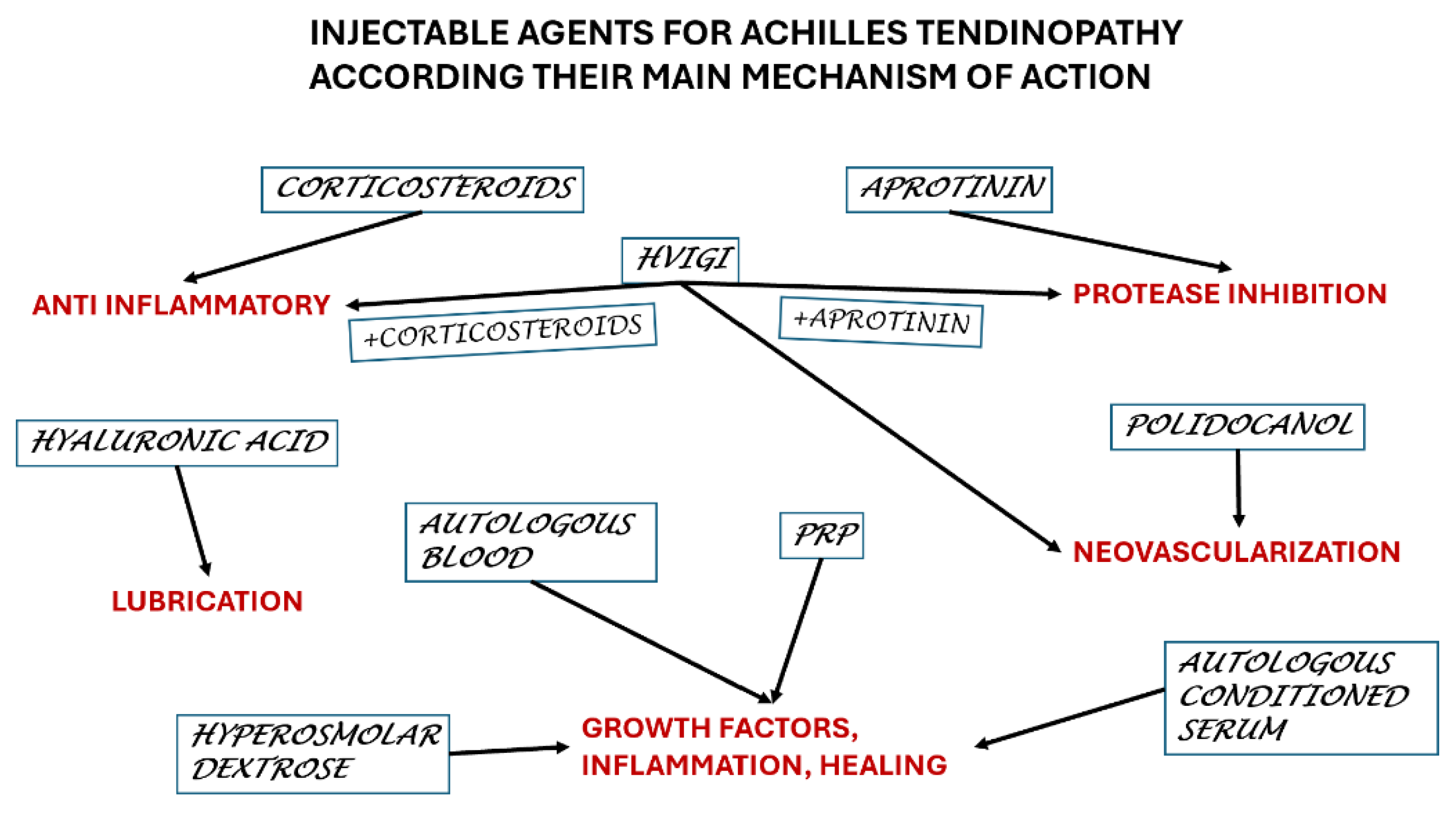

Table 1.
Studies on the injectable agents in mid-portion Achilles tendinopathy.
| Author | Research type | Modality of administration | Agent, dosing, timing | Evaluation tools | Timing | Results | Observations |
| Capasso, 1993 [4] |
Prospective, longitudinal, interventional, case series, 77 tendons | Peritendinous | Aprotinin (62 500 kIU), 4 injections | Patient satisfaction | N/A | 78% improvement | 7% failure |
| Aubin, 1997 [5] | Prospective, longitudinal, interventional, case series, 62 tendons | Peritendinous | Aprotinin (20 000 kIU), 4 injections | Patient satisfaction | N/A | 74% improvement | 16% failure |
| Kleinman, 1983 [51] | Retrospective, case report, 3 tendons | Intratendinous | Corticosteroids | Pain Return to previous activities |
2 -3 weeks | Tendon rupture | Avoid administration |
| Ohberg, 2002 [15] | Prospective, longitudinal, interventional, pilot, 10 tendons | Intratendinous, within the neovascularization area, possible repetition after 3 – 6 weeks, up to 4 injections | Polidocanol, 5 mg/ml, 2 – 4 ml | Ultrasound neovascularization Pain on VAS Patient satisfaction |
Baseline 6 months |
8/10 patients reduced neovascularization and pain | No side effects |
| Ohberg, 2003 [16] | Prospective, longitudinal, interventional, pilot, 11 tendons | Intratendinous, within the neovascularization area, possible repetition at 3 – 6 weeks, up to 4 injections | Polidocanol, 5mg/ml, 2 ml | Pain on VAS Ultrasound (neovascularization) Patient satisfaction |
Baseline, 3 – 6 weeks, 8 months (mean) |
8/11 improved pain | No side effects |
| Gill, 2004 [19] | Retrospective cohort study, therapeutic, 43 pts | Fluoroscopically guided corticosteroid injections into the space surrounding the Achilles tendon | Corticosteroid | Complications | 2 years | Pain and function improvement | No major complications and one minor complication |
| Fredberg, 2004 [34] | Prospective, randomized, double blind, placebo controlled, 24 tendons | Peritendinous, as close to the lesion as possible, US guided | Corticosteroid, 3 injections (days 0, 7 and 21): 4 ml (20 mg triamcinolone + lidocaine) | Walking pain (NRS), Pressure-pain detection thresholds, US (tendon thickness) |
Days 0, 7, 21, 28, 6 months |
Tendon thickness and pain decreased in the CS group at 1 and 3 weeks and increased lightly at 6 months | 4 days’ rest after injection. Complications: local atrophy, reversible. 25% referred to surgery at 6 months |
| Rochcongar, 2005 [52] | Non-randomized prospective trial, 128 tendons (athlets) | Peritendinous, 20 000 kIU, 5 weekly injections |
Six groups: Aprotinine Physical exercise Orthosis NSAIDs per os Cryotherapy NSAIDs Surgery |
Return to sport | 2 – 3 months | 82% of aprotinine patients returned to previous level of sport | Not important |
| Alfredson, 2005 [35] | Prospective, randomized, controlled, double-blind, 20 tendons | Intratendinous, right into the neovascularization area, ultrasound guided | Polidocanol (5 mg/ml) 1 – 4 ml versus blind (lidocaine + adrenaline), 2 treatments 3 – 6 weeks apart | Pain on activity, US exam (neo-vascularization, tendon structure) Patient satisfaction |
3 months | Significant improvement in all parameters in the polidocanol group No improvement in the blind group |
|
| Brown, 2006 [36] | Prospective, randomized, double-blinded, placebo controlled, 26 pts, 33 tendons | Peritendinous, 3 weekly injections | Aprotinin + exercise versus placebo + exercise, 3 weekly injections | Primary outcome: VISA-A, Secondary outcomes: Pain on VAS Function (no of single heel raises) Return to previous level of sport Patient satisfaction |
3 weeks, 1, 3 and 12 months |
Both groups improved all parameters at all moments, with better results for aprotinin group, but not significant | No side effects, no allergic reaction. Lack of significance: groups were too small |
| Maxwell, 2007 [28] | Prospective, before and after, a sub-group of 23 mid-portion tendinopathy | Intratendinous, US-guided within the area of abnormality | 3 mL of a mixture of 2 mL 2% lignocaine and 1 mL of 50% dextrose, giving a 25% dextrose solution One injection every 6 weeks, maximum 4 injections |
GSUS, color flow-DUS, VAS at rest, daily activity and strenuous activity |
Baseline, 6 weeks after completion, 12 months |
VAS at rest, daily and strenuous activity improved significantly after therapy US features improved |
Lack of significance may be due to too smaller a size. |
| Chan, 2008 [29] |
Prospective, longitudinal, interventional, pre- and post-treatment, 21 tendons | Peritendinous, ultrasound guidance, on the anterior aspect of the tendon | A mixture of 10 ml 0.5% bupivacaine hydrochloride and 25 mg of hydrocortisone acetate, followed by 4 x 10 ml of normal saline. | VISA-A Pain on VAS |
Baseline 2 weeks 30 weeks |
Significant improvement of pain and function on short- and long-term | |
| Orchard, 2008 [20] | Retrospective, longitudinal, interventional, cohort study, 149 tendons | Peritendinous, palpatory guidance | Solution 5 mL (aprotinin 30 000 kIU and 2 ml local anesthetic), 2 – 3 injections |
Patient satisfaction questionnaire | 3 – 54 months after the first injection | 61% improved, 3% failure |
Itching (25%) Rush (7%) Uncommon (sweating, nausea, allergy, headache) |
| Yelland, 2009 [39] | single-blinded randomised clinical trial, 40 tendons | tender points in the subcutaneous tissues adjacent to the tendon | Prolotherapy (5 ml solution glucose + local anesthetic) 4 to 12 weekly injections versus Eccentric training versus Eccentic training + prolotherapy |
VISA-A Patient satisfaction (Likert scale) Economic costs |
Baseline 12 weeks (completion) 6 and 12 months |
Intra-group: significant improvement at all moments Inter-group: at 6 months the combined therapy improved better Economic: combined therapy best value for money |
|
| Ryan, 2009 [25] | Prospective, longitudinal, interventional, 86 tendons | Intratendon, US guided | Dextrose (2 ml 25% + lignocaine), 1 – 3 sites, repeated at 6 weeks if necessary | Pain Ultrasound aspect Number of injections |
Baseline 6 weeks 28 months |
Pain improved at all moments 28 months: US aspect improved |
Number of injections: between 1 and 5 |
| De Vos, 2010 [37], De Jonge, 2011 [38] |
Prospective, randomized, double-blind, longitudinal, placebo-controlled trial, 54 pts | intratendinous | PRP (4 mL) versus saline, 3 different puncture locations. | VISA-A Patient satisfaction, return to sports, Adherence to the eccentric exercises, Ultrasound exam |
Baseline, 6, 12 and 24 weeks, One year |
Both groups improved significantly at all moments No significant differences between groups |
No benefit for PRP group |
| Van Sterkenburg, 2010 [21] | Retrospective, longitudinal, interventional, 53 tendons | Intratendon, into the hypervascularity area | Polidocanol (2 – 4 ml), at 6 weeks interval and a maximum of 5 sessions | Pain on VAS | 6 weeks (short term), 3,9 years (midterm) |
44% pain free 42% same amount of pain 14% worse pain |
No high beneficial value |
| Humphrey, 2010 [30] | Prospective, longitudinal, interventional, pre- and post-treatment, 11 tendons | Peritendinous, on the anterior aspect, ultrasound guided | A mixture of 10 mL 0.5% bupivacaine hydrochloride and 25 mg of hydrocortisone acetate, followed by 4 × 10 mL of normal saline | VISA-A Ultrasound morphology |
3 weeks | Significant improvement in all aoutcomes, with thickness reduction on US | No serious event |
| Gaweda, 2010 [31] | Prospective, observational, before after, 15 tendons | Intratendinous, US-guided within the hypoechogenic area | PRP, 3 mL, one injection | AOFAS* scale, VISA-A scale US assessment |
Baseline, 6 weeks, 3,6 and 18 months | All parameters improved significantly at all moments | |
| Finnoff, 2011 [6] | Prospective, longitudinal, observational, case series, 11 tendons | PRP, intra-tendon | US-guided percutaneous needle tenotomy and one PRP injection (2,5 – 3,5 mL) | Pain Function US morphology |
Baseline, 14 months (mean) |
Improvement Maximum effect: 4 months |
PRP augmented the benefits of tenotomy |
| Owens, 2011 [7] | Retrospective, longitudinal, interventional, case series, 11 tendons | Intratendinous, US guided, | PRP, 6 mL | FAAM*, FAAMS*, SF-8*, MRI, |
Pre- and post-injection 13.9 (range, 10.1 to 19.5) months | Modest improvement in clinical scales. Minor MRI changes. | |
| Monto, 2012 [8] | Prospective, longitudinal, Interventional, case series, 30 tendons |
Intratendinous, US-guided into the lesion, diamond injection pattern | PRP, 4 mL | AOFAS MRI Patient satisfaction |
1, 2, 3, 6, 12, and 24 months MRI at 6 months |
Significant improvement in pain, function, return to activities MRI: structural improvement |
No placebo group |
| Pearson, 2012 [40] | Prospective randomized controlled trial, 33 tendons | Autologous blood injection, peritendinous | Eccentric training + autologous blood injection (peritendinous) versus eccentric training alone, second injection 6 weeks apart | Pain VISA-A Ratings of perceived discomfort during and after the injection. |
6, 12 weeks | 6 weeks, inconsistent improvement in pain and function 12 weeks, moderate improvement |
Discomfort at injection site during the procedure and up to 48 hours after |
| Ferrero, 2012 [9] | Prospective, longitudinal, interventional, case series, 30 tendons | Intratendinous, US-guidance | PRP, 6 mL, 2 injections 3 weeks apart | VISA-A Pain (VAS) US Patient satisfaction |
Baseline, 20 days, 6 months |
Minimal improvement VISA-A, pain and US appearance at 20 days, significant improvement at 6 months, | Moderate post-procedural pain (average 4 days) |
| Deans, 2012 [10] | Case series, prospective, 28 tendons | Intratendinous, into the maximum pain area | Autologous-conditioned plasma, one or two injections (6 weeks apart)s | Pain Function Quality of life |
Baseline, 6 weeks |
Improvement in all parameters | |
| Resteghini, 2012 [11] | Prospective, longitudinal, interventional, case series, 32 tendons | Peritendon, US guided | 40 ml (25 mg of hydrocortisone, 5 ml of 1% lignocaine and up to 40 ml of normal saline) |
Pain (VAS) VISA-A Ultrasound exam |
Baseline 1 and 3 months |
Pain and function improved at all moments US exam improved at 3 months |
6% rate of failure |
| Lynen, 2012 [26] | Longitudinal, interventional, prospective, single-arm, multicenter trial, 19 tendons | Peritendon, US guided | Hyaluronic acid (40 mg/2 ml + mannitol), 2 weekly injections | Pain US exam |
Baseline 5 and 12 weeks |
Improvement in pain and US structure | None |
| Mautner, 2013 [22] | Retrospective, interventional, cross-sectional, 27 tendons | Intratendinous, US-guided | One or more injections, according to clinical evolution | Pain (at rest, function) Patient satisfaction |
15 months (average) | All patients: at least moderate improvement. 96% mostly complete improvement |
|
| Maffulli, 2013 [12] | Prospective, longitudinal, interventional, case series, 94 tendons (athletes) | Peritendinous, on the anterior side, US-guided | 10 mL mixture (bupivacaine and aprotinin 62 500 kIU), eventually followed by another injection, 2 weeks, with corticosteroid instead aprotinin | VISA-A, Ultrasound (grey-scale, Doppler) Return to athletic activity |
Baseline, 2 weeks, 1 year |
60% required a second injection One year: 68% success (return to previous level), 11% returned to a lower level |
9% failure (surgery) |
| Bell, 2013 [41] | Prospective, randomised controlled trial, 53 tendons | Autologous blood injection, peritendinous, | Standard eccentric training alone versus standard eccentric training + autologous blood injections, 2 injections 4 weeks apart | VISA-A Perceived rehabilitation (Likert scale) The ability to return to sport. |
6 months | Both groups improved significantly, | No differences between groups |
| Kearney, 2013 [17] | Randomized longitudinal, interventional, controlled trial, pilot trial, 20 tendons | Intratendinous administration (peppering, single-skin penetration and 5 penetrations of the tendon) | PRP (3 – 5 mL) versus excentric exercise program | VISA-A Pain (VAS) EQ-5D for general health |
Baseline, 6 weeks, 3 and 6 months | No significant differences | |
| Filardo, 2014 [27] | Prospective, longitudinal, interventional, 37 tendons | Intratendinous, multiple perforations, US-guided | PRP, 5 mL, 3 injections every 2 weeks | Blazina score, VISA-A, EQ-VAS for general health, Tegner score |
Baseline, 2 and 6 months, 4 years |
Improvement on all parameters, in the short and medium term Maintenance at 4 years |
|
| Guelfi, 2014 [23] | Retrospective, interventional, 98 tendons | Intra- and peritendon injection, US guided | PRP, one injection | Blazina score Pain VISA-A |
Baseline, 3 weeks, 3 and 6 months 50 months |
||
| Wheeler, 2014 [13] | Prospective, longitudinal, interventional, pre- and post-treatment, case series, 14 tendons |
Peritendon, on the anterior side, US guided | HVIGI 50 ml (10 ml lidocaine + 40 ml saline), one injection | Pain VISA-A |
Baseline 347 days mean follow-up |
Significant improvement in pain and function | 14% failure (went to surgery) |
| Krogh, 2016 [42] | Randomized placebo-controlled, single blind trial, 24 tendons | Intratendinous, ultrasound-guided injection. |
PRP (6 mL) versus saline; peppering technique (3 to 4 skin portals and about 7 tendon perforations evenly distributed in the thickest part of the tendon) | VISA-A Pain at rest, when walking, and when the Achilles tendon was squeezed. Ultrasound: color Doppler activity and tendon thickness |
Baseline 3, 6 and 12 months |
No differences between groups at 3 months for all parameters, except for the tendon thickness, that increased in PRP-group at 3 months | A huge drop-out rate (54%) due to lack of results for both groups at 12 months |
| Girolamo, 2016 [43] | Prospective, controlled, randomized, 56 tendons | Intra-tendon and peritendon | adipose tissue SVF versus PRP, one injection | Pain (VAS) VISA-A SF-36 MRI/ultrasond |
Baseline, 15, 30, 60, 120 and 180 days | Both groups improved at all moments SVF patients improved more rapidly (15 days) 6 months: imagistic were equal |
|
| Lynen, 2016 [44] | Prospective, randomized controlled, blinded-observer trial, 59 tendons | Peritendon | Hyaluronic acid HA (40 mg/2ml + mannitol), 2 weekly injections versus ESWT (3 weekly sessions) |
Pain (VAS) VISA-A Ultrasound exam |
Baseline 4 weeks, 3 and 6 months |
Intra-group: improvement in both groups Inter-group: HA group better result on all parameters |
Few adverse effects in both groups |
| Fogli, 2017 [32] | Prospective, open-label, single-center study, 34 tendons | Peritendon, on the anterior aspect | Hyaluronic acid (40 mg/2ml + mannitol), 2 weekly injections | Pain US exam Clinical symptoms Safety |
Baseline Days 7, 14 and 56 |
Pain and clinical symptoms improved at all moments. On 14 and 56 days, reduction of tendon thickness |
No adverse effects |
| Boesen, 2017 [45] | double-blinded, randomized prospective trial, 60 tendons | Peritendinous, on anterior aspect, ultrasound guided | HVIGI (one injection corticosteroid+anesthetic +saline) PRP (4 injections, every 2 weeks) Saline |
Primary outcome: VISA-A Secondary outcome: VAS, satisfaction Ultrasound: tendon thickness and color Doppler |
Baseline, 6, 12 and 24 weeks | Both HVIGI and PRP improve parameters at all moments. HVIGI was more effective than PRP on pain, function and satisfaction at 6 and 12 weeks, but not at 24 weeks |
|
| Usuelli, 2018 [46] | Double blinded RCT, 44 pts | Intra-tendon and peritendon | One injection either of PRP or adipose tissue SVF | Pain on VAS VISA-A AOFAS SF-36 US and MRI |
15, 30, 60, 120 and 180 days | All patients improved, SVF group with a faster evolution (15 days) 6 months: equally structural evolution |
|
| Boesen, 2019 [47] | Double blinded, randomized controlled, 28 tendons | Peritendinous, on the anterior side | HVIGI with and without corticosteroid (CS) | Primary outcome: VISA-a Secondary: VAS on weight-bearing, ultrasound (tendon thickness, Doppler), patient satisfaction |
6, 12, 24 weeks | HVIGI with CS improved better in the short term and equally on medium term. | |
| Von Wehren, 2019 [24] | Retrospective, longitudinal, comparative study, 50 tendons | Intratendinous, into the area of maximum pain | Autologous condioned serum (2 mL, 3 weekly injections) versus eccentric training | VISA-A MRI (baseline and 6 months) |
Baseline 6, 12 weeks, 6 months |
VISA-A improved better in autologous conditioned serum group at all moments |
|
| Frizziero, 2019 [33] | Prospective, longitudinal, interventional trial, 26 tendons | Peritendinous, US guided | Hyaluronic acid (20 mg/2 ml; 500-730 kDa), 3 weekly injections | Pain VISA-A Quality of life (EQ-5D-5L) US assessment |
Baseline 14, 45 and 90 days |
Significant improvement in pain and function up to 90 days Structural improvement at 90 days |
None |
| Der Vlist, 2020 [48] | Prospective, double-blind, randomized, placebo-controlled, 80 tendons | Peritendin, on the anterior side, into the area of maximum Doppler flow | 50 mL versus 2 mL mixture of saline and 1% lidocaine | VISA-A. Patient satisfaction, return to sport, Doppler flow |
2, 6, 12, 24 weeks | No benefit for the high-volume group | None |
| Ayyaswamy, 2020 [18] | Prospective, longitudinal, interventional, pilot study, 17 tendons | Peritendon, US-guided | Hyaluronic acid (40mg/2ml with 0.5% mannitol), one injection | Pain (VAS) Manchester-Oxford Foot Questionnaire |
Baseline 2 and 12 weeks |
Significant improvement at all moments | No adverse effects |
| Nielsen, 2020 [14] | Retrospective, longitudinal, interventional, case series, 30 tendons | Peritendon, on the anterior side, US guided | One HVIGI (10 mL of marcaine, 0,5 ml of triamcinolonacetonid and 40 mL of saline) | VISA-A US exam |
Baseline One year |
33% of patiens improved | The low rate might be the result of long duration of symptoms and multiple failures |
| Kearney, 2021 [49] | Randomized placebo-controlled, longitudinal, multicenter clinical trial, 221 tendons | Intratendinous, a single skin portal and 5 penetrations of the tendon |
PRP (3 – 5 mL) versus saline | VISA-A Health-related quality of life assessed (EQ-5D-5L) |
Baseline 3 and 6 months |
No difference between groups at 3 and 6 months | |
| Johansson, 2022 [50] | Double-blinded randomized, controlled, placebo, 100 pts | Peritendinous, US guided | Corticosteroid, 3 injections with an interval of at least 4 weeks versus placebo, followed by exercise | Primary: VISA-A Secondary: pain on VAS, global assessment, US exam (thickness, PDUS) |
1, 2, 3, 6, 12, and 24 months. | Both groups improved. CS group improved better, 6 months. | No deleterious effect of CS |
NRS, numeric rating scale; VISA-A, Victorian Institute of Sports Assessmente – Achilles; GSUS, grey-scale ultrasound; DUS, Doppler ultrasound; FAAM, Foot and Ankle Ability Measure; FAAMS, Foot and Ankle Ability Measure – Sports; SF-8, Short Form health survey; EQ-5D, EuroQol 5-Dimension questionnaire; SVF, stromal vascular factor; AOFAS, American Orthopaedic Foot and Ankle Society; SF-8,measures health-related quality of life);.
Table 2.
This.
| Agent | Main mechanism | Administration |
| Corticosteroids | Anti-inflammatory | Intra tendon – to be avoided Peritendon - advisable |
| HVIGI a. Corticosteroids b. Saline c. Aprotinin |
Sclerosing agent for neovascularization a. + anti-inflammatory b. No other effect c. Proteolytic |
Peritendon |
| Polidocanol | Sclerosing agent for neovascularization | Peritendon |
| Hyperosmolar dextrose | Inflammatory reaction to promote healing | Intra tendon |
| Aprotinin | Proteolytic | Intra tendon / Peritendon |
| Hyaluronic acid | Lubricating, breaking adhesions | Peritendon |
| Autologous blood | Inflammatory reaction to promote healing | Peritendon |
| PRP | Inflammatory reaction to promote healing | Intra tendon |
| Autologous serum | Inflammatory reaction to promote healing | Intra tendon |
| Autologous adipose-derived stromal vascular fraction | Inflammatory reaction to promote healing | Intra tendon |
Disclaimer/Publisher’s Note: The statements, opinions and data contained in all publications are solely those of the individual author(s) and contributor(s) and not of MDPI and/or the editor(s). MDPI and/or the editor(s) disclaim responsibility for any injury to people or property resulting from any ideas, methods, instructions or products referred to in the content. |
© 2025 by the authors. Licensee MDPI, Basel, Switzerland. This article is an open access article distributed under the terms and conditions of the Creative Commons Attribution (CC BY) license (http://creativecommons.org/licenses/by/4.0/).
Copyright: This open access article is published under a Creative Commons CC BY 4.0 license, which permit the free download, distribution, and reuse, provided that the author and preprint are cited in any reuse.


