

Submitted:
14 February 2025
Posted:
17 February 2025
You are already at the latest version
Abstract
Impatiens reidii Hook.f. a rare presumed extinct and Kumaon endemic species only known from its type collection in 1886 is rediscovered from its type locality after a gap of 138 years. The identity of historically ambiguous name I. tingens is reinvestigated based on studies of literature, type specimens and recollection of live material from the type locality that confirmed the name I. tingens is conspecific with I. scullyi and thus latter name is synonymised. Impatiens inayatii, another little-known species described by Hooker as endemic to Kali valley, Kumaon currently treated as a synonym of Impatiens bicornuta is recollected from near the type locality after 124 years, our recollection confirms its identity as a totally distinct species from section Urticifoliae S.Akiyama & H.Ohba thus reinstating name I. inayatii. Augmented description for all three species is provided with information on their botanical history, species etymology, key identification characteristics, distribution, phenology, ecology and first photographic documentation of I. reidii and I. inayatii. Also, lectotypes are designated for the names I. reidii and I. tingens.
Keywords:
Flora of Himalaya
; lectotypification
; rediscovery
; reinstatement
; synonymisation
1. Introduction
Balsaminaceae with more than 1000 species are one of taxonomically problematic plant families [1,2,3]. According to recent phylogenetic studies [4,5,6], Balsaminaceae evolved in southeast Asia, most probably in southwest China and subsequently spread to Western Ghats of India, continental Africa and Madagascar, as well as the northern temperate zone in Eurasia and North America. Himalaya was a migration route of balsams towards Central Asia, with the number of taxa diminishing from the east to the north-west [3,7,8,9,10]. Eastern and central parts of the range have recent revisions of discussed family [3,8,9]. On the other hand, there are many unresolved taxonomic problems in Indian Western Himalaya; some taxa are known only from old, badly preserved or only type collections. Available state floras are outdated [11,12,13], “Flora of India” [14] and the treatment of Balsaminaceae in recent floras were made based on the old herbarium specimens and literature rather than fresh collections. Recent papers dealing with Balsaminaceae of Himalayan region resolved some old problems and augmented our knowledge [9,15,16,17,18,19,20,21,22,23,24], yet errors in balsam identification are common and outdated taxonomic approaches are still repeated in some recently published papers [25,26].
2. Materials and Methods
The present study is based on the extensive seven years of field work in Himalayan union territory Jammu & Kashmir, Himachal Pradesh and Uttarakhand states; as well as Trans-Himalayan union territory Ladakh, India. Examination of protologues, illustrations, herbarium type specimen images and analyzing observations present on various online citizen science portals and efloras. In an attempt to rediscover I. reidii and I. inayatii a two weeklong expedition was carried out in Garhwal and Kumaon, Uttarakhand in August 2024 which was funded by IAPT research grant to first author (A.S.). To retain the maximum amount of diagnostic characters in herbarium, the dissected floral parts were flattened, pressed and fixed on a white paper with colorless adhesive and later the same sheet was pasted on herbarium sheet with specimen. Type localities of species (I. inayatii, I. reidii and I. tingens) were visited and extensively explored to rediscover the species and ascertain their true identity; floral parts were dissected and photographed in the field along with habit and habitat documentation using Nikon D5600 and Tamron 90 mm macro lens. The collected plant specimens were processed into mounted herbarium sheets following conventional methods of herbarium technique and are submitted at FRLH and BSS herbarium. With the help of protologues, type specimen images and critical examinations of specimens (K, E, CAL, DD, BSD, FRLH) along with various available literatures, identities of the species were ascertained. Distribution of species was traced from recent field collections along with data available on historical old specimens (including types), confirmed with the original materials and analyzing online available citizen science observations (available on eFloraofIndia and iNaturalist).
3. Results
3.1. Rediscovery of Impatiens reidii Hook.f. a Rare Presumed Extinct Endemic Species from Its Type Locality After a Gap of 138 Years
Impatiens reidii Hook.f. was described by Hooker [27] in Hooker's Icones Plantarum based on a collection made by J.F. Duthie and J.R. Reid from near Sela Darma, Byans, Kali Valley in Kumaon, Uttarakhand. Hooker in his description wrote ‘inflorescentia pedunculata, pedunculi pauciflori, pedicelli infra florem solum bracteati (basi ebracteati), floribus parvis, labelli calcare elongato gracile’ i.e. inflorescence pedunculate, peduncles pauciflorous, pedicels below the flower only bracteate (basally ebracteate), with small flowers, lower sepal with elongate slender spur. Further, Hooker mentioned this as a very distinctive species but didn’t assign it to any particular group. According to our observations I. reidii belongs to I. scabrida group sensu Akiyama and Ohba [18] having type 7 inflorescence [28] and pubescent bract in the middle of the pedicel.
Taxonomic treatment
Impatiens reidii Hook.f. in Hooker's Icon. Pl. [ser. 4, 10] 30: t. 2901. 1910; Vivek. & al. in Hajra &e al., Fl. India 4: 204. 1997; Uniyal & al., Flow. PL. Uttarakhand Checkl.: 91. 2007. Flora of Uttarakhand – 1 875. 2018. Figure 1 and Figure 2
Lectotype (designated here):— INDIA, Uttarakhand, Kumaon, Kali Valley, Byans, near Sela Darma, 6-7000ft., 16.07.1886, J.R. Reid 2549 (K000694744!)
Description:— Annual erect herb, 75 cm long, pubescent, most of the plant parts covered with trichomes, stem green, erect, swollen at lower nodes. Leaves alternate; petiole 1-4 cm long with a pair of round glands (extrafloral nectaries) at the base of petiole; lamina elliptic or obovate, 5-18 × 2-5.5 cm, base gradually attenuate, margins crenate-cuspidate with terminal cusp, apex acuminate, pubescent, main lateral veins 11-14 pairs. Inflorescence pubescent, covered with trichomes, 3-6 flowered, axillary, pedunculate racemes; bracts linear, pubescent with prominent trichomes, 4-6 mm long; peduncles slender, 3-5 cm long, pubescent or puberulous, elongated, stiff in fruiting: pedicels bracteate, 6-10 mm long; bracteole linear-setaceous, 3-5 mm long. Flowers yellow. Lateral sepals 2, obliquely ovate, 6-8 mm long, as broad, acute to acuminate, membranous, pubescent along margins and on slightly raised prominent midrib. Lower sepal shallowly navicular or funnel-shaped, 2-2.5 cm long; 12-14 mm deep; with oblique mouth, spur gradually constricted, filiform, curved, 1.2-1.5 cm long. Upper petal oblong or oblate, 12-14 mm across, back/dorsally green with pubescent crest on midvein. Lateral united petals 15-20 mm long; basal lobes more or less rounded, distal lobes elongated-dolabriform with rounded auricle and obtusely elongated-apiculate lower lobe, brown spotted. Capsules linear, 2.5-4 cm long, erect; seeds oblong, brown, 3-4 mm long, tuberculate.
Flowering & Fruiting:— July to October.
Distribution:— Uttarakhand, Kumaon (Kali valley) in temperate forests; 2000-2300 m.
Associated species:— Achyranthes bidentata Blume, Aster verticillatus (Reinw.) Brouillet, Carpesium abrotanoides L., Clinopodium umbrosum (M.Bieb.) K.Koch, Geranium nepalense Sweet, Girardinia diversifolia (Link) Friis, Persicaria nepalensis (Meisn.) H.Gross, Pilea umbrosa Wedd. ex Blume, Rubia cordifolia L., Selaginella sp. and Urtica parviflora Roxb.
Species etymology:— Specific epithet ‘reidii’ is an eponymy named after collector Mr. James Robert Reid (J.R. Reid) (Chief secretary, CIE to the government of the North West Provinces and Oudh) who collected this species in 1886.
Specimens examined:— INDIA, Kumaon: Kali Valley, Byans, near Sela Darma, 6-7000ft., 16.07.1886, J.R. Reid 2549 (K000694744!); Uttarakhand, Kumaon: Kali Valley, Uttarakhand, Kumaon division, Pithoragarh district, near Birthi waterfall, 30°01'9.63"N 80°10'35.32"E, 2055 m, 27.08.2024, Ashutosh Sharma, 12614 (FRLH!); Kumaon: Kali Valley, Uttarakhand, Kumaon division, Pithoragarh district, near Birthi waterfall, 30°01'9.63"N 80°10'35.32"E, 2055 m, 27.08.2024, Ashutosh Sharma, 12615 (BSS!)
Discussion:— Impatiens reidii is apparently related to I. tricornis and I. scabrida, due to annual habit, yellow flowers, plant pubescence and presence of dark, round glands at the base of petiole. It is however different from both these species in shape of lower sepal and spur. I. scabrida is characterized by big flower size, wide lateral united petals, big navicular lower sepal tapering into a long (upto 20 mm) straight downwardly curved spur and pubescent capsules while I. reidii is having smaller flower size, narrow lateral united petals, smaller lower sepal with short spur not exceeding 15 mm and glabrous capsules. Type specimen of I. calycina Wall. (= I. scabrida DC.), only known material of this species, comes from Nepal [18]. Impatiens tricornis is rather common and highly variable in Western Himalaya, having bucciniform lower sepal abruptly constricted into the spur, its flower color varies from creamy white in lower elevation to dark yellow at higher elevations, plant height upto 4 feet in lower elevations to 15 cm in sub-alpine rocky habitats and puberulent in subtropical habitat to pubescent in subalpine region. Impatiens reidii could be mistaken with I. tricornis and I. scabrida in herbarium material lacking flowers. In Flora of Kullu District, Himachal Pradesh [25] misidentified I. tricornis as I. reidii, we examined the specimens identified as I. reidii from Beas, Kullu deposited at PUN herbarium and confirmed their identity as I. tricornis, a common species in Kullu district. I. reidii is endemic to Kali valley, Eastern Kumaon and probably adjoining western Nepal? Hooker [27] working with more than twenty years old herbarium specimens, described flower colour of I. reidii as white as flower color fades in Impatiens specimens with time, moreover there are no notes by collectors on color of I. reidii flowers on type sheet.
3.2. Reinstating Impatiens inayatii Hook.f. and Augmented Description Based on Recollection from Type Locality in Kali Valley, Kumaon, Uttarakhand
Impatiens inayatii Hook.f. was described by J.D. Hooker [29] based on a specimen collected by Inayat Khan in 1900 in Sosa Forest, Kali Valley in nowadays Kumaon, eastern Uttarakhand, close to the border with Nepal. Hooker’s description is very short: “A remarkable large leaved and flowered species, only once found”, giving no clues about its affinities. Recently Singh et al. [30] incorrectly synonymised I. inayatii with distantly related I. bicornuta without studying live plant material. Our recollection from near type locality confirms the distinct identity and resurrection of this species from I. bicornuta complex [31,32]. Also, on detailed search across different herbaria we came across a recent collection of this species from Seti zone of Doti District in far West Nepal housed at Royal Botanic Garden Edinburgh herbarium (E) and this forms a new record for the Flora of Nepal.
Taxonomic treatment
Impatiens inayatii Hook.f. in Rec. Bot. Surv. India 4: 10. 1904; Vivek. & al. in Hajra & al., Fl. India 4: 157. 1997; Uniyal & al., Flow. Pl. Uttarakhand Checkl.: 91. 2007. Figure 3 and Figure 4 Lectotype: India, Uttarakhand, Kumaon, Kali valley, Sosa forest, 8000-9000 ft., 17September 1900, Inayat 23987 (K000694900!); Isolectotype DD!
Annual erect herb, 40 – 130 cm tall; glabrous. Stem glabrous, green to dark purple, slightly swollen at nodes, upto 2 cm wide at the base and hollow inside. Leaves thick coriaceous, glabrous, alternate; petioles 0.5-6 cm long; lamina ovate-elliptic to ovate-lanceolate or elliptic-oblong, 15-25 x 5-8 cm, base attenuate, margins crenate to deeply crenate with glandular cusps, apex acuminate; main lateral veins 7-10 pairs. Few to many small filiform glands at the base of petiole and mostly on the apical branches, 1-2.5 mm long. Inflorescences pendulous racemose, upto 15 cm long, ascending at tip, 2 - 8 flowered. Flowers large, upto 3 cm long, white and yellow with dark red rusty spots inside, pedunculate; bract at the base of pedicel, glabrous, persistent, ovate-lanceolate, 7-8 × 3 mm; peduncle slender, 5-14 cm long, glabrous; pedicels opposite, arcuate when fruiting. Lateral sepals one pair, green turning to translucent white with small red spots in mature flowers, ovate, 8 × 6 mm; appendaged at apex. Lower sepal bucciniform, 2.5 × 3 cm; with oblique mouth, mouth with short beak, basal part yellow inside with red-brown spots, spur gradually constricted and curved inside such that it reaches depression formed at the base of lower sepal, 5 mm long. Dorsal petal white with small red spots on dorsal side, 11× 15 mm, suborbicular-obcordate; crested, crest upto 2 mm, lateral united petals 8-10 × 32-35 mm with yellow splash and dark spots on sinus of basal and distal lobes; basal lobes broadly triangular; distal lobes narrowly ovate, narrowed just above the middle, shortly apiculate. Auricle inconspicuous. Capsules linear, acute, 3-4 cm long. Seeds 3-5, ovoid to oblong, 4-5 mm long, surface smooth and glabrous, brown at maturity.
Flowering & Fruiting:— July to October.
Distribution:— Kumaon (Sosa, Kali valley) and far West Nepal, in temperate to sub-alpine forests; 2600-3730 m.
Associated species:— Ainsliaea aptera DC., Aster verticillatus (Reinw.) Brouillet, Semple & Y.L.Chen, Bistorta amplexicaulis (D.Don) Greene, Geranium wallichianum D.Don ex Sweet, Halenia elliptica D.Don, Impatiens amphorata Edgew., Impatiens laxiflora Edgew., Quercus semecarpifolia Sm., Rhododendron campanulatum D.Don and Rubus nepalensis (Hook.f.) Kuntze.
Species etymology:— Specific epithet ‘inayatii’ is an eponymy named after collector Inayat Khan (Head plant collector of the Botanical Department of N. India) who collected this species in 1900.
Specimens examined:— INDIA, Kumaon: Kali valley, Shosa forest, 8000-9000 ft., 17.09.1900, Inayat 23987 (K000694900!); Kumaon: Kali valley, Shosa forest, 17.09.1900, Inayat 23987 (CAL0000005156!); Uttarakhand, Kumaon division, Pithoragarh district, on way to Khaliya top, 30°3'51" N 80°12'28" E, 3275 m, 23.08.2024, Ashutosh Sharma, 12605 (FRLH!); Uttarakhand, Kumaon division, Pithoragarh district, on way to Khaliya top, 30°3'42"N 80°12'54"E, 2900 m, 23.08.2024, Ashutosh Sharma, 12604 (FRLH!)
NEPAL, Far Western Development Region, Seti Zone, Doti District, Khaptad National Park. Trail from Jhigrana to Bichpani, 29°20'37''N 81°3'25''E, 2668m, 01.07.2009, Nepal Bajhang Expedition 2009 H. Ikeda et al. 20911026 (E00623967!); Far Western Development Region, Seti Zone, Bajhang District, above Surma village, 29°39'24''N 81°5'36''E, 3386m, 08.07.2009, Nepal Bajhang Expedition 2009 H. Ikeda et al. 20911089 (E00509740!); Far Western Development Region, Seti Zone, Bajhang District, on trail between Dhahidunga Kharka and Manane Lekh, 29°37'27''N 81°0'29''E, 3730m, 13.07.2009, Nepal Bajhang Expedition 2009 H. Ikeda et al. 20911119 (E00509971!)
Discussion:— Akiyama [9] nor Raskoti & Ale [21] do not include I. inayatii for Nepal. Based on morphological evidence (inflorescences pendulous, racemose, with few to many flowers (type 2a and 2b inflorescences: [28] and leaves thick coriaceous) we include I. inayatii to section Urticifoliae S.Akiyama & H.Ohba [17]. Members of this section were not reported earlier from Western Himalaya.
Raskoti & Ale [21] recently described morphologically closely resembling species, I. nimspurjae, with white and yellow flowers from western Nepal. Impatiens nimspurjae has however smaller flowers (1.5–2 cm long), sessile leaves and shorter inflorescences (2–3-flowered and peduncle 1.5–6 cm) but authors didn’t compare the newly described species with I. inayatii to which it seems to be more closely allied morphologically. Further integrated morpho-molecular studies are necessary to resolve species delimitation and relation between these taxa.
Recently I. inayatii was synonymized with I. bicornuta by [30]. This paper was however heavily criticised [33], as illustrations of I. bicornuta sensu [30] include also members of I. urticifolia group sensu [17]. I. bicornuta complex is characterised by multiflowered interrupted and erect raceme inflorescences, with pseudowhorls of flowers in lower part of inflorescence (I. bicornuta) while in I. urticifolia group (incl. I. inayatii) inflorescences are drooping, ascending [Type 2a and 2b inflorescences [28] and thick, coriaceous leaves. Separation of I. bicornuta group and I. urticifolia group was confirmed in phylogenetic study by [5]. However, according to molecular study of [21], I. nimspurjae is more closely related to I. radiata and I. racemosa than to I. urticifolia.
3.3. Synonymizing Impatiens scullyi Hook.f. with Impatiens tingens Edgew. – Insight into Botanical History and Identity Confusion of Names Impatiens tingens Edgew. with Impatiens racemosa DC. and Impatiens laxiflora Edgew
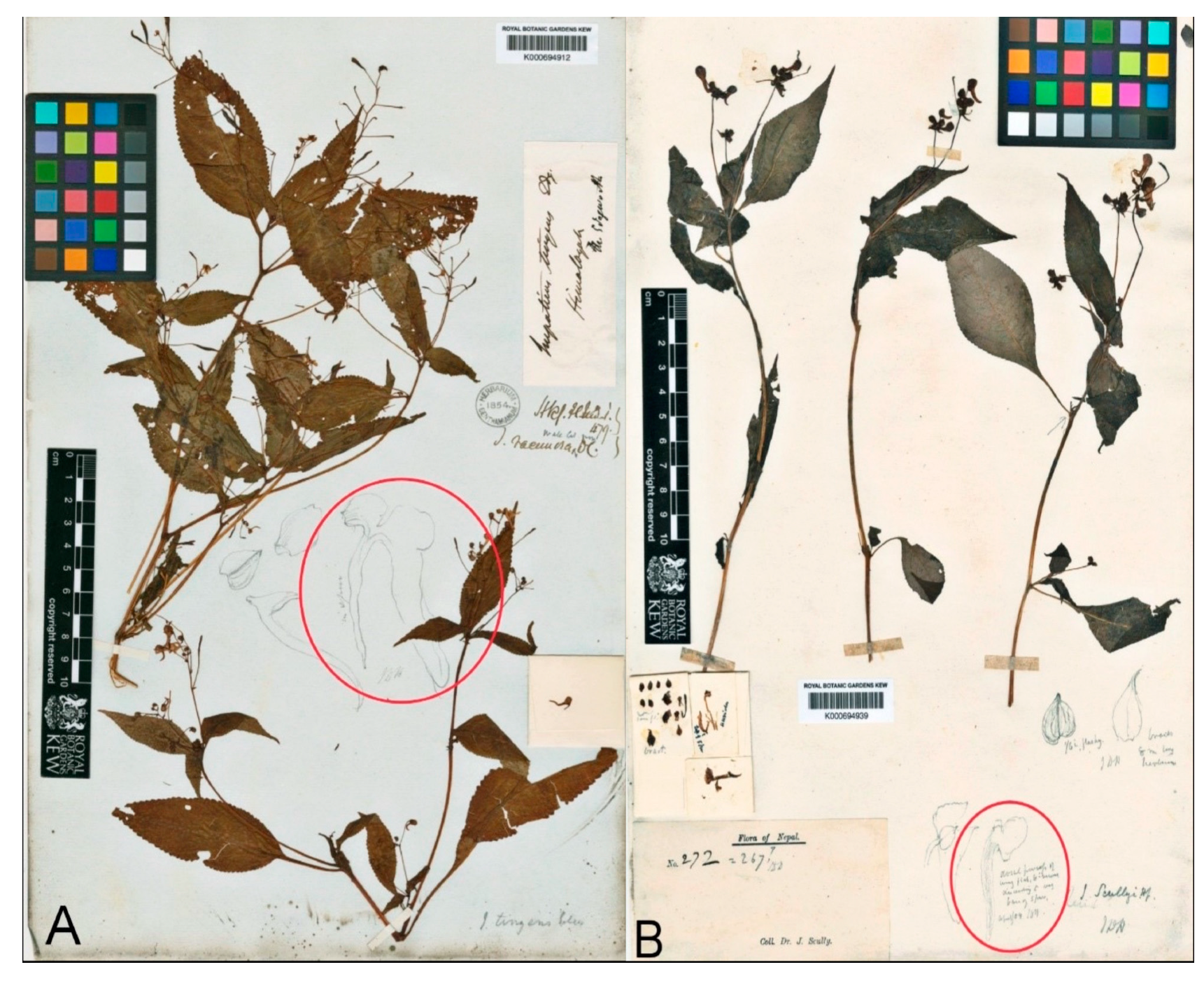
Recently authors (A.S. & W.A.) reported Impatiens scullyi Hook. f. as a new record for India [22]. The species was first collected by J. Scully from Nepal and was mentioned by Sir J.D. Hooker in “An epitome of the British Indian Species of Impatiens” [29] from central Nepal. It was described in detail later by [34] from central and eastern Nepal. Western Himalayan floras [12,13] report I. tingens, originally described by [35]. Further studies of literature [29,34,35], type specimens of both taxa (Fig. 1 a, b), pictures, live material and recollection of I. tingens by first author (A.S.) from type locality (Fig. 5) confirms that I. tingens and I. scullyi share one rare feature: long auricle from base of lateral united petals inserted into spur [36]. This feature is known to occur only in a dozen or so species from continental Africa, Western Ghats and China [1,37,38]. Further examination of type specimens of both species revealed that there are no consistent differences between the taxa (Fig. 6). Hence, following the principle of priority (Article 23 ICN) we synonymise later published names viz. I. scullyi under I. tingens.
Taxonomic Treatment:
Impatiens tingens Edgew. Trans. Linn. Soc. London 20(1): 41 (1846).
Type: India, Western Himalaya, Simla, below Nagkanda, 8000–9,000 ft., M.P. Edgeworth 339 (Lectotype designated here: K [K000694912!]). Figure 5 and Figure 6
Impatiens scullyi Hook. f. in Rec. Bot. Surv. Ind. 4: 15 & 21 (1905) syn. nov.; Impatiens scullyi Hara in Hara & Williams, Enum. Flow. Pl. Nepal 2: 80 (1979); Impatiens scullyi Akiyama et al. Bull. Univ. Tokyo No. 34 (1991); Impatiens scullyi Yu Balsaminaceae of China: 140 (2012).
I. laxiflora var. stracheyi, FI, Brit. Znd. 1. c. 480.
Annual herbs, 30–90 cm tall, stem succulent, swollen at nodes, often rooting from lower nodes, leaves alternate, aggregated at the apical part of stem, petiole 10–20 mm long, lamina broadly lanceolate to oblong-ovate, 8–14 cm long, 4–6 cm wide, glabrous with crenate margin. Inflorescence racemose, 6–13 cm long, axillary, with six to ten flowers, flowers congested on top of peduncle. Pedicel 1.5–2 cm long, slender, glabrous, with a bract at base. Bracts 3–4 mm long, narrowly ovate, acute at apex. Flowers 1.4–2 cm long, 1.2–2.8 cm deep. Lateral sepals two, ovate, 3–4 mm long. Lower sepal greenish, white or rosa, 4–7 mm long, 12–20 mm deep, tubular; spur inconspicuous. Dorsal petal white, rosa or pale purple, 4–6 mm long and 6 mm wide when flattened, cucullate, with thickened greenish midrib, ending in a short horn or appendage. Lateral united petals white, rosa or rarely purple colored with yellow spot at the base of lower lobe, 11–14 mm long; the upper lobe ovate, ca. 3 mm long and ca. 2 mm wide; the lower lobe with two rounded lobes, 9–11 mm long and 5–6 mm wide, with a very characteristic long appendage (9–13 mm long) elongating into the tubular lower sepal. Stamens five, anthers without appendage. Capsule 1.5–3 cm long, unevenly linear, green with pale yellowish stripes, enclosing 2–6 seeds. Seeds 3-4 mm long (Figure 5).
Synonymisation. Some sources treat the name I. tingens as a synonym of I. laxiflora [39]. I. tingens was previously also confused with I. racemosa due to much similarity in flower shape and size as from the frontal side both species may look much similar however still one can easily differentiate both based on its flower color and shape of spur. More importantly Impatiens racemosa has inconspicuous auricle (Fig. 5) and this way could not be synonymous with I. tingens (compare [29], p. 6). There was a lot of misunderstanding around I. tingens: Hooker & Thomson [40] described it as yellow flowered, but from description it looks as an aggregate of more than one taxon. In Flora Simlensis [41] described I. tingens as I. racemosa where he mentioned unique appendage of lateral united petals as ‘wings (lateral united petals) produced in a long, linear tail descending into the spur’ not found in any other Western Himalayan balsam. Basu & Uniyal [12] also describe I. tingens as yellow flowered, but [13] describe it as white flowered. On the other hand, neither [12] and [13] mention long auricle in their descriptions. Edgeworth [35], Hooker [29], and Akiyama et al. [34] described I. tingens as variable in flower color, size and shape of spur. Hooker [29] describes auricle in I. tingens as filiform; in I. scullyi as linear. However, comparison of type specimens and sketches by J.D. Hooker (Fig 6) shows clear similarity in long auricle arising from the base of lateral united petals entering lower sepal/spur.
Geographical distribution. Impatiens scullyi was regarded as confined to Nepal in the newest list of endemic plants of this country [42,43], however, [44] reported it from southern Tibet (Xizang). Impatiens tingens was described from Nagkanda (nowadays Narkanda, Shimla district, Himachal Pradesh) and Dhobri [35], and reported from Western Himalaya [12,13] from Himachal Pradesh to Uttarakhand. Hooker [29] reported I. tingens also from Nepal, but newer literature confirms only I. scullyi [9,21,34,43,45] from this country. Thus I. tingens is distributed from Himachal Pradesh and Uttarakhand in India to Central Nepal and southern Tibet.
Impatiens tingens Edgew. was first described by M.P. Edgeworth [35] in Transactions of the Linnean Society of London based on his own collection from below Nagkanda (Narkanda), Shimla, Himachal Pradesh. Stewart [46] in his book Punjab Plants mentioned ‘This species, so named by Edgeworth from its coloring his herbarium paper yellow, is a common weed in Lahoul, where Aitchison states that an oil is expressed from the seeds, only to be used, however, for polishing the cups made by the inhabitants from the knots of chiefly Acer perhaps imported from further down, as on the Satluj’.
Impatiens racemosa was first described by De Candolle [47] in Prodromus Systematis Naturalis Regni Vegetabilis. Hooker and Thomson [40] mentioned that ”I. racemosa in Wallich’s Herbarium there are at least three plants, viz., I. leptoceras and the two others, which appear to differ chiefly in the racemes of one being interrupted whorled, and of the other continuous: as Mr. Edgeworth has described the latter under the name of I. tingens, I have retained Wallich’s name for the former. The I. tingens, Edgeworth, appears to differ in no respect from this and from specimens marked I. racemosa in Wall Herb., except in the flowers not being verticillate, and in the remarkable character of the posticous lobes of the lateral petals (alae) being included into the spur, which I cannot but regard as an anomalous character. The whorled pedicels, numerous long erect racemes, small flowers and straight spur best distinguish racemosa.” So, they described I. laxiflora flowers as yellow and pink because they were treating collections of three species i.e. I. racemosa (=I. laxiflora var. khasiana), I. tingens (=I. laxiflora var. stracheyi) and true I. laxiflora.
Hooker and Thomson [40] pointing out unique anomalous character of I. tingens wrote ‘one lobe is developed in aestivation within the spur.’ Further they wrote under I. tingens ”In some of the specimen I found the posticous lobes of the lateral petals (which are extremely variable in form and shape) included in the spur, as described by Edgeworth; in others they are free, and I am disposed to regard the former arrangement as owing to an anomalous form of the petals, which are normally simply and shortly 2-lobed as in I. racemosa and others.”
In 1905, J.D. Hooker while summarizing Impatiens in the Indian subcontinent in a series of papers as “An Epitome of British Indian Species of Impatiens” [29] excluded all the varieties from I. laxiflora. Impatiens laxiflora var. stracheyi Hook.f. was synonymized with I. tingens Edgew. and it was mentioned that this species is distributed from Western Himalaya to eastward up to Central Nepal.
Impatiens laxiflora var. stracheyi Hook.f. in Fl. Brit. India 1: 480 (1875)
Edgeworth [35] described many new species from northwestern India based on his own herbarium collection. For most species, he had not only herbarium specimens but also the notes taken from living plants at the time of collection. One of these species is Impatiens micranthemum Edgew. [35, p. 40], in most sources, it is treated as a synonym of I. laxiflora Edgew. [35, p. 40];[48]. It was described as having predominantly white or whitish flowers, but inflorescences with 3–4 flowers, stems with sparse black glands and round lower lobe of lateral united petals. These features clearly differentiate it from I. scullyi, as described by [29] and [34]. There is, however, nothing in Edgeworth’s description of I. micranthemum about a long appendage on lateral united petals, characteristic of I. scullyi (see [34] and very rare in other species of the Impatiens genus.
Identity of name Impatiens micranthemum Edgew. as I. laxiflora Edgew. is also confirmed by author (A.S.) after recollecting I. micranthemum from its type locality Hatu Peak, Narkanda, Shimla district, Himachal Pradesh where the lower elevation limits of this species descends with I. tingens population.
Specimens Examined –
FRLH124715, 14.ix.2021, INDIA, Himachal Pradesh, Shimla District, Narkanda, 31.15070N & 77.28050E, 2650 m, coll. Ashutosh Sharma; BSS124716, 14.ix.2021, India, Himachal Pradesh, Shimla District, Narkanda, Below Hattu Peak, 31.15060N & 77.28540E, 2805 m, coll. Ashutosh Sharma; DD172573, 04.viii.2018, India, Himachal Pradesh, Mandi District, Dhaved (near Khanni), 31.6530N & 77.2830E, 1,600–1,900 m, coll. Ashutosh Sharma; DD172574, 15.viii.2018, India, Himachal Pradesh, Kullu District, Jhuni, 31.8700N & 77.3240E, 1,800–2,100 m, coll. Ashutosh Sharma; No. 9420261, 12.viii.1994, Nepal, Rasuwa District, Lingju Tibling, 28012’N & 85007’E, 2,040–2,130 m, coll. F. Miyamoto, K.R. Rajbhandari, S. Akiyama, M. Amano, H. Ikeda & Y. Tsukaya (KATH005907; seen as a picture); No. 8427, 16.ix.1954, Nepal, Mardi Khola, 2,280m, coll. Stainton, Sykes & Williams (KATH030467; seen as a picture); No. 4367, 12.ix.1954, Nepal, Gurjakhani, 2,590m, coll. Stainton, Sykes & Williams (E00848293; seen as a picture); No. 9043, 15.x.1954, Nepal, Bhujihola, 2,440m, coll. Stainton, Sykes & Williams (E00848290; seen as a picture). No. 26818, 4.x.1958, India, Uttarakhand, Chakrata forest division, Kathyan - Mundali 2,070m, coll. K.C. Sahni, (DD 128670; seen as a picture); No. 71231, 8.viii.1958, India, Uttarakhand, Chakrata forest division, Kathyan - Mundali 2,070m, coll. K.C. Sahni, (DD 128670; seen as a picture); https://ivh.bsi.gov.in/phanerogams-gen-coll-details/en?link=CAL0000046687&column=szBarcode
Author Contributions
Conceptualization by A.S. and W.A.; methodology by A.S.; validation by A.S., W.A. and S.N.B.; formal analysis by A.S. & W.A .; investigation by A.S. and W.A. ; field work by A.S.; data curation by A.S. and S.N.B.; writing—original draft preparation by A.S. and W.A.; writing—review and editing by W.A., A.S. and S.N.B.; visualization by A.S. and W.A. ; supervision by W.A.; project administration by A.S. and W.A.; and all authors have read and agreed to the published version of the manuscript.
Funding
Author (A.S.) thank International Association for Plant Taxonomy (IAPT) for providing IAPT Research Grant 2024.
Data Availability Statement
All data is available within the paper.
Acknowledgments
Author (AS) thanks International Association for Plant Taxonomy (IAPT) for providing IAPT Research Grant 2024 that funded field explorations in Kumaon Himalaya leading to the rediscovery of Impatiens reidii and I. inayatii. Authors (AS and SNB) are thankful to Shri. Darshan Shankar, Vice Chancellor, FRLHT-TDU, Bangalore for logistics and encouragement. WA acknowledges logistic support from International Centre for Research on Forest Ecosystems, Białowieża, Poland. Authors also acknowledge help from Dr. Manish Kapoor (Head, Department of Botany, Punjabi University, Patiala) for providing images of Impatiens sp. specimens from PUN herbarium.
Conflicts of Interest
The authors declare no conflicts of interest.
References
- Grey-Wilson, C. Impatiens of Africa: morphology; pollination and pollinators; ecology; phytogeography; hybridisation; keys and a systematic treatment of all African species; with a note on collecting and cultivation. A.A. Balkema, Rotterdam, Netherlands, 1980, pp viii + 235, ISBN 90 6191 041 2.
- Fischer, E. Balsaminaceae. In The Families and Genera of Vascular Plants Kubitzki, K. Ed. Springer, Berlin, Germany, 2004, Volume VI: 20-25, ISBN 978-3-642-05714-4.
- Gogoi, R.; Borah, S.; Dash, S.S.; Singh, P. 2018. Balsams of Eastern Himalaya - A Regional Revision. Botanical Survey of India, Kolkata, India, 2018, pp 1-215, ISBN 819347582-8.
- Yuan, Y.-M.; Song, Y.; Geuten, K.; Rahelivololona, E.; Wohlhauser, S.; Fischer, E.; Smets, E.; Küpfer, P. Phylogeny and biogeography of Balsaminaceae inferred from ITS sequences. Taxon 2004, 53, 391-403. [CrossRef]
- Yu, S.X.; Janssens, S.B.; Zhu, X.Y.; Lidén, M.; Gao, T.G.; Wang, W. Phylogeny of Impatiens (Balsaminaceae): integrating molecular and morphological evidence into a new classification. Cladistics 2015, 32, 179-197. [CrossRef]
- Qin, F.; Xue, T.; Zhang, X.; Yang, X.; Yu, J.; Gadagkar, S.R.; Yu, S. Past climate cooling and orogenesis of the Hengduan Mountains have influenced the evolution of Impatiens sect. Impatiens (Balsaminaceae) in the Northern Hemisphere. BMC Plant Biol. 2023, 23, 600. [CrossRef]
- Nasir, Y.J. 1980. Flora of Pakistan: no. 133. Balsaminaceae. 17 pp. Agricultural Research Councils, Islamabad, Pakistan, 1980.
- Gogoi, R.; Sherpa, N.; Rai, S. Wild Balsams of Darjeeling and Sikkim Himalaya - A Pictorial Handbook. Botanical Survey of India, Kolkata and Directorate of Cinchona and Other Medicinal Plants, West Bengal, India, 2021, pp. 1-268, ISBN 819507251-8.
- Akiyama S. Impatiens (Balsaminaceae) of Nepal (1) An Identification Key and Taxonomy of the Species of Sections Uniflorae, Fasciculatae and Axilliflorae. Bull. Natl. Mus. Nat. Sci., Ser. B 2021, 47, 79-101.
- Breckle, S.-W.; Hedge, I.C.; Rafiqpoor, M.D. Vascular Plants of Afghanistan - an Augmented Checklist. Revised digital edition. Part C-3: The Checklist of Vascular Plants – Dicotyledons. Scientia Bonensis, Bonn, Germany, 2022, pp. 1-321, ISBN 978-3-940766-64-9.
- Chowdhery, H.J.; Wadhwa, B.M. Flora of Himachal Pradesh. Botanical Survey of India. Calcutta, India, 1984, Volume 1: 1–860. ISBN 9780785570578.
- Basu, D.; Uniyal, B.P. Balsaminaceae. In Flora of Jammu & Kashmir, Singh, N.P., Singh, D.K., Uniyal, B.P. Eds, Botanical Survey of India, Kolkata, India, 2002, Volume 1, pp. 772-781. ISBN 81-8177-000-5.
- Pusalkar, P.K.; Srivastava S.K. Flora of Uttarakhand: Vol. 1: Gymnosperms and Angiosperms (Ranunculaceae-Moringaceae). Botanical Survey of India. Kolkata, India, 2018, pp. 1-1099, ISBN 978-81-8177-094-3.
- Vivekananthan, K.; Rathakrishnan, N.C.; Swaminathan, M.S.; Ghara, L.K. Balsaminaceae. In: Flora of India (Maphighiaceae-Dichapetalaceae); Hajra, P.K., Nair, V.J., Daniel P. Eds.; Botanical Survey of India. Calcutta. India, 1997, Volume 4, pp. 95-229.
- Akiyama, S. Impatiens (Balsaminaceae) of Nepal (2): Taxonomy of the Species of Sections Racemosae and Sulcatae. Bull. Natl. Mus. Nat. Sci., Ser. B 2021, 47, 193–220. [CrossRef]
- Akiyama, S.; Ohba H. Studies of Impatiens (Balsaminaceae) of Nepal 1. Impatiens amplexicaulis Edgew. and I. chungtienensis Y. L. Chen. Bull. Natl. Mus. Nat. Sci., Ser. B 2015, 41, 113-124.
- Akiyama, S.; Ohba H. Studies of Impatiens (Balsaminaceae) of Nepal 2. Impatiens jurpia, I. urticifolia, and Allied Species. Bull. Natl. Mus. Nat. Sci., Ser. B 2015, 41, 161–178.
- Akiyama, S.; Ohba H. Studies of Impatiens (Balsaminaceae) of Nepal 3. Impatiens scabrida and Allied Species. Bull. Natl. Mus. Nat. Sci., Ser. B 2016, 42, 121–130.
- Gogoi, R.; Sherpa, N.; Borah, S. Taxonomic revision of Impatiens laxiflora Edgew. (Balsaminaceae) and its allied species in India, Nepal, Bhutan & China. Bot. Lett. 2021, 68, 233-245. [CrossRef]
- Gogoi, R.; Sherpa, N.; Murugesan, M.; Meitei, L.R. Rediscovery of Impatiens cothurnoides C.E.C.Fisch., taxonomic identity, lectotypification and notes on its distribution. Bot. Lett. 2021, 68, 227-232. [CrossRef]
- Raskoti, B.B., Ale, R. A new species of Impatiens and updated checklist of Balsaminaceae in Nepal. PLoS ONE 2022, 17, e0274699. [CrossRef]
- Sharma, A., Singh, N.; Adamowski, W. Scully’s Balsam Impatiens scullyi Hook.f. (Balsaminaceae): a new record for India from Himachal Pradesh. J. Threat. Taxa 2019, 11, 14065–14070. [CrossRef]
- Sharma, A.; Adamowski, W.; Naithani, H.B.; Begum, S.N. Rediscovery of rare steno-endemic Impatiens violoides Edgew. ex Hook.f. (Balsaminaceae) from Western Himalaya, after 179 years of type collection. Phytotaxa 2024, 644, 42-48. [CrossRef]
- Singh, H.; Sharma, A.; Adamowski, W. Impatiens glauca Hook. f. et Thomson—A little known Himalayan species with augmented description and a new spurless variety. Phytotaxa 2022, 539, 280–286. [CrossRef]
- Dhaliwal, D.S.; Sharma, M. Flora of Kullu District (Himachal Pradesh). Bishen Singh Mahendra Pal Singh, Dehra Dun, India, 1999, pp. 1-744, ISBN 978-8121101493.
- Subramani, S.P.; Kapoor, K.S.; Goraya, G.S. Additions to the floral wealth of Sirmaur District, Himachal Pradesh from Churdhar Wildlife Sanctuary. J. Threat. Taxa 2014, 6, 6427–6452. [CrossRef]
- Hooker, J.D. Impatiens reidii, Hook. f. Hook. Ic. PI. 1910, 30, 2901.
- Akiyama, S.; Ohba H. Inflorescences of the Himalayan species of Impatiens (Balsaminaceae). J. Jap. Bot. 2000, 75, 226–240. [CrossRef]
- Hooker, J.D. An Epitome of the British Indian species of Impatiens. Rec. Bot. Surv. India 1904-1906, 4: 1-58.
- Singh, R.K.; Borah, D.; Taram, M. Typifications, new combinations and new synonyms in Indian Impatiens (Balsaminaceae). Biodiv. Res. Conserv. 2021, 61, 1-27. [CrossRef]
- Akiyama, S. Impatiens bicornuta Wall. and its allied species in Nepal. J. Jap. Bot. 1987, 62, 363-370. [CrossRef]
- Grey-Wilson, C. Impatiens bicornuta and its allies: Studies in Balsaminaceae: VII. Kew Bull. 1989, 44, 1: 61-66. [CrossRef]
- Gogoi, R.; Adamowski, W.; Sherpa, N.; Sharma, A.; Borah S. Misinterpretations and plagiarism in a publication about Himalayan Impatiens: polemics with the paper of Singh R.K. et al. 2021. Biodiv. Res. Conserv. 2021, 63: 1-30. [CrossRef]
- Akiyama, S., Ohba, H.; Wakabayashi, M. Taxonomic notes of the East Himalayan species of Impatiens: Studies of Himalayan Impatiens (Balsaminaceae) (1). In The Himalayan Plants: Ohba, H., Malla, S.B. Eds. Tokyo: University Museum; University of Tokyo, Japan, 1991, Volume 2, pp. 67-94, ISBN 978-0860084594.
- Edgeworth, M.P. Descriptions of some unpublished species of plants from North-Western India. Trans. Linn Soc. 1846, 20: 23-92. [CrossRef]
- Sharma, A.; Adamowski, W. Are Impatiens tingens and I. scullyi the same species? Presented at 2nd International Symposium on Impatiens Research, held online . 6th January 2021. [CrossRef]
- Chen, Y.L.; Akiyama, S.; Ohba, H. Balsaminaceae. In Flora of China Wu, Z.Y., Raven P.H., Hong D.Y. Eds., Science Press, Beijing, China; St. Louis: Missouri Botanical Garden Press, St. Louis, USA, 2007, Volume 12, pp. 43-113. ISBN 9781930723641.
- Bhaskar, V. 2012. Taxonomic Monograph on Impatiens L. (Balsaminaceae) of Western Ghats – the key genus for endemism. Centre for Plant Taxonomic Studies, Bangalore, India, 2012, pp. 1-283, ISBN 9789350672570.
- Bánki, O.; Roskov, Y.; Döring, M.; Ower, G.; Hernández Robles, D.R.; Plata Corredor, C.A.; Stjernegaard Jeppesen, T.; Örn, A.; Pape, T.; Hobern, D.; Garnett, S.; Little, H.; DeWalt, R.E.; Ma, K.; Miller, J.; Orrell, T.; Aalbu, R.; Abbott, J.; Aedo, C.; et al. Catalogue of Life (Version 2024-12-19). Available online: (accessed 20.01.2025). [CrossRef]
- Hooker, J.D.; Thomson, T. Praecursores ad Floram Indicam. - Balsamineae. Jour. Linn. Soc. Bot. 1860, 4, 106-157.
- Collett, H. Flora Simlensis: A Handbook of the Flowering Plants of Simla and the Neighborhood. Thacker Spink and Co., Calcutta, India, 1902, pp. 1-652. [CrossRef]
- Rajbhandari, K.R.; Rai, S.K.; Bhatt, G.D. Endemic Flowering Plants of Nepal: An update. Bul. Dept. Pl. Res. 2016, 38, 106-144.
- Hara, H.; Williams, L.H.J. (eds.). 1979. An enumeration of the flowering plants of Nepal Vol. 2. British Museum (Natural History), London, UK, pp. 1-226. ISBN 9780565008109.
- Yu, S.X. Balsaminaceae of China. Peking University Press, Beijing, China, 2012, pp 1-215, ISBN 978-7-301-20911-0.
- Press, J.R.; Shrestha, K.K; Sutton, D.A. 2000. Annotated Checklist of the Flowering Plants of Nepal (The Natural History Museum, London). Updated online version available at http://www.efloras.org/flora_page.aspx?flora_id=110.
- Stewart, J.L. Punjab Plants: Comprising Botanical and Vernacular Names, and Uses of Most of the Trees, Shrubs, and Herbs of Economical Value, Growing Within the Province. Govt. Press, Lahore, India, 1869, pp. 36-37.
- Candolle, A.P. de 1824. Balsamineae. Prodromus systematis naturalis regni vegetabilis, sive enumeratio contracta ordinum generum specierumque plantarum huc usque cognitarium, juxta methodi naturalis, normas digesta; /Auctore Aug. Pyramo de Candolle. I: 685-688. Sumptibus Sociorum Treuttel et Wurtz, Parisii, France.
- Grey-Wilson, C. 1991. Impatiens L. In: Flora of Bhutan, A.J.C. Grierson, D.G. Long (eds.), 2(1): 82-104. Royal Botanic Garden, Edinburgh, UK. ISBN 978-1872291024.
Figure 1.
Impatiens reidii Hook.f. A – inflorescence showing side view of flower and position of bracts , B – inflorescence with front view of flower, C – bract, D – dorsal petal (adaxial), E – lateral sepal (adaxial), F – mature flower lateral sepal (abaxial), G – lateral united petals (adaxial), H – lateral united petals (abaxial), I – stamens and ovary, J – side view of lower sepal, K – inside view of lower sepal, L – capsule with pedicel and bract at middle, M – leaf adaxial surface and inflorescence with a capsule, N – tuberculate seeds. All photographs by Ashutosh Sharma.
Figure 1.
Impatiens reidii Hook.f. A – inflorescence showing side view of flower and position of bracts , B – inflorescence with front view of flower, C – bract, D – dorsal petal (adaxial), E – lateral sepal (adaxial), F – mature flower lateral sepal (abaxial), G – lateral united petals (adaxial), H – lateral united petals (abaxial), I – stamens and ovary, J – side view of lower sepal, K – inside view of lower sepal, L – capsule with pedicel and bract at middle, M – leaf adaxial surface and inflorescence with a capsule, N – tuberculate seeds. All photographs by Ashutosh Sharma.
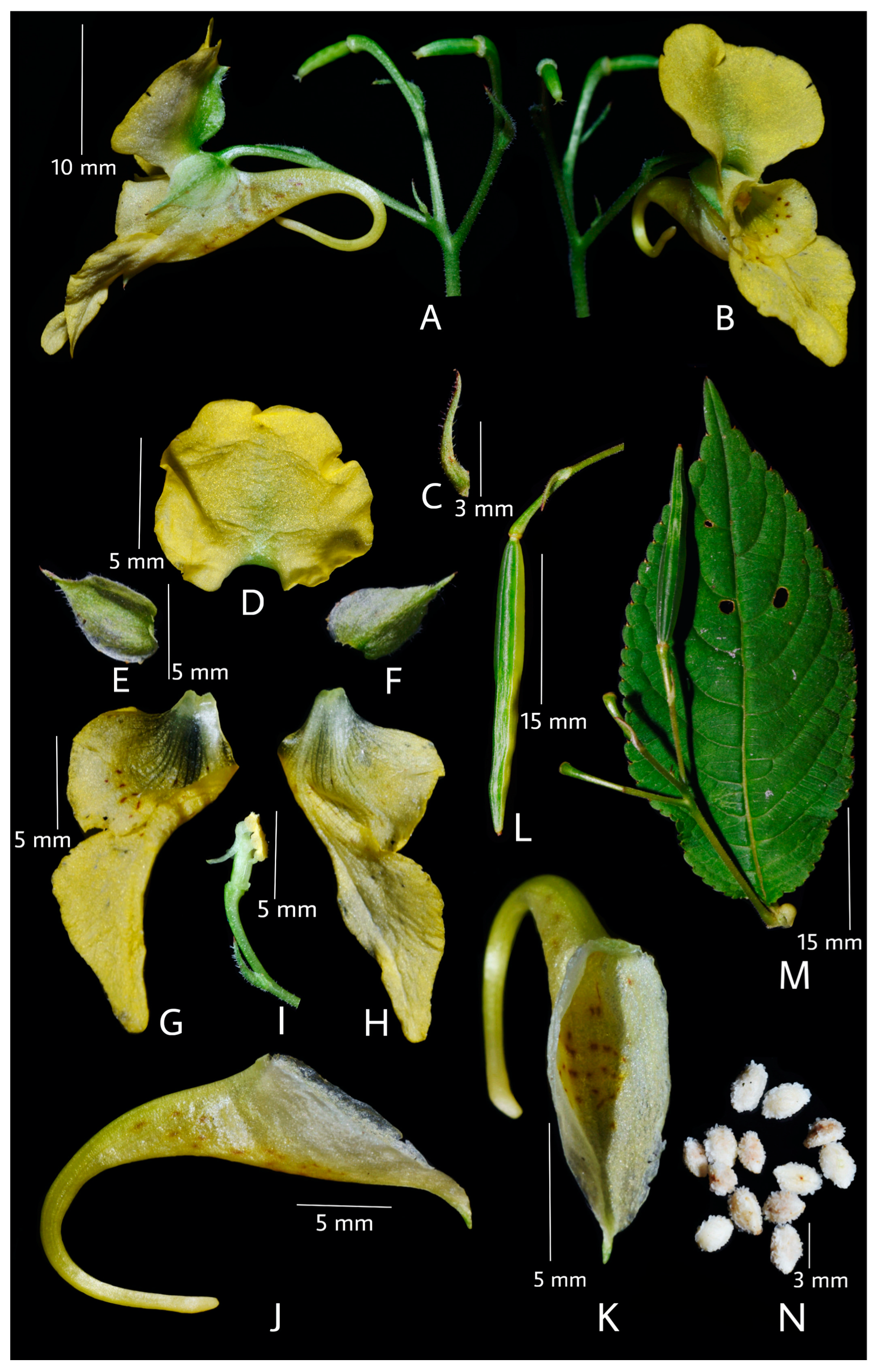
Figure 2.
Impatiens reidii Hook.f. A – Flowering plant habit; B – Stem showing swollen nodes and glands/extrafloral nectaries at base of petiole; C – Dehisced capsule and glands/ extrafloral nectaries at the base of petiole; D – Inflorescence showing mature flowers side view, bracts and buds. All photographs by Ashutosh Sharma.
Figure 2.
Impatiens reidii Hook.f. A – Flowering plant habit; B – Stem showing swollen nodes and glands/extrafloral nectaries at base of petiole; C – Dehisced capsule and glands/ extrafloral nectaries at the base of petiole; D – Inflorescence showing mature flowers side view, bracts and buds. All photographs by Ashutosh Sharma.
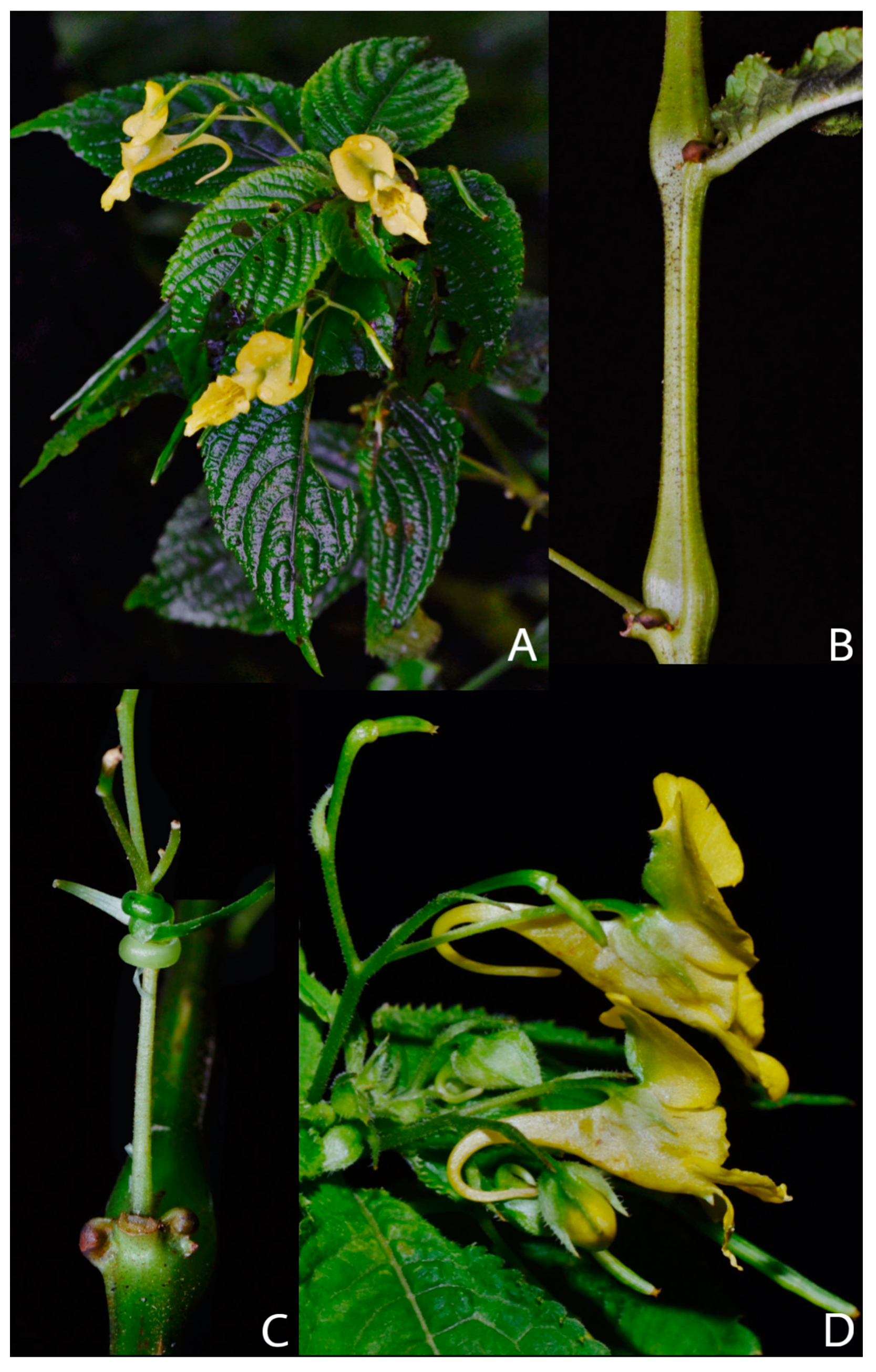
Figure 3.
Impatiens inayatii Hook.f. A – inflorescence with frontal view of flower, B –inflorescence with side view of flower, C – capsule with pedicel and bract at base, D –dorsal petal (abaxial), E – flower bud lateral sepal (abaxial), F – mature flower lateral sepal (abaxial), G – stamens and ovary, H – lateral united petal (abaxial), I – lateral united petal (adaxial), J – bract, K – side view of lower sepal, L – lower sepal from below, M – inside view of lower sepal, N – side view of flower, O – seeds. All photographs by Ashutosh Sharma.
Figure 3.
Impatiens inayatii Hook.f. A – inflorescence with frontal view of flower, B –inflorescence with side view of flower, C – capsule with pedicel and bract at base, D –dorsal petal (abaxial), E – flower bud lateral sepal (abaxial), F – mature flower lateral sepal (abaxial), G – stamens and ovary, H – lateral united petal (abaxial), I – lateral united petal (adaxial), J – bract, K – side view of lower sepal, L – lower sepal from below, M – inside view of lower sepal, N – side view of flower, O – seeds. All photographs by Ashutosh Sharma.
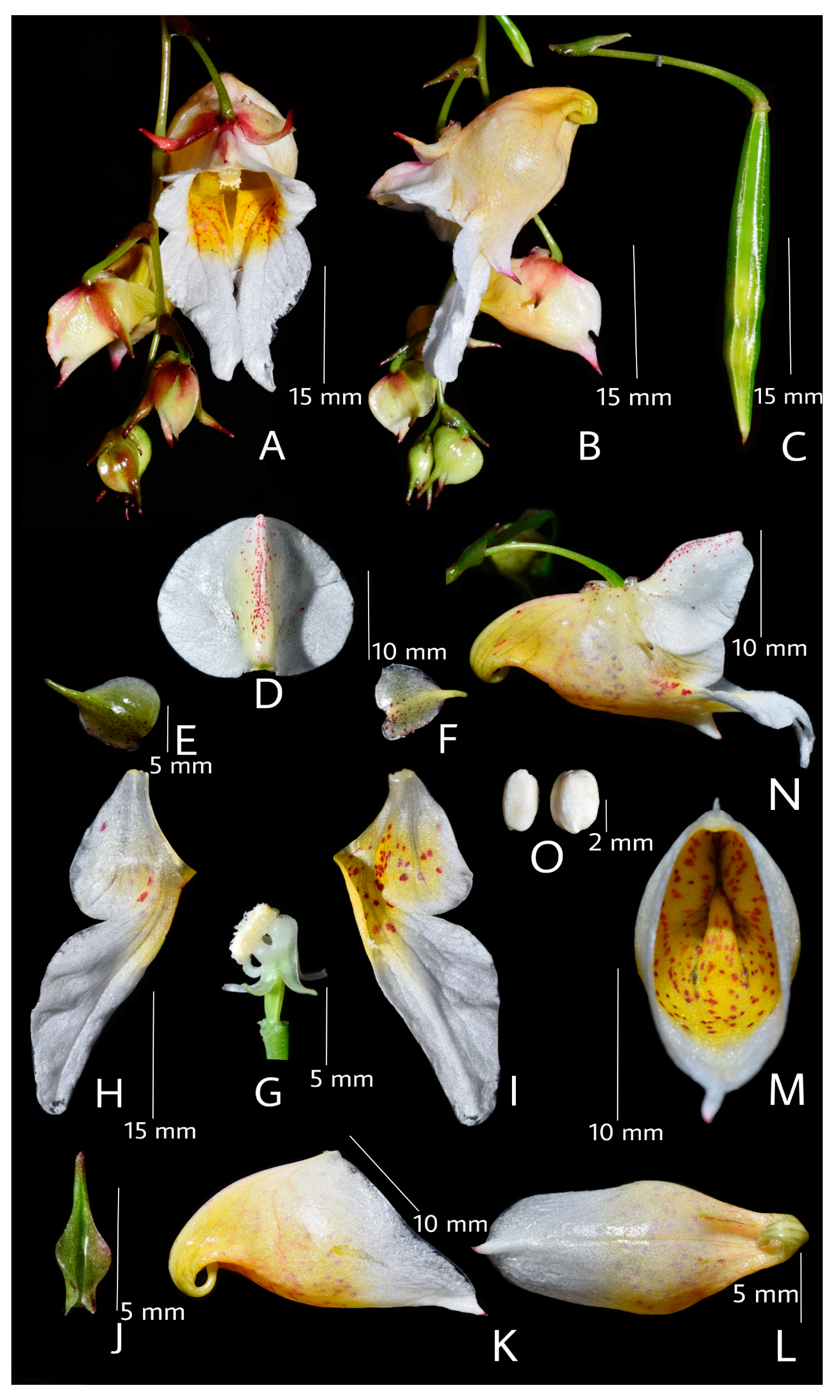
Figure 4.
Impatiens inayatii Hook.f. A & B – Flowering plant habit showing pendulous racemose inflorescences, swollen nodes and thick coriaceous leaves; C – Small filiform glands at the base of petiole on apical branches; D – Fresh dissected floral parts processing in field showing floral parts fixed on a white paper with colorless adhesive. All photographs by Ashutosh Sharma.
Figure 4.
Impatiens inayatii Hook.f. A & B – Flowering plant habit showing pendulous racemose inflorescences, swollen nodes and thick coriaceous leaves; C – Small filiform glands at the base of petiole on apical branches; D – Fresh dissected floral parts processing in field showing floral parts fixed on a white paper with colorless adhesive. All photographs by Ashutosh Sharma.
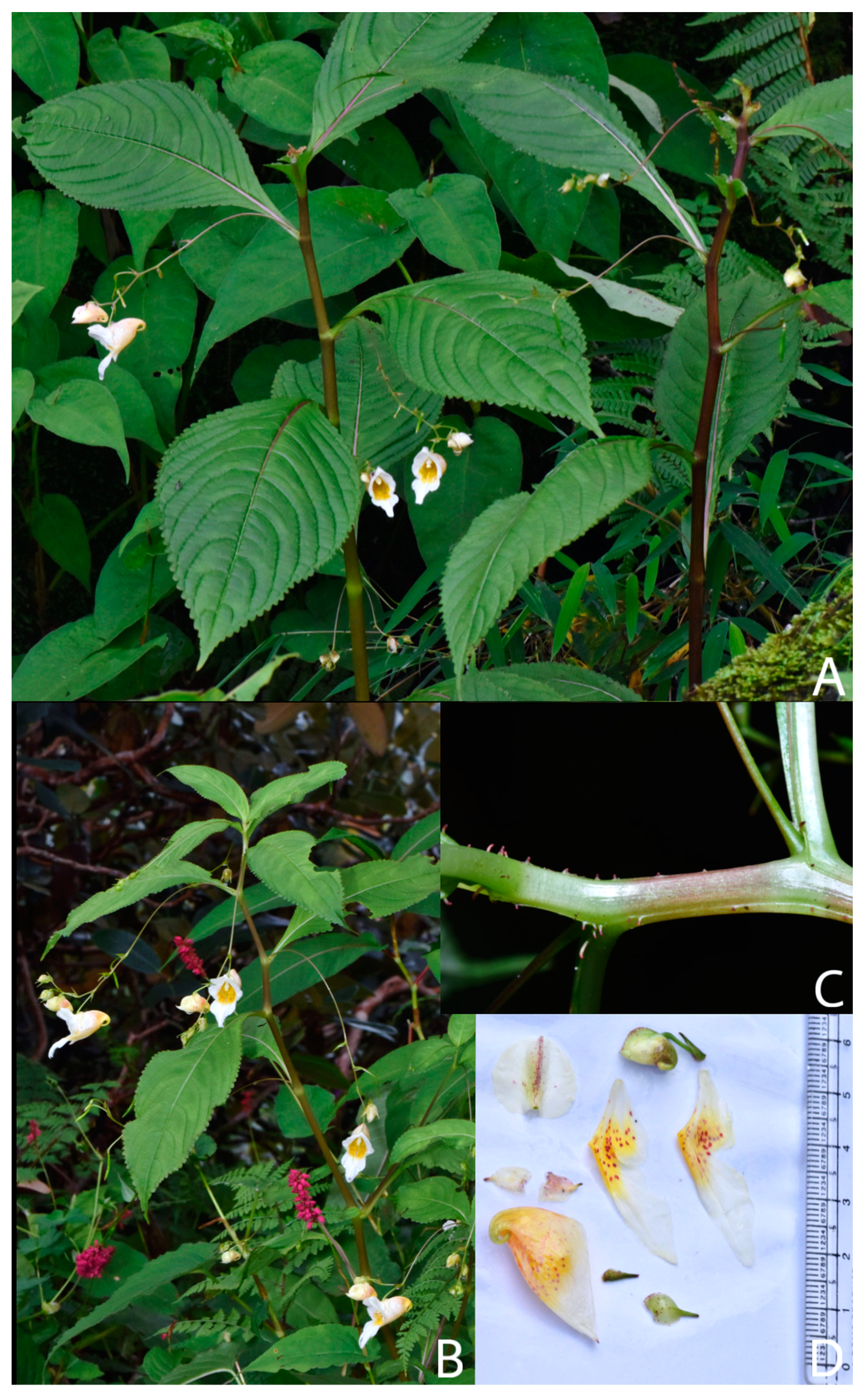
Figure 5.
Impatiens tingens Edgew. A – Flower front view and buds showing lower sepal and spur, B – Lateral united petals showing with long appendage, C – Lower sepal and spur, D – Flowering plants habitat at the type locality (Narkanda, Shimla). All photographs by Ashutosh Sharma.
Figure 5.
Impatiens tingens Edgew. A – Flower front view and buds showing lower sepal and spur, B – Lateral united petals showing with long appendage, C – Lower sepal and spur, D – Flowering plants habitat at the type locality (Narkanda, Shimla). All photographs by Ashutosh Sharma.
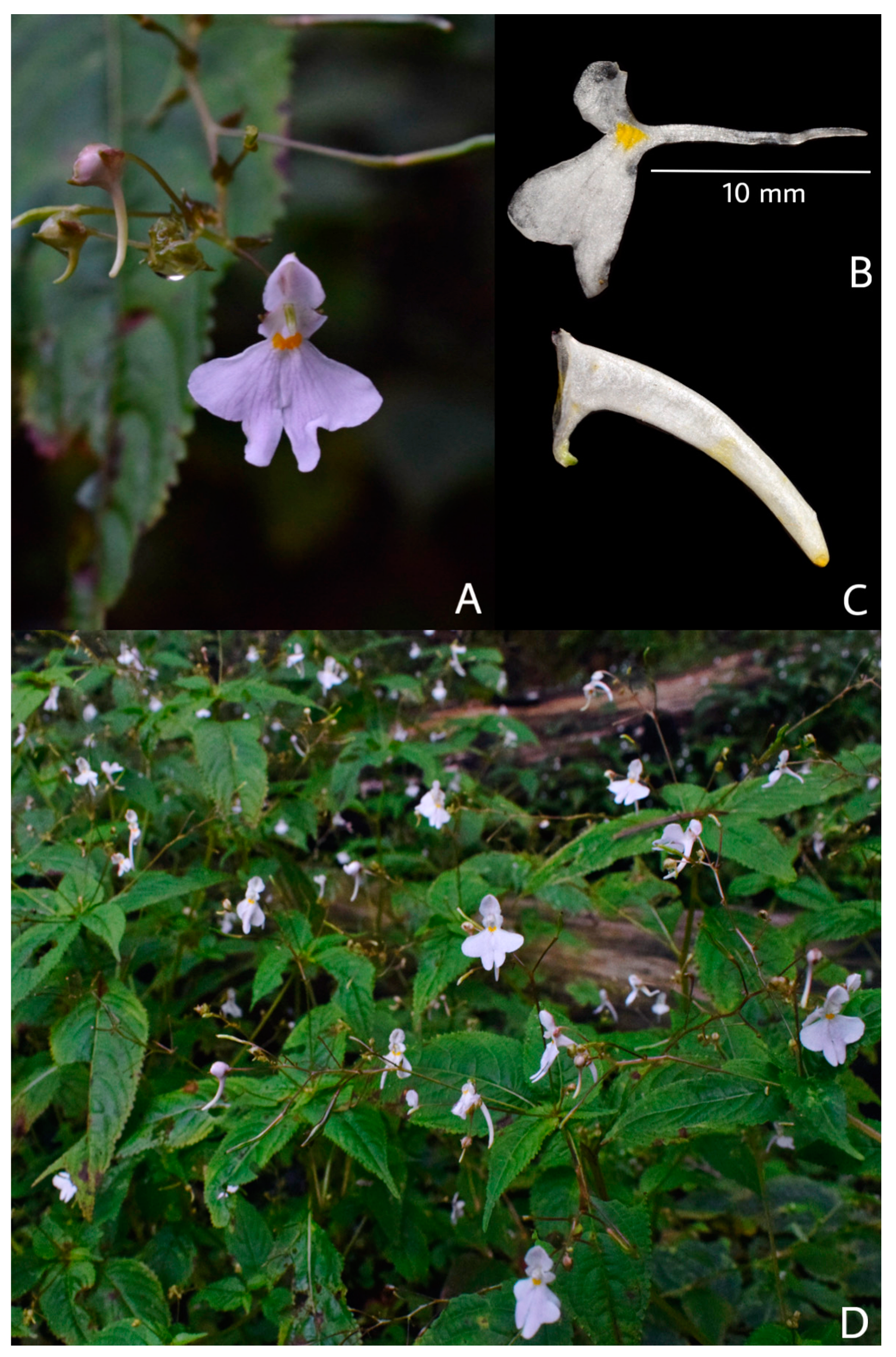
Figure 6.
A - Impatiens tingens Edgew. lectotype; B – Impatiens scullyi Hook.f. (J. Scully 272, K000694939, holotype). Note type specimen of both species A & B showing illustrated long auricle arising from the base of lateral united petal. Images copyright Royal Botanical Garden, Kew.
Figure 6.
A - Impatiens tingens Edgew. lectotype; B – Impatiens scullyi Hook.f. (J. Scully 272, K000694939, holotype). Note type specimen of both species A & B showing illustrated long auricle arising from the base of lateral united petal. Images copyright Royal Botanical Garden, Kew.
Disclaimer/Publisher’s Note: The statements, opinions and data contained in all publications are solely those of the individual author(s) and contributor(s) and not of MDPI and/or the editor(s). MDPI and/or the editor(s) disclaim responsibility for any injury to people or property resulting from any ideas, methods, instructions or products referred to in the content. |
© 2025 by the authors. Licensee MDPI, Basel, Switzerland. This article is an open access article distributed under the terms and conditions of the Creative Commons Attribution (CC BY) license (http://creativecommons.org/licenses/by/4.0/).
Copyright: This open access article is published under a Creative Commons CC BY 4.0 license, which permit the free download, distribution, and reuse, provided that the author and preprint are cited in any reuse.


