Introduction
The European Union has implemented several policies and strategies to support mountain entrepreneurship, including: the LEADER Rural Development Programme, the European Strategy for Mountain Regions, funds for renewable energies in mountain areas. Former projects have turned into successful businesses at European mountain level, and the current programmes will support future renewable development. The most relevant indicators for renewable development at European mountain level refer to existing enterprises (I1), newly established enterprises (I2) and high growth enterprises that create the most jobs (I10).
The concept of sustainable mountain development was first used in the UN Agenda 21 as a sign of recognition of global priorities. A study conducted in 1999 by Price and Kim (1999) shows that out of 249 respondents the majority considered environmental variables to be more important than socio -political or economic variables and that there are important differences both between different parts of Europe and between types of respondents. Such findings have been considered as a reference point for defining European and national mountain policies.
In a mountain research specific to South-Eastern Europe, the authors emphasize that the unique landscape and biological diversity can create high economic potential. The human, ecological and economic dimensions that arise in different mountain regions have similar characteristics. Some areas are subject to specific conditions of regional and national mountain policy. These researchers believe that understanding the importance of mountain regions and preserving the natural heritage requires scientific and institutional cooperation at all levels. (Zhelezov 2015)
Other mountain-specific studies show that the desire to implement evidence-based policies has led to a sharp development of quantitative indicators and targets at European level, with the ultimate goal of designing policy measures and assessing their impact. The focal point of this research is the focus on the development of regional and local mountain policies. The main objective is to support territorial diversity by local, national and transnational authorities and use it as a lever in public and private policies, in the governance of human, economic and natural resources. (Gløersen et al 2016)
Other research on sustainable development shows that the more than 10 major mountain ranges in Europe, with a rare biodiversity, affect the climate and shape the history and society, but especially the economy of the community space. The mountain areas of Europe face a series of problems related to natural hazards, depopulation/aging of the population in remote rural areas or the increase in car traffic on the main routes. Given the need for a circular economy at European level, financial and material investments must be intensified at an alert pace in the most sustainable areas of the community space, namely mountain areas. (Schneiderbauer 2024)
A study on the sustainable development of European mountain entrepreneurship focuses its argument on the development of tourism as a central point of the sustainability of the community space. The authors consider that the economic development of tourism in disadvantaged mountain areas has the role of supporting their development and economic growth. The vision regarding tourism planning in disadvantaged mountain regions must be oriented towards sustainable development, which facilitates the stimulation of entrepreneurial initiatives through the diversification and harmonization of tourism services. These services must be correlated with the specific requirements of tourists and dynamically adapted to emerging social challenges, thus ensuring the complementarity and sustainability of this sector. (Cristache et al 2021)
The same idea of sustainable development of mountains through tourism is also found in other researchers, such as Kuščer et al (2017). The authors conducted a comparative analysis of mountain destinations in Austria, Slovenia and Switzerland, small states located in the Alpine region. The study was conducted based on the responses provided by 88 managers in the field of tourism. The results obtained confirm the existence of significant differences in terms of the stages of tourism development, levels of innovation and the role of the socioeconomic environment in supporting this sector. Mountain destinations in Switzerland and Austria demonstrated a considerable advance compared to those in Slovenia in almost all the aspects analyzed. However, no significant differences were identified in terms of the protection and quality of the natural environment or the inherited socio-cultural attractiveness. These findings can provide support to the authorities responsible for tourism development and the development of public policies, contributing to the optimization of the determinants of the sustainable development of tourist destinations.
Professor Rey (2015) highlights the importance of sustainable mountain development by ensuring a dynamic complexity of urban, but especially rural, space. He emphasizes that the secondary, tertiary and quaternary mountain economic sectors become unsustainable without the primary sector of the economy, without family farms, based on meadows and pastures, ruminant farming and organic fertilizers. The researcher emphasizes that the main dimension of mountain entrepreneurship remains the mountain product. The attention of all European actors must be focused on the rapid demographic growth and the existence of a significant market segment interested in healthy mountain products that can ensure sustainability. The proposal formulated in this study aims to develop an innovative associative-cooperative system, adapted to specific realities. It would be organized at the level of traditional bio -zones, with the aim of supporting niche production in mountain regions and connecting it with appropriate consumer segments. The implementation of such a system, based on the use of local brands, could contribute to economic recovery and sustainable growth through mechanisms of self-reproduction and consolidation of local value chains.
Regarding European mountain models, it is worth mentioning the Swiss, Romanian and Italian systems. Switzerland represents a successful model in European mountain entrepreneurship, especially through the integration of hydropower and sustainable tourism. Romania demonstrates that South-Eastern Europe can be sustainable through mountain entrepreneurship in the development of agro-tourism in areas such as Apuseni, Bucovina and Maramureș. Italy supports the development of European mountains through initiatives to promote local mountain products through short supply chains.
Materials and Research Method
The research in this paper is based on Eurostat data related to mountain and non-mountain entrepreneurship – secondary, tertiary and quaternary economic sectors – from the meta-index
urt_bd_hgn. The analyzed indicators refer to I1 – Active enterprises, I2 – Newly established enterprises and I10 – Rapidly growing enterprises measured by employment (part of the European indicators posted by the authors at the link
https://doi.org/10.5281/zenodo.14713867). The statistical analysis presents an observable evolutionary character for the period 2021-2022, and the forecast analysis is carried out for the period 2023-2025. The data were extracted from Eurostat, and subsequently processed in Excel (
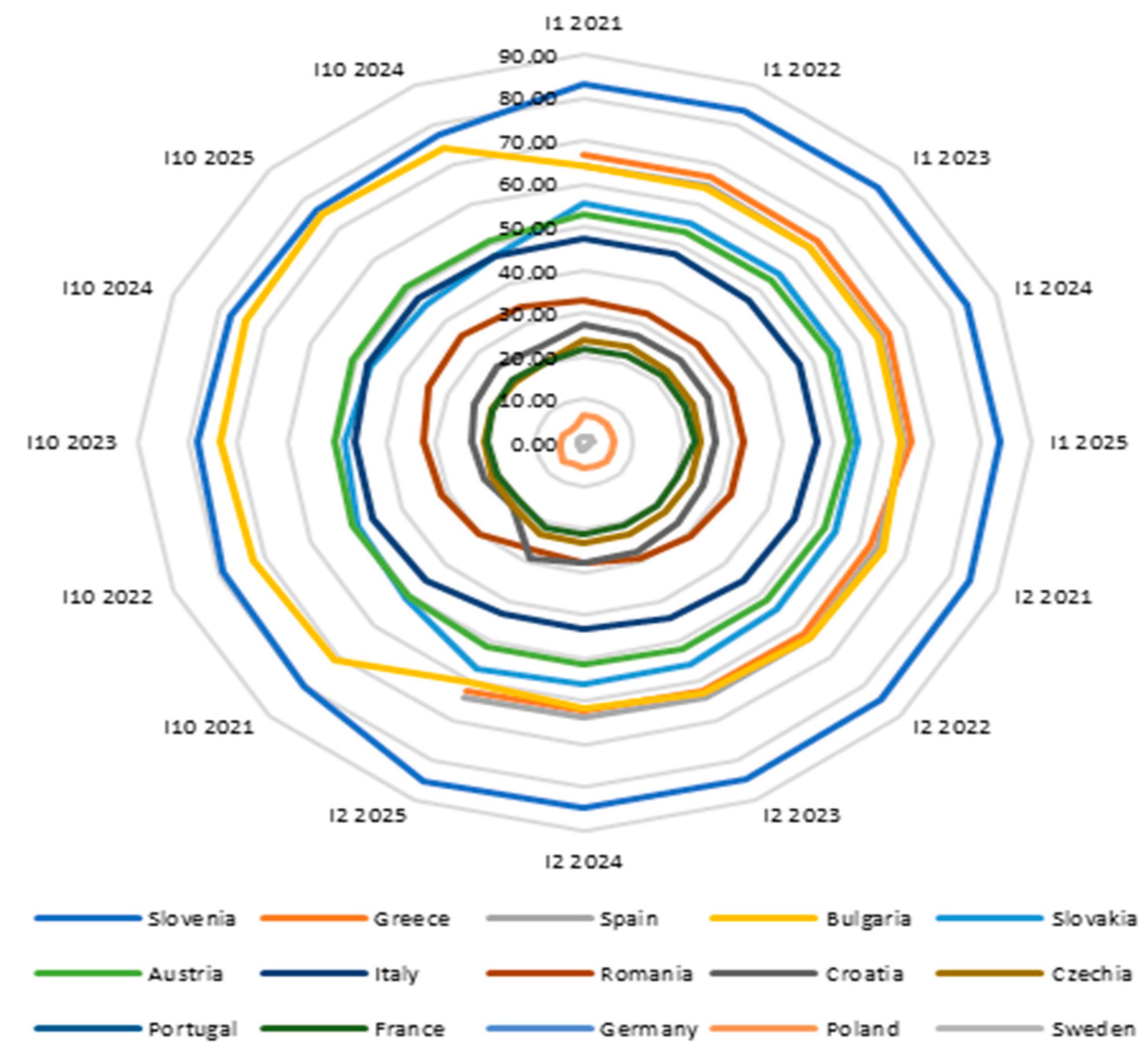
Figure 1 and
Table 2) and SPSS (the rest of the tables and figures), using simple (descriptive and autocorrelation) or complex (forecast) analyses.
The need for an exhaustive analysis, regarding the indicators presented with values for entrepreneurship in mountain (M) and non-mountain (NM) areas, led the authors to a simple descriptive analysis of the range, sum, mean, standard error of the mean, standard deviation, skewness and kurtosis (
Table 1). Following the range analysis, a large variability is noted between the two categories, suggesting that NM22 (2022) has a greater dispersion of data compared to M21 (2021) for all the indicators presented. Regarding the sum analysis, it is observed that NM21 (2021) has a significantly higher total contribution compared to M22 (2022). For the mean, it is indicated that NM21 presents, on average, much higher values than M21. The standard error of the mean suggests that NM21 has a greater variability around the mean compared to M21. For the standard deviation, a greater dispersion of the data is observed for M22 compared to NM21. The skewness suggests that the data distribution for NM21 is more skewed to the right compared to NM22. The lower kurtosis compared to the higher one suggests that NM21 has a more peaked distribution and heavier tails compared to NM22. Summarizing, NM21 (below I1) has the highest values for the sum, mean, std. error (standard) of the mean, and kurtosis, indicating a large total contribution, a high mean, high variability around the mean, and a peaked distribution. M21 (below I2) has the lowest values for the range, sum, mean, and std. error (standard) of the mean, suggesting a small total contribution, a low mean, and low variability around the mean. NM22 (below I0) shows the lowest skewness and kurtosis, indicating a relatively symmetric and flat distribution compared to the other categories.
Results
In accordance with the descriptive statistics presented in the previous section, the authors conducted an autocorrelation analysis for European mountain entrepreneurship related to statistical and forecast evolution, a percentage analysis of mountain areas in relation to non-mountain areas and the total of the two, respectively a forecast analysis for the coming years.
-
a.
Statistical evolution of European entrepreneurship in the period 2021-2022 through the prism of autocorrelation
The autocorrelation analysis, performed using the SPSS forecast function, returns values that vary between negative and positive values for all series (M2021, NM2021, M2022, NM2022). For the M2021 and M2022 series, the autocorrelations are closer to zero, indicating a weak dependence between values at different lags. In contrast, for the NM2021 and NM2022 series, the autocorrelations have higher values (both positive and negative), suggesting a stronger dependence between observations at specific lags. This indicates that the NM2021 and NM2022 series present a more pronounced autocorrelation structure compared to the M2021 and M2022 series. The standard error is relatively constant for each series, with small variations between lags. The M2021 and M2022 series have smaller standard errors compared to NM2021 and NM2022, which indicates a higher precision in estimating autocorrelation for these series. In contrast, the NM2021 and NM2022 series have slightly larger standard errors, suggesting a higher variability in autocorrelation estimates. Regarding the degrees of freedom (df) and significance (Sig.), it is observed that the degrees of freedom increase with lag, and the significance levels remain high for all series. High significance levels (above 0.05) indicate that there is insufficient evidence to reject the null hypothesis of absence of autocorrelation. This is true for all series, but is more pronounced in the case of the M2021 and M2022 series, where the significance levels are close to 1. For the NM2021 and NM2022 series, the significance levels are somewhat lower, suggesting a possible more significant autocorrelation at certain lags.
-
b.
Mountain and non-mountain areas in the distribution of European entrepreneurship in the period 2021-2025
entrepreneurship for the period 2021-2025 supports a dynamic evolution, especially of mountain areas (
Table 2).
The analysis of mountain areas for indicator I1 shows that most countries register increases in mountain areas, except for Austria (-0.96%), Malta (-1.13%) and Sweden (-19.03%). At the total, mountain and non-mountain level, Sweden has the largest decrease (-19.03%), followed by Austria (-0.96%) and Malta (-1.13%). The evolution of non-mountain areas for I2 shows that non-mountain areas (I2) show a mixed evolution, with Greece registering the largest increase (41.86%), followed by Luxembourg (32.45%) and Croatia (9.52%). At the total level, Estonia shows a decrease (-26.49%), followed by Hungary (-19.02%) and Denmark (-13.97%). The study of non-mountainous areas for I10 shows that they show the greatest variations, with Cyprus registering an extraordinary increase (4765.88%), followed by Lithuania (42.15%) and Italy (11.92%). At the overall level, Bulgaria shows a decrease (-8.60%), followed by Romania (-21.72%) and Poland (-5.52%).
Table 2.
Evolution of European mountain and non-mountain entrepreneurship in the period 2021-2022.
Table 2.
Evolution of European mountain and non-mountain entrepreneurship in the period 2021-2022.
| |
2022/2021 (+/-) (%) |
| Country |
I1 |
I2 |
I10 |
| Austria |
-0.96 |
2.61 |
0.48 |
| Bulgaria |
3.15 |
2.95 |
-8.60 |
| Croatia |
4.53 |
9.52 |
1.33 |
| Cyprus |
5.59 |
2.21 |
4765.88 |
| Czech |
3.06 |
5.99 |
2.63 |
| Denmark |
30.57 |
-13.97 |
-5.19 |
| Estonia |
12.45 |
-26.49 |
|
| French |
7.77 |
-4.89 |
6.20 |
| Greece |
4.21 |
41.86 |
-6.69 |
| Hungary |
2.88 |
-19.02 |
3.96 |
| Italy |
2.63 |
0.46 |
11.92 |
| Lithuania |
9.72 |
3.76 |
42.15 |
| Luxembourg |
7.60 |
32.45 |
9.11 |
| Malta |
-1.13 |
-1.98 |
3.87 |
| Poland |
0.40 |
0.02 |
-5.52 |
| Romania |
4.34 |
9.66 |
-21.72 |
| Slovakia |
6.83 |
12.65 |
12.40 |
| Slovenia |
4.97 |
9.07 |
2.98 |
| Spain |
2.09 |
-4.02 |
3.73 |
| Sweden |
-19.03 |
-9.87 |
-4.89 |
The analysis of the shares of mountain entrepreneurship in the European total shows that its evolution for the period 2021-2025 is presented in relatively linear dynamics. The data in
Figure 1 highlights past trends (2021-2022) and makes predictions for the period 2023-2025. Statistical and forecasting analysis suggests that, if current trends continue, European mountain entrepreneurship will experience overall growth, but with significant variations between regions.
-
c.
Europe 2025 forecast for mountain and non-mountain entrepreneurship
The forecast analysis for 2025, including the following, for mountain and non-mountain entrepreneurship in Europe presents a sustainable character offered by the mountain area.
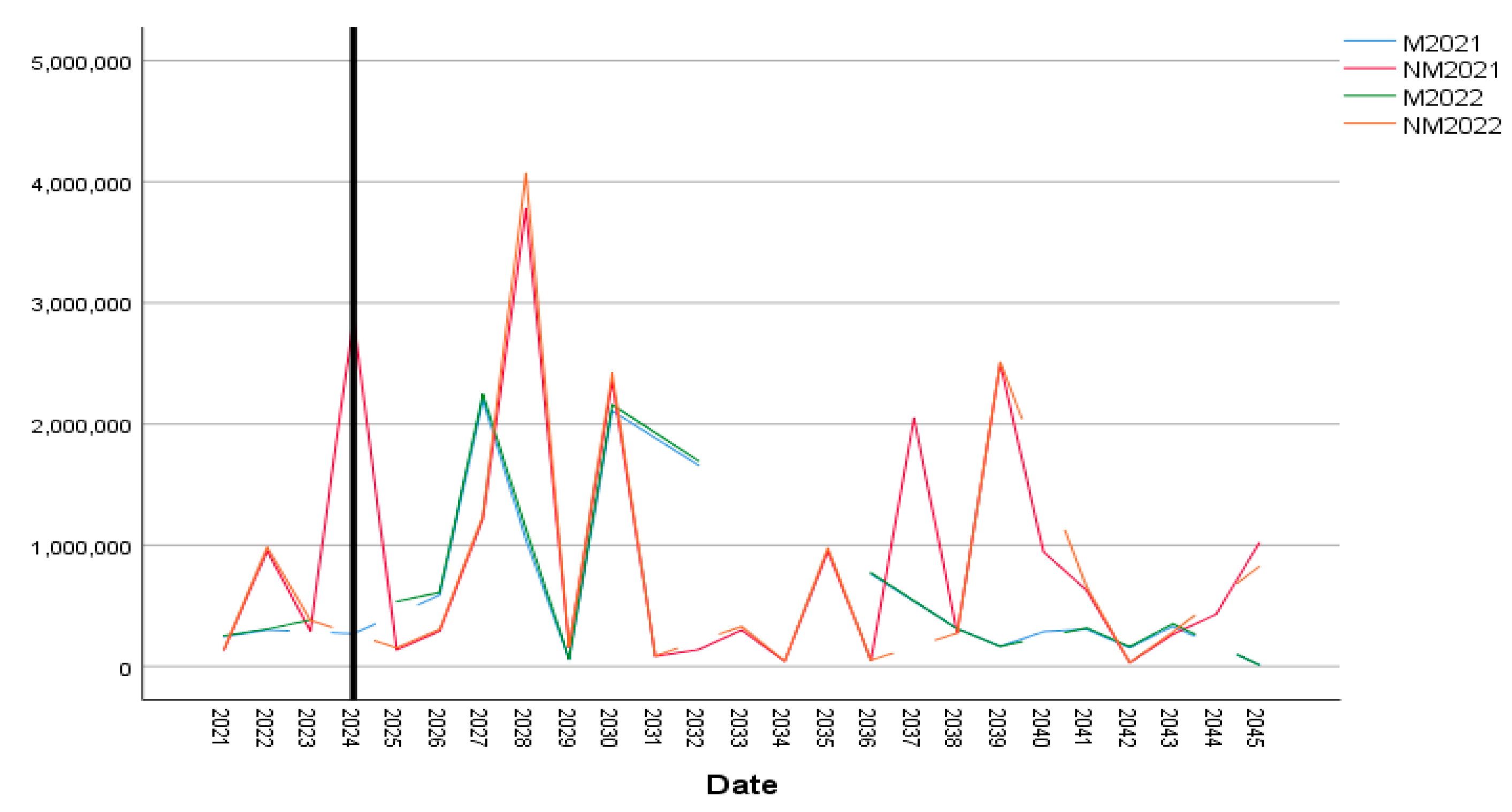
Figure 2 provides an insight into the evolution of mountain (M) and non-mountain (NM) enterprises in Europe between 2021 and 2025.
The analysis is based on historical data from 2021-2022 and projections for the following years. For the base period, 2021-2022, on which the model for 2025 was built, it can be seen that the data show significant fluctuations for both mountain and non-mountain enterprises; peaks in activity are seen, which may indicate seasonal or economic factors; non-mountain entrepreneurship (NM2022) recorded significant maximum values compared to M2022, suggesting faster development in non-mountain regions.
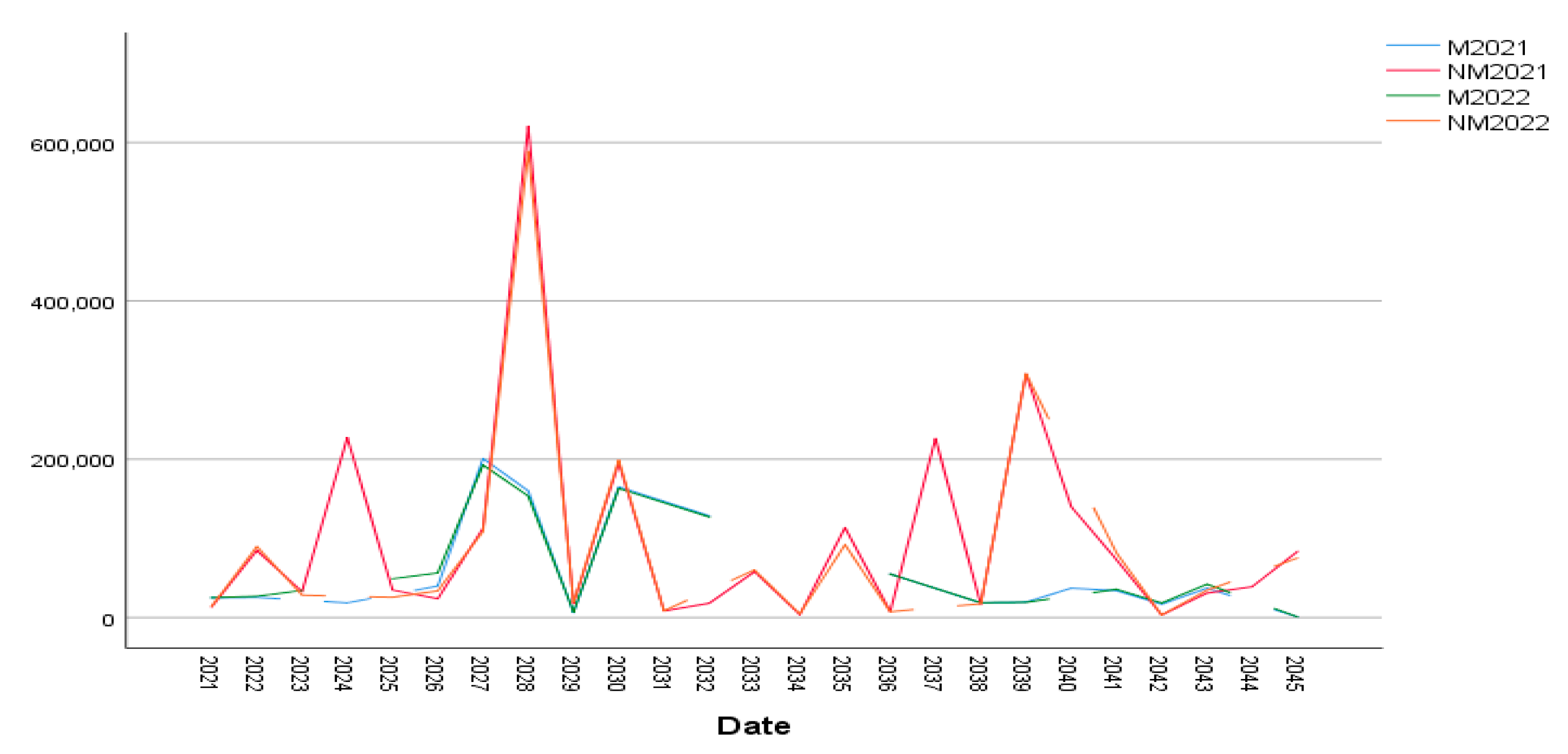
decreasing trend for the period 2021-2025 (
Figure 3). The figure shows a fluctuating number of enterprises, with increases and decreases recorded during this period. For the future, the graph suggests a stabilization of economic initiatives.
Towards 2024 and 2025, there seems to be a slight increase, which may indicate an economic recovery or new policies supporting entrepreneurship. The differences between mountain and non-mountain enterprises established in the analyzed period, with lines for M2021, M2022, NM2021 and NM2022 relatively close, indicate a balanced interest between mountain and non-mountain businesses. There are periods when mountain enterprises seem to be more numerous, but the differences are not very large.
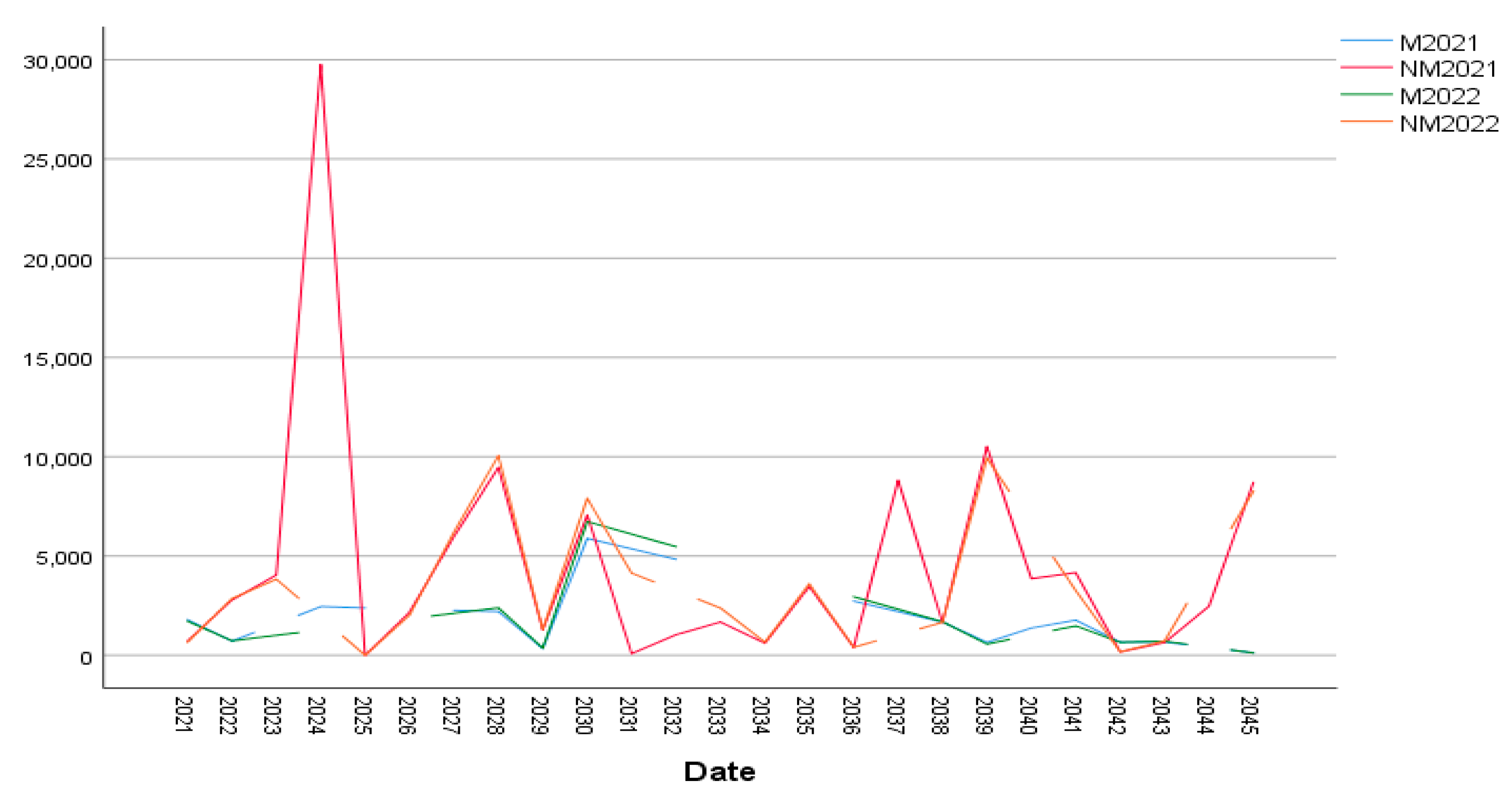
Analyzing the graph on the intensity of European enterprises with high employment (employability) (
Figure 4), mountain (M) and non-mountain (NM), for the period 2021-2025, it can be seen that the overall evolution of employability is induced by a significant peak in 2024, when the number of non-mountain enterprises (NM2022) increases sharply. This increase may be the result of favorable economic policies, major investments or the need for labor in certain sectors. After 2024, a steep decline is observed, followed by a slight increase towards the end of 2025. The differences between mountain and non-mountain enterprises show that before 2023 the development in these firms is relatively balanced. In 2024, non-mountain businesses see massive employment growth, suggesting a higher demand for labor in non-mountain areas.
Discussion
The results of the paper show a dynamic entrepreneurship in the analyzed sectors, especially for the mountain area. The results demonstrate that mountain entrepreneurship represents the main vector of self-generating development in Europe.
-
a.
Statistical evolution of European entrepreneurship in the period 2021-2022 through the prism of autocorrelation
From the analysis of autocorrelation and statistical evolution in the period 2021-2022, conclusions can be drawn regarding the dynamics of mountain (M) and non-mountain (NM) entrepreneurship in Europe:
- stability and predictability in mountain entrepreneurship (M2021 and M2022): the data series related to mountain entrepreneurship (M2021 and M2022) show weak autocorrelation and low statistical values, which indicates a reduced dependence between observations at different lags ; this suggests that mountain entrepreneurship is more stable and less influenced by external factors or significant fluctuations. The smaller standard error confirms a higher precision in estimating the evolution, which reflects a better predictability of this sector;
- higher volatility and dependence in non-mountain entrepreneurship (NM2021 and NM2022): the data series for non-mountain entrepreneurship (NM2021 and NM2022) show stronger autocorrelations (both positive and negative) and higher values of the statistic, indicating a more pronounced dependence structure between observations; this suggests that non-mountain entrepreneurship is more volatile and more susceptible to external influences or structural changes. The higher standard error reflects increased variability, which makes estimates for this sector less precise and more difficult to predict;
- comparison between the two types of entrepreneurship : mountain entrepreneurship (M) appears to be more resistant to fluctuations and more stable in the long term, which makes it attractive for medium and long-term investments. This stability can be attributed to factors such as constant natural resources and a lower dependence on rapid economic changes; on the other hand, non-mountain entrepreneurship (NM) is more dynamic and more sensitive to economic, social or environmental changes. This volatility can offer opportunities for rapid growth, but also higher risks, which requires more careful management and faster adaptation to new conditions;
- implications for policies and strategies: for mountain entrepreneurship, it is important to maintain stability and support long-term investments, given its predictable and resilient character; for non-mountain entrepreneurship, it is essential to develop flexible strategies that allow rapid adaptation to changes and minimize the risks associated with volatility.
-
b.
Mountain and non-mountain areas in the distribution of European entrepreneurship in the period 2021-2025
Mountain areas (I1) have shown a positive evolution in most countries, with significant increases especially in Northern European countries (Denmark, Estonia) and Eastern European countries (Lithuania). Decreases are limited and less significant, except in Sweden, which records a substantial decrease.
Non-mountainous areas (I2) have had a more volatile evolution compared to mountain areas. Increases are significant in countries such as Greece and Luxembourg, while decreases are pronounced in Estonia and Hungary. This suggests that non-mountainous areas are more sensitive to external factors or regional changes.
Non-mountainous areas (I10) are the most dynamic, with extreme variations in countries such as Cyprus and Lithuania. Massive increases in Cyprus and Lithuania indicate possible structural changes or significant investments in these areas. Significant decreases in Bulgaria and Romania suggest possible economic difficulties or changes in entrepreneurial dynamics.
As can be seen, mountain areas (I1) appear to be more stable and less volatile, while non-mountain areas (I2 and I10) are more dynamic and sensitive to regional or economic changes.
Regarding the statistical and forecast analysis for the period 2021-2025, the observations for the years 2021-2022 show significant differences between the European countries analyzed. The following aspects can be noted:
- Slovenia and Slovakia show high values in terms of entrepreneurship, indicating sustained growth in mountain regions.
- Greece and Spain have a lower trend, which may suggest difficulties in developing businesses in mountainous areas.
- Germany and France have a stable evolution, with moderate increases, indicating a balance between mountainous and non-mountainous regions.
- Eastern European countries (Romania, Bulgaria, Poland) show progressive growth, which suggests an intensification of entrepreneurial initiatives in these regions.
The trends observed in the base period (2021-2022) are extrapolated to estimate the evolution in the period 2023-2025:
- Slovenia and Slovakia will continue to be leaders in mountain entrepreneurship, with slight growth, but with the risk of market saturation.
- Western European countries (France, Germany, Austria, Italy) will maintain a constant growth rate, benefiting from favorable policies and developed infrastructure.
- Spain and Greece may experience stagnation or even decline if economic support measures are not implemented.
- Eastern European countries will see the greatest growth due to investments in regional development and facilitating access to resources.
-
c.
Europe 2025 forecast for mountain and non-mountain entrepreneurship
The forecast for 2023-2025 related to I1 indicates that the general situation is in permanent positive dynamics, as follows:
- moderate growth of mountain enterprises: data indicate stabilization and possible slight growth in mountain regions;
- continued oscillations in non-mountainous regions: non-mountainous enterprises will continue to fluctuate, but at higher levels than mountainous ones;
- economic and political factors: supporting policies and access to resources will influence growth in both sectors.
The projection for the end of 2025 shows that, if current trends for I2 continue, there is a possibility that 2025 will bring a slight increase in the number of enterprises, both mountain and non-mountain. Economic factors, such as government support or access to finance, will influence whether this increase is sustained. This point analysis for I2 shows that although non-mountain entrepreneurship is growing more rapidly, mountain entrepreneurship can benefit from specific measures to stimulate sustainable economic development.
The related analysis for I10 argues that after 2023, employability drops sharply, and towards 2025 a gradual recovery is observed, possibly due to economic stabilization. The forecast for 2025 suggests that if current trends continue, employability in mountain and non-mountain enterprises will increase slightly in 2025, but without extreme peaks like in 2023. Factors such as digitalization, access to finance and economic policy will influence the level of employment in enterprises.
Conclusion
Entrepreneurship is characterized by stability and predictability, while non-mountain entrepreneurship is more dynamic and sensitive to change. Both sectors have complementary roles in the European economy, but require different approaches in terms of support policies and development strategies. Mountain entrepreneurship represents, according to Eurostat data, the main vector of community development.
The authors propose several solutions for the mountain area regarding infrastructure, financial and legislative involvement, and computerization, as follows:
- infrastructure development: low-growth countries should invest more in infrastructure and in supporting start- ups ;
- financial and legislative support: funding programs and favorable regulations can stimulate entrepreneurship in less developed regions;
- digitalization and innovation: mountain regions can benefit from modern technologies to support businesses and make them more sustainable.
entrepreneurship is an important vector of renewable development in Europe, with the potential to transform mountain regions into sustainable hubs of innovation and economic growth. With adequate support from European policies and local initiatives, European mountain enterprises can significantly contribute to a green and resilient economy.
The following can be noted as final conclusions for the mountainous area:
(1) Mountain entrepreneurship needs additional economic support to support total entrepreneurship, including non-mountain entrepreneurship.
(2) Seasonality must be taken into account in development strategies for mountain enterprises.
(3) Investments in infrastructure and digitalization can reduce gaps in supply chains within mountain and non-mountain entrepreneurial systems.
Author Contributions
Conceptualization, BC and MC; Data Verification, BC and MC; Formal Analysis, BC; Research, BC and MC; Methodology, BC; Software, BC and MC; Validation, BC; Visualization, BC and MC; Writing - original draft, BC; and Writing - review and editing, BC and MC
Conflict of Interest Statement
The authors declare that there are no conflicts of interest.
Statement on the Use of Artificial Intelligence
During the preparation of this article, the authors used the ChatGPT tool for the purpose of statistical analysis suggestions. After using this tool/service, the authors reanalyzed, rewrote, revised, and edited the content as necessary and assume full responsibility for the content of the publication.
References
-
Cristache N, Soare I, Nastase M, Antohi VM. 2021. Integrated approach of the entrepreneurial behavior in the tourist sector from disadvantaged mountain area from Romania. Environment, Development and Sustainability 1-17.
-
Eurostat. 2025. Business demography and high growth enterprises by NACE Rev. 2 activity and other typologies [urt_bd_hgn__custom_15325082].
-
Gløerse E, Mader C, Ruoss E. 2016. What policy evidence for a European strategy of sustainable development in the mountains regions ? Journal of Alpine Research Revue de géographie alpine 104:3.
-
Kuščer K, Mihalič T, Pechlaner H. 2017. Innovation, sustainable tourism and mountain environments destination development : a comparative analysis of Austria, Slovenia and Switzerland. Journal of Sustainable Tourism 25(4):489-504.
-
Price MF, Kim EG. 1999. Priorities for sustainable mountain development in Europe. The International Journal of Sustainable Development & World Ecology 6(3):203-219.
-
Rey R. 2015. New challenges and opportunities for mountain agri-food economy in South Eastern Europe. A scenario for efficiency and sustainable use of mountain products, based on the family farm, in an innovative, adapted associative cooperative system – horizon 2040. Proceedings Economics and Finance 22:723-732.
-
Schneiderbauer S. 2024. Challenges and opportunities for sustainable development in European mountains (Europe- Introduction). Safeguarding Mountain Social- Ecological Systems 2:153-156.
-
Zhelezov G (Ed.). 2015. Sustainable development in the mountains regions : Southeastern Europe. Springer.
|
Disclaimer/Publisher’s Note: The statements, opinions and data contained in all publications are solely those of the individual author(s) and contributor(s) and not of MDPI and/or the editor(s). MDPI and/or the editor(s) disclaim responsibility for any injury to people or property resulting from any ideas, methods, instructions or products referred to in the content. |
© 2025 by the authors. Licensee MDPI, Basel, Switzerland. This article is an open access article distributed under the terms and conditions of the Creative Commons Attribution (CC BY) license (http://creativecommons.org/licenses/by/4.0/).