

Submitted:
13 February 2025
Posted:
13 February 2025
You are already at the latest version
Abstract
This study examines the impact of various tillage practices on the agrophysical and hydrophysical properties of sierozem and light chestnut soils in Southeastern Kazakhstan. The objective is to develop an optimized tillage strategy to enhance soil fertility and moisture conservation. The research evaluates both conventional and innovative tillage methods, analyzing their effects on soil erosion, structure, and water retention. Field trials demonstrated that replacing traditional moldboard plowing with chisel and flat-cutting tillage, along with combined implements for leveling, crushing, and rolling, significantly reduces erosion and improves moisture retention. The results suggest that adopting alternative tillage technologies can enhance soil conservation and crop productivity while reducing operational costs.
Keywords:
soil erosion
; tillage machinery
; moisture retention
; agrophysical properties
; chisel tillage
; conservation agriculture
; field experiments
1. Introduction
The irrigated zone of Southern and Southeastern Kazakhstan cultivates the following row crops: soybeans, sugar beets, corn, sunflowers, safflower, rapeseed, mustard, and vegetables. This zone is the main supplier of thermophilic crops to the market: tomatoes, peppers, eggplants, watermelons, melons, cucumbers, and table and fodder root crops. Cereal crops are cultivated partially in the irrigated zone and under dryland conditions. Therefore, this zone is of great importance for providing the population with affordable food and fodder for livestock development. However, currently, the yield of row and cereal crops remains low, due to several factors, including: insufficient moisture supply, violation of cultivation technology, and soil degradation caused by water and wind erosion due to inadequate tillage.
The climate of the southern and southeastern zone of Kazakhstan is sharply continental with high summer temperatures and insufficient precipitation. The main feature of the precipitation regime is the concentration of its maximum in the spring period and the minimum in the summer. Winter precipitation accounts for 15-25% of the annual total, summer precipitation accounts for slightly more than 20%, and the same amount falls in autumn. Autumn is always dry and warm. In August, September, and October, the average monthly precipitation norm is about 10-30 mm.
The main soil types on which agricultural crops are cultivated are light chestnut soils and sierozems.
Light chestnut soils are found in the mountainous zone of the region at an altitude of 700-1000 m above sea level. They are characterized by a predominance of slopes with a steepness of 3-8°, and slopes with a steepness of 1-3° occupy a significant proportion (40.4%). The weighted average slope steepness is 3.9°. The amount of erosion-prone arable land on light chestnut soils is 105.3 thousand hectares or 97.2% [1]. The main features are weak structure and water-holding capacity. In the spring, at a moisture content of 70-80% of the field capacity (FC), they have an equilibrium density in the 0-10 cm layer of 0.6-0.9 g/cm³, which is optimal for plant development. Since the soils are located in a sharply continental climate zone with high daytime temperatures, their drying occurs over a short period in the spring-summer period. Precipitation is uneven, and its amount is subject to sharp fluctuations from year to year, averaging 350-450 mm. Spring fieldwork is often carried out at low or high humidity, which leads to the development of erosion processes.
Ordinary sierozems occupy foothill plains, foothills, and low mountains at an altitude of 600-700 to 900-1000 m, where they are formed under ephemeral-wormwood vegetation. The average annual precipitation is 250-400 mm. Parent materials are loess-like loams and loesses. The bulk of sierozems have a light loamy and sandy loam texture; therefore, these soils can be susceptible to all types of erosion, which must be considered during tillage.
In connection with the above, the main factors negatively affecting plant development and their productivity on these soils are:
- soil degradation through deterioration of their agrophysical condition under the influence of tillage implements during the cultivation of dry soils, which creates conditions for soil pulverization and erosion.
All soils are subject to erosion processes to one degree or another; however, most of them, without the intervention of anthropogenic factors, under the influence of vegetation, water, and temperature regimes characteristic of the zone of their distribution, come to an equilibrium state in which density, structure, and other agrophysical indicators fully or partially return to the initial characteristics of this soil type. During tillage for crops, their agrophysical state changes under the influence of machinery and climatic factors.
Spring tillage is carried out from March 20 to April 25, which is associated with recurring spring frosts. After March 10-15, there is a sharp increase in air temperature, which leads to the drying of the surface soil layer. As a result, soil clods in the upper layer harden, their hardness reaches 3 or more MPa, and subsequently, they are difficult to break down. Carrying out spring moldboard plowing when the upper soil layers dry out leads to the formation of clods.
In heavy clay soils, due to the high clay content, the process of clod formation is more pronounced, which makes tillage more energy-intensive.
Sierozems and light chestnut soils are mostly structureless, as a result of which they are prone to waterlogging during rainfall and irrigation. Soils with a significant content of the clay fraction - heavy clay soils - tend to form a soil crust after rainfall and irrigation.
The soil crust can reach 2 cm, which hinders the germination and development of seedlings and requires additional tillage aimed at destroying the crust.
Drying of medium and heavy clay soils and the development of the plant root system leads to a sharp increase in soil density and hardness. If before the start of spring fieldwork the density does not exceed 1.0 g/cm³ in the 0-20 cm soil layer, then in August-September it increases to 1.38 g/cm³.
Thus, when cultivating agricultural crops on medium and heavy clay soils, spring tillage should be aimed at creating appropriate (at least 80% of fractions less than 20 mm) soil crumbling and preventing clod formation. The objectives of primary tillage in the irrigated farming zone are to loosen and decompact the topsoil to a depth of 25-30 cm for the accumulation of soil moisture, and to control weeds and pests on the surface.
2. The irrigated farming zone of Southern Kazakhstan is concentrated on the cultivation of row crops. The main tillage technology used for row crops is traditional, accounting for 90% of all cultivated crops. The peculiarity of this technology lies in the use of moldboard plowing in autumn or spring and a set of single-operation implements for pre-sowing tillage. With the systematic use of moldboard plowing on medium and heavy clay soils, a plow pan is formed. Compacted soil in the plow pan zone sharply reduces its water-absorbing capacity. Studies by several authors [10,11,12,13,14,15,16,17] show that the absorption of atmospheric precipitation by compacted soil is reduced by three to four times, and with irrigation, this difference can be an order of magnitude higher. Row crops are especially sensitive to the presence of a plow pan in the soil.
Under the influence of multiple passes of machinery across the field with single-operation implements during spring pre-sowing tillage, the soil is pulverized, and humus is destroyed due to an imbalance between the process of organic matter mineralization and its entry into the soil. On light loamy sierozems in the dryland farming zone, moldboard plowing leads to the destruction of their structure and the occurrence of erosion processes.
The aim of this work is to investigate the influence of primary and pre-sowing tillage methods on the agrophysical and water-physical indicators of light chestnut and sierozem soils and, based on the conducted research, to develop a technological complex of tillage machines that ensures soil fertility preservation, moisture accumulation, and the quality of technological operations that meets agricultural requirements.
2. Materials and Methods
The work was carried out on the fields of the Kazakh Research Institute of Agriculture and Plant growing station under conditions of row crop cultivation under irrigation and in the dryland farming zone of the Almaty region when cultivating cereal crops. The water regime of light chestnut soil and ordinary sierozem, as well as their agrophysical indicators after tillage operations, were studied.
Agrophysical soil indicators: density, friability, and moisture were determined according to GOST 33736-2016 “Agricultural machinery. Machines for deep tillage. Test methods.” Interstate standard. GOST 33687-2015 “Machines and implements for surface tillage. Test methods.” Interstate standard.
The soil water regime was determined according to methodological recommendations [18].
3. Results and Discussion
When moldboard plows and cultivators operate, intensive mixing and crumbling of the soil into small particles, including dust (0.25 mm), occurs. These particles, acquiring kinetic energy, are carried to the surface. Without encountering resistance on the soil surface in the form of plant residues, some of the dust particles enter the atmosphere and can settle or be blown away by wind, washed away by meltwater or rainwater on soils with even a slight slope. With strong winds, soil displacement occurs on soils of medium-light loamy and sandy loam texture. In this regard, the processes of formation and movement of soil particles under different moisture regimes and tillage methods were studied in the irrigated and dryland zones of Southeastern Kazakhstan.
The agrophysical indicators of the most common soil types (light chestnut and sierozem) were determined on uncultivated soil under vegetation cover as a control.
According to the data obtained, in the summer-autumn period, the moisture content of the studied soils was low and amounted to 10% in the 0-20 cm layer on light chestnut soil and 7.4% on sierozem. The content of erosion-prone fractions less than 1 mm in the respective soils was 16.0% and 23%. In the spring, at higher humidity, the content of the erosion-prone fraction was lower: 14.5% on light chestnut soil and 19.9% on sierozem.
Several researchers have established that to completely prevent blowing of the surface layer, the soil should contain no more than 26% of erosion-prone sized fractions (less than 1 mm) and at least 50% of fractions larger than 1 mm.
Thus, in uncultivated soil under vegetation cover, the content of the erosion-prone fraction does not exceed the permissible value.
The main indicator of the agrophysical state of the soil is its density. The data obtained show that in spring, the density of uncultivated light chestnut and sierozem soils in the 0-20 cm layer was 0.98 g/cm³ and 0.88 g/cm³, respectively. In autumn, due to drying, the density of the studied soils increased in the 0-20 cm layer to 1.22 and 1.12 g/cm³, respectively. The light texture of sierozem resulted in its lower density and higher content of erosion-prone particles compared to light chestnut soil. Thus, in soils under undisturbed vegetation, the density and content of the erosion-prone fraction did not exceed the permissible value. The field capacity of light chestnut soil was 22.5%, and that of sierozem was 16.0%.
Studies were conducted on the influence of different types of working parts of tillage machines on the formation of soil fractions, including erosion-prone ones.
Under irrigated farming conditions on light chestnut soil and under dryland conditions on ordinary sierozem, agrophysical indicators were determined using:
- -
- working parts of a moldboard plow type PLN-4-35;
- -
- sweep cultivator shanks for continuous tillage type KPS-4;
- -
- chisel plow shanks type KPN-4;
- -
- working parts of chisel cultivators type PCh-4.
Soil samples for analysis were taken in autumn, spring, and summer (the previous tillage operation was moldboard plowing and disking after winter wheat harvest).
In the foothills of Almaty, in April and at the end of summer and beginning of autumn (August-September), i.e., in the periods when moldboard plowing is carried out, the wind speed is 1.2-1.5 m/s. At the same time, its maximum value can reach 5-7 m/s, and during dust storms, usually short-term, more than 10 m/s.
According to the data obtained on the aggregate composition, it was found that during all types of tillage, the structure of ordinary sierozem, due to its light texture, is more susceptible to destruction, as evidenced by the increased concentration of the erosion-prone fraction less than 1 mm (Figure 1) and its most mobile component less than 0.25 mm (Figure 2), which is primarily subject to wind and water erosion, compared to light chestnut soil. When processing the studied soils with moldboard plows, tillage implements with sweep shanks, or working parts of other implements that disturb its topsoil at low humidity (summer-autumn period), the formation of an erosion-prone soil fraction occurred in a concentration exceeding the norm. In addition, under these conditions, soil clods larger than 50 mm with increased hardness and density are formed on the soil surface, which requires additional tillage in the spring. Implements with chisel shanks had a weak erosive effect only on dry soil due to minimal impact on the topsoil.
When working with a combined implement, the leveler and roller following the loosening shanks compact the soil and contribute to the adhesion of dust particles into larger aggregates. As a result, with sufficient soil moisture, the concentration of the erosion-prone fraction is within acceptable limits on both light chestnut soil and sierozem.
5. Erosion risk on the studied soils is mainly associated with the destruction of their topsoil due to violation of tillage technology. Water erosion is most common on irrigated light chestnut soils, which occurs on slopes steeper than 5°, primarily as a result of the washing away of dust particles less than 1 mm and especially fractions less than 0.25 mm during heavy rainfall, intensive snowmelt, and all types of irrigation.
On sierozem soil, due to its light texture and weak water-holding capacity, leading to rapid drying, wind erosion can occur with intensive mixing of the topsoil by tillage implements at wind speeds exceeding the average seasonal value.
Consequently, tillage that destroys soil structure, sparse vegetation or its complete absence, and irrigation without considering soil characteristics lead to the development of all types of erosion.
The main indicator of tillage quality is the content of the agronomically valuable soil fraction less than 20 mm after the passage of the working parts of tillage machines.
According to the data obtained, the maximum amount of the agronomically valuable fraction, depending on the moisture content, was formed on the studied soils when working with a combined implement. The combination of loosening, leveling, rolling, and seedbed preparation operations, as well as the high content of the agronomically valuable fraction in the tilled layer, will allow sowing both cereal and row crops, including small-seeded ones, immediately after the passage of the combined machine. The KPS-4 cultivator provides satisfactory soil crumbling quality; however, pre-sowing tillage with this machine requires additional operations for leveling, rolling, and forming a compacted seedbed. It is not advisable to use implements with sweep shanks on sierozem at low humidity due to soil pulverization.
Soil crumbling by the mounted chisel plow KPN-4 is sufficient for sowing cereals. Row crops, especially small-seeded ones, require additional operations for leveling and rolling the soil, as well as more thorough crumbling. This cultivator is more appropriate for use in dryland conditions when growing spring and cereal crops, where leveling and rolling operations are less effective.
When operating a moldboard plow, soil clods were turned to the field surface, increasing the ridging of the soil. Loosening to a depth of up to 22 cm during moldboard plowing does not provide for leveling, rolling, and seedbed preparation, which leads to reduced seed germination. Moldboard plowing has the most negative impact on soil fertility, so it is advisable to use it no more than once every three years on irrigated lands to incorporate weed seeds, insect larvae, and pathogens.
The PCh-4 chisel cultivator is designed to deepen the arable horizon and loosen the plow pan formed after the passage of plows. It is used in autumn and spring and requires additional passes of agricultural machinery for pre-sowing tillage.
Thus, on irrigated light chestnut soil, all the listed machines can be used for the erosive impact of working parts on the soil and the quality of its tillage, but taking into account soil moisture, meteorological conditions, the size of the seeds being sown, and their germination. For pre-sowing tillage, it is most advisable to use combined tillage implements, which reduce the load of machinery on the soil, prevent the destruction of its structure and the formation of dust particles due to the combination of technological operations. Creating a fine-clod soil fraction and forming a compacted seedbed makes it possible to sow crops immediately after their passage, which reduces the time gap between technological operations and contributes to moisture conservation in the tilled layer.
On sierozem, based on the quality of soil crumbling and the amount of erosion-prone fraction formed, it is advisable to use implements with chisel shanks, such as PCh-4 and KPN-4, for primary tillage and combined implements, such as OKN-3.6 and OKP-4, for pre-sowing tillage.
Taking into account the obtained data, the Scientific Production Center of Agricultural Engineering (SPCAE) developed tillage machines for a perspective (water- and soil-saving) tillage technology for the irrigated farming zone, which have a minimal negative impact on the soil and the occurrence of erosion processes, as well as contribute to moisture accumulation in the soil and ensure the quality of its tillage that meets agricultural requirements. These include:
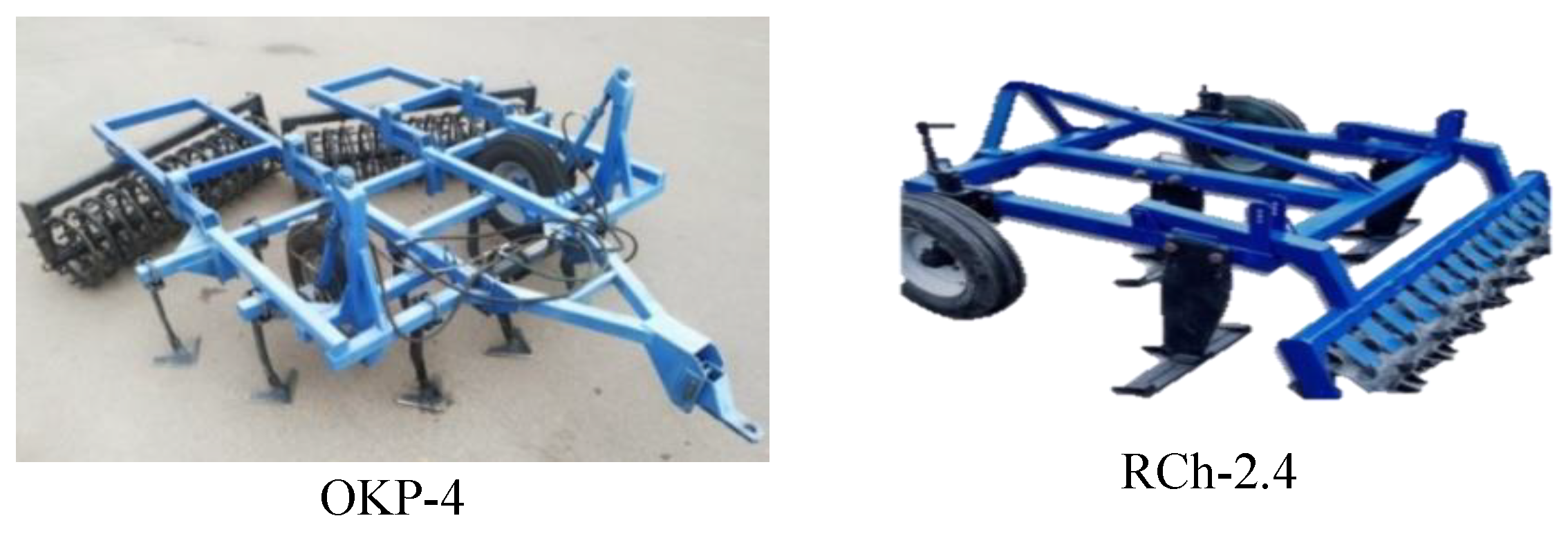
Combined implements OKN-3.6 and OKP-4, which perform cultivation, leveling, and rolling of the soil with additional crumbling in one pass; they are used for pre-sowing tillage and fallow tillage in technologies for cultivating cereal, fodder, and row crops. The use of three types of working parts (sweep shanks, levelers, rollers) ensures high-quality crumbling of soils of different textures and complete weed control [19,20]. Combining three technological operations prevents soil drying due to the time gap between their implementation. Loosening the soil simultaneously with rolling prevents the movement of soil particles, increasing the bond strength between them.
Chisel cultivators RCh-2.4 and RCh-4 carry out continuous volumetric loosening of the soil without leaving subsoil ridges to a depth of 35 cm with experimental working parts developed by SPCAE[21]. A feature of the operation of the machines is the continuous loosening of the soil due to the formation of longitudinal and transverse cracks without intensive crumbling and mixing. As a result of such tillage, soil aeration, permeability, and moisture accumulation are improved, and dust formation in the topsoil is prevented.
Figure 3.
Tillage machines developed by the Scientific Production Center of Agricultural Engineering (Figure not provided).
Figure 3.
Tillage machines developed by the Scientific Production Center of Agricultural Engineering (Figure not provided).
A field experiment was conducted on the fields of the Kazakh Research Institute of Soil Science and Plant Growing to study the influence of technological methods and technical means used in traditional and perspective technologies on the water regime and agrophysical indicators of irrigated light chestnut soil during soybean cultivation.
Tillage using traditional technology included autumn moldboard plowing, spring harrowing, leveling, and cultivation with single-operation tillage implements. Primary tillage using perspective technology was carried out with a RCh-2.4 chisel cultivator, which prevented large soil clods from being brought to the surface, complicating further pre-sowing tillage. Spring loosening, leveling, and rolling were carried out with a combined implement OKN-3.6, which combines these three operations. The field experiment scheme is shown in Table 1.
As can be seen from the table, 6 passes of machinery across the field were required for primary and pre-sowing tillage for soybeans using traditional technology, and 2 passes using perspective technology. Reducing the number of passes contributed to less soil pulverization and moisture conservation.
The soil moisture content during autumn tillage was low, and the hardness corresponded to the capabilities of the tillage implements (up to 4 MPa). During spring pre-sowing tillage, the agrophysical indicators of the soil were satisfactory and did not hinder either its tillage or seed germination. The field capacity and total moisture reserves corresponded to the average long-term data for this soil type under the conditions of the southern zone of Kazakhstan.
When tilling the soil with the RCh-2.4 chisel cultivator, the soil density and hardness in the tilled layer of 0-35 cm were constant and averaged 1.16 g/cm³ (density) and 1.54 MPa (hardness), respectively. Below the tilled layer, these indicators increased to 1.58 g/cm³ and 2.4 MPa. When moldboard plowing with a PLN-4.35 plow, a plow pan was formed at a depth of 27-40 cm, as indicated by a significant increase in density and hardness in the underlying layer. Thus, if in the 0-20 cm layer these indicators were 1.05 g/cm³ and 1.33 MPa, respectively, then in the uncultivated layer of 30-40 cm they increased to 1.55 g/cm³ and 2.5 MPa. The plow pan hinders the penetration of moisture into the lower soil layers, its aeration, and inhibits the development of the plant root system.
The study of soil crumbling shows that during moldboard plowing, 11.7% of clods larger than 50 mm and 29.3% of fine fractions less than 1.0 mm were formed in the tilled layer, which poses a risk due to the possibility of water and wind erosion. When the soil was tilled with a chisel cultivator, 4.2% of soil clods larger than 50 mm were formed, as well as 16% of the erosion-prone fraction. The amount of the most valuable fine-clod fraction less than 20 mm was 67.1% when working with a plow and 55.2% when chiseling.
Perspective technology involves partially replacing moldboard plowing with deep chiseling of the soil. It is recommended to carry out moldboard tillage once every 3-4 years at optimal soil moisture to incorporate pests and pathogenic microorganisms remaining on the surface and stubble.
The results of the conducted research show that the total moisture reserve in the 50 cm soil layer was higher with chisel tillage. This is due to the fact that during moldboard plowing, the upper inverted soil layer of 0-30 cm dries out. Thus, after primary tillage with the RCh-2.4 chisel cultivator, the soil had better agrophysical (density, hardness, and crumbling) and water-physical (total moisture reserve) indicators.
In spring, after carrying out the entire range of technological operations provided for by spring pre-sowing tillage, the agrophysical indicators of the soil and its crumbling were approximately the same and met agricultural requirements (at least 80% of fractions less than 20 mm) on both the traditional and perspective technology variants. This required 6 passes of machinery across the field with traditional technology and 2 passes with perspective technology (Table 1), which affected the moisture reserve in the soil and the content of its erosion-prone fraction less than 1 mm. The increased number of passes with traditional technology led to an increase in the duration of spring fieldwork compared to perspective technology by 1 day and, as a consequence, to soil drying. The total moisture reserve in the soil in the 0-50 cm layer with traditional and perspective technology was 90.3 mm and 87 mm, respectively. The content of the erosion-prone fraction with traditional tillage after all technological operations was 27.0% versus 20.1% with resource-saving technology.
10. In addition, reducing the number of passes of machinery across the field resulted in a 20% reduction in the cost of pre-sowing tillage.
Discussion. According to studies of the agrophysical state of light chestnut and sierozem soils, it was found that the soil moisture content at which tillage implements impact the soil is of great importance for the manifestation of erosion processes. Tilling soil with low moisture content using implements that mix its top layer (moldboard plows and cultivators for continuous tillage with sweep shanks such as KPS-4) contributes to the formation of an erosion-prone soil fraction on both light chestnut soil and sierozem, exceeding the permissible value. The results of field experiments to determine the impact of different types of working parts of tillage machines showed that replacing moldboard plowing in traditional technology with chisel tillage and the use of combined implements that combine technological operations in perspective technology prevents the formation of erosion-prone particles less than 1 mm and contributes to moisture accumulation and conservation in the soil.
4. Conclusions
The study of the impact of different types of working parts of tillage implements showed that the largest amount of the erosion-prone soil fraction was formed on dry soils with a moisture content of less than 8% when working with a moldboard plow and a KPS-4 cultivator with sweep shanks. During moldboard plowing at low humidity, a large number of large soil clods were formed, hindering pre-sowing tillage.
Replacing moldboard plowing in traditional technology with chisel and flat-cutting tillage, as well as the use of combined implements combining leveling, crumbling, and rolling operations in perspective technology, prevents the formation of erosion-prone particles less than 1 mm and contributes to moisture accumulation and conservation.
For the implementation of resource-saving technology for cultivating agricultural crops under the conditions of Southern Kazakhstan, SPCAE developed perspective technical means for primary and pre-sowing tillage for row crops: chisel cultivators RCh-2.4 and RCh-4; combined implements OKN-3.6 and OKP-4.
Field experiments were conducted with variants of traditional and perspective technology during soil tillage for soybean sowing, which showed that:
– When tilling the soil with RCh-2.4 chisel cultivator, no plow pan was formed, the amount of erosion-prone particles was within acceptable limits, and the moisture reserve in the soil increased.
– During spring tillage, by the time it was completed, the soil crumbling was approximately the same and met agricultural requirements (at least 80% of fractions less than 20 mm) on both the variant with traditional technology after 6 passes of machinery and the variant with perspective technology after 2 passes.
– The increased number of passes of machinery across the field affected the moisture reserve in the soil and the content of its erosion-prone fraction less than 1 mm. The increased number of passes with traditional technology led to an increase in the duration of spring fieldwork compared to perspective technology by 1 day and, as a consequence, to soil drying.
– Reducing the number of passes of machinery across the field resulted in a 20% reduction in the cost of pre-sowing tillage.
Author Contributions
Conceptualization, A.R. and V.G.; methodology, A.R.; software, S.B.; validation, O.S.; formal analysis, S.B. and O.S.; investigation, S.B.. and O.S.; resources, V.G. and S.B.; data curation, O.S and D.K.; writing-original draft preparation, A.R. and O.S.; writing-review and editing, A.R. and O.S.; visualization, D.K.; supervision, A.R.; project administration, A.R.; funding acquisition, A.R. All authors have read and agreed to the published version of the manuscript.
Funding
This research was funded by the Committee of Industry of the Ministry of Industry and Construction of the Republic of Kazakhstan, grant number BR23992516.
Institutional Review Board Statement
Not applicable.
Informed Consent Statement
Not applicable.
Data Availability Statement
The data is contained in the article.
Conflicts of Interest
The authors declare no conflict of interest.
References
- Iorganskiy, A.I., 1998. Protection against Water Erosion and Increasing the Fertility of Non-Irrigated Soils of the Kazakh Tian Shan. [Abstract]. Almaty, p. 39. Available from: https://rusneb.ru/catalog/000199_000009_000293548/ (In Russian). Accessed July 12, 2024.
- Saparov, A., Chen Shi, Jilili Abuduwaili. Soils of the Arid Zone of Kazakhstan: Current State and Their Use. Almaty, 2014. – 438 p.
- Erlepesov, M.N., 1973. Irrigated Agriculture. Alma-Ata: Kaynar, 1973. – 367 p. Available from: https://search.rsl.ru/ru/record/01007045132. (In Russian). Accessed July 12, 2024.
- Belenkov, A.I., Zhidkov, V.M., Ignatyeva, L.A., Zhurbenko, A.K., 2012. Water Consumption by Barley Crops (Hordeum) Depending on Tillage and Fertilization of Light Chestnut Soil. Izvestiya TSKHA, No. 5, pp. 52-56. Available from: https://cyberleninka.ru/article/n/vodopotreblenie-posevami-yachmenya-hordeum-v-zavisimosti-ot-obrabotki-i-udobreniy-svetlo-kashtanovoy-pochvy/viewer. Accessed July 15, 2024.
- Churzin, V.N. and Asirifi Amoako, O., 2013. Water Consumption and its Components in Spring Barley Crops Depending on Predecessors and Methods of Primary Tillage. Izvestiya Nizhnevolzhskogo Agrouniversitetskogo Kompleksa: Nauka i Vysshee Professional’noe Obrazovanie, No. 1, pp. 61-64. Available from: https://cyberleninka.ru/article/n/vodopotreblenie-i-ego-sostavlyayuschie-v-posevah-yarovogo-yachmenya-v-zavisimosti-ot-predshestvennikov-i-sposobov-osnovnoy-obrabotki/viewer. Accessed July 15, 2024.
- Belyakov, A.M., Solonkin, A.V., Boldyr’, D.A., 2016. Water Regime of Light Chestnut Soils, Methods of its Regulation. Izvestiya Nizhnevolzhskogo Agrouniversitetskogo Kompleksa: Nauka i Vysshee Professional’noe Obrazovanie, No. 3, pp. 12–16. Available from: https://cyberleninka.ru/article/n/vodnyy-rezhim-svetlo-kashtanovyh-pochv-priyomy-ego-regulirovaniya/viewer. Accessed July 15, 2024.
- Moskvitchev, A.Yu., Kazakov, G.V., Eremin, S.V., Dubrovin, A.P., 2011. Influence of Soil Tillage on the Water Regime and Productivity of Grain Maize under the Conditions of Southern Chernozems of the Lower Volga Region. Izvestiya Nizhnevolzhskogo Agrouniversitetskogo Kompleksa: Nauka i Vysshee Professional’noe Obrazovanie, No. 2 (22), pp. 28-34. Available from: https://cyberleninka.ru/article/n/vliyanie-obrabotok-pochvy-na-vodnyy-rezhim-i-produktivnost-zernovoy-kukuruzy-v-usloviyah-yuzhnyh-chernozemov-nizhnego-povolzhya/viewer. Accessed July 15, 2024.
- Gulyanov, Yu.A., 2007. Rational Use of Moisture Resources in Winter Wheat Cultivation in the Steppe of the Southern Urals. Tekhnologicheskie Problemy Povysheniya Ustoychivosti Agrotsenozov, No. 2, pp. 27–28. Available from: https://cyberleninka.ru/article/n/ratsionalnoe-ispolzovanie-resursov-vlagi-pri-vyraschivanii-ozimoy-pshenitsy-v-stepi-yuzhnogo-urala/viewer. Accessed July 15, 2024.
- Soil Water Regime. [Online resource]. Agriculture/University Agro.ru: Available from: https://universityagro.ru/земледелие/вoдный-режим-пoчв/. Accessed July 15, 2024.
- Gulaev, V.M., Zudilin, S.N., Gulaeva, N.V., 2014. Influence of Primary Tillage on Agrophysical Indicators of Soil Fertility in Soybean Crops. Izvestiya Samarskogo Nauchnogo Tsentra Rossiyskoy Akademii Nauk, No. 5, pp. 1090-1092. Available from: https://cyberleninka.ru/article/n/vliyanie-osnovnoy-obrabotki-pochvy-na-agrofizicheskie-pokazateli-plodorodiya-pochvy-na-posevah-soi/viewer. Accessed July 15, 2024.
- Sukhov, A.N., 2010. Features of the Water Regime of Light Chestnut Soils of the Lower Volga Region Depending on the Methods of Their Primary Tillage. Izvestiya Nizhnevolzhskogo Agrouniversitetskogo Kompleksa, No. 2, pp. 57-70. Available from: https://cyberleninka.ru/article/n/osobennosti-vodnogo-rezhima-svetlo-kashtanovyh-pochv-nizhnego-povolzhya-v-zavisimosti-ot-priyomov-ih-osnovnoy-obrabotki/viewer. Accessed July 15, 2024.
- The Problem of Plow Pan in Soil and Ways to Solve it. 2019. [Online resource]. Available from: https://propozitsiya.com/problema-pluzhnoy-podoshvy-u-pochvy-i-puti-ee-resheniya. Accessed July 15, 2024.
- Tsvetkov, M.L., Musokhranov, V.E., Gilev, S.I., Obyskalov, S.Ya., Dianov, O.L., 2012. Chisel Tillage: Past, Present, Future. Vestnik Altayskogo Gosudarstvennogo Agrarnogo Universiteta, No. 11, pp. 24-26. Available from: https://cyberleninka.ru/article/n/chizelnaya-obrabotka-pochvy-proshloe-nastoyaschee-buduschee/viewer. Accessed July 15, 2024.
- Tikhonov, V.V., 2012. Improvement of the Chisel Working Body for Additional Soil Crushing and Justification of its Parameters. [Abstract]. Ufa, p. 18. Available from: https://www.dissercat.com/content/sovershenstvovanie-rabochego-organa-chizelya-dlya-dopolnitelnogo-krosheniya-pochvy-i-obosnov/read. Accessed July 15, 2024.
- Boykov, V.M., 1998. Mechanical and Technological Justification of Effective Methods and Technical Means of Basic Soil Tillage. [Abstract]. Saratov, p. 35. Available from: https://www.dissercat.com/content/mekhaniko-tekhnologicheskoe-obosnovanie-effektivnykh-sposobov-i-tekhnicheskikh-sredstv-osnov/read. Accessed July 15, 2024.
- Schneider, F., Don, A., Hennings, I., Schmittmann, O., Seidel, S.J., 2017. The Effect of Deep Tillage on Crop Yield – What Do We Really Know?. Soil & Tillage Research 174, pp. 193–204. Available from: https://sci-hub.ru/10.1016/j.still.2017.07.005. Accessed July 15, 2024.
- Botta, G.F., Jorajuria, D., Balbuena, R., Ressia, M., Tourn, M., 2006. Deep Tillage and Traffic Effects on Subsoil Compaction and Sunflower (Helianthus annus L.) Yields. Soil and Tillage Research, Volume 91, Issues 1–2, December, pp. 164-172. Available from: https://www.researchgate.net/publication/223582023_Deep_tillage_and_traffic_effects_on_subsoil_compaction_and_sunflower_Helianthus_annus_L_yields. Accessed July 16, 2024.
- Calculation of Soil Moisture Reserves. [Online resource]: Bstudy.net. Available from: https://bstudy.net/752703/agro/raschet_zapasov_vlagi_pochve. Accessed July 16, 2024.
- Rzaliev, A.S., Goloborodko, V.P., Bekmukhametov, Sh.B., 2020. Combined Tools for Pre-Sowing Tillage to Tractors of the Class of 14, 20 and 30 kN. News of the National Academy of Sciences of the Republic of Kazakhstan. Series of Agrarian Sciences, 3 (57), pp. 51-58. Available from: https://www.researchgate.net/publication/342440602_combined_tools_for_pre-sowing_tillage_to_tractors_of_the_class_of_14_20_and_30_kn. DOI:10.32014/2020.2224-526x.25. Accessed July 16, 2024. [CrossRef]
- Rzaliyev, A., Bekmukhametov, S., Goloborodko, V., and Begaly, D., 2019. Types and Parameters of Combined Tool Implements for Perspective Soil-Saving Technologies. Eurasian Journal of Biosciences, 13(1), pp. 609-617. Available from: https://elibrary.ru/item.asp?id=41639672. Accessed July 16, 2024.
- Rzaliyev, A., Gribanovsky, A., Goloborodko, V., Boranbayev, B., Seipataliyev, O. Working Body of the Chisel Deep-Ripper for Tillage of the South of Kazakhstan. Eurasian Journal of Biosciences, 2020, 14, pp. 4983-4990. (Scopus).
Figure 1.
Content of soil fraction less than 1 mm, % (Figure not provided).
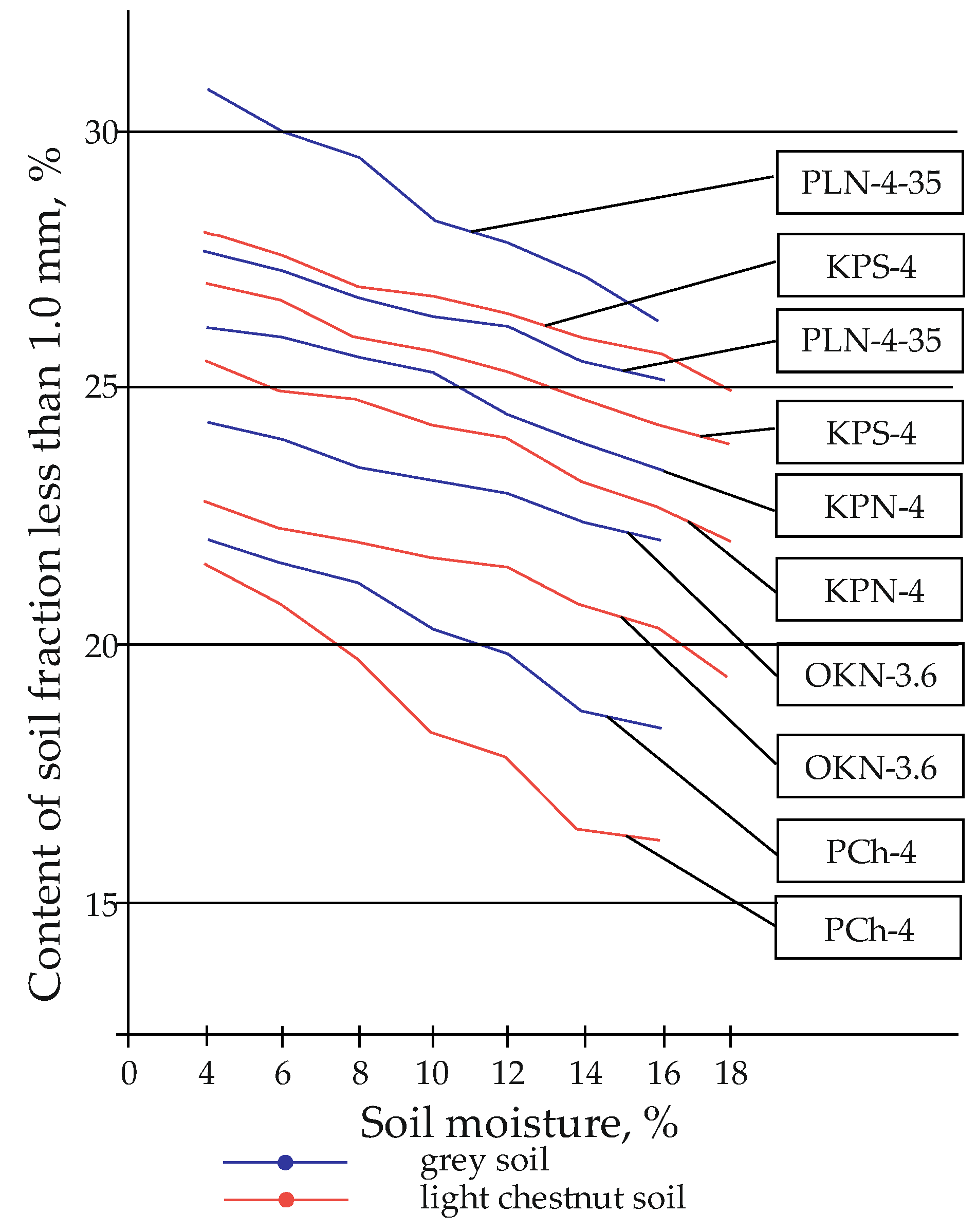
Figure 2.
Content of soil fraction less than 0.25 mm, % (Figure not provided).
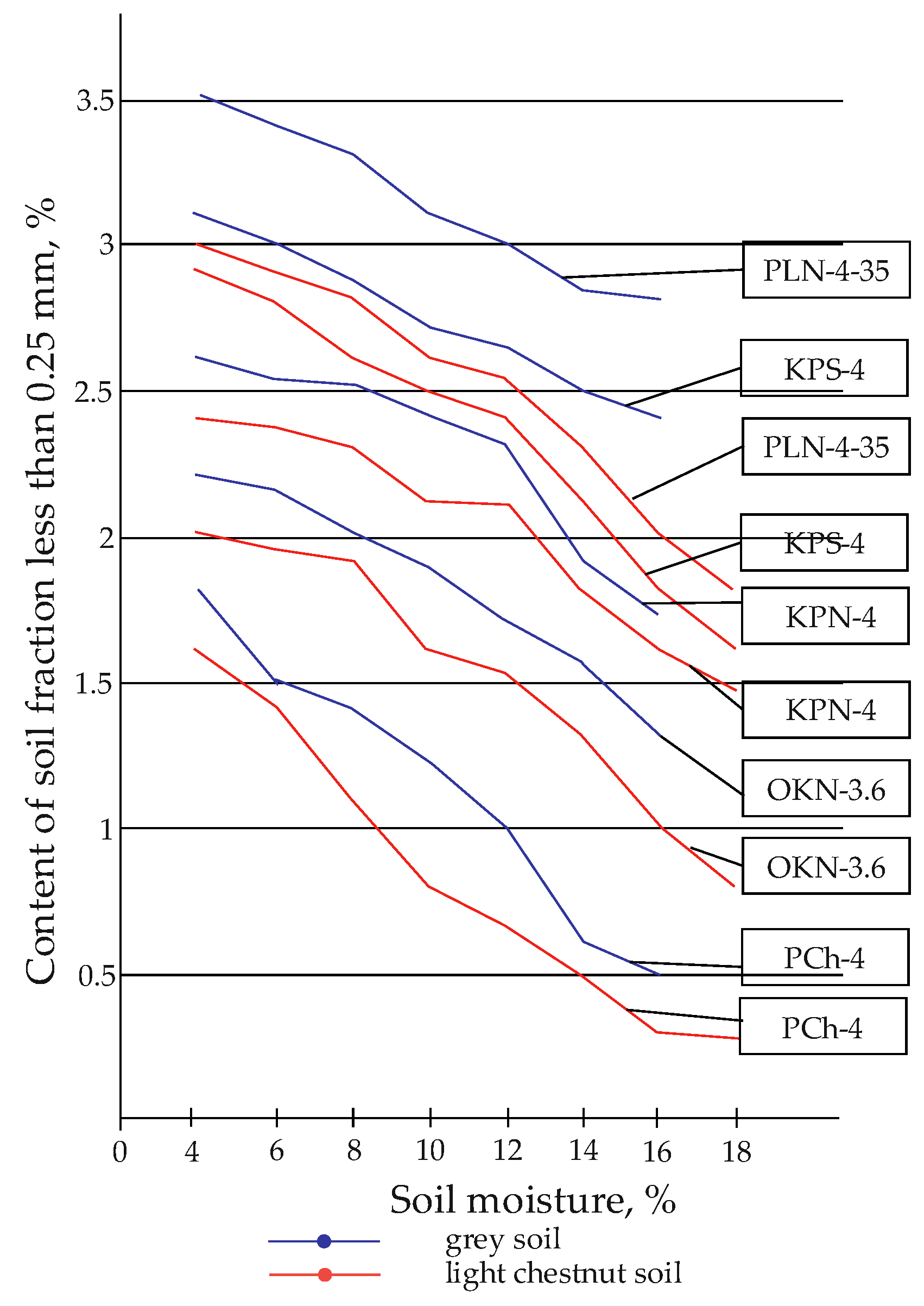

Table 1.
Field experiment scheme.
| Technological Operations (Traditional) | Technical Means | Technological Operations (Perspective) | Technical Means (SPCAE) |
| Autumn plowing | Belarus 2022, PLN-4-35 | Autumn chisel tillage or moldboard plowing (once every 3 years) | Belarus 2022, RCh-2.4 Belarus 2022, PLN-4-35 |
| Spring harrowing (2 passes) | Belarus 1221, Medium tooth harrow (BZSS-1)*6 | Loosening + Leveling + Rolling | Belarus 2022, OKN-3.6 |
| Field leveling | Belarus 2022, VIP-5.6 | ||
| Cultivation with harrowing (2 passes) | Belarus 1221, KPS-4 |
Disclaimer/Publisher’s Note: The statements, opinions and data contained in all publications are solely those of the individual author(s) and contributor(s) and not of MDPI and/or the editor(s). MDPI and/or the editor(s) disclaim responsibility for any injury to people or property resulting from any ideas, methods, instructions or products referred to in the content. |
© 2025 by the authors. Licensee MDPI, Basel, Switzerland. This article is an open access article distributed under the terms and conditions of the Creative Commons Attribution (CC BY) license (https://creativecommons.org/licenses/by/4.0/).
Copyright: This open access article is published under a Creative Commons CC BY 4.0 license, which permit the free download, distribution, and reuse, provided that the author and preprint are cited in any reuse.


