Preprint
Article

This version is not peer-reviewed.

In Silico Screening of Epitopes as Potential Vaccine Candidates Against Pathogenic Acinetobacter baumannii

Submitted:

12 February 2025

Posted:

13 February 2025

You are already at the latest version

Abstract

Multidrug-resistant (MDR) Acinetobacter baumannii possesses a pressing threat to global healthcare settings, as most antibiotics are ineffective against this nosocomial pathogen. Vaccines, particularly peptide-based vaccines, offer a promising and effective strategy to deal with these infections. This study employed advanced bioinformatic tools to identify potential epitopes for vaccine candidates against A. baumannii infections. Three epitopes (EP1, EP2, and EP3) derived from A. baumannii OmpA were found to effectively bind with specific human leukocyte antigen (HLA) alleles. These epitopes have shown promising potential to elicit both cellular and humoral immune responses. Their physicochemical and immunological properties were thoroughly evaluated, indicating strong antigenic potential, non-toxicity, lack of allergenic properties, good binding affinity, and wide population coverage. The epitopes' two- and three-dimensional structures were predicted, and they were docked with their respective HLA alleles to assess their ability to stimulate innate immune responses. The predicted epitopes and HLA-allelic complexes exhibited excellent binding affinity, optimal Root Mean Square Deviation (RMSD) values, favorable physicochemical properties, and high-quality structural characteristics. Therefore, these in silico screened epitopes hold promise as potential solutions for combating multidrug-resistant A. baumannii, pending validation through wet lab experiments and clinical trials.

Keywords: 
;  ;  ;  ;  

1. Introduction

The Gram-negative, opportunistic pathogen Acinetobacter baumannii (A. baumannii) is a major concern for global public health due to its resistance to various antibiotics, especially carbapenems. In recent years, A. baumannii has emerged as a major cause of nosocomial infections globally. It is responsible for pneumonia, urinary tract infections, bloodstream infections, meningitis, and wound infections [1]. The healthcare settings are potential reservoirs of these pathogens, facilitating their transmission between individuals [2,3]. Hospital-acquired A. baumannii infections primarily affect critically ill patients with risk factors like long ICU stays, previous hospital or ICU stay, coma, previous antibiotic therapy, older age, immunosuppression, comorbidities, burns, surgery, mechanical ventilation, indwelling catheter, and dialysis [4,5,6]. Infections caused by MDR A. baumannii showed high mortality rates 61.2% at 14 days and 73.6% at 30 days), while colonized patients experienced a higher mortality rate than uncolonized patients (49.2% vs. 32.0%), longer ICU stays, and increased healthcare costs [7,8]. A. baumannii is one of the six leading deadly pathogens that contribute to the global burden of antimicrobial resistance (AMR). It was estimated that carbapenem-resistant A. baumannii alone causes between 50,000 and 100,000 deaths due to AMR, underscoring its substantial impact on global public health [9].
Acinetobacter baumannii is highly adaptable due to its genomic plasticity, allowing it to quickly mutate to survive environmental challenges and stresses, which greatly contributes to its success [10,11]. The ability of A. baumannii to survive for extended periods on surfaces, such as medical supplies and furniture, coupled with its antibiotic resistance, enables it to easily spread among humans from one environment to another, making it a notorious human pathogen [12,13]. A. baumannii's virulence factors, including adhesins, iron uptake systems, secretion systems, pili, lipopolysaccharides, and biofilm formation, empower it to adhere, invade, and evade the immune system, contributing to its pathogenicity. These factors confer that it survives in hospital environments, tolerates stress, and is persistent in infections, establishing it as a notable hospital pathogen [14,15,16]. Considering this situation, the World Health Organization (WHO) has declared MDRAB a critical pathogen [17], prompting researchers and clinicians to investigate the mechanisms of its survival and seek new effective treatment modalities. As drug resistance continues to expand and newly developed antibiotics lose effectiveness, there is a pressing need for innovative therapeutic approaches. Hence, immunization trials could be an alternative tool to the management of infections caused by A. baumannii [18].
Recent advancements in bioinformatics and immunoinformatic have transformed vaccine science, allowing for the development of next-generation immunogens through modern, efficient, and precise computational tools that are cost-effective, accurate, robust, and safe for human use [19,20]. Extensive research has been dedicated to developing cost-effective therapeutic strategies, such as chemo-immunotherapies and epitope-based immunizations, against MDR A. baumannii. Despite, several vaccine candidates have demonstrated efficacy in preclinical studies using animal models, none have progressed to clinical trials or obtained FDA approval [21,22,23,24].
Outer membrane protein A (AbOmpA) is a key virulence factor of A. baumannii, playing a critical role in its pathogenesis and resistance to antimicrobial agents. AbOmpA causes host cell death by binding to cells in the initial stages of infection, activating surface death receptors, and localizing in mitochondria to stimulate pro-apoptotic molecules, ultimately resulting in apoptosis [25]. OmpA has been recognized as a key target of the humoral immune response in mice with A. baumannii systemic infection. Vaccination with recombinant OmpA (rOmpA) increased survival rates, reduced bacterial levels in tissues, and generated high levels of anti-OmpA antibodies. The presence of these antibodies was closely linked to enhanced survival, underscoring OmpA's potential as a valuable antigen for developing vaccines against A. baumannii [26]. B and T cells are essential in fighting A. baumannii infection. Predicting their epitopes is crucial for designing a vaccine that can activate both immune responses [27]. The vaccine potential of OmpA epitopes has not been explored yet.
Epitope-driven vaccines represent a breakthrough, providing safety, stability, and precise immune responses. Despite challenges from MHC polymorphism and HLA variability, computational tools now assist in predicting epitopes and optimizing population coverage. Leveraging genomic and proteomic data, researchers can pinpoint conserved epitopes among A. baumannii strains for creating vaccines with broad effectiveness[28,29]. This study focuses on screening T-cell epitopes from A. baumannii OmpA through bioinformatics and molecular docking analysis. It identifies a T-cell epitopic peptide with promising immunological and physicochemical characteristics as a potential vaccine candidate. The biological activity of this peptide was assessed through computational modeling, specifically investigating its capacity to stimulate immune responses, including cytokine production.

2. Methods

2.1. Protein sequence retrieval

The outer membrane protein (OmpA) sequence of A. baumannii was obtained from the NCBI protein database of (https://www.ncbi.nlm.nih.gov/protein, accession number: UVF06875). The antigenic potential of the protein, as well as its likelihood of being surface-exposed or secreted—which are key characteristics of effective vaccine targets [30]—were evaluated using Vaxijen v2.0 (https://www.ddg-pharmfac.net/vaxijen/VaxiJen/VaxiJen.html) and PSORTb (https://www.psort.org/psortb/).

2.2. Assessment and selection of helper T-cell epitopes and linear B-cell epitopes

To predict helper T-cell (HTL) epitopes associated with a reference set of human leukocyte alleles (HLA), various tools were utilized, including SYFPEITHI (http://www.syfpeithi.de/bin/MHCServer.dll/EpitopePrediction.htm), IEDB (http://tools.iedb.org) , (https://services.healthtech.dtu.dk/services/NetMHCIIpan-4.1/) and (https://services.healthtech.dtu.dk/services/NetMHCpan-4.1/). The reference HLA class I alleles included HLA-A01:01, HLA-A02:01, HLA-A03:01, HLA-A11:01, HLA-A24:02, HLA-A30:01, HLA-A68:02, HLA-B08:01, HLA-B35:01, and HLA-B51:01, while the class II alleles consisted of HLA-DRB1*03:01, HLA-DRB1*07:01, HLA-DRB1*15:01, HLA-DRB3*01:01, HLA-DRB3*02:02, HLA-DRB4*01:01, and HLA-DRB5*01:01.HTL epitopes were selected based on their binding affinities to these alleles, as indicated by IC50 values (in nanomoles). Binding strengths were categorized as strong (<50 nM), moderate (<500 nM), and weak (<5000 nM). Moreover, for IEDB predictions, percentile ranks of ≤1 for class I and ≤10 for class II epitopes were set as thresholds. In SYFPEITHI, a score of ≥10 was used as the threshold. Peptides of 9 residues were selected for class I epitopes, and 15 residues for class II epitopes.

2.3. Final selection of helper T-cell epitopes

The IEDB Epitope Cluster Analysis Tool (http://tools.iedb.org/cluster/) was utilized to evaluate the effect of sequence-level peptide homology on immunogenicity predictions. Clustering was conducted using a 70% homology threshold, and a single peptide from each cluster, chosen based on highest scoring, was selected for further analysis. The immunogenicity of class I epitopes was predicted using a specific IEDB tool (http://tools.iedb.org/immunogenicity/), which analyzes the amino acid composition of peptides at non-anchor positions, where amino acid side chains are expected to interact with the TCR. Several criteria were applied to select the final T-cell epitopes, including class II epitopes capable of inducing cytokine production, class I epitopes with higher immunogenicity scores, higher prediction scores, and the inclusion of both class I and class II epitopes identified using various immunoinformatic tools.

2.4. Prediction of cytokine secretion

The IFNepitope server (http://crdd.osdd.net/raghava/ifnepitope/) was used to evaluate the capability of class II epitopes to stimulate IFN-γ release from CD4+ T cells [31]. The selected epitopes were analyzed using IL4pred (https://webs.iiitd.edu.in/raghava/il4pred/index.php) and IL-10Pred (https://webs.iiitd.edu.in/raghava/il10pred/) to evaluate their potential to stimulate IL-4 and IL-10 production.

2.5. Assessment of Allergenicity, Toxicity, Population coverage, and Epitope Identity for Peptide Evaluation

The T-cell epitopes retrieved were evaluated for allergenicity using the Allertop 2.0 tool (available at https://www.ddg-pharmfac.net/AllerTOP/index.html) and for toxicity through the ToxinPred web server (https://webs.iiitd.edu.in/raghava/toxinpred/index.html). To predict toxicity, the SVM (Swiss-Prot) and Motif-based methods were employed in ToxinPred, with a threshold of 0.0 and an e-value cutoff of 10, respectively. The coverage across the global population was evaluated using the IEDB Population Coverage tool (available at http://tools.iedb.org/population/). Human similarity was assessed by analyzing two factors—coverage and identity—using the BLASTP server, with human proteome (taxid 9606) as the reference. Epitopes with ≥90% similarity to the human proteome were excluded from further analysis. Additionally, the epitopes were investigated for any previous experimental records through the IEDB homepage (https://www.iedb.org/).

2.6. Tertiary Structure Prediction

The three-dimensional (3D) model of the OmpA protein was created using the SWISS-MODEL server (https://swissmodel.expasy.org/) homology modeling, with the experimentally determined structure of the A. baumannii OmpA protein (PDB ID: 3td5) serving as a template. The PEP-FOLD3 server [32], a computational platform for de novo prediction of peptide 3D structures, was utilized to identify the tertiary structure of the epitopes and protein coarse-grained optimized potential for efficient structure prediction (sOPEP). Model validation is crucial for detecting errors in predicted 3D protein structures [33]. Tools such as ProSA-Web (https://prosa.services.came.sbg.ac.at/prosa.php), PROCHECK, and ERRAT, accessible through SAVES v6.0, (https://saves.mbi.ucla.edu/), were used to assess model quality. ProSA-Web calculates a Z-score to compare the model’s quality with experimentally derived structures. ERRAT examines non-bonded atomic interactions against high-resolution crystallographic data [34], while PROCHECK uses a Ramachandran plot to analyze residues in favored, allowed, and disallowed regions, with separate plots for Glycine and Proline [35]. The Ramachandran plot, generated by tools like MolProbity (http://molprobity.biochem.duke.edu/), visualizes dihedral angles (ψ and φ) based on van der Waals interactions, offering a comprehensive validation of protein models [36].

2.7. Prediction of physicochemical characteristics, solubility prediction, and structure analyses

The ProtParam tool (https://web.expasy.org/protparam/) was utilized to assess the physicochemical properties of selected epitopes. Key parameters analyzed included molecular weight, theoretical isoelectric point (pI), grand average of hydropathicity (GRAVY), instability index, and the estimated in vitro and in vivo half-life. This thorough analysis offers valuable insights into the stability, solubility, and hydrophobicity of the designed proteins [37]. The Stride Web interface (http://webclu.bio.wzw.tum.de/cgi-bin/stride/stridecgi.py) was utilized for predicting the secondary structure, while the Web3DMol server (http://web3dmol.net/) was used to visualize the structures and epitope locations. The SMILES (Simplified Molecular-Input Line-Entry System) strings of the peptides were generated with PepSMI server (https://www.novoprolabs.com/tools/convert-peptide-to-smiles-string) and utilized to create their corresponding 2D structural representations.

2.8. Molecular Docking

Epitopes were flexibly docked with MHC alleles using the CABS-dock server (https://biocomp.chem.uw.edu.pl/CABSdock/) to predict binding interactions and evaluate MHC-peptide complex formation. CABS-dock performs protein-peptide docking by using peptide sequences and receptor 3D structures. It utilizes Monte Carlo simulations to create approximately 10,000 models, which are then refined through energy-based selection. Models in unbound states are eliminated, and the top 100 models per trajectory (from 10 replicates) with the lowest interaction energy are kept [38]. The PDB files of the MHC alleles for docking simulations were obtained from the RCSB Protein Data Bank (https://www.rcsb.org).

3. Result

3.1. Selection of T-cell epitopes

Duplicate epitopes were removed, and only one epitope was chosen from each epitope cluster. Three T-cell epitopes, each 15 amino acids in length, were finally selected for further analysis based on their non-allergic and non-toxic properties, as well as a less human similarity (<90% or more) confirmed through BLASTp. The selection criteria emphasized the potential for IFN-γ production and higher immunogenicity scores for class-II and class-I epitopes, respectively. Additionally, the selected T-cell epitopes were predicted to induce IL-4 or IL-10 production. All the predicted epitopes were found to be non-toxic and non-allergenic. Furthermore, none of the selected epitopes exhibited ≥90% similarity with human peptides, and there was no existing experimental evidence identified for these epitopes. Three qualified epitopes (EP1, EP2 and EP3) are listed in Table 1. The table includes prediction scores for each epitope from different tools, cytokine production ability as well as information on their toxicity, and allergenicity.

3.2. Assessment of the tertiary structures of the protein and epitopes

The tertiary structures of the OmpA protein were predicted using ERRAT, while the epitope sequences were modeled into tertiary structures using the PEP-FOLD web server. The overall quality factors for OmpA, as assessed by ERRAT, were 92.7215. The sOPEP energy of EP1, EP2, and EP3 were -6.82, -15.39, and -8.28 respectively. The Ramachandran plot analysis revealed that most amino acid residues in all three epitopes and the OmpA protein were in allowed and/or favored regions (Figure 1). Additionally, the Z-scores for these structures were -1.13, −0.59, −0.46, and -5.77 respectively, falling within the typical range observed for native proteins of similar sizes derived from X-ray or NMR data.

3.3. The structure, antigenic potential, and physicochemical characteristics of the final peptides

Table 2 summarizes the physicochemical properties of the three final epitopes (peptides), each composed of 15 amino acid residues. The Ep1 peptide (VVEVAPVEPTPVAPQ) has a molecular weight of 1531.77 g/mol, 73.33% hydrophobicity, and an isoelectric point (pI) 3.79. Its estimated half-life is 100 hours in mammalian reticulocytes (in vitro) and over 10 hours in E. coli (in vivo). Although poorly water-soluble, it is stable and has a net charge of -2.
The Ep2 peptide (GIELTPWLGFEAEYN) weighs 1738.91 g/mol, has 46.67% hydrophobicity, and a pI of 3.67. Its half-life is 30 hours in mammalian reticulocytes (in vitro) and more than 10 hours in E. coli (in vivo). It is poorly water-soluble and stable, with a net charge of -3.
Similarly, the Ep3 peptide (EPTPVAPQPQELTED) has a molecular weight of 1650.76 Daltons, 46.67% hydrophobicity, and a pI of 3.50. Its half-life is 1 hour in mammalian reticulocytes (in vitro) and over 30 minutes in yeast (in vivo). It is water-soluble but unstable, with a net charge of -4.
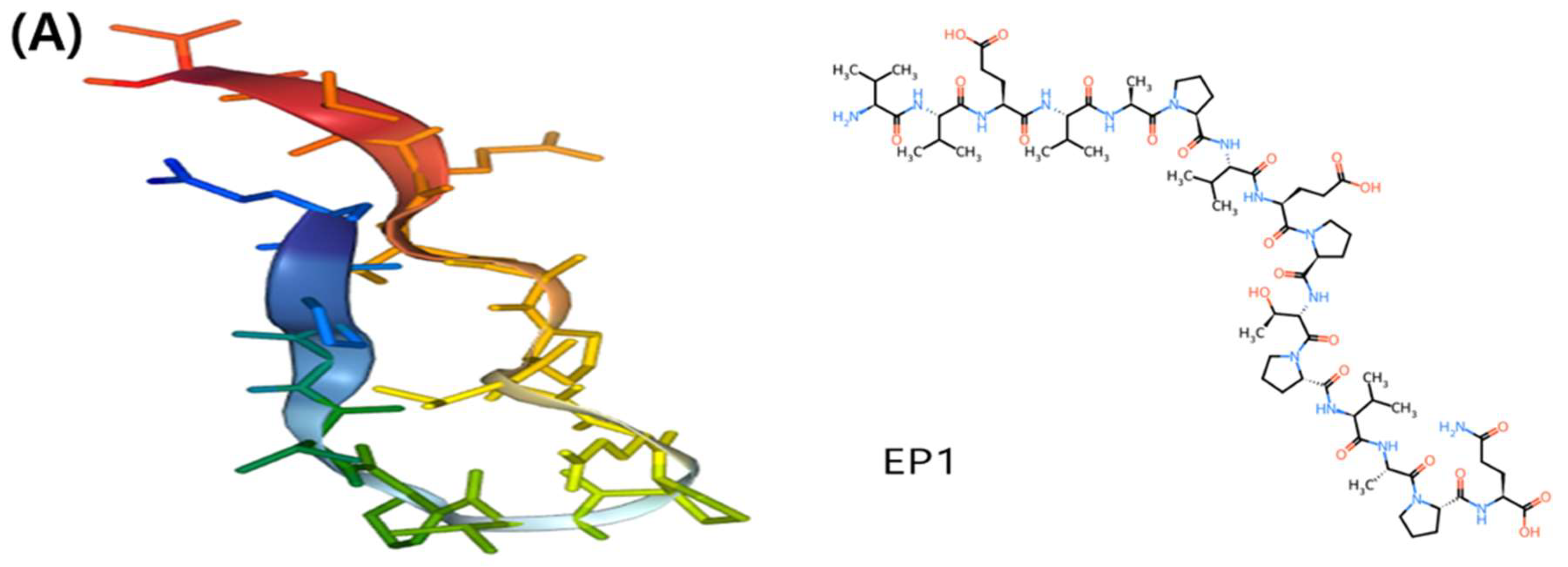
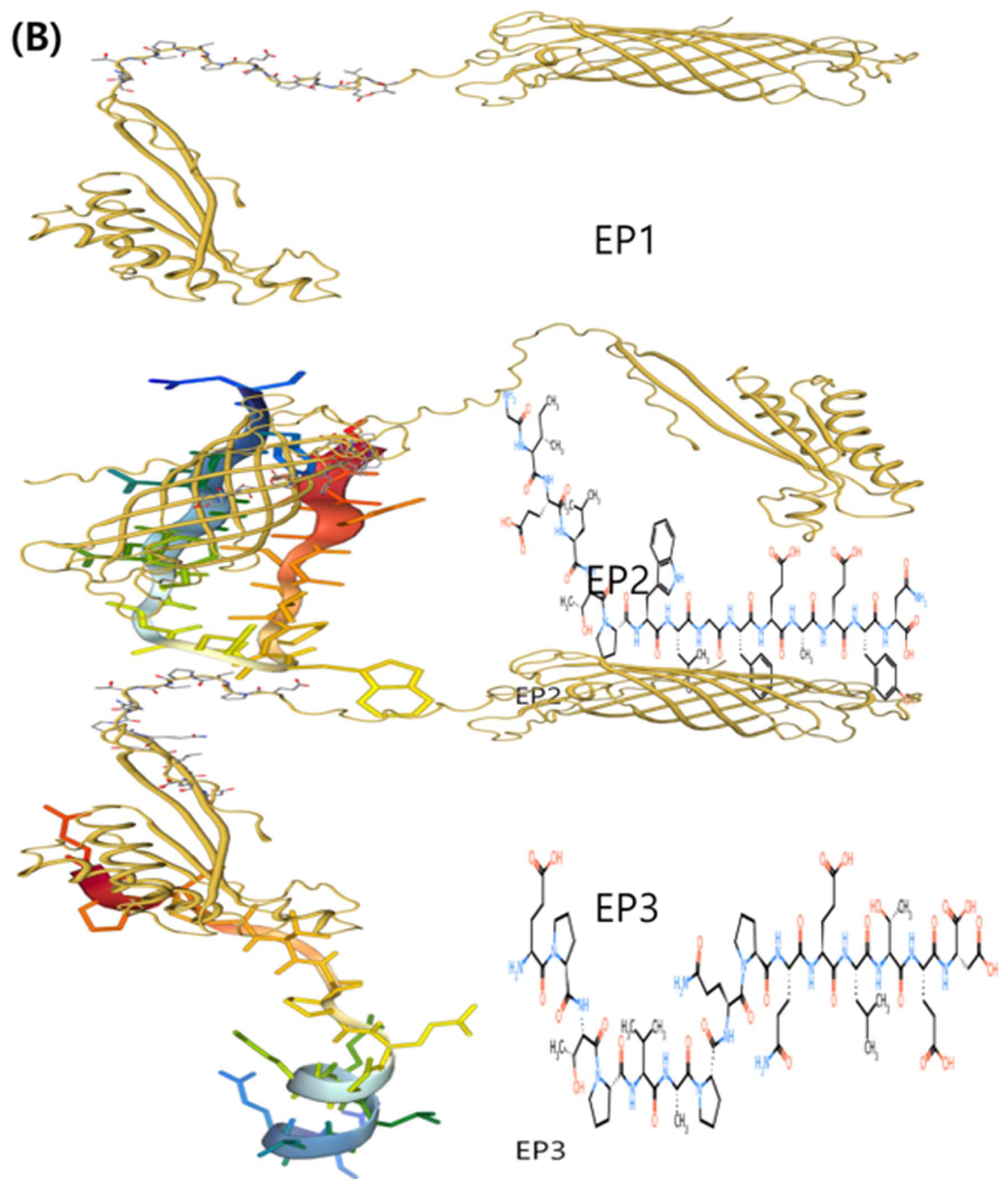
All three peptides (Ep1, Ep2, and Ep3) were predicted to be antigens by the VaxiJen server (Table 2). Structural analysis revealed that the peptides predominantly consist of turns and are located on the lateral surfaces of the OmpA structure (Figure 2). Conservation analysis showed that the peptides are conserved among Acinetobacter species but not among other species.

3.4. Molecular Docking Simulation of the Epitopes

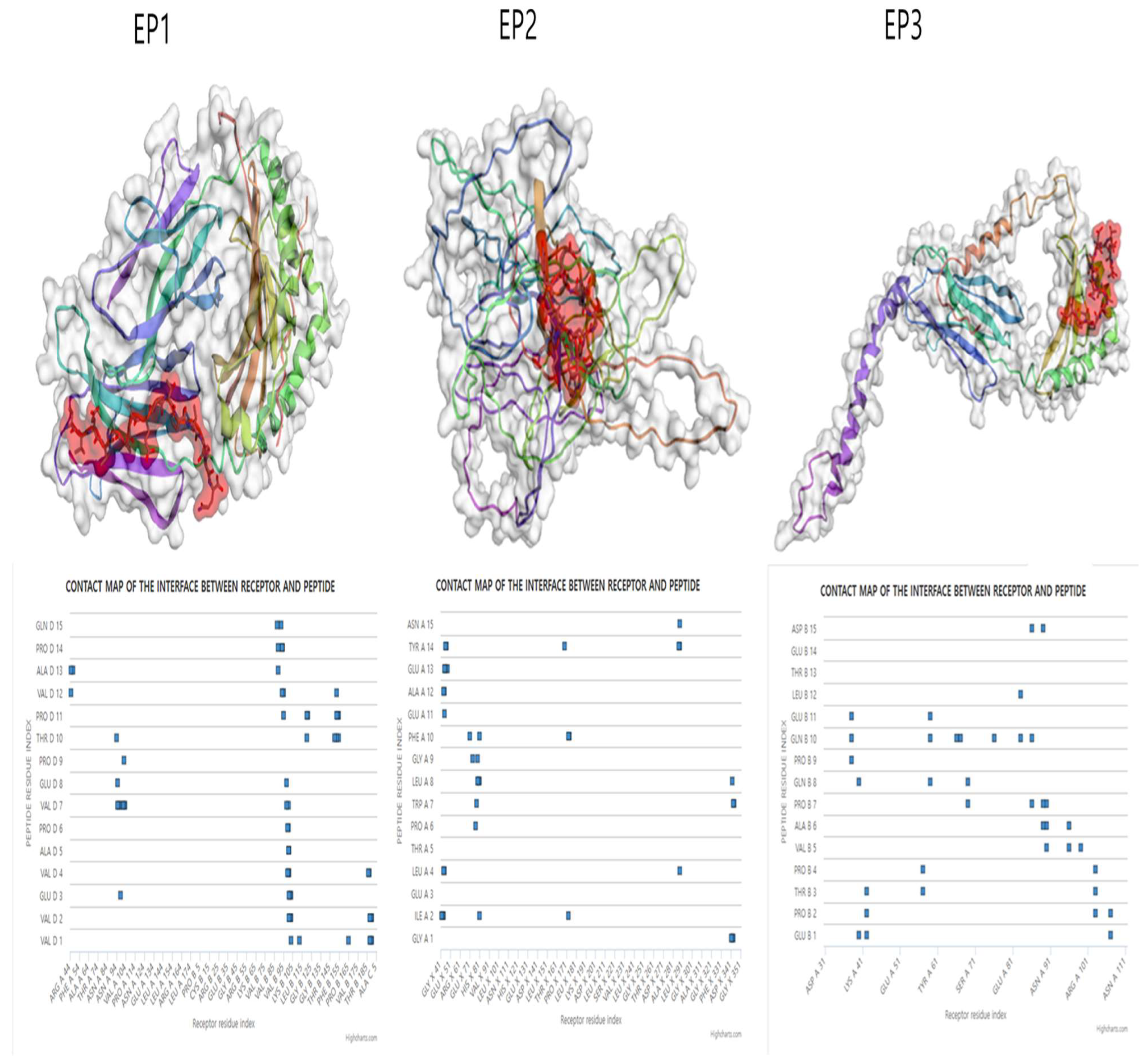
The CABS-dock online server was utilized for protein-peptide docking through Monte Carlo simulation, and the resulting cluster details are presented in Table 3. Among the selected clusters, the average RMSD values of EP1, EP2, and EP3 were 1.55333, 2.55491, and 2.04817, respectively. Molecular docking analysis indicates that, in principle, EP1, EP2, and EP3 bind effectively to HLA-DRB1*07:01, HLA-DRB1*15:01, and HLA-DRB4*01:01, respectively (Figure 3).

4. Discussion

OmpA is a highly conserved outer membrane protein in A. baumannii, considered a potential vaccine antigen due to its widespread presence in clinical isolates and distinct structure from human proteomes [25,27,39]. Research indicates that immunization with OmpA can offer protection against A. baumannii infections. Passive immunization with anti-AbOmpA antibodies is being investigated as a treatment for multidrug-resistant and extensively drug-resistant A. baumannii [26]. OmpA can stimulate both humoral and cell-mediated immunity, improving the body's ability to fight infections [40]. The focus of vaccine development has been primarily on antibody-mediated protection rather than cell-mediated immunity. While IgG isotype ratios are used to evaluate Th1/Th2 responses, there is limited research on T cell participation. Studies indicate that inactivated or attenuated A. baumannii strains can trigger both Th1 and Th2 responses [41]. However, the optimal T cell cytokine response for protection is still uncertain and warrants further research. In this study, a set of computational techniques was deployed to elucidate the effectiveness of individual peptides in inducing the desired immunogenic responses against A. baumannii infection. We identified three strong T cell epitopic peptides (EP1, EP2, and EP3) with favorable characteristics as potential vaccine candidates against A. baumannii. Since toxicity is a crucial factor in selecting an ideal vaccine [42], our findings showed that all the tested epitopes are non-toxic. Additionally, the identified epitopes are anticipated to exhibit robust antigenic properties for both humoral and cellular responses, along with minimal allergenicity, non-similar to human proteome, and low sOPEP energies. These attributes enhance the stability of the selected peptides. Cytokines such as IFN-γ, IL-4, and IL-10 play a crucial role in the host's defense against A. baumannii. IFN-γ promotes Th1 responses and the production of IgG2a/IgG2c, IL-4 regulates Th2 differentiation and IgG1 production, and IL-10 is essential for host defense against multidrug-resistant A. baumannii [43,44]. EP2 was expected to induce the production of IFN-γ, IL-4, and IL-10, whereas EP1 and EP3 were predicted to stimulate the production of IFN-γ indicating that the epitopes can produce an effective immune response through immune stimulation.
Molecular docking analysis conducted with CABS-dock indicated robust interactions between the predicted epitopes and HLA alleles, with low RMSD values and high cluster densities further supporting their strong binding affinity and interaction profiles. The targeted epitope-HLA allelic complexes showed satisfactory global population coverage. The structural integrity of the epitope was further validated by analyzing the Ramachandran plot. Most amino acid residues in our modeled protein (OmpA) and the epitopic regions were located within the allowed or favored regions of the plot, indicating the excellent quality of our models. Additionally, various online tools were used to evaluate the predicted model, including PROSA for Z-score analysis, PROCHECK to identify non-GLY residues in disallowed regions, and ERRAT to assess overall model quality. The results showed that our model had a high-quality factor with an ERRAT score of 92.7215, indicating excellent model reliability.
Surface-exposed pathogen proteins are excellent vaccine candidates because they stimulate immune responses. Proteins found in the extracellular, outer membrane, and periplasmic regions are well-suited for vaccine development [45,46]. PsortB was utilized to predict surface-localized proteins. The epitopes identified on the surface of the OmpA protein are easily accessible to antibodies, rendering them valuable for both vaccine development and the diagnosis of A. baumannii disease. An effective epitopic vaccine candidate should have favorable physicochemical properties throughout production, formulation, storage, and administration [47]. The study emphasized the unique physicochemical properties of the identified epitopes. Ep2 is characterized by stability, low water-solubility, a pI of 3.67, a negative GRAVY score indicating hydrophilicity [48], and a longer estimated half-life. EP1, on the other hand, is unstable, more hydrophobic, poorly water-soluble, with a pI of 3.79, a longer half-life, and a positive GRAVY score. EP3 is unstable, highly water-soluble, with a pI of 3.5, a negative GRAVY score indicating hydrophilicity [48], and a shorter half-life compared to Ep2 and EP1. These findings suggest their potential as vaccine candidates for further in vitro and in vivo investigations. Moreover, their properties could be enhanced through chemical or biochemical modifications and incorporated into multi-epitope vaccines, a strategy employed against A. baumannii[49,50,51].

5. Conclusion

This study utilized various bioinformatics tools to identify three potential epitopic vaccine candidates against A. baumannii. These epitopes demonstrated the ability to stimulate immune responses, particularly humoral and cellular immunity. They also possess favorable physicochemical properties and a high-quality structural profile. Further in vitro and in vivo studies are recommended to assess their efficacy and efficiency. Upon wet lab validation, these peptides could contribute to vaccine development. Overall, our findings, in conjunction with previous research, provide promising prospects for designing an OMP-based vaccine to combat A. baumannii infections in the future.

Fundings

This research was supported by Basic Science Research Program through the National Research Foundation of Korea (NRF) funded by the Ministry of Education (Grant Nos. 2022R1F1A1071415 and NRF-RS-2023-00275307).

Data Availability Statement

All data obtained in this study are included in the article. For any further inquiries, please contact the corresponding author.

Acknowledgment

Not applicable

Conflicts of Interest

Authors declare no conflict of interest.

References

  1. Islam, M.M.; Mahbub, N.U.; Shin, W.S.; Oh, M.H. Phage-encoded depolymerases as a strategy for combating multidrug-resistant Acinetobacter baumannii. 2024, 14. [Google Scholar] [CrossRef]
  2. Savin, M.; et al. Tracing clinically-relevant antimicrobial resistances in Acinetobacter baumannii-calcoaceticus complex across diverse environments: A study spanning clinical, livestock, and wastewater treatment settings. Environment International 2024, 186, 108603. [CrossRef]
  3. Fahy, S., O'Connor, J. A., Lucey, B. & Sleator, R. D. Hospital Reservoirs of Multidrug Resistant Acinetobacter Species-The Elephant in the Room! British journal of biomedical science 2023, 80, 11098. [CrossRef]
  4. Benaissa, E.; Belouad, E.; Maleb, A.; Elouennass, M. Risk factors for acquiring Acinetobacter baumannii infection in the intensive care unit: experience from a Moroccan hospital. Access microbiology 2023, 5. [Google Scholar] [CrossRef]
  5. Corcione, S.; Longo, B.M.; Scabini, S.; Pivetta, E.; Curtoni, A.; Shbaklo, N.; Costa, C.; De Rosa, F.G. Risk factors for mortality in Acinetobacter baumannii bloodstream infections and development of a predictive mortality model. Journal of Global Antimicrobial Resistance 2024, 38, 317–326. [Google Scholar] [CrossRef]
  6. Wei, Z.; Zhou, S.; Zhang, Y.; Zheng, L.; Zhao, L.; Cui, Y.; Xie, K. Microbiological characteristics and risk factors on prognosis associated with Acinetobacter baumannii bacteremia in general hospital: A single-center retrospective study. Frontiers in microbiology 2022, 13, 1051364. [Google Scholar] [CrossRef]
  7. Russo, A.; Bassetti, M.; Ceccarelli, G.; Carannante, N.; Losito, A.R.; Bartoletti, M.; Corcione, S.; Granata, G.; Santoro, A.; Giacobbe, D.R.; et al. Bloodstream infections caused by carbapenem-resistant Acinetobacter baumannii: Clinical features, therapy and outcome from a multicenter study. The Journal of infection 2019, 79, 130–138. [Google Scholar] [CrossRef]
  8. Lee, H.; Lee, H. Clinical and Economic Evaluation of Multidrug-Resistant Acinetobacter baumannii Colonization in the Intensive Care Unit. Infection & chemotherapy 2016, 48, 174–180. [Google Scholar] [CrossRef]
  9. Murray, C.J.L.; Ikuta, K.S.; Sharara, F.; Swetschinski, L.; Robles Aguilar, G.; Gray, A.; Han, C.; Bisignano, C.; Rao, P.; Wool, E.; et al. Global burden of bacterial antimicrobial resistance in 2019: a systematic analysis. The Lancet 2022, 399, 629–655. [Google Scholar] [CrossRef]
  10. Lucidi, M.; Visaggio, D.; Migliaccio, A.; Capecchi, G.; Visca, P.; Imperi, F.; Zarrilli, R. Pathogenicity and virulence of Acinetobacter baumannii: Factors contributing to the fitness in healthcare settings and the infected host. Virulence 2024, 15, 2289769. [Google Scholar] [CrossRef]
  11. Harding, C.M.; Hennon, S.W.; Feldman, M.F. Uncovering the mechanisms of Acinetobacter baumannii virulence. Nature reviews. Microbiology 2018, 16, 91–102. [Google Scholar] [CrossRef]
  12. Singh, S.; Singh, S.; Trivedi, M.; Dwivedi, M. An insight into MDR Acinetobacter baumannii infection and its pathogenesis: Potential therapeutic targets and challenges. Microbial Pathogenesis 2024, 192, 106674. [Google Scholar] [CrossRef] [PubMed]
  13. Erol, H.B.; Kaskatepe, B.; Yildiz, S.; Altanlar, N. The effect of phage-antibiotic combination strategy on multidrug-resistant Acinetobacter baumannii biofilms. Journal of Microbiological Methods 2023, 210, 106752. [Google Scholar] [CrossRef] [PubMed]
  14. Shadan, A.; Pathak, A.; Ma, Y.; Pathania, R.; Singh, R.P. Deciphering the virulence factors, regulation, and immune response to Acinetobacter baumannii infection. 2023, 13. [Google Scholar] [CrossRef]
  15. McConnell, M.J.; Actis, L.; Pachón, J. Acinetobacter baumannii: human infections, factors contributing to pathogenesis and animal models. FEMS Microbiology Reviews 2013, 37, 130–155. [Google Scholar] [CrossRef] [PubMed]
  16. Cook-Libin, S.; Sykes, E.M.E.; Kornelsen, V.; Kumar, A. Iron Acquisition Mechanisms and Their Role in the Virulence of Acinetobacter baumannii. 2022; 90, e00223-00222. [Google Scholar] [CrossRef]
  17. WHO Bacterial Priority Pathogens List, 2024: bacterial pathogens of public health importance to guide research, development and strategies to prevent and control antimicrobial resistance. Geneva: World Health Organization; 2024. Licence: CC BY-NC-SA 3.0 IGO.
  18. Yang, N.; Jin, X.; Zhu, C.; Gao, F.; Weng, Z.; Du, X.; Feng, G. Subunit vaccines for Acinetobacter baumannii. 2023, 13. [Google Scholar] [CrossRef]
  19. Olawade, D.B.; Teke, J.; Fapohunda, O.; Weerasinghe, K.; Usman, S.O.; Ige, A.O.; Clement David-Olawade, A. Leveraging artificial intelligence in vaccine development: A narrative review. Journal of Microbiological Methods 2024, 224, 106998. [Google Scholar] [CrossRef]
  20. Shawan, M.; Sharma, A.R.; Halder, S.K.; Arian, T.A.; Shuvo, M.N.; Sarker, S.R.; Hasan, M.A. Advances in Computational and Bioinformatics Tools and Databases for Designing and Developing a Multi-Epitope-Based Peptide Vaccine. International journal of peptide research and therapeutics 2023, 29, 60. [Google Scholar] [CrossRef]
  21. Khalid, K.; Poh, C.L. The Promising Potential of Reverse Vaccinology-Based Next-Generation Vaccine Development over Conventional Vaccines against Antibiotic-Resistant Bacteria. 2023, 11, 1264. [Google Scholar] [CrossRef]
  22. Xu, Y.; Zhu, F.; Zhou, Z.; Ma, S.; Zhang, P.; Tan, C.; Luo, Y.; Qin, R.; Chen, J.; Pan, P. A novel mRNA multi-epitope vaccine of Acinetobacter baumannii based on multi-target protein design in immunoinformatic approach. BMC Genomics 2024, 25, 791. [Google Scholar] [CrossRef]
  23. Mukhopadhyay, H.; Bairagi, A.; Mukherjee, A.; Prasad, A.K.; Roy, A.D.; Nayak, A. Multidrug resistant Acinetobacter baumannii: A study on its pathogenesis and therapeutics. Current Research in Microbial Sciences 2025, 8, 100331. [Google Scholar] [CrossRef]
  24. Ahmad, T.A.; Tawfik, D.M.; Sheweita, S.A.; Haroun, M.; El-Sayed, L.H. Development of immunization trials against Acinetobacter baumannii. Trials in Vaccinology 2016, 5, 53–60. [Google Scholar] [CrossRef]
  25. Nie, D.; Hu, Y.; Chen, Z.; Li, M.; Hou, Z.; Luo, X.; Mao, X.; Xue, X. Outer membrane protein A (OmpA) as a potential therapeutic target for Acinetobacter baumannii infection. Journal of Biomedical Science 2020, 27, 26. [Google Scholar] [CrossRef] [PubMed]
  26. Luo, G.; Lin, L.; Ibrahim, A.S.; Baquir, B.; Pantapalangkoor, P.; Bonomo, R.A.; Doi, Y.; Adams, M.D.; Russo, T.A.; Spellberg, B. Active and passive immunization protects against lethal, extreme drug resistant-Acinetobacter baumannii infection. PloS one 2012, 7, e29446. [Google Scholar] [CrossRef] [PubMed]
  27. Singh, R.; Capalash, N.; Sharma, P. Vaccine development to control the rising scourge of antibiotic-resistant Acinetobacter baumannii: a systematic review. 3 Biotech 2022, 12, 85. [Google Scholar] [CrossRef] [PubMed]
  28. Bravi, B. Development and use of machine learning algorithms in vaccine target selection. npj Vaccines 2024, 9, 15. [Google Scholar] [CrossRef]
  29. Dey, J.; Mahapatra, S.R.; Singh, P.K.; Prabhuswamimath, S.C.; Misra, N.; Suar, M. Designing of multi-epitope peptide vaccine against Acinetobacter baumannii through combined immunoinformatics and protein interaction–based approaches. Immunologic Research 2023, 71, 639–662. [Google Scholar] [CrossRef]
  30. Monterrubio-López, G. P. Monterrubio-López, G. P., González, Y. M. J. A. & Ribas-Aparicio, R. M. Identification of Novel Potential Vaccine Candidates against Tuberculosis Based on Reverse Vaccinology. BioMed research international 2015, 483150. [Google Scholar] [CrossRef]
  31. Dhanda, S.K.; Vir, P.; Raghava, G.P.S. Designing of interferon-gamma inducing MHC class-II binders. Biology Direct 2013, 8, 30. [Google Scholar] [CrossRef]
  32. Lamiable, A.; Thévenet, P.; Rey, J.; Vavrusa, M.; Derreumaux, P.; Tufféry, P. PEP-FOLD3: faster de novo structure prediction for linear peptides in solution and in complex. Nucleic acids research 2016, 44, W449–454. [Google Scholar] [CrossRef]
  33. Wodak, S.J.; Vajda, S.; Lensink, M.F.; Kozakov, D.; Bates, P.A. Critical Assessment of Methods for Predicting the 3D Structure of Proteins and Protein Complexes. Annual review of biophysics 2023, 52, 183–206. [Google Scholar] [CrossRef]
  34. Colovos, C.; Yeates, T.O. Verification of protein structures: patterns of nonbonded atomic interactions. Protein science : a publication of the Protein Society 1993, 2, 1511–1519. [Google Scholar] [CrossRef]
  35. Laskowski, R.A.; MacArthur, M.W.; Moss, D.S.; Thornton, J.M. PROCHECK: a program to check the stereochemical quality of protein structures. 1993, 26, 283–291. [Google Scholar] [CrossRef]
  36. Williams, C.J.; Headd, J.J.; Moriarty, N.W.; Prisant, M.G.; Videau, L.L.; Deis, L.N.; Verma, V.; Keedy, D.A.; Hintze, B.J.; Chen, V.B.; et al. MolProbity: More and better reference data for improved all-atom structure validation. 2018, 27, 293–315. [Google Scholar] [CrossRef]
  37. Gasteiger, E. et al. in The Proteomics Protocols Handbook (ed John M. Walker) 571-607 (Humana Press, 2005).
  38. Ciemny, M. P., Kurcinski, M., Kozak, K. J., Kolinski, A. & Kmiecik, S. in Modeling Peptide-Protein Interactions: Methods and Protocols (eds Ora Schueler-Furman & Nir London) 69-94 (Springer New York, 2017).
  39. Rafiei Delfan, R.; Fekrirad, Z.; Jalali Nadoushan, M.; Rasooli, I. Adherence and cytotoxicity of Acinetobacter baumannii on human cervical carcinoma epithelial cells: Exploring the role of anti-OmpA antibodies. Medicine in Microecology 2024, 22, 100113. [Google Scholar] [CrossRef]
  40. Rainard, P.; Répérant-Ferter, M.; Gitton, C.; Gilbert, F.B.; Germon, P. Cellular and humoral immune response to recombinant Escherichia coli OmpA in cows. PloS one 2017, 12, e0187369. [Google Scholar] [CrossRef]
  41. Heidarinia, H.; Tajbakhsh, E.; Rostamian, M.; Momtaz, H. Epitope mapping of Acinetobacter baumannii outer membrane protein W (OmpW) and laboratory study of an OmpW-derivative peptide. Heliyon 2023, 9, e18614. [Google Scholar] [CrossRef]
  42. Goetz, K.B.; Pfleiderer, M.; Schneider, C.K. First-in-human clinical trials with vaccines--what regulators want. Nature biotechnology 2010, 28, 910–916. [Google Scholar] [CrossRef]
  43. Jeffreys, S.; Chambers, J.P.; Yu, J.J.; Hung, C.Y.; Forsthuber, T.; Arulanandam, B.P. Insights into Acinetobacter baumannii protective immunity. Frontiers in immunology 2022, 13, 1070424. [Google Scholar] [CrossRef]
  44. Kang, M.J.; Jang, A.R.; Park, J.Y.; Ahn, J.H.; Lee, T.S.; Kim, D.Y.; Lee, M.S.; Hwang, S.; Jeong, Y.J.; Park, J.H. IL-10 Protects Mice From the Lung Infection of Acinetobacter baumannii and Contributes to Bacterial Clearance by Regulating STAT3-Mediated MARCO Expression in Macrophages. Frontiers in immunology 2020, 11, 270. [Google Scholar] [CrossRef]
  45. ud-din, M.; Albutti, A.; Ullah, A.; Ismail, S.; Ahmad, S.; Naz, A.; Khurram, M.; Haq, M.u.; Afsheen, Z.; Bakri, Y.E.; et al. Vaccinomics to Design a Multi-Epitopes Vaccine for Acinetobacter baumannii. 2022; 19, 5568. [Google Scholar]
  46. Maiti, B.; Dubey, S.; Munang'andu, H.M.; Karunasagar, I.; Karunasagar, I.; Evensen, Ø. Application of Outer Membrane Protein-Based Vaccines Against Major Bacterial Fish Pathogens in India. Frontiers in immunology 2020, 11, 1362. [Google Scholar] [CrossRef] [PubMed]
  47. Gorai, S.; Das, N.C.; Gupta, P.S.S.; Panda, S.K.; Rana, M.K.; Mukherjee, S. Designing efficient multi-epitope peptide-based vaccine by targeting the antioxidant thioredoxin of bancroftian filarial parasite. Infection, Genetics and Evolution 2022, 98, 105237. [Google Scholar] [CrossRef] [PubMed]
  48. Girija, A.S.S.; Gunasekaran, S.; Habib, S.; Aljeldah, M.; Al Shammari, B.R.; Alshehri, A.A.; Alwashmi, A.S.S.; Turkistani, S.A.; Alawfi, A.; Alshengeti, A.; et al. Prediction of Putative Epitope Peptides against BaeR Associated with TCS Adaptation in Acinetobacter baumannii Using an In Silico Approach. Medicina (Kaunas, Lithuania) 2023, 59. [Google Scholar] [CrossRef]
  49. Ma, S.; Zhu, F.; Zhang, P.; Xu, Y.; Zhou, Z.; Yang, H.; Tan, C.; Chen, J.; Pan, P. Development of a novel multi-epitope subunit mRNA vaccine candidate to combat Acinetobacter baumannii. Scientific Reports 2025, 15, 1410. [Google Scholar] [CrossRef] [PubMed]
  50. Mirali, M.; Jahangiri, A.; Jalali Nadoushan, M.; Rasooli, I. A two-protein cocktail elicits a protective immune response against Acinetobacter baumannii in a murine infection model. Microbial Pathogenesis 2023, 182, 106262. [Google Scholar] [CrossRef]
  51. Raoufi, Z.; Abdollahi, S.; Armand, R. DcaP porin and its epitope-based subunit promise effective vaccines against Acinetobacter baumannii; in-silico and in-vivo approaches. Microbial Pathogenesis 2022, 162, 105346. [Google Scholar] [CrossRef]
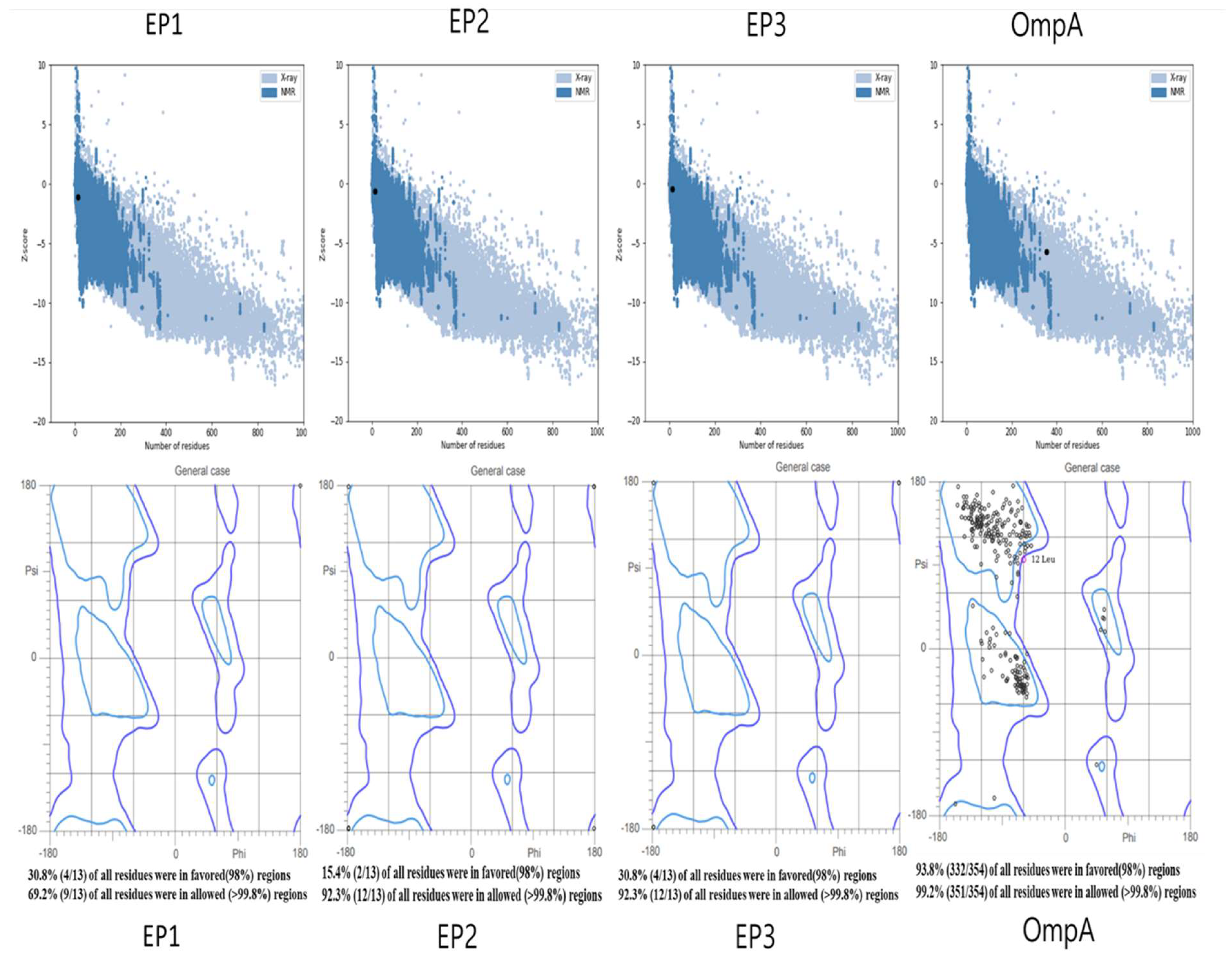
Figure 1. Validation of structural quality for A. baumannii OmpA and vaccine candidate epitopes. The top part of the figure shows ProSA-web Z-score plots, indicating that the models of the chosen epitopes and the entire OmpA protein (marked by black points) fall within the normal Z-score range for proteins of similar size (shown by colored regions). The bottom part displays Ramachandran plots for the modeled structures of the epitopes and the complete OmpA protein, with the count of residues in favored and allowed regions below each plot.
Preprints 149143 g001
Figure 2. Illustrates the structural features and positions of the identified epitopes from A. baumannii OmpA, proposed as vaccine candidates. (A) The 3D structures of the three epitopes are shown alongside their respective simplified molecular-input line-entry system (SMILES) strings (B). The location of epitopes within the 3D structure of OmpA is highlighted. As depicted, both epitopes are positioned on the lateral surfaces of the OmpA structure.
Preprints 149143 g002aPreprints 149143 g002b
Figure 3. The optimal CABS-dock modeling using default settings for epitopes (represented as red stick structures) and the contact map between the peptide and receptor. EP1 with HLA-DRB107:01, EP2 with HLA-DRB1*15:01, and EP3 with HLA-DRB4*01:01.
Preprints 149143 g003
Table 1. The epitopes identified from A. baumannii OmpA protein.
Epitope Core peptide HLA allele IEDB percentile score SYFPEITHI IFN-γ IL-4 IL-10 Toxicity Allergenicity
VVEVAPVEPTPVAPQ VAPVEPTPV DRB1*07:01 0.96 16 Yes NO No No No
GIELTPWLGFEAEYN LTPWLGFEA DRB1*15:01 0.59 34 Yes Yes No No No
EPTPVAPQPQELTED PVAPQPQEL DRB4*01:01 0.85 N/A Yes No NO No No
Table 2. The physicochemical properties of selected epitopes from A. baumannii OmpA.
Peptide name Vaxijen score Antigen Molecular weight (g/mol) Half-life Hydrophobicity Net charge at pH 7 Water solubility PI GRAVY Instability index
EP1 0.7548 Yes 1531.77 100 hours (mammalian reticulocytes, in vitro) >20 hours (yeast, in vivo) >10 hours (Escherichia coli, in vivo) 73.33% -2 poor 3.79 0.467 86.37 (Unstable)
EP2 0.9127 Yes 1738.91 30 hours (mammalian reticulocytes, in vitro) >20 hours (yeast, in vivo) >10 hours (Escherichia coli, in vivo) 46.67% -3 poor 3.67 -173 39.27 (Stable)
EP3 0.5131 Yes 1650.76 1 hour (mammalian reticulocytes, in vitro) 30 min (yeast, in vivo) >10 hours (Escherichia coli, in vivo) 46.67% -4 good 3.5 -1.267 124.89 (Unstable)
Table 3. Cluster analysis of epitopes as predicted using CABS-Dock, online server.
Epitope Cluster density Average RMSD Max. RMSD Number of elements
EP1 38.9179 2.69799 13.097 105
EP2 39.1403 2.55491 11.7363 100
EP3 48.824 2.04817 6.8723 100
Disclaimer/Publisher’s Note: The statements, opinions and data contained in all publications are solely those of the individual author(s) and contributor(s) and not of MDPI and/or the editor(s). MDPI and/or the editor(s) disclaim responsibility for any injury to people or property resulting from any ideas, methods, instructions or products referred to in the content.
Copyright: This open access article is published under a Creative Commons CC BY 4.0 license, which permit the free download, distribution, and reuse, provided that the author and preprint are cited in any reuse.
Prerpints.org logo

Preprints.org is a free preprint server supported by MDPI in Basel, Switzerland.

Subscribe

Disclaimer

Terms of Use

Privacy Policy

Privacy Settings

© 2025 MDPI (Basel, Switzerland) unless otherwise stated