

Submitted:
11 February 2025
Posted:
12 February 2025
You are already at the latest version
Abstract
The frequency spectrum allocation has been a subject of dispute in recent years. Cognitive Radio dynamically allocates users to spectrum holes using various sensing techniques. Noise levels and distances between users can significantly impact the efficiency of cognitive radio systems. Designing robust communication systems requires accurate knowledge of these factors. This paper proposes a method for predicting noise levels and distances based on spectrum sensing signals using regression machine learning models. The proposed methods achieved correlation coefficients of over 0.98 and 0.82 for noise and distance prediction, respectively. Accurately estimating these parameters enables adaptive resource allocation, interference mitigation, and improved spectrum efficiency, ultimately enhancing the performance and reliability of cognitive radio networks.
Keywords:
Spectrum Sensing
; Machine Learning
; Regression Models
; Transformer
1. Introduction
The frequency spectrum, essential for wireless communications, is a limited resource that has become increasingly congested [1,2,3]. Cognitive radio (CR) dynamically allocates communication for secondary users (SUs) in parts of the spectrum, known as spectrum holes, where primary users (PUs) are absent [4,5,6]. Several techniques exist for spectrum sensing, including energy detection, feature detection, Nyquist and sub-Nyquist methods, and multi-bit and one-bit compressive sensing. More recently, machine and deep learning models have been employed to detect the presence of PUs [7,8]. Across these methods, noise can adversely affect the accurate detection of PUs, impacting the efficient use of the spectrum. In multi-user systems, the distance between users significantly influences noise levels. Thus, predicting the noise level in the received signal and understanding user distances is fundamental for optimizing spectrum efficiency.
In communication systems, noise refers to any unwanted or random interference that compromises the quality of a transmitted signal. Noise can distort the original information being transmitted, leading to errors, diminished signal clarity, and reduced communication performance [9]. Almost all communication channels and systems encounter noise, which can originate from various sources. The noise level can be influenced by several factors, including transmitted power, path loss, shadow fading, multipath fading, and the distance between users. In addition to these factors, additive white Gaussian noise is a type of noise that exists across all frequencies [10]. This noise is characterized by its randomness and uniform energy distribution throughout the frequency spectrum. White Gaussian noise is a common model for representing random background noise in communication systems. By predicting noise levels, one can more effectively optimize system parameters and frequency allocation [11].
The distance between users is an important factor that influences signal quality and, consequently, spectrum efficiency. In spectrum sensing, the strength of the received signal depends on the distance between the transmitter and receiver. Predicting these distances helps adjust transmission power levels: users closer to the transmitter require lower power for reliable communication, while users farther away need higher power [12]. This power control optimizes energy efficiency and minimizes interference. Especially in systems with limited resources, such as bandwidth, predicting distances is fundamental for effective resource allocation. Users closer to the transmitter can be assigned greater bandwidth and consequently higher data rates, while those farther away might be allocated smaller bandwidths to improve signal quality at the same transmission power level. Additionally, distance prediction is essential for providing location-based services. The distance between users can also impact the performance of artificial intelligence models used to increase spectrum efficiency. By estimating distances, services like navigation, location-based advertisements, and emergency services can be offered.
To predict noise and distances between users, regression models and deep learning architectures are recommended [24]. Regression models are a class of machine learning algorithms designed to predict continuous numerical values based on input data. These models play a crucial role in various fields, including economics, finance, healthcare, and natural sciences. They allow for the analysis and forecasting of trends, relationships, and outcomes by learning from historical data. Among the most traditional machine learning regression approaches are support vector regression (SVR) (an extension of support vector machines to regression), decision trees and random forests [13], linear regression (one of the simplest yet widely used regression techniques), and ridge and lasso regression (variants of linear regression). In more robust regression approaches, convolutional neural networks (CNNs), initially designed for image analysis, can be adapted for regression tasks [14]. More recently, the Transformer, designed for forecasting, has shown promise for regression activities [36].
In this article, we propose the use of regression models to predict noise levels and distances based on spectrum sensing signals. During our study, we generated a dataset that considers important parameters, including a wide range of noise power densities, an extensive sensing area, and power leakage from the PU. We compared both traditional and deep learning models for prediction purposes. Furthermore, we evaluated the results using various metrics. Our proposed method has shown promising results, with a correlation coefficient exceeding 0.98 for noise and over 0.82 for distances. Additional metrics also indicate that our method is effective in predicting noise levels and distances between users. Such predictive capability can be important in designing communication systems to enhance spectrum efficiency.
This article is organized as follows: in Section 2, related works about the prediction of noise levels and distances between users in a communication system are presented; in Section 3, the proposed methodology for data generation, training, and evaluation is described; in Section 4, the experiments conducted and the results achieved are presented; the discussions related to the experiments are presented in Section 5; lastly, in Section 6, the conclusions are presented.
1.1. Contributions
The main contributions of this paper can be summarized as follows: (1) the use of the Transformer model, one of the newest and most robust networks, which achieved good results for distance prediction even with a limited architecture; (2) for noise prediction, classical regression methods presented excellent results, achieving a correlation coefficient greater than 0.98, demonstrating a high level of similarity between predictions and real values; (3) since current models used for spectrum sensing are very sensitive to signal quality, the proposed approach can help design better communication systems based on artificial intelligence models by providing prior information.
2. Related Works
In this section, the related works about noise and distances between users prediction in a spectral sensing scheme are described in detail.
2.1. Noise Prediction
The authors proposed a signal-to-noise ratio (SNR) estimation method based on the sounding reference signal and a deep learning network in [15]. The proposed deep learning network, called DINet, combines a denoising convolutional neural network (DnCNN) and an image restoration convolutional neural network (IRCNN) in parallel. The method was compared to other algorithms, and the results demonstrated superior performance in SNR estimation. The evaluation metric used was the normalized mean square error (NMSE) calculated over 200 test samples, yielding a NMSE value of . This result was significantly better than the performance achieved by other algorithms.
In [16], the authors presented a method for estimating SNR in LTE systems and 5G. They employed a combination of a CNN and long short-term memory (LSTM), known as a CNN-LSTM neural network. The CNN was utilized to extract spatial features, while the LSTM was used to extract temporal features from the input signal. Data was generated using MATLAB LTE and 5G toolboxes, taking into consideration modulation types, path delays, and Doppler shifts. The evaluation metric used was NMSE. The NMSE achieved a value of zero in the time-domain for SNR ranging from to 32 dB, demonstrating very low latency. However, in the frequency-domain, the proposed method exhibited lower performance.
In [17], the authors proposed NDR-Net, a novel neural network for channel estimation in the presence of unknown noise levels. NDR-Net comprises a noise level estimation subnet, a DnCNN, and a residual learning cascade. The noise level estimation subnet determines the noise interval, followed by the DnCNN, which processes the pure noise image. Subsequently, residual learning is applied to extract the noiseless channel image. The evaluation metric used for assessing the model’s performance was the mean square error (MSE). The experiments conducted across different channel models (TDL-A, TDL-B, TDL-C) consistently demonstrated low MSE values. However, it’s worth noting that the proposed model’s performance was evaluated within a SNR range of 0 to 35. This limited range does not provide a comprehensive understanding of the model’s robustness, particularly in scenarios with high levels of noise.
In Table 1, some techniques for noise prediction are summarized and compared. The methodology proposed in this article considers several variables that influence signal quality for data generation. The study incorporates noise power density across a wide range of values and explores a spectrum sensing environment where multiple users are in motion at fixed speeds over time. Several regression models are compared using various metrics to highlight the robustness of the proposed method.
2.2. Distances Prediction
In [18], the authors proposed a deep learning approach for user equipment positioning in non-line-of-sight scenarios. The impact of variables such as the type of radio data, the number of base stations, the size of the training dataset, and the generalization of the trained models on 3GPP indoor factory scenarios was analyzed. The model trained consisted of a customized residual neural network (ResNet) for the path gain dataset and a ResNet-18 for the channel impulse response dataset. The metric used was the quantile of the cumulative distribution function of the horizontal positioning error. The authors obtained the best performance with a large number of samples for training and tuning the models.
In [19], the authors proposed a machine learning algorithm for indoor fingerprint positioning based on measured 5G signals. The dataset was created by collecting 5G signals in the positioning area and processing them to form fingerprint data. A CNN was trained to locate a 5G device in an indoor environment. The metrics used were the root mean square error (RMSE) and the circular error probable. The experiments were conducted in a real field and demonstrated a positioning accuracy of 96% for the proposed method.
Finally, in [20], the authors introduced a location-aware predictive beamforming approach utilizing deep learning techniques for tracking unmanned aerial vehicle communication beams in dynamic scenarios. Specifically, they designed a recurrent neural network called LRNet, based on LSTM, to accurately predict unmanned aerial vehicle locations. Using the predicted location, it was possible to determine the angle between the unmanned aerial vehicle and the base station for efficient and rapid beam alignment in the subsequent time slot. This ensures reliable communication between the unmanned aerial vehicle and the base station. Simulation results demonstrate that the proposed approach achieves a highly satisfactory unmanned aerial vehicle-to-base station communication rate, approaching the upper limit attained by a perfect genie-aided alignment scheme.
In Table 2, some techniques for distances prediction are summarised and compared. The methodology proposed in this article considers several variables that influence signal quality for data generation. The study incorporates Euclidean distances between users across a wide range of values and explores a spectrum sensing environment where multiple users are in motion at fixed speeds over time. Several regression models are compared using various metrics to highlight the robustness of the proposed method.
3. Methods
This section presents the proposed methods for data generation, noise and distance predict.
3.1. System Model
The use of generated data simulating PU signals is proposed in spectrum sensing to predict the noise level of the sensed signal and the initial and final distances between users. For this, the methodology is divided as follows: (1) database generation, where the signals that represent PUs are generated [1,2]; (2) training the proposed regression models [21,22]; and (3) evaluation of the trained models for predicting noise level and distance [23,24]. At the end of the process, it is expected that the models will be able to predict the level of noise and the initial and final distance between the PU and SU during the sensing period.
The dataset utilized for training the proposed regression models comprises signal data, noise levels, and distances between the users. Initially, the SU and PU are positioned within the area , moving randomly for a duration of . During this time, signals are sensed, and data on noise levels () as well as initial () and final () distances are collected. This collected data is then used to train and test the proposed regression models. To validate the effectiveness of the method in predicting noise levels and distances, various metrics are calculated.
The Figure 1 illustrates the representation of the environment just described. The Initial State (left) is an example of how users can be positioned within the area, while the Final State (right) demonstrates the change in position after . The PU, marked by a red diamond, and the SUs, represented by black triangles, are randomly positioned within the area. In the Initial State, the heatmap represents the distance of each SU from the PU, with warmer (red) areas indicating closer proximity and cooler (blue) areas showing greater distances. In the Final State, we can observe that both the PU and SUs have changed positions, and the distances between the SUs may also vary during the observation period.
The output of step (1) is expected to be the signals that represent the PU, the associated noise level for each signal, and the initial and final distances during the sensing. Using this information, two regression models are trained: one for noise level prediction and another for initial and final distance predictions. In step (2), some classical machine learning regression models are employed, including Random Forest, Decision Tree, Extra Trees, XGBosst, LightGBM, SVR and Transformer. The output of this step consists of predicted values for noise level and distances given a test dataset. Lastly, in step (3), several metrics are used to evaluate the best models for these tasks.
3.2. Data Generation
In the spectrum sensing process, the decision on the channel condition is binary, involving two hypotheses: and [25]. Here, represents the hypothesis in which the PU is present, while represents the absence of the PU [2]. For the purposes of this paper, we will only consider hypotheses involving the presence of the PU. We assume that SU and a single PU are moving at a speed v, with their starting positions randomly chosen within a given area. As a result, the users’ locations change over a time interval of . Additionally, we are considering a multi-channel system with bands, each having a bandwidth of . Furthermore, we assume that the PU can utilize consecutive bands [1]. Therefore, the received signal of the i-th SU on the j-th band at time n can be described as
where and is the additive white Gaussian noise (AWGN) whose noise power density is , mean zero and standard deviation . Being the proportion of power leaked to adjacent bands, then are the bands occupied by the PU and are the bands affected by the leaked power of the PU.
In the expression , a simplified path loss model is utilized, which can be written as follows:
where and denote the path-loss exponent and path-loss constant, respectively. Here, represents the Euclidean distance between the PU and SU i at time n. The shadow fading of the channel, indicated by , between the PU and SU i at time n in decibels (dB) can be described by a normal distribution with a mean of zero and a variance of . The term P denotes the power transmitted by the PU within a specified frequency band. Furthermore, the multipath fading factor, denoted as , is modeled as an independent zero-mean circularly symmetric complex Gaussian (CSCG) random variable. Moreover, the data transmitted at time n, represented by , has an expected value of one [1,2].
3.3. Regression Models
The machine learning regression models used to predict interference and distance between the PU and SUs are the Random Forest, Decision Tree, Extra Trees, XGBoosting, LightGBM, SVR and Transformer.
3.3.1. Random Forest
The Random Forest consists of a collection of trees denoted as . Here, x represents an input vector of length q, containing a correlated random vector X, while refers to independent and identically distributed random vectors. In the context of regression, assume that the observed data is drawn independently from the joint distribution of , where Y represents the numerical outcome. This dataset includes -tuples, namely [26]. The prediction of the Random Forest regression is the unweighted average over the collection
3.3.2. Decision Tree
In the context of regression, the Decision Tree is based on recursively partitioning the input features space into regions and then assigning a constant value to each region. This constant value serves as the prediction for any data point that falls within that region. Assume that X is the input data, Y the target variable and represents the parameters that define the splits in the Decision Tree [27]. Let be the predicted value for Y given input X and parameter . Given a set of n training samples , where , the decision tree regressor seeks to find optimal split that minimize the sum of square differences between the predicted value and the actual target value. The prediction for a given X can be represented as
where N is the number of leaf nodes (regions) in the tree, is the constant value associated with the leaf node and is an indicator function equals 1 if X falls within the region and 0 otherwise.
3.3.3. Extra Trees
The extra trees follows the same step-by-step as Random Forest, using a random subset of features to train each base estimator [26]. Although, the best feature and the corresponding value for splitting the node are randomly selects [28]. Random Forest uses a bootstrap replica to train the model, while the extra trees the whole training dataset to train each regression tree [29].
3.3.4. XGBoosting
XGBoosting (XGB) is a highly optimized distributed gradient boosting library. It employs a recursive binary splitting strategy to identify the optimal split at each stage, leading to the construction of the best possible model [30]. Due to its tree-based structure, XGB is robust to outliers and, like many boosting methods, is effective in countering overfitting, making model selection more manageable. The regularized objective of the XGB model during the training step [31] is illustrate in Equation 5. Here, represents the loss, which quantifies the disparity between the prediction of the imputed missing value and the corresponding ground truth .
where is the regularizer representing the complexity of the tree.
3.3.5. LightGBM
The LightGBM (LGBM) is the gradient boosting decision tree (GBDT) algorithm with gradiente-based one-side sampling (GOSS) and exclusive feature bundling (EFB). The GOSS technique is employed within the context of gradient boosting, utilizing a training set consisting of n instances {}, where each instance represents a s-dimensional vector in space . In every iteration of gradient boosting, we compute the negative gradients of the loss function relative to the model’s output, resulting in {}. These training instances are then arranged in descending order, based on the absolute values of their gradients, and we select the top- instances with the largest gradient magnitudes to constitute a subset A [32]. For the complementing set , comprising of instances characterized by smaller gradients, a random subset B is extracted, sized at . The division of instances is subsequently determined by the estimated variance gain concerning vector over the combined subset , where
where , , , , and is the coefficient used to normalize the the sum of the gradients over B back to the size of .
3.3.6. SVR
Given a n training data , where ⊂, being the space of the input patterns [33]. The goal of the -SVR is to find a function which exhibits a maximum deviation of or less from the target values obtained during training, while also maintaining a minimal degree of fluctuation or variability. This function can be described as
where denotes dot product in .
3.3.7. Transformer
A Transformer model consists of an encoder and a decoder, each composed of multiple layers of self-attention and feed-forward neural networks. The base structure of the Transformer is the self-attention mechanism. Given an input sequence, the self-attention computes a weighted sum of the values. Multi-head attention is used to capture different aspects of relationships. Let the input of a Transformer layer be , where n is the number of tokens and d is the dimension of each token. Then, one block layer can be a function defined by [37]:
where Equations 8, 9 and 10 refereed to attention computation, and Equations 11 and 12 refereed to the feed forward network layer. is the row-wise softmax function, is the layer normalization function, and to activation function. Q, K, V and O, , , , are the training parameters in the layer [37]. In Figure 2 is shown the architecture of the proposed Transformer.
3.4. Evaluation Metrics
The metrics used for evaluation of the regression models are the mean square error, mean absolute error, root mean square error, mean absolute percentage error, R-square and correlation coefficient [34].
- Mean square error (MSE) [34]:where n is the number of data points in the dataset, represents the actual target value of the i-th data point, and represents the predicted value of the i-th data point.
- Mean absolute error (MAE) [34]:where denotes the absolute value.
- Root mean square error (RMSE) [34]:
- Mean absolute percentage error (MAPE) [34]:
- R-square () [23]:where represents the sum of squared differences between the the actual target values and the predicted values. The represents the total sum of squares, which is the sum of squared differences between the actual target values and their mean.
-
Correlation coefficient [35]:The correlation coefficient is given by the Pearson correlation coefficient:where is the mean of the actual target values and is the mean of the predicted values.
4. Experiments and Results
This section presents the experiments conducted and the results achieved for data generation, noise and distance predict.
4.1. Data Generation
The first stage of the experiments involves signal generation. It is assumed that multiple SU and a single PU are moving at a velocity of km/h, and their initial positions are randomly chosen within an area of 250 meters × 250 meters. As a result, the users’ positions change over a time period of seconds. Each occupied band has bandwidth of 10 MHz, and the PU can simultaneously use 1 to 3 bands. Additionally, dBm, , , dB, and is randomly chosen between and dBm/Hz. The ratio of leaked power to adjacent bands, , is 10 dBm, resulting in leaked power to adjacent bands being half of the PU signal power. For the experiments, instances were generated, divided into for training and for testing. For the Transformer method, the training dataset was divided into for training and for validation. A total of samples per second of the signal were generated. In Table 3 is presented the parameters and their respective values.
4.2. Model Parameters
4.3. Noise Predict
Figure 3 (left) presents the graph of the MSE with the variation of the in the proposed regression methods. It is noticeable that the SVR had the worst performance, only achieving good results at an of dBm/Hz. The Random Forest, Extra Trees, XGB, LGBM, Transformer, and Decision Tree showed similar performances, as shown in the graph. However, the Random Forest, XGB, LGBM and Extra Trees exhibited better performance, especially at lower levels of . The XGB was the best model, achieving the lowest level of MSE, achieving , which indicates that the predicted values are close to the actual ones.
Figure 3 (right) presents the graph of the MAE with the variation of the in the proposed regression methods. It is noticeable, also, that the SVR had the worst performance, only achieving good results at an of dBm/Hz. The Random Forest, Extra Trees, XGB, LGBM, Transformer, and Decision Tree showed similar performances, as shown in the graph. However, the Random Forest, XGB, LGBM and Extra Trees exhibited better performance, especially at levels of dBm/Hz and dBm/Hz. The Random Forest was the best model, achieving the lowest level of MAE, achieving , which indicates that the predicted values are close to the actual ones.
Figure 4 (left) presents the graph of the RMSE with the variation of the in the proposed regression methods. It is noticeable, also, that the SVR had the worst performance, only achieving good results at an of dBm/Hz. The Random Forest, XGB, LGBM, Transformer and Extra Trees showed similar performances, as shown in the graph. The XGB was the best model, achieving the lowest level of RMSE, achieving , which indicates that the predicted values are close to the actual ones.
Figure 4 (right) presents the graph of the MAPE with the variation of the in the proposed regression methods. It is noticeable, also, that the SVR had the worst performance, only achieving good results at an of dBm/Hz. The Random Forest, XGB, LGBM Extra Trees, Transformer, and Decision Tree showed similar performances, as shown in the graph. However, the Random Forest and Extra Trees exhibited better performance. The Random Forest was the best model, achieving the lowest level of MAPE, achieving , which indicates that the predicted values are close to the actual ones.
In Table 6, the general metrics for all proposed models are presented for noise prediction. It is worth noting that, in terms of the correlation coefficient, Random Forest, XGB, LGBM, Transformer and Extra Trees exhibited the highest and similar performances. However, Random Forest performed slightly better on the MAE and MAPE metrics, while XGB performed better on the correlation coefficient, MSE, RMSE, and . The SVR presented the worst performance in the general metrics.
4.4. Distance Predict
Figure 5 presents the graphics of the MSE of the initial and final distance between the SU and PU during the spectrum sensing with the variation of in the proposed regression methods. It is noticeable that the SVR and Decision Tree had the worst performances at all levels of noise. The Random Forest, XGB, Transformer, LGBM and Extra Trees showed similar performances, as shown in the graph. However, the LGBM exhibited slightly better performance than the others, especially at the lowest level of noise, achieving . In the final distance prediction, the Extra Trees model exhibited slightly better performance, achieving .
Figure 6 presents the graphics of the MAE of the initial and final distance between the SU and PU during the spectrum sensing with the variation of in the proposed regression methods. It is also noticeable that the SVR and Decision Tree had the worst performances at all levels of noise. The Random Forest, XGB, LGBM, Transformer and Extra Trees showed similar performances, as shown in the graph. However, the XGB exhibited slightly better performance than the others, achieving . In the final distance prediction, the Extra Trees model exhibited slightly better performance, achieving .
Figure 7 presents the graphics of the RMSE of the initial and final distance between the SU and PU during the spectrum sensing with the variation of in the proposed regression methods. It is also noticeable that the SVR and Decision Tree had the worst performances at all levels of noise. The Random Forest, XGB, LGBM, Transformer and Extra Trees showed similar performances, as shown in the graph. However, the LGBM exhibited slightly better performance than the others, achieving . In the final distance prediction, the Extra Trees model exhibited slightly better performance, achieving .
Figure 8 presents the graphics of the MAPE of the initial and final distance between the SU and PU during spectrum sensing with variations in using the proposed regression methods. It is also noticeable that SVR and Decision Tree had the worst performance levels across all levels of noise. Random Forest and Extra Trees showed similar performance, as shown in the graph on the left. However, Transformer exhibited slightly better performance than Random Forest, especially at dBm/Hz, dBm/Hz, and dBm/Hz, achieving . In the graph on the right, Random Forest, XGB, LGBM, and Extra Trees showed similar performance. However, Transformer exhibited slightly better performance than the others, achieving .
In Table 7, general metrics for all proposed regression models are presented for initial distance prediction. It is worth noting that, in all metrics, Random Forest, XGB, LGBM, Transformer and Extra Trees exhibited the highest and similar performances. Transformer performed better in correlation coefficient, MAPE, and , demonstrating a high level of correlation between the predictions and the actual values of distances. In terms of MSE and RMSE, LGBM achieved the lowest values, indicating that the differences between predictions and actual values are small. The lowest MAE values were exhibited by XGB.
In Table 8, general metrics for all proposed regression models are presented for final distance prediction. The Extra Trees exhibited the best performance in all metrics except for MAPE, and correlation coefficient, where Transformer exhibited the best performance.
5. Discussion
In Section 4.3, the results for noise predict were presented, and several important aspects need to be highlighted. In Figure 3 (left), it is noticeable that the models achieved similar performances, except for Decision Tree, and SVR. Interestingly, the best performance occurred at the highest levels of noise, except for SVR, which specialized in a single noise level, dBm/Hz. Figure 3 (right), Figure 4 (left), and Figure 4 (right) exhibit similar characteristics to Figure 3 (left). The overall results for Random Forest, XGB, LGBM, Transformer and Extra Trees are similar across all metrics, with Random Forest and XGB performing particularly well, as demonstrated in Table 6. In contrast, SVR exhibited poor performance overall. Additionally, the correlation coefficients reveal that Random Forest, XGB, LGBM and Extra Trees achieved strong correlations between predicted and real noise values (Table 6). Due to the limited computational resources and the large amount of generated data, it was not possible to enhance the robustness of the Transformer architectures. Furthermore, a search for optimal hyperparameters values for all models could be a proposed enhancement for the work.
In Section 4.4, the results for initial and final distance predict were presented, and several notable observations arise. In Figure 5, it is evident that Extra Trees and LGBM achieved the highest performances. Unlike the noise predict, the best performances for both distance predicts occurred at the lowest levels of noise for all models, which was expected. The behavior of predict the initial distance mirrors that of predict the final distance, as seen in Figure 5, Figure 6, Figure 7 and Figure 8. The general results for Random Forest, XGB, LGBM, Transformer and Extra Trees exhibit similarity across all metrics, with Extra Trees, Transformer and LGBM slightly outperforming in almost all metrics for both initial and final distance, as shown in Table 7 and Table 8, respectively. In contrast, Decision Tree and SVR showed poor performance overall. Moreover, the correlation coefficients reveal that the predicted distances exhibited indices greater than in relation to the real values in both distances, initial and final. Interesting factor is that in the initial distance prediction, the MAPE values for the XGB and LGBM models returned ’inf’. More studies are needed to understand what happened.
6. Conclusions
In this paper, noise and distance prediction based on spectrum sensing signals using regression models was proposed. The conducted experiments have shown that the proposed methods hold promise for predict noise levels, as well as the initial and final distances between the PU and SU. The correlation coefficient value for XGB is the highest and closest to one (Table 6), indicating a strong correlation between predicted and actual noise values in the test database. As a result, the proposed methods can greatly benefit various applications, especially in telecommunication and networking, enabling the design of communication systems that meet appropriate requirements for ensuring reliable and efficient data transfer.
Additionally, the predicts for the initial and final distances between PU and SU are presented as results. The conducted experiments have demonstrated that the proposed methods show promise in predicting distances between users. The correlation coefficient values for Transformer are the highest, exceeding (Table 7 and Table 8), which implies a good level of correlation between the predicted distances and the actual distances in the test database. It’s important to highlight that the number of possible noise levels is limited to 7 levels ( to dBm/Hz), while the number of possible distances is unknown since the distance was chosen randomly within a certain range of the area. Therefore, there may be a difference in performance between the two approaches. Hence, the proposed methods hold the potential to benefit numerous applications, including signal attenuation and path loss, interference and frequency reuse, fading and multipath effects, localization and tracking, and power control.
Author Contributions
Conceptualization, Myke Valadão; methodology, Myke Valadão; software, Myke Valadão; validation, Myke Valadão; formal analysis, Myke Valadão; investigation, Myke Valadão; resources, Myke Valadão; data curation, Myke Valadão; writing—original draft preparation, Myke Valadão and Diego Amoedo; writing—review and editing, Myke Valadão, Diego Amoedo, André Costa, Celso Carvalho and Waldir Sabino; visualization, Myke Valadão, Diego Amoedo, André Costa, Celso Carvalho and Waldir Sabino; supervision, Myke Valadão, André Costa, Celso Carvalho and Waldir Sabino; project administration, Myke Valadão; funding acquisition, Myke Valadão, Celso Carvalho and Waldir Sabino. All authors have read and agreed to the published version of the manuscript.
References
- Valadão, M. D., Amoedo, D., Costa, A., Carvalho, C., & Sabino, W. (2021). Deep cooperative spectrum sensing based on residual neural network using feature extraction and random forest classifier. Sensors, 21(21), 7146. [CrossRef]
- Lee, W., Kim, M., & Cho, D. H. (2019). Deep cooperative sensing: Cooperative spectrum sensing based on convolutional neural networks. IEEE Transactions on Vehicular Technology, 68(3), 3005-3009. [CrossRef]
- Valadäo, M. D., Carvalho, C. B., & Júnior, W. S. (2020). Trends and challenges for the spectrum sensing in the next generation of communication systems. In 2020 IEEE International Conference on Consumer Electronics-Taiwan (ICCE-Taiwan) (pp. 1-2). [CrossRef]
- Valadão, M. D., Amoedo, D. A., Pereira, A. M., Tavares, S. A., Furtado, R. S., Carvalho, C. B., ... & Júnior, W. S. (2022). Cooperative spectrum sensing system using residual convolutional neural network. In 2022 IEEE International Conference on Consumer Electronics (ICCE) (pp. 1-5). IEEE. [CrossRef]
- Valadão, M. D., Júnior, W. S., & Carvalho, C. B. (2021). Trends and Challenges for the Spectrum Efficiency in NOMA and MIMO based Cognitive Radio in 5G Networks. In 2021 IEEE International Conference on Consumer Electronics (ICCE) (pp. 1-4). IEEE. [CrossRef]
- Valadão, M., Silva, L., Serrão, M., Guerreiro, W., Furtado, V., Freire, N., ... & Craveiro, C. (2023). MobileNetV3-based Automatic Modulation Recognition for Low-Latency Spectrum Sensing. In 2023 IEEE International Conference on Consumer Electronics (ICCE) (pp. 1-5). IEEE. [CrossRef]
- Gupta, M. S., & Kumar, K. (2019). Progression on spectrum sensing for cognitive radio networks: A survey, classification, challenges and future research issues. Journal of Network and Computer Applications, 143, 47-76. [CrossRef]
- Arjoune, Y., & Kaabouch, N. (2019). A comprehensive survey on spectrum sensing in cognitive radio networks: Recent advances, new challenges, and future research directions. Sensors, 19(1), 126. [CrossRef]
- Shen, X., Shi, D., Peksi, S., & Gan, W. S. (2022). A multi-channel wireless active noise control headphone with coherence-based weight determination algorithm. Journal of Signal Processing Systems, 94(8), 811-819. [CrossRef]
- Cheon, B. W., & Kim, N. H. (2022). AWGN Removal Using Modified Steering Kernel and Image Matching. Applied Sciences, 12(22), 11588. [CrossRef]
- Ngo, T., Kelley, B., & Rad, P. (2020). Deep learning based prediction of signal-to-noise ratio (SNR) for LTE and 5G systems. In 2020 8th International Conference on Wireless Networks and Mobile Communications (WINCOM) (pp. 1-6). IEEE. [CrossRef]
- Nagah Amr, Mohammed, Hussein M. ELAttar, Mohamed H. Abd El Azeem, and Hesham El Badawy. (2021). "An Enhanced Indoor Positioning Technique Based on a Novel Received Signal Strength Indicator Distance Prediction and Correction Model" Sensors 21, no. 3: 719. [CrossRef]
- Jain, P., Choudhury, A., Dutta, P., Kalita, K., & Barsocchi, P. (2021). Random forest regression-based machine learning model for accurate estimation of fluid flow in curved pipes. Processes, 9(11), 2095. [CrossRef]
- Wang, X., Zhao, Y., & Pourpanah, F. (2020). Recent advances in deep learning. International Journal of Machine Learning and Cybernetics, 11, 747-750. [CrossRef]
- Yao, G., & Hu, Z. (2023, June). SNR Estimation Method based on SRS and DINet. In Proceedings of the 2023 15th International Conference on Computer Modeling and Simulation (pp. 218-224). [CrossRef]
- Ngo, T., Kelley, B., & Rad, P. (2020, October). Deep learning based prediction of signal-to-noise ratio (SNR) for LTE and 5G systems. In 2020 8th International Conference on Wireless Networks and Mobile Communications (WINCOM) (pp. 1-6). IEEE. [CrossRef]
- Li, Y., Bian, X., & Li, M. (2023). Denoising Generalization Performance of Channel Estimation in Multipath Time-Varying OFDM Systems. Sensors, 23(6), 3102. [CrossRef]
- Chatelier, B., Corlay, V., Ciochina, C., Coly, F., & Guillet, J. (2023). Influence of Dataset Parameters on the Performance of Direct UE Positioning via Deep Learning. arXiv preprint arXiv:2304.02308. [CrossRef]
- Wang, C., Xi, J., Xia, C., Xu, C., & Duan, Y. (2023, January). Indoor fingerprint positioning method based on real 5G signals. In Proceedings of the 2023 7th International Conference on Machine Learning and Soft Computing (pp. 205-210). [CrossRef]
- Conti, A., Morselli, F., Liu, Z., Bartoletti, S., Mazuelas, S., Lindsey, W. C., & Win, M. Z. (2021). Location awareness in beyond 5G networks. IEEE Communications Magazine, 59(11), 22-27. [CrossRef]
- Yang, H., Xie, X., & Kadoch, M. (2020). Machine learning techniques and a case study for intelligent wireless networks. IEEE Network, 34(3), 208-215. [CrossRef]
- Arjoune, Y., & Kaabouch, N. (2019). On spectrum sensing, a machine learning method for cognitive radio systems. In 2019 IEEE International Conference on Electro Information Technology (EIT) (pp. 333-338). IEEE. [CrossRef]
- Chicco, D., Warrens, M. J., & Jurman, G. (2021). The coefficient of determination R-squared is more informative than SMAPE, MAE, MAPE, MSE and RMSE in regression analysis evaluation. PeerJ Computer Science, 7, e623. [CrossRef]
- Spüler, M., Sarasola-Sanz, A., Birbaumer, N., Rosenstiel, W., & Ramos-Murguialday, A. (2015). Comparing metrics to evaluate performance of regression methods for decoding of neural signals. In 2015 37th Annual International Conference of the IEEE Engineering in Medicine and Biology Society (EMBC) (pp. 1083-1086). IEEE. [CrossRef]
- Cichoń, K., Kliks, A., & Bogucka, H. (2016). Energy-efficient cooperative spectrum sensing: A survey. IEEE Communications Surveys & Tutorials, 18(3), 1861-1886. [CrossRef]
- Segal, M. R. (2004). Machine Learning Benchmarks and Random Forest Regression. UCSF: Center for Bioinformatics and Molecular Biostatistics. Retrieved from https://escholarship.org/uc/item/35x3v9t4.
- Luo, H., Cheng, F., Yu, H., & Yi, Y. (2021). SDTR: Soft decision tree regressor for tabular data. IEEE Access, 9, 55999-56011. [CrossRef]
- Ahmad, M. W., Reynolds, J., & Rezgui, Y. (2018). Predictive modelling for solar thermal energy systems: A comparison of support vector regression, random forest, extra trees and regression trees. Journal of cleaner production, 203, 810-821. [CrossRef]
- Geurts, P., Ernst, D., & Wehenkel, L. (2006). Extremely randomized trees. Machine learning, 63, 3-42. [CrossRef]
- Zhang, X., Yan, C., Gao, C., Malin, B. A., & Chen, Y. (2020). Predicting missing values in medical data via XGBoost regression. Journal of healthcare informatics research, 4, 383-394. [CrossRef]
- Chen, T., & Guestrin, C. (2016, August). Xgboost: A scalable tree boosting system. In Proceedings of the 22nd acm sigkdd international conference on knowledge discovery and data mining (pp. 785-794). [CrossRef]
- Ke, G., Meng, Q., Finley, T., Wang, T., Chen, W., Ma, W., ... & Liu, T. Y. (2017). Lightgbm: A highly efficient gradient boosting decision tree. Advances in neural information processing systems, 30.
- Smola, A. J., & Schölkopf, B. (2004). A tutorial on support vector regression. Statistics and computing, 14, 199-222. [CrossRef]
- Botchkarev, A. (2018). Evaluating performance of regression machine learning models using multiple error metrics in azure machine learning studio. Available at SSRN 3177507. [CrossRef]
- Cohen, I., Huang, Y., Chen, J., Benesty, J., Benesty, J., Chen, J., ... & Cohen, I. (2009). Pearson correlation coefficient. Noise reduction in speech processing, 1-4. [CrossRef]
- Su, X., Li, J., & Hua, Z. (2022). Transformer-based regression network for pansharpening remote sensing images. IEEE Transactions on Geoscience and Remote Sensing, 60, 1-23. [CrossRef]
- Min, E. , Chen, R., Bian, Y., Xu, T., Zhao, K., Huang, W.,... & Rong, Y. (2022). Transformer for graphs: An overview from architecture perspective. [CrossRef]
Figure 1.
Users position over time (Initial State on the left, Final State on the right).
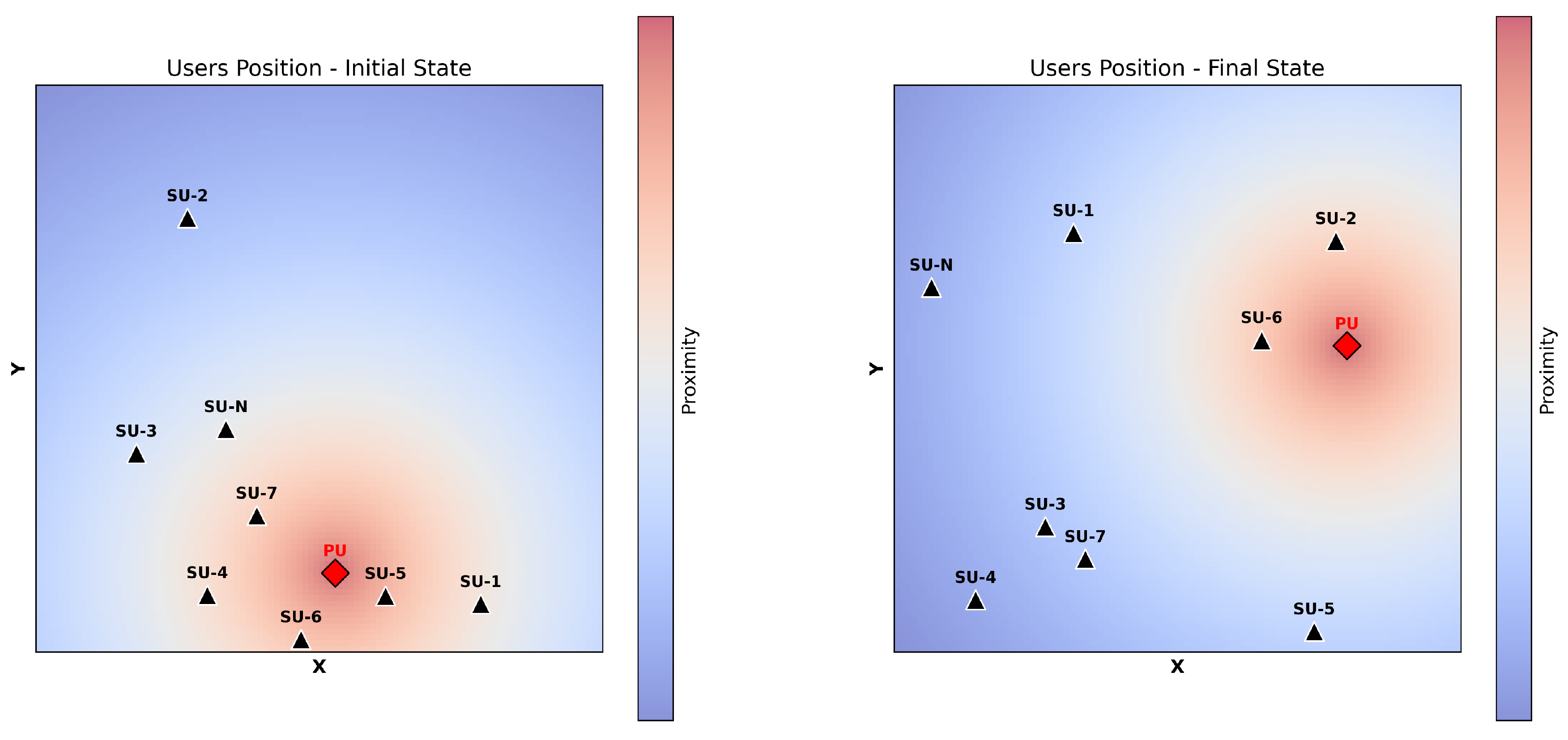
Figure 2.
Architecture of the proposed Transformer.
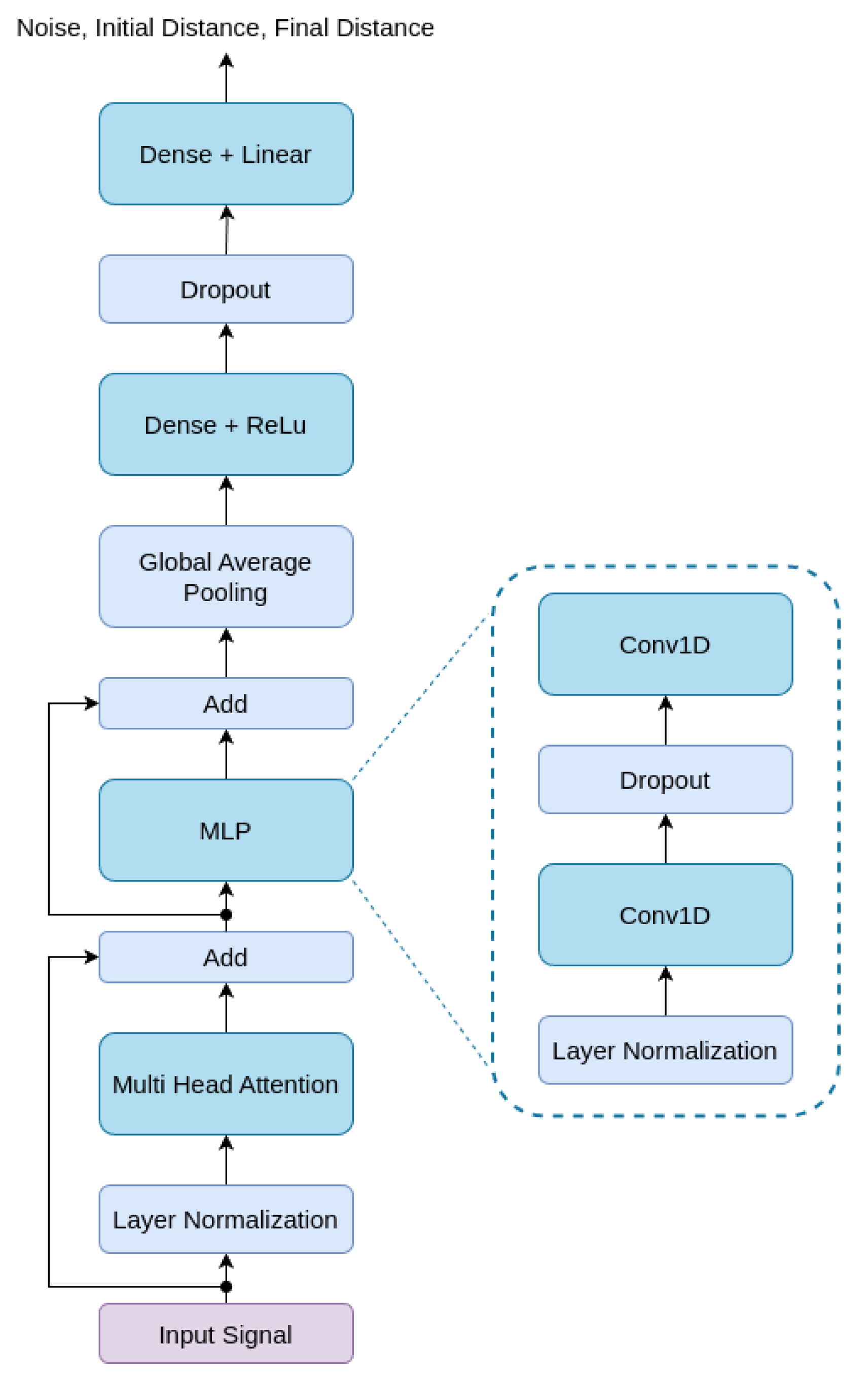
Figure 3.
Graphic of the MSE (left) and MAE (right) of proposed methods with between dBm/Hz and dBm/Hz.
Figure 3.
Graphic of the MSE (left) and MAE (right) of proposed methods with between dBm/Hz and dBm/Hz.
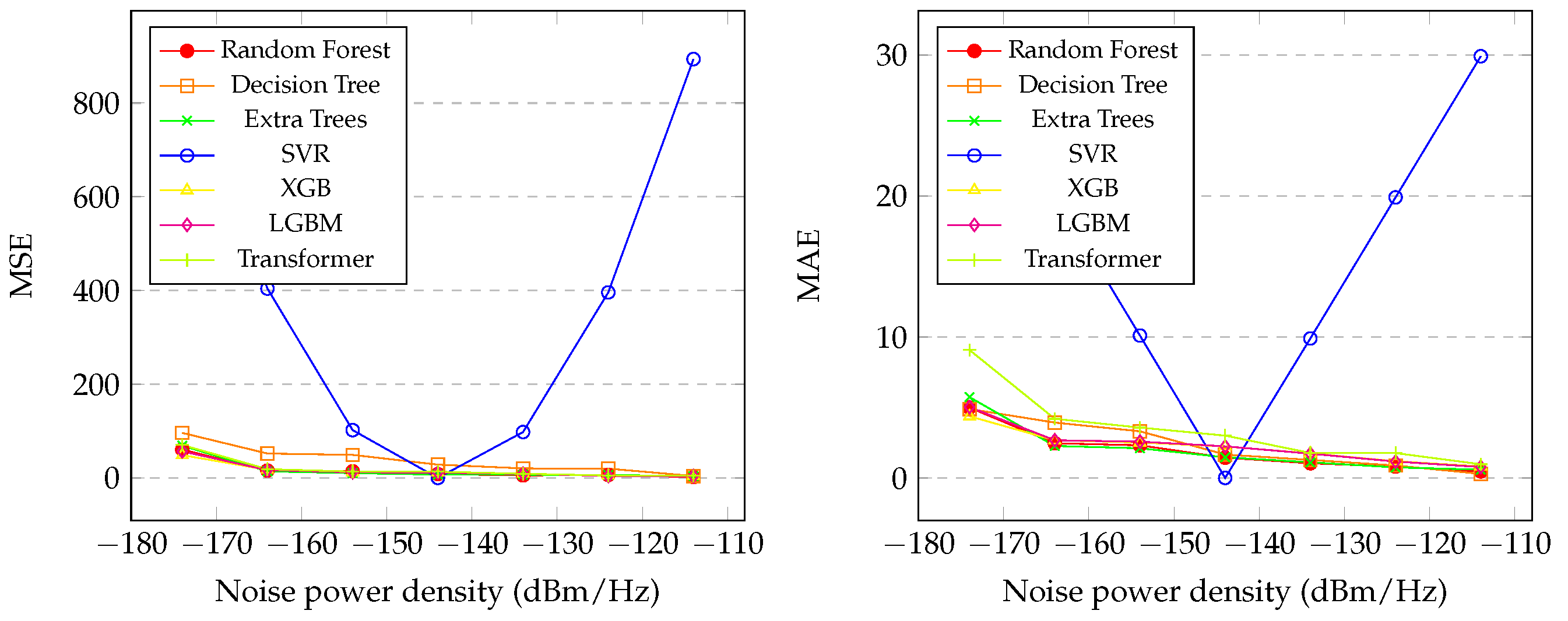
Figure 4.
Graphic of the RMSE (left) and MAPE (right) of the proposed methods with between dBm/Hz and dBm/Hz.
Figure 4.
Graphic of the RMSE (left) and MAPE (right) of the proposed methods with between dBm/Hz and dBm/Hz.
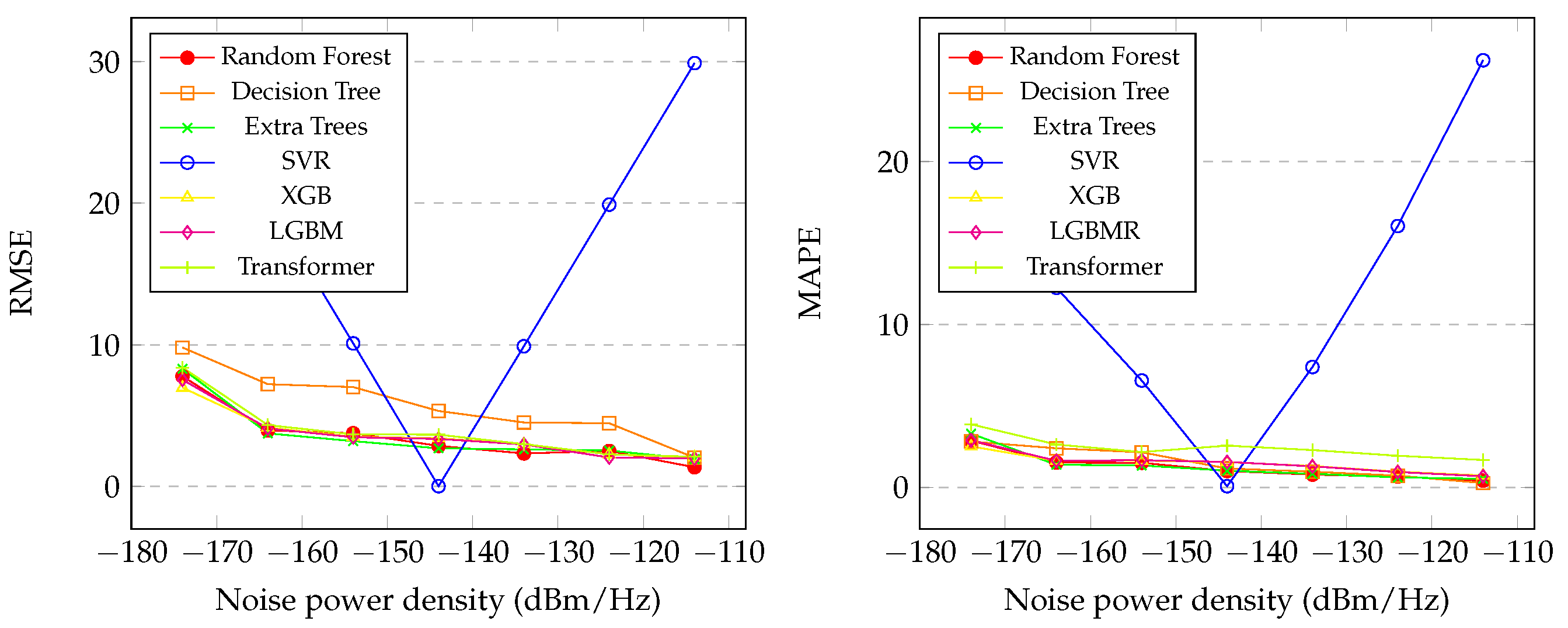
Figure 5.
Graphic of the MSE (initial distance at the left and final distance at the right) of the proposed methods with between dBm/Hz and dBm/Hz.
Figure 5.
Graphic of the MSE (initial distance at the left and final distance at the right) of the proposed methods with between dBm/Hz and dBm/Hz.
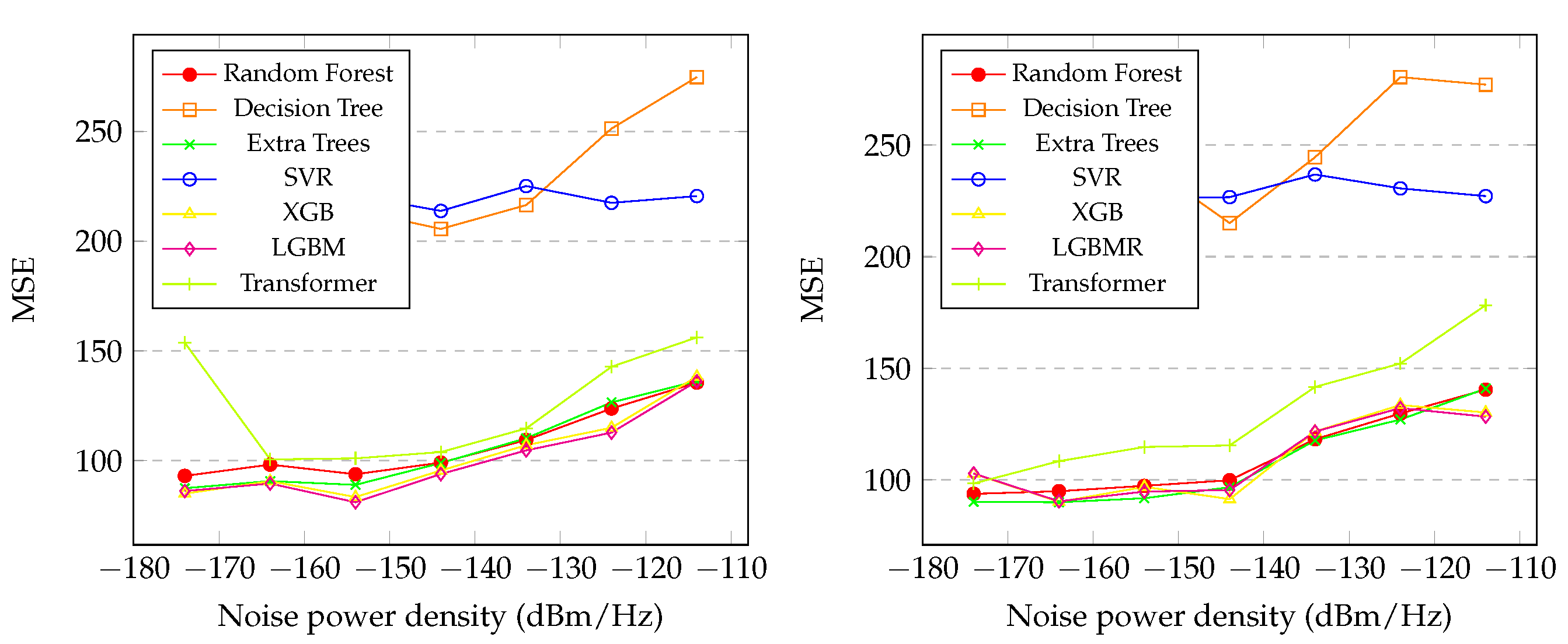
Figure 6.
Graphic of the MAE (initial distance at the left and final distance at the right) of the proposed methods with between dBm/Hz and dBm/Hz.
Figure 6.
Graphic of the MAE (initial distance at the left and final distance at the right) of the proposed methods with between dBm/Hz and dBm/Hz.
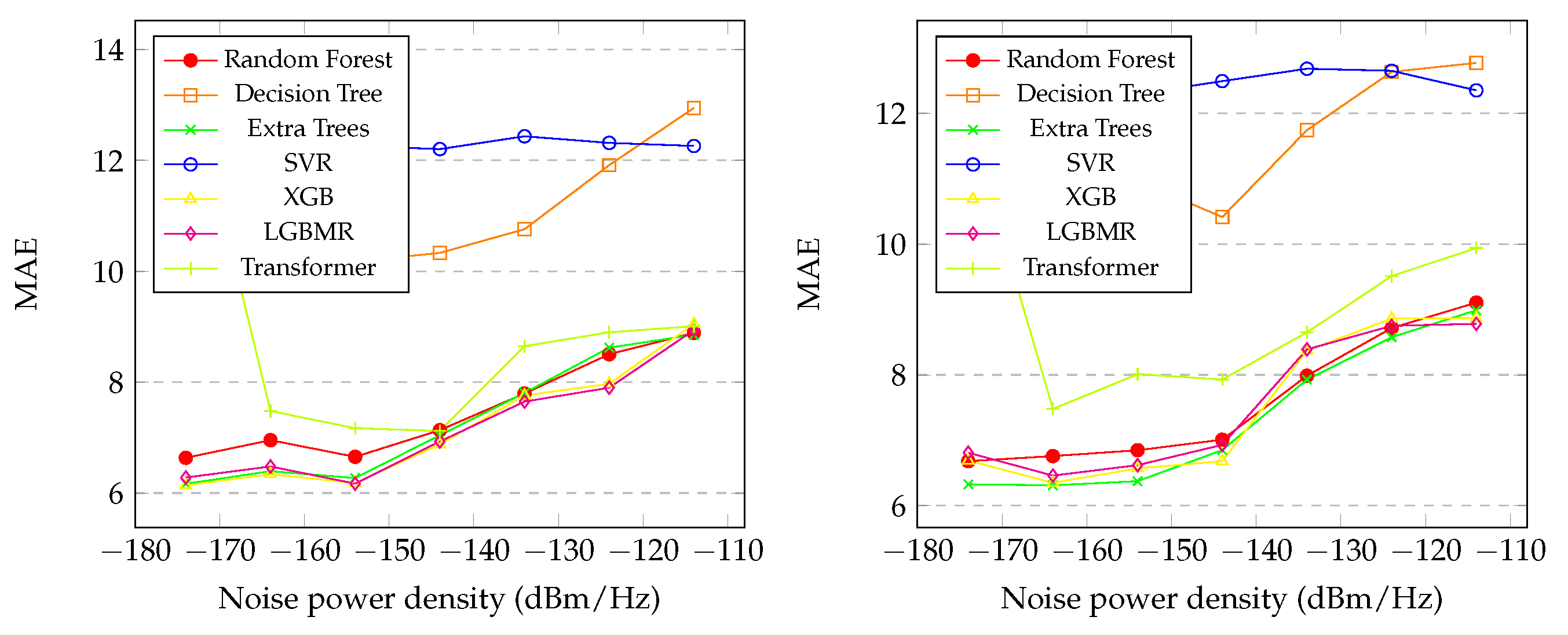
Figure 7.
Graphic of the RMSE (initial distance at the left and final distance at the right) of the proposed methods with between dBm/Hz and dBm/Hz.
Figure 7.
Graphic of the RMSE (initial distance at the left and final distance at the right) of the proposed methods with between dBm/Hz and dBm/Hz.
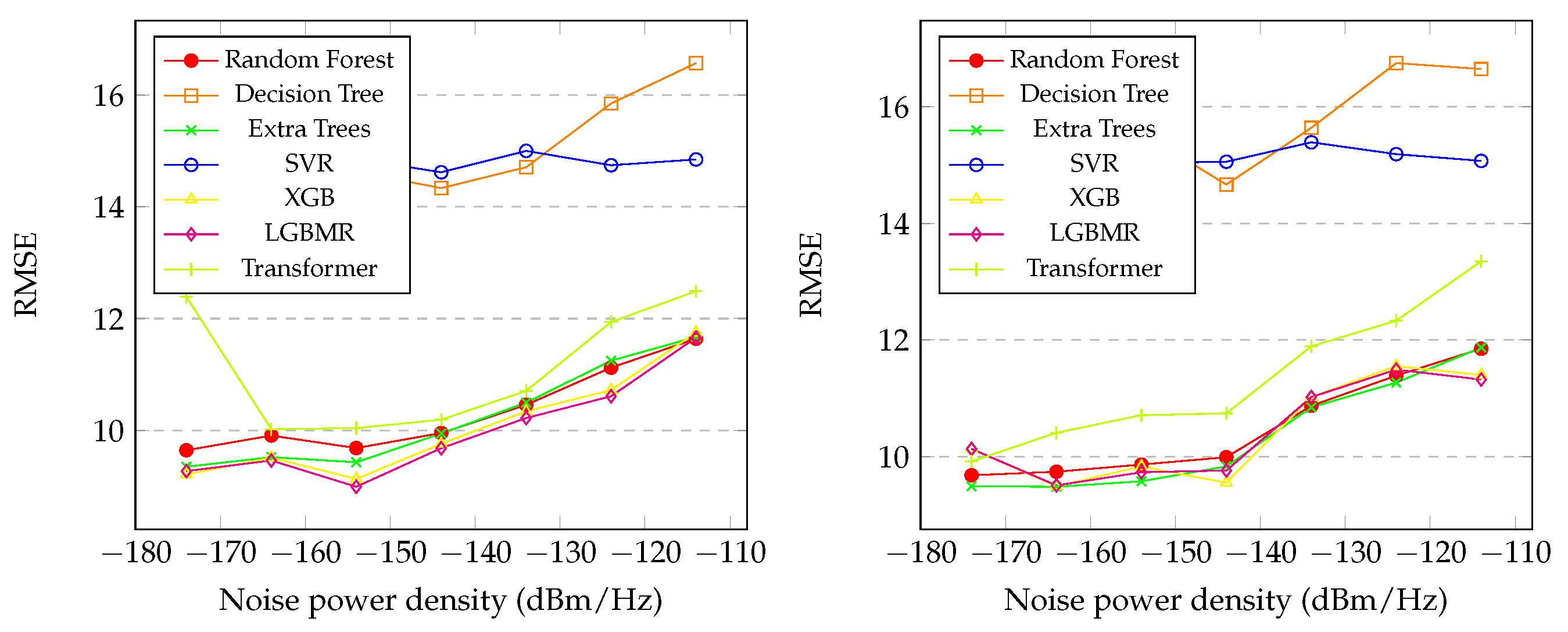
Figure 8.
Graphic of the MAPE (initial distance at the left and final distance at the right) of the proposed methods with between dBm/Hz and dBm/Hz.
Figure 8.
Graphic of the MAPE (initial distance at the left and final distance at the right) of the proposed methods with between dBm/Hz and dBm/Hz.
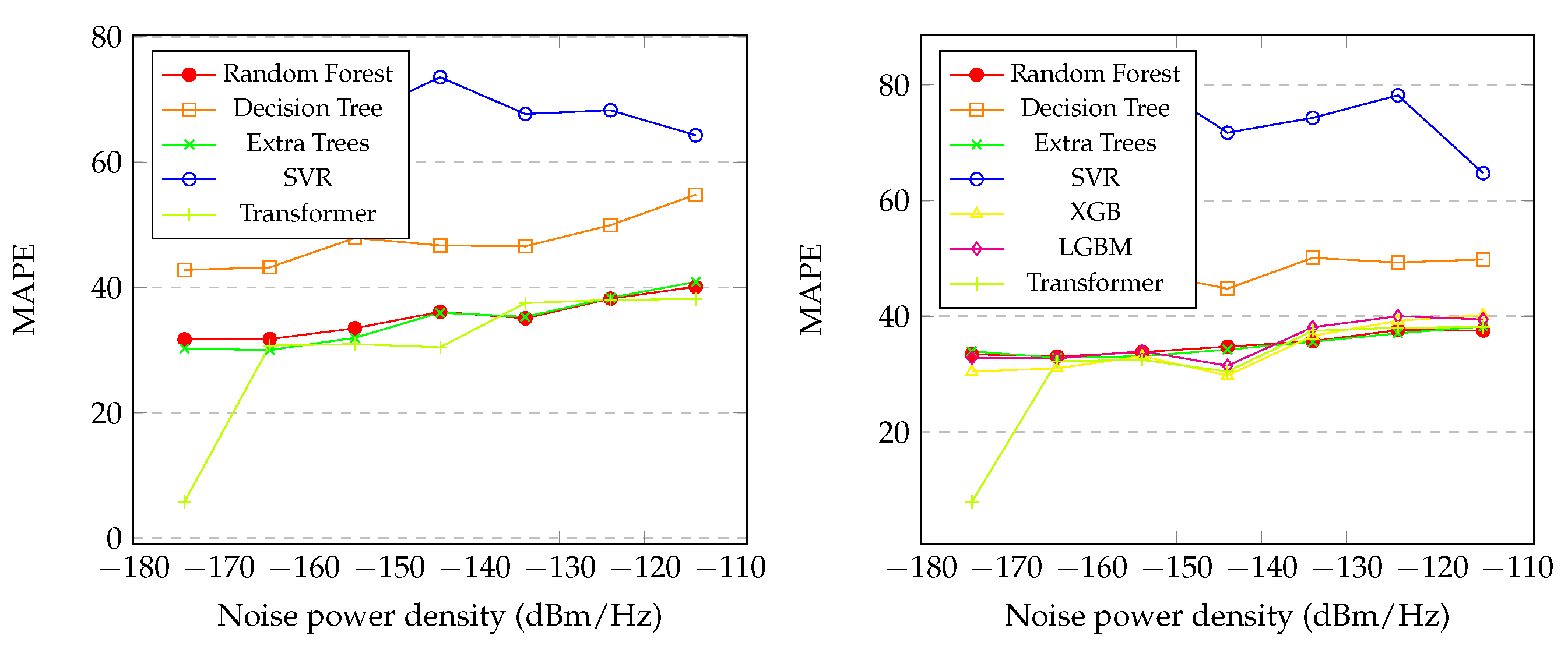

Table 1.
Related Works on noise prediction.
| Reference | Research Direction | Contribution | Limitation |
|---|---|---|---|
| [15] | SNR estimation method based on the sounding reference signal and a deep learning network | Proposed a DICNN for SNR estimation, which is a DnCNN and IRCNN in parallel | The number of testing samples is small |
| [16] | Method for estimating SNR in LTE systems and 5G | They used a CNN-LSTM neural network to extract spatial and temporal features | The proposed method exhibited lower performance in the frequency-domain |
| [17] | Novel neural network for channel estimation in the presence of unknown noise levels | Proposed an NDR-Net for channel estimation, which comprises a noise level estimation subnet, a DnCNN, and a residual learning cascade | Limited to a small range of noise level |
| Proposed | Prediction of noise power density in spectrum sensing signals | Proposed several regression algorithms for predicting noise power density in signals considering several other variables that influence the quality of the signal | Computing power was a limitation for training with more data and robust architectures |
Table 2.
Related Works on distances prediction.
| Reference | Research Direction | Contribution | Limitation |
|---|---|---|---|
| [18] | User equipment positioning in non-line-of-sight scenarios | Proposed customized ResNet for the path gain dataset and a ResNet-18 for the channel impulse response dataset | Without finetune and with large number of samples the models exhibited lower performance |
| [19] | Indoor fingerprint positioning based on measured 5G signals | A CNN was trained to locate a 5G device in an indoor environment. The experiments were conducted in a real field and demonstrated a positioning accuracy of 96% for the proposed method | The proposed method is not compared with other deep learning models |
| [20] | Location-aware predictive beamforming approach utilizing deep learning techniques for tracking unmanned aerial vehicle communication beams in dynamic scenarios | Designed a recurrent neural network called LRNet, based on LSTM, to accurately predict unmanned aerial vehicle locations. Using the predicted location, it was possible to determine the angle between the unmanned aerial vehicle and the base station for efficient and rapid beam alignment in the subsequent time slot | Limited only to unmanned aerial vehicle-to-base station communication |
| Proposed | Prediction of initial and final distances between users during spectrum sensing | Proposed several regression algorithms for predicting distances between users considering several other variables that influence the quality of the signal | Computing power was a limitation for training with more data and robust architectures |
Table 3.
Parameters and values for data generation.
| Parameter | Value | Mean |
|---|---|---|
| v | 3 km/h | Velocity |
| 5 seconds | Time period | |
| 10 MHz | Bandwidth of each band | |
| 1 to 3 | Number of consecutive bands that the PU can used | |
| P | 23 dBm | Power transmitted by the PU |
| Path-loss exponent | ||
| Path-loss constant | ||
| dB | Standard deviation | |
| to dBm/Hz | Noise power density | |
| 10 dBm | Leaked power to adjacent bands |
Table 4.
XGB and LGBM parameters.
| Parameter | XGB | LGBM |
|---|---|---|
| Estimators | 100 | 100 |
| Max depth | 6 | - |
| Learning rate | ||
| Subsample | - | |
| Column sample by tree | - | |
| Random state | 42 | 42 |
| Boosting type | - | GBDT |
| Number of leaves | - | 31 |
Table 5.
Transformer parameters.
| Parameter | Transformer |
|---|---|
| Head size | 32 |
| Number of heads | 4 |
| Filter dimension | 32 |
| Transformer block | 1 |
| Dense layer | 32 |
| Drop out | 0.25 |
| Batch size | 32 |
| Optimizer | Adam |
| Learning rate | |
| Loss | MSE |
Table 6.
Noise regression comparison metrics of the proposed methods.
| Metrics | R.F. | D.T. | E.T. | SVR | XGB | LGBM | Transformer |
|---|---|---|---|---|---|---|---|
| C.C. | 0.9801 | 0.9521 | 0.9794 | 0.0079 | 0.9806 | 0.979 | 0.9697 |
| MSE | 16.084 | 38.6547 | 16.8942 | 404.64335 | 15.53 | 16.35 | 19.2086 |
| MAE | 1.9473 | 2.32738 | 2.0186 | 17.2736 | 2.23 | 2.32 | 3.4854 |
| RMSE | 4.0104 | 6.2172 | 4.11026 | 20.11575 | 3.94 | 4.04 | 4.3827 |
| MAPE | 1.2534 | 1.49406 | 1.2971 | 12.3579 | 1.48 | 1.52 | 2.4489 |
| R[2] | 0.96025 | 0.9044 | 0.9582 | 0.9616 | 0.959 | 0.9365 |
C.C. is the abbreviation of correlation coefficient. R.F. is the abbreviation of Random Forest. D.T. is the abbreviation of Decision Tree. E.T. is the abbreviation of Extra Trees.
Table 7.
Initial distance regression comparison metrics of the proposed methods.
| Metrics | R.F. | D.T. | E.T. | SVR | XGB | LGBM | Transformer |
|---|---|---|---|---|---|---|---|
| C.C. | 0.7222 | 0.4876 | 0.7290 | 0.08103 | 0.718 | 0.725 | 0.841 |
| MSE | 107.56 | 226.2186 | 105.5776 | 218.8497 | 102.17 | 100.67 | 124.63 |
| MAE | 7.5115 | 10.9095 | 7.31 | 12.2795 | 7.19 | 7.20 | 8.87 |
| RMSE | 10.3713 | 15.0405 | 10.275 | 14.7935 | 10.10 | 10.03 | 11.16 |
| MAPE | 35.2191 | 47.4401 | 34.69 | 68.5288 | inf | inf | 30.23 |
| R2 | 0.51807 | 0.5269 | 0.00399 | 0.516 | 0.523 | 0.58 |
Table 8.
Final distance regression comparison metrics of the proposed methods.
| Metrics | R.F. | D.T. | E.T. | SVR | XGB | LGBM | Transformer |
|---|---|---|---|---|---|---|---|
| C.C. | 0.7225 | 0.47 | 0.7321 | 0.0923 | 0.712 | 0.714 | 0.821 |
| MSE | 110.61 | 245.51 | 107.77 | 228.4979 | 109.51 | 109.36 | 129.805 |
| MAE | 7.58 | 11.405 | 7.33 | 12.45 | 7.49 | 7.54 | 9.06 |
| RMSE | 10.51 | 15.66 | 10.38 | 15.1161 | 10.46 | 10.45 | 11.39 |
| MAPE | 35.13 | 47.78 | 35.01 | 74.74 | 34.36 | 35.52 | 31.25 |
| R2 | 0.5182 | 0.5306 | 0.004 | 0.5081 | 0.5083 | 0.573 |
Disclaimer/Publisher’s Note: The statements, opinions and data contained in all publications are solely those of the individual author(s) and contributor(s) and not of MDPI and/or the editor(s). MDPI and/or the editor(s) disclaim responsibility for any injury to people or property resulting from any ideas, methods, instructions or products referred to in the content. |
© 2025 by the authors. Licensee MDPI, Basel, Switzerland. This article is an open access article distributed under the terms and conditions of the Creative Commons Attribution (CC BY) license (http://creativecommons.org/licenses/by/4.0/).
Copyright: This open access article is published under a Creative Commons CC BY 4.0 license, which permit the free download, distribution, and reuse, provided that the author and preprint are cited in any reuse.


