
Submitted:
12 February 2025
Posted:
13 February 2025
You are already at the latest version
Abstract
During the global energy transition, electric vehicles and electrochemical energy storage systems are rapidly gaining popularity, leading to a strong demand for lithium battery technology with high energy density and long lifespan. However, the highly integrated components, such as flammable polymers, organic electrolytes, and high energy density electrodes, make the batteries susceptible to thermal runaway (TR) under abuse conditions, resulting in fire and explosion incidents. The key approach to ensure the safe operation of LIBs including detecting and responding to thermal runaway characteristic parameters, that enables premature response window for disaster incidents and interruption of disaster propagation chain. This paper begins with the development characteristics of thermal runaway in lithium batteries and provides a review of research progress in areas such as the design principle in key battery components especially for polymers, multi-parameter responsive characteristics, and mechanisms for blocking thermal runaway. It analyzes the challenges faced by inorganic and organic materials based on multi-parameter responses in the fields of thermal response and thermal runaway suppression, and it looks ahead to research directions in the design and application of intelligent safety materials in new battery systems and complex scenarios. The findings aim to provide scientific guidance for promoting the design and application of high-safety lithium batteries.
Keywords:
lithium ion batteries
; flammable polymers
; thermal runaway
; multi-parameter responsive
; safety materials
2
3 National Academy of Safety Science and Engineering, Ministry of Emergency Management of the People’s Republic of China, Beijing, 100012, China
4 School of Emergency Management and Safety Engineering, China University of Mining and Technology, Beijing 100083, China
5 Key Laboratory of Electrochemical Energy Safety, Ministry of Emergency Management of the People’s Republic of China, Beijing 100012, China
1. Introduction
Lithium ion batteries (LIBs) possess excellent energy density and outstanding cycle life, making them a core technology for achieving the “dual carbon” goals and facilitating the energy transition.0,2 However, lithium batteries will occurs thermal runaway (TR) under the influence of both internal and external factors. LIBs contain integrated flammable polymers, organic electrolytes, and high energy density electrodes, that can easily lead to fires and explosions without targeted preventive measures, posing a threat to the safety of people’s lives and property (Figure 1a).3,4 Once thermal runaway is initiated, external measures often struggle to address the internal core exothermic reactions, the violent combustion chain reaction of polymers lead to inefficient risk management. The typical LIBs accident at home and abroad from 2023 to 2024 are displayed in Table 1.
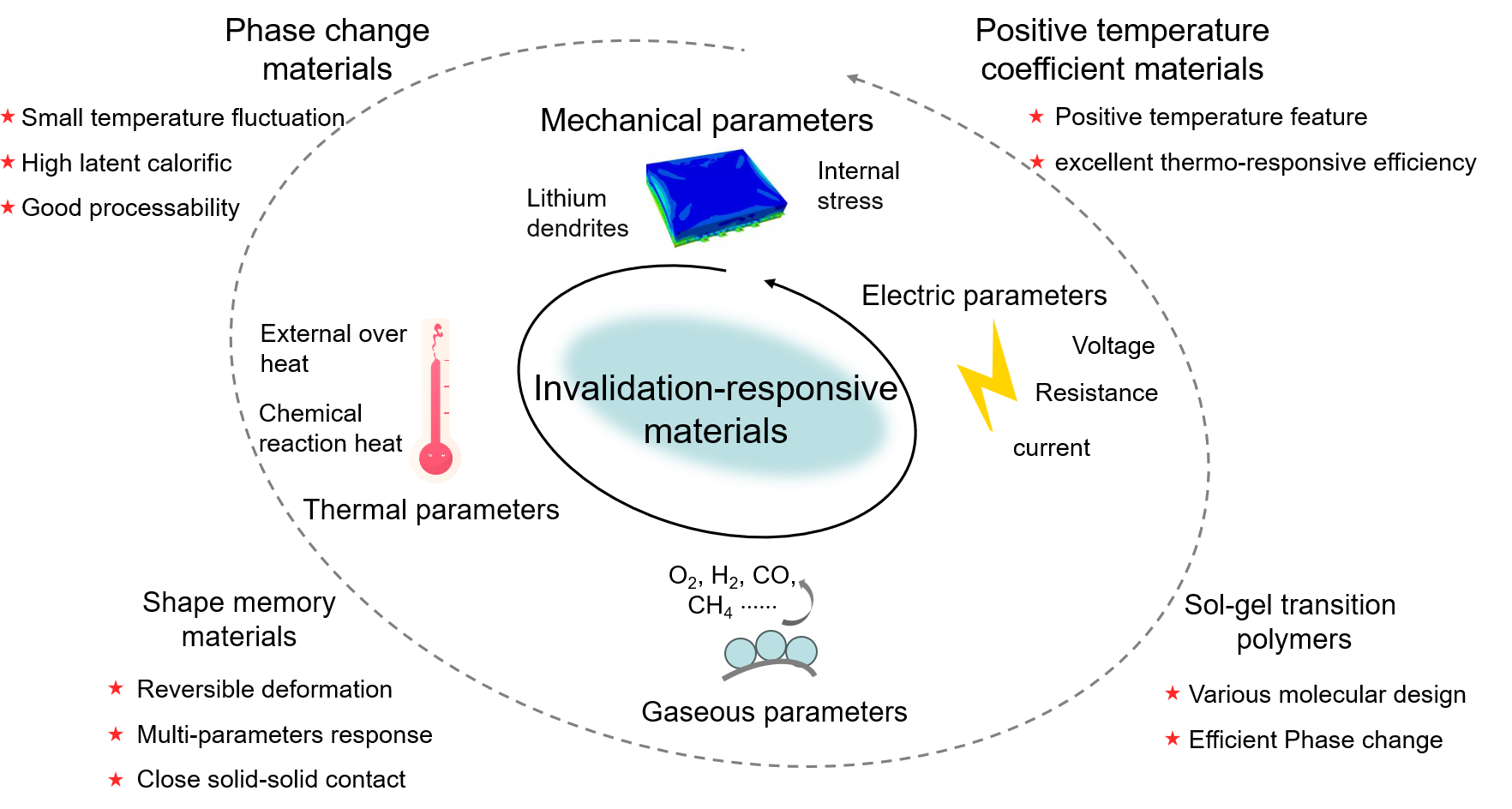
The internal causes of TR mainly refer to issues arising during the design and manufacturing process of the battery, with internal short circuits being a primary factor. Mechanical abuse, electrical abuse, and thermal abuse are the three main categories of external factors that trigger thermal runaway in batteries and are the leading causes of this phenomenon.5 Therefore, the development of efficient and stable TR suppression technologies is a crucial research direction to enhance the thermal safety of LIBs (Figure 1b).6,7 In general, TR process is associated with changes of characteristic parameters in LIBs, such as temperature, stress, voltage, resistance, and gas emission.8,9 Developing responsive materials with high sensitivity and excellent switch ratios is a crucial strategy for enhancing the safety of lithium batteries. As research deepens into the temporal relationships of TR behavior and characteristic parameters in lithium batteries, multi-parameter responsive intelligent safety materials have expanded into domains such as battery thermal management, electrode materials, separators, and electrolytes.10,11 Benefiting from accessible molecules design, polymer materials paly a versatile effort for multi-parameters response. Additionally, each component in LIBs has its requirement of design principle. This review has recalled the research progress on the characteristics of TR in lithium batteries, the types of intelligent safety materials, and the mechanisms of multi-parameter response. It will analyze the challenges faced by intelligent safety materials in the prevention and control of TR in lithium batteries, and it will look ahead to research directions for material design and technological applications in new battery systems and complex scenarios. The findings aim to provide scientific guidance for promoting the safe design of lithium batteries.
2. Thermal Runaway Characteristics
TR in lithium batteries is a major safety issue faced by electrochemical energy storage systems. TR refers to incidents where electrochemical batteries uncontrollably increase their temperature through self-heating.12,13 Multiple standards contain definitions regarding thermal runaway and its propagation (Table 2). Lithium batteries are highly integrated and high-energy units, once TR occurs, external measures struggle to reach the internal core reactions, the combustion chain reaction from polymers, liquid electrolytes et al. inside makes it difficult to effectively contain the spread of the disaster. Therefore, studying the evolution mechanism of battery thermal runaway is of utmost importance.
2.1. Thermal Runaway of LIBs
Generally, thermal runaway can be divided into three stages: the self-heating stage (50 °C-140 °C), the thermal runaway stage (140 °C-850 °C), and thermal runaway termination (850 °C to ambient temperature) (Figure 2a).14,15,16 The self-heating stage begins with the dissolution of the solid electrolyte interphase (SEI) film. When the internal temperature of the battery reaches around 90 °C, the SEI visibly dissolves, triggering an intense exothermic reaction between the anode and the electrolyte. The continuously accumulating heat causes the internal temperature of the battery to rise persistently. Once the temperature exceeds 140 °C, both the positive and negative electrode materials participate in electrochemical reactions, causing the battery temperature to rise rapidly. During this stage, significant melting of the separator leads to short circuits between the positive and negative electrodes, resulting in large-scale short-circuiting and a drastic drop in battery voltage. Intense reactions generate a large amount of gas while also producing substantial heat, which spreads to the surroundings through thermal diffusion, resulting in the propagation of thermal runaway. The accumulation of heat and gas inside the battery continues, and once it breaches the battery casing, material jetting occurs, reaching the most extreme state of thermal runaway, with the highest temperature attained in this phase. Once thermal runaway occurs, the process can only naturally terminate once the reactants are exhausted. Notably, the voltage drops during the TR development, therefore, monitoring the electrical or electrical-thermal coupled signals can achieve a early TR detection, ultimately guaranteeing batteries’ safety (Figure 2b).
2.2. Triggering Mechanism of Thermal Runaway in LIBs
The thermal runaway is caused by two categories of internal factors and external factors. Internal factors primarily refer to the issues arising during the design and manufacturing processes of the battery, while external factors pertain to causes related to personnel and external conditions during transportation, installation, and operational maintenance of the battery. Internal short circuits are a major internal cause of thermal runaway. Due to the varying degrees of contact between the positive and negative electrodes of the battery, the subsequent reactions triggered can differ significantly. As shown in Figure 3, internal short circuits induced by defects generated during battery design and manufacturing have relatively mild heat generation in the initial stage, leading to no significant voltage drop. However, as the battery ages and various performance degradations occur (such as increased internal resistance and lithium metal deposition), the risk of internal short circuits gradually increases, leading to the accumulation of heat and noticeable voltage decline. If effective prevention and control measures are not in place, the battery will trigger thermal runaway.
Mechanical abuse, electrical abuse, and thermal abuse are the three main external factors that trigger thermal runaway in batteries. Various standards have been established both domestically and internationally, such as IEC 62619, IEC 63056, IEC 62281, UN 38.3, UL 1973, UL 9540A, and GB/T 36276, to evaluate battery safety performance. Mechanical abuse refers to the deformation of battery cells or packs under external forces, with abusive forms including impacts, compression, and puncturing in safety evaluation tests.17,18 Electrical abuse typically includes forms such as external short circuits, overcharging, and over-discharging, with overcharging being particularly prone to developing into thermal runaway. Under overcharging conditions, the generation of heat and gas are two significant characteristics. Due to excessive lithium insertion, lithium dendrites grow on the surface of the anode. The stoichiometric ratio between the cathode and anode determines the growth sequence characteristics of the lithium dendrites. Excessive de-intercalation of lithium causes the cathode structure to collapse due to heat generation and oxygen release, while the release of oxygen accelerates electrolyte decomposition, generating a large amount of gas and increasing internal pressure, leading to the opening of the vent valve for gas release.19 Once the active materials in the battery come into contact with air, a vigorous reaction occurs, releasing a substantial amount of heat. Therefore, overcharging is the most hazardous form of electrical abuse. Thermal abuse rarely occurs independently; it often develops from mechanical and electrical abuse. Local overheating is a typical situation that can occur within a battery pack, and it is a critical link that can directly trigger TR. In addition to overheating caused by mechanical or electrical abuse, thermal abuse caused by loose connections has also been confirmed by relevant studies.20 Thermal abuse is currently the most frequently simulated failure condition in batteries, and the use of adiabatic calorimeters is an important method for researching the TR process and triggering mechanisms in batteries.21
3. The Categories of Smart Safety Materials
Safety is a critical issue facing lithium batteries, and traditional thermal protection measures primarily rely on temperature parameter responses, which pose challenges to efficiency of shutdown. Exploring smart safety materials that respond to characteristics such as temperature, light, force, and electricity to enhance the disaster perception and response capabilities of lithium batteries is an important research direction for achieving high safety in lithium batteries. This review introduces the applications of phase change materials (PCM), positive temperature coefficient materials (PTC), shape memory materials (SMM), and sol-gel transition polymers (STP) as smart safety materials for lithium batteries.
3.1. Phase Change Materials
PCM is a class of typical functional material that includes polymers and hydrated salts, capable of storing energy by absorbing heat during melting and releasing heat during solidification.22,23 It has a significant latent heat and a small temperature range for phase change, maintaining the phase change process under isothermal or near-isothermal conditions. Benefiting from this characteristic of PCM, it is possible to manage the internal heat of the battery, ensuring a stable and moderate operating environment, suppressing the propagation of thermal runaway, and enhancing safety.
3.2. Positive Temperature Coefficient Materials
PTC exhibits an increasing resistance during rising temperature and rarely deteriorate properties at normal temperatures in operating batteries. Polymers are typical PTC that can response to temperature fluctuation. The degree of resistance increase under a transition temperature is a crucial requirement for overheat protection in LIBs. Recent studies have proposed some PTC components with proper transition temperature, considerable conductivity, and obvious shutting down effect as well as excellent electrochemical and chemical stability in operating battery, enabling an efficient prevention for thermal runaway.24,25 Therefore, PTC composites can be utilized as electrode, electrolyte, current collector, and separator. These properties of PTC materials provide an approach for building much safer batteries.
3.3. Sol-Gel Transition Polymers
STP is a class of polymers capable of undergoing phase separation at a critical temperature.26,27 Common synthesis methods include reversible addition-fragmentation chain transfer polymerization (RAFT), atom transfer radical polymerization (ATRP), and free radical polymerization (FRP). Based on whether they exhibit a lower critical solution temperature (LCST) or an upper critical solution temperature (UCST), sol-gel transition polymers can be categorized into two types. LCST refers to the lowest temperature on the binary curve of the phase diagram, above which two phases exist. In contrast, UCST indicates the temperature at which the bimodal curve reaches its maximum; below this temperature, two phases are present. By utilizing the aforementioned characteristics of STP, it is possible to modulate the transition temperature (LCST and UCST) of the polymers through molecular design, achieving reversible blocking and recovery of the mass transfer process in lithium battery electrochemical reactions, thereby ensuring the safe and stable operation of the battery.
3.4. Shape Memory Materials
SMM is a class of functional polymer materials that combine properties of both plastics and rubber.28,29 Through molecular design and modification, these polymer materials are endowed with desired deformation characteristics. When external conditions change, they can correspondingly alter their shape and fix that altered (deformed) state. If the external environment changes again in a specific manner and pattern, they can reversibly return to their original state. By utilizing the “memory of the initial state-fixed deformed state-recovery to the initial state” characteristic, lithium battery key components designed and constructed in this manner can respond to characteristic signals such as temperature, pressure, and current, enhancing the disaster perception and handling efficiency of lithium batteries and effectively suppressing the spread of disasters.
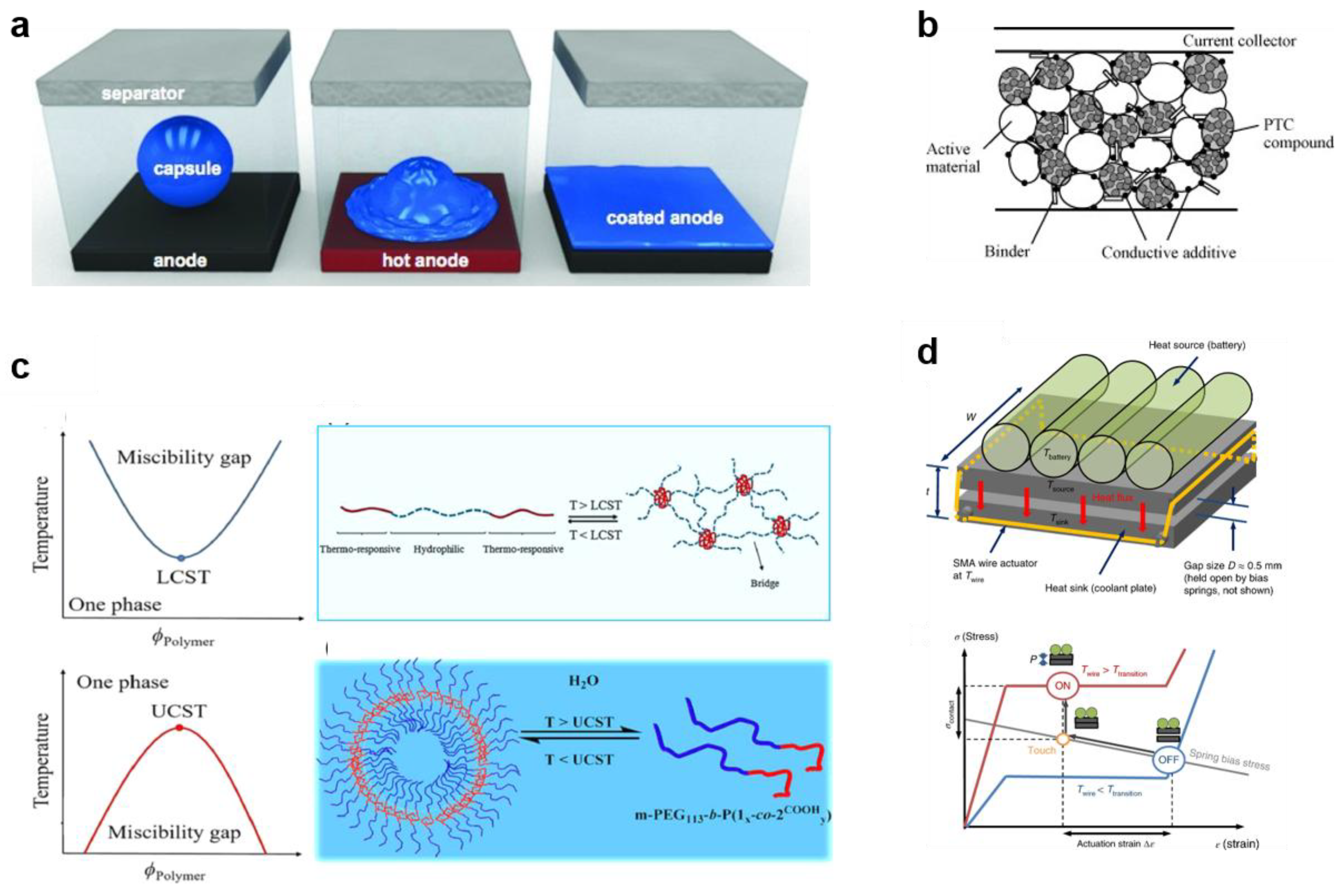
Figure 3.
The categories of smart safety materials. (a) Phase change materials; (b) positive temperature coefficient materials; (c) sol-gel transition polymers; (d) shape memory materials .
Figure 3.
The categories of smart safety materials. (a) Phase change materials; (b) positive temperature coefficient materials; (c) sol-gel transition polymers; (d) shape memory materials .
In general, smart safety materials suitable for lithium batteries need to meet the following requirements: (1) they should have appropriate response windows for thermal, mechanical, and electrical parameters, along with excellent switching ratios; (2) they must possess good thermal stability to endure harsh operating temperatures; (3) they should exhibit outstanding chemical and electrochemical stability to broaden the design and application of key components in lithium batteries.
4. Design and Application of LIBs’ Key Components
The application of smart safety materials is an important measure to enhance the safety of lithium batteries. This paper reviews the significant roles played by thermal-responsive, electro-responsive, stress-responsive, and other safety materials in improving the safety and electrochemical performance of lithium batteries from the perspectives of design paradigms, component structures, and functional types.
4.1. Thermo-Responsive Safety Materials
Thermal signal emerges during the thermal runaway process and reflects the hazard status in operating batteries, thereby, thermo-responsive materials are crucial safety component, forming an important research aspect for enhancing batteries’ safety and stability.30
4.1.1. Thermo-Responsive Electrode
At present, reported electrode materials with high energy densities, such as lithium transition metal composite oxides (LiCoO2, LiNi0.5Mn1.5O4, LiNi0.8Mn0.1Co0.1O2 and so on), sulfur, and lithium metal still exist a dominant risk of TR because of their high reactive and catalysis.31,32 Electrical and ionic blocking are typical design for internal application of thermo-responsive materials, achieving a crucial factor for shutting down the electrochemical reactions under internal/external overheat.33 PTC exhibit a distinct resistance increase undergoing elevated temperature, and shut down the electrochemical reaction by electrical blocking effect. However, there is still an issue for constructing a highly conductive matrix in electrode materials (up to 4×10⁴ Ω cm−1), because PTC are generally synthesized by nonconductive monomer. In order to address this challenge, designed PTC with enhanced intrinsic conductivity are proposed. Li et al. proposed a designed PTC polymer by mixing poly(3-octylpyrrole):poly (styrenesulfonate) (P3OPy:PSS) and carbon composite (P3OPy:PSS/C).34 P3OPy:PSS achieves a high conductivity because of PSS anionic doped, and promote charge transfer in operating batteries. Once the internal temperature exceed normal operating window, (P3OPy:PSS)/C can efficiently transform to insulation and further block the charge transference at cathode/conductive agent interface (Figure 4a). The such-fabricated graphite||LiCoO2 pouch cell has shown a considerable electrochemical performance and avoided TR even at 120 °C. Zhang et al. developed an integrative cathode with PTC effect through constructing a redox-active P3BT layer between LiNi0.5Co0.2Mn0.3O2 (NCM523) coating and aluminum foil current collector (Figure 4b).35 This integrative cathode delivers an excellent charge/discharge capacity of 141.7 mAh g−1 at operating temperature, and achieves a quick voltage drop by sharply increased resistance 120–150 °C. As expected, the electrochemical reaction in pouch cell is completely terminated under persistent overheat (150 °C) for 5 min. In order to reduce side reactions of PTC materials and organic electrolytes, and improve safety redundancy, lower thermo-responsive triggered temperature is urgent need, therefore, highly fluoridated system has been proposed. Jin et al. constructed a poly(vinylidene fluoride) (PVDF) based PTC structure with carbon-coated LiFePO4 and super-P (Figure 4c).36 This conductive cathode network shows a rapid electron transfer at operating temperature, and reach a PTC effect because of the blocked electronic pathway caused by sharp volume expansion of PVDF at 80 °C. Polyethylene (PE) shows a melting point of 105 °C, recent studies have demonstrated that sandwich-like separator of PP/PE/PP can act an ionic blocking effect by closing ion transport channel in PP. Baginska et al. have prepared a thermo-responsive coating on graphite anode substrate, the as-synthesized PE microspheres with an average diameter of 4 μm guarantee fluent ion transport at graphite/electrolyte interface under normal working temperature, whereas their thermal transformation, specifically melting create ionic insulation barriers that shut down the electrochemical reaction at a critical temperature.37 In order to achieve batteries’ smart modification, reversibly thermo-responsive materials have been widely explored and highly integrated. Chen et al. reported a reversibly thermo-responsive cathode by a built-in low density polyethylene (LDPE) with a thermal expansion coefficient of around 10−4 K−1.38 As seen in Figure 4d, a reversibly thermo-responsive layer was assembled by mixing molten LDPE and graphene-coated spiky Ni nanoparticle filler, which guarantees rapid electrical transport between cathode and current collector. Benefit from reversible expansion and contraction, this smart layer achieves a maximal reduce in conductivity by 7–8 orders of magnitude at thermal abuse, and increases to high conductivity of 50 S cm−1 when the internal temperature recovers to suitable operation condition, playing a smart modification effect for safer batteries undergoing overheat.
4.1.2. Thermo-Responsive Electrolyte
Flammable liquid electrolytes constitute a significant safety concern of TR, because their can easily be ignited under an accumulated heat and oxygen condition, furthermore causing fire or explosion.39 Therefore, designed electrolytes with reversibly thermo-responsive feature need to be applied to improve batteries’ safety. Sol-gel transition polymers with a suitable critical temperature can restrain early TR risk. Kelly et al. synthesized a PNIPAM-AA copolymer electrolyte through free radical polymerization with an initiator, which can control the thermal performance and offer the electrolyte ions (Figure 5a).40 In full cell testing, the overall cell capacity was reduced by about 85% during the temperature increase from 20 °C to 50 °C due to its unique LCST, which prevents internal overheat. When the temperature cools down, the polymer dissolves into solution again, releasing free ions for continuous electrochemical reaction. The conventional electrolytes using sol-gel transition strategy are still exist numerous problems such as packing difficulties, phase separation, and liquid leakage, therefore, gel polymer electrolytes with reversibly thermo-responsive feature have been developed. Zhang et al. selected a free-radical copolymerization strategy to obtain the poly(N-isopropylacrylamide-co-N-methylolacrylamide) (PNIPAM/NMAM) hydrogel polyelectrolyte.41 The full cell using this electrolyte delivers considerable electrochemical properties at room temperature and exhibits a maximum capacity loss rate of more than 80% at 70 °C, reflecting the dynamically thermally self-protected for control and prevention of TR. Temperature-stimulus SMPs display a capability to temporarily fix a shape under specific external thermal activation conditions and revert to their original shape after cooling down. Ureidopyrimidinone (UPy)-containing polymers are typical units for constructing shape memory polymer electrolytes. Jo et al. fabricated a SPE with poly(vinyl alcohol) (PVA) as the main chain and epoxy-functionalized poly(ethylene glycol) (PEG) and UPy as the side chains.42 Benefiting from the physical cross-linking network formed via the quadruple hydrogen bonding, the PVA-UPy-PEG polymer electrolyte can transform from a temporary shape to a permanent shape under a heat stimulus (60 °C). The battery using this electrolyte shows not only efficient overheat protection, but also outstanding electrochemical performance. However, SMPs still face complicated synthesis routes, inferior tensile stress (∼40 kPa), and inefficient separation processes, thus exploring SMPs categories with shape recovery and tunability is crucial topic for developing next-generation safe and high-performance energy storage technologies.
In practical application, LIBs usually face extreme safety hazard such as uncontrollable heat accumulation, thereby thermal trigger temperature and shutting down efficiency are crucial parameter. As seen in Figure 5b, Zhou et al. designed a smart thermo-responsive electrolyte (PPE) through poly(ethylene glycol) methyl ether methacrylate (PEGA) and 2,2,3,3,3-pentafluoropropyl acrylate (PFE) copolymerization.43 This smart thermo-triggered electrolyte exhibits excellent thermal stability that elevates batteries’ operating temperature up to 100 °C, and achieves rapid transformation from liquid to solid under 130 °C that caused by its thermal free radical polymerization behavior without any short circuit or gas expansion. Even up to 150 °C, the LIBs integrated with PPE does not suffer from short-circuit failure. In addition, the LIBs integrated with PPE presents excellent thermal reversibility that still retains a capacity retention of 95% after 200 cycles at 0.1 C after cooling down (30 °C).
4.1.3. Thermo-Responsive Current Collector
Current collector is a bridge for charge transfer in LIBs. Jia et al. designed an innovative current collector built by shape memory polymer for TR inhibition.44 The configuration of current collector is shown in Figure 6a, a highly conductive Cu layer is deposited onto shape memory polymer surface via magnetron sputtering. This complex current collector exerts no influence on the electrochemical properties during regular battery operation, while rapidly changes its original shape undergoing internal TR (>90 °C), leading a transformation from conductive to insulating state in a sacrificial manner. As depicted in Figure 6b, the full cell delivers a stable operating condition at moderate temperatures (30–50 °C), and exhibits swift self-closure under overheat at 120 °C. This strategy renders completely inoperable post-heating event, demonstrating its effectiveness especially in a high-nickel ternary system ensuring safety. Though electrical and ionic blocking are typical design for inhibiting TR, combustion and explosion risks still exist because of the absence of internal fire extinguishing means. For building safer batteries, traditional approaches prefer to embed flame retardant materials in the current collectors. However, this method tends to, to some extent, sacrifice the transport of lithium ions or electronic conduction capability. To bolster the overall energy density of LIBs through current collector design, Ye et al. fabricated an ultralight thermos-responsive current collector with porous polyimide (PI) substrate.45 As seen in Figure 6c, porous PI is filled by triphenyl phosphate (TPP) and coated with copper. As the low melting point of TPP (around 50 °C), the response time to TR can be significantly shortened. In terms of safety, the self-extinguishing time (SET) value significantly decreases as the thickness of PI-TPP-Cu increased from 5 to 9 μm. As for the whole electrode, the PI-TPP-Cu-based graphite electrode achieved self-extinguishing completely within 1.0 second. These suggest that as-fabricated PI-TPP-Cu sandwich current collector presents lightweight, remarkable thermal stability (>400 °C) and notable flame retardancy.
4.1.4. Thermo-Responsive Separator
The growing demand for high energy density in cutting-edge batteries’ technology, multi-functional separators have attracted significant interest in recent years.46,47 In order to prompts the shutting down effect of the LIBs, recent studies have focused on appropriate critical temperature, rapid response speed at critical temperatures, and excellent chemical stability within the battery system.
Commercial Celgard2325 (PP/PE/PP) membrane is a typical thermo-responsive separator, where the PE layer can impede ion transport by closing hole above 115 °C, and inhibit TR propagation.48 However, such a high thermo-responsive temperature will directly cause extra risk of TR. Constructing a separator featuring a lower melting point is feasible approach to substitute the commercial PP/PE/PP membrane. In generally, thermal-responsive polymer can also be introduced into LIBs for functional separators. Dong et al. synthesized a functional coating of core–shell paraffin@SiO2 particles.49 This coating on PE shows favorable ion diffusion and compatibility for commercial electrolyte, and releases core paraffin under TR, ensuring stable electrochemical and safe performance of working batteries. Ji et al. synthesized a new thermal shutdown separator by coating thermoplastic ethylene–vinyl acetate copolymer (EVA) microspheres onto PE surfaces.50 The thermal responsive EVA micropores can melt and barrier channels of PE at 90 °C, achieving Li+ blocking in working batteries. These processes efficiently expand application conditions of polyolefins for high energy density battery systems. Not restricted to polyolefin separators, a three-layer nonwoven separator featuring amide-functionalized polyetheretherketone (APEEK) outer layer also shows a broad shutdown temperature range from 100 to 270 °C, ensuring the battery’s safety effectively.51 Shen et al. built a thermal responsive separator containing poly(sulfobetaine) polymer (PMABS) with high upper critical solution temperature (UCST) and graphene oxide (GO) sheets with electronic insulation.52 The thermal cutoff in the battery is displayed in Figure 7a, at regular operating temperature, the dipole attraction between zwitterions results in the tight coiling of the polymer and forms hydrophobic polymer attachments on the membrane, enabling open channels for rapid ions migration ions. Beyond the UCST, the disruption of dipole attraction between zwitterions leads to the unfolding of polymer chains and exposing the zwitterions to the electrolyte, resulting an elevated electrolyte viscosity within the membrane that achieves thermal cutoff in the battery through limiting the migration of lithium ions. However, phase conversion tactics (sol–gel) still face leakage of polymer during re-cooling process, resulting in increased interface impedance and sacrificial batteries’ properties. Electro-spun is a convenient way to fabricate porous polymer skeleton with various surface area and pore structure.53 At present, polytic fluoride-hexarinol (PVDF-HFP), polyimide (PI) and other polymers have been widely used as substrate.54,55 Jiang et al. have proposed a polylactic acid (PLA) @ polybuthylenesuccinate (PBS) core–shell separators through an electro-spun technique.56 PLA core delivers excellent thermal stability and mechanical strength, and PBS shell exhibits strong electrolyte affinity and proper melting temperature (130 °C). LIBs with this separator shows outstanding electrochemical properties at regular operating temperature, and self-protective effect under overheat.
Though numerous reports have focused on switching function for smart partitions under high temperature conditions, its reversibility is still tricky for reusable batteries. Jiang et al. synthesized a temperature-dependent PVP@TiO2 separator by a modified electrospinning method, implementing fabulous wettability towards liquid electrolytes and structural integrity.57 Once the batteries’ internal temperature exceeds 60 °C, PVP will react with the liquid electrolyte and blocks the pores in the separator for terminating electrochemical reaction. When brings back to normal operating temperature, the capacities of batteries will revive because the TiO2 skeleton will restore the structure. The inorganic Al2O3, SiO2, ZrO2, and zeolite particles also exhibit potential reversible response with polyvinyl alcohol (PVA) as a binder.58 In addition, as-fabricated functional separator shows enhanced thermal stability than commercial PP separator. For inorganic-organic systems, it is imperative to carefully select an appropriate organic polymer for binder to guarantee the stability of the composite coating.
In order to deal with potential combustion and explosion risks of the high energy density batteries, positioning flame retardant additives within the separator becomes an effective approach. Illustratively, Yim et al. designed a core-shell structural coating with 1,1,1,2,2,3,4,5,5,5-decafluoro-3-methoxy-4-(trifluoromethyl)-pentane (DMTP) fire extinguishing agent (Figure 7b).59 Under a mechanical abuse (nail-puncture test), a 0.5 Ah pouch cell utilizing a commercial PE separator exhibits a rapid temperature surge (72.3 °C), whereas that using a PE coated by DMTP-contained coating shows a markedly reduced maximum temperature of 37.2 °C, demonstrating a significant enhancement of safety. The ‘core–shell structure can avoid the parasitic reactions between flame retardant additive and active electrode, and release the flame retardant additive at critical temperature. As displayed in Figure 7c, Liu et al. encapsulated triphenyl phosphate (TPP) into polyvinylidene-hexafluoropropylene (PVDF-HFP) shell through electrospinning technology.60 This microfiber separator rarely affects batteries’ properties under mild running condition. Once the TR spreads violently, the PVDF-HFP shell will melt at 160 °C and release TPP into electrolyte, achieving an effective inhibition for electrolyte combustion.
4.2. Electric-Responsive Safety Materials
For LIBs, external short-circuit (EST), overcharging, and overdischarging are typic electrical abuse behaviors. Among these abuses, overcharging poses the highest risk to transition into TR.61,62 Therefore, recent studies generally have focused on overcharge protection in electric-responsive safety materials design. Components such as cathode coatings, electric-responsive electrolyte, and potential response separators were conducted to contribute the anti-overcharge behavior of LIBs.63
4.2.1. Electric-Responsive Additives
Electro-polymerization additives exert passivation effect at cathode and disrupt internal ion transport, that prevents the continuous decomposition of the electrolyte and the onset of TR in the batteries.64 Biphenyl (BP) is one of the earliest utilized polymer additives for overcharge protection. Once overcharge is occurred in the battery, BP can generate a sleek and dense polymer film through electro-polymerization on the electrode surface. Xiao et al. succeeded to address overcharge by introducing a 1 M LiPF6 EC/DMC (1/1) electrolyte with 2.5 wt.% BP.65 Xu et al. proposed cyclohexyl benzene (CHB) as electro-polymerization additive, although it only exerts reliable overcharge protection for the battery under a reduced operating voltage.66 Korepp et al. have determined a series of additives with high electrochemical polymerization potentials (benzyl isocyanate (BIC) for 5 V and 4-bromo-benzyl isocyanate (Br-BIC) for 5.5 V), which are suitable for high-voltage cathode systems.67 The experiments suggest that the electrochemical polymerization additive can effectively suppress TR even at a low concentration (2 wt.%) in a 1 M LiPF6 EC/DMC (1/1) electrolyte. This result reflects that regulating functional groups on the benzene ring of polymerized anti-overcharge additives is a strategy to enhance their performance, broadening their sequence such as diphenylamine (DPAn), Nphenylmaleimide (NPM), dimethoxydiphenylsilane (DDS), bis(diphenyl phosphate) (RDP), (2-chloro-4-methoxy)-phenoxy pentafluorocyclotriphosphazene (2-Cl-4-MPPFPP).68,69,70,71,72 In general, electro-polymerization protection during overcharge is irreversible, thereby, there is an increased need for developing electro-polymerization protection with high reversibility here.
Redox shuttle additives are typical electro-polymerization materials with reversibility. The operating mechanism of redox shuttle additives involve two steps, their conversion into an oxidized form [O] on the overcharged anodic electrode, and restoration to their original state [R] on the cathodic electrode, which maintains ‘‘oxidation-diffusion-reduction-diffusion” loop driven by diffusion.73 This process can effectively constrain the anodic electrode potential at the oxidation state until the complete consumption of excess charge and show no damage to the batteries’ capacities. Behl et al. first revealed the redox shuttle LiI-I2 loop in a 1.5 M LiAsF6 tetrahydrofuran (THF) electrolyte.74 LiI can be oxidized to I2 under overcharging and prevent the oxidation of solvent molecules effectively. Subsequently, I2 can diffuse to the cathodic electrode and reduce to reduction products of LiI. Benefiting from this loop in electrolyte, the full cell can steadily operate without distress of TR caused by overcharging. At present, numerous redox shuttle additives such as ferrocene, polypyridine, dimethoxybenzene, phenothiazine and derivatives, and their mechanisms have been clarified.75,76,77,78 (1) Most metallocene compounds show easily miscible with organic electrolytes, ensuring good stability, easy preparation and low cost. Abraham et al. introduced various metallocene compounds with diverse metal centers into the electrolyte of 1.5 M LiAsF6 in THF: 2MeTHF: 2MeF (volume ratio is 48:48:4), and concluded a finding that regulating the metallic atoms or substituents on the cyclopentadienyl rings can alter the overcharge prevention performance itself.79 Golovin et al. also suggested that tailoring various substituent groups of ferrocene derivatives exert a significant influence on the electrochemical performance, diffusion constants, and shuttle voltage range in the full cell.80 These results that an electron-withdrawing substituents determines a higher oxidation potential, whereas an electron-donating substituents results in a lower oxidation potential, reflecting a highly consistent with theoretical predictions, as a higher electron cloud density results in a higher HOMO in the molecule. Though metallocene and its derivatives exhibit high stability, but they still face low oxidation–reduction potentials and occur premature termination of batteries’ charging before completely charged, resulting in merely applicable to low potential positive electrode.81 Improving the stability of metallocene-based redox shuttle additives are urgent demands for popularizing their application in commercial batteries. (2) Dimethoxybenzene and its derivatives are typical redox shuttle additives for high voltage systems, though they have been restricted by their limited solubility and slow mobility. Adachi et al. have systematically explored aromatic compounds possessing methoxy groups and halogen directly substituted on the benzene ring, and revealed a two electrons redox shuttle mechanism in 1 M LiPF6 PC/DMC electrolyte, achieving an efficient overcharging protection in a 4 V class battery.82 However, the above additives are not entirely effective for preventing overcharging in LiFePO4/graphite cells, because of the oxidative electro-polymerization between the neutral molecule and radical cation. At present, numerous studies focused on constructing steric hindrance around benzene ring to avoid predominantly access of radical cation to neutral molecules.83 Hence, the designing of the substituents on benzene ring have endowed multi-functional features of dimethoxybenzene-based redox shuttle additives, such as higher solubility and potentials in practical batteries (Figure 8). For example, Zhang et al. synthesized a 2,5-di-tert-butyl-1,4-bis(2-methoxyethoxy)benzene (DBBB) functional redox shuttle with superior solubility in common electrolytes.84 For DBBB molecule, the CH2-CH2O unit can remarkably facilitate the dissolution of lithium salt through strong O−Li+ coordination. The cell employing DBBB demonstrate an outstanding electrochemical reversibility, which withstands over 180 cycles of 100% overcharge at the 0.5 C rate. The 1.5 Ah LiFePO4/graphite pouch cell also passed the standard and abusive overcharging testing, and achieved an excellent durability of overcharge protection undergoing a 700-cycle test period without any observable cell swelling. In order associate with higher voltage cathodes, such as LiCoO2, LiNi1/3Mn1/3Co1/3O2 and so on, Moshurchak et al. produced a 1,4-di-t-butyl-2,5-bis(2,2,2-trifluoroethoxy)benzene (DTFDB) additive with strong-electron-withdrawing 2,2,2-trifluoroethoxy group.85 As expect, DTFDB has elevated reversible oxidation potential and maintained a 100% overcharge capacity for each cycle across various cell chemistries. On basis of above results, Weng et al. synthesized a novel asymmetric redox shuttle additive, TFDB, through substituting one of the methoxy groups with an OCH2CF3 group in DTFDB.86 This additive not only addresses the issue of solubility, but also elevates the reversible oxidation potential. Generally, phosphonates are employed as flame retardants with high voltage compatibility in LIBs. Zhang et al. have synthesized a tetraethyl-2,5-di-tert-butyl-1,4-phenylene diphosphate (TEDBPDP) additive, and investigated its applicability when matches LiMn2O4 and Li1.2Ni0.15Co0.1Mn0.55O2 cathodes.87 Notably, this redox shuttle additive presents a successful overcharge protection at 4.75 V vs. Li+/Li, broadening the designed principle for high potential additives. Huang et al. explored the failure mechanism of the redox shuttle by synthesizing a BTMSDB with a trimethylsilyl group.88 The substituted trimethylsilyl group is utilized as a chemical probe, which can be broken and induce a more prone cation polymerization during the formation of SEI formation on the negative electrode surface, resulting in an inferior overcharge protection duration for the battery. Weng et al. studied a series of redox shuttle additives through changing the ditert-butyl groups to 1,2,3,4-tetrahydronaphthalene.89 This axisymmetric molecule with a rigid skeleton features high solubility in carbonate electrolytes. when the methoxy groups on TDTN have been substituted by trifluoroethyl groups, its anti-overcharge potential shows a distinct increase (about 0.34 V higher). A bis-annulated 9,10-bis(2-methoxyethoxy)-1,2,3,4,5,6,7,8-octahydro-1,4,5,8-dimethano-anthracene molecule (BODMA) also exhibits an enhanced overcharging prevention capability at a low concentration (0.1-0.2 M).90 These suggest that symmetry leads to a uniform distribution of the excess positive charge between the two methoxy groups, meaning the symmetry of the conformationally-locked radical cation, which can elucidate the markedly increased oxidative stability on positive side.91
4.2.2. Electric-Responsive Separator
The commercial separators are typically monolayer or multilayer polymer film and play primary role for impeding the electronic circuits and facilitating the unrestricted ions migration between positive and negative electrodes.92 The structure design of separator dictates the battery’s responsive features. The voltage-responsive separators deliver self-protection against overcharging through the electroactive polymers coating, that occur a reversible phase conversion between the insulating and conducting states. The electroactive polymer on separator can transform to conducting state, that induces an internal short circuit to ensure overcharge current across the cell harmlessly.
Chen et al. fabricated poly(3-butylthiophene) (P3BT), featuring relatively high oxidation potential (3.25 V vs. Li+/Li) and stability toward to lithium metal.93 The electronic conductivity of P3BT varies from 10−9 to 0.1 S cm−1 under various electric states. In the TiS2-Li cell with a separator modified by P3BT, a fixed potential of 3.10 V can be maintained, and it do not reach 4.0 V within 12 h even under overcharge abuse. The P3BT-modified separator also has been applied for safety control of LiFePO4||Li4Ti5O12 batteries.94 The P3BT occurs a redox-active cycling to control overcharging at a low loading of 0.062 mg cm−2 in commercial batteries. Ai et al. proposed a polytriphenylamine (PTPAn) based electroactive polymer as an electric-responsive separator.95 Utilizing this separator, the LiFePO4||Li cell remains a charging voltage plateau below 4.0 V during overcharge process. These results reflect the effectiveness of protection by the reversible internal short circuit of the electroactive polymer in separator. For developing energy density batteries with high potential cathodes, elevating oxidation potential are urgent for electric-responsive separator. However, single layer polymer separator generally faces challenge of industrial production and commercial application especially at a thickness level of dozens micrometers.96 Therefore, constructing a bilayer separator becomes an approach to meet the requirement for 4 V level overcharge protection in LIBs. The antioxidant Poly(3-phenylthiophene) (P3PT) for cathode and the highly stable P3BT for anode are coated on separator, safeguarding a stable cycling for LiFePO4 cells at 3.9 V (~140 mA h g−1).97 In a high nickel ternary cathode (LiNi0.8Co0.15Al0.05O2), utilizing an external separator also retained a stable potential of 4.3 V through the external shunt. Ai et al. synthesized a composite separator contains p-polyphenyl (PPP) and polyaniline (PAn).98 The LiMn2O4||Li half-cells with this separator can cycled within the range of 3.6–4.3 V under overcharge protection, because the electroactive polymer undergoes p-doping at high oxidation potential with a conductive state, while reverts de-doped at normal operating voltage with isolating state, that enables a reversible voltage-regulated current shunt. At present, there are urgent need of simpler, more efficient, and less costly fabrication craft for multilayer separators. Ni et al. proposed an integrative strategy for incorporating a reversible silicone-capped electroactive polyfluorene (PFO-PSSQ) into PVDF separators, that creates a composite electrolyte.99 The experiments demonstrate that the interpenetrating polymer electrolyte exhibits higher thermal stability and lower threshold value than commercial separators when undergoes overcharge abuse, achieving a reversible and stable protection of LiCoO2||Li half cell even at 4.2 V.
The typical approach to address main electric abuses involves establishing a protective voltage, which is lower than the peak voltage during overcharging. The electro-polymerization molecules show strong capabilities for interrupting electrochemical reactions, thereby guaranteeing overcharge prevention. However, it still faces a significant drawback during over-discharge process, that means poor capability for dealing with comprehensive electric abuses. Redox shuttle molecule is another option of electrolyte additive, which offers repetitive overcharge protection and favorable cyclic behavior. In general, excessive redox shuttle additives cause a deterioration of electrochemical performance. Before its long-term and stable application during overcharge period, settling the low solubility and synthesis cost are urgent and required rational approach. In addition, designing a voltage-responsive separator can address above issues by a shunting mechanism, but its intricate fabrication and assembling process leads a high cost and limited industrial applicability.
4.3. Mechanical-Responsive Safety Materials
In operating LIBs, lithium deposition and stripping behaviors of are limited by the diffusion kinetics, means that irregular lithium deposits reflect their invalidation states.100 In general, Li+ will exhaust in the electrolyte near the cathodic electrode, then break the electroneutral balance and form local space charge on the surface of the deposition electrode, resulting in harsh dendrites growth.101 Therefore, monitoring the evolution trends of lithium dendrite and conducting protection action through internal mechanical signal are crucial for designing internal safety components.
In recent years, designed polymer separators are conducted in LIBs for monitoring lithium dendrite inside the battery. As shown in Figure 9a, Wu et al. fabricated a sandwich-liked separator, which integrated a pre-deposited copper layer around 50 nm thick inside PE by the magnetron sputtering method (PE-Cu-PE), and provided a unique signal in the form of obvious voltage change besides cathode and anode.102 When the early lithium dendrites reach copper layer, the potential shift to 0 V, making it applicable to conduct early activation prior to short circuiting. Lin et al. proposed an integrated porous polyimide/copper/ porous polyimide separator (PI/Cu/PI).103 This bi-functional separator achieves an enhanced thermal stability and highly sensitive for lithium dendrites (Figure 9b). An alternative approach involves active inorganic interlayer for the detection of lithium dendrites. Wang et al. inserted non-conductive red phosphorus (RP) into bilayer PP separator (Figure 9c).104 Once the lithium dendrites penetrate PP, a reaction between lithium and RP can cause a distinct voltage disturbance, avoiding additional electrical risks from conductive electrodes (Cu).
Apart from detecting the growth of lithium dendrites, restraining effect of separators with elevated Young’s modulus has became a feasible approach. Lee et al. utilized an ultrathin copper thin film (CuTF) for enhancing the strength of PE separator membrane and Li utilization during the Li stripping process.105 This copper coating plays a current collector for backside plating to manipulate the morphology of lithium metal deposits, ensuring a stable operation without internal short circuits even with twofold excessive lithium deposition. The nucleation overpotential of lithium metal determines its morphology on the substrate metal.106 For instance, Ma et al. employed a lithiophilic Au nanoparticles on commercial separator by a magnetron sputtering method.107 The Au nanoparticles undergo alloying with lithium under deposition process, forming of Lix-Au alloy before reaching 0 V (vs. Li+/Li) with nearly negligible nucleation potential. Yan et al. demonstrated the regulated behavior of graphite lithiation by Au layer, that enables effectively redirects the predominant growth of lithium dendrites toward the separator when lithium dendrites emerge during high-current, preventing potentially hazardous dendrites (Figure 10a).108 At present, alloying reactions between Li metal and various metal substrates, such as Mg, Zn, and Ge have been uncovered. In addition, metallic compounds such as oxides, nitrides, and fluorides also exhibit an excellent modification feature for restraining lithium dendrites.109,110,111 Yan et al. have conducted a systemic investigation of transition metal oxides (TMOs) particles coating for PP separator (Figure 10b).112 MnO exhibits trace solubility and plays a slow-release effect in the ether electrolyte. In this case, Mn and Li2O products have formed through a spontaneous reaction between MnO and Li metal, that enables a ‘‘self-repair” effect for fixing SEI during the lithium metal deposition process. Titanium oxide also presents a functional layer for modifying mass transfer behavior of Li+ because of its electronic localization. Huang et al. observed that TiO2-x shows a strong repulsive force toward Li+ through theoretical calculations, facilitating a rapid and even lithium diffusion across functional separator.113 This TiO2-x@PP separator can improve LIBs’ cyclic performance attributed to a smooth lithium deposition. Generally, the positively charged oxygen vacancies in TMOs impede the migration of the lithium salt anions and prolong the nucleation time of lithium dendrites, ultimately achieving a dendrite-free morphology on the lithium metal anode.114 Though the TMOs play a positive effect for lithium deposition modification, however their dissolution in organic electrolyte easily causes uneven TM-rich SEI, which is harmful to Coulomb efficiency (CE).115 Therefore, TMOs coating in design of functional separators require more comprehensive consideration. Metal nitrides show an excellent stability in organic electrolytes, for example, Li3N with high Li+ conductivity can facilitate a steady SEI, achieving the reduced Li+ concentration polarization and lithium dendrites. Yan et al. proposed a Mg3N2-decorated functional separator, thereby occurred in situ on the lithium metal surface, forming a mixed ion/electron conducting layer (MCL) contained Li3N and Li-Mg solid solutions.116 The elevated Li+ conductivity (around 10−3 S cm−1 at room temperature) in MCL can buffer the Li+ concentration gradient and the interfacial resistance, thus avoiding the sustainable lithium dendrites growth and side reactions during the cycle process, that endows the battery a prolonged lifespan. As seen in Figure 10c, indium nitride (InN) and aluminium nitride (AlN) also present a cooperative protection effect in LIBs. Ma et al. proposed that the Li||Cu battery utilizing an InN-decorated separator achieves a high CE beyond 97% and an ultra-stable cycling over 200 cycles.117 The AlN stands out for outstanding compatibility to lithium metal because of its impressive thermal conductivity (319 W (m−1 K−1)), high rigidity (23.7 GPa), and electrochemical stability.118 As expected, the Li||LiFePO4 battery with AlN-decorated PP separator delivers a high specific capacity of 84.3 mA h g−1 even at 10 C. Fluorides play a crucial role in LIBs for boosting flame retardant properties and forming LiF-rich SEI. Although LiF shows a much lower Li+ conductivity than that in Li3N and Li2O, but it has a competitive Young’s modulus (around 64.9 GPa) and plays an effective effect for preventing electron tunneling and facilitating Li+ surface diffusion, avoiding lithium dendrites growth.119 For instance, AlF3 and MgF2 can form alloy anode and LiF to protect lithium metal surface in-situ during lithium deposition process, that enable the battery a prolonged cycling life (Figure 10d).120 The rigid solid-solid interface causes a contact loss during lithium deposition process, resulting in high interface resistance, therefore, adaptive smart materials have attracted lots concerns. Liu et al. utilized silicone polymers to construct ‘‘Silly Putty” (SP) as adaptive protective layer for lithium metal.121 The SP presents liquid nature to ensure optimal coverage irrespective of volume fluctuations in the lithium metal at normal condition, while its shear force increases under mechanical trigger, thereby inhibiting the further growth of lithium dendrites. For the SP layer, the reversible alteration between the ‘‘solid” and ‘‘liquid” features, in response to the growth and elimination of lithium dendrites, ensures the stable operation of the lithium metal anode.
These attempts in functional separator play a crucial role in suppressing the lithium dendrites, ultimately reducing the risk of internal short circuit in LIBs. However, several distresses still exist in further investigation: (1) The thickness of the modification layer affects internal impedance, therefore, constructing a protective layer with even and rapid ions diffusion meeting the requirement for raised charge and discharge rate becomes an important direction. (2) It's worth pondering the stability of metallic compounds toward to lithium metal, which may inevitably diminish the first coulomb efficiency.122 (3) Reducing the weight of inorganic coating on separator is an imperative approach to achieve higher energy density for advanced batteries, which obtains lots of attention.
5. Conclusions and Perspectives
In this review, we have summarized four type materials, such as phase change materials, positive temperature coefficient materials, shape memory materials, and sol-gel transition polymers response to multi-parameters, and provided detailed strategies for addressing various abuse conditions. In the realm of thermo-responsive materials, we scrutinize the mechanism of electrical and ionic blocking in electrodes, electrolytes, current collectors, and separators, demonstrating the effective role for thermal runaway inhibition. However, several obstacles still exist for constructing safer LIBs, for example, the PTC materials in operating batteries suffer from sluggish thermo-responsive window and small “switching ratio”, resulting in poor suppression for thermal runaway propagation. For electric abuse, recent studies generally have focused on overcharge protection in electric-responsive safety materials design. Electro-polymerization and redox shuttle additives still face intractable problem of molecular synthesis, which restrict their compatibility for high voltage system under extended cycles. In operating LIBs, lithium deposition and stripping would evolve to dendrites behavior under limited diffusion kinetics. At present, main strategy focuses on lithium dendrite response, that enables lithium dendrite monitoring and restraining, ultimately achieving an excellent cycling property with dendrite-free anode. Whereas, complex fabrication process and additional weight of mechanical-responsive component still impede their practical application in advanced batteries. In order to meet the highly safe requirement in high energy density batteries systems, we list several emerging directions for smart safety materials design.
5.1. Advanced Characterization Techniques for Detection of Invalidation Status
In order to construct much safer batteries, the characterization and early warning techniques have been conducted to detect batteries’ invalidation status, whereas the development are often insufficient right now. During the TR process, temperature, voltage, current, and pressure signals changes unpredictably, the optical technology with rare electromagnetic interference presents potential application for high-precision monitoring.123 Koch et al. have conducted a systematic investigation for characteristic parameters of TR, while reveal that gas sensor consistently provided an early signal compared to other sensors.0 Cai et al. also suggested that the gas sensing method achieves a fastest responsive time (approximately 85 s) for TR by using the COMSOL model.125 This innovative simulation and sensor technologies facilitate synchronous and precise measurement of internal invalidation status under early TR stage, that enables its effective suppression for TR propagation.
In this review, multiple parameters can reflect the status of operating batteries, though existing the potential issues of design principle and categories of sensors. Therefore, there is a pressing need for developing effective technologies to mitigate cross-talk between thermal, electric, mechanical, gaseous, and optical signals, achieving accurate sense and respond to disaster chain reactions in batteries.
5.2. Cross-Scale Response of Smart Materials for LIBs
Smart materials based on characteristic parameter response mainly focus on design of electrodes, electrolytes, separators, current collectors, and so on, enabling swift intervention to interrupt the TR chain reaction in cell level. However, the protection strategy at single level only offers finite efforts early TR inhibition. For instance, PTC electrode can suppress overheating by ionic or electric blocking effect, but the efficiency depends on status of TR propagation. Notably, the reversibility of thermo-responsive components are also restricted by persistent calorie accumulation.
Therefore, the cross-scale response of smart materials in LIBs needs to integrate the “atom-interface-cell-system” chain, achieving a transition from “passive protection” to “active immunity” through the synergy of material innovation, structural optimization, and intelligent management. Future development will focus on the cross-scale integration of solid-state batteries, AI-driven closed-loop design, and robustness validation under extreme conditions, laying a safety foundation for the large-scale application of high-energy-density batteries.
5.3. Utilization of High Safety Redundancy Component
In the context of conventional LIBs using liquid electrolytes, high flammability of batteries consistently accompany with the requirement of high energy density. Therefore, cutting-edge battery system holds two promise options: solid state electrolytes and non-combustible electrolytes.
Solid state electrolytes mainly contain inorganic electrolytes (IEs), solid polymer electrolytes (SPEs), and composite solid electrolytes (CSEs). IEs have high ionic conductivity and mechanical strength, that enables highly integrated configuration in battery system. Despite numerous efforts directed toward IEs development, their properties still lag behind that of liquid electrolytes because of poor interface contact caused by relatively brittle nature. Benefiting from good flexibility and machinability, SPEs such as PEO or PAN usually present an infiltrative interface, whereas they still face the crucial issue of limited strength and ionic conductivity. CSEs are compromise approach to meet the requirement of practical application by manipulating the composition and structure of inorganic and organic phases, focusing on high ionic conductivity, good interface stability, and considerable mechanical properties. Ideally, solid state electrolytes should have low electronic conductivity (<10−10 S cm−1), high Li+ conductivity (>10−3 S cm−1), good ionic transport number, and reliable chemical compatibility, among other mechanical characteristics. Therefore, future research should focus on developing new solid state electrolyte materials and optimizing the issue of compatibility at existing solid-solid interface, fully unlocking the conflict between safety and electrochemical properties in solid-state batteries. In addition, non-combustible electrolytes are emerging approach to elevate intrinsic safety in LIBs. The utilization of ionic liquids, fluorinated reagents, phosphate esters, or phosphonitriles present an effective approach for enhanced safety in high energy density batteries, but there are numerous issues such as dissolution of lithium salt, low conductivity, and poor interface stability. It is imperative to recognize that flammability is not exclusive to liquid electrolytes. When operating batteries are conducted under high charging states, highly oxidized cathode and lithiation anode also pose significant combustion concerns. Notably, interfacial reaction design methods offer a means to optimize the compatibility between safety components, thereby enhancing the overall performance in batteries.
Acknowledgments
We gratefully acknowledge support by, National Key Research and Development Program (2023YFE0109100), National Fire and Rescue Administration Science and Technology Program (2024XFCX17); the Science Foundation of China Academy of Safety Science and Technology (2023JBKY17).
Declaration of competing interest
The authors declare that they have no known competing financial interests or personal relationships that could have appeared to influence the work reported in this paper.
References
- Lin, D.; Liu, Y.Y.; Cui, Y. Reviving the lithium metal anode for high-energy batteries. Nat. Nanotechnol. 2017, 12, 194–206. [Google Scholar] [CrossRef] [PubMed]
- Zhao, Q.; Stalin, S.; Zhao, C.Z.; Archer, L.A. Designing solid-state electrolytes for safe, energy-dense batteries. Nat. Rev. Mater. 2020, 5, 229–252. [Google Scholar] [CrossRef]
- Chen, R.S.; Nolan, A.M.; Lu, J. Z; Wang, J.Y.; Yu, X.Q.; Mo, Y.F.; Chen, L.Q.; Huang, X.J.; Li, H. The thermal stability of lithium solid electrolytes with metallic lithium. Joule. 2020, 4, 812–821. [Google Scholar] [CrossRef]
- Zeng, Z.Q.; Murugesan, V.; Han, K.S.; Jiang, X.Y.; Cao, Y.L.; Xiao, L.F.; Ai, X.P.; Yang, H.X.; Zhang, J.-G.; Sushko, M.L.; Liu, J. Non-flammable electrolytes with high salt-to-solvent ratios for Li-ion and Li-metal batteries. Nat. Energy 2018, 3, 674–681. [Google Scholar] [CrossRef]
- Hou, J.X.; Lu, L.G.; Wang, L.; Ohma, A.; Ren, D.S.; Feng, X.N.; Li, Y.; Li, Y.L.; Ootani, I.; Han, X.B.; Ren, W.N.; He, X.M. Thermal runaway of Lithium-ion batteries employing LiN(SO2F)2-based concentrated electrolytes. Nat. Commun. 2020, 11, 5100. [Google Scholar]
- Abada, S.; Marlair, G.; Lecocq, A.; Petit, M.; Sauvant-Moynot, V.; Huet, F. Safety focused modeling of lithium-ion batteries: A review. J. Power Sources 2016, 306, 178–192. [Google Scholar]
- Chen, Y.; Kang, Y.; Zhao, Y.; Wang, L.; Liu, J.; Li, Y.; Liang, Z.; He, X.; Li, X.; Tavajohi, N.; Li, B. A review of lithium-ion battery safety concerns: The issues, strategies, and testing standards. J. Energy Chem. 2021, 59, 83–99. [Google Scholar]
- Wang, Q.S.; Ping, P.; Zhao, X.J.; Chu, G.Q.; Sun, J.H.; Chen, C.H. Thermal runaway caused fire and explosion of lithium ion battery. J. Power Sources 2012, 208, 210–224. [Google Scholar]
- Xia, L.; Li, S.L.; Ai, X.P.; Yang, H.X.; Cao, Y.L. Temperature-sensitive cathode materials for safer lithium-ion batteries. Energy Environ. Sci. 2011, 4, 2845–2848. [Google Scholar]
- Wang, Q.; Mao, B.; Stoliarov, S.I.; Sun, J. A review of lithium ion battery failure mechanisms and fire prevention strategies. Prog. Energy Combust. Sci. 2019, 73, 95–131. [Google Scholar]
- Li, J.; Zhang, Y.; Shang, R.; Cheng, C.; Cheng, Y.; Xing, J.; Wei, Z.; Zhao, Y. Recent advances in lithium-ion battery separators with reversible/irreversible thermal shutdown capability. Energy Storage Mater. 2021, 43, 143–157. [Google Scholar]
- Liu, K.; Liu, Y.Y.; Lin, D.C.; Pei, A.; Cui, Y. Materials for lithium-ion battery safety. Sci. Adv. 2018, 4, 9820. [Google Scholar]
- He, W.; Guo, W.B.; Wu, H.L.; Lin, L.; Liu, Q.; Han, X.; Xie, Q.S.; Liu, P.F.; Zheng, H.F.; Wang, L.S. Challenges and recent advances in high capacity Li-rich cathode materials for high energy density lithium-ion batteries. Adv. Mater. 2021, 33, 2005937. [Google Scholar]
- Feng, X. , Fang, M., He, X., Ouyang, M., Lu, L., Wang, H., and Zhang, M. Thermal runaway features of large format prismatic lithium ion battery using extended volume accelerating rate calorimetry. J. Power Sources 2014, 255, 294–301. [Google Scholar]
- Loveridge, M.J.; Remy, G.; Kourra, N.; Genieser, R.; Barai, A.; Lain, M.J.; Guo, Y.; Amor-Segan, M.; Williams, M.A.; Amietszajew, T.; Ellis, M.; Bhagat, R.; Greenwood, D. Looking deeper into the galaxy (note 7). Batteries 2018, 4, 3. [Google Scholar] [CrossRef]
- Tian, X.L.; Yi, Y.K.; Fang, B.R.; Yang, P.; Wang, T.; Liu, P.; Qu, L.; Li, M.T.; Zhang, S.Q. Design strategies of safe electrolytes for preventing thermal runaway in lithium ion batteries. Chem. Mater. 2020, 32, 9821–9848. [Google Scholar]
- Feng, X.N.; Ren, D.S.; He, X.M.; Ouyang, M.G. Mitigating Thermal Runaway of Lithium-Ion Batteries. Joule 2020, 4, 743–770. [Google Scholar]
- He, W.; Guo, W.B.; Wu, H.L.; Lin, L.; Liu, Q.; Han, X.; Xie, Q.S.; Liu, P.F.; Zheng, H.F.; Wang, L.S.; Yu, X.Q.; Peng, D.L. Challenges and Recent Advances in High Capacity Li-Rich Cathode Materials for High Energy Density Lithium-Ion Batteries. Adv. Mater. 2021, 33, 2005937. [Google Scholar]
- Yang, L.F.; Zhang, J.; Xue, W.R.; Li, J.Z.; Chen, R.S.; Pan, H.Y.; Yu, X.Q.; Liu, Y.J.; Li, H.; Chen, L.Q. Anomalous thermal decomposition behavior of polycrystalline LiNi0.8Mn0.1Co0.1O2 in PEO-based solid polymer electrolyte. Adv. Funct. Mater. 2022, 32, 2200096. [Google Scholar]
- Xu, C.S. Fan, Z.W.; Zhang, M.Q.; Wang, P.B.; Wang, H.B.; Jin, C.Y.; Peng, Y.; Jiang, F.C.; Feng, X.N.; Ouyang, M.G. A Comparative Study of the Venting Gas of Lithium-ion Batteries during Thermal Runaway Triggered by Various Methods. Cell Rep. Phys. Sci. 2023, 4, 101705. [Google Scholar]
- Wu, Y.; Feng, X.N.; Ma, Z.; Gao, L.H.; Wang, Y.W.; Zhao, C.Z.; Ren, D.S.; Yang, M. Xu, C.S.; Wang, L.; He, X.M.; Lu, L.G.; Ouyang, M.G. Electrolyte Design for Stable Electrode-electrolyte Interphase to Enable High-safety and High-voltage Batteries. eTransportation 2023, 15, 100216. [Google Scholar]
- Cabeza, L.F.; Frazzica, A.; Chafer, M.; Verez, D.; Palomba, V. Research trends and perspectives of thermal management of electric batteries: Bibliometric analysis. J. Energy Storage 2020, 32, 101976. [Google Scholar]
- Pesaran, A.A. Battery thermal models for hybrid vehicle simulations. J. Power Sources 2002, 110, 377–382. [Google Scholar]
- Kise, M.; Yoshioka, S.; Kuriki, H. Relation between composition of the positive electrode and cell performance and safety of lithium-ion PTC batteries. J. Power Sources 2007, 174, 861–866. [Google Scholar]
- Chen, L.; Zhang, J.M. Designs of conductive polymer composites with exceptional reproducibility of positive temperature coefficient effect: A review. J. Appl. Polym. Sci. 2021, 138, 49677. [Google Scholar]
- Bordat, A.; Boissenot, T.; Nicolas, J.; Tsapis, N. Thermoresponsive polymer nanocarriers for biomedical applications. Adv. Drug. Del. Rev. 2019, 138, 167–192. [Google Scholar]
- Pasparakis, G.; Tsitsilianis, C. LCST polymers: Thermoresponsive nanostructured assemblies towards bioapplications. Polymer 2020, 211, 123146. [Google Scholar] [CrossRef]
- Hao, M.L.; Li, J.; Park, S.; Moura, S.; Dames, C. Efficient thermal management of Li-ion batteries with a passive interfacial thermal regulator based on a shape memory alloy. Nat. Energy 2018, 3, 899–906. [Google Scholar]
- Wang, Z.F.; Ruan, Z.H.; Liu, Z.X.; Wang, Y.K.; Tang, Z.J.; Li, H.F.; Zhu, M.S.; Huang, T.F.; Liu, J.; Shi, Z.C.; Zhi, C.Y. A flexible rechargeable zinc-ion wire-shaped battery with shape memory function. J. Mater. Chem. A 2018, 6, 8549–8557. [Google Scholar]
- Xiang, J.W.; Zhang, Y.; Zhang, B.; Yuan, L.X.; Liu, X.T.; Cheng, Z.X.; Yang, Y.; Zhang, X.X.; Li, Z.; Shen, Y. A flame-retardant polymer electrolyte for high performance lithium metal batteries with an expanded operation temperature. Energy Environ. Sci. 2021, 14, 3510–3521. [Google Scholar]
- Li, J.Y.; Li, W.D.; You, Y.; Manthiram, A. Extending the service life of high-Ni layered oxides by tuning the electrode-electrolyte interphase. Adv. Energy Mater. 2018, 8, 1801957. [Google Scholar]
- Wu, Y.; Liu, X.; Wang, L.; Feng, X.N.; Ren, D.S.; Li, Y.; Rui, X.Y.; Wang, Y.; Han, X.B.; Xu, G.L. Development of cathode-electrolyte-interphase for safer lithium batteries. Energy Storage Mater. 2021, 37, 77–86. [Google Scholar]
- Zhang, X.N.; Zhang, C.R.; Li, H.; Cao, Y.L.; Yang, H.X.; Ai, X.P. Reversible temperature-responsive cathode for thermal protection of lithium-ion batteries. ACS Appl. Energy Mater. 2022, 5, 5236–5244. [Google Scholar]
- Li, H.; Wang, F.; Zhang, C.R.; Ji, W.; Qian, J.F.; Cao, Y.L.; Yang, H.X.; Ai, X.P. A temperature-sensitive poly (3-octylpyrrole)/carbon composite as a conductive matrix of cathodes for building safer Li-ion batteries. Energy Storage Mater. 2019, 17, 275–283. [Google Scholar]
- Zhang, X.N.; Zhang, C.R.; Li, H.; Cao, Y.L.; Yang, H.X.; Ai, X.P. Reversible temperature-responsive cathode for thermal protection of lithium-ion batteries. ACS Appl. Energy Mater. 2022, 5, 5236–5244. [Google Scholar]
- Jin, H.Z.; Han, X.F.; Radjenovic, P.M.; Tian, J.H.; Li, J.F. Facile and effective positive temperature coefficient (PTC) layer for safer lithium-ion batteries. J. Phys. Chem. C 2021, 125, 1761–1766. [Google Scholar]
- Baginska, M.; Blaiszik, B.J.; Rajh, T.; Sottos, N.R. White, S.R. Enhanced autonomic shutdown of Li-ion batteries by polydopamine coated polyethylene microspheres. J. Power Sources 2014, 269, 735–739. [Google Scholar] [CrossRef]
- Chen, Z.; Hsu, P.C.; Lopez, J.; Li, Y.Z.; To, J.W.; Liu, N.; Wang, C.; Andrews, S.C.; Liu, J. Cui, Y. Fast and reversible thermoresponsive polymer switching materials for safer batteries. Nat. Energy. 2024, 1, 2058–7546. [Google Scholar]
- Zhu, G.R.; Zhang, Q.; Liu, Q.S.; Bai, Q.Y.; Quan, Y.Z.; Gao, Y.; Wu, G. Wang, Y.Z. Non-flammable solvent-free liquid polymer electrolyte for lithium metal batteries. Nat Commun. 2023, 14, 4617. [Google Scholar]
- Kelly, J.C.; Pepin, M.; Huber, D.L.; Bunker, B.C.; Roberts, M.E. Reversible control of electrochemical properties using thermally-responsive polymer electrolytes. Adv. Mater. 2012, 24, 886–889. [Google Scholar]
- Zhang, H.; Xue, P.; Liu, J.L.; Xu, X.H. Thermal-switching and repeatable self-protective hydrogel polyelectrolytes for energy storage applications of flexible electronics. ACS Appl. Energy Mater. 2021, 4, 6116–6124. [Google Scholar]
- Jo, Y.H.; Zhou, B.H.; Jiang, K.; Li, S.Q.; Zuo, C.; Gan, H.H.; He, D.; Zhou, X.P.; Xue, Z.G. Self-healing and shape-memory solid polymer electrolytes with high mechanical strength facilitated by a poly (vinyl alcohol) matrix. Polym. Chem. 2019, 10, 6561–6569. [Google Scholar]
- Zhou, Q.; Dong, S.M.; Lv, Z.L.; Xu, G.J.; Huang, L.; Wang, Q.L.; Cui, Z.L.; Cui, G.L. A temperature-responsive electrolyte endowing superior safety characteristic of lithium metal batteries. Adv. Energy Mater. 2020, 10, 1903441. [Google Scholar]
- Jia, J.C.; Liu, H.; Liao, S. L; Liu, K.; Wang, Y.P. Early braking of overwarmed lithium-ion batteries by shape-memorized current collectors. Nano Lett. 2022, 22, 9122–9130. [Google Scholar]
- Ye, Y.S.; Chou, L.Y.; Liu, Y.Y.; Wang, H.S.; Lee, H.K.; Huang, W.X.; Wan, J.Y.; Liu, K.; Zhou, G. M; Yang, Y.F. Ultralight and fire-extinguishing current collectors for high-energy and high-safety lithium-ion batteries. Nat. Energy 2020, 5, 786–793. [Google Scholar]
- Liu, X.H.; Zhong, L.; Zhang, L.Q.; Kushima, A.; Mao, S.X.; Li, J.; Ye, Z.Z.; Sullivan, J.P.; Huang, J.Y. Lithium fiber growth on the anode in a nanowire lithium ion battery during charging. Appl. Phys. Lett. 2011, 98. [Google Scholar]
- Steiger, J.; Kramer, D.; Mönig, R. Microscopic observations of the formation, growth and shrinkage of lithium moss during electrodeposition and dissolution. Electrochimica Acta. 2014, 136, 529–536. [Google Scholar]
- Steiger, J.; Kramer, D.; Mönig, R. Mechanisms of dendritic growth investigated by in situ light microscopy during electrodeposition and dissolution of lithium. J. Power Sources 2014, 261, 112–119. [Google Scholar]
- Dong, H.; Wang, P.; Yan, S.S.; Xia, Y.C.; Wang, B.G.; Wang, X.L.; Liu, K. A thermoresponsive composite separator loaded with paraffin@ SiO2 microparticles for safe and stable lithium batteries. J. Energy Chem. 2021, 62, 423–430. [Google Scholar]
- Ji, W.X.; Jiang, B.L.; Ai, F.X.; Yang, H.X.; Ai, X.P. Temperature-responsive microspheres-coated separator for thermal shutdown protection of lithium ion batteries. RSC Adv. 2015, 5, 172–176. [Google Scholar]
- Li, Z.; Li, C.H.; Wang, X.; Peng, C.; Cai, Y.P.; Huang, W.C. A hybrid system dynamics and optimization approach for supporting sustainable water resources planning in Zhengzhou City, China. J. Hydrol. 2018, 556, 50–60. [Google Scholar]
- Shen, J.M.; Han, K.; Martin, E.J.; Wu, Y.Y.; Kung, M.C.; Hayner, C.M.; Shull, K.R.; Kung, H.H. Upper-critical solution temperature (UCST) polymer functionalized graphene oxide as thermally responsive ion permeable membrane for energy storage devices. J. Mater. Chem. A 2014, 2, 18204–18207. [Google Scholar]
- Lu, W.J.; Yuan, Z.Z.; Zhao, Y.Y.; Zhang, H.Z.; Zhang, H.M.; Li, X.F. Porous membranes in secondary battery technologies. Chem. Soc. Rev. 2017, 46, 2199–2236. [Google Scholar]
- Smith, S.A.; Williams, B.P.; Joo, Y.L. Effect of polymer and ceramic morphology on the material and electrochemical properties of electrospun PAN/polymer derived ceramic composite nanofiber membranes for lithium ion battery separators. J. Membr. Sci. 2017, 526, 315–322. [Google Scholar]
- Cao, L.Y.; An, P.; Xu, Z.W.; Huang, J.F. Performance evaluation of electrospun polyimide non-woven separators for high power lithium-ion batteries. J. Electroanal. Chem. 2016, 767, 34–39. [Google Scholar]
- Jiang, X.Y.; Xiao, L.F.; Ai, X.P.; Yang, H.X.; Cao, Y.L. A novel bifunctional thermo-sensitive poly (lactic acid)@ poly (butylene succinate) core–shell fibrous separator prepared by a coaxial electrospinning route for safe lithium-ion batteries. J. Mater. Chem. A 2017, 5, 23238–23242. [Google Scholar]
- Jiang, Y.H.; Ding, Y.H.; Zhang, P.; Li, F.; Yang, Z.M. Temperature-dependent on/off PVP@ TiO2 separator for safe Li-storage. J. Membr. Sci. 2018, 565, 33–41. [Google Scholar]
- Nunes-Pereira, J.; Costa, C.; Lanceros-Méndez, S. Polymer composites and blends for battery separators: state of the art, challenges and future trends. J. Power Sources 2015, 281, 378–398. [Google Scholar] [CrossRef]
- Yim, T.; Park, M.S.; Woo, S.G.; Kwon, H.K.; Yoo, J.K.; Jung, Y.S.; Kim, K.J.; Yu, J.S.; Kim, Y.J. Self-extinguishing lithium ion batteries based on internally embedded fire-extinguishing microcapsules with temperature-responsiveness. Nano Lett. 2015, 15, 5059–5067. [Google Scholar]
- Liu, K.; Liu, W.; Qiu, Y.C.; Kong, B.; Sun, Y.M.; Chen, Z.; Zhuo, D.; Lin, D.C.; Cui, Y. Electrospun core-shell microfiber separator with thermal-triggered flame-retardant properties for lithium-ion batteries. Sci. Adv. 2017, 3, e1601978. [Google Scholar]
- Jia, Y.K.; Xu, J. Data-driven short circuit resistance estimation in battery safety issues. J. Energy Chem. 2023, 79, 37–44. [Google Scholar]
- Zhao, R.; Liu, J.; Gu, J.J. Simulation and experimental study on lithium ion battery short circuit. Appl. Energy 2016, 173, 29–39. [Google Scholar]
- Liu, J.L.; Wang, Z.R.; Bai, J.L. Influences of multi factors on thermal runaway induced by overcharging of lithium-ion battery. J. Energy Chem. 2022, 70, 531–541. [Google Scholar]
- Chen, Y.S.; Hu, C.C.; Li, Y.Y. The importance of heat evolution during the overcharge process and the protection mechanism of electrolyte additives for prismatic lithium ion batteries. J. Power Sources 2008, 181, 69–73. [Google Scholar]
- Xiao, L.F.; Ai, X.P.; Cao, Y.L.; Yang, H.X. Electrochemical behavior of biphenyl as polymerizable additive for overcharge protection of lithium ion batteries. Electrochimica Acta. 2004, 49, 4189–4196. [Google Scholar]
- Xu, M.Q.; Xing, L.D.; Li, W.S.; Zuo, X.X.; Shu, D.; Li, G.L. Application of cyclohexyl benzene as electrolyte additive for overcharge protection of lithium ion battery. J. Power Sources 2008, 184, 427–431. [Google Scholar]
- Korepp, C.; Kern, W.; Lanzer, E.; Raimann, P.; Besenhard, J.; Yang, M.; Möller, K.C.; Shieh, D.T.; Winter, M. 4-Bromobenzyl isocyanate versus benzyl isocyanate—New film-forming electrolyte additives and overcharge protection additives for lithium ion batteries. J. Power Sources 2007, 174, 637–642. [Google Scholar]
- Li, S.L.; Ai, X.P.; Feng, J.K.; Cao, Y.L.; Yang, H.X. Diphenylamine: A safety electrolyte additive for reversible overcharge protection of 3.6 V-class lithium ion batteries. J. Power Sources 2008, 184, 553–556. [Google Scholar]
- Wang, B.; Xia, Q.; Zhang, P.; Li, G.C.; Wu, Y.P.; Luo, H.J.; Zhao, S.Y.; Van Ree, T. N-Phenylmaleimide as a new polymerizable additive for overcharge protection of lithium-ion batteries. Electrochem. Commun. 2008, 10, 727–730. [Google Scholar]
- Chen, L.; Xu, M.Q.; Li, B.; Xing, L.D.; Wang, Y.; Li, W.S. Dimethoxydiphenylsilane (DDS) as overcharge protection additive for lithium-ion batteries. J. Power Sources 2013, 244, 499–504. [Google Scholar]
- Feng, J.K.; Lu, L. A novel bifunctional additive for safer lithium ion batteries. J. Power Sources 2013, 243, 29–32. [Google Scholar]
- Huang, T.; Zheng, X.Z.; Wang, W.G.; Pan, Y.; Fang, G.H.; Wu, M.X. (2-Chloro-4-methoxy)-phenoxy pentafluorocyclotriphosphazene as a safety additive for lithium-ion batteries. Mater. Chem. Phys. 2017, 196, 310–314. [Google Scholar]
- Narayanan, S.R.; Surampudi, S.; Attia, A.I.; Bankston, C.P. Analysis of redox additive-based overcharge protection for rechargeable lithium batteries. J. Electrochem. Soc. 1991, 138, 2224. [Google Scholar]
- Wang, Q.S.; Jiang, L.H.; Yu, Y.; Sun, J.H. Progress of enhancing the safety of lithium ion battery from the electrolyte aspect. Nano Energy 2019, 55, 93–114. [Google Scholar]
- Chen, Y.C.; Tsai, M.J.; Lee, M.H.; Kuo, C.Y.; Shen, M.C.; Tsai, Y.M.; Chen, H.C.; Hung, J.Y.; Huang, M.S.; Chong, I.W. Lower starting dose of afatinib for the treatment of metastatic lung adenocarcinoma harboring exon 21 and exon 19 mutations. BMC cancer. 2021, 21, 1–13. [Google Scholar]
- Cha, C.S.; Ai, X.P.; Yang, H.X. Polypyridine complexes of iron used as redox shuttles for overcharge protection of secondary lithium batteries. J. Power Sources 1995, 54, 255–258. [Google Scholar]
- Chen, Z.H.; Qin, Y.; Amine, K. Redox shuttles for safer lithium-ion batteries. Electrochim. Acta. 2009, 54, 5605–5613. [Google Scholar]
- Ergun, S.; Elliott, C.F.; Kaur, A.P.; Parkin, S.R.; Odom, S.A. Overcharge performance of 3, 7-disubstituted N-ethylphenothiazine derivatives in lithium-ion batteries. Chem Comm. 2014, 50, 5339–5341. [Google Scholar]
- Abraham, K.M.; Pasquariello, D.M.; Willstaedt, E.B. N-butylferrocene for overcharge protection of secondary lithium batteries. J. Electrochem. Soc. 1990, 137, 1856–1857. [Google Scholar]
- Golovin, M.N.; Wilkinson, D.P.; Dudley, J.T.; Holonko, D.; Woo, S. Applications of metallocenes in rechargeable lithium batteries for overcharge protection. J. Electrochem. Soc. 1992, 139, 5. [Google Scholar]
- Gélinas, B.; Bibienne, T.; Dollé, M.; Rochefort, D. Electrochemistry and transport properties of electrolytes modified with ferrocene redox-active ionic liquid additives. Can. J. Chem. 2020, 98, 554–563. [Google Scholar]
- Adachi, M.; Tanaka, K.; Sekai, K. Aromatic compounds as redox shuttle additives for 4 V class secondary lithium batteries. J. Electrochem. Soc. 1999, 146, 1256. [Google Scholar]
- Feng, J.K.; Ai, X.P.; Cao, Y.L.; Yang, H.X. A highly soluble dimethoxybenzene derivative as a redox shuttle for overcharge protection of secondary lithium batteries. Electrochem. Commun. 2007, 9, 25–30. [Google Scholar]
- Zhang, L.; Zhang, Z.C.; Redfern, P.C.; Curtiss, L.A.; Amine, K. Molecular engineering towards safer lithium-ion batteries: a highly stable and compatible redox shuttle for overcharge protection. Energy Environ. Sci. 2012, 5, 8204–8207. [Google Scholar]
- Moshurchak, L.M.; Lamanna, W.M.; Bulinski, M.; Wang, R.L.; Garsuch, R.R.; Jiang, J.W.; Magnuson, D.; Triemert, M.; Dahn, J.R. High-potential redox shuttle for use in lithium-ion batteries. J. Electrochem. Soc. 2009, 156, A309. [Google Scholar] [CrossRef]
- Weng, W.; Tao, Y.T.; Zhang, Z.C.; Redfern, P.C.; Curtiss, L.A.; Amine, K. Asymmetric form of redox shuttle based on 1, 4-Di-tert-butyl-2, 5-dimethoxybenzene. J. Electrochem. Soc. 2013, 160, A1711. [Google Scholar]
- Zhang, L.; Zhang, Z.C.; Wu, H.M.; Amine, K. Novel redox shuttle additive for high-voltage cathode materials. Energy Environ. Sci. 2011, 4, 2858–2862. [Google Scholar]
- Huang, J.H.; Shkrob, I.A.; Wang, P.Q.; Cheng, L.; Pan, B.F.; He, M.N.; Liao, C.; Zhang, Z.C.; Curtiss, L.A.; Zhang, L. 1, 4-Bis (trimethylsilyl)-2, 5-dimethoxybenzene: a novel redox shuttle additive for overcharge protection in lithium-ion batteries that doubles as a mechanistic chemical probe. J. Mater. Chem. A 2015, 3, 7332–7337. [Google Scholar]
- Weng, W.; Huang, J.H.; Shkrob, I.A.; Zhang, L.; Zhang, Z.C. Redox Shuttles with Axisymmetric Scaffold for Overcharge Protection of Lithium-Ion Batteries. Adv. Energy Mater. 2016, 6, 1600795. [Google Scholar]
- Zhang, J.J.; Shkrob, I.A.; Assary, R.S.; Zhang, S.; Hu, B.; Liao, C.; Zhang, Z.C.; Zhang, L. Dual overcharge protection and solid electrolyte interphase-improving action in Li-ion cells containing a bis-annulated dialkoxyarene electrolyte additive. J. Power Sources 2018, 378, 264–267. [Google Scholar]
- Odom, S.A. Overcharge protection of lithium-ion batteries with phenothiazine redox shuttles. New J Chem. 2021, 45, 3750–3755. [Google Scholar]
- Zhang, L.P.; Li, X.L.; Yang, M.R.; Chen, W.H. High-safety separators for lithium-ion batteries and sodium-ion batteries: advances and perspective. Energy Storage Mater. 2021, 41, 522–545. [Google Scholar]
- Chen, G.Y.; Richardson, T.J. Overcharge protection for rechargeable lithium batteries using electroactive polymers. ECS Solid State Lett. 2003, 7, A23. [Google Scholar]
- Zhang, H.Y.; Cao, Y.L.; Yang, H.X.; Lu, S.G.; Ai, X.P. A redox-active polythiophene-modified separator for safety control of lithium-ion batteries. J Polym. Sci. Pol. Phys. 2013, 51, 1487–1493. [Google Scholar]
- Feng, J.K.; Ai, X.P.; Cao, Y.L.; Yang, H.X. Polytriphenylamine used as an electroactive separator material for overcharge protection of rechargeable lithium battery. J. Power Sources 2006, 161, 545–549. [Google Scholar]
- Li, S.L.; Ai, X.P.; Yang, H.X.; Cao, Y.L. A polytriphenylamine-modified separator with reversible overcharge protection for 3.6 V-class lithium-ion battery. J. Power Sources 2009, 189, 771–774. [Google Scholar]
- Chen, G.Y.; Richardson, T.J. Overcharge protection for high voltage lithium cells using two electroactive polymers. ECS Solid State Lett. 2005, 9, A24. [Google Scholar]
- Xiao, L.F.; Ai, X.P.; Cao, Y.L.; Wang, Y.D.; Yang, H.X. A composite polymer membrane with reversible overcharge protection mechanism for lithium ion batteries. Electrochem. Commun. 2005, 7, 589–592. [Google Scholar]
- Ni, W.; Yang, D.; Cheng, J.L.; Li, X.D.; Guan, Q.; Wang, B. Gel-type polymer separator with higher thermal stability and effective overcharge protection of 4.2 V for secondary lithium-ion batteries. RSC Adv. 2016, 6, 52966–52973. [Google Scholar]
- Jana, A.; Ely, D.R.; García, R.E. Dendrite-separator interactions in lithium-based batteries. J. Power Sources 2015, 275, 912–921. [Google Scholar]
- Liu, X.H.; Zhong, L.; Zhang, L.Q.; Kushima, A.; Mao, S.X.; Li, J.; Ye, Z.Z.; Sullivan, J.P.; Huang, J.Y. Lithium fiber growth on the anode in a nanowire lithium ion battery during charging. Appl. Phys. Lett. 2011, 98. [Google Scholar]
- Wu, H.; Zhuo, D.; Kong, D.S.; Cui, Y. Improving battery safety by early detection of internal shorting with a bifunctional separator. Nat. Commun. 2014, 5, 5193. [Google Scholar] [PubMed]
- Lin, D.C.; Zhuo, D.; Liu, Y.Y.; Cui, Y. All-integrated bifunctional separator for Li dendrite detection via novel solution synthesis of a thermostable polyimide separator. J. Am. Chem. Soc. 2016, 138, 11044–11050. [Google Scholar]
- Wang, T.; Salvatierra, R.V.; Tour, J.M. Detecting Li dendrites in a two-electrode battery system. Adv. Mater. 2019, 31, 1807405. [Google Scholar]
- Lee, H.; Ren, X.D.; Niu, C.J.; Yu, L.; Engelhard, M.H.; Cho, I.; Ryou, M.H.; Jin, H.S.; Kim, H.T.; Liu, J. Suppressing lithium dendrite growth by metallic coating on a separator. Adv. Funct. Mater. 2017, 27, 1704391. [Google Scholar]
- Yan, K.; Lu, Z. d.; Lee, H.W.; Xiong, F.; Hsu, P.C.; Li, Y.Z.; Zhao, J.; Chu, S.; Cui, Y. Selective deposition and stable encapsulation of lithium through heterogeneous seeded growth. Nat. Energy 2016, 1, 1–8. [Google Scholar]
- Ma, Y.; Wu, F.; Chen, N.; Ma, Y.T.; Yang, C.; Shang, Y.X.; Liu, H.X.; Li, L.; Chen, R.J. Reversing the dendrite growth direction and eliminating the concentration polarization via an internal electric field for stable lithium metal anodes. Chem. Sci. 2022, 13, 9277–9284. [Google Scholar]
- Yan, S.S.; Chen, X.X.; Zhou, P.; Wang, P.C.; Zhou, H. Y; Zhang, W.L.; Xia, Y.C.; Liu, K. Regulating the growth of lithium dendrite by coating an ultra-thin layer of gold on separator for improving the fast-charging ability of graphite anode. J. Energy Chem. 2022, 67, 467–473. [Google Scholar]
- Liu, Y.Y.; Xiong, S.Z.; Wang, J.L.; Jiao, X.X.; Li, S.; Zhang, C.F.; Song, Z.X.; Song, J.X. Dendrite-free lithium metal anode enabled by separator engineering via uniform loading of lithiophilic nucleation sites. Energy Storage Mater. 2019, 19, 24–30. [Google Scholar]
- Lin, L.; Liu, F.; Yan, X.L.; Chen, Q.L.; Zhuang, Y.P.; Zheng, H.F.; Lin, J.; Wang, L.S.; Han, L.H.; Wei, Q.L. Dendrite-free reverse lithium deposition induced by ion rectification layer toward superior lithium metal batteries. Adv. Funct. Mater. 2021, 31, 2104081. [Google Scholar]
- Yue, C.; Sun, S.; Jang, M.; Park, E.; Son, B.; Son, H.; Liu, Z.; Wang, D.; Paik, U.; Song, T. A robust solid electrolyte interphase layer coated on polyethylene separator surface induced by Ge interlayer for stable Li-metal batteries. Electrochim. Acta. 2021, 370, 137703. [Google Scholar]
- Yan, J.; Liu, F.Q.; Gao, J.; Zhou, W.; Huo, H.; Zhou, J.J.; Li, L. Low-cost regulating lithium deposition behaviors by transition metal oxide coating on separator. Adv. Funct. Mater. 2021, 31, 2007255. [Google Scholar]
- An, Q.; Liu, Q.; Wang, S.M.; Liu, L.X.; Wang, H.; Sun, Y.J.; Duan, L.Y.; Zhao, G.F.; Guo, H. Oxygen vacancies with localized electrons direct a functionalized separator toward dendrite-free and high loading LiFePO4 for lithium metal batteries. J. Energy Chem. 2022, 75, 38–45. [Google Scholar]
- Yan, J.; Liu, F.Q.; Hu, Z.Y.; Gao, J.; Zhou, W.D.; Huo, H.; Zhou, J. J; Li, L. Realizing dendrite-free lithium deposition with a composite separator. Nano Lett. 2020, 20, 3798–3807. [Google Scholar]
- Sim, R.; Su, L.S.; Dolocan, A.; Manthiram, A. Delineating the impact of transition-metal crossover on solid-electrolyte interphase formation with ion mass spectrometry. Adv. Mater. 2024, 36, 2311573. [Google Scholar]
- Yan, M.; Wang, C.Y.; Fan, M.; Zhang, Y.; Xin, S.; Yue, J.; Zeng, X.X.; Liang, J.Y.; Song, Y.X.; Yin, Y.X. In situ derived mixed ion/electron conducting layer on top of a functional separator for high-performance, dendrite-free rechargeable lithium-metal batteries. Adv. Funct. Mater. 2024, 34, 2301638. [Google Scholar]
- Ma, Y.T.; Qu, W.J.; Hu, X.; Qian, J.; Li, Y.; Li, L.; Lu, H.; Du, H.L.; Wu, F.; Chen, R.J. Induction/inhibition effect on lithium dendrite growth by a binary modification layer on a separator. ACS Appl. Mater. 2022, 14, 44338–44344. [Google Scholar]
- Guo, Y.; Wu, Q.; Liu, L.W.; Li, G.C.; Yang, L.J.; Wang, X.Z.; Ma, Y.W.; Hu, Z. Thermally conductive AlN-network shield for separators to achieve dendrite-free plating and fast Li-ion transport toward durable and high-rate lithium-metal anodes. Adv. Sci. 2022, 9, 2200411. [Google Scholar]
- Cui, C.Y.; Yang, C.Y.; Eidson, N.; Chen, J.; Han, F.D.; Chen, L.; Luo, C.; Wang, P.F.; Fan, X.L.; Wang, C.S. A highly reversible, dendrite-free lithium metal anode enabled by a lithium-fluoride-enriched interphase. Adv. Mater. 2020, 32, 1906427. [Google Scholar]
- Wang, L.L.; Fu, S.Y.; Zhao, T.; Qian, J.; Chen, N.; Li, L.; Wu, F.; Chen, R.J. In situ formation of a LiF and Li–Al alloy anode protected layer on a Li metal anode with enhanced cycle life. Mater. Chem. A 2020, 8, 1247–1253. [Google Scholar]
- Liu, K.; Pei, A.; Lee, H.R.; Kong, B.; Liu, N.; Lin, D.C.; Liu, Y.Y.; Liu, C.; Hsu, P.C.; Bao, Z.N. Lithium metal anodes with an adaptive “solid-liquid” interfacial protective layer. J. Am. Chem. Soc. 2017, 139, 4815–4820. [Google Scholar] [PubMed]
- Xiao, J.; Li, Q.Y.; Bi, Y.J.; Cai, M.; Dunn, B.; Glossmann, T.; Liu, J.; Osaka, T.; Sugiura, R.; Wu, B.B.; Yang, J.H.; Zhang, J.G.; Whittingham, M.S. Understanding and applying coulombic efficiency in lithium metal batteries. Nat. Energy 2020, 5, 561–568. [Google Scholar]
- Raghavab, A.; Kiesel, P.; Sommer, L.W.; Schwartz, J.; Lochbaum, A.; Hegyi, A.; Schuh, A.; Arakaki, K.; Saha, B.; Ganguli, A.; Kim, K.H.; Kim, C.; Hah, H.J.; Kim, S.; Hwang, G.-O.; Chuang, G.-C.; Choi, B.; Alamgir, M. Embedded fiber-optic sensing for accurate internal monitoring of cell state in advanced battery management systems part 1: Cell embedding method and performance. J. Power Sources 2017, 341, 466–473. [Google Scholar]
- Koch, S.; Birke, K.P.; Kuhn, R. Fast thermal runaway detection for lithium-ion cells in large scale traction batteries. Batteries 2018, 4, 16. [Google Scholar] [CrossRef]
- Cai, T.; Stefanopoulou, A.G.; Siegel, J.B. Early detection for li-ion batteries thermal runaway based on gas sensing. ECS Trans. 2019, 89, 85–97. [Google Scholar]
Figure 1.
(a) The predisposing factors of TR in LIBs; (b) the application of invalidation-responsive materials.
Figure 1.
(a) The predisposing factors of TR in LIBs; (b) the application of invalidation-responsive materials.
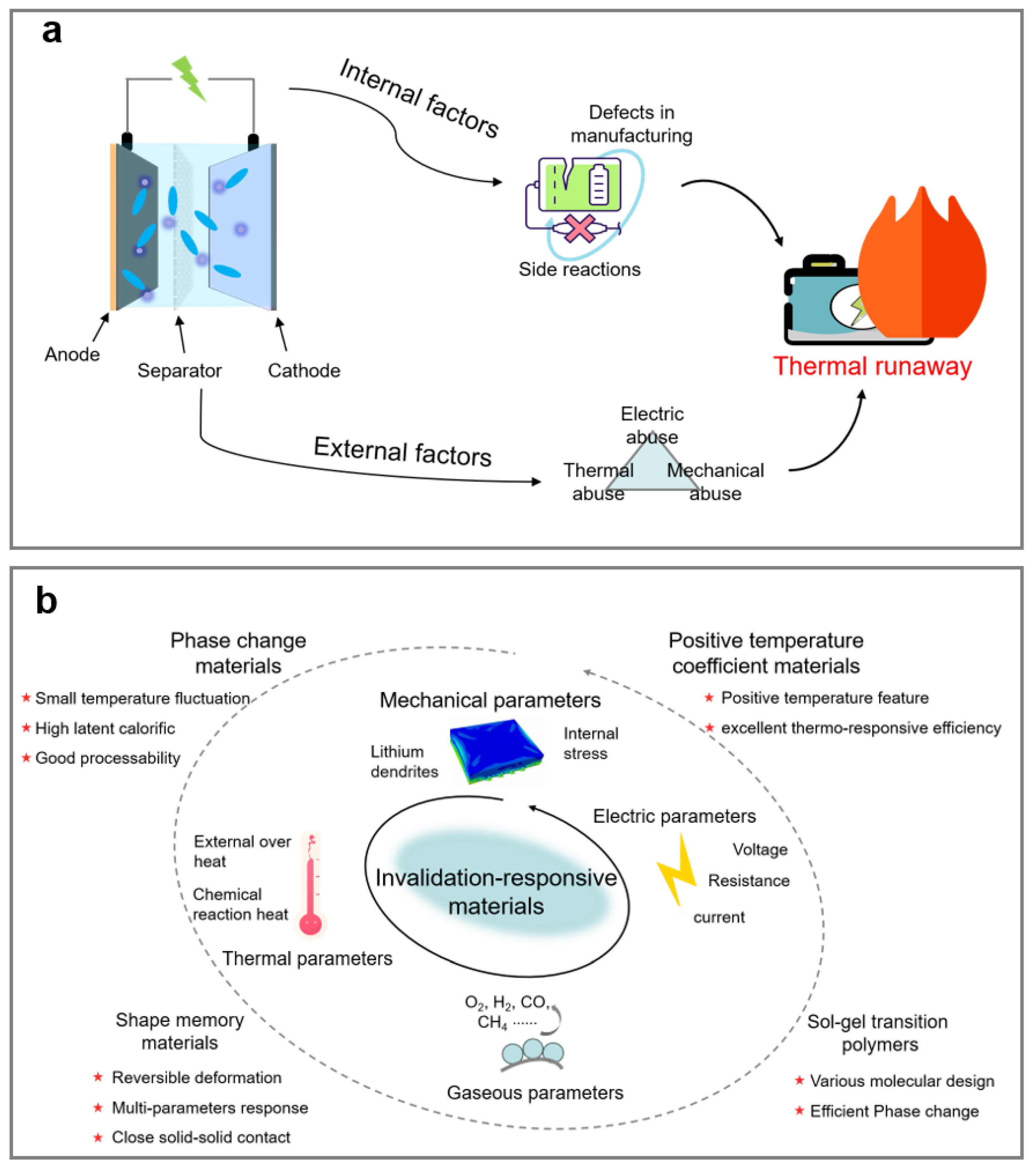
Figure 2.
(a) Stages of thermal runaway development in LIBs; (b) the sequence of characteristic parameters during thermal runaway process.
Figure 2.
(a) Stages of thermal runaway development in LIBs; (b) the sequence of characteristic parameters during thermal runaway process.
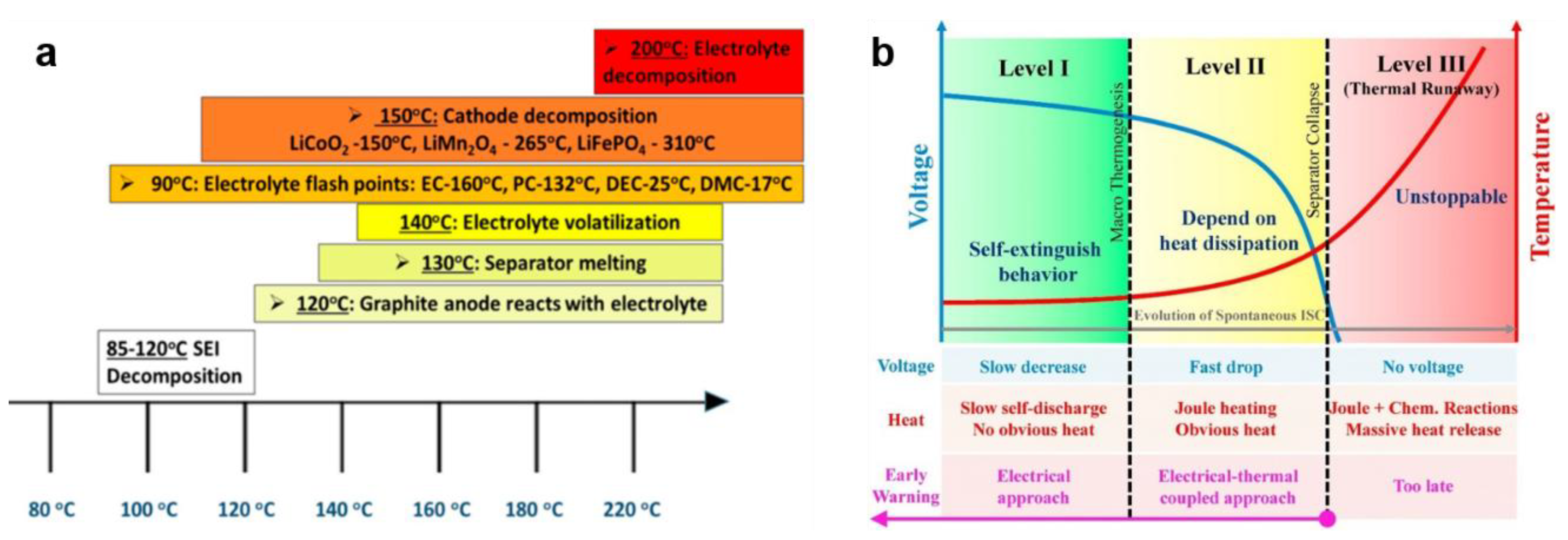
Figure 4.
(a) Working mechanism of lithium ion batteries with and without a PTC cathode under abusive conditions; (b) schematic illustration for structural features and temperature-responsive mechanism of the as-proposed RTSM composite and its effort between the electrode-active layer and current collector; (c) schematic diagram of cathode electrode with PTC layer safe design; (d) schematic illustration of safe battery design.
Figure 4.
(a) Working mechanism of lithium ion batteries with and without a PTC cathode under abusive conditions; (b) schematic illustration for structural features and temperature-responsive mechanism of the as-proposed RTSM composite and its effort between the electrode-active layer and current collector; (c) schematic diagram of cathode electrode with PTC layer safe design; (d) schematic illustration of safe battery design.
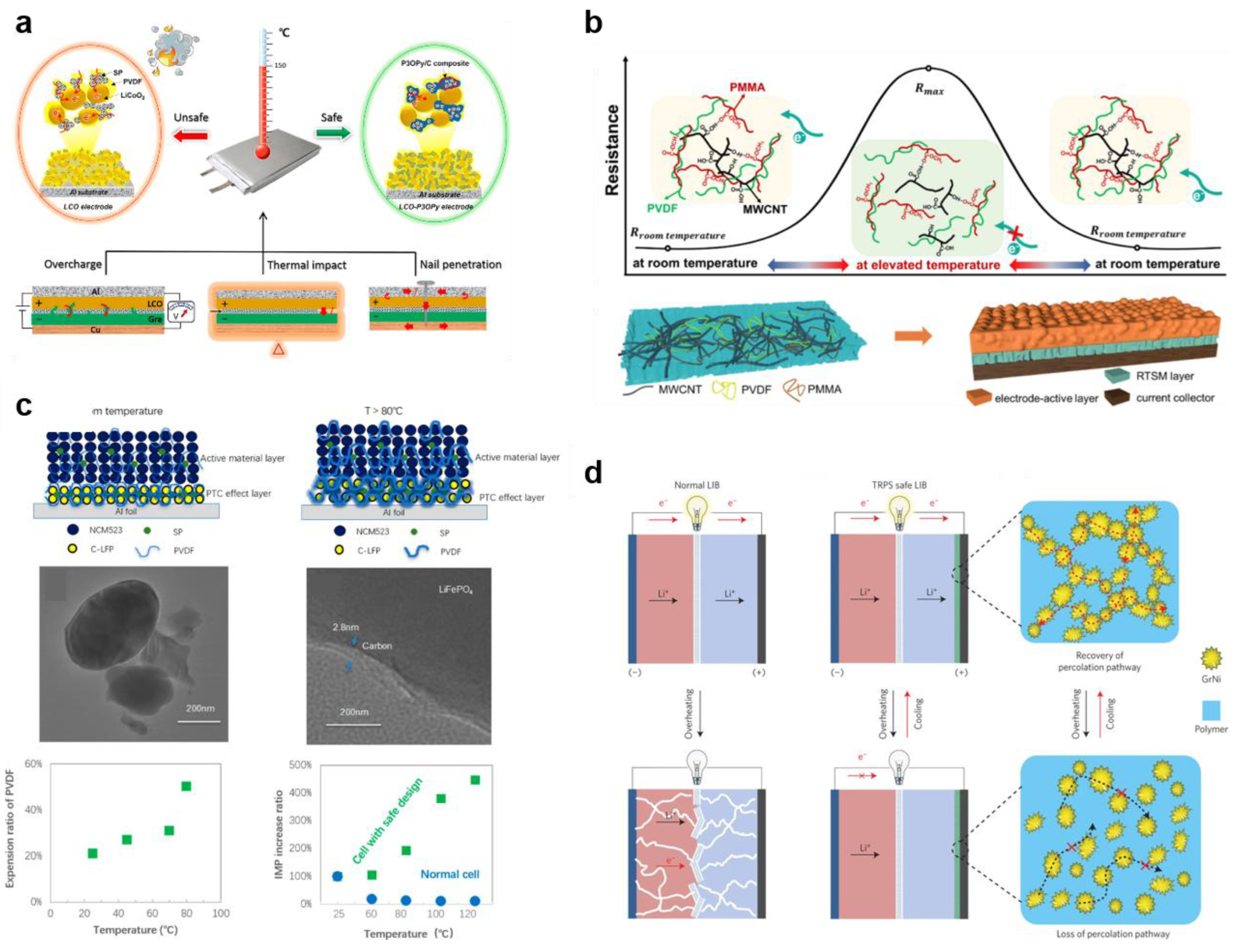
Figure 5.
(a) The ionic blocking effect of a thermally-controllable polymerelectrolyte for electrochemical energy storage; (b) Schematic illustration of the formation of polymer protection layer and its smart thermal responsive behavior in cell by the free radical polymerization mechanism under thermal abuse condition.
Figure 5.
(a) The ionic blocking effect of a thermally-controllable polymerelectrolyte for electrochemical energy storage; (b) Schematic illustration of the formation of polymer protection layer and its smart thermal responsive behavior in cell by the free radical polymerization mechanism under thermal abuse condition.
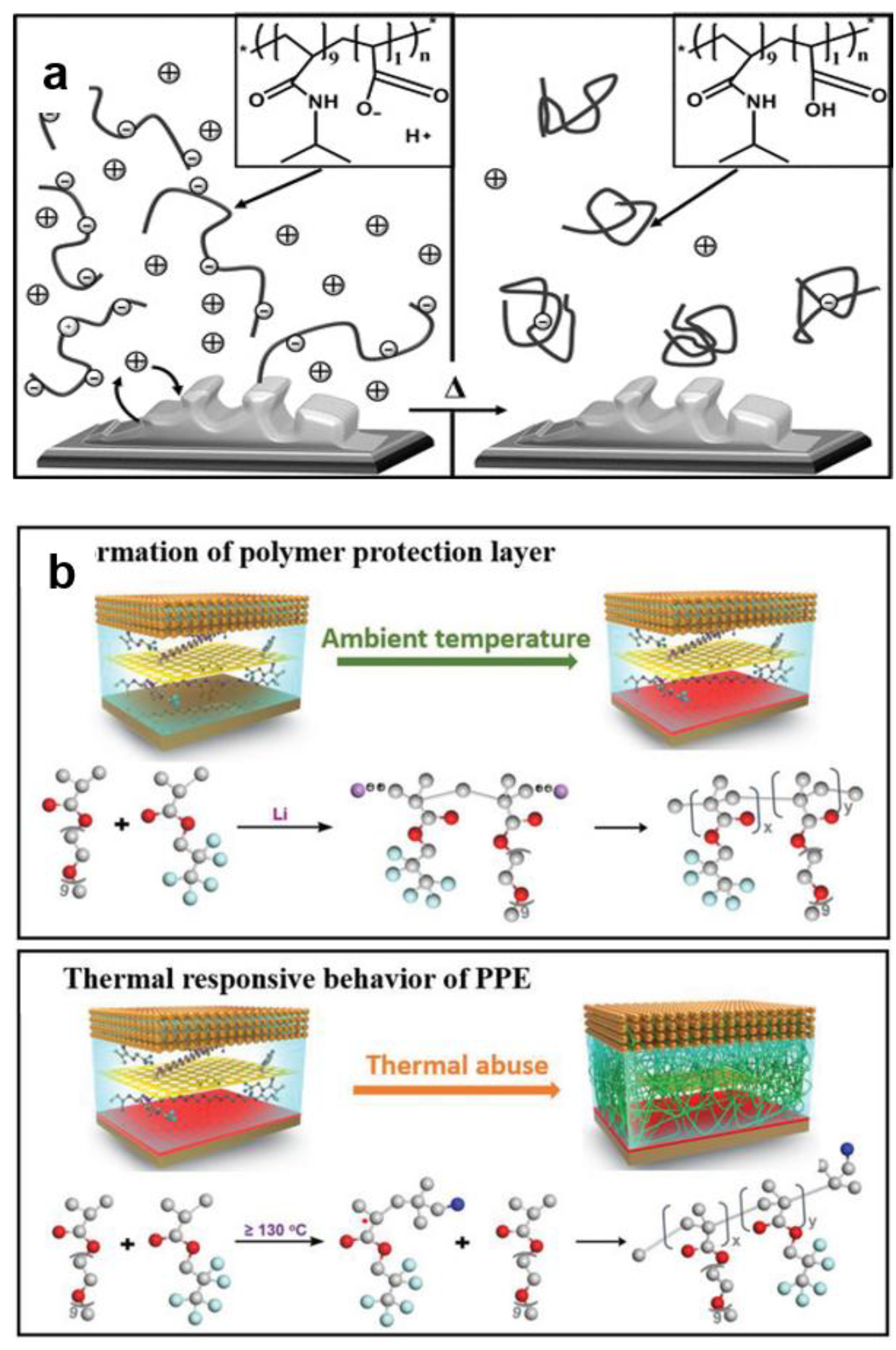
Figure 6.
Design of the micropatterned and shape-memorized current collectors. (a) Self-shutdown performance of the safe lithium-ion batteries with smart current collectors before thermal runaway; (b) The safe battery internal structure and the trigger mechanism of the automatic cut-out current collector; (c) conventional pure Cu CCs are heavy and bulky, while PI-Cu CCs are much lighter. By incorporating TPP and subsequently coating the CC with ultrathin Cu layers on both sides, the resulting PI-TPP-Cu CC is ultralight and exhibits efficient flame retardant properties.
Figure 6.
Design of the micropatterned and shape-memorized current collectors. (a) Self-shutdown performance of the safe lithium-ion batteries with smart current collectors before thermal runaway; (b) The safe battery internal structure and the trigger mechanism of the automatic cut-out current collector; (c) conventional pure Cu CCs are heavy and bulky, while PI-Cu CCs are much lighter. By incorporating TPP and subsequently coating the CC with ultrathin Cu layers on both sides, the resulting PI-TPP-Cu CC is ultralight and exhibits efficient flame retardant properties.
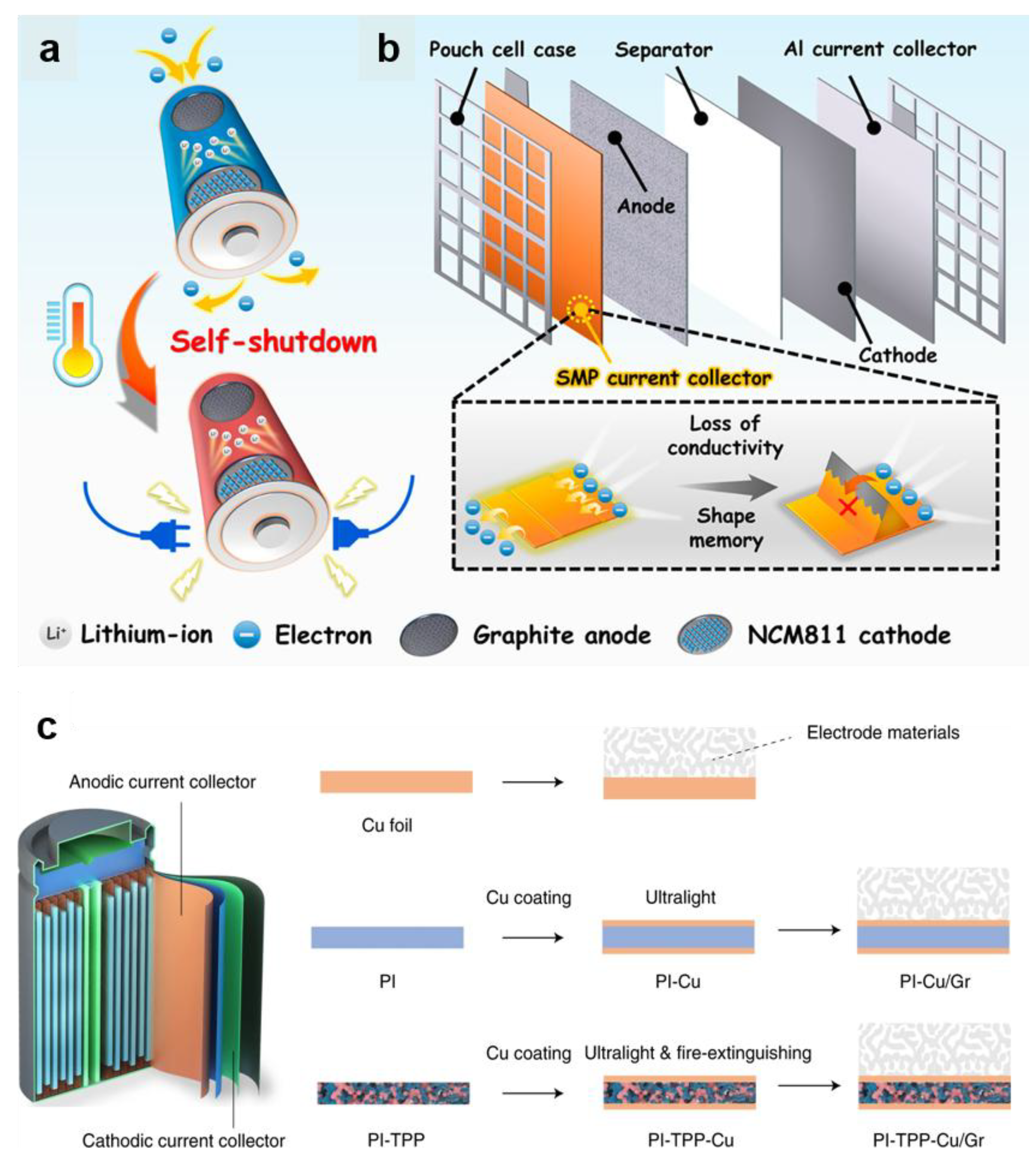
Figure 7.
(a) synthesis of graphene oxide functionalized with poly(3-(N-2-methacryloyloxyethyl-N,N-dimethyl)ammonatobutane-sulfonate, GO-PMABS; (b) schematic illustrations for the synthesis route of the microcapsules containing fire-suppression agent (DMTP); (c) schematic of the “smart” electrospun separator with thermal-triggered flame-retardant properties for lithium-ion batteries.
Figure 7.
(a) synthesis of graphene oxide functionalized with poly(3-(N-2-methacryloyloxyethyl-N,N-dimethyl)ammonatobutane-sulfonate, GO-PMABS; (b) schematic illustrations for the synthesis route of the microcapsules containing fire-suppression agent (DMTP); (c) schematic of the “smart” electrospun separator with thermal-triggered flame-retardant properties for lithium-ion batteries.

Figure 8.
Dimethoxybenzene and its derivatives as redox shuttles: A summary of design logic. Copyright 2024 Elsevier.
Figure 8.
Dimethoxybenzene and its derivatives as redox shuttles: A summary of design logic. Copyright 2024 Elsevier.
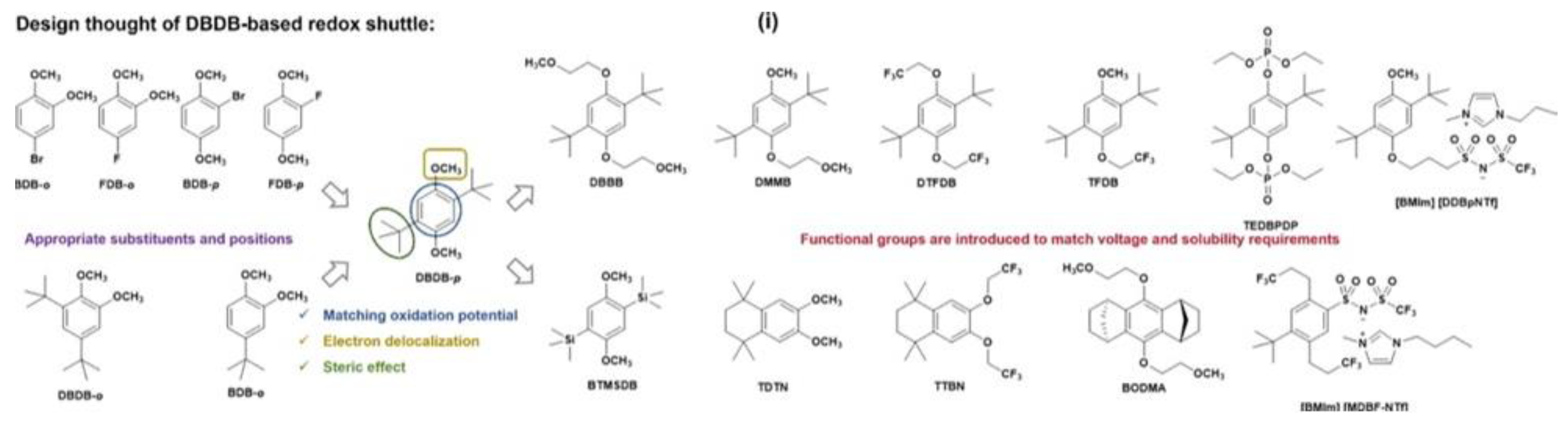
Figure 9.
(a) Dendrite formation in a traditional lithium battery and the functional separator which can detect an early lithium dendrite penetration through an internal short circuit and VLi-Li drops to zero; (b) the PI based smart separator and its detection mechanism for early lithium dendrite; (c) configuration of the half-cell with RP coating (P-hc) and its testing protocol showing the current density versus time.
Figure 9.
(a) Dendrite formation in a traditional lithium battery and the functional separator which can detect an early lithium dendrite penetration through an internal short circuit and VLi-Li drops to zero; (b) the PI based smart separator and its detection mechanism for early lithium dendrite; (c) configuration of the half-cell with RP coating (P-hc) and its testing protocol showing the current density versus time.
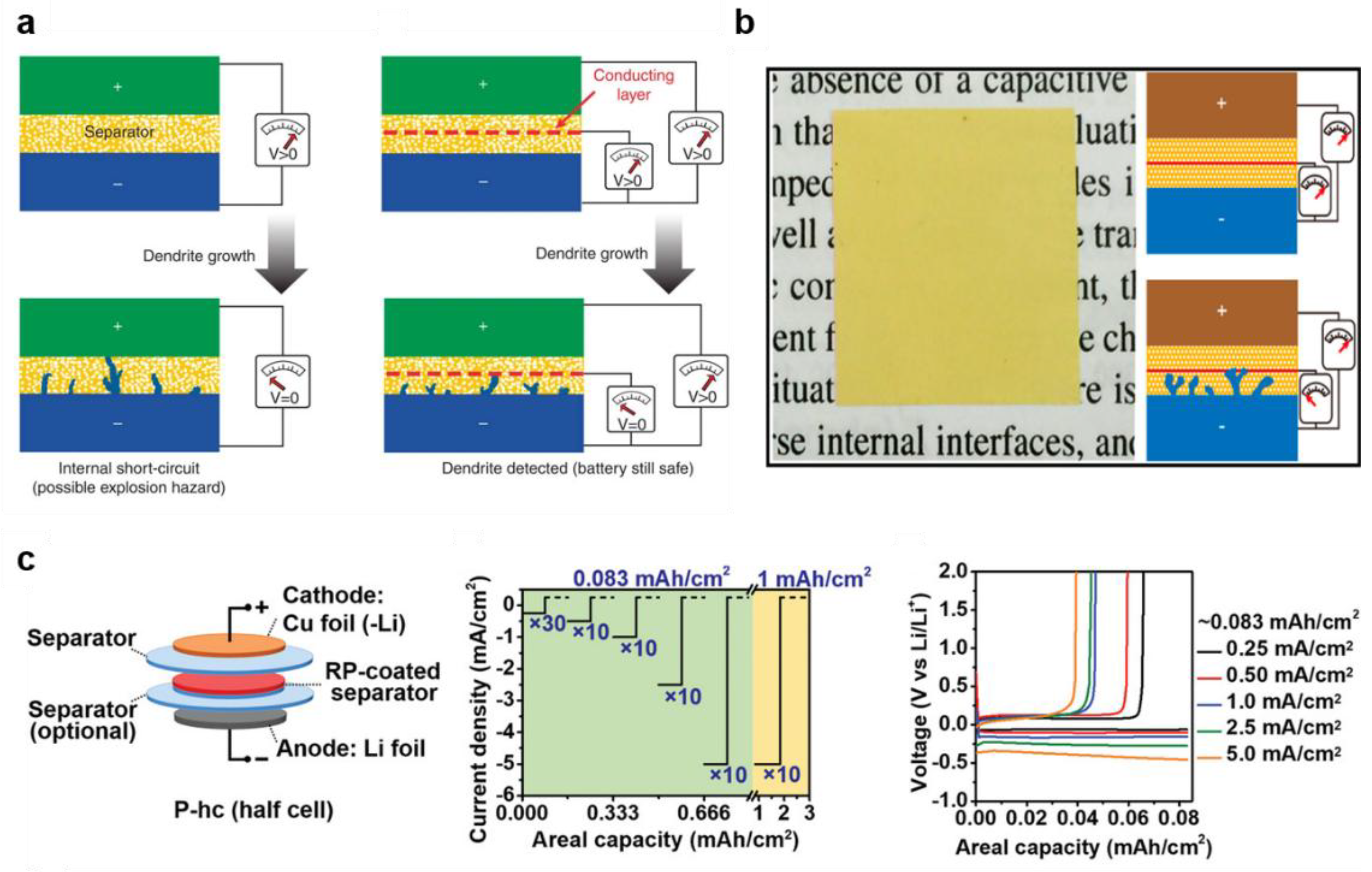
Figure 10.
(a) The regulating behavior of functional separator coated with an ultra-thin layer of Au nanoparticles lithium deposition. The functional separator with TMOs (b), TMNs (c), and TMFs (d) coating.
Figure 10.
(a) The regulating behavior of functional separator coated with an ultra-thin layer of Au nanoparticles lithium deposition. The functional separator with TMOs (b), TMNs (c), and TMFs (d) coating.
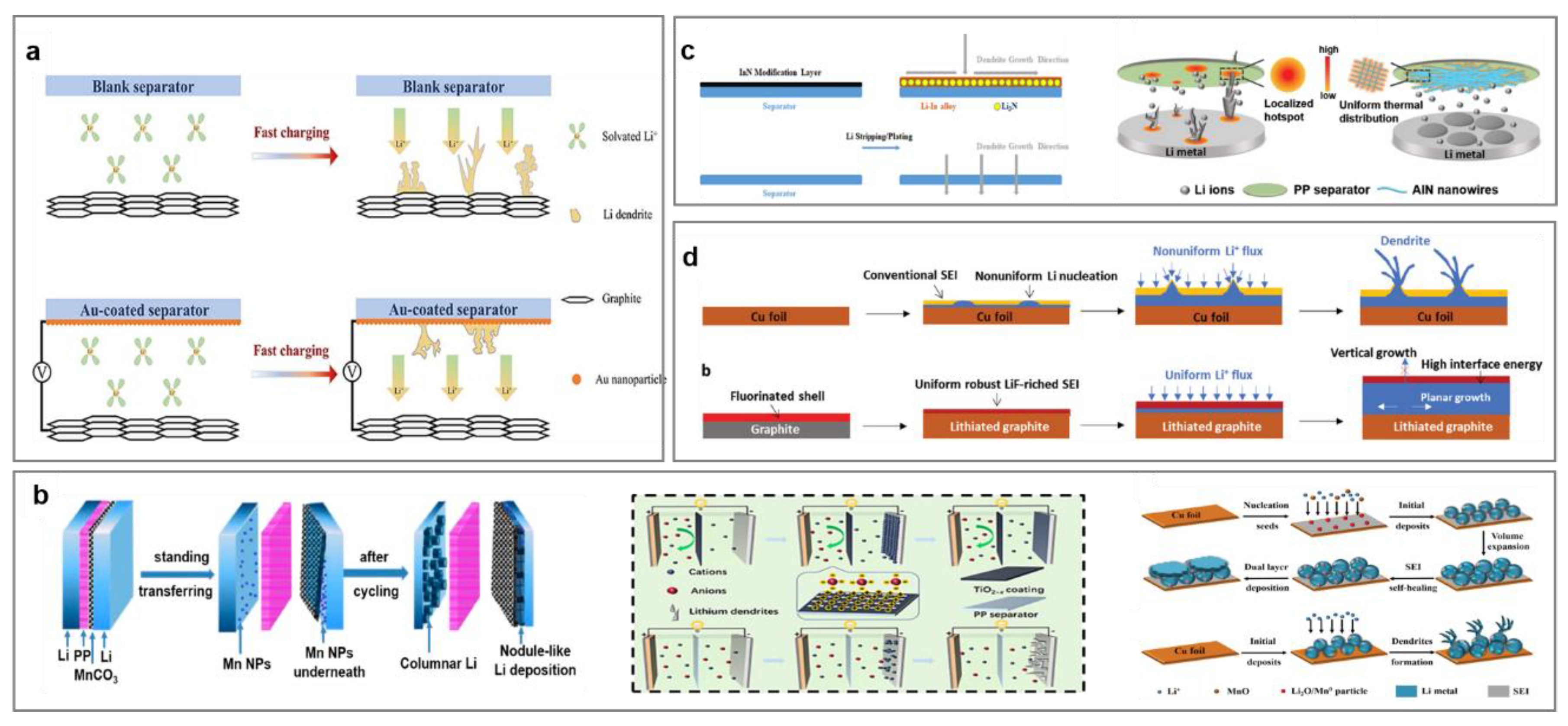

Table 1.
The typical LIBs accident at home and abroad from 2023 to 2024.
| Time | Type | Consequence |
|---|---|---|
| April 2023 | A lithium battery container caught fire in the industrial park in Gothenburg, Sweden | Massive property damage |
| May 2023 | A 5MW energy storage facility caught fire in East Hampton, New York, USA | Massive property damage |
| June 2023 | A fire broke out at an electric bicycle shop in Chinatown, New York City | Four people died, and two were seriously injured |
| July 2023 | A fire broke out at the container energy storage station in Longjing District, Taichung City, Taiwan Province | Massive property damage |
| August 2023 | A storage energy cabinet suddenly caught fire in the Guangtong Logistics Park in Zhuhai, Guangdong Province | Massive property damage |
| August 2023 | A lithium battery failure in an electric scooter and caused a fire in a residential building in Los Angeles, California | Two people died, and multiple people were seriously injured |
| September 2023 | A fire broke out in an apartment building due to overheating of lithium batteries in personal mobility devices in London, UK | Resulting in significant property damage, many people received treatment for smoke inhalation |
| February 2024 | A lithium-ion battery from an electric bicycle caused an apartment fire in the Harlem neighborhood of New York City | One journalist died, and multiple people were seriously injured |
| May 2024 | A fire broke out at a 70 MW agricultural-photovoltaic complementary energy storage power station in Hainan Province | A group of battery prefabricated containers was burned |
Table 2.
The definition of thermal runaway and propagation.
| Number | Standard | Description |
|---|---|---|
| 1 | GB/T 36276-2023 | The phenomenon of uncontrollable temperature rise caused by exothermic reactions inside the battery cell |
| 2 | IEC 62619-2022 | Uncontrollable and rapid temperature rise caused by exothermic reactions within the battery cell |
| 3 | UL 1973-2022 UL 9540A |
An event in which an electrochemical battery uncontrollably raises its temperature through self-heating. Thermal runaway occurs when the heat generated by the battery exceeds the heat it can dissipate. This can lead to fires, explosions, and gas emissions |
| 4 | GB/T 36276-2023 | The phenomenon where thermal runaway in a battery cell within a battery module triggers thermal runaway in adjacent or other cells |
Disclaimer/Publisher’s Note: The statements, opinions and data contained in all publications are solely those of the individual author(s) and contributor(s) and not of MDPI and/or the editor(s). MDPI and/or the editor(s) disclaim responsibility for any injury to people or property resulting from any ideas, methods, instructions or products referred to in the content. |
© 2025 by the authors. Licensee MDPI, Basel, Switzerland. This article is an open access article distributed under the terms and conditions of the Creative Commons Attribution (CC BY) license (http://creativecommons.org/licenses/by/4.0/).
Copyright: This open access article is published under a Creative Commons CC BY 4.0 license, which permit the free download, distribution, and reuse, provided that the author and preprint are cited in any reuse.