

Submitted:
07 February 2025
Posted:
10 February 2025
You are already at the latest version
Abstract
The article represents a plea in favor of pluralism and own university values, influenced by current educational cultures and modern academic ethics in constant dynamics. The research develops aspects regarding the organization of university values and ethics at the level of a Romanian educational institution. The statistical analysis of the work, parametric and non-parametric, shows the importance of organizational culture in the face of the entropic phenomenon. The research results demonstrate the importance of university contextual factors, of the existing information sources at the level of the organization and the adjacent environment, as well as of educational values considered relevant in contemporary culture.
Keywords:
educational pluralism
; university values
; socio-cultural ethics
; entropy
Introduction and Methodology
The purpose of the research1 lies in the importance of the subject of entropy at the level of university culture. In a society where the university offer is, to say the least, abundant compared to the educational demand, the need for organization is of particular relevance. Organizational entropy at the level of current educational institutions is more present than ever, the need to capture reality and its origin being relevant in understanding how there can be a relationship to intrinsic values 2.
In the current social context, a frequent criticism of the legitimacy of human rights is that they reflect an ethnocentric or parochial perspective. In contrast to this perspective, the globalist dimension brings to the fore the need for the dynamic integration of people, groups and organizations. The contradictions of the different systems of approaching human rights are found in the entropic character of modern education, especially in its managerial system. In this context, the main challenge to the universal validity of human rights is not relativism, but ethical cultural pluralism. At the meta-ethical level, skepticism or ethical relativism claims that there are no or cannot be known universal values, because moral truth and the justification of moral judgments are considered relative to contingent cultural and historical 3factors. Applied at the university level, educational values find themselves in a dynamic equilibrium unfavorable to pedagogical ethics. In this context, the study of university entropy represents a central point of modern organizational culture.
In an increasingly destructured society - marked by environmental threats, uncontrolled consumerism, religious violence, information technology and unethical global escalation, including the use of weapons of mass destruction - organizational values, especially those applied at the university level, are becoming existential pillars of today's society. Intrinsic and group values become the source of freedom, creativity and organizational values that significantly connect humans with other social and natural beings or species. 4Today's universities can definitively influence the trajectory of intrinsic and organizational values.
The article presents a parametric and non-parametric analysis regarding a university case in Romania, applied to the organizational management level of an educational institution.
Results
The experimental research was based on collecting information through a questionnaire. The data obtained were coded and entered into SPSS for statistical validation. Due to the types of data obtained as well as certain intra-group differences, non-parametric statistical tests were used.5
The independent variables analyzed were general length of service, position held, age, completed studies (or level of studies), gender, field of completed studies and type of manager or personal consideration of one's own managerial qualities. The representations of these variables (figure 1, panels) show that the length of service of the majority of study participants is over 10 years, many of them being in the category of mid-level managers, the share of people between 41-50 years old being decisive, the male gender being a minority at the level of university management. At the level of the university managerial group researched, people with at least a doctorate dominate the top of scientific studies, representatives of social sciences being in the majority and most of them considering that they became managers through training and experience.
The questionnaire applied to the studied group highlighted the importance of factors, sources of information, relevant values, etc. at the university organizational level.
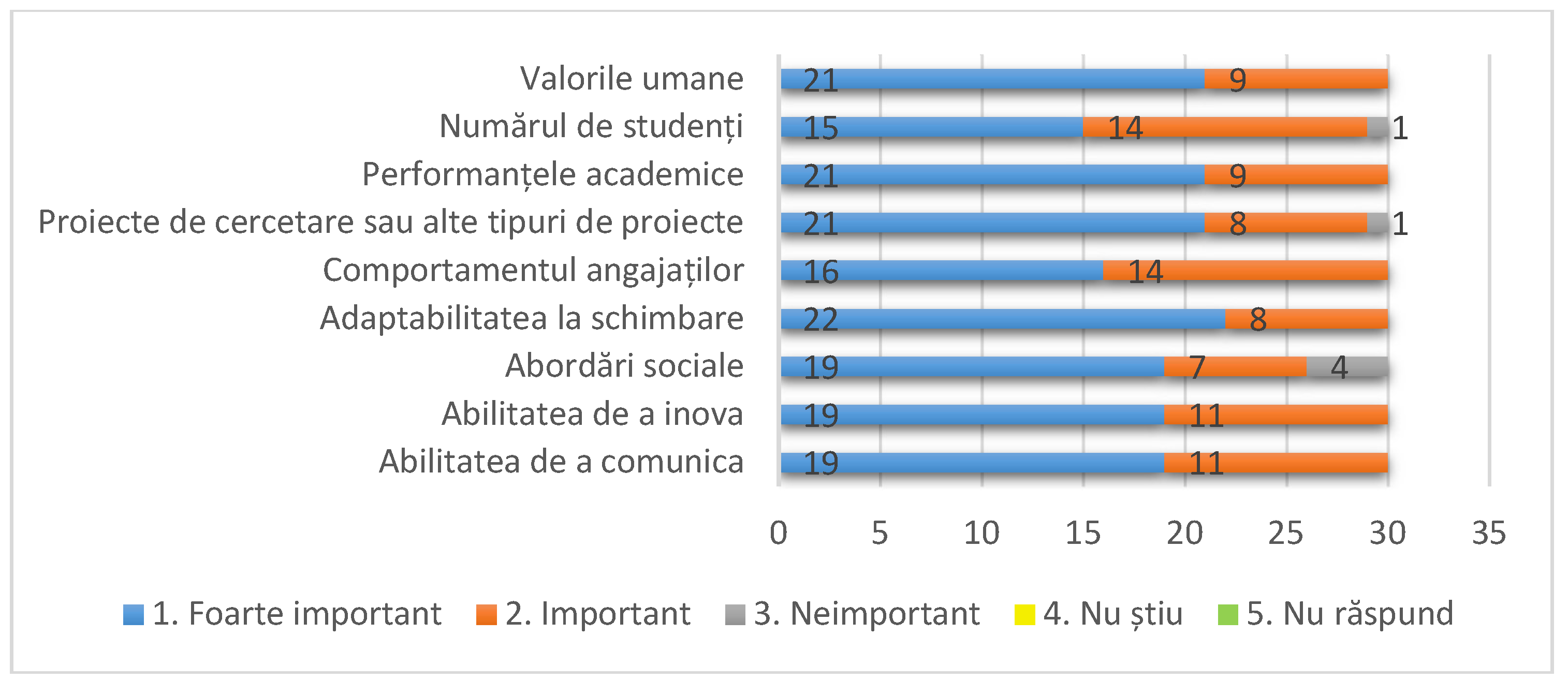
To the question How do you assess the importance of the following factors on the future performance of the university? The list of factors was nine in number (Ability to communicate, Ability to innovate, Social approaches, Adaptability to change, Employee behavior, Research projects or other types of projects, Academic performance, Number of students, Human values) with five answer options (1. Very important, 2. Important, 3. Not important, 4. Don't know and 5. No answer). From the responses received, adaptability to change would be the aspect noted as very important and in second place were factors such as human values, academic performance and research projects or other types of projects.
Figure 2.
Factors influencing academic performance.
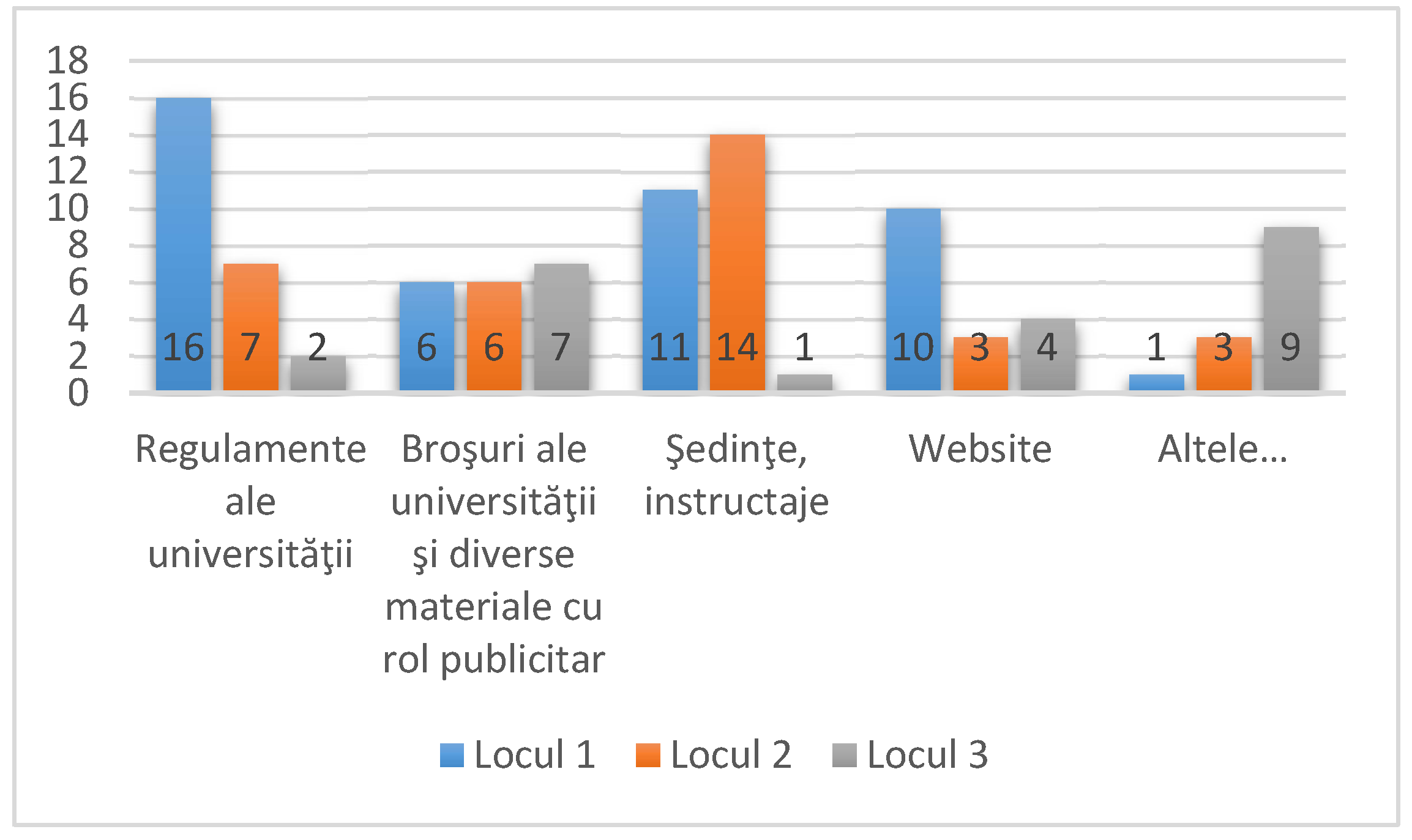
The sources of information regarding the organization's values considered to be the most frequently used among the following: University regulations, University brochures and various advertising materials, Meetings, trainings, Website, Other... The answers had to be classified according to the place of the information source: 1st place, 2nd place and 3rd place. The primary source of information emerged as being the university regulations and in second place were meetings, trainings, etc.
Figure 3.
Sources of information regarding the organization's values.
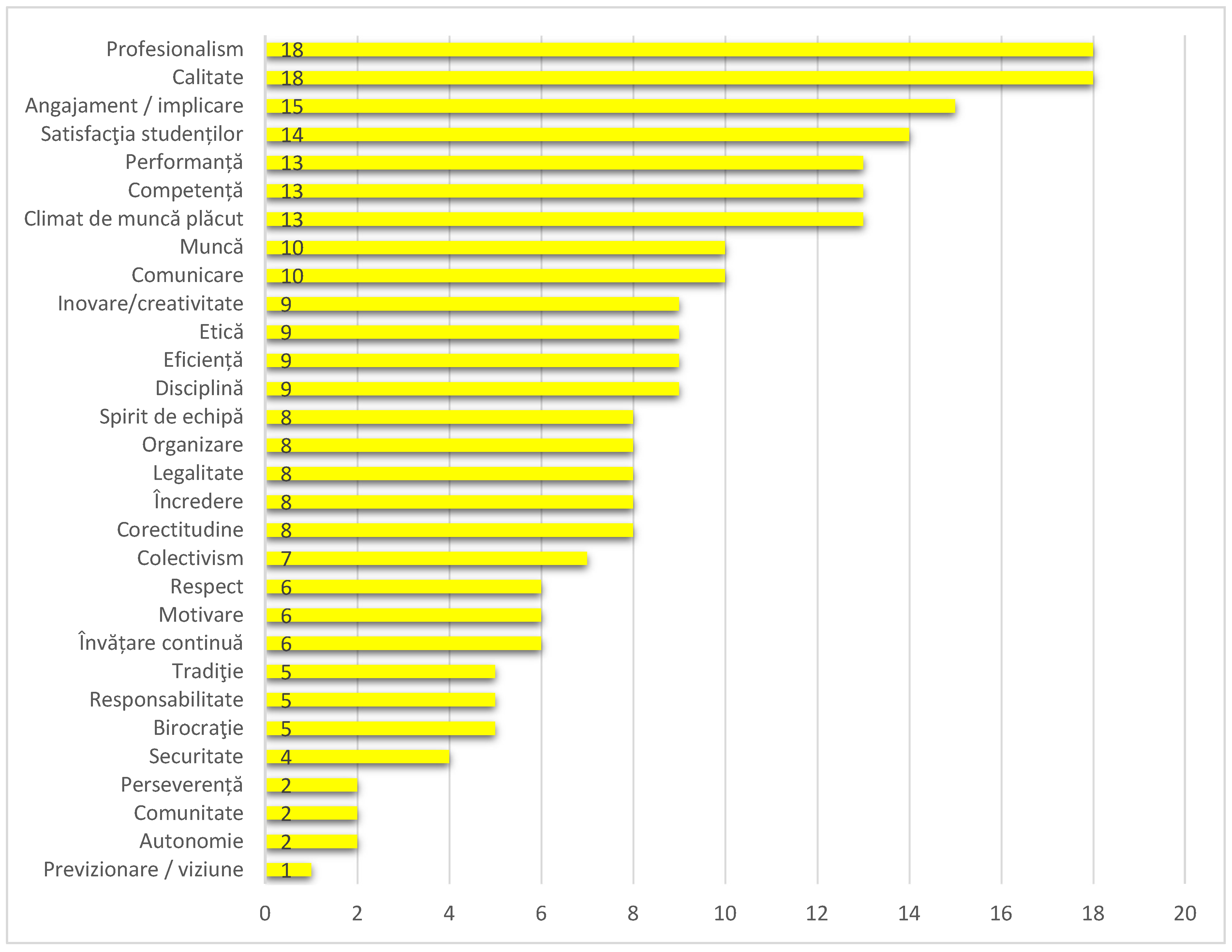
The 10 keywords considered relevant to the university by respondents, as a definition of what they consider relevant to the organizational culture, were chosen as being top quality and professionalism (each with 18 responses) and in last place (with only one response) being Forecasting/Vision.
Figure 4.
Keywords relevant to the university.
When selecting the first five values considered to be the most intensely shared and frequently used within the university within the existing situation (Figure 5, panels ae), the following values were obtained: open communications between students and teaching staff, on the one hand, and management staff, on the other hand, along with quality (six answers each), open communications between students and teaching staff (four answers), and with three answers each realism, professionalism, passion, orientation towards student satisfaction, openness and transparency, fairness, ethical behavior and integrity, assuming responsibility .
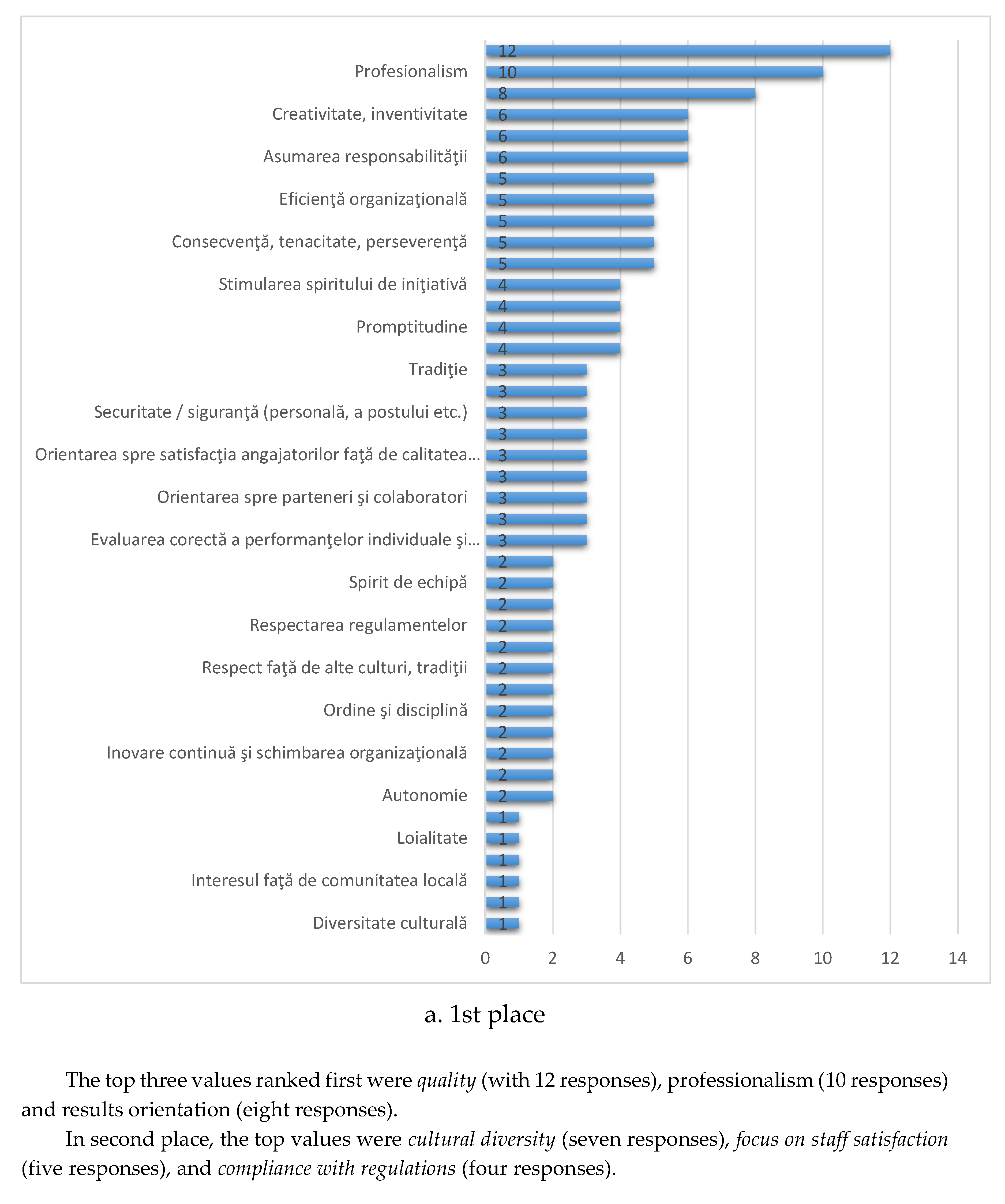
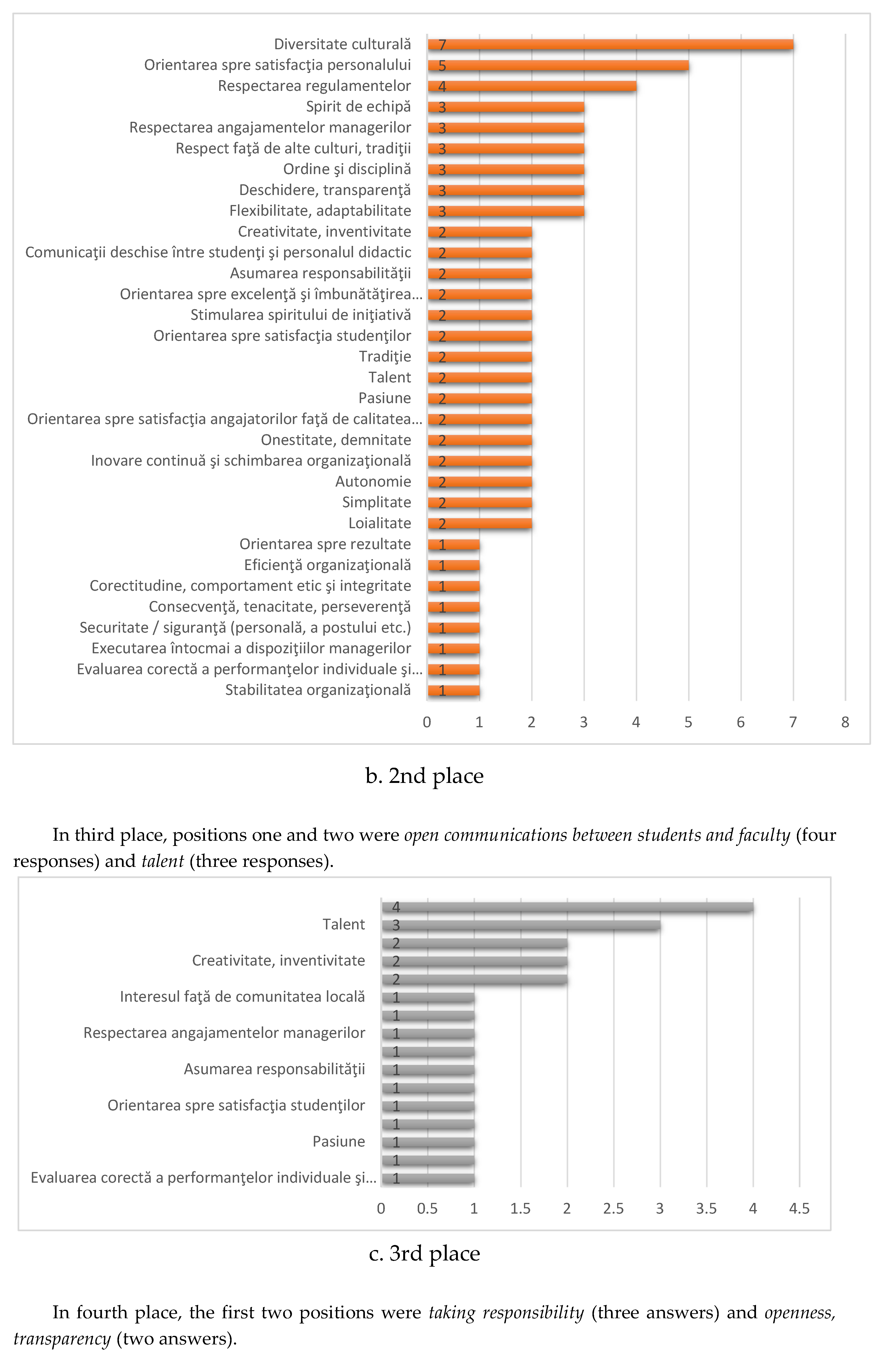
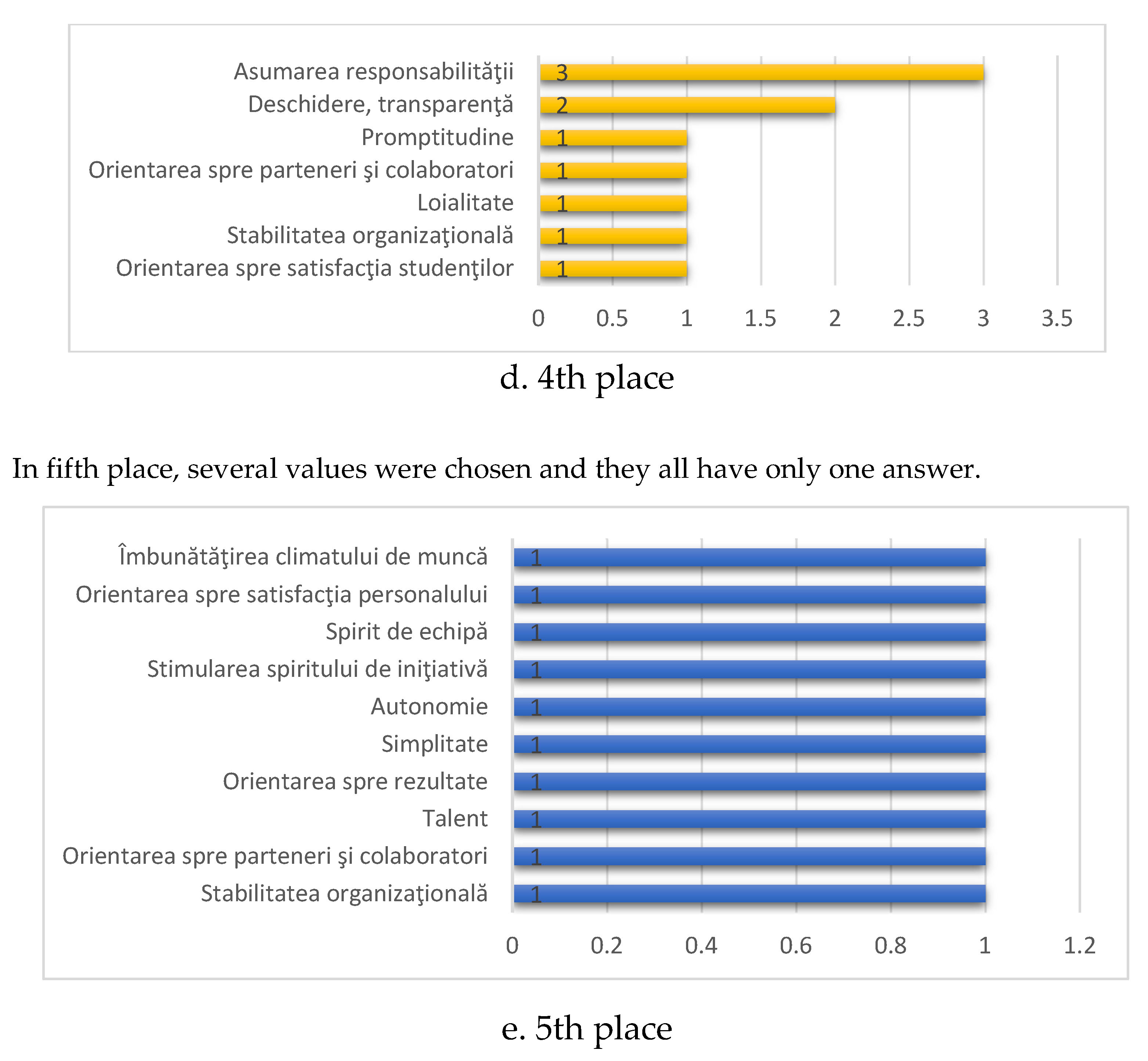
When selecting the first five values considered to be the most intensely shared and frequently used within the university within the desired situation (Figure 6, panels ae), the following values were obtained: quality (12 responses), professionalism (10), results orientation (eight), creativity, inventiveness along with open communications between students and teaching staff and along with assuming responsibility with six responses each.
Conclusion
In conclusion, the normality analysis of the questionnaire questions revealed that factors such as adaptability to change, human values, academic performance and research projects or other types of projects are factors with a huge negentropic potential. Shared values with good negentropic capacity are open communications between students and teaching staff, on the one hand, and management staff, on the other; quality (in general); open communications between students and teaching staff; realism; professionalism; passion; orientation towards student satisfaction; openness and transparency; fairness, ethical behavior and integrity; assuming responsibility. The values that are desired to be shared in the future within the university are: quality; professionalism; orientation towards results; creativity and inventiveness; open communications between students and teaching staff; assuming responsibility. Externally, quality and professionalism are the factors that are relied on.
| 1 | The paper is a variant of the article Covaci M., Covaci B. (2024). Pluralism și valori universitare intrinseci în contextul eticii culturale. Jurnalul Libertatii de Constiinta. |
| 2 | Jaspers, K. (1971). Philosophy of existence (Vol. 1010). University of Pennsylvania Press. |
| 3 | Ramírez, F. A. (2019). The challenge of ethical-cultural pluralism to the universality of human rights. The Age of Human Rights Journal, (12), 184-203. |
| 4 | Sarin, I. (2011). Philosophical Faith: The Savior of Humanity. In Philosophical Faith and the Future of Humanity (pp. 387-398). Dordrecht: Springer Netherlands. |
| 5 | The research was adapted according to Covaci M. (2019). Doctoral thesis. National School of Political and Administrative Studies; Covaci, M. (2024). Academic satisfaction of students: validity and reliability study. ORAV; Covaci, M (2024). Organizational negentropy - theory and concepts. ORAV; Covaci, M. (2024). Organizational negentropy - regression analysis and correlations. ORAV; Covaci, M. (2024). Organizational negentropy - statistical research. ORAV |
References
- Covaci M. (2019). Doctoral thesis. National School of Political and Administrative Studies.
- Covaci, M. (2024). Academic satisfaction of students: validity and reliability study. ORAV.
- Covaci, M (2024). Organizational negentropy - theory and concepts. ORAV.
- Covaci, M. (2024). Organizational negentropy - regression analysis and correlations. ORAV.
- Covaci, M. (2024). Organizational negentropy - statistical research. ORAV.
- Jaspers, K. (1971). Philosophy of existence (Vol. 1010). University of Pennsylvania Press.
- Ramírez, F. A. (2019). The challenge of ethical-cultural pluralism to the universality of human rights. The Age of Human Rights Journal, (12), 184-203. [CrossRef]
- Sarin, I. (2011). Philosophical Faith: The Savior of Humanity. In Philosophical Faith and the Future of Humanity (pp. 387-398). Dordrecht: Springer Netherlands.
Figure 1.
Structure of the respondent management group.
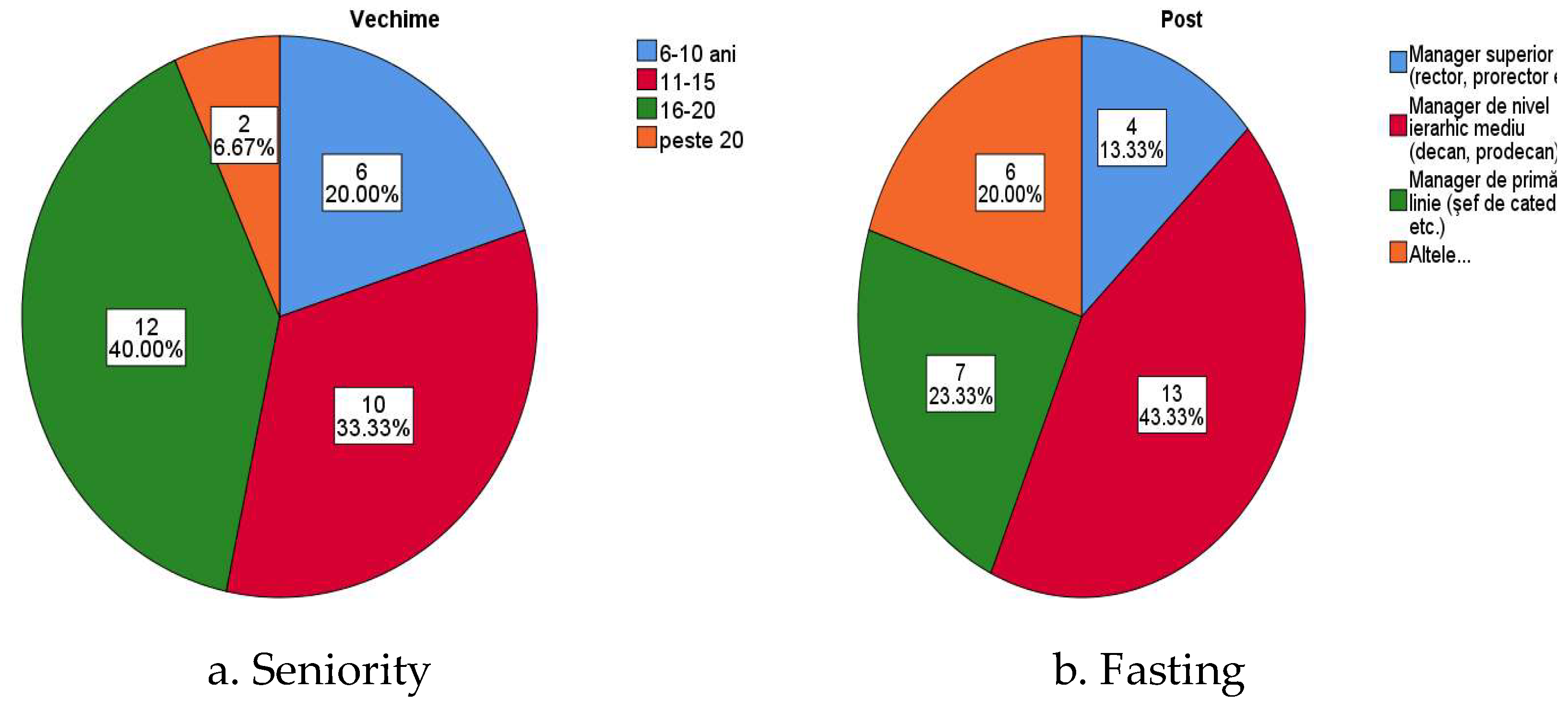
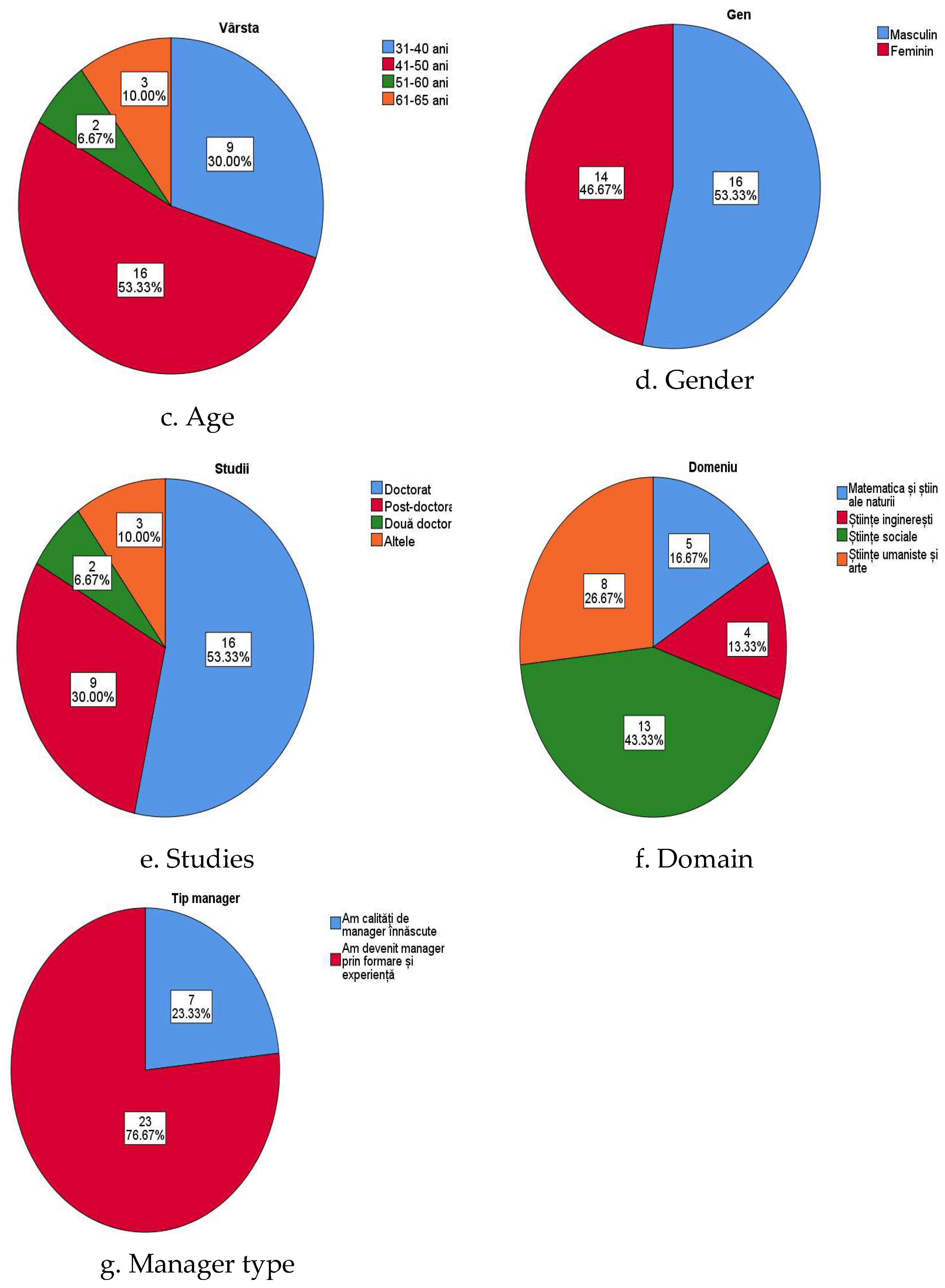
Figure 5.
Values considered to be the most intensely shared and frequently used within the university within the existing situation.
Figure 5.
Values considered to be the most intensely shared and frequently used within the university within the existing situation.
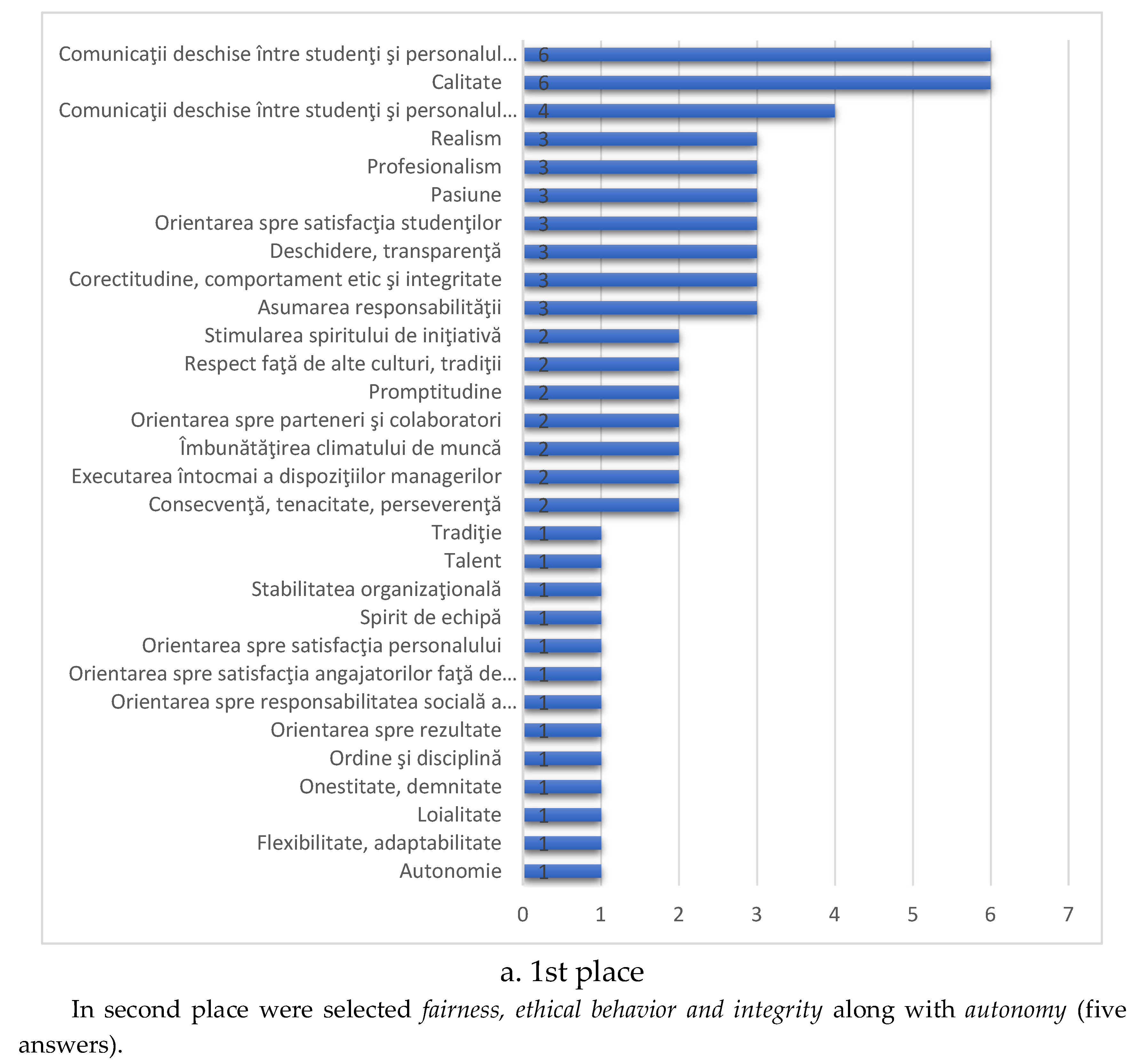
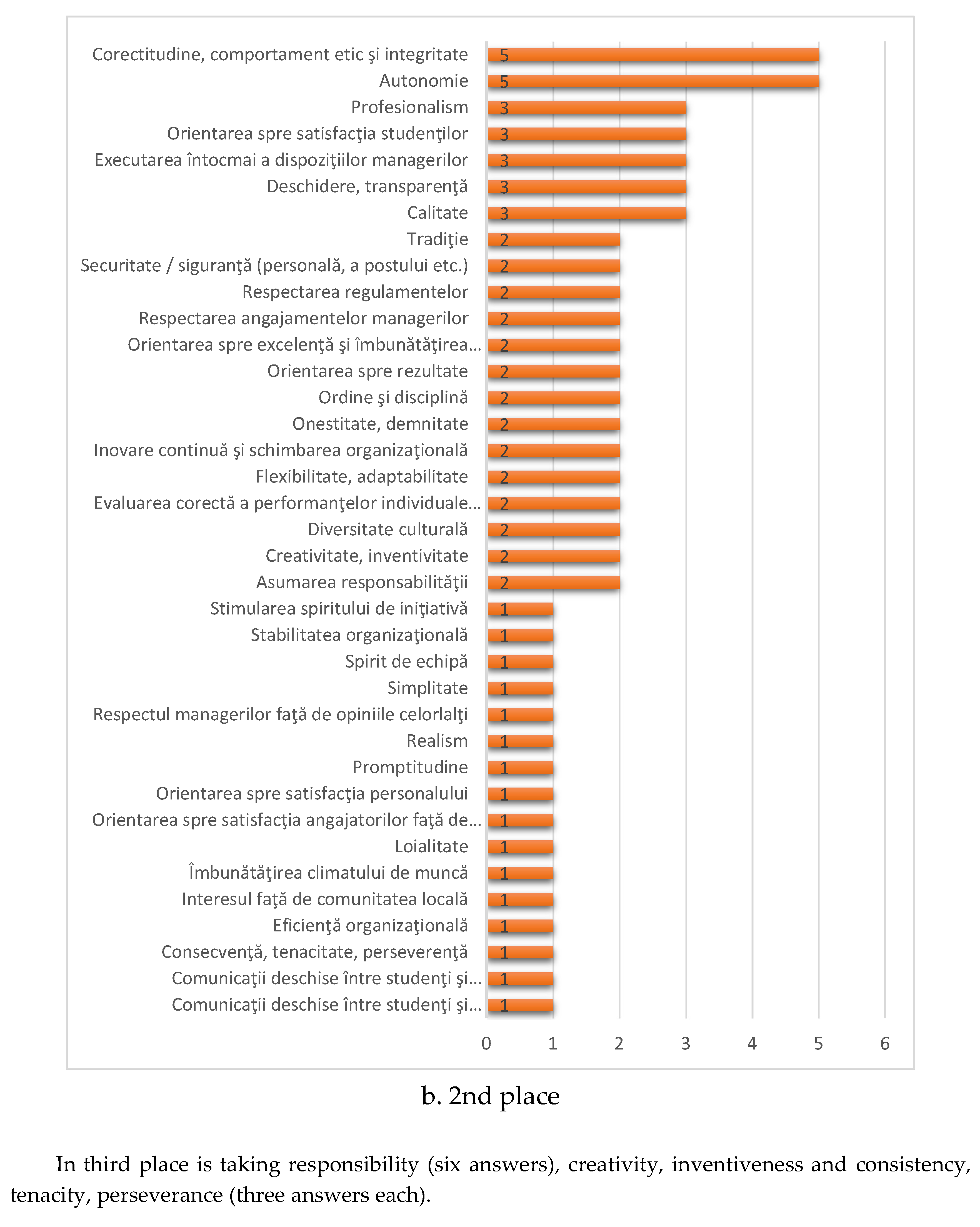
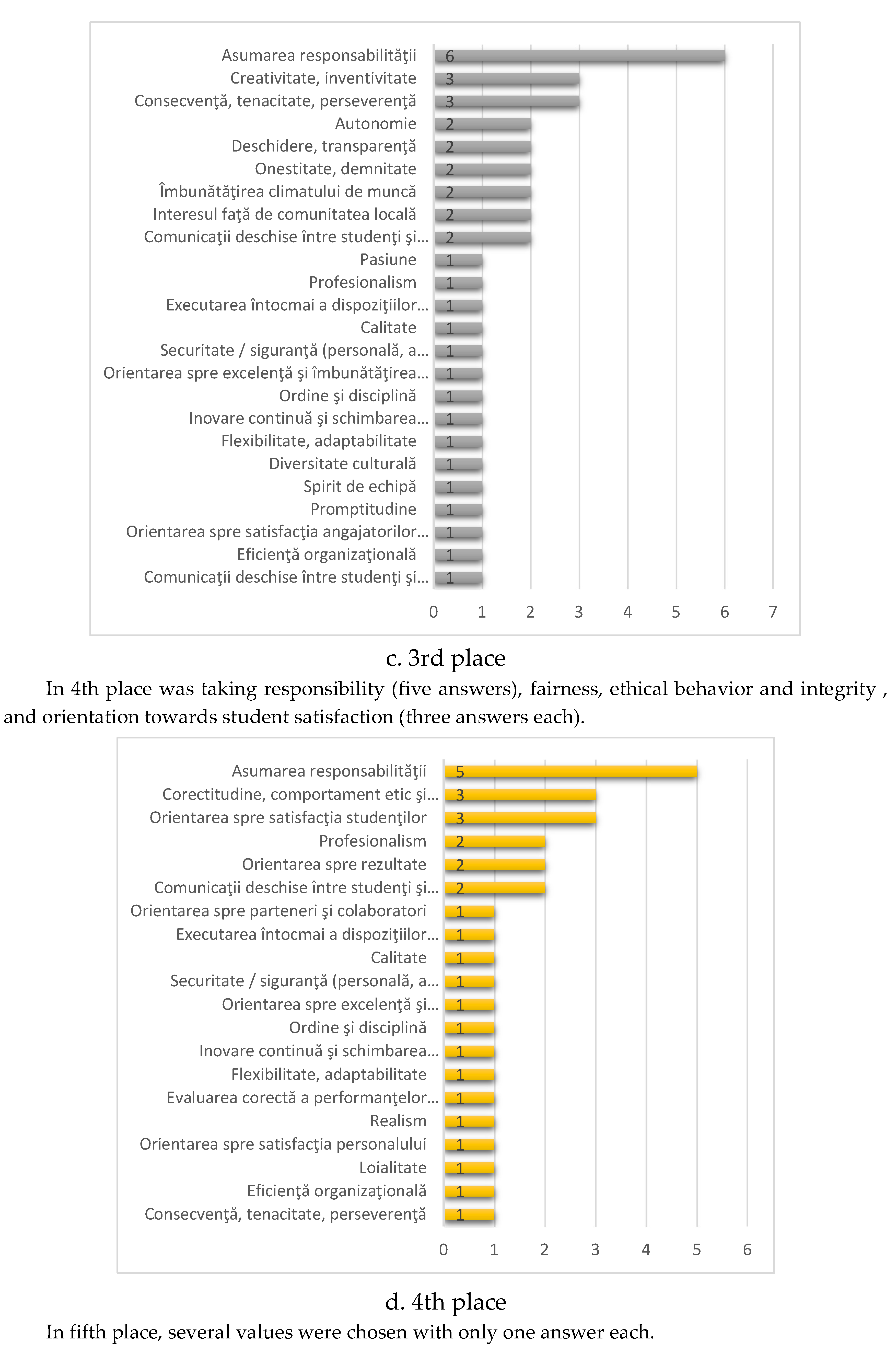
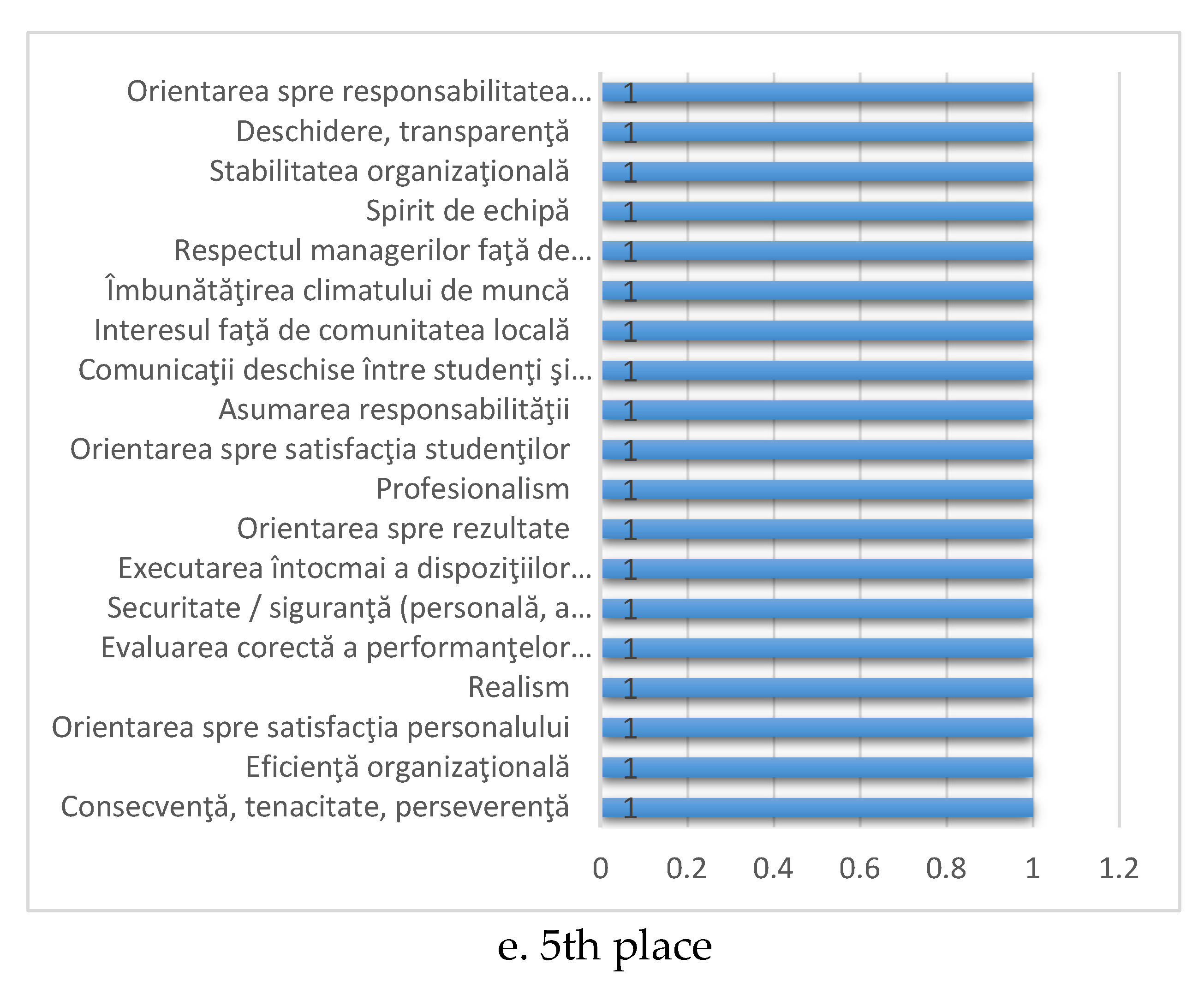
Figure 6.
Values considered to be the most intensely shared and frequently used within the university within the desired situation.
Figure 6.
Values considered to be the most intensely shared and frequently used within the university within the desired situation.
Disclaimer/Publisher’s Note: The statements, opinions and data contained in all publications are solely those of the individual author(s) and contributor(s) and not of MDPI and/or the editor(s). MDPI and/or the editor(s) disclaim responsibility for any injury to people or property resulting from any ideas, methods, instructions or products referred to in the content. |
© 2025 by the authors. Licensee MDPI, Basel, Switzerland. This article is an open access article distributed under the terms and conditions of the Creative Commons Attribution (CC BY) license (http://creativecommons.org/licenses/by/4.0/).
Copyright: This open access article is published under a Creative Commons CC BY 4.0 license, which permit the free download, distribution, and reuse, provided that the author and preprint are cited in any reuse.


