
Submitted:
09 February 2025
Posted:
10 February 2025
You are already at the latest version
Abstract
Fouling, particularly from biofouling, organic and colloidal fouling, and scale formation, presents a significant challenge in RO/NF treatment of marginal waters. The previous review (Part 1) shed light on fouling behavior by LMWOCs and its underlying mechanisms. Part 2 outlines countermeasures to solve this problem and applications utilizing the LMWOCs. Key preventive strategies include pretreatment, early detection, cleaning, optimized operation procedures, and in-situ membrane modification. Correctly predicting the extent of fouling is essential as a first step. Flat-sheet membranes or small-diameter modules can be used for a preliminary test. Long-term testing is not necessary to elucidate the extent of LMWOC fouling; typically, 3 to 4 days is sufficient. So far, no fouling index applicable to LMWCO fouling exists. For this purpose, hydrophobic membranes such as polyamide are proposed instead of the standard silt density index (SDI) filter. Once the extent of LMWOC fouling is evaluated, a suitable pretreatment method can be selected, including adsorbents, specialty water filters, oxidative decomposition, and antifoulants. When no appropriate pretreatment is viable, alternative approaches such as high pH operation may be considered. Cleaning is necessary when membranes are fouled. However, regular cleaning often does not restore the original flow. Thus, special CIP chemicals, such as organic solvent-based and oxidative cleaning agents, are required. On the other hand, although fouling due to LMWCO initially reduces the flow rate, it usually reaches a steady value. Therefore, if the accompanying operating pressure increase can be tolerated, there is no need to restore the initial performance with strong cleaning chemicals. When a significant drop in flow rate occurs and LMWOC fouling is suspected, the cause can be identified by analyzing the fouled membranes. However, LMWCOs cannot often be identified by regular FT-IR analysis. In this case, the membrane is subjected to solvent extraction and then analyzed by GC-MS. Pyrolysis GC-MS, which does not require extraction, seems to be a promising technique. The review concludes by examining how LMWOCs can be strategically utilized to enhance membrane rejection and restore deteriorated membranes.
Keywords:
fouling
; organic fouling
; internal fouling
; flow loss
; reverse osmosis
; nanofiltration
; surfactant
; phonolics
; plasticizaer
; leachables
; octanol-water partition coefficient
; log P
; pore size
; SDI
; pretreatment
; activated carbon
; ozonation
; AOP
; in-situ modification
; cleaning
; CIP
; oxidative cleaning
; boron
; NDMA
; urea
; IPA
; tannic acid
; PEG
; rejuvenation
1. Introduction
The expansion of RO/NF applications to marginal water resources [1,2] has highlighted fouling as a critical challenge. It is said that marginal waters with high fouling tendencies, like municipal or industrial wastewater effluents and contaminated surface or well waters, create significant fouling problems for membrane plants [3]. Biofouling, organic and colloidal fouling, and scaling are particularly problematic. Of these, organic fouling, along with biofouling, has been considered difficult to manage. The major organic foulants intensively studied are natural organic matter (NOM) for surface water and groundwater and effluent organic matter (EfOM) for municipal wastewater reuse. Polymeric substances such as sodium alginate, humic acid (HA), and proteins have been used as model substances of EfOM. Fouling by low molecular weight organic compounds (LMWOCs) such as surfactants, phenolics, and plasticizers is known, but there have been few comprehensive reports.
The previous paper (Part 1) [4] shed light on fouling behavior by LMWOCs and its mechanism. The main characteristics and symptoms are as follows:
- Rapid flow decline within a short time of contact;
- Salt rejections are sometimes increased.
- No appreciable differential pressure increase;
- Organic concentration is very low, sometimes a few ppm or less.
- No visible foulant can be seen when fouled elements are autopsied.
- Flow loss is sometimes irreversible or difficult to clean.
- AC pretreatment is effective in alleviating problems.
- Typical LMWOC foulants are surfactants, phenolics, tannic acid, dyestuffs, aromatic compounds, oil and grease (O&G), and leachables from plant components such as bisphenol A and plasticizers (phthalates).
Regarding the fouling mechanism, internal fouling is more important than external fouling. LMWOCs are trapped within aggregate pores. Trapped organics hinder the permeation of water and solutes, resulting in a decreased flow rate. Two factors are critical for the entrapment of organic compounds within membrane pores: molecule size (or MW) and membrane-organic interactions. The molecules should be of an appropriate size to fill the membrane pores, and the hydrophobicity of the components enhances the sorption process. Hydrophobic interaction can be judged by the n-octanol/water partition coefficients. Log P (logarithm of n-octanol-water partition coefficient) and normalized water flux were well correlated.
Since LMWOC fouling is not a specific case but a ubiquitous problem in RO/NF treatment, specific attention must be paid to designing and operating RO/NF plants. Table 1 summarizes the unique corrective and preventive measures applicable to LMWOC fouling. General control strategies, i.e., pretreatment, detection, cleaning in place (CIP), and low fouling membranes, are similar to those for other types of fouling [5,6,7,8], but individual methods vary considerably.
This review paper (Part 2) summarizes the reported corrective and preventive measures against LMWOC fouling. Furthermore, some applications utilizing organic foulants (i.e., rejection enhancement and rejuvenation) are also introduced.
2. Pretreatment
Pretreatment is one of the essential unit processes in RO/NF plants, as shown in Figure 1 [9]. Potential foulants, such as particulate matter, organics, hardness, etc., can be removed via appropriate pretreatment processes. Chemical addition, including acid or an antiscalant, can prevent inorganic scaling.
However, LMWOCs are more difficult to remove through conventional pretreatment technologies (coagulation/flocculation and media filtration) than high molecular weight organic matters [6]. Fe(III) salt, a common coagulant, is often used to reduce fouling in UF membranes. However, it is not effective in removing LMWOCs [8]. Therefore, to prevent LMWOC fouling, special pretreatment should be considered. The following subsections explain such pretreatment methods.
2.1. Adsorption Process
Various methods exist to remove toxic organic compounds from surface water and wastewater. Among those, adsorption is recognized as an effective and low-cost technique for removing organic pollutants and producing high-quality process water [10]. Table 2 shows the technologies used or examined as the adsorption pretreatment.
It has been demonstrated that AC exhibits excellent removal capabilities for most organic pollutants [10]. As mentioned in Part 1, AC has been utilized to investigate the causes of sudden flow rate drops and take corrective actions, leveraging its unique characteristics [11,12,13,14]. As a result, it has been proved that the AC process can prevent the flow decline by LMWOCs. AC products come in three forms: granular (GAC), powdered (PAC), and fibrous (FAC). While GAC is commonly used in RO/NF pretreatment, FAC cartridge filters [15] are suitable for bench and pilot studies. The author confirmed that installing an FAC cartridge filter reduced flux decline during full-circulation bench tests. It is also considered effective in preventing LMWOC fouling due to leachables from plant construction components, a concern for new plants. However, FAC has a limited capacity, so GAC is preferable for long-term use.
While PAC provides faster adsorption kinetics than GAC, its implementation may be restricted due to handling problems and the difficulty of regeneration [20]. To address handling issues, a hybrid process in which a low-pressure (LP) membrane (MF/UF) is installed to remove spent PAC was disclosed [26]. Shon et al. [16,17,18,19] demonstrated that pretreatment involving flocculation (with FeCl3) followed by PAC adsorption significantly improved the prevention of RO/NF membrane normalization flux decline in biologically treated sewage effluent. The flocculant and PAC mainly remove the hydrophobic portion of EfOM and the majority of LMWOCs [17]. A PAC dose of 0.5 g/L was sufficient to remove most 300 – 5000 Da organics. The effect of the PAC has been confirmed not only in RO/NF but also in the UF process [31]. A significant decrease in the UF membrane fouling was observed by PAC dosing. This could be beneficial for alleviating both UF and RO fouling when an integrated treatment process (PAC–UF–RO) is applied to wastewater with a high organic load.
Regarding raw materials of AC, it was reported that stiffer and more dense bituminous-based media exhibit better performance than lignite media [22,23]. Bituminous-based AC is less susceptible to attrition and provides better TOC reduction. In the column test using secondary effluent with 18.9 mg/L TOC, the following effluent TOC data was obtained: 4.1 mg/l for the lignite-based AC and 2.1 mg/L for the bituminous-based AC [21]. Peat-based AC also has excellent adsorption capability of surfactants [24].
AC is costly to regenerate; the process is energy-intensive and has a high attrition rate. It also tends to sorb most organic chemicals indiscriminately, making it difficult to selectively recover certain organic chemicals for reuse [32]. Synthetic adsorbents offer an alternative solution. For example, to address an oil spill accident, an oil adsorbent made of polypropylene (PP) was examined [33]. The PP adsorbent reduced the oil concentration to the design value of less than 1 mg/L from 4-8 mg/L over 20 days. Synthetic adsorbents are made of spherical crosslinked polymer particles that have a porous structure [34]. Hydrophobic macroporous styrene-divinylbenzene copolymers are synthetic adsorbents most commonly used [32]. The synthetic adsorbent can well adsorb and remove bisphenol A, a strong RO/NF membrane foulant. Hitotsuyanagi et al. [14] performed RO tests with the treated effluent from a machinery factory, comparing GAC and synthetic adsorbent. Both GAC and synthetic adsorbent reduced the extent of fouling, but there was no apparent difference in their effect. The same materials (PA) making RO membranes were also proposed as adsorbents [25].
AC process has several problems, i.e., the generation of fine particles, capacity limitation, and biofouling. Thus, as shown in Table 2, various integrated processes are proposed to improve the organic removal performance. By placing the coagulation/filtration or an LP membrane in front of the AC, the capacity of the AC can be increased, and the water quality can be improved. It is reported that by implementing alum clarification to secondary effluent treatment, TOC removal in the solids contact clarifier increased to 30-45%, extending the carbon life [21].
In particular, since UF can remove colloids and polymeric organic substances, it can reduce fouling more effectively than the MF–GAC process [24]. In a refinery wastewater reuse system, Wang et al. [27] demonstrated that placing a GAC tower in front of the UF was necessary to absorb some LMWOCs, which could otherwise pass through the UF unit and cause organic fouling on the RO membrane surface. In this process, it can be expected that penetrating fine particles from GAC to RO would be minimized, and the biofouling potential would also be reduced. As for the integrated process (MBR–GAC), GAC pretreatment in the pilot scale resulted in 80–90% dissolved organic matter (DOM) removal from MBR effluents, stabilizing RO membrane permeability and increasing permeate quality [29].
An alternative approach using NF instead of MF/UF has been proposed [28]. As described in Part 1, piperazine polyamide (PPA) has a less fouling nature for surfactants, etc., so NF–GAC can be used for the pretreatment of RO. Since NF effectively removes organic matter, only minimal removal of LMWOCCs with GAC is required. The same effect can also be anticipated for AOP-treated water with the added advantage of removing residual oxidants like ozone [30].
2.2. Specialty Water Filters
Cartridge filters typically need to be replaced every 4 to 8 weeks. [35]. Thus, if specialty filters can remove LMWOCs and last for a comparable period, the filters could be applied to RO/NF processes. The application of FAC cartridge filters has already been mentioned. A pilot study evaluating the capability of PP and polyolefin cartridge filters to remove crude oil contaminants from seawater indicated that the short-term performance of an RO element was not significantly affected by the oil-contaminated feedwater [36]. The water analysis results indicated that the filter sets would retain almost all the crude oil. However, the PP-based cartridge filters cannot fully remove LMWOC foulants. Thus, some modifications or other types of materials are necessary.
One such modified filter, MYCELX, was coated with a patented polymeric surfactant technology to enable the removal of oil droplets [37]. MYCELX filters are considered effective in removing hydrocarbons, oil sheen, synthetic oil, and natural oil [38]. The MYCELX filters applied to protect RO membranes from oil fouling reduced the inlet water concentration of 5 ppm of oil and grease (O&G) to less than 0.3 ppm [39].
While not categorized as cartridge filters, MF/UF membranes with layer-by-layer (LbL) formed PEC were reported to be effective at removing organic foulants from a machine shop’s wastewater effluent, preventing the initial flow decline of the TFC PA membrane [40]. To confirm its effectiveness, a cellulose acetate (CA) RO membrane was also tested and compared. Notably, the use of the CA RO membrane as a prefilter did not effectively prevent LMWOC fouling. The PEC MF/UF membranes may be prepared by using anionic-charged membranes as a base membrane, e.g., sulfonated polyether sulfone (PES), hydrolyzed polyacrylonitrile (PAN) [41,42], etc. The PEC layer is formed by simply contacting with polycation solutions.
2.3. Oxidation and AOPs
The direct method for removing LMWOCs is oxidative decomposition. UV, chemical, and ozone oxidation have been widely used in water treatment. AOPs have been attracting particular attention as a method for the oxidative decomposition of refractory organic matter. AOPs are a set of chemical treatment procedures, e.g., UV/hydrogen peroxide (H2O2), UV/Cl2, ozone (O3)/UV, O3/H2O2, etc., that can remove organic materials by oxidation reactions with a hydroxyl radical (·OH) [43]. The concept has been extended to the oxidative processes with sulfate radicals (·SO4−) [44]. Table 3 shows the oxidation treatment technologies considered pretreatment for organic removal. Various AOPs have been proposed and applied to wastewater treatment; ozone-based systems are predominantly considered for the pretreatment of RO/NF.
Chlorine and potassium permanganate (KMnO4) have been used to oxidize inorganics such as Fe(II), Mn(II), and As(III) to prevent metal oxide fouling or improve rejection. While chlorine is common, its use for removing organics in RO/NF pretreatment is limited. Sugita et al. [45] investigated oxidation using chlorine to reduce biofouling and organic fouling of RO in the MBR/RO process. They reported that fouling could be reduced by adding 10 mg/L sodium hypochlorite and setting the residence time at 30 minutes. Furthermore, adding an acid shock (once a day for 1 hour, pH 3) could suppress the pure water permeability coefficient decrease to -2.5 %/month. Three-dimensional excitation-emission matrix (EEM) fluorescence spectra analysis revealed that the addition of hypochlorous acid significantly reduced components such as HA and fulvic acid in the MBR effluent. Hu and Shan [46] found that the more organic fractions with a non-polar nature, the more serious fouling was found for both RO and NF. Thus, they examined oxidation with KMnO4, aiming to modify the organic polarity in the feed water. It was observed that the polar fractions were significantly increased, especially under 2ppm dosage. With KMnO4 pretreatment, the normalized flux for municipal wastewater effluent in RO and NF systems improved from 0.65 to 0.78 and 0.74 to 0.88 respectively, after 20 hours of operation.
Cold-cathode X-ray irradiation is a new technology that decomposes organics and is applied to control organic fouling. Kim et al. [47] evaluated the feasibility of the cold-cathode X-ray irradiation to remove O&G in shale gas produced water (SGPW). After dissolved air flotation (DAF) and UF (MWCO: 30 kDa), SGPW (O&G: 3.3 mg/ L) was treated under various X-ray irradiation conditions for 6 minutes. The RO was sustainably operated up to 40% recovery without any flux decline by controlling the concentration of aliphatic hydrocarbon to below 2 mg/L. Their work demonstrated that cold-cathode X-ray irradiation could efficiently remove the aliphatic hydrocarbon.
The H2O2/UV process has been used in the Groundwater Replenishment System (GWRS) in the United States to remove N-nitrosodimethylamine (NDMA) and 1,4 dioxane from RO permeate [62]. Regarding the effectiveness of removing LMWOCs from RO supply water, it was demonstrated that H2O2/UV treatment can effectively remove nonionic surfactants, thereby preventing a decrease in flow rate [48]. However, to remove 90% or more of TOC at about 20 mg/L, an H2O2 concentration of 100 mg/L or more is required. Song et al. [49] investigated H2O2/UV treatment for removing TOC from groundwater. Preoxidized waters exhibited significantly less decline in NF permeate flux. Longer oxidation times or higher hydrogen peroxide dosages resulted in increased permeate flux. A decrease in specific UV absorbance (SUVA) was observed after H2O2/UV pretreatment. This SUVA reduction indicates the transformation of humic substances into less- or non-humic substances. It is reported that organic acids, e.g., oxalic acid, acetic acid, malonic acid, and n-butanoic acid, are formed during NOM’s H2O2/UV treatment [63]. A raw water source spiked with 100 μg/L of alachlor (an herbicide from the chloroacetanilide family) was subjected to H2O2/UV oxidation (i.e., initial H2O2 concentration = 1 mM, UV intensity = 1.8 × 10⁻⁶ einstein/L) for 30 minutes. No alachlor was detected in the treated water [49].
As shown in Table 3, ozone treatment is the process most often studied to reduce organic fouling. There are two methods: treatment with ozone alone and combined with H2O2. Pisarenko et al. [58,59,60] evaluated four oxidation processes, UV, UV/H2O2, ozone, and ozone/H2O2, for reducing the organic fouling of RO membrane systems for water reuse. UV alone had a minimal impact on organic matter removal and little to no effect on fouling control in flat-sheet tests. UV/H2O2, ozone, and ozone/H2O2 effectively decrease total fluorescence and UV254 absorbance for the EEM analysis. In comparison, even at a relatively high UV dose, total fluorescence and UV254 absorbance did not decrease significantly for UV treatment alone. Although a significant decrease in UV254 was observed in UV/H2O2 treatment of secondary sewage effluent, the RO specific flux decreased by 31% after one hour (66% in untreated water). In a comparative test of ozone and ozone/ H2O2 using MBR-treated water, the decrease in RO specific flux was 7% for ozone alone at a concentration of 3 mg/L but 52% for ozone/H2O2. Thus, for MBR effluent, ozone alone appears to be the best method for minimizing organic fouling of RO membranes [59].
Williams et al. [50] demonstrated how ozonation affects membrane fouling when treating chlorophenols. At low feed pH, trichlorophenol (TCP) is not ionized and interacts strongly with RO/NF membranes; the adsorbed TCP displaces water in the membrane pores, causing a significant drop in water flux. Feed pre-ozonation was shown to significantly improve flux and rejection characteristics due to the formation of ionizable organic acid intermediates during the ozonation that do not interact as strongly with the membrane. It was disclosed that ozone treatment of DOM in surface water, similar to H2O2/UV treatment, can convert the organic matter into carboxylic acids, aldehydes, and carbonyls, and thus into ionic (hydrophilic) organic matter, thereby preventing membrane fouling [51].
An optimum ozone dosage of 1.2-2 mg/L of O3 concentration (0.3 mg O3/mg TOC) appears to be sufficient to prevent organic fouling in sewage MBR effluent [52]. Without ozone treatment, the flow rate reduction in RO was about 10-15%, whereas with ozone treatment, the reduction was limited to about 5%. Comparable results were obtained for effluent from a sequencing batch reactor membrane bioreactor process, where a modest specific ozone dose (0.2 mg O3/mg DOC at 5.7 mg/L DOC) significantly mitigated fouling on the NF membrane (NF90) compared to filtration without pre-ozonation [53]. Notably, doubling the ozone dose to 0.4 mg O3/mg DOC did not provide a significant additional benefit. The EEM analysis supported the effect of ozone dosage in these ranges. Pre-ozonation led to a reduction of total fluorescence, indicating a decrease in hydrophobicity of the organic matter present in the feed water. Szczuka et al. [54] reported that ozonation (0.8 mg O3/mg DOC) minimized RO flux decline by rendering DOC more hydrophilic.
The effectiveness of ozone treatment is affected by reaction conditions. Membrane foulants can be efficiently decomposed and removed with a small amount of ozone by performing treatment in the pH 8 to 10 alkaline range, where the reactivity of ozone and hydroxyl radicals is high [56]. Ma et al. [64] indicated that the degradation of nitrobenzene by ozone exhibited better efficiency at high pH. When pH increased from 8.3 to 10.3, the degradation efficiency increased from 30% to 86% due to the OH ions initiating radical chain reactions to form hydroxyl radicals, which have high reaction reactivity towards nitrobenzene. Sarp et al. [61] examined MBR effluent oxidation with ozone/peroxide in high pH conditions in order to decrease NF membrane fouling. The flux decline was reduced from 29% to 15% when 6 mg/L O3 and H2O2 (1/1 O3/H2O2 mol ratio and pH5.6) were used. A further decrease in flux decline was observed when pH was adjusted to 9.0 (29% to 9%).
Since the extent of LMWOC fouling is mitigated under alkaline conditions, it is feasible to feed the ozone-treated water directly to the RO without neutralization. However, installing AC to remove residual ozone and harmful organics that could not be fully removed by ozonation is preferable [30].
In AOP, membrane fouling can be prevented by changing organic matter into carboxylic acids or ionic (hydrophilic) organic matter, so there is no need to decompose all of the target organic matter. Arai and Hitotsuyanagi [57] proposed measuring the UV absorbance of the feed water and regulating the oxidant dosage based on the measured value. As an example, they showed that stable operation is possible by keeping UV absorbance at 260 nm (E260) below 0.2 after ozonation.
2.4. Antifoulnants or Dispersants
It was reported that EfOMs from the activated sludge process treating municipal wastewater lowered the fouling potential caused by other organic foulants like reactive dye and surfactants [65]. One possible mechanism is the formation of the aggregates between EfOMs and nonionic surfactant or reactive dye, which reduces RO fouling. It is, therefore, reasonable to consider whether a specific compound that acts similarly to EfOM could be used as an effective antifoulant.
However, organic fouling (alginate and bovine serum albumin) significantly increased in the presence of commonly used antifoulants, such as polyacrylate or carboxylated dendrimeric-based compounds, when used to condition the membrane surface [66]. These results were derived for macromolecular organic matter, so the effect on LMWOC is unknown. Considering that antifoulants were commonly added in many RO/NF plants where LMWOC fouling has been observed, the antifoulant effect on LMWOC fouling is thought to be limited.
In recent years, antifoulants have been reported to reduce the effects of HA and harmful calcium ions contained in NOM. Yang et al. [67] investigated an environmentally benign antifoulant, polyaspartic acid (PASP). In the presence of PASP, HA fouling decreased even with increasing Ca ion concentration. For other types of HA fouling inhibitors, the following compounds have been identified:
- Polymer compounds having a carbonyl group and a structure including a nitrogen atom bonded to a carbonyl carbon atom, such as PVP and polyacrylamide [68];
- Chemicals including organic amines having two or more nitrogen atoms and five or more carboxyl groups or four or more phosphate groups, e.g., ethylene diamine tetra (methylene phosphonic acid) [69];
- Polymer compounds having a carboxyl group and a sulfonic acid group [70];
So far, it is unclear what kind of antifoulants are effective against LMWOC foulants, but there have been some promising reports. Kronmiller [71] reported the development of a new chemical that can increase the RO flux in stressed systems, like organic oils and organic acids, typically found in the food process and effluent streams. The flux enhancement products were evaluated using a type AFC 99 tubular PA semipermeable membrane. The process stream contained caffeine- and process-derivative organic acids and oils. The test results demonstrated an improvement in flow rate stability compared to a similar run conducted without the antifoulant. A good result was also observed at a wood treatment plant where the stock is a mix of stormwater runoff, creek water, and effluent from a wood treatment plant that manufactures utility poles. The foulants range from rosins and diesel fuel to pentachlorophenol and inorganic foulants. The flux enhancement product was added at a concentration of 100 ppm, along with an antiscalant to control the formation of inorganic scale. The mobile system has been running successfully for 2 months. Kronmiller and Netwig [72] disclosed a process for improving the separation rate of water from a stream of aqueous caffeine and coffee bean extract by RO by adding PVP. So far, the effect of PVP is not apparent. However, it is said that PVP stands far above any other synthetic macromolecules except modified synthetic ones in binding and displays a strong binding affinity toward dissolved small molecules, such as various azo dyes and many kinds of aromatic compounds [73]. Hydrophobic interaction was suggested to play an important role in the binding process [73,74,75]. Fujii and Kawakatsu [68] speculate that the bonding between PVP and polyphenol is due to the interaction between carbonyl groups of PVP and phenolic hydroxy groups via hydrogen bonds.
Shimpo et al. [76] reported a new antifoulant that prevents RO fouling by organic matter mainly composed of humic substances. Although the antifoulant’s primary target is HA, the antifoulant inhibited fouling for secondary effluent (EfOM) to an extent not produced by conventional agents.
So far, no systematic research has been conducted in this field. Thus, it will be necessary to elucidate the fouling prevention mechanism to develop new antifoulants and improve performance.
3. Detection and Prediction of LMWOC Fouling and Identification of Foulants
As a troubleshooting effort for the initial flow loss, the presence of LMWOC fouling has been indirectly proved by treating the feed water with an AC filter and confirming that the extent of fouling was reduced [11,12]. In another case, the source of foulants was identified by analyzing various waters within the system using a small RO element (a household 1.8-inch element) [12]. This section will introduce several reported cases that can be applied to the detection and prediction of fouling. Methods for identifying the fouling substances within fouled membranes will also be discussed.
3.1. Quick Prediction of LMWOC Fouling Potential
As mentioned in Part 1, two factors are critical for the entrapment of organic compounds within membrane pores: molecule size (or MW) and membrane-organic interactions. The molecules should have the appropriate size to fill the membrane pores, and the hydrophobicity of the components enhances the sorption process [77]. Hydrophobic interaction can be judged by the n-octanol/water partition coefficients [78]. Organic molecules have more influence on the water flux when the log P (logarithm of the octanol−water partition coefficient) has a large value. These findings suggest we might predict the fouling potential from the MW and Log P values for known organic substances in the feed water. To verify this concept, two factors for the reported foulants and non-foulants are summarized in Table 4 and Figure 2, using data from aromatic polyamide (APA) TFC RO/NF membranes. Foulants are assigned into three types: strong, moderate, and weak.
The extent of fouling depends on membrane materials, operating conditions such as flux and feed flow rate, and concentrations. Thus, the foulants are classified qualitatively in Table 4.
Nevertheless, a clear difference can be seen between strong and non-fouling compounds. Figure 2 shows that an organic compound that exhibits strong fouling propensities has a log P value of more than 1.5 and an MW ranging from 150 to 300 Da (highlighted by the blue line). In Part 1, fouling is reported as more pronounced when the MWs of organics are slightly smaller than the MWCO. However, actual fouling seems to occur even with larger organics than the MWCO. This may be because fouling occurs preferentially in large pores such as aggregate pores. It should be noted that foulants of NF membranes might be extended to wider MW ranges depending on the MWCO of NF membranes, as seen in the case of tannic acid [79]. However, this simplified prediction method may not be applicable to foulants based on electrostatic interactions, such as those involving cationic surfactants and amine compounds. Further research is needed to validate its reliability.
As for nonionic surfactants composed of alkyl ethoxylates and alkylphenol ethoxylates, the extent of fouling is affected by both the hydrophobic group and the number of ethoxylate units. Shorter ethoxylate nonionic surfactants are more hydrophobic and exhibit a strong fouling effect, such as TRITON X-35 and X-45. However, it should be noted that longer ethoxylate surfactants with larger MW and lower log P also exhibit a high propensity for fouling [90,91]. Kawakatsu [92] found that higher MW polyethylene glycols (PEGs) (PEG1470 and PEG7100) significantly reduced flux at lower concentrations.
In addition, since long-chain aliphatic hydrocarbons and higher fatty acids have lower solubility, caution is required due to a risk of free oil formation or precipitation during operation as the recovery rate increases [47].
3.2. Detection and Prediction of LMWOC Fouling
As fouling with LMWOCs leads to a rapid decrease in flow during the initial stages of operation, the extent of fouling can be assessed relatively easily and quickly using a small module. The testing approach should align with project development phases.
- Preliminary evaluation of raw water: Bench-scale tests (tests with small elements);
- Preliminary evaluation of pretreatment processes: Bench-scale tests (a flat sheet membrane test might be acceptable for screening purposes);
- The final test of pretreatment: Pilot tests (4-inch or 8-inch elements);
- Detection of fouling during plant operation: Canary tests (small elements);
Selecting an appropriate pretreatment method according to the raw water properties is essential to reduce the membrane’s organic fouling. For this purpose, lab and bench tests can be utilized. For example, when investigating the effects of various combinations of chloramine, ozone, and biological activated carbon applied as pretreatment to reduce organic fouling of RO membranes and the generation of DBPs, it was found that lab tests lasting approximately 25 hours helped confirm the effectiveness of ozone treatment in minimizing the decline in RO flux [54]. Bellona [93] reported that bench-scale tests effectively estimated the potential for EfOM fouling of the investigated membrane. This was supported by comparisons between bench-scale fouling results and initial operational data obtained from pilot and full-scale tests.
Small membrane devices for organic fouling detection within an operating plant make it possible to detect whether components clogging the RO membrane exist. Further, by monitoring changes in flow rate, pressure, and salinity over time, necessary measures can be taken if these changes are greater than expected [28,94]. The Orange County Water District (OCWD) has been conducting pilot tests of various 8-inch elements when introducing new RO membranes to the GWRS. As a result, valuable data on initial fouling behavior was accumulated [95,96].
SDI and modified fouling index (MFI) are used to predict colloidal and silt fouling, and SDI listed in the ASTM Standards (D4189) has been widely used in RO desalination fields. In general, SDI should be 5 or less and 3 or less for large plants. However, no established method or index currently exists to estimate the water quality conducive to organic fouling, including LMWOC fouling. Regarding the question of whether SDI can be applied to organic fouling, it was shown that feed solution chemistry (i.e., pH, ionic strength, and hardness) affected the SDI values of organic-rich feed water to some degree. However, since NOM fouling of RO membranes is greatly affected by membrane properties such as charge and organic properties, it was suggested that SDI measurements cannot accurately evaluate the true fouling potential by organic matter [97].
Ando et al. [98] reported that even if seawater was pretreated with UF, the SDI value can be high depending on the characteristics of the seawater. They also found that among two types of SDI filters with the same 0.45 µm diameter pore size, the hydrophilic surface-modified MF membrane always showed lower SDI values than the standard Millipore MF filter. In addition, the hydrophobic polytetrafluoroethylene (PTFE) membrane showed the highest SDI values. Normal seawaters do not show this kind of difference, but eutrophic seawaters containing high levels of organic compounds in a closed bay or the Gulf area often indicate unexpectedly high levels of SDI values with very low turbid seawaters. They proposed that the unexpected rise in SDI in the absence of turbidity may be due to the accumulation of hydrophobic organic compounds in the porous structure within the SDI filter. Depending on the concentration of organic compounds in the UF filtrate, some hydrophobic organic compound layer is built on a porous structure inside the SDI filter and blocks the flow channel, causing a rapid decline in flux.
Regarding the influence of membrane type, the SDI value of MF filtrate of a secondary effluent was in the range of 3.2 to 4.1 for CA membranes from two different manufacturers [99]. In contrast, the average SDI value was in the range of 1.8 to 1.9 for nylon membranes. Handley and Owens [100] compared various membranes, including the ASTM standard membrane (mixed cellulose acetate and cellulose nitrate). They reported that the SDI value varied greatly depending on the membrane type and the properties of the supplied water.
However, when testing sample water containing turbidity components, no significant change in SDI value (SDI>6) was observed depending on the membrane type [101]. Although not the SDI test, Jönsson and Jönsson [102] reported that in a filtration experiment using octanoic acid as a model foulant, various UF membranes such as regenerated cellulose, PSF, PES, PVDF, and PA were evaluated. Among those, the PA membrane showed the most significant decrease in flow rate. Based on the above results, it might be possible to use hydrophobic membranes such as aramid PA or PES for SDI filters as an indicator of organic fouling and hydrophilic membranes such as nylon membranes as an indicator of colloid and silt components. Arai et al. [13,103] proposed a new method and index applicable to organic fouling. The sample water is first prefiltered with a cartridge filter with a pore size of 0.2 μm to prevent the formation of cake layers on the membrane filter surface and then is filtered under reduced pressure at 500 mmHg using a PA membrane filter with a pore size of 0.45 μm. They measured the time required for filtering every 0.5 L as T1 to T6 and evaluated the filterability from the change in MFFi (= Ti/T1, i = 1 to 6). The MFFi value of the coagulated filtrate from a machine factory wastewater reclamation and reuse facility increased when PA-MF was used but did not increase when CA-MF was used. When the same sample was treated with activated carbon adsorption and the MFFi value was measured again, the MFFi value hardly increased in either the PA-MF or CA-MF cases. When pretreating test water with a cartridge filter, it is preferable to use a CA membrane to minimize the adsorption of LMWOCs.
Other indicators that could be considered include monitoring SUVA and UV, focusing on the hydrophobicity of aromatic compounds. Arai et al. [57] propose monitoring the UV of the raw water to control the amount of UV light irradiated optimally and the amount of ozone or other oxidizing agents added when decomposing and removing harmful organic matter from the RO membrane using AOP. They disclose that fouling can be prevented by controlling the oxidation conditions so that E260 is below a certain set value (e.g., <0.2).
3.3. Identification of Foulants
When a fouling problem occurs due to LMWOCs, even if the membrane is disassembled and the surface is observed, no particularly noticeable foulants may be found [104]. Also, one membrane service company stated that the most troublesome case is the foulant that can’t be seen and can’t be sampled [105,106]. The adsorption of LMWOC to the membrane surface is minimal and difficult to detect by standard surface analysis. Tasaka et al. [107] reported that problematic foulants could not be detected by surface FT-IR analysis. Instead, they applied an extraction method with hexane from the hydrochloric acid solution used to clean the membrane, and they succeeded in detecting nonionic surfactants by FT-IR. Attempts have also been made to measure the zeta potential before and after fouling and estimate what substances are adsorbed from the change, but foulants could not be identified in this method [108,109].
Therefore, GC-MS is generally used to identify foulants. Reported methods include extracting foulants from the membrane and directly analyzing them using pyrolysis. Extraction methods include extracting foulants from cleaning solutions with hexane, etc., and extracting them from the contaminated membrane with solvent. In one case, foulants were extracted by methanol (MeOH) since cleaning the fouled membrane with MeOH restored membrane performance [11]. DnBP leached from a reinforced polyester pipe was detected using methylene chloride as an extraction solvent [85]. Martínez et al. [110] developed a comprehensive protocol for extraction using five types of solvents (MeOH, isopropanol (IPA), hexane, dichloromethane, and acetonitrile). In other cases, phthalates were extracted by immersing the membrane in aqueous NaOH, adsorbing it on XAD resin, and eluting it with dichloromethane [111]. Since LMWOC fouling primarily occurs inside the membrane, it may be preferable to gently hand-wash the membrane surface before extraction to remove foulants on the surface. A new method has been reported in which foulants on the membrane surface, rather than the membrane itself, are collected and analyzed using the Headspace Solid Phase Microextraction (HS-SPME) method [110].
The methods for analyzing organic matter in feed water include solvent and solid phase extractions. Examples of using Sep-Pak, granular activated carbon, and synthetic adsorbents as extraction materials have been reported [11,14]. It has also been disclosed that organic foulants can be selectively captured by using an adsorbent with the same composition as the PA membrane [25,112]. HS-SPME can also be applied for water analysis [113].
Khan et al. [114] used pyrolysis GC-MS to detect LMWOCs and pyrolysis products of foulants in seawater desalination RO membranes. Although this study analyzes foulants on the membrane surface, it is also possible to identify LMWOCs in the membrane by removing the accumulated matter on the membrane surface by cleaning it with running water and then removing the nonwoven fabric for the pyrolysis GC-MS. In the case of solvent extraction, it has been revealed that the amount and type of organic matter detected by GC-MS varies greatly depending on the extraction solvents. In particular, hexane provided more information on organic contamination than other solvents (methanol, IPA, dichloromethane, and acetonitrile) [110]. An analysis of ultra-low pressure (ULP) RO membranes applied to secondary sewage effluent detected many GC peaks. Some of them were commonly found in both the fouling layer and the influent water, suggesting they may contribute to organic fouling and, consequently, a decline in membrane flux.
In analyzing organic substances in RO feedwater, a secondary effluent from a petrochemical plant, the SPME technique was employed prior to GC-MS analysis. Aromatic compounds such as phenol, methylphenol, benzeneacetic acid, DnBP, and xylenol were detected [115]. Since DnBP is known to be a harmful foulant, it is presumed to be one of the substances causing the flow rate reduction. Martínez et al. [113] used SPME fibers of four different polarities to measure volatile and semi-volatile organic substances from the RO influent in water reuse applications. They compared the results with those obtained by conventional liquid-liquid extraction. The GC-MS chromatograms varied significantly depending on the SPME fiber used. Polyacrylate and Divinylbenzene/Carboxen/Polydimethylsiloxane (DVB/CAR/PDMS) are complementary fibers that can be used together to characterize organic compounds in influent water. Furthermore, HS-SPME found more compound families than liquid-liquid extraction, making it a powerful method for characterizing organic compounds in influent water. They recommend that further experiments, such as flat-sheet studies, are needed to understand and confirm whether these families of compounds may be potent organic contaminants of RO membranes.
4. Cleaning of LMWOCs-Fouled RO/NF Membranes
Guidelines for cleaning RO/NF membranes are provided by membrane manufacturers [5,116,117,118], and many publications also provide information on cleaning agents and cleaning methods [119,120]. Membrane manufacturers recommend alkaline cleaning agents for organic fouling. In cases where inorganic components are mixed in or depending on the composition of the organic matter, the cleaning effect may be improved by adding an anionic surfactant such as sodium dodecyl sulfate (SDS), detergent builder (sodium tripolyphosphate (STPP), trisodium phosphate (TSP)), or a chelating agent (tetrasodium salt of ethylenediaminetetraacetic acid, Na4EDTA). The cleaning temperature is an important factor, and raising the temperature of the cleaning solution promotes the removal of organic matter from the membrane surface. In addition, since fouling is usually caused by multiple factors and components, it is common to alternate between various cleaning agents (e.g., acid cleaning).
Meanwhile, regular alkaline and acid cleaning often proves ineffective against LMWOC fouling [11,121,122,123]. In alkaline cleaning, the higher the pH, the higher the flow rate recovery, but the flow rate cannot be completely restored to the original flow rate [104]. Therefore, special cleaning chemicals and methods are required. In this section, cleaning-in-place (CIP) procedures that are considered to be effective for LMWOC fouling are outlined.
4.1. Special Cleaning Agents for LMWOCs Fouling
Table 5 shows cleaning agents and methods reported to be effective for LMWOC fouling. Cleaning agents can be divided into alkaline, organic solvent-based, and oxidizing agent-based cleaners. This process typically requires either membrane swelling or organic oxidation to effectively remove organics sorbed within the membrane matrix.
Pressurized filtration cleaning was proposed to replace conventional low-pressure flushing for alkaline CIP [124]. Intentionally passing alkaline solution through the membrane makes it possible to flush out and remove organic foulants trapped inside the membrane. In RO membranes contaminated with wastewater containing nonionic surfactants, the performance was almost restored with 4 to 5 hours of pressure cleaning (1.2 MPa) for mild fouling. About 95% of the performance was restored with 18 hours of cleaning for severely contaminated membranes. Other alkaline cleaners are effective when they contain a few percent or less of an amide compound, such as nicotinamide [125,146]. When the cleaner’s effectiveness decreases, it is helpful to occasionally use an alkaline cleaner that does not contain an amide compound but a reducing agent or a chelating agent to maintain its effectiveness [126,127].
For organic solvent-based cleaning agents, lower alcohols (MeOH, IPA), butyl cellosolve, and polyols such as EG and PG have been reported, as shown in Table 1. Lower alcohols are also known as rewetting agents for PA TFC membranes [5,147], but they are also effective for cleaning LMWOC fouling. 30% MeOH solution was applied to clean the elements fouled by phthalates [11]. Considering the safety of handling MeOH, cleaning was performed off-site.
Butyl cellosolve is reported to effectively remove foulants attached to UF membranes treated with electrodeposition paints containing liquid [148,149]. The following example may be the first reported instance of RO CIP using butyl cellosolve solution at a steel pipe manufacturing plant where a sudden drop in flow rate was encountered due to the leakage of water-glycol-based hydraulic fluid. The problem was that regular acid and alkali cleaning was ineffective in removing membrane contamination caused by hydraulic fluid, and the number of cleanings had to be increased. After consulting with the membrane manufacturer, special cleaning using 10% butyl cellosolve was performed, which removed membrane contamination caused by hydraulic fluid and restored the flow rates [128,129]. The effectiveness of 50% MeOH or 10% butyl cellosolve solutions in removing fouling from RO membranes used to treat rolling mill wastewater in the steel industry was also confirmed [133].
Kawakatsu et al. [92] investigated the mechanism of fouling caused by nonionic surfactants and PEG, and explored effective cleaning methods. Alkaline solutions (pH 12 NaOH, 18 hours) and 30% MeOH were ineffective in recovering membranes fouled with PEG. On the other hand, a mixed solution of polyol and alcohol (polyol: 70% EG, solvent: 30% MeOH) restored the membrane flux to 80% of the original. It is presumed that the membrane skin layer was swollen, and PEG molecules were removed by EG molecules with similar chemical properties. The effectiveness of a mixed solution of polyol and alcohol (polyol: 70% EG or PG, alcohol: 30% MeOH or ethanol) has also been confirmed for removing nonionic surfactants [130,131].
Several chemicals containing oxidizing agent-based cleaning agents have been proposed, namely, high-concentration nitric acid, high alkaline solutions containing hypochlorite, hydrogen peroxide, dichloroisocyanurate (DCC), etc. In addition, membrane chemical suppliers have their own proprietary oxidizing agent-based cleaning technology and have published their effects [122].
Maki et al. [150] investigated the cleaning of organic-fouled UF membranes. When UF modules utilized in the polishing loop of ultra-pure water (UPW) systems became severely contaminated by ion exchange resin leachate, cleaning with high-concentration nitric acid proved effective. So, cleaning tests were conducted for fouled RO membranes used in the pure water treatment systems [107]. Flux recovery with nitric acid was superior to acid and alkaline cleaning. However, they mentioned that caustic soda with a pH of 11 should be selected for RO membrane elements because some materials for spiral-wound elements cannot withstand high-concentration nitric acid. It was also disclosed that, compared to nitric acid cleaning alone, the three-step cleaning is more effective: firstly clean with an aqueous solution of NaOH with a pH of 12 or higher, followed by nitric acid with a pH of 2 or lower, and then alkaline (pH.12) solution [135]. In addition, a mixed solution of polyols such as EG and nitric acid has a synergistic effect that significantly improves the cleaning effect [136]. Nitric acid cleaning was applied in an RO plant producing process water for a pulp mill built in 2004 [134]. The RO membrane started with a higher flow rate than initially predicted. However, the standard cleaning procedure was ineffective, so the flow rate progressively decreased in the first six months. In this case, most of the flow rate was restored when the membrane was cleaned with 7% nitric acid. However, nitric acid is highly corrosive and poses significant risks to operators and equipment, particularly membranes. Therefore, specialized cleaning agents were subsequently developed.
Finally, highly alkaline cleaners containing hypochlorite or hydrogen peroxide might be the best method to perform on-site. Cleaning of semipermeable membranes fouled by organic substances with cleaners containing oxidizing substances (hydrogen peroxide or hypochlorite) at a pH of 9 or higher has been disclosed, but no examples of RO membranes were shown [137]. In addition, Moch et al. [151,152] have reported a new cleaning procedure using a high pH NaOCl solution for removing biological contaminants from RO modules. In this cleaning procedure, 250 mg/L of NaOCl with a high pH (11.8-12.0) is contacted for about 30 minutes and circulated for 15 minutes. However, the removal of LMWOCs was not mentioned. Freeman et al. [138,140] conducted cleaning tests using high pH hypochlorite at a semiconductor factory wastewater reuse RO plant installed in Chandler, Arizona, because regular cleaning was not satisfactory. First, acid cleaning was performed, followed by alkaline cleaning for 30 to 60 minutes. Then, NaOCl solution was added to adjust the chlorine concentration to 50 to 80 mg/L, and circulating cleaning was tested for about 6 hours. They concluded that since hypochlorite is not a strong oxidizing agent at high pH, careful application seems to extend the membrane life. However, they also mentioned that the membrane may be accidentally damaged during cleaning (e.g., if exposed to hypochlorite at neutral pH) and that cleaning operations must be performed according to established procedures.
In cleaning membranes operated for half a year at an actual plant, a decrease in salt rejection was observed when cleaning with a chlorine concentration exceeding 50 ppm, so a cleaning method with a chlorine concentration of 10 ppm or less has been proposed [142]. Since heavy metals may have accumulated on the surface of a fouled membrane, it is preferable to remove heavy metals by acid cleaning before doing oxidative cleaning, as seen in the tests conducted in Chandler.
Farooque et al. [139] reported that standard acid and caustic cleaners were ineffective for cleaning NF membranes used in a seawater application. However, a more pronounced cleaning effect was obtained when hydrogen peroxide (1-2.5%) was added to a high-pH hypochlorite solution. They also reported that based on a test using a 4-inch element, a chemical cleaning procedure using NaOCl/H2O2 at high pH was very effective in removing fouling from the NF membrane surface without damaging the membrane and restoring membrane performance. However, attention should be paid to the effect of alkaline hypochlorite on RO/NF membranes. Since flow rates and salt rejections increase when new membranes are treated with high pH hypochlorite [153,154,155,156], it remains to be seen whether the flow rate recovery during cleaning is due to organic removal or an effect on the membrane structure. Other examples of high-pH oxidants include chloramine compounds (e.g., monochlorosulfamic acid) [145].
DCC has also been reported as another oxidative cleaning component [123]. Conventional cleaning methods were ineffective when a boiler water RO plant in Schkopau, Germany, experienced a sudden drop in flow rate shortly after starting operation. The flow rate could be restored by using DCC. This oxidative cleaning was applied three times but was subsequently discontinued due to an obvious negative effect on salt rejection. However, a subsequent study showed that the normalized salt rejection of the DCC-exposed membrane remained stable at 99% without sacrificing flux [157]. In contrast, the salt rejection of the chlorine-exposed membrane dropped to 80%. Since there has been no detailed study of DCC for LMWOC foulant removal, further studies will be required, including the effect of pH and concentration.
The following case is a pilot trial for a reuse system consisting of an MBR-RO in a textile dyeing facility [158]. The permeability of the RO membrane dropped significantly after a very short run time. Autopsy of the membrane revealed that the membrane was fouled with a very thin layer of tightly adhered organic dye. Oxidative cleaning with a chloramine-based cleaner and chlorine dioxide solution was attempted, but the permeation flux did not improve. However, when a high pH cleaning agent was applied as a secondary step after cleaning with chlorine dioxide solution at pH 5.7, the fouling was completely removed, and the membrane performance was restored without affecting the salt rejection of the membrane. Although chlorine dioxide has no direct effect as a cleaning agent, it was found to change the chemical properties of organic dyes, making them more soluble in high-pH cleaning solutions.
4.2. Timing of Cleaning
The following guidelines are provided by membrane manufacturers for the timing of membrane cleaning [5,116].
- Normalized permeate flow has decreased 10% since startup or last cleaning.
- Normalized salt passage has increased 10% since startup or last cleaning.
- Normalized pressure drop from feed to concentrate has increased 15% since startup or last cleaning.
Since a significant drop in flow rate is often associated with LMWOC fouling, frequent cleaning is required according to this guideline. However, specialized cleaning agents may only be required in limited cases, such as:
- The concentration of leachables from plant construction materials decreases over time to a level that does not interfere with the RO operation.
- Measures are taken to prevent problematic substances from entering the plant, such as fouling caused by hydraulic fluid leaks and installing a GAC filter.
On the other hand, if foulants remain mixed in the feed water, the flow rate will quickly decrease even after rigorous cleaning. This necessitates frequent cleaning, leading to increased operation and maintenance (O&M) costs. Therefore, as shown in Figure 3, instead of cleaning when the flow rate decreases by 10% from startup, a cleaning method based on the point when performance stabilizes should be suitable for municipal and industrial wastewater reuse plants [104,159]. This cleaning method has been implemented in the GWRS in OCWD [160]. By shifting the reference point, the frequency of required cleaning can be reduced. In other words, this O&M idea is to accept LMWOC fouling as irreversible and focus on removing other particulate matter and biofouling that accumulate on the membrane surface by regular cleaning. This approach should also eliminate the need for specialized cleaners designed for LMWOC fouling.
5. Operational Methods
Although a rapid flow rate drop is observed immediately after starting operation due to LMWOC fouling, it usually reaches a steady value within 1-2 weeks of operation. If a flow rate drop is known in advance through pilot tests, etc., Carney [161] advises that much higher fouling allowances (such as 30-50%) should be taken into consideration such that the pump pressures are significantly higher than design projections. Meanwhile, if fouling is not predicted, responding by applying frequent CIP or installing AC will be necessary. A practical and simple alternative response is to accept the irreversible fouling and continue the operation as usual.
Sehn [123] explained fouling phenomena and corrective measures experienced at a power station for boiler feed water treatment. The flow had decreased dramatically during the first month of operation due to aliphatic halogenated hydrocarbons. Conventional cleaning methods have not been effective, but with chloroisocyanurate, the flow was able to be recovered. A similar flux decline was observed when the new third train was started. In this case, the oxidative CIP was not applied. The new train continued running operations with cleaning at pH 13, although the effect of this CIP was limited. The permeate’s high and stable quality, especially the low silica concentration of typically 5 ppb (from a feed concentration of 1 to 2 ppm), was considered more beneficial than a further reduction of the feed pressure (about 4 bar). The same O&M procedure was reported for wastewater RO treatment in a steel plant where the feed had high COD and TOC [162].
EfOM is present in the RO feed water in municipal wastewater reuse plants, causing a significant initial flow decline. In response, many plants have now adopted the approach of accepting irreversible fouling and continuing operation as is [104,160,163,164,165,166,167]. The West Basin Municipal Water District had experience with this performance phenomenon and established an operating philosophy that accepts the rapid decline in specific flux [163]. Based on this concept, the RO cleaning strategy was evaluated to minimize energy and CIP costs [160]. Majamaa et al. [164] reported O&M procedures to maintain RO performance at a domestic wastewater reuse plant in the Netherlands. They focused on maintaining stabilized performance and preventing biofouling by utilizing preventative cleanings at a pH of 11 rather than restoring the initial flow.
The above examples illustrate instances where LMWOC fouling is allowed to occur, followed by normal operational practices. The following subsection will review a few examples of reducing fouling by changing the operating pH.
5.1. High pH Operations
Operation at a high pH has several advantages and has been applied in various fields [168]. For example, when the silica concentration in the raw water is high, the recovery rate cannot be increased due to a solubility limit. The solubility of silica is increased by raising the pH to 10 or higher, which makes it possible to increase the recovery rate [169]. Other applications include seawater desalination and ultrapure water production processes, where boron rejection, which is low at neutral pH, can be improved by raising the pH to approximately 10 or higher [170,171].
Another benefit noted is the reduction in organic fouling. Hitotsuyanagi et al. [172] developed an RO process for treating organic wastewater by adjusting the feed pH to 10 to 13. They speculate that the working mechanism is the same as that of alkaline cleaning, so this method can effectively prevent the adsorption of organics to the membrane. It is also assumed that both the membrane and any organic substances have a negative charge at pH >9 [5,173]. For these reasons, high pH operations have been widely adopted for difficult waters such as oily produced water and refinery wastewater [174,175,176].
The following mechanisms are thought to reduce organic fouling at high pH:
- Increase in negative charge of membrane: Increase in hydrophilicity (contact angle), swelling of membrane;
- Electrostatic interactions: Decrease in sorption of organic compounds;
- Hydrolysis of certain organic compounds: Phthalates;
- Increase in solubility of organics: Hydrocarbons, fatty acids, etc.
The negative charge of PA membranes comes from unreacted carboxyl groups. The degree of dissociation (or pKa) of carboxylic acid groups can vary significantly depending on their immobilization environment: bulk aqueous solution versus surface-immobilized species. It was observed that the degree of dissociation of polyelectrolytes such as polyacrylic acid shifts to the higher pH side compared to acetic acid [177]. In the case of polyethylene film having a high density of carboxylic acid, ionization of these carboxylic acid groups begins at approximately pH 6 and is complete at a pH of around 11. Along with this ionization, the contact angle decreases as the pH increases from 6 to 11 [177]. The same behavior for contact angle changes is observed for the TFC RO membrane (XLE) [178]. The membrane’s charge can also be estimated from zeta potential measurements, which decreases from the isoelectric point at pH 4-4.5 to pH 10. From the above, it is thought that in the alkaline region of pH 10, the dissociation of carboxyl groups progresses completely, and hydrophilicity increases. It is also thought that the membrane swells as the membrane charge increases [179]. Thus, the membrane pore size increases, so it may become difficult for LMWCO to be trapped within the expanded pores.
Since the membrane and organics, such as organic acids and phenolics, are negatively charged at high pH, they repel each other through electrostatic interactions, resulting in reduced fouling. For example, the flow decline for the fatty acid (octanoic acid) is minor at pH 9. [180]. A severe flux decline was observed by adding SDS (0.3 g/l at pH 7) when evaluating wastewater treatment in the textile reactive dyeing process. This decline was prevented when the pH of the wastewater was raised to 10 due to the repulsive electrostatic interactions [181].
It is also thought that some organic substances are hydrolyzed in alkali, and their foulant activity is reduced. For example, phthalic acid esters are hydrolyzed by alkali. Dimethyl phthalate (DMP) is decomposed into the mono- and diacid hydrolysis products. It is reported that the monoacid is quickly generated at 30 °C in 0.01 M NaOH solution [182]. Thus, fouling with phthalates may be minimized under alkaline conditions due to mono and di-carboxylate formation.
Another favorable effect is the increased solubility of organic substances such as hydrocarbons and fatty acids. The solubility of oil in San Ardo produced water in California increases from 225 mg/L at pH 7.5 to 320 mg/L at pH 9.5 [183]. Naphthenic acid shows a similar organic solubility increase [179]. Therefore, free oil formation or precipitation can be prevented at high pH, even under higher recovery conditions. The pilot test at the San Ardo field confirmed that RO membrane fouling could be controlled by raising the pH to 10.6-11.0, where the feed soluble oil concentration was 80 mg/L. Even though a rapid flow decline was observed at the beginning (1st stage: ca. 20% and 2nd stage: ca. 30%), there was no further fouling after day 45 in either stage [183]. Franks et al. [174] reported the RO membrane’s long-term performance and the element’s integrity for a produced water treatment plant containing high O&G concentration (38 mg/L) at pH 10.7. After six months of operation, a lead element was taken from the RO system and subjected to a detailed analysis. The retest indicates only a 16% flux loss compared to the original factory wet test performance.
As for higher fatty acid, Brinck et al. [184] studied the adsorption of octanoic acid (sodium octanoate concentration: 5.9 mM) on a planar, hydrophobized silica surface by means of in situ null ellipsometry. A sharp increase in the amount adsorbed was observed when the concentration of undissociated acid approached the saturation concentration as the pH was decreased.
Next, the optimum pH is considered for reducing fouling. The first case is an RO plant treating industrial wastewater consisting of an evaporation condensate containing LMWOCs [185]. The main components are polyol, trimethylolpropane, formic acid, methanol, and formaldehyde. Severe fouling problems were encountered during the first year of operation. The pH of the condensate is 3 and initially not adjusted. However, alkali was added to the condensate by accident, and it was noticed that the membrane performance improved markedly. The influence of pH on flux and fouling was then investigated. It was found that when the pH was below 10, the flux declined rapidly, resulting in a need for frequent cleaning. After this finding, the pH of the feed was controlled to about pH 10.5.
The following case concerns the effect of pH when treating wastewater from an electronic device manufacturing plant containing nonionic surfactants with RO [186,187]. NaOH was added to the wastewater (pH 7.2, TOC 10 mg/L) to adjust the pH to 9.5 (No. 1), 9.2 (No. 2), 9.0 (No. 3) or 8.5 (No. 4), and RO filtration was then performed under conditions of a 90% recovery rate. Figure 4 shows the change in flux over time in each RO operating condition. The decrease in flux was suppressed by setting the feed pH to 9.5 or higher. As mentioned in the above two cases, it was found that a slight increase or decrease in pH can drastically change fouling behavior, but the mechanism behind this is unclear. Further research is needed to better understand this phenomenon.
5.2. Low pH Operation
TFC PA membranes have amphoteric properties, i.e., negatively charged in neutral and alkaline conditions and positively charged in the acidic range. This property can be considered effective in treating feed water containing cationic LMWOCs, such as cationic surfactants at low pH.
However, there are some points to consider when implementing this idea. First, the membrane’s charge differs between APA and PPA membranes, and the isoelectric point of the membrane varies from 2.8 to 5.0 [188,189]. Although, depending on the report, there is variation in the zeta potentials, the APA membranes typically show a zeta potential of +10 mV or more at pH 3, except those coated with PVA [178,190,191]. Secondly, the positive charge of the membrane is thought to come from amine groups remaining in the membranes [191]. The amine groups can easily be oxidized by oxidizing agents such as chlorine and lose their positive charge [192]. As mentioned above, when treating cationic LMWOCs at low pH, it is crucial to select an appropriate membrane and prevent any contact between the membrane and oxidizing agents.
Childress and Elimelech [193] measured the zeta potential after contacting a test membrane with an anionic surfactant (SDS) and a cationic surfactant (dodecyltrimethylammonium bromide, DTAB). Even when contacted with DTAB below the isoelectric point, the zeta potential was increased compared to the uncontacted membrane. It is speculated that hydrophobic interactions dominate in the lower pH range because the membrane and surfactant molecules are similarly charged. Therefore, it is thought that some degree of surface fouling will occur even at low pH, but the key is whether internal fouling can be prevented. Boussu et al. [194] investigated fouling by surfactants using four types of NF membranes. The zeta potential of the Desal51HL membrane is 3.5 and −12.6 mV at pH 3 and 6, respectively. Although the adsorption of cetrimide to the membrane is high, at 14.0 mmol/m2 at pH 6 and 2.7 mmol/m2 at pH 3, the relative flux was almost the same, at about 90%. With PPA-based membranes, significantly lowering the pH might not be necessary, and fouling may be reduced even at pH 5-6. Ochi and Chiba [195] disclosed a similar RO/NF process where feed water containing cationic or nonionic surfactants is treated with pH 6 or less. They indicated two examples where SU600 membranes treated feed waters containing cationic/anionic surfactants at pH 5.8 and cationic/anionic/nonionic surfactants at pH 3.9. A higher flow rate could be maintained compared to operation at pH 7. Ikuno and Maeda [196] developed an RO separation process for wastewater containing a cationic surfactant at a pH range of 3 to 5. The examples show data for wastewater containing 2 mg/L of a monoalkyl ammonium chloride cationic surfactant treated with an APA RO membrane (ES-20) at pH 4, 5, 7, and 9. When the pH of the RO feedwater is 7 or 9, the permeation flux decreases significantly over time. In contrast, when the pH of the RO feedwater is 4 or 5, the degree of decrease in the permeation flux is insignificant even after 30 days, and membrane fouling by the cationic surfactant is prevented.
6. Low Fouling RO/NF Membranes and In-Situ Treatment
PPA-based NF and CA RO membranes have been reported as low-fouling membranes against LMWOCs. For example, it was disclosed that a TFC membrane consisting of a mixture of ethylenediamine and piperazine as the amine component does not show permeate flow decline even when treating a nonionic surfactant [197]. Therefore, applying such membranes to feed water containing LMWOC foulants is considered adequate, but they also have some shortcomings. PPA-based membranes, a type of NF membrane, are generally not suitable for producing high-purity water. CA RO membranes require higher operation pressures than TFC RO and have lower rejection for organics and silica. For example, in municipal wastewater tests, the TOC rejections were reported to be 89% and 99% for CA membranes and TFC RO, respectively [198]. In addition, a significant difference was observed in the rejection of TCP, known as a significant foulant, at 9% and 100% for CA and APA membranes, respectively.
PPA or CA membranes can be used as pretreatment for TFC RO or in a two-pass system. However, as reported by Oda et al. [40], a significant flow rate drop occurs in the second-pass TFC RO when treating wastewater containing LMWCOs, even if CA membranes are used as pretreatment. When the flow rate drop happened in the two-pass system consisting of CA RO/TFC RO, introduced as a case study in Part 1, it was suspected that the flow decline was due to leachables from the first-pass CA RO element. Considering the results of Oda et al. [40], the possibility that the flow loss in the second-pass RO was due to organics contained in the raw water cannot be ruled out.
The development of low-fouling membranes has attracted the attention of researchers, and many studies have been conducted. Some of these studies were previously introduced in the surfactant section of Part 1 [4]. This section will focus on post-treatment, which can be treated on-site or off-site as a corrective measure.
There are two possible causes of LMWOC fouling: surface and internal fouling. An overview of corrective measures corresponding to these fouling mechanisms is shown in Figure 5. Coating with hydrophilic polymers or oligomers is an effective method for preventing surface fouling. The important point is the immobilization of the coating layer. To fix the hydrophilic polymer to the membrane surface, it is possible to utilize electrostatic interactions or to introduce pendant groups (polyethoxylate, quaternary ammonium, etc.) that can provide an anchoring effect. Next, pore shrinking or pre-filling is effective in preventing LMWOCs from being trapped in aggregate pores to avoid internal fouling. These will be described in detail in the following subsections.
6.1. Membrane Surface Modification
Surface modification is effective in imparting anti-fouling properties to PA RO/NF membranes, and many research works have been done on this subject. Coating materials such as PEG-, polydopamine-, and zwitterionic-based ones have been examined depending on the purpose of the modification [199]. When applying hydrophilic polymers, it is crucial to investigate how to immobilize them to the RO membrane surface. Usually, the coating layer is heat-treated, crosslinked, or grafted to be immobilized, but these methods are often unsuitable for the on-site or off-site treatment of RO elements. Insolubilization treatments thought to be adequate for on-site application include copolymerization of monomers that can be expected to have an anchoring effect, such as PEG and cationic pendant group, or surface treatments that utilize electrostatic interactions.
An example of the use of the anchoring effect is shown for PVA. PVA has been widely used in commercial RO membranes to form a protective layer and impart a low-fouling nature [200]. Heat treatment [201] or crosslinking treatment [202,203,204] is performed to make the PVA layer insoluble during the membrane formation, but this is not suitable for on-site treatment. Hayakawa and Kawakatsu [205] disclosed a method of surface modification using modified PVA with polyethoxylate as the anchoring group. When this membrane was applied to wastewater treatment, the durability of the anti-fouling effect was improved compared to conventional PVA treatment. They also reported a similar treatment that applies this method to betaine compounds [206].
Polycations can be used for immobilization treatment using electrostatic interactions. In the neutral range, PA membranes have a negative charge, so when they come into contact with polycations, the polycations are fixed to the membrane surface. Uemura et al. [207] have disclosed a composite membrane modification using this method. Zhou et al. [208] reported that modified membranes in contact with PEI showed a low fouling propensity against DTAB.
It has been revealed that PECs are formed by contacting a polyelectrolyte membrane with an oppositely charged polyelectrolyte, and this method can be used to immobilize various hydrophilic polyelectrolytes [42,209]. For example, it was reported that carboxymethyl cellulose (CMCL) coating is effective against organic fouling, but heat treatment is required to immobilize it [210]. Therefore, it may be possible to fix the CMCL layer by first fixing the polycation and then contacting it with a CMCL solution.
A method that further advances this idea is LbL assembly or modification [211,212]. In this method, a polycation and a polyanion are alternately deposited on a substrate and are adsorbed by electrostatic interaction. The advantage of this method is that various polycations and polyanions can be chosen. Kurokawa et al. [213] measured the sorption isotherms of water and some organic solvents for various PECs. They observed that the PEC consisting of polystyrene sulfonate (PSS-Na) and an ionene shows a lesser organic sorption nature (methanol, acetone, and benzene).
As mentioned in the previous section, PEC membranes have been reported to have excellent LMWOC removal properties, so the PECs are thought to be effective for surface modification [40]. Ishigami et al. [211] investigated surface modification using the LbL method with PSS-Na and poly(allylamine hydrochloride). Interestingly, 6-layer and 12-layer membranes showed appreciably low fouling against DTAB despite the negative charge on the membrane surface. This phenomenon may suggest that the PEC membrane prevents DTAB from being sorbed to the PEC matrix.
To apply the LbL method in the field, reducing the number of alternating adsorption treatments is desirable. Tanaka and Osawa [214] applied pressure treatment (0.75 MPa) to cation- and anion-modified PVA for 2 and 5 hours, respectively. The results showed that a stable PVA layer was formed after two-step treatments.
Examples of other material modification methods, such as PEG and lignin, are introduced here. PEG is chelated and immobilized onto the PA surface by ion-dipole interaction between ether oxygen atoms in the PEG backbone and –COONa in the PA layer [215]. The TFC RO membrane was first immersed in NaOH aqueous solution (pH 14) for 10 min to convert the -COOH in the PA layer into –COONa. After rinsing with deionized water, the membrane surface was then contacted with a PEG aqueous solution. The PEG-modified membrane showed less fouling characteristics for the DTAB solution. de Jubera et al. [216] reported NF membrane modification with aramide dendrimers with oligoethylene glycol chains on their peripheries.
Biopolymer lignin was deposited onto the surface of RO membranes using a simple filtration method [217]. Alkaline lignin is deposited to the membrane surface via both hydrogen bonding and π-π interaction. Lignin deposition reduces the surface roughness of the membrane and enhances its negative charging. The lignin-deposited membranes were applied to treat real effluents of dyeing and papermaking, and they performed much better than the unmodified membranes.
6.2. Pore Size Reduction
Internal fouling is considered more important than surface fouling when encountering fouling caused by LMWOC. When the LMWOC is trapped in aggregate pores or large-sized network pores, water permeation is hindered, and the flow rate decreases. Bartels and Franks [104], in their work addressing membrane structures less susceptible to fouling, suggest that an ideal PA membrane could be made with only micro-cycles (network pores). This configuration could potentially eliminate the rapid organic fouling observed in many wastewater RO plants. For NF membranes specifically, Boussu et al. [218] proposed a slightly different idea that a low volume fraction of small pores (network pores) is desirable if the feed solution contains dissolved uncharged or charged organic components. Fujioka and Nghiem [219] also noted that tighter membranes are less susceptible to flux decline than looser membranes.
In developing such low-fouling membranes, rejection rates of boron and IPA, which are sensitive to the membrane pore structure, can be used as indicators for tight membranes. When evaluating currently available membranes against the ideal membrane described by Bartels and Franks [104], SWRO membranes fall into this category. It has been reported that SWRO has a higher boron rejection and smaller pore size than BWRO. Therefore, SWRO membranes may be a suitable option to mitigate LMWOC fouling. However, due to its lower permeability compared to BWRO membranes, it has the disadvantage of requiring higher operating pressures. Thus, the SWRO becomes viable only if its pressure requirement is lower than the pressure increase caused by LMWCO fouling in BWRO systems.
To prevent fouling, reducing aggregate pore size is crucial. Pore shrinking and pore filling are possible methods that allow in-situ treatment. Pore shrinking is mainly performed by heat treatment. Hot water treatment has been considered to improve stability during high-temperature operations and increase rejection of LMWOCs and boron [220,221]. Hot water treatment is also used to sanitize membranes in the pharmaceutical and medical fields. About 15-20% flow decline was typically seen after initial hot water sanitization at 80 °C [222]. Eriksson [223] reported that heat disinfection at 90 °C of 4-inch diameter RO elements decreased the water permeability by 25%.
Fujioka et al. [219,224,225] investigated the effects of heat treatment on membrane fouling resistance and the rejection of small and neutral solutes. Boron rejection by the ESPA2 membrane was enhanced by heat treatment (80°C and 4 h) from 26 to 68% (when evaluated at a permeate flux of 20 LMH) [224]. Positron annihilation lifetime spectroscopy (PALS) revealed that heat treatment did not significantly influence the free-volume hole radius of the membrane. Thus, they suggested that changes in the other membrane properties, such as free-volume fraction and thickness, may be the main cause of improving boron rejection.
To assess the membrane fouling propensity, filtration of the secondary effluent was conducted at an elevated permeate flux of 30 LMH [219]. The permeate flux of the virgin RO membrane initially dropped by 20% within the first 5 hours of filtration and subsequently decreased gradually by about 10%. In contrast, the permeate flux of the heat-treated (70°C and 24 h) ESPA2 membrane exhibited only about 5% drop within the first 2 h of filtration and a total of approximately 12% decline at the end of the experiment. In this case, fouling caused a considerable permeability reduction from 4.1 to 2.9 LMH/bar for the virgin membrane, while the permeability of the heat-treated membrane revealed a negligible reduction from 2.9 to 2.6 LMH/bar. However, it should be noted that although the relative flux of the original membrane was significantly reduced, the absolute flux is still higher than that of the heat-treated membrane. Therefore, finding suitable heat treatment conditions for each membrane type is imperative.
Pore filling can be performed by immobilizing organic or inorganic substances that react with the amino or carboxyl groups remaining in the PA membrane or by sorbing fillers such as tannic acid to large pores of NF membranes [226]. Inorganic substances include bromine and iodine, but iodine has a large atomic radius, so there is a possibility that the flow rate will decrease significantly. So, bromine treatment may be preferable. In this case, stabilized bromine has been proposed to prevent oxidative deterioration of the membrane [227]. The treated membranes have an improved boron rejection.
Treatment with compounds that react with residual amines in the PA membrane can enhance the rejection of sulfate ions and IPA [228]. These include a carboxylic acid ester, a carboxylic acid anhydride, an amine-reactive organic halogen compound, an ethylenically-unsaturated hydrocarbon, or a 1,3-propanesultone. These pore-filling compounds reduce the pore size, making a decrease in flow rate inevitable. To minimize the reduction in flow rate, introducing hydrophilic sulfonic acid groups, carboxyl groups, or hydroxyl groups may be effective. Treatment with sulfonating agents such as 1,3-propanesultone has been proposed to introduce sulfonic acid groups [228,229]. Another method that seems to be promising for pore filling is nitrous acid treatment or diazotization [230,231]. Cadotte and Schmidt [232] developed a treatment method for treating the PA RO membrane with a nitrous acid solution. Nitrous acid reacts with primary amines to form diazonium salts, which produce azo compounds in azo coupling reactions. The phenolic hydroxyl group can be introduced by heating the diazotized membrane. Methods of adding a compound that reacts with diazonium salts during or after diazotization treatment have been investigated. For example, potassium iodide is added to introduce iodine [233], and sulfamic acid or polyfunctional phenol is added to introduce sulfonic acid or phenolic hydroxyl groups [234,235]. In particular, it was shown that boron rejection is improved by coexisting m-phenylenediamine, a monomer of the APA RO membrane [236]. In this way, diazotization treatment may be able to form new network pores within aggregate pores through azo coupling. In addition, since surface modification can be performed simultaneously, it is considered a noteworthy in-situ treatment technology.
7. Applications for Enhancing RO/NF Performance and Rejuvenation
Rapid pressure increases due to fouling can hinder steady operation and increase O&M costs. However, LMWOC fouling reduces aggregate and large network pore sizes, improving the rejection of LMW compounds such as IPA, urea, NDMA, and boron. It may also be used as a performance recovery (rejuvenation) agent when the membrane is oxidized or physically damaged. It is thought that LMWOC improves membrane performance by filling micro-defects on the membrane surface and large pores in the membrane matrix. Although not an RO membrane application, the author has experienced that when it was difficult to reproduce the membrane performance of asymmetric pervaporation membranes such as poly(parabanic acid) [237] and polyacrylonitrile [238], pouring a few drops of epoxy resin extract to the ethanol or acetic acid feed solutions dramatically improved the separation factor. Since this epoxy resin extract is also a significant foulant in RO/NF, a similar effect can be expected.
Given these potential advantages for RO/NF operations, this section discusses reported applications, categorized into performance enhancers and rejuvenation agents (RJAs).
7.1. Application as a Performance Enhancer
There is a continuous demand to improve the performance of RO/NF membranes, e.g., fouling and chlorine resistance, salt rejection, etc. For example, Wilbert [239] examined treating PA RO/NF membranes with a homologous series of polyethylene oxide-based surfactants to enhance fouling resistance. This idea originated from medical research on the prevention of protein adsorption. However, this attempt was unsuccessful due to a significant flow decline by nonionic surfactants.
Improving rejection is the most critical requirement for specific components and applications. TFC PA RO/NF membranes are highly effective at removing ionized inorganic and organic substances, but the rejection of uncharged LMW substances is not high enough. Examples of LMW organic and inorganic substances that are problematic in RO treatment are shown in Table 6.
In the production of UPW for use in the microelectronics industry, the primary role of RO is to remove ionic components, silica, and TOC from the raw water supply [246]. IPA is commonly used to evaluate RO membranes as a model substance for TOC removal [240]. Urea is also a troublesome organic substance in UPW production. During March and April of 2001, the Intel semiconductor manufacturing facilities that obtained feedwater from the City of Hillsboro, OR, experienced multiple TOC excursions in the final purified UPW supplied to the fab [241,242]. When TOC increases were observed, trace amounts of organic matter were analyzed, and it was found that urea, presumed to originate from agricultural production activities, was the main cause of the TOC increase. The usual UPW purification processes, including AC, RO, ion exchange, ozonation, UV, etc., were ineffective at removing urea. Weerakoon et al. [247] pointed out that due to the low removal efficiencies for RO/NF membranes, significant improvements of current membranes would be required before their application becomes feasible.
Boron removal is of critical importance in both seawater desalination and UPW production. Low boron concentrations (e.g., 0.3-0.5 mg/L or less) may be required for irrigation applications such as citrus fruits and semiconductor manufacturing. In order to meet this requirement, two-pass RO may have to be used, but to increase the boron rejection, NaOH is added to the first-pass permeate, raising the pH to about 10. Thus, there is a need to develop RO membranes for seawater desalination (SWRO) and brackish water desalination (BWRO) with a high boron rejection to reduce alkali consumption and O&M costs.
In recent years, interest in removing micropollutants by RO has increased due to the stringent drinking water quality standards and the application of wastewater reuse for drinking purposes, i.e., potable reuse. Among these micropollutants, N-nitrosamines, in particular NDMA, 1,4-dioxane, and THMs, are challenging to remove effectively by RO due to their low molecular weights. NDMA is formed as an unintentional byproduct of the chlorination of wastewater and drinking water at treatment plants, especially where chloramines are used for disinfection [248]. NDMA has been reported to exhibit lower rejection compared to other N-nitrosoalkylamines. For example, the ULP membrane (ESPA3) showed 54% rejection at 150 psi, while the LP RO membranes had 61% (BW30) and 70% (LFC3) rejection at 225 psi [249].
Regarding the action as a rejection enhancer, most LMWOC foulants are thought to function as rejection enhancers, but the key points for selection are as follows:
- The flow rate reduction must be as low as possible.
- Targeted boron and micropollutant rejections must be increased as much as possible.
- The performance of modified BWRO membranes needs to be compared with SWRO membranes as a reference.
- The ability to be immobilized in the membrane;
Bernstein et al. [250] examined membrane modification by concentration polarization-enhanced radical graft polymerization using a dilute aqueous solution of appropriate monomer such as glycidyl methacrylate (GMA) to improve boron rejection. Figure 6 compares different commercial SWRO and BWRO membranes and GMA-modified FilmTec LE membranes. There is a large difference in boron removal performance between SWRO and BWRO membranes. SWRO membranes having small pore sizes exhibit higher boron removal performance. SWRO membranes are used as the base membrane when modifying membranes for seawater desalination. On the other hand, modification of BWRO membranes is required for UPW production and two-pass RO. When modifying BWRO membranes with LMWOC, it is necessary to confirm that the permeability is higher than that of SWRO, as it would be preferable to simply use SWRO membranes without treatment.
For the immobilization of LMWOC, methods mentioned in the low-fouling membrane section can be applied, with diazonium modification considered particularly useful.
7.1.1. Tannic Acid (TA)
TA is the most investigated organic compound as a membrane performance enhancer and RJA. It was reported that every B-9 and B-10 “Permasep” RO permeator was post-treated with PT-A (polyvinyl methyl ether, PVME) during manufacturing. B-10 permeators were also post-treated with PT-B (TA) during manufacturing [251]. New B-10 permeators typically required treatment with PT-B after the initial flushing, prior to being placed on stream. It was discovered that semipermeable membranes having permanently reduced salt passage are obtained by contacting membranes with solutions of hydrolyzable tannins [252]. However, rapid loss of PT-B was observed at a seawater desalination plant (Ghar Lapsi seawater RO facility in Malta) [253,254]. Adding hydrolyzable tannin solution to seawater forms a precipitate, aggravating the permeator’s fouling [255]. This problem was resolved by applying the PT-B treatment at a lower pH [253,255].
TA treatment is also effective for TFC PA RO/NF; examples of such treatments are summarized in Table 7. The tannins examined were mainly hydrolyzed tannins with molecular weights ranging from 900 to 3000 [256]. As the MW of TA is relatively large, a prominent effect is seen in ULP membranes and NF membranes having larger aggregate pores.
Sato and Tamura comprehensively investigated TA treatment [226,267,270]. The effect of tannins on NF membranes was evaluated using various tannins (hydrolyzed, condensed, synthetic tannins, etc.). As a result, they found that Chinese gallnut had the highest effect on the separation performance of LES90 NF membrane, e.g., conductivity, Ca, and silica passage. The TA treatment also effectively improved RO rejection performance, including conductivity, Ca, silica, and IPA rejections. They studied the impact of treatment mode, concentration, and time on this effect.
Precipitation may occur when used at high concentrations or when polyphenols other than gallnut are used. Thus, it is necessary to lower the pH by adding an organic acid such as citric acid [257]. It was found that permeation treatment under pressure was superior to submersion treatment [258]. Treatment with more than 5 mg/L of tannic acid for 10 minutes was required to improve separation performance [226]. In addition, because hydrolyzed tannin is a natural product, there can be significant differences in performance after treatment depending on the lot, so care must be taken [261].
Mitrouli et al. [262] examined the same DuPont PVME and TA post-treatment methods for ULP and LP RO membranes. Treatment of a pristine ULP RO membrane with 10–30 ppm PVME followed by 10–30 ppm TA significantly improved membrane rejection performance. However, a similar treatment of LP RO, which exhibited good initial salt-rejection performance, did not produce any further improvements.
Another example of TA treatment is its use as a rejection-enhancing agent in producing NF membranes for water softening [264,265]. The membrane can be prepared by treating a PA RO membrane with a strong mineral acid such as phosphoric acid, followed by a rejection-enhancing agent (TA or a hydrolyzed tannin). Under transmembrane pressures of 50 psi, these modified membranes can achieve a magnesium sulfate (MgSO4) rejection exceeding 90% for 0.2 % aqueous magnesium sulfate solution.
Furthermore, TA treatment can improve chlorine and oxidant tolerance of RO/NF membranes. Moch et al. explained this action for DuPont’s aramid membrane: chlorine first reacts with TA before attacking the membrane [151,272]. Sato and Tamura [270] evaluated the effect of TA on preventing oxidative damage in commercial RO/NF membranes. They investigated the impact of periodic TA (gallnut) treatments on separation performance and flux in membranes with oxidative damage. The treated NF membrane (LES90) showed good tolerance to oxidants at stable flux and stable separation performance in the same manner mentioned by Moch [151]. However, when they extended their study to ES10 ULP RO membrane, they found that while TA treatment showed improved oxidant tolerance, the treatment was less effective than in the case of LES90.
When the raw water has an oxidizing atmosphere with a high oxidation-reduction potential (ORP) value, treatment with TA alone proved ineffective. It was speculated that TA is decomposed prior to reaching the membrane. In such cases, rejection performance can be sustained by intermittently supplying pressurized water containing polyphenols (TA) and a reducing agent such as SBS [271].
7.1.2. Other LMWOCs as Performance Enhancers
It is known that when municipal wastewater effluent is treated with RO, rejection of LMWOCs increases due to fouling. Xu et al. [273] observed that membrane fouling with secondary effluent resulted in rejection enhancement for chloroform, bromoform, and trichloroethylene. Similarly, N-nitrosamine rejection increased when the membranes were fouled by tertiary effluent. The rejection of LMW N-nitrosamines, such as DMNA, was most affected by membrane fouling [274]. The characterization of organics in the treated wastewater samples revealed that increased NDMA rejection could be caused by foulants composed of LMWOCs (<300 Da) [275]. On the other hand, membrane fouling caused by large model organic foulants (e.g., sodium alginate, bovine serum albumin, and HA) does not significantly impact NDMA rejection [276].
These cases indicate that membrane modification with LMWOC can improve the rejection of non-dissociated organic and inorganic substances. Although not an in-situ treatment, the membrane performance can be enhanced by contacting various reactive organic substances after the interfacial polymerization of polyfunctional amines and acid chlorides [277].
Figure 7 shows an example of an improvement in IPA rejection by treatment with phenyl amine compounds showing that most amine-modified membranes reveal IPA passage of 10-12%. However, the IPA passage for the membrane modified with 3-aminoacetophenone and 3-methoxyaniline decreased to about 7%. Therefore, screening various LMWOCs may make it possible to find a suitable enhancer that balances flow rate and rejection improvement. Table 8 summarizes examples of LMWOCs examined for enhancing RO membrane performance reported.
Improvement of the salt rejection performance of RO membranes is required in various situations as follows:
- Improvement of salt rejection by plugging micro defects;
- Improving rejection of monovalent cations at low concentrations;
- Improvement of salt rejection at low and high pH;
TA treatment has been reported to plug micro defects and aggregate pores and improve the rejection performance. As a sealant, cationic organic substances that can be immobilized through electrostatic interactions with the membrane are considered. Rejection performance was enhanced by treating PA asymmetric membranes with cationic dyes (crystal violet and malachite green) [278].
In UPW production, low total dissolved solids (TDS) water supplied from the first-pass RO permeate (in a double-pass RO system) or ion exchange effluent may be treated with RO. In this case, there is a problem in that the rejection of monovalent cations such as Na ion decreases due to the Donnan effect [279,280]. Attempts have been made to modify the membrane surface to be positively charged to improve the rejection of Na ions [281]. A simple method is to treat it with polycations such as PEI or cationic flocculants. Similar effects were observed with membranes treated with LMW quaternary ammonium compounds such as CTAB. However, performance longevity needs to be verified. Meanwhile, treating the membrane with PEG increases TOC rejection, and the specific resistance of the permeate in the 2-pass RO was also improved [282].
Commercially available PEG has a wide range of MWs from 300 to 100,000 Da. As mentioned in Part 1, PEG with a MW of more than 1,000 acts as a significant foulant. Kawakatsu et al. [282,283,284,285,286] intensively investigated its use as a performance enhancer for RO membranes. In particular, PEG with a MW of several thousand has positive effects on membrane modifications, as shown in Table 8. In addition to improving the rejection performance of uncharged boron and urea, TOC at high pH and salt rejection at low pH are increased. With normal APA RO membranes, the salt rejection decreases as the pH of the feed solution approaches the isoelectric point. In this case, PEG treatment effectively improves rejection in the low pH range (pH 4-7) [284]. However, PEG treatment also seems to have issues with long-term performance stability. For example, it was shown that the IPA removal performance of sulfonated PEG-treated RO membranes gradually decreases with treatment time. To solve this problem, they discovered a method to form a PEC protective layer using the LbL method (alternate treatment with polyvinylamidine and PSS-Na) after sulfonated PEG treatment [286].
The application of various LMWOC foulants (nonionic and cationic surfactants, pyrogallol derivatives, etc.) has also been considered to improve the rejection of non-dissociated inorganic and organic substances. Among these, higher alkylamines, i.e., decylamine and dodecylamine, show a prominent effect [290,295]. Fujioka et al. [295] evaluated the effect of alkyl chain length, i.e., hexyl, octyl, decyl, and dodecyl. The NDMA rejection increased with alkyl chain length from 55% to 82% (the pristine membrane: 42%). Along with rejection improvement, the permeate flux was decreased.
An interesting treatment method was reported: the membrane is treated while swelling with an appropriate solvent instead of contacting it with LMWOC in an aqueous solution (swelling-embedding-shrinking, SES) [292]. The enhancer easily penetrates the inside of the membrane due to swelling. After that, the PA network shrinks due to the evaporation of the solvent, and the enhancer is fixed to the PA network. An example was reported in which ethanol was used as the solvent, and 4-nitrobenzenesulfonyl chloride (NBS) was used as the enhancer. After treatment, NBS is hydrolyzed into sulfonic acid in water. This method increased the boron rejection from 82.12% to 93.10%.
As an immobilization method for the rejection-enhancing agents, carbodiimides were used to activate residual carboxyl groups in the PA layer and form amide bonds with MPD. By this method, MPD or any other amines can be immobilized [293].
Next, improved performance is reviewed. Table 9 summarizes the performance changes after various post-treatments.
All enhancers examined improved the rejection performance of uncharged LMW substances, but the following substances showed remarkable effects:
- PEG-based: PEG (MW 1,000 – 10,000) and Tween 80 (ethoxylated surfactant);
- Cationic surfactant with long alkyl chains: CTAB and dodecylamine;
- NBS: SES method;
Both PEG and cationic surfactants are linear molecules. In order to improve the rejection of LMW substances such as boron, urea, and NDMA, it may be necessary to plug smaller pores beyond aggregate pores. For this purpose, linear molecules having small molecular widths may be more suitable. Although seawater desalination (SWRO) membranes are thought to have a small pore size that results in high boron rejection, the dodecylamine treatment reduced the flow rate by 60%, suggesting that they may penetrate smaller pores as well. In addition, the SES method may be effective for fixing the enhancing agent in smaller pores.
Next, performance changes by enhancers and the oxidation treatment with bromine or iodine in SWRO membranes are compared for boron removal. It has been observed that the oxidation with bromine or iodine causes a significant decrease in flow rate during seawater desalination. However, it is considered to be used as a performance enhancer, just like LMWOC foulants. Table 10 shows a comparison of the performance of the two. Dodecylamine and NBS reduce the flow rate by about 60%, iodine chloride reduces the flow rate by about 50%, but other bromine and iodine treatments reduce the flow rate by about 30-40%.
In some cases, the boron rejection after treatment exceeds 95%. However, since bromine is a strong oxidizing agent, the RO membrane may be deteriorated. On the other hand, it was reported that iodine does not break amide bonds [301], so iodine may be more suitable when used as an enhancer. Furthermore, since it is known that prechlorination can minimize the flow losses by bromine and iodine [302,303], performance enhancement could be optimized by combining the prechlorination followed by bromination or iodization. As such, bromine and iodine are significantly effective in improving boron rejection, so when applying an LMWCO enhancer, a comparative study with bromine or iodine treatment may be necessary.
Regarding the modification of BWRO membranes, all of the BWRO data shown in Table 9 uses ULP-type membranes as the base membrane, so to determine its effectiveness, it is necessary to compare it with ULP membranes treated with halogens or untreated LP and SWRO membranes. Figure 6 shows LP RO (BW30HR) has better boron rejection than the modified ULP RO (LE) membranes.
7.2. Application as an RJA
García et al. [304] reported summarized results from their autopsy analysis of over 500 SWRO membranes conducted over a 20-year period. Although the main issue on SWRO membranes is fouling (63%) for performance failure, oxidation (9%) and abrasion (28%) are cited as other critical causes. Performance decline with fouling can generally be restored by cleaning, but membrane deterioration due to oxidation and abrasion cannot be restored. In such cases, the need for chemicals and treatment methods called “rejuvenation” that can restore membrane performance is recognized. Rejuvenation is the enhancement of salt-rejection characteristics by applying chemical treatments to the surface of semipermeable membranes [121]. Rejuvenation techniques were studied by membrane manufacturers and the government during the 1970s and early 1980s and were applied to CA and PA hollow fiber membranes. Amjad et al. [121] summarized the rejuvenation techniques as follows:
- Two mechanisms are proposed to explain the rejuvenation process: “surface treatment,” which is, in effect, a surface coating on the membrane, and “hole plugging.”
- Membrane rejuvenation typically increases salt rejection to at least 94%.
- The key to successful application is to clean the RO membranes thoroughly.
- When salt rejection is below 75%, successful rejuvenation is unlikely.
DuPont’s most common rejuvenation technique was first applied to their B-9 and B-10 permeators, that is, PT-A and PT-B treatment [251]. B-10 permeators usually had to be treated with PT-B before placing on-stream after the initial flushing and after any cleaning operation. It was reported that the train salt rejection at an actual plant in India increased from 91.5% to 98.6% with PT-B treatment during commissioning [305]. PT-A and PT-B treatments were implemented in many plants, and the following findings have been drawn [121]:
- PT-B treatment should be conducted at a pH less than 5.0 [255].
- PT-A is generally durable.
- PT-B wears away with time.
- Cleaning treatments may remove PT-A and will readily remove PT-B.
- It is usually very effective when salt rejection is above 80%.
PT-B is relatively insoluble in seawater and forms a brown precipitate even at a PT-B concentration of only 10 mg/L [255,306]. If the seawater pH is less than 5.0, no precipitate is formed even at a PT-B concentration of 80 mg/L. It was also noted that the pH required to maintain a stable or controllable salt passage is site-dependent and is normally determined experimentally [254].
The later developed TFC RO membrane had sufficient initial performance. Although the membrane’s durability was weak against chlorine, it was sufficient if carefully managed, so less attention was paid to rejuvenation. However, in recent years, the thought of using products for as long as possible has become widespread regarding sustainable manufacturing practices. RO membranes can be used in some fields even if their rejection performance drops slightly, and in such fields, rejuvenation can extend the membrane’s lifespan and reduce operating costs. NF membranes, with lower salt rejection requirements, are suitable for rejuvenation treatment. TA has been extensively studied as a TFC RO/NF membrane RJA [226,307].
7.2.1. TA and Polyphenols as RJAs
Treatment with Chinese gallnut TA (MW 1,700 Da) can improve the performance of the APA NF (LES90) membrane with a salt rejection of 95% [226]. Assuming this NF membrane is a model RO membrane that is oxidatively deteriorated, it is possible to assume that TA, which has a much larger MW than the RO membrane MWCO, is effective for rejuvenation. This idea is evident from the results of a modification test of NF membranes using three types of polyphenols conducted by Pan et al. [308]. Pore size distributions estimated by PEG fractionation were unchanged for NF membrane treated with protocatechuic acid (MW 154.1 Da) from those of untreated membrane. On the other hand, the proportion of large pores with a diameter of 0.4 to 0.7 nm was significantly reduced by treatment with TA or tea polyphenols, and the pore size distribution became sharper.
Some examples of TFC RO membrane performance recovery using TA are summarized in Table 11. Case 1 is an early example of TA treatment, in which the tests were performed at the Sabha BWRO desalination plant in Israel [309]. The original RO elements were in operation for over two years, and the actual salt passage deteriorated from the initial level of 2-3% to 15-20%. The first TA treatment with 5 ppm for 10 minutes was conducted after acid (citric acid, pH 4) and alkaline cleaning (NaOH, pH 10.5). This treatment resulted in a decrease in salt passage by 55% and productivity by 22%. Next, the TA dosing was decreased to 1 ppm, resulting in a more moderate decrease in productivity and salt rejection. Based on those results, a cleaning and rejuvenation treatment was applied to twelve old spiral wound elements with 1 ppm of TA for 15 minutes. An average reduction of 43% of the salt passage was obtained, as shown in Table 11. This plant also used polyamide hollow fiber membranes, which required 100 ppm TA treatment. In comparison, it is noteworthy that TFC PA membrane rejuvenation was effective with low concentrations of TA treatment.
Case 1 is an example of a substantial effect. However, there are also cases where the effect was not as significant, depending on the degree of deterioration and membrane type [226]. When RO elements were oxidized by chlorine, salt passage increased from 1.5 to close to 10%. A trial with a commercially available TA derivative initially showed promising results: the salt passage decreased from 10% to 7%. However, this effect was lost a couple of hours after dosing. The first assumption was that the membranes were not clean enough or there was still residual chlorine in the feed. Therefore, a caustic CIP was performed. The result of the second coating trial with the tannin product was not much better [311].
As observed in DuPont’s PT-B treatment, the rejuvenation efficacy for TFC PA membranes is also affected by the treatment conditions (effect of pre-cleaning, pH, concentration, treatment pressure, etc.). First, regarding the effect of pH, it is important to treat at a low pH to increase the solubility of TA, but Silva et al. [307] reported data showing that the effect decreases at pH 2-2.4. Good results are obtained at pH 3-5. On the other hand, Sato and Tamura [266] reported that enough modification effects were observed even at pH 2.2.
Case 2 in Table 11 examined the effect of pressurization [266]. Although sufficient treatment results were obtained under pressurized conditions at a permeate flux of 41.7 LMH, performance did not recover after one hour of immersion treatment. Meanwhile, no difference in treatment effect due to pressure was observed when the treatment pressure was in the range of 0.196 to 0.785 MPa [307].
Case 3 shows data on the importance of pre-cleaning [310]. A deteriorated membrane was cleaned with a 0.2 wt% citric acid solution and a pH 11 sodium hydroxide solution for 6 hours each, and then TA treatment was performed. When cleaning was not performed, performance recovery was not satisfactory. All examples in Table 11 are cleaned with alkali just before TA treatment. Since the membrane, which was deteriorated by chlorine and other oxidative agents, swells when cleaned with alkali, the TA molecules are incorporated into the polymer matrix of the membrane, which may result in a better effect, as with the SES procedure. Concerning the effect of concentration, a sufficient effect was obtained even at 1 ppm (case 1), but in other cases, the concentration is quite high at 100-240 ppm. No difference in effect was observed in the range of 80 to 400 ppm [307].
To evaluate how long the TA rejuvenation treatment can last, the chlorine-degraded BW30 spiral wound module was treated as shown in case 4 of Table 11 and evaluated for 30 days [307]. The salt rejection remained almost constant during the 30 days of evaluation, with 97.6% at the beginning and 97.0% at the end. The silica rejection decreased during the first 4 days of evaluation, from 96% to 91%, and then remained relatively constant for the subsequent 26 days. However, the loss of tannic acid from the membrane surface was also evidenced by an increase in permeate flux. A method has been disclosed to alleviate the problem where the TA-treated membrane is contacted with an aqueous solution containing heavy metals (potassium antimonyl tartrate, Iron(III) hydroxide, etc.) [260]. The membrane post-treated with heavy metals maintained its initial performance even after one week, whereas rejection performance deteriorated without post-treatment. It is reported that polyfunctional tannins with several o-dihydroxyphenyl functional groups are good chelators that can form precipitates with metal ions [312]. Therefore, it is presumed that the TA treatment with heavy metals after TA treatment insolubilizes the TA and stabilizes its performance.
Post-treatment with polycation solution can be another method to immobilize TA. TA can be combined with a polycation, such as PEI, chitosan, etc., to form a PEC. Chitosan-TA complex treatment was reported to increase salt rejection up to 33.17% on oxidatively degraded RO membrane [313].
7.2.2. Other RJAs
To avoid excessive permeate flow rate reduction, bulky hydrophobic or amino organic substances with relatively large MW (e.g., more than 300 Da) are preferable for rejuvenating oxidatively or chemically damaged membranes, but there are few reports of such use.
Water-soluble amines were reported to effectively rejuvenate RO membranes consisting of cross-linked polymers based on furfuryl alcohol [314,315]. Water-soluble amino compounds include LMW alkyl, aromatic, and alicyclic amine compounds (e.g., sulfamic acid, sulfanilic acid, and diaminobenzoic acid) and high MW compounds such as PEI. A remarkable salt rejection improvement was observed with diamino-diphenylmethane (MW 198.3 Da, log P=1.59) among LMWOCs.
Examples of nonionic surfactants and PEG as RJAs, other than TA, examined in TFC RO are shown in Table 12. Triton X-405 (MW 1974.47 Da, HLB=17.9) is an octylphenol ethoxylate having long ethoxy chains (n=40). Compared to cetyltrimethylammonium chloride (CTAC), Triton X-405 does not cause a significant decrease in flow rate and can improve silica rejection from 98% to 99% [316].
As mentioned in the subsection on performance enhancers, PEG is also useful as an RJA. Its effectiveness depends on several factors, like TA treatment (MW, concentration, pressure conditions, pre-cleaning, pH) [317]. First, regarding the effect of MW, an MW of about 1000 Da does not restore boron rejection performance, and an MW of about 6,000 to 100,000 Da is considered suitable. Immersion treatment is ineffective. In addition, performance recovery is improved by treating deteriorated membranes after alkaline cleaning [318]. However, unlike TA, PEG can be used at high pH, and the effect is also significant in that case, so it can be assumed that the swelling of the membrane is effective in the penetration of PEG molecules. In regular membrane cleaning, the rejection and flow rate can be returned to normal by adding an acid cleaning after alkaline cleaning, so it may be more effective to add an acid cleaning based on the SES concept.
7.2.3. Multicomponent RJAs
As shown in Figure 8, RO/NF membranes are physically damaged by abrasion caused by foreign matter, compaction during operation, etc., resulting in membrane defects. In addition, oxidative attacks cause polyamide chains to break, forming larger pores and pinholes, which deteriorates rejection performance. When rejuvenating such deteriorated membranes, a single component, such as PEG and TA, may not be sufficient. For example, in rejuvenating SWRO membranes, recovery of boron rejection is essential, but TA treatment alone is insufficient to plug smaller-sized pores; thus, the improvement of boron rejection is limited. Nonionic surfactants can plug aggregate pores but cannot repair large pores or pinholes. Therefore, one of the measures to solve this problem is to use a multicomponent RJA instead of a single component.
As a two-component RJA, DuPont proposed a two-step treatment using PT-A (PVME) and PT-B (TA). PVME covers defects on the membrane surface, and TA treatment can plug pores. This method was developed for rejuvenating polyamide hollow fiber membranes, but Valls et al. [319] developed a technique suitable for TFC PA membranes. However, a problem encountered with the PVME solution is that it cannot be used for online treatment with warm feed waters due to its low critical solution temperature (cloud point) of about 34°C to 37°C. Instead of PVME, Mitrouli et al. [320,321] investigated the effectiveness of PA RO membrane treatment by PVP and PVA, followed by TA. They applied these polymers to degraded membranes by dead-end and cross-flow modes. There was significant rejection improvement, with a modest concurrent flux reduction. The durability of coatings with all three RJAs was further evaluated by extending the operation of the cross-flow unit for approximately one month. The improved membrane performance remained unchanged.
This stable membrane performance may be due to the formation of a complex between the polymer and TA by contacting TA after PVP or PVA treatment, which insolubilizes the water-soluble polymer. Various tannin-complexing agents, such as PVP, PEG, and chitosan, have been reported. PVP and PEG form a hydrogen-bonded complex with TA [322]. Raval et al. [313] demonstrated an increase in salt rejection of up to 33.17% of oxidatively degraded RO membranes by chitosan–TA complex treatment. Meanwhile, PEG is also known as an effective RJA. Thus, TA treatment following PEG treatment may improve performance stability through complex formation.
Next, Kawakatsu et al. [323,324] reported a three-component RJA. Their strategy to rejuvenate the deteriorated membrane is to attach small molecules with amino groups to the carboxyl groups at the damaged portion and cover them with larger molecules.
The three-step covering method was developed as a rejuvenation technology using different MW chemicals. The No.1 agent has a smaller MW than the No.2 and No.3 agents. The No.1 agent can plug small holes in the membrane. Then, the No.2 agent is a middle MW, so it deposits onto the No.1 agent and covers the large hole. Lastly, the No.3 agent can enhance the stability of the coating. In terms of these RJAs, they proposed several combinations. Table 13 shows some examples of these three-component compounds. The first example is a three-component system consisting of aminopentane, 3,5-diaminobenzoic acid, and polyvinylamidine, all of which have amino groups [325]. Compared to single or two-component treatment, the three-component treatment is superior in improving salt rejection. In addition, no difference was observed in the permeation flow rate after treatment. The next example is a three-component system of arginine–aspartame–TA [326]. In either single-component case, the IPA rejection was insufficient, but a remarkable improvement in IPA rejection performance of over 90% was observed with the three-component system. This component is also safer for the environment and humans and makes it easy to dispose of waste liquid, so it is suitable for on-site treatment.
Figure 8 summarizes the potential RJA for deteriorated TFC RO/NF membranes. PEG is a linear molecule that is effective in improving boron rejection performance, so two components, PEG treatment followed by TA treatment, may be sufficient. TA plays two essential roles in rejuvenation, i.e., plugging large pores and immobilizing water-soluble polymer coating. Thus, after treating the deteriorated membrane with a mixture of LMWOC (amines, nonionic surfactants, phenolics, etc.) and water-soluble polymer (PVP, chitosan, etc.), TA treatment may make it possible to stabilize the RJA and enhance rejection performance. Future research on optimizing the RJAs and methods is anticipated.
8. Conclusions
Fouling is a serious concern when treating marginal waters with RO/NF. Biofouling, organic and colloidal fouling, and scale formation are particularly problematic. Of these, organic fouling has been considered difficult to manage. The previous review (Part 1) shed light on fouling behavior by LMWOCs and its underlying mechanisms. LMWOC fouling is an acute problem compared with other fouling phenomena, having the following unique symptoms:
- Rapid flow decline within a short time of contact;
- Salt rejection sometimes increased;
- No appreciable differential pressure increase;
- Organic concentration is very low, sometimes a few ppm or less;
- No visible foulant can be seen when fouled elements are autopsied;
- Flow loss is sometimes irreversible or difficult to restore through regular cleaning;
- AC pretreatment is effective in alleviating problems.
Regarding the fouling mechanism, internal fouling is more important than external fouling. LMWOCs are trapped in larger or aggregate pores. Trapped organics impede solute permeation more than water, resulting in improved salt rejection. Two factors are critical for the entrapment of organic compounds within membrane pores: molecule size (or MW) and membrane-organic interactions, i.e., electrostatic and hydrophobic interaction. Hydrophobic interaction can be judged by the n-octanol/water partition coefficients. Thus, molecules with a positive log P have a more substantial influence on the decline in water flux.
The most critical LMWOC foulants commonly encountered in RO/NF plants are surfactants (especially nonionic and cationic surfactants), plasticizers (phthalates), phenolics (TCP, leachables from epoxy resins, e.g., bisphenol A, etc.), hydrocarbons, etc. Since EfOM contains such LMWOCs, initial flow loss has been a critical issue in wastewater treatment.
Sun Tzu, a Chinese military strategist, says, “If you know the enemy and know yourself, you need not fear the result of a hundred battles.” Now that we have sufficient knowledge about LMWOC fouling, it should be possible to establish effective strategies to combat it. Part 2 outlines countermeasures to solve this problem and applications using the LMWOCs.
The crucial first step in addressing the diverse challenges associated with LMWOC fouling is to accurately predict the extent of fouling. If the organic foulant has not been identified, bench testing is required. Bench testing can be done using flat-sheet membrane testing or a small 1.8-inch diameter module used in home water purifiers. Long-term testing is not necessary to determine the extent of LMWOC fouling; typically, 3 to 4 days is sufficient. Next, the changes in feed organics concentration and their types during operation must be monitored. However, no indicator such as SDI, which is used to predict particulate and silt fouling, can be applied to LMWCO fouling. It has been suggested that hydrophobic PA or PTFE membranes be used instead of the standard filter (mixed cellulose nitrate and cellulose acetate), which is used to measure SDI.
Once the extent of LMWOC fouling and the problematic organic compound are determined, the next step is to select a suitable pretreatment method. These include adsorbents, filters, oxidative decomposition, and antifoulants. AC, commonly used as an RO adsorbent, is also effective in removing LMWOCs. The organic removal capability varies depending on the type of AC, and AC derived from bituminous and peat is reported to be more effective. Direct organic removal can be achieved through oxidation treatment. Ozone treatment is effective at eliminating LMWOCs, and hybrid treatment, in which AC is installed after high pH ozone treatment, can remove foulants to a high degree. However, the clear selection criteria for these organic matter removal methods have not been established, and this may be a topic for future study.
Next, if no special pretreatment process for LMWO removal is installed, the appropriate operating method must deal with the problem. With LMWOC fouling, a sudden drop in flow rate occurs immediately after the start of operation. However, performance stabilizes in a short period of time thereafter, and no further drop in flow rate occurs. If the increase in operating pressure based on this initial drop in flow rate is acceptable, initial operation can be continued without taking any special measures, e.g., AC installation. As an alternate method, operation at a high pH has been proposed. By increasing the feed pH, the extent of fouling can be reduced due to increasing the membrane charge, reducing the adhesion of organic matter, and increasing the solubility of organic matter such as hydrocarbons. In addition, an antifoulant that can prevent organic fouling was also reported, but further research is required to enhance its performance.
The next step is membrane cleaning and troubleshooting. As mentioned, flow loss is sometimes irreversible or difficult to restore through regular cleaning. Thus, special CIP chemicals are necessary. These include organic solvent-based and oxidative cleaning agents. A 10% methyl cellosolve solution was used on a plant to clean the fouled membrane with a hydraulic fluid. A mixture of alcohol (30%) and EG (70%) also showed better cleaning effects at the laboratory level. An example of oxidative cleaning is the application of dichloroisocyanurate, but it could not be used continuously due to its negative effect on salt rejection. Instead, oxidative cleaning with sodium hypochlorite at high pH is a possible choice because NaOCl has a low oxidizing power at high pH. Also, if fouling due to LMWOCs is accepted as irreversible, there is no need to restore the initial performance by membrane cleaning specifically designed for LMWOC removal. Standard acid and alkali cleaning procedures can be employed.
If a significant drop in flow rate occurs immediately after the start of operation, the cause can be identified as described in the detection method. For example, by installing an AC cartridge filter, a cause of fouling can be identified by comparing the degree of fouling without an AC filter. In addition, membrane manufacturers and service companies frequently autopsy the problematic membrane and analyze the foulants, but LMWCO cannot often be identified by regular FT-IR analysis. In this case, the membrane is subjected to solvent extraction and then analyzed by GC-MS. Solvent extraction and solid-phase extraction methods are being implemented. In addition, pyrolysis GC-MS, which does not require extraction, seems to be a promising technique.
Until now, we have only focused on the adverse effects of LMWOC foulants, but these organic substances have the function of sealing large pores, improving membrane rejection, and restoring the performance of deteriorated membranes (rejuvenation). This review also tries to summarize these applications. Phenolics, nonionic surfactants, higher alkylamines (C10-12), etc., effectively improve the rejections of boron, urea, NDMA, etc. Interestingly, PEG with a molecular weight of 4,000 or more also showed a similar effect of improving the rejection of low MW undissociated compounds. If the deteriorated membrane can be easily repaired when oxidized or physically damaged, the membrane life can be extended, contributing to improved sustainability of the membrane process. Since the size of the membrane defects is not uniform, restoring performance with a single RJA is difficult. Therefore, multi-component RJAs have been proposed.
Lastly, this review aims to provide necessary information on LMWOC fouling and its remediation. The author hopes this review can be used as a one-stop reference database when readers want to know about their LMWOC fouling problems, symptoms, mechanisms, corrective measures, i.e., prediction, pretreatment, and CIP, and ideas about low fouling membrane development.
Funding
This research received no external funding.
Institutional Review Board Statement
Not applicable.
Informed Consent Statement
Not applicable.
Data Availability Statement
The author confirms that the data supporting the findings of this study are available within the articles, conference proceedings, patents, etc., listed in References.
Acknowledgments
The author would like to thank Chris Claessen for carefully reading the manuscript and providing valuable comments. The author is also grateful to Younghoon Ko for his support and encouragement during the preparation of this manuscript.
Conflicts of Interest
Author Yasushi Maeda is employed by LG Chem Japan Co., Ltd. The author declares no conflict of interest. This review article represents the author’s personal opinion and does not necessarily reflect the views or opinions of LG Chem and LG Water Solutions.
Abbreviations
| 2B3T | Two-bed, three-tower pure water system |
| 2CP | 2-Chlorophenol |
| 2NP | 2-Nitrophenol |
| 3,5-DABA | 3,5-Diaminobenzoic acid |
| 4CP | 4-Chlorophenol |
| 4NP | 4-Nitrophenol |
| AC | Activated carbon |
| AE | Alkyl ethoxylate |
| AEO | Alcohol ethoxylate |
| AOM | Algal organic matter |
| AOP | Advanced oxidation process |
| APA | Aromatic polyamide |
| APEO | Alkylphenol ethoxylate |
| APT | Aminopentane |
| ATD | Anti-telescoping device |
| ATP | Adenosine triphosphate |
| ATR | Attenuated total reflection |
| BAC | Benzalkonium chloride |
| BPA | Bisphenol A |
| BSA | Bovine serum albumin |
| BTEX | Benzene, Toluene, Ethylbenzene, and Xylenes |
| BWRO | Brackish water reverse osmosis |
| CA | Cellulose acetate |
| CAPB | Cocamidopropyl betaine |
| CAR | Carboxen |
| CEB | Chemical-enhanced backwash |
| CF | Cartridge filter |
| CIP | Cleaning in place |
| CMC | Critical micelle concentration |
| CMCL | Carboxymethyl cellulose |
| COD | Chemical oxygen demand |
| CTA | Cellulose triacetate |
| CTAB | Cetyltrimethylammonium bromide |
| CTAC | Cetyltrimethylammonium chloride |
| CTBD | Cooling tower blowdown |
| DAF | Dissolved air flotation |
| DBP | Disinfection by-product |
| DCC | Dichloroisocyanurate |
| DCHP | Dicyclohexyl phthalate |
| DCP | 2,4-Dichlorophenol |
| DEHP | Di-2-ethylhexyl phthalate |
| DEP | Diethyl phthalate |
| DMAc | N,N-Dimethylacetamide |
| DMF | N,N-Dimethylformamide |
| DMP | Dimethyl phthalate |
| DMSO | Dimethyl sulfoxide |
| DnBP | Dibutyl phthalate |
| DNP | 2, 4-Dinitrophenol |
| DO | Dissolved oxygen |
| DOC | Dissolved organic carbon |
| DOM | Dissolved organic matter |
| DOP | Dioctyl phthalate |
| DP | Differential pressure |
| DTAB | Dodecyltrimethylammonium bromide |
| DVB | Divinylbenzene |
| E260 | UV absorbance at 260 nm |
| ED | Electrodialysis |
| EDTA | Ethylenediaminetetraacetic acid |
| EEM | Excitation-emission matrix |
| EfOM | Effluent organic matter |
| EG | Ethylene glycol |
| EPS | Extracellular polymeric substances |
| ESCA | Electron spectroscopy for chemical analysis |
| FAC | Fibrous activated carbon |
| GFPD | Flat panel display |
| FRP | Fiber-reinforced plastic |
| FT-IR | Fourier transform infrared spectroscopy |
| GAC | Granular activated carbon |
| GC | Gas chromatography |
| gfd | Gallons/ft2/day |
| GMA | Glycidyl methacrylate |
| GWRS | Groundwater Replenishment System |
| HA | Humic acid |
| HEM | n-Hexane Extractable Material |
| HLB | Hydrophilic–Lipophilic Balance |
| HPM | High-pressure membrane |
| HPO | Hydrophobic |
| HS-SPME | Headspace solid-phase microextraction |
| ICP | Inductively coupled plasma |
| ICR | Information Collection Rule |
| IEX | Ion exchange |
| IPA | Isopropanol |
| IR | Infrared |
| LAS | Linear alkyl benzene sulfonate |
| LbL | Layer-by-layer |
| LC-OCD | Liquid chromatography—organic carbon detection |
| LES | Lauryl ether sulfate |
| LMH | L/m2/h |
| LMW | Low molecular weight |
| LMWOCs | Low molecular weight organic compounds |
| Log Dow | Logarithm of the pH-dependent n-octanol/water distribution coefficient |
| Log P | Logarithm of the octanol-water partition coefficient |
| LOI | Loss on ignition |
| LP | Low pressure |
| LPM | Low-pressure membrane |
| MBR | Membrane bioreactor |
| MF | Microfiltration |
| MeOH | Methanol |
| MFI | Modified Fouling Index |
| MMF | Multi-media filter |
| MPD | m-phenylenediamine |
| MS | Membrane softening |
| MTCw | Water mass transfer coefficients |
| MW | Molecular weight |
| MWCO | Molecular weight cut-off |
| NBS | 4-nitrobenzenesulfonyl chloride |
| NDMA | N-nitrosodimethylamine |
| NF | Nanofiltration |
| NMP | N-methyl-2-pyrrolidinone |
| NOM | Natural organic matter |
| NP | Nitrophenol |
| OCWD | Orange County Water District |
| ORP | Oxidation-reduction potential |
| O&G | Oil and grease |
| O&M | Operation and maintenance |
| PA | Polyamide |
| PAC | Powdered activated carbon |
| PALS | Positron annihilation lifetime spectroscopy |
| PAN | Polyacrylonitrile |
| PASP | Polyaspartic acid |
| PDMS | Polydimethylsiloxane |
| PEC | Polyelectrolyte complex |
| PEG | Polyethylene glycol |
| PEI | Polyethyleneimine |
| PEO | Polyethylene oxide |
| PES | Polyether sulfone |
| PFAS | Perfluoroalkyl substances |
| PFOS | Perfluorooctane sulfonate |
| PG | Propylene glycol |
| PHE | Phenol |
| pKa | Acid dissociation constant |
| PMSP | Poly(1-(trimethylsilyl)-1-propyne) |
| POE | Polyoxyethylene octyl phenyl ether |
| polyDADMAC | Polydiallyldimethylammonium chloride |
| PP | Polypropylene |
| PPA | Piperazine polyamide |
| PPCPs | Pharmaceuticals and personal care products |
| PPO | Polyphenylene oxide |
| PSF | Polysulfone |
| PSS-Na | Polystyrene sulfonate |
| PT-A | Polyvinyl methyl ether |
| PT-B | Tannic acid |
| PTFE | Polytetrafluoroethylene |
| PV | Pervaporation |
| PVA | Polyvinyl alcohol |
| PVAM | Polyvinylamidine |
| PVDF | Polyvinylidene fluoride |
| PVME | Polyvinyl methyl ether |
| PVP | Polyvinylpyrrolidone |
| RJA | Rejuvenation agent |
| RBSMT | Rapid bench-scale membrane test |
| RO | Reverse osmosis |
| SBS | Sodium bisulfite |
| SDBD | Sodium dodecyl benzenesulfonate |
| SDGs | Sustainable development goals |
| SDI | Silt density index |
| SDS | Sodium dodecyl sulfate |
| SEM | Scanning electron microscopy |
| SES | Swelling-embedding-shrinking |
| SGPW | Shale gas produced water |
| SMPs | Soluble microbial products |
| SO | Sodium oleate |
| SOC | Synthetic organic compound |
| STPP | Sodium tripolyphosphate |
| SULP | Super ultra-low pressure |
| SUVA | Specific UV absorbance |
| SWRO | Seawater reverse osmosis |
| TBP | Tributyl phosphate |
| TCP | 2,4,6-trichlorophenol |
| TDS | Total dissolved solids |
| TEP | Transparent exopolymer particles |
| TFC | Thin-film composite |
| TFN | Thin-film nanocomposite |
| TGA | Thermo gravimetric analysis |
| THM | Trihalomethane |
| TMC | Trimesoyl chloride |
| TMP | Transmembrane pressure |
| TOC | Total organic carbon |
| TPI | Transphilic |
| TSP | Trisodium phosphate |
| UF | Ultrafiltration |
| ULP | Ultra low-pressure |
| UPW | Ultra-pure water |
| USEPA | US Environmental Protection Agency |
| XAD | Polymeric adsorbent resin |
| WBMWD | West Basin Municipal Water District |
| WF-21 | Water Factory 21 |
| WOCS | Weathered oil-contaminated seawater |
References
- Oron, G. Marginal-water application in arid zones. GeoJournal 1987, 15, 259–266. [Google Scholar] [CrossRef]
- Glueckstern, P.; Nadav, N.; Priel, M. Desalination of marginal water: environmental and cost impact: Part 1: The effect on long-range regional development Part 2: Case studies of desalinated water vs. local desalination of marginal brackish water. Desalination 2001, 138, 157–163. [Google Scholar] [CrossRef]
- Redondo, J. Combined Systems Tackle Marginal Resources. DESALINATION AND WATER REUSE 2001, 11, 37–45. [Google Scholar]
- Maeda, Y. Fouling of Reverse Osmosis (RO) and Nanofiltration (NF) Membranes by Low Molecular Weight Organic Compounds (LMWOCs), Part 1: Fundamentals and Mechanism. Membranes 2024, 14, 221. [Google Scholar] [CrossRef] [PubMed]
- DuPont. FilmTec™ Reverse Osmosis Membranes Technical Manual, Form No. 45-D01504-en, Rev. 16; DuPont: Wilmington, DE, USA, 2023. [Google Scholar]
- Jiang, S.; Li, Y.; Ladewig, B.P. A review of reverse osmosis membrane fouling and control strategies. Science of The Total Environment 2017, 595, 567–583. [Google Scholar] [CrossRef] [PubMed]
- Mulyawan, R.; Muarif, A. A Review Of Reverse Osmosis Membrane Fouling: Formation and Control. International Journal of Engineering, Science and Information Technology 2021, 1, 110–115. [Google Scholar] [CrossRef]
- Sisay, E.J.; Al-Tayawi, A.N.; László, Z.; Kertész, S. Recent Advances in Organic Fouling Control and Mitigation Strategies in Membrane Separation Processes: A Review. Sustainability 2023, 15, 13389. [Google Scholar] [CrossRef]
- Maeda, Y. Roles of Sulfites in Reverse Osmosis (RO) Plants and Adverse Effects in RO Operation. Membranes 2022, 12, 170. [Google Scholar] [CrossRef]
- Mohamed Nageeb, R. Adsorption Technique for the Removal of Organic Pollutants from Water and Wastewater. In Organic Pollutants, Rashed, M.N., Ed.; IntechOpen: Rijeka, 2013; p. Ch. 7.
- Nickerson, G.; McClain, B.; Bukay, M. Investigation of Severe Flux Decline in a Two-Pass CA/Thin-Film Composite Membrane RO System. ULTRAPURE WATER 1994, 11, 26–33. [Google Scholar]
- Eriksson, P.; Taylor, B.; Scarth, I. Nanofiltration Followed by Reverse Osmosis of Cooling Water Blowdown to Achieve Zero Liquid Discharge - IWC-03-38. In Proceedings of the 64th, International Water Conference, Pittsburgh, Pa, 2003, 19-23 October; pp. 420–432.
- Arai, N.; Hitotsuyanagi, N. Evaluation method of feed water to reverse osmosis membrane and operation control method of water treatment equipment. Japanese Unexamined Patent Application Publication No. JP2004188387A, 8 July 200.
- Hitotsuyanagi, N.; Arai, N.; Masudo, M. Influence of Trace Organic Matter on RO Membrane Performance in Industrial Wastewater Reclamation. In Proceedings of the 38th Japan Society on Water Environment Annual Meeting, Sapporo, Hokkaido, Japan, 17-19 March 2004. [Google Scholar]
- Koizumi, M.; Furuichi, M. Water treating apparatus. Japanese Unexamined Patent Application Publication No. JPH04354581A, 8 December 1992.
- Shon, H.k.; Vigneswaran, S.; Ngo, H.H.; Kim, D.; Park, N.; Jang, N.; Kim, I.T.S. Characterisation of Effluent Organic Matter (EFOM)Of Fouled Nanofilter (NF) Membranes. In Proceedings of the Fifth International Membrane Science & Technology Conference, The University of New South Wales, Sydney, Australia, November 10-14, 2003.
- Shon, H.k.; Vigneswaran, S.; Ngo, H.H.; Aim, R.B. Low Pressure Nanofiltration with Adsorption As Pretreatment In Tertiary Wastewater Treatment for Reuse. In Proceedings of the Fifth International Membrane Science & Technology Conference, The University of New South Wales, Sydney, Australia, November 10-14, 2003.
- Shon, H.K.; Vigneswaran, S.; Kim, I.S.; Cho, J.; Ngo, H.H. Effect of pretreatment on the fouling of membranes: application in biologically treated sewage effluent. Journal of Membrane Science 2004, 234, 111–120. [Google Scholar] [CrossRef]
- Shon, H.K.; Vigneswaran, S.; Kim, I.S.; Cho, J.; Ngo, H.H. The effect of pretreatment to ultrafiltration of biologically treated sewage effluent: a detailed effluent organic matter (EfOM) characterization. Water Res 2004, 38, 1933–1939. [Google Scholar] [CrossRef] [PubMed]
- Suzuki, M. Application of Fiber Adsorbents in Water Treatment. Water Science and Technology 1991, 23, 1649–1658. [Google Scholar] [CrossRef]
- J.D. Darji; Ballard, P.T. Treatment of Secondary Wastewater for Reverse Osmosis Systems. In Proceedings of the International Water Conference, Pittsburgh, PA, USA, October 11-13, 1993; pp. IWC-93-18.
- Geselbracht, J.; Freeman, S. Polyamide RO Membranes Help Reclaim Water. Water Environment & Technology 1995, 7. [Google Scholar]
- Freeman, S.D.N.; Crook, J. An Update on Membrane Water Reuse Projects. In Proceedings of the AWWA Membrane Technology Conference Reno, NV, USA, August 13-16, 1995; pp. 665-698.
- Ikuno, N. Treatment method for biologically treated water-containing water. Japanese Unexamined Patent Application Publication No. JP2005058934A, 10 March 2005.
- Masudo, M.; Hitotsuyanagi, N. Method and apparatus for treating water and method for analyzing contaminant of reverse osmosis membrane. Japanese Unexamined Patent Application Publication No. JP2003275760A, 30 September 2003.
- Katsu, Y.; Kojima, Y. Method for treating organic waste water. Japanese Unexamined Patent Application Publication No. JPH0760249A, 7 March 1995.
- Wang, D.; Tong, F.; Aerts, P. Application of the combined ultrafiltration and reverse osmosis for refinery wastewater reuse in Sinopec Yanshan Plant. Desalination and Water Treatment 2011, 25, 133–142. [Google Scholar] [CrossRef]
- Takeda, A.; Miyamaru, H. Wastewater treatment method, wastewater treatment apparatus, and wastewater recovery system. Japanese Unexamined Patent Application Publication No. JP2007313445A, 6 December 2007.
- Gur-Reznik, S.; Katz, I.; Dosoretz, C.G. Removal of dissolved organic matter by granular-activated carbon adsorption as a pretreatment to reverse osmosis of membrane bioreactor effluents. Water Res 2008, 42, 1595–1605. [Google Scholar] [CrossRef] [PubMed]
- Hitotsuyanagi, N. Surfactant-containing waste water treatment method. Japanese Unexamined Patent Application Publication No. JP2007260494A, 11 October 2007.
- Haberkamp, J.; Ruhl, A.S.; Ernst, M.; Jekel, M. Impact of coagulation and adsorption on DOC fractions of secondary effluent and resulting fouling behaviour in ultrafiltration. Water Res 2007, 41, 3794–3802. [Google Scholar] [CrossRef] [PubMed]
- Xu, Z.; Zhang, Q.; Fang, H.H.P. Applications of Porous Resin Sorbents in Industrial Wastewater Treatment and Resource Recovery. Critical Reviews in Environmental Science and Technology 2003, 33, 363–389. [Google Scholar] [CrossRef]
- Goto, T.; Hirai, M.; Al-Hinai, H.; Yamada, H.; Iwahashi, H.; Matsuo, I. Designing and Performance of Full SWRO Plant in the Middle East. In Proceedings of the IDA World Congress on Desalination and Water Reuse, Singapore, 11-16, September, 2005.
- Corporation, M.C. DIAION Technical Manual, Synthetic adsorbents; Mitsubishi Chemical Corporation: Tokyo, Japan.
- Robinson, K. RO Pretreatment; Cartridge Filtration, An Operational Overview. In Proceedings of the AMTA/AWWA Membrane Technology Conference, Knoxville, TN, USA, 20-23 February, 2023.
- Nordham, D.J. Oil-Fouling Evaluation of Membranes and Components of a Navy Shipboard RO Desalination System. ULTRAPURE WATER 1999, 16, 18–28. [Google Scholar]
- Subramani, A.K.; Schlicher, R.; Long, J.; Yu, J.; Lehman, S.; Jacangelo, J.G. Recovery optimization of membrane processes for treatment of produced water with high silica content. Desalination and Water Treatment 2011, 36, 297–309. [Google Scholar] [CrossRef]
- D’Angelo, P.; Abbott, K. A New Approach to Organic Removal for Make-up and Wastewater Treatment in Membrane Systems. ULTRAPURE WATER 2002, 19, 16–21. [Google Scholar]
- Case Study: Protecting Reverse Osmosis via Membrane Pre-Treatment System. 2017.
- Oda, N.; Matsushita, N.; Hayakawa, K. Water treatment method and water treatment apparatus. Japanese Unexamined Patent Application Publication No. JP2005329334A, 2 December 2005.
- Tsuyumoto, M.; Karakane, H.; Maeda, Y.; Tsugaya, H. Development of polyion complex hollow fiber membrane for separation of water-ethanol mixtures. Desalination 1991, 80, 139–158. [Google Scholar] [CrossRef]
- Maeda, Y.; Tsuyumoto, M.; Karakane, H.; Tsugaya, H. Separation of Water-Ethanol Mixture by Pervaporation through Hydrolyzed Polyacrylonitrile Hollow Fiber Membranes. Polymer Journal 1991, 23, 501–511. [Google Scholar] [CrossRef]
- Rekhate, C.V.; Srivastava, J.K. Recent advances in ozone-based advanced oxidation processes for treatment of wastewater- A review. Chemical Engineering Journal Advances 2020, 3, 100031. [Google Scholar] [CrossRef]
- Deng, Y.; Zhao, R. Advanced Oxidation Processes (AOPs) in Wastewater Treatment. Current Pollution Reports 2015, 1, 167–176. [Google Scholar] [CrossRef]
- Sugita, K.; Kitanaka, A.; Taniguchi, M.; Uemura, T. Development of MBR+RO system for reuse of sewage and wastewater. In Proceedings of the 45th Japan Annual Technical Conference on Sewerage, Yokohama, Japan, 22-24 July, 2008; pp. 497-499.
- Hu, J.Y.; Shan, J.H. Control of RO/NF organic fouling by monitoring and modification of organic polarity of feed water. Water Supply 2008, 8, 467–472. [Google Scholar] [CrossRef]
- Kim, J.; Kim, J.; Lim, J.; Lee, S.; Lee, C.; Hong, S. Cold-cathode X-ray irradiation pre-treatment for fouling control of reverse osmosis (RO) in shale gas produced water (SGPW) treatment. Chemical Engineering Journal 2019, 374, 49–58. [Google Scholar] [CrossRef]
- Okuma, N.; Sumiyoshi, M.; Nakaoka, A. Treatment for waste launder water. Japanese Unexamined Patent Application Publication No. JPS5995989A, 2 June 1984.
- Song, W.; Ravindran, V.; Koel, B.E.; Pirbazari, M. Nanofiltration of natural organic matter with H2O2/UV pretreatment: fouling mitigation and membrane surface characterization. Journal of Membrane Science 2004, 241, 143–160. [Google Scholar] [CrossRef]
- Williams, M.; Deshmukh, R.; Bhattacharyya, D. Separation of hazardous organics by reverse osmosis membranes. Environmental Progress 1990, 9, 118–125. [Google Scholar] [CrossRef]
- Fujii, K.; Matsuo, I. Water purifying method by ozone resistant membrane. Japanese Unexamined Patent Application Publication No. JPH10309577A, 24 November 1997.
- Stanford, B.; Pisarenko, A.; Snyder, S. A Cost-Benefit Analysis of the Energy Requirements for UV/Peroxide and Ozone Pre-Oxidation for Organic Fouling Control in RO Membranes. In Proceedings of the 16th Annual Water Reuse & Desalination Research Conference, San Diego, CA, USA, 4-5 June, 2012.
- Vatankhah, H.; Murray, C.C.; Brannum, J.W.; Vanneste, J.; Bellona, C. Effect of pre-ozonation on nanofiltration membrane fouling during water reuse applications. Separation and Purification Technology 2018, 205, 203–211. [Google Scholar] [CrossRef]
- Szczuka, A.; Berglund-Brown, J.P.; Chen, H.K.; Quay, A.N.; Mitch, W.A. Evaluation of a Pilot Anaerobic Secondary Effluent for Potable Reuse: Impact of Different Disinfection Schemes on Organic Fouling of RO Membranes and DBP Formation. Environmental Science & Technology 2019, 53, 3166–3176. [Google Scholar] [CrossRef]
- Yacouba, Z.A.; Mendret, J.; Lesage, G.; Zaviska, F.; Brosillon, S. Removal of organic micropollutants from domestic wastewater: The effect of ozone-based advanced oxidation process on nanofiltration. Journal of Water Process Engineering 2021, 39, 101869. [Google Scholar] [CrossRef]
- Hitotsuyanagi, N.; Arai, N. Method and apparatus for water treatment. Japanese Unexamined Patent Application Publication No. JP2005230731A, 2 September 2005.
- Arai, N.; Hitotsuyanagi, N. Water treatment method and water treatment apparatus. Japanese Unexamined Patent Application Publication No. JP2005230774A, 2 September 2005.
- Pisarenko, A.N.; Yan, D.; Snyder, S.A.; Stanford, B.D. Comparing Oxidative Organic Fouling Control in RO Membrane Applications. IDA Journal of Desalination and Water Reuse 2011, 3, 45–49. [Google Scholar] [CrossRef]
- Stanford, B.D.; Pisarenko, A.N.; Holbrook, R.D.; Snyder, S.A. Preozonation Effects on the Reduction of Reverse Osmosis Membrane Fouling in Water Reuse. Ozone: Science & Engineering 2011, 33, 379–388. [Google Scholar] [CrossRef]
- Pisarenko, A.N.; Yan, D.; Snyder, S.A.; Stanford, B.D. Comparison of UV, UV/Peroxide, Ozone, and Ozone/Peroxide for Organic Fouling Control in RO Membrane Applications. In Proceedings of the AWWA Membrane Technology Conference, Long Beach, CA, USA, 28-31 March, 2011.
- Sarp, S.; Chon, K.; Kim, I.S.; Cho, J. Advanced treatment of membrane bioreactor (MBR) effluents for effective wastewater reclamation. Water Sci Technol 2011, 63, 303–310. [Google Scholar] [CrossRef]
- Patel, M. UV/AOP a key part of the groundwater replenishment system. In Proceedings of the WEFTEC 2011, Los Angeles, CA, USA, 15-19 October, 2011; pp. 3516-3525.
- Backlund, P. Degradation of aquatic humic material by ultraviolet light. Chemosphere 1992, 25, 1869–1878. [Google Scholar] [CrossRef]
- Ma, J.; Sui, M.; Zhang, T.; Guan, C. Effect of pH on MnOx/GAC catalyzed ozonation for degradation of nitrobenzene. Water Research 2005, 39, 779–786. [Google Scholar] [CrossRef] [PubMed]
- Srisukphun, T.; Chiemchaisri, C.; Urase, T.; Yamamoto, K. Fouling mechanism of reverse osmosis membrane in textile wastewater reuse plant. In Proceedings of the IWA International Conference on Membranes for Water and Wastewater Treatment, Harrogate, UK, 15-17 May 2007, 2007.
- Sweity, A.; Ronen, Z.; Herzberg, M. Induced organic fouling with antiscalants in seawater desalination. Desalination 2014, 352, 158–165. [Google Scholar] [CrossRef]
- Yang, Q.; Liu, Y.; Li, Y. Humic Acid fouling mitigation by antiscalant in reverse osmosis system. Environ Sci Technol 2010, 44, 5153–5158. [Google Scholar] [CrossRef]
- Fujii, A.; Kawakatsu, T. Dispersant for water treatment and water treatment method. U.S. Patent Application Publication No. US20170107126A1, 20 April 2017.
- Ishii, K.; Ikuno, N. Water treatment chemical for membrane, and membrane treatment method. U.S. Patent Application Publication No. US20200129928A1, 30 April 2020.
- Ishii, K. Water treatment chemical for membranes and membrane treatment method. U.S. Patent Application Publication No. US20210339205A1, 4 November 2021.
- Kronmiller, D. RO Permeate Water Flux Enhancement. ULTRAPURE WATER 1993, 10, 37–40. [Google Scholar]
- Kronmiller, D.L.; Netwig, C.L. Method of improving the reverse osmosis dewatering of an aqueous caffine stream. U.S. Patent 5,525,234, 11 June 1996.
- Takagishi, T.; Kuroki, N. Interaction of polyvinylpyrrolidone with methyl orange and its homologs in aqueous solution: Thermodynamics of the binding equilibria and their temperature dependences. Journal of Polymer Science: Polymer Chemistry Edition 1973, 11, 1889–1901. [Google Scholar] [CrossRef]
- Molyneux, P.; Frank, H.P. The Interaction of Polyvinylpyrrolidone with Aromatic Compounds in Aqueous Solution. Part I. Thermodynamics of the Binding Equilibria and Interaction Forces1. Journal of the American Chemical Society 1961, 83, 3169–3174. [Google Scholar] [CrossRef]
- Maruthamuthu, M.; Sobhana, M. Hydrophobic interactions in the binding of polyvinylpyrrolidone. Journal of Polymer Science: Polymer Chemistry Edition 1979, 17, 3159–3167. [Google Scholar] [CrossRef]
- Shimpo, C.; Hayakawa, K.; Imai, K.; Ishi, K. Innovative approach to preventing RO fouling caused by humic substance. In Proceedings of the Singapore International Water Week 2018, Singapore, 8-12 July, 2018.
- Van der Bruggen, B.; Braeken, L.; Vandecasteele, C. Evaluation of parameters describing flux decline in nanofiltration of aqueous solutions containing organic compounds. Desalination 2002, 147, 281–288. [Google Scholar] [CrossRef]
- Kiso, Y.; Sugiura, Y.; Kitao, T.; Nishimura, K. Effects of hydrophobicity and molecular size on rejection of aromatic pesticides with nanofiltration membranes. Journal of Membrane Science 2001, 192, 1–10. [Google Scholar] [CrossRef]
- Williams, M.E.; Hestekin, J.A.; Smothers, C.N.; Bhattacharyya, D. Separation of Organic Pollutants by Reverse Osmosis and Nanofiltration Membranes: Mathematical Models and Experimental Verification. Industrial & Engineering Chemistry Research 1999, 38, 3683–3695. [Google Scholar] [CrossRef]
- Bhattacharyya, D.; Madadi, M.R. Separation of Phenolic Compounds by Low Pressure Composite Membranes: Mathematical Model and Experimental Results. In New Membrane Materials and Processes for Separation, Sirkar, K.K., Lloyd, D.R., Eds.; American Institute of Chemical Engineers: New York, NY, USA, 1988; pp. 139–157. [Google Scholar]
- Arsuaga, J.M.; Sotto, A.; López-Muñoz, M.J.; Braeken, L. Influence of type and position of functional groups of phenolic compounds on NF/RO performance. Journal of Membrane Science 2011, 372, 380–386. [Google Scholar] [CrossRef]
- Lin, Y.L.; Chiang, P.C.; Chang, E.E. Reduction of disinfection by-products precursors by nanofiltration process. J Hazard Mater 2006, 137, 324–331. [Google Scholar] [CrossRef] [PubMed]
- Macintosh, P.D.; Fane, A.G.; Papazoglou, D. Reclamation of Contaminated Ground Waters by a Multiple Membrane Process. In Proceedings of the 3rd International Conference on Membranes in Drinking and Industrial Water Production, Mulheim an der Ruhr, Germany, 22-26 September, 2002; p. 525.
- Poy, F.L. Fouling effects of tri-n-butylphosphate on reverse osmosis performance and techniques for performance recovery; DPST-87-387, DE91005116/XAB, AC09-89SR18035; Savannah River Lab., Aiken, SC (USA): 1987.
- Hasson, D.; Limoni-Relis, B.; Semiat, R.; Tob, P. Fouling of RO membranes by phthalate esters contamination. Desalination 1996, 105, 13–20. [Google Scholar] [CrossRef]
- Cartwright, P.S. Industrial Wastewater Treatment with Membranes - A United States Perspective. Water Science and Technology 1992, 25, 373–390. [Google Scholar] [CrossRef]
- Saavedra, A.; Bertoni, G.; Fajner, D.; Sarti, G.C. Reverse osmosis treatment of process water streams. Desalination 1991, 82, 249–266. [Google Scholar] [CrossRef]
- Ang, W.S.; Tiraferri, A.; Chen, K.L.; Elimelech, M. Fouling and cleaning of RO membranes fouled by mixtures of organic foulants simulating wastewater effluent. Journal of Membrane Science 2011, 376, 196–206. [Google Scholar] [CrossRef]
- Hodgkiess, T.; Hanbury, W.T.; Law, G.B.; Al-Ghasham, T.Y. Effect of hydrocarbon contaminants on the performance of RO membranes. Desalination 2001, 138, 283–289. [Google Scholar] [CrossRef]
- Wilbert, M.C.; Pellegrino, J.; Zydney, A. Bench-scale testing of surfactant-modified reverse osmosis/nanofiltration membranes. Desalination 1998, 115, 15–32. [Google Scholar] [CrossRef]
- Ishida, K.P.; Bold, R.; Phipps, D. Identification and evaluation of unique chemicals for optimum membrane compatibility and improved cleaning efficiency; Orange County Water District Fountain Valley, CA, USA, 2005.
- Kawakatsu, T.; Izawa, S.; Hitotsuyanagi, N.; Orita, N. Regeneration of RO membranes fouled with nonionic surfactants and polyethylene glycols by novel cleaning method. In Proceedings of the ICOM2005, Seoul, Korea, 21-26 August, 2005.
- Bellona, C.L.; Wuertle, A.; Xu, P.; Drewes, J.E. Evaluation of a bench-scale membrane fouling protocol to determine fouling propensities of membranes during full-scale water reuse applications. In Proceedings of the 7th IWA World Congress on Water Reclamation and Reuse, Brisbane, Australia, 20-25 September, 2009.
- Ukai, N.; Suzuki, H.; Nakashoji, H.; Yoshioka, S.; Eda, M. System and method to prevent chemical fouling on reverse osmosis membrane. U.S. Patent Application Publication No. US20160046509A1, 18 February 2016.
- Knoell, T.; Patel, M.; Dunivin, W.; Owens, E. From Qualification to Selection: Orange County’s Groundwater Replenishment System RO Membrane Procurement Process. In Proceedings of the AMTA/AWWA Membrane Technology Conference, San Antonio, TX, USA, 25-28 February, 2013.
- Knoell, T.; Shu, J.; Coker, S.; Majamaa, K.; Patel, M.; Dunivin, W. Establishment of an Application Center to Enhance RO Membrane Performance for Municipal Water Reuse. In Proceedings of the IDA World Congress on Desalination and Water Reuse, San Diego, CA, USA, August 30 - September 4, 2015.
- Choi, S.I.; Lee, S.; Hong, S.; Kim, H.; Park, C. Evaluation of organic matter fouling potential by membrane fouling index. Water Supply 2007, 7, 27–33. [Google Scholar] [CrossRef]
- Ando, M.; Ishihara, S.; Iwahori, H.; Tada, N. Peculiar or unexpected behavior of silt density index of pretreated seawater for RO desalination. In Proceedings of the IDA World Congress, Bahamas, 28 September-3 October, 2003; pp. BAH03-071.
- Escobar, L.; Sellerberg, W.; Sanchez, D.; Pastrana, F.; Wachinski, A. Detailed Analysis of the Silt Density Index (SDI) on Desalination and Wastewater Reuse Applications for Reverse Osmosis Evaluation. In Proceedings of the IDA World Congress Dubai, UAE, 7-12 November, 2009; pp. IDAWC/DB09-074.
- Handley, G.J.; Owens, E. Silt Density Index: A Fresh Perspective on an Old Index. In Proceedings of the AMTA/AWWA Membrane Technology Conference & Exposition, Las Vegas, NV, USA, 10–14 March, 2014.
- Yoo, H.Y.; Lee, Y.S.; Oh, H.K.; Kim, J.-O. Silt density index as a fouling propensity parameter of various membrane materials using dissolved organic matter. Journal of Water Process Engineering 2021, 44, 102391. [Google Scholar] [CrossRef]
- Jönsson, C.; Jönsson, A.-S. Influence of the membrane material on the adsorptive fouling of ultrafiltration membranes. Journal of Membrane Science 1995, 108, 79–87. [Google Scholar] [CrossRef]
- Arai, N.; Hitotsuyanagi, N.; Furuichi, M.; Sawada, S. Evaluation of RO Membrane Feed Water by Modified MF Method. In Proceedings of the 68th Annual Meeting of SCEJ, Tokyo, Japan, 23-25 March, 2003; p. R320.
- Bartels, C.R.; Franks, R. Understanding RO Membrane Fouling at Wastewater Treatment Plants. In Proceedings of the AWWA/AMTA Membrane Technology Conference, Glendale, AZ, USA, Feb 27 - Mar 1, 2012.
- Darton, T.; Annunziata, U.; del Vigo Pisano, F.; Gallego, S. Membrane autopsy helps to provide solutions to operational problems. Desalination 2004, 167, 239–245. [Google Scholar] [CrossRef]
- López, S.G.; del Vigo Pisano, F.; Muñoz, J.S. Membrane autopsies: helps to provide solutions to operational problems in reverse osmosis plants. Water Supply 2005, 5, 129–135. [Google Scholar] [CrossRef]
- Tasaka, K.; Katsura, T.; Iwahori, H.; Kamiyama, Y. Analysis of RO elements operated at more than 80 plants in Japan. Desalination 1994, 96, 259–272. [Google Scholar] [CrossRef]
- Sasaki, T.; Hachisuka, H.; Ikeda, k. New Low Fouling RO Membrane. In Proceedings of the 9th MRC (Membrane Research Circle of Food) Autumn Meeting (in Japanese) Osaka, Japan, 13-14 November, 1997.
- Hachisuka, H.; Nakamura, T.; Ikeda, K. Method for analyzing contamination of separation membrane. Japanese Unexamined Patent Application Publication No. JPH11197472A, 27 July 1999.
- Martinez, C.; Gomez, V.; Pocurull, E.; Borrull, F. Characterization of organic fouling in reverse osmosis membranes by headspace solid phase microextraction and gas chromatography-mass spectrometry. Water Sci Technol 2015, 71, 117–125. [Google Scholar] [CrossRef] [PubMed]
- Luo, M.; Wang, Z. Complex fouling and cleaning-in-place of a reverse osmosis desalination system. Desalination 2001, 141, 15–22. [Google Scholar] [CrossRef]
- Kawakatsu, T.; Arai, N. Method for evaluating supply water to reverse osmosis membrane and method of managing operation of water treatment apparatus. Japanese Unexamined Patent Application Publication No. JP2005106516A, 21 April 2005.
- Martínez, C.; Gómez, V.; Borrull, F.; Pocurull, E. Headspace-solid phase microextraction: useful technique to characterize volatile and semi-volatile organic compounds in water reuse applications. Desalination and Water Treatment 2016, 57, 23176–23184. [Google Scholar] [CrossRef]
- Khan, M.T.; de, O. Manes, C.-L.; Aubry, C.; Gutierrez, L.; Croue, J.P. Kinetic Study of Seawater Reverse Osmosis Membrane Fouling. Environmental Science & Technology 2013, 47, 10884–10894. [Google Scholar] [CrossRef]
- Li, H.; Yu, P.; Luo, Y. Fouling mechanisms and primary foulant constituents in reverse osmosis membrane reclamation of a petrochemical secondary effluent. Desalination and Water Treatment 2015, 54, 3200–3210. [Google Scholar] [CrossRef]
- LG. Membrane Cleaning. In LG Water Solutions, Technical Service Bulletin 113; LG Chem, Ltd.: Seoul, Korea, 2023. [Google Scholar]
- Hydranautics. Foulants and Cleaning Procedures for composite polyamide RO/NF Membrane Elements. In Technical Service Bulletin 107; Hydranautics: Oceanside, CA, USA, 2020. [Google Scholar]
- Toray. Operation, Maintenance, and Handling Manual; Tokyo, Japan, 2024.
- Al-Amoudi, A.; Lovitt, R.W. Fouling strategies and the cleaning system of NF membranes and factors affecting cleaning efficiency. Journal of Membrane Science 2007, 303, 4–28. [Google Scholar] [CrossRef]
- Kucera, J. Reverse osmosis: industrial processes and applications, 2nd ed.; Scrivener Publishing/John Wiley & Sons: Beverly, MA, USA, 2015. [Google Scholar]
- Amjad, Z.; Workman, K.R.; Castete, D.R. Considerations in Membrane Cleaning. In Reverse Osmosis: Membrane Technology, Water Chemistry and Industrial Applications, Amjad, Z., Ed.; Van Nostrand Reinhold: New York, NY, USA, 1993. [Google Scholar]
- Jefferies, M.; Freeman, D. Extreme Membrane Cleaning: How Far Can You Bend the Rules? In Proceedings of the IDA World Congress on Desalination and Water Reuse, Dubai, UAE, 7–12 November 2009; pp. B09–319. [Google Scholar]
- Sehn, P. Long-term experiences with reverse osmosis membranes in three different process water plants. VGB PowerTech 2012, 92, 80–83. [Google Scholar]
- Kawakatsu, T.; Hitotsuyanagi, N. Washing method of reverse osmosis membrane device. Japanese Unexamined Patent Application Publication No. JP2005028329A, 3 February 2005.
- Ishii, K.; Kawakatsu, T. Agent, liquid, and method for cleaning reverse osmosis membrane. U.S. Patent Application Publication No. US20180257038A1, 13 September 2018.
- Yoda, K.; Shimura, K. Method for washing reverse osmosis membrane. Japanese Unexamined Patent Application Publication No. JP2018122205A, 9 August 2018.
- Yoda, K.; Shimura, K. Method for washing RO membrane. Japanese Unexamined Patent Application Publication No. JP2018122206A, 9 August 2018.
- Toma, H.; Suehiro, S.; Inami, R.; Sato, K.; Hara, M. Desalination Plant of Factory Waste Water by Reverse Osmosis Membrane. Journal of industrial water 1991, 25–33. [Google Scholar]
- Hiramatsu, T. In-house Developed Wastewater Reclamation System by RO Method. Journal of water re-use technology 1991, 17, 38–42. [Google Scholar]
- Izawa, S.; Kawakatsu, T. Regeneration of reverse osmosis membranes fouled with surfactants. In Proceedings of the 70th SCEJ Annual Meeting, Nagoya, Japan, 22-24 March 2005; p. 123. [Google Scholar]
- Izawa, S.; Kawakatsu, T. Effect of Detergent Composition on Surfactant-fouled Reverse Osmosis Membrane. In Proceedings of the 71st SCEJ Annual Meeting Tokyo, Japan, 28-30 March 2006; p. 123. [Google Scholar]
- Kawakatsu, T.; Orita, N.; Hitotsuyanagi, N. Detergent for selectively permeable film and method for cleaning. U.S. Patent Application Publication No. US20070015680A1, 18 January 2007.
- Jung, Y.-J.; Kiso, Y.; Yamada, T.; Shibata, T.; Lee, T.-G. Chemical cleaning of reverse osmosis membranes used for treating wastewater from a rolling mill process. Desalination 2006, 190, 181–188. [Google Scholar] [CrossRef]
- Sehn, P. Data Normalization as a Tool to Evaluate the Field Performance of Reverse Osmosis Membranes. In Proceedings of the 7th WISA-MTD Symposium and Workshop, Mabalingwe Nature Reserve, South Africa, 18-20 March 2007. [Google Scholar]
- Ikuno, N.; Kawakatsu, T.; Izawa, S. Method for washing permeable membrane. Japanese Unexamined Patent Application Publication No. JP2005224671A, 25 August 2005.
- Izawa, S.; Kawakatsu, T. Detergent for permselective membrane and washing method. Japanese Unexamined Patent Application Publication No. JP2006159062A, 22 June 2006.
- Ishii, K.; Honda, Z. Separation specificity recovering method of membrane. Japanese Unexamined Patent Application Publication No. JPS531178A, 7 January 1978.
- Freeman, S.; Harvey, G. As Easy As 1, 2, 3. Industrial Wastewater 1999, 7, 30–34. [Google Scholar]
- Farooque, M.; Al-amoudi, A.; Hassan, A. Chemical Cleaning Experiments for Performance Restoration of NF Membranes Operated on Seawater Feed. In Proceedings of the IDA World Congress on Desalination and Water Reuse, Bahrain, 8-13 March 2002. [Google Scholar]
- Freeman, S.; Harvey, G.; Adams, L. Eight Years and Two Billion Gallons Later: An Update on a Triple Membrane Plant. In Proceedings of the AWWA Membrane Technology Conference, Phoenix, AZ, USA, 6-9 March 2005. [Google Scholar]
- Li, H.; Yu, P.; Luo, Y. Oxidative cleaning of reverse osmosis membranes during reclamation of steel wastewater. Desalination and Water Treatment 2016, 57, 5687–5699. [Google Scholar] [CrossRef]
- Kawakatsu, T.; Hayakawa, K.; Aoki, T. Method for washing reverse osmosis membrane, and washing solution. Japanese Unexamined Patent Application Publication No. JP2013248547A, 12 December 2013.
- Fremont, H.A.; Agar, R.C.; Bray, J.W.; Marquart, G.W. Membrane Cleaning Process. U.S. Patent 4,740,308, 26 April 1988. [Google Scholar]
- Li, H.; Yu, P.; Luo, Y. Oxidative Cleaning of Reverse Osmosis Membrane Used in the Steel Industry Wastewater Reclamation. Procedia Engineering 2012, 44, 567–570. [Google Scholar] [CrossRef]
- Aoki, T.; Kawakatsu, T.; Hayakawa, K. Agent and method for cleaning permeable membranes. U.S. Patent Application Publication No. US20150045276A1, 12 February 2015. [Google Scholar]
- Ishii, K.; Kawakatsu, T. Reverse osmosis membrane cleaning agent, cleaning liquid, and cleaning method. International Patent Publication WO2017017994A1, 2 February 2017. [Google Scholar]
- Louie, J.S.; Pinnau, I.; Reinhard, M. Effects of surface coating process conditions on the water permeation and salt rejection properties of composite polyamide reverse osmosis membranes. Journal of Membrane Science 2011, 367, 249–255. [Google Scholar] [CrossRef]
- Zwack, R.R.; Christenson, R.M. Method of cleaning membrane filter. U.S. Patent 4,136,025, 23 January 1979. [Google Scholar]
- Tsukamoto, T.; Kojima, Y. Removal of contaminant of membrane. Japanese Unexamined Patent Application Publication No. JPS5551406A, 15 April 1980. [Google Scholar]
- Maki, M.L.; Katsura, T.; Tasaka, K.; Ionue, K. External Pressurizing Capillary Ultrafiltration Module for High-Purity Water Systems. ULTRAPURE WATER 1993, 10, 20–20. [Google Scholar]
- Moch, I.; Hamida, A.B.; Pohland, H.W. New Technology to Control Biofouling. In Proceedings of the IDA World Congress on Desalination, Abu Dhabi, UAE, 1995; pp. 59-72.
- Hamida, A.B.; Moch, I. Controlling biological fouling in open sea intake RO plants without continuous chlorination. Desalination & Water Reuse 1996, 6, 40–45. [Google Scholar]
- Glater, J.; McCutchan, J.W.; McCray, S.B.; Zachariah, M.R. The Effect of Halogens on the Performance and Durability of Reverse-Osmosis Membranes. In Synthetic Membranes, Turbak, A.F., Ed.; ACS Symposium Series; AMERICAN CHEMICAL SOCIETY: Washington, D.C., USA, 1981; Volume 153, pp. 171–190. [Google Scholar]
- Jons, S.D.; Stutts, K.J.; Ferritto, M.S.; Mickols, W.E. Treatment of composite polyamide membranes to improve performance. U.S. Patent Application Publication No. US5876602A, 2 March 1999. [Google Scholar]
- Obara, T.; Hirose, M. Production of multiple reverse osmosis membrane. Japanese Unexamined Patent Application Publication No. JP2000334280A, 5 December 2000. [Google Scholar]
- Acker, C.L.; Colvin, C.K.; Mariñas, B.J.; Lozier, J.C. Assessing the Integrity of Reverse Osmosis Spiral-Wound Membrane Elements with Biological and Non-Biological Surrogate Indicators. In Proceedings of the AWWA Membrane Technology Conference, San Antonio, TX, USA, 4-7 March 2001. [Google Scholar]
- Yu, J.; Baek, Y.; Yoon, H.; Yoon, J. New disinfectant to control biofouling of polyamide reverse osmosis membrane. Journal of Membrane Science 2013, 427, 30–36. [Google Scholar] [CrossRef]
- Malki, M. The Use of Chlorine Dioxide as a RO Membrane Cleaning Aid for Natural and Synthetic Organic Foulants. In Proceedings of the AMTA/AWWA Membrane Technology Conference & Exposition, West Palm Beach, FL, USA, 11–15 March 2018. [Google Scholar]
- Oh, J.; Maeda, Y.; Ko, Y.; Wang, L. Practical Approaches to Mitigate Reverse Osmosis (RO) Fouling and Reduce O&M Cost in Wastewater Treatment. In Proceedings of the AWWA/AMTA Membrane Technology Conference, West Palm Beach, FL, USA, 2024., 4-7 March.
- Patel, M.; Owens, E. Developing RO Cleaning Strategies based on Minimizing Energy and CIP Costs. In Proceedings of the AMTA Annual Conference & Exposition, San Diego, CA, USA, 12-15 July 2010. [Google Scholar]
- Carney, M. 3.4 - The beverage industry. In Membranes for Industrial Wastewater Recovery and Re-use, Judd, S., Jefferson, B., Eds.; Elsevier Science: Amsterdam, The Netherlands, 2003; pp. 159–170. [Google Scholar]
- Ko, Y.; Wang, L.; Wu, T.; Maeda, Y. Application of LG NanoH2O™ Second Generation Thin-Film Nanocomposite Membranes for Wastewater Treatment in a Steel Plant. In Proceedings of the IDA World Congress, Sydney, NSW, Australia, 9-13 October 2022. [Google Scholar]
- Won, W.; Owens, E. Comparison of RO Membrane Performance: From Qualification Testing to Full Scale Application at West Basin MWD. In Proceedings of the AMTA Annual Meeting, San Diego, CA, USA, July 12-15 2010. [Google Scholar]
- Majamaa, K.; Aerts, P.E.M.; Groot, C.; Paping, L.L.M.J.; van den Broek, W.; van Agtmaal, S. Industrial water reuse with integrated membrane system increases the sustainability of the chemical manufacturing. Desalination and Water Treatment 2010, 18, 17–23. [Google Scholar] [CrossRef]
- Knoell, T.; Won, W.; Owens, E. Time To Replace Your RO Membranes: Lessons From Two Premier California Water Recyclers. In Proceedings of the AMTA/SEDA Joint Conference & Exposition, Miami Beach, FL, USA, 18-21 July 2011. [Google Scholar]
- Ekowati, Y.; Msuya, M.; Salinas Rodriguez, S.G.; Veenendaal, G.; Schippers, J.C.; Kennedy, M.D. Synthetic organic polymer fouling in municipal wastewater reuse reverse osmosis. Journal of Water Reuse and Desalination 2014, 4, 125–136. [Google Scholar] [CrossRef]
- Franks, R.N.; Bartels, C.R.; Davis, M.; Shin, D. Design and Operation of an Integrated Membrane System for the Reclamation of Industrial Wastewater. In Proceedings of the AMTA/AWWA Membrane Technology Conference, New Orleans, LA, USA, 25-28 February 2019. [Google Scholar]
- Moftah, K. For water treatment, consider high-pH reverse osmosis. Chemical Engineering 2003, 110, 62–69. [Google Scholar]
- McBride, D.; Mukhopadhyay, D. 450 ppm Silica Sustained in Innovative Reverse Osmosis Technology. In Proceedings of the 57th Annual International Water Conference, Pittsburgh; PA, 21-23 October 1996; pp. 145–152. [Google Scholar]
- Magara, Y.; Tabata, A.; Kohki, M.; Kawasaki, M.; Hirose, M. Development of boron reduction system for sea water desalination. Desalination 1998, 118, 25–33. [Google Scholar] [CrossRef]
- Kawasaki, M.; Hirose, M.; Ohara, T.; Kimura, S. Simulation of Boron Reduction System for Reverse Osmosis Sea Water Desalination Unit. Membrane 1999, 24, 296–303. [Google Scholar] [CrossRef]
- Hitotsuyanagi, N.; Furuichi, M.; Murakami, Y.; Ishii, Y.; Kagi, S. Treatment of organic waste liquid. Japanese Unexamined Patent Application Publication No. JPS61181590A, 14 August 1986. [Google Scholar]
- Redondo, J.A.; Lomax, I. Experiences with the pretreatment of raw water with high fouling potential for reverse osmosis plant using FILMTEC membranes. Desalination 1997, 110, 167–182. [Google Scholar] [CrossRef]
- Franks, R.; Bartels, C.; Anit, A. RO Membrane Performance when Reclaiming Produced Water from the Oil Extraction Process. In Proceedings of the IDA World Congress 2009 on Desalination and Water Reuse, Dubai, UAE, 7-12 November, 2009; pp. IDAWC/DB09-194.
- Alzahrani, S.; Mohammad, A.W.; Hilal, N.; Abdullah, P.; Jaafar, O. Identification of foulants, fouling mechanisms and cleaning efficiency for NF and RO treatment of produced water. Separation and Purification Technology 2013, 118, 324–341. [Google Scholar] [CrossRef]
- Lester, A.; Muddasani, S. Zero Liquid Discharge (ZLD) System – An Advanced Water Reuse System for Oil & Gas Refinery. In Proceedings of the 83rd Annual International Water Conference, Orlando, FL USA, 6 -10 November, 2022; pp. IWC 22-48.
- Holmes-Farley, S.R.; Reamey, R.H.; McCarthy, T.J.; Deutch, J.; Whitesides, G.M. Acid-base behavior of carboxylic acid groups covalently attached at the surface of polyethylene: The usefulness of contact angle in following the ionization of surface functionality. Langmuir 1985, 1, 725–740. [Google Scholar] [CrossRef]
- Hurwitz, G.; Guillen, G.R.; Hoek, E.M.V. Probing polyamide membrane surface charge, zeta potential, wettability, and hydrophilicity with contact angle measurements. Journal of Membrane Science 2010, 349, 349–357. [Google Scholar] [CrossRef]
- Franks, R.; Bartels, C.; Nagghappan, L. Performance of a reverse osmosis system when reclaiming high pH-high temperature wastewater. In Proceedings of the AWWA Membrane Technology Conference, Memphis, TN, USA, 15-18 March 2009. [Google Scholar]
- Ang, W.S.; Elimelech, M. Fatty acid fouling of reverse osmosis membranes: implications for wastewater reclamation. Water Res 2008, 42, 4393–4403. [Google Scholar] [CrossRef]
- van’t Hul, J.P.; Racz, I.G.; Reith, T. Application of reverse osmosis for the re-use of process water and the reduction of waste water volume in textile washing processes subsequent to reactive dyeing processes. In Proceedings Colloquium “Entwicklungen zur Produkt- und Wasserruckgewinnung aus Industrieabwassern”; Technische Universitat Berlin: Berlin, Germany, 1998; pp. 169–183. [Google Scholar]
- Wolfe, N.L.; Steen, W.C.; Burns, L.A. Phthalate ester hydrolysis: Linear free energy relationships. Chemosphere 1980, 9, 403–408. [Google Scholar] [CrossRef]
- Tao, F.; Curtice, S.; Hobbs, R.; Sides, J.L.; Wieser, J.; Dyke, C.; Tuohey, D.; Pilger, P.F. Reverse osmosis process successfully converts oil field brine into freshwater. Oil & Gas Journal 1993, 91, 88–91. [Google Scholar]
- Brinck, J.; Jönsson, A.S.; Jönsson, B.; Lindau, J. Influence of pH on the adsorptive fouling of ultrafiltration membranes by fatty acid. Journal of Membrane Science 2000, 164, 187–194. [Google Scholar] [CrossRef]
- Into, M.; Jönsson, A.-S.; Lengdén, G. Reuse of industrial wastewater following treatment with reverse osmosis. Journal of Membrane Science 2004, 242, 21–25. [Google Scholar] [CrossRef]
- Ikuno, N. Treatment method and treatment apparatus for organic substance-containing wastewater. Japanese Unexamined Patent Application Publication No. JP2005081268A, 31 March 2005. [Google Scholar]
- Ikuno, N. Method and apparatus for treating organic material-containing waste water. Japanese Unexamined Patent Application Publication No. JP2005169372A, 30 June 2005. [Google Scholar]
- Mullett, M.; Fornarelli, R.; Ralph, D. Nanofiltration of Mine Water: Impact of Feed pH and Membrane Charge on Resource Recovery and Water Discharge. Membranes 2014, 4, 163–180. [Google Scholar] [CrossRef]
- Idil Mouhoumed, E.; Szymczyk, A.; Schäfer, A.; Paugam, L.; La, Y.H. Physico-chemical characterization of polyamide NF/RO membranes: Insight from streaming current measurements. Journal of Membrane Science 2014, 461, 130–138. [Google Scholar] [CrossRef]
- Tang, C.Y.; Kwon, Y.-N.; Leckie, J.O. Probing the nano- and micro-scales of reverse osmosis membranes—A comprehensive characterization of physiochemical properties of uncoated and coated membranes by XPS, TEM, ATR-FTIR, and streaming potential measurements. Journal of Membrane Science 2007, 287, 146–156. [Google Scholar] [CrossRef]
- Fernández, J.F.; Jastorff, B.; Störmann, R.; Stolte, S.; Thöming, J. Thinking in Terms of Structure-Activity-Relationships (T-SAR): A Tool to Better Understand Nanofiltration Membranes. Membranes 2011, 1, 162–183. [Google Scholar] [CrossRef] [PubMed]
- Do, V.T.; Tang, C.Y.; Reinhard, M.; Leckie, J.O. Degradation of Polyamide Nanofiltration and Reverse Osmosis Membranes by Hypochlorite. Environmental Science & Technology 2012, 46, 852–859. [Google Scholar] [CrossRef]
- Childress, A.E.; Elimelech, M. Effect of solution chemistry on the surface charge of polymeric reverse osmosis and nanofiltration membranes. Journal of Membrane Science 1996, 119, 253–268. [Google Scholar] [CrossRef]
- Boussu, K.; Kindts, C.; Vandecasteele, C.; Van der Bruggen, B. Surfactant fouling of nanofiltration membranes: measurements and mechanisms. Chemphyschem 2007, 8, 1836–1845. [Google Scholar] [CrossRef]
- Ochi, H.; Chiba, T. Method for treating waste water containing surfactant and waste water treatment system. Japanese Unexamined Patent Application Publication No. JP2006247576A, 21 September 2006. [Google Scholar]
- Ikuno, N.; Maeda, Y. Method and apparatus for treating cationic surfactant-containing waste water. Japanese Unexamined Patent Application Publication No. JP2015009230A, 19 January 2015. [Google Scholar]
- Kawaguchi, T.; Tamura, K. Membrane separation and treatment of aqueous solution containing nonionic surface active agent. Japanese Unexamined Patent Application Publication No. JPS59179188A, 11 October 1984. [Google Scholar]
- Reinhard, M.; Goodman, N.L.; McCarty, P.L.; Argo, D.G. Removing Trace Organics by Reverse Osmosis Using Cellulose Acetate and Polyamide Membranes. Journal - American Water Works Association 1986, 78, 163–174. [Google Scholar] [CrossRef]
- Xu, G.-R.; Wang, J.-N.; Li, C.-J. Strategies for improving the performance of the polyamide thin film composite (PA-TFC) reverse osmosis (RO) membranes: Surface modifications and nanoparticles incorporations. Desalination 2013, 328, 83–100. [Google Scholar] [CrossRef]
- Kim, I.-C.; Lee, K.-H. Dyeing process wastewater treatment using fouling resistant nanofiltration and reverse osmosis membranes. Desalination 2006, 192, 246–251. [Google Scholar] [CrossRef]
- Hachisuka, H.; Ikeda, K. Composite reverse osmosis membrane having a separation layer with polyvinyl alcohol coating and method of reverse osmotic treatment of water using the same. U.S. Patent 6,177,011, 23 January 2001. [Google Scholar]
- Inoue, T.; Isaka, H.; Sugita, K. Composite semipermeable membrane and method for manufacturing the same. Japanese Unexamined Patent Application Publication No. JP2003200026A, 15 July 2003. [Google Scholar]
- Zhang, Q.; Zhang, C.; Xu, J.; Nie, Y.; Li, S.; Zhang, S. Effect of poly(vinyl alcohol) coating process conditions on the properties and performance of polyamide reverse osmosis membranes. Desalination 2016, 379, 42–52. [Google Scholar] [CrossRef]
- Hu, Y.; Lu, K.; Yan, F.; Shi, Y.; Yu, P.; Yu, S.; Li, S.; Gao, C. Enhancing the performance of aromatic polyamide reverse osmosis membrane by surface modification via covalent attachment of polyvinyl alcohol (PVA). Journal of Membrane Science 2016, 501, 209–219. [Google Scholar] [CrossRef]
- Hayakawa, K.; Kawakatsu, T. Method for hydrophilizing reverse osmosis membrane. International Patent Publication WO2014098059A1, 26 June 2014. [Google Scholar]
- Kawakatsu, T. Anti-contamination processing method for reverse osmosis membrane. Japanese Unexamined Patent Application Publication No. JP2015229159A, 21 December 2015. [Google Scholar]
- Uemura, T.; Fujimaki, H.; Kurihara, M. Composite semipermeable membrane. Japanese Unexamined Patent Application Publication No. JPS62266103A, 18 November 1987. [Google Scholar]
- Zhou, Y.; Yu, S.; Gao, C.; Feng, X. Surface modification of thin film composite polyamide membranes by electrostatic self deposition of polycations for improved fouling resistance. Separation and Purification Technology 2009, 66, 287–294. [Google Scholar] [CrossRef]
- Maeda, Y.; Kai, M. Recent Progress in Pervaporation Membranes for Water/Ethanol Separation. In Pervaporation Membrane Separation Processes, Huang, R.Y.M., Ed.; Elsevier Science Publishers, B.V.: Amsterdam, The Netherlands, 1991; pp. 391–435. [Google Scholar]
- Iseki, Y.; Honda, Z.; Ase, T. New dual separating membrane and treatment of waste water using the membrane. Japanese Unexamined Patent Application Publication No. JPH05253454A, 5 October 1993. [Google Scholar]
- Ishigami, T.; Amano, K.; Fujii, A.; Ohmukai, Y.; Kamio, E.; Maruyama, T.; Matsuyama, H. Fouling reduction of reverse osmosis membrane by surface modification via layer-by-layer assembly. Separation and Purification Technology 2012, 99, 1–7. [Google Scholar] [CrossRef]
- Saqib, J.; Aljundi, I.H. Membrane fouling and modification using surface treatment and layer-by-layer assembly of polyelectrolytes: State-of-the-art review. Journal of Water Process Engineering 2016, 11, 68–87. [Google Scholar] [CrossRef]
- Kurokawa, Y.; Shirakawa, N.; Terada, M.; Yui, N. Formation of polyelectrolyte complex and its adsorption properties. Journal of Applied Polymer Science 1980, 25, 1645–1653. [Google Scholar] [CrossRef]
- Tanaka, Y.; Osawa, M. Reverse osmosis membrane, reverse osmosis membrane device, and method of hydrophilizing reverse osmosis membrane. Japanese Unexamined Patent Application Publication JP2009101335A, 14 May 2009. [Google Scholar]
- Zhang, Y.; Wan, Y.; Guo, M.; Pan, G.; Shi, H.; Yao, X.; Liu, Y. Surface modification on thin-film composite reverse osmosis membrane by cation complexation for antifouling. Journal of Polymer Research 2019, 26. [Google Scholar] [CrossRef]
- Saenz de Jubera, A.M.; Gao, Y.; Moore, J.S.; Cahill, D.G.; Marinas, B.J. Enhancing the performance of nanofiltration membranes by modifying the active layer with aramide dendrimers. Environ Sci Technol 2012, 46, 9592–9599. [Google Scholar] [CrossRef]
- Zhang, F.; Wu, Y.; Li, W.; Xing, W.; Wang, Y. Depositing lignin on membrane surfaces for simultaneously upgraded reverse osmosis performances: An upscalable route. AIChE Journal 2017, 63, 2221–2231. [Google Scholar] [CrossRef]
- Boussu, K.; Vandecasteele, C.; Van der Bruggen, B. Relation between membrane characteristics and performance in nanofiltration. Journal of Membrane Science 2008, 310, 51–65. [Google Scholar] [CrossRef]
- Fujioka, T.; Nghiem, L.D. Modification of a polyamide reverse osmosis membrane by heat treatment for enhanced fouling resistance. Water Supply 2013, 13, 1553–1559. [Google Scholar] [CrossRef]
- Izumi, A.; Edogawa, K.; Uemura, T. Production of semipermeable composite membrane. Japanese Unexamined Patent Application Publication No. JPS63287507A, 24 November 1988. [Google Scholar]
- Obara, T.; Hirose, M. Reverse osmotic membrane module and treatment of sea water. Japanese Unexamined Patent Application Publication No. JPH1119493A, 26 January 1999. [Google Scholar]
- Wood, J.; Arba, J. The Use of Hot Water for Sanitization of RO Membranes in Ultrapure Water Systems. In Proceedings of the Fifteenth Annual Membrane Technology/Separations Planning Conference, Newton, MA, USA, 29 October 1997. [Google Scholar]
- Eriksson, P.K. Hot Water Disinfection Effect on Polyamide RO Elements. In Proceedings of the IDA World Congress, Dubai, UAE, 20–24 October 2019. [Google Scholar]
- Fujioka, T.; Oshima, N.; Suzuki, R.; Higgins, M.; Price, W.E.; Henderson, R.K.; Nghiem, L.D. Effect of heat treatment on fouling resistance and the rejection of small and neutral solutes by reverse osmosis membranes. Water Supply 2015, 15, 510–516. [Google Scholar] [CrossRef]
- Fujioka, T.; Ishida, K.P.; Shintani, T.; Kodamatani, H. High rejection reverse osmosis membrane for removal of N-nitrosamines and their precursors. Water Research 2018, 131, 45–51. [Google Scholar] [CrossRef] [PubMed]
- Sato, Y.; Tamura, M. Tannic Acid as an Important Tool to Improve Quality Standards of Commercial RO/NF Membranes. Kagaku Kogaku Ronbunshu 2008, 34, 493–498. [Google Scholar] [CrossRef]
- Nakamura, Y.; Yoshikawa, H. Modification method for reverse osmosis membrane, reverse osmosis membrane, and processing method for water containing boron. Japanese Unexamined Patent Application Publication No. JP2016155067A, 1 September 2016. [Google Scholar]
- Cadotte, J.E. Treatment of composite polyamide membranes via substitution with amine reactive reagents. U.S. Patent 4,960,517, 2 October 1990. [Google Scholar]
- Yasuda, T.; Adachi, Y.; Mitsui, S.; Shimura, H.; Ogawa, T. Composite semi-permeable membrane. U.S. Patent Application Publication No. US20230001363A1, 5 January 2023. [Google Scholar]
- Liu, Y.; Hong, Z.; Lin, S.; Liu, M.; Yu, S.; Gao, C. Surface room-temperature treatment of polyamide-based reverse osmosis membrane by diazotization reagent: Perm-selectivity regulation and mechanism. Journal of Membrane Science 2023, 684, 121901. [Google Scholar] [CrossRef]
- Wang, L.; Yang, H.; Li, H.; Lu, P.; Yu, Y.; Zhang, X.; Wang, Y.; Xia, J.; He, D.; Li, Y. Diazotized polyamide membranes on commercial polyethylene textile with simultaneously improved water permeance, salt rejections and anti-fouling. Desalination 2023, 549, 116307. [Google Scholar] [CrossRef]
- Cadotte, J.E.; Schmidt, D.L. Method of improving membrane properties via reaction of diazonium compounds or precursors. U.S. Patent 4,888,116, 19 December 1989. [Google Scholar]
- Inoue, T. Compound semi-permeable membrane and its manufacturing method. Japanese Unexamined Patent Application Publication No. JP2006021094A, 26 January 2006. [Google Scholar]
- Mitsuhata, T.; Tomioka, H.; Sasaki, T. Production method of composite semi-permeable membrane. Japanese Unexamined Patent Application Publication No. JP2008260009A, 30 October 2008. [Google Scholar]
- Mitsuhata, T.; Sasaki, T.; Iwai, K. Production method of composite semi-permeable membrane. Japanese Unexamined Patent Application Publication No. JP2009255075A, 5 November 2009. [Google Scholar]
- Ogawa, T.; Kimura, M.; Sasaki, T. Separation membrane element and method for producing composite semipermeable membrane. U.S. Patent Application Publication No. US20130126419A1, 23 May 2013. [Google Scholar]
- Maeda, Y.; Tsuyumoto, M.; Karakane, H.; Tsugaya, H. Separation of Water-Acetic Acid Mixture by Pervaporation through Aromatic Polymer Membranes. In Proceedings of the Fifth International Conference on Pervaporation Processes in the Chemical Industry, Heidelberg, Germany, 11-15 March 1991; pp. 31–44. [Google Scholar]
- Maeda, Y.; Magara, K.; Tsugaya, H. Permselective membrane of polyacrylonitrile copolymer and process for producing the same. U.S. Patent Application Publication No. US5554292A, 10 September 1996. [Google Scholar]
- Wilbert, M.C. Enhancement of Membrane Fouling Resistance Through Surface Modification; PB97-157473/XAB, WATER TREATMENT TECHNOLOGY-22; Bureau of Reclamation, Denver, CO. Water Treatment Engineering and Research Group: 1997.
- Lee, H.; Kim, S. Factors affecting the removal of isopropyl alcohol by reverse osmosis membranes for ultrapure water production. Desalination and Water Treatment 2015, 54, 916–922. [Google Scholar] [CrossRef]
- Rydzewski, J. Identification of Critical Contaminants by Applying an Understanding of Different TOC Measuring Technologies. ULTRAPURE WATER 2002, 19, 20–27. [Google Scholar]
- Godec, R. Measurement and Removal of Trace Levels of Urea. ULTRAPURE WATER 2003, 20, 27–35. [Google Scholar]
- Redondo, J.; Busch, M.; De Witte, J.-P. Boron removal from seawater using FILMTECTM high rejection SWRO membranes. Desalination 2003, 156, 229–238. [Google Scholar] [CrossRef]
- Agenson, K.O.; Oh, J.-I.; Urase, T. Retention of a wide variety of organic pollutants by different nanofiltration/reverse osmosis membranes: controlling parameters of process. Journal of Membrane Science 2003, 225, 91–103. [Google Scholar] [CrossRef]
- Altalyan, H.N.; Jones, B.; Bradd, J.; Nghiem, L.D.; Alyazichi, Y.M. Removal of volatile organic compounds (VOCs) from groundwater by reverse osmosis and nanofiltration. Journal of Water Process Engineering 2016, 9, 9–21. [Google Scholar] [CrossRef]
- Maeda, Y. Recent Progress in RO Elements for High-Purity Water Production. ULTRAPURE WATER 2001, 18, 20–28. [Google Scholar]
- Weerakoon, D.; Bansal, B.; Padhye, L.P.; Rachmani, A.; James Wright, L.; Silyn Roberts, G.; Baroutian, S. A critical review on current urea removal technologies from water: An approach for pollution prevention and resource recovery. Separation and Purification Technology 2023, 314, 123652. [Google Scholar] [CrossRef]
- Muianga, C.; Roney, N.; Przybyla, J.; Carlson-Lynch, H.; Citra, M.; Heit, C. Toxicological profile for n-nitrosodimethylamine (NDMA); Agency for Toxic Substances and Disease Registry (US): Atlanta, GA, USA, 2023. [Google Scholar]
- Steinle-Darling, E.; Zedda, M.; Plumlee, M.H.; Ridgway, H.F.; Reinhard, M. Evaluating the impacts of membrane type, coating, fouling, chemical properties and water chemistry on reverse osmosis rejection of seven nitrosoalklyamines, including NDMA. Water Research 2007, 41, 3959–3967. [Google Scholar] [CrossRef]
- Bernstein, R.; Belfer, S.; Freger, V. Toward Improved Boron Removal in RO by Membrane Modification: Feasibility and Challenges. Environmental Science & Technology 2011, 45, 3613–3620. [Google Scholar] [CrossRef]
- DuPont. Posttreatments for Permasep Permeators. Permasep Engineering Manual, Bulletin 508 1982.
- Chen, C.; Ganci, J.B. Tannin treatment for nonporous semipermeable membranes. U.S. Patent 3,886,066, 27 May 1975. [Google Scholar]
- Lamendola, M.F.; Tua, A. Desalination of Sea Water by Reverse Osmosis: the Malta Experience. In Proceedings of the International Workshop, Membranes in drinking water production, Paris, France, 27-29 March 1995; pp. 153–159. [Google Scholar]
- Lamendola, M.F.; Tua, A. Desalination of seawater by reverse osmosis, the Malta experience. Desalination & Water Reuse 1995, 5, 18–22. [Google Scholar]
- Applegate, L.E. Sea water desalination process. European Patent Application No. EP0082705A1, 29 June 1983. [Google Scholar]
- Sasaki, T.; Henmi, M.; Inoue, T. Method for manufacturing semipermeable membrane. Japanese Unexamined Patent Application Publication No. JP2003117360A, 22 April 2003. [Google Scholar]
- Sato, Y.; Tamura, M. Method and device for modifying separation membrane, and separation membrane modified by the method. Japanese Unexamined Patent Application Publication No. JP2006223963A, 31 August 2006. [Google Scholar]
- Sato, Y.; Tamura, M. Method and device for treating/preserving separation membrane. Japanese Unexamined Patent Application Publication No. JP2007000790A, 11 January 2007. [Google Scholar]
- Sato, Y.; Tamura, M. Method and device for enhancing performance of separation membrane, and separation membrane treated by the method. Japanese Unexamined Patent Application Publication No. JP2007000801A, 11 January 2007. [Google Scholar]
- Sato, Y.; Tamura, M. Method for manufacturing separation membrane. Japanese Unexamined Patent Application Publication No. JP2007000828A, 11 January 2007. [Google Scholar]
- Sato, Y.; Tamura, M. Reforming method and apparatus for separation membrane. Japanese Unexamined Patent Application Publication No. JP2007111607A, 10 May 2007. [Google Scholar]
- Mitrouli, S.T.; Karabelas, A.J.; Isaias, N.P.; Sioutopoulos, D.C.; Al Rammah, A.S. Reverse Osmosis Membrane Treatment Improves Salt-Rejection Performance. IDA Journal of Desalination and Water Reuse 2010, 2, 22–34. [Google Scholar] [CrossRef]
- Cadotte, J.E.; Walker, D.R. Polyamide Membranes Useful for Water Softening. U.S. Patent 4,765,897, 23 August 1988. [Google Scholar]
- Cadotte, J.E.; Walker, D.R. Novel Water Softening Membranes. U.S. Patent 4,812,270, 14 March 1989. [Google Scholar]
- Cadotte, J.E.; Walker, D.R. Novel water softening process using membranes. U.S. Patent 4,824,574, 25 April 1989. [Google Scholar]
- Sato, Y.; Tamura, M. Method and device for modifying separation membrane and separation membrane modified by the method. Japanese Unexamined Patent Application Publication No. JP2006224048A, 31 August 2006. [Google Scholar]
- Sato, Y.; Tsuru, T.; Nakao, S.-i. Model Analysis of Separation Performance of Commercial Nanofiltration Membranes Improved by Tannic Acid. Journal of Chemical Engineering of Japan 2009, 42, 95–106. [Google Scholar] [CrossRef]
- Sato, Y.; Tamura, M. Sterilization method and apparatus of separation membrane, and separation membrane treated by this method. Japanese Unexamined Patent Application Publication No. JP2007160173A, 28 June 2007. [Google Scholar]
- Sato, Y.; Tamura, M. Method for operating separation membrane and apparatus. Japanese. Unexamined Patent Application Publication No. JP2007167713A, 5 July 2007. [Google Scholar]
- Sato, Y.; Tamura, M. Preventing Oxidative Damage in Commercial RO/NF Membranes by Tannic Acid Treatment. Kagaku Kogaku Ronbunshu 2008, 34, 499–504. [Google Scholar] [CrossRef]
- Sato, Y.; Tamura, M. Method and apparatus for modifying separation membrane, and separation membrane modified by the method. Japanese Unexamined Patent Application Publication No. JP2007167725A, 5 July 2007. [Google Scholar]
- Moch, I., Jr. Hollow Fiber Permeators and Reverse Osmosis. Desalination & Water Reuse 1993, 3, 30–37. [Google Scholar]
- Xu, P.; Drewes, J.E.; Kim, T.-U.; Bellona, C.; Amy, G. Effect of membrane fouling on transport of organic contaminants in NF/RO membrane applications. Journal of Membrane Science 2006, 279, 165–175. [Google Scholar] [CrossRef]
- Fujioka, T.; Khan, S.J.; McDonald, J.A.; Henderson, R.K.; Poussade, Y.; Drewes, J.E.; Nghiem, L.D. Effects of membrane fouling on N-nitrosamine rejection by nanofiltration and reverse osmosis membranes. Journal of Membrane Science 2013, 427, 311–319. [Google Scholar] [CrossRef]
- Fujioka, T.; Aizawa, H.; Kodamatani, H. Fouling substances causing variable rejection of a small and uncharged trace organic chemical by reverse osmosis membranes. Environmental Technology & Innovation 2020, 17, 100576. [Google Scholar] [CrossRef]
- Fujioka, T.; Kodamatani, H.; Aizawa, H.; Gray, S.; Ishida, K.P.; Nghiem, L.D. Role of membrane fouling substances on the rejection of N-nitrosamines by reverse osmosis. Water Research 2017, 118, 187–195. [Google Scholar] [CrossRef] [PubMed]
- Mickols, W.E.; Krauss, R.C.; Niu, Q.J.; Gaupp, C.L. Modified membrane. International Patent Publication No. WO2007133362A1, 22 November 2007. [Google Scholar]
- Nitta, K.; Matsui, Y.; Morino, M. Treatment of semipermeable membrane. Japanese Unexamined Patent Application Publication JPH03245828A, 1 November 1991. [Google Scholar]
- Nakagawa, Y.; Edogawa, K.; Kurihara, M.; Tonomura, T. Solute Separation and Transport Characteristics Through Polyether Composite (PEC)-1000 Reverse-Osmosis Membranes. In Reverse Osmosis and Ultrafiltration; ACS Symposium Series; American Chemical Society: 1985; Volume 281, pp. 187-199.
- Lesan, R.; Tomaschke, J. A comparison of different classes of spiral-wound membrane elements at low concentration feeds. ULTRAPURE WATER 1990, 7, 18–22. [Google Scholar]
- Nakagawa, Y.; Murakishi, H.; Uemura, T.; Ooto, K.; Hirai, M. Treatment of cross-linked polyamide-based reverse osmotic membrane. Japanese Unexamined Patent Application Publication No. JPH022827A, 8 January 1990. [Google Scholar]
- Kawakatsu, T.; Tsujinaka, N. Pure water production method and apparatus. Japanese Unexamined Patent Application Publication JP2008161818A, 17 July 2008. [Google Scholar]
- Kawakatsu, T. Agent and Process for Increasing Rejection of Nanofiltration Membrane or Reverse Osmosis Membrane, Nanofiltration Membrane or Reverse Osmosis Membrane, Process for Water Treatment and Apparatus for Water Treatment. U.S. Patent Application No. US20090266764A1, 29 October 2009. [Google Scholar]
- Anzai, S.; Kawakatsu, T. Water treatment apparatus and water treatment method. International Publication No. JPWO2008059824A1, 22 May 2008.
- Kawakatsu, T.; Tsujinaka, N. Water treatment apparatus and water treatment method. Japanese Unexamined Patent Application Publication JP2008132421A, 12 June 2008. [Google Scholar]
- Hayakawa, K.; Kawakatsu, T. Method for improving inhibition rate of permeable membrane, permeable membrane with improved inhibition rate, permeable membrane treatment method and device. Japanese Unexamined Patent Application Publication JP2008238121A, 9 October 2008. [Google Scholar]
- Chen, D.; Zhao, X.; Li, F.; Zhang, X. Influence of surfactant fouling on rejection of trace nuclides and boron by reverse osmosis. Desalination 2016, 377, 47–53. [Google Scholar] [CrossRef]
- Kawakatsu, T. Blocking rate improver of reverse osmosis membrane, and blocking rate improvement method. Japanese Unexamined Patent Application Publication No. JP2018047406A, 29 March 2018. [Google Scholar]
- Shultz, S.; Freger, V. In situ modification of membrane elements for improved boron rejection in RO desalination. Desalination 2018, 431, 66–72. [Google Scholar] [CrossRef]
- Shultz, S.; Bass, M.; Semiat, R.; Freger, V. Modification of polyamide membranes by hydrophobic molecular plugs for improved boron rejection. Journal of Membrane Science 2018, 546, 165–172. [Google Scholar] [CrossRef]
- Stolov, M.; Keisar, O.; Cohen, Y.; Freger, V. Elucidating the Effect of Aliphatic Molecular Plugs on Ion-Rejecting Properties of Polyamide Membranes. ACS Applied Materials & Interfaces 2022, 14, 13335–13343. [Google Scholar] [CrossRef]
- Li, Y.; Wang, S.; Song, X.; Zhou, Y.; Shen, H.; Cao, X.; Zhang, P.; Gao, C. High boron removal polyamide reverse osmosis membranes by swelling induced embedding of a sulfonyl molecular plug. Journal of Membrane Science 2020, 597, 117716. [Google Scholar] [CrossRef]
- Habib, S.; Weinman, S.T. Modification of polyamide reverse osmosis membranes for the separation of urea. Journal of Membrane Science 2022, 655, 120584. [Google Scholar] [CrossRef]
- Habib, S.; Wilkins, M.A.; Weinman, S.T. Emerging investigator series: post-synthesis modification of reverse osmosis membranes for the enhanced separation of small neutral molecules. Environmental Science: Water Research & Technology 2023, 9, 2836–2846. [Google Scholar] [CrossRef]
- Fujioka, T.; Osako, M.; Tanabe, S.; Kodamatani, H.; Shintani, T. Plugging nonporous polyamide membranes for enhanced rejection of small contaminants during advanced wastewater treatment. Separation and Purification Technology 2020, 253, 117490. [Google Scholar] [CrossRef]
- Morović, S.; Drmić, K.M.; Babić, S.; Košutić, K. Maximizing N-Nitrosamine Rejection via RO Membrane Plugging with Hexylamine and Hexamethylenediamine. Nanomaterials 2024, 14, 1117. [Google Scholar] [CrossRef]
- Kwon, S.; Jee, K.Y.; Lee, Y.T. Surface modification of reverse osmosis membrane with diphenylamine for improved chlorine and fouling resistance. Membrane Journal 2013, 23, 439–449. [Google Scholar] [CrossRef]
- Kawakatsu, T. Inhibition-ratio improver of nano filtration membrane or reverse osmosis membrane, improvement method of inhibition-ratio, nano filtration membrane or reverse osmosis membrane, water treatment method, and water treatment apparatus. Japanese Unexamined Patent Application Publication JP2007289922A, 8 November 2007. [Google Scholar]
- Hirose, M. Composite reverse osmosis membrane and method for producing the same. U.S. Patent US6709590B1, 23 March 2004. [Google Scholar]
- Koo, J.-y.; Hong, S. Composite polyamide reverse osmosis membrane showing high boron rejection and method of producing the same. U.S. Patent Application Publication No. US20070227966A1, 4 October 2007. [Google Scholar]
- Maugin, T. Fate of reverse osmosis (RO) membranes during oxidation by disinfectants used in water treatment: Impact on membrane structure and performances. King Abdullah University of Science and Technology, Thuwal, Kingdom of Saudi Arabia, 2013.
- Yoshikawa, H.; Nakamura, Y. Operational method for separation membrane, modification method for separation membrane, and separation membrane. Japanese Unexamined Patent Application Publication No. JP2016155074A, 1 September 2016. [Google Scholar]
- Lagartos, A.; Santos, R.; Son, Y.S.; Lee, S.; Y. Maeda; Park, J.S. Possible Consequences of Iodine Effect on Reverse Osmosis Membranes and Solution to Remediate and Prevent Them. In Proceedings of the XII Congreso Internacional de Aedyr, Toledo, Spain, 23-25 October, 2018; pp. REF: AedyrTOL18- TOL18-12.
- García, N.P.; Rodriguez, J.; Vigo, F.d.; Chesters, S.P. 20 Years of Data from 500 Seawater Membrane Autopsies. In Proceedings of the IDA 2022 World Congress, Sydney, Australia, 9-13 October 2022. [Google Scholar]
- Sundaram, R.; Natarajan, M.; Ragunathan, R. Operational Experience of Open Sea Intake-1 MGD SWRO Desalination Plant in South India. In Proceedings of the IDA World Congress on Desalination and Water Reuse, Manama, Bahrain, 8 -13 March 2002. [Google Scholar]
- Ebrahim, S.; Malik, A. Membrane fouling and cleaning at DROP. Desalination 1987, 66, 201–221. [Google Scholar] [CrossRef]
- da Silva, M.K.; Ambrosi, A.; dos Ramos, G.M.; Tessaro, I.C. Rejuvenating polyamide reverse osmosis membranes by tannic acid treatment. Separation and Purification Technology 2012, 100, 1–8. [Google Scholar] [CrossRef]
- Pan, G.; Zhao, M.; Wan, Y.; Zhao, G.; Yu, H.; Tang, G.; Zhang, Y.; Liu, Y. One-step rejuvenation for prolonging running lifespan of nanofiltration membranes. Advanced Membranes 2024, 4, 100094. [Google Scholar] [CrossRef]
- Wilf, M.; Guleckstern, P. Restoration of commercial reverse osmosis membranes under field conditions. Desalination 1985, 54, 343–350. [Google Scholar] [CrossRef]
- Sato, Y.; Tamura, M. Method and device for recovering performance of separation membrane, and separation membrane processed by the method. Japanese Unexamined Patent Application Publication JP2006224049A, 31 August 2006. [Google Scholar]
- Buijs, P.J.; Schippers, J.C.; Baas, K.J. Restoring membrane rejection after chlorination damage: a long term solution. In Proceedings of the Euromed 2008, Desalination for Clean Water and Energy, Dead Sea, Jordan, 9-13 November 2008. [Google Scholar]
- McDonald, M.; Mila, I.; Scalbert, A. Precipitation of Metal Ions by Plant Polyphenols: Optimal Conditions and Origin of Precipitation. Journal of Agricultural and Food Chemistry 1996, 44, 599–606. [Google Scholar] [CrossRef]
- Raval, H.D.; Modi, R.; Dave, K.; Raviya, M. Selectivity enhancement of oxidative degraded reverse osmosis membrane by chitosan–tannic acid treatment. Journal of Applied Polymer Science 2022, 139, e52643. [Google Scholar] [CrossRef]
- Nakagawa, Y.; Yamamura, H.; Kurihara, M. Treatment of semipermeable membrane. Japanese Unexamined Patent Application Publication No. JPS5811005A, 21 January 1983. [Google Scholar]
- Nakagawa, Y.; Oto, K.; Kurihara, M. Membrane treatment method for semipermeable membranes. U.S. Patent 4,634,531, 6 January 1987. [Google Scholar]
- Fujiwara, K.; Goto, S. Method for recovering performance of permselective membrane. Japanese Unexamined Patent Application Publication No. JP2008086945A, 17 April 2008. [Google Scholar]
- Sugita, K.; Kubo, H.; Kodera, K. Rejection rate improving method of composite semipermeable membrane. Japanese Unexamined Patent Application Publication No. JP2015016448A, 29 January 2015. [Google Scholar]
- Sugita, K.; Taniguchi, M.; Takabatake, H. Rejection rate improving method of semipermeable membrane. Japanese Unexamined Patent Application Publication No. JP2016128142A, 14 July 2016. [Google Scholar]
- Valls, S.T.; Palazon, J.A.R.; Panovic, D. Recuperation of spiral aromatic polyamide reverse osmosis membranes consists of successive citric acid polyvinyl methyl ether and tannic acid solutions at relatively low pressure. Spanish Patent Application No. ES2212905A1, 1 August 2004. [Google Scholar]
- Mitrouli, S.T.; Karabelas, A.J.; Isaias, N.P.; Al Rammah, A.S. Application of hydrophilic macromolecules on thin film composite polyamide membranes for performance restoration. Desalination 2011, 278, 105–116. [Google Scholar] [CrossRef]
- Isaias, N.P.; Karabelas, A.J.; Mitrouli, S.T. Application of Rejection Enhancing Agents (REAs) that do not have Cloud Point Limitations on Desalination Membranes. U.S. Patent Application Publication No. US20120080058A1, 5 April 2012. [Google Scholar]
- Makkar, H.P.S.; Blümmel, M.; Becker, K. Formation of complexes between polyvinyl pyrrolidones or polyethylene glycols and tannins, and their implication in gas production and true digestibility in in vitro techniques. British Journal of Nutrition 1995, 73, 897–913. [Google Scholar] [CrossRef]
- Kawakatsu, T. Anti-Fouling and Rejuvenation Technologies for Reverse Osmosis Membrane. In Proceedings of the 15th IUMRS-International Conference in Asia, Fukuoka, Japan, 24-30 August 2014. [Google Scholar]
- Nakamura, T.; Kawakatsu, T.; Hayakawa, K.; Matsumoto, K.; Matoba, Y.; Ishii, K. Innovative Chemicals for Deteriorated RO Membranes. In Proceedings of the IDA World Congress on Desalination and Water Reuse, San Diego, CA, USA, 30 August - 4 September 2015; pp. IDAWC15 – Nakamura_51420.
- Aoki, T.; Kawakatsu, T. Method for improving rejection of permeable membrane and permeable membrane. International Publication No. JPWO2011040354A1, 7 April 2011.
- Kawakatsu, T.; Aoki, T. Method for improving blocking rate of permeable membrane and treating agent for improving blocking rate, and permeable membrane. Japanese Unexamined Patent Application Publication JP2012187468A, 4 October 2012. [Google Scholar]
Figure 1.
Key unit processes of a seawater desalination RO system and chemical usage [9].
Figure 1.
Key unit processes of a seawater desalination RO system and chemical usage [9].
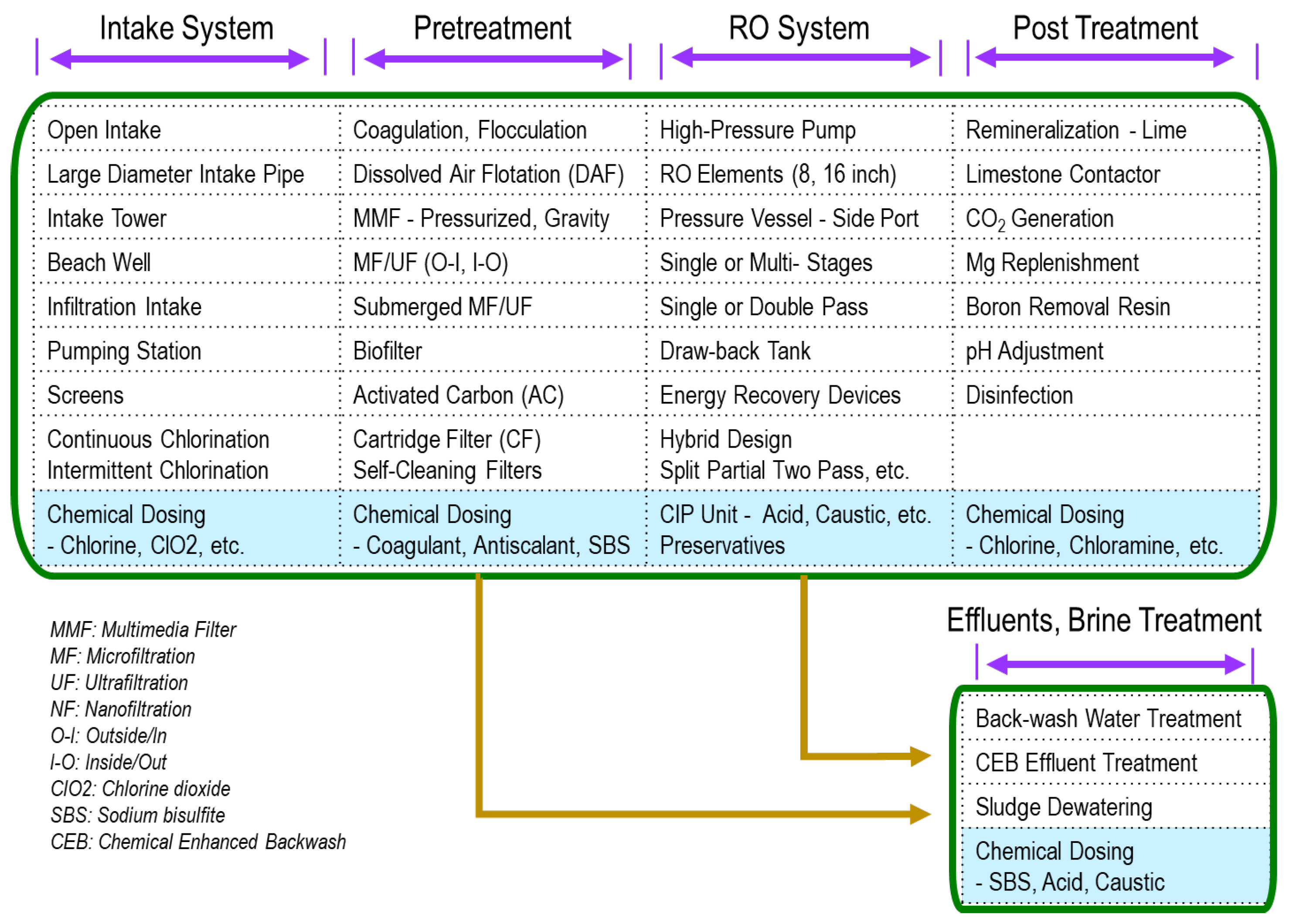
Figure 2.
RO fouling potential estimation using an MW‒Log P matrix chart.
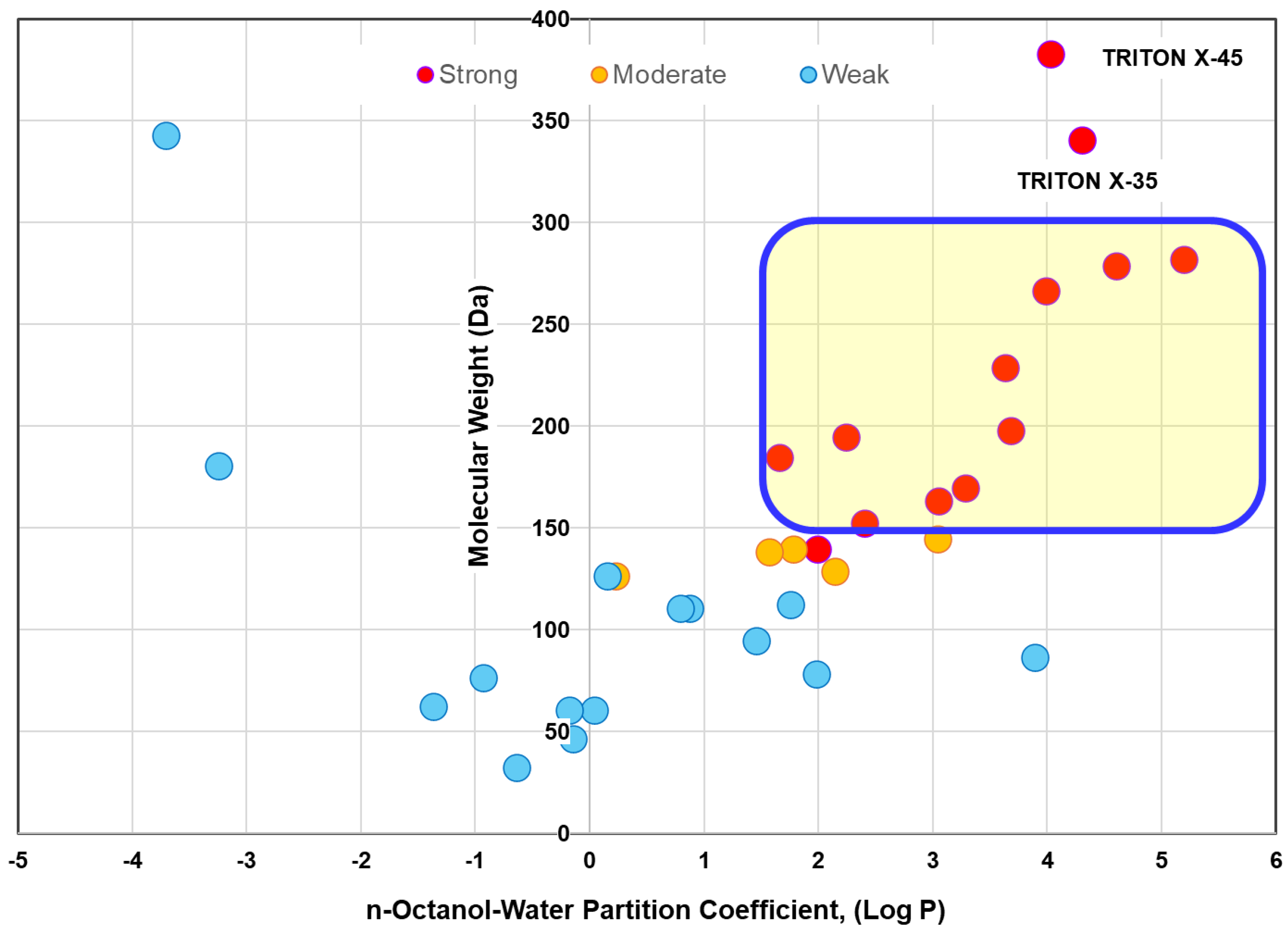
Figure 3.
Timing of cleaning for LMWOC-fouled RO/NF membranes.
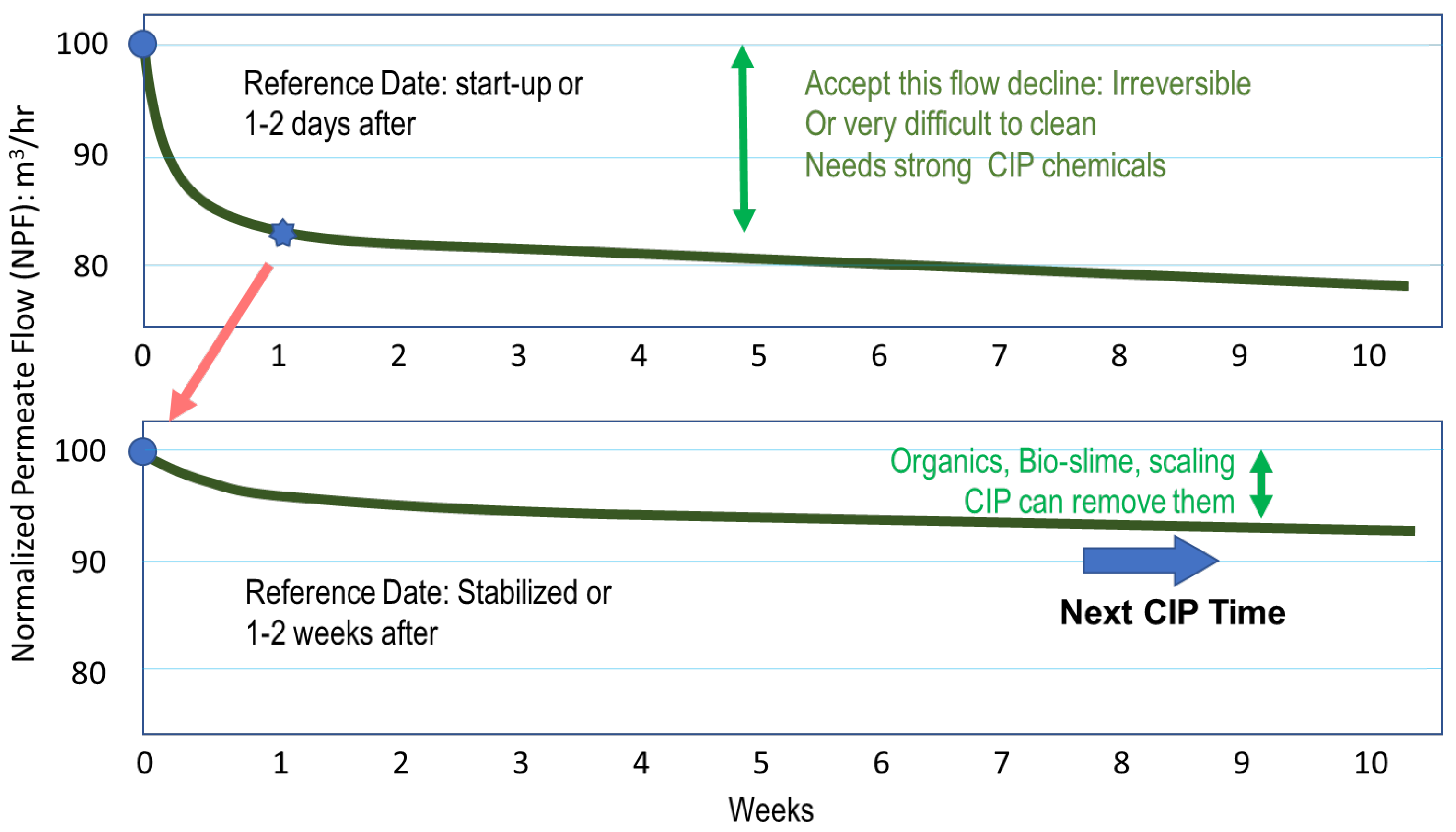
Figure 4.
Effect of feed pH for treating wastewater containing nonionic surfactants [186]. (RO membrane: NTR-759HR, pressure: 1.47 MPa, recovery: 90%, feed TOC: 10 mg/L).
Figure 4.
Effect of feed pH for treating wastewater containing nonionic surfactants [186]. (RO membrane: NTR-759HR, pressure: 1.47 MPa, recovery: 90%, feed TOC: 10 mg/L).
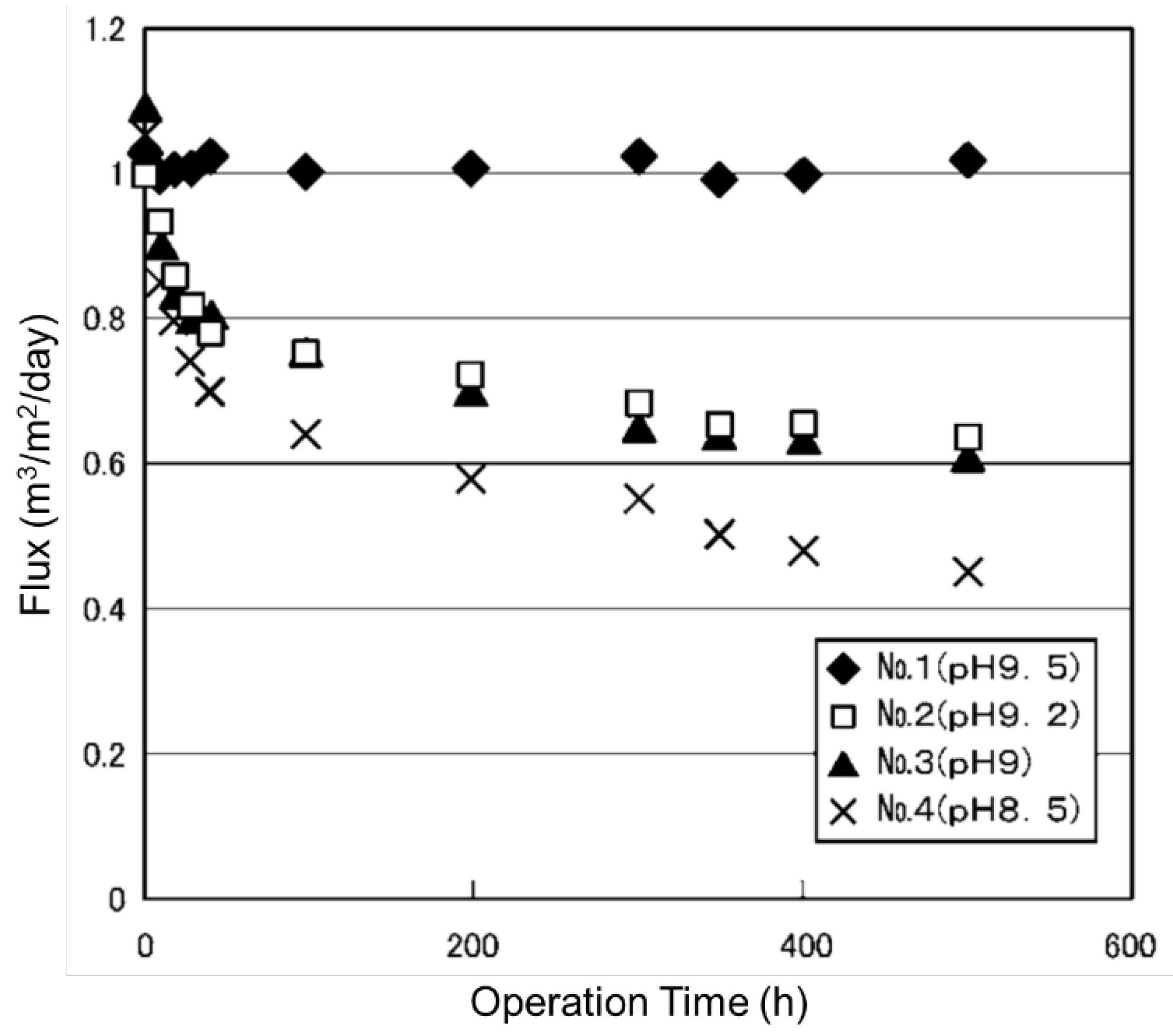
Figure 5.
In situ surface and pore modifications to alleviate LMWOC fouling.
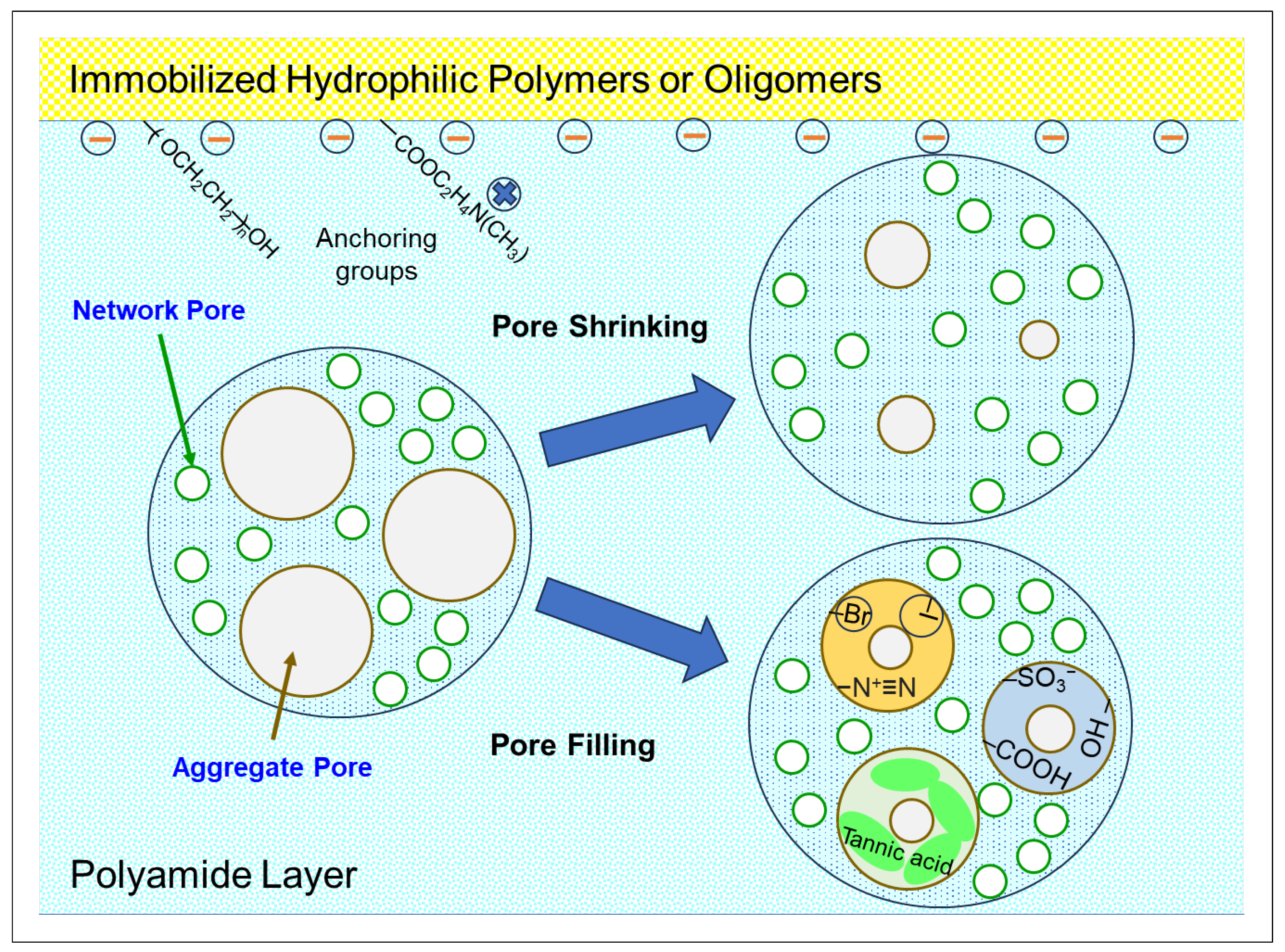
Figure 6.
Boron passage and membrane permeability of commercial BWRO and SWRO elements. Empty circles show the results for FilmTec LE membranes modified with glycidyl methacrylate (GMA) [250]. Reprinted with copyright permission. (The author added the target area for the modified BWRO membrane.).
Figure 6.
Boron passage and membrane permeability of commercial BWRO and SWRO elements. Empty circles show the results for FilmTec LE membranes modified with glycidyl methacrylate (GMA) [250]. Reprinted with copyright permission. (The author added the target area for the modified BWRO membrane.).
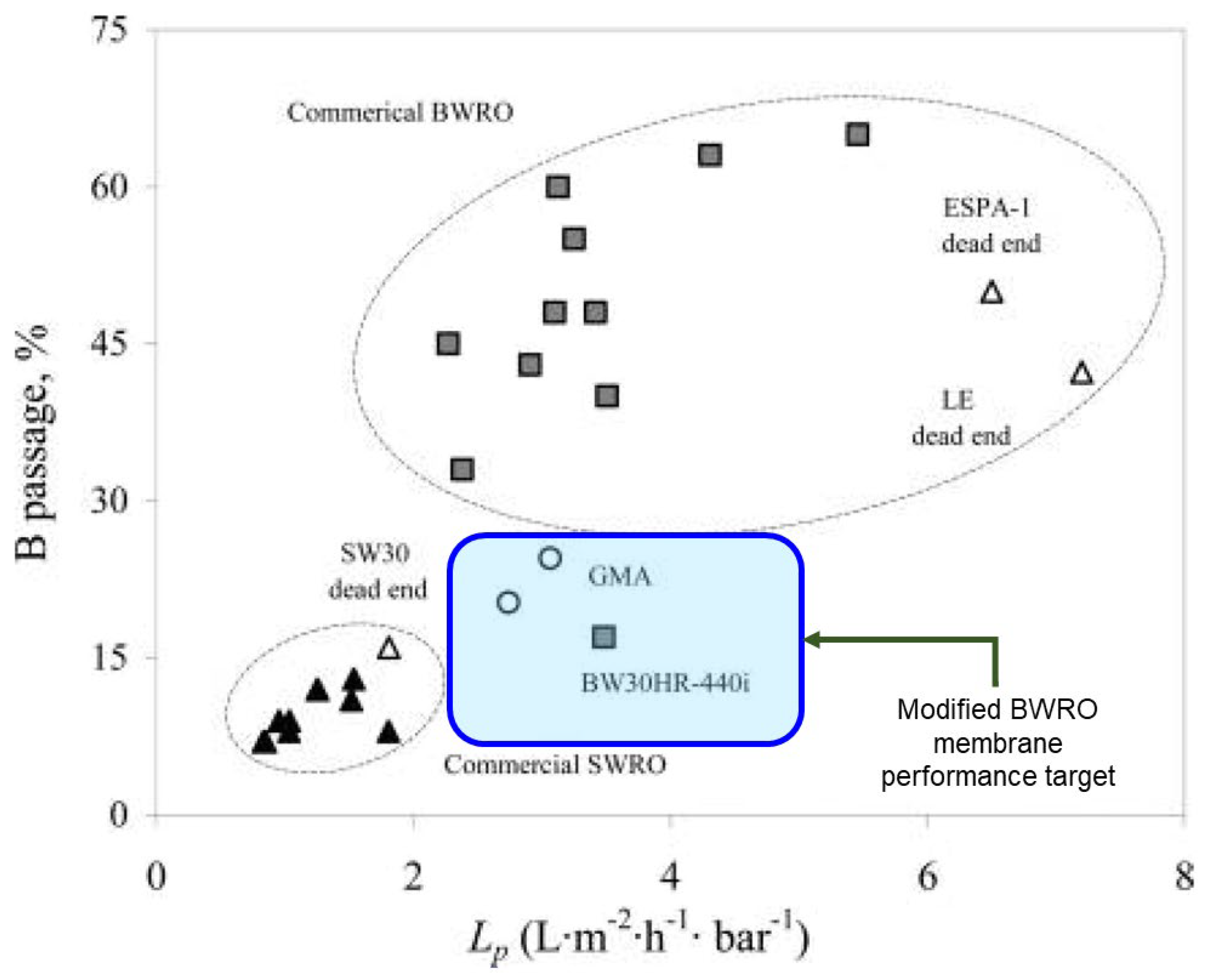
Figure 7.
Sodium chloride, IPA, and nitrate passage in membranes modified with phenyl amine compounds [277].
Figure 7.
Sodium chloride, IPA, and nitrate passage in membranes modified with phenyl amine compounds [277].
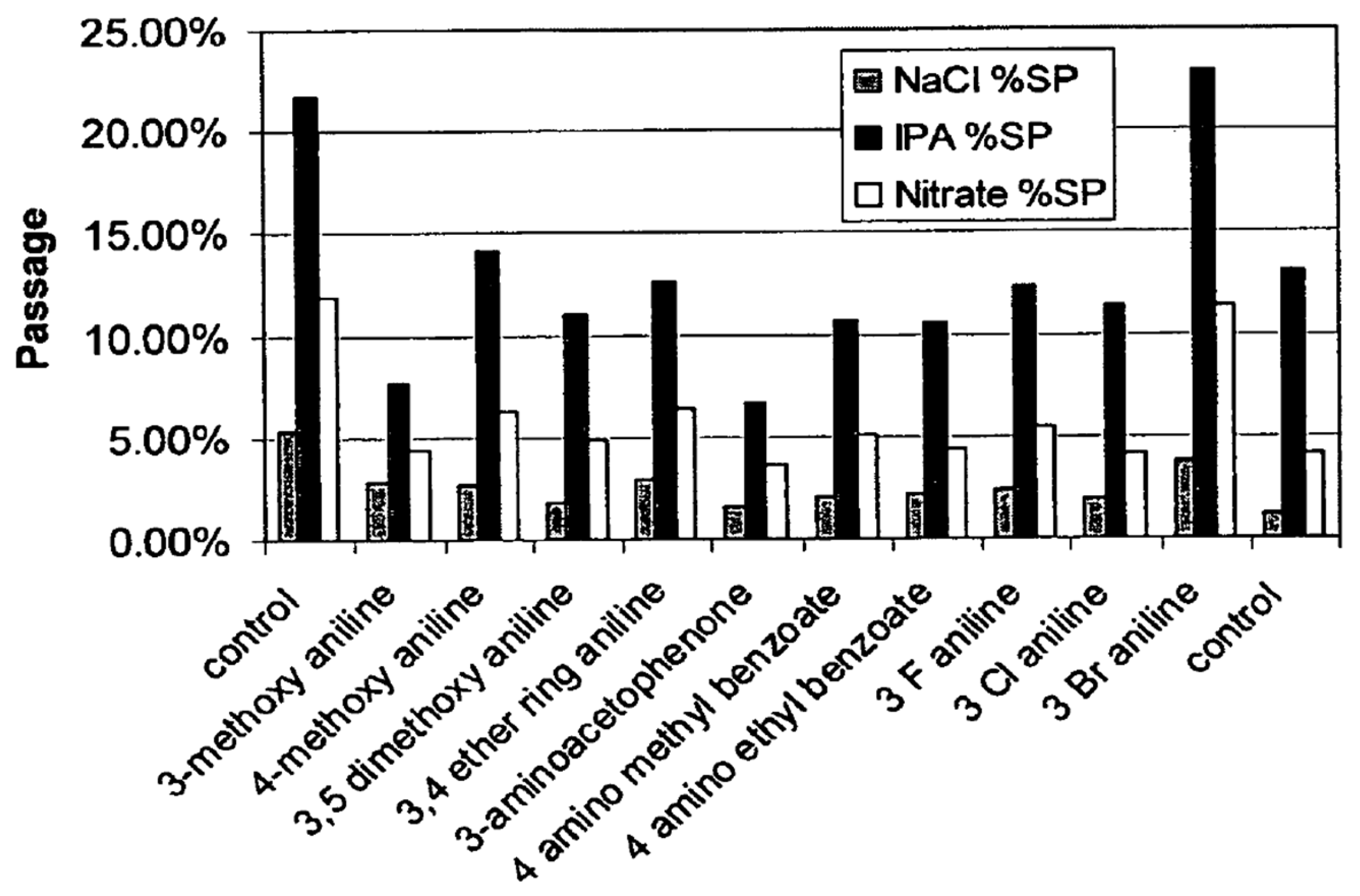
Figure 8.
Schematic image of a degraded membrane and proposed RJAs.
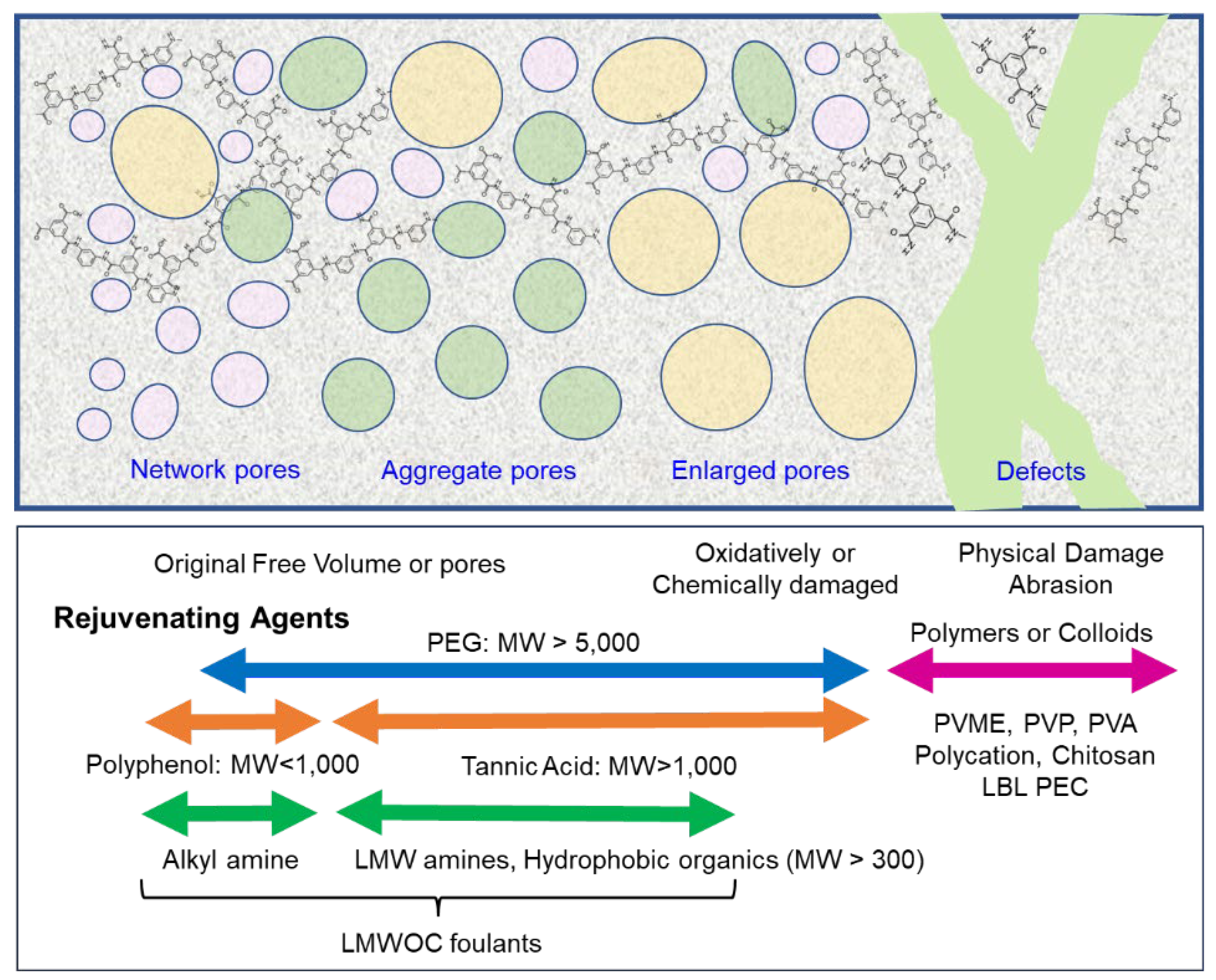

Table 1.
Corrective and preventive measures for LMWOC fouling in RO/NF.
| Corrective and Preventive Measures | Examples | |
|---|---|---|
| Pretreatment | Adsorbents | Activated carbon (AC), synthetic adsorbents |
| Filters | Organic/oil removal filters | |
| Oxidation | Ozone, Advanced oxidation process (AOP), NaOCl, etc. | |
| Antifoulants | Polyvinylpyrrolidone (PVP), anionic polyvinyl alcohol (PVA), etc. | |
| Detection | Prediction | Bench or pilot tests, coupon tests with polyamide (PA) membrane |
| Identification | GC-MS (extraction or pyrolysis) | |
| CIP | Organic CIP | Lower alcohols, butyl cellosolve, ethylene glycol (EG)/alcohol, etc. |
| Oxidative CIP | Nitric acid, high pH NaOCl, dichloroisocyanurate, etc. | |
| Operation | High pH | Negative membrane charge, swelling |
| Low pH | Positive membrane charge | |
| Low fouling membranes | Tight membranes | Seawater RO membranes |
| Post-treatment | Heat treatment, nitrous acid; | |
| Surface modification | Polyvinyl alcohol (PVA), polyelectrolyte complex (PEC), etc. | |
| NaOCl: Sodium hypochlorite, GC-MS: Gas Chromatography/Mass Spectrometry | ||
Table 2.
Adsorption processes to remove LMWOC foulants in RO/NF.
| Adsorbents & Process | Comments | Reference |
|---|---|---|
| AC | Granular activated carbon (GAC) | [11,12,13,14] |
| Powdered activated carbon (PAC) | [16,17,18,19] | |
| Fibrous activated carbon (FAC) | [15,20] | |
| AC Material | Bituminous AC | [21,22,23] |
| Peat-based AC | [24] | |
| Others | Polyamide (PA) | [25] |
| Synthetic adsorbents | [14] | |
| Integrated Process | Coagulation + multi-media filter (MMF) + GAC | [21] |
| Coagulation/PAC + MF/UF | [26] | |
| GAC + UF | [27] | |
| UF + GAC | [24] | |
| NF + GAC | [28] | |
| Membrane bioreactor (MBR) + GAC | [29] | |
| Advanced oxidation process (AOP) + GAC | [30] |
Table 3.
Oxidation and AOPs for removing organics as RO/NF pretreatment.
| Oxidant | Organics | Membrane | Comments | Ref. |
|---|---|---|---|---|
| NaOCl | MBR EfOM | APA RO | NaOCl: 10 mg/L, Retention time: 30 min. | [45] |
| KMnO4 | Surface water, EfOM | AG (RO), HL (NF) | KMnO4: 0.45-0.8 mg/L | [46] |
| X-ray | Produced water | SWC-5 | Cold-cathode X-ray: 20-30 kV/0.1-03 mA | [47] |
| H2O2/UV | Nonionic surfactant | Polybenzimidazole | H2O2: 100 mg/L, UV: 0.07 W·min/cm2 | [48] |
| H2O2/UV | Groundwater | NF70 | H2O2: 1-2 mM, UV (254 nm), TOC: 3.5 mg/L | [49] |
| Ozone (O3) | Phenolics | NF40, FT30 | Chlorophenols, O2 containing 2% O3 | [50] |
| Ozone (O3) | Surface water | APA NF | O3: 3 ppm, Feed COD: 2-4 ppm | [51] |
| Ozone (O3) | MBR EfOM | ESPA-2 | Pilot test (MBR - O3 - RO), O3: 1.5-2 ppm | [52] |
| Ozone (O3) | EfOM | NF90 | O3: 0.2 and 0.4 mg O3/mg DOC | [53] |
| Ozone (O3) | MBR EfOM | ESPA-DHR | O3: 0.8 mg O3/mg DOC | [54] |
| Ozone (O3) | MBR EfOM | NF90 | Gas ozone concentration: 5 gO3/Nm3 | [55] |
| O3 or H2O2/O3 | NA | NTR-759 (RO) | Ozonation at high pH | [56] |
| O3 or H2O2/O3 | NA | ES-10 (RO) | O3 dosing regulation (UV absorbance) | [57] |
| O3 or H2O2/O3 | NOM, MBR EfOM | ESPA-2 | O3: 1.5, 3, and 6 mg/L | [58,59,60] |
| O3 or H2O2/O3 | MBR EfOM | NE90 | Ozonation at high pH, O3: 3, 6, and 9 mg/L | [61] |
Table 4.
Summary of reported fouling and non-fouling compounds.
| Organic Compound | Molecular Structure | CAS No. | Fouling | MW | Log P | Reference |
|---|---|---|---|---|---|---|
| Phenolic Derivatives | ||||||
| 2,4-Dinitrophenol | C6H3(OH)(NO2)2 | 51-28-5 | S | 184.11 | 1.67 | [79] |
| 2,4,6-Trichlorophenol | C6H2Cl3OH | 88-06-2 | S | 197.45 | 3.69 | [79,80] |
| 2,4-Dicholrophenol | C6H4Cl2O | 120-83-2 | S | 163.0 | 3.06 | [79] |
| Phenol | C6H5OH | 108-95-2 | W | 94.1 | 1.46 | [79,80,81] |
| 2-Fluorophenol | C6H4FOH | 367-12-4 | W | 112.1 | 1.76 | [79] |
| 2-Nitrophenol | C6H5NO3 | 88-75-5 | M | 139.1 | 1.79 | [79] |
| 3-Nitrophenol | C6H5NO3 | 554-84-7 | S | 139.1 | 2.00 | [81] |
| 2-Chlorophenol | C6H4ClOH | 95-57-8 | M | 128.5 | 2.15 | [79] |
| Catechol | C6H4(OH)2 | 120-80-9 | W | 110.1 | 0.88 | [81] |
| Resorcinol | C6H4(OH)2 | 108-46-3 | W | 110.1 | 0.8 | [82] |
| Pyrogallol | C6H3(OH)3 | 87-66-1 | M | 126.1 | 0.23 | [81] |
| Phloroglucinol | C6H3(OH)3 | 108-73-6 | W | 126.1 | 0.16 | [82] |
| 3-Hydroxybenzonic acid | HOC6H4CO2H | 99-96-7 | M | 138.1 | 1.58 | [82] |
| Bisphenol A | (CH3)2C(C6H4OH)2 | 80-05-7 | S | 228.3 | 3.64 | [83] |
| Nonionic Surfactant | ||||||
| Triton-X 35 | C14H22O(C2H4O)3 | 9036-19-5 | S | 340 | 4.31 | |
| Triton-X 45 | C14H22O(C2H4O)4 | 2315-63-1 | S | 382.5 | 4.04 | |
| Plasticizer | ||||||
| Tributyl Phosphate | (C4H9)3PO4 | 126-73-8 | S | 266.3 | 4.0 | [84] |
| Dimethyl terephthalate | C6H4(COOCH3)2 | 120-61-6 | S | 194.2 | 2.25 | [11] |
| Dibutyl Phthalate | C6H4(COOC4H9)2 | 84-74-2 | S | 278.3 | 4.61 | [11,85] |
| Other Aromatics | ||||||
| Alkylated diphenylamine | C20H27N | 68921-45-9 | S | 281.43 | 5.2 | [86] |
| Diphenylamine | (C6H5)2NH | 122-39-4 | S | 169.22 | 3.29 | [86] |
| Cumene hydroperoxide | C6H5C(CH3)2OOH | 80-15-9 | S | 152.19 | 2.41 | [87] |
| Benzene | C6H6 | 71-43-2 | W | 78.11 | 1.99 | [79] |
| Aliphatic Organics | ||||||
| Methanol | CH3OH | 67-56-1 | W | 32 | -0.63 | |
| Ethanol | C2H5OH | 64-17-5 | W | 46 | -0.14 | |
| 2-Propanol | CH3CH(OH)CH3 | 67-63-0 | W | 60 | 0.05 | |
| Ethylene glycol | C2H4(OH)2 | 107-21-1 | W | 62.07 | -1.36 | |
| Propylene glycol | CH3CHOHCH2OH | 57-55-6 | W | 76.1 | - 0.92 | |
| Acetic acid | CH3COOH | 64-19-7 | W | 60 | -0.17 | [80] |
| n-Octanoic acid | CH3(CH2)6COOH | 124-07-2 | M | 144.21 | 3.05 | [88] |
| n-Hexane | C6H14 | 110-54-3 | W | 86.18 | 3.9 | [89] |
| Glucose | C6H12O6 | 50-99-7 | W | 180.2 | -3.24 | |
| Sucrose | C12H22O11 | 57-50-1 | W | 342.3 | -3.7 | |
| S: Strong fouling compound | M: Moderate fouling compound | W: Weak fouling compound | ||||
Table 5.
Cleaning agents and methods reported to be effective for LMWOC fouling.
| CIP Solution | Components and Comments | Reference |
|---|---|---|
| Alkaline-based Cleaner | ||
| Pressurized cleaning | A part of the alkaline solution is passed through fouled membranes | [124] |
| Alkaline cleaner | An aliphatic or aromatic amide containing cleaner | [125] |
| Alkaline cleaner | Periodical change from an amide cleaner to no amide containing one | [126,127] |
| Organic Cleaner | ||
| Isopropyl alcohol | IPA | [121] |
| Methanol | 30% MeOH | [11] |
| Butyl cellosolve | 10% butyl cellosolve (ethylene glycol monobutyl ether) | [128,129] |
| Polyol/alcohol | A mixture of Polyols (such as EG and PG) and alcohols (e.g., MeOH) | [92,130,131,132] |
| Organic Solutions | 50% MeOH or 10% ethylene glycol monobutyl ether | [133] |
| Oxidative Cleaner | ||
| Nitric acid | High concentration nitric acid. | [107,123,134] |
| Nitric acid | Three step cleaning: alkaline (pH>12) + nitric acid (pH<1) + alkaline (pH>12) | [135] |
| Polyol + nitric acid | Two-step cleaning: Nitric acid cleaning followed by EG cleaning | [136] |
| High pH NaOCl | Cleaning solution containing oxidizing substances with higher pH. | [137,138,139,140,141] |
| High pH NaOCl | NaOCl concertation <10 mg/L as free chlorine and pH>10 | [142] |
| H2O2 + NaOCl | An inorganic peroxide cleaning and rinsing with an alkali metal or alkaline earth metal hypohalite | [143] |
| Oxidizing agent | An oxidizing agent, followed by cleaning with an alkaline detergent | [122] |
| Dichloroisocyanurate | Flow was restored, but there was a negative effect on salt rejection. | [123] |
| H2O2 | Alkaline H2O2 (pH12) | [141,144] |
| Chloramines | Chloramine compounds, e.g., monochlorosulfamic acid at high pH | [145] |
Table 6.
LMW compounds for requiring improved rejections.
| Components | MW | Applications |
|---|---|---|
| Neutral organic and inorganic compounds | ||
| IPA | 60.1 | UPW [240] |
| Urea | 60.06 | UPW [241,242] |
| Boron: B(OH)3 | 61.83 | UPW and seawater desalination [243] |
| Arsenite, As(III): H3AsO3 | 125.9 | Drinking water treatment |
| Micropollutants | ||
| NDMA | 74.08 | Municipal wastewater reuse |
| 1,4-dioxane | 88.11 | Municipal wastewater reuse |
| Trihalomethanes (THMs) | 119.37 (CHCl3) | Drinking water treatment (DBP removal) |
| Haloalkane, haloalkene, etc. | Drinking water (volatile organic compounds) [244,245] | |
Table 7.
Summary of TA treatment for TFC RO/NF membranes.
| Purpose | Polyphenols | Treatment method and comments | Reference |
|---|---|---|---|
| RO | |||
| Rej. enhancer | Tannic acid (TA) | Hot water treatment with TA; | [256] |
| Ca, silica, IPA | Polyphenol (gallnut) | Treatment in low pH (1-5), flushing with water; | [257,258] |
| Rej. enhancer | Polyphenol (gallnut) | Pressurized treatment and improving rejections at LP; | [259] |
| Rej. enhancer | Polyphenol (gallnut) | Optimize treatment conditions (temperature, duration); | [260] |
| Rej. enhancer | Polyphenol (gallnut) | Effect of polyphenol (gallnut) lot; | [261] |
| Rej. enhancer | Hydrolyzed tannin | Combination of PVME and TA; | [262] |
| NF | |||
| Rej. enhancer | TA | Treatment with a strong mineral acid followed by TA; | [263,264,265] |
| NaCl, Ca, silica | Tannins | Treatment with various tannins | [226,266,267] |
| Other applications (improve oxidant tolerance) | |||
| Anti-oxidant | Polyphenol (gallnut) | Intermittent on-line TA (5-20 mg/L) treatment | [268,269,270] |
| Anti-oxidant | Polyphenol (gallnut) | TA treatment with a reducing agent (sodium bisulfite, SBS) | [271] |
Table 8.
Summary of LMWOC performance-enhancing agents.
| Targets | Rejection Enhancer | Comments | Reference |
|---|---|---|---|
| Improvement of inorganic and organic rejections | |||
| Na+ ion | Quaternary ammonium | Under low TDS conditions | [281] |
| Salt rejection | Cationic organic compounds | Asymmetric polyamide membrane | [278] |
| Urea, IPA | Polyalkylene glycol | PEG (MW 2,000 – 6,000) | [283] |
| Salt rejection | Polyalkylene glycol | PEG (MW 1,000 – 10,000), low pH performance | [284] |
| TOC | Polyalkylene glycol | Improve TOC rejection at high pH (>9.5) | [285] |
| Salt rejection | Polyalkylene glycol | Under low TDS conditions, i.e., second pass RO | [282] |
| IPA | Polyalkylene glycol + LBL PEC | After PEG treatment, an LBL PEC treatment | [286] |
| As(III) | Aramide dendrimers | With oligoethylene glycol chains, for NF membrane | [216] |
| Boron | Surfactants | Cationic, nonionic, and anionic surfactants | [287] |
| Boron | Pyrogallol derivatives | Pyrogallol and/or a pyrogallol derivative: MW <500 | [288] |
| Boron | Higher alkylamines | Decylamine and dodecylamine | [289,290,291] |
| Boron | 4-Nitrobenzenesulfonyl chloride | Hydrolyzed to 4-Nitrobenzenesulfonic acid | [292] |
| Urea | MPD | Carbodiimide chemistry is used to attach a diamine | [293] |
| Urea | MPD, 1,8-diaminooctane, etc. | Carbodiimide chemistry and effect of amines | [294] |
| Improvement of Micropollutant rejection | |||
| NDMA | Tryptophan | Model LMW foulant in municipal wastewater | [275] |
| NDMA | Alkylamines | Hexylamine, decylamine, dodecylamine, etc. | [295,296] |
| Improve chlorine tolerance | |||
| Chlorine | Diphenylamine | First, a membrane is treated with sodium peroxide. | [297] |
Table 9.
Rejection improvements by LMWOC performance-enhancing agents.
| Solutes | Rejection Enhancer | Flow (L/m2/h) |
Rejection (%) |
Passage decrease (%) | Pressure (MPa) |
Membrane | Ref. |
|---|---|---|---|---|---|---|---|
| IPA | Blank | Relative 1.0 | 95 | ‒ | ‒ | ES10 | [258] |
| TA (gallnut) | Relative 0.95 | 96.5 | 30 | ‒ | |||
| Blank | 44.5 | 77.8 | ‒ | 0.75 | ES20 | [298] | |
| PEG 4000 | 26.0 | 87.9 | 46 | ||||
| Blank | 34.2 | 92.3 | ‒ | 0.75 | ES20 | [286] | |
| Sulfonated PEG4000 + LBL | 25.4 | 96.7 | 57 | ||||
| Boron | Blank (12 hours run) | Relative 0.81 | 55.7 | ‒ | 1.2 | LE | [287] |
| Sodium dodecylbenzene sulfonate | Relative 0.42 | 68.2 | 28 | ||||
| Tween-80 | Relative 0.56 | 73.7 | 40.6 | ||||
| CTAB | Relative 0.6 | 70.5 | 33.4 | ||||
| Blank | 41.7 | 45.1 | ‒ | ‒ | ES20 | [288] | |
| pyrogallol | 41.7 | 53.7 | 15.7 | ||||
| Blank | Relative 1.0 | 84 | ‒ | 5.5 | TM820V | ||
| Propyl gallate | Relative 0.955 | 88 | 25 | ||||
| Blank | Pure water 110 | 74 | ‒ | 5.5 | SWC4B | [290] | |
| Dodecylamine (C12) | Pure water 45 | 87 | 50 | ||||
| Blank | 34 | 88 | ‒ | 5.5 | SW30 | [292] | |
| NBS | 14 | 93.1 | 58 | ||||
| Urea | Blank | 42.7 | 15.4 | ‒ | 0.75 | ES20 | [298] |
| PEG 4000 | 29.1 | 32.2 | 19.9 | ||||
| PEG 7100 | 17.5 | 39.2 | 28.1 | ||||
| Blank (22°C) | 142 | 18 | ‒ | 1.59 | XLE | [293] | |
| MPD (Carbodiimide chemistry) | 76 | 37 | 23 | ||||
| Blank (78°C heat treat) | 60 | 47 | 35 | ||||
| MPD (78°C heat treat) | 30 | 55 | 45 | ||||
| NDMA | Blank | 3.5 LMH/bar | 42 | ‒ | 0.42 | ESPAB | [295] |
| Dodecylamine (MW: 185.4)) | 1.2 LMH/bar | 82 | 69 | 1.25 | |||
| Dodecanamide (MW: 199.3) | 2.3 LMH/bar | 64 | 38 | 0.65 | |||
| 1,2-Epoxydodecane (MW: 184.3) | 3.5 LMH/bar | 60 | 31 | 0.42 |
Table 10.
Boron rejection comparison between LMWOC enhancer and halogen treatment.
| Rejection Enhancer | Flow (L/m2/h) |
Boron Rej.(%) |
Passage decrease (%) | Pressure (MPa) |
Membrane | Ref. |
|---|---|---|---|---|---|---|
| LMWOC Rejection Enhancer | ||||||
| Blank | Relative 1.0 | 84 | ‒ | 5.5 | TM820V | [288] |
| Propyl gallate | Relative 0.955 | 88 | 25 | |||
| Blank | Pure water 110 | 74 | ‒ | 5.5 | SWC4B | [290] |
| Dodecylamine (C12) | Pure water 45 | 87 | 50 | |||
| Blank | 34 | 88 | ‒ | 5.5 | SW30 | [292] |
| NBS | 14 | 93.1 | 58 | |||
| Bromine and Iodine Treatment | ||||||
| Blank | 25 | 84 | ‒ | 5.5 | ‒ | [299] |
| Bromine | 25 | 92 | 50 | 6.6 | ||
| Blank | ‒ | 78 | ‒ | 6.0 | SWC5 | [227] |
| Stabilized Bromine | ‒ | 96 | 82 | |||
| Blank | 30.6 | 86 | ‒ | 5.5 | ‒ | [300] |
| Br (NaOCl 100 ppm + 10 ppm NaBr) | 20.1 | 93.6 | 54 | |||
| I (NaOCl 100 ppm + 20 ppm KI) | 25.9 | 95 | 64 | |||
| Iodine chloride (ICl), 3 ppm | 16.5 | 97 | 79 | |||
| HOI | Relative 1.0 | 91.96 | ‒ | 5.5 | SW30HR | [301] |
| HOI (0.013 mM·h contact) | 0.7 | 95.33 | 42 | |||
| HOI (0.032 mM·h contact) | 0.6 | 98.11 | 76 | |||
Table 11.
TA and polyphenols as RJAs.
| Case | Type | Conc. mg/L |
pH | P MPa |
Pre- Clean |
Memb. | Type | Before | After | Ref. | ||
|---|---|---|---|---|---|---|---|---|---|---|---|---|
| Flow (LMH) |
Rej. (%) |
Flow (LMH) |
Rej. (%) |
|||||||||
| 1 | TA | 1 | ‒ | 2.76 | AC&AL | TFC PA | Old | 109% * | 84 | 98.8% * | 90.9 | [309] |
| 2 | Gallnut | 100 | ‒ | Yes | No | ES10 | New | ‒ | 80 | ‒ | 98 | [266] |
| 2 | Gallnut | 100 | ‒ | No | No | ES10 | New | ‒ | 80 | ‒ | 80 | |
| 3 | Gallnut | 100 | 2.2 | Yes | AC&AL | ES10 | Old | ‒ | 92 | ‒ | 99.1 | [310] |
| 3 | Gallnut | 100 | 2.2 | Yes | No | ES10 | Old | ‒ | 92 | ‒ | 93 | |
| 4 | Digallic | 240 | 4.0 | 0.29 | AL | BW30 | New | 65.5 | 85.6 | 37.4 | 97.3 | [307] |
| *: Normalized flow, P: Pressure, Cleaning: Pre-cleaning before TA treatment, AC: Acid, AL: Alkaline | ||||||||||||
Table 12.
Other RJAs and the effect on rejection performance improvement.
| Compounds | Conc. mg/L |
I or Pres. (MPa) |
Before | After | Ref. | ||||
|---|---|---|---|---|---|---|---|---|---|
| Flow (LMH) |
NaCl Rej. (%) |
Silica Rej. (%) |
Flow (LMH) |
NaCl Rej. (%) | Silica Rej. (%) |
||||
| TRITON X-405 | 1000 | I; 16 h | 76.7 | 99.5 | 98 | 40.8 | 99.6 | 99 | [316] |
| CTAC | 1000 | I; 16 h | 76.7 | 99.5 | 98 | 19.6 | 99.1 | 99.2 | |
|
Flow (LMH) |
NaCl Rej. (%) |
Boron Rej. (%) |
Flow (LMH) |
NaCl Rej. (%) |
Boron Rej. (%) |
||||
| PEG(1,000) | 15 | 0.45 | 46.3 | 99.5 | 89.1 | 44.6 | 99.6 | 89.5 | [317] |
| PEG(8,000) | 15 | 0.45 | 46.3 | 99.5 | 89.1 | 37.1 | 99.7 | 92.3 | |
| PEG(50,000) | 15 | 0.45 | 46.3 | 99.5 | 89.1 | 36.3 | 99.7 | 92.5 | |
| PEG(8,000) | 1 | 0.45 | 46.3 | 99.5 | 89.1 | 42.1 | 99.6 | 91.0 | |
| PEG(8,000) | 15 | I; 1 h | 46.3 | 99.5 | 89.1 | 42.1 | 99.6 | 90.1 | |
| PEG(8,000) – Before CIP | – | – | 28 m3/d | 99.0 | 85 | – | – | – | [318] |
| PEG(8,000 ) – After CIP | 15 | 0.45 | 32 m3/d | 98.6 | 84 | 28 m3/d | 99.3 | 91 | |
| PEG(8,000) – pH 12 | 15 | 0.45 | 28 m3/d | 99.0 | 85 | 22 m3/d | 99.2 | 90 | |
| PEG(8,000 ) – No CIP | 15 | 0.45 | 28 m3/d | 99.0 | 85 | 25 m3/d | 99.2 | 87 | |
| I: Immerse, CTAC: Cetyltrimethylammonium chloride, CIP: pH 12 with NaOH | |||||||||
Table 13.
Three-component RJAs and the effect on rejection performance improvement.
| RJAs | Before | After | Ref. | ||||||
|---|---|---|---|---|---|---|---|---|---|
| No.1 | No.2 | No.3 | Flow (LMH) |
NaCl Rej. (%) | IPA Rej. (%) |
Flow (LMH) |
NaCl Rej. (%) | IPA Rej. (%) |
|
| 3,5-DABA | ‒ | ‒ | 49.6 | 89.2 | ‒ | 33.8 | 94.5 | ‒ | [325] |
| 3,5-DABA | APT | ‒ | 50.0 | 88.4 | ‒ | 34.6 | 95.1 | ‒ | |
| 3,5-DABA | APT | PVAM | 49.6 | 88.1 | ‒ | 34.2 | 96.1 | ‒ | |
| Arginine | ‒ | ‒ | 37.9 | 91.7 | 78.1 | 37.1 | 94.3 | 84.6 | [326] |
| Arginine | Aspartame | ‒ | 37.9 | 91.2 | 78.3 | 36.7 | 94.7 | 85.0 | |
| Arginine | Aspartame | TA | 37.5 | 92.3 | 78.5 | 33.3 | 98.6 | 90.2 | |
| Arginine | Aspartame | Mimosa | 38.3 | 90.8 | 77.6 | 33.8 | 97.7 | 91.2 | |
| ‒ | ‒ | TA | 37.5 | 92.0 | 78.7 | 35.8 | 94.6 | 83.1 | |
| 3,5-DABA: 3,5-Diaminobenzoic Acid (MW 152.15 Da), APT: Aminopentane (MW 87.16 Da), PVAM: polyvinylamidine Arginine (MW 174.2 Da) Aspartame (MW 294.3 Da) | |||||||||
Disclaimer/Publisher’s Note: The statements, opinions and data contained in all publications are solely those of the individual author(s) and contributor(s) and not of MDPI and/or the editor(s). MDPI and/or the editor(s) disclaim responsibility for any injury to people or property resulting from any ideas, methods, instructions or products referred to in the content. |
© 2025 by the authors. Licensee MDPI, Basel, Switzerland. This article is an open access article distributed under the terms and conditions of the Creative Commons Attribution (CC BY) license (http://creativecommons.org/licenses/by/4.0/).
Copyright: This open access article is published under a Creative Commons CC BY 4.0 license, which permit the free download, distribution, and reuse, provided that the author and preprint are cited in any reuse.


