

Submitted:
06 February 2025
Posted:
06 February 2025
You are already at the latest version
Abstract
The breast tissue microbiome has been increasingly recognized as a potential contributor to breast cancer development and progression. However, inconsistencies in microbial composition across studies have hindered the identification of definitive microbial signatures. To address these gaps, we conducted a systematic review and meta-analysis of 11 studies employing 16S rRNA sequencing to characterize the bacterial microbiome across 1,260 fresh breast tissue samples, including normal, mastitis-affected, benign, cancer-adjacent, and cancerous tissues. We also incorporated microbiome data from The Cancer Genome Atlas breast cancer (TCGA-BRCA) cohort to enhance our analyses. Our meta-analysis identified Proteobacteria, Firmicutes, Actinobacteriota, and Bacteroidota as the dominant phyla in breast tissue, with Staphylococcus and Corynebacterium frequently detected across studies. While microbial diversity was similar between cancer and cancer-adjacent tissues, both exhibited lower diversity compared to normal and mastitis-affected tissues. Variability in bacterial genera was observed across primer sets and studies, emphasizing the need for standardized methodologies in microbiome research. Analysis of TCGA-BRCA data confirmed the dominance of Staphylococcus and Corynebacterium, which was associated with breast cancer proliferation-related gene expression programs. Notably, high Staphylococcus abundance was associated with a 4.1-fold increased mortality risk. These findings underscore the potential clinical relevance of the breast microbiome in tumor progression and emphasize the importance of methodological consistency. Future studies to establish causal relationships, elucidate underlying mechanisms, and assess microbiome-targeted interventions are warranted.
Keywords:
microbiota
; microbiome
; bacterial community
; 16S rRNA
; 16S rRNA sequencing
; breast cancer
; mastitis
; human
; systematic review
; meta-analysis
1. Introduction
The intratumoral microbiome has been extensively studied across various cancers, including breast cancer, where its potential role in tumor pathogenesis and progression has garnered significant interest [1,2]. As the most common malignancy among women worldwide, breast cancer is increasingly recognized as being influenced by the tumor microenvironment, including its associated microbiota [3,4]. Bacteria can modulate cancer progression through various mechanisms, either promoting or inhibiting tumor growth depending on the species involved [5]. For example, Staphylococcus aureus has been shown to enhance PD-L1 expression and recruit tumor-infiltrating CD8+ T cells in an in vivo model of triple-negative breast cancer [6]. Conversely, Fusobacterium nucleatum binds to sugar moieties on breast cancer cells, a mechanism linked to reduced T-cell infiltration and increased metastatic potential [7]. These findings highlight the need for a deeper understanding of the breast tissue microbiome and its role in cancer biology.
Although breast cancer is generally considered a malignancy with a low bacterial load compared to gastrointestinal cancers, multiple studies have confirmed the presence of microbes in breast tissue. Most of these studies employed 16S ribosomal RNA (rRNA) amplicon sequencing targeting variable regions of the bacterial gene, predominantly using Illumina’s short-read sequencing technology [8,9,10,11,12,13,14,15,16,17,18,19,20,21,22,23,24,25,26,27,28,29,30,31,32,33,34,35,36]. A range of sample types has been analyzed, including healthy, benign, cancerous, and adjacent tissues [8,9,10,11,12,13,14,15,16,17,18,19,20,21,22,23,24,25,26,27,28,29,30,31,32,33,34,35,36]. The potential relationship between the microbiome and breast cancer is often investigated by comparing microbial profiles between cancerous and cancer-adjacent tissues.
The breast microbiome is predominantly composed of bacteria from the phyla Proteobacteria, Firmicutes, Actinobacteria, and Bacteroidetes. Frequently reported genera include Staphylococcus [8,9,10,11,16,17,20,21,29,36,37,38], Pseudomonas [11,12,15,17,20,22,29,33,37,38], Acinetobacter [9,11,15,17,21,22,38], Corynebacterium [9,10,16,17,36,38], Propionibacterium [15,17,20,36], Prevotella [17,22,38], Ralstonia [9,10,20,22,33], Streptococcus [10,11,16,22,31,33], Burkholderia [9,10,37,39], and Methylobacterium [9,18,36]. Across studies comparing cancerous and cancer-adjacent tissues, Proteobacteria [8,9,10,11,15,16,17,20,22,31,33,36,37,38,40] and Firmicutes [8,9,10,11,15,16,17,20,31,36,38] are consistently enriched in cancerous tissues. At the genus level, Staphylococcus [11,12,16,17,33], Pseudomonas [9,15,16,17], Ralstonia [12,18,33], Acinetobacter [11,22,29], Corynebacterium and Bacillus [10,12,17] are frequently elevated in cancer compared to adjacent tissues. However, inconsistencies in taxonomic abundance across studies present challenges in establishing a definitive microbial signature associated with breast cancer.
Several systematic reviews and meta-analyses have attempted to consolidate breast tissue microbiome data [41,42,43]. While some extracted microbial data from published studies [42], others re-analyzed existing datasets [41,43]. However, these meta-analyses have limitations, including the lack of a standardized bioinformatics approach, failure to control for confounding factors (e.g., sequencing depth, inter-patient variability, primer biases), and inclusion of formalin-fixed paraffin-embedded (FFPE) tissues, which are prone to contamination and degradation artifacts [44]. These inconsistencies may contribute to conflicting findings and hinder a comprehensive understanding of the role of the breast microbiome in cancer.
To address these gaps, we conducted a systematic review and meta-analysis of 11 studies that employed 16S rRNA short-read sequencing to characterize the bacterial microbiome across fresh breast tissue samples, including normal, mastitis-affected, benign, benign-adjacent, cancer-adjacent, and cancerous tissues [8,9,10,11,12,13,15,16,17,19,45]. By exclusively analyzing fresh tissue samples, we aimed to minimize contamination and degradation issues associated with FFPE samples, ensuring higher data reliability. To enhance consistency, all datasets were uniformly re-analyzed and batch-corrected where appropriate, reducing inter-study variability. Additionally, microbial profiles from The Cancer Genome Atlas (TCGA) breast cancer cohort (TCGA-BRCA) [46] were incorporated to complement the 16S rRNA sequencing data, providing further insights into the relationships between the microbiome, clinical features, and tumor phenotypes.
2. Materials and Methods
2.1. Selection Criteria, Database Search and Study Design
A comprehensive literature search was conducted in PubMed, Embase, and Scopus using the search terms defined in File S1. The search was restricted to articles published up to December 31, 2023. The titles and abstracts of the identified records were screened by three independent reviewers (S.K.R, S.N. and E.S.). The inclusion criteria were: 1) utilized human breast tissue samples, 2) provided sufficient metadata to distinguish different tissue types, 3) used fresh, fresh-frozen, or fresh tissue preserved in nucleic acid stabilizer, 4) employed Illumina short-read amplicon sequencing of 16S rRNA genes. The exclusion criteria were: 1) reviews, systematic reviews, published errata, letters, conferences proceedings, non-English articles, 2) non-human samples, 3) non-breast tissue samples (e.g., breast milk, nipple aspirate fluid, feces, gut, saliva, oral, nasal, nasopharyngeal, respiratory, vaginal, urine and blood), 4) studies lacking a reported project accession number or sufficient metadata for sample classification, 5) studies utilizing techniques other than Illumina short-read amplicon sequencing of 16S rRNA genes. Risk of bias was assessed using the RoB 2 tool (ROB2_IRPG_beta_v9) [47] (File S2).
2.2. Downloading and Pre-Processing of 16S rRNA Datasets
Raw 16S rRNA sequencing of breast tissues were downloaded from the NCBI Sequence Read Archive (SRA; https://www.ncbi.nlm.nih.gov/sra). Samples were divided into six groups: normal, mastitis-affected, benign, benign-adjacent, cancer and cancer-adjacent tissues. Cancer tissues were obtained directly from tumors, while cancer-adjacent tissues were cancer-free regions located within 2 to 5 cm from the tumor. Normal tissues were obtained from either healthy individuals or contralateral (non-cancerous) sites of cancer patients.
Primer removal and sequence denoising were performed using the Cutadapt and Divisive Amplicon Denoising Algorithm 2 (DADA2) plugins in QIIME2 [48,49,50]. Amplicon Sequence Variants (ASVs) classification was performed using QIIME2 and SILVA reference database (version silva-138-99-nb-classifier) [48,51]. Batch adjustment was performed using MMUPHin v1.18 (Meta-Analysis Methods with a Uniform Pipeline for Heterogeneity in microbiome studies) in R to adjust for study batch effects (File S3). Initially, we attempted to include all samples irrespective of primer set. However, this approach proved suboptimal due to significant batch effects that remained even after batch correction (File S3). As a result, analyses were conducted separately for each primer set. The V3V4 primer set, being the only one with multiple studies and tissue types, was processed using MMUPHin analysis, and the adjusted values were used for subsequent analyses (refer to File S2). Pre-processing for raw microbial data was described previously [52]. Briefly, ASVs were agglomerated into the genus level since short-read amplicon sequencing of 16S rRNA gene is mostly limited genus-level resolution [52,53]. Low-abundance ASVs were filtered using PreFL from PLSDA-batch with the parameters, keep.spl = 10 and keep.var = 0.01 [54].
2.3. Alpha and Beta Diversity Analyses
Both conventional (rarefied) and compositional (central log ratio transformed) methods were applied to analyse alpha and beta diversities, as previously described [55,56,57]. For conventional dataset, samples were rarefied to an even depth (read = 1000) using rarefy_even_depth in phyloseq v1.48 [58]. For alpha diversity, rarefied or unrarefied abundance Shannon index was used to measure alpha-diversity using microeco v1.9.1 R package [59]. Differences in alpha diversities between tissue types (cancer, cancer-adjacent, normal and mastitis tissue) were tested using Kruskal–Wallis test with Dunn’s multiple comparison and the Mann–Whitney test. For beta diversity analysis, rarefied relative abundances of all genera were ordinated using Bray–Curtis distances and visualized with Principal Coordinates Analysis (PCoA) utilizing the phyloseq v1.46 and ggpubr v0.6 R packages [58]. Permutational multivariate analysis of variance (PERMANOVA) was used to test differences in beta diversity between tissue types, while dispersion (variance) among different tissue types was evaluated using betadisper test from the vegan v2.6 package [60]. Since PERMANOVA relies on the assumption of homogeneity of dispersion among groups, the betadisper test was used to detect potential differences in dispersion, as significant variation in dispersion could impact the validity of PERMANOVA results. All tests were performed with 999 permutations. To address the compositional nature of microbiome data, CLR transformation with an offset of 0.5 was applied to generate scale-invariant values, mitigating biases caused by differences in library sizes [55,61]. The CLR-transformed abundance data were subsequently analysed using Euclidean distances and visualized with PCoA.
2.4. Differential Abundance and Prevalence Between Different Breast Tissues
Mean relative abundance and prevalence were calculated at the phylum and genus levels using phyloseq v1.48 [58]. The general breast microbiome composition and prevalence at these taxonomic levels were assessed across all breast tissue samples for each primer set (Table 2, Table S2–S5). To investigate differences in relative abundance and CLR-abundance between cancer and cancer-adjacent samples, statistical tests were performed at the genus level. Multiple Mann-Whitney tests with Bonferroni correction for multiple comparisons were used for unpaired cancer and cancer-adjacent samples, while multiple Wilcoxon tests with Bonferroni correction were applied for paired samples. All statistical analyses were conducted using Prism 10 and mean relative abundance plots were visualised using the microeco R package, excluding samples with zero reads.
2.5. Reanalysis of Breast Tissue Microbiome Data from the Cancer Genome Atlas
The microbiome dataset for The Cancer Genome Atlas Breast Cancer (TCGA-BRCA) cohort was obtained from Sepich-Poore et al. (2024) [62]. Specifically, we used the "RS210-clean" dataset, which comprises host-depleted microbiome reads with ≥ 50% aggregate coverage [62]. This dataset includes microbiome profiles from 112 cancer tissues and 16 cancer-adjacent tissues, including 15 paired cancer and cancer-adjacent samples. Microbial data were aggregated at the genus level for consistency with the 16S rRNA dataset analysis. It is important to note that the TCGA-BRCA samples were not collected under sterile conditions, as the cohort was not initially designed for microbiome research. To address this, we excluded likely contaminants using two criteria: 1) taxa that are not present in the 16S rRNA datasets, and 2) taxa present but at abnormally high abundance. After excluding these contaminants, microbial reads were normalised relative to total BAM-mapped reads and scaled to 109 reads to account for differences in sequencing depth [63]. All analyses for the TCGA-BRCA dataset followed the same workflow as for the 16S rRNA sequencing data. An exception was applied for CLR-abundance calculations, where an offset of 0.01 was used.
2.6. Microbial Correlation Analysis with Tumor Phenotype and Clinical Survival Data
The tumor tissue phenotype was characterised using the TCGA-BRCA transcriptomics dataset, as previously described [64]. A total of 29 functional gene expression signature (FGES) scores were utilised to represent the major functional characteristics, as well as immune, stromal, and other cellular populations, within breast cancer tissues [64]. To assess relationships between microbial CLR-abundance and FGES scores, Spearman’s correlation analysis was performed using the cor.test function in R. P-values were adjusted for false discovery rate (FDR) to account for multiple comparisons. Additionally, univariate and Cox proportional hazard model analyses were conducted using the survminer package in R. These analyses evaluated associations between microbial abundance and overall survival for continuous CLR-abundance data and for high and low CLR-abundance groups, characterised by the top and bottom 30% of CLR-abundance values.
2.7. Statistical Analysis
For comparisons made between unpaired tissue groups, Kruskal-Wallis test with Bonferroni’s multiple comparison was used. For all paired cancer and cancer-adjacent samples, Wilcoxon matched-pairs signed rank test was performed. Statistical analysis was performed using Prism 10 for macOS (Version 10.4.0 (527), 23 October 2024; GraphPad Software Inc., La Jolla, CA, USA).
3. Results
3.1. Study Selection
A comprehensive search of PubMed, Scopus, and Embase databases identified 6,825 records published up to December 31, 2023 (Figure 1). After removing duplicates, 4,334 records remained for screening. Title and abstract screening excluded 4,296 records based on irrelevance, including studies unrelated to the microbiome, non-human microbiome studies and microbiome studies of non-breast tissue samples including breast milk, nipple aspirate fluid, feces, gut, saliva, oral, nasal, nasopharyngeal, respiratory, vaginal, urine and blood. This left 38 full-text articles for eligibility assessment.
Of these, 27 were excluded based on predefined criteria (Table S1). Seven did not utilize 16S rRNA short-read sequencing [37,38,65,66,67,68,69], and two reused previously reported datasets without presenting original data [41,43]. Eleven lacked project accession numbers [14,18,21,23,24,26,27,32,33,34,36], while five were excluded due to insufficient metadata [20,25,28,31,35]. Despite attempts to contact corresponding authors, the required project accession numbers or metadata remained unavailable. Additionally, two studies were omitted for using only FFPE tissue rather than fresh samples [22,29].
After applying these criteria, 11 studies met the eligibility requirements and were included in the meta-analysis [8,9,10,11,12,13,15,16,17,19,45]. Collectively, these studies provided 16S rRNA sequencing data for 1,260 fresh, fresh-frozen, or nucleic acid-preserved breast tissue samples, including 532 normal, 269 cancerous, 372 cancer-adjacent, 15 benign, 24 benign-adjacent, and 48 mastitis-affected samples (Table 1). All studies used an Illumina sequencing platform. A risk of bias assessment using the RoB2 tool indicated an overall low risk of bias across the included studies (File S3).
Two studies employed multiple 16S rRNA primer sets. Nejman et al. used V2, V3, V5, V6, and V8 [16], while German et al. used V1V2, V2V3, V3V4, V4V5, V5V7, and V7V9 [9]. To ensure consistency and comparability across studies, we utilized only the V6 primer data from Nejman et al. and the V3V4 primer data from German et al., as these regions were also used in other studies included in this meta-analysis. Analyses of the excluded primer sets were comprehensively reported in their respective publications [9,16].
3.2. General Composition of the Breast Microbiome at the Phylum and Genus Level
Despite extensive research on the breast microbiome, inconsistencies persist in defining its core composition. To address this, we analyzed microbiome profiles from 832 breast tissue samples, including 509 normal, 154 cancer-adjacent, 121 cancerous, and 48 mastitis-affected tissues from five studies employing V3V4 primers [9,10,11,12,13] (Figure 2, Table 2) and additional studies employing other primer sets [8,14,15,16,17,19] (Figure S1-S4, Table S2-S3).
Analysis of the pooled V3V4 datasets revealed that Proteobacteria, Firmicutes, Actinobacteriota and Bacteroidata were the most abundant (mean relative abundance ≥3.8%) and prevalent (≥35%) phyla across the normal, mastitis-affected, cancer-adjacent, cancerous breast tissues included in these studies (Figure 2a, Table 2, Table S2). These phyla were consistently among the most abundant and most detected (prevalence ≥41%) in datasets generated with other primer sets (V1V3, V3V5, V4, V4V6 and V6) (Figure S1, Table S2). An exception was observed with Campilobacterota, which ranked as third most abundant phylum in the V1V3 primer dataset (abundance 3.4%, prevalence 12%). These findings remained robust even after rarefying the datasets to standardise sequencing depth, ensuring reliable comparisons (Figure S2). Collectively, these results indicate that the breast microbiome predominantly consists of Proteobacteria, Firmicutes, Actinobacteriota and Bacteroidata, regardless of primer set or study.
Given the limitations of short-read 16S rRNA sequencing in resolving taxa beyond the genus level [52], we further analysed the datasets at the genus level. Pooled V3V4 primer datasets identified 303 bacterial genera, of which 13 exhibited a prevalence >20% across all breast samples (Table S2). Among these, Burkholderia-Caballeronia-Paraburkholderia, Corynebacterium, Staphylococcus, Acetobacter, Ralstonia and Lactobacillus were the most abundant, each with an abundance >5% and a prevalence >25% (Table 2).
Staphylococcus emerged as one of the most prevalent genera, identified in 42.8% of breast tissue samples, with a mean relative abundance of 9.0% in the pooled V3V4 dataset (Figure 2b, Table 2). Detection rates varied by primer set, ranging from 19% with V1V3 primers to 100% with V3V5 or V4 primers (Figure S3-S4, Table S2-S3). Its relative abundance also showed substantial variation, from 0.28% (V1V3 primers) to 18.8% (V3V5 primers). Other genera with >20% prevalence in the pooled V3V4 dataset included Cutibacterium (mean relative abundance: 3.6%), Pseudomonas (3.3%), Streptococcus (2.4%), Sphingomonas (1.8%), Bacillus (1.7%), Acinetobacter (1.6%), and Paracoccus (0.9%). These genera were consistently detected across primer sets, apart from Bacillus, which was absent from the dataset V3V5 dataset (Table S2-S3).
Significant discrepancies in bacterial genera detection were observed between studies, reflecting the influence of primer selection and study design. For example, Brochothrix, a bacterium commonly associated with food spoilage, was highly abundant (mean relative abundance 30.4%) and prevalent (64%) in metastatic cancer samples from lymph nodes [8]. In contrast, it was detected at substantially lower levels in the pooled V3V4 (abundance 0.01%, prevalence 0.5%) and V3V5 (0.02%, 3.6%) datasets and was undetected with other primer sets (Table S2). Similarly, Psychrobacter, typically found in environments with moderate to high salinity and low temperatures [71], was frequently identified with V1V3 (prevalence 58.7%, abundance 8.2%) and V4 (87.2%, 1.3%) primers. In contrast, it was detected at much lower abundance and prevalence with V3V4 (0.3%, 0.4%) and V4V6 (7.4%, 2.9%) primer sets (Table S2). Halomonas, a genus commonly associated with saline and hypersaline environments, showed high prevalence and abundance in breast samples analysed using the pooled V6 (prevalence: 59.5%, abundance: 43.9%) and V4 (prevalence: 62.8%, abundance: 0.9%) primers. In contrast, it was detected at significantly lower levels with the pooled V3V4 primers (prevalence: 0.6%, abundance: 0.03%) and was undetectable with other primer sets (Tables S2, S4). Notably, a high prevalence (100%) and abundance (75.3%) were observed in a single study using the V6 primer set [16] (Table S4), while other studies reported considerably lower prevalence (<3.1%, except for the V4 primer set [19] and abundance (<0.1%) (Tables S2, S4). These trends remained consistent following rarefaction (Tables S3, S5). These findings underscore the significant influence of primer selection and study design on the observed prevalence and abundance of bacterial genera in the breast microbiome.
Collectively, these results indicate that the breast microbiome is predominantly composed of Proteobacteria, Firmicutes, Actinobacteriota and Bacteroidota, with Staphylococcus frequently detected, regardless of study or primer set. However, the prevalence and abundance of specific bacterial genera vary across breast tissue types, primer sets, and study designs. This variability underscores the potential existence of distinct microbial signatures associated with different breast tissue conditions (normal, cancer, cancer-adjacent, mastitis) and highlights the need for standardization in future microbiome research.

Table 2.
Top phyla and genera in breast tissues using V3V4 primer set (unrarefied, n = 832).
| Phylum | Relative Abundance (Mean ± SD) | Prevalence (%) |
| Proteobacteria | 42.2 ± 33.1% | 83.2 % |
| Firmicutes | 25.8 ± 28.3 % | 79.3 % |
| Actinobacteriota | 25.4 ± 29.7 % | 73.9 % |
| Bacteroidota | 3.8 ± 12.7 % | 35.0 % |
| Genera | Relative Abundance (Mean ± SD) | Prevalence (%) |
| Burkholderia-Caballeronia-Paraburkholderia | 11.1 ± 20.6 % | 50.0 % |
| Corynebacterium | 9.9 ± 21.1 % | 41.5 % |
| Staphylococcus | 9.0 ± 20.3 % | 42.8 % |
| Acetobacter | 7.2 ± 16.8 % | 28.4 % |
| Ralstonia | 6.8 ± 18.5 % | 25.5 % |
| Lactobacillus | 5.1 ± 12.9 % | 33.7 % |
3.3. Similar Microbial Diversity Between Cancer and Cancer-Adjacent Breast Tissue, but Distinct from Mastitis and Normal Tissues
To further characterise the microbial composition at the genus level across various breast tissue types, we focused on cancer and cancer-adjacent tissues. Using pooled V3V4 primer set data, which includes the broadest range of tissue types (cancer, cancer-adjacent, mastitis, and normal), we compared the microbial profiles of cancer tissues with those of other breast tissue types (Figure 3).
Alpha diversity, measured by the Shannon index, showed no significant differences between cancer tissues (Median = 0.86, 95% CI = 0.77–1.04) and cancer-adjacent tissues (Median = 1.04, 95% CI = 0.97–1.21) (Figure 3a). A minimal but statistically significant difference (Median difference -0.36, 95% CI = -0.50–0.0004; p = 0.0466) was observed between paired samples from cancer and cancer-adjacent tissues (Figure 3b). These results were consistent across datasets generated using other primer sets (V1V3, V4V6) that included paired cancer and cancer-adjacent tissues (Figure S5). In contrast, alpha diversity was significantly higher in mastitis-affected (Median = 2.17, 95% CI = 1.66–2.16) and normal tissues (Median = 1.34, 95% CI = 1.30–1.44) relative to cancer and cancer-adjacent tissues (Figure 3a). This trend remained consistent in the rarefied dataset analyses (Figure S6).
Beta diversity, representing overall microbial composition, was evaluated using PCoA plots of Euclidean distances on CLR-transformed abundance data (Figure 3c, Figure S7), PCoA density plots based on Bray-Curtis distances from rarefied datasets (Figure S8), and PERMANOVA tests. Slight differences in beta diversity were observed between cancer and cancer-adjacent tissues for datasets using V3V4 (PERMANOVA: R² = 0.005, p = 0.028) and V4V6 (PERMANOVA: R² = 0.034, p = 0.002) primers (Table S6). However, no significant differences were found between these tissue types in the V1V3 dataset (Table S6). Greater differences in beta diversity were noted in paired cancer and cancer-adjacent samples (PERMANOVA: V1V3: R² = 0.015, p = 0.03; V3V4: R² = 0.012, p = 0.004; V4V6: R² = 0.03, p = 0.028) (Table S8). Mastitis-effected and normal tissues showed significant differences in beta diversity compared to cancer tissues (PERMANOVA: p < 0.05). However, the Betadisper analysis revealed that these differences were primarily driven by greater variability within each group rather than consistent differences in their central microbial composition (p < 0.05). This suggests that the microbial communities in these groups exhibited greater spread or variability rather than distinct central compositions. These trends were consistent across analyses using Bray-Curtis distances from rarefied datasets (Table S7).
In summary, cancer and cancer-adjacent tissues exhibit similar microbial diversity, while mastitis-affected and normal tissues show significantly higher alpha diversity and distinct beta diversity. These differences likely reflect underlying variations in tissue conditions and microbial environments.
3.4. Similar Genus-Level Abundance Between Cancer and Cancer-Adjacent Breast Tissue Samples
We examined genus-level abundance differences between cancer and cancer-adjacent tissues. Staphylococcus and Corynebacterium were among the most abundant bacteria identified in the cancer and cancer-adjacent tissues using the V3V4 primers. Consistent with beta-diversity findings, no significant changes were observed in CLR-abundance or relative abundance (both rarefied and non-rarefied) for the V1V3 and V3V4 primer sets (Table S9-S10). This was true for both paired and unpaired differential abundance analyses. For V4V6 primer set, three bacterial genera showed significant differences across various analyses (Table S11). Specifically, Pseudomonas was elevated in cancer tissues (Paired CLR-abundance analysis, Table S11B), while Aliterella and Rubrobacter were more abundant in cancer-adjacent tissues. Aliterella was significant in paired CLR-abundance (Table S11B) and unpaired non-rarefied relative abundance analyses (Table S11C). In contrast, Rubrobacter showed significance in paired rarefied relative abundance analyses (Table S11F). Notably, Aliterella was absent in cancer tissues (abundance = 0%) and only detected in only 11 out of 68 samples (16.1% prevalence) for the V4V6 primer set (Table S2, Table S11). Overall, cancer and cancer-adjacent breast tissues exhibited highly similar microbial profiles, with minimal differences observed across all 16S rRNA primer sets, indicating a consistent in microbial composition between these tissue types.
3.5. Microbial Profiles of Cancer and Cancer-Adjacent Breast Tissues in TCGA-BRCA Are Consistent with 16S rRNA Sequencing
Recent seminal studies have shown the presence of microbial reads within TCGA metagenomic datasets [62] offering the opportunity to differentiate between cancer and cancer-adjacent tissue samples and explore correlations between microbial profiles and clinical outcomes. To utilise this dataset, we first investigate whether microbial abundance patterns identified in TCGA-BRCA align with those observed in 16S rRNA sequencing.
The initial analysis revealed that Shigella, Escherichia, Afipia, Staphylococcus, Acinetobacter, Achromobacter, Corynebacterium, Streptococcus, Cutibacterium, and Cupriavidus were the top 10 genera identified in breast samples (Table S12). Notably, Escherichia (mean relative abundance = 32.8%, prevalence = 85.2%) and Shigella (mean relative abundance = 42.4%, prevalence = 85.2%) were unexpectedly dominant (Figure S9, Table S12, Table S13). These genera, which are not typically abundant in breast tissues [72,73], were also absent or minimally represented in our analyses of 16S rRNA datasets (mean relative abundance: V1V3 = not detected (ND) V3V4 = 0.55%, V3V5 = 1.78%, V4V6 = 0.21%, V4 = 2.12%, V6 = ND) (Table S13B). Their elevated presence in TCGA-BRCA may reflect contamination during sample collection or sequencing [74,75,76]. Similarly, Achromobacter showed unusually high abundance and prevalence compared to 16S rRNA data (Figure S9, Table S12, Table S13B). In addition, there were 28 bacterial genera that were not found in any 16S rRNA sequencing (Table S13A). As a result, these genera were excluded from subsequent analyses, leaving a total of 88 genera for TCGA-BRCA dataset (Table S13).
After filtering, three breast cancer tissue samples were left with no microbial reads. The remaining microbial genera closely resembled those reported in the 16S rRNA sequencing datasets (Figure 4A, Table S2, Table S14). The most prominent genera (>5% mean relative abundance and >80% prevalence) were Staphylococcus, Acinetobacter, Corynebacterium, and Streptococcus (Figure 4A, Figure S10, Table S14). Among these, Staphylococcus was the most dominant, with a mean relative abundance of 21.3% (prevalence 88.1%) in cancer tissues and 19.2% (prevalence 100%) in cancer-adjacent tissues (Figure 4A, Figure S10, Table S14). Consistent with 16S rRNA results, no significant differences in alpha diversity were observed between cancer and cancer-adjacent tissues, while slight differences in beta-diversity (PERMANOVA (unpaired): R2 = 0.018, p = 0.005, beta-dispersion p = 0.02. PERMANOVA (paired): R2 = 0.035, p = 0.052, beta-dispersion p = 0.11) were detected (Figure 4B-4C, Table S15). When comparing differences in genera relative abundance and CLR-abundance, cancer and cancer-adjacent breast tissues exhibited largely similar microbial profiles. Notably, only Acinetobacter and Propionibacterium were found to differ significantly in unpaired CLR-abundance analyses, while no significant differences were observed in other analyses (Table S16). Overall, the microbiome composition at the genus level appeared to be comparable between cancer and cancer-adjacent breast tissues, like the findings in 16S rRNA sequencing.
3.6. Evaluation of Microbial Abundance with Tumor Phenotype and Overall Survival
Since cancer and cancer-adjacent tissues exhibited similar microbial profiles, we investigated the relationship between prominent microbial genera (Staphylococcus, Acinetobacter, Corynebacterium, and Streptococcus) and breast tumor phenotype, as well as patient overall survival. These genera were consistently identified across all 16S rRNA datasets.
The tumor phenotypes were characterized using 29 functional gene expression signatures (FGES) that represent key functional characteristics of cancer tissues [64]. Correlation analysis of CLR-abundance with FGES scores revealed significant associations (Figure 5). Proliferation-related FGES positively correlated with the abundance of Staphylococcus (r = 0.42, FDR p = 0.000743) and Corynebacterium (r = 0.35, FDR p = 0.0094). Meanwhile, Corynebacterium abundance negatively correlated with the neutrophil-related signature (r = -0.37, FDR p = 0.0043).
To evaluate associations between microbial abundance and overall survival, univariate Cox proportional hazards models were performed using both continuous CLR-abundance values and categorized groups. In the categorized analysis, "high" abundance was defined as the top 30% and "low" as the bottom 30% based on the median (Table 3).
Using CLR-abundance as a continuous variable, Staphylococcus was identified as the only prominent genus significantly associated with reduced overall survival (HR = 1.40, 95% CI = 1.04-1.88, p = 0.02). Patients with high Staphylococcus abundance demonstrated a 4.1-fold increase in the risk of death compared to those with low abundance (HR = 4.06, 95% CI = 1.13-14.6, p = 0.03) (Table 3).
For Corynebacterium, the continuous variable was not associated with reduced overall survival. However, when patients were categorized into high and low abundance groups, a significant association was observed (HR = 4.72, 95% CI = 1.02-21.9, p = 0.048). No significant associations with overall survival were observed for Streptococcus and Acinetobacter abundance.
4. Discussion
The breast microbiome has garnered significant attention in recent years for its potential role in influencing disease phenotypes [6,8,9,10,11,12,13,14,15,16,17,18,19]. While studies employing 16S rRNA sequencing have provided valuable insights into microbial composition in a variety of breast tissue types, including normal, cancer, and cancer-adjacent, findings have been inconsistent [11,15,37]. For instance, whilst the majority of studies to date have suggested that there is little or no difference in the abundance of different bacterial genera between cancer and cancer-adjacent tissues [8,9,12,16,18,20,33,36] some studies have suggested that Rothia [11] and Corynebacterium [37] are elevated in cancer compared to cancer-adjacent tissues, whilst Propionibacterium [15], Aeromonas [15] and Pseudomonas [11] were less abundant in cancer tissues, highlighting key microbes that may play a clinical role in breast cancer.
Similar to previous studies, we identified Proteobacteria [8,11,12,14,15,16,17,18,19,20,31,33,37,38]. Firmicutes [8,10,11,12,14,16,17,18,19,20,31,33,37,38], Actinobacteriota [8,10,11,12,14,15,16,17,18,20,31,33,37,38,39] and Bacteroidota [8,12,14,17,18,20,31,33,37,38] as major phyla found within breast tissues, regardless of disease phenotype or primer sets used. Importantly, these phyla can also be detected using culture-based methods across various samples types, including breast milk [77,78], alveolar skin [78], and breast tissue samples from individuals with diverse phenotypes, such as cancer, cancer-adjacent, benign, benign-adjacent, and inflammatory diseases [78,79].
In agreement with previous investigations [9,18,33,38] Staphylococcus was the most abundant and prevalent genera, consistently identified across all breast tissues, regardless of the study or primer set used. Other genera, such as Cutibacterium, Pseudomonas, Streptococcus, Sphingomonas, Acinetobacter, and Paracoccus were also detected at higher prevalence in breast tissues in our meta-analysis. Among these, only Pseudomonas [12,15,17,18,20,33,38] and Acinetobacter [15,33,38] were also identified among top abundant genera in previous studies using breast tissues. Importantly, Staphylococcus, Cutibacterium, Pseudomonas, Streptococcus, and Acinetobacter can be detected in breast tissue and milk samples using molecular (i.e. sequencing, PCR) and culture-based methods reported in previous meta-analysis by Togo et al. [78]. Both Paracoccus and Sphingomonas can be detected in milk samples using molecular methods [78]. However, Paracoccus was not detected in breast milk cultures, while Sphingomonas was absent in both milk and breast tissue cultures [78]. Together, the lack of culture-based detection of Paracoccus and Sphingomonas in previous breast microbiome studies may indicate their low abundance, stringent culturing requirements, possibility of artefactual detection by sequencing-based method or a combination of these factors. It is important to highlight the importance of culture-based techniques which add further certainty to indicate the presence of live bacteria within the breast environment.
In addition, the influence of primer selection, study design, and data pre-processing methods on the observed microbial composition can also be a significant confounder [52]. For instance, Brochothrix, Halomonas, and Psychrobacter were identified in some studies and with certain primer sets; however, these were not cultured in either breast tissue or milk [78]. Together, these findings suggest that these bacteria are unlikely to be present in breast tissues.
Microbial diversity and composition were further compared between cancer and other breast tissue types. As reported in previous studies [8,10,15,18,37], alpha-diversity was similar between cancer and cancer-adjacent tissues, regardless of the primer sets used in this meta-analysis. In the context of the V3V4 primer set, alpha-diversity was higher in normal [33] and mastitis tissues compared to cancer and cancer-adjacent tissues. Additionally, beta-diversity was similar between cancer and cancer-adjacent tissues [8,9,10,15,16,18,37], but distinct from normal and mastitis tissues. These findings suggest differences in microbial diversity across tissue types with varying disease phenotypes. Subsequently, we focused on microbial taxa at the genus level between cancer and cancer-adjacent tissues.
As reported in earlier studies [11,15,37] we found that cancer and cancer-adjacent tissues were largely similar (< 3 genera significantly different) at the genus level, as demonstrated through both paired and unpaired sample analyses. The only notable differences identified were Pseudomonas (elevated in cancer tissues) and Aliterella and Rubrobacter (decreased in cancer-adjacent tissues) in V4V6 primer set samples. However, Aliterella and Rubrobacter were not cultured from any breast tissues or milk samples [78], suggesting they may be contaminants or artifacts. Similarly, the TCGA-BRCA microbial dataset showed that cancer and cancer-adjacent tissues were largely similar, with the only differences observed in Acinetobacter and Propionibacterium in unpaired CLR-abundance analyses. No significant differences were found in other types of analysis within the TCGA dataset. Together, these findings highlight the similarity between cancer and cancer-adjacent breast tissues, while also underscoring the need for further validation of datasets using alternative methods.
Lastly, we investigated the relationship between the abundance of Staphylococcus, Acinetobacter, Corynebacterium, and Streptococcus, four prominent microbes identified in TCGA-BRCA dataset, and their association with functional genomic expression signatures and clinical outcomes. While Acinetobacter and Streptococcus showed no significant associations, Staphylococcus was linked to an increased proliferation signature, and Corynebacterium was associated with both increased proliferation and a decreased neutrophil signature.
The association between Staphylococcus and a proliferation-related signature aligns with previous in vitro studies in lung [80] and oral cancer cells [81]. Staphylococcus aureus and its components, such as lipoteichoic acid and peptidoglycan, have been shown to induce proliferation via toll-like receptor-signaling, leading to activating of downstream pathways such as the NF-κB [80,81,82]. Additionally, Staphylococcus superantigens (e.g. staphylococcal protein A, staphylococcal enterotoxins, toxic shock syndrome toxin-1) have been implicated in promoting immune cell proliferation, particularly in T and B cells [83]. However, some studies have reported anti-proliferative effects of Staphylococcus components, including staphopain A and enterotoxin B, in epithelial [84] and glioblastoma cell lines [85]. These discrepancies may stem from variations in experimental models, bacterial strains, bacterial load, or secreted bacterial proteins. Notably, our analysis revealed that patients with higher Staphylococcus abundance in tumor tissue had shorter overall survival, underscoring its potential clinical significance. Future studies should employ clinically relevant experimental models to further elucidate the role of Staphylococcus in breast cancer progression.
We also found that Corynebacterium abundance was positively associated with proliferation and negatively associated with neutrophil signatures in breast cancer. While few studies have explored the functional role of Corynebacterium in breast cancer, its presence in breast tissues has been well-documented [9,10,16,17,25,36,38]. Several reports suggest that Corynebacterium is more abundant in healthy breast tissue than in cancerous tissues [10,17]. Given the critical role of neutrophils in shaping breast cancer progression [86], further research is needed to determine whether Corynebacterium modulates tumor-associated inflammation in a way that promotes or suppresses disease progression.
Collectively, these findings highlight the potential role of the tumor-associated microbiome, particularly Staphylococcus and Corynebacterium, in modulating the tumor microenvironment and influencing breast cancer progression. Further studies are warranted to elucidate the mechanistic contributions of these microbes to tumor biology and their potential as therapeutic targets.
This meta-analysis is the first to reanalyze 16S rRNA sequencing data from multiple breast tissue studies using a uniform bioinformatics approach while accounting for batch effects. Despite these efforts, several challenges remain.
Batch-correction tools cannot fully address variability introduced by differences in DNA extraction protocols, primer sets, or amplified amplicon regions [87,88,89]. Notably, the studies included in our meta-analysis employed diverse extraction methods, which likely influenced bacterial cell lysis efficiency and DNA recovery [90]. Such methodological variability can lead to differential representation of microbial taxa, complicating cross-study comparisons and potentially biasing the observed microbial profiles [91]. While our meta-analysis mitigated some of these biases by filtering low-abundance microbes and curating datasets to identify potential contaminants, the variability in DNA extraction protocols, primer sets, and amplified amplicon regions remains a key limitation.
Additionally, the absence standardized sequencing controls and incomplete metadata in public repositories restricts our ability to effectively control for contamination and background noise. Future studies should adopt standardized approaches to minimize these technical discrepancies and enhance reproducibility.
Molecular methods such as amplicon and metagenomics sequencing, or PCR are commonly used to identify and profile microbiomes [92]. However, these techniques do not necessarily determine the tissue compartment where the microbes are located, nor do they confirm whether the microbes within tissues are viable [92]. Supplementing sequencing data with culture-based methods can increase confidence in microbial presence [92] However, culturing is limited by biases such as selectivity and the inability to grow certain bacteria [92]. For instance, transmission electron microscopy evidence suggests that bacteria in breast tissues may exist intracellularly and lack cell walls [16]. These cell wall-deficient bacteria (L-forms) are particularly challenging to isolate and often require osmoprotective culture media [93].
We also lacked extensive metadata or transcriptomics datasets to comprehensively associate microbial profiles with clinical or tumor phenotypes in the analyzed 16S rRNA datasets. Consequently, these associations rely on the TCGA-BRCA cohort, which included a limited sample size (n = 107).
To better explore host-microbe interactions in breast cancer, we propose integrating multiple approaches. At a single-cell level, methods like INVADEseq (invasion–adhesion-directed expression sequencing) can identify microbes within specific cell subsets and assess their impact on host cell transcriptomes [94,95]. Spatial host-microbiome sequencing [95,96] can further elucidate the spatial distribution of microbial communities within the tumor microenvironment. Combining these techniques with culturomics and transmission electron microscopy will provide a robust framework for understanding the intricate relationships between microbes and breast tissues including breast cancer. However, while these approaches deepen our understanding of microbial presence and associations, most studies to date remain correlative, limiting our ability to establish causality. Functional studies using mouse models [97] have begun to link dysbiosis with breast cancer progression, underscoring the need for experimental validation. Future research integrating spatial and single-cell sequencing with functional assays, such as organoid models, co-culture systems, and gnotobiotic mouse models, will be crucial in determining whether specific microbial taxa actively drive tumor progression or merely reflect disease-associated changes.
5. Conclusions
This meta-analysis identified a consensus microbial signature in breast cancer tissues, revealing distinct and consistent microbial profiles shared across multiple studies despite variability introduced by differences in primer sets and study-specific methodologies. Our findings emphasize the potential of the breast microbiome as a promising target for future therapeutic interventions and diagnostic strategies. However, methodological inconsistencies remain a key challenge, underscoring the need for standardized protocols in microbiome research. Future studies should focus on refining microbial profiling methods and investigating the functional roles of these microbes in breast cancer initiation, progression, and response to therapy. This will pave the way for a deeper understanding of the role of the breast microbiome in cancer biology and its potential applications in precision medicine.
Supplementary Materials
The following supporting information can be downloaded at: Preprints.org, Figure S1: General composition of breast microbiome at the phylum level in 16S rRNA sequenced samples (Not rarefied); Figure S2: General composition of breast microbiome at the phylum level in 16S rRNA sequenced samples (Rarefied); Figure S3: General composition of breast microbiome at the genus level in 16S rRNA sequenced samples (Not rarefied); Figure S4: Figure S4: General composition of breast microbiome at the genus level in 16S rRNA sequenced samples (Rarefied); Figure S5: Alpha-diversity index comparison between cancer and cancer-adjacent samples using V1V3 and V4V6 primer sets (Not rarefied); Figure S6: Alpha-diversity index comparison between cancer, cancer-adjacent, normal and mastitis breast tissues samples using V1V3, V3V4, and V4V6 primer sets (Rarefied); Figure S7: Beta-diversity for cancer and cancer-adjacent samples sequenced using CLR-abundance of V1V3 and V4V6 breast tissue samples; Figure S8: Beta-diversity for cancer, cancer-adjacent, normal and mastitis breast samples sequenced using rarefied relative abundance; Figure S9: Initial TCGA-BRCA analysis without removal of likely contaminants; Figure S10: TCGA-BRCA analysis after removal of likely contaminants.; Table S1: Excluded articles that did not meet the eligibility criteria; Table S2: Mean relative abundance of all breast tissue samples (Non rarefied dataset); Table S3: Mean relative abundance of all breast tissue samples (Rarefied dataset); Table S4: Prevalence of all breast samples by study at the genera level (Not rarefied); Table S5: Prevalence of all breast samples by study at the genera level (Rarefied); Table S6: Beta-diversity statistics (PERMANOVA and Beta-dispersion permutation test) based on Euclidean distance of CLR-abundance; Table S7: Beta-diversity statistics (PERMANOVA and Beta-dispersion permutation test) based on Bray-Curtis for rarefied relative abundance dataset; Table S8: Paired sample analyses - Beta-diversity statistics (PERMANOVA and beta-dispersion permutation test) based on Euclidean distance of CLR-abundance (paired); Table S9: Differential abundance analyses at the genus level for V1V3 primer set; Table S10: Differential abundance analyses at the genus level for V3V4 primer set; Table S11: Differential abundance analyses at the genus level for V4V6 primer set; Table S12: Unfiltered genus level relative abundance for all breast tissue from TCGA-BRCA; Table S13: Filtering of TCGA microbes based on 16S rRNA and likely contaminants; Table S14: Mean relative abundance at the genus level for all breast tissue samples for TCGA dataset; Table S15: TCGA beta-diversity statistics (PERMANOVA and Beta-dispersion permutation test), Table S16: Differential abundance analyses at the genus level for TCGA-BRCA.
Author Contributions
Conceptualization, E.S., S.K.R., and K.K.L.Y.; methodology, S.K.R., K.K.L.Y., R.L., F.W., S.N., Y.T. and E.S.; formal analysis, S.K.R., K.K.L.Y. and E.S.; investigation, S.K.R., K.K.L.Y. and E.S.; resources, E.S., A.R.T. and T.J.P.; data curation, S.K.R., K.K.L.Y. and E.S.; writing—original draft preparation, S.K.R., K.K.L.Y., and E.S.; writing—review and editing, S.K.R., K.K.L.Y. and E.S.; visualization, S.K.R. and E.S.; supervision, E.S., A.R.T., and W.V.I.; project administration, E.S.; funding acquisition E.S., A.R.T. and T.J.P. All authors have read and agreed to the published version of the manuscript.
Funding
S.K.R., R.L, and F.W. were recipients of University of Adelaide Research Scholarships.
Institutional Review Board Statement
Not applicable.
Informed Consent Statement
Not applicable.
Data Availability Statement
There is no new sequencing data generated in this study. All data used in this study can be obtained from NCBI SRA.
Conflicts of Interest
The authors declare no conflicts of interest.
Abbreviations
The following abbreviations are used in this manuscript:
| FGES | Functional gene expression signatures |
| FFPE | Formalin-fixed paraffin-embedded |
| TCGA | The Cancer Genome Atlas |
| TCGA-BRCA | The Cancer Genome Atlas Breast Cancer |
| DADA | Divisive Amplicon Denoising Algorithm |
| FDR | False discovery rate |
| ND | Not detected |
| CLR | Centered log ratio |
References
- Cao, Y.; Xia, H.; Tan, X.; Shi, C.; Ma, Y.; Meng, D.; Zhou, M.; Lv, Z.; Wang, S.; Jin, Y. Intratumoural microbiota: a new frontier in cancer development and therapy. Signal Transduction and Targeted Therapy 2024, 9, 15.
- Laborda-Illanes, A.; Sanchez-Alcoholado, L.; Dominguez-Recio, M.E.; Jimenez-Rodriguez, B.; Lavado, R.; Comino-Méndez, I.; Alba, E.; Queipo-Ortuño, M.I. Breast and gut microbiota action mechanisms in breast cancer pathogenesis and treatment. Cancers 2020, 12, 2465.
- Harbeck, N.; Penault-Llorca, F.; Cortes, J.; Gnant, M.; Houssami, N.; Poortmans, P.; Ruddy, K.; Tsang, J.; Cardoso, F. Breast cancer. Nature reviews Disease primers 2019, 5, 66.
- Chen, J.; Douglass, J.; Prasath, V.; Neace, M.; Atrchian, S.; Manjili, M.H.; Shokouhi, S.; Habibi, M. The microbiome and breast cancer: a review. Breast cancer research and treatment 2019, 178, 493-496.
- Xavier, J.B.; Young, V.B.; Skufca, J.; Ginty, F.; Testerman, T.; Pearson, A.T.; Macklin, P.; Mitchell, A.; Shmulevich, I.; Xie, L. The cancer microbiome: distinguishing direct and indirect effects requires a systemic view. Trends in cancer 2020, 6, 192-204.
- Liu, C.-C.; Wolf, M.; Ortego, R.; Grencewicz, D.; Sadler, T.; Eng, C. Characterization of immunomodulating agents from Staphylococcus aureus for priming immunotherapy in triple-negative breast cancers. Scientific Reports 2024, 14, 756.
- Parhi, L.; Alon-Maimon, T.; Sol, A.; Nejman, D.; Shhadeh, A.; Fainsod-Levi, T.; Yajuk, O.; Isaacson, B.; Abed, J.; Maalouf, N. Breast cancer colonization by Fusobacterium nucleatum accelerates tumor growth and metastatic progression. Nature communications 2020, 11, 3259.
- Kim, H.-E.; Kim, J.; Maeng, S.; Oh, B.; Hwang, K.-T.; Kim, B.-S. Microbiota of breast tissue and its potential association with regional recurrence of breast cancer in Korean women. Journal of microbiology and biotechnology 2021, 31, 1643.
- German, R.; Marino, N.; Hemmerich, C.; Podicheti, R.; Rusch, D.B.; Stiemsma, L.T.; Gao, H.; Xuei, X.; Rockey, P.; Storniolo, A.M. Exploring breast tissue microbial composition and the association with breast cancer risk factors. Breast Cancer Research 2023, 25, 82.
- Hoskinson, C.; Zheng, K.; Gabel, J.; Kump, A.; German, R.; Podicheti, R.; Marino, N.; Stiemsma, L.T. Composition and functional potential of the human mammary microbiota prior to and following breast tumor diagnosis. Msystems 2022, 7, e01489-01421.
- Kartti, S.; Bendani, H.; Boumajdi, N.; Bouricha, E.M.; Zarrik, O.; El Agouri, H.; Fokar, M.; Aghlallou, Y.; El Jaoudi, R.; Belyamani, L. Metagenomics analysis of breast microbiome highlights the abundance of Rothia genus in tumor tissues. Journal of Personalized Medicine 2023, 13, 450.
- Thyagarajan, S.; Zhang, Y.; Thapa, S.; Allen, M.S.; Phillips, N.; Chaudhary, P.; Kashyap, M.V.; Vishwanatha, J.K. Comparative analysis of racial differences in breast tumor microbiome. Scientific reports 2020, 10, 14116.
- Zhu, J.; Wu, J.; Liang, Z.; Mo, C.; Qi, T.; Liang, S.; Lian, T.; Qiu, R.; Yu, X.; Tang, X. Interactions between the breast tissue microbiota and host gene regulation in nonpuerperal mastitis. Microbes and Infection 2022, 24, 104904.
- Hieken, T.J.; Chen, J.; Chen, B.; Johnson, S.; Hoskin, T.L.; Degnim, A.C.; Walther-Antonio, M.R.; Chia, N. The breast tissue microbiome, stroma, immune cells and breast cancer. Neoplasia 2022, 27, 100786.
- Esposito, M.V.; Fosso, B.; Nunziato, M.; Casaburi, G.; D’Argenio, V.; Calabrese, A.; D’Aiuto, M.; Botti, G.; Pesole, G.; Salvatore, F. Microbiome composition indicate dysbiosis and lower richness in tumor breast tissues compared to healthy adjacent paired tissue, within the same women. BMC cancer 2022, 22, 1-11.
- Nejman, D.; Livyatan, I.; Fuks, G.; Gavert, N.; Zwang, Y.; Geller, L.T.; Rotter-Maskowitz, A.; Weiser, R.; Mallel, G.; Gigi, E. The human tumor microbiome is composed of tumor type–specific intracellular bacteria. Science 2020, 368, 973-980.
- Urbaniak, C.; Gloor, G.B.; Brackstone, M.; Scott, L.; Tangney, M.; Reid, G. The microbiota of breast tissue and its association with breast cancer. Applied and environmental microbiology 2016, 82, 5039-5048.
- Costantini, L.; Magno, S.; Albanese, D.; Donati, C.; Molinari, R.; Filippone, A.; Masetti, R.; Merendino, N. Characterization of human breast tissue microbiota from core needle biopsies through the analysis of multi hypervariable 16S-rRNA gene regions. Scientific reports 2018, 8, 16893.
- Li, X.; Sun, X.; Zhang, A.; Pang, J.; Li, Y.; Yan, M.; Xu, Z.; Yu, Y.; Yang, Z.; Chen, X. Breast microbiome associations with breast tumor characteristics and neoadjuvant chemotherapy: A case-control study. Frontiers in Oncology 2022, 12, 926920.
- Tzeng, A.; Sangwan, N.; Jia, M.; Liu, C.-C.; Keslar, K.S.; Downs-Kelly, E.; Fairchild, R.L.; Al-Hilli, Z.; Grobmyer, S.R.; Eng, C. Human breast microbiome correlates with prognostic features and immunological signatures in breast cancer. Genome Medicine 2021, 13, 1-17.
- Thompson, K.J.; Ingle, J.N.; Tang, X.; Chia, N.; Jeraldo, P.R.; Walther-Antonio, M.R.; Kandimalla, K.K.; Johnson, S.; Yao, J.Z.; Harrington, S.C. A comprehensive analysis of breast cancer microbiota and host gene expression. PloS one 2017, 12, e0188873.
- Niccolai, E.; Baldi, S.; Nannini, G.; Gensini, F.; Papi, L.; Vezzosi, V.; Bianchi, S.; Orzalesi, L.; Ramazzotti, M.; Amedei, A. Breast cancer: the first comparative evaluation of oncobiome composition between males and females. Biology of sex differences 2023, 14, 37.
- Chang, J.; Li, X.; Xia, Q.; Yang, S.; Zhang, H.; Yang, H. Potential values of formalin-fixed paraffin-embedded tissues for intratumoral microbiome analysis in breast cancer. Heliyon 2023, 9.
- Chiba, A.; Bawaneh, A.; Velazquez, C.; Clear, K.Y.; Wilson, A.S.; Howard-McNatt, M.; Levine, E.A.; Levi-Polyachenko, N.; Yates-Alston, S.A.; Diggle, S.P. Neoadjuvant chemotherapy shifts breast tumor microbiota populations to regulate drug responsiveness and the development of metastasis. Molecular Cancer Research 2020, 18, 130-139.
- Crowe, S.A.; Simister, R.L.; Spence, J.S.; Kenward, P.A.; Van Slyke, A.C.; Lennox, P.; Carr, N. Microbial community compositions in breast implant biofilms associated with contracted capsules. PLoS One 2021, 16, e0249261.
- Desalegn, Z.; Smith, A.; Yohannes, M.; Cao, X.; Anberber, E.; Bekuretsion, Y.; Assefa, M.; Bauer, M.; Vetter, M.; Kantelhardt, E.J. Human breast tissue microbiota reveals unique microbial signatures that correlate with prognostic features in adult Ethiopian women with breast cancer. Cancers 2023, 15, 4893.
- Hilmi, M.; Kamal, M.; Vacher, S.; Dupain, C.; Ibadioune, S.; Halladjian, M.; Sablin, M.P.; Marret, G.; Ajgal, Z.C.; Nijnikoff, M. Intratumoral microbiome is driven by metastatic site and associated with immune histopathological parameters: An ancillary study of the SHIVA clinical trial. European Journal of Cancer 2023, 183, 152-161.
- Hogan, G.; Eckenberger, J.; Narayanen, N.; Walker, S.P.; Claesson, M.J.; Corrigan, M.; O’Hanlon, D.; Tangney, M. Biopsy bacterial signature can predict patient tissue malignancy. Scientific Reports 2021, 11, 18535.
- Liu, E.; Zhang, F.; Xu, T.; Ye, L.; Ma, S.S.Q.; Ji, Z.-S. Relationship between tumor microbiota transcriptional activity and gene expression in breast cancer. BMC cancer 2023, 23, 252.
- Ma, J.; Sun, L.; Liu, Y.; Ren, H.; Shen, Y.; Bi, F.; Zhang, T.; Wang, X. Alter between gut bacteria and blood metabolites and the anti-tumor effects of Faecalibacterium prausnitzii in breast cancer. BMC microbiology 2020, 20, 1-19.
- Meng, S.; Chen, B.; Yang, J.; Wang, J.; Zhu, D.; Meng, Q.; Zhang, L. Study of microbiomes in aseptically collected samples of human breast tissue using needle biopsy and the potential role of in situ tissue microbiomes for promoting malignancy. Frontiers in oncology 2018, 8, 318.
- Ong, S.S.; Xu, J.; Sim, C.K.; Khng, A.J.; Ho, P.J.; Kwan, P.K.W.; Ravikrishnan, A.; Tan, K.-T.B.; Tan, Q.T.; Tan, E.Y. Profiling microbial communities in idiopathic granulomatous mastitis. International Journal of Molecular Sciences 2023, 24, 1042.
- Smith, A.; Pierre, J.F.; Makowski, L.; Tolley, E.; Lyn-Cook, B.; Lu, L.; Vidal, G.; Starlard-Davenport, A. Distinct microbial communities that differ by race, stage, or breast-tumor subtype in breast tissues of non-Hispanic Black and non-Hispanic White women. Scientific reports 2019, 9, 11940.
- Smith, A.; Cao, X.; Gu, Q.; Kubi Amos-Abanyie, E.; Tolley, E.A.; Vidal, G.; Lyn-Cook, B.; Starlard-Davenport, A. Characterization of the metabolome of breast tissues from non-Hispanic black and non-Hispanic white women reveals correlations between microbial Dysbiosis and enhanced lipid metabolism pathways in triple-negative breast tumors. Cancers 2022, 14, 4075.
- Walker, J.N.; Hanson, B.M.; Pinkner, C.L.; Simar, S.R.; Pinkner, J.S.; Parikh, R.; Clemens, M.W.; Hultgren, S.J.; Myckatyn, T.M. Insights into the microbiome of breast implants and periprosthetic tissue in breast implant-associated anaplastic large cell lymphoma. Scientific reports 2019, 9, 10393.
- Wang, H.; Altemus, J.; Niazi, F.; Green, H.; Calhoun, B.C.; Sturgis, C.; Grobmyer, S.R.; Eng, C. Breast tissue, oral and urinary microbiomes in breast cancer. Oncotarget 2017, 8, 88122.
- Luo, L.; Fu, A.; Shi, M.; Hu, J.; Kong, D.; Liu, T.; Yuan, J.; Sun, S.; Chen, C. Species-level characterization of the microbiome in breast tissues with different malignancy and hormone-receptor statuses using nanopore sequencing. Journal of personalized medicine 2023, 13, 174.
- Urbaniak, C.; Cummins, J.; Brackstone, M.; Macklaim, J.M.; Gloor, G.B.; Baban, C.K.; Scott, L.; O'Hanlon, D.M.; Burton, J.P.; Francis, K.P. Microbiota of human breast tissue. Applied and environmental microbiology 2014, 80, 3007-3014.
- Arnold, M.; Morgan, E.; Rumgay, H.; Mafra, A.; Singh, D.; Laversanne, M.; Vignat, J.; Gralow, J.R.; Cardoso, F.; Siesling, S. Current and future burden of breast cancer: Global statistics for 2020 and 2040. The Breast 2022, 66, 15-23.
- Banerjee, S.; Wei, Z.; Tian, T.; Bose, D.; Shih, N.N.; Feldman, M.D.; Khoury, T.; De Michele, A.; Robertson, E.S. Prognostic correlations with the microbiome of breast cancer subtypes. Cell death & disease 2021, 12, 831.
- Wang, N.; Yang, J.; Han, W.; Han, M.; Liu, X.; Jiang, L.; Cao, H.; Jing, M.; Sun, T.; Xu, J. Identifying distinctive tissue and fecal microbial signatures and the tumor-promoting effects of deoxycholic acid on breast cancer. Frontiers in Cellular and Infection Microbiology 2022, 12, 1029905.
- Thu, M.S.; Chotirosniramit, K.; Nopsopon, T.; Hirankarn, N.; Pongpirul, K. Human gut, breast, and oral microbiome in breast cancer: A systematic review and meta-analysis. Frontiers in Oncology 2023, 13, 1144021.
- Sohail, S.; Burns, M.B. Integrating current analyses of the breast cancer microbiome. PLoS One 2023, 18, e0291320.
- Yeo, K.; Wu, F.; Li, R.; Smith, E.; Wormald, P.-J.; Valentine, R.; Psaltis, A.J.; Vreugde, S.; Fenix, K. Is Short-Read 16S rRNA Sequencing of Oral Microbiome Sampling a Suitable Diagnostic Tool for Head and Neck Cancer? Pathogens 2024, 13, 826.
- Hieken, T.J.; Chen, J.; Hoskin, T.L.; Walther-Antonio, M.; Johnson, S.; Ramaker, S.; Xiao, J.; Radisky, D.C.; Knutson, K.L.; Kalari, K.R. The microbiome of aseptically collected human breast tissue in benign and malignant disease. Scientific reports 2016, 6, 30751.
- Oh, E.; Lee, H. Transcriptomic data in tumor-adjacent normal tissues harbor prognostic information on multiple cancer types. Cancer Medicine 2023, 12, 11960-11970.
- Sterne, J.A.; Savović, J.; Page, M.J.; Elbers, R.G.; Blencowe, N.S.; Boutron, I.; Cates, C.J.; Cheng, H.-Y.; Corbett, M.S.; Eldridge, S.M. RoB 2: a revised tool for assessing risk of bias in randomised trials. bmj 2019, 366.
- Estaki, M.; Jiang, L.; Bokulich, N.A.; McDonald, D.; González, A.; Kosciolek, T.; Martino, C.; Zhu, Q.; Birmingham, A.; Vázquez-Baeza, Y. QIIME 2 enables comprehensive end-to-end analysis of diverse microbiome data and comparative studies with publicly available data. Current protocols in bioinformatics 2020, 70, e100.
- Callahan, B.J.; McMurdie, P.J.; Rosen, M.J.; Han, A.W.; Johnson, A.J.A.; Holmes, S.P. DADA2: High-resolution sample inference from Illumina amplicon data. Nature methods 2016, 13, 581-583.
- Martin, M. Cutadapt removes adapter sequences from high-throughput sequencing reads. EMBnet. journal 2011, 17, 10-12.
- Quast, C.; Pruesse, E.; Yilmaz, P.; Gerken, J.; Schweer, T.; Yarza, P.; Peplies, J.; Glöckner, F.O. The SILVA ribosomal RNA gene database project: improved data processing and web-based tools. Nucleic acids research 2012, 41, D590-D596.
- Yeo, K.; Connell, J.; Bouras, G.; Smith, E.; Murphy, W.; Hodge, J.-C.; Krishnan, S.; Wormald, P.-J.; Valentine, R.; Psaltis, A.J. A comparison between full-length 16S rRNA Oxford nanopore sequencing and Illumina V3-V4 16S rRNA sequencing in head and neck cancer tissues. Archives of Microbiology 2024, 206, 248.
- Curry, K.D.; Wang, Q.; Nute, M.G.; Tyshaieva, A.; Reeves, E.; Soriano, S.; Wu, Q.; Graeber, E.; Finzer, P.; Mendling, W. Emu: species-level microbial community profiling of full-length 16S rRNA Oxford Nanopore sequencing data. Nature methods 2022, 19, 845-853.
- Wang, Y.; Lê Cao, K.-A. PLSDA-batch: a multivariate framework to correct for batch effects in microbiome data. Briefings in Bioinformatics 2023, 24, bbac622.
- Gloor, G.B.; Macklaim, J.M.; Pawlowsky-Glahn, V.; Egozcue, J.J. Microbiome datasets are compositional: and this is not optional. Frontiers in microbiology 2017, 8, 2224.
- Yeo, K.; Li, R.; Wu, F.; Bouras, G.; Mai, L.T.; Smith, E.; Wormald, P.-J.; Valentine, R.; Psaltis, A.J.; Vreugde, S. Identification of consensus head and neck cancer-associated microbiota signatures: a systematic review and meta-analysis of 16S rRNA and The Cancer Microbiome Atlas datasets. Journal of Medical Microbiology 2024, 73, 001799.
- Kodikara, S.; Ellul, S.; Lê Cao, K.-A. Statistical challenges in longitudinal microbiome data analysis. Briefings in Bioinformatics 2022, 23, bbac273.
- McMurdie, P.J.; Holmes, S. phyloseq: an R package for reproducible interactive analysis and graphics of microbiome census data. PloS one 2013, 8, e61217.
- Liu, C.; Cui, Y.; Li, X.; Yao, M. microeco: an R package for data mining in microbial community ecology. FEMS microbiology ecology 2021, 97, fiaa255.
- Anderson, M.J. Permutational multivariate analysis of variance (PERMANOVA). Wiley statsref: statistics reference online 2014, 1-15.
- Rohart, F.; Gautier, B.; Singh, A.; Lê Cao, K.-A. mixOmics: An R package for ‘omics feature selection and multiple data integration. PLoS computational biology 2017, 13, e1005752.
- Sepich-Poore, G.D.; McDonald, D.; Kopylova, E.; Guccione, C.; Zhu, Q.; Austin, G.; Carpenter, C.; Fraraccio, S.; Wandro, S.; Kosciolek, T. Robustness of cancer microbiome signals over a broad range of methodological variation. Oncogene 2024, 43, 1127-1148.
- Feng, Y.; Ramnarine, V.R.; Bell, R.; Volik, S.; Davicioni, E.; Hayes, V.M.; Ren, S.; Collins, C.C. Metagenomic and metatranscriptomic analysis of human prostate microbiota from patients with prostate cancer. BMC genomics 2019, 20, 1-8.
- Bagaev, A.; Kotlov, N.; Nomie, K.; Svekolkin, V.; Gafurov, A.; Isaeva, O.; Osokin, N.; Kozlov, I.; Frenkel, F.; Gancharova, O. Conserved pan-cancer microenvironment subtypes predict response to immunotherapy. Cancer cell 2021, 39, 845-865. e847.
- Banerjee, S.; Wei, Z.; Tan, F.; Peck, K.N.; Shih, N.; Feldman, M.; Rebbeck, T.R.; Alwine, J.C.; Robertson, E.S. Distinct microbiological signatures associated with triple negative breast cancer. Scientific reports 2015, 5, 15162.
- Banerjee, S.; Tian, T.; Wei, Z.; Shih, N.; Feldman, M.D.; Peck, K.N.; DeMichele, A.M.; Alwine, J.C.; Robertson, E.S. Distinct microbial signatures associated with different breast cancer types. Frontiers in microbiology 2018, 9, 951.
- Hadzega, D.; Minarik, G.; Karaba, M.; Kalavska, K.; Benca, J.; Ciernikova, S.; Sedlackova, T.; Nemcova, P.; Bohac, M.; Pindak, D. Uncovering microbial composition in human breast cancer primary tumour tissue using transcriptomic RNA-seq. International Journal of Molecular Sciences 2021, 22, 9058.
- Bachour, Y.; Poort, L.; Verweij, S.P.; van Selms, G.; Winters, H.A.; Ritt, M.J.; Niessen, F.B.; Budding, A.E. PCR characterization of microbiota on contracted and non-contracted breast capsules. Aesthetic plastic surgery 2019, 43, 918-926.
- Kim, D.; Yu, Y.; Jung, K.S.; Kim, Y.H.; Kim, J.-J. Tumor microenvironment can predict chemotherapy response of patients with triple-negative breast cancer receiving neoadjuvant chemotherapy. Cancer Research and Treatment: Official Journal of Korean Cancer Association 2023, 56, 162.
- Haddaway, N.R.; Page, M.J.; Pritchard, C.C.; McGuinness, L.A. PRISMA2020: An R package and Shiny app for producing PRISMA 2020-compliant flow diagrams, with interactivity for optimised digital transparency and Open Synthesis. Campbell Systematic Reviews 2022, 18, e1230 . [CrossRef]
- Juni, E. The genus Psychrobacter. In The Prokaryotes: A Handbook on the Biology of Bacteria: Ecophysiology, Isolation, Identification, Applications; Springer: 1992; pp. 3241-3246.
- Dohlman, A.B.; Mendoza, D.A.; Ding, S.; Gao, M.; Dressman, H.; Iliev, I.D.; Lipkin, S.M.; Shen, X. The cancer microbiome atlas: a pan-cancer comparative analysis to distinguish tissue-resident microbiota from contaminants. Cell host & microbe 2021, 29, 281-298. e285.
- Bars-Cortina, D.; Ramon, E.; Rius-Sansalvador, B.; Guinó, E.; Garcia-Serrano, A.; Mach, N.; Khannous-Lleiffe, O.; Saus, E.; Gabaldón, T.; Ibáñez-Sanz, G. Comparison between 16S rRNA and shotgun sequencing in colorectal cancer, advanced colorectal lesions, and healthy human gut microbiota. BMC genomics 2024, 25, 730.
- Salter, S.J.; Cox, M.J.; Turek, E.M.; Calus, S.T.; Cookson, W.O.; Moffatt, M.F.; Turner, P.; Parkhill, J.; Loman, N.J.; Walker, A.W. Reagent and laboratory contamination can critically impact sequence-based microbiome analyses. BMC biology 2014, 12, 1-12.
- Laurence, M.; Hatzis, C.; Brash, D.E. Common contaminants in next-generation sequencing that hinder discovery of low-abundance microbes. PloS one 2014, 9, e97876.
- Schierwagen, R.; Alvarez-Silva, C.; Servant, F.; Trebicka, J.; Lelouvier, B.; Arumugam, M. Trust is good, control is better: technical considerations in blood microbiome analysis. Gut 2020, 69, 1362-1363.
- Pannaraj, P.S.; Li, F.; Cerini, C.; Bender, J.M.; Yang, S.; Rollie, A.; Adisetiyo, H.; Zabih, S.; Lincez, P.J.; Bittinger, K. Association between breast milk bacterial communities and establishment and development of the infant gut microbiome. JAMA pediatrics 2017, 171, 647-654.
- Togo, A.; Dufour, J.-C.; Lagier, J.-C.; Dubourg, G.; Raoult, D.; Million, M. Repertoire of human breast and milk microbiota: a systematic review. Future microbiology 2019, 14, 623-641.
- Wang, K.; Nakano, K.; Naderi, N.; Bajaj-Elliott, M.; Mosahebi, A. Is the skin microbiota a modifiable risk factor for breast disease?: A systematic review. The Breast 2021, 59, 279-285.
- Hattar, K.; Reinert, C.P.; Sibelius, U.; Gökyildirim, M.Y.; Subtil, F.S.; Wilhelm, J.; Eul, B.; Dahlem, G.; Grimminger, F.; Seeger, W. Lipoteichoic acids from Staphylococcus aureus stimulate proliferation of human non-small-cell lung cancer cells in vitro. Cancer Immunology, Immunotherapy 2017, 66, 799-809.
- Kong, L.-X.; Wang, Z.; Shou, Y.-K.; Zhou, X.-D.; Zong, Y.-W.; Tong, T.; Liao, M.; Han, Q.; Li, Y.; Cheng, L. The FnBPA from methicillin-resistant Staphylococcus aureus promoted development of oral squamous cell carcinoma. Journal of Oral Microbiology 2022, 14, 2098644.
- Xie, W.; Huang, Y.; Xie, W.; Guo, A.; Wu, W. Bacteria peptidoglycan promoted breast cancer cell invasiveness and adhesiveness by targeting toll-like receptor 2 in the cancer cells. PLoS One 2010, 5, e10850.
- Wei, Y.; Sandhu, E.; Yang, X.; Yang, J.; Ren, Y.; Gao, X. Bidirectional functional effects of staphylococcus on carcinogenesis. Microorganisms 2022, 10, 2353.
- Stelzner, K.; Boyny, A.; Hertlein, T.; Sroka, A.; Moldovan, A.; Paprotka, K.; Kessie, D.; Mehling, H.; Potempa, J.; Ohlsen, K. Intracellular Staphylococcus aureus employs the cysteine protease staphopain A to induce host cell death in epithelial cells. PLoS Pathogens 2021, 17, e1009874.
- Akbari, A.; Farahnejad, Z.; Akhtari, J.; Abastabar, M.; Mobini, G.R.; Mehbod, A.S.A. Staphylococcus aureus enterotoxin B down-regulates the expression of transforming growth factor-beta (TGF-β) signaling transducers in human glioblastoma. Jundishapur journal of microbiology 2016, 9.
- Gong, Y.-T.; Zhang, L.-J.; Liu, Y.-C.; Tang, M.; Lin, J.-Y.; Chen, X.-Y.; Chen, Y.-X.; Yan, Y.; Zhang, W.-D.; Jin, J.-M. Neutrophils as potential therapeutic targets for breast cancer. Pharmacological Research 2023, 106996.
- Ma, S.; Shungin, D.; Mallick, H.; Schirmer, M.; Nguyen, L.H.; Kolde, R.; Franzosa, E.; Vlamakis, H.; Xavier, R.; Huttenhower, C. Population structure discovery in meta-analyzed microbial communities and inflammatory bowel disease using MMUPHin. Genome Biology 2022, 23, 208.
- Gibbons, S.M.; Duvallet, C.; Alm, E.J. Correcting for batch effects in case-control microbiome studies. PLoS computational biology 2018, 14, e1006102.
- Nearing, J.T.; Comeau, A.M.; Langille, M.G. Identifying biases and their potential solutions in human microbiome studies. Microbiome 2021, 9, 113.
- Weinroth, M.D.; Belk, A.D.; Dean, C.; Noyes, N.; Dittoe, D.K.; Rothrock Jr, M.J.; Ricke, S.C.; Myer, P.R.; Henniger, M.T.; Ramírez, G.A. Considerations and best practices in animal science 16S ribosomal RNA gene sequencing microbiome studies. Journal of animal science 2022, 100, skab346.
- Hong, B.-Y.; Driscoll, M.; Gratalo, D.; Jarvie, T.; Weinstock, G.M. Improved DNA extraction and amplification strategy for 16S rRNA gene amplicon-based microbiome studies. International Journal of Molecular Sciences 2024, 25, 2966.
- Lagier, J.-C.; Dubourg, G.; Million, M.; Cadoret, F.; Bilen, M.; Fenollar, F.; Levasseur, A.; Rolain, J.-M.; Fournier, P.-E.; Raoult, D. Culturing the human microbiota and culturomics. Nature Reviews Microbiology 2018, 16, 540-550.
- Errington, J.; Mickiewicz, K.; Kawai, Y.; Wu, L.J. L-form bacteria, chronic diseases and the origins of life. Philosophical Transactions of the Royal Society B: Biological Sciences 2016, 371, 20150494.
- Galeano Niño, J.L.; Wu, H.; LaCourse, K.D.; Srinivasan, H.; Fitzgibbon, M.; Minot, S.S.; Sather, C.; Johnston, C.D.; Bullman, S. INVADEseq to identify cell-adherent or invasive bacteria and the associated host transcriptome at single-cell-level resolution. Nature protocols 2023, 18, 3355-3389.
- Galeano Niño, J.L.; Wu, H.; LaCourse, K.D.; Kempchinsky, A.G.; Baryiames, A.; Barber, B.; Futran, N.; Houlton, J.; Sather, C.; Sicinska, E. Effect of the intratumoral microbiota on spatial and cellular heterogeneity in cancer. Nature 2022, 611, 810-817.
- Lötstedt, B.; Stražar, M.; Xavier, R.; Regev, A.; Vickovic, S. Spatial host–microbiome sequencing reveals niches in the mouse gut. Nature Biotechnology 2024, 42, 1394-1403.
- Buchta Rosean, C.; Bostic, R.R.; Ferey, J.C.; Feng, T.-Y.; Azar, F.N.; Tung, K.S.; Dozmorov, M.G.; Smirnova, E.; Bos, P.D.; Rutkowski, M.R. Preexisting commensal dysbiosis is a host-intrinsic regulator of tissue inflammation and tumor cell dissemination in hormone receptor–positive breast cancer. Cancer research 2019, 79, 3662-3675.
Figure 1.
Flow diagram illustrating the study identification, screening and selection process, conducted in accordance with the Preferred Reporting Items for Systematic Reviews and Meta-Analyses (PRISMA) guidelines [70].
Figure 1.
Flow diagram illustrating the study identification, screening and selection process, conducted in accordance with the Preferred Reporting Items for Systematic Reviews and Meta-Analyses (PRISMA) guidelines [70].
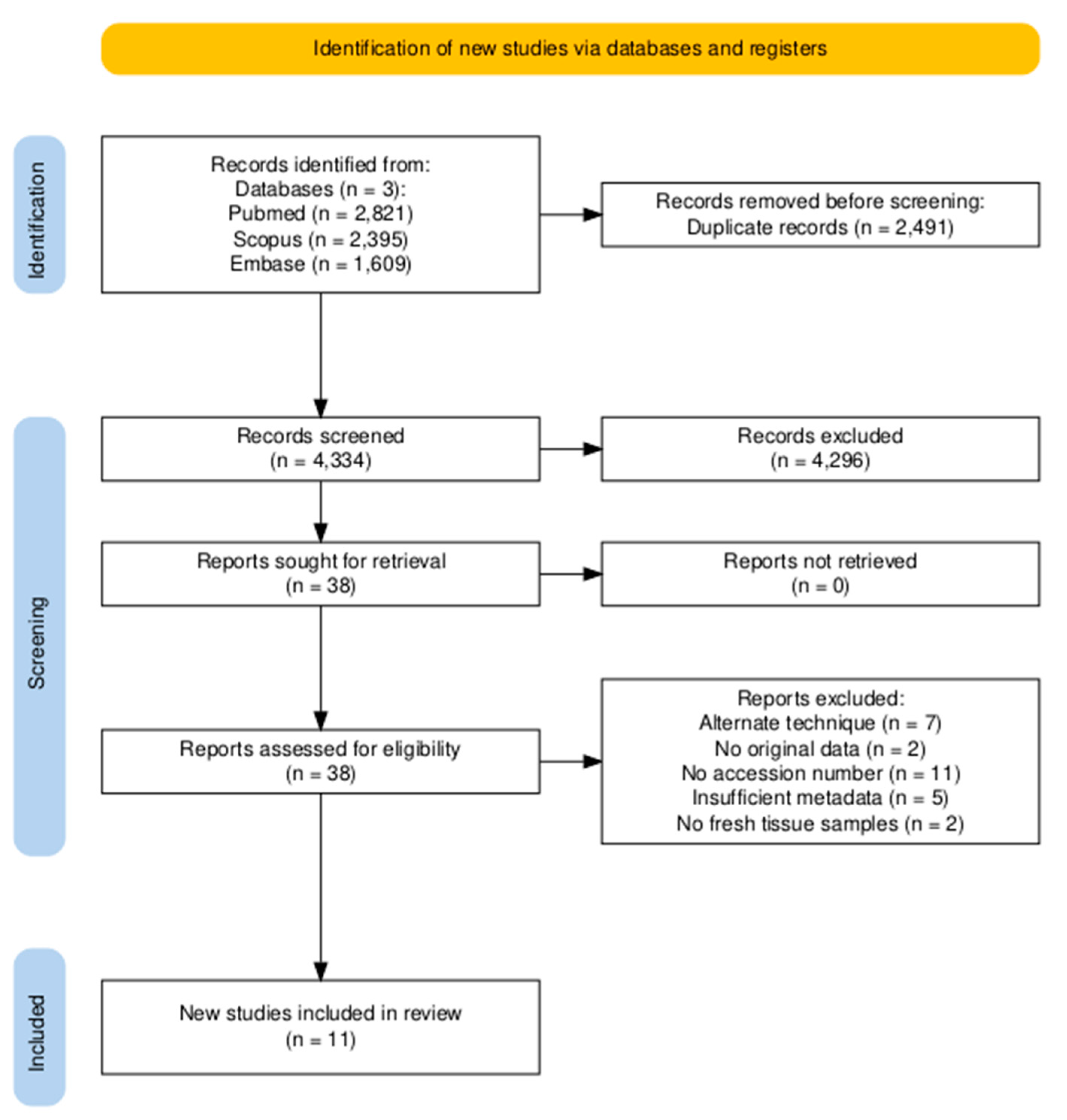
Figure 2.
General composition of breast microbiome in 16S rRNA V3V4 sequenced samples. The prevalence and mean relative abundance of taxa are shown at the (a) phylum and (b) genus levels for the V3V4 primer set (unrarefied, n = 832). The top phyla and genera are labelled and highlighted with red symbols to indicate prominence in the dataset.
Figure 2.
General composition of breast microbiome in 16S rRNA V3V4 sequenced samples. The prevalence and mean relative abundance of taxa are shown at the (a) phylum and (b) genus levels for the V3V4 primer set (unrarefied, n = 832). The top phyla and genera are labelled and highlighted with red symbols to indicate prominence in the dataset.
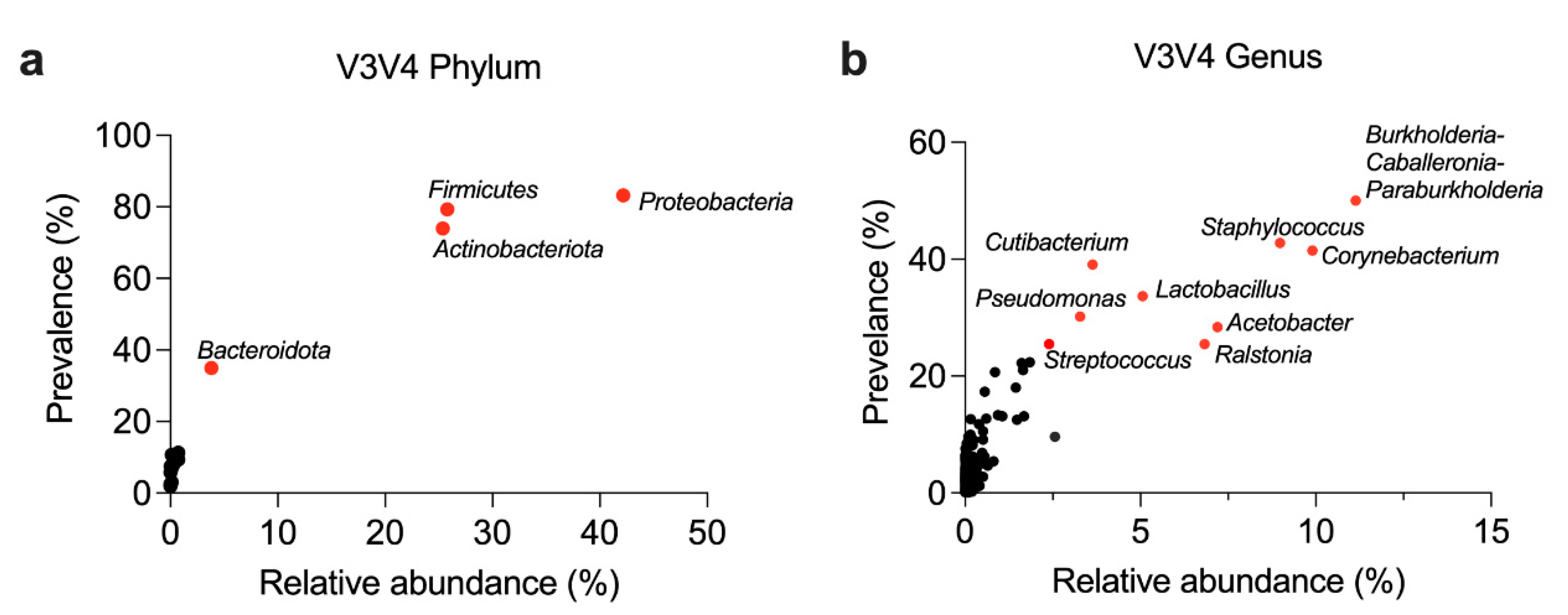
Figure 3.
Alpha and beta diversities for V3V4 breast tissue samples. (a) Shannon index representing alpha diversity across cancer, cancer-adjacent, normal and mastitis-effected breast tissue samples. (b) Shannon index for paired cancer and cancer-adjacent samples. (c) PCoA density plot based on Euclidean distance of CLR-transformed abundance, illustrating beta-diversity. Kruskal-Wallis test with Dunn’s multiple comparison was performed for unpaired analysis in (a), while Wilcoxon paired signed-rank test was performed for paired sample analyses in (b). **** p < 0.0001, *** p < 0.001, ** p < 0.01, not significant (n.s.) p > 0.05.
Figure 3.
Alpha and beta diversities for V3V4 breast tissue samples. (a) Shannon index representing alpha diversity across cancer, cancer-adjacent, normal and mastitis-effected breast tissue samples. (b) Shannon index for paired cancer and cancer-adjacent samples. (c) PCoA density plot based on Euclidean distance of CLR-transformed abundance, illustrating beta-diversity. Kruskal-Wallis test with Dunn’s multiple comparison was performed for unpaired analysis in (a), while Wilcoxon paired signed-rank test was performed for paired sample analyses in (b). **** p < 0.0001, *** p < 0.001, ** p < 0.01, not significant (n.s.) p > 0.05.
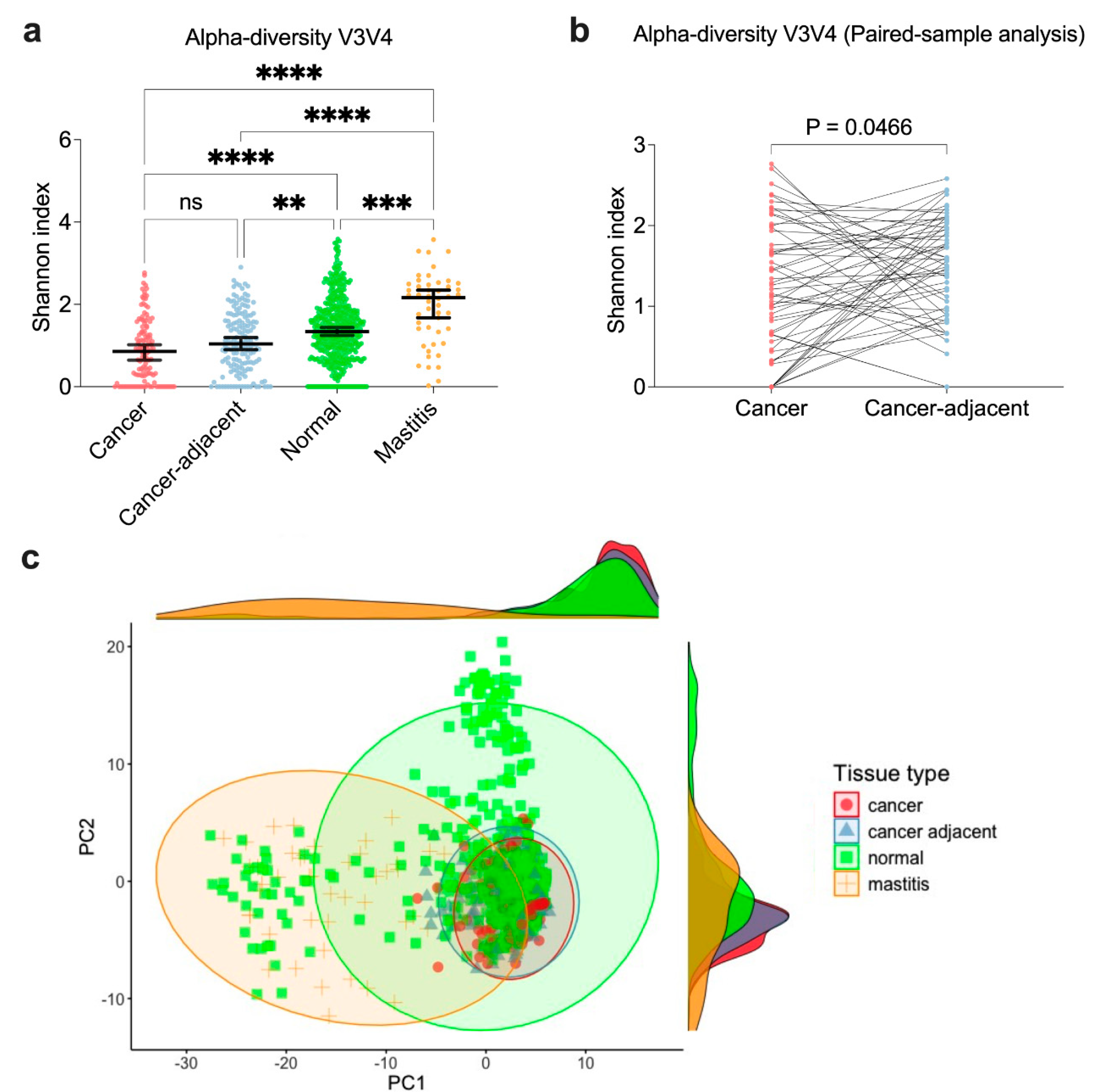
Figure 4.
TCGA-BRCA microbial abundance and diversity. (a) Mean relative abundance of genera in cancer and cancer-adjacent breast tissue. (b) Shannon index for unpaired samples. (c) Shannon index for paired cancer and cancer-adjacent samples. (d) PCoA density plot based on Euclidean distances of CLR-transformed abundance data representing beta-diversity. Kruskal-Wallis test with Dunn’s multiple comparison was performed for unpaired analysis (a), and Wilcoxon paired signed-rank test was performed for paired sample analyses (b). Not significant (n.s.), p > 0.05.
Figure 4.
TCGA-BRCA microbial abundance and diversity. (a) Mean relative abundance of genera in cancer and cancer-adjacent breast tissue. (b) Shannon index for unpaired samples. (c) Shannon index for paired cancer and cancer-adjacent samples. (d) PCoA density plot based on Euclidean distances of CLR-transformed abundance data representing beta-diversity. Kruskal-Wallis test with Dunn’s multiple comparison was performed for unpaired analysis (a), and Wilcoxon paired signed-rank test was performed for paired sample analyses (b). Not significant (n.s.), p > 0.05.
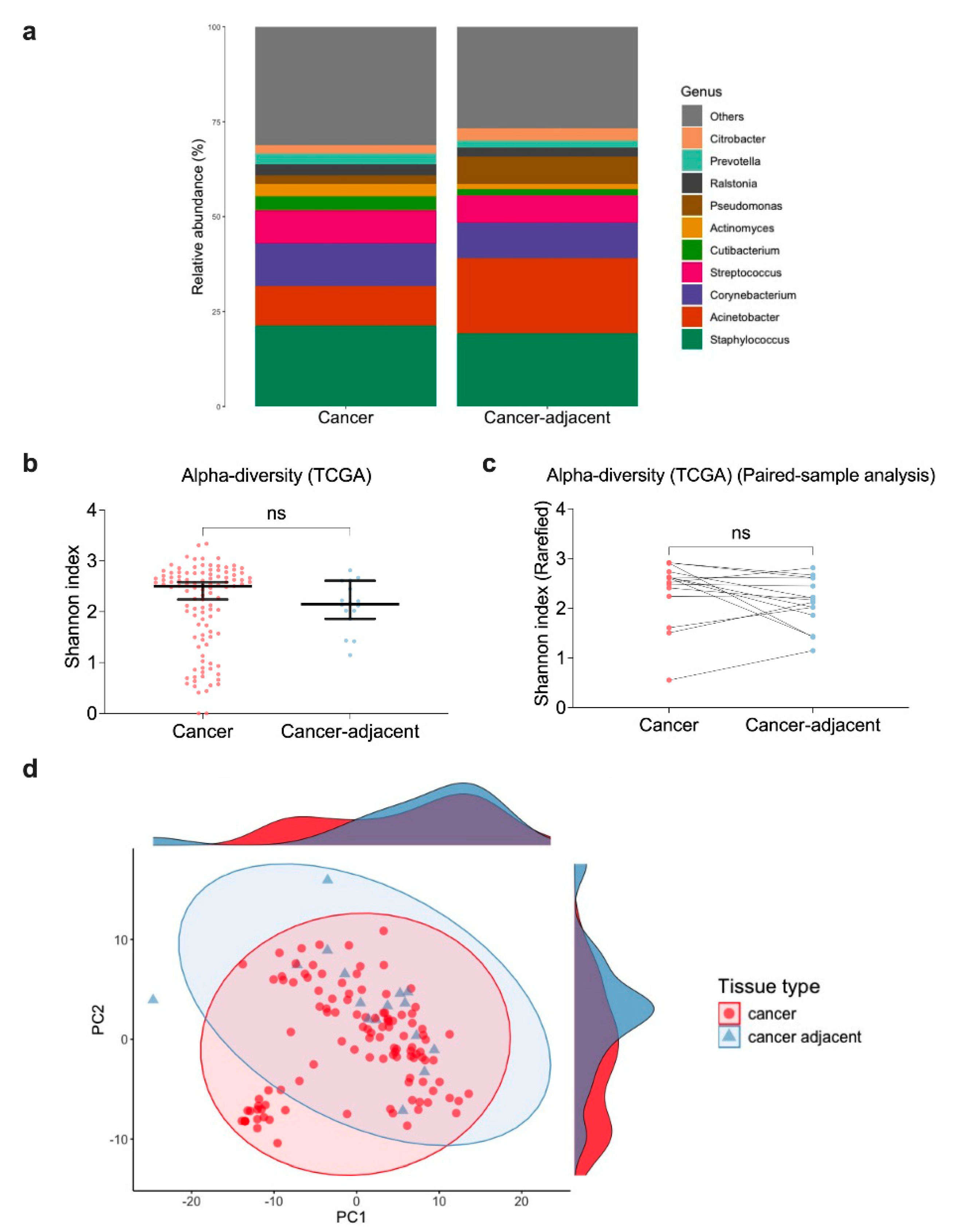
Figure 5.
Correlation analysis of CLR-abundance for prominent bacterial genera in breast cancer tissues. Spearman correlation analysis was performed to evaluate the relationship between CLR-abundance of bacterial genera and tumor phenotypes described by 29 functional gene expression signatures (FGES). P-values were adjusted for the false-discovery rate (FDR). *** p < 0.001, * p < 0.01.
Figure 5.
Correlation analysis of CLR-abundance for prominent bacterial genera in breast cancer tissues. Spearman correlation analysis was performed to evaluate the relationship between CLR-abundance of bacterial genera and tumor phenotypes described by 29 functional gene expression signatures (FGES). P-values were adjusted for the false-discovery rate (FDR). *** p < 0.001, * p < 0.01.
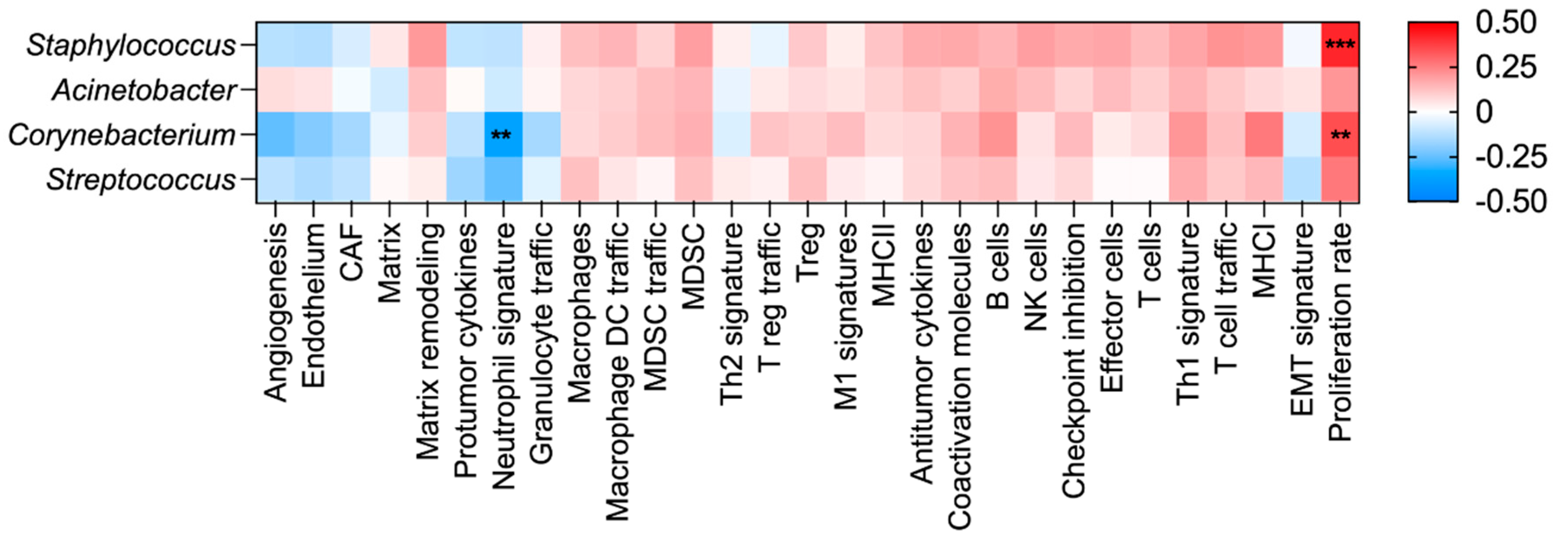
Table 1.
List of studies and tissue samples used for this meta-analysis after pre-processing and filtering.
Table 1.
List of studies and tissue samples used for this meta-analysis after pre-processing and filtering.
| Study | SRA Project Accession number | 16S rRNA hypervariable region | Cancer | Cancer-adjacent | Normal | Benign | Benign-adjacent | Mastitis |
| Kim (2021) [8] | PRJEB37724 | V1V3 | 37 | 38 | 0 | 0 | 0 | 0 |
| German (2023) [9] | PRJNA867176 | V3V4 | 31 | 61 | 398 | 0 | 0 | 0 |
| Hoskinson (2022) [10] | PRJNA723425 | V3V4 | 42 | 46 | 63 | 0 | 0 | 0 |
| Kartti (2023) [11] | PRJNA926328 | V3V4 | 17 | 14 | 0 | 0 | 0 | 0 |
| Thyagarajan (2020) [12] | PRJNA637875 | V3V4 | 31 | 33 | 0 | 0 | 0 | 0 |
| Zhu (2022) [13] | PRJNA667140 | V3V4 | 0 | 0 | 48 | 0 | 0 | 48 |
| Heiken (2016) [45] | PRJNA335375 | V3V5 | 0 | 16 | 0 | 12 | 0 | |
| Li (2022) [19] | PRJNA842933 | V4 | 0 | 79 | 0 | 15 | 0 | 0 |
| Esposito (2022) [15] | PRJNA759366 | V4V6 | 34 | 34 | 0 | 0 | 0 | 0 |
| Nejman (2020) [16] | PRJNA624822 | V6 | 77 | 18 | 0 | 0 | 0 | 0 |
| Urbaniak (2016) [17] | PRJNA323995 | V6 | 0 | 33 | 23 | 0 | 12 | 0 |
| Total | 269 | 372 | 532 | 15 | 24 | 48 |
Table 3.
Univariate Cox proportional hazard models for overall survival.
| n | HR (95% CI) | p-value | ||
| Age (years) | < 65 ≥ 65 |
74 33 |
2.23 (0.85 – 5.84) |
0.103 |
| Staphylococcus | Low High Continuous |
33 32 107 |
4.06 (1.13 – 14.6) 1.40 (1.04 – 1.88) |
0.032* 0.027* |
| Acinetobacter | Low High Continuous |
33 31 107 |
0.90 (0.27 – 2.95) 1.01 (0.83 – 1.24) |
0.859 0.891 |
| Corynebacterium | Low High Continuous |
34 31 107 |
4.72 (1.02 – 21.9) 1.21 (0.93 – 1.56) |
0.048* 0.160 |
| Streptococcus | Low High Continuous |
32 31 107 |
2.06 (0.41 – 10.3) 1.20 (0.89 – 1.63) |
0.236 0.380 |
Disclaimer/Publisher’s Note: The statements, opinions and data contained in all publications are solely those of the individual author(s) and contributor(s) and not of MDPI and/or the editor(s). MDPI and/or the editor(s) disclaim responsibility for any injury to people or property resulting from any ideas, methods, instructions or products referred to in the content. |
© 2025 by the authors. Licensee MDPI, Basel, Switzerland. This article is an open access article distributed under the terms and conditions of the Creative Commons Attribution (CC BY) license (http://creativecommons.org/licenses/by/4.0/).
Copyright: This open access article is published under a Creative Commons CC BY 4.0 license, which permit the free download, distribution, and reuse, provided that the author and preprint are cited in any reuse.


