

Submitted:
05 February 2025
Posted:
05 February 2025
You are already at the latest version
Abstract
A two-step annealing treatment was applied on a fully transparent amorphous InGaZnO4 (a-IGZO) top gate thin-film transistor (TG-TFT) to improve the device perfor-mance. The electrical properties and stabilities of a-IGZO TG TFTs were significantly im-proved as the 1st-annealing temperature increased from 150°C to 350°C with a 300°C 2nd-annealing treatment. The a-IGZO TG-TFT with the 300°C 1st-annealing treatment demonstrated the overall best performance, which has a mobility of 13.05 cm2/(V·s), a threshold voltage (Vth) of 0.33 V, a subthreshold swing of 130 mV/dec, and a Ion/Ioff of 1.73×10⁸. The Vth deviation (ΔVth) was -0.032 V and -0.044 V, respectively, after a 7200 s positive and negative bias stress under the gate bias voltage VG = ± 3 V and VD = 0.1 V. The PL spectra results revealed that the distribution and the density of defects in a-IGZO films were changed after the 1st-annealing treatment, whereas, XPS results displayed that the contents of oxygen vacancy and Ga-O bond varied in annealed a-IGZO films. In addition, a-IGZO TG-TFT had achieved a transmittance of over 90%. Researches on effects of the 1st-annealing treatment will contribute the fabrication of highly stable top-gate TFTs in the fields of transparent flexible electronics.
Keywords:
amorphous InGaZnO4
; top gate thin film transistor
; two-step annealing treatment
1. Introduction
The top gate (TG) structure amorphous InGaZnO4 (a-IGZO) thin-film transistor (TFT) was widely used in fields of fingerprint sensors, transparent displays, and flexible electronics [1-6] due to its high gate control capability and excellent stability. The high stability of a-IGZO TG-TFTs requires a certain special treatment on the a-IGZO active layer, such as annealing in different gas atmospheres, plasma gas treatment, or covering a passivation layer [5, 7-12]. The before mentioned various treatments could improve the bonding state of metal ions and oxygen atoms both on the surface, interface, and inside the a-IGZO active layer [9, 13]..
For TG-TFTs, the gate dielectric layer was deposited after the semiconductor active layer. The bonding state in the a-IGZO active layer would degrade during the deposition of Al2O3 gate dielectric material in the fabrication of TG-TFTs [5, 14-16]. Especially, the quantity of oxygen vacancy (VO) and the distribution of O defects in a-IGZO were significantly altered when the Al2O3 top gate dielectric was grown through atomic layer deposition (ALD) process, leading to the degeneration of the electrical performance of a-IGZO TG-TFTs [8-10, 14, 17]. The variation of oxygen-related states mainly originated from oxygen outgassing from a-IGZO during the deposition of Al2O3 in the ALD high-temperature vacuum environment [18]. Thermal annealing treatments in air or O2 after gate dielectric deposition have been considered to be an effective method to improve oxygen-related states between the a-IGZO-Al2O3 interface and the internal a-IGZO and Al2O3, and increase the film density and uniformity [5, 14-16], which mainly relies on oxygen diffusion mechanisms [5, 14, 15, 19]. However, the diffusion of external oxygen into a-IGZO active layer are severely hindered due to the passivation effect of Al2O3 top gate dielectric, resulting in only partly eliminating the degradation of a-IGZO. In addition, oxygen vacancies passivated by the hydrogen diffusing from the precursor residue of trimethylaluminum (TMA) in Al2O3 and the deficiency of oxygen in a-IGZO lead to the negative degradation of threshold voltage (Vth) of a-IGZO TG-TFTs [16, 19]. Therefore, another annealing treatment of a-IGZO in air or O2 before the gate dielectric deposition was proposed in some reports to resist the degradation of a-IGZO due to the formation of metal-oxygen (M-O) bonds, reducing the VO and O defects and densifying a-IGZO films [20, 21]. In previous reports, the effect on the performance of devices and the mechanism of the annealing treatment after gate dielectric deposition have been thoroughly investigated [5, 11, 16, 22]. While the effect and mechanism of the annealing treatment of a-IGZO before the gate dielectric deposition are seldom reported.
In this work, a two-step annealing treatment was applied during the fabrication of the TG-TFT. The annealing treatment on a-IGZO active layer before ALD-Al2O3 gate dielectric deposition is defined as the first annealing (1st-annealing), while the annealing of a-IGZO TG-TFTs after Al2O3 coverage is defined as the second annealing (2nd-annealing). The mechanism on a-IGZO and a-IGZO TFTs of the 2nd-annealing treatment had been reported in our previous study [16]. Herein, the effect and mechanism of the 1st-annealing treatment on a-IGZO active layer and the stability of a-IGZO TG-TFTs were systematically investigated based on a fully transparent a-IGZO TG-TFT fabricated under different 1st-annealing conditions. The UV–Vis optical transmission spectra was used to obtain the transmittance of the a-IGZO TG-TFT. The photoluminescence (PL) spectroscopy and X-ray photoelectron spectroscopy (XPS) were employed to analysis the 1st-annealing mechanism through investigating the distribution and the content of defects in a-IGZO.
2. Materials and Methods
Fig. 1(a) shows a schematic of the fabricating process sequence and major processing steps, respectively, of the top-gate bottom-contact a-IGZO TFT in this work. The fully transparent staggered TG-TFTs were fabricated on a cleaned SiO2 (100 nm)/Si substrate. Firstly, ITO source and drain (S/D) electrodes were deposited by radio-frequency (RF) magnetron sputtering at 60 W in Ar atmosphere under the pressure of 0.43 mtorr for 840 s. The S/D regions were defined by photolithography, and outside regions were etched by CH4 and H2 at 60 °C using inductively coupled plasma reactive-ion-etching (ICP-RIE). Secondly, the a-IGZO channel was deposited through RF magnetron sputtering at 90 W in pure Ar atmosphere from a ceramic target with a molar ratio of In2O3 : Ga2O3 : ZnO = 1 : 1 : 1 at room temperature (RT). Right after the deposition of a-IGZO layer, the 1st-annealing treatment was carried out in air (the air humidity is 40%) for 1 hour, which the 1st-annealing treatment temperatures were controlled between 150°C and 350°C with a step of 50°C. The a-IGZO channel regions were defined by photolithography, and were etched by CH4 and H2 at 20°C using ICP-RIE technology. Subsequently, the Al2O3 gate insulator (GI) was deposited through thermal-ALD at 150°C with trimethylaluminum (TMA) and H2O as aluminum and oxygen precursor, respectively, and N2 as purge gas. The pulse time of TMA, H2O, and N2 were 0.03 s, 0.02 s, and 30 s, respectively. Finally, ITO gate electrodes were deposited by RF magnetron sputtering in Ar atmosphere and defined by lift-off processes. The 2nd- annealing treatment was carried out at 300°C in air for 1 hour after the fabrication of a-IGZO TFTs finished. Additionally, the layer thicknesses of ITO S/D electrodes, a-IGZO channel, Al2O3 GI, and ITO gate electrode were measured using atomic force microscope (AFM) and found to be 50 nm, 24 nm, 10 nm, and 50 nm, respectively.
All electrical measurements of the a-IGZO TG-TFTs were performed using an Agilent B1500A parameter analyzer connecting Cascade EPS150TRIAX probe station at RT in a dark ambient atmosphere. The PL spectra was obtained using a Renishaw inVia Raman spectrometer equipped with a 325 nm wavelength laser. XPS spectra were obtained on a Thermo Scientific K-Alpha XPS system with monochromatic Al Kα X-ray (1486.7 eV) radiation and were calibrated by the C 1s peak (∼284.8 eV).
3. Results
3.1. Optical and Electric characteristics of TG-TFTs
The transmittance of the fully transparent staggered a-IGZO TG-TFT was showed in Figure 1(b). The transmittance of the a-IGZO TG-TFT obtained by the UV–Vis optical transmission spectra had achieved over 90% (quartz as substrate) in visible light range. An optical band gap of 3.84 eV was calculated based on the UV-Vis optical transmission spectrum of a 130 nm thick a-IGZO film on quartz glass, which was shown in the insert of Fig. 1(b). The pleasant transmittance of the TG-TFT was mainly attributed to the wide bandgap of the a-IGZO material, which was benefit for the application in transparent flexible electronic smart wearable devices.

Table 1.
Electrical characteristic parameters of TG-TFTs with different 1st-annealing temperature.
| Parameters T (°C) |
Vth-lin(V) | Vth-sat(V) |
μsat (cm2V-1s-1) |
Ion/Ioff (VD = 3 V) |
SS (mV/dec) |
Nt (eV-1cm-2) |
|---|---|---|---|---|---|---|
| 150 | -1.13 | -1.23 | 9.13 | 4.03×10³ | -- | -- |
| 200 | -0.53 | -0.83 | 30.52 | 4.46×10⁸ | 203 | 6.10×10¹² |
| 250 | 1.12 | 0.78 | 6.87 | 6.98×10⁷ | 137 | 3.28×10¹² |
| 300 | 0.52 | 0.33 | 13.05 | 1.73×10⁸ | 130 | 2.98×10¹² |
| 350 | -2.05 | -3.05 | -- | 7.2 | -- | -- |
Figure 2(a) and (b) displayed transfer characteristics of TG-TFTs with different 1st-annealing treatments. As shown in Fig. 2(a) and (b), the TG-TFT without the 1st-annealing treatment did not show the switching characteristic, which indicated that the degradation of a-IGZO without 1st-annealing was most severe after the deposition of Al2O3. There was a significant change in transfer characteristics of the transistor after the introduction of the 1st-annealling treatment. The TFTs with 1st-annealling at 150°C and 350°C did not exhibit obvious switching characteristics, which were attributed to the extensive shallow donor states and the creation of new trap states in a-IGZO [9], respectively. The TFTs with 1st-annealling treatment at 200°C-300°C exhibited good switching characteristics, which also showed a variation with 1st-annealling temperature. The electrical parameters of TG-TFTs, such as threshold voltage (Vth), subthreshold swing (SS), field-effect mobility (μsat) and on/off current ratio (Ion/Ioff) were all extracted from the saturated transfer curve, as shown in Table I. The Vth-sat was shifting positively with increasing 1st-annealing temperature up to 250°C and then switching to a negative shift with further increasing 1st-annealing temperature. The turn-around Vth shift was associated with the changes in the quantity and distribution of VO and O defects, and the bonding energy between metal ions and oxygen atom within the internal composition of a-IGZO films [9, 17, 23]. From Fig. 2(b) and Table I, the values of SS were 203 mV (200°C), 137 mV (250°C), and 130 mV (300°C), and showed a declining trend under the increasing 1st-annealing temperatures. It was reported that the SS was mainly influenced by the interfacial quality and defect states between Al2O3 and the a-IGZO channel [24]. Excellent interfaces between a-IGZO and Al2O3 had been proved by the negligible hysteresis of transfer curves as shown in Fig. 2(a) and (b). And the density of trapping states (Nt) at the interface was extracted from SS by the following formula:
where κB is Boltzmann’s constant, Cox is unit area capacitance of 10 nm Al2O3, T was the temperature in Kelvin, and q is the electron charge. In this work, the Cox was 408 nF/cm2 obtained from the capacitance-voltage measurement. The calculated Nt value was within the range of 2.98×10¹² ̶ 6.10×10¹² eV-1cm-2 as shown in Table I, and this result was also agreement with the reported value 3.0×10¹² eV-1cm-2 [24]. The improvement of SS performance with the 1st-annealling temperature might be mainly attributed to the reduction of O defects and VO in a-IGZO film [25]. Therefore, we further analyzed the a-IGZO films with 1st- annealing treatments at 200°C, 250°C, and 300°C by PL spectra and XPS technology, based on the good switching transfer curves, as shown in Fig. 5 and Fig. 6.
3.2. Electrical stability test on a-IGZO TG-TFTs
The electrical stability of a-IGZO TG-TFTs was further investigated. As depicted in Figure 3 and Figure 4, positive bias stress (PBS) and negative bias stress (NBS) measurements were performed on TG-TFTs under the test conditions of Vstress (gate bias voltage) = ± 3 V at VD = 0.1 V. As displayed in Figure 3 (a), (b) and (c), transfer curves of all TG-TFTs shifted very slightly in negative direction after a positive stress duration of 7200 s, demonstrating an excellent resistance to PBS. And this extraordinary stability was mainly due to the good interface between a-IGZO channel and Al2O3 insulator [26-28]. Moreover, the negative shift in transfer curves was likely caused by the H-doping effect, which was resulting from the ALD-Al2O3 insulator due to the 2nd-annealing treatment[16]. The deviations of Vth (ΔVth) between the initial and the 7200 s positive biased transfer curves at VD = 0.1 V were -0.11 V (200°C), -0.035 V (250°C), and -0.032 V (300°C), respectively. This result showed PBS stabilities of TG-TFTs had an obvious improvement with increasing 1st-annealing temperatures, and the TG-TFT with 1st-annealing treatment at 300°C had the best PBS stability.
The NBS results of a-IGZO TG-TFTs were presented in Fig. 4. The transfer characteristics of all TG-TFTs exhibited negative shifts after a 7200 s stress duration under the Vstress = - 3 V condition, as shown in Fig. 4(a), (b), and (c). The negative shifts in Vth attribute to that holes were difficult to be generated in n-type oxide semiconductors[16]. The ΔVth values between the initial and the 7200 s negative biased transfer curves at VD = 0.1 V were -0.573 V (200°C), -0.335 V (250°C), and -0.044 V (300°C). It was evident that the NBS stabilities of the TG-TFTs were improved with increasing 1st-annealing temperature, and TG-TFT with 300°C 1st-annealing treatment had the best NBS stability. The excellent NBS stability would make a-IGZO TG-TFTs very advantageous for applications in the field of transparent displays.
The best PBS stability and the best NBS stability were both obtained from TG-TFTs with 1st-annealing treatment at 300°C. In order to further understand the effect of the 1st-annealing treatment on the bias stress stability improvement of TG-TFTs, PL and XPS spectra were conducted on a-IGZO films with 1st-annealing treatments at 200°C, 250°C, and 300°C, as shown in Figure 5 and Figure 6.
3.3. 1st-annealing effect on a-IGZO films
Fig. 5 and the insert figure showed the PL spectra and separated PL spectra of a-IGZO films with 1st-annealing at fresh (no 1st-annealing), 200°C, 250°C, and 300°C. Four broad emission peaks were found in the visible light range of 1.6 ~ 3.2 eV, which is consistent with previous reports [29-32]. From the insert of Fig. 5, every peak was observed with a flat top, of which the maximum energy for all peaks was at 2.16 eV. The result meant that the deepest defect in all a-IGZO films was located at 2.16 eV below the conduction band bottom (VBM) )[33]. In addition, the energy bands occupied by the flat top of the measured peaks were 0.159 eV (fresh), 0.130 eV (200°C), 0.107 eV (250°C), and 0.136 eV (300°C), respectively. The peak intensity and width of the energy band of the flat top in the PL spectra may illustrate the density and the distribution range of defects in the a-IGZO film [30, 31, 34]. The PL curve of the a-IGZO film with 1st-annealing at 250°C exhibited the highest peak intensity and the narrowest energy band (0.107 eV) of the flat top, while the PL spectra of the a-IGZO film without 1st-annealing showed the lowest peak intensity and the widest energy band (0.159 eV). These results demonstrated that the O defects in a-IGZO film with 1st-annealing at 250°C were at the deepest energy level, which might result in the largest positive Vth for the TG-TFT, as shown in Fig. 2(a) and (b). The PL spectra of the a-IGZO film with 300°C 1st-annealing treatment showed a lower peak intensity but wider energy band (0.136 eV) of the flat top than that of the 250°C 1st-annealed a-IGZO film. This result might suggest that some shallow defect states were generated in the 300°C 1st-annealed a-IGZO film as the overall number of defects decreased [9]. And this might be the reason for the higher mobility of the TG-TFT with 300°C 1st-annealing treatment than that of the TG-TFT with 250°C 1st-annealed a-IGZO, as shown in Table I. The generation of ionized VO might lead to the generation of O defects, explaining the wider energy band of the flat top for the a-IGZO film with 1st-annealing temperature at 300°C than that of the 200°C 1st-annealed a-IGZO film in the PL spectra, as shown in Fig. 5. Consequently, ionized VO and electrons would gather on the upper surface of the a-IGZO channel, and this made the TG-TFT with 1st-annealing temperature at 300°C achieved a higher mobility of 13.05 cm2V-1s-1.
The peak intensity decreased with the increase of 1st-annealing temperature as shown in Fig.5, indicating the defect density decreased with the increase of 1st-annealing temperature. This result would explain the PBS and NBS stability improvement with the increase of 1st-annealing temperature.
It is reported that bonding states of gallium atoms in a-IGZO had a great impact on Vth, SS, and μ for a-IGZO TFTs [35]. It is known that Ga-O bond exhibits the shortest bond length and the strongest binding energy compared to In-O bond and Zn-O bond [36]. XPS spectra of oxygen and gallium elements in a-IGZO films with 1st-annealing treatments at 200°C ̶ 300° were employed to investigate the relationship between transfer characteristics of TG-TFTs and temperatures of 1st-annealing treatments. The 1st-annealing temperature of the controlled samples were set at fresh (no 1st-annealing treatment), 200°C, 250°C, and 300°C, respectively. Fig. 6 (a) and (b) showed the O 1s and Ga 3d XPS spectra of a-IGZO films with 1st-annealing treatments at fresh, 200°C, 250°C, and 300°C, respectively. O 1s spectra could be deconvoluted into two sub-peaks based on Gaussian fitting, i.e., bond between O atom and metal atom (O-M) (centered around 530.15 eV), VO (centered around 531.47 eV), and Ga 3d spectra could be deconvoluted into Ga-Ga (centered around 17.8 eV) and Ga-O (centered around 19.60 eV) [36-39]. O-M and VO core peaks of a-IGZO films with 1st-annealing at fresh, 200°C, 250°C, 300°C were at 530.02 eV, 530.12 eV, 530.20 eV, and 530.15 eV with error of ± 0.02 eV, and VO core peaks were at 530.85 eV, 531.45 eV, 531.55 eV, and 531.50 eV with error of ± 0.02 eV, respectively, as shown in Fig.6(a). The core peak energy values of O-M for the a-IGZO films were almost consistent. The VO core peak energy for the a-IGZO film with 1st-annealing at 250°C was found to be the biggest (531.55 eV), which indicated that the defect states in the a-IGZO film were located at the deepest energy level compared to that in other a-IGZO films, consistent with the PL spectra results from Fig. 5. The contents of VO and O-M bonds were calculated from the O 1s spectra, as shown in Table II. The VO contents in a-IGZO films were 26.60% (fresh), 11.17% (200°C), 12.84% (250°C), and 11.01% (300°C), respectively. The contents of O-M bonds in a-IGZO films were 17.27% (fresh), 32.57% (200°C), 30.45% (250°C), and 32.44% (300°C), respectively. The 1st-annealing treatment led to a 13.76 ̶ 15.59% decrease in VO content and 13.18 ̶ 15.3% increase in O-M bonds content for a-IGZO films, as shown in Table II. The change in contents of VO and O-M bonds demonstrated that the O-related defects in a-IGZO films decreased with the 1st-annealing treatment temperature. The VO content in the 250°C 1st-annealed a-IGZO film was slightly higher than that of a-IGZO films with 1st-annealing at 200°C and 300°C, indicating that the combination state between O and metal atoms under this condition was different compared to other a-IGZO films.
In this report, the Ga-Ga peaks in all a-IGZO films were centered at 17.80 eV with calculation error of ± 0.02 eV. The Ga-O peak in the 250°C 1st-annealed a-IGZO film was centered at 19.75 eV, whereas the Ga-O peaks for other a-IGZO films were all centered at 19.60 eV with calculation error of ± 0.02 eV, as shown in Fig. 6(b). The 0.15 eV increase in Ga-O peak indicated that the coordination between Ga and O in the 250°C 1st-annealed a-IGZO film was better than that in other a-IGZO films. The Ga-O contents in a-IGZO films were 12.82% (fresh), 12.92% (200°C), 11.18% (250°C), and 13.34% (300°C), respectively. The a-IGZO film with 1st-annealing temperature at 300°C had the highest Ga-O content. This might be the reason why TG TFTs with 1st-annealing at 300°C exhibited the best PBS and NBS stability as shown in Fig.3(c) and Fig.4(c), based on the fact that Ga-O could suppress the ionization of VO at gate voltage bias[36].
Usually, an increase of VO in a-IGZO would lead to Vth shifting to negative direction, while the enhancement of Ga-O bond lead to Vth shifting to positive direction. In comparison to the a-IGZO film with 1st-annealing temperature at 200°C, the 300°C 1st-annealed a-IGZO film showed 0.16% decrease of VO content and a 0.42% increase of Ga-O content. As a result, the Vth of the TG-TFT with 300°C 1st-annealed a-IGZO exhibited a positive shift. The VO content in the 250°C 1st-annealed a-IGZO film was higher than that of a-IGZO films with 1st-annealing temperature at 200°C and 300°C, and while the Ga-O content in the 250°C 1st-annealed a-IGZO film was lower than that of a-IGZO films with 1st-annealing temperature at 200°C and 300°C. Thus, Vth of the TG-TFT with the 250°C 1st-annealed a-IGZO should be more negative than that of the TG-TFT with other a-IGZO films. However, the largest positive Vth was observed at the TG-TFT with 250°C 1st-annealed a-IGZO. This strange phenomenon might suggest that the Ga-O content had a greater impact on Vth than VO content. And the better coordination between Ga and O promoted that the Vth of the TG-TFT with the 250°C 1st-annealed a-IGZO film was more positive than that of the TG-TFT with 300°C 1st-annealed a-IGZO.
4. Conclusions
In this work, the electronic properties and stabilities of a-IGZO TG-TFTs were investigated by controlling the 1st-annealing temperature, and the mechanism of 1st-annealing treatment on a-IGZO films was explored through PL spectra and XPS analysis. The TG-TFT achieved good switching function when 1st-annealing temperature at 200°C – 300°C. The TG-TFT with 1st-annealing treatment at 300°C resulted in the best electrical properties, PBS stability, and NBS stability.
The PL spectra and XPS spectra revealed the change of O defect states and Ga-O bond state in the 1st-annealed a-IGZO films. O defects were reduced with 1st-annealing treatments, but some shallow states were produced when the 1st-annealing temperature increased to 300°C. The best coordination situation between Ga and O atoms occurred for a-IGZO film with 1st-annealing treatment at 250°C, leading to the biggest positive Vth of TG-TFTs. Furthermore, the highest content of Ga-O bond and minimal defect intensity were both obtained in a-IGZO film with 1st-annealing at 300°C, which contributed to the excellent PBS and NBS stabilities of TG-TFTs.
Author Contributions
Experimental plan, S.Z; Verification, S.Z. and C.W.; Investigation, S.Z., C.W., and S.L.; Data processing, S.Z., L.D., and Z.L.; Writing, First draft preparation, S.Z.; Writing - Review and Editing, S.Z., Q.X., A.S., Y.L., and J.Z.; Supervision, Y.L.; Project management. Y.L. and J.Z.; All authors have read and agree to the publication version of the manuscript.
Funding
This work was supported by Natural Science Foundation of Shandong Province (ZR2022ZD05, ZR2022ZD04, and ZR2020ZD03), National Key Research and Development Program of China (2022YFA1405200 and 2022YFB3603900), and National Natural Science Foundation of China (62074094).
Data Availability Statement
Data are contained within the article.
Conflicts of Interest
The authors declare no conflicts of interest.
References
- Y. Kim, G. J. Y. Kim, G. J. Jeon, M. K. Lee, S. H. Lee and S. H. K. Park, "Transparent top gate oxide TFT with ITO/Ag/ITO low resistance electrode for the application to the high speed operation fingerprint sensor array in the touch panel," in 13th Symposium on Thin Film Transistor Technologies (TFT), Ed., pp. 247-251, Honolulu, HI, 2016.
- M. Mativenga, F. M. Mativenga, F. Haque and Ieee, "Highly Stable Thin-Film Transistors for Flexible and Transparent Displays," in IEEE International Conference on Electrical, Computer, and Energy Technologies (ICECET), Ed., pp. 2273-2278, Cape Town, SOUTH AFRICA, 2021.
- J. Fan, L. J. Fan, L. Chia-Yu, C. Shu-jhih, G. Liu Ming, J. Zhang Li, Y. Sun, C. Lu Ma, F. Xie Hua, N. Liu, S. Jianqing, S. Chongyu and L. Jay Guoxu, "High transparent Active matrix Mini-LED Full Color Display with IGZO TFT Backplane," SID Symposium Digest of Technical Papers, vol. 50, no. 1, pp. 454-456, 2019.
- Y. B. Li and T. P. Chen, "Enhancement in Performance and Reliability of Transparent IGZO Thin-Film Transistors by ITO/Ti Stacked Source/Drain Contacts," Ecs Journal of Solid State Science and Technology, vol. 12, no. 9, pp. 095003, 2023.
- J. Li, Y. J. Li, Y. Zhang, J. Wang, H. Yang, X. Zhou, M. Chan, X. Wang, L. Lu and S. Zhang, "Near-Ideal Top-Gate Controllability of InGaZnO Thin-Film Transistors by Suppressing Interface Defects with an Ultrathin Atomic Layer Deposited Gate Insulator," ACS applied materials & interfaces, vol. 15, no. 6, pp. 8666-8675, 2023.
- H. Ning, X. H. Ning, X. Zeng, H. Zhang, X. Zhang, R. Yao, X. Liu, D. Luo, Z. Xu, Q. Ye and J. Peng, "Transparent Flexible IGZO Thin Film Transistors Fabricated at Room Temperature," Membranes, vol. 12, no. 1, pp. 1-7, 2022.
- Y.-D. Kim, K.-L. Y.-D. Kim, K.-L. Han, J.-H. Kim, J.-I. Lee, W.-B. Lee, J.-S. Park and B.-D. Choi, "Effects of Tensile Strain on Dynamic and Static Inverters Using Amorphous Indium-Gallium-Zinc-Oxide TFTs," Ieee Electron Device Letters, vol. 42, no. 3, pp. 359-362, 2021.
- R. Velichko, Y. R. Velichko, Y. Magari and M. Furuta, "Defect Passivation and Carrier Reduction Mechanisms in Hydrogen-Doped In-Ga-Zn-O (IGZO:H) Films upon Low-Temperature Annealing for Flexible Device Applications," Materials, vol. 15, no. 1, pp. 334, 2022.
- Y. Hanyu, K. Y. Hanyu, K. Abe, K. Domen, K. Nomura, H. Hiramatsu, H. Kumomi, H. Hosono and T. Kamiya, "Effects of High-Temperature Annealing on Operation Characteristics of a-In-Ga-Zn-O TFTs," Journal of Display Technology, vol. 10, no. 11, pp. 979-983, 2014.
- N. Oka, T. N. Oka, T. Aoi, R. Hayashi, H. Kumomi and Y. Shigesato, "Electronic State of Amorphous Indium Gallium Zinc Oxide Films Deposited by DC Magnetron Sputtering with Water Vapor Introduction," Applied Physics Express, vol. 5, no. 7, pp. 075802, 2012.
- W. Zhang, Z. W. Zhang, Z. Fan, A. Shen and C. Dong, "Atmosphere Effect in Post-Annealing Treatments for Amorphous InGaZnO Thin-Film Transistors with SiOx Passivation Layers," Micromachines, vol. 12, no. 12, pp. 1551, 2021.
- D. H. Kang, I. D. H. Kang, I. Kang, S. H. Ryu, Y. S. Ahn and J. Jang, "Effect of SiO2 and/or SiNx Passivation Layer on Thermal Stability of Self-Aligned Coplanar Amorphous Indium-Gallium-Zinc-Oxide Thin-Film Transistors," Journal of Display Technology, vol. 9, no. 9, pp. 699-703, 2013.
- H.-H. Hsieh, T. H.-H. Hsieh, T. Kamiya, K. Nomura, H. Hosono and C.-C. Wu, "Modeling of amorphous InGaZnO4 thin film transistors and their subgap density of states," Applied Physics Letters, vol. 92, no. 13, pp. 133503, 2008.
- W.-T. Chen, S.-Y. W.-T. Chen, S.-Y. Lo, S.-C. Kao, H.-W. Zan, C.-C. Tsai, J.-H. Lin, C.-H. Fang and C.-C. Lee, "Oxygen-Dependent Instability and Annealing/Passivation Effects in Amorphous In-Ga-ZnO Thin-Film Transistors," Ieee Electron Device Letters, vol. 32, no. 11, pp. 1552-1554, 2011.
- S. G. M. Aman, Y. S. G. M. Aman, Y. Magari, K. Shimpo, Y. Hirota, H. Makino, D. Koretomo and M. Furuta, "Low-temperature (150 °C) activation of Ar+O2+H2-sputtered In-Ga-Zn-O for thin-film transistors," Applied Physics Express, vol. 11, no. 8, pp. 081101, 2018.
- S. Zheng, S. S. Zheng, S. Lv, C. Wang, Z. Li, L. Dong, Q. Xin, A. Song, J. Zhang and Y. Li, "Post-annealing effect of low temperature atomic layer deposited Al2O3 on the top gate IGZO TFT," Nanotechnology, vol. 35, no. 15, 2024.
- K. Nomura, T. K. Nomura, T. Kamiya, H. Ohta, M. Hirano and H. Hosono, "Defect passivation and homogenization of amorphous oxide thin-film transistor by wet O2 annealing," Applied Physics Letters, vol. 93, no. 19, pp. 192107, 2008.
- H.-W. Lee and W.-J. Cho, "Effects of vacuum rapid thermal annealing on the electrical characteristics of amorphous indium gallium zinc oxide thin films," Aip Advances, vol. 8, no. 1, pp. 015007, 2018.
- N. Thi Thu Thuy, B. N. Thi Thu Thuy, B. Aventurier, O. Renault, T. Terlier, J. P. Barnes, F. Templier and Ieee, "Impact of hydrogen diffusion on electrical characteristics of IGZO TFTs passivated by SiO2 or Al2O3," in 21st International Workshop on Active-Matrix Flatpanel Displays and Devices - TFT Technologies and FPD Materials (AM-FPD), Ed., pp. 149-152, Ryukoku Univ, Kyoto, JAPAN, 2014.
- C. Wang, C. C. Wang, C. Zeng, H. Ning, F. Li, M. Liu, K. Xu and F. Ma, "Enhanced performances of a-IGZO TFTs with oxide passivation layers fabricated by hollow cathode assisted PLD," Journal of Alloys and Compounds, vol. 961, no. 170972, pp. 1-15, 2023.
- C. Peng, S. C. Peng, S. Yang, C. Pan, X. Li and J. Zhang, "Effect of Two-Step Annealing on High Stability of a-IGZO Thin-Film Transistor," Ieee Transactions on Electron Devices, vol. 67, no. 10, pp. 4262-4268, 2020.
- J. Li, Y. J. Li, Y. Zhang, J. Wang, H. Yang, X. Zhou, M. Chan, X. Wang, L. Lu and S. Zhang, "High-Performance Self-Aligned Top-Gate Amorphous InGaZnO TFTs With 4 nm-Thick Atomic-Layer-Deposited AlOX Insulator," Ieee Electron Device Letters, vol. 43, no. 5, pp. 729-732, 2022.
- M. Yokoyama, Y. M. Yokoyama, Y. Asakura, H. Yokoyama, M. Takenaka, S. Takagi and Ieee, "Impact of Al2O3 ALD temperature on Al2O3/GaSb metal-oxide-semiconductor interface properties," in 2013 International Conference on Indium Phosphide and Related Materials, Ed., pp. 6132, 2013.
- P. Ma, L. P. Ma, L. Du, Y. Wang, R. Jiang, Q. Xin, Y. Li and A. Song, "Low voltage operation of IGZO thin film transistors enabled by ultrathin Al2O3 gate dielectric," Applied Physics Letters, vol. 112, no. 2, pp. 023501, 2018.
- S. W. Tsao, T. C. S. W. Tsao, T. C. Chang, S. Y. Huang, M. C. Chen, S. C. Chen, C. T. Tsai, Y. J. Kuo, Y. C. Chen and W. C. Wu, "Hydrogen-induced improvements in electrical characteristics of a-IGZO thin-film transistors," Solid-State Electronics, vol. 54, no. 12, pp. 1497-1499, 2010.
- Y.-H. Chang, M.-J. Y.-H. Chang, M.-J. Yu, R.-P. Lin, C.-P. Hsu and T.-H. Hou, "Abnormal positive bias stress instability of InGaZnO thin-film transistors with low-temperature Al2O3 gate dielectric," Applied Physics Letters, vol. 108, no. 3, pp. 033502, 2016.
- J. T. Jang, D. J. T. Jang, D. Ko, S.-J. Choi, D. M. Kim and D. H. Kim, "Observation of Hydrogen-Related Defect in Subgap Density of States and Its Effects Under Positive Bias Stress in Amorphous InGaZnO TFT," Ieee Electron Device Letters, vol. 42, no. 5, pp. 708-711, 2021.
- Y.-T. Chien, Y.-L. Y.-T. Chien, Y.-L. Tsai, K.-J. Zhou, Y.-Z. Zheng, M.-C. Tai, H.-Y. Tu, C.-W. Kuo, T.-C. Chang and T.-M. Tsai, "Performance Enhancement of InGaZnO Top-Gate Thin Film Transistor With Low-Temperature High-Pressure Fluorine Treatment," Ieee Electron Device Letters, vol. 42, no. 11, pp. 1611-1614, 2021.
- T. Morimoto, Y. T. Morimoto, Y. Yang, Y. Ochiai, N. Fukuda and Y. Ohki, "Effects of metal content on electrical and physical properties in solution-processed IGZO thin films," Applied Physics a-Materials Science & Processing, vol. 126, no. 5, pp. 03579-03572, 2020.
- S. H. Jeong, B. S. S. H. Jeong, B. S. Bae, K. M. Yu, M. K. Ryu, K. I. Cho and E.-J. Yun, "Properties of IGZO thin films irradiated by electron beams with various energies," Journal of the Korean Physical Society, vol. 61, no. 6, pp. 867-872, 2012.
- A. Hino, T. Kishi, S. Morita, K. Hayashi and T. Kugimiya, "Study of electronic structure and composition at back channel surface of amorphous In-Ga-Zn-O thin films," in 11th Symposium on Thin Film Transistor Technologies (TFT), Ed., pp. 197-202, Honolulu, HI, 2012.
- Y. Takamori, T. Morimoto, N. Fukuda and Y. Ohki, "Effects of ultraviolet photon irradiation and subsequent thermal treatments on solution-processed amorphous indium gallium zinc oxide thin films," Aip Advances, vol. 8, no. 11, pp. 115304, 2018.
- E. K.-H. Yu, S. Jun, D. H. Kim and J. Kanicki, "Density of states of amorphous In-Ga-Zn-O from electrical and optical characterization," Journal of Applied Physics, vol. 116, no. 15, pp. 154505, 2014.
- H. Pu, Q. Zhou, L. Yue and Q. Zhang, "Investigation of oxygen plasma treatment on the device performance of solution-processed a-IGZO thin film transistors," Applied Surface Science, vol. 283, pp. 722-726, 2013.
- Y. Y. Zhang, L. X. Qian, W. B. Ge, P. T. Lai and X. Z. Liu, "Tailoring the Band Alignment of GaxZn1-xO/InGaZnO Heterojunction for Modulation-Doped Transistor Applications," Physica Status Solidi a-Applications and Materials Science, vol. 215, no. 18, pp. 180032, 2018.
- H.-K. Noh, K. J. Chang, B. Ryu and W.-J. Lee, "Electronic structure of oxygen-vacancy defects in amorphous In-Ga-Zn-O semiconductors," Physical Review B, vol. 84, no. 11, pp. 115205, 2011.
- C.-K. Kim, E. Kim, M. K. Lee, J.-Y. Park, M.-L. Seol, H. Bae, T. Bang, S.-B. Jeon, S. Jun, S.-h. K. Park, K. C. Choi and Y.-K. Choi, "Electrothermal Annealing (ETA) Method to Enhance the Electrical Performance of Amorphous-Oxide-Semiconductor (AOS) Thin-Film Transistors (TFTs)," Acs Applied Materials & Interfaces,vol. 8, no. 36, pp. 23820-23826, 2016.
- H. Xie, Y. Zhou, Y. Zhang and C. Dong, "Chemical bonds in nitrogen-doped amorphous InGaZnO thin film transistors," Results in Physics, vol. 11, no. 2018, pp. 1080-1086.
- R. Kishore, K. Vishwakarma and A. Datta, "Effect of Non-identical Annealing on the Breakdown Characteristics of Sputtered IGZO Films," 2022 IEEE International Reliability Physics Symposium (IRPS), pp. P24(24pp)-P24(24pp), 2022.
Figure 1.
(a) Schematic of fabrication process, and (b) the measured transmittance of the a-IGZO TG-TFT device at various wavelengths, and the insert is the calculated band gap energy for a 130 nm a-IGZO film on quartz substrate.
Figure 1.
(a) Schematic of fabrication process, and (b) the measured transmittance of the a-IGZO TG-TFT device at various wavelengths, and the insert is the calculated band gap energy for a 130 nm a-IGZO film on quartz substrate.
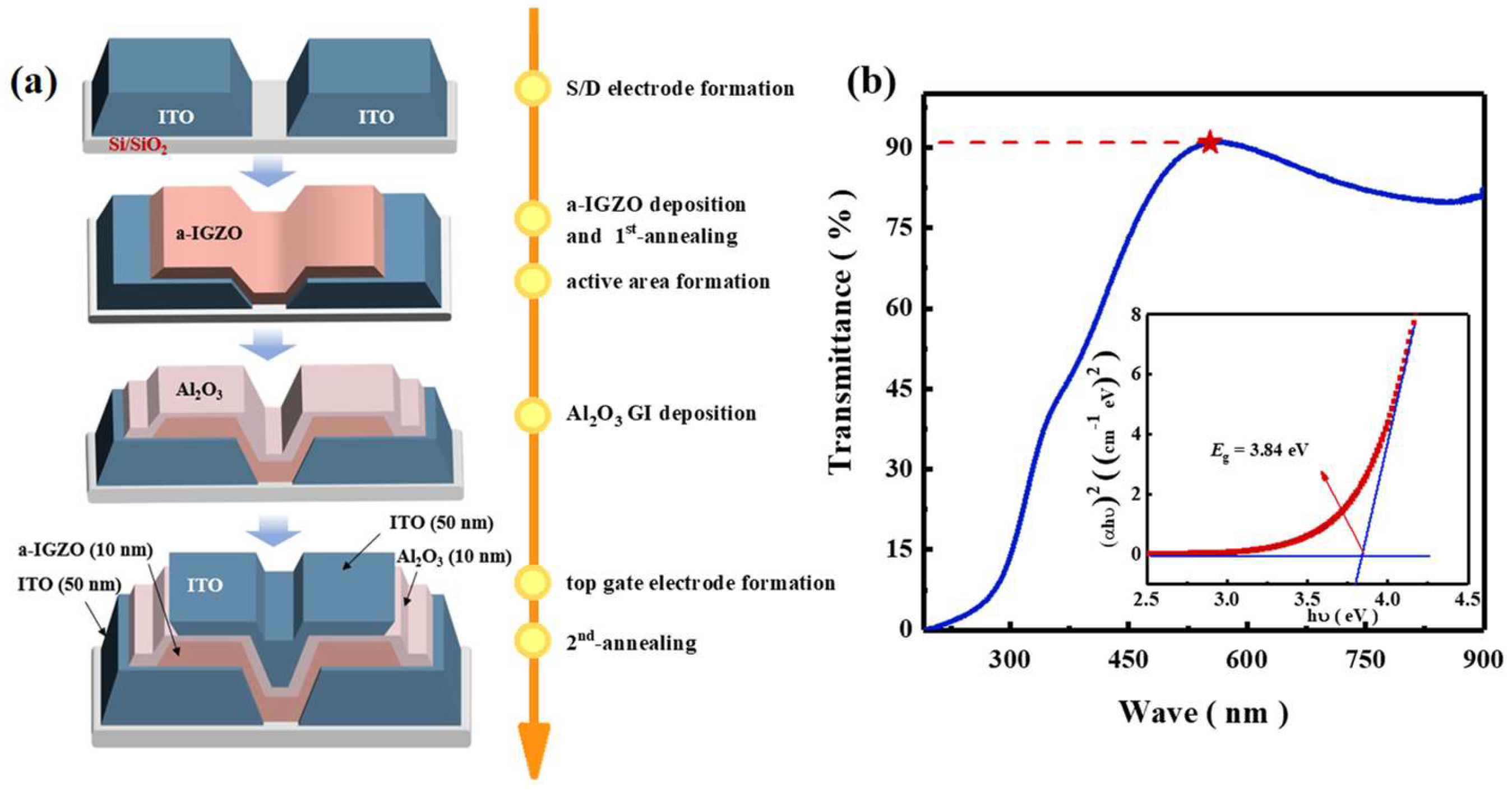
Figure 2.
(a) and (b) are transfer characteristics of TG-TFTs with different 1st -annealing treatments under VD = 0.1 V and VD = 3 V, respectively.
Figure 2.
(a) and (b) are transfer characteristics of TG-TFTs with different 1st -annealing treatments under VD = 0.1 V and VD = 3 V, respectively.
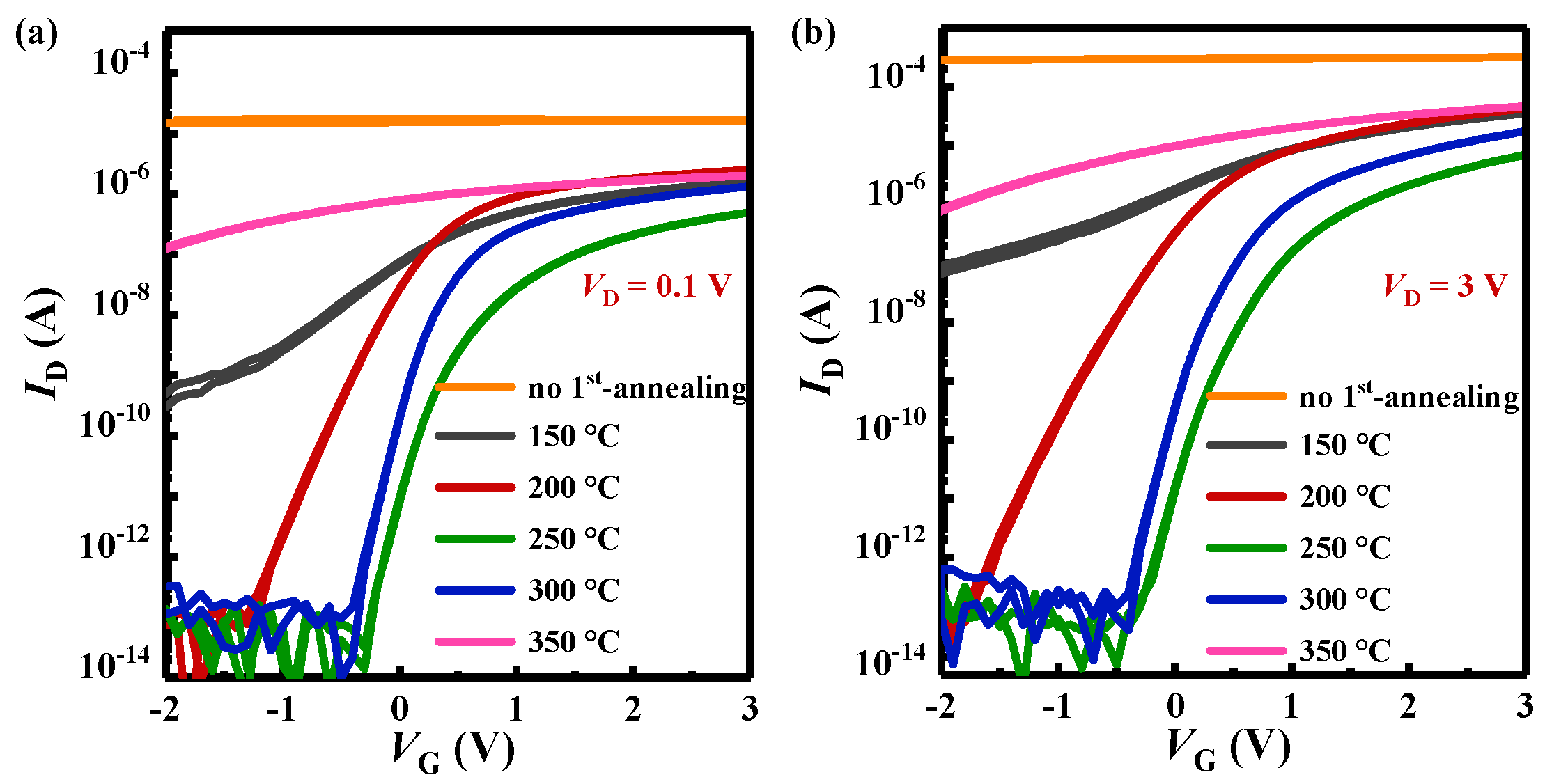
Figure 3.
PBS time evolution (under Vstress = 3 V and VD = 0.1 V at RT without illumination) of the transfer for a-IGZO TG-TFTs with 1st -annealing treatments at (a) 200°C, (b) 250°C, (c) 300°C, and (d) Vth shifts of the TG-TFTs with different 1st -annealing treatments during PBS process.
Figure 3.
PBS time evolution (under Vstress = 3 V and VD = 0.1 V at RT without illumination) of the transfer for a-IGZO TG-TFTs with 1st -annealing treatments at (a) 200°C, (b) 250°C, (c) 300°C, and (d) Vth shifts of the TG-TFTs with different 1st -annealing treatments during PBS process.
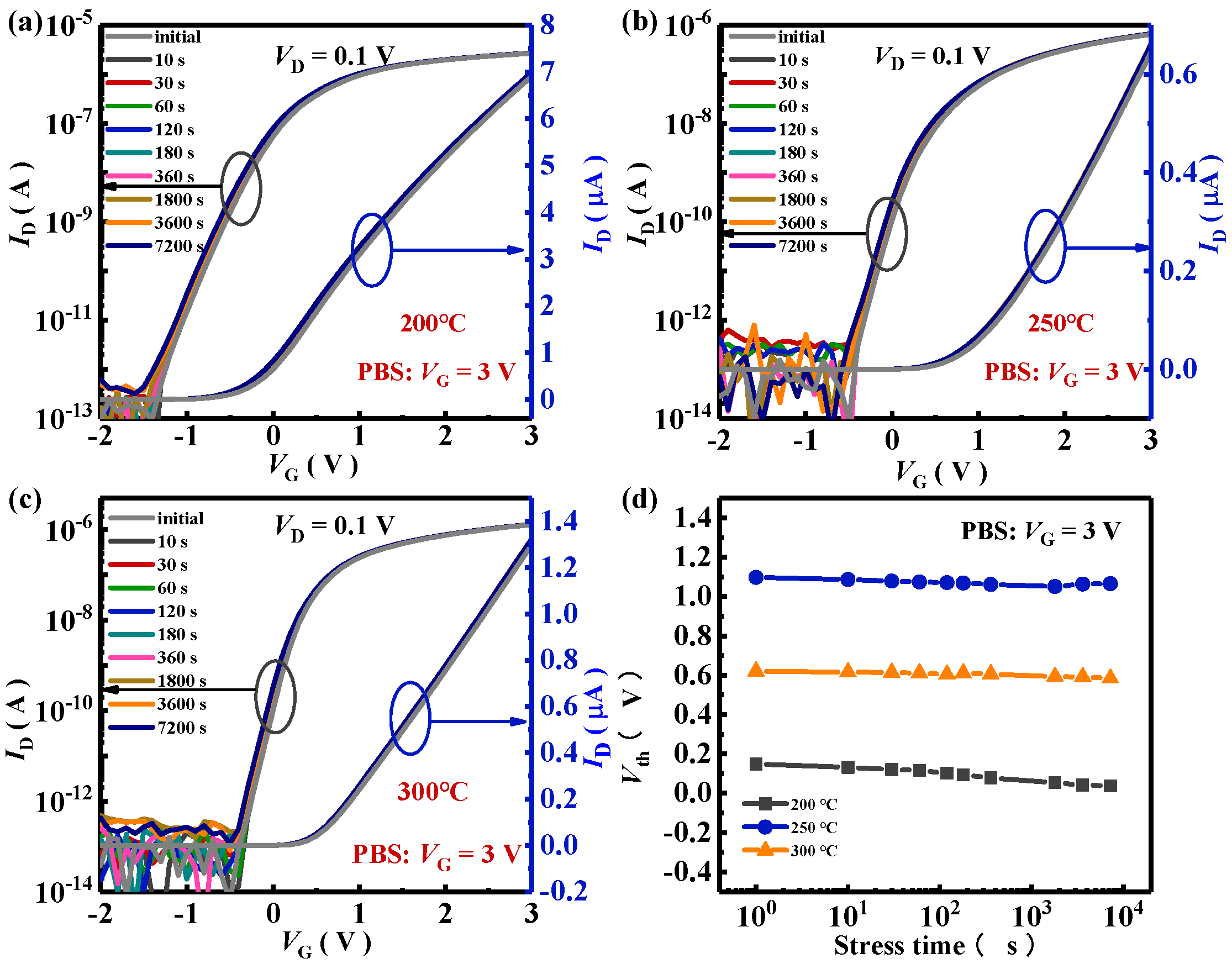
Figure 4.
NBS time evolution (under Vstress = - 3 V and VD = 0.1 V at RT without illumination) of the transfer for a-IGZO TG-TFTs with 1st -annealing treatments at (a) 200°C, (b) 250°C, (c) 300°C, and (d) Vth shifts of the TG-TFTs with different 1st -annealing treatments during NBS process.
Figure 4.
NBS time evolution (under Vstress = - 3 V and VD = 0.1 V at RT without illumination) of the transfer for a-IGZO TG-TFTs with 1st -annealing treatments at (a) 200°C, (b) 250°C, (c) 300°C, and (d) Vth shifts of the TG-TFTs with different 1st -annealing treatments during NBS process.
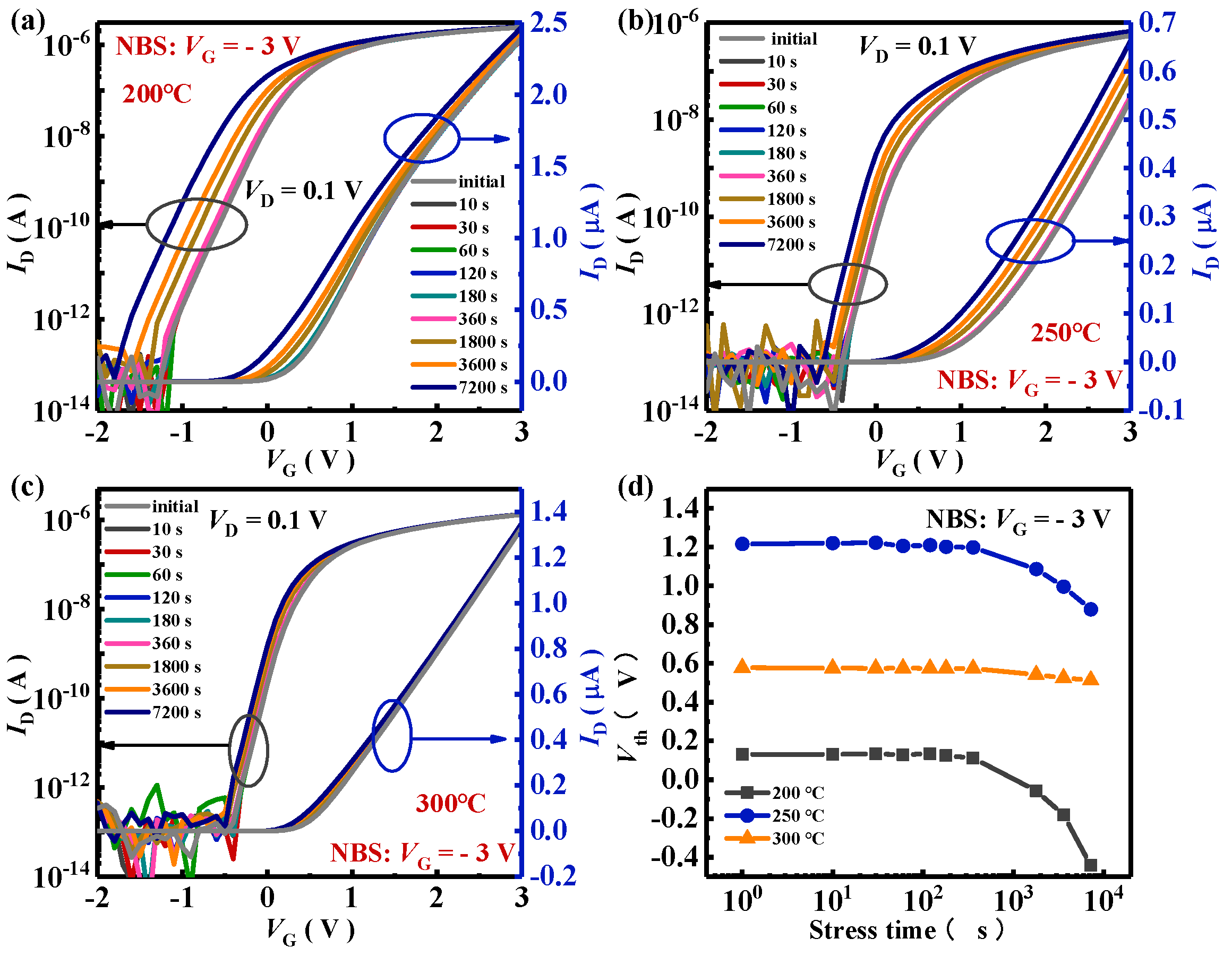
Figure 5.
PL spectra for a-IGZO films under different 1st-annealing temperature of fresh, 200°C, 250°C, and 300°C, respectively, insert is separated PL spectra at the range of 1.7-2.5 eV.
Figure 5.
PL spectra for a-IGZO films under different 1st-annealing temperature of fresh, 200°C, 250°C, and 300°C, respectively, insert is separated PL spectra at the range of 1.7-2.5 eV.
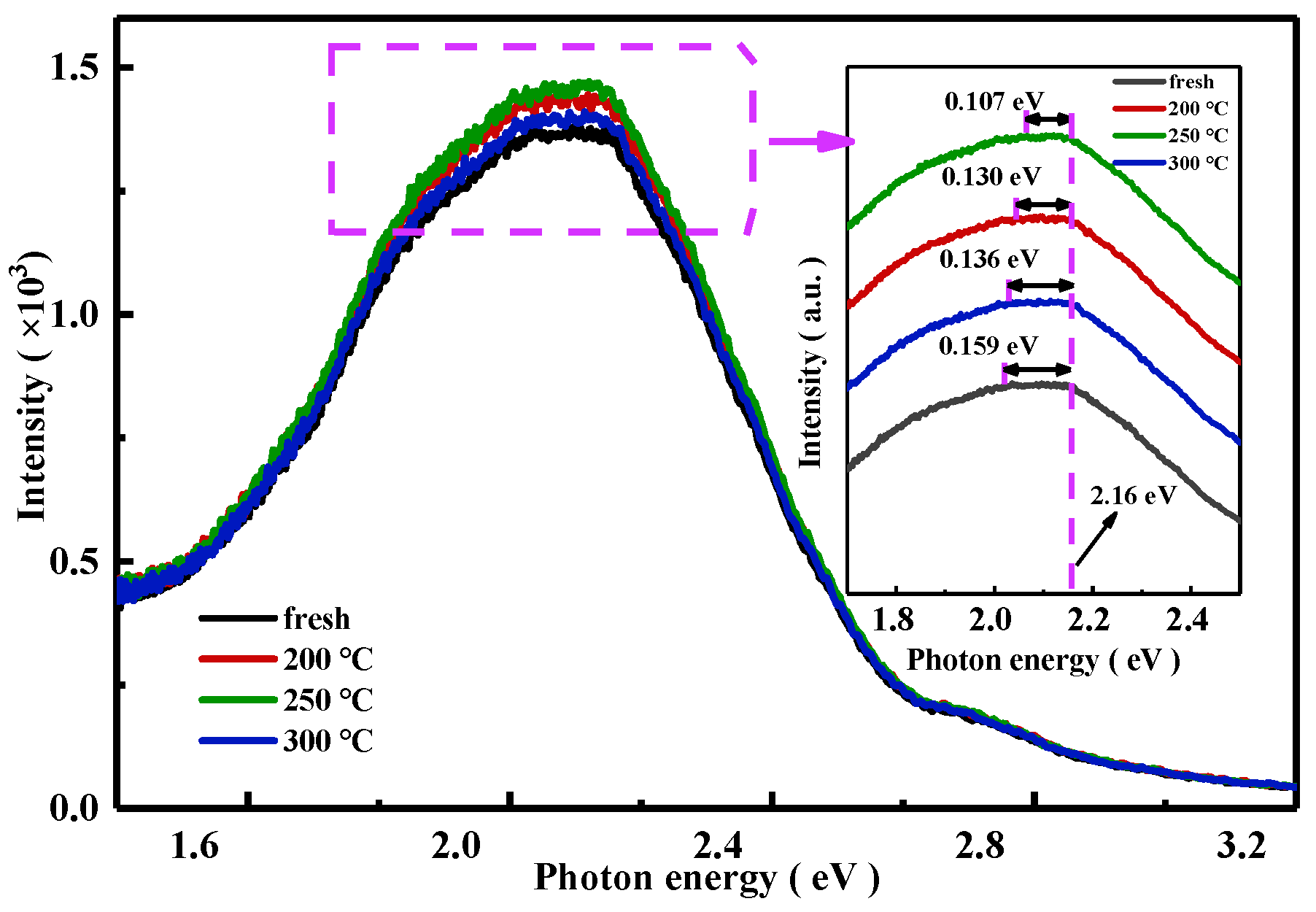
Figure 6.
(a) deconvoluted O 1s XPS profile with VO and O-M, and (b) deconvoluted Ga 3d XPS profile with Ga-Ga and Ga-O in a-IGZO films received different 1st-annealing treatments at fresh, 200°C, 250°C, and 300°C, respectively.
Figure 6.
(a) deconvoluted O 1s XPS profile with VO and O-M, and (b) deconvoluted Ga 3d XPS profile with Ga-Ga and Ga-O in a-IGZO films received different 1st-annealing treatments at fresh, 200°C, 250°C, and 300°C, respectively.
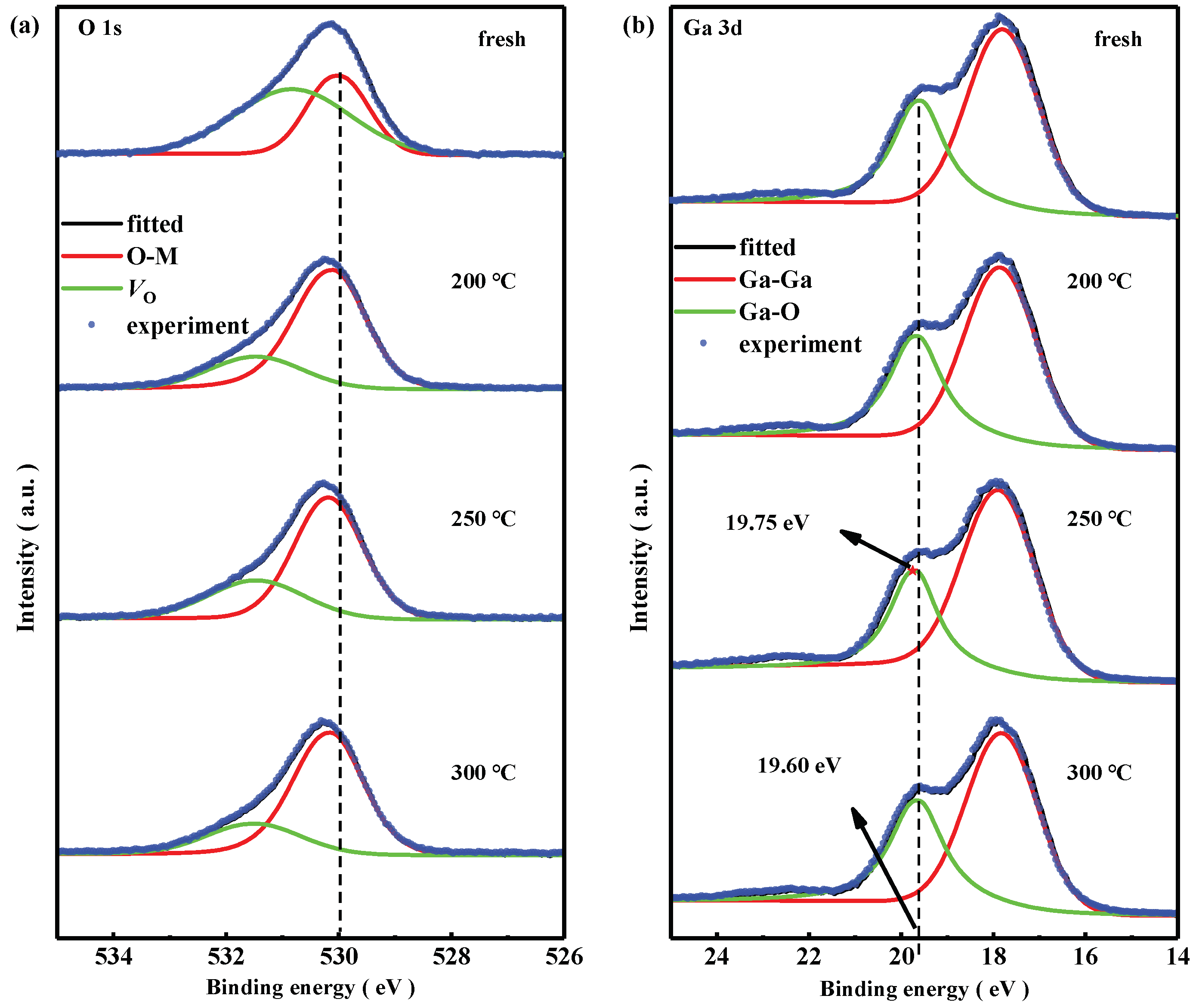
Table 2.
Bonds content percentage of IGZO films with different 1st-annealing treatments
| Annealing condition (°C) | Content (%) | |||
| VO | O-M | Ga-Ga | Ga-O | |
| fresh | 26.60 | 17.27 | 23.74 | 12.82 |
| 200 | 11.17 | 32.57 | 23.81 | 12.92 |
| 250 | 12.84 | 30.45 | 25.85 | 11.18 |
| 300 | 11.01 | 32.44 | 23.6 | 13.34 |
Disclaimer/Publisher’s Note: The statements, opinions and data contained in all publications are solely those of the individual author(s) and contributor(s) and not of MDPI and/or the editor(s). MDPI and/or the editor(s) disclaim responsibility for any injury to people or property resulting from any ideas, methods, instructions or products referred to in the content. |
© 2025 by the authors. Licensee MDPI, Basel, Switzerland. This article is an open access article distributed under the terms and conditions of the Creative Commons Attribution (CC BY) license (http://creativecommons.org/licenses/by/4.0/).
Copyright: This open access article is published under a Creative Commons CC BY 4.0 license, which permit the free download, distribution, and reuse, provided that the author and preprint are cited in any reuse.


