
Submitted:
04 February 2025
Posted:
05 February 2025
You are already at the latest version
Abstract
The pellicle is a coproduct from kombucha beverage production without economic value. This material is based on cellulose produced from bacteria and it has better physical properties than cellulose isolated from plants. This review analyzed systematically the research literature about pellicle (KBC – kombucha bacteria cellulose) valorization. In general, KBC has been used in food applications, especially as a packaging ingredient to improve the physical properties of biopolymer-based films, as well as to manufacture packaging materials based on KBC. In addition, some studies have investigated the potential of KBC to encapsulate food ingredients or as a food additive. Furthermore, KBC has been used in nonfood applications with a special interest in the development of materials for textile and medical applications, as well as to substitute disposable materials (e.g. spoons). Although the literature shows promising results, it is necessary to increase the production scale of this material, as well as to analyze its economic viability. It is also necessary to establish quality standards and international regulations for KBC with respect to its different food and nonfood applications.
Keywords:
macromolecule
; food ingredient
; packaging material
; pellicle
; SCOBY
1. Introduction
Kombucha is a carbonated beverage produced by tea fermentation from a symbiosis of bacteria and yeasts, this beverage has a slightly sweet and citrusy taste, with low alcohol content and a vinegar-like taste [1]. Kombucha was originally consumed in China, but recently this product has been commercialized worldwide due to the increase in the market and the potential health benefits associated with the presence of bioactive molecules and probiotics [2,3,4].
The kombucha production process involves two steps. Firstly, a sweet tea is produced with filtered herbal infusion where an inoculum is added (Figure 1). The fermentation time oscillates between 7 and 15 days, depending on temperature (18 – 26 ºC) [5]. Ethanol, acetic, lactic, glucuronic acids, as well as a large quantity of tea-derived polyphenols are the most common products found in kombucha tea after fermentation [6,7]. In sequence, the fermented beverage in step 1 is blended with fruit juice or another herbal infusion to flavor kombucha (Figure 1). The resulting blended beverage is packed and again fermented at the same conditions. After this second step, a flavored kombucha is obtained and commercialized under refrigeration [8].
Another product of kombucha fermentation is the pellicle (Kombucha Bacterial Cellulose – KBC, Figure 1) produced by the microbial consortium which consists of pure cellulose fibrils [9,10]. A small number of researchers have focused on the characterization and potential applications of KBC, probably because kombucha tea has high economic value and KBC is considered a residue [11]. However, KBC does not contain hemicellulose and lignin, having higher purity, degree of polymerization, and crystallinity than cellulose isolated from plants. Furthermore, materials based on KBC have better mechanical strength, water holding capacity, chemical stability, and biological adaptability than their counterparts using plant cellulose [5,12]. In addition, the processes to purify plant cellulose demand high energy consumption and has negative impacts on cellulose chains (polymer degradation) and the environment since chemical residues are discarder in the processes [13]. In this scenario, the valorization of KBC involving a circular economy concept is fundamental to the development of a sustainable industry to achieve the 2030 Agenda for Sustainable Development adopted by all United Nations has focused on the 17 Sustainable Development Goals (SDGs) [14].
Previously Laavanya et al. [5] reviewed the KBC production, its biochemical composition, and explored some potential applications. It should, however, be noted that to our current knowledge, no review paper has comprehensively analyzed and reviewed the recent advances about KBC applications. Therefore, the objective of this review was to comprehensively analyze the potentiality of KBC for industrial applications.
2. Research about kombucha bacterial cellulose
A search using the SCOPUS database revealed that the number of scientific manuscripts on “kombucha” has increased in the last 24 years (1,287 documents) (Figure 2a). A new search using the same database and the keywords “kombucha AND pellicle AND scoby” revealed 50 research papers in the last 24 years (Figure 2a). Between them, only 25 manuscripts focused on valorization and application of the pellicle obtained after kombucha production. These results confirmed that research on kombucha is an important topic with expressive publication rate in the last years, however, pellicle from kombucha has been little explored.
Analyzing the global production of scientific articles on KBC is possible to conclude that several countries are researching this topic, having India as the country that most research about BKC (22.9 %), followed by China (14.3 %), Argentina, Brazil, Iran, South Korea, and USA (5.7 5 each), and Austria, Australia, Czech Republic, Denmark, Egypt, Germany, Italy, Indonesia, Malaysia, Poland, Spain, Taiwan, and Viet Nam (2.9 % each) (Figure 2b).
3. Application of kombucha bacterial cellulose
3.1. Food applications
Packaging is important for the food processing, preservation, supply, and distribution chain. Its main function is to contain and protect food material, but it is also essential to ensure food quality and safety; while also extending shelf life and minimizing food loss and waste [15,16].
KBC has been used as an additive or as the main macromolecule to manufacture food packaging materials (Figure 3). The drying method impacts on the physicochemical properties of KBC and its application as packaging material. Dey et al. [17] investigated different drying methods on the physicochemical properties of KBC. In this research, KBC was washed with distilled water and then soaked with NaOH (0.1 N) to remove tannins and microbial residues. In sequence, cleaned KBC was dried using microwave drying (180–900 W), hot air oven drying (30–70 ºC), and shade drying (25 ºC). The authors observed that elevated temperatures and power levels during the drying processes increased the formation of inter-fiber hydrogen bonding of KBC. Therefore, elastic modulus (EM) increased from 980 to 1972 MPa as the power level increased from 180 to 900 W (microwave drying) and from 529 to 1518 MPa as the drying temperature increased from 30 ºC to 70 ºC in oven drying. In contrast, KBC with higher water absorption (≈ 55 %) values were obtained when this material was dried in oven drying at 30 ºC or in shade drying. Packaging materials must have high mechanical parameters and low water sensitivity. This research demonstrated that KBC must be dried using drying technologies (microwave and hot air oven drying) at elevated power levels and temperatures to produce dried KBC with high EM and less water absorption.
In another research, Ramírez Tapias et al. [18] studied the production of KBC (pellicle) using different herbs (black tea, green tea, yerba mate, Patagonian lavender, oregano, and fennel) and concluded that in all cultures, pellicle production resulted in a maximum after 21 days. Native pellicles from yerba mate had a remarkable antioxidant activity of 93 ± 4% of radical inhibition due to plant polyphenols, which could prevent food oxidation. Results revealed that pellicles retained natural bioactive substances preserving important physicochemical properties, essential for developing active materials in packaging applications.
Table 1 summarizes the use of KBC in packaging applications. Most researches have used KBC as a filler to reinformed biopolymer-based films manufactured by casting and extrusion (Figure 3). In these studies, the use of KBC improved mechanical, optical, and barrier properties and imparted antioxidant and antimicrobial activities in the developed materials (Table 1). However, this macromolecule also can be used as polymeric matrix to manufacture packaging materials or as an encapsulating material of bioactive molecules (e.g. anthocyanins and essential oils) in packaging applications (Table 1 and Figure 3).
Pickering emulsions utilize solid particles to stabilize the interface between the two immiscible liquids, avoiding the use of classic surfactant [28,29]. Recently, KBC has been used to stabilize O/W emulsions where this biopolymer had reduced lipid oxidation and increased emulsion stability [28,30].
Finally, KBC has been used as an additive in mango jam. The incorporation of KBC between 20 to 100 g/kg reduced water activity up to 22.2% (0.68), moisture content from 37.1% to 19.9% and pH from 5.9 to 3.2. Furthermore, texture of jam with KBC gave higher gel strength and adhesiveness. Overall acceptability in sensory test scoring was above 70% on a nine-point hedonic scale with the 40 g/kg KBC jam chosen as the most preferred [31].
3.2. Other material applications
KBC-based materials have potential nonfood applications (Figure 3). KBC has been used to develop materials with promissory industrial applications. In this way, KBC was incorporated with gold nanoparticles (AuNP), silver nanoparticles (AgNP), and graphene oxide (GO). The incorporation of nanomaterials increased glass transition (Tg = 41 → 50 ºC), tensile strength (TS 63 → 94.1 MPa) and improved hydrophobicity (WCA = 31 → 81º), probably by the formation of non-covalent interactions. Furthermore, the presence of AgNP inhibited the growth of S. aureus. Although it was not informed the nanomaterial concentration added in KBC. The authors concluded that this nanocomposite can be used as a leather-like material with antimicrobial activity [32].
In another research, Candra et al. [33] synthetized AuNPs using a composite matrix based on chitosan and KBC. The obtained nanocomposite displayed antimicrobial effect against Pseudomonas aeruginosa and Streptococcus mutans, as well as in-vivo wound healing in mice, encompassing granulation tissue formation, reepithelization, reduced inflammation, and collagen fiber formation. Based on these results, KBC incorporated with AuNPs in a suitable candidate for medical applications.
Plastic spoons contribute significantly to environmental problems because they are typically made from non-degradable polymers. With this in mind, Muralidharan et al. [34] developed multi-layered composite spoon based on KBC and gelatin. KBC was cleaned with NaOH (0.5 N) at 90 ºC for 1 h, followed by distilled water to until pH 7. Bilayer materials were produced by the layer-by-layer method where KBC and gelatin sheets were hot-pressed under a pressure of 2500 psi for 5 min at 90 ºC. The resulting materials had high tensile strength of 47.7 MPa and a flexural strength of 117.27 MPa indicating high mechanical stiffness with the least density value of 0.71 g/cm3. In another research, Nguyen et al. [35] modified KBC with different silanes (dimethyldichlorosilane, hexadecyltrimethoxysilane, vinyltriethoxysilane and 3-aminopropyltriethoxysilane) followed by mixing with polyurethane (PU) and polylactic acid (PLA). According to the authors, the optimal biocomposite formulation was KBC 13.74% w/w, PU 73.89% w/w, and PLA 12.50% w/w compressed at 155 ºC for 5 min. The KBC modification with silanes increased the WCA from 82º to 95º and reduced the water permeation through the material. In this way, WCA after 5 min was of 63º and 92º in untreated and treated KBC, respectively. Results from both studies suggest that disposable materials can be manufactured using KBC as matrix.
Aerogels are nanostructured materials with low bulk density and open porosity. Recently, they have been broadly investigated due to their capacity to load vitamins, chemical compounds and oils for food and material applications [36]. Aerogels based on KBC were produced after purification of KBC with KOH, followed by an acidic hydrolysis (H2SO4 and HCl) and lyophilization. The obtained nanofibers presented thickness between 50 and 110 nm with high crystallinity (90%) [37]. KBC aerogels also have been applied 3D bioprinting in tissue engineering [38] and as acoustic foams [39].
4. Future trends
4.1. Food and pharmaceutical applications
Future research should investigate the biodegradability and toxicity of KBC. Regarding toxicity, both kombucha tea and KBC are not toxic when produced under controlled conditions and they are considered safe for consumption and use [40]. However, they should be used in moderation due to contraindications in infants, children under 4 years old, patients with renal, hepatic, and pulmonary diseases, as well as with the human immunodeficiency virus. Furthermore, this product is not recommended for pregnant women due to the interference with the coagulation process, which may be harmful to fetal development [40]. According to the literature, continuous consumption above 355 mL may cause internal organ perforations, resulting in renal lesions and necrosis in the duodenum, pancreas, and intestines [41]. The effects associated with kombucha consumption are still unclear, requiring further investigations. Currently, the regulations in effect for kombucha production address criteria such as pH and alcohol content to ensure food safety and quality for consumers.
The production conditions of kombucha, such as the type of tea used, fermentation time, and the microbial composition of the scoby are determining factors in its physicochemical, microbiological, and bioactive properties [42,43]. There is no doubt that both kombucha and scoby contain significant bioactive compounds, including polyphenols, organic acids, amino acids, vitamins, and minerals [41]. According to the literature, the use of green tea results in a quantitatively richer microbial composition, with free amino acids, reducing sugars, and increased antiproliferative activity against cancer cell lines, attributed to the presence of catechins [42,43,44]. Kombucha based on black tea, in turn, has demonstrated greater diversity and abundance of phenolic compounds, resulting in superior antioxidant capacity, presenting 70.2% flavonoids, 18.3% phenolic acids, 8.4% other polyphenols, 2.3% lignans, and 0.8% stilbenes [44]. These findings highlight that the choice of tea significantly influences the antioxidant properties of kombucha and KBC, indicating the need to study blends and the addition of new unconventional herbs to kombucha to evaluate their overall properties.
4.2. Animal feed
In the animal feed industry, both kombucha and KBC have emerged as potential functional additives. Their biochemical composition, rich in probiotics, organic acids, and bioactive compounds, suggests significant benefits for animal nutrition, especially in the context of the growing demand for sustainable alternatives that repurpose organic waste [45]
Studies have already demonstrated these benefits in different species. Ramadhan et al. [46] supplemented the diet of catfish (Clarias sp.) with kombucha and observed a positive impact on growth, with increased weight gain, improved absolute growth rate, and better feed efficiency. These findings indicate that kombucha and KBC could be viable alternatives in formulating feed for aquatic animals. For terrestrial animals, Afsharmanesh and Sadaghi [47] investigated the use of probiotics, including kombucha, in the diet of broiler chickens. The results were promising: fermented tea exhibited growth-promoting effects comparable to traditional antibiotics, reinforcing its potential as a natural alternative in poultry farming.
In addition to lactic acid bacteria, yeasts play a fundamental role in KBC, actively participating in the fermentation of kombucha. In this context, some fungi have been studied as nutritional supplements due to their probiotic and enzymatic potential. Singh et al. [48] investigated the supplementation of white button mushrooms (Agaricus bisporus) in the diet of Penaeus vannamei (Pacific white shrimp) and observed a significant improvement in survival rate, specific growth rate, feed conversion efficiency, and protein efficiency ratio, along with increased average weight gain. These findings suggest that the presence of beneficial microorganisms in animal feed can contribute to better performance and improved nutrient absorption efficiency.
The probiotics present in kombucha play a crucial role in modulating the intestinal microbiota. Research indicates that its consumption can help balance gut microbiota in animals, promoting better digestibility and absorption of essential nutrients [49]. Additionally, antioxidant compounds such as polyphenols help reduce oxidative stress, strengthen the immune system, and increase resistance to infections, which directly impacts the physiological performance of animals [50]. These benefits, combined with the fact that the KBC, a by-product of kombucha fermentation, can be repurposed as an ingredient in animal feed, make it a promising alternative aligned with the global trend toward more sustainable and natural practices in animal nutrition [51].
Despite its great potential, more studies are still needed to validate the efficacy of kombucha on a large scale. The composition of the beverage can vary considerably due to factors such as fermentation time and the ingredients used, making standardization and the determination of ideal dosages challenging. However, with growing interest in sustainable solutions and the search for alternatives to synthetic antibiotics and additives, kombucha is likely to gain more visibility in research and the animal feed industry. Its potential to enhance animal performance and reduce environmental impact makes it a strong candidate to establish itself as a viable functional feed additive for the future of animal nutrition.
4.3. Nonfood applications
As discussed in Section 3.2, some studies have explored the use of KBC in textile, medical, and material applications. It is necessary to explore new KBC applications in these fields, such as in the production of porous materials to be used as scaffolds and adsorbents, as well as for 3D printing. Furthermore, this macromolecule can be used to manufacture disposable plates and packaging for nonfood applications. However, before an industrial application, it is necessary to establish regulatory frameworks with the intention of standardizing the physicochemical properties of this macromolecule and its production at an industrial scale.
5. Conclusions
Pellicle or kombucha bacterial cellulose (KBC) is a coproduct of the kombucha beverage production without economic value. Recent studies demonstrate that KBC has potential food and nonfood applications. KBC is composed of cellulose of high purity and it has been used to manufacture or reinforce food packaging, as well as to encapsulate active molecules or stabilize oil in water emulsions. Other applications range from the production of porous material for tissue engineering to the production of spoons. Future research studies must standardize KBC production at an industrial scale and establish international legislation about KBC. New KBC applications are expected to be explored since this material has antioxidant properties and it can be used to produce functional foods and feeds or to manufacture active materials. Furthermore, KBC can be used to produce nanocellulose and porous materials for culture meat and adsorbents.
Author Contributions
Conceptualization, GAV.; formal analysis, TRG, AFN and GAV.; writing—original draft preparation, TRG, AFN and GAV.; writing—review and editing, GAV.; visualization, GAV.; supervision, GAV.; project administration, GAV.; funding acquisition, GAV. All authors have read and agreed to the published version of the manuscript.
Funding
Please add: This research was funded by the National Council for Scientific and Technological Development (CNPq), grant number grant 302434/2022-4.
Data Availability Statement
Where no new data were created.
Acknowledgments
The author gratefully acknowledges the Federal University of Santa Catarina
Conflicts of Interest
The authors declare no conflicts of interest.
Abbreviations
The following abbreviations are used in this manuscript:
| AgNPs | Silver nanoparticles |
| AuNPs | Gold nanoparticles |
| CMC | Carboxymethyl cellulose |
| EM | Elastic modulus |
| PLA | Polylactic acid |
| PU | Polyurethane |
| TS | Tensile strength |
| SDGs | Sustainable Development Goals |
| WCA | Water contact angle |
| WVP | Water vapor permeability |
| WVTR | Water vapor transmission rate |
References
- Cavicchia, L.O.A.; Almeida, M.E.F. de Health Benefits of Kombucha: Drink and Its Biocellulose Production. Brazilian Journal of Pharmaceutical Sciences 2022, 58. [Google Scholar] [CrossRef]
- Bortolomedi, B.M.; Paglarini, C.S.; Brod, F.C.A. Bioactive Compounds in Kombucha: A Review of Substrate Effect and Fermentation Conditions. Food Chem 2022, 385, 132719. [Google Scholar] [CrossRef] [PubMed]
- Cheng, J.; Huang, S.-Y.; Xiong, R.-G.; Wu, S.-X.; Yang, Z.-J.; Zhou, D.-D.; Saimaiti, A.; Zhao, C.-N.; Zhu, H.-L.; Li, H.-B. Vine Tea Kombucha Ameliorates Non-Alcoholic Fatty Liver Disease in High-Fat Diet Fed Mice via Antioxidation, Anti-Inflammation and Regulation of Gut Microbiota. Food Biosci 2024, 62, 105400. [Google Scholar] [CrossRef]
- Kitwetcharoen, H.; Phannarangsee, Y.; Klanrit, P.; Thanonkeo, S.; Tippayawat, P.; Klanrit, P.; Klanrit, P.; Yamada, M.; Thanonkeo, P. Functional Kombucha Production from Fusions of Black Tea and Indian Gooseberry (Phyllanthus Emblica L. ). Heliyon 2024, 10, e40939. [Google Scholar] [CrossRef] [PubMed]
- Laavanya, D.; Shirkole, S.; Balasubramanian, P. Current Challenges, Applications and Future Perspectives of SCOBY Cellulose of Kombucha Fermentation. J Clean Prod 2021, 295, 126454. [Google Scholar] [CrossRef]
- Chakravorty, S.; Bhattacharya, S.; Chatzinotas, A.; Chakraborty, W.; Bhattacharya, D.; Gachhui, R. Kombucha Tea Fermentation: Microbial and Biochemical Dynamics. Int J Food Microbiol 2016, 220, 63–72. [Google Scholar] [CrossRef] [PubMed]
- Abuduaibifu, A.; Tamer, C.E. Evaluation of Physicochemical and Bioaccessibility Properties of Goji Berry Kombucha. J Food Process Preserv 2019, 43. [Google Scholar] [CrossRef]
- Villarreal-Soto, S.A.; Beaufort, S.; Bouajila, J.; Souchard, J.; Taillandier, P. Understanding Kombucha Tea Fermentation: A Review. J Food Sci 2018, 83, 580–588. [Google Scholar] [CrossRef]
- Leonarski, E.; Cesca, K.; Zanella, E.; Stambuk, B.U.; de Oliveira, D.; Poletto, P. Production of Kombucha-like Beverage and Bacterial Cellulose by Acerola Byproduct as Raw Material. LWT 2021, 135, 110075. [Google Scholar] [CrossRef]
- Leonarski, E.; Cesca, K.; Pinto, C.C.; González, S.Y.G.; de Oliveira, D.; Poletto, P. Bacterial Cellulose Production from Acerola Industrial Waste Using Isolated Kombucha Strain. Cellulose 2022, 29, 7613–7627. [Google Scholar] [CrossRef]
- El-Shall, F.N.; Al-Shemy, M.T.; Dawwam, G.E. Multifunction Smart Nanocomposite Film for Food Packaging Based on Carboxymethyl Cellulose/Kombucha SCOBY/Pomegranate Anthocyanin Pigment. Int J Biol Macromol 2023, 242, 125101. [Google Scholar] [CrossRef] [PubMed]
- Cottet, C.; Salvay, A.G.; Peltzer, M.A.; Fernández-García, M. Incorporation of Poly(Itaconic Acid) with Quaternized Thiazole Groups on Gelatin-Based Films for Antimicrobial-Active Food Packaging. Polymers (Basel) 2021, 13, 200. [Google Scholar] [CrossRef] [PubMed]
- Cerrutti, P.; Roldán, P.; García, R.M.; Galvagno, M.A.; Vázquez, A.; Foresti, M.L. Production of Bacterial Nanocellulose from Wine Industry Residues: Importance of Fermentation Time on Pellicle Characteristics. J Appl Polym Sci 2016, 133. [Google Scholar] [CrossRef]
- UN The 17 Goals. UN 2025.
- Anukiruthika, T.; Sethupathy, P.; Wilson, A.; Kashampur, K.; Moses, J.A.; Anandharamakrishnan, C. Multilayer Packaging: Advances in Preparation Techniques and Emerging Food Applications. Compr Rev Food Sci Food Saf 2020, 19, 1156–1186. [Google Scholar] [CrossRef]
- Han, J.-W.; Ruiz-Garcia, L.; Qian, J.-P.; Yang, X.-T. Food Packaging: A Comprehensive Review and Future Trends. Compr Rev Food Sci Food Saf 2018, 17, 860–877. [Google Scholar] [CrossRef] [PubMed]
- Dey, B.; Jayaraman, S.; Balasubramanian, P. Investigating the Effects of Drying on the Physical Properties of Kombucha Bacterial Cellulose: Kinetic Study and Modeling Approach. J Clean Prod 2024, 452, 142204. [Google Scholar] [CrossRef]
- Ramírez Tapias, Y.A.; Di Monte, M.V.; Peltzer, M.A.; Salvay, A.G. Bacterial Cellulose Films Production by Kombucha Symbiotic Community Cultured on Different Herbal Infusions. Food Chem 2022, 372, 131346. [Google Scholar] [CrossRef] [PubMed]
- Agüero, A.; Lascano, D.; Ivorra-Martinez, J.; Gómez-Caturla, J.; Arrieta, M.P.; Balart, R. Use of Bacterial Cellulose Obtained from Kombucha Fermentation in Spent Coffee Grounds for Active Composites Based on PLA and Maleinized Linseed Oil. Ind Crops Prod 2023, 202, 116971. [Google Scholar] [CrossRef]
- Amarasekara, A.S.; Shrestha, A.B.; Wang, D. Chemical Modifications of Kombucha SCOBY Bacterial Cellulose Films by Citrate and Carbamate Cross-Linking. Carbohydrate Polymer Technologies and Applications 2024, 8, 100595. [Google Scholar] [CrossRef]
- Ashrafi, A.; Jokar, M.; Mohammadi Nafchi, A. Preparation and Characterization of Biocomposite Film Based on Chitosan and Kombucha Tea as Active Food Packaging. Int J Biol Macromol 2018, 108, 444–454. [Google Scholar] [CrossRef]
- He, S.; Wu, Y.; Zhang, Y.; Luo, X.; Gibson, C.T.; Gao, J.; Jellicoe, M.; Wang, H.; Young, D.J.; Raston, C.L. Enhanced Mechanical Strength of Vortex Fluidic Mediated Biomass-Based Biodegradable Films Composed from Agar, Alginate and Kombucha Cellulose Hydrolysates. Int J Biol Macromol 2023, 253, 127076. [Google Scholar] [CrossRef] [PubMed]
- Li, S.; Wang, X.; Luo, Y.; Chen, Z.; Yue, T.; Cai, R.; Muratkhan, M.; Zhao, Z.; Wang, Z. A Green Versatile Packaging Based on Alginate and Anthocyanin via Incorporating Bacterial Cellulose Nanocrystal-Stabilized Camellia Oil Pickering Emulsions. Int J Biol Macromol 2023, 249, 126134. [Google Scholar] [CrossRef] [PubMed]
- Mortazavi Moghadam, F. sadat; Mortazavi Moghadam, F.A. Kombucha Fungus Bio-Coating for Improving Mechanical and Antibacterial Properties of Cellulose Composites. Mater Today Commun 2024, 40, 109609. [Google Scholar] [CrossRef]
- Patil, S. V.; Dulait, K.; Shirkole, S.S.; Thorat, B.N.; Deshmukh, S.P. Dewatering and Drying of Kombucha Bacterial Cellulose for Preparation of Biodegradable Film for Food Packaging. Int J Biol Macromol 2024, 280, 136334. [Google Scholar] [CrossRef] [PubMed]
- Qin, X.; Li, B.; Li, L.; Wang, F.; Jia, S.; Xie, Y.; Zhong, C. Cinnamon Essential Oil Pickering Emulsions: Stabilization by Bacterial Cellulose Nanofibrils and Applications for Active Packaging Films. Food Biosci 2023, 56, 103258. [Google Scholar] [CrossRef]
- Koreshkov, M.; Takatsuna, Y.; Bismarck, A.; Fritz, I.; Reimhult, E.; Zirbs, R. Sustainable Food Packaging Using Modified Kombucha-Derived Bacterial Cellulose Nanofillers in Biodegradable Polymers. RSC Sustainability 2024, 2, 2367–2376. [Google Scholar] [CrossRef]
- de Farias Nascimento, A.; Ramos, S.M.T.; Bergamo, V.N.; dos Santos Araujo, E.; Valencia, G.A. Pickering Emulsions Stabilized Using Bacterial Cellulose From Kombucha. Starch - Stärke 2024. [CrossRef]
- DENG, W.; LI, Y.; WU, L.; CHEN, S. Pickering Emulsions Stabilized by Polysaccharides Particles and Their Applications: A Review. Food Science and Technology 2022, 42. [Google Scholar] [CrossRef]
- Li, Z.; Hu, W.; Dong, J.; Azi, F.; Xu, X.; Tu, C.; Tang, S.; Dong, M. The Use of Bacterial Cellulose from Kombucha to Produce Curcumin Loaded Pickering Emulsion with Improved Stability and Antioxidant Properties. Food Science and Human Wellness 2023, 12, 669–679. [Google Scholar] [CrossRef]
- Chong, A.Q.; Chin, N.L.; Talib, R.A.; Basha, R.K. Application of Scoby Bacterial Cellulose as Hydrocolloids on Physicochemical, Textural and Sensory Characteristics of Mango Jam. J Sci Food Agric 2025, 105, 285–293. [Google Scholar] [CrossRef]
- Ayyappan, V.G.; Vhatkar, S.S.; Bose, S.; Sampath, S.; Das, S.K.; Samanta, D.; Mandal, A.B. Incorporations of Gold, Silver and Carbon Nanomaterials to Kombucha-Derived Bacterial Cellulose: Development of Antibacterial Leather-like Materials. Journal of the Indian Chemical Society 2022, 99, 100278. [Google Scholar] [CrossRef]
- Candra, A.; Ahmed, Y.W.; Kitaw, S.L.; Anley, B.E.; Chen, K.-J.; Tsai, H.-C. A Green Method for Fabrication of a Biocompatible Gold-Decorated-Bacterial Cellulose Nanocomposite in Spent Coffee Grounds Kombucha: A Sustainable Approach for Augmented Wound Healing. J Drug Deliv Sci Technol 2024, 94, 105477. [Google Scholar] [CrossRef]
- Muralidharan, V.; Jebathomas, C.R.T.; Sundaramoorthy, S.; Madhan, B.; Palanivel, S. Preparation and Evaluation of Novel Biodegradable Kombucha Cellulose-Based Multi-Layered Composite Tableware. Ind Crops Prod 2024, 215, 118629. [Google Scholar] [CrossRef]
- Nguyen, H.T.; Saha, N.; Ngwabebhoh, F.A.; Zandraa, O.; Saha, T.; Saha, P. Silane-Modified Kombucha-Derived Cellulose/Polyurethane/Polylactic Acid Biocomposites for Prospective Application as Leather Alternative. Sustainable Materials and Technologies 2023, 36, e00611. [Google Scholar] [CrossRef]
- Manzocco, L.; Mikkonen, K.S.; García-González, C.A. Aerogels as Porous Structures for Food Applications: Smart Ingredients and Novel Packaging Materials. Food Structure 2021, 28, 100188. [Google Scholar] [CrossRef]
- Bergottini, V.M.; Bernhardt, D. Bacterial Cellulose Aerogel Enriched in Nanofibers Obtained from Kombucha SCOBY Byproduct. Mater Today Commun 2023, 35, 105975. [Google Scholar] [CrossRef]
- Bhattacharyya, A.; Heo, J.; Priyajanani, J.; Kim, S.H.; Khatun, M.R.; Nagarajan, R.; Noh, I. Simultaneous Processing of Both Handheld Biomixing and Biowriting of Kombucha Cultured Pre-Crosslinked Nanocellulose Bioink for Regeneration of Irregular and Multi-Layered Tissue Defects. Int J Biol Macromol 2024, 282, 136966. [Google Scholar] [CrossRef]
- Mehrotra, N.; Bhuvana, T.; Tiwari, A.; Chandraprakash, C. Aerogel-like Biodegradable Acoustic Foams of Bacterial Cellulose. J Appl Polym Sci 2024, 141. [Google Scholar] [CrossRef]
- Silva, K.A.; Uekane, T.M.; Miranda, J.F. de; Ruiz, L.F.; Motta, J.C.B. da; Silva, C.B.; Pitangui, N. de S.; Gonzalez, A.G.M.; Fernandes, F.F.; Lima, A.R. Kombucha Beverage from Non-Conventional Edible Plant Infusion and Green Tea: Characterization, Toxicity, Antioxidant Activities and Antimicrobial Properties. Biocatal Agric Biotechnol 2021, 34, 102032. [Google Scholar] [CrossRef]
- Cavicchia, L.O.A.; Almeida, M.E.F. de Health Benefits of Kombucha: Drink and Its Biocellulose Production. Brazilian Journal of Pharmaceutical Sciences 2022, 58. [Google Scholar] [CrossRef]
- Jakubczyk, K.; Kałduńska, J.; Kochman, J.; Janda, K. Chemical Profile and Antioxidant Activity of the Kombucha Beverage Derived from White, Green, Black and Red Tea. Antioxidants 2020, 9, 447. [Google Scholar] [CrossRef] [PubMed]
- Jakubczyk, K.; Łopusiewicz, Ł.; Kika, J.; Janda-Milczarek, K.; Skonieczna-Żydecka, K. Fermented Tea as a Food with Functional Value—Its Microbiological Profile, Antioxidant Potential and Phytochemical Composition. Foods 2023, 13, 50. [Google Scholar] [CrossRef]
- Cardoso, R.R.; Neto, R.O.; dos Santos D’Almeida, C.T.; do Nascimento, T.P.; Pressete, C.G.; Azevedo, L.; Martino, H.S.D.; Cameron, L.C.; Ferreira, M.S.L.; Barros, F.A.R. de Kombuchas from Green and Black Teas Have Different Phenolic Profile, Which Impacts Their Antioxidant Capacities, Antibacterial and Antiproliferative Activities. Food Research International 2020, 128, 108782. [Google Scholar] [CrossRef] [PubMed]
- Villarreal-Soto, S.A.; Beaufort, S.; Bouajila, J.; Souchard, J.; Taillandier, P. Understanding Kombucha Tea Fermentation: A Review. J Food Sci 2018, 83, 580–588. [Google Scholar] [CrossRef] [PubMed]
- Ramadhan, H.U.; Prayogo; Kenconojati, H.; Rahardja, B.S.; Azhar, M.H.; Budi, D.S. Potential Utilization of Kombucha as a Feed Supplement in Diets on Growth Performance and Feed Efficiency of Catfish (Clarias Sp.). IOP Conf Ser Earth Environ Sci 2021, 679, 012070. [CrossRef]
- Afsharmanesh, M.; Sadaghi, B. Effects of Dietary Alternatives (Probiotic, Green Tea Powder, and Kombucha Tea) as Antimicrobial Growth Promoters on Growth, Ileal Nutrient Digestibility, Blood Parameters, and Immune Response of Broiler Chickens. Comp Clin Path 2014, 23, 717–724. [Google Scholar] [CrossRef]
- Singh, P.; Tank, P.R.; Janbandhu, S.; Motivarash, Y. Ffect of supplementation of white button mushroom, agaricus bisporus (imbach, 1946) on growth performance and survival in white leg shrimp, litopenaeus vannamei (BOONE, 1931). J. Exp. Zool. India 2022, 25, 2521–2528. [Google Scholar]
- Wolfe, B.E.; Dutton, R.J. Fermented Foods as Experimentally Tractable Microbial Ecosystems. Cell 2015, 161, 49–55. [Google Scholar] [CrossRef] [PubMed]
- Ivanišová, E.; Meňhartová, K.; Terentjeva, M.; Harangozo, Ľ.; Kántor, A.; Kačániová, M. The Evaluation of Chemical, Antioxidant, Antimicrobial and Sensory Properties of Kombucha Tea Beverage. J Food Sci Technol 2020, 57, 1840–1846. [Google Scholar] [CrossRef] [PubMed]
- Vīna, I.; Semjonovs, P.; Linde, R.; Deniņa, I. Current Evidence on Physiological Activity and Expected Health Effects of Kombucha Fermented Beverage. J Med Food 2014, 17, 179–188. [Google Scholar] [CrossRef]
Figure 1.
Kombucha production flowchart.
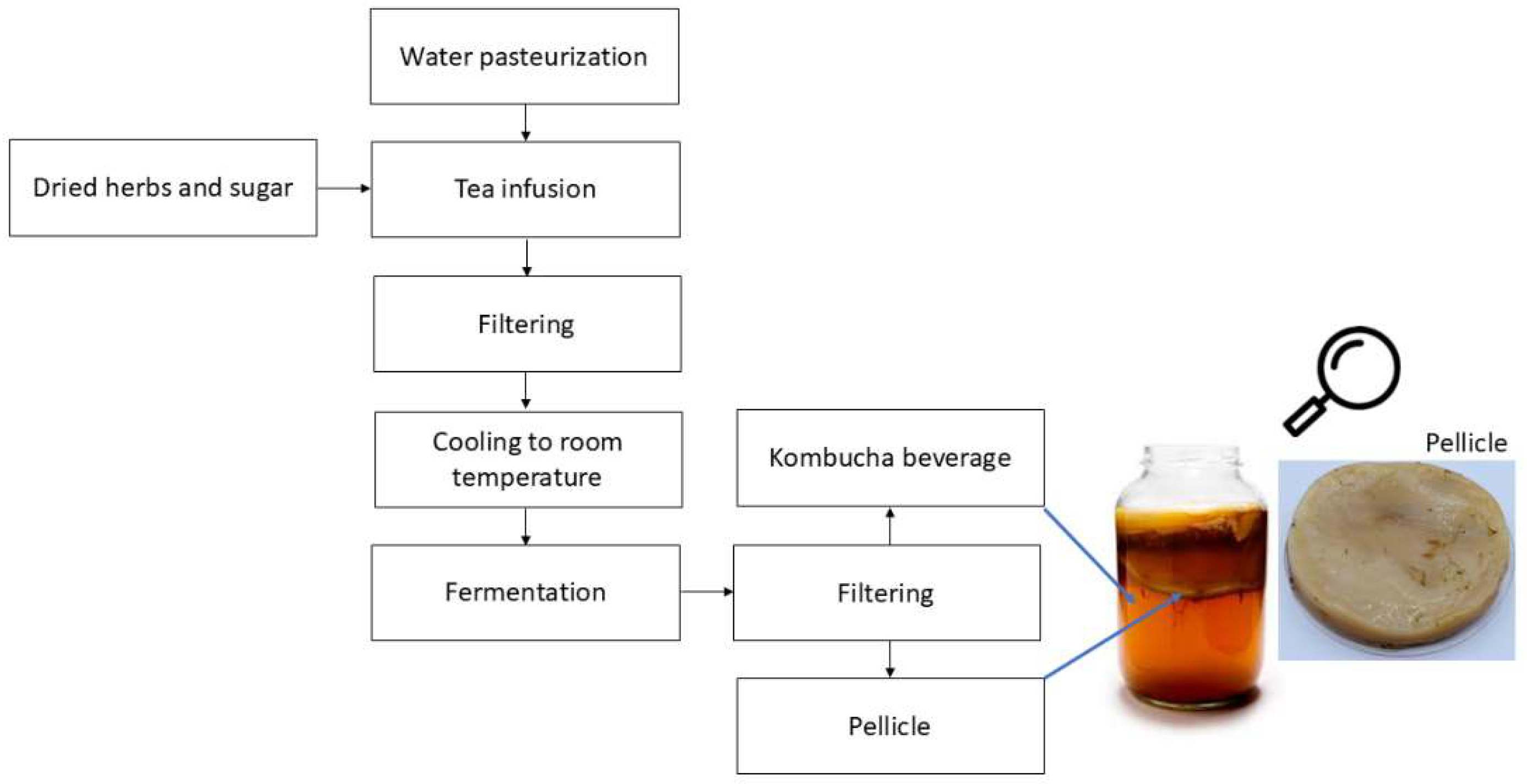
Figure 2.
(a) A search of the SCOPUS database for scientific production using the keywords “kombucha” versus “kombucha AND pellicle AND scoby” between the years 2000 and 2024; (b) Global production of scientific articles on kombucha bacterial cellulose. The world map was made using MapChart (https://www.mapchart.net/).
Figure 2.
(a) A search of the SCOPUS database for scientific production using the keywords “kombucha” versus “kombucha AND pellicle AND scoby” between the years 2000 and 2024; (b) Global production of scientific articles on kombucha bacterial cellulose. The world map was made using MapChart (https://www.mapchart.net/).
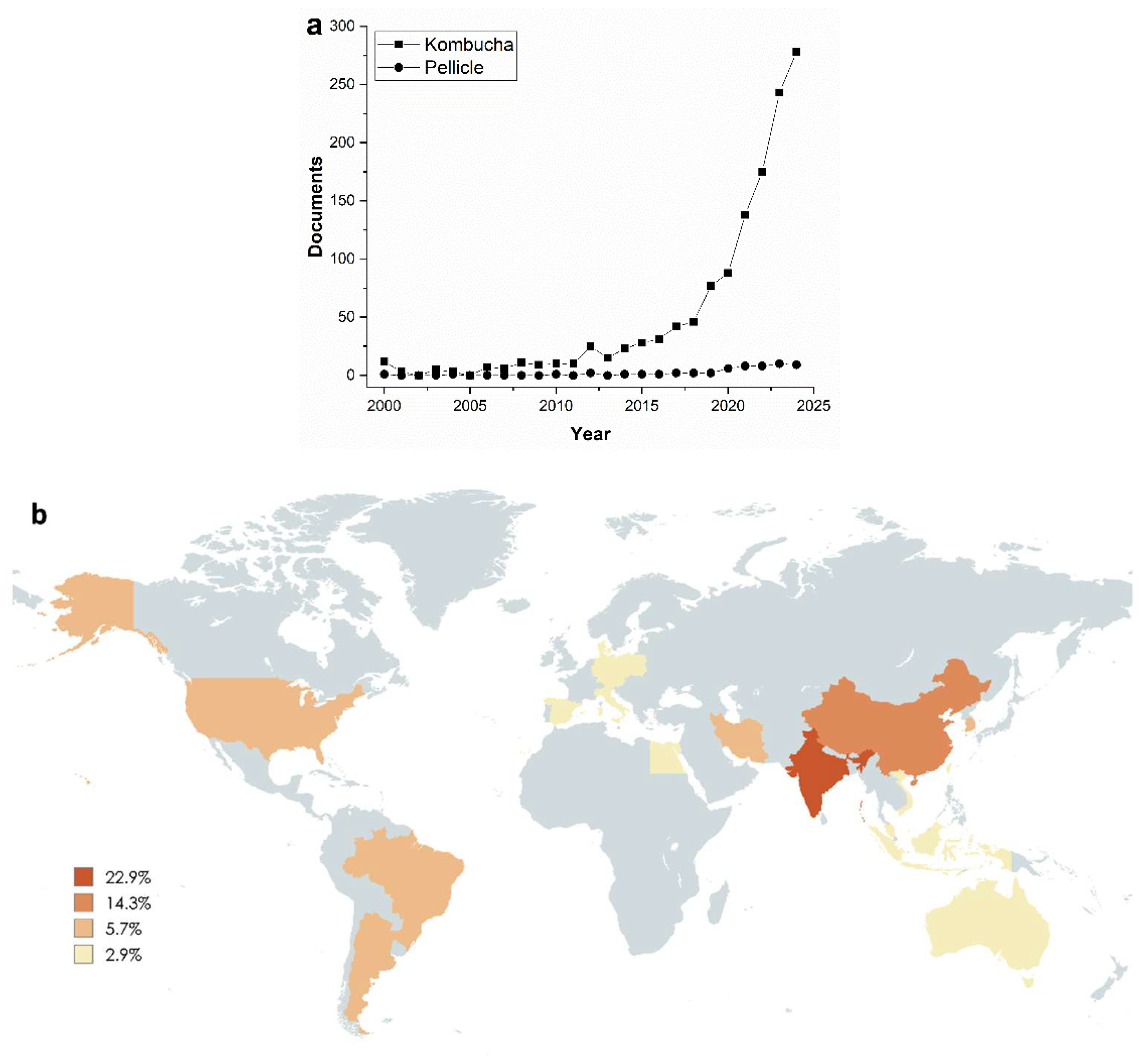
Figure 3.
Main food and nonfood kombucha bacterial cellulose applications.
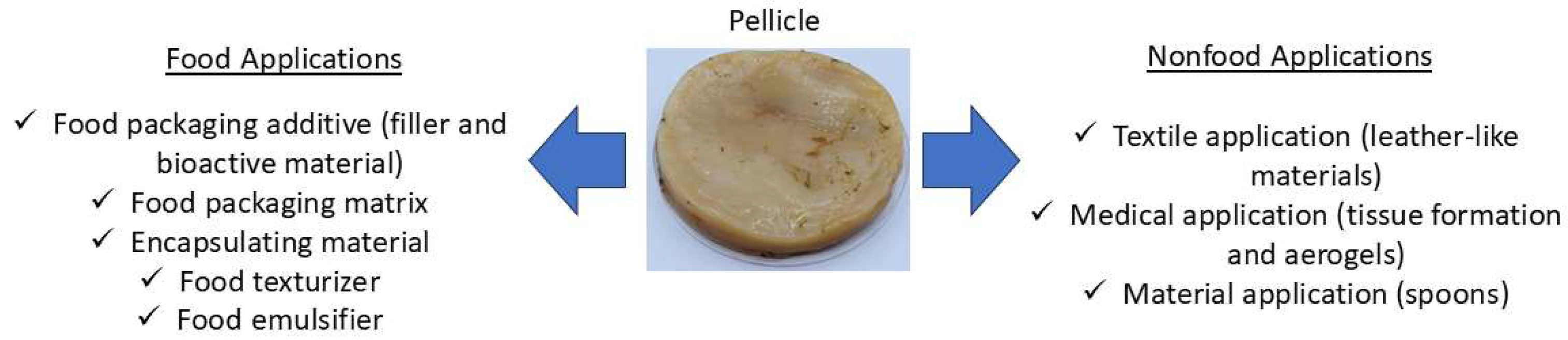

Table 1.
Application of kombucha bacterial cellulose (KBC) in food packaging materials.
| Polymeric matrix and ingredients | KBC application and treatment | Production method | Major findings | Ref. |
|---|---|---|---|---|
| CMC and anthocyanins extract |
KBC was used as a filler (1 – 15 wt%). KBC was cleaned with deionized water and sodium hydroxide (1 M), and dried at 50 ºC for 20 h | Casting method at 40 ºC for 18 h | The incorporation of KBC increased TS from 1.28 to 18.51 MPa and improved UV-barrier (200 – 400 nm) properties in CMC films containing anthocyanin extract. Films incorporated with KBC increased red grapes and plums' shelf life by up to 25 days | [11] |
| PLA plasticized with maleinized linseed oil |
KBC was used as a filler (3 – 5 wt%). KBC was sterilized, cut into small pieces, and dispersed in deionized water in a 1:2 proportion. Dispersions were homogenized in 4 cycles of 30 s at 30,000 rpm by using an Ultra-turrax. Finally, KBC wad dried at 60 ⁰C for 2 days | Films were produced using a conical twin-screw microextruder. The temperature profile was set up at 195–190–190 ⁰C in the three extrusion areas and screw speed was established at 25 rpm. Formulations were mixed during 3 min. The die temperature was set up at 180 ⁰C and the film drawing speed at 1200 mm/min. Films with a thickness of 100–200 μm were obtained | The incorporation of KBC produced a reduction of film transparency and reduced the transmittance in the UV region of the spectra. Furthermore, EM (1308 → 1639 MPa) and TS (13 → 31 MPa) increased with 5 wt% KBC. Unfortunately, WVTR increased from 82 → 116 g/m2·day with KBC incorporation | [19] |
| KBC | KBC was used as the polymeric matrix. KBC was washed with deionized water (2 ×1.0 L) and pat dried with Kleenex tissues. In sequence, KBC was purified by immersion into a NaOH solution at 90 ºC for 1.0 h. Finally, KBC was dried at 50 ºC for 20 h to obtain films. Finally, films were modified using citric acid and carbamate groups | Films were produced by the casting method at room temperature for 24 h |
Citric acid cross-linking resulted a decrease in TS (25.3 → 7.8 MPa). Whereas carbamate cross-linking with hexamethylene, toluene, methylene di-p-phenyl and 4,4′-methylene-bis(cyclohexyl) linking groups by treatments with corresponding diisocyanates resulted improvements in TS (25.3 → 44.1 ± 7.1 MPa), thermal stability (Tonset 215 → 281.5 ± 33.5 ºC) and reduction in water retention (100 → 60 ± 20 %) properties in KBC films |
[20] |
| Chitosan | KBC was used as a filler (1 – 3 wt%). No kombucha treatment was reported by the authors | Casting method at 50 ºC for 24 h | The incorporation of KBC reduced WVP from 256.7 to 132.1 g·mm/cm2·h·KPa and enhanced the antioxidant activity (59% DPPH), and the protective effect of the film against ultra violet. Furthermore, active films reduced lipid oxidation and microbial growth in minced beef during storage | [21] |
| Agar and alginate | KBC was used as a filler (2.5 wt%). KBC was cleaned by stirring distilled water for 48 h, filtered, and then heated at 50 ºC for 12 h with 1 M NaOH, followed by 1 h treatment with 1 % glacial acetic acid. KBC was washed with distilled water until the pH reached 7. Finally, KBC was freeze-dried. KBC was treated enzymatically with cellulase | Casting method at 45 ºC for 20 h | TS of control films (agar and alginate) decreased from 9.98 MPa to 7.69 MPa with the incorporation of unhydrolyzed KBC, however, TS increased to 18.18 MPa when KBC was incorporated into the polymeric matrix. This result was due to the better uniformity and particle size distribution of KBC | [22] |
| Alginate and anthocyanins | KBC was used as encapsulating material (0.1 – 0.4 wt%). KBC was ground with a crusher for 4 min at 8000 rpm and then centrifuged at 6000 rpm for 10 min. KBC was hydrolyzed using a 50 % (w/v) sulfuric acid solution in a water bath at 45 ºC for 6 h, followed by cleaning with ultra-pure water, centrifugation, and filtering. Hydrolyzed KBC was dialyzed and freeze-dried | Casting method at 45 ºC for 20 h. Oil in water (O/W) Pickering emulsions were produced with camelia oil, water, and KBC as emulsifier, using an ultrasonic dispersion method |
The incorporation of Pickering emulsions containing KBC increased TS from 12 to 33 MPa, reduced transmittance at 280 nm (52 → 3 %) and 660 nm (70 → 5 %), and increased WCA from 31 to 63º. Films containing Pickering emulsions displayed antioxidant activity | [23] |
| KBC | KBC was used as the polymer matrix. KBC was crushed in sterile deionized water and then homogenized at 10,000 rpm by Ultra-Turrax | N.i. | Materials based on KBC had elongation at break of 2 % and antimicrobial activity against S. aureus and E. coli | [24] |
| KBC, KBC and glycerol or KBC with chitosan | KBC was used as the polymer matrix. KBC was cleaned with NaOH (2 M) at 90 ºC for 2 h, and then washed with deionized water 5–6 times. In sequence, KBC was treated with NaClO (2 M) at room temperature for 2 h and finally washed with deionized water for 1 h | Films were produced by drying KBC with hot air (temperature not informed). Furthermore, KBC was immersed in glycerol of chitosan solutions for 10 min at room temperature, followed by drying to obtain KBC plasticized with glycerol and composite KBC/chitosan films | The incorporation of glycerol and chitosan increased film thickness (45 → 130 μm), density (6 → 15 g/m2), and TS (50 → 110 MPa). KBC, KBC with glycerol, and KBC/chitosan films extended the shelf life of tomatoes by 12, 13, and 15 days when compared with uncoated tomatoes (7 days) | [25] |
| Gelatin | KBC was used as the encapsulating material (0.1 – 1 wt%). KBC was cleaned with NaOH (0.1 M) and then washed with distilled water | O/W Pickering emulsions were produced with cinnamon essential oil and KBC. Gelatin films were produced by the casting method with 1 – 12 % of Pickering emulsions. Films were dried at 25 ºC for 48 h | Gelatin films containing 1% of Pickering emulsion had yellow color, homogeneous visual aspect, and antibacterial activities against S. aureus and E. coli | [26] |
| PLA and PHBV | KBC was used as a filler (5 wt%). KBC was homogenized with distilled water at 25000 rpm and treated by adding NaOH to the dispersion. The resulting mixture was centrifuged, washed, and freeze dried | Films were produced by extrusion (twin-screw microextruder) at 180 ºC and 100 rpm for 2 min | Mechanical properties of PLA (EM ≈ 1.7 GPa, TS ≈ 61 MPa, and EB ≈ 4.2 %) and PHBV (EM ≈ 2.2 GPa, TS ≈ 31 MPa, and EB ≈ 9.0 %) were not altered with the incorporation of KB, however, the film biodegradability increased with the incorporation of KBC. Furthermore, KBC incorporation resulted in a ∼23 % and ∼45 % decrease in O2 permeability for PLLA and PHBV, respectively | [27] |
CMC: Carboxymethyl cellulose; DPPH: 2,2-diphenyl-1-picryl-hydrazyl-hydrate; EM: elastic modulus; N.i.: not informed; PLA: Polylactic acid; TS: tensile strength UV: ultraviolet; WVP: water vapor permeability; WVTR: water vapor transmission rate.
Disclaimer/Publisher’s Note: The statements, opinions and data contained in all publications are solely those of the individual author(s) and contributor(s) and not of MDPI and/or the editor(s). MDPI and/or the editor(s) disclaim responsibility for any injury to people or property resulting from any ideas, methods, instructions or products referred to in the content. |
© 2025 by the authors. Licensee MDPI, Basel, Switzerland. This article is an open access article distributed under the terms and conditions of the Creative Commons Attribution (CC BY) license (http://creativecommons.org/licenses/by/4.0/).
Copyright: This open access article is published under a Creative Commons CC BY 4.0 license, which permit the free download, distribution, and reuse, provided that the author and preprint are cited in any reuse.


