Preprint
Article

This version is not peer-reviewed.

Merkel Cell Carcinoma of the Skin: Deducing the Pattern of Spread from an International Aggregated Database of 303 Patients

A peer-reviewed article of this preprint also exists.

Submitted:

05 February 2025

Posted:

05 February 2025

You are already at the latest version

Abstract

Background: There is controversy if Merkel cell carcinomas (MCCs) spread to lymph nodes or distant metastases (DM) first. Methods: Data from six institutions (March 1982 to Feb 2015) formed an aggregated database of 303 patients. The primary outcome was recurrence patterns. Results: (a) More patients presented with lymph node metastases (LNM) than DM, 19.5% (59/303) versus 2.6% (8/303). (b) 26.1% (79/303) had lifetime DM, of whom 47/79 also developed LNM: 31/47 (66%) prior to DM. (c) A shorter median time interval of 1.5 (range: 0-47.0) months from initial diagnosis to LNM; and 8 (0-107.8) months from diagnosis to DM. Another additional observation was 7/79 patients with initial primaries <1 cm in maximum dimension developed DM in their lifetime, the smallest being 0.2 cm. Conclusions: Three observations favor prior LNM giving rise to subsequent DM as the main pathway of dissemination in MCC. These observations are especially important in developing countries with inadequate staging resources for patient management. Even small MCCs <1 cm in maximum dimension, including a 0.2 cm primary, can metastasize. Therefore, we believe this report might be practice-changing since some thought these small primaries do not require any adjuvant therapy.

Keywords: 
;  ;  ;  ;  ;  

1. Introduction

Merkel cell carcinoma (MCC), a rare skin cancer, has a natural history of developing early distant metastases (DM) [1,2,3]. Primary MCCs appear most frequently in sites with sun-exposure: 44% on the head and neck, 28% on the leg, 16% on the arm and 9% on the buttock. The rate of DM developing from a head and neck located MCC was 36% in a report from the M. D. Anderson Cancer Center, which has the largest experience of MCC in the world [4].
Numerous large studies have documented conflicting results as to whether lymph node metastasis (LNM) is the initial and the most frequent site of recurrence. Queirolo, et al. reported that MCC tends to recur locally in 30%, as LNM in 50-65%, and as DM in 28-40% of patients [5]. Veness, et al. identified 36 published studies from 1997 to 2015 comprising 692 clinically node negative patients; all underwent sentinel lymph node biopsy (SLNB) [6]. By adding 29 patients treated at Westmead Hospital, Sydney, this cohort of 721 cases had a 29.6% positive SLNB rate. More DM were identified after a positive SLNB than negative SLNB (17.6% vs. 7.3%, P<0.001).
In the Loma Linda University Medical Center experience, LNM was the first site of recurrence in 60% of cases, hence preceding the appearance of DM [7]. The authors suggested that SLNB and radiotherapy and/or node dissection may improve outcome by decreasing DM. However, the report from the Massachusetts General Hospital which included 161 patients of different stages showed that the first site of recurrence was distant in 52% of patients, nodal in 27% and local in 21% [8]. DM occurred in 9% of all patients, with 0% 5-year cause-specific survival. Recurrence occurred in 56% of the 161 patients after a positive SLNB and 39% of patients with a negative SLNB. Half of these patients recurred at a median time of 9 months [8].
Due to controversies in the literature, we sought to document the pattern of recurrence as the primary objective, by building our own database. Data were collected by seven co-authors from three countries. The aggregated database enabled the collection of a large dataset as MCC is a rare tumor, to gather enough patients for analysis. Our eventual goal was to identify the group(s) who may potentially benefit the most from neoadjuvant or adjuvant systemic therapy, such as nivolumab. In 2023, the adjuvant immunotherapy with nivolumab versus observation in completely resected MCC (ADMEC-O) trial demonstrated that adjuvant nivolumab increased the disease-free survival (DFS) although the overall survival (OS) result is still immature [9].

2. Materials and Methods

Patient data from six jurisdictions from France, Canada and Australia were collected retrospectively from both paper and electronic charts. A Microsoft excel datasheet was designed. There were no exclusion criteria for patients. The following were compiled for patients after ethics approval: baseline information of age, sex, initial clinical and pathological stages, site, time delay before seeing doctors, other concurrent tumor(s), maximum dimension of the primary tumor, LNM and DM, histological details, history of immunosuppression/co-morbidities/previous radiotherapy. We recorded the treatment(s) received: surgery (e.g., Mohs microsurgery, nodal dissection or excision alone, and resection margin), radiotherapy (doses, field coverage, response), chemotherapy (specific chemotherapy drugs, number of cycles, response) and outcome such as recurrence (timing, site and subsequent treatments), and final disease status. To our knowledge, this MCC database is one of the most comprehensive in the literature. MCC polyomavirus status was not included due to non-availability at the time of study. Follow-up timing varied among the three countries and was per judgement of each clinician according to the assessed recurrence risk since no recommended internationally accepted follow-up guidelines were available at the time of the study.

2.1. Statistical Analysis

Pattern of recurrence was analyzed as the primary outcome, with survival rate as a secondary outcome. CSS was defined as the time interval from diagnosis to death from MCC, or censored at the last follow-up date if the patient was still alive at the time of analysis. OS was defined as the time interval from diagnosis to death regardless of the cause, or last follow-up date for censoring as described above. Kaplan-Meier method was used to generate survival curves [10]. Cox-Proportional Hazards model was used to identify risk factors for DM [11].

3. Results

303 patients presented to our respective cancer centers in Canada, France and Australia, from March 1982 to Feb 2015. No patients were excluded. They were staged accordingly by computerized axial tomography (CT) imaging, with or without bone scans. Positron emission tomography (PET) imaging was ordered for selected patients. The median FU was 21.8 (range, 0.5-264.8) months. The head and neck were the primary site of disease in 44.3% (35/79) of patients; limbs, 36.7% (29/79); and body, 21.5% (17/79, see Table 1). Ten percent (8/79) of patients presented as LNM with an unknown primary. The median dimension of the primary was 2.5 cm (range, 0.2-17.0 cm); and 8.9% (7/79) were <1 cm in size, the smallest being 0.2 cm.
The data on patterns of spread were noted below: (a) A total of 59/303 (19.5%) patients presented with LNM, but only 3/303 (1.0%) with DM. The above patient number included one patient who presented with both LNM and DM at the same time. In five patients the sequence of developing LNM and DM was unclear. (b) Altogether 79/303 (26.1%) patients developed DM within their lifetime, the focus of this study (Table 1). Among these 79 patients with DM, 47/79 (59.4%) also developed LNM at different times: 31/47 (66.0%) before DM, 10/47 (21.3%) within a month of DM, and 1/47 (2.2%) after DM diagnosis. (c) The median time between self-discovery of skin spot(s) and first doctor’s visit was 3.0 months (range, 0.5-36.0 months). The median time from cancer diagnosis to LNM was 1.5 months (range, 0-47.0 months); and from cancer diagnosis to DM, 8 months (range, 0-107.8 months).
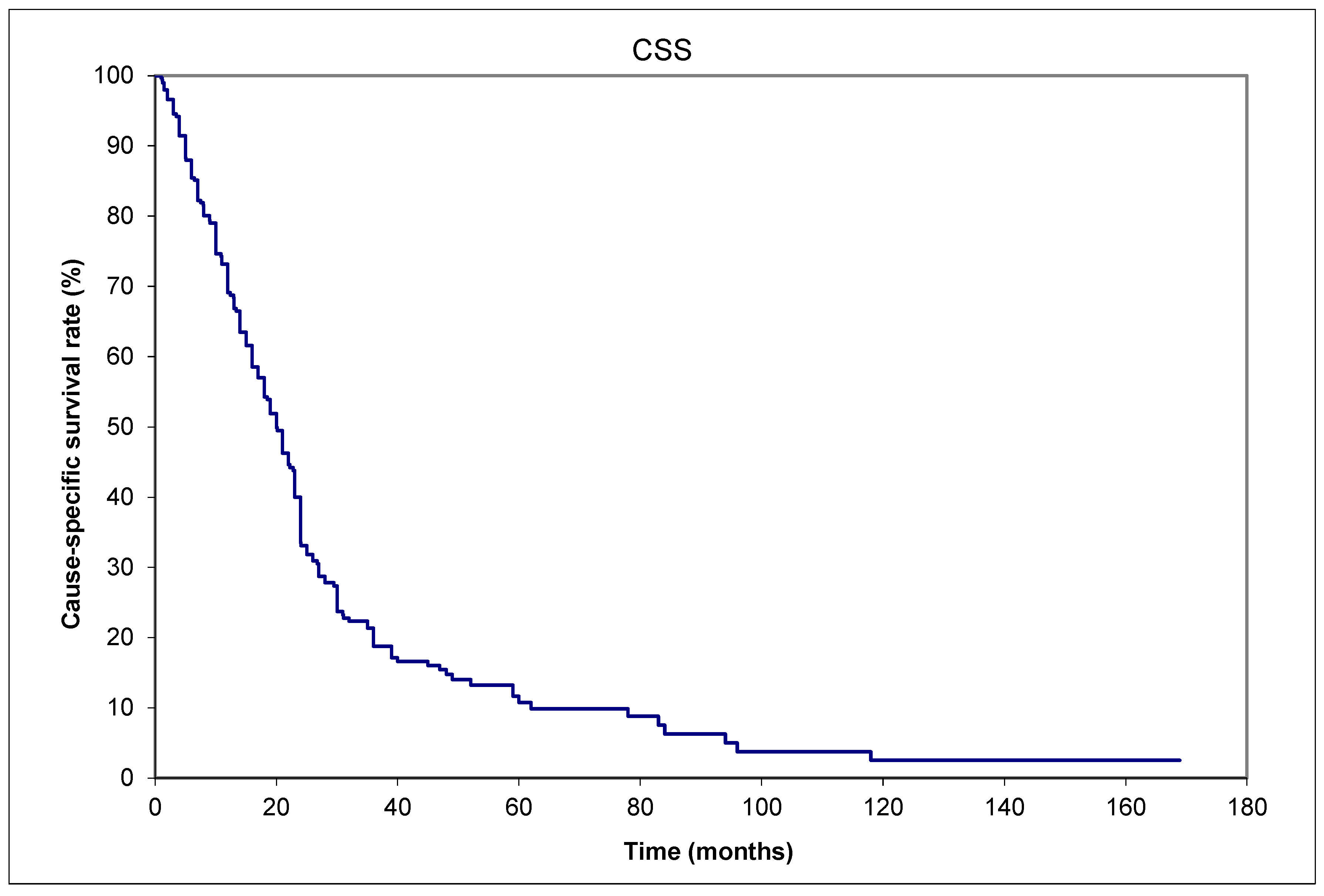
Despite different treatments as listed in Table 2, most patients died eventually of the cancer. The 1, 2, and 5-year OS rates were 56.5%, 30.4%, 9.2%, respectively (Figure 1). The 1, 2, and 5-year CSS rates were 56.5%, 32.1%, 11.6%, respectively (Figure 2). Table 3 shows risk factors for DM.

4. Discussion

Our results are comparable to other centers in terms of site location and the rate of lifetime development of DM: 79/303 (25%), with the 5-year OS and CSS rates both approximately 10%, respectively. OS and CSS were similar, implying most patients died from their MCC [12,13,14,15].
Knowing the controversies in the literature, the three observations support the hypothesis that the development of LNM giving rise to the subsequent development of DM is the main pathway of dissemination. We found 47/79 (59%) of patients with DM also developed LNM in their lifetime. Among them, 31/47 (66%) were documented before the development of DM. This, together with the higher proportion of patients presenting with LNM than DM, and the shorter time interval from initial diagnosis to LNM all point towards nodal disease preceding DM, or the so-called “cascade theory” of dissemination.
We identified 7/79 patients with a small <1 cm primary tumor, and in particular a 0.2 cm primary later developed DM. This finding illustrates that even small primary tumors have the potential to metastasize, in conflict with some older guidelines tending to favor post-operative observation in these small primaries. The latest MCC guidelines of the National Comprehensive
Patients with locoregional disease may benefit from neoadjuvant or adjuvant treatment(s). Recently immunotherapy has emerged as a likely beneficial adjuvant treatment as well as palliative treatment modality [16]. Immunotherapy confers about 50% durable benefit in metastatic MCC as first line therapy and 30% as second line. Adverse events with immunotherapy are not as frequent as with patients receiving cytotoxic chemotherapy (e.g., carboplatin and etoposide) [17]. Chemotherapy provides only short-lived responses (2-3 months) and is notably toxic in many patients, resulting in 3.4% treatment-related death [18].
Limitations of this study are the use of multi-center retrospective data from the year 1982 to 2015, and the treatment paradigm has changed over the years. Hence survival/recurrence outcomes may be different from the current use of immunotherapy, more of neoadjuvant treatments and sentinel node biopsy. Data are heterogeneous and center-dependent. In addition, the MCC polyomavirus status was unavailable. Follow-up protocols varied according to each center due to a lack of international follow-up guidelines at the time of study. Strengths of this study are our detailed database being more comprehensive than many others in the literature, due to the multidisciplinary collaboration. All stages of MCC patients were included without any bias, whether they were treatment-naïve or previously treated elsewhere.
We advocate that (1) after initial diagnosis, patients with primaries of any size should be referred without delay to experienced specialist(s) for definitive treatment, in a tertiary center if possible [19]. This will ensure the best outcome for the patient. (2) Enrollment into clinical trials is strongly encouraged. (3) The results of the recent phase II study (ADMEC-O) could be confirmed with more trials encouraging clinicians to consider adopting adjuvant nivolumab into their clinical practice. These ideas and data observation are relevant to all MCC patients and clinicians who manage them. These basic observations are especially important in developing countries with inadequate staging resources for patient management.

5. Conclusions

Our comprehensive aggregated database helped to deduce the pattern of spread for MCC. Three basic observations favor prior LNM giving rise to the subsequent development of DM as the main pathway of MCC dissemination. We also identified 2.6% (8/303) of patients with MCC presented with DM. Even small MCCs <1 cm in maximum dimension, including a 0.2 cm primary, can metastasize. Therefore, we believe this report might be practice-changing.

Author Contributions

Conceptualization, P.T., E.Y. and K.J.; methodology, P.T., E.Y. and K.J.; software, P.T..; validation, P.T., E.Y. and K.J.; formal analysis, P.T., E.Y. and K.J.; investigation, P.T., E.Y. and K.J.; data curation, all; writing— P.T., E.Y. and K.J.; writing—review and editing, P.T., E.Y. and K.J.; supervision, P.T., E.Y. and K.J.; project administration, P.T., E.Y. and K.J. All authors have read and agreed to the published version of the manuscript.

Funding

This research received no external funding.

Institutional Review Board Statement

The study was conducted in accordance with the Declaration of Helsinki, and approved by the Institutional Review Board (or Ethics Committee) of the University of Saskatchewan Biomedical Research Ethics Board (Bio-REB). “It has reviewed the above- named research study. The study was found to be acceptable on scientific and ethical grounds. The principal investigator has the responsibility for any other administrative or regulatory approvals that may pertain to this research study, and for ensuring that the authorized study is carried out according to governing law. This approval is valid for the specified period provided that there is no change to the approved protocol or the consent process (REB# 16-06; date of approval: 5 July 2017)”.

Informed Consent Statement

Not applicable

Data Availability Statement

Data is unavailable to the public due to privacy (restrictions by the ethics committee above).

Acknowledgments

Data and research support from Saskatchewan Cancer Agency. In this publication, the results and conclusions, if any, are the sole responsibility of the researcher and that no endorsement by the Agency or by any third party, is to be inferred.

Conflicts of Interest

The authors declare no conflicts of interest.

Abbreviations

The following abbreviations are used in this manuscript:
ADMEC-O Adjuvant immunotherapy with nivolumab versus observation
ADT Androgen deprivation therapy
CSS Cause-specific survival
CT Computerized tomography
DFS Disease-free survival
DM Distant metastases
LNM Lymph node metastases
MCC Merkel cell carcinoma
OS Overall survival
PET Positron emission tomography
PFS Progression-free survival
SLNB Sentinel lymph node biopsy

References

  1. Tai, P.; Park, S.Y.; Nghiem, P.T. Pathogenesis, clinical features, and diagnosis of Merkel cell (neuroendocrine) carcinoma. In: UpToDate, Canellos, GP, Schnipper L (Ed), UpToDate, Waltham, MA, 2024. Accessed: October 14, 2024: www.uptodate.com.
  2. Tilling, T.; Moll, I. Which are the cells of origin in Merkel cell carcinoma? J Skin Cancer. 2012, 2012, 680410. [Google Scholar] [CrossRef] [PubMed]
  3. Tai, P.; Au, J. Skin cancer management—updates on Merkel cell carcinoma. Ann. Transl. Med. 2018, 6, 282–282. [Google Scholar] [CrossRef] [PubMed]
  4. Gillenwater AM, Hessel AC, Morrison WH, et al. Merkel cell carcinoma of the head and neck: effect of surgical excision and radiation on recurrence and survival. Arch Otolaryngol Head Neck Surg. 2001, 127, 149–154. [CrossRef]
  5. Queirolo, P.; Gipponi, M.; Peressini, A.; Raposio, E.; Vecchio, S.; Guenzi, M.; Sertoli, M.R.; Santi, P.; Cafiero, F. Merkel cell carcinoma of the skin. Treatment of primary, recurrent and metastatic disease: review of clinical cases. Anticancer Res. 1997, 17, 2339–2342. [Google Scholar] [PubMed]
  6. Gunaratne, D.A.; Howle, J.R.; Veness, M.J. Sentinel lymph node biopsy in Merkel cell carcinoma: a 15-year institutional experience and statistical analysis of 721 reported cases. Br J Dermatol. 2016, 174, 273–281. [Google Scholar] [CrossRef]
  7. Victor, N.S.; Morton, B.; Smith, J.W. Merkel cell cancer: is prophylactic lymph node dissection indicated? Am Surg. 1996, 62, 879–882. [Google Scholar] [PubMed]
  8. Santamaria-Barria, J.A.; Boland, G.M.; Yeap, B.Y.; Nardi, V.; Dias-Santagata, D.; Cusack, J.C. Merkel Cell Carcinoma: 30-Year Experience from a Single Institution. Ann. Surg. Oncol. 2012, 20, 1365–1373. [Google Scholar] [CrossRef]
  9. Becker, J.C.; Ugurel, S.; Leiter, U.; Meier, F.; Gutzmer, R.; Haferkamp, S.; Zimmer, L.; Livingstone, E.; Eigentler, T.K.; Hauschild, A.; et al. Adjuvant immunotherapy with nivolumab versus observation in completely resected Merkel cell carcinoma (ADMEC-O): disease-free survival results from a randomised, open-label, phase 2 trial. Lancet 2023, 402, 798–808. [Google Scholar] [CrossRef] [PubMed]
  10. Kaplan, E.L.; Meier, P. Non-parametric estimation from incomplete observations. J Am Stat Assoc. 1958, 53, 457–482. [Google Scholar] [CrossRef]
  11. Cox, DR. Regression Models and Life-Tables. J Royal Statistical Soc. 1972, 34, 187–220. [Google Scholar] [CrossRef]
  12. Coggshall K, Tello TL, North JP, et al. Merkel cell carcinoma: An update and review: Pathogenesis, diagnosis, and staging. J Am Acad Dermatol. 2018, 78, 433–442. [CrossRef] [PubMed]
  13. Tai P, Park SY, Nghiem PT, et al. Staging and treatment, and surveillance of locoregional Merkel cell carcinoma. In: UpToDate, Canellos, GP, Schnipper L (Ed), UpToDate, Waltham, MA, 2024. www.uptodate.com. (last accessed 15 May 2024).
  14. Park SY, Nghiem PT, Tai P, et al. Treatment of recurrent and metastatic Merkel cell carcinoma. In: UpToDate, Canellos, GP, Schnipper L (Ed), UpToDate, Waltham, MA, 2024. www.uptodate.com. (last accessed 15 May 2024).
  15. National Comprehensive Cancer Network (NCCN) guideline website: www.nccn.org (last accessed 15 May 2024).
  16. Kaufman HL, Russell JS, Hamid O, et al. Updated efficacy of avelumab in patients with previously treated metastatic Merkel cell carcinoma after ≥1 year of follow-up: JAVELIN Merkel 200, a phase 2 clinical trial. J Immunother Cancer. 2018, 6, 7. [CrossRef] [PubMed]
  17. Kaufman HL, Russell J, Hamid O, et al. Avelumab in patients with chemotherapy-refractory metastatic Merkel cell carcinoma: a multi-center, single-group, open-label, phase 2 trial. Lancet Oncol. 2016, 17, 1374–1385. [CrossRef] [PubMed]
  18. Tai PTH, Yu E, Winquist E, et al. Chemotherapy in neuroendocrine / Merkel cell carcinoma of the skin [MCC]: case series and review of 204 cases. J Clin Oncol 2000, 18, 2493–2499. [CrossRef] [PubMed]
  19. Alexander, N.A.; Schaub, S.K.; Goff, P.H.; Hippe, D.S.; Park, S.Y.; Lachance, K.; Bierma, M.; Liao, J.J.; Apisarnthanarax, S.; Bhatia, S.; et al. Increased risk of recurrence and disease-specific death following delayed postoperative radiation for Merkel cell carcinoma. J. Am. Acad. Dermatol. 2023, 90, 261–268. [Google Scholar] [CrossRef] [PubMed]
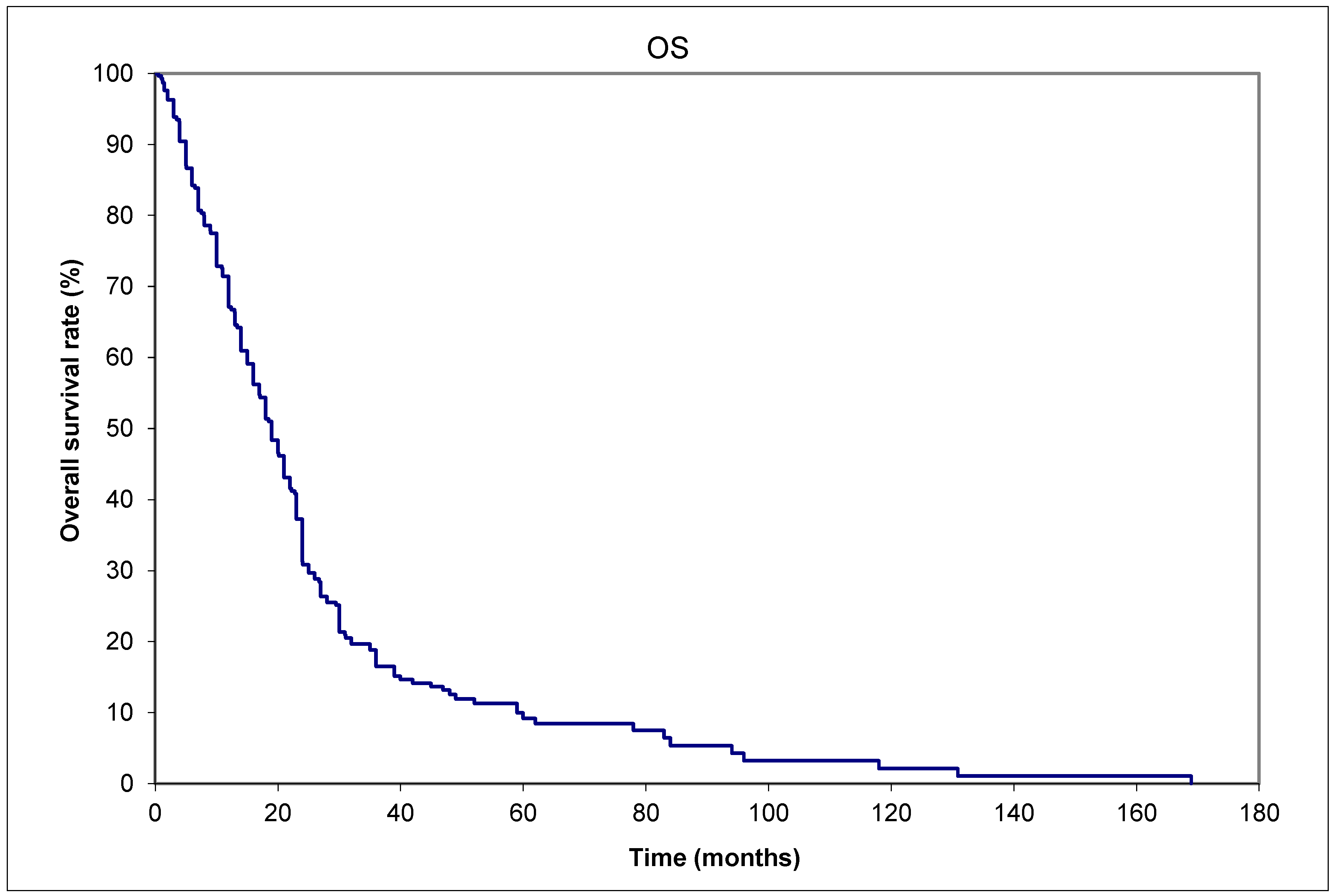
Figure 1. Merkel cell carcinoma. OS (overall survival) of 79 patients with distant metastases from the time of initial diagnosis to death from any cause.
Preprints 148318 g001
Figure 2. Merkel cell carcinoma. CSS (cause-specific survival) of 79 patients with distant metastases from the time of initial diagnosis to death from Merkel cell carcinoma.
Preprints 148318 g002
Table 1. Merkel cell carcinoma patient characteristics: a total of 79 patients from six centers developed distant metastases in their lifetime.
Aggregated data from Saskatchewan (Canada) 13 (16%)
Alberta (Canada) 17 (22%)
London, Ontario (Canada) 5 (19%)
Windsor/Ontario,Canada 5 (6%)
Amiens (France) 9 (11%)
Westmead, New South Wales (Australia) 20 (25%)
Baseline characteristics Age: median 78 (range:47-95) years
Sex: 29 males & 50 females
Size of primary tumor: median 2.5 (range: 0.2 -17) cm
Initial stages Local Nodal Distant metastases
Unknown
Clinical 42 (53%) 28 (35%) 8 (10%) 1 (1%)
Pathological 35 (44%) 35 (44%) 8 (10%) 1 (1%)
Primary site Head and neck 35 (44%)
Limb (upper or lower) 23 (29%)
Trunk 13 (16%)
Unknown primary, presented with nodes only 8 (10%)
Timing of nodal metastases (patient number=47) Before distant metastases diagnosis 31/47 (66%)
Within 1 month of distant metastases diagnosis 10/47 (21%)
After distant metastases diagnosis 1/47 (2%)
Unknown time relative to distant metastases 5/47 (11%)
Table 2. Merkel cell carcinoma with distant metastases: treatment and outcome of the 79 patients from six centers.
Treatment of localized disease at presentation (patient number=43) Surgery 24/43 (56%)
Surgery+Radiotherapy 11/43 (26%)
Surgery+Chemotherapy 1/43 (2%)
Radiotherapy alone 4/43 (9%)
Radiotherapy+Chemotherapy 1/43 (2%)
None 2/43 (5%)
Treatment of nodal metastases at presentation (patient number=28) Surgery 6/28 (21%)
Surgery+Radiotherapy 7/28 (25%)
Surgery+Radiotherapy+Chemotherapy 2/28 (7%)
Radiotherapy alone 13/28 (46%)
Treatment of distant metastases at presentation
(patient number=8)
Radiotherapy+Chemotherapy 3/8 (38%)
Chemotherapy alone 2/8 (25%)
None 3/8 (38%)
Final vital status Alive 8/79 (10%)
Dead 71/79 (90%)
Cause of death among those expired (patient number=71) Merkel cell carcinoma
65/71 (92%)
Intercurrent disease 6/71 (8%)
Table 3. Merkel cell carcinoma: risk factors for distant metastases with adjusted Cox-Proportional Hazards model.
Variable Hazard Ratio (95% Confidence interval) P values
Age: 60 Reference variable
70 0.90 (0.64-1.26) 0.50
80 1.06 (0.66-1.68) 0.82
90 1.75 (0.89-3.46) 0.11
Sex Male 0.87 (0.54-1.42) 0.59
Female Reference variable
Chemotherapy: Yes 0.56 (0.19-1.62) 0.29
No Reference variable
Clinical stage: Localized disease 2.53 (1.21-5.28) 0.013
Primary <1 cm Reference variable
Primary >1 cm 1.32 (0.61-2.89) 0.49
Nodal metastases 3.27 (1.85-5.78) <0.001
Distant metastases 21.42 (7.15-64.21) <0.001
Previous irradiation: Yes 2.95 (0.90-9.61) 0.073
No Reference variable
Disclaimer/Publisher’s Note: The statements, opinions and data contained in all publications are solely those of the individual author(s) and contributor(s) and not of MDPI and/or the editor(s). MDPI and/or the editor(s) disclaim responsibility for any injury to people or property resulting from any ideas, methods, instructions or products referred to in the content.
Copyright: This open access article is published under a Creative Commons CC BY 4.0 license, which permit the free download, distribution, and reuse, provided that the author and preprint are cited in any reuse.
Prerpints.org logo

Preprints.org is a free preprint server supported by MDPI in Basel, Switzerland.

Subscribe

Disclaimer

Terms of Use

Privacy Policy

Privacy Settings

© 2025 MDPI (Basel, Switzerland) unless otherwise stated