

Submitted:
04 February 2025
Posted:
05 February 2025
You are already at the latest version
Abstract
Dieldrin is legacy organochlorine insecticide, which was listed in the Stockholm Convention because of its persistence, bioaccumulation and toxicity. But it is still present in the environment and in organisms two decades after its ban. The current criteria used to risk assessment in China are based on acute toxicity data in water column without considering the bioavailability and bioaccumulation, which accordingly lead to under-protection of aquatic organisms and wildlife. In this study, the water quality criteria (WQC) for dieldrin were derived in combination of tissue-based toxicity data and bioaccumulation factor (BAF) to better protect aquatic ecosystems. The dieldrin residue data in surface water in China were obtained by literature review and the ecological risk was assessed using quotient method. Combined with the BAF estimated by the model of 58884.37 L/kg, the WQC were calculated to be 3.07 and 1.5 ng/L to protect aquatic life and aquatic-dependent wildlife, respectively. The results of the risk assessment revealed the potential high risk posed by dieldrin bioaccumulation. This study provides a scientific guidance for the determination of water quality standard for dieldrin and ensure the risk management of aquatic environment in China.
Keywords:
Dieldrin
; Water quality criteria
; Bioaccumulation
; Ecological risk
; Wildlife criteria
1. Introduction
Dieldrin(C12H8Cl6O) is both a synthetic organochlorine pesticides (OCPs) classified as a chlorinated cyclodiene compound that was primarily used on cotton, corn, and citrus crops, and the environmental and metabolic product of the related compound aldrin [1]. It is lipophilic and persistent in soil with half-life up to five years. Dieldrin possesses high potential for bioaccumulation and readily bioaccumulates in terrestrial and aquatic organisms [2,3,4,5], tending to bio-magnify in the food chain.
Endpoints of dieldrin have been clarified, including carcinogenicity, endocrine disruptions, reproductive/development effects and neurotoxicity [6,7,8,9]. With causing adverse effects on humans and the ecosystem, dieldrin's persistence in the environment became a major concern, prompting its inclusion as one of the 12 initial POPs under the Stockholm Convention, which imposed a ban on its manufacturing, usage, and commerce worldwide. While dieldrin has been widely detected in the environment in studies related to pesticides [10,11,12,13,14]. Its residues have also been monitored in human milk [15,16,17] and wildlife such as raptors globally [18], whales and polar bear in Arctic [19]. In China, dieldrin was never produced on an industrial scale and was not used as a pesticide in agriculture [20]. However, previous researches have unequivocally demonstrated its presence in Chinese environmental media such as soil, air, water as well as in wild animals [21,22,23,24,25], indicating long-range transport and latent illegal use of dieldrin. Meanwhile, research which conducted in two sediment cores from Lake Fuxain, the largest deep freshwater lake in China to track the historical pollution records, revealed that as one of the predominant OCPs dieldrin might pose a potential threat to exposed organisms [26].
For the protection of aquatic life, CCME developed Canadian interim sediment quality guidelines and probable effect levels for dieldrin, which can be used to assess the likelihood that exposure to dieldrin in sediments will have detrimental biological effects [27]. The procedures to derive dieldrin concentrations in sediment that are protective of benthic organisms were described in an equilibrium partitioning sediment benchmark document [28]. The dieldrin wildlife value for waters within the Great Lakes Basin was also determined, along with the calculations and avian values [29]. There are limited specific guidelines, standards or criteria for the risk that dieldrin might pose to aquatic ecosystem in China. Yang et al have deduced recommended values of the criteria maximum concentrations of dieldrin for domestic aquatic organisms using acute toxicity data [30]. Dieldrin in aquatic environments generally occurs at low concentrations, however, and might result in high accumulation within living organisms. Accordingly, the traditional water quality criteria (WQC) derived from water-based toxicity that does not consider bioaccumulation factors (BAFs) makes it challenging to provide comprehensive protection for aquatic life. Therefore, it is needful to adopt a tissue-based method for deriving aquatic life criteria because multiple routes of exposure (e.g., diet, sediment, water) may impact the bioavailability of substances [31]. Moreover, the basis for establishing water quality standards in China did not consider trophic magnification of chemical substances and effects on higher trophic levels. Wildlife criteria have been urgently needed to assessing risks posed by PBTs to birds or mammals in Chinese aquatic systems and to support national policy-making decisions.
The aim of this study is to determine dieldrin WQC to protect aquatic organisms and aquatic-dependent wildlife using tissue-based toxicity data to better manage the environment. This study gives new insight into the ecological risk of dieldrin and provides a scientific foundation for enhancing WQC determination systems in China through serving as a reference for the derivation of bio-accumulative substances.
2. Methods
2.1. Toxicity Data Screening
The sources of tissue-based toxicity of aquatic organisms for dieldrin are the Environmental Residue Effects Database, ECO-TOX database and published literature. For wildlife, tissue-based toxicity data were obtained from literature which compiled by the USEPA. Internationally recognized, indigenous, and introduced species, including freshwater invertebrates, vertebrates, and wildlife were selected. The region of species was mainly defined according to the Global Biodiversity Information Facility (https://www.gbif.org/). Tissue-based values need to be developed based on ecologically relevant endpoints that protect populations [32]. Thus, the endpoints of the effect include morality, developmental growth, reproduction, behavior and accumulation. And the no-observed effect concentration (NOEC) was selected as the test endpoint to develop chronic criteria. All dieldrin residue data are obtained from whole-body measurements.
2.2. Derivation of Tissue-Based Criteria
The term "tissue-based criteria (TBC)" refers to criteria generated from toxicity data reported as concentrations in tissues of the target organisms or their diet (in wildlife) [33]. Tissue-based toxicity metrics are developed using the same methodology as that for external concentration-based toxicity tests [32]. On the premise of sufficient valid toxicity data, the species sensitivity distribution (SSD) method is selected to derive a baseline or toxicity reference value. This probability distribution function assumes that species sensitive can be characterized by statistical distributions. Designating the most sensitive species, a hazard concentration, the 5-th percentile of SSD which protects 95% of organisms is used to set the criteria.
In the case of aquatic-dependent wildlife, toxicity data of avian or mammalian species expressed as tissue concentrations per day are used to generate the HC₅, represent the tolerable daily intake (TDI). While in the derivation of WQC, tissue concentrations need to manifest as concentrations in the aquatic diet. The tissue reference value (TRV) for aquatic-dependent wildlife is calculated using the TDI in conjunction with daily food ingestion rates (FI) and body weights (BW) of wildlife species [34], as shown in Eq. (1).
where TDI is derived using the SSD method using tissue–based toxicity data (mg/kg), and FI:BW is the ratio of food ingestion rates to body weights of representative wildlife species in China, which were selected from literature.
2.3. Derivation of WQC for Dieldrin
In order to translate the tissue criterion to corresponding water concentrations, it would be divided by the relevant bioaccumulation factors (BAFs) determined for each representative species [33]. Bioaccumulation can be viewed as the combination of bioconcentration and food uptake due to it occurs when chemicals accumulate in aquatic organisms through multiple exposure routes, including dietary, respiratory, and dermal absorption [35]. The BAF is the ratio of the concentration of the chemical in the organism to that in the environment. Fish have among the highest bioaccumulation rates for dieldrin and higher trophic levels in aquatic ecosystems. From there, empirical model based on field-derived BAFs is used to assess bioaccumulation potential and to translate tissue-based criteria to water concentrations [31]. Herein, a generic BAF model for fish development by Arnot and Gobas [36] was used to estimate the BAF of dieldrin in absence of site-specific measurements. The model is a quantitative structure-activity relationship (QSAR), with input parameters consisting only of the octanol-water partition coefficient (Kow) of the chemical and, if available, the metabolic transformation rate constant. The model provides predictions of BAF for fish species in lower, middle and upper trophic levels of aquatic food webs and can be used to predict dietary concentrations for higher trophic level predators (e.g., birds and mammals) from fish in their diet. Then with the estimates of BAF, TBC or TRV were converted to WQC expressed as the concentration in water using Eq. (2).
where WQC_aqua and WQC_wild are for the protection of aquatic life and aquatic-dependent wildlife, respectively; TBC is derived from tissue–based toxicity data through the SSD method (mg/kg), TRV is calculated using Eq. (1), and BAF is the bioaccumulation factor (L/kg).
2.4. Ecological Risk Assessment
The available literature data on concentrations of dieldrin in China were used for environmental risk screening via quotient method. Risk quotients (RQs) are the ratio of points estimate of exposure and toxicity. The exposure refers to actual monitored or model-estimated environment concentration. The toxicity refers to an effect level such as Predicted No Effect Concentration (PNEC), which is the ecological risk threshold predicted to have no adverse effects on organisms. RQs were calculated as shown in Eq. (3),
where C is the measured environmental concentration collected from literature; WQC for dieldrin is derived from Eq. (2), which express the ecological risk threshold. Then compared to EPA's levels of concern (LOCs). According to EPA’s risk presumptions, the value of LOC is 1 for chronic risk. A resulting RQ below the value of 1 indicates no chronic risk concern.
2.5. Data Analysis
The current study employs the R package “ssdtools” to generate the SSD [37] using R version 4.1.0 [38]. We utilized the “ssd_fit_dists” function using maximum likelihood to fit the distribution and the “ssd_gof” function to assess the goodness of fit. With bootstrapping to get confidence intervals, the “ssd_hc” function was used to estimate the model-averaged 5% concentration; that is, the HC₅ value. Together with the original data, the predictions were plotted using the “ssd_plot” function. The model BAF-QSAR v1.1 [36] coded in a Microsoft Excel workbook was used to obtain the BAF. The data screening and derivation of WQC were also using Microsoft Excel 2019 for Windows.
3. Results and Discussion
3.1. WQC for Protection of Aquatic Life
Table 1 presents toxicity data obtained from database for dieldrin of aquatic life. The selected species, including 10 fishes, 1 crustacean and 1 mollusk, met the minimum data requirement. As shown in Figure 1, the SSD curve with confidence interval was simulated from collated data. The TBC is 0.227 mg/kg (wet weight; WW) derived from estimated model-averaged predictions by parametric bootstrapping.
It was recommended to translate tissue criteria into water concentrations and develop site-specific criteria using paired water concentration and fish tissue data from a representative set of species. While data of dieldrin in environment and biota are insufficient, model approach was used to obtain the BAF. Both empirical models that leverage field-derived BAFs and mechanistic models can be used to assess bioaccumulation potential. Since the metabolic transformation rate constant was not available, the log₁₀Kow value of 5.4 for dieldrin determined with the “slow-stirring” method [39] was used as input parameter for the BAF-QSAR model. The BAF predictions are considered generic in that they are not considered to be for a particular species of fish. The estimation of logarithm BAFs base 10 in lower, middle and upper trophic levels of fish species are 4.77, 5.09 and, 5.66 respectively. Arnot and Gobas [40] reviewed the status of bioaccumulation evaluations for organic chemicals in aquatic systems and summarized regression statistics for different organism classes before and after the confidence assessment on the reviewed data. In agreement with their empirical model, the log₁₀BAF value of 4.77 was used to derive the WQC for dieldrin. The calculated BAF for fish is 58884.37 L/kg. Using Eq. (3), the calculated WQC for aquatic organisms is 3.86 ng/L.

Table 1.
Tissue-based toxicity data of aquatic life for dieldrin.
| Species | Common name | NOEC (mg/kg) | Taxa | Reference |
|---|---|---|---|---|
| Palaemonetes pugio | Grass shrimp | 0.09 | Crustaceans | [41] |
| Micropterus salmoides | Largemouth bass | 1.01 | Fishes | [42] |
| Ictalurus punctatus | Channel catfish | 2 | Fishes | [43] |
| Lepomis macrochirus | Bluegill | 3.7 | Fishes | [44] |
| Carassius auratus | Godfish | 3.8 | Fishes | [44] |
| Poecilia reticulata | Guppy | 10.7 | Fishes | [45] |
| Cyprinodon variegatus | Sheepshead minnow | 12.8 | Fishes | [41] |
| Crassostrea virginica | Eastern oyster | 18.6 | Mollusks | [46] |
| Morone saxatilis | Striped bass | 25 | Fishes | [47] |
| Gambusia affinis | Mosquito fish | 28 | Fishes | [48] |
| Oncorhynchus mykiss | Rainbow trout | 43 | Fishes | [49] |
| Leuciscus idus | Golden ide | 151 | Fishes | [50] |
3.2. WQC for Protection Of Aquatic-Dependent Wildlife
Table 2 presents the toxicity data for dieldrin of wildlife, including 11 avians and 10 mammalians which met the minimum data requirement. As shown in Figure 2 and Figure 3, the SSD curves with confidence intervals were simulated for each taxa group from collated data. Calculated from the SSD curves, TDIs for avian and mammalian are 0.0379 and 0.0914 mg/kg-day, respectively. The highest FI:BW value among representative avian species in China is 0.43 [51] and the higher ratio of FI to BW among representative mammalian species in China is 0.05 [52,53,54]. TRVs are 0.088 and 0.1828 mg/kg WW, respectively. Using Eq. (3) and the previous calculated BAF for fish, the calculated WQC are 1.50 and 3.10 ng/L, respectively. To better protect aquatic-dependent wildlife, the smallest WQC (1.50 ng/L) was selected as the dieldrin WQC for protecting aquatic-dependent wildlife in China.
Considering the bioaccumulation of dieldrin via piscivorous food webs, the threshold contaminant body burden in wildlife was calculated, which is then back-calculated to an equivalent concentration in fish or water using the combination of food and chemical assimilation efficiencies and bioconcentration/ bioaccumulation factors. For wildlife criteria derived from dietary toxicity data, BAFs would be applied and appropriately weighted for each component of the aquatic diet of the representative wildlife species [33]. Using this method, the dieldrin wildlife value for waters within the Great Lakes Basin was determined to be 7.1×10⁻⁵ μg/L [29]. According to Protocol for the Derivation of Canadian Tissue Residue Guidelines for the Protection of Wildlife that Consume Aquatic Biota [34], reference concentrations are calculated using information on BW and FI for wildlife species as well as the TDI derived from toxicity studies, then the result can be compared to the generic tissue residue guideline developed to protect all wildlife. For substances with a high potential to bio-magnify within food chains, it is important that the guideline derived from lowest reference value be applied to the highest aquatic trophic level (e.g., level 4 fish) in order to protect predators feeding at that level
Since species specific and site-specific data for dieldrin were not available in China, we selected the highest ratio of FI to BW of representative wildlife species to calculate TRV from TDI and used BAF for fish to convert TRV to water concentration. Dieldrin was found in one fish liver sample (0.07 μg/g WW) collected from aquaculture cages in coastal waters of Xiamen [75], and in various organs and tissues of Indo-Pacific humpback dolphins from the Pearl River Estuary, ranging from 0.74 to 6.8 ng/g WW [24]. Our result of WQC is much higher than the value within the Great Lakes Basin, but compared to residue records in biota, it can be effective to protect wildlife.
3.3. Risk Assessment
Studies have shown that chronic exposure to dieldrin can cause harm to aquatic organisms and wildlife [9,76]. Therefore, it is important to assess the ecological risk of dieldrin in aquatic environments. The results of presence of dieldrin in surface water in the last dozen years from the literature review and ecological risk assessment results are shown in Table 3. Samples were collected from the Yangtze River, the Qinhuai River and the Xuanwu Lake in Nanjing [23] and Shaying River Basin [77], and the mean concentrations of dieldrin were 1.31, 2.32, 4.38 and 4.6 ng/L, respectively. RQ values were calculated separately using WQC for the protection of aquatic life and wildlife. The results between 0.34 and 3.07 were observed, suggesting that dieldrin post ecological risk to both aquatic organism and wildlife in Xuanwu Lake and Shaying River Basin, potential ecological risk to avians in Qinhuai River and no chronic risk concern in Yangtze River.
The sampling approach, which the timing and site selection are unable to adequately capture the periodic occurrence of pesticides and investigate surface waters particularly susceptible to pesticide risks may contribute to inappropriate estimation of risk [78]. Since dieldrin has been banned and not used in China, its main source is environment migration. With hydrophobicity and low water solubility, dieldrin is prone to binding to organic materials [1]. Research on distribution of organochlorine pesticide pollution in Indonesia revealed that sediments showed higher organochlorine concentrations than water, mollusk, and fish [14]. Sediment is still a potential source and is rarely detected. It was demonstrated that the effect concentration in sediments can be accurately predicted by multiplying the effect concentration in water by the chemical’s organic carbon partition coefficient [28]. Thus, it significative to detect dieldrin concentrations in water to better understand its ecological risk to integral aquatic ecosystem.
4. Conclusions
This study set out to determine the dieldrin WQC using the tissue-based toxicity data which have not been used previously. In this study, the estimated BAF of 58884.37 L/kg was used to derive WQC in the absence of field-based data. The tissue-based criteria obtained with screened dieldrin toxicity data and SSD method are 0.227 mg/kg (WW) of aquatic life, 0.088 and 0.1828 mg/kg-day food (WW) of avian and mammalian, respectively. Using the statistic presented above, the dieldrin WQC for the protection of aquatic organisms and wildlife in China is 3.86 and 1.5 ng/L, respectively. The risk assessment results indicate that dieldrin levels in surface water may pose a high ecological risk to aquatic organisms and wildlife, especially avians. This work contributes to provide more scientific protection for aquatic organisms and wildlife from the harm of bioaccumulation of dieldrin, supporting the environmental management and risk assessment in China. The results also enhance China’s water environment criterion system, enabling the development of the “water ecological civilization”. The major limitation of this study is the lack of data of dieldrin presence in surface water, further study on monitoring should be taken.
Author Contributions
Conceptualization, Li Xie and Hailei Su; Data curation, Li Xie and Liangwen Bao; Formal analysis, Liangwen Bao and Yuexin Zhang; Funding acquisition, Hailei Su; Investigation, Li Xie; Methodology, Xuemei Li and Hailei Su; Supervision, Hailei Su; Validation, Xuesong Liu, Fanfan Wang, Yuan Wei, Ningning Ji and Min Zhou; Visualization, Li Xie and Liangwen Bao; Writing – original draft, Li Xie; Writing – review & editing, Li Xie, Xuemei Li and Hailei Su. All authors have read and agreed to the published version of the manuscript.
Funding
This research was funded by NAME OF FUNDER the National Key Research and Development Program of China, grant number 2022YFC3702403 and National Natural Science Foundation of China, grant number No. 42394154.
Institutional Review Board Statement
Not applicable.
Informed Consent Statement
Not applicable.
Data Availability Statement
The original contributions presented in this study are included in the article/supplementary material. Further inquiries can be directed to the corresponding author.
Conflicts of Interest
The authors declare no conflicts of interest.
References
- Honeycutt, M.; Shirley, S. Dieldrin. In Encyclopedia of Toxicology; 2014; pp. 107-110.
- ASTDR. Toxicological Profile for Aldrin and Dieldrin; 2022.
- Petrocelli, S.R.; Anderson, J.W.; Hanks, A.R. Controlled food-chain transfer of dieldrin residues from phytoplankters to clams. Marine Biology 1975, 31, 215–218. [Google Scholar] [CrossRef]
- Petrocelli, S.R.; Anderson, J.W.; Hanks, A.R. Biomagnification of dieldrin residues by food-chain transfer from clams to blue crabs under controlled conditions. Bulletin of Environmental Contamination and Toxicology 1975, 13, 108–116. [Google Scholar] [CrossRef] [PubMed]
- Yamada, H.; Jandric, Z.; Chhem-Kieth, S.; Vreysen, M.J.; Rathor, M.N.; Gilles, J.R.; Cannavan, A. Anopheles arabiensis egg treatment with dieldrin for sex separation leaves residues in male adult mosquitoes that can bioaccumulate in goldfish (Carassius auratus auratus). Environ Toxicol Chem 2013, 32, 2786–2791. [Google Scholar] [CrossRef] [PubMed]
- Stern, A.H. Hazard identification of the potential for dieldrin carcinogenicity to humans. Environ Res 2014, 131, 188–214. [Google Scholar] [CrossRef]
- Martyniuk, C.J.; Mehinto, A.C.; Denslow, N.D. Organochlorine pesticides: Agrochemicals with potent endocrine-disrupting properties in fish. Molecular and Cellular Endocrinology 2020, 507. [Google Scholar] [CrossRef] [PubMed]
- Evangelista de Duffard, A.M.; Duffard, R. Behavioral toxicology, risk assessment, and chlorinated hydrocarbons. Environ Health Perspect 1996, 104 Suppl 2, 353–360. [Google Scholar] [CrossRef]
- Deck, A.T.; Reinke, E.N.; McCain, W.C. Wildlife Toxicity Assessment for Aldrin and Dieldrin. In Wildlife Toxicity Assessments for Chemicals of Military Concern; 2015; pp. 367-384.
- Ulugov, U.A.; Bobritskaya, L.S.; Sinitsky, J. Inventory of Obsolete Pesticide Warehouses in Tajikistan and Implications for Removal of Contaminated Soil. J Health Pollut 2018, 8, 1–5. [Google Scholar] [CrossRef]
- Navarrete, I.A.; Tee, K.A.M.; Unson, J.R.S.; Hallare, A.V. Organochlorine pesticide residues in surface water and groundwater along Pampanga River, Philippines. Environ Monit Assess 2018, 190, 289. [Google Scholar] [CrossRef] [PubMed]
- Ogbeide, O.; Uhunamure, G.; Okundaye, F.; Ejeomo, C. First report on probabilistic risk assessment of pesticide residues in a riverine ecosystem in South-South Nigeria. Chemosphere 2019, 231, 546–561. [Google Scholar] [CrossRef] [PubMed]
- Snow, D.D.; Chakraborty, P.; Uralbekov, B.; Satybaldiev, B.; Sallach, J.B.; Thornton Hampton, L.M.; Jeffries, M.; Kolok, A.S.; Bartelt-Hunt, S.B. Legacy and current pesticide residues in Syr Darya, Kazakhstan: Contamination status, seasonal variation and preliminary ecological risk assessment. Water Res 2020, 184, 116141. [Google Scholar] [CrossRef]
- Oginawati, K.; Susetyo, S.H.; Rahmawati, S.I.; Kurniawan, S.B.; Abdullah, S.R.S. Distribution of organochlorine pesticide pollution in water, sediment, mollusk, and fish at Saguling Dam, West Java, Indonesia. Toxicol Res 2022, 38, 149–157. [Google Scholar] [CrossRef] [PubMed]
- Souza, R.C.; Portella, R.B.; Almeida, P.; Pinto, C.O.; Gubert, P.; Santos da Silva, J.D.; Nakamura, T.C.; do Rego, E.L. Human milk contamination by nine organochlorine pesticide residues (OCPs). J Environ Sci Health B 2020, 55, 530–538. [Google Scholar] [CrossRef] [PubMed]
- El-Saeid, M.H.; Hassanin, A.S.; Bazeyad, A.Y. Levels of pesticide residues in breast milk and the associated risk assessment. Saudi J Biol Sci 2021, 28, 3741–3744. [Google Scholar] [CrossRef]
- Al Antary, T.M.; Alawi, M.A.; Kiwan, R.; Haddad, N.A. Monitoring of Organochlorine Pesticide Residues in Human Breast Milk in the Northern Governorates of Jordan in 2019/2020 Compared with the Results of 2015 Study. Bull Environ Contam Toxicol 2021, 106, 1071–1076. [Google Scholar] [CrossRef]
- Padayachee, K.; Reynolds, C.; Mateo, R.; Amar, A. A global review of the temporal and spatial patterns of DDT and dieldrin monitoring in raptors. Sci Total Environ 2023, 858, 159734. [Google Scholar] [CrossRef] [PubMed]
- Pedersen, A.F.; Dietz, R.; Sonne, C.; Letcher, R.J.; Roos, A.M.; Simon, M.; Rosing-Asvid, A.; Ferguson, S.H.; McKinney, M.A. Feeding and biological differences induce wide variation in legacy persistent organic pollutant concentrations among toothed whales and polar bear in the Arctic. Science of The Total Environment 2024, 908. [Google Scholar] [CrossRef] [PubMed]
- Zhang, A.; Fang, L.; Wang, J.; Liu, W.; Yuan, H.; Jantunen, L.; Li, Y.-F. Residues of Currently and Never Used Organochlorine Pesticides in Agricultural Soils from Zhejiang Province, China. Journal of Agricultural and Food Chemistry 2012, 60, 2982–2988. [Google Scholar] [CrossRef]
- Niu, L.; Xu, C.; Zhu, S.; Liu, W. Residue patterns of currently, historically and never-used organochlorine pesticides in agricultural soils across China and associated health risks. Environ Pollut 2016, 219, 315–322. [Google Scholar] [CrossRef]
- Wang, L.; Cao, G.; Liu, L.-Y.; Zhang, Z.-F.; Jia, S.-M.; Fu, M.-Q.; Ma, W.-L. Cross-regional scale studies of organochlorine pesticides in air in China: Pollution characteristic, seasonal variation, and gas/particle partitioning. Science of The Total Environment 2023, 904, 166709. [Google Scholar] [CrossRef] [PubMed]
- Chen, Y.; Huang, R.; Guan, Y.; Zhuang, T.; Wang, Y.; Tan, R.; Wang, J.; Zhou, R.; Wang, B.; Xu, J.; et al. The profiling of elements and pesticides in surface water in Nanjing, China with global comparisons. Science of The Total Environment 2021, 774, 145749. [Google Scholar] [CrossRef]
- Zhang, X.; Zhan, F.; Yu, R.-Q.; Sun, X.; Wu, Y. Bioaccumulation of legacy organic contaminants in pregnant Indo-Pacific humpback dolphins (Sousa chinensis): Unique features on the transplacental transfer. Science of The Total Environment 2021, 785, 147287. [Google Scholar] [CrossRef] [PubMed]
- Zhao, Z.; Zhang, L.; Wu, J.; Fan, C. Residual levels, tissue distribution and risk assessment of organochlorine pesticides (OCPs) in edible fishes from Taihu Lake, China. Environ Monit Assess 2013, 185, 9265–9277. [Google Scholar] [CrossRef]
- Han, X.; Xu, L.; Deng, A.; Xing, P.; Xu, Y. Centurial deposition records of polychlorinated biphenyls and organochlorine pesticides in sediment cores from a plateau deep-water lake of China: Significance of anthropogenic impacts, transformation signals and ecological risks revealed by full congener analysis. Science of The Total Environment 2024, 926. [Google Scholar] [CrossRef]
- CCME. Canadian Sediment Quality Guidelines for the Protection of Aquatic Life-dieldrin. 1999.
- USEPA. Procedures for the Derivation of Equilibrium Partitioning Sediment Benchmarks (ESBs) for the Protection of Benthic Organisms: Dieldrin. 2003.
- USEPA. Wildlife Fact Sheet for Dieldrin: (Wildlife). 1995.
- Yang, M.; Mu, Y.; Wu, F. Derivation on Criteria Maximum Concentration of Four Typical Organochlorine Pesticides for Protecting Aquatic Organisms. Journal of Kunming University of Science and Technology (Natural Science) 2019, 44, 111–118. [Google Scholar] [CrossRef]
- Barnhart, B.; Flinders, C.; Ragsdale, R.; Johnson, G.; Wiegand, P. Deriving Human Health and Aquatic Life Water Quality Criteria in the United States for Bioaccumulative Substances: A Historical Review and Future Perspective. Environ Toxicol Chem 2021, 40, 2394–2405. [Google Scholar] [CrossRef] [PubMed]
- Meador, J.P.; Warne, M.S.J.; Chapman, P.M.; Chan, K.M.; Yu, S.; Leung, K.M.Y. Tissue-based environmental quality benchmarks and standards. Environmental Science and Pollution Research 2013, 21, 28–32. [Google Scholar] [CrossRef]
- USEPA. Tissue-Based Criteria for “Bioaccumulative” Chemicals. 2005.
- CCME. Protocol for the Derivation of Canadian Tissue Residue Guidelines for the Protection of Wildlife that Consume Aquatic Biota. 1998.
- Mackay, D.; Fraser, A. Kenneth Mellanby Review Award. Bioaccumulation of persistent organic chemicals: mechanisms and models. Environ Pollut 2000, 110, 375–391. [Google Scholar] [CrossRef] [PubMed]
- Arnot, J.A.; Gobas, F.A.P.C. A Generic QSAR for Assessing the Bioaccumulation Potential of Organic Chemicals in Aquatic Food Webs. QSAR & Combinatorial Science 2003, 22, 337–345. [Google Scholar] [CrossRef]
- Thorley, J.; Schwarz, C. ssdtools: An R package to fit Species Sensitivity Distributions. Journal of Open Source Software 2018, 3. [Google Scholar] [CrossRef]
- R Core Team R: A Language and Environment for Statistical Computing, 4.1.0; R Foundation for Statistical Computing: 2021.
- De Bruijn, J.; Busser, F.; Seinen, W.; Hermens, J. Determination of octanol/water partition coefficients for hydrophobic organic chemicals with the “slow-stirring” method. Environmental Toxicology and Chemistry 1989, 8, 499–512. [Google Scholar] [CrossRef]
- Arnot, J.A.; Gobas, F.A.P.C. A review of bioconcentration factor (BCF) and bioaccumulation factor (BAF) assessments for organic chemicals in aquatic organisms. Environmental Reviews 2006, 14, 257–297. [Google Scholar] [CrossRef]
- Parrish, P.R.; Couch, J.A.; Forester, J.; Jr., J.M.P.; Cook, G.H. Dieldrin: Effects on Several Estuarine Organisms. Journal of the Southeastern Association of Fish and Wildlife Agencies 1977.
- Johnson, K.G.; Muller, J.K.; Price, B.; Ware, A.; Sepúlveda, M.S.; Borgert, C.J.; Gross, T.S. Influence of seasonality and exposure on the accumulation and reproductive effects of p,p′-dichlorodiphenyldichloroethane and dieldrin in largemouth bass. Environmental Toxicology and Chemistry 2007, 26, 927–934. [Google Scholar] [CrossRef]
- Shannon, L.R. Accumulation and elimination of dieldrin in muscle tissue of channel catfish. Bulletin of Environmental Contamination and Toxicology 1977, 17, 637–644. [Google Scholar] [CrossRef] [PubMed]
- Gakstatter, J.H.; Weiss, C.M. The Elimination of DDT-C14, Dieldrin-C14, and Lindane-C14 from Fish following a Single Sublethal Exposure in Aquaria. Transactions of The American Fisheries Society 1967, 96, 301–307. [Google Scholar] [CrossRef]
- Burnett, K.M.; Liss, W.J. Multi-steady-state toxicant fate and effect in laboratory aquatic ecosystems. Environmental Toxicology and Chemistry 1990, 9, 637–647. [Google Scholar] [CrossRef]
- Mason, J.W.; Rowe, D.R. The accumulation and loss of dieldrin and endrin in the Eastern oyster. Archives of Environmental Contamination and Toxicology 1976, 4, 349–360. [Google Scholar] [CrossRef] [PubMed]
- Santerre, C.R.; Blazer, V.S.; Khanna, N.; Reinert, R.E.; Barrows, F.T. Absorption of Dietary Dieldrin by Striped Bass. Bulletin of Environmental Contamination and Toxicology 1997, 58, 334–340. [Google Scholar] [CrossRef]
- Metcalf, R.L. Chapter 2 - A Laboratory Model Ecosystem to Evaluate Compounds Producing Biological Magnification. In Essays in Toxicology, Hayes, W.J., Ed.; Elsevier: 1974; Volume 5, pp. 17-38.
- Mehrle, P.; Mayer, F.; Johnson, W.; Mayer, F.; Hamelink, J. Diet Quality in Fish Toxicology: Effects on Acute and Chronic Toxicity. In Aquatic Toxicology and Hazard Evaluation; ASTM International: 1977; Volume STP634-EB, p. 0.
- Freitag, D.; Ballhorn, L.; Geyer, H.; Korte, F. Environmental hazard profile of organic chemicals: An experimental method for the assessment of the behaviour of organic chemicals in the ecosphere by means of simple laboratory tests with 14C labelled chemicals. Chemosphere 1985, 14, 1589–1616. [Google Scholar] [CrossRef]
- Su, H.; Mu, Y.; Feng, C.; Zhu, Y.; Wang, H.; Wu, F.; Giesy, J.P. Tissue Residue Guideline for ∑DDT for Protection of Aquatic Birds in China. Human and Ecological Risk Assessment: An International Journal 2014, 20, 1629–1642. [Google Scholar] [CrossRef]
- Su, H.; Feng, C.; Chang, H.; Mu, Y.; Wu, F. Study on Tissue Residue Guidelines of DDTs for Protection of Aquatic Mammalian Species in China. Asian Journal of Ecotoxicology 2015, 10, 110–118. [Google Scholar] [CrossRef]
- Hung, C.L.H.; Lau, R.K.F.; Lam, J.C.W.; Jefferson, T.A.; Hung, S.K.; Lam, M.H.W.; Lam, P.K.S. Risk assessment of trace elements in the stomach contents of Indo-Pacific Humpback Dolphins and Finless Porpoises in Hong Kong waters. Chemosphere 2007, 66, 1175–1182. [Google Scholar] [CrossRef] [PubMed]
- Jefferson, T.A. Population biology of the Indo-Pacific Humpacked dolphin in Hong Kong waters. Journal of Wildlife Management 2000, 64, 1–65. [Google Scholar]
- Mendenhall, V.M.; Klaas, E.E.; McLane, M.A.R. Breeding success of barn owls (Tyto alba) fed low levels of DDE and dieldrin. Archives of Environmental Contamination and Toxicology 1983, 12, 235–240. [Google Scholar] [CrossRef]
- Wiese, I.H.; Basson, N.C.J.; Van Der Vyver, J.H.; Van Der Merwe, J.H. Toxicology and Dynamics of Dieldrin in the Crowned Guinea-fowl, Numida Meleagris (L). Phytophylactica 1969, 1, 161–175. [Google Scholar]
- Atkins, T.D. Effects of Dieldrin on Reproduction of Penned Hen Pheasants. Journal of Wildlife Management 1967, 31, 746. [Google Scholar] [CrossRef]
- Fergin, T.J.; Schafer, E.C. Toxicity of dieldrin to bobwhite quail in relation to sex and reproductive status. Archives of Environmental Contamination and Toxicology 1977, 6, 213–219. [Google Scholar] [CrossRef]
- Heinz, G.H.; Hill, E.F.; Contrera, J.F. Dopamine and norepinephrine depletion in ring doves fed DDE, dieldrin, and Aroclor 1254. Toxicology and Applied Pharmacology 1980, 53, 75–82. [Google Scholar] [CrossRef] [PubMed]
- Reading, C.M.; Arscott, G.H.; Tinsley, I.J. Effect of Dieldrin and Calcium on the Performance of Adult Japanese Quail (Coturnix coturnix japonica)1. Poultry Science 1976, 55, 212–219. [Google Scholar] [CrossRef]
- Dahlgren, R.B.; Linder, R.L. Effects of Dieldrin in Penned Pheasants through the Third Generation. Journal of Wildlife Management 1974, 38, 320. [Google Scholar] [CrossRef]
- Kreitzer, J.F.; Heinz, G.H. The effect of sublethal dosages of five pesticides and a polychlorinated biphenyl on the avoidance response of coturnix quail chicks. Environmental Pollution (1970) 1974, 6, 21–29. [Google Scholar] [CrossRef]
- Jefferies, D.J.; French, M.C. Changes Induced in the Pigeon Thyroid by p,p prime -DDE and Dieldrin. Journal of Wildlife Management 1972, 36, 24. [Google Scholar] [CrossRef]
- Davison, K.L.; Sell, J.L. DDT thins shells of eggs from mallard ducks maintained onad libitum or controlled-feeding regimens. Archives of Environmental Contamination and Toxicology 1974, 2, 222–232. [Google Scholar] [CrossRef] [PubMed]
- Eden, W.G. Toxicity of Dieldrin to Chickens. Journal of Economic Entomology 1951, 44, 1013–1013. [Google Scholar] [CrossRef]
- Walker, A.I.T.; Stevenson, D.E.; Robinson, J.; Thorpe, E.; Roberts, M. The toxicology and pharmacodynamics of dieldrin (HEOD): Two-year oral exposures of rats and dogs. Toxicology and Applied Pharmacology 1969, 15, 345–373. [Google Scholar] [CrossRef] [PubMed]
- Walker, A.I.T.; Thorpe, E.; Stevenson, D.E. The toxicology of dieldrin (HEOD). I. Long-term oral toxicity studies in mice. Food and Cosmetics Toxicology 1973, 11, 415–432. [Google Scholar] [CrossRef] [PubMed]
- Wiese, I.; Basson, N.C.J.; Basson, P.; Naudé, T.W.; Maartens, B.P. The toxicology and pathology of dieldrin and photodieldrin poisoning in two antelope species. The Onderstepoort journal of veterinary research 1973, 40 1, 31–39. [Google Scholar]
- Murphy, D.A.; Korschgen, L.J. Reproduction, growth, and tissue residues of deer fed dieldrin. Journal of Wildlife Management 1970, 34, 887–903. [Google Scholar] [CrossRef]
- Davison, K.L. Growth, Hemoglobin, Body Composition and Vitamin A of Sheep Fed Dieldrin. Journal of Animal Science 1970, 31, 567–575. [Google Scholar] [CrossRef] [PubMed]
- Bildstein, K.L.; Forsyth, D.J. Effects of dietary dieldrin on behavior of white-footed mice (Peromyscus leucopus) towards an avian predator. Bulletin of Environmental Contamination and Toxicology 1979, 21, 93–97. [Google Scholar] [CrossRef] [PubMed]
- Kotonya, R.; Jensen, N.-E. No effect of dieldrin on progesterone production in gilts. Toxicology 1993, 81, 165–171. [Google Scholar] [CrossRef] [PubMed]
- Hurkat, P.C.; Joshi, G.P. Some Physiological and Behavior Studies on Rabbit (Oryctolagus cuniculus) after Dieldrin Administration. Indian Veterinary Journal 1977, 54(9), 709–714. [Google Scholar]
- Uzoukwu, M.; Sd, S. Dieldrin toxicosis: fetotoxicosis, tissue concentrations, and microscopic and ultrastructural changes in guinea pigs. American journal of veterinary research 1972, 33 3, 579–583. [Google Scholar]
- Klump, D.W.; Huasheng, H.; Humphrey, C.; Xinhong, W.; Codi, S. Toxic contaminants and their biological effects in coastal waters of Xiamen, China. I. Organic pollutants in mussel and fish tissues. Mar Pollut Bull 2002, 44, 752–760. [Google Scholar] [CrossRef] [PubMed]
- Lamai, S.L.; Warner, G.F.S.; Walker, C.H. Effects of dieldrin on life stages of the African catfish, Clarias gariepinus (Burchell). Ecotoxicology and environmental safety 1999, 42 1, 22–29. [Google Scholar] [CrossRef]
- Bai, Y.; Ruan, X.; van der Hoek, J.P. Residues of organochlorine pesticides (OCPs) in aquatic environment and risk assessment along Shaying River, China. Environ Geochem Health 2018, 40, 2525–2538. [Google Scholar] [CrossRef] [PubMed]
- Weisner, O.; Arle, J.; Liebmann, L.; Link, M.; Schafer, R.B.; Schneeweiss, A.; Schreiner, V.C.; Vormeier, P.; Liess, M. Three reasons why the Water Framework Directive (WFD) fails to identify pesticide risks. Water Res 2022, 208, 117848. [Google Scholar] [CrossRef]
Figure 1.
Species sensitivity distribution for dieldrin for aquatic organism tissue-based toxicity data.
Figure 1.
Species sensitivity distribution for dieldrin for aquatic organism tissue-based toxicity data.
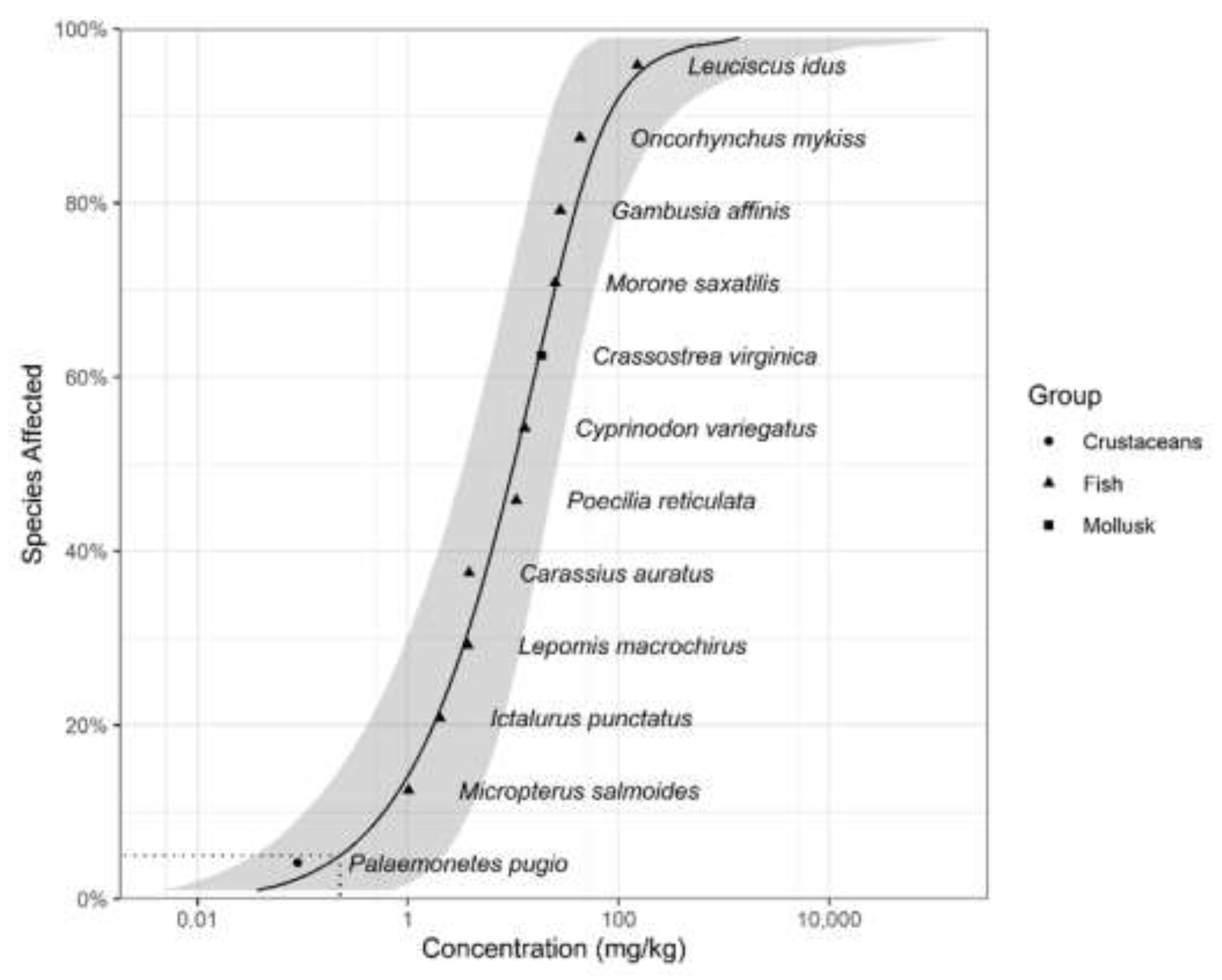
Figure 2.
Species sensitivity distribution for dieldrin for avians tissue-based toxicity data.
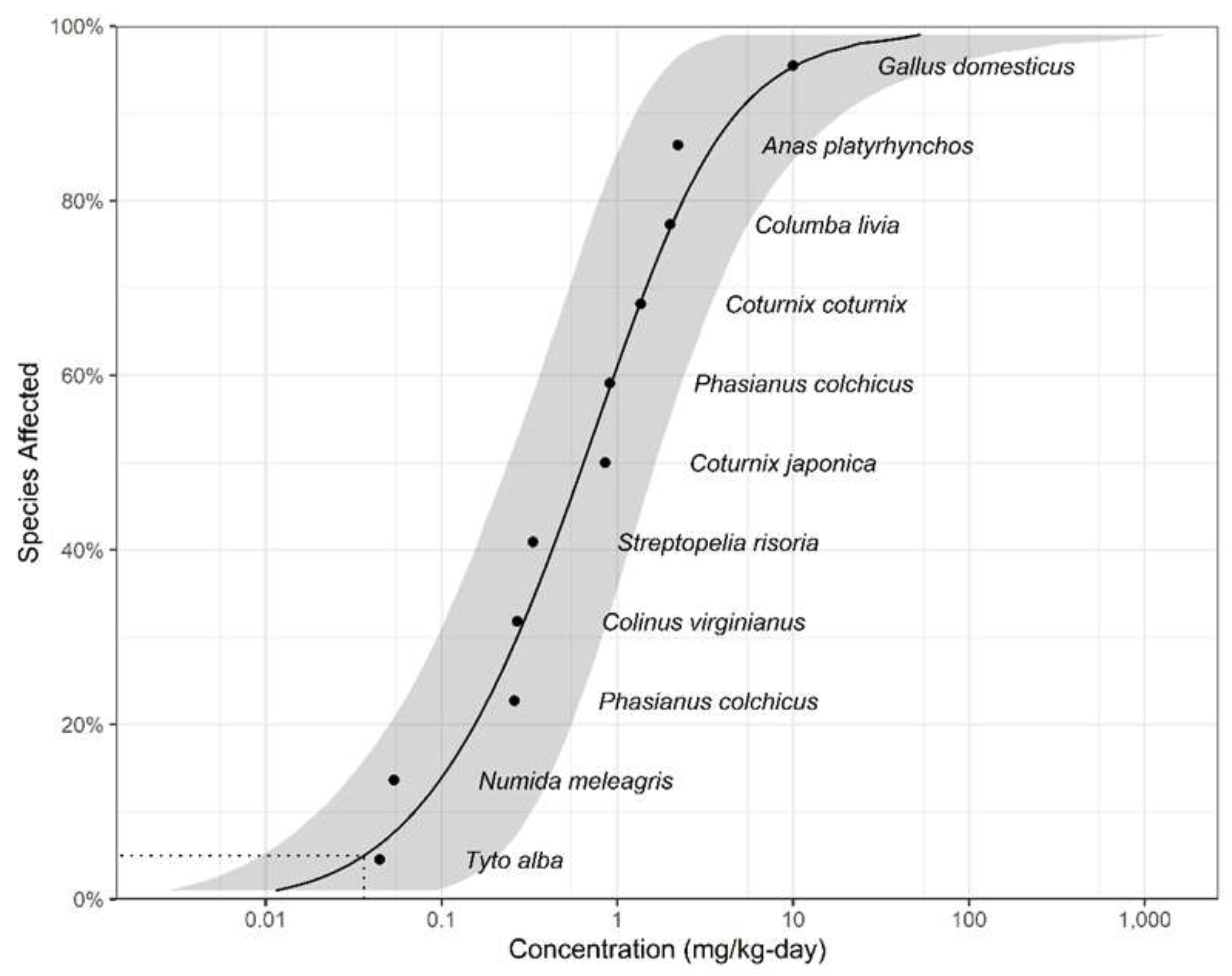
Figure 3.
Species sensitivity distribution for dieldrin for mammalians tissue-based toxicity data.
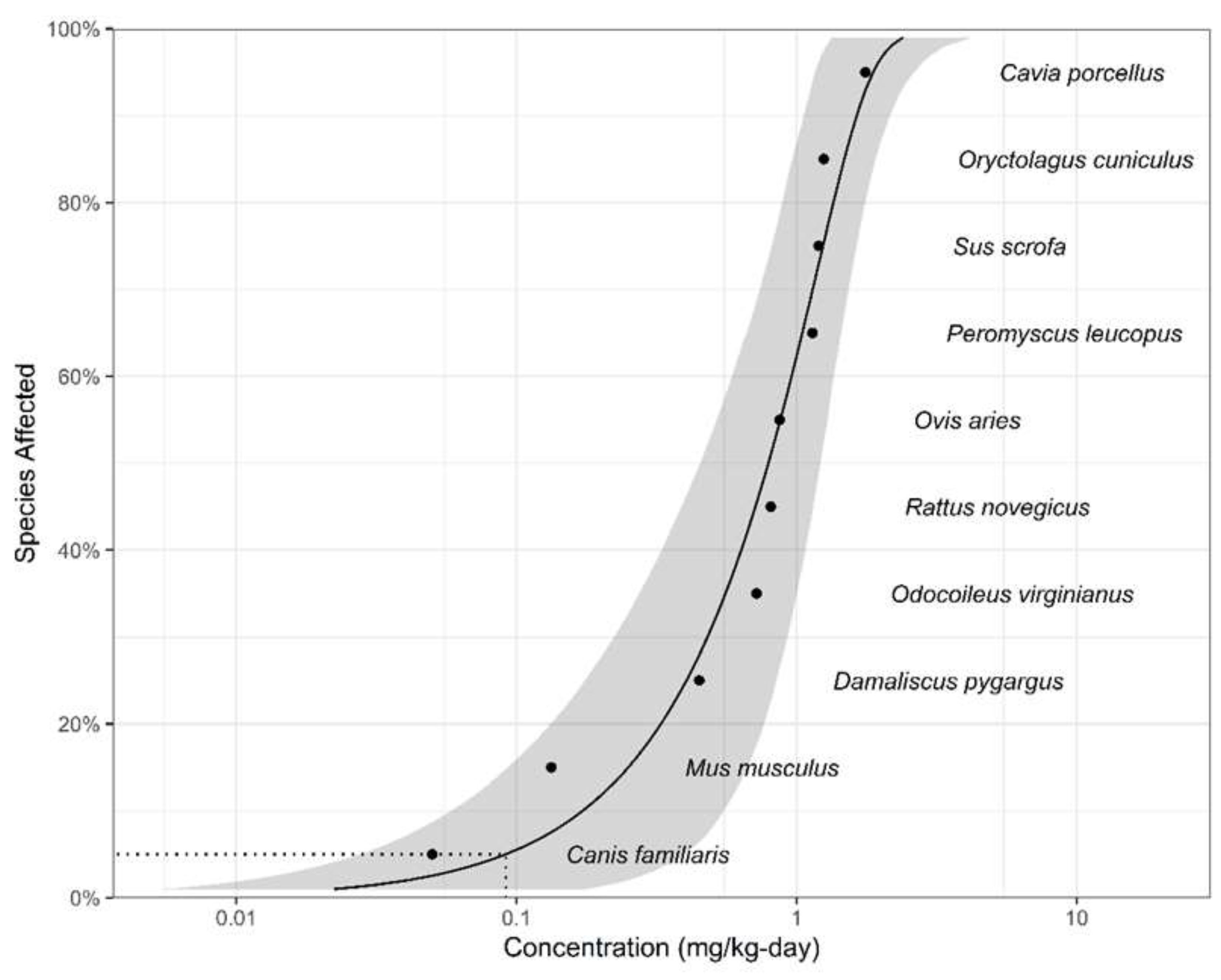
Table 2.
Tissue-based toxicity data of aquatic-dependent wildlife for dieldrin.
| Species | Common name | NOEC (mg/kg) | Taxa | Reference |
|---|---|---|---|---|
| Tyto alba | Barn owl | 0.0445 | Avian | [55] |
| Numida meleagris | Crowned guinea fowl | 0.0537 | Avian | [56] |
| Phasianus colchicus | Ring-necked pheasant | 0.26 | Avian | [57] |
| Colinus virginianus | Bobwhite quail | 0.27 | Avian | [58] |
| Streptopelia risoria | Ring dove | 0.331 | Avian | [59] |
| Coturnix japonica | Japanese quail | 0.852 | Avian | [60] |
| Phasianus colchicus | Pheasant | 0.905 | Avian | [61] |
| Coturnix coturnix | Quail | 1.36 | Avian | [62] |
| Columba livia | Homing pigeon | 2 | Avian | [63] |
| Anas platyrhynchos | Mallard | 2.21 | Avian | [64] |
| Gallus domesticus | Chicken | 10 | Avian | [65] |
| Canis familiaris | Dog | 0.05 | Mammalian | [66] |
| Mus musculus | Mouse | 0.133 | Mammalian | [67] |
| Damaliscus pygargus | Blesbuk | 0.449 | Mammalian | [68] |
| Odocoileus virginianus | White tailed deer | 0.72 | Mammalian | [69] |
| Rattus novegicus | Rat | 0.81 | Mammalian | [66] |
| Ovis aries | Sheep | 0.87 | Mammalian | [70] |
| Peromyscus leucopus | White footed mouse | 1.14 | Mammalian | [71] |
| Sus scrofa | Pig | 1.20 | Mammalian | [72] |
| Oryctolagus cuniculus | Rabbit | 1.25 | Mammalian | [73] |
| Cavia porcellus | Guinea pig | 1.76 | Mammalian | [74] |
Disclaimer/Publisher’s Note: The statements, opinions and data contained in all publications are solely those of the individual author(s) and contributor(s) and not of MDPI and/or the editor(s). MDPI and/or the editor(s) disclaim responsibility for any injury to people or property resulting from any ideas, methods, instructions or products referred to in the content. |
© 2025 by the authors. Licensee MDPI, Basel, Switzerland. This article is an open access article distributed under the terms and conditions of the Creative Commons Attribution (CC BY) license (http://creativecommons.org/licenses/by/4.0/).
Copyright: This open access article is published under a Creative Commons CC BY 4.0 license, which permit the free download, distribution, and reuse, provided that the author and preprint are cited in any reuse.


