

Submitted:
03 February 2025
Posted:
04 February 2025
You are already at the latest version
Abstract
With the continuous advancement of manufacturing technology, the demand for small and lightweight structures for various engineering applications has increased. This study examines forced vibration behaviour of an orthotropic nano-system consisting of an elastically connected nano-plate and a doubly curved shallow nano-shell. Both nano-elements (plate and shell) are simply supported and embedded in a Winkler-type elastic medium. Utilizing the Eringen constitutive elastic relation, Kirchhoff-Love plate theory, and Novozhilov linear shallow shell theory, we derive a system of four coupled nonhomogeneous partial differential equations (PDEs) describing the forced transverse vibrations of the system. For forced vibrations, we employ detailed numerical method to solve the differential equations. The forced vibration analysis is conducted using modal analysis. A key finding of this study is that the upper excited element of the nano-system (nano-plate) exhibits smaller amplitude transverse vibrations when the lower element is curved (nano-shell). This phenomenon is observed by comparing the amplitude of forced transverse responses between an elastically connected system of two nano-plates (ECSTNP) and a system composed of a nano-plate and a nano-shell (ECSNPS). We analyse the effects of the nonlocal parameter, external excitation, damping proportional coefficients, and the radii of curvature of the nano-shell on the ECSNPS in detail. The study reveals that the amplitude of the excited upper nano-plate decreases with increasing nonlocal parameter and decreasing radii of curvature of the nano-shell. Additionally, the damping proportional coefficients and external excitation significantly influence the transverse displacements of both the nano-plate and nano-shell. Specifically, an increase in damping proportional coefficients reduces the transverse displacements, while an increase in external excitation to the upper plate increases them. This study provides measurable data relating the vibration characteristics of the nano-system to its geometric and material properties. The proposed mathematical model of the ECSNPS can be applied in the development of new nano-sensors, which respond to transverse vibrations based on the geometry of the nano-shell element.
Keywords:
forced vibration
; nonlocal elasticity
; nano-shell
; nanoplate
; modal analysis
; coupled nano-structures
; transverse response
; dynamic behavior
1. Introduction
Developing a suitable mathematical model is crucial to obtain the accurate response for the sandwich nano-structures. Generally, an appropriate type of coupling layer is responsible for the stiffness of the sandwich nano-system. For this reason, this study aims to demonstrate how geometric and material parameters can affect the stiffness of nano-systems by analyzing the amplitude values of forced in vibrations of nano-systems. In recent years, nonlocal elastic theory has attracted much attention because of the necessity for modeling and analyzing of very small mechanical structures in the developments of nanotechnologies [1,2]. It is known that the size effect of nano-structures is important for their mechanical behavior, because their dimensions are small and comparable to molecular distances. There are various higher-order continuum theories involving material length scale parameters. Among them are strain gradient elasticity theory [3] and nonlocal theory [4,5,6]. In these theories, the phenomenon known as material size effects arises because internal material properties, such as inhomogeneity and interatomic interactions, significantly influence elastic behaviors. Due to the expanding applications of nano-sized structures, this consideration has gained increasing interest in fields such as sandwich nano-structures which have been widely used in various applications of aerospace, biomedicine, mechanical, and civil engineering [7,8]. Many researchers have shown that the advantage of these structures is their high strength and stiffness to weight ratios [9,10,11,12]. The mechanical and geometrical properties of the nano-sandwich system play a very important role in the overall behavior of a system [13,14,15,16]. For this reason, this study aims to show how would the stiffness of the system change if one element (nano-plate) in the nano system were replaced with a corresponding other element of the same surface area, only with a radius of curvature (nano-shell). Additionally, researchers have previously questioned the effect of curvature upon the vibration frequencies of rectangular shallow shells [17]. The open shallow shells have large radii of curvatures compared to other shell parameters. A shallow shell can be doubly-curved, and more applications can be found in engineering practice. Bhimaraddi [18] investigated the free vibration analysis of homogeneous and laminated doubly-curved shells on a rectangular planform, using the three-dimensional elasticity equations. In the paper of Dereli, E. et al. [19] an extensive investigation into the deformation, shear, and normal stress values of sandwich structures with lattice cores of varying aspect ratios are presented. Their findings suggest a potential for optimization in lightweight structures, which could lead to innovative advancements in design and manufacturing processes within the aerospace and automotive sectors. Nonlocal electro-elastic bending analysis of a doubly curved nano shell has been studied in the paper of Arefi [20] based on nonlocal elasticity theory and first order shear deformation theory. In the paper of Karami and Shahsavari [21], the forced resonate vibration of the nano-shells which included four different geometries of the shells, spherical, elliptical, hyperbolic and cylindrical was studied. The comprehensive free vibration analysis of doubly-curved shallow shells which are made of an orthotropic material was presented in the paper of Ghavanloo and Fazelzadeh [22]. In the paper of Hosseini-Hashemi et al. [23], the influences of changing geometrical parameter and scale parameter on the natural frequency of the micro/nano spherical shell based on First-order shear deformation theory were investigated. The increased use of orthotropic shells in the design of various devices including their mechanical behavior has attracted the attention of many researchers. As fundamental elements, shells are used in many fields of modern engineering technologies because they provide dynamic stability. Study of Turan, F. et al. [24] deals with the free vibration and buckling responses of porous orthotropic doubly-curved shallow shells subjected to non-uniformly distributed edge compressions. In this paper, the parametric studies were developed to discuss the influence of various factors, such as different porosity coefficients, aspect ratio, arc length-to-thickness ratio, radius-to-arc length ratio, orthotropy ratio, shell type on the free vibration and buckling behavior of porous orthotropic doubly-curved shallow shells. The free vibration of composite sandwich plates and cylindrical shells, composed of two composite laminated faces and an ideally orthotropic elastic core was considered by Hwu [25]. Based on several different numerical mathematical methods, the natural frequencies of composite sandwich plates and cylindrical shells [25] were obtained. It was shown that the values of natural frequencies of such a system agree well with each other.
In the present study, the authors analyze in detail a nano-system composed from elastically connected nano-plate and nano-shell. The nano-plate and the doubly-curved shallow nano-shell are made of orthotropic materials. Both nano-elements (plate and shell) are simply supported and connected by an elastic layer, which is approximated by the Winkler model of discretely distributed springs of linear stiffness , acting on the surface of the nano-plate and nano-shell. In this paper, the forced vibrations analysis are conducted for the Elastically Connected System composed from Nano-Plate and nano-Shell (ECSNPS). Based on the Eringen’s constitutive elastic relation, Kirchhoff-Love plate theory [26,27,28] and Novozhilov linear shallow shell theory [29], the system of four coupled nonhomogeneous PDEs of the transverse vibration of ECSNPS system is derived. The forced transverse vibration analysis is solved by modal analysis. The effect of the nonlocal parameter on the values of amplitudes forced vibration of ECSNPS system is presented. Additionally, the effects of external excitation, damping proportional coefficients and radii curvature of nano-shell on the ECSNPS are analyzed in detail. We rigorously examine the effects of nano-shell curvature on nano-systems, with a particular focus on its role in reducing the amplitude of transverse vibrations in the upper nano-plate. This analysis is contrasted with a nano-system comprising two nano-plates. The advanced mathematical model of the sandwich nano-structure proposed here holds significant promise for the dynamic analysis of the nano-sensors and nano-antennas. These applications leverage the unique geometry of the nano-shell element to precisely tune and optimize transverse responses, thereby driving significant advancements in the field of nanotechnology.
2. Brief Review of the Eringen’s Constitutive Elasticity
Using the fundamental equations of the nonlocal elasticity theory from papers Eringen and co-workers [4,5,6], the Eringen constitutive elastic relation from the stress and the strain are given as
where the is the nonlocal parameter, describes the internal characteristic length, and is a constant appropriate to each material that can be identified from atomistic simulations or by using the dispersive curve of the Born-Karman model of lattice dynamics. is the elastic modulus tensor for classical isotropic elasticity; and are the stress and the strain tensors, respectively.
Based on expression (1) constitutive relations can be written for one-dimensional structures in the following forms
where is Young’s modulus of elasticity and is the shear modulus.
By applying relation (1), the constitutive relation for orthotropic two-dimensional nano-structures can be expressed as follows
where is Laplacian, and denotes Poisson’s ratios, , and are normal and shear stresses, , , and are normal and shear strains and is the shear modulus. The internal characteristic lengths are often assumed to be in the range 0-3 [nm]. When the nonlocal constitutive relation is reduced to the classical constitutive relation of the elastic body.
3. Mathematical Formulations of the Equations of Motion for an Orthotropic Nano-Plate
Based on Kirchhoff's plate theory [26,27], the displacement components , and for an arbitrary point of the middle plane of nano-plate along the axis x, y, z it can be written in the following forms
The strain - displacement relations of the linear strain theory are
The nonlocal constitutive relation between stress and strain of one orthotropic nano-plate, as expressed in form (4), based on nonlocal stresses ,,, can be written as follows
Based on the Newton’s second law for the infinitesimal element of the nano-plate, equilibrium equations can be obtained in the following form
where , and are the in-plane stress resultants and , and are the moment resultants defined as
and is the external force caused by transverse forces f
Using expression (6) and (9) and taking into account Equation (7) yields,
and
where are extensional and are the bending stiffness’s of the orthotropic elastic nano-plate expressed as
By using Equation. (11), (12) and (8), the PDEs describing the displacements in the xOy plane and the transverse displacement in the z-axis direction of a nanoplate subjected to an external load f(x,y,t) have the forms
4. Mathematical Formulation of the Equations of Motion for an Orthotropic Doubly Curved Shallow Nano-Shell
According to Novozhilov’s linear shell theory presented from Amabili [29], the strain components in an arbitrary point of the panel are related to the middle surface strains , , and by changes in the curvature and torsion of the middle surface , , and are defined by the following relationships
where are
The nonlocal constitutive relation between stress and strain is defined by expression (4). For nano-shell the constitutive relation between stress and strain can be written in following form
From Equation (18) the nonlocal stresses are in the following forms
By integrating Equation (19) and taking into account expression (9) yields
and
The extensional and bending stiffnesses are expressed by the expressions (13) and (14).
According to Novozhilov’s linear shell theory presented in Amabili [29], the equilibrium equations of the orthotropic doubly curved shallow shell can be written in the following form
the displacements in the xOy plane and the transverse displacement in the z-axis direction of a nano-shell have the forms
In all three presented Equations (23.1-23.3) figures displacement w. For this reason, all equations must be taken into account to describe the vibration analysis of orthotropic doubly curved shallow nano-shell. In the paper of Ghavanloo E. et al. [22], PDEs of the orthotropic doubly curved shallow shell based on the gradient elasticity were presented.
5. Formulation of Model ECSNPS
A detailed analysis is conducted for the nano-system shown in Figure 1, which is composed of an elastically connected nano-plate and nano-shell (ECSNPS). The nano-plate and the doubly-curved shallow nano-shell are made of orthotropic materials. Both nano-elements (plate and shell) are simply supported and connected by an elastic layer, which is approximated by the Winkler model of discretely distributed springs of linear stiffness , which acting on the surface of the nano-plate and nano-shell. The material characteristics of the nano-shell are the same as of nano-plate with the same elastic modulus , Poison coefficients , shear modulus and mass density. The geometrical characteristics length, width and thickness are same for nano-plate and nano-shell, where at shell exist and principal radii of curvature. We assume that transversal displacement of nano-plate is and displacements of nano-shell in direction x, in direction y, and transversal displacement of nano-shell in direction z is .
A Material properties from Table 1 are used from Pouresmaeeli et al. [30]. Value for the stiffness coefficient k is used from paper of Radić et al. [31].
If we use the PDEs of transverse oscillations (15 and 23.1-23.3) and if we take into account the elastic layer connecting the nano-plate and the nano-shell via the displacement of the ends of the springs , (where 1 denotes the nano-plate and 2 the nano-shell), we obtain the PDEs of the coupled system that represent the small transverse displacements of the mid-plane of the nano-plate and nano-shell in the following forms
The transverse displacements of the midplane of the nanoplate are described by in Equation (24.1). In Equations (24.2-24.4) it can be observed that displacement components in all three directions , and appear. Therefore, all equations must be considered when describing small transverse oscillations of an orthotropic doubly curved shallow nanoshell.
The boundary conditions of a simply supported nanoplate and nanoshell, of length a and width b, are
where i=1 denotes a nanoplate, while i=2 denotes a double-curved shallow nano-shell.
6. Solution Methodology for Determining the Natural Frequencies of ECSNPS
Governing Equations (24.1-24.4) can be solved by assuming displacements in the following forms
where , m=1,2,3,….; n=1,2,3,…. .
Unknown time functions are marked by and .
By substituting the assumed solutions (26.1-26.4) into Equations (24.1 -24.4) and applying the orthogonality conditions, a system of ordinary differential equations (ODEs) of free vibrations is obtained in the forms
where are mass, extensional and bending stiffness constants presented in the Appendix A.
Taking into account the presented differential Equations (24.1 -24.4) the ODEs (27.1-27.4) of the time modes of the transverse oscillations that describe the free vibration of the undamped observed ECSNPS system have the following matrix form
or in a more concise form
where are
The free vibrations of the ECSNPS described by the Equation (29) are periodic. Thus, when free vibrations at a single frequency are initiated for a particular system, the ratio of any two dependent variables is independent of time. These assumptions lead to hypothesizing the normal-mode solution of Equation (29) in the form
where is the m-dimensional vector of constants (according to mode shapes) and represents the natural frequencies of the ECSNPS system.
By substituting Equation (31) into Equation (29) gives
Since for any real value of time t,
The mass matrix is nonsingular, and thus exists. Multiplying Equation (33) by and rearranging gives
where is the identity matrix. Thus, the trivial solution is obtained unless
By solving the determinant (35) for the unknown , four natural frequencies are obtained for each pair (m, n) and for the chosen set of parameters presented in Table 2. These four natural frequencies correspond to four distinct vibration modes.
7. Forced Vibration of the Damped ECSNPS
In this section, the forced vibrations of the damped system of the considered nano-system are analyzed. Damping is implemented using Rayleigh-type proportional damping, defined by the coefficients α and β, i.e. Specifically, the damping matrix is a linear combination of the mass matrix βM and the stiffness matrix αK, Kelly [32].
Considering the PDEs of the nano-plate (24.1) and nano-shell (24.2-24.4), the PDEs for the time modes of the transverse vibrations, which describe the forced vibrations of the damped ECSNPS, can be presented in the following matrix form:
where M, K, and are presented by the expressions (30.1 and 30.2) and
To determine the forced-vibration response of the presented system (36) the standard procedure of modal analysis is used, based on the principal coordinates from Kelly [32]. For the natural frequencies obtained from expression (35), the matrix P presents the system’s modal matrix, the matrix whose columns are normalized mode shapes:
The system of n-differential equations corresponding to the generalized coordinates can be transformed into a system with the principal coordinates by introducing the modal matrix P of the system. The columns of this matrix represent the normalized mode shapes. The transformation is given by
is equivalent to a linear transformation between the generalized and the principal coordinates of the system
Substituting of Eq. (39) into Eq. (36) yields
By applying the mode-shape orthogonality condition and multiplying Equation (41) by a scalar , for an arbitrary r=1,2,3,4, we find that only one term in each of the sums is non-zero, specifically when . With the mode shapes normalized, Equation (41) can be expressed as follows
The Equation (42) can also be written in the form
where is
For load in expression (37) we take the uniformly distributed surface harmonic load in the following form
By substituting (45) in expression (37), we obtain
Equation can be writen in the form
where is
The general solution of Equation (43) can be developed as a sum of homogeneous and the particular solutions in the form
Each nonhomogeneous Equation (43) has a corresponding homogeneous equation
The homogeneous solution is assumed in the form
where A and B are the arbitrary constants obtained from the initial conditions and
Based on the nonhomogeneous term given in Equation (47), we can predict the type of function that the particular solution would be
where C and D are the coefficients that are easy to determine.
By substituting the and in Equation (47), we obtain two equations
From the system of Equations (54 and 55) the coefficients are determined in the forms
where N is the amplitude of the vibration.
From Equations (56 and 57) it is easy to obtain unknowns N and in the following form
Now the particular and general solutions have the following forms
For the arbitrary initial condition and, it is possible to obtain the constants A and B in the following form
Finaly, the general solution of Equation (47) is obtained
When the solution from Equation (62) is returned into Equation (40), we obtain
Finally, the solutions of Equations (36) for the damped ECSNPS system are in the following forms
8. Results and Discussion
This section is divided into two parts. In the first part, the natural frequencies of the nano-system of the presented study are analyzed. The second part presents the results of the forced vibrations of the nano-system created from elastically connected nano-plate and nano-shell elements (ECSNPS). Most importantly, a comparison of the transverse response of forced vibrations between the nano-system elastically composed of a nanoplate and a nano-shell (ECSNPS) and the nano-system elastically composed of two nanoplates (ECSTNP) is presented. The material and geometrical parameters for both analyzed nano-systems are given in Table 1.
8.1. Natural Frequencies Analysis
For material and geometrical characteristics given in Table 1, the natural frequencies of the presented nano-system are given in Table 2. The values of natural frequencies of the presented nano-system (ECSNPS) are denoted by for the first three eigenmodes In Table 2, the values of the natural frequencies are compared based on changes in the nonlocal parameter. It can be observed that the natural frequencies decrease as the values of the nonlocal parameter increase.
The general mode shapes of vibration of coupled two plates are presented in the paper Oniszczuk [33,34]. Assuming that the nonlocal parameter is equal to zero μ=0, and radius of curvatures of the doubly curved shallow shell tends to infinity, i.e. and in the Equations (24.1-24.4), the equations are reduced to two-plates equations as in paper of Oniszczuk [33,34].
Then the system of four coupled differential Equations (24.1-24.4), is reduced to a system of two coupled differential equations, which represent the transverse displacements of two elastically coupled plates Oniszczuk [33,34]. In this way, the considered nano-system is reduced to a system of two nano-plates interconnected by a Winkler elastic layer.
The values of the natural frequencies of the observed nano-system (ECSNPS) are compared with the results from the paper Oniszczuk [33,34]. In Equations (24.1-24.4) the geometric and material parameters from the paper Oniszczuk [33,34] are used. By neglecting the non-local parameter and assuming that the radii of curvature of the shallow shell tend to infinity, a very good agreement of the results with the values of the frequencies from the work Oniszczuk [33,34] is obtained, as shown in Table 3.
If we omit the upper nanoplate and the elastic medium, the validity of the derived equations is conducted comparing with the published findings of doubly-curved shell from [22], as shown in Table 4. From Table 4, it can be seen that the natural frequency values are close to those obtained in [22]. The differences in values arise due to the application of the Gradient Elasticity Theory in the paper [22].
8.2. Forced Vibration of the ECSNPS
The main objective of this research is to observe the expected occurrence of dynamic absorption or decrease amplitudes in the excited upper nano-plate of the ECSNPS in comparison with the results of ECSTNP system. Figure 2 presents the two analyzed nano-systems. This chapter also examines the material and geometrical influences on the ECSNPS for the first three pairs of forced vibration modes.
In this section the forced transverse vibration response at the mid-points of the nano-systems is analyzed. The ECSNPS is excited with a periodic force in the form F0cos(Ωt), where F0=10 [nN] and Ω=0.8ω11. The value of the nonlocal parameter is chosen to be , in an analysis that does not include the influence of this parameter. The values of the damping proportional coefficients are chosen to be α=β=1 nNs/m.
A comparison of the amplitude values of the transverse vibrations of ECSNPS and ECSTNP nano-systems is shown in Figure 3. The transverse displacements as a function of time for the plate-plate (ECSTNP) system are shown in gray, while those for the plate-shell system (ECSNPS) are shown in blue. Figure 3a presents a comparison of the amplitude of forced transverse vibrations of the upper nanoplate in the ECSNPS with that of the upper nanoplate in the ECSTNP. The most important observation is that the amplitude values of the upper elements in the plate-shell system (ECSNPS) are lower than those in the plate-plate system (ECSTNP), as indicated by the blue line. This decrease in amplitude values in the ECSNPS system is one of the primary findings of this study. In Figure 3, the radius of curvature values for the nano shell are R1=∞,R2=450[nm].
Additionally, Figure 3b compares the amplitude values of forced transverse vibrations of the nano-shell in the ECSNPS system with those of the lower nano-plate in the ECSTNP system. It was observed that the amplitude value is significantly smaller for the nano-shell in the ECSNPS system compared to the vibration amplitude of the lower nano-plate in the ECSTNP system.
It can be concluded that with a change in geometric shape, the transverse response decreases, and consequently, the stiffness of the nano-system increases.
The influence of the radii of curvatures , for , on the transverse displacement of the forced vibration for the first three modes of ECSNPS is presented in Figure 4. The values of the radius of curvature R2 vary from 150 to 850, while the radius of curvature R1 tends to infinity. Lower values of the radius of curvature R2 lead to a decrease in the amplitude of forced vibration in both the nano-plate and nano-shell of the ECSNPS system. Notably, the amplitude of forced vibration in the nano-shell significantly decreases as the radius of curvature decreases, as illustrated in Figure 4b.
It can be observed that as the radii of curvature decreases, the transverse displacement of the forced vibration for both the upper nano-plate and lower nano-shell of the ECSNPS system also decreases.
The effect of the one-sided and double-sided curved nano-shell on the transverse displacement for the first three modes of ECSNPS system is presented in Figure 5. The doubly-curved shallow nano-shell has radii of curvature , while one-sided -curved nano-shell has radii of curvature . The transverse displacement of one-side curved nano-shell is marked in blue, while the transverse displacement of the double-sided curved nano-shell of the ECSNPS system is marked in gray. From Figure 5a it can be seen that the vibration amplitude of the nano-plate is smaller in ECSNPS system with one-sided -curved nano-shell. Figure 5b also shows that the amplitude of forced vibration for the nano-shell of the ECSNPS system is smaller with the one-sided curved nano-shell.
The conclusion is that the amplitude of forced vibration is smaller for both the nanoplate and the nano-shell for the ECSNPS system with the one-sided -curved nano-shell.
The effect of the external excitation on the transverse displacement for the first three modes of ECSNPS system is presented in Figure 6. The magnitude values of the uniformly distributed surface harmonic loads are used It is observed that increasing the magnitude values of the external load increases the vibration amplitude of both the nanoplate and the nano-shell of the ECSNPS system
The effect of the nonlocal parameter on the transverse displacement for the first three modes of the ECSNPS system is presented in Figure 7. The transverse displacements for the nanoplate of the ECSNPS system are shown in Figure 7a, while those for the nano-shell of the ECSNPS system are shown in Figure 7b. It is observed that the vibration amplitude of the nanoplate in the ECSNPS system decreases with an increase in the nonlocal parameter, as seen in Figure 7a. Conversely, the amplitude of the forced vibration of the nano-shell in the ECSNPS system increases with an increase in the nonlocal parameter, as shown in Figure 7b. Similar observations regarding the effect of the nonlocal parameter on a doubly-curved nano-shell are also noted in [20].
The effect of the damping proportional coefficients on the transverse displacement for the first three modes of the ECSNPS system is presented in Figure 8. It can be observed that an increase in the damping proportionality coefficients decreases the amplitude of transverse vibrations in both nano-elements of the ECSNPS system.
9. Conclusion
This work presents a detailed chapter on the forced vibration behaviour of an orthotropic nano-system composed of an elastically connected nano-plate and a doubly curved shallow nano-shell. It demonstrates how the stiffness in such a nano-system changes based on variations in geometric and material parameters. Both nano-elements are simply supported and embedded in a Winkler-type elastic medium. Using Eringen’s constitutive elastic relation, Kirchhoff-Love plate theory, and Novozhilov linear shallow shell theory, we derive a system of four coupled nonhomogeneous PDEs for the transverse vibration of the system. The numerical method for solving these PDEs is presented in detail. Forced vibration analysis is solved using modal analysis.
The main contribution of this paper is the discovery that the upper excited element of the nano-system (the nano-plate) exhibits smaller amplitude vibrations of transverse responses only if the lower element is curved (the nano-shell). This phenomenon is observed by comparing the amplitude of forced transverse responses in a system composed of two nano-plates (ECSTNP) to a system composed of a nano-plate and a nano-shell (ECSNPS).
We examine the effects of the nonlocal parameter, external excitation, damping proportional coefficients, and radii of curvature of the nano-shell on the ECSNPS in detail. The amplitude decrease of the excited upper nano-plate is related to an increasing nonlocal parameter and decreasing radii of curvature of the nano-shell. The effect of one-sided and double-sided curved nano-shells on the transverse displacement of forced vibration for the first three modes of the ECSNPS is also analyzed. It is concluded that the amplitude of forced vibration is smaller for both the nano-plate and the nano-shell in the ECSNPS with a one-sided curved nano-shell.
The effects of damping proportional coefficients and external excitation on the ECSNPS are presented and analyzed in detail. An increase in damping proportional coefficients results in decreased transverse displacements of the nano-plate and nano-shell, while an increase in external excitation to the upper plate results in increased transverse displacements. The proposed mathematical model of the ECSNPS can be implemented in the creation of new nano-sensors that correspond to the occurrence and tuning of transverse responses due to the geometry of the nano-shell element.
It is concluded that the influence of geometry at higher modes changes the stiffness of the system. For higher vibration modes, a decrease in the radii of curvature of the nano-shell results in decreased forced transverse response and consequently increased stiffness of the ECSNPS. Conversely, an increase in the radii of curvature of the nano-shell approximates the transverse response of forced vibrations to that of the ECSTNP system.
The results obtained in this paper can be used for the development of nano-electromechanical devices, providing engineers with better insight into the behaviour of the ECSNPS under the influence of the considered parameters. The proposed mathematical model of the ECSNPS can be implemented in the creation of new nano-sensors that correspond to the occurrence and tuning of transverse responses due to the geometry of the nano-shell element. This paper also provides an opportunity for other researchers to compare the analytically presented results with various numerical methods.
Author Contributions
Conceptualization, M.S.A., I.P. and J.S.; Methodology, M.S.A.; software, M.S.A.; formal analysis, M.S.A., I.P. and J.S.; writing-original draft, M.S.A.; writing-review and editing, M.S.A., J.S. and I.P. All authors have read and agreed to the published version of the manuscript.
Funding
This research was financially supported by the Ministry of Science, Technological Development and Innovation of the Republic of Serbia (Contract No. 451-03-66/2024-03).
Institutional Review Board Statement
Not applicable.
Informed Consent Statement
Not applicable.
Data Availability Statement
The data presented in this study, including the review protocol, are available upon request from the corresponding author.
Acknowledgments
This research is a revised and expanded version of a doctoral dissertation titled "Stability and Forced Vibration of Coupled Nano-Structures" by the corresponding author M.S.A., which was defended at the Faculty of Mechanical Engineering, University of Niš, on September 4th, 2023.
Conflicts of Interest
The authors declare no conflicts of interest.
Abbreviations
The following abbreviations are used in this manuscript:
| ECSNPS | Elastically Connected System of Nano-Plate and nano-Shell |
| ECSTNP | Elastically Connected System of Two Nano-Plates |
| PDE | Partial Differential Equation |
| ODE | Ordinary Differential Equations |
Appendix A
References
- Li, X.; Warzywoda, J.; McKenna, G.B. Mechanical responses of a polymer graphene-sheet nano-sandwich. Polymer 2014, 55, 4976–4982. [Google Scholar] [CrossRef]
- Li, H.; Wang, W.; Yao, L. Analysis of the vibration behaviors of rotating composite nano-annular plates based on nonlocal theory and different plate theories. Appl. Sci. 2021, 12, 230. [Google Scholar] [CrossRef]
- Lam, D. C.; Yang, F.; Chong, A. C. M.; Wang, J.; Tong, P. Experiments and theory in strain gradient elasticity. J. Mech. Phys. Solids. 2003, 51, 1477–1508. [Google Scholar] [CrossRef]
- Eringen, A. C.; Edelen, D. G. B. On nonlocal elasticity. Int. Jour. of Eng. Scie. 1972, 10, 233–248. [Google Scholar] [CrossRef]
- Eringen, A. C. On differential equations of nonlocal elasticity and solutions of screw dislocation and surface waves. Jour. of Appl. Physics. 1983, 54, 4703–4710. [Google Scholar] [CrossRef]
- Eringen, A. C. Nonlocal continuum field theories; Springer Science & Business, 2002. [Google Scholar]
- Cheng, N.; Juntian, T.A.N.G.; Peng, F.E.N.G.; Zhihao, H.A.O.; Zhang, Y.; Chang, M. Experimental and theoretical study on flexural performance of lightweight sandwich panels using FRP connectors. Case Studies in Const. Materials 2024, 21, e03947. [Google Scholar] [CrossRef]
- Zhou, S.; Qi, L.; Zhang, R.; Li, A.; Ren, F.; Zheng, Z.; Qiao, J.; Sun, Y.; Zhou, S. Analysis of the electromechanical responses of sandwich circular nano-plate based on flexoelectric nano-ultrasonic transducer. Appl. Math. Mod 2025, 137, 115697. [Google Scholar] [CrossRef]
- Marchetti, F.; Ege, K.; Leclere, Q.; Roozen, N.B. On the structural dynamics of laminated composite plates and sandwich structures; a new perspective on damping identification. Jour. of Sound and Vib 2020, 474, 115256. [Google Scholar] [CrossRef]
- Di Sciuva, M.; Sorrenti, M. Bending, free vibration and buckling of functionally graded carbon nanotube-reinforced sandwich plates, using the extended Refined Zigzag Theory. Comp. Struct 2019, 227, 111324. [Google Scholar] [CrossRef]
- Atanasov, M. S.; Karličić, D.; Kozić, P. Forced transverse vibrations of an elastically connected nonlocal orthotropic double-nanoplate system subjected to an in-plane magnetic field. Acta Mech. 2017, 228, 2165–2185. [Google Scholar] [CrossRef]
- Safarpour, M.; Rahimi, A.; Noormohammadi A., O.; Rabczuk, T. Frequency characteristics of multiscale hybrid nanocomposite annular plate based on a Halpin–Tsai homogenization model with the aid of GDQM. Appl. Sci 2020, 10, 1412. [Google Scholar] [CrossRef]
- Wang, Y.; Guo, Y.; Zhang, J. Dynamic response of double-layer rectangular sandwich plates with graded foam cores under blast loading. Intern. Jour. of Impact Eng 2025, 195, 105141. [Google Scholar] [CrossRef]
- Fu, T.; Wang, X.; Hu, X.; Rabczuk, T. Impact dynamic response of stiffened porous functionally graded materials sandwich doubly-curved shells with Arc-type auxetic core. Intern. Jour. of Impact Eng. 2024, 191, 105000. [Google Scholar] [CrossRef]
- Atanasov, M. S. Stability and forced vibration of coupled nano-structures. Doctoral dissertation. 2023. [Google Scholar]
- Pavlovic I., R.; Pavlovic, R.; Janevski, G.; Despenic, N.; Pajkovic, V. Dynamic behavior of two elastically connected nanobeams under a white noise process. Facta Univ., series: Mech. Eng. 2020, 18, 219–227. [Google Scholar] [CrossRef]
- Leissa, A. W.; Kadi, A. S. Curvature effects on shallow shell vibrations. Jour. of Sound and Vib. 1971, 16, 173–187. [Google Scholar] [CrossRef]
- Bhimaraddi, A. Free vibration analysis of doubly curved shallow shells on rectangular planform using three-dimensional elasticity theory. Inter. Jour. of Sol. and Struct. 1991, 27, 897–913. [Google Scholar] [CrossRef]
- Dereli, E.; Mbendou II, J.; Patel, V.; Mittelstedt, C. Analytical and numerical analysis of composite sandwich structures with additively manufactured lattice cores. Comp. Part C: Open Access 2024, 14, 100484. [Google Scholar] [CrossRef]
- Arefi, M. Analysis of a doubly curved piezoelectric nano shell: nonlocal electro-elastic bending solution. Eur. Jour. of Mech-A/Solids. 2018, 70, 226–237. [Google Scholar] [CrossRef]
- Karami, B.; Shahsavari, D. On the forced resonant vibration analysis of functionally graded polymer composite doubly-curved nanoshells reinforced with graphene-nanoplatelets. Comp. Meth. in Appl. Mech. and Eng. 2020, 359, 112767. [Google Scholar] [CrossRef]
- Ghavanloo, E.; Fazelzadeh, S. A. Free vibration analysis of orthotropic doubly-curved shallow shells based on the gradient elasticity. Comp. Part B: Eng. 2013, 45, 1448–1457. [Google Scholar] [CrossRef]
- Hosseini-Hashemi, S.; Sharifpour, F.; Ilkhani, M.R. On the free vibrations of size-dependent closed micro/nano-spherical shell based on the modified couple stress theory. Inter. Jour. of Mech. Sci. 2016, 115, 501–515. [Google Scholar] [CrossRef]
- Turan, F.; Karadeniz, M.; Zeren, E. Free vibration and buckling behavior of porous orthotropic doubly-curved shallow shells subjected to non-uniform edge compression using higher-order shear deformation theory. Thin-Wall. Struct. 2024, 205, 112522. [Google Scholar] [CrossRef]
- Hwu, C.; Hsu, H. W.; Lin, Y. H. Free vibration of composite sandwich plates and cylindrical shells. Comp. Struct, 2017, 171, 528–537. [Google Scholar] [CrossRef]
- Reddy, J. N. Mechanics of laminated composite plates and shells: theory and analysis; CRC press, 2004. [Google Scholar]
- Reddy, J. N. Theory and analysis of elastic plates and shells; CRC press, 2006. [Google Scholar]
- Karličić, D.; Murmu, T.; Adhikari, S.; McCarthy, M. Non-local Structural Mechanics; John Wiley and Sons, 2015. [Google Scholar]
- Amabili, M. Nonlinear vibrations and stability of shells and plates; Cambridge Univ. Press: New York, 2008. [Google Scholar]
- Pouresmaeeli, S.; Ghavanloo, E.; Fazelzadeh, S. A. Vibration analysis of viscoelastic orthotropic nanoplates resting on viscoelastic medium. Comp. Struct. 2013, 96, 405–410. [Google Scholar] [CrossRef]
- Radić, N.; Jeremić, D.; Mijatović, B. Vibration analysis of orthotropic double-nanoplate system subjected to unidirectional in-plane magnetic field with various boundary conditions. Jour. of Mech. and Civil Eng. 2018, 15, 59–76. [Google Scholar]
- Kelly, S. G. Mechanical vibrations: theory and applications. Cengage learning. 2012. [Google Scholar]
- Oniszczuk, Z. Free transverse vibrations of an elastically connected rectangular simply supported double-plate complex system. Jour. of Sound and Vib. 2000, 236, 595–608. [Google Scholar] [CrossRef]
- Oniszczuk, Z. Forced transverse vibrations of an elastically connected complex rectangular simply supported double-plate system. Jour. of Sound and Vib. 2004, 270, 997–1011. [Google Scholar] [CrossRef]
Figure 2.
The double graphene nano-system is composed of nano-plate and nano-shell and coupled by Winkler-type elastic layer: (a) Physical model; (b) Mechanical model.
Figure 2.
The double graphene nano-system is composed of nano-plate and nano-shell and coupled by Winkler-type elastic layer: (a) Physical model; (b) Mechanical model.
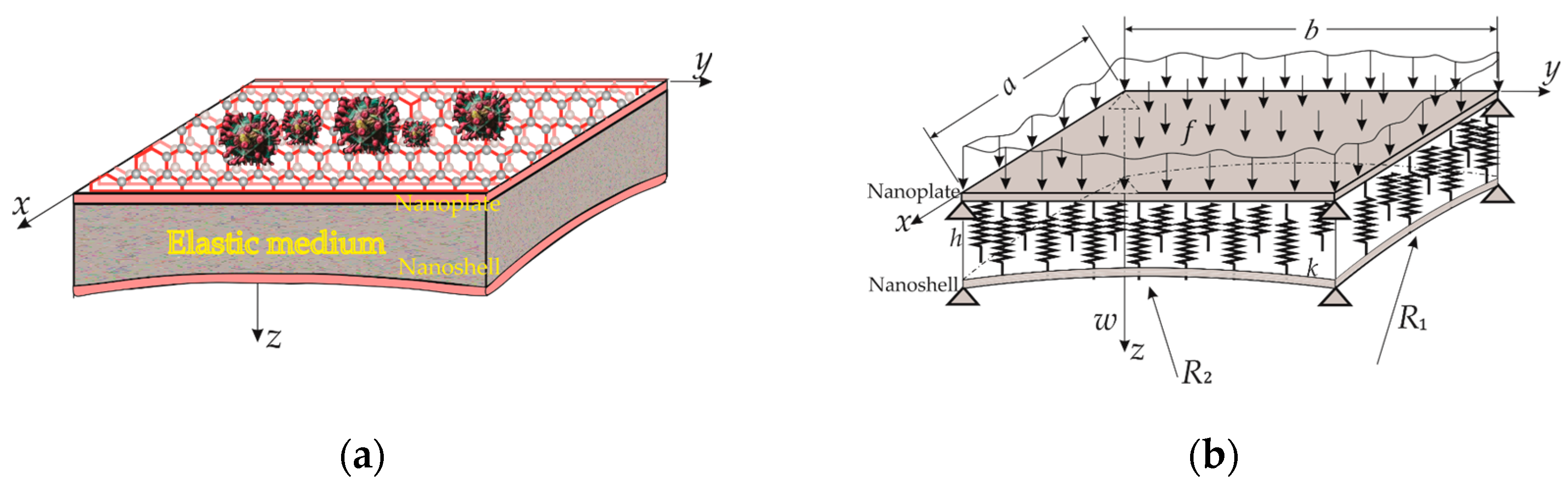
Figure 2.
The nano-systems coupled by Winkler-type elastic layer: (a) Elastically connected system composed from nano-plate and nano-shell (ECSNPS); (b) Elastically connected system from two nano-plates (ECSTNP).
Figure 2.
The nano-systems coupled by Winkler-type elastic layer: (a) Elastically connected system composed from nano-plate and nano-shell (ECSNPS); (b) Elastically connected system from two nano-plates (ECSTNP).
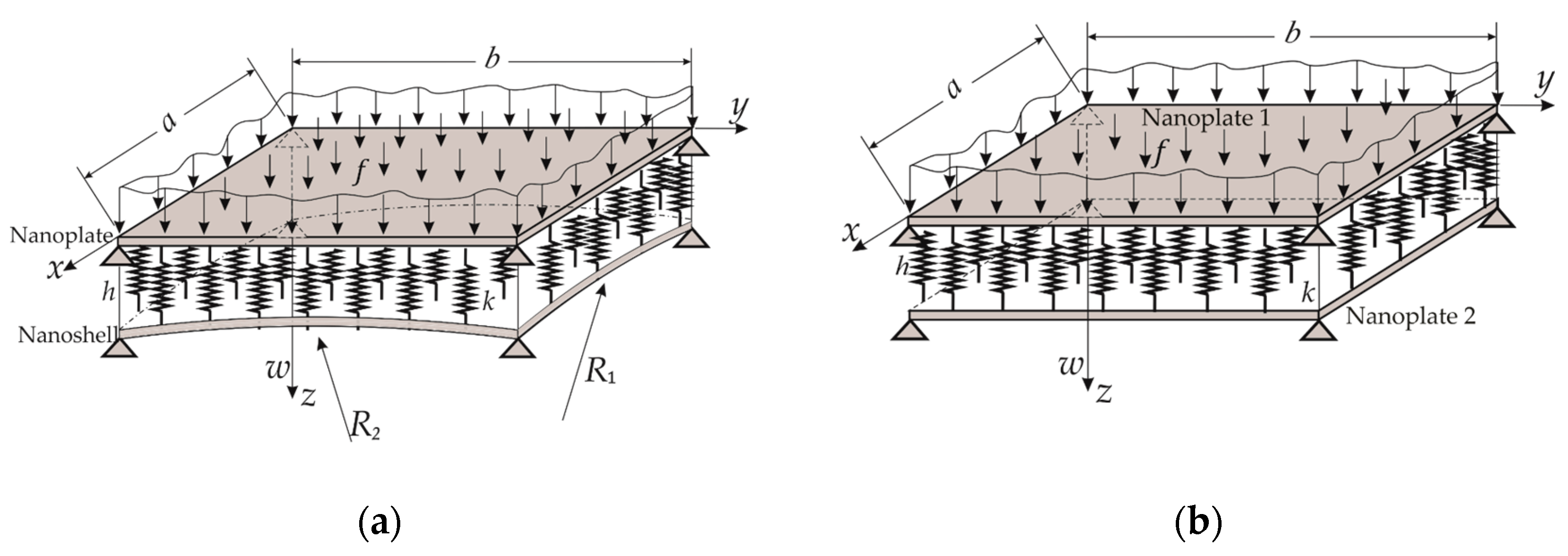
Figure 3.
Comparison of the amplitude values of the forced vibrations of ECSNPS and the ECSTNP systems: (a) The upper nano-plate of the ECSNPS system with the upper nano-plate of the ECSTNP system; (b) The lower nano-shell of the ECSNPS system with the lower nano-plate of the ECSTNP system.
Figure 3.
Comparison of the amplitude values of the forced vibrations of ECSNPS and the ECSTNP systems: (a) The upper nano-plate of the ECSNPS system with the upper nano-plate of the ECSTNP system; (b) The lower nano-shell of the ECSNPS system with the lower nano-plate of the ECSTNP system.
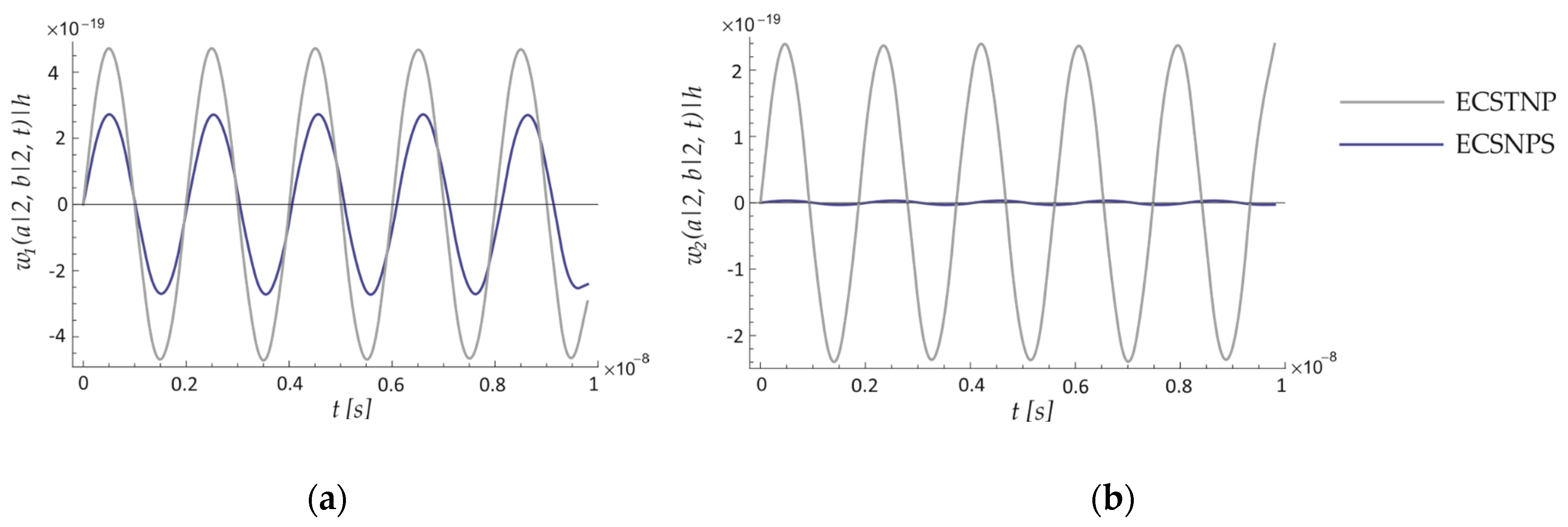
Figure 4.
Effect of the radii of curvature R2 on the transverse displacement for the first three modes of ECSNPS systems: (a) Nano-plate; (b) Nano-shell.
Figure 4.
Effect of the radii of curvature R2 on the transverse displacement for the first three modes of ECSNPS systems: (a) Nano-plate; (b) Nano-shell.
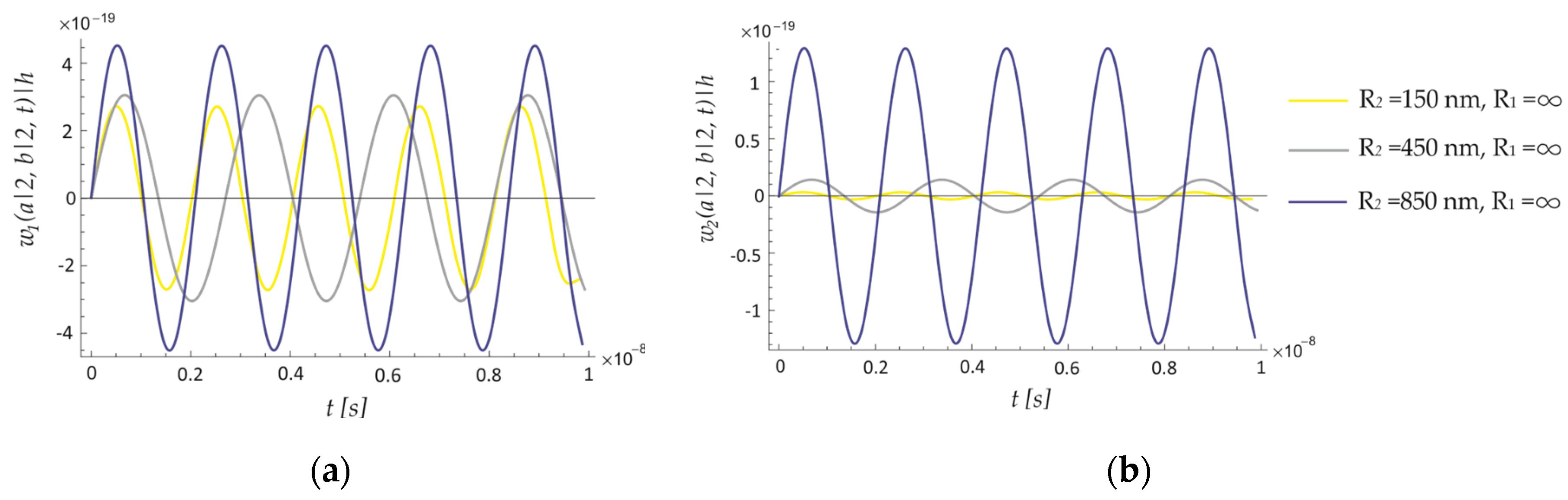
Figure 5.
Effect of the one-sided and double-sided curved nano-shell on the transverse displacement for the first three modes of ECSNPS system: (a) Nano-plate; (b) Nano-shell.
Figure 5.
Effect of the one-sided and double-sided curved nano-shell on the transverse displacement for the first three modes of ECSNPS system: (a) Nano-plate; (b) Nano-shell.
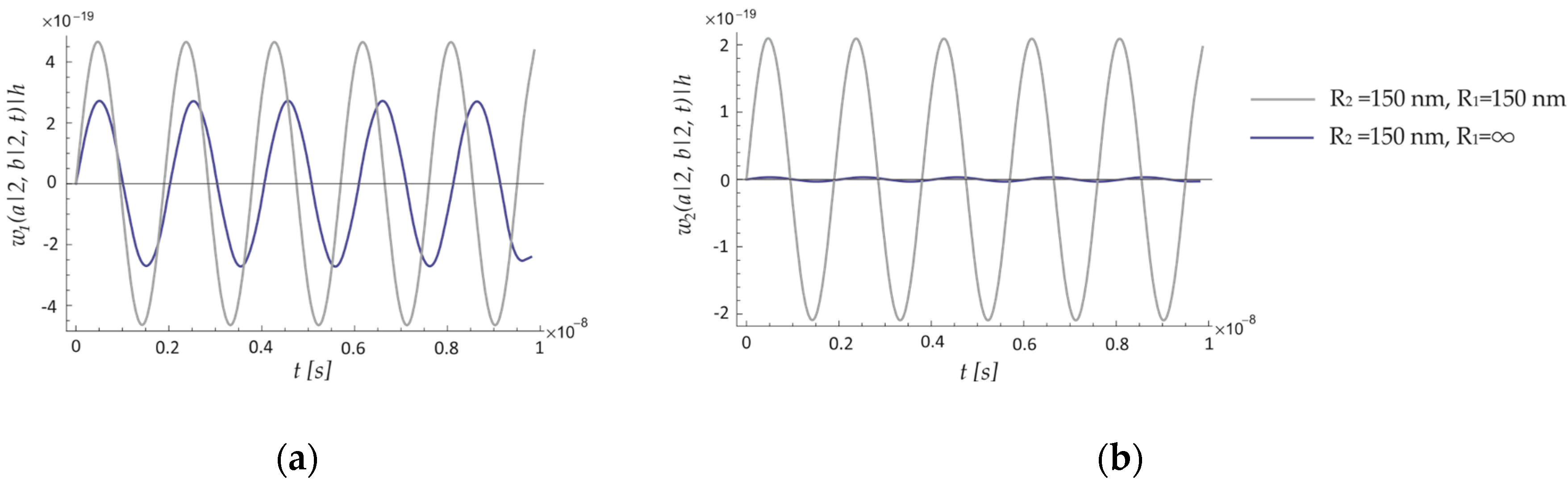
Figure 6.
Effect of the external excitation on the transverse displacement for the first three modes of ECSNPS system: (a) Nano-plate; (b) Nano-shell.
Figure 6.
Effect of the external excitation on the transverse displacement for the first three modes of ECSNPS system: (a) Nano-plate; (b) Nano-shell.
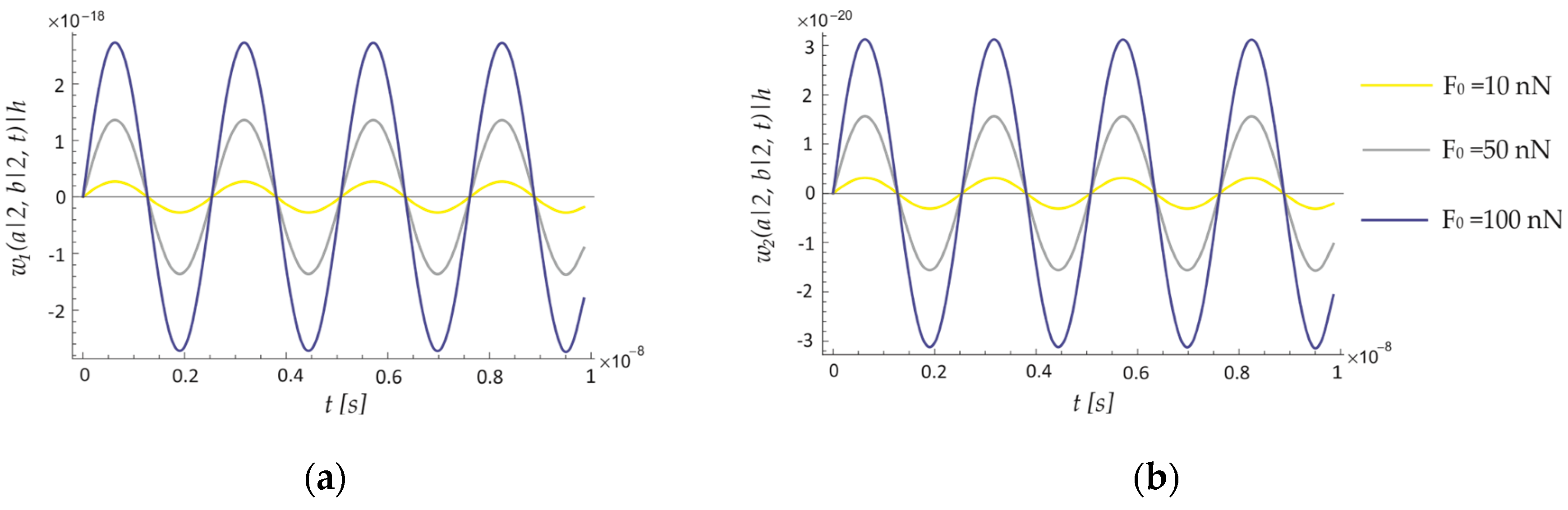
Figure 7.
Effect of the nonlocal parameter on the transverse displacement for the first three modes of ECSNPS system: (a) Nano-plate; (b) Nano-shell.
Figure 7.
Effect of the nonlocal parameter on the transverse displacement for the first three modes of ECSNPS system: (a) Nano-plate; (b) Nano-shell.
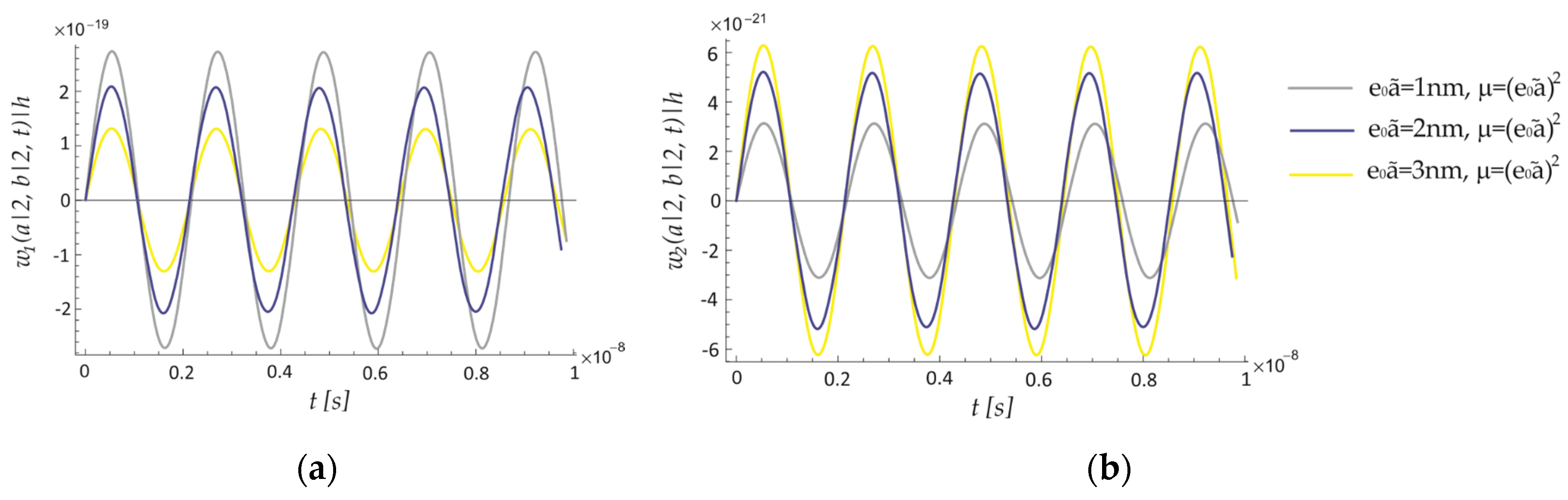
Figure 8.
Effect of the damping proportional coefficients on the transverse displacement for the first three modes of ECSNPS system: (a) Nano-plate; (b) Nano-shell.
Figure 8.
Effect of the damping proportional coefficients on the transverse displacement for the first three modes of ECSNPS system: (a) Nano-plate; (b) Nano-shell.


Table 1.
Material and geometrical properties for nano-plate and nano-double-shallow shell.
| a b h | ||
| TPa TPa TPa | kg/m3 nm | nm nm GPa/nm |
| 2.434 2.473 1.039 | 0.197 6316 0.129 | 10 4.5 0.075 |
Table 2.
Natural frequencies of ECSNPS for .
| n=1 n=2 n=3 |
4.61953×10¹¹ | 2.99085×10¹² | 7.38604×10¹² | 1.21507×10¹³ | |
| m=1 | 9.31595×10¹¹ | 2.30851×10¹² | 1.03814×10¹³ | 1.64871×10¹³ | |
| 1.46995×10¹² | 2.15757×10¹² | 1.15336×10¹³ | 1.82203×10¹³ | ||
| n=1 n=2 n=3 |
5.70087×10¹¹ | 5.67846×10¹² | 6.99782×10¹² | 1.36309×10¹³ | |
| m=2 | 1.01025×10¹² 1.52519×10¹² |
4.20984×10¹² 3.45108×10¹² |
1.01672×10¹³ 1.13942×10¹³ |
1.67344×10¹³ 1.82509×10¹³ |
|
| n=1 n=2 n=3 |
7.34647×10¹¹ | 6.85678×10¹² | 7.19172×10¹² | 1.51839×10¹³ | |
| m=3 | 1.13034×10¹² 1.61201×10¹² |
5.94912×10¹² 4.78913×10¹² |
9.69245×10¹² 1.11226×10¹³ |
1.71264×10¹³ 1.83239×10¹³ |
|
| n=1 n=2 n=3 |
3.84471×10¹¹ | 2.07360×10¹² | 5.08588×10¹² | 8.36769×10¹² | |
| m=1 | 5.86577×10¹¹ | 1.35492×10¹² | 5.97785×10¹² | 9.49374×10¹² | |
| 8.24879×10¹¹ | 1.19378×10¹² | 6.20668×10¹² | 9.80507×10¹² | ||
| n=1 n=2 n=3 |
4.33619×10¹¹ | 3.68099×10¹² | 4.50109×10¹² | 8.78749×10¹² | |
| m=2 | 6.24265×10¹¹ 8.54911×10¹¹ |
2.40523×10¹² 1.86919×10¹² |
5.77111×10¹² 6.10670×10¹² |
9.49987×10¹² 9.78197×10¹² |
|
| n=1 n=2 n=3 |
5.04771×10¹¹ | 4.25083×10¹² | 4.25083×10¹² | 9.17758×10¹² | |
| m=3 | 6.77858×10¹¹ 8.95666×10¹¹ |
3.33059×10¹² 2.56714×10¹² |
5.40006×10¹² 5.92601×10¹² |
9.54656×10¹² 9.76398×10¹² |
|
| n=1 n=2 n=3 |
3.44521×10¹¹ | 1.53112×10¹² | 3.71222×10¹² | 6.10881×10¹² | |
| m=1 | 4.49233×10¹¹ | 9.63276×10¹¹ | 4.11125×10¹² | 6.52950×10¹² | |
| 5.85347×10¹¹ | 8.49677×10¹¹ | 4.19978×10¹² | 6.63473×10¹² | ||
| n=1 n=2 n=3 |
3.73072×10¹¹ | 2.64494×10¹² | 3.19060×10¹² | 6.25442×10¹² | |
| m=2 | 4.78425×10¹¹ 6.15194×10¹¹ |
1.66611×10¹² 1.28667×10¹² |
3.95389×10¹² 4.12822×10¹² |
6.50982×10¹² 6.61318×10¹² |
|
| n=1 n=2 n=3 |
4.11932×10¹¹ | 2.96932×10¹² | 2.96932×10¹² | 6.39772×10¹² | |
| m=3 | 5.11162×10¹¹ 6.42609×10¹¹ |
2.28870×10¹² 1.75086×10¹² |
3.68065×10¹² 4.00041×10¹² |
6.51242×10¹² 6.59264×10¹² |
|
Table 3.
Comparison of natural frequencies of double plate system from Oniszczuk [33,34], when are and R1=R2=∞.
| Oniszczuk [33,34] | Present study | ||||
| n=1 n=2 n=3 |
52.8 | 72.0 | 52.7975095047 | 72.0248360629 | |
| m=1 | 84.5 | 97.7 | 84.4760152075 | 97.6534543441 | |
| 137.3 | 145.8 | 137.2735247122 | 145.7532867105 | ||
| n=1 n=2 n=3 |
179.5 | 186.1 | 179.5115323161 | 186.0763021839 | |
| m=2 | 211.2 264.0 |
216.8 268.5 |
211.1900380189 263.9875475236 |
216.7976756296 268.4947397018 |
|
| n=1 n=2 n=3 |
390.7 | 393.8 | 390.7015703349 | 393.7609897669 | |
| m=3 | 422.4 475.2 |
425.2 477.7 |
422.3800760378 475.1775855425 |
425.2116280556 477.6962819637 |
Table 4.
Validation of the frequency parameters of the shallow spherical shells,
| Ghavanloo E. et al. [22] | Presented study | |
| Ω1 | 5.0843 | |
| Ω2 | 12.2689 | |
| Ω3 | 13.4459 | |
| Ω4 | 20.1542 |
Disclaimer/Publisher’s Note: The statements, opinions and data contained in all publications are solely those of the individual author(s) and contributor(s) and not of MDPI and/or the editor(s). MDPI and/or the editor(s) disclaim responsibility for any injury to people or property resulting from any ideas, methods, instructions or products referred to in the content. |
© 2025 by the authors. Licensee MDPI, Basel, Switzerland. This article is an open access article distributed under the terms and conditions of the Creative Commons Attribution (CC BY) license (http://creativecommons.org/licenses/by/4.0/).
Copyright: This open access article is published under a Creative Commons CC BY 4.0 license, which permit the free download, distribution, and reuse, provided that the author and preprint are cited in any reuse.


