

Submitted:
03 February 2025
Posted:
04 February 2025
You are already at the latest version
Abstract
The global imperative for clean energy solutions has positioned photocatalytic water splitting as a promising pathway for sustainable hydrogen production. This review comprehensively analyzes recent advances in TiO2-based photocatalytic systems, focusing on materials engineering, water source effects, and scale-up strategies. We recognize the advancement in nanoscale architectural design, engineered heterojunction of the catalyst, and cocatalyst integration that have significantly enhanced photocatalytic efficiency. Particular emphasis is placed on the crucial role of water chemistry in photocatalytic system performance, analyzing how different water sources—from wastewater to seawater—impact hydrogen evolution rates and system stability. Additionally, the review addresses key challenges in scaling up these systems, including optimization of reactor design, light distribution, and mass transfer. Recent developments in artificial intelligence-driven materials discovery and process optimization are discussed, along with emerging opportunities in bio-hybrid systems and CO2 reduction coupling. Through critical analysis, we identify fundamental challenges and propose strategic research directions for advancing TiO2-based photocatalytic technology toward practical implementation. This work will provide a comprehensive framework for researchers to explore advanced TiO2-based composite materials to develop efficient and scalable photocatalytic systems for multifunctional simultaneous hydrogen production.
Keywords:
photocatalytic water splitting
; hydrogen evolution
; heterojunction engineering
; water chemistry
; scale-up engineering
; reactor design
; artificial intelligence in catalysis
; sustainable energy
1. Introduction
Energy is becoming an increasingly critical factor in global socio-economic development and environmental sustainability [1,2,3]. The global energy infrastructure continues to be overwhelmingly reliant on fossil fuels, with oil being the predominant source, followed closely by coal, while natural gas constitutes approximately one-fourth of power generation (Figure 1) [4,5]. The predominant reliance on non-renewable energy sources has precipitated substantial environmental deterioration through carbon dioxide emissions (CO2), exacerbating both concerns in climate change and challenges inherited with global energy security [6,7,8]. These global challenges represent two of humanity's most pressing concerns, particularly in light of the IPCC’s recommendation to achieve substantial CO2 emissions reductions by 2050 and limit global average temperature increase below 1.5°C [9,10,11,12]. To meet these ambitious zero-emission targets while ensuring energy security, a transition toward clean, sustainable energy alternatives is imperative [13,14]. Among various renewable energy sources, hydrogen has emerged as a promising energy carrier due to its zero greenhouse gas emissions, superior energy capacity, and ecological sustainability [15,16,17,18]. However, the current hydrogen production methods, dominated by steam methane reforming, contribute significantly to greenhouse gas emissions, accounting for approximately 530 million tons of CO2 annually [19,20,21]. While hydrogen can be produced through multiple pathways, photocatalytic water splitting using natural light has recently gained attention as a sustainable approach that harnesses abundant renewable resources such as water and solar energy [22,23,24].
Photocatalytic water splitting represents a transformative approach to hydrogen production, offering the possibility of harnessing abundant solar energy to generate clean hydrogen fuel [26,27,28]. Among various photocatalytic materials, titanium dioxide (TiO2) has maintained its position as a cornerstone material since Fujishima and Honda's seminal work in 1972 [29,30]. The enduring interest in TiO2-based systems stems from their unique combination of chemical stability, cost-effectiveness, low toxicity, and favorable band edge positions for water splitting reactions [31,32,33,34].
Recent years have witnessed remarkable advances in TiO2-based photocatalytic and photo-reforming systems [35,36,37,38,39,40,41]. The emergence of precise nanoscale engineering techniques has enabled unprecedented control over material properties, leading to significant improvements in hydrogen evolution rates [42,43,44]. Notable achievements include the development of black TiO2 with engineered oxygen vacancies showing exceptional hydrogen evolution performance under visible light irradiation, and the creation of Z-scheme TiO2/g-C3N4 heterojunction systems demonstrating promising photocatalytic activity with superior quantum efficiency under solar illumination [45,46,47,48,49]. Additionally, noble metal-decorated TiO2 nanomaterials with optimized morphology have exhibited remarkable stability over extended periods while maintaining outstanding hydrogen production rates [50,51,52].
Despite these significant advances, several fundamental challenges continue to impede the widespread implementation of TiO2-based photocatalytic systems for practical hydrogen production. The primary limitations include the wide bandgap of TiO2 (3.2 eV), which restricts light absorption to the UV region, representing only about 4% of the solar spectrum [35,53,54,55]. Therefore, the pristine TiO2 exhibits minimal hydrogen production under natural light conditions due to the low intensity of UV light in the solar spectrum. While various bandgap engineering strategies have been explored, achieving both efficient visible light absorption and maintaining appropriate band positions for water splitting remains a significant challenge, as visible light, which constitutes a larger portion of the solar spectrum than UV, offers more practical and sustainable energy for photocatalytic processes [56,57]. Another critical barrier is the rapid recombination of photogenerated electron-hole pairs, which substantially reduces quantum efficiency [58,59,60]. Although heterojunction engineering and cocatalyst incorporation have shown promise in charge carrier separation, the fundamental understanding of interfacial charge transfer dynamics and the precise role of cocatalysts in multi-component systems requires further investigation [61,62,63]. The stability of these complex architectures under prolonged photocatalytic conditions, particularly in terms of maintaining interfacial contacts and preventing photocorrosion, presents additional challenges [64,65,66]. Water chemistry also emerges as a critical yet often overlooked factor in photocatalytic hydrogen production efficiency. The pH, ionic strength, and dissolved species in the reaction medium significantly influence the surface chemistry of TiO2 and the kinetics of water splitting reactions [67,68,69,70,71]. Moreover, the hardness and impurities in the water can lead to surface poisoning or competitive reactions that diminish hydrogen evolution rates [72,73]. These challenges become particularly pronounced when considering alternative water sources such as municipal wastewater, seawater, and produced water from industrial processes [74,75,76,77]. While these non-traditional water sources present an attractive opportunity for sustainable hydrogen production, their complex chemical matrices (such as total dissolved solids concentrations ranged from ~500 mg/L of municipal wastewater to 260,000 mg/L in oil field produced water) introduce additional complications, including enhanced catalyst deactivation, and selective ion interference [78,79,80]. Understanding the intricate relationships between water source characteristics and photocatalytic performance is crucial for advancing the field toward practical applications.
This comprehensive review analyzes the state-of-the-art advances in TiO2-based photocatalytic systems for sustainable hydrogen production, addressing challenges from fundamental science to practical implementation. Beginning with photocatalytic water splitting mechanisms, we examine recent breakthroughs in materials design, including nanoscale engineering, crystal phase control, and advanced heterojunction systems. Special attention is given to the critical yet often overlooked influence of water chemistry on photocatalytic performance, providing insights into how various water sources—from municipal wastewater to seawater—affect system efficiency and stability. We address engineering challenges for scaling up these systems, incorporating developments in reactor design, process integration, and artificial intelligence approaches for optimization. Through this analysis, we identify current knowledge gaps and propose strategic directions for advancing TiO2-based photocatalytic systems toward feasible large-scale hydrogen production, aiming to serve as a comprehensive reference for researchers working at the intersection of materials science, catalysis, and sustainable energy technologies.
2. Mechanism of Photocatalytic Water Splitting
The energetically-driven process of water splitting facilitates the dissociation of water molecules into their fundamental elements: hydrogen and oxygen [81]. Photocatalytic water splitting represents a sophisticated approach for converting light energy into chemical energy through water decomposition into stoichiometric hydrogen and oxygen using photocatalysts [82,83]. The process fundamentally relies on semiconductor photocatalysts with distinct valence band (VB) and conduction band (CB) in the electronic structures, where incident photons generate electron-hole pairs by exciting the electron when the light energy equals or exceeds the photocatalyst's bandgap energy [84,85]. The VB and CB distinguish semiconductors from conductors, with the bandgap representing the energy difference between these two bands [86]. The mechanism follows thermodynamic constraints, requiring a Gibbs free energy change of 237 kJ/mol (ΔG = +237 kJ/mol) and an energy barrier of 1.23 eV for the complete water-splitting redox process [87,88].
Two distinct mechanisms have emerged for photocatalytic water splitting: the one-step and two-step (Z-scheme) photo-excitation processes [89]. In the one-step mechanism, the photocatalytic activity in single-semiconductor systems occurs when incident photons exceeding the material's bandgap energy trigger electronic transitions. This photoexcitation process generates electron-hole pairs through the promotion of electrons to the CB, simultaneously creating positive holes in the VB structure [90]. The efficacy of photocatalytic water splitting hinges on precise energetic alignment: the semiconductor's CB minimum must maintain a more negative potential than the H+/H2 reduction potential (0 V vs. Normal Hydrogen Electrode (NHE) at pH = 0), while its VB maximum must exceed the O2/H2O oxidation potential (+1.23 V vs. NHE at pH = 0). These thermodynamic constraints enable photogenerated charge carriers to facilitate the requisite redox reactions - electrons driving proton reduction and holes mediating water oxidation [91]. Therefore, the one-step excitation mechanism necessitates a minimum theoretical photon energy of 1.23 eV to overcome the thermodynamic barrier for water splitting, corresponding to the standard potential difference between water oxidation and proton reduction [92]. The efficiency of one-step photocatalytic water splitting is governed by three fundamental processes: photon absorption, charge carrier dynamics (separation and transport), and surface-mediated catalytic reactions of adsorbed species (Figure 2) [93]. In one step mechanism, a single photocatalyst directly facilitates water splitting through the following sequential reactions [89]:
Photocatalyst → (e- + h+) (1)―
Catalyst (e- + h+) → Catalyst (2)―
hν → 2e- + 2h+ (3)―
H2O (l) + 2h+ → ½ O2 + 2H+ (4)―
2H+ + 2e- → H2 (g) (5)―
In two-step water splitting mechanism, the Z-scheme approach employs dual photocatalysts – customized for hydrogen and oxygen production, respectively - linked by electron-shuttling redox mediators, which provides more photocatalyst options than single-step excitation systems with their constraints [94]. In this process, the CB electrons of the hydrogen evolution photocatalyst reduce protons, while the VB holes convert reduced mediators to their oxidized form, generating H2 gas and oxidized mediator molecules, respectively [95,96]. At the oxygen evolution photocatalyst, light-excited electrons restore the oxidized mediators to their reduced form, while holes facilitate water oxidation to generate molecular oxygen [97,98]. A material qualifies as a hydrogen evolution photocatalyst in Z-scheme systems when its CB minimum lies above the proton reduction potential, while its VB maximum exceeds the mediator's redox potential [99]. A material can function as an oxygen evolution photocatalyst when its VB maximum surpasses water's oxidation potential, with its CB minimum positioned above the mediator's redox potential [100,101,102]. The more flexible thermodynamic criteria for Z-scheme systems enable redox reactions between the mediator species and significantly expand the selection of suitable photocatalysts for overall water splitting [103,104,105,106,107,108].
While significant advances have been made in understanding photocatalytic water splitting mechanisms, several fundamental challenges remain unresolved. The widely accepted one-step excitation mechanism, though elegant in its simplicity, faces severe limitations in practical applications. The requirement for semiconductors with both suitable band positions and a minimum bandgap of 1.23 eV significantly restricts material selection [110], with current materials achieving efficiencies well below their theoretical maximum due to rapid charge carrier recombination [111]. The Z-scheme approach, while promising in its ability to utilize a broader range of materials, introduces additional complexity through interfacial charge transfer resistance, which can impact the overall efficiency of the photocatalytic system [112,113,114]. Recent attempts to enhance charge separation through cocatalyst integration have shown limited success, with noble metal cocatalysts improving efficiency by only 2-3 fold while significantly increasing system costs [115,116]. Surface modification strategies, particularly the creation of oxygen vacancies, have demonstrated enhanced visible light absorption but often face stability challenges, as these defects tend to be filled by water/oxygen from the air or blocked by reaction intermediates, leading to gradual performance decline unless specific stabilization strategies are employed [117,118]. This inherent trade-off necessitates a more holistic approach to mechanism design, potentially incorporating dynamic response elements that can adapt to changing reaction conditions [119]. These challenges are particularly evident in TiO2-based systems, where the wide bandgap of 3.2 eV limits visible light absorption, while rapid electron-hole recombination and surface stability issues continue to constrain the hydrogen evolution rates.
3. Advanced Engineering of TiO2 for Photocatalytic Water Splitting
Recent advances in materials science and nanotechnology have enabled unprecedented control over the structural and electronic properties of TiO2-based photocatalysts, leading to significant improvements in water splitting efficiency. These developments encompass multiple engineering strategies, ranging from precise architectural design to sophisticated surface modifications and interface engineering. The following sections will detail these key advances, beginning with fundamental architectural considerations and crystal phase engineering, followed by surface chemistry modifications, heterojunction development, and cocatalyst integration strategies. Each of these approaches contributes uniquely to addressing the inherent limitations of TiO2-based systems, particularly in terms of light absorption, charge separation, and catalytic activity.
3.1. Architectural Design and Crystal Phase Engineering
The evolution of nanoscale material engineering has fundamentally transformed TiO2-based photocatalyst design, introducing sophisticated approaches that have revolutionized photocatalytic water splitting efficiency [120,121,122,123,124,125,126,127]. This transformation encompasses multiple critical advances in materials design and engineering, ranging from novel nanostructure architectures to advanced interface engineering strategies, each contributing uniquely to enhanced photocatalytic performance [128,129,130]. Hierarchical nanostructures have emerged as a groundbreaking development, integrating multiple morphological elements such as nanotubes, nanosheets, and nanoparticles into cohesive architectures [131,132,133]. These sophisticated structures demonstrate remarkable improvements in light harvesting efficiency through enhanced light scattering and trapping mechanisms [134,135]. When combined with carefully engineered macro/mesoporous structures, these systems facilitate superior mass transport while maximizing reactive surface area, leading to significant improvements in photocatalytic activity [136,137,138]. The integration of ordered arrays and self-assembled structures has particularly advanced directional charge transport, addressing one of the fundamental limitations in traditional photocatalyst designs [139,140,141]. Crystal phase engineering has emerged as a critical strategy in photocatalyst development, with mixed-phase TiO2 (anatase/rutile) junctions exhibiting exceptional charge separation properties. The controlled synthesis of these phase junctions has enabled precise manipulation of electron-hole pair dynamics, significantly reducing recombination rates [142,143,144,145,146,147]. Table 1 summarizes these key advancements in TiO2-based photocatalysts, highlighting their features and specific impacts on hydrogen production efficiency via water splitting.
3.2. Surface Chemistry and Defect Engineering
Notably, the development of black TiO2 through controlled oxygen vacancy engineering has revolutionized visible light absorption capabilities. These modified materials demonstrate photocatalytic activity well beyond traditional UV-restricted domains, with some systems showing remarkable quantum efficiencies under visible light irradiation [153,154]. Surface modification and defect engineering have advanced significantly, with atomic-level control over surface chemistry becoming increasingly precise [155,156]. The strategic introduction of oxygen vacancies and Ti3+ states, coupled with non-metal doping, has enabled targeted band structure modifications [157,158,159]. These modifications have substantially improved visible light absorption and charge separation efficiency, with some systems demonstrating marked increase in photocatalytic hydrogen evolution rates compared to unmodified TiO2 [160,161]. Advanced characterization techniques, including in-situ X-ray absorption spectroscopy and electron paramagnetic resonance, have provided unprecedented insights into the role of surface defects in photocatalytic processes [162,163,164,165]. Table 2 outlines the major advancements in modifying TiO2 photocatalysts for visible light-driven hydrogen production, focusing on defect engineering, doping strategies, and surface modifications.
To provide a quantitative comparison of different TiO2-based photocatalysts and their hydrogen production efficiencies, Table 3 summarizes various modified TiO2 photocatalysts, their fabrication methods, testing conditions, and corresponding hydrogen evolution rates.
3.3. Advanced Heterojunction Systems and Z-scheme Design
Heterojunction engineering has witnessed significant progress, particularly in Z-scheme systems, where the integration of 2D materials such as g-C3N4 and MXenes has established new paradigms for electron transfer [195,196,197,198,199]. Direct Z-scheme systems, eliminating the need for electron mediators, have demonstrated unprecedented charge separation efficiency while maintaining robust stability under prolonged operation [200,201,202]. The development of atomically sharp interfaces and implementation of strain engineering at heterojunctions has led to significant improvements in charge transfer efficiency, with some systems approaching theoretical maximum quantum yields [203].
3.4. Cocatalyst Integration and Interface Optimization
Cocatalyst integration has evolved substantially, with single-atom catalysts and bimetallic systems showing exceptional hydrogen evolution performance. The development of core-shell structures and protective layers has addressed long-standing stability challenges, while interface engineering has optimized charge transfer dynamics [204,205,206]. Recent advances in synthetic methods have enabled precise control over cocatalyst size, distribution, and electronic structure, leading to significant improvements in catalytic activity and stability [83,207].
3.5. Current Challenges and Future Perspectives
Despite remarkable advances in nanoscale engineering of TiO2-based photocatalysts, several critical challenges impede widespread implementation. While hierarchical nanostructures have demonstrated enhanced light harvesting through increased surface area and improved charge transport pathways, their complex synthesis often results in inconsistent reproducibility between research batches [208]. The integration of ordered arrays and self-assembled structures, though promising for directional charge transport, faces significant scalability challenges, with production costs typically 5-10 times higher than conventional materials [27,209]. Crystal phase engineering, particularly in mixed-phase TiO2 systems namely anatase-rutile heterojunction has shown enhanced charge separation efficiency but often suffers from phase instability under prolonged operation, with anatase-to-rutile transformation accelerated by reaction conditions [210,211]. The introduction of surface defects and oxygen vacancies, while effective for visible light absorption, frequently leads to reduced photocatalytic stability due to their metastable nature, with surface defects being particularly susceptible to repair through water and oxygen adsorption [212]. These limitations highlight the critical need for balanced material design approaches that consider not only performance metrics but also practical aspects of scalability, stability, and cost-effectiveness.
Future directions in advanced materials design point toward several promising avenues. The exploration of earth-abundant cocatalysts with high activity and stability remains a priority, as does the investigation of dynamic interface phenomena under reaction conditions [213,214,215]. Integration of design principles across multiple time and length scales, coupled with advanced in-situ characterization techniques, is expected to provide deeper insights into reaction mechanisms and degradation pathways [216,217]. Additionally, the development of scalable synthesis methods for complex nanostructures and the optimization of interface engineering strategies continue to be active areas of research [218,219]. This evolution in materials design represents a significant step toward practical, large-scale implementation of photocatalytic water splitting systems. However, continued research is essential to address the remaining challenges in stability, efficiency, and cost-effectiveness. The integration of multiple design strategies, coupled with advanced characterization and theoretical modeling, provides a promising pathway toward achieving commercially viable photocatalytic water splitting systems [119,220].
4. Hydrogen Production from Different Water Sources: Effects and Applications
The development of efficient and sustainable photocatalytic water splitting systems requires careful consideration of water source characteristics. While significant advancements have been made in photocatalytic technologies, the transition from laboratory conditions to real-world water sources presents distinct challenges. Different water sources, such as seawater, municipal wastewater, and industrial wastewater introduce unique complexities that affect both the performance and stability of TiO2-based photocatalysts. Understanding these effects and developing appropriate solutions is crucial for practical applications. Figure 4 provides an overview of the challenges associated with seawater and different wastewater sources such as municipal wastewater and industrial wastewater in TiO2 photocatalytic systems.
4.1. Influence of Water Chemistry on Photocatalytic Performance
The efficiency of TiO2-based photocatalytic water splitting is profoundly influenced by water chemistry, which plays a crucial role in determining both reaction kinetics through pH-dependent charge distribution and ionic interactions, and catalyst stability [221,222]. Some investigations have revealed that pH, ionic strength, and dissolved species significantly impact the surface chemistry of TiO2 and the kinetics of water splitting reactions [70,223,224,225,226,227,228]. Modulating pH not only affects the band edge positions of TiO2 but also influences the surface charge distribution, which in turn alters the adsorption-desorption equilibrium of reactive species like water and protons [229,230]. The presence of common ions such as Na+, Cl-, SO42- etc., in natural water sources modifies the local electric field at the semiconductor-electrolyte interface, affecting charge carrier separation and transport efficiency [231,232]. In addition, dissolved organic matter (DOM) can serve as both electron donors and acceptors, introducing competing reaction pathways that may either enhance or inhibit hydrogen evolution rates [233,234]. Specifically, while some ions (e.g., sulfate ions) stabilize charge carriers and enhance photocatalytic activity, others (e.g., chloride ions) may cause catalyst degradation [235,236,237]. Moreover, dissolved oxygen can act as an electron acceptor, competing with hydrogen evolution and thus reducing the overall photocatalytic performance [238]. The intricate interplay of these water chemistry factors underscores the complexity of optimizing TiO2-based photocatalysts for practical hydrogen production. The key water chemistry parameters and their specific effects on photocatalytic performance in TiO2-based systems are summarized in Table 4.
4.2. Impact of Dissolve Species and Impurities
The presence of dissolved species and impurities in water presents both challenges and opportunities for photocatalytic water splitting. Certain ionic species such as Ca2+, Zn2+, Fe2+, Fe3+ can adversely affect catalyst performance by causing surface poisoning through competitive adsorption or the formation of inactive surface complexes, as observed with multivalent metal ions that induce surface precipitation and alter the electric double layer structure [240,241]. These interactions can reduce the availability of active sites and disrupt charge carrier dynamics, thereby diminishing overall efficiency [242]. Conversely, some dissolved species such as triethylamine and potassium iodide offer advantageous effects, acting as hole scavengers or facilitating charge separation by forming beneficial surface complexes [243,244,245].
4.3. Advanced Strategies for Seawater Splitting
Seawater splitting offers a sustainable pathway for large-scale hydrogen production yet present distinct challenges due to its complex chemical composition and high salinity. The primary issues include chloride-induced catalyst degradation, fouling, and scaling through the formation of Ca(OH)2 and Mg(OH)2 deposits [246,247,248]. To address these challenges, recent advancements have focused on developing chloride-resistant photocatalysts through surface modifications and protective layer integration [249,250,251]. Strategies such as selective membranes and buffer layers have been shown to mitigate the corrosive effects of chloride ions while preserving high photocatalytic activity [252,253]. Additionally, the incorporation of engineered cocatalyst systems has demonstrated the ability to sustain stability in high-salt environments, achieving hydrogen evolution rates comparable to those observed in pure water systems [254,255]. The performance metrics of various TiO2-based photocatalysts designed for seawater splitting, along with their corresponding strategies, are presented in Table 5.
4.4. Integration with Wastewater Treatment Systems
The integration of photocatalytic hydrogen production with wastewater treatment offers a transformative approach to addressing energy and environmental challenges concurrently. TiO2-based photocatalysts have demonstrated promising potential for simultaneous hydrogen evolution and the degradation of organic pollutants [35,264,265]. Advanced reactor configurations, including membrane separation and continuous flow systems, have been developed to maintain stable hydrogen production while achieving substantial reductions in organic contaminant concentrations [266,267]. Organic pollutants present in wastewater effectively serve as sacrificial electron donors, thereby enhancing hydrogen evolution rates and enabling efficient water purification [268]. Despite these advancements, key challenges, such as catalyst deactivation and ensuring long-term stability within the chemically complex matrices of wastewater remain [269,270]. Future research should focus on optimizing catalyst designs and reactor configurations to address these limitations and enhance the scalability of these integrated systems. To illustrate the current state of technology, Table 6 presents the simultaneous hydrogen production and wastewater treatment performance of selected TiO2-based catalysts.
4.5. Future Prospectives and Challenges
The translation of laboratory-scale success to real-world water sources reveals significant performance gaps in TiO2-based photocatalytic systems. While impressive results have been achieved in controlled laboratory conditions, performance typically decreases when applied to actual environmental waters [84]. Common ionic species present in natural waters, particularly chloride and carbonate ions, can significantly reduce photocatalytic efficiency through competitive adsorption and radical scavenging effects [284,285]. The deposition of carbonaceous compounds on the catalyst surface, known as fouling or coking, is a common cause of deactivation that can block active sites and pores, often necessitating frequent regeneration cycles which impact the long-term operational costs and viability of the process [286]. Moreover, the synergistic effects of multiple ions and organic compounds in real water sources create complex interaction patterns that current theoretical models fail to fully predict [287]. Standard testing protocols often overlook these crucial matrix effects, leading to overoptimistic performance projections that rarely translate to practical applications [288]. This disconnect between idealized laboratory conditions and real-world performance necessitates a fundamental shift in how we evaluate and design photocatalytic systems for practical water splitting applications [289].
Despite notable advancements, significant challenges remain in the practical implementation of photocatalytic water splitting systems, particularly when using non-traditional water sources such as seawater or wastewater. One critical issue is ensuring long-term stability under variable and often harsh water chemistry conditions [290]. The development of robust and scalable catalyst systems capable of maintaining activity and selectivity in such environments is imperative [291]. Furthermore, optimizing integrated treatment processes to handle complex water matrices without compromising hydrogen production efficiency is essential for widespread application [292].
Future research should prioritize the development of smart, self-healing materials that can adapt dynamically to fluctuating water chemistry, such as changes in pH, ionic strength, or contaminant levels [293]. Advancements in in-situ and operando characterization techniques are needed to provide real-time insights into reaction mechanisms and surface interactions, which are crucial for understanding and mitigating deactivation pathways [216,217,290]. Additionally, the establishment of standardized protocols for performance evaluation under realistic operating conditions is necessary to facilitate reliable comparisons and accelerate the translation of laboratory-scale findings to industrial applications [294]. The integration of artificial intelligence (AI) and machine learning approaches holds immense potential in optimizing system performance. These technologies can be leveraged to model complex reaction networks, predict catalyst behavior across diverse water sources, and design adaptive operational strategies [292,294]. By combining AI-driven insights with experimental advancements, researchers can streamline the development of next-generation water splitting systems [293].
5. Scale-Up and Engineering Challenges
5.1. Reactor Design Considerations and Optimization
The scaling of photocatalytic water splitting systems from laboratory to industrial scale presents significant engineering challenges that demand innovative reactor design solutions. Recent advances in reactor engineering have focused on optimizing light utilization efficiency, mass transfer, and reaction kinetics while maintaining economic viability [119,295,296]. Advanced reactor configurations, including suspended particle systems, fixed-bed reactors, and optical fiber reactors, have demonstrated varying degrees of success in addressing scale-up challenges [297]. Computational fluid dynamics modeling has emerged as a powerful tool for predicting flow patterns, light distribution, and reaction kinetics in large-scale reactors, enabling more efficient design optimization [298]. Furthermore, modular reactor systems have shown promise in addressing scalability issues, offering operational flexibility and ease of maintenance, which are critical for real-world applications [299]. The key characteristics, challenges, and engineering solutions for major photocatalytic reactor designs are summarized in Table 7.
5.2. Light Distribution and Mass Transfer Phenomena
The optimization of light distribution represents a critical challenge in large-scale photocatalytic systems. Non-uniform light distribution in scaled-up reactors has been shown to significantly affect overall system efficiency, leading to suboptimal photocatalytic performance [29,296]. Advanced light delivery systems, including internal illumination configurations and solar concentrators, have been developed to enhance light utilization efficiency in photocatalytic reactors [303,304]. Additionally, the integration of plasmonic materials and photonic crystals has demonstrated significant improvements in light harvesting and uniform light distribution throughout the reactor volume [305,306,307,308,309]. Addressing mass transfer limitations, particularly in gas-liquid-solid systems, remains a key focus of reactor design. Innovative solutions, such as enhanced mixing strategies and optimized flow patterns, have been implemented to improve mass transfer dynamics [310,311,312]. The incorporation of structured catalysts and membrane-integrated systems has further demonstrated enhanced mass transfer characteristics, ensuring high photocatalytic activity under operational conditions [313,314]. The major technical challenges encountered in large-scale photocatalytic reactor design and their corresponding solutions are presented in Table 8.
While various strategies have been proposed to address these challenges, a quantitative assessment of key scalability factors is essential to guide future advancements in photocatalytic hydrogen production. Table 9 summarizes the key engineering challenges in scaling up photocatalytic hydrogen production, providing quantitative data on efficiency losses, material limitations, and proposed solutions derived from recent advancements.
5.3. Process Integration and System Optimization
The successful implementation of large-scale photocatalytic water splitting systems requires careful consideration of process integration and system optimization. Recent developments have focused on integrating hydrogen separation and purification systems, thermal management strategies, and control systems to achieve optimal performance [251,327]. Incorporating renewable energy sources, such as solar and wind power, for supplementary energy needs has emerged as a promising approach to enhance the sustainability of these systems. Hybrid systems that combine photocatalytic and conventional water splitting techniques have demonstrated improved overall system efficiency and adaptability under varying operational conditions [328].
Advanced process control strategies leveraging machine learning algorithms and real-time monitoring systems have been instrumental in enhancing system performance and reliability. These technologies enable the prediction and adjustment of operational parameters to maintain stable performance under fluctuating conditions [329]. Furthermore, the integration of heat recovery systems has been shown to improve energy efficiency by capturing and reusing waste heat generated during the process [330].
5.4. Economic Feasibility and Sustainability Analysis
Economic considerations play a pivotal role in determining the commercial viability of scaled-up photocatalytic water splitting systems. Recent techno-economic analyses have highlighted key cost drivers and potential strategies for optimization, including advancements in reactor construction, catalyst synthesis, and the development of auxiliary equipment [331,332]. Capital costs, particularly those related to the production and scalability of photocatalysts, remain a significant barrier to widespread adoption, while operating costs, encompassing maintenance, catalyst replacement, and energy consumption, have been systematically evaluated to identify areas for cost reduction and efficiency improvements [333,334]. Life cycle assessment studies have underscored the importance of incorporating environmental and sustainability metrics into system design and optimization [335]. These assessments provide insights into the long-term environmental impacts, such as carbon emissions and resource utilization, associated with large-scale photocatalytic hydrogen production. Furthermore, the development of cost-effective methods for catalyst production, including scalable and sustainable synthesis techniques, has emerged as a critical area of research [336,337]. In addition, the integration of renewable energy sources for supplementary power, combined with strategies to minimize waste and recycle key materials, has shown promise in enhancing the economic feasibility and sustainability of these systems [35]. By addressing these economic and environmental challenges, future developments can pave the way for the commercialization of photocatalytic hydrogen production technologies.
5.5. Future Direction and Research Needs
The pilot and full scale TiO2-based photocatalytic systems reveal fundamental limitations that are often masked in bench-scale studies. While bench-scale reactors demonstrate promising efficiencies, scaling to industrial volumes results in significant performance losses, primarily due to light distribution limitations and mass transfer constraints [298,338]. Current reactor designs struggle to maintain uniform light intensity throughout larger volumes, with light penetration depth rarely exceeding 5 cm in typical slurry systems [315,339]. While advanced light delivery systems like optical fibers and solar concentrators offer potential improvements, they present significant engineering challenges in maintaining uniform light distribution and thermal management [340,341]. Mass transfer limitations are a major challenge in scaled-up systems, with a recent survey showing 30% of scale-up failures were attributed to mass transfer issues, and reaction times potentially increasing 4-5 fold without proper controls [342]. The economic viability of large-scale implementation remains questionable, with techno-economic analyses indicating photocatalyst costs need to be below $10/kg and solar-to-hydrogen efficiencies above 10% for commercial viability - targets that remain elusive with existing technologies [343].
Future advancements in the scale-up and engineering of photocatalytic water splitting systems must address several crucial areas to ensure both efficiency and commercial viability. Key research directions include:
- The development of advanced reactor designs that integrate improved light delivery systems and enhanced mass transfer characteristics, aiming to maximize the system's overall performance.
- The incorporation of artificial intelligence and machine learning approaches for the optimization of operational strategies, system control, and real-time monitoring [344].
- The implementation of sustainable and cost-effective manufacturing processes for catalyst production and system components, ensuring scalability and resource efficiency.
- The establishment of standardized methodologies for performance evaluation, including techno-economic and life cycle assessments, to streamline industry adoption and regulatory compliance.
6. Advanced Applications and System Integration of TiO2-Based Photocatalysts
Advanced integration of TiO2-based photocatalysts encompasses multiple strategic approaches, including bio-hybrid systems, CO2 reduction, and machine learning applications. These integration strategies present both opportunities and challenges in advancing photocatalytic technology.
6.1. Integration with Artificial Photosynthesis
The integration of photocatalytic water splitting with artificial photosynthesis offers a promising path for advancing sustainable energy solutions. Recent progress has demonstrated the successful incorporation of photocatalysts with synthetic biological components, resulting in enhanced energy conversion efficiency [347]. Novel bio-hybrid systems, which integrate engineered proteins and light-harvesting complexes, have shown significant improvements in solar-to-hydrogen conversion rates, outperforming traditional systems [348]. These hybrid systems combine the selectivity of biological catalysts with the robustness and stability of inorganic semiconductor materials, making them ideal candidates for large-scale energy production [349,350]. Moreover, advanced architectures that combine multiple photocatalytic centers with biomimetic electron transfer pathways have achieved remarkable stability and improved quantum efficiency under visible light irradiation, thereby enhancing overall system performance and longevity [351,352]. The major innovations in bio-hybrid photocatalytic systems and their corresponding significance in advancing sustainable energy solutions are detailed in Table 10.
While bio-hybrid photocatalytic systems present an attractive pathway for mimicking natural photosynthesis, significant technical barriers impede their practical implementation. The integration of biological components with inorganic photocatalysts, though promising in principle, faces considerable challenges, including limited operational stability, low energy conversion efficiency, and poor sustainability of the catalytic system during continuous operation [358,359]. Current bio-hybrid photocatalytic systems for water splitting hydrogen production still face efficiency challenges. Although these systems show promise, their hydrogen evolution rates need further improvement for practical applications [351,360]. The structural complexity and synthesis requirements of these bio-hybrid systems currently present challenges for large-scale production and practical implementation. While these systems show promising potential in mimicking natural photosynthesis and offer unique advantages in biomass conversion, their widespread adoption is limited by the need for:
- Improved photocatalytic efficiency and stability
- Enhanced charge separation and transfer
- Optimization of light harvesting capabilities
- Development of more cost-effective alternatives to noble metal co-catalysts
6.2. Coupling with CO2 Reduction Systems
The integration of hydrogen production with CO2 reduction in photocatalytic systems represents a transformative approach to sustainable energy and chemical synthesis. Recent advancements have centered on the development of dual-function catalysts capable of simultaneously facilitating water oxidation and CO2 reduction [363]. The incorporation of selective cocatalysts, such as metal oxides and molecular complexes, has significantly improved reaction efficiency and product selectivity [364]. Z-scheme photocatalytic systems, which mimic natural photosynthesis, have demonstrated the ability to couple water splitting and CO2 reduction with enhanced energy conversion efficiency [365]. Emerging approaches leveraging plasmonic effects and defect engineering have shown great promise in enhancing CO2 activation while maintaining robust water-splitting performance [366,367].
6.3. Machine Learning Applications in Materials Discovery
The application of machine learning has significantly advanced the discovery and optimization of photocatalytic materials, enabling efficient identification of promising candidates and pathways. Advanced machine learning algorithms have been instrumental in rapidly screening vast material combinations and accurately predicting photocatalytic performance based on theoretical and experimental data [72,368]. Deep learning models have revealed intricate structure-property relationships, aiding in the prediction of optimal synthesis conditions for novel photocatalysts [369].
The integration of high-throughput experimentation with machine learning driven analysis has accelerated the pace of material discovery. These combined approaches allow researchers to evaluate numerous variables simultaneously, reducing the time and resources required for experimental validation [370,371,372]. Notably, interpretable machine learning models have emerged as a valuable tool, offering insights into fundamental mechanisms governing photocatalytic activity, stability, and efficiency. These models provide transparent and explainable predictions, bridging the gap between computational predictions and experimental realities [72,373,374,375]. Figure 5 provides an overview of these key integration approaches and their associated developments.
7. Future Perspectives and Emerging Opportunities in Photocatalytic Water Splitting
The field of photocatalytic water splitting stands at a critical juncture, where despite significant scientific advances, practical implementation remains elusive. Current state-of-the-art systems achieve solar-to-hydrogen efficiencies of only 1-2% under real-world conditions, far below the 10% threshold considered necessary for commercial viability [334,376]. The cost of hydrogen production through photocatalytic water splitting remains 3-4 times higher than conventional methods, primarily due to expensive materials and complex system requirements [27,333]. Stability issues remain a critical challenge in photocatalytic devices, with the most advanced systems demonstrating limited operational lifetimes. Current research indicates that while a five-year lifetime (approximately 21,900 hours) is required for cost-competitive hydrogen production, most cutting-edge systems struggle to maintain performance beyond 100 hours [377]. These fundamental challenges suggest that revolutionary rather than evolutionary advances are needed across multiple fronts - from basic materials design to system engineering [378]. The field must address not only efficiency and stability but also scalability and economic viability to bridge the gap between laboratory success and commercial implementation [379]. Promising areas for future exploration include:
- Quantum Computing for Materials Optimization: Quantum computing approaches are being explored for accelerated discovery and optimization of photocatalytic materials, offering potential breakthroughs in reaction efficiency and material design [382].
- Autonomous Systems for Real-Time Optimization: Autonomous systems equipped with real-time monitoring and adaptive control mechanisms are transforming operational efficiency and system reliability [383].
- Sustainable Manufacturing Processes: A focus on eco-friendly manufacturing of advanced photocatalytic materials ensures scalability and minimizes environmental impact [384].
Addressing challenges related to long-term stability, scalability, and cost-effectiveness is essential for commercial success. Recent trends also highlight the development of multifunctional systems capable of tackling multiple environmental issues concurrently, such as simultaneous water purification and hydrogen production [27,379].
In conclusion, while significant strides have been made in photocatalytic water splitting, achieving commercial viability demands transformative innovations that address critical challenges such as efficiency, stability, scalability, and cost-effectiveness. By advancing material design, leveraging emerging technologies like quantum computing and autonomous systems, and prioritizing sustainable manufacturing, the field can move closer to bridging the gap between laboratory success and real-world implementation. A multidisciplinary approach that integrates these solutions will be pivotal in unlocking the full potential of photocatalytic water splitting as a sustainable pathway for green hydrogen production.
Author Contributions
Conceptualization, H.W., T.A. and E.M.N.T.E.; methodology, T.A., H.W., E.M.N.T.E, and P.S.S; validation, T.A., H.W., E.M.N.T.E, P.S.S; formal analysis, T.A., H.W., E.M.N.T.E, P.S.S; investigation, T.A., H.W., E.M.N.T.E, P.S.S; resources, T.A., H.W.; data curation, T.A.; writing—original draft preparation, T.A. and H.W.; writing—review and editing, T.A., E.M.N.T.E, P.S.S., P.X. and H.W.; visualization, T.A.; supervision, H.W.; project administration, H.W.; funding acquisition, H.W. and P.X. All authors have read and agreed to the published version of the manuscript.
Funding
This research was funded by New Mexico Economic Development Department.
Informed Consent Statement
Not applicable.
Data Availability Statement
This study did not involve the creation or analysis of new data; therefore, data sharing is not applicable.
Conflicts of Interest
The authors declare no conflicts of interest.
References
- Fu, F.Y.; Alharthi, M.; Bhatti, Z.; Sun, L.; Rasul, F.; Hanif, I.; Iqbal, W. The Dynamic Role of Energy Security, Energy Equity and Environmental Sustainability in the Dilemma of Emission Reduction and Economic Growth. J. Environ. Manage. 2021, 280, 111828. [Google Scholar] [CrossRef] [PubMed]
- Khan, I.; Zakari, A.; Dagar, V.; Singh, S. World Energy Trilemma and Transformative Energy Developments as Determinants of Economic Growth amid Environmental Sustainability. Energy Econ. 2022, 108, 105884. [Google Scholar] [CrossRef]
- Liu, H.; Khan, I.; Zakari, A.; Alharthi, M. Roles of Trilemma in the World Energy Sector and Transition towards Sustainable Energy: A Study of Economic Growth and the Environment. Energy Policy 2022, 170, 113238. [Google Scholar] [CrossRef]
- Yek, P.N.Y.; Cheng, Y.W.; Liew, R.K.; Wan Mahari, W.A.; Ong, H.C.; Chen, W.-H.; Peng, W.; Park, Y.-K.; Sonne, C.; Kong, S.H.; et al. Progress in the Torrefaction Technology for Upgrading Oil Palm Wastes to Energy-Dense Biochar: A Review. Renew. Sustain. Energy Rev. 2021, 151, 111645. [Google Scholar] [CrossRef]
- Abdul Latif, S.N.; Chiong, M.S.; Rajoo, S.; Takada, A.; Chun, Y.-Y.; Tahara, K.; Ikegami, Y. The Trend and Status of Energy Resources and Greenhouse Gas Emissions in the Malaysia Power Generation Mix. Energies 2021, 14, 2200. [Google Scholar] [CrossRef]
- Osman, A.I.; Chen, L.; Yang, M.; Msigwa, G.; Farghali, M.; Fawzy, S.; Rooney, D.W.; Yap, P.-S. Cost, Environmental Impact, and Resilience of Renewable Energy under a Changing Climate: A Review. Environ. Chem. Lett. 2023, 21, 741–764. [Google Scholar] [CrossRef]
- Wang, X.; Sun, X.; Ahmad, M.; Chen, J. Energy Transition, Ecological Governance, Globalization, and Environmental Sustainability: Insights from the Top Ten Emitting Countries. Energy 2024, 292, 130551. [Google Scholar] [CrossRef]
- Kirat, Y.; Prodromou, T.; Suardi, S. Unveiling the Nexus: Climate Change, Green Innovation, and the Pendulum of Energy Consumption and Carbon Emissions. Energy Econ. 2024, 138, 107727. [Google Scholar] [CrossRef]
- Bhuiyan, M.R.A. Overcome the Future Environmental Challenges through Sustainable and Renewable Energy Resources. Micro Nano Lett. 2022, 17, 402–416. [Google Scholar] [CrossRef]
- Fragkos, P. Global Energy System Transformations to 1.5 °C: The Impact of Revised Intergovernmental Panel on Climate Change Carbon Budgets. Energy Technol. 2020, 8, 2000395. [Google Scholar] [CrossRef]
- Huang, M.-T.; Zhai, P.-M. Achieving Paris Agreement Temperature Goals Requires Carbon Neutrality by Middle Century with Far-Reaching Transitions in the Whole Society. Adv. Clim. Change Res. 2021, 12, 281–286. [Google Scholar] [CrossRef]
- Rogelj, J.; Lamboll, R.D. Substantial Reductions in Non-CO2 Greenhouse Gas Emissions Reductions Implied by IPCC Estimates of the Remaining Carbon Budget. Commun. Earth Environ. 2024, 5, 1–5. [Google Scholar] [CrossRef]
- Shahzad, S.; Faheem, M.; Muqeet, H.A.; Waseem, M. Charting the UK’s Path to Net Zero Emissions by 2050: Challenges, Strategies, and Future Directions. IET Smart Grid n/a. [CrossRef]
- Tiwari, S.; Bashir, S.; Sarker, T.; Shahzad, U. Sustainable Pathways for Attaining Net Zero Emissions in Selected South Asian Countries: Role of Green Energy Market and Pricing. Humanit. Soc. Sci. Commun. 2024, 11, 1–13. [Google Scholar] [CrossRef]
- M, A.; V, M.K.; Hariharan, V.S.; Narahari, T.; P, A.K.; K, M.; G, P.K.; Prabakaran, R. Fuelling the Future: A Review of Non-Renewable Hydrogen Production and Storage Techniques. Renew. Sustain. Energy Rev. 2023, 188, 113791. [Google Scholar] [CrossRef]
- Sikiru, S.; Oladosu, T.L.; Amosa, T.I.; Olutoki, J.O.; Ansari, M.N.M.; Abioye, K.J.; Rehman, Z.U.; Soleimani, H. Hydrogen-Powered Horizons: Transformative Technologies in Clean Energy Generation, Distribution, and Storage for Sustainable Innovation. Int. J. Hydrog. Energy 2024, 56, 1152–1182. [Google Scholar] [CrossRef]
- Muhammed, N.S.; Gbadamosi, A.O.; Epelle, E.I.; Abdulrasheed, A.A.; Haq, B.; Patil, S.; Al-Shehri, D.; Kamal, M.S. Hydrogen Production, Transportation, Utilization, and Storage: Recent Advances towards Sustainable Energy. J. Energy Storage 2023, 73, 109207. [Google Scholar] [CrossRef]
- Qazi, U.Y. Future of Hydrogen as an Alternative Fuel for Next-Generation Industrial Applications; Challenges and Expected Opportunities. Energies 2022, 15, 4741. [Google Scholar] [CrossRef]
- Qureshi, F.; Yusuf, M.; Ibrahim, H.; Kamyab, H.; Chelliapan, S.; Pham, C.Q.; Vo, D.-V.N. Contemporary Avenues of the Hydrogen Industry: Opportunities and Challenges in the Eco-Friendly Approach. Environ. Res. 2023, 229, 115963. [Google Scholar] [CrossRef]
- Ali Khan, M.H.; Daiyan, R.; Neal, P.; Haque, N.; MacGill, I.; Amal, R. A Framework for Assessing Economics of Blue Hydrogen Production from Steam Methane Reforming Using Carbon Capture Storage & Utilisation. Int. J. Hydrog. Energy 2021, 46, 22685–22706. [Google Scholar] [CrossRef]
- Shokrollahi, M.; Teymouri, N.; Ashrafi, O.; Navarri, P.; Khojasteh-Salkuyeh, Y. Methane Pyrolysis as a Potential Game Changer for Hydrogen Economy: Techno-Economic Assessment and GHG Emissions. Int. J. Hydrog. Energy 2024, 66, 337–353. [Google Scholar] [CrossRef]
- Imran, S.; Hussain, M. Emerging Trends in Water Splitting Innovations for Solar Hydrogen Production: Analysis, Comparison, and Economical Insights. Int. J. Hydrog. Energy 2024, 77, 975–996. [Google Scholar] [CrossRef]
- Tao, X.; Zhao, Y.; Wang, S.; Li, C.; Li, R. Recent Advances and Perspectives for Solar-Driven Water Splitting Using Particulate Photocatalysts. Chem. Soc. Rev. 2022, 51, 3561–3608. [Google Scholar] [CrossRef]
- Rafique, M.; Mubashar, R.; Irshad, M.; Gillani, S.S.A.; Tahir, M.B.; Khalid, N.R.; Yasmin, A.; Shehzad, M.A. A Comprehensive Study on Methods and Materials for Photocatalytic Water Splitting and Hydrogen Production as a Renewable Energy Resource. J. Inorg. Organomet. Polym. Mater. 2020, 30, 3837–3861. [Google Scholar] [CrossRef]
- Strizhenok, A.V.; Bykova, M.V.; Korotaeva, A.E. Extractive Industries as a Source of Greenhouse Gas Emissions and the Possibility of Its Natural Sequestration under the Climatic Conditions of Central and Northern Eurasia. J. Ecol. Eng. 2024, 25, 43–69. [Google Scholar] [CrossRef] [PubMed]
- Tao, X.; Zhao, Y.; Wang, S.; Li, C.; Li, R. Recent Advances and Perspectives for Solar-Driven Water Splitting Using Particulate Photocatalysts. Chem. Soc. Rev. 2022, 51, 3561–3608. [Google Scholar] [CrossRef] [PubMed]
- Gunawan, D.; Zhang, J.; Li, Q.; Toe, C.Y.; Scott, J.; Antonietti, M.; Guo, J.; Amal, R. Materials Advances in Photocatalytic Solar Hydrogen Production: Integrating Systems and Economics for a Sustainable Future. Adv. Mater. 2024, 36, 2404618. [Google Scholar] [CrossRef] [PubMed]
- Kumar, K.; Kaushal, S.; Kumar, R.; Kumar, P.; Thakur, N.; Thakur, N. Photocatalytic Water Splitting for Production of Green Hydrogen Using Metal Oxide Nanoparticles. In Towards Sustainable and Green Hydrogen Production by Photocatalysis: Insights into Design and Development of Efficient Materials (Volume 2); ACS Symposium Series; American Chemical Society, 2024; Vol. 1468, pp. 79–106.
- Fujishima, A.; Honda, K. Electrochemical Photolysis of Water at a Semiconductor Electrode. Nature 1972, 238, 37–38. [Google Scholar] [CrossRef]
- Xing, C.; Yang, L.; Spadaro, M.C.; Zhang, Y.; Guardia, P.; Arbiol, J.; Liu, T.; Fan, X.; Fernández-García, M.; Llorca, J.; et al. Controllable Synthesis of Defective TiO2 Nanorods for Efficient Hydrogen Production. ACS Appl. Electron. Mater. 2024, 6, 5833–5841. [Google Scholar] [CrossRef]
- Ghamarpoor, R.; Fallah, A.; Jamshidi, M. A Review of Synthesis Methods, Modifications, and Mechanisms of ZnO/TiO2-Based Photocatalysts for Photodegradation of Contaminants. ACS Omega 2024, 9, 25457–25492. [Google Scholar] [CrossRef] [PubMed]
- Tanos, F.; Razzouk, A.; Lesage, G.; Cretin, M.; Bechelany, M. A Comprehensive Review on Modification of Titanium Dioxide-Based Catalysts in Advanced Oxidation Processes for Water Treatment. ChemSusChem 2024, 17, e202301139. [Google Scholar] [CrossRef]
- Gatou, M.-A.; Syrrakou, A.; Lagopati, N.; Pavlatou, E.A. Photocatalytic TiO2-Based Nanostructures as a Promising Material for Diverse Environmental Applications: A Review. Reactions 2024, 5, 135–194. [Google Scholar] [CrossRef]
- Yu, Z.; Liu, H.; Zhu, M.; Li, Y.; Li, W. Interfacial Charge Transport in 1D TiO2 Based Photoelectrodes for Photoelectrochemical Water Splitting. Small 2021, 17, 1903378. [Google Scholar] [CrossRef] [PubMed]
- Ahasan, T.; Xu, P.; Wang, H. Dual-Function Photocatalysis in the Visible Spectrum: Ag-G-TiO2 for Simultaneous Dye Wastewater Degradation and Hydrogen Production. Catalysts 2024, 14, 530. [Google Scholar] [CrossRef]
- Edirisooriya, E.M.N.T.; Senanayake, P.S.; Wang, H.B.; Talipov, M.R.; Xu, P.; Wang, H. Photo-Reforming and Degradation of Waste Plastics under UV and Visible Light for H2 Production Using Nanocomposite Photocatalysts. J. Environ. Chem. Eng. 2023, 11, 109580. [Google Scholar] [CrossRef]
- Chen, L.; Xu, P.; Zhang, Y.; Betts, D.; Ghurye, G.L.; Wang, H. Au-TiO2 Nanoparticles Enabled Catalytic Treatment of Oil and Gas Produced Water in Slurry and Vacuum Membrane Distillation Systems. J. Water Process Eng. 2024, 65, 105745. [Google Scholar] [CrossRef]
- Edirisooriya, E.M.N.T.; Senanayake, P.S.; Xu, P.; Talipov, M.R.; Wang, H. Optimization of Green Hydrogen Evolution from Low-Density Plastics Using TiO2-Based Nano-Photocatalysts with Techno-Economic and Carbon Footprint Assessment. Nanotechnol. Environ. Eng. 2024, 9, 817–832. [Google Scholar] [CrossRef]
- Lin, L.; Jiang, W.; Nasr, M.; Bechelany, M.; Miele, P.; Wang, H.; Xu, P. Enhanced Visible Light Photocatalysis by TiO2–BN Enabled Electrospinning of Nanofibers for Pharmaceutical Degradation and Wastewater Treatment. Photochem. Photobiol. Sci. 2019, 18, 2921–2930. [Google Scholar] [CrossRef]
- Atilano-Camino, M.M.; García-González, A.; Olivo-Alanís, D.S.; García-Reyes, R.B. Photoreforming of Fermentation Byproducts by TiO2 and Pt/TiO2 to Enhance Hydrogen Production: Insight into a Real Perspective. J. Environ. Chem. Eng. 2024, 12, 112017. [Google Scholar] [CrossRef]
- Indla, N.R.; Shelake, S.P.; Sutar, D.N.; Mehmood, S.; Raghava Reddy, K.; Aminabhavi, T.M.; Sainath, A.V.S.; Pal, U. Fluoro-Polymer/TiO2 Based Photocatalysts for High Efficiency Hydrogen Generation. Chem. Eng. J. 2024, 501, 157584. [Google Scholar] [CrossRef]
- Mitchell, S.; Qin, R.; Zheng, N.; Pérez-Ramírez, J. Nanoscale Engineering of Catalytic Materials for Sustainable Technologies. Nat. Nanotechnol. 2021, 16, 129–139. [Google Scholar] [CrossRef] [PubMed]
- Shaker, L.M.; Al-Amiery, A.A.; Al-Azzawi, W.K. Nanomaterials: Paving the Way for the Hydrogen Energy Frontier. Discov. Nano 2024, 19, 3. [Google Scholar] [CrossRef] [PubMed]
- Poerwoprajitno, A.R.; Cheong, S.; Gloag, L.; Gooding, J.J.; Tilley, R.D. Synthetic Strategies to Enhance the Electrocatalytic Properties of Branched Metal Nanoparticles. Acc. Chem. Res. 2022, 55, 1693–1702. [Google Scholar] [CrossRef] [PubMed]
- Hou, X.; Li, Y.; Zhang, H. D. Lund, P.; Kwan, J.; Edman Tsang, S.C. Black Titanium Oxide: Synthesis, Modification, Characterization, Physiochemical Properties, and Emerging Applications for Energy Conversion and Storage, and Environmental Sustainability. Chem. Soc. Rev. 2024, 53, 10660–10708. [Google Scholar] [CrossRef]
- Gao, J.; Xue, J.; Shen, Q.; Liu, T.; Zhang, X.; Liu, X.; Jia, H.; Li, Q.; Wu, Y. A Promoted Photocatalysis System Trade-off between Thermodynamic and Kinetic via Hierarchical Distribution Dual-Defects for Efficient H2 Evolution. Chem. Eng. J. 2022, 431, 133281. [Google Scholar] [CrossRef]
- Zhang, G.-H.; Zhang, H.-R.; He, J.-G.; Jiang, Y.-C.; Zhang, H.-L.; Zhou, Q.-B.; Cao, J.-L. Facile Construction Z-Scheme Anatase/Rutile TiO2/g-C3N4 Hybrid for Efficient Photocatalytic H2 Evolution under Visible-Light Irradiation. Ceram. Int. 2022, 48, 36644–36654. [Google Scholar] [CrossRef]
- Meng, D.; Ruan, X.; Xu, M.; Jiao, D.; Fang, G.; Qiu, Y.; Zhang, Y.; Zhang, H.; Ravi, S.K.; Cui, X. An S-Scheme Artificial Photosynthetic System with H-TiO2/g-C3N4 Heterojunction Coupled with MXene Boosts Solar H2 Evolution. J. Mater. Sci. Technol. 2025, 211, 22–29. [Google Scholar] [CrossRef]
- Sahar, K.U.; Rafiq, K.; Abid, M.Z.; Rehman, U.U.; Althomali, R.H.; Rauf, A.; Hussain, E. Sensitization of TiO2/g-C3N4 Heterostructures via Pd–Au Cocatalysts: A Rational Design of Water Splitting System for Green Fuel Production. Energy Fuels 2024, 38, 17995–18009. [Google Scholar] [CrossRef]
- Raghavan, A.; Sarkar, S.; Nagappagari, L.R.; Bojja, S.; MuthukondaVenkatakrishnan, S.; Ghosh, S. Decoration of Graphene Quantum Dots on TiO2 Nanostructures: Photosensitizer and Cocatalyst Role for Enhanced Hydrogen Generation. Ind. Eng. Chem. Res. 2020, 59, 13060–13068. [Google Scholar] [CrossRef]
- Hamukwaya, S.L.; Zhao, Z.; Hao, H.; Abo-Dief, H.M.; Abualnaja, K.M.; Alanazi, A.K.; Mashingaidze, M.M.; El-Bahy, S.M.; Huang, M.; Guo, Z. Enhanced Photocatalytic Performance for Hydrogen Production and Carbon Dioxide Reduction by a Mesoporous Single-Crystal-like TiO2 Composite Catalyst. Adv. Compos. Hybrid Mater. 2022, 5, 2620–2630. [Google Scholar] [CrossRef]
- Reddy, N.R.; Bharagav, U.; Shankar, M.V.; Reddy, P.M.; Reddy, K.R.; Shetti, N.P.; Alonso-Marroquin, F.; Kumari, M.M.; Aminabhavi, T.M.; Joo, S.W. Photocatalytic Hydrogen Production by Ternary Heterojunction Composites of Silver Nanoparticles Doped FCNT-TiO2. J. Environ. Manage. 2021, 286, 112130. [Google Scholar] [CrossRef]
- Li, Z.; Li, Z.; Zuo, C.; Fang, X. Application of Nanostructured TiO2 in UV Photodetectors: A Review. Adv. Mater. 2022, 34, 2109083. [Google Scholar] [CrossRef] [PubMed]
- Ahmed, T.Y.; Abdullah, O.Gh.; Mamand, S.M.; Aziz, S.B. Band Structure Study of Pure and Doped Anatase Titanium Dioxide (TiO2) Using First-Principle-Calculations: Role of Atomic Mass of Transition Metal Elements (TME) on Band Gap Reduction. Opt. Quantum Electron. 2024, 56, 1249. [Google Scholar] [CrossRef]
- Yaseen Ahmed, T.; Aziz, S.B.; Dannoun, E.M.A. Role of Outer Shell Electron-Nuclear Distant of Transition Metal Atoms (TMA) on Band Gap Reduction and Optical Properties of TiO2 Semiconductor. Results Eng. 2024, 23, 102479. [Google Scholar] [CrossRef]
- Wang, Q.; Domen, K. Particulate Photocatalysts for Light-Driven Water Splitting: Mechanisms, Challenges, and Design Strategies. Chem. Rev. 2020, 120, 919–985. [Google Scholar] [CrossRef] [PubMed]
- Tasleem, S.; Tahir, M. Recent Progress in Structural Development and Band Engineering of Perovskites Materials for Photocatalytic Solar Hydrogen Production: A Review. Int. J. Hydrog. Energy 2020, 45, 19078–19111. [Google Scholar] [CrossRef]
- Zu, D.; Wei, H.; Lin, Z.; Bai, X.; Ivan, M.N.A.S.; Tsang, Y.H.; Huang, H. The Role of Point Defects in Heterojunction Photocatalysts: Perspectives and Outlooks. Adv. Funct. Mater. 2024, 34, 2408213. [Google Scholar] [CrossRef]
- Shen, R.; Liang, G.; Hao, L.; Zhang, P.; Li, X. In Situ Synthesis of Chemically Bonded 2D/2D Covalent Organic Frameworks/O-Vacancy WO3 Z-Scheme Heterostructure for Photocatalytic Overall Water Splitting. Adv. Mater. 2023, 35, 2303649. [Google Scholar] [CrossRef]
- Wudil, Y.S.; Ahmad, U.F.; Gondal, M.A.; Al-Osta, M.A.; Almohammedi, A.; Sa’id, R.S.; Hrahsheh, F.; Haruna, K.; Mohamed, M.J.S. Tuning of Graphitic Carbon Nitride (g-C3N4) for Photocatalysis: A Critical Review. Arab. J. Chem. 2023, 16, 104542. [Google Scholar] [CrossRef]
- Ma, J.; Jingyan Miao, T.; Tang, J. Charge Carrier Dynamics and Reaction Intermediates in Heterogeneous Photocatalysis by Time-Resolved Spectroscopies. Chem. Soc. Rev. 2022, 51, 5777–5794. [Google Scholar] [CrossRef] [PubMed]
- Kumar, R.; Chaudhary, M.P.; Al-Ahmed, A.; Bhattacharyya, S.; von Gratowski, S.; Iqbal, J. ; Inamuddin Photo-to-Chemical Energy Transformation: Pioneering Photocatalysts, Surface and Interface Engineering. Mater. Res. Bull. 2024, 180, 113046. [Google Scholar] [CrossRef]
- Mohapatra, L.; Paramanik, L.; Sabnam, S.; Yoo, S.H. Advanced Strategies for Controlling Three-Phase Boundaries in Photocatalysis. Nanoscale 2024, 16, 22099–22119. [Google Scholar] [CrossRef]
- Li, C.-Q.; Wang, J.-J. Copper Sulfide Based Photocatalysts, Electrocatalysts and Photoelectrocatalysts: Innovations in Structural Modulation and Application. Small 2024, 20, 2404798. [Google Scholar] [CrossRef] [PubMed]
- Li, Z.; Li, W.; Wang, J.; Jing, L.; Li, P.; Zhang, H.; Fan, Y.; Wang, H.; Chen, Z.; Hu, J. Roles of Cocatalysts in Biomass Photo(Electro)Refining. Adv. Energy Mater. 2024, 14, 2401838. [Google Scholar] [CrossRef]
- Yao, X.; Zhao, X.; Hu, J.; Xie, H.; Wang, D.; Cao, X.; Zhang, Z.; Huang, Y.; Chen, Z.; Sritharan, T. The Self-Passivation Mechanism in Degradation of BiVO4 Photoanode. iScience 2019, 19, 976–985. [Google Scholar] [CrossRef] [PubMed]
- Di Liberto, G.; Maleki, F.; Pacchioni, G. pH Dependence of MgO, TiO2, and γ-Al2O3 Surface Chemistry from First Principles. J. Phys. Chem. C 2022, 126, 10216–10223. [Google Scholar] [CrossRef]
- Xu, Q.; Liang, L.; Nie, T.; She, Y.; Tao, L.; Guo, L. Effect of Electrolyte pH on Oxygen Bubble Behavior in Photoelectrochemical Water Splitting. J. Phys. Chem. C 2023, 127, 5308–5320. [Google Scholar] [CrossRef]
- Kumar Biswas, N.; Srivastav, A.; Saxena, S.; Verma, A.; Dutta, R.; Srivastava, M.; Rani Satsangi, V.; Shrivastav, R.; Dass, S. Role of Varying Ionic Strength on the Photoelectrochemical Water Splitting Efficiency. Sol. Energy 2022, 247, 543–552. [Google Scholar] [CrossRef]
- Rusinque, B.; Escobedo, S.; de Lasa, H. Hydrogen Production via Pd-TiO2 Photocatalytic Water Splitting under Near-UV and Visible Light: Analysis of the Reaction Mechanism. Catalysts 2021, 11, 405. [Google Scholar] [CrossRef]
- Dang, V.-H.; Nguyen, T.-A.; Le, M.-V.; Nguyen, D.Q.; Wang, Y.H.; Wu, J.C.-S. Photocatalytic Hydrogen Production from Seawater Splitting: Current Status, Challenges, Strategies and Prospective Applications. Chem. Eng. J. 2024, 484, 149213. [Google Scholar] [CrossRef]
- Kumar, R.; Singh, A.K. Chemical Hardness-Driven Interpretable Machine Learning Approach for Rapid Search of Photocatalysts. Npj Comput. Mater. 2021, 7, 1–13. [Google Scholar] [CrossRef]
- Chen, S.; Huang, D.; Xu, P.; Xue, W.; Lei, L.; Cheng, M.; Wang, R.; Liu, X.; Deng, R. Semiconductor-Based Photocatalysts for Photocatalytic and Photoelectrochemical Water Splitting: Will We Stop with Photocorrosion? J. Mater. Chem. A 2020, 8, 2286–2322. [Google Scholar] [CrossRef]
- Guo, M.; Chen, M.; Xu, J.; Wang, C.; Wang, L. C, N-Vacancies and Br Dopant Co-Enhanced Photocatalytic H2 Evolution of g-C3N4 from Water and Simulated Seawater Splitting. Chem. Eng. J. 2023, 461, 142046. [Google Scholar] [CrossRef]
- Lin, Y.-R.; Chang, Y.-C.; Ko, F.-H. One-Pot Microwave-Assisted Synthesis of In2S3/In2O3 Nanosheets as Highly Active Visible Light Photocatalysts for Seawater Splitting. Int. J. Hydrog. Energy 2024, 52, 953–963. [Google Scholar] [CrossRef]
- Imizcoz, M.; Puga, A.V. Assessment of Photocatalytic Hydrogen Production from Biomass or Wastewaters Depending on the Metal Co-Catalyst and Its Deposition Method on TiO2. Catalysts 2019, 9, 584. [Google Scholar] [CrossRef]
- Hinojosa Reyes, M.; Camposeco, R.; Rodríguez González, V. Wastewater Contaminated with Hydrazine as Scavenger Agent for Hydrogen Production by Cu/Ti Nanostructures. Catalysts 2021, 11, 74. [Google Scholar] [CrossRef]
- Kolpin, A.; Jones, G.; Jones, S.; Zheng, W.; Cookson, J.; York, A.P.E.; Collier, P.J.; Tsang, S.C.E. Quantitative Differences in Sulfur Poisoning Phenomena over Ruthenium and Palladium: An Attempt To Deconvolute Geometric and Electronic Poisoning Effects Using Model Catalysts. ACS Catal. 2017, 7, 592–605. [Google Scholar] [CrossRef]
- Lange, J.-P. Renewable Feedstocks: The Problem of Catalyst Deactivation and Its Mitigation. Angew. Chem. Int. Ed. 2015, 54, 13186–13197. [Google Scholar] [CrossRef] [PubMed]
- Jiang, L.; Luan, J.; Zhang, Y.; Chi, Q.; Liu, W.; Yan, Z.; Li, S.; Zhao, C. The Interference Mechanism of Na+ and Cl- on Photocatalytic Properties of Phosphate-Oxygen Co-Doped Graphite Carbon Nitride for Hydrogen Production from Water Splitting: Experimental and Theoretical Calculations. J. Alloys Compd. 2024, 1002, 175480. [Google Scholar] [CrossRef]
- Hassanzadeh-Afruzi, F. 12 - Synergistic Photocatalytic Effect. In Heterogeneous Micro and Nanoscale Composites for the Catalysis of Organic Reactions; Maleki, A., Ed.; Micro and Nano Technologies; Elsevier, 2022; pp. 183–195 ISBN 978-0-12-824527-9.
- Hota, P.; Das, A.; Maiti, D.K. A Short Review on Generation of Green Fuel Hydrogen through Water Splitting. Int. J. Hydrog. Energy 2023, 48, 523–541. [Google Scholar] [CrossRef]
- Sohail, M.; Rauf, S.; Irfan, M.; Hayat, A.; M. Alghamdi, M.; A. El-Zahhar, A.; Ghernaout, D.; Al-Hadeethi, Y.; Lv, W. Recent Developments, Advances and Strategies in Heterogeneous Photocatalysts for Water Splitting. Nanoscale Adv. 2024, 6, 1286–1330. [Google Scholar] [CrossRef] [PubMed]
- Rafique, M.; Hajra, S.; Irshad, M.; Usman, M.; Imran, M.; Assiri, M.A.; Ashraf, W.M. Hydrogen Production Using TiO2-Based Photocatalysts: A Comprehensive Review. ACS Omega 2023, 8, 25640–25648. [Google Scholar] [CrossRef] [PubMed]
- Naldoni, A.; Altomare, M.; Zoppellaro, G.; Liu, N.; Kment, Š.; Zbořil, R.; Schmuki, P. Photocatalysis with Reduced TiO2: From Black TiO2 to Cocatalyst-Free Hydrogen Production. ACS Catal. 2019, 9, 345–364. [Google Scholar] [CrossRef]
- Rose, M.J. Semiconductor Band Structure, Symmetry, and Molecular Interface Hybridization for the Chemist. J. Am. Chem. Soc. 2024, 146, 5735–5748. [Google Scholar] [CrossRef]
- Maeda, K. Photocatalytic Water Splitting Using Semiconductor Particles: History and Recent Developments. J. Photochem. Photobiol. C Photochem. Rev. 2011, 12, 237–268. [Google Scholar] [CrossRef]
- Odabasi Lee, S.; Lakhera, S.K.; Yong, K. Strategies to Enhance Interfacial Spatial Charge Separation for High-Efficiency Photocatalytic Overall Water-Splitting: A Review. Adv. Energy Sustain. Res. 2023, 4, 2300130. [Google Scholar] [CrossRef]
- Sharma, K.; Hasija, V.; Malhotra, M.; Verma, P.K.; Parwaz Khan, A.A.; Thakur, S.; Van Le, Q.; Phan Quang, H.H.; Nguyen, V.-H.; Singh, P.; et al. A Review of CdS-Based S-Scheme for Photocatalytic Water Splitting: Synthetic Strategy and Identification Techniques. Int. J. Hydrog. Energy 2024, 52, 804–818. [Google Scholar] [CrossRef]
- Zhang, Z.; Yates, J.T.Jr. Band Bending in Semiconductors: Chemical and Physical Consequences at Surfaces and Interfaces. Chem. Rev. 2012, 112, 5520–5551. [Google Scholar] [CrossRef] [PubMed]
- Wang, Y.; Wang, X.; Antonietti, M. Polymeric Graphitic Carbon Nitride as a Heterogeneous Organocatalyst: From Photochemistry to Multipurpose Catalysis to Sustainable Chemistry. Angew. Chem. Int. Ed. 2012, 51, 68–89. [Google Scholar] [CrossRef] [PubMed]
- Chen, S.; Qi, Y.; Li, C.; Domen, K.; Zhang, F. Surface Strategies for Particulate Photocatalysts toward Artificial Photosynthesis. Joule 2018, 2, 2260–2288. [Google Scholar] [CrossRef]
- Zhang, G.; Lan, Z.-A.; Wang, X. Surface Engineering of Graphitic Carbon Nitride Polymers with Cocatalysts for Photocatalytic Overall Water Splitting. Chem. Sci. 2017, 8, 5261–5274. [Google Scholar] [CrossRef] [PubMed]
- Iwashina, K.; Iwase, A.; Ng, Y.H.; Amal, R.; Kudo, A. Z-Schematic Water Splitting into H2 and O2 Using Metal Sulfide as a Hydrogen-Evolving Photocatalyst and Reduced Graphene Oxide as a Solid-State Electron Mediator. J. Am. Chem. Soc. 2015, 137, 604–607. [Google Scholar] [CrossRef]
- Lin, L.; Ma, Y.; Zettsu, N.; Vequizo, J.J.M.; Gu, C.; Yamakata, A.; Hisatomi, T.; Takata, T.; Domen, K. Carbon Nanotubes as a Solid-State Electron Mediator for Visible-Light-Driven Z-Scheme Overall Water Splitting. J. Am. Chem. Soc. 2024, 146, 14829–14834. [Google Scholar] [CrossRef] [PubMed]
- Kageshima, Y.; Gomyo, Y.; Matsuoka, H.; Inuzuka, H.; Suzuki, H.; Abe, R.; Teshima, K.; Domen, K.; Nishikiori, H. Z-Scheme Overall Water Splitting Using ZnxCd1–xSe Particles Coated with Metal Cyanoferrates as Hydrogen Evolution Photocatalysts. ACS Catal. 2021, 11, 8004–8014. [Google Scholar] [CrossRef]
- Chen, S.; Qi, Y.; Hisatomi, T.; Ding, Q.; Asai, T.; Li, Z.; Ma, S.S.K.; Zhang, F.; Domen, K.; Li, C. Efficient Visible-Light-Driven Z-Scheme Overall Water Splitting Using a MgTa2O6−N /TaON Heterostructure Photocatalyst for H2 Evolution. Angew. Chem. 2015, 127, 8618–8621. [Google Scholar] [CrossRef]
- Yuan, Q.; Liu, D.; Zhang, N.; Ye, W.; Ju, H.; Shi, L.; Long, R.; Zhu, J.; Xiong, Y. Noble-Metal-Free Janus-like Structures by Cation Exchange for Z-Scheme Photocatalytic Water Splitting under Broadband Light Irradiation. Angew. Chem. 2017, 129, 4270–4274. [Google Scholar] [CrossRef]
- Kato, H.; Sasaki, Y.; Iwase, A.; Kudo, A. Role of Iron Ion Electron Mediator on Photocatalytic Overall Water Splitting under Visible Light Irradiation Using Z-Scheme Systems. Bull. Chem. Soc. Jpn. 2007, 80, 2457–2464. [Google Scholar] [CrossRef]
- Chen, X.; Sun, B.; Chu, J.; Han, Z.; Wang, Y.; Du, Y.; Han, X.; Xu, P. Oxygen Vacancy-Induced Construction of CoO/h-TiO2 Z-Scheme Heterostructures for Enhanced Photocatalytic Hydrogen Evolution. ACS Appl. Mater. Interfaces 2022, 14, 28945–28955. [Google Scholar] [CrossRef]
- Cai, M.; Chen, Y.; Zhuo, Z.; Lu, Y.; Shuaib, S.S.A.; Jiang, Y.; Bai, J.; Wei, Y.; Sun, S. Construction of SrTiO3/Ti3C2/TiO2 Z-Scheme Derived from Multilayer Ti3C2 MXene for Efficient Photocatalytic Overall Water Splitting. J. Alloys Compd. 2025, 1010, 177550. [Google Scholar] [CrossRef]
- Wang, Q.; Hisatomi, T.; Ma, S.S.K.; Li, Y.; Domen, K. Core/Shell Structured La- and Rh-Codoped SrTiO3 as a Hydrogen Evolution Photocatalyst in Z-Scheme Overall Water Splitting under Visible Light Irradiation. Chem. Mater. 2014, 26, 4144–4150. [Google Scholar] [CrossRef]
- Oshima, T.; Nishioka, S.; Kikuchi, Y.; Hirai, S.; Yanagisawa, K.; Eguchi, M.; Miseki, Y.; Yokoi, T.; Yui, T.; Kimoto, K.; et al. An Artificial Z-Scheme Constructed from Dye-Sensitized Metal Oxide Nanosheets for Visible Light-Driven Overall Water Splitting. J. Am. Chem. Soc. 2020, 142, 8412–8420. [Google Scholar] [CrossRef] [PubMed]
- Wang, Z.; Luo, Y.; Hisatomi, T.; Vequizo, J.J.M.; Suzuki, S.; Chen, S.; Nakabayashi, M.; Lin, L.; Pan, Z.; Kariya, N.; et al. Sequential Cocatalyst Decoration on BaTaO2N towards Highly-Active Z-Scheme Water Splitting. Nat. Commun. 2021, 12, 1005. [Google Scholar] [CrossRef] [PubMed]
- Wang, J.; Zhang, Y.; Wang, X.; Su, W. Simultaneous Enhancements in Photoactivity and Anti-Photocorrosion of Z-Scheme Mn0.25Cd0.75S/WO3 for Solar Water Splitting. Appl. Catal. B Environ. 2020, 268, 118444. [Google Scholar] [CrossRef]
- Yoo, H.; Kahng, S.; Hyeun Kim, J. Z-Scheme Assisted ZnO/Cu2O-CuO Photocatalysts to Increase Photoactive Electrons in Hydrogen Evolution by Water Splitting. Sol. Energy Mater. Sol. Cells 2020, 204, 110211. [Google Scholar] [CrossRef]
- Xie, H.; Zhao, Y.; Li, H.; Xu, Y.; Chen, X. 2D BiVO4/g-C3N4 Z-Scheme Photocatalyst for Enhanced Overall Water Splitting. J. Mater. Sci. 2019, 54, 10836–10845. [Google Scholar] [CrossRef]
- Liu, F.; Shi, R.; Wang, Z.; Weng, Y.; Che, C.-M.; Chen, Y. Direct Z-Scheme Hetero-Phase Junction of Black/Red Phosphorus for Photocatalytic Water Splitting. Angew. Chem. 2019, 131, 11917–11921. [Google Scholar] [CrossRef]
- Ng, B.-J.; Putri, L.K.; Kong, X.Y.; Teh, Y.W.; Pasbakhsh, P.; Chai, S.-P. Z-Scheme Photocatalytic Systems for Solar Water Splitting. Adv. Sci. 2020, 7, 1903171. [Google Scholar] [CrossRef] [PubMed]
- Ma, Y.; Lin, L.; Takata, T.; Hisatomi, T.; Domen, K. A Perspective on Two Pathways of Photocatalytic Water Splitting and Their Practical Application Systems. Phys. Chem. Chem. Phys. 2023, 25, 6586–6601. [Google Scholar] [CrossRef]
- Fu, C.-F.; Wu, X.; Yang, J. Material Design for Photocatalytic Water Splitting from a Theoretical Perspective. Adv. Mater. 2018, 30, 1802106. [Google Scholar] [CrossRef]
- Wang, X.; Wang, X.; Huang, J.; Li, S.; Meng, A.; Li, Z. Interfacial Chemical Bond and Internal Electric Field Modulated Z-Scheme Sv-ZnIn2S4/MoSe2 Photocatalyst for Efficient Hydrogen Evolution. Nat. Commun. 2021, 12, 4112. [Google Scholar] [CrossRef] [PubMed]
- Edwin Malefane, M.; John Mafa, P.; Thokozani Innocent Nkambule, T.; Elizabeth Managa, M.; Tawanda Kuvarega, A. Modulation of Z-Scheme Photocatalysts for Pharmaceuticals Remediation and Pathogen Inactivation: Design Devotion, Concept Examination, and Developments. Chem. Eng. J. 2023, 452, 138894. [Google Scholar] [CrossRef]
- Li, J.; Yuan, H.; Zhang, W.; Jin, B.; Feng, Q.; Huang, J.; Jiao, Z. Advances in Z-Scheme Semiconductor Photocatalysts for the Photoelectrochemical Applications: A Review. Carbon Energy 2022, 4, 294–331. [Google Scholar] [CrossRef]
- Tian, L.; Guan, X.; Zong, S.; Dai, A.; Qu, J. Cocatalysts for Photocatalytic Overall Water Splitting: A Mini Review. Catalysts 2023, 13, 355. [Google Scholar] [CrossRef]
- Zhong, Y.; Ueno, K.; Mori, Y.; Oshikiri, T.; Misawa, H. Cocatalyst Effects on Hydrogen Evolution in a Plasmon-Induced Water-Splitting System. J. Phys. Chem. C 2015, 119, 8889–8897. [Google Scholar] [CrossRef]
- Ran, M.; Cui, W.; Li, K.; Chen, L.; Zhang, Y.; Dong, F.; Sun, Y. Light-Induced Dynamic Stability of Oxygen Vacancies in BiSbO4 for Efficient Photocatalytic Formaldehyde Degradation. ENERGY Environ. Mater. 2022, 5, 305–312. [Google Scholar] [CrossRef]
- Yang, D.; Xia, Y.; Zhang, L.; Liu, J.; Zhu, X.; Feng, W. Investigation on the Structural and Photocatalytic Performance of Oxygen-Vacancy-Enriched SnO2-CeO2 Heterostructures. Int. J. Mol. Sci. 2023, 24, 15446. [Google Scholar] [CrossRef]
- Takanabe, K. Photocatalytic Water Splitting: Quantitative Approaches toward Photocatalyst by Design. ACS Catal. 2017, 7, 8006–8022. [Google Scholar] [CrossRef]
- Gopinath, C.S.; Nalajala, N. A Scalable and Thin Film Approach for Solar Hydrogen Generation: A Review on Enhanced Photocatalytic Water Splitting. J. Mater. Chem. A 2021, 9, 1353–1371. [Google Scholar] [CrossRef]
- Mani, S.S.; Rajendran, S.; Nalajala, N.; Mathew, T.; Gopinath, C.S. Electronically Integrated Mesoporous Ag–TiO2 Nanocomposite Thin Films for Efficient Solar Hydrogen Production in Direct Sunlight. Energy Technol. 2022, 10, 2100356. [Google Scholar] [CrossRef]
- Toledo Camacho, S.Y.; Rey, A.; Hernández-Alonso, M.D.; Llorca, J.; Medina, F.; Contreras, S. Pd/TiO2-WO3 Photocatalysts for Hydrogen Generation from Water-Methanol Mixtures. Appl. Surf. Sci. 2018, 455, 570–580. [Google Scholar] [CrossRef]
- Peng, L.; Liu, Y.; Li, Y.; Teng, F.; Tang, A.; Yin, Y. Fluorine-Assisted Structural Engineering of Colloidal Anatase TiO2 Hierarchical Nanocrystals for Enhanced Photocatalytic Hydrogen Production. Nanoscale 2019, 11, 22575–22584. [Google Scholar] [CrossRef] [PubMed]
- Yang, X.; Huang, H.; Kubota, M.; He, Z.; Kobayashi, N.; Zhou, X.; Jin, B.; Luo, J. Synergetic Effect of MoS2 and G-C3N4 as Cocatalysts for Enhanced Photocatalytic H2 Production Activity of TiO2. Mater. Res. Bull. 2016, 76, 79–84. [Google Scholar] [CrossRef]
- Chen, W.-T.; Chan, A.; Al-Azri, Z.H.N.; Dosado, A.G.; Nadeem, M.A.; Sun-Waterhouse, D.; Idriss, H.; Waterhouse, G.I.N. Effect of TiO2 Polymorph and Alcohol Sacrificial Agent on the Activity of Au/TiO2 Photocatalysts for H2 Production in Alcohol–Water Mixtures. J. Catal. 2015, 329, 499–513. [Google Scholar] [CrossRef]
- Almomani, F.; Shawaqfah, M.; Alkasrawi, M. Solar-Driven Hydrogen Production from a Water-Splitting Cycle Based on Carbon-TiO2 Nano-Tubes. Int. J. Hydrog. Energy 2022, 47, 3294–3305. [Google Scholar] [CrossRef]
- Ghosh, N.G.; Sarkar, A.; Zade, S.S. The Type-II n-n Inorganic/Organic Nano-Heterojunction of Ti3+<math><msup Is="true"><mrow Is="true"></Mrow><mrow Is="true"><mn Is="true">3</Mn><mo Is="true">+</Mo></Mrow></Msup></Math> Self-Doped TiO2<math><msub Is="true"><mrow Is="true"></Mrow><mrow Is="true"><mn Is="true">2</Mn></Mrow></Msub></Math> Nanorods and Conjugated Co-Polymers for Photoelectrochemical Water Splitting and Photocatalytic Dye Degradation. Chem. Eng. J. 2021, 407, 127227. [Google Scholar] [CrossRef]
- Kou, J.; Lu, C.; Wang, J.; Chen, Y.; Xu, Z.; Varma, R.S. Selectivity Enhancement in Heterogeneous Photocatalytic Transformations. Chem. Rev. 2017, 117, 1445–1514. [Google Scholar] [CrossRef]
- Liu, C.; Zhu, H.; Zhu, Y.; Dong, P.; Hou, H.; Xu, Q.; Chen, X.; Xi, X.; Hou, W. Ordered Layered N-Doped KTiNbO5/g-C3N4 Heterojunction with Enhanced Visible Light Photocatalytic Activity. Appl. Catal. B Environ. 2018, 228, 54–63. [Google Scholar] [CrossRef]
- C. Warren, S.; Thimsen, E. Plasmonic Solar Water Splitting. Energy Environ. Sci. 2012, 5, 5133–5146. [Google Scholar] [CrossRef]
- Santhosh, K.; Sk, S.; Chouti, S.; Gonuguntla, S.; Ega, S.P.; Tiwari, A.; Pal, U. Tailoring Hierarchical Porous TiO2 Based Ternary rGO/NiO/TiO2 Photocatalyst for Efficient Hydrogen Production and Degradation of Rhodamine B. J. Mol. Struct. 2021, 1235, 130222. [Google Scholar] [CrossRef]
- Navakoteswara Rao, V.; Kwon, H.; Lee, Y.; Ravi, P.; Won Ahn, C.; Kim, K.; Mo Yang, J.-. Synergistic Integration of MXene Nanosheets with CdS@TiO2 Core@shell S-Scheme Photocatalyst for Augmented Hydrogen Generation. Chem. Eng. J. 2023, 471, 144490. [Google Scholar] [CrossRef]
- Sundaram, I.M.; Kalimuthu, S.; P, G.P.; Sekar, K.; Rajendran, S. Hierarchical TiO2 Spheroids Decorated G-C3N4 Nanocomposite for Solar Driven Hydrogen Production and Water Depollution. Int. J. Hydrog. Energy 2022, 47, 3709–3721. [Google Scholar] [CrossRef]
- Yu, L.; Li, Z. Building Triple Shelled ZnO Hollow Microspheres Decorated TiO2 Nanotree to Boost Light Harvesting and Reduced Charges Recombination in Dye Sensitized Solar Cell. Mater. Sci. Semicond. Process. 2022, 149, 106881. [Google Scholar] [CrossRef]
- Sowards, K.; Medina, H. Hierarchical Enhanced Surface Area Structures and Their Associated Applications with Titania. Appl. Mater. Today 2023, 35, 101962. [Google Scholar] [CrossRef]
- Mendoza-Diaz, M.-I.; Lecestre, A.; Salvagnac, L.; Bounor, B.; Pech, D.; Djafari-Rouhani, M.; Esteve, A.; Rossi, C. High Surface Area TiO2 Photocatalyst for H2 Production through Silicon Micromachining. Appl. Surf. Sci. 2022, 588, 152919. [Google Scholar] [CrossRef]
- Tiwari, A.; Gautam, A.; Sk, S.; Gavali, D.S.; Thapa, R.; Pal, U. Controlled Loading of MoS2 on Hierarchical Porous TiO2 for Enhanced Photocatalytic Hydrogen Evolution. J. Phys. Chem. C 2021, 125, 11950–11962. [Google Scholar] [CrossRef]
- Yang, W.; Li, M.; Pan, K.; Guo, L.; Wu, J.; Li, Z.; Yang, F.; Lin, K.; Zhou, W. Surface Engineering of Mesoporous Anatase Titanium Dioxide Nanotubes for Rapid Spatial Charge Separation on Horizontal-Vertical Dimensions and Efficient Solar-Driven Photocatalytic Hydrogen Evolution. J. Colloid Interface Sci. 2021, 586, 75–83. [Google Scholar] [CrossRef]
- Gong, Y.; Chen, Y.; Zhong, J.; Ma, D.; Li, M. In-Situ Construction of S-Scheme (BiO)2CO3/TiO2 Heterojunctions with Enriched Oxygen Vacancies and Enhanced Photocatalytic Performance. Solid State Sci. 2023, 144, 107305. [Google Scholar] [CrossRef]
- Zeng, H.; Li, Z.; Li, G.; Cui, X.; Jin, M.; Xie, T.; Liu, L.; Jiang, M.; Zhong, X.; Zhang, Y.; et al. Interfacial Engineering of TiO2/Ti3C2 MXene/Carbon Nitride Hybrids Boosting Charge Transfer for Efficient Photocatalytic Hydrogen Evolution. Adv. Energy Mater. 2022, 12, 2102765. [Google Scholar] [CrossRef]
- Roh, D.K.; Chi, W.S.; Jeon, H.; Kim, S.J.; Kim, J.H. High Efficiency Solid-State Dye-Sensitized Solar Cells Assembled with Hierarchical Anatase Pine Tree-like TiO2 Nanotubes. Adv. Funct. Mater. 2014, 24, 379–386. [Google Scholar] [CrossRef]
- Peng, D.; Wang, J.; Wang, L.; Sun, Q.; Zhang, Y.; Ma, J. Engineering of a N-Doped Anatase/Rutile TiO2 Heterophase Junction via In Situ Phase Growth for Photocatalytic Hydrogen Evolution. Inorg. Chem. 2024, 63, 22806–22818. [Google Scholar] [CrossRef] [PubMed]
- Wang, P.; Song, W.; Li, W. Phase Transformation Strategies for the Construction of Heterojunction TiO2 Photocatalysts. ChemCatChem 2024, 16, e202301489. [Google Scholar] [CrossRef]
- Meng, M.; Yang, L.; Yang, J.; Zhu, Y.; Li, C.; Xia, H.; Yuan, H.; Zhang, M.; Zhao, Y.; Tian, F.; et al. Two-Dimensional Lateral Anatase-Rutile TiO2 Phase Junctions with Oxygen Vacancies for Robust Photoelectrochemical Water Splitting. J. Colloid Interface Sci. 2023, 648, 56–65. [Google Scholar] [CrossRef] [PubMed]
- Dai, J.; Wu, C.; Ma, J.; Chang, S.-H.; Liu, W. Interface Engineering of Ti3C2 MXene Assisted Anatase/Rutile TiO2 with Hetero-Phase Junction for Enhancing the Photocatalytic Activity of Tetracycline Hydrochloride Removal and H2 Production. J. Water Process Eng. 2024, 64, 105649. [Google Scholar] [CrossRef]
- Jin, H.; You, W.; Tian, K.; Kong, E.; Ye, X.; Wang, Y.; Ye, J. Construction of TiO2(B)/Anatase Heterophase Junctions via a Water-Induced Phase Transformation Strategy for Enhanced Photocatalytic Hydrogen Production. Langmuir 2022, 38, 15282–15293. [Google Scholar] [CrossRef] [PubMed]
- Du, P.; Niu, P.; Yang, Y.; Chen, R.; Yin, L.-C.; Fan, F.; Liu, G. Constructing Anatase–Brookite TiO2 Phase Junction by Thermal Topotactic Transition to Promote Charge Separation for Superior Photocatalytic H2 Generation. J. Phys. Chem. Lett. 2022, 13, 4244–4250. [Google Scholar] [CrossRef]
- Haider, Z.; Kang, Y.S. Facile Preparation of Hierarchical TiO2 Nano Structures: Growth Mechanism and Enhanced Photocatalytic H2 Production from Water Splitting Using Methanol as a Sacrificial Reagent. ACS Appl. Mater. Interfaces 2014, 6, 10342–10352. [Google Scholar] [CrossRef] [PubMed]
- Yu, J.; Qi, L.; Jaroniec, M. Hydrogen Production by Photocatalytic Water Splitting over Pt/TiO2 Nanosheets with Exposed (001) Facets. J. Phys. Chem. C 2010, 114, 13118–13125. [Google Scholar] [CrossRef]
- Qin, L.; Wang, G.; Tan, Y. Plasmonic Pt Nanoparticles—TiO2 Hierarchical Nano-Architecture as a Visible Light Photocatalyst for Water Splitting. Sci. Rep. 2018, 8, 16198. [Google Scholar] [CrossRef]
- Lei, Y.; Yang, Y.; Zhang, P.; Zhou, J.; Wu, J.; Li, K.; Wang, W.; Chen, L. Controllable One-Step Synthesis of Mixed-Phase TiO2 Nanocrystals with Equivalent Anatase/Rutile Ratio for Enhanced Photocatalytic Performance. Nanomaterials 2021, 11, 1347. [Google Scholar] [CrossRef]
- Nguyen, N.T.; Ozkan, S.; Hwang, I.; Mazare, A.; Schmuki, P. TiO2 Nanotubes with Laterally Spaced Ordering Enable Optimized Hierarchical Structures with Significantly Enhanced Photocatalytic H2 Generation. Nanoscale 2016, 8, 16868–16873. [Google Scholar] [CrossRef] [PubMed]
- Gao, J.; Xue, J.; Jia, S.; Shen, Q.; Zhang, X.; Jia, H.; Liu, X.; Li, Q.; Wu, Y. Self-Doping Surface Oxygen Vacancy-Induced Lattice Strains for Enhancing Visible Light-Driven Photocatalytic H2 Evolution over Black TiO2. ACS Appl. Mater. Interfaces 2021, 13, 18758–18771. [Google Scholar] [CrossRef] [PubMed]
- Zou, W.-S.; Hong, M.; Kong, W.-L.; Zhao, Q.-C.; Li, W.; Wang, Y. Oxygen Vacancy Defects and Cobalt Nanoparticle-Mediated Charge Separation in Black Ti3+ Self-Doped TiO2 Mesoporous Nanotubes for Enhanced Solar-Driven Hydrogen Evolution and Tetracycline Degradation. ACS Appl. Electron. Mater. 2022, 4, 2885–2896. [Google Scholar] [CrossRef]
- Di, J.; Xiong, J.; Li, H.; Liu, Z. Ultrathin 2D Photocatalysts: Electronic-Structure Tailoring, Hybridization, and Applications. Adv. Mater. 2018, 30, 1704548. [Google Scholar] [CrossRef]
- Naldoni, A.; Allieta, M.; Santangelo, S.; Marelli, M.; Fabbri, F.; Cappelli, S.; Bianchi, C.L.; Psaro, R.; Dal Santo, V. Effect of Nature and Location of Defects on Bandgap Narrowing in Black TiO2 Nanoparticles. J. Am. Chem. Soc. 2012, 134, 7600–7603. [Google Scholar] [CrossRef]
- Zhang, D.; Ma, X.; Zhang, H.; Liao, Y.; Xiang, Q. Enhanced Photocatalytic Hydrogen Evolution Activity of Carbon and Nitrogen Self-Doped TiO2 Hollow Sphere with the Creation of Oxygen Vacancy and Ti3+. Mater. Today Energy 2018, 10, 132–140. [Google Scholar] [CrossRef]
- Ong, W.-J.; Tan, L.-L.; Chai, S.-P.; Yong, S.-T.; Mohamed, A.R. Self-Assembly of Nitrogen-Doped TiO2 with Exposed {001} Facets on a Graphene Scaffold as Photo-Active Hybrid Nanostructures for Reduction of Carbon Dioxide to Methane. Nano Res. 2014, 7, 1528–1547. [Google Scholar] [CrossRef]
- Sun, H.; Wang, S.; Ang, H.M.; Tadé, M.O.; Li, Q. Halogen Element Modified Titanium Dioxide for Visible Light Photocatalysis. Chem. Eng. J. 2010, 162, 437–447. [Google Scholar] [CrossRef]
- Preethi, L.K.; Antony, R.P.; Mathews, T.; Walczak, L.; Gopinath, C.S. A Study on Doped Heterojunctions in TiO2 Nanotubes: An Efficient Photocatalyst for Solar Water Splitting. Sci. Rep. 2017, 7, 14314. [Google Scholar] [CrossRef]
- Shi, R.; Li, Z.; Yu, H.; Shang, L.; Zhou, C.; Waterhouse, G.I.N.; Wu, L.-Z.; Zhang, T. Effect of Nitrogen Doping Level on the Performance of N-Doped Carbon Quantum Dot/TiO2 Composites for Photocatalytic Hydrogen Evolution. ChemSusChem 2017, 10, 4650–4656. [Google Scholar] [CrossRef] [PubMed]
- Mu, C.; Lv, C.; Meng, X.; Sun, J.; Tong, Z.; Huang, K. In Situ Characterization Techniques Applied in Photocatalysis: A Review. Adv. Mater. Interfaces 2023, 10, 2201842. [Google Scholar] [CrossRef]
- Barawi, M.; A. Mesa, C.; Collado, L.; J. Villar-García, I.; Oropeza, F.; O’Shea, V.A. de la P.; García-Tecedor, M. Latest Advances in in Situ and Operando X-Ray-Based Techniques for the Characterisation of Photoelectrocatalytic Systems. J. Mater. Chem. A 2024, 12, 23125–23146. [Google Scholar] [CrossRef]
- Yermakov, A.Ye.; Galakhov, V.R.; Minin, A.S.; Mesilov, V.V.; Uimin, M.A.; Kuepper, K.; Bartkowski, S.; Molochnikov, L.S.; Konev, A.S.; Gaviko, V.S.; et al. Magnetic Properties, Electron Paramagnetic Resonance, and Photoelectron Spectroscopy Studies of Nanocrystalline TiO2 Co-Doped with Al and Fe. Phys. Status Solidi B 2021, 258, 2000399. [Google Scholar] [CrossRef]
- Al-Madanat, O.; Nunes, B.N.; AlSalka, Y.; Hakki, A.; Curti, M.; Patrocinio, A.O.T.; Bahnemann, D.W. Application of EPR Spectroscopy in TiO2 and Nb2O5 Photocatalysis. Catalysts 2021, 11, 1514. [Google Scholar] [CrossRef]
- Wang, K.; Yang, N.; Xiao, B.; Shen, Y.; Zi, B.; Qiu, Z.; Zhou, T.; Hu, R.; Zhan, W.; Qiu, G.; et al. C,N Doped TiO2 Nanoparticles with Abundant Surface Ti3+ and Oxygen Vacancies for Visible-Light Photocatalytic Hydrogen Production. ACS Appl. Nano Mater. 2024, 7, 21842–21851. [Google Scholar] [CrossRef]
- Thabet, S.M.; Abdelhamid, H.N.; Ibrahim, S.A.; El-Bery, H.M. Boosting Photocatalytic Water Splitting of TiO2 Using Metal (Ru, Co, or Ni) Co-Catalysts for Hydrogen Generation. Sci. Rep. 2024, 14, 10115. [Google Scholar] [CrossRef] [PubMed]
- Gogoi, D.; Namdeo, A.; Golder, A.K.; Peela, N.R. Ag-Doped TiO2 Photocatalysts with Effective Charge Transfer for Highly Efficient Hydrogen Production through Water Splitting. Int. J. Hydrog. Energy 2020, 45, 2729–2744. [Google Scholar] [CrossRef]
- El-Bery, H.M.; Abdelhamid, H.N. Photocatalytic Hydrogen Generation via Water Splitting Using ZIF-67 Derived Co3O4@C/TiO2. J. Environ. Chem. Eng. 2021, 9, 105702. [Google Scholar] [CrossRef]
- Wang, Y.; Zhou, M.; He, Y.; Zhou, Z.; Sun, Z. In Situ Loading CuO Quantum Dots on TiO2 Nanosheets as Cocatalyst for Improved Photocatalytic Water Splitting. J. Alloys Compd. 2020, 813, 152184. [Google Scholar] [CrossRef]
- Liu, J.; Ke, J.; Li, Y.; Liu, B.; Wang, L.; Xiao, H.; Wang, S. Co3O4 Quantum Dots/TiO2 Nanobelt Hybrids for Highly Efficient Photocatalytic Overall Water Splitting. Appl. Catal. B Environ. 2018, 236, 396–403. [Google Scholar] [CrossRef]
- Meng, A.; Zhang, J.; Xu, D.; Cheng, B.; Yu, J. Enhanced Photocatalytic H2-Production Activity of Anatase TiO2 Nanosheet by Selectively Depositing Dual-Cocatalysts on {101} and {001} Facets. Appl. Catal. B Environ. 2016, 198, 286–294. [Google Scholar] [CrossRef]
- Yan, Z.; Wu, H.; Han, A.; Yu, X.; Du, P. Noble Metal-Free Cobalt Oxide (CoOx) Nanoparticles Loaded on Titanium Dioxide/Cadmium Sulfide Composite for Enhanced Photocatalytic Hydrogen Production from Water. Int. J. Hydrog. Energy 2014, 39, 13353–13360. [Google Scholar] [CrossRef]
- Chiarello, G.L.; Bernareggi, M.; Selli, E. Redox Dynamics of Pt and Cu Nanoparticles on TiO2 during the Photocatalytic Oxidation of Methanol under Aerobic and Anaerobic Conditions Studied by In Situ Modulated Excitation X-Ray Absorption Spectroscopy. ACS Catal. 2022, 12, 12879–12889. [Google Scholar] [CrossRef]
- Dholam, R.; Patel, N.; Adami, M.; Miotello, A. Hydrogen Production by Photocatalytic Water-Splitting Using Cr- or Fe-Doped TiO2 Composite Thin Films Photocatalyst. Int. J. Hydrog. Energy 2009, 34, 5337–5346. [Google Scholar] [CrossRef]
- Montoya, A.T.; Gillan, E.G. Enhanced Photocatalytic Hydrogen Evolution from Transition-Metal Surface-Modified TiO2. ACS Omega 2018, 3, 2947–2955. [Google Scholar] [CrossRef] [PubMed]
- Zhao, W.; Li, Y.; Zhang, M.; Chen, J.; Xie, L.; Shi, Q.; Zhu, X. Direct Microwave–Hydrothermal Synthesis of Fe-Doped Titania with Extended Visible-Light Response and Enhanced H2-Production Performance. Chem. Eng. J. 2016, 283, 105–113. [Google Scholar] [CrossRef]
- Valero-Romero, M.J.; Santaclara, J.G.; Oar-Arteta, L.; van Koppen, L.; Osadchii, D.Y.; Gascon, J.; Kapteijn, F. Photocatalytic Properties of TiO2 and Fe-Doped TiO2 Prepared by Metal Organic Framework-Mediated Synthesis. Chem. Eng. J. 2019, 360, 75–88. [Google Scholar] [CrossRef]
- Ouyang, W.; Muñoz-Batista, M.J.; Kubacka, A.; Luque, R.; Fernández-García, M. Enhancing Photocatalytic Performance of TiO2 in H2 Evolution via Ru Co-Catalyst Deposition. Appl. Catal. B Environ. 2018, 238, 434–443. [Google Scholar] [CrossRef]
- Pulido Melián, E.; Nereida Suárez, M.; Jardiel, T.; Calatayud, D.G.; del Campo, A.; Doña-Rodríguez, J.M.; Araña, J.; González Díaz, O.M. Highly Photoactive TiO2 Microspheres for Photocatalytic Production of Hydrogen. Int. J. Hydrog. Energy 2019, 44, 24653–24666. [Google Scholar] [CrossRef]
- Kwon, J.; Choi, K.; Schreck, M.; Liu, T.; Tervoort, E.; Niederberger, M. Gas-Phase Nitrogen Doping of Monolithic TiO2 Nanoparticle-Based Aerogels for Efficient Visible Light-Driven Photocatalytic H2 Production. ACS Appl. Mater. Interfaces 2021, 13, 53691–53701. [Google Scholar] [CrossRef] [PubMed]
- Sun, T.; Liu, E.; Liang, X.; Hu, X.; Fan, J. Enhanced Hydrogen Evolution from Water Splitting Using Fe-Ni Codoped and Ag Deposited Anatase TiO2 Synthesized by Solvothermal Method. Appl. Surf. Sci. 2015, 347, 696–705. [Google Scholar] [CrossRef]
- Gao, L.; Li, Y.; Ren, J.; Wang, S.; Wang, R.; Fu, G.; Hu, Y. Passivation of Defect States in Anatase TiO2 Hollow Spheres with Mg Doping: Realizing Efficient Photocatalytic Overall Water Splitting. Appl. Catal. B Environ. 2017, 202, 127–133. [Google Scholar] [CrossRef]
- Hu, X.; Song, J.; Luo, J.; Zhang, H.; Sun, Z.; Li, C.; Zheng, S.; Liu, Q. Single-Atomic Pt Sites Anchored on Defective TiO2 Nanosheets as a Superior Photocatalyst for Hydrogen Evolution. J. Energy Chem. 2021, 62, 1–10. [Google Scholar] [CrossRef]
- Ni, D.; Shen, H.; Li, H.; Ma, Y.; Zhai, T. Synthesis of High Efficient Cu/TiO2 Photocatalysts by Grinding and Their Size-Dependent Photocatalytic Hydrogen Production. Appl. Surf. Sci. 2017, 409, 241–249. [Google Scholar] [CrossRef]
- Xiao, M.; Zhang, L.; Luo, B.; Lyu, M.; Wang, Z.; Huang, H.; Wang, S.; Du, A.; Wang, L. Molten-Salt-Mediated Synthesis of an Atomic Nickel Co-Catalyst on TiO2 for Improved Photocatalytic H2 Evolution. Angew. Chem. Int. Ed. 2020, 59, 7230–7234. [Google Scholar] [CrossRef]
- Gao, D.; Wu, X.; Wang, P.; Xu, Y.; Yu, H.; Yu, J. Simultaneous Realization of Direct Photoinduced Deposition and Improved H2-Evolution Performance of Sn-Nanoparticle-Modified TiO2 Photocatalyst. ACS Sustain. Chem. Eng. 2019, 7, 10084–10094. [Google Scholar] [CrossRef]
- Babu, V.J.; Kumar, M.K.; Nair, A.S.; Kheng, T.L.; Allakhverdiev, S.I.; Ramakrishna, S. Visible Light Photocatalytic Water Splitting for Hydrogen Production from N-TiO2 Rice Grain Shaped Electrospun Nanostructures. Int. J. Hydrog. Energy 2012, 37, 8897–8904. [Google Scholar] [CrossRef]
- Liu, J.; Zhang, Q.; Yang, J.; Ma, H.; Tade, M.O.; Wang, S.; Liu, J. Facile Synthesis of Carbon-Doped Mesoporous Anatase TiO2 for the Enhanced Visible-Light Driven Photocatalysis. Chem. Commun. 2014, 50, 13971–13974. [Google Scholar] [CrossRef]
- Esmat, M.; El-Hosainy, H.; Tahawy, R.; Jevasuwan, W.; Tsunoji, N.; Fukata, N.; Ide, Y. Nitrogen Doping-Mediated Oxygen Vacancies Enhancing Co-Catalyst-Free Solar Photocatalytic H2 Production Activity in Anatase TiO2 Nanosheet Assembly. Appl. Catal. B Environ. 2021, 285, 119755. [Google Scholar] [CrossRef]
- Xing, Z.; Li, Z.; Wu, X.; Wang, G.; Zhou, W. In-Situ S-Doped Porous Anatase TiO2 Nanopillars for High-Efficient Visible-Light Photocatalytic Hydrogen Evolution. Int. J. Hydrog. Energy 2016, 41, 1535–1541. [Google Scholar] [CrossRef]
- Yang, C.; Zhang, X.; Qin, J.; Shen, X.; Yu, R.; Ma, M.; Liu, R. Porous Carbon-Doped TiO2 on TiC Nanostructures for Enhanced Photocatalytic Hydrogen Production under Visible Light. J. Catal. 2017, 347, 36–44. [Google Scholar] [CrossRef]
- Lian, J.; Shibata, K.; Xiao, Y.; Du, S.; Tanaka, T.; Qi, Y.; Ishitani, O.; Maeda, K.; Feng, Z.; Zhang, F. A Band-to-Band Transition Visible-Light-Responsive Anatase Titania Photocatalyst by N,F-Codoping for Water Splitting and CO 2 Reduction. J. Mater. Chem. A 2023, 11, 141–148. [Google Scholar] [CrossRef]
- Zhang, C.; Zhou, Y.; Bao, J.; Sheng, X.; Fang, J.; Zhao, S.; Zhang, Y.; Chen, W. Hierarchical Honeycomb Br-, N-Codoped TiO2 with Enhanced Visible-Light Photocatalytic H2 Production. ACS Appl. Mater. Interfaces 2018, 10, 18796–18804. [Google Scholar] [CrossRef]
- Wang, Y.; Fiaz, M.; Kim, J.; Carl, N.; Kim, Y.K. Kinetic Evidence for Type-II Heterojunction and Z-Scheme Interactions in g-C3N4/TiO2 Nanotube-Based Photocatalysts in Photocatalytic Hydrogen Evolution. ACS Appl. Energy Mater. 2023, 6, 5197–5206. [Google Scholar] [CrossRef]
- Hosseini, S.F.; Seyed Dorraji, M.S.; Rasoulifard, M.H. Boosting Photo-Charge Transfer in 3D/2D TiO2@Ti3C2 MXene/Bi2S3 Schottky/Z-Scheme Heterojunction for Photocatalytic Antibiotic Degradation and H2 Evolution. Compos. Part B Eng. 2023, 262, 110820. [Google Scholar] [CrossRef]
- Guo, Y.; Zhang, D.; Wang, M.; Wei, G.; Nie, Z.; Yang, X.; Li, Z.; Zhang, Y.; Peng, Y. Synergistic Modulation on Atomic-Level 2D/2D Ti3C2/Svac-ZnIn2S4 Heterojunction for Photocatalytic H2 Production. Colloids Surf. Physicochem. Eng. Asp. 2022, 648, 129229. [Google Scholar] [CrossRef]
- Bai, J.; Chen, W.; Hao, L.; Shen, R.; Zhang, P.; Li, N.; Li, X. Assembling Ti3C2 MXene into ZnIn2S4-NiSe2 S-Scheme Heterojunction with Multiple Charge Transfer Channels for Accelerated Photocatalytic H2 Generation. Chem. Eng. J. 2022, 447, 137488. [Google Scholar] [CrossRef]
- Biswal, L.; Nayak, S.; Parida, K. Rationally Designed Ti3C2/N, S-TiO2/g-C3N4 Ternary Heterostructure with Spatial Charge Separation for Enhanced Photocatalytic Hydrogen Evolution. J. Colloid Interface Sci. 2022, 621, 254–266. [Google Scholar] [CrossRef] [PubMed]
- Liu, J.; Wu, M.; Ye, H.; Xie, Y.; Ma, Y.; Liu, L. Strong Interaction between Sulfur Sites and Oxygen Vacancies in Z-Scheme ZnIn2S4/TiO2-x Heterojunction for Improved Photocatalytic Hydrogen Yield and Stability. Chem. Eng. J. 2023, 455, 140722. [Google Scholar] [CrossRef]
- Xu, X.; Xu, X.; Wang, T.; Xu, M.; Yang, X.; Hou, J.; Cao, D.; Wang, Q. Construction of Z-Scheme CdS/Ag/TiO2 NTs Photocatalysts for Photocatalytic Dye Degradation and Hydrogen Evolution. Spectrochim. Acta. A. Mol. Biomol. Spectrosc. 2022, 276, 121215. [Google Scholar] [CrossRef] [PubMed]
- Liu, S.; Chi, D.; Chen, R.; Ma, Y.; Fang, H.; Zhang, K.; Liu, B. N-Doped C Layer Boost Z-Scheme Interfacial Charge Transfer in TiO2/ZnIn2S4 Heterojunctions for Enhance Photocatalytic Hydrogen Evolution. Renew. Energy 2023, 219, 119494. [Google Scholar] [CrossRef]
- Miao, Y.; Zhao, Y.; Zhang, S.; Shi, R.; Zhang, T. Strain Engineering: A Boosting Strategy for Photocatalysis. Adv. Mater. 2022, 34, 2200868. [Google Scholar] [CrossRef] [PubMed]
- Yang, C.; Chen, Y.; Chen, T.; Rajendran, S.; Zeng, Z.; Qin, J.; Zhang, X. A Long-Standing Polarized Electric Field in TiO2@BaTiO3/CdS Nanocomposite for Effective Photocatalytic Hydrogen Evolution. Fuel 2022, 314, 122758. [Google Scholar] [CrossRef]
- Naik, G.K.; Majhi, S.M.; Jeong, K.-U.; Lee, I.-H.; Yu, Y.T. Nitrogen Doping on the Core-Shell Structured Au@TiO2 Nanoparticles and Its Enhanced Photocatalytic Hydrogen Evolution under Visible Light Irradiation. J. Alloys Compd. 2019, 771, 505–512. [Google Scholar] [CrossRef]
- Alam, S.; Yamashita, H.; Verma, P. Unveiling the Critical Role of High/Low-Index Facets in Nanostructured Energy Materials for Enhancing the Photoelectrochemical Water Splitting. ChemCatChem n/a, e202401672. [CrossRef]
- Luo, Z.; Poyraz, A.S.; Kuo, C.-H.; Miao, R.; Meng, Y.; Chen, S.-Y.; Jiang, T.; Wenos, C.; Suib, S.L. Crystalline Mixed Phase (Anatase/Rutile) Mesoporous Titanium Dioxides for Visible Light Photocatalytic Activity. Chem. Mater. 2015, 27, 6–17. [Google Scholar] [CrossRef]
- Kumarage, G.W.C.; Hakkoum, H.; Comini, E. Recent Advancements in TiO2 Nanostructures: Sustainable Synthesis and Gas Sensing. Nanomaterials 2023, 13, 1424. [Google Scholar] [CrossRef]
- Wang, Y.; J. Desroches, G.; J. Macfarlane, R. Ordered Polymer Composite Materials: Challenges and Opportunities. Nanoscale 2021, 13, 426–443. [Google Scholar] [CrossRef] [PubMed]
- Hanaor, D.A.H.; Sorrell, C.C. Review of the Anatase to Rutile Phase Transformation. J. Mater. Sci. 2011, 46, 855–874. [Google Scholar] [CrossRef]
- Li, A.; Wang, Z.; Yin, H.; Wang, S.; Yan, P.; Huang, B.; Wang, X.; Li, R.; Zong, X.; Han, H.; et al. Understanding the Anatase–Rutile Phase Junction in Charge Separation and Transfer in a TiO2 Electrode for Photoelectrochemical Water Splitting. Chem. Sci. 2016, 7, 6076–6082. [Google Scholar] [CrossRef]
- Zhang, Y.-C.; Afzal, N.; Pan, L.; Zhang, X.; Zou, J.-J. Structure-Activity Relationship of Defective Metal-Based Photocatalysts for Water Splitting: Experimental and Theoretical Perspectives. Adv. Sci. 2019, 6, 1900053. [Google Scholar] [CrossRef]
- Ran, J.; Zhang, J.; Yu, J.; Jaroniec, M.; Qiao, S.Z. Earth-Abundant Cocatalysts for Semiconductor-Based Photocatalytic Water Splitting. Chem. Soc. Rev. 2014, 43, 7787–7812. [Google Scholar] [CrossRef] [PubMed]
- Mei, B.; Han, K.; Mul, G. Driving Surface Redox Reactions in Heterogeneous Photocatalysis: The Active State of Illuminated Semiconductor-Supported Nanoparticles during Overall Water-Splitting. ACS Catal. 2018, 8, 9154–9164. [Google Scholar] [CrossRef]
- Zhang, H.; Chen, L.; Dong, F.; Lu, Z.; Lv, E.; Dong, X.; Li, H.; Yuan, Z.; Peng, X.; Yang, S.; et al. Dynamic Transformation of Active Sites in Energy and Environmental Catalysis. Energy Environ. Sci. 2024, 17, 6435–6481. [Google Scholar] [CrossRef]
- van der Stam, W. The Necessity for Multiscale In Situ Characterization of Tailored Electrocatalyst Nanoparticle Stability. Chem. Mater. 2023, 35, 386–394. [Google Scholar] [CrossRef]
- Salciccioli, M.; Stamatakis, M.; Caratzoulas, S.; Vlachos, D.G. A Review of Multiscale Modeling of Metal-Catalyzed Reactions: Mechanism Development for Complexity and Emergent Behavior. Chem. Eng. Sci. 2011, 66, 4319–4355. [Google Scholar] [CrossRef]
- González, C.M.O.; Kharissova, O.V.; González, L.T.; Méndez-Rojas, M.A.; Quezada, T.S.; Méndez, Y.P. Kharissova, O.V., Torres-Martínez, L.M., Kharisov, B.I., Eds.; Scalable Synthesis of Nanomaterials. In Handbook of Nanomaterials and Nanocomposites for Energy and Environmental Applications; Springer International Publishing: Cham, 2021; pp. 899–921. ISBN 978-3-030-36268-3. [Google Scholar]
- Baig, N.; Kammakakam, I.; Falath, W. Nanomaterials: A Review of Synthesis Methods, Properties, Recent Progress, and Challenges. Mater. Adv. 2021, 2, 1821–1871. [Google Scholar] [CrossRef]
- Zhou, X.; Liu, N.; Schmuki, P. Photocatalysis with TiO2 Nanotubes: “Colorful” Reactivity and Designing Site-Specific Photocatalytic Centers into TiO2 Nanotubes. ACS Catal. 2017, 7, 3210–3235. [Google Scholar] [CrossRef]
- Yamakata, A.; Ishibashi, T.; Onishi, H. Kinetics of the Photocatalytic Water-Splitting Reaction on TiO2 and Pt/TiO2 Studied by Time-Resolved Infrared Absorption Spectroscopy. J. Mol. Catal. Chem. 2003, 199, 85–94. [Google Scholar] [CrossRef]
- Li, Y.; Peng, Y.-K.; Hu, L.; Zheng, J.; Prabhakaran, D.; Wu, S.; Puchtler, T.J.; Li, M.; Wong, K.-Y.; Taylor, R.A.; et al. Photocatalytic Water Splitting by N-TiO2 on MgO (111) with Exceptional Quantum Efficiencies at Elevated Temperatures. Nat. Commun. 2019, 10, 4421. [Google Scholar] [CrossRef]
- Wu, Y.; Lu, G.; Li, S. The Role of Cu(I) Species for Photocatalytic Hydrogen Generation Over CuOx/TiO2. Catal. Lett. 2009, 133, 97–105. [Google Scholar] [CrossRef]
- Liu, S.; Luo, Z.; Li, L.; Li, H.; Chen, M.; Wang, T.; Gong, J. Multifunctional TiO2 Overlayer for P-Si/n-CdS Heterojunction Photocathode with Improved Efficiency and Stability. Nano Energy 2018, 53, 125–129. [Google Scholar] [CrossRef]
- Maeda, K. Photocatalytic Properties of Rutile TiO2 Powder for Overall Water Splitting. Catal. Sci. Technol. 2014, 4, 1949–1953. [Google Scholar] [CrossRef]
- Li, H.; Zhu, B.; Sun, J.; Gong, H.; Yu, J.; Zhang, L. Photocatalytic Hydrogen Production from Seawater by TiO2/RuO2 Hybrid Nanofiber with Enhanced Light Absorption. J. Colloid Interface Sci. 2024, 654, 1010–1019. [Google Scholar] [CrossRef] [PubMed]
- Bischoff, M.; Biriukov, D.; Předota, M.; Roke, S.; Marchioro, A. Surface Potential and Interfacial Water Order at the Amorphous TiO2 Nanoparticle/Aqueous Interface. J. Phys. Chem. C 2020, 124, 10961–10974. [Google Scholar] [CrossRef] [PubMed]
- Maghsoodi, M.; Jacquin, C.; Teychené, B.; Lesage, G.; Snow, S.D. Delineating the Effects of Molecular and Colloidal Interactions of Dissolved Organic Matter on Titania Photocatalysis. Langmuir 2023, 39, 3752–3761. [Google Scholar] [CrossRef] [PubMed]
- Maleki, F.; Di Liberto, G.; Pacchioni, G. pH- and Facet-Dependent Surface Chemistry of TiO2 in Aqueous Environment from First Principles. ACS Appl. Mater. Interfaces 2023, 15, 11216–11224. [Google Scholar] [CrossRef]
- Wang, W.-Y.; Ku, Y. Effect of Solution pH on the Adsorption and Photocatalytic Reaction Behaviors of Dyes Using TiO2 and Nafion-Coated TiO2. Colloids Surf. Physicochem. Eng. Asp. 2007, 302, 261–268. [Google Scholar] [CrossRef]
- Xu, Y.; Li, A.; Yao, T.; Ma, C.; Zhang, X.; Shah, J.H.; Han, H. Strategies for Efficient Charge Separation and Transfer in Artificial Photosynthesis of Solar Fuels. ChemSusChem 2017, 10, 4277–4305. [Google Scholar] [CrossRef] [PubMed]
- Mayer, T.; Schwanitz, K.; Kaiser, B.; Hajduk, A.; Lebedev, M.V.; Jaegermann, W. Semiconductor/Electrolyte Interfaces for Solar Energy Conversion: Interface Studies by Synchrotron Induced Photoelectron Spectroscopy. J. Electron Spectrosc. Relat. Phenom. 2017, 221, 116–133. [Google Scholar] [CrossRef]
- Dong, S.; Gong, Y.; Zeng, Z.; Chen, S.; Ye, J.; Wang, Z.; Dionysiou, D.D. Dissolved Organic Matter Promotes Photocatalytic Degradation of Refractory Organic Pollutants in Water by Forming Hydrogen Bonding with Photocatalyst. Water Res. 2023, 242, 120297. [Google Scholar] [CrossRef]
- Nguyen, T.T.; Nam, S.-N.; Kim, J.; Oh, J. Photocatalytic Degradation of Dissolved Organic Matter under ZnO-Catalyzed Artificial Sunlight Irradiation System. Sci. Rep. 2020, 10, 13090. [Google Scholar] [CrossRef]
- Colón, G.; Hidalgo, M.C.; Macı́as, M.; Navı́o, J.A. Enhancement of TiO2/C Photocatalytic Activity by Sulfate Promotion. Appl. Catal. Gen. 2004, 259, 235–243. [Google Scholar] [CrossRef]
- Delarmelina, M.; W. Dlamini, M.; Pattisson, S.; R. Davies, P.; J. Hutchings, G.; A. Catlow, C.R. The Effect of Dissolved Chlorides on the Photocatalytic Degradation Properties of Titania in Wastewater Treatment. Phys. Chem. Chem. Phys. 2023, 25, 4161–4176. [Google Scholar] [CrossRef]
- Gao, X.; Guo, Q.; Tang, G.; Peng, W.; Luo, Y.; He, D. Effects of Inorganic Ions on the Photocatalytic Degradation of Carbamazepine. J. Water Reuse Desalination 2019, 9, 301–309. [Google Scholar] [CrossRef]
- Schneider, J.; Bahnemann, D.W. Undesired Role of Sacrificial Reagents in Photocatalysis. J. Phys. Chem. Lett. 2013, 4, 3479–3483. [Google Scholar] [CrossRef]
- Schott, C.M.; Schneider, P.M.; Song, K.-T.; Yu, H.; Götz, R.; Haimerl, F.; Gubanova, E.; Zhou, J.; Schmidt, T.O.; Zhang, Q.; et al. How to Assess and Predict Electrical Double Layer Properties. Implications for Electrocatalysis. Chem. Rev. 2024, 124, 12391–12462. [Google Scholar] [CrossRef]
- Matsarskaia, O.; Roosen-Runge, F.; Schreiber, F. Multivalent Ions and Biomolecules: Attempting a Comprehensive Perspective. ChemPhysChem 2020, 21, 1742–1767. [Google Scholar] [CrossRef] [PubMed]
- Wang, R.; Wang, B.; Abdullahi, A.S.; Fan, H. Understanding the Prototype Catalyst TiO Surface with the Help of Density Functional Theory Calculation. WIREs Comput. Mol. Sci. 2024, 14, e1686. [Google Scholar] [CrossRef]
- Lettieri, S.; Pavone, M.; Fioravanti, A.; Santamaria Amato, L.; Maddalena, P. Charge Carrier Processes and Optical Properties in TiO2 and TiO2-Based Heterojunction Photocatalysts: A Review. Materials 2021, 14, 1645. [Google Scholar] [CrossRef] [PubMed]
- Gebre, S.T.; Kiefer, L.M.; Guo, F.; Yang, K.R.; Miller, C.; Liu, Y.; Kubiak, C.P.; Batista, V.S.; Lian, T. Amine Hole Scavengers Facilitate Both Electron and Hole Transfer in a Nanocrystal/Molecular Hybrid Photocatalyst. J. Am. Chem. Soc. 2023, 145, 3238–3247. [Google Scholar] [CrossRef]
- AlSalka, Y.; Al-Madanat, O.; Hakki, A.; Bahnemann, D.W. Boosting the H2 Production Efficiency via Photocatalytic Organic Reforming: The Role of Additional Hole Scavenging System. Catalysts 2021, 11, 1423. [Google Scholar] [CrossRef]
- Wang, J.; Cherevan, A.S.; Hannecart, C.; Naghdi, S.; Nandan, S.P.; Gupta, T.; Eder, D. Ti-Based MOFs: New Insights on the Impact of Ligand Composition and Hole Scavengers on Stability, Charge Separation and Photocatalytic Hydrogen Evolution. Appl. Catal. B Environ. 2021, 283, 119626. [Google Scholar] [CrossRef]
- Zhang, J.; Lei, Y.; Cao, S.; Hu, W.; Piao, L.; Chen, X. Photocatalytic Hydrogen Production from Seawater under Full Solar Spectrum without Sacrificial Reagents Using TiO2 Nanoparticles. Nano Res. 2022, 15, 2013–2022. [Google Scholar] [CrossRef]
- Yesupatham, M.S.; Augustin, A.; Agamendran, N.; Honnappa, B.; Shanmugam, M.; Sagayaraj, P.J.J.; Thennarasu, G.; Selvam, N.C.S.; Sekar, K. Photocatalytic Seawater Splitting for Hydrogen Fuel Production: Impact of Seawater Components and Accelerating Reagents on the Overall Performance. Sustain. Energy Fuels 2023, 7, 4727–4757. [Google Scholar] [CrossRef]
- d’Amore-Domenech, R.; Santiago, Ó.; Leo, T.J. Multicriteria Analysis of Seawater Electrolysis Technologies for Green Hydrogen Production at Sea. Renew. Sustain. Energy Rev. 2020, 133, 110166. [Google Scholar] [CrossRef]
- Xu, R.; Qu, Y.; Zhao, Z.; Wang, Y.; Li, M.; Zhou, F. NiS Protective Layer for Repelling Chloride Ion Effectively for Water Oxidation on Photocatalytic Seawater Splitting. ACS Appl. Energy Mater. 2023, 6, 2618–2623. [Google Scholar] [CrossRef]
- Shi, J.; Zhao, X.; Li, C. Surface Passivation Engineering for Photoelectrochemical Water Splitting. Catalysts 2023, 13, 217. [Google Scholar] [CrossRef]
- Lakhera, S.K.; Kangeyan, K.P.; Yazhini S, C.; Golda A, S.; Bernaurdshaw, N. Advances in Hybrid Strategies for Enhanced Photocatalytic Water Splitting: Bridging Conventional and Emerging Methods. Appl. Phys. Rev. 2024, 11, 041305. [Google Scholar] [CrossRef]
- Komiya, H.; Obata, K.; Wada, M.; Nishimoto, T.; Takanabe, K. Electrolyte Engineering Applying Concentrated Chloride Ions with Mixed Buffer Solutions for a Versatile High-Productivity Water-Splitting System. ACS Sustain. Chem. Eng. 2023, 11, 12614–12622. [Google Scholar] [CrossRef]
- Suguro, T.; Kishimoto, F.; Kariya, N.; Fukui, T.; Nakabayashi, M.; Shibata, N.; Takata, T.; Domen, K.; Takanabe, K. A Hygroscopic Nano-Membrane Coating Achieves Efficient Vapor-Fed Photocatalytic Water Splitting. Nat. Commun. 2022, 13, 5698. [Google Scholar] [CrossRef]
- Yi, J.; Zhang, G.; Wang, Y.; Qian, W.; Wang, X. Recent Advances in Phase-Engineered Photocatalysts: Classification and Diversified Applications. Materials 2023, 16, 3980. [Google Scholar] [CrossRef]
- Bhalothia, D.; Huang, T.-H.; Chang, C.-W.; Lin, T.-H.; Wu, S.-C.; Wang, K.-W.; Chen, T.-Y. High-Performance and Stable Hydrogen Evolution Reaction Achieved by Pt Trimer Decoration on Ultralow-Metal Loading Bimetallic PtPd Nanocatalysts. ACS Appl. Energy Mater. 2020, 3, 11142–11152. [Google Scholar] [CrossRef]
- Cheng, Z.; Zhang, X.; Bo, C.; Sun, Y.; Li, C.; Piao, L. Precise Design of TiO2 Photocatalyst for Efficient Photocatalytic H2 Production from Seawater Splitting. Int. J. Hydrog. Energy 2024, 55, 542–549. [Google Scholar] [CrossRef]
- Zhang, J.; Lei, Y.; Cao, S.; Hu, W.; Piao, L.; Chen, X. Photocatalytic Hydrogen Production from Seawater under Full Solar Spectrum without Sacrificial Reagents Using TiO2 Nanoparticles. Nano Res. 2022, 15, 2013–2022. [Google Scholar] [CrossRef]
- Kumar, R.; Swain, G.; Dutta, S. Synthesis of Visible Light-Sensitive Photocatalysts for Hydrogen Production. Fuel 2024, 360, 130555. [Google Scholar] [CrossRef]
- Ayyub, M.M.; Chhetri, M.; Gupta, U.; Roy, A.; Rao, C.N.R. Photochemical and Photoelectrochemical Hydrogen Generation by Splitting Seawater. Chem. – Eur. J. 2018, 24, 18455–18462. [Google Scholar] [CrossRef] [PubMed]
- Sakurai, H.; Kiuchi, M.; Jin, T. Pt/TiO2 Granular Photocatalysts for Hydrogen Production from Aqueous Glycerol Solution: Durability against Seawater Constituents and Dissolved Oxygen. Catal. Commun. 2018, 114, 124–128. [Google Scholar] [CrossRef]
- Yang, C.; Qin, J.; Rajendran, S.; Zhang, X.; Liu, R. WS2 and C-TiO2 Nanorods Acting as Effective Charge Separators on g-C3N4 to Boost Visible-Light Activated Hydrogen Production from Seawater. ChemSusChem 2018, 11, 4077–4085. [Google Scholar] [CrossRef] [PubMed]
- Guo, L.; Yang, Z.; Marcus, K.; Li, Z.; Luo, B.; Zhou, L.; Wang, X.; Du, Y.; Yang, Y. MoS 2 /TiO 2 Heterostructures as Nonmetal Plasmonic Photocatalysts for Highly Efficient Hydrogen Evolution. Energy Environ. Sci. 2018, 11, 106–114. [Google Scholar] [CrossRef]
- Gao, M.; Nuo Connor, P.K.; Wei Ho, G. Plasmonic Photothermic Directed Broadband Sunlight Harnessing for Seawater Catalysis and Desalination. Energy Environ. Sci. 2016, 9, 3151–3160. [Google Scholar] [CrossRef]
- Govinda raj, M.; Mahalingam, S.; Gnanarani, S.V.; Jayashree, C.; Ganeshraja, A.S.; Pugazhenthiran, N.; Rahaman, M.; Abinaya, S.; Senthil, B.; Kim, J. TiO2 Nanorod Decorated with MoS2 Nanospheres: An Efficient Dual-Functional Photocatalyst for Antibiotic Degradation and Hydrogen Production. Chemosphere 2024, 357, 142033. [Google Scholar] [CrossRef]
- Yan, C.; Abed, A.M.; Shaban, M.; Li, X.; Zhou, X.; Lei, G.; Abdullaev, S.; Mahariq, I. Superb Photocatalytic H2 Production/Tetracycline Pollutant Degradation by Synthesizing Novel and Recyclable Ternary g-C3N4-Based Photocatalyst: Characterization/Optimization/Mechanism/Toxicity Assessment. J. Water Process Eng. 2025, 69, 106642. [Google Scholar] [CrossRef]
- Li, D.; Yu, J.C.-C.; Nguyen, V.-H.; Wu, J.C.S.; Wang, X. A Dual-Function Photocatalytic System for Simultaneous Separating Hydrogen from Water Splitting and Photocatalytic Degradation of Phenol in a Twin-Reactor. Appl. Catal. B Environ. 2018, 239, 268–279. [Google Scholar] [CrossRef]
- Hafeez, S.; Al-Salem, S.M.; Manos, G.; Constantinou, A. Fuel Production Using Membrane Reactors: A Review. Environ. Chem. Lett. 2020, 18, 1477–1490. [Google Scholar] [CrossRef]
- Guo, W.; Guo, T.; Zhang, Y.; Yin, L.; Dai, Y. Progress on Simultaneous Photocatalytic Degradation of Pollutants and Production of Clean Energy: A Review. Chemosphere 2023, 339, 139486. [Google Scholar] [CrossRef] [PubMed]
- Argyle, M.D.; Bartholomew, C.H. Heterogeneous Catalyst Deactivation and Regeneration: A Review. Catalysts 2015, 5, 145–269. [Google Scholar] [CrossRef]
- Ren, L.; Huo, W.; Li, G.; Choi, W.; An, T. Photocatalytic Mechanisms and Photocatalyst Deactivation during the Degradation of 5-Fluorouracil in Water. Catal. Today 2023, 410, 45–55. [Google Scholar] [CrossRef]
- Jang, D.; Kim, Y.; Lee, J.; Shin, H.; Kang, M. Dual-Functional Cu-Fe Co-Doped TiO₂ Photocatalyst for Efficient Hydrogen Production and Phenol Degradation. Surf. Interfaces 2024, 55, 105394. [Google Scholar] [CrossRef]
- Abd-Rabboh, H.S.M.; Benaissa, M.; Hamdy, M.S.; Ahmed, M.A.; Glal, M. Synthesis of an Efficient, and Recyclable Mesoporous BiVO4/TiO2 Direct Z-Scheme Heterojunction by Sonochemical Route for Photocatalytic Hydrogen Production and Photodegradation of Rhodamine B Dye in the Visible Region. Opt. Mater. 2021, 114, 110761. [Google Scholar] [CrossRef]
- Keshipour, S.; Mohammad-Alizadeh, S. Nickel Phthalocyanine@graphene Oxide/TiO2 as an Efficient Degradation Catalyst of Formic Acid toward Hydrogen Production. Sci. Rep. 2021, 11, 16148. [Google Scholar] [CrossRef]
- Elysabeth, T.; Dewi, E.L.; Ratnawati; Mulia, K. ; Slamet Simultaneous Photoelectrocatalytic Hydrogen Production and Ammonia Degradation Using Titania Nanotube-Based Photoanodes. Commun. Sci. Technol. 2024, 9, 207–218. [Google Scholar] [CrossRef]
- Cherif, Y.; Azzi, H.; Sridharan, K.; Ji, S.; Choi, H.; Allan, M.G.; Benaissa, S.; Saidi-Bendahou, K.; Damptey, L.; Ribeiro, C.S.; et al. Facile Synthesis of Gram-Scale Mesoporous Ag/TiO2 Photocatalysts for Pharmaceutical Water Pollutant Removal and Green Hydrogen Generation. ACS Omega 2023, 8, 1249–1261. [Google Scholar] [CrossRef] [PubMed]
- Wu, Y.; Chen, X.; Cao, J.; Zhu, Y.; Yuan, W.; Hu, Z.; Ao, Z.; Brudvig, G.W.; Tian, F.; Yu, J.C.; et al. Photocatalytically Recovering Hydrogen Energy from Wastewater Treatment Using MoS2 @TiO2 with Sulfur/Oxygen Dual-Defect. Appl. Catal. B Environ. 2022, 303, 120878. [Google Scholar] [CrossRef]
- Wu, Y.; Li, Y.; Hu, H.; Zeng, G.; Li, C. Recovering Hydrogen Energy from Photocatalytic Treatment of Pharmaceutical-Contaminated Water Using Co3O4 Modified {001}/{101}-TiO2 Nanosheets. ACS EST Eng. 2021, 1, 603–611. [Google Scholar] [CrossRef]
- Ismael, M. Enhanced Photocatalytic Hydrogen Production and Degradation of Organic Pollutants from Fe (III) Doped TiO2 Nanoparticles. J. Environ. Chem. Eng. 2020, 8, 103676. [Google Scholar] [CrossRef]
- Cai, X.; Wang, C.; Chen, Y.; Cheng, Z.; Shu, R.; Zhang, J.; Bu, E.; Liao, M.; Song, Q. A Novel Approach for Enhancing Hydrogen Production from Bio-Glycerol Photoreforming by Improving Colloidal Dispersion Stability. Sci. Total Environ. 2018, 627, 1464–1472. [Google Scholar] [CrossRef] [PubMed]
- AlSalka, Y.; Hakki, A.; Fleisch, M.; Bahnemann, D.W. Understanding the Degradation Pathways of Oxalic Acid in Different Photocatalytic Systems: Towards Simultaneous Photocatalytic Hydrogen Evolution. J. Photochem. Photobiol. Chem. 2018, 366, 81–90. [Google Scholar] [CrossRef]
- Li, Y.; Kuang, L.; Xiao, D.; Badireddy, A.R.; Hu, M.; Zhuang, S.; Wang, X.; Lee, E.S.; Marhaba, T.; Zhang, W. Hydrogen Production from Organic Fatty Acids Using Carbon-Doped TiO2 Nanoparticles under Visible Light Irradiation. Int. J. Hydrog. Energy 2018, 43, 4335–4346. [Google Scholar] [CrossRef]
- Cho, Y.-J.; Moon, G.; Kanazawa, T.; Maeda, K.; Choi, W. Selective Dual-Purpose Photocatalysis for Simultaneous H 2 Evolution and Mineralization of Organic Compounds Enabled by a Cr 2 O 3 Barrier Layer Coated on Rh/SrTiO 3. Chem. Commun. 2016, 52, 9636–9639. [Google Scholar] [CrossRef]
- Badawy, M.I.; Ghaly, M.Y.; Ali, M.E.M. Photocatalytic Hydrogen Production over Nanostructured Mesoporous Titania from Olive Mill Wastewater. Desalination 2011, 267, 250–255. [Google Scholar] [CrossRef]
- Sun, Y.; Sun, W.; Li, Y.; Dong, N.; Yu, H.; Yin, W.; Zhu, F.; Gao, B.; Xu, S. Effective Inhibition of Chloride Ion Interference in Photocatalytic Process by Negatively Charged Molecularly Imprinted Photocatalyst: Behavior and Mechanism. Water Res. 2024, 262, 122040. [Google Scholar] [CrossRef]
- Liao, C.-H.; Huang, C.-W.; Wu, J.C.S. Hydrogen Production from Semiconductor-Based Photocatalysis via Water Splitting. Catalysts 2012, 2, 490–516. [Google Scholar] [CrossRef]
- Guisnet, M.; Ribeiro, F.R. DEACTIVATION AND REGENERATION OF SOLID CATALYSTS. In Deactivation and Regeneration of Zeolite Catalysts; Catalytic Science Series; IMPERIAL COLLEGE PRESS, 2011; Vol. 9, pp. 3–18 ISBN 978-1-84816-637-0.
- Demir, M.E.; Chehade, G.; Dincer, I.; Yuzer, B.; Selcuk, H. Synergistic Effects of Advanced Oxidization Reactions in a Combination of TiO2 Photocatalysis for Hydrogen Production and Wastewater Treatment Applications. Int. J. Hydrog. Energy 2019, 44, 23856–23867. [Google Scholar] [CrossRef]
- Petala, A.; Mantzavinos, D.; Frontistis, Z. Impact of Water Matrix on the Photocatalytic Removal of Pharmaceuticals by Visible Light Active Materials. Curr. Opin. Green Sustain. Chem. 2021, 28, 100445. [Google Scholar] [CrossRef]
- Takata, T.; Lin, L.; Hisatomi, T.; Domen, K. Best Practices for Assessing Performance of Photocatalytic Water Splitting Systems. Adv. Mater. 2024, 36, 2406848. [Google Scholar] [CrossRef]
- Maeda, K.; Domen, K. Photocatalytic Water Splitting: Recent Progress and Future Challenges. J. Phys. Chem. Lett. 2010, 1, 2655–2661. [Google Scholar] [CrossRef]
- Beil, S.B.; Bonnet, S.; Casadevall, C.; Detz, R.J.; Eisenreich, F.; Glover, S.D.; Kerzig, C.; Næsborg, L.; Pullen, S.; Storch, G.; et al. Challenges and Future Perspectives in Photocatalysis: Conclusions from an Interdisciplinary Workshop. JACS Au 2024, 4, 2746–2766. [Google Scholar] [CrossRef]
- Xin, H.; Mou, T.; Pillai, H.S.; Wang, S.-H.; Huang, Y. Interpretable Machine Learning for Catalytic Materials Design toward Sustainability. Acc. Mater. Res. 2024, 5, 22–34. [Google Scholar] [CrossRef]
- Wayo, D.D.K.; Goliatt, L.; Ganji, D. AI and Quantum Computing in Binary Photocatalytic Hydrogen Production 2024.
- Dmitrieva, A.P.; Fomkina, A.S.; Tracey, C.T.; Romanenko, E.A.; Ayati, A.; Krivoshapkin, P.V.; Krivoshapkina, E.F. AI and ML for Selecting Viable Electrocatalysts: Progress and Perspectives. J. Mater. Chem. A 2024, 12, 31074–31102. [Google Scholar] [CrossRef]
- Fujishima, A.; Zhang, X.; Tryk, D.A. TiO2 Photocatalysis and Related Surface Phenomena. Surf. Sci. Rep. 2008, 63, 515–582. [Google Scholar] [CrossRef]
- Schneider, J.; Matsuoka, M.; Takeuchi, M.; Zhang, J.; Horiuchi, Y.; Anpo, M.; Bahnemann, D.W. Understanding TiO2 Photocatalysis: Mechanisms and Materials. Chem. Rev. 2014, 114, 9919–9986. [Google Scholar] [CrossRef]
- Mosleh, S.; Ghaedi, M. Chapter 13 - Photocatalytic Reactors: Technological Status, Opportunities, and Challenges for Development and Industrial Upscaling. In Interface Science and Technology; Ghaedi, M., Ed.; Photocatalysis: Fundamental Processes and Applications; Elsevier, 2021; Vol. 32, pp. 761–790.
- Jamil, Q.; Rana, K.B.; Matoh, L. A CFD Study on Optimization of Mass Transfer and Light Distribution in a Photocatalytic Reactor with Immobilized Photocatalyst on Spheres. Water 2024, 16, 1828. [Google Scholar] [CrossRef]
- Benefits of Small Modular Reactors (SMRs). Available online: https://www.energy.gov/ne/benefits-small-modular-reactors-smrs (accessed on 8 January 2025).
- Nandy, S.; Ashok Savant, S.; Haussener, S. Prospects and Challenges in Designing Photocatalytic Particle Suspension Reactors for Solar Fuel Processing. Chem. Sci. 2021, 12, 9866–9884. [Google Scholar] [CrossRef]
- Oliveira, A.; Visioli, L.; Enzweiler, H. Photocatalytic Reactors and Their Scale up: Literature Review. Conjecturas 2022, 22, 509–530. [Google Scholar] [CrossRef]
- Barbosa, I.S.O.; Santos, R.J.; Dias, M.M.; Faria, J.L.; Silva, C.G. Radiation Models for Computational Fluid Dynamics Simulations of Photocatalytic Reactors. Chem. Eng. Technol. 2023, 46, 1059–1077. [Google Scholar] [CrossRef]
- Yang, Y.; Wei, Q.; Hou, J.; Liu, H.; Zhao, L. Solar Concentrator with Uniform Irradiance for Particulate Photocatalytic Hydrogen Production System. Int. J. Hydrog. Energy 2016, 41, 16040–16047. [Google Scholar] [CrossRef]
- Xie, W.T.; Dai, Y.J.; Wang, R.Z.; Sumathy, K. Concentrated Solar Energy Applications Using Fresnel Lenses: A Review. Renew. Sustain. Energy Rev. 2011, 15, 2588–2606. [Google Scholar] [CrossRef]
- Wang, J.; Le-The, H.; Karamanos, T.; Suryadharma, R.N.S.; van den Berg, A.; Pinkse, P.W.H.; Rockstuhl, C.; Shui, L.; Eijkel, J.C.T.; Segerink, L.I. Plasmonic Nanocrystal Arrays on Photonic Crystals with Tailored Optical Resonances. ACS Appl. Mater. Interfaces 2020, 12, 37657–37669. [Google Scholar] [CrossRef] [PubMed]
- Aubry, A.; Lei, D.Y.; Fernández-Domínguez, A.I.; Sonnefraud, Y.; Maier, S.A.; Pendry, J.B. Plasmonic Light-Harvesting Devices over the Whole Visible Spectrum. Nano Lett. 2010, 10, 2574–2579. [Google Scholar] [CrossRef]
- Zhou, L.; Huang, Q.; Xia, Y. Plasmon-Induced Hot Electrons in Nanostructured Materials: Generation, Collection, and Application to Photochemistry. Chem. Rev. 2024, 124, 8597–8619. [Google Scholar] [CrossRef] [PubMed]
- Huang, Q.; Canady, T.D.; Gupta, R.; Li, N.; Singamaneni, S.; Cunningham, B.T. Enhanced Plasmonic Photocatalysis through Synergistic Plasmonic–Photonic Hybridization. ACS Photonics 2020, 7, 1994–2001. [Google Scholar] [CrossRef]
- Collins, G.; Lonergan, A.; McNulty, D.; Glynn, C.; Buckley, D.; Hu, C.; O’Dwyer, C. Semiconducting Metal Oxide Photonic Crystal Plasmonic Photocatalysts. Adv. Mater. Interfaces 2020, 7, 1901805. [Google Scholar] [CrossRef]
- Li, L.; Gu, Z.; Xu, W.; Tan, Y.; Fan, X.; Tan, D. Mixing Mass Transfer Mechanism and Dynamic Control of Gas-Liquid-Solid Multiphase Flow Based on VOF-DEM Coupling. Energy 2023, 272, 127015. [Google Scholar] [CrossRef]
- Tan, J.; Ji, Y.-N.; Deng, W.-S.; Su, Y.-F. Process Intensification in Gas/Liquid/Solid Reaction in Trickle Bed Reactors: A Review. Pet. Sci. 2021, 18, 1203–1218. [Google Scholar] [CrossRef]
- Joshi, S.S.; Vitankar, V.S.; Dalvi, V.H.; Joshi, J.B. Solid Suspension and Solid-Liquid Mass Transfer in Stirred Reactors. In Handbook of Multiphase Flow Science and Technology; Yeoh, G.H., Joshi, J.B., Eds.; Springer Nature: Singapore, 2023; pp. 1491–1553. ISBN 978-981-287-092-6. [Google Scholar]
- Huang, Y.-J.; Lyu, L.-M.; Lin, C.-Y.; Lee, G.-C.; Hsiao, K.-Y.; Lu, M.-Y. Improved Mass-Transfer Enhances Photo-Driven Dye Degradation and H2 Evolution over a Few-Layer WS2/ZnO Heterostructure. ACS Omega 2022, 7, 2217–2223. [Google Scholar] [CrossRef] [PubMed]
- Chakachaka, V.M.; Tshangana, C.S.; Mamba, B.B.; Muleja, A.A. CFD-Assisted Process Optimization of an Integrated Photocatalytic Membrane System for Water Treatment. Membranes 2023, 13, 827. [Google Scholar] [CrossRef]
- Visan, A.; van Ommen, J.R.; Kreutzer, M.T.; Lammertink, R.G.H. Photocatalytic Reactor Design: Guidelines for Kinetic Investigation. Ind. Eng. Chem. Res. 2019, 58, 5349–5357. [Google Scholar] [CrossRef]
- Dai, B.; Zhou, Y.; Xiao, X.; Chen, Y.; Guo, J.; Gao, C.; Xie, Y.; Chen, J. Fluid Field Modulation in Mass Transfer for Efficient Photocatalysis. Adv. Sci. 2022, 9, 2203057. [Google Scholar] [CrossRef]
- Amiri, H.; Ayati, B.; Ganjidoust, H. Mass Transfer Phenomenon in Photocatalytic Cascade Disc Reactor: Effects of Artificial Roughness and Flow Rate. Chem. Eng. Process. Process Intensif. 2017, 116, 48–59. [Google Scholar] [CrossRef]
- Ling, L.; Tugaoen, H.; Brame, J.; Sinha, S.; Li, C.; Schoepf, J.; Hristovski, K.; Kim, J.-H.; Shang, C.; Westerhoff, P. Coupling Light Emitting Diodes with Photocatalyst-Coated Optical Fibers Improves Quantum Yield of Pollutant Oxidation. Environ. Sci. Technol. 2017, 51, 13319–13326. [Google Scholar] [CrossRef] [PubMed]
- Song, Y.; Ling, L.; Westerhoff, P.; Shang, C. Evanescent Waves Modulate Energy Efficiency of Photocatalysis within TiO2 Coated Optical Fibers Illuminated Using LEDs. Nat. Commun. 2021, 12, 4101. [Google Scholar] [CrossRef] [PubMed]
- Cheng, Z.; Shang, C.; Westerhoff, P.; Ling, L. Novel Polymer Optical Fibers with High Mass-Loading g-C3N4 Embedded Metamaterial Porous Structures Achieve Rapid Micropollutant Degradation in Water. Water Res. 2023, 242, 120234. [Google Scholar] [CrossRef]
- Fu, H.; Wang, T.-H.; Doong, R.; Lai, Y.-J.S.; Garcia-Segura, S.; Zhao, Z.; Westerhoff, P. Boosting Hydrogen Production via Water Splitting: An ITO Plus g-C3N4 Nanomaterial Enabled Polymer Optical Fiber Design. ACS Mater. Lett. 2024, 6, 2267–2275. [Google Scholar] [CrossRef]
- Lee, C.-G.; Javed, H.; Zhang, D.; Kim, J.-H.; Westerhoff, P.; Li, Q.; Alvarez, P.J.J. Porous Electrospun Fibers Embedding TiO2 for Adsorption and Photocatalytic Degradation of Water Pollutants. Environ. Sci. Technol. 2018, 52, 4285–4293. [Google Scholar] [CrossRef]
- Zhao, Z.; Rho, H.; Shapiro, N.; Ling, L.; Perreault, F.; Rittmann, B.; Westerhoff, P. Biofilm Inhibition on Surfaces by Ultraviolet Light Side-Emitted from Optical Fibres. Nat. Water 2023, 1, 649–657. [Google Scholar] [CrossRef]
- Zhao, Z.; Shapiro, N.D.; Mobasher, B.; Wang, T.-H.; Smith, D.; Sinha, S.; Ling, L.; Perreault, F.; Westerhoff, P. Subtractive Engineering of Polymer Cladding Induces Tunable UV-C Irradiation from Flexible Side-Emitting Optical Fibers for Biofilm Control in Curved Piping. ACS EST Eng. 2023, 3, 2071–2080. [Google Scholar] [CrossRef]
- Wang, T.-H.; Chen, M.-J.; Lai, Y.S.; Doong, R.; Westerhoff, P.; Rittmann, B. High-Efficiency Photocatalytic H2O2 Production in a Dual Optical– and Membrane–Fiber System. ACS Sustain. Chem. Eng. 2023, 11, 6465–6473. [Google Scholar] [CrossRef]
- Wang, T.-H.; Zhao, Z.; Garcia-Segura, S.; Ling, L.; Doong, R.; Westerhoff, P. Flexible Fiber Optoelectrodes Integrating Perovskite-Nafion-ITO Layers for Efficient Photoelectrocatalytic Water Purification. Appl. Catal. B Environ. 2024, 342, 123397. [Google Scholar] [CrossRef]
- Wang, S.; Si, Y.; Lu, K.; Liu, F.; Wang, B.; Zhao, S.; Wang, Y.; Zhang, S.; Lu, Y.; Li, N.; et al. Energy and Mass Flow in Photocatalytic Water Splitting by Coupling Photothermal Effect. Chem. Phys. Rev. 2024, 5, 031301. [Google Scholar] [CrossRef]
- Pornrungroj, C.; Mohamad Annuar, A.B.; Wang, Q.; Rahaman, M.; Bhattacharjee, S.; Andrei, V.; Reisner, E. Hybrid Photothermal–Photocatalyst Sheets for Solar-Driven Overall Water Splitting Coupled to Water Purification. Nat. Water 2023, 1, 952–960. [Google Scholar] [CrossRef]
- Sitapure, N.; Kwon, J.S.-I. Machine Learning Meets Process Control: Unveiling the Potential of LSTMc. AIChE J. 2024, 70, e18356. [Google Scholar] [CrossRef]
- Jouhara, H.; Khordehgah, N.; Almahmoud, S.; Delpech, B.; Chauhan, A.; Tassou, S.A. Waste Heat Recovery Technologies and Applications. Therm. Sci. Eng. Prog. 2018, 6, 268–289. [Google Scholar] [CrossRef]
- Bhom, F.; Isa, Y.M. Photocatalytic Hydrogen Production Using TiO2-Based Catalysts: A Review. Glob. Chall. 2024, 8, 2400134. [Google Scholar] [CrossRef]
- Cattry, A.; Johnson, H.; Chatzikiriakou, D.; Haussener, S. Probabilistic Techno-Economic Assessment of Medium-Scale Photoelectrochemical Fuel Generation Plants. Energy Fuels 2024, 38, 12058–12077. [Google Scholar] [CrossRef] [PubMed]
- Hisatomi, T.; Wang, Q.; Zhang, F.; Ardo, S.; Reisner, E.; Nishiyama, H.; Kudo, A.; Yamada, T.; Domen, K. Photocatalytic Water Splitting for Large-Scale Solar-to-Chemical Energy Conversion and Storage. Front. Sci. 2024, 2. [Google Scholar] [CrossRef]
- Ravi, P.; Noh, J. Photocatalytic Water Splitting: How Far Away Are We from Being Able to Industrially Produce Solar Hydrogen? Molecules 2022, 27, 7176. [Google Scholar] [CrossRef]
- Keoleian, G.A. Life-Cycle Optimization Methods for Enhancing the Sustainability of Design and Policy Decisions. In Treatise on Sustainability Science and Engineering; Jawahir, I.S., Sikdar, S.K., Huang, Y., Eds.; Springer Netherlands: Dordrecht, 2013; pp. 3–17. ISBN 978-94-007-6229-9. [Google Scholar]
- Luo, Y.; Su, R. Environmental Impact of Waste Treatment and Synchronous Hydrogen Production: Based on Life Cycle Assessment Method. Toxics 2024, 12, 652. [Google Scholar] [CrossRef]
- Kumar Sahu, P.; Champati, A.; Pradhan, A.; Naik, B. Design and Development of Nanostructured Photocatalysts for Large-Scale Solar Green Hydrogen Generation. Sustain. Energy Fuels 2024, 8, 1872–1917. [Google Scholar] [CrossRef]
- Ballari, M. de los M.; Brandi, R.; Alfano, O.; Cassano, A. Mass Transfer Limitations in Photocatalytic Reactors Employing Titanium Dioxide Suspensions: II. External and Internal Particle Constrains for the Reaction. Chem. Eng. J. 2008, 136, 242–255. [Google Scholar] [CrossRef]
- Molinari, R.; Severino, A.; Lavorato, C.; Argurio, P. Which Configuration of Photocatalytic Membrane Reactors Has a Major Potential to Be Used at an Industrial Level in Tertiary Sewage Wastewater Treatment? Catalysts 2023, 13, 1204. [Google Scholar] [CrossRef]
- Udhwani, L.; Soni, A.; Cuce, E.; Kumarasamy, S. Optical Fiber Technology for Efficient Daylighting and Thermal Control: A Sustainable Approach for Buildings. Eng 2024, 5, 2680–2694. [Google Scholar] [CrossRef]
- Ullah, I.; Whang, A.J.-W. Development of Optical Fiber-Based Daylighting System and Its Comparison. Energies 2015, 8, 7185–7201. [Google Scholar] [CrossRef]
- Huggins, S.; Allian, A. Scale-up of Mass Transfer-Limited Reactions. In Chemical Engineering in the Pharmaceutical Industry; John Wiley & Sons, Ltd, 2019; pp. 227–239 ISBN 978-1-119-60080-0.
- Mani, P.; Shenoy, S.; Sagayaraj, P.J.J.; Agamendran, N.; Son, S.; Bernaurdshaw, N.; Kim, H.; Sekar, K. Scaling up of Photocatalytic Systems for Large-Scale Hydrogen Generation. Appl. Phys. Rev. 2025, 12, 011303. [Google Scholar] [CrossRef]
- Bbumba, S.; Kigozi, M.; Karume, I.; Arum, C.T.; Murungi, M.; Babirye, P.M.; Kirabo, S. Prediction and Optimization of Process Parameters Using Artificial Intelligence and Machine Learning Models. Asian J. Appl. Chem. Res. 2025, 16, 11–33. [Google Scholar] [CrossRef]
- Bockenstedt, J.; Vidwans, N.A.; Gentry, T.; Vaddiraju, S. Catalyst Recovery, Regeneration and Reuse during Large-Scale Disinfection of Water Using Photocatalysis. Water 2021, 13, 2623. [Google Scholar] [CrossRef]
- Vanka, S.; Zeng, G.; Deutsch, T.G.; Toma, F.M.; Mi, Z. Long-Term Stability Metrics of Photoelectrochemical Water Splitting. Front. Energy Res. 2022, 10. [Google Scholar] [CrossRef]
- Jiao, Z.; Li, G.; Guo, S.; Wang, W.; Hou, Q.; Li, Y.; Ma, W.; He, G.; Fei, Q. A De Novo Auto-Activated Solar-Driven Biohybrid System for Hydrogen Production in Methanotrophic Cells. Angew. Chem. n/a, e202419973. [CrossRef]
- Lubner, C.E.; Applegate, A.M.; Knörzer, P.; Ganago, A.; Bryant, D.A.; Happe, T.; Golbeck, J.H. Solar Hydrogen-Producing Bionanodevice Outperforms Natural Photosynthesis. Proc. Natl. Acad. Sci. 2011, 108, 20988–20991. [Google Scholar] [CrossRef] [PubMed]
- Li, L.; Xu, Z.; Huang, X. Whole-Cell-Based Photosynthetic Biohybrid Systems for Energy and Environmental Applications. ChemPlusChem 2021, 86, 1021–1036. [Google Scholar] [CrossRef] [PubMed]
- Lee, B.; Lee, I.; Kim, G.-M.; Kim, J.; Panpranot, J.; Lee, D.C. Light-Driven Chemical Production with Quantum Dot-Biohybrid System: A Review. J. Chem. Eng. Jpn. 2024, 57, 2419109. [Google Scholar] [CrossRef]
- Zheng, T.; Li, A.; Han, J.; Wang, X.-F. Biohybrid Molecule-Based Photocatalysts for Water Splitting Hydrogen Evolution. ChemPlusChem 2023, 88, e202200424. [Google Scholar] [CrossRef] [PubMed]
- Photosynthesis-Inspired Biohybrid and Biomimetic Systems (Special Issue). Available online: https://link.springer.com/collections/cfbfgbhiha (accessed on 10 January 2025).
- Ortiz-Torres, M.; Fernández-Niño, M.; Cruz, J.C.; Capasso, A.; Matteocci, F.; Patiño, E.J.; Hernández, Y.; Barrios, A.F.G. Rational Design of Photo-Electrochemical Hybrid Devices Based on Graphene and Chlamydomonas Reinhardtii Light-Harvesting Proteins 2020.
- Britz, A.; Bokarev, S.I.; Assefa, T.A.; Bajnóczi, É.G.; Németh, Z.; Vankó, G.; Rockstroh, N.; Junge, H.; Beller, M.; Doumy, G. ; et al. Site-Selective and Real-Time Observation of Bimolecular Electron Transfer during Photocatalytic Water Splitting 2020.
- Zou, Q.; Liu, K.; Abbas, M.; Yan, X. Peptide-Modulated Self-Assembly of Chromophores toward Biomimetic Light-Harvesting Nanoarchitectonics. Adv. Mater. 2016, 28, 1031–1043. [Google Scholar] [CrossRef] [PubMed]
- Ihssen, J.; Braun, A.; Faccio, G.; Gajda-Schrantz, K.; Thony-Meyer, L. Light Harvesting Proteins for Solar Fuel Generation in Bioengineered Photoelectrochemical Cells. Curr. Protein Pept. Sci. 2014, 15, 374–384. [Google Scholar] [CrossRef] [PubMed]
- Nam, Y.S.; Shin, T.; Park, H.; Magyar, A.P.; Choi, K.; Fantner, G.; Nelson, K.A.; Belcher, A.M. Virus-Templated Assembly of Porphyrins into Light-Harvesting Nanoantennae. J. Am. Chem. Soc. 2010, 132, 1462–1463. [Google Scholar] [CrossRef] [PubMed]
- R. Soltau, S.; D. Dahlberg, P.; Niklas, J.; G. Poluektov, O.; L. Mulfort, K.; M. Utschig, L. Ru–Protein–Co Biohybrids Designed for Solar Hydrogen Production: Understanding Electron Transfer Pathways Related to Photocatalytic Function. Chem. Sci. 2016, 7, 7068–7078. [Google Scholar] [CrossRef]
- Song, J.; Lin, H.; Zhao, G.; Huang, X. Photocatalytic Material-Microorganism Hybrid System and Its Application—A Review. Micromachines 2022, 13, 861. [Google Scholar] [CrossRef]
- Rehan, M.A.; Li, G.; Liang, H.; Ali, M. Recent Advances in Hybrid Photocatalysts for Efficient Solar Photocatalytic Hydrogen Production. Int. J. Hydrog. Energy 2025, 97, 920–949. [Google Scholar] [CrossRef]
- Augustin, A.; Chuaicham, C.; Shanmugam, M.; Vellaichamy, B.; Rajendran, S.; Hoang, T.K.A.; Sasaki, K.; Sekar, K. Recent Development of Organic–Inorganic Hybrid Photocatalysts for Biomass Conversion into Hydrogen Production. Nanoscale Adv. 2022, 4, 2561–2582. [Google Scholar] [CrossRef] [PubMed]
- Davis, K.A.; Yoo, S.; Shuler, E.W.; Sherman, B.D.; Lee, S.; Leem, G. Photocatalytic Hydrogen Evolution from Biomass Conversion. Nano Converg. 2021, 8, 6. [Google Scholar] [CrossRef] [PubMed]
- Udry, G.A.O.; Tiessler-Sala, L.; Pugliese, E.; Urvoas, A.; Halime, Z.; Maréchal, J.-D.; Mahy, J.-P.; Ricoux, R. Photocatalytic Hydrogen Production and Carbon Dioxide Reduction Catalyzed by an Artificial Cobalt Hemoprotein. Int. J. Mol. Sci. 2022, 23, 14640. [Google Scholar] [CrossRef] [PubMed]
- Wu, H.-K.; Li, Y.-H.; Qi, M.-Y.; Lin, Q.; Xu, Y.-J. Enhanced Photocatalytic CO2 Reduction with Suppressing H2 Evolution via Pt Cocatalyst and Surface SiO2 Coating. Appl. Catal. B Environ. 2020, 278, 119267. [Google Scholar] [CrossRef]
- Yoshino, S.; Iwase, A.; Yamaguchi, Y.; Suzuki, T.M.; Morikawa, T.; Kudo, A. Photocatalytic CO2 Reduction Using Water as an Electron Donor under Visible Light Irradiation by Z-Scheme and Photoelectrochemical Systems over (CuGa)0.5ZnS2 in the Presence of Basic Additives. J. Am. Chem. Soc. 2022, 144, 2323–2332. [Google Scholar] [CrossRef] [PubMed]
- Ezendam, S.; Herran, M.; Nan, L.; Gruber, C.; Kang, Y.; Gröbmeyer, F.; Lin, R.; Gargiulo, J.; Sousa-Castillo, A.; Cortés, E. Hybrid Plasmonic Nanomaterials for Hydrogen Generation and Carbon Dioxide Reduction. ACS Energy Lett. 2022, 7, 778–815. [Google Scholar] [CrossRef] [PubMed]
- Wang, Z.; Xiao, M.; You, J.; Liu, G.; Wang, L. Defect Engineering in Photocatalysts and Photoelectrodes: From Small to Big. Acc. Mater. Res. 2022, 3, 1127–1136. [Google Scholar] [CrossRef]
- Priyanga, G.S.; Pransu, G.; Krishna, H.; Thomas, T. Discovery of Novel Photocatalysts Using Machine Learning Approach. In Machine Learning for Advanced Functional Materials; Joshi, N., Kushvaha, V., Madhushri, P., Eds.; Springer Nature: Singapore, 2023; pp. 233–261. ISBN 978-981-99-0393-1. [Google Scholar]
- Liu, J.; Liang, L.; Su, B.; Wu, D.; Zhang, Y.; Wu, J.; Fu, C. Transformative Strategies in Photocatalyst Design: Merging Computational Methods and Deep Learning. J. Mater. Inform. 2024, 4, N/A-N/A. [Google Scholar] [CrossRef]
- Pyzer-Knapp, E.O.; Pitera, J.W.; Staar, P.W.J.; Takeda, S.; Laino, T.; Sanders, D.P.; Sexton, J.; Smith, J.R.; Curioni, A. Accelerating Materials Discovery Using Artificial Intelligence, High Performance Computing and Robotics. Npj Comput. Mater. 2022, 8, 1–9. [Google Scholar] [CrossRef]
- Williams, T.; McCullough, K.; Lauterbach, J.A. Enabling Catalyst Discovery through Machine Learning and High-Throughput Experimentation. Chem. Mater. 2020, 32, 157–165. [Google Scholar] [CrossRef]
- McCullough, K.; Williams, T.; Mingle, K.; Jamshidi, P.; Lauterbach, J. High-Throughput Experimentation Meets Artificial Intelligence: A New Pathway to Catalyst Discovery. Phys. Chem. Chem. Phys. 2020, 22, 11174–11196. [Google Scholar] [CrossRef] [PubMed]
- Jiang, Z.; Hu, J.; Samia, A.; Yu, X. (Bill) Predicting Active Sites in Photocatalytic Degradation Process Using an Interpretable Molecular-Image Combined Convolutional Neural Network. Catalysts 2022, 12, 746. [Google Scholar] [CrossRef]
- Wang, Y.; Sun, Y.; Liu, X.; Dong, F. Predicting and Understanding Photocatalytic CO2 Reduction Reaction with IR Spectroscopy-Based Interpretable Machine Learning Framework. PNAS Nexus 2024, 3, pgae339. [Google Scholar] [CrossRef] [PubMed]
- Shi, Y.; Zhang, Y.; Wen, J.; Cui, Z.; Chen, J.; Huang, X.; Wen, C.; Sa, B.; Sun, Z. Interpretable Machine Learning for Stability and Electronic Structure Prediction of Janus III–VI van Der Waals Heterostructures. Mater. Genome Eng. Adv. 2024, 2, e76. [Google Scholar] [CrossRef]
- Nishiyama, H.; Yamada, T.; Nakabayashi, M.; Maehara, Y.; Yamaguchi, M.; Kuromiya, Y.; Nagatsuma, Y.; Tokudome, H.; Akiyama, S.; Watanabe, T.; et al. Photocatalytic Solar Hydrogen Production from Water on a 100-M2 Scale. Nature 2021, 598, 304–307. [Google Scholar] [CrossRef] [PubMed]
- Xiao, M.; Wang, Z.; Maeda, K.; Liu, G.; Wang, L. Addressing the Stability Challenge of Photo(Electro)Catalysts towards Solar Water Splitting. Chem. Sci. 2023, 14, 3415–3427. [Google Scholar] [CrossRef]
- Xu, Y.-J. Promises and Challenges in Photocatalysis. Front. Catal. 2021, 1. [Google Scholar] [CrossRef]
- Younis, S.A.; Kim, K.-H. Heterogeneous Photocatalysis Scalability for Environmental Remediation: Opportunities and Challenges. Catalysts 2020, 10, 1109. [Google Scholar] [CrossRef]
- Hou, Y.S.; Ardo, S.; Wu, R.Q. Hybrid Density Functional Study of Band Gap Engineering of SrTiO3 Photocatalyst via Doping for Water Splitting. Phys. Rev. Mater. 2021, 5, 065801. [Google Scholar] [CrossRef]
- Cui, D.; Wang, L.; Xu, K.; Ren, L.; Wang, L.; Yu, Y.; Du, Y.; Hao, W. Band-Gap Engineering of BiOCl with Oxygen Vacancies for Efficient Photooxidation Properties under Visible-Light Irradiation. J. Mater. Chem. A 2018, 6, 2193–2199. [Google Scholar] [CrossRef]
- Hariharan, S.; Kinge, S.; Visscher, L. Modeling Heterogeneous Catalysis Using Quantum Computers: An Academic and Industry Perspective. J. Chem. Inf. Model. 2024. [Google Scholar] [CrossRef] [PubMed]
- Blessing, M.; Surisetti, S. Real-Time Control and Optimization in Machine Learning for Dynamic Systems. 2024.
- Charanpahari, A.; Gupta, N.; Devthade, V.; Ghugal, S.; Bhatt, J. Ecofriendly Nanomaterials for Sustainable Photocatalytic Decontamination of Organics and Bacteria. In Handbook of Ecomaterials; Martínez, L.M.T., Kharissova, O.V., Kharisov, B.I., Eds.; Springer International Publishing: Cham, 2018; pp. 1–29. ISBN 978-3-319-48281-1. [Google Scholar]
- Guo, S.; Li, X.; Li, J.; Wei, B. Boosting Photocatalytic Hydrogen Production from Water by Photothermally Induced Biphase Systems. Nat. Commun. 2021, 12, 1343. [Google Scholar] [CrossRef]
Figure 1.
Global Energy Resource Distribution by Percentage [25].
Figure 1.
Global Energy Resource Distribution by Percentage [25].
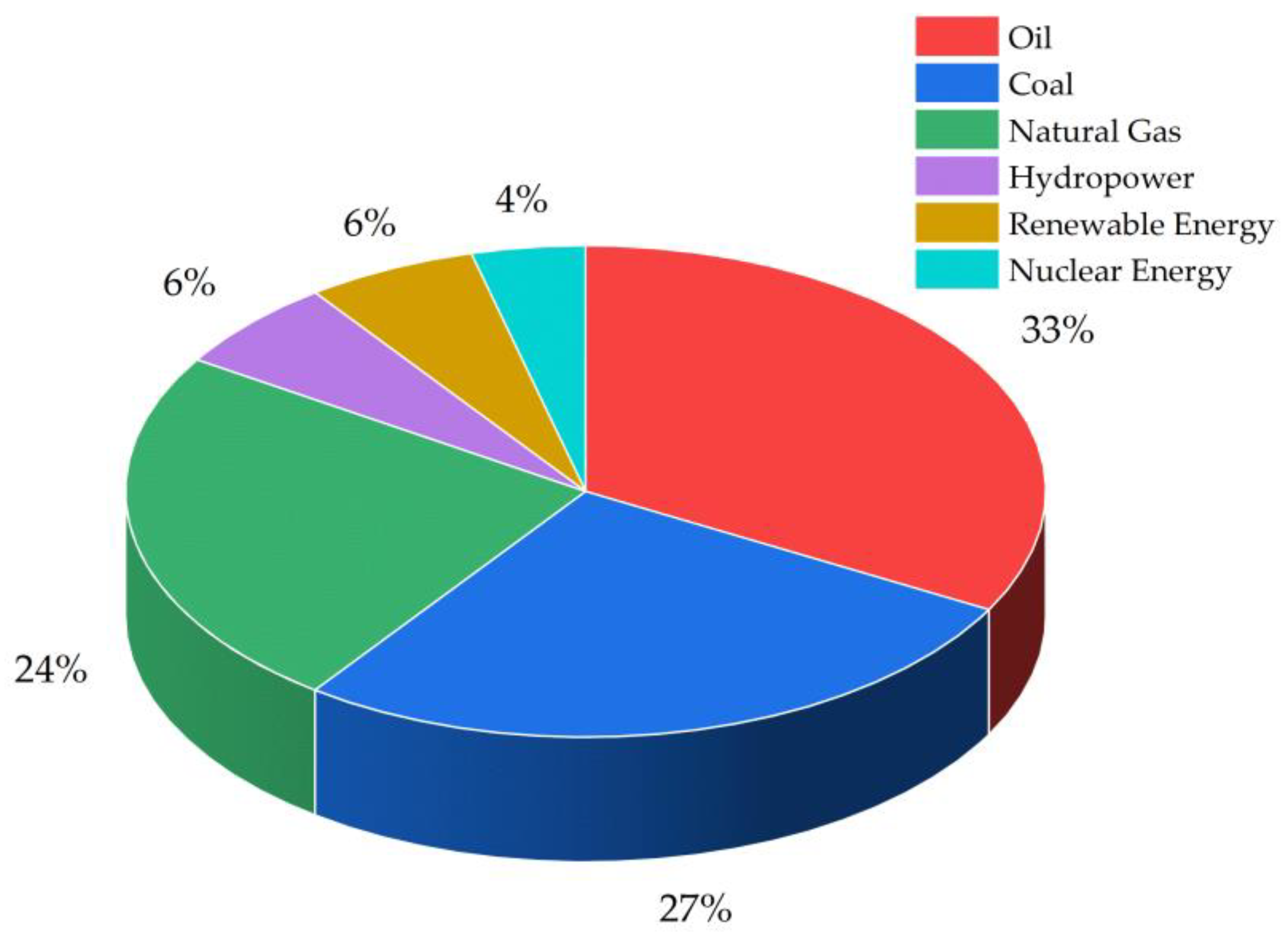
Figure 2.
a) Schematic representing the key steps of photocatalytic water splitting: light absorption, charge carrier separation, and surface redox reactions. b) Energy band diagram illustrating the thermodynamic requirements for water splitting using semiconductor photocatalysts [88].
Figure 2.
a) Schematic representing the key steps of photocatalytic water splitting: light absorption, charge carrier separation, and surface redox reactions. b) Energy band diagram illustrating the thermodynamic requirements for water splitting using semiconductor photocatalysts [88].
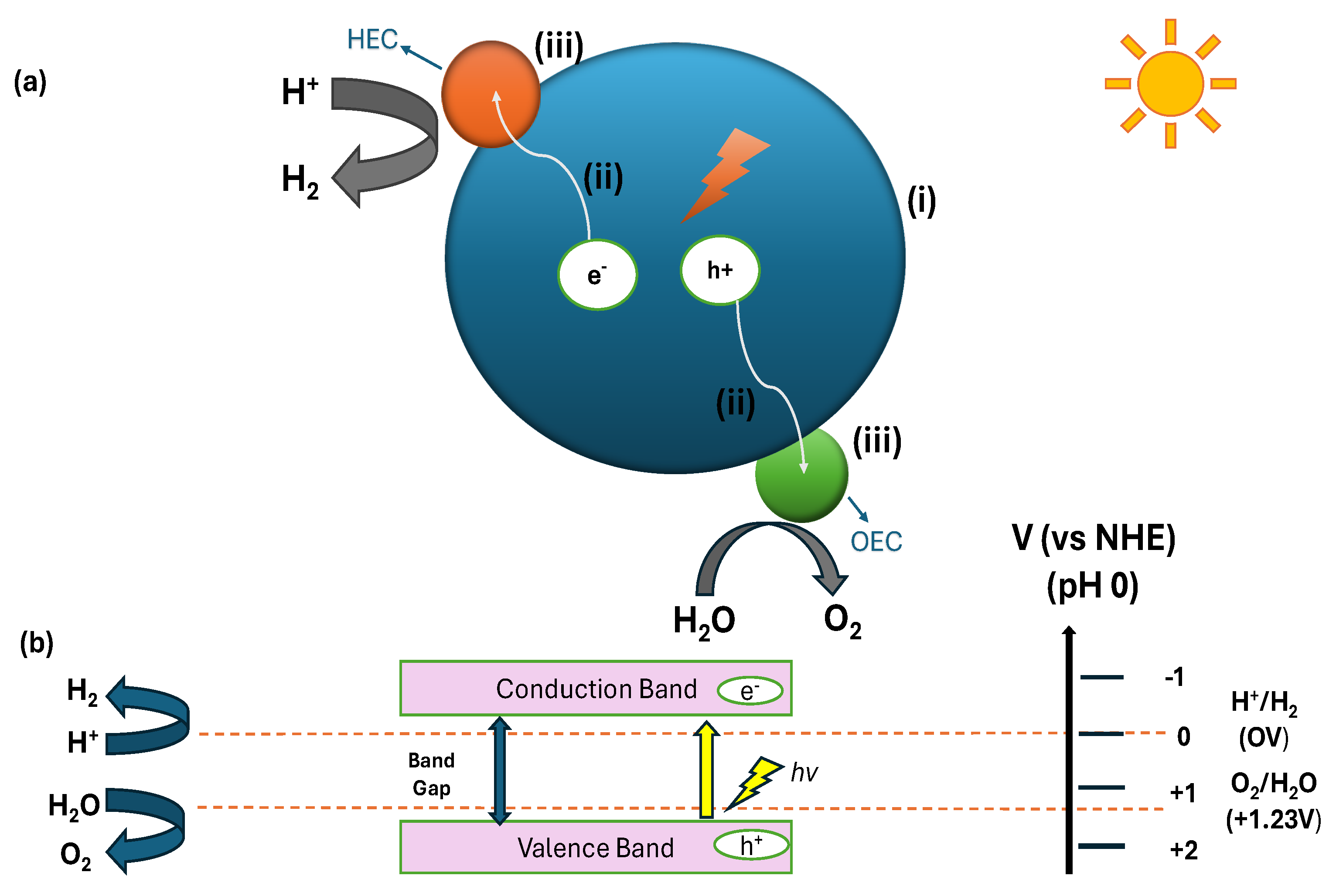
Figure 3.
Diagram illustrating the energy band in a two-step photocatalytic water splitting system [109].
Figure 3.
Diagram illustrating the energy band in a two-step photocatalytic water splitting system [109].
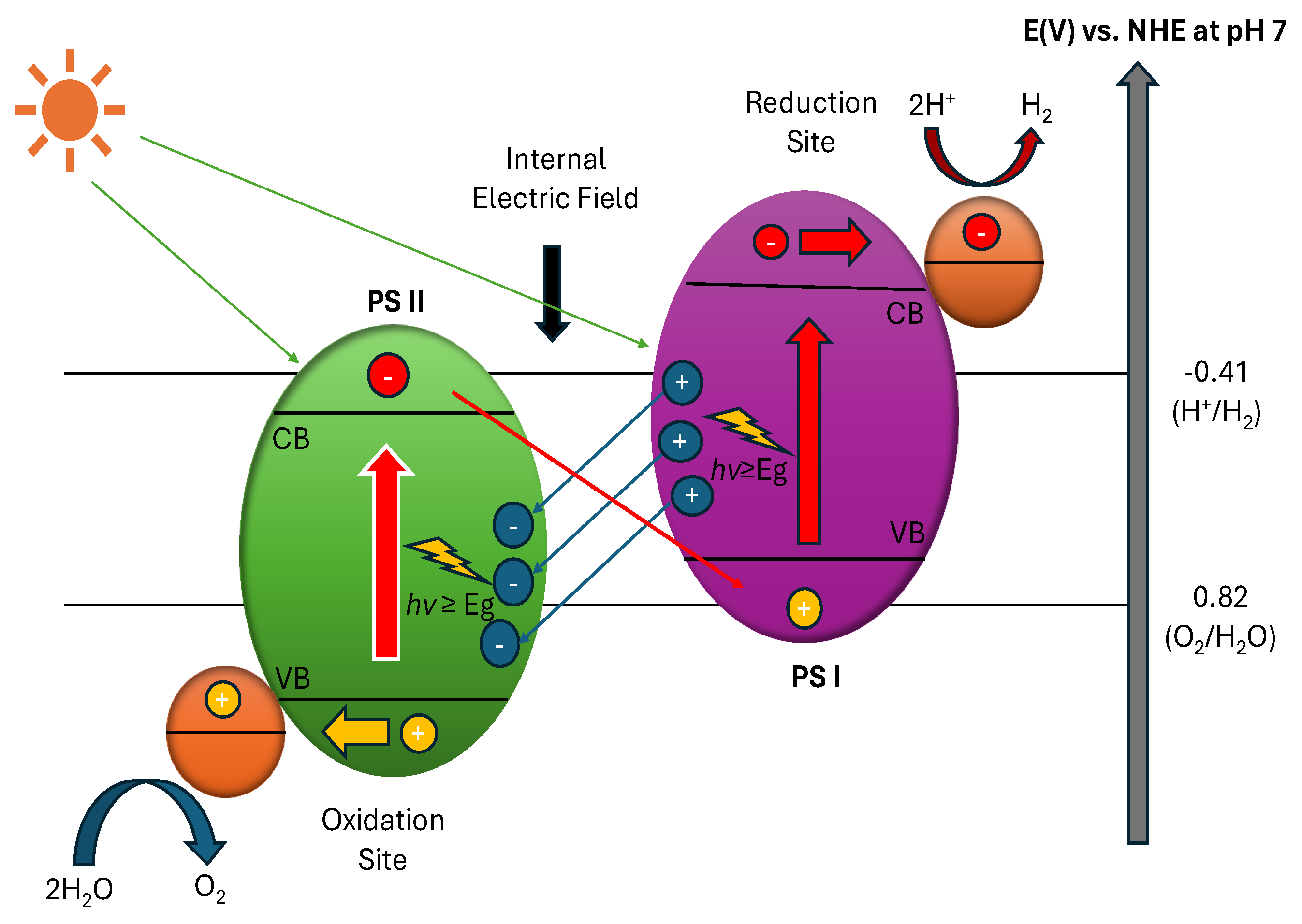
Figure 4.
Challenges of Seawater and Wastewater in TiO2-Based Photocatalytic Systems.
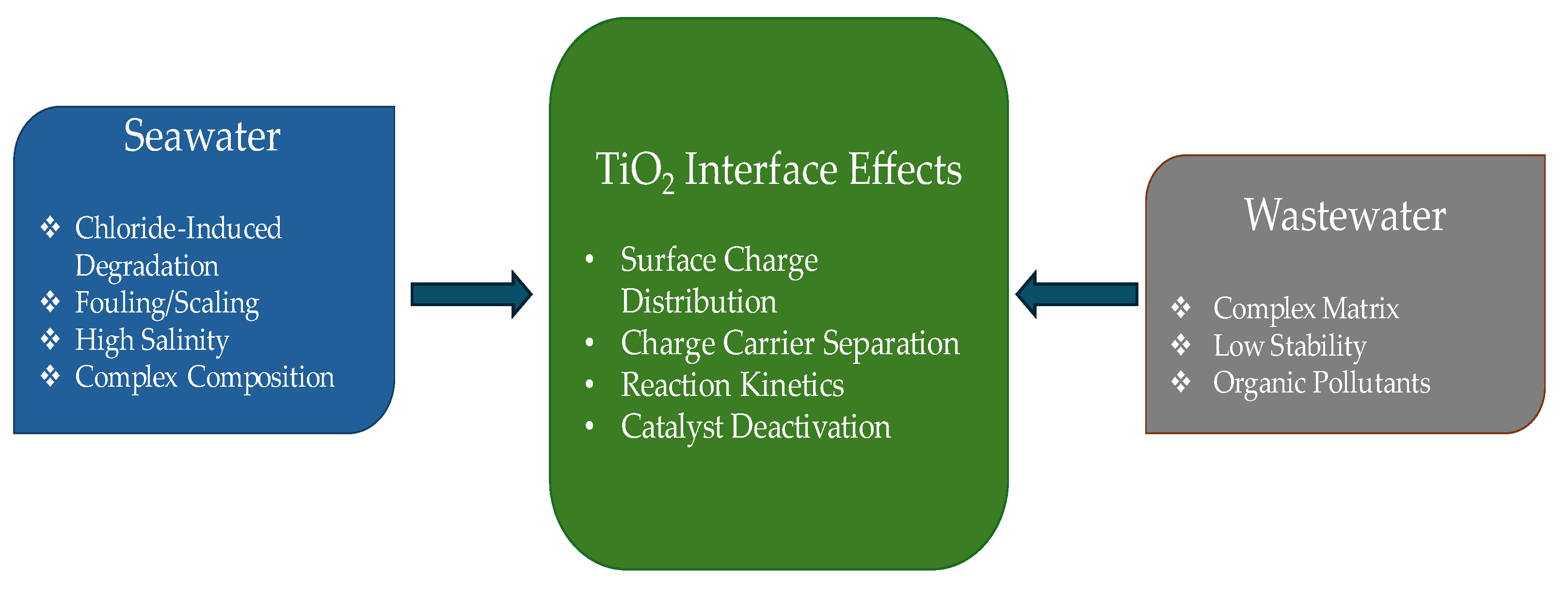
Figure 5.
Integration Strategies for Advanced TiO2 Systems.
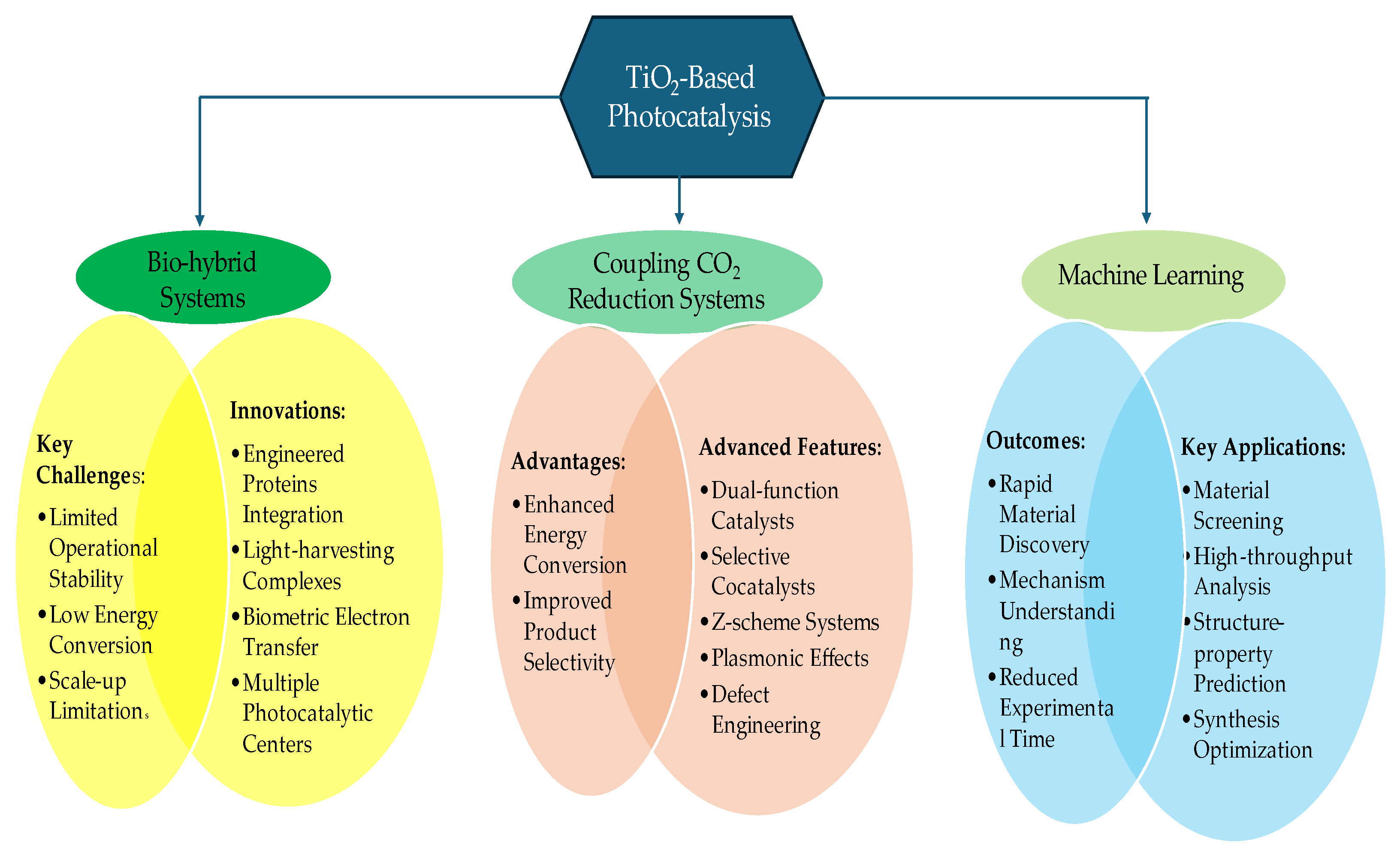

Table 1.
Key Advancements in TiO2-Based Photocatalysts.
| Advancement | Key Features | Impact on Efficiency | References |
|---|---|---|---|
| Hierarchical Nanostructures | Integration of nanotubes, nanosheets, and nanoparticles into cohesive architectures. | Enhanced light scattering and trapping mechanisms, leading to improved photocatalytic hydrogen production. | [148] |
| Macro/Mesoporous Structures | Engineered pores facilitating superior mass transport and maximizing reactive surface area. | Significant improvements in photocatalytic hydrogen production due to enhanced surface area and reaction kinetics. | [149] |
| Ordered Arrays and Self-Assembly | Formation of ordered arrays and self-assembled structures for directional charge transport. | Addressed limitations in traditional designs by enhancing charge separation and reducing recombination rates, leading to improved hydrogen evolution. | [150] |
| Crystal Phase Engineering | Controlled synthesis of mixed-phase TiO2 (anatase/rutile) junctions. | Exceptional charge separation properties, significantly reducing recombination rates and enhancing hydrogen production efficiency. | [151] |
| Nanoscale Engineering | Precise control over TiO2 nanostructures, including size, shape, and surface properties. | Enhanced light absorption, charge separation, and surface reaction kinetics, leading to improved hydrogen production efficiency. | [152] |
Table 2.
Advances in Surface Chemistry and Defect Engineering.
| Advancement | Key Features | Impact on Efficiency | References |
|---|---|---|---|
| Black TiO2 via Oxygen Vacancy Engineering | Controlled introduction of oxygen vacancies to create black TiO2 with enhanced visible light absorption. | Extends photocatalytic activity into the visible spectrum, significantly improving hydrogen production rates. | [153] |
| Surface Modification and Defect Engineering | Atomic-level control over surface defects, including Ti3+ states and non-metal doping. | Improves charge separation and extends light absorption, leading to higher hydrogen evolution rates. | [166] |
| Co-doping with Transition Metals and Non-Metals | Incorporation of both metal and non-metal dopants into TiO2 lattice. | Synergistic effect leading to enhanced visible light absorption and improved hydrogen production rates. | [167] |
Table 3.
Summary of Modified TiO2-Based Photocatalysts and Hydrogen Production Efficiencies.
| Photocatalyst Composition | Fabrication Method | Hydrogen Production Rate | Light Source | References |
|---|---|---|---|---|
| Ag/TiO2 | Chemical Reduction | 23.5 mmol g−1 h−1 | UV lamp (254 nm Wavelength) | [168] |
| Co3O4@C/TiO2 | Carbonization | 11,400 µmol g−1 h−1 | UV-LED lamp (365 nm Wavelength) | [169] |
| CuO/TiO2 | Hydrothermal | 2,000 µmol g−1 h−1 | 300 W Xe lamp | [170] |
| Co3O4 QDs/TiO2 | Hydrothermal | 1735 µmol g−1 h−1 | Solar light | [171] |
| Co3O4@TiO2/ Pt | Hydrothermal | 5280 µmol g−1 h−1 | 300 W Xe lamp | [172] |
| CoOx-TiO2/ CdS | Solvothermal | 660 µmol g−1 h−1 | Visible light (> 400 nm Wavelength) | [173] |
| Pt/TiO2 | Hydrothermal | 334 µmol h−1 | 350 W Xe lamp | [149] |
| FP-Pt/TiO2 | Pyrolysis | 19.25 mmol g−1 h−1 | 300 W Xe lamp | [174] |
| FP-Cu/TiO2 | Pyrolysis | 5.02 mmol g−1 h−1 | 300W Xenon lamp | [174] |
| Cr-TiO2 | Magnetron sputtering and Sol–gel | 5.3 µmol h−1 | Visible light | [175] |
| Fe-TiO2 | Magnetron sputtering and Sol–gel | 15.5 µmol h−1 | Visible light | [175] |
| Cu-TiO2 (P25) | Photoassisted Deposition | 8.47 mmol g−1 h−1 | 450 W Hg lamp | [176] |
| Co-TiO2 | Photoassisted Deposition | 2.48 mmol g−1 h−1 | 450 W Hg lamp | [176] |
| Fe-TiO2 | Microwave-Hydrothermal | 11 µmol g−1 h−1 | Xe lamp | [177] |
| Fe-TiO2 | Impregnation | 230 µmol g−1 h−1 | UV light | [178] |
| Ru-TiO2 | Micro-emulsion | 0.80 mmol g−1 h−1 | 500 W Xe lamp | [179] |
| Au-TiO2 | Photodeposition | 1.1 mmol g−1 h−1 | UV lamp | [180] |
| Pd/N-TiO2 | Chemical vapor deposition | 6.3 mmol g−1 h−1 | White LED | [181] |
| Fe-Ni-/Ag/TiO2 | Solvothermal | 794 µmol g−1 h−1 | 500 W Xe lamp | [182] |
| Pt/Mg-TiO2 | Hydrothermal | 850 µmol g−1 h−1 | 300 W Xe lamp | [183] |
| Pt SA/Def-s-TiO2 | Deposition-Precipitation | 13.5 mmol g−1 h−1 | 300 W Xe lamp | [184] |
| Cu-TiO2 | Ball Milling | 9.5 mmol g−1 h−1 | 300 W Xe lamp | [185] |
| Ni-TiO2 | Molten Salt | 1.9 mmol g−1 h−1 | 300 W Xe lamp | [186] |
| Sn/TiO2 | Photoinduced Deposition | 553 µmol g−1 h−1 | 3 W UV lamp | [187] |
| N-TiO2 | Sol-gel and Electrospinning | 28 µmol h−1 | 150 W Xe lamp | [188] |
| N-TiO2 | RF Magnetron Sputtering Deposition | 4.5 mmol cm-2 h-1 | 300 W Xe lamp | [189] |
| N-TiO2 with VO | Solvothermal | 1.04 mmol g−1 h−1 | Solar Simulator | [190] |
| S-TiO2 | Thermal Protection | 164 µmol g−1 h−1 | Visible light | [191] |
| TiC@C-TiO2 | Situ Thermal Growth | 558 µmol g−1 h−1 | 300 W Xe lamp | [192] |
| N/F-TiO2 | Calcination | 11.5 µmol g−1 h−1 | 300 W Xe lamp | [193] |
| C/N self-doped TiO2 | Hydrothermal | 332.3 µmol g−1 h−1 | 300 W Xe lamp | [157] |
| Br/N-TiO2 | Hydrothermal | 2.3 mmol g−1 h−1 | 300 W Xe lamp | [194] |
Table 4.
Water Chemistry Influence.
| Factors | Effect of Photocatalytic Performance | References |
|---|---|---|
| pH | Modulates band edge positions, surface charge, and adsorption/desorption equilibrium of reactive species. Affects hydrogen evolution rates depending on the pH range. | [229,230] |
| Ionic Strength | Influences the electric double layer and charge carrier separation. High ionic strength can improve conductivity but may increase recombination. | [69,239] |
| DOM | Acts as electron donors and acceptors; competing pathways can either enhance or inhibit hydrogen evolution rates. | [233] |
| Common Ions (e.g., Na+, Cl-, SO42-) | Alters the electric field at the semiconductor-electrolyte interface and influences charge carrier separation. Some ions stabilize the catalyst, while others lead to degradation. | [235,236] |
| Dissolved Oxygen | Competes with hydrogen evolution by capturing electrons, reducing overall photocatalytic efficiency. | [238] |
Table 5.
Strategies Employed in Seawater Splitting.
| Photocatalyst | Hydrogen Production Rate | Key Strategy/Condition Addressed | References |
|---|---|---|---|
| Mesoporous brookite/anatase TiO2 | 6.59 mmolg-1h-1 | Mitigated chloride-induced degradation | [256] |
| Brookite TiO2 | 1,476 µmolg-1h-1 | Improved stability in saline environments | [257] |
| Phosphorus and Nickel co-doped TiO2 | 149 µmolg-1h-1 | Improved stability by preventing photo-corrosion | [258] |
| TiO2(NT)/Pt/ Cd0.8Zn0.2S | 21.7 mmolg-1h-1 | Increased active sites and hydrogen production rate | [259] |
| Granular Pt/TiO2 | 23.6 µmolh-1 | Catalyst deflocculation and oxygen inhibition | [260] |
| WS2/C-TiO2/g-C3N4 | 986 µmolg-1h-1 | Enhanced electron-hole pair separation | [261] |
| MoS2@TiO2 | 580 mmolg-1h-1 | Enhanced plasmonic effect | [262] |
| SiO2/Ag@TiO2 | 816 µmolg-1h-1 | Photothermic interfacial heating synergy | [263] |
Table 6.
Simultaneous Wastewater treatment and Hydrogen Production.
| Photocatalyst | Hydrogen Production Rate | Pollutant Treated | Light Source | References |
|---|---|---|---|---|
| CuO/TiO2 NT | 3.43 µmolg-1h-1 | Phenol | Visible light | [271] |
| Ag-G-TiO2 | 191 µmolg-1h-1 | Methylene Blue | Visible light | [35] |
| BiVO4/TiO2 | 14.3 mmolg-1h-1 | Rhodamine B | Visible light | [272] |
| NiPc@GO/TiO2 | 1.38 mmolh-1 | Formic Acid | Visible light | [273] |
| 7CuO-TiNTA | 910 mmol/m2 | Ammonia | UV light | [274] |
| Ag/TiO2 | 1729 µmolg-1h-1 | Paracetamol | Natural sunlight | [275] |
| MoS2−x @TiO2-OV | 42 µmolg-1h-1 | Pharmaceutical Wastewater | 300W Xenon lamp | [276] |
| MoS2−x @TiO2-OV | 103 µmolg-1h-1 | Coking wastewater | 300W Xenon lamp | [276] |
| PtCo3O4TiO2 | 2200 µmolg-1h-1 | Enrofloxacin | 300W Xenon lamp | [277] |
| Fe-doped TiO2 | 2423 µmolh-1 | Methyl Orange | Visible light | [278] |
| Mixed TiO2 nanosphere and nanosheet | 19.4 µmolg-1h-1 | Glycerol | 300W Xenon arc lamp | [279] |
| Pt/TiO2 | 101 µmolg-1h-1 | Oxalic Acid | 450W Xenon Arc lamp | [280] |
| Carbon-doped TiO2 | 374 µmolg-1h-1 | Lactic Acid | Visible light | [281] |
| Cr2O3/Rh/SrTiO3 | 590 µmolg-1h-1 | 4-chlorophenol | 300W Xe Arc lamp | [282] |
| Nanostructure mesoporous TiO2 | 19 mmolh-1 | Olive mill wastewater | UV light | [283] |
Table 7.
Overview of Photocatalytic Reactor Designs and Scale-up Challenges.
| Reactor Type | Key Features | Scalability Challenges | Engineering Solutions | References |
|---|---|---|---|---|
| Suspended Particle | High light absorption, dynamic particle flow | Potential clogging, complex design | Optimization of particle dispersion and flow dynamics | [300] |
| Fixed-Bed Reactor | Stable, large-scale suitability | Low light utilization, heat management | Reactor designed for improved light penetration and mass transfer | [301] |
| Optical Fiber Reactor | Efficient light delivery through fibers, compact | Cost, complexity in large-scale integration | Optimization of fiber configuration for large-scale light distribution | [302] |
Table 8.
Key Technical Challenges and Solutions in Large-Scale Photocatalytic Reactor Design.
| Aspect | Challenges | Solutions | References |
|---|---|---|---|
| Light Distribution | - Non-uniform illumination in scaled reactors leading to efficiency loss. | - Advanced light delivery systems (e.g., internal illumination, solar concentrators). - Integration of plasmonic materials and photonic crystals to enhance light harvesting and uniformity |
[298,315] |
| Mass Transfer | - Limitation in gas-liquid-solid interactions affecting reaction rates. - Poor mixing leading to concentration gradients |
- Enhanced mixing strategies to improve contact between phases. - Structured catalysts and membrane-integrated systems to facilitate better mass transfer. |
[316,317] |
Table 9.
Quantitative Assessment of Key Challenges Proposed Solutions in Scaling Up Photocatalytic Hydrogen Production.
Table 9.
Quantitative Assessment of Key Challenges Proposed Solutions in Scaling Up Photocatalytic Hydrogen Production.
| Scaling-Up Factor | Challenges | Quantitative Metrics | Proposed Solutions | References |
|---|---|---|---|---|
| Light Delivery Efficiency | - Light Scattering. - Poor penetration in slurries. - Limited light absorption by photocatalyst. |
- Single LED to optical fiber efficiency: ~91% evanescent wave utilization. - TiO2-coated optical fibers enhance degradation by 32%. |
- Optical fibers with reduced TiO2 patchiness (0.034 cm2/cm2). -Optimized interspace distance (114.3 nm) for evanescent waves. |
[318,319] |
| Reactor Design and Photocatalyst Loading | - Low photocatalyst mass-loading. - Reactor inefficiencies. - Catalyst detachment. |
- Mass-loading of g-C3N4-POFs up to 100-1000× higher than conventional reactors. - Photocatalyst coated optical fibers improved micropollutant degradation by 4×. |
Bundled 150 optical fibers for higher quantum efficiency and scalable production. | [320,321] |
| Surface Area Utilization | - Limited catalyst loading. - Light scattering losses. - Inefficient pollutant degradation. - Catalyst leaching. - High energy consumption. |
- High mass-loading g-C3N4 embedded in metamaterial porous polymer fibers (100-1000× higher than traditional coatings). - 4× higher degradation rates compared to slurry reactors. - Maintains photocatalytic activity for 20+ cycles. - No catalyst leaching. - Reduced energy-per-order (EEO) compared to slurry reactors |
- Metamaterial porous polymer fibers for efficient light delivery and increased reaction sites. - Photocatalyst immobilization for long-term stability. - Energy-efficient fiber-based reactor designs |
[320,322] |
| Biofouling and Catalyst Stability | - Biofilm accumulation on photocatalytic surfaces reduces efficiency and leads to fouling. - Controlling biofilm growth in enclosed water systems is challenging due to light delivery limitations. |
- UV-C SEOFs (side-emitting optical fibers) inhibited biofilm formation at ≥10 µW/cm² (265-275 nm). - UV-A and UV-B SEOFs were ineffective and even increased EPS (Extracellular Polymeric Substances) accumulation, leading to more fouling. |
- Low-fluence UV-C SEOFs enable continuous surface disinfection, preventing biofilm accumulation. - Subtractive engineering approach enhances UV-C side-emission, improving biofilm control in confined spaces. |
[323,324] |
| Hydrogen Evolution Reaction (HER) Efficiency | - Electron-hole recombination losses reduce reaction efficiency. - Conventional systems suffer from low quantum yield due to inefficient light absorption. |
- Quantum yield increased by nearly 2× when reactor length was doubled. - Photocatalytic H₂O₂ production improved by 60× compared to slurries, demonstrating superior light utilization. - HER efficiency increased significantly using g-C3N4 and ITO-modified polymer optical fibers. |
- Evanescent wave enhancement using optical fibers improves light utilization. - Dual optical-membrane fiber systems enable stable photocatalysis with enhanced oxygen delivery and light absorption. |
[319,321,325] |
| Water Source and Impurities | - Organic pollutants act as reactive species scavengers, reducing oxidation efficiency. - Background organic matter (e.g., WWTP effluent) significantly decreases photocatalytic degradation rates. |
- Organic matter in secondary wastewater effluent (17 mg TOC/L) inhibited photocatalysis. - In the presence of WWTP effluent, BPA removal rates decreased by 52% for electrospun TiO₂ fibers, compared to 91% for suspended TiO₂. |
- Coupled adsorption-photocatalysis systems enhance contaminant capture and oxidation efficiency. - Porous electrospun fibers increase surface area, improving pollutant access to photocatalytic sites. - TiO₂ immobilization mitigates organic interference, enhancing stability and reusability. |
[322] |
| Chemical Stability of Photocatalysts | Potential long-term performance degradation | Photocatalytic performance sustained over 20 cycles, with no structural loss of optical fibers. | - High-mass-loading photocatalysts. - Roll-to-roll fabrication for scalable and stable production. |
[320] |
| Photoelectrochemical (PEC) Integration | High energy cost due to inefficient PEC designs. | - Geometric space capacity: 2670 m²/m³ (>25× higher than flat PEC electrodes). - Photocurrent density: 0.2 mA/cm². - Hydrogen production rate: 15× higher than standard reactors. |
ITO and g-C₃N₄ coated polymer optical fiber optoelectrode improves electron transfer and efficiency. | [321] |
| Flexible Fiber-Based Reactor Designs | - Need for scalable and adaptable configurations for industrial applications. - Current reactor designs suffer from low energy efficiencies due to light attenuation. |
- >6000% larger surface area than flat glass electrodes. - >300% better incident photon-to-current efficiency. |
Flexible Perovskite-Nafion-ITO fiber optoelectrodes for efficient light-driven PEC water purification and hydrogen production. | [326] |
Table 10.
Key Innovations in Bio-Hybrid Photocatalytic Systems.
| Category | Innovation | Significance | Example Applications | References |
|---|---|---|---|---|
| Material Integration | Combination of photocatalysts with engineered proteins and synthetic biological components | Enhanced synergy between biological selectivity and inorganic stability | Large-scale hydrogen production systems. | [353] |
| Hybrid System Design | Bio-hybrid architectures incorporating light-harvesting complexes with multiple catalytic sites | Increased efficiency and robustness under visible light conditions. | Artificial photosynthesis setups for clean energy. | [354] |
| Electron Transfer Pathways | Biomimetic electron transfer mechanisms inspired by natural processes | Improved quantum efficiency and system longevity | Sustainable solar-to-hydrogen energy conversion | [355] |
| Performance Optimization | Development of systems with high solar-to-hydrogen conversion rates and operational stability | Breakthrough in achieving industrial scale feasibility. | Scaled-up photocatalytic energy production plants. | [356] |
| Advanced Architectures | Architectures combining multiple photocatalytic centers for distributed light utilization. | Uniform energy conversion and improved system durability. | Decentralized renewable energy systems. | [357] |
Disclaimer/Publisher’s Note: The statements, opinions and data contained in all publications are solely those of the individual author(s) and contributor(s) and not of MDPI and/or the editor(s). MDPI and/or the editor(s) disclaim responsibility for any injury to people or property resulting from any ideas, methods, instructions or products referred to in the content. |
© 2025 by the authors. Licensee MDPI, Basel, Switzerland. This article is an open access article distributed under the terms and conditions of the Creative Commons Attribution (CC BY) license (http://creativecommons.org/licenses/by/4.0/).
Copyright: This open access article is published under a Creative Commons CC BY 4.0 license, which permit the free download, distribution, and reuse, provided that the author and preprint are cited in any reuse.