

Submitted:
03 February 2025
Posted:
04 February 2025
You are already at the latest version
Abstract
This article reports on the first qualitative phase of an exploratory sequential mixed method (ESMM) research design focusing on EFL pronunciation instruction in Spanish primary schools. Firstly, it presents an analysis of the National Curriculum in light of recent policy changes and adaptations across seventeen Autonomous Communities (AACC) to assess coherence and the scaffolding of contents. Secondly, based on results from Focus Groups with eight instructors from five different schools and two different AACC, teachers' perceptions on EFL pronunciation teaching in the current curriculum change are examined according to two main strands, i.e., Curriculum Design and Development and Teacher Professional Development. The results reveal asymmetries in Curriculum Contents regarding specificity and teaching methodologies, as well as some conceptual inconsistencies and dispositions that seem to be leading to overregulation, particularly in relation to increased measures of public accountability. These appear to be heightening tensions that are causing a mismatch between the intended Curriculum and the instructor-experienced curriculum. Another key observation is that, in this scenario, the positive beliefs and attitudes of primary school teachers towards EFL pronunciation are insufficient for optimal teaching. Intervention measures and innovations are suggested to improve the situation, which may be extrapolated to other similar EFL contexts.
Keywords:
EFL pronunciation
; Spanish national curriculum
; primary school
; phonetics
; educational policies
1. Introduction
Pronunciation1 plays a pivotal role in the acquisition of EFL competence, both for the development of language skills and for successful communication building social or work relations (Saito, 2012; Lee et al., 2015; Walker, 2014). Furthermore, according to error gravity studies, pronunciation is not only a key aspect of spoken intelligibility (i.e. the literal understandability of an utterance), comprehensibility (i.e. the effort required for understanding an utterance) and interpretability (i.e. the full, nuanced, contextual understanding of a speech act) (Derwing & Munro, 2009; Jenkins, 2000; Levis, 2018; Saito, 2021). Phonetic errors and mispronunciations may also affect the learners’ self-esteem (Underhill, 2010), they may trigger judgmental attitudes among listeners (e.g. boredom, tiredness, irritation, annoyance, or anxiety) (Anderson-Hsieh & Koehler, 1992; Bent & Bradlow 2003) and negative stereotypes about disfluent speakers (Seidlhofer, 2001), or may even result in withdrawal from interaction on the part of some speakers (Singleton, 1995), probably due to a breakdown in fluent communication or the extra effort needed to repair phonological distortions (Fernández González, 1988).
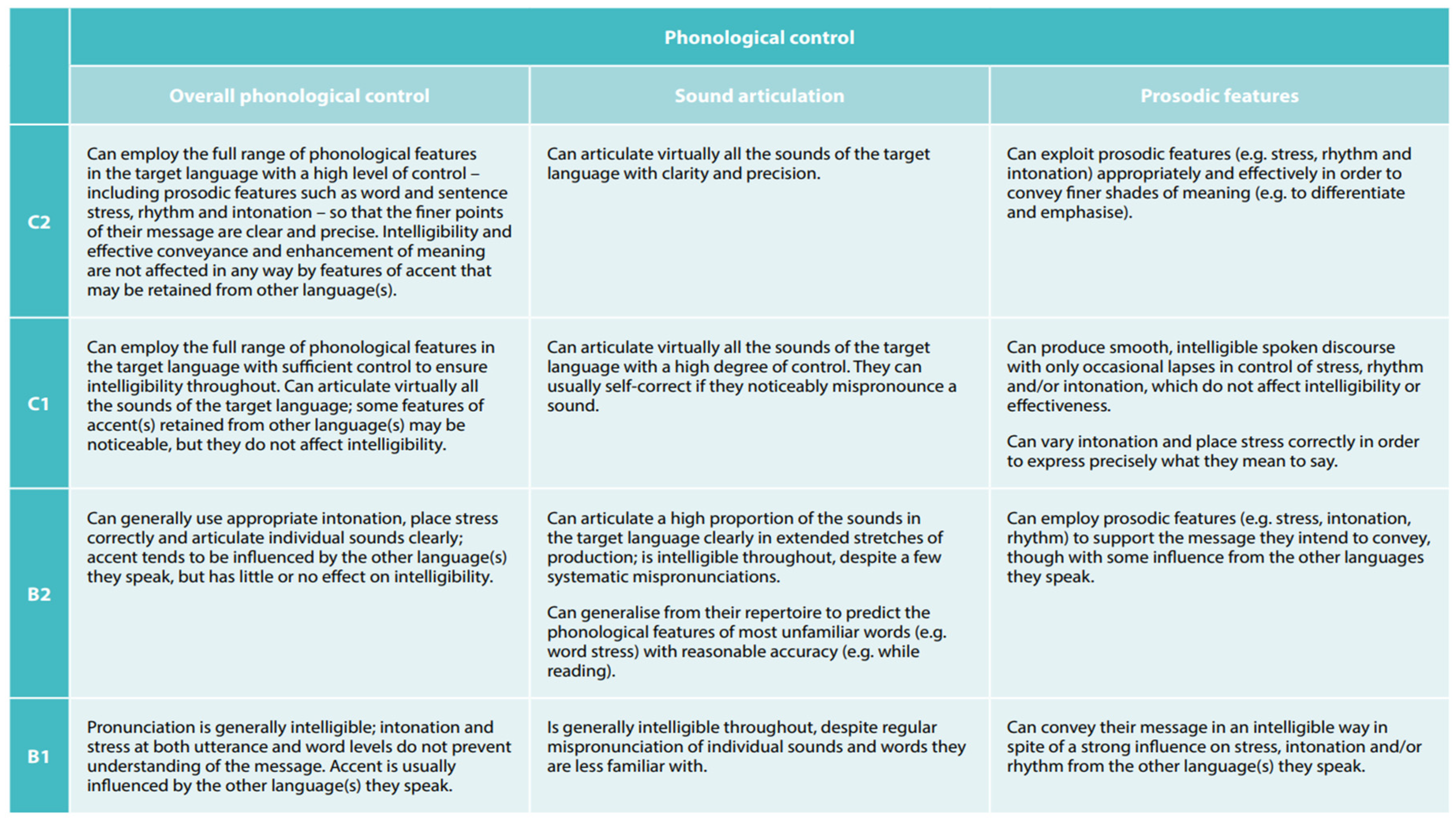
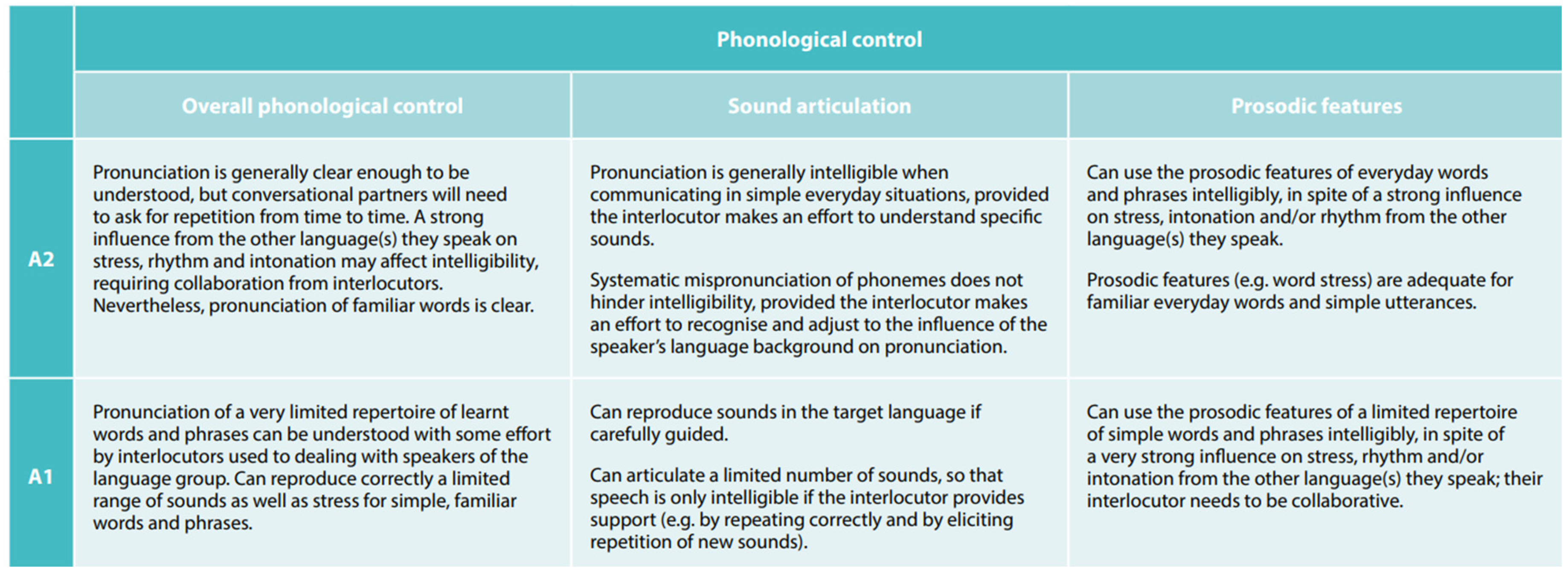
Nevertheless, pronunciation has often been overshadowed in EFL classes by other aspects of language teaching (Gilakjani & Sabouri, 2016; Kelly, 1969; Marks, 2011; Sweeting, 2015). In Isaacs’ (2018: 273) words, L2/EFL pronunciation practices have been affected by “the whims of the time and the fashions of the day” (Celce-Murcia, 2010; Demir & Kartal, 2022; Jordan et al., 2008; Pennington & Rogerson-Revell, 2019; Setter, 2018). Grammar and Reading-based methodologies prioritized other dimensions of EFL learning, usually based on the appreciation that acquiring a native speaker-like pronunciation is an unrealistic goal that can never be attained. A paradigm shift occurred with the implementation of audio-lingual and oral methods in viewing pronunciation as an essential aspect of L2/EFL teaching. Similarly, the rise of communicative language teaching combined with the establishment of multilingual/bilingual programs such as CLIL (Content and Language Integrated Learning) within international frameworks like the Common European Framework of Reference (CEFR) also enhanced speaking and communicative competence, even though fluency and intelligibility were prioritized over phonetic accuracy (Baker & Burri, 2016; Foote et al., 2016; Levis, 2018). It has not been until recently that CEFR has explicitly acknowledged the importance of phonological awareness, referred to as phonological control (Council of Europe 2020: 133-136), which is scaffolded over six levels, A1, A2, B1, B2, C1 and C2 − displayed in Appendix A −, involving clarity and precision in sound articulation, as well as control of prosodic features (stress, intonation and/or rhythm) to appropriately and effectively convey one’s particular message and finer shades of meaning.
The question then arises as to whether the dimensions involved in phonological control as described by CEFR or in any equivalent manner2 have been systematically integrated into EFL curriculum design, curriculum development, and (lesson) planning within the framework of the educational policies applicable in each country; and if they have, whether such contents are developed progressively and gradually throughout the different educational levels, including teacher training programs. This area has been underexplored, and as a result, research appears to be largely misaligned with teaching practice and the instructional materials used to teach EFL pronunciation, with only intermittent applications of its results to classroom pedagogy (Low, 2021; Müller, 2013).
Focusing on Spain, a number of reports (PISA, ESLC, PIRLS, EPI) and empirical studies (Alonso, 2014; Cuddy, 2018; Martínez-Flor et al., 2006; Bartoli Rigol, 2005; Szprya, 2015) have found that the phonological competence of Spanish-speaking learners of English lags behind other skills, albeit the importance conferred on pronunciation by both instructors and learners (Castillo et al., 2023; Díaz Lage et al., 2023; Bartolí Rigol, 2005; Calvo Benzies, 2016; Cenoz & García-Lecumberri 1999; Gómez González & Lago Ferreiro, 2024; Gómez Lacabex & Gallardo del Puerto, 2021; Martínez-Adrián & Gallardo, 2011; Santos Díaz et al., 2024). In addition to L1 negative interference, given the differences existing between English and Spanish in terms of sound inventories, prosody and orthography, as well as acculturation variables (i.e. degree of social/psychological interaction with the target group) (Gallardo del Puerto et al., 2009), inadequate methodologies and educational systems seem to lie at the heart of the problem.
Nevertheless, the link between EFL pronunciation pedagogies in Spanish primary schools and educational regulations has been underinvestigated, despite its critical importance for secondary and tertiary-level programs since any language-related outcomes will depend on the model of the education curriculum and setting realistic objectives will support any early start benefits. This target population has been underrepresented in Henderson et al.’s (2012, 2015) English Pronunciation Teaching in Europe Survey (EPTiES) (5%). Furthermore, except for some panoramic accounts (García-Mayo, 2017), most prior studies have focused on other issues such as (1) the acquisition of EFL sounds (Lecumberri & Gallardo del Puerto, 2003), (2) the relevance of the intensity of CLIL exposure and L2 motivation in non-CLIL, low-CLIL and high-CLIL programs (Azpilicueta-Martínez & Lázaro-Ibarrola, 2023; Pérez Cañado, 2018), (3) foreign language awareness (Gómez Lacabex & Gallardo del Puerto, 2014, 2020; Muñoz, 2013), or (4) the effectiveness of specific approaches like communicative or audio-lingual methods (Domínguez Baguer, 2014; Nivela Herrero, 2014), explicit perception and production training programs (Gómez-Lacabex et al., 2022), explicit spelling instruction (Pérez Cañado, 2003), or the Jolly Phonics (JP) method (Fonseca-Mora & Fernández-Corbacho, 2017; Lázaro-Ibarrola, 2007, 2010; Martínez, 2011; Redón Romero et al., 2021). Some previous investigations have also examined the implementation of (compliance with) legislation on primary school (L2) teaching in Spain such as Barbero (2012), Bolívar (2008, 2009, 2019), Palacios et al. (2022) or Trillo Alonso & Fraga Varela (2023). However, such prior work is not specifically focused on EFL pronunciation and neither does it consider the dimensions presented here in the same degree of granularity.
2. Materials and Methods
This study examines the implementation of EFL pronunciation instruction in Spanish primary schools in a context of Curriculum change, as well as primary school teachers’ beliefs and practices on the matter by comparing testimonies of instructors from public and public institutions from different autonomous communities (AACC). The research questions are the following:
- RQ1.
- Are the Spanish National Curriculum Guidelines for EFL pronunciation instruction at primary school level adequately scaffolded and coherent across AACC?
- RQ2.
- What are teachers’ beliefs and practices towards EFL pronunciation instruction in the New Curriculum, and are there differences between public and private schools and/or between AACC?
The study reports on the first qualitative phase of an exploratory sequential mixed method (ESMM) (Creswell & Plano, 2018) design. ESMM is characterized by two sequential phases, the first qualitative and the second quantitative, aimed at exploring a research problem about which little is known, hence the term exploratory. Accordingly, the first phase involved the collection of qualitative data through semi-structured interviews with primary school instructors to gain insights and explore their experiences with the recently established intervention, that is, the National Curriculum and its adaptations across different AACC, which hence had also to be examined as teaching is a regulated profession.
First, an ad hoc documentary analysis of 18 documents (circa 500 pages each) was conducted concerning EFL phonetic knowledge, objectives, competencies and assessment criteria: the Spanish national curriculum at the Primary Education stage that has been recently reformed in the LOMLOE (Organic Law 3/2020 of 20 December 2020), as well as of each one of the 17 adaptations implemented by each of the Autonomous Communities (AACC) in compliance with the Minimum Education Decree (BOE 2022 a, b).
Semi-structured interviews following a common script (Appendix C) were then conducted in three Focus Groups (FG) with eight primary school teachers. FG01 gathered two teachers from two different public schools in Galicia, whereas FG02 assembled four instructors from two different private schools from the same AC (two from each school), and FG03 took place with two teachers from another public school in Asturias, a nearby AC. Public primary schools were prioritized because the public network has the greatest presence and impact. Likewise, the sample includes more Galician schools due to logistical, budgetary, and methodological constraints. The schools were selected on the basis of proximity, but also on their consideration as reference centers for public or private education in their respective AACC. Authorizations to conduct the FG had to be obtained from each of the sampled schools, AACC, and interviewees. Funds also had to be devoted to cover both travel expenses and participation payments to the surveyed teachers, which meant that the sample needed to be kept to an economically sustainable size. Additionally, after conducting FG01, it was decided to extend the sample to FG02 and FG03 to see if this would improve our understanding of what we were finding in the FG analysis. Once it was established that a theoretical saturation point (Strauss & Corbin, 1990) had been reached, at which the experiences offered by participants did not reveal substantial new topics, it was concluded that there was no need to expand the FG sample further.
ATLAS.ti software (version 23) was employed to analyze the FG data and retrieve the code networks generated from verbatim transcripts, illustrated in Figure 1, as well as the resulting list of codes and subcodes with their corresponding number of quotations (Appendix D).3 FG responses were refined through thematic analysis as it offers a theoretically flexible approach to this kind of qualitative approach (Braun & Clarke, 2006). Accordingly, the FG data were explored using a deductive mapping strategy, involving several phases of interrogating, defining, and redefining, until the most prominent themes and answers were identified (Appendix E).
3. Results
The qualitative data extracted from the documentary analysis and from the interviews were analyzed, and the two main themes corresponding to the two research questions are reported in this section.
3.1. The LOMLOE and Its Regional Adaptations
The LOMLOE reinstates a 3-cycle Primary program, i.e. 1st cycle (1st and 2nd year, ages 6 to 8), 2nd cycle (3rd and 4th year, ages 8 to 10) and 3rd cycle (5th and 6th year, ages 10 to 12), setting the number of teaching hours for Foreign Language teaching at 120 hours per year in the 1st and 2nd Primary cycles, and at 125 hours in the 3rd cycle. Focusing on the specific curriculum for foreign languages, LOMLOE establishes a link between Essential knowledge and the acquisition and development of Key competences ascribed to three main blocks: (1) Communication or Competence in linguistic communication (CLC), the ability to carry out communicative activities, such as comprehension, production, interaction and searching for information; (2) Plurilingualism or Multilingual competence (MC), a learner’s awareness of their specific linguistic repertoire and its relevance to understanding and producing a foreign language; and (3) Interculturality or Competence in cultural awareness and expression (CCAE), suggesting that students should not only be aware of the workings of a foreign language. Each of these Key competences is linked to corresponding Core skills cross-cutting the student’s Exit Profile, the relevant Objectives and Contents, as well as the subject areas covered by the Assessment criteria totaling 43 items.
Explicit mentions of EFL pronunciation contents are summarized in Table 1. It can be observed that contents of core pronunciation knowledge are ascribed to the Communication block and associated with CLC competencies that are scaffolded across the three cycles involving both the segmental and suprasegmental dimensions and targeting intelligibility, comprehensibility, and interpretability.
While the 1st cycle pursues an initiation to English sounds and accent patterns, the 2nd and 3rd cycles incorporate sound and intonation patterns in common use in association with their communicative functions that should be presented in learning situations that recreate real or simulated communicative contexts. In the 3rd cycle, rhythm is introduced alongside the gradual acquisition of both the so-called phonetic code and subsequently the written code (BOE 2022b: 113). The former seems to refer to orality, in the sense of teaching-learning sounds and suprasegmental features, before confronting children with orthographic issues and the complications of writing. The approach, the leveling and the definition of the different elements of the curriculum are said to be based on the language activities and competencies established by the Council of Europe in the CEFR to ensure lifelong learning, in keeping with the Sustainable Development Goals and the challenges of the 21st century.
Appendix B extracts the dispositions that explicitly refer to pronunciation-related contents across AACC adaptations of the LOMLOE. There exist convergences but also significant discrepancies concerning the terminological and procedural treatment of Essential Knowledge and its systematization in cycles or years, as well as in the organization of Key competences and Core skills. Except for Andalusia, which explicitly alludes to pronunciation contents only in the first year, all the other AACC adhere to the general distribution of EFL pronunciation knowledge into cycles (or years) by repeating, in many cases almost verbatim, the same general headings as those of the LOMLOE but presenting them as learning outcomes. Yet there is no systematic elicitation across AACC as to which pronunciation contents and skills should be targeted in each cycle. Furthermore, while the Curricula of the other AACC are cycle-based, Andalusia, Galicia, and Castile-Leon present contents both for cycles and years. Another inconsistency refers to the fact that, while five AACC (Andalusia, Balearic Islands, Catalonia, Galicia, and Navarre) simply associate pronunciation contents with Core skills in the Communication block using National Curriculum headings, the remaining twelve AACC do introduce varying degrees of additional differentiating elements to enhance intelligibility, comprehensibility and interpretability. One case in point is the curriculum of La Rioja. It is the only one that suggests a learning pathway with specific contents across the cycles, involving first initiation to recognition of English sounds (1st cycle), next the oral, written and monomodal mastery of such sounds (2nd cycle), and finally the oral, written and multimodal mastery of such sounds (3rdcycle), stressing the importance of prosody (stress, rhythm, and intonation) for intelligibility.
Nevertheless, with the exception of Andalusia, Extremadura, Basque Country, and Galicia, all the other AACC follow the trend detected in the National Curriculum of not addressing EFL pronunciation issues beyond the Communication block. A final inconsistency refers to the treatment of the evaluation criteria. Most AACC propose evaluation criteria in terms of specific competencies in the spirit of the LOMLOE, while Andalusia, Aragon, and Galicia treat them differently, in direct relation to the content block of the Foreign Language area. This practice implies greater specificity but is not based on learning standards or evaluation situations as demanded in the LOMLOE. Likewise, the Curricula of Castile-Leon, Galicia, and Catalonia, which are divided into both cycles and courses, provide a higher number of evaluation criteria than in the LOMLOE (50 vs. 43) (Fraga et al., 2024).
3.2. Beliefs About EFL Pronunciation Instruction in the New Curriculum
The most relevant findings emerging from the FG pivoted on two central topics:
-
Curriculum Design and Development (CDD) (278 quotations), referring to the structure or organization of the curriculum, as well as to the planning, implementation and evaluation processes of the curriculum (Mohanasundaram, 2018), and covering the following (sub)codes and corresponding topics (in decreasing frequency):1.1. Contents of the English Curriculum1.1.1. Pronunciation1.1.2. Phonetics1.2. Methodological principles1.7. Resources and Didactic Materials1.7.9. Publishing houses1.7.1. Textbooks1.7.29. Constraints1.9. Technology and digitalization1.6. Timing1.6.3. Teaching Load1.5.5. Ratio of students
-
Teacher Professional Development (TPD) (100 quotations), referring to the attitudes, commitments and actions involved in the teaching career in which professionals go through different stages, both autonomously or self-directed and collectively with the supports of others since teaching is a collaborative profession (Van Ha & Murray, 2021), which registered the following most relevant (sub)codes and topics:2.1.11. Teacher Autonomy2.1.9. Teacher Unrest2.3.2. Control2.3.3. Bureaucracy
The first significant CDD-related finding is the importance attached by EFL primary school teachers to including solid instruction in EFL pronunciation in the EFL curriculum. No differences are observed in this regard across the AACC and public-private education divides. FG01 coincided in that pronunciation instruction should start as soon as possible and that it should be taught in a playful way, while FG02 and FG03 highlighted the challenges of this endeavor, because of the disparities between L1 and L2, especially in the case of vowels. There are other strong agreements across the three FG. All the primary school teachers take British English as the accent of reference, arguing that it is the pronunciation model that is mainly featured in the materials they use. These are mostly EFL textbooks (teacher’s and student’s) by two publishing houses, Oxford University Press and Macmillan, throughout the three cycles of primary education, although portfolios that follow private schools’ own methodologies were also mentioned in FG02. Instructors justify the choice of these two publishing houses as being consistent with the textbooks adopted in most public schools, and because they are produced in the UK. Regarding additional support materials and activities, the teachers from the three FG noted the benefits of video/multimedia-based, song-based, and game-based learning, as well as various ICT-supported innovations (e.g. digital whiteboard, virtual notebook) in the case of FG02.
Moving on to the differences across FG, the first involves Timing. In the two public schools from the two AACC (FG01 and FG03), EFL instruction is given 3 hours a week in compliance with state regulations, whereas in the private schools, this type of instruction is offered for 8 hours a week, during which time different types of activities such as projects and interdisciplinary workshops are held, while EFL oral skills are assessed three times a year (initial, mid-term and final term) under a general rubric (measuring fluency, pronunciation, and vocabulary). However, while FG03 teachers also claimed to assess students’ communicative competence through listening, speaking, and writing, FG01 instructors complained bitterly about having classes with too many students and about not having enough time to work on and assess the competencies associated with EFL pronunciation specifically and individually.
The last discrepancy relates to the methodology used to teach EFL pronunciation. Although all the teachers concurred in confirming the effectiveness of an English-Spanish contrastive approach for teaching English pronunciation and spelling, there were some differences. FG03 pointed out that, although pronunciation contents are only marginally primary school objectives and therefore are not salient targets in textbooks, teachers deal with them intuitively as they are not aware of any specific methods for teaching EFL pronunciation to children. In contrast, the teachers of FG01 and FG02 mentioned the effectiveness of the communicative approach and game-based learning, including synthetic phonic methods such as JP, which they find especially useful. Additionally, the instructors in FG02 resorted to the explanation of pronunciation errors as an eye-opener for pupils, while those from FG01 explained that they gradually introduced the IPA alphabet in the third cycle to illustrate the correspondences or lack of them that may exist between the phonetic and the writing codes. Furthermore, both FG01 and FG02 placed special emphasis on scaffolding explicit EFL pronunciation learning, whereas FG03 underscored the strengths of pairing movie-watching in English with Spanish subtitles as immersion activities
Turning to TPD, the three FG agreed on the need for specialized training in EFL pronunciation. All three groups had a very negative perception of the primary school teacher training programs offered in their centers and in Spain in this area. Curiously, while FG02 instructors from the private schools were uncritical in these matters, FG01 and FG03 teachers showed their dissatisfaction with the difficulty of carrying out programming tasks, even though these are rarely required by the administration, and with the pressure of deadlines that negatively impact on the teaching process. They explained that learning outcomes must be achievable, measurable and assessed according to the agenda, despite the lack of resources or the excessive number of students, which, in their view, contradicts the spirit of the educational reform. Besides, both groups emphasized the complications involved in adequately interpreting the text of the new curriculum, which, instead of helping, was experienced as an added difficulty on the grounds of its convoluted and technical expression. As in the previous question, FG03 instructors were perhaps the most skeptical ones. They addressed all the impediments that hinder educational innovation in Spain (i.e. tight schedules, excessive bureaucratization, high ratio of students to teachers or the lack of adequate means and materials. In contrast, the FG01 teachers, possibly the most proactive ones, although they broadly agree with their colleagues in FG03, also suggested actions for improvement, such as adapting the curriculum to make EFL (pronunciation) contents more explicit and better scaffolded, or adopting innovation measures aimed at the professional development and continuous training in updated and groupwork-based teaching methods supported by technologies (ICT) that should be made available to them in the educational centers.
4. Discussion
4.1. EFL Pronunciation Curriculum
The overarching conclusion that can be drawn after examining the scaffolding of EFL pronunciation contents in the recently established Primary School Curriculum at national and regional levels in Spain is that there is a lack of specificity regarding the EFL pronunciation objectives, contents and teaching methodologies to be acquired and implemented throughout the three cycles of primary education. Neither the CEFR idea of phonological control with the six associated descriptor scales, nor any other similar or equivalent notions are incorporated into the LOMLOE in order to modulate the specific level of phonological control to be acquired in each of the primary education cycles.
A positive interpretation of this could be that it gives teachers more freedom to create specific syllabi adapted to the individual needs of the students of each AC. However, from a more critical perspective, one could conclude that EFL pronunciation plays an ancillary role in the Spanish primary school curriculum. EFL pronunciation-related subject areas, objectives, and evaluation criteria have only marginal curricular weight in the prescribed national curriculum, possibly with the exception of La Rioja, compared to other dimensions, which are better defined and do have more curricular weight. While the three FG agreed on the importance of teaching EFL pronunciation to children as soon as possible to enhance their oral skills, a belief shared by primary school teachers in other countries (Sifakis & Sougari, 2005), particularly public instructors also complained of the cognitive and time costs involved in the development of teaching programs adapted to the prescribed curricular requirements, which concurs with the opinions of other EFL teachers in previous investigations (Castillo et al., 2023; Couper, 2017; Díaz Lage et al., 2023, 2024b; Henderson et al., 2012; Santos Díaz et al., 2024). The assessment of spoken production activities and the evaluation of the accuracy of pronunciation skills usually require an investment of time and expertise that instructors do not always have. Educational gaps such as these, including failure to provide adequate (corrective) feedback and explanations, as well as insufficient exposure to naturalistic L2 pronunciation models are frequently the reasons behind many mispronunciations and negative beliefs and perceptions about pronunciation and phonetic matters (Bliss et al., 2018; Engwall, 2007). The answers provided in this regard by private school instructors, positive as it may sound, should be approached with some caution. Considering the high number of students per classroom, these teachers’ responses might have been affected by a wish to save face. In other words, to be perceived as competent professionals and to justify the parents’ payment of tuition fees, the respondents might have opted for answers that put them and their school in a better light.
Likewise, the complexity of the reformed curriculum with its diversity of terminology opens up a panorama of significant discrepancies, which makes it difficult for teachers to situate themselves in a common framework and reach a consensus among all the guidelines available, thereby threatening to undermine its potential impact. It may therefore be advisable to reduce some of the dense formulation of the regulatory arrangements, as suggested by our informants. The CEFR and ELP recommendation could be accommodated into the Curriculum both at national and AACC levels to make EFL (pronunciation) contents more explicit and better scaffolded designing individualized learning pathways to cater for learners’ needs and individual differences (ID) (e.g. biological constraints, attitude, aptitude, personality, motivation, age, identity), given the highly individualized nature of L2/EFL pronunciation acquisition (Dörnyei, 2005; Müller, 2013). Authors like Lara & Lara (2009), Levis (2016) or Bakla & Demirezen (2018) appear to be right when suggesting that teaching practices and regulations remain largely unchanged as L2 pronunciation is not systematically taught and assessed until late in the language learning process. This practice seriously compromises not only the pronunciation competence of young Spanish learners of English (YSLE), but also the test validity principle in early EFL learning, which suggests that if teachers test something, they must teach it to their learners or test takers (Hogan, 2007). Since language proficiency is measured by using standardized high-stake tests (e.g. TOEFL, Proficiency, First Certificate, IELTS, among others) that clearly include pronunciation in their rubrics and rating scales, it should be gradually taught at different proficiency levels to abide by the principle of validity.
In the absence of meta-analyses that explore this issue more thoroughly and globally, our findings indicate that, although on paper the regulations may say otherwise, the adequate implementation, scaffolding and assessment of EFL pronunciation contents is still a pending issue in the Spanish primary school Curriculum. A similar conclusion was reached in other investigations suggesting that the curriculum and teaching practices regarding EFL pronunciation needs to be thoroughly revised in Europe, where CEFR remains an underused tool (Henderson et al. 2012, 2015), as well as in other countries like Cyprus (Georgiou, 2018), Pakistan (Rahman & Chowdhury, 2018), Vietnam (Hiep, 2001), China (Pan, 2015) or Japan (Ismail et al., 2020; Uchida & Sugimoto, 2016), to mention but a few.
4.2. Methodologies
The study reveals a disparity of methodologies that are based on intuitions about teaching practice, rather than on specialized didactic techniques acquired during pre-service or in-service training. This is only to be expected, since the primary school Curricula from the two AACC under inspection, Galicia and Asturias, have been reported to underspecify EFL pronunciation goals and methodologies, as compared to other AACC. The effectiveness of the range of methodologies for explicit phonetic training mentioned in the FG has already been attested in prior work. Drilling and Repetition tasks have proved necessary, given the psychomotor demands of pronunciation that usually require a great deal of repetition on the part of students (Flege & Bohne, 2021), a process in which technology assisted tools may play a key role in providing flexible (private or public, formal or informal) learning environments and reinforcement, considering the scarcity of teaching hours devoted to L2/EFL in the curriculum (Bueno-Alastuey & Gómez-Lacabex, 2022; Chapelle & Jamieson, 2008; Gómez González & Lago Ferreiro, 2024; Mompean & Fouz-González, 2021). Likewise, other investigations have supported the advantages of Communicative Language Teaching (Celce-Murcia et al., 1996), the JP method (Lázaro-Ibarrola, 2007, 2010; Martínez, 2011; Rendón-Romero et al., 2021), the IPA method (Fouz-González & Mompeán, 2021; Meldrum, 2004; Mompean & Lintunen, 2015; Lintunen, 2004; Stanton, 2002; Underhill, 2010), as well as song-based (Good et al., 2015) and game-based learning (Gómez González et al., 2023; Ludke et al., 2014; Matera, 2015).
In contrast, other techniques have come in for some criticism. While reading aloud has been criticized for using controlled and slightly unnatural texts (Celce-Murcia et al., 1996), it has also been argued that learning pronunciation through teacher imitation is a very old-fashioned method dating from the 1940s and 1960s (Morley, 1991) and that the use of language labs fails to implement appropriate activities, fostering confusion among teachers about its role in language classrooms (Navas-Brenes, 2006). Additionally, it has been noted that, although phonetic drills are well suited for teaching or practicing segmental features (Demirezen, 2008; Hişmanoğlu, 2007), the same may not apply to the teaching of suprasegmentals such as intonation, which are said to be better taught in context and discourse (Brazil, Coulthard, & Johns, 1980; Topal 2017). Accordingly, contextualized pronunciation teaching is recommended (Celce-Murcia, 2010), which is in line with the spirit of the regulations already described.
Generally, comprehensive EFL phonetic instruction is increasingly demanded (Pennington, 2021). Based on the idea that learners may vary in their individual differences and needs (e.g. biological constraints, attitude, aptitude, personality, motivation, age, or identity), given the highly individualized nature of L2/EFL pronunciation acquisition (Dörnyei, 2005; Müller, 2013), the current trend is to advocate personalized student-tailored materials, rather than generic-user courseware, which integrate phonetic instruction into the oral communication curriculum at different levels of proficiency, practicing both segmentals and suprasegmentals beyond listen-and-repeat drills (Derwing & Munro, 2015; Derwing & Rossiter, 2002; Reed & Michaud, 2011). More global activities are called for that build learners’ international intelligibility and interactional competence outside the classroom as both speakers and listeners live in a multilingual–multicultural world where English pronunciation plays a constructive and supportive role (Celce-Murcia et al., 2010; Pennington, 2021; Rajadurai, 2007; Müller, 2013). A holistic approach to classroom practice is therefore necessary so that children can develop cognitively, linguistically, emotionally and socio-culturally, using a combination of implicit and explicit methodologies and bringing the results of empirical and theoretical EFL/ESL research into classroom pedagogy (e.g. Celce-Murcia, 2010; Gómez Celce-Murcia et al., 1996; Gómez González et. al. 2024; Gómez González & Lago Ferreiro, 2024; Hall, 2018; House et al., 2011).
4.3. Resources and Didactic Materials
According to our informants, it is their textbooks that give structure to the mobilization of basic knowledge, in the form of units or lessons that sometimes seem impossible to cover during the school year. They identify substantial hurdles in terms of materials creation, increased collaboration with colleagues, and striking the right balance between language and content. As a result, our interviewees claim to end up mainly using the controlled techniques (Baker, 2014) included in the reference EFL textbooks edited by British publishing houses and targeting global EFL learners, so that presumably the more challenging aspects for YSLE are not taught effectively or not addressed at all in favor of other skills (Celce Murcia et al., 2010; Bai & Yuan, 2019).
The massive adoption of such textbooks is somewhat surprising considering the decreasing number of pronunciation-related contents they include, as FG01 instructors explicitly mentioned, a tendency that is also attested in prior work inspecting primary and secondary education EFL textbooks (Gallardo del Puerto, 2005; Lindade Rodrigues, 2022). In addition to involving mostly listen-and-repeat drills, these materials fail to implement explicit English-Spanish contrastive pronunciation instruction, a very effective approach according to the sampled teachers and reference frameworks like Speech Learning Model (Flege, 1995), Native Language Magnet (Kuhl, 1999), Contrastive Analysis (Gao, 2005) or the Theory of Language Transfer (Gass & Selinker, 1972), among others. It can therefore be concluded that the primary school course books used in Spain, which supposedly should support teachers’ choices of appropriate actions for EFL pronunciation learning, turn out to rely on an insufficient number of pronunciation-learning activities, as well as on pronunciation teaching aids that are not specifically tailored to satisfying the needs of YSLE.
A plausible explanation for the apparent monopoly of some publishers on EFL learning in Spanish primary schools may be derived from the adherence of most instructors, students and educational programs to the tendency described as nativelikeness (Abrahamson & Hyltenstam, 2009) or native-speakerism, which involves the promotion of “the native-speaker’s presumed language competence, learning styles, communication patterns, conversational maxims, cultural beliefs, and even accent as the norm to be learned and taught” (Kumaravadivelu, 2016: 8). Standard British (i.e., Received Pronunciation (RP)) or standard American English (GA) compete for prevalence depending on the influence of geographical proximity, due to their prestige and claimed intelligibility in international communication (Carrie, 2016; Li, 2009; Mompean, 2004).
The issues of intelligibility vs. the attainment of native pronunciation and the assessment of foreign accent constitutes an open debate (Best & Tyler, 2007; Fernández González, 1988; Gallardo del Puerto et al., 2015; Mitterer et al., 2020). Recently, the pursuit of nativelikeness seems not so much to be the goal in EFL, especially in international communicative contexts. Since English is spoken and taught by more non-native than native speakers (Dewey & Patsko, 2018; Medgyes, 2017) and has become an international language (Low, 2021), a Lingua Franca (ELF) or even a Multilingua Franca when ELF is mixed with words from the interlocutors’ own languages (Jenkins, 2012, 2015), so-called comfortable intelligibility, i.e. ‘‘being understood by a listener at a given time in a given situation” (Kenworthy 1987: 3), appears to be gaining ground. It has been claimed to be a means to avoid self-marginalization of non-native speakers, as seeking to become native-like could be very discouraging for EFL learners and teachers, as well as a strategy to diminish the hegemonic status of Inner Circle countries (Kumaravadivelu, 2016). This position seems to be shared by FG01 and FG02 informants, who point out the importance of introducing YSLE to all types of accents in English − whether native or non-native − in everyday situations, while the teachers from the three FG emphasize that their fundamental goal is to get children to speak in English − regardless of their accent − and to make themselves understood.
In line with this trend, it could be reasonable to achieve an epistemic break that transcends the nativelikeness-non-nativelikeness divide in such crucial sectors as EFL program administration and pre- and in-service teacher education programs where teachers’ beliefs are constructed (Borg, 2011; Woods, 2003). Scholars who give priority to the attainment of intelligibility as a fundamental teaching / learning goal, might still place some value (motivational, aspirational, self-fulfilling, personal, etc.) to varying extents, on the striving towards a native-like accent, particularly in certain teaching-learning contexts (university settings, advanced courses, etc.). Likewise, instead of mimicking certain accents or adhering to the commercially notorious accent reduction that pervades EFL textbooks, a more realistic goal, particularly in certain teaching-learning contexts (primary schools, basic level courses, international settings, etc.), may be to prioritize key pronunciation features in accordance with comfortable intelligibility or the Lingua Franca Core (Jenkins, 2000), which influence comprehension and may contribute to learners’ intelligibility, in addition to translanguaging and accent variation to expose learners to different natural pronunciation models (Gómez González & Sánchez Roura, 2016; Gómez González et al. 2021; Fouz-Gonzalez & Mompean, 2021; Rallo-Fabra & Juan-Gurau, 2011).
4.4. Professional Training
Teachers are researchers of their own practice, as well as producers and not mere recipients of knowledge. This difference lies at the heart of the distinction between SFLT (second- or foreign-language teaching) involving pronunciation learning and practice, and TELT (training and education of language teachers) referring to methodology in pronunciation teaching in pre-service courses (Celce-Murcia et al., 1996; Burgess & Spencer, 2000). From a CEFR-oriented perspective, both language learners and teachers have corresponding responsibilities regarding pronunciation. We have already examined the requirements of competent language learners. Teachers, on the other hand, as role models for their students, in addition to language proficiency and a good command of the skills and knowledge of EFL pronunciation, also need to learn the methodology and pedagogy of phonetics and phonology instruction.
Nevertheless, our survey suggests that updated TELT programs specialized on EFL pronunciation do not seem to exist in Spanish primary schools. The same deficiency is detected in other investigations (Jennings & Greenberg, 2009; State et al., 2011), which means that many EFL instructors are self-taught regarding pronunciation. This is another weakness in educational systems that should be remedied, especially considering the need to update teaching methodologies underscored in previous investigations (Handelsman et al., 2004; Hermans et al., 2017) in order to counteract the lack of training in phonetic pedagogy (Darcy & Lidster, 2012; Derwing, 2010; Derwing & Munro, 2005) and to optimize the exploitation of materials and resources like language labs (MacDonald, 2002; Cantarutti, 2015).
4.5. Professional Practice
Teaching practice and professional identity are affected by societal changes and challenges caused by Curriculum modifications including inclusive schooling and the escalation of digitalization (Tiana Ferrer, 2013), thereby detecting new teacher training needs (EURYDICE, 2021). The answers provided by public school respondents in this connection suggest the existence of a breach between the prescribed Curriculum and the reality of professional practice. Assessment criteria turned out to play a crucial role in this mismatch.
In the context of external evaluations and accountability, evaluation criteria and the use of institutional educational platforms (e.g., EDIXGAL, PROENS) acquire special importance. They are considered by administration and society in general to be key elements of the supervision of school activities and, as a result, have become a focus of interest (Pallarès et al., 2019). These standardized institutional platforms are intended to provide organizational guides that regulate, regularize, and homogenize educational processes in the spirit of the educational reform, following so-called generalized accountability (Martín Alonso & Blanco, 2021) in the direction of external agents (i.e. administrators, families, and the educational community), while simultaneously ranking the competitiveness of centers, students, and teaching staff based on external evaluations. Likewise, we have seen that the number of evaluation criteria has escalated markedly since the reform, especially in some AACC like Galicia, Castile-Leon, and Catalonia. This is in theory to guarantee a reliable assessment of the vast gamut of activities which are now developed in class and outside it.
Nevertheless, in the eyes of the public-school teachers interviewed, institutional platforms alongside the number and nature of assessment criteria (and the corresponding deadlines) entail excessive regulations and bureaucratization causing a work overload that is not only often detrimental to the attention given to students, the teaching-learning processes, the elaboration of classroom materials, and the development of the curriculum, but also compromises professional development (Barroso, 2006). Both evaluation criteria and institutional platforms are perceived to be more concerned with measuring learning outcomes than providing solutions for adequate teaching and training methods, showing a tendency towards over-regulation of professional practice on the part of evaluative administrations by reinforcing mechanisms of control and exerting pressure on teaching practice, which coincides with the reflections of many specialists in the field like Parcerisa and Falabella (2017), Ball (2003b) and Trillo Alonso & Fraga Varela (2023), among others.
To conclude, therefore, it seems that after the reform the autonomy of public schools and teachers is felt to be compromised due to the elevated levels of curricular demands (Bolívar, 2008; Fullan and Quinn, 2015) and because of the bureaucratic-administrative conception of some Curricula (Bolívar, 2019). In this connection, experts like Barroso (2006), Rodríguez-Martínez (2014) or Martín-Alonso et al (2021) explain that curricula that opt for the path of exerting an excessive regulatory role not only can place extraordinary stress on teachers’ work, but also may call into question the opportunity and guarantee of teachers’ professional development, or even may entail a loss of professional autonomy, all key aspects of quality teaching (European Commission, 2020b; EURYDICE, 2021). Furthermore, specialists like Bolívar (2010), Ball (2003a, 2012) and Trillo Alonso & Fraga Varela (2023), among others, argue that teachers have long been exposed to a contradictory logic in so-called post-bureaucratic modes of regulation characterized by excessive regulations, in which the action of educational centers is oriented towards accountability as a mode of bureaucratic organization, placing a focus on outcomes, performance and performativity, rather than on intended competence gains.
5. Conclusions
This study has revealed some keys to understanding the apparent mismatch that exists between the prescribed reformed Curriculum and classroom practice concerning EFL pronunciation in Spanish primary schools, which may extrapolate to similar EFL contexts. Broadly, our results have shown that, in this scenario, the positive beliefs and attitudes of primary school teachers towards EFL pronunciation are insufficient for proper implementation of pronunciation teaching. Alongside asymmetries in Curriculum Contents across AACC in terms of specificity and teaching methodologies, the results reveal some conceptual inconsistencies as well as dispositions that seem to be leading to over-regulation, particularly in relation to increased measures of public accountability, thereby apparently heightening tensions on the two parameters inspected in this investigation related to curriculum design and development, as well as to teacher professional development.
Several intervention measures and innovations have been suggested to improve the situation, for instance, by promoting an epistemic break that observes both native-likeness and comfortable intelligibility depending on settings and goals, which should lead to a deep revision of EFL teaching materials and methodologies. Another major evidence-based intervention involves the mobilization of professional, pedagogical, and bureaucratic-administrative work to promote educational reforms explained in user-friendly texts that abide by internationally comparable standards and are accompanied by funds to enable optimal implementation. Additionally, the intervention would require investments by the educational authorities to transfer EFL research-validated pronunciation tools and methodologies to primary school teachers and students, as well as to offer teacher training programs aimed at building trainee and in-service teachers’ confidence in EFL pronunciation teaching, among other actions.
Finally, a few limitations of this exploratory investigation should be pointed out. There may be reservations about the opinions of the sampled teachers, particularly those working in private schools, as they may have provided answers that placed them in a favorable light as EFL instructors probably to justify the receipt of tuition fees. Another limitation involves the number of issues addressed as only the most frequently quoted were selected. Lastly, further research should be conducted to complete the second phase of the ESMM design with quantitative data. FG-informed online questionnaires will allow us to compare the views presented here with those of other primary school teachers from more AACC, giving further inspiration and a broader picture of the topic at issue. It is to be hoped, nonetheless, that teachers, researchers, and policy makers will all gain useful insights from this qualitative ESMM analysis.
Author Contributions
Conceptualization, MA Gómez and R. García; Methodology, MA Gómez and R. García; validation, MA Gómez and R. García; formal analysis, MA Gómez and R. García; investigation, MA Gómez and R. García; resources, MA Gómez and R. García; data curation, MA Gómez; writing—original draft preparation, MA Gómez; writing—review and editing, MA Gómez; visualization, MA Gómez; supervision, MA Gómez; project administration, MA Gómez; funding acquisition, MA Gómez and R. García. All authors have read and agreed to the published version of the manuscript.
Funding
This study was funded by the Spanish Ministry of Science and Innovation with European Next Generation Funds (PID2019-105678RB-C21).
Informed Consent Statement
Informed consent was obtained from all subjects involved in the study (cf. fn. 3).
Acknowledgments
The views and opinions expressed therein are those of the interviewees and the authors and do not necessarily reflect those of the Spanish National Research Agency or any educational institution. The authors would like to thank the schools and instructors who participated in this project and the facilitators who helped with intervention delivery.
Conflicts of Interest
The authors declare no conflicts of interest.
Appendix A
The CEFR illustrative descriptor scales involving phonological control
Appendix B
Dispositions that explicitly refer to EFL pronunciation in the Primary School Curriculum across Spanish AACC
| AACC | Pronunciation contents |
| Andalusia |
A. Communication block 1st year LE.02.A.8. Basic sound, accentual and intonation patterns in common use, and general communicative functions associated with these patterns. The search for the terms sound patterns reports data referring to Interculturality: Participate, in a guided way, in simple dialogues and conversations about familiar topics, using some repetition supports, reproducing sound patterns, with basic intonation and rhythm and using some non-verbal techniques, favoring the ability to show empathy. Learning situations are not specified, nor is supplementary information on phonics. In addition, reference to sound patterns is also made in the Intercultarality block. |
| Aragon |
A. Communication block 1st cycle Phonetic-synthetic methods are recommended to teach children in a multisensory way: through image, movement, and sound. Each sound may be represented separately in action, using a picture with the grapheme and a picture beginning with that sound) and a short song, which allows children to learn the sounds more easily and helps them to remember them for later reading. This approach also allows students to learn the movements of each letter in a more entertaining way. Coordination with the early childhood stage is necessary in this respect. 2nd cycle: Basic sound, accentual and intonation patterns in common use (particularly in questions) in association with their communicative functions, using phonic-synthetic methods in vertical coordination. 3rd cycle: Basic sound, accentual, rhythmic and intonation patterns commonly used (particularly third person and simple past inflectional endings, as well as the prosody of questions) in association with their communicative functions, using phonic-synthetic methods in vertical coordination |
| Asturias |
A. Communication block 1st cycle: Introduction to elementary sound and accent patterns. 2nd cycle: Basic sound, accentual and intonation patterns in common use, and general communicative functions associated with these patterns. 3rd cycle: Basic sound, accentual, rhythmic and intonation patterns, and general communicative functions associated with these patterns. Basic strategies for identifying, organizing, retaining, retrieving, and using linguistic units (lexis, morphosyntax, sound patterns, etc.) based on the comparison of the languages and varieties which make up the personal linguistic repertoire. Learning situations and syntactic-discursive structures are not made explicit. |
| Balearic Islands |
A. Communication block 1st cycle: Introduction to elementary sound and accent patterns. 2nd cycle: Basic sound, accentual, rhythmic and intonation patterns and general communicative functions associated with these patterns. 3rd cycle: Basic sound, accentual, rhythmic and intonation patterns, and general communicative functions associated with these patterns. There is no further specification of possible learning situations or further specification of sound and phonetic patterns. |
| Basque Country |
A. Communication block 1st cycle: Introduction to the elementary sound and accent patterns; basic sound, accent and intonation patterns in common use, and the general communicative functions associated with these patterns. 3rd cycle: Basic sound, accentual, rhythmic and intonation patterns, and general communicative functions associated with these patterns. Express orally with sufficient accuracy, fluency, pronunciation and intonation simple, structured, understandable, coherent and appropriate to the communicative situation texts in order to describe, narrate, argue and inform, in different media, using verbal and nonverbal resources, and making an effective and ethical use of language. Interest and initiative in carrying out communicative exchanges through different media with speakers or students of the foreign language with appropriate pronunciation, rhythm and intonation, respect for basic spelling conventions and care in the presentation of texts. B. Multilingualism block 1st cycle: Introduction to the basic strategies of identification and use of linguistic units (lexicon, morphosyntax, sound patterns, etc.) from the comparison of the languages and varieties that make up the personal linguistic repertoire. 2nd cycle: Basic strategies in common use to identify, retain, retrieve and use linguistic units (lexis, morphosyntax, sound patterns, etc.) from the comparison of languages and varieties that make up the personal linguistic repertoire. |
|
Canary Islands |
A. Communication block Introduction to elementary strategies to identify and use linguistic units (lexis, morphosyntax, sound patterns...), based on the comparison of the languages and varieties that make up the personal linguistic repertoire; sound patterns are also mentioned on several occasions in the specific competencies: the aim is for students to make use of their individual linguistic repertoire and establish relations with the foreign language using lexis, morphosyntax or sound patterns. In the three cycles the same statement is repeated in the specification of basic knowledge: 7. Development of basic sound, accentual and intonation patterns in common use, and general communicative functions associated with these patterns. But there is no complementary information, nor is there any breakdown of more specific knowledge. |
| Cantabria |
A. Communication block 1st cycle: Introduction to elementary sound and accent patterns. 2nd cycle: Basic sound, accentual and intonation patterns of common use, and general communicative functions associated with these patterns. 3rd cycle: Basic sound, accentual, rhythmic and intonation patterns, and general communicative functions associated with these patterns. |
| Castile-Leon |
A. Communication block 1st year/course: Introduction to basic and elementary sound and accent patterns: songs, rhymes, riddles, tongue twisters and other oral resources from the cultural tradition of the foreign language. 2nd year: Introduction to elementary sound and accent patterns: songs, rhymes, riddles, tongue twisters and other oral resources from the cultural tradition of the foreign language. 3rd year: Basic and simple sound, accentual and intonation patterns in common use, and general communicative functions associated with these patterns: rhymes, tongue twisters, songs, riddles, resources of oral and written tradition. 4th and 5th years: Basic sound, accentual and intonation patterns in common use, and general communicative functions associated with these patterns: rhymes, letters, tongue twisters, songs, riddles, resources of oral and written tradition. 6th year: Basic sound, accentual, rhythmic and intonation patterns and general communicative functions associated with these patterns, such as rhythm, sonority of the language through rhymes, rhymes, tongue-twisters, songs, riddles and resources from the oral and written tradition. |
|
Castile- La Mancha |
A. Communication block 1st cycle: Introduction to elementary sound and accent patterns. 2nd cycle: Basic sound, rhythmic, accentual and intonation patterns in common use, and general communicative functions associated with these patterns and basic orthographic conventions in common use and meanings associated with formats and graphic elements. 3rd cycle: Basic sound, accentual, rhythmic and intonation patterns, and general communicative functions associated with these patterns and basic orthographic conventions and meanings associated with formats and graphic elements. There are no explicit sections referring to learning situations or syntactic-discursive structures referring to the phonetics of the language. |
| Catalonia |
A. Communication block 1st cycle: 1st and 2nd years: Recognition, analysis and use of commonly used sound, accentual, rhythmic and intonation patterns, and general communicative meanings and intentions associated with these patterns, in informal and semi-formal situations. 3rd cycle: 5th and 6th years: They do not appear. Likewise, there are no explicit learning situations or examples of syntactic-discursive structures in the document. |
| Extremadura |
A. Communication block 1st cycle: Elementary sound and accent patterns (initiation). Elementary communicative functions and intentions associated with these patterns. 2nd cycle: Basic sound, accent, and intonation patterns in common use. General communicative functions and intentions associated with these patterns. 3rd cycle: Common sound, accentual, rhythmic and intonation patterns. Functions and communicative intentions associated with these patterns. Common spelling conventions. Common meanings associated with formats and graphic elements. B. Interculturality block 1st cycle: Recognition of the basic characteristics of the foreign language: spelling and pronunciation. 2nd and 3rd cycles: No examples of learning situations or syntactic-discursive structures. |
| Galicia |
A. Communication block 1st cycle: 1st year: Introduction to elementary sound, accentual, rhythmic and intonation patterns. 2nd year: Introduction to elementary sound, accentual, rhythmic and intonation patterns. 2nd cycle: 3rd year: Basic sound, accentual and intonation patterns in common use, and general communicative functions associated with these patterns. 4th year: Basic sound, accentual and intonation patterns in common use and general communicative functions associated with them. 3rd cycle: 5th and 6th years: Basic sound, accentual, rhythmic and intonation patterns, and general communicative functions associated with these patterns. B. Multilingualism block 3rd cycle: 5th and 6th years Basic commonly used strategies for identifying, organizing, retaining, retrieving and using linguistic units (lexis, similar phonemes, morphosyntax, sound patterns, position of question and exclamation marks) by comparing the languages and varieties which make up one’s personal linguistic repertoire. Learning situations or supplementary information on phonetics and/or sound patterns are not specified. |
| La Rioja |
A. Communication block 1st cycle: In addition to the information on syntactic-discursive structures, a section on mastering the sounds of the English language is added as a differentiating element: Introduction to the recognition of the 44 sounds. Vowel sounds, consonant sounds. 2nd cycle: In addition to the information on syntactic-discursive structures, a section on the mastery of the sounds of the English language is added as a differentiating element: Oral, written and monomodal knowledge of the 44 sounds. Vowel sounds, consonant sounds. 3rd cycle: In addition to the information on syntactic-discursive structures, a section on the mastery of the sounds of the English language is added as a differentiating element: Oral, written and multimodal mastery of the 44 sounds: Mastery of blending and segmenting. Writing long vowels. Intelligible pronunciation when communicating in simple everyday situations, provided that the interlocutor tries to understand specific sounds. Interest in expressing oneself orally with appropriate pronunciation and intonation through narratives or personal experiences, popular texts (stories, sayings, poems, songs, riddles). Pronunciation of the regular past tense. Importance of L1-L2 contrasts involving accent, rhythm and intonation, which may affect intelligibility and require the collaboration of interlocutors. |
| Madrid |
A. Communication block 1st cycle: Utterance of words and short, simple messages with correct pronunciation, intonation, accentuation and rhythm. Participation in classroom conversations. Strategies for understanding key words and simple messages produced with different accents in the English language; Introduction to elementary sound and accent patterns. Basic phonetic differences in the English language through sound groups, words and simple sentences. Words sharing a common pattern, rhyming words and final phonemes. Songs, rhymes, rhymes, humming, tongue twisters, basic jokes, poetry, accompanied by facial and body gestures, mime and initiation into elementary spelling conventions. The sound and name of the letters of the alphabet. Use of capital letters, full stops and other punctuation marks. 2nd cycle: Delivery of key words, phrases and information in short messages with correct pronunciation, stress, intonation and rhythm. Strategies for understanding messages produced with different accents of English. Basic sound, accent and intonation patterns in common use, and general communicative functions associated with these patterns. Basic phonetic differences in the English language through words, simple sentences, songs, rhymes, rhymes, strings, tongue twisters, basic jokes, poems, comic quatrains (limericks), accompanied by facial and body gestures and mime. Reading, spelling and recognition of words sharing a common pattern, rhyming words and final phonemes. Basic commonly used spelling conventions and meanings associated with formats and graphic elements. The sound and name of the letters of the alphabet. Spelling. Correct use of punctuation, capital letters and apostrophes. 3rd cycle: Utterance of key words, sentences, messages, frequently used everyday expressions with correct pronunciation, stress, intonation and rhythm using simple connectors in English. Basic sound, accent, rhythm and intonation patterns and general communicative functions associated with these patterns. Phonological aspects: sounds, rhythm, intonation, and accentuation of words in sentences frequently used in the classroom, through songs, rhymes, tongue twisters, jokes, riddles, poetry, comic quatrains, etc., accompanied by facial and body gestures and mime. Reading, spelling, recognition and utterance of words sharing a common pattern, rhyming words and final phonemes. Understanding messages produced with different accents of the English language. Oral production: basic elements of prosody (pauses, pronunciation, proper intonation...) and non-verbal communication. Construction, communication and valuation of knowledge through the planning and production of oral and multimodal texts to relate events or happenings, invent or modify stories, summarize texts heard, express opinions on nearby topics, respond to questions, etc. Adequacy of expression to the intention, considering the interlocutor and the subject matter. |
| Murcia |
A. Communication block 1st cycle: Initiation to elementary sound and accentual patterns. 2nd cycle: Basic sound, accentual and intonation patterns in common use, and general communicative functions associated with these patterns. 3rd cycle: Basic sound, accentual, rhythmic and intonation patterns, and general communicative functions associated with these patterns. Lexicon and expressions in common use, with careful pronunciation and appropriate rhythm, intonation and accentuation, both in oral interaction and expression and in dramatizations or representations of communicative situations, to understand statements on communication, language, learning and communication and learning tools (metalanguage). Learning situations and complementary information on phonetics and/or sound patterns are not specified. |
| Navarre |
A. Communication block 1st cycle: Introduction to basic sound and accent patterns in common use. 2nd cycle: Basic sound, accentual and intonation patterns of common use, and general communicative functions associated with these patterns. 3rd cycle: Basic sound, accentual, rhythmic and intonation patterns, and general communicative functions associated with those patterns. The search for the term phonics or phonemes does not yield any data; neither do they exemplify learning situations. |
| Valencia |
A. Communication block Language and use, integrates the linguistic knowledge of the foreign language (phonetics and phonology, spelling, grammar, vocabulary, communicative functions and textual genres). It is essential to know, reflect on and contrast the linguistic and discursive elements between languages (phonetics, grammar, syntax, vocabulary or textual typology), as well as the extra-linguistic ones (body language, visual signs, pauses, rhythm and intonation), for the understanding and subsequent reformulation of the message. In relation to sound, accent and intonation patterns: 1st cycle: Introduction to elementary sound and accent patterns. 2nd cycle: Language and Use, in relation to Communicative Functions. Basic sound, accentual and intonation patterns in common use and general communicative functions associated with these patterns. 3rd cycle: Basic sound, accentual, rhythmic and intonation patterns and general communicative functions associated with these patterns, alongside spelling conventions. No specific discourse structures or more specific examples of pronunciation-related issues. |
Appendix C
Focus-Group Interview Script
Brief Project Presentation: The interviews were conducted in Spanish and/or Galician language. Due to the characteristics of this article, they have been translated into English.
[1] CLASSROOM LEVEL:
- GLOBAL SITUATION OF THE AREA: how the LOMLOE (2020, Organic Law for the Modification of the LOE) curricular proposal is perceived versus the previous curriculum:
1980: Ley Orgánica por la que se regula el Estatuto de Centros Escolares (LOECE)
1985: Ley Orgánica reguladora del Derecho a la Educación (LODE)
1990: Ley Orgánica de Ordenación General del Sistema Educativo (LOGSE)
1995: Ley Orgánica de Participación, Evaluación y Gobierno de los Centros Docentes (LOPEG)
2002: Ley Orgánica de Calidad de la Educación (LOCE)
2006: Ley Orgánica de Educación (LOE)
2013: Ley Orgánica para la Mejora de la Calidad Educativa (LOMCE)
2020: Ley Orgánica de Modificación de la LOE (LOMLOE)
-----------------------------------
1980: Organic Law regulating the Statute of Schools (LOECE).
1985: Organic Law regulating the Right to Education (LODE).
1990: Ley Orgánica de Ordenación General del Sistema Educativo (LOGSE) (Organic Law on the General Organisation of the Education System).
1995: Organic Law on Participation, Evaluation and Governance of Educational Establishments (LOPEG).
2002: Organic Law on the Quality of Education (LOCE)
2006: Organic Law on Education (LOE)
2013: Organic Law for the Improvement of the Quality of Education (LOMCE)
- CONTENT LEVEL
o Is the current curricular level sufficient?
o Changes in the academic level of Lomce versus Lomloe?
o What are the main difficulties that are identified in this area?
o What type of activities and tasks are proposed to the students?
o What are the main difficulties identified in this area?
o What are the main difficulties identified in this area?
o What type of activities and tasks are proposed to the students?
o What transversal contents are worked on?
- PRONUNCIATION
o Do you consider that this area is well developed in the curricular proposals?
o How important do you think pronunciation is in the context of teaching a foreign language?
o How is it worked on in the classroom?
o The curriculum does not give explicit indications: how does the vocabulary used in the classroom influence it?
o Are specific support materials used for these contents? With what teaching materials?
o What specific activities do you put into practice in the classroom, or would it be desirable to put into practice?
o How much time is devoted to pronunciation during day-to-day activities?
o How is this type of content evaluated in the classroom?
o Is there a possibility of autonomous reinforcement work for the students?
o Are differences perceived attributable to socioeconomic level, private classes, etc.?
o In the case of students with difficulties, how do you work with them in the classroom?
o What aspects of English pronunciation do you think should be worked on in class, and why, and which ones do you consider the most difficult for your students?
o What accent do they take as a reference (British English or some other variety)?
o Would they be interested in illustrating a variety of accents or do they prefer to focus on a single standard?
o What is their goal: to achieve a native accent or to achieve intelligibility?
o Do you think teachers are trained to work on pronunciation, and if not, what kind of additional training do you think they would need?
o Do they know the phonic method or do they prefer the phonetic system? Which do they think is better (this is a very important element to consider)?
- PUBLISHERS: publisher selected and criteria used? own materials? textbooks or own materials?
- TIME:
o weekly work times
o organization in the learning center and classroom schedules.
- RESOURCES:
o Technologies available in the classrooms.
o Purpose-built classrooms
o Equipment
o Digital resources and their characteristics.
o Elements desired by teachers.
- NEAE STUDENTS (Necesidades Específicas de Apoyo Educativo (NEAE) / Specific Educational Support Needs (SEN))
o How do you develop the interventions with neae students in the area?
o What kind of methodological adaptations do you implement, and which ones do you require in order to improve their comprehension and expression?
- LIBRARY:
o Is the library a source of support for your work in English and is it used? If so, how is it helping you and what kind of use are you making of it?
[2] CENTER LEVEL
- PROFESSIONAL AUTONOMY: curricular changes LOE, LOMCE and LOMLOE in partial deployment and coexisting with the previous legislation.
o Where did you feel more comfortable professionally?
o How has your professional profile evolved over the years?
o Have you strengthened your autonomy and capacity for innovation?
- COMPETENCIES: + 15 years
o How do you perceive this situation evolving over the years?
o Has progress really been made?
o In areas such as the one you work in, how competently are students being trained?
- DIAGNOSTIC EVALUATION: being recovered in 4th grade Primary School
o What do you consider from your experience of their remediation? Was it really a driver for improvement?
o The diagnostic assessment does not affect all areas and competencies, only Linguistics and Mathematics. What does this imply for your work in English?
- EDUCATIONAL PROJECT: update.
- DIGITAL PLAN:
o Who is in charge of its elaboration?
o How has the faculty contributed to its elaboration?
o What measures have been prioritized?
- SELFIE: mandatory application in schools last year.
o What has it meant for the schools?
- OTHER PLANS
o Balar? What happened to that?
o Edixgal or something equivalent in other communities? What digitalization initiatives has the center adopted?
o Covid Contingency Plants and mandatory educational platform from the 3rd grade of Primary? What digital measures did the center put in place and what has remained of all that?
- CURRICULAR Concreteness /Curricular specification: measures taken in its elaboration (GALICIA ONLY)
- INSPECTION: supervision? advice? both?
- INVESTIGATIVE CENTERS: contemplated by legislation
o Has any of this come to your attention?
o Do you have references of justified good practices from other centers?
o Do you feel that your work can be part of this dynamic?
[3] PRIMARY SCHOOL LEVEL
- PROGRAMMING IN LOMLOE: difficulties and opportunities in the new LOMLOE curriculum proposal.
- PROENS: use of the digital planning platform of the Consellería de Educación.
o How is this process being experienced?
o Does it help or does it increase the workload?
o Does it facilitate the work of the centers?
- OTHER ISSUES:
o The new legislation allows programming by areas in addition to areas, do you think it is a good measure?
o Do you think it is feasible as Primary schools are currently organized?
o What changes has it implied in the center’s Digital Plan?
o Bureaucracy or a driver for reflection and revision?
- PROJECT WORK:
o Competencies are favored through integration in projects. Do you have experiences in this sense in the centers?
o Do you combine projects and area-specific teaching?
o Only projects within the same area?
- EVALUATION:
o How do you manage the evaluation of competencies?
o The work in the areas generates indicators that do not necessarily coincide with the competencies, how do you deal with this problem?
- DIGITAL COMPETENCE:
o How do you perceive its development in Primary Education?
o Strengths and weaknesses diagnosed in line with Selfie?
- LEARNING TO LEARN COMPETENCY:
o How do you perceive its development in Primary Education?
Appendix D
List of FG codes, subcodes and quotations (excluding those with 0 mentions)
| (Sub)Codes | Number of quotations |
| ● 1. Curriculum Design and Development | 278 |
| ● 1.1. Contents of English Curriculum | 109 |
| ● 1.1.1. Pronunciation | 101 |
| ● 1.1.2. Phonetics | 82 |
| ● 1.1.3. Grammar | 20 |
| ● 1.1.4. Student difficulties | 15 |
| ● 1.1.5. Student attitudes | 35 |
| ● 1.1.6. Contents | 2 |
| ● 1.1.7. Basic knowledge | 2 |
| ● 1.1.8. Editorial proposals | 18 |
| ● 1.1.9. Educational projects | 12 |
| ● 1.1.10. Area structure | 15 |
| ● 1.1.11.Objectives | 10 |
| ● 1.1.15.Games | 5 |
| ● 1.1.16. Activities | 39 |
| ● 1.1.22. Interdisciplinary Projects | 6 |
| ● 1.1.22. Learning situations | 5 |
| ● 1.2. Methodological Principles | 69 |
| ● 1.2.1. Platforms | 10 |
| ● 1.2.2. Applications | 38 |
| ● 1.2.2. Methods | 19 |
| ● 1.2.9. Difficulties | 30 |
| ● 1.2.11.Jolly Phonics | 8 |
| ● 1.3. LOMLOE Curricular Proposals | 52 |
| ● 1.3.1. Curricular Structure | 52 |
| ● 1.3.2. Center documents | 33 |
| ● 1.3.3. Reforms | 6 |
| ● 1.3.4. UDL (Universal Design for Learning) | 3 |
| ● 1.3.5. Digitalization (ICT) | 20 |
| ● 1.3.7. Operational descriptors | 3 |
| ● 1.3.8. Key competences | 4 |
| ● 1.3.9. Specific competences | 1 |
| ● 1.3.10. Evaluation criteria | 25 |
| ● 1.3.11. Basic Knowledge | 1 |
| ● 1.3.12. Contents | 1 |
| ● 1.3.14. Areas of learning | 4 |
| ● 1.3.16. Educational intentions | 1 |
| ● 1.4. Evaluation | 42 |
| ● 1.4.1. Resources | 1 |
| ● 1.4.2. Competence-based approach | 11 |
| ● 1.4.4. Tools | 8 |
| ● 1.4.5. Headings | 4 |
| ● 1.4.6. Indicators of achievement | 2 |
| ● 1.4.10. SELFIE | 1 |
| ● 1.4.13. Role of students | 28 |
| ● 1.4.14. Teacher training | 7 |
| ● 1.4.16. Applications | 1 |
| ● 1.5. Spaces | 22 |
| ● 1.5.1. Autonomous Communities | 8 |
| ● 1.5.3. Classroom | 13 |
| ● 1.5.4. Family (household) context | 6 |
| ● 1.5.5. Ratio of students | 15 |
| ● 2.6. Timing | 35 |
| ● 1.6.1. Timetables | 18 |
| ● 1.6.3. Teaching load | 28 |
| ● 1.7. Teaching Resources and Materials | 107 |
| ● 1.7.1. Textbooks | 50 |
| ● 1.7.4. Tablets | 2 |
| ● 1.7.8. Digital platforms | 1 |
| ● 1.7.9. Publishers | 31 |
| ● 1.7.10. Applications | 1 |
| ● 1.7.11. Needs | 4 |
| ● 1.7.14. PROENS | 2 |
| ● 1.7.15. EDIXGAL | 5 |
| ● 1.7.16. Snappet (Pupil app) | 5 |
| ● 1.7.17.Use | 4 |
| ● 1.7.22. Support | 4 |
| ● 1.7.23. Educational stages | 32 |
| ● 1.7.25. Music | 4 |
| ● 1.7.26.Videos | 2 |
| ● 1.7.27. Obstacles | 8 |
| ● 1.7.28. Accessibility | 1 |
| ● 1.7.29. Constraints | 40 |
| ● 1.7.30 Licences | 6 |
| ● 1.8. Economic Resources | 1 |
| ● 1.9. Technologies and Digitalization | 75 |
| ● 1.9.1. Programs | 15 |
| ● 1.9.2. Digital Books | 10 |
| ● 1.9.11. Digital games | 1 |
| ● 1.10. Educational Cycles and Levels | 24 |
| ● 1.10.1. Courses | 12 |
| ● 1.10.2. Stages | 15 |
| ● 1.10.6. Adaptations | 2 |
| ● 1.10.7. Curricular Flexibility | 3 |
| ● 1.11. Support and attention to diversity | 9 |
| ● 1.11.1. Curricular Adaptations | 10 |
| ● 1.11.3. Educational support | 9 |
| ● 1.11.4. Curricular measures | 5 |
| ● 2. Teacher Professional Development (TPD) | 100 |
| ● 2.1. Teaching staff | 31 |
| ● 2.1.3. Teaching coordination | 11 |
| ● 2.1.4. Needs | 8 |
| ● 2.1.6. Technical role | 4 |
| ● 2.1.8. Curricular pressure | 1 |
| ● 2.1.9. Teacher unrest | 41 |
| ● 2.1.10. Teaching load | 4 |
| ● 2.1.11. Teaching Autonomy | 25 |
| ● 2.2. Centers | 60 |
| ● 2.3. Administration | 45 |
| ● 2.3.2. Control | 42 |
| ● 2.3.3. Bureaucracy | 40 |
| ● 2.3.4. Deadlines | 8 |
| ● 2.3.9. Inspection | 8 |
| ● 2.4. Educational Innovation Processes | 23 |
| ● 2.4.3. Attitudes | 2 |
| ● 2.5. Lifelong learning | 6 |
| ● 1.6. Theory-Practice Relationship | 8 |
| ● 2.6.1. Knowledge production | 2 |
| ● 2.6.2. Teaching role | 55 |
Appendix E
Summary of FG themes and answers (Some have been edited for clarity purposes)
|
CODES |
FG01 | FG02 | FG03 | |
| 1 | Curriculum Development and Design (CDD) | |||
|
1.1.1. 1.1.2. |
Importance of EFL pronunciation Importance of EFL phonetics |
|||
| English pronunciation is very important, and it should be worked on from an early age. The younger learners are, the less embarrassing it is for them to deal with pronunciation issues and the more plastic their brains are to internalize the sounds and prosody of English. Pronunciation contents can be gradually introduced through games, songs, drills, jolly phonics cards or the materials provided by publishing houses across the cycles, the third cycle focusing on phonetic symbols and prosody (intonation and rhythm). |
We attach a lot of importance to English pronunciation. We think students must learn to pronounce well. However, if a child answers in English, we let him/her speak, despite his/her mispronunciations. What you value is his/her willingness to communicate. The basic difficulty is that Spanish has 24 phonemes while English has 44. First, it is essential to understand the language, and then to be able to speak it. It is very important to work on communicative skills, as well as on language exposure for children to become more self-confident in English. |
EFL pronunciation is very important, to be able to pronounce the sounds of the language in an understandable way. We know that it is very difficult for students to be able to recognize all the sounds of English words, especially vowels since there are more in English than in Spanish. These are aspects that are not included in EFL primary school textbooks. We work on them ourselves, giving elementary instructions (e.g. position of the tongue, silent letters, phonological awareness of differences). In first grade, students must know the letters and they must learn to read, listen and repeat. |
||
| 1.2. | Methodologies: Pronunciation models | |||
| We use British English as the accent of reference, which is the “poshest”. In the third cycle, I work with Word reference to see the differences between British English, an American accent, as well as other varieties such as Scottish English, for example. |
We prioritize British English as practically all the materials we use target this variety. However, as we favor the communicative approach, listening activities do not focus on just one accent, but often present other models such as American English or speakers of other languages speaking in English in real life situations. We give the English and the American version of some words. It would also be interesting to expose children to other pronunciation models (Scottish English, Irish English, etc.) to have a taste of how real people talk. |
Students are used to studying and listening to British English. This is their reference pronunciation model that conditions their EFL pronunciation learning. Although it is difficult for them, they perceive differences between British English and American English in song lyrics, singers, and music groups. |
||
| 1.2. | Methodologies: Approaches to teach EFL pronunciation | |||
| Instructors know the Jolly Phonics method. “Of course” — they say — “English sounds are divided into 7 groups using a very structured methodology that works very well. But it is better to work on it from an early age.” They also affirm that they use IPA in the third cycle. |
The instructors know what the Jolly Phonics method and use it in class. They say that it is employed in UK to teach reading and writing. We also use explain the differences between right and wrong pronunciations as an eye-opener technique. | Neither of the teachers is familiar with the Jolly Phonics method. However, both emphasize the importance of noting the lack of correspondence between sounds and spelling/letters in English, giving the example of word-final <-r>, because students tend to pronounce them. |
||
| 1.7. | Resources and Didactic Materials | |||
| We use the textbook and accompanying activity book, as well as complementary materials. Instructors claim to be somewhat “constricted” by the contents of textbooks, and one observes an involution in the case of EFL phonetics and pronunciation activities: “I remember materials from years ago that specifically worked on phonetic issues much more explicitly perhaps by saying something like “We are going to work on this phonetic symbol, this sound”, presenting the phonetic symbols as well as sounds, and comparing them”. |
Production logs, audiovisual materials such as TV (series, movies, drawings...), digital whiteboard, audio (songs...) and multimedia materials (virtual notebook to carry out interactive activities inside the Chromebook). |
The basic material is the textbook that covers a bit of everything (phonetics, oral activities, viewing, listening, grammar). One instructor thinks that it is very well structured, using additional materials such as videos, songs, and the like, to connect what they are studying with students’ interests. The other teacher also uses the textbook, but to a certain extent, as didactic unit material, but does not wish to be “enslaved” to the book contents. |
||
| 1.7. | Resources and Didactic Materials | |||
| All the teachers agree that music (songs that children like) is very important because it brings many EFL dimensions together (vocabulary, pronunciation, phonetics, rhythm and so on). Small fragments of original English versions of movies/series (with Spanish subtitles) are also found very useful. In 4th, 5th and 6th grades, instructors introduce phonetic concepts and symbols to represent sounds, which are gradually worked on, raising children’s awareness of these aspects in playful way. Complementary materials are also used to contrasting EFL and Spanish sounds in the classroom. |
Basically, we work on oral competence through songs, since, at this age children have a great capacity for retention, and they can reproduce words and sounds quite well. In 1st and 2nd grade, the methodology is very active. We believe it is essential that they lose their fear to speak. In the 2nd cycle, we use Jolly Phonics to differentiate similar sounds, as well as error analysis to distinguish what is right and wrong. In 3rd cycle, 5th and 6th grades, pronunciation and oral skills are enhanced through oral presentations. Specific pronunciation-related activities focus on sound-spelling correspondences distinguishing between grapheme and phoneme, targeting correct pronunciations. |
Practicing communicative routines, the days of the week, the months, the numbers, and so on. Additionally, both instructors work with music (songs), videos (series) for the same purpose. When students are older, the watch short series in the original English version with Spanish subtitles, as a sort of “immersion” activity. |
||
|
1.7.9. 1.7.1. |
Publishers Textbooks and selection criteria |
|||
| The textbooks we use are Oxford and Macmillan. |
The textbooks we use in the three cycles are from British publishing houses, mostly Macmillan. However, we use them as a support, because now we prefer to follow our own methodology and portfolio in the center. | In Galicia most primary schools work with Oxford and/or Macmillan. All educational centers, regardless of their curriculum, work with the same textbooks. We always work with Oxford because we consider that it is a serious publisher. I personally like Macmillan a little more for the little ones, and Oxford for the slightly older ones. We decided to stick to Oxford in the three cycles for the sake of coherence. |
||
| 1.6. | Timing | |||
| Within the timeframe we have, three hours a week, there is not enough time to work on the competencies associated with EFL learning. Time is always a problem. Ideally, the system should be self-managed. The deadlines and excessive bureaucratization required for the development of teaching programs predetermined by curricular requirements in institutional educational platforms conditions and usually turn in a work overload, often to the detriment of greater attention to students. |
We devote eight hours a week to EFL learning, which are distributed in projects (each one lasting three weeks), in addition to seminars and playful interdisciplinary workshops (exhibition or oral presentation). Children have one additional session per week with a conversation assistant. |
We teach EFL three hours a week. In the first courses, we make a very detailed timetable/programming, specifying how many days we dedicate to each content and how we do it. All the sessions are 60 minutes long, except the ones after recess, which are 45 minutes (until 2:00 pm). |
||
| 1.4. | Assessment | |||
| In a language classroom, we cannot be with 25 students, when the curriculum talks about making small groups to prioritize oral skills. We cannot assess them individually regarding their EFL pronunciation skills. To do this and to prioritize oral skills, it would be essential to have smaller groups as established in the primary school national curriculum. |
We give new students a placement test to find out their written and oral competencies. Students’ oral presentations are recorded to observe their pronunciation, correct mistakes and discuss issues, and sometimes checklists are made to register each student’s pronunciation and expression issues. EFL orality is evaluated using rubrics (for fluency, pronunciation, and vocabulary) on a one to four scale. Each student has three rubrics corresponding to initial, mid-term and final evaluation. |
Communicative competence is what we care about. We want students to listen, understand, speak, and write. So, we continually assess students’ performance in these competencies and skills. |
||
| 2 | Teacher Professional Development (TPD) | |||
|
2.1.9. 2.2. 2.4. 2.3.3. |
Teacher Unrest Centers Educational Innovation Bureaucracy |
|||
| Primary school teachers are capable of instructing EFL pronunciation, but this requires several prerequisites: coordination, adaptation of the curriculum by the administration, EFL (pronunciation) specialization courses, group work and group dynamics, mastering innovative technologies, provision of adequate equipment, and adjustment of teachers’ schedules to enable them to retrain. | Absolutely not. Primary school instructors would need additional training to work on the didactics of language teaching (e.g. phonological skills, among others). | Primary school instructors do not receive enough training in EFL pronunciation, or in any other competencies related to language learning. Teaching training courses on these topics are a necessity. Instead, instructors receive more general pedagogical training, which is often outdated. Furthermore, ICT resources are not always helpful either or make matters more complicated. Educational innovation takes a back seat because of the many obstacles instructors must face, ranging from limited time schedules, a high ratio of students per group, bureaucratic obligations to lack of adequate or necessary means and resources. |
||
|
2.1.11. 2.3. 2.3.2. 2.3.3. |
Teacher autonomy Administration Control Bureaucracy |
|||
| Sometimes it is complicated, because the management plan plays with tools that are also very ... bureaucracy, bureaucracy eh... it is very easy to put it on the table and it is very easy to demand deadlines, and those deadlines condition people, in general we are afraid of deadlines. |
Programming always had to be done, the current one, or the teaching one, or whatever you want to call it, it always had to be done… they don’t ask you for it. They also never asked you for it, unless an inspector came. The law is confusing. The way it’s written, and you have to read it several times because it is very technical, it’s very technical discourse. We thought the curriculum was going to help us more. The bureaucratic load we have at the moment is huge. And of course, that does not translate into our timetable, our timetable says 25 hours of classes, OK, you can’t tell anyone that 25 hours of classes is a huge effort, but we need to adapt that timetable because we can’t, if I want to join training. |
|||
| 1 | The term pronunciation may be defined in a narrow sense concerning speech production and reception skills (Dalton & Seidlhofer, 1994), or it may be used as a cover term for both phonetics, or the study of human speech sounds, and phonology, or how sounds function in a systematic way (Gimson 1989; Cruttenden, 2014). Following the latter approach, in this study EFL pronunciation encompasses phonetic and phonological knowledge and skills, which are linguistically-oriented, as well as other competencies and methodologies that are necessary for developing expression and communication. |
| 2 | ACTFL (American Council on the Teaching of Foreign Languages) Standards for Foreign Language Learning in the 21st Century (National Standards Collaborative Board, 2015) offer only brief and vague commentaries on phonological learning goals (O’Brien, 2004). The European Language Portfolio (ELP), on the other hand, is linked to the CEFR but focuses on the development of learner autonomy and competence, as well as on plurilingualism and intercultural awareness, whether gained inside or outside formal education. It also scaffolds spoken interaction and spoken production into six levels, but it makes no explicit reference to pronunciation issues. |
| 3 | We ensured that the study adhered to the ethical principles proposed by the Research Ethics Committee at the University of Santiago de Compostela and respected the privacy and confidentiality of the participants involved. |
References
- Anderson-Hsieh, J.; Johnson, R.; Koehler, K. The relationship between native speaker judgments of nonnative pronunciation and deviance in segmentals, prosody, and syllable structure. Language Learning 1992, 42(4), 529–555. [Google Scholar] [CrossRef]
- Alonso, R. Teaching speaking: an exploratory study in two academic contexts. Porta Linguarum 2014, 22, 145–160. [Google Scholar] [CrossRef]
- Abrahamsson, N.; Hyltenstam, K. Age of onset and nativelikeness in L2: Listener perception versus linguistic scrutiny. Language Learning 2009, 59, 249–306. [Google Scholar] [CrossRef]
- Azpilicueta-Martínez, R.; Lázaro-Ibarrola, A. Intensity of CLIL exposure and L2 motivation in primary school: Evidence from Spanish EFL learners in non-CLIL, low-CLIL and high-CLIL programmes. IRAL: International Review of Applied Linguistics in Language Teaching 2023. [Google Scholar] [CrossRef]
- Bai, B.; Yuan, R. EFL teachers’ beliefs and practices about pronunciation teaching. ELT Journal 2019, 73(2), 134–143. [Google Scholar] [CrossRef]
- Baker, A.; Burri, M. Feedback on second language pronunciation: A case study of EAP teachers’ beliefs and practices. Australian Journal of Teacher Education 2016, 41(6), 1–19. [Google Scholar] [CrossRef]
- Baker, C. A parents’ and teachers’ guide to bilingualism, 4th ed.; Multilingual Matters: Bristol, 2014. [Google Scholar]
- Bakla, A.; Demirezen, M. An overview of the ins and outs of L2 pronunciation: A clash of methodologies. Journal of Mother Tongue Education 2018, 6(2), 477–497. [Google Scholar]
- Ball, S. J. The teachers’ soul and the terrors of performativity. Journal of Education Policy 2003a, 18(2), 215–228. [Google Scholar] [CrossRef]
- Ball, S. J. Professionalism, Managerialism and Performativity. (Keynote Address, Professional Development and Educational Change, a Conference organized by The Danish University of Education, 14 May 2003.). 2003b. [Google Scholar]
- Ball, S. J. Performativity, commodification and commitment: An I-Spy guide to the neoliberal university. British Journal of Educational Studies 2012, 60(1), 17–28. [Google Scholar] [CrossRef]
- Barbero, J. La enseñanza de la lengua inglesa en el sistema educativo español: De la legislación al aula como entidad social (1970-2000). Cabás 2012, 8, 72–96. [Google Scholar]
- Barroso, J. A autonomia das escolas: Retórica, instrumento e modo de regulação da acção política. In A Autonomia das Escolas; Moreira, A., Ed.; Fundação Calouste Gulbenkian: Lisbon, 2006; pp. 23–48. [Google Scholar]
- Bartolí Rigol, M. La pronunciación en las clases de lenguas extranjeras. Phonica 2005, 1, 1–27. [Google Scholar]
- Bayyurt, Y.; Sifakis, N. C. ELF-aware in-service teacher education: A transformative perspective. In International perspectives on teaching English as a lingua franca; Bowles, H., Cogo, A., Eds.; Palgrave Macmillan; Basingstoke, 2015b; pp. 117–135. [Google Scholar]
- Bent, T.; Bradlow, A.R. The interlanguage speech intelligibility benefit. Journal of the Acoustical Society of America 2003, 114(3), 1600–1610. [Google Scholar] [CrossRef] [PubMed]
- Best, C. T.; Tyler, M. D. Nonnative and second-language speech perception: Commonalities and complementarities. In Language experience in second speech learning: In honor of James Emil Flege; Munro, M. J., Bohn, O.-S., Eds.; John Benjamins: Amsterdam and Philadelphia, 2007; pp. 13–34. [Google Scholar]
- Bliss, H.; Abel, J.; Gick, B. Computer-assisted visual articulation feedback in L2 pronunciation instruction: A review. Journal of Second Language Pronunciation 2018, 4(1), 129–153. [Google Scholar] [CrossRef]
- BOE. Organic Law 3/2020, of 29 December, which amends Organic Law 2/2006, of 3 May, on Education. Official State Journal 2022a, 340, 122868–122953. Available online: https://www.boe.es/eli/es/lo/2020/12/29/3.
- BOE. Decreto Enseñanzas Mínimas y Currículo Primaria. Order EFP/678/2022, of 15 July, which establishes the curriculum and regulates the organisation of Primary Education in the area of management of the Ministry of Education and Vocational Training. Official State Journal 2022b, 174, 103615–103772. Available online: https://www.boe.es/buscar/act.php?id=BOE-A-2022-12066.
- Bolívar, A. El discurso de las competencias en España: Educación básica y educación superior. Revista de docencia universitaria 2008, 6(2), 1–23. [Google Scholar] [CrossRef]
- Bolívar, A. Liderazgo para el aprendizaje. En Organización y gestión educativa: Revista del Fórum Europeo de Administradores de la Educación 2010, 18(1), 15–20. [Google Scholar]
- Bolívar, A. Un currículum inclusivo en una escuela que asegure el éxito para todos. Revista E-currículum 2019, 17(3), 827–851. [Google Scholar] [CrossRef]
- Borg, S. The impact of in-service teacher education on language teachers’ beliefs. System 2011, 39, 370–380. [Google Scholar] [CrossRef]
- Braun, V.; Clarke, V. Using thematic analysis in psychology. Qualitative Research in Psychology 2006, 3(2), 77–101. [Google Scholar] [CrossRef]
- Brazil, D.; Coulthard, M.; Johns, C. Discourse intonation and language teaching; Longman: London, 1980. [Google Scholar]
- Bueno-Alastuey, M. C.; Gómez-Lacabex, E. Technology and pronunciation. In The Routledge handbook of second language acquisition and technology; Routledge: London, 2022; pp. 161–173. [Google Scholar]
- Calvo Benzies, Y. J. The teaching and learning of English pronunciation in Spain. An analysis and appraisal of students’ and teachers’ views and teaching materials. Unpublished PhD dissertation, University of Santiago de Compostela, 2016. [Google Scholar]
- Cantarutti, M. Pronunciation and e-portfolios: Developing self-regulatory skills and self-esteem. In IATEFL 2014 Harrogate Conference Selections; Pattison, T., Ed.; IATEFL, 2015; pp. 136–138. [Google Scholar]
- Carlet, A.; Cebrian, J. Assessing the effect of perceptual training on L2 vowel identification, generalization and long-term effects. In A sound approach to language matters; Nyvad, A. M., Hejna, M., Hojen, A., Jespersen, A. B., Sorensen, M. H., Eds.; Aarhus University Press; Aarhus, 2019; pp. 91–119. [Google Scholar]
- Carrie, E. British is professional, American is urban: attitudes towards English reference accents in Spain. International Journal of Applied Linguistics 2016, 27(2), 427–444. [Google Scholar] [CrossRef]
- Castillo Rodríguez, C.; Torrado Cespón, M.; Lago Ferreiro, A. The ideal English pronunciation resource: non-native teachers’ beliefs. Opción 2023, 39, 131–154. [Google Scholar]
- Celce-Murcia, M. Teaching Pronunciation; Cambridge University Press; Cambridge, 2010. [Google Scholar]
- Celce-Murcia, M.; Brinton, D. M.; Goodwin, J. M. Teaching pronunciation: A reference for teachers of English to speakers of other languages; Cambridge University Press: Cambridge, 1996. [Google Scholar]
- Celce-Murcia, M.; Brinton, D. M.; Goodwin, J. M. Teaching pronunciation hardback with audio CDs (2): A course book and reference guide; Cambridge University Press: Cambridge, 2010. [Google Scholar]
- Cenoz, J.; Garcia-Lecumberri, M. L. The acquisition of English pronunciation: Learners’ views. International Journal of Applied Linguistics 1999, 9, 3–15. [Google Scholar] [CrossRef]
- Chapelle, C.; Jamieson, J. Tips for teaching with CALL: Practical approaches to computer-assisted language learning; Pearson-Longman: White-Plains, NY, 2008. [Google Scholar]
- Coll, C.; Martín, E. Las competencias específicas de área y materia. Cuadernos de Pedagogía 2022, 537, 93–99. [Google Scholar]
- Council of Europe. Common European Framework of Reference for Languages: Learning, Teaching, Assessment (CEFR). Companion Volume with New Descriptors. 2018. Available online: https://www.coe.int/en/web/common-european-framework-reference-languages.
- Council of Europe. Council Regulation (EU) 2020/1998 of 7 December 2020 concerning restrictive measures against serious violations and abuses of human rights. 2020a. Available online: http://data.europa.eu/eli/reg/2020/1998/oj.
- Council of Europe. Council conclusions on European teachers and trainers for the future (2020/C 193/04). 2020b. Available online: https://eur-lex.europa.eu/legal-content/EN/TXT/PDF/?uri=CELEX:52020XG0609(02).
- Couper, G. Teacher cognition of pronunciation teaching: Teachers’ concerns and issues. Tesol Quarterly 2017, 51(4), 820–843. [Google Scholar] [CrossRef]
- Creswell, J.W.; Plano, CV. Designing and conducting mixed methods research, 4th ed.; Sage: Thousand Oaks, CA, 2018. [Google Scholar]
- Cruttenden, A. Gimson’s pronunciation of English; Routledge: London, 2014. [Google Scholar]
- Cuddy, A. 2018. Available online: https://www.euronews.com/2018/11/03/which-eu-countries-are-the-best-and-worst-at-speaking-english.
- Dalton, C.; Seidlhofer, B. Pronunciation; Oxford University Press: Oxford, 1994. [Google Scholar]
- Darcy, I.; Ewert, D.; Lidster, R. Bringing pronunciation instruction back into the classroom: An ESL teachers’ pronunciation “toolbox”. In Proceedings of the 3rd Pronunciation in Second Language Learning and Teaching Conference; Levis, J., LeVelle, K., Eds.; Iowa State University: Ames, IA, 2012; pp. 93–108. [Google Scholar]
- Demir, Y.; Kartal, G. Mapping research on L2 pronunciation: A bibliometric analysis. Studies in Second Language Acquisition 2022, 44(5), 1211–1239. [Google Scholar] [CrossRef]
- Demirezen, M. The recognition and the production of question forms of English intonation by Turkish first year students. Worldwide Forum on Education and Culture-Putting Theory intoPractice: Teaching for the Next Century, Rome, Italy, 4–5 December; 2008. [Google Scholar]
- Derwing, T. M. Utopian goals for pronunciation teaching. In Proceedings of the 1st Pronunciation in the Second Language Learning and Teaching Conference; Levis, J., Velle, L., Eds.; Iowa State University: Ames, IA, 2010; pp. 24–37. [Google Scholar]
- Derwing, T. M.; Munro, M. J. Putting accent in its place: Rethinking obstacles to communication. Language teaching 2009, 42(4), 476–490. [Google Scholar] [CrossRef]
- Derwing, T. M.; Munro, M. J. Pronunciation fundamentals: Evidence-based perspectives for L2 teaching and research; John Benjamins: Amsterdam & Philadelphia, 2015. [Google Scholar]
- Derwing, T. M.; Rossiter, M.J. ESL learners’ perceptions of their pronunciation needs and strategies. System 2002, 30(2), 155–166. [Google Scholar] [CrossRef]
- Derwing, T.; Munro, M. J. Second language accent and pronunciation teaching: A research-based approach. TESOL Quarterly 2005, 39(3), 379–397. [Google Scholar] [CrossRef]
- Dewey, M.; Patsko, L. ELF and teacher education. In The Routledge Handbook of English as a Lingua Franca; Jenkins, J., Baker, W., Dewey, M., Eds.; Routledge: London, 2018; pp. 441–455. [Google Scholar]
- Domínguez Baguer, I. An approach to the teaching of pronunciation in primary education in Spain. BA dissertation, University of Zaragoza, 2014. [Google Scholar]
- Díaz Lage, J. M.; Gómez González, M. Á.; Santos Díaz, I. C. Teaching and learning English phonetics/pronunciation in digital and other learning environments: Challenges and perceptions of Spanish instructors and students. In Current Trends on Digital Technologies and Gaming for Language Teaching and Linguistics; Santos Díaz, et al., Eds.; Peter Lang: Bern, 2023a; pp. 87–109. [Google Scholar]
- Dörnyei, Z. The psychology of the language learner: Individual differences in second language acquisition; Lawrence Erlbaum: New York, 2005. [Google Scholar]
- Engwall, O.; Bälter, O. Pronunciation feedback from real and virtual language teachers. Journal of Computer Assisted Language Learning 2007, 20(3), 235–262. [Google Scholar] [CrossRef]
- EURYDICE. Teachers in Europe: careers, development and well-being. [Online]. 2021. Available online: https://eurydice.eacea.ec.europa.eu/publications/.
- Fernández González, J. Reflections on foreign accent. In Issues in second language acquisition and learning; Fernández González, J., de Santiago-Guervós, J., Eds.; Universitat de València: Valencia, 1988; pp. 127–142. [Google Scholar]
- Flege, J. E.; Bohn, O. The Revised Speech Learning Model (SLM-r) applied. In Second language speech learning: Theoretical and empirical progress; Wayland, R., Ed.; Cambridge University Press: Cambridge, 2021; pp. 84–118. [Google Scholar]
- Fonseca-Mora, M.C.; Fernández-Corbacho, A. Procesamiento fonológico y aprendizaje de la lectura en lengua extranjera. Revista Española de Lingüística Aplicada/Spanish Journal of Applied Linguistics (RESLA/SJAL) 2017, 30(1), 166–187. [Google Scholar] [CrossRef]
- Foote, J. A.; Trofimovich, P.; Collins, L.; Soler Urzua, F. Pronunciation teaching practices in communicative second language classes. The Language Learning Journal 2016, 44(2), 181–196. [Google Scholar] [CrossRef]
- Fouz-González, J.; Mompean, J. A. Exploring the potential of phonetic symbols and keywords as labels for perceptual training. Studies in Second Language Acquisition 2021, 43, 297–328. [Google Scholar] [CrossRef]
- Fraga-Varela, F.; Ceinos-Sanz, C.; García-Murias, R.; Ramos-Trasar, I. Currículos autonómicos LOMLOE de Educación Primaria y autonomía del profesorado: Un análisis comparado. Revista de Investigación en Educación 2024, 22(3), 439–456. [Google Scholar] [CrossRef]
- Fullan, M.; Quinn, J. Coherence: The right drivers in action for schools, districts, and systems; Corwin Press: LACE, 2015. [Google Scholar]
- Gallardo del Puerto, F. La adquisición de la pronunciación del inglés como tercera lengua. Unpublished Ph D dissertation, Universidad del País Vasco, Thousand Oaks, CA, 2005. [Google Scholar]
- Gallardo del Puerto, F.; García Lecumberri, M. L.; Cenoz Iragui, J. Degree of foreign accent and age of onset in formal school instruction PLACE/PUBLISHER? In Proceedings of the Phonetics Teaching and Learning Conference; 2009; pp. 1–4. [Google Scholar]
- Gallardo del Puerto, F.; García Lecumberri, M. L.; Gómez Lacabex, E. The assessment of foreign accent and its communicative effects by native judges vs. experienced non-native judges. International Journal of Applied Linguistics 2015, 25(2), 202–224. [Google Scholar] [CrossRef]
- Gallardo del Puerto, F.; Lecumberri, M. L. G.; Cenoz, J. Age and native language influence on the perception of English vowels. In English with a Latin Beat; John Benjamins: Amsterdam & Philadelphia, 2005; pp. 57–69. [Google Scholar]
- Gao, L. Pronunciation difficulties analysis: a case study using native language linguistic background to understand a Chinese English learner’s pronunciation problems. Celea Journal 2005, 28(2), 76–84. [Google Scholar]
- García Lecumberri, M.L.; Gallardo del Puerto, F. English FL sounds in school learners of different ages. In Age and the acquisition of English as a foreign language; García Mayo, M.P., García Lecumberri, M.L., Eds.; Multilingual Matters: Clevedon, 2003; pp. 115–135. [Google Scholar]
- García Mayo, M. P. Learning foreign languages in primary school. Research insights; Multilingual Matters: Bristol, 2017. [Google Scholar]
- Gass, S. M.; Selinker, L. Second language acquisition: An introductory course; Lawrence Erlbaum: New York, 1972. [Google Scholar]
- Georgiou, G. P. EFL teachers’ cognitions about pronunciation in Cyprus. Journal of Multilingual and Multicultural Development 2018, 40(6), 538–550. [Google Scholar] [CrossRef]
- Gilakjani, A.P.; Sabouri, N.B. Why is English pronunciation ignored by EFL teachers in their classes? International Journal of English Linguistics 2016, 6(6), 195–208. [Google Scholar] [CrossRef]
- Gimson, A. C. An introduction to the pronunciation of English, 4th ed.; Edward Arnold: London, 1989. [Google Scholar]
- Gómez González, M. Á.; Sánchez Roura, M. T. English Pronunciation for Speakers of Spanish. In From Theory to Practice; Mouton de Gruyter: Boston/Berlin/Beijing, 2016. [Google Scholar]
- Gómez-González, M. Á.; Sánchez Roura, M. T.; Torrado Cespón. English Pronunciation for Speakers of Spanish. A Practical Course Toolkit; Santiago de Compostela University Press: Santiago de Compostela, 2021. [Google Scholar]
- Gómez González, M. Á.; Lago Ferreiro, A.; Fragueiro Agrelo, A. Using a Serious Game for English Phonetics and Pronunciation Training: Foundations and Dynamics. In Current Trends on Digital Technologies and Gaming for Language Teaching and Linguistics; Santos Díaz, et al., Eds.; Peter Lang: Bern, 2023b; pp. 109–130. [Google Scholar]
- Gómez-González, M. Á.; Lago Ferreiro, A. Computer-Assisted Pronunciation Training (CAPT): An empirical evaluation of EPSS Multimedia Lab. Language Learning & Technology 2024a, 28(1), 1–44. [Google Scholar]
- Gómez Lacabex, E.; García Lecumberri, M.L.; Cooke, M. Training and generalization effects of English vowel reduction for Spanish listeners. In Recent research in second language phonetics/ Phonology: perception and production; Watkins, M. A., et al., Eds.; CSP: Newcastle upon Tyne, 2009; pp. 32–42. [Google Scholar]
- Gómez Lacabex, E.; Gallardo del Puerto, F. Two phonetic-training procedures for young learners: Investigating instructional effects on perceptual awareness. Canadian Modern Language Review 2014, 70(4), 500–531. [Google Scholar] [CrossRef]
- Gómez-Lacabex, E.; Gallardo del Puerto, F. Explicit phonetic instruction vs. implicit attention to native exposure: Phonological awareness of English schwa in CLIL. IRAL 2020, 58(4), 419–442. [Google Scholar] [CrossRef]
- Gómez-Lacabex, E.; Gallardo-del-Puerto, F.; Gong, J. Perception and production training effects on production of English lexical schwa by young Spanish learners. Journal of Second Language Pronunciation 2022, 8(2), 196–217. [Google Scholar] [CrossRef]
- Good, A. J.; Russo, F. A.; Sullivan, J. The efficacy of singing in foreign language learning. Psychology of Music 2015, 43, 627–640. [Google Scholar] [CrossRef]
- Handelsman, J.; Ebert-May, D.; Beichner, R.; Bruns, P.; Chang, A.; DeHaan, R.; et al. Scientific teaching. Science 2004, 304, 521–522. [Google Scholar] [CrossRef]
- Henderson, A.; Curnick, L.; Frost, D.; Kautzsch, A.; Kirkova-Naskova, A.; Levey, D.; Waniek-Klimczak, E. The English pronunciation teaching in Europe survey: Factors inside and outside the classroom. In Investigating English pronunciation: Trends and directions; Mompean, J.A., Fouz-González, J., Eds.; Palgrave Macmillan: London, 2015; pp. 260–291. [Google Scholar] [CrossRef]
- Henderson, A.; Frost, D.; Tergujeff, E.; Kautszch, A.; Murphy, D.; Kirlova Naskova, A.; Cunick, L. English pronunciation teaching in Europe survey: Selected results. Research in language 2012, 2012, 5–28. [Google Scholar] [CrossRef]
- Hermans, F.; Sloep, P.; Kreijs, K. Teacher professional development in the contexts of teaching English pronunciation. International Journal of Educational Technology in Higher Education 2017, 14(23). [Google Scholar] [CrossRef]
- Hiep, P. H. Teacher development: A real need for English departments in Vietnam. Forum 2001, 39(4), n4. Available online: http://exchanges.state.gov/forum.
- Hişmanoğlu, M. The [ɔ:] and [oʊ] contrast as a fossilized pronunciation error of Turkish learners of English and solutions to the problem. Journal of Language and Linguistic Studies 2007, 3(1), 99–115. [Google Scholar]
- Isaacs, T. Shifting sands in second language pronunciation teaching and assessment research and practice. Language Assessment Quarterly 2018, 15(3), 273–293. [Google Scholar] [CrossRef]
- Ismail, F.; Koffi, E.; Uchikawa, M. English education in Japan from the perspective of a Japanese student. Linguistic Portfolios 2020, 9(8), 97–106. [Google Scholar]
- Jenkins, J. The phonology of English as an international language. New models, new norms, new goals; Oxford University Press: Oxford, 2000. [Google Scholar]
- Jenkins, J. English as a Lingua Franca: Attitude and identity; Oxford University Press: Oxford, 2012. [Google Scholar]
- Jenkins, J. Repositioning English and multilingualism in English as a Lingua Franca. Englishes in Practice 2015, 2(3), 37. [Google Scholar] [CrossRef]
- Kelly, L. G. Twenty-five centuries of language teaching; Newbury House: PLACE, 1969. [Google Scholar]
- Kenworthy, J. Teaching English pronunciation; Longman: PLACE, 1987. [Google Scholar]
- Kuhl, P. K. The role of experience in early language development: Linguistic experience alters the perception and production of speech. In The role of early experience in infant development; Johnson & Johnson Pediatric Institute, 1999; pp. 101–125. [Google Scholar]
- Kumaravadivelu, B. The decolonial option in English teaching: Can the subaltern act? TESOL Quarterly 2016, 50(1), 66–85. [Google Scholar] [CrossRef]
- Lara, D.; Lara, L. Podcasting: An effective tool for honing language students’ pronunciation? Learning & Technology 2009, 13(3), 66–86. [Google Scholar]
- Lázaro-Ibarrola, A. Enseñanza de la lectura a través de phonics en el aula de Lengua Extranjera de Educación Primaria; University of Granada University Press: Universidad de Granada, 2007. [Google Scholar]
- Lázaro-Ibarrola, A. English phonics for Spanish children: adapting to new English as a Foreign Language classrooms. In Researching literacy in a foreign language among primary school learners/Forschung zum Schrifterwerb in der Fremdsprache bei Grundschülern; Diehr, B., Rymarczyk, J., Eds.; Peter Lang: Berne, 2010; pp. 89–106. [Google Scholar]
- Lee, J.; Jang, J.; Plonsky, L. The effectiveness of second language pronunciation instruction: A meta-analysis. Applied Linguistics 2015, 36(3), 345–366. [Google Scholar] [CrossRef]
- Levis, J. Research into practice: How research appears in pronunciation teaching materials. Language Teaching 2016, 49(3), 423. [Google Scholar] [CrossRef]
- Levis, J. M. Intelligibility, oral communication, and the teaching of pronunciation; Cambridge University Press: Cambridge, 2018. [Google Scholar]
- Li, D. Researching NNSs’ views toward intelligibility and identity: Bridging the gap between high moral grounds and down-to-earth concerns. In English as an international language: Perspectives and pedagogical issues; Sharifan, F., Ed.; Multilingual Matters: Clevedon, 2009; pp. 81–118. [Google Scholar]
- Lindade Rodrigues, C. J. A comprehensive analysis on how English Language Teaching coursebooks promote pronunciation in Portuguese public schools; University of Vigo Press; Vigo, 2022. [Google Scholar]
- Lintunen, P. Pronunciation and phonemic transcription: A study of advanced Finnish learners of English; Anglicana Turkuensia: Turku, 2004; Volume 24. [Google Scholar]
- Lintunen, P.; Mäkilähde, A. Short-and long-term effects of pronunciation teaching: EFL learners’ views. In The pronunciation of English by speakers of other languages; Teoksesssa Volín, J., Skarnitzl, R., Eds.; Cambridge Scholars Publishing, 2018; pp. 46–72. [Google Scholar]
- Low, E. L. EIL pronunciation research and practice: Issues, challenges, and future directions. RELC Journal 2021, 52(1), 22–34. [Google Scholar] [CrossRef]
- Ludke, K. M.; Ferreira, F.; Overy, K. Singing can facilitate foreign language learning. Memory & cognition 2014, 42, 41–52. [Google Scholar]
- Macdonald, S. Pronunciation: views and practices of reluctant teachers. Prospect 2002, 17(3), 3–18. [Google Scholar]
- Marks, J.; Łeba, P. L. Cinderella at the crossroads: quo vadis, English pronunciation teaching. Babylonia 2011, 2(11), 63–67. [Google Scholar]
- Martín-Alonso, D.; Sierra, E.; Blanco, N. Relationships and tensions between the curricular program and the lived curriculum. Narrative research. Teaching and Teacher Education 2021, 105, 103433. [Google Scholar] [CrossRef]
- Martínez, A. M. M. Explicit and differentiated phonics instruction as a tool to improve literacy skills for children learning English as a Foreign Language. GIST Education and Learning Research Journal 2011, 5, 25–49. [Google Scholar]
- Martínez, A. M.; Gallardo, F. Hacia la mejora de la exposición oral en inglés en ámbito universitario. GRETA Journal 2011, 19, 45–55. [Google Scholar]
- Martínez-Flor, A.; Usó, E.; Alcón, E.; Usó, E.; Martínez-Flor, A. Towards acquiring communicative competence through speaking. In Current trends in the development and teaching of the four language skills; Mouton de Gruyter: Berlin, 2006; pp. 139–157. [Google Scholar]
- Matera, M. Explore Like a Pirate: Gamification and Game-Inspired Course Design to Engage, Enrich and Elevate Your Learners; Editorial Paperback: San Diego, 2015. [Google Scholar]
- Medgyes, P. The non-native teacher, 3rd ed.; Swan Communication: Scotland, 2017. [Google Scholar]
- Meldrum, N. Young learners and the phonemic chart. 19 January 2004. Available online: https://www.teachingenglish.org.uk/article/young-learners-phonemic-chart.
- Mitterer, H.; Eger, N.A.; Reinisch, E. My English sounds better than yours. Second-language learners perceive their own accent as better than that of their peers. PLOS One 2020, 15(2), 1–12. [Google Scholar] [CrossRef]
- Mohanasundaram, K. Curriculum Design and Development. Journal of Applied and Advanced Research 2018, 3 Suppl. 1, S4−S6. [Google Scholar] [CrossRef]
- Mompean, J. A. Options and criteria for the choice of an English pronunciation model in Spain. In Linguistic perspectives from the classroom (1043-1059); Oro Cabanas, J. M., Anderson, J., Varela Zapata, J., Eds.; Universidad de Santiago de Compostela, 2004. [Google Scholar]
- Mompean, J. A.; Fouz-González, J. Twitter-based EFL pronunciation instruction. Language Learning & Technology 2016, 20(1), 166–190. [Google Scholar]
- Mompean, J. A.; Fouz-Gonzalez, J. Phonetic symbols in contemporary pronunciation instruction. RELC Journal 2021, 52(1), 155–168. [Google Scholar] [CrossRef]
- Mompean, J.A.; Lintunen, P. Phonetic notation in foreign language teaching and learning: Potential advantages and learners’ views. Research in Language 2015, 13, 292–314. [Google Scholar] [CrossRef]
- Morley, J. The pronunciation component in teaching English to speakers of other languages. TESOL Quarterly 1991, 25(3), 481–520. [Google Scholar] [CrossRef]
- Moya, J. El Perfil de Salida y sus consecuencias para el desarrollo del currículo. Cuadernos de Pedagogía 2022, 537, 80–86. [Google Scholar]
- Müller, M. Conceptualizing pronunciation as part of translingual/transcultural competence: New impulses for SLA research and the L2 classroom. Foreign Language Annals 2013, 46(2), 213–229. [Google Scholar] [CrossRef]
- Muñoz. Exploring young learners’ foreign language learning awareness. Language Awareness 2013, 23(1-2), 24–40. [Google Scholar] [CrossRef]
- Murphy, D. An investigation of English pronunciation teaching in Ireland. English Today 2011, 27, 10–18. [Google Scholar] [CrossRef]
- National Standards Collaborative Board. World-readiness standards for learning languages, 4th ed; ACTFL: Alexandria, VA, 2015. [Google Scholar]
- Navas-Brenes, C. A. The language laboratory and the EFL course. Revista Electrónica Actualidades Investigativas en Educación 2006, 6(2), 1–25. [Google Scholar] [CrossRef]
- Herrero, Nivela. An approach to the teaching of pronunciation in Primary Education in Spain. BA dissertation, University of Zaragoza, 2014. [Google Scholar]
- O’Brien, T. Writing in a foreign language: Teaching and learning. Language Teaching 2004, 37(1), 1–28. [Google Scholar] [CrossRef]
- Organic Law 3/2020, of 29 December, which amends Organic Law 2/2006, of 3 May, on Education. Official State Journal 2020, 340, 122868–122953. Available online: https://www.boe.es/eli/es/lo/2020/12/29/3/con.
- Palacios-Hidalgo, F. J.; Gómez-Parra, M. E.; Huertas-Abril, C. A. “Spanish bilingual and language education: A historical view of language policies from EFL to CLIL”. Policy Futures in Education 2022, 20(8), 877–892. [Google Scholar] [CrossRef]
- Pallarès, M.; Chiva, Ó.; Planella, J.; y López Martín, R. Repensando la educación. Trayectoria y futuro de los sistemas educativos modernos. Perfiles educativos 2019, 41(163), 143–157. [Google Scholar] [CrossRef]
- Parcerisa, L.; y Falabella, A. The consolidation of the evaluative state through accountability policies: Trajectory, enactment and tensions in the Chilean education system. Education Policy Analysis Archives 2017, 25, 89. [Google Scholar] [CrossRef]
- Pennington, M. C. Teaching pronunciation: The state-of-the-art 2021. RELC Journal 2021, 52(1), 3–21. [Google Scholar] [CrossRef]
- Pennington, M.C.; Rogerson-Revell, P. English pronunciation teaching and research: contemporary perspectives; Palgrave Macmillan: PLACE, 2019. [Google Scholar]
- Pérez Cañado, M. L. CLIL and pedagogical innovation: Fact or fiction? Innovation in language learning and teaching. International Journal of Applied Linguistics 2018, 28, 369–390. [Google Scholar] [CrossRef]
- Pérez Cañado, M.L. English and Spanish spelling: Are they really different? The Reading Teacher 2003, 58(6), 522–530. [Google Scholar] [CrossRef]
- Rahman, A.; Chowdhury, R. Teaching “English for Life”: Beliefs and attitudes of secondary school English teachers in rural Bangladesh. Bangladesh Education Journal 2018, 17(2), 35–54. [Google Scholar]
- Rajadurai, J. Forum: Intelligibility studies: A consideration of empirical and ideological issues. World Englishes 2007, 26(1), 101–103. [Google Scholar] [CrossRef]
- Rallo Fabra, L.; Juan-Garau, M. Assessing FL pronunciation in a semi-immersion setting: The effects of CLIL instruction on Spanish-Catalan learners’ perceived comprehensibility and accentedness. Poznań Studies in Contemporary Linguistics 2011, 47(1), 96. [Google Scholar] [CrossRef]
- Reed, M.; Michaud, C. An integrated approach to pronunciation: Listening comprehension and intelligibility in theory and practice. In Proceedings of the 2nd Pronunciation in Second Language Learning and Teaching Conference; Levis, J., LeVelle, K., Eds.; Iowa State University: Ames, IA, 2011; pp. 95–104. [Google Scholar]
- Redón Romero, S. I.; Navarro Pablo, M.; García Jiménez, E. Using phonics to develop the emergent English literacy skills of Spanish learners. Porta Linguarum 2021, 35, 111–128. [Google Scholar] [CrossRef]
- Rodríguez-Martínez, C. La proletarización del profesorado en la LOMCE y en las nuevas políticas educativas: de actores a culpables. Revista Interuniversitaria de Formación del Profesorado 2014, 81(28.3), 73–87. [Google Scholar]
- Royal Decree 126/2014, of 28 February, establishing the basic curriculum for Primary Education. Official State Journal 2014, 52, 19349–19420. Available online: https://www.boe.es/eli/es/rd/2014/02/28/126.
- Royal Decree 157/2022, of 1 March, which establishes the organisation and minimum teachings of Primary Education. Official State Journal 2022, 52, 24386–24504. Available online: https://www.boe.es/eli/es/rd/2022/03/01/157.
- Saito, K. What characterizes comprehensible and native-like pronunciation among English-as-a-second-language speakers? Meta-analyses of phonological, rater, and instructional factors. Tesol Quarterly 2021, 55(3), 866–900. [Google Scholar] [CrossRef]
- Santos Díaz, I. C.; Gómez González, M. Á.; Díaz Lage, J. Do you speak English? Teachers and students’ perceptions and pronunciation practices. Logos: Revista de Lingüística, Filosofía y Literatura 2024b, 34(1). [Google Scholar]
- Setter, J. Theories and approaches in English pronunciation. In 25 años de lingüística aplicada en España: hitos y retos; Monroy, R., Sanchez, A., Eds.; Editum: PLACE, 2018; pp. 447–457. [Google Scholar]
- Sifakis, N. C.; Sougari, A. M. Pronunciation issues and EIL pedagogy in the periphery: A survey of Greek state school teachers’ beliefs. Tesol Quarterly 2005, 39(3), 467–488. [Google Scholar] [CrossRef]
- Stanton, A. Teaching pronunciation with phonemic symbols. [On-line]. 2002. Available online: https://www.teachingenglish.org.uk.
- Strauss, A.; Corbin, J. Basics of qualitative research: Grounded theory procedures and techniques; Sage Publications: London, 1990. [Google Scholar]
- Sweeting, A. Pronunciation in EFL instruction: A research-based approach. Journal of Academic Language and Learning 2015, 9(1), B1–B3. [Google Scholar]
- Tiana Ferrer, A. Los cambios recientes en la formación inicial del profesorado en España: Una reforma incompleta. Revista española de educación comparada 2013, 22, 39–58. [Google Scholar] [CrossRef]
- Trillo Alonso, F.; Fraga Varela, F.; Escudero, J. M.; Moreno, J. M.; Pérez-García, M. P.; Domingo, J. Efectos indeseados de la LOMLOE: de las razonables competencias formativas generales al disparate de una taxonomía de conductas operativas específicas. Un análisis del currículo en Galicia. In Compromiso con la mejora educativa. Homenaje al profesor Antonio Bolívar; University of Granada: University of Granada Press, coords., 2023; pp. 57–74. [Google Scholar]
- Uchida, Y.; Sugimoto, J. A survey of Japanese English teachers’ attitudes towards pronunciation teaching and knowledge on phonetics: Confidence and teaching. Proceedings of ISAPh2016: Diversity in Applied Phonetics; 2016; pp. 38–42. [Google Scholar]
- Underhill, A. Pronunciation - the poor relation? 2010. Available online: https://www.teachingenglish.org.uk/article/pronunciation-poor-relation.
- Valle, J. M. LOMLOE y Competencias Clave: España converge con las tendencias educativas supranacionales. Cuadernos de pedagogía 2022, 537, 15. [Google Scholar]
- Van Ha, X.; Murray, J. C. The impact of a professional development program on EFL teachers’ beliefs about corrective feedback. System 2021, 96, 102405. [Google Scholar]
- Walker, N. Listening: The most difficult skill to teach. Encuentro 2014, 23(1), 167–175. [Google Scholar]
- Woods, D. The social construction of beliefs in the language classroom. Beliefs about SLA: New research approaches 2003, 201–229. [Google Scholar]
Figure 1.
FG themes generated by Atlas.ti.
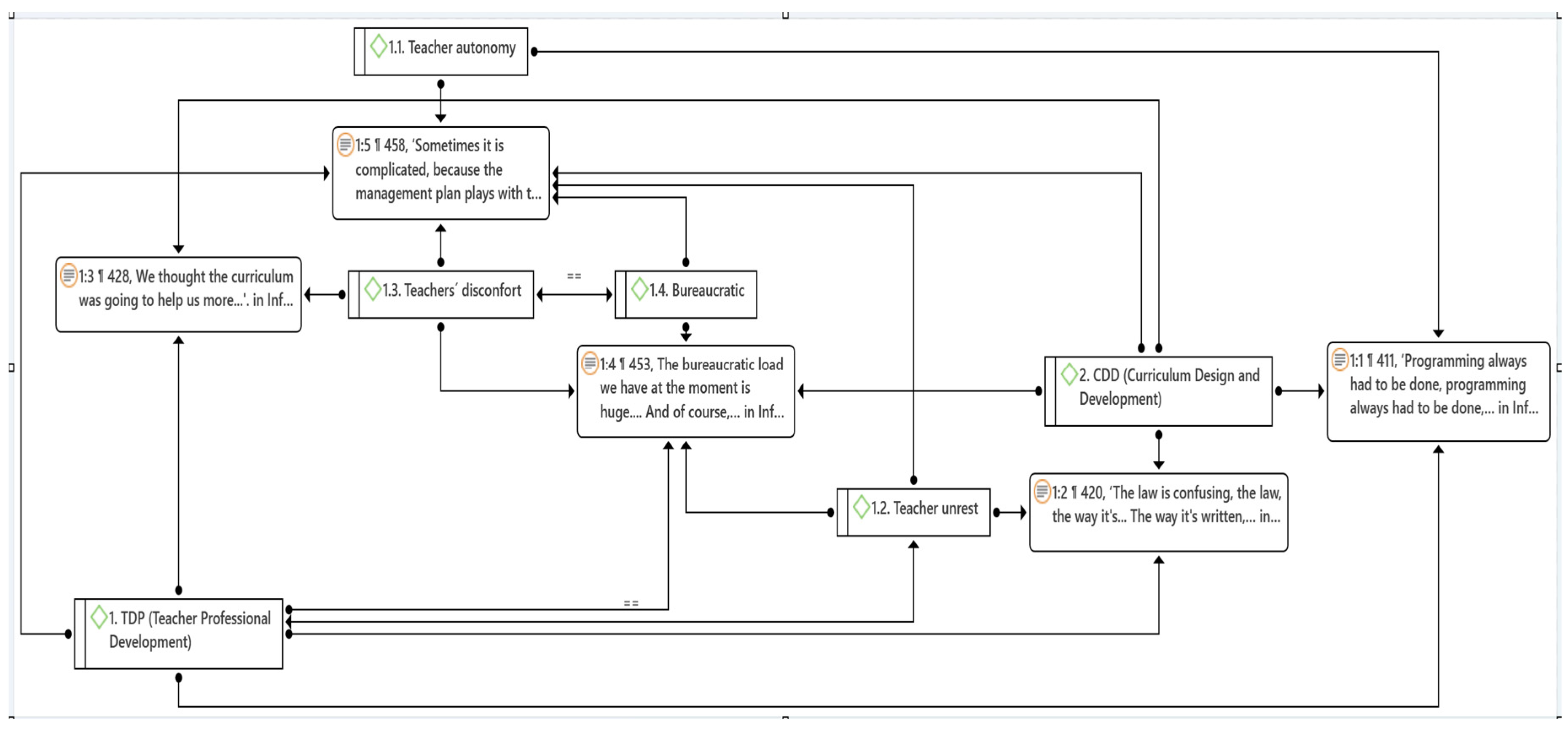

Table 1.
Spanish primary education National Curriculum regarding EFL pronunciation contents.
|
General provisions |
Sections in the basic knowledge: Communication, Multilingualism and Interculturalism, supported by digital competence with corresponding descriptors based on the language activities and competencies established by the Council of Europe in the CEFR Digital tools reinforce the learning, teaching and assessment of foreign languages and cultures Action-oriented methodological approach Learning through oral and written language use Learning situations involving production and interaction; emphasis on communicative language activities and language proficiency (oral and written): comprehension, production, interaction, mediation, using personal linguistic repertoires across languages, and appreciating and respecting linguistic and cultural diversity Guidelines for the practice of evaluation, both of the learning process and of the teaching process |
| Cycles | Pronunciation in the Communication block and CLC competencies |
| 1st | -Introduction to elementary sound and accent patterns. |
| 2nd | -Basic sound, accentual and intonation patterns in common use, and general communicative functions associated with these patterns. |
| 3rd |
-Basic sound, accentual, rhythmic and intonation patterns, and general communicative functions associated with these patterns. -The learning of the foreign language encompasses the acquisition of both the phonetic code and the graphic code of that language. In the first years of this stage, priority will be given to orality while gradually incorporating the written code that allows the comprehensive reading of words and expressions. The acquisition of this code will facilitate the subsequent recognition of written forms and their progressive analysis. -The learning of the written code must be done through the reading and production of texts in real or simulated communicative contexts of personal, family and social life, and related to the needs and interests of the students. This learning will include aspects related to the composition and organization of the different textual manifestations and their use, as well as the different supports and channels that can be used both to access texts and to create them. -Oral production: pronunciation and intonation. Postural attitude. Construction and communication of knowledge through the planning and production of simple oral and multimodal texts. |
Disclaimer/Publisher’s Note: The statements, opinions and data contained in all publications are solely those of the individual author(s) and contributor(s) and not of MDPI and/or the editor(s). MDPI and/or the editor(s) disclaim responsibility for any injury to people or property resulting from any ideas, methods, instructions or products referred to in the content. |
© 2025 by the authors. Licensee MDPI, Basel, Switzerland. This article is an open access article distributed under the terms and conditions of the Creative Commons Attribution (CC BY) license (http://creativecommons.org/licenses/by/4.0/).
Copyright: This open access article is published under a Creative Commons CC BY 4.0 license, which permit the free download, distribution, and reuse, provided that the author and preprint are cited in any reuse.


