

Submitted:
03 February 2025
Posted:
04 February 2025
You are already at the latest version
Abstract
Peri-urban transition leads to rapid spatial manifestations and environmental changes in the periphery across globe. The heterogeneous peripheral morphologies of the Global South depict land use changes, rapid real estate growth and unplanned development. Peri-urban regions face the challenges of dynamic metropolitan growth and the pressures of globalisation. Peri-urban areas differ globally; they differ in economic and social factors. The rural-urban frontier is a complex transition area in the Global South. Peri-urbanisation leads to population expansion; but often these pressures compromise environmental qualities in the Global South. Land use change is a major challenge to sustainability leading to decline in agriculture and environmental challenges. The transition process thus challenges the metropolitan cities of the Global South. This paper addresses sustainable urbanization as an alternative path essential for confronting problems of sustainability in the Global South.
Keywords:
Urbanization
; Peri-urban
; Land Use Changes
; Environment
; Sustainability
; Global South
1. Introduction
Unprecedented urbanization leads to innumerable changes in the peri-urban environment across the globe. Urban sprawl, a remarkable characteristic of global urban development (Varkey, 2023; Hutchings et al., 2022; Hatab et al., 2019; Muñoz, 2003) results in the dynamic nature of peri-urban zones, where present peri-urban could become urban landscape tomorrow, leading to serious threats to policymakers and planners in managing these sprawling spaces (Mauro, 2020; Li et al., 2017). The urban populace has been advancing rapidly than the rural populace in the peripheries of developing countries (Beltran, 2023; Cohen, 2004). From just one in 1950 (New York), the count of megacities with more than 10 million people increased to 17 by 2000, with the majority located in developing countries (UNDP, 2000). In the pursuits of policy and debate, this paper raises two important questions. What are the consequences of the land use changes and challenges of sustainability of peri-urban areas in the Global South? How the new planning and policies cope with the changing scenario of urbanisation?
As of 2021, according to the latest reports, 56.47% of the world's population lives in urban areas; in India, 35.393% resides in cities, whereas in the high-income countries, the urban population is 81.46%. The USA stands out as the most urbanized country globally, with 82.87% of urban population. Additionally, in upper middle-income countries, the urban population constitutes 68.37%, the pace of urbanisation in India is fast, the extent of the urban population in India grew by 31.27 % by 2010 (Figure 1), it is predicted to be above 40 % in the coming years.
Expansion of population (Liu et al., 2011; Mondal and Banerjee, 2021), has resulted in urban expansion, with the population increase from 1.35 billion (1970) to 6.3 billion (2050 ) (United Nations, 2012) as a consequence of this demographic change (Hutchings et al., 2011). Increase in the urban population, constant structural changes lead to changes in the peri- urban landscapes. Peri- urbanization process has negative environmental effects (Theodorou, 2022; Benis, 2017; Simon, 2008). Environmental issues and developmental conflicts are evidenced in the Global South in the Peri-urban Interface (PUI). South Asia, particularly (representing 17.7% of the world population), is becoming increasingly fragmented due to development activities. This provides a pertinent backdrop for addressing the challenges of peri-urban land use changes and environmental sustainability.
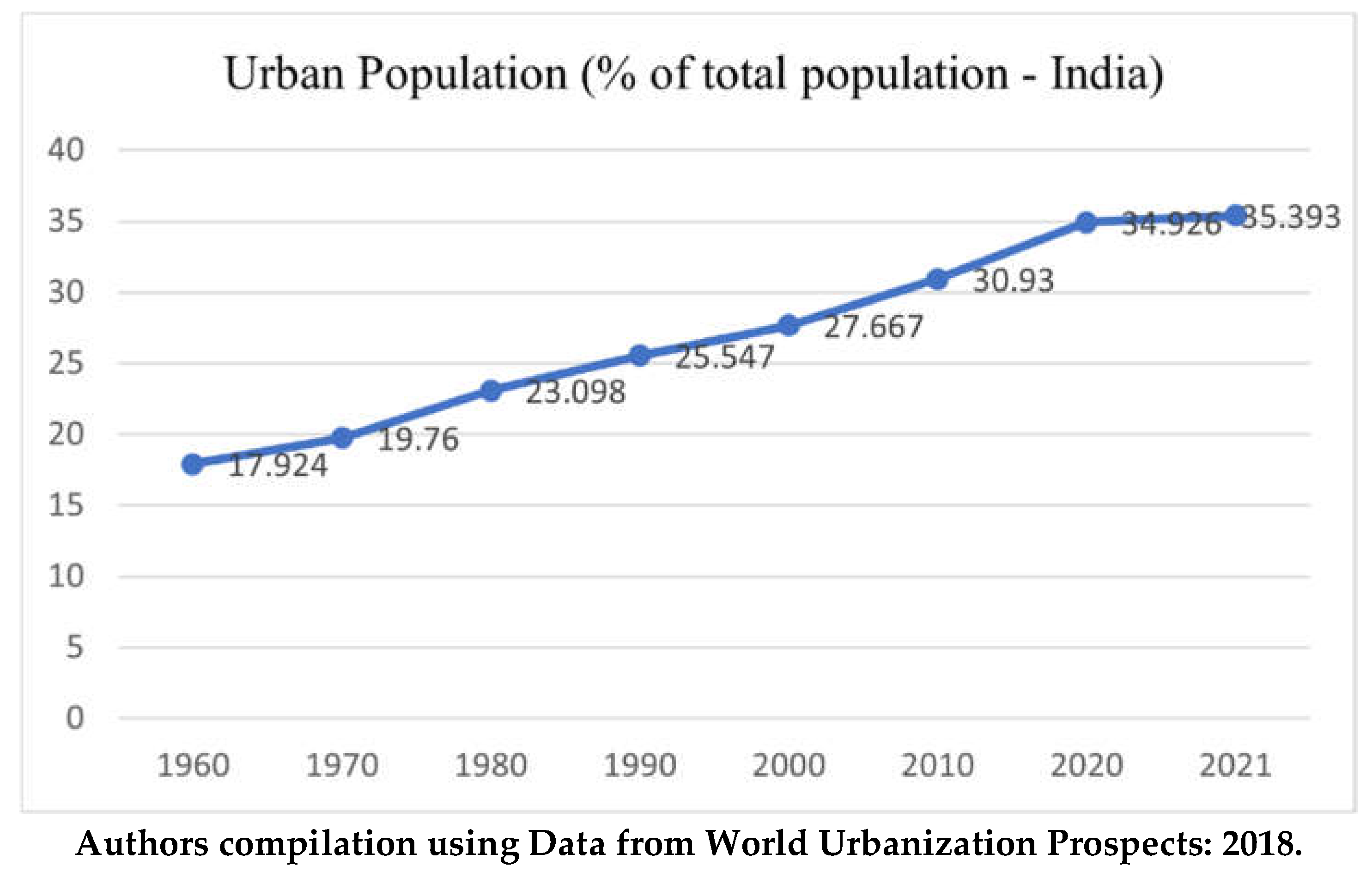
In 1960, the amount of the urban populace was 17.92%, it increased to 25.54 per cent in 1990 and it is 35.39 per cent in 2021 (Figure 2). This suggests that urbanisation is rapid, it manifests substantial changes in India. This fast growth, leading to significant changes in cities, particularly in their environment and livelihood, with shifts from agriculture to industry and service sector lead development. However, urbanization-led land use and land cover changes are important contributors to environmental deterioration, resulting in problems such as loss of land covers and biodiversity crisis (McKinney, 2002). Urban expansion frequently leads to land conversion (Pickett et al., 2001; Bürgi et al., 2004) and the spatiotemporal pattern of this expansion further contributes to environmental changes and land cover use alterations.
Peri-urbanization phenomenon in city and regional planning, has become a significant aspect of urbanisation in the Global South. It has notably occurred in Asian countries like India and China, as well as in African countries such as Ghana and Lagos (Narain, 2009; Wu et al., 2013; Lawanson et al., 2012; Appiah et al., 2014). The world's fast urbanisation process are visible cities in Asia and Africa (Angel et al., 2016). While peri-urbanization brings about positive effects such as economic expansion and employment opportunities, it also poses challenges to environmental sustainability. Land use changes affect sustainability, particularly in the context of sprawling cities in the Global South (Follmann, 2021; Paul, 2021; Drescher, 2021). Such challenges are understood from examples like the Yangtze and Pearl River Deltas of China, where there is immense development challenges with the fast urbanisation (Liu et al., 2004). Addressing the existing gap in peri-urban literature on the Global South, this paper offers a perspective of the issues related to sustainability and land use changes.
Substantial research in the field have addressed sprawling and land use changes; however, scant attention on formulating methodologies quantifying sprawl (Hasse, 2004). The peri-urban growth pattern varies significantly across geographical regions and cannot be understood in isolation from the larger metropolitan context. While existing literature mainly discusses land use from a GIS-based geographic perspective, it lacks adequate discussion on the Global South perspective of peri-urban areas, particularly concerning specific examples of industrial development. The land use changes affect biophysical activities, leading to climate change, biodiversity decline, and changes in environmental quality. While land conversion processes leads urbanisation (Quan et al., 2006; Wang et al., 2005), they result in biophysical changes that require planning attention. Global South, in particular, suffer from haphazard patterns of sprawling, leading to loss of biodiversity and environmental degradation due to unplanned constructions and lack of efficient land use planning.
2. Peri-Urbanization as an Exemplar from the Global South
The pace of transition of cities of Global South is very quick, and the increase in population is one of the major reasons for the fast development. The fastest urban sprawl is visible in South Asia due to its high population growth and industrial development. The several reasons affecting urbanisation in South Asian cities, like Bangalore are the growth of the IT Corridor, IT- led real estate developments and industrial developments (Varkey, 2023). Bangalore is known for speedy transitions and loss of land cover unlike world- class cities like London or Paris where there is a frequent inflow of people and resources but managed effectively.
Land use changes lead to problems such as climate variability, land degradation, water problems and unplanned developments in the peripheries. Fast urbanisation is responsible for the unplanned development of the Global South. Spatial transition is a global phenomenon, it varies in different geographic regions, the city of the Global South is in a transition state, with a distinct pattern of an influx of migrants from villages to cities. Studies show urbanization pattern of the West refers to a massive migration of the rural population into the cities (Gottmann, 1961). Bangalore attracts businesses and investments to their peripheries seeking affordable land with the possibility of expanding. Fringe areas have been experiencing economic and structural changes leading to a service-l ed economy in Bangalore. The dynamic transition of the periphery is associated with environmental problems and lack of planning (Dijst et al. 2005).
Bangalore is an example of a distinct pattern of urban sprawl in the Global South based on two reasons: (1) Existence of Peri-urban clusters and (2) Its reputation for rapid industrial growth, yet differences in the pattern of development and land administration. Globally, land use changes are continually altering the environment at an unprecedented rate, driven by both natural and human processes. The relations between space and time between biophysical and human aspects propel these changes (Meyfroidt et al., 2013). Changes in land use reveals the extent of deterioration of farmland, as fallow land becomes unsuitable for cultivation over time due to various human activities and water stress. Human activities impact on land use changes (Liu, 2018). Rapid environmental changes have created complex feedback across the rural-urban continuum, affecting ecology and society (Marshall and Dolley, 2019).
3. Discussion
Land use changes affect sustainability of the peri-urban (Varkey and Manasi, 2019). Densification of metropolitan areas directly influences the quality of life by diminishing the greenery and hindering environmental services (Westerink and Aalbers 2013; Westerink et al. 2013). The peri-urban areas are often evolving than a planned development zone. This creates significant spatial management problems related to environmental management. The issues related to environmental changes and challenges to sustainability concerning the ever-changing cities of the global south are discussed. The negative effects include loss of agriculture, changes in the land covers, and environmental degradation in the growing peripheries of the global south. Fringe areas have adequate scope for expansion in the global south, industries are located near a growing periphery in growing metropolitan areas of Bangalore, Chennai and Delhi as they offer employment opportunities in emerging tech jobs and businesses. Accessibility to the market, expansion of services and commerce are some reasons why people choose the periphery (Mandere et al. 2010; Tuyen 2014). Peri-urban areas are attractive to people due to close proximity to city and access to urban facilities (Sridharan, 2011), and people enjoy rural-urban amenities. The peri-urban areas are the best living places (Mahavir, 2011); but dynamic changes at periphery are triggered by economic and environmental factors. Moreover, the demarcation of the periphery is always in question, as the administration is difficult to decide since the rate of transition is dynamic and volatile.
Fast urbanisation is common in the Global South, and the pattern of urban growth refers to a sprawling nature (Leichenko and Solecki 2005). Deterioration of agricultural lands co-occurs with various urban land uses. Human activities significantly affect the landscape in the emerging cities of South Asia. Unlike European countries such as the Netherlands, France or Poland the developing countries lack facilities for the planned development of their land. This affects the Land Use/Land Cover , sustainability and climate of the region (Mahmood et al. 2006).
Evolving industrial clusters of the Global South agglomerate many polluting industries from the urban core. Dupont (2005) explained the scenario in the case of Delhi, a very dense location in the Global South. Similar example of peri-urban growth is found in Rajiv Gandhi Technology Park in the case of Chandigarh (Narain et al. 2013) and HITEC city at the periphery of Hyderabad city (Kennedy 2007). Due to the lack of planned management of peripheries, the peri-urban urban environment is degraded with exorbitant amounts of pollution led by human activities. Issues of peri-urbanization include increasing land and water conflicts, and negative environmental consequences and a reduction in farmlands and the source of livelihoods of people (Kwangwama, et.al. 2021). The narrative delves into the historical shifts in landscapes and their ramifications on the environmental dynamics intertwined with urbanization across diverse nations, as elucidated by Acemoglu et al. (2005), Hassan and Nazem (2016), Suribabu et al. (2012), Yagoub and Kolan (2006), Batisani and Yarnal (2009), Liu (2018), Giupponi et al. (2006), and Tianhong et al. (2010). The lack of better policy management has led to increased exclusion and failure in achieving sustainable urban development goals and there arises a dire need for a policy to tackle the various issues related to managing the sustainable peri-urban environment.
4. Recommendations
4.1. Technological Investment
Sustainable waste management is a concern for the cities of India and much of the global south, except for China, which is facing a serious challenge regarding sustainable waste management and disposal. In China, biogas from food waste is one of the sustainable waste management methods being implemented. Chinese companies are investing in various sectors in other global south countries, particularly in the waste management and biogas areas, which can bring sustainable growth to these regions.
In comparison, India is facing significant challenges in green technology innovation, particularly in city planning. In this globalized world, investment from Chinese companies in Indian city planning could lead to mutual growth for both countries. India has a wide range of opportunities to achieve economic growth under these circumstances, but peri-urban development is also a concern in the context of sustainability due to the lack of technological innovation. There is a gap in India's city planning and innovation that can potentially be filled through foreign direct investment (FDI) from other countries. Chinese firms have significant opportunities in city planning investment in India. Such technological investment will lead to better environmental urban planning in the newly developing cities.
4.2. Innovation and Green Finance
The global south is facing challenges in innovation due to a lack of investment and government projects. This situation can be improved through green finance provided by various financial institutions. Green finance can eventually reduce the lack of green technology innovation. The government should support private entities in this endeavor by offering tax reductions for innovative projects in green technology. Additionally, subsidies can encourage better innovation in green technology and urban development.
4.3. Sustainable Education and Urban Development
Sustainable education is essential for fostering environmentally friendly lifestyles. In a growing economy like India, sustainable education is crucial for achieving long-term goals. An educated society is more capable of addressing human-made environmental problems. As a result, an educated society can contribute to green investment opportunities for urban development. Governments and private entities should provide sustainable education to promote green cities.
4.4. Sustainable growth of Global South
The backwardness of the Global South, particularly in green finance and innovation, can only be overcome through mutual cooperation among Global South countries. In this context, sustainable urban planning requires greater investment opportunities between these nations. China has significant financial and technological capabilities in city planning, which presents a unique opportunity. This collaboration can enable the Global South to overcome its backwardness in green technology and innovations through joint venture investments. Such joint ventures will create equal opportunities for all countries involved. Bilateral cooperation is essential for advancing green finance and technology, and political decisions play a vital role in ensuring sustainability.
4.5. Political Decisions and Sustainability
Political decisions are critical for sustainability. Governments have an important role in achieving sustainable growth within their countries. For many Global South nations, the primary focus has been on addressing basic issues such as lack of education, poverty, food crises, and healthcare. Unfortunately, environmental protection often becomes a secondary objective. This neglect can lead to man-made natural disasters, which ultimately result in increased poverty and climate refugees. Addressing these man-made environmental disasters requires government action through proper legal amendments. Environmental protection policies should be prioritized to mitigate the adverse effects of neglecting sustainability.
City planning is essential for avoiding various problems related to man-made disasters through environmentally friendly buildings. This approach will improve the living standards of the people. Political administrations have a significant opportunity to foster bilateral cooperation with various countries to enhance the basic infrastructure of peri-urban development, but this can only be achieved through visionary political leadership.
In the Global South, China is striving to achieve its environmental objectives largely due to government initiatives. These initiatives should serve as a lesson for the Global South on how to effectively promote environmentally friendly peri-urban development. The political administration of India should take the initiative to collaborate with China to overcome the challenges related to green technology
5. Conclusions
Precise land use land cover data is critical for efficient land use planning (Pabi, 2007). Landscape simulations (Aspinall 2004; Parker, Manson et al. 2003; Turner 1987, Gutzler 2015, Cao, S.,2009 et.al, Kamusoko et al. 2009) shows continuous degradation of vegetation . Land use changes petulantly affect urban sustainability in the scenario of a lack of good governance. Urban authorities are concerned about the issues, and they try to make efforts to ensure planned developments; however, the extent of peri-urban transition is uncontrollable and unpredictable in metropolitan cities of the Global South. Based on the above discussion on peri-urban land use changes and sustainability, broad policy implications are derived. First, PUI is to be included in the urban planning of the city through integrated planning. This will significantly reduce uncontrolled expansion and prevent environmental damage. Second, cities of the Global South because of their speedy transition demands more flexibility in planning mechanisms and institutions. Planning authorities like the Bangalore Metropolitan Development Authority (BMRDA) make a conscious effort; however, more development control is needed for a sustainable future for the city. Third, fast-growing urban areas in many poor countries in the Global South are characterized by conflicts between land fragmentation, litigation, and property conflicts. The technological integration of land management can play a significant role in countries like India. Fourth, effective planning for peri-urban will require appropriate levels of local authority attention.
Spatial transitions are captured using GIS and remote sensing tools by assessing Land Use Land Cover patterns (Hathout 2002; Lambin et al. 2003). According to Zhang and Jia (2013), remote sensing data shows patterns of LULC change. GIS and remote sensing techniques are useful for future research to identify spatial changes and development challenges. Long-term evaluation of the changes gives a solution to the farmers, policymakers, and planners.
There is a way forward for future research of cities in transition; continuous growth of built-up areas leads to innumerable changes. There is a need for a planned strategy for the spatial changes of megacities to ensure sustainable urbanization. Some of the challenges addressed are addressed in this paper; however, global environmental changes are affecting the peri-urban in developing countries demanding sustainable urbanization. Future research on peri-urban use changes and sustainability necessitates sustainable urbanization. In the Global South, as global environmental changes and climate change loom large, the imperative to address key questions related to land use and environmental sustainability intensifies. Embracing countermeasures that favor sustainability becomes increasingly crucial. Future research may center on revitalizing rural decline, enhancing land use and sustainability to achieve sustainable development, and promoting sustainable urbanization.
In the context of India, this research provides insights of implications of land use changes in the peri urban. This systematically explains the scenario of challenges associated with land use changes and the environment, opening opportunities for further research. The results affirm that the biophysical impacts of land cover change differ across geographic regions. Spatial analysis could thus offer insights for shaping land-based mitigation strategies, leveraging the biophysical attributes of different land use types to address environmental challenges. This research calls for an action plan to overcome environmental challenges via diligent planning of the local government.
Countries in the Global South often lack access to new green technologies and sustainable methods for building infrastructure during peri-urban transitions due to a shortage of innovation and limitations in economic and human resources. In contrast, countries in the Global West possess advanced environmental technologies, but these are often too costly for the Global South due to the profitable structure of the market. This gap can only be filled through free technology exchange or affordable pricing. Such measures would benefit the Global South during peri-urban transitions by enabling the development of zero-carbon or low-emission cities without imposing a financial burden, thereby preventing environmental green finance colonialism.
The important aspect of the peri-urban research envisaged is to develop an efficient land use policy for the administration of fast-moving cities urban locales. But there are chances for the future empirical research in the industrialized regions of the global south as the peri-urban always is in transition. Long-term studies discussing issues at the microscale are aimed to provide a solution to farmers, policymakers, and planners while practically investigating the consequence of spatial-temporal development in land uses of ever-evolving regions of the global south. Since peri-urban locales are different across both developing and developed regions across the globe, the discussion of challenges of sustainability in the developing country setting deserves special mention. The frequency of peri-urban transition is very high; therefore, the latest research is relevant for the policy purposes.
Conflicts of Interest
The authors declare that there is no conflict of interest.
References
- Angel, S., Blei, A. M., Civco, D. L., & Parent, J. (2012). Atlas of urban expansion (p. 397). Cambridge, MA: Lincoln Institute of Land Policy.
- Appiah, D. O., Bugri, J. T., Forkuo, E. K., & Boateng, P. K. (2014). Determinants of peri- urbanization and land use change patterns in peri- urban Ghana.
- Cohen, B. (2004).Aspinall, R. (2004). Modelling land use change with generalized linear models— a multi- model analysis of the difference between 1860 and 2000 in Gallatin Valley, Montana. Journal of Environmental Management, 72(1- 2), 91- 103.
- Batisani, N., & Yarnal, B. (2009). Urban expansion in Centre County, Pennsylvania: Spatial dynamics and landscape transformations. Applied Geography, 29, 235– 249.
- Benis, K., & Ferrão, P. (2017). Potential mitigation of the environmental impacts of food systems through urban and peri-u rban agriculture (UPA)–a life cycle assessment approach. Journal of Cleaner Production, 140, 784-7 95.
- Beltran, A. M., Padró, R., La Rota- Aguilera, M. J., Marull, J., Eckelman, M. J., Cirera, J.,... & Villalba, G. (2023). Displaying geographic variability of peri- urban agriculture environmental impacts in the Metropolitan Area of Barcelona: A regionalized life cycle assessment. Science of The Total Environment, 858, 159519.
- Cao, S., Xu, C., Chen, L., & Wang, X. (2009). Attitudes of farmers in China's northern Shaanxi Province towards the land-u se changes required under the Grain for Green Project, and implications for the project's success. Land use policy, 26 (4), 1182- 1194.
- Cohen, B. (2004). Urban growth in developing countries: a review of current trends and a caution regarding existing forecasts. World Development, 32(1), 23- 51.
- Dijst, M., Elbersen, B., & Willis, K. (2005). The challenge of multi- functional land use in rural areas. Journal of environmental planning and management, 48(1), 3- 6.
- Drescher, A. W., Isendahl, C., Cruz, M. C., Karg, H., & Menakanit, A. (2021). Urban and peri- urban agriculture in the Global South. Urban Ecology in the Global South, 293- 324.
- Dupont, V. (ed.). (2005). Peri- urban dynamics: population, habitat and environment on the peripheries of large Indian metropolises: a review of concepts and general issues. New Delhi: Center de sciences humanes.
- Follmann, A., Willkomm, M., & Dannenberg, P. (2021). As the city grows, what do farmers do? A systematic review of urban and peri- urban agriculture under rapid urban growth across the Global South. Landscape and Urban Planning, 215, 104186.
- Giupponi, C., Ramanzin, M., Sturaro, E., & Fuser, S. (2006). Climate and land use changes, biodiversity and agri- environmental measures in the Belluno province, Italy. Environmental Science & Policy, 9 (2), 163- 173.
- Hutchings, P., Willcock, S., Lynch, K., Bundhoo, D., Brewer, T., Cooper, S.,... & Welivita, I. (2022). Understanding rural– urban transitions in the Global South through peri-u rban turbulence. Nature Sustainability, 5(11), 924-930.
- Kamusoko, C., Aniya, M., Adi, B., & Manjoro, M. (2009). Rural sustainability under threat in Zimbabwe– simulation of future land use/cover changes in the Bindura district based on the Markov- cellular automata model. Applied Geography, 29 (3), 435- 447.
- Kennedy, L. (2007). Regional industrial policies driving peri- urban dynamics in Hyderabad, India. Cities, 24(2), 95- 109.
- Kwangwama, N. A., Wekwete, K. H., & Chirisa, I. (2021). Strategies for Taming the City: Debates in Managing Peri-U rbanization. In The Palgrave Encyclopedia of Urban and Regional Futures (pp. 1- 10). Cham: Springer International Publishing.
- Lambin, E. F., Geist, H. J., & Lepers, E. (2003). Dynamics of land- use and land- cover change in tropical regions. Annual review of environment and resources, 28(1), 205- 241.
- Lawanson, T., Yadua, O., & Salako, I. (2012). Environmental challenges of peri- urban settlements in the Lagos megacity. on.
- Leichenko, R. M., & Solecki, W. D. (2005). Critical surveys. Regional Studies, 39, 241- 253.
- Li, W., Wang, D., Li, H., & Liu, S. (2017). Urbanization- induced site condition changes of peri- urban cultivated land in the black soil region of northeast China. Ecological indicators, 80, 215- 223.
- Liu, W., Yu, W., Zang, S., Wu, C., & Na, X. (2011). Analyzing and modelling land use land cover change (LUCC) in the Daqing City, China. Applied Geography, 31 (2), 600- 608.
- Liu, Y. (2018). Introduction to land use and rural sustainability in China. Land use policy, 74, 1- 4.
- Mahavir. (2011). Fringe: A concept of our mind, not a ground reality. In P. Patra (Ed.), Fringe dynamism in Delhi metropolitan city. Delhi: Globe Publishing House.
- Mahmood, R., Pielke Sr, R. A., Hubbard, K. G., Niyogi, D., Bonan, G., Lawrence, P.,... & Syktus, J. (2010). Impacts of land use/land cover change on climate and future research priorities. Bulletin of the American Meteorological Society, 91(1), 37- 46.
- Mandere, M. N., Ness, B., & Anderberg, S. (2010). Peri-u rban development, livelihood change and household income: A case study of peri- urban Nyahururu, Kenya. Journal of Agricultural Extension and Rural Development, 2 (5), 73- 83.
- Marshall, F., & Dolley, J. (2019). Transformative innovation in peri-u rban Asia. Research Policy, 48(4), 983– 9.
- Mauro, G. (2020). Rural– urban transition of Hanoi (Vietnam): Using Landsat imagery to map its recent peri- urbanization. ISPRS International Journal of Geo- Information, 9 (11), 669.
- McKinney, M. L. (2002). Urbanization, biodiversity, and conservation. Bioscience, 52(10), 883– 890.
- Meyfroidt, P., Lambin, E. F., Erb, K. H., & Hertel, T. W. (2013). Globalization of land use: distant drivers of land change and geographic displacement of land use. Current Opinion in Environmental Sustainability, 5 (5), 438- 444.
- Mondal, D., & Banerjee, A. (2021). Exploring peri- urban dynamism in India: Evidence from Kolkata Metropolis. Journal of Urban Management, 10 (4), 382- 392.
- Muñoz, F. (2003). Lock living: Urban sprawl in Mediterranean cities. Cities, 20 (6), 381- 385.
- Narain, V. (2009). Growing city, shrinking hinterland: land acquisition, transition and conflict in peri- urban Gurgaon, India. Environment and Urbanization, 21 (2), 501- 512.
- Narain, V., Anand, P., & Banerjee, P. (2013). Periurbanization in India: A Review of the Literature and Evidence. Report for the Project: Rural to Urban Transitions and the Peri- Urban Interface. SaciWATERs. India First published in.
- Pabi, O. (2007). Understanding land- use/cover change process for land and environmental resources use management policy in Ghana. GeoJournal, 68(4), 369- 383.
- Paul, S., Saxena, K. G., Nagendra, H., & Lele, N. (2021). Tracing land use and land cover change in peri- urban Delhi, India, over 1973–2 017 period. Environmental Monitoring and Assessment, 193, 1- 12.
- Pickett STA, Cadenasso ML, Grove JM, Nilon CH, Pouyat RV, Zipperer WC, Costanza R (2001) Urban ecological systems: linking terrestrial ecological, physical, and socioeconomic components of metropolitan areas. Annl Rev Ecol Syst 32:127– 157.
- Quan et al., 2006, Spatial- Temporal Pattern and Driving Forces of Land Use in Xiamen Pedosphere 16(4): 477- 488, 2006. Published by Elsevier Limited and Science Press.
- Simon, D. (2008). Urban environments: issues on the peri- urban fringe. Annual review of environment and resources, 33, 167- 185.
- Sridharan, N. (2011). Spatial inequality and the politics of urban expansion. Environment and urbanization ASIA, 2(2), 187- 204.
- Suribabu, C. R., Bhaskar, J., & Neelakantan, T. R. (2012). Land use/cover change detection of Tiruchirapalli City, India, using integrated remote sensing and GIS tools. Journal of the Indian Society of Remote Sensing, 40(4), 699– 708.
- Theodorou, P. (2022). The effects of urbanization on ecological interactions. Current Opinion in Insect Science, 52, 100922.
- Tianhong, L., Wenkai, L., & Zhenghan, Q. (2010). Variations in ecosystem service value in response to land use changes in Shenzhen. Ecological economics, 69(7), 1427- 1435.
- Torrens, P. M., & Alberti, M. (2000). Measuring sprawl. Paper 27. London, UK: Center for Advanced Spatial Analysis, University College London. p. 43.
- Turner, M. G. (1987). Land use changes and net primary production in the Georgia, USA, landscape: 1935– 1982. Environmental Management, 11, 237- 247.
- Tsai, Y. H., Stow, D., An, L., Chen, H. L., Lewison, R., & Shi, L. (2019). Monitoring land- cover and land- use dynamics in Fanjingshan National Nature Reserve. Applied Geography, 111, 102077.
- Tuyen, T.Q., Lim, S., Cameron, M.P., & Van Huong, V. (2014). Farmland loss, nonfarm diversification and inequality among households in Hanoi's peri- urban areas, Vietnam. International development planning review, 36 (3).
- Varkey, A. M. (2023). The Rural to Urban Transition in Developing Countries: Urbanisation and Peri- Urban Land Markets. Taylor & Francis.
- Varkey, A.M., & Manasi, S. (2019). A review of peri-u rban definitions, land use changes and challenges to development. Urban India, 39 (1), 96- 146.
- Wang, Y. P., Fan, F. L., Zhang, J. Q., & Tang, S. H. (2005). Urbanused land change (1998–2 003) and its spatial distribution of Shenzhen, China: detected by Landsat TM/ETM data. Geoscience and Remote Sensing Symposium, 4(25– 29), 2339– 2342.
- Westerink, J., Haase, D., Bauer, A., Ravetz, J., Jarrige, F., & Aalbers, C. B. (2013). Dealing with sustainability trade- offs of the compact city in peri- urban planning across European city regions. European Planning Studies, 21(4), 473- 497.
- Westerink, J., Aalbers, C., et al., 2013. The Hague region: negotiating the common ground in peri-u rban landscapes. In: Nilsson, K. (Ed.), Peri-urban Futures: Scenarios and Models for Land Use Change in Europe. Springer- Verlag, Berlin, Heidelberg (Chapter 6).
- Wu, C. T., Zhang, X. L., Cui, G. H., & Cui, S. P. (2013). Shrinkage and expansion in peri-u rban China: Exploratory case study from Jiangsu Province. In Shrinking cities (pp. 180- 201). Routledge.
- Wu, Y., Li, S., & Yu, S. (2016). Monitoring urban expansion and its effects on land use and land cover changes in Guangzhou city, China. Environmental monitoring and assessment, 188, 1- 15.
- Yagoub, M. M., & Kolan, G. R. (2006). Monitoring coastal zone land use and land cover changes of Abu Dhabi using remote sensing. Journal of the Indian Society of Remote Sensing, 34(1), 57.
- Zhang, A., & Jia, G. (2013). Monitoring meteorological drought in semiarid regions using multi- sensor microwave remote sensing data. Remote sensing of Environment, 134, 12- 23.
Figure 1.
Urban Population (% of total population) .
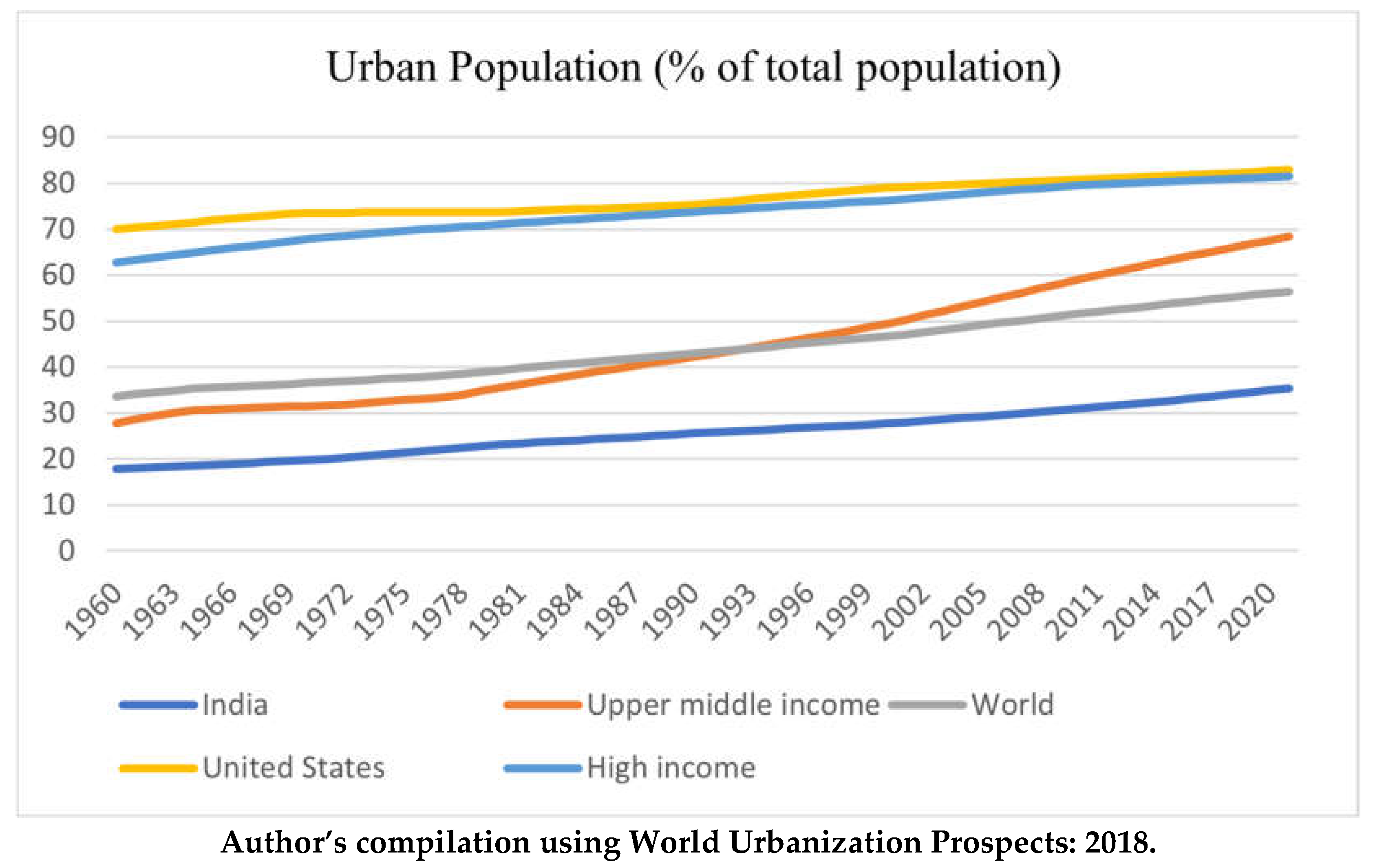
Figure 2.
Urban Population (% of total population India).
Disclaimer/Publisher’s Note: The statements, opinions and data contained in all publications are solely those of the individual author(s) and contributor(s) and not of MDPI and/or the editor(s). MDPI and/or the editor(s) disclaim responsibility for any injury to people or property resulting from any ideas, methods, instructions or products referred to in the content. |
© 2025 by the authors. Licensee MDPI, Basel, Switzerland. This article is an open access article distributed under the terms and conditions of the Creative Commons Attribution (CC BY) license (http://creativecommons.org/licenses/by/4.0/).
Copyright: This open access article is published under a Creative Commons CC BY 4.0 license, which permit the free download, distribution, and reuse, provided that the author and preprint are cited in any reuse.


