

Submitted:
04 June 2023
Posted:
05 June 2023
You are already at the latest version
Abstract
This research experiments with a sustainability assessment based on the Sustainable Development Goals (SDGs) of Agenda 2030 through a process of their territorialisation and implementation. This process enables the development of a Spatial Decision Support System (SDSS) that can be integrated with strategic environmental assessments in urban planning. The assessment takes place on the transversality of the sustainability concept by trying to consider together the three dimensions (environmental, social and economic) into a single assessment through the Spatial Sustainability Assessment Model (SSAM) by integrating Geographic Information Systems (GIS) and multi-criteria analyses. Economic development, social equity, and ecological integrity represent three common visions for rethinking peri-urban edges.
Keywords:
sustainability assessment
; Sustainable Development Goals
; Agenda 2030
; peri-urban fringe
; multidimensional indicators
; evaluation tools
; sustainable development
; spatial decision support system
1. Introduction
The experimentation carried out in this paper is aimed at territorialising Agenda 2030 to support planning processes in peri-urban areas.
Territorialisation operates as a process of implementation of goals and targets of the 2030 Agenda and is aimed at analysing and spatially explicating the multiple values and relationships of the spatial context with the community and in the link between social, economic and environmental aspects. This process makes it possible to develop a Spatial Decision Support System (SDSS) that operates, in the context of the research, as a sustainability assessment model as it enables the evaluation of urban planning forecasts in compliance with sustainable development goals.
Sustainability assessment has been called the ‘third generation’ of impact assessment, after Environmental Impact Assessment (EIA) and Strategic Environmental Assessment (SEA) [1,2]. It emerged simultaneously from different disciplinary fields such as planning or natural resource management [3]. Although all environmental evaluation instruments have sustainable development issues as their underlying aim [4], sustainability assessment has the specific purpose of orienting decision-making towards the achievement of development goals in integrated dimensions [5]. In order to not make the assessment only theoretical, it is necessary to build coherence between sustainability goals and the capacity for action or transformation of the instrument being assessed. By doing so, a direct coherence with the planning instrument is established, which makes it possible to identify key indicators for evaluation.
Sustainability is a cross-cutting concept that affects the environmental, economic and social dimensions of a society. Nowdays widely accepted definition of sustainable development is contained in Our Common Future (1987), better known as the Brundtland Report, of the World Commission on Environment and Development (WCED) of the United Nations Environment Programme (UNEP). This paradigm constitutes the backbone of a debate that has been a priority since the 1970s with the Limits to Growth report of 1972 and has important continuations in Carrying Capacity by W.E. Rees (1992) or the Millennium Ecosystem Assessment (2005). The latter, assuming economic value as an impact gradient, describes how ecological characteristics, functions and processes, which directly or indirectly contribute to human well-being, have undergone such alterations that the world economies themselves are unable to compensate for the ecological debt. From the unravelling of a development model incapable of adapting to the scarcity of resources emerges the need for a notion of sustainability embedded in the link between the satisfaction of human needs and intergenerational responsibility, which evolves with analytical experimentation of tools and methods. This allows for continuous theoretical advances, guiding practices, experiments or analytical models committed to repositioing society and the outcomes of generalised urbanisation in new relationships of meaning that allow for an integrated development that does not consider non-human nature as external or the environment as a passive system of resources.
The concept of sustainability, in its substantive meaning, persists in an unresolved tension between the prevalence of environmental needs and the demands of economic and social development, in the perennial search for a balance between these perspetives. The debate has addressed the question of whether environmental protection and development are separated from each other, in order to ascertain whether environmental protection is ancillary to development or, conversely, whether development is instrumental to environmental protection [6]. By claiming the lexical priority of ecological rationality over economic, social or political rationality, it allows ecological values deemed inferior to come into play for a full value [7]. By balancing the domines of development, it is possible, by means of place-based approaches, to bring sustainability back to a relationship to be conceived in terms of dialectical unity, which cannot be defined singularly or categorically but must be determined on a case-by-case basis as the context differs [1].
In the specific case of the peri-urban context, it is possible to imagine a novel proposal for sustainability because this space is dependent on both urban and rural culture [8]. The peri-urban area can represent the ideal space on which to build a debate and experiment with balances between the multidimensional divarications of sustainability. This opportunity is provided by the rethinking of linear-reductionist functioning based on a perpetual growth paradigm in favour of the realisation of a coherent local landscape with potential for collective use, with social value of open space and ecological and productive enhancement [9,10]. The renunciation of the local, in order to modernise the context, has led to extensive regionalisation processes that have meant a rejection of the world that one claims to inhabit [11]. In the geo-social issue also highlighted by the 2030 Agenda, spatial justice is certainly a key. Recovering proximity represents an opportunity for an alternative economic development, which tries to restart from the present resources of agriculture and the economies of open spaces engaged in the attempt to combine social and economic well-being with quality of life [9,10].
The peri-urban landscape can, therefore, represent the context where solutions really matter for both people and nature [12]. Its regional connections, the wide availability of open and public spaces connected to operational landscapes, cannot only support biodiversity, but also provide cities with the essential ecosystem services they need [13] through a redefinition of space according to the co-construction of community densities, shortening supply chains and recycling.
The 2030 Agenda (Tranforming our world: The 2030 Agenda for Sustainable Development) is the interpretive lens of the sustainability assessment model. On the model of Agenda 21 (1992) and the Millennium Development Goals (2002), it implements with cooperative, quantifiable and comparable tools, the search for a balance, to be understood in the concrete network of relationships between the different dimensions: environmental, social and economic. It addresses geo-social and intergenerational issues that confront the contrasts that have characterised modernity, namely: nature as ‘infinite bounty’ and the economic system as ‘horn of plenty’ [7]. It is structured to have both a global-qualitative view of development issues through the 17 goals (SDGs) and a local-quantitative view through the targets (169) and indicators (240). The SDGs represent valid frameworks for implementing the assessment, by means of representative, comparable and relevant indices and indicators to assess and monitor transformations in multidimensional terms, setting targets in time and space that are necessary to achieve the desired sustainability conditions.
The 2030 Agenda 2030 addresses imply a regeneration of the peri-urban fringe in ecological terms in a dialectical relationship between different density gradients and functions, within planning and development processes understood in the sensitivity of the contextual limits of territories. In fact, the SDGs place biodiversity and urbanisation in the same frame of reference: the former, in Goal 15, stating that by 2020 ecosystem and biodiversity values should be integrated into national and local planning and development processes; the latter, in Goal 11, stating that positive economic, social and environmental linkages should be sustained between urban, peri-urban and rural areas by strengthening national and regional development planning.
This paper highlights a spatially explicit methodology for assessing sustainability in the lens of the 2030 Agenda through the integration of multi-criteria techniques.
The difficulty of experimentation is due to two issues. The first concerns the statistical approach of the assessment of targets and indicators in 20230 Agenda, which is not always spatially explicit. The second difficulty has to face with the need to identify indicators and values that are able to represent sustainability issues within the peculiarities of urban planning instruments, thus being able to answer the question: ‘how could I objectively know whether things are getting better or worse?’
Methodology and results are intended to contribute to the debate on what values for human activity to be compatible with the conditions for sustainable development. The methodology tries to structure a replicable and implementable process. The results demonstrate the effectiveness of the implementation process between the 2030 Agenda and peri-urban territories because the greater the expropriations of context values, the greater the distance from a condition of ideal sustainability. In fact, this condition is visible in the assessment where the urban design includes a relational dimension of ecoloical and social values.
2. Materials and Methods
2.1. Study Area: The East Naples Peri-Urban Fringe
The peri-urban space appears as the dominant urban form and challenge of contemporary socio-spatial planning [14]. The focus on these areas is due to different levels of complexity transited by other disciplines and knowledge that have fertilised and flanked the urban question with the environmental question, landscape integrity and ecological relations. Moreover, these areas represent landscapes in transition aimed at consolidating urban characteristics at the expense of agro-environmental values.
There are many definitions associated with the peri-urban context. The common characteristic of the many different types of space that are considered peri-urban is that they are transitional spaces with a certain degree of mixing of urban and rural uses, resulting in a varied nature of the territory [15]. This degree of mixture is conditioned by the many overlapping and constantly changing variables (character, structure, thickness, prevalence of land use, way of occupying the space, environmental processes), by the degree of belonging to the two reference sets (urban and rural), by the levels of gravitation (dependence/attraction) with respect to one or more centres, and by belonging to more or less structured metropolitan systems [16].
Nevertheless, there is a particularly strong difference between the peri-urban areas of developing countries and those of the developed nations of Europe. The former are characterised by poverty, environmental degradation and informal settlements; the latter, to which this study refers, are characterised by low levels of mobility, economic performance, landscape integrity and environmental quality [17].
This second typology of peri-urban areas hoghlights the result of multipolar organisation particularly evident in large metropolitan areas where the residual space is set as a frontier for greater competitiveness to the urban area that no longer holds a single centre [18]. They are the product of processes of regionalisation of the urban in which these new urbanisation strategies determine an extended spatial configuration in which not everything is urban but everything is urban-driven [19]. In pockets of what used to be considered the countryside, a disjointed, additive, stratified and light patchwork extends: a "constitutive outside" [20] influenced by successive structural adjustment programmes, land expropriations, agro-industrial consolidation and ecological plunder [19]. These are processes of spoiling that accumulate: first the resources (agrarian, environmental and social), then the expropriation of the capacity to reproduce them to make way for service infrastructures [21].
This ‘third territory’ of difficult delimitation is placed halfway between urbanity and rurality [22] plays the role of a ‘bridge-space’ between density and rarefaction [23] and varies in size and nature according to the increase in urban pressures [24]. An indeterminated space, no longer to be considered non-urban, linked to dissipative logics or functional decentralisation of informality and waste of urban functioning.
The degradation of prime agricultural land, the deprivation of soil from tree density and water pollution in peri-urban areas are results of a rapid urbanisation that should be re-read within the concept of ecological footprint [25] or planetary boundaries [26], aiming at recovering missed opportunities with respect to food self-sufficiency, shortening of supply chains, re-cycling of materials, soil consumption and ecological connections of biodiversity corridors. The implications, therefore, call for ‘re-evaluating people-environment relationships’ rather than focussing on resource extraction or land transitions.
The study area of the East Naples peri-urban fringe represents an urban-rural patchwork of mixed land uses in which a no longer functional agricultural matrix is still legible. Administrative boundaries, spaces and demarcations are no longer discrete, distinct and universal. It is an edge that develops at the fringe of the urban belt of the first ring consolidated around the cores of the historic city. It presents different functions and densities and behaves as a transitional area in which the landscape is characterised by mobility infrastructure and its interstitial spaces, plates of residential construction, low-density settlements, planned and unplanned, old rural cores interspersed with disused or declining production plates [9]. As the place where the urban expansion process unfolds, heterogeneous expectations and interests make urban planning processes complex. The controversies are amplified by the need to frame these processes in the paradigma of sustainable development. The agricultural palimpsest and the collective domain of related benefits (ecosystem, landscape, food, economic services) are replaced by the accumulation and addition of uses necessary only for urban functioning, through the strategic location of higher functions (landfills, shopping centres, logistics), or in the replication of unplanned settlements.
The two case studies concern two experiences carried out in the Naples Metropolitan Area: the Urban Plan of the municipality of Casoria and the Urban Recovery Programme of the Ponticelli neighbourhood in Naples; they differ in terms of project scale, type of urban planning instrument and purpose of the plan-programme (Figure 1). The differences also concern the variability of the peri-urban context. This helps to clarify the results of the evaluation model, its implementations and applications.
The peri-urban landscape of Casoria is characterised by a widespread eco-systemic, particle and topological fragmentation and a high density of mobility infrastructure and is subject to continuous pressure from unplanned settlements or expansions for production or logistics or dislocation in which traditional agricultural management is put into crisis. Marginal agricultural areas are contrasted by numerous open spaces with dynamics of under-use and abandonment.
In Ponticelli the condition of peri-urbanity is given by an edge condition between a dense urban system and the conurbation system of the coastal strip of the Metropolitan City of Naples, made up of interstices, residual agricultural uses and large open spaces of public property uncultivated and waiting. The great residential plaques of public housing policies have operated by leaving voids delimited by the infrastructural system, but still potentially linked to a legible agricultural matrix. Spaces with strong infrastructural and political pressures, but also uncertain spaces left unrealised by the public housing policies that built this part of the city, agricultural residues and numerous public properties.
2.1.1 The Municipal Urban Plan of Casoria
The municipality of Casoria is part of the first ring of municipalities that make up the Neapolitan urban fringe that stretches north and east of Naples.
The urban planning tool on which the evaluation model is tested is the Municipal Urban Plan (MUP). This general urban planning tool is prepared by the municipal administration to outline strategic development choices, define public space management policies, identify structuring elements and territorial invariants, and protect the physical and environmental integrity of the territory by enhancing existing resources and their economic and social development. The choices made with these tools guarantee environmental quality and sustainability.
The guidelines dictated by the MUP, which are general in nature and of indefinite duration, are concretely implemented by operational planning. The Programmatic Operational Plan (POP) envisaged by the MUP concerns the rural-periurban territorial unit characterised by the prevalence of rural territories with eco-systemic value, by conditions of particle and topological fragmentation, low settlement density, phenomena of under-utilisation and abandonment, and the crossing of large network infrastructures. The MUP promotes: the use of non-urbanised peri-urban contexts for social purposes, ecological reconnection and environmental rebalancing, foreseeing: the creation of public parks and public use with different naturalistic typologies; the possibility of enhancing agricultural production, also for social, educational and training purposes; the increase in the supply of social and public housing, with zero soil consumption.
The POP implements the provisions of the MUP through the definition of a vast periurban park. This park, covering approximately three square kilometres (a quarter of the entire municipality), is included in the metropolitan ecological network and is aimed at the restoration of ecological continuity, the enhancement of agricultural use, the civic use of public areas, and new community densities. In particular, the POP foresees the creation of social settlements in the park, the construction of a sustainable road network, which connects the area with the urbanised context (road-park, bicycle path and equipped pedestrian path). A further provision is the identification of Minimum Project Units (MPU) in which three levels of land use are identified: equipped green, productive green/productive forest and mitigation green. The latter extends on the edges of MPUs and beyond, i.e. in the public interstitial areas of infrastructures.
2.1.2 The Urban Recovery Programme of the Ponticelli Neighbourhood in Naples
Ponticelli is a district on the eastern outskirts of the municipality of Naples. The urban evolution of the neighbourhood is linked to national public housing policies and to the contingency and acceleration measures that arose in response to natural disasters or as a response to the high housing tension and social hardship in the suburbs.
The urban planning instrument on which the evaluation model is tested is the Urban Recovery Programme (URP). It is a programme with the status of an implementing urban plan and its approval and public financing has the following basic requirements building and urban redevelopment of public housing settlements, also in accordance with the urban planning instruments in force; a systematic set of interventions organised on the basis of a unitary proposal, with different types of intervention (redevelopment, new construction) and the integrative character of the functions (residential, public housing services and production of goods and services); co-participation of public and private implementers and the related economic and organisational resources, with a minimum threshold of 25% private financing for ensuring the public financing of the project.
The Ponticelli URP is designed to rethink the parts left unfinished by the rational design imposed by previous public housing programmes; in fact, already in the 1950s, the first public housing estates were grafted onto Ponticelli as an expansion of the historic centre of the city. The URP reinterprets the design of the suburbs in a contemporary key, confronting it with the rigid constraining system of the volcanic risk of Vesuvius, which in some very dangerous areas (the so called ‘red zones’) does not provide for residential development, and with the superordinate forecasts of the Sustainable Urban Mobility Plan, which envisages the passage of a Bus Rapid Transit connecting with the city centre. The URP envisages the construction of new social housing, areas of private residential expansion to balance the social mix, numerous public facilities, and a forest running through the central spine.
2.2. Data Sources and Approach
For the comparison of the indicators, the evaluation was processed in a Geographic Information System (GIS) environment on a hexagonal grid with 50x50m spacing.
The use of regular polygons proves to be effective for representing the spatial variousness of the phenomena under investigation and is a suitable method for generalising data, statistical mapping, and spatial evaluations [27]. Another peculiarity of regular-meshed grids is also inherent in the possibility of combining mapping units into new cells at a more detailed resolution, allowing the cumulative effects of state changes to be studied [28].
For the assessment of the sustainability of the transformations, the indicators are built on the dual pre/post-plan scenario, which allows for a cognitive picture of the state of the environment and an assessment scenario of the achievement of targets. In fact, the ex-ante scenario is intended as a tool for reconstructing the state of the environment to support decision-making [29]. It addresses the issue of asset mapping, which indicates the process of documenting the tangible and intangible resources of a community by considering the community as a place with strengths or assets that must be preserved and enhanced, not deficits to be remedied [30]. It allows the construction of a knowledge project capable of initiating a conscious and creative reflection aimed at overcoming the concepts acquired within the interpretative models of modern thought based on a paradigm of perpetual growth and a linear-reductionist functioning of de-contextualisation and resource extraction. Furthermore, it allows the urban design project to orientate its choices towards forms of sustainability and resilience inscribed within the urgencies of 2030 Agenda and understood not only as the capacity to adapt to the pushes of urban transformation and the degenerative forces of land rent, but above all as the injection of elasticity into urban policies to connect resources, actors, identities and tensions in a non-rigid manner, to reactivate functional chains and to reanimate urban metabolisms.
Ex-post evaluation allows the identification of the impacts of transformations by determining the identification of criticality thresholds through the recognition of context limits and by integrating the multidimensional aspects necessary to look at open and multifunctional margins in which different forms of life interact and develop social-ness. The objectives of using multidimensional criteria and specific indicators are different from the mapping and evaluation of context attributes and values in ex-ante evaluations, as ex-post evaluation focuses on the actual impacts generated [31]. In particular, ex-post evaluation is used to verify that established objectives have been achieved, to determine whether there are unintended or unintended consequences and to evaluate the effectiveness of alternative approaches in the meantime [31,32].
The place-based approach makes it possible to support researchers and practitioners addressing complex multidimensional issues with methodologies that can be replicated and implemented to the relevant case study variables. This approach is focused on addressing a problem on a local scale, meeting the needs of a particular context by tapping into local communities and resources [33,34] and enabling work on a non-abstract concept of sustainability. They support the theoretical and practical framework taking into account the unique characteristics of a given complex socio-ecological system by aiming to generate locally relevant knowledge and context-specific solutions to address sustainability problems [35,36].
2.3. First Phase: Identification of Evaluation Indicators
Sustainability cannot be measured directly [37] but through a process of implemetation that takes into account the transversality of the concept (economic development, social equity and ecological integrity) [38] and through metrics or indicators [39] as a composite of several directly measurable variables that enable the quantification of such multidimensional and complex phenomena [37,40].
Indicators and indices, which are born from values (we measure what we care about) and create values (we care about what we measure) [41], assume instrumental value not only with respect to the type of territory (place-based approach) but above all with respect to the type of urban planning instrument we are evaluating. Their main characteristic is their ability to summarise, focus and condense the enormous complexity of our dynamic environment into a manageable amount of meaningful information [42]. Furthermore, ‘composite indicators’ can be easier to interpret than trying to find a trend in many separate variables [43,44]. Therefore, in order to visualise phenomena, highlight trends, simplify, quantify, analyse and communicate the otherwise complex and complicated information related to sustainability, it is necessary to identify coherence between the goals and targets of the 2030 Agenda and the possibility of the urban plan to have an impact. This coherence gives rise to a relationship of direct or indirect dependence that helps the spatial dimension of the spatial assessment to select the most significant indicators for the peri-urban for the integration of the three dimensions and the explicit rendering of impacts.
The SDGs through which the urban planning project in the peri-urban area was proven to correspond to the sustainability assessment are the numbers: 2, 8, 12, 11, 15 17. The targets of the SDGs were then analysed, and indicators were identified (Table 1). The indicators of the 2030 Agenda were not always spatialisable, so in some cases an adaptation was developed to express the theme of sustainability. The indicators that fully correspond to the global indicators proposed by the Agenda are: illegal building rate, forest area index, soil sealing, fragmentation of natural and agricultural territory.
2.4. Second Phase: Spatial Sustainability Assessment
All the assessments have been done using the Spatial Sustainability Assessment Model (SSAM) [45,46], developed by the Regional Environmental Protection Agency of Umbria and the Environmental Laboratory, a research group within the Applied Economy Unit of the Department of Agricultural, Food and Environmental Sciences (DSA3) of the University of Perugia (Italy). The SSAM model is specifically developed for integrated spatial multi-criteria analysis and combines Multiple-Criteria Decision Analysis (MCDA) with Geographic Information System (GIS), analysing each sustainability dimension by means of the Technique for Order of Preference by Similarity to Ideal Solution (TOPSIS) process and returning a global sustainability index by means of a weighted summation. The use of the geo-TOPSIS algorithm has already been successfully tested in other spatial classification contexts [47,48], as has the integration of GIS and multi-criteria evaluation systems and methods.
MCDAs are part of Decision Support Systems (DSSs); in their most general formulation, they can be considered as a set of systematic procedures that serve to generate, evaluate and select alternative decisions on the basis of convergent criteria, which cannot be commensurate in a traditional way and allow the combination of individual criteria into an overall assessment [49]. The multidimensionality of decision-making criteria, which must be taken into account in sustainability assessments, can be optimally handled by multi-criteria procedures, through the peculiar introduction of different weighting systems, which vary according to the objectives and structure of the decision problem, and which basically serve to determine priorities of choice or action at various levels of complexity even in multidisciplinary approaches [50].
GIS enables the construction of an interpretative-knowledge framework of reality through spatial analysis models. It is part of Geographic Information Science (GISci), which is the information science oriented towards the collection, modelling, management, visualization and interpretation of geographic information, consolidated in the reflections on spatial dynamics and the need to read relationships and place measurable and shareable in-formation in space [51]. Being an integrative disciplinary field, it combines multidisciplinary concepts, theories and techniques, enabling innovative synergies for a greater understanding of territories [52]. In particular, QGIS, an open-source software flexible to experimental implementations of academic research through the integration of specific plug-ins or tools, was used for the entire project.
The TOPSIS method belongs to MCDA [53,54,55] and uses as a basic concept that the preferred option should have (in Euclidean space) the ‘shortest distance’ to the ‘ideal solution’ and the ‘greatest distance’ to the ‘non-ideal solution’. The Euclidean distance criterion was then used to assess the relative closeness of the of-factors to the final solution, and the final order of option preferences is obtained by con-fronting these relative distances [56]. This method is particularly useful for research as it can be used to verify the achievement of the 2030 Agenda targets.
MCDAs integrated with GIS enable the development of Spatial Decision Support Systems (SDSS) by combining geographical data with contextual statistical measures analysed by means of preferences and value judgements. This allows both effective communication of assessment results to planners and decision-makers, and the construction of spatial assessments necessary to understand the impacts of urban planning on the territory.
In SSAM, the MCDA model is activated within the GIS software and therefore uses the same interface and database. The interface of the SSAM provides a series of successive screens, in which the user is guided through the initial data input, and subsequently through the execution of the multi-criteria analysis [45]. The final product of the processing is represented by numerical and tabular outputs, as well as graphical and cartographical outputs. These outputs represent the indices of environmental (EnvIdeal), eco-nomic (EcoIdeal) and social (SocIdeal) sustainability. The indicators of each dimension are agregated by applying TOPSIS, while the different dimensions are then aggregated by using the weighted summation to derive the overall sustainability index (SustIdeal) [46]. Furthermore, in addition to the separate calculation of the economic, environmental and social indices, SSAM presents a procedure that can retrace the steps that led to the final result, revealing which indicators and/or procedural steps had the greatest influence on the results obtained [45, 46].
3. Results
3.1. Results of the First Phase: Construction of Evaluation Indicators
3.1.1. Social Dimension
The social dimension is assessed in SDGs numbers 11 and 17. The indicators used in the social assessment are:
- social housing;
- sustainable mobility;
- civic use of public properties;
- illegal building rate;
- civic cornerstones.
Social settlements constitute a part of the new community developments in the peri-urban context. These measures identify various criteria but the key indicator summarising this condition of housing hardship is the ratio of evictions/resident households. The municipalities of Naples and Casoria have the highest indices among the Metropolitan Area, this condition is also given by a high housing density.
The ‘social housing’ indicator used in the evaluation is calculated as the land area covered by social public housing developments that have been conventionally built or subsidised by public funding (Figure 2).
Sustainable connections are the main device for building an open, shared city. They aim to ensure that transport systems meet the economic, social and environmental needs of society while minimising their negative repercussions on the economy, society and the environment. In Italy, a strong criticality stems from road transport, which contributes 23% to total greenhouse gas emissions (of which about 60% is attributable to passenger cars), about 50% to nitrogen oxide emissions and about 13% to particulate emissions [57]. It is also a precondition for people, regardless of economic capacity, to be able to travel across the territory and establish social relationships. Although the public transport sector is of undisputed value in this issue, urban planning generally has no direct bearing on the transport sector. Therefore, the assessment is primarily intended as a redesign of the relationship between infrastructures and urban/peri-urban spaces to encourage the spread of alternative mobility and minimise environmental impacts. The sustainable mobility index is calculated as the surface area covered by traversability elements (pavements, bicycle lanes and equipped paths) or by devices for environmental-climatic comfort (planting or tree-lined streets). In the ex-ante evaluation only existing devices were assessed, while in the ex-post evaluation project devices were also added. In particular, devices aggregating various forms of traversability or environmental comfort were given an aggregate weight, e.g. ‘park ways’ were given the highest weight as they are made up of all elements (Figure 3).
The indicator ‘civic use of public properties’ identifies public facilities or facilities for public use in the territory. In compliance with target no. 17.17, private equipment for public use is also included in the evaluation in order to promote effective partnerships between public, public-private and civil society actors. The indicator is calculated as the surface area covered by public equipment that categorises in education, common interest and equipped public spaces) or private equipment for public use (Figure 4).
The ‘illegal building rate’ indicator concerns unplanned settlements, which represent land-use practices operated illegally and without a real right. The indicator is calculated in the ex-ante evaluation as the area covered by illegal settlements. In the ex-post evaluation, the capacity to accommodate tree density or public facilities is calculated. In the former case, the area free of infrastructures for mobility and buildings was identified by selecting the cells totally free of these two elements. A tree density ratio of one tree per 30 sqm was then used. In the second case, only cells free of infrastructure, buildings and appurtenances were selected and this area was used as an index. Both ratios were normalised on a 0-1 scale and their average was evaluated and subtracted from the ex-ante evaluation index. This makes it possible to assess the capacity of land to serve social purposes in such settlements. These parameters were used because Casoria MUP envisages for the urban redevelopment of these areas the planting of at least 50% of the appurtenances and the identification of areas able to accommodate public facilities (Figure 5).
The last indicator of the social dimension is ‘civic cornerstones’. It represents a sustainable practice in land management as peri-urban areas are de-regulated by large spaces and numerous uncultivated public properties with no real use. Their reactivation represents a practice of active territorialism in terms of care and management of uncultivated or unused and therefore inaccessible land. The experiences mapped in the ex-ante evaluation show how bottom-up regeneration practices have created multifunctional open spaces capable of combining the dimensions of utility and environmental quality [58]. These practices show the need for urban spaces not tied to the logic of consumption or profit and for a renewed right to the city. They also favour the ecological connectivity of the territory or public connection between parts of the territory. The indicator refers to the practices of the commons of a collaborative type and aimed at general interest objectives that go beyond even the most directly involved actors and transcend a logic of ownership [59]. The indicator is calculated as the public surface area covered by land use affected by social regenerative practices for public (public or public-use facilities, social agriculture) or ecological (forest) purposes. In the specific case of the Casoria plan, the mitigation green, productive green or equipped green envisaged in the operational plan of the peri-urban park were evaluated ex-post on public properties (Figure 6).
3.1.2 Environmental Dimension
The environmental dimension is assessed according to SDGs no. 11 and 15. All indicators refer to the needs which the Agenda expresses in target 15.9 to integrate ecosystem and biodiversity values into national and local planning and development processes. The indicators/indicators used in the assessment of the environmental dimension are:
- soil sealing;
- forest area index;
- Ecosystem fragmentation.
The indicator ‘soil sealing’ identifies the proportion of land area that is artificially covered by buildings, infrastructures and other permanent structures, which make the underlying soil totally or partially impervious to water so preventing it to perform its vital functions. In particular, in the MUP/POP of Casoria, the ex-post assessment of the indicator is calculated on the basis of the plan's forecasts, which envisage the following de-impermeabilisations: in squatter settlements, 50% of the appurtenant areas are to be de-paved and planted with trees; all the mobility infrastructures in the peri-urban area are reclassified as agricultural service roads and made permeable, with the exception of ribbon infrastructures (motorways, motorways). Therefore, these de-impermeabilisations are subtracted. The plan provides for de-impermeabilisations concerning ecological islands and equipped green areas within the minimum project units. For the latter, a maximum sealing of 30 per cent of the area concerned was foreseen. This area was therefore added to the budget within the cell (Figure 7).
The forest area index represents the proportion of land covered by forests and other wooded land, and describes the variations of the forest coverage over time. It is calculated on the basis of the reports of the National Inventory of Forests and Forest Carbon Sinks [60], which estimates an average tree density of forested areas in Italy of 1/20 sqm. In the ex-ante evaluation the trees were then mapped in a GIS environment and counted for each grid cell. In the ex-post evaluation in all the grid cells falling within the areas identified by the plan as ‘mitigation green, the maximum woodiness coefficient was associated according to the tree density ratio of 1/20 sqm, which equates to approximately 108 trees per cell. The ‘soil sealing’ indicator index was subtracted from this density. In addition, the areas potentially free of infrastructure or construction identified by the soil sealing indicator index were also subject to the ex-post evaluation, since the plan provides for 50% planting in these areas. Agrarian tree formations (citrus groves) were not taken into account in the ex-ante and ex-post evaluations because their contribution to regulating ecosystem services is unknown, whereas they make a real contribution to supplying ecosystem services [61] (Figure 8).
The ‘ecosystem fragmentation’ index represents the share of natural and agricultural land with high/very high fragmentation. Land fragmentation is the process of reducing the continuity of ecosystems, habitats and landscape units as a result of phenomena such as urban sprawl and the development of the infrastructure network, which lead to the transformation of patches (unconsumed areas without significant artificial elements that fragment them by interrupting their continuity) of large territories into smaller and more isolated parts of land.
The index on peri-urban territory was constructed through an adaptation of the index ‘effective mesh-density’ (Seff) [62]. The index represents the density of the territorial patches (no. of meshes per 1,000 km2) calculated according to the method of the effective mesh-size-density (Seff) [62], related to the probability that two points chosen at random in a given area are located in the same territorial particle. This method has been appropriately modified according to the ‘cross-boundary connections (CBC) procedure’ which guarantees the continuity of territory beyond the limits of the reporting unit (1 km2 cell). The Seff index measures the obstacle to movement starting from a point within the reporting unit due to the presence on the territory of so-called "fragmenting elements" barriers. The choice of the most appropriate fragmenting elements is guided by the aims and objectives of the analysis.
The case study adaptation of the indicator of fragmentation was calculated with the open source plug-in QGIS FragScape [63], developed by the National Research Institute for Agriculture, Food and the Environment and the French Ministry of Ecological Transition. In the assessment, fragmenting elements are identified according to two criteria: spread of anthropogenic disturbance and constriction of parts. Diffusion of anthropogenic disturbance represents fragmentation caused by elements that do not allow connection between the parts, i.e. transport infrastructure. Constriction is represented by internal elements that do not allow movement, i.e. fences and overhead power grid infrastructures. In the ex-ante evaluation, the following values were assessed for the determination of fragmentation buffers from the following thresholds:
- 15 metres for urban roads;
- 7.5 metres for the urban neighbourhood road network;
- 5 metres for fences and other infrastructure.
In the ex-post evaluation, the ability of plan actions to mitigate fragmentation was assessed (Figure 9). The following measures were carried out according to the plan strategies:
- the cancellation of the buffer for fences, as both urban planning instruments provide that such works are not allowed in peri-urban areas;
- the cancellation of the buffer in areas where local roads are reclassified as agricultural service roads;
- the reduction of the buffer by 50% in areas characterised by public crossing routes;
- the reduction of the buffer by 50% in areas subject to mitigation through reforestation and thus ecological reconnection.
3.1.3. Economic Dimension
The economic dimension is assessed in SDGs no. 2, 8 and 12. The indicators of economic dimension are:
- agri-environmental productions;
- green equipped economies.
The economic dimension is aimed at supporting the development of a coherent local landscape with potential for collective use with social value of open space (equipped green economies) and neighbourhood economies (agro-environmental productions).
The ecological enhancement of the peri-urban area also passes through the recovery of agricultural-productive capacity. In this perspective, proximity economies and short supply chains represent an opportunity for economic development based on existing resources and environmental sustainability, as well as the preservation of local agriculture and the agricultural landscape.
The ‘agri-environmental productions’ indicator is made up of the agricultural outlets provided in the minimum project units of the Casoria MUP and the social gardens of the Ponticelli URP. In addition, these areas are able to offer woody forest products that support the ecosystem services category of supply. The index is calculated as the ratio of the area covered by the categories of productive green areas/productive forest (Figure 10).
‘Green equipped economies’ are the areas designated for green equipped areas. These areas can represent small economies of scale respecting the environmental criteria of rural areas with low building indexes (0.3 m3/m2) (Figure 11).
3.2. Results of the Second Phase: Dimension Assessment and Sustainability Index
All the assessments have been done using the Spatial Sustainability Assessment Model (SSAM), a plugin developed within QGIS, which is a free and open-source GIS software, widely used in several fields and applications [45,46].
Clearly, due to the heterogeneity of the dimensions considered, it is not possible to achieve undifferentiated degrees of equilibrium. In addition to a synthetic spatial index, it is probably possible to consider thresholds for the peri-urban context and evaluate state changes. The analysis of the dimensions of the SDGs can be conducted using a spatial approach by means of the SSAM model, which enables the analysis of the relationships between the dimensions [45] (Figure 12 and Figure 13).
The social dimension index shows a wide distribution of the average level of sustainability, higher levels in public reactivation areas.
The environmental dimension index is the highest of the three. The plan actions are definitely sustainable from an environmental point of view as a large part of the grid shows medium-high levels. Despite a high level of agricultural and ecosystem fragmentation identified in the partial assessments, the index demonstrates high ecological connectivity in the peri-urban area.
The economic dimension is affected by the decisive importance of the reactivation of agricultural activities in the peri-urban area.
The ideal sustainability index shows a high distribution of values from medium to high, the decisive importance of wooded areas along infrastructures, thus succeeding in linking, through a redefinition of the peri-urban space, the three dimensions defining the construction of community densities, shortening of supply chains, production of reserves and biodiversity corridors (Figure 14).
The synthesis evaluation makes it possible to ascertain whether multidimensional integration is balanced.
4. Conclusions
Environmental assessments interpreted as instruments for the pursuit of sustainbility and they can support decision processes for peri-urban planning and programming.
Although the fringe represents significant critical issues, it can be seen as a key area for the regeneration of European cities, working on a different growth model from the one that generated them [9].
The territorialisation of 2030 Agenda in the peri-urban context brings out the ne-need to think urbanisation without postulating a constitutive outside [20] in which split spatialities are rethought to communicate the sense of an eco-logical and social relational dimension. The conflicting interests in these transitional landscapes must be supported by evaluations capable of opening a debate and questioning the hypertrophic city in order to imagine alter-urbanisations not preordained to technological or economic laws, but to collective political choices in which the form of urbanisation follows the differentiations of infratructuring solutions cultivated within oil-structured frames of territorial development through the balanced management of resources and attention to the ecological dimension [64]. The development of cities must be planned within its consolidated boundaries, as on the waterfront of the generic city it is not sustainable to relocate the waste of life support (landfills, logistics, production activities) because it is incompatible with the quality of the residential habitat or because the expansion models foresaw a sectorialisation of space. Thinking of the margin as a constitutive exterior determines the construction of what Gilles Clément calls the ‘back yards’ that serve as another medium for displacement [65].
The development of indices and indicators based on the SDGs of the 2030 Agenda verifies the feasibility of these tools on a territorial level also for the support of strategic environmental assessments. These indices make the issues of the society of peri-urban territories spatially explicit. In addition, they attempt to overcome the growing criticality of requiring data through replicable procedures. The choice of indicators or indices is based on adaptations of measures proposed in the national monitoring of Italian National Institute of Statistics, which largely uses indices equivalent to the global indicators of the Agenda. The adaptations that were necessary in this experiment are justified by the place-based approach that the 2030 Agenda by its very nature cannot consider except in terms of compensation or trade-offs on indicators that are worse than the status quo. Collective use with a social value of open space and proximity as an opportunity for alternative economic development. Proximity and the local are certainly in the focus of contemporary urban design, but they also need to be reworked in the evaluation processes.
In the economic dimension, the services provided by agro-forestry economies, which the Agenda deals with in terms of utilised agricultural area, have been integrated and the concrete case of the economies of green spaces has been evaluated.
In the environmental dimension, the woodiness coefficient can be associated with regulating ecosystem services (CO2 sequestration, air purification, protection against erosion or hydrogeological disruptions, increase of habitats for biodiversity) or with indicators of ecological value used in the green infrastructure of spatial policies. It therefore represents a synthetic indicator capable of fulfilling several functions.
In the social dimension, the 2030 Agenda does not take into account the civic use of public property. It is not possible to imagine a sustainable development that does not take into account instances of regeneration from below, even if only with a view to saving public expenditure. Even unintentional practices of a collaborative type and aimed at objectives of general interest that go beyond even the most directly involved subjects and transcend a logic of a proprietary type [59] insist in the territories, with different and unqualified purposes. A shared project based on new ways of planning and managing regeneration processes also from a quantitative point of view. These instances of a social character need to be studied within the evaluation and planning processes to make them transparent within the community in order to bring out the social aims of bottom-up processes. Furthermore, given the in-depth scale of the experimentation, it was deemed necessary to adapt the sustainable mobility index to the spatial context, evaluating the actual devices capable of fostering sustainable mobility for all social groups also as a form of spatial justice.
The territorialised model makes it possible both to explicate a physical dimension of the trans-formations and to highlight the new economic, social and environmental relationships between urban and peri-urban. Moreover, a parallelism with the broad scientific literature of ecosystem services is possible [66]. Indeed, the three dimensions can represent: ‘regulating services’ for the environmental dimension, ‘provisiong services’ for the economic dimension and ‘cultural services’ for the social dimension.
This evaluation model is developed to associate spatial values that peri-urban areas are capable of expressing even at a potential level. The non-achievement of ideal sustainability is due to two conditions. The first one concerns and shows that the peri-urban space is used for value expropriation purposes, i.e. to reiterate an urban development that is no longer sustainable, as in the case of private residences that are, however, necessary for the financing of the URP project and for the creation of ‘social mixitè’. The second issue concerns the state of the place. In fact, by its nature the peri-urban space is made up of extensive infrastructures and settlements for which planning tools can imagine restraining or compensatory measures but are not able to cancel their impacts.
Author Contributions
Conceptualization, E.F. and P.D.T.; methodology, N.F and E.F.; software, N.F.; validation, N.F., E.F. and P.D.T.; formal analysis, N.F. and PDT; investigation, N.F. and E.F.; data curation, N.F.; writing—original draft preparation, E.F. and N.F.; writing—review and editing, P.D.T. All authors have read and agreed to the published version of the manuscript.
References
- Bond, A.; Morrison-Saunders, A.; Pope, J. Sustainability assessment: the state of the art. Impact Assessment and Project Appraisal 2012, 30, 53–62. [Google Scholar] [CrossRef]
- Sadler, B. A framework for environmental sustainability assessment and assurance. In Handbook of environmental impact assessment; Petts, J., Ed.; Blackwell: Oxford, UK, 1999; Volume 2, pp. 12–32. [Google Scholar]
- Gibson, R.B. Sustainability assessment: criteria, processes and applications; Earthscan: London, UK, 2005; ISBN 13: 978-1-84407-050-3. [Google Scholar]
- Sheate, W.R. The evolving nature of environmental assessment and management: linking tools to help deliver sustainability – tools, techniques & approaches for sustainability. In Tools, techniques and approaches for sustainability: collected writings in environmental assessment policy and management; Sheate, W.R., Ed.; World Scientific: Toh Tuck Link, SGP, 2009; pp. 1–29. ISBN 13 978-981-4289-68-9. [Google Scholar]
- Hacking, T.; Guthrie, P. A framework for clarifying the meaning of triple bottom-line, integrated, and sustainability assessment. Environmental Impact Assessment Review 2008, 28, 73–89. [Google Scholar] [CrossRef]
- Buffoni, L. La “dottrina” dello sviluppo sostenibile e della solidarietà generazionale. Il giusto procedimento di normazione ambientale. Federalismi.it: rivista di diritto pubblico italiano, comparato, europeo 2007, 8. [Google Scholar]
- Low, N.; Gleeson, B. Justice, Society and Nature. An exploration of politcal ecology, 2nd ed.; Routledge: London, UK; pp. 29–48. ISBN 0-203-00668-2.
- Mininni, M. Abitare il territorio e costruire paesaggi. In Campagne urbane, 2nd ed.; Pierre Donadie; Donzelli Editore: Roma, IT, 2013; pp. XIII–LV. ISBN 978-88-6036-966-6. [Google Scholar]
- Attademo, A.; Formato, E. Ripartire dalle cincture urbane di transizione. In Fringe Shifts; Attademo, A., Formato, E., Eds.; LISt Lab: Trento, IT, 2018; pp. 10–25. ISBN 978-88-9877-458-6. [Google Scholar]
- Russo, M. Un urbanistica senza crescita? In Urbanistica per una diversa crescita; Russo, M., Ed.; Donzelli Editore: Roma, IT, 2014; pp. XV–XXX. ISBN 978-88-6843-091-7. [Google Scholar]
- Latour, B. Tracciare la rotta; Raffaello Cortina Editore: Milano, IT, 2018; pp. 61–65. [Google Scholar]
- Forman, T.T.R.; In Conversation with Richard T., T. Forman. LA+ Interdisciplinary Journal of Landscape Architecture 2015, 1, 115–120. [Google Scholar]
- Weller, R.; Drozdz, Z.; Padgett Kjaersgaard, S. Hotspot Cities: Identifying peri-urban conflict zones. Journal of Landscape Architecture 2019, 14, 8–19. [Google Scholar] [CrossRef]
- Ravetz, J.; Fertner, C.; Sick Nielsen, T. The Dynamics of Peri-Urbanization. In Peri-urban futures: Scenarios and models for land use change in Europe; Nilsson, K., Pauleit, S., Bell, S., Aalbers, C., Sick Nielsen, T., Eds.; Springer: London, UK, 2012; pp. 13–44. ISBN 978-3-642-30529-0. [Google Scholar]
- Wandl, A.; Magoni, M. Sustainable Planning of Peri-Urban Areas: Introduction to the Special Issue. Planning Practice & Research 2017, 32, 1–3. [Google Scholar] [CrossRef]
- Pareglio, S.; Pozzi, F. Analisi e caratterizzazione dei sistemi agricoli e territoriali della Lombardia. In Analisi e governo dell’agricoltura periurbana (AGAPU). Rapporto finale di ricerca; Pareglio, S., Ed.; Milano, IT: Fondazione Lombardia per l’Ambiente: Milano, IT, 2013; pp. 24–60. ISBN 978-88-8134-116-0. [Google Scholar]
- Forsyth, A. Defining suburbs. Journal of Planning Literature 2012, 27, 270–281. [Google Scholar] [CrossRef]
- Mininni, M. Approssimazioni alla città, 1nd ed.; Donzelli Editore: Roma, IT, 2012; pp. 13–62. [Google Scholar]
- Brenner, N. Theses on Urbanization. Public Culture 2013, 25, 85–144. [Google Scholar] [CrossRef]
- Brenner, N., Schmid, C. Planetary urbanisation. In Urban Constellations, 1nd ed.; Gandy, M., Ed.; Jovis: Berlin, DE, 2011; pp. 10–13. [Google Scholar]
- Harvey, D. The New Imperialism, 1nd ed.; Oxford University Press: New York, USA, 2003; pp. 137–182. ISBN 0-19-926431-7. [Google Scholar]
- Mininni, M. Né città, né campagna. Un terzo territorio per una società paesaggista. Urbanistica 2005, 128, 7–14. [Google Scholar]
- Ferretto, M.; Caiani, G.; Mugnano, S. Classificazione dei comuni lombardi sulla base della morfologia sociale e delle funzioni: 4 possibili scenari interpretativi del territorio. In Analisi e governo dell’agricoltura periurbana (AGAPU). Rapporto finale di riceerca; Pareglio, S., Ed.; Milano, IT: Fondazione Lombardia per l’Ambiente: Milano, IT, 2013; pp. 116–153. ISBN 978-88-8134-116-0. [Google Scholar]
- Simon, D.; McGregor, D.; Thompson, D. Contemporary Perspectives on the Peri-Urban Zones of Cities in Developing Areas. In The Peri-Urban Interface: approches to sustainable natural and human resource use, 1nd ed.; Simon, D., McGregor, D., Thompson, D., Eds.; Earthscan: Londra, UK, 2006; pp. 3–17. ISBN 13: 978-1-84407-188-3. [Google Scholar]
- Allen, A. Understanding Environmental Change in the Contest of Rural-Urban Interaction. In The Peri-Urban Interface: approches to sustainable natural and human resource use, 1nd ed.; Simon, D., McGregor, D., Thompson, D., Eds.; Earthscan: Londra, UK, 2006; pp. 30–43. ISBN 13: 978-1-84407-188-3. [Google Scholar]
- Rockström, J. W; Steffen, K; Noone, Å; Persson, F. S; Chapin, III, E; Lambin, T. M; Lenton, M; Scheffer, C; Folke, H; Schellnhuber, B; Nykvist, C. A; De Wit, T; Hughes, S; van der Leeuw, H; Rodhe, S; Sörlin, P. K; Snyder, R; Costanza, U; Svedin, M; Falkenmark, L; Karlberg, R. W; Corell, V. J; Fabry, J; Hansen, B; Walker, D; Liverman, K; Richardson, P. Crutzen, and J. Foley. Planetary boundaries:exploring the safe operating space for humanity. Ecology and Society 2009, 14, 32. [Google Scholar]
- Cerreta M, Poli G. Landscape Services Assessment: A Hybrid Multi-Criteria Spatial Decision Support System (MC-SDSS). Sustainability 2017, 9, 1311. [Google Scholar] [CrossRef]
- Birch, C.P.; Oom, S.P.; Beecham, J.A. Rectangular and hexagonal grids used for observation, experiment and simulation in ecology. Ecological Modellling 2007, 206, 347–359. [Google Scholar] [CrossRef]
- Wang, J.; Maier, S.D.; Horn, R.; Holländer, R.; Aschemann, R. Development of an Ex-Ante Sustainability Assessment Methodology for Municipal Solid Waste Management Innovations. Sustainability 2018, 10, 3208. [Google Scholar] [CrossRef]
- Panzarella, F.; Turcanu, C.; Abelshausen, B.; Cappuyns, V. Community capitals and (social) sustainability: Use and misuse of asset-based approaches in environmental management. Journal of Environmental Management 2023, 329, 117122. [Google Scholar] [CrossRef]
- Bosone, M.; De Toro, P.; Fusco Girard, L.; Gravagnuolo, A.; Iodice, S. Indicators for Ex-Post Evaluation of Cultural Heritage Adaptive Reuse Impacts in the Perspective of the Circular Economy. Sustainability 2021, 13, 4759. [Google Scholar] [CrossRef]
- OECD. Better Regulation Practices across the European Union. Chapter 4. Ex-post Review of Laws and Regulations Across the European Union; OECD: Paris, France, 2019. [Google Scholar]
- Ayala-Orozco, B.; Rosell, J.A.; Merçon, J.; Bueno, I.; Alatorre-Frenk, G.; Langle-Flores, A.; Lobato, A. Challenges and Strategies in Place-Based Multi-Stakeholder Collaboration for Sustainability: Learning from Experiences in the Global South. Sustainability 2018, 10, 3217. [Google Scholar] [CrossRef]
- Bellefontaine, T.; Wisener, R. The Evaluation of Place-Based Approaches. Questions for Further Research; Policy Horizons Canada: Toronto, ON, Canada, 2011; p. 33. [Google Scholar]
- Carpenter, S.R.; Folke, C.; Norström, A.; Olsson, O.; Schultz, L.; Agarwal, B.; Balvanera, P.; Campbell, B.; Castilla, J.C.; Cramer, W. Program on ecosystem change and society: An international research strategy for integrated social–ecological systems. Current Opinion in Environmental Sustainability 2012, 4, 134–138. [Google Scholar] [CrossRef]
- Balvanera, P.; Calderón-Contreras, R.; Castro, A.J.; Felipe-Lucia, M.R.; Geijzendorffer, I.R.; Jacobs, S.; Martín-López, B.; Arbieu, U.; Speranza, C.I.; Locatelli, B.; Pérez Harguindeguy, N.; Ruiz Mercado, I.; Spierenburg, M. J.; Vallet, A.; Lynes, L.; Gillson, L. Interconnected place-based social–ecological research can inform global sustainability. Current Opinion in Environmental Sustainability 2017, 29, 1–7. [Google Scholar] [CrossRef]
- Becker, W.; Saisana, M.; Paruolo, P.; Vandecasteele, I. Weights and importance in composite indicators: closing the gap. Ecological Indicators 2017, 80, 12–22. [Google Scholar] [CrossRef]
- Serrat, O. The Sustainable Livelihoods Approach. In Knowledge Solutions; Serrat, O., Ed.; Springer: Singapore, SG, 2017; pp. 21–26. [Google Scholar]
- Dong, Y.; Hauschild, M.Z. Indicators for environmental sustainability. Procedia CIRP 2017, 61, 697–702. [Google Scholar] [CrossRef]
- Coppinger, C. R.; Gorman, M.; Markey, A.; Stanley, D. A. Are indicators useful for measuring and supporting the sustainability of forest use? A Zambian case study. Forest Policy and Economics 2023, 149, 102926. [Google Scholar] [CrossRef]
- Meadows, D. Indicators and information systems for sustainable development. In The Earthscan Reader in Sustainable Cities, 1st ed.; Satterthwaite, D., Ed.; Routledge: London, UK, 1999; pp. 1–30. ISBN 978–13–1580–046–2. [Google Scholar]
- Warhurst, A., 2002. Sustainability Indicators and Sustainability Performance Management. Report to the Project: Mining, Minerals and Sustainable Development (MMSD). International Institute for Environment and Development (IIED): Warwick, England. Available online: Sustainability Indicators and Sustainability Performance Management (iied.org) (accessed 15 December 2022).
- Singh, K. R.; Murty, H. R.; Gupta, S. K.; Dikshit, A. K. An overview of sustainability assessment methodologies. Ecological Indicators 2012, 15, 281–299. [Google Scholar] [CrossRef]
- Nardo, M.; Saisana, M.; Saltelli, A.; Tarantola, S. Tools for Composite Indicators Building. European Commission, 2005. Available online: (PDF) Tools for Composite Indicators Building (researchgate.net) (accessed 18 November 2022).
- Rocchi, L.; Ricciolini, E.; Massei, G.; Paolotti, L.; Boggia, A. Towards the 2030 Agenda: Measuring the Progress of the European Union Countries through the SDGs Achievement Index. Sustainability 2022, 14, 3563. [Google Scholar] [CrossRef]
- Boggia, A.; Massei, G.; Pace, E.; Rocchia, L.; Paolotti, L.; Attard, M. Spatial multicriteria analysis for sustainability assessment: A new model for decision making. Land Use Policy 2018, 71, 281–292. [Google Scholar] [CrossRef]
- Carone, P.; De Toro, P.; Franciosa, A. Evaluation of urban processes on health in Historic Urban Landscape approach: Experimentation in the Metropolitan Area of Naples (Italy). Quality Innovation Prospery 2016, 21, 202–222. [Google Scholar] [CrossRef]
- Fusco Girard, L.; Cerreta, M.; De Toro, P. Towards a local comprehensive productive development strategy: A methodological proposal for the Metropolitan City of Naples. Quality Innovation Prospery 2016, 21, 223–240. [Google Scholar] [CrossRef]
- Malczewski, J.; Rinner, C. Multicriteria Decision Analysis in Geographic Information Science; Springer: Berlin, DE, 2015. [Google Scholar]
- Rodenburg, C.A.; Nijkamp, P. Multifunctional land use in the city: A typological overview. Built Environment 2004, 30, 274–288. [Google Scholar] [CrossRef]
- Peeters, D.; Thomas, I. Location of Public Services: From Theory to Application. In Models in Spatial Analysis; Sanders, L., Ed.; ISTE Ltd: London, UK, 2007; pp. 73–96. [Google Scholar]
- Kemp, K. K. Geographic Information Science and Spatial Analysis for the Humanitie. In The Spatial Humanities: GIS and the future humanities scholarship; Bodenhamer, D. J., Corrigan, J., Harris, T. M., Eds.; Indiana University Press: Bloomington, USA, 2010; pp. 31–57. [Google Scholar]
- Olson, D.L. Comparison of weights in TOPSIS models. Mathematical and Computer Modelling 2004, 40, 721–727. [Google Scholar] [CrossRef]
- Huang, I.B.; Keisler, J.; Linkov, I. Multi-criteria decision analysis in environmental sciences: Ten years of applications and trends. Science of The Total Environment 2011, 409, 3578–3594. [Google Scholar] [CrossRef]
- Ananda, J.; Herath, A. A critical review of multi-criteria decision making methods with special reference to forest management and planning. Ecological Economics 2009, 68, 2535–2548. [Google Scholar] [CrossRef]
- D’Auria, A.; De Toro, P.; Fierro, N.; Montone, E. Integration between GIS and Multi-Criteria Analysis for Ecosystem Services Assessment: A Methodological Proposal for the National Park of Cilento, Vallo di Diano and Alburni (Italy). Sustainability 2018, 10, 3329. [Google Scholar] [CrossRef]
- ISPRA. XIII Rapporto “Qualità dell’ambiente urbano”, 2017. Available online: https://www.isprambiente.gov.it/it/pubblicazioni/stato-dellambiente/xiii-rapporto-qualita-dell2019ambiente-urbano-edizione-2017 (accessed on 14 June 2022).
- Magnaghi, A. Il principio territoriale, 1st ed.; Bollati Boringhieri: Torino, IT, 2020. [Google Scholar]
- Cellamare, C. Città fai-da-te; Donzelli Editore: Roma, IT, 2019. [Google Scholar]
- INFC—Inventario Nazionale delle Foreste e dei Serbatoi Forestali di Carbonio (2005–2015). Available online: https://www.sian.it/inventarioforestale/jsp/dati_carquant_tab.jsp?menu=3 (accessed on 20 June 2022).
- Schirpke, U.; Scolozzi, R.; De Marco, C.; Modello Dimostrativo di Valutazione Qualitativa e Quantitativa dei Servizi Ecosistemici Nei Siti Pilota; Parte1: Metodi di Valutazione. Report del Progetto Making Good Natura (LIFE+11 ENV/IT/000168); EURAC Research: Bolzano, Italy; Available online: http://www.lifemgn-serviziecosistemici.eu/IT/Documents/doc_mgn/LIFE+MGN_Report_B1.1.pdf (accessed on 16 May 2022).
- Jaeger, J. A. G. Landscape division, splitting index, and effective mesh size: New measures of landscape fragmentation. Landscape ecology 2000, 15, 115–130. [Google Scholar] [CrossRef]
- Chailloux, M.; Amsallem, J.; Chéry J., P. FragScape v1.0. INRAE - Ministère de la Transition Ecologique et Solidaire, 2019. Available online: https://www.umr-tetis.fr/jdownloads/equipements/FragScape_UserGuide_fr.pdf (accessed on 25 May 2022).
- Brenner, N. The Hinterland, Urbanized? AD/Architectural Design 2016, 86, 118–127. [Google Scholar] [CrossRef]
- Dryzek, J. S. Rational Ecology: Environment and Political Economy; Blackwell: New York, USA, 1987. [Google Scholar]
- M. Potschin, R. Haines-Young. Landscapes, sustainability and the place-based analysis of ecosystem services. Landscape Ecology 2013, 28, 1053–1065. [Google Scholar] [CrossRef]
Figure 1.
(a) Location of the two case studies in the Metropolitan Area of Naples; (b) Case studies comparison.
Figure 1.
(a) Location of the two case studies in the Metropolitan Area of Naples; (b) Case studies comparison.
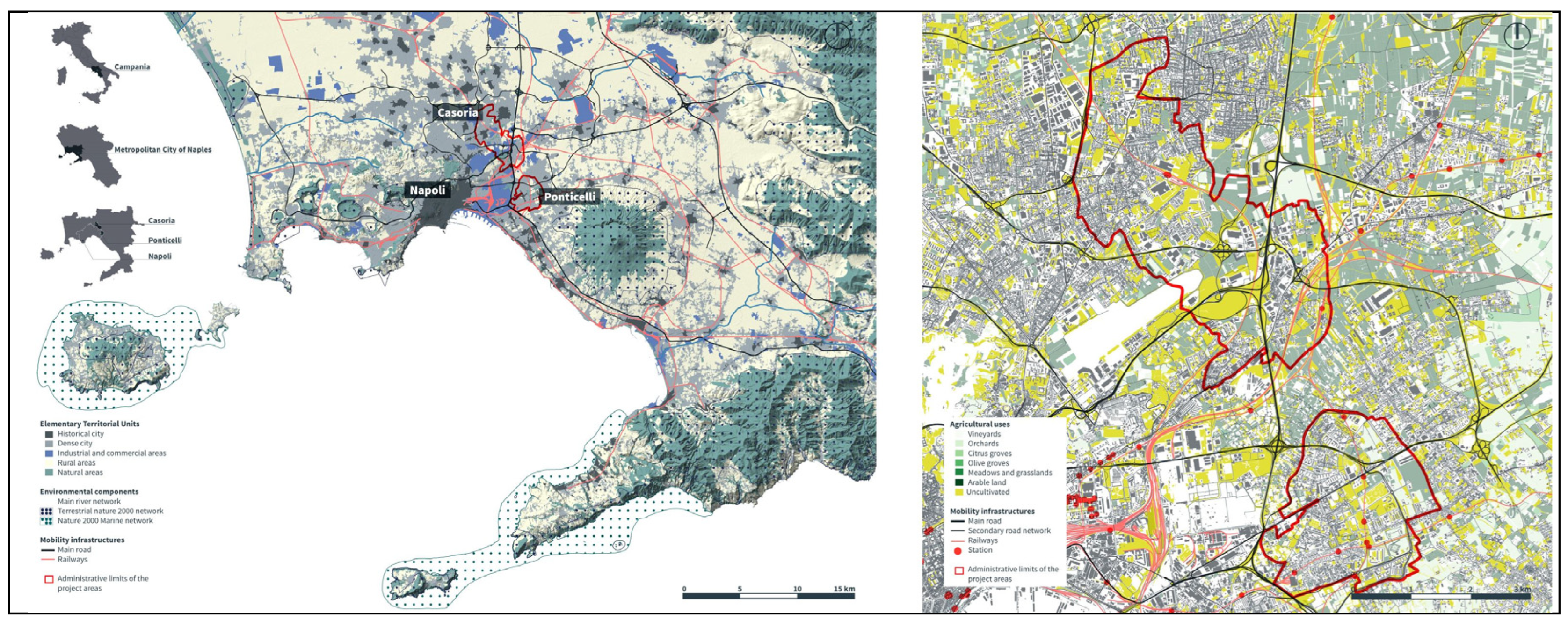
Figure 2.
Social housing: (a) Casoria ex-ante and ex-post evaluation; (b) Ponticelli ex-ante and ex-post evaluation.
Figure 2.
Social housing: (a) Casoria ex-ante and ex-post evaluation; (b) Ponticelli ex-ante and ex-post evaluation.
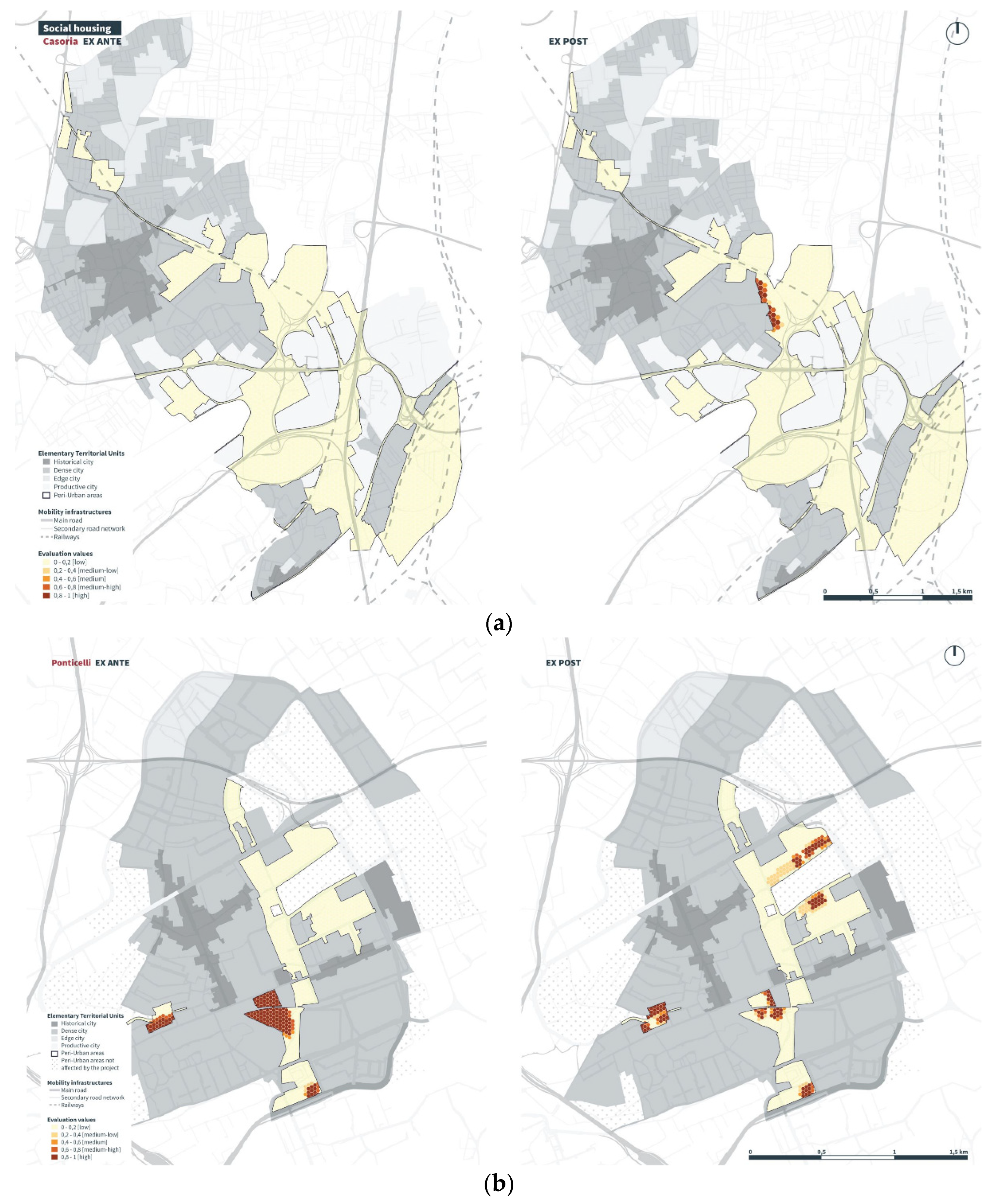
Figure 3.
Sustainable mobility: (a) Casoria ex-ante and ex-post evaluation; (b) Ponticelli ex-ante and ex-post evaluation.
Figure 3.
Sustainable mobility: (a) Casoria ex-ante and ex-post evaluation; (b) Ponticelli ex-ante and ex-post evaluation.
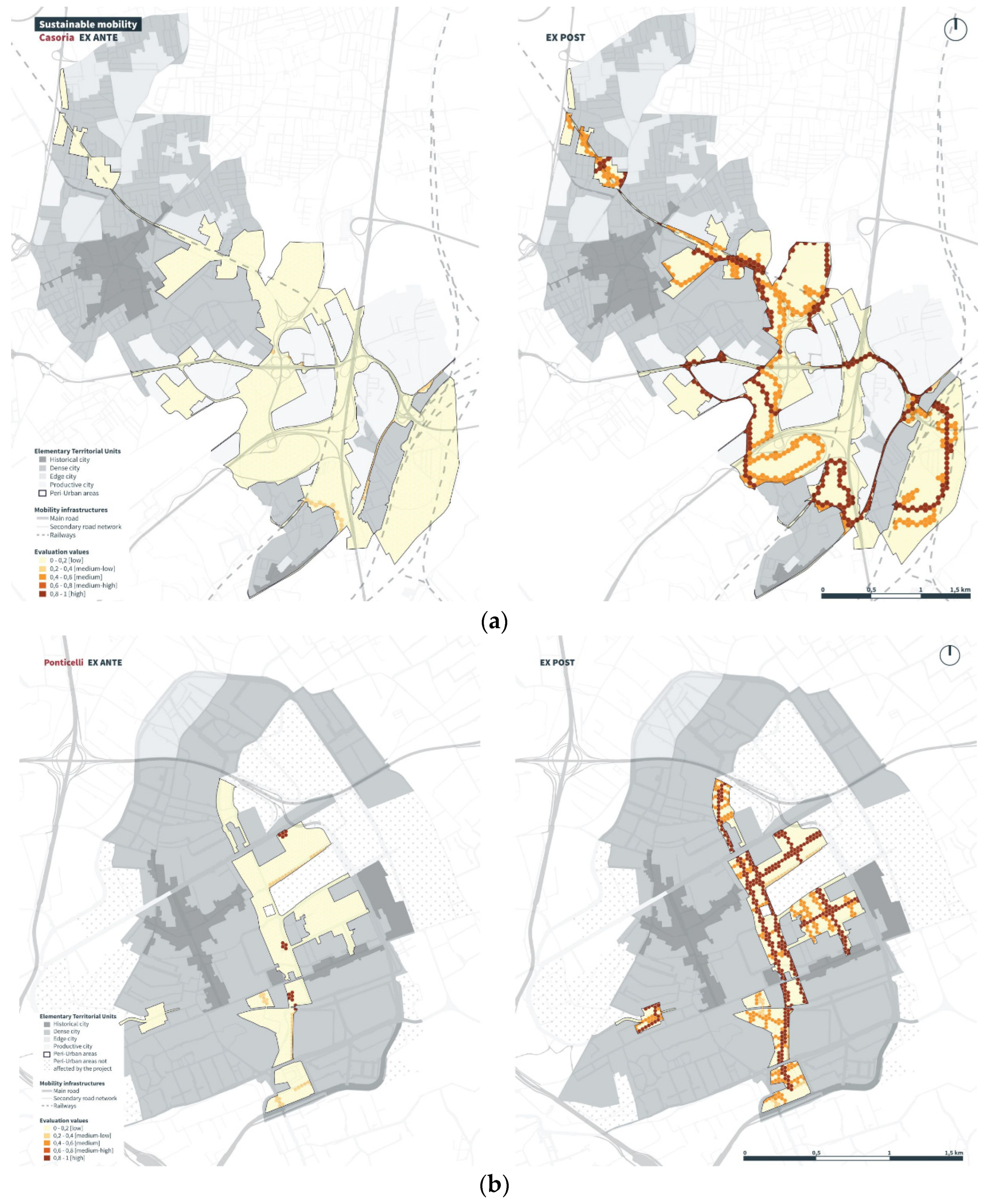
Figure 4.
Civic use pf public properties: (a) Casoria ex-ante and ex-post evaluation; (b) Ponticelli ex-ante and ex-post evaluation.
Figure 4.
Civic use pf public properties: (a) Casoria ex-ante and ex-post evaluation; (b) Ponticelli ex-ante and ex-post evaluation.
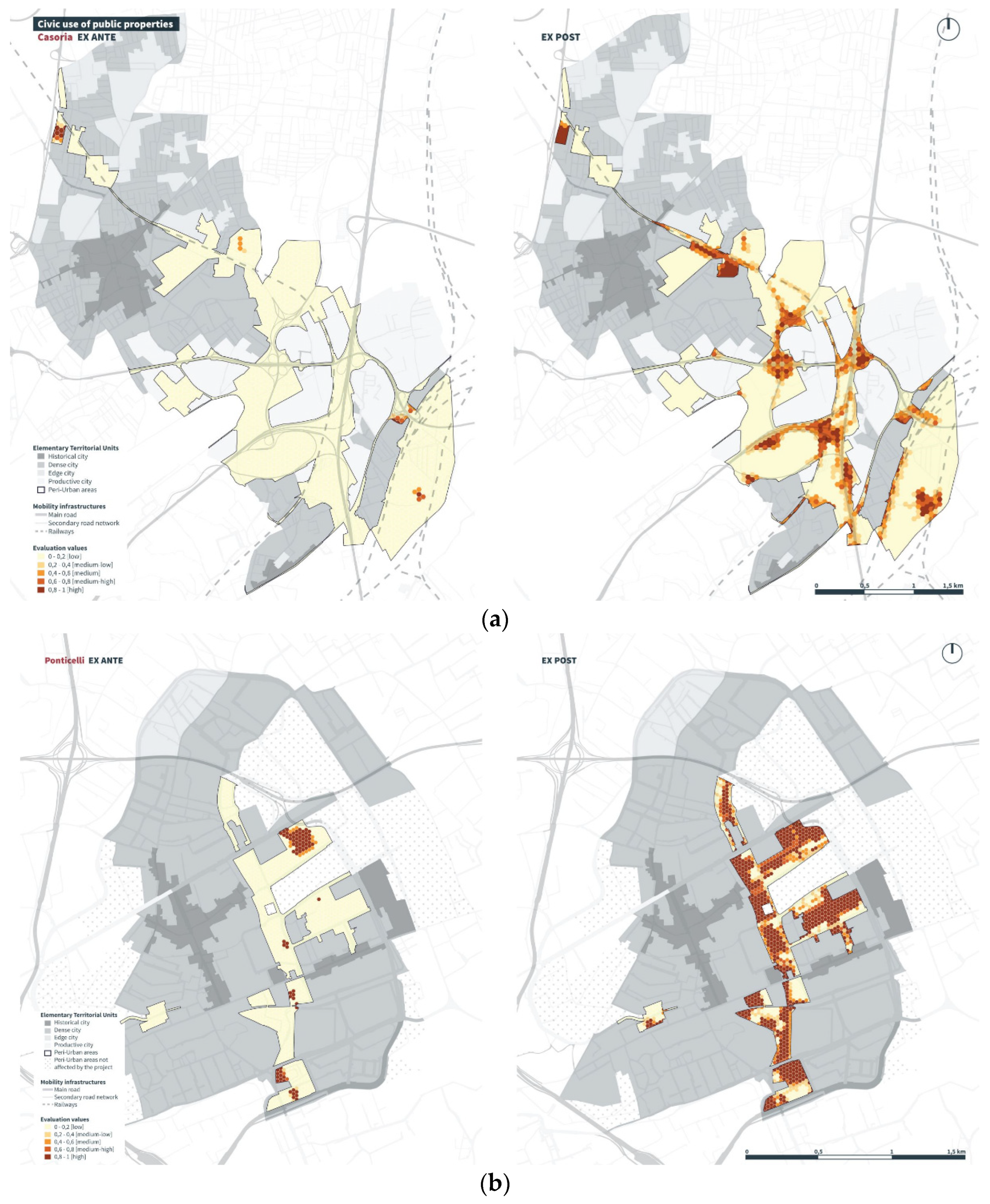
Figure 5.
Illegal building rate: Casoria ex-ante and ex-post evaluation.
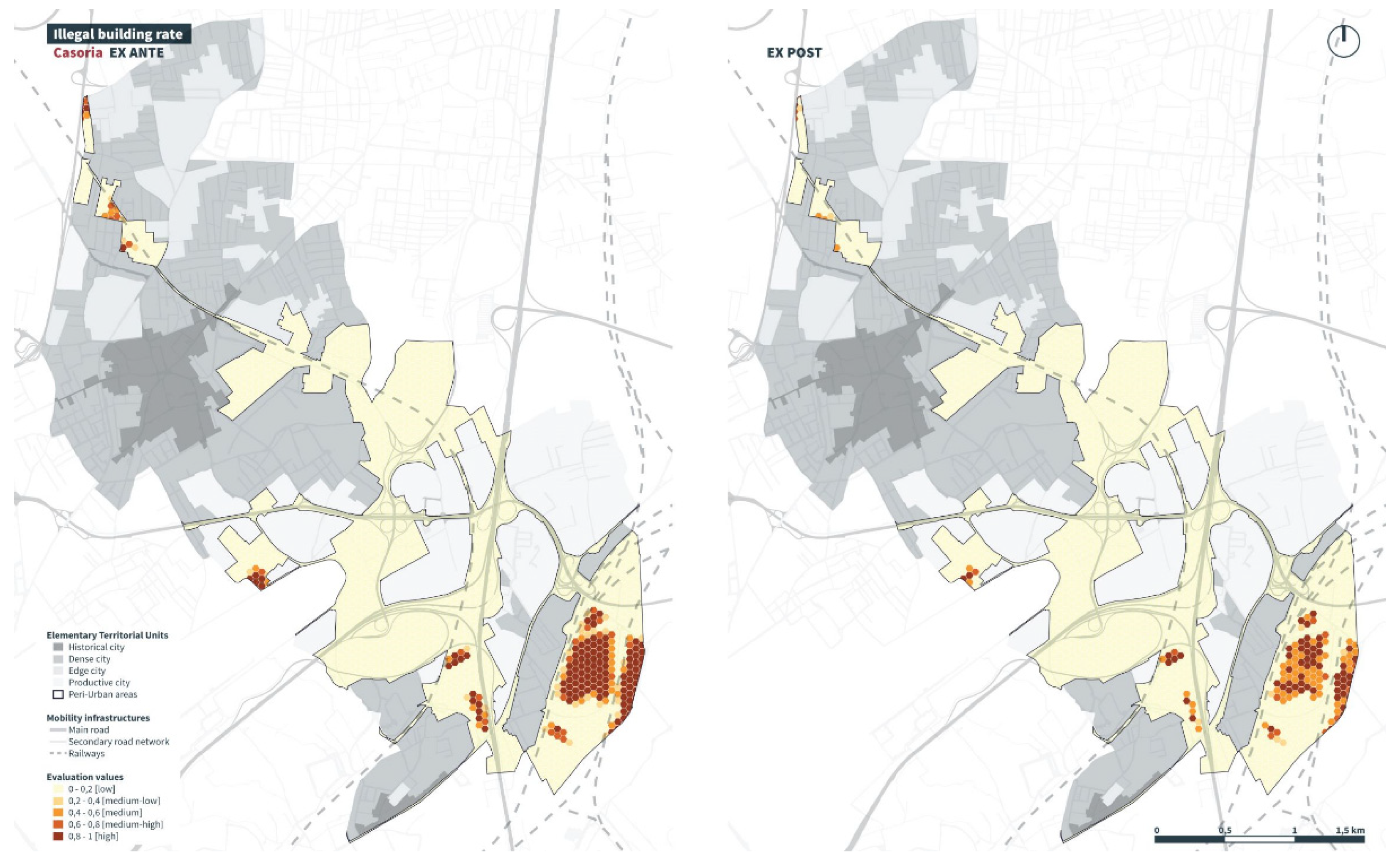
Figure 6.
Civic cornerstones: (a) Casoria ex-ante and ex-post evaluation; (b) Ponticelli ex-ante and ex-post evaluation.
Figure 6.
Civic cornerstones: (a) Casoria ex-ante and ex-post evaluation; (b) Ponticelli ex-ante and ex-post evaluation.
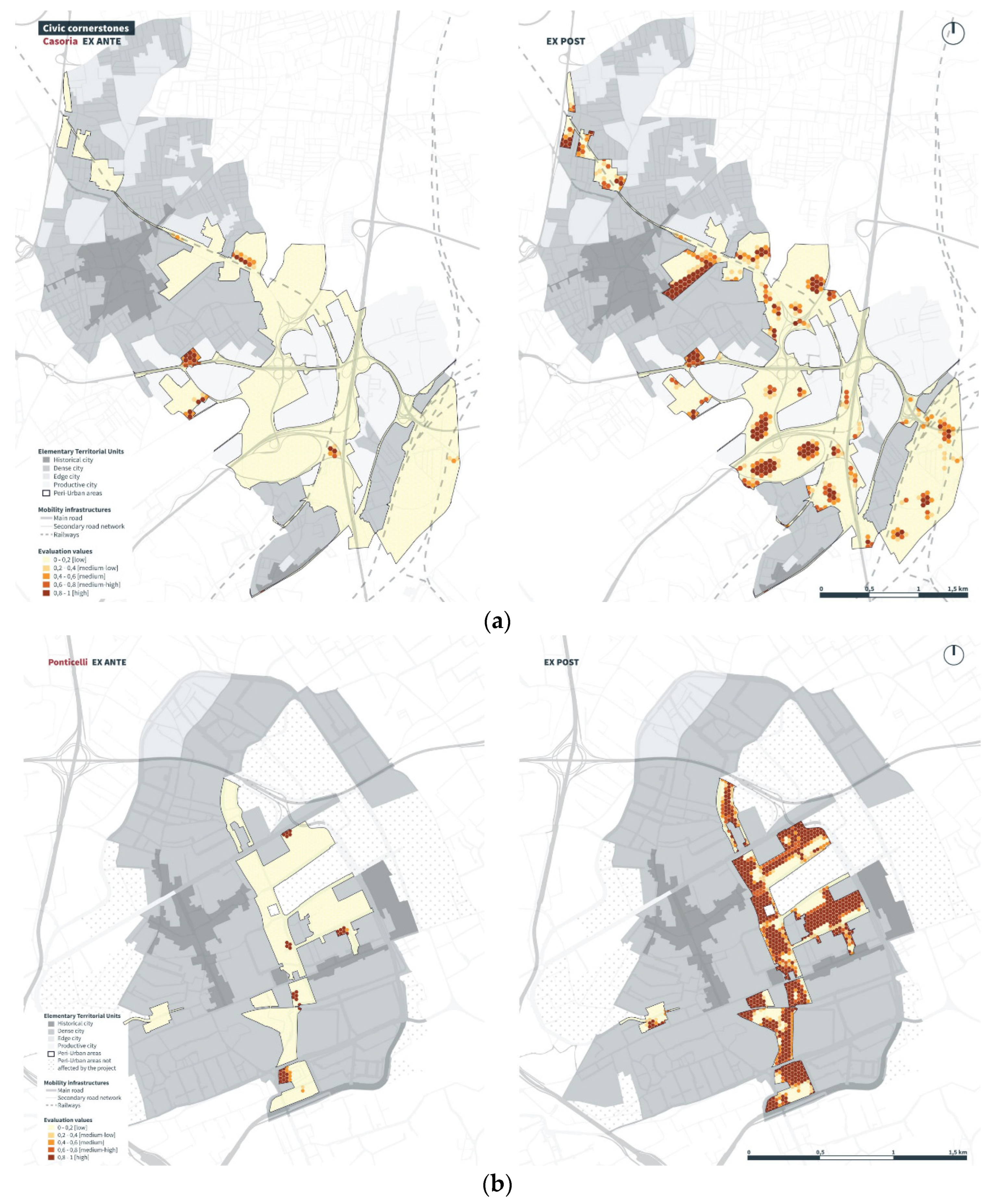
Figure 7.
Soil sealing: (a) Casoria ex-ante and ex-post evaluation; (b) Ponticelli ex-ante and ex-post evaluation.
Figure 7.
Soil sealing: (a) Casoria ex-ante and ex-post evaluation; (b) Ponticelli ex-ante and ex-post evaluation.
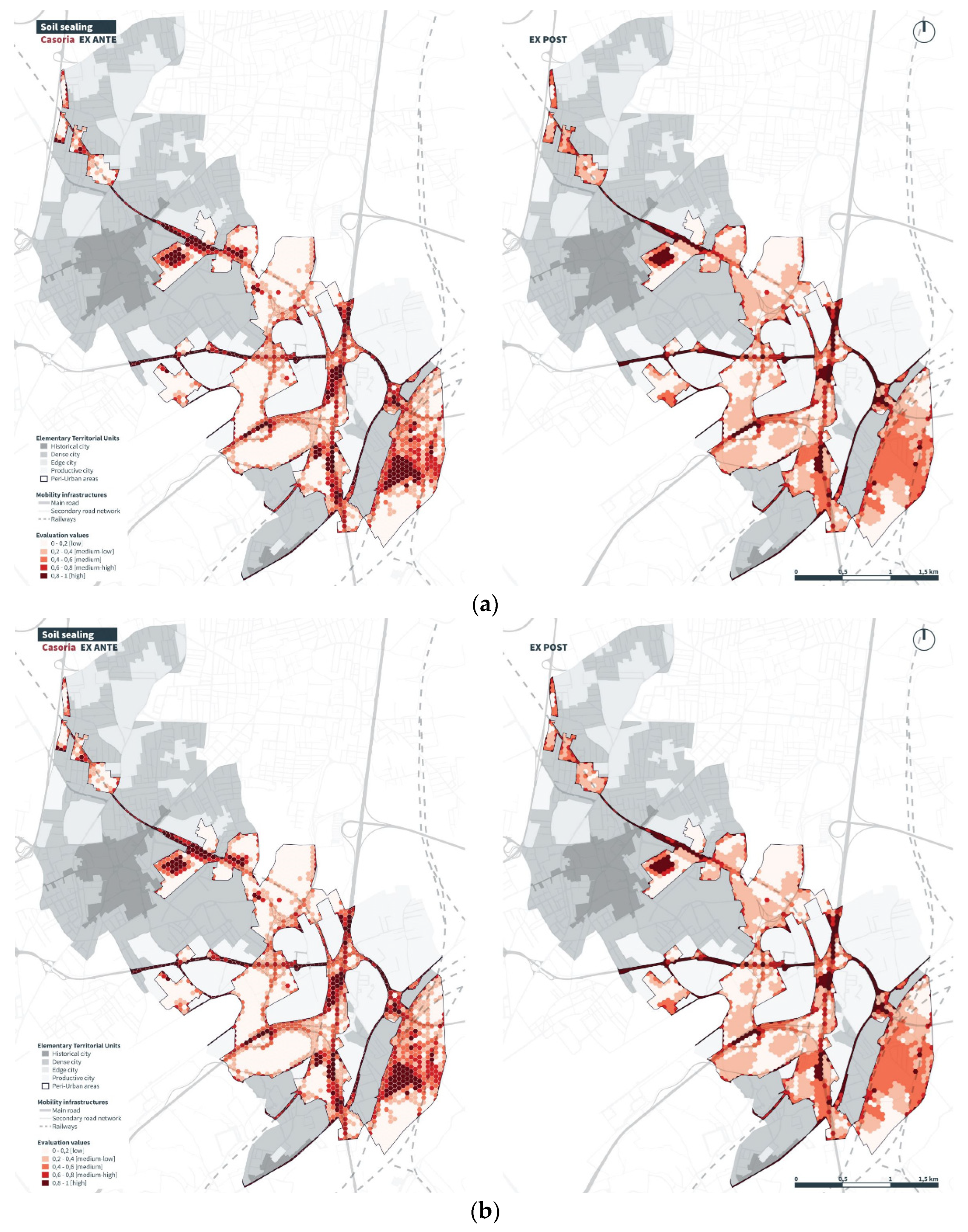
Figure 8.
Forest area index: (a) Casoria ex-ante and ex-post evaluation; (b) Ponticelli ex-ante and ex-post evaluation.
Figure 8.
Forest area index: (a) Casoria ex-ante and ex-post evaluation; (b) Ponticelli ex-ante and ex-post evaluation.
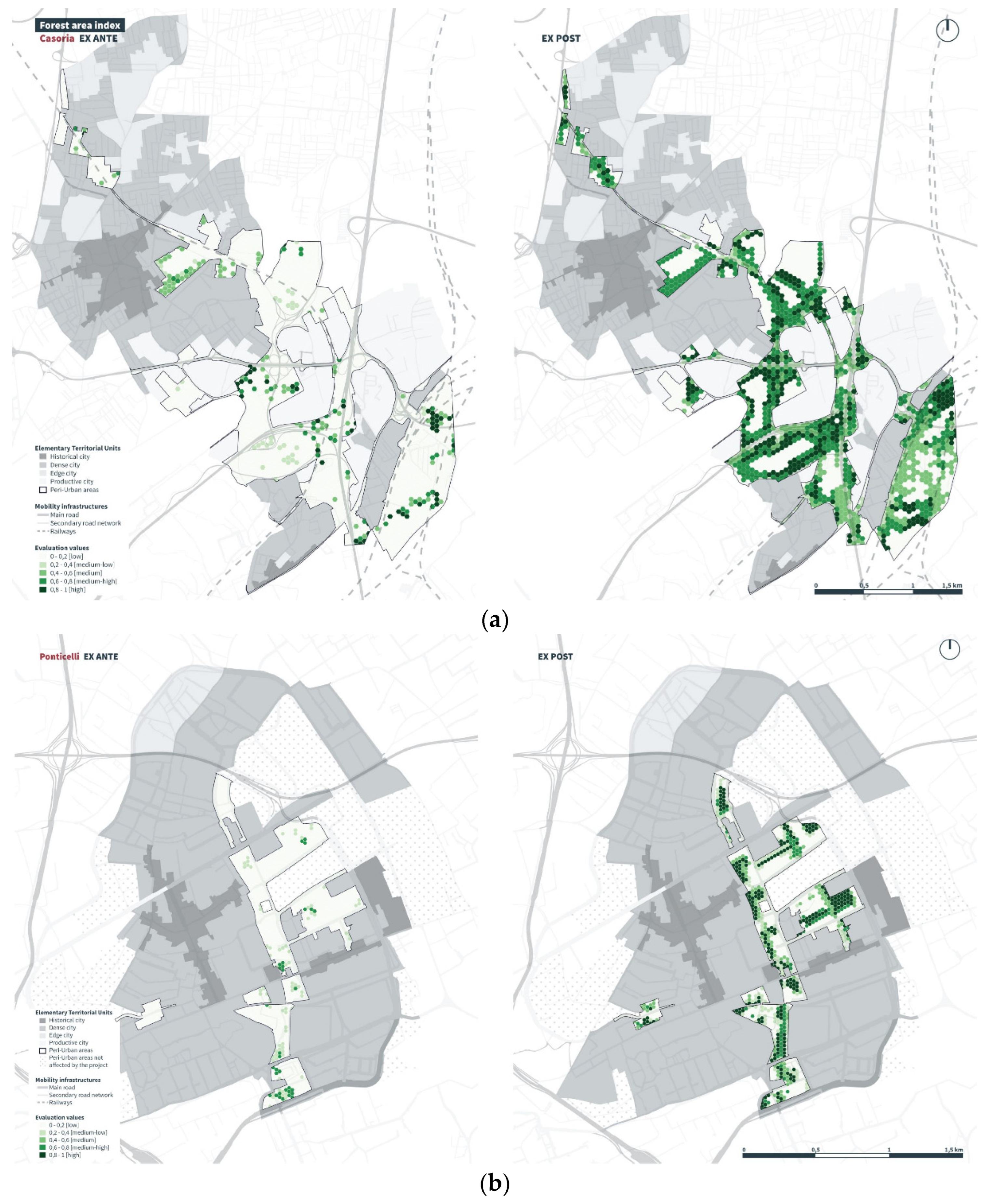
Figure 9.
Ecosystem fragmentation: (a) Casoria ex-ante and ex-post evaluation; (b) Ponticelli ex-ante and ex-post evaluation.
Figure 9.
Ecosystem fragmentation: (a) Casoria ex-ante and ex-post evaluation; (b) Ponticelli ex-ante and ex-post evaluation.
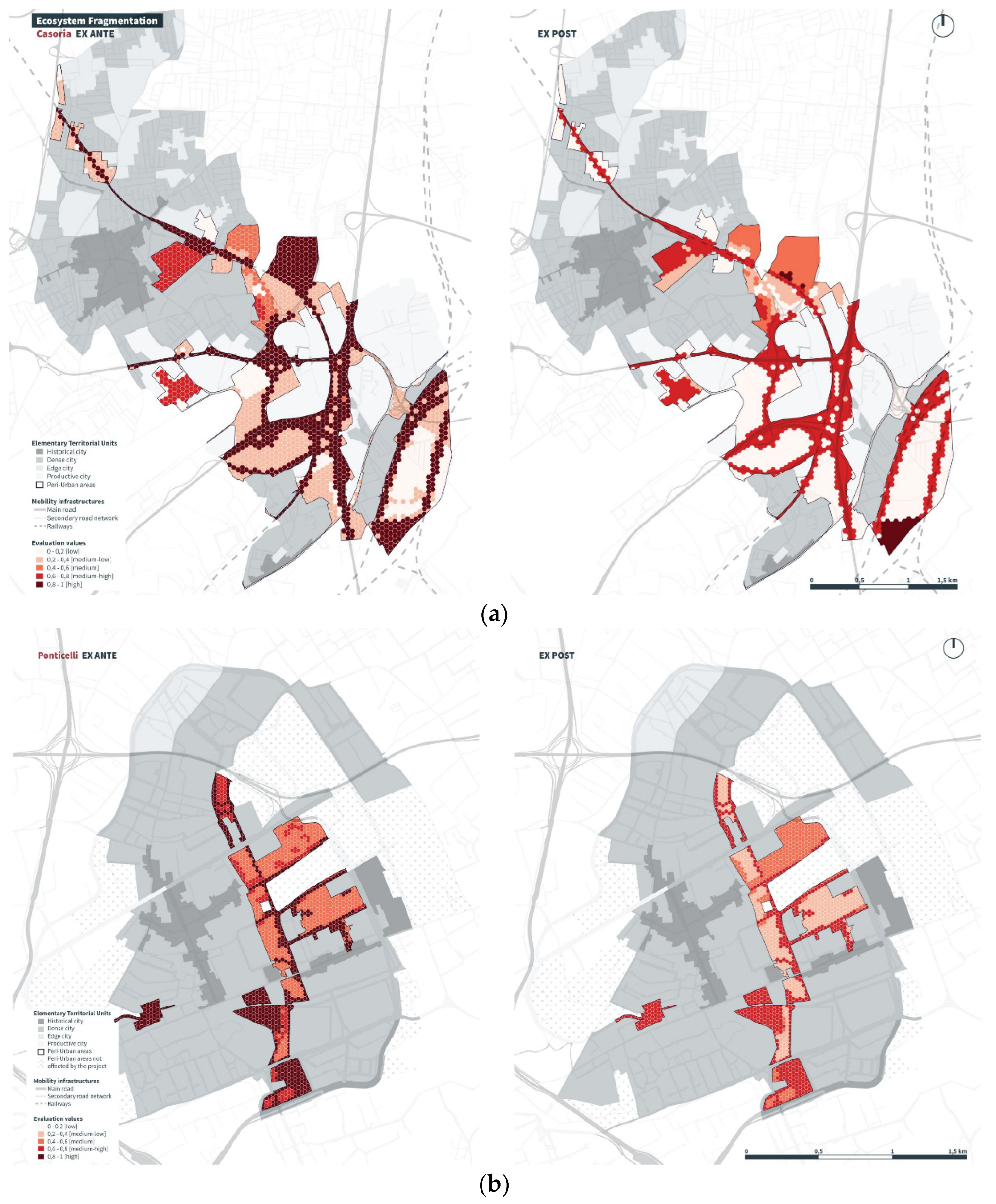
Figure 10.
Agri-environmental production: (a) Casoria ex-ante and ex-post evaluation; (b) Ponticelli ex-ante and ex-post evaluation.
Figure 10.
Agri-environmental production: (a) Casoria ex-ante and ex-post evaluation; (b) Ponticelli ex-ante and ex-post evaluation.
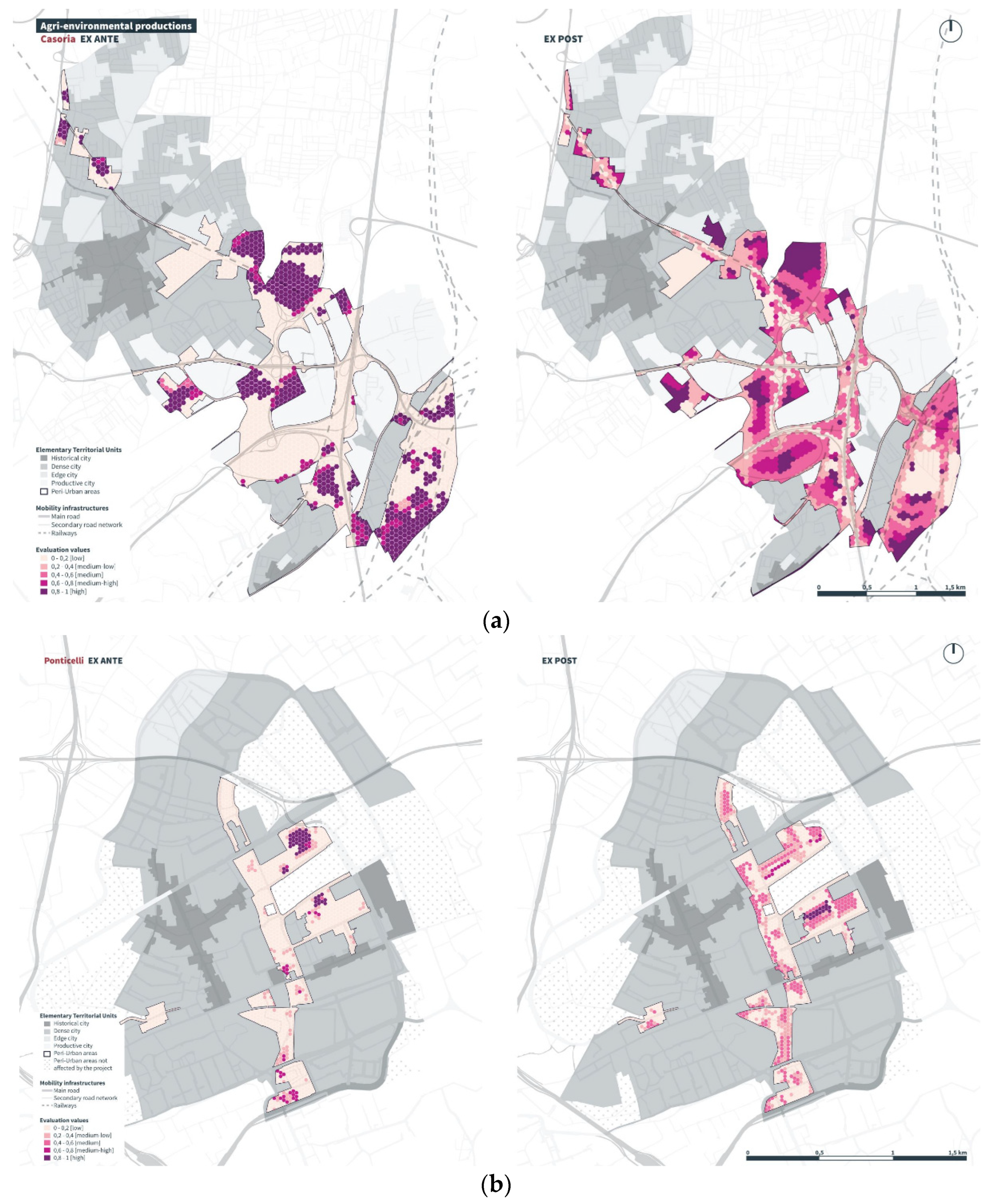
Figure 11.
Green equipped economies: (a) Casoria ex-ante and ex-post evaluation; (b) Ponticelli ex-ante and ex-post evaluation.
Figure 11.
Green equipped economies: (a) Casoria ex-ante and ex-post evaluation; (b) Ponticelli ex-ante and ex-post evaluation.
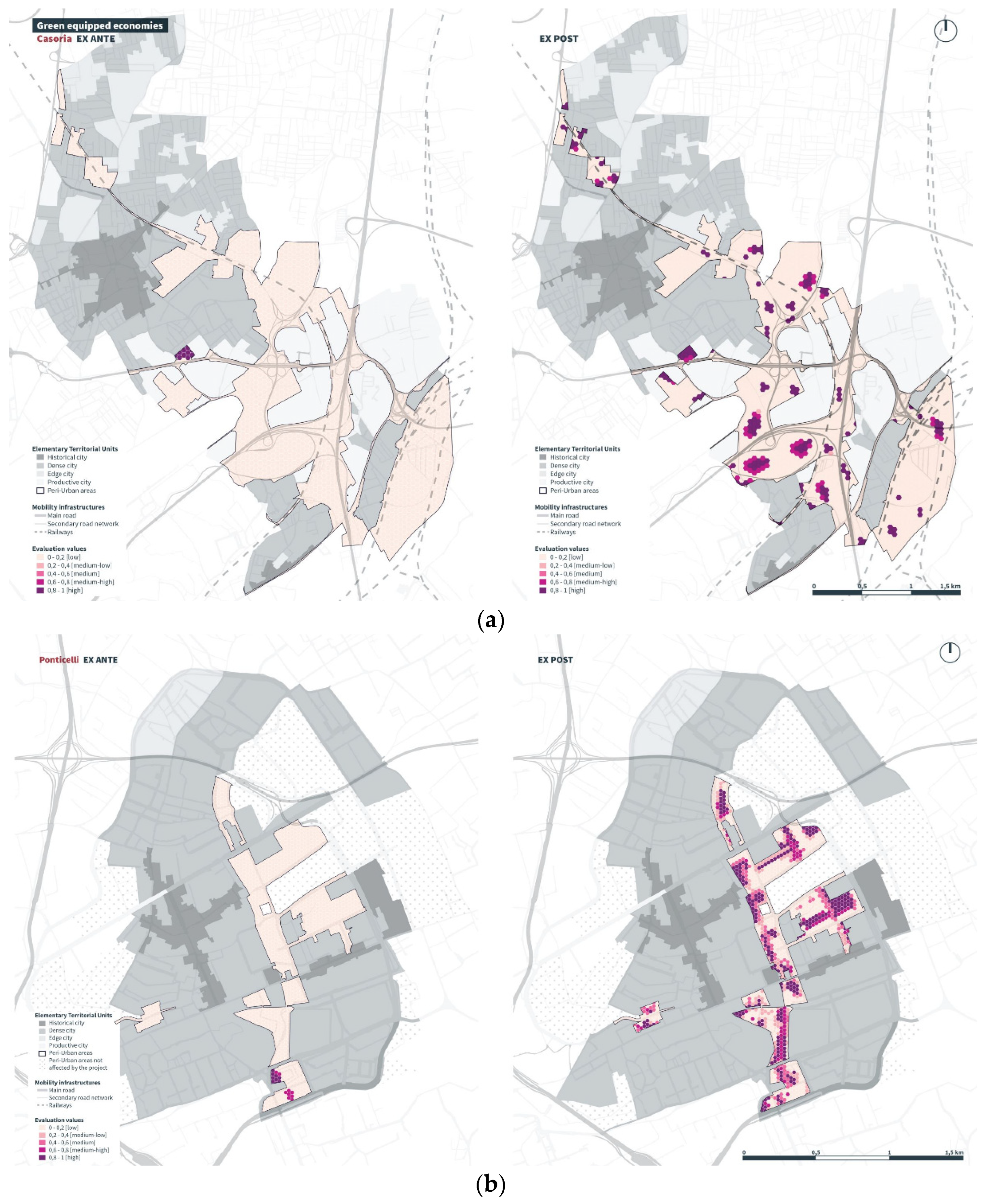
Figure 12.
SSAM results for Casoria Municipal Urban Plan.
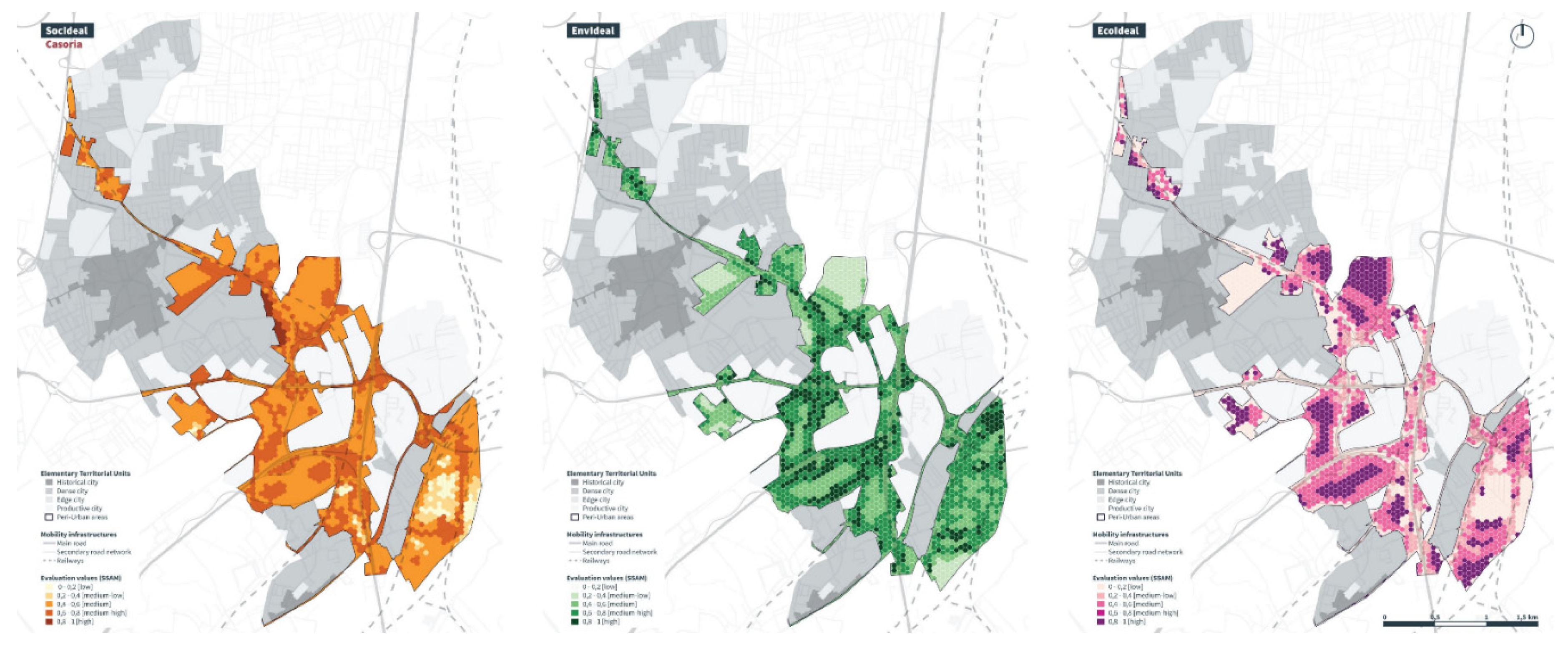
Figure 13.
SSAM results for Ponticelli Urban Recovery Programme.
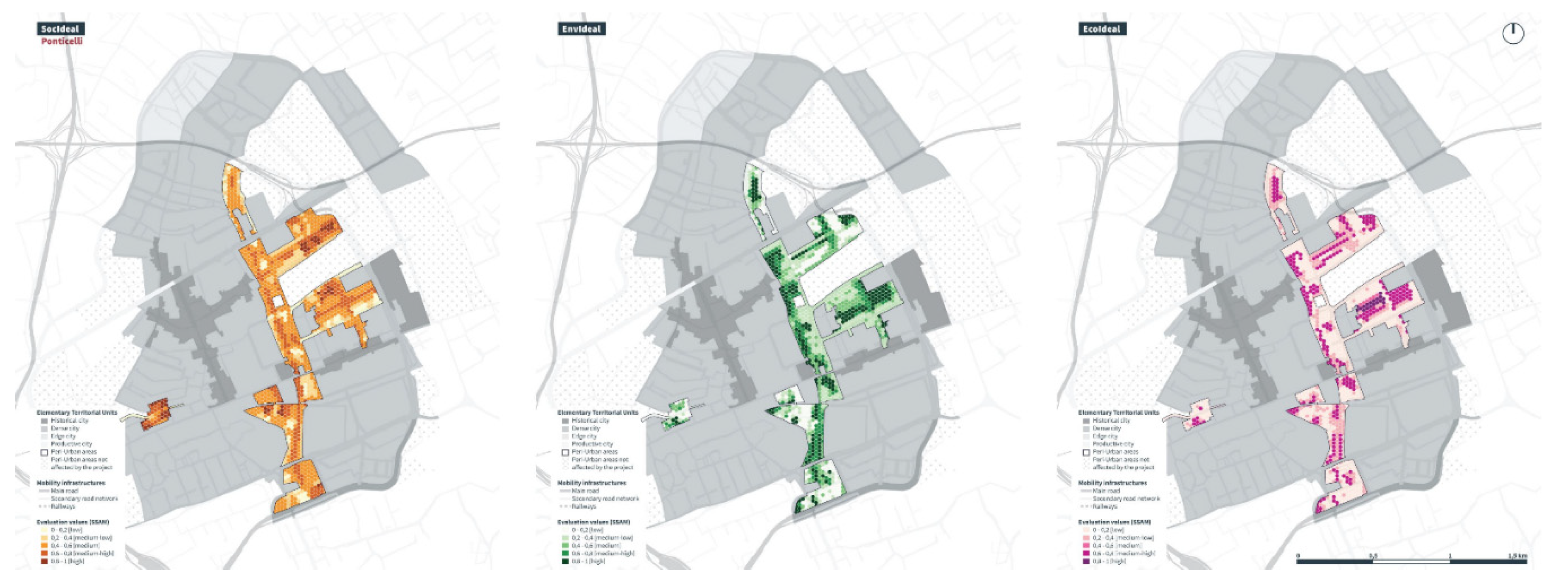
Figure 14.
Idea sustainability index for Casoria and Ponticelli.
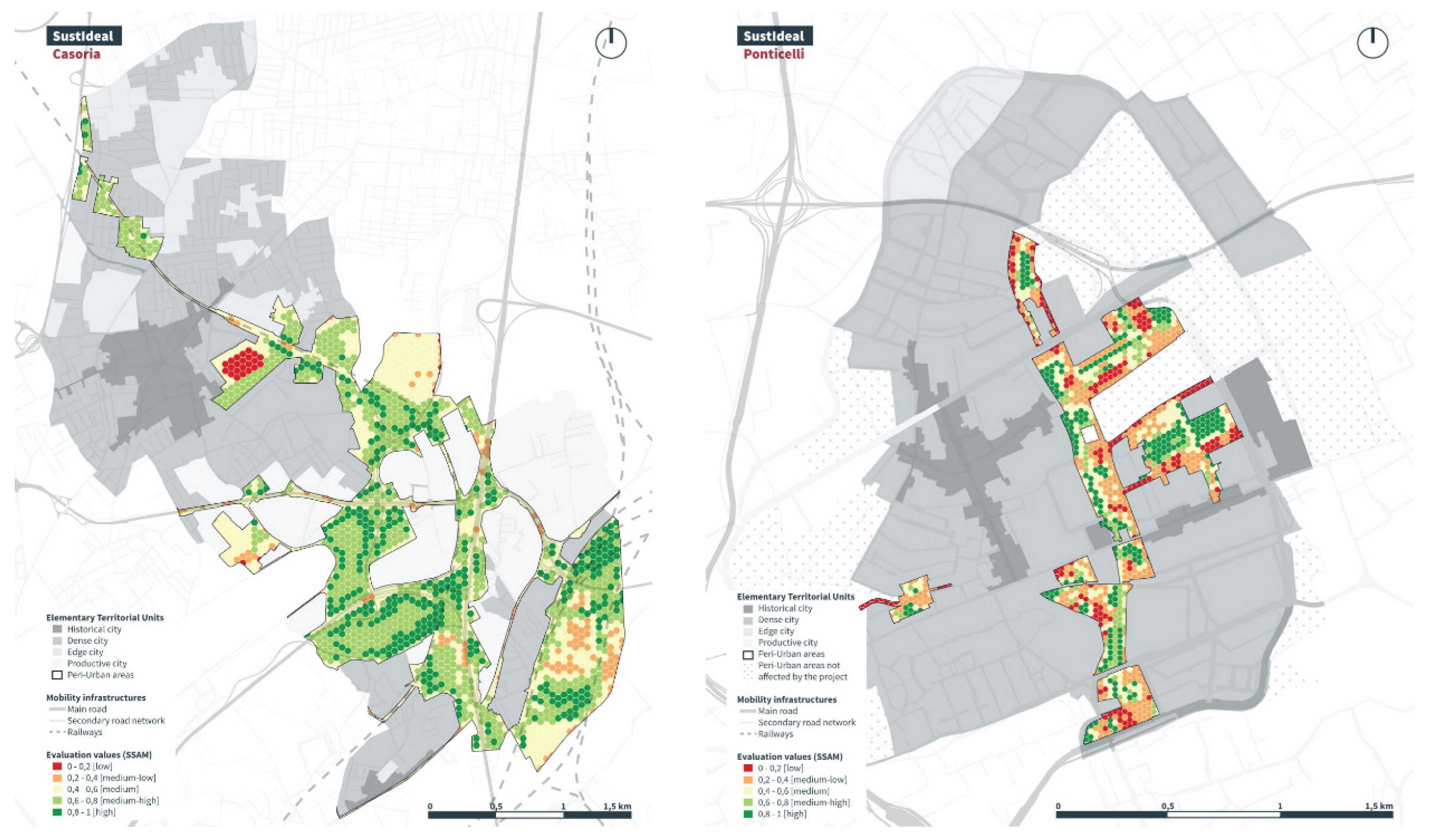

Table 1.
SDGs, targets e indicatori utilizzati nella valutazione.
| Dimension of Sustainability | SDGs | Target SDGs | Indicators |
| Social | 11 Sustainable cities and communities |
11.1 By 2030, ensure access for all to adequate, safe and affordable housing and basic services and upgrade slums | Social housing |
| 11.2 By 2030, provide access to safe, affordable, accessible and sustainable transport systems for all, improving road safety, notably by expanding public transport, with special attention to the needs of those in vulnerable situations, women, children, persons with disabilities and older persons | Sustainable mobility |
||
| 11.3 By 2030, enhance inclusive and sustainable urbanization and capacity for participatory, integrated and sustainable human settlement planning and management in all countries | Civic use of public properties |
||
| 11.4 Strengthen efforts to protect and safeguard the world's cultural and natural heritage | Illegal building rate | ||
| 11 Sustainable cities and communities 17 Partnerships for the goals |
11.7 By 2030, provide universal access to safe, inclusive and accessible, green and public spaces, in particular for women and children, older persons and persons with disabilities 17.17 Encourage and promote effective public, public-private and civil society partnerships, building on the experience and resourcing strategies of partnerships |
Civic cornerstones | |
| Environmental | 15 Life on land data |
15.1 By 2020, ensure the conservation, restoration and sustainable use of terrestrial and inland freshwater ecosystems and their services, in particular forests, wetlands, mountains and drylands, in line with obligations under international agreements | Forest area index |
| 15.3 By 2030, combat desertification, restore degraded land and soil, including land affected by desertification, drought and floods, and strive to achieve a land degradation-neutral world | Soil sealing |
||
| Ecosystem Fragmentation | |||
| Economic | 2 Zero Hunger | By 2030, ensure sustainable food production systems and implement resilient agricultural practices that increase productivity and production, that help maintain ecosystems, that strengthen capacity for adaptation to climate change, extreme weather, drought, flooding and other disasters and that progressively improve land and soil quality |
Agri-environmental productions |
| 8 Decent work and economic growth | 8.3 Promote development-oriented policies that support productive activities, decent job creation, entrepreneurship, creativity and innovation, and encourage the formalization and growth of micro-, small-and medium-sized enterprises, including through access to financial services | ||
| 12 Responsible consumption and production |
12.2 By 2030, achieve the sustainable management and efficient use of natural resources |
||
| 8 Decent work and economic growth |
8.4 Improve progressively, through 2030, global resource efficiency in consumption and production and endeavour to decouple economic growth from environmental degradation, in accordance with the 10-Year Framework of Programmes on Sustainable Consumption and Production, with developed countries taking the lead | Green equipped economies |
Disclaimer/Publisher’s Note: The statements, opinions and data contained in all publications are solely those of the individual author(s) and contributor(s) and not of MDPI and/or the editor(s). MDPI and/or the editor(s) disclaim responsibility for any injury to people or property resulting from any ideas, methods, instructions or products referred to in the content. |
© 2023 by the authors. Licensee MDPI, Basel, Switzerland. This article is an open access article distributed under the terms and conditions of the Creative Commons Attribution (CC BY) license (http://creativecommons.org/licenses/by/4.0/).
Copyright: This open access article is published under a Creative Commons CC BY 4.0 license, which permit the free download, distribution, and reuse, provided that the author and preprint are cited in any reuse.


