

Submitted:
01 February 2025
Posted:
03 February 2025
Read the latest preprint version here
Abstract
Recently, two research groups [1–3] reported on the observation of ambient pressure superconductivity in a few nanometres thick La3-xPrxNi2O7-d (x = 0.0, 0.15, 1.0) films with the Tc,onset = 40 K and Tc,zero = 2-14 K. Here I have analysed the reported self-field critical current density, Jc(sf,T), and upper critical field, Bc2(T), for these films and showed that La3-xPrxNi2O7-d films exhibit a large in-plane London penetration depth, λab(0) = (1.9-6.8) μm, and the Ginzburg-Landau parameter κc(0) = 500-1000. Deduced λab(0) values are within uncertainty range for independently reported [2] λab(0) = (3.7±1.4) μm. Such large values of λab(0) explain a wide resistive transition in La3-xPrxNi2O7-d films [1–3], because large λab(0) implies low superfluid density, and therefore large thermal fluctuations. Consequently, I calculated the phase fluctuation temperature, Tfluc, and found that the Tc,zero < Tfluc. I also found that λab(T) and Bc2(T) data are nicely fitted to two-band gap models, from which the preference has been given to two-band (s+s)-wave model. Besides I showed that bulk highly compressed Ruddlesden–Popper nickelates Lan+1NinO3n+1 (n = 2,3) and ambient pressure Lan+1NinO2n+2 (n = 5) thin film also demonstrate evidences for two-band superconductivity.
Keywords:
superconducting nickelates
; self-field critical current
; upper critical field
; two-band superconductivity
1. Introduction
High-temperature superconductivity in nickelates had predicted by first principles calculations [4] in 1999 and experimentally discovered in several nanometers thick Nd1-xSrxNiO2 films [5] twenty years later. Recently, high-temperature superconductivity in highly compressed bulk nickelate phase La3Ni2O7-δ (LNO-327) has been reported [6]. Despite a fact that this phase had been synthesized more than four decades ago [7], and it had been intensively studied [8,9,10,11] since then (including studies at high pressure [12]), only experiments at pressures above 10 GPa allowed to detect the high-temperature superconductivity in bulk La3Ni2O7-δ samples. Very recently two research groups [1], [2] reported on the observation of ambient pressure superconducting state with and in a few nanometers thick epitaxial La3-xPrxNi2O7-δ (x = 0.0, 0.15) films. It should be noted that nearly two decades ago [13], epitaxial Lan+1NinO3n+1 (n = 1,2,3,∞) films with thickness 130-200 nm had been fabricated and studied; however, temperature dependent resistivity in these films was measured in the range of [13] only.
Here from an analysis of temperature dependent self-field critical current density, , reported for La3-xPrxNi2O7-δ (x = 0.0, 0.15, 1.0) films [1,2,3] we extracted the ground state in-plane London penetration depth, , the Ginzburg-Landau parameter, , BCS ratios (the gap-to-transition temperature ratio, , and relative jump in electronic specific heat at the transition temperature, ), and explained a large width of the resistive transition as manifestation of low superfluid density in these films. We also found that two-band s-wave superconductivity is a preferable model for the order parameter in the La3-xPrxNi2O7-δ (x = 0.0, 0.15, 1.0) films [1,2,3] for existing experimental data.
2. Fundamental Parameters for La3-xPrxNi2O7-δ (x = 0.0; 0.15; 1.0) Films
2.1. Transition Temperature and Coherence Length Definitions
Superconducting coherence length, , is one of two fundamental lengths of any superconductor. Commonly accepted simple approach to determine the ground state coherence length, , is to fit the upper critical field data, , to the Ginzburg-Landau expression:
where is the superconducting flux quantum, is the Planck’s constant, is the electron charge. From several available analytical approximations of Eq. 1 within frames of the Werthamer-Helfand-Hohenberg (WHH) theory [14,15], here we used two expressions [16,17]:
where is the out-of-plane upper critical field, is the ground state in-plane coherence length, and and are free fitting parameters. Eq. 2 will be designated as B-WHH model [16], and Eq.3 will be designated as PK-WHH [17] model below. From our experience, data fits to Eqs. 2,3 results in very close and values (but for the purpose of verification of the deduced free fitting parameters we used both fits).
The crucial issue here is the criterion of the upper critical field definition, , which can be applied to available experimental data. Theoreticians rarely discuss this key issue, and experimentalists tend to overestimate (sometimes by manifold) the values by chosen high resistive criteria [1,2,5,6,18,19,20,21,22]:
where is the resistance at temperature, where starts to drop.
It should be also noted that several research groups [22,23] demonstrated the consequences of applying different resistive criteria, , for the definition for infinite-layer nickelate superconductor Nd1-xSrxNiO2. For instance, Wang et al [22] showed that applying different criteria for data for Nd0.775Sr0.225NiO2 film results in manifold difference in the values (and at some temperatures, the difference is more than 20 times). Moreover, different criteria result in different shapes of the temperature dependent . Because the shape is a primary property which is analyzed by the WHH theory [14,15], this implies that fundamental superconducting parameters deduced by this theory [14,15] depend not from fundamental intrinsic properties of the superconductor, but they determined by the chosen criterion for the upper critical field definition.
In regard of highly compressed La3Ni2O7 phase, the large difference between extrapolated ground state upper critical field value when different resistive criteria was applied has been demonstrated by Zhang et al. [24].
These issues demonstrate a large uncertainty associated with the one of two fundamental fields of any type-II superconductor, which is unusual for any fundamental property of material.
To resolve this issue, from our view, the criterion should be as strict as it is practically possible:
because the superconducting state has several unique properties, and one of them is the entire zero resistivity. And because of this, it is incorrect to designate the superconducting coherence length to the state at which the material [25,26,27] (including, nickelates [1,2,5,18,21,28,29,30]) exhibits the resistivity of:
which is the respective resistivity value to Eq. 4. The level of resistivity described by Eq. 6 is by several orders of magnitude exceeds the resistivity of noble normal metals at the same temperatures. In term of resistance, Eqs. 4,6 often imply that the is defined [25,26,27] at , which cannot be accepted to be the resistance of the superconducting state by any standards.
It should be stressed that initial drop in resistance at originates from thermodynamic fluctuations [22,31,32,33] “occurring at temperatures above the superconducting transition temperature” [34], which is . The strength of these fluctuations can be quantified by two characteristic temperatures, which we calculated for the La3-xPrxNi2O7-δ (x = 0.0, 0.15, 1.0) films below (see Section 4).
Despite strict criterion (Eq. 5) is in a rare use, there are several research groups who implemented this criterion to define the and [24,35,36,37,38,39,40,41,42,43,44,45,46,47,48]. It should be noted that there are several other strict criteria for the and definitions (for instance, these criteria are based on the onset of the diamagnetic response [40,49,50,51,52,53,54,55], the peak of the jump in the specific electronic heat [56,57,58,59,60,61,62], or on the onset of the spontaneous Nernst effect [48], or superconducting gap closing [63]). Some research groups use several techniques and criteria [48,64,65,66,67,68,69] to define the and .
However, the majority of reports on thin film superconductors utilize the manifold overestimated criterion (Eq. 4) [1,2,3,5,21,25,26,30,70,71]. In a particular case of the La3Ni2O7-δ films [1], the difference between and (see Figures 1,3 in Ref. [1]) is remarkable. Based on that, the difference between the and defined by different criteria are enormous. Similar problem is for La2.85Pr0.15Ni2O7-δ films [2], for which the and (see Figure 2 in Ref. [2]).
Additional reason for defining the transition temperature by Eq. 5 is the request to harmonize parameters of another genuine phenomenon of superconductors, which is dissipative-free electric current flow. The current becomes dissipative at some value, known as critical current, , and material resistivity at this state [72] is:
which is by eight-nine orders of magnitude lower than the half of normal state resistivity in nickelate films [1,2,3,5,18,21,28,29,30] (Eq. 4).
Considering that the critical current density (which is , where is cross-section of the conductor) in the absence of external magnetic field, which is designated as the self-field critical current density, , in thin-film superconductors describes by universal equation [73]:
where is the permeability of free space, and is London penetration depth, there is a request that and should be harmonized.
Otherwise, if will be defined by Eq. 4, and will be defined by Eq. 7, then the Ginzburg-Landau parameter, , and the lower critical field:
would be undefined for a large temperature range between and (see Figures 1,3 in Ref. [1]).
This implies that should be defined by a condition at which both characteristic lengths, and , as well as, other related fundamental parameters, do exist:
All data fits were performed with homemade software freely available online [74].
2.2. London Penetration Depth and Other Fundamental Parameters
There are two available R(T,B) datasets for the La3Ni2O7-δ films reported by Ko et al [1], for which we applied the resistive criteria discussed above:
Despite both R(T,B) datasets (i.e. Figure 3,b [1] and Extended Data Figure 3,a [1]) consists of only two curves which satisfy the condition (Eqs. 13,14), it is still possible to estimate the value in the La3Ni2O7-δ films [1], from the data fits to Eqs. 2,3 (Figure 1).
As a result, we estimated the ground state coherence length in the La3Ni2O7-δ films [1] as the average value of:
However, detailed experimental data in the temperature range of and field range of range is required to determine the value more accurately.
Because the self-field critical current density, , has a very weak dependence (Eq. 6) from temperature dependent Ginsburg-Landau parameter, , we simplify Eq. 6 to the form [73]:
where (Eq. 12) is fixed parameter.
Temperature dependent London penetration depth for s-wave superconductors is given by the following equation [75,76]:
where is the Boltzmann constant. Temperature dependent superconducting gap amplitude, , can be described by analytical expression [75,76]:
where for s-wave superconductors [75,76], and is the relative jump in the electronic heat at , and is the Sommerfeld parameter. Direct measurements of superconducting gap in highly compressed elemental sulfur [63] confirmed temperature dependent shape of the described by Eq. 18.
For d-wave superconductors, London penetration depth is given by [75,76]:
where the superconducting energy gap, , is given by [75,76]:
where is the maximum amplitude of the k-dependent d-wave gap given by Eq. 15, is the angle around the Fermi surface subtended at (π, π) in the Brillouin zone (details can be found elsewhere [75,76]), and in accordance with Refs. [75,76,77,78].
p-wave superconductors have the gap function given by [75,76,79]:
where is the superconducting gap, is the wave vector, and is the gap axis. The electromagnetic response depends [80] on the mutual orientation of the vector potential and the gap axis . At experimental conditions during the self-field critical current measurements in epitaxial thin films this is the orientation of the crystallographic axes compared with the direction of the electric current [80]. In addition, from four different p-wave pairing states (which are two “axial” states, where there are two point nodes, and two “polar” states, where there is an equatorial line node), previous analysis [80] showed that the only p-wave case that is distinguishable from dirty s- and d-wave is the p-wave polar case. Details can be found in Ref. [80]. For this polar p-wave case the London penetration depth is given by [75,76,80]:
where the superconducting energy gap, is given by Eq. 21, where [75,76,80]:
Ko et al [1] reported the data for the La3Ni2O7-δ film in Figure 3,a [1], which we fitted to single s-, d-, and polar p-wave gap symmetry models (Eqs. 16-25) in Figure 2.
Deduced unitless BCS ratios (Figure 2) are in large difference from the weak-coupling limits for s-, d-, and polar p-wave symmetries [75,76,77,80,81,82]:
Thus, we concluded that ambient pressure La3Ni2O7-δ films are multiple-band superconductor.
2.3. Two-Band Superconductivity
Thus, we tested six possible two-band cases (i.e. s- + s-; s- + d-; …, p- + p-) of superconductivity in these films. To do this, we used two-band model [77,83]:
where and designate critical current density originated from respectful band; each band has its independent , , , and (Eqs. 16-25). We used fixed value for both bands.
From performed fits of the data to six possible two-band models, we found that deduced parameters for two-band s-wave model are in reasonable proximity to the values reported for MgB2 superconductor [84,85,86] (Figure 3). It should be noted, that in this fit we assumed the condition [77,83] of:
by keeping this joint parameter to be free. Without this restriction, several deduced parameters have large uncertainties. Denser raw dataset with measurements performed with a smaller temperature step () would make it possible to deduce separate values for for each band.
Fits to other two-band models (Eq. 29) are either diverged, either the deduced parameters are in times different from respectful weak coupling limiting values (Eqs. 26-28). Fits to three-band models are possible in principle, but to do this, the experimental dataset should be very dense with and covers as lower as possible temperature range.
It should be stressed that independent from assumed pairing symmetry and/or multiple-band superconductivity, the absolute values of and are remaining the same. The former value is in close proximity to the determined [87] from the data reported for highly compressed bulk La3Ni2O7-δ sample [24]. Both these values are in the same ballpark with the upper limit of recently reported for La2.85Pr0.15Ni2O7-δ thin film by independent research group [2].
3. Fundamental Parameters in La2PrNi2O7-δ Films
To deduce in-plane ground state coherence length in La2PrNi2O7-δ films [3] we applied strict resistive criterion:
to the data reported by Liu et al [3] in their Figure 1,c [3]. Obtained dataset and data fit to Eq. 3 are shown in Figure 4,a. Better fit quality was obtained for two-band model [88,89,90]:
where and designate upper critical field originated from the respectful band; each band has its independent and values, and where and can be described by one of two equations (Eqs. 2,3). The result of data fit to two-band PK-WHH model (Eqs. 3,32) is shown in Figure 4,b.
For the analysis in the La2PrNi2O7-δ film [3], we rounded in-plane ground state coherence length to .
Liu et al [3] measured E-J curves in zero applied field for the La2PrNi2O7-δ film [3] and reported the dataset obtained by application of the Ec = 5 μV/cm criterion which is in the same ballpark with commonly used Ec = 1 μV/cm criterion in applied superconductivity [91,92,93].
In Figure 5 we showed the reported by Liu et al in their Figure 1,b [3] together with fits to single band models (Eqs. 16-25). One can see that deduced parameters for s- and d-wave are significantly different from the weak-coupling limits (Eqs. 26,27). Deduced parameters for p-wave symmetry fit within their uncertainties are within the weak-coupling limiting values for this symmetry. The confirmation for this gap symmetry is required denser dataset, which span on as wide as it is experimentally possible temperature range, because the temperature dependence at demonstrates unique distinct features of s-, d-, p-wave symmetry. It should be noted that deduced the Ginsburg-Landau parameter remains its large value , similar to the one in the La3Ni2O7-δ film [1] (Figures 2,3).
We further analyzed the data within two-band models. In Figure 6 we showed the data fit to two-band s-wave model (Eq. 29), where (because two-band fit requires denser dataset that all parameters will be free) we reduced the number of free-fitting parameters by assuming that: (a) both bands have transition temperature equals to the experimental value ; (b) accepting the restriction described by Eq. 30; (c) and fixing the Ginzburg-Landau parameter to .
The fit (Figure 6) shows that the gap-to-transition temperature ratios, , for two bands are, within their uncertainties, in reasonable agreement with the value reported for MgB2 superconductor [86].
In Figure 7 we showed the data fit to (d-+d-)-wave model (Eq. 29), where we reduced the number of free-fitting parameters assuming that: (a) one band has equals to the experimental value ; (b) , and (c) .
We showed that there is a variety of gap symmetry models which can with good accuracy describe currently available experimental dataset [3] measured in ambient pressure La2PrNi2O7-δ film. Thus, denser data which is measured at, as wide as it is experimentally possible, temperature range is required to reveal the gap symmetry in the ambient pressure La2PrNi2O7-δ films. However, we are confident that ambient pressure La3-xPrxNi2O7-δ (x = 0.0; 1.0) films are high-κ type-II superconductors with large London penetration depth , and these films are more likely multiple-band superconductors.
4. Fundamental Parameters in La3-xPrxNi2O7-δ (x = 0.15) Films
Zhou et al. [2] reported V-I curves for 6 nm thick La3-xPrxNi2O7-δ (x = 0.15) film [2] which exhibits the . Despite the authors [2] noted “…that, due to the significant heating effect caused by the applied current (a result of the high critical current associated with the elevated TC), the actual sample temperatures are higher than the recorded values”, there is still an interest to estimate the dataset and , because Zhou et al. [2] reported measured by mutual inductance technique, and, thus, even estimated value deduced from can shed a light on the absolute value of the London penetration depth in ambient pressure La3-xPrxNi2O7-δ films.
In Figure 8 we showed the out-of-plane upper critical field data, , deduced from dataset showed in Figure 2,b [2] for which we used resistive criteria of (in Figure 8,a) and (in Figure 8,b).
It can be seen that two-band fit to PK-WHH model (Eqs. 3,32) have a good quality, and deduced is close proximity to the value deduced in La2PrNi2O7-δ film [3] (Figure 4). Also, Figure 8 demonstrate two-band feature of the superconducting state in La3-xPrxNi2O7-δ (x = 0.15) film [2].
We estimated dataset in the La3-xPrxNi2O7-δ (x = 0.15) film [2] from V-I curves showed in Extended Data Figure 7 [2] by assuming transport current bridge lateral dimensions of 5x5 mm and by applying electric field criterion of Ec = 25 μV/cm which is manifold larger than commonly used criterion of Ec = 1 μV/cm, but raw experimental data have noise level at about E = 20 μV/cm (it should be also taking into account a note about sample heating mentioned above).
Derived dataset and fits to single band models are shown in Figure 9, where because of small number of raw data points we reduced as much as it is practically possible the number of free-fitting parameters by fixing and values to their weak-coupling limits for respectful gap symmetry (Eqs. 26-28).
In the result, deduced values are within uncertainty range for the value reported by Zhou et al. [2] measured by mutual inductance technique.
5. More Evidences for Multiple-Band Superconductivity in Ruddlesden–Popper Nickelates
5.1. Highly Compressed Single Crystals La3Ni2O7-δ
Zhang et al [24] reported on zero-resistance state in highly compressed La3Ni2O7-δ single crystals at temperature with highest . For one of these crystals, raw experimental dataset for defined by the strictest criterion:
compressed at pressure P = 20.5 GPa and P = 26.6 GPa has been reported in Extended Data Figure 6 [24]. In Figure 10 we fitted these two datasets to the two-band model (Eqs. 3, 32), from which two-band superconductivity in highly compressed La3Ni2O7-δ single crystals can be seen.
We can express a request for experimentalists to measure the data at low applied magnetic field in Ruddlesden–Popper and infinite layer nickelates [1,2,3,18,22,23,94,95]. Indeed, at the low applied fields, , the for the band which exhibits higher transition temperature, , can be determined. However, commonly accepted approach is different, and it is related to the applying as high as possible magnetic field, , with practically no any experimental data for an applied field in the range of , except at .
5.2. Highly Compressed Polycrystalline La2PrNi2O7-δ
Wang et al [96] reported on zero-resistance state in highly compressed La3PrNi2O7-δ polycrystalline samples with highest . We digitized the data from Extended Data Figure 6,a [96] and applied the criterion of:
Determined dataset and the fit to the two-band model are shown in Figure 11.
5.3. Highly Compressed Single Crystals La4Ni3O10-δ
Zhu et al [97] reported on zero-resistance state in highly compressed La4Ni3O10-δ single crystals with the highest . Raw experimental data is available for this study [97]. We applied the lowest possible criterion for each dataset in the range of:
to determine the . Data fit to two-band model for La4Ni3O10-δ single crystal compressed at four pressures are shown in Figure 12, from which two-band superconductivity in highly compressed La4Ni3O10-δ is evident.
5.4. Ambient Pressure La3Ni2O7-δ Thin Film
5.5. Ambient Pressure La6Ni5O12 Thin Film
Recently, Yan et al. [98] reported on observation of significant drop in resistivity in ambient pressure single-unit-cell Nd6Ni5O12 film at temperatures . Despite the zero resistance was not observed in the film (down to ), typical for superconductors suppression of the in applied magnetic field was observed. We assumed that the single-unit-cell Nd6Ni5O12 film is a superconductor and applied resistive criterion:
to determine the dataset for Nd6Ni5O12 film. In Figure 14 we showed the obtained dataset and data fit to two-band model (Eqs. 3, 32). Evidence for two-band superconductivity can be seen in Figure 14. We should note that the emergence of the second band is completely missed if the will be defined by overwhelmingly large criterion of , as the one implemented by Yan et al. [98] in their Figure 1,d.
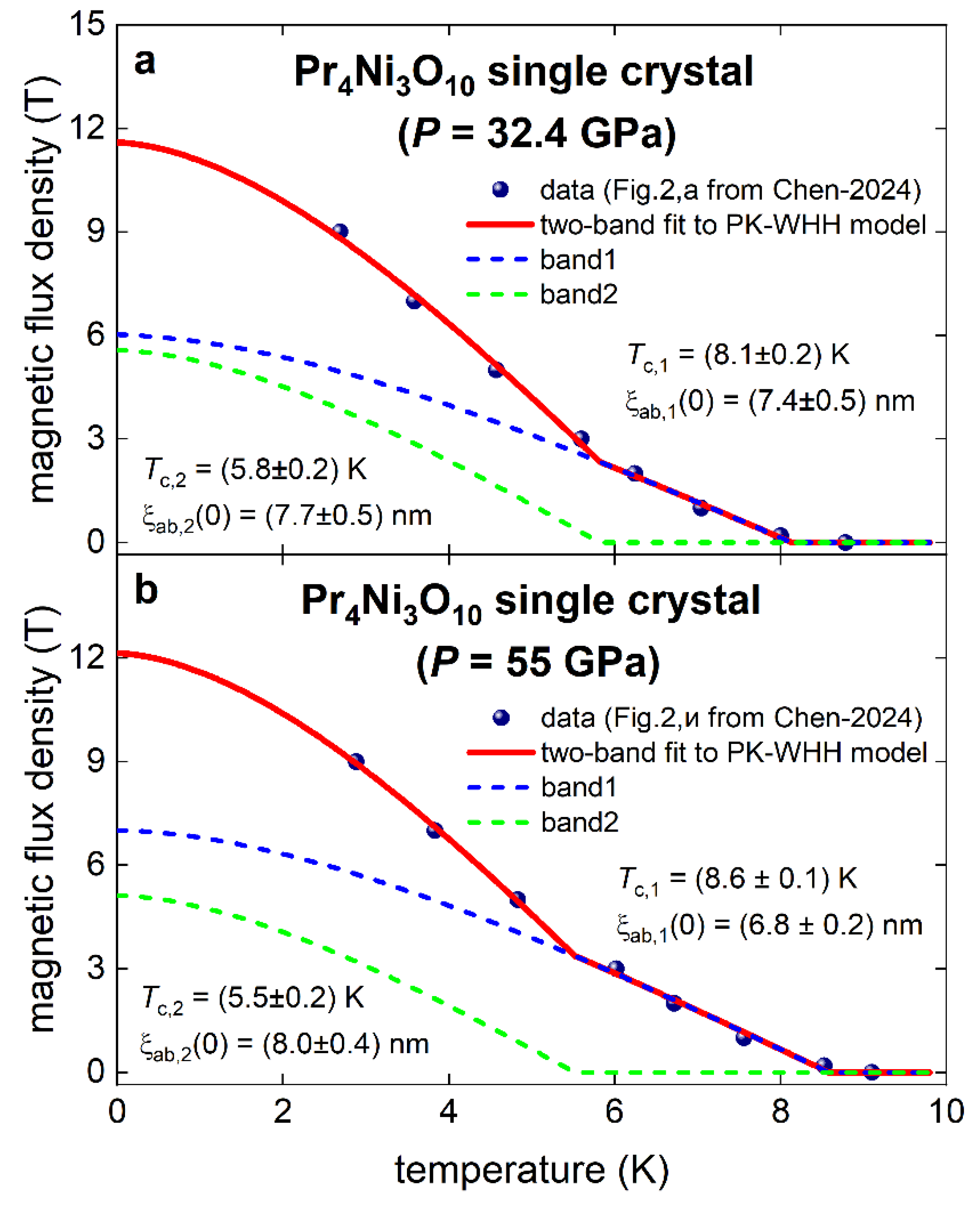
5.6. Highly Compressed Pr4Ni3O10 Single Crystal
To demonstrate that the Ruddlesden-Popper nickelates exhibit two-band superconductivity in Figure 15 we showed the datasets deduced from the dataset measured in highly compressed Nd6Ni5O12 single crystal by Chen et al. [99]. It should be noted, that recently Zhang et al. [100] reported on observation of the zero-resistance state with in the single crystal of the same phase Nd6Ni5O12, however, the dataset is unavailable to date.
In Figure 15,a we applied the criterion of to define the dataset reported in Figure 2,a [99], and in Figure 15,b we applied the criterion of to define in the Nd6Ni5O12 single crystal.
Data fits to Eqs. 3,32 (Figure 15) confirms two-band nature of the superconducting state in highly compressed Nd6Ni5O12 single crystal.
6. The limitation of Tc in nickelates by thermal fluctuations
Thermal fluctuations are expected to break Cooper pairs and suppress superconductivity for materials with low superfluid density [32]. For HTS cuprates strong thermal fluctuations reduce the observed transition temperature, Tc, below its meanfield value, by up to 30%, and similar feature have been understood in iron-based superconductors [101,102,103,104], however, the transition temperatures in near-room-temperature hydride superconductors [105,106,107,108,109,110,111] based on their 3D nature and short London penetration depth λ(0) [112,113,114] are not affected by thermal fluctuations [33,115].
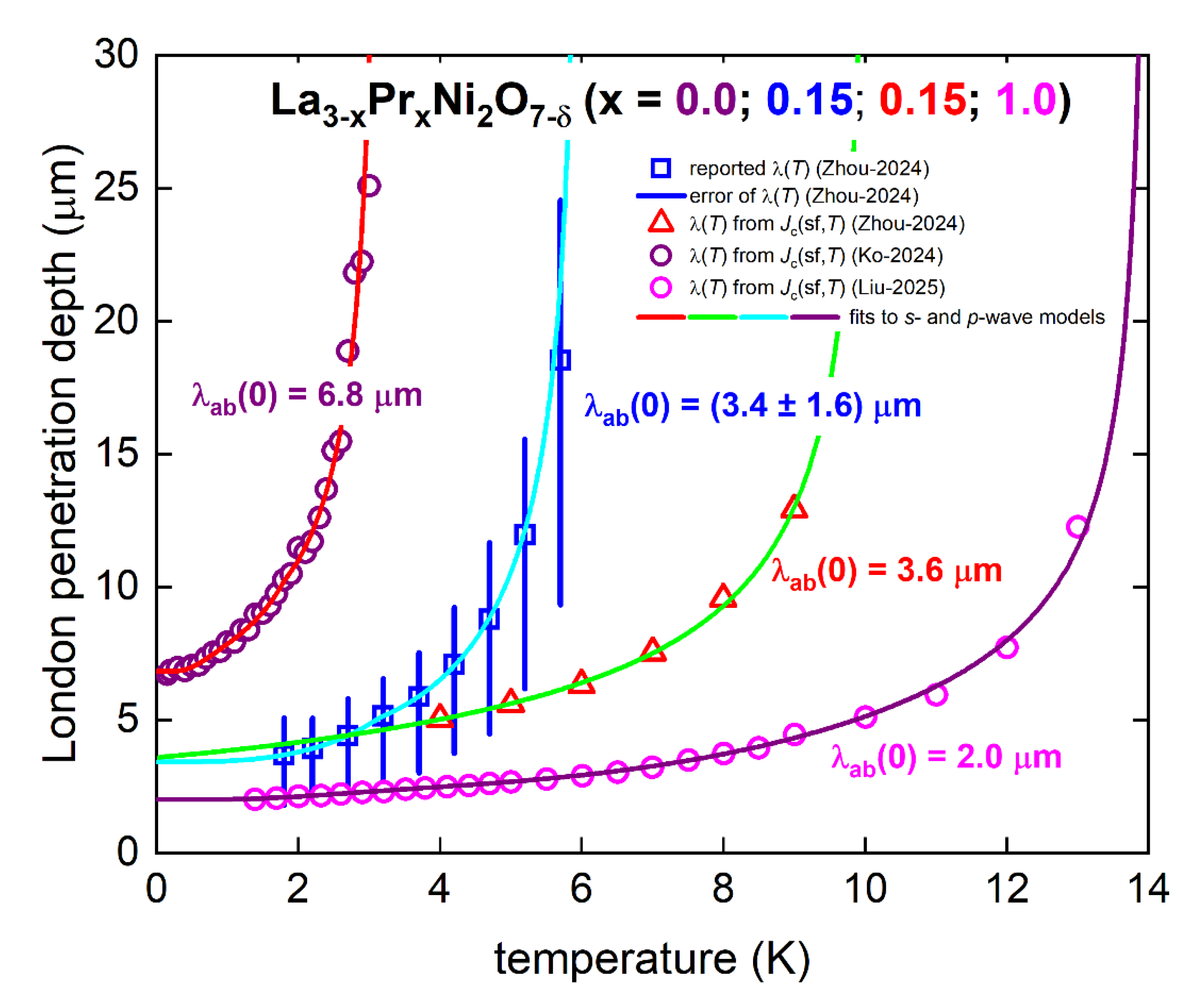
However, large London penetration depth λ(T) in ambient pressure La3-xPrxNi2O7-δ (x = 0.0, 0.15, 1.0) films deduced herein and reported in Ref. [2] opened a question about the impact of thermal fluctuations on Tc in these films.
By considering unit cells of the Ruddlesden-Popper nickelate family phases, Lan+1NinO3n+1 (n = 2,3) considering herein, one can conclude that main structural element where high-temperature superconductivity is originated from is the 3D Ni-O octahedron. Thus, in opposite to HTS cuprates, the superconductivity in Lan+1NinO3n+1 can be classified to exhibit 3D nature, despite the superconductivity observed in very thin films of Lan+1NinO3n+1.
Based on this, we can calculate the phase fluctuation temperature for 3D superconductors in accordance with Emery and Kivelson approach [32]:
The substitution of the deduced values for the La3Ni2O7-δ film [1] in Eq. 38 returns:
Defined by us (Eq. 13) in this film is about half of the , which is expected value, if we take into account that thermal fluctuations cause ~ 30-50% suppression for Tc.
The substitution of the deduced values for the La2PrNi2O7-δ film [3] in Eq. 38 returns:
which is again about twice higher than the observed .
For the for the La3-xPrxNi2O7-δ film [2], the substitution of the lower limit for the reported value and , returns:
We need to mention, that the authors [2] pointed out that reported (from which we extracted ) was measured at conditions of large heat realize. Thus, the shortest London penetration depth (Figure 9) which we deduced from the represents the upper-limiting value for the London penetration depth, for which we calculate:
Thus, the La3-xPrxNi2O7-δ film [2] exhibits the phase fluctuation temperature in the range:
And thus, observed in experiment diamagnetic and resistive are in the range described by Eq. 43.
In Figure 16, we summarized the London penetration depth data for La3-xPrxNi2O7-δ (x = 0.0, 0.15, 1.0) films.
Acknowledgments
The work was carried out within the framework of the state assignment of the Ministry of Science and Higher Education of the Russian Federation for the IMP UB RAS.
References
- Ko, E. K. et al. Signatures of ambient pressure superconductivity in thin film La3Ni2O7. Nature (2024) doi:10.1038/s41586-024-08525-3. [CrossRef]
- Zhou, G. et al. Ambient-pressure superconductivity onset above 40 K in bilayer nickelate ultrathin films. (2024).
- Liu, Y. et al. Superconductivity and normal-state transport in compressively strained La$_2$PrNi$_2$O$_7$ thin films. (2025).
- Anisimov, V. I., Bukhvalov, D. & Rice, T. M. Electronic structure of possible nickelate analogs to the cuprates. Phys Rev B 59, 7901–7906 (1999). [CrossRef]
- Li, D. et al. Superconductivity in an infinite-layer nickelate. Nature 572, 624–627 (2019). [CrossRef]
- Sun, H. et al. Signatures of superconductivity near 80 K in a nickelate under high pressure. Nature 621, 493–498 (2023). [CrossRef]
- Brisi, C., Vallino, M. & Abbattista, F. Composition and structure of two hitherto unidentified phases in the system La2O3-NiO-O. Journal of the Less Common Metals 79, 215–219 (1981).
- Ram, R. A. M., Ganapathi, L., Ganguly, P. & Rao, C. N. R. Evolution of three-dimensional character across the Lan+1NinO3n+1 homologous series with increase in n. J Solid State Chem 63, 139–147 (1986). [CrossRef]
- Sreedhar, K. et al. Low-Temperature Electronic Properties of the Lan+1NinO3n+1 (n = 2, 3, and ∞) System: Evidence for a Crossover from Fluctuating-Valence to Fermi-Liquid-like Behavior. J Solid State Chem 110, 208–215 (1994).
- Zhang, Z., Greenblatt, M. & Goodenough, J. B. Synthesis, Structure, and Properties of the Layered Perovskite La3Ni2O7-δ. J Solid State Chem 108, 402–409 (1994).
- Taniguchi, S. et al. Transport, Magnetic and Thermal Properties of La 3 Ni 2 O 7-δ. J Physical Soc Japan 64, 1644–1650 (1995).
- Wu, G., Neumeier, J. J. & Hundley, M. F. Magnetic susceptibility, heat capacity, and pressure dependence of the electrical resistivity of La3N2O7 and La4Ni3O10. Phys Rev B 63, 245120 (2001).
- Burriel, M. et al. Enhanced High-Temperature Electronic Transport Properties in Nanostructured Epitaxial Thin Films of the La n+1 Ni nO 3 n+1 Ruddlesden−Popper Series ( n = 1, 2, 3, ∞). Chemistry of Materials 19, 4056–4062 (2007).
- Helfand, E. & Werthamer, N. R. Temperature and Purity Dependence of the Superconducting Critical Field, Hc2. II. Physical Review 147, 288–294 (1966). [CrossRef]
- Werthamer, N. R., Helfand, E. & Hohenberg, P. C. Temperature and Purity Dependence of the Superconducting Critical Field, Hc2. III. Electron Spin and Spin-Orbit Effects. Physical Review 147, 295–302 (1966). [CrossRef]
- Baumgartner, T. et al. Effects of neutron irradiation on pinning force scaling in state-of-the-art Nb3Sn wires. Supercond Sci Technol 27, 015005 (2014). [CrossRef]
- Prozorov, R. & Kogan, V. G. Practically universal representation of the Helfand-Werthamer upper critical field for any transport scattering rate. Phys Rev Appl 22, 064006 (2024). [CrossRef]
- Yan, X. et al. Superconductivity in an ultrathin multilayer nickelate. Sci Adv 11, (2025). [CrossRef]
- Wang, Z.-C. et al. Superconductivity in KCa 2 Fe 4 As 4 F 2 with Separate Double Fe 2 As 2 Layers. J Am Chem Soc 138, 7856–7859 (2016).
- Honda, F. et al. Pressure-induced Structural Phase Transition and New Superconducting Phase in UTe 2. J Physical Soc Japan 92, (2023). [CrossRef]
- Wang, B. Y. et al. Effects of rare-earth magnetism on the superconducting upper critical field in infinite-layer nickelates. Sci Adv 9, (2023). [CrossRef]
- Wang, B. Y. et al. Isotropic Pauli-limited superconductivity in the infinite-layer nickelate Nd0.775Sr0.225NiO2. Nat Phys 17, 473–477 (2021). [CrossRef]
- Ji, H. et al. Rotational symmetry breaking in superconducting nickelate Nd0.8Sr0.2NiO2 films. Nat Commun 14, 7155 (2023). [CrossRef]
- Zhang, Y. et al. High-temperature superconductivity with zero resistance and strange-metal behaviour in La3Ni2O7−δ. Nat Phys (2024) doi:10.1038/s41567-024-02515-y. [CrossRef]
- Cao, Y. et al. Unconventional superconductivity in magic-angle graphene superlattices. Nature 556, 43–50 (2018). [CrossRef]
- Park, J. M. et al. Robust superconductivity in magic-angle multilayer graphene family. Nat Mater 21, 877–883 (2022). [CrossRef]
- Di Battista, G. et al. Infrared single-photon detection with superconducting magic-angle twisted bilayer graphene. Sci Adv 10, (2024).
- Lee, K. et al. Linear-in-temperature resistivity for optimally superconducting (Nd,Sr)NiO2. Nature 619, 288–292 (2023). [CrossRef]
- Osada, M. et al. A Superconducting Praseodymium Nickelate with Infinite Layer Structure. Nano Lett 20, 5735–5740 (2020). [CrossRef]
- Pan, G. A. et al. Superconductivity in a quintuple-layer square-planar nickelate. Nat Mater 21, 160–164 (2022). [CrossRef]
- Bulaevskii, L. N., Ginzburg, V. L. & Sobyanin, A. A. Macroscopic theory of superconductors with small coherence length. Physica C Supercond 152, 378–388 (1988). [CrossRef]
- Emery, V. J. & Kivelson, S. A. Importance of phase fluctuations in superconductors with small superfluid density. Nature 374, 434–437 (1995). [CrossRef]
- Talantsev, E. F., Crump, W. P., Storey, J. G. & Tallon, J. L. London penetration depth and thermal fluctuations in the sulphur hydride 203 K superconductor. Ann Phys 529, 1–5 (2017). [CrossRef]
- Andersson, M. Comment on “Superconducting state of Ca-VII below a critical temperature of 29 K at a pressure of 216 GPa”. Phys Rev B 84, 216501 (2011). [CrossRef]
- Wu, L. et al. Record-High <math display="inline"> <msub> <mi>T</mi> <mi>c</mi> </msub> </math> and Dome-Shaped Superconductivity in a Medium-Entropy Alloy TaNbHfZr under Pressure up to 160 GPa. Phys Rev Lett 132, 166002 (2024).
- Ye, G. et al. Distinct pressure evolution of superconductivity and charge density wave in kagome superconductor <math> <mrow> <msub> <mi>CsV</mi> <mn>3</mn> </msub> <msub> <mi>Sb</mi> <mn>5</mn> </msub> </mrow> </math> thin flakes. Phys Rev B 109, 054501 (2024).
- Nie, J. Y. et al. On the superconducting gap structure of the miassite Rh17S15: Nodal or nodeless? (2024).
- Chen, K. Y. et al. Double Superconducting Dome and Triple Enhancement of <math display="inline"> <msub> <mrow> <mi>T</mi> </mrow> <mrow> <mi>c</mi> </mrow> </msub> </math> in the Kagome Superconductor <math display="inline"> <mrow> <msub> <mrow> <mi>CsV</mi> </mrow> <mrow> <mn>3</mn> </mrow> </msub> <msub> <mrow> <mi>Sb</mi> </mrow> <mrow> <mn>5</mn> </mrow> </msub> </mrow> </math> under High Pressure. Phys Rev Lett 126, 247001 (2021).
- Huyan, S. et al. Suppression of metal-to-insulator transition and stabilization of superconductivity by pressure in <math> <mrow> <msub> <mi>Re</mi> <mn>3</mn> </msub> <msub> <mi>Ge</mi> <mn>7</mn> </msub> </mrow> </math>. Phys Rev B 109, 174522 (2024).
- Terashima, T. et al. Anomalous upper critical field in the quasicrystal superconductor Ta$_{1.6}$Te. (2024).
- Ruan, B.-B. et al. Superconductivity in Mo 4 Ga 20 As with endohedral gallium clusters. Journal of Physics: Condensed Matter 35, 214002 (2023).
- Zhang, C. L. et al. Superconductivity above 80 K in polyhydrides of hafnium. Materials Today Physics 27, 100826 (2022). [CrossRef]
- Wang, L. S. et al. Nodeless superconducting gap in the topological superconductor candidate <math> <mn>2</mn> <mi>M</mi> <mtext>–</mtext> <mi>WS</mi> <msub> <mrow/> <mn>2</mn> </msub> </math>. Phys Rev B 102, 024523 (2020).
- Pan, J. et al. Nodal superconductivity and superconducting dome in the layered superconductor <math> <mrow> <msub> <mi>Ta</mi> <mn>4</mn> </msub> <msub> <mi>Pd</mi> <mn>3</mn> </msub> <msub> <mi>Te</mi> <mn>16</mn> </msub> </mrow> </math>. Phys Rev B 92, 180505 (2015).
- Vedeneev, S. I., Piot, B. A., Maude, D. K. & Sadakov, A. V. Temperature dependence of the upper critical field of FeSe single crystals. Phys Rev B 87, 134512 (2013). [CrossRef]
- Yu, F. H. et al. Unusual competition of superconductivity and charge-density-wave state in a compressed topological kagome metal. Nat Commun 12, 3645 (2021). [CrossRef]
- Dong, Q. et al. Strong superconducting pairing strength and pseudogap features in a putative multiphase heavy-fermion superconductor CeRh2As2 by soft point-contact spectroscopy. (2025).
- Bärtl, F. et al. Evidence of pseudogap and absence of spin magnetism in the time-reversal-symmetry-breaking state of Ba$_{1-x}$K$_x$Fe$_2$As$_2$. (2025).
- Jangid, S. et al. Superconductivity with a high upper critical field in an equiatomic high-entropy alloy Sc–V–Ti–Hf–Nb. Appl Phys Lett 124, (2024).
- Jangid, S. et al. High critical field superconductivity in a 3d dominated lightweight equiatomic high entropy alloy. (2025).
- Sharma, S. et al. Evidence for conventional superconductivity in <math> <msub> <mi>Bi</mi> <mn>2</mn> </msub> <mi mathvariant="normal">PdPt</mi> </math> and prediction of possible topological superconductivity in disorder-free <math> <mrow> <mi>γ</mi> <mtext>−</mtext> <mi>BiPd</mi> </mrow> </math>. Phys Rev B 109, 224509 (2024).
- Landaeta, J. F. et al. Evidence for vertical line nodes in <math> <msub> <mi mathvariant="normal">Sr</mi> <mn>2</mn> </msub> <msub> <mi mathvariant="normal">RuO</mi> <mn>4</mn> </msub> </math> from nonlocal electrodynamics. Phys Rev B 110, L100503 (2024).
- Sun, Y. et al. Specific Heat and Upper Critical Field of Sc 5 Ir 4 Si 10 Superconductor. J Physical Soc Japan 82, 074713 (2013).
- Perkins, G. K. et al. Superconducting critical fields and anisotropy of a MgB2 single crystal. Supercond Sci Technol 15, 330 (2002). [CrossRef]
- Arima, H. et al. Direct Observation of Vortices and Antivortices Generation in Phase-Separated Superconductor Sn-Pb Solder. (2025).
- Landaeta, J. F. et al. Conventional type-II superconductivity in locally noncentrosymmetric <math> <msub> <mi mathvariant="normal">LaRh</mi> <mn>2</mn> </msub> <msub> <mi mathvariant="normal">As</mi> <mn>2</mn> </msub> </math> single crystals. Phys Rev B 106, 014506 (2022).
- Watanabe, Y., Miura, A., Moriyoshi, C., Yamashita, A. & Mizuguchi, Y. Observation of superconductivity and enhanced upper critical field of η-carbide-type oxide Zr4Pd2O. Sci Rep 13, 22458 (2023). [CrossRef]
- Ma, K. et al. Superconductivity with High Upper Critical Field in the Cubic Centrosymmetric η-Carbide Nb 4 Rh 2 C 1−δ. ACS Materials Au 1, 55–61 (2021).
- Michor, H. et al. Superconductivity in layered YB 2 C 2. J Phys Conf Ser 150, 052160 (2009).
- Anand, V. K. et al. Physical properties of noncentrosymmetric superconductor <math> <msub> <mrow> <mi mathvariant="normal">LaIrSi</mi> </mrow> <mn>3</mn> </msub> </math> : A <math> <mi>μ</mi> </math> SR study. Phys Rev B 90, 014513 (2014).
- Chajewski, G., Szymański, D., Daszkiewicz, M. & Kaczorowski, D. Horizontal flux growth as an efficient preparation method of CeRh 2 As 2 single crystals. Mater Horiz 11, 855–861 (2024).
- Li, L. et al. Large upper critical fields and strong coupling superconductivity in the medium-entropy alloy (Ti1/3Hf1/3Ta1/3)1-xNbx. (2025).
- Du, F. et al. Tunneling Spectroscopy at Megabar Pressures: Determination of the Superconducting Gap in Sulfur. Phys Rev Lett 133, 036002 (2024). [CrossRef]
- Takahashi, H. et al. Superconductivity in a ferroelectric-like topological semimetal SrAuBi. NPJ Quantum Mater 8, 77 (2023). [CrossRef]
- Sundar, S., Chattopadhyay, M. K., Chandra, L. S. S., Rawat, R. & Roy, S. B. Vortex–glass transformation within the surface superconducting state of β-phase Mo(1-x)Rex alloys. Supercond Sci Technol 30, 025003 (2017).
- Liu, Y. et al. Superconductivity under pressure in a chromium-based kagome metal. Nature 632, 1032–1037 (2024). [CrossRef]
- Zeng, S. W. et al. Observation of perfect diamagnetism and interfacial effect on the electronic structures in infinite layer Nd0.8Sr0.2NiO2 superconductors. Nat Commun 13, 743 (2022). [CrossRef]
- Wang, J. et al. Superconductivity in an Orbital-Reoriented SnAs Square Lattice: A Case Study of Li 0.6 Sn 2 As 2 and NaSnAs. Angewandte Chemie International Edition 62, (2023).
- Zhou, N. et al. Disorder-robust high-field superconducting phase of FeSe single crystals. Phys Rev B 104, L140504 (2021). [CrossRef]
- Chow, L. E. et al. Pauli-limit violation in lanthanide infinite-layer nickelate superconductors. (2022).
- Lee, Y. et al. Synthesis of superconducting freestanding infinite-layer nickelate heterostructures on the millimetre scale. Nature Synthesis (2025) doi:10.1038/s44160-024-00714-2. [CrossRef]
- Ekin, J. W. Experimental Techniques for Low-Temperature Measurements. (Oxford University Press, Oxford, UK, 2006).
- Talantsev, E. F. & Tallon, J. L. Universal self-field critical current for thin-film superconductors. Nat Commun 6, 7820 (2015). [CrossRef]
- Crump, W. P. & Talantsev, E. F. Software for fitting self-field critical current data. Preprint at (2016).
- Gross-Alltag, F., Chandrasekhar, B. S., Einzel, D., Hirschfeld, P. J. & Andres, K. London field penetration in heavy fermion superconductors. Zeitschrift f�r Physik B Condensed Matter 82, 243–255 (1991). [CrossRef]
- Gross, F. et al. Anomalous temperature dependence of the magnetic field penetration depth in superconducting UBe13. Zeitschrift f�r Physik B Condensed Matter 64, 175–188 (1986). [CrossRef]
- Talantsev, E., Crump, W. P. & Tallon, J. L. Thermodynamic Parameters of Single- or Multi-Band Superconductors Derived from Self-Field Critical Currents. Ann Phys 529, 1–18 (2017).
- Talantsev, E. F., Crump, W. P. & Tallon, J. L. Universal scaling of the self-field critical current in superconductors: from sub-nanometre to millimetre size. Sci Rep 7, 10010 (2017). [CrossRef]
- Prohammer, M. & Carbotte, J. P. London penetration depth of d -wave superconductors. Phys Rev B 43, 5370–5374 (1991).
- Talantsev, E. F. et al. p-wave superconductivity in iron-based superconductors. Sci Rep 9, 14245 (2019). [CrossRef]
- Won, H. & Maki, K. d -wave superconductor as a model of high- <math display="inline"> <mrow> <msub> <mrow> <mi mathvariant="italic">T</mi> </mrow> <mrow> <mi mathvariant="italic">c</mi> </mrow> </msub> </mrow> </math> superconductors. Phys Rev B 49, 1397–1402 (1994).
- Bardeen, J., Cooper, L. N. & Schrieffer, J. R. Theory of Superconductivity. Physical Review 108, 1175–1204 (1957).
- Talantsev, E. F. et al. On the origin of critical temperature enhancement in atomically thin superconductors. 2d Mater 4, (2017). [CrossRef]
- Carrington, A. & Manzano, F. Magnetic penetration depth of MgB2. Physica C Supercond 385, 205–214 (2003). [CrossRef]
- Canfield, P. C., Bud’ko, S. L. & Finnemore, D. K. An overview of the basic physical properties of MgB2. Physica C Supercond 385, 1–7 (2003). [CrossRef]
- Buzea, C. & Yamashita, T. Review of the superconducting properties of MgB 2. Supercond Sci Technol 14, R115–R146 (2001).
- Talantsev, E. F. Solving mystery with the Meissner state in La3Ni2O7-δ. Superconductivity: Fundamental and Applied Research 65–76 (2024) doi:10.62539/2949-5644-2024-0-3-65-76. [CrossRef]
- Talantsev, E. F., Mataira, R. C. & Crump, W. P. Classifying superconductivity in Moiré graphene superlattices. Sci Rep 10, 212 (2020). [CrossRef]
- Talantsev. Classifying Induced Superconductivity in Atomically Thin Dirac-Cone Materials. Condens Matter 4, 83 (2019).
- Gumeniuk, R., Levytskyi, V., Kundys, B. & Leithe-Jasper, A. Yb3Rh4Sn13: Two-gap superconductor with a complex Fermi surface. Phys Rev B 108, 214515 (2023).
- Wimbush, S. C. & Strickland, N. M. A Public Database of High-Temperature Superconductor Critical Current Data. IEEE Transactions on Applied Superconductivity 27, 1–5 (2017). [CrossRef]
- Lao, M. et al. High current variable temperature electrical characterization system for superconducting wires and tapes with continuous sample rotation in a split coil magnet. Review of Scientific Instruments 90, (2019). [CrossRef]
- Devitre, A. R. et al. A facility for cryogenic ion irradiation and in situ characterization of rare-earth barium copper oxide superconducting tapes. Review of Scientific Instruments 95, (2024). [CrossRef]
- Zhang, D. et al. Achieving superconductivity in infinite-layer nickelate thin films by aluminum sputtering deposition. (2024).
- Li, J. et al. Pressure-driven right-triangle shape superconductivity in bilayer nickelate La$_3$Ni$_2$O$_7$. (2024).
- Wang, N. et al. Bulk high-temperature superconductivity in pressurized tetragonal La2PrNi2O7. Nature 634, 579–584 (2024). [CrossRef]
- Zhu, Y. et al. Superconductivity in pressurized trilayer La4Ni3O10−δ single crystals. Nature 631, 531–536 (2024).
- Yan, X. et al. Superconductivity in an ultrathin multilayer nickelate. Sci Adv 11, (2025). [CrossRef]
- Chen, X. et al. Non-bulk Superconductivity in Pr$_4$Ni$_3$O$_{10}$ Single Crystals Under Pressure. (2024).
- Zhang, E. et al. Bulk superconductivity in pressurized trilayer nickelate Pr4Ni3O10 single crystals. (2025).
- Storey, J. G. Incoherent superconductivity well above ${T}_{{\rm{c}}}$ in high-${T}_{{\rm{c}}}$ cuprates—harmonizing the spectroscopic and thermodynamic data. New J Phys 19, 073026 (2017).
- Tallon, J. L., Storey, J. G. & Loram, J. W. Fluctuations and critical temperature reduction in cuprate superconductors. Phys Rev B 83, 092502 (2011). [CrossRef]
- Stewart, G. R. Superconductivity in iron compounds. Rev Mod Phys 83, 1589–1652 (2011). [CrossRef]
- Chiao, M. Are we there yet? Nat Phys 3, 148–150 (2007).
- Drozdov, A. P., Eremets, M. I., Troyan, I. A., Ksenofontov, V. & Shylin, S. I. Conventional superconductivity at 203 kelvin at high pressures in the sulfur hydride system. Nature 525, 73–76 (2015). [CrossRef]
- Drozdov, A. P. et al. Superconductivity at 250 K in lanthanum hydride under high pressures. Nature 569, 528–531 (2019). [CrossRef]
- Kong, P. et al. Superconductivity up to 243 K in the yttrium-hydrogen system under high pressure. Nat Commun 12, 5075 (2021). [CrossRef]
- Somayazulu, M. et al. Evidence for Superconductivity above 260 K in Lanthanum Superhydride at Megabar Pressures. Phys Rev Lett 122, 027001 (2019). [CrossRef]
- Bhattacharyya, P. et al. Imaging the Meissner effect in hydride superconductors using quantum sensors. Nature 627, 73–79 (2024). [CrossRef]
- Troyan, I. A. et al. Anomalous High-Temperature Superconductivity in YH6. Advanced Materials 33, 2006832 (2021).
- Semenok, D. Computational design of new superconducting materials and their targeted experimental synthesis. PhD Thesis; Skolkovo Institute of Science and Technology (2023) doi:10.13140/RG.2.2.28212.12161. [CrossRef]
- Minkov, V. S., Ksenofontov, V., Bud’ko, S. L., Talantsev, E. F. & Eremets, M. I. Magnetic flux trapping in hydrogen-rich high-temperature superconductors. Nat Phys 19, 1293–1300 (2023). [CrossRef]
- Minkov, V. S. et al. Revaluation of the lower critical field in superconducting H$_3$S and LaH$_{10}$ (Nature Comm. 13, 3194, 2022). (2024).
- Minkov, V. S. et al. Magnetic field screening in hydrogen-rich high-temperature superconductors. Nat Commun 13, 3194 (2022). [CrossRef]
- Tallon, J. L. & Talantsev, E. F. Compressed H3S, superfluid density and the quest for room-temperature superconductivity. J Supercond Nov Magn 31, 619–624 (2018). [CrossRef]
Figure 1.
Estimated values for for the ambient pressure La3Ni2O7-δ films [1]. (a) R(T,B) data from Figure 3,b [1] by applying criterion described by Eq. 8 and data fit to Eq. 2; (b) R(T,B) data from Extended Data and Figure 3,a [1] by applying criterion described by Eq. 9 and data fit to Eq. 3.
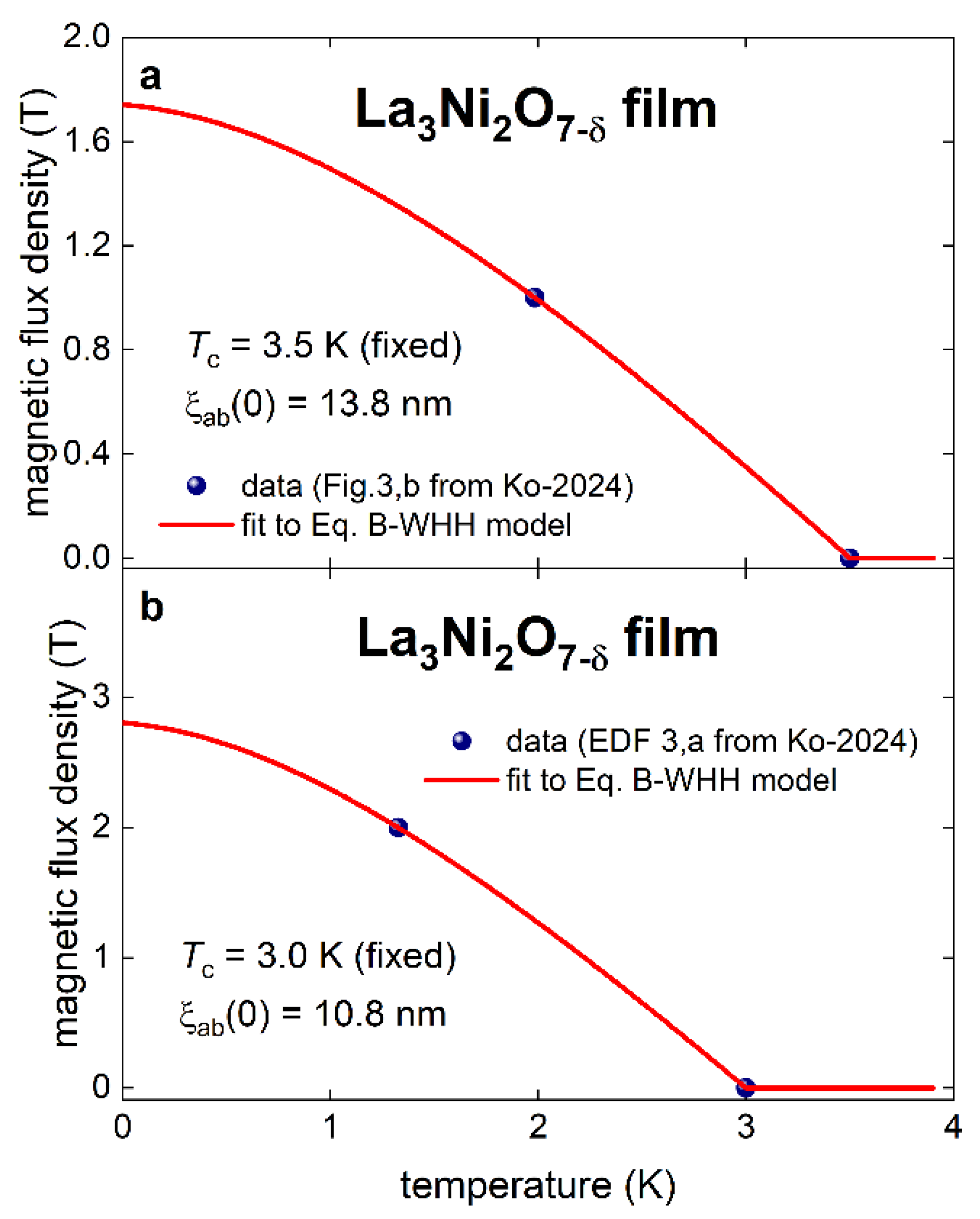
Figure 2.
The self-field critical current density, , for the ambient pressure La3Ni2O7-δ film [1] (reported by Ko et al [1] in their Figure 3,a [1]) and data fit to the single band model (Eq. 16) with symmetry of (a) s-wave (Eqs. 17,18, fit quality R = 0.9575); (b) d-wave (Eqs. 18-20, fit quality R = 0.9810); and (c) polar p-wave (Eqs. 22-25, fit quality R = 0.9849). Derived parameters are shown in each panel. was assumed for all fits.
Figure 2.
The self-field critical current density, , for the ambient pressure La3Ni2O7-δ film [1] (reported by Ko et al [1] in their Figure 3,a [1]) and data fit to the single band model (Eq. 16) with symmetry of (a) s-wave (Eqs. 17,18, fit quality R = 0.9575); (b) d-wave (Eqs. 18-20, fit quality R = 0.9810); and (c) polar p-wave (Eqs. 22-25, fit quality R = 0.9849). Derived parameters are shown in each panel. was assumed for all fits.
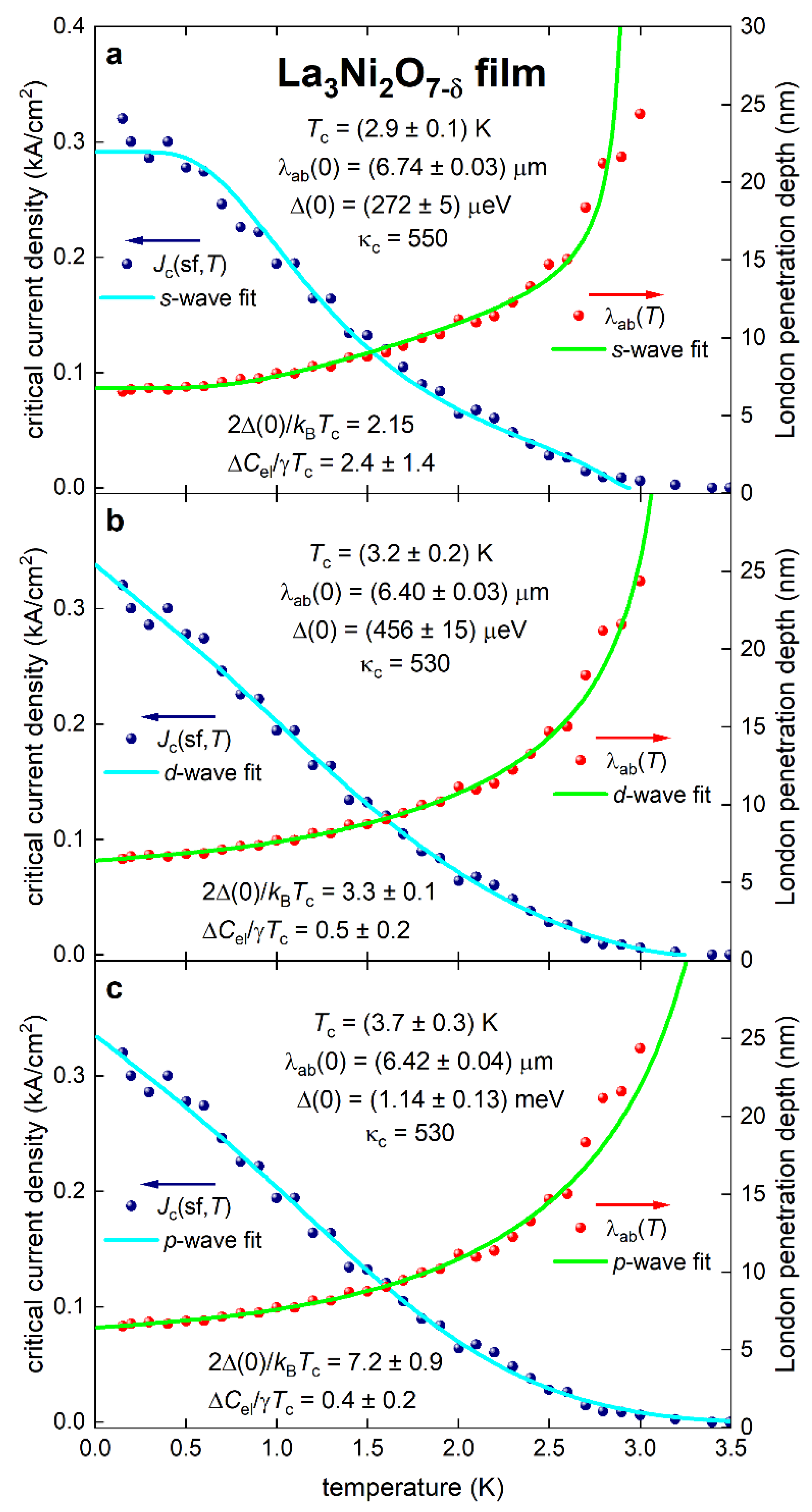
Figure 3.
The self-field critical current density, , for the ambient pressure La3Ni2O7-δ film [1] (reported by Ko et al [1] in their Figure 3,a [1]) and data fit to two-band (s- + s-)-wave model (Eq. 29). The restriction of has been implemented. Fit quality is R = 0.9674. Derived parameters are shown. was assumed. (a) data and fitting curves are shown for data; (b) data and fitting curves are shown for data.
Figure 3.
The self-field critical current density, , for the ambient pressure La3Ni2O7-δ film [1] (reported by Ko et al [1] in their Figure 3,a [1]) and data fit to two-band (s- + s-)-wave model (Eq. 29). The restriction of has been implemented. Fit quality is R = 0.9674. Derived parameters are shown. was assumed. (a) data and fitting curves are shown for data; (b) data and fitting curves are shown for data.
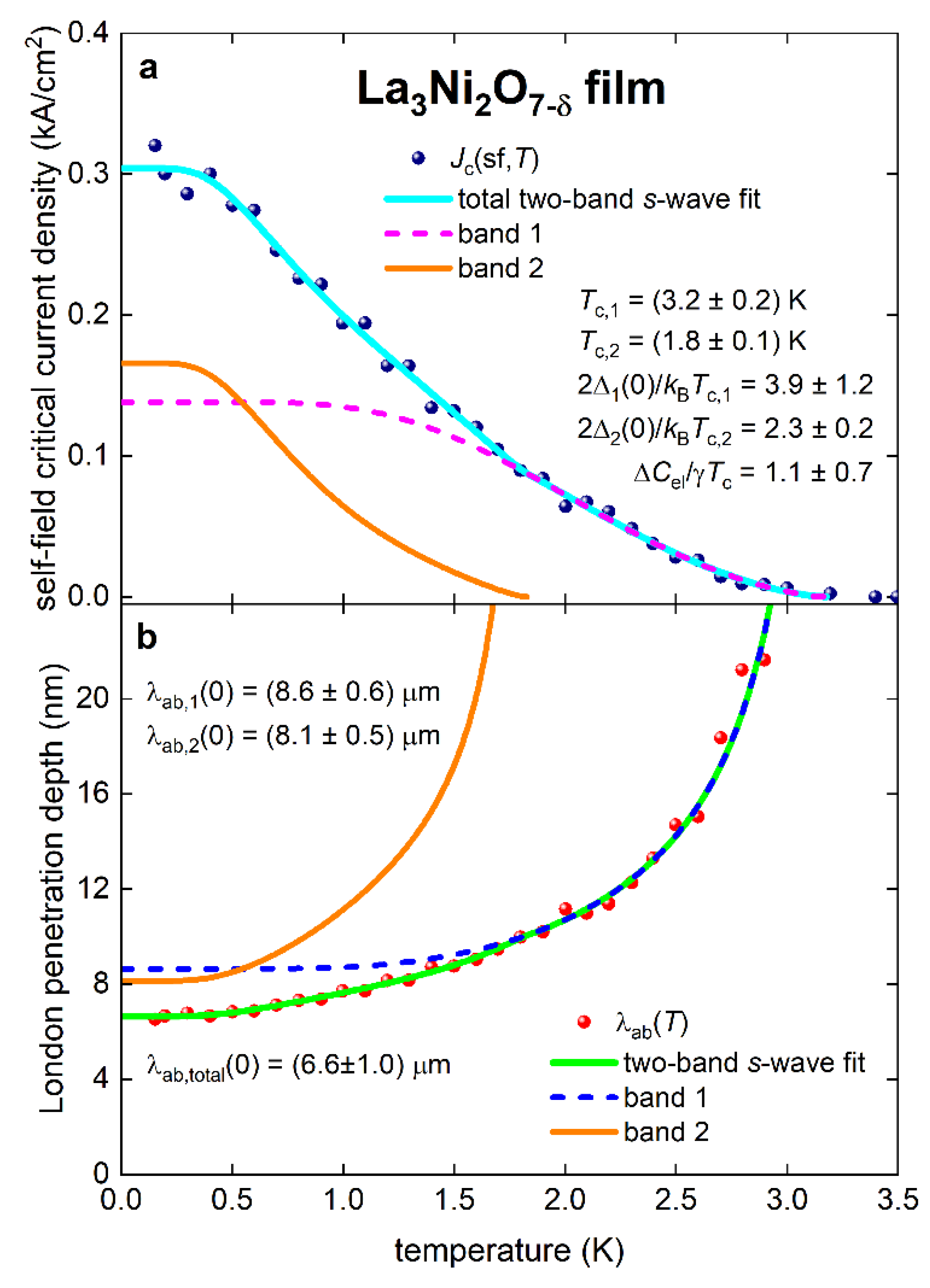
Figure 4.
data deduced from curves reported for the ambient pressure La2PrNi2O7-δ film [3] by applying criterion of . (a) data fit to the single band model (Eq. 3, fit quality R = 0.9779); (b) data fit to two-band model (Eq. 32, fit quality R = 0.9999). Derived parameters are shown.
Figure 4.
data deduced from curves reported for the ambient pressure La2PrNi2O7-δ film [3] by applying criterion of . (a) data fit to the single band model (Eq. 3, fit quality R = 0.9779); (b) data fit to two-band model (Eq. 32, fit quality R = 0.9999). Derived parameters are shown.
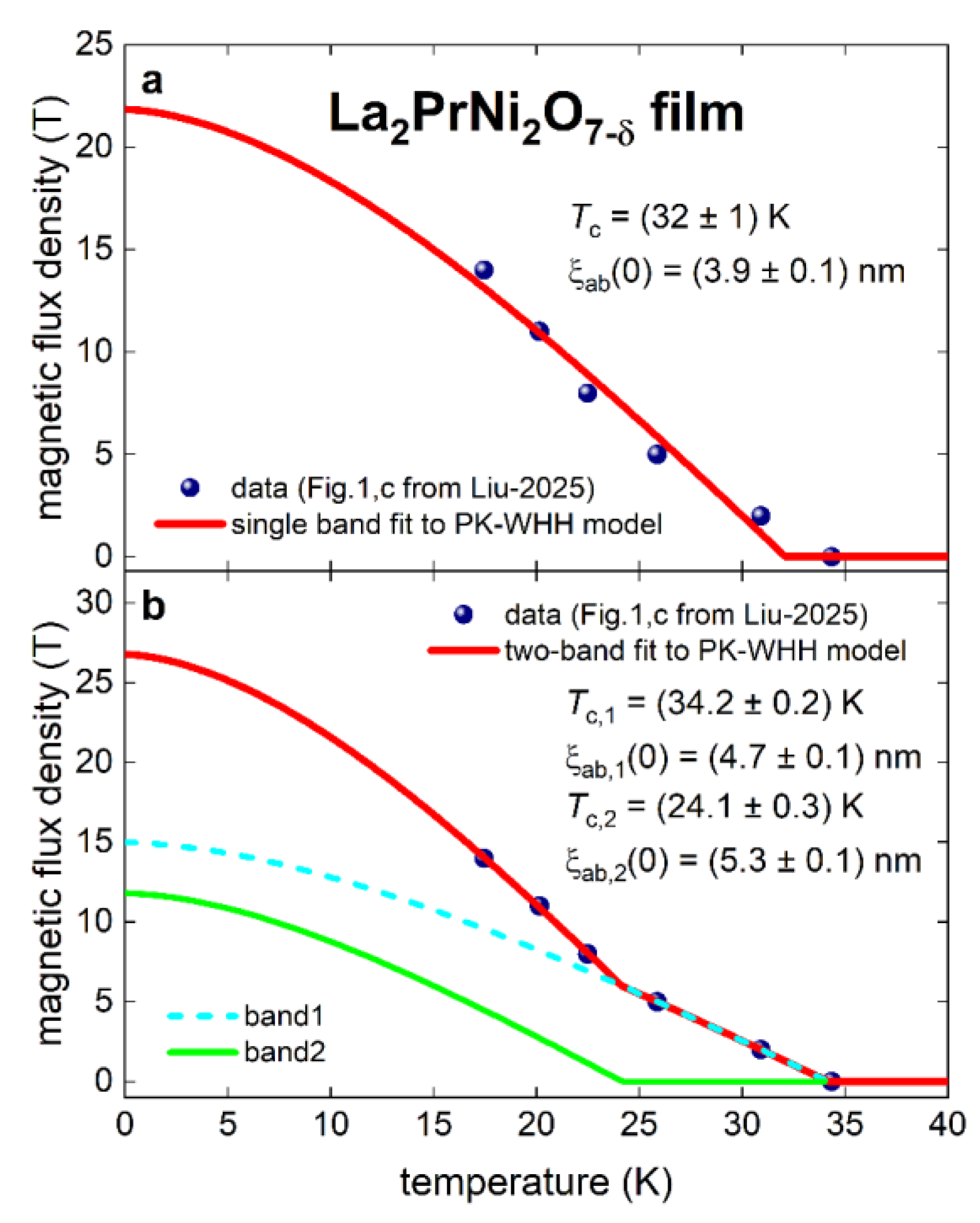
Figure 5.
The self-field critical current density, , in the ambient pressure La2PrNi2O7-δ film [3] (reported by Liu et al [3] in their Figure 1,b [3]) and data fit to the single band model (Eq. 16) with symmetry of (a) s-wave (Eqs. 17,18, fit quality R = 0.9303); (b) d-wave (Eqs. 18-20, fit quality R = 0.9830); and (c) polar p-wave (Eqs. 22-25, fit quality R = 0.9921). Derived parameters are shown in each panel. was assumed for all fits.
Figure 5.
The self-field critical current density, , in the ambient pressure La2PrNi2O7-δ film [3] (reported by Liu et al [3] in their Figure 1,b [3]) and data fit to the single band model (Eq. 16) with symmetry of (a) s-wave (Eqs. 17,18, fit quality R = 0.9303); (b) d-wave (Eqs. 18-20, fit quality R = 0.9830); and (c) polar p-wave (Eqs. 22-25, fit quality R = 0.9921). Derived parameters are shown in each panel. was assumed for all fits.
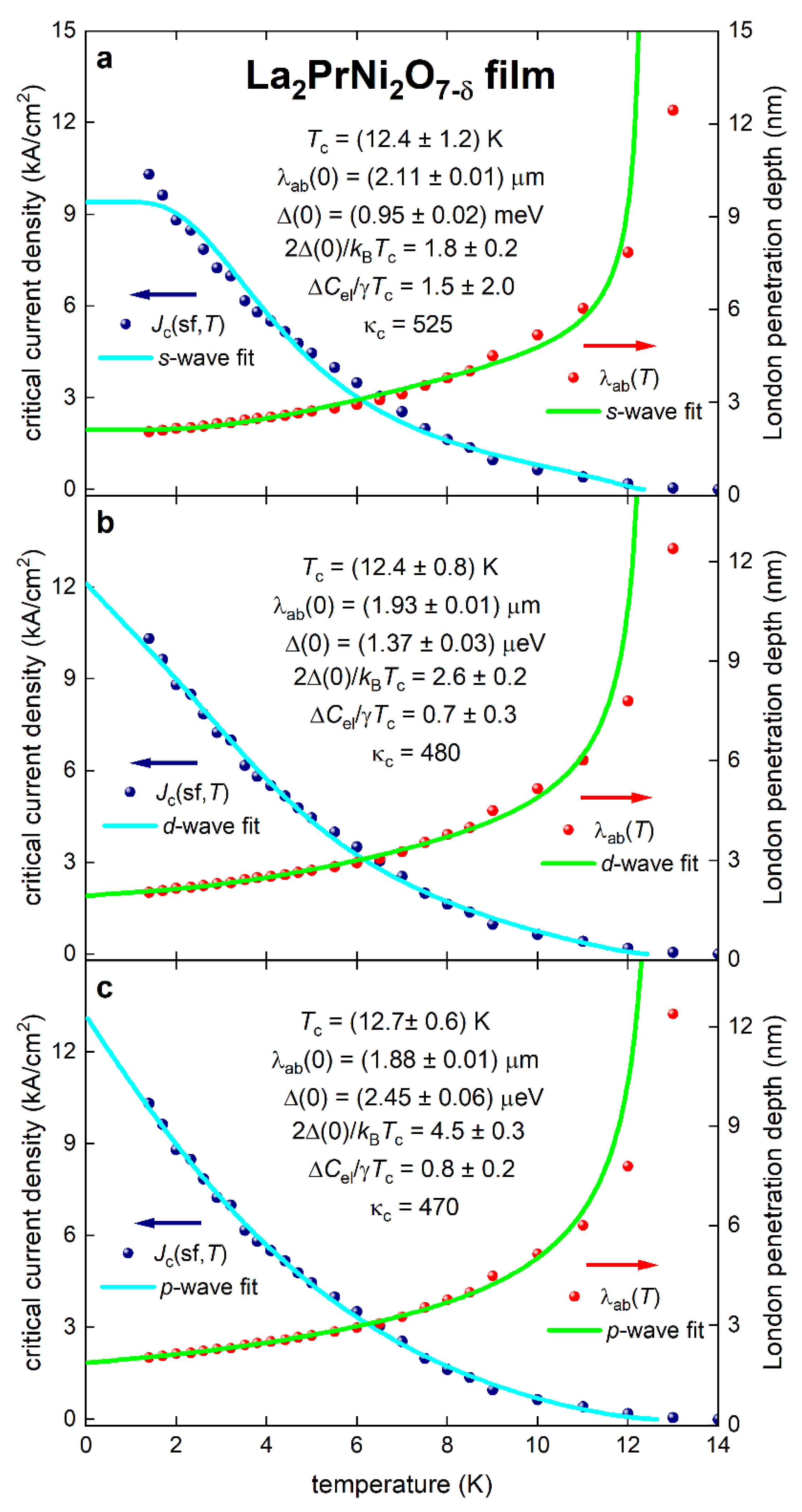
Figure 6.
The self-field critical current density, , in the ambient pressure La2PrNi2O7-δ film [3] (reported by Liu et al [3] in their Figure 1,b [3]) and data fit to two-band (s- + s-)-wave model (Eq. 29). The assumptions are: , , and . Fit quality is R = 0.9934. Derived parameters are shown. (a) data and fitting curves are shown for data; (b) data and fitting curves are shown for data.
Figure 6.
The self-field critical current density, , in the ambient pressure La2PrNi2O7-δ film [3] (reported by Liu et al [3] in their Figure 1,b [3]) and data fit to two-band (s- + s-)-wave model (Eq. 29). The assumptions are: , , and . Fit quality is R = 0.9934. Derived parameters are shown. (a) data and fitting curves are shown for data; (b) data and fitting curves are shown for data.
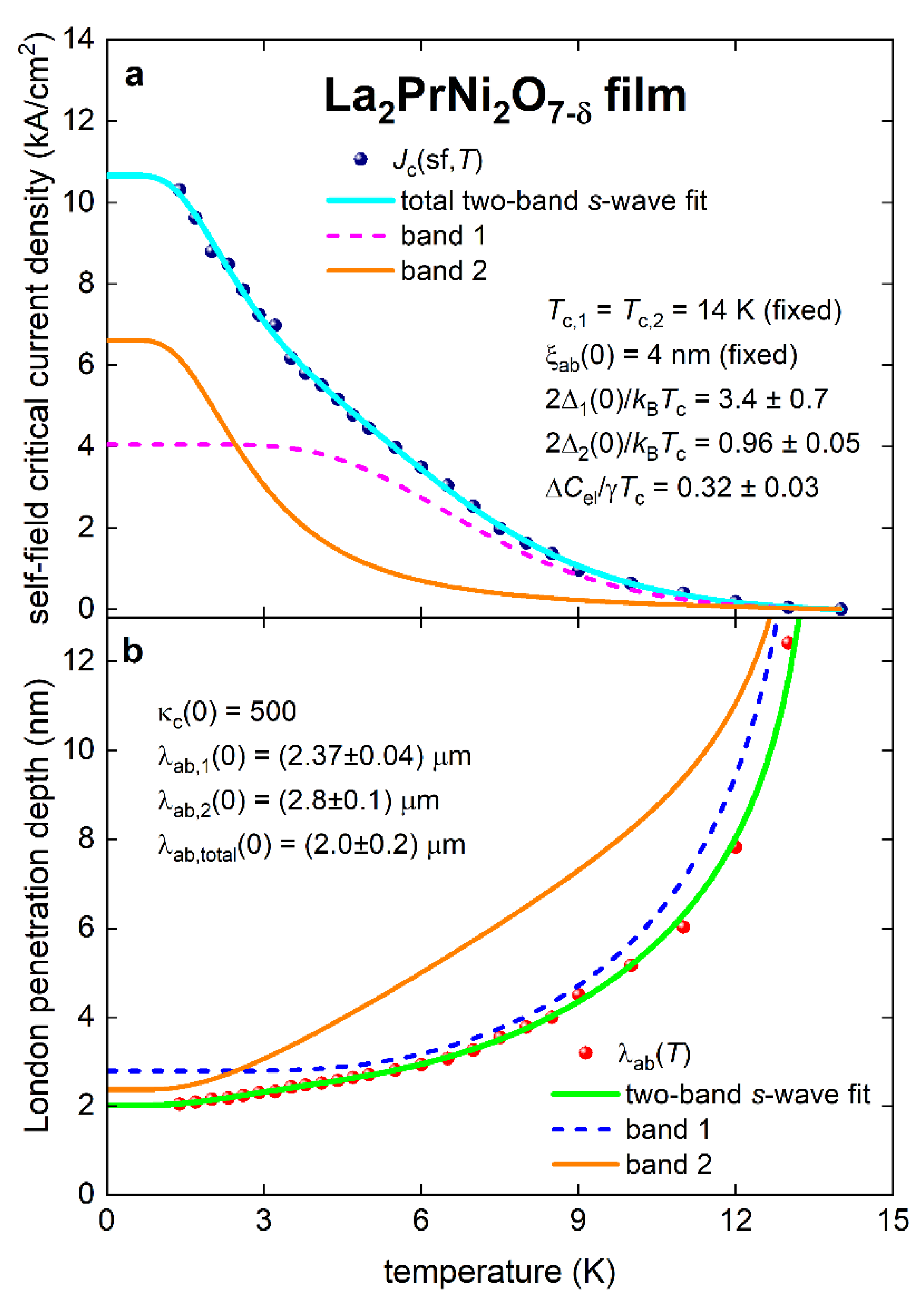
Figure 7.
The self-field critical current density, , in the ambient pressure La2PrNi2O7-δ film [3] (reported by Liu et al [3] in their Figure 1,b [3]) and data fit to two-band (d- + d-)-wave model (Eq. 29). The assumptions are: , , and . Fit quality is R = 0.9930. Derived parameters are shown. (a) data and fitting curves are shown for data; (b) data and fitting curves are shown for data.
Figure 7.
The self-field critical current density, , in the ambient pressure La2PrNi2O7-δ film [3] (reported by Liu et al [3] in their Figure 1,b [3]) and data fit to two-band (d- + d-)-wave model (Eq. 29). The assumptions are: , , and . Fit quality is R = 0.9930. Derived parameters are shown. (a) data and fitting curves are shown for data; (b) data and fitting curves are shown for data.
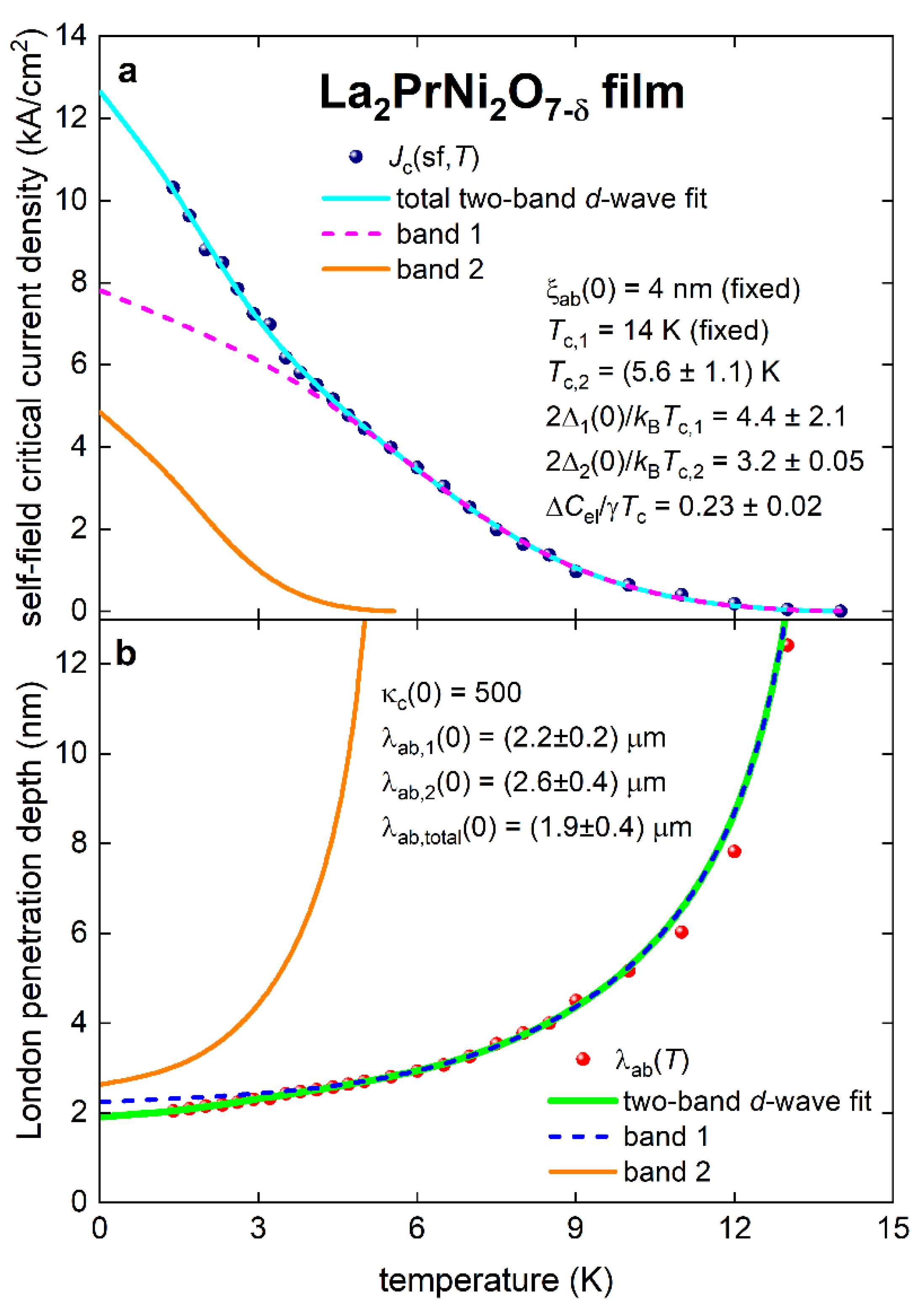
Figure 8.
data deduced from curves reported for the ambient pressure La3-xPrxNi2O7-δ (x = 0.15) film [2] by applying criteria of: (a) ; and (b) . Data fits to two band model (Eqs. 3,32). Fits quality (a) R = 0.9992; and (b) R = 0.9991. Derived parameters are shown.
Figure 8.
data deduced from curves reported for the ambient pressure La3-xPrxNi2O7-δ (x = 0.15) film [2] by applying criteria of: (a) ; and (b) . Data fits to two band model (Eqs. 3,32). Fits quality (a) R = 0.9992; and (b) R = 0.9991. Derived parameters are shown.
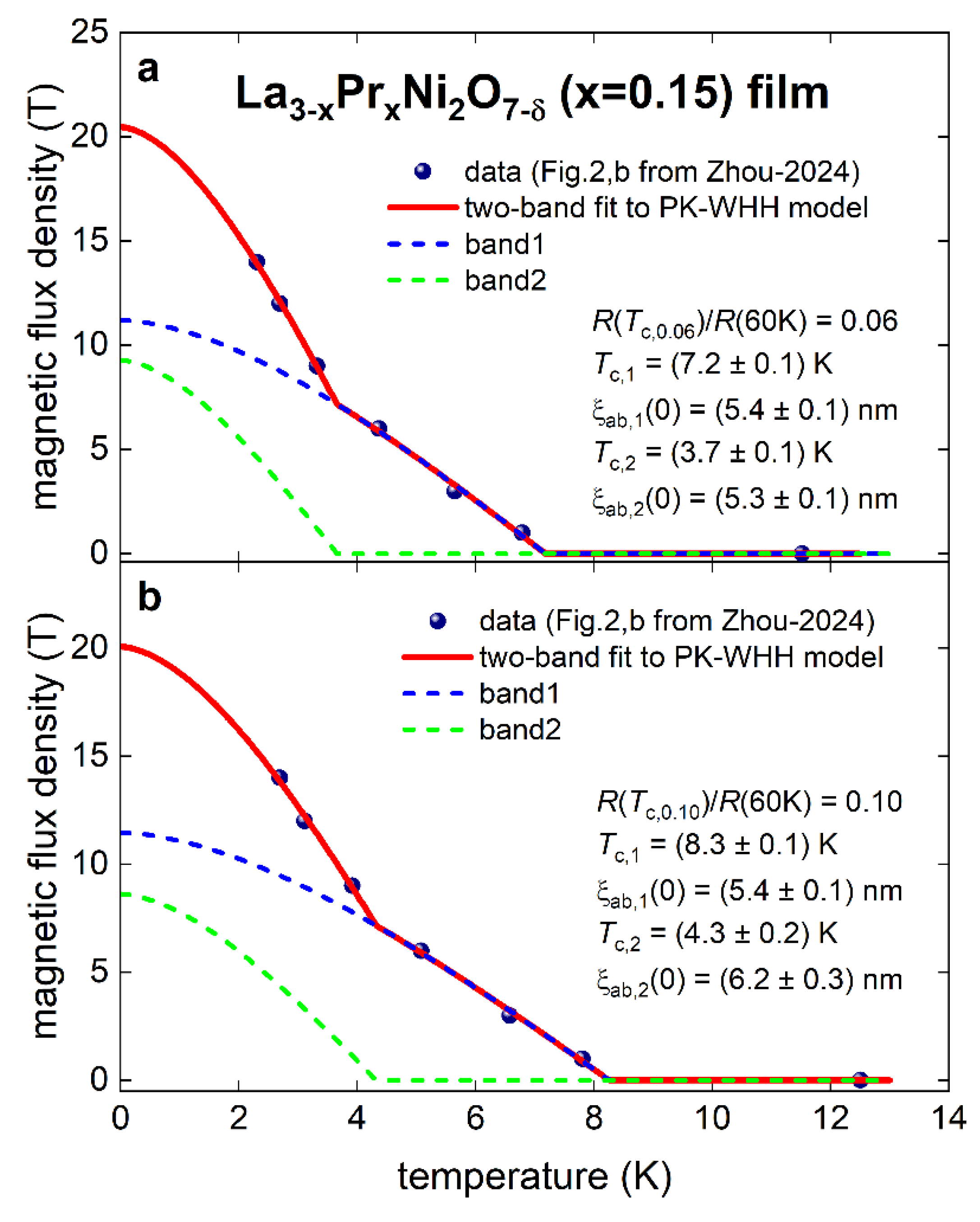
Figure 9.
The self-field critical current density, , in the ambient pressure La3-xPrxNi2O7-δ (x=0.15) film [3] (reported by Zhou et al [2] in their Figure 1,b [2,3]) and data fit to the single band weak-coupling model (Eqs. 16,26-28) with symmetry of (a) s-wave (Eqs. 17,18, fit quality R = 0.7962); (b) d-wave (Eqs. 18-20, fit quality R = 0.8916); and (c) polar p-wave (Eqs. 22-25, fit quality R = 0.9809). Derived parameters are shown in each panel. was assumed for all fits.
Figure 9.
The self-field critical current density, , in the ambient pressure La3-xPrxNi2O7-δ (x=0.15) film [3] (reported by Zhou et al [2] in their Figure 1,b [2,3]) and data fit to the single band weak-coupling model (Eqs. 16,26-28) with symmetry of (a) s-wave (Eqs. 17,18, fit quality R = 0.7962); (b) d-wave (Eqs. 18-20, fit quality R = 0.8916); and (c) polar p-wave (Eqs. 22-25, fit quality R = 0.9809). Derived parameters are shown in each panel. was assumed for all fits.
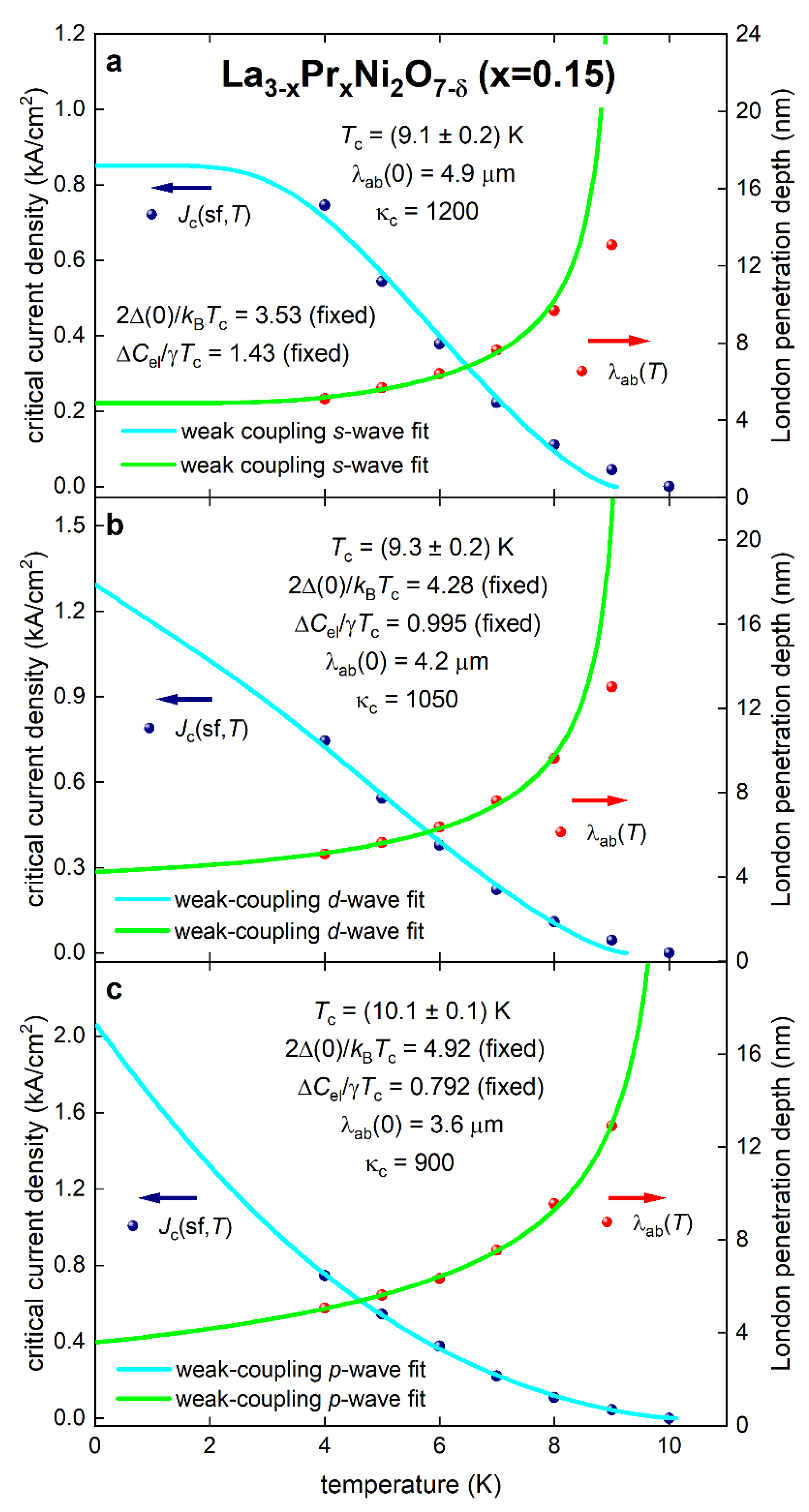
Figure 10.
defined at for highly compressed La3Ni2O7-δ single crystal [24] (reported by Zhang et al. [24]) and data fit to two-band model (Eqs. 3,32) for applied pressure (a) (fit quality R = 0.9998); and (b) (fit quality R = 0.9989). Derived parameters are shown.
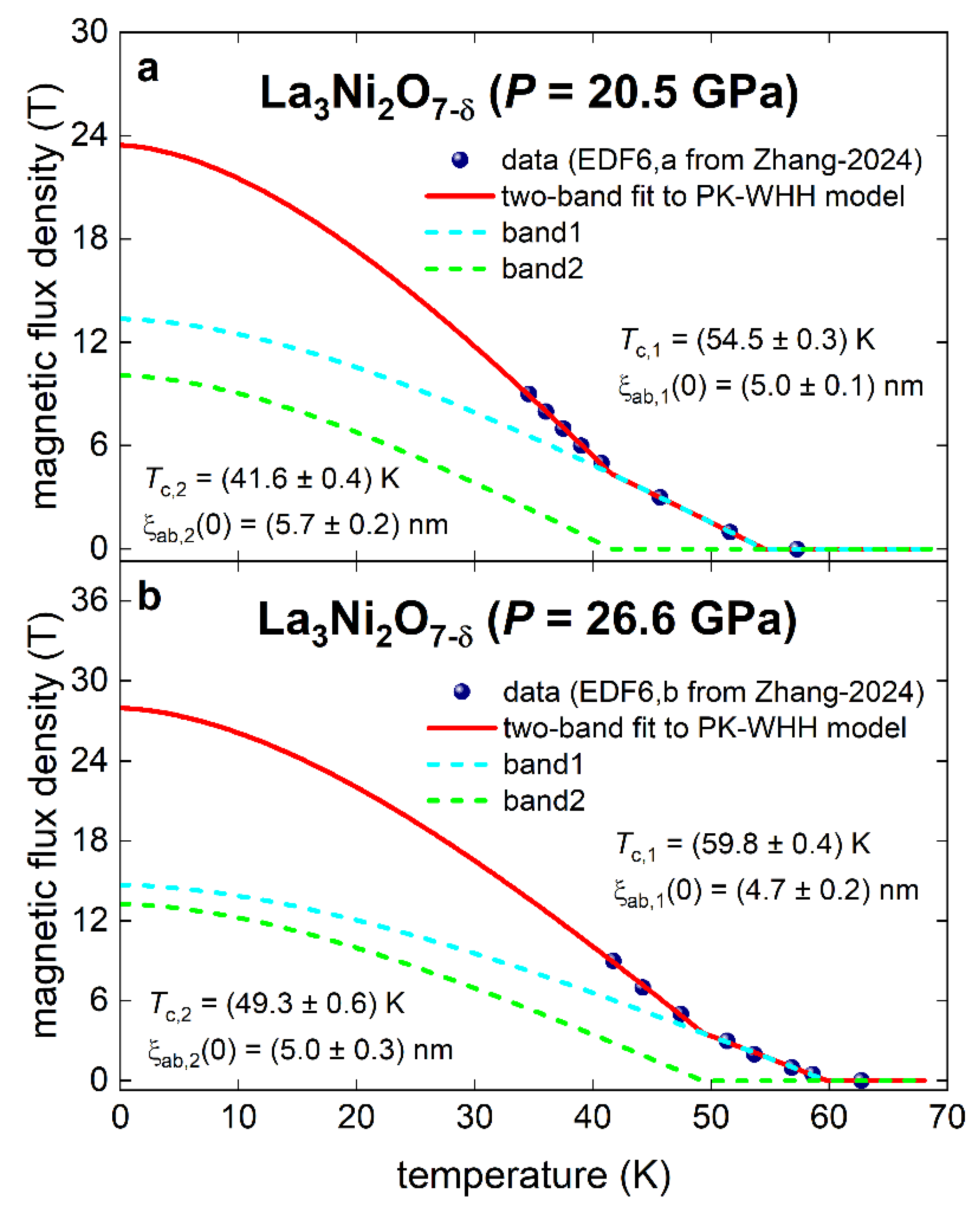
Figure 11.
defined by criterion for highly compressed La2PrNi2O7-δ polycrystal [96] (reported by Wang et al. [96]) and data fit to two-band model (Eqs. 3,32) for applied pressure (fit quality R = 0.9998). Derived parameters are shown.
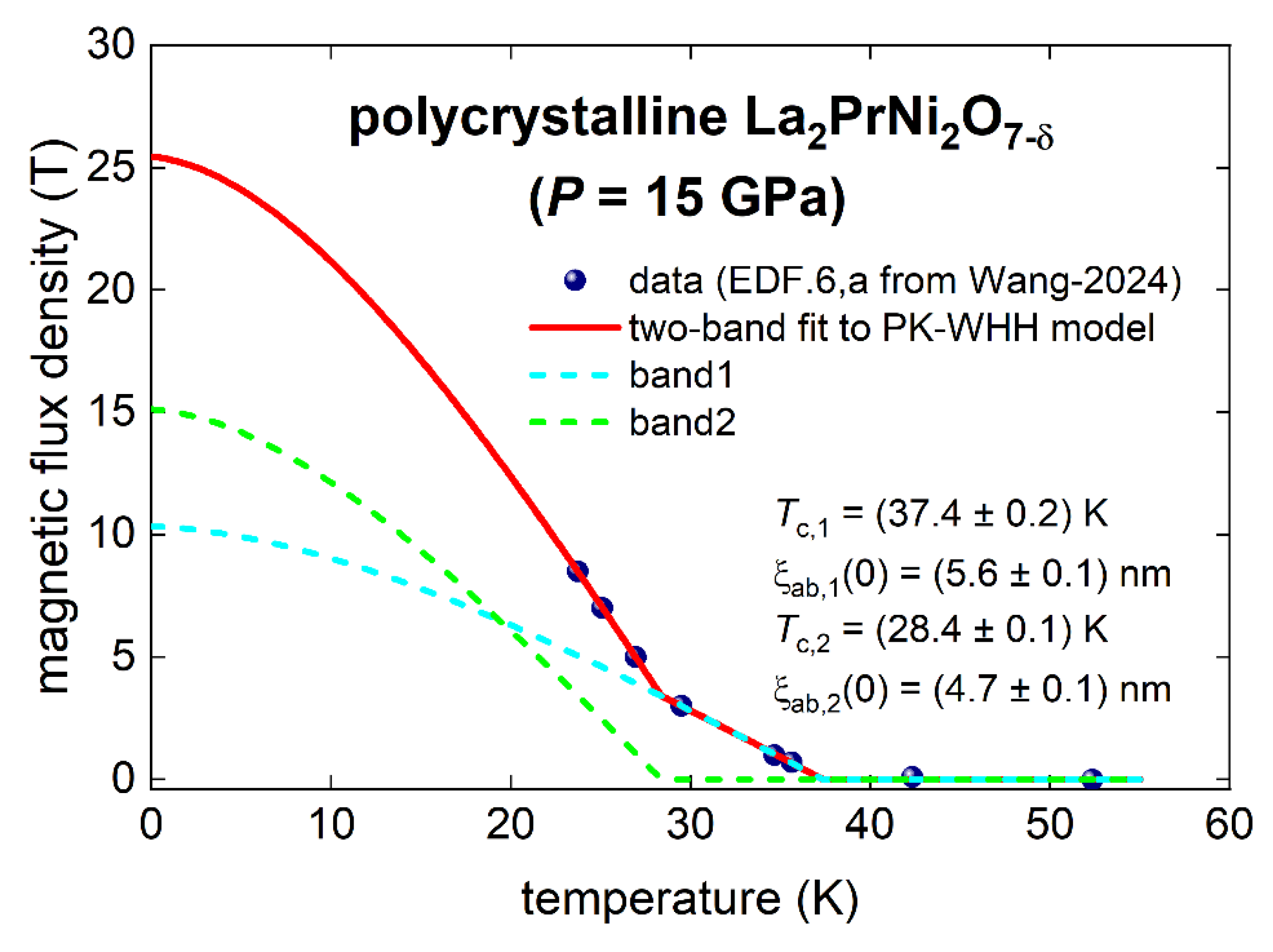
Figure 12.
defined by the following criteria: (a) , (b) , (c,d) in highly compressed La4Ni3O10-δ single crystal [97] (reported by Zhu et al. [97]) and data fit to two-band model (Eqs. 3,32) for measurements performed at applied pressure: (a) (fit quality R = 0.9993); (b) (fit quality R = 0.9991); (c) (fit quality R = 0.9997); (d) (fit quality R = 0.9992). Derived parameters are shown.
Figure 12.
defined by the following criteria: (a) , (b) , (c,d) in highly compressed La4Ni3O10-δ single crystal [97] (reported by Zhu et al. [97]) and data fit to two-band model (Eqs. 3,32) for measurements performed at applied pressure: (a) (fit quality R = 0.9993); (b) (fit quality R = 0.9991); (c) (fit quality R = 0.9997); (d) (fit quality R = 0.9992). Derived parameters are shown.
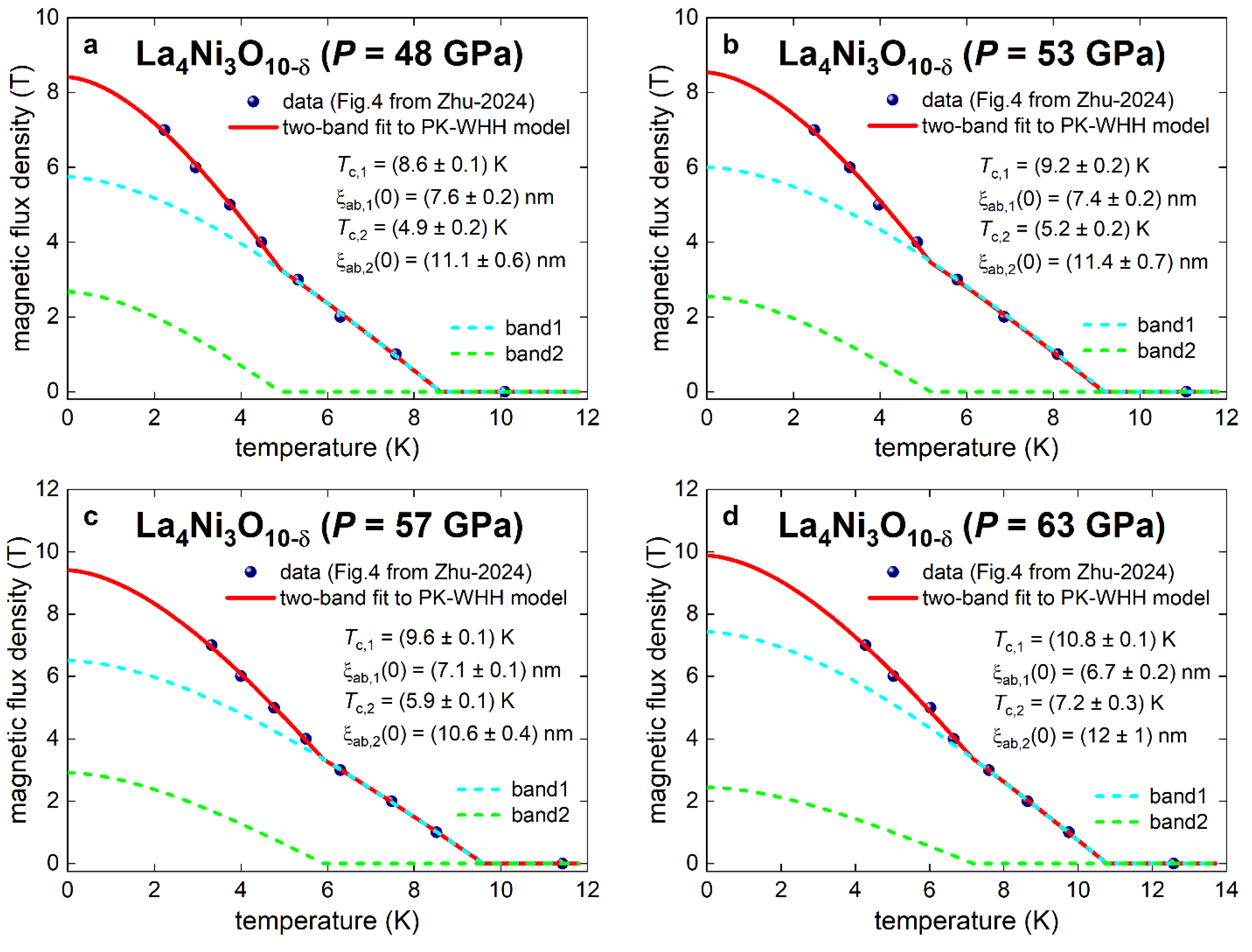
Figure 13.
data deduced from curves reported for the ambient pressure La3Ni2O7-δ film reported in Figure 3,b [1] by applying criteria of . Data fits to two-band model (Eqs. 3,32). Fit quality is R = 0.9973. Derived parameters are shown.
Figure 13.
data deduced from curves reported for the ambient pressure La3Ni2O7-δ film reported in Figure 3,b [1] by applying criteria of . Data fits to two-band model (Eqs. 3,32). Fit quality is R = 0.9973. Derived parameters are shown.
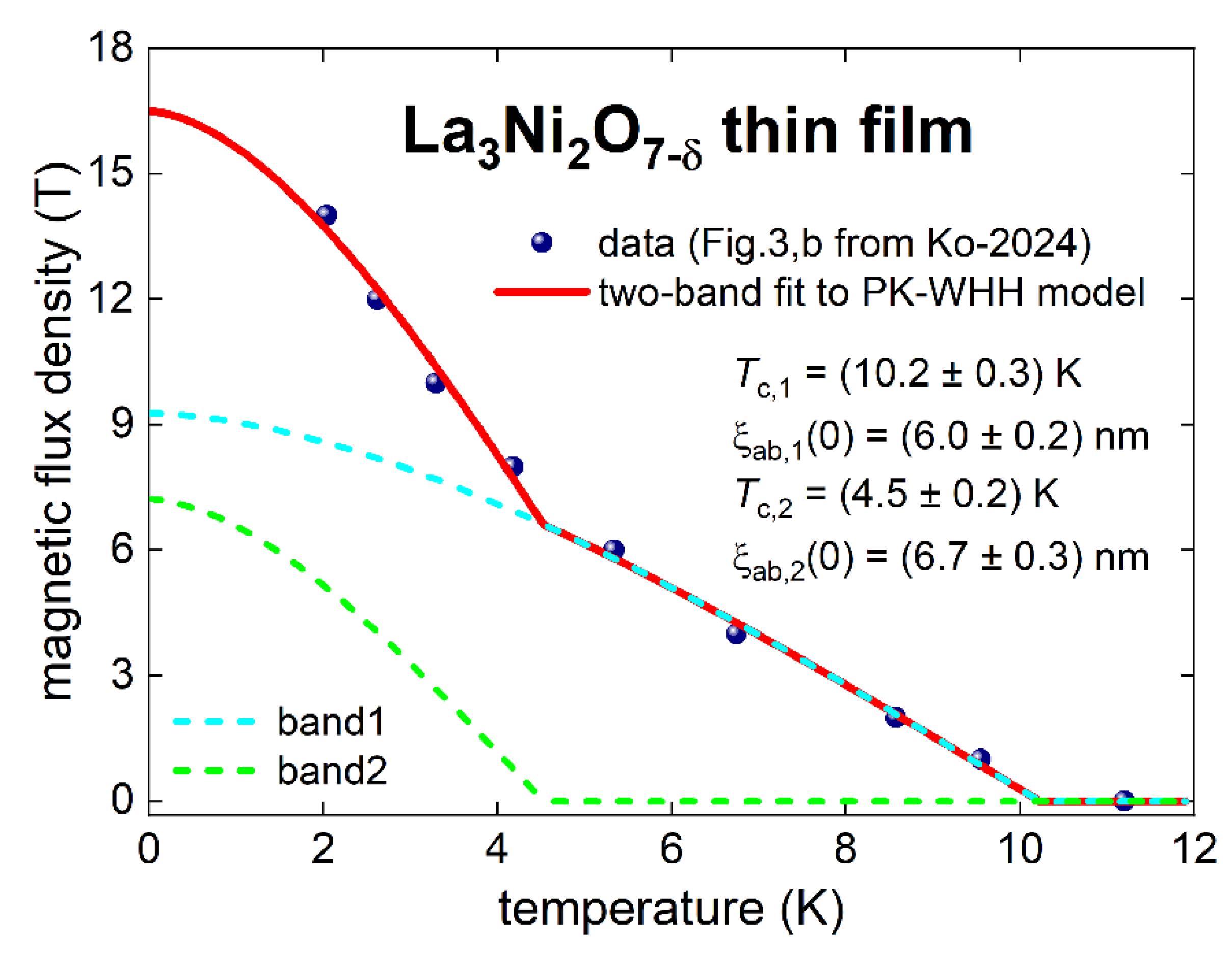
Figure 14.
data deduced from curves reported for the ambient pressure single-unit-cell La6Ni5O12 film reported in Figure 1,c [98] and by applying criteria of . Data fits to two-band model (Eqs. 3,32). Fit quality is R = 0.9973. Derived parameters are shown.
Figure 14.
data deduced from curves reported for the ambient pressure single-unit-cell La6Ni5O12 film reported in Figure 1,c [98] and by applying criteria of . Data fits to two-band model (Eqs. 3,32). Fit quality is R = 0.9973. Derived parameters are shown.
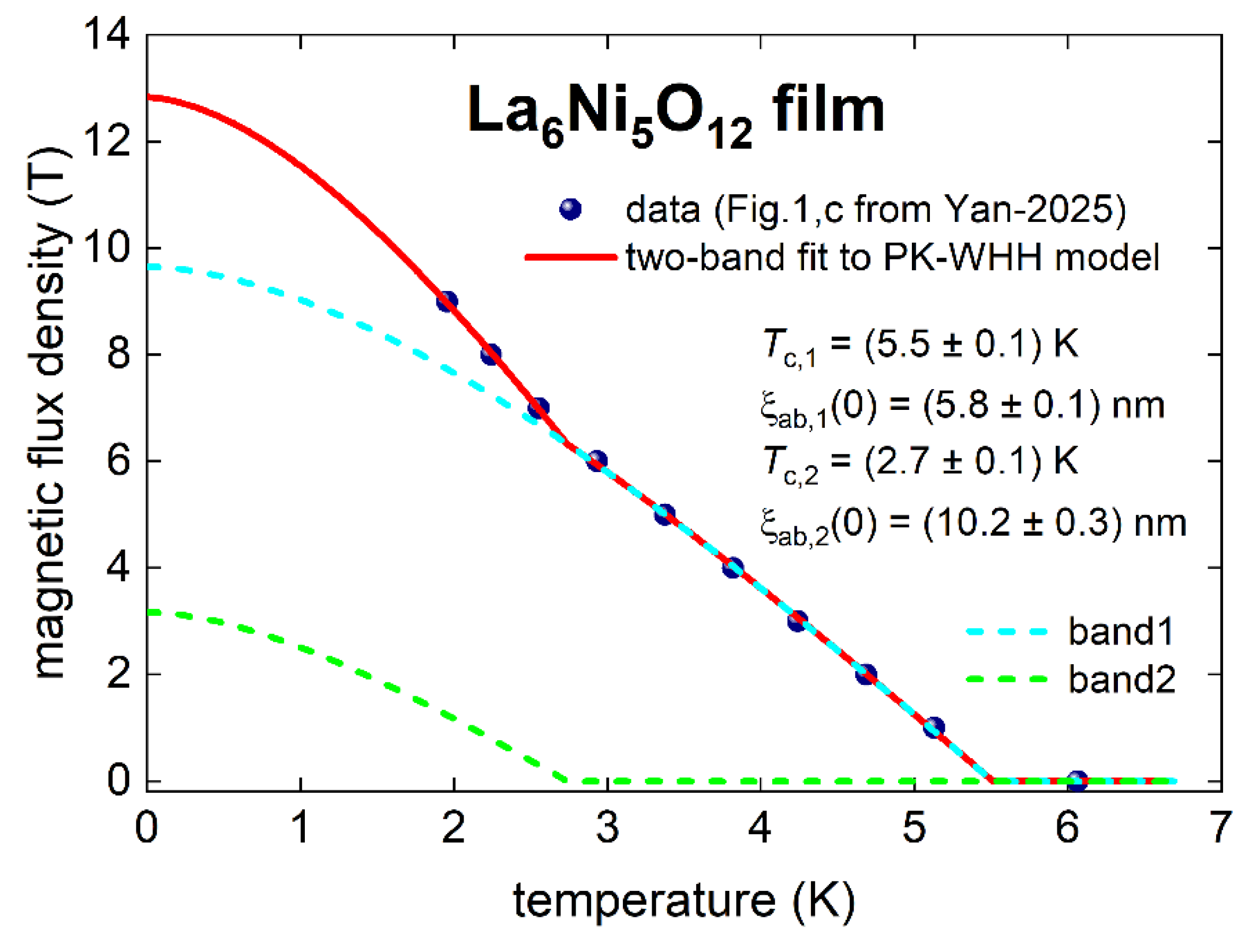
Figure 15.
defined by the following criteria: (a) and (b) in highly compressed Pr4Ni3O10-δ single crystal [99] (reported by Chen et al. [99]) and data fit to two-band model (Eqs. 3,32) for measurements performed at applied pressure: (a) (fit quality is R = 0.9983) and (b) (fit quality is R = 0.9988). Derived parameters are shown.
Figure 15.
defined by the following criteria: (a) and (b) in highly compressed Pr4Ni3O10-δ single crystal [99] (reported by Chen et al. [99]) and data fit to two-band model (Eqs. 3,32) for measurements performed at applied pressure: (a) (fit quality is R = 0.9983) and (b) (fit quality is R = 0.9988). Derived parameters are shown.
Disclaimer/Publisher’s Note: The statements, opinions and data contained in all publications are solely those of the individual author(s) and contributor(s) and not of MDPI and/or the editor(s). MDPI and/or the editor(s) disclaim responsibility for any injury to people or property resulting from any ideas, methods, instructions or products referred to in the content. |
© 2025 by the authors. Licensee MDPI, Basel, Switzerland. This article is an open access article distributed under the terms and conditions of the Creative Commons Attribution (CC BY) license (http://creativecommons.org/licenses/by/4.0/).
Copyright: This open access article is published under a Creative Commons CC BY 4.0 license, which permit the free download, distribution, and reuse, provided that the author and preprint are cited in any reuse.


