
Submitted:
01 February 2025
Posted:
03 February 2025
You are already at the latest version
Abstract
This review examines advanced methodologies for optimal power flow (OPF) in integrated energy systems (IES), highlighting the integration of diverse energy forms like electricity, heat, and gas. It focuses on decoupled algorithms and developments for gas-electric systems and the impact of renewable energy sources and electric vehicles, which introduce significant uncertainties into OPF. The paper also addresses the cybersecurity challenges, especially false data injection risks. Future directions include advancing predictive control systems, improving energy storage, and evolving regulatory frameworks to facilitate sustainable IES development. This synopsis aims to guide future research efforts in enhancing the efficiency and reliability of multi-energy systems.
Keywords:
integrated energy systems
; optimal power flow
; renewable energy integration
; electric vehicle integration
; cybersecurity
; multi-energy flow optimization
1. Introduction
With industrial and economic development, global resources are increasingly strained. The energy internet, characterized by openness, low carbon, efficiency, and sustainability, has become a central theme in the energy sector’s development [1,2,3]. In traditional energy sectors, separate planning and operation of different energy systems ignore the complementary and substitutive relationships between energies, which is not conducive to energy efficiency improvement. Integrated energy systems (IESs) achieve the cascaded utilization of multiple forms of energy such as electricity, heat, cold, and gas, enhancing energy conversion efficiency and end-use efficiency, reducing energy transmission losses, and ensuring the safe and reliable supply of social energy. It promotes the consumption of renewable energy and energy conservation and emission reduction [4,5].
IESs have become a major strategic research direction and a technological high point in the international energy field. Europe first proposed the concept of integrated energy systems and conducted research on multi-energy coordination optimization and integrated energy systems through EU framework projects, with active development in various European countries [6,7]. The United States emphasized the necessity of integrated energy planning through the Energy Independence and Security Act of 2007 [8]. Canada focuses on building community integrated energy systems to achieve the 2050 greenhouse gas reduction targets, planning extensive national coverage [9,10]. Japan, one of the earliest Asian countries to study integrated energy systems, proposed the “Strategic Energy Plan of Japan” in 2010, developing electricity and natural gas supply systems with safety, environmental protection, and efficiency as starting points [11].
Research on IESs in China is currently in the development stage. Since the reform and opening up, the total supply and demand of energy in China have continuously grown, bringing many challenges: prominent issues in renewable energy consumption, high carbon emissions, and low energy utilization rate [12]. After intense construction of power grids and energy systems, China’s energy development is turning towards innovation-driven, focusing more on the comprehensive and optimized use of energy. Over the past decade, China has conducted related experiments on integrated energy systems. In 2003, heat pump technology was attempted for regional centralized cooling, and in 2008, a comprehensive energy station for regional heating and cooling was realized [13]. After 2010, the Power-to-Gas technology that emerged in Germany became a research hotspot in various countries. Since 2014, China has successively started large-scale wind power to hydrogen projects, accelerating the construction of interconnected electricity and gas networks [14]. In 2017, the National Energy Administration announced 23 first-batch multi-energy complementary integrated optimization demonstration projects, including 17 terminal integrated energy supply systems and 6 multi-energy complementary supply systems involving wind, solar, water, fire, and storage [15]. At the beginning of 2019, the State Grid Corporation of China released the “Action Plan for Promoting the Development of Integrated Energy Services 2019-2020” emphasizing the importance of the integrated energy service sector [16].
Optimal power flow (OPF) in integrated energy systems studies the complementary and coordinated optimization of heterogeneous energy subsystems based on power flow calculations, which is of great significance for their safe, stable, and economical operation. Currently, the study of OPF in power systems has been extensively researched both domestically and internationally, but the models and theories of energy routes for IESs are not yet mature, and their OPF research is still in the basic development stage. In terms of system scale and coupling intensity, most research on OPF is in electric-thermal or electric-gas combined systems, with less research on systems with strong coupling such as electric-thermal-gas. From an algorithmic perspective, compared to OPF in power systems, there are relatively fewer multi-energy flow optimal algorithms applied to integrated energy systems. In terms of optimization objectives, current OPF studies for integrated energy systems mostly focus on single-objective optimization problems, such as minimum economic or environmental costs, with less involvement in multi-objective optimal planning. Reference [17] studied a dynamic OPF algorithm for a gas-electric integrated energy system. Based on the different response times of natural gas and electricity, transient natural gas flow and steady-state electric power flow were combined to form a dynamic OPF model for the gas-electric combined system; further transforming the optimization problem into a single-stage linear programming, optimal operation strategies for the natural gas and electric power systems were obtained.
Through simulation examples, the effectiveness of the dynamic OPF model and algorithm was verified, reflecting that this model can be used for decision support in the coordinated planning and operation of natural gas and electric power systems. Reference [18] studied the multi-period optimal energy flow and energy pricing problems of carbon emission-embedded integrated energy systems involving electricity, natural gas, and district heating. First, a direct current electric power flow model, natural gas pipeline flow model, and heating network energy flow model were established, and the optimization problem was linearized, thereby establishing an optimal scheduling model for the integrated energy system; then, based on this optimal scheduling model, the locational marginal prices for electricity, natural gas, and heating networks were determined, and carbon emissions caused by energy production were considered during the pricing process. Among many classic optimization algorithms, the interior-point method has the characteristics of good convergence and robustness and has been widely applied to various OPF planning problems. Reference [19] established a coupled OPF model for gas-electric integrated energy systems and environmental systems and used the interior-point method for computational analysis to determine the impact of environmental factors on the system. Reference [20] constructed an OPF model for an electric-thermal combined system with the total coal consumption of the system as the objective and used the interior-point method for simulation, verifying the effectiveness of this optimal model. Reference [21] proposed a generalized model and intelligent optimization method for the coupled multi-energy flow of heterogeneous supply networks. First, an OPF model for an electric-gas combined system including an energy hub was constructed; then, a multi-agent genetic algorithm was used to decompose the multi-energy flow optimization problem into traditional single-system OPF problems. Through example tests, the expected applicability and robustness of this method were proven. Reference [22] applied the improved non-dominated sorting genetic algorithm and distributed reinforcement learning algorithm to the multi-energy flow optimization problems in regional integrated energy systems, respectively.
To better carry out related research work on integrated energy systems, this paper explores the research status of OPF in integrated energy systems. Firstly, the definition and structure of integrated energy systems are introduced; secondly, the decoupling algorithm and the OPF model of the gas-electric integrated energy system are introduced; thirdly, existing and commonly used OPF calculation methods for integrated energy systems are summarized and introduced; finally, the paper is concluded, pointing out the current shortcomings in the calculation of OPF in integrated energy systems, future research trends, and prospects.
2. Integrated Energy Systems
2.1. Definition of IESs
An integrated energy system refers to a system within a defined area that utilizes advanced information management technology to integrate the production, transmission, distribution, conversion, storage, and consumption of various energy sources such as electricity, heat, and natural gas. This system achieves organic coordination and optimization of multiple forms of energy, promoting a sustainable development of energy production, supply, and marketing systems [23].
2.2. Structure of Integrated Energy Systems
An IES typically consists of energy supply networks (electricity, heating/cooling, gas networks), coupling components, energy storage devices, and load units. Taking an IES that includes electricity, heat, and gas as an example, its structure is illustrated in Figure 1 [24].
In Figure 1, the power network generally includes photovoltaic systems, wind power, or other renewable energy generation systems; the thermal network consists of heat sources, and water supply networks with identical topology to the return water networks [25,26]; the natural gas network is composed of gas sources, gas pipelines, and compressors, which are driven by gas turbines or electric motors to ensure a certain gas pressure and maintain stable gas supply; coupling devices include combined heat and power units, electric boilers, power-to-gas devices, gas turbines, and gas boilers, capable of transforming energy between different forms; energy storage devices include electrical energy storage, thermal storage, and gas storage tanks, maintaining the dynamic balance of multi-energy sources, which benefits the flexibility and economic efficiency of the system operation.
3. OPF Decoupling Algorithm of IESs
3.1. Overview of OPF Problems in IESs
Adopting MCES is an innovative solution, leading to the proposal of combined modeling and analysis of energy networks. Reference [27] attempts to study the impact of integrated energy systems on the reliability levels of power systems. Reference [28] conducted research on the optimal integration of MCES through power flow studies, providing a method for the unified optimization of MCES. Reference [29] introduced a generic modeling method with some simplifying assumptions, proposing a mathematical model for OPF in multi-energy systems. Operations research related to MCES systems can be divided into two separate steps: optimal scheduling within and between hubs. Based on Energy Hubs (EH) and energy network safety constraints, the optimal operating strategy for the energy system, known as multi-energy OPF, is determined. Mathematically, it is a challenging non-convex nonlinear constrained optimization problem. By knowing the optimal operating state, the optimal EH inputs, various EH scheduling factors, and network flows can be obtained. The MCOPF problem can be represented in a non-linear structure as follows:
where F is the vector of different energy flows; v represents the scheduling factors; is the related equal constraints of the MCOPF problem; and are respectively the upper and lower vectors of the input energy vector。This paper aims to minimize the total energy cost as the objective, and the feasible domain of this optimization problem is defined by some practical equal and unequal constraints. During the optimization process, flow equations related to EH and the energy network must be satisfied as equal constraints。
3.2. General Structure after Decoupling the MCOPF
In the MCES system, the required quantity of each energy carrier is a function of the energy load and the conversion efficiency related to the Energy Hubs (EH):
In the equation: N represents the scheduling matrix; other variables are as previously defined. By calculating the inverse of matrix c, the demand for each energy carrier at the EH input ports can be determined. Once the load is established, the MCOPF problem can be transformed into a decomposed OPF problem.
To obtain a constant matrix c, both the efficiency matrix and the scheduling matrix must be constants. Additionally, during the optimization process of the MCOPF problem, this paper proposes a decomposition algorithm, the main process of which is shown in Figure 2. This two-layer MCOPF model introduces how to coordinate the scheduling of energy carriers. It consists of two main modules: in the first module, a superior heuristic method is adopted, with decision variables for the MCOPF problem being predetermined.
3.3. Mathematical Representation of the MCOPF
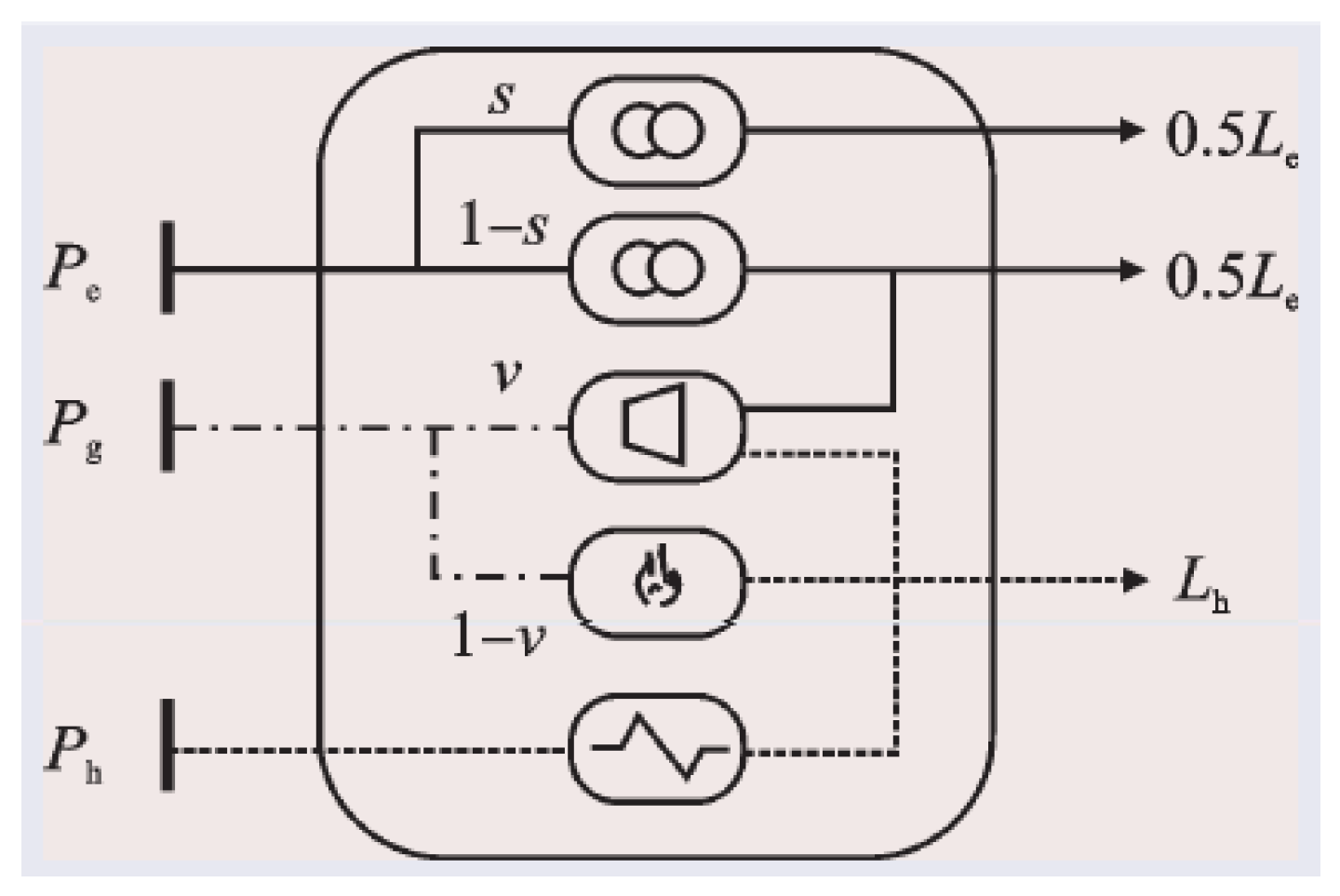
To transform these equations into deterministic equations, a new strategy based on the concept of virtual variables is proposed. The main idea is to introduce some virtual transformers that have the same characteristics as those in the original EH, thus regularizing the input-output relationship of the improved hub. Therefore, the hub that has not been studied is replaced by the EH as shown in Figure 3, whose input-output model can be represented by
The parameters in Figure 3 represent a virtual variable, which determines how the electricity received through the electrical network should be distributed between the transformers and the virtual transformers. Thus, this variable, in addition to being used for the virtual transformers, also plays the same role as scheduling factors. To utilize this method to solve the MCOPF problem, slack variables must also be used as decision variables in the optimization process.
4. Gas-Electric IES OPF Model
4.1. Gas-Electric IESs
The gas-electric integrated energy system, as a future method for efficient energy use and management, has been extensively validated in terms of its construction model, research approach, and significance [30]. Reference [31] uses a one-dimensional compressible flow equation to simulate the behavior of natural gas in pipelines and, combined with electric power system flow calculations, proposes a hybrid load analysis method for gas-electric integrated energy systems. Reference [32] jointly formulates the natural gas and electricity system equations, establishes the Jacobian matrix, and solves the IES flow using a unified method. Building on this, Documents [33,34] respectively study the effects of gas temperature, natural gas quality, and injection points on the steady state of the gas-electric integrated energy system. Reference [35] examines the impact of bidirectional energy conversion and changes in wind turbine output on the steady state of the integrated system. These studies focus on addressing the mathematical problems associated with simulating the coupling in gas-electric integrated energy systems, transforming influencing factors into matrix-coupled parameters for unified solution. Although they provide quantitative analysis of the impact of coupled parameter changes on system flow, they do not construct system models from an optimization perspective and lack discussion on economic issues.
Reference [36] calculates the OPF of the gas-electric integrated energy system using the interior-point method within the electric power system. Reference [37] simplifies the natural gas network pipelines using the node-loop method in graph theory and solves the OPF of the gas-electric integrated energy system using an improved interior-point method, which enhances computational efficiency and convergence. Building on the OPF, Reference [38] considers the randomness of the load and employs the point estimation method based on Nataf transformation for probabilistic OPF calculations, while Documents [39,40] introduce carbon emission pricing and carbon trading mechanisms as cost elements into the planning of the gas-electric integrated energy system. Reference [41] considers environmental costs in the model of a multi-energy system with hybrid AC/DC grid supply and incorporates the costs of atmospheric pollutant management into the objective function to study the system’s energy supply optimization strategy.
4.2. Process and Steps
The interior-point method is used to solve the OPF coupling problem between the gas-electric integrated energy system and the environmental system. The specific process are listed as below.
Step 1: Initialize data, defining the operating ranges for each generator, the upper and lower voltage limits at network nodes, and the pressure fluctuation range at natural gas network nodes. Based on specific requirements of the actual laid lines, determine the transmission capacity limits of the electrical grid and the supply capacity limits of the natural gas pipelines.
Step 2: Calculate the complementarity gap (Gap). The complementarity gap is a crucial indicator to determine whether an optimal state has been reached [42]. By setting the central parameter to less than 0.1, a better convergence effect on the imbalance of decision variables during the iteration process can be achieved [43].
Step 3: Check if the complementarity gap meets the accuracy requirements. If it does, output the optimal results; otherwise, proceed to Step 4.
Step 4: Joint analysis of three systems:
(1) Electric Power System: Perform optimization analysis on the grid part according to the equivalent mathematical model of the power system. Under the premise of meeting all equality and inequality constraints, calculate the possible generator outputs and line flows, and solve for the grid imbalance.
(2) Natural Gas System: The power system and the natural gas system are effectively coupled through gas turbines, and the active power of gas turbines and the natural gas consumption can establish corresponding transformation mathematical models, thus forming a close interconnection. The imbalance of the natural gas network can be solved based on the constraints of the gas pipelines.
(3) Environmental System: By analyzing the pollution model of the thermal power generation system, the emitted pollution can be quantified. At the same time, based on the real-time dynamics of emissions, determine the pollution limits.
Step 5: Calculate the iterative step lengths, seek updated information for each variable and update the environmental constraints [44]. The update information includes
Step 6: Convergence judgment. Based on the iterative markings, determine whether the maximum number of iterations limit has been met. If not, the result is deemed non-convergent, and the optimal result cannot be solved. At this point, it should be checked whether the constraints set in Step 1 are unreasonable. If the conditions are met, return to Step 2.
5. OPF Calculation Methods for IESs
5.1. Classical Algorithms
Mixed integer programming, interior-point methods, and other classical optimization algorithms have been preliminarily applied to the calculation of OPF in integrated energy systems. These methods are easy to implement and have good solving speeds, making them suitable for small to medium scale single-objective optimization problems. However, the implementation of classical algorithms is complex, convergence depends on the choice of initial values, and they may fail to converge or only converge locally if the objective function is discontinuous or has multiple extreme points. These limitations make them unsuitable for solving large-scale, strongly non-linear, non-differentiable, and non-convex optimization problems. Reference [45] uses second-order cone relaxation to convexify the constraints of the electric grid flow and employs a piecewise linearization method to handle the flow constraints of natural gas pipelines, transforming the original model into a mixed-integer second-order cone programming problem for rapid numerical solution. Reference [46] aims for the lowest environmental operating cost in the gas-electric integrated energy system, with safety and pollutant emissions as constraints, using the interior-point method to solve its OPF and exploring the impact of environmental factors under different goals and constraints. Reference [47] established an accurate model for steady-state energy flow calculation in heating systems, and based on this, proposed an interior-point method-based OPF solution method for the electric-thermal integrated energy system, using the output of combined heat and power units and electric boilers as adjustment variables. Reference [48] established an OPF model for an electric-thermal combined system with a multi-branch radial heat network, using the interior-point method’s fast-converging and robust central path following method to solve the model.
5.2. Intelligent Algorithms
Intelligent algorithms are generally inspired by human intelligence, social behavior of biological groups, or natural phenomena, and rely on proven effective methods rather than systematically seeking answers when solving problems. Intelligent algorithms applied to the OPF problems in integrated energy systems include reinforcement learning, particle swarm optimization, fuzzy logic, and genetic algorithms. These algorithms typically do not require the objective function and constraints to be continuous or convex, sometimes even lacking analytical expressions, and are highly adaptable to the uncertainty in computational data. However, the theoretical framework of intelligent optimization algorithms is not yet complete, and they usually cannot guarantee the optimality of solutions, often being considered as heuristic methods. Reference [49] discussed the Markov decision process and reinforcement learning optimization model, establishing a regional integrated energy system multi-energy flow optimization model based on Q-learning and further implementing distributed coordination optimization for a hybrid self-energy system using distributed reinforcement learning. Reference [50], based on the theory of energy hubs, constructed a combined heat and power system model and proposed a comprehensive flow algorithm; considering the operational characteristics of electric-gas-thermal integrated energy systems, it established an OPF model for micro-energy systems and used PSO for flow optimization. Reference [51] proposed a distributed multi-objective fuzzy optimization algorithm based on objective value swapping to solve the multi-objective OPF in electric-gas integrated energy systems. Reference [52] used a genetic algorithm to decouple the OPF problem in a large-scale electric-gas integrated energy system containing energy hubs. Reference [53] established a general modeling framework for OPF in integrated energy systems and proposed a universal decoupling method, using a multi-agent evolutionary algorithm for flow optimization, suitable for large, complex multi-energy systems. Reference [54] employed an improved non-dominated sorting genetic algorithm to solve the multi-objective optimal hybrid flow in regional integrated energy systems.
5.3. Other Algorithms
Some studies consider the impact of network elements on the optimal use of multi-energy flows in integrated energy systems, treating the reconfigurable network topology of distribution networks as controllable factors to further optimize and reduce operational costs, or analyze OPF from the perspective of interconnected AC/DC electric networks, proposing solutions that can optimize processes in parallel. Reference [55] aimed to minimize operational costs, considering the constraints related to the three-phase unbalanced distribution systems, gas networks, and energy centers in regional IES, integrating the distribution network reconfiguration capability into the multi-energy flow OPF calculation of hybrid systems. Reference [56] established a distributed OPF model for interconnected AC/DC electric networks, based on the Gaussian Seidel type alternating direction method of multipliers (ADMM) framework, proposing an improved synchronous ADMM with fast convergence and parallel optimization features. Reference [57], based on the aforementioned synchronous ADMM, performed distributed optimal energy flow calculations for the electric-gas integrated energy system. Reference [58] proposed a PSO-SQP algorithm calculation framework that starts with a global search using the PSO algorithm before SQP calculation, taking the search results as initial values for the SQP algorithm, which then performs local search to obtain the global optimum, then re-entering the PSO algorithm to determine the next movement direction and step length for all particles, iterating until the calculation is complete. Documents [59,60] provided models for traditional heat networks including hydraulic and thermal models.
6. Challenges and Future Prospects
6.1. Challenges
6.1.1. Renewable Energy Integration
The incorporation of renewable energy sources such as wind and solar into IESs introduces heightened levels of variability and uncertainty. These renewable sources are inherently intermittent, with power output that can vary significantly depending on weather conditions [61,62,63]. This unpredictability challenges the traditional paradigms of power system operation and demands more sophisticated forecasting and management strategies. To maintain grid stability and ensure continuous supply, energy storage systems and grid flexibility solutions such as demand response programs must be enhanced [64,65].
The variability of renewables necessitates the development of advanced power flow management techniques that can accommodate sudden changes in energy generation [66,67,68]. Moreover, integrating high levels of renewable energy requires upgrades to existing infrastructure to handle the increased range of power flow scenarios, potentially involving significant investment in both technology and new grid architectures [69,70,71]. Moreover, the stability of integrated energy systems, challenged by the intermittent nature of renewable energy sources, can be significantly bolstered by deploying Phasor Measurement Units. These devices provide real-time synchronization and precise measurements of electrical waves on the grid, crucial for monitoring system dynamics and responding to instabilities promptly [72].
6.1.2. Electric Vehicle (EV) Integration
The surge in electric vehicle adoption represents another layer of complexity for power systems operators [73,74]. EVs add a substantial and somewhat unpredictable demand on power systems, particularly as charging practices and locations can vary widely among users. This can lead to peak load scenarios that strain the grid or necessitate the use of peaker plants, which are less efficient and more costly [75,76,77].
Effective integration of EVs into IES requires smart charging strategies that align EV charging demand with grid capabilities and renewable energy availability [78,79]. Vehicle-to-grid (V2G) technologies, which allow EVs to feed energy back into the grid, present a promising solution to this challenge. These technologies can transform EVs into mobile storage units that can help balance the grid during periods of high demand or low renewable generation [80,81,82].
6.1.3. Cybersecurity Threats
As IES grow more complex and interconnected, they become more susceptible to cybersecurity threats [83,84,85]. False data injection attacks, which involve the manipulation of real-time data flows and control signals, pose a significant threat to the stability and integrity of power systems [86]. These attacks can result in incorrect operation commands, leading to inefficiencies, system instabilities, or even catastrophic failures [87,88,89,90].
Developing robust cybersecurity frameworks that can anticipate, detect, and mitigate these threats is crucial [91]. This involves not only technological solutions but also regulatory and procedural safeguards that ensure comprehensive protection across all levels of the IES. Training for personnel and continuous improvement of security protocols is essential to stay ahead of potential cyber attackers [92,93].
6.2. Future Prospects
6.2.1. Advanced Predictive and Adaptive Control Systems
The future of IES heavily relies on the development of advanced control systems that can predict fluctuations in both supply (from renewables) and demand (including EV charging) and adapt in real-time to optimize power flow [94]. Leveraging big data analytics, artificial intelligence, and machine learning can provide these systems with the capability to learn from patterns, predict future conditions, and make autonomous decisions to balance supply and demand efficiently.
These technologies will facilitate the development of self-healing grids that automatically detect and respond to failures or system degradations, improving reliability and reducing downtime. Furthermore, the integration of these advanced systems will enable more precise and flexible management of distributed energy resources and demand response initiatives [95].
6.2.2. Enhanced Energy Storage Solutions
As the penetration of intermittent renewable energy sources increases, so does the need for effective energy storage solutions [96,97]. Future advancements may include not only improvements in battery technology but also the development of new storage options such as compressed air energy storage, flywheel energy storage, and pumped hydro storage, which can offer larger scale and longer duration energy storage compared to current battery systems [98].
Innovations in energy storage technology will be complemented by advancements in energy storage management systems, which optimize the charging and discharging cycles based on usage patterns, weather predictions, and grid needs. These systems will play a pivotal role in ensuring that stored energy is used at optimal times to support grid operations or to balance intermittent generation [99,100,101].
6.2.3. Regulatory and Policy Development
Navigating the future landscape of IES will require not only technological advancements but also supportive regulatory and policy frameworks. Policymakers will need to establish clear standards and incentives that encourage the adoption of renewable energies, support infrastructure upgrades, and foster innovations in cybersecurity and energy storage [102,103,104].
Additionally, policies that promote collaboration across sectors and between nations will be crucial in tackling the global challenges of energy management and sustainability. This collaborative approach can facilitate the sharing of best practices, innovations, and resources, driving faster adoption of effective technologies and strategies worldwide [105,106].
7. Conclusions
This review has explored the development of OPF within IESs, highlighting the nascent stage of research, particularly in multi-energy flow analysis. Despite advances in modeling for electric-thermal and electric-gas systems, comprehensive research on electric-thermal-gas IES remains limited, signaling a need for broader multi-objective optimization approaches and improved safety and reliability assessments.
Future IES will require enhanced algorithms and theories for more complex, interconnected systems. Addressing these challenges will necessitate advanced modeling, rigorous safety protocols, and incorporation of uncertainty analysis to build clean, reliable, and intelligently controlled energy systems. Emphasizing a multidisciplinary approach will be crucial in advancing the field towards sustainable energy integration.
References
- Bie Z., Wang X., Hu Y. Overview and Prospects of Energy Internet Planning Research. Proceedings of the Chinese Society of Electrical Engineering, 2017, 37(22): 6445-6462.
- Dong Z., Zhao J., Wen F., et al. From Smart Grids to Energy Internet: Basic Concepts and Research Framework. Automation of Electric Power Systems, 2014, 38(15): 1-11. [CrossRef]
- Wang C, Liu C, Zhou X, et al. Hierarchical optimal dispatch of active distribution networks considering flexibility auxiliary service of multi-community integrated energy systems. IEEE Transactions on Industry Applications, 2024: 1-12. [CrossRef]
- Ai Q., Hao R. Key Technologies and Challenges for Multi-Energy Complementary and Integrated Optimization Energy Systems. Automation of Electric Power Systems, 2018, 42(04): 2-10+46.
- Li Y, Han M, Yang Z, et al. Coordinating flexible demand response and renewable uncertainties for scheduling of community integrated energy systems with an electric vehicle charging station: A bi-level approach. IEEE Transactions on Sustainable Energy, 2021, 12(4): 2321-2331. [CrossRef]
- Jia H., Wang D., Xu X., et al. Research on Several Issues of Regional Integrated Energy Systems. Automation of Electric Power Systems, 2015, 39(07): 198-207. [CrossRef]
- Wu J. Drivers and Current Status of Integrated Energy System Development in Europe. Automation of Electric Power Systems, 2016, 40(05): 1-7.
- Congress of United States. Energy independence and security ACT of 2007 [EB/OL]. (2004-08-01) [2020-03-19]. Available online: http:// www.gpo.gov/fdsys/pkg/BILLS- 110hr6enrl pdf/BILLS-110hr6enr.pdf.
- Natural Resources Canada. Integrated community energy solutions: a roadmap for action [R/OL].(2009-09-01) [2020-03-19]. Available online: http://oee.nrcan.gc. ca/sites/oee.nrcan.gc.ca/files/pdf/publications/cem-cmelices_e.pdf.
- Government of Canada. Combining our energies-integrated energy systems for Canadian communities[R/OL]. (2009-06-01) [2020-03-19]. Available online: http://publications.gc.calcollections/collection_2009/parl/xc49-402-1-1-O1E.pdf.
- Ministry of Economy, Trade and Industry.The strategic energy plan of Japan[EB/OL]. (2010-06-O1) [2020-03-19]. Available online: http://www.meti.go.jplenglish/press/data/pdf/20100618_08a. pdf.
- Li Y, Wang C, Li G, et al. Improving operational flexibility of integrated energy system with uncertain renewable generations considering thermal inertia of buildings. Energy Conversion and Management, 2020, 207: 112526. [CrossRef]
- Zhu N. Development Context, Technical Characteristics, and Future Trends of Integrated Energy. China Energy, 2019, 41(10): 18-22+43.
- Luo C. Germany’s Adoption of Power-to-Gas Technology for Decarbonization. International Energy, 2017, 22(04): 20-26.
- National Energy Administration. Public Announcement of the Selection Results of the First Batch of Multi-Energy Complementary Integrated Optimization Demonstration Projects [EB/OL]. (2016-12-26) [2020-03-19]. Available online: http://www.nea.gov.cn/2016-12/26/c_135933772.htm.
- Feng H. Latest Developments, Trends, and Challenges in the Competitive Landscape of the Integrated Energy Service Market. Electrical Industry, 2019, (12): 51-61.
- Jiakun Fang, Qing Zeng, Xiaomeng Ai, et al. Dynamic Optimal Energy Flow in the Integrated Natural Gas and Electrical Power Systems. IEEE Transactions on Sustainable Energy, 2018, 9 (1): 188-198. [CrossRef]
- Cao M., Shao C., Hu B., et al. Reliability assessment of integrated energy systems considering emergency dispatch based on dynamic optimal energy flow. IEEE Transactions on Sustainable Energy, 2022, 13(1): 290-301. [CrossRef]
- Wang Z., Tang Y., Qiao B., et al. Optimal Power Flow and Its Environmental Enhancement Research in Gas-Electric Integrated Energy Systems. Proceedings of the Chinese Society of Electrical Engineering, 2018, 38(S1): 111-120.
- Liu S., Dai S., Hu L., et al. Research on Optimal Power Flow in Electric-Heating Combined Systems. Power System Technology, 2018, 42(01): 285-290.
- Moeini-Aghtaie M, Abbaspour A, Fotuhi-Firuzabad M, et al. A decomposed solution to multiple-energy carriers optimal power flow. IEEE Transactions on Power Systems, 2014, 29 (2): 707-716. [CrossRef]
- Lin W., Jin X., Mu Y., et al. Multi-objective Optimal Hybrid Power Flow Algorithm for Regional Integrated Energy Systems. Proceedings of the Chinese Society of Electrical Engineering, 2017, 37(20): 5829-5839.
- Li Y, Han M, Shahidehpour M, et al. Data-driven distributionally robust scheduling of community integrated energy systems with uncertain renewable generations considering integrated demand response. Applied Energy, 2023, 335: 120749. [CrossRef]
- Li Y, Ma W, Li Y, et al. Enhancing cyber-resilience in integrated energy system scheduling with demand response using deep reinforcement learning. Applied Energy, 2025, 379:124831. [CrossRef]
- BOHM B, HA S, KIM W, et al. Simple models for operational optimisation[R]. Denmark: Technical University of Denmark (DTU), Fraunhofer-Institute for Environmental, Safety and Energy Technology (UMS- ICHT), Korea District Heating Corporation (KDHC), 2002: 3-6.
- STEER KCB, WIRTH A, HALGAMUGE S K. Control period selection for improved operating performance in district heating networks. Energy and Buildings, 2011, 43(2/3): 605-613. [CrossRef]
- Yang J., Liu J., Zhang B. Research on Fault Detection for Hospital Backup Power Systems Based on Hydrogen Fuel Engines. Grid and Clean Energy, 2017, 33(01): 150-153.
- Zhang Z., Guo X., Zhang X., et al. Strategy for Smoothing Wind Power Fluctuations Using Energy Storage Batteries. Power System Protection and Control, 2017, 45(03): 62-68.
- Jia C., Yang C., Shi Y., et al. Research on Enhancing Wind Turbine Penetration through Coordinated Control of Photovoltaic Inverters. Grid and Clean Energy, 2017, 33(03): 131-136.
- Li Y, Wang B, Yang Z, et al. Optimal scheduling of integrated demand response-enabled community-integrated energy systems in uncertain environments. IEEE Transactions on Industry Applications, 2021, 58(2): 2640-2651. [CrossRef]
- Zhang, Y. Study on Analysis Methods for Hybrid Natural Gas-Electric Power Systems [D]. China Electric Power Research Institute, 2005.
- Li Q, An s, Gedra T W. Solving natural gas load flow problems usingelectric load flow techniques[C]// Proceedings of the North American Power Symposium. Rolla, USA, 2003:1-7.
- Martinez-Mares A, Fuerte-Esquivel CR. A Unified gas and power flow analysis in natural gas and electricity coupled networks. IEEE Transactions on Power Systems, 2012, 27(4):2156-2166. [CrossRef]
- Wang W., Wang D., Jia H., et al. Steady-State Analysis of Electric-Gas Regional Integrated Energy Systems Considering Natural Gas Network Status. Proceedings of the Chinese Society of Electrical Engineering, 2017, 37(05): 1293-1305.
- Zeng Q, Fang J, Li J, et al. Steady-state analysis of the integrated natural gas and electric power system with bi-directional energy conversion. Applied Energy, 2016(184):1483-1492. [CrossRef]
- An S, Li Q, Gedra T W. Natural gas and electricity optimal power flow[C]//Proceedings of the IEEE PES Transmission and Distribution Conference and Exposition. Dallas, TX, USA:IEEE, 2003: 138-143.
- Unsihuay C, Lima J W M, Souza ACZD. Modeling the integrated natural gas and electricity optimal power flow [C]/Power Engineering Society General Meeting, IEEE, 2007: 1-7.
- Sun G., Chen S., Wei Z., et al. Probabilistic Optimal Power Flow in Electric-Gas Interconnected Systems Considering Correlations. Automation of Electric Power Systems, 2015, 39(21): 11-17.
- Qiu J, Dong Z Y, Zhao J H, et al. Low carbon oriented expansion planning of integrated gas and power systems. IEEE Transactions on Power Systems, 2015, 30(2): 1035-1046.
- Li Y, Bu F, Gao J, et al. Optimal dispatch of low-carbon integrated energy system considering nuclear heating and carbon trading. Journal of Cleaner Production, 2022, 378: 134540. [CrossRef]
- Miao M., Li Y., Cao Y., et al. Optimization Strategy for Multi-Energy Systems with AC/DC Hybrid Supply Considering Environmental Factors. Automation of Electric Power Systems, 2018, 42(04): 128-134.
- Wang, X. Modern Power System Analysis [M]. Science Press, 2003: 120-123.
- Wei H, Sasaki H, Kubokawa J, et al. An interior point nonlinear programming for optimal power flow problems with a novel data structure. IEEE Transactions on Power System, 1997, 13(3): 870-877. [CrossRef]
- Zhao, T. Application Research on Environmental Cost Accounting in Thermal Power Enterprises [D]. Zhejiang University of Technology, 2013.
- Jia Y., Zhang F. Study on Dual-Layer Optimization Allocation of Multi-Energy Storage Under Distributed Wind Power Integration in Regional Integrated Energy Systems. Renewable Energy, 2019, 37(10): 1524-1532.
- Wang Z., Tang Y., Qiao B., et al. Research on Optimal Power Flow and Environmental Efficiency in Gas-Electric Integrated Energy Systems. Proceedings of the Chinese Society of Electrical Engineering, 2018, 38(S1): 111-120.
- Zhang Y., Wang X., Jing H., et al. Optimal Energy Flow Calculation Methods Considering Heating System Modeling in Integrated Energy Systems. Transactions of China Electrotechnical Society, 2019, 34(03): 562-570.
- Liu S., Dai S., Hu L., et al. Research on Optimal Power Flow in Electric-Heating Combined Systems. Power System Technology, 2018, 42(01): 285-290.
- Yang, L. Research on Flow Optimization Methods for Hybrid Energy Systems of Electricity, Gas, and Heat [D]. Northeastern University, 2017.
- Xu, X. Research on Modeling, Simulation, and Energy Management of Electric/Gas/Heat Micro Energy Systems [D]. Tianjin University, 2014.
- Zheng, B. Research on Distributed Multi-Objective Energy Flow Optimization Methods Under the Context of Integrated Energy Systems [D]. South China University of Technology, 2019.
- MOEINI-AGHTAIE M, ABBASPOUR A, FOTUHI- FIRUZABAD M, et al. A decomposed solution to multiple-energy carriers optimal power flow. IEEE Transactions on Power Systems, 2014, 29(2): 707-716. [CrossRef]
- Bao Y., Zhang Q., Zhang M., et al. Optimal Power Flow Decoupling Algorithm Based on Integrated Energy Systems. Grid and Clean Energy, 2018, 34(06): 80-86.
- Lin W., Jin X., Mu Y., et al. Multi-Objective Optimal Hybrid Power Flow Algorithm for Regional Integrated Energy Systems. Proceedings of the Chinese Society of Electrical Engineering, 2017, 37(20): 5829-5839.
- Jin, X., Mu Y., Jia H., et al. Optimal Hybrid Power Flow Calculation Considering Distribution Network Reconstruction in Regional Integrated Energy Systems. Automation of Electric Power Systems, 2017, 41(01): 18-24+56.
- Liang, Z., Lin S., Liu M. A Synchronous ADMM Method for Solving Distributed Optimal Power Flow in Interconnected AC/DC Grids. Power System Protection and Control, 2018, 46(23): 28-36.
- Liang, Z. Synchronous Alternating Direction Method of Multipliers for Distributed Optimal Power Flow Calculation in Modern Energy Systems [D]. South China University of Technology, 2018.
- CHANG Y, P. Integration of SQP and PSO for optimalplanning of harmonic filters. ExpertSystems withApplications, 2010, 37(3):2522-2530.
- PAN Z, GUO Q, SUN H. Interactions of district electricity and heating systems considering time-scale characteristics based on quasi-steady multi-energy flow. Applied Energy, 2016, 167: 230-243. [CrossRef]
- LIU X, JENKINS N, WU J, et al. Combined analysis of electricity and heat networks. Energy Procedia, 2014, 61: 155-159. [CrossRef]
- Li Y, Yang Z, Li G, et al. Optimal scheduling of an isolated microgrid with battery storage considering load and renewable generation uncertainties. IEEE Transactions on Industrial Electronics, 2019, 66(2): 1565-1575. [CrossRef]
- Kou L, et al. Review on monitoring, operation and maintenance of smart offshore wind farms. Sensors, 2022, 22(8): 2822. [CrossRef]
- Li Y, Wang R, Li Y, et al. Wind power forecasting considering data privacy protection: A federated deep reinforcement learning approach. Applied Energy, 2023, 329: 120291. [CrossRef]
- Datta U, Kalam A, Shi J. A review of key functionalities of battery energy storage system in renewable energy integrated power systems. Energy Storage, 2021, 3(5): e224. [CrossRef]
- Li Y, Wang C, Li G, et al. Optimal scheduling of integrated demand response-enabled integrated energy systems with uncertain renewable generations: A Stackelberg game approach. Energy Conversion and Management, 2021, 235: 113996. [CrossRef]
- Chen, S., Wei, Z., Sun, G., et al. (2016). Identifying optimal energy flow solvability in electricity-gas integrated energy systems. IEEE Transactions on Sustainable Energy, 8(2), 846-854. [CrossRef]
- Li Y, Li J, Wang Y. Privacy-preserving spatiotemporal scenario generation of renewable energies: A federated deep generative learning approach. IEEE Transactions on Industrial Informatics, 2021, 18(4): 2310-2320. [CrossRef]
- Amusat O O, Shearing P R, Fraga E S. Optimal integrated energy systems design incorporating variable renewable energy sources. Computers & Chemical Engineering, 2016, 95: 21-37. [CrossRef]
- Gong X, Li X, Zhong Z. Strategic bidding of hydrogen-wind-photovoltaic energy system in integrated energy and flexible ramping markets with renewable energy uncertainty. International Journal of Hydrogen Energy, 2024, 80: 1406-1423. [CrossRef]
- Li Y, Wang B, Yang Z, et al. Hierarchical stochastic scheduling of multi-community integrated energy systems in uncertain environments via Stackelberg game. Applied Energy, 2022, 308: 118392. [CrossRef]
- Long X, et al. Collaborative response of data center coupled with hydrogen storage system for renewable energy absorption. IEEE Transactions on Sustainable Energy, 2024, 15(2): 986–1000. [CrossRef]
- Li, Y., et al. PMU measurements-based short-term voltage stability assessment of power systems via deep transfer learning. IEEE Transactions on Instrumentation and Measurement, 2023, 72: 2526111. [CrossRef]
- Ibrahim A, Jiang F. The electric vehicle energy management: An overview of the energy system and related modeling and simulation. Renewable and Sustainable Energy Reviews, 2021, 144: 111049. [CrossRef]
- Taghizad-Tavana K, Alizadeh A, Ghanbari-Ghalehjoughi M, et al. A comprehensive review of electric vehicles in energy systems: Integration with renewable energy sources, charging levels, different types, and standards. Energies, 2023, 16(2): 630. [CrossRef]
- Li Y, Yang Z, Li G, et al. Optimal scheduling of isolated microgrid with an electric vehicle battery swapping station in multi-stakeholder scenarios: A bi-level programming approach via real-time pricing. Applied energy, 2018, 232: 54-68. [CrossRef]
- Cao J, Crozier C, McCulloch M, et al. Optimal design and operation of a low carbon community based multi-energy systems considering EV integration. IEEE Transactions on Sustainable Energy, 2018, 10(3): 1217-1226. [CrossRef]
- Chen L, He H, Jing R, et al. Energy management in integrated energy system with electric vehicles as mobile energy storage: An approach using bi-level deep reinforcement learning. Energy, 2024, 307: 132757. [CrossRef]
- Li Y, He S, Li Y, et al. Probabilistic charging power forecast of EVCS: Reinforcement learning assisted deep learning approach. IEEE Transactions on Intelligent Vehicles, 2022, 8(1): 344-357. [CrossRef]
- Tabari M, Yazdani A. An energy management strategy for a DC distribution system for power system integration of plug-in electric vehicles. IEEE Transactions on Smart Grid, 2015, 7(2): 659-668. [CrossRef]
- Noorollahi Y, Golshanfard A, Aligholian A, et al. Sustainable energy system planning for an industrial zone by integrating electric vehicles as energy storage. Journal of Energy Storage, 2020, 30: 101553. [CrossRef]
- Mohammad A, Zuhaib M, Ashraf I, et al. Integration of electric vehicles and energy storage system in home energy management system with home to grid capability. Energies, 2021, 14(24): 8557. [CrossRef]
- Li Y, Li K. Incorporating demand response of electric vehicles in scheduling of isolated microgrids with renewables using a bi-level programming approach. IEEE Access, 2019, 7: 116256-116266. [CrossRef]
- Atia R, Yamada N. More accurate sizing of renewable energy sources under high levels of electric vehicle integration. Renewable Energy, 2015, 81: 918-925. [CrossRef]
- Bo X, Chen X, Li H, et al. Modeling method for the coupling relations of microgrid cyber-physical systems driven by hybrid spatiotemporal events. IEEE Access, 2021, 9: 19619-19631. [CrossRef]
- Wang L, et al. Coordinated cyber-attack detection model of cyber-physical power system based on the operating state data link. Frontiers in Energy Research, 2021, 9: 666130. [CrossRef]
- Li Y, Cao J, Xu Y, et al. Deep learning based on Transformer architecture for power system short-term voltage stability assessment with class imbalance. Renewable and Sustainable Energy Reviews, 2024, 189: 113913. [CrossRef]
- Qu Z, Xie Q, Liu Y, et al. Power cyber-physical system risk area prediction using dependent Markov chain and improved grey wolf optimization. IEEE Access, 2020, 8: 82844-82854. [CrossRef]
- Qu Z, Zhang Y, Qu N, et al. Method for quantitative estimation of the risk propagation threshold in electric power CPS based on seepage probability. IEEE Access, 2018, 6: 68813-68823. [CrossRef]
- Wang L, et al. Method for extracting patterns of coordinated network attacks on electric power CPS based on temporal–topological correlation. IEEE Access, 2020, 8: 57260-57272. [CrossRef]
- Chen L, Gu S, Wang Y, et al. Stacked autoencoder framework of false data injection attack detection in smart grid. Mathematical Problems in Engineering, 2021, 2021(1): 2014345. [CrossRef]
- Li Y, Wei X, Li Y, et al. Detection of false data injection attacks in smart grid: A secure federated deep learning approach. IEEE Transactions on Smart Grid, 2022, 13(6): 4862-4872. [CrossRef]
- Qu Z, Bo X, Yu T, et al. Active and passive hybrid detection method for power CPS false data injection attacks with improved AKF and GRU-CNN. IET Renewable Power Generation, 2022, 16(7): 1490-1508. [CrossRef]
- Qu Z, et al. Localization of dummy data injection attacks in power systems considering incomplete topological information: A spatio-temporal graph wavelet convolutional neural network approach. Applied Energy, 2024, 360: 122736. [CrossRef]
- Xie L, Huang T, Kumar P R, et al. On an information and control architecture for future electric energy systems. Proceedings of the IEEE, 2022, 110(12): 1940-1962. [CrossRef]
- Juma S A, Ayeng’o S P, Kimambo C Z M. A review of control strategies for optimized microgrid operations. IET Renewable Power Generation, 2024, 18(14): 2785-2818.
- Li Y, Feng B, Wang B, et al. Joint planning of distributed generations and energy storage in active distribution networks: A Bi-Level programming approach. Energy, 2022, 245: 123226. [CrossRef]
- Wang Y, Zhang Y, Xue L, et al. Research on planning optimization of integrated energy system based on the differential features of hybrid energy storage system. Journal of Energy Storage, 2022, 55: 105368. [CrossRef]
- Ding Y, Xu Q, Yang B. Optimal configuration of hybrid energy storage in integrated energy system. Energy Reports, 2020, 6: 739-744. [CrossRef]
- Li J, Niu D, Wu M, et al. Research on battery energy storage as backup power in the operation optimization of a regional integrated energy system. Energies, 2018, 11(11): 2990. [CrossRef]
- Li Y, Feng B, Li G, et al. Optimal distributed generation planning in active distribution networks considering integration of energy storage. Applied energy, 2018, 210: 1073-1081. [CrossRef]
- Kotowicz J, Uchman W. Analysis of the integrated energy system in residential scale: Photovoltaics, micro-cogeneration and electrical energy storage. Energy, 2021, 227: 120469. [CrossRef]
- Shi Y, Zeng Y, Engo J, et al. Leveraging inter-firm influence in the diffusion of energy efficiency technologies: An agent-based model. Applied Energy, 2020, 263: 114641. [CrossRef]
- Lund, H., & Münster, E. Integrated energy systems and local energy markets. Energy Policy, 2006, 34(10): 1152-1160. [CrossRef]
- Siano, P. Assessing the impact of incentive regulation for innovation on RES integration. IEEE Transactions on Power Systems, 2014, 29(5): 2499-2508. [CrossRef]
- Agupugo C P, Ajayi A O, Nwanevu C, et al. Policy and regulatory framework supporting renewable energy microgrids and energy storage systems. Eng. Sci. Technol. J, 2022, 5: 2589-2615. [CrossRef]
- Kerscher S, Arboleya P. The key role of aggregators in the energy transition under the latest European regulatory framework. International Journal of Electrical Power & Energy Systems, 2022, 134: 107361. [CrossRef]
Figure 1.
Integrated energy system structure.
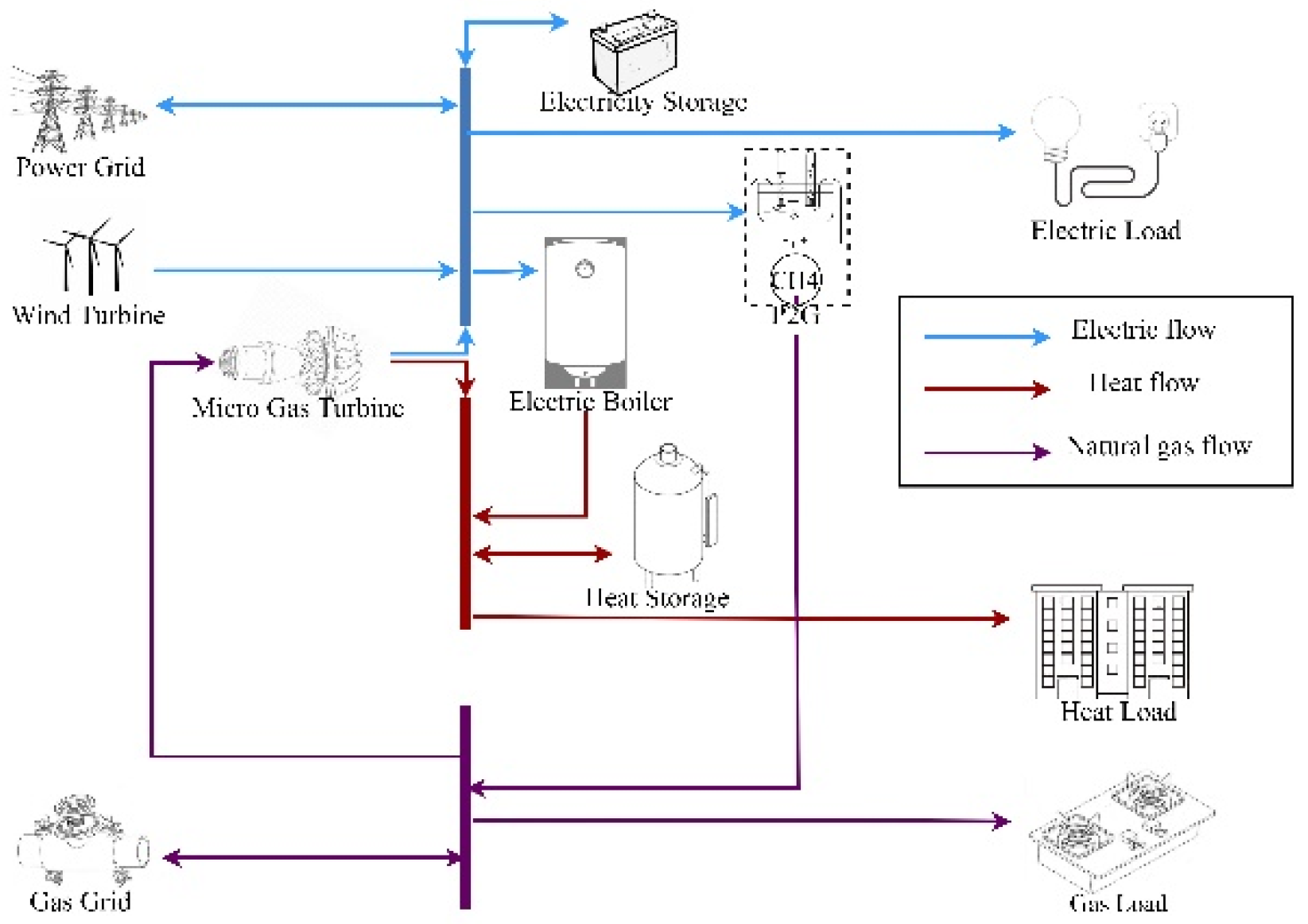
Figure 2.
Decomposition algorithm flow.
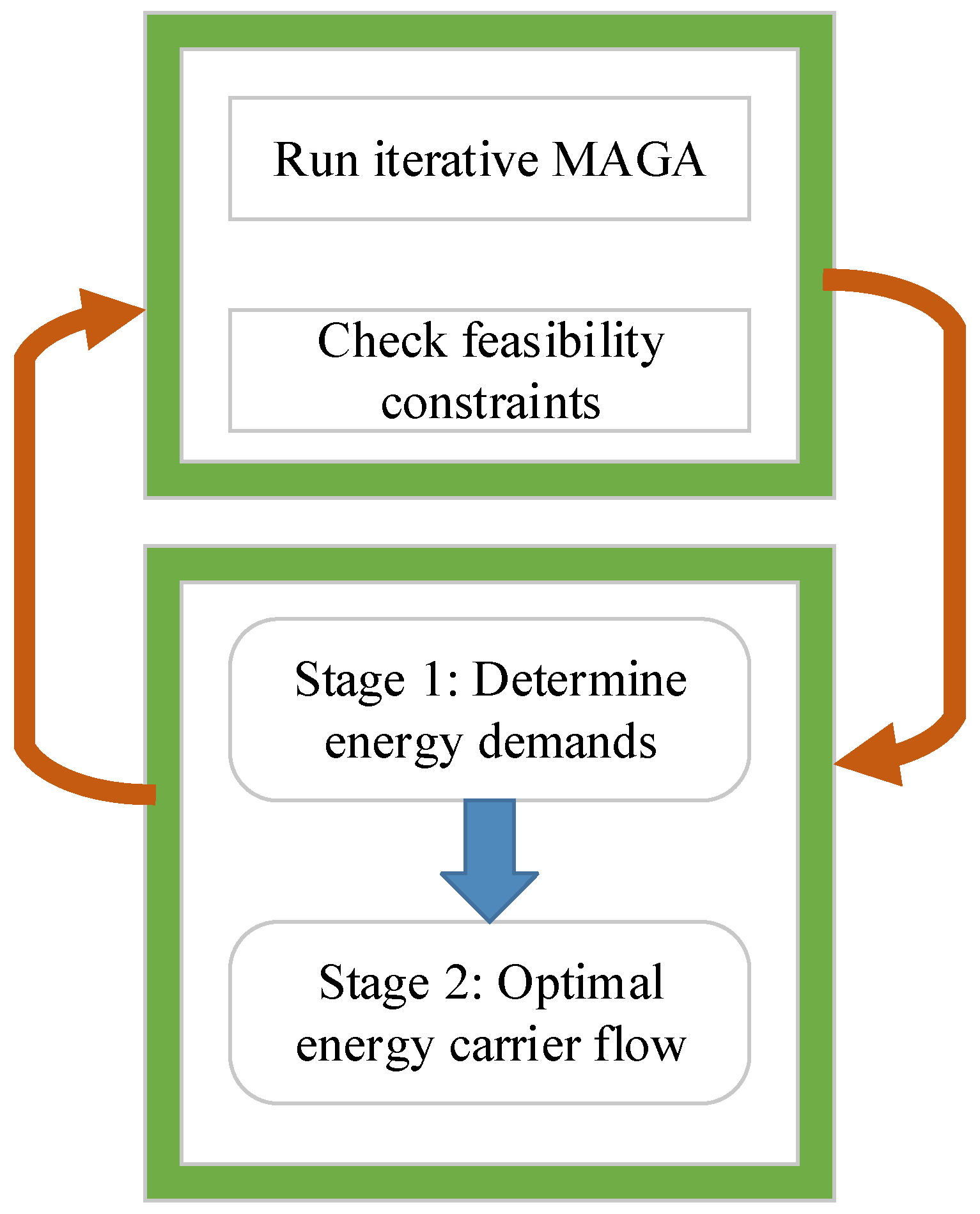
Figure 3.
Decomposition algorithm flow.
Disclaimer/Publisher’s Note: The statements, opinions and data contained in all publications are solely those of the individual author(s) and contributor(s) and not of MDPI and/or the editor(s). MDPI and/or the editor(s) disclaim responsibility for any injury to people or property resulting from any ideas, methods, instructions or products referred to in the content. |
© 2025 by the authors. Licensee MDPI, Basel, Switzerland. This article is an open access article distributed under the terms and conditions of the Creative Commons Attribution (CC BY) license (http://creativecommons.org/licenses/by/4.0/).
Copyright: This open access article is published under a Creative Commons CC BY 4.0 license, which permit the free download, distribution, and reuse, provided that the author and preprint are cited in any reuse.


