

Submitted:
31 January 2025
Posted:
03 February 2025
You are already at the latest version
Abstract
The rising demand for critical minerals essential for modern technologies, renewable energy solutions, and advanced electronics has intensified mining activities worldwide. While these minerals are vital for a sustainable future, their extraction and processing often pose significant threats to aquatic ecosystems. Findings indicate that mining operations result in severe water contamination through heavy metals and toxic discharge, habitat destruction due to sedimentation and landform alterations, and disruption of hydrological cycles affecting both surface and groundwater. Additionally, the biodiversity of aquatic life is at significant risk, with examples such as mercury bioaccumulation in the Amazon Basin and coral reef degradation in Indonesia. This paper examines these impacts in detail, supported by global case studies, and explores strategies for mitigating these effects through sustainable mining practices, advanced water treatment technologies, and robust regulatory frameworks.
Keywords:
Critical minerals
; Mining activities
; Water contamination
; Habitat destruction
; Mitigation strategies
; Sustainable practices
1. Introduction
Critical minerals such as lithium (Li), cobalt (Co), nickel (Ni), and rare earth elements (REE) are indispensable for the transition to renewable energy technologies, the proliferation of electric vehicles (EVs), and the development of advanced electronics (Haque et al., 2014; Deady, 2021; IEA 2022&2023; Paleologos et al., 2024; Mohamed 2024a). Their unique properties make them essential for building sustainable futures, but their extraction often comes with a significant environmental cost (Gupta and Krishnamurthy, 2005; Benzal et al., 2020; Ji et al., 2022; Mohamed 2024b). Mining operations, particularly those targeting critical minerals, are frequently located in ecologically sensitive areas, where the potential for adverse impacts on water bodies is high (Bredariol, 2022). For instance, critical minerals like Li, REEs, and copper (Cu) are highly vulnerable to water stress due to the substantial water requirements involved in mining exploration (Figure 1, data from Bredariol, 2022).
Moreover, the map shown in Figure 2 (Bredariol, 2022) illustrates global water stress levels, categorized as low (<10%), low-medium (10–20%), medium-high (20–40%), high (40–80%), and extremely high (>80%), overlaid with the locations of Cu (orange circles) and Li (blue circles) mines. Regions with the highest water stress are concentrated in the Middle East, North Africa, parts of South Asia, and southwestern United States. Many mining operations for Cu and Li are situated in areas of medium to extremely high-water stress, highlighting potential environmental and resource management challenges in these regions.
A study by Oelofse (2008) estimated that approximately 19,300 kilometers of rivers and 72,000 hectares of lakes and water reserves were negatively affected by aqueous effluents from the mining industry. These effluents are characterized by low pH levels and elevated concentrations of reactive and toxic metals (Éthier, 2011; Kagambeg et al., 2014; Dong et al., 2020). The cost of addressing the resulting pollution is significant, with mitigation expenses exceeding 1.2 million USD annually at the abandoned Equity mine site in Houston, British Columbia, Canada (Sumi et al., 2001). Furthermore, it is projected that the site will continue generating acidic aqueous solutions for the next 150,000 years.
Aquatic ecosystems, which include both surface water sources such as rivers and lakes and groundwater systems, are particularly vulnerable to mining activities (Daraz et al., 2023; GBC, 2023; Otunola et al., 2024). These ecosystems not only support a wide array of biodiversity but also provide critical resources for human communities, including drinking water, agriculture, and fisheries.
The interaction between mining processes and aquatic ecosystems is intricate and multifaceted. Mining activities can introduce toxic substances, disrupt hydrological cycles (Marazuela et al., 2019), destroy habitats (Liu et al., 2019; Garajardo and Redón, 2019), and impact social well-being (Babidge, 2016, 2018; Egbue, 2012). A comparative life cycle assessment of Co, Cu, and Ni extraction processes, presented in Table 1 (data from Farjana et al., 2019). This table compares the environmental impacts of producing Co, Cu, and Ni. Nickel exhibits the highest impacts in climate change (11.19 kg CO₂ eq.), ozone depletion, human toxicity, particulate matter, acidification, and freshwater ecotoxicity, indicating its significant environmental burden. Cobalt shows the greatest contributions to land use (24.69 kg C deficit) and terrestrial eutrophication, while Cu generally has lower impacts across most categories. However, Cu still poses notable risks in freshwater eutrophication and toxicity effects. These findings underscore the need for sustainable practices in Ni and Co extraction.
Moreover, these impacts often extend beyond the immediate mining areas, affecting downstream ecosystems and communities dependent on clean and stable water sources (Lukacs and Ortolano, 2015; Akpan et al., 2021; Wang et al., 2021; Abiye and Ali, 2022; Jiao et al., 2023; Palmerton, 2023). Addressing these challenges is essential to ensuring that the pursuit of critical minerals does not compromise the health of aquatic environments or the livelihoods of communities that rely on them.
This paper explores these dynamics, shedding light on the ecological and socio-economic ramifications of critical mineral mining on aquatic ecosystems. It emphasizes the importance of adopting sustainable practices, innovative technologies, and robust policy frameworks to mitigate these impacts and achieve a balance between economic development and environmental conservation.
2. Methodology and Data Analysis
To gather the necessary information for analyzing previously published cases, the following comprehensive methodology was employed. Initially, an extensive search was conducted by entering relevant keywords and phrases into scholarly search engines, such as Google Scholar. This provided a broad range of academic articles and papers that addressed key topics, including critical minerals, mining activities, mitigation measures, mining waste, and innovations in wastewater treatment with application to mining industry. After this initial search, the most pertinent results were examined thoroughly to identify key findings. If further details were required, references and sources cited within these articles were also reviewed to deepen the understanding of the subject matter.
Once the scholarly articles were assessed, these findings guided additional searches using non-scholarly search engines. These alternative search engines were used to gather supplementary information on the materials and their applications, focusing specifically on mineral mining, mining waste innovative solutions, and advanced mitigation measures.
For the data analysis portion of the study, a grounded theory approach, known for its flexibility and iterative nature, was employed. This approach was implemented through a series of organized steps: (i) conducting an online search to gather data from various sources, (ii) utilizing relevant keywords to narrow down the focus and identify pertinent studies, (iii) reviewing abstracts to quickly assess the relevance of the articles, (iv) performing a detailed analysis of full-length papers to identify emerging patterns in the discussions (including both agreements and disagreements) and familiarizing with the key points made by the authors, and (v) identifying and clustering key themes or relationships that emerged from the literature. This iterative process allowed for a deeper understanding of the trends and relationships in the research data.
3. Impact on Aquatic Ecosystems
3.1. Water Contamination
Mining activities produce tailings and wastewater that can release heavy metals, acids, and other toxic substances into water bodies (Wolkersdorfer and Mugova, 2022). For instance, producing one tonne of REEs generates 60,000 m³ of waste gas containing hydrochloric acid, 200 m³ of acid-laden wastewater, and 1–1.4 tonnes of radioactive waste (Hayes-Labruto et al., 2014). Beyond water pollution, REEs extraction, separation, and refining require substantial amounts of water, acidic substances, and electricity. As shown in Table 1 (data from Farjana et al., 2019), Ni extraction has a higher impact than Co and Cu in categories such as acidification, freshwater eutrophication, and freshwater ecotoxicity. However, Co extraction surpasses Ni and Cu in terms of terrestrial and marine eutrophication, land use, and water resource depletion. Among the three, Cu extraction is identified as the least environmentally damaging process.
Examples from the mining industry highlight significant environmental and social impacts. In Chile’s Atacama Desert, Li extraction from brine pools has caused considerable depletion of the water table, severely impacting local aquifers and reducing freshwater availability for ecosystems and nearby communities (Egbue, 2012; Babidge, 2016, 2018; Garajardo and Redón, 2019; Marazuela et al., 2019; Liu et al., 2019; Liu and Agusdinata, 2020; Greenfield, 2022; Maxwell et al., 2022). The high-water consumption required for Li mining has further exacerbated water scarcity in this already arid region, endangering the survival of native plant and animal species (Romero et al., 2012; Molina Camacho, 2016).
Similarly, Co mining in the Democratic Republic of Congo (DRC), which holds approximately 70% of the world’s Co reserves (RAID and AFREWATCH, 2024), has led to significant environmental and health challenges. Effluent discharge from Co mines has contaminated nearby rivers with elevated levels of Co, cadmium (Cd), and lead (Pb) (RAID and AFREWATCH, 2024). These pollutants have had toxic effects on aquatic organisms, including reduced fish populations and the bioaccumulation of heavy metals in the food chain. Communities reliant on these water sources for drinking and agriculture face heightened health risks (Banza et al., 2009; Elenge and De Brouwer, 2011; Cheyns et al., 2014; Pourret et al., 2016; WHO, 2017; Nkulu et al., 2018; Smolders et al., 2019; Lindberg and Anderson, 2020; Muimba-Kankolongo et al., 2021; Sanderson and Hume, 2022).
For instance, a study by Brown et al. (2022) assessed the impact of Co mining activities on land cover in Kolwezi, DR Congo (DRC), and its surrounding mining areas. Between 2009 and 2021, land cover change showed significant increases of 147.2% for rooftops (e.g., metal, clay, and concrete materials), 104.7% for impervious surfaces (e.g., asphalt and low-albedo surfaces), 85.4% for bare land (e.g., dirt tracks, construction sites, sediment deposits, and bare soil), and 56.2% for exposed rock (e.g., mine pits, rock piles, tailings, and smelt waste). Conversely, decreases were observed in trees (-4.5%), shrubs (-38.4%), grass and cultivated lands (-27.1%), and water resources (-34.6%) such as rivers, lakes, ponds, and streams.
To further evaluate these impacts (human health and environment), RAID and AFREWATCH (2024) conducted extensive fieldwork, visiting 25 villages and towns and collecting testimonies from 144 individuals living near five of the world’s largest Co and Cu mines in the DRC between July 2022 and February 2024 (Figure 3). Results shown in Figure 3 highlight several significant impacts on the well-being and livelihoods of a community, illustrating how intertwined environmental, economic, and health challenges are. Firstly, a drastic decrease in agricultural productivity was reported by 99% of respondents, indicating the profound effect of environmental degradation, changing climatic conditions, or resource depletion on farming activities. Agriculture is likely a key source of income and food security for this community, and a decline in productivity would have cascading effects on livelihoods, exacerbating food insecurity and economic vulnerability.
Additionally, healthcare affordability has become a pressing concern, with 75% of respondents indicating that they can no longer afford necessary medical care. This is closely tied to income loss, as reported by 60% of interviewees, which reflects broader economic challenges such as unemployment, reduced earnings from agriculture, or inflation. The inability to afford healthcare not only worsens the immediate health outcomes of individuals but also increases long-term vulnerability to diseases. Health concerns are further exacerbated by the rise in skin diseases, as 72% of respondents have experienced these issues. This could result from environmental pollution, contaminated water sources, or hazardous working conditions. The increasing prevalence of such illnesses highlights the link between environmental degradation and public health.
Food insecurity is also a growing issue, as 59% of respondents reported being forced to reduce the number of meals per day. This is likely a direct consequence of reduced agricultural productivity and income loss. Insufficient access to food affects the community’s overall nutritional health, particularly for vulnerable groups such as children and women. The figure also highlights a negative impact on children’s health, reported by 56% of respondents. Poor nutrition, limited access to healthcare, and environmental factors likely contribute to these adverse outcomes, jeopardizing the long-term development and well-being of children. Similarly, women’s gynecological and reproductive health has been negatively affected, as noted by 56% of participants. This could stem from limited access to healthcare, malnutrition, or exposure to harmful environmental pollutants, underscoring the disproportionate burden on women in the community.
In conclusion, this figure paints a sobering picture of the interconnected challenges faced by the community. Environmental degradation, economic instability, and inadequate access to healthcare collectively impact agriculture, food security, and public health. Vulnerable groups such as women and children are particularly affected, highlighting the urgent need for integrated interventions to address these multifaceted issues.
3.2. Habitat Destruction
Mining operations often require the clearing of vegetation and the alteration of landforms, which can destroy aquatic habitats. For instance, a study by Farjana et al. (2019) (Table 1) revealed that the land use associated with the extraction of Co, Cu, and Ni contributes to a land carbon deficit of 24.69 kg, 4.58 kg, and 6.76 kg, respectively. This indicates that Co extraction has a higher environmental impact than Ni and Cu. Additionally, water acidity increases in the order of Co (0.1 mole H⁺ eq.), Cu (0.42 mole H⁺ eq.), and Ni (1.87 mole H⁺ eq.), while terrestrial eutrophication decreases in the order of CO (0.52 mole N eq.), Ni (0.38 mole N eq.), and Cu (0.26 mole N eq.). Sedimentation caused by mining runoff can further smother aquatic plants, disrupt habitats for fish and invertebrates, and degrade water quality.
Nickel mining in Indonesia exemplifies the severe environmental consequences of extractive industries. According to Nasution et al. (2024), the rapid expansion of Ni production in Indonesia has resulted in deforestation, habitat degradation, air and water contamination, and significant risks to human health and the environment. Coastal ecosystems have been particularly affected, with waste discharge into the ocean causing impacts up to 20 kilometers from mining sites. These impacts include seawater discoloration, high fish mortality, elevated concentrations of heavy metals, and the emergence of arsenic bacteria previously absent in these environments (Syarifuddin, 2022). Open-pit mining in Sulawesi has contributed to extensive sedimentation in rivers and coastal waters, degrading coral reefs vital for marine biodiversity and local fisheries. Increased sediment loads have reduced sunlight penetration, impairing coral growth and damaging spawning grounds for numerous fish species (Hartono et al., 2017; Bidul and Zaid, 2024; Syarifuddin, 2022). Furthermore, Ni mining has exacerbated erosion rates at river estuaries, damaged local infrastructure, and degraded soil fertility through reduced pH, organic carbon content, phosphorus, and nitrogen levels (Prematuri et al., 2020; Mustafa et al., 2022; Wahanisa and Adiyatma, 2021).
Similarly, Cu mining in Zambia’s Copperbelt region highlights the environmental and health challenges posed by mining activities. While ores are mined primarily for Cu and Co, trace elements such as Pb, As, Cd, Hg, and Zn accumulate in soils and stream sediments (Kríbe et al., 2023). Issues associated with mining and processing include soil and crop contamination from dust fallout and smelter emissions, which release 300,000 to 700,000 tons of pollutants annually (Muma et al., 2020). Surface soils near chemical leaching plants have been found to contain high concentrations of Co (2483 mg/kg), Ni (321 mg/kg), Cu (22.6 mg/kg), Zn (637 mg/kg), and sulfur (38.1 wt.% Stot) (Kríbek et al., 2010). Heavy metals also accumulate in crops, with leafy vegetables exhibiting higher concentrations than tubers or bulbs (Kríbek and Nyambe, 2010). Additionally, leaks from tailing dams pose a significant threat to aquatic ecosystems. For instance, water collected from the Bwana Mkubwa Waste Pond in 2009 was highly acidic (pH 4.10), exhibited high electrical conductivity (5580 µS/m), and contained an average sulfate concentration of 7378 mg/L (Kríbek et al., 2010; Kríbek and Nyambe, 2007). Insufficient technological controls for tailing dam stability and failures in slurry pipeline systems further exacerbate pollution, leading to heavy metal deposition in stream sediments and contamination of water resources (Kríbek and Nyambe, 2005).
3.3. Alteration of Hydrological Cycles
Water-intensive mining processes can significantly disrupt local hydrological cycles, affecting both groundwater recharge and surface water flows. For example, a study by Farjana et al. (2019) (Table 1) reported that the water usage for extracting Co, Ni, and Cu follows a decreasing order of 0.057 m³, 0.053 m³, and 0.032 m³ water equivalents, respectively, indicating that Co extraction has a higher water footprint than Ni and Cu. Such disruptions reduce water availability for ecosystems and human communities, causing widespread environmental and social impacts.
Rare Earth Element (REE) mining in China provides a striking example of these consequences. Excessive water withdrawal for REE extraction has altered river flows, leading to localized droughts that harm aquatic ecosystems. Altered flow regimes disrupt fish migration patterns and shrink wetland areas critical for biodiversity. China, which holds 39% of the global REE reserves, produces approximately 100 kilotons annually, accounting for 90% of global production as of 2010 (Trapasso et al., 2021). Since the 1960s, REEs, along with iron (Fe) and niobium (Nb), have been extracted from the Bayan Obo industrial mining site in Mongolia, China, resulting in large volumes of tailings containing REEs and radioactive elements. The production of just one tonne of REEs generates 60,000 m³ of waste gas containing hydrochloric acid, 200 m³ of acidic sewage water, and 1–1.4 tonnes of radioactive waste (Hayes-Labruto et al., 2014). Separation and refining processes further exacerbate the issue by consuming significant amounts of water, acidic substances, and electricity. The pond leaching process, for instance, destroys 200 m² of surface vegetation, requires the removal of 300 m³ of topsoil, and produces 2,000 m³ of waste tailings per tonne of Rare Earth Ores (China Water Risk, 2016).
The environmental impacts of REE mining are starkly visible in Longnan County, where 17.7 km² of forest—accounting for 20% of the county’s total deforestation—has been destroyed due to REE extraction (China Water Risk, 2016). This pollution significantly affects the Yellow River watershed, which provides drinking water, irrigation, and fishing resources to nearly 200 million people. The region’s soils and watersheds have been contaminated with heavy metals, fluorine (F), and As, negatively affecting local ecosystems and inhabitants. REEs have been detected in various aquatic environments, including rivers, estuaries, and oceans (Négrel et al., 2000; Akagi, 2017; Trifuoggi et al., 2018). In marine environments, REEs bioaccumulate in organisms and may be transferred through the trophic web, potentially leading to biomagnification or bio-dilution at higher trophic levels (Souza et al., 2021).
A study by Traore (2023) reviewed the content and distribution of REEs in Chinese rivers and lakes. It noted that in river water, the sequence of REEs concentrations in decreasing order was Ce > La > Nd > Pr > Sm > Gd > Dy > Er > Yb > Eu > Lu > Ho > Tb > Tm. Mean REE concentrations in the Pearl and Jiulong rivers were 229.6 mg/kg and 266.86 mg/kg, respectively, exceeding the national river average of 174.8 mg/kg. The Liaohe River recorded concentrations ranging from 106.61 to 174.71 g/L, with an average of 144.59 g/L. In sediments, Ce was the most abundant element, followed by La, Nd, and Pr, which together accounted for 85.39% of the total REE concentration. Similarly, average sediment concentrations of REEs in Poyang and Dongting lakes were 254.0 μg/g and 197.95 μg/g, respectively, exceeding the average upper continental crust concentration of 146.4 μg/g.
Accumulation of REEs has been documented in various organisms, such as plankton in the Mediterranean Sea (Strady et al., 2015), algae in China (Strady et al., 2015), bivalves in Japan and Germany (Akagi and Edanami, 2017), fish in the United States and China (Figueiredo et al., 2018), and turtles in Sicily (Censi et al., 2013). This demonstrates the far-reaching ecological impacts of REE mining, as these elements permeate aquatic food chains and potentially affect biodiversity and ecosystem health on a global scale.
Mining activities have a profound impact on the interaction between surface water and groundwater, with an estimated 1×10⁶ m³/day of water being pumped from mine shafts (Ashton et al., 2001). This extensive water extraction causes significant groundwater drawdown, disrupting natural groundwater recharge processes. In the Copperbelt region, large-scale copper mining has led to the clearing of riparian vegetation, which alters the natural flow regimes of rivers and streams. This disruption, coupled with increased sedimentation, has negatively affected aquatic life, including freshwater fish species that depend on clean substrates for breeding.
According to a study by the World Bank (2016), soils in plant areas within the Copperbelt are heavily contaminated with Pb (6.4%) and Zn (8.3%), with smaller amounts of Cd (0.0095%). The surface soils across the region contain 50 times higher concentrations of Cu than subsurface samples (Ncube et al., 2012), primarily due to plant spills, leaks, fugitive windblown dust from dumps, and stack emissions. Furthermore, dredged sediments from mine canals contain alarmingly high levels of Pb (30%) and Zn (25%). Atmospheric emissions from Cu smelting activities range between 300,000 and 700,000 tons per year, far exceeding the WHO limit of 125,000 tons/year, while SO₂ concentrations in the air range from 500 to 1,000 μg/m³, far surpassing Zambia’s guideline of 50 μg/m³ (World Bank, 2016).
Despite the extensive mining activities in the Copperbelt, a study by Sracek et al. (2012) found that the Kafue River’s water quality remains relatively unaffected due to the high neutralizing capacity of mining wastes. This neutralization controls the precipitation of iron oxides and hydroxides and the adsorption or co-precipitation of Cu and Co. However, the high metal content in stream sediments poses significant risks to human health and the environment, particularly during accidental acid spikes that can remobilize heavy metals. In contrast, Kríbe et al. (2023) reported high concentrations of dissolved Cu (up to 14,752 µg/L) and Co (up to 1,917 µg/L) in some Kafue River tributaries near large mining centers, exceeding Zambian effluent limits.
Data from Kríbek et al. (2023) (Table 2) reveal that pH levels at the Kafue River outflow are slightly higher, while concentrations of SO₄²⁻ and trace elements generally increase downstream from the industrial areas of the Copperbelt. Although these concentrations remain below Zambia’s water effluent discharge limits, very low pH and extremely high concentrations of SO₄²⁻ and dissolved heavy metals were observed in the Wusakile River, a tributary of the Kafue, in 2005. Sediments at the Kafue River outflow show enrichment in sulfur, Co, Cu, manganese (Mn), and to a lesser extent, Pb, Zn, As, and Hg, compared to sediments at unpolluted inflow points. Tributaries of the Kafue River also exhibit high concentrations of As, Cu, Co, Pb, and Zn in sediments. Pettersson et al. (2000) noted that Co and Cu were found in sediments as far as 100 and 300 km downstream of the mining area, respectively. In polluted sediments, these metals are predominantly present as exchangeable metals and carbonates, whereas in unpolluted sediments, they are associated with organic matter. The potential for desorption or dissolution and remobilization of these metals is high under low pH conditions (Yong et al., 1992; Mohamed and Antia, 1998; Sracek et al., 2011; Mohamed and Paleologos, 2018; Mulenga, 2022).
The environmental impact of producing 1 kg of neodymium (Nd), as determined using the Life Cycle Assessment (LCA) method, was analyzed, by Zapp et al. (2022), for four process chains: mixed bastnäsite/monazite ore at Bayan Obo (Mongolia, China), bastnäsite ore at Mountain Pass (San Bernardino County, California, USA), monazite ore at Mount Weld (Western Australia), and eudialyte ore at Norra Kärr (Jönköping County, Sweden). The results, presented in Figure 4 and Table 3 (data from Zapp et al., 2022), are expressed in kilogram equivalents. The production of REEs involves a series of processes, including mining, flotation, precipitation using ammonium bicarbonate, solvent extraction, magnetic separation, roasting, leaching, precipitation with oxalic acid, and electrolysis. Each of these processes contributes to the environmental impact parameters to varying degrees, as shown in Table 3. The analysis highlights significant effects on global warming potential, freshwater and marine eutrophication potentials, particulate matter formation, and acidification potential, impacting both terrestrial and aquatic ecosystems.
3.4. Biodiversity Loss
Biodiversity loss due to pollutants and habitat alterations is a critical environmental issue, particularly in aquatic ecosystems (Table 1). The disruption of habitats, combined with the presence of pollutants, leads to a decline in species populations, including those that are endemic or critically endangered. These impacts can have profound and long-lasting effects, resulting in significant ecological imbalances.
One of the major contributors to biodiversity loss in the Amazon Basin is gold mining, particularly artisanal and small-scale gold mining (ASGM). This activity relies heavily on Hg for extracting gold from ore, releasing between 410 and 1400 tonnes of Hg annually, accounting for 37% of global Hg emissions (Seccatore et al., 2014; Esdaile and Chalker, 2018). Hg poisoning poses serious health risks to ASGM communities, as it can be absorbed through the lungs and transported to other organs (Tchounwou et al., 2003; Park and Zheng, 2012; Steckling et al., 2017). In addition to Hg contamination, ASGM leads to widespread deforestation. For instance, between 2006 and 2009, approximately 20 km² of Amazon forest was cleared annually in Peru for mining activities (Swenson et al., 2011).
Mercury released into the environment is highly toxic to living organisms. Once it enters water bodies, it accumulates in sediments and the water column, exposing aquatic species to contamination through ingestion of tainted food or water. This leads to bioaccumulation and biomagnification, where Hg concentrations increase as it moves up the food chain (Paddock, 2017; Reichelt-Brushett et al., 204). Fish, particularly top predators, suffer from Hg-related health issues, including reproductive failures, deformities, and mortality, threatening their survival. Mercury also bioaccumulates in aquatic and terrestrial plants, further amplifying its ecological impact (Zillioux et al., 1993; Wolfe et al., 1998; Scheuhammer et al., 2015). Phytoremediation has been proposed as a potential strategy for addressing Hg contamination in ASGM areas.
Endangered species in the Amazon Basin face heightened risks due to Hg pollution. The Amazon river dolphin and several fish species endemic to the basin are particularly vulnerable due to their restricted habitats and specialized ecological niches. Mercury contamination leads to population declines, jeopardizing their survival and the overall ecological balance of the region.
The health risks of Hg contamination extend to indigenous communities in the Amazon Basin, who rely on the river for food and drinking water. These communities face direct exposure to Hg through fish consumption, water use, and even skin contact. As Hg accumulates in the food chain, individuals consuming fish as a primary protein source experience elevated Hg levels in their bodies. This exposure results in severe health issues, including neurological damage, kidney failure, and developmental disorders in children ((Tchounwou et al., 2003; Bose-O’Reilly et al., 2008; Park and Zheng, 2012; Gibb and O’Leary, 2014; Esdaile and Chalker, 2018). The contamination also threatens traditional livelihoods, as fishing is not only a source of sustenance but also a vital aspect of cultural identity for many indigenous groups.
Mercury contamination and declining fish populations disrupt broader ecosystem dynamics, leading to food chain imbalances. The decline in fish affects predators such as birds and aquatic mammals, further amplifying biodiversity loss. Additionally, the disruption of aquatic ecosystems impairs critical ecosystem services, such as water purification, carbon sequestration, and local climate regulation. In a biodiversity-rich region like the Amazon, such disruptions have cascading effects on both local and global environmental health.
In summary, Hg contamination from gold mining in the Amazon Basin poses a grave threat to aquatic biodiversity, fish populations, and the health of indigenous communities. It exacerbates biodiversity loss, undermines ecosystem functions, and endangers traditional livelihoods, highlighting the urgent need for effective interventions to mitigate these impacts and protect the region’s unique ecosystems.
4. Mitigation Strategies
Figure 5 presents an overview of mitigation measures for critical minerals mining, categorizing them into four key areas: advanced treatment technologies, sustainable mining practices, policy and regulations, and community engagement and indigenous rights. Each category highlights specific approaches aimed at minimizing environmental and social impacts while ensuring sustainable resource extraction.
- Advanced treatment technologies focus on reducing water contamination and improving waste management through methods like reverse osmosis, constructed wetlands, ion exchange, flotation, bioremediation, and electro-coagulation.
- Sustainable mining practices emphasize environmentally responsible extraction methods, such as dry-stack tailings, closed-loop water recycling, revegetation, underground mining, carbon capture, and alternative energy sources.
- Policy and regulations outline the institutional and regulatory frameworks that govern mining activities. This includes professional associations, expert panels, civil society involvement, standard-setting organizations, intergovernmental agreements, and economic interventions like zero-discharge policies, penalties, incentives, and reclamation strategies.
- Community engagement and indigenous rights recognize the importance of Indigenous knowledge, free, prior, and informed consent, collaborative resource management, and social development to ensure fair and sustainable mining practices.
A detailed discussion of these mitigation measures is provided in the following sections, exploring their implementation and effectiveness in addressing the challenges associated with critical minerals mining.
4.1. Advanced Water Treatment Technologies
Implementing advanced water treatment systems in mining operations is critical to reducing the environmental impact of contaminants in mining effluents. These technologies are specifically designed to treat water polluted with toxic substances, heavy metals, sediments, and other pollutants, ensuring that the water meets environmental standards before being released into natural water bodies. Such systems are vital for protecting aquatic ecosystems, preventing soil degradation, and safeguarding human health.
Among the key advanced water treatment technologies, reverse osmosis (RO) systems play a significant role. RO uses a semi-permeable membrane to remove contaminants from water by applying pressure, forcing water through the membrane while leaving behind contaminants like salts, metals, and minerals. This technique is especially effective for treating water contaminated with heavy metals such as As, Cd, and Pb, as well as high salinity levels (Adeola and Forbes, 2020; Simões et al., 2020). RO has been widely employed in coal mining and gold extraction processes to clean effluents before discharge into the environment. For instance, in Chile, RO is utilized to treat recyclable water in the Cu industry (Bosse et al., 2007). However, the effectiveness of RO systems depends on the scale of the mining operation and the concentration of pollutants in the effluents.
A study by Pervov et al. (2023) explored a new RO system designed to reduce the flow of RO concentrate and dewatered sludge, increase heavy metal recovery, and mitigate high operational costs. The system, which uses nanofiltration membranes, achieved a total dissolved solids (TDS) value of 110–120 g per liter. Despite its benefits, RO is considered an expensive water treatment technique, with costs ranging from €0.76 to €2.12 per cubic meter per year. This high cost is largely due to its significant energy consumption and the scaling of nano-filters, which decreases performance over time. While RO provides a highly effective solution for treating contaminated water, the operational costs and potential performance challenges need to be carefully managed (Fatta and Kythreotou, 2005; Vigneswaran et al., 2007; Adeola and Forbes, 2020; Ezugbe and Rathilal, 2020).
Constructed wetlands are an effective water treatment technique that utilizes natural processes to treat wastewater, mimicking the filtration and purification functions of natural wetlands. These wetlands rely on plants, microorganisms, and soil to work in synergy to remove contaminants, including suspended solids, heavy metals, and nutrients (Rao and Finch, 1989; Kilborn Inc, 1999; Rodgers and Castle, 2008; Skrzypiec et al., 2017; Pat-Espadas et al., 2018; Opitz et al., 2021). The system is particularly suitable for treating mining effluents, which often contain sediments, nutrients, and heavy metals. Constructed wetlands have been applied in various mining sectors, including coal mining, bauxite mining, and gold mining, where they treat runoff water from mining sites (Lorion, 2001; Shardendu et al., 2003; Shrestha, 2008). In fact, Regulation Number 5 of 2022 by the Ministry of the Environment in Indonesia specifically addresses wastewater treatment for mining activities using constructed wetlands (Agincourt Resources, 2023).
An example of constructed wetlands in mining can be seen in Australia, where the Sibelco mining company employs this technique to treat water from its operations. These wetlands effectively remove contaminants such as Fe, Al, and suspended solids before the treated water is safely returned to local waterways (SIBELCO, 2013). Moreover, the combination of constructed wetlands with other treatment systems, such as adsorption, has proven successful in removing heavy metals. For instance, a study by Nguyen et al. (2019) achieved removal efficiencies of 80.3% for As, 96.9% for Mn, 79.6% for Cd, 52.9% for Zn, and 38.7% for Pb from a Pb–Zn mine in northern Vietnam, with a consistent flow rate of 5 m³/day after four months of treatment. Similarly, in the Katanga region of the Democratic Republic of Congo, mining liquid waste from copper ore flotation was treated using biological techniques in combination with constructed wetlands. The wetlands were used as a polishing stage after the removal of pollutants in a tailings pond converted into a bioreactor (Shengo and Mutiti, 2016).
Ion exchange (IX) systems are a highly effective water treatment method that involves replacing undesirable ions, such as heavy metals or minerals, in contaminated water with harmless or beneficial ions using a resin or other materials (Jasim and Ajjam, S.K., 2024). This process is particularly useful for removing specific contaminants like Cu, Zn, As, and ammonia (NH3). Ion exchange systems are especially beneficial in mining applications, as they can effectively treat mining effluents containing toxic heavy metals and recover valuable metals from wastewater, allowing for their reuse in the mining process. This makes ion exchange a crucial technology in industries such as uranium mining and precious metal recovery (Lanxess, 2025).
An example of IX technology in action can be seen at the Los Pelambres Mine in Chile, one of the largest copper mines in the world. Here, IX systems are used to treat water contaminated with Cu and other metals, ensuring that the effluent meets environmental standards before being discharged into local rivers (Sole et al., 2016). This application of IX not only reduces environmental impact but also helps manage valuable resources in the mining process, contributing to both sustainability and efficiency in the industry.
Flotation and coagulation/flocculation are widely used water treatment techniques in the mining industry. Flotation systems work by using bubbles to attach to fine particles, such as tailings or sediments, causing them to rise to the surface and form a froth that can be easily skimmed off. Coagulation and flocculation involve the addition of chemicals that cause particles to clump together, making them easier to remove from the water. These methods are particularly effective for treating wastewater containing suspended solids, tailings, and fine particles generated during mining activities (Dibrov et al., 1998; Anastassakis et al., 2004; Rubio et al., 2007; Taşdemir and Başaran, 2020).
In mining applications, flotation and coagulation/flocculation are often used to treat wastewater that results from the extraction and beneficiation of ores. For instance, during the production of base metals, such as Cu, Ni, Pb, Zn, titanium (Ti), and Al, a significant amount of water is consumed in the flotation treatment process, with varying water usage per tonne of ore. Specifically, the water consumption for Cu, Ni, Pb, Zn, Ti, and Al production ranges from 0.3 to 7.8 m3/tonne, depending on the metal (Lutandula and Mpanga, 2021). These methods are frequently used in combination with other treatment systems to further enhance the removal of pollutants from mining effluents. For example, Sudilovskiy et al. (2008) demonstrated that combining conventional flotation with reverse osmosis (RO) filtration provides a cost-effective method for removing Cu from wastewater. This combination allows for more efficient treatment, ensuring that the water released back into the environment meets regulatory standards and minimizing the environmental impact of mining activities.
Bioremediation is an effective water treatment method that utilizes microorganisms, such as bacteria, fungi, and algae, to degrade or detoxify pollutants in contaminated water. These microorganisms can break down a wide range of pollutants, including organic compounds, heavy metals, and cyanide (CN-), which are often used in mining processes. The use of bioremediation in mining is becoming increasingly popular, especially for treating effluents contaminated with CN- from gold extraction and various organic compounds (Potvin, 2004; Alkherraz et al., 2020; Oyewumi Tolulope et al., 2020; Anandkumar et al., 2022; Wróbel et al., 2023).
In the mining industry, bioremediation is particularly valuable for treating leachate from tailings storage facilities and CN--affected water in gold mining. The ability of microorganisms to break down these hazardous substances makes bioremediation a cost-effective and environmentally friendly solution for mitigating the impacts of mining activities on surrounding ecosystems. Studies have shown that bioremediation can effectively reduce the concentrations of toxic compounds in wastewater, offering a sustainable approach to managing mining effluents and protecting water quality.
Electrocoagulation is a treatment method in which an electric current is passed through contaminated water, causing the coagulation of pollutants such as suspended solids, oils, and heavy metals. This process leads to the aggregation of the contaminants, which can then be removed as sludge (Walsh and Reade, 1994; Day and Howe, 2003; Schelesinger and Paunovic, 2006; Brahmi et al., 2019; Murillo Costa et al., 2021; Alam et al., 2022).
In the mining industry, electrocoagulation is particularly effective for removing heavy metals, oils, and suspended particles from mining effluents. It is commonly employed in metal mining operations and tailings management (Solis-Marcial et al., 2024). For example, a study by Solis-Marcial et al. (2024) conducted on water samples from a mining unit in central Mexico with an initial Cu concentration of 150 ppm demonstrated that electrocoagulation effectively eliminated undesirable ions and organic compounds from mining-metallurgical process water. After treatment, the residual Cu concentrations were reduced by 43% and 3% for charge densities of 104 and 204 A/m2, respectively. Additionally, the formation of crystals containing Zn, Pb, Fe, Ca, and sulfur was observed, which could decrease the efficiency of the flotation process. Interestingly, using flotation after electrocoagulation enhanced the recovery of silver (Ag), gold (Au), and Zn by 1.5%, 2.0%, and 30%, respectively, compared to untreated water. This suggests that electrocoagulation has a positive effect on metal recovery through flotation. However, no substantial change in the recovery of lead was observed.
A summary of the advantages and disadvantages of these wastewater treatment methods is shown in Table 4. This table provides a comparative look at the effectiveness, sustainability, and limitations of each method in the context of the mining industry.
Advanced water treatment technologies offer several key benefits for mining operations. One of the primary advantages is the reduction of pollutants. These systems can remove a wide range of contaminants, including heavy metals like As, Cd, and Hg, chemicals, and suspended solids, ensuring that water discharged into the environment does not harm aquatic ecosystems. Additionally, these systems help mining companies comply with national and international environmental regulations, reducing the risk of costly fines and enhancing their corporate reputation. Another benefit is the potential for water reuse and recycling. Technologies such as reverse osmosis and ion exchange allow treated water to be reused in the mining process, which helps reduce overall water consumption and minimizes reliance on external water sources. Moreover, the proper treatment of mining effluents helps protect local ecosystems, ensuring the health of aquatic and terrestrial wildlife that depend on water for survival.
However, there are challenges associated with implementing advanced water treatment technologies. One significant challenge is the cost and infrastructure required. These systems can be expensive, particularly for small-scale or remote mining operations, and there may be issues related to their maintenance and scalability. Another challenge is the energy consumption of certain treatment methods. For instance, reverse osmosis requires considerable energy, which could contribute to a carbon footprint if the energy is sourced from non-renewable resources. Additionally, many treatment processes generate sludge as a by-product, which must be managed carefully to prevent further environmental contamination.
In conclusion, advanced water treatment technologies are crucial in mitigating the environmental impacts of mining, particularly in regions with sensitive ecosystems. By integrating these technologies into mining practices, companies can significantly reduce the release of harmful pollutants into local water bodies, safeguard biodiversity, and promote sustainable water management. The effectiveness of these systems, however, depends on their design, operation, and integration into broader environmental management strategies.
4.2. Sustainable Mining Practices
Sustainable mining practices aim to minimize environmental damage and promote the efficient use of resources, especially in water-intensive operations. By integrating these practices into mining operations, companies can reduce water usage, enhance environmental protection, and ensure long-term sustainability for local ecosystems. Below are some key sustainable mining practices with examples:
4.2.1. Dry-stack Tailings
Sustainable mining practices are becoming increasingly important to reduce environmental impacts and improve the efficiency of mining operations. One of the key practices gaining attention is the adoption of dry-stack tailings to minimize water use. Dry-stack tailings refer to a method of storing mining waste without the use of water, contrasting with traditional tailings dams where waste slurry is mixed with water and stored in large ponds. Instead, dry-stack tailings are dewatered and compacted into stacks, which reduces water consumption and eliminates the risks associated with dam failures, which can lead to catastrophic environmental consequences (https://www.tailings.info/disposal/drystack.htm).
The key benefits of dry-stack tailings are significant. By dewatering the tailings, this method greatly minimizes the need for large amounts of water, which is especially crucial in areas where water scarcity is a concern. Additionally, dry-stack tailings are more stable and have a much lower risk of catastrophic failure compared to traditional tailings dams, which can collapse and release harmful toxic waste into nearby ecosystems. Furthermore, the compact nature of the dry-stack tailings reduces the potential for contaminants to leach into the environment, providing a more secure method of waste containment.
There are several examples of dry-stack tailings being implemented in mining operations. For instance, Newmont Mining’s Ahafo Mine in Ghana has successfully adopted this technique to significantly reduce water usage (Newmont, 2022). The tailings are dewatered and stacked in a contained manner, minimizing both water consumption and the risk of environmental contamination from tailings leaks. In fact, four of Newmont’s mines are currently using a dry-stack tailings technology called GeoWaste, designed to blend filtered tailings with waste rock in transit to create a geotechnically stable product. The data from the Colorado School of Mines (2025) highlights various mines that are implementing this technology, including the Eleonore mine in Quebec, Canada, which uses a filter press for dewatering with a daily throughput of around 6,900–7,200 metric tons per day; the Tanami mine in Northern Territory, Australia, which uses a vacuum filter with a throughput of 6,000–8,400 metric tons per day; the Penasquito mine in Zacatecas, Mexico, which is testing GeoWaste/EcoTails with a throughput of approximately 100,000 metric tons per day; and the Marlin mine in San Miguel, Guatemala, which employs a filter press with a daily throughput of 6,000–8,000 metric tons per day.
4.2.2. Closed-loop Water Recycling Systems
Utilizing closed-loop water recycling systems is a key sustainable mining practice that helps minimize the environmental impact of mining operations by reducing freshwater consumption and treating wastewater. A closed-loop water recycling system is a process in which water used in mining operations is collected, treated, and recycled, reducing the need for freshwater withdrawals from external sources (Kinnunen et al., 2021). By reusing water within the mining process, this system not only conserves freshwater but also minimizes the environmental effects of mining effluents. However, water recycling can sometimes affect plant performance due to high concentrations of dissolved ions and high ionic strength, which can pose challenges for system operation (Corin et al., 2011; Levay et al., 2001).
The key benefits of closed-loop water recycling systems are significant. First, they reduce the demand for freshwater from local sources, which is especially beneficial in water-scarce regions. Second, these systems help reduce pollution by treating effluents and removing harmful contaminants before the water is reused, thus preventing the discharge of pollutants into surrounding ecosystems. Finally, closed-loop systems contribute to improved sustainability by reducing overall water consumption, which helps minimize the environmental footprint of mining operations.
There are several examples of mining companies successfully implementing closed-loop water recycling systems. For instance, Anglo American has implemented such a system at its Kolomela mine in South Africa, where water used in the processing plant is recycled, reducing the mine’s reliance on external water sources (Kumba Iron Ore Limited, 2017). The system at Kolomela recycles between 3.12 and 4.57 Megalitres of water annually, and artificially recharges clean mine water into underground aquifers, averaging 36,000 cubic meters per month, which is approximately 10 to 15% of the excess water produced by the mine. In Canada, Teck Resources has adopted a closed-loop water system at its Trail Operations and other sites (Teck, 2020). The system captures and recycles water used in the milling process, reducing the need for fresh water and minimizing wastewater discharge into nearby rivers. In 2020, Teck’s mining operations reused and recycled water 3.3 times on average before it was treated and returned to the environment. Additionally, freshwater use in Chile was reduced by 15%, leading to a 13% reduction in overall freshwater consumption in 2020. The total water consumption in areas with water stress was 11,528 Megalitres in 2020.
4.2.3. Conducting Detailed Environmental Impact Assessments (EIAs)
Environmental Impact Assessments (EIAs) are a crucial tool in evaluating the potential environmental effects of proposed mining projects before they commence (Rodríguez-Luna et al., 2022). This comprehensive process identifies, predicts, and evaluates possible impacts on various environmental factors, including water resources, air quality, biodiversity, and local communities. Additionally, it provides a framework for mitigating these impacts and promoting the sustainability of mining operations. Several studies have highlighted the importance of EIAs in assessing mining projects, with key research contributions from Wood (1995), Annandale (2001), Ahmad and Wood (2002), and Khosravi (2019), focusing on legislation, administration, and the EIA process. The EIA system has been adapted in various countries such as Chile (Rodríguez-Luna et al., 2021), the Middle East and North Africa (El-Fadl and El-Fadel, 2004), Pakistan (Nadeem and Hameed, 2008), Egypt (Badr, 2009), Laos (Wayakone and Makoto, 2012), the Gulf Cooperation Council States (Al-Azria et al., 2013), United Arab Emirates (Malek and Mohamed, 2005; Heaton and Burns, 2014), Bangladesh (Ahmad and Ferdausi, 2016), and Myanmar (Aung, 2017), among others. Despite their widespread use, the UNEP (2024) has noted gaps in current EIA guidance, especially regarding tailings management, life-cycle assessments, and the incorporation of climate change considerations.
The key benefits of EIAs include the identification and mitigation of risks to aquatic ecosystems and other environmental resources early in the project lifecycle, allowing for the development of strategies to minimize adverse impacts. Furthermore, EIAs help mining companies comply with local and international environmental regulations, which are often legally required for project approval. Additionally, the EIA process promotes stakeholder engagement, fostering transparency and communication with local communities, indigenous groups, and other stakeholders, ensuring their concerns are integrated into decision-making and environmental management plans.
Several examples demonstrate the implementation of EIAs in mining operations. For instance, BHP conducted a detailed EIA before expanding its Olympic Dam copper and uranium mine in South Australia, identifying risks to water resources and biodiversity. In response, the company implemented measures such as water recycling, air quality monitoring, and ecosystem management plans to mitigate mining impacts (Government of South Australia, 2011). Similarly, the Cerro Verde Copper Mine in Peru underwent an EIA, which highlighted the mining impact on local rivers and ecosystems (Vidal, 2023). This led to the adoption of water conservation measures, including closed-loop systems and water recycling, as well as sedimentation control techniques to protect aquatic habitats from contamination. In Chile and Peru, Cacciuttolo and Cano (2022) conducted an EIA of gold and copper mining, proposing environmental management measures aimed at reducing the environmental impact on various ecosystems.
The UNEP (2024) has identified several key gaps in the current EIA process for mining, including a lack of tailored guidance for tailings management, insufficient baseline data, and inadequate consideration of chemical use in ore processing. There is also a need for improved life-cycle assessments, especially regarding tailings circularity, and better public participation in the EIA process. Furthermore, some regions experience unreliable data in impact assessments, which diminishes public trust in the mining sector. Other challenges include limited time for public review, insufficient access to independent technical experts, and the lack of technical assistance for strategic environmental assessments. Lastly, climate considerations, such as emissions from tailings management, are often overlooked, and there is a need for research to develop climate-resilient tailings storage facilities that can withstand rising temperatures and extreme weather events (Mebratu Tsegaye et al., 2021; UNEP, 2023b, 2023c, 2023d, 2023e).
4.2.4. Other Sustainable Practices
Other sustainable mining practices are also crucial in reducing the environmental impact of mining activities. One such practice is revegetation and habitat restoration, which involves restoring and revegetating land after mining to promote ecosystem recovery and prevent soil erosion (Cacciuttolo and Cano, 2022; Islam et al., 2024). For example, after gold mining, many companies plant native vegetation and work to restore degraded ecosystems to aid in biodiversity conservation. This not only enhances ecosystem recovery but also helps prevent long-term ecological damage.
Another important practice is minimizing surface disturbance. Techniques such as underground mining or using smaller, more efficient equipment can reduce surface disturbance and the destruction of habitats (Nichols, 2020; GYA, 2024; Future Bridge Mining, 2025). This approach helps preserve wildlife and plant species by reducing the amount of land affected by mining activities. A summary of the environmental impact reduction measures in underground mining is shown in Table 5 (adopted from GYA, 2024), which highlights various strategies that can be employed to minimize surface disruption.
Carbon capture and offsetting is also a critical element of sustainable mining practices. As part of decarbonization efforts, some mining operations invest in carbon capture technologies to reduce the greenhouse gas emissions associated with their activities (Mohamed et al., 2022; Bose et al., 2024; IGF, 2024; White & Case LLP, 2024). In addition to this, companies may engage in reforestation and other environmental offset projects to help balance their carbon footprints. This helps mitigate the negative impacts of mining operations on climate change and supports efforts to achieve net-zero emissions.
Furthermore, the adoption of alternative energy sources is gaining traction within the mining industry. Many mining companies are turning to renewable energy sources such as solar, wind, and hydropower to power their operations, which reduces reliance on fossil fuels and lowers emissions (GYA, 2024; White & Case LLP, 2024). For example, Gold Fields recently announced the construction of a US$195 million renewable energy project in Western Australia to power its St Ives Gold mine. Rio Tinto has made significant progress in using renewable energy at its Weipa bauxite mine in Queensland, Australia. Additionally, Ivanhoe Mines has completed the electrification of its entire equipment fleet at its Platreef mine in South Africa, while Barrick Gold has contracted with Weir Group to provide proprietary energy-efficient and sustainable mining technology for the Reko Diq copper-gold project in Pakistan. Anglo American is also testing hydrogen fuel cells to power mining vehicles, which could further reduce carbon emissions from mining operations.
In conclusion, the adoption of sustainable mining practices such as dry-stack tailings, closed-loop water recycling, and comprehensive Environmental Impact Assessments (EIAs) can significantly reduce the environmental footprint of mining operations. These practices ensure that mining companies can achieve their economic goals while minimizing their impact on the environment and local communities. By continuously integrating innovative and responsible practices, the mining industry can contribute to sustainable development and protect critical ecosystems for future generations.
4.3. Policy and Regulations
4.3.1. Regulatory Dimensions
Table 6 presents a comprehensive overview of various regulatory dimensions related to tailings management, highlighting the roles of professional associations, expert panels, civil society, standard-setting organizations, commodity-specific entities, the finance sector, intergovernmental agreements, and state-level regulations. These dimensions encompass a broad range of standards and protocols aimed at improving the safety, environmental responsibility, and sustainability of tailings management in the mining industry.
Professional associations, such as the International Commission on Large Dams and the Mining Association of Canada, provide foundational guidelines for managing the safety, design, construction, operation, and closure of tailings. For instance, the International Commission on Large Dams emphasizes comprehensive management practices, while the Mining Association’s Towards Sustainable Mining programme focuses on tailings management protocols (Legge 1982; Bjelkevik 2023; Mining Association of Canada 2023). The International Council on Mining and Metals (ICMM) has also contributed with its Tailings Management Good Practice Guide and Tailings Reduction Roadmap, providing industry-wide recommendations for sustainable practices (ICMM 2021a; ICMM 2022).
Multi-disciplinary expert panels, like the Global Industry Standard on Tailings Management (GISTM), play a critical role in shaping industry standards by offering conformance protocols and guidelines for tailings management. These panels include contributions from both technical experts and stakeholders aiming to ensure that global practices are harmonized for better safety and environmental outcomes (GTR 2023; Oberle, Brereton, and Mihaylova 2020; ICMM 2021b).
Civil society organizations, such as Earthworks, the London Mining Network, and Mining Watch Canada, have also shaped the discourse by providing guidelines focused on responsible tailings management and safety, advocating for practices that minimize environmental harm and ensure community well-being. These organizations emphasize the importance of transparency and accountability in managing tailings storage facilities (Morrill et al. 2022).
Standard-setting organizations, such as the International Organization for Standardization (ISO) and the Global Reporting Initiative (GRI), provide overarching frameworks for environmental management and sustainability. ISO 14001 offers a widely recognized environmental management system standard (ISO 2015), while GRI’s mining sector supplement encourages reporting on tailings volumes and associated risks (GRI 2023). Additionally, the Sustainability Accounting Standards Board (SASB) and Responsible Mining Assurance (IRMA) contribute standards and certifications that guide companies toward responsible operations in the mining sector (IRMA 2023a; IRMA 2023b).
Commodity-specific standards also address the environmental impacts of tailings in particular sectors, with organizations like the Responsible Jewellery Council (RJC) and the World Gold Council (WGC) setting guidelines for sustainable practices in jewellery and gold mining (RJC 2019; WGC 2019). The Aluminium Stewardship Initiative (ASI) and the International Cyanide Management Institute (ICMI) provide industry-specific certifications that help mitigate environmental risks associated with these materials (ASI 2023; ICMI 2021).
The finance sector plays an important role in fostering responsible practices through entities like the International Finance Corporation (IFC) and the Equator Principles, which set environmental and social performance standards for financial institutions involved in projects with significant environmental impact, such as mining operations (Equator Principles 2023; IFC 2007a&b).
Intergovernmental agreements, such as the UNECE Convention on the Transboundary Effects of Industrial Accidents, provide a legal framework for countries to strengthen tailings safety and management practices. The European Union has also established regulations for the management of waste from extractive industries, including best available techniques for tailings management (Garbarino et al. 2018; EU 2018). These agreements offer tools, methodologies, and frameworks to support international collaboration in addressing the risks associated with tailings (UNECE 2023; UNECE 2022a; UNECE 2022b).
Finally, state-level regulations, such as those from the Department of Mines and Petroleum in Western Australia, enforce legally binding requirements and provide practical guidance for tailings management, ensuring compliance with national and international standards (UNEP 2023a; UNEP 2023b; UNEP 2023c; UNEP 2023d; UNEP 2023e).
Together, these regulatory dimensions provide a multi-layered approach to ensuring safe and sustainable tailings management, balancing technical, environmental, social, and financial considerations across the global mining industry. However, the UNEP (2024) has identified several critical knowledge gaps in tailings management that need to be addressed to improve safety and sustainability in the industry. One significant gap is the call by member states for wider adoption and implementation of the Global Industry Standard on Tailings Management (GISTM). This standard is considered crucial in enhancing the safety and sustainability of tailings management practices (UNEP 2023a; UNEP 2023b). However, civil society organizations have criticized current standards, pointing out that they are often not applicable to existing facilities, fail to ban unsafe practices, do not require sufficient dam break studies, and lack robust enforcement mechanisms. These shortcomings make the current standards largely ineffective (McLaughlin 2022).
Furthermore, there is a recognized need for an independent verification mechanism that can drive meaningful change, hold operators accountable, and prevent the reinforcement of existing power imbalances in the sector. The current reliance on self-reporting by the industry is seen as problematic, and experts argue that implementing penalties for reporting failures or inaccuracies is essential to improving accountability (UNEP 2023e). The over-reliance on specific standards may also create a false sense of security, as risks can arise in areas that are not adequately addressed by existing frameworks.
Another significant challenge is that many existing standards lack future proofing, which makes them inadequate for addressing emerging issues. This, combined with the fragmented nature of these standards and the absence of a comprehensive international instrument, complicates the creation of harmonized practices (UNEP 2023b; UNEP 2023e). Strengthening the legislative application of these standards could significantly enhance their impact. National regulatory regimes often lack the necessary financial guarantees to ensure safe tailings management and to cover associated environmental liabilities, which further exacerbates the problem.
The need for full cost accounting, including life cycle costs and externalities, is another gap in global tailings management, with experts pointing out that this aspect has often been neglected (Roche et al., 2017; Burritt and Christ 2021). Strengthening government enforcement and institutional capabilities is also seen as essential in certain regions to ensure that legislation is effectively enacted and implemented (UNEP 2023b; UNEP 2023d; UNEP 2023e). Moreover, there is a high demand in the global South for investment in regulatory capacity and for studies that can provide effective policy guidance on tailings management.
Nationally, gaps in the clarity of governmental responsibilities and coordination among agencies complicate the management of tailings, which spans multiple public sectors (UNEP 2023a; UNEP 2023e). Inter-State cooperation, especially in sharing best practices and lessons learned, is also essential for improving all aspects of tailings management, including design, monitoring, emergency response, and circular economy initiatives (UNEP 2023a; UNEP 2023c; UNEP 2023e). Furthermore, significant gaps remain in auditor independence and inclusivity in decision-making processes. It is crucial to include governments, Indigenous Peoples, workers, impacted communities, and civil society in decision-making to ensure a more comprehensive and inclusive approach (UNEP 2023c).
Finally, addressing the transboundary effects of dam failures and the chronic impacts of these failures on rivers, air, soil, and water quality requires strengthened cross-border coordination. This is essential to mitigate the environmental and social consequences of tailings management failures and to promote long-term sustainability (UNEP 2023a; UNEP 2023c; UNEP 2023e).
4.3.2. Regulatory Interventions
As discussed previously governments and international organizations play a pivotal role in regulating mining activities to ensure environmental responsibility and sustainability. By enforcing strict regulations, mandating innovative technologies, and holding companies accountable for non-compliance, policymakers can help mitigate the negative impacts of mining on aquatic ecosystems, biodiversity, and water resources (UNEP, 2024). Below are key policy and regulatory interventions that can help mitigate environmental risks:
4.3.2.1. Mandating Zero-Discharge Policies
A zero-discharge policy refers to regulations that mandate mining companies to prevent the release of wastewater and other contaminants into the environment. This requires companies to ensure that all process water, tailings, and waste by-products are treated or reused before being discharged into rivers, lakes, or other water bodies. The benefits of such policies are significant. They protect aquatic ecosystems from pollutants such as heavy metals, sediments, and chemicals that can cause long-term damage to water quality and biodiversity. Additionally, these policies encourage the adoption of water recycling and closed-loop systems, which minimize water consumption and reduce environmental impacts. Furthermore, by imposing strict discharge standards, zero-discharge policies hold companies accountable for their waste production, promoting more sustainable practices.
Examples of the successful implementation of zero-discharge policies can be found in several regions. Brazil, for instance, has implemented these policies in highly water-intensive sectors, such as iron ore and bauxite mining (OECD, 2022). The country’s National Mining Agency (ANM) mandates mining companies to treat wastewater and avoid releasing untreated effluents into local water systems. However, Brazil still faces challenges in fully realizing these policies, including public mistrust toward mining activities, outdated Mining Code regulations, and the lack of a comprehensive regulatory framework for tailings dam management. Addressing these issues requires updates to environmental impact regulations, specialized frameworks for artisanal small-scale mining (ASM), and enhanced community engagement mechanisms.
The European Union (EU) has also adopted stringent guidelines through its Mining Waste Directive to ensure proper treatment of mining waste and prevent environmental harm (European Union, 2017). Many member states have implemented zero-discharge policies for tailings and wastewater in mining operations. However, the Transport & Environment (T&E) organization (2024) has called for updates to the Extractive Waste Directive (2006) to address modern challenges. Recommended updates include transforming the directive into a comprehensive European Extractive Waste Regulation, mandating safer tailings storage and monitoring techniques, strengthening environmental protection and community safety measures, and promoting active community participation in mining-related decisions.
In Chile, a leading copper-producing country, the government has introduced zero-discharge regulations for water used in copper mining operations (UNFCCC, 2021). Companies like Codelco, the world’s largest copper producer, have implemented advanced water treatment and recycling systems to comply with these regulations. These measures demonstrate how robust zero-discharge policies can drive significant progress in sustainable mining practices, ensuring the protection of vital ecosystems while addressing the industry’s environmental challenges.
Collectively, these examples highlight the importance of zero-discharge policies as a critical component of sustainable mining practices. When supported by robust regulatory frameworks and active community engagement, these policies can significantly reduce the environmental footprint of mining activities and promote long-term ecological balance.
4.3.2. Imposing Penalties for Non-Compliance
Penalties for non-compliance are critical tools for ensuring that mining companies adhere to environmental regulations. These penalties, which may include fines, sanctions, or other legal actions, serve as deterrents to harmful practices while reinforcing accountability for environmental violations. By imposing such measures, governments can drive compliance with environmental standards set by local, national, and international authorities, thereby safeguarding ecosystems and public health.
The imposition of penalties for non-compliance offers several key benefits. First, it encourages mining companies to follow environmental laws and adopt more sustainable practices. This compliance helps reduce the environmental footprint of mining operations and minimizes risks to ecosystems and biodiversity. Second, penalties increase accountability by holding companies responsible for their actions, particularly in cases of environmental negligence or deliberate violations. Finally, by imposing significant financial or legal consequences, governments incentivize companies to prioritize environmental protection in their operations, ensuring a higher standard of care and reducing the likelihood of harmful incidents.
Several examples illustrate the successful application of penalties for non-compliance in mining industries worldwide. In Indonesia, the government has targeted the nickel mining sector, imposing heavy fines on companies discharging untreated wastewater into rivers, thereby harming local ecosystems. For instance, Vale Indonesia was penalized for failing to meet wastewater treatment standards at its nickel processing plant in Sulawesi (Mayangsari et al., 2024). Similarly, in the United States, the Environmental Protection Agency (EPA) enforces penalties under the Clean Water Act for violations of water quality standards. Peabody Energy, for example, faced a fine exceeding $1 million for discharging polluted water from its coal mining operations into rivers without proper treatment (US EPA, 2025).
In Australia, the state of Queensland has implemented stringent penalties to ensure compliance with environmental regulations. In 2020, Adani Mining was fined for improperly managing water discharge from its Carmichael Coal Mine, resulting in a violation of the Environmental Protection Act (Insights, 2020). Additionally, a company operating in southwest Queensland was fined $85,000 and ordered to pay over $5,000 in legal and investigation costs after failing to manage an accumulation of contaminated water onsite ahead of the 2022 wet season (Queensland Government, 2024).
These examples demonstrate the importance of enforcing penalties to strengthen environmental protection and promote sustainable practices in the mining industry. By holding companies accountable and imposing significant consequences for non-compliance, governments can mitigate environmental risks and drive positive change across the sector. This approach not only protects ecosystems but also aligns with global efforts to ensure the sustainability of natural resources and reduce the environmental impacts of industrial activities.
4.3.3. Encouraging the Adoption of Green Mining Technologies
Green mining technologies represent a transformative approach to reducing the environmental footprint of mining operations through innovative practices and advanced technologies. These technologies focus on minimizing energy use, reducing water consumption, improving waste management, and preserving ecosystems. Their goal is to lower greenhouse gas emissions, conserve water resources, and curtail pollution associated with mining activities. For example, in Australia, the government has launched the Industry Growth Centre initiative, which supports innovation and competitiveness in key sectors, including the $90 billion Mining Equipment, Technology, and Services (METS) sector (Australian Government, 2025). This initiative fosters collaboration between industries and research institutions, enhances workforce skills, and addresses regulatory challenges. Similarly, Chile has demonstrated leadership in green mining through initiatives like the Alta Ley National Mining Program, which connects industry stakeholders to tackle productivity, safety, and environmental challenges in copper mining. This program aims to strengthen the innovation ecosystem and develop 250 world-class mining service and technology suppliers (Verónica et al., 2017). Additionally, the Aurus III Copper Venture Fund, established in Santiago in 2013, invests in startups and technology companies developing sustainable solutions for copper industry processes (IDB, 2025).
The adoption of green mining technologies offers numerous benefits. These include reducing the environmental impact of mining operations, such as deforestation, water pollution, and habitat destruction, and promoting resource efficiency by optimizing the use of energy, water, and raw materials. Furthermore, these technologies provide long-term cost savings for companies by lowering operational expenses related to water usage, energy consumption, and waste management.
Examples of successful implementation of green mining technologies can be observed globally. In Canada, Goldcorp (now part of Newmont Mining) implemented renewable energy technologies at its Borden Mine in Ontario to reduce greenhouse gas emissions. The mine transitioned to using 100% renewable hydroelectric power, significantly lowering its carbon footprint (Mining Association of Canada, 2025). In South Africa, Anglo American invested in electric-powered mining trucks at its Mogalakwena Platinum Mine, which not only reduced emissions but also minimized noise pollution and improved operational efficiency (Anglo American, 2022). Meanwhile, Rio Tinto introduced advanced water recovery and treatment systems at its Pilbara iron ore operations in Western Australia. By using a closed-loop water recycling system, the company significantly reduced water consumption, a critical initiative given the arid conditions of the Pilbara region (Rio Tinto, 2023).
These examples underscore the potential of green mining technologies to transform the mining sector into a more sustainable and environmentally conscious industry. By adopting such technologies, mining companies can reduce their ecological footprint, enhance resource efficiency, and contribute to global sustainability goals while achieving long-term economic benefits.
4.3.4. Other Regulatory and Policy Interventions
Governments and regulatory bodies play a vital role in ensuring sustainable and environmentally responsible mining practices through various interventions. One such intervention is mandating reclamation and rehabilitation, which requires mining companies to restore disturbed land and ecosystems after completing operations. For instance, Canada’s Mining Association actively promotes rehabilitation practices, and provinces like British Columbia have established regulations that mandate mining companies to restore mining sites to a natural or economically usable state following closure (Boulot and Collins, 2023). This ensures that mining activities do not leave a lasting negative impact on the environment and contribute to land conservation efforts.
Another effective regulatory measure involves environmental taxes and incentives. Governments can impose environmental taxes on companies to encourage the reduction of harmful emissions and the adoption of green technologies. A notable example is the European Union’s Emissions Trading Scheme (ETS), which charges companies for carbon emissions, incentivizing them to either lower their emissions or adopt cleaner, more sustainable technologies. This approach not only reduces environmental harm but also fosters innovation in the development of eco-friendly solutions.
Certification programs for responsible mining also serve as a critical tool in promoting sustainability (Minsus.net, 2020). These programs, established by governments or independent agencies, recognize companies that adhere to sustainable practices. For example, the International Council on Mining and Metals (ICMM) (ICMM, 2025) offers guidelines and certifications for responsible mining, which encourage companies to follow best practices in environmental and social governance (ESG). By aligning their operations with these standards, mining companies can demonstrate their commitment to sustainability, improve their reputation, and build trust with stakeholders.
Through these regulatory and policy interventions, governments and organizations can drive the mining industry toward greater accountability, environmental stewardship, and sustainable development.
In conclusion, policy and regulatory interventions are crucial for enforcing sustainable mining practices and ensuring that mining operations are conducted in an environmentally responsible manner. By mandating zero-discharge policies, imposing penalties for non-compliance, and encouraging the adoption of green mining technologies, governments can help mitigate the environmental impacts of mining activities. When effectively implemented, these interventions can promote sustainability in the mining industry, protect ecosystems, and contribute to long-term economic and environmental benefits.
4.4. Community Engagement and Indigenous Rights
Community engagement and the recognition of indigenous rights are essential for the sustainable and effective management of natural resources, particularly in the context of mining activities (IIED 2002a; UNEP 2022; ICMM 2023b). Involving local and indigenous communities in decision-making processes allows for the integration of their traditional knowledge, cultural perspectives, and resource management practices into mining operations. This approach not only enhances conservation efforts but also promotes equitable resource management outcomes (UNEP 2024). The Global Industry Standard on Tailings Management (GISTM) emphasizes social performance requirements alongside environmental standards, highlighting the importance of due diligence throughout the life cycle of mining facilities, meaningful community engagement, and effective grievance mechanisms (GTR 2020; Joyce and Kemp 2020).
The UNEP (2024) report identifies significant social gaps that need to be addressed to mitigate the impacts of mining activities. One of the critical issues highlighted is the inadequacy of public participation mechanisms in decision-making related to tailings management, which often leaves affected communities without a voice in key processes (Joyce and Kemp 2020). Furthermore, there is a lack of open-access research on the health, well-being, and human rights impacts of mining on surrounding communities. Indigenous rights, including Free, Prior, and Informed Consent (FPIC) (UN, 2016) protocols and the incorporation of traditional knowledge, are frequently overlooked in tailings management decisions. Emergency preparedness also requires significant improvement, with a need for proactive communication and the sharing of site maps and tailings storage facility (TSF) data with local communities (UNEP 2023a; UNEP 2023c; UNEP 2023e).
Additionally, there is an insufficient focus on mandatory studies, such as dam break analyses and “worst-case scenario” planning, which are critical for understanding potential risks. Monitoring early warning signs of failure, such as slippage and overtopping, is often neglected (UNEP 2023d). Lastly, remediation, compensation, and insurance provisions for disasters are frequently excluded from tailing site facility (TSF) planning and regulatory frameworks, leaving communities vulnerable in the event of environmental or social catastrophes. Addressing these gaps is imperative for fostering more inclusive and sustainable mining practices that prioritize the well-being of local and indigenous populations. Below are key strategies and examples for promoting community engagement and respecting indigenous rights in mining operations:
4.4.1. Incorporating Indigenous Knowledge in Conservation Strategies
Indigenous knowledge, often referred to as Traditional Ecological Knowledge (TEK), is the cumulative understanding developed by indigenous peoples through centuries of interaction with their natural environments. This knowledge encompasses insights into local ecosystems, biodiversity, and sustainable resource management practices passed down through generations (Boulot and Collins, 2023; Teck, 2023a; Gholami et al., 2024; MMSD, 2025). In British Columbia, for example, the provincial environmental assessment regulation recognizes the importance of understanding and incorporating indigenous knowledge into environmental strategies, particularly in the final stages of land use planning, closure, and reclamation (BC Ministry of Energy and Mines, 2017).
The integration of indigenous knowledge into conservation strategies offers several key benefits. Firstly, it enhances ecological understanding by providing unique insights into local ecosystems and biodiversity that conventional scientific research may overlook. This can lead to more effective conservation and environmental protection strategies. Secondly, indigenous communities have a long history of sustainable resource management, employing practices such as rotational farming, fire management, and controlled hunting. These practices offer valuable lessons for contemporary environmental management. Lastly, engaging indigenous communities ensures that their cultural values and traditions are respected in environmental and mining activities, fostering social equity and justice.
There are notable examples of the successful implementation of indigenous knowledge in conservation and resource management. In Panama, Newmont Mining collaborated with the indigenous Guna people to integrate their traditional knowledge into environmental management plans for a gold mining project (Ansu-Mensah et al., 2021; Newmont, 2023; Lorch, 2024). This partnership enabled the company to adopt sustainable land-use practices that honored both ecological conservation and the cultural heritage of the Guna people. Similarly, in Alaska, the Alaska Native Claims Settlement Act (ANCSA) established a framework for indigenous communities to manage land and resources within the state (Congressional Research Service, 2021). Under this act, indigenous groups formed regional corporations to oversee natural resource management, including minerals, while incorporating traditional knowledge into decision-making processes. Teck Resources, which operates in Alaska, exemplifies this approach by actively engaging with local indigenous communities to include their knowledge and address their concerns in project planning and impact mitigation (Teck, 2023b).
4.4.2. Ensuring Free, Prior, and Informed Consent (FPIC)
Free, Prior, and Informed Consent (FPIC) is a principle enshrined in international law, particularly through the United Nations Declaration on the Rights of Indigenous Peoples (UNDRIP). This principle asserts that indigenous peoples have the right to give or withhold their consent to any project affecting their lands, territories, and resources (Doyle and Whitmore, 2014; UN, 2016). FPIC ensures that indigenous communities are fully informed about proposed projects, consulted in a meaningful way, and allowed to make decisions freely, without coercion or manipulation.
The implementation of FPIC offers several key benefits. First, it upholds indigenous rights by granting communities the legal authority to approve or reject projects that impact their lands and resources. Second, FPIC helps to prevent conflicts by fostering transparency and ensuring that the voices of indigenous peoples are heard, reducing the likelihood of protests, social unrest, and legal disputes. Third, securing FPIC can result in mutually beneficial outcomes for all stakeholders. Mining and development companies that respect FPIC often gain social acceptance for their projects, leading to shared benefits such as improved infrastructure, profit-sharing agreements, and better environmental management practices.
Several examples highlight the successful application of FPIC. British Petroleum (BP)’s Tangguh LNG Project in Papua, Indonesia, demonstrates how multinational companies can engage with indigenous communities effectively. BP ensured that local communities were fully informed about the project’s environmental and social impacts and sought their consent before proceeding with the liquefied natural gas development (BP Berau Ltd., 2016). Another example is Rio Tinto’s Resolution Copper Project in Arizona, USA. As a signatory to the Equator Principles, which mandate the acquisition of FPIC for major projects, Rio Tinto worked closely with the San Carlos Apache Tribe to address concerns related to cultural heritage and environmental impacts. By prioritizing meaningful engagement, the company ensured that the tribe’s rights and concerns were respected before advancing mining activities (Equator Principles, 2025; Scheyder, 2024). These cases illustrate how FPIC serves as a critical tool for fostering trust, respecting indigenous rights, and achieving sustainable development.
4.4.3. Promoting Collaborative Resource Management
Collaborative resource management is a strategy that involves partnerships between mining companies, local communities, and indigenous groups to jointly manage natural resources, share decision-making responsibilities, and co-create solutions to environmental and social challenges. This approach promotes inclusivity and transparency by integrating diverse perspectives into the management of shared resources (Fraser, 2021; Brock et al., 2023; Poelzer et al., 2023; FAO, 2025). By fostering collaboration, stakeholders can address complex environmental and social challenges more effectively.
This model of resource management offers several benefits. First, it enhances environmental stewardship by combining diverse knowledge and expertise, leading to more holistic and sustainable ecosystem management. Second, it builds trust and fosters cooperation between mining companies and indigenous communities, creating more productive and less confrontational relationships. Third, it empowers local and indigenous communities by giving them a direct role in decision-making processes related to their land and resources, ensuring that their voices are heard and respected.
Examples of successful collaborative resource management highlight its impact on sustainable development. The Cerro Verde Mining Project in Arequipa, Peru, exemplifies this approach (Fraser, 2021; Freeport-McMoRan, 2016). The Cerro Verde Mining authority partnered with local stakeholders to construct a municipal wastewater treatment plant in 2015, which treats 85% of the city’s municipal sewage with a capacity of 1.8 m³/s, projected to increase to 2.4 m³/s by 2043. This collaboration yielded significant outcomes, including uninterrupted production, reduced competition for water resources, increased copper production to 1.1 billion pounds annually, and shared value through enhanced water quality, agricultural productivity, and local technical capacity.
Another example is the Oyu Tolgoi Mining Project in Mongolia, where Rio Tinto and Turquoise Hill Resources have implemented a collaborative approach with local Mongolian communities and indigenous groups (Rio Tinto, 2025). This initiative focuses on co-managing water resources, ensuring sustainable land use, and monitoring environmental impacts in the region.
In Brazil, mining companies such as Vale and Itaú Unibanco have partnered with the Munduruku indigenous people in the Amazon to develop a sustainable mining strategy (Mining.com, 2022; Bnamericas, 2023; Vale, 2025). This collaboration includes water protection, habitat restoration, and the integration of traditional knowledge for forest management. The Munduruku actively monitor environmental changes to ensure mining operations do not disrupt their traditional way of life. These examples illustrate how collaborative resource management can create shared value while respecting the rights and traditions of local and indigenous communities.
4.4.4. Investing in Social Development and Infrastructure
Investing in social development and infrastructure is a crucial aspect of ensuring that mining projects deliver sustainable benefits to local communities while mitigating potential negative impacts. Mining operations often have significant social and economic implications, ranging from job creation to infrastructure improvement. However, without adequate planning and investment, these activities can also harm communities. Effective engagement with local and indigenous groups includes providing opportunities for education, healthcare, infrastructure development, and sustainable livelihoods, ensuring long-term benefits beyond the lifespan of the mine (O’Dwyer and Unerman, 2016; Ansu-Mensah et al., 2021).
Social development and infrastructure investments offer multiple benefits. Firstly, such initiatives empower communities by improving living standards through access to education, healthcare, and essential infrastructure. Secondly, companies that prioritize these investments enhance their reputation and strengthen their social license to operate. Gaining the trust of local communities and governments can ensure smoother operations and reduce opposition or conflicts. Thirdly, fostering economic diversification through educational programs, training, and infrastructure development helps reduce dependence on mining, creating more resilient local economies.
Several examples highlight the impact of these efforts. Anglo American, a global mining company, invests in community development programs in South Africa (Angloamerican.com, 2023a&b; 2024). These initiatives include building schools, healthcare centers, and offering training programs for local communities near mining operations. By working closely with local and indigenous groups, Anglo American ensures that community needs are met and that mining activities contribute positively to infrastructure development and economic opportunities.
BHP, another major mining company, has undertaken significant investments in Aboriginal communities in Australia (BHP, 2024; Prestipino, 2024). These efforts include funding programs to improve education, healthcare, and job opportunities. BHP collaborates with Aboriginal leaders to ensure that cultural practices are respected and that mining activities foster long-term community development.
In addition to corporate efforts, organizations such as Amira Global and Austmine play pivotal roles in advancing social development in the mining sector (Amira Global, 2020). Amira Global, a nonprofit organization supporting the resources industry, leverages research and development (R&D) to address industry challenges, support future resource needs, and promote education and networking. Austmine, the leading industry body for Australia’s $90 billion mining equipment, technology, and services (METS) sector, collaborates directly with copper producers to share insights, tackle challenges, and develop innovative solutions that benefit communities and the industry alike (Austmine, 2020).
These examples underscore the importance of integrating social development and infrastructure investments into mining practices to create lasting, positive impacts on local communities and ensure sustainable resource management.
In conclusion, incorporating community engagement and respecting indigenous rights are fundamental for ensuring that mining projects are sustainable, socially responsible, and environmentally sound. By integrating indigenous knowledge, securing FPIC, promoting collaborative resource management, and investing in social development, mining companies can build positive relationships with local communities, enhance environmental stewardship, and create shared benefits for all stakeholders. These approaches not only improve the effectiveness of conservation strategies but also contribute to the equitable and inclusive management of natural resources.
5. Summary, the Way Forward, Conclusion and Vision for the Future
5.1. Summary
The global demand for critical minerals essential for modern technologies, renewable energy solutions, and advanced electronics has surged, driving intensified mining activities worldwide. While these minerals are crucial for advancing a sustainable future, the extraction and processing of these resources often pose significant environmental risks, particularly to aquatic ecosystems. Mining operations are linked to severe water contamination from heavy metals and toxic discharges, habitat destruction caused by sedimentation and landform alterations, and disruption of natural hydrological cycles that affect both surface and groundwater. Moreover, the biodiversity of aquatic life is increasingly under threat, with examples such as mercury bioaccumulation in the Amazon Basin and coral reef degradation in Indonesia highlighting the extensive damage caused by mining activities.
This paper has explored the far-reaching impacts of mining on aquatic ecosystems, supported by case studies from diverse regions around the world. The findings underscore the urgency of implementing effective mitigation strategies to prevent further degradation. These strategies include (a) incorporation of advanced wastewater treatment technologies, such as reverse osmosis, constructed wetlands, ion exchange, flotation and coagulation/flocculation, bioremediation and electro-coagulation, to address the contamination risks; (b) adoption of sustainable mining practices, such as dry-stack tailings, closed-loop water recycling; (c) robust policy and regulatory interventions are essential, with governments and international bodies needing to enforce stricter mining regulations, including zero-discharge policies and penalties for non-compliance; and (d) recognizing the rights and knowledge of indigenous communities is pivotal in ensuring that mining activities are more inclusive, equitable, and environmentally responsible.
5.2. The Way Forward:
To address the complex environmental and social challenges posed by mining and its impact on aquatic ecosystems, a multi-faceted approach is necessary. The following steps outline the way forward to mitigate the adverse effects of mining on water resources and biodiversity while fostering sustainable development:
- Strengthening policy and regulatory frameworks: Governments and international bodies must prioritize the implementation of stringent environmental regulations that hold mining companies accountable for their water use and discharge practices. Zero-discharge policies, mandatory environmental impact assessments (EIAs), and penalties for non-compliance should be enforced to ensure that mining operations minimize their environmental footprint. Governments should support the transition toward green mining technologies by offering incentives, such as tax credits or grants, for companies that invest in sustainable practices, water treatment systems, and eco-friendly extraction methods. International collaboration is crucial to align global mining standards and create a unified regulatory framework that addresses the environmental impacts of mining on aquatic ecosystems.
- Promoting sustainable mining practices: Mining companies must adopt sustainable practices such as dry-stack tailings and closed-loop water recycling to reduce their water consumption and prevent contamination. These methods can help conserve precious water resources, especially in regions where water scarcity is a growing concern. Mining projects should be required to conduct comprehensive EIAs that evaluate the potential effects of mining on local ecosystems, hydrological cycles, and aquatic biodiversity. This proactive approach will enable the identification of potential risks before mining begins and allow for effective mitigation measures to be implemented early on.
- Investing in advanced water treatment technologies: To address the severe contamination of water resources, mining operations must implement advanced water treatment technologies to reduce contaminants in mining effluents. Techniques such as reverse osmosis, chemical precipitation, and bioremediation can effectively treat toxic discharges, ensuring that mining effluents meet environmental standards before they are released into the surrounding ecosystem. Research and development in eco-friendly mining technologies should be prioritized to minimize environmental harm. These technologies could include the use of biodegradable chemicals in ore processing, the development of non-toxic alternatives to mercury in gold mining, and the introduction of low-impact mining techniques that reduce waste generation.
- Ensuring community engagement and indigenous rights: Involving local and indigenous communities in decision-making processes is crucial for ensuring that mining projects respect both environmental and social considerations. Free, Prior, and Informed Consent (FPIC) must be upheld as a core principle to guarantee that communities have the right to approve or reject projects that affect their lands and resources. Collaborative resource management models, where mining companies work alongside indigenous peoples and local communities to manage water resources and biodiversity, should be encouraged. By integrating traditional ecological knowledge with modern scientific practices, these partnerships can foster more sustainable and effective conservation strategies.
- Enhancing transparency and accountability: Transparency in mining operations is essential for building trust with local communities and governments. Companies should be required to adopt international reporting standards for environmental performance, social impacts, and water use. Independent third-party audits can verify compliance with environmental regulations and ensure that companies are meeting their obligations. Accountability mechanisms, including community monitoring and stakeholder oversight, can help ensure that mining companies adhere to their environmental commitments. Local communities should be empowered to monitor mining impacts and report violations, creating a system of checks and balances that holds companies accountable.
- Adaptation to climate change and long-term resilience: Mining operations must recognize the growing risks posed by climate change, including shifting weather patterns, extreme flooding, and water shortages. Companies should adopt adaptive management strategies that allow them to respond to these challenges and ensure that their operations remain resilient in the face of environmental stressors. Long-term planning should include strategies for the reclamation and restoration of mining-impacted areas, particularly aquatic ecosystems that have been degraded. Restoring wetlands, riparian zones, and aquatic habitats should be prioritized as part of the closure and post-mining phase.
5.3. Conclusion and Vision for the Future:
The future of mining must prioritize sustainability, not just in terms of economic benefits but also in protecting the ecosystems that are integral to human and environmental well-being. As the demand for critical minerals continues to grow, mining activities must evolve to minimize their impact on aquatic ecosystems and biodiversity. By implementing robust environmental policies, adopting sustainable mining practices, investing in advanced technologies, and engaging with local communities, the mining sector can contribute to a sustainable future while ensuring that the environmental costs of mineral extraction are minimized.
The way forward requires the collaborative effort of governments, industries, local communities, and international organizations. Only through a holistic, inclusive, and proactive approach can mining become a driver of sustainable development, ensuring that the minerals extracted today support the green technologies of tomorrow without sacrificing the health of our planet’s precious water resources and biodiversity.
Author Contributions
Conceptualization, Abdel-Mohsen Mohamed; Formal analysis, Evan Paleologos, Dina Mohamed, Adham Fayad and Moza Al Nahyan; Investigation, Dina Mohamed and Adham Fayad; Methodology, Abdel-Mohsen Mohamed, Evan Paleologos and Dina Mohamed; Writing – original draft, Abdel-Mohsen Mohamed; Writing – review & editing, Abdel-Mohsen Mohamed, Evan Paleologos, Dina Mohamed, Adham Fayad and Moza Al Nahyan.
References
- Abiye, T.A.; and Ali, K.A. (2022). Potential role of acid mine drainage management towards achieving sustainable development in the Johannesburg region South Africa. Groundw Sustain Dev 19:100839. [CrossRef]
- Adeola, A.O., and Forbes, P.B.C. (2020). Advances in water treatment technologies for removal of polycyclic aromatic hydrocarbons: Existing concepts, emerging trends, and future prospects, Water Environment Research 2020: 1–17.
- Agincourt Resources (2023). Constructed wetland technology for mining wastewater treatment, Mar 5, 2023; (https://agincourtresources.com/2023/03/05/constructed-wetland-technology-for-mining-wastewater-treatment/) Accessed 12 January, 2025.
- Agussalim, M.S., Ariana, A., and Saleh, R. (2023). Kerusakan Lingkungan Akibat Pertambangan Nikel di Kabupaten Kolaka melalui Pendekatan Politik Lingkungan. Palita: Journal of Social Religion Research 8(1): 37–48. [CrossRef]
- Ahmad, B., and Wood, C. (2002). A comparative evaluation of the EIA systems in Egypt, Turkey and Tunisia. Environ. Environ. Impact Assess. Rev. 2002, 22, 213–234.
- Ahmad, T., and Ferdausi, S.A. (2016). Evaluation of EIA system in Bangladesh. In Proceedings of the 36th Annual Conference of the International Association of Impact Assessment, Nagoya, Japan, 11–14 May 2016.
- Akagi, T., and Edanami, K. (2017). Sources of rare earth elements in shells and soft tissues of bivalves from Tokyo Bay. Mar. Chem. 2017, 194, 55–62.
- Akpan, L., Tse, A.C., Giadom, F.D., and Adamu, C.I. (2021). Chemical characteristics of discharges from two derelict coal mine sites in enugu Nigeria: implication for pollution and acid mine drainage. J Mining Environ 12:89–111. [CrossRef]
- Alam, P.N., Yulianis, Pasya, H.L., Aditya, R., Aslam, I.N., and Pontas, K. (2022). Acid mine wastewater treatment using electrocoagulationmethod. Mater. Today Proc. 2022, 63, S434–S437.
- Al-Azria, N.S., Al-Busaidia1, R.O., Sulaiman, H., and Al-Azri, A.R. (2013). Comparative evaluation of EIA systems in the Gulf Cooperation Council States. Impact Assess. Proj. Apprais. 2013, 32, 136–149.
- Alkherraz, A.M., Ali, A.K., and Elsherif, K.M. (2020). Removal of Pb(II), Zn(II), Cu(II) and Cd(II) from aqueous solutions by adsorption onto olive branches activated carbon: Equilibrium and thermodynamic studies, Chemistry International 2020, 6(1): 11-20.
- Amira Global (2020). Amira Global. [Online]. Available at: https://amira.global/ (accessed 28 january 2025).
- Anandkumar, J., Chaterjee, T., and Sahariah, B.P. (2022). Bioremediation techniques for the treatment of mine tailings: A review. June 2022, Soil Ecology Letters. [CrossRef]
- Anastassakis, G., Karageorgiou, K., and Paschalis, M. (2004). Removal of phosphates species from solution by flotation, In: Gaballah, I. et al., (eds.), Proceedings of “REWAS 04”: Global Symposium on Recycling and Clean technology, Vol. II, 26 September 2004, Spain, 2004, pp.1147-1154.
- Anglo American (2022). Anglo American unveils a prototype of the world’s largest hydrogen-powered mine haul truck - a vital step towards reducing carbon emissions over time. [Online]. Available at: https://www.angloamerican.com/media/press-releases/2022/06-05-2022 (Accessed 23 January 2025).
- Angloamerican.com (2023a).Thriving Communities. [Online]. Available at: https://www.angloamerican.com/sustainable-mining-plan/thriving-communities (Accessed 25 January 2025).
- Angloamerican.com (2023b). Collaborative Regional Development. [Online]. Available at: https://www.angloamerican.com/sustainable-mining-plan/collaborative-regional-development (Accessed 25 January 2025).
- Angloamerican.com (2024). Project roundup: Giving back to host communities. [Online]. Available at: https://www.angloamerican.com/our-stories/communities/project-roundup-giving-back-to-host-communities (Accessed 25 January 2025).
- Annandale, D. (2001). Developing and evaluating environmental impact assessment systems for small developing countries. Impact Assess. Proj. Apprais. 2001, 19, 187–193.
- Ansu-Mensah, P., Marfo, E.O., Awuah, L.S., and Amoako, K.O. (2021). Corporate social responsibility and stakeholder engagement in Ghana’s mining sector: a case study of Newmont Ahafo mines. Int J Corporate Soc Responsibility, 6, 1 (2021). [CrossRef]
- Ashton, P.J., Love, D., Mahachi, H., and Dirks, P.H.G.M. (2001). An Overview of the Impact of Mining and Mineral Processing Operations on Water Resources and Water Quality in the Zambezi, Limpopo and Olifants Catchments in Southern Africa. Contract Report to the Mining, Minerals and Sustainable Development (SOUTHERN AFRICA) Project, by CSIREnvironmentek, Pretoria, South Africa and Geology Department, University of Zimbabwe, Harare, Zimbabwe. Report No. ENV-P-C 2001-042. xvi + 336 pp.
- ASI, Aluminium Stewardship Initiative (2023). ASI Standards Overview. [Online]. Available at: https://aluminiumstewardship.org/asi-standards/overview. Accessed 30 November 2023. 2023.
- Aung, T.S. (2017). Evaluation of the environmental impact assessment system and implementation in Myanmar: Its significance in oil and gas industry. Environ. Impact Assess. Rev. 2017, 66, 24–32. [CrossRef]
- Austmine (2020). Austmine. [Online]. Available at: http://www.austmine.com.au/.
- Australian Government (2016). Tailings Management: Leading Practice Sustainable Development Program for the Mining Industry. Canberra. [Online]. Available at: https://www.industry.gov.au/sites/default/files/2019-04/lpsdp-tailingsmanagement-handbook-english.pdf.
- Australian Government (2025). Industry Growth Centres Initiative: Background Information for Australian Research Council Industrial Transformation Research Program Applicants. [Online]. Available at: https://www.arc.gov.au/industry-growth-centres-initiative (Accessed 23 January 2025).
- Babidge, S. (2016). Contested value and an ethics of resources: water, mining and indigenous people in the Atacama desert, Chile. Aus. J. Anthrop. 27(1), 84–103. [CrossRef]
- Babidge, S., and Bolados, P. (2018). Neoextractivism and Indigenous Water Ritual in Salar de Atacama, Chile. Lat. Am. Perspect. 45(5), 170–185. [CrossRef]
- Badr, E.A. (2009). Evaluation of the environmental impact assessment system in Egypt. Impact Assess. Proj. Apprais. 2009, 27, 193–203. [CrossRef]
- Banza, C.L.N., Nawrot, T.S., Haufroid, V., Decrée, S., De Putter, T., Smolders, E., Kabyla, B.I., Luboya, O.N., Ilunga, A.N., and Mutombo, A.M. (2009). High human exposure to cobalt and other metals in Katanga, a mining area of the Democratic Republic of Congo. Environ. Res. 2009, 109, 745–752.
- BC Ministry of Energy and Mines (2017). Health, Safety and Reclamation Code for Mines in British Columbia (Victoria, BC: Ministry of Energy and Mines). [Online]. Available at: www2.gov.bc.ca/gov/content/industry/mineral-exploration-mining/health-safety/health-safety-and-reclamation-code-for-mines-in-british-columbia (accessed on 24 January 2025).
- Benzal, E., Solé, M., and Lao, C. (2020). Elemental copper recovery from e-wastes mediated with a two-step bioleaching process Waste and Biomass Valorization 11 5457 5465. [CrossRef]
- Beylot, A., Bodénan, F., Guezennec, A-G. and Muller, S. (2022). LCA as a support to more sustainable tailings management: critical review, lessons learnt and potential way forward. Resources, Conservation and Recycling 183, 106347. [CrossRef]
- BHP (2024). FY24 Australian Indigenous Social Investment Report. [Online]. Available at: https://www.bhp.com/-/media/documents/ourapproach/operatingwithintegrity/indigenouspeoples/241126_bhpfy24australianindigenoussocialinvestmentreport.pdf (Accessed 25 January 2025).
- Bidul, S., and Zaid, Z. (2024). Analisis Yuridis Dampak Pencemaran Lingkungan Pertambangan Mangan dan Nikel di Provinsi Maluku Utara. Justisi 9(3), 412–426. [CrossRef]
- Bjelkevik, A. (2023). ICOLD Bulletin No. 194. Tailings Dam Safety. PowerPoint presentation. International Commission on Large Dams. [Online]. Available at: https://unece.org/sites/default/files/2023-05/8_2_Annika%20Bjelkevik_ENG.pdf.
- Bnamericas (2023).Brazil’s Vale steps up focus on innovation, sustainability. [Online]. Available at: https://www.bnamericas.com/en/news/brazils-vale-steps-up-focus-on-innovation-sustainability (Accessed 25 January 2025).
- Boening, D.W. (2000). Ecological effects, transport, and fate of mercury: a general review. Chemosphere. 2000 Jun;40(12),1335-51. [CrossRef]
- Bose, D., Bhattacharya, R., Kaur, T., Pandya, R., Sarkar, A., Ray, A., Mondal, S., Mondal, A., Ghosh, P., and Chemudupati, R.I., (2024).Innovative approaches for carbon capture and storage as crucial measures for emission reduction within industrial sectors, Carbon Capture Science & Technology, 12, 2024, 100238, ISSN 2772-6568. [CrossRef]
- Bose-O’Reilly, S., Lettmeier, B., Gothe, R.M., Beinhoff, C., Siebert, U., and Drasch, G. (2008). Mercury as a serious health hazard for children in gold mining areas. Environ Res. 2008 May;107(1):89-97. [CrossRef]
- Bosse, M.A., Schneider, H., and Cortina, J.L. (2007). Treatment and reutilization of liquid effluents of copper mining in desert zones, Water Sustainability and Integrated Water Resource Management, The Preliminary Program for 2007 Annual Meeting, 2007. [Online] Available at: http://aiche.confex.com/aiche/2007/preliminaryprogram/abstract_101082.htm.
- Boulot, E., and Collins, B. (2023). Regulating Mine Rehabilitation and Closure on Indigenous Held Lands: Insights from the Regulated Resource States of Australia and Canada”, International Development Policy | Revue internationale de politique de développement [Online], 16, 2023, Online since 12 June 2023, connection on 22 January 2025. URL: http://journals.openedition.org/poldev/5319. [CrossRef]
- Boulot, E., and Collins, B. (2023). Regulating Mine Rehabilitation and Closure on Indigenous Held Lands: Insights from the Regulated Resource States of Australia and Canada. International Development Policy | Revue internationale de politique de développement [Online], 16, 2023, Online since 12 June 2023, connection on 22 January 2025. URL: http://journals.openedition.org/poldev/5319. [CrossRef]
- BP Berau Ltd. (2016). Draft Resettlement and Indigenous People Plan: INO: Tangguh LNG Expansion Project. [Online]. Available at: https://www.adb.org/sites/default/files/project-documents//49222-001-remdp-01.pdf (Accessed 24 January 2025).
- Brahmi, K., Bouguerra, W., Hamrouni, B., Elaloui, E., Loungou, M., and Tlili, Z. (2019). Investigation of electrocoagulation reactor design parameters effect on the removal of cadmium from synthetic and phosphate industrial wastewater. Arab. J. Chem. 2019,12, 1848–1859.
- Bredariol, D.O.T. (2022) Reducing the Impact of Extractive Industries on Groundwater Resources International Energy Agency Paris, France. [Online]. Available at: https://www.iea.org/commentaries/reducing-the-impact-of-extractive-industries-on-groundwater-resources (accessed 03/01/2024).
- Brock, T., Reed, M.G., and Stewart, K.J. (2023). A practical framework to guide collaborative environmental decision making among Indigenous Peoples, corporate, and public sectors. The Extractive Industries and Society 14(2), 101246. [CrossRef]
- Brown, C., Boyd, D.S., and Kara, S. (2022). Landscape analysis of cobalt mining activities from 2009 to 2021 using very high-resolution satellite data (Democratic Republic of the Congo). Sustainability 2022, 14, 9545. [CrossRef]
- Burritt, R. L., and Christ, K. L. (2021). Full cost accounting: A missing consideration in global tailings dam management. Journal of Cleaner Production, 321, 129016. [CrossRef]
- Cacciuttolo, C., and Cano, D. (2022). environmental impact assessment of mine tailings spill considering metallurgical processes of gold and copper mining: Case studies in the Andean Countries of Chile and Peru. Water 2022, 14, 3057. [CrossRef]
- Censi, P., Randazzo, L.A., D’Angelo, S., Saiano, F., Zuddas, P., Mazzola, S., and Cuttitta, A. (2013). Relationship between lanthanide contents in aquatic turtles and environmental exposures. Chemosphere 2013, 91, 1130–1135.
- Cheyns, K., Banza Lubaba Nkulu, C., Ngombe, L.K., Asosa, J.N., Haufroid, V., De Putter, T., Nawrot, T., Kimpanga, C.M., Numbi, O.L., Ilunga, B.K., Nemery, B., and Smolders, E. (2014). Pathways of human exposure to cobalt in Katanga, a mining area of the D.R. Congo. Sci Total Environ. 2014 Aug 15;490:313-21. [CrossRef]
- China Water Risk (2016). Rare earths: shades of grey Can China Continue To Fuel Our Global Clean & Smart Future. [On line] Available at: https://www.chinawaterrisk.org/wp-content/uploads/2016/07/CWR-Rare-Earths-Shades-Of-Grey-2016-ENG.pdf (accessed 09 January 2025).
- Colorado School of Mines (2025). Mechanical Dewatering of Mine Tailings. [On line] Available at: https://www.mines.edu/capstoneseniordesign/project/mechanical-dewatering/; (Accessed 21 January 2025).
- Congressional Research Service (2021). Alaska Native Lands and the Alaska Native Claims Settlement Act (ANCSA). [On line] Available at: https://crsreports.congress.gov/product/pdf/R/R46997#:~:text=At%20the%20time%20of%20its,which%20they%20lived%20for%20generations. (Accessed 24 January 2025).
- Corin, K.C., Reddy, A., Miyen, L., Wiese, J.G., and Harris, P.J. (2011). The effect of ionic strength of plant water on valuable mineral and gangue recovery in a platinum bearing ore from the Merensky reef. Miner. Eng. 24, 131e137. [CrossRef]
- Daraz, U., Li, Y., Ahmad, I., Iqbal, R., and Ditta, A. (2023). Remediation technologies for acid mine drainage: Recent trends and future perspectives, Chemosphere,311, Part 2,137089,ISSN 0045-6535. [CrossRef]
- Day, D., and Howe, C. (2003). Forecasting peak demand—What do we need to know? Water Supply 2003, 3, 177–184.
- Deady, E. (2021). Global Rare Earth Element (REE) Mines, Deposits and Occurrences British Geological Survey Keyworth, UK.
- Dibrov, I., Voronin, N., and Klemyatov, A. (1998). Froth flotoextraction - a new method of metal separation from aqueous solutions, International Journal of Minerals Processing 1998; 54: 45-58.
- DMP, Department of Mines and Petroleum, Western Australia (2013). Code of Practice: Tailings Storage Facilities in Western Australia. East Perth: Resources Safety and Environment Divisions. [On line] Available at: https://www.dmp.wa.gov.au/Documents/Safety/MSH_COP_TailingsStorageFacilities.pdf.
- DMP, Department of Mines and Petroleum, Western Australia (2015). Guide to the Preparation of a Design Report for Tailings Storage Facilities (TSFs). East Perth: Resources Safety and Environment Divisions. [On line] Available at: https://www.dmp.wa.gov.au/Documents/Safety/MSH_G_TSFs_PreparationDesignReport.pdf.
- Dong, Y., Di, J., Wang, X., Xue, L., Yang, Z., Guo, X., and Li, D. (2020). Dynamic Experimental Study on Treatment of Acid Mine Drainage by Bacteria Supported in Natural Minerals, Energies 2020; 13(439); 1-14. [CrossRef]
- Doyle, C., and Whitmore, A. (2014). Indigenous Peoples and the Extractive Sector: Towards a Rights-Respecting Engagement. Baguio: Tebtebba, PIPLinks and Middlesex University. ISBN No: 978-971-0186-20-4; [On line] Available at: https://rightsandresources.org/wp-content/uploads/IPs-and-the-Extractive-Sector-Towards-a-Rights-Respecting-Engagement.pdf (Accessed 24 January 2025).
- Egbue, O. (2012). Assessment of social impacts of lithium for electric vehicle batteries. IIE Annu. Conf. Proc. 2012, 1–7.
- Elenge, M.M., and De Brouwer, C. (2011). Identification of hazards in the workplaces of artisanal mining in Katanga. Int. J. Occup. Med.Environ. Health 2011, 24, 57–66.
- El-Fadl, K., and El-Fadel, M. (2004). Comparative assessment of EIA systems in MENA countries: Challenges and prospects. Environ. Impact Assess. Rev. 2004, 24, 553–593.
- Equator Principles (2023). [Online] Available at: https://equator-principles.com. Accessed 5 October 2023.
- Equator Principles (2025).The Equator Principles. [Online] Available at: https://equator-principles.com/ (Accessed 24 January 2025).
- Esdaile, L.J., and Chalker, J.M. (2018). The mercury problem in artisanal and small-scale gold mining. Chem. Eur. J. 2018, 24, 6905 – 6916. [CrossRef]
- Esdaile, L.J., and Chalker, J.M. (2018). The mercury problem in artisanal and small-scale gold mining. Chemistry. 2018 May 11;24(27):6905-6916. [CrossRef]
- Éthier, M-P. (2011). Évaluation du comportement géochimique en conditions normale et froides de différents stériles présents sur le site de la mine raglan, a thesis in fulfilment of a master’s degree in applied sciences (Mineral Processing), Department of Civil Engineering, Geology and Mines, École Polytechnique de Montréal, 2011, 204p.
- EU, European Union (2018). EN 16907-7:2018. Earthworks – Part 7: Hydraulic Placement of extractive waste. Brussels.
- European Union (2017). Mining Waste Directive 2006/21/EC Assessment. ISBN 978-92-846-0398-5; [Online] Available at: https://www.europarl.europa.eu/RegData/etudes/STUD/2017/593788/EPRS_STU(2017)593788_EN.pdf (Accessed 22 January 2025). [CrossRef]
- Ezugbe, E.O., and Rathilal, S. (2020). Membrane technologies in wastewater treatment: A review, Membranes 2020;10 (89), 1-28. [CrossRef]
- FAO (2025). ANNEX I: Collaborative natural resource management. [Online] Available at: https://www.fao.org/4/a0032e/a0032e0c.htm (accessed 24 January 2025).
- Farjana, S.H., Huda, N., and Parvez Mahmud, M.A. (2019). Life cycle assessment of cobalt extraction process. Journal of Sustainable Mining 18 (2019) 150–1. [CrossRef]
- Fatta, D, and Kythreotou, N. (2005). Water as valuable water resource- concerns, constraints and requirements related to reclamation, recycling and reuse, Proceedings of IWA International Conference on Water Economics, Statistics, and Finance, Rethymno, Greece, 2005, pp.8-10.
- Figueiredo, C., Grilo, T.F., Lopes, C., Brito, P., Diniz, M., Caetano, M., Rosa, R., and Raimundo, J. (2018). Accumulation, elimination and neuro-oxidative damage under lanthanum exposure in glass eels (Anguilla anguilla). Chemosphere 2018, 206, 414–423.
- Fraser, J. (2021). Mining companies and communities: Collaborative approaches to reduce social risk and advance sustainable development, Resources Policy, 74, 2021, 101144, ISSN 0301-4207. [CrossRef]
- Freeport-McMoRan (2016). Form 10 K. Freeport-McMoRan, Phoenix. [Online] Available at: http://s2.q4cdn.com/089924811/files/doc_financials/quarter/10_ k2016/10_k2016.pdf〉).
- Future Bridge Mining (2025). Five ways to make mining more sustainable. [Online] Available at: https://mining-events.com/5-ways-to-make-mining-more-sustainable/ (Accessed on 22 January 2025).
- Gajardo, G., and Redón, S. (2019). Andean hypersaline lakes in the Atacama Desert , northern Chile: Between lithium exploitation and unique biodiversity conservation. Conserv. Sci. Pract. 1(9). [CrossRef]
- Garbarino, E., Orveillon, G., Saveyn, H., Barthe, P. and Eder, P. (2018). Best Available Techniques (BAT) Reference Document for the Management of Waste from Extractive Industries, in accordance with Directive 2006/21/EC; EUR 28963 EN. , Luxembourg: Publications Office of the European Union. [On line] Available at: https://op.europa.eu/en/publication-detail/-/publication/74b27c3c-0289-11e9-adde01aa75ed71a1/language-en.
- GBC, Government of British Columbia (2023). Mount Polley Mine Tailings Dam Breach Government of British Columbia Victoria, BC, Canada. [Online] Available at: https://www2.gov.bc.ca/gov/content/environment/air-land-water/spills-environmental-emergencies/spill-incidents/past-spill-incidents/mt-polley (accessed 04/01/2024).
- Gholami, A., Tokac, B., and Zhang, Q. (2024). Knowledge synthesis on the mine life cycle and the mining value chain to address climate change, Resources Policy, 95, 2024, 105183, ISSN 0301-4207. [CrossRef]
- Gibb, H., and O’Leary, K.G. (2014). Mercury exposure and health impacts among individuals in the artisanal and small-scale gold mining community: a comprehensive review. Environ. Health Perspect. 2014, 122, 667 – 672. [CrossRef]
- Government of South Australia (2011). Environmental impact statement: Olympic dam expansion. ISBN 978-0-7590-0175-6; [Online] Available at: https://plan.sa.gov.au/__data/assets/pdf_file/0007/638242/Olympic_Dam_Expansion_Assessment_Report.pdf (Accessed 22 January 2025).
- Greenfield, N. (2022). Lithium Mining Is Leaving Chile’s Indigenous Communities High and Dry (Literally). NRDC Report. [Online] Available at: https://www.nrdc.org/stories/lithium-mining-leaving-chiles-indigenous-communities-high-and-dry-literally. Accessed 04/01/2025.
- GRI, Global Reporting Initiative (2023). Sector Standard Project for Mining. [On line] Available at: https://www.globalreporting.org/standards/standards-development/sector-standard-project-for-mining. Accessed 5 October 2023.
- GTR, Global Tailings Review (2023). About us. [Online] Available at: https://globaltailingsreview.org/about. Accessed 5 October 2023.
- Gupta, C.K., and Krishnamurthy, N. (2005) Extractive Metallurgy of Rare Earths CRC Press Boca Raton, FL, USA.
- GYA (2024). How can underground mining minimise environmental impacts? [Online] Available at: https://hetherington.net.au/underground-mining-minimise-environmental-impacts/ (Accessed 22 January 2025).
- Handayanto, E., Muddarisna, N., and Krisnayanti, B. D. (2014). Induced phytoextraction of mercury and gold from cyanidation tailings of small-scale gold mining area of west Lombok, Indonesia. Adv. Environ. Biol. 2014, 8, 1277 – 1284.
- Haque, N., Hughes, A., Lim, S., and Vernon, C. (2014). Rare earth elements: overview of mining, mineralogy, uses, sustainability and environmental impact Resources 3 4 614 635. [CrossRef]
- Hartono, D. M., Suganda, E., and Nurdin, M. (2017). Metal Distribution at River Water of Mining and Nickel Industrial Area in Pomalaa Southeast Sulawesi Province, Indonesia. Oriental Journal of Chemistry 33(5): 2599–2607. [CrossRef]
- Hayes-Labruto, L., Schillebeeckx, S.J.D., Workman, M., and Shah, N. (2013). Contrasting perspectives on China’s rare earths policies: Reframing the debate through a stakeholder lens. Energy Policy, 63, 2013, pp. 55-68, ISSN 0301-4215. [CrossRef]
- Heaton, C., and Burns, C. (2014). An evaluation of environmental impact assessment in Abu Dhabi, United Arab Emirates. Impact Assess. Proj. Apprais. 2014, 32, 246–251.
- ICMI, International Cyanide Management Institute (2021). The International Cyanide Management Code. [Online] Available at: https://cyanidecode.org.
- ICMM (2025). Our principles. https://www.icmm.com/en-gb/our-principles (accessed 28 January 2025).
- ICMM, International Council on Mining and Metals (2021a). Tailings Management: Good Practice Guide. London. [Online] Available at: https://www.icmm.com/en-gb/guidance/innovation/2021/tailings-management-good-practice.
- ICMM, International Council on Mining and Metals (2021b). Conformance Protocols. Global Industry Standard on Tailings Management. London. [Online] Available at: https://www.icmm.com/en-gb/our-principles/tailings/tailingsconformance-protocols.
- ICMM, International Council on Mining and Metals (2022). Tailings Reduction Roadmap. London. [Online] Available at: https://www.icmm.com/en-gb/guidance/innovation/2022/tailings-reduction-roadmap.
- ICMM, International Council on Mining and Metals (2023b). Human Rights Due Diligence Guidance. London. https://www.icmm.com/website/publications/pdfs/social-performance/2023/guidance_human-rightsdue-diligence.pdf.
- IDB (2025). Aurus Ventures III Fund. Innovation around the Copper and Mining Industries. [Online] Available at: https://www.iadb.org/en/project/CH-M1059 (Accessed 23 January 2025).
- IEA (2023). Final List of Critical Minerals, 2022. IEA, Paris, France. [Online] Available at: https://www.iea.org/policies/15271-final-list-of-critical-minerals-2022 (accessed 15/01/2024).
- IEA (International Energy Agency) (2022). The Role of Critical Minerals in Clean Energy Transitions IEA Paris, France.
- IFC, International Finance Corporation (2007a). Environmental, Health, and Safety General Guidelines. Washington, D.C. 99. [Online] Available at: https://www.ifc.org/content/dam/ifc/doc/2023/ifc-general-ehs-guidelines.pdf.
- IFC, International Finance Corporation (2007b). Environmental, Health, and Safety Guidelines for Waste Management Facilities. Washington, D.C. 36. [Online] Available at: https://www.ifc.org/content/dam/ifc/doc/2000/2007- waste-management-facilities-ehs-guidelines-en.pdf.
- IGF (2024). Decarbonization of the mining sector: Scoping study on the role of mining in nationally determined contributions. Intergovernmental Forum on Mining, Minerals, Metals and Sustainable Development. [Online] Available at: https://www.iisd.org/system/files/2024-08/igf-decarbonization-mining-sector.pdf (Accessed 22 January 2025).
- IIED, International Institute for Environment and Development (2002a). Human Rights in the Minerals Industry. London: Mining, Minerals and Sustainable Development Project. [Online] Available at: https://www.iied.org/sites/default/files/pdfs/migrate/G00531.pdf.
- Insights (2020). Queensland Government passes legislation introducing industrial manslaughter offence into resources industry. [Online] Available at: https://www.jonesday.com/en/insights/2020/05/queensland-government-passes-legislation-introducing-industrial-manslaughter-offence-into-resources-industry Accessed 23 January 2025).
- International Organization for Standardization (2015). ISO 14001:2015 – Environmental management systems. Geneva. [Online] Available at: https://www.iso.org/standard/60857.html.
- Irawati, I. (2020). The Expansion of Nickel Mining, Environmental Damage and Determinants’ of the Bajo Community Marginalization in Pomalaa Regency, Southeast Sulawesi. J. Pemikiran Sosiologi 7(2), 139–152. [CrossRef]
- IRMA, Initiative for Responsible Mining Assurance (2023a). DRAFT Standard for Responsible Mining and Mineral Processing 2.0. Seattle. [Online] Available at: https://responsiblemining.net/wp-content/uploads/2023/10/IRMA-Standard-forResponsible-Mining-and-Mineral-Processing-2.0-DRAFT-20231026.pdf.
- IRMA, Initiative for Responsible Mining Assurance (2023b). DRAFT Chain of Custody Standard for Responsibly Mined Materials 2.0. Seattle. [Online] Available at: https://responsiblemining.net/wp-content/uploads/2023/10/IRMA-Chain-ofCustody-Standard-Draftv2.0_23October2023.pdf.
- Islam, M., Pranto, A., Shabab, R., Rone, R.I., Al Miraj, A., Hossen, Md M., and Shoumi, S. (2024). Revitalizing the Land: Ecosystem Restoration in PostMining Areas. North American Academic Research. 2024, 7(11), 26- 57. [CrossRef]
- Jasim, A.Q., and Ajjam, S.K. (2024). Removal of heavy metal ions from wastewater using ion exchange resin in a batch process with kinetic isotherm. South African Journal of Chemical Engineering, 49, 2024, 43-54, ISSN 1026-9185. [CrossRef]
- Ji, B., Li, Q., and Zhang, W. (2022). Leaching recovery of rare earth elements from calcination product of a coal coarse refuse using organic acids Journal of Rare Earths 40 2 318 327. [CrossRef]
- Jiao, Y., Zhang, C., Su, P., Tang, Y., Huang, Z., and Tao Ma, T. (2023) A review of acid mine drainage: Formation mechanism, treatment technology, typical engineering cases and resource utilization. Process Safety Environ Prot 170:1240–1260. [CrossRef]
- Johannesson, K.H., Palmore, C.D., Fackrell, J., Prouty, N.G., Swarzenski, P.W., Chevis, D.A., Telfeyan, K., White, C.D., and Burdige, D.J. (2017). Rare earth element behavior during groundwater–seawater mixing along the Kona Coast of Hawaii. Geochim. Cosmochim. Acta 2017, 198, 229–258.
- Johnson, D.B., and Hallberg, K.B. (2005). Acid mine drainage remediation options: a review Science of the Total Environment 338(1–2), 3-14.
- Joyce, S., and Kemp, D. (2020). Social performance and safe tailings management: A critical connection. In Towards Zero Harm: A Compendium of Papers Prepared for the Global Tailings Review. Oberle, B., Brereton, D. and Mihaylova, A. (eds.). St. Gallen: Global Tailings Review. [Online] Available at: https://globaltailingsreview.org/wp-content/uploads/2020/09/Ch-III-Social-Performance-and-SafeTailings-Management_A-Critical-Connection.pdf.
- Kagambeg, N., Sawadogo, S., Bamba, O., Zombre, P., and Galvez R. (2014). Acid mine drainage and heavy metals contamination of surface water and soil in southwest Burkina Faso–west Africa, International Journal of Multidisciplinary Academic Research 2014; 2 (3):9-19. [Online] Available at: www.multidisciplinaryjournals.com.
- Khosravi, F., Jha-Thakur, U., and Fischer, B. (20190. Evaluation of the environmental impact assessment system in Iran. Environ. Impact Assess. Rev. 2019, 74, 63–72.
- Kilborn Inc. Review of passive systems for treatment of acid mine drainage, Phase II May 1996, Mend report 3.14.1 revised in 1999 and prepared for the Mine Environment Neutral Drainage (MEND) program; Toronto, 1999, pp. 1-79. [Online] Available at: http://mendnedem.org/wp-content/uploads/2013/01/3.14.1.pdf.
- Kinnunen, P., Obenaus-Emler, R., Raatikainen, J., Guignot, S., Guimerà, J., Ciroth, A., and Heiskanen, K. (2021). Review of closed water loops with ore sorting and tailings valorisation for a more sustainable mining industry, Journal of Cleaner Production, 278, 2021, 123237, ISSN 0959-6526. [CrossRef]
- Kovacs, A., Lohunova, O., Winkelmann-Oei, G., Mádai, F. and Török, Z. (2020). Safety of Tailings Management Facilities in the Danube River Basin. Technical Report No. 185/2020. Dessau-Rosslau: German Environment Agency. https://unece.org/info/Environment-Policy/Industrialaccidents/pub/369164.
- Kríbek, B., and Nyambe, I. (Eds.) (2005). Impact Assessment of Mining and Processing of Copper and Cobalt Ores on the Environment in the Copperbelt, Zambia. Nsato, Mokambo and Kitwe Areas. Project of the Technical Aid of the Czech Republic to the Republic of Zambia in the Year 2004; Record Office—File Report No. 1/2005; Czech Geological Survey: Prague, Czech Republic, 2005; p. 160, Unpublished Work, Available on Request.
- Kríbek, B., and Nyambe, I. (Eds.) (2007). Impact Assessment of Mining and Processing of Copper and Cobalt Ores on the Environment in the Copperbelt, Zambia. Eastern Part of the Kitwe and Mufulira Areas. Project of the Technical Aid of the Czech Republic to the Republic of Zambia in the Year 2006; Czech Geological Survey: Prague, Czech Republic, 2007; p. 135, Unpublished Work, Available on Request.
- Kríbek, B., and Nyambe, I. (Eds.) (2009). Assessment of Impacts of Mining and Mineral Processing on the Environment and Human Health in Selected Regions of the Central and Copperbelt Provinces of Zambia, Republic of Zambia. The Ndola Area. Project of the Development Cooperation Programme of the Czech Republic to the Republic of Zambia. Final report for the year 2009—The Ndola Area; MS Czech Geological Survey: Prague, Czech Republic, 2010; p. 157, Unpublished Work, Available on Request.
- Kríbek, B., Majer, V., Veselovský, F., and Nyambe, I. (2010). Discrimination of lithogenic and anthropogenic sources of metals and sulphur in soils of the central-northern part of the Zambian Copperbelt Mining District: A topsoil vs. subsurface soil concept. J. Geochem. Explor. 2010, 104, 69–86.
- Kríbek, B., Nyambe, I., Sracek, O., Mihaljevic, M., and Knésl, I. (2023). Impact of Mining and Ore Processing on Soil, Drainage and Vegetation in the Zambian Copperbelt Mining Districts: A Review. Minerals 2023, 13, 384. [CrossRef]
- Kumba Iron Ore Limited (2017). Sustainability Report 2017. [Online] Available at: https://www.angloamericankumba.com/~/media/Files/A/Anglo-American-Kumba/annual-report-2018/section-wise/water.pdf (Accessed 21 January, 2025).
- Lanxess (2025). Ion exchange resins for the mining and metallurgy industry. [Online] Available at: https://lanxess.com/en/products-and-brands/brands/lewatit/industries/mining-and-metallurgy (Accessed 12 January 2025).
- Legge, G.H.H. (1982). Manual on tailings dams and dumps. International Commission on Large Dams. Bulletin 45. Paris.
- Levay, G., Smart, R.S.C., and Skinner, W.M. (2001). The impact of water quality on flotation performance. The Journal of The South African Institute of Mining and Metallurgy. The South African Institute of Mining and Metallurgy, 2001. SA ISSN 0038–223X/3.00 + 0.00. Paper first published at, Minerals Processing Conference, Aug. 2000. 69-75.
- Lindberg, S., and Anderson, U. (2025). Blood Batteries, So High is the Price for the Technology of the Future. [online] Available at: https://special.aftonbladet.se/blodsbatterier/ (accessed on 05 January 2025).
- Liu, W., Agusdinata, D., and Myint, S.W. (2019). Spatiotemporal patterns of lithium mining and environmental degradation in the Atacama Salt Flat, Chile. Int. J. Appl. Earth Obs. Geoinformation 80, 145-156. [CrossRef]
- Liu, W., and Agusdinata, D.B. (2020). Interdependencies of lithium mining and communities sustainability in Salar de Atacama, Chile. Journal of Cleaner Production, (), 120838–. [CrossRef]
- Lorch, D. (2024). Team Ghana helps Newmont Mining analyze biodiversity offset solutions. [Online] Available at: https://businessonthefrontlines.nd.edu/discover/insights-from-the-frontlines/team-ghana-helps-newmont-mining-analyze-biodiversity-offset-solutions ((Accessed 24 January 2025).
- Lorion R. (2001). Constructed wetlands: Passive systems for wastewater treatment, Technology status report prepared for the US EPA Technology Innovation Office under a National Network of Environmental Management Studies Fellowship, 2001, pp. 1-24.
- Lukacs, H., and Ortolano, L. (2015). West Virginia has not directed sufcient resources to treat acid mine drainage efectively. Extr Ind Soc 2:194–197. [CrossRef]
- Lutandula, M.S., and Mpanga, F.I. (2021). Review of Wastewater Treatment Technologies in View their Application in the DR Congo Mining Industry. Glob. Environ. Eng. 2021; 8: 14-26. [CrossRef]
- Lutandula, M.S., and Mpanga, F.I. (2021).Review of Wastewater Treatment Technologies in View of their Application in the DR Congo Mining Industry. The Global Environmental Engineers, 2021, 14-26. [CrossRef]
- Lutandula, M.S., and Mwana, K.N. (2014). Perturbations from the recycled water chemical components on flotation of oxidized ores of copper: the case of bicarbonate ions. Journal of Environmental Chemical Engineering 2, 190e198. [CrossRef]
- Malek, S.A., and Mohamed, A.M.O. (2005) Environmental impact assessment of offshore oil spill on desalination plant, Desalination Journal, 185, 1435-1456.
- Marazuela, M.A., Vázquez-Suñé, E., Ayora, C., García-Gil, A., and Palma, T. (2019). The effect of brine pumping on the natural hydrodynamics of the Salar de Atacama: the damping capacity of salt flats. Sci. Total Environ. 654, 1118–1131. [CrossRef]
- Maxwell, A., Balcázar, R.M., and Barandiarán, J. (2022). Exhausted: How We Can Stop Lithium Mining from Depleting Water Resources, Draining Wetlands, and Harming Communities in South America, NRDC Report. [Online] Available at: https://www.nrdc.org/resources/exhausted-how-we-can-stop-lithium-mining-depleting-water-resources-draining-wetlands-and (accessed 04/01/2025).
- Mayangsari, M., Nastiti, A., Marselina, M., Astriani, N., and Wibisana, A.G. (2024). Assessing compliance with environmental regulations: a case study of fines imposed on companies in the Citarum River Basin, Indonesia. E3S Web of Conferences 485, 03002 (2024). [CrossRef]
- McLaughlin, B. (2022). Mining industry standard failing to make waste dams safe. Earthworks. 31 May. https://earthworks.org/releases/mining-industry-standard-failing-to-make-waste-dams-safe.
- Mebratu-Tsegaye, T., Toledano, P., Brauch, M.D. and Greenberg, M. (2021). Five Years After the Adoption of the Paris Agreement, Are Climate Change Considerations Reflected in Mining Contracts? New York: Columbia Center on Sustainable Development. [Online] Available at: https://ccsi.columbia.edu/sites/default/files/content/docs/ccsi-climate-change-investor-state-miningcontracts.pdf.
- Mining Association of Canada (2023). Towards Sustainable Mining - Canada Tailings Management Protocol. [Online] Available at: https://canadacommons.ca/artifacts/11768333/towards-sustainable-mining-canada-tailings-management-protocol-version-date/12659730/ (Accessed on 28 January 2025).
- Mining Association of Canada (2025). Newmont’s all-electric Borden mine. [Online] Available at: https://mining.ca/resources/canadian-mining-stories/newmonts-all-electric-borden-mine/ (Accessed 23 January 2025).
- Mining.com (2022) Vale, other large companies leading reforestation program in Brazil. [Online] Available at: https://www.mining.com/vale-other-large-companies-leading-reforestation-program-in-brazil/(accessed 25 January 2025).
- Minsus.net (2020). Recommendations to Improve Local Governance through Mining Certifications. [Online] Available at: https://minsus.net/mineria-sustentable/documents/recommendations-to-improve-local-governance-through-mining-certifications.pdf (accessed 28 January 2025).
- MMSD (2025). Local communities and mines: chapter 9. The mining, minerals and sustainable development project. 198-229. [Online] Available at: https://www.iied.org/sites/default/files/pdfs/migrate/G00901.pdf (Accessed 24 January 2025).
- Mohamed, A.M.O. (2024a) “Sustainable recovery of silver nanoparticles from electronic waste: Applications and safety concerns. Review Article. Academia Engineering, 1(3), 1-17. [CrossRef]
- Mohamed, A.M.O. (2024b) Nexuses of critical minerals recovery from e-waste. Academia Environmental Sciences and Sustainability 2024;1,1-21. [CrossRef]
- Mohamed, A.M.O., and Antia, H. (1998) Geo-environmental Engineering, Elsevier, Amsterdam, ISBN: 0-444-89847-6, 707p.
- Mohamed, A.M.O., El Gamal, M.M., and Hameedi, S. (2022) Sustainable utilization of carbon dioxide in waste management: moving toward reducing environmental impact. Elsevier; ISBN 9780128234181, 606p.https://www.elsevier.com/books/sustainable-utilization-of-carbon-dioxide-in-waste-management/mohamed/978-0-12-823418-1.
- Mohamed, A.M.O., Paleologos, E.K. (2018) Fundamentals of Geo-environmental Engineering: Understanding Soil, Water, and Pollutant Interaction and Transport. Elsevier, USA, imprint: Butterworth- Heinemann, ISBN: 9780128048306; 708p.
- Molina Camacho, F. (2016). Intergenerational dynamics and local development: mining and the indigenous community in Chiu Chiu, El Loa Province, northern Chile. Geoforum 75, 115–124. [CrossRef]
- Morrill, J., Chambers, D., Emerman, S., Harkinson, R., Kneen, J., Lapointe, U. et al. (2022). Safety First: Guidelines for Responsible Mine Tailings Management. Washington, D.C., Ottawa and London: Earthworks, MiningWatch Canada and London Mining Network. [Online] Available at: https://earthworks.org/wpcontent/uploads/2022/05/Safety-First-Safe-Tailings-Management-V2.0-final.pdf.
- Muddarisna, N., Krisnayanti, B.D., Utami, S.R., and Handayanto, E. (2013). Phytoremediation of mercury-contaminated soil using three wild plant species and its effect on maize growth. Applied Ecology and Environmental Sciences. 2013; 1(3):27-32. [CrossRef]
- Muimba-Kankolongo, A., Nkulu, C.B.L., Mwitwa, J., Kampemba, F.M., Nabuyanda, M.M., Haufroid, V., Smolders, E., and Nemery, B. (2021). Contamination of water and food crops by trace elements in the African Copperbelt: A collaborative cross-border study in Zambia and the Democratic Republic of Congo. Environ. Adv. 2021, 6, 100103.
- Mulenga, C. Soil governance and the control of mining pollution in Zambia. Soil Secur. 2022, 6, 100039. [CrossRef]
- Muma, D., Besa, B., Manchisi, J., and Banda, W. (2020). Effects of mining operations on air and water quality in Mufulira district of Zambia: A case study of Kankoyo Township. J. Sout. Afr. Inst. Min. Metall. 2020, 120, 287–298.
- Murillo Costa, A., Fernando Zanoelo, E., Benincá, C., and Bentes Freire, F. (2021). A kinetic model for electrocoagulation and its application for the electrochemical removal of phosphate ions from brewery wastewater. Chem. Eng. Sci. 2021, 243, 116755.
- Mustafa, M., Maulana, A., Irfan, U. R., and Tonggiroh, A. (2022). Evaluasi Kesuburan Tanah pada Lahan Pasca Tambang Nikel Laterit Sulawesi Tenggara. Jurnal Ilmu Alam dan Lingkungan 13(1): 52–56. [CrossRef]
- Nadeem, O., and Hameed, R. (2008). Evaluation of environmental impact assessment system in Pakistan. Environ. Impact Assess. Rev. 2008, 28, 562–571.
- Nasution, M.J., Tugiyono, Bakri, S., Setiawan, A., Murhadi, Wulandari, C., and Wahono, E.P. (2024). The Impact of Increasing Nickel Production on Forest and Environment in Indonesia: A Review. Journal Sylva Lestari 12(3): 549-576. [CrossRef]
- Ncube, E., Banda, C., and Mundike, J. (2012). Air Pollution on the Copperbelt Province of Zambia: Effects of Sulphur Dioxide on Vegetation and Humans. Nat Env Sci 2012, 3(1), 34-41, https://www.researchgate.net/publication/253650701.
- Négrel, P., Guerrot, C., Cocherie, A., Azaroual, M., Brach, M., and Fouillac, C. (2000). Rare earth elements, neodymium and strontium isotopic systematics in mineral waters: Evidence from the Massif Central, France. Appl. Geochem. 2000, 15, 1345–1367.
- Newmont (2022). Ahafo Operations Ghana Technical Report Summary. [Online] Available at: https://minedocs.com/23/Ahafo_TRS_12312021.pdf (Accessed 21 January 2025).
- Newmont (2023). Newmont’s Mining lifecycle: Sustainable value and community engagement. [Online] Available at: https://www.newmont.com/blog-stories/blog-stories-details/2023/Newmonts-Mining-Lifecycle-Sustainable-Value-and-Community-Engagement/default.aspx (Accessed 24 January 2025).
- Nguyen, H.T.H., Nguyen, B.Q., Duong, T.T., Bui, A.T.K., Nguyen, H.T.A., Cao, H.T., Mai, N.T., Nguyen, K.M., Pham, T.T., and Kim, K.-W. (2019). Pilot-Scale Removal of Arsenic and Heavy Metals from Mining Wastewater using Adsorption Combined with Constructed Wetland. Minerals 2019, 9, 379. [CrossRef]
- Nichols, M.R. (2020). 5 Ways to Make Mining More Sustainable. [Online] Available at: https://empoweringpumps.com/5-ways-to-make-mining-more-sustainable/ (Accessed on 22 January 2025).
- Nkulu, C.B.L., Casas, L., Haufroid, V., De Putter, T., Saenen, N.D., Kayembe-Kitenge, T., Obadia, P.M., Wa Mukoma, D.K., Ilunga, J.-M.L., Nawrot, T.; Luboya Numbi, O., Smolders, E., and Nemery B. (2018). Sustainability of artisanal mining of cobalt in DR Congo. Nat. Sustain. 2018, 1(9), 495–504. [CrossRef]
- Oberle, B., Brereton, D. and Mihaylova, A. (eds.) (2020). Towards Zero Harm: A Compendium of Papers Prepared for the Global Tailings Review. St. Gallen: Global Tailings Review. https://globaltailingsreview.org/wp-content/uploads/2020/09/GTR-TZH-compendium.pdf.
- OECD (2022), Regulatory Governance in the Mining Sector in Brazil, OECD Publishing, Paris. [Online] Available at; Accessed 22 January 2025. [CrossRef]
- Oelofse, S. (2008). Mine water pollution - Acid mine decant, Effluent and treatment: A consideration of key emerging issues that may impact the state of the environment, Emerging Issues Paper: Mine Water Pollution 2008, A document prepared for The South African Department of Environmental Affairs and Tourism (DEAT), 2008, pp. 1-11.
- Opitz, J., Alte, M., Bauer, M., and Peifer, S. (2021). The Role of Macrophytes in Constructed Surface-fow Wetlands for Mine Water Treatment: A Review, Mine Water and the Environment, 2021. [CrossRef]
- Otunola, B.O., and Mhangara, P. (2024). Global advancements in the management and treatment of acid mine drainage. Appl Water Sci 14, 204 (2024). [CrossRef]
- Oyewumi Tolulope, O., and Ajayi Omoyemi, O. (2020). Biological Treatment of Heavy Metal in Aquatic Environment: A Review of Wetland Phytoremediation and Plant-Based Biosorption Methods, International Journal of Current Research in Applied Chemistry & Chemical Engineering 2020; 4(1): 46-52.
- Paddock, R.C. (2016). The Toxic Toll of Indonesia’s Gold Mines, National Geographic. [Online] Available at: http://news.nationalgeographic.com/2016/05/160524-indonesia-toxic-toll/.
- Paleologos, E.K., Mohamed, A.M.O., Singh, D.N., O’Kelly, B.C., El Gamal, M., Mohammad, A., Singh, P., Goli, V.S.N.S., Roque, A.J., Oke, J.A., Abuel-Naga, H., and Leong, E-C. (2024) Sustainability Challenges of Critical Minerals for Clean Energy Technologies: Copper and Rare Earths. Environmental Geotechnics J. [CrossRef]
- Palmerton, D. (2023). The science, funding, and treatment of acid mine drainage: nationwide, states are developing acid mine reclamation projects in pennsylvania, west virginia, illinois, and wyoming, among others. Coal Age 128:16–21.
- Park, J.D., and Zheng, W. (2012). Human exposure and health effects of inorganic and elemental mercury. J Prev Med Public Health. 2012 Nov;45(6):344-52. [CrossRef]
- Pat-Espadas, A.M., Portales, R.L., Amabilis-Sosa, L.E., Gómez, G., and Vidal, G. (2018). Review of Constructed Wetlands for Acid Mine Drainage Treatment, Water 2018; 10 (1685): 2-25. [CrossRef]
- Patra, M., and Sharma, A. (2000). Mercury toxicity in plants. Bot. Rev 66, 379–422 (2000). [CrossRef]
- Pervov, A., Aung, H.Z., and Spitsov, D. (2023). Treatment of Mine Water with Reverse Osmosis and Concentrate Processing to Recover Copper and Deposit Calcium Carbonate. Membranes 2023, 13, 153. [CrossRef]
- Pettersson, U.T., Ingri, J., and Andersson, P.S. (2006). Hydrogeochemical processes in the Kafue River upstream from the Copperbelt Mining Area, Zambia. Aquat. Geochem. 2000, 6, 385–411.
- Poelzer, G., Frimpong, R., Poelzer, G., and Bram Noble, B. (2023). Community as Governor: Exploring the role of Community between Industry and Government in SLO. Environmental Management 72, 70–83 (2023). [CrossRef]
- Potvin, R. (2004). Réduction de la toxicité des effluents des mines de métaux de base et précieux à l’aide de méthodes de traitement biologique, Rapport de synthèse environnementale, Université du Québec en Abitibi-Témiscaminque, Inédit, 2004, pp.7-20.
- Pourret, O., Lange, B., Bonhoure, J., Colinet, G., Decrée, S., Mahy, G., Séleck, M., Shutcha, M., and Faucon, M.-P. (2016). Assessment of soil metal distribution and environmental impact of mining in Katanga (Democratic Republic of Congo). Appl. Geochem. 2016, 64, 43–55.
- Prematuri, R., Turjaman, M., Sato, T., and Tawaraya, K. (2020). The Impact of Nickel Mining on Soil Properties and Growth of Two Fast-Growing Tropical Trees Species. International Journal of Forestry Research 2020: 1–9. [CrossRef]
- Prestipino, D. (2024). BHP’s $22million First Nations social investment aims to drive change. [Online] Available at: https://nit.com.au/27-11- 2024/15078/bhps-20m-to-social-investment-keeps-fn-dream-alive#:~:text=The%20results%20position%20BHP%20on,Centre%20for%20Indigenous%20Business%20Leadership (Accessed 25 January 2025).
- Queensland Government (2024). South west Qld mine operator fined for failing to manage onsite contaminated water. [Online] Available at: https://www.desi.qld.gov.au/our-department/news-media/mediareleases/2024/south-west-qld-mine-operator-fined-failing-manage-onsite-contaminated-water (Accessed 23 January 2025).
- RAID and AFREWATCH (2024). Beneath the Green: A critical look at the environmental and human costs of industrial cobalt mining in DRC. [Online] Available at: https://raid-uk.org/wp-content/uploads/2024/03/Report-Beneath-the-Green-DRC-Pollution-March-2024.pdf (accessed 04/01/2025).
- Rao, S.R., and Finch, J.A. (1989). Review of water re-use in flotation, Minerals Engineering 1989; 2: 65-85.
- Reichelt-Brushett, A.J., Stone, J., Howe, P., Thomas, B., Clark, M., Male, Y., Nanlohy, A., and Butcher, P. (2017). Geochemistry and mercury contamination in receiving environments of artisanal mining wastes and identified concerns for food safety. Environ Res. 2017 Jan;152:407-418. [CrossRef]
- Rio Tinto (2023). Rio Tinto to invest in Pilbara desalination plant. [Online] Available at: https://www.riotinto.com/en/news/releases/2023/rio-tinto-to-invest-in-pilbara-desalination-plant (Accessed 23 January 2025).
- Rio Tinto (2025). Oyu Tolgoi shareholders sign agreement to progress the development of underground mine. [Online] Available at: https://www.riotinto.com/mn-mn/mn/news/releases/oyu-tolgoi-shareholders-agreement-signed (Accessed 24 January 2025).
- RJC, Responsible Jewellery Council (2019). Code of Practices. Standard. London. 58. [Online] Available at: https://www.responsiblejewellery.com/wp-content/uploads/RJC-COP-2019-V1.2-Standards-updated130623.pdf.
- Roche, C., Thygesen, K., and Baker, E. (eds). (2017). Mine Tailings Storage: Safety Is No Accident. A UNEP Rapid Response Assessment. Nairobi and Arendal: United Nations Environment Programme and GRIDArendal. [Online] Available at: https://www.grida.no/publications/383.
- Rodgers, J.H., and Castle, J.W. (2008). Constructed wetland systems for efficient and effective treatment of contaminated waters for reuse, Environmental Geosciences 2008; 15(1): 1-8.
- Rodríguez-Luna, D., Encina-Montoya, F., Alcalá, F.J., and Vela, N. (2022). An Overview of the Environmental Impact Assessment of Mining Projects in Chile. Land 2022, 11, 2278. [CrossRef]
- Rodríguez-Luna, D., Vela, N., Alcalá, F.J., and Encina-Montoya, F. (2021). The Environmental Impact Assessment in Aquaculture Projects in Chile: A Retrospective and Prospective Review Considering Cultural Aspects. Sustainability 2021, 13, 9006.
- Romero, H., Méndez, M., and Smith, P. (2012). Mining development and environmental injustice in the Atacama Desert of Northern Chile. Environ. Justice 5 (2), 70–76. [CrossRef]
- Rubio, J., Carissimi, E., and Rosa, J. (2007). Flotation in water and waste-water treatment and reuse: recent trends in Brazil, International Journal of Environment and Pollution 2007; 30: 193-207.
- Sanderson, H., and Hume, N. (2019). Financial Times. Dozens Die on Congo Mine Accident. 2019. [Online] Available at: https://www.ft.com/content/aea51eb0-98c7-11e9-8cfb-30c211dcd229 (accessed on 05 January 2025).
- Schelesinger, M., and Paunovic, M. (2006). Fundamentals of Electrochemical Deposition, 2nd ed.; John Wiley and Sons, Inc.: Windsor, ON, Canada, 2006.
- Scheuhammer, A., Braune, B., Chan, H.M., Frouin, H., Krey, A., Letcher, R., Loseto, L., Noël, M., Ostertag, S., Ross, P., and Wayland, M.(2015). Recent progress on our understanding of the biological effects of mercury in fish and wildlife in the Canadian Arctic, Science of The Total Environment, Volumes 509–510, 2015, 91-103, ISSN 0048-9697. [CrossRef]
- Scheyder, E. (2024). Arizona’s battle over crucial copper mine poised to sway US election. [Online] Available at: https://www.reuters.com/markets/commodities/arizonas-battle-over-crucial-copper-mine-poised-sway-us-election-2024-09-12/ (Accessed 24 January 2025).
- Seccatore, J., Veiga, M., Origliasso, C., Marin, T., and De Tomi, G. (2014). An estimation of the artisanal small-scale production of gold in the world. Sci Total Environ. 2014 Oct 15;496, 662-667. [CrossRef]
- Shengo, L.M., and Mutiti, W.N.C. (2016). Bio-treatment and water reuse as feasible treatment approaches for improving wastewater management during flotation of copper ores, International Journal of Environmental Sciences and Technology 2016; 13: 2505–2520.
- Shrestha, K.L. (2008). Decentralised wastewater management using constructed wetland in Nepal, Water aid in Nepal, Kupondole, 2008, pp.1-12.
- SIBELCO (2013). SIBELCO EA amendments attachment 9. [Online] Available at: https://documents.parliament.qld.gov.au/com/AREC-56F5/RN3154PNSI-A863/que-23Oct2013Att9.pdf); accessed 12 January, 2025.
- Simões, A., Macêdo-Júnior, R., Santos, B., Silva, L., Silva, D., and Ruzene, D. (2020). Produced Water: An overview of treatment technologies, International Journal for Innovation Education and Research 2020; 8(4): 207-224. [CrossRef]
- Skrzypiec, K., and Gajewska, M.H. (2017). The use of constructed wetlands for the treatment of industrial wastewater, Journal of Water and Land Development 2017; 34 (VII–IX): 233–240. [CrossRef]
- Shardendu, S.N., Boulyga, S.F., and Stengel, E. (2003). Phytoremediation of selenium by two helophyte species in subsurface flow constructed wetland, Chemosphere 2003; 50: 967-973.
- Smolders, E., Roels, L., Kuhangana, T.C., Coorevits, K., Vassilieva, E., Nemery, B., and Nkulu, C.B.L. (2019). Unprecedentedly High Dust Ingestion Estimates for the General Population in a Mining District of DR Congo. Environ. Sci. Technol. 2019, 53, 7851–7858.
- Sole, K.C., Prinsloo, A., and Hardwick, E. (2016). Recovery of copper from Chilean mine waste waters. Proceedings IMWA 2016, Freiberg/Germany | Drebenstedt, Carsten, Paul, Michael (eds.) | Mining Meets Water – Conflicts and Solutions. 1295- 1302; [Online] Available at: http://www.imwa.de/docs/imwa_2016/IMWA2016_Sole_277.pdf (Accessed 12 January 2025).
- Solis-Marcial, O.J., Talavera-López, A., Ruelas-Leyva, J.P., Hernández-Maldonado, J.A., Najera-Bastida, A., Zarate-Gutierrez, R., and Serrano Rosales, B. (2024). Clarification of Mining Process Water Using Electrocoagulation. Minerals 2024, 14, 412. [CrossRef]
- Souza, I.C., Morozesk, M., Azevedo, V.C., Mendes, V.A.S., Duarte, I.D., Rocha, L.D., Matsumoto, S.T., Elliott, M., Baroni, M.V., Wunderlin, D.A., Monferrán, M.V., and Fernandes, M.N. (2021). Trophic transfer of emerging metallic contaminants in a neotropical mangrove ecosystem food web. Journal of Hazardous Materials 408, 124424. [CrossRef]
- Sracek, O., Kríbek, B., Mihaljevic, M., Majer, V., Veselovský, F., Vencelides, Z., and Nyambe, I. (2012). Mining-related contamination of surface water and sediments of the Kafue River drainage system in the Copperbelt district, Zambia: An example of a high neutralization capacity system. J. Geoch. Explor. 2012, 112, 174–188.
- Sracek, O., Kříbek, B., Mihaljevič, M., Majer, V., Veselovský, F., Vencelides, Z., and Nyambe, I. (2012). Mining-related contamination of surface water and sediments of the Kafue River drainage system in the Copperbelt district, Zambia: An example of a high neutralization capacity system. January 2012. Fuel and Energy Abstracts, 112(3). [CrossRef]
- Steckling, N., Tobollik, M., Plass, D., Hornberg, C., Ericson, B., Fuller, R., and Bose-O’Reilly, S. (2017). Global burden of disease of mercury used in artisanal small-scale gold mining. Ann Glob Health. 2017 Mar-Apr;83(2):234-247. [CrossRef]
- Strady, E., Kim, I., Radakovitch, O., and Kim, G. (2015). Rare earth element distributions and fractionation in plankton from the northwestern Mediterranean Sea. Chemosphere 2015, 119, 72–82.
- Sudilovskiy, P., Kagramanov, G., and Kolesnikov, V. (2008). Use of RO and NF for treatment of copper containing wastewaters in combination with flotation, Desalination 2008; 221: 192-201.
- Sumi, L., and Thomsen, S. (2001). Mining in Remote Areas: Issues and impacts, Produced for MiningWatch Canada/Mines Alerte by the Environmental Mining Council of British Columbia, Printed by union labour at Fleming Printing, Victoria, BC, 2001, pp. 1-33.
- Swenson, J. J., Carter, C. E., Domec, J.-C., and Delgado, C. I. (2011). Gold Mining in the Peruvian Amazon: Global Prices, Deforestation, and Mercury Imports. PLoS One 2011, 6. [CrossRef]
- Syarifuddin, N. (2022). Pengaruh Industri Pertambangan Nikel terhadap Kondisi Lingkungan Maritim di Kabupaten Morowali. Jurnal Riset dan Teknologi Terapan Kemaritiman 1(2): 19–23. [CrossRef]
- T&E (2024). Mining waste: time for the EU to clean up. [Online] Available at: https://www.transportenvironment.org/articles/mining-waste-time-for-the-eu-to-clean-up. Accessed 22 January, 2025.
- Taşdemir, T., and Başaran, H.K. (2020). Floatability of Suspended Particles from Wastewater of Natural Stone Processing by Floc-Flotation in Mechanical Cell, El-Cezerî Journal of Science and Engineering 2020;7(2): 358-370. [CrossRef]
- Tchounwou, P.B., Ayensu, W.K., Ninashvili, N., and Sutton, D. (2003). Environmental exposure to mercury and its toxicopathologic implications for public health. Environ Toxicol. 2003 Jun;18(3),149-175. [CrossRef]
- Teck (2020). 2020 Sustainability report. [Online] Available at: https://ceowatermandate.org/wp-content/uploads/2022/01/2020-sust-water-Teck-Resources.pdf (Accessed 21 January 2025).
- Teck (2023a). Sustainability Report: Relationships with Indigenous Peoples. [Online] Available at: https://www.teck.com/media/Sustainability-Report-Relationships-With-Indigenous-Peoples.pdf (Accessed 24 January 2025).
- Teck (2023b). Sustainability Report Relationships with Communities. [Online] Available at: https://www.teck.com/media/Sustainability-Report-Relationships-With-Communities.pdf (Accessed 24 January 2025).
- The Warren Centre (2020). Zero Emission Copper Mine of the Future. [Online] Available at: https://internationalcopper.org/wp-content/uploads/2020/07/Emissions-Copper-Mine-of-the-Future-Report.pdf (Accessed 23 January 2025).
- Traore, M. (2023). Research progress on the content and distribution of rare earth elements in rivers and lakes in China. Marine Pollution Bulletin 191(2023):114916. [CrossRef]
- Trapasso, G., Chiesa, S., Freitas, R., and Pereira, E.(2021). What do we know about the ecotoxicological implications of the rare earth element gadolinium in aquatic ecosystems? Sci. Total Environ. 2021, 781, 146273. [PubMed]
- Trifuoggi, M., Donadio, C., Ferrara, L., Stanislao, C., Toscanesi, M., and Arienzo, M. (2018). Levels of pollution of rare earth elements in the surface sediments from the Gulf of Pozzuoli (Campania, Italy). Mar. Poll. Bull. 2018, 136, 374–384.
- UN, Department of Economic and Social Affairs Indigenous Peoples (2016). Free Prior and Informed Consent – An Indigenous Peoples’ right and a good practice for local communities – FAO. [Online] Available at: https://www.un.org/development/desa/indigenouspeoples/publications/2016/10/free-prior-and-informed-consent-an-indigenous-peoples-right-and-a-good-practice-for-local-communities-fao/#:~:text=FPIC%20is%20a%20principle%20protected,%2C%20social%20and%20cultural%20development’. (Accessed 24 January 2025).
- UNECE, United Nations Economic Commission for Europe (2020). Conclusions of the seminar on mine tailings safety in the United Nations Economic Commission for Europe region and beyond. Informal document CP.TEIA/2020/INF.6. Geneva. [Online] Available at: https://unece.org/fileadmin/DAM/env/documents/2020/TEIA/COP_11/Informal_docs/CP.TEIA2020INF.6_Eng.pdf.
- UNECE, United Nations Economic Commission for Europe (2022a). Conference of the Parties to the UNECE Industrial Accidents Convention, Decision 2022/1 on Strengthening Natech risk management in the United Nations Economic Commission for Europe region and beyond (ECE/CP.TEIA/44/Add.1). Geneva. [Online] Available at: https://unece.org/sites/default/files/2023-08/ECE_CPTEIA_44Add1_E.pdf.
- UNECE. United Nations Economic Commission for Europe (2022b). Roadmap to Strengthen Mine Tailings Safety Within and Beyond the UNECE Region. Geneva. [Online] Available at: https://unece.org/sites/default/files/2022-11/ECE_CP.TEIA_2022_7-2214590E%5B1%5D.pdf.
- UNEP (2024) Knowledge Gaps in Relation to the Environmental Aspects of Tailings Management. [Online] Available at: https://www.greenpolicyplatform.org/sites/default/files/downloads/tools/Final%20Knowledge%20Gaps%20Report_Environmental%20Aspects%20of%20Tailings%20Management%20%28January%202024%29_1.pdf (accessed 22 January, 2024).
- UNEP, United Nations Environment Programme (2023a). Environmental aspects of minerals and metals management. Co-chairs’ summary of intergovernmental regional consultation. Group of Eastern European States. 24-25 April 2023. [Online] Available at: https://www.greenpolicyplatform.org/sites/default/files/downloads/tools/EEG-Report-FINAL.pdf.
- UNEP, United Nations Environment Programme (2023b). Environmental aspects of minerals and metals management. Co-chairs’ summary of intergovernmental regional consultation. Group of Western European and Other States. 27-28 April 2023. [Online] Available at: https://www.greenpolicyplatform.org/sites/default/files/downloads/tools/WEOG-Report-FINAL.pdf.
- UNEP, United Nations Environment Programme (2023c). Environmental aspects of minerals and metals management. Co-chairs’ summary of intergovernmental regional consultation. Group of Latin American and Caribbean States. 17-18 May 2023. [Online] Available at: https://www.greenpolicyplatform.org/sites/default/files/downloads/tools/GRULAC-Report.pdf.
- UNEP, United Nations Environment Programme (2023d). Environmental aspects of minerals and metals management. Co-chairs’ summary of intergovernmental regional consultation. Group of Asian and Pacific States. 15-16 June 2023. [Online] Available at: https://www.greenpolicyplatform.org/sites/default/files/downloads/tools/Asian-Pacific-Group-ReportV3.pdf.
- UNEP, United Nations Environment Programme (2023e). Environmental aspects of minerals and metals management. Co-chairs’ summary of intergovernmental regional consultation. African Group of States. 5- 6 July 2023. [Online] Available at: https://www.greenpolicyplatform.org/sites/default/files/downloads/tools/African-GroupReport-V3.pdf.
- UNFCCC (2021). Chile’s long-term climate strategy the path to carbon neutrality and resilience by 2050; [Online] Available at: https://unfccc.int/sites/default/files/resource/CHL_LTS_2021_EN_0.pdf (Accessed 23 January 20250.
- United Nations Environment Programme (2022). Mineral Resource Governance and the Global Goals: An Agenda for International Collaboration – Summary of the UNEA 4/19 Consultations. Nairobi. [Online] Available at: https://wedocs.unep.org/handle/20.500.11822/37968.
- US EPA (2025). Criminal Provisions of Water Pollution. [Online] Available at: https://www.epa.gov/enforcement/criminal-provisions-water-pollution (Accessed 23 January 2025).
- USGS, U.S. Geological Survey. Minerals Yearbook-Rare Earths. [Online] Available at: https://minerals.usgs.gov/minerals/pubs/commodity/rare_earths/mcs-2015-raree.pdf (accessed on 05 January 2025).
- Vale (2025). Amazon. [Online] Available at: https://vale.com/amazonia (Accessed 25 January 2025).
- Verónica, R.O.A., González, J., and Torres, J (2017). How to improve collaboration between industry, government and universities to face industry challenges: the case of the Chilean Mining Programme ‘Alta Ley’. Revista, ISSN 0798 1015, [Online] Available at: https://www.revistaespacios.com/a17v38n47/a17v38n47p31.pdf (Accessed 23 January 2025).
- Vidal, M.C. (2023). Updated Environmental and Social Impact Assessment on the Construction and operation of the Six Senses Cerro Verde Ecolodge. [Online] Available at: https://d1xeoqaoqyzc9p.cloudfront.net/app/uploads/2023/10/UPDATED-ESIA-and-ESMP_Six-Senses-Cerro-Verde_20231010_EN_compressed.pdf (Accessed 22 January 2025).
- Vigneswaran, S., Ngo, H.H., Chaudhary, D.S., and Hung, Y-T. (2007). Physicochemical treatment processes for water reuse, in Wang, L. K., Hung, Y.-T. & Shammas, N.K. (Eds.)., 2007. Handbook of Environmental Engineering, Volume 3: Physicochemical Treatment Processes, The Humana Press Inc., Totowa, NJ, 2007, pp. 635-676.
- Vrel, A. (2012). Reconstitution de L’historique des Apports en Radionucléides et Contaminants Métalliques à L’estuaire Fluvial de la Seine Par L’analyse de Leur Enregistrement Sédimentaire. Ph.D. Thesis, University of Caen, Caen, France, 2012.
- Wahanisa, R., and Adiyatma, S. E. (2021). Konsepsi Asas Kelestarian dan Keberlanjutan dalam Perlindungan dan Pengelolaan Lingkungan Hidup dalam Nilai Pancasila. Bina Hukum Lingkungan 6(1): 95–120. [CrossRef]
- Walsh, F., and Reade, G. (1994). Design and performance of electrochemical reactors for efficient synthesis and environment treatment. Part 1.Electrode Geometry and Figures of Merit. Analuyst 1994, 119, 791–796.
- Wang, Z., Xu, Y., Zhang, Z., and Zhang, Y. (2021). Review: Acid Mine Drainage (AMD) in abandoned coal mines of shanxi. China. Water 13:8. [CrossRef]
- Wayakone, S., and Makoto, I. (2012). Evaluation of the environmental impacts assessment (EIA) system in Lao PDR. Environ. Prot. 2012, 3, 1655–1670.
- WGC, World Gold Council (2019). Responsible Gold Mining Principles. [Online] Available at: https://www.gold.org/download/file/14254/Responsible-Gold-Mining-Principles-en.pdf.
- White & Case LLP (2024). Net-zero by 2050: is the mining & metals sector on track to reduce greenhouse gas emissions? [Online] Available at: https://www.whitecase.com/insight-our-thinking/net-zero-2050-mining-metals-sector-track-reduce-greenhouse-gas-emissions; Accessed 22 January 2025.
- WHO, World Health Organization. Guidelines for Drinking-Water Quality: First Addendum to the Fourth Edition. 2017. [Online] Available at: https://www.who.int/publications/i/item/9789241549950 (accessed on 5 January 2025).
- Wolfe, M. F., Schwarzbach, S., and Sulaiman, R. A. (1998). Effects of mercury on wildlife: A comprehensive review. Environ. Toxicol. Chem. 1998, 17, 146 – 160.
- Wolkersdorfer, C., and Mugova, E. (2022). Effects of mining on surface water. Encyclopedia of Inland Waters, Second Edition by Section Editors Ken Irvine, Debbie Chapman and Stuart Warner, 170-187. [CrossRef]
- Wood, C. (1995). Evaluación de Impacto Ambiental un Análisis Comparativo de Ocho Sistemas EIA, Doc de Trabajo N◦ 247; Centro de Estudios Públicos: Santiago, Chile, 1995.
- World Bank (2016). Environmental and social management framework. Zambia Mining Environment Remediation and Improvement Project. [Online] Available at: https://documents1.worldbank.org/curated/fr/813951469077929423/pdf/SFG2338-EA-P154683-Box396279B-PUBLIC-disclosed-7-20-16.pdf (accessed 06 January 2025).
- Wróbel, M., Sliwakowski, W., Kowalczyk, P., Kramkowski, K., and Dobrzynski, J. (2023). Bioremediation of Heavy Metals by the Genus Bacillus. Int. J. Environ. Res. Public Health 2023, 20, 4964. [CrossRef]
- Yong, R.N., Mohamed, A.M.O, and Warkentin, B.P. (1992) Principles of Contaminant Transport in Soils,” Elsevier, Amsterdam, ISBN: 0-444-882936; 327p.
- Zapp, P., Schreiber, A., Marx, J., and Kuckshinrichs, W. (2022). Environmental impacts of rare earth production. MRS bulletin, 47, March 2022, 267-275. [CrossRef]
- Zillioux, E. J., Porcella, D. B., and Benoit, J. M. (1993) Mercury cycling and effects in freshwater wetland ecosystems. Environ. Toxicol. Chem. 1993, 12, 2245 – 2264. [CrossRef]
Figure 1.
Freshwater use to produce lithium, rare-earth minerals and copper.
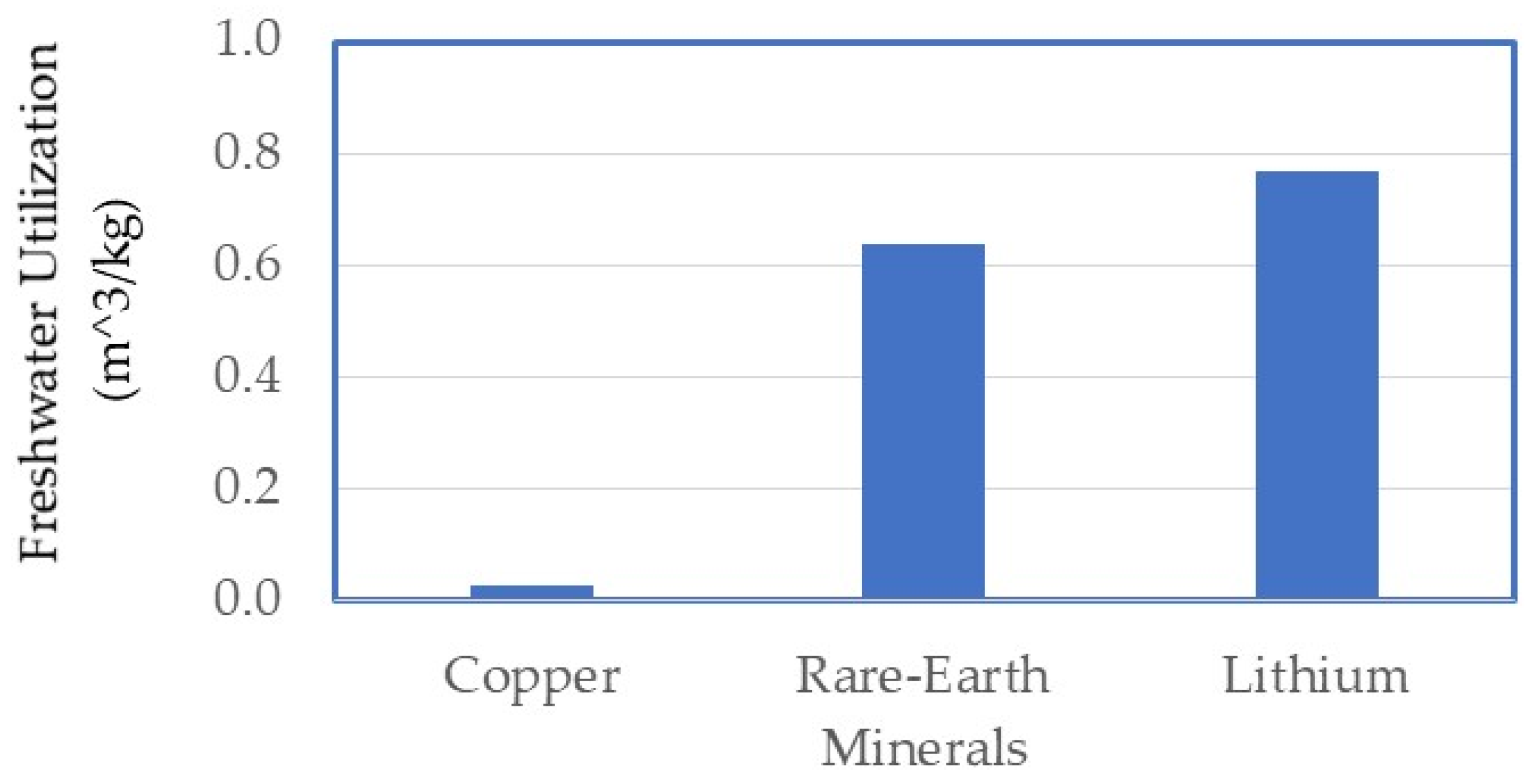
Figure 2.
Location of copper and lithium mines and water stress levels, 2020 (adopted from https://iea.imgix.net/8aa06eac-71ae-4ab0-9634-523248604704/Ch3_waterstressmap.png?auto=compress%2Cformat&fit=min&q=80&rect=0%2C0%2C3048%2C1204&w=1600&fit=crop&fm=jpg&q=70&auto=format&h=632.).
Figure 2.
Location of copper and lithium mines and water stress levels, 2020 (adopted from https://iea.imgix.net/8aa06eac-71ae-4ab0-9634-523248604704/Ch3_waterstressmap.png?auto=compress%2Cformat&fit=min&q=80&rect=0%2C0%2C3048%2C1204&w=1600&fit=crop&fm=jpg&q=70&auto=format&h=632.).
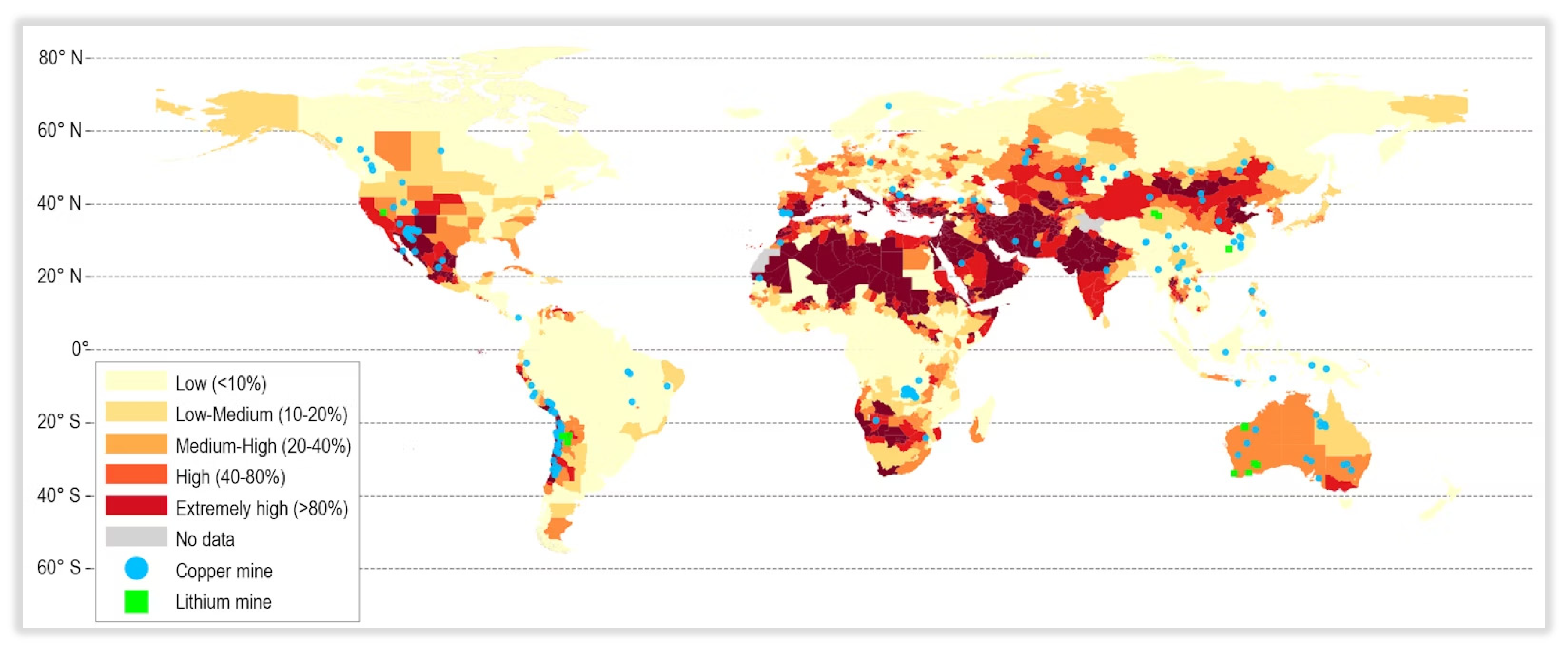
Figure 3.
% of total interviewees who reported several Human health and environmental issues.
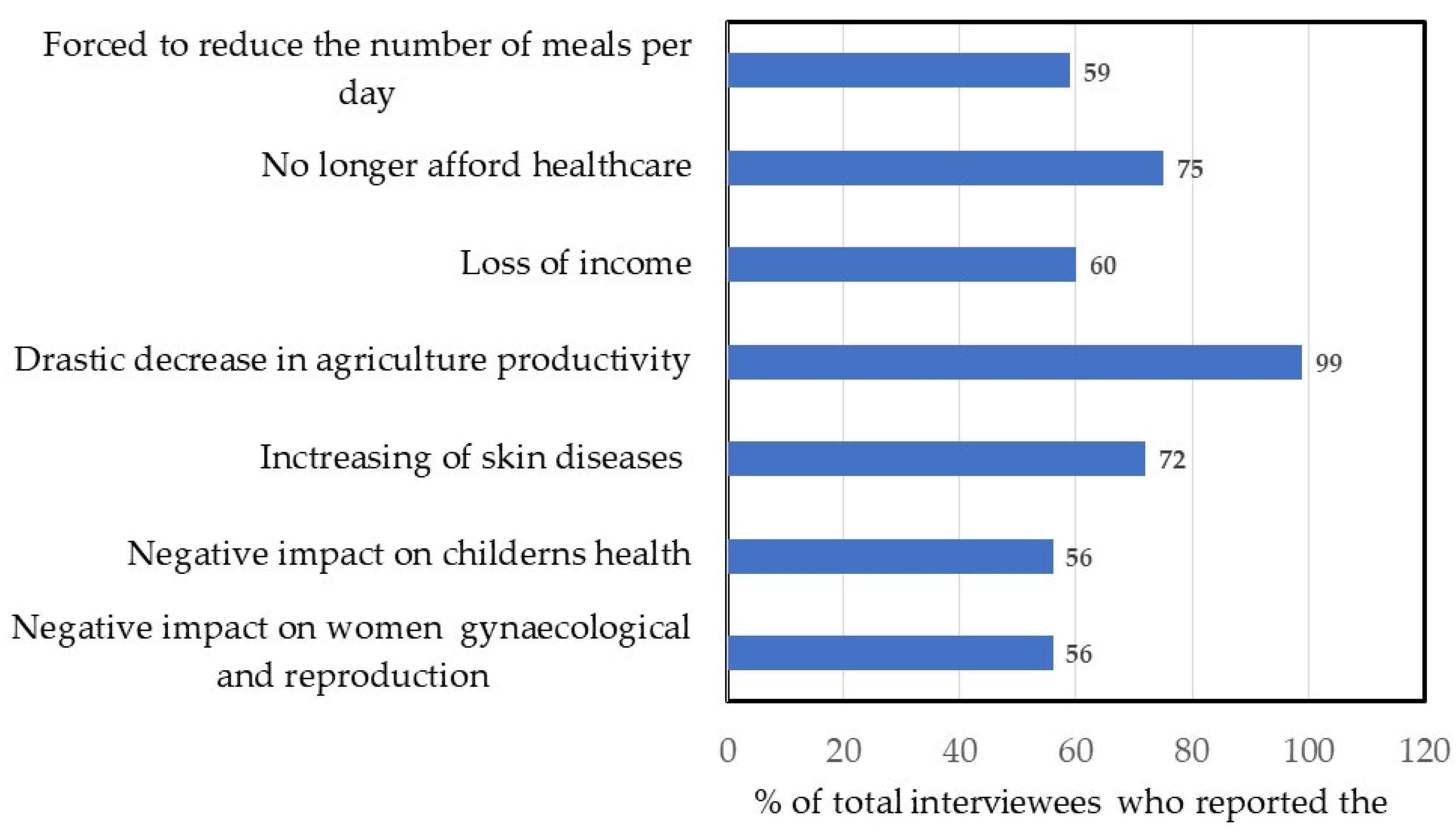
Figure 4.
Environmental impacts of four process chains (based on eudialyte at Norra Kärr, monazite at Mount Weld, bastnäsite at Mountain Pass, and the mixed bastnäsite/monazite ore at Bayan Obo in kg equivalents for production of of 1 kg neodymium.
Figure 4.
Environmental impacts of four process chains (based on eudialyte at Norra Kärr, monazite at Mount Weld, bastnäsite at Mountain Pass, and the mixed bastnäsite/monazite ore at Bayan Obo in kg equivalents for production of of 1 kg neodymium.
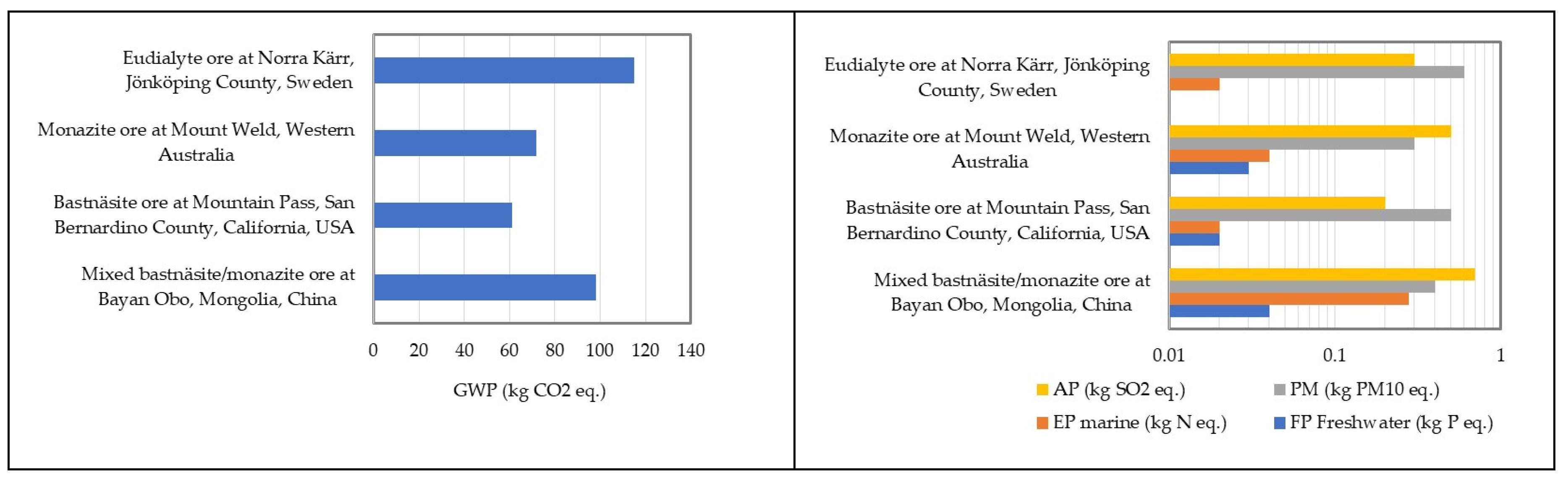
Figure 5.
Mitigation measures for critical minerals mining.
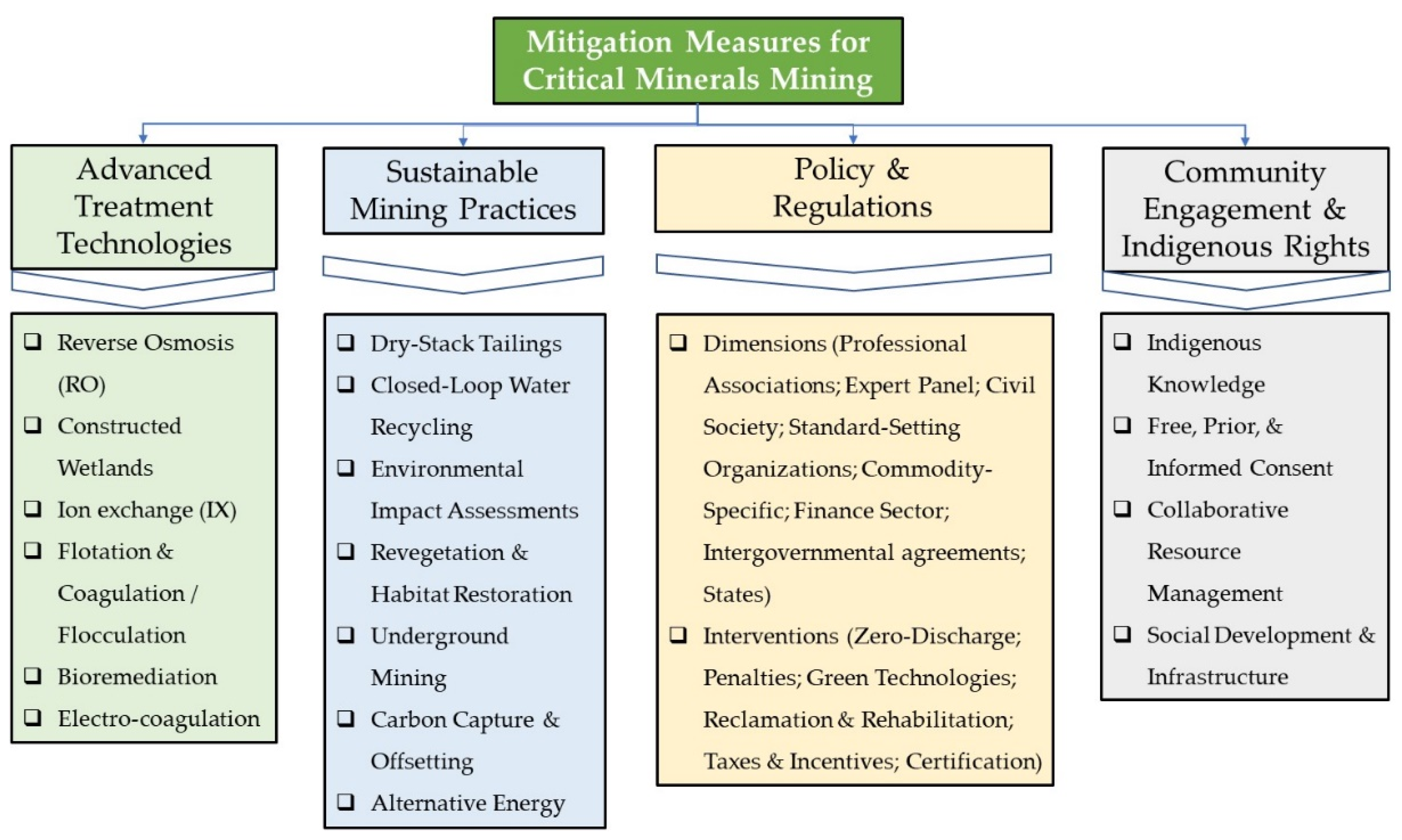

Table 1.
Comparative life cycle assessment results from cobalt, copper, and nickel extraction processes.
Table 1.
Comparative life cycle assessment results from cobalt, copper, and nickel extraction processes.
| Impact category | Unit | Cobalt (Co) | Copper (Cu) | Nickel (Ni) |
| Climate change | kg CO2 eq. | 10.81 | 5.44 | 11.19 |
| Ozone depletion | kg CFC-11 eq. | 3.68E-07 | 2.68E-07 | 5.12E-07 |
| Human toxicity, non-cancer effects | CTUh | 6.95E-07 | 7.79E-07 | 2.52E-06 |
| Human toxicity, cancer effects | CTUh | 1.45E-08 | 2.54E-08 | 4.51E-08 |
| Particulate matter | kg PM2.5 eq. | 5.3E-03 | 0.024 | 0.095 |
| Acidification | mole H+ eq. | 0.1 | 0.42 | 1.87 |
| Terrestrial eutrophication | mole N eq. | 0.52 | 0.26 | 0.38 |
| Freshwater eutrophication | kg P eq. | 3.18E-05 | 0.01 | 0.014 |
| Marine eutrophication | kg N eq. | 0.041 | 0.018 | 0.026 |
| Freshwater ecotoxicity | CTUe | 0.52 | 9.25 | 17.52 |
| Land use | kg C deficit | 24.69 | 4.58 | 6.76 |
| Water resource depletion | m³ water eq. | 0.057 | 0.032 | 0.053 |
Table 2.
Quality of Kafue river water and sediment during years 2008 and 2009.
| Kafue River | Tributaries of the Kafue River | ||||||
| Mushishima River | Wusakile River | ||||||
| Water | Sediment | Water | Water | Sediment | |||
| Parameter/ Element | Inflow (µg/L) |
Outflow (µg/L) |
Inflow (mg/kg) |
Outflow (mg/kg) | Inflow (µg/L) | Inflow (µg/L) | |
| pH | 6.6 | 6.8 | ND | ND | 2.04 | ||
| SO4 | 1.02 | 79.5 | ND | ND | 1396 mg/L | ||
| Al | 4.5 | 20.5 | ND | ND | 2115 µg/L | ||
| As | < 0.5 | 0.8 | 0.36 | 3.77 | 30.9 mg/kg | ||
| Ba | 15.3 | 37.9 | ND | ND | |||
| Co | < 0.05 | 33.1 | 18 mg/kg | 540 | 919 | 909 µg/L | 1060 mg/kg |
| Cr | ND | ND | 64 | 40 | |||
| Cu | 3.5 | 52.3 | 161 | 1520 | 14,752 | 7405 µg/L | 6316 mg/kg |
| Fe | ND | ND | 2.27 wt.% | 2.01 wt.% | |||
| Hg | ND | ND | 0.026 | 0.11 | |||
| Mn | 12.5 | 158 | 117 | 2251 | |||
| Mo | < 0.1 | 1.18 | ND | ND | |||
| Ni | 0.11 | 0.82 | 27 | 23 | 51.5 µg/L | ||
| P | 33.5 | 62.1 | ND | ND | |||
| Pb | 0.11 | 0.25 | 8.5 | 24.5 | 161 µg/L | 60 mg/kg | |
| Se | 0.05 | 0.91 | ND | ND | |||
| Stot | ND | ND | 0.08 wt.% | 0.13 wt.% | 0.29 wt.% | ||
| Zn | 1.7 | 3.7 | 62.5 | 55.5 | 346 µg/L | 129 mg/kg | |
Table 3.
Major process contributions to the environmental impact parameters.
| Major process contribution in decreasing order | |||||
| Process Chain | GWP (kg CO2 eq.) |
FP Freshwater (kg P eq.) | EP marine (kg N eq.) |
PM (kg PM10 eq.) |
AP (kg SO2 eq.) |
| Mixed bastnäsite/monazite ore at Bayan Obo, Mongolia, China | 9 > 4 > 3 > 8 > 6 | 9 > 4 > 8 | 3 | 1 > 3 | 6 > 8 > 4 > 9 |
| Bastnäsite ore at Mountain Pass, San Bernardino County, California, USA | 4 > 9 > 2 | 9 > 4 | 4 > 9 | 1 > 3 | 1 > 4 > 9 |
| Monazite ore at Mount Weld, Western Australia | 4 > 8 > 6 > 9 | 9 > 8 > 4 | 8 > 4 | 1 > 4 > 2 > 6 | 6 > 4 > 8 > 9 |
| Eudialyte ore at Norra Kärr, Jönköping County, Sweden | 4 > 6 > 8 > 7 | 2 > 9 | 4 > 8 | 1 > 3 | 6 > 4 > 1 > 2 |
| Number identification of processes used: 1 for Mining; 2 for flotation; 3 for ammonium bicarbonate precipitation; 4 for solvent extraction; 5 for magnetic separation; 6 for roasting; 7 for leaching; 8 for precipitation with oxalic acid; and 9 for electrolysis GWP (kg CO2 eq.) for global warming potential; EP freshwater (kg P eq.) for eutrophication potential; EP marine (kg N eq.) for eutrophication potential; PM (kg PM10 eq.) for particulate matter; and AP (kg SO2 eq.) for acidification potential | |||||
Table 4.
Advantages and disadvantages of the wastewater treatment methods with respect to the mining industry.
Table 4.
Advantages and disadvantages of the wastewater treatment methods with respect to the mining industry.
| Treatment Method | Advantages | Disadvantages |
| Reverse Osmosis (RO) |
|
|
| Constructed Wetlands |
|
|
| Ion Exchange (IX) |
|
|
| Flotation & Coagulation/Flocculation |
|
|
| Bioremediation |
|
|
| Electrocoagulation |
|
|
Table 5.
Environmental Impact Reduction Measures in Underground Mining.
| Environmental Aspect | Reduction Measure | Benefit |
| Energy Consumption | Use of renewable energy sources (e.g., solar, wind) | Lower carbon emissions and fuel dependency |
| Water Usage | Implement water recycling and conservation systems | Reduce freshwater consumption and pollution |
| Air Quality | Install dust suppression and emission control systems | Improve local air quality |
| Land Degradation | Rehabilitate land after mining | Restore natural habitats and ecosystems |
| Biodiversity Loss | Design buffer zones and habitat corridors | Protect local flora and fauna |
| Waste Management | Use tailings reprocessing and safe disposal methods | Reduce toxic waste and soil contamination |
| Acid Mine Drainage | Chemical neutralization and natural barriers | Prevent contamination of local water bodies |
| Noise Pollution | Use sound barriers and low-noise equipment | Minimize impact on nearby communities |
| Carbon Emissions | Deploy electric or hybrid vehicles in mining | Decrease the overall carbon footprint |
| Mine Closure Planning | Create detailed closure and reclamation plans | Ensure long-term environmental restoration |
Table 6.
Existing performance standards for tailings management.
| Regulatory Dimension | Name | Performance Standards Areas |
| Professional associations | The International Commission on Large Dams | safety, design, construction, operation, closure, monitoring and management |
| Mining Association of Canada’s Towards Sustainable Mining (TSM) programme | Tailings Management protocol | |
| International Council on Mining and Metals (ICMM) | Tailings Management Good Practice Guide Tailings Reduction Roadmap | |
| Multi-disciplinary expert panel | Global Industry Standard on Tailings Management (GISTM) | GISTM conformance protocols |
| Civil society | Earthworks, London Mining Network, and Mining Watch Canada | Safety First: Guidelines for Responsible Mine Tailings Management |
| Standard-setting organizations | International Organization for Standardization’s ISO 14001 | Environmental management systems |
| Global Reporting Initiative’s (GRI) | Mining sector supplement. Reporting on the volume of tailings produced and their risk | |
| Sustainability Accounting Standards Board | Metals and Mining standard | |
| Responsible Mining Assurance (IRMA) | IRMA Standard for Responsible Mining and Chain of Custody Standard | |
| Commodity-specific | Commodity-specific sustainability standards | Responsible Jewellery Council (RJC) Code of Practices |
| World Gold Council’s (WGC) | Gold Mining Principles | |
| Single-commodity sustainability standards | Aluminium Stewardship Initiative (ASI), | |
| International Cyanide Management Institute (ICMI) | International Cyanide Management Code | |
| Finance sector | International Finance Corporation (IFC) | Equator Principles for environmental and social performance standards |
| Intergovernmental agreements | United Nations Economic Commission for Europe (UNECE) Convention on the Transboundary Effects of Industrial Accidents | Legal framework for countries to develop and strengthen tailings safety, and it offers tools, guidelines and methodologies to strengthen tailings safety and management practices |
| German Environment and UNECE | Methodology to support countries in practical implementation | |
| European Union (EU) (2006/21/EC) | Management of Waste from Extractive Industries Directive; Best available techniques | |
| European standard (EN 16907-7:2018) | Hydraulic placement of extractive waste, i.e., tailings | |
| States | Example: Department of Mines and Petroleum, Western Australia [DMP] 2013; DMP 2015; Australian Government 2016 | Legally binding requirements for miners as well as providing guidance |
Disclaimer/Publisher’s Note: The statements, opinions and data contained in all publications are solely those of the individual author(s) and contributor(s) and not of MDPI and/or the editor(s). MDPI and/or the editor(s) disclaim responsibility for any injury to people or property resulting from any ideas, methods, instructions or products referred to in the content. |
© 2025 by the authors. Licensee MDPI, Basel, Switzerland. This article is an open access article distributed under the terms and conditions of the Creative Commons Attribution (CC BY) license (http://creativecommons.org/licenses/by/4.0/).
Copyright: This open access article is published under a Creative Commons CC BY 4.0 license, which permit the free download, distribution, and reuse, provided that the author and preprint are cited in any reuse.