

Submitted:
29 January 2025
Posted:
30 January 2025
You are already at the latest version
Abstract
Human serum albumin (HSA) is a natural depot of amyloid β-peptide (Aβ), a key player in the Alzheimer's disease (AD). HSA and pro-inflammatory Ca2+-binding proteins S100A8 and S100A9 are involved in Aβ metabolism and its deposition in the brain, serve as probable triggers and therapeutic targets in AD, but their interplay with regard to Aβ binding/fibrillation is unclear. To this end, here we explore in vitro binding of Ca2+-bound S100A8 or S100A9 to monomeric Aβ and influence of the S100 proteins on Aβ fibrillation. The equilibrium dissociation constants of the complexes of dimeric S100A8/S100A9 with Aβ40/42 estimated by biolayer interferometry are of 1-5 µM. S100A8 and S100A9 interfere with HSA binding to Aβ. Thioflavin T assay and electron microscopy data show that micromolar S100A8/S100A9 inhibit Aβ40 fibrillation, and the inhibitory effect of S100A8 exceeds that for HSA. The competition for Aβ between HSA and S100A8/S100A9 may contribute to the Aβ-HSA imbalance in the pro-inflammatory conditions in AD.
Keywords:
Alzheimer's disease
; amyloid fibrils
; amyloid β-peptide
; human serum albumin
; S100 proteins
; S100A8
; S100A9
; protein-protein interactions
1. Introduction
Alzheimer's disease (AD) is a common multifactorial disease that is accompanied by steadily increasing cognitive and memory impairment, leading to dementia [1,2]. The main pathomorphologic hallmarks of AD are extracellular senile plaques (deposits of amyloid-β peptide, Aβ, with other components) and intracellular accumulations of the abnormally modified tau protein associated with progressive atrophy of cortical and subcortical structures [2,3]. AD is subdivided into familial and sporadic forms, with the latter accounting for about 90% of all AD cases [4]. The familial form of AD is associated with mutations in the genes for the amyloid precursor protein (APP) and the proteins involved in its processing, Presenilin-1 and Presenilin-2 [3,4]. The etiology of sporadic and typically late-onset AD is less understood and is associated with a combination of rare genetic variants and environmental factors [4]. Infections, inflammation, oxidative stress and impaired activity of neurotransmitters favor development of sporadic AD along with the accumulation of neurotoxic Aβ oligomers and neurofibrillary tangles [5,6,7,8]. Meanwhile, it is disturbances in the metabolism of tau protein and Aβ that are considered to be the defining components of pathogenesis of sporadic AD [2].
The imbalance between Aβ synthesis and its excretion from the central nervous system (CNS) in AD leads to Aβ accumulation in brain tissue [9]. Elevated levels of neurotoxic Aβ oligomers cause neuronal cell death with subsequent development of cognitive impairment [10]. The same effect is achieved with improper posttranslational modifications of tau protein [11,12]. The debate as to which of these interrelated mechanisms is crucial for triggering and progression of AD is still ongoing [13,14,15,16]. In favor of the key role for amyloids is the fact that AD does not develop in the absence of amyloid deposits, and genetic forms of only Aβ are associated with AD. The recent approval of the Aβ-specific monoclonal antibodies for treatment of mild cognitive impairment and mild AD (aducanumab, lecanemab, donanemab [17]) is consistent with this conclusion.
In addition to Aβ isoforms, senile plaques contain metal ions (Cu, Fe, Zn) and dozens of proteins, including immunoglobulins, components of complement system, proteins involved in metabolism, molecular transport, blood coagulation/hemostasis, cell adhesion, extracellular matrix, etc. [18,19,20,21]. Among them, human serum albumin (HSA) is of particular importance, since this major protein of serum and cerebrospinal fluid (CSF) serves as a depot of Aβ [22,23] due to its ability to bind monomeric and multimeric forms of Aβ, and also prevents its fibrillation [23,24,25,26]. The latter fact indicates the possibility that Aβ pathology develops specifically in extracellular space of the brain due to reduced HSA level in the CSF compared to that in the blood [23]. Intracerebroventricular infusion of HSA in the 3xTg mouse model gave multifactorial beneficial effects leading to improvement in cognitive tests [27]. Plasma Aβ clearance by plasma exchange and replacement of endogenous albumin with therapeutic albumin slowed cognitive and functional decline in clinical trials in patients with mild-to-moderate AD [28,29].
Another component colocalized with senile plaques and associated with AD are specific members of S100 protein family (reviewed in ref. [30]). The S100 family contains over two dozen small (9-13 kDa) multifunctional Ca2+-binding proteins of the EF-hand superfamily [31,32,33,34], defined by the presence of the EF-hand motif, which coordinates a calcium ion through a loop located between two α-helices [35,36]. Some of S100 proteins affect cognitive processes, neuronal development and maintenance, APP processing, Aβ levels, formation of amyloid plaques, post-translational modifications of tau protein, trace metal homeostasis and signaling pathways related to AD progression [30]. The AD-related S100 proteins include S100A1, S100A6, S100A7, S100A8, S100A9, S100A12, and S100B [30]. With the exception of S100A7, they are found near or within amyloid plaques in the brains of AD animal models or AD patients [20,21,30,37,38,39]. Of these, S100A8 and S100A9 stand out as proinflammatory proteins contributing to neuroinflammation that accompanies AD progression [30,40,41,42,43,44,45]. In mouse AD models, S100A8 and S100A9 accumulate in microglia cells surrounding amyloid plaques [43], and S100A8 is deposited in the center of amyloid plaques [20]. Similarly, S100A9 is included into amyloid plaques of AD patients [21]. S100A9 is inherently amyloidogenic and synergistically promotes Aβ40 fibrillation in vitro [37,46], which is partly due to direct S100A9-Aβ40 interaction as evidenced by nuclear magnetic resonance (NMR) spectroscopy [37]. S100A9 plaques are found in the brains of patients with traumatic brain injury [37,47], which is considered a risk factor for AD [48]. Similarly, studies in mice AD models have revealed formation of extracellular S100A8 aggregates prior to accumulation of Aβ plaques and a feedback loop between S100A8 and Aβ production [49]. In contrast to the effect of S100A9 on Aβ40 fibrillation [37,46], S100A8 suppresses Aβ40/Aβ42 fibrillation in vitro [20,50]. S100A9 levels in CSF have been proposed as a marker of early stages of cognitive impairment in AD [51]. In addition, deficiency of S100A9 reduced amyloid plaque burden and prevented cognition decline in mice AD model [43,44].
Although S100A8/S100A9 and their natural depot, HSA, serve as possible triggering factors and therapeutic targets in AD, their interplay with respect to Aβ binding/fibrillation remains unclear. We previously evaluated HSA affinity for monomeric forms of Aβ40/Aβ42 [52,53]. In the present study, we aimed at quantitation of the interaction of Ca2+-loaded forms of S100A8/S100A9 with monomeric Aβ40/Aβ42 and examination of the effect of the S100 proteins on Aβ fibrillation compared with HSA.
2. Materials and Methods
2.1. Materials
Albumin, Human Serum, Non-denatured [54] (cat.#126654) and anti-amyloid-β (oligomer) antibody, clone F11G3 (MABN1839) were from Merck. Recombinant human Aβ40/Aβ42 were prepared in E. coli as described earlier [55]. Briefly, after cell disruption 6–His–ubiquitin–Aβ40/Aβ42 fusion protein was purified by immobilized metal affinity chromatography (IMAC, Bio-Rad Laboratories (Hercules, USA)). Further after proteolysis of fusion protein using catalytic core of ubiquitin carboxyl-terminal hydrolase 2 (Usp2-cc) Aβ40/Aβ42 were finally purified by sequential IMAC and reversed-phase chromatography on Jupiter C18-column (Phenomenex®). The purity and homogeneity of the obtained Aβ40/Aβ42 preparations were determined by electrophoresis in polyacrylamide gel (PAAG) and mass spectrometry. Recombinant human S100A8 protein was prepared in E. coli as described in our previous paper [56]. Usp2-cc was expressed in E. coli and purified mainly in accordance with ref. [57].
Ultra-grade Tris and Tricine, ethylenediaminetetraacetic acid (EDTA), dimethyl sulfoxide (DMSO) and isopropyl β-D-1-thiogalactopyranoside (IPTG) were from Helicon (Moscow, Russia). 2-Mercaptoethanol (2-ME) was from VWR Life Science (Solon, USA). Urea, glycerol and ampicillin were from NeoFroxx (Einhausen, Germany). Sodium chloride, potassium chloride, Coomassie Brilliant Blue R-250 and sodium azide were from Dia-M (Moscow, Russia). Imidazole, sodium hydroxide, sodium dodecyl sulfate (SDS) and DL-dithiothreitol (DTT) were purchased from Panreac AppliChem (Darmstadt, Germany). Calcium/magnesium chloride were from Fluka (Charlotte, NC, USA). 1-Ethyl-3-(3-dimethylaminopropyl)carbodiimide (EDAC), N-hydroxysuccinimide (sulfo-NHS), thioflavin T (ThT), acetonitrile, and polyethylene glycol sorbitan monolaurate (TWEEN®) 20 were from Sigma-Aldrich (St. Louis, MO, USA). Ethanolamine was bought from Bio-Rad Laboratories (Hercules, USA). Hydrochloric acid was from Sigma Tec LLC (Moscow, Russia). Phenylmethylsulfonyl fluoride (PMSF) was from Amresco® LLC (Vienna, Austria). Trifluoroacetic acid (TFA) was purchased from Fisher Scientific (Madrid, Spain). Acetic acid and ammonium hydroxide were from Chimmed (Moscow, Russia) and Component-reaktiv (Moscow, Russia), respectively.
Protein concentrations were measured spectrophotometrically using molar extinction coefficients at 280 nm calculated according to ref. [58]: 34,445 M−1cm−1 for HSA, 11,460 M−1cm−1 for S100A8, 6,990 M−1cm−1 for S100A9, 41,370 M−1cm−1 for Usp2-cc and 1,490 M−1cm−1 for Aβ40/Aβ42 at pH 7.4–8.0. Stock solution of ThT (0.8 mg/mL) was prepared in distilled, deionized water. The ThT concentration was measured spectrophotometrically using the molar extinction coefficient at 412 nm of 36,000 M−1cm−1 [59].
2.2. Bio-Layer Interferometry Studies
BLI measurements of S100A8/S100A9/HSA affinity to monomeric Aβ40/Aβ42 samples at 25°C were performed using an ForteBio Octet® QKe System (Fremont, CA, USA) with Aβ immobilization on the sensor surface. 96-well microplates with analyte solutions were kept at 25°C and shaken at 1,000 rpm. The Aβ samples were pretreated with neat TFA, followed by dissolution in DMSO as described in ref. [55,60]. The pretreated ligand (5 μg/mL Aβ40/Aβ42 in 10 mM sodium acetate, pH 4.5 buffer) was immobilized onto Octet® AR2G biosensor by amine coupling using EDAC/sulfo-NHS to achieve the loading level of 3.5 nm. The rest of the activated amine groups on the sensor were blocked by 1 M ethanolamine solution. The noncovalently bound ligand molecules were washed off the sensor with a 0.5% SDS water solution, followed by passage of the assay buffer (20 mM Tris-HCl, 140 mM NaCl, 4.9 mM KCl, 2.5 mM CaCl2, 1 mM MgCl2, pH 7.4), resulting in the loading level of 1.5 nm. The absence of Aβ oligomers has been confirmed by use of the Aβ oligomer-specific antibodies as an analyte (10–100 nM), which did not reveal noticeable BLI response. The baseline was recorded for 120 s, followed by association with the analyte (30–50 μM S100A8/S100A9; 30–50 μM HSA; 67 μM HSA in the presence/absence of 12 µM S100A8 or 7 µM S100A9) for 600 s, and dissociation of the complex for 600/1200 s. The sensor surface was regenerated by passage of 0.5% SDS water solution for 30 s.
The response data was corrected for non-specific binding by subtracting the signal from the reference sensors (one lacking the immobilized analyte in presence of ligand and one with the analyte in the absence of the ligand in the buffer). The resulting BLI sensograms were analyzed using either a bivalent analyte model:
or a heterogeneous ligand model:
where ka and kd are kinetic association and dissociation constants, respectively, and KD are equilibrium dissociation constants. The constants were evaluated for each analyte concentration using ForteBio Data Analysis software v.12.0 (Fremont, CA, USA), followed by averaging of the resulting values (n = 3–4; standard deviations are indicated).
| A + L |
ka1 → ← |
AL | AL + L |
ka2 → ← |
ALL | (1) | |
|
kd1 KD1 |
kd2 KD2 |
| A + L1 |
ka1 → ← |
AL1 | A + L2 |
ka2 → ← |
AL2 | (2) | |
|
kd1 KD1 |
kd2 KD2 |
2.3. ThT Fluorescence Assay
The human Aβ40 samples were pretreated as described in ref. [55] with some modifications. Aβ40 sample was dissolved in 5 mM NaOH at pH 11.8 (0.5 mg/mL) and then rocked gently for 72 h at 4°C. ThT fluorescence emission was measured mainly as described in ref. [55]. 20 µM Aβ40 in 25 mM Tris-HCl, 140 mM NaCl, 4.9 mM KCl, 2.5 mM CaCl2, 1 mM MgCl2, pH 7.4 buffer with 0.05% NaN3 was incubated with 10 µM ThT in the absence/presence of 5 µM HSA, 4 µM S100A8 or 4 µM S100A9 at 30°C. The ThT fluorescence intensity (λem = 485 nm, λexc = 440 nm) was recorded every 30 min for 266 h using a BioTek Synergy H1 multimode microplate reader (Agilent Technologies, Inc., Santa Clara, CA, USA) with orbital shaking prior to each measurement. The control kinetic curves (for the wells without Aβ40) were subtracted from the corresponding kinetic curves of the experimental samples. The resulting kinetic ThT fluorescence intensity data were described by the Boltzmann sigmoid function using OriginPro v.9.0 (OriginLab Corp.) software:
where A1 and A2 are the initial and final fluorescence intensities, t0 is the half-transition time and kapp is the apparent rate constant of the Aβ40 fibrillation [61]. Each measurement was performed in 4 repetitions.
2.4. Transmission Electron Microscopy
A 300-mesh copper grid coated with a 0.2% formvar film was placed onto a 10 µL drop of the sample. After allowing the sample (after the ThT fluorescence assay) to adsorb for 10 minutes, the grid was negatively stained for 2 minutes using a 1% (w/v) aqueous solution of uranyl acetate. Excess staining solution was removed with filter paper, followed by a 1-minute rinse in deionized water. The samples were examined using a JEM-1400Plus (HC) transmission electron microscope (JEOL, Ltd., Tokyo, Japan) operated at 80 keV.
2.5. Structural Modeling of Aβ40-S100 Complexes
The molecular modeling was based on the structures of human Aβ40 and Ca2+-loaded dimers of human S100A8 and S100A9: PDB [62] entries 2LFM (NMR), 1MR8 (X-ray, chains A, B) and 5I8N (NMR, model 1, chains A, B, mutation C3S), respectively. The models of tertiary structures of Aβ40-S100A8/S100A9 complexes were built using ClusPro docking server (data access on July, 2024) [63]. The analysis of distributions of the predicted contact residues of the proteins over their amino acid sequences within the models was performed as described in [64]. 10 representative models of Aβ40-S100A8/S100A9 complexes were overlayed. The numbering of the contact residues is according to the PDB entries. The model tertiary structures were drawn using molecular visualization system PyMOL v.2 [65](data access on July, 2024).
2.6. Dynamic Light Scattering Measurements
Dynamic light scattering (DLS) measurements were carried out using a Zetasizer Nano ZS system (Malvern Instruments Ltd., Malvern, UK). The backscattered light from a 4 mW He-Ne laser 632.8 nm was collected at an angle of 173°. S100A8 (4.0, 6.8, 13.6, 27.3 and 54.5 µM) and S100A9 (3.5, 7.1, 14.2, 28.4, 56.8 µM) solutions in 20 mM Tris-HCl, 140 mM NaCl, 4.9 mM KCl, 2.5 mM CaCl2, 1 mM MgCl2, pH 7.4 buffer were kept at 25°C. The acquisition time for a single autocorrelation function was 100 s. The resulting autocorrelation functions are averaged values from three measurements. The volume-weighted size distributions were calculated using the following parameters for the buffer: refractive index of 1.334 measured with RL3 refractometer (PZO, Warszawa, Poland); the viscosity value η = 0.95 mPa∙s measured using micro-rheology method with a water suspension of standard latex nanoparticles. Molecular mass corresponding to the volume-weighted hydrodynamic radius was calculated according to the equations from [66] in approximation of a globular protein.
2.7. Chemical Crosslinking of Proteins
Crosslinking of S100A8 (25, 50 and 75 μM), 20 μM Aβ40/Aβ42 and their mixtures with 0.02% glutaraldehyde was performed in 20 mM HEPES-KOH, 140 mM NaCl, 4.9 mM KCl, 2.5 mM CaCl2, 1 mM MgCl2, pH 7.4 buffer at 37°C for 1 h, mainly as described in ref. [67]. The protein solution was incubated at 25°C for 30 min prior to the crosslinking. The samples were subjected to Tricine-SDS-PAGE under reducing conditions (5% concentrating and 15% resolving gels) and staining with Coomassie Brilliant Blue R-250.
3. Results
3.1. The Interaction of S100A8/S100A9 Proteins with Aβ Peptides
The direct interaction of S100 proteins with monomeric Aβ was studied by biolayer interferometry in the buffer conditions mimicking the physiological conditions (20 mM Tris-HCl, 140 mM NaCl, 4.9 mM KCl, 2.5 mM CaCl2, 1 mM MgCl2, pH 7.4). Recombinant Aβ40/Aβ42 was immobilized on the surface of BLI sensor by amine coupling, followed by washing the sensor with 0.5% aqueous SDS solution to ensure monomeric state of Aβ (the latter was confirmed using the antibodies specific to Aβ oligomers). The BLI sensograms for Ca2+-bound forms of S100A8/S100A9 proteins (30-40 μM) exhibited well defined concentration-dependent effects, reflecting both association and dissociation phases (Figure 1). Taking into consideration that S100A8/S100A9 are prone to dimerization/tetramerization in water solutions [68], their average degrees of multimerization were estimated using DLS: 2.20±0.27 and 2.54±0.30 for S100A8 and S100A9, respectively (protein concentration of 4-57 μM). Since the S100 proteins are predominantly dimeric, their BLI sensograms were described within the bivalent analyte model (1), taking into account that the dimer concentration is half of the monomer concentration. Considering that the kinetic and equilibrium parameters of the S100-Aβ interactions estimated for each BLI sensogram did not reveal dependence on the analyte concentration, their resulting estimates were averaged (Table 1).
S100A8 and S100A9 exhibit nearly identical equilibrium and kinetic parameters of interaction with Aβ42 (Table 1). Meanwhile, the affinity of S100A9 for Aβ40 is about 2-fold higher than that of S100A8, mainly due to the slower dissociation of the S100A9-Aβ40 complex. The affinity of S100A8 for Aβ42 is 4-fold higher than that for Aβ40, due to 1.5-fold accelerated association and 2.4-fold slower dissociation. Notably, our estimates of the equilibrium dissociation constants (KD) for S100A8/S100A9 complexes with Aβ40/Aβ42 (1-5 μM) are close to some values reported for other targets of S100A8/S100A9: S100A9 binds RAGE V domain with KD of 5–6 μM [69] and S100A12 with KD of 1.3 μM [70], S100A8 binds Toll-like receptor 4 with KD of 1 μM in the presence of Ca2+ and Zn2+ [71]. This fact indicates physiological relevance of the S100-Aβ interactions.
The interactions of S100A8 [20] and S100A9 [37,46] proteins with Aβ have been previously reported, but they were not quantified and likely correspond to multimeric forms of Aβ due to the lack of means of its monomerization. Instead, these studies demonstrate influence of S100A8/S100A9 on the process of Aβ fibrillization. In fact, even relatively low levels of Aβ (20 μM) are accompanied by accumulation of its multimeric states, as evidenced by chemical cross-linking data (Figure S1). Nevertheless, Aβ multimerization does not preclude its interaction with S100A8, and the complex of their monomers is detected by chemical cross-linking, as evidenced by appearance of the faint band at about 15 kDa (Figure S1).
3.2. Modeling of Aβ40-S100A8/S100A9 Complexes
The tertiary structures of the complexes between Ca2+-loaded dimers of S100A8/S100A9 and Aβ40 monomer were built using ClusPro docking server [63] (Figure 2). Overlay of 10 representative structures predicted for the S100A8-Aβ40 complex (Figure 2A) shows that Aβ40 preferentially binds to the groove between chain A and B of S100A8 (Figure 2A), which is considered as a typical binding site of S100 proteins for numerous protein targets, including cytokines and receptors [72,73,74]. The predicted contact residues for chain A of S100A8 include I60 (from the loop between helices α3 and α4), Q69, I73 and K77 (helix α4). The contact residues of chain B: K56 (helix α3), I60 (the loop between helices α3 and α4), I73, I76 and K77 (helix α4). The analogous modeling of the S100A9-Aβ40 complex (Figure 2B) predicts that chain A of S100A9 binds Aβ40 via residues K51 and H61 (helix α3), R85, W88, A89 and E92 (helix α4), H103 and H105 (C-terminus). The predicted contact residues of chain B are nearly the same: K51, R85, W88, E92, H103 and H105. Our results are consistent with the modeling of the S100A9-Aβ40 complex, reported earlier [37], which showed that residues R85 and L86 make particularly close contacts with Aβ40. The residue S26 of Aβ40 is predicted to bind S100A9, consistent with the literature data [37].
3.3. S100A8/S100A9 Prevent HSA Interaction with Monomeric Aβ
Since HSA serves as a natural depot of Aβ [22,23], an intriguing question is whether S100A8/S100A9 can affect the Aβ binding to HSA. The BLI sensograms for HSA (30–50 µM) interaction with monomeric Aβ40/Aβ42 immobilized on BLI sensor were described by the heterogeneous ligand model (2) (Figure 1 (C, F)). The resulting KD values (Table 2) are in agreement with our previous SPR estimates [52,53]. Notably, the HSA affinity for monomeric Aβ exceeds that for S100A8/S100A9 (Table 1): the KD values for the Aβ40-S100A8 or Aβ40-S100A9 complexes are respectively 23- or 10-fold higher than the lowest KD value for the HSA-Aβ40 interaction, whereas for the Aβ42, this effect is much less pronounced (3-fold difference). Meanwhile, S100A8/S100A9 notably suppress HSA interaction with Aβ40/Aβ42: the similar experiment performed in the presence of 12 µM S100A8 or 7 µM S100A9 shows marked decline in maximal BLI signal (Figure 3). The observed prevention of HSA interaction with monomeric Aβ in the presence of S100A8/S100A9 could be due in part to direct S100 binding to HSA, but this possibility was ruled out by control BLI experiments which did not show S100-HSA interaction (Figure S2). Therefore, this effect is mainly due to competition between the HSA and S100A8/S100A9 for Aβ molecules.
The fact that S100A8, S100A9, and HSA are found in amyloid deposits in brain tissue of AD patients [20,37,75] suggests their involvement in the Aβ intermolecular interactions and the subsequent Aβ fibrillation. Our findings evidence that S100A8 and S100A9 proteins preclude HSA interaction with Aβ through a competitive mechanism. The latter suggests that HSA loading with Aβ will depend on the relative concentrations of HSA, S100A8/S100A9, and Aβ. Total Aβ concentrations in CSF and blood serum do not exceed nanomolar level [76,77,78,79]. Meanwhile, concentrations of HSA and S100A8/S100A9 greatly depend on the fluid: HSA concentration ranges from 3 μM in CSF to 645 μM in serum [80], while total concentration of S100A8 and S100A9 varies from 0.09 μM in serum of healthy donor [81] to 3-6 μM in the synovial fluid during inflammation [82]. Furthermore, albumin synthesis and secretion by microglial cells is enhanced upon their activation by Aβ42 [83]. In addition, local brain concentrations of Aβ and S100A8/S100A9 in the sites of amyloid deposition may be quite high [84]. Our theoretical estimates indicate that at the Aβ and HSA concentrations equivalent to those in CSF [78,79] and the total S100A8 and S100A9 contents corresponding to those in the inflammatory focus [82] 12% of Aβ40 and 36% of Aβ42 will be bound to either S100A8 or S100A9, while 82% of Aβ40 and 56% of Aβ42 will be bound to HSA (Appendix 1). Therefore, S100A9 and S100A8 should be considered as possible competitors of HSA with respect to Aβ binding, with S100A9 being more efficient than S100A8.
3.4. Effect of S100A8/S100A9 on Aβ Fibrillation In Vitro
We investigated the effect of Ca2+-loaded S100A8/S100A9 on kinetics of the Aβ40 fibrillation at 30°C using thioflavin T fluorescence assay (Figure 4) and S100A8/S100A9 concentration of 4 μM, which corresponds to that in the inflammatory focus [82]. The addition of S100A8 dramatically decreased the maximum fluorescence signal (Imax) by 32-fold compared to the sample containing Aβ40 alone. Similar, but less pronounced effect is observed in the presence of S100A9 (Imax is decreased by a factor of 5). HSA at a concentration of 5 μM (close to that in CSF [80]) lowers Imax value by 4-fold, which is consistent with previous reports [23,55]. This effect is close to that for S100A9, but lower than the effect observed for S100A8.
The data of ThT fluorescence assay were confirmed by electron microscopy analysis (Figure 5). The incubation of the Aβ40 sample (20 μM) reveals dense clusters of the intertwined mature fibrils reaching microns in length (Figure 5A). The fibrillation in the presence of 4 μM S100A9 gives rise to drastically more fuzzy fibrils, which indicates suppression of the process (Figure 5C). The Aβ40 fibrillation in the presence of 4 μM S100A8 yields even fewer fibrils (Figure 5B), in accord with the ThT fluorescence assay (Figure 4).
S100A8 and S100A9 are known to be able to form aggregates and fibrils under certain conditions [85,86]. The previous AFM study of interaction between Aβ42 and S100A9 fibrils suggested that the bulk of co-aggregated complexes is represented by Aβ42 amyloids templating S100A9 fibrils on their surfaces [86]. The TEM image for the analogous S100A9-Aβ40 complex (Figure 6) also suggests that S100A9 ‘stick’ to Aβ40 fibrils, consistent with the protein interaction mechanism described in ref. [86]. Taken together, the TEM data evidence a suppressive effect of S100A8/A9 on the Aβ40 fibrillation, in accord with the ThT fluorescence assay data.
Although our results evidence that 4 μM S100A9 suppresses Aβ40 fibrillation (Figures 4, 5C), S100A9 at higher concentrations of 20-200 µM has previously been shown to exert the opposite effect [37,46]. This discrepancy may be due to differences in the experimental conditions, including S100A9 concentration, temperature of the experiment (30°C versus 37°C), and the presence of Ca2+ and Mg2+ excess in our experiments to mimic the physiologically relevant conditions.
Our and literature data on Aβ40 fibrillation are in partial agreement with the effects of S100A9 and S100A8 on Aβ42 fibrillation reported earlier [20,86]. J. Pansieri et al. demonstrated that lag-phase of the Aβ42 fibrillation is more pronounced at the lowest S100A9 concentration of 2 μM, although the inhibitory effects persisted at S100A9 concentrations up to 100 μM [86]. According to the authors, S100A9 co-aggregates with Aβ42, affecting fibril morphology. Meanwhile, S100A8 at concentration of 16 μM slows but does not completely inhibit the Aβ42 fibrillation [20].
Examination of the additivity of the effects of HSA (5 µM) and S100A8/S100A9 (4/2 µM) with regard to Aβ40 fibrillation showed that the addition of HSA does not cause qualitative changes in the individual effects of S100A8 and S100A9 proteins (Figure S3). Therefore, S100A9 and S1008 proteins at physiologically relevant concentrations prevent formation of Aβ40 fibrils regardless of micromolar level of HSA.
4. Conclusions
Accumulating evidences suggest active involvement of the proinflammatory proteins S100A8 and S100A9 in Aβ metabolism in the CNS. Positive feedback between S100A8 and Aβ productions has previously been found, which is hypothesized to be critical for the accumulation of Aβ deposits [49]. Similarly, S100A9 favors APP processing and Aβ accumulation [43]. Aside from signaling through an array of cell surface receptors [43,49], S100A8 and S100A9 are capable of aggregation and co-deposition with Aβ, which was observed in AD patients and in mouse models of AD [20,37,85]. The primary Aβ depot, HSA, is also included into the amyloid deposits [20,37,75], but the interplay between Aβ, HSA and S100A8/S100A9 proteins and its significance for amyloid formation remains obscure. In the present work, we have described the specific processes related to this issue, starting with a numerical characterization of the individual chemical equilibria occurring in the system and ending with a consideration of the complex phenomenon of Aβ fibrillation in the presence of the other reactants and their combinations. Despite the relatively low affinity of S100A8 and S100A9 homodimers for monomeric Aβ40/Aβ42 compared with HSA, the S100 proteins markedly suppress both HSA binding to Aβ40/Aβ42 monomer and Aβ40 fibrillation in vitro, with S100A8 most efficiently blocking the latter process. The competition between HSA and S100A8/S100A9 for Aβ likely contributes to the Aβ-HSA imbalance in the pro-inflammatory conditions in AD favoring elevated S100A8/S100A9 levels. In this way, these S100 proteins may link inflammation to the impaired Aβ metabolism in AD. Given that accumulation of S100A8 aggregates precedes Aβ plaque formation in murine models of AD [49], exploiting its protective function or targeted prevention of S100A8 accumulation or its interaction with Aβ or its other targets may be a viable therapeutic strategy, as demonstrated for S100A9 in ref. [43,44]. Further in-depth in vivo studies are needed to choose an effective approach and validate it experimentally.
Supplementary Materials
The following supporting information can be downloaded at the website of this paper posted on Preprints.org. Figure S1: SDS-PAGE analysis of S100A8 (25, 50 and 75 μM), 20 μM Aβ40/Aβ42 and their mixtures cross-linked by 0.02% glutaraldehyde at 37°C for 1 h (20 mM HEPES-KOH, 140 mM NaCl, 4.9 mM KCl, 2.5 mM CaCl2, 1 mM MgCl2, pH 7.4). The numbers in the column “M” indicate molecular masses of markers in kDa. Gel staining by Coomassie Brilliant Blue R-250. Figure S2: The kinetics of HSA-S100A8 interaction examined using BLI (20 mM Tris-HCl, 140 mM NaCl, 4.9 mM KCl, 2.5 mM CaCl2, 1 mM MgCl2, pH 7.4). Figure S3: Kinetics of Aβ40 (20 μM) fibrillation in the presence of HSA (5 μM), S100A8 (4 μM), S100A9 (4 μM) or combination of HSA (5 μM) with S100A8 (4 μM) or S100A9 (2 μM) at 30°C, followed by ThT (10 μM) fluorescence intensity at 485 nm (25 mM Tris-HCl, 140 mM NaCl, 4.9 mM KCl, 2.5 mM CaCl2, 1 mM MgCl2, pH 7.4 buffer with 0.05% NaN3). The standard deviations of the fluorescence signals are indicated. Excitation wavelength of 440 nm. Appendix 1: Evaluation of distribution of Aβ40 and Aβ42 between S100A8, S100A9 and HSA in CSF under inflammatory conditions.
Author Contributions
Conceptualization, E.L., M.Sh., S.P.; methodology, E.D., E.L., M.Sh.; software, E.D.; validation, E.L., M.Sh., E.D.; formal analysis, M.Sh., E.D., E.L.; investigation, M.Sh., A.V., A.M., E.D., E.N.; resources, M.P., A.S., S.P.; data curation, E.L., M.Sh., A.M.; writing—original draft preparation, E.L., E.D., M.Sh., E.N., A.M.; writing—review and editing, S.P., A.M., V.U.; visualization, E.L., M.Sh., E.D., A.M.; supervision, E.L., S.P.; project administration, E.L.; funding acquisition, E.L. All authors have read and agreed to the published version of the manuscript.
Funding
This research was funded by Russian Science Foundation, grant number 20-74-10072, https://rscf.ru/project/20-74-10072/. The funders had no role in study design, data collection and analysis, decision to publish, or preparation of the manuscript.
Institutional Review Board Statement
Not applicable.
Informed Consent Statement
Not applicable.
Data Availability Statement
Data are contained within the article and supplementary materials.
Acknowledgments
The authors are grateful to Dr. Alexey S. Kazakov (Institute for Biological Instrumentation, Russian Academy of Sciences, Pushchino, Moscow Region, Russia) for preliminary SPR experiments on S100A8/A9 interaction with Aβ; Dr. Vadim V. Rogachevskii (Institute of Cell Biophysics, Russian Academy of Sciences, Pushchino, Moscow Region, Russia) for providing access to the electron microscope of the Shared Core Facilities of the Pushchino Scientific Center for Biological Research (http://www.ckp-rf.ru/ckp/670266/; accessed on 13 December 2024); Marina F. Bystrova (Institute of Cell Biophysics, Russian Academy of Sciences, Pushchino, Moscow Region, Russia) for assistance in construction of USP2 recombinant plasmid.
Conflicts of Interest
The authors declare no conflicts of interest.
References
- Reitz, C.; Mayeux, R. Alzheimer disease: Epidemiology, diagnostic criteria, risk factors and biomarkers. Biochemical Pharmacology 2014, 88(4), 640–651. [Google Scholar] [CrossRef] [PubMed]
- Jack, C. R., Jr.; Bennett, D. A.; Blennow, K.; Carrillo, M. C.; Dunn, B.; Haeberlein, S. B.; Holtzman, D. M.; Jagust, W.; Jessen, F.; Karlawish, J.; Liu, E.; Molinuevo, J. L.; Montine, T.; Phelps, C.; Rankin, K. P.; Rowe, C. C.; Scheltens, P.; Siemers, E.; Snyder, H. M.; Sperling, R. NIA-AA Research Framework: Toward a biological definition of Alzheimer's disease. Alzheimer's & dementia : the journal of the Alzheimer's Association 2018, 14(4), 535–562. [Google Scholar]
- DeTure, M. A.; Dickson, D. W. The neuropathological diagnosis of Alzheimer's disease. Mol Neurodegener 2019, 14(1), 32. [Google Scholar] [CrossRef] [PubMed]
- Dorszewska, J.; Prendecki, M.; Oczkowska, A.; Dezor, M.; Kozubski, W. Molecular Basis of Familial and Sporadic Alzheimer's Disease. Curr Alzheimer Res 2016, 13(9), 952–63. [Google Scholar] [CrossRef] [PubMed]
- Hosseininasab, S. S. M.; Ebrahimi, R.; Yaghoobpoor, S.; Kazemi, K.; Khakpour, Y.; Hajibeygi, R.; Mohamadkhani, A.; Fathi, M.; Vakili, K.; Tavasol, A.; Tutunchian, Z.; Fazel, T.; Fathi, M.; Hajiesmaeili, M. Alzheimer's disease and infectious agents: a comprehensive review of pathogenic mechanisms and microRNA roles. Front Neurosci 2024, 18, 1513095. [Google Scholar] [CrossRef] [PubMed]
- Kinney, J. W.; Bemiller, S. M.; Murtishaw, A. S.; Leisgang, A. M.; Salazar, A. M.; Lamb, B. T. Inflammation as a central mechanism in Alzheimer's disease. Alzheimers Dement (N Y) 2018, 4, 575–590. [Google Scholar] [CrossRef] [PubMed]
- Cheignon, C.; Tomas, M.; Bonnefont-Rousselot, D.; Faller, P.; Hureau, C.; Collin, F. Oxidative stress and the amyloid beta peptide in Alzheimer's disease. Redox Biol 2018, 14, 450–464. [Google Scholar] [CrossRef]
- Yang, Z.; Zou, Y.; Wang, L. Neurotransmitters in Prevention and Treatment of Alzheimer's Disease. Int J Mol Sci 2023, 24(4). [Google Scholar] [CrossRef] [PubMed]
- Mawuenyega, K. G.; Sigurdson, W.; Ovod, V.; Munsell, L.; Kasten, T.; Morris, J. C.; Yarasheski, K. E.; Bateman, R. J. Decreased clearance of CNS beta-amyloid in Alzheimer's disease. Science (New York, N.Y.) 2010, 330(6012), 1774. [Google Scholar] [CrossRef]
- Sengupta, U.; Nilson, A. N.; Kayed, R. The Role of Amyloid-β Oligomers in Toxicity, Propagation, and Immunotherapy. eBioMedicine 2016, 6, 42–49. [Google Scholar] [PubMed]
- Liu, F.; Liang, Z. H.; Gong, C.-X. Hyperphosphorylation of tau and protein phosphatases in Alzheimer disease. Panminerva medica 2006, 48, 97–108. [Google Scholar]
- Li, X.; Ba, Z.; Huang, J.; Chen, J.; Jiang, J.; Huang, N.; Luo, Y. Comprehensive review on Alzheimer's disease: From the posttranslational modifications of Tau to corresponding treatments. Ibrain 2024, 10(4), 427–438. [Google Scholar] [CrossRef] [PubMed]
- Morris, G. P.; Clark, I. A.; Vissel, B. Questions concerning the role of amyloid-β in the definition, aetiology and diagnosis of Alzheimer’s disease. Acta Neuropathologica 2018, 136(5), 663–689. [Google Scholar] [CrossRef]
- Paroni, G.; Bisceglia, P.; Seripa, D. Understanding the Amyloid Hypothesis in Alzheimer's Disease. J Alzheimers Dis 2019, 68(2), 493–510. [Google Scholar] [CrossRef]
- Karran, E.; De Strooper, B. The amyloid hypothesis in Alzheimer disease: new insights from new therapeutics. Nature Reviews Drug Discovery 2022, 21(4), 306–318. [Google Scholar] [CrossRef]
- Arnsten, A. F. T.; Datta, D.; Del Tredici, K.; Braak, H. Hypothesis: Tau pathology is an initiating factor in sporadic Alzheimer's disease. Alzheimers Dement 2021, 17(1), 115–124. [Google Scholar] [CrossRef] [PubMed]
- Qi, X.; Nizamutdinov, D.; Yi, S. S.; Wu, E.; Huang, J. H. Disease Modifying Monoclonal Antibodies and Symptomatic Pharmacological Treatment for Alzheimer's Disease. Biomedicines 2024, 12(11). [Google Scholar] [CrossRef]
- Rahman, M. M.; Lendel, C. Extracellular protein components of amyloid plaques and their roles in Alzheimer's disease pathology. Mol Neurodegener 2021, 16(1), 59. [Google Scholar] [CrossRef] [PubMed]
- Lovell, M. A.; Robertson, J. D.; Teesdale, W. J.; Campbell, J. L.; Markesbery, W. R. Copper, iron and zinc in Alzheimer's disease senile plaques. J Neurol Sci 1998, 158(1), 47–52. [Google Scholar] [CrossRef]
- Hagmeyer, S.; Romao, M. A.; Cristovao, J. S.; Vilella, A.; Zoli, M.; Gomes, C. M.; Grabrucker, A. M. Distribution and Relative Abundance of S100 Proteins in the Brain of the APP23 Alzheimer's Disease Model Mice. Front Neurosci 2019, 13, 640. [Google Scholar] [CrossRef]
- Shepherd, C. E.; Goyette, J.; Utter, V.; Rahimi, F.; Yang, Z.; Geczy, C. L.; Halliday, G. M. Inflammatory S100A9 and S100A12 proteins in Alzheimer's disease. Neurobiol Aging 2006, 27(11), 1554–63. [Google Scholar] [CrossRef] [PubMed]
- Biere, A. L.; Ostaszewski, B.; Stimson, E. R.; Hyman, B. T.; Maggio, J. E.; Selkoe, D. J. Amyloid β-Peptide Is Transported on Lipoproteins and Albumin in Human Plasma*. Journal of Biological Chemistry 1996, 271(51), 32916–32922. [Google Scholar] [CrossRef]
- Stanyon, H. F.; Viles, J. H. Human serum albumin can regulate amyloid-β peptide fiber growth in the brain interstitium: implications for Alzheimer disease. J Biol Chem 2012, 287(33), 28163–8. [Google Scholar] [CrossRef]
- Litus, E. A.; Kazakov, A. S.; Sokolov, A. S.; Nemashkalova, E. L.; Galushko, E. I.; Dzhus, U. F.; Marchenkov, V. V.; Galzitskaya, O. V.; Permyakov, E. A.; Permyakov, S. E. The binding of monomeric amyloid β peptide to serum albumin is affected by major plasma unsaturated fatty acids. Biochem Biophys Res Commun 2019, 510(2), 248–253. [Google Scholar] [CrossRef]
- Milojevic, J.; Melacini, G. Stoichiometry and affinity of the human serum albumin-Alzheimer's Aβ peptide interactions. Biophysical journal 2011, 100(1), 183–92. [Google Scholar] [CrossRef] [PubMed]
- Wang, C.; Cheng, F.; Xu, L.; Jia, L. HSA targets multiple Aβ42 species and inhibits the seeding-mediated aggregation and cytotoxicity of Aβ42 aggregates. RSC Advances 2016, 6(75), 71165–71175. [Google Scholar] [CrossRef]
- Ezra, A.; Rabinovich-Nikitin, I.; Rabinovich-Toidman, P.; Solomon, B. Multifunctional Effect of Human Serum Albumin Reduces Alzheimer's Disease Related Pathologies in the 3xTg Mouse Model. J Alzheimers Dis 2016, 50(1), 175–88. [Google Scholar] [CrossRef]
- Boada, M.; Ortiz, P.; Anaya, F.; Hernandez, I.; Munoz, J.; Nunez, L.; Olazaran, J.; Roca, I.; Cuberas, G.; Tarraga, L.; Buendia, M.; Pla, R. P.; Ferrer, I.; Paez, A. Amyloid-targeted therapeutics in Alzheimer's disease: use of human albumin in plasma exchange as a novel approach for Abeta mobilization. Drug News Perspect 2009, 22(6), 325–39. [Google Scholar] [CrossRef] [PubMed]
- Boada, M.; López, O. L.; Olazarán, J.; Núñez, L.; Pfeffer, M.; Paricio, M.; Lorites, J.; Piñol-Ripoll, G.; Gámez, J. E.; Anaya, F.; Kiprov, D.; Lima, J.; Grifols, C.; Torres, M.; Costa, M.; Bozzo, J.; Szczepiorkowski, Z. M.; Hendrix, S.; Páez, A. A randomized, controlled clinical trial of plasma exchange with albumin replacement for Alzheimer's disease: Primary results of the AMBAR Study. Alzheimer's & dementia : the journal of the Alzheimer's Association 2020, 16(10), 1412–1425. [Google Scholar]
- Cristovao, J. S.; Gomes, C. M. S100 Proteins in Alzheimer's Disease. Front Neurosci 2019, 13, 463. [Google Scholar] [CrossRef]
- Donato, R.; Cannon, B. R.; Sorci, G.; Riuzzi, F.; Hsu, K.; Weber, D. J.; Geczy, C. L. Functions of S100 proteins. Curr Mol Med 2013, 13(1), 24–57. [Google Scholar] [CrossRef] [PubMed]
- Singh, P.; Ali, S. A. Multifunctional Role of S100 Protein Family in the Immune System: An Update. Cells 2022, 11(15). [Google Scholar] [CrossRef] [PubMed]
- Gonzalez, L. L.; Garrie, K.; Turner, M. D. Role of S100 proteins in health and disease. Biochim Biophys Acta Mol Cell Res 2020, 1867(6), 118677. [Google Scholar] [CrossRef] [PubMed]
- Sreejit, G.; Flynn, M. C.; Patil, M.; Krishnamurthy, P.; Murphy, A. J.; Nagareddy, P. R. S100 family proteins in inflammation and beyond. Adv Clin Chem 2020, 98, 173–231. [Google Scholar] [PubMed]
- Persechini, A.; Moncrief, N. D.; Kretsinger, R. H. The EF-hand family of calcium-modulated proteins. Trends Neurosci. 1989, 12(11), 462–467. [Google Scholar] [CrossRef] [PubMed]
- Gifford, J. L.; Walsh, M. P.; Vogel, H. J. Structures and metal-ion-binding properties of the Ca2+-binding helix-loop-helix EF-hand motifs. Biochem J 2007, 405(2), 199–221. [Google Scholar] [CrossRef]
- Wang, C.; Klechikov, A. G.; Gharibyan, A. L.; Warmlander, S. K.; Jarvet, J.; Zhao, L.; Jia, X.; Narayana, V. K.; Shankar, S. K.; Olofsson, A.; Brannstrom, T.; Mu, Y.; Graslund, A.; Morozova-Roche, L. A. The role of pro-inflammatory S100A9 in Alzheimer's disease amyloid-neuroinflammatory cascade. Acta Neuropathol 2014, 127(4), 507–22. [Google Scholar] [CrossRef] [PubMed]
- Boom, A.; Pochet, R.; Authelet, M.; Pradier, L.; Borghgraef, P.; Van Leuven, F.; Heizmann, C. W.; Brion, J. P. Astrocytic calcium/zinc binding protein S100A6 over expression in Alzheimer's disease and in PS1/APP transgenic mice models. Biochim Biophys Acta 2004, 1742(1-3), 161-8. [Google Scholar] [CrossRef] [PubMed]
- Tian, Z. Y.; Wang, C. Y.; Wang, T.; Li, Y. C.; Wang, Z. Y. Glial S100A6 Degrades beta-amyloid Aggregation through Targeting Competition with Zinc Ions. Aging Dis 2019, 10(4), 756–769. [Google Scholar] [CrossRef] [PubMed]
- Ma, L.; Sun, P.; Zhang, J. C.; Zhang, Q.; Yao, S. L. Proinflammatory effects of S100A8/A9 via TLR4 and RAGE signaling pathways in BV-2 microglial cells. Int J Mol Med 2017, 40(1), 31–38. [Google Scholar] [CrossRef]
- Venegas, C.; Heneka, M. T. Danger-associated molecular patterns in Alzheimer's disease. Journal of leukocyte biology 2017, 101(1), 87–98. [Google Scholar] [CrossRef] [PubMed]
- Heneka, M. T.; Carson, M. J.; El Khoury, J.; Landreth, G. E.; Brosseron, F.; Feinstein, D. L.; Jacobs, A. H.; Wyss-Coray, T.; Vitorica, J.; Ransohoff, R. M.; Herrup, K.; Frautschy, S. A.; Finsen, B.; Brown, G. C.; Verkhratsky, A.; Yamanaka, K.; Koistinaho, J.; Latz, E.; Halle, A.; Petzold, G. C.; Town, T.; Morgan, D.; Shinohara, M. L.; Perry, V. H.; Holmes, C.; Bazan, N. G.; Brooks, D. J.; Hunot, S.; Joseph, B.; Deigendesch, N.; Garaschuk, O.; Boddeke, E.; Dinarello, C. A.; Breitner, J. C.; Cole, G. M.; Golenbock, D. T.; Kummer, M. P. Neuroinflammation in Alzheimer's disease. Lancet Neurol 2015, 14(4), 388–405. [Google Scholar] [CrossRef] [PubMed]
- Kummer, M. P.; Vogl, T.; Axt, D.; Griep, A.; Vieira-Saecker, A.; Jessen, F.; Gelpi, E.; Roth, J.; Heneka, M. T. Mrp14 deficiency ameliorates amyloid beta burden by increasing microglial phagocytosis and modulation of amyloid precursor protein processing. J Neurosci 2012, 32(49), 17824–9. [Google Scholar] [CrossRef]
- Ha, T. Y.; Chang, K. A.; Kim, J.; Kim, H. S.; Kim, S.; Chong, Y. H.; Suh, Y. H. S100a9 knockdown decreases the memory impairment and the neuropathology in Tg2576 mice, AD animal model. PLoS One 2010, 5(1), e8840. [Google Scholar] [CrossRef] [PubMed]
- Zhang, X.; Sun, D.; Zhou, X.; Zhang, C.; Yin, Q.; Chen, L.; Tang, Y.; Liu, Y.; Morozova-Roche, L. A. Proinflammatory S100A9 stimulates TLR4/NF-kappaB signaling pathways causing enhanced phagocytic capacity of microglial cells. Immunol Lett 2023, 255, 54–61. [Google Scholar] [CrossRef] [PubMed]
- Zhang, C.; Liu, Y.; Gilthorpe, J.; van der Maarel, J. R. MRP14 (S100A9) protein interacts with Alzheimer beta-amyloid peptide and induces its fibrillization. PLoS One 2012, 7(3), e32953. [Google Scholar] [CrossRef] [PubMed]
- Wang, C.; Iashchishyn, I. A.; Pansieri, J.; Nystrom, S.; Klementieva, O.; Kara, J.; Horvath, I.; Moskalenko, R.; Rofougaran, R.; Gouras, G.; Kovacs, G. G.; Shankar, S. K.; Morozova-Roche, L. A. S100A9-Driven Amyloid-Neuroinflammatory Cascade in Traumatic Brain Injury as a Precursor State for Alzheimer's Disease. Sci Rep 8 1), 12836. [CrossRef]
- Mielke, M. M.; Ransom, J. E.; Mandrekar, J.; Turcano, P.; Savica, R.; Brown, A. W. Traumatic Brain Injury and Risk of Alzheimer's Disease and Related Dementias in the Population. J Alzheimers Dis 2022, 88(3), 1049–1059. [Google Scholar] [CrossRef]
- Lodeiro, M.; Puerta, E.; Ismail, M. A.; Rodriguez-Rodriguez, P.; Ronnback, A.; Codita, A.; Parrado-Fernandez, C.; Maioli, S.; Gil-Bea, F.; Merino-Serrais, P.; Cedazo-Minguez, A. Aggregation of the Inflammatory S100A8 Precedes Abeta Plaque Formation in Transgenic APP Mice: Positive Feedback for S100A8 and Abeta Productions. J Gerontol A Biol Sci Med Sci 2016, 72(3), 319–328. [Google Scholar]
- Litus, E.; Shevelyova, M.; Vologzhannikova, A.; Deryusheva, E.; Nemashkalova, E.; Machulin, A.; Nazipova, A.; Permyakova, M.; Permyakov, S. S100A8 Interaction with Amyloid-β Peptide Suppresses Its Fibrillation Proceedings [Online], 2024.
- Horvath, I.; Jia, X.; Johansson, P.; Wang, C.; Moskalenko, R.; Steinau, A.; Forsgren, L.; Wagberg, T.; Svensson, J.; Zetterberg, H.; Morozova-Roche, L. A. Pro-inflammatory S100A9 Protein as a Robust Biomarker Differentiating Early Stages of Cognitive Impairment in Alzheimer's Disease. ACS Chem Neurosci 2016, 7(1), 34–9. [Google Scholar] [CrossRef] [PubMed]
- Litus, E. A.; Kazakov, A. S.; Sokolov, A. S.; Nemashkalova, E. L.; Galushko, E. I.; Dzhus, U. F.; Marchenkov, V. V.; Galzitskaya, O. V.; Permyakov, E. A.; Permyakov, S. E. The binding of monomeric amyloid beta peptide to serum albumin is affected by major plasma unsaturated fatty acids. Biochem Biophys Res Commun 2019, 510(2), 248–253. [Google Scholar] [CrossRef] [PubMed]
- Deryusheva, E. I.; Shevelyova, M. P.; Rastrygina, V. A.; Nemashkalova, E. L.; Vologzhannikova, A. A.; Machulin, A. V.; Nazipova, A. A.; Permyakova, M. E.; Permyakov, S. E.; Litus, E. A. In Search for Low-Molecular-Weight Ligands of Human Serum Albumin That Affect Its Affinity for Monomeric Amyloid beta Peptide. Int J Mol Sci 2024, 25(9). [Google Scholar] [CrossRef]
- Travis, J.; Pannell, R. Selective removal of albumin from plasma by affinity chromatography. Clin Chim Acta 1973, 49(1), 49–52. [Google Scholar] [CrossRef]
- Litus, E. A.; Kazakov, A. S.; Deryusheva, E. I.; Nemashkalova, E. L.; Shevelyova, M. P.; Machulin, A. V.; Nazipova, A. A.; Permyakova, M. E.; Uversky, V. N.; Permyakov, S. E. Ibuprofen Favors Binding of Amyloid-beta Peptide to Its Depot, Serum Albumin. Int J Mol Sci 2022, 23(11). [Google Scholar] [CrossRef] [PubMed]
- Kazakov, A. S.; Sofin, A. D.; Avkhacheva, N. V.; Denesyuk, A. I.; Deryusheva, E. I.; Rastrygina, V. A.; Sokolov, A. S.; Permyakova, M. E.; Litus, E. A.; Uversky, V. N.; Permyakov, E. A.; Permyakov, S. E. Interferon Beta Activity Is Modulated via Binding of Specific S100 Proteins. Int J Mol Sci 2020, 21(24). [Google Scholar] [CrossRef]
- Catanzariti, A. M.; Soboleva, T. A.; Jans, D. A.; Board, P. G.; Baker, R. T. An efficient system for high-level expression and easy purification of authentic recombinant proteins. Protein Sci 2004, 13(5), 1331–9. [Google Scholar] [CrossRef] [PubMed]
- Pace, C. N.; Vajdos, F.; Fee, L.; Grimsley, G.; Gray, T. How to measure and predict the molar absorption coefficient of a protein. Protein Sci 1995, 4(11), 2411–23. [Google Scholar] [CrossRef] [PubMed]
- De Ferrari, G. V.; Mallender, W. D.; Inestrosa, N. C.; Rosenberry, T. L. Thioflavin T is a fluorescent probe of the acetylcholinesterase peripheral site that reveals conformational interactions between the peripheral and acylation sites. J Biol Chem 2001, 276(26), 23282–7. [Google Scholar] [CrossRef]
- Litus, E. A.; Kazakov, A. S.; Deryusheva, E. I.; Nemashkalova, E. L.; Shevelyova, M. P.; Nazipova, A. A.; Permyakova, M. E.; Raznikova, E. V.; Uversky, V. N.; Permyakov, S. E. Serotonin Promotes Serum Albumin Interaction with the Monomeric Amyloid beta Peptide. Int J Mol Sci 2021, 22(11). [Google Scholar] [CrossRef]
- Tiiman, A.; Krishtal, J.; Palumaa, P.; Tougu, V. In vitro fibrillization of Alzheimers amyloid-b peptide (1-42). AIP Advances 2015, 5(092401). [Google Scholar] [CrossRef]
- Berman, H. M.; Westbrook, J.; Feng, Z.; Gilliland, G.; Bhat, T. N.; Weissig, H.; Shindyalov, I. N.; Bourne, P. E. The Protein Data Bank. Nucleic Acids Res 2000, 28(1), 235–42. [Google Scholar] [CrossRef] [PubMed]
- Desta, I. T.; Porter, K. A.; Xia, B.; Kozakov, D.; Vajda, S. Performance and Its Limits in Rigid Body Protein-Protein Docking. Structure 2020, 28(9), 1071–1081 e3. [Google Scholar] [CrossRef]
- Kazakov, A. S.; Deryusheva, E. I.; Sokolov, A. S.; Permyakova, M. E.; Litus, E. A.; Rastrygina, V. A.; Uversky, V. N.; Permyakov, E. A.; Permyakov, S. E. Erythropoietin Interacts with Specific S100 Proteins. Biomolecules 12 1). [CrossRef] [PubMed]
- Schrodinger, LLC, The PyMOL Molecular Graphics System, Version 1.8. 2015.
- Uversky, V. N. Natively unfolded proteins: a point where biology waits for physics. Protein Sci 2002, 11(4), 739–56. [Google Scholar] [CrossRef] [PubMed]
- Nemashkalova, E. L.; Permyakov, E. A.; Permyakov, S. E.; Litus, E. A. Modulation of linoleic acid-binding properties of human serum albumin by divalent metal cations. Biometals 2017, 30(3), 341–353. [Google Scholar] [CrossRef] [PubMed]
- Streicher, W. W.; Lopez, M. M.; Makhatadze, G. I. Modulation of quaternary structure of S100 proteins by calcium ions. Biophys Chem 2010, 151(3), 181–6. [Google Scholar] [CrossRef] [PubMed]
- Chang, C. C.; Khan, I.; Tsai, K. L.; Li, H.; Yang, L. W.; Chou, R. H.; Yu, C. Blocking the interaction between S100A9 and RAGE V domain using CHAPS molecule: A novel route to drug development against cell proliferation. Biochim Biophys Acta 2016, 1864(11), 1558–69. [Google Scholar] [CrossRef]
- Katte, R.; Yu, C. Blocking the interaction between S100A9 protein and RAGE V domain using S100A12 protein. PLoS One 2018, 13(6), e0198767. [Google Scholar] [CrossRef] [PubMed]
- Paramasivam, S.; Murugesan, J.; Vedagiri, H.; Perumal, S. S.; Ekambaram, S. P. Virtual Probing on the Influence of Ca(2+) and Zn(2+) Bound S100A8 and S100A9 Proteins Towards their Interaction Against Pattern Recognition Receptors Aggravating Rheumatoid Arthritis. Cell Biochem Biophys 2024. [Google Scholar] [CrossRef] [PubMed]
- Kazakov, A. S.; Deryusheva, E. I.; Rastrygina, V. A.; Sokolov, A. S.; Permyakova, M. E.; Litus, E. A.; Uversky, V. N.; Permyakov, E. A.; Permyakov, S. E. Interaction of S100A6 Protein with the Four-Helical Cytokines. Biomolecules 13 9). [CrossRef] [PubMed]
- Kazakov, A. S.; Deryusheva, E. I.; Permyakova, M. E.; Sokolov, A. S.; Rastrygina, V. A.; Uversky, V. N.; Permyakov, E. A.; Permyakov, S. E. Calcium-Bound S100P Protein Is a Promiscuous Binding Partner of the Four-Helical Cytokines. Int J Mol Sci 2022, 23(19). [Google Scholar] [CrossRef]
- Permyakov, S. E.; Ismailov, R. G.; Xue, B.; Denesyuk, A. I.; Uversky, V. N.; Permyakov, E. A. Intrinsic disorder in S100 proteins. Mol Biosyst 2011, 7(7), 2164–80. [Google Scholar] [CrossRef] [PubMed]
- Wisniewski, H. M.; Kozlowski, P. B. Evidence for blood-brain barrier changes in senile dementia of the Alzheimer type (SDAT). Ann N Y Acad Sci 1982, 396, 119–29. [Google Scholar] [CrossRef]
- Kim, H. J.; Park, K. W.; Kim, T. E.; Im, J. Y.; Shin, H. S.; Kim, S.; Lee, D. H.; Ye, B. S.; Kim, J. H.; Kim, E. J.; Park, K. H.; Han, H. J.; Jeong, J. H.; Choi, S. H.; Park, S. A. Elevation of the Plasma Abeta40/Abeta42 Ratio as a Diagnostic Marker of Sporadic Early-Onset Alzheimer's Disease. J Alzheimers Dis 2015, 48(4), 1043–50. [Google Scholar] [CrossRef] [PubMed]
- Mayeux, R.; Honig, L. S.; Tang, M. X.; Manly, J.; Stern, Y.; Schupf, N.; Mehta, P. D. Plasma A[beta]40 and A[beta]42 and Alzheimer's disease: relation to age, mortality, and risk. Neurology 2003, 61(9), 1185–90. [Google Scholar] [CrossRef] [PubMed]
- van Steenoven, I.; van der Flier, W. M.; Scheltens, P.; Teunissen, C. E.; Lemstra, A. W. Amyloid-beta peptides in cerebrospinal fluid of patients with dementia with Lewy bodies. Alzheimers Res Ther 2019, 11(1), 83. [Google Scholar] [CrossRef]
- Mehta, P. D.; Pirttila, T.; Mehta, S. P.; Sersen, E. A.; Aisen, P. S.; Wisniewski, H. M. Plasma and cerebrospinal fluid levels of amyloid beta proteins 1-40 and 1-42 in Alzheimer disease. Arch Neurol 2000, 57(1), 100–5. [Google Scholar] [CrossRef]
- Seeliger, T.; Gingele, S.; Guzeloglu, Y. E.; Heitmann, L.; Luling, B.; Kohle, F.; Pressler, H.; Stascheit, F.; Motte, J.; Fisse, A. L.; Gruter, T.; Pitarokoili, K.; Skripuletz, T. Comparative analysis of albumin quotient and total CSF protein in immune-mediated neuropathies: a multicenter study on diagnostic implications. Front Neurol 2023, 14, 1330484. [Google Scholar] [CrossRef]
- Srsen, S.; Held, M.; Sestan, M.; Kifer, N.; Kozmar, A.; Supe Domic, D.; Benzon, B.; Gagro, A.; Frkovic, M.; Jelusic, M. Serum Levels of S100A8/A9 as a Biomarker of Disease Activity in Patients with IgA Vasculitis. Biomedicines 2024, 12(4). [Google Scholar] [CrossRef]
- Frosch, M.; Strey, A.; Vogl, T.; Wulffraat, N. M.; Kuis, W.; Sunderkotter, C.; Harms, E.; Sorg, C.; Roth, J. Myeloid-related proteins 8 and 14 are specifically secreted during interaction of phagocytes and activated endothelium and are useful markers for monitoring disease activity in pauciarticular-onset juvenile rheumatoid arthritis. Arthritis Rheum 2000, 43(3), 628–37. [Google Scholar] [CrossRef] [PubMed]
- Ahn, S. M.; Byun, K.; Cho, K.; Kim, J. Y.; Yoo, J. S.; Kim, D.; Paek, S. H.; Kim, S. U.; Simpson, R. J.; Lee, B. Human microglial cells synthesize albumin in brain. PLoS One 2008, 3(7), e2829. [Google Scholar] [CrossRef] [PubMed]
- Raskatov, J. A. What Is the "Relevant" Amyloid β42 Concentration? Chembiochem : a European journal of chemical biology 2019, 20(13), 1725–1726. [Google Scholar] [CrossRef]
- Baronaite, I.; Sulskis, D.; Kopu Stas, A.; Tutkus, M.; Smirnovas, V. Formation of Calprotectin Inhibits Amyloid Aggregation of S100A8 and S100A9 Proteins. ACS Chem Neurosci 2024, 15(9), 1915–1925. [Google Scholar] [CrossRef]
- Pansieri, J.; Iashchishyn, I. A.; Fakhouri, H.; Ostojic, L.; Malisauskas, M.; Musteikyte, G.; Smirnovas, V.; Schneider, M. M.; Scheidt, T.; Xu, C. K.; Meisl, G.; Knowles, T. P. J.; Gazit, E.; Antoine, R.; Morozova-Roche, L. A. Templating S100A9 amyloids on Abeta fibrillar surfaces revealed by charge detection mass spectrometry, microscopy, kinetic and microfluidic analyses. Chem Sci 2020, 11(27), 7031–7039. [Google Scholar] [CrossRef] [PubMed]
Figure 1.
Kinetics of interaction between monomeric Aβ40 (panels A-C) or Aβ42 (D-F) and S100A8 (blue), S100A9 (red) or HSA (green) at 25°C, monitored using BLI (20 mM Tris-HCl, 140 mM NaCl, 4.9 mM KCl, 2.5 mM CaCl2, 1 mM MgCl2, pH 7.4). The analyte (S100/HSA) concentrations are indicated nearby the sensograms. The black curves are theoretical, calculated according to either the bivalent analyte (1) (panels A-B, D-E) or the heterogeneous ligand (2) (C, F) models (see Table 1 and Table 2 for the fitting parameters).
Figure 1.
Kinetics of interaction between monomeric Aβ40 (panels A-C) or Aβ42 (D-F) and S100A8 (blue), S100A9 (red) or HSA (green) at 25°C, monitored using BLI (20 mM Tris-HCl, 140 mM NaCl, 4.9 mM KCl, 2.5 mM CaCl2, 1 mM MgCl2, pH 7.4). The analyte (S100/HSA) concentrations are indicated nearby the sensograms. The black curves are theoretical, calculated according to either the bivalent analyte (1) (panels A-B, D-E) or the heterogeneous ligand (2) (C, F) models (see Table 1 and Table 2 for the fitting parameters).
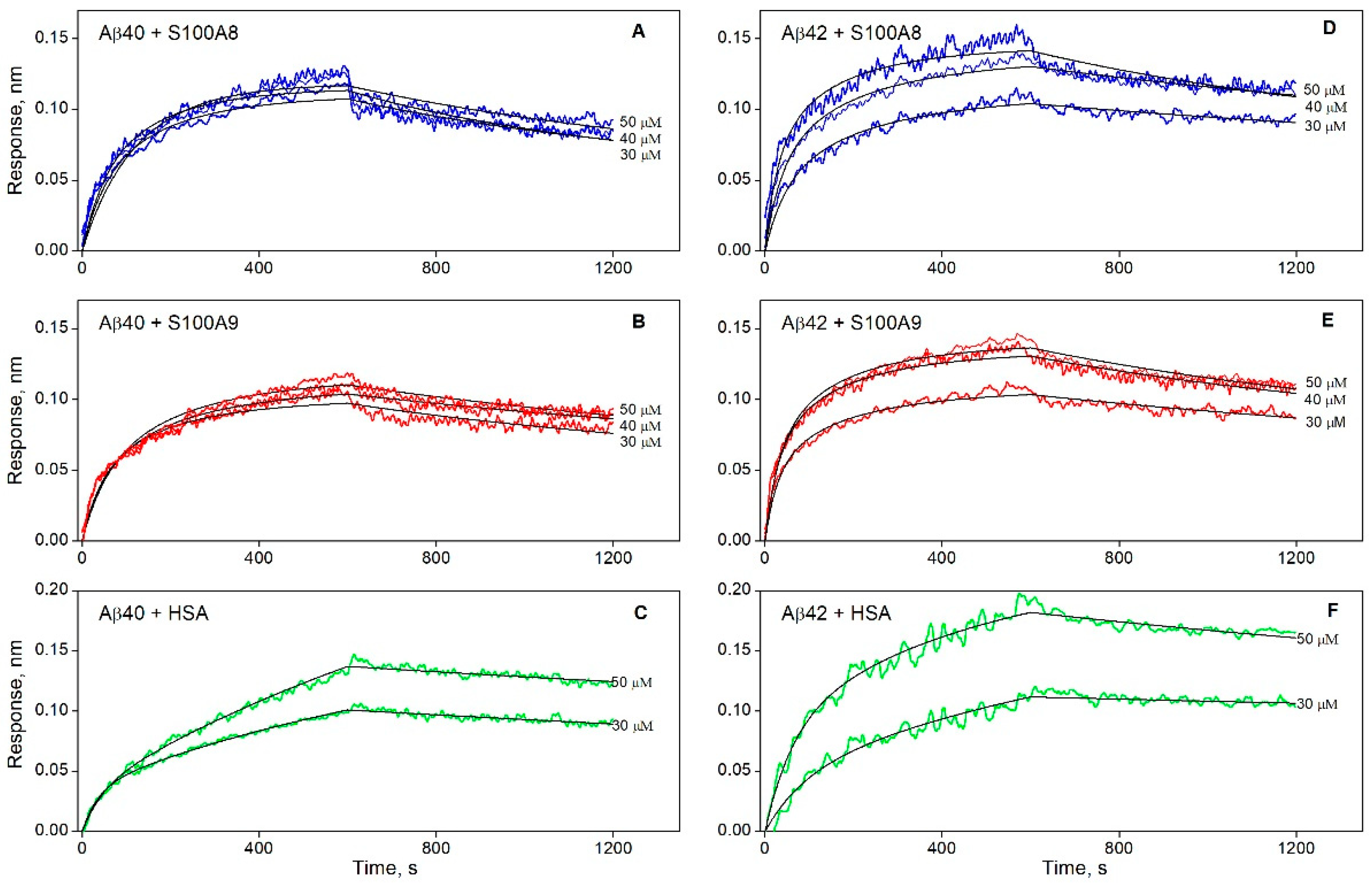
Figure 2.
Overlay of the 10 representative models of S100A8-Aβ40 (A) and S100A9-Aβ40 (B) complexes calculated using ClusPro docking server [63]. Aβ40 monomers are shown in grey. Chains A and B of S100A8/S100A9 dimers are shown in cyan and dark grey, respectively; their Ca2+-binding loops are highlighted in yellow.
Figure 2.
Overlay of the 10 representative models of S100A8-Aβ40 (A) and S100A9-Aβ40 (B) complexes calculated using ClusPro docking server [63]. Aβ40 monomers are shown in grey. Chains A and B of S100A8/S100A9 dimers are shown in cyan and dark grey, respectively; their Ca2+-binding loops are highlighted in yellow.
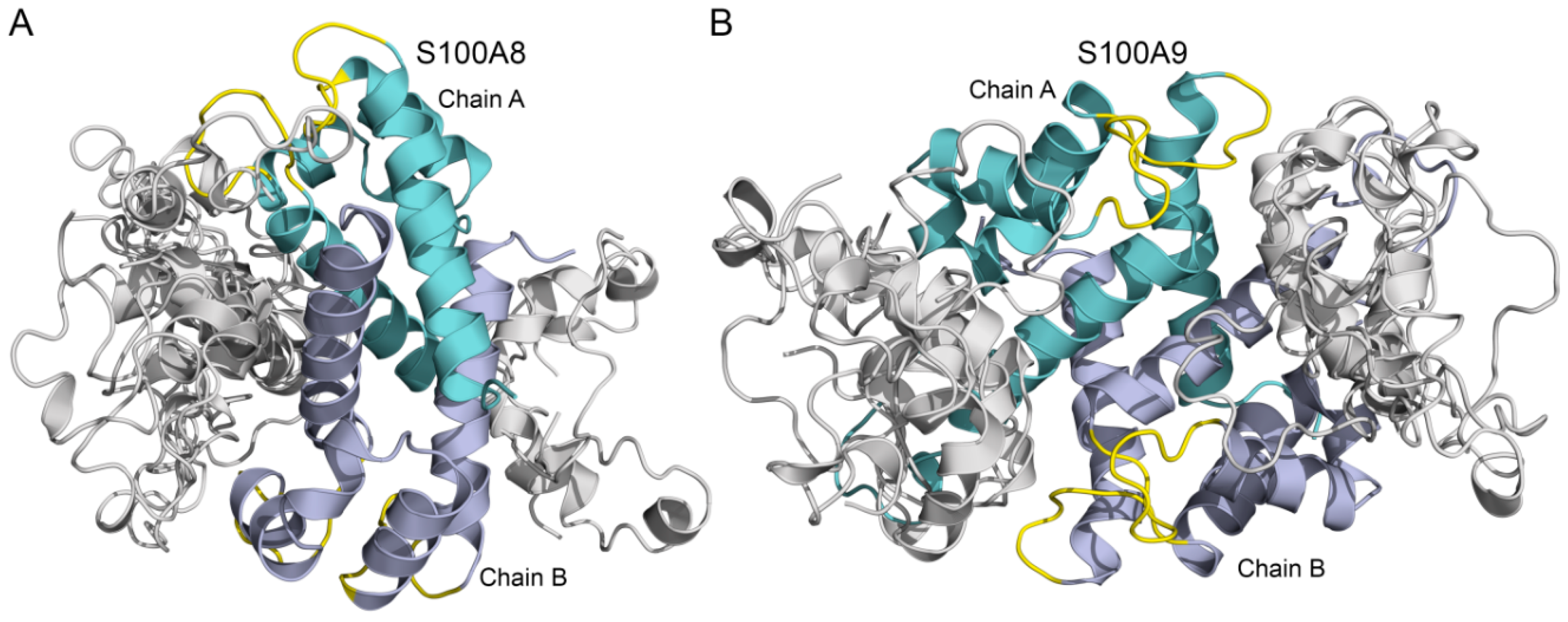
Figure 3.
Kinetics of HSA (67 µM) interaction with monomeric Aβ40 (A) or Aβ42 (B) immobilized on BLI sensor in the absence (green) or presence of S100A8 (12 µM, blue) or S100A9 (7 µM, red) at 25°C, monitored using BLI (20 mM Tris-HCl, 140 mM NaCl, 4.9 mM KCl, 2.5 mM CaCl2, 1 mM MgCl2, pH 7.4).
Figure 3.
Kinetics of HSA (67 µM) interaction with monomeric Aβ40 (A) or Aβ42 (B) immobilized on BLI sensor in the absence (green) or presence of S100A8 (12 µM, blue) or S100A9 (7 µM, red) at 25°C, monitored using BLI (20 mM Tris-HCl, 140 mM NaCl, 4.9 mM KCl, 2.5 mM CaCl2, 1 mM MgCl2, pH 7.4).
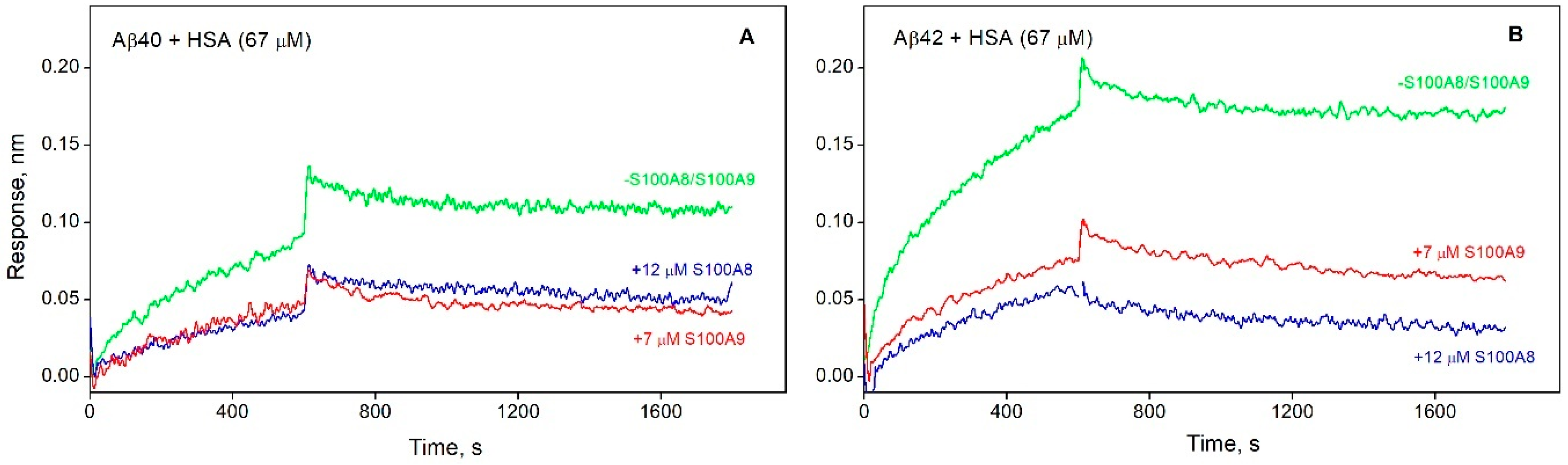
Figure 4.
Kinetics of Aβ40 (20 μM) fibrillation in the presence of HSA (5 μM), S100A8 (4 μM) or S100A9 (4 μM) at 30°C, followed by ThT (10 μM) fluorescence intensity at 485 nm (25 mM Tris-HCl, 140 mM NaCl, 4.9 mM KCl, 2.5 mM CaCl2, 1 mM MgCl2, pH 7.4 buffer with 0.05% NaN3). Excitation wavelength of 440 nm. The standard deviations of the fluorescence signals are indicated.
Figure 4.
Kinetics of Aβ40 (20 μM) fibrillation in the presence of HSA (5 μM), S100A8 (4 μM) or S100A9 (4 μM) at 30°C, followed by ThT (10 μM) fluorescence intensity at 485 nm (25 mM Tris-HCl, 140 mM NaCl, 4.9 mM KCl, 2.5 mM CaCl2, 1 mM MgCl2, pH 7.4 buffer with 0.05% NaN3). Excitation wavelength of 440 nm. The standard deviations of the fluorescence signals are indicated.
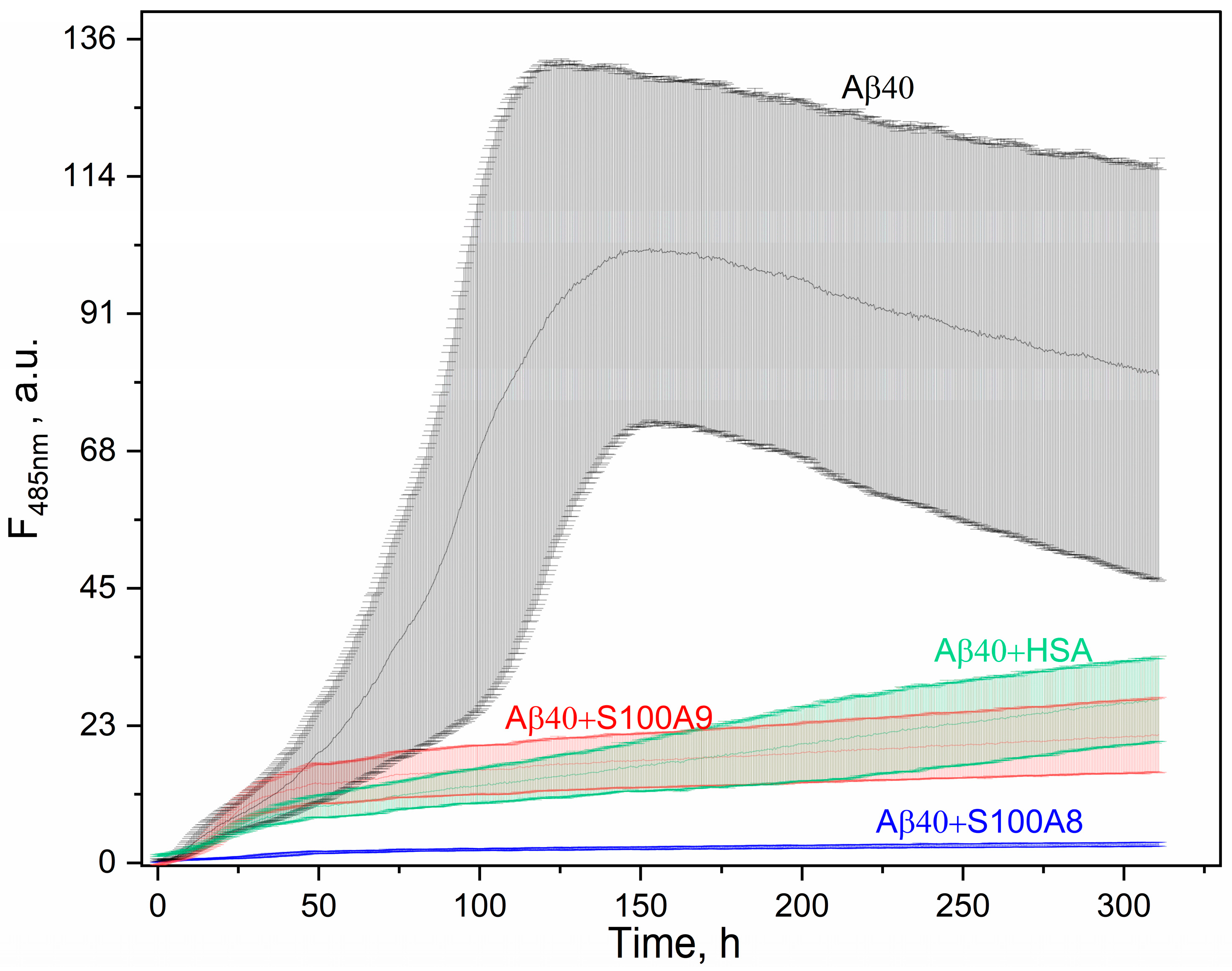
Figure 5.
Negative staining TEM images of the 20 μM Aβ40 fibers grown in the course of the ThT fluorescence assay (A) and in the presence of 4 μM S100A8 (B) or 4 μM S100A9 (C). The scale bars represent 500 nm.
Figure 5.
Negative staining TEM images of the 20 μM Aβ40 fibers grown in the course of the ThT fluorescence assay (A) and in the presence of 4 μM S100A8 (B) or 4 μM S100A9 (C). The scale bars represent 500 nm.
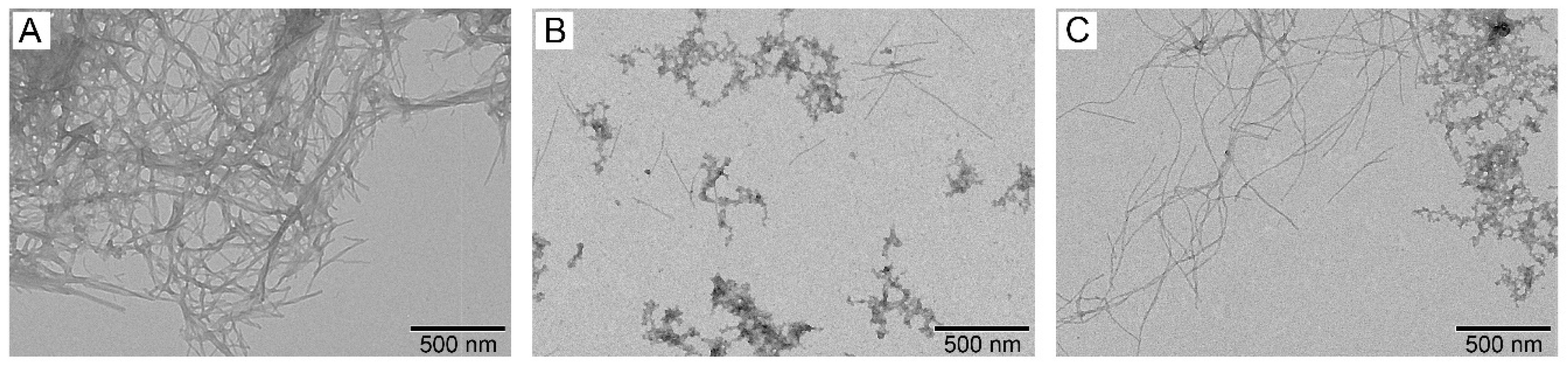
Figure 6.
Negative staining TEM image of the complex between Aβ40 (20 μM) fibers and S100A9 (4 μM). The scale bar represents 500 nm. The arrows indicate the probable sites of S100A9 adhesion to Aβ40 fibrils.
Figure 6.
Negative staining TEM image of the complex between Aβ40 (20 μM) fibers and S100A9 (4 μM). The scale bar represents 500 nm. The arrows indicate the probable sites of S100A9 adhesion to Aβ40 fibrils.
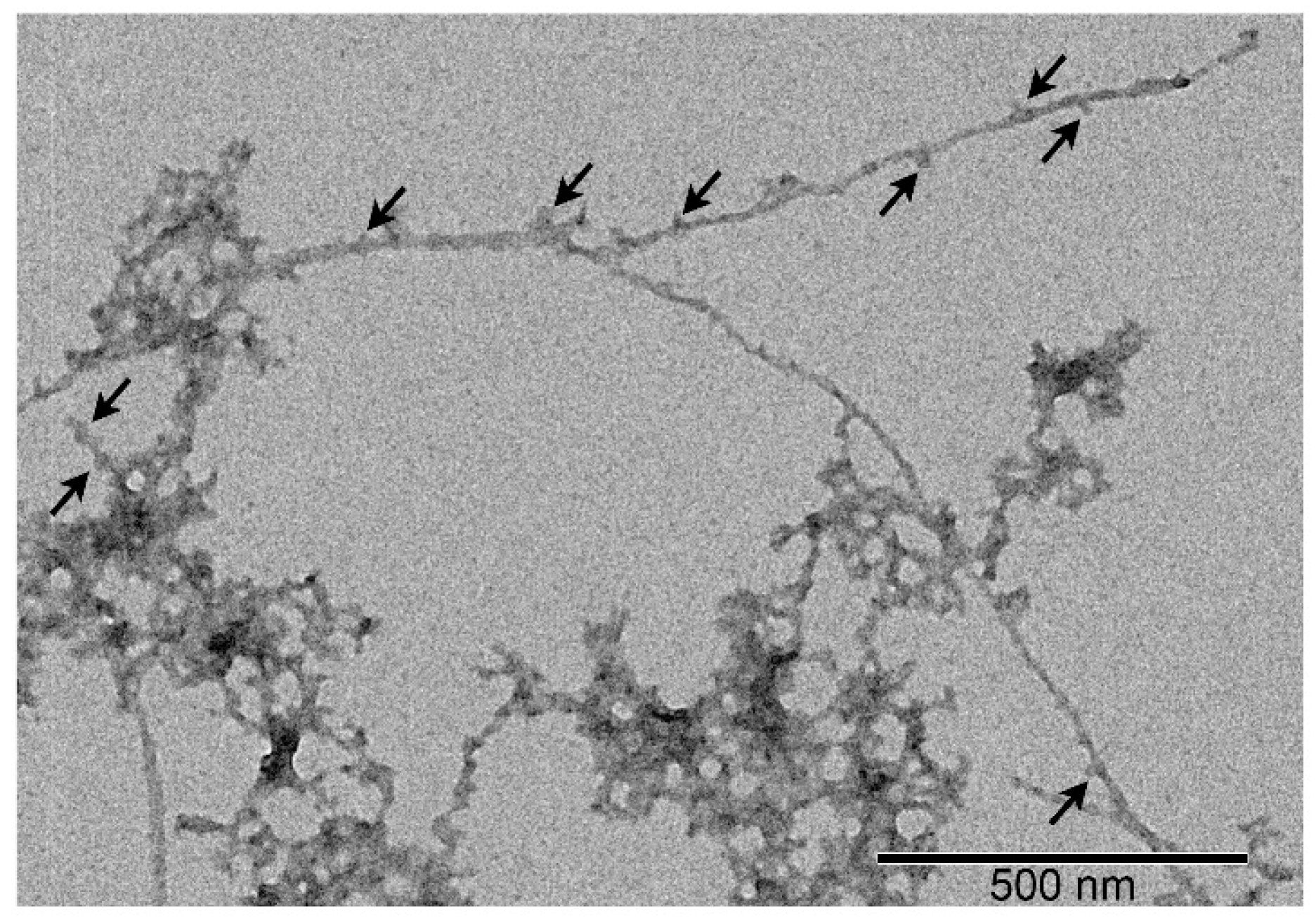

Table 1.
Parameters of the bivalent analyte model (1) describing the BLI data on kinetics of the S100 interactions with monomeric Aβ shown in Figure 1.
Table 1.
Parameters of the bivalent analyte model (1) describing the BLI data on kinetics of the S100 interactions with monomeric Aβ shown in Figure 1.
| KD×106, M | ka×10-2, M-1s-1 | kd×104, s-1 | |
| Aβ40 | |||
| S100A8 | 5.1 ± 2.3 | 2.2 ± 0.7 | 10.9 ± 1.5 |
| S100A9 | 2.1 ± 1.3 | 2.6 ± 1.0 | 5.4 ± 1.0 |
| Aβ42 | |||
| S100A8 | 1.3 ± 0.9 | 3.4 ± 0.9 | 4.6 ± 1.9 |
| S100A9 | 1.2 ± 0.6 | 4.5 ± 1.3 | 5.1 ± 1.1 |
Table 2.
Parameters of the heterogeneous ligand model (2) describing the BLI data on kinetics of the HSA–Aβ interaction shown in Figure 1 (C, F).
Table 2.
Parameters of the heterogeneous ligand model (2) describing the BLI data on kinetics of the HSA–Aβ interaction shown in Figure 1 (C, F).
| KD1×106, M | ka1×10-2, M-1s-1 | kd1×104, s-1 | KD2×106, M | ka2×10-2, M-1s-1 | kd2×104, s-1 |
| Aβ40 | |||||
| 0.22±0.12 | 7.9 ± 4.4 | 1.72 ± 0.04 | 6.7 ± 4.5 | 0.36 ± 0.24 | 2.38 ± 0.06 |
| Aβ42 | |||||
| 0.48±0.09 | 3.5 ± 0.5 | 1.66 ± 0.10 | 5.6 ± 4.6 | 0.28 ± 0.18 | 1.58 ± 0.26 |
Disclaimer/Publisher’s Note: The statements, opinions and data contained in all publications are solely those of the individual author(s) and contributor(s) and not of MDPI and/or the editor(s). MDPI and/or the editor(s) disclaim responsibility for any injury to people or property resulting from any ideas, methods, instructions or products referred to in the content. |
© 2025 by the authors. Licensee MDPI, Basel, Switzerland. This article is an open access article distributed under the terms and conditions of the Creative Commons Attribution (CC BY) license (http://creativecommons.org/licenses/by/4.0/).
Copyright: This open access article is published under a Creative Commons CC BY 4.0 license, which permit the free download, distribution, and reuse, provided that the author and preprint are cited in any reuse.


