

Submitted:
29 January 2025
Posted:
30 January 2025
You are already at the latest version
Abstract
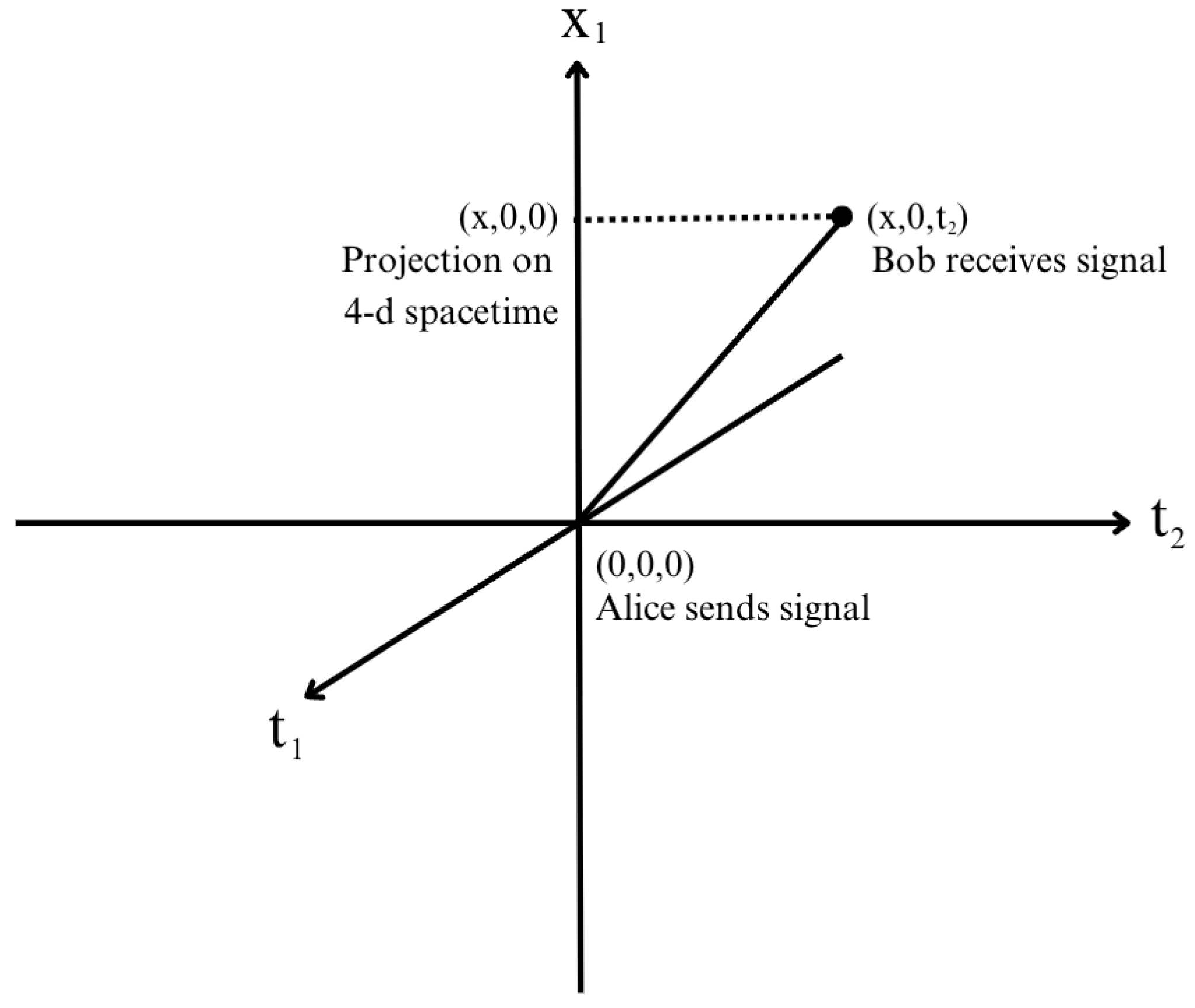
The E8 ⊗ E8 octonionic theory of unification suggests that our universe is six-dimensional and that the two extra dimensions are timelike. These timelike extra dimensions, in principle, offer an explanation of the quantum nonlocality puzzle, also known as the EPR paradox. Quantum systems access all six dimensions whereas classical systems such as detectors experience only four dimensions. Therefore, correlated quantum events which are timelike separated in 6D can appear to be spacelike separated, and hence nonlocal, when projected to 4D. Our lack of awareness of the extra timelike dimensions creates the illusion of nonlocality whereas in reality the communication obeys special relativity and is local. Bell inequalities continue to be violated because quantum correlations continue to hold. In principle, this idea can be tested experimentally. We develop our analysis after first constructing the Dirac equation in 6D using quaternions, and using the equation to derive spin matrices in 6D and then in 4D. We also show that the Tsirelson bound of the CHSH inequality can in principle be violated in 6D.
Keywords:
1. Introduction
2. Some Remarks on Dirac Equation in 6D Spacetime
2.1. Dirac Equation Using Gamma Matrices
2.2. Dirac Operator Using Quaternions
2.3. Dirac Equation Using Quaternion Bivectors
3. Interpreting Spin in 6D
3.1. Non-Relativistic Limit (v/c) Expansion for the First Dirac Spinor ()
3.2. Non-Relativistic Limit (v/c) Expansion for the Other Dirac Spinor ()
4. Proposed Resolution of the EPR Paradox
4.1. Proposal
4.2. Experimental Validation
5. Physical Motivation for Two Timelike Extra Dimensions
6. Tsirelson Bound
7. Conclusion
Acknowledgments
References
- N. Gisin. Quantum nonlocality: How does nature do it? Science 2009, 326, 1357. [Google Scholar] [CrossRef] [PubMed]
- T. Maudlin. Quantum non-locality and relativity - metaphysical intimations of modern physics, 3rd Edn. ed; Wiley-Blackwell, 2011. [Google Scholar]
- T. P. Singh. Trace dynamics, octonions, and unification: An E8⊗E8 theory of unification. J. Phys. Conf. Series 2024, 2912, 012009. [Google Scholar] [CrossRef]
- R. A. Wilson. Remarks on the group-theoretical foundations of particle physics. 2020. Available online: https://www.newton.ac.uk/files/preprints/ni19011.pdf.
- Daniel Salart, Augustin Baas, Cyril Branciard, Nicolas Gisin and Hugo Zbinden. Testing the speed of spooky action at a distance. Nature 2008, 454, 861–864. [Google Scholar] [CrossRef] [PubMed]
- N. Gisin. Session 5: Open Discussion. Time Stamp 25:00, Conference on 100 years of quantum mechanics, IISER Kolkata. 2024. Available online: https://www.youtube.com/live/KcWmBW6PyfE?si=jOVqsRI2xOGRM4mR.
- Maldacena, Juan and Susskind, Leonard. Cool horizons for entangled black holes. Fortschritte der Physik 2013, arXiv:1306.053361, 781–811. [Google Scholar] [CrossRef]
- J. Lambek. Quaternions and three temporal dimensions. 2014. Available online: https://www.math.mcgill.ca/barr/lambek/pdffiles/Quater2014.pdf.
- G. A. Sparling. Germ of a synthesis: Space-time is spinorial, extra dimensions are time-like. Proc. R. Soc. A. 2007, 463, 463. [Google Scholar]
- C. E. Patty, Jr. and L. L. Smalley. Dirac equation in a six-dimensional spacetime: temporal polarisation for subluminal interactions. Phys. Rev. D 1985, 32, 891. [Google Scholar] [CrossRef] [PubMed]
- W. E. Hagston and I. D. Cox. An extended theory of relativity in a six-dimensional manifold. Foundations of Physics 1985, 15, 773. [Google Scholar] [CrossRef]
- E. A. B. Cole and S. A. Buchanan, Space-time transformations in six-dimensional special relativity, J. Phys. A: Math. Gen. 15, L255 (1982).
- M. T. Teli, General Lorentz transformations in six-dimensional spacetime, Phys. Lett. A 122, 447 (1987) and references therein.
- A.W. Conway, Quaternions and quantum mechanics, Pontificia Academia Scientiarum, 12, 204 (1948), Available athttps://www.pas.va/content/dam/casinapioiv/pas/pdf-volumi/acta/acta12pas.
- A. Kritov, Gravitation with cosmological term, expansion of the universe as uniform acceleration in Clifford coordinates, Symmetry, 2021, 13 (2021).
- C. A. Dartora and G. G. Cabrera, The Dirac Equation in Six-dimensional SO(3,3) Symmetry Group and a Non-chiral “Electroweak” Theory, Int. J. Theo. Phys. 49, 51 (2010).
- J. Podolanski, Unified field theory in six dimensions, Proceedings of the Royal Society of London. Series A, Mathematical and Physical Sciences, 201, 234 (1950).
- J. Venancio and C. Batista, Two-Component spinorial formalism using quaternions for six-dimensional spacetimes, Adv. Appl. Clifford Algebras, 31, 46 (2021).
- J. B. Boyling and E. A. B. Cole, Six-dimensional Dirac equation, Int. J. Theo. Phys. 32, 801 (1993).
- D. C. Brody and E-M. Graefe. Six-dimensional space-time from quaternionic quantum mechanics. Phys. Rev. D 2011, 84, 125016. [Google Scholar] [CrossRef]
- Y. Shtanov and V. Sahni. Bouncing braneworlds. Phys.Lett.B 2003, 557, 1–6. [Google Scholar] [CrossRef]
- T. Asselmeyer-Maluga, F. Finster, N. Gresnigt, J. Isidro, A. Marciano, C. Paganini, T. P. Singh and P Samuel Wesley. Gravi-weak unification in a six-dimensional spacetime with signature (3,3). in preparation 2025. [Google Scholar]
- B. S. Tsirelson. Quantum generalization of Bell’s inequalities. Lett. Math. Phys. 1980, 4, 93–100. [Google Scholar] [CrossRef]
- D. Rohrlich and S. Popescu. Nonlocality as an axiom for quantum theory. arXiv:quant-ph/9508009.
- R. G. Ahmed and T. P. Singh. A violation of the Tsirelson bound in the pre-quantum theory of trace dynamics. arXiv:2208.02209.
- A. J. Barr, M. Fabbrichesi, R. Floreanini, E. Gabrielli and L. Marzola. Quantum entanglement and Bell inequality violation at colliders. Prog. Part. Nucl. Phys. 2024, 139, 104134. [Google Scholar] [CrossRef]
- A. Connes and C. Rovelli. Class. Quant. Grav. 1994, 11, 2899–2918. [CrossRef]
Disclaimer/Publisher’s Note: The statements, opinions and data contained in all publications are solely those of the individual author(s) and contributor(s) and not of MDPI and/or the editor(s). MDPI and/or the editor(s) disclaim responsibility for any injury to people or property resulting from any ideas, methods, instructions or products referred to in the content. |
© 2025 by the authors. Licensee MDPI, Basel, Switzerland. This article is an open access article distributed under the terms and conditions of the Creative Commons Attribution (CC BY) license (http://creativecommons.org/licenses/by/4.0/).


