

Submitted:
29 January 2025
Posted:
30 January 2025
You are already at the latest version
Abstract
Monitoring of metastatic breast cancer (mBC) is an important issue in the clinical management of patients. Liquid biopsy has become a non-invasive method for detecting and monitoring cancer in body fluids. The presence of circulating tumor cells (CTC) and circulating tumor DNA (ctDNA) in peripheral blood indicates poor prognosis and may contribute to early detection of progression, but is still not routine clinical management. The main objective of this study was to estimate the frequency and clinical value of the ESR1 and PIK3CA mutations identified in circulating free DNA (cfDNA.) The second goal was to evaluate whether simultaneous evaluation of CTC and mutation status in cfDNA increases the prognostic value of liquid biopsy. The results of the analysis of the CTC number and ESR1 and PIK3CA mutations in blood collected from 179 patients with metastatic breast cancer show that ESR1 mutations are more frequent in patients with advanced luminal breast cancer regardless of the type of the treatment. ESR1 mutations appear primarily during the progression, as no mutations were found in primary tumor samples. The main conclusion of the study is that combined assessment of CTCs and ESR1 status in liquid biopsy may improve the prognostic value of liquid biopsy.
Keywords:
breast cancer
; liquid biopsy
; circulating tumor cells
; circulating tumor DNA
; ESR1 mutation
; PI3K mutation
; droplet digital PCR
1. Introduction
Metastatic breast cancer (mBC) is a treatable but still incurable disease. The majority of diagnosed breast cancers are luminal type expressing estrogen receptors (ER) and progesterone receptors (PR) [1] about 30-50% of patients will eventually relapse due to resistance to the given treatment [2]. This resistance is a consequence of modifications of ERα at the genetic, regulatory or protein level that allow tumor growth independent of the presence of estrogen. Resistance often develops as a result of the acquiring new mutations in the ESR1 gene [3,4].These mutations are rare (up to 3%) in primary tumors but much more abundant in metastatic lesions where the rate ranges from 5 to 60% [5], The most common alterations in ESR1 are point mutations occurring in the ligand binding domain (LBD), in codons 536, 537, 538, and 380 [6,7]. These ESR1-LB mutations result in constitutively activated ER causing decreased sensitivity to endocrine treatments [6,8]. In addition, activation of alternative growth pathways and/or cell survival mechanisms can lead to estrogen independence and resistance to targeted hormonal therapy. For this reason, tracking mutational changes in ERα during treatment has clinical value and may influence therapeutic decisions during treatment.
The phosphatidylinositol 3-kinase/protein kinase B/mammalian target of the rapamycin (PI3K/AKT/mTOR) pathway is a pivotal intracellular signaling system that drives cell proliferation, differentiation, survival, and metabolism. Hyperactivation of this pathway that leads to tumorigenesis of ER+ breast cancer is a well-known cause of hormonal treatment failure [9]. The PIK3CA gene (coding the catalytic subunit p110α of PI3K) is one of the most frequently mutated genes in breast cancer patients. Mutations in PIK3CA occur mainly in two hotspots at 1047aa and 545aa. accounting for around 70% of all mutations [10,11]. They lead to constitutive activation of PI3K, which has been proposed as a mechanism for endocrine resistance [10].
Alpelisib is a PI3K selective inhibitor approved for the treatment of patients with advanced breast cancer. Data from the SOLAR-1 trial showed that simultaneous treatment with alpelisib-fulvestrant prolonged progression-free survival among patients with PIK3CA-mutated, HR-positive, HER2-negative advanced breast cancer who had previously received endocrine therapy [12,13]. Furthermore, studies on patient-derived tumor xenograft (PDX) indicated that activation of the PI3K pathway leads to an adaptive resistance mechanism to CDK4/6 inhibition, which in turn leads to increased AKT phosphorylation and activation of CDK2. This observation highlights the importance of investigating PI3K pathway inhibitors to overcome resistance to CDK4/6 inhibitors [14,15].
Due to the heterogeneity of cancer and its dynamic development recognition of molecular mechanisms responsible for cancer evolution is a challenge. Recently, liquid biopsy has emerged as a noninvasive method for detecting and monitoring cancer in body fluids, not tumor tissue. Cancer cells release CTC, ctDNA, RNA (mRNA and micro-RNA), and extracellular vesicles (EV) which are easily available from peripheral blood collected repeatedly during patient's treatment [16,17,18]. Unlike tissue biopsy, liquid biopsy can be taken simultaneously with routine blood tests at any stage of the disease. Therefore, the new field of oncology emerged, focusing on the components of analysis of the metastatic tumors circulating in the blood, mainly CTC and ctDNA. Research in this area will help to better track cancer progression and tailor treatment.
The presence of cfDNA in the blood has proven prognostic significance. Dawson et al. demonstrated that ctDNA is a specific, and highly sensitive biomarker in MBC [19], outperforming CTCs in detection frequency and correlation with tumor burden. This was confirmed by other studies [20,21]. Genomic analysis of ctDNA has begun to be incorporated into the clinical management of patients with advanced cancer. The mutational analysis of ESR1 and PIK3CA in cfDNA from MBC patients has been recognized as an important tool for the assessment of the response to treatment and drug efficacy [22,23,24], and has been tested in clinical trials. Mutations in ESR1 and PIK3CA did not show an effect on PFS (progression free survival) and OS in the MONARCH study [25]. but were associated with worse survival in other studies e.g. BOLERO-2 trial and SAFIR02 trial [26,27]. Mutations in other functionally important genes in MBC were tested in the PALOMA-3 trial in which TP53 mutations and FGFR1 amplifications were associated with worse outcome regardless of treatment [28]. Impaired survival of MBC patients with TP53 mutation was also shown in the PEARL trial [29].
CTCs have been identified as an independent prognostic factor for progression-free and overall survival in the adjuvant, neoadjuvant and metastatic setting [30,31] CTC detection and their longitudinal analysis [32,33,34] are still not a clinical standard and its value as a predictor of disease progression has not yet been established, although many studies suggest that it could be a promising prognostic tool for clinicians [35,36,37]. Until now, several studies have attempted to combine ctDNA information with CTC) [38,39,40] although they mainly focus on cfDNA levels, or compare the mutational status of cfDNA and gDNA in CTCs.
The general objective of this study was to evaluate the frequency and clinical value of the ESR1 and PIK3CA mutations identified in cfDNA, and to compare these results with primary tumor samples to evaluate if the mutation was originally present in the tumor or if it occurred during metastasis. The other goal was to assess whether the simultaneous evaluation of the status of CTCs and mutational status in cfDNA might strengthen the prognostic value of liquid biopsy. Our work demonstrates that combining the two liquid biopsy approaches results in a better prognosis.
2. Results
2.1. Patients Characteristics
In total, 179 patients were enrolled in the study. The clinical characteristics of the patients is summarized in Table 1 and Figure 1. The median follow-up was 53.1 months. The median age of the patients was 63 years at the beginning of the study. Approximately 70% of the patients were characterized with bone metastases. Most of the histological subtypes identified in the primary tumor sample were NST. Most of the patients were treated with radiotherapy and HTH+CHTH+CDK4/6.
2.2. Mutations in cfDNA
In general, mutations in ESR1 or PIK3CA were found in ~63% of the patients. ESR1 mutations were more frequent as they were found in 53,63% of patients, while PIK3CA mutations in PIK3CA were found in 26,82% of patients (Table 2, Figure 2) . Around 15% of the patients were characterized with double mutations in the PIK3CA gene and the ESR1 genes. One patient had double PIK3CA mutations, occurring in p.E545K and p.H1047R hotspots.
For 59 patients, an additional analysis of the mutation status was performed in FFPE samples as representative samples of primary tumor. This enabled us to compare the mutational status in primary tumor vs. liquid biopsy. No patient was found to have a mutation in ESR1 in the primary tumor sample, while ~12% were identified with PIK3CA mutations. From this group, ~54% of patients with ESR1 mutations and ~20% with PIK3CA mutations were identified on liquid biopsy (Figure 2). Interestingly, we showed that all ESR1 mutations were identified only in cfDNA samples, while for PIK3CA mutations the mutation gain during progression was observed only in a few patients. These results highlight that ESR1 mutations develop under the selective pressure of endocrine treatments and might be associated with cancer progression. Therefore, for further validation of the clinical value of cfDNA mutational status, we analyzed data considering only ESR1 mutational status.
2.3. Clinical Value of Liquid Biopsy
- CTC evaluation
For 96 patients out of a total of 179 patients subjected to ctDNA analysis, an additional CTC evaluation was performed. The characteristic of this group is shown in Table 3. The median age in this group was ~65. CTCs were detected in 36% of the patients and >5 CTCs were found in ~16% of the patients. Patients with >5 CTCs detected were characterized with a significantly lower median survival (Figure 3B 2A). For all patients, an additional evaluation of ESR1 mutational status in cfDNA was performed. To estimate the clinical value of the liquid biopsy, additional analysis was performed for combined liquid biopsy markers as predictors of OS. For patients with >5CTCs and ESR1 mutation in cfDNA material the median survival was significantly lower than for other patients (11.1 months, compared to 44.3 for patients >5 CTCs and N/A for patients with <5 CTCs) (Figure 3C,D). These results highlight that the simultaneous evaluation of liquid biopsy markers might improve the prognostic value of liquid biopsy during treatment.
- Multivariable COX proportion and hazard regression analysis
To further confirm the clinical value of the simultaneous assessment of the CTCs and the ESR1 mutation, we performed the multivariable Cox proportional hazard regression. The clinicopathological data used for the Cox multivariable model are listed in Table 4 with their reference levels.
Interestingly, the >5CTCs and ESR1 status in cfDNA alone were found to be not significant factors in the univariable and multivariable Cox analysis for the overall survival prognosis. However, when combined, these markers were found to greatly improve the prognostic value of liquid biopsy. The simultaneous presence of >5CTCs and ESR1 mutation in liquid biopsy was found to be a strong predictive factor of OS in univariable (HR=3.496; 95% CI 1.173-8.484; p-value<0.05) and multivariable (HR=3.538; 95% CI 1.126-9.403; p-value<0.05) analyses (Table 5, Figure 4). Furthermore, these results highlight that combining standard liquid biopsy approaches strongly improves the clinical effectiveness of liquid biopsy as a predictor of OS.
3. Discussion
Liquid biopsy is one of the most dynamically improved fields in current clinical science. The evaluation of liquid biopsy potential as a prognostic tool is usually evaluated using cfDNA mutational analysis or CTC number counts.
The evaluation of the genetic status of ESR1 and PIK3CA in cfDNA of patients with MBC is recognized as having prognostic and predictive value [41,42,43,44]. Plasma PIK3CA ctDNA specific mutation detected by next generation sequencing is associated with clinical outcome in advanced breast cancer.
The results of the research carried out in this work confirm previous findings that ESR1 mutations are more frequent in advanced luminal breast cancer patients irrespective of the type of therapy (endocrine or chemotherapy-based treatments) [41,45] and reveal that pathogenic ESR1 mutations appear mainly during the progression, most probably as a result of the selective pressure of endocrine treatments, as no mutations were found in primary tumor samples. PIK3CA mutations are more frequent in primary tumors and most of them remain present in the advanced stages, but only a few new mutations appear during the metastatic process. These results, and the statistical analysis of mutational changes in both genes and their impact on survival (Figure 3), suggest that ESR1 mutations in cfDNA are better suited to be a prognostic tool in MBC. However, our results on the impact of cfDNA mutations were on the borderline of significance (ESR1) or insignificant (PIK3CA) in Kaplan-Meier survival analysis. The clinical relevance of the ESR1 mutations detected in cfDNA evaluated by Kaplan-Meier analysis has been reported several times, with different significance levels [46,47,48,49]. The borderline significance of our analysis may result from the relative heterogeneity of our group of patients in terms of the observation period, so in some patients resistance-conferring mutations may not be present because there was not enough time for the evolution of the resistance.
However, the results points to the conclusion that this prognostic value of liquid biopsy should be further improved, possibly by combining it with CTC enumeration. This could be achieved by evaluating both values from the same blood sample, which makes it relatively easy to implement in clinical practice.
CTCs are significant prognostic markers in advanced breast cancer patients. The prognostic value of CTC was widely studied and the presence of >5 CTCs was found to be a negative prognostic predictor of OS and PFS [50,51,52]. Longitudinal studies of serially collected samples were reported to improve the prognostic power of CTC enumeration in advanced breast cancer, but require a more organized collection schedule [34,53,54].
In the current study, the presence of CTC with the >5 cutoff was confirmed to be significant. Subsequently, we tested whether the combination of CTC numbers and ESR1 mutational status in blood samples from advanced breast cancer patients can improve the clinical value of such a single liquid biopsy. The question of the benefits of combining these two markers was addressed in several reports, but the authors evaluated the level of cfDNA, its integrity or a whole profile of genomic alterations and did not evaluate the presence of specific mutation(s) in one gene [38,39,40,55,56]. Our findings suggest that the presence of plasma ESR1 mutations in addition to the >5 CTC number could be unfavorable in the long term for these patients and adds additional evidence that early detection of mutation may be clinically helpful for the prediction of treatment efficacy. Additionally, this will help select a specific group of patients who will benefit from a change in treatment.
4. Materials and Methods
4.1. Patients Samples
Blood samples were collected from 179 patients with advanced luminal breast cancer treated in the Maria Sklodowska-Curie National Institute of Oncology. The selection of patients was carried out by experienced clinicians from the Department of Breast Cancer and Reconstructive Surgery of the Maria Sklodowska-Curie National Research Institute of Oncology. Patients were included for this study between June 2018 and December 2022. The inclusion criteria for the patients were: breast cancer with ongoing hormonal treatment, age > 18 and identification of distant metastases. All participants signed an informed consent. Blood collection (9ml) was carried out once during treatment. Overall 179 patients were enrolled: 179 patients with cfDNA mutation evaluation and 96 patients with CTCs and cfDNA evaluation.
4.2. Isolation and Preparation of cfDNA
Plasma samples from patients were isolated using the QIAamp Circulating Nucleic Acid Kit (Qiagen; 55114) according to the manufacturer’s protocol. The amount of isolated cfDNA was measured using the Quantus system (Promega) using the QuantiFluor ONE dsDNA system (Promega; E4871). The isolated and measured cfDNA was further used for ddPCR analysis.
4.3. ddPCR Analysis
To test the abundance ddPCR analysis was performed using the BioRad QX200 Droplet ddPCR system according to the protocol of Schiavon et al. [22]. Probes for ESR1 mutations L536R, Y537S / C, and D538G (Table 6) were purchased from Merck. Reactions were run in multiplexes: L536R with Y537C and Y537S with D538G. For PIK3CA E545K and H1047R mutations BioRad specific ddPCR Mutations Assays were used. The plates were read on a BioRad QX200 droplet reader with BioRad QuantaSoft v1.6.6.0320 software.
4.4. Post-Analysis for ddPCR
The estimation of false positive rate was determined by performing 5 experiments for each assay using WT-only samples, where total amounts of detected mut positive droplets determined thresholds above which positive droplets in patient samples were to be considered true positive. For each patient, plasma was analyzed in duplicate. Therefore, the PCR results of the patient samples were based on the mean estimated target DNA concentrations (copies/μl) in the merged wells, automatically calculated by the manufacturer’s software. Correction for false positivity was made by subtracting the amount of mut-positive droplets detected in the false positive assessment experiments. The mutant allele frequency (MAF) was defined as the number of mut-positive in the total droplet amount (mut-positive and wt-positive). Samples were considered positive if mutation was confirmed in the FFPE sample and mut-positive droplets were found.
4.5. CTCs Assessment
The CTC assessment was done using the CytoTrack system using the protocol described before [34]. Criteria for CTC identification were established as: nearly round size with ≥ 6µm diameter, visible nucleus, pan-CK signal, CD45 negative. The clusters were defined as: group of ≥ 3 cells, with at least 3 visible nuclei in the DAPI channel, with at least 3 cells identified as CTCs.
4.6. FFPE Analysis
FFPE samples obtained from the Department of Cancer Pathomorphology in the Maria-Sklodowska-Curie National Research Institute of Oncology were cut 10 µm thin and up to 8 sections were used for DNA isolation. DNA was isolated using the QIAamp DNA FFPE Tissue Kit (Qiagen) according to the manufacturer’s instructions. The purity of the isolated genetic material was verified on a NanoDrop spectrophotometer (ThermoFisher). Only pure DNA with a concentration of at least 50 ng/µl was used for sequencing. Samples were amplified using GoldTaq Polymerase (Applied Biosystems) and GeneAmp PCR System 9700 Thermal Cycler (Applied Biosystems). PCR products were sequenced using BigDye™ Terminator v3.1 Cycle Sequencing Kit (ThermoFisher) and ABI Prism 3130xl Genetic Analyzer (ThermoFisher). Primers sequence was shown in the Table 7.
4.7. Statistical Analysis
Categorized quantitative data at different time points were compared using the Mann–Whitney U test or, if there were more than two categories, the Kruskal–Wallis test. The primary end point was overall survival (OS). OS was defined as the time from blood collection to death from any cause. If an outcome was not reached during the observation time, the variables were censored. Kaplan–Meier plots and the log-rank tests were used to illustrate and compare survival between subgroups. Univariable and multivariable hazard ratios (HR) for selected potential predictors of OS were determined by Cox proportional hazards regression. The fit was measured using the Harrell C index, and the fit of the nested prognostic models was compared using the logarithmic likelihood ratio test (G squared). All data were analyzed using GraphPad Prism 9.
Author Contributions
Analysis of mutations by ddPCR, redaction of abstract, introduction part of discussion: A.F.; CTC results section, statistical analysis, preparation of Table 3, Table 4, Table 5, Table 6 and Table 7, Figure 3 and 4: M.S.-R.; analysis of mutations in FFPE, preparation of Table 1 and Table 2: I.M; redaction of discussion, Figure 1 and Figure 2 and all manuscript correction: E.A.G.; sequencing and sample collection, R.Z.; selection of patients to the study, collection of clinical data: A.J-G. and A.K. All authors have read and agreed to the published version of the manuscript.
Funding
This research was funded by Maria Skłodowska-Curie Research Institute of Oncology minigrant number SN/MGW19/2024 for A.F. by Narodowe Centrum Nauki, grant number 2016/21/B/NZ2/03473 for E.G. and 2019/33/N/NZ5/00758 for M.Sz-R.
Institutional Review Board Statement
The study was conducted in accordance with the Declaration of Helsinki, and approved by the Ethics Committee of the Maria Sklodowska-Curie National Research Institute of Oncology (31/2020, 18.06.2020 for cfDNA and 84/2020, 17.12.2020 for CTCs).
Informed Consent Statement
Informed consent was obtained from all subjects involved in the study.
Data Availability Statement
The original contributions presented in this study are included in the article/supplementary material. Further inquiries can be directed to the corresponding authors.
Conflicts of Interest
The authors declare no conflicts of interest.
Abbreviations
| mBC | metastatic breast cancer |
| CTC | circulating tumor cell |
| ctDNA | circulating tumor DNA |
| cfDNA | circulating free DNA |
| ER | estrogen receptor |
| PR | progesteron receptor |
| LBD | ligand binding domain |
| PDX | patient-derived tumor xenograft |
| EV | extracellular vesicle |
| HR | hazard ratio |
| CI | confidence intervals |
| PFS | progression free survival |
| OS | overall survival |
| MAF | mutant allele frequency |
References
- Kittaneh, M.; Montero, A. J.; Glück, S. Molecular profiling for breast cancer: a comprehensive review. Biomark. Cancer 2013, 5, 61–70. [Google Scholar] [CrossRef] [PubMed]
- Pedersen, R. N.; Esen, B. Ö.; Mellemkjær, L.; Christiansen, P.; Ejlertsen, B.; Lash, T. L.; Nørgaard, M.; Cronin-Fenton, D. The incidence of breast cancer recurrence 10-32 years after primary diagnosis. J. Natl. Cancer Inst. 2022, 114, 391–399. [Google Scholar] [CrossRef]
- Aitken, S. J.; Thomas, J. S.; Langdon, S. P.; Harrison, D. J.; Faratian, D. Quantitative analysis of changes in ER, PR and HER2 expression in primary breast cancer and paired nNodal metastases. Ann. Oncol. 2009, 21, 1254–1261. [Google Scholar] [CrossRef] [PubMed]
- Simmons, C.; Miller, N.; Geddie, W.; Gianfelice, D.; Oldfield, M.; Dranitsaris, G.; Clemons, M. J. Does confirmatory tumor biopsy alter the management of breast cancer patients with distant metastases? Ann. Oncol. 2009, 20, 1499–1504. [Google Scholar] [CrossRef] [PubMed]
- Jeselsohn, R.; Yelensky, R.; Buchwalter, G.; Frampton, G.; Meric-Bernstam, F.; Gonzalez-Angulo, A. M.; Ferrer-Lozano, J.; Perez-Fidalgo, J. A.; Cristofanilli, M.; Goḿez, H.; Arteaga, C. L.; Giltnane, J.; Balko, J. M.; Cronin, M. T.; Jarosz, M.; Sun, J.; Hawryluk, M.; Lipson, D.; Otto, G.; Ross, J. S.; Dvir, A.; Soussan-Gutman, L.; Wolf, I.; Rubinek, T.; Gilmore, L.; Schnitt, S.; Come, S. E.; Pusztai, L.; Stephens, P.; Brown, M.; Miller, V. A. Emergence of constitutively active estrogen receptor-α mutations in pretreated advanced estrogen receptor-positive breast cancer. Clin. Cancer Res. 2014, 20, 1757–1767. [Google Scholar] [CrossRef]
- Robinson, D.R.; Wu, Y.; Vats, P.; Su, F.; Lonigro, R.J.; Cao, X.; Kalyana-Sundaram, S.; Wang, R.; Ning, Y.; Hodges, L.; Gursky, A.; Siddiqui, J.; Tomlins, S.A.; Roychowdhury, S.; Pienta, K.J.; Kim, S.Y.; Roberts, J.S.; Rae, J.M.; Van Poznak, C.H.; Hayes, D.D.; Chugh, R.; Kunju, L.P.; Talpaz, M.; Schott, A.F.; Chinnaiyan, A.M. Activating ESR1 mutations in hormone-resistant metastatic breast cancer. Nat Genet. 45. [CrossRef]
- Toy, W.; Shen, Y.; Won, H.; Green, B.; Sakr, R. A.; Will, M.; Gala, K.; Fanning, S.; King, T. A.; Hudis, C.; Chen, D.; Hortobagyi, G.; Greene, G.; Berger, M.; Baselga, J.; Chandarlapaty, S. ESR1 ligand-binding domain mutations in hormone-resistant breast cancer. Nat. Genet. 2013, 45, 1439–1445. [Google Scholar] [CrossRef]
- Toy, W.; Weir, H.; Razavi, P.; Lawson, M.; Goeppert, A. U.; Marie, A.; Smith, A.; Wilson, J.; Morrow, C.; Wong, W. L.; De, E.; Carlson, K. E.; Martin, T. S.; Uddin, S.; Li, Z.; Katzenellenbogen, J. A.; Greene, G.; Baselga, J.; Chandarlapaty, S. Activating ESR1 mutations differentially affect the efficacy of ER antagonists. Cancer Discov. 2017, 7(3), 277–287. [Google Scholar] [CrossRef]
- Ciruelos Gil, E. M. Targeting the PI3K/AKT/MTOR pathway in estrogen receptor-positive breast cancer. Cancer Treat. Rev. 2014, 40, 862–871. [Google Scholar] [CrossRef]
- Fusco, N.; Malapelle, U.; Fassan, M.; Marchiò, C.; Buglioni, S.; Zupo, S.; Criscitiello, C.; Vigneri, P.; Dei Tos, A. P.; Maiorano, E.; Viale, G. PIK3CA mutations as a molecular target for hormone receptor-positive, HER2-negative metastatic breast cancer. Front. Oncol. 2021, 11, 1–9. [Google Scholar] [CrossRef]
- Samuels, Y.; Wang, Z.; Bardelli, A.; Silliman, N.; Ptak, J.; Szabo, S.; Yan, H.; Gazdar, A.; Powell, S. M.; Riggins, G. J.; Willson, J. K. V.; Markowitz, S.; Kinzler, K. W.; Vogelstein, B.; Velculescu, V. E. High Frequency of mutations of the PIK3CA gene in human cancers. Science. 2004, 304. [Google Scholar] [CrossRef]
- André, F.; Ciruelos, E.; Rubovszky, G.; Campone, M.; Loibl, S.; Rugo, H. S.; Iwata, H.; Conte, P.; Mayer, I. A.; Kaufman, B.; Yamashita, T.; Lu, Y.-S.; Inoue, K.; Takahashi, M.; Pápai, Z.; Longin, A.-S.; Mills, D.; Wilke, C.; Hirawat, S.; Juric, D. Alpelisib for PIK3CA -mutated, hormone receptor–positive advanced breast cancer. N. Engl. J. Med. 2019, 380, 1929–1940. [Google Scholar] [CrossRef] [PubMed]
- Schagerholm, C.; Robertson, S.; Toosi, H.; Sifakis, E. G.; Hartman, J. PIK3CA mutations in endocrine-resistant breast cancer. Sci. Rep. 2024, 14, 1–13. [Google Scholar] [CrossRef]
- Herrera-Abreu, M. T.; Palafox, M.; Asghar, U.; Rivas, M. A.; Cutts, R. J.; Garcia-Murillas, I.; Pearson, A.; Guzman, M.; Rodriguez, O.; Grueso, J.; Bellet, M.; Cortés, J.; Elliott, R.; Pancholi, S.; Baselga, J.; Dowsett, M.; Martin, L. A.; Turner, N. C.; Serra, V. Early adaptation and acquired resistance to CDK4/6 Inhibition in estrogen receptor-positive breast cancer. Cancer Res. 2016, 76, 2301–2313. [Google Scholar] [CrossRef] [PubMed]
- Zhang, J.; Xu, K.; Liu, P.; Geng, Y.; Wang, B.; Gan, W.; Guo, J.; Wu, F.; Chin, Y. R.; Berrios, C.; Lien, E. C.; Toker, A.; DeCaprio, J. A.; Sicinski, P.; Wei, W. Inhibition of Rb phosphorylation leads to MTORC2-mediated activation of Akt. Mol. Cell 2016, 62, 929–942. [Google Scholar] [CrossRef] [PubMed]
- Guan, X. Cancer metastases: challenges and opportunities. Acta Pharm. Sin. B 2015, 5, 402–418. [Google Scholar] [CrossRef]
- Alix-Panabières, C.; Pantel, K. Liquid biopsy: from discovery to clinical application. Cancer Discov. 2021, 11, 858–873. [Google Scholar] [CrossRef]
- Wang, X.; Wang, L.; Lin, H.; Zhu, Y.; Huang, D.; Lai, M.; Xi, X.; Huang, J.; Zhang, W.; Zhong, T. Research progress of CTC, CtDNA, and EVs in cancer liquid biopsy. Front. Oncol. 2024, 14, 1–22. [Google Scholar] [CrossRef] [PubMed]
- Dawson, S.-J.; Tsui, D. W. Y.; Murtaza, M.; Biggs, H.; Rueda, O. M.; Chin, S.-F.; Dunning, M. J.; Gale, D.; Forshew, T.; Mahler-Araujo, B.; Rajan, S.; Humphray, S.; Becq, J.; Halsall, D.; Wallis, M.; Bentley, D.; Caldas, C.; Rosenfeld, N. Analysis of circulating tumor DNA to monitor metastatic breast cancer. N. Engl. J. Med. 2013, 368, 1199–1209. [Google Scholar] [CrossRef]
- Yang, J.; Cheng, L.; Zhang, J.; Chen, L.; Wang, D.; Guo, X.; Ma, X. Predictive value of circulating cell-free DNA in the survival of breast cancer patients a systemic review and meta-analysis. Med. (United States) 2018, 97. [Google Scholar] [CrossRef]
- Lee, J. H.; Jeong, H.; Choi, J. W.; Oh, H. E.; Kim, Y. S. Liquid biopsy prediction of axillary lymph node metastasis, cancer recurrence, and patient survival in breast cancer a meta-analysis. Med. (United States) 2018, 97. [Google Scholar] [CrossRef]
- Schiavon, G.; Hrebien, S.; Garcia-murillas, I.; Cutts, R. J.; Tarazona, N.; Fenwick, K.; Kozarewa, I.; Lopez-knowles, E.; Ribas, R.; Nerurkar, A.; Osin, P.; Chandarlapaty, S.; Dowsett, M.; Smith, I. E.; Turner, N. C. Analysis of ESR1 mutation in circulating tumor DNA demonstrates evolution during therapy for metastatic breast cancer. Sci Transl Med. 2016, 7. [Google Scholar] [CrossRef] [PubMed]
- Moynahan, M. E.; Chen, D.; He, W.; Sung, P.; Samoila, A.; You, D.; Bhatt, T.; Patel, P.; Ringeisen, F.; Hortobagyi, G. N.; Baselga, J.; Chandarlapaty, S. Correlation between PIK3CA mutations in cell-free DNA and everolimus efficacy in HR+, HER2-advanced breast cancer: results from BOLERO-2. Br. J. Cancer 2017, 116, 726–730. [Google Scholar] [CrossRef] [PubMed]
- O’Leary, B.; Hrebien, S.; Morden, J. P.; Beaney, M.; Fribbens, C.; Huang, X.; Liu, Y.; Bartlett, C. H.; Koehler, M.; Cristofanilli, M.; Garcia-Murillas, I.; Bliss, J. M.; Turner, N. C. Early circulating tumor DNA dynamics and clonal selection with palbociclib and fulvestrant for breast cancer. Nat. Commun. 2018, 9, 1–10. [Google Scholar] [CrossRef]
- Tolaney, S. M.; Toi, M.; Neven, P.; Sohn, J.; Grischke, E. M.; Llombart-Cussa, A.; Soliman, H.; Wang, H.; Wijayawardana, S.; Jansen, V. M.; Litchfield, L. M.; Sledge, G. W. Clinical significance of PIK3CA and ESR1 mutations in circulating tumor DNA: analysis from the MONARCH 2 study of abemaciclib plus fulvestrant. Clin. Cancer Res. 2022, 28, 1500–1506. [Google Scholar] [CrossRef]
- Chandarlapaty, S.; Chen, D.; He, W.; Sung, P.; Samoila, A.; You, D.; Bhatt, T.; Patel, P.; Voi, M.; Gnant, M.; Hortobagyi, G.; Baselga, J.; Moynahan, M. E. Prevalence of ESR1 mutations in cell-free DNA and outcomes in metastatic breast cancer: a secondary analysis of the BOLERO-2 clinical trial. JAMA Oncol. 2016, 2, 1310–1315. [Google Scholar] [CrossRef] [PubMed]
- Mosele, F.; Stefanovska, B.; Lusque, A.; Tran Dien, A.; Garberis, I.; Droin, N.; Le Tourneau, C.; Sablin, M. P.; Lacroix, L.; Enrico, D.; Miran, I.; Jovelet, C.; Bièche, I.; Soria, J. C.; Bertucci, F.; Bonnefoi, H.; Campone, M.; Dalenc, F.; Bachelot, T.; Jacquet, A.; Jimenez, M.; André, F. Outcome and molecular landscape of patients with PIK3CA-mutated metastatic breast cancer. Ann. Oncol. 2020, 31, 377–386. [Google Scholar] [CrossRef] [PubMed]
- O’leary, B.; Cutts, R. J.; Huang, X.; Hrebien, S.; Liu, Y.; André, F.; Loibl, S.; Loi, S.; Garcia-Murillas, I.; Cristofanilli, M.; Bartlett, C. H.; Turner, N. C. Circulating tumor DNA, markers for early progression on fulvestrant with or without palbociclib in ER+ Advanced Breast Cancer. J. Natl. Cancer Inst. 2021, 113, 309–317. [Google Scholar] [CrossRef]
- Pascual, J.; Gil-Gil, M.; Proszek, P.; Zielinski, C.; Reay, A.; Ruiz-Borrego, M.; Cutts, R.; Ciruelos Gil, E. M.; Feber, A.; Muñoz-Mateu, M.; Swift, C.; Bermejo, B.; Herranz, J.; Vila, M. M.; Antón, A.; Kahan, Z.; Csöszi, T.; Liu, Y.; Fernandez-Garcia, D.; Garcia-Murillas, I.; Hubank, M.; Turner, N. C.; Martín, M. Baseline mutations and CtDNA dynamics as prognostic and predictive factors in ER-Positive/HER2-negative metastatic breast cancer patients. Clin. Cancer Res. 2023, 29, 4166–4177. [Google Scholar] [CrossRef]
- Janni, W. J.; Rack, B.; Terstappen, L. W. M. M.; Pierga, J. Y.; Taran, F. A.; Fehm, T.; Hall, C.; De Groot, M. R.; Bidard, F. C.; Friedl, T. W. P.; Fasching, P. A.; Brucker, S. Y.; Pantel, K.; Lucci, A. Pooled analysis of the prognostic relevance of circulating tumor cells in primary breast cancer. Clin. Cancer Res. 2016, 22, 2583–2593. [Google Scholar] [CrossRef]
- Bidard, F. C.; Michiels, S.; Riethdorf, S.; Mueller, V.; Esserman, L. J.; Lucci, A.; Naume, B.; Horiguchi, J.; Gisbert-Criado, R.; Sleijfer, S.; Toi, M.; Garcia-Saenz, J. A.; Hartkopf, A.; Generali, D.; Rothe, F.; Smerage, J.; Muinelo-Romay, L.; Stebbing, J.; Viens, P.; Magbanua, M. J. M.; Hall, C. S.; Engebraaten, O.; Takata, D.; Vidal-Martınez, J.; Onstenk, W.; Fujisawa, N.; Diaz-Rubio, E.; Taran, F. A.; Cappelletti, M. R.; Ignatiadis, M.; Proudhon, C.; Wolf, D. M.; Bauldry, J. B.; Borgen, E.; Nagaoka, R.; Carañana, V.; Kraan, J.; Maestro, M.; Brucker, S. Y.; Weber, K.; Reyal, F.; Amara, D.; Karhade, M. G.; Mathiesen, R. R.; Tokiniwa, H.; Llombart-Cussac, A.; Meddis, A.; Blanche, P.; D’Hollander, K.; Pantel, K. Circulating tumor cells in breast cancer patients treated by neoadjuvant chemotherapy: a meta-analysis. J. Natl. Cancer Inst. 2018, 110, 560–567. [Google Scholar] [CrossRef]
- Gerratana, L.; Davis, A. A.; Zhang, Q.; Basile, D.; Rossi, G.; Strickland, K.; Franzoni, A.; Allegri, L.; Mu, Z.; Zhang, Y.; Flaum, L. E.; Damante, G.; Gradishar, W. J.; Platanias, L. C.; Behdad, A.; Yang, H.; Puglisi, F.; Cristofanilli, M. Longitudinal dynamics of circulating tumor cells and circulating tumor DNA for treatment monitoring in metastatic breast cancer. JCO Precis. Oncol. 2021, 5, 943–952. [Google Scholar] [CrossRef] [PubMed]
- Magbanua, M.J.M.; Hendrix, L.H.; Hyslop, T.; Barry, W.T.; Winer, E.P.; Hudis, C.; Toppmyer, D.; Carey, L.A.; Partidge, A.H. ; Pierga, JY; Fehm, T.; Vidal-Martinez, J.; Mavroudis, D.; Garcia-Saenz, J.A.; Stebbing, J.;Gazzaniga, P.; Manso, L.; Zamarchi, R.; Antelo, M.L.; De Mattos-Aruda, L.; Generali, D.; Caldas, C.; Munzone, E.; Dirix, C.; L Delson, A.; Burstein, H.J.; Quadir, M.; Ma Cynthia; Scott, J.H.; Bidard, F.C.; Park, J.W.; Rugo, H.S. Serial analysis of circulating tumor cells in metastatic breast cancer receiving first-line chemotherapy. J Natl Cancer Inst. [CrossRef]
- Szostakowska-Rodzos, M.; Fabisiewicz, A.; Wakula, M.; Tabor, S.; Szafron, L.; Jagiello-Gruszfeld, A.; Grzybowska, E. A. Longitudinal analysis of circulating tumor cell numbers improves tracking metastatic breast cancer progression. Sci. Rep. 2024, 14, 1–16. [Google Scholar] [CrossRef] [PubMed]
- Zhang, L.; Riethdorf, S.; Wu, G.; Wang, T.; Yang, K.; Peng, G.; Liu, J.; Pantel, K. Meta-analysis of the prognostic value of circulating tumor cells in breast cancer. Clin. Cancer Res. 2012, 18, 5701–5710. [Google Scholar] [CrossRef]
- Riethdorf, S.; Muller, V.; Loibl, S.; Nekljudova, V.; Weber, K.; Huober, J.; Fehm, T.; Schrader, I.; Hilfrich, J.; Holms, F.; Tesch, H.; Schem, C.; von Minckwitz, G.; Untch, M.; Pantel, K. Prognostic impact of circulating tumor cells for breast cancer patients treated in the neoadjuvant "Geparquattro" trial. Clin Cancer Res. 5384. [Google Scholar]
- Smit, D. J.; Schneegans, S.; Pantel, K. Clinical applications of circulating tumor cells in patients with solid tumors. Clin. Exp. Metastasis 2024, 41, 403–411. [Google Scholar] [CrossRef] [PubMed]
- Kong, S. L.; Liu, X.; Tan, S. J.; Tai, J. A.; Phua, L. Y.; Poh, H. M.; Yeo, T.; Chua, Y. W.; Haw, Y. X.; Ling, W. H.; Ng, R. C. H.; Tan, T. J.; Loh, K. W. J.; Tan, D. S. W.; Ng, Q. S.; Ang, M. K.; Toh, C. K.; Lee, Y. F.; Lim, C. T.; Lim, T. K. H.; Hillmer, A. M.; Yap, Y. S.; Lim, W. T. Complementary sequential circulating tumor cell (CTC) and cell-free tumor DNA (CtDNA) profiling reveals metastatic heterogeneity and genomic changes in lung cancer and breast cancer. Front. Oncol. 2021, 11, 698551. [Google Scholar] [CrossRef]
- Rossi, G.; Mu, Z.; Rademaker, A. W.; Austin, L. K.; Strickland, K. S.; Costa, R. L. B.; Nagy, R. J.; Zagonel, V.; Taxter, T. J.; Behdad, A.; Wehbe, F. H.; Platanias, L. C.; Gradishar, W. J.; Cristofanilli, M. Cell-free DNA and circulating tumor cells: comprehensive liquid biopsy analysis in advanced breast cancer. Clin. Cancer Res. 2018, 24, 560–568. [Google Scholar] [CrossRef] [PubMed]
- Madic, J.; Kiialainen, A.; Bidard, F. C.; Birzele, F.; Ramey, G.; Leroy, Q.; Frio, T. R.; Vaucher, I.; Raynal, V.; Bernard, V.; Lermine, A.; Clausen, I.; Giroud, N.; Schmucki, R.; Milder, M.; Horn, C.; Spleiss, O.; Lantz, O.; Stern, M. H.; Pierga, J. Y.; Weisser, M.; Lebofsky, R. Circulating tumor DNA and circulating tumor cells in metastatic triple negative breast cancer patients. Int. J. Cancer 2015, 136, 2158–2165. [Google Scholar] [CrossRef]
- Takeshita, T.; Yamamoto, Y.; Yamamoto-Ibusuki, M.; Tomiguchi, M.; Sueta, A.; Murakami, K.; Omoto, Y.; Iwase, H. Analysis of ESR1 and PIK3CA mutations in plasma cell-free DNA from ER-positive breast cancer patients. Oncotarget 2017, 8, 52142–52155. [Google Scholar] [CrossRef]
- Fuqua, S. A. W.; Rechoum, Y.; Gu, G. ESR1 mutations in cell-free DNA of breast cancer: predictive “Tip of the Iceberg. ” JAMA Oncol. 2016, 2, 1315–1316. [Google Scholar] [CrossRef]
- Raei, M.; Heydari, K.; Tabarestani, M.; Razavi, A.; Mirshafiei, F.; Esmaeily, F.; Taheri, M.; Hoseini, A.; Nazari, H.; Shamshirian, D.; Alizadeh-Navaei, R. Diagnostic Accuracy of ESR1 mutation detection by cell-free DNA in breast cancer: a systematic review and meta-analysis of diagnostic test accuracy. BMC Cancer 2024, 24. [Google Scholar] [CrossRef]
- Li, H.; Xu, Y.; Zhao, F.; Song, G.; Rugo, H. S.; Zhang, Y.; Yang, L.; Liu, X.; Shao, B.; Yang, L.; Liu, Y.; Ran, R.; Zhang, R.; Guan, Y.; Chang, L.; Yi, X. Plasma PIK3CA CtDNA specific mutation detected by Next Generation Sequencing is associated with clinical outcome in advanced breast cancer. Am. J. Cancer Res. 2018, 8, 1873–1886. [Google Scholar] [PubMed]
- Li, S.; Shen, D.; Shao, J.; Crowder, R.; Liu, W.; Prat, A.; He, X.; Liu, S.; Hoog, J.; Lu, C.; Ding, L.; Griffith, O. L.; Miller, C.; Larson, D.; Fulton, R. S.; Harrison, M.; Mooney, T.; McMichael, J. F.; Luo, J.; Tao, Y.; Goncalves, R.; Schlosberg, C.; Hiken, J. F.; Saied, L.; Sanchez, C.; Giuntoli, T.; Bumb, C.; Cooper, C.; Kitchens, R. T.; Lin, A.; Phommaly, C.; Davies, S. R.; Zhang, J.; Kavuri, M. S.; McEachern, D.; Dong, Y. Y.; Ma, C.; Pluard, T.; Naughton, M.; Bose, R.; Suresh, R.; McDowell, R.; Michel, L.; Aft, R.; Gillanders, W.; DeSchryver, K.; Wilson, R. K.; Wang, S.; Mills, G. B.; Gonzalez-Angulo, A.; Edwards, J. R.; Maher, C.; Perou, C. M.; Mardis, E. R.; Ellis, M. J. Endocrine-therapy-resistant ESR1 variants revealed by genomic characterization of breast-cancer-derived Xenografts. Cell Rep. 2013, 4, 1116–1130. [Google Scholar] [CrossRef] [PubMed]
- Keup, C.; Storbeck, M.; Hauch, S.; Hahn, P.; Sprenger-Haussels, M.; Hoffmann, O.; Kimmig, R.; Kasimir-Bauer, S. Multimodal targeted deep sequencing of circulating tumor cells and matched cell-free DNA provides a more comprehensive tool to identify therapeutic targets in metastatic breast cancer patients. Cancers 2020, 12. [Google Scholar] [CrossRef] [PubMed]
- Takeshita, T.; Yamamoto, Y.; Yamamoto-Ibusuki, M.; Inao, T.; Sueta, A.; Fujiwara, S.; Omoto, Y.; Iwase, H. Clinical significance of monitoring ESR1 mutations in circulating CfDNA in ER positive breast cancer. Oncotarget 2016, 7, 32504–18. [Google Scholar] [CrossRef] [PubMed]
- Zundelevich, A.; Dadiani, M.; Kahana-Edwin, S.; Itay, A.; Sella, T.; Gadot, M.; Cesarkas, K.; Farage-Barhom, S.; Saar, E. G.; Eyal, E.; Kol, N.; Pavlovski, A.; Balint-Lahat, N.; Dick-Necula, D.; Barshack, I.; Kaufman, B.; Gal-Yam, E. N. Erratum. ESR1 mutations are frequent in newly diagnosed metastatic and loco-regional recurrence of endocrine-treated breast cancer and carry worse prognosis. Breast Cancer Res. 2020, 22, 1–11. [Google Scholar] [CrossRef]
- Sim, S. H.; Yang, H. N.; Jeon, S. Y.; Lee, K. S.; Park, I. H. Mutation analysis using cell-free DNA for endocrine therapy in patients with HR+ metastatic breast cancer. Sci. Rep. 2021, 11, 1–9. [Google Scholar] [CrossRef]
- Peeters, D. J. E.; Van Dam, P. J.; Van Den Eynden, G. G. M.; Rutten, A.; Wuyts, H.; Pouillon, L.; Peeters, M.; Pauwels, P.; Van Laere, S. J.; Van Dam, P. A.; Vermeulen, P. B.; Dirix, L. Y. Detection and prognostic significance of circulating tumour cells in patients with metastatic breast cancer according to immunohistochemical subtypes. Br. J. Cancer 2014, 110, 375–383. [Google Scholar] [CrossRef]
- Fabisiewicz, A.; Szostakowska-Rodzos, M.; Zaczek, A. J.; Grzybowska, E. A. Circulating tumor cells in early and advanced breast cancer; biology and prognostic value. Int. J. Mol. Sci. 2020, 21, 1–19. [Google Scholar] [CrossRef]
- Lv, Q.; Gong, L.; Zhang, T.; Ye, J.; Chai, L.; Ni, C.; Mao, Y. Prognostic value of circulating tumor cells in metastatic breast cancer: a systemic review and meta-analysis. Clin. Transl. Oncol. 2016, 18, 322–330. [Google Scholar] [CrossRef]
- Magbanua, M. J. M.; Savenkov, O.; Asmus, E. J.; Ballman, K. V.; Scott, J. H.; Park, J. W.; Dickler, M.; Partridge, A.; Carey, L. A.; Winer, E. P.; Rugo, H. S. Clinical significance of circulating tumor cells in hormone receptor–positive metastatic breast cancer patients who received letrozole with or without bevacizumab. Clin. Cancer Res. 2020, 26, 4911–4920. [Google Scholar] [CrossRef]
- Fabisiewicz, A.; Szostakowska-Rodzos, M.; Grzybowska, E. A. Improving the prognostic and predictive value of circulating tumor cell enumeration: is longitudinal monitoring the answer? Int. J. Mol. Sci. 2024, 25. [Google Scholar] [CrossRef] [PubMed]
- Fernandez-Garcia, D.; Hills, A.; Page, K.; Hastings, R. K.; Toghill, B.; Goddard, K. S.; Ion, C.; Ogle, O.; Boydell, A. R.; Gleason, K.; Rutherford, M.; Lim, A.; Guttery, D. S.; Coombes, R. C.; Shaw, J. A. Plasma cell-free DNA (CfDNA) as a predictive and prognostic marker in patients with metastatic breast cancer. Breast Cancer Res. 2019, 21, 1–13. [Google Scholar] [CrossRef] [PubMed]
- Ye, Z.; Wang, C.; Wan, S.; Mu, Z.; Zhang, Z.; Abu-Khalaf, M. M.; Fellin, F. M.; Silver, D. P.; Neupane, M.; Jaslow, R. J.; Bhattacharya, S.; Tsangaris, T. N.; Chervoneva, I.; Berger, A.; Austin, L.; Palazzo, J. P.; Myers, R. E.; Pancholy, N.; Toorkey, D.; Yao, K.; Krall, M.; Li, X.; Chen, X.; Fu, X.; Xing, J.; Hou, L.; Wei, Q.; Li, B.; Cristofanilli, M.; Yang, H. Association of clinical outcomes in metastatic breast cancer patients with circulating tumour cell and circulating cell-free DNA. Eur. J. Cancer 2019, 106, 133–143. [Google Scholar] [CrossRef] [PubMed]
Figure 1.
Flowchart with the overall patients data: A) Flowchart of the study design; B) Metastatic status of patients included in the studies, divided into bone metastasis only; bones and other lesions, and locally advanced; C) CTCs status of patients included in the studies.
Figure 1.
Flowchart with the overall patients data: A) Flowchart of the study design; B) Metastatic status of patients included in the studies, divided into bone metastasis only; bones and other lesions, and locally advanced; C) CTCs status of patients included in the studies.
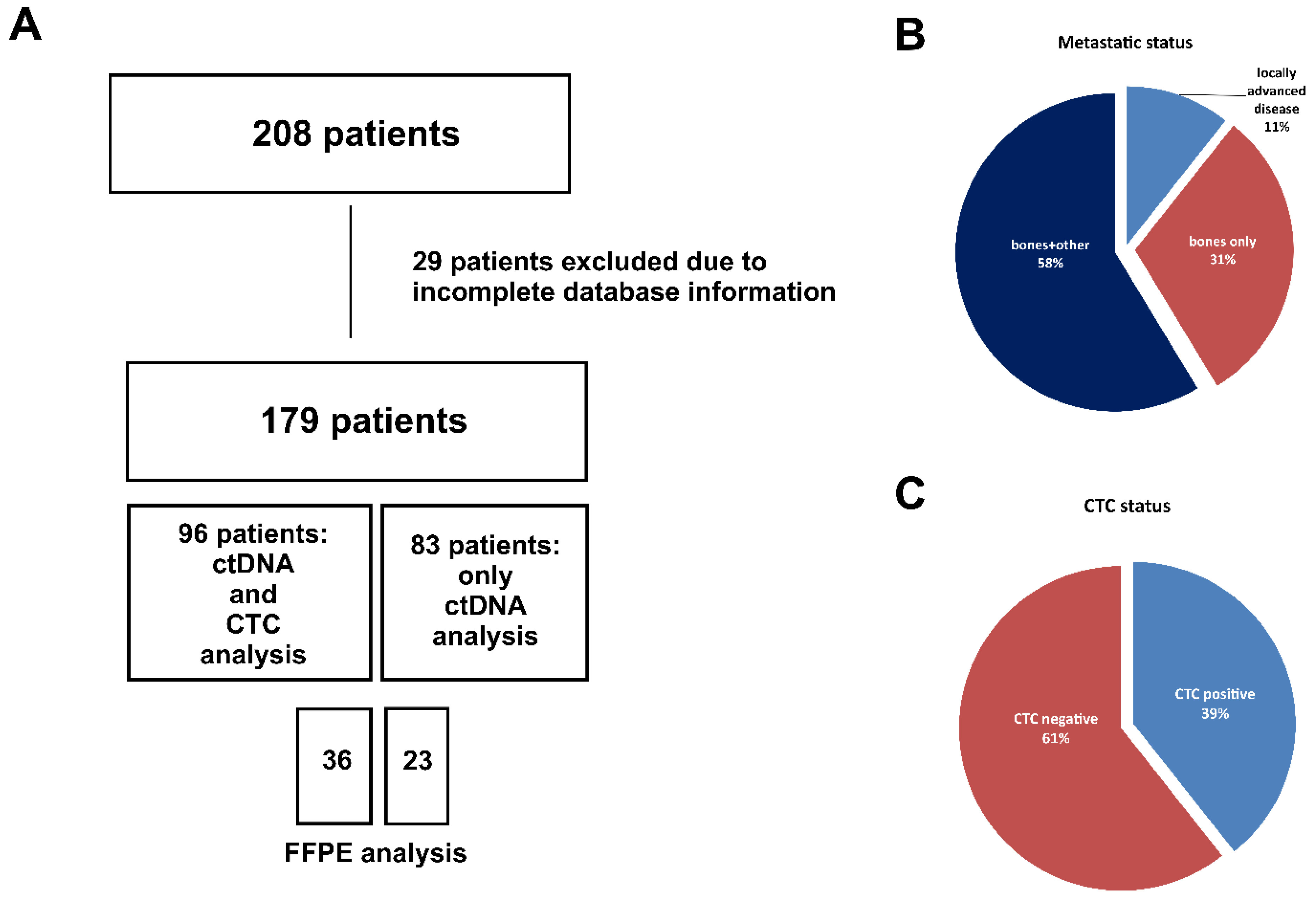
Figure 2.
The mutational status in cfDNA of patients included in the study: A) The incidence of mutations in PIK3CA and ESR1 genes, in samples from 59 patients for whom the analysis of FFPE and cfDNA mutational status was done; for patients with CTCs detected the number of CTCs was also included, N/D is for patients without CTCs. B) The frequency of mutations in PIK3CA and ESR1 in cfDNA; data from 179 patients’ samples. C) The graphical representation of mutational hotspots and main mutations detected in this study in PIK3CA and ESR1 genes.
Figure 2.
The mutational status in cfDNA of patients included in the study: A) The incidence of mutations in PIK3CA and ESR1 genes, in samples from 59 patients for whom the analysis of FFPE and cfDNA mutational status was done; for patients with CTCs detected the number of CTCs was also included, N/D is for patients without CTCs. B) The frequency of mutations in PIK3CA and ESR1 in cfDNA; data from 179 patients’ samples. C) The graphical representation of mutational hotspots and main mutations detected in this study in PIK3CA and ESR1 genes.
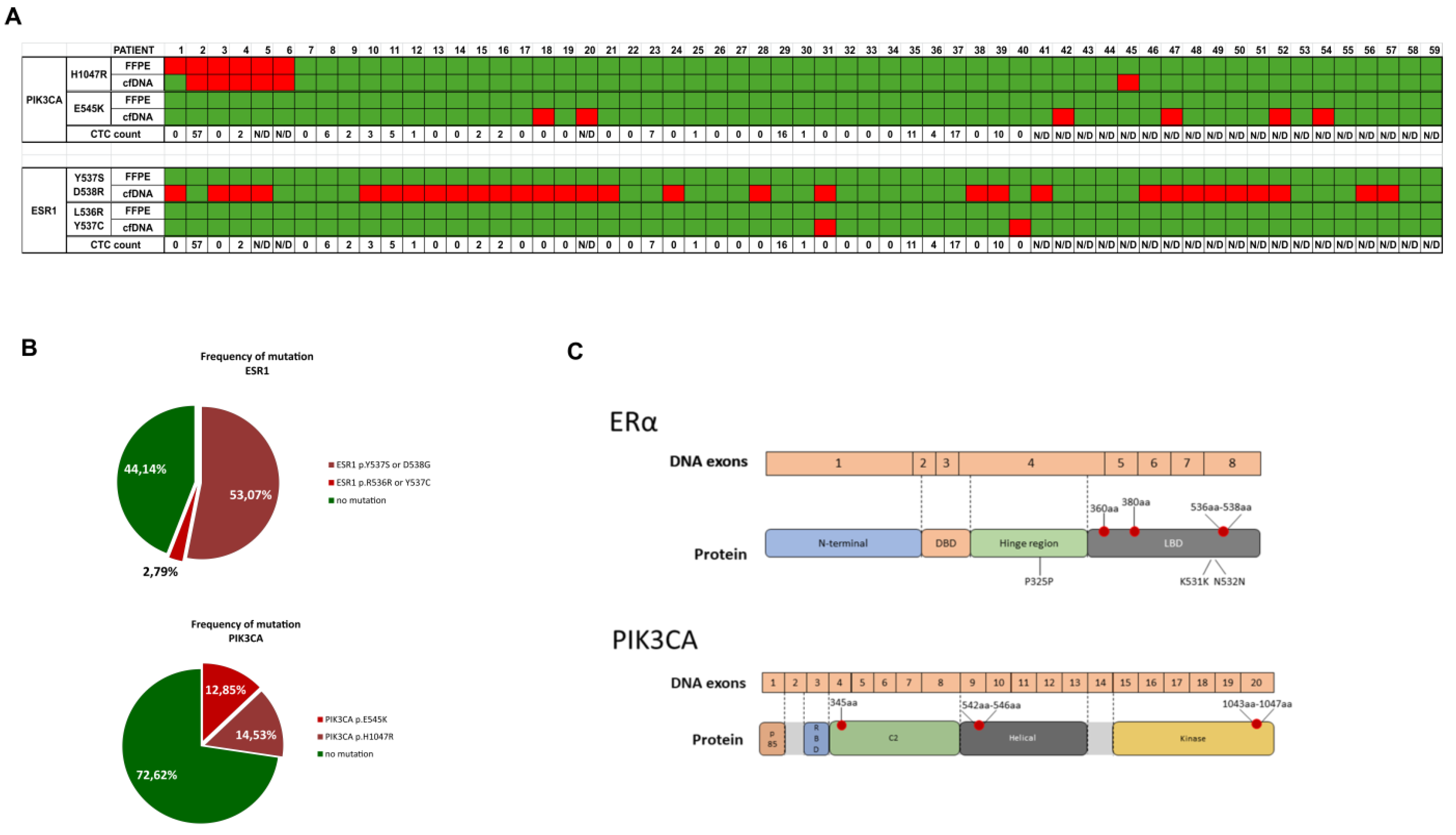
Figure 3.
The Kaplan-Mayer survival analysis for overall survival (OS) for group of 96 patients with CTCs and ESR1 mutation. A) Patients divided according to ESR1 mutational status; mutation detected - red line, wild-type only detected – black line. B) Patients divided according to the CTCs status: ≥5CTCs – red line, <5CTCs – black line. C) Patients divided according to combined CTCs and ESR1 status: ≥5CTCs and ESR1 mutation – red line, <5CTCs and wild-type ESR1 – black line. D) Patients divided according to combined CTCs and ESR1 status: ≥5CTCs – red line, <5CTCs – black line, ≥5CTCs and ESR1 mutation – dashed red line, <5CTCs and wild-type ESR1 – dashed black line. The p-values for survival analysis in log-rank test were stated at the bottom right corner of each graph: * - p-value <0.5; ** - p-value <0.01.
Figure 3.
The Kaplan-Mayer survival analysis for overall survival (OS) for group of 96 patients with CTCs and ESR1 mutation. A) Patients divided according to ESR1 mutational status; mutation detected - red line, wild-type only detected – black line. B) Patients divided according to the CTCs status: ≥5CTCs – red line, <5CTCs – black line. C) Patients divided according to combined CTCs and ESR1 status: ≥5CTCs and ESR1 mutation – red line, <5CTCs and wild-type ESR1 – black line. D) Patients divided according to combined CTCs and ESR1 status: ≥5CTCs – red line, <5CTCs – black line, ≥5CTCs and ESR1 mutation – dashed red line, <5CTCs and wild-type ESR1 – dashed black line. The p-values for survival analysis in log-rank test were stated at the bottom right corner of each graph: * - p-value <0.5; ** - p-value <0.01.
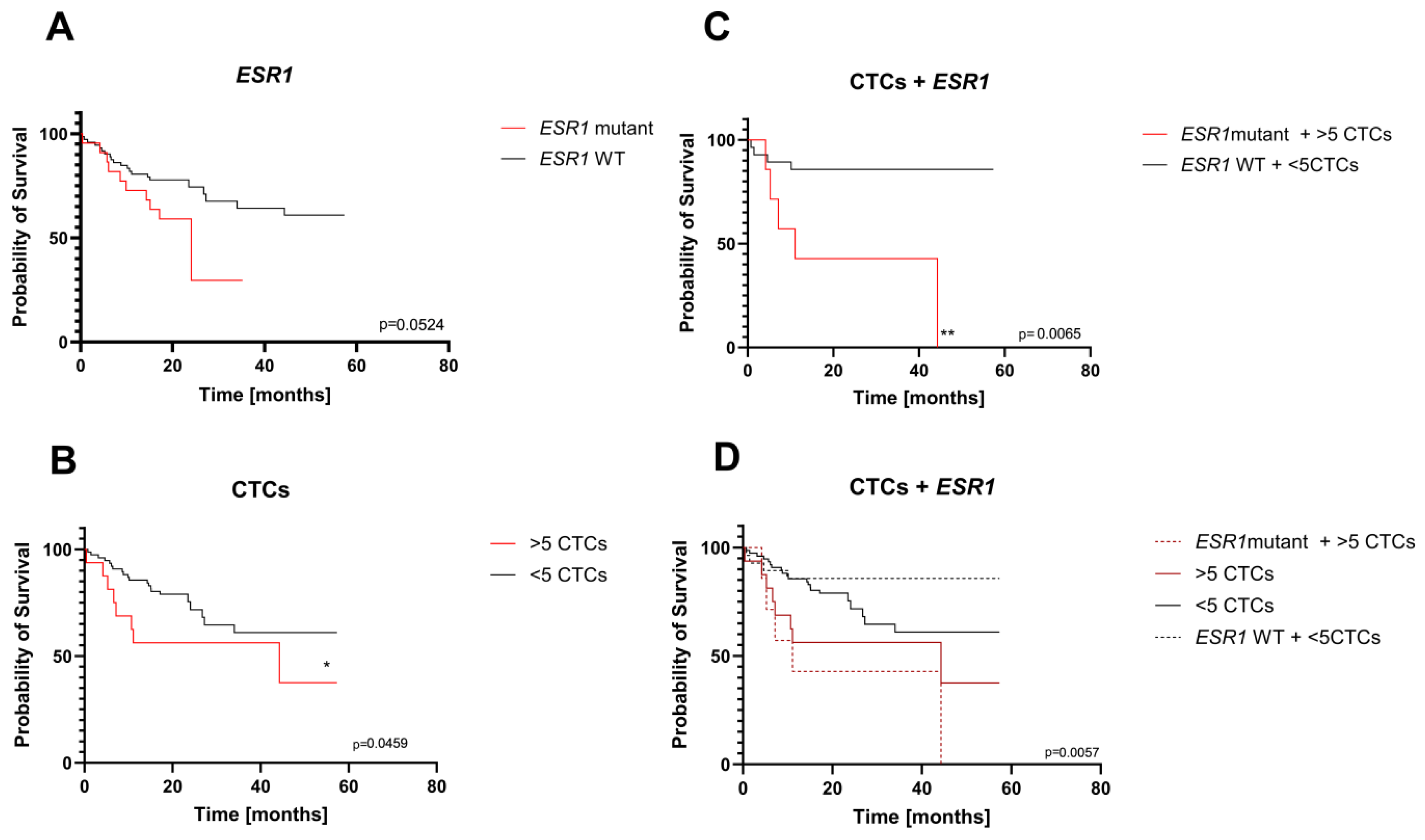
Figure 4.
The graphical representation of the hazard ratios (HRs) and confidence intervals (95% CI) for multivariable Cox proportional hazard regression model. The dashed black line represents HR=1.
Figure 4.
The graphical representation of the hazard ratios (HRs) and confidence intervals (95% CI) for multivariable Cox proportional hazard regression model. The dashed black line represents HR=1.
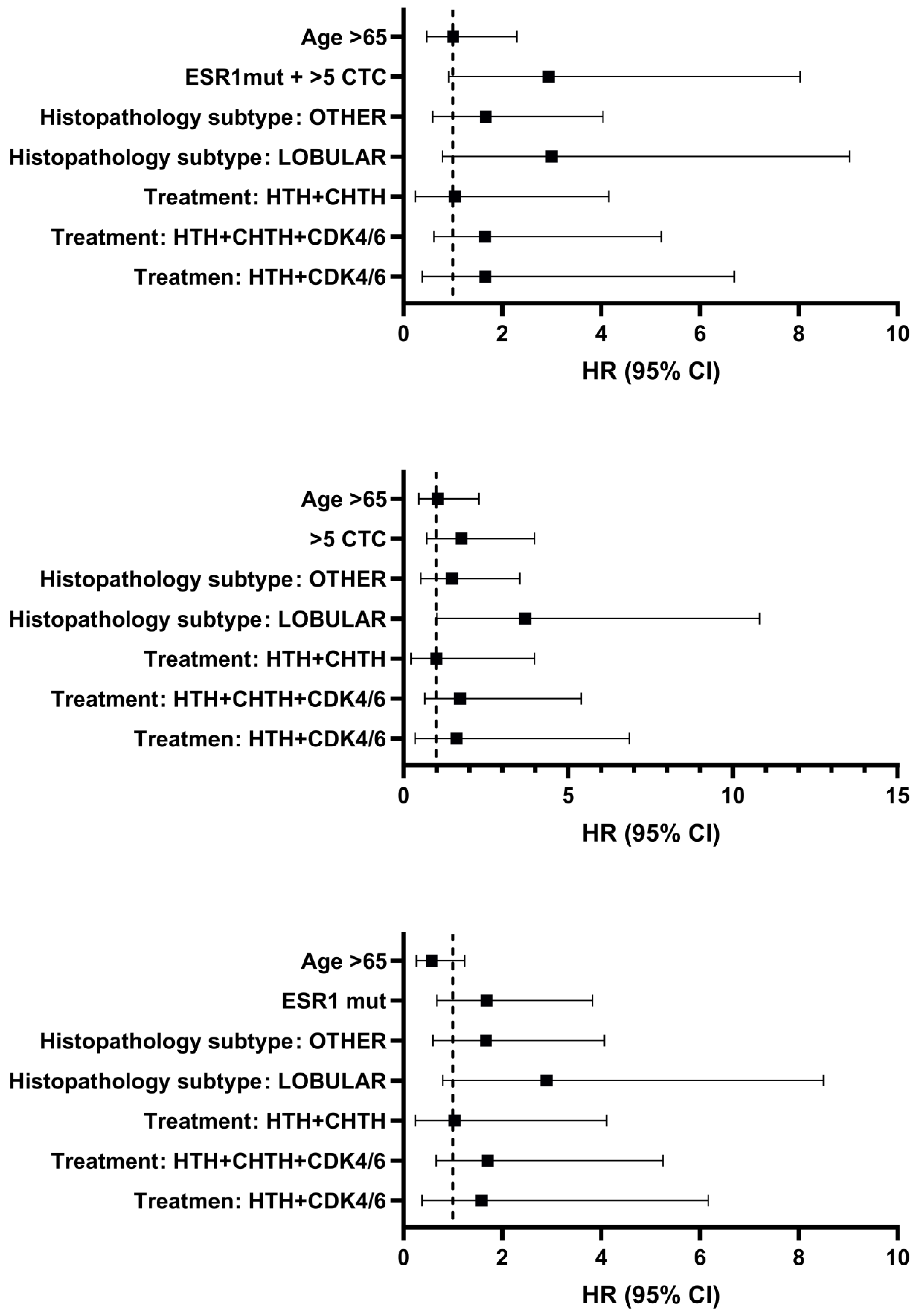

Table 1.
Clinical characteristics of patients.
| Variables | Number of patients |
|---|---|
| Age | |
| <63 | 89 |
| ≥63 | 90 |
| HER2 status | |
| HER2+ | 5 |
| HER- | 161 |
| N/D | 13 |
| No of meta sites | |
| 1 | 83 |
| 2 | 49 |
| ≥3 | 47 |
| Meta sites | |
| Bones | 133 |
| Liver | 67 |
| Lung | 58 |
| Other | 81 |
| Hitological subtype | |
| NST | 133 |
| Lobular | 16 |
| Other | 30 |
| Treatment | |
| HTH | 32 |
| HTH+CHTH | 36 |
| HTH+CDK4/6 | 26 |
| HTH+CHTH+CDK4/6 | 85 |
| Radiotherapy | |
| RTH+ | 100 |
| RTH- | 79 |
Table 2.
Frequency of the mutations identified in the cfDNA material.
| Mutation | Frequency |
|---|---|
| PIK3CA p.E545K | 12,85% |
| PIK3CA p.H1047R | 14,53% |
| ESR1 p.Y537S or D538G | 53,07% |
| ESR1 p.R536R or Y537C | 2,79% |
Table 3.
Characteristics of patients evaluated for CTC.
| Variables | Number of patients |
|---|---|
| Age | |
| <65 | 50 |
| ≥65 | 46 |
| HER2 status | |
| HER2+ | 5 |
| HER- | 86 |
| N/D | 5 |
| No of meta sites | |
| 1 | 58 |
| 2 | 27 |
| ≥3 | 21 |
| Meta sites | |
| Bones | 70 |
| Liver | 32 |
| Lung | 26 |
| Other | 36 |
| Hitological subtype | |
| NST | 75 |
| Other | 21 |
| Treatment | |
| HTH | 22 |
| HTH+CHTH | 15 |
| HTH+CDK4/6 | 14 |
| HTH+CHTH+CDK4/6 | 45 |
| Radiotherapy | |
| RTH+ | 46 |
| RTH- | 50 |
| ESR1 status | |
| ESR1 mutation | 58 |
| ESR1 WT | 38 |
Table 4.
The clinical variables used for the Cox multivariable model.
| Clinical variable | Reference level |
|---|---|
| Treatment | HTH |
| Histopathological subtype | NST |
| Age | <65 |
Table 5.
The results of Cox proportional hazard regression analyzes.
| Univariable analysis | |||
|---|---|---|---|
| Variable | HR | 95 CI | p-value |
| ESR1 mutation | 0,5832 | 0,2853-1,186 | 0,1339 |
| >5 CTCs | 1,775 | 0,7423-3,821 | 0,1636 |
| ESR1 mut + >5CTCs | 3,496 | 1,173-8,484 | 0,0113 |
| Multivariable analysis | |||
| Variable | HR | 95 CI | p-value |
| ESR1 mutation | 0,5616 | 0,2686-1,165 | 0,1197 |
| >5 CTCs | 1,814 | 0,7310-4,124 | 0,1714 |
| ESR1 mut + >5CTCs | 3,538 | 1,126-9,403 | 0,0172 |
Table 6.
Sequence of probes and starters used for the assessment of the ESR1 mutation status.
| Mutation | Probe sequence | Primer sequence | |
|---|---|---|---|
| L536R | [6FAM]TGGTGCCCCGCTATGACC[BHQ1] | F | F 5’AGGCATGGAGCATCTGTACA3’ |
| R | 5’TTGGTCCGTCTCCTCCA3’ | ||
| Y537S | [6FAM]TGGTGCCCCTCTCTGACCT[BHQ1] | F | F 5’AGGCATGGAGCATCTGTACA3’ |
| R | 5’TTGGTCCGTCTCCTCCA3’ | ||
| D538G | [6FAM]CCCTCTATGGCCTGCTGCT[BHQ1] | F | F 5’AGGCATGGAGCATCTGTACA3’ |
| R | 5’TTGGTCCGTCTCCTCCA3’ | ||
| Y537C | [6FAM]TGCCCCTCTGTGACCTGCT[BHQ1] | F | F 5’AGGCATGGAGCATCTGTACA3’ |
| R | 5’TTGGTCCGTCTCCTCCA3’ | ||
| WT ESR1 | [HEX]TGGTGCCCCTCTATGACCTG[BHQ1] | F | F 5’AGGCATGGAGCATCTGTACA3’ |
| R | 5’TTGGTCCGTCTCCTCCA3’ | ||
Table 7.
Sequences of the primers used for Sanger sequencing.
| Gene | Forward primer | Reverse primer | Product lenght |
|---|---|---|---|
| ESR1 exon 8 | 5’- TCTGTGTCTTCCCACCTACAGT-3’ | 5’- ATGCGATGAAGTAGAGCCCG-3’ | 200bp |
| PIK3CA exon 9 | 5’- AGCTAGAGACAATGAATTAAGGGA -3’ | 5’- TCCATTTTAGCACTTACCTGTGAC -3’ | 130bp |
| PIK3CA exon 20 | 5’- AACTGAGCAAGAGGCTTTGGA -3’ | 5’- CAATCGGTCTTTGCCTGCTG -3’ | 200bp |
Disclaimer/Publisher’s Note: The statements, opinions and data contained in all publications are solely those of the individual author(s) and contributor(s) and not of MDPI and/or the editor(s). MDPI and/or the editor(s) disclaim responsibility for any injury to people or property resulting from any ideas, methods, instructions or products referred to in the content. |
© 2025 by the authors. Licensee MDPI, Basel, Switzerland. This article is an open access article distributed under the terms and conditions of the Creative Commons Attribution (CC BY) license (http://creativecommons.org/licenses/by/4.0/).
Copyright: This open access article is published under a Creative Commons CC BY 4.0 license, which permit the free download, distribution, and reuse, provided that the author and preprint are cited in any reuse.


