

Submitted:
27 January 2025
Posted:
28 January 2025
You are already at the latest version
Abstract
Chronic urinary tract infection (UTI) presents with protracted lower urinary tract symptoms and elevated urinary leukocyte counts, but its bacterial etiological agents remain obscure. In this cross-sectional investigation, we aimed to unravel the role of the bladder microbiota in chronic UTI pathogenesis by studying the host immune response. Full-void urine samples were collected from healthy controls (HT), chronic UTI patients who had not initiated treatment (PT) and those undergoing treatment (OT), then sorted into white blood cell (WBC) and epithelial cell (EPC) fractions. Bacteria associated with both fractions were identified by chromogenic agar culture coupled with mass spectrometry and 16S rRNA sequencing. Distinct WBC-exclusive bacteria were observed in health, but this pattern was less obvious in patients, plausibly due to epithelial shedding and breaching of the urothelial barrier. We also described a bacterial fingerprint guided by Escherichia that was able to stratify patients based on symptom severity. Clustering analyses of mean rank changes revealed highly statistically significant upward and downward ecological shifts in communities of bacteria between health and disease. Interestingly, many of the most abundant genera identified in sequencing remained stable when compared between the study cohorts. We concluded that reshuffling of the urinary microbiome, rather than the activity of a single known urinary pathogen, could drive chronic UTI.
Keywords:
urinary tract infection
; lower urinary tract symptoms
; pain
; host immune response
; urinary leukocytes
; chromogenic agar culture
; 16S rRNA sequencing
; K-means clustering
; bladder pain syndrome
; painful bladder syndrome
1. Introduction
Urinary tract infection (UTI) preponderantly affects females, with an age-standardized incidence rate of 80 per 1000 - nearly four times that in males. While the global age-standardized disability-adjusted life-year (DALY) rate declined from 1990 to 2019, it has remained largely unchanged during the same period for UTI, reflecting a persistent health burden [1,2]. Approximately half of UTI cases recur within a year [3], with some patients experiencing chronic lower urinary tract symptoms (LUTS) over several years [4].
Standard diagnostics, including the biochemical urinary dipstick and midstream urine (MSU) culture often lack sensitivity and specificity, leading to delayed or inaccurate UTI treatment [5,6,7,8]. Moreover, multiple independent studies have confirmed the presence of resident bladder microbiota through methods such as 16S rRNA metagenomic sequencing and enhanced culture techniques [9,10,11,12], complicating the distinction between commensals and pathogens.
Most urobiome studies focus on distinguishing bacterial profiles in health versus cohorts with defined LUTS, revealing putative health- or disease-associated bacteria, but sample heterogeneity limits conclusions [13,14,15,16,17,18,19,20]. Similarly, studies comparing the urobiome between chronic UTI patients and healthy controls have thus far been unable to determine definitive differences [7,11]. Besides LUTS, elevated urinary white blood cells and infected epithelial cells, the majority of which originating from the urinary tract, are key markers of chronic UTI [4,21,22,23,24,25,26].
We aimed to explore the relationship between the resident bacterial ecology and bacteria responsible for eliciting an immune response in the bladder using shed urinary epithelial cell-associated and urinary white blood cell-associated bacteria as respective proxies. To achieve this, we sorted urinary cells harvested from chronic UTI patients and age-matched healthy controls into white blood cell (WBC) and epithelial cell (EPC) fractions and used agar culture and 16S rRNA sequencing to study bacterial populations. By employing novel clustering techniques and analyses, we uncovered potential ecological shifts, microbial fingerprints and polymicrobial infection in the etiology of chronic UTI.
2. Materials and Methods
2.1. Sample Processing and Sorting into Urinary White Blood Cell and Epithelial Cell Fractions
This study was approved by Health and Care Research Wales (reference: 22/WA/0069). Full-void urine samples were collected with informed consent from female adults at the Whittington Health and Royal Free Hospitals (London, UK) and categorized into three study groups. The healthy (HT, n=18) group comprised of individuals not currently diagnosed with UTI and had not taken antibiotics for at least a month prior to sampling. The chronic UTI pre-treatment (PT, n=14) group comprised of patients diagnosed with chronic UTI who were new to the LUTS clinic and were not on antibiotic treatment for at least two weeks prior to sampling. The chronic UTI on treatment (OT, n=19) group comprised of patients diagnosed with chronic UTI who were being treated at the LUTS clinic with antibiotics and/or urinary antiseptics. All participants provided personal particulars and answered a 39-point symptom questionnaire [21]. Fresh urine microscopy was performed to enumerate epithelial and white blood cells. The samples underwent routine urinalysis (Multistix® 8 SG Reagent Strips, Siemens Healthineers, GB) and overnight MSU culture on chromogenic agar (CHROMID® CPS® Elite Agar, CPSE, bioMérieux, UK) using a 10 μl calibrated loop and standard surface streak technique.
The urine samples were then transported to the research laboratory for processing and storage. They were centrifuged at 300 g for 5 minutes and pelleted cells were stored at -70oC in cryopreservation medium (CTSTM Synth-a-FreezeTM Medium, ThermoFisher, UK) until further use. On the day of experimentation, urinary cells were thawed and incubated with anti-human CD45 MicroBeads (Miltenyi Biotec, UK) for magnetic-activated cell sorting (autoMACS® Pro Separator, Miltenyi Biotec, UK), resulting in leukocyte-enriched white blood cell (WBC) and leukocyte-depleted epithelial cell (EPC) fractions. For every fraction before (NEAT) and after CD45 marker separation (WBC and EPC), 0.1 ml of samples at a concentration of 125000 cells/ml were cultured overnight at 37oC on CPSE. Each individual morphological colony type was then subcultured on new agar plates to obtain pure colonies for identification by matrix-assisted laser desorption/ionization time-of-flight (MALDI-TOF) mass spectrometry with a score threshold of ≥2.00. The remaining samples from WBC and EPC fractions were stored in DNA/RNA Shield (Zymo Research, US) at -70oC for subsequent DNA extraction and 16s RNA sequencing (Figure 1).
2.2. PNA-FISH and Immunofluorescence
A randomly selected subset of urine samples (n=10 per study group) was prepared for fluorescence in situ hybridization using peptide nucleic acid (PNA-FISH) and immunofluorescence staining. Cytocentrifugation was conducted using a Shandon Cytospin 2 at 800 rpm for 5 minutes and adhesion slides (EprediaTM SuperFrost PlusTM, Fisher Scientific, UK). Fixation and permeabilization were conducted with 4% formaldehyde/PBS for 30 minutes at room temperature followed by methanol/acetone (1:1) for 10 minutes at -20oC. After washing thrice with PBS, the slides were preheated in a humidified chamber at 60oC for 10 minutes. Preheated PNA probes (80oC for 10 minutes) were then added. After 30 minutes, the slides were brought to room temperature and incubated for a further 2 hours at room temperature in the dark. After incubation, the slides were washed twice in 2X saline-sodium citrate buffer/0.1% Tween-20/ultrapure water for 5 minutes each at 50oC. After a further two washes with PBS at room temperature, blocking (Invitrogen™ eBioscience™ IHC/ICC Blocking Buffer, ThermoFisher, UK) was performed for 30 minutes and labelling with CD45-Alexa Fluor 647 (1:20 dilution in blocking buffer, Biolegend, UK) was performed for an hour. This was followed by three washes with PBS and two washes with HBSS and staining with wheat germ agglutinin (WGA)-Alexa Fluor 488 (1 μg/ml in HBSS, ThermoFisher, UK) and Hoechst 33342 (12 μg/ml in HBSS, ThermoFisher, UK) for 30 minutes. Final washes were performed with HBSS three times and coverslips mounted (Invitrogen™ ProLong™ Diamond Antifade Mountant, ThermoFisher, UK). The slides were allowed to cure overnight, sealed with clear nail varnish and imaged on a confocal laser scanning microscope (TCS SP8, Leica Microsystems, UK). Negative control slides were prepared with the same protocol as above but hybridized with a sense PNA probe and without staining for CD45 marker. The PNA probes that target bacterial 16S rRNA (anti-sense for positive staining: 5’-TGCCTCCCGTAGGA-3’; sense for negative staining: 5’-ACTCCTACGGGA-3’) were synthesized (Panagene, South Korea) with the fluorophore (Alexa Fluor 594) conjugated at the N-terminus via a double linker (2-aminoethoxy-2-ethoxy acetic acid, AEEA). The probes were used at 0.5 μM prepared in in situ hybridization buffer (Enzo Life Sciences, UK). The acquired images were visualized in Fiji (ImageJ) software release 1.54f [27].
2.3. Bacterial Colony Counts of WBC and EPC Fractions Grown on Chromogenic Agar
Images of chromogenic agars cultured with NEAT, WBC and EPC fractions were cropped to a common size (1322×1322 pixels) and colony counts were analyzed with an open-source image processing software, ilastik [28]. Segmentation masks were first created from the pixel classification workflow to differentiate colonies from background. This was followed by training an object classification workflow to identify individual colonies, with the classes assigned based on their species identification by MALDI-TOF. The resulting bacterial colony counts were normalized to 1000 total number of cells to reflect total abundance (CFU/1000 cells). Bacteria that were only present in the WBC fraction were deemed to be exclusively associated with white blood cells and were normalized to 1000 white blood cells (CFU/1000 WBC). The rest of the bacteria from all three fractions were considered to be associated with epithelial cells and normalized to 1000 epithelial cells (CFU/1000 EPC). Alpha and beta diversity indices were calculated with RStudio version 2023.12.0.369 (Posit Software, USA). Statistical analysis was performed on GraphPad Prism version 10.3.1 for Windows (GraphPad Software, USA).
2.4. Bacterial DNA Extraction and 16s rRNA Sequencing
Bacterial DNA was extracted from WBC and EPC fractions separately using FastDNATM SPIN Kit for Soil (MP Biomedicals, USA) in combination with mechanical lysis facilitated by Fisherbrand™ Bead Mill 24 Homogenizer (Fisher Scientific, UK) following the manufacturers’ instructions. Library preparation was conducted as described previously [29]. Briefly, a two-step PCR approach was used to amplify the V1V2 variable regions of the 16S rRNA gene, employing the primers 27F (3′-AGRGTTHGATYMTGGCTCAG-5′) and 338R (5′-TGCTGCCTCCCGTAGGAGT-3′). The amplification was based on the DNA abundance extracted from each sample, with the Q5® High-Fidelity DNA Polymerase (New England Biolabs, UK) applied according to the manufacturer’s instructions.
Thermocycler settings for library preparation included an initial denaturation at 98°C for 30 seconds, followed by 10 seconds at 98°C, 30 seconds at 58°C and 60 seconds at 72°C for 15 cycles, plus another 10 cycles for barcoding and a final extension at 72°C for 2 minutes. For samples with low biomass, an additional 20 cycles of one-step PCR, using the same primers, were added to enrich the 16S rRNA gene before the two-step PCR. Amplicons were assessed using the Agilent TapeStation System, with the expected size of ~450 bp. For library pooling, 10 ng of purified product from each sample (quantified using the Quant-iT Picogreen dsDNA assay kit on BMG LABTECH FLUOstar Omega microplate reader) was added. The pooled library was then purified using the QIAquick PCR Purification Kit (Qiagen, Germany) before being subjected to 2 x 300 bp paired-end Illumina MiSeq sequencing (Illumina, USA).
2.5. Sequencing Data Processing and Clustering Analysis
Sequencing data (FASTQ files) were processed using nf-core/ampliseq v2.6.1 pipeline with Nextflow v23.10.0 [30]. The pipeline is publicly available at https://github.com/nf-core/ampliseq [31]. Briefly, sequencing quality was assessed using FastQC (v0.11.9), with results summarized and visualized through MultiQC (v1.14). Cutadapt (v3.4) was employed to trim sequences followed by DADA2 (v1.22.0) in R (v4.1.1), which removed PhiX contamination and filtered reads (before the median quality dropped below 25 and ensuring at least 90% of reads were retained). DADA2 was further utilized for the identification of Amplicon Sequence Variants (ASVs) and taxonomic classification against the SILVA database (release 138). Additionally, QIIME2 (v2022.11.1) was used for taxonomic assignment, also against the SILVA database (release 138). A total of 3179 ASVs were identified across all samples. Sequencing reads were normalized according to the formulae below to obtain theoretical pure numbers of bacteria associated with white blood cell and epithelial cell, respectively. Subsequent statistical analyses were conducted using RStudio version 2023.06.0 Build 421 (Posit Software, USA) and IBM SPSS Statistics for Windows version 29.0 (IBM Corp, USA). K-means clustering of mean rank changes was performed using IBM SPSS Statistics for Windows version 29.0 (IBM Corp, USA).
Equations 1 and 2.
T: Total number of; B: Bacteria; W: white blood cell; E: epithelial cell; P: white blood cell fraction; N: epithelial cell fraction.Normalization of sequencing data to obtain theoretical numbers of bacteria associated with white blood cell and epithelial cell.
Notably, genera related to Burkholderia (specifically Burkholderia-Caballeronia-Paraburkholderia) and Ralstonia were excluded from the dataset prior to analysis to enhance data reliability. This decision was based on their consistent identification as contaminants in the FastDNA™ Spin Kit for Soil [32,33,34].
3. Results
3.1. PNA-FISH and Confocal Microscopy Showed a Diversity of Bacteria Associated with Urinary White Blood Cells and Epithelial Cells
In this study, PNA-FISH and immunofluorescence techniques were employed to differentiate cellular and bacterial components. Hoechst stained the cell nuclei and bacterial DNA, whilst WGA labelled the cell cytoplasm, Gram-positive bacteria and mucus. The PNA probe tagged both Gram-positive and Gram-negative bacteria and CD45 immunofluorescence confirmed white blood cell identification. Suspended bacterial biofilms displayed structural variations, including single-species auto-aggregates, multi-species co-aggregates and filamentous forms (Figure 2a). Bacteria targeted by white blood cells, as shown in Figure 2b (right), and surface-associated biofilms on epithelial cells (Figure 2c) were the objects of interest in this study. These initial microscopy observations validated the approach of isolating WBC- and EPC-associated bacteria to examine immune targets in chronic UTI.
3.2. The Three Study Groups Were Distinguished by Urinary White Blood Cell Counts and Lower Urinary Tract Symptoms
This study modelled disease progression across healthy individuals (HT), chronic UTI patients yet to receive treatment (PT) and chronic UTI patients undergoing treatment (OT). Participant ages were similar (mean years [95% CI]: HT = 44.4 [37.8, 51.0]; PT = 45.7 [36.5, 54.9]; OT = 50.9 [42.0, 59.8]) (Figure 3a), as were epithelial cell counts (mean cells/ml [95% CI]: HT = 893 [522, 1263]; PT = 2588 [557, 4618]; OT = 4009 [-413.2, 8432]) (Figure 3b); however, fresh urinary white blood cell counts were significantly elevated in PT (mean cells/ml [95% CI]: HT = 528 [175, 882]; PT = 146315 [-160573, 453202]; OT = 9254 [-758, 19265]) (Figure 3c). Using a 39-point LUTS questionnaire, stress and storage symptoms showed no significant differences between the study groups but chronic UTI patients in both PT and OT scored consistently higher than HT in voiding (mean score [95% CI]: HT = 0.88 [0.36, 1.39]; PT = 4.14 [2.50, 5.79]; OT = 3.68 [2.59, 4.77]) and pain (mean score [95% CI]: HT = 0.44 [-0.04, 0.91]; PT = 5.36 [3.44, 7.27]; OT = 3.53 [2.52, 4.53]) symptoms (Figure 3d). Both urinary WBC counts and LUTS scores were reduced in the OT group when compared to the PT group.
3.3. Gold Standard Diagnostic Tests for UTI Were Unable to Reliably Distinguish Between the Three Study Groups
Positive leukocyte esterase and nitrite tests are commonly used as indicators for UTI. Within HT, biochemical dipstick results were not available for five samples, however 2/13 (15%) samples tested positive for leukocyte esterase, while 5/14 (36%) in PT and 8/19 (42%) in OT were positive. None of the samples in HT were positive for nitrite, compared to 3/13 (23%) in PT and 2/19 (11%) in OT. For MSU culture, a positive result is defined as >105 CFU/ml of a single known uropathogen. All 18 HT samples were MSU-negative, with ‘no significant growth’ reported for most, although 56% grew colonies. In the PT group, 5/14 (36%) were MSU-positive, showing either Escherichia coli or Coliforms (Klebsiella/Enterobacter/Serratia group); the remaining 64% were MSU-negative. In the OT group, 3/19 (16%) were MSU-positive, with E. coli, Klebsiella pneumoniae and Citrobacter braakii identified. The remaining OT samples (84%) were MSU-negative, with most showing ‘no significant growth’ or ‘mixed growth’. Both dipstick and MSU tests exhibited low sensitivity, averaging below 30%, in detecting UTI in the patient groups (PT and OT).
3.4. Enriched Urine Culture Following CD45-Sorting into WBC and EPC Fractions Uncovered Bacteria Uniquely Associated with White Blood Cell and Epithelial Cell in All Study Groups
Laboratory culture on chromogenic agar yielded colony growth in 17/18 (94%), 14/14 (100%) and 18/19 (95%) of HT, PT and OT samples, respectively. A total of 41 bacteria and 3 yeast species from 21 genera, 15 families, 7 orders, 4 classes and 4 phyla was identified (Table S1). Total abundance was the highest in PT, followed by HT and OT (mean CFU/1000 cells [95% CI]: HT=52.9 [14.5, 91.3]; PT=161.3 [28.8, 293.7]; OT=39.4 [7.7, 71.0]) (Figure 4a). Notable trends included a decline in Corynebacterium spp. while Enterobacteria and Enterococcus spp. increased from HT to PT and PT to OT. Escherichia coli showed the highest abundance in PT and was significantly reduced in OT (mean CFU/1000 cells [95% CI] in HT=0.013 [-0.003, 0.028]; PT=61.910 [-4.263, 128.100]; OT=1.415 [-1.544, 4.374]) (Figure 4e). Staphylococcus spp. increased in OT and yeasts were also slightly more common in OT. Streptococcus spp. and the ‘Others’ bacterial group remained relatively stable among the study groups. There were 30, 21 and 23 species isolated from HT, PT and OT, respectively, giving the highest species richness in individuals without UTI. The most abundant species was Corynebacterium coyleae in HT, E. coli in PT and Staphylococcus epidermidis in OT (Figure 4b). Both alpha- and beta-diversity analyses did not show apparent differences between the study groups.
By sorting the urinary cells with CD45 marker prior to laboratory culture, bacteria exclusively associated with WBC were highlighted as immune targets and potential infective agents (Figure 4c). The species that was most frequently targeted was S. epidermidis in HT and OT, and Staphylococcus haemolyticus in PT. Bacteria that were targeted by all study groups were Enterococcus faecalis, S. haemolyticus and Staphylococcus hominis. Most bacteria targeted in HT were found only in this study group (Figure 4f set 1). In PT, bacteria that were only present in this study group and targeted were Streptococcus anginosus and Globicatella sanguinis (Figure 4f set 2). Serratia entomophila and Micrococcus luteus were targeted solely in OT (Figure 4f set 3). No yeasts were targeted by white blood cells in any of the study groups.
Bacteria associated with epithelial cells in the EPC fraction (Figure 4d) were postulated to be bladder-resident commensals or pathogens that were shed along with the cells. Species that were isolated from EPC in all three study groups were Corynebacterium aurimucosum, C. coyleae, E. coli, Streptococcus agalactiae, S. epidermidis and S. haemolyticus, with E. faecalis being the most prevalent. Most EPC-associated bacteria in HT and OT were distinctively found in these study groups (Figure 4g sets 1 and 3), while the species found in PT frequently showed overlaps with HT and OT. This demonstrated a plausible shift in bacterial communities in the bladder during health and chronic UTI.
3.5. 16S rRNA Sequencing Showed Lactobacillus as the Predominant Genus Across All Study Groups and Differences Between WBC and EPC Fractions
The microbial ecology of the study groups was further analyzed using 16S rRNA sequencing, with each urine sample contributing two fractions (WBC and EPC) after CD45-sorting, thus amounting to 100 sequencing samples from 17 HT (one sample was lost during processing), 14 PT and 19 OT individuals. All the samples yielded sufficient sequencing reads for analysis. A total of 3179 amplicon sequencing variants (ASVs) was classified across 25 phyla, 144 classes, 106 orders, 172 families and 476 genera (Table S2).
There were 21 genera that accounted for more than 85% of the sequencing reads across all study groups (Figure 5) and Lactobacillus was the most abundant genus, dominating 15/34 (44.1%) HT, 9/28 (32.1%) PT and 10/38 (26.3%) OT samples. Lactobacillus presence was also consistent in the WBC-associated microbiomes across study groups, in 7/17 (41.2%) HT, 5/14 (35.7%) PT and 5/19 (26.3%) OT samples. These findings suggested that Lactobacillus dominated the bladder microbial ecology with the immune system targeting Lactobacillus in both healthy and patient groups.
There was increased similarity between WBC- and EPC-associated bacteria in both the PT and OT compared with HT groups, a finding supported by the nested Bray-Curtis dissimilarity test (Figure 5b). The nested mean dissimilarity score was the highest in HT (0.605), compared to 0.422 and 0.443 in PT and OT, respectively, though these differences were not statistically significant. This observation was further confirmed by the level of dissimilarity between WBC-associated and EPC-associated bacteria across all study groups (Figure 5c). In HT, WBC-associated bacteria exhibited a significantly higher dissimilarity score than EPC-associated bacteria. Non-significant differences were observed in PT and OT.
Among WBC-associated bacteria, the only statistically significant difference was noted between HT and OT, indicating that white blood cells may target distinct bacterial groups across individuals, regardless of health status (Figure 5c). Conversely, the dissimilarity of EPC-associated microbiomes significantly increased from HT to both PT and OT, suggesting that the epithelium-associated microbiome gradually became more heterogeneous.
3.6. Bacterial Signatures in the Urine Were Related to Lower Urinary Tract Symptoms in Chronic UTI
In enriched urine culture following CD45 sorting into WBC and EPC fractions, only E. coli showed statistically significant differences across study groups (Figure 4e). Consequently, samples were categorized based on the presence or absence of E. coli growth in culture (indicated as “Clt.ECO+” or “Clt.ECO-”) for analysis. Corynebacterium spp., Enterococcus spp. and Staphylococcus spp. were consistently present in all study groups (Figure 6a); however, Streptococcus spp., Enterobacteria and “Others” were absent in HTClt.ECO+, HTClt.ECO- and OTClt.ECO+, respectively. Yeasts were found in HTClt.ECO+ but were absent in PTClt.ECO+ and OTClt.ECO+. Samples containing E. coli showed a higher total abundance than those without, reaching statistical significance within PT (mean CFU/1000 cells [95% CI]: HTClt.ECO+ = 90.0 [-173.8, 353.8], n = 3; HTClt.ECO- = 48.7 [5.9, 91.6], n = 14; PTClt.ECO+ = 307.4 [1.2, 613.6], n = 6; PTClt.ECO- = 51.6 [-6.4, 109.7], n = 8; OTClt.ECO+ = 40.5 [-5.3, 86.3], n = 5; OTClt.ECO- = 42.0 [-4.4, 88.3], n = 13). When matched to the individual’s symptoms (Figure 6b,c), voiding scores were generally higher in samples without E. coli, showing statistical significance in PT (mean score [95% CI]: HTClt.ECO+ = 0.00 [0.00, 0.00]; HTClt.ECO- = 1.00 [0.39, 1.61]; PTClt.ECO+ = 2.83 [-0.77, 6.43]; PTClt.ECO- = 5.13 [3.43, 6.82]; OTClt.ECO+ = 3.60 [0.74, 6.46]; OTClt.ECO- = 4.00 [2.70, 5.31]).
A similar analysis was conducted on E. coli presence identified via 16S rRNA sequencing, broadly represented by the Escherichia-Shigella group (indicated as “Seq.ESH+” or “Seq.ESH-”). The voiding symptom scores showed a similar trend (Figure 6d) and pain scores were significantly higher in OT samples containing Escherichia-Shigella group in sequencing (mean score [95% CI] in HTSeq.ESH+=0.00 [0.00, 0.00], n=4; HTSeq.ESH-=0.58 [-0.05, 1.22], n=13; PTSeq.ESH+=5.80 [3.26, 8.34], n=10; PTSeq.ESH-=4.25 [-0.13, 8.63], n=4; OTSeq.ESH+=5.00 [3.08, 6.93], n=7; OTSeq.ESH-=2.67 [1.64, 3.69], n=12) (Figure 6e). Additional clinical signs and symptoms related to the presence of E. coli in culture or the Escherichia-Shigella group in sequencing are detailed in Figure S1.
3.7. Clustering Analysis of Mean Rank Changes in Relative Bacterial Abundance Revealed Significant Ecological Shifts Amidst a Stable Bacterial Community Between the Study Groups
To examine how the bacterial ecology shifted from health to disease, two pairs of study group comparisons were conducted – from HT to PT and PT to OT. When analyzing the microbial ecologies associated with WBC and EPC collectively, 42 genera exhibited significant shifts in relative abundance. Of these, 12 genera showed significant changes between HT and PT, while 33 genera differed between PT and OT (Figure 7a). Specifically, WBC-associated bacteria revealed changes in 2 genera from HT to PT and 12 genera from PT to OT (Figure 7b). EPC-associated bacteria displayed significant alterations in 7 genera from HT to PT and 14 genera from PT to OT (Figure 7c). There were no significant differences in the alpha- and beta-diversity indices in the sequenced samples within and between the study groups.
To capture broader bacterial changes across health and disease states, K-means clustering was applied to categorize shifts of all 476 genera into three patterns – upward shifts, stable bacterial communities and downward shifts. This analysis was conducted on all samples (Figure 8a) as well as within WBC (Figure 8b) and EPC (Figure 8c) fractions. The majority of the top 21 abundant genera (61.9%) remained stable across all study groups. Exceptions included Escherichia-Shigella, Klebsiella, Veillonella and Family-Enterobacteriaceae, which increased from HT to PT in both WBC and EPC but showed no significant changes from PT to OT. Notably, Anaerococcus, Pelomonas, Pseudomonas and Ureaplasma consistently showed a slight upward shift from PT to OT across WBC and EPC fractions. In contrast, EPC-associated Citrobacter decreased from HT to PT but bloomed in both WBC and EPC from PT to OT, suggesting a potentially beneficial role in health by regulating this genus. When comparing bacteria identified in the upward shift clusters with our culture data, previous studies [35,36,37,38] and manufacturers’ manuals (https://www.biomerieux-usa.com/sites/subsidiary_us/files/18_chromid_cpse_flyer.pdf; https://www.biomerieux-nordic.com/sites/subsidiary_no/files/9308627-002-gb-a-chromid-cps-elite-reading-guide.pdf), only 4 to 12% were reported to grow on chromogenic agar. Full bacterial listings for each cluster are provided in Table S3.
4. Discussion
This is the first study to investigate urinary microbiota associated with an immune response in chronic UTI. Congruent with previous works, bacteria identified using agar culture and 16S rRNA sequencing in this study were predominantly Firmicutes, Proteobacteria, Actinobacteria and Bacteroidetes [39]. Although the culture was limited to chromogenic agar and overnight aerobic incubation at 37°C, only 2/51 (3.9%) samples showed an absence of growth, and 41 bacterial species were identified in this cell-enriched method. In sequencing, all samples were sequence-positive and 476 genera were identified, representing a 20 to 40% increase over previous reports [7,13]. Many previous urobiome studies utilized a small volume of urine collected via transurethral catheterization and DNA extraction by enzymatic lysis for 16S rRNA sequencing [13,16,19,40,41]. The broader diversity achieved in this study may be attributed to bacterial tropism toward cells in the urine [11,23,25,42,43,44,45], use of mechanical lysis during DNA extraction and sequencing of different hypervariable regions of the 16S rRNA gene.
We posited that bacteria associated with WBC were pathogens that were targets of the host immune system while bacteria associated with EPC were a rich ecology made up of commensals and pathogens. Bacterial colonies that were WBC-exclusive in culture were most frequently observed in HT samples (16/18, 88.9%), followed by PT (9/14, 64.3%) and OT (10/19, 52.6%). Similarly, in 16S rRNA sequencing, differences between both fractions were the most prominent in HT compared to chronic UTI patients (PT and OT) (Figure 5b). The urothelium acts as a protective barrier and epithelial cell sloughing is a known bladder immune mechanism that helps to reduce bacterial load in UTI [23,24,26,43]. In this study, the number of fresh urinary EPC/ml was similar in all cohorts (Figure 3b). However, we did not inspect the epithelial cell in all individuals to determine the extent of bacterial association. It is quite possible that the number of epithelial cells colonized by bacteria is notably higher in chronic UTI [23]. Indeed, the bacterial load associated with EPC fraction in PT was remarkably higher than controls in this study (Figure 4d). The presence of WBC-exclusive bacteria in HT suggested transient subclinical infections, but in healthy individuals, the bladder epithelial barrier is likely to be intact with rigorous immunosurveillance by white blood cells. On the contrary, the urothelial structural integrity may have been compromised in chronic UTI patients giving way to colonizing bacteria, thus leading to a lesser degree of cellular compartmentalization which was reflected in the diminishing distinction and increasing species overlap between WBC and EPC fractions. Some bacteria were more frequently targeted than others, but WBC-exclusive species, or genera, remained discrete within and between study groups.
Unlike previous studies employing similar culture conditions [7,11], only one species of Lactobacillus (L. gasseri) was isolated from one OT sample in this study. Nevertheless, Lactobacillus was the most abundant genera in sequencing across all study groups, consistent with prior urobiome studies in women [13,16,19,40,41]. Lactobacilli are facultative anaerobic Gram-positive bacteria from the phylum Firmicutes and form part of the microbiota in human gastrointestinal, urinary and female genital tracts. They are generally regarded as beneficial bacteria with protective functions such as enhancing epithelial barrier function, promoting mucus production, colonization resistance through competition and immunomodulation via their metabolites or by inducing production of antibodies and antimicrobial peptides [46,47]. However, studies at the species-level hinted at different biology shaped by different Lactobacillus species. For instance, L. crispatus was associated with a stable and normal vaginal microflora while L. gasseri and/or L. iners increased the risk of vaginal dysbiosis during pregnancy [48]. In the bladder, L. crispatus was commonly found in health while L. gasseri was detected more frequently in individuals with urgency urinary incontinence (UUI) [13]. In our study, we found that Lactobacillus was associated with both WBC and EPC fractions in all study groups, suggesting that defined populations of this bacterial group were actively targeted by the immune system. Future work that aims to characterize Lactobacillus in more detail may be able to shed light on the regulatory roles exhibited by this genus in the bladder microbiome.
By characterizing samples based on the presence of E. coli in culture or Escherichia-Shigella group in sequencing, we established the occurrence of a bacterial fingerprint that affected the overall urobiome composition, which was also relevant to the symptoms experienced. Chronic UTI patients (PT) that grew E. coli in culture scored lower in voiding symptoms while those (OT) that showed Escherichia-Shigella in sequencing reported more severe pain (Figure 6). Both symptom categories have been described as the most indicative of pyuria and chronic UTI [21]. The prevalence of E. coli and Escherichia-Shigella was relatively low in this study, and it is important to clarify that they were not identified as the cause of infection. Instead, this bacterial group was used as a guide species to indicate urobiome shifts and stratify the study cohorts. Such classification may inform the severity of infection and benefit patients by tailoring a more efficient approach in disease-monitoring and treatment.
Past studies have also attempted to arrange samples into urotypes based on bacterial diversity or predominant bacterial groups but the resulting clusters did not differentiate the healthy individuals from those with UUI studied [13,16,17]. Another study grouped urobiomes based on the relative abundance of sequenced Lactobacillus and found that UUI in individuals with mixed urinary incontinence showed bacterial communities characterized by low Lactobacilli and high Proteobacteria [40]. In this study, the application of clustering analysis to mean rank changes revealed group trends in bacterial shifts that could describe health and different stages of disease as well as microbial responses to treatment in this study (Figure 8). The varying bacterial community shifts from HT to PT and PT to OT signified that a polymicrobial infection is highly probable in chronic UTI.
5. Conclusions
A growing understanding of the coexistence of commensals and pathogens in the bladder microbiome has rendered current gold standards unfit for UTI diagnosis. Indicators of microbiome dysbiosis, such as reduced diversity [49] and imbalances in relative abundance ratios [39], have been postulated as potential drivers of disease in UTI. In our study, bacteria uniquely associated with WBC or EPC were uncovered. However, likely due to inter-person urobiome variances, these distinctions were not absolute. By employing clustering analyses, we reinforced the lack of a universal commensal/pathogen divide in chronic UTI. Hence, we infer that discerning signature changes in bacterial communities within each individual, rather than focusing on a few specific species or abundance thresholds, is the central distinguishing feature between health and disease. Although it may be difficult to determine the reason for such dysbiosis to occur leading to chronic UTI, further examination into the consequent metabolomic and functional changes are warranted [50,51]. The addition of a study group comprising individuals that have completely recovered or longitudinal studies tracing chronic UTI patients are needed in the future. Studying individuals through their treatment period until partial or complete remission could determine whether a return to health constitutes a complete transformation or simply rehabilitation of the urobiome to pre-disease state.
Supplementary Materials
The following supporting information can be downloaded at the website of this paper posted on Preprints.org, Figure S1: Clinical signs and symptoms with presence or absence of E. coli growth in culture and Escherichia-Shigella group in 16S rRNA sequencing following CD45 sorting of urinary cells; Table S1: List of microbial species identified from culture of WBC and EPC fractions on chromogenic agar (grouped); Table S2: List of all genera identified in 16S rRNA sequencing; Table S3: List of all genera in the different clusters shown in Figure 8.
Author Contributions
Conceptualization, Catherine C. Y. Chieng, Qingyang Kong and Harry Horsley; Data curation, Catherine C. Y. Chieng, Qingyang Kong, Natasha S. Y. Liou and Harry Horsley; Formal analysis, Catherine C. Y. Chieng, Qingyang Kong and Harry Horsley; Funding acquisition, Rajvinder Khasriya and Harry Horsley; Investigation, Catherine C. Y. Chieng, Qingyang Kong, Natasha S. Y. Liou, Mariña Neira Rey, Katie Dalby and Neil Jones; Methodology, Catherine C. Y. Chieng, Qingyang Kong and Harry Horsley; Project administration, Catherine C. Y. Chieng, Qingyang Kong, Natasha S. Y. Liou, Rajvinder Khasriya and Harry Horsley; Resources, Neil Jones, Rajvinder Khasriya and Harry Horsley; Supervision, Rajvinder Khasriya and Harry Horsley; Visualization, Catherine C. Y. Chieng, Qingyang Kong and Harry Horsley; Writing – original draft, Catherine C. Y. Chieng and Qingyang Kong; Writing – review & editing, Catherine C. Y. Chieng, Qingyang Kong, Natasha S. Y. Liou, Mariña Neira Rey, Katie Dalby, Neil Jones, Rajvinder Khasriya and Harry Horsley. All authors have read and agreed to the published version of the manuscript.
Funding
This research was funded by charitable donations to Harry Horsley and Rajvinder Khasriya (grant number: 558771).
Institutional Review Board Statement
The study was conducted in accordance with the Declaration of Helsinki and approved by Health and Care Research Wales (reference: 22/WA/0069; project ID: 295252; protocol number: 143470; date of approval: 30 March 2022).
Informed Consent Statement
Informed consent was obtained from all subjects involved in the study.
Data Availability Statement
The original contributions presented in this study are included in the article and Supplementary Materials. Further inquiries can be directed to the corresponding author.
Acknowledgments
We would like to thank Caitlin and Josefa from the LUTS Clinic at Whittington Health for assistance in study recruitment and sample collection. We would also like to thank the Microbiology Department at Whittington Health for guidance and use of MALDI-TOF instrument.
Conflicts of Interest
The authors declare no conflicts of interest. The funders had no role in the design of the study; in the collection, analyses, or interpretation of data; in the writing of the manuscript; or in the decision to publish the results.
References
- Vos, T. et al. Global burden of 369 diseases and injuries in 204 countries and territories, 1990-2019: A systematic analysis for the global burden of disease study 2019. Lancet 2020, 396, 1204-1222. [CrossRef]
- Yang, X.; Chen, H.; Zheng, Y.; Qu, S.; Wang, H.; Yi, F. Disease burden and long-term trends of urinary tract infections: A worldwide report. Front Public Health 2022, 10. [CrossRef]
- Ikähelmo, R.; Siitonen, A.; Heiskanen, T.; Kärkkäinen, U.; Kuosmanen, P.; Lipponen, P.; Mäkelä, P.H. Recurrence of urinary tract infection in a primary care setting: Analysis of a i-year follow-up of 179 women. Clin Infect Dis 1996, 22, 91-99. [CrossRef]
- Swamy, S.; Barcella, W.; De Iorio, M.; Gill, K.; Khasriya, R.; Kupelian, A.S.; Rohn, J.L.; Malone-Lee, J. Recalcitrant chronic bladder pain and recurrent cystitis but negative urinalysis: What should we do? Int Urogynecol J 2018, 29, 1035-1043. [CrossRef]
- Ciaccio, L.; Fountain, H.; Beech, E.; Brown, C.S.; Demirjian, A.; Gerver, S.; Muller-Pebody, B.; Bou-Antoun, S. Trends in urine sampling rates of general practice patients with suspected lower urinary tract infections in england, 2015–2022: A population-based study. BMJ Open 2024, 14, e084485. [CrossRef]
- Mambatta, A.K.; Jayarajan, J.; Rashme, V.L.; Harini, S.; Menon, S.; Kuppusamy, J. Reliability of dipstick assay in predicting urinary tract infection. J Family Med Prim Care 2015, 4, 265-268. [CrossRef]
- Sathiananthamoorthy, S. et al. Reassessment of routine midstream culture in diagnosis of urinary tract infection. J Clin Microbiol 2019, 57. [CrossRef]
- Chieng, C.C.Y.; Kong, Q.; Liou, N.S.Y.; Khasriya, R.; Horsley, H. The clinical implications of bacterial pathogenesis and mucosal immunity in chronic urinary tract infection. Mucosal Immunol 2023, 16, 61-71. [CrossRef]
- Siddiqui, H.; Nederbragt, A.J.; Lagesen, K.; Jeansson, S.L.; Jakobsen, K.S. Assessing diversity of the female urine microbiota by high throughput sequencing of 16s rdna amplicons. BMC Microbiol 2011, 11, 244. [CrossRef]
- Wolfe, A.J. et al. Evidence of uncultivated bacteria in the adult female bladder. J Clin Microbiol 2012, 50, 1376-1383. [CrossRef]
- Khasriya, R.; Sathiananthamoorthy, S.; Ismail, S.; Kelsey, M.; Wilson, M.; Rohn, J.L.; Malone-Lee, J. Spectrum of bacterial colonization associated with urothelial cells from patients with chronic lower urinary tract symptoms. J Clin Microbiol 2013, 51, 2054-2062. [CrossRef]
- Fouts, D.E. et al. Integrated next-generation sequencing of 16s rdna and metaproteomics differentiate the healthy urine microbiome from asymptomatic bacteriuria in neuropathic bladder associated with spinal cord injury. J Transl Med 2012, 10, 174. [CrossRef]
- Pearce, M.M. et al. The female urinary microbiome: A comparison of women with and without urgency urinary incontinence. mBio 2014, 5. [CrossRef]
- Hilt, E.E. et al. Urine is not sterile: Use of enhanced urine culture techniques to detect resident bacterial flora in the adult female bladder. J Clin Microbiol 2014, 52, 871-876. [CrossRef]
- Du, J. et al. Cataloging the phylogenetic diversity of human bladder bacterial isolates. Genome Biol 2024, 25, 75. [CrossRef]
- Pearce, M.M. et al. The female urinary microbiome in urgency urinary incontinence. Am J Obstet Gynecol 2015, 213, 347 e1-347 e11. [CrossRef]
- Karstens, L.; Asquith, M.; Davin, S.; Stauffer, P.; Fair, D.; Gregory, W.T.; Rosenbaum, J.T.; McWeeney, S.K.; Nardos, R. Does the urinary microbiome play a role in urgency urinary incontinence and its severity? Front Cell Infect Microbiol 2016, 6, 78. [CrossRef]
- Thomas-White, K.J. et al. Evaluation of the urinary microbiota of women with uncomplicated stress urinary incontinence. Am J Obstet Gynecol 2017, 216, 55.e1-55.e16. [CrossRef]
- Fok, C.S.; Gao, X.; Lin, H.; Thomas-White, K.J.; Mueller, E.R.; Wolfe, A.J.; Dong, Q.; Brubaker, L. Urinary symptoms are associated with certain urinary microbes in urogynecologic surgical patients. Int Urogynecol J 2018, 29, 1765-1771. [CrossRef]
- Price, T.K.; Lin, H.; Gao, X.; Thomas-White, K.J.; Hilt, E.E.; Mueller, E.R.; Wolfe, A.J.; Dong, Q.; Brubaker, L. Bladder bacterial diversity differs in continent and incontinent women: A cross-sectional study. Am J Obstet Gynecol 2020, 223, 729.e1-729.e10. [CrossRef]
- Khasriya, R.; Barcella, W.; De Iorio, M.; Swamy, S.; Gill, K.; Kupelian, A.; Malone-Lee, J. Lower urinary tract symptoms that predict microscopic pyuria. Int Urogynecol J 2018, 29, 1019-1028. [CrossRef]
- Kupelian, A.S. et al. Discrediting microscopic pyuria and leucocyte esterase as diagnostic surrogates for infection in patients with lower urinary tract symptoms: Results from a clinical and laboratory evaluation. BJU International 2013, 112, 231-238. [CrossRef]
- Horsley, H.; Malone-Lee, J.; Holland, D.; Tuz, M.; Hibbert, A.; Kelsey, M.; Kupelian, A.; Rohn, J.L. Enterococcus faecalis subverts and invades the host urothelium in patients with chronic urinary tract infection. PLoS One 2013, 8, e83637. [CrossRef]
- Choi, H.W.; Bowen, S.E.; Miao, Y.; Chan, C.Y.; Miao, E.A.; Abrink, M.; Moeser, A.J.; Abraham, S.N. Loss of bladder epithelium induced by cytolytic mast cell granules. Immunity 2016, 45, 1258-1269. [CrossRef]
- Mulvey, M.A.; Schilling, J.D.; Hultgren, S.J. Establishment of a persistent escherichia coli reservoir during the acute phase of a bladder infection. Infect Immun 2001, 69, 4572-4579. [CrossRef]
- Mysorekar, I.U.; Mulvey, M.A.; Hultgren, S.J.; Gordon, J.I. Molecular regulation of urothelial renewal and host defenses during infection with uropathogenic escherichia coli. J Biol Chem 2002, 277, 7412-7419. [CrossRef]
- Schindelin, J. et al. Fiji: An open-source platform for biological-image analysis. Nat Methods 2012, 9, 676-682. [CrossRef]
- Berg, S. et al. Ilastik: Interactive machine learning for (bio)image analysis. Nat Methods 2019, 16, 1226-1232. [CrossRef]
- Rath, S.; Heidrich, B.; Pieper, D.H.; Vital, M. Uncovering the trimethylamine-producing bacteria of the human gut microbiota. Microbiome 2017, 5, 54. [CrossRef]
- Ewels, P.A.; Peltzer, A.; Fillinger, S.; Patel, H.; Alneberg, J.; Wilm, A.; Garcia, M.U.; Di Tommaso, P.; Nahnsen, S. The nf-core framework for community-curated bioinformatics pipelines. Nat Biotechnol 2020, 38, 276-278. [CrossRef]
- Straub, D.; Blackwell, N.; Langarica-Fuentes, A.; Peltzer, A.; Nahnsen, S.; Kleindienst, S. Interpretations of environmental microbial community studies are biased by the selected 16s rrna (gene) amplicon sequencing pipeline. Front Microbiol 2020, 11, 550420. [CrossRef]
- Delbeke, H.; Casteels, I.; Joossens, M. DNA extraction protocol impacts ocular surface microbiome profile. Front Microbiol 2023, 14, 1128917. [CrossRef]
- dos Anjos Borges, L.G.; Pastuschek, J.; Heimann, Y.; Dawczynski, K.; group, P.s.; Schleussner, E.; Pieper, D.H.; Zollkau, J. Vaginal and neonatal microbiota in pregnant women with preterm premature rupture of membranes and consecutive early onset neonatal sepsis. BMC Med 2023, 21, 92. [CrossRef]
- Salter, S.J. et al. Reagent and laboratory contamination can critically impact sequence-based microbiome analyses. BMC Biol 2014, 12, 87. [CrossRef]
- Chaux, C.; Crepy, M.; Xueref, S.; Roure, C.; Gille, Y.; Freydiere, A.M. Comparison of three chromogenic agar plates for isolation and identification of urinary tract pathogens. Clin Microbiol Infect 2002, 8, 641-645. [CrossRef]
- Rigaill, J.; Verhoeven Paul, O.; Mahinc, C.; Jeraiby, M.; Grattard, F.; Fonsale, N.; Pozzetto, B.; Carricajo, A. Evaluation of new biomérieux chromogenic cps media for detection of urinary tract pathogens. J Clin Microbiol 2015, 53, 2701-2702. [CrossRef]
- Stefaniuk, E.M. The usefulness of chromogenic media for qualitative and semi-quantitative diagnostic of urinary tract infections. Pol J Microbiol 2018, 67, 213-218. [CrossRef]
- Yarbrough Melanie, L.; Wallace Meghan, A.; Marshall, C.; Mathias, E.; Burnham Carey-Ann, D. Culture of urine specimens by use of chromid cps elite medium can expedite escherichia coli identification and reduce hands-on time in the clinical laboratory. J Clin Microbiol 2016, 54, 2767-2773. [CrossRef]
- Morand, A.; Cornu, F.; Dufour, J.-C.; Tsimaratos, M.; Lagier, J.-C.; Raoult, D. Human bacterial repertoire of the urinary tract: A potential paradigm shift. J Clin Microbiol 2019, 57. [CrossRef]
- Carnes, M.U. et al. Urinary microbiome community types associated with urinary incontinence severity in women. Am J Obstet Gynecol 2024, 230, 344.e1-344.e20. [CrossRef]
- Price, T.K.; Hilt, E.E.; Thomas-White, K.; Mueller, E.R.; Wolfe, A.J.; Brubaker, L. The urobiome of continent adult women: A cross-sectional study. BJOG 2020, 127, 193-201. [CrossRef]
- Horsley, H.; Dharmasena, D.; Malone-Lee, J.; Rohn, J.L. A urine-dependent human urothelial organoid offers a potential alternative to rodent models of infection. Sci Rep 2018, 8, 1238. [CrossRef]
- Mulvey, M.A.; Lopez-Boado, Y.S.; Wilson, C.L.; Roth, R.; Parks, W.C.; Heuser, J.; Hultgren, S.J. Induction and evasion of host defenses by type 1-piliated uropathogenic escherichia coli. Science 1998, 282, 1494-1497. [CrossRef]
- Anderson, G.G.; Palermo, J.J.; Schilling, J.D.; Roth, R.; Heuser, J.; Hultgren, S.J. Intracellular bacterial biofilm-like pods in urinary tract infections. Science 2003, 301, 105-107. [CrossRef]
- Justice, S.S.; Hung, C.; Theriot, J.A.; Fletcher, D.A.; Anderson, G.G.; Footer, M.J.; Hultgren, S.J. Differentiation and developmental pathways of uropathogenic escherichia coli in urinary tract pathogenesis. PNAS 2004, 101, 1333-1338, doi: doi:10.1073/pnas.0308125100.
- Dempsey, E.; Corr, S.C. Lactobacillus spp. For gastrointestinal health: Current and future perspectives. Front Immunol 2022, 13. [CrossRef]
- Chee, W.J.Y.; Chew, S.Y.; Than, L.T.L. Vaginal microbiota and the potential of lactobacillus derivatives in maintaining vaginal health. Microb Cell Fact 2020, 19, 203. [CrossRef]
- Verstraelen, H.; Verhelst, R.; Claeys, G.; De Backer, E.; Temmerman, M.; Vaneechoutte, M. Longitudinal analysis of the vaginal microflora in pregnancy suggests that l. Crispatus promotes the stability of the normal vaginal microflora and that l. Gasseri and/or l. Iners are more conducive to the occurrence of abnormal vaginal microflora. BMC Microbiol 2009, 9, 116. [CrossRef]
- Horwitz, D.; McCue, T.; Mapes, A.C.; Ajami, N.J.; Petrosino, J.F.; Ramig, R.F.; Trautner, B.W. Decreased microbiota diversity associated with urinary tract infection in a trial of bacterial interference. J Infect 2015, 71, 358-367. [CrossRef]
- Jiang, L.; Wang, H.; Luo, L.; Pang, X.; Liu, T.; Sun, L.; Zhang, G. Urogenital microbiota-driven virulence factor genes associated with recurrent urinary tract infection. Front Microbiol 2024, 15. [CrossRef]
- Wu, C.; Wei, X.; Huang, Z.; Zheng, Z.; Zhang, W.; Chen, J.; Hong, H.; Li, W. Urinary microbiome dysbiosis is associated with an inflammatory environment and perturbed fatty acids metabolism in the pathogenesis of bladder cancer. J Transl Med 2024, 22, 628. [CrossRef]
Figure 1.
Experimental design. Three study cohorts answered a 39-point LUTS questionnaire and provided urine samples. Fresh urine microscopy was performed to enumerate urinary white blood cells and epithelial cells followed by standard diagnostic tests with biochemical dipstick and MSU culture. The urine samples were then sorted via CD45 magnetic-activated cell sorting (MACS) into leukocyte-enriched WBC and leukocyte-depleted EPC fractions. These fractions were subsequently cultured and sequenced to examine the bacterial profiles. Figure created in BioRender.com. HT: Healthy; PT: chronic UTI pre-treatment; OT: chronic UTI on treatment; LUTS: lower urinary tract symptoms; MSU: midstream urine; WBC: white blood cell fraction; EPC: epithelial cell fraction.
Figure 1.
Experimental design. Three study cohorts answered a 39-point LUTS questionnaire and provided urine samples. Fresh urine microscopy was performed to enumerate urinary white blood cells and epithelial cells followed by standard diagnostic tests with biochemical dipstick and MSU culture. The urine samples were then sorted via CD45 magnetic-activated cell sorting (MACS) into leukocyte-enriched WBC and leukocyte-depleted EPC fractions. These fractions were subsequently cultured and sequenced to examine the bacterial profiles. Figure created in BioRender.com. HT: Healthy; PT: chronic UTI pre-treatment; OT: chronic UTI on treatment; LUTS: lower urinary tract symptoms; MSU: midstream urine; WBC: white blood cell fraction; EPC: epithelial cell fraction.
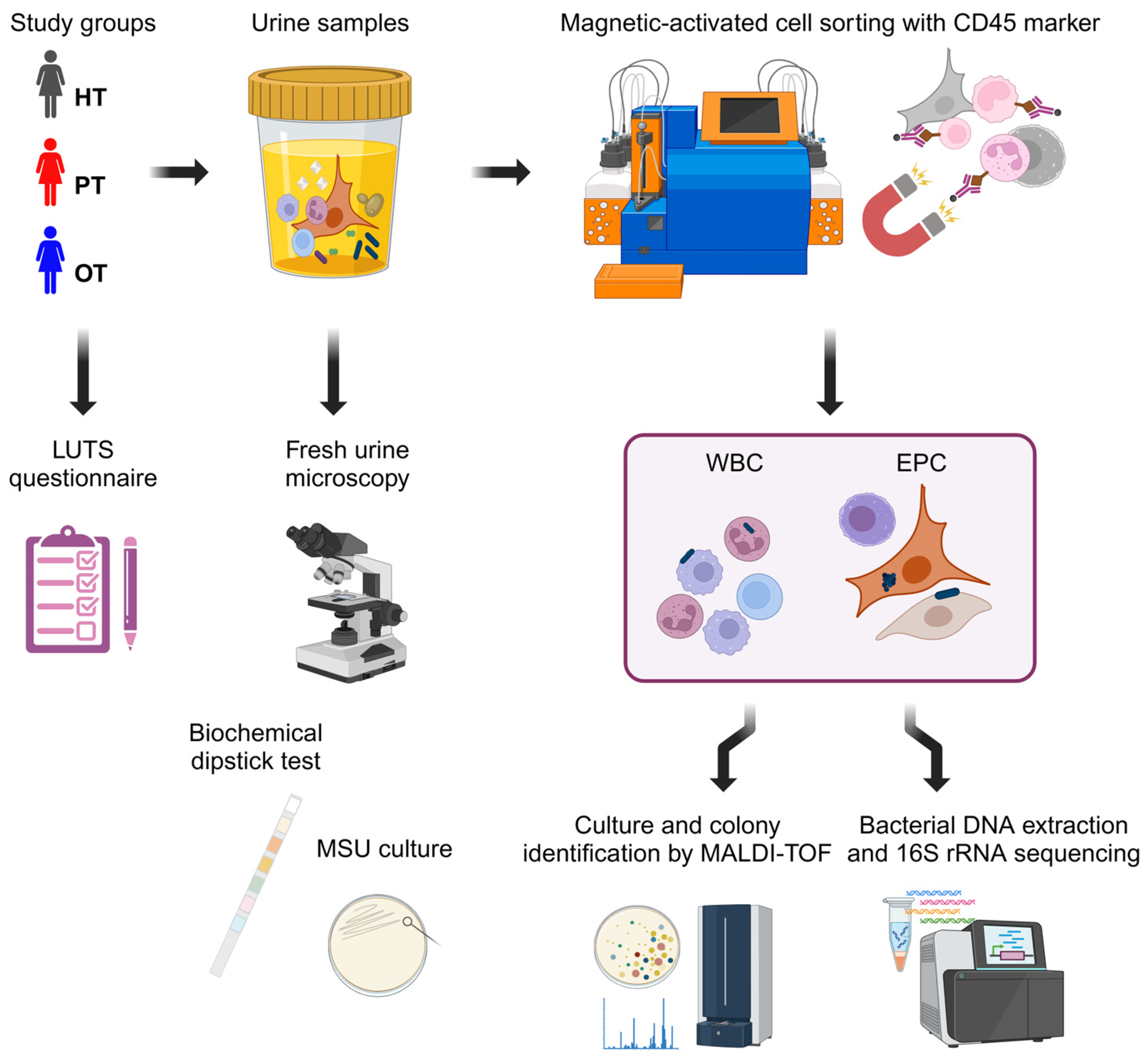
Figure 2.
Numerous bacterial morphologies were observed in the urine, associated with or without cells. (a) Suspended bacterial aggregates formed by Gram-negative rods (auto-aggregates, left), a combination of Gram-negative and Gram-positive rods (co-aggregates, center) and elongated rods showing filamentation (right); (b) Neutrophils showing multi-lobed nucleus without (left) and with (right) associated bacteria; (c) An uninfected epithelial cell (left) shown in contrast with one containing auto-aggregates (center) and another enveloped by a multi-species biofilm (right). Scale bars represent 5 μm. Hoechst (cyan): DNA; WGA (gray): cytoplasm, Gram-positive bacteria and mucus; PNA (magenta): bacteria; CD45 (yellow): white blood cell.
Figure 2.
Numerous bacterial morphologies were observed in the urine, associated with or without cells. (a) Suspended bacterial aggregates formed by Gram-negative rods (auto-aggregates, left), a combination of Gram-negative and Gram-positive rods (co-aggregates, center) and elongated rods showing filamentation (right); (b) Neutrophils showing multi-lobed nucleus without (left) and with (right) associated bacteria; (c) An uninfected epithelial cell (left) shown in contrast with one containing auto-aggregates (center) and another enveloped by a multi-species biofilm (right). Scale bars represent 5 μm. Hoechst (cyan): DNA; WGA (gray): cytoplasm, Gram-positive bacteria and mucus; PNA (magenta): bacteria; CD45 (yellow): white blood cell.
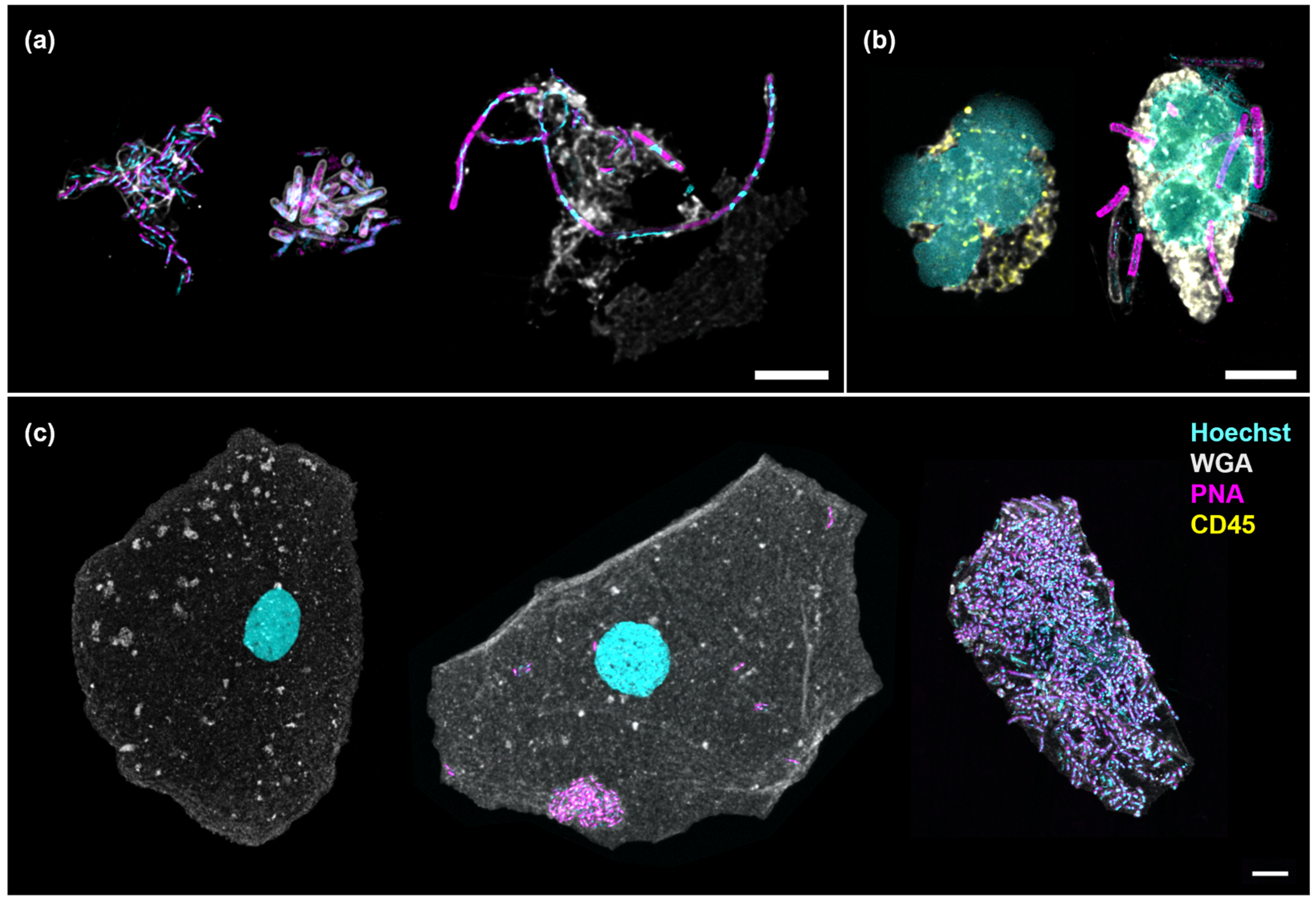
Figure 3.
Study cohort (HT, PT and OT) characteristics. The groups were characterized by (a) age, fresh microscopy counts of urinary (b) epithelial and (c) white blood cells; (d) LUTS scores were categorized into stress, storage, voiding and pain. The PT group showed significantly elevated levels of white blood cell count as well as voiding and pain scores. Bar charts show mean with 95% CI. Significant differences between groups are indicated at *p≤.05, **p≤.01 and ***p≤.001 (one-way (a-c) or two-way (d) ANOVA with Fisher’s LSD test for multiple comparisons). HT: Healthy; PT: chronic UTI pre-treatment; OT: chronic UTI on treatment; LUTS: lower urinary tract symptoms.
Figure 3.
Study cohort (HT, PT and OT) characteristics. The groups were characterized by (a) age, fresh microscopy counts of urinary (b) epithelial and (c) white blood cells; (d) LUTS scores were categorized into stress, storage, voiding and pain. The PT group showed significantly elevated levels of white blood cell count as well as voiding and pain scores. Bar charts show mean with 95% CI. Significant differences between groups are indicated at *p≤.05, **p≤.01 and ***p≤.001 (one-way (a-c) or two-way (d) ANOVA with Fisher’s LSD test for multiple comparisons). HT: Healthy; PT: chronic UTI pre-treatment; OT: chronic UTI on treatment; LUTS: lower urinary tract symptoms.
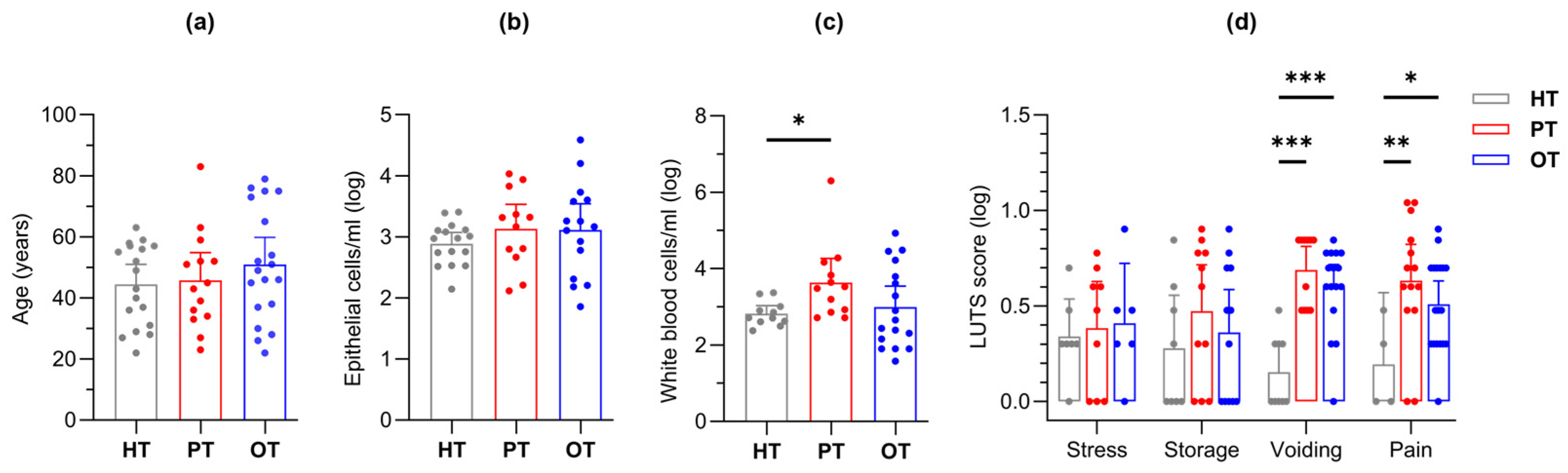
Figure 4.
Abundance of bacteria and yeast isolated from urine culture following CD45-sorting into WBC and EPC fractions. Total abundance (CFU/1000 cells) are shown in (a) microbial groups or (b) individual species, as well as those associated with (c) WBC and (d) EPC. Bar charts show mean with 95% CI while heatmaps show relative bacterial abundance (a-b) and sample frequency (c-d). There were no significant differences in the mean CFU/1000 cells between study groups, except for (d) Escherichia coli at ***p≤.001 (one-way ANOVA with Fisher’s LSD test for multiple comparisons). The Venn diagrams show bacteria species that were associated with (f) WBC and (g) EPC in the three study groups. The colored dots after each species name refer to their presence in the study groups. For instance, in diagram (f) set [1], Corynebacterium aurimucosum was isolated from all study groups (gray, red and blue dots) but only associated with WBC in HT (gray circle). The diagram in (h) shows an overview of the species found only in WBC [1], EPC [2] or both fractions [3]. HT: Healthy; PT: chronic UTI pre-treatment; OT: chronic UTI on treatment; WBC: white blood cell fraction; EPC: epithelial cell fraction; CFU: colony-forming unit.
Figure 4.
Abundance of bacteria and yeast isolated from urine culture following CD45-sorting into WBC and EPC fractions. Total abundance (CFU/1000 cells) are shown in (a) microbial groups or (b) individual species, as well as those associated with (c) WBC and (d) EPC. Bar charts show mean with 95% CI while heatmaps show relative bacterial abundance (a-b) and sample frequency (c-d). There were no significant differences in the mean CFU/1000 cells between study groups, except for (d) Escherichia coli at ***p≤.001 (one-way ANOVA with Fisher’s LSD test for multiple comparisons). The Venn diagrams show bacteria species that were associated with (f) WBC and (g) EPC in the three study groups. The colored dots after each species name refer to their presence in the study groups. For instance, in diagram (f) set [1], Corynebacterium aurimucosum was isolated from all study groups (gray, red and blue dots) but only associated with WBC in HT (gray circle). The diagram in (h) shows an overview of the species found only in WBC [1], EPC [2] or both fractions [3]. HT: Healthy; PT: chronic UTI pre-treatment; OT: chronic UTI on treatment; WBC: white blood cell fraction; EPC: epithelial cell fraction; CFU: colony-forming unit.
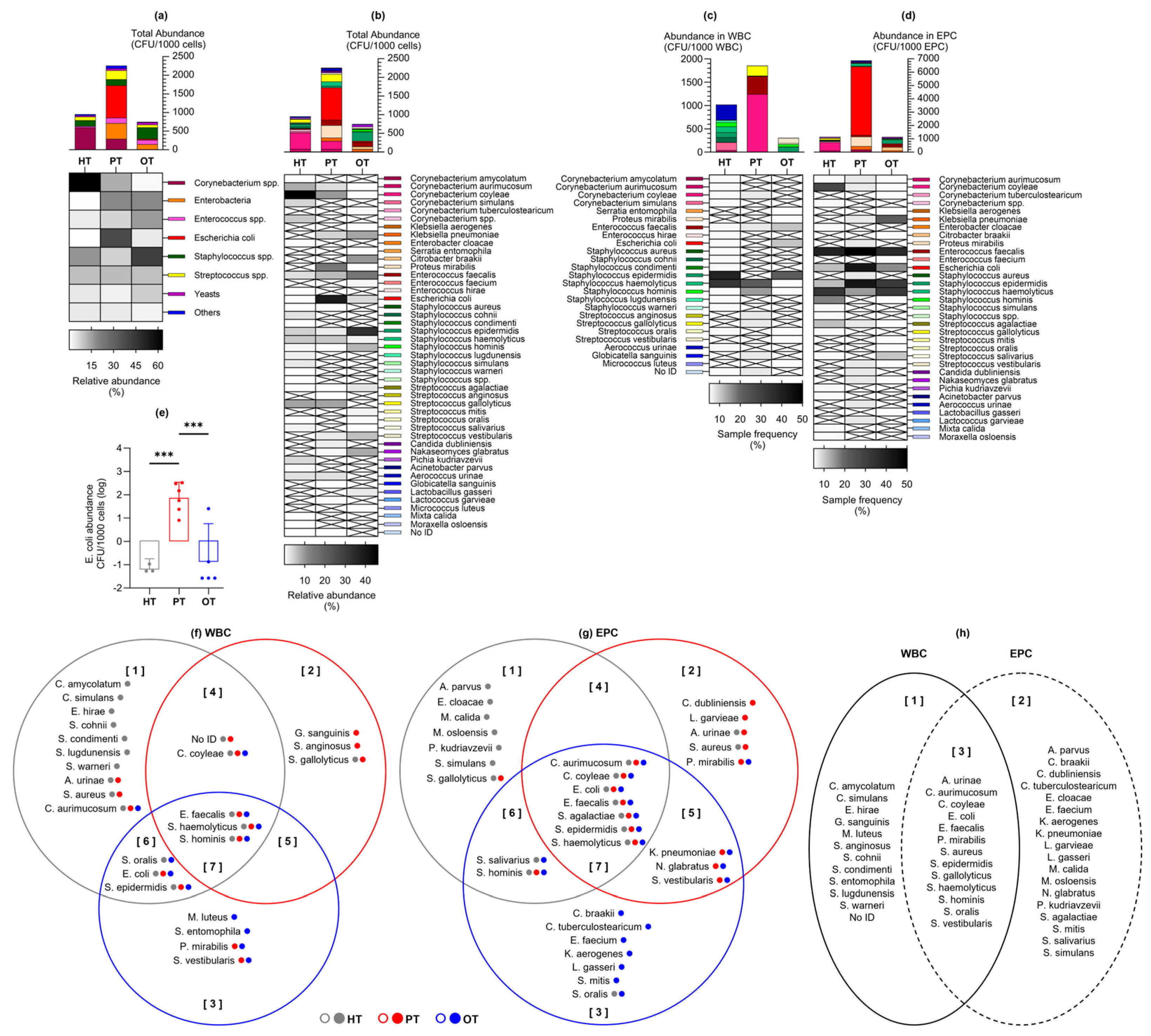
Figure 5.
The relative abundance and mean Bray-Curtis dissimilarity scores between WBC and EPC fractions in 16S rRNA sequencing. (a) Stacked bar charts show the relative abundance of the top 21 genera with Lactobacillus being the predominant genus. Within each study group (HT, PT and OT), the WBC and EPC fractions from the same sample are shown side by side; (b) Nested Bray-Curtis dissimilarity score between WBC and EPC microbial ecology within an individual in the respective study groups; (c) Bray-Curtis dissimilarity scores between WBC and EPC bacteria. Bar charts show mean with 95% CI. Significant differences between groups are indicated at *p≤.05, **p≤.01 and ***p≤.001 (Kruskal-Wallis). HT: Healthy; PT: chronic UTI pre-treatment; OT: chronic UTI on treatment; WBC: white blood cell fraction; EPC: epithelial cell fraction.
Figure 5.
The relative abundance and mean Bray-Curtis dissimilarity scores between WBC and EPC fractions in 16S rRNA sequencing. (a) Stacked bar charts show the relative abundance of the top 21 genera with Lactobacillus being the predominant genus. Within each study group (HT, PT and OT), the WBC and EPC fractions from the same sample are shown side by side; (b) Nested Bray-Curtis dissimilarity score between WBC and EPC microbial ecology within an individual in the respective study groups; (c) Bray-Curtis dissimilarity scores between WBC and EPC bacteria. Bar charts show mean with 95% CI. Significant differences between groups are indicated at *p≤.05, **p≤.01 and ***p≤.001 (Kruskal-Wallis). HT: Healthy; PT: chronic UTI pre-treatment; OT: chronic UTI on treatment; WBC: white blood cell fraction; EPC: epithelial cell fraction.
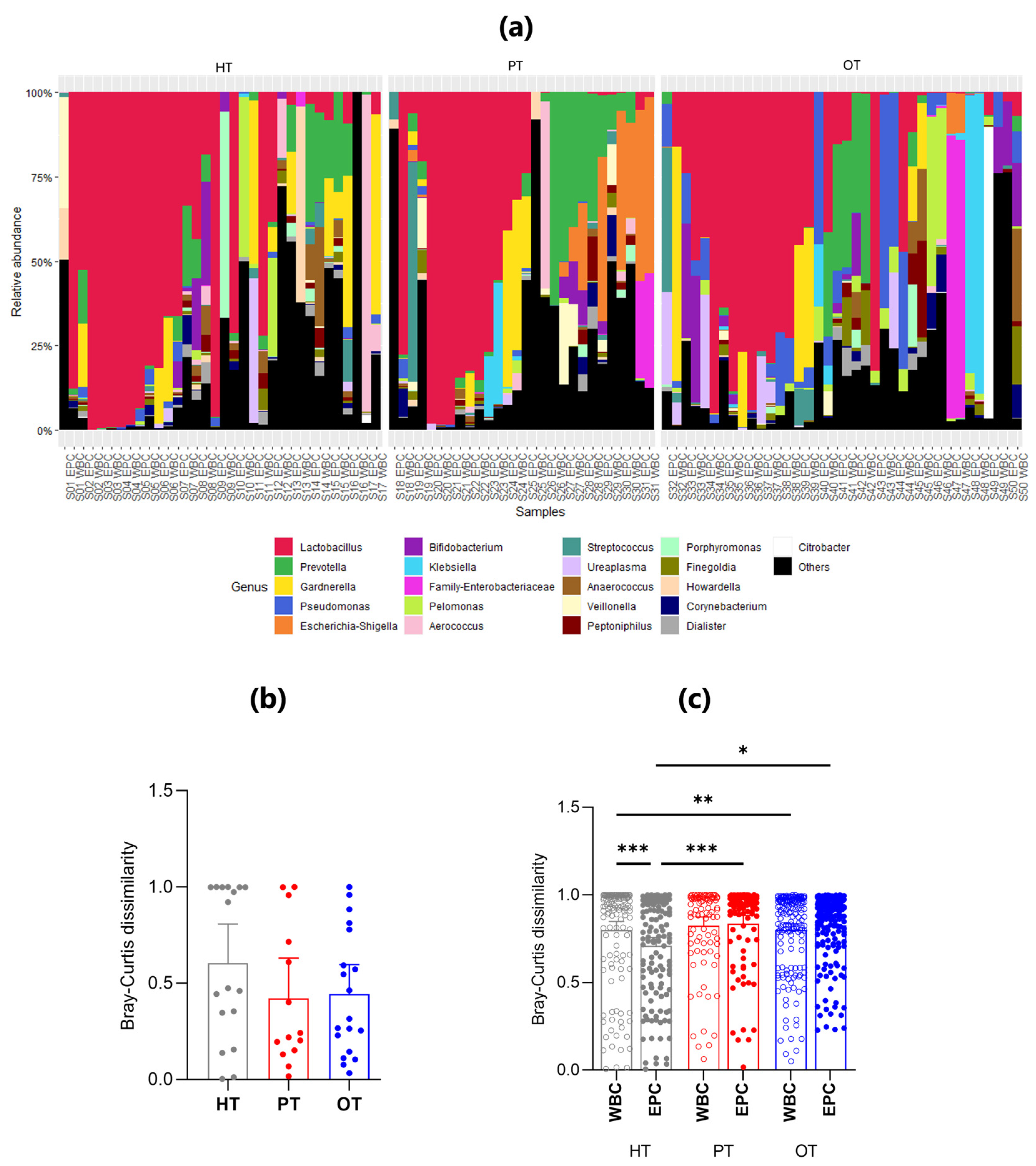
Figure 6.
Lower urinary tract symptoms differed in individuals with Escherichia coli in enriched culture and Escherichia-Shigella group in 16S rRNA sequencing. (a) Abundance bar charts are shown in microbial groups with their relative abundance shown in the heatmap for samples with or without E. coli growth in culture (Clt.ECO). Total abundance was higher in samples containing E. coli; (b-c) Voiding symptom score was higher in samples that were Clt.ECO- in PT while there were no differences in the pain score; (d-e) Conversely, there were no differences in the voiding symptom score but pain score was higher in samples containing Escherichia-Shigella group in sequencing (Seq.ESH). Bar charts show mean with 95% CI. Significant differences between groups are indicated at *p≤.05 (two-way ANOVA with Fisher’s LSD test for multiple comparisons). HT: Healthy; PT: chronic UTI pre-treatment; OT: chronic UTI on treatment; WBC: white blood cell fraction; EPC: epithelial cell fraction; CFU: colony-forming unit.
Figure 6.
Lower urinary tract symptoms differed in individuals with Escherichia coli in enriched culture and Escherichia-Shigella group in 16S rRNA sequencing. (a) Abundance bar charts are shown in microbial groups with their relative abundance shown in the heatmap for samples with or without E. coli growth in culture (Clt.ECO). Total abundance was higher in samples containing E. coli; (b-c) Voiding symptom score was higher in samples that were Clt.ECO- in PT while there were no differences in the pain score; (d-e) Conversely, there were no differences in the voiding symptom score but pain score was higher in samples containing Escherichia-Shigella group in sequencing (Seq.ESH). Bar charts show mean with 95% CI. Significant differences between groups are indicated at *p≤.05 (two-way ANOVA with Fisher’s LSD test for multiple comparisons). HT: Healthy; PT: chronic UTI pre-treatment; OT: chronic UTI on treatment; WBC: white blood cell fraction; EPC: epithelial cell fraction; CFU: colony-forming unit.
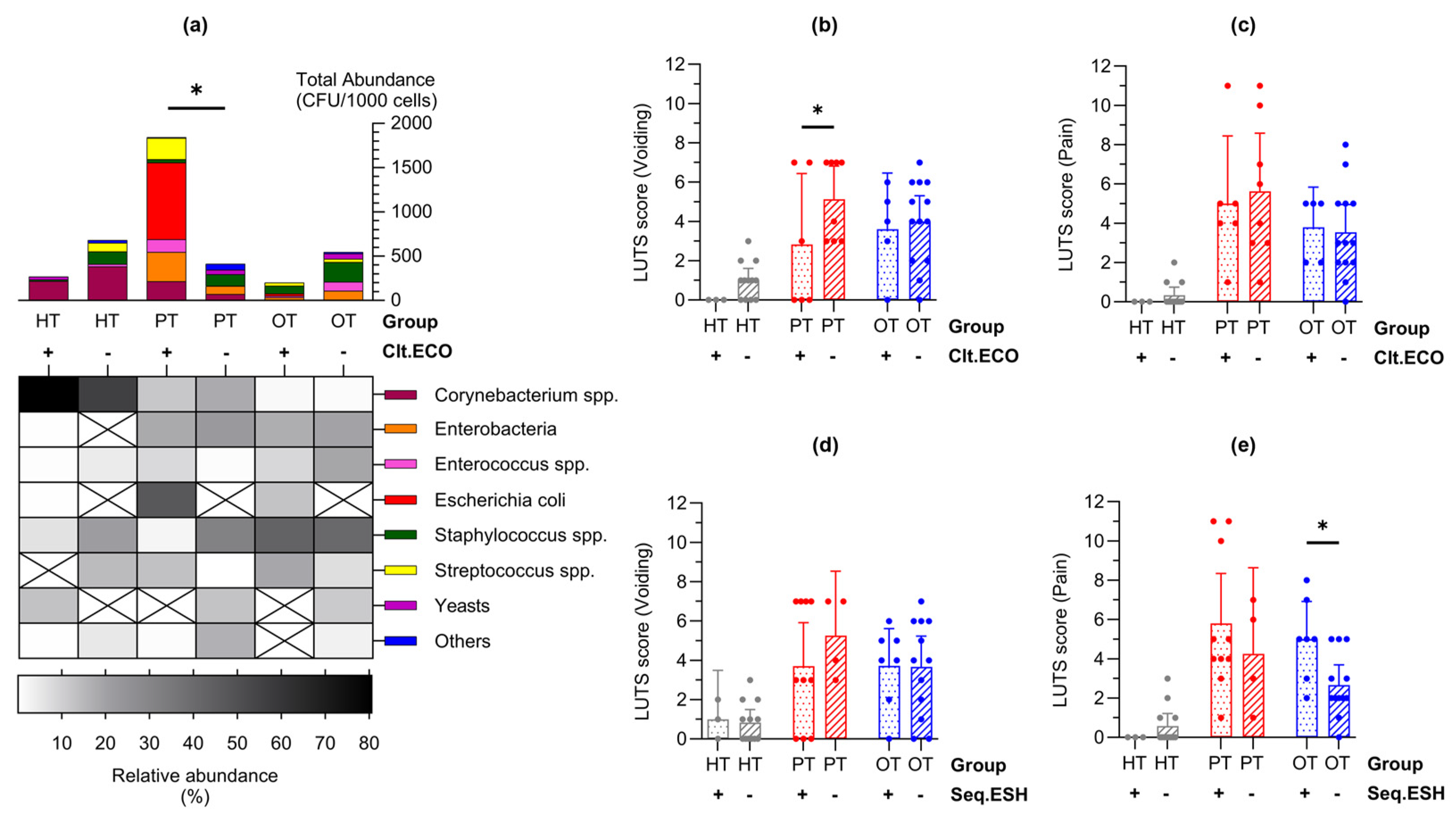
Figure 7.
Rank changes in relative bacterial abundance from HT to PT and PT to OT in 16S rRNA sequencing. Lists of genera showing an increase (orange lines) and decrease (blue lines) in ranks based on their mean relative abundance in the respective study groups in (a) all samples; (b) WBC and (c) EPC. Dashed lines show no significant diffe9rence while significant differences between the study groups are indicated with solid lines at p≤.05 (Mann-Whitney). HT: Healthy; PT: chronic UTI pre-treatment; OT: chronic UTI on treatment; WBC: white blood cell fraction; EPC: epithelial cell fraction.
Figure 7.
Rank changes in relative bacterial abundance from HT to PT and PT to OT in 16S rRNA sequencing. Lists of genera showing an increase (orange lines) and decrease (blue lines) in ranks based on their mean relative abundance in the respective study groups in (a) all samples; (b) WBC and (c) EPC. Dashed lines show no significant diffe9rence while significant differences between the study groups are indicated with solid lines at p≤.05 (Mann-Whitney). HT: Healthy; PT: chronic UTI pre-treatment; OT: chronic UTI on treatment; WBC: white blood cell fraction; EPC: epithelial cell fraction.
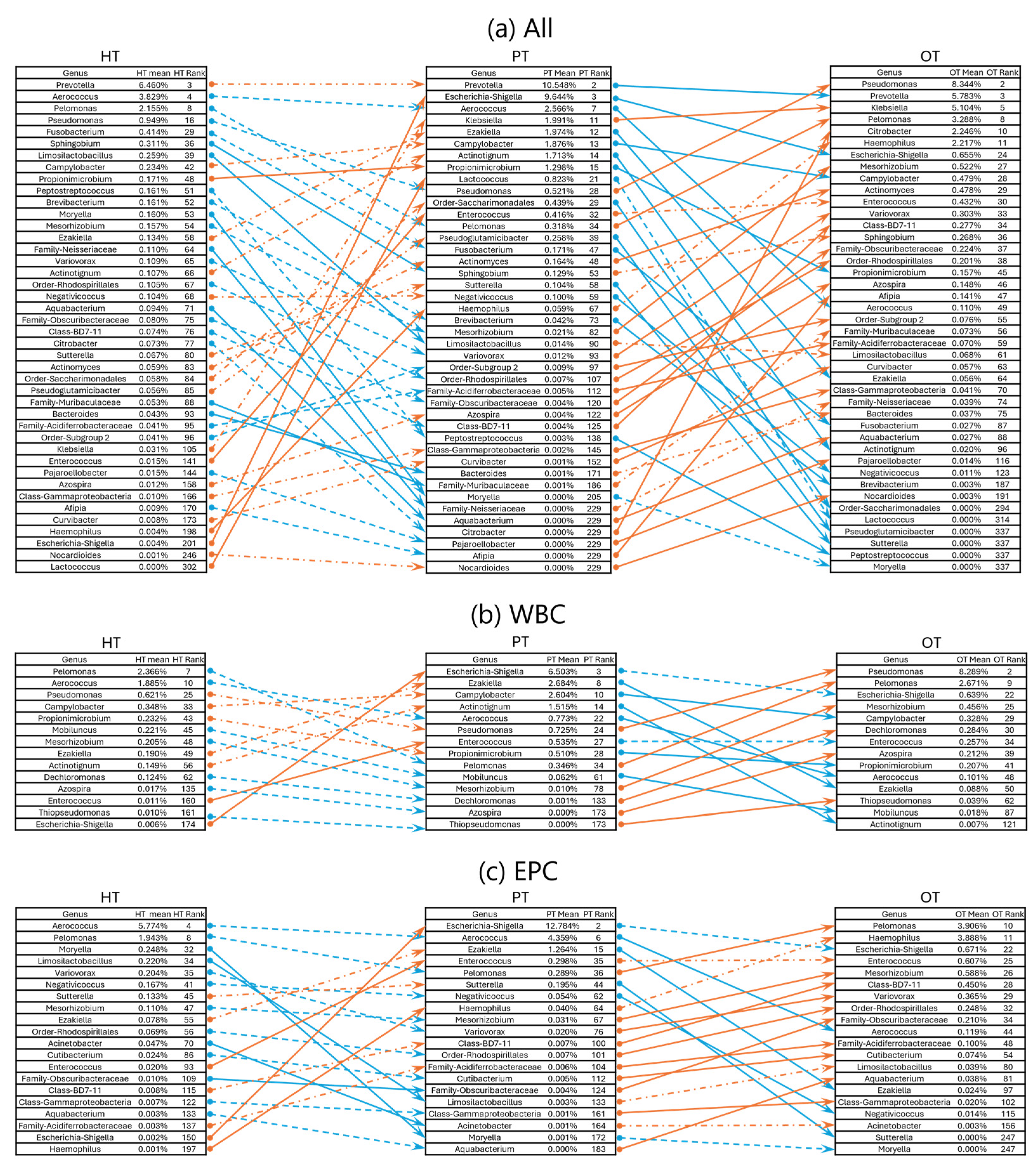
Figure 8.
K-means clustering of 16S rRNA sequencing data showed three distinct clusters that shifted from health to disease. The number of genera that comprises downward, stable or upward are indicated below the clusters shown in (a) all samples; (b) WBC and (c) EPC. Genera with the highest relative abundances (top 21) are color-coded and mostly belonged in the stable communities. Bacteria that showed the least amount of rank changes in the stable clusters around y=0 are highlighted (black) and listed. The top 5 genera with the largest upward (red) or downward (blue) shifts are also highlighted and listed. Within each comparison from HT to PT (dashed lines) and PT to OT (solid lines), the three clusters are significantly different from one another at ***p≤.001 (one-way ANOVA with Bonferroni test for multiple comparisons). HT: Healthy; PT: chronic UTI pre-treatment; OT: chronic UTI on treatment; WBC: white blood cell fraction; EPC: epithelial cell fraction
Figure 8.
K-means clustering of 16S rRNA sequencing data showed three distinct clusters that shifted from health to disease. The number of genera that comprises downward, stable or upward are indicated below the clusters shown in (a) all samples; (b) WBC and (c) EPC. Genera with the highest relative abundances (top 21) are color-coded and mostly belonged in the stable communities. Bacteria that showed the least amount of rank changes in the stable clusters around y=0 are highlighted (black) and listed. The top 5 genera with the largest upward (red) or downward (blue) shifts are also highlighted and listed. Within each comparison from HT to PT (dashed lines) and PT to OT (solid lines), the three clusters are significantly different from one another at ***p≤.001 (one-way ANOVA with Bonferroni test for multiple comparisons). HT: Healthy; PT: chronic UTI pre-treatment; OT: chronic UTI on treatment; WBC: white blood cell fraction; EPC: epithelial cell fraction

Disclaimer/Publisher’s Note: The statements, opinions and data contained in all publications are solely those of the individual author(s) and contributor(s) and not of MDPI and/or the editor(s). MDPI and/or the editor(s) disclaim responsibility for any injury to people or property resulting from any ideas, methods, instructions or products referred to in the content. |
© 2025 by the authors. Licensee MDPI, Basel, Switzerland. This article is an open access article distributed under the terms and conditions of the Creative Commons Attribution (CC BY) license (http://creativecommons.org/licenses/by/4.0/).
Copyright: This open access article is published under a Creative Commons CC BY 4.0 license, which permit the free download, distribution, and reuse, provided that the author and preprint are cited in any reuse.


