Keynotes
Breastfeeding support in MWs should be an essential component of the care provided to the dyad
Families’ satisfaction with postpartum care and on breastfeeding support in MWs of Northern Italy appear to be mostly positive
Information to families on available breastfeeding support after hospital discharge is suboptimal.
1. Introduction
Assessing women's satisfaction with the care received during childbirth is an essential component of quality care [
1]. However, the World Health Organization emphasizes that there is still insufficient attention given to this aspect, which would allow women to feel safe, comfortable, and to have a positive experience of childbirth [
2]. The variables that most significantly impact maternal satisfaction include the duration of labor, the type of delivery, the presence of perineal trauma, effective pain management, the potential hospitalization of the newborn, which often leads to a separation between mother and child, the continuity of care, the consistency of clinical management by hospital professionals and lastly, but not of lesser importance, the breastfeeding experience [
2]. In fact, even after a physiological birth and the birth of a healthy baby, a new mother may encounter a series of breastfeeding problems (e.g., difficulties with the baby latching onto the breast, nipple cracks, etc.), which require competent help from healthcare professionals. However, such help is not always available [
3,
4], and when available, it is often burdened by contradictions and ambiguities [
5].
It must be recognized that the level of self-efficacy in breastfeeding, its initiation [
6] and success [
7] are essential components of the maternity experience and are closely linked to and influenced by the experience of childbirth and the postpartum period.
With these premises, the present study aimed to explore the satisfaction with the support received by women in relation to breastfeeding within the context of postnatal hospital care.
2. Materials and Methods
The inter-societal project for the promotion of breastfeeding, known as the Hospital Policy on Breastfeeding (HPB) Project, is currently underway, as a joint initiative of the Italian Scientific Societies involved in perinatal care (the Italian Society of Neonatology, the Italian Society of Pediatrics, the Italian Society of Pediatric Nutrition, the Italian Society of Obstetricians and Gynecologists, the Italian Association of Hospital Obstetricians & Gynecologists, the Italian Society of Neonatal Nurses and the Italian Society of Pediatric Nurses), together with the National Midwife Board and the Nurse Board and with Vivere Onlus, the Italian Federation of NICU Parent Associations.
The primary objective of the HPB project is to increase the rate of exclusive breastfeeding at discharge from Italian MWs, which, according to a survey conducted by the Task Force on Breastfeeding of the Italian Ministry of Health, shows an extremely wide range, from 20% to 97% [
8].
Out of the 108 Italian hospitals participating in the HBP Project, 39 used a 23 items questionnaire ("Your Opinion Matters") (Supplementary Material), developed from a pre-existing questionnaire used at Careggi Hospital in Florence. Thirty five out of 39 hospitals were from Northern Italy, 2 from Central Italy, 2 from Southern Italy. This questionnaire was proposed by the National Working Group on HPB to assess satisfaction with the care received, particularly regarding breastfeeding, during the days spent in the Nursery/Rooming-in after childbirth. This questionnaire was translated into 10 languages (Albanian, Arabic, Chinese, English, French, Hindi, Romanian, Russian, Spanish and Ukrainian) by translators and/or cultural mediators connected to the hospitals participating in the study. It was administered between November 15 and December 15, 2023, filled out independently and anonymously by one or both parents on the day of discharge, and returned before going home. Each MW was asked to collect 20 questionnaires administered to consecutively discharged mothers/parents.
3. Results
Among the 39 hospitals that implemented the questionnaire on user satisfaction, 26 provided and uploaded the responses from 20 questionnaires through the SurveyMonkey platform, totaling 520 questionnaires. These 26 hospitals belong to 7 Regions or Autonomous Provinces: 3 from Emilia-Romagna (AOU Modena, Bologna-Ospedale Maggiore, Bentivoglio Hospital), 1 from South Tyrol (Bruneck Hospital), 6 from Veneto (Vicenza, Arzignano, Valdagno, Mestre, Portogruaro, Verona), 10 from Lombardy (Varese, Tradate, Cittiglio, Sesto S. Giovanni, Milan-Niguarda, Milan-Macedonio Melloni, Manerbio, Desenzano, Gavardo, Bergamo-Giovanni XXIII), 1 from Liguria (Villa Scassi-Sampierdarena), 3 from Piedmont (Ciriè-Caselle, Turin-Maria Vittoria, Turin-Martini), 1 from Marche (Urbino), and 1 from Campania (Naples-Cardarelli). In summary, 24/26 hospitals are located in the North of Italy.
Parents did not always answer all the questions. The questionnaires were completed by the mother in 73% of cases (381/519), by the father in 5% of cases (24/519), and jointly by mother and father in 22% of cases (114/519).
Families reported having an Italian cultural background in 77% of cases (383/500) and a non-Italian cultural background in the remaining 23% of cases (117/500).
The length of stay for the mother-baby pair was less than 2 days in 3% of cases (16/518), 2-5 days in 86.9% of cases (450/518), and more than 5 days in another 10.0% of cases (52/518) (6% Italian vs. 23% non-Italian).
Table 1 shows the responses to 20 items on postpartum care included in the questionnaire, 4 of which concern specifically the breastfeeding support.
Notwithstanding the overall positive evaluation given by families on postpartum health care, some critical issues emerged from the survey:
Eleven percent of families reported that the healthcare staff did not introduce themselves by name and role when interacting with them. This issue was more frequently reported by Italians (45/287; 15.7%) than by non-Italians (12/230; 5.2%).
In 11.8% of cases, the staff was deemed not to adequately consider the cultural background of the families, though no differences were observed between Italian and non-Italian populations.
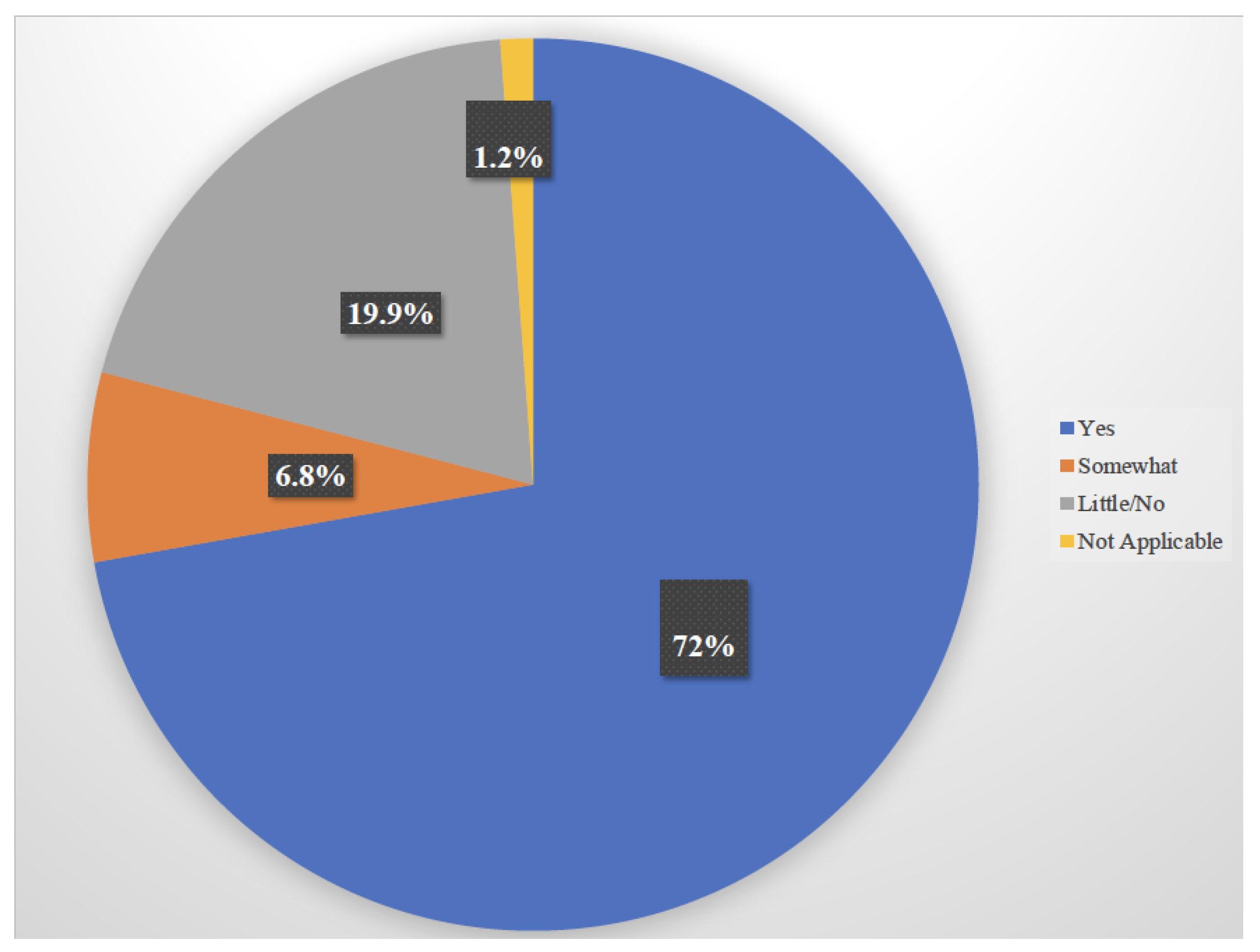
Finally, in a relevant percentage of the collected questionnaires (19.9%), information provided to families about the available support resources after hospital discharge was referred as lacking (
Figure 1).
4. Discussion
Overall, the evaluation provided by parents regarding the care they received was positive across many different aspects. In most cases, parents felt supported by a welcoming and helpful team, who communicated information clearly, showed empathy and provided emotional support, when needed. The team was also attentive to preventing and treating eventual pain symptoms experienced by new mothers. Despite recognized workload, the healthcare team showed respect for the mother-baby relationship and taught parents how to care for their baby.
No differences were observed in the responses between Italian and non-Italian families. The families' experience was such that they felt they could recommend the same MH for future childbirths.
4.1. Strenghts and Limitations
Summarizing, this study depicts a positive picture of the provision of postpartum hospital care. However, the results derive from a very selective sample and cannot be generalized to the entire country. The sample was selected in many respects. First, the maternity wards are mostly located in Northern Italy, a geographic area that generally has higher breastfeeding rates (geographical bias)[
9]. This may not only be due to cultural differences between geographic areas, but also to possibly better breastfeeding promotion, protection, and support provided by healthcare facilities. Second, the 26 hospitals participating in the HPB Project may already be more motivated about breastfeeding and thus more aware of the importance of the mother-baby relationship and offering appropriate care methods. This introduces a potential sampling bias. Third, these 26 hospitals, by choosing to participate in the survey, have demonstrated an interest in being evaluated by mothers/families. It’s possible that these hospitals are more interested to know the opinions of families or simply confident that the survey would not reveal negative results regarding breastfeeding support (selection bias). Fourth, filling out a satisfaction questionnaire can also be subject to other biases, such as non-response or acquiescence bias, which limit its reliability.
A major strength of the study lies in exploring satisfaction on breastfeeding support in the broader context of postpartum care in a sample of hospitals that accounts to 14% of the 172 hospitals located in Northern Italy [
10].
The results demonstrate that, within this selected sample, there is a widespread positive cultural approach where the mother-baby relationship is central to hospital care, which is appreciated by families.
However, a minority (19.9%) of women did not receive complete information upon discharge on how to orientate themselves, especially when seeking help with breastfeeding. According to Mother and Baby Friendly Initiative, families returning home should receive written and verbal information on how to obtain competent and timely breastfeeding support, as milk production may not be fully established yet [
11]. Proper discharge from the MW involves not only ensuring that the mother's caregiving skills are adequate, but also anticipating that she may encounter difficulties, particularly with breastfeeding, and need competent support.
This support should be provided by the same MW or, preferably, by health facilities in the community, or, complementarily, by lactation consultants and/or peer-to-peer support [
12]. The family should receive an appointment for a follow-up visit within 24-72 hours of returning home [
13], but they should also have the information needed to obtain breastfeeding support if required. If in-person support is not possible, remote support via video call is effective, without overlooking the possibility of a simple traditional phone call [
14,
15].
Care during childbirth and breastfeeding should be empathetic towards women, respectful of their choices, and create a relaxing and safe environment [
2]. Care that encourages the active participation of the woman in the decision-making process contributes to a positive experience [
2], though women’s expectations may sometimes be influenced by their knowledge and acceptance of the care practices at specific MWs, whatever they may be [
16].
Regarding breastfeeding, qualified support significantly influences overall satisfaction and the success of the breastfeeding experience. Open communication and respect for the mother’s preferences are particularly essential. Institutions that encourage a patient/family-centered care environment tend to receive more positive evaluations for childbirth and breastfeeding support [
17].
In the current era, unfortunately, professional frustrations are common among those who work daily in our hospitals, given the progressively limited availability of human and material resources [
18]. Therefore, the data from this study represent a justifiable reason to be satisfied for a group, though selected, of MWs. At the same time, they could serve as an inspiration for other MWs, whether or not they participate in a breastfeeding promotion project such as the HBP Project.
5. Conclusions
The postpartum hospital care and breastfeeding support in a group of the hospitals participating to a breastfeeding promotion project seem to be appreciated by the great majority of families. Nevertheless, information on the resources available for the breastfeeding support after discharge from the MW were not provided in 1 out of 5 cases. Ultimately, MWs are challenged to revise and consequently be aware of available support from local resources and to routinely fully inform families.
Author Contributions
Riccardo Davanzo: Conceptualization; methodology; writing the original draft; editing. Emanuela Lanfranchi: Resources; review. Silvia Perugi: Conceptualization; methodology; resources; review. Giuseppe Giordano: Conceptualization; review. Maria Lorella Giannì: Conceptualization; methodology; review and editing. Mariella Baldassarre: Conceptualization; review. Massimo Agosti: Conceptualization; review.
Acknowledgment
We thank the 520 families of the 26 hospitals that completed the questionnaires on the level of satisfaction on postpartum and breastfeeding support. Concurrently, we must appreciate the voluntary contribution given by the health staff who made the data collection possible at a local level.
Funding Information
No external funding.
Conflict of Interest Statement
The authors have no conflicts of interest to declare.
Ethical Statement
All research methods were performed in accordance with the ethical standards of the Declaration of Helsinki. Particularly, questionnaires submitted to family at hospital discharge were anonymous. The Breastfeeding Section of the Italian Society of Neonatology (Com.A.SIN) approved the study protocol in April 2023. Moreover, the study related to the Project for Hospital Policy on Breastfeeding (HPB Project) has received approval (Prot. 230; April 10th, 2024) from Ethics Committee of the IRCCS Istituto Oncologico “Gabriella Serio”, Bari (Italy).
Abbreviations
National Midwife Board; HPB, Hospital Policy on Breastfeeding; MW, Maternity Wards
References
- Donate-Manzanares M, Rodríguez-Cano T, Rodríguez-Almagro J, Hernández-Martínez A, Santos-Hernández G, Beato-Fernández L. Mixed-method study of women's assessment and experience of childbirth care. J Adv Nurs. 2021 Oct;77[10]:4195-4210. Epub 2021 Jul 23. PMID: 34297861. [CrossRef]
- WHO recommendations: intrapartum care for a positive childbirth experience. Geneva: World Health Organization; 2018. Licence: CC BY-NC-SA 3.0 IGO.
- Feenstra MM, Jørgine Kirkeby M, Thygesen M, Danbjørg DB, Kronborg H. Early breastfeeding problems: A mixed method study of mothers' experiences. Sex Reprod Healthc. 2018 Jun;16:167-174. Epub 2018 Apr 6. PMID: 29804762. [CrossRef]
- Miller CW, Wojnar D. Breastfeeding Support Guided by Swanson's Theory of Caring. MCN Am J Matern Child Nurs. 2019 Nov/Dec;44(6):351-356. PMID: 31633525. [CrossRef]
- Quinones, C. Quinones C. "Breast is best"… until they say so. Front Sociol. 2023 Mar 9;8:1022614. PMID: 36992698; PMCID: PMC10042138. [CrossRef]
- Hinic, K. Hinic K. Predictors of Breastfeeding Confidence in the Early Postpartum Period. J Obstet Gynecol Neonatal Nurs. 2016 Sep-Oct;45(5):649-60. Epub 2016 Jul 26. PMID: 2747299. [CrossRef]
- Bizon AMBL, Giugliani C, Giugliani ERJ. Women's Satisfaction with Breastfeeding and Risk of Exclusive Breastfeeding Interruption. Nutrients. 2023 Dec 11;15(24):5062. PMID: 38140321; PMCID: PMC10745461. [CrossRef]
- Ministero della Salute. Allattamento al seno nelle strutture sanitarie in Italia - Report sulla survey nazionale 2014. Task Force on Breastfeeding (TAS), Ministero Salute (MoH) 2014; https://www.salute.gov.it/imgs/C_17_pubblicazioni_2256_allegato.pdf.
- Istituto Superiore Sanità. Epicentro. Sorveglianza Bambini 0-2. Indagine 2022: allattamento; https://www.epicentro.iss.it/sorveglianza02anni/indagine-2022-allattamento.
- Mosca F, Orfeo L, Dani C. Libro Bianco della Neonatologia 2019. Indagine sull’organizzazione delle unità operative di neonatologia e terapia intensiva neonatale italiane. Società Italiana di Neonatologia 2019. https://www.sin-neonatologia.it/wp-content/uploads/2022/05/Libro-Bianco-della-neonatologia-_anno-2019.pdf.
- WHO, UNICEF. Protecting, promoting and supporting breastfeeding in facilities providing maternity and newborn services: implementing the revised Baby-friendly Hospital Initiative 2018. Geneva: World Health Organization and the United Nations Children’s Fund (UNICEF), 2018. Licence: CC BY-NC-SA 3.0 IGO.
- Shakya P, Kunieda MK, Koyama M, Rai SS, Miyaguchi M, Dhakal S, Sandy S, Sunguya BF, Jimba M. Effectiveness of community-based peer support for mothers to improve their breastfeeding practices: A systematic review and meta-analysis. PLoS One. 2017 May 16;12(5):e0177434. PMID: 28510603; PMCID: PMC5433692. [CrossRef]
- Chirico G, De Curtis M, Mosca F, Paolillo PM. Task Force SIN on Hospital discharge of the newborn infant. Dimissione del neonato. 10 maggio 2017; https://blog.sin-neonatologia.it/wp-content/uploads/2020/05/DIMISSIONE-DEL-NEONATO-documento-della-Task-Force-della-SIN.pdf.
- Davanzo R, Bettinelli ME, Baldassarre M, Mondello I, Soldi A, Perugi S, Giannì ML, Colombo L, Salvatori G, Travan L, Giordano G; Breastfeeding Section of the Italian Society of Neonatology. Tele-support in breastfeeding: position statement of the Italian society of Neonatology. Ital J Pediatr. 2024 Nov 9;50(1):240. PMID: 39516812; PMCID: PMC11549854. [CrossRef]
- Gavine A, Marshall J, Buchanan P, Cameron J, Leger A, Ross S, Murad A, & Mcfadden A. (2022). Remote provision of breastfeeding support and education: Systematic review and metaanalysis. Maternal & Child Nutrition, 18(2). [CrossRef]
- Hundley V, Ryan M. Are women's expectations and preferences for intrapartum care affected by the model of care on offer? BJOG. 2004 Jun;111(6):550-60. PMID: 15198782. [CrossRef]
- Forster DA, Savage TL, McLachlan HL, Gold L, Farrell T, Rayner J, Yelland J, Rankin B, Lovell B. Individualised, flexible postnatal care: a feasibility study for a randomised controlled trial. BMC Health Serv Res. 2014 Nov 25;14:569. PMID: 25421495; PMCID: PMC4279591. [CrossRef]
- WHO. Health workforce. https://www.who.int/health-topics/health-workforce#tab=tab_1.
|
Disclaimer/Publisher’s Note: The statements, opinions and data contained in all publications are solely those of the individual author(s) and contributor(s) and not of MDPI and/or the editor(s). MDPI and/or the editor(s) disclaim responsibility for any injury to people or property resulting from any ideas, methods, instructions or products referred to in the content. |
© 2025 by the authors. Licensee MDPI, Basel, Switzerland. This article is an open access article distributed under the terms and conditions of the Creative Commons Attribution (CC BY) license (http://creativecommons.org/licenses/by/4.0/).