

Submitted:
27 January 2025
Posted:
27 January 2025
You are already at the latest version
Abstract
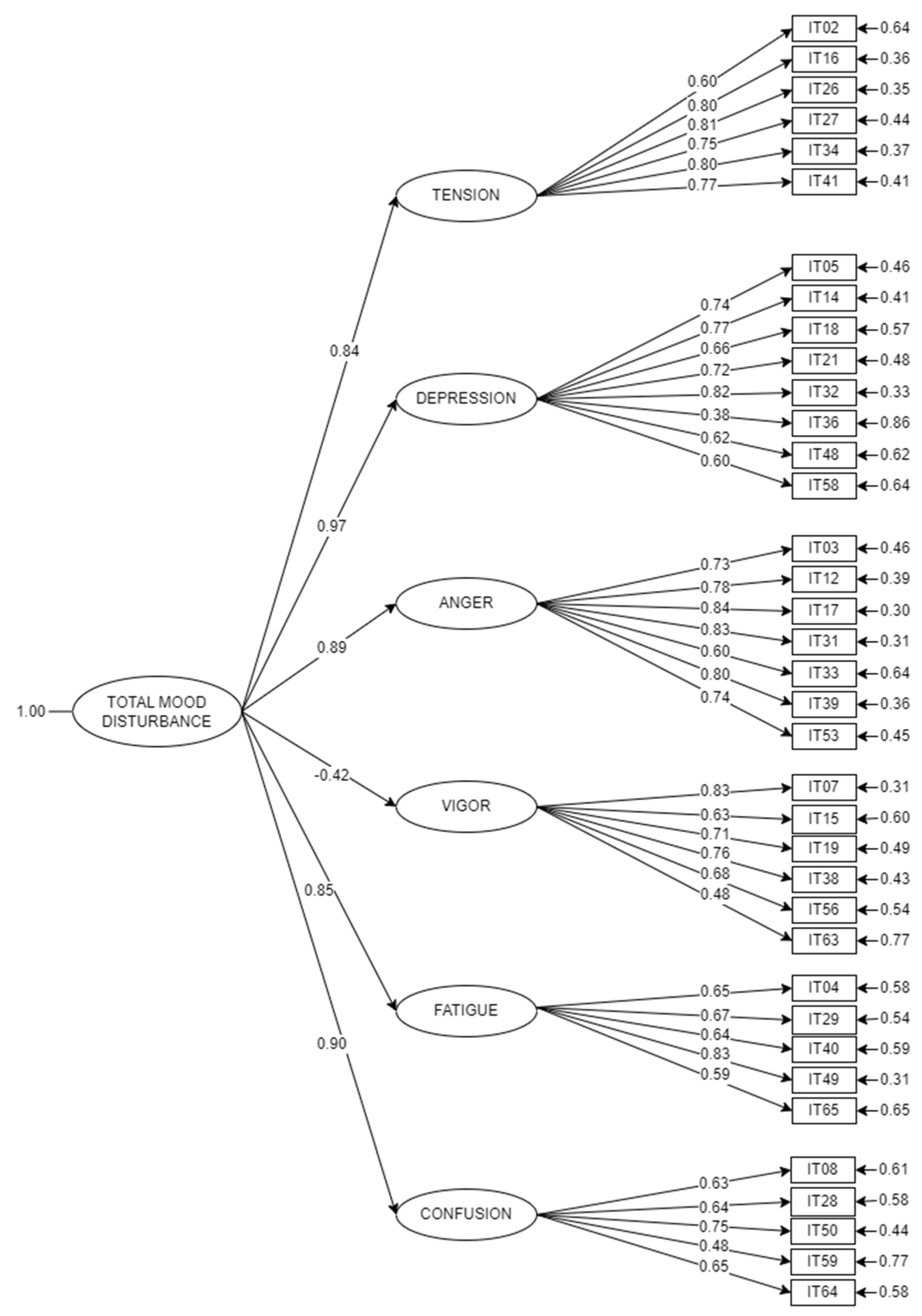
Background: Although the Profile of Mood States has been proposed by the Initiative on Methods, Measurement, and Pain Assessment in Clinical Trials (IMMPACT) to measure emotional functioning in chronic pain, it has not yet been validated in these patients. Objective: To confirm the factor structure and internal consistency of the Shortened Version of the Profile of Mood States (37 items) in patients with chronic pain. Methods: A confirmatory factor analysis (CFA) was conducted to test the theoretical structure of six factors that result in a Total Mood Disturbance episode: Tension-Anxiety (6 items), Depression-Dejection (8 items), Anger-Hostility (7 items), Vigor-Activity (6 items), Fatigue-Inertia (5 items), and Confusion-Bewilderment (5 items). Participants: A total of 588 patients with chronic pain from Spanish primary care health and community centers completed the questionnaire. Results: The factors presented adequate reliability coefficients, McDonald’s Omega (ω) between .77 and .91; and appropriate average discrimination indexes (D), ranging from .35 to .67. The Total Mood Disturbance yielded excellent results, ω = .95, D = .61. The original structure was confirmed, ECVI = 4.361 (saturated ECVI = 2.395; independent ECVI = 21.855); RMSEA = .070, 90% CI [.067, .072]; GFI = .974; AGFI = .971; CFI = .853; NFI = .812; and NNFI = .843. Conclusions: The Shortened Version of the Profile of Mood States has proven a valid and reliable measure of emotional functioning in chronic pain patients.
Keywords:
1. Introduction
2. Materials and Methods
2.1. Participants
2.2. Measures
2.3. Procedures
2.4. Data Analysis
3. Results
3.1. Reliability
3.2. Discrimination Index
3.3. Bivariate Normal Distribution
3.4. Factor Loadings
3.5. Fit Indices
3.6. Descriptives
4. Discussion
Supplementary Materials
Author Contributions
Funding
Institutional Review Board Statement
Informed Consent Statement
Data Availability Statement
Acknowledgments
Conflicts of Interest
Abbreviations
| IMMPACT | Initiative on Methods, Measurement, and Pain Assessment in Clinical Trials |
| CFA | Confirmatory Factor Analysis |
| POMS | Profile of Mood States |
| SV-POMS | Shortened Version of the Profile of Mood States |
| ECVI | Expected Cross-Validation Index |
| RMSEA | Root Mean Square Error of Approximation |
| GFI | Goodness of Fit Index |
| AGFI | Adjusted Goodness of Fit Index |
| CFI | Comparative Fit Index |
| NFI | Normed Fit Index |
| NNFI | Non-Normed Fit Index |
| MMPI | Minnesota Multiphasic Personality Inventory |
| BDI | Beck Depression Inventory |
Appendix A
Perfil de Estados de Ánimo (POMS). Versión Española de Arce, Andrade & Seoane (2000) del Original de McNair, Lorr & Droppleman (1971)
| 1 | Amistoso/a | 0 | 1 | 2 | 3 | 4 | 33 | Resentido/a | 0 | 1 | 2 | 3 | 4 | |
| 2 | Tenso/a | 0 | 1 | 2 | 3 | 4 | 34 | Nervioso/a | 0 | 1 | 2 | 3 | 4 | |
| 3 | Enfadado/a | 0 | 1 | 2 | 3 | 4 | 35 | Solo/a | 0 | 1 | 2 | 3 | 4 | |
| 4 | Rendido/a | 0 | 1 | 2 | 3 | 4 | 36 | Desdichado/a | 0 | 1 | 2 | 3 | 4 | |
| 5 | Infeliz | 0 | 1 | 2 | 3 | 4 | 37 | Aturdido/a | 0 | 1 | 2 | 3 | 4 | |
| 6 | Sensato/a | 0 | 1 | 2 | 3 | 4 | 38 | De buen humor | 0 | 1 | 2 | 3 | 4 | |
| 7 | Animado/a | 0 | 1 | 2 | 3 | 4 | 39 | Amargado/a | 0 | 1 | 2 | 3 | 4 | |
| 8 | Confuso/a | 0 | 1 | 2 | 3 | 4 | 40 | Exhausto/a | 0 | 1 | 2 | 3 | 4 | |
| 9 | Arrepentido/a | 0 | 1 | 2 | 3 | 4 | 41 | Ansioso/a | 0 | 1 | 2 | 3 | 4 | |
| 10 | Agitado/a | 0 | 1 | 2 | 3 | 4 | 42 | Listo/a para pelear | 0 | 1 | 2 | 3 | 4 | |
| 11 | Desatento/a | 0 | 1 | 2 | 3 | 4 | 43 | Afable/a | 0 | 1 | 2 | 3 | 4 | |
| 12 | Enojado/a | 0 | 1 | 2 | 3 | 4 | 44 | Abatido/a | 0 | 1 | 2 | 3 | 4 | |
| 13 | Considerado/a | 0 | 1 | 2 | 3 | 4 | 45 | Desesperado/a | 0 | 1 | 2 | 3 | 4 | |
| 14 | Triste | 0 | 1 | 2 | 3 | 4 | 46 | Perezoso/a | 0 | 1 | 2 | 3 | 4 | |
| 15 | Activo/a | 0 | 1 | 2 | 3 | 4 | 47 | Rebelde | 0 | 1 | 2 | 3 | 4 | |
| 16 | Con nervios | 0 | 1 | 2 | 3 | 4 | 48 | Indefenso | 0 | 1 | 2 | 3 | 4 | |
| 17 | Malhumorado/a | 0 | 1 | 2 | 3 | 4 | 49 | Cansado | 0 | 1 | 2 | 3 | 4 | |
| 18 | Melancólico/a | 0 | 1 | 2 | 3 | 4 | 50 | Desconcertado/a | 0 | 1 | 2 | 3 | 4 | |
| 19 | Enérgico/a | 0 | 1 | 2 | 3 | 4 | 51 | Alerta | 0 | 1 | 2 | 3 | 4 | |
| 20 | Descontrolado/a | 0 | 1 | 2 | 3 | 4 | 52 | Engañado/a | 0 | 1 | 2 | 3 | 4 | |
| 21 | Desesperanzado/a | 0 | 1 | 2 | 3 | 4 | 53 | Furioso/a | 0 | 1 | 2 | 3 | 4 | |
| 22 | Relajado/a | 0 | 1 | 2 | 3 | 4 | 54 | Eficiente | 0 | 1 | 2 | 3 | 4 | |
| 23 | No merecedor/a | 0 | 1 | 2 | 3 | 4 | 55 | Confiado/a | 0 | 1 | 2 | 3 | 4 | |
| 24 | Rencoroso/a | 0 | 1 | 2 | 3 | 4 | 56 | Dinámico/a | 0 | 1 | 2 | 3 | 4 | |
| 25 | Comprensivo/a | 0 | 1 | 2 | 3 | 4 | 57 | Con mal genio | 0 | 1 | 2 | 3 | 4 | |
| 26 | Intranquilo/a | 0 | 1 | 2 | 3 | 4 | 58 | Inútil | 0 | 1 | 2 | 3 | 4 | |
| 27 | Inquieto/a | 0 | 1 | 2 | 3 | 4 | 59 | Olvidadizo/a | 0 | 1 | 2 | 3 | 4 | |
| 28 | Desconcentrado/a | 0 | 1 | 2 | 3 | 4 | 60 | Despreocupado/a | 0 | 1 | 2 | 3 | 4 | |
| 29 | Fatigado/a | 0 | 1 | 2 | 3 | 4 | 61 | Aterrorizado/a | 0 | 1 | 2 | 3 | 4 | |
| 30 | Servicial | 0 | 1 | 2 | 3 | 4 | 62 | Culpable | 0 | 1 | 2 | 3 | 4 | |
| 31 | Irritado/a | 0 | 1 | 2 | 3 | 4 | 63 | Vigoroso/a | 0 | 1 | 2 | 3 | 4 | |
| 32 | Desanimado/a | 0 | 1 | 2 | 3 | 4 | 64 | Inseguro/a | 0 | 1 | 2 | 3 | 4 | |
| 65 | Agotado/a |
Appendix B
Perfil de Estados de Ánimo Versión Abreviada en Español (POMS-SV, Shacham, 1983)
| 1 | Tenso/a | 0 | 1 | 2 | 3 | 4 | 19 | Irritado/a | 0 | 1 | 2 | 3 | 4 | |
| 2 | Enfadado/a | 0 | 1 | 2 | 3 | 4 | 20 | Desanimado/a | 0 | 1 | 2 | 3 | 4 | |
| 3 | Rendido/a | 0 | 1 | 2 | 3 | 4 | 21 | Resentido/a | 0 | 1 | 2 | 3 | 4 | |
| 4 | Infeliz | 0 | 1 | 2 | 3 | 4 | 22 | Nervioso/a | 0 | 1 | 2 | 3 | 4 | |
| 5 | Animado/a | 0 | 1 | 2 | 3 | 4 | 23 | Desdichado/a | 0 | 1 | 2 | 3 | 4 | |
| 6 | Confuso/a | 0 | 1 | 2 | 3 | 4 | 24 | De buen humor | 0 | 1 | 2 | 3 | 4 | |
| 7 | Enojado/a | 0 | 1 | 2 | 3 | 4 | 25 | Amargado/a | 0 | 1 | 2 | 3 | 4 | |
| 8 | Triste | 0 | 1 | 2 | 3 | 4 | 26 | Exhausto/a | 0 | 1 | 2 | 3 | 4 | |
| 9 | Activo/a | 0 | 1 | 2 | 3 | 4 | 27 | Ansioso/a | 0 | 1 | 2 | 3 | 4 | |
| 10 | Con nervios | 0 | 1 | 2 | 3 | 4 | 28 | Indefenso/a | 0 | 1 | 2 | 3 | 4 | |
| 11 | Malhumorado/a | 0 | 1 | 2 | 3 | 4 | 29 | Cansado/a | 0 | 1 | 2 | 3 | 4 | |
| 12 | Melancólico/a | 0 | 1 | 2 | 3 | 4 | 30 | Desconcertado/a | 0 | 1 | 2 | 3 | 4 | |
| 13 | Enérgico/a | 0 | 1 | 2 | 3 | 4 | 31 | Furioso/a | 0 | 1 | 2 | 3 | 4 | |
| 14 | Desesperanzado/a | 0 | 1 | 2 | 3 | 4 | 32 | Dinámico/a | 0 | 1 | 2 | 3 | 4 | |
| 15 | Intranquilo/a | 0 | 1 | 2 | 3 | 4 | 33 | Inútil | 0 | 1 | 2 | 3 | 4 | |
| 16 | Inquieto/a | 0 | 1 | 2 | 3 | 4 | 34 | Olvidadizo/a | 0 | 1 | 2 | 3 | 4 | |
| 17 | Desconcentrado/a | 0 | 1 | 2 | 3 | 4 | 35 | Vigoroso/a | 0 | 1 | 2 | 3 | 4 | |
| 18 | Fatigado/a | 0 | 1 | 2 | 3 | 4 | 36 | Inseguro/a | 0 | 1 | 2 | 3 | 4 | |
| 0 | 1 | 2 | 3 | 4 | 37 | Agotado/a | 0 | 1 | 2 | 3 | 4 |
References
- Cohen SP, Vase L, Hooten WM. Chronic pain: an update on burden, best practices, and new advances. The Lancet [Internet]. 2021 May 29;397(10289):2082–97. Available from: https://linkinghub.elsevier.com/retrieve/pii/S0140673621003937.
- McCracken LM. Personalized pain management: Is it time for process-based therapy for particular people with chronic pain? European Journal of Pain [Internet]. 2023 Oct 24;27(9):1044–55. Available from: https://onlinelibrary.wiley.com/doi/10.1002/ejp.2091.
- Kerns RD. Assessment of emotional functioning in pain treatment outcome research. In: IMMPACT-II Initiative on Methods, Measurement, and Pain Assessment in Clinical Trials [Internet]. Washington, D.C.; 2003. Available from: http://www.immpact.org/meetings/Immpact2/participants2.html.
- McNair DM, Lorr M, Droppleman LF. Profile of Mood States. San Diego, CA: Educational and Industrial Testing Service; 1971.
- Beck A, Ward CH, Mendelson M, Mock J, Erbaugh J. An Inventory for Measuring Depression. Arch Gen Psychiatry [Internet]. 1961 Jun 1;4(6):561–71. [CrossRef]
- Casini I, Fatighenti E, Giannantoni A, Massai L, Pieretti S, Ceccarelli I, et al. Food-Specific IgG4 Antibody-Guided Exclusion Diet Improves Conditions of Patients with Chronic Pain. Pain Ther. 2022;11(3):873–906.
- Edwards SA, Martin SL, Rainey T, Whitaker G, Greenwood DC, Jones A, et al. Influence of acute fasting on pain tolerance in healthy subjects: a randomised crossover study. FRONTIERS IN PAIN RESEARCH. 2023;4.
- Hergenroeder A, Quinn TD, Perdomo SJ, Kline CE, Gibbs BB. Effect of a 6-month sedentary behavior reduction intervention on well-being and workplace health in desk workers with low back pain. WORK-A JOURNAL OF PREVENTION ASSESSMENT & REHABILITATION. 2022;71(4):1145–55.
- Yamada K, Fujii T, Kubota Y, Wakaizumi K, Oka H, Matsudaira K. Negative effect of anger on chronic pain intensity is modified by multiple mood states other than anger: A large population-based cross-sectional study in Japan. Mod Rheumatol. 2022;32(3):650–7.
- López-Jiménez CM, Cano-García FJ, Sanduvete-Chaves S, Chacón-Moscoso S. Profile of Mood States Factor Structure Does Not Accurately Account for Patients with Chronic Pain. Pain Medicine [Internet]. 2021 Nov 1;22(11):2604–14. [CrossRef]
- Heuchert JP, McNair DM. Profile of mood states, POMS-2. North Tonawanda: Multi-Health Systems Inc. 2012.
- Wicherts JM, Vorst HCM. Modelpassing van de Verkorte Profile of Mood States en meetinvariantie over mannen en vrouwen TT - Model fit of the Dutch Shortened Profile of Mood States and measurement invariance over gender. Ned Tijdschr Psychol [Internet]. 2004 Feb;59(1):12–21. Available from: https://search.proquest.com/docview/620402801?accountid=14744.
- Chen KM, Snyder M, Krichbaum K. Translation and equivalence: The Profile of Mood States Short Form in English and Chinese. Int J Nurs Stud [Internet]. 2002 Aug;39(6):619–24. Available from: https://search.proquest.com/docview/619921481?accountid=14744.
- Shacham S. A Shortened Version of the Profile of Mood States. J Pers Assess [Internet]. 1983;47(3):305–6. Available from: http://www.tandfonline.com/doi/abs/10.1207/s15327752jpa4703_14.
- Baker F, Denniston M, Zabora J, Polland A, Dudley WN. A POMS short form for cancer patients: Psychometric and structural evaluation. Psychooncology. 2002;11(4):273–81.
- Curran SL, Andrykowski MA, Studts JL. Short Form of the Profile of Mood States (POMS-SF): Psychometric information. Psychol Assess [Internet]. 1995 Mar;7(1):80–3. Available from: https://search.proquest.com/docview/618655884?accountid=14744.
- Dilorenzo TA, Bovbjerg DH, Montgomery GH, Valdimarsdottir H, Jacobsen PB. The application of a shortened version of the profile of mood states in a sample of breast cancer chemotherapy patients. Br J Health Psychol [Internet]. 1999 Nov 16;4(4):315–25. Available from: https://bpspsychub.onlinelibrary.wiley.com/doi/10.1348/135910799168669.
- Fillion L, Gagnon P. French Adaptation of the Shortened Version of the Profile of Mood States. Psychol Rep [Internet]. 1999 Feb;84(1):188. Available from: http://asp.ammonsscientific.com/find.php?resource=PR0.84.1.188.
- Kim J, Smith T. Exploring measurement invariance by gender in the profile of mood states depression subscale among cancer survivors. Qual Life Res [Internet]. 2017 Jan;26(1):171–5. Available from: https://search.proquest.com/docview/1845056348?accountid=14744.
- Andrade E, Arce C, Seaone G. Adaptación al español del cuestionario Perfil de los Estados de Ánimo en una muestra de deportistas [Adaptation of the Profile of Mood States into Spanish with a sample of athletes]. Psicothema. 2002;14(4):708–13.
- Dworkin RH, Turk DC, Farrar JT, Haythornthwaite JA, Jensen MP, Katz NP, et al. Core outcome measures for chronic pain clinical trials: IMMPACT recommendations. Pain. 2005;113(1–2):9–19.
- Kalkbrenner MT. Alpha, Omega, and H Internal Consistency Reliability Estimates: Reviewing These Options and When to Use Them. Counseling Outcome Research and Evaluation. 2023;14(1).
- Barbero MI. Psicometría II. Métodos de elaboración de escalas [Psychometrics II. Methods to develop scales]. Madrid: Uned. 1993.
- Holgado-Tello FP, Chacón-Moscoso S, Barbero-García I, Vila-Abad E. Polychoric versus Pearson correlations in exploratory and confirmatory factor analysis of ordinal variables. Quality & Quantity: International Journal of Methodology [Internet]. 2010 Jan;44(1):153–66. Available from: https://search.proquest.com/docview/742973733?accountid=14744.
- Morata-Ramírez M de los Á, Holgado-Tello FP. Construct validity of Likert scales through confirmatory factor analysis: A simulation study comparing different methods of estimation based on Pearson and polychoric correlations. Int’l J Soc Sci Stud. 2013;1:54.
- Hooper D, Coughlan J, Mullen MR. Structural equation modelling: Guidelines for determining model fit. Electronic journal of business research methods. 2008;6(1):53–60.
- Bagozzi RP, Yi Y. Specification, evaluation, and interpretation of structural equation models. J Acad Mark Sci [Internet]. 2012 Jan;40(1):8–34. Available from: https://search.proquest.com/docview/923957517?accountid=14744.
- Jöreskog KG. Factor analysis by MINRES. To the memory of Harry Harman and Henry Kaiser. 2003.
- Browne MW, Cudeck R. Single sample cross-validation indices for covariance structures. Multivariate Behav Res [Internet]. 1989 Oct;24(4):445–55. Available from: https://search.proquest.com/docview/617747593?accountid=14744.
- Browne MW, Cudeck R. Alternative ways of assessing model fit. In: Sage focus editions. Sage publications; 1993. p. 136–136.
- Byrne BM. Structural equation modeling with LISREL, PRELIS, and SIMPLIS. [Б. и.] London; 1998.
- Hoe SL. Issues and procedures in adopting structural equation modeling technique. Journal of applied quantitative methods. 2008;3(1):76–83.
- Bendayan R, Blanca MJ, Fernández-Baena JF, Escobar M, Trianes MV. New empirical evidence on the validity of the Satisfaction with Life Scale in early adolescents. European Journal of Psychological Assessment [Internet]. 2013;29(1):36–43. Available from: https://search.proquest.com/docview/1284066109?accountid=14744.
- Bourgeois A, LeUnes A, Meyers M. Full-scale and short-form of the Profile of Mood States: A factor analytic comparison. J Sport Behav. 2010;33(4):355–76.
- Watson D, Vaidya JG. Mood Measurement: Current Status and Future Directions. In: Handbook of Psychology, Second Edition. 2012. p. 351–75.

| Mean (SD) | Range | |
| Age | 54 (9.7) | 29-87 |
| n | % | |
| Gender | ||
| Female | 538 | 91.5 |
| Male | 50 | 8.5 |
| Race/ethnicity | ||
| White/Caucasian | 588 | 100 |
| Employment | ||
| Housewife | 209 | 35.5 |
| Employed | 130 | 22.1 |
| Unemployed | 98 | 16.7 |
| Permanent disability | 75 | 12.8 |
| Retired | 47 | 8 |
| Temporary disability | 28 | 4.8 |
| Unknown | 1 | .1 |
| Education | ||
| Elementary school | 302 | 51.4 |
| High school | 150 | 25.5 |
| No schooling | 83 | 14.1 |
| College/university | 52 | 8.8 |
| Unknown | 1 | .2 |
| Marital status | ||
| Married | 453 | 77 |
| Separated/Divorced | 56 | 9.5 |
| Widowed | 42 | 7.1 |
| Single | 35 | 6 |
| Unknown | 2 | .4 |
| Mean (SD) | Range | |
| Pain chronicity (in years) | 14.9 (9.7) | 1-60 |
| Pain intensity (last 24 hours)* | 7.1 (2.3) | 0-10 |
| Pain intensity (during assessment)* | 5.7 (2.8) | 0-10 |
| Pain duration (in hours)** | 19.9 (7.3) | 1-48 |
| n | % | |
| Diagnosis | ||
| Fibromyalgia | 347 | 59 |
| Arthrosis | 57 | 9.7 |
| Chronic lower back pain | 51 | 8.7 |
| Other osteoarticular disease | 45 | 7.6 |
| Chronic headache | 35 | 6 |
| Unknown | 21 | 3.6 |
| Herniated disc | 16 | 2.7 |
| Chronic cervicalgia | 8 | 1.4 |
| Rheumatoid arthritis | 7 | 1.2 |
| Neuropathic pain | 1 | 0.1 |
| Diagnosed by | ||
| Rheumatologist | 195 | 33.2 |
| Traumatologist | 177 | 30.1 |
| Family doctor | 148 | 25.2 |
| Unknown | 32 | 5.4 |
| Neurologist | 24 | 4.1 |
| Pain doctor | 9 | 1.5 |
| Internist | 3 | 0.5 |
| Pain interference (last 24 hours) | ||
| Moderate (hampers daily activity) | 340 | 57.8 |
| Severe (prevents daily activity) | 166 | 28.2 |
| Slight (does not hamper or prevent daily activity) | 51 | 8.7 |
| None | 29 | 4.9 |
| Unknown | 2 | 0.3 |
| Pain interference (during assessment) | ||
| Moderate (hampers daily activity) | 285 | 48.5 |
| Slight (does not hamper or prevent daily activity) | 123 | 20.9 |
| Severe (prevents daily activity) | 102 | 17.3 |
| None | 74 | 12.6 |
| Unknown | 4 | 0.7 |
| Pain frequency | ||
| Daily | 494 | 84 |
| Day in & day out | 37 | 6.3 |
| Twice a week | 27 | 4.6 |
| Four times a week | 11 | 1.9 |
| Twice a month | 11 | 1.9 |
| Unknown | 8 | 1.4 |
Disclaimer/Publisher’s Note: The statements, opinions and data contained in all publications are solely those of the individual author(s) and contributor(s) and not of MDPI and/or the editor(s). MDPI and/or the editor(s) disclaim responsibility for any injury to people or property resulting from any ideas, methods, instructions or products referred to in the content. |
© 2025 by the authors. Licensee MDPI, Basel, Switzerland. This article is an open access article distributed under the terms and conditions of the Creative Commons Attribution (CC BY) license (http://creativecommons.org/licenses/by/4.0/).