

Submitted:
25 January 2025
Posted:
27 January 2025
You are already at the latest version
Abstract
The aim of this study was to systematically review the existing literature on padel among youth players (under 18). After searching through PubMed, Scopus, and Web of Science, 16 articles were analyzed, covering teaching methodologies, psychological factors, physiological demands, physical characteristics, and game parameters. Studies on teaching methodologies highlighted effective approaches for enhancing player learning, such as modifying court size (from 20x10 to 10x6 meters) and using lower pressure balls. Psychological factors showed higher levels of self-confidence and lower cognitive and somatic anxiety, with better values observed in younger players. Understanding physiological demands and physical characteristics based on sex (e.g., maximum oxygen consumption in U14 boys: 47.21±4.49 vs girls: 41.29±4.35 mL/kg/min) and age (e.g., squat jump power in girls; U14: 1565±277 vs U16: 1724±246) helps tailor training sessions to meet these needs, enhancing players' physical condition. Gameplay parameters revealed competition characteristics such as temporal parameters (7-9 seconds for lower-level players and 9-12 seconds for national category), number of strokes (from 4 at initiation level to 6-9 at regional and national levels), and specific technical actions (forehand and backhand for initiation level, volleys for advanced level, and bandeja to finish points). In conclusion, this review offers insights for developing new research and helps coaches plan training sessions by using effective teaching methods and adapting training to the specific physical, physiological, psychological, and game parameters of youth players, optimizing performance by considering age and sex differences.
Keywords:
racket sports
; performance
; teaching
; PRISMA
1. Introduction
Padel has achieved a significant popular interest due to its social and competitive nature [1], leading to an increase in both competitive players [2] and research in various domains [3]. Key research areas include game analysis, psychological factors, physical and physiological profiles of players, and teaching methodologies [3].
In this context, researchers conduct theoretical studies aimed at reporting advances in specific areas of knowledge. Numerous theoretical studies on padel have been undertaken [4,5,6]. Noteworthy among these are systematic reviews of the characteristics and incidences of padel in Spain [7] and studies related to player movements on the court, temporal structure, and game actions in padel [3,6,8,9].
Other topics explored in theoretical studies include physiological and metabolic responses, physical preparation, injury risk, and rehabilitation in padel [8,10]. Additionally, a systematic review of the TESEO database was conducted to compile doctoral theses on padel [11].
1.1. Analysis of Game Parameters
The analysis of game parameters, particularly game actions, has emerged as the primary research area [6]. Various studies have established an average set duration of 40 minutes [12], with average point durations varying by sex (13.98 seconds for men and 15.49 seconds for women), and a similar number of strokes between sexes (10-11 strokes) [13]. Additionally, these studies have identified that the smash and forehand volley are the strokes with the most winners for men and women, respectively [14], with the volley being the most frequently used stroke for men [15]. These findings allow for the identification of tactical parameters with significant practical applications in training.
1.2. Psychological Analysis
The psychological analysis of players has become the second most researched area [3], due to the impact of competition on the players’ psycho-emotional resources [16]. In this context, there are three main effects of emotional load: cognitive anxiety (negative thoughts, discomfort, and feelings of insecurity caused by the fear of negative social evaluation, failure, and loss of self-esteem [17,18], and somatic anxiety (increased physiological activation caused by nervousness, such as elevated heart rate, respiration, and muscle tension [19,20], which have a negative effect on player performance. Conversely, self-confidence (the athlete’s belief in their ability to perform well in competition [21], has a positive effect on sports performance [22].
1.3. Physiological and Physical Profiles
Similarly, the analysis of the physiological and physical profiles has provided insights into the characteristics of competition and players in other racket sports [23,24]. Internal load parameters, such as heart rate (HR) and oxygen consumption (VO2), are used to quantify competitive efforts [25] and to identify the limits of cardiovascular function [26]. In padel, both HR [27,28] and VO2 [27,29] are influenced by the level of play and sex among senior players. Additionally, physical characteristics such as strength (maximal, vertical, and horizontal) and changes in direction, as well as player height, differ between men’s and women’s players in amateur and professional categories [29,30,31], potentially affecting playing styles based on these characteristics and demands.
1.4. Teaching Methodologies
Furthermore, the analysis of teaching methodologies in various sports disciplines aims to understand the impact of different teaching styles on the educational process of players, particularly children and young beginners [32,33]. In padel, the use of videos for students in formative cycles has been shown to aid in study, comprehension, motivation, and reinforcement of learning [34]. Additionally, a multi-methodological teaching approach by coaches, incorporating demonstrations and error corrections (group or individual) [35], as well as designing tasks that are adaptive, varied, innovative, and challenging for beginners [36], can enhance learning at these levels of play among senior players.
A review of the scientific literature indicates that theoretical studies have been conducted on various areas of knowledge in padel. However, there is still a need to better analyze existing knowledge in youth categories and minors (under 18). Despite its importance, given that 12.5% of federative licenses in Spain belong to minors [2], there is a lack of systematic revisions in this field. Therefore, the objective of this study was to conduct a systematic review of the existing literature on padel among players in youth categories (under 18) and to develop a classification of the main fields of study in this research topic.
2. Materials and Methods
2.1. Study Design
The study was conducted based on the principles of systematic review as outlined by Cartwright-Hatton [37].The information search was carried out using three sport science specialized databases: Web of Science, Scopus and PubMed. Keywords used included: padel AND (Young OR youth OR boys OR girls OR children OR kids OR under OR U12 OR U14 OR U16 OR U18 OR junior* OR menor* OR niños OR jóvenes). The final search was conducted on December 20, 2023, encompassing all research up to that date.
2.2. Inclusion and Exclusion Criteria
The selection of articles for the review was based on the following inclusion criteria: (a) sample of padel players under 18 years of age; (b) original studies; (c) variables related to methodology, teaching, and performance, especially game parameters, health, physiological, and physical aspects; (d) studies published in scientific journals (indexed in JCR, Scimago SJR, or meeting at least 30 Latindex criteria); (e) book chapters. Excluded were (a) abstracts, conference communications, and systematic reviews; (b) variations of padel such as individual padel, adapted padel, and wheelchair padel; (c) samples of padel players over 18 years of age. Articles written in English and Spanish were included.
2.3. Identification and Selection of Studies
The process for searching the studies to be analyzed followed the PRISMA (Preferred Reporting Items for Systematic Reviews and Meta-Analyses) method. The identification of potential studies to include was based on six phases [38,39]: (i) searching for original studies in the databases, (ii) removing duplicate studies, (iii) first screening phase based on title and abstract, (iv) second screening phase based on the full text of the article, (v) forward searching (references cited in the included studies), and (vi) backward searching (citations of the included studies).
2.4. Literature Search and Selection
Figure 1 presents the PRISMA flow diagram illustrating the studies obtained during the search process. The keywords used in the initial search identified a total of 62 articles. After analyzing the titles and abstracts, 41 studies were discarded due to duplication and insufficient indexing to meet the inclusion criteria. The second screening, based on the full text, excluded 5 articles because the results mixed under-18 and senior players. Ultimately, 16 studies were included in the review for analysis.
2.5. Risk of Bias in Included Studies
The quality assessment of the articles was performed using the Cochrane Risk of Bias Tool (CROB). It consists of six domains with the following scoring: high risk, low risk and unclear risk [40]. The methodological quality was described in the Table 1 and Figure 2. Overall, all studies were dominated by “low risk of bias” in the proposed quality criteria. Only the criterion Blinding of participants and personnel (Performance bias) showed some concerns.
3. Results
The most frequently analyzed topic was gameplay parameters (n=6), followed by physical characteristics (n=5), physiological, psychological, and teaching parameters (n=3) (Table 2). The articles were published between 2011 and 2023. Of the included studies, 58.82% were published in Journal Citation Report (JCR) journals. Table 3 presents a summary of each study included in the review, indicating the sample, variables, and most relevant results.
4. Discussion
The aim of this study was to conduct a systematic review of the existing literature on padel among young players (under 18) and to develop a classification of the main fields of study in this research topic. Following the methodology for search and selection of studies, a total of 16 articles were included. They focused on the following fields of study: teaching methodologies, psychological characteristics, physiological parameters, physical characteristics, and gameplay parameters.
4.1. Teaching Methodologies
During the formative and initial stage, an effective teaching methodology is crucial for acquiring the necessary knowledge for learning. According to Prieto-Bermejo & Renes-López [47], any teaching style can improve the knowledge of players in initiation stages around the age of eight. However, these authors suggest that a search-based methodology (learning in variable game situations) significantly enhances performance in baseline-to-baseline and baseline-to-net situations compared to a traditional methodology (repetition-based exercises and automatization of decontextualized actions). Additionally, the materials used in the teaching process are crucial for the student’s training. Firstly, adapting the court size from 20x10 meters to 10x6 meters increases the execution of wall shots, volleys, and overhead shots [44]. Secondly, while modifying the pressure of the balls does not affect temporal, physiological, or specific game actions, using lower pressure balls for beginners around 10 years old promotes a more enjoyable, comfortable environment and facilitates game development [48]. Therefore, in initiation stages with younger players, a search-based teaching methodology combined with modified instructional materials (court dimensions, net and racket size, and ball pressure) can lead to greater learning at these ages and levels, enhancing the educational process of the players. Additionally, Díaz-García et al. [51] indicated that exposing elite players to an external stimulus during training (e.g., a session with a professional player) increases motivation (intrinsic and extrinsic), fatigue, mental load, and physiological variables. Therefore, implementing a reward system adapted to the players’ level and age to generate appropriate demands may be an interesting approach to increase engagement and performance improvement.
4.2. Psychological Characteristics
Psychological characteristics can vary according to age and sex. Generally, padel players exhibit higher levels of self-confidence compared to cognitive and somatic anxiety [16,18]. Regarding sex, Rodríguez-Cayetano et al. [18] indicated that both sexes show similar values of cognitive anxiety, somatic anxiety, and self-confidence. Rodríguez-Cayetano et al. [16] confirmed the data on cognitive anxiety and self-confidence but showed differences in somatic anxiety, with boys exhibiting higher values. Therefore, these results suggest that playing padel generates greater self-confidence in players compared to somatic anxiety, related to physical problems, or cognitive anxiety, linked to negative thoughts and worries. This effect is similar in both sexes except for somatic anxiety, which requires further investigation for validation. Furthermore, Rodríguez-Cayetano et al. [16] found a correlation between the variables, indicating that higher self-confidence is associated with lower anxiety levels, while higher somatic anxiety is associated with higher cognitive anxiety. In relation to age, younger players present better values of self-confidence, cognitive anxiety, and somatic anxiety [16]. Therefore, these data suggest that as players age, they may experience lower self-confidence and higher levels of anxiety. Finally, compared to other racket sports like tennis, male padel players exhibit higher levels of self-confidence but also higher levels of somatic and cognitive anxiety, while female padel players exhibit better levels of self-confidence and cognitive anxiety compared to tennis players [16].
4.3. Physiological Parameters
In terms of physiological parameters, competition results in male players having a VO2 of 24.06±6.95 mL/kg/min (43.73±11.04% of VO2max obtained in the laboratory), a maximum heart rate (HRmax) of 169.72±18.41 bpm (18% lower than HRmax in the laboratory), and an average heart rate (HRavg) of 73.99±4.65% of HRmax in the laboratory [41]. The values reported by [42] are similar, indicating minimum heart rate (HRmin) values of 95.45 bpm, HRavg of 141.23 bpm, and HRmax of 175.24 bpm in the first set. In relation to sexes and age differences, boys have higher VO2max values compared to girls, and younger players (U14 vs. U16) have higher VO2max values in both sexes [53]. Finally, padel is considered a moderate-intensity sport located at the anaerobic threshold (VT2) [41].
4.4. Physical Characteristics
Regarding the physical characteristics of the players, results presented by Courel-Ibáñez & Llorca-Miralles [50] show higher values in height (172.8 vs 158 cm), weight (70.2 vs 54.7 kg), and body mass index (23.3 vs 21.7) in boys compared to girls, who, in turn, have a higher body fat percentage (24.1 vs 16.1%). The physical conditions of padel players show differences related to strength (vertical, horizontal, and throwing), direction changes, distance covered, and flexibility according to sexes. Regarding vertical strength, boys have higher jump heights than girls [50,53]. Regarding throwing strength and agility, there are discrepancies among the results. On the one hand, the data presented by Courel-Ibáñez & Llorca-Miralles [50] indicate that in players with an average age of 14, values for the medicine ball throw (dominant arm, non-dominant arm, and overhead) are similar in both sexes. On the other hand, Sánchez-Alcaraz, Orozco-Ballesta, et al. [46] show that boys have higher values in the overhead throw, while girls achieve better results in agility. Data related to horizontal strength show that in shorter distances (10m), girls achieve better results, whereas in longer distances (20m), boys perform better [46]. These authors also add a positive correlation between linear speed and change of direction (COD) but a negative correlation between linear speed and strength. Lastly, in the study by Pradas et al. [53], it was observed that jump height, maximum oxygen consumption, distance covered, and flexibility variables are influenced by age in both sexes, with older players showing higher values (U16 vs. U14). The results show differences in the data proposed by the studies across various variables, indicating a need for further research on these physical capacities to establish standard values for use with players, allowing coaches to assess physical condition and adapt training accordingly.
4.5. Health-Related Physical Parameters
Regarding health-related physical parameters during padel practice in young players, Delgado-García et al. [52] and [53] indicated that padel practice does not generate asymmetries in lower limbs; however, it does generate asymmetries in upper limbs, which are not affected by maturity status [52]. Finally, injuries are a critical aspect of sports practice, with Castillo-Lozano & Casuso-Holgado [43] indicating that the most common injuries in padel for minors are low back pain (23.30%), knee sprain, plantar fasciitis, and elbow injuries (10%), wrist, ankle sprain, and shoulder (6.70%). They also indicate that body mass index, laterality, and age variables can explain 7.5-18.5% of injuries.
4.6. Game Indicators
Game indicators related to temporal parameters indicate that matches played by lower-level players (initiation, regional category) have an average point duration of 7-9 seconds [42,48,49]. On the other hand, advanced-level matches show a point duration of around 7 seconds in boys [41], with these values being lower than those proposed by García-Benítez et al. [45] in the national category, indicating that point duration varies based on age and sexes, ranging from 9-12 seconds in boys and 11 seconds in girls. They also indicate that point duration is longer in older age categories, especially in boys. Therefore, there seem to be discrepancies regarding point duration, but the results suggest that higher-level and older players have longer point durations.
4.7. Game Parameters
Regarding game parameters, a lower number of strokes per point is observed at initiation levels (4 strokes per point) compared to regional (7-9) or national levels (6-8) [42,45,48,49]. Additionally, they are slightly higher in older players (U18 vs U16) [45]. Stroke frequency shows a higher use of forehand, backhand, and wall shots at initiation [49], whereas direct strokes (volleys and smashes) surpass bounce strokes (forehand, backhand) in advanced players [41]. Therefore, the data suggest more backcourt play at initiation level and more net-to-backcourt play in higher-level players. Finally, concerning specific stroke analysis, only Sánchez-Pay et al. [54] have examined this issue focusing on under-18 padel players strokes. These authors indicate that the bandeja is the most used finishing move in both sexes, followed by the off the wall samsh in girls and flat smashes in boys. Similarly, they show more winners with flat smash in girls and topspin smash in boys, more continuity and errors with the bandeja. Regarding stroke direction, the bandeja and topspin smash are mainly cross-court, with flat smash down the line and the off the wall smash similar, but according to sexes, girls execute it more down the line (52.5%), while boys do it more cross-court (65.4%).
4.8. Study Limitations and Future Studies
Research in padel has increased in recent years, covering multiple areas but focusing on professional players. The main limitation of this review has been the limited number of studies exclusively focused on younger players. To our knowledge, only those included in this review that meet the inclusion criteria exist. Likewise, a problem arising from the limited research on young players is the lack of information on the different areas addressed. The results have allowed us to gain an understanding of the various research areas; however, it has not been possible to corroborate the information with more studies to draw more robust conclusions. Therefore, future studies should continue to address the analyzed parameters in younger players to enhance their development as athletes and help them grow appropriately as players.
5. Conclusions
Training during formative ages is crucial for the development of players. Therefore, the obtained results can assist professionals dedicated to coaching young padel players in better understanding the educational process and competition demands. The teaching methodology will help comprehend which teaching styles and tools might be most suitable for players’ learning based on their level and age. To illustrate, while any methodology is beneficial at the outset of training (approximately eight years of age), learning in variable game situations facilitates more effective learning, while also reducing the size of the court from 20x10m to 10x6m and the pressure of the balls. Similarly, at more advanced levels, external stimuli that stimulate the athlete’s motivation enhance performance and learning.
Data concerning psychological parameters can aid coaches in adjusting training sessions according to the competition’s impact on players’ emotional states, since, knowing that higher levels of self-confidence and lower cognitive and somatic anxiety are shown in both sexes, with better values observed in younger players, more specific work should be done for a better control of feelings in competition according to the age of the players and according to the sex due to the higher levels of somatic anxiety shown in boys.
Understanding physiological and physical characteristics, will identify competitive demands and enable their replication in training. On the one hand, understanding that a padel match results in VO2 levels of 24.06±6.95 mL/kg/min and around FCmax and Mean values of 169.72±18.41 and 141.23 p/min respectively, in male players, who also have higher VO2max values than girls, and that younger players have higher VO2max values in both sexes. As for example, boys have a greater height (172.8 vs 158 cm) and more jump height in the CMJ (23.2 vs 9.9 cm) will help coaches and physical trainers of U-18 players to improve the physical preparation and tactical situations of the players, individualizing on the basis of sex and age.
Finally, understanding gameplay parameters enables the identification of competition characteristics concerning temporal parameters (7-9 seconds in lower-level players and 9-12 in national category), the number of strokes (from 4 in initiation level to 6-9 in regional and national level, and slightly higher in older players (U18 vs U16), and specific technical actions (forehand and backhand in initiation and volleys in advance level as most used strokes and bandeja most used to finish the point in both sexes).
This knowledge will facilitate the design of training sessions encompassing psychological, physical, and technical-tactical aspects that simulate specific competition scenarios for younger players.
Author Contributions
Conceptualization, I.M.-M. and D.M.; methodology, R.C.-R. and A.B.-S.; formal analysis, I.M.-M. and A.E.-T.; investigation, I.M.-M., R.C.-R., D.M. and B.J.S.-A.; resources, A.B.-S.; data curation, A.E.-T. and B.J.S.-A.; writing—original draft preparation, I.M.-M.; writing—review and editing, I.M.-M, D.M. and B.J.S-A.; visualization, A.E.-T..; supervision, R.C.-R., A.B.-S., A.E.-T.; project administration, I.M.-M. All authors have read and agreed to the published version of the manuscript.
Funding
This research received no external funding.
Institutional Review Board Statement
The study was conducted in accordance with the Declaration of Helsinki, and approved by the Ethics Committee of the University of Extremadura (166//2023).
Informed Consent Statement
Informed consent was obtained from all subjects involved in the study.
Data Availability Statement
The original contributions presented in the study are included in the article, further inquiries can be directed to the corresponding author.
Conflicts of Interest
The authors declare no conflicts of interest.
References
- Rodríguez-Cayetano Pérez-Muñoz, S.; de Mena-Ramos, J.M.; Codón-Beneitez, N.; Sánchez-Muñoz, A. Motivos de participación deportiva y satisfacción intrínseca en jugadores de pádel. Retos 2020, 242–7. [Google Scholar] [CrossRef]
- Federación Española de Pádel. Licencias federativas en España. 2024. Available online: https://www.padelfederacion.es/Federaciones (accessed on 24 November 2024).
- Sánchez-Alcaraz, B.J.; Cánovas, J.; Sánchez-Pay, A.; Muñoz, D. Research in padel. Systematic review. Padel Sci J 2022, 1, 71–105. [Google Scholar]
- Conde-Ripoll, R.; Muñoz, D.; Sánchez-Alcaraz, B.J.; Escudero-Tena, A. Analysis and prediction of unforced errors in men’s and women’s professional padel. Biol Sport. 2024, 41, 3–9. [Google Scholar] [CrossRef] [PubMed]
- Escudero-Tena, A.; Galatti, L.; Sánchez-Alcaraz, B.J.; Muñoz, D.; Ibáñez, S.J. Effect of the golden points and non-golden points on performance parameters in professional padel. Int. J. Sports Sci. Coach. 2023, 19, 1314–1323. [Google Scholar] [CrossRef]
- Martín-Miguel, I.; Escudero-Tena, A.; Muñoz, D.; Sánchez-Alcaraz, B.J. Performance Analysis in Padel: A Systematic Review. J. Hum. Kinet. 2023, 89, 213–230. [Google Scholar] [CrossRef]
- Villena-Serrano, M.; Castro-López, R.; Lara-Sánchez, A.; Cachón-Zagalaz, J. Revisión sistemática de las características e incidencia del pádel en España. Apunts 2016, 1, 7–22. [Google Scholar] [CrossRef]
- Demeco, A.; de Sire, A.; Marotta, N.; Spanò, R.; Lippi, L.; Palumbo, A.; Iona, T.; Gramigna, V.; Palermi, S.; Leigheb, M.; et al. Match Analysis, Physical Training, Risk of Injury and Rehabilitation in Padel: Overview of the Literature. Int. J. Environ. Res. Public Heal. 2022, 19, 4153. [Google Scholar] [CrossRef]
- Martínez, B.J.S.-A.; Courel-Ibáñez, J.; Cañas, J. Temporal structure, court movements and game actions in padel: A systematic review. Retos 2018, 33, 308–312. [Google Scholar] [CrossRef]
- Suárez-Montoya, D.M.; Pradas, F.; Falcón-Miguel, D.; Ortega-Zayas, M.A. Revisión sistemática de la respuesta fisiológica y metabólica en los deportes de raqueta. Revista internacional de deportes colectivos 2020, 44, 67–78. [Google Scholar]
- Villena Serrano, M.; Zagalaz Sánchez, M.L.; Castro López, R.; Cachón Zagalaz, J. El pádel. Revisión sistemática de la base de datos TESEO. Sportis Sci J 2017, 30, 375–87. [Google Scholar]
- Sánchez-Alcaraz, B.J.; Jiménez, V.; Muñoz, D. Ramón-Llin. External training load differences between male and female professional padel. J. Sport Health Res 2021, 3, 445–54. [Google Scholar]
- Almonacid, B.; Martínez, J.; Escudero-Tena, A.; Sánchez-Alcaraz, B.J.; Sánchez-Pay, A.; Muñoz, D. Volumen e intensidad en pádel profesional masculino y femenino. Rev. Iberoam. De Cienc. De La Act. Fis. Y El Deport. 2023, 12, 58–70. [Google Scholar] [CrossRef]
- Escudero-Tena, A.; Almonacid, B.; Martínez, J.; Martínez-Gallego, R.; Sánchez-Alcaraz, B.J.; Muñoz, D. Analysis of finishing actions in men’s and women’s professional padel. Int J Sports Sci Coach 2024, 19, 1384–1389. [Google Scholar] [CrossRef]
- Ampuero, R.; Mellado-Arbelo, O.; Fuentes-García, J.P.; Baiget, E. Game sides technical-tactical differences between professional male padel players. Int. J. Sports Sci. Coach. 2023, 19, 1332–1338. [Google Scholar] [CrossRef]
- Rodríguez-Cayetano, A.; Hernández-Merchán, F.; De Mena-Ramos, J.M.; Sánchez-Muñoz, A.; Pérez-Muñoz, S. Tennis vs padel: Precompetitive anxiety as a function of gender and competitive level. Front. Psychol. 2022, 13, 1018139. [Google Scholar] [CrossRef] [PubMed]
- Cox, R.H. Sports Psychology: Concepts and Applications, 7th ed.; The McGraw-Hill Companies, Inc.: New York, NY, USA, 2012. [Google Scholar]
- Rodríguez-Cayetano Sánchez-Muñoz, A.; De Mena-Ramos, J.M.; Fuentes-Blanco, J.M.; Castaño-Calle, R.; Pérez-Muñoz, S. Pre-competitive anxiety in U12, U14 and U16 paddle tennis players. J Sport Psychol 2017, 26, 51–56. [Google Scholar]
- Conde-Ripoll, R.; Escudero-Tena, A.; Bustamante-Sánchez, Á. Pre and post-competitive anxiety and self-confidence and their relationship with technical-tactical performance in high-level men’s padel players. Front Sports Act Living 2024, 6. [Google Scholar] [CrossRef]
- Conde-Ripoll, R.; Escudero-Tena, A.; Bustamante-Sánchez, Á. Position and ranking influence in padel: somatic anxiety and self-confidence increase in competition for left-side and higher-ranked players when compared to pressure training. Front. Psychol. 2024, 15, 1393963. [Google Scholar] [CrossRef] [PubMed]
- Robazza, C.; Bortoli, L. Perceived impact of anger and anxiety on sporting performance in rugby players. Psychol. Sport Exerc. 2007, 8, 875–896. [Google Scholar] [CrossRef]
- Díaz-Ramiro, E.M.; Rubio-Valdehita, S.; Martín-García, J.; Luceño-Moreno, L. Rendimiento deportivo en jugadoras de élite de hockey hierba: diferencias en ansiedad y estrategias cognitivas. Rev. psicol 2007, 7, 23–41. [Google Scholar]
- Baiget, E.; Fernandez-Fernandez, J.; Iglesias, X.; Rodríguez, F.A. Tennis Play Intensity Distribution and Relation with Aerobic Fitness in Competitive Players. PLOS ONE 2015, 10, e0131304. [Google Scholar] [CrossRef] [PubMed]
- Manrique, D.C.; González-Badillo, J.J. Analysis of the characteristics of competitive badminton. Br. J. Sports Med. 2003, 37, 62–66. [Google Scholar] [CrossRef] [PubMed]
- Ramón-Llín, J.; Guzmán, J.F.; Martínez-Gallego, R. Comparison of heartrate between elite and national paddle players during competition. Retos 2018, 33, 91–5. [Google Scholar]
- Sánchez-Otero, T.; Iglesias-Soler, E.; Boullosa, D.A.; Tuimil, J.L. Verification criteria for the determination of VO2max in the field. J Strength Cond Res 2014, 28, 3544–51. [Google Scholar] [CrossRef] [PubMed]
- García, J.D.; Pérez, F.J.G.; Gil, M.C.R.; Mariño, M.M.; Marín, D.M. Estudio de la carga interna en pádel amateur mediante la frecuencia cardíaca. Apunt. Educ. Fis. Y Deport. 2017, 75–81. [Google Scholar] [CrossRef]
- De La Fuente, F.P.; Zagalaz, J.C.; Benedí, D.O.; Hijós, A.Q.; Castellar, S.I.A.; Otín, C.C. Análisis antropométrico, fisiológico y temporal en jugadoras de pádel de elite (Anthropometric, physiological and temporal analysis in elite female paddle players). Retos Nuevas Tend. Educ. Fís. Deport. Recreación 2015, 1, 107–112. [Google Scholar] [CrossRef]
- Pradas, F.; Sánchez-Pay, A.; Muñoz, D.; Sánchez-Alcaraz, B.J. Gender Differences in Physical Fitness Characteristics in Professional Padel Players. Int. J. Environ. Res. Public Heal. 2021, 18, 5967. [Google Scholar] [CrossRef] [PubMed]
- Castillo-Rodríguez, A.; Alvero-Cruz, J.R.; Hernández-Mendo, A.; Fernández-García, J.C. Physical and physiological responses in Paddle Tennis competition. Int J Perform Anal Sport 2014, 14, 524–34. [Google Scholar] [CrossRef]
- Muñoz, D.; Toro-Román, V.; Courel-Ibáñez, J.; Sánchez-Pay, A.; Sánchez-Alcaraz, B.J. La altura como factor de rendimiento en pádel profesional: diferencias entre géneros. Acción motriz 2022, 29, 93–103. [Google Scholar]
- Ibáñez, S.J.; Feu, S.; Cañadas, M.; González-Espinosa, S.; García-Rubio, J. Estudio de los indicadores de rendimiento de aprendizaje tras la implementación de un programa de intervención tradicional y alternativo para la enseñanza del baloncesto. Kronos 2016, 1, 5. [Google Scholar]
- Viciana, J.; Mayorga-Vega, D. Differences between tactical/technical models of coaching and experience on the instructions given by youth soccer coaches during competition. J Phys Educ Sport 2014, 14, 3–11. [Google Scholar]
- Sánchez-Alcaraz, B.J. La utilización de vídeos didácticos en la enseñanza- aprendizaje de los golpes de pádel en estudiantes. DIM, 2014, 29, 1–8. [Google Scholar]
- Romero-Granados, S.; Latorre-Romero, A.; Lasaga-Rodríguez, M.J. Metodología de enseñanza en pádel en niveles de iniciación. Habilidad Motriz 2010, 34, 33–42. [Google Scholar]
- Lacasa, E. ¿Cuáles son los “principios ignorados” cuando diseño mis entrenamientos de pádel? Padel Sci J 2022, 1, 107–29. [Google Scholar] [CrossRef]
- Cartwright-Hatton, S.; Roberts, C.; Chitsabesan, P.; Fothergill, C.; Harrington, R. Systematic review of the efficacy of cognitive behaviour therapies for childhood and adolescent anxiety disorders. Br. J. Clin. Psychol. 2004, 43, 421–436. [Google Scholar] [CrossRef] [PubMed]
- Webster, J.; Watson, R.T. Analyzing the Past to Prepare for the Future: Writing a Literature Review. MIS Quarterly. 2002, 26, xiii–xxiii. [Google Scholar]
- Wright, R.W.; Brand, R.A.; Dunn, W.; Spindler, K.P. How to write a systematic review. In: Clinical Orthopaedics and Related Research. Lippincott Williams and Wilkins, 2007. p. 23–9.
- Higgins, J.P.T.; Altman, D.G.; Gøtzsche, P.C.; Jüni, P.; Moher, D.; Oxman, A.D.; Savović, J.; Schulz, K.F.; Weeks, L.; Sterne, J.A.C.; et al. The Cochrane Collaboration’s tool for assessing risk of bias in randomised trials. BMJ 2011, 343, d5928. [Google Scholar] [CrossRef] [PubMed]
- Carrasco, L.; Romero, S.; Sañudo, B.; de Hoyo, M. Game analysis and energy requirements of paddle tennis competition. Sci. Sports 2011, 26, 338–344. [Google Scholar] [CrossRef]
- Sánchez-Alcaraz, B.J. Análisis de la exigencia competitiva del pádel en jóvenes jugadores. Kronos 2014, 13, 13. [Google Scholar]
- Castillo-Lozano, R.; Casuso-Holgado, M. A comparison musculoskeletal injuries among junior and senior paddle-tennis players. Sci. Sports 2015, 30, 268–274. [Google Scholar] [CrossRef]
- Lacasa, E.; Torrents, C.; Orteu, E.; Gabriel, E.; Hileno, R.; Salas, C. !Profe! ¿Montamos el campo de Mini-Pádel? Los small sided games como medio de iniciación al pádel para niños de 6 a 10 años. Courel J, Cañas J, Sánchéz-Alcaraz B, Alarcón R, editors. Vol. III. Madrid: ESM Librería Deportiva; 2016.
- García-Benítez, S.; Courel-Ibáñez, J.; Pérez-Bilbao, T.; Felipe, J.L. Game Responses During Young Padel Match Play: Age and Sex Comparisons. J. Strength Cond. Res. 2018, 32, 1144–1149. [Google Scholar] [CrossRef] [PubMed]
- Sánchez-Alcaraz, B.J.; Orozco-Ballesta, V.; Courel-Ibáñez, J.; Sánchez-Pay, A. Evaluación de la velocidad, agilidad y fuerza en jóvenes jugadores de pádel. Retos 2018, 34, 263–6. [Google Scholar] [CrossRef]
- Prieto-Bermejo, J.; Renes-López, V.M. Diseño exploratorio y valoración de una metodología de enseñanza mediante la búsqueda frente a una metodología tradicional en jugadores de pádel en formación. Kronos 2020, 19, 1–12. [Google Scholar]
- Sánchez-Pay, A.; García-Castejón, A.; Courel-Ibáñez, J.; Sánchez-Alcaraz, B. INFLUENCE OF LOW-COMPRESSION BALLS IN PADEL INITATION STAGE. Rev. Int. De Med. Y Cienc. De La Act. Fis. Y Del Deport. 2020, 20, 419–434. [Google Scholar] [CrossRef]
- Andreu-Díaz, M.; Sánchez-Pay, A.; Sánchez-Alcaraz, B.J. Estructura temporal y factores técnico-tácticos en el pádel de iniciación. Sportis Sci J 2021, 7, 111–30. [Google Scholar] [CrossRef]
- Courel-Ibáñez, J.; Llorca-Miralles, J. Physical Fitness in Young Padel Players: A Cross-Sectional Study. Int. J. Environ. Res. Public Heal. 2021, 18, 2658. [Google Scholar] [CrossRef] [PubMed]
- Díaz-García, J.; López-Gajardo, M.Á.; Ponce-Bordón, J.C.; Pulido, J.J. Is Motivation Associated with Mental Fatigue during Padel Trainings? A Pilot Study. Sustainability 2021, 13, 5755. [Google Scholar] [CrossRef]
- Delgado-García, G.; Vanrenterghem, J.; Molina-García, P.; Gómez-López, P.; Ocaña-Wilhelmi, F.; Soto-Hermoso, V. Upper Limb Asymmetries In Young Competitive Paddle-Tennis Players. Rev. Int. De Med. Y Cienc. De La Act. Fis. Y Del Deport. 2022, 22, 827–843. [Google Scholar] [CrossRef]
- Pradas, F.; Toro-Román, V.; Ortega-Zayas, M.Á.; Montoya-Suárez, D.M.; Sánchez-Alcaraz, B.J.; Muñoz, D. Physical Fitness and Upper Limb Asymmetry in Young Padel Players: Differences between Genders and Categories. Int. J. Environ. Res. Public Heal. 2022, 19, 6461. [Google Scholar] [CrossRef] [PubMed]
- Sánchez-Pay, A.; Sánchez-Jiménez, J.; Escudero-Tena, A.; Muñoz, D.; Martín-Miguel, I.; Sánchez-Alcaraz, B.J. Analysis of the smash in men’s and women’s junior padel. Cult Cienc Depote 2023, 18, 37–45. [Google Scholar]
Figure 1.
PRISMA Flow Diagram.
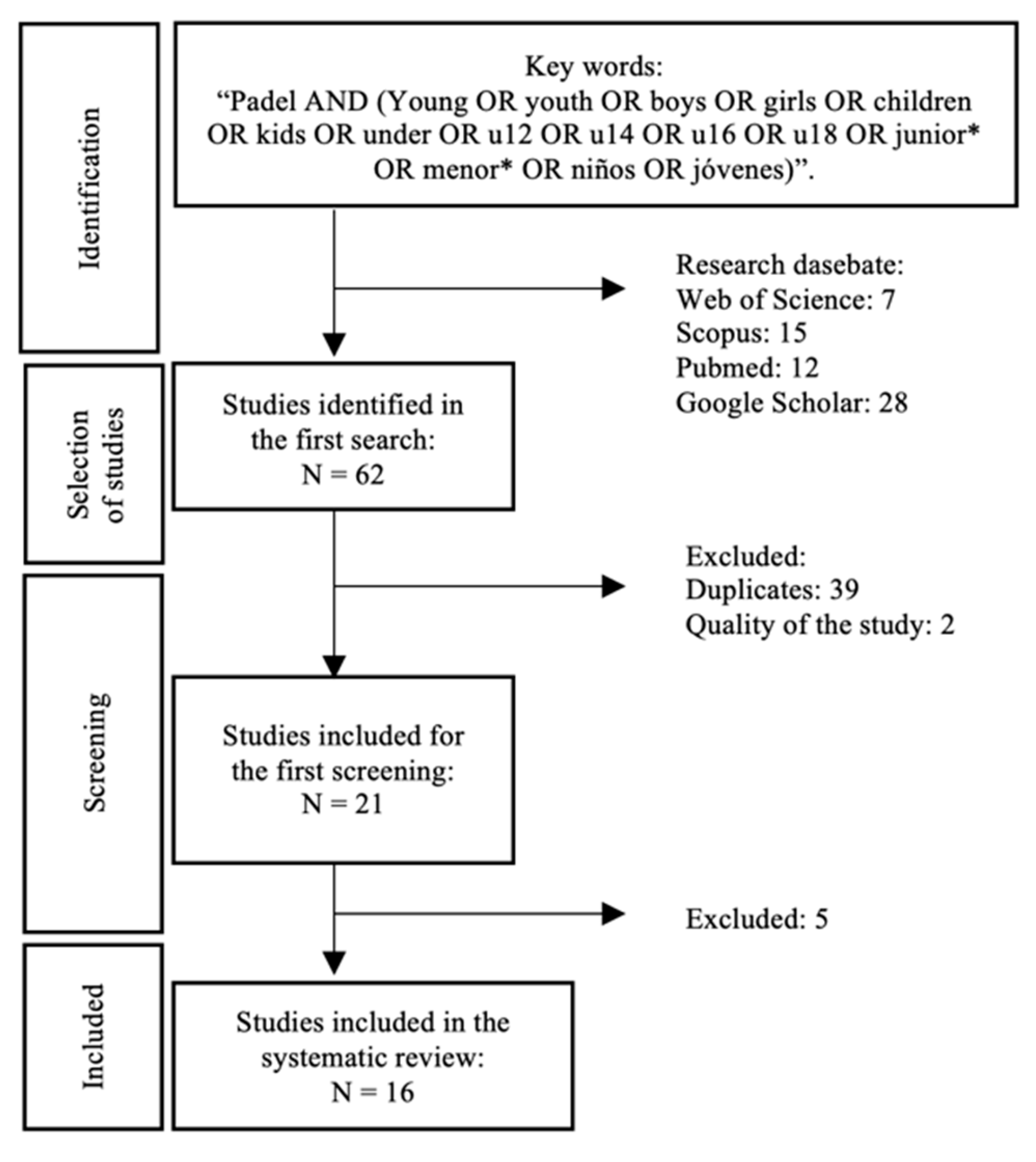
Figure 2.
Risk-of-bias item presented as percentages across all included studies.
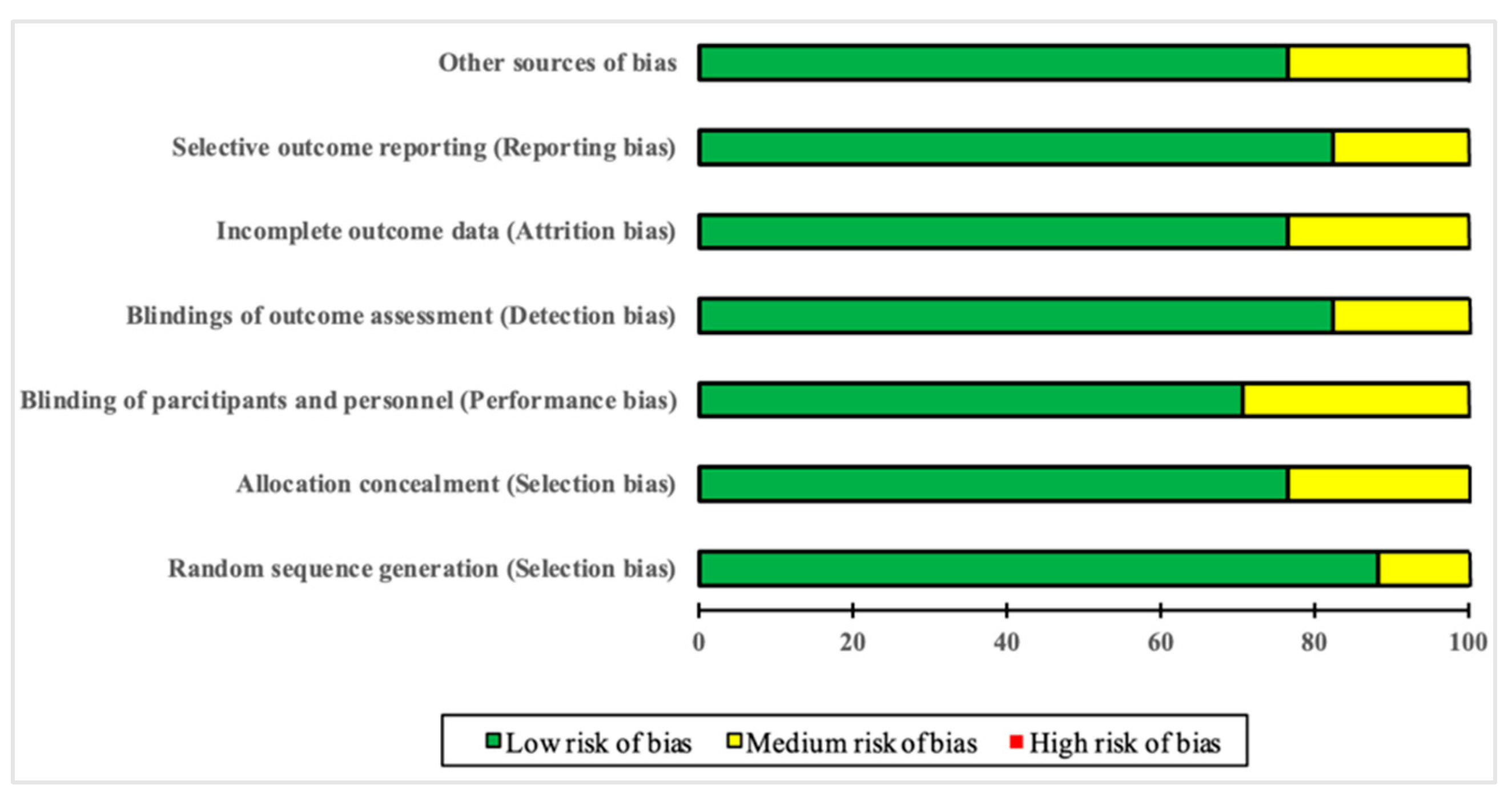

Table 1.
Assessment of the methodological quality of the studies using Cochrane. Risk of Bias Tool for Randomised Trials.
Table 1.
Assessment of the methodological quality of the studies using Cochrane. Risk of Bias Tool for Randomised Trials.
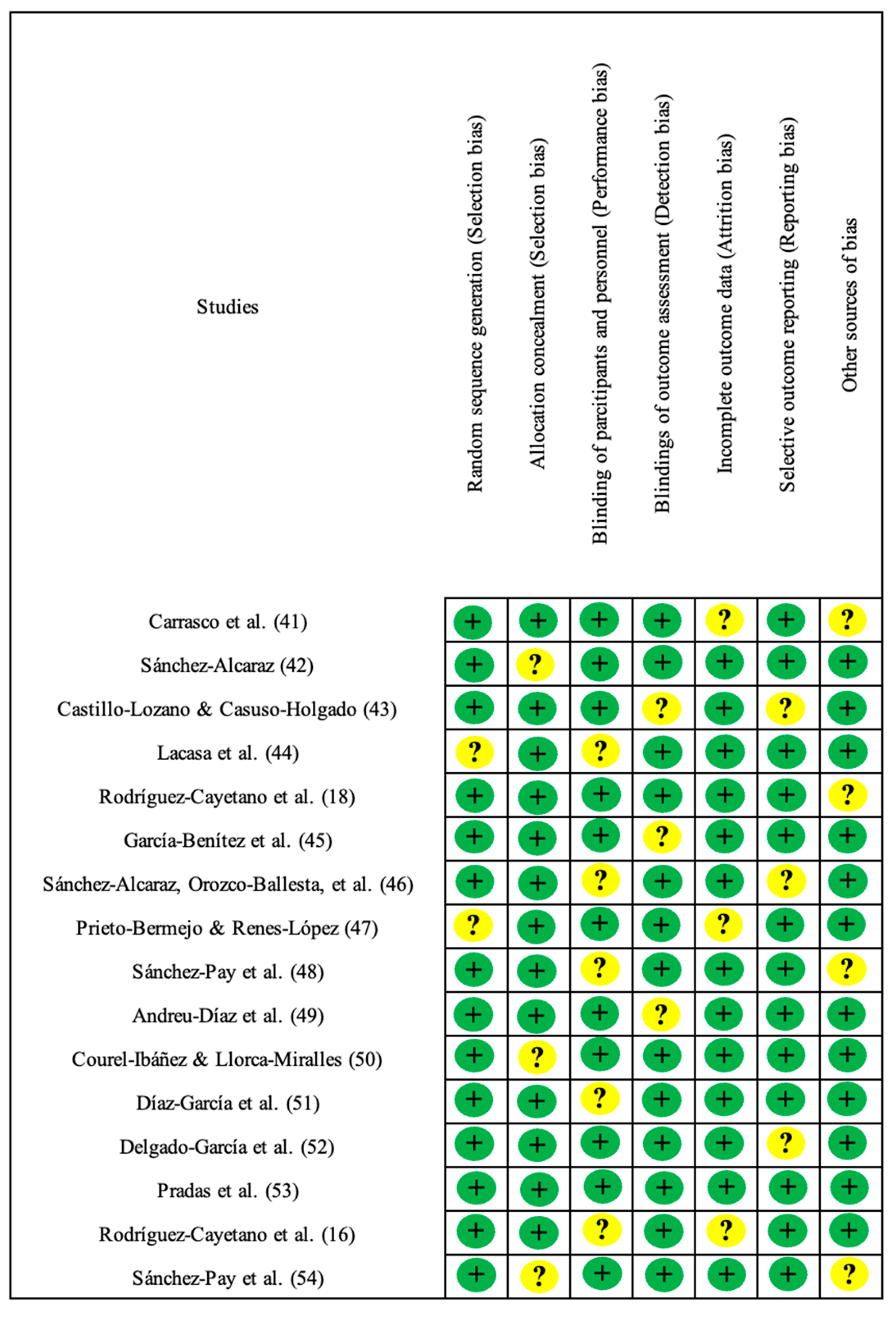 |
Table 2.
Classification of Articles by Study Topic.
| Nº | Study | Teaching | Psychology | Physiology | Physical characteristics | Gameplay parameters |
|---|---|---|---|---|---|---|
| 1 | Carrasco et al. [41] | |||||
| 2 | Sánchez-Alcaraz [42] | |||||
| 3 | Castillo-Lozano & Casuso-Holgado [43] | |||||
| 4 | Lacasa et al. [44] | |||||
| 5 | Rodríguez-Cayetano et al. [18] | |||||
| 6 | García-Benítez et al. [45] | |||||
| 7 | Sánchez-Alcaraz, Orozco-Ballesta, et al. [46] | |||||
| 8 | Prieto-Bermejo & Renes-López [47] | |||||
| 9 | Sánchez-Pay et al. [48] | |||||
| 10 | Andreu-Díaz et al. [49] | |||||
| 11 | Courel-Ibáñez & Llorca-Miralles [50] | |||||
| 12 | Díaz-García et al. [51] | |||||
| 13 | Delgado-García et al. [52] | |||||
| 14 | Pradas et al. [53] | |||||
| 15 | Rodríguez-Cayetano et al. [16] | |||||
| 16 | Sánchez-Pay et al. [54] |
Table 3.
Summary of the studies analized.
| Nº | Authors | Sample | Variables | Results |
|---|---|---|---|---|
| 1 | Carrasco et al. [41] | 12 advanced-level right-handed boys (16.57±1.51 years; 1.72±0.08 m; 66±11.37 kg; BMI 22.24±2.73 kg/m2). | -Physiological variables: VO2, %VO2max, Max HR, Mean HR, VT2. Measured in laboratory and competition. -Temporal variables: Real game time. Point duration. Pause between points. Game-rest time ratio. -Stroke frequency variables. |
VO2 in competition 24.06±6.95 ml/kg/min. %VO2max 43.73±11.04% in laboratory test. Max HR in laboratory 200.43±15.76 bpm. Max HR in match 169.72±18.41 bpm, 18% lower. Mean HR is 73.99±4.65% of Max HR obtained in the laboratory. VT2 of 52.52±15.50%, indicating moderate intensity in competition. Game time 163.06 s. Real game time 71.43 s. Point duration 7.24 s. Pause between points 9.11 s. Game-rest time ratio 0.97. Volley (25.57%) and smash (12.45%), most used strokes without bounce. Forehand (20.16%), smash (12.45%), and backhand (8.36%), most used strokes with bounce. Lob least used (2.95% without bounce and 1.80% with bounce). |
| 2 | Sánchez-Alcaraz [42] | 16 boys (14.24±1.86 years, 165.46±7.45 cm, and 58.67±8.93 kg). Minimum of 2 years of practice and participation in 10 tournaments per year. First set of 8 matches from the regional junior padel championship. | - Game actions. Total strokes per point, from the left side and from the right side. - Temporal variables. Total game time. Actual playing time. Rest time. Mean duration of each point. Mean duration of pauses between points. - HR. HRavg, HRmin and HRmax. |
Average total game time 1745.21 s (between 17 and 39 minutes). Average rest time 1212.98 s (20.2 minutes). Mean duration of each point 9.23 s. Mean pause time between points 14.12 s. Number of strokes on the right side 3.28. Number of strokes on the left side 3.45. Average total strokes per point 7-9. HRmin 95.45 bpm. HRavg 141.23 bpm. HRmax 175.24 bpm. |
| 3 | Castillo-Lozano & Casuso-Holgado [43] | 30 players, 24 boys and 6 girls (17.5±2.1 years, 1.75±0.89 cm, 70.13±11.1 kg, 22.65±2.63 body mass index). | Percentage of injuries: Head/neck, upper limbs, trunk, and lower limbs. | The most common injuries are low back pain (23.30%). Knee sprain, plantar fascitis, and elbow injuries (10%). Wrist, ankle sprain, shoulder (6.70%). BMI, handedness, and age variables can explain 7.5-18.5% of the injuries. |
| 4 | Lacasa et al. [44] | 8 players (5 boys and 3 girls, aged 7.6±0.7 years). | - Hitting: baseline, wall, net. - Situation A: nine-game match, court size 20x10m. - Situation B: adapted match, court 10x6m, padel length 33cm, soft1 ball. |
Significantly more hits against the wall (8.57±2.22 vs 3±0.82) and at the net (21.25±5.25 vs 5.25±1.26) in the adapted match. More defining shots in the adapted match (3.75±2.06 vs 0.50±1.00) and similar baseline hits in both matches (63.25±9.91 vs 64.75±15.09) were not significant. The adapted match promotes a greater use of wall shots, as well as volleys and lobs. |
| 5 | Rodríguez-Cayetano et al. [18] | 221 players (100 girls, 121 boys). Age categories: U12=93; U14=73; U16=55. | Revised Competitive State Anxiety Inventory-2 (CSAI-2R), Spanish version. 16 items across three subscales: cognitive anxiety, somatic anxiety, and self-confidence. Measurement on Likert scale. | No differences found in cognitive anxiety (1.97±0.758 vs 1.95±0.681), somatic anxiety (1.44±0.608 vs 1.56±0.631), and self-confidence (3.18±0.642 vs 3.30±0.641) between girls and boys. Differences observed between U12 (1.74±0.736) and U16 (2.20±0.704) in cognitive anxiety. Differences noted between U12 (3.44±0.616) and U14 (3.07±0.608) and U16 (3.15±0.650) in self-confidence. Differences observed between U16 (1.62±0.623) compared to U14 (1.49±0.580) and U12 (1.45±0.651) in somatic anxiety. Self-confidence values (3.24±0.642) were higher than cognitive anxiety (1.96±0.716) and somatic anxiety (1.51±0.622). |
| 6 | García-Benítez et al. [45] | 1670 points from 32 matches in the national youth category. 16 boys and 16 girls U18 (15±1.08 years). | - Sex. - Point duration. - Rest between points. - Strokes per point. - Lobs per point. - Effective playing time. - Work-rest ratio. |
Boys have less total playtime in U16 (29%, 3454.86 s) compared to U18 (34.7%, 3404.742 s). Average of 995 and 1185 strokes per point and 169 and 259 lobs per match in U16, U18 respectively. Point duration between 8.9 and 12.0 s. Rest time of 14.3 and 15.5 s. There are between 6.1 and 8.0 strokes per point. Girls have a total playtime of 32.4% in U16 and 34.8% in U18. There are 986 points per game. Point duration is 11.3 and 11.7 s, rest time of 15.6 and 14.1 s, and between 6.9 and 7.2 strokes per point between U16 and U18 respectively. |
| 7 | Sánchez-Alcaraz, Orozco-Ballesta, et al. [46] | 17 players, 8 boys (14.12±1.24 years) and 9 girls (14.33±1.24 years). Minimum practice of 2 days per week. Minimum participation in 10 tournaments per season. | - Speed of movement. 10 and 20m sprint. - Change of direction speed. Hexagon test. Upper body strength. Medicine ball throw. |
Boys show better 20m sprint times (3.87±0.30 vs 4.29±0.37 s) and medicine ball throw distances (625±9.70 vs 423±6.70 cm) compared to girls. Girls demonstrate better 10m sprint times (2.84±0.17 vs 2.56±0.26 s) and agility (15.39±3.06 vs 14.39±2.32 s). Linear speed and change of direction variables positively correlate with each other. Strength variables correlate negatively with linear speed and change of direction. |
| 8 | Prieto-Bermejo & Renes-López [47] | 45 participants in beginner level (8.62±2.06 years; 21 boys and 24 girls). Experimental group (n=22) and control group (n=23). | -Experimental group (1): Methodology based on exploration, focused on acquiring skills in variable game situations. -Control group (2): Traditional methodology emphasizing repetition of exercises and automation of actions. |
Tests for baseline (pre) and post-training for baseline-to-baseline (group 1 - 5.05 vs 9.73; group 2 - 4.52 vs 5.17) and baseline-to-net (group 1 - 2.86 vs 4.73; group 2 - 3.26 vs 3.96) demonstrate improvements in both groups, with more pronounced improvements in the group using the exploration-based teaching approach. |
| 9 | Sánchez-Pay et al. [48] | 16 players (10 boys and 6 girls) at beginner level (10±0.8 years; 146.0±4.9 cm; 37.4 ± 7.3 kg). They train 2 hours per week with one year of competitive experience. Four matches were played. | -Physiological variables: HRavg, %HRmax. -Psychological variables: Rating of Perceived Exertion (RPE), Satisfaction questionnaire. -Game variables: Set and point duration. Points per set. Strokes per set and per point. Strokes with bounce and without bounce. -Ball type: Official ball vs low-pressure ball. |
Set duration (24.03±8.38 vs 23.38±5.06 min). Number of points per set (51.75±20.21 vs 48.25±12.55). Number of strokes per set (223.25±91.03 vs 209±51.19). Number of strokes per point (4.31±2.76 vs 4.33±2.61). Strokes with bounce (3.81±2.13 vs 3.86±2.18). Strokes without bounce (1.64±1.20 vs 1.49±0.83). Point duration (8.07±4.79 vs 7.99±4.63). Official ball vs low-pressure ball showed no significant differences. 70% of points were concluded with between 2 and 5 strokes. 30% of points had more than 5 strokes. HRavg and %HRmax were higher in matches with the official ball (145 bpm, 72.5% HRmax) compared to low-pressure balls (140 bpm, 69.9% HRmax). There were no differences in subjective perception of effort. 30% of game time with low-pressure balls and 20% with official balls were in low to very low intensity zones. 12.82 min with normal balls and 10.94 min with low-pressure balls were spent in moderate-intensity zones (65-76% HRmax). Greater enjoyment, comfort, and ease of play were reported with low-pressure balls. |
| 10 | Andreu-Díaz et al. [49] | Eight male beginner players (13.5±1.4 years; 1.51±0.21 m; 46.25±4.51 kg) participated in two matches, totaling 723 strokes (176 points). They have a minimum of one year of training experience, with two hours of training per week. | -Temporal variables: Average point duration. Average rest duration between points. -Game action variables: Number of strokes. Number of points. Type of stroke. Stroke direction. Stroke effectiveness. Court side. |
Strokes per point 4.08±2.73. Strokes per game 25.07±10.69. Strokes per set 242.33±76.14. Strokes per match 363.5±13.5. Points per game 6.07±2.36. Points per set 58.66±10.53. Points per match 88±15. Average duration 7.66 s, constituting 33% of total game time. Rest duration 15.47 s, comprising 67% of total game time. Primary strokes include first serve (18.4%), forehand return (18.2%), forehand (17.8%), and forehand wall (8.9%). The winning pair utilized more backhand volleys (2.3 vs 0.8%) and forehand wall (10.1 vs 7.7%), and less forehand volleys (5.1 vs 6.6%) and forehand (15.8 vs 19.5%) compared to the losing pair. The side of play and stroke direction did not determine the outcome. The winning and losing pairs executed 30.4% and 22.6% more cross-court strokes. The left-side player executed 11% more down the line strokes than the right-side player. The right-side player had 10-16.4% more involvement in both pairs. Errors accounted for 15-19%, and winners for 6.5-7.3%. The side of play did not determine stroke effectiveness. |
| 11 | Courel-Ibáñez & Llorca-Miralles [50] | 34 players (19 boys and 15 girls): 14.6±1.5 years old; 63.4±14.5 kg; height 166.6±9.8 cm; 6.2±2.5 years of experience. Regional category of the Andalusian Padel Federation. | -Sex -Anthropometry -Body composition -Change of direction and agility -Jump and strength test |
Boys have an average height of 172.8 cm, weight of 70.2 kg, 16.1% body fat, and BMI of 23.3. Girls have an average height of 158 cm, weight of 54.7 kg, 24.1% body fat, and BMI of 21.7. Boys’ jump height (CMJ=23.2 cm; Abalakov=27 cm) is higher than girls’ (CMJ=9.9 cm; Abalakov=11.7 cm). Strength values (medicine ball throw dominant hand=4.7-5 m; non-dominant hand=4.8 m; overhead throw=5.2-6 m) and change of direction (padel agility test=18.2-19.4 s; 3x10 m sprint=8.3-8.8 s) show no differences between sexes. |
| 12 | Díaz-García et al. [51] | 36 elite players (22 boys, 17.40±2.16 years old; 14 girls, 17.90±3.21 years old) participated in four matches, two of which had rewards. | -Situational Motivation Scale -Heart Rate Variability -Quantification of Mental Load -Visual Analog Scale -Psychomotor Vigilance Task |
Intrinsic motivation (6.31±1.98 vs 5.17±1.47), external motivation (4.45±1.29 vs 3.86±1.17), mental fatigue (7.08±2.29 vs 5.67±1.28), and mental load (8.67±2.27 vs 6.45±1.49) were higher in matches with rewards compared to matches without rewards. Reaction time (0.49±0.02 vs 0.43±0.02), HRavg (146.19±16.43 vs 137.67±14.89), SDNN (31.21±6.91 vs 38.76±8.82), NN50 (6.52±1.23 vs 10.22±1.78), and %rMSSD (19.48±5.91 vs 22.65±6.98) were higher in matches with rewards compared to matches without rewards. Amotivation (2.21±0.94 vs 2.67±0.98) was lower in matches with rewards compared to matches without rewards. |
| 13 | Delgado-García et al. [52] | 96 players (53 boys and 43 girls) and a control group of 76 alpine skiers (43 boys and 33 girls). | -Lower limb asymmetry variable. -State of maturity. |
There are no lower limb asymmetries observed in padel players, with a measurement of 1.1±0.8%. However, there are upper limb asymmetries observed at 7.2±5%, which are higher compared to the control group, who had values of 1.4±3.2%. There are also no significant differences observed in terms of maturity status between children with negative or positive maturity status. |
| 14 | Pradas et al. [53] | 60 young padel players divided into: U14 (15 boys and 15 girls); U16 (15 boys and 15 girls). | -Physiological variables. VO2max. -Physical variables. SJ. CMJ. Flexibility. Distance covered. Average speed. Asymmetries. |
VO2max in U14 (47.21±4.49 vs 41.29±4.35 mL/kg/min) and U16 (45.70±2.34 vs 39.85±2.73 mL/kg/min) is higher in boys compared to girls. VO2max in absolute terms (U14: 2.57±0.41 vs U16: 2.92±0.34 l/min) also shows higher values in boys compared to girls. Boys demonstrate higher values in jump tests for power in SJ (U14: 1765±414 vs U16: 2388±397 W) and CMJ (U14: 2002±398 vs U16: 2555±382 W), than girls for SJ (U14: 1565±277 vs U16: 1724±246 W) and CMJ (U14: 1741±289 vs U16: 1894±263 W), and for jump height in SJ (U14: 22.9±5.12 vs U16: 25.53±3.85 cm) and CMJ (U14: 25.68±4.75 vs U16: 27,72±3,67 cm), than girls for SJ (U14: 21.22±2.44 vs U16: 21.16±2.41 cm) and CMJ (U14: 23.70±2.52 vs U16: 23.27±2.85 cm). Distance covered in shuttle run tests (U14: 1129±322 vs U16: 1203±160 m) and average speed (U14: 11.37±0.8 vs U16: 11.55±0.40 km/h) are slightly higher in U16 compared to U14 for both sexes. Flexibility measurements indicate higher values in U16 compared to U14 for both boys (U14: 18.91±6.38 vs U16: 25.46±8.94 cm) and girls (U14: 29.31±6.24 vs U16: 32.42±7.85 cm). Upper limb asymmetries are observed but are not significant between U14 (boys: 11.31±5.09% vs girls: 5.82±1.65%) and U16 (boys: 10.86±2.85% vs girls: 6.75±1.42%). There are no asymmetries observed in the lower limb during lateral movement, accelerations, and reaction time tests. Strength values in the dominant and non-dominant hand show similarities across ages but differ between sexes, with higher values observed in boys. |
| 15 | Rodríguez-Cayetano et al. [16] | 423 players (15.40±3.43 years old), including 291 padel (191 boys; 100 girls; 93 U14; 93 U16; 105 senior category) and 132 tennis players (85 boys and 47 girls; 31 U14; 34 U16; 67 senior category). | Revised Competitive State Anxiety Inventory-2 (CSAI-2R), Spanish version. Three subscales: cognitive anxiety, somatic anxiety, and self-confidence. | Higher values of self-confidence (3.25±0.548) compared to cognitive anxiety (2.01±0.679) and somatic anxiety (1.60±0.557) are observed. Boys exhibit self-confidence (3.27±0.54), somatic anxiety (1.69±0.56), and cognitive anxiety (2.04±0.68). Girls demonstrate self-confidence (3.22±0.56), somatic anxiety (1.44±0.52), and cognitive anxiety (1.96±0.67). Somatic anxiety values are significantly higher in boys compared to girls. Boys show higher values in all three variables compared to tennis players. Girls exhibit lower levels of cognitive anxiety and higher levels of self-confidence than in tennis. Self-confidence is higher in U14 (3.44±0.54) compared to U16 (3.27±0.49) and seniors (3.07±0.55). Somatic anxiety is higher in seniors (1.82±0.54) than in U14 (1.44±0.55) and U16 (1.52±0.51). Cognitive anxiety is higher in seniors (2.26±0.69) compared to U14 (1.79±0.70) and U16 (1.96±0.55). There is a positive correlation between cognitive anxiety and somatic anxiety (0.487) and a negative correlation between both (-0.312; -0.254) and self-confidence. |
| 16 | Sánchez-Pay et al. [54] | 175 smashes from six junior national category finals (three male and three female). 12 boys and 12 girls (aged 16-18 years). Top 10 national junior category. | -Sex. -Type of smash. Flat smash. Topspin smash. Bandeja. Off the wall smash. -Direction of shot. -Effectiveness of the smash. |
Bandeja (RTC=13) and topspin smashes (RTC=5.7) are predominantly cross-court. Flat smashes (RTC=19.1) are mainly down the line. Off the wall smash are similar in both directions, but girls tend to execute them more down the line (52.5%), while boys tend to do so more cross-court (65.4%). Flat smashes (RTC = 9.4) and topspin smashes (RTC = 7.1) mainly result in winners. Off the wall smash primarily lead to errors (RTC = 3.1), while bandejas lead to more continuity (RTC = 11.6). Regarding sexes, bandejas (boys (88.5%) and girls (79.3%)) and off the wall smash (boys (80.8%) and girls (61.3%)) promote continuity in the game, as does flat smashes in boys (62.8%) and topspin smashes in girls (54.5%). Flat smashes are often winners for girls (53.3%), while topspin smashes are winners for boys (50.7%) and less often result in continuity (46.3%). Bandejas are the most used shot among girls (44.1%) and boys (43.8%). Girls execute more off the wall smashes (13.8%) and flat smashes (36.5%) compared to boys. Boys perform more topspin smashes (22.6%) than girls. |
| M: Meters; Cm: Centimeter; Kg: Kilograms; Kg/m2: Kilogram per square meter; BMI: Body Mass Index; s: Seconds; Min: Minutes; VO2: Oxygen uptake; %VO2max: Percentage of maximal oxygen consumption; HR: Hear rate; HRmax: Maximum heart rate; %HRmax: Percentage of maximum heart rate; HRavg: Average heart rate; HRmin: Minimum heart rate; bpm: Beats per minute; VT2: Anaerobic ventilatory threshold; %: Percentage; Ml/kg/min: Milliliters per kilogram per minute; P/min: Beats per minute; l*min: Liters per minute; W: Watts; Km/h: Kilometers per hour; SDNN: Standard deviation of normal-to-normal RR intervals; NN50: Number of pairs of successive RR intervals differing by more than 50 ms, divided by the total number of RR intervals; %rMSSD: Square root of the mean of the sum of the squares of differences between adjacent RR intervals; U12: Under 12 years; U14: Under 14 years; U16: Under 16 years; U18: Under 18 years; RPE: Rating of Perceived Exertion; CMJ: Countermovement Jump; SJ: Squat Jump; COD: Change of Direction; RTC: Residual Tipified Corrected. | ||||
Disclaimer/Publisher’s Note: The statements, opinions and data contained in all publications are solely those of the individual author(s) and contributor(s) and not of MDPI and/or the editor(s). MDPI and/or the editor(s) disclaim responsibility for any injury to people or property resulting from any ideas, methods, instructions or products referred to in the content. |
© 2025 by the authors. Licensee MDPI, Basel, Switzerland. This article is an open access article distributed under the terms and conditions of the Creative Commons Attribution (CC BY) license (http://creativecommons.org/licenses/by/4.0/).
Copyright: This open access article is published under a Creative Commons CC BY 4.0 license, which permit the free download, distribution, and reuse, provided that the author and preprint are cited in any reuse.


