

Submitted:
24 January 2025
Posted:
27 January 2025
You are already at the latest version
Abstract
The existence of zero-point electromagnetic energy of space is a potentially unlimited source of green energy. For a better understanding of energy extraction from space the model of an “empty space-time” has to be replaced by the model of superfluid quantum space which is a four-dimensional type of energy. Electric current is a flux of space energy along, X1, X2, and X3, magnetic current is a flux of space energy along X2, X3, and X4. Permanent magnets create a constant magnetic flux that can be transformed into mechanical kinetic energy.
Keywords:
green energy
; electromagnetism
; superfluid quantum space
1. Introduction
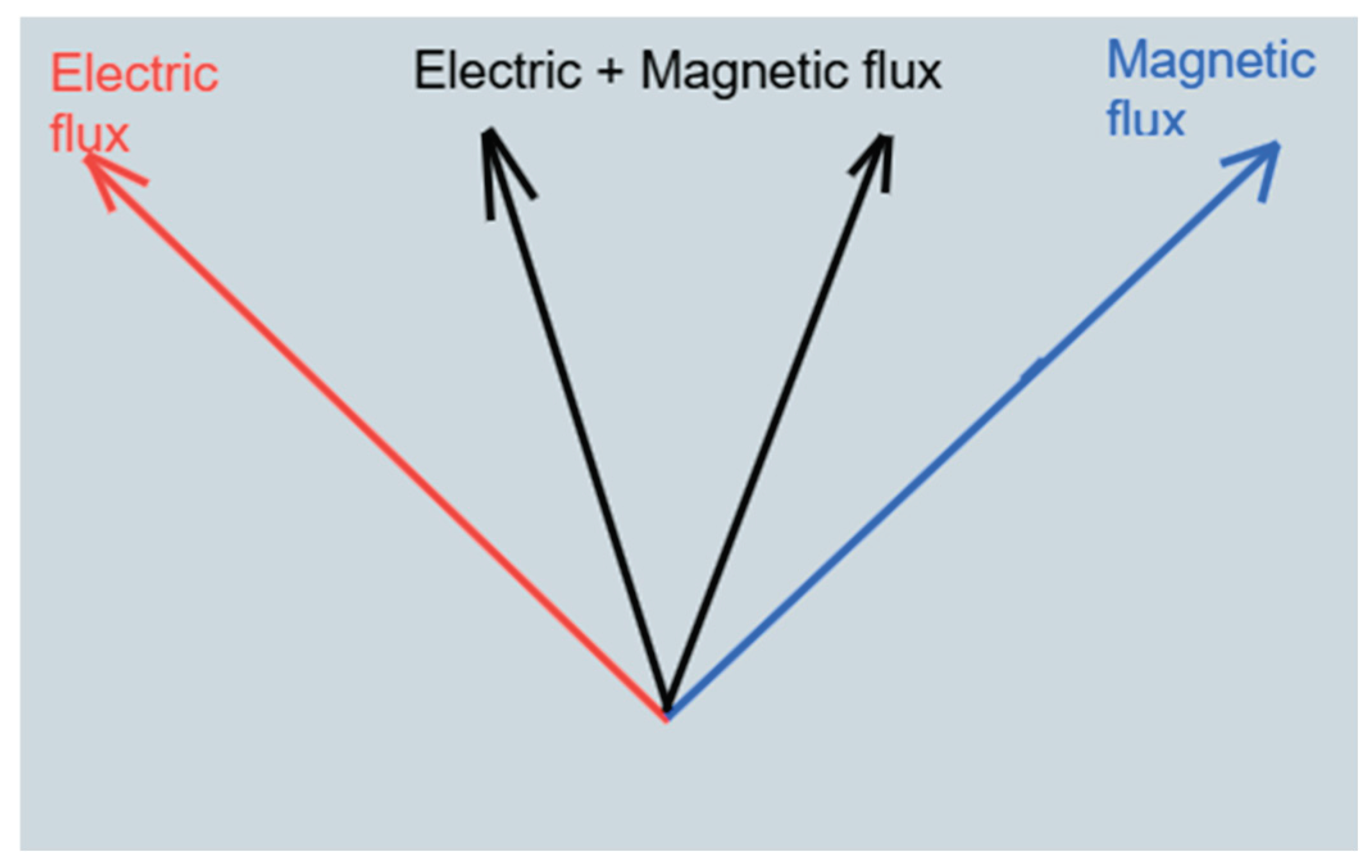
The so-called “zero-point energy” of space (ZPE) [1] is a physical model that allows speculations about energy extraction from space. A physical vacuum is not “empty” but is a special superfluid medium [2]. Recent research suggests that electromagnetism is a phenomenon of the fluxes of superfluid space that is a 4-dimensional type of energy with four coordinates X1, X2, X3, and X4. Electricity and magnetism are both the phenomena of superfluid space. Electricity and magnetism have two coordinates (X2 and X3) in common; electricity always generates magnetism and vice-versa [3]. When an electric current passes in the wire, it generates a perpendicular magnetic field. When we move a magnet along the wire the electric flux is generated. Electric flux is the flux of superfluid space energy along coordinates X1, X2, and X3, and magnetic flux is the flow of space energy along the coordinates X2, X3, and X4 [2], see picture (1) below:
Figure 1.
Electric flux and magnetic flux.
In the dynamo kinetic energy of the rotor transforms into magnetic flux and magnetic flux transforms into electric flux. In the electric motor, the electric flux transforms into magnetic flux and magnetic flux transforms into kinetic energy of the rotor.
Imagine a DC battery. On the negative pole, there is a high concentration of negative ions. These ions generate the negatively charged area of superfluid space. This negatively charged area tends to be discharged. When we link the bulb to the negative pole with the wire and connect this wire with the positive pole the electric flow of superfluid space energy is created. In DC the flow runs from the negative to the positive pole. In AC flow changes its direction 50 times per second. Electric flux around the wire created perpendicular magnetic flux. The motion of a permanent magnet along the wire stick creates an electric current. Electric flux and magnetic flux are interwoven.
2. Green Energy Extraction from Superfluid Quantum Space
Maxwell's equations describe the fundamental behaviour of electric and magnetic flux. A permanent magnet atomic structure is “sucking” the energy of space in on one side (S) and “pushing” it out on another side (N) of the magnet. The kinetic energy of a permanent magnet's magnetic flux can be transformed into mechanical kinetic energy. If magnetic flux does some work, it will not diminish. Here is the theoretical paradigm shift of green energy extraction from superfluid quantum space. Turkish inventor Yildiz used permanent magnetic flux in his motor, which is a well-known motor that extracts energy from superfluid quantum space. Yildiz motor is an example of patented technical innovation where the kinetic energy of magnetic flux is transformed into the rotor’s kinetic energy [4].
Here is the video introduction of the Yildiz motor, first presented at Delft University, Netherlands in 2014 [5]. Prof. Duarte, J. L. presented technical details of the motor on the portal of the Eindhoven University of Technology [6]. Yildiz motor provides a better understanding of electromagnetism. In the old paradigm, electromagnetic fields exist in a space deprived of physical properties. In the new paradigm electromagnetic fields are the flux of space energy. Superfluid space has physical properties, energy density, permittivity, and permeability. The old name for superfluid space is “vacuum”, we know today that a vacuum is not “empty”, vacuum is a type of energy. In the Yildiz motor, the kinetic energy of magnetic flux transforms into the rotor’s kinetic energy of the rotor.
A dynamo can transform the rotor's kinetic energy into electric flux. The Yildiz motor is in accord with the law of conservation of energy. It is an open system that gets energy from superfluid space. The magnetic flow of superfluid space energy in the permanent magnet is constant. It will not diminish when doing some work. Superfluid space is an inexhaustible pool of energy. We have to get accustomed to this scientific fact.
In 1978 a similar motor was patented by Howard R. Johnson [7]. Both motors do not get enough attention from the scientific community because they are not well-understood. The term “motor” is not appropriate. Motors are transforming one type of energy into another type of energy. Electromotor transforms electric energy into mechanical energy, dynamo transforms mechanical energy into electric energy, and internal combustion motor transforms chemical energy into mechanical energy. All motors are closed systems. Yildiz and Howard's devices are open systems, they extract energy from the superfluid quantum space. The magnetic flux of a permanent magnet is like a waterfall under which is an electric power station. The flow of water and the magnetic flow remain unchanged when doing a job or not doing it.
In 2015 Prof. Duarte examined the technical properties of the Yildiz motor: “It is shown in Fig. 3 that the rotation speed of the Yildiz motor at no-load is about 2500 rpm (more precisely, 2485 rpm), and that the speed drops quite linearly (considering the precision of the measurement instruments) to 2100 rpm when the motor delivers 45 watts. A linear extrapolation of the results in Fig. 3 is shown in Fig. 4, where it is illustrated that, theoretically, the maximum power that could be delivered by the prototype is around 300 watts, when the speed of rotation is about zero. In practice, a power of level 100 watts can be easily reached with a simple dynamo (10V, 10A, 1600rpm)” [8]. Building this motor in bigger sizes is a challenge for institutes and companies that are searching for green energy. The motor works, this question is solved. The following common task of the scientific community is to fully accept the fact that we can extract green energy directly from space. It sounds unbelievable, but it's true. We are at a crucial turning point in our civilization that today has access to green energy. Let's hope scientific society will be the first to see this redemptive opportunity.
A more appropriate term for Yildiz and Howard devices is “Energy Extractor” from superfluid space. These devices are connected and extract energy from superfluid space. Water turbines get energy from the water stream and Yildiz and Howard's devices get energy from the magnetic stream. This should be well understood. Magnetic flux in permanent magnets is stable and will run until the magnet is active, which means until the atomic structure of the magnet creates the magnetic flux. The supposed magnetic flux loss is about 1% in a hundred years [9]. In perspective, the future “Energy Extractors”, when their moving parts are well-maintained, will lose only 10% of power in 1000 years.
3. Conclusions
The huge advantage of energy extraction from superfluid space is that no pollution is created. Also, these devices will not add to the pollution when replaced by the new ones. An old permanent magnet does not threaten nature. This energy extraction is “green” in the true meaning of a word. It gives us an opportunity for local production and local energy use that does not need transmission lines. Green energy extraction from space deserves the general attention of the scientific community. It represents the most serious candidate for achieving the goals of the 2030 Green Plan.
References
- H.E. Puthoff, Source of vacuum electromagnetic zero-point energy, Physical Review A, Phys. Rev. A 40, 4857 – Published 1 November, 1989. [CrossRef]
- V.I. Sbitnev, Physical Vacuum is a Special Superfluid Medium (2015) https://www.intechopen.com/chapters/47567 (arXiv:1501.06763v4).
- Šorli, A.S. & Čelan Š., Time-Invariant Superfluid Quantum Space as the Unified Field Theory, Reports in Advances of Physical Sciences, 4 (2020), no. 3, 2050007. [CrossRef]
- Amrit Sorli, The theoretical framework of Yildiz motor (2025). [CrossRef]
- Yildiz motor presentation at Delft University (2014) https://www.youtube.com/watch?v=D5K_wB-xsuM&t=0s.
- Duarte, J. L., Essay on magnetic-wind mills parts I-II-III, Eindhoven University of Technology (2024) https://pure.tue.nl/ws/portalfiles/portal/345517591/Duarte_EssayMagWindMills_toto_Nov2024.pdf.
- Howard R. Johnson, patent (1973) https://patents.google.com/patent/US4151431A/en.
- Duarte, J. L, Tests on a new Yildiz motor prototype (2015) http://www.borderlands.de/Links/YildizMotor_ExperimentsIzmir_26Oct2015v1.
- Paul Fears, e-Magnets (2023) https://e-magnetsuk.com/does-magnetism-decay-over-time/.
Disclaimer/Publisher’s Note: The statements, opinions and data contained in all publications are solely those of the individual author(s) and contributor(s) and not of MDPI and/or the editor(s). MDPI and/or the editor(s) disclaim responsibility for any injury to people or property resulting from any ideas, methods, instructions or products referred to in the content. |
© 2025 by the authors. Licensee MDPI, Basel, Switzerland. This article is an open access article distributed under the terms and conditions of the Creative Commons Attribution (CC BY) license (http://creativecommons.org/licenses/by/4.0/).
Copyright: This open access article is published under a Creative Commons CC BY 4.0 license, which permit the free download, distribution, and reuse, provided that the author and preprint are cited in any reuse.


