

Submitted:
23 January 2025
Posted:
23 January 2025
You are already at the latest version
Abstract
Biosensors are innovative and cost-effective analytical devices that integrate biological recognition elements (bioreceptors) with transducers to detect specific substances (biomolecules), providing high sensitivity and specificity for rapid and accurate Point-of-Care (POC) quantitative detection of selected biomolecules. In the meat production chain, their application has gained attention due to the increasing demand for enhanced food safety, quality assurance, food fraud detection and regulatory compliance demands. Biosensors can detect foodborne pathogens (Salmonella, Campylobacter, Shiga toxin-producing E. coli/STEC, L. monocytogenes), spoilage bacteria and indicators, contaminants (pesticides, dioxins, mycotoxins), antibiotics, antimicrobial resistance genes, hormones (growth promoters, stress hormones), metabolites (acute phase proteins as inflammation markers) at different modules along the meat chain, from livestock farming to packaging in farm-to-fork (F2F) continuum. By providing real-time data from the meat chain, biosensors enable early interventions, reducing health risks (foodborne outbreaks) associated with contaminated meat/meat products or substandard meat products. Recent advancements in micro and nanotechnology, microfluidics, and wireless communication have further enhanced the sensitivity, specificity, portability, and automation of biosensors, making them suitable for on-site, field applications. Integration of biosensors with blockchain and Internet of Things (IoT) systems allows acquired data integration and management, while integration with Artificial Intelligence (AI) and Machine Learning (ML) enables rapid data processing, analytics and input for risk assessment by competent authorities. This promotes transparency and traceability within the meat chain, fostering consumer trust and industry accountability. Despite biosensors’ promising potential, challenges such as scalability, reliability associated with the complexity of meat matrices and regulatory approval, are still the main challenges. This review provides a broad overview of the most relevant aspects of the current state-of-the-art biosensors` development, challenges and opportunities for prospective biosensors` application and its regular use in meat safety and quality monitoring and clarify further perspectives.
Keywords:
biosensors
; meat chain
; pathogen detection
; contaminants
; food safety
; quality assurance
; traceability
1. Introduction
Biosensors represent a promising and potent tool in enhancing animal health and welfare, as well as food safety by providing early information due to the possibility for rapid and on-site detection of various hazards along all modules in the meat production chain, in F2F continuum [1]. Other issues closely intersecting the meat production chain are related to the environmental impact of intensive livestock production (e.g., on arable land/soil, water, forest and atmosphere) and challenges to find the appropriate and most effective solutions to adopt policies for management of production systems that are sustainable, economically justified, ethically accepted which provide continuous meat/meat products supply on a global scale. Optimization of livestock management systems requires integration of a variety of data and acquired knowledge on the environment, agricultural practices, biotechnology, animal husbandry, animal nutrition and behavior, animal welfare, veterinary medicine, slaughter and meat processing, distribution and retail with the modern electronic systems/devices able to detect specific biomarkers and transfer them to a readable signal [2,3]. Such systems can play an essential and crucial role in the transformation of the meat production system in promoting and improving animal health and welfare, productivity and, ultimately, food safety and quality of the meat and meat products, thus providing security in the meat supply chain and consumers` protection.
Biosensors are analytical devices that combine a biological component (such as enzymes, antibodies, nucleic acids/aptamers, deoxyribonucleic Acid/DNA or whole cells) with a transducing and detector system, (Figure 1), to detect specific substances from analytes rapidly and cost-effectively, with high sensitivity and specificity [4,5,6]. The biological component (bioreceptor) incorporated within the biosensor, interacts with the analyte on the transducer which produces a measurable signal which is then converted into a user-understandable mostly quantifiable output.
The meat production chain is complex, involving multiple stages along F2F continuum (Figure 2). Different food-borne hazards can enter the meat chain at multiple points, carrying potential risks that could compromise food safety and quality [3,7,8]. Animal health and welfare monitoring on-farm (Pre-harvest) is based on concept such as the Heard Health Surveillance Program (HHSP), while food safety hazards in further stages of the meat chain, such as slaughter (Harvest), meat processing, distribution and retail (Post-harvest) are controlled by Hazard Analysis and Critical Control Points (HACCP). Those concepts are risk-based, aiming to identify, detect and prevent/control food producing animal-based food safety hazards in a proactive way, during the production process-before such hazards can contaminate the final food product. Such a proactive approach requires real-time and early information on animal health and food safety hazards so that adequate corrective measures can be applied to eliminate or reduce the hazards before entering the further stage along the meat production chain. Current practices do not provide adequate technical support (on-site detection) to fulfill early and prompt reactions, since they are based on a collection of samples, e.g. blood, feces, slurry (on the farm) or swabs from carcasses, meat juice, lymph nodes (at slaughterhouse), transportation in cold chain environment (cool bin) to the central laboratory and time-consuming and labor-intensive analysis (e.g. culturing, Enzyme-linked Immunosorbent Assay - ELISA, Polymerase Chain Reaction - PCR, High Performance Liquid Chromatography - HPLC) which also require expensive equipment, specially designated space and highly trained laboratory personnel. For example, the average time for obtaining the results for ELISA and PCR or PCR-HPLC assay is within 24 h at best [9,10], while for culturing techniques (by internationally recognized standards, such as by the International Standard Organization/ISO), which are considered as a `gold standard` for sensitive and specific detection of foodborne pathogens, the results are available after 5 days (such as the case with Salmonella detection; ISO 6579) or up to 7 days (Listeria monocytogenes detection; ISO 11290). On the other hand, biosensors emerged as an innovative technology offering a low-cost solution for in-field detection aiming to meet Real-time connectivity, Ease of specimen collection, Affordable, Sensitive, Specific, User-friendly, Rapid, Robust, Equipment free, and Deliverable to end users (REASSURED) criteria [11,12]. Biosensors can enable rapid response time for getting accurate results and quantitative detection with an average read-out time of up to 30 minutes [13,14], which enables timely reaction in applying corrective measures within HHSP and/or HACCP thus improving significantly the performance of such risk-based animal health and food safety management systems. Therefore, biosensors are effective tools for monitoring the key animal health and food safety hazards of public health importance and are a useful asset to ensure that meat products reaching consumers are safe and of high quality.
Consumers` perception towards animal health, animal welfare and food safety issues increased globally over the previous decade and demand for proper, real-time, and accurate information on aforementioned meat safety issues is needed for making informed choices in purchasing preferred meat/meat products [15]. Further, the meat production system is facing the impact of climate change reflected in trends of global temperature increase, precipitations, and wind patterns that are directly or indirectly associated with human activity [16]. Extreme weather events became more frequent, severe and unpredictable. These events may jeopardize food safety by changing ecological patterns and dynamics of different hazards, including food borne, by altering their occurrence, virulence and distribution leading to increased exposure for consumers [17]. For example, the potential association between rising temperatures and increased levels of antimicrobial resistance (AMR) in certain zoonotic food (meat) borne pathogens has been observed, e.g. Campylobacter spp., Salmonella spp., Listeria monocytogenes, Escherichia coli. Parallel to that, these pathogens are also showing increased resistance, in particular, to Critically Important Antibiotics (in accordance with the World Health Organization/WHO CIA list) and/or Medically Important Antibiotics (in accordance with the WHO MIA list) thus reducing the efficacy and quality of clinical treatments [18,19,20,21]. The meat production chain is also facing another challenge related to its sustainability due to the environmental impact of livestock production contributing to anthropogenic Greenhouse Gases (GHG) emissions to some extent [17]. Mitigation strategies that include sensor-based early information on animal health and welfare can significantly reduce emissions enabling monitoring and optimization of farm animals` digestion, feed conversion and better product yield [22]. In the context of meat safety, biosensors can be effectively used to monitor food safety and quality by detecting food-borne pathogens such as Salmonella, Campylobacter, Listeria, pathogenic E. coli, chemical contaminants such as antibiotics, pesticides, dioxins, heavy metals, mycotoxins [23] or specific biochemical markers that indicate animal health (acute phase proteins) and welfare (stress hormones) [24,25], meat spoilage assessment by detecting ammonia, biogenic amines or volatile organic compounds (VOCs) [26] or food authenticity/food fraud (presence of undeclared species or the dilution of meat with other substances) verification based on species identification [27,28]. Lastly, a new challenge is related to the process control of cell-based (cultivated) meat which is based on culturing cells isolated from animals followed by processing to produce food products that are comparable to the corresponding animal versions [29]. The potential food safety hazards (fecal-borne pathogens) associated during cell selection for meat cultivation, production (Mycoplasma), harvesting (biological components, such as growth factors and hormones from animal serum), food processing and formulation (additives, ingredients, nutrients) [30] should be also regularly monitored to ensure food safety. Therefore, in the context of the meat chain, the major advantages of the use of biosensors over `traditional` methods (such as culture techniques, ELISA, PCR) which are time-consuming, require expensive equipment, adequate laboratory space and highly-trained personnel, is user-friendly mode providing field diagnostics and early food chain information (FCI) flow due to their capability to provide (i) rapid detection (approximate output up to 30 min) allowing real-time or near-real-time monitoring, (ii) high sensitivity and specificity (detection very low levels of pathogens, contaminants, or spoilage markers, which is crucial for early intervention) and (iii) on-site testing (biosensors as lab-on-a-chip (LOC) and POC devices can be used directly in farm environment, processing plants – slaughterhouse, meat processing, or retail settings thus reducing the need to send samples to the lab).
In spite of the number of developed biosensing platforms for the detection of different animal health, animal welfare, food safety and food quality markers, their application within the regulatory framework is still a debating issue [31]. The major challenges to be tackled are related to its specificity (although highly sensitive, some biosensors may suffer from cross-reactivity, where they detect non-target substances, leading to false positive results), costs (regular use of biosensors can be expensive, which may limit their widespread adoption, especially in smaller operations) and calibration/standardization (ensuring that biosensors are consistently accurate across different batches and environments) [31,32]. The major drivers related to the adoption of biosensors and their regular introduction into meat production system when it comes to food safety and food quality control are related to: (i) regulatory compliance, such as food safety standards (stricter food safety regulations are pushing meat producers to adopt technologies like biosensors to ensure compliance) and traceability requirements (demand for greater transparency and traceability in the food chain), (ii) consumers` demand, such as quality assurance (increasing consumer awareness and demand for high-quality, safe meat products are driving the adoption of biosensors) and sustainability (consumers are also pushing for sustainable practices, which biosensors can support by reducing waste and improving efficiency) [33], (iii) technological advancement, such as portability (POC devices based on advances in nanotechnology and microelectronics) [34] and real-time monitoring (improved data analytics and connectivity allow for real-time monitoring and rapid response to potential safety issues) [35], (iv) economic factors, such as cost-effectiveness (since the cost of biosensor technology decreases, it becomes a more attractive option for meat producers, including emerging companies manufacturing cell-based (cultivated) meat, to improve safety and efficiency of production process [29] and loss prevention (by allowing monitoring of contamination and spoilage, biosensors help prevent and/or reduce economic losses) [5], and (v) globalization, such as international trade (the global nature of the meat industry, with products often crossing multiple borders, needs rigorous safety checks, which biosensors can facilitate) and competitive advantage (companies adopting biosensors may gain a competitive edge by offering safer, higher-quality products) [36].
This review highlights as follows: a) the most relevant and up-to-date aspects of the current state-of-the-art of biosensors` development and manufacturing, b) challenges and opportunities for prospective biosensors` application and regular use in meat safety and quality monitoring, and c) research and development needs to address the challenges and improve biosensors` reliability and affordability.
2. Materials and Methods
A literature review was conducted by identifying and analyzing articles (research and review scientific papers, technical reports and guidelines by international organizations) published in domains of biosensors and sensing systems related to meat safety, meat quality assurance, food fraud, food control, public health, zoonotic food borne pathogens, antimicrobial resistance, meat chain, meat-producing animals, animal health, animal welfare, veterinary medicine, and detection methods. Searched documents originated from the international scientific databases such as Web of Science, Scopus, Academic Search Complete, IEEE Xplore, PubMed, EBSCO and CAB Abstracts. The search algorithm included relevant keywords and phrases related to the topic and was based on Boolean operators (AND, OR, NOT) to combine keywords and narrow down results. These included terms like "Biosensors AND meat safety", “Biosensors AND meat quality“, “Biosensors AND food fraud”, “Biosensors AND public health”, “Biosensors AND zoonotic food borne pathogens”, “Biosensors and meat-producing animals”, “Biosensors AND animal health“, “Biosensors AND animal welfare”, “Biosensors AND detection methods”, “Biosensors AND antimicrobial resistance”, “Biosensors AND veterinary medicine”, “Biosensors AND food control “Biosensors and drivers”, “Biosensors AND nanotechnology”, “Biosensors AND manufacturing”, “Biosensors AND multiplex”. The search was done for the years between 2008 and 2025. Each source of information was further checked by reading through the titles and abstracts of the search results to assess its relevance and eligibility for the given topic. Once a list of relevant articles has been selected, a "snowballing" technique was used to discover additional literature listed in the initially retrieved articles. The selection criteria to identify the relevant articles within the scope of this review were as follows: 1) current state-of-the-art biosensors` application in the meat chain and 2) focus on prospective biosensors` use in the meat production chain, within the regulatory framework, for monitoring of animal health, animal welfare and meat safety and quality.
3. Overview of Different Biosensor Types
Biosensors in the meat production chain are specialized devices that detect biological or chemical changes to monitor meat quality and safety. They operate on various detection principles, such as optical, piezoelectric, magnetic, acoustic, electrochemical, etc. The selection of a detection method depends mainly on biosensor purpose, but also factors such as the sample type, specificity, accuracy and detection limit. The following subsections provide a detailed overview of various biosensors, with a focus on their transduction principles and operations. This section also targets general applications of different types of biosensors in F2F continuum.
3.1. Electrochemical Sensors
Electrochemical sensors are a class of analytical devices that convert chemical reactions into electrical signals, enabling the detection of specific analytes with high precision [37,38]. Electrochemical biosensors integrate a biological recognition element with an electrochemical transducer electrode to detect targeted analytes. The fundamental principle of electrochemical biosensors lies in converting a biochemical interaction into an electrical signal by measuring changes in electrical parameters, such as current, voltage, or impedance, caused by the presence of a target analyte. The biological recognition element, such as enzymes, antibodies, DNA, aptamers, or whole cells that interacts selectively with the target analyte, are immobilized on an electrochemical sensor and initiate biochemical reaction. Electrochemical biosensors commonly operate based on one of three detection techniques: amperometry (measures current changes resulting from redox reactions involving the analyte), voltammetry (monitors potential differences between electrodes caused by ionic interactions), or impedimetric detection (variations in the electrical impedance of the sensor interface upon analyte binding). These approaches enable highly sensitive measurements, even at trace levels, and are particularly suited for use in complex matrices. EC biosensors are highly valued for their sensitivity and rapid response, making them indispensable tools in food safety applications. The specificity of electrochemical biosensors is derived mainly from the biological recognition element. Enzyme-based biosensors, for instance, utilize catalytic reactions to produce electroactive species detected amperometrically [38]. Immunosensors leverage antibody-antigen binding to trigger changes in impedance or potential, while DNA biosensors detect hybridization events by measuring electron transfer [37].
Recent advancements in nanotechnology have further enhanced EC biosensors detection capabilities. Nanomaterials, such as graphene, carbon nanotubes, and metallic nanoparticles, are often incorporated into the sensor design [39,40]. These materials provide a high surface area, enhance electron transfer rates, and improve signal-to-noise ratios, enabling the detection of analytes at extremely low concentrations.
In the food industry, electrochemical biosensors have proven critical for ensuring safety and quality. They are widely used to detect pathogens, toxins, allergens, and chemical residues in food products. For example, covalent organic frameworks have been incorporated into electrochemical sensors to enhance their sensitivity for food hazard detection [41]. Nanomaterials like graphene and gold nanoparticles have been employed to improve detection limits and specificity in food analysis [42]. Nowadays, portable electrochemical sensors have gained popularity for real-time monitoring in food production, storage, and distribution, ensuring compliance with regulatory standards [43]. Furthermore, enzyme-based electrochemical biosensors are increasingly used to monitor freshness indicators, such as biogenic amines in meat products [44], while continuous quality monitoring throughout the supply chain can be realized using biosensors on smart packaging [45].
3.2. Optical Sensors
Optical biosensors offer high sensitivity and the ability to detect analytes without the need for labels, making them ideal for real-time, in situ analysis in various applications like food safety and environmental monitoring [46]. They use light-based detection methods, such as color change, fluorescence, surface plasmon resonance, or refractive index changes, to monitor biological interactions. Interaction of light with biomolecules in the analyte is generally expressed with changes in reflection, transmission and absorption, which enable development of various optical sensors. One of the simplest optical biosensors are colorimetric sensors. The detection principle is directly related to changes in color which can be observed by the naked eye or with the detector [47,48]. It is also one of the oldest detection methods used for routine food analysis since the freshness and quality of the food can be directly monitored with the color change.
Another class of optical biosensors are fluorescence biosensors that use fluorescence to detect biological molecules, such as pathogens, drugs, and toxins [49]. Fluorescence biosensors work by binding the target molecule to a fluorescently labeled probe, which results in changes to the fluorescence intensity or emission wavelength of the probe. Essential components of fluorescence biosensors are an excitation light source (such as light emitting diode/LEDs or lasers), fluorophore molecules that mark target biomolecules, and a photodetector that captures the fluorescence intensity and spectrum. The major advantage of fluorescence biosensors is their high sensitivity and selectivity, allowing for the detection of low concentrations of target analytes with minimal interference. Additionally, fluorescence biosensors can be used for fast, real-time monitoring in complex samples without the need for extensive sample preparation or labeling. Moreover, fluorescence biosensors can be integrated with various optical and microfluidic systems and can be used in a range of sensing modes, including label-free, competitive, and sandwich assays.
Photonic biosensors utilize light-based technologies, such as interference, diffraction, or resonance, to detect biological interactions and analytes with high sensitivity and precision. Most photonic applications are in the visible and near-infrared light ranges, albeit spanning all technological uses of light over the whole spectrum [50]. Photonic biosensors can be fabricated on a substrate with a low refractive index and low thickness, using silica or polymer materials, or in the form of optical fibers. Most familiar types of photonic sensors are based on optical fiber technology [51]. Optical fiber biosensors are sensors that use optical fibers to detect biological molecules. These sensors typically consist of a fiber optic waveguide, a sensing region, and a detection system. An optical fiber consists of a core and cladding. The refractive index of the core is slightly higher than that of the cladding and extra layers are introduced as secondary cladding for protecting the fiber. Optical-fiber-based sensors have attracted a great deal of attention in analytical fields because of the nature of optical fibers that are not susceptible to external electromagnetic interference and multiple fibers can be used for simultaneous detection of various targets.
Surface plasmon resonance (SPR) is a phenomenon in which light interacts with a metal film or metallic nanoparticles to produce strong confinement of the electromagnetic field intensity. This confinement enhances the interaction between light and target molecules, making the measurement more sensitive. SPR is the result of the resonant oscillation of conduction electrons at the interface between materials with different permittivity (positive and negative) in response to incident light. An SPR biosensor works by shining light onto a metal film or nanoparticle and measuring the angle of minimum reflection, also known as the angle of maximum absorption. The light is totally internally reflected from a prism, and the evanescent waves outside the prism interact with the plasma waves on the surface of the metal (typically gold or silver) to induce plasmon resonance. The angle of minimum reflection is highly sensitive to the refractive index of the biomaterial applied to the metal surface, which changes as molecular interactions take place. Fabrication of SPR sensors can be complex and challenging, as it requires the precise control of nanoscale metal structures on a substrate. The metal structures must be of the correct size, shape, and orientation to allow for efficient excitation of surface plasmons, which is the key to the high sensitivity of SPR sensors, but also the main disadvantage of this type of biosensor. One of the key advantages of SPR biosensors is their high sensitivity, which enables the detection of trace amounts of biological molecules. SPR found a wide range of applications, including the detection in animal healthcare, food inspection and allergen detection [52,53].
Surface Enhanced Raman Spectroscopy (SERS) sensors are a type of photonic biosensor that utilizes the unique optical properties of nanostructured materials to enhance the Raman scattering signal from analytes. SERS is a highly sensitive analytical technique that can detect trace amounts of chemical species, making it an attractive technology for various sensing applications, including the field of animal welfare and healthcare [54,55]. Because spontaneous (normal) Raman scattering is typically very weak, surface-enhanced Raman spectroscopy employs a special technique to enhance Raman scattering by molecules adsorbed on a specific medium or interface to improve the sensitivity. Key advantages of SERS sensors are their high sensitivity and versatility. SERS can be applied to a wide range of substrates, including surfaces, fibers, and nanoparticles, and can be integrated with various imaging and sensing systems, such as optical microscopy and spectroscopy.
One of the strongest driving forces in development of optical detection methods is related to application of AI for image processing, introducing new approaches to monitoring various parameters for food safety and healthcare applications [56].
3.3. FET-Based Sensors
A field-effect transistor (FET)-based biosensor is a type of label-free biosensor where the bio-interaction is directly converted into an electrical signal, measurable by the suitable instrument [57,58,59,60]. Speaking traditionally, FETs are semiconductor-based devices that consist of three main terminals (electrodes): source, drain and gate. The current flow in the FET is controlled by an electric field, established by the gate potential and such flow takes place in a FET channel which is the most important part of the FET-type biosensors. Additionally, the fourth terminal in FETs is a body or substrate, which is needed to bias the transistor into operation [61]. There are numerous types of FETs classified mainly by the nature of the channel, material used or the physical principle of the operation. Biosensors that are working on the FET principle (BioFET – biologically sensitive FET) have demanded slight changes in the standard structure of FETs.
Namely, the most effort was given to the channel modification to enable unprecedented performances in sensing that are not met in some traditional detection techniques. The incorporation of a wide spectrum of nanomaterials opened a door to the FET-based biosensor increased interest and research, especially two-dimensional (2D) materials [62,63,64]. 2D-FETs can operate in two modes concerning the gate orientation: back-gate (solid-gate) or top-gate (liquid-gate). For biosensing, a top-gate regime is mostly used nowadays. Namely, the gate electrode is often comparable to the standard reference electrode in an electrochemical three-electrode system and is immersed into the electrolyte of interest or co-planarly fabricated on the body of the FET. In this configuration, the insulation layer is formed upon the application of gate voltage in the form of a so-called electrical double layer, which serves as a capacitor at the solid/liquid interface with a thickness of several nanometers and capacitance of several orders of magnitude higher than induced back-gate capacitance. Likewise, the liquid-gate configuration makes the conductivity of the channel more sensitive to the specific interactions [65]. 2D materials are very sensitive to charge redistribution in the vicinity of their surface; the integration into a FET arrangement, the electrical properties are very susceptible to such redistribution. Consequently, channel materials are tuned with specific biorecognition elements (antibodies, DNA/RNA probes, aptamers, peptides, etc.) to make the biosensor specific to a certain target molecule [66]. The application of portable sensing devices to track animal welfare and health parameters is nowadays a practice [67]. However, the use of FET wearable devices in animal health monitoring is not well exploited. Instead, FET-based biosensors which are equipped with various functional nanomaterials for high sensitivity and reproducibility are very suitable for the detection of pathogenic bacteria [68], its toxic compounds [69], or for meat quality control [70].
3.4. Other Types of Sensors
Besides three main biosensors` groups, there are also other types of biosensors which attracted the interest of the research community and industry. Some examples are given below.
3.4.1. Piezoelectric Biosensors
A growing interest in the field of biosensors is devoted to the development of quartz crystal microbalance (QCM) biosensors. This type of biosensor utilizes quartz crystal resonator technology to detect and analyze biomolecules based on the changes in the mass of a sensing layer due to the binding of analytes. This highly sensitive and label-free approach offers real-time detection using a portable system with basic data analysis. The proposed QCM solutions are usually based on the gold substrate that is modified with a biorecognition element like immobilized antibodies, nucleic acid probes, or synthetic molecularly imprinted polymers (MIPs), which are also known as artificial antibodies, for specific detection in the complex analyte [71]. Recent studies in the field of QCM biosensors have focused on applying nanomaterials for sensing and improving sensors’ sensitivity [72,73,74]. In the meat industry, QCM sensors functionalized with aptamer have been used to detect pathogens in meat [75], fever viruses using a MIP layer [76], drug detection [77], or meat adulteration [78]. While QCM biosensors have shown promise in the detection of pathogens and other quality indicators, the sensitivity of QCM biosensors can be affected by the matrix in which the analyte is present. Components such as fats and proteins, can interfere with the binding of the analyte to the sensing layer, resulting in reduced sensitivity and accuracy.
3.4.2. Surface Acoustic Wave Biosensors
Surface acoustic wave (SAW) sensors utilize the interaction between an electrical signal and surface acoustic waves to detect changes in the environment. SAW biosensors operate by generating acoustic waves on the surface of a piezoelectric material, where any mass change or interaction on the surface affects the wave's velocity or amplitude. These changes are then measured and correlated to the presence or concentration of the target analyte, offering high sensitivity and real-time detection capabilities. These sensors have gained popularity due to their high sensitivity and small size, making them an attractive choice for a wide range of applications [79,80]. Ongoing research efforts are focused on improving the performance of SAW sensors, including increasing their sensitivity and expanding their range of detectable analytes. Application of these sensors in the farm-to-fork continuum is still rare. SAW sensor was developed to evaluate chicken meat storage time [81], haptoglobin detection in unpurified meat juice from slaughtered pigs [82], or pathogens detection [83].
3.4.3. Magnetic Relaxation Switching Biosensors
Magnetic relaxation switching (MRS) biosensors are a promising technology that has gained significant attention in recent years for their ability to detect target biomolecules with high sensitivity and selectivity [84]. MRS biosensors use functionalized magnetic nanoparticles that bind to the target biomolecules, leading to changes in the magnetic properties of the nanoparticles. These changes are then detected using an external magnetic field, providing a highly sensitive and quantitative readout of the target biomolecule concentration. Different biorecognition elements were used in different studies like aptamers, DNA, enzymes, etc. Recently proposed MRS biosensors in the literature demonstrate very sensitive detection performances for low concentrations of pathogens in meat samples [85,86], forbidden substance comprises in drug for animal treatments [87] or toxin detection [88].
4. Application of Biosensors in the Meat Chain Continuum
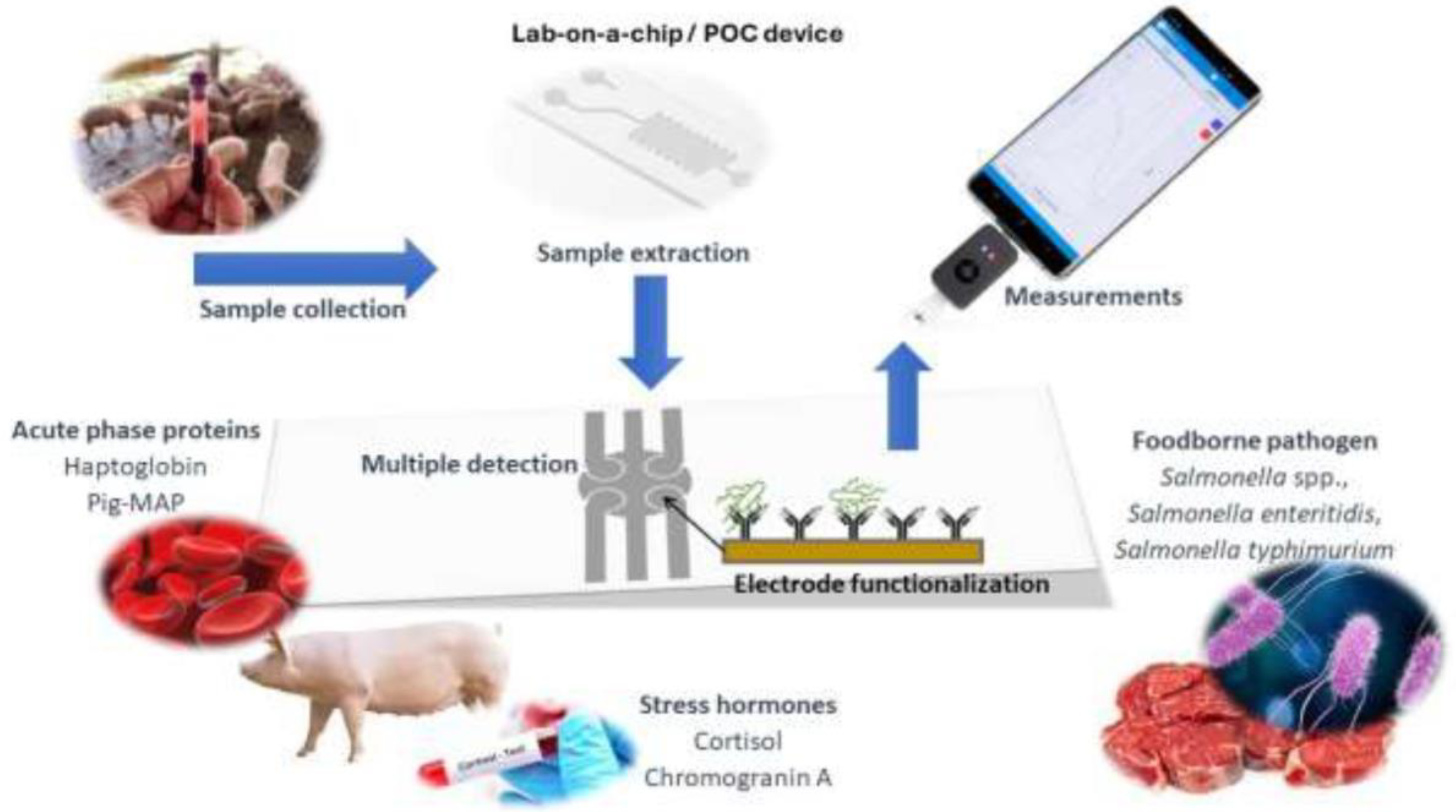
Biosensors play a crucial role in enhancing safety, quality, and efficiency within the meat supply chain. The application of biosensors in the meat chain spans all modules in F2F framework, ensuring that meat products are safe, of high quality, and traceable throughout the entire continuum. Their multiple applications in the meat production chain are presented in Figure 3.
4.1. Animal Health
In recent years, biosensors have been increasingly applied in the monitoring of animal health and welfare, including reproductive and nutrition status. As biosensors can provide real-time and reliable data on various biomarkers that indicate the general and specific health status of farm animals [2], they represent a powerful tool helping in the early detection of diseases, as well as the management of chronic conditions. Examples of applications of biosensors in the animal health sector are given in sections below.
4.1.1. Detection of Disease Markers
Blood Glucose Levels. Biosensors enable continuous glucose monitors (CGMs) and can be used for diabetic animals or those at risk of metabolic disorders (e.g. cetosis) [89,90]. Different enzymatic sensors have been proposed in the literature [91], while some commercial solutions are already available on the market for veterinary use [92]. Early information on blood glucose levels can help in adjusting timely the nutrition regime, as well as the farm environment to prevent the occurrence of metabolic disorders.
Hormonal Levels. Cortisol and/or Chromogranin A (CgA) sensors can monitor stress levels in animals, which can indicate welfare issues or the presence of disease [2,25,93]. Further, information on levels of specific stress hormones can also provide insight into farm husbandry practices and valuable data for the prediction of meat quality traits in further processing [93]. Recently, an electrochemical immunosensor with antibodies and aptamers as its bioreceptors has been proposed to monitor cortisol levels [95,96], MIP was used for voltametric determination of four hormones in urine with the ability of cortisol molecule detection at the concentration as low as 2 ag/mL [97] and different optical sensors are efficiently applied in animal welfare in the tracking of stress levels by in-site measuring stress related metabolites laves [98,99]. Apart from the invasive method that includes a collection of blood/plasma samples from animals, biosensors can also detect glucocorticoids using non-invasive sample materials, such as saliva, excreta, milk, hair/feathers and eggs [94]. A comprehensive review regarding detection of various metabolites and biomarkers in cattle was published outlining biosensors for the diagnosis of noncompliant pH, dark cutting beef predisposition, and welfare [100]. Wearable sensors were also extensively used for monitoring animal welfare in disease detection [101] where for example tattoo-based biosensors were utilized to monitor metabolites in interstitial fluid. pH, glucose, and albumin concentrations using minimally invasive, injectable skin biosensors [102].
Inflammatory Markers. Biosensors can measure levels of acute-phase proteins (e.g. C-Reactive Protein or Haptoglobin) which gives information on inflammation, infection or injury, as well as cytokines (TNF-alpha and IL-6) which are indicators of immune response and inflammation in animals. Namely, a poorly managed farm biosecurity may lead to the occurrence of different acute and chronic disease conditions in food producing animals (e.g. cattle, pigs, poultry) [103] induced by a variety of pathogens of viral and bacterial origin provoking a range of respiratory, gastrointestinal, skin and udder infections (e.g. rotavirus infections, bovine respiratory disease, bovine viral diarrhea, avian, pig of bovine influenza, mycoplasmosis, salmonellosis, colibacillosis, staphylococcosis, mastitis, etc.) [104,105,106]. Early information on specific acute phase proteins (APP) may contribute to assessing the general health status of animals, including unnoticed subclinical conditions, thus preventing further aggravation of disease conditions and/or carrying out timely therapeutic protocols [5,93]. For example, a biosensor detecting specific APP such as Haptoglobin (Hp) can provide real-time information on mastitis in milking cows [107] or inflammation/infection or trauma in beef and dairy herds [108] or future development of biosensors able to detect Pig-Major Acute Proteins (Pig-MAP) important for revealing infection with H3N2 swine influenza virus or other inflammatory conditions in pigs [103,109,110].
Metabolic Markers. Monitoring of selected markers associated with the metabolism of animals can be conducted by biosensors. For example, biosensors may provide useful information used for the diagnostic of disease by detection of VOCs from animals` breath, blood, faeces, skin, urine and vaginal fluids [2]. Breath metabolites are composed of gasses, (e.g. hydrogen and methane) and fatty acids which all can be used as specific biomarkers for the detection of certain metabolic and pathologic processes. For example, a higher level of glucose in the blood is detected by presence of specific VOCs, e.g. ketones, ethanol, methanol [111]. In livestock, these biosensors can accurately identify Bovine Respiratory Diseases (BRD) [112], brucellosis [113], bovine tuberculosis [114], Johne`s diseases [115], ketoacidosis [116], even Foot and Mouth (FMD) disease [117]. Other biosensors enable salivary detection of metabolites, such as the level of uric acid which high levels may be connected with a metabolic syndrome, renal syndrome or physical stress [118] or provide detection of perspiration metabolites such as concentration of sodium and lactate in sweat, giving information also about animal welfare (e.g. physical stress) [119].
Disease-associated pathogens. Recent developments released biosensors able to detect specific biomarkers from animals` fluids and tissues providing valuable input needed for diagnostic procedures for respiratory, gastrointestinal and other diseases.
In cattle, biosensors have been developed as a diagnostic method for Bovine Respiratory Disease (BRD) with high sensitivity and specificity to anti-IgE present in commercial anti-BHV_1 (Bovine Herpes Virus-1/BHV-1, the wild-type virus cause of BRD) and in real serum samples from cattle [106,120]. Another sensor was developed to detect a virus-provoking Bovine Viral Diarrhoea (BVD) from a cattle serum sample, with a very short detection time of only 8 min and LOD of 103 CCID/ml [105]. The sensor is able to detect bovine leukemia virus (BLV), a causative agent of Enzootic Bovine Leucosis (EBL) based on SPR phenomenon was developed [121], as well as a sensor for FMD detection which includes lateral flow immune-chromatographic platform for the detection of antibodies against FMD proteins [117]. In-field aptamer-based sensor was developed for the detection of bovine mycoplasma (M. bovis) [122], a disease affecting severely health of cattle provoking bronchopneumonia, mastitis and arthritis. Further, an online sensing system enabling automated California Mastitis Test (CMT) in milk has been developed [123], as well as a sensor for the detection of mastitis based on acute phase proteins (Haptoglobin) [124]. Further to this, a sensor for the detection of Prion protein (PrPC) causing Bovine Spongiform Encephalopathy (BSE), Creutzfeldt-Jakob disease in humans and scrapie in sheep [125], as well as a sensor for detection of Campylobacter in dairy livestock, based on magnetic beads functionalized with a C. jejuni-aptamer, that uses magnetic separation to isolate and enrich C. jejuni from samples, with the detection range of 10–107 colony forming units (CFU)/ml and LOD of 3 CFU/ml [126].
In pigs, different sensing systems are available, such as quartz crystal immunosensor for the detection of African Swine Fever virus (ASFV) developed in 1998 using diluted pig sera samples [127], followed by developed nanoplasmonic biosensor involving p30 protein-specific label-free integration into standard 96-well plates, able to detect ASFV in 20 min [128] proved in vitro environment, colorimetric sensor or aptamer-based sensor for detection of porcine reproductive and respiratory syndrome virus (PRRSV), respectively [129,130]. An important disease occurring in large scale commercial pig fattening farms causes serious impacts on livestock farms worldwide. In addition, a range of photonic (optical) integrated circuit (PIC) biosensors based on antibody (monoclonal)-antigen reactions were developed within SWINOSTICS project – Swine diseases field diagnostics toolbox (https://cordis.europa.eu/project/id/771649/results) for multiplex detection of six most important endemic and emerging viruses occurring in the pork production chain such as ASFV, Classical Swine Fever Virus (CSFV), PRRSV, Porcine Parvovirus (PPV), Porcine Circovirus 2 (PCV2), and Swine Influenza Virus A (SIV) [131,132], as well as photonic sensor for detection of porcine circovirus 2 (PCV2) causing porcine circovirus-associated disease (PCVAD) associated with attack to lymphoid tissues and consequent immunosuppression in pigs [133].
In poultry, an impedance immunosensor based on the detection of avian influenza-associated immobilised H5N1 antibodies providing limit of detection (LOD) of 103 EID50/ml (EID50: 50% Egg Infective Dose) has been developed [104] or a biosensor for detecting and differentiating between avian and human influenza viruses [134]. A biosensor containing mammalian cells as sensing elements able to detect enterotoxins of Clostridium perfringens (A, B, C, D, E, NetB, CnaA) causing necrotic enteritis in broiler chicken associated with significant economic losses to the global poultry industry due to high mortality rates, as well as provoking foodborne disease in humans due to sporulation of pathogen and development of toxin, have been proposed [135]. Further to this, a three-mode biosensor with ratiometric design (electrochemical/colorimetric, electrochemical/photothermal) based on DNA-driven magnetic beads (DMBs) has been developed to detect C. perfringens with very low LOD of only ultimately reduced to 0.26 and 0.27 lg/CFU and in samples in a real operational environment enabling its use in food safety and environmental monitoring [136]. The sensors based on SPR technology, which can accurately detect antibiotics` residues (e.g. fluoroquinolones and sulfonamides) in chicken muscle and blood serum are also available [137]. Although confirmatory methods for antibiotic residues depend on liquid chromatography-mass spectrometry (LC-MS) or a combination of liquid chromatography and ultra-violet detector (LC-UV) to determine the exact concentration of the analyte, biosensors can be effectively used for screening purposes (semi-quantitative measurements) [138] and serve as a very practical solution when there is a need for a large-scale detection of antibiotic residue in animals in farm-to-slaughterhouse continuum [137].
4.1.2. Monitoring Reproductive Health
Hormone Levels. Sensors can detect levels of hormones like progesterone and estrogen, which are critical in monitoring reproductive cycles and identifying fertility issues. Reproductive management of dairy herds is of great importance for the dairy industry, with missed estrus detection representing a main cause of economic losses. In the early stages, a biosensor that uses an enzyme immunoassay format for molecular recognition, was developed with a read-out time of 8 min [139]. A gold standard for the detection of progesterone, a hormone important for reproductive management of dairy cows, is based of antibodies which is expensive and often difficult to procure at the international market. In response to that, an affordable transcription factor-based sensor has been developed in a portable paper-fluidic format to serve for accurate and rapid detection of progesterone [140]. Another solution is a microbially-derived biosensor as an affordable, real-time sensor device able to detect progesterone in urine [141]. In addition, a fungal biosensor, based on the modified strain of the filamentous fungus Aspergillus nidulans, for the detection of estrogen activity in cows and pregnancy diagnosis is developed, after successful validation with blood, urine, feces, milk and saliva; the specificity of 100% and a sensitivity of more than 97% in milk, urine and feces [142]. Other examples are biosensors for detection of mycotoxins in cow`s milk, such as bioluminescent whole-cell biosensors for detection of zearalenone family mycotoxins allowing detection in less than 3 hours, based on the fat content in milk and providing an excellent screening device [143]. Other developed `mycotoxin biosensors` based on nanomaterials for the determination of mycotoxins as endocrine disruptors (EDMs) are also available [144], such as aptamer-based with LOD of 0.93 pg/mL [145] , 0.17 pg/mL [146] or even 1 pg/mL [147], as well as an antibody-based sensor with LOD of 0.1 M [148].
Estrus detection. Detection of estrus in animals is a crucial issue of high economic importance to farmers in livestock management to optimize reproductive efficiency and productivity. Standard sensor solutions are based on monitoring the vaginal conductivity and temperature, or wearable solution placed in the ventral tail to acquire data such as surface temperature, behavior, and ovulation [149]. Unfortunately, these solutions can only be confirmed at a rate of 50%–60%, which is lower than that obtained using a biosensor. Therefore, a metal-oxide electronic nose biosensor was developed to detect estrus based on odor release from the perineal headspace in dairy cattle by direct sampling [150], as well as biosensor to track the bovine estrous cycle by online measurement of milk progesterone [151].
Sperm Quality. Animal sperm quality assessment is crucial for reproductive success in livestock and wildlife management. A microfluidic biosensor with portable microscopic imaging system was designed to predict the reproductive ability of livestock [152]. Although methods based on counting and micro-imaging systems have demonstrated high accuracy in detecting sperm survival rates and fast detection time [153], recent advancements have led to the development of biosensors that evaluate sperm parameters such as motility, viability, and morphology, which are important markers in breeding programs.
4.2. Animal Welfare
The application of biosensors enables early detection of welfare issues (impact on health, stress, and environmental conditions), ensuring that animals are raised on farms, transported to livestock markets or slaughterhouses, and processed (slaughter and dressing) under conditions that minimize stress and suffering. These technologies enable facilitate humane handling practices and support regulatory compliance and consumer transparency. As biosensor technology continues to advance, its role in promoting higher standards of animal welfare in the meat industry is likely to grow, benefiting both animals and the industry. Examples of biosensors` application in animal welfare monitoring are given below.
4.2.1. Behavioral, Physiological and Nutrition Status Monitoring
Animal Intersticial Fluid (ISF). The recent development of biosensors enabled the detection of internal physiological factors as a component of strategies to improve animal welfare. Such an approach is dependent on the monitoring and accurate detection of specific traits (e.g. fluctuations of ISF) to understand physiological and behavioral changes in animals. With reference to this, a WAIT4 (Welfare: Artificial Intelligence and new Technologies for Tracking Key Indicator Traits in Animals Facing Challenges of the Agro-ecological Transition) is implemented with the aim to increase technical possibilities to assess animal welfare status. A new sensor has been proposed to assess the kinetics of key physiological variables (Na+, K+, pH) in ISF by microneedle patches, while the acquired data are to be analyzed and interpreted by machine learning algorithms in relation to animal welfare [154].
Saliva. Monitoring of lactate levels in animal saliva can be an indicator of the stress level, as well as health status of animals. Nowadays, the microfluidic sensing systems based on materials such as carbon nanotubes and graphene have become popular among animal handlers and farm owners to enzymatic uric acid detection in saliva, detect lactate variations and fluoride detection [156].
4.2.2. Transport and Handling
Stress Monitoring During Transport. Transport is a critical point within the meat chain where animal welfare can be compromised due to poor conditions related to factors such as watering, feeding, air flow, rest, load density, high or low temperature, humidity, etc. in a vehicle transporting animals from farm to the livestock market and/or slaughterhouse. Nowadays, besides standard sensor solutions for the measurement of heart rate and skin temperature of animals and environmental conditions within transporting vehicles, biosensors are widely used as stress indicators [155,156,157,158]. Salivary biomarkers are generally used to detect cortisol that evaluates the hypothalamic-pituitary-adrenal axis, salivary alpha-amylase (sAA) [159] and CgA that are related to the autonomous nervous system [160], and total esterase (TEA) and some of their components such as salivary lipase (sLip) and butyrylcholinesterase (BChE) which are enzymes that have been related to situations of pain and discomfort [161].
4.2.3. Pre-Slaughter Welfare Assessment
Biosensors can assess the physical and emotional state of animals before they are slaughtered, as well as monitor handling practices in slaughterhouses (unloading of livestock after transport, stay in lairage/pens, stunning procedure) ensuring that animals are treated humanely and in accordance with welfare standards and verifying human handling practices. The application of biosensors may also contribute to ante-mortem examination, a component of the meat inspection system, carried out by the official veterinarian. Monitoring parameters like cortisol levels using biosensors in combination with heart rate can help to ensure that animals are calm and not experiencing unnecessary stress which is important for both welfare and meat quality [93,162], while increased body temperature may be connected with the animal health condition. Such application of biosensors may also add to more automated ante-mortem clinical examination of animals intended for slaughter and increase the relevance of meat inspection, by providing accurate data for Food Information Chain (FCI) used for risk assessment in farm-slaughterhouse continuum.
4.2.4. Application in Precision Livestock Farming
The application of biosensors in large animal populations in intensive commercial farming has an excellent potential. Some of biosensors` applications within the precision livestock farming (PLF) system include examples given below.
Early Disease Detection. Biosensors can be used to detect early signs of disease in large herds, allowing for timely intervention. For example, a proactive approach related to the application of biosensors for the detection of disease outbreaks through farm wastewater-based epidemiology (WBE) has been recently proposed to collect comprehensive environmental and public health data to assist in timely health interventions during the COVID-19 outbreak [163]. Such an approach can also be a novel solution to monitor animal health on farms using wastewater discharge to detect the presence of disease causative agents which should allow timely intervention either to maintain the health of food-producing animals or monitor fecally associated discharges of pathogens/AMR-genes to prevent cross-contamination of the environment. Another approach is the possibility of detecting animal infectious diseases and/or pathogens of high public health importance, using nano-based biosensors [2].
In all, there is a good perspective associated with the use of biosensors in animal health and welfare monitoring within PLF systems since they offer numerous advantages, such as non-invasive or minimally invasive approach, providing real-time data for farmers and veterinarians, which is crucial for early detection of animal health and welfare status and targeted interventions. The data acquired through regular application of biosensors enable continuous monitoring of selected health and welfare parameters of food-producing animals on farms and its integration within data management systems, allowing for automated health monitoring and analysis. The major challenges for the introduction of sensors into regular monitoring schemes related to animal health are related to biosensors` accuracy and calibration to provide reliable data since it encompasses animals wearing or being implanted with biosensors, as well as costs and scalability to deploy them across large populations of animals.
4.2.5. Slaughterhouse and Meat Processing
Post-Slaughter Indicators. Monitoring selected biochemical markers post-slaughter can provide information on whether animals were stressed and ill before slaughter, namely on animal welfare (e.g. stress hormones, such as Cortisol, Cg A) and general animal health status (e.g. acute phase proteins, such as Haptoglobin, Pig-MAP) which can be used to improve welfare practices and farm biosecurity [93].
Pathogen detection. Biosensors Food-borne pathogens can enter the meat chain at various and multiple points along F2F continuum, including during slaughter, processing, packaging, and distribution (Figure 2). Contamination with these pathogens poses serious health risks to consumers, including foodborne illnesses that can lead to severe outcomes or even fatalities. In the meat production chain, biosensors can be applied at various stages, from prevalence of foodborne pathogens on farm, up to raw material inspection, to the final product testing, enhancing the ability to quickly detect contamination and enabling timely response (e.g. control measures and corrective actions). This helps in preventing outbreaks of foodborne illnesses and maintaining consumer trust in meat products. Biosensors operating at different transducing principle are increasingly used for detecting foodborne pathogens and contaminants, ensuring food safety and public health. They can identify pathogens such as Salmonella, E. coli, Listeria monocytogenes, and viruses by targeting specific proteins or DNA sequences [164,165,166,167,168,169]. Some examples include, electrochemical biosensors leveraging antibody-antigen binding or aptamer-based approaches can achieve highly sensitive detection of Salmonella or E. coli in various food matrices [170,171,172], phagosensors biosensors that use bacteriophages as a bioreceptor to detect enteric bacteria in water samples, including S. typhimurium [173], biosensor for detection of S. typhimurium in eggshells [174], or biosensor based on antimicrobial peptides as a bioreceptors for Salmonella detection by electrochemical impedance [175]. Different optical biosensors, including fluorescent and colorimetric have been proposed as well, including aptasensors which are fluorescently labelled to enable the detection of E. coli [176], antibody-based nano biosensors used to enable high sensitivity of E. coli in food and water samples [177], or colorimetric sensor for milk samples [178]. In addition, a reusable sensor based on QCM technology with antifouling nano-coatings on the sensing surface for accurate detection of E. coli in liquid (milk) or solid (hamburgers) food samples [179], the FET platforms for the detection of gram-positive and gram-negative bacteria species, such as a multiplex detection biosensor based on an organic FET for the detection of two types of Gram-positive and -negative bacteria [180], nanozyme-mediated MRS DNA biosensor for the rapid detection of Listeria monocytogenes [181], and many others can be found in literature.
Chemical contaminants. Antibiotics are widely used as bacteriostatic agents to combat microbial infection in animals, almost unavoidable in the treatment of bacterial infections. Inappropriate antibiotic drug dosages, on the other hand, may result in antibiotic residues in livestock and poultry products (meat, milk, and eggs), aquatic products, and vegetables, resulting in a variety of side effects on human health. Antibiotic residues promote the spread of antibiotic-resistant bacteria, cause allergies like penicillin, and cause other severe pathologies such as cancers (oxytetracycline, sulfamethazine, and furazolidone), bone marrow toxicity, mutagenic effects, anaphylactic shock, reproductive disorders (chloramphenicol), nephropathy (gentamicin). Biosensors are also used for the detection of chemical contaminants such as antibiotics [182,183] which is critical given the concern over antimicrobial resistance and to ensure that meat/meat products comply with regulatory antibiotics residue limits; pesticides that can accumulate in animal tissues and meat [184,185,186], growth hormones used to promote growth in livestock [187], dioxins [188], sulfadiazine and acetaminophen [189] that can enter the meat chain through various environmental pathways, including contaminated feed, industrial pollution. Biosensor can be additionally used to detect bioaccumulation of heavy metals such as lead, cadmium, and mercury, which can contaminate meat through environmental exposure [190], as well as natural toxins (mycotoxins) such as Aflatoxins, Ochratoxin A, Fumonisins, Zearalenone, Trichothecenes, that can accumulate in tissues of food producing animals due to consumption of contaminated feed [191,192] and pose risks to consumers` health.
AMR detection. In the era of increasing AMR related to pathogens of public health importance, including foodborne, rapid detection and monitoring of antibiotic resistance in the meat production chain is of utmost importance to control and prevent its spread, particularly in international trade. Current methods allow separate detection of either selected pathogen via traditional (culturing), immunoassay (ELISA), and molecular methods PCR or antibiotic resistance genes via molecular methods such as PCR, DNA microarray, whole-genome sequencing (WGS) and metagenomics [193], thus requiring multiple assays. Therefore, there is a need for POC devices that can simultaneously detect pathogen (infectious agent) and their antibiotic resistance at the given module along the meat chain. For example, in 2008 an optical, silicon-based biosensor was developed to detect the tuf gene in blood culture for the identification of the Staphylococcus genus, the femB gene for the identification of S. aureus species, and the mecA gene for the identification of methicillin-resistance with LOD = 5 × 10⁷ CFU/mL [194] or electrochemical sensor to be used in bacterial culture combining a new class of non-biological binder molecules with electrochemical impedance spectroscopy (EIS)-based sensor detection for detection of Gram-positive bacteria [195] or integrated, dual channel electrochemical biosensor for detection of Enteropathogenic (EPEC) E. coli based on monoclonal antibody against a virulence marker (EspB), and markers for AMR detection (β-lactam resistance marker, β-lactamase) developed in [196]. Integration of biosensors can have a profoundly beneficial impact in tackling one of the most important global public health challenges such as antimicrobial resistance and should be conducted within the One Health context [197] to cover environment-animals-humans` ecological compartments.
4.3. Meat Quality Traits
Biosensors are increasingly used for rapid and accurate detection of the most important meat quality traits, such as freshness, sensory and nutritional attributes and spoilage of meat and meat products. Some examples of biosensors` application are given below.
Freshness and spoilage. Biosensors can measure freshness and/or spoilage of meat/meat products by detecting levels of certain compounds typically associated with the degradation of meat proteins and lipids including purine derivatives such as hypoxanthine and xanthine [198], ammonia [199], trimethylamine [200], or hydrogen sulfide [201] or food spoilage biomarkers such as volatile organic gases, microorganisms, or enzymes [202].
Sensory and nutritional attributes. The road of fresh meat piece from the slaughterhouses to the consumers is not always available and, therefore, the development of easy-to-use POC devices for meat freshness can help the consumers to buy meat as fresh as possible. Some biosensors assess meat quality traits related to sensory characteristics and nutritional value. For example, biosensors can detect visual texture, color, visible fat and natural drip in raw meat [203] or aroma and flavor in thermally-processed meat [204] by detecting changes in specific proteins or metabolites, or biosensor can evaluate freeze/thaw cycles from the detection of hemin in beef samples [205]. A series of graphene FET-based electronic noses have been developed so far for in-field and rapid food freshness evaluation under refrigerator and room-temperature conditions for the detection and quantification of olfactory compounds [206,207,208].
4.4. Food Fraud & Food Crime
Food fraud is a globally widespread concern and is also frequently associated with meat products. Biosensors are increasingly valuable in combating food fraud and food crime in the food (meat) production chain. Their ability to provide precise, real-time, and reliable data helps ensure the authenticity and safety of meat products. Some examples of biosensors` application to address these issues are given below.
Detection of Adulteration. Biosensors are used to detect chemical adulterants, and this is related to unauthorized chemicals or food additives or packaging materials that may be used to alter the appearance or quality of meat [209,210]. A specifically functionalized graphene derivative, was employed for development of impedimetric genosensor for pork adulteration in real meat samples with determination limit of detection by these sensors of 9% W/W for pork content in beef [211], and the MIP nano gel-based sensor is proposed for the detection of pork contamination in real beef extract samples showed a LOD of 12 µg/mL [78]. These sensors can also identify specific chemical markers or residues indicative of fraud.
Species and origin authentication. Biosensors can verify the species of meat, helping to prevent fraud where cheaper or different species are substituted for higher-value meats. A portable multifunction biosensor (PMB) has been developed to detect pork in food which integrates Recombinase Polymerase Amplification (RPA), clustered regularly interspaced short palindromic repeats (CRISPR)/Cas12a assay (enabling accurate POC testing in the field), and a custom-designed 3D-printed multifunction device and enables rapid reaction time between 20–30 min, with a sensitivity of 0.01 g/100 g [147]. The spectroscopy-based sensors were developed to detect frequent fraudulent practices related to minced meat substitution with cheaper raw material, such as beef with bovine offal and pork with chicken [212]. Similar sensors might be also used for the detection of the authenticity of high-value products such as Wagyu or Kobe beef. In the global market, many meat products are officially protected bearing the mark `Protected Designation of Origin` (PDO) or `Protected Geographical Indications` (PGI). Such products typically have a higher market value and because of that are more vulnerable to fraudulent practices associated with use of cheaper raw materials from other species or geographical regions than it is presented in a label. DNA-based biosensors can accurately identify meat species by analyzing genetic material and can be proactive and cost-effective approach to provide food authenticity and verify food origin [27]. This is also because DNA is more stable and can stand harsh environmental conditions in comparison with proteins and metabolites thus being an excellent solution as a bioreceptor for the quantitative detection of food fraud and adulteration [213,214].
Biosensors can be used in combination with other traceability technologies to verify the origin of meat products. For example, sensors embedded in packaging or labels can track and authenticate the meat’s journey from farm to table, ensuring that claims about origin are accurate thus contributing to smarter food traceability [33].
Consumer protection. Portable biosensors can allow on-site testing to determine the quality and authenticity of meat products in retail settings or at home, such as verification of product labels or packaging to check claims made about the meat’s origin, quality, or content [214]. This adds a layer of transparency and trust, empowers consumers to make informed choices and reduces the risk of being exposed to fraudulent practices.
In all, the deployment of biosensors in detecting the meat quality traits can be an asset for competent authorities (inspection) verifying compliance of meat products with food quality regulations, as well as facilitating quicker response to potential food fraud. Consumers may also benefit from using the biosensors to ensure to receive the product they are paying for, thus reducing the risk of fraudulent labeling.
4.5. Risk-Based Meat Safety Assurance System
Biosensors can become an integral part of the risk-based meat safety assurance system (RB-MSAS) providing real-time monitoring of selected foodborne hazards and ensuring meat safety throughout the production chain and should be also included in the future training of official veterinarians to monitor the RB-MSAS [215,216]. The overview of the application of biosensors in the meat production chain, is presented in Table 1.
Their contribution to the RB-MSAS is important since they enable the integration of data acquired along all modules in the meat chain (farm-slaughterhouse-meat processing-distribution-retail continuum) via IoT, such as blockchain approach [216]. Namely, it allows the integration of data from various stages of production and inspection into a centralized system for comprehensive monitoring of meat safety allowing a holistic approach. For example, biosensors contribute to the Food Chain Information (FCI) dataset by providing real-time information on foodborne hazards and facilitating FCI flow from farm to slaughterhouse/meat processing/retail (bottom-up) and backward, from retail to farm (top-down). This also enables record keeping and tracking of meat products from production to the point of sale within the blockchain system [33]. This may help maintain comprehensive records of safety and quality checks throughout the supply chain, analyze trends and conduct risk assessment using AI and ML. It is also important to enable interoperability to ensure that acquired data are compatible with existing food chain information systems which should facilitate seamless integration and enhances the overall effectiveness of MSAS (Figure 4). Further, the important contribution of biosensors` application within MSAS is related to epidemiological monitoring and surveillance by providing accurate and timely information on potential food-borne hazards in various modules along the meat chain, including outbreaks, thus enabling comparative analysis of meat safety data from various sources via Harmonized Epidemiological Indicators (HEIs) [216,217]. Another advantage of biosensors within MSAS is the capability to automatically generate reports for regulatory compliance, documenting adherence to food safety regulations. By aligning biosensor data with HEIs, competent authorities can perform better risk assessments and manage risks associated with meat products, leading to more effective interventions and public health protection. This helps competent authorities in risk management decisions and allocating resources more effectively, focusing on the most critical points in the production chain. Parallel to that, it also contributes to increasing consumer confidence in food control system providing better transparency. Overall, by integrating biosensors` data into comprehensive RB-MSAS, the meat industry can achieve better risk management, operational efficiency, and build consumers` trust in the safety of meat/meat products.
4.6. Opportunities and Challenges for Biosensors` Application in the Meat Production Chain
Due to the complexity of the meat supply chain, frequently associated with long storage and distribution/transport periods of meat/meat products based on specific requirements of retail chains, biosensors are needed to enable proper real-time monitoring in all phases of the production [26]. As discussed above, biosensors can enhance food safety, quality control, and traceability in the food chain. The opportunities for future application of biosensors along the meat chain are numerous and they relate to improved food safety monitoring, quality control and shelf-life monitoring, traceability and authenticity and real-time production process control [218].
Figure 5.
A structure model of biosensor for application in the meat chain.
Improved food safety monitoring. As discussed, biosensors offer rapid, on-site detection of pathogenic microorganisms such as Salmonella, Escherichia coli, Listeria monocytogenes, and Campylobacter, which are common in meat production. Biosensors can detect these foodborne pathogens at low levels before contamination spreads through the supply chain thus allowing timely actions to prevent the further transfer of pathogens along the meat chain [219].
Quality control and shelf-life monitoring. Biosensors can track the freshness of meat by detecting VOCs or pH changes associated with spoilage, which are crucial for ensuring product quality [202].
Traceability and authenticity. Biosensors enable the detection of DNA or protein markers specific to animal species, which helps in verifying meat authenticity, thus preventing fraud (e.g., mislabeling or adulteration) [27].
Real-time production process control. The integration of biosensors in automated systems allows continuous monitoring along all modules in the meat chain [36], such as farm (animal welfare and health), during slaughtering and meat cutting (microbial process hygiene), and packaging processes (control of cross-contamination), enhancing the efficiency of quality control and reducing human error.
Challenges to the regular application of biosensors are related to several gaps that may limit their widespread adoption and effectiveness. Identifying these gaps is crucial for guiding further research and development. Some examples are given below.
Limited Range of Detection. Many biosensors are designed to detect specific pathogens, contaminants, or spoilage markers, but the range of the detection is often narrow and does not correspond either with the regulatory limits or the recommended values according to the best practices. Therefore, the issue related to detection range (an appropriate level of detection, not always related with the lowest possible limits) should correspond with food regulations and market requirements and allow a balanced approach in the technological development of biosensors [220].
Sensitivity and Specificity. This issue is related to false positives or negatives. The specificity of biosensors can be compromised by cross-reactivity, leading to false positives (detecting a hazard where none exists) or false negatives (failing to detect an actual hazard) [218]. This is particularly an issue in complex samples within the meat production chain (e.g. feces, slurry, carcass, meat juice, meat product) which contain dirt, proteins, fats and other compounds that could interfere with the biosensor's ability to detect specific analytes. Overcoming these interferences is essential for reliable, accurate measurements in real-world applications.
Lack of Standardization and Calibration. Biosensors can suffer from variability in their performance due to differences in calibration, environmental conditions, or the biological materials used. This lack of standardization can lead to inconsistent results and limit the reliability of biosensors in diverse settings [31].
Environmental and operational conditions. Since meat production environments (farms, slaughterhouses, processing plants, etc.) are subject to extreme conditions like fluctuating temperatures, humidity, and the presence of organic matter, these factors can affect the performance and durability of biosensors, limiting their usability in harsh operational settings.
Regulatory Compliance and Auditing. Biosensors, particularly those used in food safety and quality control, face strict regulatory frameworks that vary across regions, such as the European Food Safety Authority (EFSA) and European Medicine Agency (EMA) in the European Union or Food and Drug Administration (FDA) regulations in the United States. The adoption of new biosensor technologies requires adherence to these regulations and approval based on long-term validation data. This can delay the adoption of innovative biosensors in the meat industry which can delay commercialization and widespread use [220].
High costs and commercialization issues. The major challenges are related to costs and economic feasibility, especially for those biosensors with advanced capabilities, which remains a barrier to their widespread adoption, particularly for small and medium-sized enterprises (SMEs) in the meat industry. Other concern is the potential for commercial applications of biosensors with regard to complexity (integration with existing meat safety inspection systems, such as MSAS, which can be complex and require training) and accuracy (calibration to avoid interference from other substances and ensure accurate results). Namely, the integration of sensing systems with MSAS may require significant and costly modifications to equipment or workflows to enable data management and their interpretation. Therefore, ensuring that biosensor technology is affordable is crucial for its widespread adoption and regular use.
Ethical considerations. The primary issue is to ensure that biosensor devices do not cause any discomfort or harm to the animals. Other ethical aspects relate to concerns around animal welfare, data privacy, economic equity, environmental impact, consumer trust, labor dynamics, and regulatory oversight to ensure that this technology contributes positively to the meat industry and society as a whole.
5. Conclusions
The application of biosensors in the meat production chain represents an advancement that may contribute to the food systems transformation enhancing animal health and welfare, food safety and food quality control, the reduction of climate change impact, increasing consumers` confidence in meat business operators and fostering transparency regarding data management. The biosensors, as POC devices capable of monitoring biomarkers specific for animal health (acute phase proteins) and welfare (stress hormones), microbial contamination (foodborne pathogens, e.g. Salmonella, Campylobacter, STEC, L. monocytogenes), AMR (resistance genes) and environmental contaminants (pesticides, dioxins, mycotoxins), have the potential to address several longstanding challenges in the meat industry. One of the key benefits of biosensors is their ability to improve food safety by rapid quantitative detection of foodborne pathogens and contaminants along modules in the meat production chain (farm-slaughterhouse-meat processing-retail continuum) in real-time. This not only minimizes the risk of occurrence of foodborne illnesses but also strengthens consumer confidence in the meat supply chain. Additionally, by monitoring the health and well-being of livestock, biosensors can contribute to higher farm biosecurity and welfare standards and more efficient production practices. Furthermore, meat supply chain transparency is enhanced as biosensors provide traceable data that may be deposited in open access platforms, allowing consumers to make informed choices. However, the deployment of biosensors also raises important ethical questions, such as ensuring that biosensors do not cause any discomfort or harm to the animals, as well as enabling certain level of data privacy on animal health, welfare, and food safety. Challenges also include maintaining economic equity related to a certain meat business operator. For example, small-scale farmers and meat business operators may face barriers to accessing this technology due to high costs risking further inequalities in the industry. Therefore, initiatives to subsidize or make biosensors more affordable to all stakeholders involved in the meat production chain are crucial. In addition, automation in animal health, welfare and food safety monitoring and data-driven processes for analyses and risk assessment based on AI and large language models (LLM) could displace workers, necessitating retraining programs to support affected individuals. Further, respect for traditional knowledge and practices is crucial in balancing innovation with cultural heritage and preserving traditional production practices characteristic for certain geographical regions and national habits. Environmental considerations also play a significant role. While biosensors can optimize resource use (e.g. optimized animal nutrition and health) and reduce waste, the attention should be also given to production and disposal of these devices which must be managed responsibly to prevent ecological harm. Using sustainable materials in biosensors` manufacturing and recycling programs can mitigate such impacts. Additional efforts should be made in terms of integrating data acquired by biosensors within RB-MSAS to contribute to FCI flow and HEIs and enhance the integrated approach toward meat safety. It will improve consumer confidence in livestock raising conditions and food control systems, as well as foster informed purchasing decisions. The vast amounts of information generated by biosensors require robust governance frameworks to ensure fair usage and protect key stakeholders' rights (industry, competent authorities, researchers, and consumers). To realize the full potential of biosensors` application in the meat chain, collaborative efforts among key stakeholders will be essential. Further research should be done to address not only technical aspects in biosensors` manufacturing (nanomaterials, detection methods, sensitivity) and environmental protection, but also to develop a model system for its application to achieve regulatory approval. Additional efforts should be made to find appropriate solutions regarding socioeconomic aspects related to biosensors` affordability and inclusivity of small-scale producers. The research efforts should ideally be conducted through a trans-disciplinary collaboration between life and social sciences/humanities to achieve acceptable and fit-for-purpose solutions enabling a more efficient and sustainable meat industry.
Declaration of interest statement
The authors declare herewith no conflict of interest related to this review paper.
List of Abbreviations (in Alphabetical Order)
| AI | Artificial Intelligence |
| AMR | Antimicrobial Resistance |
| ASFV | African Swine Fever virus |
| ASSURED | Affordable, Sensitive, Specific, User-friendly, Rapid and Robust, Equipment free, Deliverable |
| BHV | Bovine Herpes Virus |
| BRD | Bovine Respiratory Disease |
| BSE | Bovine Spongiform Encephalopathy |
| BVD | Bovine Viral Diarrhoea |
| CIA | WHO Critically Important Antibiotics |
| CFU | Colony Forming Units |
| CgA | Chromagronin A |
| CGM | Continuous glucose monitors |
| CMT | California Mastitis Test |
| COVID-19 | Corona Virus Disease of 2019 |
| CRISPR | Clustered regularly interspaced short palindromic repeats |
| CSFV | Classical Swine Fever Virus |
| 2D | Two dimensional |
| DMBs | Driven magnetic beads |
| DNA | Deoxyribonucleic Acid |
| EBL | Enzootic Bovine Leucosis |
| EFSA | European Food Safety Authority |
| EID | Egg infective dose |
| EIS | Electrochemical impedance spectroscopy |
| EMA | European Medicine Agency |
| ELISA | Enzyme-linked Immunosorbent Assay |
| EPEC | Enteropathogenic E. coli |
| F2F | Farm-to-Fork |
| FCI | Food Chain Information |
| FDA | Food and Drug Administration |
| FET | Field-effect transistor |
| FMD | Foot and Mouth Diseases |
| IoT | Internet of Things |
| GHG | Greenhouse Gases |
| HACCP | Hazard Analysis and Critical Control Points |
| HEIs | Harmonized Epidemiological Indicators |
| HHSP | Heard Health Surveillance Programme |
| HPLC | Reaction - PCR, High Performance Liquid Chromatography |
| ISF | Animal Intersticial Fluid |
| ISO | International Standard Organization |
| LC-MS | Liquid chromatography - mass spectrometry |
| LC-UV | Liquid chromatography and UV detector |
| LED | Light Emitting Diode |
| LOC | Lab-on-a-Chip |
| LOD | Limit of detection |
| LLM | Large Language Models |
| MIA | WHO Medically Important Antibiotics |
| MIPs | Molecularly Imprinted Polymers |
| ML | Machine Learning |
| MRS | Magnetic Relaxation Switching |
| POC | Point-of-Care |
| PCR | Polymerase Chain Reaction |
| PCV | Porcine circovirus |
| PCVAD | Porcine circovirus-associated disease |
| PDO | Protected Designation of Origin |
| PGI | Protected Geographical Indication |
| Pig-MAP | Pig Major Acute Proteins |
| PLF | Precision Livestock Farming |
| PMB | Portable multifunction biosensor |
| PrPc | Prion protein |
| PRRSV | Porcine reproductive and respiratory syndrome virus |
| PIC | Photonic integrated circuit |
| PPV | Porcine Parvovirus |
| QCM | Quartz Crystal Microbalance (Resonator) |
| RPA | Recombinase Polymerase Amplification |
| RB-MSAS | Risk-based meat safety assurance system |
| SAW | Surface Acoustic Wave |
| SERS | Surface Enhanced Raman Spectroscopy |
| SIV | Swine Influenza Virus |
| SMEs | Small and medium-sized enterprises |
| SPR | Surface plasmon resonance |
| STEC | Shiga toxin-producing E. coli |
| VOCs | Volatile Organic Compounds |
| WBE | Wastewater-based epidemiology |
| WGS | Whole-genome sequencing |
| WHO | World Health Organization |
Author Contributions
IN had a role in conceptualization, methodology, data acquisition and analysis, writing original draft, supervision, validation, editing and providing a critical review; IK participated in data acquisition, data analysis and writing original draft; SJ contributed in data acquisition and writing original draft; ZP contributed in data acquisition and writing original draft; MR contributed in data acquisition and writing original draft; VR contributed in conceptualization, data acquisition and analysis, writing original draft, validation, editing and providing a critical review.
Acknowledgments
This work is supported by the Science Fund of Republic of Serbia, project `Microfluidic Lab-on-a-Chip platform for fast detection of pathogenic bacteria using novel electrochemical aptamer-based biosensors` (MicroLabAptaSens) (Grant number:7750276, from 24.12.2021.).
References
- Rios, T.B.; Maximiano, M.R.; Feitosa, G.C.; Malmsten, M.; Franco, O.L. Nanosensors for Animal Infectious Disease Detection. Sens Biosensing Res 2024, 43, 100622. [Google Scholar] [CrossRef]
- Neethirajan, S. Recent Advances in Wearable Sensors for Animal Health Management. Sens Biosensing Res 2017, 12, 15–29. [Google Scholar] [CrossRef]
- Nastasijević, I.; Podunavac, I.; Janković, S.; Mitrović, R.; Radonić, V. Challenges in Agri-Food Chain: Biosensors in the Meat Production System. Meat Technology 2023, 64, 101–105. [Google Scholar] [CrossRef]
- Li, S.; Hao, X.; Wang, Z.; Le, T.; Zou, S.; Cao, X. Lab-on-a-Chip Analytical Devices. In Micro- and Nanotechnology Enabled Applications for Portable Miniaturized Analytical Systems; Elsevier, 2022; pp. 355–374.
- Manessis, G.; Gelasakis, A.I.; Bossis, I. Point-of-Care Diagnostics for Farm Animal Diseases: From Biosensors to Integrated Lab-on-Chip Devices. Biosensors (Basel) 2022, 12, 455. [Google Scholar] [CrossRef]
- Lu, Y.; Zhang, J.; Lu, X.; Liu, Q. Isothermal Nucleic Acid Amplification Based Microfluidic “Lab-on-a-Chip” for the Detection of Pathogenic Bacteria and Viruses in Agri-Foods. Trends Food Sci Technol 2024, 148, 104482. [Google Scholar] [CrossRef]
- Buncic, S.; Nychas, G.-J.; Lee, M.R.F.; Koutsoumanis, K.; Hébraud, M.; Desvaux, M.; Chorianopoulos, N.; Bolton, D.; Blagojevic, B.; Antic, D. Microbial Pathogen Control in the Beef Chain: Recent Research Advances. Meat Sci 2014, 97, 288–297. [Google Scholar] [CrossRef]
- Koutsoumanis, K.; Allende, A.; Bolton, D.; Bover-Cid, S.; Chemaly, M.; De Cesare, A.; Herman, L.; Hilbert, F.; Lindqvist, R.; Nauta, M.; et al. Persistence of Microbiological Hazards in Food and Feed Production and Processing Environments. EFSA Journal 2024, 22. [Google Scholar] [CrossRef]
- Xu, Y.; Cui, L.; Tian, C.; Li, S.; Cao, J.; Liu, Z.; Zhang, G. A Multiplex Polymerase Chain Reaction Coupled with High-Performance Liquid Chromatography Assay for Simultaneous Detection of Six Foodborne Pathogens. Food Control 2012, 25, 778–783. [Google Scholar] [CrossRef]
- Bhunia, A.K. One Day to One Hour: How Quickly Can Foodborne Pathogens Be Detected? Future Microbiol 2014, 9, 935–946. [Google Scholar] [CrossRef]
- Bhardwaj, T.; Ramana, L.N.; Sharma, T.K. Current Advancements and Future Road Map to Develop ASSURED Microfluidic Biosensors for Infectious and Non-Infectious Diseases. Biosensors (Basel) 2022, 12, 357. [Google Scholar] [CrossRef]
- Land, K.J.; Boeras, D.I.; Chen, X.-S.; Ramsay, A.R.; Peeling, R.W. REASSURED Diagnostics to Inform Disease Control Strategies, Strengthen Health Systems and Improve Patient Outcomes. Nat Microbiol 2018, 4, 46–54. [Google Scholar] [CrossRef] [PubMed]
- Bankole, O.E.; Verma, D.K.; Chávez González, M.L.; Ceferino, J.G.; Sandoval-Cortés, J.; Aguilar, C.N. Recent Trends and Technical Advancements in Biosensors and Their Emerging Applications in Food and Bioscience. Food Biosci 2022, 47, 101695. [Google Scholar] [CrossRef]
- Mi, F.; Hu, C.; Wang, Y.; Wang, L.; Peng, F.; Geng, P.; Guan, M. Recent Advancements in Microfluidic Chip Biosensor Detection of Foodborne Pathogenic Bacteria: A Review. Anal Bioanal Chem 2022, 414, 2883–2902. [Google Scholar] [CrossRef] [PubMed]
- de Araújo, P.D.; Araújo, W.M.C.; Patarata, L.; Fraqueza, M.J. Understanding the Main Factors That Influence Consumer Quality Perception and Attitude towards Meat and Processed Meat Products. Meat Sci 2022, 193, 108952. [Google Scholar] [CrossRef]
- United Nations Framework Convention on Climate Change. United Nations, (accessed on 3 September 2024).
- FAO. 2022. Thinking about the future of food safety – A foresight report. Available online: https://openknowledge.fao.org/server/api/core/bitstreams/acfc4e93-8702-47da-acd2-7bf064ea9b0b/content (accessed on 27 August 2024). [CrossRef]
- Poirel, L.; Madec, J.-Y.; Lupo, A.; Schink, A.-K.; Kieffer, N.; Nordmann, P.; Schwarz, S. Antimicrobial Resistance in Escherichia Coli. Microbiol Spectr 2018, 6. [Google Scholar] [CrossRef]
- Van Puyvelde, S.; Pickard, D.; Vandelannoote, K.; Heinz, E.; Barbé, B.; de Block, T.; Clare, S.; Coomber, E.L.; Harcourt, K.; Sridhar, S.; et al. An African Salmonella Typhimurium ST313 Sublineage with Extensive Drug-Resistance and Signatures of Host Adaptation. Nat Commun 2019, 10, 4280. [Google Scholar] [CrossRef]
- Critically important antimicrobials for human medicine, 6th revision. Geneva: World Health Organization; 2019. License: CC BY-NC-SA 3.0 IGO. https://iris.who.int/bitstream/handle/10665/312266/9789241515528-eng.pdf? (accessed on 19 December 2024).
- WHO's List of Medically Important Antimicrobials: a risk management tool for mitigating antimicrobial resistance due to non-human use. Geneva: World Health Organization; 2024. License: CC BY-NC-SA 3.0 IGO. https://cdn.who.int/media/docs/default-source/gcp/who-mia-list-2024-lv. (accessed on 19 December 2024).
- Niloofar, P.; Francis, D.P.; Lazarova-Molnar, S.; Vulpe, A.; Vochin, M.-C.; Suciu, G.; Balanescu, M.; Anestis, V.; Bartzanas, T. Data-Driven Decision Support in Livestock Farming for Improved Animal Health, Welfare and Greenhouse Gas Emissions: Overview and Challenges. Comput Electron Agric 2021, 190, 106406. [Google Scholar] [CrossRef]
- Diep Trinh, T.N.; Trinh, K.T.L.; Lee, N.Y. Microfluidic Advances in Food Safety Control. Food Research International 2024, 176, 113799. [Google Scholar] [CrossRef]
- Kumar, P.; Ahmed, M.A.; Abubakar, A.A.; Hayat, M.N.; Kaka, U.; Ajat, M.; Goh, Y.M.; Sazili, A.Q. Improving Animal Welfare Status and Meat Quality through Assessment of Stress Biomarkers: A Critical Review. Meat Sci 2023, 197, 109048. [Google Scholar] [CrossRef]
- Kaswan, S.; Chandratre, G.A.; Upadhyay, D.; Sharma, A.; Sreekala, S.M.; Badgujar, P.C.; Panda, P.; Ruchay, A. Applications of Sensors in Livestock Management. In Engineering Applications in Livestock Production; Elsevier, 2024; pp. 63–92.
- Nanda, P.K.; Bhattacharya, D.; Das, J.K.; Bandyopadhyay, S.; Ekhlas, D.; Lorenzo, J.M.; Dandapat, P.; Alessandroni, L.; Das, A.K.; Gagaoua, M. Emerging Role of Biosensors and Chemical Indicators to Monitor the Quality and Safety of Meat and Meat Products. Chemosensors 2022, 10, 322. [Google Scholar] [CrossRef]
- Barrias, S.; Ibáñez, J.; Fernandes, J.R.; Martins-Lopes, P. The Role of DNA-Based Biosensors in Species Identification for Food Authenticity Assessment. Trends Food Sci Technol 2024, 145, 104350. [Google Scholar] [CrossRef]
- Flauzino, J.M.R.; Alves, L.M.; Rodovalho, V.R.; Madurro, J.M.; Brito Madurro, A.G. Application of Biosensors for Detection of Meat Species: A Short Review. Food Control 2022, 142, 109214. [Google Scholar] [CrossRef]
- Pawar, D.; Lo Presti, D.; Silvestri, S.; Schena, E.; Massaroni, C. Current and Future Technologies for Monitoring Cultured Meat: A Review. Food Research International 2023, 173, 113464. [Google Scholar] [CrossRef] [PubMed]
- FAO. 2022. Food safety aspects of cell-based food – Background document two: Generic production process. Available online: https://www.fao.org/3/cc2502en/cc2502en.pdf (accessed on 1 September 2024). [CrossRef]
- Curulli, A. Electrochemical Biosensors in Food Safety: Challenges and Perspectives. Molecules 2021, 26, 2940. [Google Scholar] [CrossRef]
- Griesche, C.; Baeumner, A.J. Biosensors to Support Sustainable Agriculture and Food Safety. TrAC Trends in Analytical Chemistry 2020, 128, 115906. [Google Scholar] [CrossRef]
- Meliana, C.; Liu, J.; Show, P.L.; Low, S.S. Biosensor in Smart Food Traceability System for Food Safety and Security. Bioengineered 2024, 15. [Google Scholar] [CrossRef]
- Qiao, X.; He, J.; Yang, R.; Li, Y.; Chen, G.; Xiao, S.; Huang, B.; Yuan, Y.; Sheng, Q.; Yue, T. Recent Advances in Nanomaterial-Based Sensing for Food Safety Analysis. Processes 2022, 10, 2576. [Google Scholar] [CrossRef]
- Chen, Y.; Wang, Y.; Zhang, Y.; Wang, X.; Zhang, C.; Cheng, N. Intelligent Biosensors Promise Smarter Solutions in Food Safety 4.0. Foods 2024, 13, 235. [Google Scholar] [CrossRef]
- Singh, P.K.; Jairath, G.; Ahlawat, S.S.; Pathera, A.; Singh, P. Biosensor: An Emerging Safety Tool for Meat Industry. J Food Sci Technol 2016, 53, 1759–1765. [Google Scholar] [CrossRef]
- Alam, M.M.; Mitea, V.; Howlader, M.M.R.; Selvaganapathy, P.R.; Deen, M.J. Analyzing Electrochemical Sensing Fundamentals for Health Applications. Advanced Sensor Research 2024, 3. [Google Scholar] [CrossRef]
- Singh, R.; Gupta, R.; Bansal, D.; Bhateria, R.; Sharma, M. A Review on Recent Trends and Future Developments in Electrochemical Sensing. ACS Omega 2024. [Google Scholar] [CrossRef] [PubMed]
- Boukherroub, R.; Szunerits, S. The Future of Nanotechnology-Driven Electrochemical and Electrical Point-of-Care Devices and Diagnostic Tests. Annual Review of Analytical Chemistry 2024, 17, 173–195. [Google Scholar] [CrossRef] [PubMed]
- Wang, M.; Chen, X.; Aryal, N. Advances in Nano-Electrochemical Materials and Devices. Nanomaterials 2024, 14, 712. [Google Scholar] [CrossRef]
- Lu, Z.; Wang, Y.; Li, G. Covalent Organic Frameworks-Based Electrochemical Sensors for Food Safety Analysis. Biosensors (Basel) 2023, 13, 291. [Google Scholar] [CrossRef]
- Tarannum, N.; Gautam, A.; Chauhan, T.; Kumar, D. Nanomaterial Based Sensors for Detection of Food Contaminants: A Prospect. Sensing Technology 2024, 2. [Google Scholar] [CrossRef]
- Mishra, G.; Barfidokht, A.; Tehrani, F.; Mishra, R. Food Safety Analysis Using Electrochemical Biosensors. Foods 2018, 7, 141. [Google Scholar] [CrossRef]
- Majer-Baranyi, K.; Székács, A.; Adányi, N. Application of Electrochemical Biosensors for Determination of Food Spoilage. Biosensors (Basel) 2023, 13, 456. [Google Scholar] [CrossRef]
- Sobhan, A.; Muthukumarappan, K.; Wei, L. Biosensors and Biopolymer-Based Nanocomposites for Smart Food Packaging: Challenges and Opportunities. Food Packag Shelf Life 2021, 30, 100745. [Google Scholar] [CrossRef]
- Mostufa, S.; Rezaei, B.; Ciannella, S.; Yari, P.; Gómez-Pastora, J.; He, R.; Wu, K. Advancements and Perspectives in Optical Biosensors. ACS Omega 2024, 9, 24181–24202. [Google Scholar] [CrossRef]
- Liu, R.; Li, J.; Salena, B.J.; Li, Y. Aptamer and DNAzyme Based Colorimetric Biosensors for Pathogen Detection. Angewandte Chemie International Edition 2024. [Google Scholar] [CrossRef]
- Feng, L.; Zhang, M.; Fan, Z. Current Trends in Colorimetric Biosensors Using Nanozymes for Detecting Biotoxins (Bacterial Food Toxins, Mycotoxins, and Marine Toxins). Analytical Methods 2024, 16, 6771–6792. [Google Scholar] [CrossRef] [PubMed]
- Mal, D.K.; Pal, H.; Chakraborty, G. A Comprehensive Review on Recent Advances in Fluorescence-Based Bio-Analytes Sensing. TrAC Trends in Analytical Chemistry 2024, 171, 117493. [Google Scholar] [CrossRef]
- Butt, M.A.; Kazanskiy, N.L.; Khonina, S.N.; Voronkov, G.S.; Grakhova, E.P.; Kutluyarov, R. V. A Review on Photonic Sensing Technologies: Status and Outlook. Biosensors (Basel) 2023, 13, 568. [Google Scholar] [CrossRef] [PubMed]
- Ramirez, J.C.; Grajales García, D.; Maldonado, J.; Fernández-Gavela, A. Current Trends in Photonic Biosensors: Advances towards Multiplexed Integration. Chemosensors 2022, 10, 398. [Google Scholar] [CrossRef]
- Ravindran, N.; Kumar, S.; M, Y.; S, R.; C A, M.; Thirunavookarasu S, N.; C K, S. Recent Advances in Surface Plasmon Resonance (SPR) Biosensors for Food Analysis: A Review. Crit Rev Food Sci Nutr 2023, 63, 1055–1077. [Google Scholar] [CrossRef]
- Zhou, J.; Qi, Q.; Wang, C.; Qian, Y.; Liu, G.; Wang, Y.; Fu, L. Surface Plasmon Resonance (SPR) Biosensors for Food Allergen Detection in Food Matrices. Biosens Bioelectron 2019, 142, 111449. [Google Scholar] [CrossRef]
- Jin, S.; Lednev, I.K.; Jung, Y.M. Recent Trends in Surface-Enhanced Raman Spectroscopy-Based Biosensors: Label-Free Early Disease Diagnosis. The Journal of Physical Chemistry C 2024, 128, 8861–8873. [Google Scholar] [CrossRef]
- Esther Jebakumari, K.A.; Murugasenapathi, N.K.; Peixoto, L.P.F.; Oliveira, G.P.; Andrade, G.F.S.; Gopinath, S.C.B.; Tamilarasan, P. Surface-Enhanced Raman Scattering in Biosensing Technologies. In Health and Environmental Applications of Biosensing Technologies; Elsevier, 2024; pp. 355–391.
- Flynn, C.D.; Chang, D. Artificial Intelligence in Point-of-Care Biosensing: Challenges and Opportunities. Diagnostics 2024, 14, 1100. [Google Scholar] [CrossRef]
- Cui, Y.; Wei, Q.; Park, H.; Lieber, C.M. Nanowire Nanosensors for Highly Sensitive and Selective Detection of Biological and Chemical Species. Science (1979) 2001, 293, 1289–1292. [Google Scholar] [CrossRef]
- Patolsky, F.; Zheng, G.; Lieber, C.M. Fabrication of Silicon Nanowire Devices for Ultrasensitive, Label-Free, Real-Time Detection of Biological and Chemical Species. Nat Protoc 2006, 1, 1711–1724. [Google Scholar] [CrossRef]
- Sarkar, D.; Liu, W.; Xie, X.; Anselmo, A.C.; Mitragotri, S.; Banerjee, K. MoS 2 Field-Effect Transistor for Next-Generation Label-Free Biosensors. ACS Nano 2014, 8, 3992–4003. [Google Scholar] [CrossRef] [PubMed]
- Wustoni, S.; Hideshima, S.; Kuroiwa, S.; Nakanishi, T.; Hashimoto, M.; Mori, Y.; Osaka, T. Sensitive Electrical Detection of Human Prion Proteins Using Field Effect Transistor Biosensor with Dual-Ligand Binding Amplification. Biosens Bioelectron 2015, 67, 256–262. [Google Scholar] [CrossRef] [PubMed]
- Wadhera, T.; Kakkar, D.; Wadhwa, G.; Raj, B. Recent Advances and Progress in Development of the Field Effect Transistor Biosensor: A Review. J Electron Mater 2019, 48, 7635–7646. [Google Scholar] [CrossRef]
- Syedmoradi, L.; Ahmadi, A.; Norton, M.L.; Omidfar, K. A Review on Nanomaterial-Based Field Effect Transistor Technology for Biomarker Detection. Microchimica Acta 2019, 186, 739. [Google Scholar] [CrossRef]
- Sung, D.; Koo, J. A Review of BioFET’s Basic Principles and Materials for Biomedical Applications. Biomed Eng Lett 2021, 11, 85–96. [Google Scholar] [CrossRef]
- Bolotsky, A.; Butler, D.; Dong, C.; Gerace, K.; Glavin, N.R.; Muratore, C.; Robinson, J.A.; Ebrahimi, A. Two-Dimensional Materials in Biosensing and Healthcare: From In Vitro Diagnostics to Optogenetics and Beyond. ACS Nano 2019, 13, 9781–9810. [Google Scholar] [CrossRef]
- Ghasemi, F.; Salimi, A. Advances in 2d Based Field Effect Transistors as Biosensing Platforms: From Principle to Biomedical Applications. Microchemical Journal 2023, 187, 108432. [Google Scholar] [CrossRef]
- Morales, M.A.; Halpern, J.M. Guide to Selecting a Biorecognition Element for Biosensors. Bioconjug Chem 2018, 29, 3231–3239. [Google Scholar] [CrossRef]
- Zhang, M.; Wang, X.; Feng, H.; Huang, Q.; Xiao, X.; Zhang, X. Wearable Internet of Things Enabled Precision Livestock Farming in Smart Farms: A Review of Technical Solutions for Precise Perception, Biocompatibility, and Sustainability Monitoring. J Clean Prod 2021, 312, 127712. [Google Scholar] [CrossRef]
- Samota, S.; Rani, R.; Chakraverty, S.; Kaushik, A. Biosensors for simplistic detection of pathogenic bacteria: A review with special focus on field-effect transistors, Mater. Sci. Semicond. Process.2022, 141, 106404, doi.org/10.1016/j.mssp.2021. 1064. [Google Scholar]
- Gong, H.; Chen, F.; Huang, Z.; Gu, Y.; Zhang, Q.; Chen, Y.; Zhang, Y.; Zhuang, J.; Cho, Y.-K.; Fang, R. H.; Gao, W.; Xu, S.; Zhang, L. 2019; 13. [CrossRef]
- Anisimov, D. S.; Chekusova, V. P.; Trul, A.A. Abramov, A; Borshechev, O.; Agina, E. ; Ponomarenko. S. Fully integrated ultra-sensitive electronic nose based on organic field-effect transistors. Sci Rep 2021, 11, 10683, doi.org/10. 1038. [Google Scholar]
- Lim, H.J.; Saha, T.; Tey, B.T.; Tan, W.S.; Ooi, C.W. Quartz Crystal Microbalance-Based Biosensors as Rapid Diagnostic Devices for Infectious Diseases. Biosens Bioelectron 2020, 168, 112513. [Google Scholar] [CrossRef]
- Pohanka, M. Quartz Crystal Microbalance (QCM) Sensing Materials in Biosensors Development. Int J Electrochem Sci 2021, 16, 211220. [Google Scholar] [CrossRef]
- Alanazi, N.; Almutairi, M.; Alodhayb, A.N. A Review of Quartz Crystal Microbalance for Chemical and Biological Sensing Applications. Sens Imaging 2023, 24, 10. [Google Scholar] [CrossRef] [PubMed]
- Forinová, M.; Pilipenco, A.; Lynn, N.S.; Obořilová, R.; Šimečková, H.; Vrabcová, M.; Spasovová, M.; Jack, R.; Horák, P.; Houska, M.; et al. A Reusable QCM Biosensor with Stable Antifouling Nano-Coating for on-Site Reagent-Free Rapid Detection of E. Coli O157:H7 in Food Products. Food Control 2024, 165, 110695. [Google Scholar] [CrossRef]
- Klangprapan, S.; Choke-arpornchai, B.; Lieberzeit, P.A.; Choowongkomon, K. Sensing the Classical Swine Fever Virus with Molecularly Imprinted Polymer on Quartz Crystal Microbalance. Heliyon 2020, 6, e04137. [Google Scholar] [CrossRef]
- Zhao, X.; He, Y.; Wang, Y.; Wang, S.; Wang, J. Hollow Molecularly Imprinted Polymer Based Quartz Crystal Microbalance Sensor for Rapid Detection of Methimazole in Food Samples. Food Chem 2020, 309, 125787. [Google Scholar] [CrossRef]
- Cheubong, C.; Yoshida, A.; Mizukawa, Y.; Hayakawa, N.; Takai, M.; Morishita, T.; Kitayama, Y.; Sunayama, H.; Takeuchi, T. Molecularly Imprinted Nanogels Capable of Porcine Serum Albumin Detection in Raw Meat Extract for Halal Food Control. Anal Chem 2020, 92, 6401–6407. [Google Scholar] [CrossRef]
- Tang, Z.; Wu, W.; Yang, P.; Luo, J.; Fu, C.; Han, J.-C.; Zhou, Y.; Wang, L.; Wu, Y.; Huang, Y. A Review of Surface Acoustic Wave Sensors: Mechanisms, Stability and Future Prospects. Sensor Review 2024, 44, 249–266. [Google Scholar] [CrossRef]
- Gronewold, T.M.A. Surface Acoustic Wave Sensors in the Bioanalytical Field: Recent Trends and Challenges. Anal Chim Acta 2007, 603, 119–128. [Google Scholar] [CrossRef]
- Kim, G.; Cho, B.-K.; Oh, S.H.; Kim, K.-B. Feasibility Study for the Evaluation of Chicken Meat Storage Time Using Surface Acoustic Wave Sensor. Journal of Biosystems Engineering 2020, 45, 261–271. [Google Scholar] [CrossRef]
- Klauke, T.N.; Gronewold, T.M.A.; Perpeet, M.; Plattes, S.; Petersen, B. Measurement of Porcine Haptoglobin in Meat Juice Using Surface Acoustic Wave Biosensor Technology. Meat Sci 2013, 95, 699–703. [Google Scholar] [CrossRef]
- Zeng, Y.; Yuan, R.; Fu, H.; Xu, Z.; Wei, S. Foodborne Pathogen Detection Using Surface Acoustic Wave Biosensors: A Review. RSC Adv 2024, 14, 37087–37103. [Google Scholar] [CrossRef] [PubMed]
- Wei, L.; Wang, Z.; Zhang, H.; Jiang, F.; Chen, Y. Recent Advances in Magnetic Relaxation Switching Biosensors for Animal-Derived Food Safety Detection. Trends Food Sci Technol 2024, 146, 104387. [Google Scholar] [CrossRef]
- Jia, F.; Xu, L.; Yan, W.; Wu, W.; Yu, Q.; Tian, X.; Dai, R.; Li, X. A Magnetic Relaxation Switch Aptasensor for the Rapid Detection of Pseudomonas Aeruginosa Using Superparamagnetic Nanoparticles. Microchimica Acta 2017, 184, 1539–1545. [Google Scholar] [CrossRef]
- Wu, Z.; Huang, C.; Dong, Y.; Zhao, B.; Chen, Y. Gold Core @ Platinum Shell Nanozyme-Mediated Magnetic Relaxation Switching DNA Sensor for the Detection of Listeria Monocytogenes in Chicken Samples. Food Control 2022, 137, 108916. [Google Scholar] [CrossRef]
- Hong, F.; Xiao, R.; Li, L.; Cai, Z.; Ren, L.; Li, N.; Zhang, F.; Xu, X.; Chen, Y. Win-Win Cooperation: Magnetic Relaxation Switching Biosensor for Chloramphenicol Detection Based on the Pipet Platform and Antigen-Driven Enzyme-Free Dual Signal Amplification Strategy. Sens Actuators B Chem 2023, 385, 133686. [Google Scholar] [CrossRef]
- Lu, Y.; Chen, R.; Dong, Y.; Zhao, W.; Ruan, S.; Yang, W.; Chen, Y.; Wang, C. Magnetic Relaxation Switching Immunoassay Based on “Limited-Magnitude” Particles for Sensitive Quantification of Aflatoxin B1. Anal Chim Acta 2023, 1266, 341329. [Google Scholar] [CrossRef]
- Del Baldo, F.; Fracassi, F. Continuous Glucose Monitoring in Dogs and Cats. Veterinary Clinics of North America: Small Animal Practice 2023, 53, 591–613. [Google Scholar] [CrossRef]
- Brobst, M.N.; Abi-Nader, B.A.; Blasczynski, S.J.; Chigerwe, M. Evaluation of a Continuous Glucose Monitoring System in Healthy Dairy Calves and Adult Goats. Am J Vet Res 2024, 85. [Google Scholar] [CrossRef]
- Abel, P.U.; von Woedtke, T. Biosensors for in Vivo Glucose Measurement: Can We Cross the Experimental Stage. Biosens Bioelectron 2002, 17, 1059–1070. [Google Scholar] [CrossRef]
- https://universalbiosensors.
- Nastasijevic, I.; Glisic, M.; Milijasevic, M.; Jankovic, S.; Mitrovic, R.; Milijasevic, J.B.; Boskovic Cabrol, M. Biosecurity and Lairage Time versus Pork Meat Quality Traits in a Farm–Abattoir Continuum. Animals 2022, 12, 3382. [Google Scholar] [CrossRef]
- Palme, R. Monitoring Stress Hormone Metabolites as a Useful, Non-Invasive Tool for Welfare Assessment in Farm Animals. Animal Welfare 2012, 21, 331–337. [Google Scholar] [CrossRef]
- Zhou, Q.; Kannan, P.; Natarajan, B.; Maiyalagan, T.; Subramanian, P.; Jiang, Z.; Mao, S. MnO2 Cacti-like Nanostructured Platform Powers the Enhanced Electrochemical Immunobiosensing of Cortisol. Sens Actuators B Chem 2020, 317, 128134. [Google Scholar] [CrossRef]
- Huang, Z.; Chen, H.; Ye, H.; Chen, Z.; Jaffrezic-Renault, N.; Guo, Z. An Ultrasensitive Aptamer-Antibody Sandwich Cortisol Sensor for the Noninvasive Monitoring of Stress State. Biosens Bioelectron 2021, 190, 113451. [Google Scholar] [CrossRef] [PubMed]
- Lee, M.-H.; Thomas, J.L.; Liu, W.-C.; Zhang, Z.-X.; Liu, B.-D.; Yang, C.-H.; Lin, H.-Y. A Multichannel System Integrating Molecularly Imprinted Conductive Polymers for Ultrasensitive Voltammetric Determination of Four Steroid Hormones in Urine. Microchimica Acta 2019, 186, 695. [Google Scholar] [CrossRef] [PubMed]
- Karachaliou, C.-E.; Koukouvinos, G.; Goustouridis, D.; Raptis, I.; Kakabakos, S.; Petrou, P.; Livaniou, E. Cortisol Immunosensors: A Literature Review. Biosensors (Basel) 2023, 13, 285. [Google Scholar] [CrossRef]
- Xing, C.; Jing, X.; Zhang, X.; Yuan, J. Ultrasensitive Indirect Competitive ELISA and Strip Sensor for Detection of Furazolidone Metabolite in Animal Tissues. Food Agric Immunol 2017, 28, 1269–1282. [Google Scholar] [CrossRef]
- Nelis, J.L.D.; Bose, U.; Broadbent, J.A.; Hughes, J.; Sikes, A.; Anderson, A.; Caron, K.; Schmoelzl, S.; Colgrave, M.L. Biomarkers and Biosensors for the Diagnosis of Noncompliant PH, Dark Cutting Beef Predisposition, and Welfare in Cattle. Compr Rev Food Sci Food Saf 2022, 21, 2391–2432. [Google Scholar] [CrossRef]
- Eckelkamp, E.A. Invited Review: Current State of Wearable Precision Dairy Technologies in Disease Detection. Applied Animal Science 2019, 35, 209–220. [Google Scholar] [CrossRef]
- Yetisen, A.K.; Moreddu, R.; Seifi, S.; Jiang, N.; Vega, K.; Dong, X.; Dong, J.; Butt, H.; Jakobi, M.; Elsner, M.; et al. Dermal Tattoo Biosensors for Colorimetric Metabolite Detection. Angewandte Chemie International Edition 2019, 58, 10506–10513. [Google Scholar] [CrossRef]
- Piñeiro, M.; Morales, J.; Vizcaíno, E.; Murillo, J.A.; Klauke, T.; Petersen, B.; Piñeiro, C. The Use of Acute Phase Proteins for Monitoring Animal Health and Welfare in the Pig Production Chain: The Validation of an Immunochromatographic Method for the Detection of Elevated Levels of Pig-MAP. Meat Sci 2013, 95, 712–718. [Google Scholar] [CrossRef]
- Wang, R.; Wang, Y.; Lassiter, K.; Li, Y.; Hargis, B.; Tung, S.; Berghman, L.; Bottje, W. Interdigitated Array Microelectrode Based Impedance Immunosensor for Detection of Avian Influenza Virus H5N1. Talanta 2009, 79, 159–164. [Google Scholar] [CrossRef] [PubMed]
- Niamh, A.M.; Ryona Sayers, C.; Alan O’riordan, S.B. Novel Single Gold Nanowire-Based Electrochemical Immunosensor for Rapid Detection of Bovine Viral Diarrhoea Antibodies in Serum. J Biosens Bioelectron 2015, 06. [Google Scholar] [CrossRef]
- Tarasov, A.; Gray, D.W.; Tsai, M.-Y.; Shields, N.; Montrose, A.; Creedon, N.; Lovera, P.; O’Riordan, A.; Mooney, M.H.; Vogel, E.M. A Potentiometric Biosensor for Rapid On-Site Disease Diagnostics. Biosens Bioelectron 2016, 79, 669–678. [Google Scholar] [CrossRef]
- Nirala, N.R.; Pinker, N.; Desitti, C.; Shtenberg, G. Milk Haptoglobin Detection Based on Enhanced Chemiluminescence of Gold Nanoparticles. Talanta 2019, 197, 257–263. [Google Scholar] [CrossRef]
- Weng, X.; Ahmed, S.R.; Neethirajan, S. A Nanocomposite-Based Biosensor for Bovine Haptoglobin on a 3D Paper-Based Analytical Device. Sens Actuators B Chem 2018, 265, 242–248. [Google Scholar] [CrossRef]
- Pomorska-Mól, M.; Krzysztof, K.; Pejsak, Z.; Markowska-Daniel, I. Analysis of the Acute-phase Protein Response in Pigs to Clinical and Subclinical Infection with <scp>H</Scp> 3 <scp>N</Scp> 2 Swine Influenza Virus. Influenza Other Respir Viruses 2014, 8, 228–234. [Google Scholar] [CrossRef]
- Saco, Y.; Bassols, A. Acute Phase Proteins in Cattle and Swine: A Review. Vet Clin Pathol 2023, 52, 50–63. [Google Scholar] [CrossRef]
- Leopold, J.H.; van Hooijdonk, R.T.; Sterk, P.J.; Abu-Hanna, A.; Schultz, M.J.; Bos, L.D. Glucose Prediction by Analysis of Exhaled Metabolites – a Systematic Review. BMC Anesthesiol 2014, 14, 46. [Google Scholar] [CrossRef]
- Burciaga-Robles, L.O.; Holland, B.P.; Step, D.L.; Krehbiel, C.R.; McMillen, G.L.; Richards, C.J.; Sims, L.E.; Jeffers, J.D.; Namjou, K.; McCann, P.J. Evaluation of Breath Biomarkers and Serum Haptoglobin Concentration for Diagnosis of Bovine Respiratory Disease in Heifers Newly Arrived at a Feedlot. Am J Vet Res 2009, 70, 1291–1298. [Google Scholar] [CrossRef]
- Knobloch, H.; Köhler, H.; Commander, N.; Reinhold, P.; Turner, C.; Chambers, M.; Pardo, M.; Sberveglieri, G. Volatile Organic Compound (VOC) Analysis For Disease Detection: Proof Of Principle For Field Studies Detecting Paratuberculosis And Brucellosis. In Proceedings of the AIP Conference Proceedings; AIP; 2009; 195–197. [Google Scholar]
- Fend, R.; Geddes, R.; Lesellier, S.; Vordermeier, H.-M.; Corner, L.A.L.; Gormley, E.; Costello, E.; Hewinson, R.G.; Marlin, D.J.; Woodman, A.C.; et al. Use of an Electronic Nose To Diagnose Mycobacterium Bovis Infection in Badgers and Cattle. J Clin Microbiol 2005, 43, 1745–1751. [Google Scholar] [CrossRef]
- Kumanan, V.; Nugen, S.R.; Baeumner, A.J.; Chang, Y.-F. A Biosensor Assay for the Detection of Mycobacterium Avium Subsp. Paratuberculosis in Fecal Samples. J Vet Sci 2009, 10, 35. [Google Scholar] [CrossRef] [PubMed]
- Mottram, T.T.; Dobbelaar, P.; Schukken, Y.H.; Hobbs, P.J.; Bartlett, P.N. An Experiment to Determine the Feasibility of Automatically Detecting Hyperketonaemia in Dairy Cows. Livest Prod Sci 1999, 61, 7–11. [Google Scholar] [CrossRef]
- Christensen, L.S.; Brehm, K.E.; Skov, J.; Harlow, K.W.; Christensen, J.; Haas, B. Detection of Foot-and-Mouth Disease Virus in the Breath of Infected Cattle Using a Hand-Held Device to Collect Aerosols. J Virol Methods 2011, 177, 44–48. [Google Scholar] [CrossRef] [PubMed]
- Yamaguchi, M.; Matsuda, Y.; Sasaki, S.; Sasaki, M.; Kadoma, Y.; Imai, Y.; Niwa, D.; Shetty, V. Immunosensor with Fluid Control Mechanism for Salivary Cortisol Analysis. Biosens Bioelectron 2013, 41, 186–191. [Google Scholar] [CrossRef]
- Schazmann, B.; Morris, D.; Slater, C.; Beirne, S.; Fay, C.; Reuveny, R.; Moyna, N.; Diamond, D. A Wearable Electrochemical Sensor for the Real-Time Measurement of Sweat Sodium Concentration. Analytical Methods 2010, 2, 342. [Google Scholar] [CrossRef]
- Nehra, A.; Kundu, R.S.; Ahlawat, S.; Singh, K.P.; Karki, K.; Lather, A.S.; Poonia, K.; Budania, S.; Kumar, V. Current Trends in Biosensors for the Detection of Cattle Diseases Worldwide. Biosens Bioelectron X 2023, 14, 100355. [Google Scholar] [CrossRef]
- Klestova, Z.S. Diagnostics of Cattle Leucosis by Using an Biosensor Based on Surface Plasmon Resonance Phenomenon. Semiconductor Physics, Quantum Electronics & Optoelectronics 2019, 22, 111–118. [Google Scholar] [CrossRef]
- Fu, P.; Sun, Z.; Yu, Z.; Zhang, Y.; Shen, J.; Zhang, H.; Xu, W.; Jiang, F.; Chen, H.; Wu, W. Enzyme Linked Aptamer Assay: Based on a Competition Format for Sensitive Detection of Antibodies to Mycoplasma Bovis in Serum. Anal Chem 2014, 86, 1701–1709. [Google Scholar] [CrossRef]
- Neitzel, A.-C.; Stamer, E.; Junge, W.; Thaller, G. Calibration of an Automated California Mastitis Test with Focus on the Device-Dependent Variation. Springerplus 2014, 3, 760. [Google Scholar] [CrossRef]
- Martins, S.A.M.; Martins, V.C.; Cardoso, F.A.; Germano, J.; Rodrigues, M.; Duarte, C.; Bexiga, R.; Cardoso, S.; Freitas, P.P. Biosensors for On-Farm Diagnosis of Mastitis. Front Bioeng Biotechnol 2019, 7. [Google Scholar] [CrossRef]
- Ogasawara, D.; Hasegawa, H.; Kaneko, K.; Sode, K.; Ikebukuro, K. Screening of DNA Aptamer Against Mouse Prion Protein by Competitive Selection. Prion 2007, 1, 248–254. [Google Scholar] [CrossRef] [PubMed]
- Cheng, X.; Liu, W.; Wang, Z.; Yang, R.; Yu, L.; Du, Q.; Ge, A.; Liu, C.; Chi, Z. Improved Triple-Module Fluorescent Biosensor for the Rapid and Ultrasensitive Detection of Campylobacter Jejuni in Livestock and Dairy. Food Control 2022, 137, 108905. [Google Scholar] [CrossRef]
- Uttenthaler, E.; Kößlinger, C.; Drost, S. Quartz Crystal Biosensor for Detection of the African Swine Fever Disease. Anal Chim Acta 1998, 362, 91–100. [Google Scholar] [CrossRef]
- Zhao, Y.; Li, R.; Lv, C.; Zhang, Y.; Zhou, H.; Xia, X.; Yu, S.; Wang, Y.; Huang, L.; Zhang, Q.; et al. One-Step Rapid and Sensitive ASFV P30 Antibody Detection via Nanoplasmonic Biosensors. Microbiol Spectr 2022, 10. [Google Scholar] [CrossRef]
- Yu, M.; Fu, S.; Li, J.; Yi, X.; Qu, Z.; Li, Y.; Miao, J.; Miao, P.; Xu, Y. A Smartphone-Based Portable Biosensor for Colorimetric Detection of Porcine Reproductive and Respiratory Syndrome Virus. Sens Actuators B Chem 2023, 396, 134617. [Google Scholar] [CrossRef]
- Kuitio, C.; Rasri, N.; Kiriwan, D.; Unajak, S.; Choowongkomon, K. Development of a Biosensor from Aptamers for Detection of the Porcine Reproductive and Respiratory Syndrome Virus. J Vet Sci 2020, 21. [Google Scholar] [CrossRef]
- Montagnese, C.; Barattini, P.; Giusti, A.; Balka, G.; Bruno, U.; Bossis, I.; Gelasakis, A.; Bonasso, M.; Philmis, P.; Dénes, L.; et al. A Diagnostic Device for In-Situ Detection of Swine Viral Diseases: The SWINOSTICS Project. Sensors 2019, 19, 407. [Google Scholar] [CrossRef]
- Gómez-Gómez, M.; Sánchez, C.; Peransi, S.; Zurita, D.; Bellieres, L.; Recuero, S.; Rodrigo, M.; Simón, S.; Camarca, A.; Capo, A.; et al. Photonic Label-Free Biosensors for Fast and Multiplex Detection of Swine Viral Diseases. Sensors 2022, 22, 708. [Google Scholar] [CrossRef]
- Griol, A.; Peransi, S.; Rodrigo, M.; Hurtado, J.; Bellieres, L.; Ivanova, T.; Zurita, D.; Sánchez, C.; Recuero, S.; Hernández, A.; et al. Design and Development of Photonic Biosensors for Swine Viral Diseases Detection. Sensors 2019, 19, 3985. [Google Scholar] [CrossRef]
- Hideshima, S.; Hinou, H.; Ebihara, D.; Sato, R.; Kuroiwa, S.; Nakanishi, T.; Nishimura, S.-I.; Osaka, T. Attomolar Detection of Influenza A Virus Hemagglutinin Human H1 and Avian H5 Using Glycan-Blotted Field Effect Transistor Biosensor. Anal Chem 2013, 85, 5641–5644. [Google Scholar] [CrossRef]
- Banerjee, P.; Bhunia, A.K. Cell-Based Biosensor for Rapid Screening of Pathogens and Toxins. Biosens Bioelectron 2010, 26, 99–106. [Google Scholar] [CrossRef] [PubMed]
- Wang, W.; Yuan, W.; Lin, T.; Sun, Z.; Liu, F.; Wang, D.; Liu, F. Three-Mode Ratiometric Biosensor Based on Integrated DNA-Driven Magnetic Beads for Clostridium Perfringens Detection. Food Chem 2025, 463, 141228. [Google Scholar] [CrossRef] [PubMed]
- Mungroo, N.; Neethirajan, S. Biosensors for the Detection of Antibiotics in Poultry Industry—A Review. Biosensors (Basel) 2014, 4, 472–493. [Google Scholar] [CrossRef] [PubMed]
- Cháfer-Pericás, C.; Maquieira, Á.; Puchades, R. Fast Screening Methods to Detect Antibiotic Residues in Food Samples. TrAC Trends in Analytical Chemistry 2010, 29, 1038–1049. [Google Scholar] [CrossRef]
- Claycomb, R.W.; Delwiche, M.J. Biosensor for On-Line Measurement of Bovine Progesterone during Milking. Biosens Bioelectron 1998, 13, 1173–1180. [Google Scholar] [CrossRef]
- Zamani, M.; Dupaty, J.; Baer, R.C.; Kuzmanovic, U.; Fan, A.; Grinstaff, M.W.; Galagan, J.E.; Klapperich, C.M. Paper-Based Progesterone Sensor Using an Allosteric Transcription Factor. ACS Omega 2022, 7, 5804–5808. [Google Scholar] [CrossRef]
- Grazon, C.; Baer, R.C.; Kuzmanović, U.; Nguyen, T.; Chen, M.; Zamani, M.; Chern, M.; Aquino, P.; Zhang, X.; Lecommandoux, S.; et al. A Progesterone Biosensor Derived from Microbial Screening. Nat Commun 2020, 11, 1276. [Google Scholar] [CrossRef]
- Zutz, C.; Wagener, K.; Yankova, D.; Eder, S.; Möstl, E.; Drillich, M.; Rychli, K.; Wagner, M.; Strauss, J. A Robust High-Throughput Fungal Biosensor Assay for the Detection of Estrogen Activity. Steroids 2017, 126, 57–65. [Google Scholar] [CrossRef]
- Välimaa, A.-L.; Kivistö, A.T.; Leskinen, P.I.; Karp, M.T. A Novel Biosensor for the Detection of Zearalenone Family Mycotoxins in Milk. J Microbiol Methods 2010, 80, 44–48. [Google Scholar] [CrossRef]
- Hassan, R.A.; Abu Hanifah, S.; Heng, L.Y.; Al-badaii, F.; Ulianas, A. Systematic Review on Biosensors for the Early Detection of Mycotoxins as Endocrine Disruptors. Food Control 2024, 157, 110195. [Google Scholar] [CrossRef]
- Khan, I.M.; Zhao, S.; Niazi, S.; Mohsin, A.; Shoaib, M.; Duan, N.; Wu, S.; Wang, Z. Silver Nanoclusters Based FRET Aptasensor for Sensitive and Selective Fluorescent Detection of T-2 Toxin. Sens Actuators B Chem 2018, 277, 328–335. [Google Scholar] [CrossRef]
- Ma, L.; Bai, L.; Zhao, M.; Zhou, J.; Chen, Y.; Mu, Z. An Electrochemical Aptasensor for Highly Sensitive Detection of Zearalenone Based on PEI-MoS2-MWCNTs Nanocomposite for Signal Enhancement. Anal Chim Acta 2019, 1060, 71–78. [Google Scholar] [CrossRef] [PubMed]
- Shi, D.; Han, X.; Liu, W.; Zhang, P.; Zhai, B.; Xu, Y. A Portable Multifunctional Biosensor Based on a Newly Screened Endogenous Reference Gene for Pork Adulteration Detection. Microchemical Journal 2024, 206, 111445. [Google Scholar] [CrossRef]
- Shojaee Sadi, B.; Bayat, M.; Tajik, P.; Hashemi, S.J. Citrinin Detection by Intensified Fluorescence Signal of a FRET-Based Immunosensor Using Magnetic/Silica Core–Shell. Saudi J Biol Sci 2018, 25, 171–177. [Google Scholar] [CrossRef]
- Papakonstantinou, G.I.; Voulgarakis, N.; Terzidou, G.; Fotos, L.; Giamouri, E.; Papatsiros, V.G. Precision Livestock Farming Technology: Applications and Challenges of Animal Welfare and Climate Change. Agriculture 2024, 14, 620. [Google Scholar] [CrossRef]
- Ali, A.S.; Jacinto, J.G.P.; Mϋnchemyer, W.; Walte, A.; Gentile, A.; Formigoni, A.; Mammi, L.M.E.; Csaba Bajcsy, Á.; Abdu, M.S.; Kamel, M.M.; et al. Estrus Detection in a Dairy Herd Using an Electronic Nose by Direct Sampling on the Perineal Region. Vet Sci 2022, 9, 688. [Google Scholar] [CrossRef]
- M. Delwiche; X. Tang; R. BonDurant; C. Munro ESTRUS DETECTION WITH A PROGESTERONE BIOSENSOR. Transactions of the ASAE 2001, 44. [Google Scholar] [CrossRef]
- Kim, D.; Kwon, W.-S.; Ha, J.; Moon, J.; Yi, J. Increased Accuracy of Estrus Prediction Using Ruminoreticular Biocapsule Sensors in Hanwoo (Bos Taurus Coreanae) Cows. J Anim Sci Technol 2023, 65, 759–766. [Google Scholar] [CrossRef]
- Pan, X.; Gao, K.; Yang, N.; Wang, Y.; Zhang, X.; Shao, L.; Zhai, P.; Qin, F.; Zhang, X.; Li, J.; et al. A Sperm Quality Detection System Based on Microfluidic Chip and Micro-Imaging System. Front Vet Sci 2022, 9. [Google Scholar] [CrossRef]
- Dordas-Perpinyà, M.; Yánez-Ortiz, I.; Sergeant, N.; Mevel, V.; Catalán, J.; Bruyas, J.-F.; Miró, J.; Briand-Amirat, L. ProAKAP4 as Indicator of Long-Lasting Motility Marker in Post-Thaw Conditions in Stallions. Animals 2024, 14, 1264. [Google Scholar] [CrossRef]
- Sorrentino, I.; Verplanck, C.; Thomas, Y.R.J. Electrochemical Sensors for Animal Welfare. In Proceedings of the Eurosensors 2023; MDPI: Basel Switzerland, March 18, 2023; p. 45. [Google Scholar]
- Neethirajan, S.; Tuteja, S.K.; Huang, S.-T.; Kelton, D. Recent Advancement in Biosensors Technology for Animal and Livestock Health Management. Biosens Bioelectron 2017, 98, 398–407. [Google Scholar] [CrossRef] [PubMed]
- Cerón, J.J.; Contreras-Aguilar, M.D.; Escribano, D.; Martínez-Miró, S.; López-Martínez, M.J.; Ortín-Bustillo, A.; Franco-Martínez, L.; Rubio, C.P.; Muñoz-Prieto, A.; Tvarijonaviciute, A.; et al. Basics for the Potential Use of Saliva to Evaluate Stress, Inflammation, Immune System, and Redox Homeostasis in Pigs. BMC Vet Res 2022, 18, 81. [Google Scholar] [CrossRef] [PubMed]
- Suba-Bokodi, É.; Nagy, I.; Molnár, M. The Impact of Transportation on the Cortisol Level of Dwarf Rabbits Bred to Animal-Assisted Interventions. Animals 2024, 14, 664. [Google Scholar] [CrossRef] [PubMed]
- Contreras-Aguilar, M.D.; Escribano, D.; Martínez-Miró, S.; López-Arjona, M.; Rubio, C.P.; Martínez-Subiela, S.; Cerón, J.J.; Tecles, F. Application of a Score for Evaluation of Pain, Distress and Discomfort in Pigs with Lameness and Prolapses: Correlation with Saliva Biomarkers and Severity of the Disease. Res Vet Sci 2019, 126, 155–163. [Google Scholar] [CrossRef] [PubMed]
- Escribano, D.; Soler, L.; Gutiérrez, A.M.; Martínez-Subiela, S.; Cerón, J.J. Measurement of Chromogranin A in Porcine Saliva: Validation of a Time-Resolved Immunofluorometric Assay and Evaluation of Its Application as a Marker of Acute Stress. Animal 2013, 7, 640–647. [Google Scholar] [CrossRef]
- Tecles, F.; Contreras-Aguilar, M.D.; Martínez-Miró, S.; Tvarijonaviciute, A.; Martínez-Subiela, S.; Escribano, D.; Cerón, J.J. Total Esterase Measurement in Saliva of Pigs: Validation of an Automated Assay, Characterization and Changes in Stress and Disease Conditions. Res Vet Sci 2017, 114, 170–176. [Google Scholar] [CrossRef]
- Dokmanovic, M.; Baltic, M.Z.; Duric, J.; Ivanovic, J.; Popovic, L.; Todorovic, M.; Markovic, R.; Pantic, S. Correlations among Stress Parameters, Meat and Carcass Quality Parameters in Pigs. Asian-Australas J Anim Sci 2015, 28, 435–441. [Google Scholar] [CrossRef]
- Jacobs, P.; Berends, B.; Lipman, L. The Value of Current Ante Mortem Meat Inspection and Food Chain Information of Dairy Cows in Relation to Post Mortem Findings and the Protection of Public Health: A Case for a More Risk-Based Meat Inspection. Foods 2023, 12, 616. [Google Scholar] [CrossRef]
- Jiménez-Rodríguez, M.G.; Silva-Lance, F.; Parra-Arroyo, L.; Medina-Salazar, D.A.; Martínez-Ruiz, M.; Melchor-Martínez, E.M.; Martínez-Prado, M.A.; Iqbal, H.M.N.; Parra-Saldívar, R.; Barceló, D.; et al. Biosensors for the Detection of Disease Outbreaks through Wastewater-Based Epidemiology. TrAC Trends in Analytical Chemistry 2022, 155, 116585. [Google Scholar] [CrossRef]
- Cossettini, A.; Vidic, J.; Maifreni, M.; Marino, M.; Pinamonti, D.; Manzano, M. Rapid Detection of Listeria Monocytogenes, Salmonella, Campylobacter Spp., and Escherichia Coli in Food Using Biosensors. Food Control 2022, 137, 108962. [Google Scholar] [CrossRef]
- Dicle, Y.; Karamese, M. Biosensors for the Detection of Pathogenic Bacteria: Current Status and Future Perspectives. Future Microbiol 2024, 19, 281–291. [Google Scholar] [CrossRef] [PubMed]
- Banakar, M.; Hamidi, M.; Khurshid, Z.; Zafar, M.S.; Sapkota, J.; Azizian, R.; Rokaya, D. Electrochemical Biosensors for Pathogen Detection: An Updated Review. Biosensors (Basel) 2022, 12, 927. [Google Scholar] [CrossRef] [PubMed]
- Flores-Ramírez, A.Y.; González-Estrada, R.R.; Chacón-López, M.A.; García-Magaña, M. de L.; Montalvo-González, E.; Álvarez-López, A.; Rodríguez-López, A.; López-García, U.M. Detection of Foodborne Pathogens in Contaminated Food Using Nanomaterial-Based Electrochemical Biosensors. Anal Biochem 2024, 693, 115600. [Google Scholar] [CrossRef] [PubMed]
- Oslan, S.N.H.; Yusof, N.Y.; Lim, S.J.; Ahmad, N.H. Rapid and Sensitive Detection of Salmonella in Agro-Food and Environmental Samples: A Review of Advances in Rapid Tests and Biosensors. J Microbiol Methods 2024, 219, 106897. [Google Scholar] [CrossRef]
- Liu, Y.; Jiang, D.; Wang, S.; Cai, G.; Xue, L.; Li, Y.; Liao, M.; Lin, J. A Microfluidic Biosensor for Rapid Detection of Salmonella Typhimurium Based on Magnetic Separation, Enzymatic Catalysis and Electrochemical Impedance Analysis. Chinese Chemical Letters 2022, 33, 3156–3160. [Google Scholar] [CrossRef]
- Jia, F.; Duan, N.; Wu, S.; Dai, R.; Wang, Z.; Li, X. Impedimetric Salmonella Aptasensor Using a Glassy Carbon Electrode Modified with an Electrodeposited Composite Consisting of Reduced Graphene Oxide and Carbon Nanotubes. Microchimica Acta 2016, 183, 337–344. [Google Scholar] [CrossRef]
- Alexandre, D.L.; Melo, A.M.A.; Furtado, R.F.; Borges, M.F.; Figueiredo, E.A.T.; Biswas, A.; Cheng, H.N.; Alves, C.R. A Rapid and Specific Biosensor for Salmonella Typhimurium Detection in Milk. Food Bioproc Tech 2018, 11, 748–756. [Google Scholar] [CrossRef]
- Podunavac, I.; Kukkar, M.; Léguillier, V.; Rizzotto, F.; Pavlovic, Z.; Janjušević, L.; Costache, V.; Radonic, V.; Vidic, J. Low-Cost Goldleaf Electrode as a Platform for Escherichia Coli Immunodetection. Talanta 2023, 259, 124557. [Google Scholar] [CrossRef]
- Vinay, M.; Franche, N.; Grégori, G.; Fantino, J.-R.; Pouillot, F.; Ansaldi, M. Phage-Based Fluorescent Biosensor Prototypes to Specifically Detect Enteric Bacteria Such as E. Coli and Salmonella Enterica Typhimurium. PLoS One 2015, 10, e0131466. [Google Scholar] [CrossRef]
- Chai, Y.; Li, S.; Horikawa, S.; Park, M.-K.; Vodyanoy, V.; Chin, B.A. Rapid and Sensitive Detection of Salmonella Typhimurium on Eggshells by Using Wireless Biosensors. J Food Prot 2012, 75, 631–636. [Google Scholar] [CrossRef]
- Malvano, F.; Pilloton, R.; Albanese, D. A Novel Impedimetric Biosensor Based on the Antimicrobial Activity of the Peptide Nisin for the Detection of Salmonella Spp. Food Chem 2020, 325, 126868. [Google Scholar] [CrossRef] [PubMed]
- Fang, S.; Song, D.; Zhuo, Y.; Chen, Y.; Zhu, A.; Long, F. Simultaneous and Sensitive Determination of Escherichia Coli O157:H7 and Salmonella Typhimurium Using Evanescent Wave Dual-Color Fluorescence Aptasensor Based on Micro/Nano Size Effect. Biosens Bioelectron 2021, 185, 113288. [Google Scholar] [CrossRef] [PubMed]
- Pebdeni, A.B.; Roshani, A.; Mirsadoughi, E.; Behzadifar, S.; Hosseini, M. Recent Advances in Optical Biosensors for Specific Detection of E. Coli Bacteria in Food and Water. Food Control 2022, 135, 108822. [Google Scholar] [CrossRef]
- Guo, Y.; Zhao, J.; Ma, X.; Cai, M.; Liu, S.; Sun, C.; Chi, Y.; Xu, K. A Colorimetric Biosensor with Infrared Sterilization Based on CuSe Nanoparticles for the Detection of E. Coli O157:H7 in Food Samples. Microbiol Spectr 2024, 12. [Google Scholar] [CrossRef]
- Forinová, M.; Pilipenco, A.; Lynn, N. S.; Obořilová, R.; Šimečková, H.; Vrabcová, M.; Spasovová, M.; Jack, R.; Horák, P.; Houska, M.; Skládal, P.; Šedivák, P.; Farka, Z.; Vaisocherová-Lísalová, H. A reusable QCM biosensor with stable antifouling nano-coating for on-site reagent-free rapid detection of E. coli O157:H7 in food products. Food Control. [CrossRef]
- Dey, A.; Singh, A.; Dutta, D.; Ghosh, S.S.; Iyer, P.K. Rapid and Label-Free Bacteria Detection Using a Hybrid Tri-Layer Dielectric Integrated n-Type Organic Field Effect Transistor. J Mater Chem A Mater 2019, 7, 18330–18337. [Google Scholar] [CrossRef]
- Wu, Z.; Huang, C.; Dong, Y.; Zhao, B.; Chen, Y. Gold Core @ Platinum Shell Nanozyme-Mediated Magnetic Relaxation Switching DNA Sensor for the Detection of Listeria Monocytogenes in Chicken Samples. Food Control 2022, 137, 108916. [Google Scholar] [CrossRef]
- Arsène, M.M.J.; Davares, A.K.L.; Viktorovna, P.I.; Andreevna, S.L.; Sarra, S.; Khelifi, I.; Sergueïevna, D.M. The Public Health Issue of Antibiotic Residues in Food and Feed: Causes, Consequences, and Potential Solutions. Vet World 2022, 662–671. [Google Scholar] [CrossRef]
- Khan, M.Z.H. Recent Biosensors for Detection of Antibiotics in Animal Derived Food. Crit Rev Anal Chem 2022, 52, 780–790. [Google Scholar] [CrossRef]
- Bhavadharini, B.; Kavimughil, M.; Malini, B.; Vallath, A.; Prajapati, H.K.; Sunil, C.K. Recent Advances in Biosensors for Detection of Chemical Contaminants in Food — a Review. Food Anal Methods 2022, 15, 1545–1564. [Google Scholar] [CrossRef]
- Nehru, R.; Chen, C.-W.; Dong, C.-D. A Review of Smart Electrochemical Devices for Pesticide Detection in Agricultural Food and Runoff Contaminants. Science of The Total Environment 2024, 935, 173360. [Google Scholar] [CrossRef]
- Balkrishna, A.; Kumari, A.; Kumar, A.; Arya, V.; Chauhan, A.; Upadhyay, N.K.; Guleria, I.; Amarowicz, R.; Kumar, D.; Kuca, K. Biosensors for Detection of Pesticide Residue, Mycotoxins and Heavy Metals in Fruits and Vegetables: A Concise Review. Microchemical Journal 2024, 205, 111292. [Google Scholar] [CrossRef]
- Lu, X.; Sun, J.; Sun, X. Recent Advances in Biosensors for the Detection of Estrogens in the Environment and Food. TrAC Trends in Analytical Chemistry 2020, 127, 115882. [Google Scholar] [CrossRef]
- Nikoleli, G.-P.; Nikolelis, D.P.; Siontorou, C.G.; Karapetis, S.; Varzakas, T. Novel Biosensors for the Rapid Detection of Toxicants in Foods. In; 2018; pp. 57–102.
- Sun, Y.; He, J.; Waterhouse, G.I.N.; Xu, L.; Zhang, H.; Qiao, X.; Xu, Z. A Selective Molecularly Imprinted Electrochemical Sensor with GO@COF Signal Amplification for the Simultaneous Determination of Sulfadiazine and Acetaminophen. Sens Actuators B Chem 2019, 300, 126993. [Google Scholar] [CrossRef]
- Anchidin-Norocel, L.; Gutt, G.; Tătăranu, E.; Amariei, S. Electrochemical Sensors and Biosensors: Effective Tools for Detecting Heavy Metals in Water and Food with Possible Implications for Children’s Health. Int J Electrochem Sci 2024, 19, 100643. [Google Scholar] [CrossRef]
- Szelenberger, R.; Cichoń, N.; Zajaczkowski, W.; Bijak, M. Application of Biosensors for the Detection of Mycotoxins for the Improvement of Food Safety. Toxins (Basel) 2024, 16, 249. [Google Scholar] [CrossRef]
- Pisoschi, A.M.; Iordache, F.; Stanca, L.; Mitranescu, E.; Bader Stoica, L.; Geicu, O.I.; Bilteanu, L.; Serban, A.I. Biosensors for Food Mycotoxin Determination: A Comparative and Critical Review. Chemosensors 2024, 12, 92. [Google Scholar] [CrossRef]
- Anjum, M.F.; Zankari, E.; Hasman, H. Molecular Methods for Detection of Antimicrobial Resistance. Microbiol Spectr 2017, 5. [Google Scholar] [CrossRef]
- Lindsey, W.C.; Woodruff, E.S.; Weed, D.; Ward, D.C.; Jenison, R.D. Development of a Rapid Diagnostic Assay for Methicillin-Resistant Staphylococcus Aureus and Methicillin-Resistant Coagulase-Negative Staphylococcus. Diagn Microbiol Infect Dis 2008, 61, 273–279. [Google Scholar] [CrossRef]
- Schulze, H.; Wilson, H.; Cara, I.; Carter, S.; Dyson, E.N.; Elangovan, R.; Rimmer, S.; Bachmann, T.T. Label-Free Electrochemical Sensor for Rapid Bacterial Pathogen Detection Using Vancomycin-Modified Highly Branched Polymers. Sensors 2021, 21, 1872. [Google Scholar] [CrossRef]
- Gunasekaran, D.; Rostovsky, I.; Taussig, D.; Bar-Am, T.; Wine, Y.; Sal-Man, N.; Vernick, S. A Dual-Channel Electrochemical Biosensor Enables Concurrent Detection of Pathogens and Antibiotic Resistance. Biosens Bioelectron 2024, 257, 116314. [Google Scholar] [CrossRef]
- Magnano San Lio, R.; Barchitta, M.; Maugeri, A.; La Rosa, M.C.; Favara, G.; Agodi, A. Updates on Developing and Applying Biosensors for the Detection of Microorganisms, Antimicrobial Resistance Genes and Antibiotics: A Scoping Review. Front Public Health 2023, 11. [Google Scholar] [CrossRef] [PubMed]
- Felicia, W.X.L.; Rovina, K.; ‘Aqilah, N.M.N.; Vonnie, J.M.; Yin, K.W.; Huda, N. Assessing Meat Freshness via Nanotechnology Biosensors: Is the World Prepared for Lightning-Fast Pace Methods? Biosensors (Basel) 2023, 13, 217. [Google Scholar] [CrossRef] [PubMed]
- Pereira, P.F.M.; de Sousa Picciani, P.H.; Calado, V.; Tonon, R. V. Electrical Gas Sensors for Meat Freshness Assessment and Quality Monitoring: A Review. Trends Food Sci Technol 2021, 118, 36–44. [Google Scholar] [CrossRef]
- Liu, Y.; He, Y.; Li, H.; Jia, D.; Fu, L.; Chen, J.; Zhang, D.; Wang, Y. Biogenic Amines Detection in Meat and Meat Products: The Mechanisms, Applications, and Future Trends. Journal of Future Foods 2024, 4, 21–36. [Google Scholar] [CrossRef]
- Lin, Y.; Zhan, Y.; Luo, F.; Lin, C.; Wang, J.; Qiu, B.; Lin, Z. Multicolor Hydrogen Sulfide Sensor for Meat Freshness Assessment Based on Cu2+-Modified Boron Nitride Nanosheets-Supported Subnanometer Gold Nanoparticles. Food Chem 2022, 381, 132278. [Google Scholar] [CrossRef]
- Kumar, A.; Kulshreshtha, S.; Shrivastava, A.; Saini, A. Biosensors for Food Spoilage Detection: A Comprehensive Review of Current Advances. Journal of Food Chemistry & Nanotechnology 2024, 10, S73–S82. [Google Scholar] [CrossRef]
- Sionek, B.; Przybylski, W.; Tambor, K. Biosensors in Evaluation of Quality of Meat and Meat Products – A Review. Annals of Animal Science 2020, 20, 1151–1168. [Google Scholar] [CrossRef]
- Kim, S.-Y.; Li, J.; Lim, N.-R.; Kang, B.-S.; Park, H.-J. Prediction of Warmed-over Flavour Development in Cooked Chicken by Colorimetric Sensor Array. Food Chem 2016, 211, 440–447. [Google Scholar] [CrossRef]
- Gao, S.; Wang, R.; Bi, Y.; Qu, H.; Chen, Y.; Zheng, L. Identification of Frozen/Thawed Beef Based on Label-Free Detection of Hemin (Iron Porphyrin) with Solution-Gated Graphene Transistor Sensors. Sens Actuators B Chem 2020, 305, 127167. [Google Scholar] [CrossRef]
- Kim, K.H.; Moon, D.; An, J.E.; Park, S.J.; Seo, S.E.; Ha, S.; Kim, J.; Kim, K.; Phyo, S.; Lee, J.; et al. Wireless Portable Bioelectronic Nose Device for Multiplex Monitoring toward Food Freshness/Spoilage. Biosens Bioelectron 2022, 215, 114551. [Google Scholar] [CrossRef]
- Kim, K.H.; Park, C.S.; Park, S.J.; Kim, J.; Seo, S.E.; An, J.E.; Ha, S.; Bae, J.; Phyo, S.; Lee, J.; et al. In-Situ Food Spoilage Monitoring Using a Wireless Chemical Receptor-Conjugated Graphene Electronic Nose. Biosens Bioelectron 2022, 200, 113908. [Google Scholar] [CrossRef] [PubMed]
- Biosensor Technology to Detect Chemical Contamination in Food. In <i>Advanced Food Analysis, Tools</i>; Kobun, R. (Eds.) Biosensor Technology to Detect Chemical Contamination in Food. In Advanced Food Analysis Tools; Kobun, R., Ed.; Elsevier, 2021; pp. 127–146.
- Flauzino, J.M.R.; Nguyen, E.P.; Yang, Q.; Rosati, G.; Panáček, D.; Brito-Madurro, A.G.; Madurro, J.M.; Bakandritsos, A.; Otyepka, M.; Merkoçi, A. Label-Free and Reagentless Electrochemical Genosensor Based on Graphene Acid for Meat Adulteration Detection. Biosens Bioelectron 2022, 195, 113628. [Google Scholar] [CrossRef] [PubMed]
- Fengou, L.-C.; Lianou, A.; Tsakanikas, P.; Mohareb, F.; Nychas, G.-J.E. Detection of Meat Adulteration Using Spectroscopy-Based Sensors. Foods 2021, 10, 861. [Google Scholar] [CrossRef] [PubMed]
- Scarano, D.; Rao, R. DNA Markers for Food Products Authentication. Diversity (Basel) 2014, 6, 579–596. [Google Scholar] [CrossRef]
- aKhalil, I.; Yehye, W.A.; Muhd Julkapli, N.; Sina, A.A.I.; Rahmati, S.; Basirun, W.J.; Seyfoddin, A. Dual Platform Based Sandwich Assay Surface-Enhanced Raman Scattering DNA Biosensor for the Sensitive Detection of Food Adulteration. Analyst 2020, 145, 1414–1426. [Google Scholar] [CrossRef]
- Lu, Y.; Shi, Z.; Liu, Q. Smartphone-Based Biosensors for Portable Food Evaluation. Curr Opin Food Sci 2019, 28, 74–81. [Google Scholar] [CrossRef]
- Nath, S. Advancements in Food Quality Monitoring: Integrating Biosensors for Precision Detection. Sustainable Food Technology 2024, 2, 976–992. [Google Scholar] [CrossRef]
- Ferri, M.; Blagojevic, B.; Maurer, P.; Hengl, B.; Guldimann, C.; Mojsova, S.; Sakaridis, I.; Antunovic, B.; Gomes-Neves, E.; Zdolec, N.; et al. Risk Based Meat Safety Assurance System – An Introduction to Key Concepts for Future Training of Official Veterinarians. Food Control 2023, 146, 109552. [Google Scholar] [CrossRef]
- Nastasijević, I.; Vesković-Moračanin, S. Digitalization in the Meat Chain. Acta agriculturae Serbica 2021, 26, 183–193. [Google Scholar] [CrossRef]
- Song, Y.; Li, W.; Xu, H. Recent Advances and Trends in Aptasensors for Sensitive Detection of Foodborne Pathogens in Various Foods. TrAC Trends in Analytical Chemistry 2023, 167, 117268. [Google Scholar] [CrossRef]
- Moulahoum, H.; Ghorbanizamani, F. The LOD Paradox: When Lower Isn’t Always Better in Biosensor Research and Development. Biosens Bioelectron 2024, 264, 116670. [Google Scholar] [CrossRef]
- Kumar, A.; Rani, K. ; Ambika; Singh, S.; Singh, Y. Cost-Effectiveness, Reliability, Selectivity, and Sensitivity of Biosensors for Foodborne Pathogens. In Biosensors for Foodborne Pathogens Detection; Elsevier, 2024; pp. 247–263.
- Karim, M.E. Biosensors: Ethical, Regulatory, and Legal Issues. Handbook of Cell Biosensors.
Figure 1.
Common components of a biosensor and its working principles used to detect various biomolecules from different analytes.
Figure 1.
Common components of a biosensor and its working principles used to detect various biomolecules from different analytes.
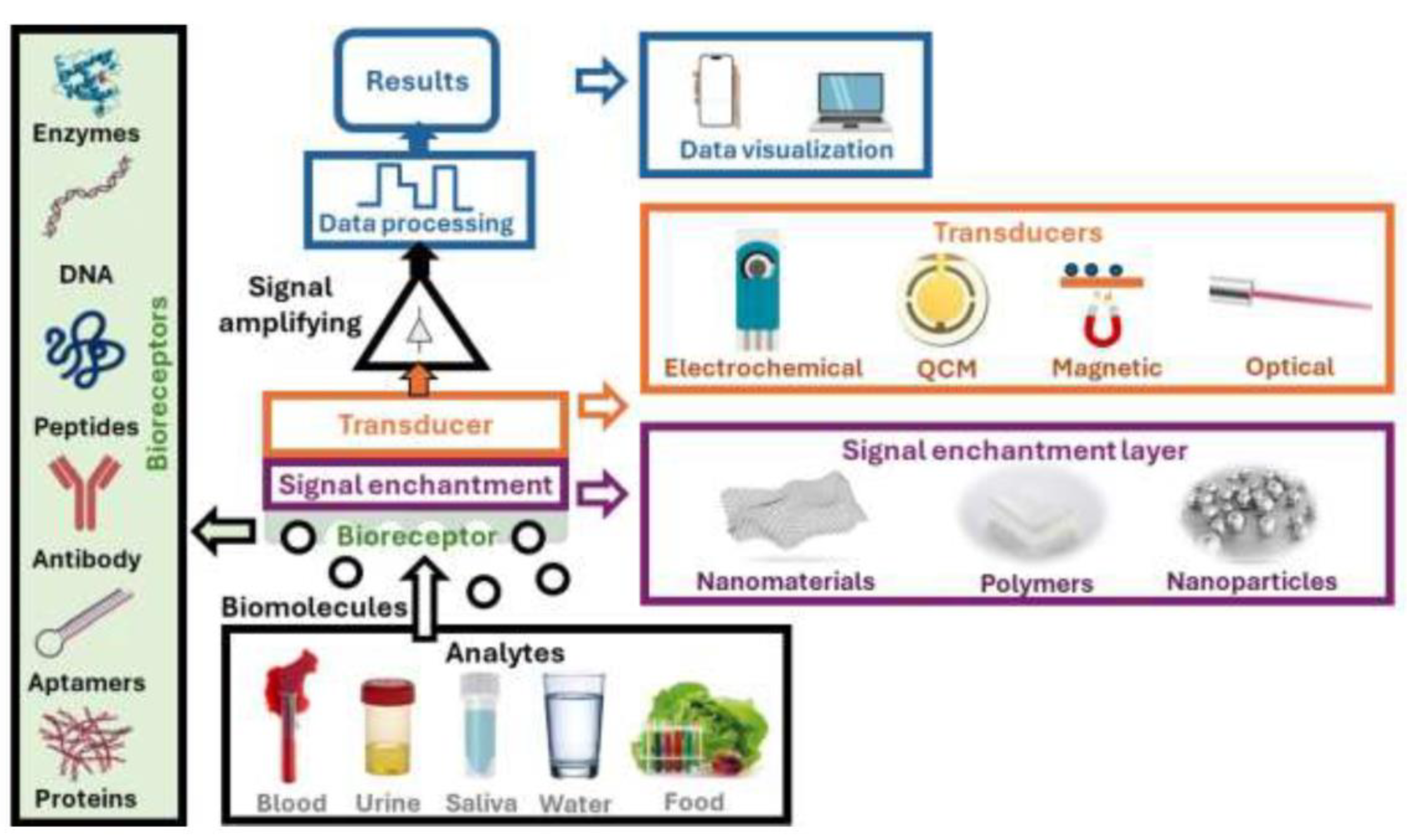
Figure 2.
Example of the meat chain structure and associated hazards.
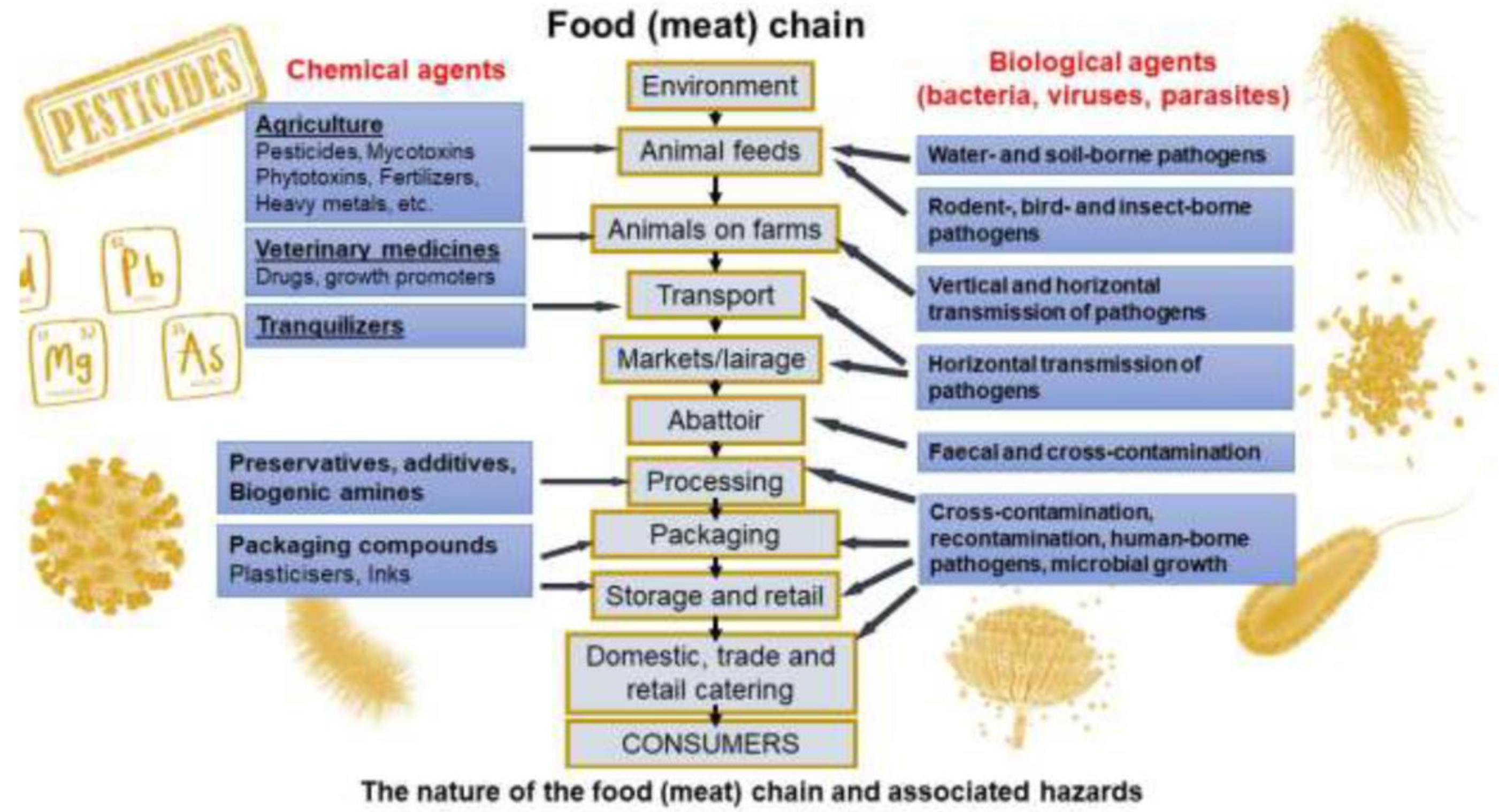
Figure 3.
Current and future perspectives of biosensors` application in the meat supply chain.

Figure 4.
A model for field implementation of multiplex, point-of-care biosensor in farm-to-slaughterhouse continuum [216].
Figure 4.
A model for field implementation of multiplex, point-of-care biosensor in farm-to-slaughterhouse continuum [216].
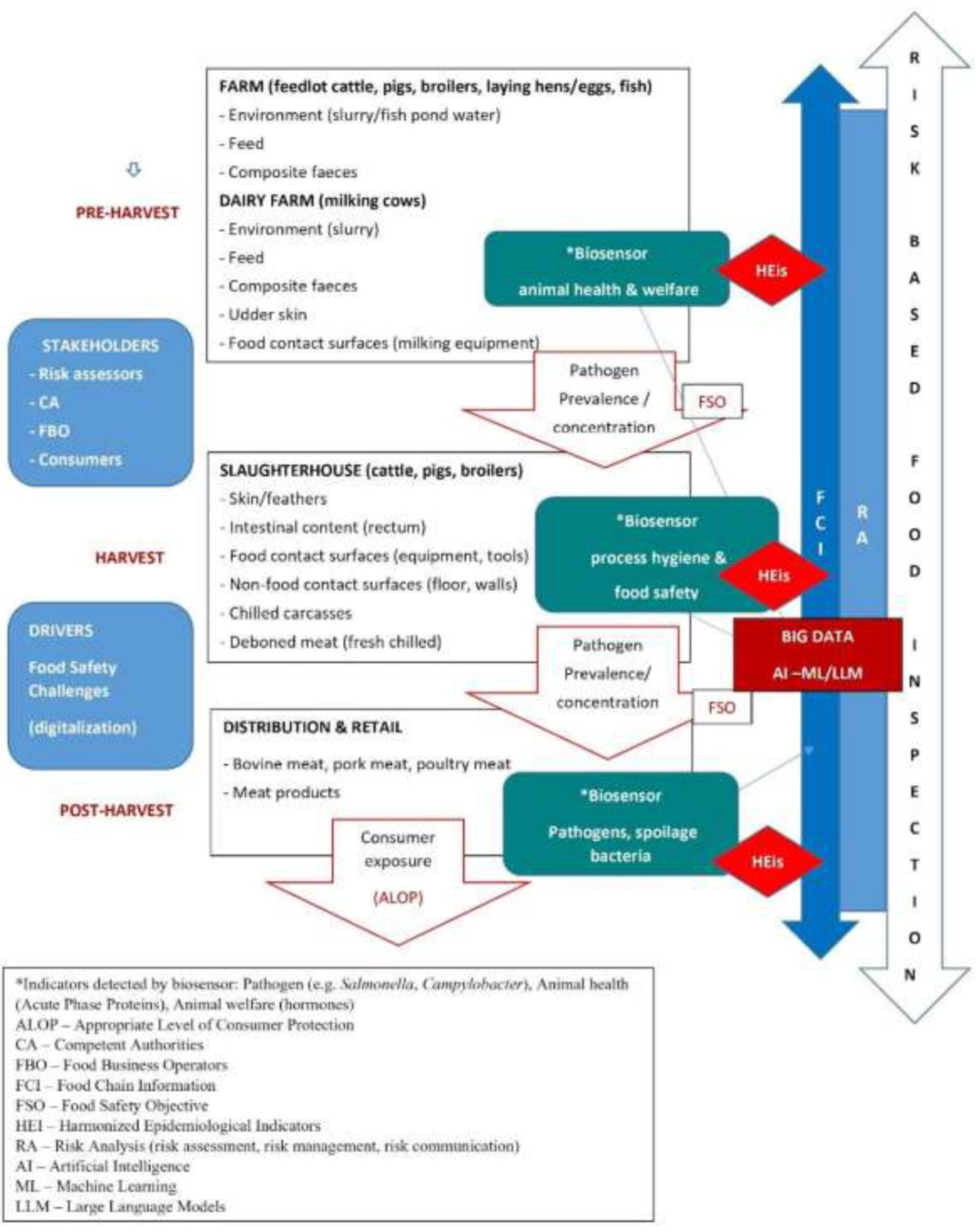

Table 1.
Biosensors in the meat production chain.
| Biosensor | Applicability in the meat production chain |
Reference | |||
| F | S | MP | R | ||
| Stress detection sensors (hormones) | x | [2]; [155] | |||
| Breath sensors (VOCs for detection of metabolic and pathological processes) |
x | ||||
| Perspiration sensors (metabolites in sweat) | x | ||||
| Tears sensor (glucose monitoring) | x | ||||
| Salivary sensor (uric acid - metabolic syndrome, renal syndrome, and abnormalities in purine metabolism) | x | ||||
| Progesterone sensor (detection of ovulation) | x | ||||
| Food and feed sensors (dietary inputs/nutrition, bioactive compounds, microbiological and chemical contamination) | x | ||||
| Infectious diseases detection sensors (BRD, AIV, FMD, BVD, PRRSV, Avian Influenza, mastitis) | x | ||||
| Sensor for continuous glucose monitoring (CGM) in dairy calves | x | (89) | |||
| Sensor for monitoring of stress and animal welfare (hormonal levels) in pigs` blood | x | x | (92) | ||
| Glucocorticoid sensor (saliva, excreta, fecal samples, milk, hair/feathers and eggs) | x | (93) | |||
| Sensors for inflammatory markers (acute phase proteins) | x | x | (102); (5); (92); (109); (106); (107) | ||
| Sensors for metabolic markers (breath, blood, faeces, skin, urine and vaginal fluids) | x | x | (115); (111); (112); (113); (114); (118); (116); (117); (110); | ||
| Sensors for infectious diseases detection Bovine. BRD (serum), BVD (serum; LOD of 103 CCID/ml), EBL, FMD, bovine mycoplasma, mastitis (Hp in serum), Campylobacter in dairy cattle (LOD of 3 CFU/ml) Pigs. AFSV, PRRSV, SIV, PCVAD |
x x |
(119); (123); (125); (127); (128); (131); (132); |
|||
|
Poultry. H5N1 (LOD of 103 EID50/ml), Clostridium perfringens (LOD of 0.26 - 0.27 lg/CFU), audio-based sensor detection system (Newcastle Disease, Infectious Bronchitis, Infectious Laryngotracheitis, AI, MG, CRD, infectious sinusitis, mycoplasmosis), antibiotic residues Early disease detection *WBE |
x x |
(103); (134); (135); (136); (163) |
|||
| Sensors for monitoring reproductive health Hormonal levels (progesterone and estrogen in milk, urine, feces) in dairy herds Estrus detection Sperm quality (in livestock) |
x x x |
(138); (141); (139); (140); (149); (150); (151) (152); (153); (154); |
|||
| Animal welfare monitoring sensors Behavioral, physiological and nutrition status Animal Intersticial Fluid (ISF) Saliva |
x x |
(154); (156); (159); (160) |
|||
| Transport and Handling Stress Monitoring |
x | (155); (156); (157); (158); (159); (160); (161) | |||
| Pre-slaughter welfare assessment | x | (93); (162); | |||
| Slaughterhouse and meat processing Post-slaughter indicators (animal health, animal welfare) Pathogen detection (Salmonella, Campylobacter, Shiga toxin- producing E. coli (STEC), Listeria monocytogenes; viruses) Antibiotic residues AMR Pesticides Growth promoters Dioxins |
x x |
x x x x x x x |
x x x x x x |
x x x x x x |
(92); (164); (165); (166); (167); (168); (169); (170); (171); (172); (173); (174); (175); (176); (177); (178); (179); (180); (181); (182); (183); (194); (195); (196); (184); (185); (186); (187); (188); |
| Mycotoxins Meat quality traits Freshness and spoilage (purine derivatives, ammonia, VOCs) Sensory and nutritional attributes (color, texture, visible fat, aroma, flavor) |
x | x x x |
x x x |
(191); (192); (198); (199); (200); (201); (202): (203); (204); (205); (206); (207); (208); |
|
| Food fraud Food adulteration Species and origin authentication |
x x |
x x |
(209); (210); (211); (212); (213); (214); |
||
Disclaimer/Publisher’s Note: The statements, opinions and data contained in all publications are solely those of the individual author(s) and contributor(s) and not of MDPI and/or the editor(s). MDPI and/or the editor(s) disclaim responsibility for any injury to people or property resulting from any ideas, methods, instructions or products referred to in the content. |
© 2025 by the authors. Licensee MDPI, Basel, Switzerland. This article is an open access article distributed under the terms and conditions of the Creative Commons Attribution (CC BY) license (http://creativecommons.org/licenses/by/4.0/).
Copyright: This open access article is published under a Creative Commons CC BY 4.0 license, which permit the free download, distribution, and reuse, provided that the author and preprint are cited in any reuse.