

Submitted:
22 January 2025
Posted:
23 January 2025
You are already at the latest version
Abstract
This work develops a new two-dimensional depth-integrated non-hydrostatic model for wave propagation simulation using a weighted average linear/quadratic non-hydrostatic pressure profile. The model is constructed by modifying an existing non-hydrostatic discontinuous/continuous Galerkin finite element model with a linear vertical non-hydrostatic pressure profile. A series of analytical solutions and laboratory experiments verify and validate the model. The results show that using a weighted average linear/quadratic non-hydrostatic pressure profile improved the performance of previous depth-integrated models with linear or quadratic non-hydrostatic pressure profiles.
Keywords:
1. Introduction
2. Description of the Model
- Solve the horizontal momentum Eq. [23] and [24] without the non-hydrostatic pressure terms using a discontinuous Galerkin method. The first step of the solution process ends with the intermediate estimation of the conserved variables and from Eq. [10]: . This step is identical to the previous model.
- Find the nodal values of using a continuous Galerkin solution of Eq. [21].
- Using the nodal values of obtained in the previous step, the continuity Eq. [25], the vertical momentum Eq. [26], the kinematic boundary conditions, and the remaining part of the horizontal momentum Eqs. [23] - [24] including the non-hydrostatic pressure terms:construct a Poisson Eq. that is solved by a continuous Galerkin method to obtain the non-hydrostatic pressures .
- Once the non-hydrostatic pressures are known, the Eq. [27] are solved on an element to obtain the final solutions for the discharges and .
- Lastly, with the discharges , , and the flow depth known, the unknown flow depth is determined from the continuity Eq. [25] using the discontinuous Galerkin formulation in Eq. [10]. This step is identical to the previous model.
3. Linear Dispersion
4. Model Validation
5. Beji and Battjes’ Experiment of Wave Propagation on a Submerged Bar
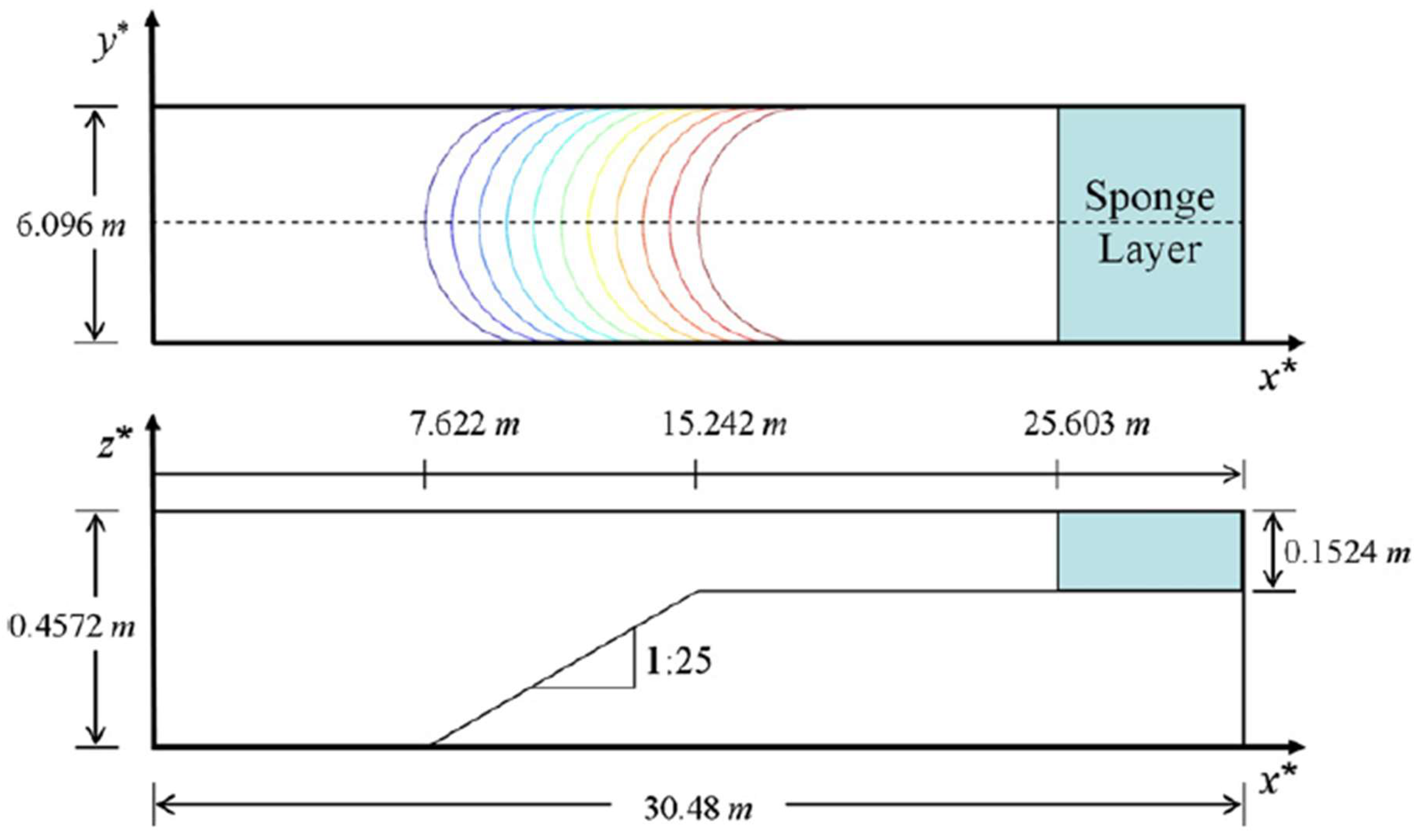
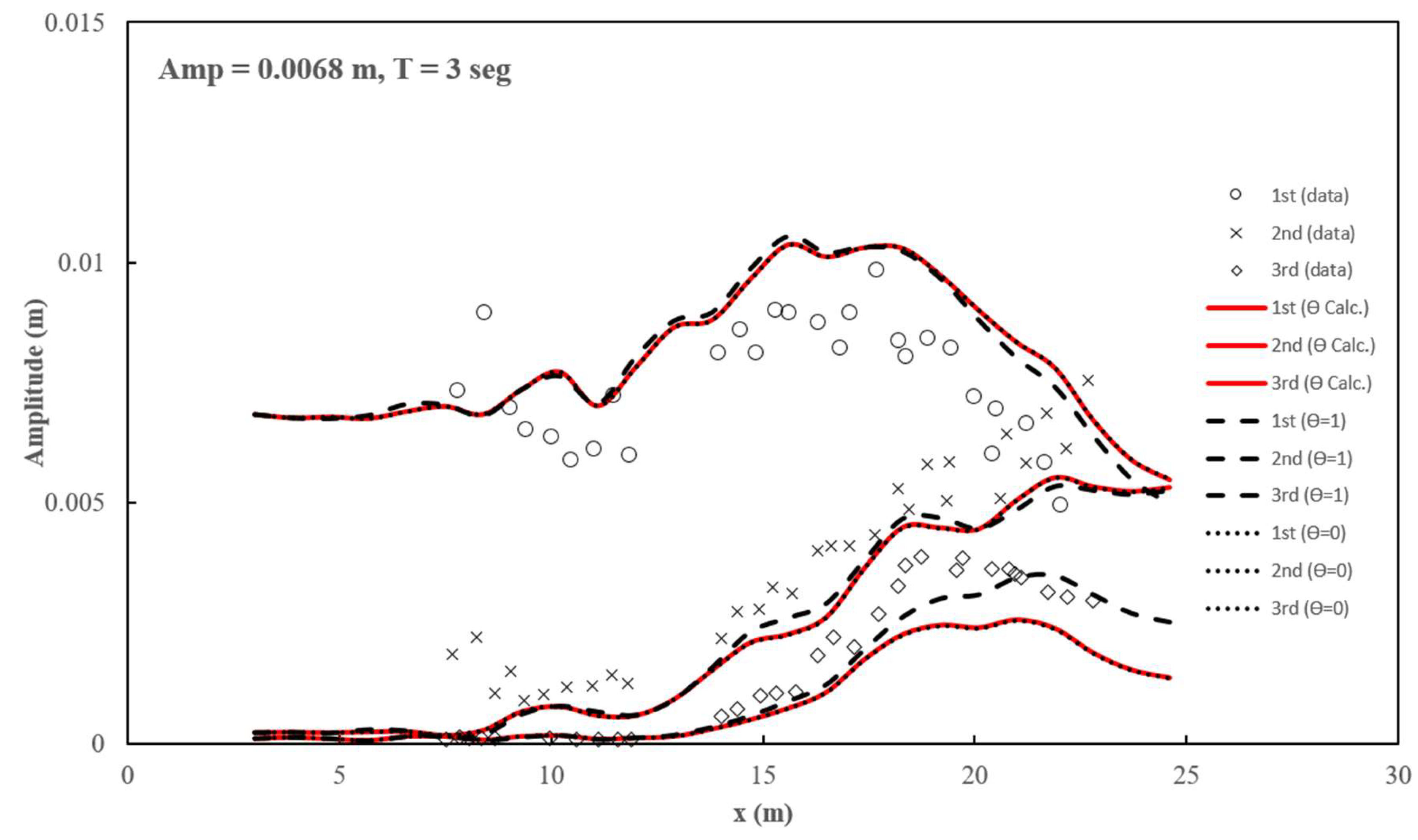
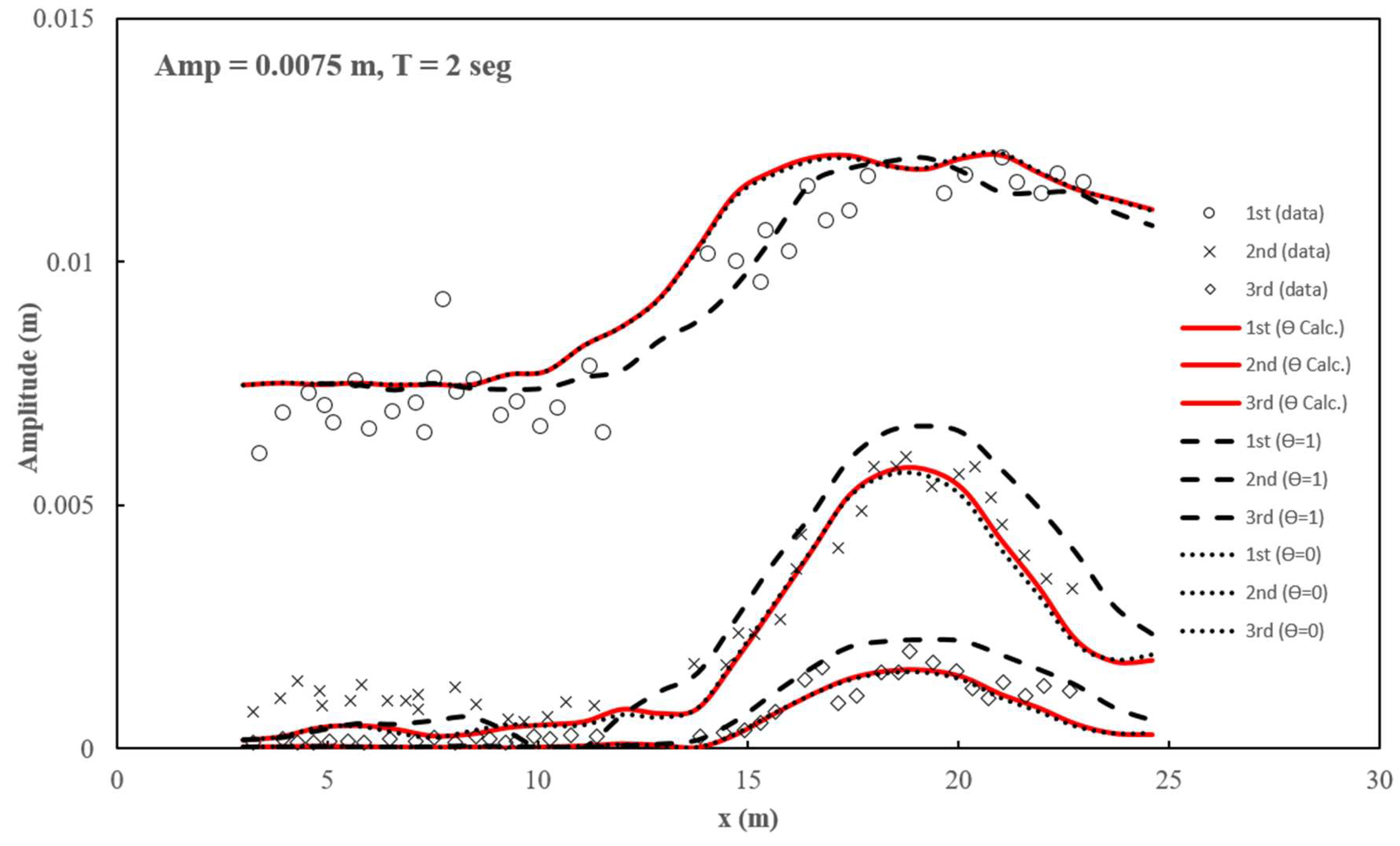
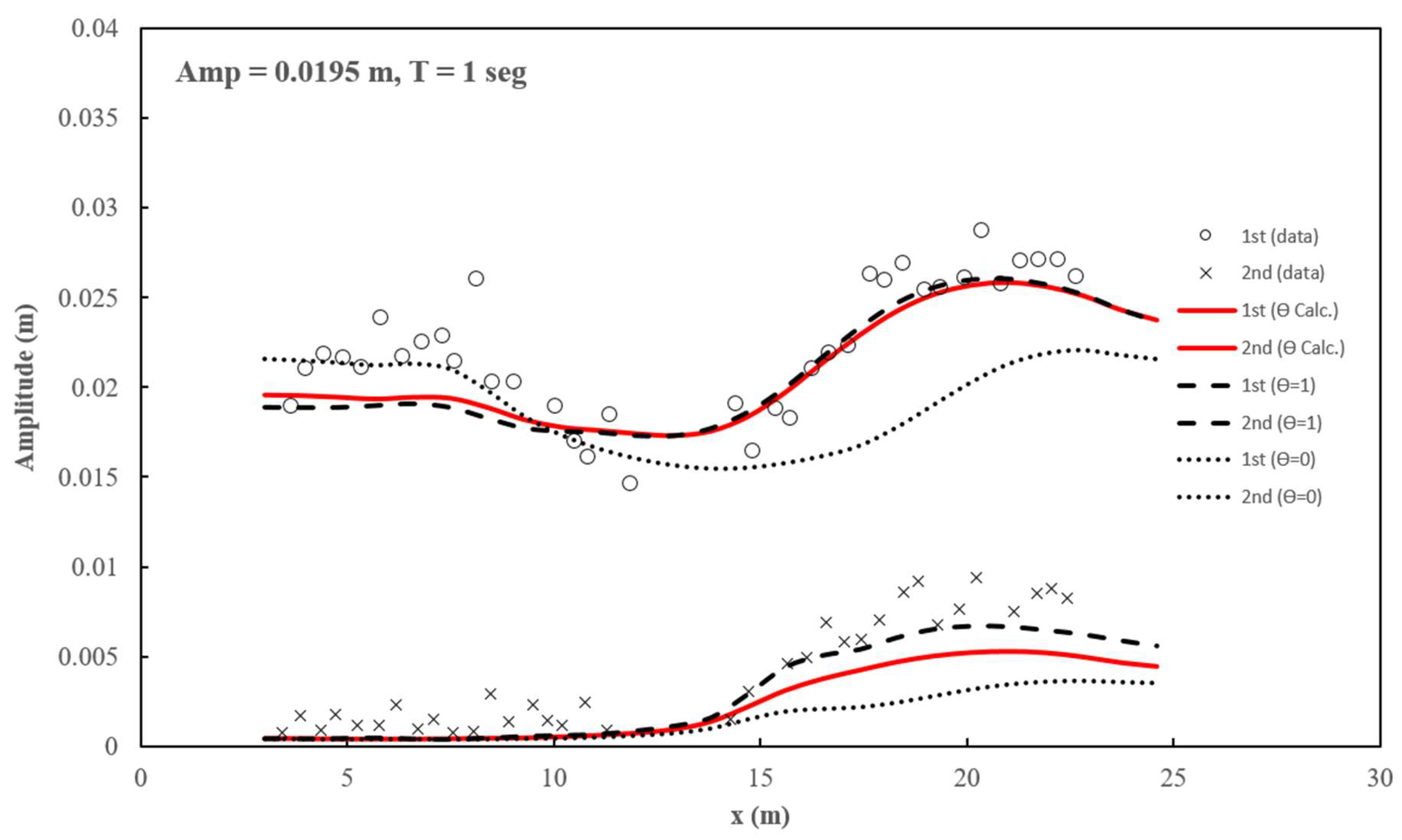
6. Whalin’s Wave Diffraction Experiment on a Semicircular Shoal and Comparison with Experimental Data
7. Wave Transformation over an Elliptic Shoal
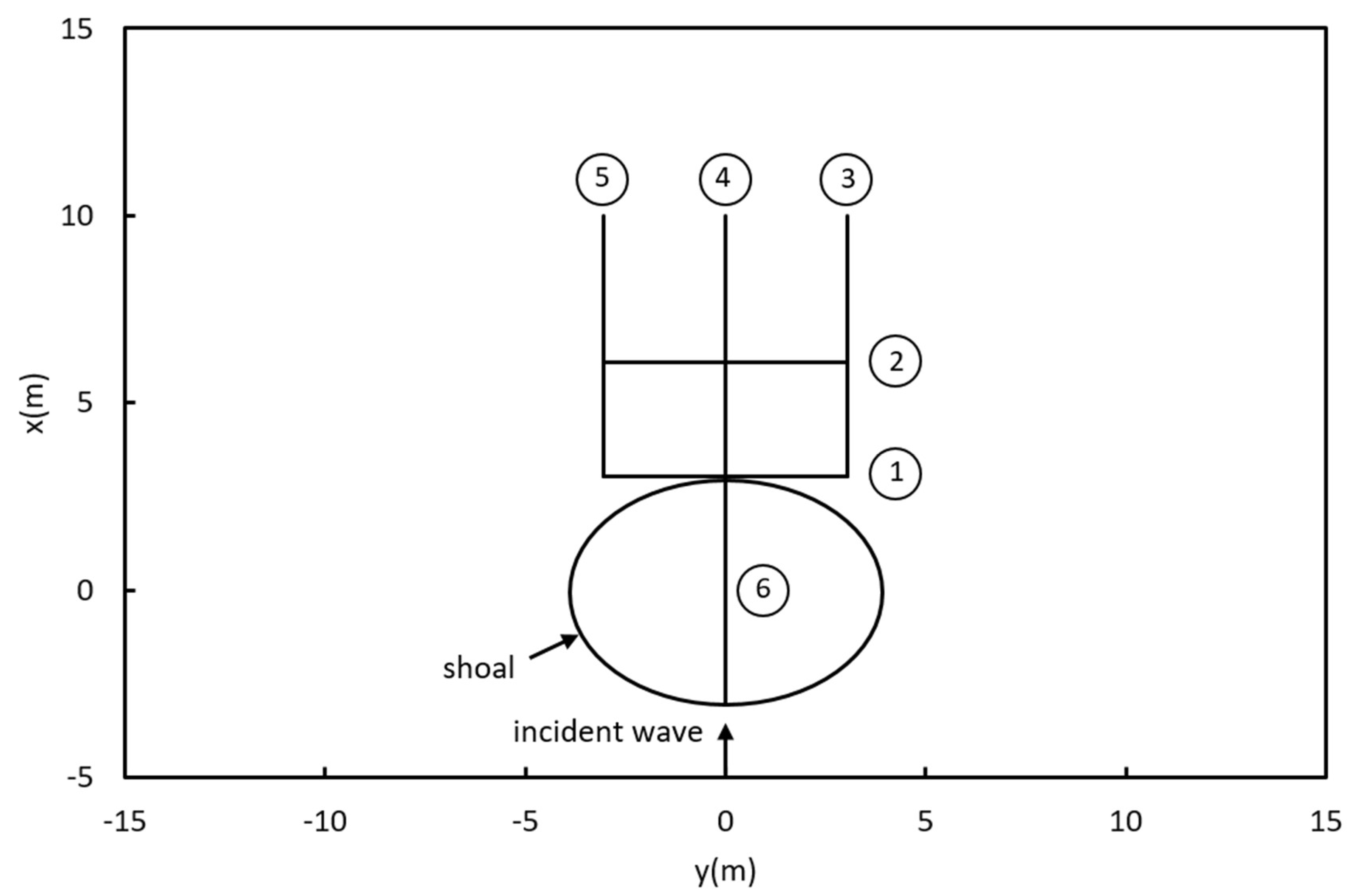
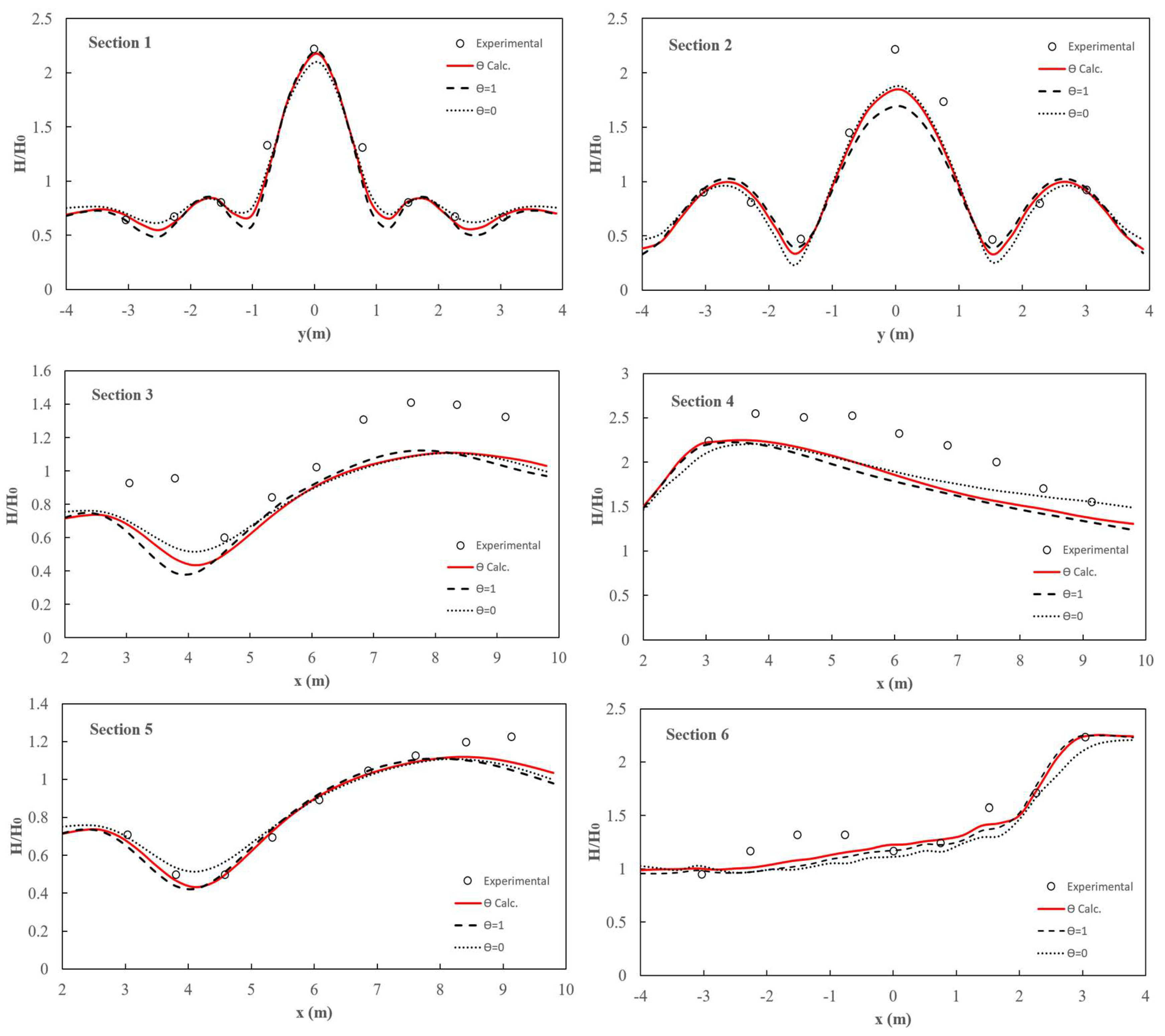
0.2. At the outgoing boundary, a 5 m absorption zone dissipated outgoing waves. The free-slip and impermeability boundary conditions were assigned to the sidewalls. The computational domain was discretized by a mesh with Δx = 5 cm and Δy = 10 cm.
8. Conclusions
Funding
References
- Aïssiouene, N. (2016). Numerical analysis and discrete approximation of a dispersive shallow water model. PhD thesis. Pierre et Marie Curie, Paris VI.
- Bai, Y., Cheung, K.F. (2013). Dispersion and nonlinearity of multi-layer non-hydrostatic free-surface flow. J. Fluid Mech. 726, 226–26. [CrossRef]
- Beji, S.; Battjes, J. A. (1993) Experimental investigation of wave propagation over a bar. Coastal Eng. 19, 1, 151–162. [CrossRef]
- Bingham, H.B.; Madsen, P.A.; Fuhraman, D.R. Velocity potential formulations of highly accurate Boussinesq-type models. Coastal Engineering, 56, 467–478, 2009.
- Calvo, L., De Padova, D., Mossa, M., Rosman, P. (2021). Non-hydrostatic discontinuous/continuous Galerkin model for wave propagation, breaking and runup. Computation. 9, 47. [CrossRef]
- Casulli, V., Stelling, G.S. (1998). Numerical simulation of 3D quasi-hydrostatic, free-surface flows. J. Hydraul. Eng. 124, 678–686. [CrossRef]
- Cui, H., Pietrzak, J., Stelling, G. (2014). Optimal dispersion with minimized Poisson equations for non-hydrostatic free surface flows. Ocean Modelling 81, 1–12. [CrossRef]
- Fenton, J.D.; McKee W.D. On calculating the lengths of water waves. Coastal Engineering, 14, 499-513, 1990. [CrossRef]
- Jeschke, A., Vater, S., Behrens, J. (2017). A discontinuous Galerkin method for non-hydrostatic shallow water flows. In Proceedings of the Conference: Finite Volumes for Complex Applications VIII-Hyperbolic, Elliptic and Parabolic Problems, Lille, France, 12–16 June 2017.
- Jeschke, A. (2018). Second Order Convergent Discontinuos Galerkin Projection Method for Dispersive Shallow Water Flows. University of Hamburg, Phd Thesis, 2018.
- Kazolea, M.; Delis, A. I.; Nikolos, I. K.; Synolakis, C. E. An unstructured finite volume numerical scheme for extended 2D Boussinesq-type equations, Coastal Eng., 69, 42–66, 2012. [CrossRef]
- Stansby, P.K., Zhou, J.G. (1998). Shallow-water flow solver with non-hydrostatic pressure: 2D vertical plane problems. Int. J. Numer. Methods Fluids, 28, 541–563.
- Stelling, G.; Zijlema, M. An accurate and efficient finite difference algorithm for non-hydrostatic free surface flow with application to wave propagation. Int. J. Numer. Methods Fluids 2003. 43, 1–23, 2003. [CrossRef]
- Tonelli, M.; Petti, M. Hybrid finite volume -finite difference scheme for 2DH improved Boussinesq equations, Coastal Eng., 56, 609–620, 2009. [CrossRef]
- Vincent, C.; Briggs, M. (1989). Refraction-Diffraction of Irregular Waves over a Mound. [CrossRef]
- Journal of Waterway, Port, Coastal and Ocean Engineering, 115(2), 269-284.
- Wang, W., Martin, T., Kamath, A., Bihs, H. (2020). An improved depth-averaged non-hydrostatic shallow water model with quadratic pressure approximation. Int. J. Numer. Methods Fluids.
- Wang, W., Kamath, A., Martin, T., Pákozdi, C., Bihs, H. (2020). A comparison of different wave modelling techniques in an open-source hydrodynamic framework. J. Mar. Sci. Eng. [CrossRef]
- Wei, Z.; Jia, Y. (2014). Simulation of nearshore wave processes by a depth-integrated non-hydrostatic finite element model. Coast. Eng. 83, 93–107.
- Whalin, R.W. The limit of applicability of linear wave refraction theory in a convergence zone. Res. Rep. H-71-3, U.S. Army Corps of Engineers, Waterways Expt. Station, Vicksburg, MS. 1971.
- Young, C.; Wu, C.; Liu W.; Kuo J. A higher-order non-hydrostatic σ model for simulating non-linear refraction–diffraction of water waves. Coastal Engineering, 56 (9), 919-930, 2009.
- Yuan, H.L.; Wu, C.H. An implicit 3D fully non-hydrostatic model for free-surface flows, Int. J. Numer. Meth. Fluids 46, 709–733, 2004.
- Zijlema, M.; Stelling, G.S. Further experiences with computing non-hydrostatic free-surface flows involving water waves. Int. J. Numer. Methods Fluids. 48, 169–197, 2005. [CrossRef]
- Zijlema, M.; Stelling, G.S. Efficient computation of surf zone waves using the nonlinear shallow water equations with non-hydrostatic pressure. Coast. Eng. 55, 780–790, 2008. [CrossRef]
- Zijlema, M.; Stelling, G.S.; Smith, P. SWASH: An operational public domain code for simulating wave fiels and rapidly varied flows in coastal waters. Coast. Eng. 58, 992–1012, 2011.
Disclaimer/Publisher’s Note: The statements, opinions and data contained in all publications are solely those of the individual author(s) and contributor(s) and not of MDPI and/or the editor(s). MDPI and/or the editor(s) disclaim responsibility for any injury to people or property resulting from any ideas, methods, instructions or products referred to in the content. |
© 2025 by the authors. Licensee MDPI, Basel, Switzerland. This article is an open access article distributed under the terms and conditions of the Creative Commons Attribution (CC BY) license (http://creativecommons.org/licenses/by/4.0/).


