

Submitted:
22 January 2025
Posted:
23 January 2025
You are already at the latest version
Abstract
This study explores the application of Artificial Intelligence (AI) and Virtual Reality (VR) collaborative technology in virtual simulation training for job skills development, emphasizing its impact on skill acquisition, learning efficiency, and overall satisfaction. An experimental design was implemented to compare AI-VR-enhanced training with traditional methods, utilizing a sample of 100 participants who were assessed both before and after the training. The findings reveal that AI-VR training substantially enhanced participants’ job skills, accelerated learning, and increased overall satisfaction, especially in areas such as interview simulations and personalized feedback. These results underscore the potential of AI-VR technology to provide more effective and individualized training experiences than traditional methods. This research contributes to the expanding body of knowledge on the use of emerging technologies in education and suggests implications for improving job readiness and educational practices.
Keywords:
Artificial Intelligence (AI)
; Virtual Reality (VR)
; Job-Seeking Skills Training
; Data Analysis
1. Introduction
1.1. Background
With the rapid advancement of technology, Artificial Intelligence (AI) and Virtual Reality (VR) have gradually permeated the educational sector, particularly in Job-Seeking Skills training and learning environments [1]. The integration of these two technologies has revolutionized traditional education and provided unprecedented learning experiences [2]. AI aids students by employing targeted data analysis to customize learning content based on individual capabilities [3]. Concurrently, VR offers immersive environments and interactive experiences, allowing students to learn and train in realistically simulated settings, thus overcoming the limitations of traditional training methods, such as lack of interactivity and inability to replicate real-world scenarios [4].
In the realm of job skills training, conventional methods such as lectures, printed materials, and classroom simulations often lack interactivity and realism, resulting in suboptimal learning outcomes [5]. Recently, many institutions have begun exploring the integration of new technologies into the training process to enhance vocational education. The combination of AI and VR, as an innovative training model, holds immense potential [6]. However, current research mainly focuses on the individual application of AI or VR in education, with studies on their combined usage still in the nascent stage. This is especially true for their application in job skills training, which remains relatively under-researched [7].
1.2. Research Questions and Objectives
The primary objective of this study is to investigate the integration of AI and VR technologies, with a particular focus on enhancing collaborative efficiency, in the context of virtual simulation training for job-seeking skills. Specifically, this study employs comparative experiments to assess the advantages of AI-VR collaborative technology in improving students' job-seeking skills, learning efficiency, and satisfaction. The primary research questions are as follows:
How effective is AI-VR collaborative technology in enhancing the outcomes of job-seeking skills training?
- In what ways do AI and VR collaborate to enhance the interactivity and personalization of the training?
- What is the level of student satisfaction with AI-VR collaborative training, and how does it compare to traditional training methods?
By exploring these questions, this study aims to provide theoretical support for applying AI-VR technology in vocational education and offer practical guidance for educational institutions in implementing AI-VR collaborative technology in their training processes.
1.3. Research Significance
The significance of this study is multifaceted: Theoretical Contribution: This research is pioneering in exploring the integration of AI-VR collaborative technology in job skills training, thereby providing a novel perspective on the educational applications of AI and VR. It offers essential theoretical support for future studies in this area. Practical Value: The study presents empirical evidence supporting the use of AI-VR technology to enhance job skills training effectiveness, serving as a reference for vocational education institutions in designing innovative training models. Policy Implications: As AI and VR technologies advance, government and educational departments can support the deep integration of technology and education through policy measures, thus improving the quality and efficiency of educational training.
1.4. Structure of the Thesis
The structure of this thesis is outlined as follows:
Chapter One: Introduction – This chapter introduces the research background, research questions and objectives, the study's significance, and the paper's structure.
Chapter Two: Literature Review – This chapter examines the application of virtual reality and artificial intelligence in employment education, focusing on the current research landscape of AI-VR collaborative technology.
Chapter Three: Research Methodology – This chapter offers a comprehensive description of the research design, participant selection, development of AI-VR collaborative technology, and data collection and analysis procedures.
Chapter Four: Results Analysis – This chapter presents a comparative analysis of training outcomes between the experimental and control groups, utilizing descriptive and inferential statistics.
Chapter Five: Discussion – This chapter discusses the theoretical and practical implications of the research findings, delving into the potential and limitations of AI-VR collaborative technology in employment education.
Chapter Six: Conclusion – The concluding chapter summarizes the key findings, addresses the study's limitations, and proposes directions for future research.
2. Literature Review
This section explores the following areas of literature: the application of virtual reality (VR) in education, the role of artificial intelligence (AI) in education, and the integration and application of AI-VR collaborative technology in training. Finally, it highlights the gaps in existing research, thereby underscoring the innovation and significance of this study.
2.1. Application of Virtual Reality in Education
Virtual reality (VR) technology creates immersive and highly interactive virtual environments that provide learners with simulated scenarios akin to the real world [8]. This immersive experience enhances learner engagement, boosts motivation, and improves learning outcomes [9]. In recent years, the application of VR in education has garnered substantial research and practical attention [10].
In Job-Seeking Skills training, VR can simulate complex work environments and scenarios, allowing students to undergo operational training without actual risk [11]. For instance, VR is employed in the medical field for surgical simulation training [12] and in architecture to enhance students' spatial perception through virtual design exercises [13]. Research indicates that VR training effectively enhances learners' skill levels, especially in high-risk industries and fields requiring intense focus [14]. Furthermore, studies targeting job seekers with challenges have found that VR-simulated interview training enhances interview skills and confidence, providing significant psychological preparation during the job application process [15].
Despite its clear advantages across various training fields, VR technology faces significant challenges. Designing VR training scenarios that cater to diverse learner needs remains pressing [16]. Additionally, high hardware costs hinder VR's broad adoption in education [17], as using lower-end equipment can significantly diminish effectiveness [18].
2.2. Application of Artificial Intelligence in Education
Artificial intelligence (AI) technology in education primarily manifests as student-centered learning, real-time learning analytics, and intelligent tutoring [19]. AI analyzes learners' behavioral data, assesses their learning status in real-time, and adjusts learning content and pace to ensure each student progresses at an appropriate rhythm. The role of AI in education is evident in the following aspects:
Targeted Learning: AI customizes learning content for each student based on their interests, background, and learning progress [20]. For example, AI tutoring systems dynamically adjust question difficulty based on student performance, providing personalized feedback [21].
Intelligent Tutoring Systems: AI-driven virtual tutors offer continuous learning assistance, respond to student queries, and provide immediate feedback [22]. Through natural language processing (NLP), AI systems comprehend student inquiries and deliver appropriate responses [23].
Learning Analytics and Assessment: AI evaluates students' learning behaviors using data mining techniques, accurately predicting their progress and outcomes while offering teachers real-time feedback and adjustment recommendations [24].
Nonetheless, AI's application in education faces challenges. Firstly, AI requires large datasets to train algorithms, raising privacy concerns during data collection and processing [25]. Secondly, AI applications in education predominantly focus on English, limiting utility for students in non-English-speaking regions [26].
2.3. Synergy of Artificial Intelligence and Virtual Reality
While VR and AI individually offer notable advantages, using these technologies separately often fails to achieve optimal educational outcomes [27,28]. Researchers have recently begun exploring the synergistic effects of combining AI and VR [29]. AI-VR collaborative technology enhances the realism and adaptability of VR environments through AI's real-time feedback and adjustment capabilities, thus improving learning outcomes [30].
Studies suggest that integrating AI and VR holds significant potential for educational training [31]. For instance, in medical training, VR can simulate surgical scenarios while AI analyzes trainees’ operations to provide real-time feedback, facilitating skill improvement [32]. Similarly, in interview simulations, VR technology allows AI to assess performance and offer personalized feedback and advice [33]. This synergy not only enhances the interactivity of VR training but also provides precise learning feedback to trainees via data analysis [34].
The benefits of AI-VR collaborative technology in skills training have been validated across various fields. Research indicates that combining AI and VR significantly enhances learners’ skill acquisition and satisfaction levels [35]. Specifically, AI-VR collaborative technology leverages the strengths of both systems, adjusting virtual scenarios based on students’ interactions, thereby enhancing immersion and learning efficiency [36].
2.4. Research Gaps and Innovations
Existing studies indicate that AI-VR collaborative technology has demonstrated substantial potential across various fields, yet its application in job skills training is relatively limited [37]. Specifically, most existing research focuses on the application of VR technology alone, with fewer studies examining the combination of AI and VR [38]. Furthermore, current research often involves small sample sizes and short-term experiments, lacking an investigation into long-term effects [39]. Therefore, this study aims to fill this gap by focusing on the practical application of AI-VR collaborative technology in job skills training, particularly its impact on improving students' job skills.
The innovations of this study are primarily reflected in the following aspects:
The first application of AI and VR combined in job skills simulation training, especially in simulating scenarios where graduating students participate in interviews and job hunts.
Utilizing an experimental research design to compare the effects of AI-VR collaborative technology with traditional training methods through pre-and post-cycle comparisons, providing empirical data support.
Through data analysis, a deep exploration of the role of AI-VR technology in enhancing students’ job skills, learning efficiency, and learning satisfaction.
2.5. Summary
This section provides a detailed review of the application of virtual reality (VR) and artificial intelligence (AI) in education, focusing on the current state of research regarding AI-VR collaborative technology. Existing literature indicates that both AI and VR have demonstrated significant potential in the educational domain; however, research on their integration is still nascent, particularly in the context of job skills training. Consequently, this study seeks to bridge this gap by further validating the effectiveness of AI-VR collaborative technology in job skills training and exploring its broader educational potential.
3. Research Methods
This study employs an experimental research design to compare the effectiveness of AI-VR collaborative technology with traditional job-seeking skills training methods. To ensure the scientific rigor and replicability of the experiment, this paper provides a detailed description of the research design, participant selection, the development process of AI-VR collaborative technology, as well as the data collection and analysis methods.
3.1. Research Design
This study employed a pre-test and post-test experimental design to assess the impact of AI-VR collaborative technology on job-seeking skills training[40]. The experiment included two groups: the experimental group and the control group. The experimental group received training using AI-VR collaborative technology, while the control group utilized traditional methods. By comparing participants' job-seeking skills assessment results before and after the training, we evaluated whether AI-VR collaborative technology significantly improves test scores and performance. The experimental design is illustrated in Figure 1.
Experimental Group: Utilizes AI-VR collaborative technology, integrating virtual reality environments with AI-supported interactive modules [41,42,43]. Participants interact with AI-controlled virtual interviewers in a virtual interview setting. The system provides real-time feedback based on participants' responses and behavior, including speech tone analysis, eye contact evaluation, and personalized learning suggestions. Weekly training includes simulated interview exercises and targeted skill improvement tasks over four weeks.
Control Group: Employs traditional training methods such as classroom lectures, simulated interviews, and group discussions [44,45]. Human interviewers conduct simulated interviews to help participants improve communication skills, response strategies, and non-verbal expressions. Weekly training content is consistent with the experimental group to ensure result comparability.
Research Process: Participants underwent initial testing at the study's start, including job-seeking skills tests and a learning satisfaction questionnaire. After the training, both groups completed the same assessments again. The study analyzed the impact of AI-VR technology using quantitative indicators (changes in job-seeking skills scores, satisfaction ratings) and qualitative feedback from open-ended questionnaires [46].
3.2. Participants
The participants included 100 third-year students aged 19 to 22 from a vocational higher education institution in China[47]. All participants had previously received basic job-seeking skills training courses, but generally lacked practical experience in simulated interviews and real job-seeking scenarios, making them ideal for this study. To ensure fairness and data reliability, students were randomly assigned to the experimental and control groups, with 50 students in each [48]. Throughout the study, both groups received uniform technical support and training resources, ensuring that all experimental conditions remained consistent except for the training method, thereby minimizing the influence of confounding variables on the results. Before the study commenced, all participants signed informed consent forms and received detailed explanations of the study's purpose, process, and privacy protection measures [49]. Research data were handled anonymously to ensure the security of participants' personal information [50].
3.3. Development of AI-VR Collaborative Technology
This study developed a bespoke AI-VR collaborative technology system to effectively integrate AI and VR. The system facilitated simulated interviews within a virtual reality environment, offering real-time personalized feedback through AI algorithms. The AI and VR modules collaborated to enhance the interactivity and personalized features of job-seeking skills training.
3.4. AI Module
The AI module analyzed student performance and provided real-time feedback by integrating natural language processing (NLP) and machine learning (ML) algorithms. These algorithms analyzed interactions between students and the virtual interviewer during interviews. The AI system employed speech recognition and emotion analysis technologies to evaluate language expression, response content, and non-verbal behaviors such as tone and speech rate, offering targeted feedback based on the assessment results.
Speech Recognition: The AI system utilized Hidden Markov Models (HMM) for speech recognition, accurately identifying students' responses by analyzing patterns in speech signals [51].
Where represents the probability of an observation sequence given a state sequence , pertains to the probability of an observation given the state, and denotes the state transition probability.
Response Evaluation: The system analyzed students’ language, response content, and non-verbal behaviors, such as tone and speed, generating scores and suggestions for improvement.
Where R is the response evaluation score, are different feature functions, and are corresponding weights.
Personalized Feedback: The AI system dynamically adjusted the difficulty of interview questions and generated personalized feedback in real time through machine learning algorithms.
Where is the difficulty level of the problem, is the student's performance score, is the difficulty adjustment level by the system, and are the corresponding weights.
3.5. VR Module
The VR module offered a highly realistic virtual interview environment, simulating real scenarios to enhance student immersion and interactivity.
Immersion Design: The virtual interviewer featured dynamic facial expressions and body movements, while the background settings, such as lighting and sound, adjusted in real time to replicate real interviews.
Interactivity Design: The virtual interviewer provided feedback based on participants' responses, such as nodding or frowning, while participants interacted through voice and gestures.
Scenario Adaptability: The system adjusted question difficulty based on student performance, ensuring stepwise training progression.
3.6. Data Collection
The primary data collection methods consisted of job-seeking skills assessments and learning satisfaction surveys.
3.7. Job-Seeking Skills Test
A job-seeking skills evaluation scale was employed to assess students' job-seeking abilities [52]. The scale encompasses multiple dimensions, including interview skills, resume writing, and communication skills. Participants were assessed both before and after the training, with their performance in each skill recorded (Table 1).. The evaluation results were statistically analyzed to determine differences between the experimental and control groups.
3.8. Learning Satisfaction Questionnaire
After the training, all participants completed a learning satisfaction survey. The survey evaluated aspects such as training content, technical support, learning experience, and training effectiveness. Analyzing the satisfaction data allowed us to further assess the application of AI-VR collaborative technology.
3.9. Data Analysis
Various data analysis methods were employed to ensure the reliability and validity of the research results.
Descriptive Statistical Analysis: Means, standard deviations, and other statistical measures were calculated to understand basic differences.
Paired Sample t-Test: This test was used to compare differences in training effects before and after the intervention between the two groups [53].
Where represents the mean of paired differences, denotes the standard deviation of paired differences, and is the sample size.
Effect Size Calculation: Cohen’s d was calculated to measure the magnitude of the effect between the two groups. A d-value greater than 0.8 is considered a large effect, indicating significant effectiveness of AI-VR collaborative technology in job-seeking skills training [54].
Where and are the means of the experimental and control groups, respectively, and is the pooled standard deviation of both groups. A value greater than 0.8 indicates a significant influence of the AI-VR technology.
4. Results
Upon completing data collection and statistical analysis, we conducted a detailed comparison of job-seeking skill improvements between the experimental and control groups. This section presents the statistical analysis results for both groups.
4.1. Descriptive Statistics
Table 2 presents the assessment results of job-seeking skills for both the experimental and control groups before and after training. The table clearly shows that the experimental group's post-training job-seeking skill scores are significantly higher than their pre-training scores, while the control group's score improvement is relatively minor.
Figure 1 illustrates the trends in skill improvements before and after training for both the experimental and control groups. The experimental group demonstrates significantly greater improvement than the control group, particularly evident in the post-training scores, where the experimental group scores markedly higher.
4.2. Paired Sample t-Tests
To determine whether the differences in job-seeking skill improvements between the experimental and control groups are statistically significant, paired sample t-tests were conducted. The results from comparing the pre- and post-training scores of both groups are as follows.
4.3. Paired Sample t-Test for the Experimental Group
A paired sample t-test was conducted on the experimental group's pre- and post-training scores, yielding the following results:
The t-test results indicate that the t-value for the experimental group is 26.09, with a p-value significantly less than 0.01, demonstrating a significant improvement in skills.
4.4. Paired Sample t-Test for the Control Group
A paired sample t-test on the control group's pre- and post-training scores yielded the following results:
The t-test results show that the t-value for the control group is 6.06, and the p-value is less than 0.01, indicating a significant improvement in skills, albeit less pronounced than in the experimental group.
4.5. Intergroup Comparison
To compare the skill improvement differences between the experimental and control groups, Cohen's d was calculated. The formula used is:
Where the pooled standard deviation is:
Substituting the data:
The results indicate an effect size of 2.60, demonstrating a significant effect of the experimental group on skill improvement.
4.6. Learning Satisfaction Survey
The results of the learning satisfaction survey indicate that the experimental group scored significantly higher than the control group in terms of technical support, interactivity, and overall learning experience (see Table 3). The mean satisfaction score for the experimental group was 4.5 on a 5-point scale, compared to a mean score of 3.6 for the control group. This suggests that participants in the AI-VR collaborative technology training perceived the process as more interactive, personalized, and immersive, thereby significantly enhancing their learning satisfaction.
Figure 2 demonstrates the differences in ratings for learning satisfaction across various dimensions between the experimental and control groups. The experimental group scores significantly higher than the control group in technical support, interactivity, content appropriateness, and overall learning experience, with statistically significant differences ( < 0.01). This further confirms the advantage of AI-VR collaborative technology in enhancing participant satisfaction.
5. Discussion
5.1. Theoretical Significance
The primary findings of this study demonstrate that the application of AI-VR collaborative technology in job-seeking skills training significantly outperforms traditional methods, offering theoretical support for integrating technology into vocational education. First, this research shows that combining AI and VR enhances the personalization and interactivity of educational training, which is challenging to achieve with a single technology. The real-time feedback provided by the AI module complements the immersive experience of the VR module, creating a learner-centered dynamic learning environment [55]. This integration expands upon existing research regarding the individual application of AI and VR in education and offers a theoretical framework for future exploration of technological synergies.
Second, this research further validates the effectiveness of virtual interview training, particularly in enhancing students' non-verbal communication and psychological preparedness. This finding provides empirical support for skill training research and offers new insights for the interdisciplinary integration of educational technology.
5.2. Practical Value
On a practical level, the findings of this study are highly valuable in several areas:
- Enhancing Students' Job-Seeking Competitiveness: The study demonstrates that students in the experimental group significantly outperformed the control group in terms of interview performance, language proficiency, and learning satisfaction. This suggests that AI-VR collaborative technology can effectively aid students in acquiring practical job-seeking skills, thus offering a novel approach to boosting their competitiveness in the job market.
- Optimizing Educational Resource Allocation: Unlike traditional training methods, AI-VR collaborative technology provides advantages in terms of repeatability and scalability. The virtual environment can be tailored to meet diverse student needs, thus maximizing training efficacy even with constrained resources. This presents crucial practical implications for vocational education institutions, especially those facing resource limitations.
- Promoting Educational Technology Adoption: The AI-VR collaborative system developed in this study represents a user-friendly and easily deployable technological solution for vocational education, establishing a foundation for the wider adoption of emerging technologies.
5.3. Advantages and Limitations of AI-VR Collaborative Technology
While AI-VR collaborative technology showcased numerous advantages in this study, its limitations must also be considered.
5.3.1. Advantages
- Real-time and Personalized Learning: AI technology can continuously adjust training content based on students' real-time performance, thereby enhancing the specificity of learning. This capacity significantly boosts students' learning efficiency and skill acquisition.
- High Immersion and Interactivity: VR technology facilitates the creation of realistic simulated scenarios that assist students in overcoming psychological barriers, enabling them to practice repeatedly within a safe virtual environment, thus enhancing actual performance.
- Data-Driven Feedback Mechanism: By analyzing students' behavioral data, the AI system can offer scientific learning assessments and personalized recommendations, thereby supporting continual student progress.
5.3.2. Limitations
- Technical Barriers and Cost Issues: The high hardware and software development costs associated with AI and VR technologies restrict their widespread adoption in education, a limitation particularly pronounced in institutions with limited resources [56].
- Variability in Learners' Technological Adaptability: Some students may struggle to adapt to high-tech devices, leading to discomfort or stress during training, which can negatively impact learning outcomes [57].
- Unknown Long-term Effects: Due to the short duration of this study, the findings primarily reflect the short-term effects of AI-VR collaborative technology. Further research is necessary to investigate its long-term impact [58].
5.4. Recommendations for Future Research
- Extend the Research Period: Future studies should aim to design long-term experiments to investigate the enduring effects of AI-VR collaborative technology on skill enhancement.
- Expand the Research Sample: Increasing the sample size and incorporating a more diverse student population can enhance the generalizability of the research findings.
- Explore Cross-Cultural Applications: Future research could examine the effectiveness of AI-VR collaborative technology across various cultural contexts to facilitate its global dissemination.
- Optimize Technology and Control Costs: Further optimization of AI and VR technologies is necessary to decrease hardware and development costs, thus promoting the widespread adoption of educational technology.
6. Conclusions
This study investigated the application effects of AI-VR collaborative technology in virtual simulation training for job-seeking skills, specifically evaluating its advantages in enhancing students' job-seeking skills, learning efficiency, and satisfaction. The findings demonstrate that AI-VR collaborative technology significantly improves these aspects. By comparing the experimental group with a control group before and after training, it was observed that the experimental group, utilizing AI-VR collaborative technology, scored significantly higher in areas such as interview skills, resume writing, and communication skills. Additionally, the experimental group reported higher learning satisfaction, indicating that AI-VR technology offers considerable benefits in improving the learning experience and catering to individualized learning needs.
From the study results, the following conclusions can be drawn:
- AI-VR Collaborative Technology Enhances Job-Seeking Skills: The experimental group showed marked improvements in job-seeking skills assessments, notably in simulated interviews and communication skills. The AI module provided real-time feedback and personalized training, while the VR module improved practical abilities by simulating real interview scenarios.
- Collaborative Effects of AI and VR Enhance Interactivity and Personalization: AI-VR collaborative technology can adapt virtual environment scenarios based on students' real-time performance, enhancing the interactivity and immersion of learning. The AI system delivers real-time feedback and evaluates students' non-verbal behaviors with voice recognition and emotion analysis technologies, reinforcing the realism and effectiveness of virtual interviews.
- AI-VR Technology Increases Learning Efficiency and Satisfaction: The study also found significant improvements in learning efficiency and satisfaction after using AI-VR technology. Compared to traditional training methods, AI-VR technology facilitates better mastery of job-seeking skills with personalized, real-time feedback, achieving greater learning outcomes in less time.
Despite the notable effects demonstrated, challenges and limitations remain, such as the high cost of hardware and the complexity of technology development, which may limit its broader educational application. Future research should consider larger sample sizes and students from varied educational backgrounds to further validate the universality and long-term effects of AI-VR collaborative technology.
In conclusion, this study provides empirical support for the use of AI-VR collaborative technology in job-seeking skills training, revealing its significant potential in enhancing skills, learning efficiency, and satisfaction. As technology continues to evolve, AI-VR collaborative technology is expected to become a crucial tool in vocational education, offering innovative training solutions and assisting learners in adapting to the rapidly changing job market.
Author Contributions
J.Z.: Conceptualization, Investigation, Writing—Original Draft Preparation, Funding Acquisition; W.D.: Methodology, Software; Y.X.: Resources, Supervision; P.W.: Validation, Formal Analysis; Y.S.: Data Curation, Visualization; Y.F.: Project Administration, Writing—Review and Editing. All authors have read and agreed to the published version of the manuscript.
Funding
This research was funded by Chongqing Municipal Education Commission, grant number KJQN202403128, for the project "Research on the Application of AI-VR Collaborative Enhancement Technology—Based on Virtual Simulation Training in Job-Seeking Skills".
Informed Consent Statement
Informed consent was obtained from all subjects involved in the study.
Data Availability Statement
The data presented in this study are available on request from the corresponding author.
Acknowledgments
The authors would like to thank all the students who participated in this study. Special thanks to College of Digital Media for their administrative support in conducting the virtual simulation training program. We also appreciate the technical support provided during the implementation of the AI-VR system.
Conflicts of Interest
The authors declare no conflicts of interest.
Abbreviations
The following abbreviations are used in this manuscript:
| AI | Artificial Intelligence |
| VR | Virtual Reality |
| AI-VR | Artificial Intelligence and Virtual Reality collaborative technology |
Appendix A

Table A1.
Control group students before and after scores.
| Control student number | Pre-training score | Post-training score |
|---|---|---|
| 1 | 56 | 63 |
| 2 | 62 | 70 |
| 3 | 63 | 64 |
| 4 | 60 | 67 |
| 5 | 64 | 71 |
| 6 | 67 | 68 |
| 7 | 76 | 94 |
| 8 | 66 | 74 |
| 9 | 66 | 69 |
| 10 | 64 | 74 |
| 11 | 53 | 54 |
| 12 | 65 | 75 |
| 13 | 65 | 78 |
| 14 | 80 | 80 |
| 15 | 64 | 75 |
| 16 | 67 | 75 |
| 17 | 65 | 75 |
| 18 | 58 | 75 |
| 19 | 72 | 76 |
| 20 | 69 | 70 |
| 21 | 70 | 70 |
| 22 | 59 | 60 |
| 23 | 73 | 78 |
| 24 | 56 | 64 |
| 25 | 68 | 76 |
| 26 | 78 | 89 |
| 27 | 59 | 64 |
| 28 | 61 | 76 |
| 29 | 66 | 69 |
| 30 | 62 | 84 |
| 31 | 55 | 65 |
| 32 | 65 | 65 |
| 33 | 58 | 60 |
| 34 | 68 | 76 |
| 35 | 59 | 63 |
| 36 | 74 | 84 |
| 37 | 60 | 69 |
| 38 | 63 | 68 |
| 39 | 70 | 70 |
| 40 | 57 | 62 |
| 41 | 66 | 69 |
| 42 | 73 | 84 |
| 43 | 55 | 62 |
| 44 | 66 | 68 |
| 45 | 66 | 73 |
| 46 | 70 | 77 |
| 47 | 57 | 58 |
| 48 | 57 | 63 |
| 49 | 68 | 74 |
| 50 | 67 | 69 |
Appendix B
Table A2.
Experimental group students before and after scores.
| Experimental student number | Pre-training score | Post-training score |
|---|---|---|
| 1 | 68 | 90 |
| 2 | 65 | 83 |
| 3 | 69 | 85 |
| 4 | 73 | 97 |
| 5 | 64 | 90 |
| 6 | 64 | 90 |
| 7 | 74 | 89 |
| 8 | 69 | 88 |
| 9 | 63 | 85 |
| 10 | 68 | 94 |
| 11 | 63 | 81 |
| 12 | 63 | 82 |
| 13 | 67 | 81 |
| 14 | 55 | 69 |
| 15 | 56 | 81 |
| 16 | 62 | 90 |
| 17 | 60 | 80 |
| 18 | 67 | 93 |
| 19 | 61 | 83 |
| 20 | 58 | 75 |
| 21 | 73 | 95 |
| 22 | 64 | 93 |
| 23 | 66 | 86 |
| 24 | 58 | 87 |
| 25 | 63 | 68 |
| 26 | 66 | 91 |
| 27 | 59 | 80 |
| 28 | 67 | 86 |
| 29 | 62 | 83 |
| 30 | 64 | 73 |
| 31 | 62 | 81 |
| 32 | 75 | 97 |
| 33 | 65 | 94 |
| 34 | 60 | 77 |
| 35 | 70 | 86 |
| 36 | 59 | 77 |
| 37 | 66 | 92 |
| 38 | 55 | 77 |
| 39 | 58 | 76 |
| 40 | 66 | 90 |
| 41 | 69 | 90 |
| 42 | 66 | 92 |
| 43 | 65 | 81 |
| 44 | 64 | 82 |
| 45 | 58 | 76 |
| 46 | 62 | 74 |
| 47 | 63 | 85 |
| 48 | 71 | 93 |
| 49 | 67 | 88 |
| 50 | 56 | 75 |
References
- Ravichandran, R.R.; Mahapatra, J. Virtual Reality in Vocational Education and Training: Challenges and Possibilities. J. Digit. Learn. Educ. 2023, 3, 25–31. [Google Scholar] [CrossRef]
- Shirazi, B.N.; Safavi, A.A.; Aftabi, E.; Salimi, G. The Integration of Virtual Reality and Artificial Intelligence in Educational Paradigms. In Proceedings of the 2024 11th International and the 17th National Conference on E-Learning and E-Teaching (ICeLeT); IEEE: Isfahan, Iran, Islamic Republic of, February 27 2024; pp. 1–6.
- Rekha, K.; Gopal, K.; Satheeskumar, D.; Anand, U.A.; Doss, D.S.S.; Elayaperumal, S. Ai-Powered Personalized Learning System Design: Student Engagement And Performance Tracking System. In Proceedings of the 2024 4th International Conference on Advance Computing and Innovative Technologies in Engineering (ICACITE); IEEE: Greater Noida, India, May 14 2024; pp. 1125–1130.
- Wang, C.; Tang, Y.; Kassem, M.A.; Li, H.; Hua, B. Application of VR Technology in Civil Engineering Education. Comput. Appl. Eng. Educ. 2022, 30, 335–348. [Google Scholar] [CrossRef]
- McDow, L.W.; Zabrucky, K.M. Effectiveness of a Career Development Course on Students’ Job Search Skills and Self-Efficacy. J. Coll. Stud. Dev. 2015, 56, 632–636. [Google Scholar] [CrossRef]
- Tsai, W.-L.; Su, L.-W.; Ko, T.-Y.; Pan, T.-Y.; Hu, M.-C. Feasibility Study on Using AI and VR for Decision-Making Training of Basketball Players. IEEE Trans. Learn. Technol. 2021, 14, 754–762. [Google Scholar] [CrossRef]
- Lee, L.-K.; Chan, E.H.; Tong, K.K.-L.; Wong, N.K.-H.; Wu, B.S.-Y.; Fung, Y.-C.; Fong, E.K.S.; Leong Hou, U.; Wu, N.-I. Utilizing Virtual Reality and Generative AI Chatbot for Job Interview Simulations. In Proceedings of the 2024 International Symposium on Educational Technology (ISET); IEEE: Macau, Macao, July 29 2024; pp. 209–212.
- Wohlgenannt, I.; Simons, A.; Stieglitz, S. Virtual Reality. Bus. Inf. Syst. Eng. 2020, 62, 455–461. [Google Scholar] [CrossRef]
- Allcoat, D.; Hatchard, T.; Azmat, F.; Stansfield, K.; Watson, D.; Von Mühlenen, A. Education in the Digital Age: Learning Experience in Virtual and Mixed Realities. J. Educ. Comput. Res. 2021, 59, 795–816. [Google Scholar] [CrossRef]
- Tang, Y.M.; Chau, K.Y.; Kwok, A.P.K.; Zhu, T.; Ma, X. A Systematic Review of Immersive Technology Applications for Medical Practice and Education - Trends, Application Areas, Recipients, Teaching Contents, Evaluation Methods, and Performance. Educ. Res. Rev. 2022, 35, 100429. [Google Scholar] [CrossRef]
- Pooladvand, S.; Taghaddos, H.; Eslami, A.; Nekouvaght Tak, A.; Hermann, U. (Rick) Evaluating Mobile Crane Lift Operations Using an Interactive Virtual Reality System. J. Constr. Eng. Manag. 2021, 147, 04021154. [Google Scholar] [CrossRef]
- Pedram, S.; Palmisano, S.; Skarbez, R.; Perez, P.; Farrelly, M. Investigating the Process of Mine Rescuers’ Safety Training with Immersive Virtual Reality: A Structural Equation Modelling Approach. Comput. Educ. 2020, 153, 103891. [Google Scholar] [CrossRef]
- Schnabel, M.A.; Kvan, T. Spatial Understanding in Immersive Virtual Environments. Int. J. Archit. Comput. 2003, 1, 435–448. [Google Scholar] [CrossRef]
- Toyoda, R.; Russo-Abegão, F.; Glassey, J. VR-Based Health and Safety Training in Various High-Risk Engineering Industries: A Literature Review. Int. J. Educ. Technol. High. Educ. 2022, 19, 42. [Google Scholar] [CrossRef]
- Genova, H.M.; Lancaster, K.; Morecraft, J.; Haas, M.; Edwards, A.; DiBenedetto, M.; Krch, D.; DeLuca, J.; Smith, M.J. A Pilot RCT of Virtual Reality Job Interview Training in Transition-Age Youth on the Autism Spectrum. Res. Autism Spectr. Disord. 2021, 89, 101878. [Google Scholar] [CrossRef]
- Pardini, S.; Gabrielli, S.; Dianti, M.; Novara, C.; Zucco, G.; Mich, O.; Forti, S. The Role of Personalization in the User Experience, Preferences and Engagement with Virtual Reality Environments for Relaxation. Int. J. Environ. Res. Public. Health 2022, 19, 7237. [Google Scholar] [CrossRef] [PubMed]
- Eswaran, M.; Bahubalendruni, M.V.A.R. Challenges and Opportunities on AR/VR Technologies for Manufacturing Systems in the Context of Industry 4.0: A State of the Art Review. J. Manuf. Syst. 2022, 65, 260–278. [Google Scholar] [CrossRef]
- Selzer, M.N.; Gazcon, N.F.; Larrea, M.L. Effects of Virtual Presence and Learning Outcome Using Low-End Virtual Reality Systems. Displays 2019, 59, 9–15. [Google Scholar] [CrossRef]
- Hashim, S.; Omar, M.K.; Ab Jalil, H.; Mohd Sharef, N. Trends on Technologies and Artificial Intelligence in Education for Personalized Learning: Systematic Literature Review. Int. J. Acad. Res. Progress. Educ. Dev. 2022, 11, Pages–884. [Google Scholar] [CrossRef] [PubMed]
- Conati, C.; Barral, O.; Putnam, V.; Rieger, L. Toward Personalized XAI: A Case Study in Intelligent Tutoring Systems. Artif. Intell. 2021, 298, 103503. [Google Scholar] [CrossRef]
- Ahmad, K.; Iqbal, W.; El-Hassan, A.; Qadir, J.; Benhaddou, D.; Ayyash, M.; Al-Fuqaha, A. Data-Driven Artificial Intelligence in Education: A Comprehensive Review. IEEE Trans. Learn. Technol. 2024, 17, 12–31. [Google Scholar] [CrossRef]
- Tapalova, O.; Zhiyenbayeva, N. Artificial Intelligence in Education: AIEd for Personalised Learning Pathways. Electron. J. E-Learn. 2022, 20, 639–653. [Google Scholar] [CrossRef]
- Alqahtani, T.; Badreldin, H.A.; Alrashed, M.; Alshaya, A.I.; Alghamdi, S.S.; Bin Saleh, K.; Alowais, S.A.; Alshaya, O.A.; Rahman, I.; Al Yami, M.S.; et al. The Emergent Role of Artificial Intelligence, Natural Learning Processing, and Large Language Models in Higher Education and Research. Res. Soc. Adm. Pharm. 2023, 19, 1236–1242. [Google Scholar] [CrossRef]
- Ouyang, F.; Wu, M.; Zheng, L.; Zhang, L.; Jiao, P. Integration of Artificial Intelligence Performance Prediction and Learning Analytics to Improve Student Learning in Online Engineering Course. Int. J. Educ. Technol. High. Educ. 2023, 20, 4. [Google Scholar] [CrossRef]
- Meurisch, C.; Mühlhäuser, M. Data Protection in AI Services: A Survey. ACM Comput. Surv. 2022, 54, 1–38. [Google Scholar] [CrossRef]
- Li, J.; Zong, H.; Wu, E.; Wu, R.; Peng, Z.; Zhao, J.; Yang, L.; Xie, H.; Shen, B. Exploring the Potential of Artificial Intelligence to Enhance the Writing of English Academic Papers by Non-Native English-Speaking Medical Students - the Educational Application of ChatGPT. BMC Med. Educ. 2024, 24, 736. [Google Scholar] [CrossRef]
- Rojas-Sánchez, M.A.; Palos-Sánchez, P.R.; Folgado-Fernández, J.A. Systematic Literature Review and Bibliometric Analysis on Virtual Reality and Education. Educ. Inf. Technol. 2023, 28, 155–192. [Google Scholar] [CrossRef]
- Chen, X.; Zou, D.; Xie, H.; Cheng, G.; Liu, C. Two Decades of Artificial Intelligence in Education: Contributors, Collaborations, Research Topics, Challenges, and Future Directions. Educ. Technol. Soc. 2022, 25, 28–47. [Google Scholar]
- Huynh-The, T.; Pham, Q.-V.; Pham, X.-Q.; Nguyen, T.T.; Han, Z.; Kim, D.-S. Artificial Intelligence for the Metaverse: A Survey. Eng. Appl. Artif. Intell. 2023, 117, 105581. [Google Scholar] [CrossRef]
- Gandedkar, N.H.; Wong, M.T.; Darendeliler, M.A. Role of Virtual Reality (VR), Augmented Reality (AR) and Artificial Intelligence (AI) in Tertiary Education and Research of Orthodontics: An Insight. Semin. Orthod. 2021, 27, 69–77. [Google Scholar] [CrossRef]
- Zhang, K.; Aslan, A.B. AI Technologies for Education: Recent Research & Future Directions. Comput. Educ. Artif. Intell. 2021, 2, 100025. [Google Scholar] [CrossRef]
- Ahuja, A.S.; Polascik, B.W.; Doddapaneni, D.; Byrnes, E.S.; Sridhar, J. The Digital Metaverse: Applications in Artificial Intelligence, Medical Education, and Integrative Health. Integr. Med. Res. 2023, 12, 100917. [Google Scholar] [CrossRef] [PubMed]
- Liaw, S.Y.; Tan, J.Z.; Lim, S.; Zhou, W.; Yap, J.; Ratan, R.; Ooi, S.L.; Wong, S.J.; Seah, B.; Chua, W.L. Artificial Intelligence in Virtual Reality Simulation for Interprofessional Communication Training: Mixed Method Study. Nurse Educ. Today 2023, 122, 105718. [Google Scholar] [CrossRef] [PubMed]
- Adiani, D.; Itzkovitz, A.; Bian, D.; Katz, H.; Breen, M.; Hunt, S.; Swanson, A.; Vogus, T.J.; Wade, J.; Sarkar, N. Career Interview Readiness in Virtual Reality (CIRVR): A Platform for Simulated Interview Training for Autistic Individuals and Their Employers. ACM Trans Access Comput 2022, 15, 2–1. [Google Scholar] [CrossRef]
- Chen, Y.-L.; Hsu, C.-C.; Lin, C.-Y.; Hsu, H.-H. Robot-Assisted Language Learning: Integrating Artificial Intelligence and Virtual Reality into English Tour Guide Practice. Educ. Sci. 2022, 12, 437. [Google Scholar] [CrossRef]
- Luck, M.; Aylett, R. Applying Artificial Intelligence to Virtual Reality: Intelligent Virtual Environments. Appl. Artif. Intell. 2000, 14, 3–32. [Google Scholar] [CrossRef]
- Renganayagalu, S. kumar; Mallam, S.C.; Nazir, S. Effectiveness of VR Head Mounted Displays in Professional Training: A Systematic Review. Technol. Knowl. Learn. 2021, 26, 999–1041. [Google Scholar] [CrossRef]
- Grassini, S.; Laumann, K.; Rasmussen Skogstad, M. The Use of Virtual Reality Alone Does Not Promote Training Performance (but Sense of Presence Does). Front. Psychol. 2020, 11. [Google Scholar] [CrossRef] [PubMed]
- Abich, J.; Parker, J.; Murphy, J.S.; Eudy, M. A Review of the Evidence for Training Effectiveness with Virtual Reality Technology. Virtual Real. 2021, 25, 919–933. [Google Scholar] [CrossRef]
- Hamilton, D.; McKechnie, J.; Edgerton, E.; Wilson, C. Immersive Virtual Reality as a Pedagogical Tool in Education: A Systematic Literature Review of Quantitative Learning Outcomes and Experimental Design. J. Comput. Educ. 2021, 8, 1–32. [Google Scholar] [CrossRef]
- Van, N.T.T.; Vrana, V.; Duy, N.T.; Minh, D.X.H.; Dzung, P.T.; Mondal, S.R.; Das, S. The Role of Human–Machine Interactive Devices for Post-COVID-19 Innovative Sustainable Tourism in Ho Chi Minh City, Vietnam. Sustainability 2020, 12, 9523. [Google Scholar] [CrossRef]
- Wang, C.; Shi, F.; Xia, S.; Chai, J. Realtime 3D Eye Gaze Animation Using a Single RGB Camera. ACM Trans Graph 2016, 35, 118–1. [Google Scholar] [CrossRef]
- A Deep Learning System for Recognizing Facial Expression in Real-Time | Request PDF. ResearchGate 2024. [CrossRef]
- Kim, J.; Shin, S. Development of the Nursing Practice Readiness Scale for New Graduate Nurses: A Methodological Study. Nurse Educ. Pract. 2022, 59, 103298. [Google Scholar] [CrossRef] [PubMed]
- Kim, J.; Shin, S. Development of the Nursing Practice Readiness Scale for New Graduate Nurses: A Methodological Study. Nurse Educ. Pract. 2022, 59, 103298. [Google Scholar] [CrossRef] [PubMed]
- Rana, P.; Dubey, M.K.; Gupta, L.R.; Thakur, A.K. A Model to Combine Qualitative and Quantitative Measures in Education for Better Assessment of Learning Outcomes. Interact. Learn. Environ. 2024, 32, 5947–5977. [Google Scholar] [CrossRef]
- Ma, Y.; Bennett, D. The Relationship between Higher Education Students’ Perceived Employability, Academic Engagement and Stress among Students in China. Educ. Train. 2021, 63, 744–762. [Google Scholar] [CrossRef]
- Noor, S.; Tajik, O.; Golzar, J. Simple Random Sampling. Int. J. Educ. Lang. Stud. 2022, 1, 78–82. [Google Scholar] [CrossRef]
- Xu, A.; Baysari, M.T.; Stocker, S.L.; Leow, L.J.; Day, R.O.; Carland, J.E. Researchers’ Views on, and Experiences with, the Requirement to Obtain Informed Consent in Research Involving Human Participants: A Qualitative Study. BMC Med. Ethics 2020, 21, 93. [Google Scholar] [CrossRef] [PubMed]
- Amo, D.; Prinsloo, P.; Alier, M.; Fonseca, D.; Kompen, R.T.; Canaleta, X.; Herrero-Martín, J. Local Technology to Enhance Data Privacy and Security in Educational Technology. Int. J. Interact. Multimed. Artif. Intell. 2021, 7, 262–273. [Google Scholar] [CrossRef]
- Chen, Q.; Guo, Z.; Zhu, D.; Yu, H. The Research of Application of Hidden Markov Model in the Speech Recognition. In Proceedings of the 2021 IEEE International Conference on Power, Intelligent Computing and Systems (ICPICS); July 2021; pp. 202–206.
- van Hooft, E.A.J.; Kammeyer-Mueller, J.D.; Wanberg, C.R.; Kanfer, R.; Basbug, G. Job Search and Employment Success: A Quantitative Review and Future Research Agenda. J. Appl. Psychol. 2021, 106, 674–713. [Google Scholar] [CrossRef]
- Lakens, D. Calculating and Reporting Effect Sizes to Facilitate Cumulative Science: A Practical Primer for t-Tests and ANOVAs. Front. Psychol. 2013, 4. [Google Scholar] [CrossRef] [PubMed]
- Peng, C.-Y.J.; Chen, L.-T. Beyond Cohen’s d: Alternative Effect Size Measures for Between-Subject Designs. J. Exp. Educ. 2014, 82, 22–50. [Google Scholar] [CrossRef]
- Yang, T.; Zeng, Q. Study on the Design and Optimization of Learning Environment Based on Artificial Intelligence and Virtual Reality Technology. Comput. Intell. Neurosci. 2022, 2022, 8259909. [Google Scholar] [CrossRef] [PubMed]
- Ribeiro de Oliveira, T.; Biancardi Rodrigues, B.; Moura da Silva, M.; Antonio, N. Spinassé, R.; Giesen Ludke, G.; Ruy Soares Gaudio, M.; Iglesias Rocha Gomes, G.; Guio Cotini, L.; da Silva Vargens, D.; Queiroz Schimidt, M.; et al. Virtual Reality Solutions Employing Artificial Intelligence Methods: A Systematic Literature Review. ACM Comput Surv 2023, 55, 214–1. [Google Scholar] [CrossRef]
- Wilcox, L.M.; Allison, R.S.; Elfassy, S.; Grelik, C. Personal Space in Virtual Reality. ACM Trans Appl Percept 2006, 3, 412–428. [Google Scholar] [CrossRef]
- Shiban, Y.; Schelhorn, I.; Pauli, P.; Mühlberger, A. Effect of Combined Multiple Contexts and Multiple Stimuli Exposure in Spider Phobia: A Randomized Clinical Trial in Virtual Reality. Behav. Res. Ther. 2015, 71, 45–53. [Google Scholar] [CrossRef] [PubMed]
Figure 1.
Experimental Design.

Figure 1.
Trends in Job-Seeking Skill Improvement for Experimental and Control Groups.
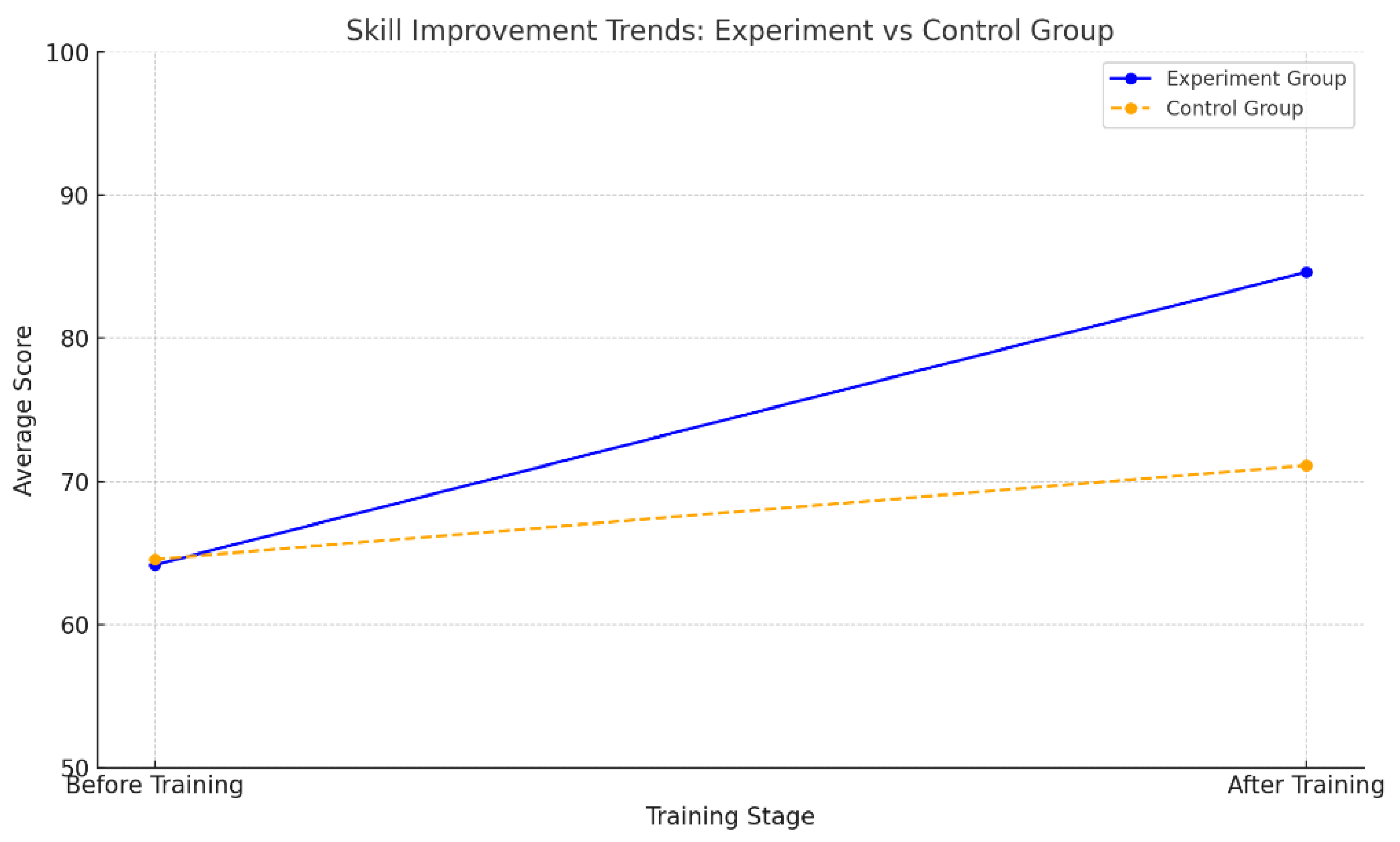
Figure 1.
Comparison of Learning Satisfaction Ratings Between Experimental and Control Groups.
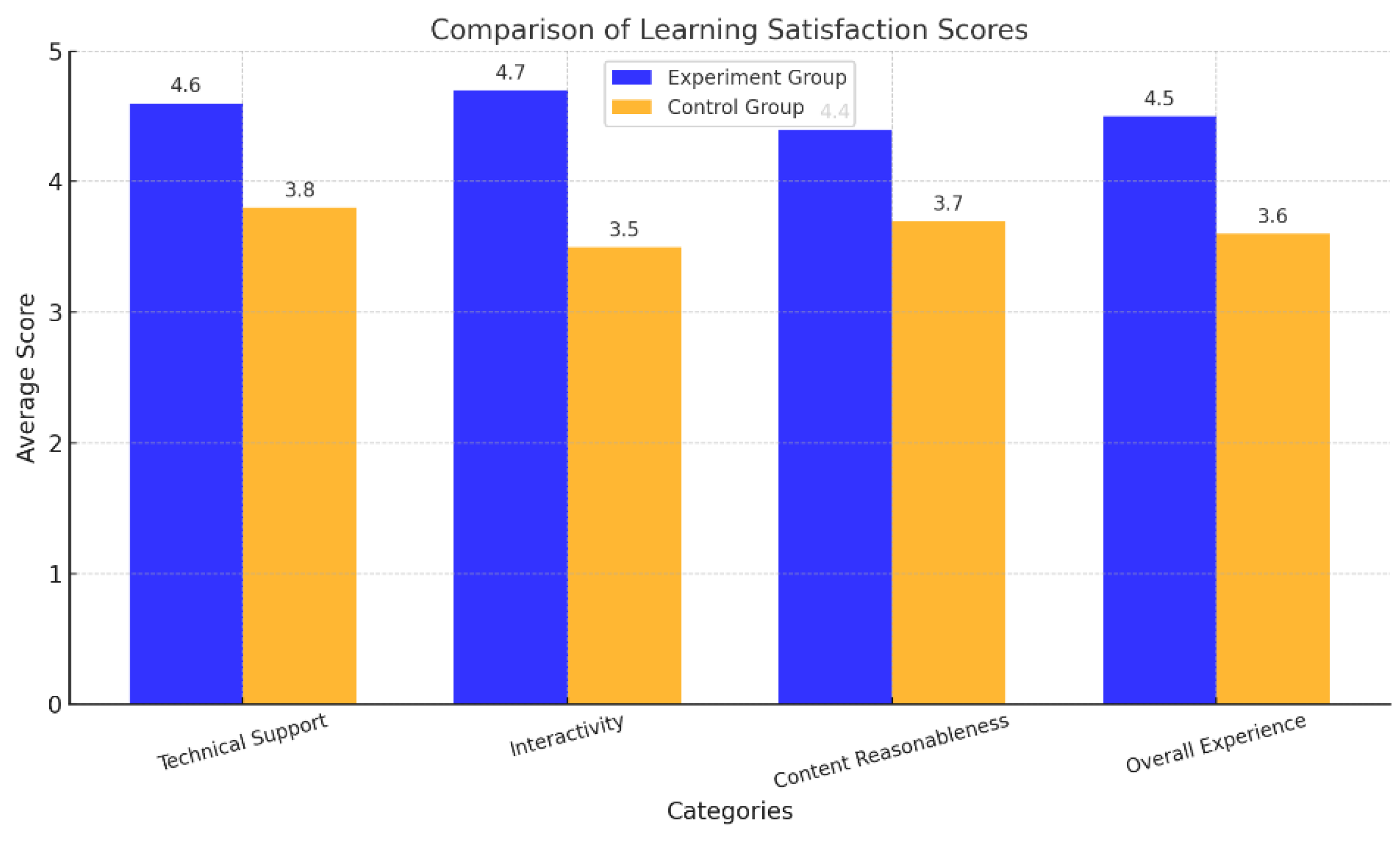
Table 1.
Job-Seeking Skills Evaluation Scale (Example).
| Category | Score |
|---|---|
| Interview Skills | 73 |
| Resume Writing | 82 |
| Communication Skills | 87 |
| Confidence Display | 94 |
Table 2.
Descriptive Statistics of Job-Seeking Skill Assessment for Experimental and Control Groups.
Table 2.
Descriptive Statistics of Job-Seeking Skill Assessment for Experimental and Control Groups.
| Group | Pre-training Mean (M) | Pre-training Standard Deviation (SD) | Post-training Mean (M) | Post-training Standard Deviation (SD) |
|---|---|---|---|---|
| Experimental | 65.4 | 5.2 | 85.7 | 5.5 |
| Control | 64.9 | 6.1 | 70.3 | 6.3 |
Table 3.
Learning Satisfaction Survey Results.
| Item | Experimental Group Mean Score | Control Group Mean Score |
|---|---|---|
| Technical Support | 4.6 | 3.8 |
| Interactivity | 4.7 | 3.5 |
| Training Content Management | 4.4 | 3.7 |
| Overall Learning Experience | 4.5 | 3.6 |
Disclaimer/Publisher’s Note: The statements, opinions and data contained in all publications are solely those of the individual author(s) and contributor(s) and not of MDPI and/or the editor(s). MDPI and/or the editor(s) disclaim responsibility for any injury to people or property resulting from any ideas, methods, instructions or products referred to in the content. |
© 2025 by the authors. Licensee MDPI, Basel, Switzerland. This article is an open access article distributed under the terms and conditions of the Creative Commons Attribution (CC BY) license (http://creativecommons.org/licenses/by/4.0/).
Copyright: This open access article is published under a Creative Commons CC BY 4.0 license, which permit the free download, distribution, and reuse, provided that the author and preprint are cited in any reuse.


