
Submitted:
17 January 2025
Posted:
20 January 2025
You are already at the latest version
Abstract
This study explores the integration of moral education courses and sustainable development education, and provides relevant integration strategies and innovative practice methods. Based on an analysis of the fundamental concepts of sustainable development education and an investigation into the development process and current status of moral education courses, the study elaborates on the objectives, principles, content, and pathways for combining moral education courses with sustainable development education. In the innovative practice section, innovative teaching models such as project-based learning and situational teaching are introduced, and modern teaching technologies such as multimedia and the internet are used to enrich teaching resources. The study also designs an evaluation index system and selects appropriate evaluation methods to assess the integration effects of innovative practices, summarizes the main research findings, theoretical and practical significance, and discusses the limitations of the study and future prospects.
Keywords:
1. Introduction
2. Literature Review
2.1. The Development Process and Current Status of Moral Education Courses

| Problem Type | Data Statistics |
|---|---|
| Course Settings | The content of moral education courses in primary, secondary, and tertiary institutions is largely similar, lacking systematic design. This results in arbitrary course offerings, fragmented content, simple repetition, and a lack of specificity. |
| Teaching Methods | Adopt a variety of teaching methods, such as case analysis, role-playing, and group discussions, to stimulate students ‘interest in learning and their participation. |
| Student Engagement | Student engagement has a significant impact on the effectiveness of moral education. By analyzing the factors that influence student engagement, we can identify ways and methods to improve the effectiveness of moral education. |
| Course Evaluation | The evaluation of moral education courses suffers from a disconnect between knowledge and action. The moral behavior of students should be considered a key component and an important aspect of the evaluation. |
| Course Integration | Secondary school moral education should enhance effectiveness through an integrated ecological approach, building a moral education system that is correctly oriented, has comprehensive content, connects across different educational stages, utilizes a variety of carriers, and is conducted on a regular basis. |
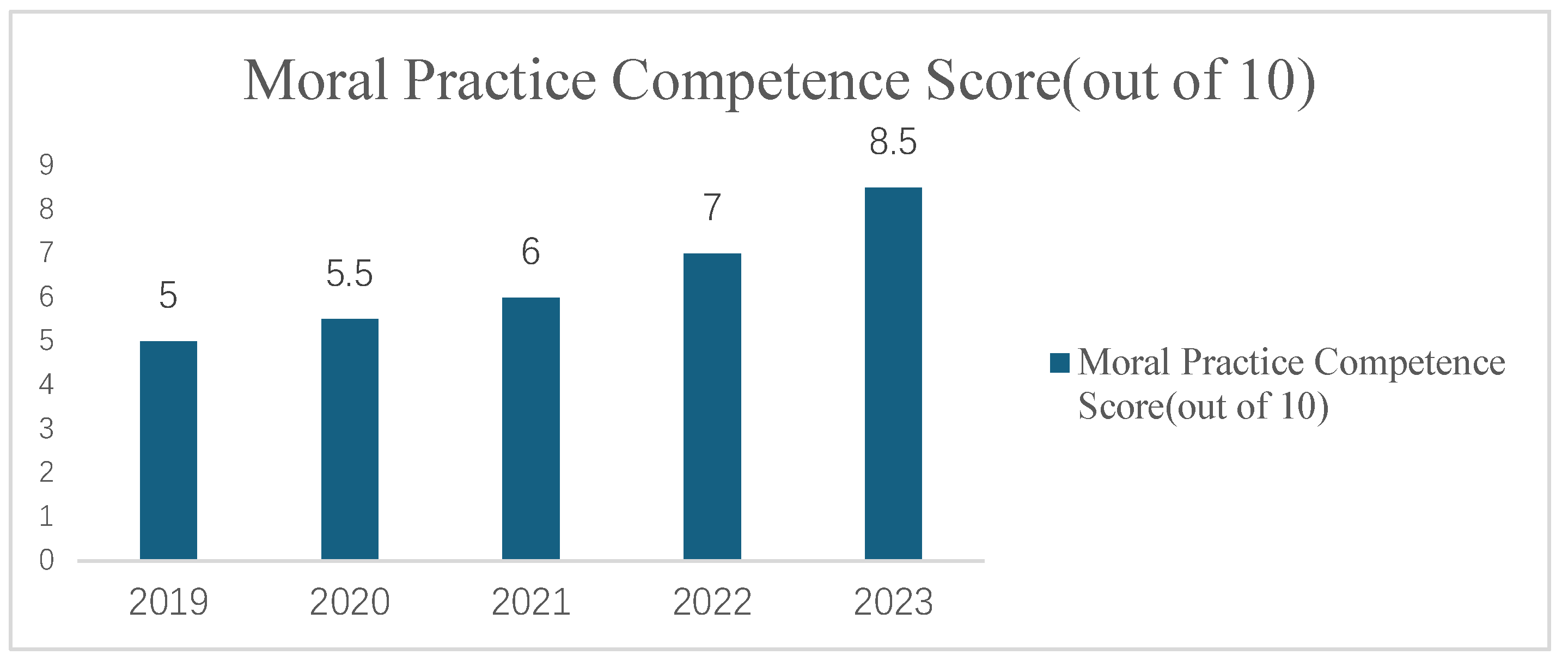
2.2. Integration Objectives and Principles
| Indicators | Before Implementation | After Implementation | Improvement Rate |
|---|---|---|---|
| Environmental Awareness Score (out of 10) | 5.2 | 7.8 | +2.6 |
| Social Responsibility Score (out of 10) | 4.9 | 7.5 | +2.6 |
| Number of Participation in Environmental Activities(times/semester) | 2.1 | 4.3 | +2.2 |
| Volunteer Service Hours(hours/semester) | 3.5 | 6.8 | +3.3 |
2.3. Integration Content and Pathways
| Steps | Content | Specific Implementation Methods | |
|---|---|---|---|
| 1 | Curriculum Design and Textbook Selection: Introducing Chapters and Textbooks Related to Sustainable Development | Curriculum Design: Add a special module on sustainable development to the existing moral education curriculum, such as environmental ethics, social equity, and resource management. Clearly define the teaching objectives, class hour arrangements, and teaching emphases for each module. | |
| Textbook Selection: Choose textbooks that include content on sustainable development. It is recommended to combine the use of internationally authoritative textbooks with localized textbooks. International textbooks could be those recommended by UNESCO, and localized textbooks can be written in conjunction with the local environment, social, and economic characteristics. | |||
| 2 | Teaching Methods and Means: Employ a variety of teaching methods and modern information technology. | Teaching Methods: Case analysis is adopted, selecting successful and failed cases of sustainable development from both domestic and international contexts for in-depth analysis. Group discussions are conducted, where students are divided into groups to exchange views on issues related to sustainable development. Role-playing activities are also carried out, in which students simulate the roles of different stakeholders in sustainable development decision-making processes to enhance their participation. | |
| Modern Information Technology: Utilize multimedia teaching to display materials related to sustainable development, such as images, videos, and animations. Rely on online learning platforms to publish teaching resources, assign homework, and conduct online discussions. Employ Virtual Reality (VR)technology to immerse students in scenarios of environmental changes and resource utilization, thereby enhancing the intuitiveness and interest of teaching. | |||
| 3 | Organize practices and projects related to sustainable development. | Practical Activities: Organize students to participate in community environmental protection activities, such as promoting waste sorting and afforestation. Conduct volunteer services by providing help at institutions like nursing homes and children's welfare homes, thereby cultivating students ‘sense of social responsibility. Carry out social surveys to understand the existing problems in local sustainable development as well as the awareness and behaviors of residents, thereby enhancing students ‘practical abilities. | |
| Project Implementation: Carry out campus greening projects, plan the layout of campus vegetation, and plant suitable plants. Implement energy conservation and emission reduction projects, monitor and optimize the campus energy usage, and promote energy-saving technologies and products. Develop community sustainable development plans, collaborate with communities to propose solutions for environmental, economic, and social issues in the community, allowing students to apply the knowledge they have learned in practice. | |||
| 4 | Evaluation and Feedback Mechanism: Establish an effective evaluation and feedback system. | Evaluation System: Design a diversified evaluation system. Class performance includes students’ attendance, classroom interaction, and group cooperation. Project outcomes are evaluated based on the degree of completion, innovation, and practical effects. Practical reports assess student’s summary, reflection, and suggestions on practical activities. The final exam combines written and oral tests. The written test focuses on theoretical knowledge, while the oral test examines students ‘comprehensive analysis and expression abilities. | |
| Feedback Mechanism: Regularly collect feedback from students and teachers through methods such as questionnaires, seminars, and individual interviews. Assess aspects such as the difficulty level of teaching content, the effectiveness of teaching methods, and the organization of practical activities. Make timely adjustments to teaching content and methods to ensure teaching effectiveness. | |||
| Project Content | Cultivate students’ environmental awareness and the ability to solve practical problems. |
| Project Content | Detailed Content |
| 1.Campus Environment Monitoring | Students are divided into groups to conduct environmental monitoring-record data. |
| 2.Propose Improvement Suggestions | Make suggestions based on the monitoring data. |
| 3.Implement Environmental Protection Measures | Waste sorting, energy conservation and emission reduction, water resource management. |
| 4.Online Learning Resources | Provide a wealth of learning resources-interactive opportunities. |
3. Research Methods
3.1. Innovative Teaching Models and Methods
| Evaluation Indicators | Average Score of Experimental Group | Average Score of Control Group | Difference (Experimental Group - Control Group) | Difference Percentage (Relative to Control Group) |
|---|---|---|---|---|
| Degree of Mastery of Sustainable Development Knowledge | 85.2 | 72.8 | 12.4 | 17.0% |
| Environmental Awareness | 90.5 | 78.3 | 12.2 | 15.6% |
| Teamwork Capability | 88.6 | 76.1 | 12.5 | 16.4% |
| Problem-solving Ability | 87.3 | 74.9 | 12.4 | 16.6% |
3.2. Enrich Teaching Resources and Methods
| Region | GDP Growth Rate | Per Capita Carbon Emissions | Renewable Energy Utilization Rate | Population Density (People per Square Kilometer) | Proportion of Green Buildings | Public Transportation Usage Ratio | |
|---|---|---|---|---|---|---|---|
| Beijing | 5.1% | 7.0 Tons per Person | 30% | 1300 | 50% | 65% | |
| Shanghai | 5.7% | 6.5 Tons per Person | 35% | 3800 | 55% | 70% | |
| Guangdong | 5.5% | 7.2 Tons per Person | 28% | 700 | 40% | 55% | |
| Sichuan | 7.0% | 2.5 Tons per Person | 81% | 140 | 45% | 60% | |
| Jiangsu | 5.4% | 6.0 Tons per Person | 25% | 750 | 40% | 50% | |
| Zhejiang | 5.7% | 5.5 Tons per Person | 19.9% | 600 | 45% | 55% | |
| Shandong | 5.5% | 6.8 Tons per Person | 20% | 600 | 35% | 45% | |
| Hubei | 5.5% | 5.8 Tons per Person | 22% | 300 | 30% | 40% | |
| Hunan | 4.9% | 5.0 Tons per Person | 20% | 300 | 35% | 45% | |
| Shanxi | 4.8% | 6.2 Tons per Person | 25% | 180 | 30% | 40% | |
| Gansu | 5.5% | 7.5 Tons per Person | 50.1% | 70 | 25% | 35% | |
| Ningxia | 4.8% | 21.0 Tons per Person | 31.0% | 90 | 20% | 30% | |
| Qinghai | 5.0% | 5.0 Tons per Person | 55% | 7 | 20% | 30% | |
| Xinjiang | 4.5% | 16.0 Tons per Person | 30% | 14 | 25% | 35% |
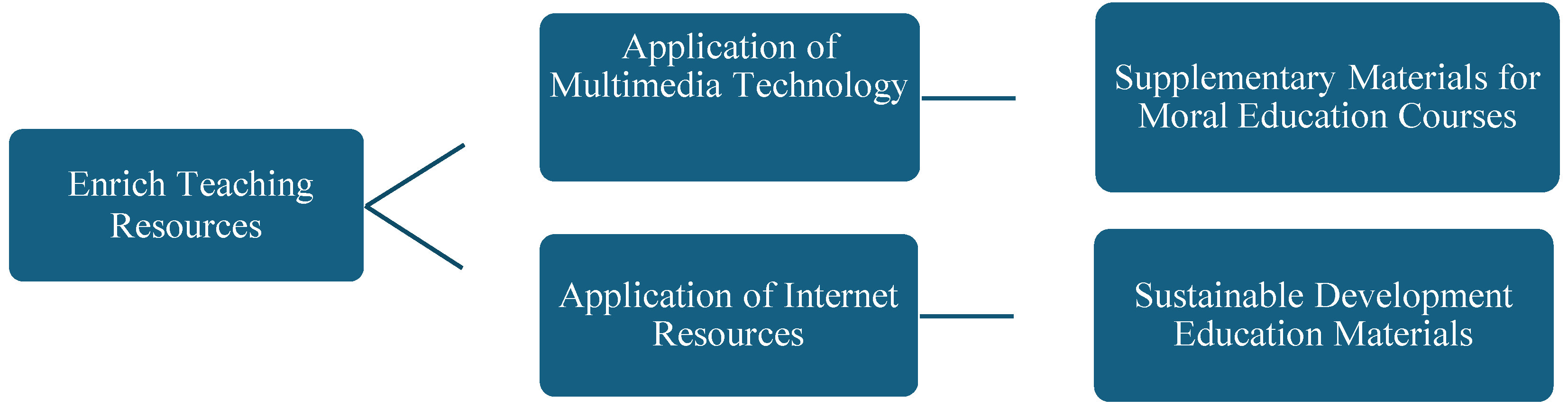
4. Research Results
4.1. Assessment Methods and Indicators
| School Name | Moral Education Curriculum System | Specific Practice Content | Successful Experience | Challenges Faced |
|---|---|---|---|---|
|
Lige Experimental School, Shuangliu District, Chengdu City |
Cultivation of a Sound Personality |
Curriculum-Based Education: Constructing a Moral Education Curriculum System and Designing and Implementing Moral Education Activities. | Curriculum System Improvement: A Systematized Moral Education Curriculum System Has Been Formed. |
Resource Coordination: It Is Necessary to Coordinate On-Campus and Off-Campus Resources to Ensure the Smooth Conduct of Practical Activities. |
| Activity-Based Education: Cultivating Students Patriotic Sentiments through Young Pioneers Activity Classes, Themed Class Meetings, and Other Activities. | ||||
| Practice-Based Education: Establishing In-School Practice Activity Bases and Conducting Off-Campus Study-Practice Activities. | Diversified Practical Activities: Enhancing Students ‘Practical Abilities and Moral Quality through a Variety of Practical Activities. | Improvement of the Evaluation System: There Is a Need to Further Improve the Moral Education Evaluation System to Ensure the Scientific Assessment of Moral Education Outcomes. | ||
|
Langan Middle School Affiliated to Chongqing No.8 Middle School |
School-Based Curriculum Development |
Aspiring to Excellence: Developing School-Based Curricula to Awaken Students Moral Awareness. | School-Based Curriculum Features: School-Based Moral Education Curricula with Unique School Characteristics Have Been Developed. |
Difficulty in Curriculum Implementation: The Implementation of School-Based Curricula Requires Teachers to Possess a High Level of Professional Quality. |
| Practical Activities: Organizing Students to Participate in Community Service, Environmental Protection Promotion, and Other Practical Activities. |
High Student Participation: Through School-Based Curricula, the Participation and Enthusiasm of Students Have Been Improved. | Insufficient Resources: Some Practical Activities Are Difficult to Continue Due to Insufficient Resources. |
||
|
Mengen Experimental Primary School, Kerwin District, Tong Liao City |
Encountering Education |
Cultural Education: Creating a Positive Moral Education Atmosphere through Campus Culture Construction. | Strong Cultural Atmosphere: A Positive Moral Education Atmosphere Has Been Formed through Campus Culture Construction. |
Teacher Training: There Is a Need to Strengthen Moral Education Training for Teachers to Improve Their Moral Education Competence. |
| Activity-Based Education: Carrying out a Rich and Diverse Range of Moral Education Activities, Such as Classic Recitation and Volunteer Service. | Diversified Activity Formats: Enhancing Students ‘Moral Quality through a Variety of Moral Education Activities. |
Home-School Cooperation: There Is a Need to Further Strengthen Home-School Cooperation to Form an Educational Synergy. |
||
|
Ning nan Middle School |
School-Based Curriculum for Study-Travel |
Geographical Study-Travel: Developing School-Based Curricula for Geographical Study-Travel to Enhance Students ‘Practical Abilities. | Enhanced Practical and Inquiry Skills: Through Study-Travel, Students ‘Practical and Inquiry Abilities Have Been Strengthened. | Difficulty in Course Design: The Design of Study-Travel Courses Requires a High Level of Professional Competence. |
| Practical Activities: Organizing Students to Participate in Geographical Study-Travel to Understand Nature and Society. | Curriculum Innovation: Innovative School-Based Study-Travel Curricula Have Been Developed. |
Safety Issues: Safety Concerns during Study-Travel Need Special Attention. |
4.2. Analysis of the Evaluation Results
| Evaluation Dimensions | Key Indicators | Evaluation Criteria |
|---|---|---|
| Integration Degree of Moral Education Content | The Degree of Integration between Moral Education Content and Subject Content | Highly Integrated and Content Appropriate |
| Innovativeness of Teaching Methods | The Diversity and Novelty of Teaching Methods | Diverse Methods and Innovative |
| Students ‘Learning Enthusiasm | Students ‘Participation and Interest in Moral Education Courses | Students Participate Actively and Have a Strong Interest |
| Sustainability of Moral Education Outcomes | The Manifestation of Moral Education Outcomes in Students ‘Daily Behavior | Moral Education Outcomes Lasting and Behavioral Change |
| Enhancement of Teachers ‘Professional Quality | The Professional Quality Performance of Teachers in Moral Education Courses | Teachers ‘Professional Quality Significantly Improved |
| Home-School Cooperation and Community Participation | The Degree of Home-School Cooperation and the Utilization of Community Resources | Close Home-School Cooperation and Community Support |
| Overall Evaluation and Directions for Improvement | Comprehensive Evaluation of the Integration and Innovation of Moral Education Courses | High Course Quality and Strong Innovation |
| Scoring Situation | Data Analysis | Problems and Improvement Suggestions |
|---|---|---|
| 85 | Subject Content and Moral Education Content Are Effectively Integrated, but There Is Still Room for Improvement | Strengthen the Deep Integration of Moral Education and Subject Content, and Avoid Rigid Insertion |
| 75 | The Teaching Methods Have Some Innovation, but More Diversified Teaching Means Are Needed | Introduce More Modern Teaching Tools and Methods, Such as Interactive Teaching and Scenario Simulation |
| 90 | Students Show a High Level of Interest and Enthusiasm in Learning | Continue to Maintain and Strengthen the Exploration and Guidance of Students ‘Interests |
| 70 | The Effects of Moral Education Have Begun to Emerge, but Longer-Term Observation and Verification Are Needed | Strengthen the Follow-Up Evaluation of Moral Education Outcomes to Ensure the Long-Term Effects of Moral Education Practice |
| 80 | Teachers Have Shown a High Level of Professional Quality in Moral Education Courses | Provide More Teacher Training Opportunities to Promote Professional Growth of Teachers |
| 65 | Home-School Cooperation Needs to Be Strengthened, and the Utilization of Community Resources Is Insufficient | Strengthen Home- School Communication and Cooperation, and Actively Introduce Community Resources to Form an Educational Synergy |
| 78 | Moral Education Courses Have Achieved Certain Results in Integration and Innovation | Continuously Optimize Course Content and Teaching Methods, and Strengthen Evaluation and Feedback Mechanisms |
5. Conclusions and Prospects
5.1. Conclusions
5.2. Limitations and Prospects
Author Contributions
Funding
Institutional Review Board Statement
Informed Consent Statement
Data Availability Statement
Conflicts of Interest
References
- Asif, T.; Gangling, O.; Haider, M.A.; Colomer, J.; Kayani, S.; Amin, N. Moral Education for Sustainable Development: Comparison of University Teachers ‘Perceptions in China and Pakistan. Sustainability 2020, 12, 3014. [Google Scholar] [CrossRef]
- Madar, S.; Syed-Abdullah, S.I.S.; Kushnir, I.; Abdurrahim, N.A. Narratives on education for sustainable development in Malaysian universities. Sustainability 2023, 15, 13110. [Google Scholar] [CrossRef]
- Vermeulen, W.J.V.; Bootsma, M.C.; Tim, M. Higher education level teaching of(master's)programmed in sustainable development: analysis of views on prerequisites and practices based on a worldwide surveying J Sust Dev World 2014, 21, 430–448.
- Wals, A.E. Sustainability in higher education in the context of the un-Desae review of learning and institutionalization processes. J.Clean.Prod. 2014, 62, 8–15. [Google Scholar] [CrossRef]
- Wu, Y.-C.J.; Shen, J.-. Phisher education for sustainable development: a systematic review. Int.J.Sustain.High.Educ. 2016, 17, 633–651. [Google Scholar] [CrossRef]
- Badea, C.; Banos-Gonzalez, I.; Biermann, F.; et al. Education for sustainable development: a systematic review of the research. Environ. Educ. Res. 2018, 24, 1493–1512. [Google Scholar]
- Badea, C.; Banos-Gonzalez, I.; Biermann, F.; et al. Education for sustainable development: a systematic review of the research. Environ. Educ. Res. 2018, 24, 1173–1192. [Google Scholar]
- Badea, C.; Banos-Gonzalez, I.; Biermann, F.; et al. Education for sustainable development: a systematic review of the research. Environ. Educ. Res. 2018, 24, 1193–1212. [Google Scholar]
- Barros, A.I.; Pereira, L.M.; Henriques, T. Measuring the carbon footprint of student and teacher transport: a case study of a Portuguese university. J.Clean.Prod. 2018, 172, 323–332. [Google Scholar]
- Geng, Y.; Sakai, S.; Fujita, T. ; teal. Promoting tree planting in universities: a case study from China.J.Clean.Prod. 2013, 47, 124–132. [Google Scholar]
- Andrades Paramagnons Lez -Gómez, D.; Rodrigos-González, A. Identifying the primary obstacles to integrating sustainability-related subjects into academic curricula. Sustainability 2018, 10, 351. [Google Scholar]
- Jain, S.; Sahu, J.K. ; Shumsky. Energy-efficient transportation in universities: a review. Renew. Sustain. Energy Rev. 2013, 28, 695–706. [Google Scholar]
- Marinho, E. A.; de Sousa, A. M.; de Lima, A. M. Reducing water usage in universities: a case study from Brazil. J.Clean.Prod. 2014, 64, 123–132. [Google Scholar]
- Badea, C.; Banos-Gonzalez, I.; Biermann, F.; et al. Education for sustainable development: a systematic review of the research. Environ.Educ.Res. 2018, 24, 1213–1232. [Google Scholar]
- Badea, C.; Benison sales, I.; B merman, F.; et al. Education for sustainable development: a systematic review of the research. Environ.Educ.Res. 2018, 24, 1233–1252. [Google Scholar]
- Aqib, Z. , &Romaniote. Building Professionalism of Teachers and School Supervisors. Surabaya: Y rami Widya.17. Armas, K. L. &Juror’s. (2024). Education for a Sustainable Future: Analysis of Universities ‘Vision and Mission Statements in Line with Global Sustainable Development Goals. Journal of Lifestyle and SDGs Review 2007, 4, e01790. [Google Scholar]
- Asmani, J.M. (2011). Guidebook for Internalization of Character Education in Schools. Yogyakarta: Diva Press.
- Armas, K. L. &Juror’s. Education for a Sustainable Future: Analysis of Universities Vision and Mission Statements in Line with Global Sustainable Development Goals. Journal of Lifestyle and SDGs Review 2024, 4, e01790. [Google Scholar]
- Borg, W.R. , Gall, M. D. &Gall. (2003). Educational Research: An Introduction. United States: Person Education Inc.
- Cano, E.V. , &Sevillano García. ICT Strategies and Tools for The Improvement of Instructional Supervision. The Virtual Supervision. TOJET: The Turkish Online Journal of Educational Technology 2013, 12, 102–108. [Google Scholar]
- Clark, A. Ioglunide, H. A. Effective Supervision as A Challenge in Technical and Vocational Education Delivery: Ensuring Quality Teaching/Learning Environment and Feedback Mechanism. Basic Research Journal of Education Research and Review 2020, 2, 15. [Google Scholar]
- Fitria, C.Z. (2011). The Application of Character Education through the Integration of Subjects in Elementary Schools. National Seminar on Education, Surabaya: Unisa University Press.
- Peggy. (2024). The Application and Data Analysis of Situational Teaching in English Teaching. In: Paa’s, F. Peggy. (2024). The Application and Data Analysis of Situational Teaching in English Teaching. In: Paa’s, F., Patnaik, S., Want. (eds)Recent Trends in Educational Technology and Administration. Duta 2023.Learning and Analytics in Intelligent Systems, Vol 38. Springer, Cham. [CrossRef]
- Sen, A. Faculty perception of online teaching effectiveness and indicators of quality. International Research Journal of Human Resource and Social Sciences 2020, 7. [Google Scholar]
- Skordis-Worrall, J.; Haphtaras-Bidgoli, H.; Batura, N.; &Hughes, J. ; &Hughes, J. Learning online: A case study exploring student perceptions and experience of a course in economic evaluation. International Journal of Teaching and Learning in Higher Education 2015, 27, 413–422. [Google Scholar]
- Chi, D.P.; Oanh, D.T.K. Proposing a process for training online teaching competence for lecturers at higher education institutions. Journal of Education and e-Learning Research 2023, 10, 502–512. [Google Scholar] [CrossRef]
- Essel, H.B.; Vlachopoulos, D.; Techy-Menson, A.; Johnson, E.E.; &Baah, P.K. ; &Baah, P. K. The impact of a virtual teaching assistant(chatbot)on students learning in Ghanaian higher education. International Journal of Educational Technology in Higher Education 2022, 19, 1–19. [Google Scholar]
- Picciano, A.G. Theories and frameworks for online education: Seeking an integrated model. Online Learning 2017, 21, 166–190. [Google Scholar] [CrossRef]
- Astin, A.W.; Astin, H.S.; &Lindholm, J.A. ; &Lindholm, J. A. Assessing Students ‘Spiritual and Religious Qualities. Journal of College Student Development 2011, 52, 39–61. [Google Scholar]
- Means, B.; Toyama, Y.; Murphy, R.; Bankia, M. ; Jones K (2009) Evaluation of evidence-based practices in online learning: A meta-analysis review of online learning studies, U.S. Department of Education.
- Garrison, D. R. , & Vaughan, N. D. (2008). Blended learning in higher education: Framework, principles, and guidelines. San Francisco: Jossey-Bass.
- Johnson, N.; &Kiviniemi, M.J. ; &Kiviniemi, M. J. The role of student ratings in the evaluation of teaching. New Directions for Teaching and Learning 2009, 2009, 7–15. [Google Scholar] [CrossRef]
- Zang, D. (2022). The Practical Effect of Integrating Mental Health Education and Moral Education in Middle School. Intelligence, 2022, (08): 172-174.
- Shang, J. L. (2022). Integration Methods and Practical Significance of Moral Education and Mental Health Education in Junior High School. New Curriculum (Middle School), 2022, (11): 280.
- Zhang, Y. Y. (2022). Innovative Practices for Effectively Implementing the Integration of Moral Education and Mental Health Education. Reading, Writing, and Arithmetic, 2022, (12): 42.
- Li, H. M. (2021). On the Integration of Moral Education into Vocational College Professional Courses. Health Vocational Education, 39.03: 37-38. • This document explores the methods and assessment indicators for integrating moral education into vocational college professional courses.
- Han, C. H. , & Shen, Y. (2021). Exploring the Real Difficulties and Mechanism Construction of Moral Education Integration from Primary to University. China Educational Technology, 02: 8-13.
- Yang, K. J. , Hao, W. L., & Hao, Y. (2021). Analysis of Moral Education Reform in the Network Environment—Review of "Moral Education and Innovative Ability Development". Chinese Journal of Education, 01(2021): 116.
- Peng, H. (2021). The Application and Prospect of the Moral Value of Non-Community Material Cultural Heritage—Taking Ren City Tao Archway as an Example. Journal of Sichuan University of Arts and Science, 31.01(2021): 100-104.
- Zhang, J. (2021). Integrating "Moral Education" and "Aesthetic Education" into the Practice of "Micro-Film Creation" Course. Innovation and Entrepreneurship Theory Research and Practice, 4.01(2021): 63-65.
- Zhou, G.W.; Li, S.S. Content and Practice of Ecological Moral Education. Chinese Forestry Education 2013, 2013. [Google Scholar]
- Gao, S. Analysis of the Current Situation and Countermeasures for the Low Effectiveness of Primary School Moral Education. Modern Educational Science 2013, 2013. [Google Scholar]
- Deng, C.G.; Hao, Z.B. On the Function and Regularity of Ideological and Political Education. Heilongjiang Higher Education Research 2013, 2013. [Google Scholar]
- Yang, S.X. New Methods of Primary School Moral Education under Network Conditions. Academic Weekly 2012, 2012. [Google Scholar]
- Zhang, J.J.; Zhang, Y.R. Application of Research-Oriented Moral Education Teaching Methods in Higher Grades of Primary School. Primary and Secondary School Teacher Training 2012, 2012. [Google Scholar]
- Chen, B.L. Practical Exploration of Building an Effective Model of Primary School Moral Education. Educational Journal 2012, 2012. [Google Scholar]
- Huang, J. Preliminary Exploration of Network Moral Education in Primary Schools. Exam Weekly 2011, 2011. [Google Scholar]
- Zhang, Y.C.; Zhu, Z.G. On the Construction of Community "Platforms" for the Development of the Main Body of Adolescent Ideological and Moral Education. Academic Forum 2011, 2011. [Google Scholar]
- Cheng, S.M.; Xia, Y. Theory and Practice of Student Subjectivity in Ideological and Political Theory Courses. Heilongjiang Higher Education Research 2011, 2011. [Google Scholar]
- Ren, Z.G. Discussion on the Problems and Countermeasures in Primary School Moral Education. Times Education (Teaching and Education) 2010, 2010.
- Tan, C.B. Professionalization of Moral Education Teachers and the Moral Professionalization of Teachers. Educational Research 2007, 2007. [Google Scholar]
- Cai, L.H. On the Process and Regularity of Network Moral Education. Contemporary World and Socialism 2006, 2006. [Google Scholar]
- Tang, K.L.; Liu, T.F. Value Enlightenment and Life Cultivation - Virtue Cultivation Education in Open Society. Educational Science Research 2005, 2005. [Google Scholar]
- Luo, Y.T. On the Subject, Object, and Their Interrelationship in Ideological and Political Education. Journal of Ideological and Theoretical Education 2002, 2002. [Google Scholar]
Disclaimer/Publisher’s Note: The statements, opinions and data contained in all publications are solely those of the individual author(s) and contributor(s) and not of MDPI and/or the editor(s). MDPI and/or the editor(s) disclaim responsibility for any injury to people or property resulting from any ideas, methods, instructions or products referred to in the content. |
© 2025 by the authors. Licensee MDPI, Basel, Switzerland. This article is an open access article distributed under the terms and conditions of the Creative Commons Attribution (CC BY) license (http://creativecommons.org/licenses/by/4.0/).


