Preprint
Review

This version is not peer-reviewed.

Earth-Air Heat Exchangers: A Comprehensive Review

A peer-reviewed article of this preprint also exists.

Submitted:

17 January 2025

Posted:

20 January 2025

You are already at the latest version

Abstract

Earth Air Heat Exchangers (EAHEs) provide a compelling solution for improving building en-ergy efficiency by harnessing the stable subterranean temperature to pre-treat ventilation air. This comprehensive review delves into the foundational principles of EAHE operation, meticu-lously examining heat and mass transfer phenomena at the ground-air interface. The study me-ticulously investigates the impact of key factors, including soil characteristics, climatic condi-tions, and crucial system design parameters, on overall system performance. Beyond independ-ent applications, this review explores the synergistic integration of EAHEs with a diverse array of renewable energy technologies, such as air source heat pumps, photovoltaic thermal (PVT) panels, wind turbines, fogging systems, water spray channels, solar chimneys, and photovoltaic systems. This exploration aims to clarify the potential of hybrid systems in achieving enhanced energy efficiency, minimizing environmental impact, and improving the overall robustness of the system.

Keywords: 
;  ;  ;  

1. Introduction

The escalating global energy crisis, exacerbated by climate change, has intensified the search for sustainable and energy-efficient building solutions. The building sector is a significant contributor to global energy consumption. As urbanization and population growth continue, the demand for energy in buildings is steadily increasing. Heating and cooling systems, in particular, play a pivotal role in this energy consumption, accounting for a substantial portion of the total energy demand in buildings. Recent studies [1,2,3,4], have highlighted the escalating trend in global building energy consumption and the growing share of heating and cooling. Furthermore, according to the World Energy Outlook 2023 [5], the global energy consumption in buildings has been steadily increasing over the past decade. In 2022, the sector consumed approximately 1% more energy than the previous year, maintaining an average annual growth rate of just over 1%. Electricity has become the primary energy source for buildings, accounting for around 35% of total energy use in 2022, up from 30% in 2010. This shift towards electricity is driven by the increasing electrification of heating and cooling systems, as well as the growing adoption of electric appliances. Despite the increasing use of renewable energy sources, fossil fuels continue to play a significant role in building energy consumption. In fact, the use of fossil fuel in buildings has increased at an average annual rate of 0.5% since 2010. This trend is concerning as it contributes to greenhouse gas emissions and climate change.
Global energy consumption in buildings is a complex issue driven by several interconnected factors. Primarily, urbanization and population growth have led to a significant increase in the number of buildings, thus increasing the demand for energy services. For example, the largest increase was observed in regions with rapidly developing urbanization, such as Southeast Asia, India, China, and in some African countries such as Nigeria [6,7].
Furthermore, changing climate patterns have exacerbated the need for heating and cooling. More frequent and intense heatwaves have led to increased reliance on air conditioning systems, while colder winters have driven up the demand for heating [8,9,10,11]. The impact of climate change is particularly pronounced in regions with extreme weather conditions, such as those experiencing prolonged heat waves or severe cold spells [12].
In addition, increasing living standards have contributed to an increase in energy consumption in buildings [4,13]. As people's expectations of indoor comfort rise, there is a growing demand for energy-intensive appliances, such as air conditioners, refrigerators, and electronic devices [14,15]. Moreover, the trend toward larger homes and more complex building designs further exacerbates energy consumption.
These factors have collectively led to a substantial increase in energy demand for building heating and cooling, particularly in developing countries where urbanisation and economic growth are rapidly accelerating.
As the demand for energy continues to grow, there is an urgent need for innovative technologies that can reduce energy consumption and greenhouse gas emissions. As a result, there is a growing demand for innovative technologies that can reduce energy consumption and improve indoor environmental quality. Among promising solutions, Earth-Air Heat Exchangers (EAHEs) have emerged as a viable option to improve the energy performance of buildings. Earth-air heat exchangers (EAHEs) have emerged as a promising technology for the design and operation. Their roots can be traced back to ancient civilisations who recognized the thermal properties of the Earth and used them for various purposes [16]. However, the modern concept of EAHE, as we know it today, began to take shape in the mid-20th century. Early research focused on understanding the fundamental principles of heat transfer between ground and air. Pioneer studies investigated the thermal properties of different types of soil, the impact of pipe configuration, and the optimal design parameters for EAHX systems. These early investigations laid the foundation for the development of practical applications of EAHE technology.
The number of articles devoted to the assessment of EAHE systems for buildings has been increasing in recent years, and several extensive review papers on the topic can be found in the literature [17,18,19,20,21,22,23,24,25] allowing to conclude that interest on the subject is rising.
By taking advantage of the relatively constant temperature of the subsurface, EAHE systems offer a sustainable and efficient means of heating and cooling buildings. Earth-to-air heat exchangers (EAHEs) have found wide application in various sectors of construction and industry. In the building sector, EAHE systems have found widespread application in residential and commercial properties. From single-family homes to large-scale commercial complexes, EAHE contributes to improved thermal comfort and reduced energy consumption. Their applications are diverse, covering space heating and cooling[26,27,28,29], ventilation [20,21,22], process cooling [30], and agricultural climate control [31]. By pre-heating or pre-cooling incoming air, EAHE reduce the load on conventional HVAC systems. In addition, they provide fresh, filtered air, improving indoor air quality. According to [32,33,34], the implementation of EAHE systems demonstrates significant potential as an effective passive cooling and heating technology, particularly in lightweight buildings located in high-altitude cold regions. Their research findings indicate a substantial improvement in indoor air quality, attributed to increased ventilation rates and reduced pollutant concentrations. Numerous studies have shown the effectiveness of EAHE in reducing energy consumption, improving indoor comfort, and reducing greenhouse gas emissions [35,36,37,38,39].
Recent studies have demonstrated the feasibility of integrating EAHE with solar energy, geothermal energy, and air heat pumps [40,41,42,43,44,45]. For instance, [46,47,48,49,50,51] investigated the performance of a hybrid system combining EAHE, achieving significant energy savings compared to conventional HVAC systems. These types of solutions have the potential to increase the efficiency of energy buildings and reduce CO2 emissions.
To optimize the performance of EAHE systems, researchers have conducted numerous studies investigating the impact of these variables [52,53,54,55,56,57]. Additionally, advancements in modeling and simulation tools have enabled more accurate prediction of the performance of EAHE systems, facilitating their design and optimization.
As technology continues to advance, EAHE systems are becoming more sophisticated and efficient. Innovative design approaches, such as the use of advanced materials and intelligent control systems, are further enhancing the performance of these systems. Additionally, ongoing research is focused on optimizing the integration of EAHE with other building systems, such as HVAC and ventilation systems, to achieve optimal energy performance [51].
Despite the promising potential of EAHE, several challenges remain. These include the high initial investment costs, the impact of soil conditions on system performance, and the potential for system degradation over time. Future research should focus on addressing these challenges and exploring innovative solutions to improve the long-term performance and reliability of EAHE systems.
Although numerous studies have investigated the performance and applications of EAHE systems, a comprehensive review that integrates the latest advances in the field. This review aims to provide a comprehensive overview of the principles, design, and performance of hybrid EAHE systems, with a particular focus on their potential for reducing energy consumption and greenhouse gas emissions. By addressing these objectives, this review will contribute to the advancement of sustainable building technologies and support the transition towards a more energy-efficient and environmentally friendly built environment. Additionally, the review will identify research gaps and propose future directions for the advancement of this technology.

2. Materials and Methods

This study employed a comprehensive literature review approach to explore the state of the art in EAHE technology. The primary sources of information included peer-reviewed articles indexed in reputable databases such as Scopus, Google Scholar, and Web of Science. Relevant keywords such as "earth-air heat exchanger," "ground-source heat pump," "renewable energy," and "energy efficiency” were used to identify a large pool of potential studies.
A rigorous filtering process was applied to select the most relevant and up-to-date research articles [57]. Criteria such as publication date, research methodology, and alignment with the study objectives were considered. This process resulted in the selection of 16324 scientific papers, which formed the foundation of this review.
To gain deeper insight into the trends and patterns within the field of EAHE research, a bibliographic analysis was conducted. This analysis involved mapping the citation network, identifying influential authors and institutions, and analyzing the most frequently cited keywords [58].
The selected articles were then subjected to a thorough qualitative analysis to extract key findings, identify research gaps, and discern emerging trends in EAHE technology. This analysis enabled a comprehensive understanding of the current state-of-the-art and future directions in this field.

3. EAHE Fundamentals

3.1. Classification of EAHE Systems

Earth Air heat exchangers represent an innovative solution in the field of energy efficiency. By leveraging the relatively stable temperature of the subsurface, EAHE systems pre-condition outdoor air before it enters a building.
Earth Air Heat Exchangers (EAHEs) have evolved significantly over the years, with advances in materials, design, and control strategies. This classification scheme provides a framework for understanding the various types of EAHE systems that have emerged (Figure 1).
When the different classifications, it is possible to appreciate the diversity of approaches to harnessing the thermal energy of the ground and to identify emerging trends in EAHE technology. Many researchers choose a hybrid configuration by coupling it with different passive techniques to improve the performance of the system in their respective research work using experimental, analytical, numerical, or some other studies [59].
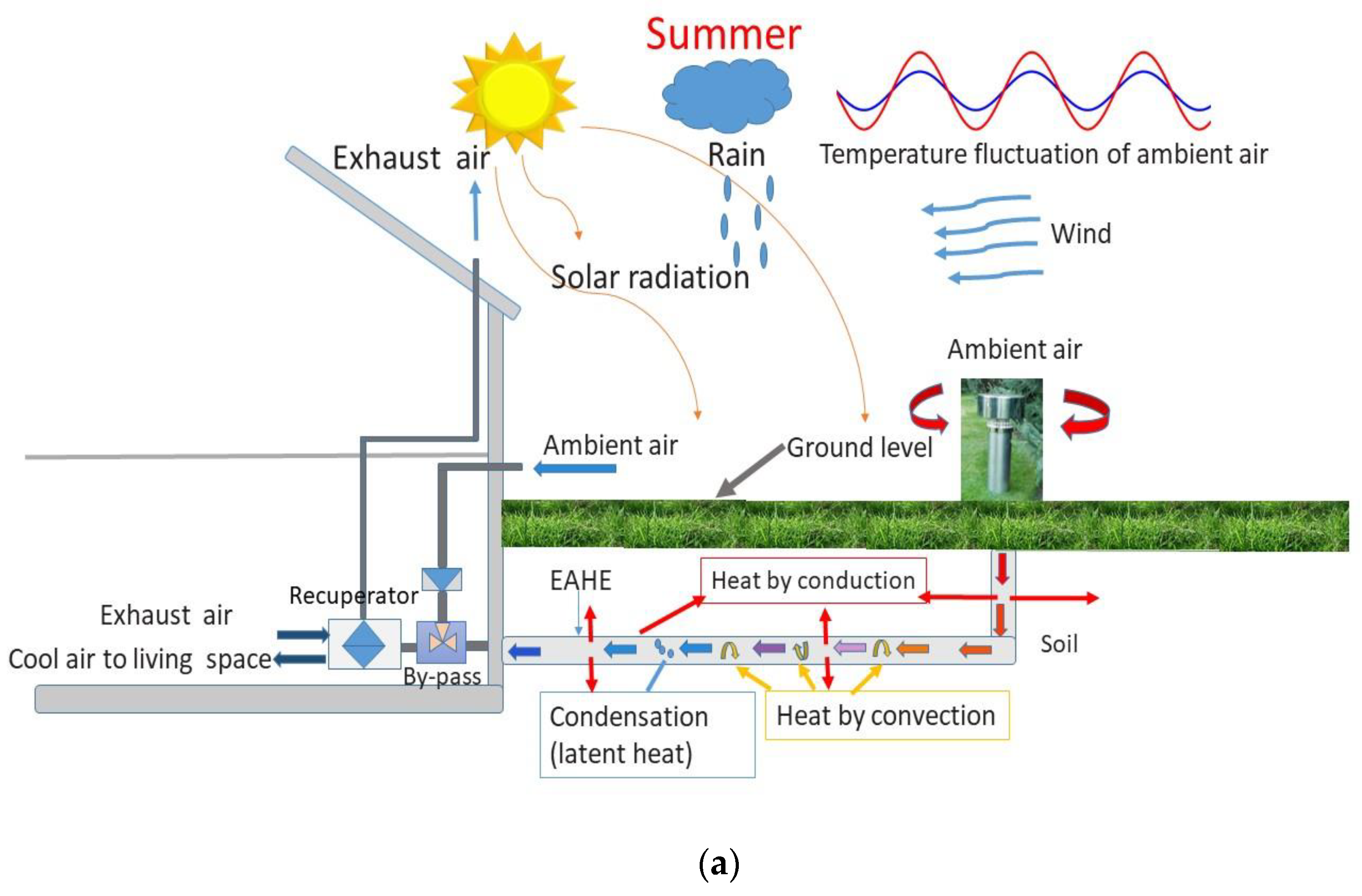
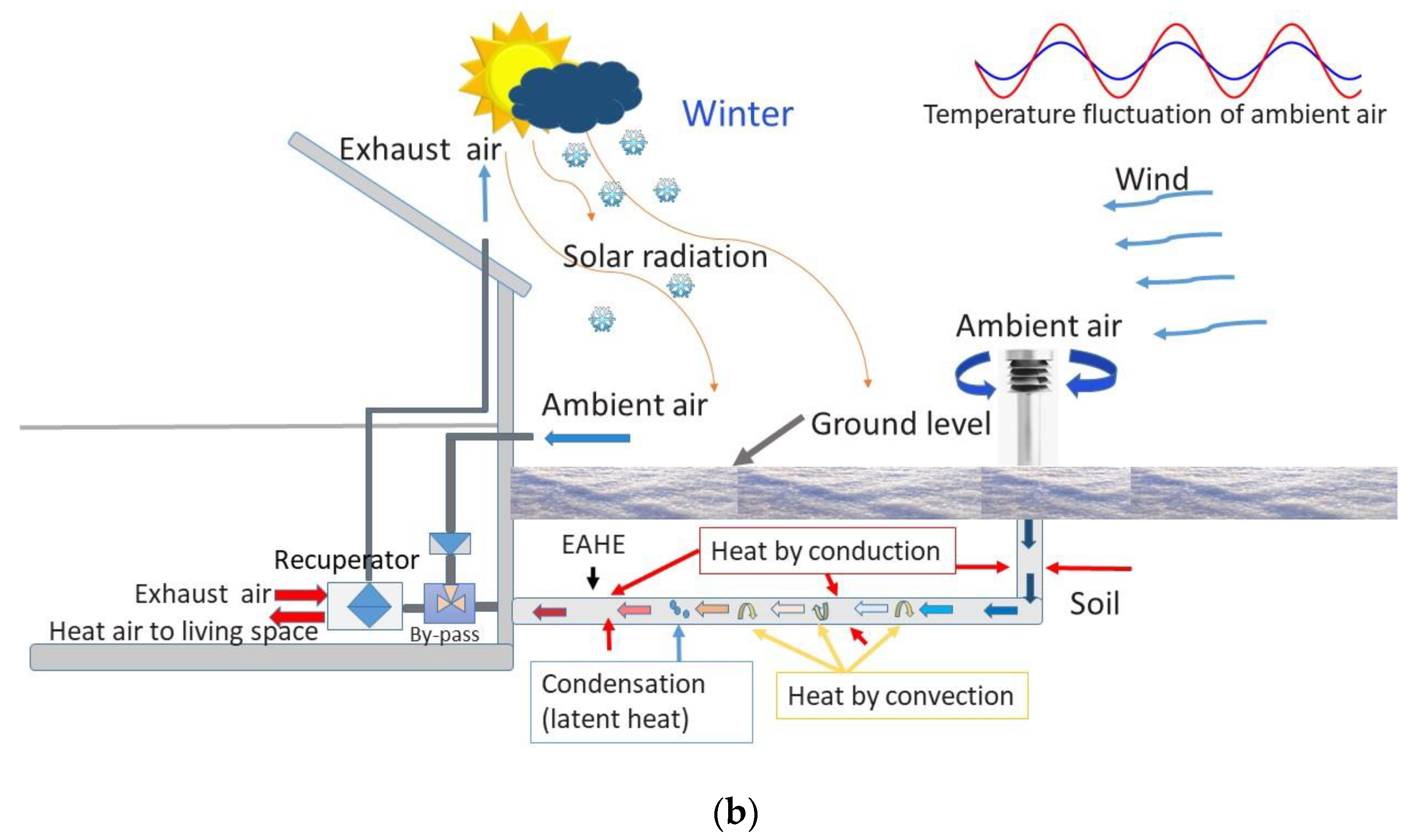
The fundamental principle of the operation of EAHE is based on the conductive heat transfer between the air flowing through underground pipes and the surrounding soil. Below a certain depth, the ground temperature exhibits relative stability year-round. Consequently, the energy requirement for conditioning the ventilation air can be substantially reduced by leveraging low-grade natural energy reserves. As illustrated in Figure 2, ambient air is forced into the pipe, where it undergoes heat exchange with the adjacent soil, subsequently being delivered to the indoor environment for ventilation purposes.
During summer (Figure 2(a)), the warm ventilation air dissipates heat to the surrounding soil, undergoing a pre-cooling process before entering the indoor space. Conversely, in winter (Figure 2(b)), the cool ventilation air can absorb heat from the surrounding soil, resulting in preheating. Although ground temperature remains relatively stable throughout the year, seasonal variations occur, particularly in transitional seasons such as spring and autumn. These fluctuations influence the effectiveness of heat exchange and require consideration during system design and operation. During these transitional periods, the EAHE system provides moderate cooling or heating, depending on the prevailing outdoor temperature. Horizontal EAHE systems, characterized by pipes laid horizontally in trenches, offer certain advantages. They are generally easier to install in areas with shallow groundwater levels and may require less excavation. However, their thermal performance can be influenced by variations in soil temperature and moisture content, which can fluctuate more significantly near the surface [86].
Vertical systems are often preferred for urban or built-up areas where land is limited, and for applications requiring higher heat transfer rates [87]. They involve drilling boreholes into the ground and circulating air through a buried pipe network [88]. Vertical Earth-Air Heat Exchangers (VEAHEs) offer several key advantages over their horizontal counterparts by accessing deeper ground temperatures [89]. By accessing deeper ground temperatures, VEAHEs minimize the impact of near-surface temperature fluctuations caused by diurnal and seasonal variations. This results in more consistent and reliable heat transfer throughout the year, improving overall system performance [90]. By accessing deeper ground temperatures, VEAHEs minimize the impact of near-surface temperature fluctuations caused by diurnal and seasonal variations. This results in more consistent and reliable heat transfer throughout the year, improving overall system performance. VEAHEs are less affected by variations in near-surface soil temperatures caused by weather conditions (e.g., solar radiation, precipitation) or changes in soil moisture content. This leads to more predictable and stable system operation [88,91]. However, vertical EAHE systems also present certain challenges. Drilling boreholes typically incurs higher installation costs compared to trenching for horizontal systems, which can significantly increase the initial investment. Furthermore, borehole stability can be a concern in certain geological conditions, requiring careful site investigation and appropriate installation techniques to mitigate risks of borehole collapse. Additionally, vertical systems may not be feasible in areas with high groundwater levels, limited space for borehole installation, or in regions with high seismic activity. In conclusion, both horizontal and vertical EAHE systems offer viable solutions to improve energy efficiency. The optimal choice depends on a variety of factors, including site-specific conditions, project budget, desired thermal performance, and environmental considerations. A thorough site assessment and a comprehensive cost-benefit analysis are crucial for selecting the most suitable EAHGE system for a given application.

3.2. Heat and Mass Transfer in Earth-Air Heat Exchangers

A thorough understanding of heat and mass transfer processes within Earth-air heat exchangers (EAHEs) is paramount for the design and optimization of these systems.
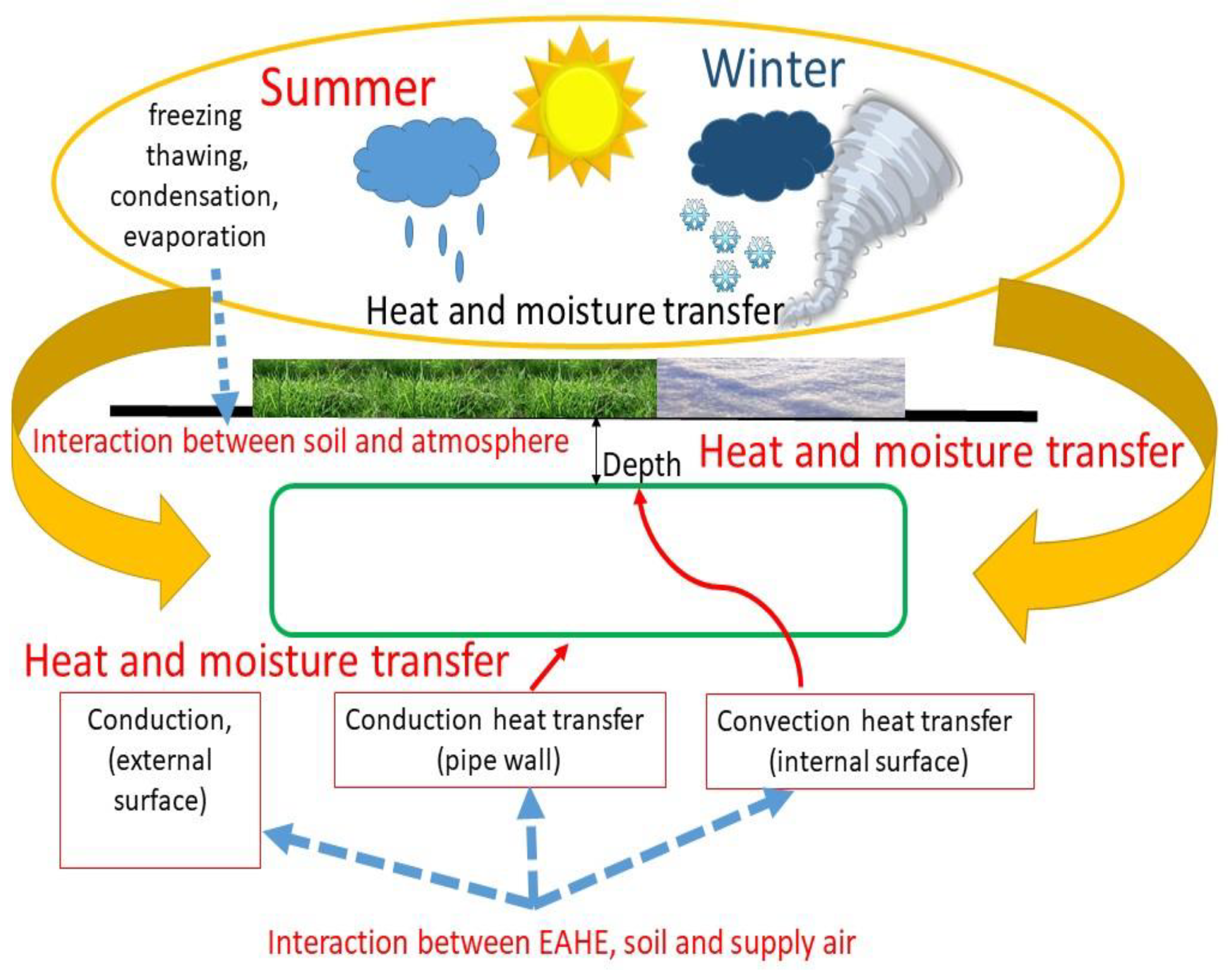
Heat and mass transfer within Earth-Air Heat Exchangers (EAHEs) involve complex interactions between buried pipes, surrounding soil, and supply air (Figure 3).
The interactions between the heat exchanger, soil, and supply air involve two areas of heat and mass transfer: the outer and inner surfaces of the heat exchanger pipe (Figure 4).
At the outer surface of the buried pipe, heat is conducted from the wall of the pipe into the surrounding soil and is governed by Fourier's law of heat conduction [92,93]. The rate of heat transfer is influenced by the thermal conductivity of the soil, its moisture content [94,95], and the temperature gradient between the pipe and the undisturbed soil. Additionally, moisture can diffuse between the soil and the pipe wall, depending on relative humidity and temperature gradients. At the inner surface, heat is transferred convectively between the wall of the flowing air and the pipe [96]. The rate of convective heat transfer is influenced by factors such as air velocity, the temperature difference between air and the pipe wall, and the fluid properties. Moisture transfer is driven by concentration gradients and is influenced by relative humidity and temperature. Mass transfer, primarily in the form of moisture diffusion, can also occur between the air and the wall of the pipe, affecting the humidity of the supply air. The performance of Earth Air Heat Exchangers (EAHEs) is influenced by a complex interplay of climatic factors, including temperature, precipitation, and surface conditions. Seasonal variations in temperature and precipitation directly affect the thermal properties of the subsurface and, consequently, the heating and cooling capacity of the EAHEs. The interaction between the atmosphere and the subsurface, as well as the specific characteristics of the ground surface, can further modify these effects. For example, vegetation cover can reduce surface temperatures through evapotranspiration, while frozen ground can reduce thermal conductivity. Understanding these interactions is crucial for optimizing the design and operation of EAHE systems in different climatic regions.
Accurate modeling of heat and mass transfer in earth-air heat exchangers is essential for their effective design and optimization [97]. While significant progress has been made in this area, challenges remain due to the complex interplay of factors such as soil heterogeneity, moisture migration, and variable boundary conditions.

3.3. Factors Influencing for Performance of Earth Air Heat Exchangers

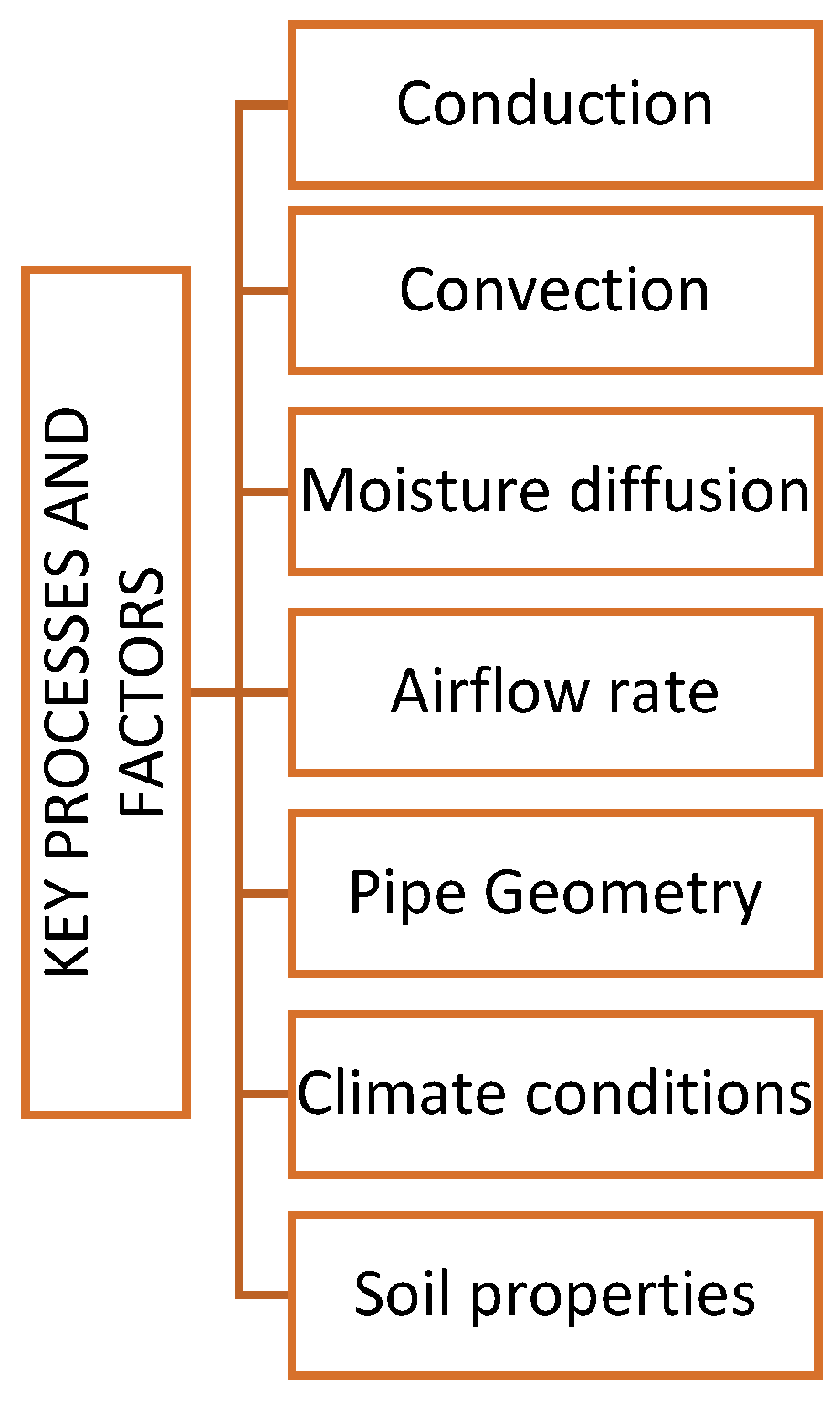
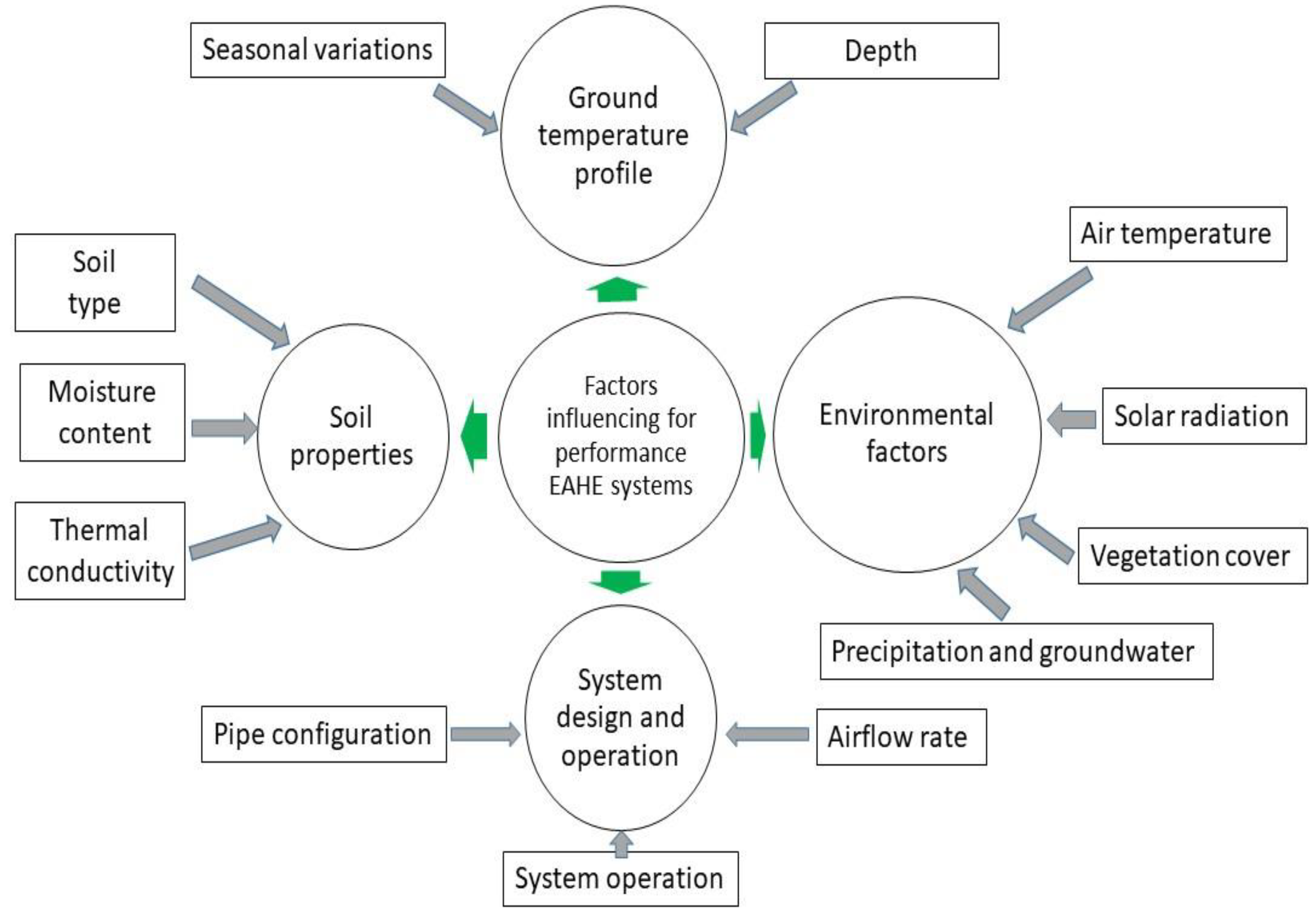
The performance of Earth-Air Heat Exchangers (EAHE) is contingent upon the capacity of the surrounding soil to store and release thermal energy. A multitude of factors influence the ability to serve as a thermal energy reservoir. These factors can be broadly categorized into soil properties, environmental factors, ground temperature profile, and system design parameters (Figure 5).
Soil properties significantly influence heat transfer within the ground. The type of soil, such as clay, sand, or loam, plays a crucial role in determining its thermal properties. Clay soils, with their high clay content, typically exhibit higher thermal conductivity compared to sandy soils. Recently, articles drew attention to such issue, showing how soils with higher thermal conductivity, such as clay-rich soils, generally exhibit better heat transfer compared to sandy soils [71,72,99]. However, the specific properties of each soil type can vary significantly depending on factors such as particle size distribution, porosity, and mineral composition. Moisture content significantly influences the thermal conductivity. The presence of water within the soil matrix generally enhances heat transfer due to water's high thermal conductivity [100,101]. However, excessive moisture can have detrimental effects. High moisture content can lead to increased soil density, which can hinder heat transfer. Moreover, it can contribute to corrosion of buried pipes, compromising the longevity and efficiency [102].
Earth Air heat exchangers take advantage of the relatively stable ground temperature to provide heating and cooling. However, the temperature of the ground exhibits significant variations depending on depth [103,104]. Determining the optimal burial depth for EAHE systems is crucial to maximise system performance while minimising installation costs. Numerous studies [20,105,106] have observed a distinct temperature gradient, with temperatures decreasing as depth increases. This phenomenon creates a "zone of constant temperature" at a specific depth, usually ranging from 5 to 15 meters [107]. This zone offers a stable thermal reservoir for EAHE systems, as temperatures remain relatively constant throughout the year. While deeper burial generally leads to more stable ground temperatures, studies have shown that the marginal increase in performance diminishes beyond a certain depth. Kaushal [108] observed that depths greater than 3.5 metres offer minimal incremental performance gains compared to 3.5 meters. However, the optimal burial depth varies depending on location and site-specific factors. For example, [109] found an optimal depth of 1 metre in Malaysia, while Babar et al. [110] reported 3.96 meters as suitable for Sahiwal, Pakistan, and Khan et al. [111] suggested 4.5 meters for Lahore, Pakistan. These variations can be attributed to differences in soil properties, climatic conditions, and local ground temperature profiles. Ideally, the burial depth should be sufficient to reach a zone of relatively stable temperature while minimizing excavation costs. Therefore, the optimal burial depth should be determined based on a cost-benefit analysis, considering factors such as soil properties, ground temperature variations, and construction costs.
The performance of Earth-Air Heat Exchangers is strongly influenced by climatic conditions. The ground temperature exhibits pronounced seasonal variations, with higher temperatures during summer and lower temperatures during winter. These fluctuations are primarily driven by changes in solar radiation and air temperature. During the heating season, when the ground temperature is higher than the desired indoor temperature, heat is extracted from the ground, while during the cooling season, excess heat is rejected to the ground. The magnitude of these heat fluxes is influenced by the temperature difference between the heat carrier fluid and the surrounding ground. Studies have shown that seasonal variations in temperature and precipitation significantly impact the heating and cooling potential of these systems. In [51,95,112] the performance of EAHE systems beneath grass and concrete surfaces was compared in different climates. Their findings demonstrated that vegetation cover, through evapotranspiration, can lead to lower subsurface temperatures and improved cooling performance compared to bare soil or concrete surfaces. Warmer climates typically offer greater heating potential, while colder climates provide better cooling performance. Additionally, the specific characteristics of the local climate, such as the annual temperature range and the frequency of extreme weather events, can influence the effectiveness of EAHEs. Beyond climatic factors, the nature of the ground surface also plays a crucial role. While studies have shown that different surface conditions, such as vegetation cover and soil type, can affect the thermal properties of the subsurface and, consequently, the performance of EAHEs [113]. The interaction between ground surface and atmospheric temperatures, as emphasised by [114] and [115], exhibits significant seasonal variability due to changes in thermal properties and energy partitioning. For example, studies in various climatic zones have shown that different characteristics of the ground surface can significantly influence the performance of EAHE. However, these studies focus on warmer climates. In colder climates, seasonal variations in ground surface conditions, such as snow cover, soil freezing and thawing, and changes in soil moisture due to snowmelt, can significantly impact subsurface temperatures and consequently the performance of EAHE systems.
In cold climates, seasonal changes in ground surface conditions, such as freezing and thawing, can significantly impact EAHE performance. The formation of a frozen layer can reduce thermal conductivity and alter the heat transfer mechanisms in the subsurface [116]. Moreover, snow cover can act as an insulating layer, affecting heat exchange between the ground and the atmosphere. Studies by Zajch et al. [117]. have demonstrated that in regions with distinct seasons, factors such as snow cover, soil moisture, and freeze-thaw cycles can significantly impact subsurface temperatures, directly affecting the performance of Earth-Air Heat Exchangers (EAHEs). Moreover, recent numerical models developed by Zajch et al. [118] provide more accurate predictions of the impacts of climate change scenarios on ground temperatures and EAHE efficiency. Despite these advances, more research is needed to fully understand the effects of extreme weather events and changes in land use on EAHE performance.
The performance of Earth-Air Heat Exchangers (EAHEs) is significantly influenced by various design parameters, including pipe material, dimensions, spacing, soil type, burial depth, and airflow rate. These parameters must be carefully selected to ensure optimal heat exchange and energy efficiency. Recent years have witnessed a surge in research dedicated to optimizing the energy efficiency and design of Earth-Air Heat Exchangers (EAHEs). Modelling has proven to be an invaluable tool for predicting the influence of operational parameters, such as pipe length, radius, burial depth, and airflow rate, on the thermal performance of Earth-Air Heat Exchangers (EAHEs). While various computational tools are available for modelling EAHE systems, such as EnergyPlus and TRNSYS, these analytical tools are often cumbersome for rapid design iterations. Computational Fluid Dynamics (CFD) has emerged as a popular choice for researchers, offering a versatile platform for simulating EAHE performance. CFD's ability to discretize the system into a fine mesh and solve governing equations numerically enables rapid and cost-effective analysis. Numerous studies have highlighted the central role of geometric parameters, such as pipe diameter, depth, and length, in influencing system performance [119,120,121,122,123,124,125,126]. For instance, Haitham Sghiouri et al. [127] proposed a multi-objective optimization framework to design efficient and cost-effective Earth-Air Heat Exchanger (EAHE) systems. Their framework, validated through an experimental exchanger model, identified key design parameters and employed a genetic algorithm for optimization. The optimization aimed to minimize life-cycle cost (LCC) while maximizing cooling potential across three diverse Moroccan climates. Multi-criteria decision-making methods were then applied to determine the optimal configurations for each location. The results emphasised the importance of site-specific design, as optimal configurations varied depending on factors such as ground temperature gradient. For example, the optimal design for Marrakesh and Oujda was a 160 mm diameter, 49 m long pipe buried at 3 m depth, while Errachidia required a similar pipe buried at 4 m due to its higher ground temperature gradient. The EAHE systems delivered cooling potentials of 1447 kWh/year, 1172 kWh/year, and 1739 kWh/year with corresponding LCCs of $4122, $4091, and $4073 over 50 years for Marrakesh, Oujda, and Errachidia, respectively. The normalized life-cycle cost (NLCC) was lowest for Errachidia ($0.234/kWh), followed by Marrakesh ($0.285/kWh) and Oujda ($0.349/kWh).
Despite advancements in Earth Air Heat Exchanger (EAHE) technology, the impact of channel cross-sectional geometry on thermal performance and indoor air quality of Earth-Air Heat Exchangers (EAHE) has been a relatively understudied area [128]. Recent studies have indicated that the thermal performance of EAHEs is directly correlated with the heat transfer surface area within the channels. Wei et al. [129] investigated rectangular channels in straight EAHEs, finding that this configuration enhanced heating and cooling performance, provided more stable channel wall temperatures, and reduced soil thermal disturbances compared to circular channel configurations. Jahanbin [130] examined elliptical channels in vertical U-shaped EAHE and observed a 17% improvement in reducing the system's thermal resistance compared to circular U-shaped channels. Benhammou et al. [131] conducted a case study on EAHEs for cooling applications, demonstrating that rectangular and elliptical channels outperformed conventional circular channels. Specifically, rectangular and elliptical channels provided approximately 88% and 93% more heat transfer surface area between air and soil, respectively.
Numerous studies have investigated the influence of airflow rate on the thermal performance of Earth-Air Heat Exchangers (EAHEs). Although higher airflow rates can improve heat transfer, they can also reduce system efficiency due to shorter contact times between the air and the ground [132]. The optimal airflow rate is a complex interplay of factors such as soil properties, climate conditions, and system design. While these parameters interact in complex ways, the specific relationship can vary depending on soil conditions, climate, and system design. Benrachi et al. [133] provided insights into this complexity by showing that increasing wind speed from 2 m/s to 2.5 m/s resulted in a substantial decrease in cooling effectivity, from 60% to 33%. Moreover, [113] explored the impact of airflow velocity on heat transfer rates, demonstrating that a decrease in velocity and an increase in diameter result in a reduced pressure drop along the length of the pipe during airflow. However, Mihalakou et al. [134] observed a decrease in the temperature difference between the inlet and outlet air with increasing pipe diameter at constant airflow rate. In conclusion, the review of the literature revealed that while airflow velocity and pipe diameter play an important role in determining EAHE performance, the performance of the EAHE, optimal design parameters depend on a complex interaction of factors, including soil properties, climate conditions, and system configuration.
Multi-pipe Earth-Air Heat Exchangers (EAHEs) have emerged as a promising technology for enhancing building energy efficiency. While offering advantages such as reduced pressure losses compared to single-pipe systems [135], multi-pipe EAHEs present design challenges, particularly regarding uneven airflow distribution among individual pipes.
Numerous studies have investigated the impact of different configurations on EAHE performance [136,137,138,139] and demonstrated that U-shaped configurations generally exhibit superior thermal performance compared to Z-shaped designs. These findings were corroborated by Qi et al. [140], who also observed improved thermal performance and airflow uniformity in L- and U-shaped configurations.
Despite these advantages, achieving optimal performance in multipipe EAHEs remains challenging. Recent studies [141] have revealed significant disparities in airflow distribution among individual pipes, leading to suboptimal performance and potential inefficiencies. This uneven flow distribution can result in substantial variations in airflow rates between different branches [142], and the static pressure differential between the inlet and outlet of the final pipes can significantly affect airflow.
ly impact airflow.
Although U-shaped configurations have shown promise in mitigating these airflow disparities, neither U-shaped nor Z-shaped designs are without limitations. Experimental and CFD studies [143] have demonstrated that U-shaped structures generally exhibit higher thermal efficiency due to a more uniform airflow distribution and reduced pressure losses. However, CFD simulations [144] have indicated that U-shaped configurations can exhibit lower outlet temperatures, potentially impacting overall system performance. This finding contradicts the results [145], which, using a simplified CFD simulation of a 5-branch EAHE, observed lower outlet temperatures for Z-shaped configurations. Furthermore, Z-shaped configurations exhibit greater variability in airflow distribution among parallel branches compared to U-shaped configurations of similar complexity. The total pressure drop is higher for 90-degree connections compared to 45-degree connections, leading to increased overall pressure drop in Z-shaped configurations. Uneven airflow distribution can have significant consequences, with [142] reporting potential thermal efficiency losses of up to 20% in multitube EAHEs. In conclusion, while multi-pipe EAHEs offer significant potential for improving building energy efficiency, their performance is highly dependent on the design and operating conditions. Future research should focus on developing more accurate models for predicting the performance of these systems, exploring innovative design solutions to address the challenges associated with uneven airflow distribution, and optimizing system operation to maximize energy efficiency.
The influence of installation depth and length has also been extensively investigated. Muehleisen et al. [146,147,148] proposed an optimal burial depth less than 5 m for EAHE, considering the trade-off between construction costs and energy efficiency.
In recent decades, there has been a surge in interest in EAHE systems driven by increasing concerns about energy efficiency and environmental sustainability. Researchers have explored various configurations and applications of EAHE, including hybrid systems that combine EAHE with other renewable energy technologies such as solar, geothermal, and wind energy. The growing interest in hybrid EAHE systems is driven by several factors, including stringent energy efficiency standards, advancements in renewable energy technologies, and climate change mitigation.

4. Integration of EAHE with Renewable Energy Sources

4.1. Earth-to-Air Heat Exchangers (EAHEs) Integrating with Air-Source Heat Pumps (ASHPs)

Integration of Earth-to-Air Heat Exchangers (EAHE) with Air-Source Heat Pumps (ASHPs) has emerged as a promising strategy to enhance the energy efficiency and sustainability of building heating and cooling systems. This synergistic approach leverages the stable ground temperature provided by EAHEs to pre-condition the inlet air to the ASHP, leading to improvements in the system's coefficient of performance (COP) and an extended operating range. Recent research has explored various aspects of this integration, including system performance optimization, economic feasibility, and environmental impact. However, the performance of EAHE-ASHP systems is influenced by complex interactions between soil properties, climatic conditions, and system design parameters. Further research is needed to fully understand these interactions and optimize the design and operation of these hybrid systems.
Recent research has demonstrated the potential of integrating EAHEs with ASHPs to improve energy efficiency in building heating and cooling systems. Studies such as those conducted by Congedo et al. [149], Guo et al. [150], Do et al. [151], Mahmoud et al. [152], and Cavazzini et al. [77] have shown promising results in various climatic conditions. Two primary integration methods have been explored: open-loop and closed-loop systems. Open-loop systems involve a direct interface between the ambient air and the ground. When ambient air through buried pipes, heat exchange occurs with the relatively stable ground temperature, preconditioning the air before entering the ASHP [153]. This preconditioning significantly enhances the heat pump's coefficient of performance (COP), particularly during extreme weather conditions. Cavazzini et al. [77] conducted a comprehensive study to evaluate the performance of an air-source heat pump integrated with an Earth Air Heat Exchanger (EAHE) in a single-family residence located in northern Italy. The study aimed to assess the system's efficiency under real-world operating conditions and to quantify the benefits of coupling an EAHE with an ASHP. While ASHPs traditionally transfer heat between air and water for space heating and cooling, the novel approach involves preconditioning the air by passing it through an EAHE before it enters the ASHP. The EAHE, in turn, leverages the thermal inertia of the ground to mitigate fluctuations in air temperature, enabling the ASHP to operate more efficiently. The researchers employed a detailed simulation model developed in MATLAB to replicate the system's behaviour. This model was calibrated and validated using a year's worth of operational data from the building. The analysis focused on two primary objectives: understanding the system's performance under real-world conditions and quantifying the advantages of integrating an EAHE. The results demonstrated that the integration of an EAHE significantly improved the system's performance. EAHE contributed approximately 50% of total heating demand during the winter, reducing the reliance on auxiliary heating sources. Furthermore, the EAHE ensured a relatively stable supply air temperature throughout the year, leading to more efficient operation of the heat pump. A detailed analysis of energy consumption revealed that the system with the EAHE achieved a 25% reduction in energy consumption compared to a system without an EAHE. This was primarily due to the reduced operating hours of the heat pump and the auxiliary heater.
Closed-loop systems harness Earth's low-grade thermal energy by circulating air through an underground network of pipes [81,154]. Do et al. [151] integrated a closed-loop Earth-Air Heat Exchanger (EAHE) with an Air Source Heat Pump (ASHP) to cool residential buildings in the hot and humid climate zones of Texas, USA. The potential energy savings of this hybrid EAHE/ASHP system were evaluated by comparing simulations of ASHPs with and without buried pipes. The results indicated that the incorporation of an EAHE system yielded annual cooling energy savings of approximately 9.6% and 13.8% for Houston and Dallas, respectively. Despite these promising findings, the authors noted that their analysis was limited to energy consumption and savings, and recommended further research to quantify increased installation costs and reduced operating expenses of the system, thereby determining the extent to which these hybrid systems can be implemented in a cost-effective manner.
Although both systems offer distinct advantages, more research is needed to comprehensively evaluate their performance under various climatic conditions and to develop optimised design guidelines. Factors such as pipe material, burial depth, and flow rate significantly influence overall system efficiency and economic viability. Moreover, long-term monitoring and data analysis are essential to assess the durability and reliability of these integrated systems.

4.1. Earth-to-Air Heat Exchangers (EAHEs) Integrating with Photovoltaic Systems

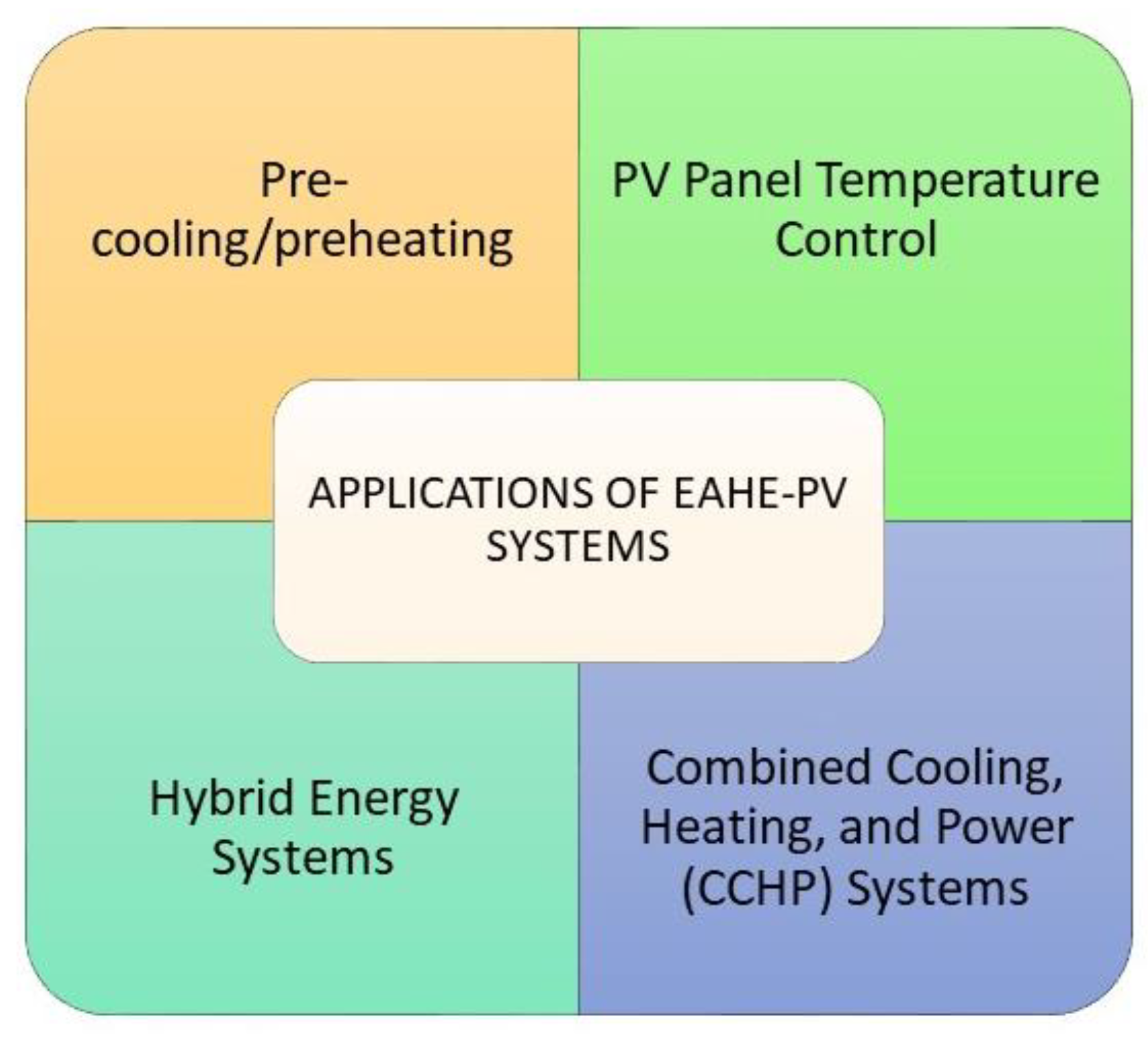
The integration of Earth-to-Air Heat Exchangers (EAHEs) with photovoltaic (PV) systems presents a promising strategy for achieving significant improvements in building energy efficiency. Recent research has extensively explored the potential benefits of this synergistic approach, as evidenced by studies conducted by Baglivo et al. [78], Kundu (et al. [155], Dokmak et al. [156], Yadav et al. [157], Hraibet et al. [158], and Zhao et al. [159]. These hybrid systems offer several potential applications, including pre-cooling/pre-heating of supply air, temperature control for PV panels, the creation of hybrid energy systems, and the development of Combined Cooling, Heating, and Power (CCHP) systems (Figure 6).
A key advantage of integrating EAHEs with PV systems lies in their ability to pre-cool or preheat the supply air [160]. During the hot summer months, EAHEs can significantly reduce the load on building HVAC systems by providing pre-cooled air. On the contrary, during colder periods, preheated air from the EAHE can be used, minimising the energy required for space heating. This pre-conditioning process demonstrably improves the overall efficiency of the HVAC system, leading to a substantial decrease in energy consumption [78]. The hybrid system described in Soares et al. [48] is aligned with the principles of sustainable building. The standalone photovoltaic system powers fans that circulate air through underground EAHE pipes, leveraging the stable ground temperature for pre-conditioning outdoor air. This approach not only yields substantial energy savings, but also enhances a building's independence from external energy sources.
Building-Integrated Photovoltaics (BIPV) refers to photovoltaic modules that are integrated into the building envelope, such as the roof or facade. Unlike traditional photovoltaic systems, BIPV not only generates electricity but also serves as a building component. This dual functionality offers several advantages, including improved aesthetics, reduced installation costs, and enhanced energy efficiency [161,162]. However, BIPV systems are susceptible to overheating, which can significantly reduce their efficiency. The proposed hybrid system combines the benefits of both technologies. The EAHE pre-cools the supply air, which is then passed over the rear of the BIPV modules. This reduces the operating temperature of the photovoltaic cells, leading to increased electrical efficiency. Additionally, the cooled air can be circulated within the building to provide thermal comfort. This approach not only improves the energy performance of the building, but also reduces the overall environmental impact. Shahsavar et al. [75] evaluated the performance of a hybrid system that combines an earth air heat exchanger (EAHE) and a building-integrated photovoltaic / thermal system incorporated with phase change material (PCM). The system was designed to meet the heating, cooling, and electrical demands of a building located in Kermanshah, Iran. A multi-objective genetic algorithm (MOGA) was used to optimize system parameters such as the length (L), width (W) and depth (D) of the PCM, mass flow rate (a), depth and length of the EAHE (DiEAHE, LEAHE), with the aim of maximising thermal and electrical outputs. The optimal system configuration was determined to have dimensions of L = 9.999 m, W = 5.0 m, D = 0.1 m, a = 1.73 kg/s, DiEAHE = 0.5 m and LEAHE = 91.147 m. Increasing L, W, ṁa, LEAHE, and DiEAHE, while decreasing D, led to an increase in thermal output (). Similarly, increasing L, W, LEAHE, and DiEAHE and decreasing D and LEAHE resulted in a higher electrical output (). The optimal photovoltaic/thermal (HPT) system exhibited the highest electrical output in July and the lowest in December. During the cold months, it could provide heating power ranging from 17701.4 to 25295.7 kWh, while in the warm months it could deliver cooling power between 3092.7 and 6738.9 kWh. The optimized system could supply 26536.1 kWh of cooling load, 132693.3 kWh of heating load, and 9242.2 kWh of electrical load to the building annually.
Numerous studies have investigated the performance of EAHE-PV hybrid systems. Photovoltaic panels exhibit reduced efficiency at higher temperatures. Using the cooling capacity of the EAHE, the ambient temperature surrounding the photovoltaic panels can be reduced, leading to increased power output and improved overall system efficiency [163]. For example, Dhaidan et al. [164] conducted a comprehensive review of the application of geothermal energy in agricultural solar greenhouses, highlighting the potential of EAHE to improve overall system performance.
Jakhar et al. [165] offers a comprehensive numerical investigation of the thermal performance of Earth-Air Heat Exchangers (EAHEs) integrated with Photovoltaic Thermal (PV/T) systems under varying climatic conditions. Research focusses on three distinct locations: Pilani, Ajmer (India), and Las Vegas (USA). A thermodynamic model was developed and validated against experimental data from the literature, demonstrating a high degree of correlation. The parametric analysis conducted revealed significant findings. Without cooling, the maximum cell temperature reached 54.3°C, 54.5°C, and 44.4°C for Pilani, Ajmer, and Las Vegas, respectively. However, with a cooling flow rate of 0.053 kg/s, these temperatures decreased to 43.4 ° C, 44.2 ° C and 35.6°C, respectively. The thermal power of the EAHE was notably enhanced when coupled with the PV/T collector, with increases ranging from 23.47 W·h–298.74 W·h, 71.18 W·h–315.93 W·h, and 41.43 W·h–270.75 W·h for Pilani, Ajmer, and Las Vegas, respectively.
Finally, Lopez-Pascual et al. [166] proposed a compact cooling system for commercial photovoltaic panels based on low-enthalpy geothermal cooling. A single-phase closed-loop cooling system was used to dissipate heat from the solar panel, using the constant and low temperature of the natural underground heat sink. A prototype, incorporating a single-axis solar tracking mechanism, was assembled and tested outdoors in Alcala de Henares, Madrid, Spain, in June 2022. Experimental results demonstrated that with a coolant flow rate of 1.8 L/min per square meter of panel surface, the cooling system reduced the temperature of the cooled panel by up to 20°C, leading to a real increase in panel efficiency of up to 13.8%.

4.2. Energy Systems Earth-to-Air Heat Exchangers (EAHEs) Integrated with Solar Energy

The increasing demand for sustainable and energy-efficient building solutions has spurred the development of innovative technologies. Hybrid systems that integrate renewable energy sources with traditional building systems have gained significant attention. Among these, solar chimney systems coupled with photovoltaic panels and earth-air heat exchangers (SC-PV-EAHE) offer a promising avenue for achieving thermal comfort while reducing reliance on conventional cooling systems. In [167,168] presented experimental results from a solar greenhouse (SG) integrated with an EAHE and a photovoltaic system. In these studies, the cooled air from the EAHE was circulated through the SG to create a more comfortable environment for plant growth while simultaneously cooling the PV modules mounted on the greenhouse structure. Their findings demonstrated that the circulation of air through the EAHE before directing it to the SG significantly reduced the ambient temperature within the greenhouse, leading to a notable improvement in PV panel efficiency. For example, Yildiz et al. [169] reported a temperature reduction of approximately 8°C between the inlet and outlet of the EAHE, resulting in a 31% energy savings. The integrated system not only improved the efficiency of the PV panels but also provided a sustainable cooling solution for the greenhouse. Alkaragoly et al. [170] made a notable contribution to this field by demonstrating the feasibility and effectiveness of such a system in a residential setting. Their study revealed that the SC-PV-EAHE system could effectively meet cooling loads while simultaneously generating a substantial amount of electricity. This research investigates the performance of a novel hybrid system designed to provide thermal comfort and electricity generation for residential buildings. The system integrates a solar chimney, photovoltaic panels, and an earth-air heat exchanger (SC-PV-EAHE). A comprehensive numerical analysis was conducted to evaluate the performance of the SC-PV-EAHE system under various climatic conditions. The study focused on two Middle Eastern cities, Tehran and Baghdad, known for their hot and arid climates. The EAHE system was modelled considering three primary heat transfer processes: convective heat transfer between the air flowing through the buried pipe and its inner surface, conductive heat transfer through the pipe wall, and conductive heat transfer between the pipe's outer surface and the surrounding soil. The optimal dimensions for the solar chimney and photovoltaic array were calculated based on the climatic conditions of each city. For instance, in Tehran and Baghdad, a chimney width of 2.4 meters and a length of 4.216 meters was recommended, accommodating 16 photovoltaic panels. Their findings underscored the system's effectiveness in achieving thermal comfort, with cooling demands ranging from 116 to 1500 W. Furthermore, the integrated photovoltaic panels generated a significant amount of electricity, with peak output reaching 1060 Watts in Tehran and 781 Watts in Baghdad, respectively. The system exhibited high electrical efficiency, with values of 9.7% for Tehran and 8.9% for Baghdad. The generated electricity could be used to power the building's electrical systems and improve overall energy efficiency. These results not only validate the feasibility of such hybrid systems, but also highlight their potential to reduce reliance on convention-al cooling systems and contribute to sustainable building design.
The research presented in [52] offers a comprehensive evaluation of a hybrid solar chimney and EAHE system for passive building cooling in arid climates. This study investigated the performance of a novel hybrid system that combined solar chimneys and earth air heat exchangers (EAHEs) for passive cooling in buildings located in hot, arid regions. Through a combination of experimental and numerical analyses, the researchers explored the intricate relationship between ventilation rates, solar chimney design parameters, EAHE geometry, pressure differentials, and climatic conditions. The study focused on two case scenarios: a baseline configuration with a solar chimney and EAHE, and a hybrid system that incorporates passive and active ventilation components. The results indicated that the proposed hybrid system significantly improved indoor thermal comfort, reducing zonal temperatures by up to 9 ° C compared to the baseline case. The integration of electric fans into the hybrid system further improved cooling performance and energy savings. Moreover, the system demonstrated substantial reductions in annual energy consumption and CO2 emissions. Economic analysis revealed a relatively short payback period, highlighting the system's long-term economic viability.
Recent research by Li et al. [171] has explored the potential of integrating solar chimneys, earth air heat exchangers (EAHEs), and photovoltaic panels into a hybrid system for building applications. The study used MATLAB for the numerical modelling of the buried tubes, solar chimney, and the photovoltaic panels, while the building model was developed using the TRNSYS software, incorporating weather data and Building modules. By systematically varying the number of EAHE tubes and solar chimney-photovoltaic modules, the researchers quantified the impact on key performance indicators, including ventilation rate, outlet air temperature, and electrical efficiency. A salient finding of the study was the substantial reduction in the peak daily ventilation rate achieved by the hybrid system compared to a standalone solar chimney system. Specifically, the integration of EAHEs led to a 22.05% decrease in the peak ventilation rate. Furthermore, the hybrid system demonstrated improved thermal performance, achieving an average reduction of 0.12 ° C in the outlet air temperature. While indoor temperatures exhibited only minor variations between hybrid and conventional ventilation systems, the hybrid system proved to be more energy efficient, showing a 1.34% enhancement in minimum electrical efficiency compared to an independent photovoltaic system. Parametric analyses revealed distinct influences of system components. Increasing the number of EAHE tubes resulted in a significant increase in forced ventilation (over 36.43%) and a concomitant decrease in the temperature of the outlet air. In contrast, increasing the number of solar chimney photovoltaic modules primarily affected supply air and outlet air temperature, with a negligible impact on the efficiency of the photovoltaic panels.

4.3. Advanced Applications: Cooling, Heating, and Power Systems

With increasing concerns about climate change and the environmental impact of conventional air conditioning systems, there is a growing demand for sustainable and energy-efficient cooling solutions. Several published studies in the literature have focused on improving cooling systems without efficiency reductions, including evaluations of their economic feasibility. In a study by Jang et al. [172] investigated a building-integrated Earth-Air Heat Exchanger (EAHE) retrofitted with a supplementary groundwater system in a cooling-dominated climate. This study investigates a Foundation-Integrated Water-based EAHE (FIWEAHE) system enhanced by circulating supplementary groundwater from a residential well. Experimental and numerical results demonstrate significant performance improvements. After groundwater integration, the cooling capacity increased from 3.21 kW to 4.84 kW and moisture removal rose from 1.97 kg/h to 4.24 kg/h during summer. The system effectively maintained indoor comfort with summer outlet air temperatures between 24-26 ° C and winter temperatures of 20-21 ° C. The mean summer and winter COPs were 10.5 and 1.74, respectively. The study developed design relation curves to optimise pipe geometry and airflow velocity, providing valuable guidelines for the future design of the FIWEAHE system.
An integrated cooling system comprising an Earth Air Heat Exchanger (EAHE) and a water spray channel presents a promising avenue for achieving energy-efficient and sustainable building cooling. Research conducted by Ahmadi et al. [173] has shown that the hybrid system integrating EAHE and a water spray channel offers a promising solution for sustainable building cooling in the Tehran climate. In this study, the authors critically analyse the system's effectiveness in providing thermal comfort and its environmental benefits within the context of the Tehran climate. According to the results, the cooling effectiveness of the proposed hybrid system exceeds 100%, indicating the system's capability to decrease the air dry-bulb temperature below the inlet ambient wet-bulb temperature. By effectively using the ground as a reliable source of alternative energy, this cooling system can be considered both ecofriendly and energy-efficient. Consequently, the introduced system presents a viable alternative to conventional evaporative coolers or mechanical vapour compression systems.
The industrial applications of EAHEs are diverse and encompass a wide range of sectors. These include pre-cooling for air-cooled condensers and air compressors, dry-cooling for thermal power plants, and cooling applications for advanced power generation systems such as those employing supercritical Rankine cycles and gas turbines. The performance is significantly influenced by ambient temperature, particularly during the summer months, which can lead to imbalances in power supply and demand [174,175]. Inlet air cooling is crucial for maintaining high-efficiency power generation. Common inlet air cooling methods include direct evaporative cooling and electric refrigeration. Although electric refrigeration offers significant reduction in temperature, it requires substantial energy consumption. In contrast, direct evaporative cooling cools air through water evaporation, but its effectiveness is highly dependent on ambient air temperature and relative humidity. In hot and arid regions, direct evaporative cooling can offer economic advantages over electric refrigeration. Barakat et al. [176] investigated a novel hybrid inlet air cooling system for gas turbines, integrating an EAHE with a fogging system. Their comparative study in a 125 MW gas turbine unit demonstrated significant performance improvements. The annual average power output of the gas turbine equipped with the hybrid cooling system exhibited a 9.8% increase compared to the uncooled unit, while the fogging system alone resulted in a 6.6% increase. In particular, the hybrid system achieved a 50% reduction in water consumption compared to the fogging system during periods of high ambient temperatures.
In study [177] introduced a novel approach to cooling solar thermal power plants by utilizing Earth-Cooling Air Tunnels (Earth CATs) as a means to reduce water consumption. The research leverages the principle of existing earth-air heat exchangers (EAHEs) by exploiting the stable and relatively low underground temperature to pre-cool ambient air before it enters the plant's air condenser. A comprehensive computational fluid dynamics (CFD) analysis was conducted to assess the feasibility of this innovative cooling system, investigating the sensitivity of various geometric and flow parameters to optimize performance. The results demonstrated that a configuration employing pipes with a diameter of 0.5 meters and an approximate length of 300 meters is technically viable and offers a promising zero-water alternative to conventional water-cooling technologies. This study contributes to the growing body of research exploring sustainable and water-efficient cooling solutions for thermal power plants.
Benhammou et al. introduced a novel design of a passive cooling system consisting of an EAHE supported by a wind tower. The results demonstrated that the ambient air passing through the wind tower connected to the EAHE exhibited lower temperatures compared to the air exiting a conventional cooling tower.
Shahsavar and Arıcı [178] investigated a novel hybrid system integrating photovoltaic thermal (PVT) panels and an earth air heat exchanger (EAHE) for building heating and cooling. This system harnesses both solar and geothermal energy to condition outdoor air before it enters the building HVAC system, while simultaneously generating electricity. The study used a genetic algorithm to optimize the annual energy and exergy output of the system. The proposed system consists of a PVT panel and an EAHE. During the cooling season, outdoor air is passed through the EAHE to reduce its temperature, while return air from the building is used to cool the PVT panels. In contrast, during the heating season, the outdoor air is preheated by passing through both the PVT panels and the EAHE. The research findings revealed that while the combined PVT-EAHE system produced slightly less annual energy (93,925.6 kWh) compared to a standalone PVT-EAHE system (96,448.6 kWh), it exhibited higher exergy output (10,904.5 kWh) compared to the standalone system (10,015.5 kWh). This indicates that the hybrid system offers improved thermodynamic efficiency, despite a slight reduction in overall energy production.

5. Conclusions

This comprehensive review delves into the latest advancements in Earth-Air Heat Exchanger (EAHE) technology, with a particular focus on their application in buildings and industrial settings. By synthesising the findings of recent studies, this review highlights the significant potential of EAHEs as a sustainable and energy efficient solution for building climate control. EAHE systems offer a viable and sustainable alternative to traditional HVAC systems by leveraging the relatively constant temperature of the subsurface. By pre-cooling or pre-heating ventilation air, EAHEs can significantly reduce energy consumption and lower operational costs. Moreover, the integration of EAHEs with other renewable energy sources, such as air source heat pumps, photovoltaic thermal (PVT) panels, wind tower, fogging system, water spray channel, solar chimneys, and photovoltaic systems, has demonstrated enhanced performance and reduced environmental impact. The performance of EAHE systems is influenced by a multitude of factors, including soil properties, climatic conditions, system design, and operational parameters. A thorough understanding of these factors is essential to optimise the design of the system and predicting performance accurately. The complex interactions between heat transfer and mass transfer within EAHEs have been explored in detail, providing valuable insights for future research and development. Key findings from this review underscore the potential of EAHEs to contribute to a more sustainable built environment. However, more research is needed to address challenges such as optimising system design for various climatic conditions, developing accurate predictive models, and evaluating the long-term performance and durability of EAHE systems. Building on the foundation of existing research, the field of EAHE technology can continue to advance and offer innovative solutions for sustainable building design.

Funding

This research received no external funding.

Conflicts of Interest

The author declare no conflicts of interest. The funders had no role in the design of the study; in the collection, analyses, or interpretation of data; in the writing of the manuscript; or in the decision to publish the results.

References

  1. Ferdinando Salata, Serena Falasca, Virgilio Ciancio, Gabriele Curci, Pieter de Wilde, Climate-change related evolution of future building cooling energy demand in a Mediterranean Country, Energy and Buildings, Volume 290, 2023, 113112, ISSN 0378-7788. [CrossRef]
  2. Deroubaix, A., Labuhn, I., Camredon, M., Gaubert, B., Monerie, P. A., Popp, M., ... & Siour, G. (2021). Large uncertainties in trends of energy demand for heating and cooling under climate change. Nature communications, 12(1), 5197.
  3. United Nations Environment Programme (2024). Global Status Report for Buildings and Construction: Beyond foundations: Mainstreaming sustainable solutions to cut emissions from the buildings sector. Nairobi. [CrossRef]
  4. Arowoiya, V.A.; Onososen, A.O.; Moehler, R.C.; Fang, Y. Influence of Thermal Comfort on Energy Consumption for Building Occupants: The Current State of the Art. Buildings 2024, 14, 1310. [Google Scholar] [CrossRef]
  5. IEA (2023), Tracking Clean Energy Progress 2023, IEA, Paris https://www.iea.org/reports/tracking-clean-energy-progress-2023, Licence: CC BY 4.
  6. IEA (2024), Southeast Asia Energy Outlook 2024, IEA, Paris https://www.iea.org/reports/southeast-asia-energy-outlook-2024, Licence: CC BY 4.0.
  7. M. Santamouris, K. Vasilakopoulou, Present and future energy consumption of buildings: Challenges and opportunities towards decarbonisation, e-Prime - Advances in Electrical Engineering, Electronics and Energy, Volume 1, 2021, 100002, ISSN 2772-6711. https://www.sciencedirect.com/science/article/pii/S2772671121000024. [CrossRef]
  8. Damm, A., Köberl, J., Prettenthaler, F., Rogler, N., & Töglhofer, C. (2017). Impacts of + 2 °C global warming on electricity demand in Europe. Climate Services, 7, 12–30. [CrossRef]
  9. IEA. (2022). World Energy Outlook. License: CC BY 4.0 (report); CC BY NC SA 4.0 (Annex A). IEA, Paris. https://www.iea.org/reports/world-energy-outlook-2022. Accessed 15 May 2023.
  10. Gonçalves, A.C.R., Costoya, X., Nieto, R. et al. Extreme weather events on energy systems: a comprehensive review on impacts, mitigation, and adaptation measures. Sustainable Energy res. 11, 4 (2024). [CrossRef]
  11. Danny H.W. Li, Liu Yang, Joseph C. Lam, Impact of climate change on energy use in the built environment in different climate zones – A review, Energy, Volume 42, Issue 1, 2012, Pages 103-112, ISSN 0360-5442, Danny H.W. Li, Liu Yang, Joseph C. Lam, Impact of climate change on energy use in the built environment in different climate zones – A review, Energy, Volume 42, Issue 1, 2012, Pages 103-112, ISSN 0360-5442,. [CrossRef]
  12. Ferdinando Salata, Serena Falasca, Virgilio Ciancio, Gabriele Curci, Pieter de Wilde, Climate-change related evolution of future building cooling energy demand in a Mediterranean Country, Energy and Buildings, Volume 290, 2023, 113112, ISSN 0378-7788, (https://www.sciencedirect.com/science/article/pii/S0378778823003420). [CrossRef]
  13. Kai Gao, K.F. Fong, C.K. I: Lee, Kevin Ka-Lun Lau, Edward Ng, Balancing thermal comfort and energy efficiency in high-rise public housing in Hong Kong. (https://www.sciencedirect.com/science/article/pii/S0959652624001884), 2024. [Google Scholar] [CrossRef]
  14. Santamouris, M. Chapter 2—Energy Consumption and Environmental Quality of the Building Sector. In Minimizing Energy Consumption, Energy Poverty and Global and Local Climate Change in the Built Environment: Innovating to Zero; Santamouris, M., Ed.; Elsevier: Amsterdam, The Netherlands, 2019. [Google Scholar]
  15. Xu, X.; Yu, H.; Sun, Q.; Tam, V.W.Y. A critical review of occupant energy consumption behavior in buildings: How we got here, where we are, and where we are headed. Renew. Sustain. Energy Rev. 2023, 182, 113396 [Google Scholar] [CrossRef]. [Google Scholar] [CrossRef]
  16. Bisoniya, T.S. , Kumar, A., & Baredar, P.V. (2013). Experimental and analytical studies of earth–air heat exchanger (EAHE) systems in India: A review. Renewable & Sustainable Energy Reviews, 19, 238-246.
  17. Peñaloza Peña, S.A.; Jaramillo Ibarra, J.E. Potential Applicability of Earth to Air Heat Ex-changer for Cooling in a Colombian Tropical Weather. Buildings 2021, 11, 219. [Google Scholar] [CrossRef]
  18. H.P. Díaz-Hernández, E.V. H.P. Díaz-Hernández, E.V. Macias-Melo, K.M. Aguilar-Castro, I. Hernández-Pérez, J. Xamán, J. Serrano-Arellano, L.M. López-Manrique, Experimental study of an earth to air heat exchanger (EAHE) for warm humid climatic conditions, Geothermics, Volume 84, 2020, 101741, ISSN 0375-6505. (https://www.sciencedirect.com/science/article/pii/S0375650519301208)],. [CrossRef]
  19. Bughio, M.; Ba-hale, S.; Mahar, W.A.; Schuetze, T. Parametric Performance Analysis of the Cooling Poten-tial of Earth-to-Air Heat Exchangers in Hot and Humid Climates. Energies 2022, 15, 7054. [Google Scholar] [CrossRef]
  20. Zhang, C.; Wang, J.; Li, L.; Wang, F.; Gang, W. Utiliza-tion of Earth-to-Air Heat Exchanger to Pre-Cool/Heat Ventilation Air and Its Annual En-ergy Performance Evaluation: A Case Study. Sustainability 2020, 12, 8330. [Google Scholar] [CrossRef]
  21. SeyedAli Mohammadi, Mohammad Hossein Jahang-ir, Numerical investigation of the saturating soil layers' effect on air temperature drops along the pipe of Earth-Air Heat Exchanger systems in heating applications, Geothermics, Volume 123, 2024, 103109, ISSN 0375-6505. (https://www.sciencedirect.com/science/article/pii/S0375650524001962); [CrossRef]
  22. Yingjun Yue, Zengfeng Yan, Pingan NI, Fuming Lei, Guojin Qin, Enhancing the performance of earth-air heat exchanger: A flexible multi-objective optimization framework, Applied Thermal Engineering, Volume 244, 2024, 122718, ISSN 1359-4311. (https://www.sciencedirect.com/science/article/pii/S1359431124003867); [CrossRef]
  23. Yue, Y. , Yan, Z., Ni, P., Lei, F., & Yao, S. (2024). Machine learning-based multi-performance prediction and analysis of Earth-Air Heat Exchanger. Renewable Energy, 227, 120550.
  24. Xiao, J. , & Li, J. (2024). Influence of different types of pipes on the heat exchange performance of an earth-air heat exchanger. Case Studies in Thermal Engineering, 55, 104116.
  25. Xiao, J. , Wang, Q., Wang, X., Hu, Y., Cao, Y., & Li, J. (2023). An earth-air heat exchanger integrated with a greenhouse in cold-winter and hot-summer regions of northern China: Modeling and ex-perimental analysis. Applied Thermal Engineering, 232, 120939.
  26. Dewangan, C. , Shukla, A. K., Salhotra, R., & Dewan, A. (2024). Analysis of an earth-to-air heat exchanger for enhanced residential thermal comfort. Environmental Progress & Sustainable Energy, 43(3), e14346.
  27. Ahsan, T. A. , Rahman, M. S., & Ahamed, M. S. (2025). Geothermal energy application for greenhouse microclimate management: A review. Geothermics, 127, 103209.
  28. Kazem, H. A. , Chaichan, M. T., Al-Waeli, A. H., Sopian, K., Alnaser, N. W., & Alnaser, W. E. (2024). Energy Enhancement of Building-Integrated Photovoltaic/Thermal Systems: A Systematic Review. Solar Compass, 100093.
  29. Ma, Q. , Qian, G., Yu, M., Li, L., & Wei, X. (2024). Performance of windcatchers in improving indoor air quality, thermal comfort, and energy efficiency: A review. Sustainability, 16(20), 9039.
  30. Hu, Z. , Yang, Q., Tao, Y., Shi, L., Tu, J., & Wang, Y. (2023). A review of ventilation and cooling systems for large-scale pig farms. Sustainable Cities and Society, 89, 104372.
  31. Castro, R. P. , Dinho da Silva, P., & Pires, L. C. C. (2024). Advances in Solutions to Improve the Energy Performance of Agricultural Greenhouses: A Comprehensive Review. Applied Sciences (2076-3417), 14(14).
  32. Vahid Vakiloroaya, Bijan Samali, Ahmad Fakhar, Kambiz Pishghadam, A review of dif-ferent strategies for HVAC energy saving, Energy Conversion and Management, Volume 77, 2014, Pages 738-754, ISSN 0196-8904. (https://www.sciencedirect.com/science/article/pii/S0196890413006584), ]. [CrossRef]
  33. Zhong, K.; Meng, Q.; Liu, X. A Ventilation Experimental Study of Thermal Performance of an Urban Underground Pipe Rack. Energy Build. 2021, 241, 110852 [Google Scholar] [CrossRef]. [Google Scholar] [CrossRef]
  34. Li, J.; Jimenez-Bescos, C.; Calautit, J.K.; Yao, J. Evaluating the Energy-Saving Potential of Earth-Air Heat Exchanger (EAHX) for Passivhaus Standard Buildings in Different Cli-mates in China. Energy Build. 2023, 288, 113005 [Google Scholar] [CrossRef]]. [Google Scholar] [CrossRef]
  35. Pikra, G. , Darmanto, P. S., & Astina, I. M. (2024). A review of solar chimney-earth air heat exchanger (SCEAHE) system integration for thermal comfort building. Journal of Building Engineering, 111484.
  36. Azzi, A. , Tabaa, M., Chegari, B., & Hachimi, H. (2024). Balancing Sustainability and Comfort: A Holistic Study of Building Control Strategies That Meet the Global Standards for Efficiency and Thermal Comfort. Sustainability, 16(5), 2154.
  37. Acharya, P. , Sharma, A., Singh, Y., & Sirohi, R. (2024). Passive Cooling Strategies Towards the Sustainability of Livestock Building-An Overview. The Indian Veterinary Journal, 101(03), 17-26.
  38. Shukla, B. K. , Pandey, A. K., Singh, A., Singh, D., & Anas, M. A holistic review on energy-efficient green buildings considering environmental, economical, and technical factors. Clean Energy, 68-85.
  39. Bosu, I. , Mahmoud, H., Ookawara, S., & Hassan, H. (2023). Applied single and hybrid solar energy techniques for building energy consumption and thermal comfort: A comprehensive review. Solar Energy, 259, 188-228.
  40. Amin Shahsavar, Müslüm Arıcı, Multi-objective energy and exergy optimization of hybrid building-integrated heat pipe photovoltaic/thermal and earth air heat exchanger system using soft computing technique, Engineering Analysis with Boundary Elements, Volume 148, 2023, Pages 293-304, ISSN 0955-7997. (https://www.sciencedirect.com/science/article/pii/S0955799722004854). [CrossRef]
  41. Ríos-Arriola, J. , Velázquez-Limón, N., Aguilar-Jiménez, J.A. et al. Air Conditioning of an Off-Grid Remote School with an Earth to air Heat Exchanger Coupled Indirectly to a Solar Cooling System. Int J Environ Res 18, 112 (2024). [CrossRef]
  42. Di Qin, Jiang Liu, Guoqiang Zhang, A novel solar-geothermal system integrated with earth–to–air heat exchanger and solar air heater with phase change material—numerical modelling, experimental calibration and parametrical analysis, Journal of Building Engineering, Volume 35, 2021, 101971, ISSN 2352-7102. (https://www.sciencedirect.com/science/article/pii/S2352710220336032). [CrossRef]
  43. Xin Guo, Haibin Wei, Xiao He, Jinhui Du, Dong Yang, Experimental evaluation of an earth–to–air heat exchanger and air source heat pump hybrid indoor air conditioning system, Energy and Buildings, Volume 256, 2022, 111752, ISSN 0378-7788. (https://www.sciencedirect.com/science/article/pii/S0378778821010367). [CrossRef]
  44. C. Baglivo, P.M. C. Baglivo, P.M. Congedo, D. Laforgia Air cooled heat pump coupled with horizontal air-ground heat exchanger (haghe) for zero energy buildings in the mediterranean climate Energy Procedia, 140 (2017), pp. 2-12, 10.1016/j.egypro.2017.11.
  45. S.L. Do, J.C. S.L. Do, J.C. Baltazar, J. Haberl Potential cooling savings from a ground-coupled return-air duct system for residential buildings in hot and humid climates Energy Build., 103 (2015), pp. 206-215, 10.1016/j.enbuild.2015.05.
  46. Soni, S. K. , Pandey, M., & Bartaria, V. N. (2016). Hybrid ground coupled heat exchanger systems for space heating/cooling applications: A review. Renewable and Sustainable Energy Reviews, 60, 724-738.
  47. Yang, L. H. , Huang, B. H., Hsu, C. Y., and Chen, S. L. 2019. Performance analysis of an earth–air heat exchanger integrated into an agricultural irrigation system for a greenhouse environmental temperature-control system. Energy and Buildings, 202, 109381.
  48. Soares, N. , Rosa, N., Monteiro, H., & Costa, J. J. (2021). Advances in standalone and hybrid earth-air heat exchanger (EAHE) systems for buildings: A review. Energy and Buildings, 253, 111532.
  49. Anshu, K. , Kumar, P., & Pradhan, B. (2023). Numerical simulation of stand-alone photovoltaic integrated with earth to air heat exchanger for space heating/cooling of a residential building. Renewable Energy, 203, 763-778.
  50. Ali, B. M. , & Akkaş, M. (2023). The Green Cooling Factor: Eco-Innovative Heating, Ventilation, and Air Conditioning Solutions in Building Design. Applied Sciences, 14(1), 195.
  51. D'agostino, D. , Greco, A., Masselli, C., & Minichiello, F. (2020). The employment of an earth-to-air heat exchanger as pre-treating unit of an air conditioning system for energy saving: A comparison among different worldwide climatic zones. Energy and Buildings, 229, 110517.
  52. Serageldin, A. A. , Abdeen, A., Ahmed, M. M., Radwan, A., Shmroukh, A. N., & Ookawara, S. (2020). Solar chimney combined with earth to-air heat exchanger for passive cooling of residential buildings in hot areas. Solar Energy, 206, 145-162.
  53. Agarwal, S. K. , & Batista, R. C. (2023). Enhancement of building thermal performance: A comparative analysis of integrated solar chimney and geothermal systems. Journal of Sustainability for Energy, 2(2), 91-108.
  54. El-Said, E. M., Sharaf, M. A., Aljabr, A., & Marzouk, S. A. (2024). Enhancing the performance of an earth air heat exchanger with novel pipe configurations. International Journal of Heat and Fluid Flow, 110, 109630.
  55. Rosa, N. , Soares, N., Costa, J. J., Santos, P., & Gervásio, H. (2020). Assessment of an earth-air heat exchanger (EAHE) system for residential buildings in warm-summer Mediterranean climate. Sustainable Energy Technologies and Assessments, 38, 100649.
  56. Hasan, N. , Arif, M., & Khader, M. A. (2021). Earth Air Tunnel Heat Exchanger for Building Cooling and Heating. In Heat Transfer-Design, Experimentation and Applications. IntechOpen.
  57. Mitha, S. B. , & Omarsaib, M. (2024). Emerging technologies and higher education libraries: a bibliometric analysis of the global literature. Library Hi Tech, (ahead-of-print).
  58. Van Eck, N. , & Waltman, L. (2010). Software survey: VOSviewer, a computer program for bibliometric mapping. scientometrics, 84(2), 523-538.
  59. Ahmad, S. N. , & Prakash, O. (2022). A review on modelling, experimental analysis and parametric effects of earth–air heat exchanger. Modeling Earth Systems and Environment, 8(2), 1535-1551.
  60. Agrawal, K. K. , Misra, R., Agrawal, G. D., Bhardwaj, M., & Jamuwa, D. K. (2019). Effect of different design aspects of pipe for earth air tunnel heat exchanger system: A state of art. International Journal of Green Energy, 16(8), 598-614.
  61. Noman, S. , Tirumalachetty, H., & Athikesavan, M. M. (2022). A comprehensive review on experimental, numerical and optimization analysis of EAHE and GSHP systems. Environmental Science and Pollution Research, 29(45), 67559-67603.
  62. Liu, Z. , Sun, P., Li, S., Yu, Z. J., El Mankibi, M., Roccamena, L.,... & Zhang, G. (2019). Enhancing a vertical earth-to-air heat exchanger system using tubular phase change material. Journal of Cleaner Production, 237, 117763.
  63. Ahmed, S. F. , Khan, M. M. K., Amanullah, M. T. O., Rasul, M. G., & Hassan, N. M. S. (2015). Performance assessment of earth pipe cooling system for low energy buildings in a subtropical climate. Energy conversion and management, 106, 815-825.
  64. Maytorena, V. M., Moreno, S., & Hinojosa, J. F. (2021). Effect of operation modes on the thermal performance of EAHE systems with and without PCM in summer weather conditions. Energy and Buildings, 250, 111278.
  65. Niu, F., Yu, Y., Yu, D., & Li, H. (2015). Investigation on soil thermal saturation and recovery of an earth to air heat exchanger under different operation strategies. Applied Thermal Engineering, 77, 90-100.
  66. Sakhri, N. , Menni, Y., & Ameur, H. (2020). Effect of the pipe material and burying depth on the thermal efficiency of earth-to-air heat exchangers. Case Studies in Chemical and Environmental Engineering, 2, 100013.
  67. Lekhal, M. C. , Benzaama, M. H., Kindinis, A., Mokhtari, A. M., & Belarbi, R. (2021). Effect of geo-climatic conditions and pipe material on heating performance of earth-air heat exchangers. Renewable Energy, 163, 22-40.
  68. Xiao, J. , & Li, J. (2024). Influence of different types of pipes on the heat exchange performance of an earth-air heat exchanger. Case Studies in Thermal Engineering, 55, 104116.
  69. Peretti, C. , Zarrella, A., De Carli, M., & Zecchin, R. (2013). The design and environmental evaluation of earth-to-air heat exchangers (EAHE). A literature review. Renewable and Sustainable Energy Reviews, 28, 107-116.
  70. Pavlenko, A. M. Pavlenko, A. M., Usenko, B. O., & Koshlak, H. V. (2014). Analysis of thermal peculiarities of alloying with special properties. Metallurgical and Mining Industry, 2, 15-20.
  71. Agrawal, K. K. , Misra, R., & Agrawal, G. D. (2020). Improving the thermal performance of ground air heat exchanger system using sand-bentonite (in dry and wet condition) as backfilling material. Renewable Energy, 146, 2008-2023.
  72. Besler, M. , Cepiński, W., & Kęskiewicz, P. (2021). Direct-contact air, gravel, ground heat exchanger in air treatment systems for cowshed air conditioning. Energies, 15(1), 234.
  73. Liu, Z. , Sun, P., Xie, M., Zhou, Y., He, Y., Zhang, G.,... & Qin, D. (2021). Multivariant optimization and sensitivity analysis of an experimental vertical earth-to-air heat exchanger system integrating phase change material with Taguchi method. Renewable Energy, 173, 401-414.
  74. Zhou, T. , Xiao, Y., Huang, H., & Lin, J. (2020). Numerical study on the cooling performance of a novel passive system: Cylindrical phase change material-assisted earth-air heat exchanger. Journal of Cleaner Production, 245, 118907.
  75. Shahsavar, A. , & Azimi, N. (2024). Performance evaluation and multi-objective optimization of a hybrid earth-air heat exchanger and building-integrated photovoltaic/thermal system with phase change material and exhaust air heat recovery. Journal of Building Engineering, 90, 109531.
  76. Myroniuk, K., Furdas, Y., Zhelykh, V., Adamski, M., Gumen, O., Savin, V., & Mitoulis, S. A. (2024). Passive Ventilation of Residential Buildings Using the Trombe Wall. Buildings, 14(10), 3154.
  77. Cavazzini, G. , Zanetti, G., & Benato, A. (2024). Analysis of a domestic air heat pump integrated with an air-geothermal heat exchanger in real operating conditions: The case study of a single-family building. Energy and Buildings, 315, 114302.
  78. Baglivo, C., Bonuso, S., & Congedo, P. M. (2018). Performance Analysis of Air Cooled Heat Pump Coupled with Horizontal Air Ground Heat Exchanger in the Mediterranean Climate. Energies, 11(10), 2704.
  79. Lapertot, A. , Cuny, M., Kadoch, B., & Le Métayer, O. (2021). Optimization of an earth-air heat exchanger combined with a heat recovery ventilation for residential building needs. Energy and Buildings, 235, 110702.
  80. Li, H. , Ni, L., Yao, Y., & Sun, C. (2020). Annual performance experiments of an earth-air heat exchanger fresh air-handling unit in severe cold regions: Operation, economic and greenhouse gas emission analyses. Renewable energy, 146, 25-37.
  81. Ascione, F. , D'Agostino, D., Marino, C., & Minichiello, F. (2016). Earth-to-air heat exchanger for NZEB in Mediterranean climate. Renewable Energy, 99, 553-563.
  82. Thiers, S. , & Peuportier, B. (2008). Thermal and environmental assessment of a passive building equipped with an earth-to-air heat exchanger in France. Solar Energy, 82(9), 820-831.
  83. Wojtkowiak, J. (2012). Experimental flow characteristics of multi-pipe earth-to-air heat exchangers. Foundations of Civil and Environmental Engineering, (15), 5-18.
  84. Bojic, M. , Trifunovic, N., Papadakis, G., & Kyritsis, S. (1997). Numerical simulation, technical and economic evaluation of air-to-earth heat exchanger coupled to a building. Energy, 22(12), 1151-1158.
  85. Li, H. , Ni, L., Liu, G., Zhao, Z., & Yao, Y. (2019). Feasibility study on applications of an Earth-air Heat Exchanger (EAHE) for preheating fresh air in severe cold regions. Renewable Energy, 133, 1268-1284.
  86. Lattieff, F. A. , Atiya, M. A., Lateef, R. A., Dulaimi, A., Jweeg, M. J., Abed, A. M.,... & Talebizadehsardari, P. (2022). Thermal analysis of horizontal earth-air heat exchangers in a subtropical climate: An experimental study. Frontiers in Built Environment, 8, 981946.
  87. Molina-Rodea, R. , Wong-Loya, J. A., Pocasangre-Chávez, H., & Reyna-Guillén, J. (2024). Experimental evaluation of a “U” type earth-to-air heat exchanger planned for narrow installation space in warm climatic conditions. Energy and Built Environment, 5(5), 772-786.
  88. Ahmed, S. F. , Liu, G., Mofijur, M., Azad, A. K., Hazrat, M. A., & Chu, Y. M. (2021). Physical and hybrid modelling techniques for earth-air heat exchangers in reducing building energy consumption: Performance, applications, progress, and challenges. Solar Energy, 216, 274-294.
  89. Tasdelen, F. , & Dagtekin, I. (2022). A numerical study on heating performance of horizontal and vertical earth-air heat exchangers with equal pipe lengths. Thermal Science, 26(4 Part A), 2929-2939.
  90. Salhein, K., Kobus, C. J., Zohdy, M., Annekaa, A. M., Alhawsawi, E. Y., & Salheen, S. A. (2024). Heat Transfer Performance Factors in a Vertical Ground Heat Exchanger for a Geothermal Heat Pump System. Energies, 17(19), 5003.
  91. Liu, Z. , Yu, Z. J., Yang, T., Li, S., El Mankibi, M., Roccamena, L.,... & Zhang, G. (2019). Experimental investigation of a vertical earth-to-air heat exchanger system. Energy Conversion and Management, 183, 241-251.
  92. Koshlak, H.; Pavlenko, A. Heat and Mass Transfer During Phase Transitions in Liquid Mixtures. Rocz. Ochr. Srodowiska 2019, 21, 234–249. [Google Scholar]
  93. Basok, B.; Davydenko, B.; Koshlak, H.; Novikov, V. Free Convection and Heat Transfer in Porous Ground Massif during Ground Heat Exchanger Operation. Materials 2022, 15, 4843. [Google Scholar] [CrossRef]
  94. Go, G. H., Lee, S. R., Nikhil, N. V., & Yoon, S. (2015). A new performance evaluation algorithm for horizontal GCHPs (ground coupled heat pump systems) that considers rainfall infiltration. Energy, 83, 766-777.
  95. Rodríguez-Vázquez, M. , Xamán, J., Chávez, Y., Hernández-Pérez, I., & Simá, E. (2020). Thermal potential of a geothermal earth-to-air heat exchanger in six climatic conditions of México. Mechanics & Industry, 21(3), 308.
  96. Bisoniya, T. S. (2015). Design of earth–air heat exchanger system. Geothermal Energy, 3, 1-10.
  97. Basok, B. , Pavlenko, A., Nedbailo, A., Bozhko, I., Novitska, M., Koshlak, H., & Tkachenko, M. (2022). Analysis of the Energy Efficiency of the Earth-To-Air Heat Exchanger. Rocznik Ochrona Środowiska, 24, 202-213.
  98. Greco, A. , Gundabattini, E., Solomon, D. G., Singh Rassiah, R., & Masselli, C. (2022). A Review on Geothermal Renewable Energy Systems for Eco-Friendly Air-Conditioning. Energies, 15(15), 5519.
  99. Peñaloza Peña, S. A., & Jaramillo Ibarra, J. E. (2021). Potential applicability of earth to air heat exchanger for cooling in a colombian tropical weather. Buildings, 11(6), 219.
  100. Malek, K., Malek, K., & Khanmohammadi, F. (2021). Response of soil thermal conductivity to various soil properties. International Communications in Heat and Mass Transfer, 127, 105516.
  101. Agrawal, K. K. , Yadav, T., Misra, R., & Agrawal, G. D. (2019). Effect of soil moisture contents on thermal performance of earth-air-pipe heat exchanger for winter heating in arid climate: In situ measurement. Geothermics, 77, 12-23.
  102. Di Sipio, E., & Bertermann, D. (2017). Factors influencing the thermal efficiency of horizontal ground heat exchangers. Energies, 10(11), 1897.
  103. Kumar Singh, R., & Sharma, R. V. (2017). Mathematical Investigation of Soil Temperature Variation for Geothermal Applications. International Journal of Engineering, 30(10), 1609-1614.
  104. Faridi, H. , Arabhosseini, A., Zarei, G., & Okos, M. (2021). Degree-Day Index for Estimating the Thermal Requirements of a Greenhouse Equipped with an Air-Earth Heat Exchanger System. Journal of Agricultural Machinery, 11(1), 83-95.
  105. Ascione, F. , Bellia, L., & Minichiello, F. (2011). Earth-to-air heat exchangers for Italian climates. Renewable energy, 36(8), 2177-2188.
  106. Vidhi, R. (2018). A review of underground soil and night sky as passive heat sink: Design configurations and models. Energies, 11(11), 2941.
  107. Singh, R. K., & Sharma, R. V. (2017). Numerical analysis for ground temperature variation. Geothermal Energy, 5, 1-10.
  108. Kaushal, M. (2017). Geothermal cooling/heating using ground heat exchanger for various experimental and analytical studies: Comprehensive review. Energy and Buildings, 139, 634-652.
  109. Sanusi, A. N., Shao, L., & Ibrahim, N. (2013). Passive ground cooling system for low energy buildings in Malaysia (hot and humid climates). Renewable energy, 49, 193-196.
  110. Babar, H. , Ali, H. M., Haseeb, M., Abubaker, M., Muhammad, A., & Irfan, July). Experimental investigation of the ground coupled heat exchanger system under the climatic conditions of Sahiwal, Pakistan. In Proceedings of the World Congress on Engineering, London, UK (pp. 4-6)., M. (2018. [Google Scholar]
  111. Khan, T. A. , Shabbir, K., Khan, M. M., Siddiqui, F. A., Taseer, M. Y. R., & Imtiaz, S. (2020). Earth-tube system to control indoor thermal environment in residential buildings. Technical Journal, 25(02), 33-40.
  112. Alves, A. B. M., & Schmid, A. L. (2015). Cooling and heating potential of underground soil according to depth and soil surface treatment in the Brazilian climatic regions. Energy and Buildings, 90, 41-50.
  113. Bhandari, R. (2024). Sustainable cooling solutions for building environments: A comprehensive study of earth-air cooling systems. Advances in Mechanical Engineering, 16(9), 16878132241272209.
  114. Pollack, H. N. , Smerdon, J. E., & van Keken, P. E. (2005). Variable seasonal coupling between air and ground temperatures: A simple representation in terms of subsurface thermal diffusivity. Geophysical Research Letters, 32(15).
  115. Smerdon, J. E. , Pollack, H. N., Cermak, V., Enz, J. W., Kresl, M., Safanda, J., & Wehmiller, J. F. (2004). Air-ground temperature coupling and subsurface propagation of annual temperature signals. Journal of Geophysical Research: Atmospheres, 109(D21).
  116. Kane, D. L. , Hinkel, K. M., Goering, D. J., Hinzman, L. D., & Outcalt, S. I. (2001). Non-conductive heat transfer associated with frozen soils. Global and Planetary Change, 29(3-4), 275-292.
  117. Zajch, A. , & Gough, W. A. (2021). Seasonal sensitivity to atmospheric and ground surface temperature changes of an open earth-air heat exchanger in Canadian climates. Geothermics, 89, 101914.
  118. Zajch, A. , W., & Chiesa, G. (2020). Earth–Air Heat Exchanger Potential Under Future Climate Change Scenarios in Nine North American Cities. In Sustainability in Energy and Buildings: Proceedings of SEB 2019 (pp.
  119. Singh, B. , Kumar, R., & Asati, A. K. (2018). Influence of parameters on performance of earth air heat exchanger in hot-dry climate. Journal of Mechanical Science and Technology, 32, 5457-5463.
  120. Liu, Z. , Yu, Z. J., Yang, T., Roccamena, L., Sun, P., Li, S.,... & El Mankibi, M. (2019). Numerical modeling and parametric study of a vertical earth-to-air heat exchanger system. Energy, 172, 220-231.
  121. Hasan, M. I. , Noori, S. W., & Shkarah, A. J. (2019). Parametric study on the performance of the earth-to-air heat exchanger for cooling and heating applications. Heat Transfer—Asian Research, 48(5), 1805-1829.
  122. Ali, S., Muhammad, N., Amin, A., Sohaib, M., Basit, A., & Ahmad, T. (2019). Parametric optimization of earth to air heat exchanger using response surface method. Sustainability, 11(11), 3186.
  123. Agrawal, K. K. , Misra, R., & Agrawal, G. D. (2020). To study the effect of different parameters on the thermal performance of ground-air heat exchanger system: In situ measurement. Renewable Energy, 146, 2070-2083.
  124. Mahach, H. , & Benhamou, B. (2021). Extensive parametric study of cooling performance of an earth-to-air heat exchanger in hot semi-arid climate. Journal of Thermal Science and Engineering Applications, 13(3), 031006.
  125. Zhang, Z. , Sun, J., Zhang, Z., Jia, X., & Liu, Y. (2021). Numerical Research and Parametric Study on the Thermal Performance of a Vertical Earth-to-Air Heat Exchanger System. Mathematical Problems in Engineering, 2021(1), 5557280.
  126. Yu, W. , Chen, X., Ma, Q., Gao, W., & Wei, X. (2022). Modeling and assessing earth-air heat exchanger using the parametric performance design method. Energy Sources, Part A: Recovery, Utilization, and Environmental Effects, 44(3), 7873-7894.
  127. Sghiouri, H. , Wakil, M., Charai, M., & Mezrhab, A. (2024). Development of a Multi-Objective optimization framework for Earth-to-Air heat Exchanger Systems: Enhancing thermal performance and economic viability in Moroccan climates. Energy Conversion and Management, 321, 119024.
  128. de Andrade, I. R. , dos Santos, E. D., Zhang, H., Rocha, L. A. O., Razera, A. L., & Isoldi, L. A. (2024). Multi-Objective Numerical Analysis of Horizontal Rectilinear Earth–Air Heat Exchangers with Elliptical Cross Section Using Constructal Design and TOPSIS. Fluids, 9(11), 257.
  129. Wei, H. , & Yang, D. (2019). Performance evaluation of flat rectangular earth-to-air heat exchangers in harmonically fluctuating thermal environments. Applied Thermal Engineering, 162, 114262.
  130. Jahanbin, A. (2020). Thermal performance of the vertical ground heat exchanger with a novel elliptical single U-tube. Geothermics, 86, 101804.
  131. Benhammou, M. , Sahli, Y., & Moungar, H. (2022). Investigation of the impact of pipe geometric form on earth-to-air heat exchanger performance using Complex Finite Fourier Transform analysis. Part I: Operation in cooling mode. International Journal of Thermal Sciences, 177, 107484.
  132. Darius, D. , Misaran, M. S., Rahman, M. M., Ismail, M. A., & Amaludin, A. (2017, July). Working parameters affecting earth-air heat exchanger (EAHE) system performance for passive cooling: A review. In IOP Conference Series: Materials Science and Engineering (Vol. 217, No. 1, p. 012021). IOP Publishing.
  133. Benrachi, N. , Ouzzane, M., Smaili, A., Lamarche, L., Badache, M., & Maref, W. (2020). Numerical parametric study of a new earth-air heat exchanger configuration designed for hot and arid climates. International Journal of Green Energy, 17(2), 115-126.
  134. Mihalakakou, G. , Lewis, J. O., & Santamouris, M. (1996). On the heating potential of buried pipes techniques—application in Ireland. Energy and Buildings, 24(1), 19-25.
  135. Amanowicz, Ł. , & Wojtkowiak, J. (2021). Comparison of single-and multipipe earth-to-air heat exchangers in terms of energy gains and electricity consumption: A case study for the temperate climate of central europe. Energies, 14(24), 8217.
  136. Mihalakakou, G. , Souliotis, M., Papadaki, M., Halkos, G., Paravantis, J., Makridis, S., & Papaefthimiou, S. (2022). Applications of earth-to-air heat exchangers: a holistic review. Renewable and Sustainable Energy Reviews, 155, 111921.
  137. Qi, D. , Li, S., Zhao, C., Xie, W., & Li, A. (2022). Structural optimization of multi-pipe earth to air heat exchanger in greenhouse. Geothermics, 98, 102288.
  138. Amanowicz, Ł. , & Wojtkowiak, J. (2020). Thermal performance of multi-pipe earth-to-air heat exchangers considering the non-uniform distribution of air between parallel pipes. Geothermics, 88, 101896.
  139. Minaei, A. , & Rabani, R. (2023). Development of a transient analytical method for multi-pipe earth-to-air heat exchangers with parallel configuration. Journal of Building Engineering, 73, 106781.
  140. Qi, D., Li, A., Li, S., & Zhao, C. (2021). Comparative analysis of earth to air heat exchanger configurations based on uniformity and thermal performance. Applied Thermal Engineering, 183, 116152.
  141. Brum, R. S. , Ramalho, J. V., Rodrigues, M. K., Rocha, L. A., Isoldi, L. A., & Dos Santos, E. D. (2019). Design evaluation of Earth-Air Heat Exchangers with multiple ducts. Renewable Energy, 135, 1371-1385.
  142. Amanowicz, Ł. , & Wojtkowiak, J. (2020). Approximated flow characteristics of multi-pipe earth-to-air heat exchangers for thermal analysis under variable airflow conditions. Renewable Energy, 158, 585-597.
  143. Amanowicz, Ł. (2018). Influence of geometrical parameters on the flow characteristics of multi-pipe earth-to-air heat exchangers–experimental and CFD investigations. Applied energy, 226, 849-861.
  144. Badescu, V. , & Isvoranu, D. (2011). Pneumatic and thermal design procedure and analysis of earth-to-air heat exchangers of registry type. Applied Energy, 88(4), 1266-1280.
  145. Sofyan, S. E. , Riayatsyah, T. M. I., Hu, E., Tamlicha, A., Pahlefi, T. M. R., & Aditiya, H. B. (2024). Computational fluid dynamic simulation of earth air heat exchanger: A thermal performance comparison between series and parallel arrangements. Results in Engineering, 24, 102932.
  146. Muehleisen, R. T. (2012). Simple design tools for earth-air heat exchangers. Proceedings of SimBuild, 5(1), 723-730.
  147. Mehdid, C. E. , Benchabane, A., Rouag, A., Moummi, N., Melhegueg, M. A., Moummi, A.,... & Brima, A. (2018). Thermal design of Earth-to-air heat exchanger. Part II a new transient semi-analytical model and experimental validation for estimating air temperature. Journal of cleaner production, 198, 1536-1544.
  148. Ali, M. H. , Kurjak, Z., & Beke, J. (2023). Investigation of earth air heat exchangers functioning in arid locations using Matlab/Simulink. Renewable Energy, 209, 632-643.
  149. Congedo, P. M. , Baglivo, C., Bonuso, S., & D’Agostino, D. (2020). Numerical and experimental analysis of the energy performance of an air-source heat pump (ASHP) coupled with a horizontal earth-to-air heat exchanger (EAHX) in different climates. Geothermics, 87, 101845.
  150. Guo, X. , Wei, H., He, X., Du, J., & Yang, D. (2022). Experimental evaluation of an earth–to–air heat exchanger and air source heat pump hybrid indoor air conditioning system. Energy and Buildings, 256, 111752.
  151. Do, S. L. , Baltazar, J. C., & Haberl, J. (2015). Potential cooling savings from a ground-coupled return-air duct system for residential buildings in hot and humid climates. Energy and Buildings, 103, 206-215.
  152. Mahmoud, M. , Abdelkareem, M. A., & Olabi, A. G. (2024). Earth air heat exchangers. In Renewable Energy-Volume 2: Wave, Geothermal, and Bioenergy (pp. 163-179). Academic Press.
  153. Yan, T. , & Xu, X. (2018). Utilization of ground heat exchangers: a review. Current Sustainable/Renewable Energy Reports, 5, 189-198.
  154. Qi, X. , Yang, D., Guo, X., Chen, F., An, F., & Wei, H. (2024). Theoretical modelling and experimental evaluation of thermal performance of a combined earth-to-air heat exchanger and return air hybrid system. Renewable Energy, 236, 121418.
  155. Kundu, A. (2025). Application of Geothermal Energy-Based Earth-Air Heat Exchanger in Sustainable Buildings. Heat Transfer Enhancement Techniques: Thermal Performance, Optimization and Applications, 221-232.
  156. Dokmak, H. , Faraj, K., Faraj, J., Castelain, C., & Khaled, M. (2024). Geothermal systems classification, coupling, and hybridization: A recent comprehensive review. Energy and Built Environment.
  157. Yadav, S. , Panda, S. K., Tiwari, G. N., Al-Helal, I. M., & Hachem-Vermette, C. (2022). Periodic theory of greenhouse integrated semi-transparent photovoltaic thermal (GiSPVT) system integrated with earth air heat exchanger (EAHE). Renewable Energy, 184, 45-55.
  158. Hraibet, M. K. , Ismaeel, A. A., & Mohammed, M. J. (2024, June). Performances evaluation of different photovoltaic-thermal solar collector designs for electrical and hot air generation technology. In AIP Conference Proceedings (Vol. 3002, No. 1). AIP Publishing.
  159. Zhao, J. , Huang, B., Li, Y., & Zhao, Y. (2024). Comprehensive review on climatic feasibility and economic benefits of Earth-to-Air Heat Exchanger (EAHE) systems. Sustainable Energy Technologies and Assessments, 68, 103862.
  160. Gorjian, S. , Singh, R., Shukla, A., & Mazhar, A. R. (2020). On-farm applications of solar PV systems. In Photovoltaic solar energy conversion (pp. 147-190). Academic Press.
  161. Aljashaami, B. A. , Ali, B. M., Salih, S. A., Alwan, N. T., Majeed, M. H., Ali, O. M.,... & Shcheklein, S. E. (2024). Recent improvements to heating, ventilation, and cooling technologies for buildings based on renewable energy to achieve zero-energy buildings: A systematic review. Results in Engineering, 102769.
  162. Hepbasli, A. (2013). Low exergy modelling and performance analysis of greenhouses coupled to closed earth-to-air heat exchangers (EAHEs). Energy and Buildings, 64, 224-230.
  163. Shaaban, A. , Mosa, M., El Samahy, A., & Abed, K. (2023). Enhancing the Performance of Photovoltaic Panels by Cooling: a Review. International Review of Automatic Control, 16(1), 26-43.
  164. Dhaidan, N. S. , Al-Shohani, W. A., Abbas, H. H., Rashid, F. L., Ameen, A., Al-Mousawi, F. N., & Homod, R. Z. (2024). Enhancing the thermal performance of an agricultural solar greenhouse by geothermal energy using an earth-air heat exchanger system: A review. Geothermics, 123, 103115.
  165. Jakhar, S. , Soni, M. S., & Boehm, R. F. (2018). Thermal modeling of a rooftop photovoltaic/thermal system with earth air heat exchanger for combined power and space heating. Journal of Solar Energy Engineering, 140(3), 031011.
  166. Lopez-Pascual, D. , Valiente-Blanco, I., Manzano-Narro, O., Fernandez-Munoz, M., & Diez-Jimenez, E. (2022). Experimental characterization of a geothermal cooling system for enhancement of the efficiency of solar photovoltaic panels. Energy Reports, 8, 756-763.
  167. Tiwari, G. N. , Singh, S., Singh, Y., Tiwari, A., & Panda, S. K. (2022). Enhancement of daily and monthly electrical power of off-grid greenhouse integrated semi-transparent photo-voltaic thermal (GiSPVT) system by integrating earth air heat exchanger (EAHE). e-Prime-Advances in Electrical Engineering, Electronics and Energy, 2, 100074.
  168. Salem, H. H. , & Hashem, A. L. (2023, July). Integration of Earth-air heat exchanger in buildings review for theoretical researches. In AIP Conference Proceedings (Vol. 2787, No. 1). AIP Publishing.
  169. Yildiz, A., Ozgener, O., & Ozgener, L. (2011). Exergetic performance assessment of solar photovoltaic cell (PV) assisted earth to air heat exchanger (EAHE) system for solar greenhouse cooling. Energy and Buildings, 43(11), 3154-3160.
  170. Alkaragoly, M. , Maerefat, M., Targhi, M. Z., & Abdljalel, A. (2022). An innovative hybrid system consists of a photovoltaic solar chimney and an earth-air heat exchanger for thermal comfort in buildings. Case Studies in Thermal Engineering, 40, 102546.
  171. Li, Y., Chu, S., Zhao, J., Li, W., Tan, B., & Lu, J. (2024). A numerical study on the performance of a hybrid ventilation and power generation system. Applied Thermal Engineering, 238, 122228.
  172. Yang, L. H. , Hu, J. W., Chiang, Y. C., & Chen, S. L. (2021). Performance analysis of building-integrated earth-air heat exchanger retrofitted with a supplementary water system for cooling-dominated climate in Taiwan. Energy and Buildings, 242, 110949.
  173. Ahmadi, S. , Irandoost Shahrestani, M., Sayadian, S., Maerefat, M., & Haghighi Poshtiri, A. (2021). Performance analysis of an integrated cooling system consisted of earth-to-air heat exchanger (EAHE) and water spray channel. Journal of Thermal Analysis and Calorimetry, 143, 473-483.
  174. Radchenko, M. , Yang, Z., Pavlenko, A., Radchenko, A., Radchenko, R., Koshlak, H., & Bao, G. (2023). Increasing the efficiency of turbine inlet air cooling in climatic conditions of China through rational designing—Part 1: A case study for subtropical climate: general approaches and criteria. Energies, 16(17), 6105.
  175. Liu, T. , Pang, H., He, S., Zhao, B., Zhang, Z., Wang, J.,... & Gao, M. (2023). Evaporative Cooling Applied in Thermal Power Plants: A Review of the State-of-the-Art and Typical Case Studies. Fluid Dynamics & Materials Processing, 19(9).
  176. Barakat, S., Ramzy, A., Hamed, A. M., & El-Emam, S. H. (2019). Augmentation of gas turbine performance using integrated EAHE and Fogging Inlet Air Cooling System. Energy, 189, 116133.
  177. de la Rocha Camba, E. , & Petrakopoulou, F. (2020). Earth-cooling air tunnels for thermal power plants: Initial design by CFD modelling. Energies, 13(4), 797.
  178. Shahsavar, A. , & Arıcı, M. (2023). Multi-objective energy and exergy optimization of hybrid building-integrated heat pipe photovoltaic/thermal and earth air heat exchanger system using soft computing technique. Engineering Analysis with Boundary Elements, 148, 293-304.
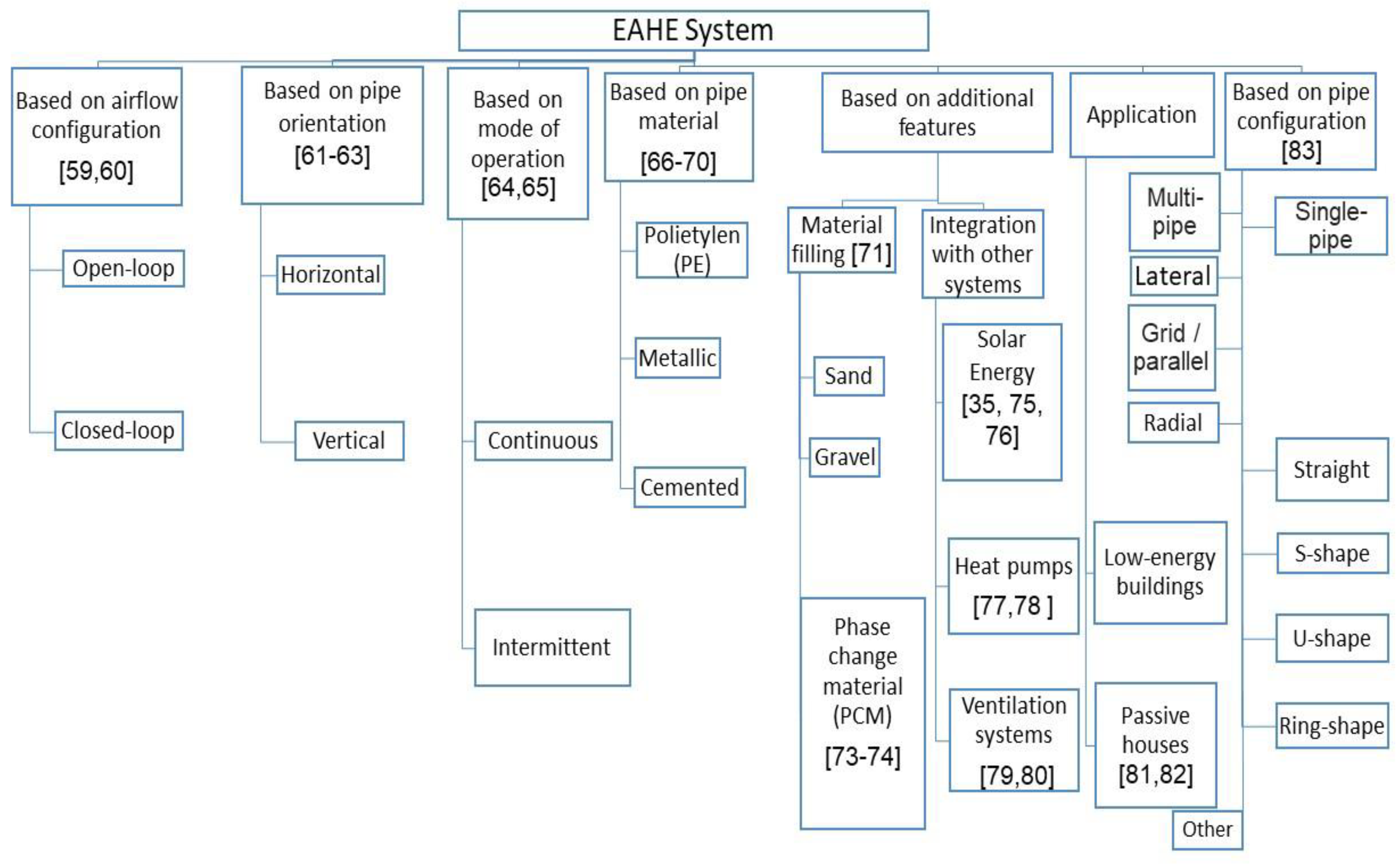
Figure 1. Classification of EAHE systems.
Preprints 146503 g001
Figure 2. Working Principle of Earth-Air Heat Exchangers (EAHE) coupled with heat recovery units: (a) In summer; (b) In winter [84,85].
Preprints 146503 g002aPreprints 146503 g002b
Figure 3. Key mechanisms and parameters affecting heat and mass transfer in EAHEs.
Preprints 146503 g003
Figure 4. Heat and mass transfer in EAHE.
Preprints 146503 g004
Figure 5. Factors influencing ground energy storage for EAHE system operations [98].
Preprints 146503 g005
Figure 6. Applications of EAHE-PV systems.
Preprints 146503 g006
Disclaimer/Publisher’s Note: The statements, opinions and data contained in all publications are solely those of the individual author(s) and contributor(s) and not of MDPI and/or the editor(s). MDPI and/or the editor(s) disclaim responsibility for any injury to people or property resulting from any ideas, methods, instructions or products referred to in the content.
Copyright: This open access article is published under a Creative Commons CC BY 4.0 license, which permit the free download, distribution, and reuse, provided that the author and preprint are cited in any reuse.
Prerpints.org logo

Preprints.org is a free preprint server supported by MDPI in Basel, Switzerland.

Subscribe

Disclaimer

Terms of Use

Privacy Policy

Privacy Settings

© 2025 MDPI (Basel, Switzerland) unless otherwise stated