

Submitted:
13 January 2025
Posted:
16 January 2025
You are already at the latest version
Abstract
This study aims to examine the issue of coastal communities that have not been successfully empowered, through a collaborative framework of Triple Helix (Etzkowitz and Leydesdorff 1995). Based on a study that has been conducted in Hamlet IV, Kuala Indah Village, Sei Suka District, Batubara Regency using the action research method to the seekers and shellers as respondents, it was found that their socio-economic level is still low. Their low level of education, income, and proficiency requires intervention through collaboration with the Triple Helix model from parties who are members of academia (University of North Sumatra), village government (Kuala Indah Village), and industry (PT. Inalum). Through collaboration, the community can be assisted socio-economically, in increasing their capacity to be trained in innovative treatment so that there is active involvement in the treatment and utilization of various coastal wastes, which the initiation of knowledge transfer is facilitated by the university. The results of the analysis show that university innovations directed at community development can bring changes in socio-economic practices so that they can reflect the actual needs of local communities. The survey results show that fishing families looking for and shellfish peelers need new skills that can be used as entrepreneurial ideas that have never been given by the government. Strong cooperation between the roles of triple helix actors in this model can produce alternative jobs for fishing families based on innovations provided through the management of coastal waste into calcium innovation products which can then lead to overall poverty alleviation.
Keywords:
Collaboration
; Triple Helix
; Coastal Community Empowerment
; Governance
; Coastal Waste and Product Innovation
1. Introduction
Indonesia’s coastal areas are known as areas that have abundant natural resources, ranging from rich marine products, to their marine tourism potential (Mariana, 2023). However, behind these natural resources, poverty in coastal communities is still a prolonged problem (Fatmasari, 2016). According to the Central Statistics Agency (BPS), in 2021 the extreme poverty rate in Indonesia reached 4 percent or amounted to 10.86 million people from the national poverty rate which was still 10.14 percent or as many as 27.54 million people. Meanwhile, based on the report of the Secretariat of the Vice President of the Republic of Indonesia in 2021, it was recorded that the level of extreme poverty, especially in coastal areas, is relatively higher than other regions and has more complex problems (Putra et al., 2023). Poverty in general is characterized by suffering from underdevelopment, underdevelopment, low productivity, which then increases to low income received (Hamdani, 2017).
The issue of poverty among coastal fishermen continues to occur due to weak governance of government services (Kitunzi, 2021). Weak government services occur due to the absence of collaboration between institutions (Ali & Haapasalo, 2023). The implementation of the coastal community empowerment program that is currently carried out by the government is not enough to solve the problems faced by fishermen, as evidenced by previous research that found a low socio-economic level of fishermen (Aisyah et al., 2010), (Aisyah et al., 2014). Governments should involve fishers in identifying their challenges and developing strategies to address them (Valentina, A., & Wardany, K. 2020). The government should visit poor fishing communities to find out the source of fishermen’s problems, and get the latest information from fishermen to get solutions to their problems (Tanjung, A., 2016). In addition, collaboration between parties is needed to create the realization of service performance to traditional fishing families that are prosperous in a sustainable manner (Mahon, R., Fanning, L., & McConney, P., 2014). Basically, the performance of the coastal community empowerment program has not been achieved due to the absence of local potential management and the absence of a sustainable collaboration scheme with stakeholders in coastal areas (Stoddart et.al, 2020). The government does not recognize the potential that exists in coastal areas because the government works alone. Empowerment programs are often hampered due to the lack of synergy between the government, the private sector, and universities and the lack of mapping of potential resources that can be used sustainably (Adrianto et al., 2013). In coastal areas, this condition is further exacerbated by the government’s work approach which tends to be centralistic and rarely involves the active participation of the community or other strategic partners.
Dusun IV, Desa Kuala Indah, Kecamatan Sei Suka, Kabupaten Batubara is one of the coastal areas in North Sumatra Province that requires special attention in terms of coastal waste management. Based on the research survey that has been carried out, it was found that shellfish are a type of shellfish that are widely found scattered in the area. The lack of community proficiency in managing waste is the cause of various problems. Clam shell waste that is not properly managed can cause unpleasant odors, pollute the environment, and become a nest of diseases (Nastiti et al., 2024). According to the Ministry of Marine Affairs and Fisheries (2019), the accumulation of waste in coastal areas can disrupt the marine ecosystem and reduce coastal aesthetics. On the other hand, the processing of clam shell waste into innovative products can open up new economic opportunities for the community (Abubakar et al., 2021). Shells have the potential to be processed into various value-added products, such as building materials, handicrafts, or even calcium supplements (Abdullah, 2021). Coastal communities need this Coastal Waste Management Science to create added value and new jobs (Utomo, 2021). In this context, the coastal area of Hamlet IV, Kuala Indah Village, Sei Suka District, Batubara Regency requires the application of change management principles to overcome existing problems and make the most of local potential. The government needs to collaborate with other parties such as academics and industry to be able to support the realization of the performance of empowerment programs in coastal areas (Effendy, 2009). Collaboration between universities as higher education institutions and the industrial sector is very important today because this synergy allows the creation of solutions to various problems in the field of science and socio-economic issues that occur in society (Hakim et al., 2020). The Corporate Social Responsibility (CSR) program is a form of social responsibility from the industry, which aims to make a positive contribution to society and the environment (Hidayati, 2007). In this context, the coastal community entrepreneurship assistance program can be integrated into one of the strategic efforts to empower local communities through innovation and sustainable resource management.
Universities, as institutions that provide innovation and science and technology (ipteks), have a strategic role in making a real contribution to changes in coastal community empowerment programs that previously failed (Aman et al., 2022). Through knowledge transfer-based interventions, universities are here to bridge the gap between local potential that has not been properly managed and the need to create sustainable solutions. One form of intervention is through coastal community empowerment programs that focus on zoning-based and type-based coastal waste management, especially waste that has the potential to be processed into innovative calcium-based products. This program not only aims to manage waste effectively, but also to encourage the creation of value-added products that can improve the welfare of coastal communities while maintaining environmental sustainability.
The researcher collaborated with PT. inalum in the CSR program and the Batubara Regency Government in providing an entrepreneurial assistance program for calcium-based innovation fostered groups in Hamlet IV, Kuala Indah Village, Sei Suka District, Batubara Regency. This program aims to provide assistance to innovation fostered groups in forming sustainable entrepreneurship through calcium-based product innovation with triple helix interparty collaboration, with the hope of improving the welfare of coastal communities through the involvement of fostered groups in community-based innovation, as well as assessing their impact on skill improvement, job creation, and sustainable economic development. This is expected to make a real contribution to supporting the development of coastal communities that are more independent and competitive.
2. Theoretical Framework
2.1. Change Management
According to Hayes (2002) in Sultani, R., & Aslami (2023) states that change management is a change in all or part of an organization that aims to maintain efficiency in terms of productivity, sales, market competitiveness and internal alignment or to improve performance. Kotter J. (2011) stated that change management is a way to bring teams and organizations towards the future they want. He also stated that change management is the use of fundamental systems and tools to guide change efforts. Change management is a systematic approach used to handle transitions or transformations in an organization, be it in processes, structures, or cultures. According to John P. Kotter in his book Leading Change (1996), emphasized that change management is a systematic approach that focuses on helping organizations to navigate and manage change through a series of structured stages, with the aim of improving the success of change implementation and ensuring that organizations are able to adapt effectively. There are many important concepts in change management that help organizations in managing change effectively. Zulkarnaini (2024) The change process involves a series of key steps to manage change effectively. Pranogyo, A. B., & Zulkarnaini, H. (2024) The first step in change management is to recognize the need for change and start the change process after identifying challenges or opportunities that require a response. Next, it is necessary to diagnose areas that need to be changed and formulate a long-term vision. After that, planning the intervention in detail is an important step before implementing the change plan and regularly reviewing progress. Ensuring change is maintained into the organizational culture and integrating it into the new normal requires continuous monitoring and reinforcement.
Three-Stage Change Model (Lewin’s Change Management Model)
Kurt Lewin Kurt Lewin, who is one of the pioneers of change management theory, proposed a Three-Stage Change Model consisting of:
- Unfreezing:
- The stage where the organization prepares for change by breaking the status quo. This step is important to overcome resistance by creating awareness of the need for change.
- 2.
- Changing:
- The stage of change is applied. It is a dynamic process that involves learning and transitioning to new ways.
- 3.
- Refreezing:
- At this stage, the newly implemented changes are maintained and integrated into the organizational culture, thus becoming a stable new practice.
The concept of change management based on Kurt Lewin can be concluded that in change management there is a gradual process that must start with the creation of readiness, followed by the implementation of change, and end with stabilization so that change lasts and is sustainable in the long term.
2.2. Collaborative Governance
According to Irwanto (2011), the terms government and governance are often considered to have the same meaning, namely how to apply authority in an organization, institution, or state. Government or government is a name given to the party that exercises government power in a country. However, in Government there is only a government that acts as a state administrator. Then according to Fibiona and Putra (2013), actually the term governance has been known in administrative and political literature for 120 years since Woodrow Wilson introduced the field of study when he became the 27th President of the United States. The emergence of the concept of governance was initially started by a sense of dissatisfaction with the concept of government which only places the government as the administrator of the state. The dominance of the government’s role in the concept of government makes the role of the community and the private sector tend to be ignored and results in their interests not being accommodated properly. This is as according to Praktikno (2005), who explained that governance should be focused on developing synergy between the state, the business community, and civil society, which is based on the capacity to build consensus, cooperation and mutual accommodating and is based on mutual equality relations. In the book Collaborative Governance New Era of Public Policy in Australia by Janine O’Flynn and John Wanna, it is explained that collaboration can be done in organizations to solve complex problems and to achieve goals effectively and on target. Ansell and Gash term collaborative governance is a way of managing government that directly involves stakeholders outside the government or the state, oriented to consensus and deliberation in the collective decision-making process that aims to make or implement public policies and public programs (Ansell and Gash, 2008). It is a process in which stakeholders involved with all sectors create efficient and effective solutions to public problems that go beyond what any organization can achieve alone. As a result, the main objectives of the collaborative governance process are to produce more informed and more engaged citizens, more inclusive participants in decision-making, more stakeholders in community partnerships, better deliberative methods, and greater accountability and trust in the government (Henton et al. 2005).
2.3. The Relationship Between Change Management and Collaborative Governance
Change management and collaborative governance are two concepts that are interrelated in an effort to improve the performance and adaptation of an organization or government to change. Change management focuses on how organizations plan and manage change to ensure continuity and success in the face of internal and external challenges. On the other hand, collaborative governance emphasizes decision-making that involves many parties, including the public, private, community, and other groups, in the process of developing or managing policies that are more inclusive and collaborative-based. These two concepts are closely related in creating effective and sustainable change, both within the organization and in governance.
In the context of change management, the success of transformation depends not only on the organization’s internal strategy, but also on the ability to work closely with various external stakeholders. Collaborative governance plays an important role in strengthening change management by providing a platform for stakeholders to collaborate in designing and implementing change. This process involves gathering different perspectives and finding common solutions that can facilitate the transition within the organization as well as in public policy. Several scientific studies show that collaboration between various parties in managing change can accelerate adaptation to new policies. Ansell & Gash (2007), found that collaborative governance can accelerate the change process by reducing conflicts between stakeholders and facilitating more open and transparent communication. This is in line with the findings of Edelenbos & Klijn (2005), which states that in government settings, the success of collaboration is highly dependent on the ability to create effective communication channels between stakeholders and the government. Therefore, collaboration in change management not only strengthens the implementation of change but also supports mutual understanding and agreement on the direction of change. In many organizations or governments, significant changes often give rise to disagreements or ambiguities about goals and how to achieve the desired outcomes. With collaborative governance, the parties involved can discuss a common vision and formulate more inclusive policies, taking into account various existing perspectives.
Research by Kooiman (2003) shows that in the context of government, the collaborative governance process not only reduces tensions between different parties, but also facilitates policy making that is more in line with the needs of the community. This is important in change management, where clear and mutually agreed change objectives can facilitate policy implementation. The change management process often encounters resistance from various parties who feel threatened by the change. In this case, collaborative governance can help manage such resistance by involving stakeholders in discussion and planning. Through open and participatory dialogue, conflicts that may arise during the change process can be minimized. Kotter’s research (1996) suggests that one of the main reasons for resistance to change is a lack of communication and involvement in the change process. When parties affected by change feel involved and their voices are heard, resistance to change can be significantly reduced. Further research by Bingham et al. (2005) also shows that the success of collaborative governance in overcoming resistance often depends on how conflicts are managed through fair and transparent resolution mechanisms. Collaborative governance has an important role in ensuring that the changes implemented remain relevant and sustainable. By involving various stakeholders in continuous evaluation and oversight, the change process can be adjusted and improved over time, ensuring that organizational goals are achieved on an ongoing basis. A study by Susskind & Cruikshank (1987) suggests that in order to maintain the sustainability of change, it is important for all parties involved to continue to collaborate in evaluating the results and impacts of the changes that have been made. Susskind & Cruikshank (1987) emphasized that without a collaborative mechanism to continuously monitor and adjust policies, such changes are likely to be short-lived.
2.4. Good Corporate Governance
Good Corporate Governance (GCG) is definitively a system that regulates and controls companies that create value added for all stakeholders (Monks, 2003:56). There are two things that are the pressure point in this GCG concept, first, the importance of shareholders’ right to obtain information correctly and on time, and second, the company’s obligation to disclose accurately, timely, and transparently all information on the company’s performance, ownership, and stakeholders. In Good Corporate Governance, there are at least four main components that are needed (Kaen, 2003; Shaw, 2003) namely fairness, transparency, accountability, and responsibility. Companies, both state-owned (SOEs) and purely private companies through the implementation of GCG, will obtain several beneficial benefits for their companies. Some of the benefits of implementing GCG for companies (http://forester-azharmaskum.blogspot.com) are: 1) with the implementation of Good Corporate Governance (GCG) the decision-making process will take place better so that it will produce optimal decisions, can increase efficiency and create a healthier work culture; 2) Good Corporate Governance (GCG) will allow it to avoid or at least minimize the abuse of authority by the board of directors in the management of the company. This will certainly reduce the possibility of losses for the company and other interested parties as a result of this action; 3) the value of the company in the eyes of investors as a result of their increased confidence in the management of the company in which they invest; 4) for shareholders, with an increase in performance, it will automatically increase the value of their shares and also the value of dividends they will receive; 5) because in Good Corporate Governance (GCG) employees are placed as one of the stakeholders that should be managed properly by the company, the motivation and job satisfaction of employees are also expected to increase; 6) with the good implementation of Corporate Governance, the level of trust of stakeholders in the company will increase so that it can increase the positive image of the company. This can of course reduce costs incurred as a result of the demands of stakeholders to the company; 7) the consistent implementation of Corporate Governance will also improve the quality of the company’s financial statements.
Corporate Social Responsibility (CSR)
Corporate Social Responsibility (CSR) according to Lord Holme and Richard Watt (in Hadi, 2011:44) is the continuous commitment of a company that runs ethically and contributes to development to improve the quality of life of workers and their families, as well as local communities and the wider community. The same definition is also explained according to The World Business Council for Sustainable Development (WBCSD) in Wibisono (2007:7) that the definition of Corporate Social Responsibility (CSR) is a form of commitment of the business world to continuously act ethically, operate legally and contribute to economic improvement, along with improving the quality of life of employees and their families as well as improving the quality of local communities and the wider community. Based on the explanation above, the implementation of Corporate Social Responsibility (CSR) from the company is a form of corporate responsibility as an effort or form of concern for the quality of life of employees and the community around the company’s location. The implementation of CSR programs by companies is not necessarily only an omission of Law Number 40 of 2007, but can also bring benefits and benefits for a company to maintain and develop its existence in the business world. According to Suhandri M. Putri (Untung, 2009:6-7) explained that there are 10 (ten) advantages that can be obtained by companies in carrying out CSR, which are as follows:
- maintain and boost the company’s reputation and brand image;
- obtaining a license to operate socially;
- Reduce the company’s business risks;
- Expanding access to resources for company operations;
- open up wider market opportunities;
- reducing costs, for example related to the impact of waste disposal;
- improving relationships with stakeholders;
- improving relations with regulators;
- increase employee morale and productivity; and
- opportunity to get an award.
Wahyudi and Azheri (2008:62-63) explained 4 forms of corporate social responsibility, namely: a. Good environmental management, including the provision of a safe and comfortable environment, a proper compensation system and attention to the welfare of employees and their families. b. Partnership between the company and the community, especially the local community. This partnership is generally realized in the Community Development (CD) program to help improve the general welfare of the local community over a long period of time. Through this program, it is hoped that the community will receive the benefits of the existence of the company which is used to support its independence even after the company stops operating. c. Handling environmental sustainability, this activity starts from the company’s own environment, including saving the use of electricity, water, paper and so on to handling waste due to company activities, so as not to pollute the environment around offices, factories and/or land. d. Social investment which is often narrowly defined as “corporate charitable activities‟. The real meaning is that the company provides financial and non-financial support for social and environmental activities carried out by other groups/organizations which will ultimately support the company’s business activities. Because the company through social investment will reap a positive image (corporate image).
2.5. Community Development (ComDev)
One of the tangible forms of CSR is Community Development (ComDev). Community Development is a systematic and participatory process in which community members work together to identify problems, utilize local resources, and design and implement solutions that can improve the economic, social, and environmental well-being of the community (Agarwal, 2020). ComDev involves developing the capacity of individuals and groups to take control of their local development, as well as strengthening social cohesion and economic empowerment (Hickey & Mohan, 2021). The ComDev approach often uses bottom-up and participatory principles, where local communities play an active role in the planning, implementation, and evaluation of development projects (Hickey & Mohan, 2021). The Corporate Social Responsibility program implemented by the company should be able to contribute to the surrounding community, especially in improving their standard of living and welfare. Wahyudi and Azheri (2008:62-63) have explained the forms of CSR programs, one of which is the Community Development program to help improve the welfare of the surrounding community. Through the Community Development program, it is hoped that the community will receive the benefits of the existence of the company which is used to support its independence even after the company stops operating. In this context, the empowerment of coastal communities through calcium waste-based product innovation is one form of ComDev, where communities are provided with the necessary skills and support to manage natural resources sustainably, increase income, and strengthen their economic independence (Smith, 2019). This approach not only emphasizes economic aspects, but also increases environmental awareness, strengthens community solidarity, and encourages local innovations relevant to the needs of the community (Mon, 2022). Arthur Dunham, a community development expert, explained Community Development as an organized effort to improve people’s living conditions and improve people’s ability to unite and direct themselves. Community development is realized through the improvement of private organizations and joint efforts of community members, but usually with technical assistance from the government or private organizations (Dunham, 1972). Dunham identifies the four elements of ComDev as follows;
- Planned programs with a focus on the total needs of village communities;
- Technical assistance;
- Integrating various specialties to help the community; and
- The main emphasis is on self-help and participation by community members.
From this definition, it can be concluded that Community Development is a sustainable development process. This means that this activity is carried out in an organized and gradual manner, starting from the initial stage to the follow-up and evaluation stages. The goal of Community Development is to improve the economic, social, and cultural conditions of the community to achieve a better quality of life. This activity is focused on empowering the potentials that the community has to meet their needs, so that the principle of helping the community to help themselves can be realized.
2.6. Coastal Community Development
Sulistiyani in the book Situmeang (2016:85) explained that empowerment is interpreted as a process to obtain power, strength or ability or the process of giving power and ability from those who have power to those who are considered less capable. Empowerment is a process and effort to acquire or provide abilities to vulnerable individuals and communities in order to identify, analyze, determine potential needs and problems faced and at the same time choose alternative solutions by optimizing resources and potentials independently. Empowerment of coastal communities, for example, is an effort to facilitate, encourage, or assist coastal communities so that they can determine the best in utilizing and managing coastal resources (Ali, 2021; Shafira & Anwar, 2021; Shaprina, 2023). This process is a long social journey to achieve the desired goal. Apart from being a social process, empowerment also functions as a strategy, means, facility, media, or instrument to help people become more empowered. Therefore, empowerment is not the end goal or the result achieved, but rather the means to achieve that goal. Fundamentally, the purpose of empowerment is for people to become empowered in various aspects of life (Irawan & Tanzil, 2020). To analyze the empowerment of coastal communities in Kuala Indah Village, the researcher refers to the views of Sulistiyani (2004: 83). According to him, empowerment is not permanent, but lasts until the target community is able to be independent and then released to be independent, although it is still monitored from afar so that there is still indirect assistance. This opinion shows that empowerment is a continuous learning process until achieving independence. Furthermore, he explained that the learning process in community empowerment takes place in stages, including: (1) The stage of awareness and the formation of behavior towards awareness and care, so that individuals feel the need to increase their capacity (Survey stage); (2) The ability transformation stage, which includes basic knowledge and skills to open up insights and provide basic skills, so that individuals can play a role in Development (Training), (3) The stage of improving intellectual ability and skills, which leads to innovative initiatives and abilities to achieve independence (UMKM Establishment).
2.7. Approaches in Community Development
Through the CSR Program, the success and smoothness of community empowerment activities are greatly influenced by the approach chosen (Aruan & Rawaty, 2020; Haris, 2023). Alfitri (2011: 34-35) explained that the stages in community development are determined by good preparation and planning strategies, so that community development programs and actions can achieve the target. Furthermore, according to Nindita (in Alfitri, 2011: 34-35) there are three approaches to community development planning, namely:
- Development for Community
- The initiator of community development activities is a company that has the status of a donor, while the position of the target community is as the object of community development activities. The effect of this activity is the dependence of the community on the company to achieve the final result. Therefore the ultimate goal is to produce something, so the duration of this program is relatively short.
- 2.
- Development with Community
- In this program, activities are formulated together between the company and the community. The position of the company is as a development agent, while the community is as the subject as well as the object of the community development program. The purpose of this program is to be results-oriented and contribute to the development process. The positive impact of this program is that the community does not depend entirely on the company, but they are trained to be self-reliant. The duration of this program is usually quite long and sustainable. The characteristic of this program is that it is oriented to meet the needs of the community as well as the company’s goals.
- 3.
- Development of Community
- The main characteristic of this program is that it is oriented towards meeting the needs of the community. The ultimate goal is a process of development. Here the originator of the idea is the community itself, so the community that identifies needs and programs. Thus, the community is in a pure position as a subject while the company is an agent of development. The positive impact is to make the community self-reliant because they are directly involved in the program and they themselves determine the success or failure of their efforts. Because of these characteristics, this kind of program usually has a long period of time. Usually, this program is known as a partnership, namely training and mentoring in certain communities.
3. Materials and Methods
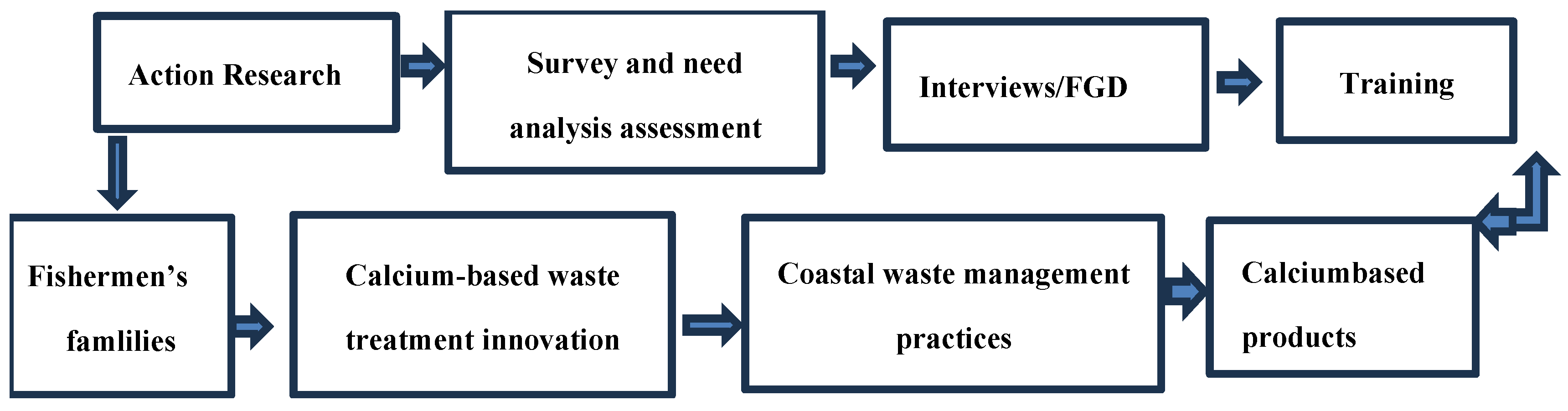
This study uses the action research method to examine the socio-economic conditions of traditional fishing families that are at a low level. The research begins with a survey and need analysis assessment to get the actual profile and needs of fishermen. Furthermore, the action chosen in this study is to provide training on the management and transformation of coastal waste into innovative products directly to fishing families for two days in the village and continued with assistance through in-person and online visits. The coastal waste used is a type of shellfish that is the main catch in Kuala Indah Village, namely clams, whose shells are scattered around fishermen’s settlements. The researcher provided a prototype to process the coastal waste into Calcium Oxide (CaO) powder.
This research provides special treatment in the form of coastal waste management interventions into innovative products through the Triple Helix Model collaboration approach. The goal is to improve the performance of the socio-economic empowerment program of traditional fishing families. In conducting research, researchers and actors collaborate to identify problems, design interventions, and implement programs systematically. The action research method has proven to be effective in ensuring that the aspirations and needs of the community are accommodated at every stage of the research (Dustman et al., 2014). This approach also involves the active participation of traditional fishing families, making them not only objects, but also active subjects in their capacity development, as well as ensuring the sustainability of empowerment programs (McNiff & Whitehead, 2011). This method allows researchers to make adjustments during the research process based on participant feedback. The action research process integrates Penta Helix’s approach, involving the government, academia, industry, society, and the media, to have a holistic impact. In this study, the Penta Helix approach was used to identify the specific problems and needs of traditional fishing families.
Figure 1.
Action Research Method in the Application of the Triple Helix Model.
- Research Location
The research was conducted in Hamlet IV, Kuala Indah Village, Sei Suka District, Batubara Regency, for nine months, from January 2024 to September 2024. This area was chosen because the distance of this coastal area is the closest to PT Inalum, besides that most of the people in the village make a living as fishermen looking for clams and shelling clams, which always produce clam waste every day. The population used in this study is the entire clam finder and peeler community in Kuala Indah Village, Sei Suka District, Batubara Regency, while the sample withdrawal was carried out purposively, namely in Hamlet IV, because the clam finders and peelers were the most in the hamlet. The determination of the number of respondents amounting to 100 people is because they are permanently domiciled in the location and every day it is easy to be collected and interviewed, because of the distance of their houses that are close to each other.
- Research Stages
- 1.
- Initial Observations and Surveys
- Initial observations were made to map the potential of coastal waste in Hamlet IV, Kuala Indah Village, Sei Suka District, Batubara Regency. This mapping identifies clamshell waste that is widely encountered in this region. This observation is an important step to understand the local context and the challenges and needs of the community (Stringer, 2014).
- 2.
- Focus Group Discussion (FGD)
- The next stage is the implementation of FGD with the local government to discuss the findings and form a driving team from traditional fishing families. This FGD involves various stakeholders to obtain input and support in designing empowerment programs. The FGD method is effective in gathering information and creating dialogue between related parties (Morgan, 2010).
- 3.
- Education and Training
- Academics determine participants who are entitled to participate in education and training programs on coastal waste management. The training focused on the process of processing waste such as shells into calcium flour, which can be applied in daily food and beverages. Local needs-based education and training have been proven to be able to improve community skills and independence (Quiroz-Nino & Murga-Menoyo, 2017).
- 4.
- Assistance
- The mentoring stage is carried out by academics who intensively provide guidance to selected trainees, ensuring that they are able to apply the skills that have been taught independently. In this stage, PT Inalum together with the local government through the Batubara Regency Cooperative UKM also facilitated administrative and legality needs, such as the management of Business Identification Numbers (NIB), product design and packaging (packaging), halal certificates from the MUI, and Household Industrial Food permits (PIRT), to support the sustainability of community businesses based on coastal waste treatment.
4. Results
- Profile of Traditional Fishing Families in Kuala Indah Village
Poverty that occurs in traditional fishing families is a serious problem, poverty can occur due to unconducive environmental factors. This study seeks to look at the problem of poverty among traditional fishing families which aims to be empowered so as to create welfare in these families. This study analyzes the needs of traditional fishing families for the determination of empowerment program assistance. Based on the findings of the study, the majority of women in Hamlet IV play a role in helping the family economy with their profession as clam finders, clam peelers, and crab shell washers. This shows that coastal women have a big role in helping the family economy. This fact reflects the important role of women in economic activities, where they are involved in supporting the family economy. Overall, this study is related to the need to carry out interventions to improve program performance to help traditional fishing families get out of poverty, through the application of a triple helix collaboration model to increase knowledge and skills in empowerment programs through the use of Corporate Social Responsibility programs. The goal is to improve the performance of the empowerment program which has not yet given good results, this is evidenced by the findings of the survey results which show that the average community does not feel any assistance. Therefore, the researcher collaborated in a triple helix carried out for coastal waste management treatment into a product innovation for the traditional fisherman family empowerment program.
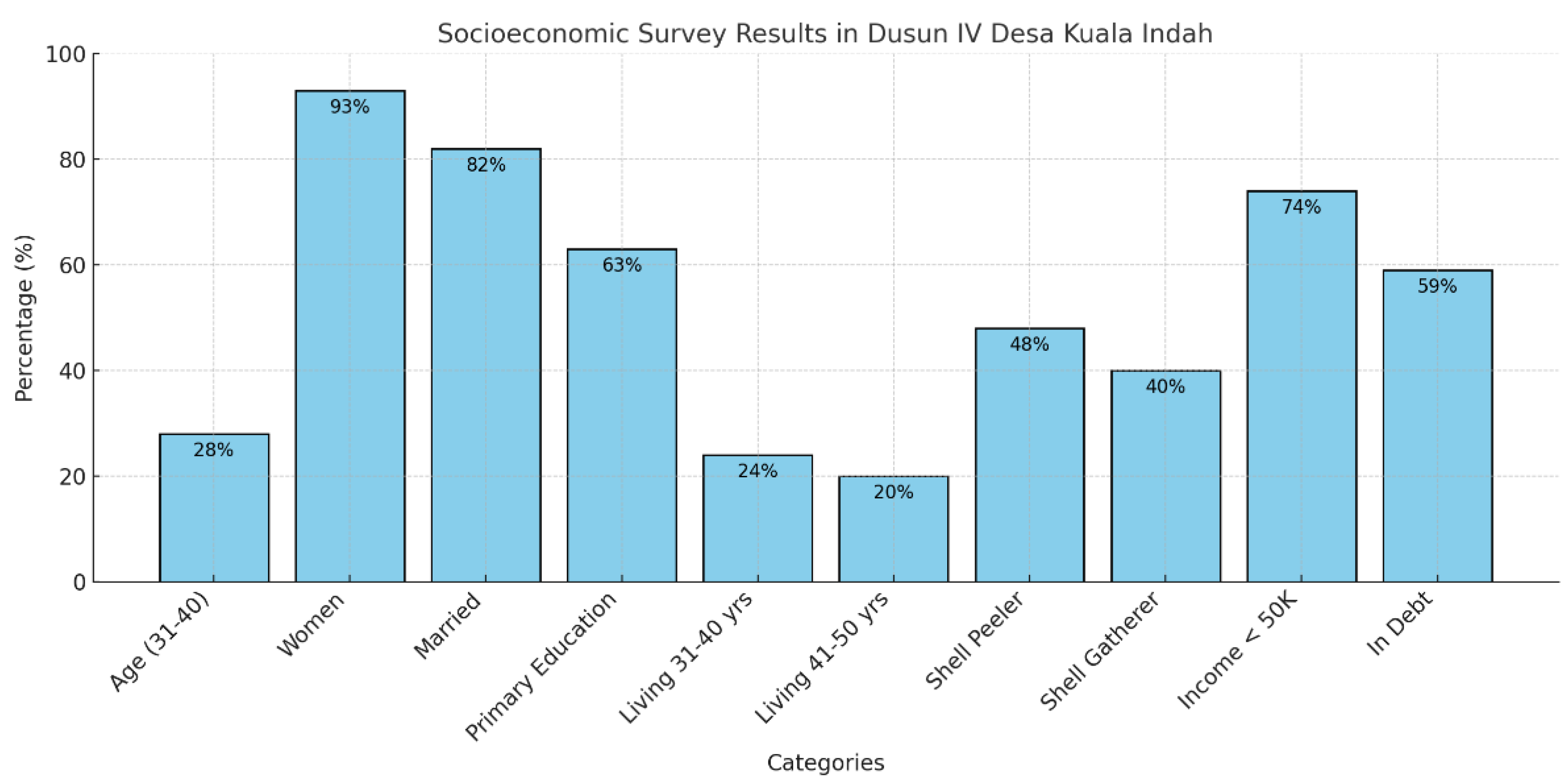
Based on the results of a survey in Dusun IV, Desa Kuala Indah, Sei Suka District, Batubara Regency, there are several important findings. The average age of residents who took part in the survey was classified as middle, with the majority aged between 31 and 40 years old (28%). Survey participation is dominated by women (93%), while men are only 7%. Most of the respondents in Hamlet IV are married (82%), with low education levels; 63% have an elementary school education. Regarding the length of stay, 24% of respondents have lived in Hamlet IV for 31-40 years, and 20% have lived for 41-50 years. The majority of the livelihoods of the residents of Hamlet IV are clam peelers (48%) and clam hunters (40%). Their average working period is between 1-10 years (56%). Most of them have 4 family members living in the same house (24%). Their income level is still very minimal, 74% have a daily income below Rp 50,000. The daily expenditure rate of 49% spends between Rp 50,000 to Rp 100,000. As a result of lack of income, they have debt on average (59%).
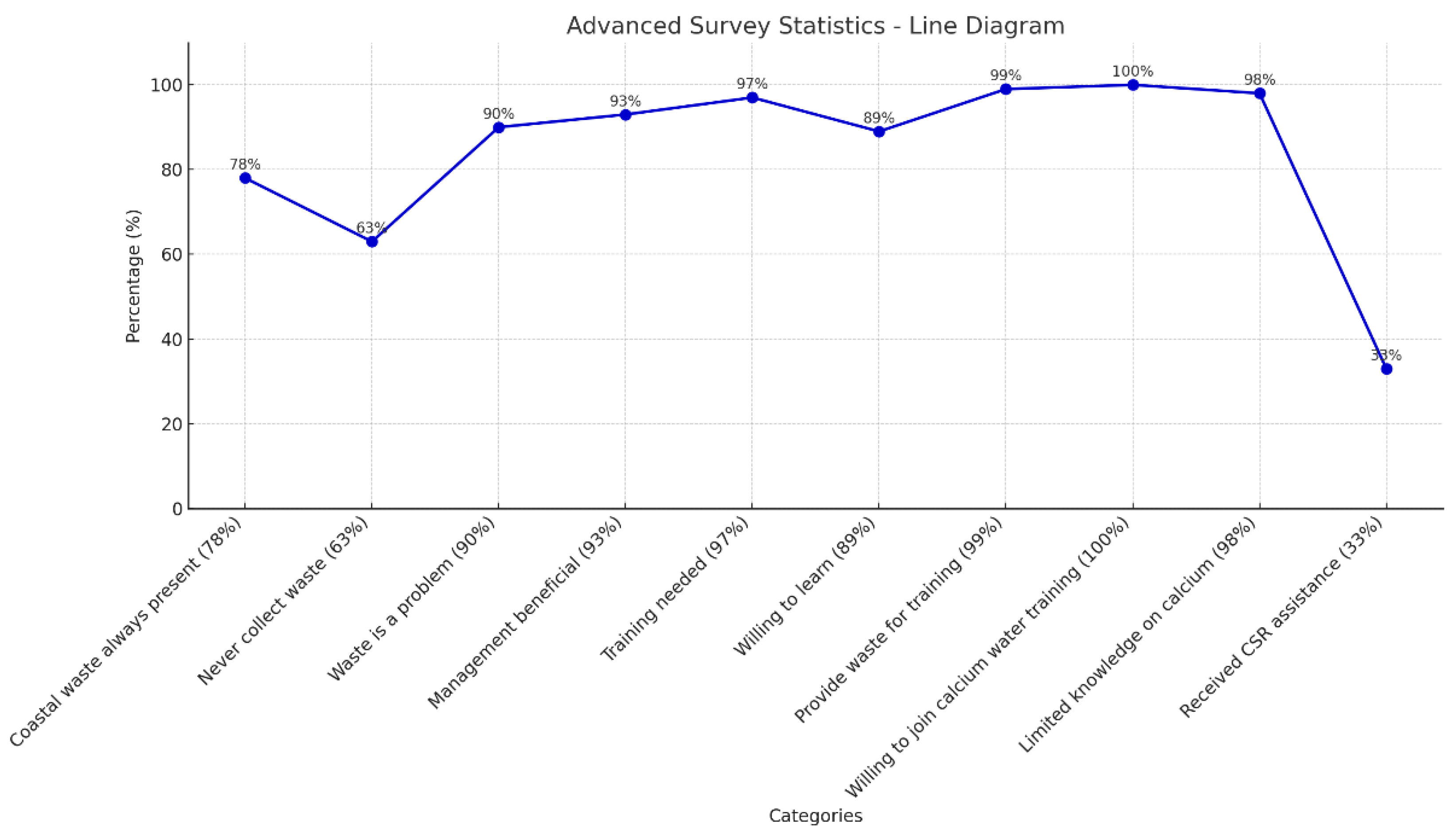
The survey conducted in Hamlet IV, Kuala Indah Village, Sei Suka District, Batubara Regency, in addition to looking at the socio-economic profile, also saw the issue of coastal waste as their asset to be intervened as an alternative to their work. The majority of respondents (78%) said that their coastal waste is always there, such as clamshell waste as the most abundant waste found around them, but the average of them (63%) said they never collect the waste, even though they said (94%) clamshell waste is always scattered around them. Therefore, according to them (90%), they consider that coastal waste is a problem that needs to be solved. Basically, respondents (93%) agree that the management and utilization of coastal waste is beneficial for their lives and work. As many as 17% of respondents had asked for waste from others to be used. As many as 99% of respondents agreed that coastal waste needs to be used for products that are useful for coastal families. Respondents’ expectations regarding coastal waste management, as many as 29% of respondents hope that waste is used properly, want training for waste management, hope that waste treatment can progress. They also hope that waste management can increase family income.
Therefore, they need training in coastal waste management The majority (97%) have never received training, but there is a strong desire from them (89%) to acquire knowledge and skills in utilizing clamshell waste, with 95% of respondents stating that they are willing to receive such training. Basically, they also want training to be able to apply the use of waste into useful products, because as many as 86% of respondents have never received training on the use of shell waste, and 92% have never received training on making calcium. They wanted to learn with 98% of respondents wanting to be taught about shell waste management, and 99% willing to provide waste for training. In addition, 99% of respondents wanted to be taught how to make calcium products from clam shells, and 100% were willing to take training to make calcium-containing water. The majority of the people of Kuala Indah Village have limited knowledge about calcium and calcium-containing water. However, they showed high enthusiasm for learning and almost all respondents (99%) expressed their readiness to work together in making the Kuala Indah Village Coastal Waste Management Program a successful innovative product that benefits the community. This shows the high enthusiasm and willingness of the community to be involved in training and waste management programs that can improve their welfare. The respondents as many as 67% have never received CSR program assistance from PT. Inalum. The most assistance they have received is in the form of basic necessities (19%), followed by waste management training (4%), and house surgery (2%). from PT. Overall, the survey results show that the people of Kuala Indah Village are very enthusiastic and ready to participate in the training on waste management and calcium water production. This enthusiasm indicates great potential to continue the program to the training stage, not only to improve the knowledge and skills of the community but also to contribute to better environmental management in improving their well-being.
- Application of the Triple Helix Model in the Fishermen’s Family Empowerment Program
The weakness of the previous empowerment program faced challenges in the form of programs that did not involve traditional fishing families. The performance intervention that has been carried out by academics in the process of empowering traditional fishing families is to carry out strong and sustainable partnerships at the local level. The partnership was built to combine 3 empowerment actors, namely government, academia, and industry which was introduced under the name Triple Helix by Leydesdorff & Etzkowitz, 2001. Triple Helix collaborative empowerment has been recommended by experts to produce sustainable empowerment through community participation and product innovation (Leydesdorff & Etzkowitz, 2001; Moreira & Lopez, 2018; Figueiredo et. Al., 2023). The Triple Helix collaboration between Academics, Government, and Industry in coastal waste management activities has resulted in the participation of traditional fishing families. Through participation in the program, they feel the benefits of the coastal waste management program, such as awareness to collect coastal waste, process it into calcium flour (CaO), then apply it to the use of calcium water to various food and beverage products on their day. Basically, this treatment is beneficial, because people use calcium water to meet health needs. The application of the triple helix model collaboration in empowering traditional fishing families in Kuala Indah Village was initiated by academics through the use of PT Inalum’s Corporate Social Responsibility program.
The role of academics is to provide innovations in the form of treatment in assisting the government in empowerment programs that have not succeeded in changing the living conditions of traditional fishermen, because basically the assistance needed is proficiency to add alternative jobs for coastal fishermen. In connection with this, the University of North Sumatra (USU) research team proposed innovative techniques in coastal waste management to become product innovations applied to calcium-based foods and beverages. The USU Research Team in the first stage transferred knowledge in managing coastal waste to be collected. Furthermore, in the second stage, the USU research team transferred knowledge to fishermen’s wives, especially how to manage coastal waste, starting from the process of cleaning, drying, burning, to flocking and boiling. As for the third stage of the process, the USU research team taught the application of calcium water into various calcium-based food and beverage products. The role of the government is very important for the sustainability of the Coastal Waste Management program, starting from the Village Government which has accommodated the fishermen by socializing this activity and providing a place to conduct surveys and training. Furthermore, the government is willing to make cooperation in the form of a Memorandum of Understanding, followed by a Memorandum of Agreement and Implementation Arrangement (IA) for every activity, between the Regency, Sub-district and Village Governments and the University of North Sumatra. The Industry (PT. Inalum) has provided support through this collaboration and has gained new knowledge on how coastal waste management programs can move to improve the socio-economic conditions of traditional fishing families. They have provided market access to entrepreneurs among fishing families who were formed to sell their products at Inalum Corner which is a corner fostered by PT Inalum’s MSME group. Furthermore, they will work together again to adopt this Coastal Waste Governance program to their Corporate Social Responsibility (CSR) Program in other coastal areas. The active participation of fishing families inspired the research team to change their role from the object of research to the main actor in empowerment. In addition, the rapid development in the dissemination of information through online media shows that the media has a strategic role as an enablement actor. The media can help increase public awareness and expand the scope of empowerment programs, as well as being an important means of educating the public about waste management. Community participation in waste management, supported by the media, is a key indicator of the success of this collaboration (Ansell & Gash, 2008), allowing the program to reach a wider audience and ensure its sustainability and scalability.
- Analysis of the Role of Triple Helix Actors in Empowerment Programs
The application of the Triple Helix collaboration model framework in coastal fishermen empowerment programs has high hopes for improving the performance of government programs, especially in programs that previously performed poorly because they ran alone. The Triple Helix approach was chosen because researchers realized that solving complex social problems is easier to solve in a collaborative way (Ansell & Gash, 2008; Bryson, et.al, 2019). The stages of implementing the Triple Helix collaboration in the context of empowering fishing families in coastal areas, based on this research involve collaboration between three actors (academics from the University of North Sumatra, the government educated from the village government and the Cooperative and Coal MSME Office, an industry driven by PT Indonesia Asahan Alumunium (Inalum)). Triple Helix’s collaborative activities in coastal waste management research have moved each party in accordance with their duties and functions which can be seen in Table 1 below.
Based on the analysis of the role of triple-helix collaboration in this governance study, the government is a decision-making actor because it has the authority to approve proposals and allocate resources, which is a key element in the implementation of the program. The decisions taken by the government can determine the success or failure of a collaborative program. In addition, the government gives legitimacy to initiatives proposed by other actors, such as academia and industry. Bäckstrand (2019), stated that support from the government is very important in creating synergies between various stakeholders, because they have the capacity to shape public policies that support collaboration. The influence of the government can also be seen from its function as a facilitator who coordinates various actors in the collaboration process, especially between departments in the government. This is in line with the views of Ansell and Gash (2008), which stated that the government needs to play an active role in creating space for effective collaboration. Meanwhile, based on Table 1 above, it can be seen that the most pro-active triple Helix actor in this coastal waste management program is an initiation from academics from the University of North Sumatra (USU). In this action research study, USU academics play an active role as inventors who submit proposals for coastal waste management innovations, not only developing new ideas but also conducting research that supports the program. USU academics are the main driving force in this collaboration which starts the program by submitting proposals, conducting surveys, and carrying out research and training activities to coastal communities. In addition, academics lead cross-sector coordination through Focus Group Action (FGA), which connects governments and industry. USU researchers also facilitate knowledge transfer to fishing families, especially in converting coastal waste into calcium-based products with economic value. USU academics not only carry out research functions, but also ensure direct community involvement and empowerment. This is in line with the views of Keast and Myrna Mandell (2014) on the importance of intensive collaboration and the development of joint ideas. The role of the industry in this case is played by PT. Indonesia Asahan Aluminum is participating in providing support in funding for the Corporate Social Responsibility program through the signing of a collaboration. Based on this, academic innovations are used to help the empowerment program of fishing families in the CSR program of PT. Inalum.
5. Discussion
- Analysis of the Impact of Triple Helix Collaboration on Coastal Community Empowerment
The implementation of the Triple Helix collaboration model has provided changes to the empowerment of coastal communities in Hamlet IV, Kuala Indah Village. This collaboration has successfully answered various challenges previously faced by empowerment programs, such as limited community skills and lack of synergy between stakeholders. The results of the study show that interventions carried out by academics, with a Triple Helix-based collaboration framework can create innovative solutions oriented to community capacity building, especially through the transformation of shell waste into economically valuable products. Further discussions showed the importance of the role of coastal women in the success of this program. With a focus on training groups of women, this empowerment model not only improves technical skills but also empowers them as active economic actors. Fishermen who previously only helped domestic activities are now able to manage coastal waste into calcium oxide (CaO) products, which are then applied in daily food and beverage products. Knowledge Transfer from academia as a strategy for the sustainability of collaboration between academia, industry, and government within the framework of Triple Helix. Academics from the University of North Sumatra play an important role as a driver of innovation through intensive training and mentoring to the community. This ensures that coastal communities are able to continue the empowerment program independently after the intervention is completed.
6. Conclusions
The implementation of the coastal community empowerment program carried out by the government is not enough to solve the problems faced by fishermen, as evidenced by the results of a survey that has been conducted among clam seekers and peelers in Hamlet IV, Kuala Indah Village, Sei Suka District, Batubara Regency, it is found that their socio-economic level is low. Academics from the University of North Sumatra were present to intervene by implementing the Triple Helix empowerment model which involves collaboration between academics, government, and industry. The Triple Helix model used in this study focuses on the empowerment of traditional fishing families from among women fishermen looking for and shelling clams. The collaboration was carried out in order to improve the performance of empowerment programs for traditional fishing families that are more prosperous and sustainable (Mahon, R., Fanning, L., & McConney, P., 2014). This research has produced a new framework as a recommendation for the implementation of community empowerment with the Triple Helix collaboration model framework. In action, this research has successfully involved three parties in the Triple Helix model that synergize and collaborate in the implementation of sustainable empowerment programs. Academics provide knowledge transfer in the form of innovative treatments that have aroused the interest of coastal communities in managing coastal waste into innovative products that have added economic value. The village government has gathered fishermen’s families and knows the needs and needs of fishermen’s families to improve their quality of life, while the PT. Inalum provides financial support through corporate social responsibility programs through training and entrepreneurial skills to fishing families to develop their products from coastal waste.
References
- Aisyah, D., Mamat, I., Rosufila, Z., & Ahmad, N. M. (2012). Program Pemanfaatan Sisa Tulang Ikan Untuk Produk Hidroksiapatit: Kajian Di Pabrik Pengolahan Kerupuk Lekor Kuala Trengganu-Malaysia. Jurnal Sosioteknologi, 11(26), 116–125.
- Ali, M., Rais, L., Gafur, M. A. A., Rosalina, F., & others. (2023). Mitigasi Dampak Kekerasan terhadap Perempuan dan Anak di Distrik Sorong Kepulauan Kota Sorong. Entita: Jurnal Pendidikan Ilmu Pengetahuan Sosial Dan Ilmu-Ilmu Sosial, 5(2), 215–234. [CrossRef]
- Ansell, C., Sørensen, E., & Torfing, J. (2023). Public administration and politics meet turbulence: The search for robust governance responses. Public Administration, 101(1), 3–22. [CrossRef]
- Assegaf, M., Wasitowati, M. M., & others. (2015). Knowledge Sharing sebagai sumber inovasi dan keunggulan bersaing pada usaha mikro kecil dan menengah (UMKM) sektor batik. Conference In Business, Accounting, And Management (CBAM), 2(1), 208–221.
- Astari, V., Hakim, L., & Putra, F. (2023). The Sustainable Development Strategy of Marine-Based Gastronomy Ecotourism at Southern Malang, Malang Regency, East Java. Environmental Research, Engineering and Management, 79(2), 32–49. [CrossRef]
- Behn, R. D. (2003). Why measure performance? Different purposes require different measures. Public Administration Review, 63(5), 586–606. [CrossRef]
- Berliandaldo, M., Chodiq, A., & Fryantoni, D. (2021). Kolaborasi dan Sinergitas Antar Stakeholder dalam Pembangunan Berkelanjutan Sektor Pariwisata Di Kebun Raya Cibinong. INOBIS: Jurnal Inovasi Bisnis Dan Manajemen Indonesia, 4(2), 221–234. [CrossRef]
- Butler, M. J. R., & Ferlie, E. (2020). Developing absorptive capacity theory for public service organizations: Emerging UK empirical evidence. British Journal of Management, 31(2), 344–364. [CrossRef]
- Campbell, D. F. J., & Carayannis, E. G. (2020). Epistemic governance and epistemic innovation policy. In Encyclopedia of creativity, invention, innovation and entrepreneurship (pp. 924–929). Springer. [CrossRef]
- Castellani, P., Ferronato, N., Ragazzi, M., & Torretta, V. (2023). Organic waste valorization in remote islands: Analysis of economic and environmental benefits of onsite treatment options. Waste Management \& Research, 41(4), 881–893. [CrossRef]
- Christensen, T., & Lægreid, P. (2011). Democracy and administrative policy: Contrasting elements of New Public Management (NPM) and post-NPM. European Political Science Review, 3(1), 125–146. [CrossRef]
- Clark, C. J., & Tetlock, P. E. (2023). Adversarial collaboration: The next science reform. In Ideological and political bias in psychology: Nature, scope, and solutions (pp. 905–927). Springer.
- Crosby, B. C., & Bryson, J. M. (2018). Why leadership of public leadership research matters: and what to do about it. Public Management Review, 20(9), 1265–1286. [CrossRef]
- Didi, L. (2022). Pemberdayaan Masyarakat Desa Pesisir (Pendekatan, Teori Dan Konsep).
- Durán-Romero, G., López, A. M., Beliaeva, T., Ferasso, M., Garonne, C., & Jones, P. (2020). Bridging the gap between circular economy and climate change mitigation policies through eco-innovations and Quintuple Helix Model. Technological Forecasting and Social Change, 160, 120246. [CrossRef]
- Dustman, E. L., Kohan, M. B., & Stringer, E. T. (2014). Starting small and building out with Ernie Stringer: Personal insights into action research and educational change. Action Research, 12(4), 426–443. [CrossRef]
- Etzkowitz, H., & Leydesdorff, L. (1995). The Triple Helix--University-industry-government relations: A laboratory for knowledge based economic development. EASST Review, 14(1), 14–19.
- Fang, B., Yu, J., Chen, Z., Osman, A. I., Farghali, M., Ihara, I., Hamza, E. H., Rooney, D. W., & Yap, P.-S. (2023). Artificial intelligence for waste management in smart cities: a review. Environmental Chemistry Letters, 21(4), 1959–1989. [CrossRef]
- Geissdoerfer, M., Santa-Maria, T., Kirchherr, J., & Pelzeter, C. (2023). Drivers and barriers for circular business model innovation. Business Strategy and the Environment, 32(6), 3814–3832. [CrossRef]
- Ginting, B., & others. (2018). Model Pemberdayaan Nelayan Tradisional: Analisis Kemiskinan Nelayan Tradisional Desa Percut Kecamatan Percut Sei Tuan Kabupaten Deli Serdang Sumatera Utara. Universitas Sumatera Utara.
- Ginting, R. K. (2018). Strategi Bertahan Hidup Nelayan Tradisional di Kampung Nelayan Seberang Kelurahan Belawan I Kecamatan Medan Belawan. Universitas Medan Area.
- Insani, N., Narmaditya, B. S., Habibi, M. M., A’Rachman, F. R., & Majid, Z. (2023). Prospect and challenges with penta helix model for unesco global geopark and local economic development: A lesson from indonesia. GeoJournal of Tourism and Geosites, 46(1), 156–162. [CrossRef]
- Kholiavko, N., Grosu, V., Safonov, Y., Zhavoronok, A., & Cosmulese, C. G. (2021). Quintuple helix model: investment aspects of higher education impact on sustainability. Management Theory and Studies for Rural Business and Infrastructure Development, 43(1), 111–128. [CrossRef]
- Leckel, A., Veilleux, S., & Dana, L. P. (2020). Local Open Innovation: A means for public policy to increase collaboration for innovation in SMEs. Technological Forecasting and Social Change, 153, 119891. [CrossRef]
- Lewenussa, R. (2023). Sustainable Mangrove Ecotourism Management Strategy in the Penta Helix Model (Literature Study) in Sorong City, West Papua Province. 7th International Conference on Accounting, Management and Economics (ICAME-7 2022), 87–104. [CrossRef]
- Ma, M., Tam, V. W., Le, K. N., Butera, A., Li, W., & Wang, X. (2023). Comparative analysis on international construction and demolition waste management policies and laws for policy makers in China. Journal of Civil Engineering and Management, 29(2), 107–130. [CrossRef]
- Mesra, R., & Dolonseda, H. P. (2023). Kolaborasi Perguruan Tinggi, UMKM, dan Masyarakat Dari Sudut Pandang Sosiologi Ekonomi. JUPE: Jurnal Pendidikan Mandala, 8(2), 481–486. [CrossRef]
- Morawska-Jancelewicz, J. (2022). The role of universities in social innovation within quadruple/quintuple helix model: Practical implications from polish experience. Journal of the Knowledge Economy, 13(3), 2230–2271. [CrossRef]
- Muhyi, H. A., Chan, A., Sukoco, I., & Herawaty, T. (2017). The Penta Helix collaboration model in developing centers of flagship industry in Bandung city. Review of Integrative Business and Economics Research, 6(1), 412–417.
- Mujiran, M., Rahardjo, S. S., & Murti, B. (2020). Contextual Effect of Community Health Center and Sosio-Demography Determinants on the Performance of Community Health Personnel in Karanganyar, Central Java. Journal of Health Policy and Management, 5(3), 162–173. [CrossRef]
- Osborne, S. P., Radnor, Z., & Nasi, G. (2013). A new theory for public service management? Toward a (public) service-dominant approach. The American Review of Public Administration, 43(2), 135–158. [CrossRef]
- Robbins, J. (1994). Equality as a value: Ideology in Dumont, Melanesia and the West. Social Analysis: The International Journal of Social and Cultural Practice, 36, 21–70.
- SAMPAH, T. P., & DAMAYANTI, P. F. (n.d.). Problematika Pengelolaan Sampah Dan Gerakan Kolaboratif Kasemen Lawan Sampah (Gk2ls) Sebagai Upaya Penegakan Peraturan Daerah Kota Serang NO 7 TAHUN 2021.
- Santoso, L., & Cahyani, Y. T. (2022). Pentahelix’s Collaboration In The Development of Halal Tourism For Sustainable Regional Economic Development. IQTISHADIA Jurnal Ekonomi \& Perbankan Syariah, 9(2), 222–237. [CrossRef]
- Setiawan, M., & Darmawan, C. (2020). A Model of Community Defending Public Awareness Development in the Bandung City. Journal of International Conference Proceedings, 3(1), 167–173. [CrossRef]
- Simmance, F. A., Cohen, P. J., Huchery, C., Sutcliffe, S., Suri, S. K., Tezzo, X., Thilsted, S. H., Oosterveer, P., McDougall, C., Ahern, M., & others. (2022). Nudging fisheries and aquaculture research towards food systems. Fish and Fisheries, 23(1), 34–53. [CrossRef]
- Sloup, R., Riedl, M., & Macho\vn, M. (2023). Comprehensive Evaluation of the Design of a New National Park Using the Quintuple Helix Model. Forests, 14(7), 1494. [CrossRef]
- Sunny, A. R., Mithun, M. H., Prodhan, S. H., Ashrafuzzaman, M., Rahman, S. M. A., Billah, M. M., Hussain, M., Ahmed, K. J., Sazzad, S. A., Alam, M. T., & others. (2021). Fisheries in the context of attaining Sustainable Development Goals (SDGs) in Bangladesh: COVID-19 impacts and future prospects. Sustainability, 13(17), 9912. [CrossRef]
- Tidd, J., & Bessant, J. (2018). Innovation management challenges: From fads to fundamentals. International Journal of Innovation Management, 22(05), 1840007. [CrossRef]
- Uduji, J. I., Okolo-Obasi, E. N., & Asongu, S. A. (2020). The impact of corporate social responsibility interventions on female education development in the rural Niger Delta region of Nigeria. Progress in Development Studies, 20(1), 45–64. [CrossRef]
- Wiyono, A. E., Herlina, H., & Rahayu, S. (2024). Pemberdayaan Masyarakat Desa Melalui Teknologi Foam Mat Drying Sebagai Alternatif Pengolahan Jeruk Siam (citrus nobilis) di RW 07 Desa Mundurejo Umbulsari Jember. LOYALITAS: Jurnal Pengabdian Kepada Masyarakat, 7(1), 36–41. [CrossRef]
- Zhironkin, S. (2022). Advances in Sustainable Development: Technological and Economic Overview. In Energies (Vol. 15, Issue 17, p. 6451). MDPI. [CrossRef]

Table 1.
Triple Helix Role Analysis.
| Actor Triple Helix |
The Role of Each Actor | Reference |
|---|---|---|
| Head of the Coal Cooperatives and UMKM Office |
|
Aisyah et.al Research Report (2023), |
| Village Government |
|
Research Report of Aisyah et.al (2023), Calzada (2020), Lu et.al (2022) |
| USU Academic Team |
|
Research Report of Aisyah et.al (2023), Capetillo et.al (2021), Uduji & Okolo-Obasi (2020) |
| Industry PT. Inalum |
|
Research Report of Aisyah et.al (2023), Uduji & Okolo-Obasi (2020), Capetillo et.al (2021) |
Source: Processed by Researcher, 2024.
Disclaimer/Publisher’s Note: The statements, opinions and data contained in all publications are solely those of the individual author(s) and contributor(s) and not of MDPI and/or the editor(s). MDPI and/or the editor(s) disclaim responsibility for any injury to people or property resulting from any ideas, methods, instructions or products referred to in the content. |
© 2025 by the authors. Licensee MDPI, Basel, Switzerland. This article is an open access article distributed under the terms and conditions of the Creative Commons Attribution (CC BY) license (http://creativecommons.org/licenses/by/4.0/).
Copyright: This open access article is published under a Creative Commons CC BY 4.0 license, which permit the free download, distribution, and reuse, provided that the author and preprint are cited in any reuse.


