

Submitted:
14 January 2025
Posted:
15 January 2025
You are already at the latest version
Abstract
Background: The frequency of proximity score matching (PSM) use in research is exponentially increasing; however, its use in nursing has not yet been explored and is possibly underused. Methods: Synthetic analyses were used first to identify the content of the current nursing PSM studies; second, the content of nursing observational, retrospective, or other quasi-experimental studies; and finally, based on the above analyses, exploring new possibilities for further use of PMS in nursing. Findings: The use of PSM in nursing is very sparse, but the number and content of observational, retrospective, and similar nursing research is increasing and becoming more extensive. Ten prolific themes in nursing observational studies were identified. Based on these studies, several influential studies in which PSM has already been successfully used in comparable healthcare topics have been selected as opportunities for extended PSM use in nursing. Conclusions: Extended use of PSM in nursing research might make nursing research more consistent, relevant, internally and externally valid, and consequently more useful in clinical practice and research.
Keywords:
nursing research
; propensity score matching
; synthetic thematic analysis
; near-empty synthetic review
1. Introduction
With the rapid increase in the volume of real-world data and evidence [1], Propensity score matching (PMS) has become widely used in quasi-experimental studies like retrospective analyses of healthcare data sets, registries, observational studies, and electronic medical record analyses based on individual patient covariates, equalizing potential confounding factors when comparing different groups of patients. More precisely, the method attempts to adjust recognized unbalanced factors at baseline such that the data, once analyzed, will better approximate analyses performed on a prospective gold standard, namely randomized data [2,3,4,5,6,7]. The use of propensity score matching in nursing research is much sparer than in medicine [8]. However, interesting results have been recently reported in 107 studies, for example, analyzing the impact of workforce violence against nursing staff [9], analyzing the impact of home and community care services pilot programs on healthy aging [10], the effects of special nursing units in nursing homes on healthcare utilization and cost [11], understanding the impact of chronic diseases on COVID-19 vaccine hesitancy [12], and analyzing if the treatment for insomnia symptoms is associated with reduced depression among older adults [13]. On the other hand, the number of observational, retrospective, and similar nursing studies where propensity score matching could be used is increasing, reaching more than 10,000 studies in total in just the last five years.
This study aimed to synthetically analyze, first, the content of the current nursing proximity score matching studies; second, the content of nursing observational, retrospective or other quasi experimental studies; and finally, based on the above analyses, explore possibilities for further use of PMS in nursing.
2. Materials and Methods
Synthetic near empty review (SNER) approach and Synthetic thematic analysis (STA) [14,15] were used in our study. SNER is a triangulation of bibliometric mapping, near empty reviews (reviews with very small number of eligible studies) [16,17] and STA. The bibliometric analysis was performed with VOSViewer [18], which visualizes bibliometric maps in various ways. In the author's keywords map, closely associated keywords are grouped into clusters, denoted by different colors. The proximity and links represent relations between keywords, and the size of a node reflects its popularity. During the thematic analysis, nodes are used as codes, and a cluster represents codes belonging to one
Following steps were performed:
- 1. Using Synthetic near empty reviews, we identified study themes by analysing publications describing PSM use in nursing published in the period 2020-2024 harvested from Web of Science bibliographic data base, using the search string “propensity score matching”, limited to the Research area Nursing.
- 2. Using Synthetic thematic analysis, we identified the most popular themes for observational, retrospective and other quasi experimental studies in nursing published in the same period and using the same bibliographic database as in Step 1. The search string used was observational or retrospective or "quasi?experimental" limited to research area Nursing
- 3. Comparing the themes identified in Step 1 and Step 2, and using themes emerging just in in Step 2 as keywords, we searched for influential articles in Web of Science and Scopus databases, where PMS has already been successfully used. The cases presented in these articles were finally identified as a sample of new opportunities for PSM use in nursing.
3. Results
3.1. Near Empty Synthetic Review of Nursing PSM Studies
For the period 2020-2024, only 76 papers describing the use of PSM in nursing were found. Comparing that number to the number of more than 10000 PSM studies in health care, we can safely conclude that the PSM used in nursing is extremely sparse. The bibliometric mapping of those 76 studies performed with VOSViewer resulted in the authors keyword landscape presented in Figure 1. The content analysis of the landscape revealed following themes:
- Red cluster: Psychological health (anxiety and depression) of nursing staff after workplace violence. PSM and regression analysis were used to compare depression and anxiety symptoms in physicians and nurses who had or had not experienced workplace violence [19] or whether workplace violence affects psychological health in general [20].
- Light blue cluster: Nurse-led management [21]
- Violet cluster: Nurse-led management. PMS was used to compare groups of patients who received nurse-led multidisciplinary psychological management and who did not [24] to compare anesthesia-related outcomes between patients monitored by newly recruited nurse anesthetists and those monitored by newly recruited anaesthesiologists [25].
- Green cluster: Successful aging. PSM was used to assess the effect of hospitalization on successful aging [28].
3.2. Syntetic Thematic Analysis of Nursing Observational, Retrospective and other Quasi Experimental Studies
For the period 2020-2024, 9463 publications reporting results from nursing observational, retrospective and other quasi experimental studies were harvested. The author's keyword landscape of these studies is shown in Figure 2. The STA performed on the landscape shown in Figure 2 resulted in the following themes:
- Nursing Education
- Emergency and Critical care nursing
- Primary care nursing
- Patient safety and quality of care
- Pandemics
- Midwifery
- CVD rehabilitation
- Quality of life and self-care/management in all ages
- Pain management
- Epidemiology from the nursing perspective
3.3. Identifying a Sample of New Opportunities
As the analyses above show, the range of current PSM use in nursing is limited, however on the other hand, the range of themes dealt with in observational, retrospective and other quasi experimental nursing studies is very broad and extensive. Comparing the themes from the nursing PMS studies and themes from nursing observational, retrospective and quasi excremental studies, it is interesting to note that they are not overlapping, opening a plethora of new opportunities for PSM use in nursing research.
In order to find the most suitable themes and thus new opportunities for the use of PSM in nursing, as already described above, we searched for influential studies where PSM has already been successfully used on comparable health topics. The results are presented in Table 1.
5. Conclusions
Unlike in general healthcare research, PSM is rarely used in nursing. The most likely reason is the lack of awareness among nursing researchers about its benefits and potential applications. However, successful and comparable examples of PSM use in health care show that PSM deserves to be more frequently employed in nursing research. In this way, observations, conclusions, and new knowledge gained from observational, retrospective, and other nursing quasi experimental studies might become more consistent, relevant, internally and externally valid and consequently more useful in clinical practice and research.
Author Contributions
Writing – review and editing, Writing – original draft, Supervision, Conceptualization. H:B:V and P.K; Data analysis, .Methodology development, Visualisation.P.K. Writing – review and editing, supervision J.Z.
Funding
This research received no external funding.
Institutional Review Board Statement
Not applicable.
Data Availability Statement
No new data were created or analyzed in this study. Data sharing is not applicable to this article.
Use of Artificial Intelligence
AI or AI-assisted tools were not used in drafting any aspect of this manuscript.
Conflicts of Interest
The authors declare no conflicts of interestAbbreviations.
Abbreviations
The following abbreviations are used in this manuscript:
| SNER | Synthetic Near Empty Review |
| STA | Synthetic Thematic Analysis |
References
- Li, Q.; Lin, J.; Chi, A.; Davies, S. Practical Considerations of Utilizing Propensity Score Methods in Clinical Development Using Real-World and Historical Data. Contemporary Clinical Trials 2020, 97, 106123. [CrossRef]
- Katip, W.; Rayanakorn, A.; Oberdorfer, P.; Taruangsri, P.; Nampuan, T. Short versus Long Course of Colistin Treatment for Carbapenem-Resistant A. Baumannii in Critically Ill Patients: A Propensity Score Matching Study. Journal of Infection and Public Health 2023, 16, 1249–1255. [CrossRef]
- Krenzien, F.; Schmelzle, M.; Pratschke, J.; Feldbrügge, L.; Liu, R.; Liu, Q.; Zhang, W.; Zhao, J.J.; Tan, H.-L.; Cipriani, F.; et al. Propensity Score-Matching Analysis Comparing Robotic Versus Laparoscopic Limited Liver Resections of the Posterosuperior Segments: An International Multicenter Study. Annals of Surgery 2024, 279, 297. [CrossRef]
- Langworthy, B.; Wu, Y.; Wang, M. An Overview of Propensity Score Matching Methods for Clustered Data. Stat Methods Med Res 2023, 32, 641–655. [CrossRef]
- Meneguzzo, P.; Antoniades, A.; Garolla, A.; Tozzi, F.; Todisco, P. Predictors of Psychopathology Response in Atypical Anorexia Nervosa Following Inpatient Treatment: A Propensity Score Matching Study of Weight Suppression and Weight Loss Speed. International Journal of Eating Disorders 2024, 57, 1002–1007. [CrossRef]
- Wang, S.V.; Schneeweiss, S.; Franklin, J.M.; Desai, R.J.; Feldman, W.; Garry, E.M.; Glynn, R.J.; Lin, K.J.; Paik, J.; Patorno, E.; et al. Emulation of Randomized Clinical Trials With Nonrandomized Database Analyses. JAMA 2023, 329, 1376–1385. [CrossRef]
- Zhu, P.; Liao, W.; Zhang, W.-G.; Chen, L.; Shu, C.; Zhang, Z.-W.; Huang, Z.-Y.; Chen, Y.-F.; Lau, W.Y.; Zhang, B.-X.; et al. A Prospective Study Using Propensity Score Matching to Compare Long-Term Survival Outcomes After Robotic-Assisted, Laparoscopic, or Open Liver Resection for Patients With BCLC Stage 0-A Hepatocellular Carcinoma. Annals of Surgery 2023, 277, e103. [CrossRef]
- Pan, W.; Bai, H. Propensity Score Methods in Nursing Research: Take Advantage of Them but Proceed With Caution. Nursing Research 2016, 65, 421. [CrossRef]
- Ding, C.; Li, L.; Li, G.; Li, X.; Xie, L.; Duan, Z. Impact of Workplace Violence against Psychological Health among Nurse Staff from Yunnan-Myanmar Chinese Border Region: Propensity Score Matching Analysis. BMC Nursing 2023, 22. [CrossRef]
- Su, Q.; Wang, H.; Fan, L. The Impact of Home and Community Care Services Pilot Program on Healthy Aging: A Difference-in-Difference with Propensity Score Matching Analysis from China. Archives of Gerontology and Geriatrics 2023, 110. [CrossRef]
- Cho, E.; Kim, E.-Y.; Lee, K.H.; Kim, H.-R.; Choi, S.; Yoon, Y.S.; Kim, E.; Heo, S.-J.; Jung, S.Y.; Jang, J. The Effects of Special Nursing Units in Nursing Homes on Healthcare Utilization and Cost: A Case-Control Study Using Propensity Score Matching. International Journal of Nursing Studies 2023, 147. [CrossRef]
- Miao, Y.; Shen, Z.; Li, Q.; Ma, M.; Xu, D.; Tarimo, C.S.; Gu, J.; Wei, W.; Zhou, X.; Zhao, L.; et al. Understanding the Impact of Chronic Diseases on COVID-19 Vaccine Hesitancy Using Propensity Score Matching: Internet-Based Cross-Sectional Study. Journal of Clinical Nursing 2024, 33, 2165–2177. [CrossRef]
- Muhammad, T.; Srivastava, S.; Muneera, K.; Kumar, M.; Kelekar, U. Treatment for Insomnia Symptoms Is Associated with Reduced Depression Among Older Adults: A Propensity Score Matching Approach. Clinical Gerontologist 2024, 47, 436–451. [CrossRef]
- Kokol, P. Synthetic Knowledge Synthesis in Hospital Libraries. Journal of Hospital Librarianship 2023, 0, 1–8. [CrossRef]
- Kokol, P.; Kokol, M.; Zagoranski, S. Machine Learning on Small Size Samples: A Synthetic Knowledge Synthesis. Science Progress 2022, 105, 00368504211029777. [CrossRef]
- Bertocchi, L.; Chiappinotto, S.; Palese, A. Exploring the Nexus between the Standardized Nursing Terminologies and the Unfinished Nursing Care Phenomenon: An Empty Systematic Review. International Journal of Nursing Knowledge 2025, 36, 81–89. [CrossRef]
- Yaffe, J.; Montgomery, P.; Hopewell, S.; Shepard, L.D. Empty Reviews: A Description and Consideration of Cochrane Systematic Reviews with No Included Studies. PLOS ONE 2012, 7, e36626. [CrossRef]
- van Eck, N.J.; Waltman, L.; Noyons, E.C.M.; Buter, R.K. Automatic Term Identification for Bibliometric Mapping. Scientometrics 2010, 82, 581–596. [CrossRef]
- Shi, L.; Li, G.; Hao, J.; Wang, W.; Chen, W.; Liu, S.; Yu, Z.; Shi, Y.; Ma, Y.; Fan, L.; et al. Psychological Depletion in Physicians and Nurses Exposed to Workplace Violence: A Cross-Sectional Study Using Propensity Score Analysis. International Journal of Nursing Studies 2020, 103, 103493. [CrossRef]
- Ding, C.; Li, L.; Li, G.; Li, X.; Xie, L.; Duan, Z. Impact of Workplace Violence against Psychological Health among Nurse Staff from Yunnan-Myanmar Chinese Border Region: Propensity Score Matching Analysis. BMC Nursing 2023, 22, 242. [CrossRef]
- Liu, Y.; Chen, J.; Wu, T.; He, J.; Wang, B.; Li, P.; Ning, N.; Chen, H. Effects of Nurses-Led Multidisciplinary-Based Psychological Management in Spinal Surgery: A Retrospective, Propensity-Score-Matching Comparative Study. BMC Nursing 2024, 23, 217. [CrossRef]
- Liang, M.; Chen, P.; Molassiotis, A.; Jeon, S.; Tang, Y.; Hu, G.; Zhu, Y.; Sun, Z.; Yu, Y.; Knobf, T.M.; et al. Measurement Invariance of the 10-Item Resilience Scale Specific to Cancer in Americans and Chinese: A Propensity Score–Based Multidimensional Item Response Theory Analysis. Asia-Pacific Journal of Oncology Nursing 2023, 10, 100171. [CrossRef]
- Ye, Z.J.; Cheng, M.H.; Zhang, X.Y.; Tang, Y.; Liang, J.; Sun, Z.; Liang, M.Z.; Yu, Y.L. Treatment Decision Making and Regret in Parents of Children With Incurable Cancer. Cancer Nursing 2021, 44, E131. [CrossRef]
- Liu, Y.; Chen, J.; Wu, T.; He, J.; Wang, B.; Li, P.; Ning, N.; Chen, H. Effects of Nurses-Led Multidisciplinary-Based Psychological Management in Spinal Surgery: A Retrospective, Propensity-Score-Matching Comparative Study. BMC Nursing 2024, 23, 217. [CrossRef]
- Cao, Q.; Fan, C.; Ren, X.; Bai, S.; Dong, H.; Wei, M.; Meng, H. Comparison of Anaesthesia-Related Outcomes in Patients Monitored by Newly Recruited Nurse Anaesthetists and Anaesthesiologists: An Observational Study. J. Clin. Nurs. 2024, 33, 1482–1492. [CrossRef]
- Wagijo, M.; Crone, M.; Bruinsma-van Zwicht, B.; van Lith, J.; Billings, D.; Rijnders, M. The Effect of CenteringPregnancy Group Antenatal Care on Maternal, Birth, and Neonatal Outcomes Among Low-Risk Women in the Netherlands: A Stepped-Wedge Cluster Randomized Trial. Journal of Midwifery & Women’s Health 2024, 69, 191–201. [CrossRef]
- Jevitt, C.M.; Stapleton, S.; Deng, Y.; Song, X.; Wang, K.; Jolles, D.R. Birth Outcomes of Women with Obesity Enrolled for Care at Freestanding Birth Centers in the United States. J Midwifery Womens Health 2021, 66, 14–23. [CrossRef]
- Lee, J.Y.; Kim, B.; Lee, K.H.; Park, C.G. Does Hospitalisation Impact the Successful Ageing of Community-Dwelling Older Adults?: A Propensity Score Matching Analysis Using the Korean National Survey Data. Int J Older People Nurs 2022, 17, e12413. [CrossRef]
- Foo, C.; Cheung, B.; Chu, K. A Comparative Study Regarding Distance Learning and the Conventional Face-to-Face Approach Conducted Problem-Based Learning Tutorial during the COVID-19 Pandemic. BMC Medical Education 2021, 21, 141. [CrossRef]
- Tsao, Y.-P.; Yeh, W.-Y.; Hsu, T.-F.; Chow, L.-H.; Chen, W.-C.; Yang, Y.-Y.; Shulruf, B.; Chen, C.-H.; Cheng, H.-M. Implementing a Flipped Classroom Model in an Evidence-Based Medicine Curriculum for Pre-Clinical Medical Students: Evaluating Learning Effectiveness through Prospective Propensity Score-Matched Cohorts. BMC Medical Education 2022, 22, 185. [CrossRef]
- Tsikas, S.A.; Afshar, K.; Fischer, V. Does Voluntary Practice Improve the Outcome of an OSCE in Undergraduate Medical Studies? A Propensity Score Matching Approach. PLOS ONE 2024, 19, e0312387. [CrossRef]
- Choi, J.; Shin, T.G.; Park, J.E.; Lee, G.T.; Kim, Y.M.; Lee, S.A.; Kim, S.; Hwang, N.Y.; Hwang, S.Y. Impact of Personal Protective Equipment on the First-Pass Success of Endotracheal Intubation in the ED: A Propensity-Score-Matching Analysis. Journal of Clinical Medicine 2021, 10, 1060. [CrossRef]
- Ohta, R.; Sato, M.; Kitayuguchi, J.; Maeno, T.; Sano, C. The Association between the Self-Management of Mild Symptoms and Quality of Life of Elderly Populations in Rural Communities: A Cross-Sectional Study. International Journal of Environmental Research and Public Health 2021, 18. [CrossRef]
- Cea-Soriano, L.; Pulido, J.; Franch-Nadal, J.; Santos, J.M.; Mata-Cases, M.; Díez-Espino, J.; Ruiz-García, A.; Regidor, E.; the, P.S.G. Mediterranean Diet and Diabetes Risk in a Cohort Study of Individuals with Prediabetes: Propensity Score Analyses. Diabetic Medicine 2022, 39. [CrossRef]
- Lundborg, L.; Åberg, K.; Liu, X.; Norman, M.; Stephansson, O.; Pettersson, K.; Ekborn, M.; Cnattingius, S.; Ahlberg, M. Midwifery Continuity of Care During Pregnancy, Birth, and the Postpartum Period: A Matched Cohort Study. Birth 2024. [CrossRef]
- Miranda, R.; Smets, T.; De Schreye, R.; Faes, K.; Van Den Noortgate, N.; Cohen, J.; Van den Block, L. Improved Quality of Care and Reduced Healthcare Costs at the End-of-Life among Older People with Dementia Who Received Palliative Home Care: A Nationwide Propensity Score-Matched Decedent Cohort Study. Palliative Medicine 2021, 35, 1701–1712. [CrossRef]
- Hamazaki, N.; Kamiya, K.; Nozaki, K.; Koike, T.; Miida, K.; Yamashita, M.; Uchida, S.; Noda, T.; Maekawa, E.; Yamaoka-Tojo, M.; et al. Trends and Outcomes of Early Rehabilitation in the Intensive Care Unit for Patients With Cardiovascular Disease: A Cohort Study With Propensity Score-Matched Analysis. Heart Lung and Circulation 2023, 32, 1240–1249. [CrossRef]
- Ohta, R.; Ryu, Y.; Sano, C. Association between Self-Medication for Mild Symptoms and Quality of Life among Older Adults in Rural Japan: A Cross-Sectional Study. Medicina (Lithuania) 2022, 58. [CrossRef]
- McPeake, J.; Shaw, M.; Mactavish, P.; Blyth, K.G.; Devine, H.; Fleming, G.; Griffin, J.; Gemmell, L.; Grose, P.; Henderson, M.; et al. Long-Term Outcomes Following Severe COVID-19 Infection: A Propensity Matched Cohort Study. BMJ Open Respiratory Research 2021, 8. [CrossRef]
- Manfuku, M.; Nishigami, T.; Mibu, A.; Yamashita, H.; Imai, R.; Tanaka, K.; Kitagaki, K.; Hiroe, K.; Sumiyoshi, K. Effect of Perioperative Pain Neuroscience Education in Patients with Post-Mastectomy Persistent Pain: A Retrospective, Propensity Score-Matched Study. Supportive Care in Cancer 2021, 29, 5351–5359. [CrossRef]
- Mekhail, N.; Costandi, S.; Saweris, Y.; Armanyous, S.; Chauhan, G. Impact of Biological Sex on the Outcomes of Spinal Cord Stimulation in Patients with Chronic Pain. Pain Practice 2022, 22, 432–439. [CrossRef]
- Franklin, J.M.; Patorno, E.; Desai, R.J.; Glynn, R.J.; Martin, D.; Quinto, K.; Pawar, A.; Bessette, L.G.; Lee, H.; Garry, E.M.; et al. Emulating Randomized Clinical Trials With Nonrandomized Real-World Evidence Studies First Results From the RCT DUPLICATE Initiative. Circulation 2021, 143, 1002–1013. [CrossRef]
- Boucly, A.; Savale, L.; Jaïs, X.; Bauer, F.; Bergot, E.; Bertoletti, L.; Beurnier, A.; Bourdin, A.; Bouvaist, H.; Bulifon, S.; et al. Association between Initial Treatment Strategy and Long-Term Survival in Pulmonary Arterial Hypertension. American Journal of Respiratory and Critical Care Medicine 2021, 204, 842–854. [CrossRef]
Figure 1.
The author's keywords landscape of PSM use in nursing research in the period 2020-2014.
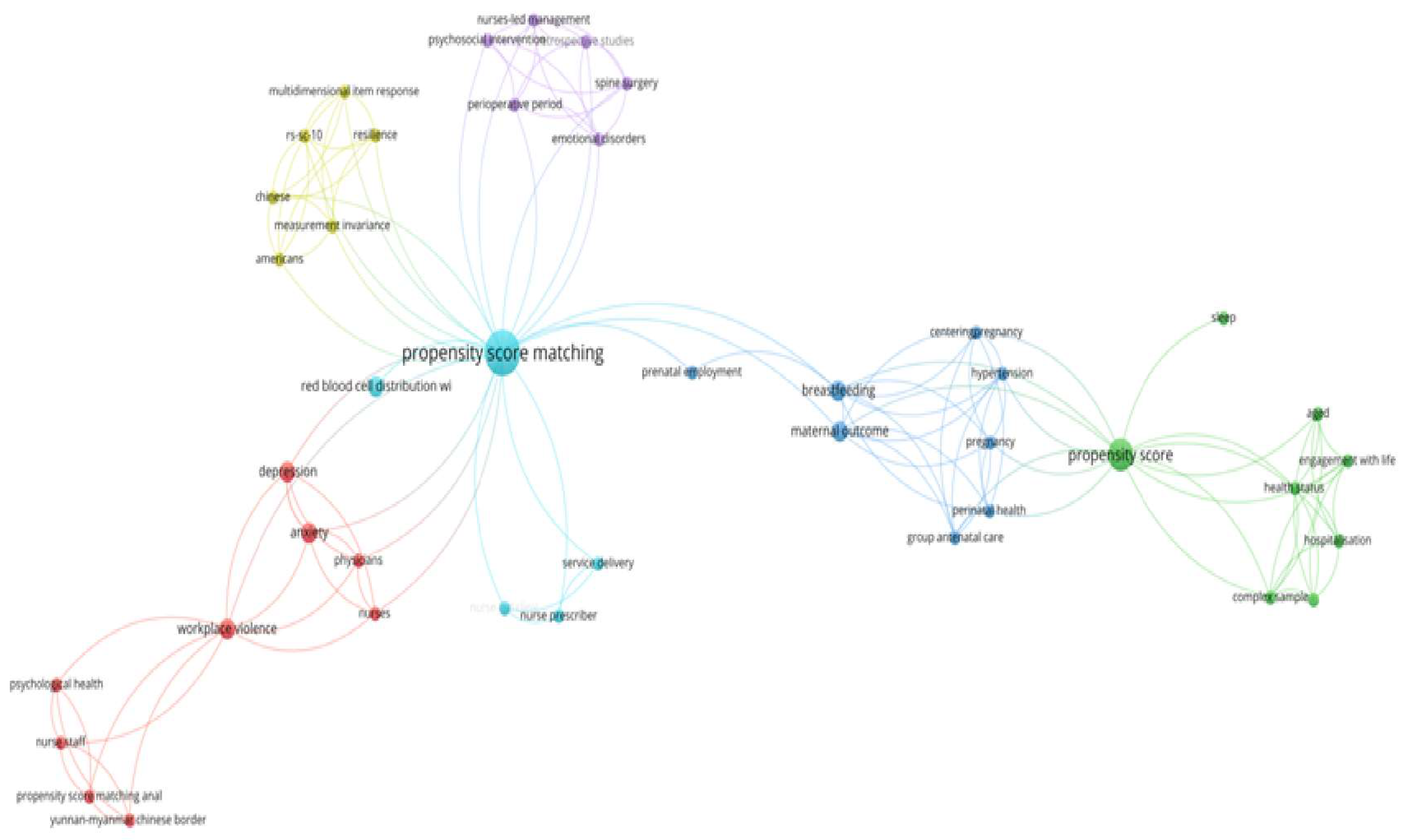
Figure 2.
The author's keyword map of nursing observational, retrospective and other quasi experimental studies in the period 2020-2024
Figure 2.
The author's keyword map of nursing observational, retrospective and other quasi experimental studies in the period 2020-2024
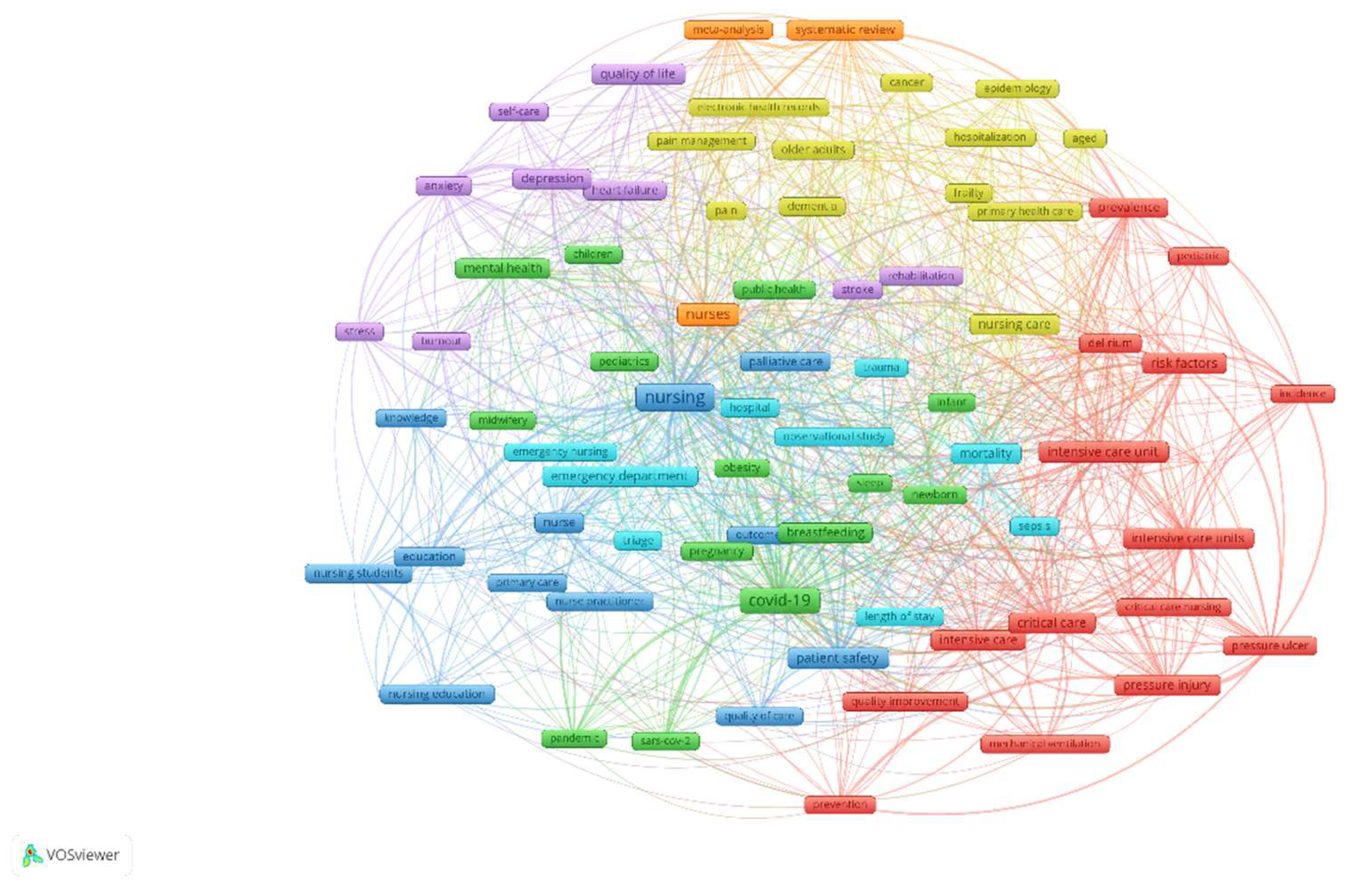

Table 1.
Opportunities for PSM use in nursing.
| Themes of nursing observational studies | Opportunities translated from general health care research employing PSM |
|---|---|
| Nursing Education | Comparing distance/blended and face-to-face learning [29,30], Does voluntary clinical practice improve study outcomes [31] |
| Emergency and Critical Care Nursing | Impact of personal protective equipment [32] |
| Primary care nursing | Effectiveness of self-management in the elderly [33], Effectiveness of diets in chronic diseases [34] |
| Patient safety and quality of care | Patient safety and efficiency of the health of robots [35] |
| Midwifery | The effects of Midwifery continuity care on delivery [35], Association of quality of care with healthcare costs [36] |
| CVD rehabilitation | Effectiveness of early rehabilitation in intensive units [37] |
| Quality of life and self-care/management | Association between self-medication for mild symptoms and Quality of Life among older adults [38], Long-term effects of severe COVID-19 [39] |
| Pain management | Effect of perioperative pain neuroscience education [40], Impact of biological sex patients with chronic pain [41] |
| Epidemiology | Emulating randomized clinical trials with nonrandomized real-world evidence studies [42], Association between initial treatment strategy and long-term survival [43] |
Disclaimer/Publisher’s Note: The statements, opinions and data contained in all publications are solely those of the individual author(s) and contributor(s) and not of MDPI and/or the editor(s). MDPI and/or the editor(s) disclaim responsibility for any injury to people or property resulting from any ideas, methods, instructions or products referred to in the content. |
© 2025 by the authors. Licensee MDPI, Basel, Switzerland. This article is an open access article distributed under the terms and conditions of the Creative Commons Attribution (CC BY) license (http://creativecommons.org/licenses/by/4.0/).
Copyright: This open access article is published under a Creative Commons CC BY 4.0 license, which permit the free download, distribution, and reuse, provided that the author and preprint are cited in any reuse.


