Preprint
Review

This version is not peer-reviewed.

Drifting Impact: A Comprehensive Review of Floating Debris

Submitted:

14 January 2025

Posted:

15 January 2025

You are already at the latest version

Abstract

Floating debris (FD), encompassing both woody and anthropogenic materials, disrupts fishway hydraulics and ecological efficiency. Despite frequent usage in scientific literature, the term remains ambiguous. Motivated by the need to enhance fishway performance, this study examines the concept of FD. A substantial review of environmental, economic, and safety impacts was conducted, focusing on marine debris, microplastics, and woody debris. Additionally, a systematic analysis of 560 articles published from 2018 to 2023 assessed how FD is described across diverse contexts. Through an elimination process, 55 papers underwent detailed manual analysis. FD was categorized into natural floating debris (NFD) and anthropogenic floating debris (AFD), a distinction crucial for engineering and scientific applications. This classification supports fishway management by facilitating the identification and monitoring of debris accumulation, thus enabling strategies to mitigate hydraulic and ecological consequences. While FD poses risks such as habitat disruption and pollutant bioaccumulation, natural FD also provides potential ecological benefits, including habitat creation. To address these challenges, the study advocates innovative waste management strategies informed by concepts like the doughnut economy and ecological economics. These approaches aim to reconcile ecological sustainability with economic activities, reducing anthropogenic FD while leveraging the advantages of NFD.
Keywords: 
;  ;  ;  ;  ;  ;  ;  ;  ;  

1. Introduction

By 2015, humanity had produced enough plastic to wrap the Earth in cling film [1]. The impact of human activity on our planet has become so profound that the term ’Anthropocene’ has entered everyday language, as reflected by the growing interest in this concept, evidenced by trends in Google searches (Figure 1):
The term “Anthropocene” was first introduced by Crutzen and Stoermer in the “Global Change Newsletter” in 2000 [2]. Two years later, the concept was further elaborated in the journal “Nature” in an article titled The „Anthropocene” [3] where the authors argued that humanity’s impact on Earth’s environment has been so significant that it justifies the establishment of a new geological epoch. The advent of the steam engine marked a turning point, leading to substantial changes in global concentrations of carbon dioxide and methane, which can be observed in polar ice core data. This proposed start of the “Anthropocene” coincides with the onset of the Industrial Revolution, marking the irreversible influence of human activity on natural geological processes, as well as on Earth’s atmosphere and biosphere [4]. The traces of human activity will be distinguishable for millions of years. Currently, discussions are ongoing about the formalization of a new geological epoch in the stratigraphic timeline, with the onset of the Anthropocene potentially determined by a specific Global Boundary Stratotype Section and Point (GSSP) in sediment or ice cores, or by a precise chronological date [5]. The total mass of human-made objects forming the technosphere has now exceeded the biomass of living organisms on our planet [6]. This shift profoundly affects the concepts we use. As recently as 1957, when the scholar E. Naylor used the term ’floating debris,’ he was referring specifically to ’floating weed or timber’ [7]. Today, the concept of floating debris (FD) is significantly broader and encompasses a variety of materials, including marine litter, microplastics, and large woody debris (LWD). This floating debris poses a threat in various areas worldwide, including the economy [8] as well as to marine, coastal, riverine, and freshwater ecosystems [9,10]. It impacts aquatic flora and fauna [11,12], as well as life on land [13], including human health and safety. Examples include the discovery of microplastics in human placentas [14] and in the food due to bioaccumulation in marine organisms [15].
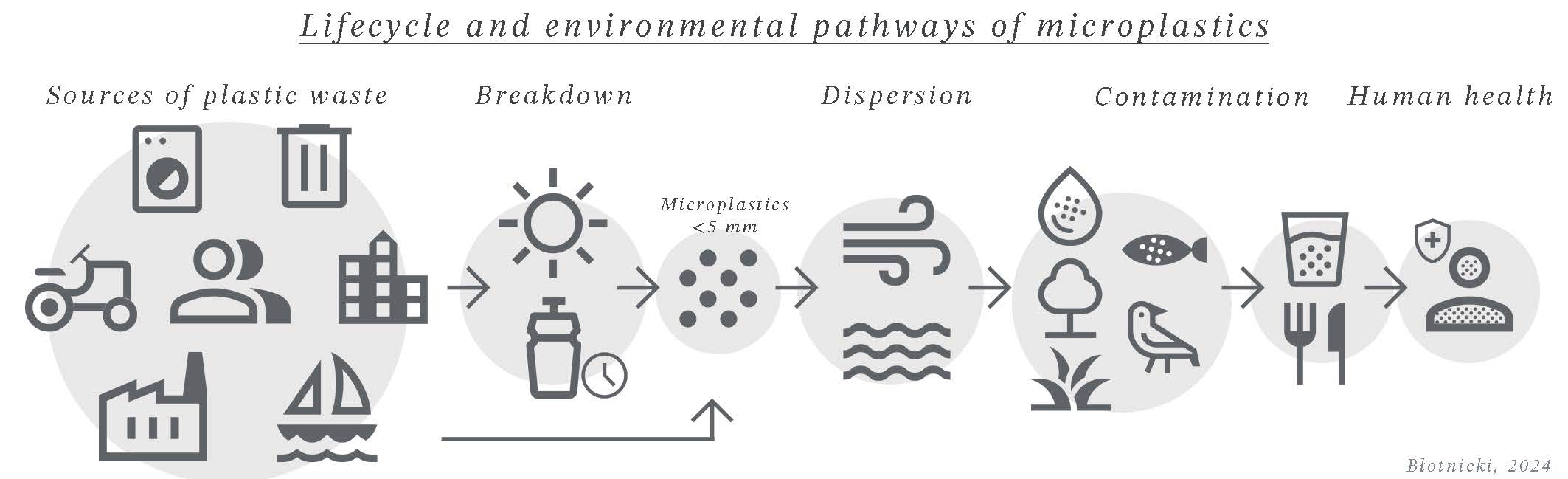
The presence of anthropogenic FD has even been observed in pristine environments such as the Arctic [16,17], the Swiss Alps [18] or the Antarctic [19], illustrating the scale and ubiquity of the issue. The pervasive presence of microplastics in both marine and terrestrial environments is a direct consequence of various human activities. As depicted in Figure 2, the lifecycle of plastic waste begins with its production and use, followed by environmental degradation processes that fragment larger plastics into microplastics. These particles are then dispersed through air, water, and soil, eventually contaminating aquatic and terrestrial ecosystems, and even entering the human food chain. This global distribution underscores the urgent need for effective waste management strategies and policies aimed at mitigating the environmental and health impacts of microplastic pollution.
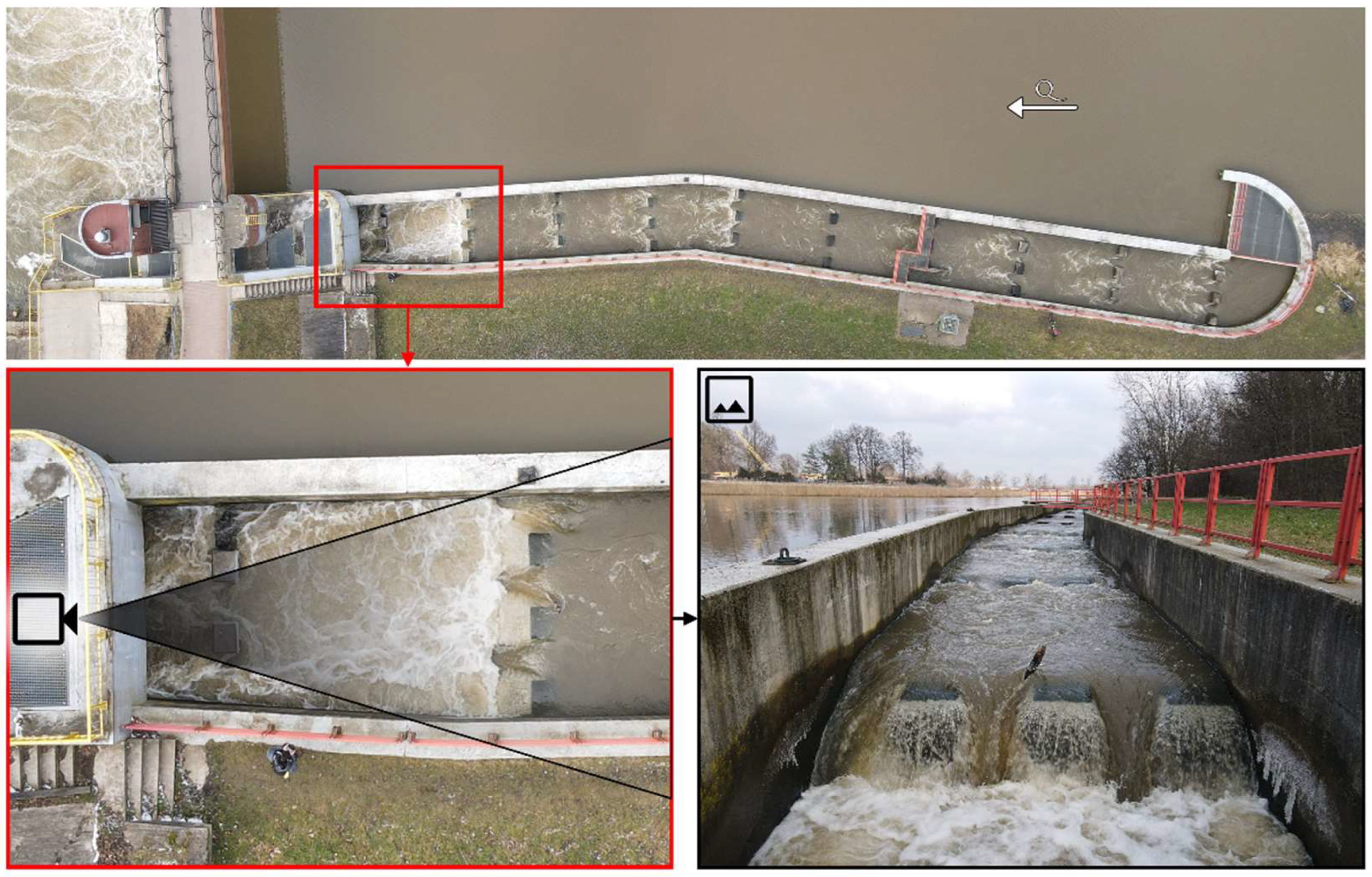
The quantity of marine debris present in marine ecosystems has shown a consistent upward trend over time [20,21,22]. In extreme events such as tsunamis, the transport of floating debris poses a serious threat to human life and health [23]. The presence of FD in aquatic ecosystems can disrupt the functioning of hydraulic structures such as bridges [24,25,26], leading to a reduction of the effective flow area [27], structural damage due to LWD accumulation, which was a primary cause of bridge infrastructure damage in the USA [28], erosion of the riverbed [29,30], the formation of blockages and local inundations [31], as well as influencing flood risk [32,33,34,35]. It also affects the operation of hydropower plants, impacting energy production and fish health [36], as well as fish passes. Similarly, the accumulation of FD in fish passes presents significant hydraulic and ecological challenges, impeding fish migration and altering flow dynamics critical for the functionality of these structures. Fish passes play a pivotal role in maintaining ecosystem connectivity, especially in highly fragmented river systems. However, their functionality is often compromised by floating debris (Figure 3), necessitating robust management strategies. Their design and functionality are directly influenced by the presence of floating debris, which can reduce their efficiency and, consequently, compromise the migration of fish and other aquatic organisms.
During site inspections at fish passes, various materials were observed to accumulate on the fish pass pillars, including logs, sticks, reeds, leaves, furniture boards, planks, plastic bags, and road posts. This accumulation not only obstructs fish migration but also necessitates frequent maintenance efforts to ensure operational efficiency, highlighting the need for targeted management strategies.
In the literature, the term that best describes the nature of these observed particles is “floating debris,” but there is no systematic classification to categorize them. Recognizing the ambiguity of this term, the authors conducted a literature review in order to better understand the current state of knowledge.
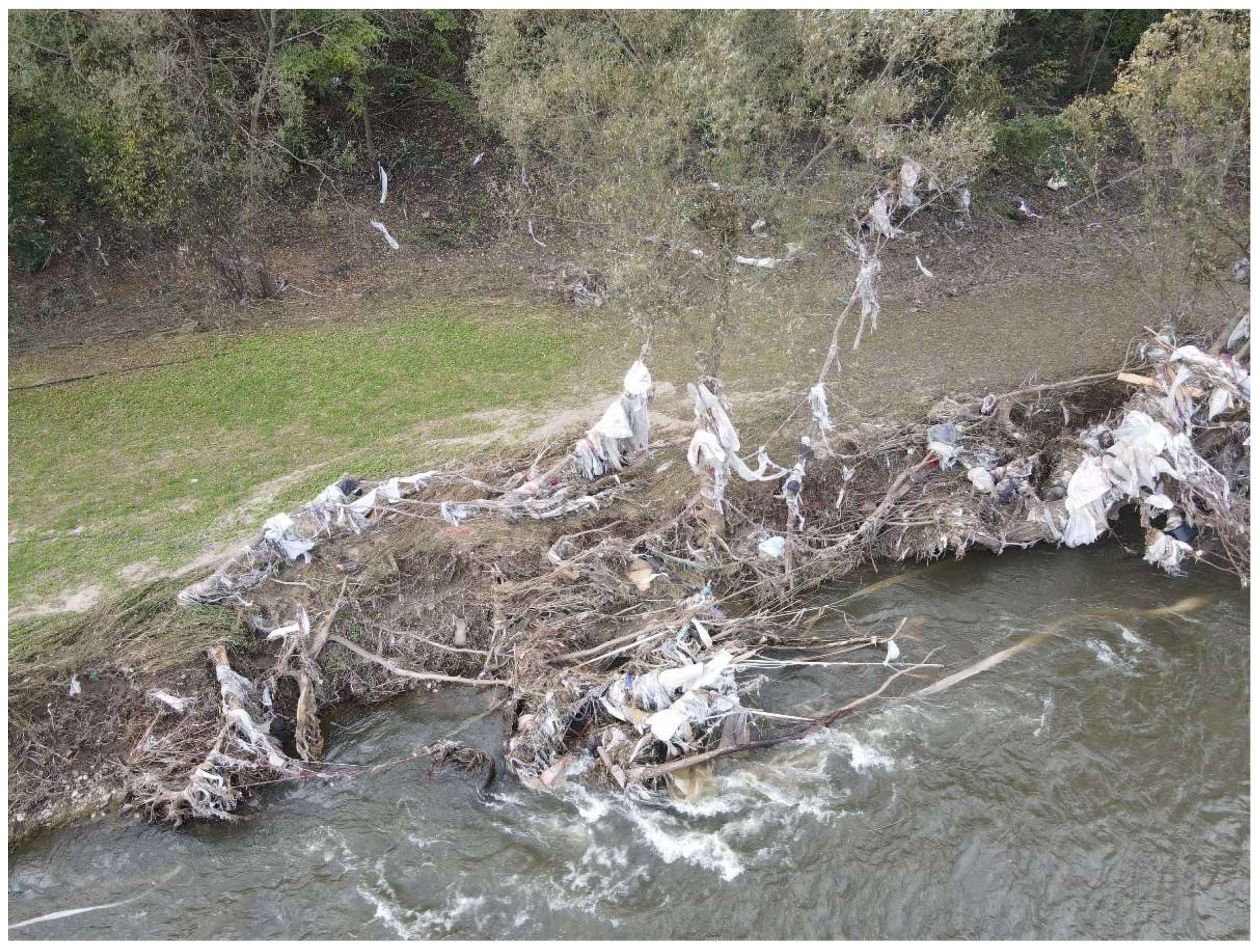
This highlights the dual challenges of managing both natural and anthropogenic debris, which affect fish migration and increase maintenance demands. Recognizing this need, the authors conducted a literature review and propose introducing a basic classification of floating debris into natural and anthropogenic categories. This classification has practical applications in both engineering and scientific contexts for categorizing waste transported or deposited in watercourses. Moreover, the large-scale production of plastics and their presence in aquatic ecosystems further underscores the importance of such a classification, as evidenced by the macroplastic residues found in the river valley of Nysa Kłodzka after the flood in September 2024 (Figure 4):
This study, in addition to providing a detailed literature review, analyzed different types of floating debris based on literature from the beginning of 2018 to the second quarter of 2023. The methodology used is based on a detailed analysis of data from the Web of Science, focusing on articles containing the phrase “floating debris” in the title, abstract, or keywords. Publications from selected scientific disciplines were chosen and analyzed, contributing to a broader understanding of the issue and its impact on freshwater and marine ecosystems.

2. Literature Review

2.1. Floating Debris

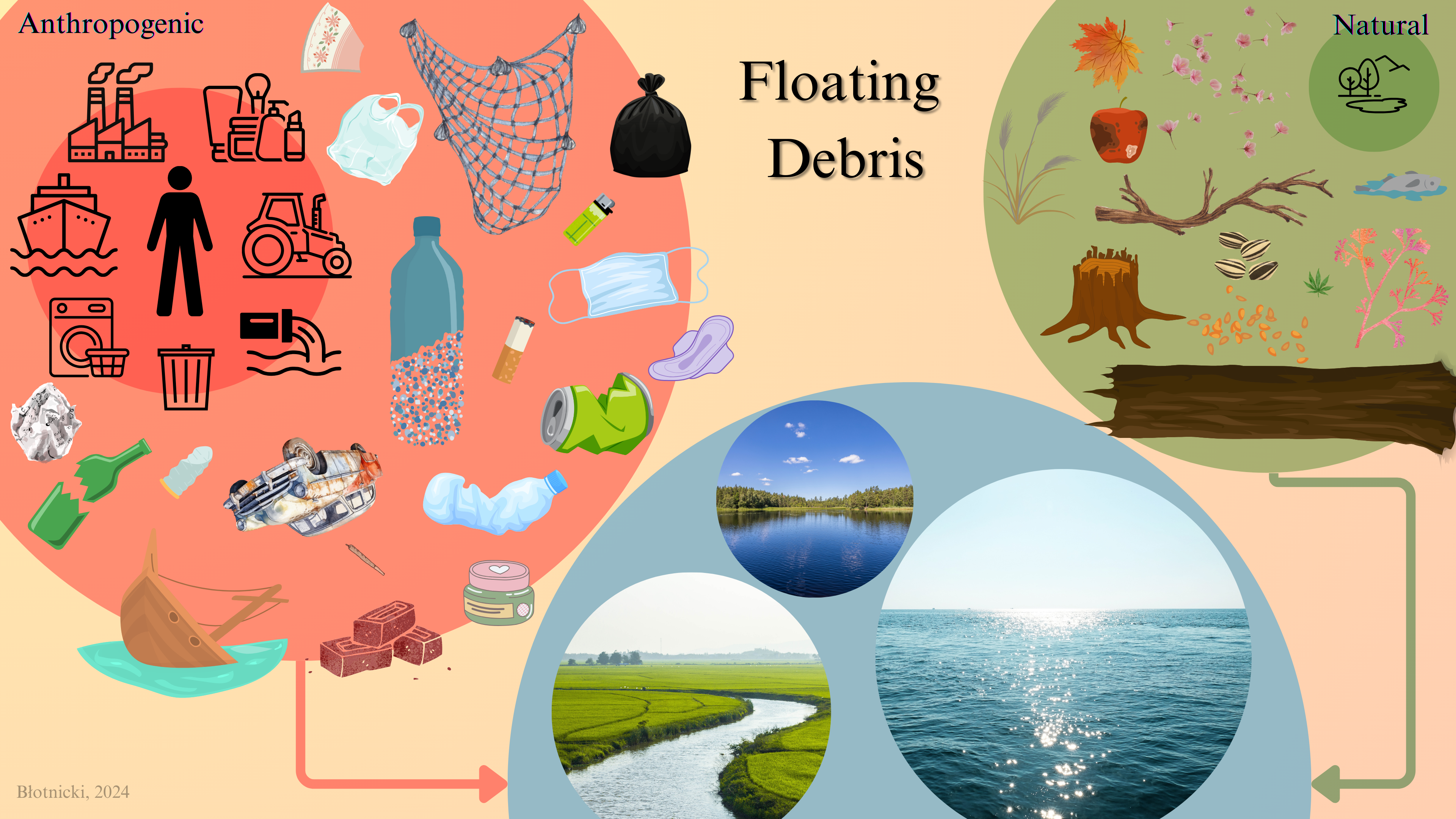
The term “floating debris” refers to any materials or plant life that are present on the surface of water bodies and have the potential to disrupt the aquatic and terrestrial ecosystem, impact hydrotechnical structures, interfere with recreational activities, or hinder navigability. This debris can encompass both natural and human-made components, including various waste materials, plastics, microplastics, marine debris, and wooden items such as small and large woody debris like branches, logs and shrubs. It also encompasses plant matter such as vegetation, reeds, grass, cones, leaves, flowers, seeds as well as invasive aquatic plants like sargassum and algae. Additionally, ice debris in the form of floating ice floes can also be included in this category [37]. The concept covers a wide range of floating litter and materials that can influence the ecological and functional aspects of water bodies. A significant diversity is observed among materials floating on the water’s surface, known as “floating debris,” with regard to their origin (whether natural or anthropogenic) as well as their sizes (ranging from seeds and microplastics to large woody debris). Seasonal leaf fall and the surface transport of seeds are significant components of natural floating debris. On the other hand, anthropogenic floating debris in aquatic ecosystems emerges from urban areas due to surface runoff, such as heavy rainfall, and sewage overflow [38,39,40].
The term ’floating debris’ has historically encompassed a variety of materials, but it was not until the latter half of the 20th century that plastic specifically began to be recognized as a predominant component. The seminal study titled “Plastics on the Sargasso Sea Surface,” published in 1972 [41], marked the earliest known mention of plastics in the ocean. It reported significant concentrations of plastic particles in the Sargasso Sea, noting their widespread distribution and potential as substrates for marine organisms, highlighting the durability of plastics in marine environments, and their resistance to natural weathering processes and their ability to carry pollutants such as polychlorinated biphenyls (PCBs).
Following this, the concept of ’floating plastic debris’ was further delineated through research such as the “Floating plastic debris in the Mediterranean” study [42], conducted near Malta in 1979. This study identified a high density of floating plastic objects and highlighted the extent of synthetic materials’ permeation into relatively enclosed marine systems like the Mediterranean. This was a pivotal moment in acknowledging the global scale of plastic pollution and its impacts on marine ecosystems.
These early studies were crucial in expanding the definition of ’floating debris’ to explicitly include synthetic materials, particularly plastics. They set the stage for subsequent research and policy discussions aimed at addressing the environmental challenges posed by marine plastic debris, underscoring the need for enhanced waste management practices and raising awareness of the environmental impacts of plastic pollution, thus helping to shape contemporary approaches to marine conservation and debris management.
The diverse terminology reflects the variety of sources and materials included under floating debris in scientific literature. Initially, the term broadly covered only plant debris. The concept of floating debris has evolved from merely identifying natural floating materials to acknowledging a wide array of anthropogenic waste influencing global water bodies. The earliest mention of floating debris in scientific literature, traced back to the Web of Science database, involves the study [7] of Idotea metallica’s distribution facilitated by floating debris across marine environments, where FD was understood solely as natural-origin materials. This early study emphasized the ecological significance of floating debris in transporting species across geographical boundaries.
The word “floating” originates from the verb “to float,” which means to remain on the surface of water or another fluid. On the other hand, “debris” signifies remnants, remains, or fragments of something. In the context of “floating debris,” it pertains to matter or objects situated on the water’s surface, not submerged underwater, but rather resting or moving on the top layer of the liquid.
This term has a broad semantic scope, encompassing a wide conceptual range, which translates into varied uses. For instance, Bradley, Richards, and Bahner [43], define floating debris as materials that are transported by a stream and can be found either floating or submerged. These materials include various types, such as logs, vegetation, and trash. The authors further categorize floating debris based on size into three groups: light, medium, and large. Light floating debris consists of small limbs, sticks, tules, and refuse. Medium floating debris comprises tree limbs and large sticks. Finally, large floating debris encompasses trees, logs, and organic matter with a length exceeding 1 meter, also referred to as Large Woody Debris. Bradley et al. primarily focus on natural-origin materials—wood and plant matter—without emphasizing litter. In the proposed size-based classification, the authors provide examples of debris solely of natural origin. Research on floating plant debris and its environmental impact dates back to the 1970s [44]. However, it is only in the 21st century that interest in plastic pollution has intensified.
Floating debris, as referred to by various authors in international literature, encompasses a wide range of terms and concepts. Some researchers use the term “floating debris” to describe plant debris or anthropogenic waste (e.g., [8,45,46]), while others refer to it as “floating marine debris” (e.g., [47,48,49,50,51]). Additionally, terms like “floating marine litter” [52], “floating plastic debris” [53], “marine plastic debris” [54] or “plastic marine debris” [55,56] and also “floating microplastic debris” [57,58,59,60] are commonly used to specify different aspects of this broad category. Furthermore, “large woody debris”, “coarse woody debris” [61] and “woody debris” [62] are other terms that highlight the diversity of floating materials. Some literature simply refers to them as objects that float on water [26,63,64]. The diverse terminology employed by different authors reflects the broad range of materials and sources encompassed by the concept of floating debris in scientific literature.
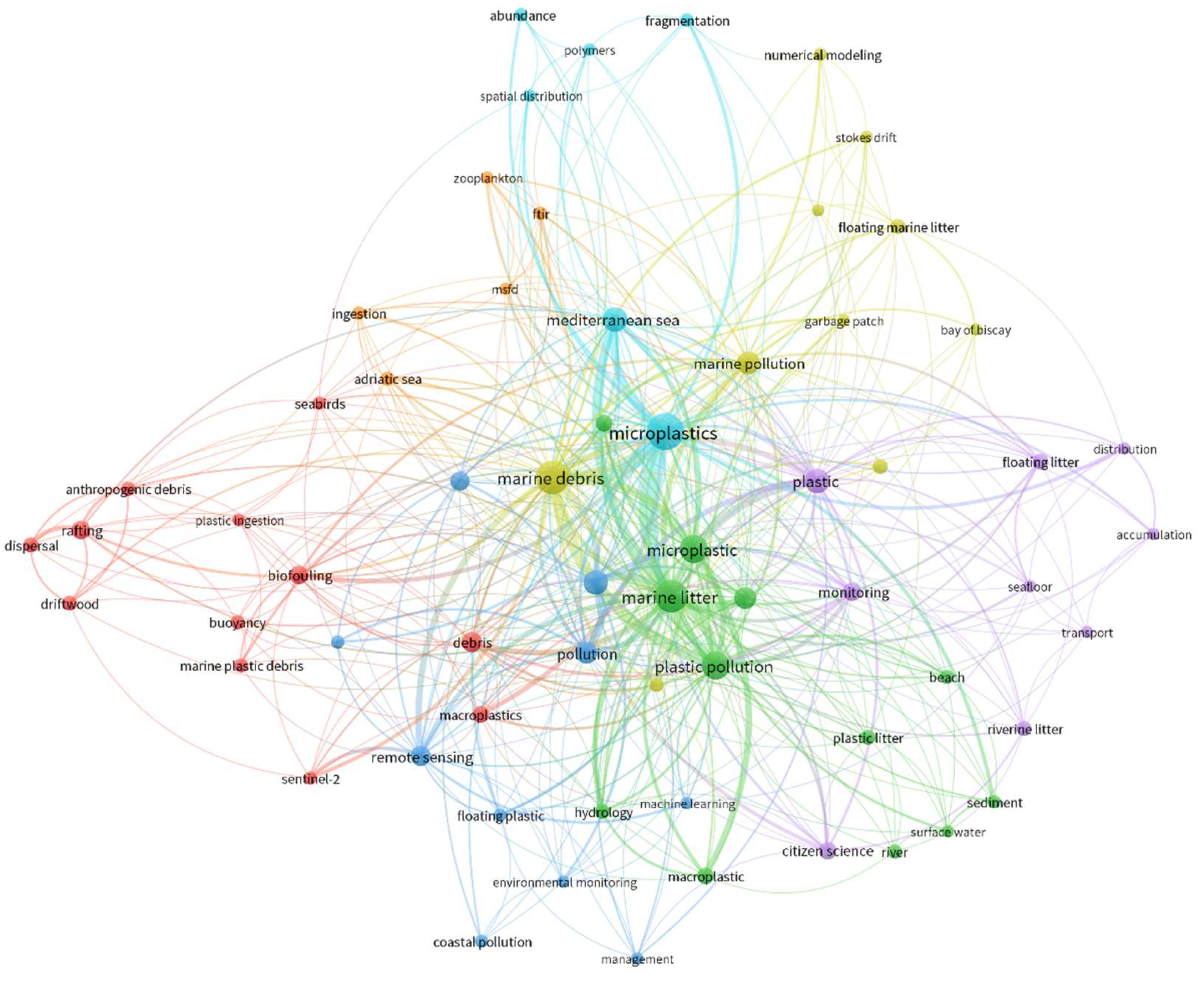
Based on an analysis of over 1,000 research papers from the Web of Science database, key author keywords related to floating debris were identified. To ensure clarity and relevance, a minimum threshold of five keyword occurrences was set, narrowing down 2,396 keywords to 86 that met this criterion. Figure 5 presents a co-occurrence network, where four primary terms—floating debris,” “marine debris,” “plastic pollution,” and “microplastics”showed strong associations with concepts such as accumulation, transport, and impacts on both inland and marine waters. The term “floating debris” was particularly linked to issues like aquatic ecosystems, waste management, and biodeterioration. In contrast, “plastic pollution” was connected with degradation, waste management, and the impact on ecosystem health.

2.2. Anthropogenic Floating Debris

Anthropogenic floating debris (AFD) refers to materials that float on the surface of water bodies and originate from human activities. These materials encompass a wide range of waste, including plastics, metals, glass, as well as larger objects such as fishing gear or even fragments of infrastructure. A distinctive characteristic of AFD is its anthropogenic origin, which means these are items created and introduced into the environment by humans, leading to pollution and disruptions within aquatic ecosystems.
The composition and dynamics of AFD in riverine ecosystems vary depending on the type of catchment area, topography, degree of urbanisation, and season [66,67]. Significant amounts of anthropogenic waste originate from urban surface runoff and sewage overflow [38,39,40,68,69,70]. In urbanised catchments, the waste entering water bodies may exclusively stem from human activity [69]. These include items such as human-processed wood, plastic and Styrofoam packaging [71], as well as household waste [72]. Anthropogenic floating debris may originate from processes related to wastewater treatment plants and the application of sewage sludge on land, which is a significant aspect of human impact on the environment. Additionally, the diffusion of such materials results from direct contamination of areas by waste and runoff from stormwater following rain events [40,73].
Among the materials constituting anthropogenic pollution, five primary materials are highlighted [74]: plastic (e.g., [53,59,75,76,77,78,79]), glass [80,81], paper [81], metal [11,81,82], textile [78] and rubber. Additionally, the literature also mentions processed wood [72], foam (polistyrene) [81,82], ceramic [81], oil, non-natural foam [83], vehicles (including car or boats) [78,84], domestic garbage/waste [83,85,86,87,88,89].
The movement of anthropogenic floating debris is a complex process, dependent on a range of physical and biological factors. The density of the material and the phenomenon of microbial colonisation on its surface contribute to the formation of aggregates with organic residues in the water, which in turn influences the transport of these materials [40,73]. Anthropogenic floating debris can also serve as a vector for microorganisms, aiding their dispersal depending on environmental conditions and the availability of nutrients, which subsequently affects the structure of microbial communities [90].
Recent studies conducted in Hawaii have significantly contributed to scientific understanding by demonstrating that different types of polyolefins such as PP, HDPE, and LDPE, in various shapes, differ in terms of microbial succession. Regardless of shape, the eukaryotic diatom Nitzschia played a dominant role in colonising all types of plastic, with significant differences in bacterial community structures across different types of plastics. These findings highlight the complexity of interactions between microorganisms and floating materials, underscoring their potential role in influencing microbial community structures [91].
Additionally, factors such as the size of the water body, depth, wind conditions, and the direction of ocean currents have a significant impact on transport processes. The dynamics of debris movement vary depending on the type of watercourse, with more pronounced variability observed in streams compared to rivers [92]. In rivers with intermittent flow, a specific pulsating transport pattern is observed, particularly intense after dry periods [93,94,95].
AFD pose a significant threat to aquatic ecosystems. Their impact extends beyond aesthetic concerns, leading to more serious consequences [82]. Plastic is the most common type of floating debris in terms of quantity, mass, and volume, with polyethylene (PE) and polypropylene (PP) particularly dominating the Great Pacific Garbage Patch (GPGP), which spans marine waters between California and Hawaii [78]. This issue is particularly evident in the category of marine debris, which encompasses not only AFD but also other types of pollutants that enter the marine and coastal environment.

2.2.1. Plastic

Plastic waste is one of the most pervasive materials, causing long-term environmental damage [96]. The production of plastics has surpassed that of most synthetic materials, placing it under extended environmental scrutiny [97]. In 2021, global plastic production reached 390.7 million tonnes, marking a 4% increase from the previous year, highlighting the escalating issue of environmental pollution from this material [98]. The problem of plastic pollution in marine and freshwater ecosystems is a significant and pressing environmental challenge in contemporary times [99].
A material analysis conducted on seven major thermoplastics used in Europe identified that in 2016, packaging had the largest share, reaching 7700 ± 1000 Gg for PET, followed by clothing at 1470 ± 400 Gg. The study also revealed that current European recycling rates ranged from 11% for PS to 33% for PET. This information is crucial for developing further strategies to reduce plastic pollution and improve the circularity of specific polymers [100].
To assess environmental impact and identify sources of plastic waste, a classification system based on the average particle size is commonly used [101]: nanoplastic, microplastic, mesoplastic and macroplastic. However, scientific literature may present slightly different classifications, which are discussed in more detail in section 2.1.3.1 Microplastic. It is important to note that most studies on plastic pollution in freshwater focus on nano- and microplastic fractions [102], while research on mesoplastic and macroplastic is less common, until studies by van Emmerik and Schwarz [88,103].
Plastic waste from various sources enters rivers, streams, lakes, and eventually seas and oceans, accounting for approximately 80% of marine pollution. The remaining 20% comes from cargo lost by ocean-going ships, lost or discarded fishing gear, and intentional or accidental dumping of waste [104]. Plastic can be found floating on the surface, suspended throughout the water column, and lying on the bottom of nearly all water bodies. It is transported by rivers to the ocean [105], where it moves with the ocean currents [12].
According to data, Indonesia ranks as the world’s second-largest source of plastic pollution entering the sea, following China, contributing between 0.48 and 1.29 million metric tons of plastic annually [106].
Floating or submerged debris increases flow velocity and the formation of vortices, which can lead to intensified erosion downstream of the culvert and raise the water level upstream, thereby increasing the risk of structural damage during floods [107].
The issue of plastic pollution is a global concern, and we are only beginning to understand the full impact of plastics on our environment and health. A particularly insightful study was made by Ding [108], which delves into the growing problem of microplastics (MPs) and nanoplastics (NPs) and their emerging environmental impacts. The research highlights how these pollutants, resulting from plastic fragmentation and degradation, pose significant threats to ecosystems and potentially to human health. The study employs the adverse outcome pathway (AOP) framework to understand comprehensively the mechanism by which MPs and NPs induce digestive toxicity. Key findings suggest that these tiny particles cause oxidative stress, apoptosis, and inflammation in the digestive system, ultimately leading to a higher risk of gastrointestinal diseases. By focusing on the gastrointestinal tract and liver, the review elucidates how exposure to MPs and NPs, primarily through ingestion, can result in various adverse health effects. This work serves as a valuable resource for understanding the mechanisms of plastic toxicity and emphasizes the need for further research into the environmental and health impacts of these ubiquitous contaminant
In the current times, it is essential to consider alternative solutions for packaging and the use of other materials that can be reused rather than ending up in recycling or landfills.

2.2.1.1. Microplastic

It is generally accepted that microplastics are fine plastic particles in size, as proposed by NOAA [109] measuring less than 5 mm [110,111]. Depending on the sources, they are mainly classified within the range from 0.001 mm to 5 mm (1-5000 μm) [73,112] or 0.3 mm to 5 mm (300-5000 μm) [113]. Defining such a broad category of pollutants, like microplastics, is problematic. Due to differences between scientific disciplines, the measuring equipment used, and the independently evolving research on microscopic plastics, the lack of precisely defined size classes for microplastics leads to discrepancies in results, such as those related to the quantitative content of MPs in the environment, which can vary by several orders of magnitude [114].
One possible alternative classification is the use of standard units of measurement, such as the SI scale, which would lead to the classification of nanoplastics (1-1000 nm), microplastics (1-1000 μm), milliplastics (1-10 mm), centiplastics (1-10 cm), and deciplastics (1-10 dm). Unfortunately, such terminology may conflict with some already established terms. For example, in the field of nanomaterials, nanoplastics are typically defined as particles up to 100 nm in size [101].
One of the most important works where researchers attempt to systematize the concept of microplastics is the study titled “Are We Speaking the Same Language? Recommendations for a Definition and Categorization Framework for Plastic Debris” [101]. The group of researchers proposes a unified terminology and classification of materials according to the following criteria:
  • Criterion 1 – Chemical Composition: This is the most fundamental criterion for defining plastic waste and other polymers. To illustrate the definitional challenges, consider the ISO definition of plastic, which excludes certain elastomers (e.g., rubber) from this definition.
  • Criterion 2 – Solid State: Polymers can exist in various consistencies, such as semi-solid, liquid, or waxy. According to the Globally Harmonized System of Classification and Labelling of Chemicals (GHS), a solid substance is one that does not meet the definition of a liquid or gas. Most polymers have low vapor pressure and a specific melting temperature, which qualifies them as solids.
  • Criterion 3 – Solubility: Another important aspect is the solubility of the polymer. Most conventional polymers are poorly soluble in water, but some synthetic polymers dissolve easily (e.g., PVA or polyethylene glycol with low molecular weight). Researchers propose using the REACH guidelines developed by ECHA, according to which a substance with a solubility of less than 1 mg/L at 20°C is considered poorly soluble.
  • Criterion 4 – Size: Size is the most commonly used criterion for categorizing plastic waste, with size classes typically corresponding to the nomenclature of nano-, micro-, meso-, and macroplastics. The size of a particle has ecological significance because it affects interactions with living organisms and its fate in the environment.
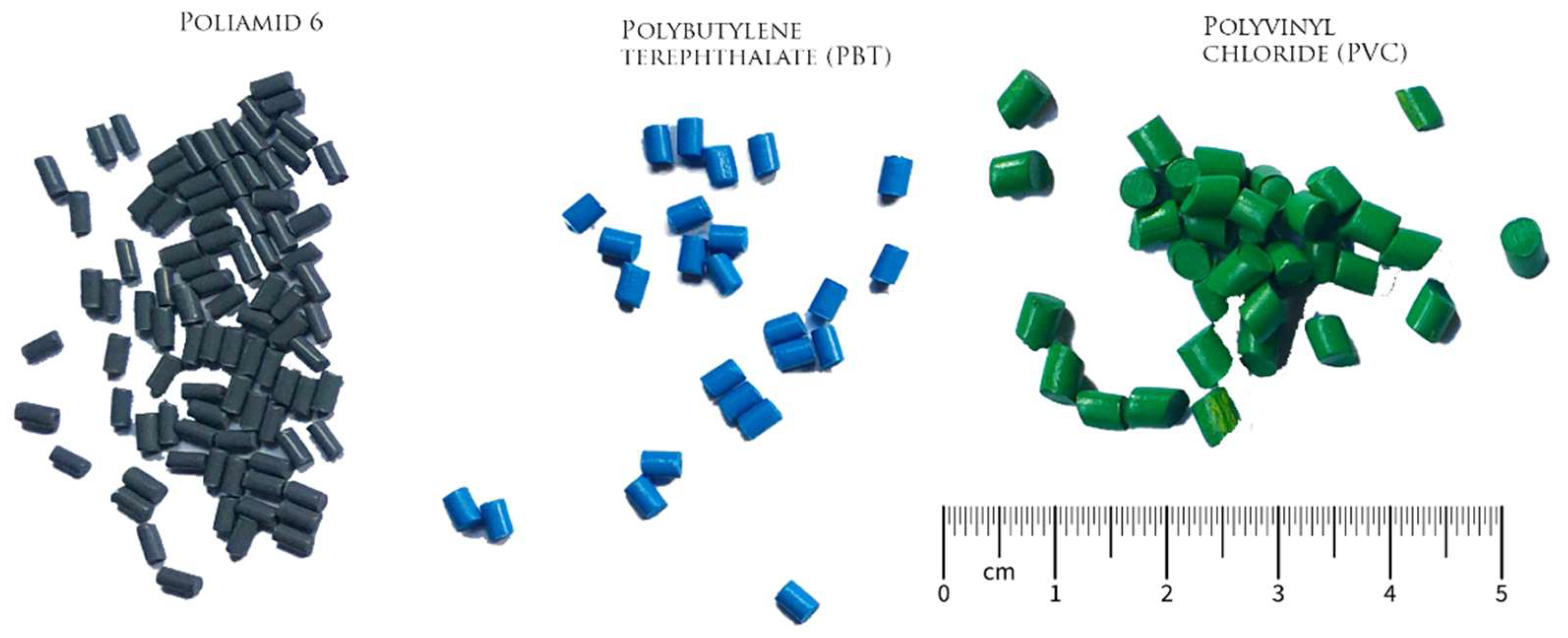
  • Criterion 5 – Shape and Structure: In addition to size, plastic waste is often categorized based on shape, structure, and colour. Common shape descriptors include spheres, pellets, foams, fibres, fragments, films, and flakes. Depending on the location of the studies, different shapes are detected in varying proportions. For example, in studies conducted by Mangarengi et al. [115] the most common form of microplastic were fibres, likely sourced from the textile industry along the river.
  • Criterion 6 – Colour: Categorizing plastic waste by colour is useful for identifying potential sources and contaminants during sample preparation. The colour of an object does not always easily indicate its origin, but it can be helpful in a biological context, such as in the feeding preferences of organisms. Studies indicate that the most commonly encountered colours of plastics ingested by aquatic organisms are blue and black, followed by transparent and semi-transparent plastics [116].
  • Criterion 7 – Origin: The origin of plastic waste is often used as a classifier, particularly for microplastics, which are categorized as “primary” and “secondary.” “Primary” microplastics are those intentionally produced at this size (see: Figure 6), while “secondary” microplastics result from fragmentation in the environment [117].
This comprehensive classification proposal aims to standardize terminology and promote consensus within the scientific and regulatory communities, based on robust scientific principles.
It is estimated that approximately 1% of plastics in the environment are in the form of microplastics. Their presence has been recorded in glaciers, benthic sediments, water bodies, as well as in flora and fauna [59]. There are significant concerns regarding the potential toxicological effects, impacts on hormonal systems, and the capacity of microplastics to transport heavy metals and organic pollutants [119]. Studies on microplastic monitoring in surface waters suggest that a comprehensive understanding of this issue requires consideration of environmental, geographical, and socio-economic factors [59,120].
The complexities of monitoring microplastic debris underscore the significant challenges in understanding its distribution across global oceans and identifying accumulation hotspots critical for clean-up efforts. Traditional methods involve labor-intensive physical sampling and manual counting, which are not only time-consuming but also prone to human error, making large-scale monitoring costly and inconsistent. In response to these limitations, innovative approaches are being developed, such as a new workflow that integrates simple experimental setups with advanced image processing techniques. This method facilitates both quantitative and qualitative assessments of microplastic debris, streamlining data collection and enhancing the accuracy and efficiency of marine plastic monitoring [121].
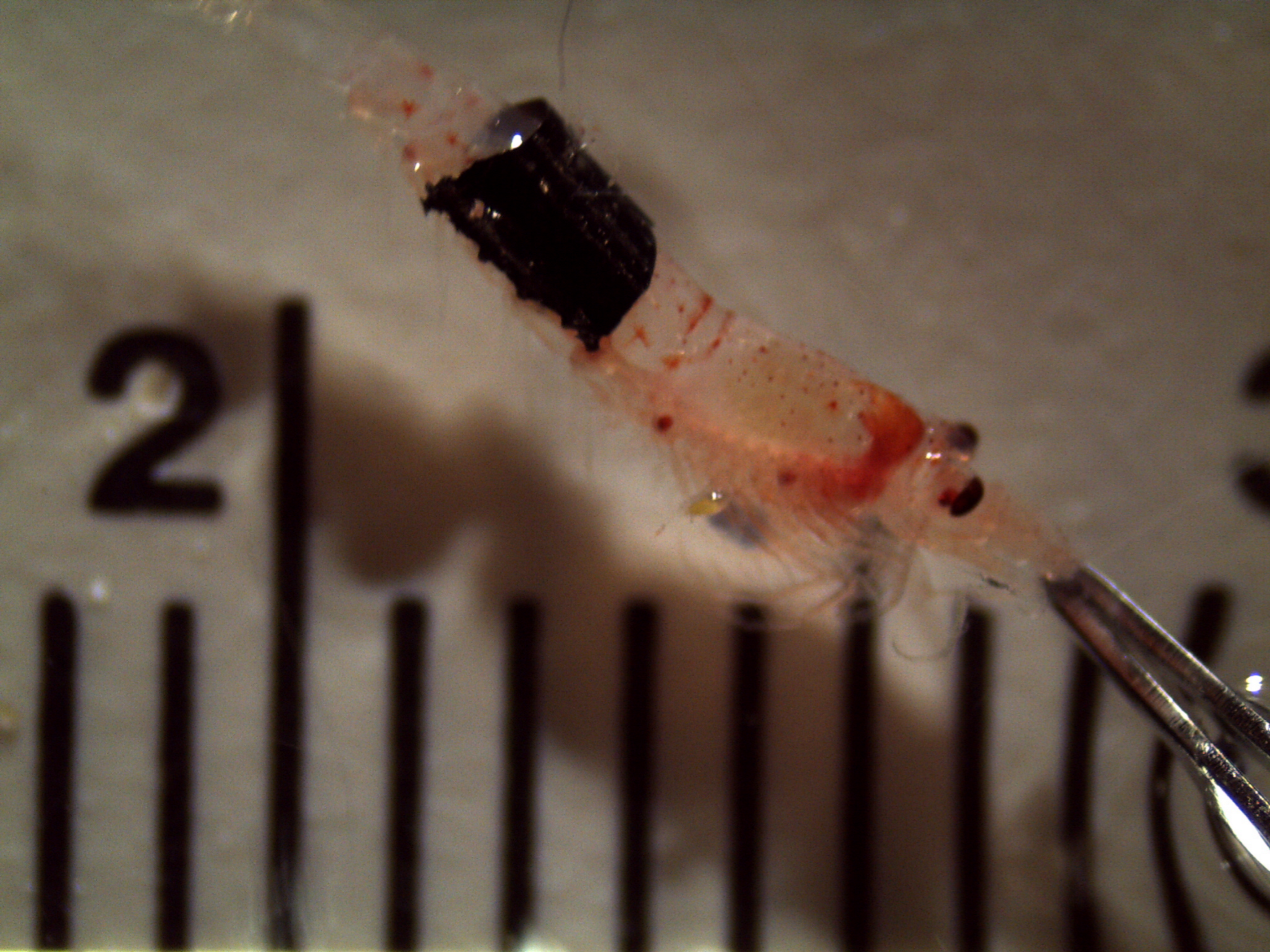
Microplastic analyses in various marine environments worldwide highlight their widespread presence and potentially harmful effects on marine fauna (Figure 7).
Particularly alarming findings come from recent studies [122] conducted in Antarctica, focusing on the impact of microplastics on three seal species: crabeater seals (Lobodon carcinophaga), leopard seals (Hydrurga leptonyx), and Weddell seals (Leptonychotes weddellii). This study concentrated on identifying anthropogenic particles in their faeces using micro-Raman and micro-FTIR spectroscopy. The results revealed that all samples from the three studied species contained anthropogenic particles, with fibers as the dominant form, alongside fragments and filaments. Most of the particles were smaller than 5 mm. Additionally, chemical identification unveiled the presence of various polymers, such as polystyrene, polyester, polyethylene terephthalate (PET), polyamide, polypropylene, and polyurethane, as well as pigments like reactive blue 238, indigo 3600, and copper phthalocyanines (blue and green).
These findings are particularly significant as they confirm the presence of microplastics in the isolated and ecologically sensitive ecosystem of Antarctica, highlighting the global reach of plastic pollution and the urgent need for actions to reduce this pollution to protect wildlife and the entire Antarctic ecosystem.
On inland waters, the predominant type of microplastic detected is secondary microplastic, which results from the fragmentation of larger plastic waste due to mechanical and chemical factors. The sedimentation of these particles typically occurs in areas where water flow slows down, such as above hydraulic structures that cause water to pool, which facilitates the accumulation of microplastics in the bottom sediment layers [123,124]. The presence of microplastics in water can potentially limit drinking water sources and necessitate the development of new treatment methods, such as the use of additional membrane filters, not only in water treatment plants but also at water intake points [125]. The use of membrane filters is associated with high costs and the need for frequent replacement, leading to the development of alternative methods for removing microplastics from water. One such approach involves the use of activated carbon, which, due to its small pores, effectively adsorbs nanoplastics. Activated carbon can be produced from epoxy waste, reducing costs and environmental impact compared to traditional methods. Research indicates that activated carbon, particularly when activated with potassium hydroxide (KOH), could be an effective alternative, offering a high surface area and efficiency in removing microplastics from water [123,126].
Research into microplastics in urban areas enables the assessment of the impact of specific anthropogenic activities on their concentration in the environment. Quantitative analysis and characterization of microplastic particle sizes are crucial for determining their distribution and identifying pollution sources. Although microscopy can be used for the visual identification of microplastics, this method is time-consuming and labor-intensive [115]. In this context, more advanced analytical techniques, such as infrared spectroscopy (FTIR), Raman spectroscopy, and gas chromatography (GC), offer significant benefits. FTIR and Raman spectroscopy allow for the precise identification of different types of microplastics by analysing their characteristic chemical signatures, enabling more effective determination of their origins and types. Meanwhile, gas chromatography, combined with a mass detector (GC-MS), provides detailed chemical analysis, allowing for the identification of chemical additives in microplastics and the analysis of their concentrations in water samples. These advanced methods not only enhance the accuracy of detection and identification but also speed up the analysis process, which is crucial for the effective monitoring of microplastic pollution in the environment [127].

2.2.1.1. Nanoplastic

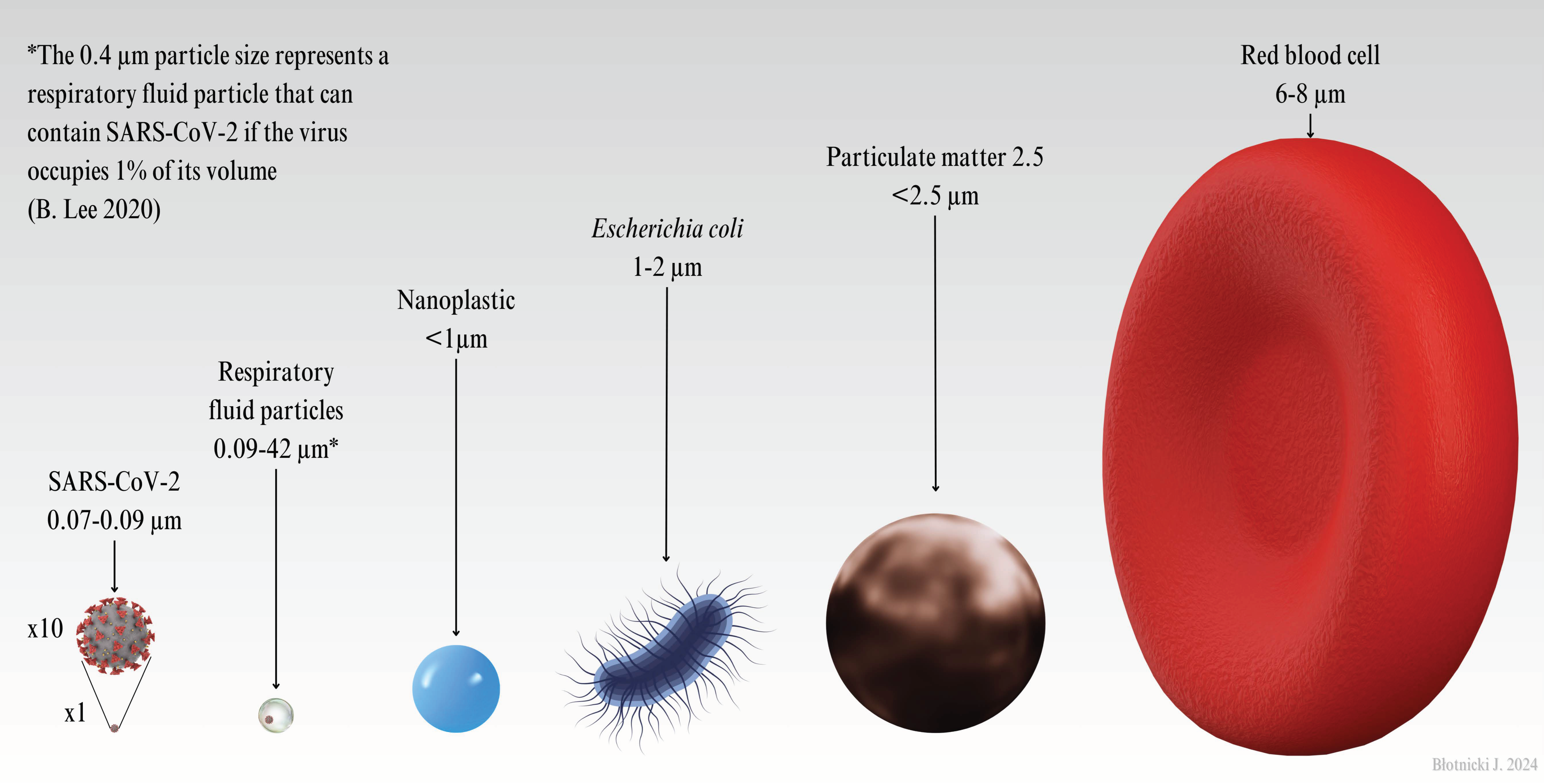
Nanoplastics are commonly defined as solid plastic particles smaller than 1 micrometer [128], which are unintentionally created through the degradation and fragmentation of larger plastic objects [129]. These particles exhibit diverse chemical compositions and shapes and display colloidal properties in aquatic environments [130]. Due to their small size, nanoplastics can be easily absorbed by organisms, potentially impacting their health [131]. The small size of nanoplastics can contribute to their increased toxicity and ease of entry into living organisms, as well as their higher reactivity and prevalence [117]. Research findings suggest that nanoplastics, particularly polystyrene nanoplastics (PS-NPs), can penetrate the brain via the nasal-brain route, bypassing the blood-brain barrier. Once in neurons, they induce oxidative stress, inflammation, and autophagy dysregulation, leading to the accumulation of damaged proteins and neurodegeneration. Even short-term exposure to PS-NPs can cause irreversible neuronal damage, leading to behavioural disturbances and nerve cell death [132]. For a comparison of the size of nanoplastics with other common particles, see Table 1, Figure 8:
Urban areas serve as central hubs for the emission of microplastics and nanoplastics, and their transportation can occur over long distances [127,139].
Nanoplastics have a negative impact on anaerobic fermentation systems, where they inhibit the growth and metabolism of microorganisms and reduce methane production efficiency. These effects are significant in wastewater treatment processes, where they can decrease operational effectiveness, as well as in biogas production, leading to lower energy yields. Research into this impact is also crucial for assessing the risks associated with the presence of nanoplastics in the environment and their effects on key biological processes [140].
Despite the growing scientific interest, researchers still face many challenges related to nanoplastics. Their occurrence in the natural environment remains unconfirmed due to the difficulties in detecting such small particles. Nanoplastics tend to undergo heteroaggregation, making their isolation and identification challenging. Moreover, conventional chemical and optical analysis methods are inadequate for the precise study of nanoplastics, and their detection process requires the development of new sampling methods and stringent quality control procedures [129]. Nevertheless, researchers are continuously advancing techniques for the identification and investigation of plastic nanoparticles, for example, through the use of hyperspectral stimulated Raman scattering (SRS) imaging [141]. Another challenge in nanoplastic research is the limited availability of model particles; most risk assessments conducted to date have been based on PS nanoparticles, which are readily available on the market as model particles. Therefore, research on other types of plastics, such as polyethylene (PE) or polypropylene (PP), which are predicted to be prevalent in the environment, is very limited [131].

2.2.2. Marine Debris

A separate and significant category within the broader context of floating debris is marine debris. Marine debris is defined by the United Nations Environmental Program (UNEP) as any persistent, manufactured, or processed solid material discarded, disposed of, or abandoned in the marine and coastal environment [142]. This broad category includes a wide variety of items, such as plastics, glass, metals, rubber, and derelict fishing gear [143]. The historical context of marine debris reveals a marked increase correlated with the rise of industrialization and human activities. Furthermore, the growth in plastic production and consumption has significantly contributed to the increase in plastic waste within marine environments [144]. Researchers have demonstrated how industrial development and increased use of synthetic materials have exacerbated the problem of marine pollution. The importance of studying marine debris lies in its profound impacts on marine ecosystems, wildlife, and human health, making it one of the critical environmental issues of our time [143].
Sources of marine debris are varied and include both land-based and sea-based origins. Land-based sources, such as urban runoff, coastal activities, and mismanaged waste, contribute approximately 80% of the total debris entering oceans [145]. Sea-based sources involve activities like shipping, fishing, and offshore industrial operations [55,146,147,148]. Additionally, natural disasters and accidental losses significantly contribute to the influx of marine debris into marine environments [149]. Rising sea levels and climate change, which are driven by human activities, have the potential to transport more waste from coastal cities into marine and coastal habitats [150].
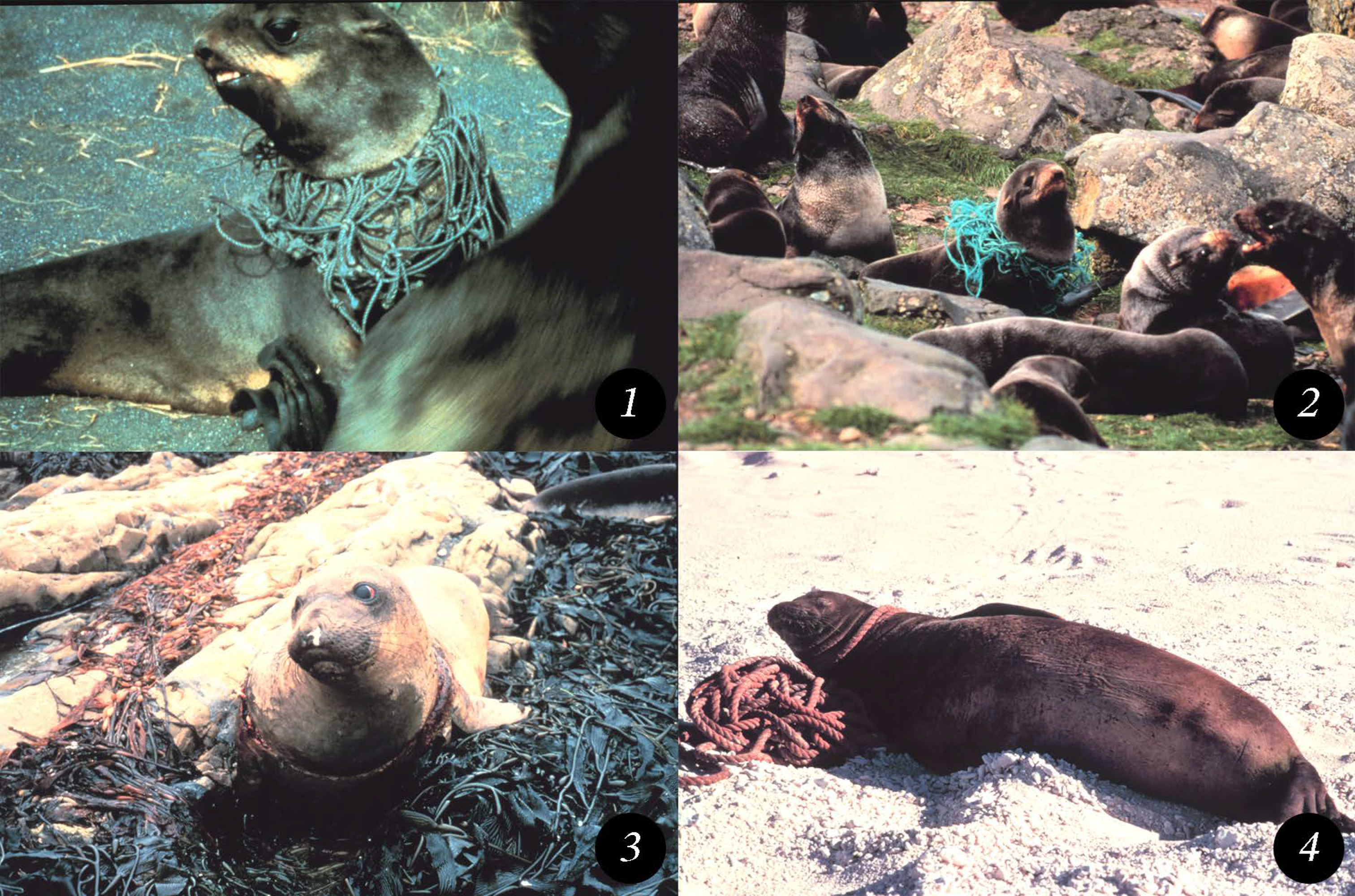
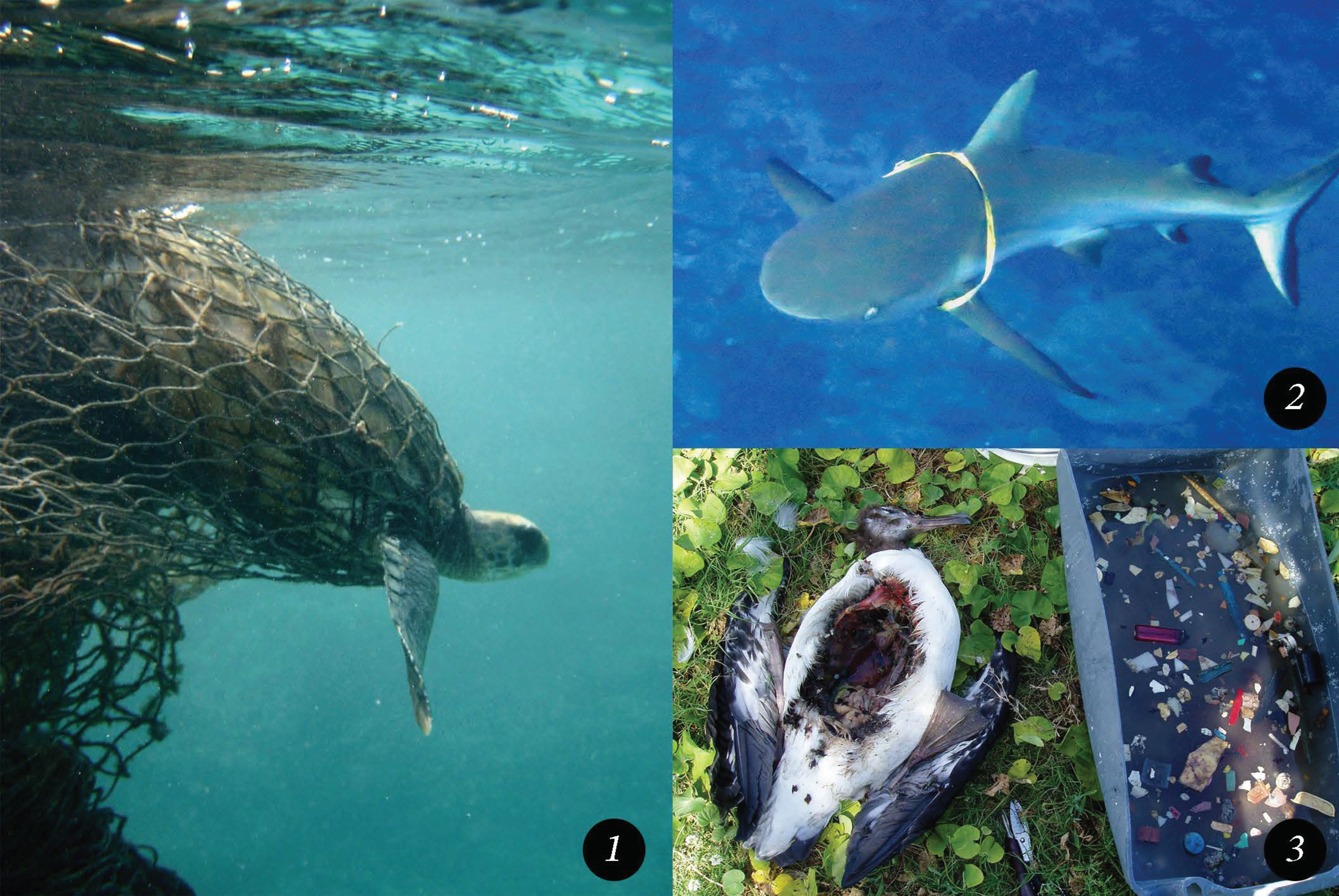
The types of marine debris are diverse, with plastics being the most predominant [151]. On Clifton Beach in Karachi, Pakistan, studies have identified ten of the most common anthropogenic pollutants transported by water: plastic, food waste, paper, glass, metal, processed wood, fabrics, styrofoam, masonry, and rubber [152]. Plastics, including single-use plastics and microplastics, constitute the majority of marine debris due to their durability and widespread use [153]. Other materials such as glass, metal, and rubber are also commonly found. Derelict fishing gear, known as ghost nets, poses significant threats to marine life through entanglement and continued ghost fishing [154,155,156]. An analysis of the stomach contents of dead turtles revealed the presence of soft plastic, styrofoam, hard plastic, fishing lines, rubber, fishing hooks, tar/oil, balloons, aluminium, and cigarette butts [157]. The presence of AFD also impacts the mortality of seabirds, such as gannets at Helgoland in Germany, where entanglement in abandoned fishing gear caused death in 13-29% of cases [158], as well as the mortality of sea turtles [159] and marine mammals like seals (Figure 9), which, attracted by these objects, may place loops of plastic around their necks [160], potentially leading to strangulation as they grow [161]. Additionally, materials like wood, fabrics, and mixed debris from various human activities contribute to the marine debris problem.
Marine debris is distributed globally, with its patterns influenced by ocean currents, winds, and waves [55,162]. Accumulation zones, such as the North Pacific Garbage Patch, are areas where debris converges due to circulating currents [78]. Seasonal and regional variations also affect debris distribution, with certain areas experiencing higher accumulation during specific times of the year [163,164,165]. It is estimated that the Great Pacific Garbage Patch covers an area of 1.6 million square kilometers, which is roughly three times the size of France. Debris spreads from the surface of the water to the ocean floor [166]. The mechanisms governing the dispersion of pollutants within the GPGP remain incompletely understood, prompting further investigation into how marine litter is transported by ocean dynamics. Recent experiments have shown that wave-induced drift varies significantly based on an object’s size, density, and shape. For instance, discs with diameters about 13% of a wave’s length experienced a 95% increase in drift relative to stokes drift, while spheres with diameters 3% of the wavelength saw up to a 23% increase. In contrast, submerged items like nets experienced reduced drift, highlighting the complex nature of marine debris transportation and the associated uncertainties in prediction models [167].
The presence of the GPGP is associated with significant environmental threats, including the risk of entanglement in abandoned, lost, or discarded fishing gear (ALDFG) [168], and the danger of ingestion by seabirds, fish, and other marine wildlife [166] (Figure 10).
Additionally, AFD can facilitate the transport and settlement of non-native species, which in the case of invasive species, may lead to the displacement of native species and the disruption of ecosystems [169]. The North Pacific Garbage Patch not only contains substantial plastic pollution but also supports the neuston community. Research suggests that areas with high plastic density have lower neuston abundance, indicating that targeted cleanups in these regions could reduce ecological impacts. The seasonal fluctuations in neuston populations further emphasize the importance of carefully timing these interventions to protect marine life while removing debris [170].
The environmental impact of marine debris is both profound and complex. Marine debris poses severe risks to marine life, including physical harm through ingestion or entanglement, leading to injury or death [171,172]. It disrupts marine ecosystems by altering habitats and food chains, thereby affecting biodiversity [173]. The ingestion of microplastics by marine organisms has been widely documented, leading to blockages, internal injuries, and exposure to toxic substances [174,175]. Numerous case studies have highlighted the impact on species such as turtles, seabirds, and marine mammals [71,176,177]. In addition to the direct threat to marine life, the presence of microplastics in ocean waters can influence more subtle but equally critical physical processes such as wave breaking. Studies have shown that microplastics can increase the stability of foam generated by breaking waves, suggesting that these particles may accumulate at the air-water interface of foam bubbles. This change could affect the lifespan of bubbles and processes such as air-sea interaction and the formation of sea spray aerosols, which are crucial for climate and planetary albedo [178].
The economic and social impacts of marine debris are equally significant. The presence of debris on beaches and in coastal waters degrades aesthetics, leading to reduced tourism appeal and economic losses for coastal communities [179,180,181]. Marine debris also negatively impacts the fishing and shipping industries by damaging equipment and vessels, which results in increased operational costs [182]. Furthermore, the ingestion of microplastics by marine organisms presents health risks to humans through the consumption of contaminated seafood, highlighting the urgent need for public health interventions [175].
Monitoring and researching marine debris involves various methodologies [183], including coastal surveys [184,185], satellite tracking [186,187,188], and numerical modelling [47,189]. Advances in technology have enhanced data collection and analysis, yet challenges remain in standardising methods across studies to enable global comparisons [149]. Effective monitoring is essential for understanding the scope of the problem and informing mitigation strategies.
Efforts to manage and mitigate marine debris encompass a range of strategies. International policies and agreements, such as the International Convention for the Prevention of Pollution from Ships (MARPOL), regulate the discharge of waste from ships. National and local initiatives focus on reducing waste and improving waste management infrastructure. Non-governmental organizations play a crucial role in clean-up efforts and raising public awareness. Community-based clean-ups have proven effective in removing debris and preventing further pollution (see: [104]). Successful management programs provide valuable case studies for best practices. For example, community-based efforts in Hawaii have significantly reduced marine debris through coordinated clean-ups and public education [190,191].
Future directions in addressing marine debris include emerging research areas and potential technological solutions [192]. Innovations in waste management and recycling are critical for reducing debris at the source [193]. Global cooperation is essential for tackling this transboundary issue, and long-term strategies must focus on sustainable management practices, such as the United Nations Sustainable Development Goal 14.1 [194].
In conclusion, marine debris is a complex and growing environmental challenge that requires comprehensive research and coordinated efforts for mitigation [195]. Continued study and policy development are crucial for addressing its impacts on marine ecosystems, wildlife, and human health. Individuals and communities play a vital role in contributing to these efforts through awareness and proactive actions.

2.2.3. Tsunami Floating Debris

Tsunami floating debris (TFD) refers to the diverse range of materials that are displaced into the marine environment as a result of a tsunami. These materials originate primarily from devastated urban and industrial areas, including infrastructure components, houses and their furnishings, vehicles, and various human-made objects, as well as natural elements such as Large Woody Debris (LWD). The composition of TFD is highly variable and dependent on the nature and scale of the destruction caused by the tsunami. For instance, following the catastrophic tsunami in Japan in 2011, approximately 1.5 million tons of TFD were released into the Pacific Ocean, encompassing materials such as fragments of building structures, plant debris, plastics, metals, and other waste materials. This aspect is discussed in detail in publications (see: [196,197]).

2.3. Natural Floating Debris

Natural floating debris (NFD) refers to materials floating on the surface of water bodies that originate from natural sources. These include a wide variety of elements such as wood, plant fragments, aquatic organisms, and other organic materials. NFD encompasses both small and large fragments of natural wood (e.g., branches, trunks, logs), as well as various plant parts like leaves, seeds, macrophytes, reeds, algae, and seaweed [198]. The most numerous group within NFD is woody debris. NFD can also contain aquatic organisms, such as fish larvae, zooplankton, and other organic remains. The characteristic feature of NFD is its natural origin, meaning that these elements are part of the natural ecological cycle, moving with water currents and influencing the biodiversity and structure of aquatic ecosystems.

2.3.1. Woody Debris

The accumulation of woody debris in rivers has a significant impact on both hydrological and ecological systems. For millions of years, trees have fallen into rivers, causing local changes in fluvial processes as well as broader spatial and temporal effects that shape and influence channel dynamics [199,200,201]. Intense rainfall and landslides can introduce large quantities of woody debris into river catchments. This type of wood, especially large pieces known as Large Woody Debris (LWD), affects both local and global flow hydraulics and sediment transport [202,203,204]. They can cause changes in the rate of bank and riverbed erosion, influence the formation of local pools and barriers, and affect sediment deposition [205]. These factors directly shape river morphology and interactions between the stream and floodplains [199].
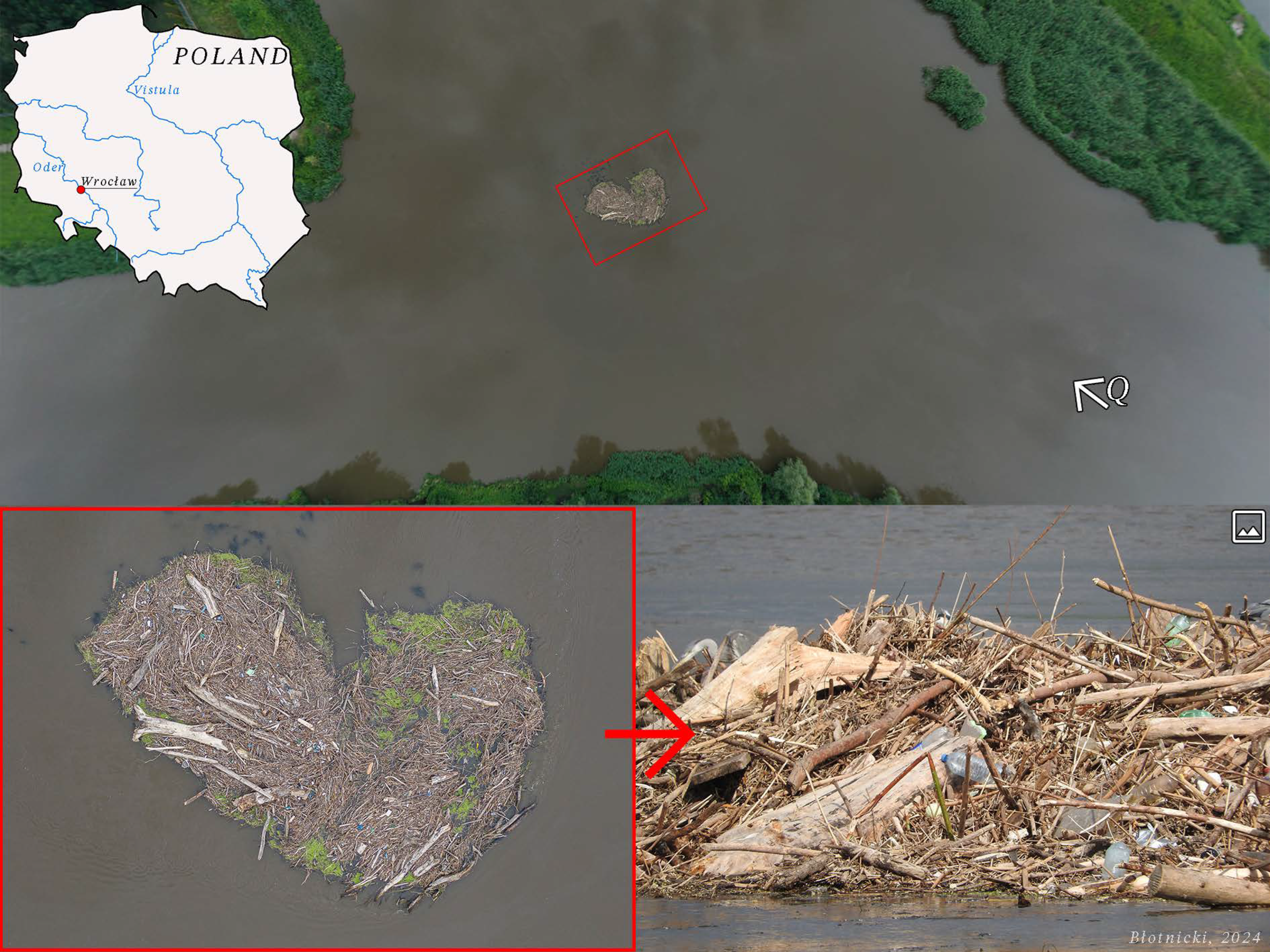
Due to their size, large pieces of wood can become stably embedded in the riverbed and catalyse the retention of smaller tree and shrub fragments, leading to significant vertical variability in river channels [206,207]. In July 2020, a significant accumulation of woody and floating debris formed on the Odra River at the entrance to the Wrocław Water Junction (Figure 11). This debris island likely originated when a large log became lodged, either by catching on the riverbed or on a protruding element, creating a point of convergence for additional debris. Over time, smaller fragments of trees and shrubs, along with sediments and anthropogenic pollutants such as plastic bottles, accumulated around this initial log. This process led to the development of a compact and stable mass, indicative of the third scenario described by [30] where both logs and sediment fill the interstitial spaces, forming a dense and cohesive structure. This formation illustrates the dynamic interaction between natural and human-induced materials in river systems, contributing to significant vertical variability in the channel and potentially posing risks to local infrastructure and navigation.
Large woody debris acts as channel roughness elements, slowing flood wave progression and increasing water retention in channels, though they offer only a slight reduction in peak flow [208]. The presence of wood in riverbeds also affects aquatic fauna, particularly fish populations, which use it as shelter. For this reason, in recent decades, stabilizing structures such as docks, piers, or artificial fish shelters (fish cribs) have been used in rivers, often constructed from large pieces of wood [209]. An example of research on the impact of wood on fish populations is the study by [210], where researchers examined the effect of woody debris on the density of brown trout populations. LWD was added to streams to restore channel complexity and ecosystem functioning—specifically, sediment and organic matter retention. It was observed that before the wood was added, trout recruitment was low, with a strong imbalance between large individuals and young fish. After the addition of coarse woody debris, fish biomass increased, especially during the spawning season. Additionally, survival rates improved, suggesting that the wood addition enhanced adult habitats.
Woody debris in rivers is typically divided into three main types [44,211]: logs and trunks (fragments of trees with a diameter over 10 cm and a length of over 1 meter; in some studies, this is defined as 30 cm in diameter and over 2 meters in length); shrubs and whole trees (shrubs or trees deposited in streams, with retained crowns and often root bundles); and jams (a mixture of various tree and shrub fragments, along with mineral material and fine organic matter). An additional type sometimes mentioned in the literature [44] are stumps, which are rare and include roots with the lowest part of the trunk remaining after a tree has been cut down.
Woody debris enters rivers through various processes, including natural tree death, weather conditions, beaver activity, or human logging [212]. The wood in rivers can undergo decomposition, deposition, or transport, with the main sources of woody debris in aquatic ecosystems being tree senescence, windthrow, beaver activity, logging, fire impact, flooding and erosion, landslides, and ice storms [209]. Debris trapped by obstacles like bridges can exacerbate localized scour, leading to stability issues and increased flood risk [213,214].
Woody debris plays a crucial role in shaping river environments. Large logs are an important component of ecosystems, creating habitats for fish [215]. To restore fish habitats, especially for salmonids, LWD is often added to rivers to increase their biological and ecological diversity [209].
Beavers (Castor canadensis and Castor fiber) also contribute to the introduction of woody debris into rivers [216]. Their specific way of living and dam-building activities lead to changes in stream morphology, introducing plant debris into rivers [217,218,219]. Due to the need to protect riverbanks from erosion and regulate rivers, there is currently a reduction in the amount of woody debris in rivers as a result of efforts to protect hydrotechnical infrastructure [220].

2.4. Methods of Identifying Floating Debris

One of the primary methods for classifying floating debris in oceans involves satellite image analysis [58,221]. However, these methods are ineffective for detecting smaller particles and are particularly challenging when applied to rivers due to their distinct morphological characteristics, which often make such analyses difficult or even impossible [222]. Rivers, as they discharge into oceans, significantly contribute to the pollution of these water bodies with floating debris [12,77,105,145]. The sources of pollution in inland waters predominantly include domestic garbage, crop straw, tree branches, leaves, and plant debris, the quantity and proportion of which depend on seasonal variations, vegetation cycles, and rainfall amounts. Sometimes, water quality is assessed based on the quantity and species of floating debris in waterways [222].
Another method of identifying floating debris is through automatic detection using image analysis with YOLO (You Only Look Ones) models, which is a real-time object detection algorithm (e.g., [222,223,224,225,226]), or other vision systems employing deep learning techniques (e.g., [11,82]). Additionally, floating debris can be observed directly by the naked eye. A comprehensive study on marine debris was conducted by Suaria and Aliani [8], where researchers performed the first large-scale survey of floating debris in the central and western Mediterranean Sea. They scanned the sea surface from a vessel, categorizing observed debris into four size classes and two categories: Natural Marine Debris (NMD) and Anthropogenic Marine Debris (AMD) [8].
The Floating Debris Index (FDI) is a novel method developed to detect marine plastic litter using optical data from Sentinel-2 satellites. This approach focuses on identifying floating macroplastics by leveraging the spectral characteristics of materials on the ocean surface. Specifically, FDI utilizes spectral signatures in the near-infrared (NIR) range, where plastics exhibit distinct reflectance patterns compared to natural materials like seaweed and timber. By applying the FDI, the study successfully detected and classified macroplastics mixed with other debris in coastal waters of countries like Ghana, Vietnam, Canada, and the UK. The findings highlight the potential of satellite-based remote sensing for monitoring and mitigating the environmental impact of marine plastic pollution [227].
Recent advancements in satellite technology have enabled the tracking of floating debris through satellite imagery, providing a novel approach for monitoring marine litter on a large scale. This method primarily detects recent land-based inputs and, despite current technological constraints, effectively identifies hotspots and trends across the Mediterranean Sea. Satellite imagery, influenced by factors such as torrential rains and coastal currents, offers a comprehensive view from source to sink of the marine litter distribution, highlighting its potential as a transformative tool for both research and the management of marine environments [228].

2.4. Methods of Identifying Floating Debris

The study of waterborne material dynamics has extensively covered suspended, dissolved, and bed load materials [229,230,231,232], while floating debris has received comparatively less attention [233,234,235].
Research on FD has predominantly focused on the marine environment, static inland waters [236,237], and riverbanks [238,239,240]. Inland studies often target floating macrophytes, particularly their formation, density, and ecological roles [241,242]. Additionally, macrophytes have been evaluated for their nutrient and heavy metal filtration abilities [243,244], while neuston studies address structure and trophic roles [236,245].
In river systems, researchers have concentrated on the dynamics of large wood [235,246], the transport of coarse particulate organic matter [234,247,248], and the spread of plant propagules [249,250]. More recently, attention has shifted towards plastic and microplastic pollution in freshwater [40,68].
Wood constitutes the most numerous natural component of FD and is often reported as the primary fraction in hydrological reports, though leaves and grass are also significant components [235].
The dynamic cycle of FD involves several stages: impact, transport, accumulation, and remobilization. These processes are governed by hydrogeomorphological, biological, and anthropogenic factors [251]. The transport of FD, especially large wood, is influenced by factors such as material density, shape, size, and water flow dynamics [234,252]. Natural materials may undergo decomposition and transformation, affecting their ability to continue moving downstream [253].
FD, particularly anthropogenic debris, significantly impacts river ecosystems by disrupting sediment transport, impeding water flow, and leading to the accumulation of hazardous waste. Therefore, understanding its dynamics and impact on rivers is crucial for effective management.
FD plays a vital role in shaping river geomorphology. Large wood, as a component of NFD, can alter riverbed morphology by creating islands, new channels, and sediment deposits along riverbanks [254,255,256]. This influences sediment transport and bed structure, enhancing the aquatic ecosystem’s diversity. Smaller elements, such as leaves and seeds, also contribute to these processes, especially in conjunction with larger wood pieces [38].
Large wood and other FD elements provide shelter and habitat for various plant and animal species [209,210,254,257]. Sediments and large wood offer protection from predators and support the development of aquatic and riparian ecosystems, promoting seed deposition and the establishment of vegetation. Microorganisms also benefit from these resources, forming biofilms that further influence the ecosystem’s structure and composition [258].
FD acts as a vector for dispersal, transporting adult and juvenile aquatic and terrestrial organisms over long distances, thereby supporting species and genetic diversity in aquatic and riparian ecosystems, even in the presence of barriers such as hydroelectric dams [259,260].
FD is a crucial element in the transfer of organic matter within the biogeochemical cycle. It affects nutrient retention within river channels and along their banks [261]. Sediments and wood enhance the exchange of soluble substances and particles between surface layers and the riverbed, increasing rivers’ self-purification capacity [262].

3. Methods

In this review, the study analyses scientific literature related to the term “floating debris” from January 2018 to the second quarter of 2023. The analysis was conducted in July 2023 using the Web of Science Core Collection as the search database. The search focused on articles with the term “floating debris” in the topic fields (title, abstract, author keywords, and Keywords Plus).
Following the methodology outlined by [263], the search was filtered to include 18 specific Web of Science Categories, which are relevant to environmental sciences and related fields. These categories included Environmental Sciences, Marine Freshwater Biology, Oceanography, Geosciences Multidisciplinary, Marine Freshwater Biology, Oceanography, Geosciences Multidisciplinary, Water Resources, Multidisciplinary Sciences, Engineering Environmental, Engineering Ocean, Remote Sensing, Engineering Civil, Engineering Marine, Imaging Science Photographic Technology, Ecology, Fisheries, Toxicology, Limnology, Engineering Multidisciplinary, Environmental Studies. Papers unrelated to aquatic environments, such as those related to medicine or astronomy, were excluded from the analysis.
To ensure the robustness of the classification, articles were categorized into four thematic groups: Marine Floating Debris, Tsunami Floating Debris, Microplastic Floating Debris, and Other. The classification process involved both automatic filtering and manual review.
For the ’Other’ group, a detailed manual review was conducted to determine the nature of the debris discussed. Articles were further categorized into two main types based on the origin of the debris: natural and anthropogenic, following the classification proposed by [8]. In cases where the specific nature of the debris (natural or anthropogenic) was not defined, the article was placed in the ’not specified’ category. Articles mentioning “floating debris” but not directly related to the established pollution context were classified as ’non-contextual’. Additionally, within the ’natural’ and ’anthropogenic’ groups, further categorization was performed based on the materials described in the articles.

4. Results

4.1. General Results

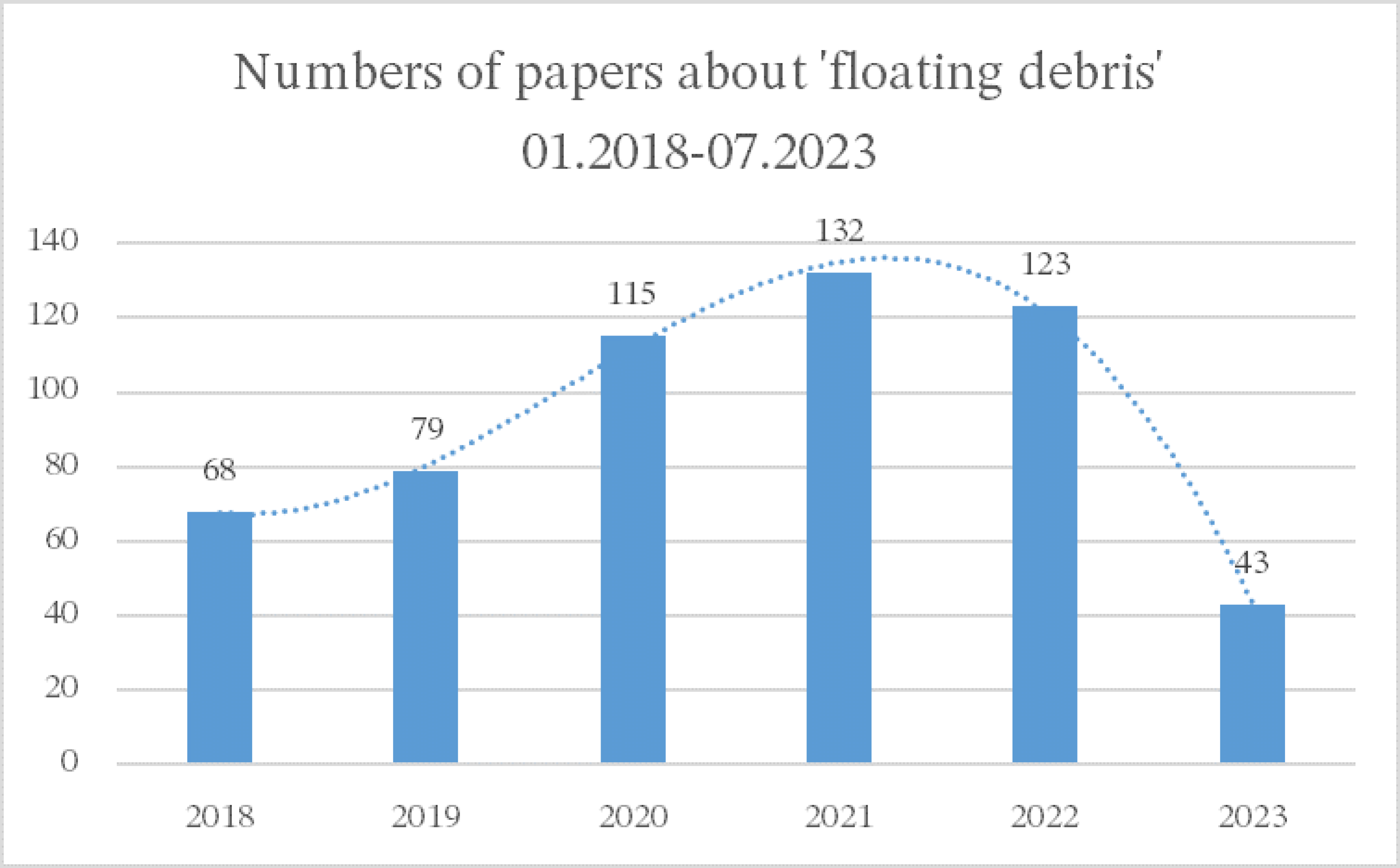
The database search resulted in 560 articles related to “floating debris” from January 2018 to July 2023. There has been a noticeable increase in the number of publications on this topic, particularly from 2018 to 2022 (Figure 12), reflecting growing ecological awareness and the intensifying issue of debris in aquatic environments. This increase in interest may be attributed to the rising recognition of the economic, ecological, and safety impacts of floating debris, such as damage to fishing gear and aquaculture plants [264,265], threats to navigation [104], and the degradation of recreational areas and infrastructure [266,267,268]. The issue of marine debris has been extensively documented in numerous studies, for example: [8,20,21,74,75,78,79,269].
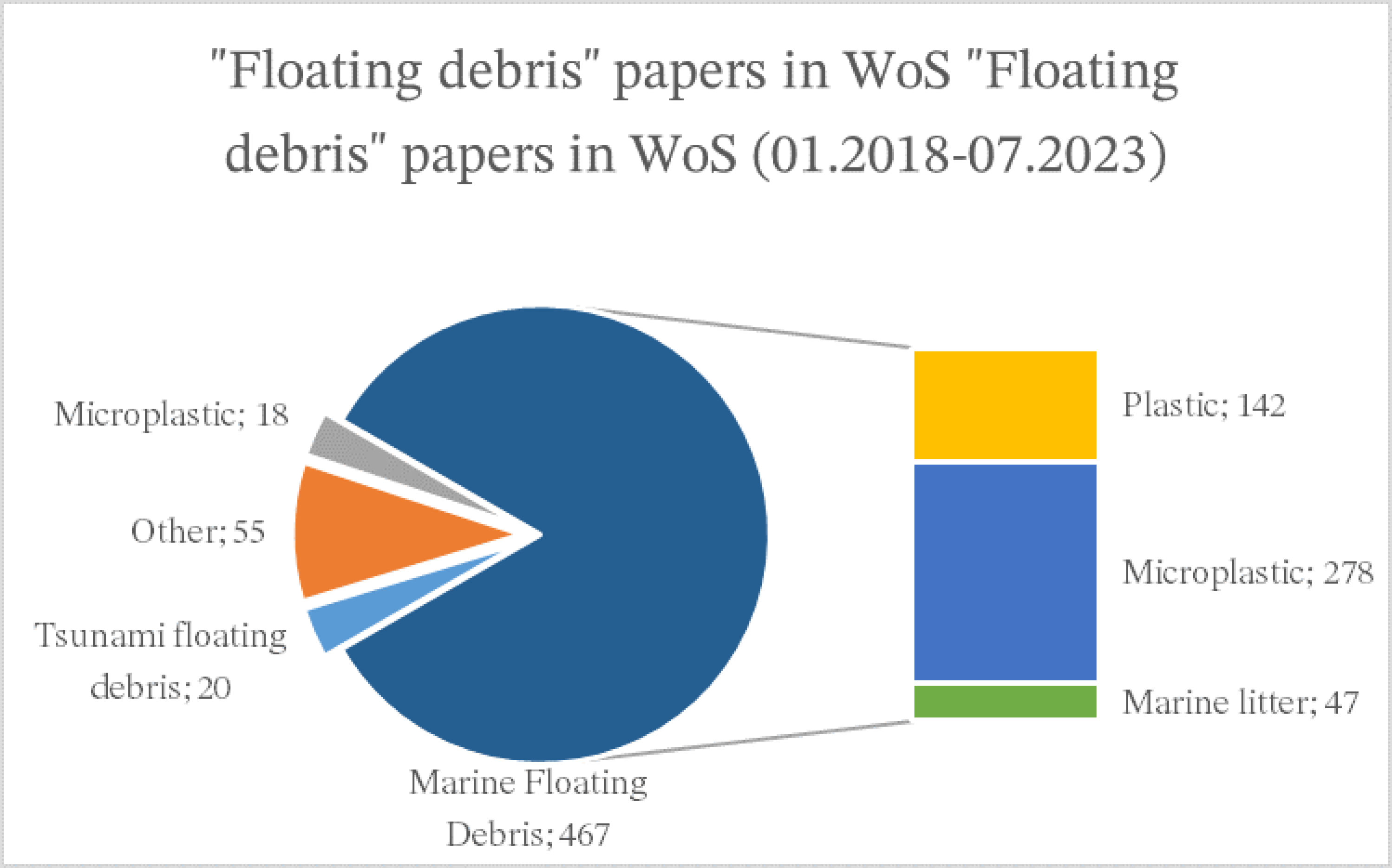
The records were categorized into four main thematic groups: Marine Floating Debris, Tsunami Floating Debris, Microplastic Floating Debris, and Other. The majority of articles (467) focused on marine environments, further subdivided into three subgroups: Microplastic, Plastic, and Marine Litter. This highlights the dominant concern with marine debris in the scientific community. Among the remaining 94 articles, three specific groups were identified: Floating Microplastic Debris (18 articles), Tsunami Floating Debris (20 articles), and Other (55 articles). Articles in the ’Other’ category were analysed in detail, with a focus on the types of materials described. The categorization of ’floating debris’ articles from the Web of Science database between January 2018 and July 2023 reveals distinct thematic groupings, as depicted in Figure 13. This figure highlights the predominance of research focused on marine environments, particularly concerning microplastics and plastics, reflecting the significant environmental concerns in these areas.
The floating microplastics within the assigned group largely pertain to riverine systems (see: [270,271,272,273,274,275]), which receive less attention in the scientific literature compared to marine systems. This reflects a research gap that could have significant environmental implications.
Floating debris transported by tsunamis is considered a distinct group, as discussed in publications such as [196,197] as well as in section 2.2.3 Tsunami floating debris. While these debris are often found in oceanic estuaries and could be classified as marine debris, the unique conditions of their origin justify their categorisation as a separate thematic group.
Articles categorized under ’Other’ include those that did not fit neatly into any of the predefined thematic groups during the selection process. This group encompasses a diverse range of studies, and a detailed qualitative analysis of these articles is provided in section 4.2.

4.2. The “Other” Category

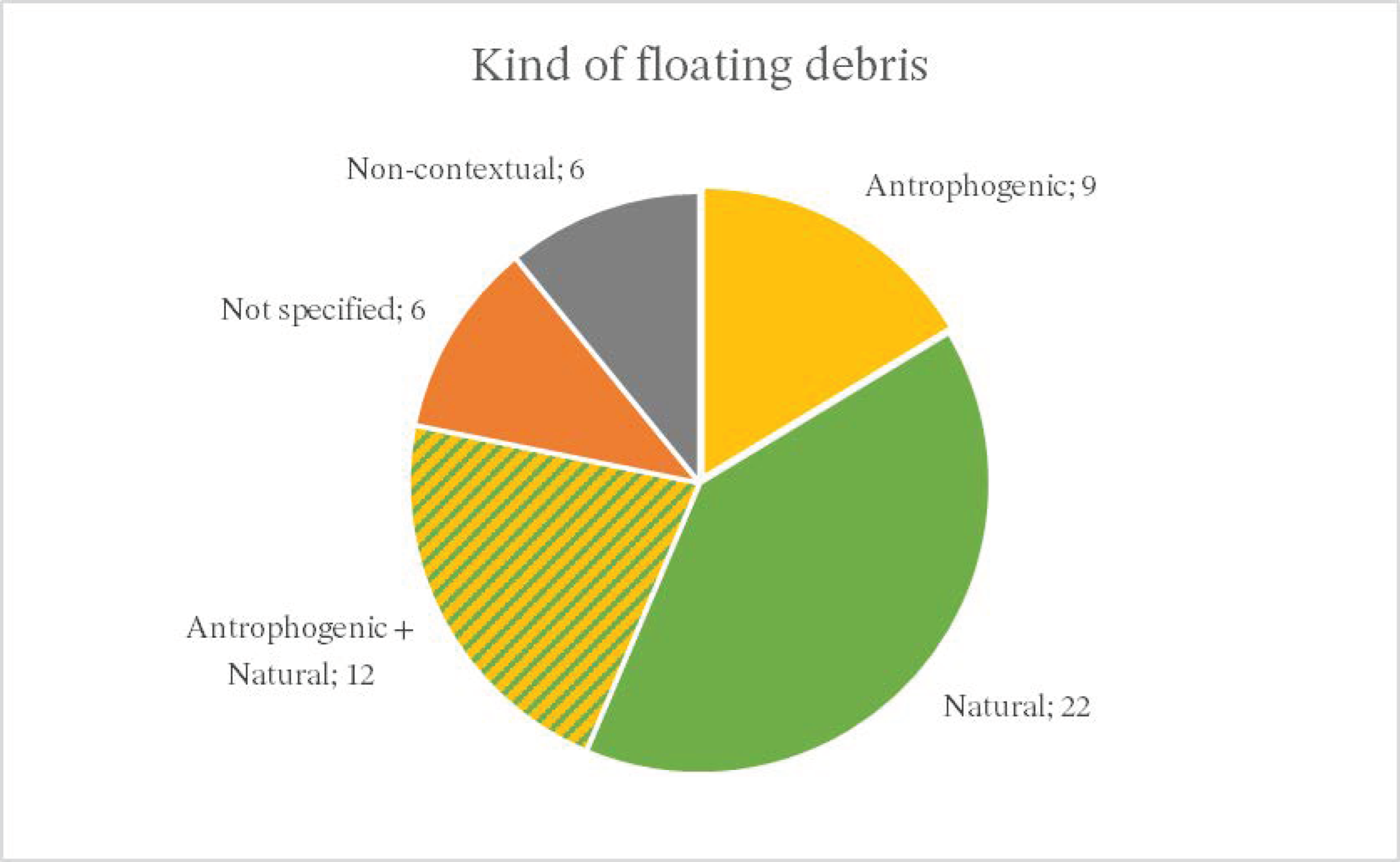
The ’Other’ category consisted of 55 articles, with six classified as “non-contextual” due to their divergence from the initial focus on environmental pollution. Six articles utilised the term “floating debris” within the context of the presented definition, understood as materials or vegetation found on the surface of water bodies with the potential to disrupt aquatic and terrestrial ecosystems, but without specifying whether the debris was of natural or anthropogenic origin, thereby placing them in the ’not specified’ group. Nine articles focused on anthropogenic debris, while 22 discussed natural debris, and 12 covered both. This classification is illustrated in Figure 14:
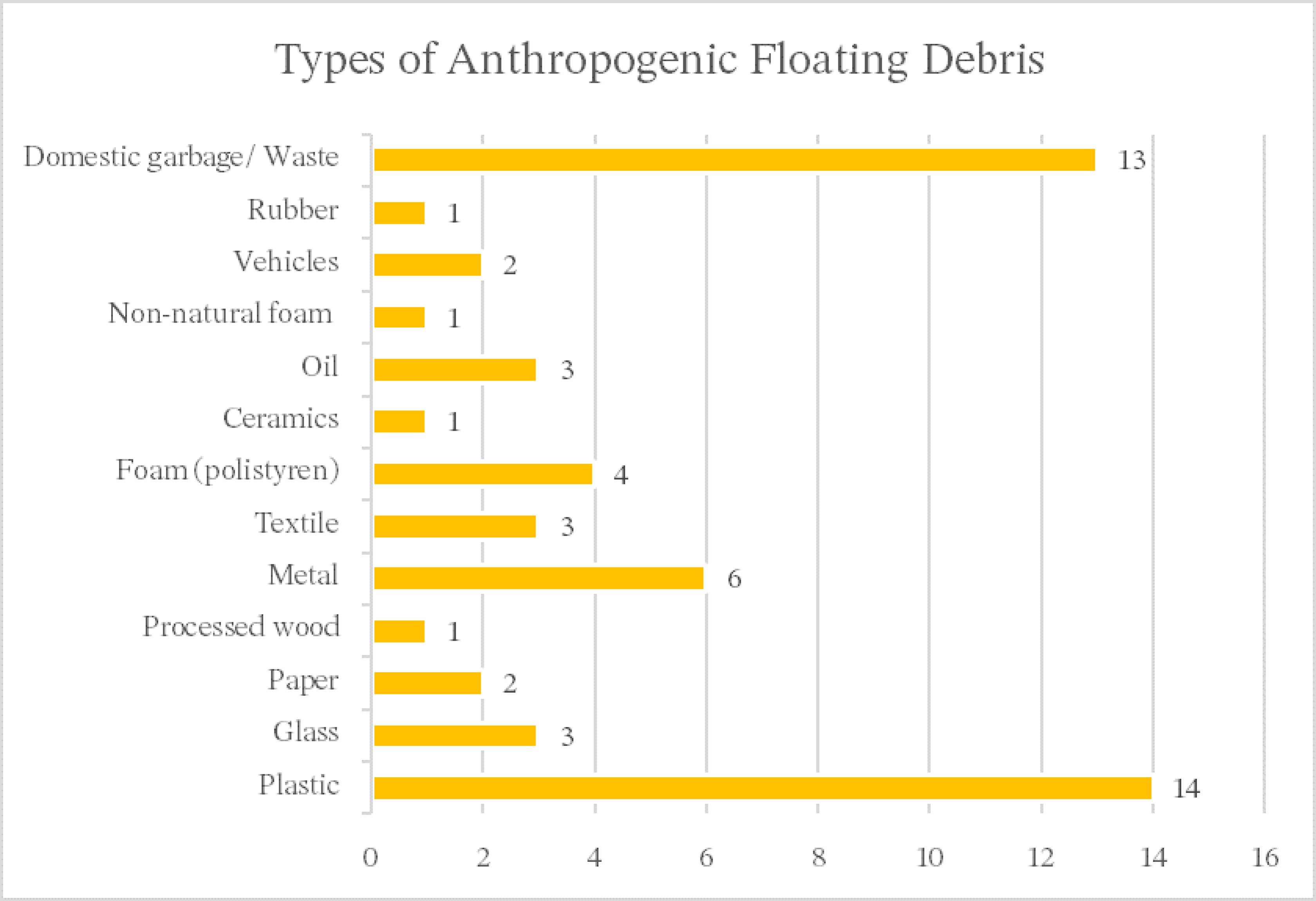
Anthropogenic floating debris was further divided into 13 material categories, based on the classification by [152]: plastic, glass, paper, processed wood, metal, textile, expanded polystyrene (EPS), ceramics, oil, non-natural foam, vehicles, rubber, and domestic garbage/waste. As shown in Figure 15, plastic emerged as the most frequently discussed material, indicating its significant environmental impact due to its widespread use, long degradation times, and challenges in waste management.
The prominence of domestic garbage, identified in 13 articles, underscores the role of households as sources of floating debris. While metals and EPS were mentioned less frequently—six and four studies, respectively—they highlight the persistent nature and potential ecological risks associated with these materials. EPS, in particular, raises concerns due to its resistance to degradation and propensity to break down into microplastics [276], which can infiltrate the digestive [108,277] and circulatory systems of organisms [278,279]. Seabirds are known to peck, move, and ingest various plastic objects, including polystyrene, though the reasons for this behaviour remain largely hypothetical. The ingestion of polystyrene elements could potentially cause lethal or sublethal effects in seabirds [280].
Other materials, such as glass, textiles, and oil, though less common, continue to be of scientific interest, indicating the wide range of anthropogenic debris affecting aquatic environments. Less frequently mentioned materials like paper, processed wood, ceramics, non-natural foam, and rubber, though only appearing in individual studies, also deserve attention for their potential, yet underexplored, impacts on aquatic ecosystems.
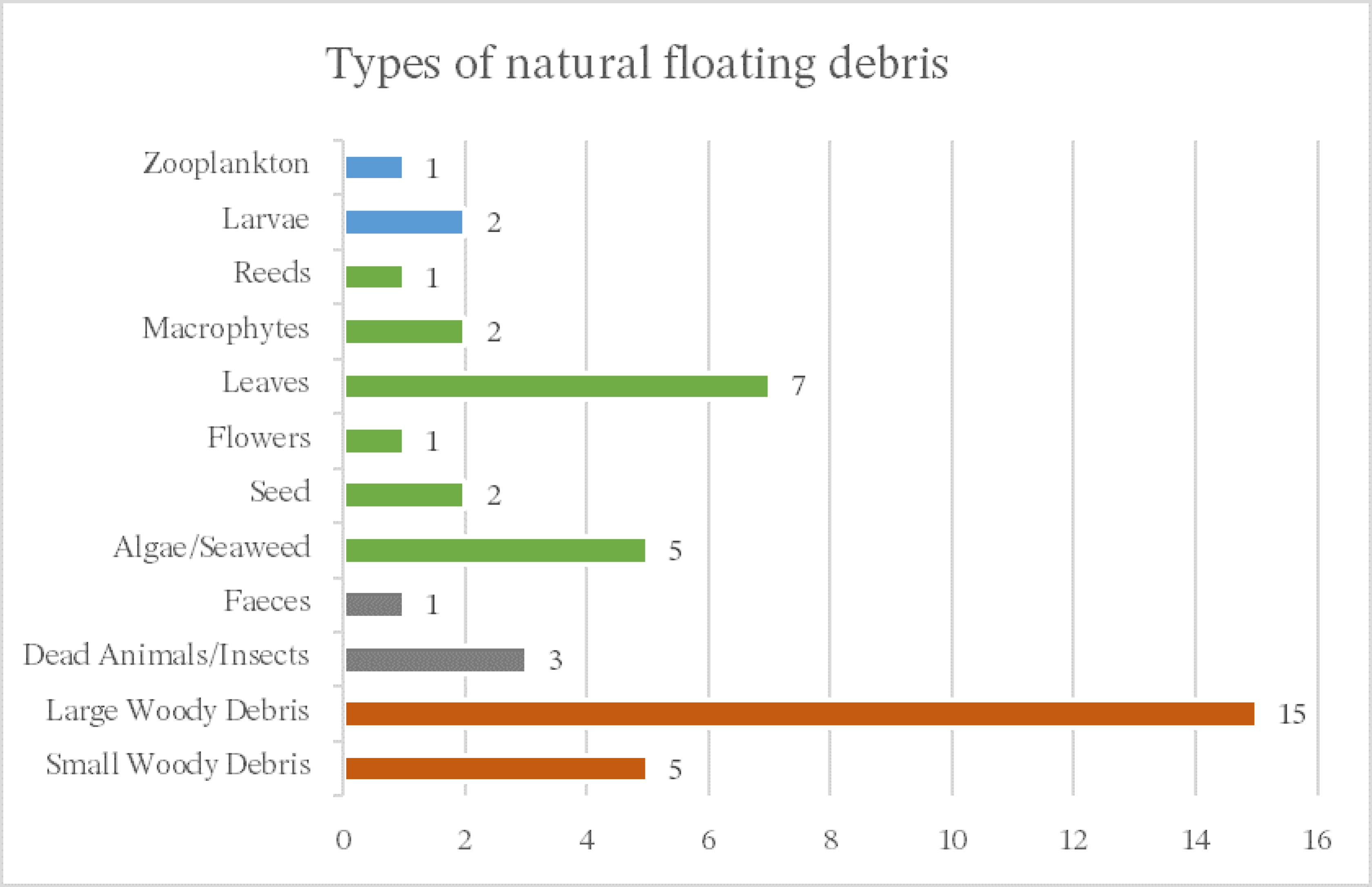
The analysis of 34 articles on natural floating debris reveals a significant diversity of materials crucial to aquatic ecosystems. NFD was categorised into four main groups [45,281]: woody debris, plant matter, aquatic organisms, and other, as illustrated in Figure 16.
Among these, woody debris emerged as the most frequently discussed type, featured in 25 articles. This category was further subdivided into small debris, discussed in five publications, and large woody debris [282], covered in 15 articles. Plant matter was the focus of 14 articles, with particular attention given to leaves (seven articles) and algae/seaweed (five articles). Although references to other plant materials like seeds, flowers, macrophytes, and reeds were less common, they underscore the complexity of this category. The other category included debris like dead animals or insects, mentioned in three articles, and faeces, noted in one. Aquatic organisms such as larvae and zooplankton were referenced in two articles each. The distribution of these mentions is detailed in Figure 17:
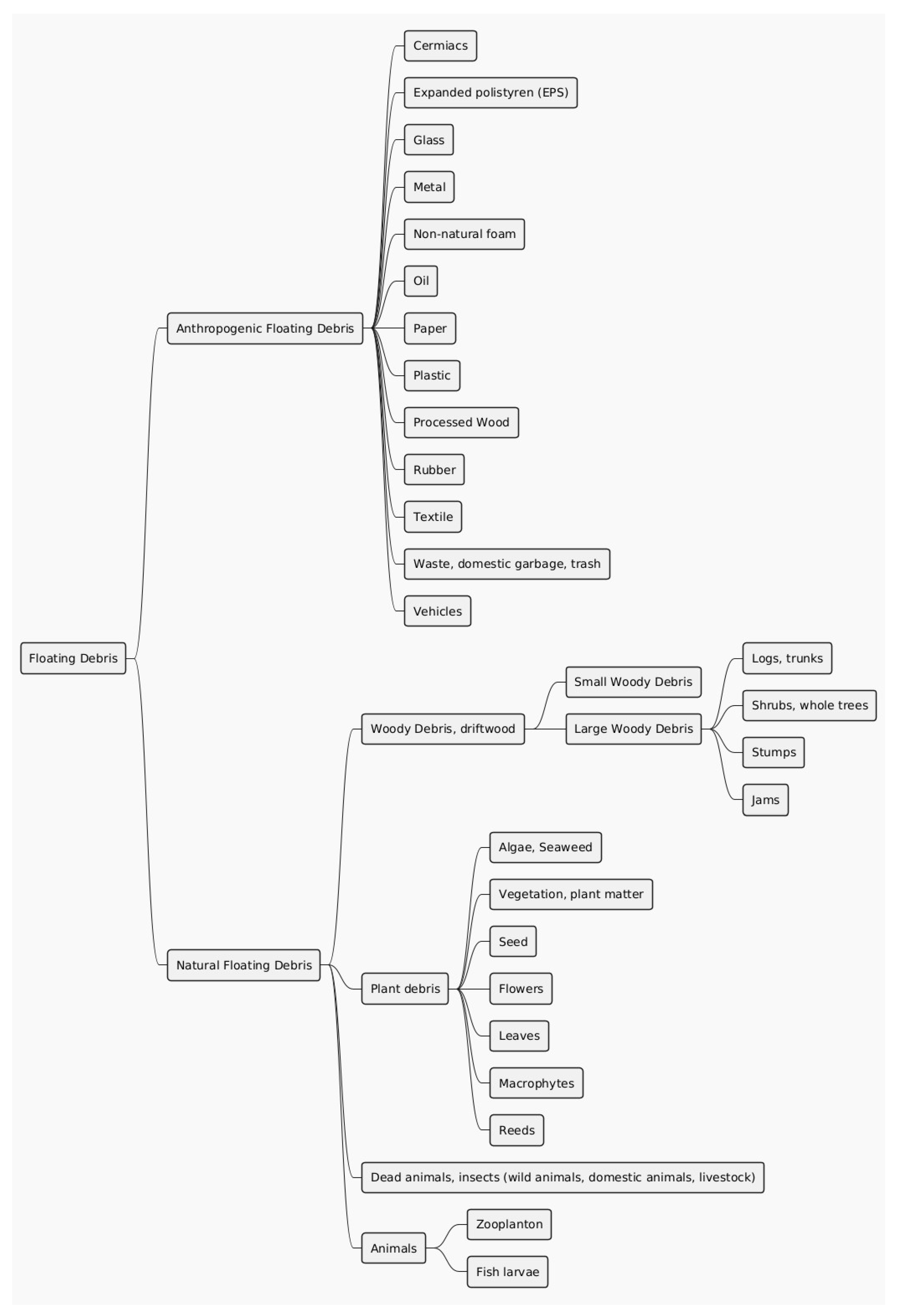
Finally, a comprehensive summary chart is provided in Figure 18, which includes both anthropogenic and natural debris, highlighting the overall diversity and complexity of floating debris analysed in this study.

5. Discussion and Conclusions

The study of floating debris (FD) plays a crucial role in understanding its impact on aquatic ecosystems and economic activities. The term “debris” in this context is often used to describe both natural and anthropogenic elements floating on water surfaces. It is imperative to differentiate between natural debris (NFD) and anthropogenic floating debris (AFD) to facilitate precise impact assessments. As environmental challenges evolve, particularly with the rising prevalence of plastics, this categorisation becomes increasingly crucial. The methodology employed in this study identified a subset of 55 articles that utilised the term FD ambiguously, without specifying the context such as marine debris, microplastics, or tsunami-related debris. This subset further revealed that approximately 11% of the papers employed the term FD in a way that defies clear categorisation. This observation suggests a nomenclatural gap that could potentially hinder the replicability of studies or lead to misinterpretations of research outcome
For example, the critical review by [283], sought to integrate various sources to enhance resource management by considering public perceptions of aquatic environments. However, this study, like many others, shows the limitations of the existing literature in clearly defining terms like FD, which can sometimes lead to inconsistent interpretations and applications in research. This discussion underlines the importance of developing a more standardized nomenclature for different types of floating debris. By clarifying these definitions, future research can more effectively contribute to the ecological, economic, and policy dimensions of managing floating debris.
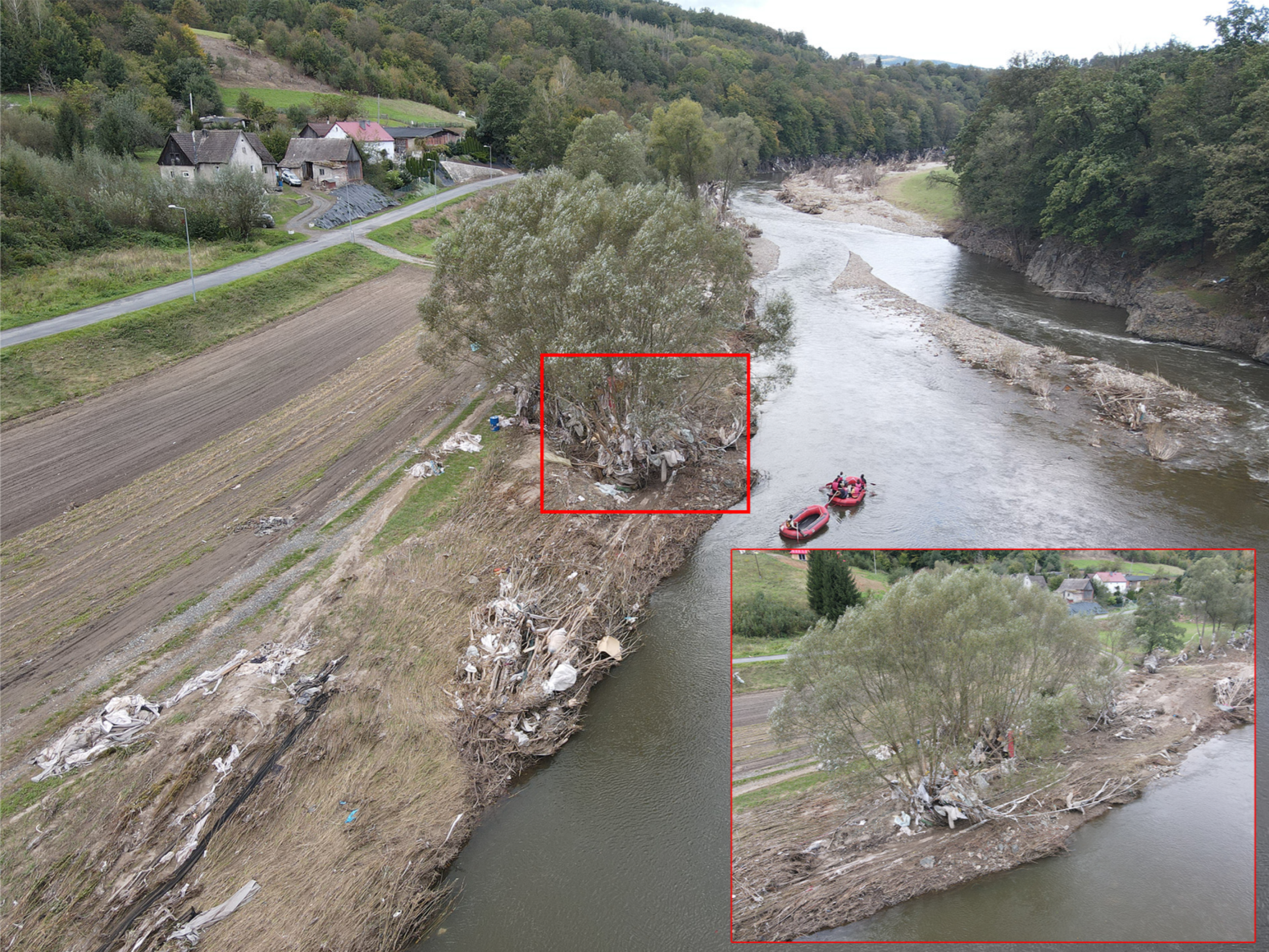
This issue is reflected in real-world scenarios. In September 2024, catastrophic floods occurred in southwestern Poland due to prolonged heavy rains. This phenomenon originated from a low-pressure system in the Gulf of Genoa, which moved towards the Mediterranean, absorbing substantial moisture. The resulting heavy rains over Central Europe quickly caused river surges and flooding. During such events, rivers transport large volumes of debris, including organic materials like logs, plants, leaves, and animals, as well as inorganic elements like rocks and soil. Organic matter naturally present in rivers is essential for their functioning and supports biodiversity [284], while anthropogenic materials, such as plastic, are primarily responsible for negative ecological impacts [285]. Given the vast quantities of plastic produced, discussed in section 2.2.1 Plastic, there has been a shift in the proportion of natural to anthropogenic elements present in rivers. An example is a section of the Nysa Kłodzka River, between kilometers 119 and 124, where, within the Natura 2000 area (ID: PLH020043), plastic waste from a nearby textile warehouse has accumulated on trees, shrubs, and rocks (Figure 19).
This case underscores the necessity for precise classification of FD into AFD and NFD to enable the automated identification and categorisation of various FD types, essential for improving the efficiency of pollution monitoring and management methods in aquatic environments. Accurately understanding and quantifying macroplastic fragmentation in rivers is crucial for assessing secondary microplastic production and associated risks for riverine biota and human health, as demonstrated in studies by Liro et al. [286]. Moreover, systematic macroplastic data collection, as suggested by research [287], and the analysis of river morphology’s impact on macroplastic accumulation across various surface types [288] are key to understanding how riverbed management influences pollution storage.
Furthermore, the presence of macroplastics in river channels during surges presents a fluid mechanics issue, as large pieces of material (acting like sails) can significantly impact flow resistance and channel filling, exerting considerable hydrodynamic pressure. This, in turn, may break or uproot large woody debris, which poses significant dangers during flood surges by damaging bridges and other infrastructure and creating blockages that lead to flooding and pose direct threats to human life.
There is no doubt that anthropogenic debris is harmful to the environment, affecting both aquatic and terrestrial ecosystems. Its presence in nature leads to numerous negative consequences, such as water pollution, threats to marine life, and the degradation of natural habitats [22,145,289]. Microplastics, due to their small size, are ingested by aquatic organisms at various trophic levels, leading to direct physical or nutritional problems and potential association with toxic pollutants [117,290,291]. The pervasive presence of plastics, which are highly stable in the environment, suggests that they may circulate for extended periods, posing a threat to both current and future generations [292]. Plastics infiltrate the food chain and pose risks to human health [293,294,295,296].
From the perspective of water resource use, natural large woody debris (LWD) and leaves can hinder the operation of hydropower plants by clogging turbine intakes and other infrastructure, necessitating more frequent removal and thereby increasing operational costs [297]. The accumulation of large logs on bridge piers poses an additional hazard, particularly during floods, sometimes leading to structural damage and localized inundation [200]. The presence of wood alters the hydraulic conditions in the channel where it settles [107,202,204,205,212], potentially causing phenomena such as riverbed scouring and local scour formation, particularly in non-armoured riverbeds [298]. In fish passage structures, this can adversely affect fish migration, preventing access to natural spawning habitats [299]. It is evident that the negative aspects of NFD are primarily associated with human activities.
To counteract blockages caused by LWD and other floating debris in fish passes, various mitigation measures can be implemented. One strategy is to install protective screens or trash racks that intercept large objects before they enter the fishway, or to use concrete or steel deflectors that direct the flow—and the debris it carries—away from the fishway entrance. It is also possible to position rows of posts, rails, or steel plates to divert incoming materials. Another approach focuses on modifying the fishway components themselves; for example, [299] suggests rounding the pillars of technical fishways to reduce snagging of logs and plastic items. Nonetheless, managing debris remains expensive and logistically complex, often necessitating the partial or complete shutdown of fishways for manual clearing, which poses safety risks and creates operational downtime. Innovative designs may include movable features—such as “mini-weirs” or adjustable panels—to temporarily raise water depth and flush out accumulated debris, although these moving parts are prone to damage and require more frequent maintenance. Nature-like fishways (e.g., riffle-and-pool or bypass channels) can also ease debris issues by intentionally incorporating wood into the channel for ecological benefits. However, even these designs must balance the habitat value of retained woody material with the need to keep migration routes open and unobstructed.
From an ecological standpoint, the retention of wood in channels is desirable, as large wood plays a pivotal role in shaping riverine ecosystems [246] which was described in section 2.4. It provides habitat for a wide range of aquatic species, including fish, invertebrates, and microorganisms, thereby enhancing biodiversity [300,301]. Wood retained in rivers influences geomorphological processes, such as the formation of islands, pools, and sediment barriers, which in turn affects bank stability and flow dynamics [200,205]. Although barrier removal is the best method for restoring biodiversity [302,303], in large urban areas, river restoration or barrier removal is often unfeasible due to existing infrastructure and dense development. Under these conditions, fishways—whether technical or nature-like—become essential for maintaining ecosystem connectivity. Their design must account not only for the biological diversity and swimming capabilities of migratory species but also for the potential accumulation of woody debris and other waste, especially in light of increasingly variable flow regimes and extreme hydrological events.
Research has shown that necromass, including wood, is a vital ecological resource that supports biodiversity by providing essential resources for detrital food webs and nutrient recycling processes [304,305,306]. Necromass exhibits varying temporal and spatial properties, influencing its role in aquatic ecosystems by supporting decomposers and contributing to recycling processes within river ecology [307,308].
In the case of living organisms, such as fish larvae, zooplankton, or plant parts, the use of the term “debris” can lead to a misunderstanding of their role as waste. Therefore, a more appropriate term might be “floating matter,” which highlights the value of these elements as vital components of aquatic ecosystems [72,309,310]. As noted by Gregory, Boyer, and Gurnell [311], natural elements floating on water surfaces are crucial to ecosystem functioning, influencing biodiversity and the structure of aquatic ecosystems.
However, when referring to elements that disrupt human activities, such as floating waste or even excessive amounts of large wood in rivers, the term “debris” is more appropriate. These elements interfere with the operation of hydropower plants, navigation, and can negatively impact ecosystems, as in the case of the Great Pacific Garbage Patch [312].
This study highlights the urgent need for improved waste management strategies, particularly in reducing plastic production, enhancing recycling efforts, and promoting the reuse of materials. Effective waste management, including the management of floating debris, is critical within the framework of planetary boundaries which define the limits of human activity to prevent critical changes in Earth systems [313]. The economic aspects of waste management are also significant, as emphasized by Kate Raworth in her concept of ’doughnut economics.’ Raworth describes the economy as a closed system where sustainable development requires economic activity to stay within limits that do not compromise ecological stability or social justice [314].
Furthermore, the report by Leach et al. [315] highlights that sustainable natural resource management should balance social needs with ecological possibilities, which is vital for maintaining human and ecosystem well-being. Understanding these interdependencies is crucial for effective waste management that significantly reduces pollution in aquatic ecosystems, including the Great Pacific Garbage Patch. Studies on processing plastic waste from the Great Pacific Garbage Patch have shown that supercritical thermal hydrolysis (HTL) technology can chemically recycle these materials into synthetic crude oil [316]. In the context of waste management, the concept of Entropy Generation Minimization (EGM), introduced by [317], can be applied to optimize systems to reduce environmental impact. By applying EGM to the design and management of waste processing technologies, it is possible to minimize the loss of useful energy and reduce waste production. These processes, referred to as energy processes, are fundamental to the efficient transformation of waste, reducing energy losses and minimizing environmental impacts [318].
The implementation of the ’10 R’ principles in waste management provides practical tools to fulfill the principles of a circular economy, promoting waste minimization, recycling, and reuse. Emphasizing the importance of refusing unnecessary items, rethinking consumption patterns, and reducing waste at its source. Steps such as repair, refurbish, remanufacture, and repurpose can extend the life of products and materials, thereby reducing the demand for new resources. Recycling and recovery ensure that even materials that have reached the end of their life cycle are managed in an environmentally responsible way. By adopting these strategies, we can decrease the amount of waste entering aquatic systems, mitigate the impacts of floating debris, and progress towards a more sustainable and circular economy [319,320]. Additionally, integrating renewable energy sources into waste management processes supports the ’10 R’ strategies, crucial for transitioning towards a circular economy. The use of renewables not only reduces the carbon footprint of these processes but also enhances their sustainability, aligning with planetary boundaries as discussed in ’Powering a Sustainable and Circular Economy’ [321]. This approach underpins the engineering of waste processing technologies to maximize energy efficiency and minimize environmental impacts, essential for the long-term viability of ecosystems and human health. In line with engineering solutions for sustainable waste management, it is also imperative to design systems that prevent the discharge of pollutants into aquatic ecosystems. As explored in recent research, advanced engineering approaches are essential for mitigating the hazards associated with plastic waste and emerging pollutants in water systems [322]. These methodologies not only focus on efficient waste processing but also on preventing the introduction of harmful substances into the environment, thus supporting the principles of a circular economy and protecting water resources critical for both ecological and human health.

Author Contributions

Conceptualization, J.B.; methodology, J.B. and P.J.; software, J.B.; validation, J.B.; formal analysis, J.B.; investigation, J.B.; resources, J.B.; data curation, J.B.; writing—original draft preparation, J.B. and B.B; writing—review and editing, J.B.; visualization, J.B.; supervision, J.B., R.G. and P.J.; project administration, J.B.; funding acquisition, J.B. All authors have read and agreed to the published version of the manuscript.

Funding

The APC was funded by Wroclaw University of Environmental and Life Sciences.

Data Availability Statement

No new data were created or analyzed in this study. Data sharing is not applicable to this article.

Acknowledgments

Special thanks to MSc Joanna Barańska for her meticulous language editing, which greatly enhanced the quality of this manuscript. We are also grateful to Oskar Studziński for identifying macroplastic accumulation sites in the river after the flood, providing critical insights for this study. Heartfelt thanks to Dr Michał Śpitalniak for his motivational support throughout the writing process and encouragement to pursue publication. Finally, we extend our gratitude to Prof. Krzysztof Lejcuś for facilitating the finalization of this article, ensuring its completion and submission.

Conflicts of Interest

The authors declare no conflicts of interest. The funders had no role in the design of the study; in the collection, analyses, or interpretation of data; in the writing of the manuscript; or in the decision to publish the results.

Abbreviations

The following abbreviations are used in this manuscript:
AFD Anthropogenic Floating Debris
AMD Anthropogenic Marine Debris
AOP Adverse Outcome Pathway
EGM Entropy Generation Minimization
FD Floating Debris
FDI Floating Debris Index
GC Gas Chromatography
GC-MS Combined With A Mass Detector
GPGP Great Pacific Garbage Patch
GSSP Global Boundary Stratotype Section And Point
HTL Hydrothermal Liquefaction
LWD Large Woody Debris
MARPOL International Convention For The Prevention Of Pollution From Ships
MP Microplastic
NFD Natural Floating Debris
NMD Natural Marine Debris
NOAA National Oceanic and Atmospheric Administration
NP Nanoplastic
TFD Tsunami Floating Debris
UNEP United Nations Environmental Program
YOLO You Only Look Ones

References

  1. Zalasiewicz, J.; Waters, C.N.; Ivar do Sul, J.A.; Corcoran, P.L.; Barnosky, A.D.; Cearreta, A.; Edgeworth, M.; Gałuszka, A.; Jeandel, C.; Leinfelder, R.; et al. The Geological Cycle of Plastics and Their Use as a Stratigraphic Indicator of the Anthropocene. Anthropocene 2016, 13, 4–17. [Google Scholar] [CrossRef]
  2. Crutzen, P.J.; Stoermer, E.F. The “Anthropocene”, Glob. Chang. Newsl. 2000, 41, 17–18. [Google Scholar]
  3. Crutzen, P.J. Geology of Mankind - Crutzen - Nature. Nature 2002, 415, 2002. [Google Scholar] [CrossRef] [PubMed]
  4. Zalasiewicz, J.; Waters, C.N.; Williams, M.; Barnosky, A.D.; Cearreta, A.; Crutzen, P.; Ellis, E.; Ellis, M.A.; Fairchild, I.J.; Grinevald, J.; et al. When Did the Anthropocene Begin? A Mid-Twentieth Century Boundary Level Is Stratigraphically Optimal. Quat. Int. 2015, 383, 196–203. [Google Scholar] [CrossRef]
  5. Zalasiewicz, J.; Williams, M.; Smith, A.; Barry, T.L.; Coe, A.L.; Bown, P.R.; Brenchley, P.; Cantrill, D.; Gale, A.; Gibbard, P.; et al. Are We Now Living in the Anthropocene? GSA Today 2008, 18, 4–8. [Google Scholar] [CrossRef]
  6. Elhacham, E.; Ben-Uri, L.; Grozovski, J.; Bar-On, Y.M.; Milo, R. Global Human-Made Mass Exceeds All Living Biomass. Nature 2020, 588, 442–444. [Google Scholar] [CrossRef] [PubMed]
  7. Naylor, E. The Occurrence of Idotea Metallica Bosc in British Waters. J. Mar. Biol. Assoc. United Kingdom 1957, 36, 599–602. [Google Scholar] [CrossRef]
  8. Suaria, G.; Aliani, S. Floating Debris in the Mediterranean Sea. Mar. Pollut. Bull. 2014, 86, 494–504. [Google Scholar] [CrossRef] [PubMed]
  9. Vieira Dantas Filho, J.; Perez Pedroti, V.; Temponi Santos, B.L.; de Lima Pinheiro, M.M.; Bezerra de Mira, Á.; Carlos da Silva, F.; Soares e Silva, E.C.; Cavali, J.; Cecilia Guedes, E.A.; de Vargas Schons, S. First Evidence of Microplastics in Freshwater from Fish Farms in Rondônia State, Brazil. Heliyon 2023, 9, 1–11. [Google Scholar] [CrossRef] [PubMed]
  10. Herman, A.; Węsławski, J.M. Typical and Anomalous Pathways of Surface-Floating Material in the Northern North Atlantic and Arctic Ocean. Sci. Rep. 2022, 12, 1–13. [Google Scholar] [CrossRef]
  11. Wang, Y.; Zhang, X.; Chen, J.; Cheng, Z.; Wang, D. Camera Sensor-Based Contamination Detection for Water Environment Monitoring. Environ. Sci. Pollut. Res. 2019, 26, 2722–2733. [Google Scholar] [CrossRef] [PubMed]
  12. Meenal, M.; Patel, K.; Patil, A. Cleaning of Water Bodies Using Coastal Sea Bin (CSB). MethodsX 2021, 8, 101469. [Google Scholar] [CrossRef]
  13. Bryukhan, F.; Vinogradov, A. Estimate of Throughput of Bridge Transitions and Pipe Passages Built on Minor Rivers of Piedmont Areas of Krasnodar Territory-Russia. MATEC Web Conf. 2018, 162, 1–4. [Google Scholar] [CrossRef]
  14. Ragusa, A.; Svelato, A.; Santacroce, C.; Catalano, P.; Notarstefano, V.; Carnevali, O.; Papa, F.; Rongioletti, M.C.A.; Baiocco, F.; Draghi, S.; et al. Plasticenta: First Evidence of Microplastics in Human Placenta. Environ. Int. 2021, 146, 106274. [Google Scholar] [CrossRef] [PubMed]
  15. Piyawardhana, N.; Weerathunga, V.; Chen, H.S.; Guo, L.; Huang, P.J.; Ranatunga, R.R.M.K.P.; Hung, C.C. Occurrence of Microplastics in Commercial Marine Dried Fish in Asian Countries. J. Hazard. Mater. 2022, 423, 127093. [Google Scholar] [CrossRef] [PubMed]
  16. Kanhai, L.D.K.; Johansson, C.; Frias, J.P.G.L.; Gardfeldt, K.; Thompson, R.C.; O’Connor, I. Deep Sea Sediments of the Arctic Central Basin: A Potential Sink for Microplastics. Deep Sea Res. Part I Oceanogr. Res. Pap. 2019, 145, 137–142. [Google Scholar] [CrossRef]
  17. Węsławski, J.M.; Urbański, J.A. Forty Years of Warming: Environmental Change in Marine Coastal Habitats on Svalbard between 1981 and 2022. Polish Polar Res. 2024. [Google Scholar] [CrossRef]
  18. Bergmann, M.; Mützel, S.; Primpke, S.; Tekman, M.B.; Trachsel, J.; Gerdts, G. White and Wonderful? Microplastics Prevail in Snow from the Alps to the Arctic. Sci. Adv. 2019, 5. [Google Scholar] [CrossRef] [PubMed]
  19. Lacerda, A.L. d. F.; Rodrigues, L. dos S.; van Sebille, E.; Rodrigues, F.L.; Ribeiro, L.; Secchi, E.R.; Kessler, F.; Proietti, M.C. Plastics in Sea Surface Waters around the Antarctic Peninsula. Sci. Rep. 2019, 9, 3977. [Google Scholar] [CrossRef]
  20. Ryan, P.G. A Brief History of Marine Litter Research. In Marine Anthropogenic Litter; Bergmann, M., Gutow, L., Klages, M., Eds.; Springer International Publishing: Cham, 2015; ISBN 978-3-319-16509-7. [Google Scholar]
  21. Galgani, F.; Hanke, G.; Maes, T. Global Distribution, Composition and Abundance of Marine Litter. In Marine Anthropogenic Litter; Springer International Publishing: Cham, 2015; ISBN 9783319165103. [Google Scholar]
  22. Barnes, D.K.A.; Galgani, F.; Thompson, R.C.; Barlaz, M. Accumulation and Fragmentation of Plastic Debris in Global Environments. Philos. Trans. R. Soc. B Biol. Sci. 2009, 364, 1985–1998. [Google Scholar] [CrossRef]
  23. Ardianti, A.; Mutsuda, H.; Kawawaki, K.; Doi, Y. Fluid Structure Interactions between Floating Debris and Tsunami Shelter with Elastic Mooring Caused by Run-up Tsunami. Coast. Eng. 2018, 137, 120–132. [Google Scholar] [CrossRef]
  24. Hughes, W.; Santos, L.; Lu, Q.; Malla, R.; Ravishanker, N.; Zhang, W. Probabilistic Risk Assessment Framework for Predicting Large Woody Debris Accumulations and Scour near Bridges. Struct. Infrastruct. Eng. 2023, 1–18. [Google Scholar] [CrossRef]
  25. Pagliara, S.; Carnacina, I. Influence of Large Woody Debris on Sediment Scour at Bridge Piers. Int. J. Sediment Res. 2011, 26, 121–136. [Google Scholar] [CrossRef]
  26. Majtan, E.; Cunningham, L.S.; Rogers, B.D. Experimental and Numerical Investigation of Floating Large Woody Debris Impact on a Masonry Arch Bridge. J. Mar. Sci. Eng. 2022, 10, 911. [Google Scholar] [CrossRef]
  27. De Cicco, P.N.; Paris, E.; Solari, L.; Ruiz-Villanueva, V. Bridge Pier Shape Influence on Wood Accumulation: Outcomes from Flume Experiments and Numerical Modelling. J. Flood Risk Manag. 2020, 13, 1–16. [Google Scholar] [CrossRef]
  28. Diehl, T.H. Potential Drift Accumulation at Bridges. US Dep. Transp. Fed. Highw. Adm. Res. Dev. Turner-Fairbank Highw. Res. Cent. 1997, 1–45.
  29. De Cicco, P.N.; Paris, E.; Solari, L. Wood Accumulation at Bridges: Laboratory Experiments on the Effect of Pier Shape. River Flow - Proc. Int. Conf. Fluv. Hydraul. RIVER FLOW 2016 2016, 2341–2345. [CrossRef]
  30. Lagasse, P.F.; Clopper, P.E.; Zevenbergen, L.W.; Spitz, W.J.; Girard, L.G. Effects of Debris on Bridge Pier Scour; Transportation Research Board: Washington, DC, USA, 2010; ISBN 978-0-309-11834-7. [Google Scholar]
  31. Kubrak, J.; Nachlik, E. Hydrauliczne Podstawy Obliczania Przepustowości Koryt Rzecznych; Wydawnictwo SGGW: Warszawa, 2003. [Google Scholar]
  32. Ruiz-Villanueva, V.; Bladé Castellet, E.; Díez-Herrero, A.; Bodoque, J.M.; Sánchez-Juny, M. Two-Dimensional Modelling of Large Wood Transport during Flash Floods. Earth Surf. Process. Landforms 2014, 39, 438–449. [Google Scholar] [CrossRef]
  33. Ruiz-Villanueva, V.; Wyżga, B.; Mikuś, P.; Hajdukiewicz, M.; Stoffel, M. Large Wood Clogging during Floods in a Gravel-Bed River: The Długopole Bridge in the Czarny Dunajec River, Poland. In Proceedings of the Earth Surface Processes and Landforms; John Wiley and Sons Ltd., March 15 2017; Vol. 42; pp. 516–530. [Google Scholar]
  34. Panici, D.; Kripakaran, P.; Djordjević, S.; Dentith, K. A Practical Method to Assess Risks from Large Wood Debris Accumulations at Bridge Piers. Sci. Total Environ. 2020, 728, 1–10. [Google Scholar] [CrossRef]
  35. De Cicco, P.N.; Solari, L.; Paris, E. Bridge Clogging Caused by Woody Debris: Experimental Analysis on the Effect of Pier Shape. Third Int. Conf. Wood World Rivers 2015 2015, 6–10. [Google Scholar]
  36. Pander, J.; Mueller, M.; Knott, J.; Geist, J. Catch-Related Fish Injury and Catch Efficiency of Stow-Net-Based Fish Recovery Installations for Fish-Monitoring at Hydropower Plants. Fish. Manag. Ecol. 2018, 25, 31–43. [Google Scholar] [CrossRef]
  37. Pollard, D.; DeConto, R.M.; Alley, R.B. A Continuum Model (PSUMEL1) of Ice Mélange and Its Role during Retreat of the Antarctic Ice Sheet. Geosci. Model Dev. 2018, 11, 5149–5172. [Google Scholar] [CrossRef]
  38. Gurnell, A.M. Analogies between Mineral Sediment and Vegetative Particle Dynamics in Fluvial Systems. Geomorphology 2007, 89, 9–22. [Google Scholar] [CrossRef]
  39. Krejčí, L.; Máčka, Z. Anthropogenic Controls on Large Wood Input, Removal and Mobility: Examples from Rivers in the Czech Republic. Area 2012, 44, 226–236. [Google Scholar] [CrossRef]
  40. Kooi, M.; Besseling, E.; Kroeze, C.; van Wezel, A.P.; Koelmans, A.A. Modeling the Fate and Transport of Plastic Debris in Freshwaters: Review and Guidance. In Freshwater microplastics. The handbook of environmental chemistry; Wagner, M., Lambert, S., Eds.; Springer International Publishing, 2018; pp. 125–152.
  41. Carpenter, E.J.; Smith, K.L. Plastics on the Sargasso Sea Surface. Science (80-. ). 1972, 175, 1240–1241. [Google Scholar] [CrossRef]
  42. Morris, R.J. Floating Plastic Debris in the Mediterranean. Mar. Pollut. Bull. 1980, 11, 125. [Google Scholar] [CrossRef]
  43. Bradley, J.B.; Richards, D.L.; Bahner, C.D. Debris Control Structures: Evaluation and Countermeasures. Report No. FHWA-IF-04-016, Hydraulic Engineering Circular; Washington, DC, 2005;
  44. Wyżga, B.; Kaczka, R.J.; Zawiejska, J. Gruby Rumosz Drzewny W Ciekach Górskich — Formy Występowania, Warunki Depozycji i Znaczenie Środowiskowe. Folia Geogr. Ser. Geogr. 2003, 33–34, 117–138. [Google Scholar]
  45. Rocamora, C.; Puerto, H.; Abadía, R.; Brugarolas, M.; Martínez-Carrasco, L.; Cordero, J. Floating Debris in the Low Segura River Basin (Spain): Avoiding Litter through the Irrigation Network. Water (Switzerland) 2021, 13, 1–19. [Google Scholar] [CrossRef]
  46. Park, Y.; Kim, S.; Chon, K.; Lee, H.; Kim, J.H.; Shin, J.K. Impacts of Heavy Rain and Floodwater on Floating Debris Entering an Artificial Lake (Daecheong Reservoir, Korea) during the Summer. Desalin. Water Treat. 2021, 219, 399–404. [Google Scholar] [CrossRef]
  47. Lebreton, L.C.M.; Greer, S.D.; Borrero, J.C. Numerical Modelling of Floating Debris in the World’s Oceans. Mar. Pollut. Bull. 2012, 64, 653–661. [Google Scholar] [CrossRef]
  48. Pedrotti, M.L.; Lombard, F.; Baudena, A.; Galgani, F.; Elineau, A.; Petit, S.; Henry, M.; Troublé, R.; Reverdin, G.; Ser-Giacomi, E.; et al. An Integrative Assessment of the Plastic Debris Load in the Mediterranean Sea. Sci. Total Environ. 2022, 838, 155958. [Google Scholar] [CrossRef]
  49. Pereiro, D.; Souto, C.; Gago, J. Dynamics of Floating Marine Debris in the Northern Iberian Waters: A Model Approach. J. Sea Res. 2019, 144, 57–66. [Google Scholar] [CrossRef]
  50. Suaria, G.; Melinte-Dobrinescu, M.C.; Ion, G.; Aliani, S. First Observations on the Abundance and Composition of Floating Debris in the North-Western Black Sea. Mar. Environ. Res. 2015, 107, 45–49. [Google Scholar] [CrossRef] [PubMed]
  51. Zhou, P.; Huang, C.; Fang, H.; Cai, W.; Li, D.; Li, X.; Yu, H. The Abundance, Composition and Sources of Marine Debris in Coastal Seawaters or Beaches around the Northern South China Sea (China). Mar. Pollut. Bull. 2011, 62, 1998–2007. [Google Scholar] [CrossRef]
  52. Topouzelis, K.; Papageorgiou, D.; Suaria, G.; Aliani, S. Floating Marine Litter Detection Algorithms and Techniques Using Optical Remote Sensing Data: A Review. Mar. Pollut. Bull. 2021, 170, 112675. [Google Scholar] [CrossRef] [PubMed]
  53. Naidu, S.A.; Mawii, L.; Ranga Rao, V.; Anitha, G.; Mishra, P.; Narayanaswamy, B.E.; Anil Kumar, V.; Ramana Murthy, M.V.; GVM, G. Characterization of Plastic Debris from Surface Waters of the Eastern Arabian Sea–Indian Ocean. Mar. Pollut. Bull. 2021, 169, 112468. [Google Scholar] [CrossRef] [PubMed]
  54. Wu, H.-H. A Study on Transnational Regulatory Governance for Marine Plastic Debris: Trends, Challenges, and Prospect. Mar. Policy 2022, 136, 103988. [Google Scholar] [CrossRef]
  55. Kisnarti, E.A.; Ningsih, N.S.; Putri, M.R.; Hendiarti, N.; Mayer, B. Dispersion of Surface Floating Plastic Marine Debris from Indonesian Waters Using Hydrodynamic and Trajectory Models. Mar. Pollut. Bull. 2024, 198, 115779. [Google Scholar] [CrossRef]
  56. Zettler, E.R.; Mincer, T.J.; Amaral-Zettler, L.A. Life in the “Plastisphere”: Microbial Communities on Plastic Marine Debris. Environ. Sci. Technol. 2013, 47, 7137–7146. [Google Scholar] [CrossRef] [PubMed]
  57. Kang, J.-H.; Kwon, O.Y.; Lee, K.-W.; Song, Y.K.; Shim, W.J. Marine Neustonic Microplastics around the Southeastern Coast of Korea. Mar. Pollut. Bull. 2015, 96, 304–312. [Google Scholar] [CrossRef]
  58. Booth, H.; Ma, W.; Karakuş, O. High-Precision Density Mapping of Marine Debris and Floating Plastics via Satellite Imagery. Sci. Rep. 2023, 13, 6822. [Google Scholar] [CrossRef]
  59. Frias, J.P.G.L.; Lyashevska, O.; Joyce, H.; Pagter, E.; Nash, R. Floating Microplastics in a Coastal Embayment: A Multifaceted Issue. Mar. Pollut. Bull. 2020, 158, 111361. [Google Scholar] [CrossRef]
  60. Syakti, A.D.; Bouhroum, R.; Hidayati, N.V.; Koenawan, C.J.; Boulkamh, A.; Sulistyo, I.; Lebarillier, S.; Akhlus, S.; Doumenq, P.; Wong-Wah-Chung, P. Beach Macro-Litter Monitoring and Floating Microplastic in a Coastal Area of Indonesia. Mar. Pollut. Bull. 2017, 122, 217–225. [Google Scholar] [CrossRef] [PubMed]
  61. Magnússon, R.Í.; Tietema, A.; Cornelissen, J.H.C.; Hefting, M.M.; Kalbitz, K. Tamm Review: Sequestration of Carbon from Coarse Woody Debris in Forest Soils. For. Ecol. Manage. 2016, 377, 1–15. [Google Scholar] [CrossRef]
  62. Dossa, G.G.O.; Schaefer, D.; Zhang, J.-L.; Tao, J.-P.; Cao, K.-F.; Corlett, R.T.; Cunningham, A.B.; Xu, J.-C.; Cornelissen, J.H.C.; Harrison, R.D. The Cover Uncovered: Bark Control over Wood Decomposition. J. Ecol. 2018, 106, 2147–2160. [Google Scholar] [CrossRef]
  63. Curran, J.C. Mobility of Large Woody Debris (LWD) Jams in a Low Gradient Channel. Geomorphology 2010, 116, 320–329. [Google Scholar] [CrossRef]
  64. Wohl, E. A Legacy of Absence: Wood Removal in US Rivers. Prog. Phys. Geogr. 2014, 38, 637–663. [Google Scholar] [CrossRef]
  65. Centre for Science and Technology Studies VOSviewer Version 1. 6.20 2023.
  66. Nihei, Y.; Yoshida, T.; Kataoka, T.; Ogata, R. High-Resolution Mapping of Japanese Microplastic and Macroplastic Emissions from the Land into the Sea. Water 2020, 12, 951. [Google Scholar] [CrossRef]
  67. Winton, D.J.; Anderson, L.G.; Rocliffe, S.; Loiselle, S. Macroplastic Pollution in Freshwater Environments: Focusing Public and Policy Action. Sci. Total Environ. 2020, 704, 135242. [Google Scholar] [CrossRef]
  68. Moore, C.J.; Lattin, G.L.; Zellers, A.F. Quantity and Type of Plastic Debris Flowing from Two Urban Rivers to Coastal Waters and Beaches of Southern California. Rev. Gestão Costeira Integr. 2011, 11, 65–73. [Google Scholar] [CrossRef]
  69. Zupanski, D.; Ristic, R. Floating Debris from the Drina River. Carpathian J. Earth Environ. Sci. 2012, 7, 5–12. [Google Scholar]
  70. Chen, S.-C.; Chao, Y.-C.; Chan, H.-C. Typhoon-Dominated Influence on Wood Debris Distribution and Transportation in a High Gradient Headwater Catchment. J. Mt. Sci. 2013, 10, 509–521. [Google Scholar] [CrossRef]
  71. Williams, R.; Ashe, E.; O’Hara, P.D. Marine Mammals and Debris in Coastal Waters of British Columbia, Canada. Mar. Pollut. Bull. 2011, 62, 1303–1316. [Google Scholar] [CrossRef] [PubMed]
  72. Shumilova, O.; Tockner, K.; Gurnell, A.M.; Langhans, S.D.; Righetti, M.; Lucía, A.; Zarfl, C. Floating Matter: A Neglected Component of the Ecological Integrity of Rivers. Aquat. Sci. 2019, 81, 0. [Google Scholar] [CrossRef]
  73. Horton, A.A.; Walton, A.; Spurgeon, D.J.; Lahive, E.; Svendsen, C. Microplastics in Freshwater and Terrestrial Environments: Evaluating the Current Understanding to Identify the Knowledge Gaps and Future Research Priorities. Sci. Total Environ. 2017, 586, 127–141. [Google Scholar] [CrossRef]
  74. Agamuthu, P.; Mehran, S.B.; Norkhairah, A.; Norkhairiyah, A. Marine Debris: A Review of Impacts and Global Initiatives. 2019. [CrossRef]
  75. Eriksen, M.; Lebreton, L.C.M.; Carson, H.S.; Thiel, M.; Moore, C.J.; Borerro, J.C.; Galgani, F.; Ryan, P.G.; Reisser, J. Plastic Pollution in the World’s Oceans: More than 5 Trillion Plastic Pieces Weighing over 250,000 Tons Afloat at Sea. PLoS One 2014, 9, 1–15. [Google Scholar] [CrossRef]
  76. Blettler, M.C.M.; Ulla, M.A.; Rabuffetti, A.P.; Garello, N. Plastic Pollution in Freshwater Ecosystems: Macro-, Meso-, and Microplastic Debris in a Floodplain Lake. Environ. Monit. Assess. 2017, 189, 581. [Google Scholar] [CrossRef] [PubMed]
  77. van Emmerik, T.; Schwarz, A. Plastic Debris in Rivers. WIREs Water 2020, 7, 1–24. [Google Scholar] [CrossRef]
  78. Lebreton, L.C.M.; Slat, B.; Ferrari, F.; Sainte-Rose, B.; Aitken, J.; Marthouse, R.; Hajbane, S.; Cunsolo, S.; Schwarz, A.; Levivier, A.; et al. Evidence That the Great Pacific Garbage Patch Is Rapidly Accumulating Plastic. Sci. Rep. 2018, 8, 1–15. [Google Scholar] [CrossRef] [PubMed]
  79. Cózar, A.; Echevarría, F.; González-Gordillo, J.I.; Irigoien, X.; Úbeda, B.; Hernández-León, S.; Palma, Á.T.; Navarro, S.; García-de-Lomas, J.; Ruiz, A.; et al. Plastic Debris in the Open Ocean. Proc. Natl. Acad. Sci. U. S. A. 2014, 111, 10239–10244. [Google Scholar] [CrossRef] [PubMed]
  80. Bak, S.; Jang, W.J.; Kim, H.-M.; Kim, T.-Y.; Ye, G.H. A Performance Comparison of Land-Based Floating Debris Detection Based on Deep Learning and Its Field Applications. Korean J. Remote Sens. 2023, 39, 193–205. [Google Scholar] [CrossRef]
  81. Poletti, S.A.; Landberg, T. Using Nature Preserve Creek Cleanups to Quantify Anthropogenic Litter Accumulation in an Urban Watershed. Freshw. Sci. 2021, 40, 536–550. [Google Scholar] [CrossRef]
  82. Qiao, G.; Yang, M.; Wang, H. A Detection Approach for Floating Debris Using Ground Images Based on Deep Learning. Remote Sens. 2022, 14. [Google Scholar] [CrossRef]
  83. Dahmer, S.C.; Matos, L.; Jarvie, S. Assessment of the Degradation of Aesthetics Beneficial Use Impairment in the Toronto and Region Area of Concern. Aquat. Ecosyst. Heal. Manag. 2018, 21, 276–284. [Google Scholar] [CrossRef]
  84. Highways England CD 356 Design of Highway Structures for Hydraulic Action Revision 1. 2020, 22.
  85. Breviglieri, C.P.B.; Romero, G.Q. Prey Stimuli Trigger Trophic Interception across Ecosystems. Austral Ecol. 2019, 44, 494–502. [Google Scholar] [CrossRef]
  86. Kolev, G.; Bathaie, S.N.T.; Rybin, V.; Kulagin, M.; Karimov, T. Design of Small Unmanned Surface Vehicle with Autonomous Navigation System. Inventions 2021, 6, 1–15. [Google Scholar] [CrossRef]
  87. Sun, Z.; Song, Y.; Xie, M.; Hou, Z.; Wang, H. Dynamic Responses of a Novel Floating Tapered Trash Blocking Net System Due to Wave-Current Combination. Ocean Eng. 2022, 266, 113141. [Google Scholar] [CrossRef]
  88. Roy, D.; Pagliara, S.; Palermo, M. Experimental Analysis of Structures for Trapping Sars-Cov-2-Related Floating Waste in Rivers. Water (Switzerland) 2021, 13. [Google Scholar] [CrossRef]
  89. MacLeod, R.F.; Dallimore, S.R. Assessment of Storm Surge History as Recorded by Driftwood in the Mackenzie Delta and Tuktoyaktuk Coastlands, Arctic Canada. Front. Earth Sci. 2021, 9, 1–16. [Google Scholar] [CrossRef]
  90. Oberbeckmann, S.; Kreikemeyer, B.; Labrenz, M. Environmental Factors Support the Formation of Specific Bacterial Assemblages on Microplastics. Front. Microbiol. 2018, 8. [Google Scholar] [CrossRef] [PubMed]
  91. Connors, E.; Lebreton, L.; Bowman, J.S.; Royer, S. Changes in Microbial Community Structure of Bio-fouled Polyolefins over a Year-long Seawater Incubation in Hawai’i. Environ. Microbiol. Rep. 2024, 16. [Google Scholar] [CrossRef] [PubMed]
  92. Richardson, J.S.; Bilby, R.E.; Bondar, C.A. ORGANIC MATTER DYNAMICS IN SMALL STREAMS OF THE PACIFIC NORTHWEST. J. Am. Water Resour. Assoc. 2005, 41, 921–934. [Google Scholar] [CrossRef]
  93. Corti, R.; Datry, T. Invertebrates and Sestonic Matter in an Advancing Wetted Front Travelling down a Dry River Bed (Albarine, France). Freshw. Sci. 2012, 31, 1187–1201. [Google Scholar] [CrossRef]
  94. Rosado, J.; Morais, M.; Tockner, K. Mass Dispersal of Terrestrial Organisms During First Flush Events in a Temporary Stream. River Res. Appl. 2015, 31, 912–917. [Google Scholar] [CrossRef]
  95. Abril, M.; Muñoz, I.; Menéndez, M. Heterogeneity in Leaf Litter Decomposition in a Temporary Mediterranean Stream during Flow Fragmentation. Sci. Total Environ. 2016, 553, 330–339. [Google Scholar] [CrossRef]
  96. Andrady, A.L. Microplastics in the Marine Environment. Mar. Pollut. Bull. 2011, 62, 1596–1605. [Google Scholar] [CrossRef] [PubMed]
  97. Geyer, R.; Jambeck, J.R.; Law, K.L. Production, Use, and Fate of All Plastics Ever Made. Sci. Adv. 2017, 3. [Google Scholar] [CrossRef]
  98. PlasticsEurope Plastics – the Facts 2022. 2022, 81.
  99. Solé Gómez, À.; Scandolo, L.; Eisemann, E. A Learning Approach for River Debris Detection. Int. J. Appl. Earth Obs. Geoinf. 2022, 107. [Google Scholar] [CrossRef]
  100. Kawecki, D.; Wu, Q.; Gonçalves, J.S.V.; Nowack, B. Polymer-Specific Dynamic Probabilistic Material Flow Analysis of Seven Polymers in Europe from 1950 to 2016. Resour. Conserv. Recycl. 2021, 173. [Google Scholar] [CrossRef]
  101. Hartmann, N.B.; Hüffer, T.; Thompson, R.C.; Hassellöv, M.; Verschoor, A.; Daugaard, A.E.; Rist, S.; Karlsson, T.; Brennholt, N.; Cole, M.; et al. Are We Speaking the Same Language? Recommendations for a Definition and Categorization Framework for Plastic Debris. Environ. Sci. Technol. 2019, 53, 1039–1047. [Google Scholar] [CrossRef]
  102. Blettler, M.C.M.; Abrial, E.; Khan, F.R.; Sivri, N.; Espinola, L.A. Freshwater Plastic Pollution: Recognizing Research Biases and Identifying Knowledge Gaps. Water Res. 2018, 143, 416–424. [Google Scholar] [CrossRef] [PubMed]
  103. van Emmerik, T.; Schwarz, A. Riverine Macroplastics and How to Find Them. In Proceedings of the EGU General Assembly 2020; EGU2020-11840: online; 2020. [Google Scholar]
  104. Sheavly, S.B.; Register, K.M. Marine Debris & Plastics: Environmental Concerns, Sources, Impacts and Solutions. J. Polym. Environ. 2007, 15, 301–305. [Google Scholar] [CrossRef]
  105. Schmidt, C.; Krauth, T.; Wagner, S. Export of Plastic Debris by Rivers into the Sea. Environ. Sci. Technol. 2017, 51, 12246–12253. [Google Scholar] [CrossRef] [PubMed]
  106. Widianarko, Y.B.; Hantoro, I. Mikroplastik Dalam Seafood Dari Pantai Utara Jawa; Penerbit Universitas Katolik Soegijapranata: Semarang, 2018; ISBN 978-602-6865-74-8. [Google Scholar]
  107. Hemdan, N.-A.T.; Abdallah, M.Y.; Mohamed, A.-A.G.; Abd-Elmaged, A.B.A.-E. Experimental Study on the Effect of Permeable Blockage At Front of One Pier on Scour Depth At Mult-Vents Bridge Supports. JES. J. Eng. Sci. 2016, 44, 27–39. [Google Scholar] [CrossRef]
  108. Ding, R.; Ma, Y.; Li, T.; Sun, M.; Sun, Z.; Duan, J. The Detrimental Effects of Micro-and Nano-Plastics on Digestive System: An Overview of Oxidative Stress-Related Adverse Outcome Pathway. Sci. Total Environ. 2023, 878, 163144. [Google Scholar] [CrossRef] [PubMed]
  109. Arthur, C.; Baker, J.; Bamford, H. Proceedings of the International Research Workshop on the Occurrence, Effects, and Fate of Microplastic Marine Debris. NOAA Tech. Memo. NOS-OR&R-30 2009, Sept 9-11, 49.
  110. Park, T.-J.; Lee, S.-H.; Lee, M.-S.; Lee, J.-K.; Park, J.-H.; Zoh, K.-D. Distributions of Microplastics in Surface Water, Fish, and Sediment in the Vicinity of a Sewage Treatment Plant. Water 2020, 12, 3333. [Google Scholar] [CrossRef]
  111. Biswal, B.K.; Balasubramanian, R. Microplastics in Aquatic and Atmospheric Environments: Recent Advancements and Future Perspectives. In Emerging Aquatic Contaminants; Elsevier, 2023; pp. 49–84.
  112. Radford, F.; Horton, A.A.; Felgate, S.; Lichtschlag, A.; Hunt, J.; Andrade, V.; Sanders, R.; Evans, C. Factors Influencing Microplastic Abundances in the Sediments of a Seagrass-Dominated Tropical Atoll. Environ. Pollut. 2024, 357, 124483. [Google Scholar] [CrossRef] [PubMed]
  113. Thompson, R.C.; Swan, S.H.; Moore, C.J.; vom Saal, F.S. Our Plastic Age. Philos. Trans. R. Soc. B Biol. Sci. 2009, 364, 1973–1976. [Google Scholar] [CrossRef]
  114. Welden, N.A.; Lusher, A. Microplastics: From Origin to Impacts. In Plastic Waste and Recycling; Elsevier Inc., 2020; Vol. 32, pp. 223–249 ISBN 9780128178805.
  115. Mangarengi, N.A.P.; Zakaria, R.; Zubair, A.; Langka, P.; Riswanto, N.A. Distribution of Microplastic Abundance and Composition in Surface Water around Anthropogenic Areas (Case Study: Jeneberang River, South Sulawesi, Indonesia). IOP Conf. Ser. Earth Environ. Sci. 2023, 1134. [Google Scholar] [CrossRef]
  116. Conowall, P.; Schreiner, K.M.; Marchand, J.; Minor, E.C.; Schoenebeck, C.W.; Maurer-Jones, M.A.; Hrabik, T.R. Variability in the Drivers of Microplastic Consumption by Fish across Four Lake Ecosystems. Front. Earth Sci. 2024, 12. [Google Scholar] [CrossRef]
  117. Osman, A.I.; Hosny, M.; Eltaweil, A.S.; Omar, S.; Elgarahy, A.M.; Farghali, M.; Yap, P.-S.; Wu, Y.-S.; Nagandran, S.; Batumalaie, K.; et al. Microplastic Sources, Formation, Toxicity and Remediation: A Review. Environ. Chem. Lett. 2023, 21, 2129–2169. [Google Scholar] [CrossRef]
  118. Gruszczyński, M.; Błotnicki, J. Badanie Ruchu Rumowiska Polifrakcyjnego w Szczelinowej Przepławce Dla Ryb. In Modelowanie procesów hydrologicznych Zagadnienia modelowania w sektorze gospodarki wodnej; Kałuża, T., Radecki-Pawlik, A., Wiatkowski, M., Hammerling, M., Eds.; Bogucki Wydawnictwo Naukowe: Poznań, 2020; pp. 87–104. [Google Scholar]
  119. Lee, Y.; Cho, J.; Sohn, J.; Kim, C. Health Effects of Microplastic Exposures: Current Issues and Perspectives in South Korea. Yonsei Med. J. 2023, 64, 301. [Google Scholar] [CrossRef] [PubMed]
  120. Ricciardi, M.; Pironti, C.; Motta, O.; Miele, Y.; Proto, A.; Montano, L. Microplastics in the Aquatic Environment: Occurrence, Persistence, Analysis, and Human Exposure. Water 2021, 13, 973. [Google Scholar] [CrossRef]
  121. Royer, S.-J.; Wolter, H.; Delorme, A.E.; Lebreton, L.; Poirion, O.B. Computer Vision Segmentation Model—Deep Learning for Categorizing Microplastic Debris. Front. Environ. Sci. 2024, 12. [Google Scholar] [CrossRef]
  122. Cebuhar, J.D.; Negrete, J.; Rodríguez Pirani, L.S.; Picone, A.L.; Proietti, M.; Romano, R.M.; Della Védova, C.O.; Casaux, R.; Secchi, E.R.; Botta, S. Anthropogenic Debris in Three Sympatric Seal Species of the Western Antarctic Peninsula. Sci. Total Environ. 2024, 922, 171273. [Google Scholar] [CrossRef]
  123. Eibes, P.M.; Gabel, F. Floating Microplastic Debris in a Rural River in Germany: Distribution, Types and Potential Sources and Sinks. Sci. Total Environ. 2022, 816, 151641. [Google Scholar] [CrossRef]
  124. Gasperi, J.; Dris, R.; Bonin, T.; Rocher, V.; Tassin, B. Assessment of Floating Plastic Debris in Surface Water along the Seine River. Environ. Pollut. 2014, 195, 163–166. [Google Scholar] [CrossRef] [PubMed]
  125. Cherian, A.G.; Liu, Z.; McKie, M.J.; Almuhtaram, H.; Andrews, R.C. Microplastic Removal from Drinking Water Using Point-of-Use Devices. Polymers (Basel). 2023, 15, 1331. [Google Scholar] [CrossRef]
  126. Gao, W.; Zhang, Y.; Mo, A.; Jiang, J.; Liang, Y.; Cao, X.; He, D. Removal of Microplastics in Water: Technology Progress and Green Strategies. Green Anal. Chem. 2022, 3, 100042. [Google Scholar] [CrossRef]
  127. Rynek, R.; Tekman, M.B.; Rummel, C.; Bergmann, M.; Wagner, S.; Jahnke, A.; Reemtsma, T. Hotspots of Floating Plastic Particles across the North Pacific Ocean. Environ. Sci. Technol. 2024. [Google Scholar] [CrossRef] [PubMed]
  128. Jebril, S.; Fredj, Z.; Saeed, A.A.; Gonçalves, A.M.; Kaur, M.; Kumar, A.; Singh, B. Nanomaterial-Based Electrochemical Chemo(Bio)Sensors for the Detection of Nanoplastic Residues: Trends and Future Prospects. RSC Sustain. 2024, 2, 832–851. [Google Scholar] [CrossRef]
  129. Jakubowicz, I.; Enebro, J.; Yarahmadi, N. Challenges in the Search for Nanoplastics in the Environment — A Critical Review from the Polymer Science Perspective. Polym. Test. 2021, 93, 106953. [Google Scholar] [CrossRef]
  130. Reynaud, S.; Aynard, A.; Grassl, B.; Gigault, J. Nanoplastics: From Model Materials to Colloidal Fate. Curr. Opin. Colloid Interface Sci. 2022, 57, 101528. [Google Scholar] [CrossRef]
  131. Tanaka, K.; Takahashi, Y.; Kuramochi, H.; Osako, M.; Suzuki, G. Preparation of Nanoplastic Particles as Potential Standards for the Study of Nanoplastics. YAKUGAKU ZASSHI 2024, 144, 23–00152. [Google Scholar] [CrossRef] [PubMed]
  132. Han, S.-W.; Choi, J.; Ryu, K.-Y. Recent Progress and Future Directions of the Research on Nanoplastic-Induced Neurotoxicity. Neural Regen. Res. 2024, 19, 331–335. [Google Scholar] [CrossRef]
  133. Park, W.B.; Kwon, N.-J.; Choi, S.-J.; Kang, C.K.; Choe, P.G.; Kim, J.Y.; Yun, J.; Lee, G.-W.; Seong, M.-W.; Kim, N.J.; et al. Virus Isolation from the First Patient with SARS-CoV-2 in Korea. J. Korean Med. Sci. 2020, 35. [Google Scholar] [CrossRef]
  134. Kim, J.-M.; Chung, Y.-S.; Jo, H.J.; Lee, N.-J.; Kim, M.S.; Woo, S.H.; Park, S.; Kim, J.W.; Kim, H.M.; Han, M.-G. Identification of Coronavirus Isolated from a Patient in Korea with COVID-19. Osong Public Heal. Res. Perspect. 2020, 11, 3–7. [Google Scholar] [CrossRef]
  135. Lee, B. Minimum Sizes of Respiratory Particles Carrying SARS-CoV-2 and the Possibility of Aerosol Generation. Int. J. Environ. Res. Public Health 2020, 17, 6960. [Google Scholar] [CrossRef] [PubMed]
  136. Jing, S.; Wang, Y.; Zheng, J.; Li, X.; Chen, Y.; Wu, M.; Liu, W.; Wanger, T.C. Size-Classifiable Quantification of Nanoplastic by Rate Zonal Centrifugation Coupled with Pyrolysis-Gas Chromatography-Mass Spectrometry. Anal. Chim. Acta 2024, 1314, 342752. [Google Scholar] [CrossRef] [PubMed]
  137. NRC. Size Limits of Very Small Microorganisms: Proceedings of a Workshop; National Academies Press: Washington, DC, USA, 1999; ISBN 978-0-309-06634-1. [Google Scholar]
  138. Diez-Silva, M.; Dao, M.; Han, J.; Lim, C.-T.; Suresh, S. Shape and Biomechanical Characteristics of Human Red Blood Cells in Health and Disease. MRS Bull. 2010, 35, 382–388. [Google Scholar] [CrossRef]
  139. Materić, D.; Peacock, M.; Dean, J.; Futter, M.; Maximov, T.; Moldan, F.; Röckmann, T.; Holzinger, R. Presence of Nanoplastics in Rural and Remote Surface Waters. Environ. Res. Lett. 2022, 17, 054036. [Google Scholar] [CrossRef]
  140. Fu, S.F.; Ding, J.N.; Zhang, Y.; Li, Y.F.; Zhu, R.; Yuan, X.Z.; Zou, H. Exposure to Polystyrene Nanoplastic Leads to Inhibition of Anaerobic Digestion System. Sci. Total Environ. 2018, 625, 64–70. [Google Scholar] [CrossRef] [PubMed]
  141. Qian, N.; Gao, X.; Lang, X.; Deng, H.; Bratu, T.M.; Chen, Q.; Stapleton, P.; Yan, B.; Min, W. Rapid Single-Particle Chemical Imaging of Nanoplastics by SRS Microscopy. Proc. Natl. Acad. Sci. 2024, 121. [Google Scholar] [CrossRef] [PubMed]
  142. UNEP Marine Litter: A Global Challenge; UNEP: Nairobi, 2009; ISBN 9789280730296.
  143. Ogawa, M.; Mitani, Y. Distribution and Composition of Floating Marine Debris in Shiretoko Peninsula, Japan, Using Opportunistic Sighting Survey. Mar. Pollut. Bull. 2024, 201, 116266. [Google Scholar] [CrossRef]
  144. Kesavan, S.; Jayakumar, N.; Santhoshkumar, S.; Subburaj, A.; Balasundari, S. Dynamics of Marine Debris in the Point Calimere Wildlife and Bird Sanctuary Wetland, Southeastern Coast of India. Ocean Coast. Manag. 2024, 251, 107097. [Google Scholar] [CrossRef]
  145. Jambeck, J.R.; Geyer, R.; Wilcox, C.; Siegler, T.R.; Perryman, M.; Andrady, A.; Narayan, R.; Law, K.L. Plastic Waste Inputs from Land into the Ocean. Science (80-.). 2015, 347, 768–771. [Google Scholar] [CrossRef]
  146. Sandaruwan, R.D.C.; Bellanthudawa, B.K.A.; Perera, I.J.J.U.N.; Udayanga, K.A.S.; Jayapala, H.P.S. Index Based Approach for Assessment of Abundance of Marine Debris and Status of Marine Pollution in Kandakuliya, Kalpitiya, Sri Lanka. Mar. Pollut. Bull. 2023, 197, 115724. [Google Scholar] [CrossRef] [PubMed]
  147. Jayapala, H.P.S.; Jayasiri, H.B.; Ranatunga, R.R.M.K.; Perera, I.J.J.U.N.; Bellanthudawa, B.K.A. Ecological Ramifications of Marine Debris in Mangrove Ecosystems: Estimation of Substrate Coverage and Physical Effects of Marine Debris on Mangrove Ecosystem in Negombo Lagoon, Sri Lanka. Mar. Pollut. Bull. 2024, 201, 116184. [Google Scholar] [CrossRef]
  148. Gallagher, K.L.; Cimino, M.A.; Dinniman, M.S.; Lynch, H.J. Quantifying Potential Marine Debris Sources and Potential Threats to Penguins on the West Antarctic Peninsula. Environ. Pollut. 2024, 347, 123714. [Google Scholar] [CrossRef]
  149. GESAMP. Sources, Fate and Effects of Microplastics in the Marine Environment: Part Two of a Global Assessment; Kershaw, P.J., Rochman, C.M., Eds.; (IMO/FAO/UNESCO-IOC/UNIDO/WMO/IAEA/UN/ UNEP/UNDP Joint Group of Experts on the Scientific Aspects of Marine En; 2016; Vol. 93.
  150. Browne, M.A.; Chapman, M.G.; Thompson, R.C.; Amaral Zettler, L.A.; Jambeck, J.; Mallos, N.J. Spatial and Temporal Patterns of Stranded Intertidal Marine Debris: Is There a Picture of Global Change? Environ. Sci. Technol. 2015, 49, 7082–7094. [Google Scholar] [CrossRef]
  151. Ritchie, H.; Samborska, V.; Roser, M. Plastic Pollution. Our World Data 2023. [Google Scholar]
  152. Ali, R.; Shams, Z.I. Quantities and Composition of Shore Debris along Clifton Beach, Karachi, Pakistan. J. Coast. Conserv. 2015, 19, 527–535. [Google Scholar] [CrossRef]
  153. Derraik, J.G.B. The Pollution of the Marine Environment by Plastic Debris: A Review. Mar. Pollut. Bull. 2002, 44, 842–852. [Google Scholar] [CrossRef]
  154. Gilman, E.; Antonelis, K.; Drinkwin, J.; Gorgin, S.; Suuronen, P.; Thomas, S.N.; Wilson, J. Introduction to the Marine Policy Special Issue on Abandoned, Lost and Discarded Fishing Gear: Causes, Magnitude, Impacts, Mitigation Methods and Priorities for Monitoring and Evidence-Informed Management. Mar. Policy 2023, 155, 105738. [Google Scholar] [CrossRef]
  155. Cerbule, K.; Herrmann, B.; Grimaldo, E.; Brinkhof, J.; Sistiaga, M.; Larsen, R.B.; Bak-Jensen, Z. Ghost Fishing Efficiency by Lost, Abandoned or Discarded Pots in Snow Crab (Chionoecetes Opilio) Fishery. Mar. Pollut. Bull. 2023, 193, 115249. [Google Scholar] [CrossRef] [PubMed]
  156. Yu, M.; Herrmann, B.; Cerbule, K.; Liu, C.; Dou, Y.; Zhang, L.; Tang, Y. Ghost Fishing Efficiency in Swimming Crab (Portunus Trituberculatus) Pot Fishery. Mar. Pollut. Bull. 2024, 201, 116192. [Google Scholar] [CrossRef] [PubMed]
  157. Schuyler, Q.; Hardesty, B.D.; Wilcox, C.; Townsend, K. Global Analysis of Anthropogenic Debris Ingestion by Sea Turtles. Conserv. Biol. 2014, 28, 129–139. [Google Scholar] [CrossRef]
  158. Vauk, G.J.M.; Schrey, E. Litter Pollution from Ships in the German Bight. Mar. Pollut. Bull. 1987, 18, 316–319. [Google Scholar] [CrossRef]
  159. Carr, A. Impact of Nondegradable Marine Debris on the Ecology and Survival Outlook of Sea Turtles. Mar. Pollut. Bull. 1987, 18, 352–356. [Google Scholar] [CrossRef]
  160. Mattlin, R.H.; Cawthorn, M.W. Marine Debris - an International Problem. New Zeal. Environ. 1986, 51, 3–6. [Google Scholar]
  161. Weisskopf, M. Plastic Reaps a Grim Harvest in the Oceans of the World (Plastic Trash Kills and Maims Marine Life). Smithsonian 1988, 18, 58. [Google Scholar]
  162. Iskandar, M.R.; Cordova, M.R.; Park, Y.-G. Pathways and Destinations of Floating Marine Plastic Debris from 10 Major Rivers in Java and Bali, Indonesia: A Lagrangian Particle Tracking Perspective. Mar. Pollut. Bull. 2022, 185, 114331. [Google Scholar] [CrossRef]
  163. Ryan, P.G.; Moore, C.J.; van Franeker, J.A.; Moloney, C.L. Monitoring the Abundance of Plastic Debris in the Marine Environment. Philos. Trans. R. Soc. B Biol. Sci. 2009, 364, 1999–2012. [Google Scholar] [CrossRef]
  164. Berg, C.J.; Hafner, J.; Lamson, M.R.; Maximenko, N.A.; Welti, C.W. Interannual Variability in Marine Debris Accumulation on Hawaiian Shores: The Role of North Pacific Ocean Basin-Scale Dynamics. Mar. Pollut. Bull. 2024, 203, 116484. [Google Scholar] [CrossRef] [PubMed]
  165. Wang, J.; Zhang, J.; Zhao, Y.; Sun, S.; Wang, X.; He, X.; Wan, R.; Ma, Y.; You, L. Distribution and Pollution Assessment of Marine Debris Off-Shore Shandong from 2014 to 2022. Mar. Pollut. Bull. 2023, 195, 115470. [Google Scholar] [CrossRef] [PubMed]
  166. NOAA, N.O. and A.A. Garbage Patches Available online: https://marinedebris.noaa.gov/info/patch.html.
  167. Calvert, R.; Peytavin, A.; Pham, Y.; Duhamel, A.; van der Zanden, J.; van Essen, S.M.; Sainte-Rose, B.; van den Bremer, T.S. A Laboratory Study of the Effects of Size, Density, and Shape on the Wave-Induced Transport of Floating Marine Litter. J. Geophys. Res. Ocean. 2024, 129. [Google Scholar] [CrossRef]
  168. Royer, S.-J.; Corniuk, R.N.; McWhirter, A.; Lynch, H.W.; Pollock, K.; O’Brien, K.; Escalle, L.; Stevens, K.A.; Moreno, G.; Lynch, J.M. Large Floating Abandoned, Lost or Discarded Fishing Gear (ALDFG) Is Frequent Marine Pollution in the Hawaiian Islands and Palmyra Atoll. Mar. Pollut. Bull. 2023, 196, 115585. [Google Scholar] [CrossRef]
  169. NOAA Marine Debris as a Potential Pathway for Invasive Species. Silver Spring 2017, 31.
  170. Egger, M.; van Vulpen, M.; Spanowicz, K.; Wada, K.; Pham, Y.; Wolter, H.; Fuhrimann, S.; Lebreton, L. Densities of Neuston Often Not Elevated within Plastic Hotspots Territory inside the North Pacific Garbage Patch. Environ. Res. Ecol. 2024, 3, 035002. [Google Scholar] [CrossRef]
  171. Kuzin, A.E.; Trukhin, A.M. Entanglement of Steller Sea Lions (Eumetopias Jubatus) in Man-Made Marine Debris on Tyuleniy Island, Sea of Okhotsk. Mar. Pollut. Bull. 2022, 177, 113521. [Google Scholar] [CrossRef]
  172. Kühn, S.; Bravo Rebolledo, E.L.; van Franeker, J.A. Deleterious Effects of Litter on Marine Life. In Marine Anthropogenic Litter; Springer International Publishing: Cham, 2015; pp. 75–116. [Google Scholar]
  173. Gregory, M.R. Environmental Implications of Plastic Debris in Marine Settings—Entanglement, Ingestion, Smothering, Hangers-on, Hitch-Hiking and Alien Invasions. Philos. Trans. R. Soc. B Biol. Sci. 2009, 364, 2013–2025. [Google Scholar] [CrossRef] [PubMed]
  174. Jang, M.; Shim, W.J.; Cho, Y.; Han, G.M.; Ha, S.Y.; Hong, S.H. Hazardous Chemical Additives within Marine Plastic Debris and Fishing Gear: Occurrence and Implications. J. Clean. Prod. 2024, 442, 141115. [Google Scholar] [CrossRef]
  175. Rochman, C.M.; Browne, M.A.; Underwood, A.J.; van Franeker, J.A.; Thompson, R.C.; Amaral-Zettler, L.A. The Ecological Impacts of Marine Debris: Unraveling the Demonstrated Evidence from What Is Perceived. Ecology 2016, 97, 302–312. [Google Scholar] [CrossRef]
  176. Yaghmour, F.; Samara, F.; Ghalayini, T.; Kanan, S.M.; Elsayed, Y.; Al Bousi, M.; Al Naqbi, H. Junk Food: Polymer Composition of Macroplastic Marine Debris Ingested by Green and Loggerhead Sea Turtles from the Gulf of Oman. Sci. Total Environ. 2022, 828, 154373. [Google Scholar] [CrossRef]
  177. Tavares, D.C.; de Moura, J.F.; Merico, A.; Siciliano, S. Incidence of Marine Debris in Seabirds Feeding at Different Water Depths. Mar. Pollut. Bull. 2017, 119, 68–73. [Google Scholar] [CrossRef] [PubMed]
  178. Bergfreund, J.; Wobill, C.; Evers, F.M.; Hohermuth, B.; Bertsch, P.; Lebreton, L.; Windhab, E.J.; Fischer, P. Impact of Microplastic Pollution on Breaking Waves. Phys. Fluids 2024, 36. [Google Scholar] [CrossRef]
  179. Newman, S.; Watkins, E.; Farmer, A.; Brink, P.; Schweitzer, J.-P. The Economics of Marine Litter. In Marine Anthropogenic Litter; Springer International Publishing: Cham, 2015; pp. 367–394. [Google Scholar]
  180. Jang, Y.C.; Hong, S.; Lee, J.; Lee, M.J.; Shim, W.J. Estimation of Lost Tourism Revenue in Geoje Island from the 2011 Marine Debris Pollution Event in South Korea. Mar. Pollut. Bull. 2014, 81, 49–54. [Google Scholar] [CrossRef]
  181. Krelling, P.A.; Williams, T.A.; Turra, A. Differences in Perception and Reaction of Tourist Groups to Beach Marine Debris That Can Influence a Loss of Tourism Revenue in Coastal Areas. Mar. Policy 2017, 85, 87–99. [Google Scholar] [CrossRef]
  182. Posadas, B.C.; Sparks, E.L.; Cunningham, S.R.; Rodolfich, A.E.; Wessel, C.; Bradley, R. Economic Impacts of Marine Debris Encounters on Commercial Shrimping. Mar. Pollut. Bull. 2024, 200, 116038. [Google Scholar] [CrossRef] [PubMed]
  183. Burgess, H.K.; Jones, T.T.; Lindsey, J.K.; Herring, C.E.; Lippiatt, S.M.; Parrish, J.K.; Uhrin, A.V. How We Count Counts: Examining Influences on Detection during Shoreline Surveys of Marine Debris. Mar. Pollut. Bull. 2024, 198, 115905. [Google Scholar] [CrossRef] [PubMed]
  184. Ribic, C.A.; Dixon, T.R.; Vining, I. Marine Debris Survey Manual, 1992.
  185. Paters, K. Marine Debris Survey Information Guide, 2020.
  186. Themistocleous, K.; Papoutsa, C.; Michaelides, S.; Hadjimitsis, D. Investigating Detection of Floating Plastic Litter from Space Using Sentinel-2 Imagery. Remote Sens. 2020, 12, 2648. [Google Scholar] [CrossRef]
  187. Rußwurm, M.; Venkatesa, S.J.; Tuia, D. Large-Scale Detection of Marine Debris in Coastal Areas with Sentinel-2. iScience 2023, 26, 108402. [Google Scholar] [CrossRef]
  188. Mifdal, J.; Longépé, N.; Rußwurm, M. Towards Detecting Floating Objects on a Global Scale with Learned Spatial Features Using Sentinel 2. ISPRS Ann. Photogramm. Remote Sens. Spat. Inf. Sci. 2021, V-32021, 285–293. [CrossRef]
  189. Barry, P.J.; Beraud, C.; Wood, L.E.; Tidbury, H.J. Modelling of Marine Debris Pathways into UK Waters: Example of Non-Native Crustaceans Transported across the Atlantic Ocean on Floating Marine Debris. Mar. Pollut. Bull. 2023, 186, 114388. [Google Scholar] [CrossRef] [PubMed]
  190. Faizal, I.; Anna, Z.; Utami, S.T.; Mulyani, P.G.; Purba, N.P. Baseline Data of Marine Debris in the Indonesia Beaches. Data Br. 2022, 41, 107871. [Google Scholar] [CrossRef] [PubMed]
  191. Gacutan, J.; Johnston, E.L.; Tait, H.; Smith, W.; Clark, G.F. Continental Patterns in Marine Debris Revealed by a Decade of Citizen Science. Sci. Total Environ. 2022, 807, 150742. [Google Scholar] [CrossRef]
  192. Râpă, M.; Cârstea, E.M.; Șăulean, A.A.; Popa, C.L.; Matei, E.; Predescu, A.M.; Predescu, C.; Donțu, S.I.; Dincă, A.G. An Overview of the Current Trends in Marine Plastic Litter Management for a Sustainable Development. Recycling 2024, 9, 30. [Google Scholar] [CrossRef]
  193. Le, V.-G.; Nguyen, H.-L.; Nguyen, M.-K.; Lin, C.; Hung, N.T.Q.; Khedulkar, A.P.; Hue, N.K.; Trang, P.T.T.; Mungray, A.K.; Nguyen, D.D. Marine Macro-Litter Sources and Ecological Impact: A Review. Environ. Chem. Lett. 2024, 22, 1257–1273. [Google Scholar] [CrossRef]
  194. UN SDG Goal 14: Conserve and Sustainably Use the Oceans, Seas and Marine Resources; 2024.
  195. Nafea, T.H.; Chan, F.K.S.; Xu, H.; Wang, C.; Xiao, H.; He, J. Status of Management and Mitigation of Microplastic Pollution. Crit. Rev. Environ. Sci. Technol. 2024, 1–23. [Google Scholar] [CrossRef]
  196. Moy, K.; Neilson, B.; Chung, A.; Meadows, A.; Castrence, M.; Ambagis, S.; Davidson, K. Mapping Coastal Marine Debris Using Aerial Imagery and Spatial Analysis. Mar. Pollut. Bull. 2018, 132, 52–59. [Google Scholar] [CrossRef]
  197. Goto, T.; Shibata, H.; Murakami, T. Effects of the 2011 Tohoku Earthquake and Tsunami on the Abundance and Composition of Anthropogenic Marine Debris on the Continental Slope off the Pacific Coast of Northeastern Japan. Mar. Pollut. Bull. 2021, 164, 112039. [Google Scholar] [CrossRef] [PubMed]
  198. Gurnell, A.M.; Sweet, R. The Distribution of Large Woody Debris Accumulations and Pools in Relation to Woodland Stream Management in a Small, Low-Gradient Stream. Earth Surf. Process. Landforms 1998, 23, 1101–1121. [Google Scholar] [CrossRef]
  199. Gurnell, A.M.; Gregory, K.J.; Petts, G.E. The Role of Coarse Woody Debris in Forest Aquatic Habitats: Implications for Management. Aquat. Conserv. Mar. Freshw. Ecosyst. 1995, 5, 143–166. [Google Scholar] [CrossRef]
  200. Montgomery, D.R.; Collins, B.D.; Buffington, J.M.; Abbe, T.B. Geomorphic Effects of Wood in Rivers. Am. Fish. Soc. Symp. 2003, 2003, 21–47. [Google Scholar]
  201. Abbe, T.B.; Brooks, A.P.; Montgomery, D.R. Wood in River Rehabilitation and Management. Am. Fish. Soc. Symp. 2003. [Google Scholar] [CrossRef]
  202. Błotnicki, J. Hydraulic Flow Parameters in a Fishway Contaminated with Remaining Wooden Debris. In Proceedings of the 4th Conference “Environmental Engineering and Design”; Kostecki, J., Jakubaszek, A., Eds.; University of Zielona Góra: Zielona Góra, 2020; p. 20. [Google Scholar]
  203. Rasche, D.; Reinhardt-Imjela, C.; Schulte, A.; Wenzel, R. Hydrodynamic Simulation of the Effects of Stable In-Channel Large Wood on the Flood Hydrographs of a Low Mountain Range Creek, Ore Mountains, Germany. Hydrol. Earth Syst. Sci. 2019, 23, 4349–4365. [Google Scholar] [CrossRef]
  204. Bocchiola, D.; Rulli, M.C.; Rosso, R. Flume Experiments on Wood Entrainment in Rivers. Adv. Water Resour. 2006, 29, 1182–1195. [Google Scholar] [CrossRef]
  205. Montgomery, D.R.; Abbe, T.B. Large Woody Debris Jams, Channel Hydraulics and Habitat Formation in Large Rivers. Regul. Rivers, Res. Mgmt 1996, 12, 201–221. [Google Scholar]
  206. Ruiz-Villanueva, V.; Gamberini, C.; Bladé, E.; Stoffel, M.; Bertoldi, W. Numerical Modeling of Instream Wood Transport, Deposition, and Accumulation in Braided Morphologies Under Unsteady Conditions: Sensitivity and High-Resolution Quantitative Model Validation. Water Resour. Res. 2020, 56, e2019WR026221. [Google Scholar] [CrossRef]
  207. Ruiz-Villanueva, V.; Wyżga, B.; Hajdukiewicz, H.; Stoffel, M. Exploring Large Wood Retention and Deposition in Contrasting River Morphologies Linking Numerical Modelling and Field Observations. Earth Surf. Process. Landforms 2016, 41, 446–459. [Google Scholar] [CrossRef]
  208. Wenzel, R.; Reinhardt-Imjela, C.; Schulte, A.; Bölscher, J. The Potential of In-Channel Large Woody Debris in Transforming Discharge Hydrographs in Headwater Areas (Ore Mountains, Southeastern Germany). Ecol. Eng. 2014, 71, 1–9. [Google Scholar] [CrossRef]
  209. Sass, G.G. Coarse Woody Debris in Lakes and Streams. Encycl. Inl. Waters 2009, 60–69. [Google Scholar] [CrossRef]
  210. Antón, A.; Elosegi, A.; García-Arberas, L.; Díez, J.; Rallo, A. Restoration of Dead Wood in Basque Stream Channels: Effects on Brown Trout Population. Ecol. Freshw. Fish 2011, 20, 461–471. [Google Scholar] [CrossRef]
  211. Bucała, A.; Budek, A. Zmiany Morfologii Koryt Wskutek Opadów Ulewnych Na Przykładzie Potoku Suszanka, Beskid Średni. Czas. Geogr. 2010, 82, 321–332. [Google Scholar]
  212. Schmocker, L.; Hager, W.H. Probability of Drift Blockage at Bridge Decks. J. Hydraul. Eng. 2011, 137, 470–479. [Google Scholar] [CrossRef]
  213. Maricar, M.F.; Maricar, F.; Lopa, R.T.; Hashimoto, H. Flume Experiments on Log Accumulation at the Bridge with Pier and without Pier. IOP Conf. Ser. Earth Environ. Sci. 2020, 419, 012124. [Google Scholar] [CrossRef]
  214. Maricar, M.F.; Maricar, F. Flume Experiments on Woody Debris Accumulation at the Bridge Pier during Flood. IOP Conf. Ser. Earth Environ. Sci. 2020, 575, 012188. [Google Scholar] [CrossRef]
  215. Harmon, M.E.; Franklin, J.F.; Swanson, F.J.; Lattin, J.D.; Cline, S.P.; Harmon, M.E.; Franklin, J.F.; Swanson, F.J. Ecology of Coarse Woody Debris in Temperate Ecosystems Ecology of Coarse Woody Debris in Temperate Ecosystems; 1986; Vol. 15;
  216. Butler, D.R.; Malanson, G.P. Sedimentation Rates and Patterns in Beaver Ponds in a Mountain Environment. Geomorphology 1995, 13, 255–269. [Google Scholar] [CrossRef]
  217. Stringer, A.P.; Gaywood, M.J. The Impacts of Beavers Castor Spp. on Biodiversity and the Ecological Basis for Their Reintroduction to Scotland, UK. Mamm. Rev. 2016, 46, 270–283. [Google Scholar] [CrossRef]
  218. Czech, A. Bóbr - Budowniczy i Inżynier; Fundacja Wspierania Inicjatyw Ekologicznych: Kraków, 2010; ISBN 978-83-62598-04-5. [Google Scholar]
  219. Hasselquist, E.M.; Polvi, L.E.; Kahlert, M.; Nilsson, C.; Sandberg, L.; McKie, B.G. Contrasting Responses among Aquatic Organism Groups to Changes in Geomorphic Complexity along a Gradient of Stream Habitat Restoration: Implications for Restoration Planning and Assessment. Water (Switzerland) 2018, 10, 1–32. [Google Scholar] [CrossRef]
  220. Nakamura, F.; Swanson, F.J.; Wondzell, S.M. Disturbance Regimes of Stream and Riparian Systems - A Disturbance-Casade Perspective. Hydrol. Process. 2000, 14, 2849–2860. [Google Scholar] [CrossRef]
  221. Duarte, M.M.; Azevedo, L. Automatic Detection and Identification of Floating Marine Debris Using Multispectral Satellite Imagery. IEEE Trans. Geosci. Remote Sens. 2023, 61, 1–15. [Google Scholar] [CrossRef]
  222. Lin, F.; Hou, T.; Jin, Q.; You, A. Improved Yolo Based Detection Algorithm for Floating Debris in Waterway. Entropy 2021, 23. [Google Scholar] [CrossRef]
  223. Watanabe, J.; Shao, Y.; Miura, N. Underwater and Airborne Monitoring of Marine Ecosystems and Debris. J. Appl. Remote Sens. 2019, 13, 1. [Google Scholar] [CrossRef]
  224. Latif, S.A.; Khairuddin, U.; Khairuddin, A.S.M. Development of Machine Vision System for Riverine Debris Counting. In Proceedings of the 2021 6th IEEE International Conference on Recent Advances and Innovations in Engineering (ICRAIE); IEEE, December 1 2021; pp. 1–6. [Google Scholar]
  225. Li, S.; Liu, S.; Cai, Z.; Liu, Y.; Chen, G.; Tu, G. TC-YOLOv5: Rapid Detection of Floating Debris on Raspberry Pi 4B. J. Real-Time Image Process. 2023, 20, 17. [Google Scholar] [CrossRef]
  226. Jiang, X.; Yang, Z.; Huang, J.; Jin, G.; Yu, G.; Zhang, X.; Qin, Z. YOLOv5n++: An Edge-Based Improved YOLOv5n Model to Detect River Floating Debris. J. Intell. Fuzzy Syst. 2024, 46, 2507–2520. [Google Scholar] [CrossRef]
  227. Biermann, L.; Clewley, D.; Martinez-Vicente, V.; Topouzelis, K. Finding Plastic Patches in Coastal Waters Using Optical Satellite Data. Sci. Rep. 2020, 10, 1–10. [Google Scholar] [CrossRef] [PubMed]
  228. Cózar, A.; Arias, M.; Suaria, G.; Viejo, J.; Aliani, S.; Koutroulis, A.; Delaney, J.; Bonnery, G.; Macías, D.; de Vries, R.; et al. Proof of Concept for a New Sensor to Monitor Marine Litter from Space. Nat. Commun. 2024, 15, 4637. [Google Scholar] [CrossRef] [PubMed]
  229. Walling, D.E.; Collins, A.L.; Stroud, R.W. Tracing Suspended Sediment and Particulate Phosphorus Sources in Catchments. J. Hydrol. 2008, 350, 274–289. [Google Scholar] [CrossRef]
  230. Covino, T. Hydrologic Connectivity as a Framework for Understanding Biogeochemical Flux through Watersheds and along Fluvial Networks. Geomorphology 2017, 277, 133–144. [Google Scholar] [CrossRef]
  231. Vercruysse, K.; Grabowski, R.C.; Rickson, R.J. Suspended Sediment Transport Dynamics in Rivers: Multi-Scale Drivers of Temporal Variation. Earth-Science Rev. 2017, 166, 38–52. [Google Scholar] [CrossRef]
  232. Mokwa, M. Sterowanie Procesami Fluwialnymi w Korytach Rzek Przekształconych Antropogenicznie; Zeszyty Naukowe Akademii Rolniczej we Wrocławiu Nr 439; Wydawnictwo Akademii Rolniczej: Wrocław, 2002. [Google Scholar]
  233. Robinson, C.T.; Tockner, K.; Ward, J.V. The Fauna of Dynamic Riverine Landscapes. Freshw. Biol. 2002, 47, 661–677. [Google Scholar] [CrossRef]
  234. Bunte, K.; Swingle, K.W.; Turowski, J.M.; Abt, S.R.; Cenderelli, D.A. Measurements of Coarse Particulate Organic Matter Transport in Steep Mountain Streams and Estimates of Decadal CPOM Exports. J. Hydrol. 2016, 539, 162–176. [Google Scholar] [CrossRef]
  235. Kramer, N.; Wohl, E. Rules of the Road: A Qualitative and Quantitative Synthesis of Large Wood Transport through Drainage Networks. Geomorphology 2017, 279, 74–97. [Google Scholar] [CrossRef]
  236. Burchardt, L.; Marshall, H.G. Algal Composition and Abundance in the Neuston Surface Micro Layer from a Lake and Pond in Virginia (U.S.A.). J. Limnol. 2003, 62, 139. [Google Scholar] [CrossRef]
  237. Azza, N.; Denny, P.; Van de Koppel, J.; Kansiime, F. Floating Mats: Their Occurrence and Influence on Shoreline Distribution of Emergent Vegetation. Freshw. Biol. 2006, 51, 1286–1297. [Google Scholar] [CrossRef]
  238. Strayer, D.L.; Findlay, S.E.G. Ecology of Freshwater Shore Zones. Aquat. Sci. 2010, 72, 127–163. [Google Scholar] [CrossRef]
  239. Harris, C.; Strayer, D.L.; Findlay, S. The Ecology of Freshwater Wrack along Natural and Engineered Hudson River Shorelines. Hydrobiologia 2014, 722, 233–245. [Google Scholar] [CrossRef]
  240. Del Vecchio, S.; Jucker, T.; Carboni, M.; Acosta, A.T.R. Linking Plant Communities on Land and at Sea: The Effects of Posidonia Oceanica Wrack on the Structure of Dune Vegetation. Estuar. Coast. Shelf Sci. 2017, 184, 30–36. [Google Scholar] [CrossRef]
  241. Ngari, A.N.; Kinyamario, J.I.; Ntiba, M.J.; Mavuti, K.M. Factors Affecting Abundance and Distribution of Submerged and Floating Macrophytes in Lake Naivasha, Kenya. Afr. J. Ecol. 2009, 47, 32–39. [Google Scholar] [CrossRef]
  242. Sarneel, J.M.; Soons, M.B.; Geurts, J.J.M.; Beltman, B.; Verhoeven, J.T.A. Multiple Effects of Land-Use Changes Impede the Colonization of Open Water in Fen Ponds. J. Veg. Sci. 2011, 22, 551–563. [Google Scholar] [CrossRef]
  243. Nahlik, A.M.; Mitsch, W.J. Tropical Treatment Wetlands Dominated by Free-Floating Macrophytes for Water Quality Improvement in Costa Rica. Ecol. Eng. 2006, 28, 246–257. [Google Scholar] [CrossRef]
  244. Dhote, S.; Dixit, S. Water Quality Improvement through Macrophytes—a Review. Environ. Monit. Assess. 2009, 152, 149–153. [Google Scholar] [CrossRef]
  245. Marshall, H.G.; Burchardt, L. Neuston: Its Definition with a Historical Review Regarding Its Concept and Community Structure. Arch. für Hydrobiol. 2005, 164, 429–448. [Google Scholar] [CrossRef]
  246. Gurnell, A.; Tockner, K.; Edwards, P.; Petts, G. Effects of Deposited Wood on Biocomplexity of River Corridors. Front. Ecol. Environ. 2005, 3, 377–382. [Google Scholar] [CrossRef]
  247. Langhans, S.D.; Richard, U.; Rueegg, J.; Uehlinger, U.; Edwards, P.; Doering, M.; Tockner, K. Environmental Heterogeneity Affects Input, Storage, and Transformation of Coarse Particulate Organic Matter in a Floodplain Mosaic. Aquat. Sci. 2013, 75, 335–348. [Google Scholar] [CrossRef]
  248. Turowski, J.M.; Badoux, A.; Bunte, K.; Rickli, C.; Federspiel, N.; Jochner, M. The Mass Distribution of Coarse Particulate Organic Matter Exported from an Alpine Headwater Stream. Earth Surf. Dyn. 2013, 1, 1–11. [Google Scholar] [CrossRef]
  249. Merritt, D.M.; Wohl, E.E. Plant Dispersal along Rivers Fragmented by Dams. River Res. Appl. 2006, 22, 1–26. [Google Scholar] [CrossRef]
  250. Nilsson, C.; Brown, R.L.; Jansson, R.; Merritt, D.M. The Role of Hydrochory in Structuring Riparian and Wetland Vegetation. Biol. Rev. 2010, 85, 837–858. [Google Scholar] [CrossRef] [PubMed]
  251. Ruiz-Villanueva, V.; Wyżga, B.; Zawiejska, J.; Hajdukiewicz, M.; Stoffel, M. Factors Controlling Large-Wood Transport in a Mountain River. Geomorphology 2016, 272, 21–31. [Google Scholar] [CrossRef]
  252. Gurnell, A.M.; Piégay, H.; Swanson, F.J.; Gregory, S. V Large Wood and Fluvial Processes. Freshw. Biol. 2002, 47, 601–619. [Google Scholar] [CrossRef]
  253. Ruiz-Villanueva, V.; Piégay, H.; Gurnell, A.A.; Marston, R.A.; Stoffel, M. Recent Advances Quantifying the Large Wood Dynamics in River Basins: New Methods and Remaining Challenges. Rev. Geophys. 2016, 54, 611–652. [Google Scholar] [CrossRef]
  254. Le Lay, Y.F.; Piégay, H.; Moulin, B. Wood Entrance, Deposition, Transfer and Effects on Fluvial Forms and Processes: Problem Statements and Challenging Issues. In Treatise on Geomorphology; Elsevier Inc., 2013; Vol. 12, pp. 20–36 ISBN 9780080885223.
  255. Gurnell, A.M. 9.11 Wood in Fluvial Systems. In Treatise on Geomorphology; Elsevier, 2013; pp. 163–188.
  256. Gurnell, A.M.; Bertoldi, W. Wood in Fluvial Systems. In Treatise on Geomorphology; Elsevier, 2022; pp. 320–352.
  257. Braudrick, C.A.; Grant, G.E. Transport and Deposition of Large Woody Debris in Streams: A Flume Experiment. Geomorphology 2001, 41, 263–283. [Google Scholar] [CrossRef]
  258. Xiong, S.; Nilsson, C. Dynamics of Leaf Litter Accumulation and Its Effects on Riparian Vegetation: A Review. Bot. Rev. 1997, 63, 240–264. [Google Scholar] [CrossRef]
  259. Trottmann, N. Schwemgut-Ausbreitungsmedium Terrestrischer Invertebraten in Gewässerkorridoren. [Diplomarbeit. ETH Zürich/EAWAG], 2004.
  260. Tenzer, C. Ausbreitung Terrestrischer Wirbelloser Durch Fliessgewässer. [Dissertation. Philipps-Universität Marburg], 2003.
  261. Comiti, F.; Andreoli, A.; Mao, L.; Lenzi, M.A. Wood Storage in Three Mountain Streams of the Southern Andes and Its Hydro-morphological Effects. Earth Surf. Process. Landforms 2008, 33, 244–262. [Google Scholar] [CrossRef]
  262. Pusch, M.; Fiebig, D.; Brettar, I.; Eisenmann, H.; Ellis, B.K.; Kaplan, L.A.; Lock, M.A.; Naegeli, M.W.; Traunspurger, W. The Role of Micro-organisms in the Ecological Connectivity of Running Waters. Freshw. Biol. 1998, 40, 453–495. [Google Scholar] [CrossRef]
  263. Akdogan, Z.; Guven, B. Microplastics in the Environment: A Critical Review of Current Understanding and Identification of Future Research Needs. Environ. Pollut. 2019, 254, 113011. [Google Scholar] [CrossRef]
  264. Havens, K.J.; Bilkovic, D.M.; Stanhope, D.; Angstadt, K.; Hershner, C. The Effects of Derelict Blue Crab Traps on Marine Organisms in the Lower York River, Virginia. North Am. J. Fish. Manag. 2008, 28, 1194–1200. [Google Scholar] [CrossRef]
  265. McIlgorm, A.; Campbell, H.F.; Rule, M.J. The Economic Cost and Control of Marine Debris Damage in the Asia-Pacific Region. Ocean Coast. Manag. 2011, 54, 643–651. [Google Scholar] [CrossRef]
  266. Hamidifar, H.; Shahabi-Haghighi, S.M.B.; Chiew, Y.M. Collar Performance in Bridge Pier Scour with Debris Accumulation. Int. J. Sediment Res. 2022, 37, 328–334. [Google Scholar] [CrossRef]
  267. Ma, X.; Zhang, W. Dynamic Amplification Responses of Short Span Bridges Considering Scour and Debris Impacts. Eng. Struct. 2022, 252, 113644. [Google Scholar] [CrossRef]
  268. Majtan, E.; Cunningham, L.S.; Rogers, B.D. Flood-Induced Hydrodynamic and Debris Impact Forces on Single-Span Masonry Arch Bridge. J. Hydraul. Eng. 2021, 147. [Google Scholar] [CrossRef]
  269. Van Sebille, E.; Aliani, S.; Law, K.L.; Maximenko, N.; Alsina, J.M.; Bagaev, A.; Bergmann, M.; Chapron, B.; Chubarenko, I.; Cózar, A.; et al. The Physical Oceanography of the Transport of Floating Marine Debris. Environ. Res. Lett. 2020, 15, 23003. [Google Scholar] [CrossRef]
  270. Mai, L.; You, S.N.; He, H.; Bao, L.J.; Liu, L.Y.; Zeng, E.Y. Riverine Microplastic Pollution in the Pearl River Delta, China: Are Modeled Estimates Accurate? Environ. Sci. Technol. 2019, 53, 11810–11817. [Google Scholar] [CrossRef] [PubMed]
  271. Lahens, L.; Strady, E.; Kieu-Le, T.C.; Dris, R.; Boukerma, K.; Rinnert, E.; Gasperi, J.; Tassin, B. Macroplastic and Microplastic Contamination Assessment of a Tropical River (Saigon River, Vietnam) Transversed by a Developing Megacity. Environ. Pollut. 2018, 236, 661–671. [Google Scholar] [CrossRef]
  272. Liu, Y.; Zhang, J.D.; Tang, Y.; He, Y.; Li, Y.J.; You, J.A.; Breider, F.; Tao, S.; Liu, W.X. Effects of Anthropogenic Discharge and Hydraulic Deposition on the Distribution and Accumulation of Microplastics in Surface Sediments of a Typical Seagoing River: The Haihe River. J. Hazard. Mater. 2021, 404. [Google Scholar] [CrossRef] [PubMed]
  273. Abeynayaka, A.; Kojima, F.; Miwa, Y.; Ito, N.; Nihei, Y.; Fukunaga, Y.; Yashima, Y.; Itsubo, N. Rapid Sampling of Suspended and Floating Microplastics in Challenging Riverine and Coastal Water Environments in Japan. Water (Switzerland) 2020, 12, 1–21. [Google Scholar] [CrossRef]
  274. Sankoda, K.; Yamada, Y. Occurrence, Distribution, and Possible Sources of Microplastics in the Surface River Water in the Arakawa River Watershed. Environ. Sci. Pollut. Res. 2021, 28, 27474–27480. [Google Scholar] [CrossRef] [PubMed]
  275. Ghinassi, M.; Michielotto, A.; Uguagliati, F.; Zattin, M. Mechanisms of Microplastics Trapping in River Sediments: Insights from the Arno River (Tuscany, Italy). Sci. Total Environ. 2023, 866, 161273. [Google Scholar] [CrossRef]
  276. Kang, M.-G.; Kwak, M.-J.; Kim, Y. Polystyrene Microplastics Biodegradation by Gut Bacterial Enterobacter Hormaechei from Mealworms under Anaerobic Conditions: Anaerobic Oxidation and Depolymerization. J. Hazard. Mater. 2023, 459, 132045. [Google Scholar] [CrossRef] [PubMed]
  277. Ding, J.-F.; Li, J.-X.; Sun, C.-J.; He, C.-F.; Jiang, F.-H.; Gao, F.-L.; Zheng, L. Separation and Identification of Microplastics in Digestive System of Bivalves. Chinese J. Anal. Chem. 2018, 46, 690–697. [Google Scholar] [CrossRef]
  278. Li, P.; Li, Q.; Lai, Y.; Yang, S.; Yu, S.; Liu, R.; Jiang, G.; Liu, J. Direct Entry of Micro(Nano)Plastics into Human Blood Circulatory System by Intravenous Infusion. iScience 2023, 26, 108454. [Google Scholar] [CrossRef] [PubMed]
  279. Browne, M.A.; Dissanayake, A.; Galloway, T.S.; Lowe, D.M.; Thompson, R.C. Ingested Microscopic Plastic Translocates to the Circulatory System of the Mussel, Mytilus Edulis (L.). Environ. Sci. Technol. 2008, 42, 5026–5031. [Google Scholar] [CrossRef] [PubMed]
  280. Bearzi, G.; Bonizzoni, S.; Fanesi, F.; Tenan, S.; Battisti, C. Seabirds Pecking Polystyrene Items in Offshore Adriatic Sea Waters. Environ. Sci. Pollut. Res. 2023, 30, 8338–8346. [Google Scholar] [CrossRef]
  281. Keller, E.A.; Tally, T. Effects of Large Organic Debris on Channel Form and Fluvial Processes in the Coastal Redwood Environment. Eur. Sp. Agency, (Special Publ. ESA SP 1979, of, 169–197.
  282. Swanson, F.J.; Gregory, S.V.; Iroumé, A.; Ruiz-Villanueva, V.; Wohl, E. Reflections on the History of Research on Large Wood in Rivers. Earth Surf. Process. Landforms 2020, 66, 55–66. [Google Scholar] [CrossRef]
  283. Flotemersch, J.; Aho, K. Factors Influencing Perceptions of Aquatic Ecosystems. Ambio 2021, 50, 425–435. [Google Scholar] [CrossRef]
  284. Naiman, R.J.; Bilby, R.E. River Ecology and Management: Lessons from the Pacific Coastal Ecoregion; Springer, 1998; ISBN 9780387983233.
  285. Narayanan, M. Origination, Fate, Accumulation, and Impact, of Microplastics in a Marine Ecosystem and Bio/Technological Approach for Remediation: A Review. Process Saf. Environ. Prot. 2023, 177, 472–485. [Google Scholar] [CrossRef]
  286. Liro, M.; Zielonka, A.; Mikuś, P. First Attempt to Measure Macroplastic Fragmentation in Rivers. Environ. Int. 2024, 191, 108935. [Google Scholar] [CrossRef]
  287. Liro, M.; Zielonka, A.; Hajdukiewicz, H.; Mikuś, P.; Haska, W.; Kieniewicz, M.; Gorczyca, E.; Krzemień, K. Litter Selfie: A Citizen Science Guide for Photorecording Macroplastic Deposition along Mountain Rivers Using a Smartphone. Water 2023, 15, 3116. [Google Scholar] [CrossRef]
  288. Liro, M.; Mikuś, P.; Wyżga, B. First Insight into the Macroplastic Storage in a Mountain River: The Role of in-River Vegetation Cover, Wood Jams and Channel Morphology. Sci. Total Environ. 2022, 838, 156354. [Google Scholar] [CrossRef]
  289. Derraik, J.G. . The Pollution of the Marine Environment by Plastic Debris: A Review. Mar. Pollut. Bull. 2002, 44, 842–852. [Google Scholar] [CrossRef]
  290. Walkinshaw, C.; Lindeque, P.K.; Thompson, R.; Tolhurst, T.; Cole, M. Microplastics and Seafood: Lower Trophic Organisms at Highest Risk of Contamination. Ecotoxicol. Environ. Saf. 2020, 190, 110066. [Google Scholar] [CrossRef] [PubMed]
  291. Ali, N.; Khan, M.H.; Ali, M.; Sidra; Ahmad, S. ; Khan, A.; Nabi, G.; Ali, F.; Bououdina, M.; Kyzas, G.Z. Insight into Microplastics in the Aquatic Ecosystem: Properties, Sources, Threats and Mitigation Strategies. Sci. Total Environ. 2024, 913, 169489. [Google Scholar] [CrossRef] [PubMed]
  292. De Boever, S.; Devisscher, L.; Vinken, M. Unraveling the Micro- and Nanoplastic Predicament: A Human-Centric Insight. Sci. Total Environ. 2024, 916, 170262. [Google Scholar] [CrossRef]
  293. Seewoo, B.J.; Goodes, L.M.; Mofflin, L.; Mulders, Y.R.; Wong, E.V.; Toshniwal, P.; Brunner, M.; Alex, J.; Johnston, B.; Elagali, A.; et al. The Plastic Health Map: A Systematic Evidence Map of Human Health Studies on Plastic-Associated Chemicals. Environ. Int. 2023, 181, 108225. [Google Scholar] [CrossRef]
  294. Alijagic, A.; Suljević, D.; Fočak, M.; Sulejmanović, J.; Šehović, E.; Särndahl, E.; Engwall, M. The Triple Exposure Nexus of Microplastic Particles, Plastic-Associated Chemicals, and Environmental Pollutants from a Human Health Perspective. Environ. Int. 2024, 188, 108736. [Google Scholar] [CrossRef]
  295. Smith, M.; Love, D.C.; Rochman, C.M.; Neff, R.A. Microplastics in Seafood and the Implications for Human Health. Curr. Environ. Heal. Reports 2018, 5, 375–386. [Google Scholar] [CrossRef] [PubMed]
  296. Ding, J.; Zhang, S.; Razanajatovo, R.M.; Zou, H.; Zhu, W. Accumulation, Tissue Distribution, and Biochemical Effects of Polystyrene Microplastics in the Freshwater Fish Red Tilapia (Oreochromis Niloticus). Environ. Pollut. 2018, 238, 1–9. [Google Scholar] [CrossRef] [PubMed]
  297. Meister, J.; Fuchs, H.; Beck, C.; Albayrak, I.; Boes, R.M. Head Losses of Horizontal Bar Racks as Fish Guidance Structures. Water (Switzerland) 2020, 12, 3–6. [Google Scholar] [CrossRef]
  298. Kattel, J.; Eriksson, M. Bridge Scour Evaluation: Screening, Analysis, and Countermeasures. Pub. Rep. No. 9877 1998. [Google Scholar]
  299. Błotnicki, J.; Gruszczyński, M.; Głowski, R.; Mokwa, M. Enhancing Migratory Potential in Fish Passes: The Role of Pier Shape in Minimizing Debris Accumulation. J. Environ. Manage. 2024, 359, 121053. [Google Scholar] [CrossRef] [PubMed]
  300. Raymond-Léonard, L.J.; Bouchard, M.; Handa, I.T. Dead Wood Provides Habitat for Springtails across a Latitudinal Gradient of Forests in Quebec, Canada. For. Ecol. Manage. 2020, 472, 118237. [Google Scholar] [CrossRef]
  301. Osei, N.A.; Harvey, G.L.; Gurnell, A.M. The Early Impact of Large Wood Introduction on the Morphology and Sediment Characteristics of a Lowland River. Limnologica 2015, 54, 33–43. [Google Scholar] [CrossRef]
  302. Duda, J.J.; Hoy, M.S.; Chase, D.M.; Pess, G.R.; Brenkman, S.J.; McHenry, M.M.; Ostberg, C.O. Environmental DNA Is an Effective Tool to Track Recolonizing Migratory Fish Following Large-scale Dam Removal. Environ. DNA 2021, 3, 121–141. [Google Scholar] [CrossRef]
  303. Garcia de Leaniz, C.; O’Hanley, J.R. Operational Methods for Prioritizing the Removal of River Barriers: Synthesis and Guidance. Sci. Total Environ. 2022, 848, 157471. [Google Scholar] [CrossRef]
  304. Barton, P.S.; Schultz, N.; Butterworth, N.J.; Ulyshen, M.D.; Mateo-Tomás, P.; Newsome, T.M. Disentangling Ecosystem Necromass Dynamics for Biodiversity Conservation. Ecosystems 2024, 27, 544–558. [Google Scholar] [CrossRef]
  305. Benbow, M.E.; Barton, P.S.; Ulyshen, M.D.; Beasley, J.C.; DeVault, T.L.; Strickland, M.S.; Tomberlin, J.K.; Jordan, H.R.; Pechal, J.L. Necrobiome Framework for Bridging Decomposition Ecology of Autotrophically and Heterotrophically Derived Organic Matter. Ecol. Monogr. 2019, 89. [Google Scholar] [CrossRef]
  306. Neumann, M.; Turner, J.; Lewis, T.; McCaw, L.; Cook, G.; Adams, M.A. Dynamics of Necromass in Woody Australian Ecosystems. Ecosphere 2021, 12. [Google Scholar] [CrossRef]
  307. Benbow, M.E.; Pechal, J.L.; Ward, A.K. Heterotrophic Bacteria Production and Microbial Community Assessment. In Methods in Stream Ecology, Volume 1; Elsevier, 2017; pp. 161–176.
  308. Gulis, V.; Bärlocher, F. Fungi: Biomass, Production, and Community Structure.; 2017.
  309. Hübl, T.; Shridhare, L. ‘Tender Narrator’ Who Sees Beyond Time: J. Awareness-Based Syst. Chang. 2022, 2, 9–27. [Google Scholar] [CrossRef]
  310. Tokarczuk, O. Nobel Lecture Available online:. Available online: https://www.nobelprize.org/prizes/literature/2018/tokarczuk/lecture/ (accessed on 27 August 2024).
  311. Gregory, S.V.; Boyer, K.L.; Gurnell, A.M. Wood Storage and Mobility. In The ecology and management of wood in world rivers 2003; Gregory, S.V., Boyer, K.L., Gurnell, A.M., Eds.; AMERICAN FISHERIES SOCIETY SYMPOSIUM SERIES; American Fisheries Society, 2003; pp. 75–91 ISBN 1-888569-56-5.
  312. Lebreton, L.; Egger, M.; Slat, B. A Global Mass Budget for Positively Buoyant Macroplastic Debris in the Ocean. Sci. Rep. 2019, 9, 12922. [Google Scholar] [CrossRef] [PubMed]
  313. Rockström, J.; Steffen, W.; Noone, K.; Persson, Å.; Chapin, F.S.; Lambin, E.F.; Lenton, T.M.; Scheffer, M.; Folke, C.; Schellnhuber, H.J.; et al. A Safe Operating Space for Humanity. Nature 2009, 461, 472–475. [Google Scholar] [CrossRef] [PubMed]
  314. Raworth, K. Doughnut Economics: Seven Ways to Think like a 21st Century Economist; White River Junction, Vermont: Chelsea Green Publishing: Chelsea, 2017. [Google Scholar]
  315. Leach, M.; Raworth, K.; Rockström, J. Between Social and Planetary Boundaries: Navigating Pathways in the Safe and Just Space for Humanity. In World Social Science Report 2013; OECD, 2013; pp. 84–89.
  316. dos Passos, J.S.; Lorentz, C.; Laurenti, D.; Royer, S.-J.; Chontzoglou, I.; Biller, P. Hydrothermal Liquefaction of Plastic Marine Debris from the North Pacific Garbage Patch. Resour. Conserv. Recycl. 2024, 209, 107822. [Google Scholar] [CrossRef]
  317. Bejan, A. Entropy Generation Minimization: The New Thermodynamics of Finite-Size Devices and Finite-Time Processes. J. Appl. Phys. 1996, 79, 1191–1218. [Google Scholar] [CrossRef]
  318. Hannon, B. Energy, Economics; Daly, H.E. (Eds.) ; Routledge: 2019; ISBN 9780429048968.
  319. Morseletto, P. Targets for a Circular Economy. Resour. Conserv. Recycl. 2020, 153, 104553. [Google Scholar] [CrossRef]
  320. Potting, J.; Hekkert, M.P.; Worrell, E.; Hanemaaijer, A.; others. Circular Economy: Measuring Innovation in the Product Chain. Planbur. voor Leefomgeving 2017.
  321. Desing, H.; Widmer, R.; Beloin-Saint-Pierre, D.; Hischier, R.; Wäger, P. Powering a Sustainable and Circular Economy—An Engineering Approach to Estimating Renewable Energy Potentials within Earth System Boundaries. Energies 2019, 12, 4723. [Google Scholar] [CrossRef]
  322. Fan, Y.; Fang, C. Circular Economy Development in China-Current Situation, Evaluation and Policy Implications. Environ. Impact Assess. Rev. 2020, 84, 106441. [Google Scholar] [CrossRef]
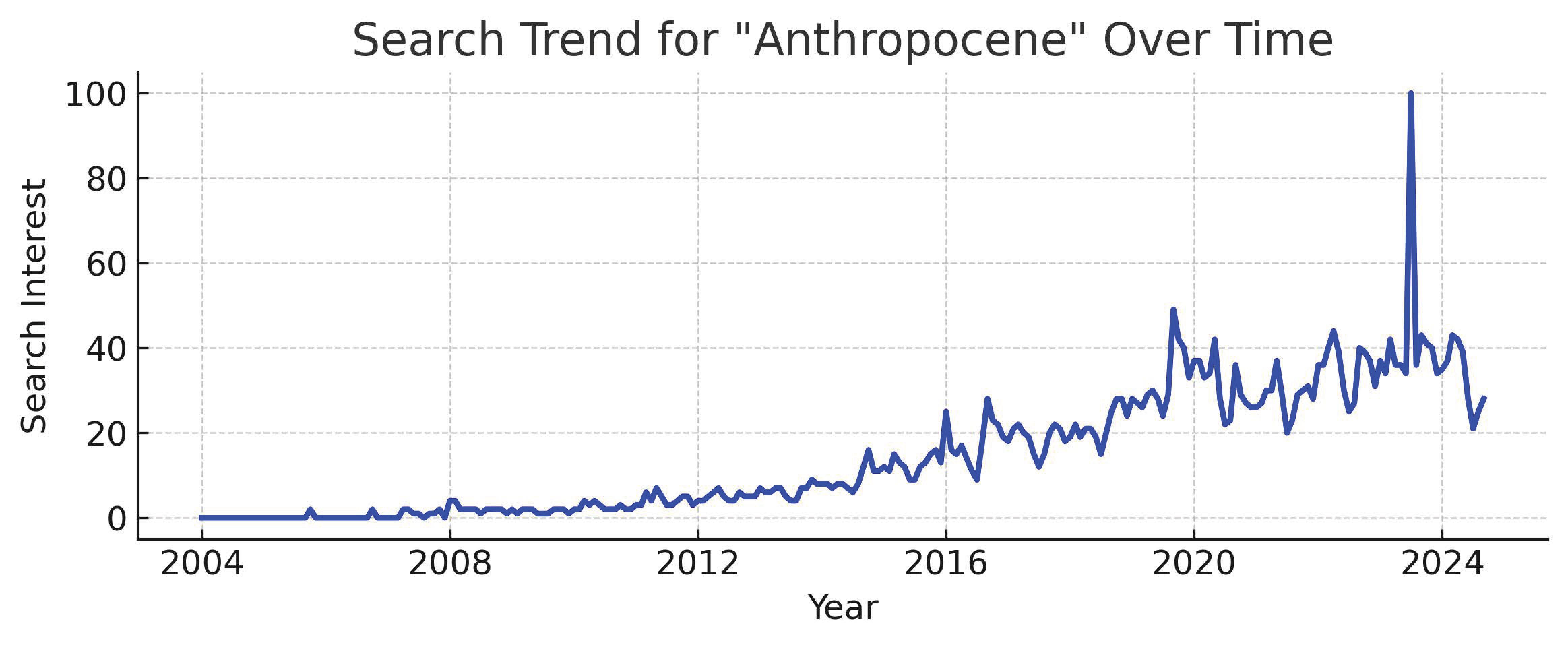
Figure 1. Search trend for “Anthropocene” over time (2004-2024).
Preprints 146190 g001
Figure 2. Lifecycle and environmental pathways of microplastics.
Preprints 146190 g002
Figure 3. The impact of floating debris on the functionality of fish passes. The top image shows an aerial view of a fish pass, while the bottom images highlight areas of potential blockage and disturbance due to debris accumulation, which can impede fish migration and affect water flow dynamics (Wrocław, Poland).
Preprints 146190 g003
Figure 4. Macroplastic deposited in the Nysa Kłodzka river valley (Ławica, Poland).
Preprints 146190 g004
Figure 5. Linkages of keywords obtained from 1001 papers with co-occurrence of “floating debris” in the Web of Science database. The figure was created by VOSviewer version 1.6.20 [65].
Preprints 146190 g005
Figure 6. Granules of various plastics in the form of primary microplastics smaller than 5 mm [118].
Preprints 146190 g006
Figure 7. Marine debris – a small plastic microchip adhered to the back of a shrimp. Source: Collection of Allen Shimada, NOAA/NMFS/OST, NOAA Digital Library.
Preprints 146190 g007
Figure 8. A comparison of the sizes of various particles, including the SARS-CoV-2 virus, nanoplastics, PM2.5 dust particles, Escherichia coli bacteria, and an erythrocyte (red blood cell).
Preprints 146190 g008
Figure 9. (1) Entangled fur seal, Credit: NOAA, Source: NOAA Digital Library; (2) Entangled fur seal, Credit: A. Lawhead, Source: NOAA Digital Library; (3) Entangled elephant seal, Credit: J. Hawes, Source: NOAA Digital Library; (4) Hawaiian monk seal entangled in rope, Credit: NOAA, Source: NOAA Digital Library.
Preprints 146190 g009
Figure 10. (1) A sea turtle entangled in a ghost net.Credit: Courtesy of Doug Helton, NOAA/NOS/ORR/ERD. Source: NOAA Digital Library.; (2) Blacktip shark entangled with strapping material. Credit: Kevin Lino, NOAA/NMFSPIFSCESD. Source: NOAA Digital Library; (3) Post-mortem examination of a dead Laysan Albatross, revealing the large amount of ingested plastic that led to its death. Photographer: Claire Fackler, Location: Hawaii, Papahanaumokuakea. Source: NOAA Digital Library.
Preprints 146190 g010
Figure 11. Formation of a debris island on the Odra River: a confluence of natural and anthropogenic floating debris (July 2020, Odra River, Wrocław, Poland).
Preprints 146190 g011
Figure 12. Trends in the number of research papers discussing ’floating debris’ from January 2018 to July 2023, illustrating the growth and subsequent decline in scholarly interest over this period.
Preprints 146190 g012
Figure 13. Distribution of “Floating Debris” articles in Web of Science (2018-2023) categorised by thematic focus.
Preprints 146190 g013
Figure 14. Categorization of articles in the ’Other’ group based on the type of floating debris mentioned: Natural (22), Anthropogenic (9), Combined Anthropogenic and Natural (12), Non-contextual (6), and Not specified (6).
Preprints 146190 g014
Figure 15. Distribution of articles discussing various types of anthropogenic floating debris. The chart illustrates the frequency of mentions for different materials, with plastic and domestic garbage being the most commonly discussed.
Preprints 146190 g015
Figure 16. Distribution of natural floating debris types across the reviewed articles.
Preprints 146190 g016
Figure 17. Distribution of specific natural floating debris types across the reviewed articles.
Preprints 146190 g017
Figure 18. Comprehensive summary chart illustrating the categorization of floating debris into anthropogenic and natural types, along with their respective subcategories, highlighting the diversity and complexity of materials analysed in this study.
Preprints 146190 g018
Figure 19. Macroplastics accumulated on trees along the Nysa Kłodzka River (123 km) after the September 2024 flood.
Preprints 146190 g019
Table 1. Comparison of the sizes of nanoplastics with other commonly occurring particles.
Particles Size (microns,μm) Source
SARS-CoV-2 0.07-0.09 [133,134]
Respiratory fluid particles 0.09-42 [135]
Nanoplastic <1 [136]
Escherichia coli 1-2 [137]
Red blood cell 6-8 [138]
Fine sand 63-200 ISO 14688-1;2002(E)
Disclaimer/Publisher’s Note: The statements, opinions and data contained in all publications are solely those of the individual author(s) and contributor(s) and not of MDPI and/or the editor(s). MDPI and/or the editor(s) disclaim responsibility for any injury to people or property resulting from any ideas, methods, instructions or products referred to in the content.
Copyright: This open access article is published under a Creative Commons CC BY 4.0 license, which permit the free download, distribution, and reuse, provided that the author and preprint are cited in any reuse.
Prerpints.org logo

Preprints.org is a free preprint server supported by MDPI in Basel, Switzerland.

Subscribe

Disclaimer

Terms of Use

Privacy Policy

Privacy Settings

© 2026 MDPI (Basel, Switzerland) unless otherwise stated