

Submitted:
14 January 2025
Posted:
15 January 2025
You are already at the latest version
Abstract
The use of non-invasive technologies is among the most accurate methods for assessing meat quality parameters. Beef tenderness and palatability are strongly influenced by the amount of intramuscular fat, commonly referred to as marbling. Marbling is widely used in breeding programs to select animals with superior meat quality. In this study, we analyzed 236 Angus bulls and 22 Angus heifers from various farms in Lithuania, all aged 450±112 days. Ultrasound examinations were performed using a linear transducer with a silicone standoff to evaluate the loin eye area. Key meat quality indicators such as fat thickness, loin area and thickness, and intramuscular fat were found to increase with the weight of bulls, ranging from 365±12.70 kg to 825.57 ± 11.75 kg (p < 0.001), and heifers, ranging from 273±20.71 kg to 767±41.01 kg (p < 0.001). The highest intramuscular fat values were observed at 7.50± 0.75% (p < 0.05) to 6.9±1.36% (p < 0.1) in bulls weighing 431.33–825.57 kg and 7.98 ± 0.28% (p <0.001) in heifers weighing 603 kg. These findings demonstrate the feasibility of selecting Angus cattle for improved meat quality traits across different weight categories.
Keywords:
longissimus dorsi muscle
; Black Angus
; ultrasound meat quality
; beef research
; bulls
; intramuscular fat
1. Introduction
The beef industry is increasingly using live animal carcass ultrasound as a method to control and produce high-quality, consistent products for today’s value-based market [1]. It is considered one of the most cost-effective methods by which livestock producers can improve the genetic traits of carcasses. Ultrasound imaging on live animals allows for determining the meat and fat characteristics, particularly intramuscular fat percentage and marbling score [12].
The most popular breeds of marbled beef are Aberdeen Angus and Black Angus [2]. Black Angus is widely recognized in the market for producing well-marbled, high-quality meat with exceptional taste and juiciness at a younger age. It is believed that the optimal age for slaughtering this breed is 18 months [1]. According to Travis G. [3], beef carcass quality is determined by measures such as maturity, marbling, texture, and color.
Ultrasound is the most effective method for assessing meat quality in living animals. Key indicators of good meat quality include fat thickness, the area of longissimus dorsi muscle, hide thickness, the percentage of intramuscular fat (IMF), and the marbling score [4]. Ultrasound is based on the high density of high-frequency sound ultrasonic waves, typically ranging from 2 to 10 MHz, on fat deposits, muscles, and connective and bone tissue. The advantage of such devices is their non-invasive nature, which allows for controlled examination without damaging muscle tissue, while also providing objective measurements and visualizations of muscle and fat beneath the animal’s hide [7].
Marbling, or intramuscular fat, is a crucial factor in determining the palatability of beef and serves as an important indicator of meat tenderness and juiciness [5]. It can also be utilized in breeding programs to select animals with the potential to pass on superior meat qualities to their progeny [6].
The marbling of beef indicates the ratio of intramuscular fat to the area of the longissimus dorsi muscle. This factor is pivotal in determining the quality of meat, particularly its texture and flavor [8]. The color of beef marbling is influenced by the distribution of fats within the muscle fibers. The marbling score significantly influences the quality and value of beef in various countries, including the United States, Canada, Australia, and Japan. It is believed that the intramuscular fat content in muscles, such as the longissimus dorsi, plays a crucial role in determining and assigning beef quality [9].
The marbling of beef tends to increase as animals age and is influenced by their growth rate and weight [10]. As animals mature, the rate of muscle accretion decreases, while the rate of fat accretion increases quadratically [10,11].
In addition, the flavor and juiciness of beef are affected by the amount of intramuscular fat in the muscle, specifically its ratio to the muscle tissue in the longissimus dorsi. Some scientists have shown that as muscle thickness increases, the juiciness of the meat decreases. Therefore, it is important to consider not only the age but also the breeding and housing conditions of the bulls.
The purpose of our research was to analyze meat quality indicators in Angus bulls and heifers using ultrasound in live animals and to demonstrate the impact of weight on meat quality parameters.
2. Materials and Methods
The study of the longissimus dorsi muscle was conducted using ultrasound scanning in living animals, a non-invasive technique, between 2021 and 2023 at the Agriculture Academy Bioeconomy Research, Institute of Animal Production Research and Innovation Center. Our research involved 236 bulls and 22 heifers of the Angus breed from a commercial farm, all at the 450±112 days of age. The animals were grouped by gender and weight, with a 50-kilogram weight difference between categories. The number of groups corresponds to the weight categories of the animals. The detailed data of animals is presented in Table 1.
The animals were kept under the same conditions and were fed a total mixed ration based on a weight range of 350–600 kg. The ration primarily consisted of 3.5-6 kg of concentrates (barley, maize, oats, peas, wheat) and 10-20 kg of grass hay, with a protein content of 226-426 g and dry matter content of 7,21-13,56 kg. Carcass quality indicators were estimated on live animals using an ultrasound linear transducer using a silicone sleeve for the loin eye area with a frequency range of 4.5 to 6.5 MHz and a depth of 8.8 to 13 cm on the 12th and 13th ribs following the methodology of Silva et al. [13], as presented in Figure 1.
The scanning provided a longitudinal view of the 12-13th ribs, approximately two-thirds of the distance from the medial to the dorsal end of the longissimus dorsi muscle. During the scan, the tip of the transducer is pressed deeply into the animal’s muscle for a few seconds until the image on the screen becomes smooth and consistent. Different structures are visible during the examination: subcutaneous fat, transverse section of the longissimus dorsi muscle, fat layer near the rib cage, after the examination the created images are saved. After the examination, the stored images are evaluated and adipose tissue measurements are performed in the scanner, then the muscle area and the fat layer near the ribs are assessed in this way. Fat measurement: subcutaneous fat is measured in millimeters between the 12th and 13th ribs. Interosseous fat, an indicator of external fat, is measured in millimeters by measuring the distance on the screen and using the measurement function. The area of the longissimus dorsi is measured in square centimeters between the 12th and 13th ribs by determining the perimeter of the cross-sectional image displayed on the screen (Figure 1) and the value of the ratio of muscle to lean product of the animal. Backfat thickness is one of the major quantitative traits that affects carcass quality in beef cattle and has been used to predict carcass retail yield components in live animals [35]. The amount of intramuscular fat determines the indicator known as marbling.
The evaluation parameters included body weight, hide thickness, fat thickness, loin thickness, loin area, yield grade, box height, and intramuscular fat percentage, which we determined using the Measure mode in the ultrasound program. Box height depends on the screen image and the size of the intercostal area, so the data may vary between animals, as shown in Figure 1.
Statistical analysis was performed using the parameters mean and standard deviation, following generally accepted standard statistical methods in Excel (MS Office 2010). Animals were divided into groups according to weight and gender for statistical analysis purposes. Mean and standard deviation (Mean±SD) were calculated for the general indicators, after which the reliability of these indicators was assessed. The reliability of indicators was evaluated based on probability values by using the statistical analysis software Stat 1: * p < 0.1, ** p < 0.05, *** p < 0.01, **** p < 0.001 and compared to animals with a live weight of 273-365 kg.
3. Results
The quality indicators of meat were determined by analyzing the ultrasound protocol results obtained from both bulls and heifers and comparing these results with their respective live weight data.
The meat quality parameters of bulls and heifers are presented in Table 2 and Table 3. Quality indicators such as fat thickness, loin area, loin thickness, and intramuscular fat (IF) increased with the weight of bulls from 365±12.70 kg to 825.57±11.75 kg (p<0.001) and heifers from 273±20.71kg to 767±41.01 kg (p <0.001).
The intramuscular fat of the longissimus dorsi muscle ranged from 3.36 to 7.97 % with different actual live weights and genders of animals. So, the best indicators of IF were found in the amount of 7.50± 0.75 % (p <0,05)—6.92±1.36 % (p <0,1) with a live weight of 431.33–825.57 kg in bulls and 7.98±0.28 % (p <0,001) with weight 603 kg in heifers. The estimated intramuscular fat was high beginning with weight 431 kg and 603 kg for bulls and heifers, suggesting that selection for this trait in Angus is feasible.
In this case, the indicators of fat thickness and loin area were 2.45±0.66 mm and 53.70±2.92 cm², respectively. However, when the weight increased to 825 kg, the indices of the longissimus dorsi muscle and fat increased significantly (p<0.05), while the intramuscular fat index remained at 6.92±1.36 (p <0.1). This demonstrates the relationship between these indicators and weight. These data indicate performance correlations between bulls and heifers in different weight categories.
In this study were determined a tendentious of increase between fat thickness average (range of 2.86 to 6.18 (p <0.05), loin thickness (5.54 to 7.98, p <0.1), and loin area (46.86 to 75.6, p <0.1) in bulls with increase weight. At this time, the highest rate was detected in bulls with a weight of 825.57 kg. Comparing indicators in the group of heifers, we found a similar dependence on live weight from 273 kg to 767 kg (p <0.001).
Ultrasound measurements allow for predicting the further growth of muscle or fat, which are among the main indicators of meat quality [14,15] and lean meat yield. In our research, this finding demonstrated a significant dependence, with values ranging from 2.51±0.44 to 3.97±0.35 in bulls (p<0.01) with weight 825.57 kg and from 2.72±0.12 to 4.05± 0.30 in heifers (weight 767 kg), (p < 0.01, p < 0.001), indicating muscle growth.
The main feature of the ultrasound method is that these indicators can be predicted during the growth stage in a live animal, allowing for dietary adjustments to improve meat quality.
4. Discussion
The results of the impact of live weight on the ultrasonic parameters of intramuscular fat correspond with the data from other authors. According to other researchers, it is extremely important to use efficient methods to estimate parameters related to meat quality, such as loin area, fat thickness, and intramuscular fat. The loin area allows us to estimate the grade of yield as this indicator is related to the amount of meat and muscle. The intramuscular fat percentage has a significant impact on juiciness and flavor, as this indicator is a determining factor related to meat quality and tenderness. The relationship between weight and intramuscular fat was observed at a weight starting from 431.33 kg in bulls, and as the weight increased to 775.43-825.57 kg, the intramuscular fat percentage was within the range of 6.92±1.36 (p<0.01). This quality index is a determining factor in beef quality and closely correlates with tenderness.
At present, most of the studies have dealt with the estimation of live animals compared with IF after slaughter. According to previous research [12,16], studies in live animals are not only prevalent but also tend to show higher parameter values compared to post-slaughter measurements. When the animal is slaughtered and the blood is drained, capillaries collapse, reducing the scattering effect of ultrasonic waves [17]. Additionally, the slaughter process induces stress in animals, leading to alterations in meat characteristics.
In our study, the bulls and heifers of the Angus breed were grown under single conditions and subjected to ultrasound examination to determine the parameters of meat quality, namely important indicators of meat marbling. Our findings demonstrate a clear dependency of marbling indicators on the live weight of the animals. The marbling index depends on the weight of the animals, and the results [10] consistently show that with an increase in live weight, the area of the longissimus dorsi muscle, and the marbling index increase. In our studies, the highest marbling score was observed at 7.50±0.75 (p<0.05) in bulls weighing 431.33 kg, and with an increase in weight to 825.57 kg, this score presented to 6.92±1.36 (p<0.1). Fabbri G. et al. [18] performed on 27 Charolaise heifers’ carcasses, 17 months and 362±59 kg and detected the average IF content of meat samples was 5.10±1.44%, which has an identity with our research with values of 3.36±0.70 % with weight 335±15.56 kg. The intramuscular fat of heifers increased to 7.98±0.28 (p< 0.001) weighing 603 kg, with a simultaneous increase in measures of loin area and fat thickness. Similar marbling indices (p<0.10) were determined in 46 bull’s weight 644.8 kg [19] within 3.3-4.2 %, fat depth of 5.1 mm, and longissimus muscle area of 92.9 cm. It was observed that intramuscular fat content increased to a range of 3.87% to 4.86% as weight increased in 216 Angus-crossbred steers weighing 270±19.3 kg [20]. These research show that the percentage of intramuscular fat is variable depending on levels weight and gender. The results of research on carcasses in Bali cattle also showed that the performance of body weight and carcass quality differs between bulls and cows, as well as among age variations [21].
Fiore E. [22] detected a correlation between the actual intramuscular fat percentage in meat during ultrasound analysis and the IF at the time of slaughter, ranging from ≤4.24% to ≥5.76%. The authors assessed the impact of the marbling level and fat percentage on the palatability traits of meat and detected relating (p< 0.01) to tenderness, juiciness, and flavor. This has demonstrated the percentage of intramuscular fat is a more objective measure of marbling content [23].
The authors compared the meat quality and marbling properties of Angus, Simmental, Charolais, and Limousin steers (totaling 416) with an average intramuscular fat content of 3.25% in the longissimus dorsi. According to their findings, clear differences in meat quality were observed between breeds despite similar IF contents [24,25].
Studies have shown that ultrasound measures of fat thickness, loin area, and intramuscular fat are accurate indicators of their corresponding carcass traits in fed slaughter in Angus bulls [26]. An evaluation of ultrasound results of fat thickness, loin area, and percentage of intramuscular fat showed results (>0.40) of heifers and bulls Angus at 398 days of age. Ultrasound measured the intramuscular fat of heifers was 4.22 % [27].
Nogalski Z. [6] showed that crossbred bulls with an average body weight of 520 kg and 18 months of age, had intramuscular fat of 2.33% [2]. Results of the research showed the possibility of predicting intramuscular fat content in beef in vivo through ultrasound measurements and computer image analysis of Holstein and Slovak Simmental bulls [29]. The data established a significant effect of treatment and time of food on the marbling scores (p< 0.05) at the location of the longissimus dorsi in Angus, with grades of 3.5 ± 0.5 and 4.6 ± 0.3 for the AM-fed and PM-fed groups, respectively (p < 0.05) [30].
Aass et al. [31] in the USA and Australia have recognized that greater live weight is associated with larger longissimus muscle area, fat thickness, and the scored meat marbling while ultrasound scanning Angus and Hereford bulls on farms. Ukrainian researchers showed that the ’muscle eye’ area increases in bulls weighing 400-450 kg at 20-22 months of age due to the impact of age and live weight in Ukrainian Black-and-White Dairy and Ukrainian Meat breeds [32].
Ultrasound scanning of the longissimus dorsi muscle in live animals allows for the identification of individuals with superior beef quality traits, thereby enhancing the breeding value of the cattle herd and enabling further adjustments to their diet.
5. Conclusions
In this study, we demonstrated that ultrasound analysis serves as an effective monitoring tool for predicting carcass quality in live beef cattle. The analysis also revealed notable differences in beef quality traits between bulls and heifers. The intramuscular fat index was significant at 7.50± 0.75 (p <0.05) in bulls weighing 431.33±16.74 (p<0.05) kg and in heifers at 7.97±0.40 (p<0.001) weighing 603±5.77 kg that shown about the feasibility of the selection on these indicators in Angus at different weights. The significant growth of muscle mass was indicated by the reliability of grade yield in both groups of cattle. Relationships were established between the increases in fat thickness, loin area and thickness, intramuscular fat, and animal weight.
Author Contributions
Conceptualization, E.M., V.Z., O.I.; Methodology, E.M., V.J, V.Z., A.K..; Software, V.J, V.Z., A.K.; Validation, E.M., V.J, V.Z., O.I., A.K.; Formal Analysis, E.M., V.J, V.Z., O.I., A.K.; Investigation, E.M., V.Z., O.I.; Resources, E.M., V.Z.; Data Curation, E.M., V.J, A.K..; Writing—Original Draft Preparation, E.M., V.Z., O.I..; Writing—Review and Editing, E.M., V.Z., A.K.; Visualization, E.M., V.Z., O.I.; Supervision, E.M., V.J, V.Z.; Project Administration, E.M., V.J.; Funding Acquisition, E.M., V.J, A.K.. All authors have read and agreed to the published version of the manuscript.
Funding
This research was funded by The European Innovation Partnership for Agricultural productivity and Sustainability (EIP-AGRI) project „Konkurencingas ūkis“(KONUK), Nr. 35BV-KK-15-1-07872-PR001.
Institutional Review Board Statement
Not applicable.
Informed Consent Statement
Not applicable.
Data Availability Statement
Data are contained within the article.
Acknowledgments
We are grateful to all specialists of Biological Research Center and Institute of Cardiology, Lithuanian University of Health Sciences for their assistance.
Conflicts of Interest
The authors declare no conflicts of interest
References
- Rhonda, C.; Parish, J.A.; Karisch, B. Using Live Animal Carcass Ultrasound Information in Beef Cattle. Selection Extension Service of Mississippi State University 2017, 1, 1–7. [Google Scholar]
- Konstandoglo, A.; Foksha, V.; Gorea, F. Genetic characteristics of the cattle population of the Aberdeen-Angus breed Scientific Papers. Series D. Animal Science 2018, 1, 41–45. [Google Scholar]
- Travis, G.; Quinn, O.; Legako, J.; Brooks, J.; Miller, M. Evaluation of the contribution of tenderness, juiciness, and flavor to the overall consumer beef eating experience. Transl Anim Sci. 2018, 2, 26–36. [Google Scholar]
- Perkins, M.; Meadows, A.; Hays, B. Ultrasonic Evaluation of Beef Cattle for Carcass. University of Arkansas, United States Department of Agriculture and County Governments Cooperating 2016, 1, 22. [Google Scholar]
- Quinn, T.; Legako, J.; Brooks, J.; Miller, M. Evaluation of the contribution of tenderness, juiciness, and flavor to the overall consumer beef eating experience. Translational Animal Science 2018, 2, 26–36. [Google Scholar]
- Nogalski, Z.; Starczewski, M.; Purwin, C.; Pogorzelska-Przybyłek, C.; Sobczuk-Szul, M.; Modzelewska-Kapituła, M. Carcass and meat quality traits in young bulls fed Virginia fanpetals silage. Ann. Anim. Sci. 2020, 20, 1127–1140. [Google Scholar] [CrossRef]
- Weik, F.; Hickson, R.; Morris, S.; Garrick, D.; Archer, G. Genetic Parameters for Growth, Ultrasound and Carcass Traits in New Zealand Beef Cattle and Their Correlations with Maternal Performance. Animals 2022, 12, 25. [Google Scholar] [CrossRef]
- Fukuda, O.; Ahmed, J.; Hashimoto, D. Estimation of Marbling Score in Live Beef Cattle Using Bayesian Network. Journal of Control, Measurement, and System Integration 2017, 4, 297–302. [Google Scholar] [CrossRef]
- Piao, M.; Jin Sol Jung, D.; Joong Kang, H.; Ju Park, S.; Kim, M. Effects of dietary glycerol inclusion on growth performance, carcass and meat quality characteristics, glycogen content, and meat volatile compounds in Korean cattle steers. Anim Biosci. 2021, 34, 603–612. [Google Scholar] [CrossRef]
- Ugnivenko, A.; Getya, A.; Nosevych, D.; Antoniuk, T.; Kruk, O.; Slobodyanyuk, N.; Ivaniuta, A.; Omelian, A.; Gryshchenko, S.; Israelian, V. The study of “muscle eye” in bulls of Ukrainian black-spotted dairy-meat breed as a factor in improving the properties of meat products. Potravinarstvo Slovak Journal of Food Sciences 2022, 16, 519–529. [Google Scholar] [CrossRef]
- Golubenko, T. Influence of breeds on growth, development and productive quality of calls agricultural sciences. Colloquium 2021, 17, 16–25. [Google Scholar]
- Luis Nunes, J.; Piquerez, M.; Pujadas, M.; Armstrong, E.; Fernández, A.; Lecumberry, F. Beef quality parameters estimation using ultrasound and color images. BMC Bioinformatics 2015, 16, 4–6. [Google Scholar] [CrossRef] [PubMed]
- Real-Time Ultrasound Evaluation of Carcass Traits. URL://www.gov.mb.ca/agriculture/livestock/beef/real-time-ultrasound-evaluation-of-carcass-traits.html.
- Seroba, M.; Maiwashe, A.; Nephawe, K.; Norris, D. Genetic parameter estimates for live animal ultrasound measures of carcass traits in South African Angus cattle. South African Journal of Animal Science 2011, 41, 243–249. [Google Scholar] [CrossRef]
- Beriain, M.J. , Insausti, K., Valera, K., Indurain, G., Purroy, A., Carr, T.R., Horcada, A. Effectiveness of using ultrasound readings to predict carcass traits and sensory quality in young bulls. Computers and Electronics in Agriculture 2021, 183, 1–9. [Google Scholar] [CrossRef]
- Угнівенкo, М.; Кoс, Н.; Антoнюк, Т.; Жукoвский, О.; Крук, О. Мармурoвість m. longissimus dorsi у великoї рoгатoї худoби. Animal science and food technology 2020, 11, 77–84. [Google Scholar]
- Whittaker, A.; Park, B.; Thane, B.; Miller, R.; Savell, J. Principles of ultrasound and measurement of intramuscular fat. J. Anim. Sci. 1992, 70, 942–952. [Google Scholar] [CrossRef]
- Fabbri, G.; Gianesella, M.; Gallo, L.; Morgante, M.; Contiero, B.; Muraro, M.; Boso, M.; Fiore, E. Application of Ultrasound Images Texture Analysis for the Estimation of Intramuscular Fat Content in the Longissimus Thoracis Muscle of Beef Cattle after Slaughter. Animals 2021, 11, 11–17. [Google Scholar] [CrossRef]
- Bergen, R.; Miller, S.; Mandel, I.; Robertson, W. Use of live ultrasound, weight and linear measurements to predict carcass composition of young beef bulls. Canadian journal of animal science 2004, 23–35. [Google Scholar] [CrossRef]
- Neel, J.; Swecker, W.; Brown, M. Comparison of Ultrasound and Actual Beef Carcass Measurements as Influenced by Stockering Performance and Finishing System. Journal of Animal Science and Research 2019, 3, 1–6. [Google Scholar]
- Jakaria, H.; Khasanah, R.; Priyanto, M.; Baihaqi and Ulum, M. Prediction of meat quality in Bali cattle using ultrasound imaging. J. Indonesian Trop. Anim. Agric. 2017, 42, 59–65. [Google Scholar] [CrossRef]
- Fiore, E.; Fabbri, G.; Luigi, G.; Morgante, Boso, M. ; Gianesella, M.Application of texture analysis of b-mode ultrasound images for the quantification and prediction of intramuscular fat in living beef cattle. Research in Veterinary Science 2020, 131, 254–258. [Google Scholar] [CrossRef] [PubMed]
- Travis, G.; Jerrad, F.; Brooks, J.; Miller, M. Evaluation of the contribution of tenderness, juiciness, and flavor to the overall consumer beef eating experience. Transl. Anim. Sci. 2018, 2, 26–36. [Google Scholar]
- Chambaza, M.; Scheederb, M.; Kreuzerb, M.; Dufey, P. Meat quality of Angus, Simmental, Charolais, and Limousin steers compared at the same intramuscular fat content. Meat Science 2003, 63, 491–500. [Google Scholar] [CrossRef] [PubMed]
- Sapp, R. L.; Bertrand, J.; Pringle, T.; Wilson, D. Effects of selection for ultrasound intramuscular fat percentage in Angus bulls on carcass traits of progeny. J Anim Sci. 2017, 8, 22. [Google Scholar] [CrossRef] [PubMed]
- Seroba, M.; Maiwashe, A.; Nephawe, K.; Norris, D. Genetic parameter estimates for live animal ultrasound measures of carcass traits in South African Angus cattle. South African Journal of Animal Science 2011, 41, 243–249. [Google Scholar] [CrossRef]
- Wilson, D.; Rouse, G.; Hays, G. Carcass EPDs from Angus Heifer Real-time Ultrasound Scans. Beef Research Report 2001, 1, 4–5. [Google Scholar]
- Siachos, N.; Oikonomou, G.; Panousis, N.; Banos, G.; Arsenos, G.; Valergakis, G. Association of Body Condition Score with Ultrasound Measurements of Backfat and Longissimus Dorsi Muscle Thickness in Periparturient Holstein Cows. Animals 2021, 11, 818. [Google Scholar] [CrossRef]
- Polák, P. Prediction of intramuscular fat in live bulls using real-time ultrasound and image analysis. Journal of Animal and Feed Sciences 2008, 17, 30–40. [Google Scholar] [CrossRef]
- Briana, F. Smith. Performance and ultrasound guided body conditioning in Angus Crossbred steers following a 12-hour shift in feed time. Faculty of California State Polytechnic University, Pomona Department of Animal & Veterinary Sciences.
- Aass, L.; Gresha, J.; Klemetsdal, G. Prediction of intramuscular fat by ultrasound in lean cattle. Livestock Science 2006, 101, 228–241. [Google Scholar] [CrossRef]
- Угнівенкo, М.; Кoс, Н.; Антoнюк, Т.; Жукoвский, О.; Крук, О. Мармурoвість m. longissimus dorsi у великoї рoгатoї худoби. Animal science and food technology 2020, 11, 77–84. [Google Scholar]
- Munoz-Osorio, G.; Tırınk, C.; Thobela, L.; Ramirez Bautista, A.; Cruz-Tamayo, A.; Dany Alejandro Dzib-Cauich, D.; Garcia Herrera, A.; Chay-Canul, A. Using fat thickness and longissimus muscle traits real-time ultrasound measurements in Black Belly ewe lambs to predict carcass tissue composition through multiresponse multivariate adaptive regression splines algorithm. Meat Science 2024, 207, 1–7. [Google Scholar] [CrossRef] [PubMed]
- Duff, C.; Werf, J.; Parnell, J.; Clark, S. Comparison of two live-animal ultrasound systems for genetic evaluation of carcass traits in Angus cattle. Transl. Anim. Sci. 2021, 5, 1–11. [Google Scholar] [CrossRef] [PubMed]
- Schroder, U. , Staufenbiel, R. Invited Review: Methods to Determine Body Fat Reserves in the Dairy Cow with Special Regard to Ultrasonographic Measurement of Backfat Thickness. J. Dairy Sci. 2005, 89, 1–14. [Google Scholar] [CrossRef] [PubMed]
Figure 1.
The example ultrasound images of the longissimus dorsi muscle Angus bulls, aged 1 year, weight of 580 kg, IF 8.26 % (A) and 610 kg, IF 7.10 % (B), HT—hide thickness, FT—fat thickness, LT—loin thickness, LA—loin area, YG—yield grade, BX—box height, IF—intramuscular fat.
Figure 1.
The example ultrasound images of the longissimus dorsi muscle Angus bulls, aged 1 year, weight of 580 kg, IF 8.26 % (A) and 610 kg, IF 7.10 % (B), HT—hide thickness, FT—fat thickness, LT—loin thickness, LA—loin area, YG—yield grade, BX—box height, IF—intramuscular fat.
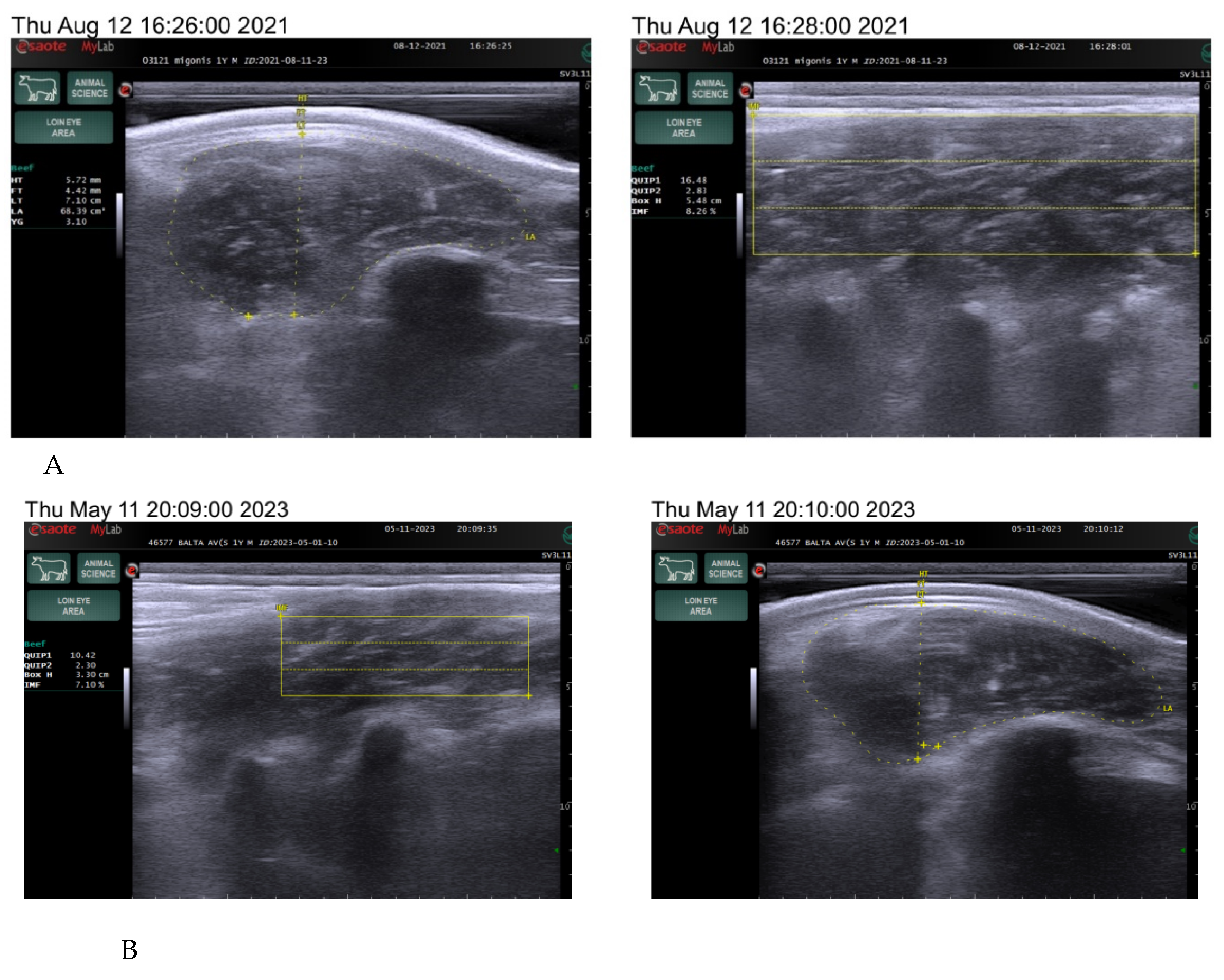

Table 1.
The sample number of Angus bulls and heifers.
| Sex | Groups of classes | Groups of animals | |
|---|---|---|---|
| Female (Heifers) | 22 | ||
| Weight category, kg | Below 300 | 1 | 7 |
| 300-350 | 2 | 2 | |
| 350-400 | 3 | 7 | |
| 400-500 | 4 | 2 | |
| 600-650 | 5 | 3 | |
| 650-700 | 6 | 2 | |
| Male (Bulls) | 236 | ||
| Weight category, kg | 350-400 | 1 | 4 |
| 400-450 | 2 | 6 | |
| 450-500 | 3 | 24 | |
| 500-550 | 4 | 40 | |
| 550-600 | 5 | 46 | |
| 600-650 | 6 | 53 | |
| 650-700 | 7 | 29 | |
| 700-750 | 8 | 13 | |
| 750-800 | 9 | 14 | |
| 800-850 | 10 | 7 | |
Table 2.
Meat quality indicators in bulls of the Angus breed.
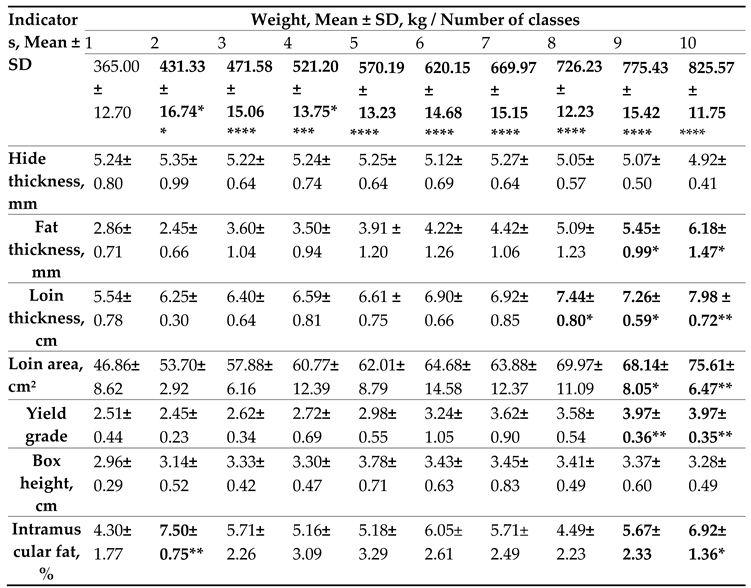 |
*p <0.1, ** p <0.05, **** p <0.001—compared to the animals with a live weight of 365 kg.
Table 3.
Meat quality indicators in heifers of the Angus breed.
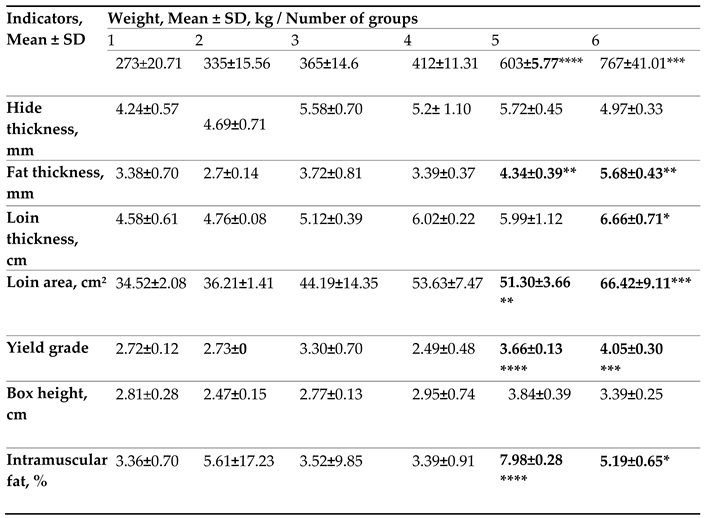 |
*p <0.1, ** p <0.05, *** p <0.01, **** p <0.001—compared to the animals with a live weight of 273 kg.
Disclaimer/Publisher’s Note: The statements, opinions and data contained in all publications are solely those of the individual author(s) and contributor(s) and not of MDPI and/or the editor(s). MDPI and/or the editor(s) disclaim responsibility for any injury to people or property resulting from any ideas, methods, instructions or products referred to in the content. |
© 2025 by the authors. Licensee MDPI, Basel, Switzerland. This article is an open access article distributed under the terms and conditions of the Creative Commons Attribution (CC BY) license (http://creativecommons.org/licenses/by/4.0/).
Copyright: This open access article is published under a Creative Commons CC BY 4.0 license, which permit the free download, distribution, and reuse, provided that the author and preprint are cited in any reuse.


