

Submitted:
13 January 2025
Posted:
14 January 2025
You are already at the latest version
Abstract
The study aimed to determine the effect of intra-vaginal bio-stimulation with a modified penis-like device (mPLD) or artificial penis and clitorial massage subsequently artificial insemination (AI) to increase the pregnancy rate of water buffaloes. The study was conducted from July 2023 to June 2024 in the selected coastal region of Bangladesh. The AI was performed on 160 buffalo cows after observing their estrus sign. During AI, the buffalo cows were divided into four groups (group A: only AI was conducted; group B: intra-vaginal bio-stimulation with mPLD following AI; group C: massage of the clitoris after AI; group D: both mPLD and the clitorial massage was done following AI). Each group consisted of 40 animals. Age, parity, body weight, reproductive health status, history of previous calving difficulties, and estrus detection method were recorded. The overall pregnancy rate was found 41.3%. The pregnancy rate in groups A, B, C, and D were 32.5, 42.2, 37.5 and 52.5%, respectively. It is determined that both application of intra-vaginal bio-stimulation with mPLD and massage of the clitoris following AI (group D) showed a significant effect on pregnancy rate than the control group (group A). It is concluded that the application of mPLD in conjugation with massage of the clitoris enhances the pregnancy rate of buffalo cows.
Keywords:
Artificial Penis
; Bio-stimulation
; Pregnancy rate
1. Introduction
Water buffalo (Bubalus bubalis) are a crucial livestock species, contributing significantly to the agricultural economy of Bangladesh, particularly in coastal regions. The number of buffalo inhabitants in Bangladesh is 1.471 million, which are mostly reared in the coastal region as bathan practice (free range rearing of animals at fallow land and river-basin area) [1]. Buffalo’s populaces in Bangladesh are typically the native type that covers swamp and riverine types which are distributed all over the country. Nevertheless, about 40% of the entire buffalo are in the coastal area, Jamuna-Brahmaputra and Meghna-Ganga floodplains measured to be buffalo prone [2]. Coastal buffaloes are salinity tolerant and capable of roaming in saline water. While buffaloes exhibit relative resistance to infectious diseases, they are prone to various reproductive disorders [3]. Improving reproductive efficiency in water buffalo is a priority for researchers and farmers alike. Inadequate estrus detection and artificial insemination (AI) efficiency often limit successful breeding in buffalo. In this context, bio-stimulation methods, such as intra-vaginal stimulation and clitoral massage, have emerged as promising alternatives to enhance estrus expression, facilitate successful insemination, and ultimately increase pregnancy rates [4]. Bio-stimulation is a natural or mechanical process used to induce physiological responses that enhance reproductive performance. This technique leverages sensory stimuli to improve hormonal activity, ovarian function, and uterine receptivity, creating favorable conditions for successful conception [5]. Both natural mating and artificial insemination systems are prevalent in farming practices in Bangladesh, although artificial insemination adoption remains limited. This is largely due to challenges such as seasonal breeders, poor estrus signs, lower pregnancy rate, and variability of estrus length in buffaloes. Moreover, buffalo also tend to show heat signs primarily at night, which poses difficulties for farmers in observation. During the estrus cycle of buffalo cows, the farmers are looking for bull buffalos instead of AI for breeding purposes. This preference is partly due to the interval of 30 hours between standing estrus and ovulation in buffaloes, a critical factor for successful artificial insemination [6]. In natural breeding, the pregnancy rate is higher than in artificial insemination. It happens because the bull can recognize the suitable time of estrus of buffalo cows, the volume of the semen, the concentration of semen as well as the bio-stimulation of the penis during mating [4]. The genital tract such as clitoris stimulation at artificial insemination may influence the rate of pregnancy in cattle as explored in several studies and increase pregnancy rates by 6.3 to 7.5% in cows [5,7]. Previously, it used a penis-like device (PLD) after artificial insemination for intra-vaginal sensation and got a higher pregnancy rate in cows [4]. However Intra-vaginal bio-stimulation involves the use of mechanical devices designed to mimic the natural stimulation provided by the bull’s penis during mating. These devices stimulate the vaginal walls and cervix, promoting the release of reproductive hormones such as oxytocin and luteinizing hormone (LH). Oxytocin facilitates uterine contractions and sperm transport, while LH induces ovulation, ensuring optimal timing for fertilization [4,8]. In this study, we used the modified penis-like device/artificial bull penis for intra-vaginal bio-stimulation immediately following artificial insemination in buffaloes. As far as our knowledge extends, there has been no prior investigation into the application of both intra-vaginal bio-stimulation with mPLD and clitorial massage subsequently artificial insemination in buffaloes. Therefore, The objective of this study is to evaluate the effect of intra-vaginal bio-stimulation using a modified penis-like device and clitoral massage on the pregnancy rates of water buffalo in the coastal region of Bangladesh.
2. Materials and Methods
This study was carried out at the Theriogenology and Reproductive Biotechnology Laboratory under the Department of Medicine, Surgery and Obstetrics, Faculty of Animal Science and Veterinary Medicine, Patuakhali Science and Technology University, Bangladesh.
2.1. Materials
2.1.1. Anthelmintics, Vitamins and Minerals
The broad spectrum anthelmintics in combination of levamisole 600mg and triclabendazole 900mg (Renadex® Vet 2g bolus @ 1 bolus/75kg body weight and repeated after 7 days), vitamin AD3E (Renasol AD3E ® Vet 30ml injection @ 10ml intramuscularly 7 days interval for three injection) were purchased from Renata Animal Health, Dhaka, Bangladesh.
2.1.2. Modified Penis Like Device (mPLD)/Artificial Penis
The mPLD/artificial penis was made according to the procedure described by Biswas et al. [4]. It was modified according to the length of the buffalo bull penis (Figure 1). The measurement was 20cm in length, the diameter ranged from 12cm to 5cm from the base to tip gradually and the handle was 12cm. In this device, there are two openings to pass the AI gun through the device during insemination. We made another opening upper the handle to push warm water into the device for a warm sensation like an erect penis.
2.1.3. Semen
The semen straws were collected from the buffalo breeding station, Bangladesh Livestock Research Institute, Savar, Dhaka. In some context, the semen from the government breeding station, Department of Livestock Services, Savar, Dhaka was used. The semen straws were preserved in liquid nitrogen as the standard protocol of cryopreservation.
2.2. Methods
2.2.1. Study Area and Period
The study was conducted in the selected coastal areas of Bangladesh which were Charfasson upazila (sub-district) in Bhola district (Latitude: 22° 11’ 4.92” N, Longitude: 90° 45’ 45.00” E) and Bauphal Upazila in Patuakhali district (Latitude: 22° 25’ 45.12” N, Longitude: 90° 30’ 50.04”E). The laboratory work was conducted during the period from July 2023 to June 2024.
2.2.2. Selection and Management of Buffalo Heifers/Cows
A total of 200 buffalo heifers/cows were selected by simple random sample method from the study area for the experiment based on the research communication, health status, calving interval, farmer’s accountability, etc. Different types of inspections were performed to select buffalo heifers/cows. Age, parity, body condition score, reproductive health status, and previous calving difficulties were recorded. The breed of buffalo in the study area was mostly non-descriptive indigenous types. Therefore, we did not consider the breed for influencing factors in the study. During selection, anthelmintics and vitamin AD3E were administered. It was suggested to inform us when the buffalo heifer/cows come to estrus. Then after observing the sign of estrus, experimental procedures were performed. Most of the buffaloes were reared in the bathan system. Farmers were bringing their animals for grazing from early morning up to afternoon and then returning home. Farmers were supplied a small amount of mixed concentrate (rice polis, wheat bran, broken rice, and oil cake) per animal. It was also advised to feed their buffalo heifer/cows a sufficient amount of concentrate and green grass for maintaining good reproductive health. Finally, A total of 160 buffalo cows were performed AI after observing the estrus sign. The reproductive health of animals was confirmed by manual palpation of the uterus and ovary per rectum.
2.2.3. Grouping of Animals
The grouping of animals was done according to the category of the different parameters considering the research hypothesis. The age was determined as previously described by Banerjee et al., [9] grouped ≤3 to 4, 4.1 to 5, 5.1 to 6, and 6.1 to ≥7 years old. According to the number of previous calving history or parity, it was categorized as Parity 0 (not yet calved/heifer), Parity 1, 2, 3, and ≥ 4. The body weight was measured by Rondo weighing tape [10]. According to the body weight, animals were classified as ≤200 to 300, 301 to 400, and >400kg. The reproductive health was scaled as good, moderate and poor as previously described by Biswas et al. [4]. The presence or absence of a previous history of calving difficulties was also considered as an influencing factor in pregnancy rate. A vasectomized buffalo bull was used as a teaser bull in this study for estrus detection besides the farmer’s detection. Therefore, the estrus detection was categorized as estrus detection by farmers and by teaser bulls.
2.2.4. Use of mPLD/Artificial Penis
The penis-like device was used as described by Biswas et al. [4]. The device was modified with size and shape for buffalo cows. During AI, it was cleaned and lubricated with gel as well as push warm water (45-48ºC) by a 50ml syringe with an 18G needle. AI gun was passed through the device after thawing and loading the AI gun with semen straw in the way of standard procedure.
2.2.5. Experimental Design
The study was designed as four experimental groups. Each group consisted of 40 animals. The experimental intervention was described as follows-
Group A (40): In this group, buffalo cows/heifers were inseminated by AI technicians after observing heat signs without applying intra-vaginal bio-stimulation.
Group B (40): In this group, AI was conducted after observing estrus signs, and intra-vaginal bio-stimulation was applied through mPLD following artificial insemination to trigger ovulation and increase sperm swimming.
Group C (40): In this group, AI was conducted after observing estrus signs, and a clitorial massage was applied for 30 seconds.
Group D (40): In this group, both mPLD and the clitorial massage were applied following AI.
2.2.6. Estrus Detection and Insemination
In this study, the estrus of buffalo cows was detected by observing signs of estrus such as drooling of vaginal mucus and standing to be mounted. It was also noticed, that excessive bellowing, vulval swelling, restlessness, and temporary teat engorgement. Sometimes rectal palpation was performed and a coiled and tonous uterus was indicated as an estrus sign in case of silent heat. Congested vulva and clear mucus streaming were also considered as an estrus sign. We also used a teaser bull for estrus detection in a bathan to compare with the estrus detection by farmers. After the determination of estrus, the cow was inseminated by a skilled AI technician within 12 to 18 hours of observing estrus household buffaloes. The am-pm method was used for the animals which were reared as bathan practice.
2.2.7. Pregnancy Diagnosis
The absence of estrus signs following 20-25 days of AI, was primarily considered as pregnant. The confirmatory diagnosis was done by rectal palpation of the reproductive organ between 60-90 days of post-insemination.
2.2.8. Statistical Analysis
The collected data was recorded and coded in an Excel sheet. The rate was expressed as a percentage (%). The analysis of variance was calculated by SPSS statistical Software (version 20.0). The chi-square test was conducted. The logistic regression was also conducted to analyze the pregnancy-associated risk factors. The test was considered significant at a level of P < 0.01 and P < 0.05. The data were decoded, entered, and sorted accordingly using MS Excel. The data were then transferred to the SPSS software for descriptive analysis. Initially, the data were sorted and cross-checked for duplication and/or missing values. The missing values for each variable were excluded from the analysis [11].
3. Results
3.1. Pregnancy Rate in Different Intervention
The bar diagram illustrates the pregnancy rates across four experimental groups A, B, C, and D which were 32.5, 42.2, 37.5 and 52.5%, respectively (Figure 2). The pregnancy rate in group D exhibited the highest pregnancy rate which was significantly out forming the other groups. The use of mPLD and clitorial massage subsequently AI has been shown as an effective protocol. The single-use of mPLD (Group B) during AI in buffalo cows also showed a relatively strong performance, though it was approximately 10% lower than that of group D. These gaps may suggest that the more sexual bio-stimulation during AI is a more favorable condition for achieving the highest chances of pregnancy in buffalo cows.
3.2. Factors Influencing the Pregnancy Rate
The results from Table 1 highlight various factors influencing the pregnancy rate in relation to different experimental groups. The findings indicated the complex interplay of physiological, managemental, and external factors affecting reproductive success.
3.2.1. Age of Animals
The pregnancy rate in ≤3 to 4, 4.1 to 5, 5 .1 to 6, and 6.1 to ≥7 years old buffalo cows were 43.75, 45.24, 41.38, and 32.14%, respectively (Table 1). The highest pregnancy rate (45.24%) was observed in animals aged between 4.1 and 5 years. In this study, there was no significant (p=0.819) differences as well as no relationship ( ꭓ2=0.925) among these age groups, were found. It was also found that the pregnancy rate in group D was higher than that of other groups.
3.2.2. Parity of Cows
The pregnancy rates in parity 0 (heifer), 1, 2, 3, and ≥4 were 47.22, 40.63, 37.93, 50.00 and 33.33%, respectively (Table 1). There was no significant (p=0.804) variation among the parity groups, however, the statistical data showed a positive relationship (ꭓ2=1.628). The highest pregnancy rate was found in parity 2 in group D.
3.2.3. Body Weight
According to the body weight of buffalo cows, the overall pregnancy rate of ≤200 to 300, 301 to 400, and >400kg body weight of cows were 33.33, 45.78, and 41.38%, respectively (Table 1). There was no significant difference (p=0.583), but there was a positive relationship ((ꭓ2=1.080) among the groups.
3.2.4. Reproductive Health
Based on reproductive health status (condition of uterus and ovary) during the AI, the overall pregnancy rate in good, moderate, and poor scaling were 35.48, 43.90 and 16.67%, respectively. There was no significant (p=0.320) difference among these criteria, however, the moderate reproductive health status of cows was interplayed more than 2.2 times stronger relationship (ꭓ2=2.279) than that of poor reproductive health. The pregnancy rates in groups B and D were comparatively higher than that of other groups in connection with the moderate condition.
3.2.5. Calving Difficulties
The cows with a history of previous calving difficulties showed poorer (20%) chances of pregnancy rate than those with previous safe and easy parturition (41.94%).
3.2.6. Heat Detection Methods
The pregnancy rate was higher (61.54%) in the cows that the were detected estrus by teaser bulls than that of estrus detected by farmers (39.46%). It was determined no significant (p=0.121) differences, however, it was interplayed a more than twice relationship (ꭓ2=2.403). In case of logistic regression analysis, The overall pregnancy rate in the group of estrous sign detection by the farmer significantly (p=0.047) 4 times higher chances of pregnancy than that of teaser bull’s estrous sign detection (Table 2).
4. Discussion
The overall pregnancy rate was found 41.3% (66/160) in this study. It is lower than that of Sarker et al. [8] in the coastal region who found the overall pregnancy rate is 46.4%. It is due to the high pregnancy rate in natural services that was also included in the average pregnancy rate. The overall rate of pregnancy in the study is similar to the report published by Yousuf et al. [12] and higher than the report of Hoque et al. [13] whose were found 41.3%, and 28.0%, respectively.
According to the experimental protocol, the combined application of of intra-vaginal bio-stimulation with mPLD and clitorial massage after AI (Group D) was determined higher pregnancy rate than that of other interventions. The single-use of mPLD (Group B) also increased the pregnancy rate more than that of without the application of any interventions (Group A) and a single use of clitorial massage (Group C). In group B, we used an mPLD (artificial penis) that gives bio-stimulation and hastens the ovulation process, and increases the pregnancy rate than only the AI service group. The buffalo cows were approachable to intra-vaginal bio-stimulation due to mPLD may help them to get feelings of bull’s penis therefore it was found a relatively higher pregnancy rate [8]. The intra-vaginal bio-stimulation helps to get feelings of the bull penis, triggering ovulation and stimulating cyclic activity. Consequently, this enhances the pregnancy rate of buffalo heifers/cows [4]. The artificial penis may also influence the secretion of oxytocin hormone (not determined in this study) which significantly triggered the sperm transportation and surge release of LH surge. Previously, it was stated that the genital tract such as clitorial stimulus at AI favorably may influence pregnancy rates in cattle which is shown in several studies and improved pregnancy rates by 6.3 to 7.5% in cows [5,7]. The findings of our study have the similarity to the results of Sarker et al. [8] in the selected coastal region of Bangladesh. Biswas et al. [4] also reported that the PLD stimulation increases the rate of pregnancy in cows during bio-stimulation to the vagina. Bull penis’s stimulation hastens the reproductive effectiveness according to Choudhary et al. [14] and follicular development of anoestrus heifers [15].
The highest pregnancy rate (45.24%) was observed in animals aged between 4.1 and 5 years, which aligns with previous findings that animals in their prime reproductive age exhibit better fertility [16]. Hamid et al. [17] also reported the highest pregnancy rate (67.8%) in the age of buffalo cows within the 4.5 to 5.6 years old group of age. Parity, or the number of previous pregnancies, showed a notable influence on pregnancy rates. Animals with three previous pregnancies (P3) recorded the highest rate (50.00%), which may reflect improved uterine health and better adaptation to calving cycles [18]. In contrast, animals with no previous pregnancies (P0) and higher parity numbers (>P4) exhibited lower pregnancy rates (33.33%), which could indicate challenges such as uterine scarring or hormonal imbalances. Conversely, Sarker et al. [8] found that the highest pregnancy rate in parity two buffalo cows but that had no significant differences with parity three cows. Additionally, Bhagat and Gokhale [19] noted a gradually increased pregnancy rate increased gradually from the 1st to the 4th parity, followed by a decrease in the subsequent parities which has the similar trend in our study. Body weight played a significant role in pregnancy rate, with animals weighing between 301 to 400 kg achieving the highest rate (45.78%). Underweight animals (≤200 to 300 kg) had the lowest rates (33.33%), suggesting a link between optimal body condition and reproductive success. These findings corroborate the work of Brown et al. [20], who emphasized the importance of maintaining ideal body condition for reproductive performance. Reproductive health was a critical determinant, with animals categorized as having “good” reproductive health showing a pregnancy rate of 43.90%. Poor reproductive health resulted in a starkly lower rate of 16.67%, underlining the need for effective health management protocols to mitigate reproductive disorders [21]. Similarly, Sarker et al. [8] reported that The buffaloes with moderate RH were shown significantly (p<0.05) higher pregnancy rate (79.16%) than those of poor and good scale. Mufti et al. [22] also reported that reproductive disorders, in the remaining 15% of the heifer/cows, were an important cause of reduced pregnancy rates which was partially supported by this study. Animals with no calving difficulties recorded a substantially higher pregnancy rate (37.94%) compared to those with prior calving difficulties (20.00%). This finding aligns with earlier studies that highlight the adverse impact of dystocia on subsequent fertility [23]. Simultaneously, Sarker et al. [8] also determined that the significantly (p<0.001) highest pregnancy rate (54.68%) was found in the case of the absence of calving difficulties. Our observation aligns with those of Sarker et al. [8] (2022) who reported that the presence of a history of previous calving difficulties negatively impacts reproductive usefulness and pregnancy rates in bovine. The method of heat detection significantly influenced outcomes, with the use of teaser bulls resulting in a higher pregnancy rate (61.54%) compared to detection by farmers (39.46%). This aligns with the findings of Garcia et al. [24], emphasizing the accuracy and reliability of biological detection methods. Across the groups, there were clear variations in pregnancy rates, reflecting the cumulative effect of these factors. Group D consistently showed superior performance across several categories, suggesting the presence of more effective interventions or management practices in this group. The study underscores the multifactorial nature of fertility in animals and the importance of targeted management strategies. Special attention should be given to maintaining optimal body condition, ensuring reproductive health, and employing reliable heat detection methods to improve reproductive outcomes.
There is some limitation in ihe study. The animals in the study were not in the same management system. Most of the animals were reared in the bathan practice. The experimental data were achieved in field conditions. Notably, the hormonal assay was not conducted in this study. Further study with hormonal assays is needed to determine the pathway of the mechanism.
5. Conclusions
It is concluded that the application of mPLD in conjunction with massage of the clitoris greatly increased the pregnancy rate of buffalo cows. In further study, it is assumed that the injection of GnRH hormone after the application of the technique may increase the pregnancy rate of water buffaloes.
Author Contributions
Conceptualization, A.K.P. and M.F.; Methodology, A.K.P., M.F. and M.Y.K.; Validation M.Y.K., M.A.A., formal analysis, Investigation, resources, data curation A.K.P., G.K.D.; writing –original draft preparation, A.K.P.; writing review and editing M.F., M.A.A.Visualization, A.K.P.; supervision, funding acquisition, M.F., M.Y.K., G.K.D. All authors have read and agreed to the published version of the manuscript.
Funding
This research was funded by Buffalo Research and Development project, Bangladesh Livestock Research Institute, Ministry of Fisheries and Livestock, People’s Republic of Bangladesh, grant number 12-ES-BRDP and the APC was funded by 12-ES-BRDP.
Acknowledgments
The Author also would like to extend thanks to Professor Dr. Md. Mahmood Riad, Department of Basic Science, Patuakhali Science and Technology University for his remarkable help in conducting statistical analysis.
Conflicts of Interest
The authors declare no conflict of interest.
References
- DLS. Department of Livestock Services. Annual Report on Livestock; Division of Livestock Statistics, Ministry of Fisheries and Livestock: Dhaka, Bangladesh, 2022. [Google Scholar]
- Faruque, M.O.; Hasnath, M.A.; Siddique, N.U. Present status of buffaloes and their productivity. Asian-Australas. J. Anim. Sci. 1990, 3, 287–292. [Google Scholar] [CrossRef]
- Gordon, I. Controlled Reproduction in Cattle and Buffaloes; CABI: Wallingford, UK, 1996; Volume 1, p. 452. [Google Scholar]
- Biswas, S.; Swarna, M.; Paul, A.K. Improvement of bovine pregnancy rate through intra-vaginal bio-stimulation with penis-like device. Bangladesh J. Sci. Ind. Res. 2022, 57, 101–108. [Google Scholar] [CrossRef]
- Ramiro, V.; Filho, O.; Cooke, R.F.; de Mello, G.A.; Pereira, V.M.; Vasconcelos, J.L.M.; Pohler, K.G. The effect of clitoral stimulation post artificial insemination on pregnancy rates of multiparous Bos indicus beef cows submitted to estradiol/progesterone-based estrus synchronization protocol. J. Anim. Sci. 2020, 98, 195. [Google Scholar] [CrossRef]
- Warriach, H.M.; Ahmad, N. Follicular waves during the oestrus cycle in Nili-Ravi buffaloes undergoing spontaneous and PGF2α-induced luteolysis. Anim. Reprod. Sci. 2008, 101, 332–337. [Google Scholar] [CrossRef]
- Chenoweth, P.J. Sexual behavior of the bull: A review. J. Dairy Sci. 1983, 66, 173–179. [Google Scholar] [CrossRef] [PubMed]
- Sarker, A.; Biswas, D.; Fakruzzaman, M.; Deb, G.K.; Hossain, S.M.J.; Alam, M.A.; Khandoker, M.A.M.Y.; Paul, A.K. Enhancement of the pregnancy rate of buffalo cows through intra-vaginal bio-stimulation with penis-like device in the coastal area of Bangladesh. Adv. Anim. Vet. Sci. 2024, 12, 1301–1308. [Google Scholar] [CrossRef]
- Banerjee, G.C. A Textbook of Animal Husbandry, 8th ed.; Oxford & IBH Publishing Company Pvt. Limited: New Delhi, India, 2010; p. 435. [Google Scholar]
- Wangchuk, K.; Wangdi, J.; Mindu, M. Comparison and reliability of techniques to estimate live cattle body weight. J. Appl. Anim. Res. 2017, 46, 349–352. [Google Scholar] [CrossRef]
- Anon. SYSTAT 6.0 for Windows: Statistics; SPSS Inc: Michigan Avenue, Chicago, IL, USA, 1996. [Google Scholar]
- Yousuf, M.R.; Martins, J.P.N.; Husnaina, A.; Riaz, U.; Riaz, H.; Sattar, A. Effect of oestradiol benzoate on oestrus intensity and pregnancy rate in CIDR-treated anoestrus nulliparous and multiparous buffalo. Anim. Reprod. Sci. 2015, 159, 104–108. [Google Scholar] [CrossRef]
- Huque, K. A performance profile of dairying in Bangladesh—Programs, policies and way forwards. Bangladesh J. Anim. Sci. 2014, 43, 81–103. [Google Scholar] [CrossRef]
- Choudhary, S.; Kamboj, M.L.; Raheja, N.; Kumar, S.; Saini, M.; Lathwal, S.S. Influence of bull bio-stimulation on age at puberty and reproductive performance of Sahiwal heifers. Indian J. Anim. Sci. 2020, 90, 28–34. [Google Scholar] [CrossRef]
- Fiol, C.; Ungerfeld, R. Positive effects of bio-stimulation on luteinizing hormone concentration and follicular development in anestrus beef heifers. J. Anim. Sci. 2016, 94, 971–977. [Google Scholar] [CrossRef] [PubMed]
- Smith, L.; Brown, H.; Patel, S.; Walker, R. The reproductive lifespan in cattle: A review. Anim. Sci. J. 2020, 91, 567–579. [Google Scholar] [CrossRef]
- Hamid, M.A.; Ahmed, S.; Rahman, M.A.; Hossain, K.M. Status of buffalo production in Bangladesh compared to SAARC countries. Asian J. Anim. Sci. 2016, 10, 313–329. [Google Scholar] [CrossRef]
- Johnson, M.; Hall, D. Influence of parity on fertility in dairy cows. Reprod. Domest. Anim. 2017, 52, 789–798. [Google Scholar] [CrossRef]
- Bhagat, R.L.; Gokhale, S.B. Factors affecting pregnancy rate in cows under field condition. Indian J. Dairy Sci. 1999, 52, 298–302. [Google Scholar]
- Brown, R.; Miller, T.; Wilson, P.; Clark, E. Body condition and reproductive efficiency in livestock. J. Anim. Sci. 2015, 93, 1234–1245. [Google Scholar] [CrossRef]
- Williams, T.; Johnson, P.; Ramirez, D.; Foster, K. Reproductive health management in livestock: Challenges and solutions. Theriogenology 2019, 128, 1–15. [Google Scholar] [CrossRef]
- Mufti, M.M.R.; Alam, M.K.; Sarker, M.S.; Bostami, A.B.M.R.; Das, N.G. Study on factors affecting the conception rate in Red Chittagong cows. Bangladesh J. Anim. Sci. 2010, 39, 52–57. [Google Scholar] [CrossRef]
- Roberts, C.; Smith, J.; Evans, H.; Taylor, B. Impact of calving difficulties on subsequent fertility. Vet. J. 2016, 109, 35–40. [Google Scholar] [CrossRef]
- Garcia, J.; Lopez, R.; Turner, K.; Martinez, L. Comparing heat detection methods in cattle: Teaser bulls vs manual observation. Anim. Reprod. Sci. 2021, 102, 45–52. [Google Scholar] [CrossRef]
Figure 1.
Artificial Bull penis or modified enis like device (mPLD).
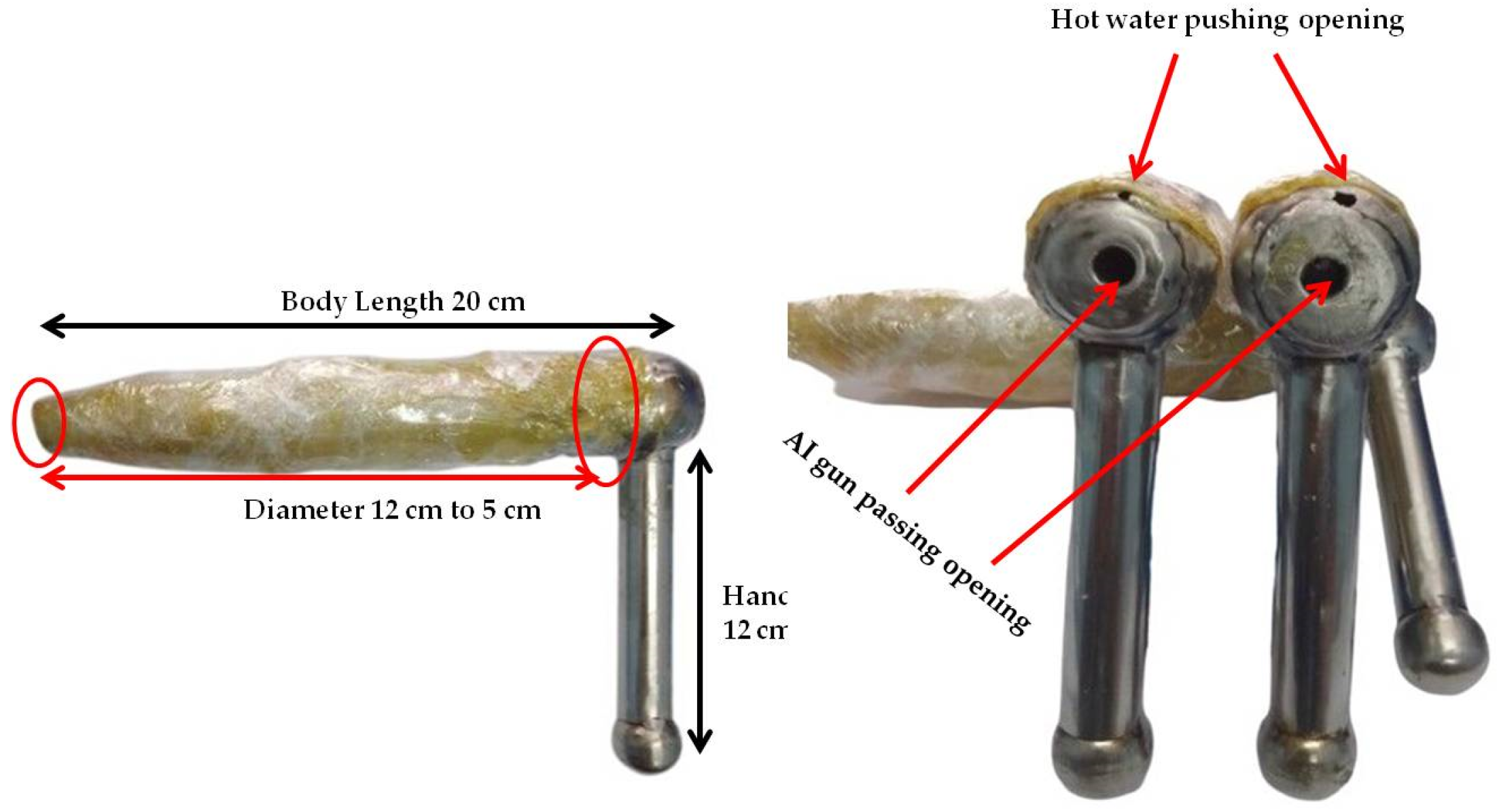
Figure 2.
Pregnancy rate in different interventions.
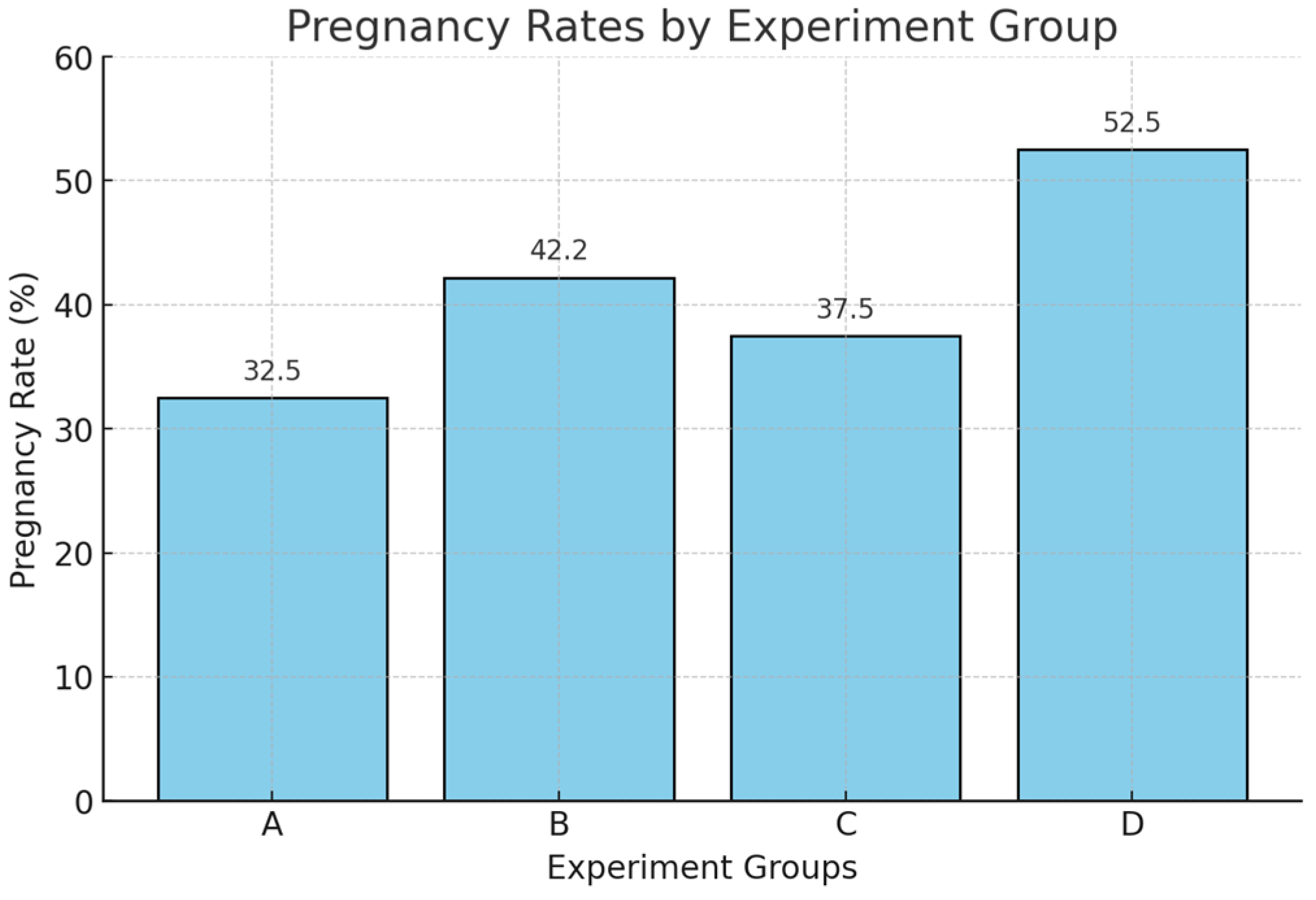

Table 1.
Factors affecting the pregnancy rate.
| Factors | Category (n) | Pregnancy rate % (n) | ꭓ2 & p value | Group wise Pregnancy rate n (%) | |||
|---|---|---|---|---|---|---|---|
| A | B | C | D | ||||
| Age (year) | ≤3 to 4 (32) |
43.75 (14) |
0.925 0.819 |
0 (0.0) |
5 (21.43) | 5 (35.71) | 6 (42.86) |
| 4.1 to 5 (42) |
45.24 (19) | 2 (10.53) | 5 (26.32) | 3 (15.79) | 9 (47.37) | ||
| 5 .1 to 6 (58) |
41.38 (24) | 6 (25.00) | 7 (29.17) | 6 (25.00) | 5 (20.83) | ||
| >6 to ≥7 (28) |
32.14 (9) | 5 (55.56) | 2 (22.22) | 1 (11.11) | 1 (11.11) | ||
| Parity (number) | P0 (36) | 47.22 (17) |
1.628 0.804 |
3 (17.65) | 10 (58.82) | 2 (11.76) | 2 (11.76) |
| P1 (32) | 40.63 (13) | 3 (23.08) | 3 (23.08) | 4 (30.77) | 3 (23.08) | ||
| P2 (58) | 37.93 (22) | 4 (18.18) | 2 (9.09) | 5 (22.73) | 11 (50.00) | ||
| P3 (24) | 50.00 (12) | 3 (25.00) | 1 (8,33) | 3 (25.00) | 5 (41.67) | ||
| ≥P4 (10) | 33.33 (2) | 0 (0.0) |
1 (50.00) | 1 (50.00) | 0 (0.0) |
||
| Body weight (kg) | ≤200 to 300 (48) |
33.33 (16) | 1.080 0.583 |
3 (18.75) | 4 (25.00) | 2 (12.50) | 7 (43.75) |
| 301 to 400 (83) |
45.78 (38) | 8 (21.05) | 11 (28.95) | 8 (21.05) | 11 (28.95) | ||
| >400 (29) |
41.38 (12) | 2 (16.67) | 2 (16.67) | 5 (41.67) | 3 (25.00) | ||
| Reproductive Health (RH) | Good (31) |
35.48 (11) | 2.279 0.320 |
3 (27.27) | 2 (18.18) | 5 (45.45) | 1 (9.09) |
| Moderate (123) |
43.90 (54) | 10 (18.52) | 14 (25.93) | 10 (18.52) | 20 (37.04) | ||
| Poor (6) |
16.67 (1) | 0 (0.0) | 1 (100.0) | 0 (0.0) | 0 (0.0) | ||
| Calving Difficulties (CD) | Yes (5) | 20.00 (1) | 0.962 0.327 |
0 (0.0) | 0 (0.0) | 1 (100.0) | 0 (0.0) |
| No (155) | 41.94 (65) | 13 (20.00) | 17 (26.15) | 14 (21.54) | 21 (32.31) | ||
| Heat detection | By farmer (147) |
39.46 (58) | 2.403 0.121 |
10 (17.24) | 14 (24.14) | 14 (24.14) | 20 (34.48) |
| By teaser bull (13) |
61.54 (8) | 3 (37.50) | 3 (37.50) | 1 (12.50) | 1 (12.50) | ||
Table 2.
Analysis of influencing factors for buffalo cows pregnancy rate.
| Factors | Variables | Coeficient | Std. Error |
Wald | Sig. | Odd ratio |
95% Confidence Interval for odd ratio | |
|---|---|---|---|---|---|---|---|---|
| Lower Bound | Upper Bound | |||||||
| Age | ≤3 to 4 | - | - | 1.648 | 0.649 | - | - | - |
| 4.1 to 5 | -0.271 | 0.520 | 0.271 | 0.603 | 0.763 | 0.309 | 2.626 | |
| 5 .1 to 6 | -0.331 | 0.464 | 0.510 | 0.475 | 0.718 | 0.323 | 2.104 | |
| >6 to ≥7 | 0.301 | 0.530 | 0.322 | 0.571 | 1.351 | 0.488 | 4.145 | |
| Parity | P0 | - | - | 3.028 | 0.553 | - | - | - |
| P1 | -1.110 | 0.977 | 1.292 | 0.256 | 0.330 | 0.050 | 2.306 | |
| P2 | -0.718 | 1.006 | 0.510 | 0.475 | 0.488 | 0.071 | 3.757 | |
| P3 | -0.435 | 0.938 | 0.215 | 0.643 | 0.647 | 0.127 | 5.458 | |
| P4 | -0.950 | 0.995 | 0.912 | 0.340 | 0.387 | 0.063 | 3.367 | |
| Body weight | ≤200 to 300 | - | - | 2.195 | .334 | - | - | |
| 301 to 400 | 0.342 | 0.560 | 0.373 | .541 | 1.407 | 0.487 | 4.894 | |
| >400 | -0.280 | 0.514 | 0.297 | .586 | 0.756 | 0.282 | 2.238 | |
| Reproductive Health | Good | - | - | 2.551 | .279 | . | . | |
| Moderate | -1.087 | 1.249 | 0.757 | 0.384 | 0.337 | 0.032 | 4.533 | |
| Poor | -1.531 | 1.154 | 1.761 | 0.184 | 0.216 | 0.028 | 2.684 | |
| Calving Difficulties | Yes | - | . | . | . | . | . | . |
| No | 1.482 | 1.186 | 1.561 | 0.212 | 4.400 | 0.390 | 42.267 | |
| Heat detection | By farmer | - | . | . | . | . | . | . |
| By teaser bull | 1.394 | 0.701 | 3.951 | 0.047 | 4.032 | 1.109 | 18.798 | |
Disclaimer/Publisher’s Note: The statements, opinions and data contained in all publications are solely those of the individual author(s) and contributor(s) and not of MDPI and/or the editor(s). MDPI and/or the editor(s) disclaim responsibility for any injury to people or property resulting from any ideas, methods, instructions or products referred to in the content. |
© 2025 by the authors. Licensee MDPI, Basel, Switzerland. This article is an open access article distributed under the terms and conditions of the Creative Commons Attribution (CC BY) license (http://creativecommons.org/licenses/by/4.0/).
Copyright: This open access article is published under a Creative Commons CC BY 4.0 license, which permit the free download, distribution, and reuse, provided that the author and preprint are cited in any reuse.


