

Submitted:
13 January 2025
Posted:
14 January 2025
Read the latest preprint version here
Abstract
The origin of the universe has always been a philosophical question that humans have been curious about and tirelessly exploring since ancient times, and has now become a significant issue in modern scientific research. At present, the Standard Model and the Big Bang theory are the two mainstream theories related to this question. However, these two theories still have many serious defects and deficiencies, failing to thoroughly resolve this major scientific issue. Here, we propose the Yin-Yang Model of elementary particles and the Theory of Existence Fields for their interactions (collectively referred to as the "Great Tao Model"). The Yin-Yang Model categorizes elementary particles into charged and uncharged types, with charged elementary particles further divided into positively charged and negatively charged types, thereby determining that there are only three types of elementary particles: electrons, positrons, and subston (物子) particles. The Existence Field Theory holds that charge and mass are the fundamental physical quantities of elementary particles, and they have the inherent property of continuously and uniformly diffusing their physical information into the surrounding space. Elementary particles propagate their physical information through the existence field of fundamental physical quantities, and interact with each other by receiving physical information emitted by other elementary particles. Based on the Great Tao Model, we propose a series of new perspectives on the binding of elementary particles and the formation and evolution of the universe, uncovering many mysteries that have long plagued the physics community. The Great Tao Model may be the true "theory of everything" with significant scientific and philosophical implications.
Keywords:
elementary particles
; Standard model
; The Big Bang Theory of the Universe
; The Great Tao model
; Yin-Yang Model
; The Theory of Existence Field
Introduction
Since ancient times, human curiosity about the mysteries of the universe has driven us to tirelessly explore the unknown, which is the driving force behind the origin and development of science. Among the mysteries of the universe, the most central and fascinating enigmas are the ultimate composition of matter and the origin and evolution of the universe. In modern physics, the research achievements concerning the ultimate mysteries of the universe are represented by two “standard models”: the Standard Model of Particle Physics (SMPP) [1] and the Standard Model of Cosmology (Big Bang Theory, BBT) [2]. It is generally believed that the deeper the scientific problems addressed, the more complex the scientific theories and mathematical tools required should be. Therefore, despite modern science adopting a reductionist research approach, as humanity delves deeper into the microscopic and macroscopic worlds of the universe, the scientific theories proposed have become increasingly complex. In the SMPP, to describe the properties of elementary particles and their interactions, physicists have introduced complex theories and mathematical tools such as Quantum Field Theory (Quantum Electrodynamics, Quantum Chromodynamics), Gauge Field Theory, Electroweak Unification Theory, and the Higgs Mechanism. This involves advanced mathematical concepts such as differential equations, tensor analysis, group theory, and symmetry. In the BBT, to describe the origin, evolution, and structure of the universe, physicists have adopted the highly complex theoretical framework of General Relativity. The mathematical tools in General Relativity include tensors, differential equations, Riemannian geometry, etc., which are used to describe the curvature of spacetime and the motion of matter within it.
However, the complexity of a theory does not imply its correctness. In fact, both of these so-called standard models have significant flaws and deficiencies. The SMPP is a theory that describes the three fundamental forces—strong force, weak force, and electromagnetic force—as well as the elementary particles that constitute all matter. This model does not account for gravity between elementary particles, indicating its incompleteness. Furthermore, the elementary particles within this model are not only numerous and diverse (a total of 61 types) but also exhibit excessively complex interactions that lack theoretical unity. The core concept of the BBT, the “singularity,” negates all physical laws, failing to explain the cause of the Big Bang or the formation mechanism of its products. Additionally, this theory struggles to explain the formation and evolution of the universe, cannot account for the phenomenon of accelerated cosmic expansion, and offers no answers to mysteries such as dark matter and dark energy. Scientific theories demand internal consistency and unity. Yet, the SMPP and the BBT lack direct unity, meaning they cannot be described within a unified theoretical framework that encompasses the interactions of elementary particles and the physical processes of the universe’s origin and evolution. Therefore, the pursuit of a “Theory of Everything” based on a unified theoretical framework that comprehensively explains the properties of elementary particles and the evolution of the universe remains an unfinished goal in physics.
The Yin-Yang Model of Elementary Particles
The question of the origin of the universe has been one of the significant topics of human philosophical and scientific inquiry since ancient times. Humans’ ultimate questioning about the origin of the universe seems to plunge them into perpetual confusion. Laozi, the great sage and philosopher of China, stated in the Tao Te Ching: “There is a thing mingled and completed, which was born before heaven and earth... It can be regarded as the mother of heaven and earth. I do not know its name, so I call it the Tao.” He further said, “All things in the world are born of Existence, and Existence is born of Nothingness”. And, “The Tao produces one; one produces two; two produces three; and three produces all things. All things carry Yin and embrace Yang, and through the interaction of Qi, they achieve harmony.” Laozi elaborated on his view of the origin of the universe, suggesting that all things in the universe evolved from three tangible entities (material substances), which in turn originated from the intangible (the Tao), with the Yin-Yang principle being the foundation of the Tao. The theory of Yin and Yang in ancient China revealed the origin of all things in the universe and the essence of their opposition and unity, profoundly expounding that all things in the universe are the opposition and unity of Yin and Yang.
Modern science tells us that material entities are composed of molecules, which in turn are made up of atoms, and atoms are further constituted by electrons, protons, and neutrons. Obviously, molecules and atoms are composite particles composed of smaller material particles. If we keep tracing the origin, is there the most fundamental and indivisible smallest particle of matter in the universe? According to the Yin-Yang principle, the existence of composite particles necessitates the existence of non-composite particles. Non-composite particles represent the indivisible smallest material particles that constitute matter, namely, elementary particles. Therefore, by integrating modern science with ancient Chinese philosophical thoughts, we believe that all things in the universe evolved from elementary particles, and these elementary particles obey the Yin-Yang principle. In other words, elementary particles are the material carriers of the “Tao”.
Since elementary particles are the smallest material entities that make up everything in the universe, they must have mass, stability, and invariance. In the SMPP, only electrons and positrons meet the criteria of elementary particles, while other purported particles either lack mass or cannot exist stably. Both electrons and positrons are charged elementary particles, with electrons carrying a negative charge and positrons carrying a positive charge, which perfectly aligns with the Yin-Yang principle where opposite charges complement each other. According to the Yin-Yang principle, the existence of charged elementary particles necessitates the existence of uncharged elementary particles. Therefore, elementary particles can be classified into three types: negatively charged electrons, positively charged positrons, and uncharged elementary particles. We can call negatively charged elementary particles “Yin particles”, positively charged elementary particles “Yang particles”, charged elementary particles “Yin particles”, and uncharged elementary particles “Yang particles”.
Based on Laozi’s philosophical thinking, “all things carry Yin and embrace Yang”, thus composite particles should be comprised of “Yin particles” and “Yang particles.” Firstly, a composite particle consisting of two elementary particles is formed by one fundamental Yin particle and one fundamental Yang particle, with a total of three combination ways: A (electron-positron), B (electron-uncharged fundamental particle), and C (positron-uncharged fundamental particle). Secondly, a composite particle consisting of three elementary particles is formed by one fundamental Yin particle (or Yang particle) and one composite Yin particle (or Yang particle), with two combination ways: D (electron-B particle) and E (positron-C particle).
The particles currently known to compose the atoms of matter are electrons, protons, and neutrons. Similarly, particles composing the atoms of antimatter have also been discovered: positrons (anti-electrons), antiprotons, and antineutrons. Since there are only three types of elementary particles: electrons, positrons, and uncharged elementary particles, we have reason to speculate that protons, antiprotons, neutrons, and antineutrons are composite particles composed of these three elementary particles. Given that protons carry a positive charge, antiprotons carry a negative charge, while neutrons and antineutrons are uncharged, and comparing this to the five types of composite particles composed of three elementary particles, we can infer that protons are composite particle C, antiprotons are composite particle B, and neutrons or antineutrons are either composite particle D or E. Based on the experimental results that neutrons can decay into electrons and protons, and protons can be converted into neutrons through electron capture, we can infer that neutrons are composite particles E. Consequently, the antineutron should be the composite particle D. Due to the much smaller mass of composite particle A compared to neutrons or antineutrons, it should be a neutrino.
Due to the extremely small mass of electrons and positrons, the mass of protons (antiprotons) and neutrons (antineutrons) mainly originates from “uncharged elementary particles”. Since “uncharged elementary particles” are the main source of material mass, we named them “Substons” (物子). The charged elementary particles have small masses, while the uncharged elementary particles have large masses, presenting an opposition in mass properties that also aligns with the Yin-Yang principle.
In composite particles, the neutrino consist of an electron and a positron orbiting each other, the proton is formed by a positron orbiting around a subston, the antiproton is formed by an electron orbiting around a subston, the neutron is formed by an electron orbiting around a proton, and the antineutron is formed by a positron orbiting around an antiproton (Figure 1b). Therefore, although neutrons and antineutrons are electrically neutral overall, the outer shell of a neutron carries a negative charge, with the middle layer carrying a positive charge, whereas the outer shell of an antineutron carries a positive charge, and the middle layer carries a negative charge.
Based on the Yin-Yang principle and modern scientific research findings, we have derived a fundamental particle model: the origin of the universe is the Tao, and the fundamental principle of the Tao is the Yin-Yang principle. The material carrier of the Tao is the smallest material unit composing all things in the universe—elementary particles. Elementary particles are divided into two categories: charged elementary particles (Yin particles) and uncharged elementary particles (Yang particles, or subston). Charged elementary particles are further divided into negatively charged elementary particles (Yin particles, electrons) and positively charged elementary particles (Yang particles, positrons). Therefore, there are three types of elementary particles: electrons, positrons, and subston. These three types of elementary particles, through Yin-Yang combinations, form five types of composite particles (protons, antiprotons, neutrons, antineutrons, and neutrinos), which in turn constitute all things in the universe. Thus, our fundamental particle model is fully consistent with Laozi’s idea of “The Tao generates one; one generates two; two generates three; three generates all things in the universe” and also aligns with his concept of “The beginning of all things is the Tao, which is simple in its essence but evolves into complexity”. The three elementary particles make up the ever-changing universe, perfectly embodying the harmonious unity of infinite and finite. Since our fundamental particle model is established based on Laozi’s philosophical concept of the Yin-Yang principle, we can refer to it as the “Yin-Yang Model” (Figure 1a).
The Theory of the Existence Field of Elementary Particles
Elementary particles are the ultimate existence in the universe, and it is neither possible nor necessary for us to further inquire into their origins. In the Yin-Yang Model of elementary particles, elementary particles are classified based on two fundamental physical properties: charge and mass. Therefore, the existence of elementary particles essentially equates to the existence of their fundamental physical properties. The physical quantities that measure these fundamental physical properties (charge and mass) are known as fundamental physical quantities. Elementary particles have a fixed and invariant fundamental physical quantity Q (charge e and mass m). For example, an electron with a unit of negative charge (-e) and mass m can be expressed as Q (-e, m); Positrons have a positive charge of one unit (+e), which is the same as the mass m of electrons and can be expressed as Q (+e, m); A subston does not carry an electric charge, meaning it has a charge of 0 and a mass M, which can be expressed as Q (0, M). Obviously, the interaction between elementary particles is the interaction between elementary physical quantities.
Fundamental physical quantities manifest as inherent physical properties and can produce specific physical effects. Mass generates unique mass effects, and charge produces distinct charge effects. Consequently, the existence of elementary particles (or fundamental physical quantities) inevitably produces fundamental physical effects on the surrounding space, meaning that these particles serve as centers from which their physical effects diffuse or propagate into the surrounding space. Since fundamental physical quantities are singular and eternal constants, the diffusion speed of their physical effects cannot be variable; it must be either infinite or a finite constant velocity. If we hypothesize an infinite diffusion speed, then even brief and minute changes in the spatial position of a fundamental particle would instantaneously affect locations infinitely far away. Given the finite nature of the motion speeds of all objects in the universe, this finite speed establishes a temporal sequence of causality for all changes in the universe. Therefore, an infinite speed would disrupt the causality principle, contradicting the basic realities of the observable universe. Hence, the speed at which fundamental physical quantities diffuse their physical effects into the surrounding space cannot be infinite; it must be a finite constant velocity, denoted as c. We define the inherent characteristic of elementary particles (or fundamental physical quantities) as their existence field (Figure 2a), centered on the particle and continuously and uniformly propagating the physical effects of the fundamental physical quantity into the surrounding space at the finite velocity c.
Fundamental physical quantities exhibit inherent physical properties and are capable of producing specific physical effects. Mass generates unique mass effects, and charge produces distinct charge effects, because mass can receive mass information transmitted by other masses, and charge can receive charge information transmitted by other charges. Therefore, the existence of elementary particles (fundamental physical quantities) means that they are continuously diffusing or transmitting physical information of their fundamental physical quantities to the surrounding space. Since fundamental physical quantities are unitary and eternal constants, the diffusion speed of their physical information cannot be variable; it must either be infinite or a finite constant velocity. If we hypothesize an infinite diffusion speed, then even momentary and minute changes in the spatial position of a fundamental particle would instantaneously affect locations infinitely far away. Given the finite nature of the motion speeds of all things in the universe, this finite speed establishes a temporal sequence and order of causality for all changes in the universe. Therefore, an infinite speed would disrupt the causality principle, contradicting the basic realities of the observable universe. Hence, the speed at which fundamental physical quantities diffuse their physical information into the surrounding space cannot be infinite; it must be a finite constant velocity, denoted as c. We define the inherent property of elementary particles that uniformly and continuously propagate physical information of fundamental physical quantities into their surrounding space as the existence field of elementary particles (Figure 2a).
Due to the uniform and constant propagation of physical information of elementary particles in the surrounding space, the propagation of their physical information in the same time inevitably forms a sphere centered on the elementary particles. Assuming the fundamental physical quantity of particle A is Q, a sphere with a radius of r and a spherical area of S is made around the particle as the center. We define the basic physical quantity contained per unit area on the sphere as the the spatial propagation spherical density of the fundamental physical quantity Q.
Obviously, the closer the distance to the elementary particle A, the smaller the r, and the higher the spatial propagation spherical density of its physical quantity. Conversely, the lower the density. Therefore, as the existence field of fundamental physical quantities propagates outward, its physical effects gradually decrease. Consequently, the intensity of the existence field of a fundamental particle () is directly proportional to its spatial propagation spherical density .
Among them, k represents the existence field constant of the fundamental physical quantity Q. Specific fundamental physical quantities have unique existence field constants k. The existence field of the fundamental physical quantity mass m is abbreviated as mass field, with a mass field constant km, and the existence field of the fundamental physical quantity charge e is abbreviated as charge field (or electric field), with a charge field (or electric field) constant ke. Since only identical physical quantities share the same existence field constant, interactions can only occur between identical existence fields. The existence field is a vector field, is a unit vector, and is oriented in the same direction as the radial vector , starting from the elementary particles and pointing towards a point in space.
The physical effects between elementary particles arise through their existential fields, meaning that the physical quantities of elementary particles can receive physical information emitted by entities with the same physical quantities and thereby produce interactions. Assuming that the distance between two elementary particles A and B (with physical quantities QA and QB respectively) is r, their existence field strengths for each other are and . So, the force exerted by B on A in the existence field of B is equal to the force exerted by A on B in the existence field of A, which we call the interaction force between A and B. Obviously, the interaction force between the two elementary particles A and B is proportional to the magnitude of their physical quantity Q and the strength of the existing field:
Generally, we represent the force acting on a physical quantity Q in the presence of another field of the same fundamental physical quantity (referred to as the physical quantity interaction force) as:
The direction of the interactive force is as follows: the interactive force between masses is mutual attraction, while the interactive force between charges is repulsion between like charges and attraction between opposite charges.
The elementary particles discussed above exist in an absolutely stationary state in vacuum. In this case, the existence field of the elementary particles is a static field, and their diffusion into the surrounding space is a uniform concentric sphere (Figure 2b). Alternatively, it can be described as the particle’s influence uniformly diffusing into the surrounding space from its center, creating a continuous and evenly distributed density gradient. When a fundamental particle moves in a uniform linear motion relative to an absolutely stationary reference frame, since the existence field of the particle is the diffusion of physical information of fundamental physical quantities into the surrounding space, and this physical information lacks mass, it conforms to the motion laws of massless “objects” (non-material entities), i.e., it moves at a constant speed c relative to the absolutely stationary reference frame[3]. Therefore, when a fundamental particle moves in a uniform linear motion, its physical information no longer diffuse into a concentric sphere; instead, the center of the sphere moves along the direction of the particle’s motion, forming a straight line. The spherical density of the existential field’s diffusion becomes distorted, with the spherical density in the direction of the particle’s motion becoming denser and the opposite direction becoming sparser (Figure 2c). Since the diffusion of the existential field of the fundamental particle is no longer isotropic (concentric), the diffusion becomes distorted. Since the distortion of the existence field is caused by the motion of the fundamental particle, and the faster the motion, the greater the degree of distortion in the diffusion of the existence field, we use the product of the fundamental physical quantity Q and its velocity v to characterize the quantity of motion (translational momentum) of the fundamental physical quantity.
Therefore, it can be used to characterize the degree of distortion in the field of elementary particles. We regard the amount of motion of elementary particles (translational momentum) as a new physical quantity. The (translational) momentum representing the physical quantities of mass m and charge e of elementary particles is referred to as mass-momentum and charge-momentum , respectively. Due to the motion of elementary particles, the propagation speed of the distortion effect caused by the diffusion of the elementary particle existence field into the surrounding space is exactly the same as the propagation speed of the elementary particle existence field. Therefore, we can also consider the physical impact of the diffusion of translational momentum into the surrounding space as the existence field of translational momentum, namely the translational momentum field (Figure 3), including the mass-momentum field and the charge-momentum field. If the direction of motion of positively charged elementary particles is defined as the direction of charge-momentum, then the direction of charge-momentum is opposite to the direction of electron motion. The direction of mass momentum is the same as the direction of mass motion (Figure 3). At a certain point x on a sphere S with a radius r centered on the elementary particle, the field vector diameter is , the momentum of the elementary particle is , and the angle between the two is , then the spatial propagation spherical density of the momentum of the fundamental particle is:
The field strength of momentum is:
The interaction force between momenta is:
The essence of elementary particle motion is that it undergoes displacement in space. When the displacement of a fundamental particle is equal to its diameter d, we call it elementary displacement. The ratio of the displacement of elementary particles to the time t required for the displacement to occur is called the (instantaneous) velocity of the elementary particles v=d/t. The ratio of the physical quantity Q that causes element displacement to the time t required for element displacement to occur is called the element flow rate of the physical quantity Q:
The product of the elementary flux I of a fundamental particle and its elemental displacement d is denoted as Qv, which represents the (translational) momentum of a fundamental physical quantity. When the physical quantity Q is electric charge e, its elemental flux I corresponds to the electric current intensity. In electromagnetism, the product of the electric current intensity I and an elemental length of wire dl is called the current element Idl, and this current element is considered capable of generating a magnetic field. Therefore, in electromagnetics, the so-called current element is essentially the sum of the charge-momentum of all charges moving in the cross-section of a wire. Consequently, the existence field of the charge-momentum for a single charge (the charge-momentum field) is actually the well-known magnetic field. The mutual force of interaction between charge-momenta is termed the charge-momentum force (电动力), and it is the mutual force of interaction between magnetic fields, namely the Lorentz force. Since the existence field of the charge-momentum is the magnetic field, the constant k of the charge-momentum field is the vacuum permeability μ0.
When the physical quantity Q is mass m, its elemental flow rate I can be referred to as mass flow intensity. The product of element flow I and element displacement d is the mass-momentum . The existence field of mass-momentum is called the mass-momentum field. We refer to the interaction force between mass-momentum fields as the mass-momentum force (质动力).
The Theory of Existence Field completely unifies logically and formally the existence field and its interaction of two fundamental physical quantities, charge and mass, in both stationary and moving states. Different existence field constants k are only needed to characterize the existence field of different physical quantities. According to the known laws of universal gravitation, Coulomb’s law, and Biot Savart’s law, it is not difficult to find that the basic physical quantity mass m interaction force is universal gravitation, the fundamental physical quantity charge e interaction force is Coulomb’s force (electrostatic attraction), and the charge-momentum interaction force is Lorentz’s force. From this, we can obtain the existence field constants of various physical quantities:
Charge existence field (charge field, i.e., electric field) constant , where is the vacuum dielectric constant.
Mass existence field (mass field, i.e., gravitational field) constant , is represented by g0, where G is the constant of universal gravitation.
Charge-momentum existence field (charge-momentum field, i.e., magnetic field) constant , where is the vacuum magnetic permeability.
The mass-momentum existence field (mass-momentum field) constant is represented by . According to the relationship between the charge field constant () and the electric field constant ()(), it can be inferred that .
The motion of elementary particles includes not only translational motion but also rotational motion. We consider two forms of motion for elementary particles: circular motion around the center point and rotation. When a fundamental particle moves in uniform circular motion around a central point, the cross product of the position vector () from the central point to the fundamental particle and the quantity of its fundamental physical motion () forms a new physical quantity, namely, the rotational momentum:
The spatial propagation spherical density of rotational momentum is:
The existence field strength of the rotational momentum is:
The interaction force between rotational momenta is:
When the fundamental physical quantity is the mass m, the rotational momentum is the rotational mass-momentum, which is actually the orbital angular momentum (referred to as angular momentum):
When the fundamental physical quantity is the electric charge e, the rotational momentum is the rotational charge-momentum, which is actually the orbital magnetic moment:
The interaction force between rotational charge-momenta (orbital magnetic moments) can be referred to as rotational charge-momentum force, which is actually the so-called magnetic torque. The interaction force between rotating mass-momenta can be referred to as rotational mass-momentum force or angular momentum force.
When an elementary particle self-rotates at an angular velocity , if the size and shape of the elementary particle are not considered, the moment of inertia of its fundamental physical quantity Q can be assumed to be , where γ is an unknown constant. The physical quantity generated by the self-rotational motion of elementary particles is called self-rotational momentum or spin momentum:
The physical quantity of motion generated by the self-rotation of elementary particle mass m is called spin mass-momentum , commonly referred to as spin angular momentum . The physical quantity generated by the self-rotation of elementary particle charge e is called spin charge-momentum , which is actually commonly referred to as spin magnetic moment :
From Equations (14), (15), and (17), (18), we can obtain
The spin momentum of elementary particles also has an existence field, and the strength of their spin momentum field is:
The interaction force between spin momenta is:
The spin momentum field generated by the rotation of mass m is called the spin mass-momentum field, or the spin angular momentum field . The spin momentum field generated by the self-rotation of charge e is called the spin charge-momentum field, or the spin magnetic moment field :
Among them, is the constant of the spin mass-momentum field (spin angular momentum field), and is the constant of the spin charge-momentum field (spin magnetic moment field). If we refer to the product of the fundamental physical quantity Q and the self-rotational angular velocity as the spin quantity , then the spin momentum field can also be called the spin quantity field:
Among them, is the spin quantity field constant, the mass spin quantity field constant is , and the charge spin quantity field constant is . The interaction force between spin quantities is:
The interaction force between charge spin quantities is called spin charge-momentum force(自旋电动力), which is actually spin magnetic force. The interaction force between mass spin quantities can be called spin mass-momentum force(自旋质动力).
The directions of rotational momentum and spin momentum are shown in Figure 4.
When a elementary particle is in an absolute stationary state, its existence field uniformly spreads outward from the elementary particles as the center, forming concentric spheres nested layer by layer, presenting a continuously decreasing density gradient from the inside out (Figure 2b). When a elementary particle moves uniformly in a straight line, the diffusion of its existence field into the surrounding space becomes distorted (Figure 2c), and we describe this distortion effect with the term (translational) momentum field. When the fundamental particle undergoes uniform rotation or spins, the distortion in the diffusion of its existence field in space, which undergoes periodic changes in space at a certain frequency, can be termed as an existence field wave (charge field wave or mass field wave). We describe this distortion change with the terms rotational momentum field or spin momentum field (or spin field). Since no external force is doing work, these momentum fields (existence field waves) do not transfer energy. When a fundamental particle accelerates, the distortion effect of its existence field diffusing into the surrounding space varies over time, meaning that the momentum field’s change increases with time (Figure 2d). Since the accelerated motion of a fundamental particle is due to the application of a force, the variation of the momentum field over time represents the work done by the force, embodying the transfer of energy. The propagation of changing electric and magnetic fields resulting from the accelerated motion of charges over time is called “electromagnetic waves”, and the energy transferred is termed “electromagnetic waves energy” or “electromagnetic energy”. The propagation of changing mass fields and mass-momentum fields resulting from the accelerated motion of mass over time is called “mass-momentum waves”(质动波), and the energy transferred is termed “mass-momentum waves energy”(质动波能). Electromagnetic energy and mass-momentum waves energy are called radiation energy. Since the existence fields of fundamental physical quantities propagate at an inherent speed constant c, the propagation speeds of electromagnetic waves and mass-momentum waves are also c.
Combination of Elementary Particles
Assuming that at the beginning of the universe, all elementary particles were infinitely far apart and in a state of absolute stillness, their kinetic energy would be 0, and the potential energy between them would also be 0, resulting in a total universal energy of 0. Despite being infinitely distant, the attractive force between elementary particles with opposite charge properties tends to be infinitely small. However, over a long period of time, their distances gradually decrease, the attractive forces gradually increase, and they eventually accelerate towards each other and combine. Since there are only three types of elementary particles: electrons, positrons, and substons, no matter how they are arranged and distributed, it is impossible to achieve a balance of the interaction forces between elementary particles. Therefore, in the initial state of the universe, the distribution and forces acting on elementary particles were asymmetric and unbalanced. That is to say, the interaction between any two elementary particles is inevitably influenced by other particles, and there must be a non-zero angle between the initial direction of motion of the elementary particles and the line connecting them. Therefore, elementary particles usually do not approach and collide with each other in a linear motion under the interaction force, but rotate in a spiral motion. This is the fundamental reason why composite particles, atomic systems, and celestial bodies in the universe all exist in a rotating form.
The most basic definition of energy begins with the work done by force, that is, work W is equal to the product of force F and the displacement r produced by that force:
According to Equation (4), the potential energy of the interaction (attraction) between two elementary particles can be expressed as
As elementary particles attract each other and move closer, their potential energy gradually decreases. When the distance between them is r, the potential energy difference is:
The work done by the interaction force between elementary particles is equal to their potential energy difference . The elementary particles accelerate under the interaction force, generating kinetic energy and releasing radiation energy . According to the principle of conservation of energy, it can be concluded that
Due to the ratio of the electrostatic force (or potential energy) of electrons to their gravitational force (or potential energy) being , when studying the interactions between charged elementary particles, we often only consider the electrostatic potential energy and its generated kinetic energy and radiation energy (electromagnetic energy), and can ignore the gravitational potential energy and its generated kinetic energy and radiation energy (mass-momentum waves energy).
In order to reveal the physical mechanism of the binding of elementary particles under interaction, we need to first construct an ideal physical model: the motion of electrons around a stationary particle. Since the mass of a proton is much greater than that of an electron, when an electron moves around a proton, it can be approximately assumed that the proton is stationary, which conforms to this ideal model. Therefore, we first study the situation where electrons (anti-electrons) combine with protons (anti-protons).
The Combination of an Electron and a Proton (or an Anti-Electron and an Anti-Proton)
Assuming that an electron and a proton are infinitely far apart (sufficiently far away) from each other. Under the action of electrostatic attraction, the electron rotates around the proton in a spiral motion and gradually approaches it, continuously releasing radiant energy until it finally reaches an equilibrium state where the electrostatic attraction equals the centripetal force. At this point, the electron moves in a uniform circular motion around the proton and ceases to release radiant energy. This stable configuration is known as the ground state of a hydrogen atom. Let the radius of the electron’s orbit around the nucleus be r0, and its orbital velocity be v0, then
The energy of an electron in its ground state orbit is the sum of the potential energy Ep and the kinetic energy Ek:
Electrons reach the ground state orbit from infinity, and the potential energy of electrostatic attraction is converted into the kinetic energy Ek and radiation energy Er of electrons:
It can be seen that when an electron enters the ground state orbit, half of its electrostatic potential energy is converted into the kinetic energy Ek, and the other half is converted into electromagnetic radiation energy Er. It is precisely because of the mechanism of electromagnetic energy radiation during the electron’s accelerated motion that the electron’s velocity can decrease to a point where the centripetal force required for its circular motion equals the electrostatic attraction, achieving an equilibrium state. Otherwise, the speed of electron motion is too fast, so that the electrostatic attraction is less than the centripetal force required for circular motion, making it impossible for the proton to bind the electron, and a stable atomic system could not be formed.
Since electromagnetic radiation is generated by the accelerated motion of electrons, the electromagnetic radiation energy Er can be calculated based on the accelerated motion of electrons. When an electron accelerates in a circular orbit around a proton, the change in its frequency over time corresponds exactly to the change over time in the electric charge existence field (electric field) and charge-momentum field (magnetic field). That is, for every additional circle of electron motion around a proton, it corresponds to an electromagnetic wave of exactly one frequency. This is the physical mechanism by which accelerated motion of an electron around a proton produces electromagnetic waves. Since the increase in electromagnetic wave energy manifests as an increase in the frequency of the electromagnetic wave, the energy carried by each wavelength of the electromagnetic wave is the same, regardless of the wavelength. Since the electron is the smallest unit of charge, the energy carried by one electromagnetic wave generated by the accelerated motion of a single electron around a proton can be regarded as the smallest unit of energy, namely, the energy quantum or light quantum ε, whose value is equal to Planck’s constant h. This is our revised concept of the quantum[4,5].
Assuming that an electron moves in a uniform circular motion around the proton at frequency fn in a stationary energy level orbit n, and after radiating or absorbing light quanta, it transitions to a stationary energy level orbit m where it moves in a uniform circular motion around the nucleus at frequency fm, taking a time duration of Δt seconds. The average rate of change of frequency is then given by:
The number of rotations that increase or decrease within Δt time is
Assuming that the electron gradually accelerates from an infinite distance from the proton (with a rotation frequency of 0) to a motion frequency of f0 around the proton, and the required time is Δt, then the number of light quanta produced by the electron is
The value of radiation frequency is equal to the number of light quanta produced per unit time, that is
The total energy of radiation is
According to Equation (37), it can be concluded that
The time required for an electron to transition from a stationary state orbit n to a stationary state orbit m is known as the electron transition time. The frequency change rate () and radiation power () caused by electronic transitions are independent of the transition time . Considering that physical quantities such as the energy radiated or absorbed, the radiation power, and Planck’s constant h all use 1 second as the unit of time, we can set =1s for convenience in calculations. Since ε is the smallest energy unit (energy quantum), its energy accumulation per unit time is the Planck constant h, which is called the action quantum, i.e., ε= h when =1s. From Equation (44), we can obtain
This is the so-called Bohr radius. By substituting Equations (33), (35), and (37) separately, we can obtain
When an electron in a stationary state is illuminated by light, as it traverses through a changing electromagnetic field (electromagnetic wave), it experiences an electromagnetic force. The work done by this force on the electron is converted into an increase in its potential energy, resulting in an enlargement of its orbital radius around the proton. When the energy absorbed by the electron is precisely sufficient to propel it into a higher stationary state orbit, the electron undergoes a transition from one stationary state to another. Assuming that the electron’s orbital radius in the stationary state n is rn and its energy is En, while in the stationary state m, its orbital radius is rm and its energy is Em, then the electromagnetic radiation energy absorbed by the electron is equal to the difference between the energy levels of these two stationary states:
Assuming the frequency of light is v and the electromagnetic energy absorbed by electrons is k light quanta, then
According to Equation (49)
By substituting (44) into the above equation, we can obtain
Let , then , we get
Among them, . According to the experimental data of hydrogen atom spectroscopy, the above formula is consistent with the Rydberg formula:
R is the Rydberg constant. Comparing (55) and (57), it can be concluded that
By substituting Equations (34) and (35) separately, we can obtain
The angular momentum of an electron in a stationary orbit is L=mvr. From (32), (45), and (58), it can be concluded that:
Due to the strong electrostatic attraction between electrons and protons, just like the tidal lock between the moon and the earth, an electron rotates once on its own axis as it completes one orbit around a proton.The angular velocity of the electron’s rotation is equal to the angular velocity of its orbit around the proton. According to the theory of existence fields, the charge spin quantity is . This can be derived from Equations (46) and (58):
It can be seen that electrons radiate or absorb energy when transitioning between different stationary states (or orbits), and there exist integer-multiple relationships among the orbital radii, energy levels, orbital frequencies, angular momenta, and spin quantities between these stationary states. Bohr believed that when an electron transitions from one stationary state to another, it jumps instantaneously rather than moves continuously. In other words, electron transitions are completed instantaneously without intermediate states. This viewpoint, which contradicts the classical physics notion of continuous motion, is regarded as a unique quantization phenomenon of microscopic particles and has become a fundamental viewpoint of quantum mechanics theory. However, our research has demonstrated that the transition of electrons between different stationary states is a continuous process of acceleration or deceleration, corresponding to the emission or absorption of electromagnetic energy (light quanta) by the electrons.
When an electron interacts with a proton in a free state, they combine to form a ground-state hydrogen atom. Under special conditions, such as when a K-shell electron orbits outside an unstable atomic nucleus lacking a neutron, or under the immense gravitational pressure in supermassive celestial bodies, an electron and a proton can further combine to form a neutron. A neutron is composed of a subston, a positron, and an electron, with the sunston at the center and the positron and electron orbiting around it, the angular velocities of rotation are and , respectively (Figure 5a). Assuming the mass of the subston is M, the distance between the subston and the positron is R, and the masses of the electron and the positron are both m, with a distance L between them. The positron orbits the subston center with a radius of R, while the electron orbits the nucleon center with a radius of R+L. Then, the centripetal force of the positron orbiting the subston center is:
The kinetic energy of a positron is
The centripetal force of electrons rotating around the center of the subston:
The total radiation energy of electrons is:
The Combination of an Electron and a Positron
Under the action of electrostatic attraction, an electron and a positron accelerate their mutual revolution in a spiral motion and gradually approach each other. The electrostatic potential energy continually decreases, converting into the kinetic energy of the electron and positron, and continuously releasing radiation energy. Ultimately, a balanced state is achieved where the electrostatic attraction equals the centripetal force, at which point the release of radiation energy ceases, forming a stable electron-positron system. In this system, the electron and positron perform uniform circular motions around the system’s center of mass, with identical rotational radii r, each being half of the distance L between them (Figure 5b). It can be derived that:
The potential energy of an electron positron system is , and the potential energy of a single electron (or anti electron) is half of it. The energy of an electron in its ground state orbit is the sum of the potential energy Ep and the kinetic energy Ek:
The electron reach the ground state orbit where it orbits with the positron from infinity, and the potential energy of electrostatic attraction is converted into the kinetic energy Ek and radiation energy Er of the electron:
Since , according to Equation (42), we can obtain:
By substituting Equation (74) into the above equation, we can obtain
Let =1s, obtain
By substituting Equation (75), we get:
The electron (or positron) in a steady state, when exposed to light (electromagnetic radiation), transition from one steady state to another. Assuming that the electron has an orbital radius of rn and energy of En in the steady state n, and an orbital radius of rm and energy of Em in the steady state m, the electromagnetic radiation energy absorbed by the electron is equal to the difference between the two steady state energy levels:
By substituting Equation (79) and L0=2r0, we can obtain
We can imagine that the system composed of electrons and positrons also satisfies the Rydberg formula, with a Rydberg constant of . It is not difficult to prove that there are integer multiples of orbital radius, energy level, frequency, angular momentum, and spin between different stationary orbitals of electrons (or positrons) in this system.
Just as the hydrogen atomic system combines electrons and protons to form neutrons under special conditions, the electron-positron system will also combine to form the neutrino under special conditions. The radiation energy Er of electrons (or positrons) is:
The radiation energy released by the combination of electrons and positrons has long been mistaken for an “annihilation reaction” of positive and negative particles, where the particles completely disappear and are converted into energy. But now we have a clear understanding that the combination of electrons and positrons can form structures similar to hydrogen atoms, and can also form neutrinos under special conditions, while releasing light or gamma rays. Using gamma rays to irradiate neutrinos will produce free electrons and positrons. According to Equation (82), given the frequency of gamma rays that irradiate neutrinos, we can calculate the radius r of neutrinos. Assuming a gamma ray frequency of 1019 Hz, the radius r of neutrinos is 4.35 × 10⁻¹⁵ m. We refer to the reaction in which positive and negative particles meet and release radiation energy (γ rays) to form neutrinos as the “Radiation and Combination Reaction” (RC reaction). The combination of an electron and a positron forms an “electron positron” system, which exists in three forms: ground state, excited state, and neutrino state. This may be a possible explanation for the so-called neutrino oscillation.
The Combination of an Electron (or Positrons) and a Subston
Since a subston only has mass and no charge, the interaction between a positron and a subston is solely due to mass force (universal gravitation). Since the mass M of the subston is much greater than the mass m of the positron, we can approximate the matter particle as a stationary reference frame, with the positron moving around the subston and the gravitational force providing the centripetal force. As the positron accelerates and spirals closer to the subston, it releases radiative energy until it reaches an equilibrium state where the gravitational force equals the centripetal force, causing the positron to move in a uniform circular motion around the subston This stable configuration is referred to as the positron-subston system (Figure 5c). Assuming the orbital radius of the positron around the matter particle is r0 and its orbital velocity is v0, then
Positrons in a steady state, when exposed to light, transition from one steady state to another. Assuming that the positron has an electron orbital radius of rn and energy of En in steady state n, and an orbital radius of rm and energy of Em in steady state m, the electromagnetic radiation absorbed by the positron is equal to the difference between the two steady state energy levels:
From Equation (42), we can obtain
Because , therefore
Let t=1s, it can be obtained from Equations (89) and (91)
Compared to the Rydberg formula (57), in the positron-subston system, the Rydberg constant is denoted as R’. It is not difficult to prove that there exists a relationship of integer multiples among the orbital radii, energy levels, frequencies, angular momenta, and spin quantities of the different stationary states of the positron, just like in the electron-proton system and the electron-positron system.
Under certain conditions, a positron (or electron) tightly binds with a subston to form a proton (or antiproton). When the centripetal force required for the positron to move in uniform circular motion around the subston equals the gravitational force between the two elementary particles, the positron and the subston reach a stable equilibrium state. At this point, the positron rotates around the subston with a radius of R. Then,
Based on the existing proton radius of 0.833ⅹ10-15 m and the proton mass of 1.672621637×10⁻²⁷ kg, using Equations (96) and (99), we obtain rad/s and v=. This suggests that the positron rotates quite slowly around the subston, implying that the proton would be highly unstable. However, in reality, the proton is extremely stable and cannot be decomposed even by gamma-ray irradiation. Therefore, the frequency of electromagnetic radiation released during the binding of the positron and the subston should be higher than the frequency of gamma rays. If the frequency of gamma rays is 1019 Hz, using Equation (100), it can be calculated that the proton radius should be at least less than m to account for this stability.
The Combination between Two Substons
Substons exert gravitational forces on each other. Can they combine to form structures similar to those in electron-positron systems? Assuming that the radius of the object rotating around the center of mass is r and the velocity is v, it undergoes uniform circular motion. Then:
The change in potential energy between substons is converted into kinetic energy and radiation energy:
Since substons have only mass and no charge, there is no electromagnetic radiation energy. The accelerated motion of a subston generates massomotive wave radiation, but the energy of massomotive wave radiation is very small and negligible. Therefore:
Due to , it indicates that if all changes in potential energy are converted into kinetic energy, the velocity of the subston will be too fast, making it impossible for two substons to bind to each other and form a subston-subston system. Therefore, two stationary substons in a free state will not form a subston-subston system under their gravitational force. Under specific conditions, when substons move in the same direction and their relative velocities decrease, they may form subston-subston systems.
The Combination of Protons and Neutrons, Atomic Nucleus Structure and Nuclear Radiation
The combination of free protons and neutrons is similar to the combination of positrons and substons. However, due to the instability of free neutrons, this binding probability is low and unstable. But under specific conditions such as high temperature and high pressure, protons and neutrons can tightly bind to form atomic nuclei. Assuming that the distance between the subston and the positron in a proton is R, the distance between the electron and the positron in a neutron is L, and the distance between the positron in a proton and the electron in a neutron is d (Figure 6a). The interaction force F between the proton and the neutron is the resultant force of the electrostatic attraction between electrons and positrons (Fe), the repulsion between positrons (Fe’), and the gravitational force between protons and neutrons (Fm). Due to the extremely weak gravitational force (Fm), which can be ignored, the attractive force F between protons and neutrons is:
Therefore, as long as the distance d between the proton and the neutron is small enough, a sufficiently large attractive force F can be generated. When d=R, the attraction between the proton and the neutron can reach an astonishing 1022 N level. When d=m, the attraction between the proton and the neutron is less than 1N (if m). As the distance d between the proton and the neutron increases, the attraction between them will decrease at a rate of 100 times. When d is equal to the atomic radius (m), the attractive force F between the proton and the neutron tends to zero. It can be seen that the binding force between the proton and the neutron is manifested as a short-range force, limited to a very small range inside the atom.
The proton and the neutron accelerate and approach each other under the influence of attractive force F. Electrostatic potential energy is converted into kinetic energy of the proton and the neutron and continuously releases radiation energy, ultimately reaching an equilibrium state where attractive force F equals centripetal force, stopping the release of radiation energy and forming a stable proton-neutron system (deuterium nucleus). In this system, the proton and the neutron undergo uniform circular motion around the center of mass of the system, with approximately the same rotation radius r, which is half the distance between the two: . Therefore,
The radiation energy generated by protons is
Due to the small distance d between the proton and the neutron, the combination of protons and neutrons can release enormous energy.
The angular velocity of the positron rotating around the subston in a proton is extremely high. In a magnetic field environment, while the positron rotates around the subston, precession occurs. Therefore, the proton appears as a spherical dynamic entity with positively charged shells. Similarly, the electron in a neutron rotates rapidly around the proton, making them appear as a spherical dynamic entity with a negatively charged outer shell, a positively charged middle layer, and an uncharged inner layer (Figure 6a). Due to the strong electrostatic attraction between protons and neutrons at close range, they can not only form rotating deuterium nuclei (2H), tritium nuclei (3H), and helium nuclei (4He) (Figure 6b), but also form atomic nucleus structures similar to ionic crystals (Figure 6c). The formation and changes in the crystal structure of atomic nuclei (nuclear fusion, nuclear fission) will release enormous binding energy, known as nuclear energy.
The strong electrostatic attraction between protons and neutrons leads to a decrease in the potential energy of the atomic nucleus system. Due to the lower potential energy of the system, the more stable the system structure becomes. Therefore, in order to reduce the potential energy of the atomic nucleus system and maintain the stability of the atomic nucleus structure, the number and arrangement of protons and neutrons in the nucleus may change, resulting in nuclear radiation. Nuclear radiation usually has three forms: α decay, β decay, and γ decay. These three types of nuclear radiation are essentially changes in the number of protons and neutrons in the atomic nucleus, or changes in the energy state of the atomic nucleus system, accompanied by changes in the crystal structure of protons and neutrons within the nucleus.
Due to the excellent stability of α particles (4He), they are often used as a module (building block) in the atomic nucleus to construct its structure.When an atomic nucleus is in a high-energy, unstable state, if reducing the number of protons and neutrons can decrease the system’s potential energy and enhance its stability, the nucleus typically releases an α particle, a process known as α-decay. If the atomic nucleus only needs to change the number of individual protons or neutrons, β-decay occurs. The change in the number of protons or neutrons in an atomic nucleus is usually caused by the combination of a proton and electron to form a neutron, or the release of an electron from a neutron to become a proton.
If an atomic nucleus has a relatively low number of neutrons (neutron-deficient), the symmetry or uniformity of its crystalline structure is compromised, resulting in a higher system potential energy. To reduce this potential energy of the atomic nucleus, the most direct method is to capture electrons from the innermost electron shells closest to the nucleus (known as K-shell or L-shell electrons) and combine them with protons to form neutrons. This is referred to as K-capture or L-capture.
There are a large number of neutrinos in the universe, which are very stable and can only be separated by high-energy γ rays. When neutrinos collide with atomic nuclei, the energy generated is usually not sufficient to completely separate electrons and positrons. When the number of protons in the atomic nucleus is relatively high (i.e., neutron deficiency) and instability occurs, neutrinos collide with protons, causing electrons to instantly combine with protons to form neutrons. The formation of neutrons can reduce the potential energy of the atomic nucleus system and release energy. With the help of the released energy, neutrinos can obtain enough energy to achieve complete separation and subsequently release positrons. This phenomenon is called β+ decay:
p+v → n+e+
When the number of neutrons in the atomic nucleus far exceeds the number of protons (i.e., proton deficiency), neutrons will release an electron and transform into protons. This transformation helps to adjust the ratio of protons to neutrons in the atomic nucleus, making the crystal structure of the nucleus more stable, and promoting a further decrease in the potential energy of the atomic nucleus system, while radiating energy. This process is called β- decay:
n → p+e+Er
If the number of protons and neutrons in the atomic nucleus remains constant, but only changes its crystal structure to reduce its system potential energy (released energy) and reach a more stable state, this is γ decay:
Unstable atomic nucleus structure → stable atomic nucleus structure+γ rays
The Origin of Cosmic Matter and the Formation and Evolution of Celestial Bodies
The questions of when, why, and how elementary particles originated are ultimate questions that humanity may never be able to answer, and in reality, there is no need to answer them. Humans only need to consider what the initial state of the universe was. We assume that the initial state of the universe is that it follows the Yin-Yang principle (Tao) to form three types of elementary particles: electrons, positrons, and substons. They have an equal and infinite number of particles, are equidistant and infinitely far from each other, and are in an absolute stationary state. In other words, the density of cosmic matter approaches zero, the temperature approaches absolute zero, and the cosmic energy trends towards zero. Over an infinitely long period of time, elementary particles gradually draw closer to each other under the influence of electrostatic attraction and universal gravitation, combining to form composite particles. The interaction potential energy between particles is converted into kinetic energy and radiation energy of the particles (this is the source of cosmic energy):
- (1)
- e+e+ →v+Er
- (2)
- e++s→ p+Er
- (3)
- e+s → +Er
Protons and antiprotons will form unstable proton-antiproton systems or undergo RC reactions, producing substons and neutrinos and releasing radiation energy:
- (4)
- p+ → 2 s+v+Er
Electrons combine with protons to form hydrogen atoms, while positrons combine with antiprotons to form antihydrogen atoms, releasing radiation energy:
- (5)
- p+e→ H+Er
- (6)
- +e+→ +Er
Hydrogen atoms combine with each other to form hydrogen molecules, while antihydrogen atoms combine with each other to form antihydrogen molecules:
- (7)
- H+H → H2
- (8)
- + → 2
After the formation of a large number of hydrogen molecules and antihydrogen molecules in the universe, huge gaseous celestial bodies are formed over a long period of time under the action of universal gravity. We call this gaseous celestial body composed of hydrogen molecules and antihydrogen molecules primordial celestial bodies. Due to the infinite space in the universe, there are countless primordial celestial bodies that are evenly distributed throughout the universe. In these primordial celestial bodies, hydrogen molecules and antihydrogen molecules continuously gather and undergo violent RC reactions (Big Bang) after reaching a certain density, releasing enormous energy:
- (9)
- H2+2→ 4 v+4 s+Er
Due to the asymmetry in the spatial distribution of the charge and mass of the three elementary particles at the beginning of the universe, it is inevitable that the number of hydrogen molecules and antihydrogen molecules is not equal in some local spaces on a large scale in the universe. Therefore, when hydrogen molecules and antihydrogen molecules undergo RC reaction, there will be residual hydrogen molecules or antihydrogen molecules. That is to say, after the Big Bang, the primordial celestial body will form either a normal matter universe or an antimatter universe. This also implies the existence of multiple distinct universes, some consisting of positive matter and some of antimatter.
After the RC reaction (Big Bang) between hydrogen molecules and antihydrogen molecules in the primordial celestial body, a large number of substons and remaining hydrogen molecules (assuming the formation of a positive matter universe) were ejected into space. Under the action of gravity, a vast amount of substons and hydrogen molecules aggregate to form countless secondary celestial bodies (which we call Class I celestial bodies). Since the substons produced after the Big Bang occupy the main component of cosmic matter and have a huge mass, they become the core area of Class I celestial bodies, which we call the subston core. Due to the enormous mass and gravity of Class I celestial bodies, hydrogen molecules collapse under immense temperature and pressure to form neutrons, forming a neutron layer on the outer side of the core region. Under high temperature and pressure, the neutron will decompose into an electron, a positron, and a subston, subsequently undergoing isomeric transition to become an antineutron. The antineutron can also isomerically transform back into a neutron, maintaining a dynamic equilibrium between them. Neutrons and antineutrons combine with each other to form a stable structure resembling a crystal, thereby reducing the potential energy of the system. On the outer side of the neutron layer, hydrogen molecules form an electron proton plasma under high temperature and pressure, which we refer to as the electron proton plasma layer (Figure 7a). At extreme high temperatures, neutrons in the neutron layer can reach the plasma layer through convection and become free neutrons. Free neutrons are unstable and will decompose into electrons and protons. So, there exists a dynamic equilibrium between free neutrons and proton electron plasmas between the neutron layer and the plasma layer. Antineutrons in the neutron layer can also become free antineutrons, which decay to form anti-electrons and anti-protons. So, between the neutron layer and the plasma layer, continuous RC reactions occur between electrons and anti-electrons, protons and anti-protons, forming neutrinos and substons, and releasing a large amount of radiation energy. This is the mechanism of “hydrogen burning” in stars. Between the neutron layer and the plasma layer, free neutrons and protons can combine to form atomic nuclei, which then combine with electrons to form various elements. This is the mechanism of nuclear fusion reactions in stars.
- (1)
- p+nD+Er
- (2)
- p+2nT+Er
- (3)
- p+D+Er
- (4)
- 2p+2n+Er
- (5)
- ++2p+Er
- (6)
- ++Er
- (7)
- +p+Er
- (8)
- ++Er
- (9)
- +p
- (10)
- Zp+(A-Z)n+Er
Due to the massive mass of Class I celestial bodies, the temperature and pressure between the neutron and plasma layers are high enough for nuclear fusion to synthesize any element in the periodic table. The enormous energy generated by “hydrogen burning” and nuclear fusion once again caused a Big Bang in Class I celestial bodies, with matter being ejected into space again, forming countless Class II celestial bodies and cosmic dust (including hydrogen molecules and various substances formed by nuclear fusion). The mass of a Class II object is much smaller than that of a Class I object, but its structure is the same as that of a Class I object, with a subston layer, a neutron layer, and an electron proton plasma layer. Class II celestial bodies continue to undergo “hydrogen burning” and nuclear fusion reactions, followed by another Big Bang, forming countless Class III celestial bodies and cosmic dust. Class III celestial bodies also have similar structures, but with further reduction in the subston layer and neutron layer. In class III celestial bodies, due to the insufficient mass of the celestial body, the temperature and pressure generated are not enough to cause further fusion reactions of iron elements, so “hydrogen combustion” mainly occurs, and nuclear fusion reactions also terminate until iron elements.
The infinite universe has formed countless primordial celestial bodies, each of which has evolved into a universe composed of either positive matter or antimatter. The Big Bang of primordial celestial bodies formed countless Class I celestial bodies, evolving into superclusters. The Big Bang of Class I celestial bodies formed countless Class II celestial bodies, evolving into galaxy clusters. The Big Bang of Class II celestial bodies formed countless Class III celestial bodies, evolving into galaxies. Class III celestial bodies are typically star systems composed of stars and planets (Figure 7b). Our sun belongs to class III celestial bodies. The planets in the solar system are formed by the accumulation of cosmic dust from the Big Bang of class II celestial body (at the center of the Milky Way).
If a Class I or Class II celestial body experiences a Big Bang and the remaining part is mainly the subston layer, then it becomes a Dark star (which is different from the concept of a black hole). If the remaining parts of a celestial body after an explosion are mainly the neutron layer, then it becomes a neutron star. A massive neutron star produces free neutrons and antineutrons under high temperature and pressure inside, and its decay products undergo RC reactions continuously, forming substons and neutrinos, releasing enormous energy, and eventually evolving into a dark star. Low mass Class III celestial bodies mainly undergo “hydrogen burning” and eventually evolve into red giants or white dwarfs.
The Big Bang occurred step by step from primordial celestial bodies, Class I celestial bodies, Class II celestial bodies to Class III celestial bodies, making the entire universe appear to be accelerating in expansion, which can explain the results of astronomical observations. Furthermore, due to the infinite vastness of cosmic space, there are infinitely many primordial celestial bodies formed. These different primordial celestial bodies ultimately evolve into many distinct universes. When primordial celestial bodies explode and evolve into universes, galaxies move away from the centers of their respective primordial celestial bodies. Meanwhile, as adjacent universes expand, the distance between the frontier galaxies of adjacent universes decreases, and the gravitational pull between them increases, resulting in faster and faster expansion speeds for each universe. The combination of this multi-universe model with the theory of hierarchical celestial body explosions can explain the phenomenon of accelerated cosmic expansion without needing to invoke the concept of so-called dark energy.
Discussion
The ancient Chinese philosopher Laozi put forward profound thoughts on the origin of the universe in the Tao Te Ching, asserting that the Tao “existed before Heaven and Earth”, meaning that all things in the universe originate from the Tao, and the Yin-Yang principle is the fundamental of the Tao. Based on the Yin-Yang principle, this article proves the existence of elementary particles, which are the indivisible smallest material units that constitute all things in the universe. This signifies that elementary particles represent the ultimate existence of all things in the universe. Based on the Yin-Yang principle and the fundamental scientific fact that elementary particles possess physical properties of charge and mass, we have constructed the a Yin-Yang model of elementary particles. In this model, elementary particles are classified into three types (electrons, positrons, and substons) based on two fundamental physical quantities (mass and charge), and then form five composite particles (neutrinos, protons, antiprotons, neutrons, and antineutrons), which make up all things in the universe. The basic physical properties of these three elementary particles fully comply with the law of Yin and Yang, reflecting the existence of the “Tao”, and therefore they can also be considered as the material carriers of the “Tao”. The Yin-Yang model perfectly aligns with the universal origin and evolution law revealed in the Tao Te Ching, which states, “The Tao produced one; one produced two; two produced three; and three produced all things”. On this basis, we propose the theory of the existence field of elementary particles, which holds that the existence of elementary particles is the existence of their fundamental physical quantities, and the existence of fundamental physical quantities inevitably propagates physical information to the surrounding space. We refer to this inherent property of fundamental physical quantities as the existence field of fundamental physical quantities. We have provided a unified physical description and mathematical expression of the interaction between elementary particles, thus completing the theoretical unification of the interaction forces between elementary particles. Based on the Yin-Yang Model of elementary particles and the Theory of Existence Fields, we explain almost all physical phenomena such as the formation of composite particles by the combination of elementary particles, the combination of protons and neutrons in atomic nuclei, nuclear radiation phenomena, the origin of cosmic matter (elements), and the formation and evolution of celestial bodies. The Yin-Yang Model and Existence Field Theory of elementary particles exhibit ultimate simplicity and theoretical unity, in line with Laozi’s philosophy of “the greatest truth is the simplest”. We collectively refer to them as the “Great Tao Model”, which has the potential to become the long-awaited “Theory of Everything” in the scientific community.
The Great Tao Model Deepens the Understanding of the Concept of Elementary Particles
Firstly, the Great Tao Model brings to people’s attention that the concept of elementary particles involves profound philosophical questions about the origin of the universe. The Great Tao Model holds that the ultimate existence of the universe is the existence of elementary particles, and the existence of elementary particles is essentially the existence of their fundamental physical quantities, whose inherent properties conform to the fundamental law of the Way, namely the Yin-Yang principle. The Great Tao model embodies a deep philosophical foundation for the origin of the universe, following the philosophical thoughts of Lao Zi, an ancient Chinese sage. However, the SMPP lacks a philosophical foundation concerning the origin of the universe, and relies on the BBT. According to the BBT, the universe originated from the singularity of the Big Bang, but the origin of the singularity has no philosophical basis or scientific mechanism.
Secondly, the Great Tao Model reveals the most essential characteristics of elementary particles, namely, that they possess the simplest and fixed basic physical quantities, embodying eternal and stable existence. In the Great Tao Model, there are only three elementary particles and two fundamental physical quantities, all of which are eternal and stable existences. The elementary particles in the Great Tao Model perfectly conform to the basic concepts of elementary particles. However, in the SMPP, many entities labeled as “elementary particles” do not actually conform to the core essence of the concept of elementary particles. For example, some so-called elementary particles have no mass, failing to meet the requirement of being the smallest unit of a material entity. With 61 types of elementary particles and a multitude of basic physical quantities, the SMPP not only violates the principle of simplicity but also includes many concepts that are solely based on theoretical constructions and hypotheses, difficult to observe directly, such as color charge, isospin, weak isospin, hypercharge, weak hypercharge, flavor, and spin, forming a sharp contrast with the Great Tao Model (Figure 8). Furthermore, none of the so-called elementary particles can exist stably, and some even have extremely short existence times (lifespans), inconsistent with the requirement of stability for elementary particles. For instance, the mass of elementary particles is not an inherent and unchanging property but rather acquired through interactions with external fields (such as the Higgs field). Particles and antiparticles can constantly be created and annihilated in a vacuum.
Finally, the Great Tao Model elucidates the essence and laws by which composite particles are formed through the combination of Yin and Yang elementary particles. In this model, Yin and Yang elementary particles interact via electrostatic or gravitational forces to form composite particles, which subsequently constitute all phenomena in the universe. From the interaction of elementary particles to the formation of composite particles and ultimately all things in the universe, the physical mechanisms are simple and unified. In contrast, the SMPP suggests that particles with opposite charge properties will undergo annihilation reactions and completely disappear when they meet, implying that composite particles are not composed of Yin and Yang particles. Various theories proposed by people, which are extremely complex and lack unity, struggle to explain the formation of composite particles and are even more unable to provide a unified theoretical framework for the formation and evolution of all things in the universe.
The Great Tao Model Deepens the Recognition of Physical Fields
Firstly, the Existence Field Theory profoundly reveals the essence of physical fields. According to this theory, the existence of fundamental physical quantities exerts physical influences on the surrounding space, implying that these quantities inherently possess the attribute of continuously and uniformly disseminating their physical information into the ambient space. Hence, the essence of a physical field lies in the inherent attributes manifested by the existence of fundamental physical quantities. Based on this understanding, we have revealed the fundamental characteristics of the Existence Field: the direction of propagation is from the elementary particles towards infinity, and the propagation speed of the Existence Field corresponds to the dissemination speed of the physical information of these fundamental quantities. Elementary particles propagate their physical information through the Existence Field and respond physically by receiving the physical information emitted by other elementary particles. Only physical information emitted by the same fundamental physical quantities can be received and produce physical effects, thereby enabling interactions solely between identical fundamental quantities. This explains why there is no interaction between gravitational and electromagnetic fields. Based on the basic physical quantities Q, distance r, and motion state of elementary particles (including motion modes: translation, rotation, or rotation, motion velocity or angular velocity), only 2 or 3 parameters are needed to describe the strength of the existence field and their interaction forces. The mathematical expression is simple and unified.
Secondly, the Theory of Existence Fields introduces some new concepts and corrects some erroneous ones. According to this theory, the motion of fundamental physical quantities generates kinematic physical quantities (i.e., momentum), including translational momentum, rotational momentum, and spin momentum. People are familiar with physical quantities such as mass-momentum (Pm=mv) and orbital angular momentum L (i.e., rotational mass-momentum Prm=mvr), but have little knowledge or hold misconceptions about charge-momentum Pe, rotational charge-momentum Pre (orbital magnetic moment M), spin mass-momentum Psm, and spin charge-momentum Pse. In fact, charge-momentum Pe is the product of charge e and velocity v, and the charge-momentum field is the magnetic field. Therefore, the mass-momentum generated by the motion of mass has a mass-momentum field similar to the magnetic field. The rotational momentum produced by the rotational motion of mass m is the orbital angular momentum mvr. Consequently, the rotational charge-momentum evr produced by the rotational motion of charge e should be the orbital magnetic moment. This represents an important correction to the current concept of magnetic moment, which originates from current-carrying coils. For a planar current-carrying coil, its magnetic moment is defined as or , where i is the current intensity and is the area vector of the coil. The area itself is a scalar, but in the definition of magnetic moment, it is treated as a vector, leading to the creation of concepts like “directed area” or “pseudovector,” which cause confusion between scalars and vectors. Both current intensity i and area S are scalars, and it is unnatural to forcibly add a unit vector to designate the direction of the magnetic moment. This implies that there are issues with the current concept of magnetic moment. Based on the current concept, the relationship between the electron’s orbital magnetic moment M and its orbital angular momentum L is derived as M=(e/2m)L, but experimental results show that a correction factor g (usually equal to 2) needs to be added, i.e., M=g(e/2m)L. However, based on the corrected concept of orbital magnetic moment from the Theory of Existence Fields, we obtain the relationship between the electron’s orbital magnetic moment M and its orbital angular momentum L : M=(e/m)L, without the need for a correction factor g.
In quantum mechanics, electron spin is considered an intrinsic property of electrons, rather than the literal rotational motion. Its spin state is not measured by its rotational speed, but by the so-called spin quantum number. This statement, which goes against classical physics and common sense and is difficult to understand, is regarded as the core concept of quantum mechanics. According to the Theory of Existence Field, electron spin is indeed the rotational motion of electrons, generating spin momentum, which encompasses both spin angular momentum Ls and spin magnetic moment Ms . From this, we derive the relationship between spin angular momentum and spin magnetic moment as Ms = (e/m)Ls. This relationship is analogous to that between the orbital magnetic moment M and orbital angular momentum L of an electron, and no correction factor g is required. This indicates that our revised concepts of orbital magnetic moment and spin magnetic moment are correct, and the so-called correction factor g and spin quantum number in quantum mechanics arise from the adoption of an incorrect concept of magnetic moment. Since the spin state of elementary particles is only related to their fundamental physical quantities Q and spin angular velocity, we propose the concept of spin quantity for elementary particles. The charge spin quantity field generated by charge spin is the magnetic field (spin magnetic field) produced by charge spinning motion. Mass spin motion will also generate a mass spin field similar to a spin magnetic field. The attractive force between two electrons with opposite spin directions is the interaction force between their charge spin fields, which we term electron spin magnetic force. The physical mechanism of electron spin pairing lays the foundation for our theory of atomic and molecular structures[6].
Finally, the Existence Field Theory reveals the physical mechanism through which accelerated motion of elementary particles generates electromagnetic waves and mass-momentum field waves. Since the Existence Field transmits physical information (without mass), it conforms to the laws of motion for massless “objects,” namely, uniform rectilinear motion relative to an absolutely stationary reference frame in a vacuum3. This characteristic determines that the motion of elementary particles will cause distortions in the propagation of the Existence Field. The uniform motion of elementary particles results in the uniform diffusion of these distorted changes in the Existence Field, described by the momentum field (charge-momentum field and mass-momentum field). The propagation of the momentum field can be termed the Existence Field Wave (charge field wave or mass field wave), which does not carry energy. Under the action of force, the accelerated motion of elementary particles leads to acceleration changes with field diffusion distortion, described by the rate of change of momentum field. The variation of momentum field over time is called momentum field wave (electromagnetic wave and mass-momentum field wave), which transmits information about the work done by the applied force. From the propagation laws of the Existence Field in the states of rest, uniform motion, and accelerated motion of elementary particles, the theory explains the propagation speed of the Existence Field, the formation of magnetic fields and electromagnetic waves, and also predicts the existence of the mass-momentum field and mass-momentum field waves, perfectly embodying the logical coherence and consistency of the Existence Field Theory.
The Establishment of the Great Tao Model Has Uncovered Many Long-Standing Mysteries that Have Plagued the Physics Community
Firstly, the mystery of dark matter and black holes has been uncovered. There are numerous astronomical observations indicating the existence of a large amount of dark matter in the universe[7,8,9,10,11]. In cosmology, dark matter is a substance that does not emit or absorb light, or interact with electromagnetic waves. Although many astronomical observations have been made on dark matter, its composition is still not fully understood. People speculate that one of the most likely candidates for dark matter is weakly interacting massive particles (WIMPs), which should be essentially electrically neutral and color neutral, and therefore not directly involved in electromagnetic and strong interactions[12]. In the SMPP, there are no particles that simultaneously satisfy these properties, which means that WIMP must be a new physical particle beyond the SMPP. Due to the lack of corresponding theoretical guidance, the global physics community has blindly searched for dark matter particles for more than half a century but still has achieved nothing. In the Great Tao Model, substons are are elementary particles with only mass and no charge. Due to the absence of charge, its acceleration does not generate electromagnetic radiation, and electromagnetic radiation cannot accelerate it, therefore it cannot absorb electromagnetic radiation. Obviously, subsons have identical physical characteristics to dark matter in cosmology, and we believe that the so-called dark matter particles are substons. According to our theory, a technical method for detecting dark matter particles (substons) can be designed, such as installing two devices, namely an electron beam (or positron beam) generator and an antiproton or proton detector. Dark matter particles (substons) in cosmic rays collide with electron beams (or positron beams), which may produce antiprotons or protons. Through antiproton or proton detectors, dark matter particles (substons) can be detected.
In the Great Tao Model, the mass of a subston is about 1836 times that of an electron or positron, providing over 99.9% of the mass of ordinary matter composed of electrons, protons, and neutrons, and being the main source of mass in the universe. In the process of the formation and evolution of the universe, the products of the RC reaction between hydrogen molecules and antihydrogen molecules in primordial celestial bodies are substons and neutrinos, among which substons account for the vast majority of the total amount of cosmic matter, which is consistent with astronomical observations that dark matter accounts for about 84% of cosmic matter. Substons play important roles in the evolution of the universe, such as influencing the formation of cosmic structures. Substons are the main source of mass for superclusters, galaxy clusters, and galaxy centers, which exist in the form of dark matter in the core regions of stars or exist independently as celestial bodies known as “dark stars”. The so-called “black hole” observed in astronomy is actually a “dark stars” formed by the condensation of substons. “Black hole” is a prediction of Einstein’s theory of general relativity, referring to a “singularity” with infinite density and volume, where spacetime is extremely distorted near the singularity. The event horizon of a black hole is a critical boundary that marks the area where light cannot escape. Obviously, the concept of a “black hole” violates many common sense in physics, and in fact, such celestial bodies do not exist. Despite the immense gravitational force of dark stars, there is no phenomenon where light cannot escape due to the lack of interaction between the gravitational field and the electromagnetic field. The reason why dark stars appear dark is that the substons that compose them carry no electric charge and thus never emit light. However, if matter is drawn by the powerful gravitational force of a dark star and accelerated towards it, charged particles within the matter will produce radiation during this infall process. For example, astronomers have observed that the supermassive “black hole”, Sagittarius A*, at the center of the Milky Way produces intense X-ray flares when it consumes surrounding matter[13].
Secondly, the mystery of neutrinos has been uncovered. In the SMPP, neutrinos are considered as elementary particles, including three types: electron neutrinos, muon (μ) neutrinos, and tau (τ) neutrinos, as well as their antiparticles. These three types of neutrinos can transform into each other during propagation, which is called neutrino oscillation. The Standard Model initially assumed that neutrinos had no mass, but later it acknowledged that they do have mass, albeit the exact mass remains a mystery. Obviously, the neutrinos described in the SMPP do not conform to the basic definition of elementary particles: their diversity violates the simplicity principle of elementary particles; and their mutual transformation among different types contradicts the invariance requirement of elementary particles. Furthermore, the initial assumption in the Standard Model that neutrinos have no mass contradicts the fundamental meaning of elementary particles as the smallest units composing material entities. According to the Great Tao Model, neutrinos are not elementary particles, but composite particles formed by the combination of electrons and positrons. Therefore, they are neutral particles with a mass twice that of an electron and interact very weakly with other matter. They do not have antiparticles, or their antiparticles are themselves (so-called “Majorana fermions”). If the combination of an electron and a positron to form an electron-positron system is termed the “neutrino system,” then this system exists in three forms based on its degree of tight binding or energy state: stable neutrinos, ground-state electron-positron systems, and excited-state electron-positron systems. This may be the true pattern of “neutrino oscillation.”
Quantum Field Theory predicts that the encounter between positive and negative matter will result in a so-called “annihilation reaction”, where matter will completely disappear and be converted into energy; Meanwhile, positive and negative particle pairs can also spontaneously generate through vacuum fluctuations. The phenomenon of γ rays produced by the encounter of positive and negative electrons in experiments is commonly regarded as direct evidence of matter-antimatter annihilation. In addition, the observation of γ rays producing electron-positron pairs in a vacuum is also generally considered direct evidence of the existence of vacuum fluctuations. For a long time, these experimental results and phenomena have been regarded as powerful validations for the predictions of the mass-energy equation and Quantum Field Theory. In fact, according to our theory, when positive and negative electrons encounter each other, they undergo an RC reaction, where the electron and positron accelerate under electrostatic attraction, producing electromagnetic radiation and combining to form a neutrino. There are a large number of neutrino rays in the universe, which can be excited and decomposed into positive and negative electron pairs when encountering γ rays in vacuum. The view that matter and antimatter annihilate and convert into energy when they encounter each other is mainly based on the mass-energy equation of Relativity and lacks any physical mechanism for how matter and antimatter annihilate and convert into energy. Our previous research has posed a disruptive challenge to relativity theory3. The generation and “annihilation” phenomenon of positive and negative electron pairs precisely confirms that neutrinos are composite particles composed of electrons and positrons, and also proves the errors in the Relativity mass-energy equation and Quantum Field Theory.
The neutrino was first proposed as a hypothetical particle by W. Pauli. He believed that, in addition to the electron, there was an electrically neutral particle (i.e., the neutrino) among the products of β decay, which could explain the apparent non-conservation of energy in β decay based on the mass-energy equation. This hypothesis was later developed into the β decay theory by E. Fermi[14], who suggested that β decay was driven by what was termed “weak interaction”. In 1956, Reines and Cowan bombarded protons with hypothetical antineutrinos that had yet to be verified, observing the predicted positron (p+→ n + e+)[15]. This experiment was interpreted as direct evidence supporting Pauli’s neutrino hypothesis or Fermi’s β decay theory, and further confirmed the existence of weak interaction. It also indirectly supported the correctness of the relativistic mass-energy equation. However, the theory of β decay has not been rigorously experimentally confirmed, as the experiment did not directly prove that neutrinos are produced by β decay, it only proved that positrons are produced by possible neutrino bombardment of protons. According to our theory, when a neutrino bombards a proton, the electron in the neutrino combines with the proton to form a neutron, while the positron is released. Obviously, our theory perfectly explains the experimental results of Reines and Cowan, or rather, their experimental results fully confirm our theory. This also implies that Pauli’s neutrino hypothesis and Fermi’s β decay theory are incorrect, and that the mass-energy equation and weak interaction have not been confirmed. However, despite the fact that Pauli’s neutrino hypothesis and Fermi’s theory of β decay were incorrect, the prediction of the existence of tiny neutral particles (neutrinos) was remarkably accurate, marking an intriguing coincidence. This bears a strong resemblance to the situation where Dirac predicted the positron.
Currently, it is believed that the primary sources of solar neutrinos are the proton-proton chain reaction (PP chain) and fusion reactions in the solar core, such as the Carbon-Nitrogen-Oxygen (CNO) cycle. The core of the PP chain involves the reaction of protons with protons to produce deuterium nuclei, positrons, and neutrinos: p+p→2H+e++νe. This is theoretically based on the β+ decay theory (p→n+e++νe). According to our theory, protons are composed of substons and positrons, and the collision of two protons cannot produce electrons, and therefore cannot form neutrons or neutrinos. Obviously, the traditional view that solar neutrinos originate from the PP chain and CNO cycle does not hold. According to our theory, there exists a dynamic equilibrium of neutron anti-neutron isomerization reactions, a dynamic equilibrium of bound neutrons and anti neutrons with free state neutrons or anti neutrons, and a dynamic equilibrium of neutrons with electron proton plasmas inside the Sun.Free neutrons and anti-neutrons undergo unstable disintegration into electrons, protons, anti-electrons, and anti-protons. Positive and negative matter combine and undergo RC reactions, forming neutrinos and substons, releasing a large amount of radiation energy. This is the physical mechanism behind the production of solar neutrinos. Under the high temperature and pressure conditions within the sun, protons can combine with neutrons to form atomic nuclei, which then combine with electrons to form elements. This is the physical mechanism of nuclear fusion that forms material elements. Obviously, deuterium is formed by the direct combination of a proton and a neutron under high temperature and pressure inside the Sun, rather than through the so-called PP chain.
A neutron star is a celestial body formed by the combination of neutrons and anti-neutrons. Due to the strong gravitational force, extreme high temperature and pressure conditions are formed inside, which will produce free state neutrons and anti-neutrons. Therefore, RC reactions will occur inside neutron stars, continuously releasing neutrinos and powerful γ rays. When neutron stars collide and merge with each other, the enormous energy generated by the impact and the increased mass lead to higher internal pressure and temperature, which will cause more bound neutrons and antineutrons to become free neutrons and antineutrons, and then undergo more intense RC reactions to form more neutrinos and substons, releasing more energy. So we will observe more neutrinos and stronger γ rays. Similarly, our theory can also explain why more neutrinos are emitted during supernova explosions.
Thirdly, the mystery of nuclear force, nuclear structure, and nuclear radiation has been uncovered, negating strong and weak interactions. For a long time, it has been difficult for people to understand why positively charged protons can tightly bind with neutrons to form stable atomic nuclei despite electrostatic repulsion. To solve this mystery, scientists have proposed the concept of nuclear force, which suggests that there exists a special interaction force between protons and neutrons (collectively known as nucleons), characterized by short-range, saturation, and charge independence. In order to delve deeper into the essence of nuclear force, scientists have proposed meson theory and quark theory, introducing concepts such as strong and weak interactions. However, these theories still have significant shortcomings and challenges in explaining the mystery of nuclear force. We believe that the core challenge facing existing theories is the lack of a correct understanding of which elementary particles make up protons and neutrons. In the Great Tao Model, we have clarified that a proton is composed of a positron and a subston, while a neutrons is composed of an electron and a proton. The interaction forces between protons and neutrons can be calculated based on the charge and mass interactions between elementary particles. Through calculations, it has been found that protons and neutrons have extremely strong electrostatic attraction when they are very close, but when the distance exceeds the range of the atomic nucleus, this attraction sharply decreases, exhibiting obvious short-range force characteristics. Therefore, we do not need to introduce the concept of strong interactions between nucleons to explain the tight binding of protons and neutrons in atomic nuclei. Meanwhile, based on the interaction between protons and neutrons, the crystal structure of atomic nuclei can be derived, and nuclear radiation can be explained as including α decay, β decay, and γ decay, without the need to introduce the concept of weak interactions. Our revelation of the neutrino mystery also proves that the β decay theory is incorrect and weak interactions do not exist. According to the Existence Field Theory of the Great Tao model, only the same fundamental physical quantities can interact with each other, and the fundamental physical quantities are only two types: charge and mass. Therefore, there are only two types of fundamental interactions between elementary particles, namely charge interaction and mass interaction, and there is no such thing as strong or weak interaction.
Fourthly, the mystery of Mercury’s precession and “gravitational waves” has been uncovered. The precession of Mercury has always been an important research topic in astronomy. General relativity holds that the precession of Mercury’s orbit is caused by the curvature of spacetime caused by the mass of the Sun. However, general relativity violates the normal concept of spacetime and cannot provide a normal physical explanation. According to the Theory of Existence Field, the interactions between masses include universal gravitation and mass-momentum force (including translational mass-momentum force, rotational mass-momentum force, and rotational mass-momentum force). Since the interaction force between masses is much smaller than that between charges, ordinary objects have small masses, and their gravitational and mass-momentum forces are extremely weak, making it difficult for people to feel or observe them. The discovery of universal gravitation is mainly due to the significant mass interaction between objects and the massive Earth. In fact, some gravitational anomalies have been discovered. For example, when a spacecraft passes through the Earth’s atmosphere, its orbit will slightly change[16]. This is actually because there is a clear mass-momentum force between the high-speed flying spacecraft and the massive Earth moving at high speed. If only the gravitational force between the spacecraft and the Earth is considered and the mass-momentum force is ignored, there will be a deviation between the theoretically calculated orbit and the actual operating orbit. Similarly, for a long time, people have only known about the gravitational force between the Sun and Mercury, without understanding the mass-momentum force between them, thus unable to explain Mercury’s precession. The sun has a huge mass, and its rotation generates a large rotational mass-momentum field (rotational angular momentum field). Other planets in the solar system are farther away from the Sun and have slower orbital speeds, so their mass-momentum force with the Sun are not very obvious. However, Mercury is closest to the Sun and has the fastest orbital speed, so its mass-momentum force with the Sun are more obvious. This is the fundamental reason for Mercury’s precession.
“Gravitational wave” is one of the predictions of Einstein’s theory of general relativity. “Gravitational waves” are believed to be “spacetime ripples” generated by the acceleration of mass and are related to gravity. Although he predicted that mass acceleration would produce “gravitational waves”, he did not have a profound understanding of the essence of “gravitational waves”. According to the Theory of Existence Field, the wave generated by the acceleration of mass motion is called “mass-momentum field wave”, which is the phenomenon of accelerated distortion of the mass existence field in space. It is similar to the electromagnetic wave generated by the acceleration of charge motion. Many astronomical phenomena, such as collisions or mergers of celestial bodies, supernova explosions, etc., can generate significant “mass-momentum field wave” due to the accelerated motion of massive celestial bodies. On September 14, 2015, LIGO observed “gravitational wave” signals (GW150914) generated by the collision and merger of two “black holes”, confirming the existence of gravitational waves[17], which is actually evidence of the existence of “mass-momentum field wave”. Although LIGO has discovered evidence of the existence of “mass-momentum field wave”, they lack proper theoretical guidance and the detection of “mass-momentum field wave” signals is very accidental. According to our theory, if a dynamic detector is used in the future, it may significantly increase the chance of detecting “mass-momentum field wave”.
Fifth, the mysteries of the source of cosmic energy and the quantization of microscopic particles have been uncovered. The current mainstream theory suggests that the main source of cosmic energy can be attributed to the Big Bang, which may have originated from the massive mass and energy of the singularity. These energies were released under unknown conditions, driving the expansion of the universe. Another viewpoint is that the Big Bang may have been a massive quantum fluctuation, utilizing the vacuum zero point energy in Quantum Field Theory to derive immense energy through the process of quantum fluctuations. However, attributing the origin of cosmic energy to singularities does not truly solve the problem of energy origin, but only shifts the problem to the singularities, where the laws of physics completely fail and cannot provide any scientific explanation. Similarly, although vacuum fluctuations in Quantum Field Theory provide a possible explanation, it does not fully reveal the true source of cosmic energy. Under the current scientific framework, we do not yet have a complete and convincing answer to explain the origin of cosmic energy. However, our theory not only unravels the mystery of the source of cosmic energy, but also the mystery of quantization of microscopic particles. According to our theory, the kinetic energy and radiation energy of objects in the universe essentially come from the combination between Yin and Yang elementary particles. It is precisely because the accelerated motion of charged particles can release radiation energy that their velocity can decrease to an equilibrium state where the centripetal force is exactly equal to the attractive force between the Yin-Yang particles, forming a stable “Yin-Yang particle pair” system (such as composite particles or atomic systems). We have revised the basic concept of “energy quantum” based on the generation mechanism of electromagnetic waves[4,5]. On this basis, we have revealed the physical mechanism of electronic transitions: electronic transitions are the acceleration or deceleration of electrons from one stationary orbit to another, during which they radiate or absorb electromagnetic energy (light quanta). This is a continuous motion process, not an instantaneous (without time), discontinuous or intermittent, indescribable ’jumping motion’. The so-called steady-state orbit refers to the orbit in which a particle rotates in a uniform circular motion or an elliptical motion with constant frequency. The radius, energy level, and angular momentum between stationary orbits have a certain integer multiple relationship, which is called quantization characteristic. This is a common feature of all “Yin-Yang particle pair systems” and is not a mysterious “quantum phenomenon” that cannot be explained by classical physics.
Sixth, the mysteries of the Big Bang, asymmetric matter, and accelerated expansion of the universe have been uncovered. Astronomical observational evidence such as galaxy redshift and microwave background radiation suggest that our universe experienced a Big Bang and that galaxies are currently accelerating away from us[2]. However, the Big Bang theory fails to explain the cause of the explosion, the existence of dark matter accounting for 84% of the universe’s total mass, the matter-antimatter asymmetry, and the accelerated expansion of the universe. Our Great Tao Model holds that elementary particles are the ultimate existence of the universe, thus avoiding the concept that the universe originated from a “singularity” explosion. In the Great Tao Model, we assume an initial state of the universe: the elementary particles are infinitely far apart and in a state of absolute stillness, resulting in density approaching zero, temperature approaching absolute zero degrees, and total energy of the universe approaching zero. Due to the fact that the three elementary particles of electrons, positrons, and particles cannot satisfy both uniform distribution in space and simultaneous force balance, they will eventually combine to form hydrogen molecules and antihydrogen molecules through interactions. Over long periods, these molecules gradually aggregate under gravitational forces to form massive primordial celestial bodies. Within these primordial bodies, RC reactions between hydrogen and anti-hydrogen molecules produce substons and neutrinos, releasing tremendous energy. This is the proposed cause of the “Big Bang”. Due to slight imbalances in the distribution of the three elementary particles in space, most hydrogen and anti-hydrogen molecules undergo RC reactions (“Big Bang”) to form substons and neutrinos, leaving only a small amount of normal matter (hydrogen molecules) or antimatter (anti-hydrogen molecules). Therefore, most of the universe’s matter consists of dark matter composed of substons, with the remainder being either normal matter or antimatter, explaining the matter-antimatter asymmetry in the universe. After the “Big Bang” of primordial celestial bodies, many Class I celestial bodies form, which then explode violently to produce Class II celestial bodies, and so on, leading to the formation of Class III celestial bodies. The hierarchical explosions of celestial bodies explain the formation and evolution of large-scale structures in the universe, such as superclusters, galaxy clusters, and galaxies. It also accounts for the increasing recession speeds of secondary celestial bodies. Furthermore, since there are multiple primordial celestial bodies in the universe, they evolve into multiple secondary universes. As these secondary universes continuously expand, the distance between their frontiers decreases, leading to increasing gravitational attraction between frontier galaxies. Consequently, the expansion of secondary universes accelerates. Therefore, the phenomenon of accelerated cosmic expansion can be explained without invoking the concept of dark energy, thereby resolving the dark energy problem.
Conclusions
Based on ancient Chinese philosophy and modern science, this paper constructs a theory about elementary particles and their interactions, termed the “Great Tao Model”. This theory elucidates the physical mechanisms underlying the formation and evolution of everything from elementary particles to the universe, truly realizing the long-sought “Theory of Everything.” The establishment of the Great Tao Model has unveiled many long-standing mysteries in the physics community and will continue to uncover more secrets of the universe, marking a significant scientific breakthrough and a milestone achievement.
References
- Cottingham, W. N. and Greenwood, D.A. “An Introduction to the Standard Model of Particle Physics”, Second Edition, Cambridge University Press (2023).
- Hawking, S. W. A Brief History of Time from the Big Bang to Black Holes. Bantam Books (1988).
- Zeng, J.Q., Zeng, T.H. The motion of massless “object” and the physical essence and motion law of light. Physics Essays 36(2), 216-222(2023).
- Zeng, J.Q. Classical physical mechanism of quantum production and its explanation for hydrogen atom structure and photoelectric effect. Physics Essays 34(4), 529-537 (2021). [CrossRef]
- Zeng, J.Q. Classical physics derivation of quantization of electron elliptical orbit in hydrogenlike atom. Physics Essays 35, 147-151(2022). [CrossRef]
- Zeng, J.Q., Zeng, T.H. A unified theory of atomic and molecular structure. In submission.
- Kapteyn, J. C. First Attempt at a Theory of the Arrangement and Motion of the Sidereal System. The Astrophysical Journal 55, 302(1922). [CrossRef]
- Zwicky, F. Die Rotverschiebung von extragalaktischen Nebeln. Helvetica Physica Acta 6, 11(1933).
- Smith, S. The Mass of the Virgo Cluster, ApJ 83, 23(1936). [CrossRef]
- Babcock, H. W. The rotation of the Andromeda Nebula. Lick Observatory Bulletin 19, 41(1939). [CrossRef]
- Oort, J. H. Some Problems Concerning the Structure and Dynamics of the Galactic System and the Elliptical Nebulae NGC 3115 and 4494. ApJ 91, 273(1940). [CrossRef]
- Bertone, G. The moment of truth for WIMP dark matter. Nature 468(7322), 389-393(2010) .
- Baganoff, F. K. , Bautz, M. W. , Brandt ,W. N., et al. Rapid X-ray flaring from the direction of the supermassive black hole at the Galactic Centre. Nature 413(6851), 45-8(2001). [CrossRef]
- Fermi, E. An attempt of a theory of β radiation. Z. Phys. 88,161-177 (1934).
- Cowan, C.L. , Reines, F., Harrison, F.B., et al. Detection of the Free Neutrino: a Confirmation. Science 24(3212), 103-104(1956).
- Anderson, J. D., Campbell, J. K., Ekelund, J. E., et al. Anomalous Orbital-Energy Changes Observed during Spacecraft Flybys of Earth. Physical Review Letters 100(9), 0911029(2008). [CrossRef]
- Abbott, B. P., Abbott, R., Abbott, T. D , et al. Observation of gravitational waves from a binary black hole merger. Phys Rev Lett 116, 061102(2016). [CrossRef]
Figure 1.
The Yin-Yang Model of elementary particles.
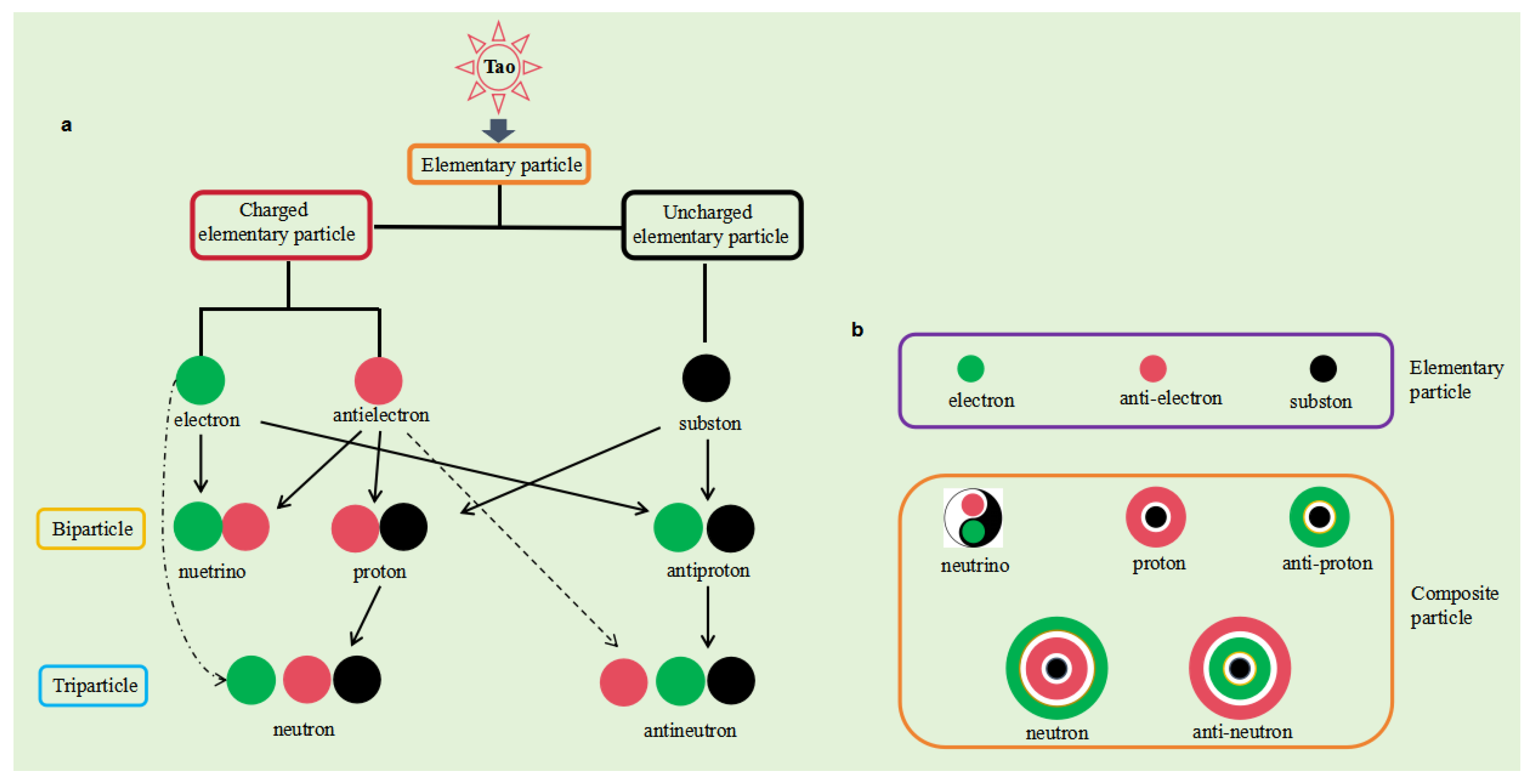
Figure 2.
Existence field of elementary particles. a: Elementary particles continuously and uniformly diffuse their physical information into the surrounding space, with a constant diffusion speed c relative to an absolutely stationary reference frame. The direction of this diffusion is from the fundamental particle towards infinity. b: When a fundamental particle is in an absolutely stationary state in a vacuum, it uniformly diffuses its physical information into the surrounding space, forming concentric spheres nested within each other. c: Changes in the existential field of a fundamental particle moving in a uniform linear motion in a vacuum. d: Changes in the existential field of a fundamental particle accelerating in a linear motion in a vacuum. e: Changes in the existential field of a fundamental particle moving in a uniform circular motion in a vacuum. f: Changes in the existential field of a fundamental particle accelerating in a circular motion in a vacuum.
Figure 2.
Existence field of elementary particles. a: Elementary particles continuously and uniformly diffuse their physical information into the surrounding space, with a constant diffusion speed c relative to an absolutely stationary reference frame. The direction of this diffusion is from the fundamental particle towards infinity. b: When a fundamental particle is in an absolutely stationary state in a vacuum, it uniformly diffuses its physical information into the surrounding space, forming concentric spheres nested within each other. c: Changes in the existential field of a fundamental particle moving in a uniform linear motion in a vacuum. d: Changes in the existential field of a fundamental particle accelerating in a linear motion in a vacuum. e: Changes in the existential field of a fundamental particle moving in a uniform circular motion in a vacuum. f: Changes in the existential field of a fundamental particle accelerating in a circular motion in a vacuum.
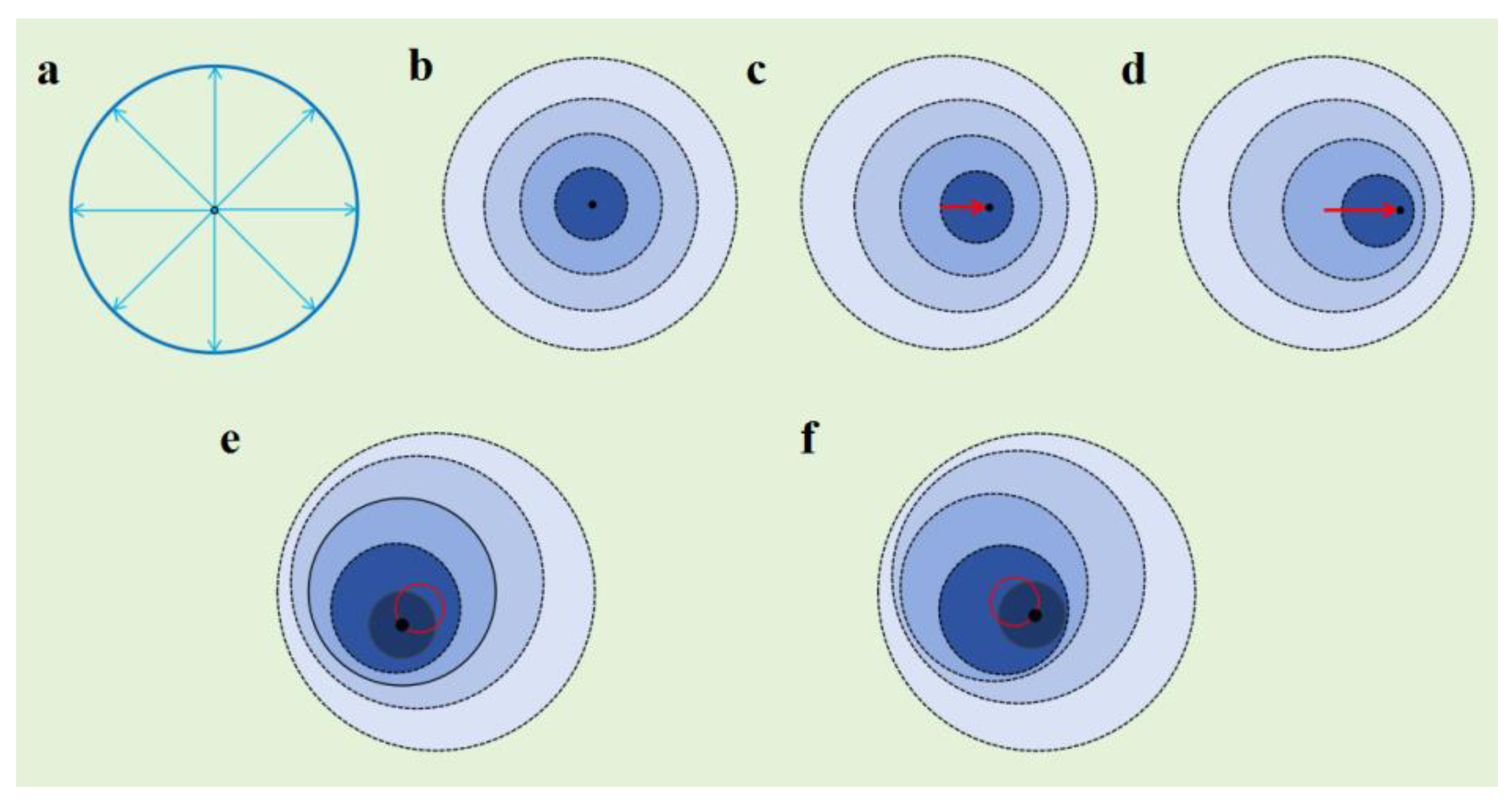
Figure 3.
Momentum and its existence field. The momentum field of elementary particles is represented by the cross product of momentum and the position vector: . The direction of the momentum field is perpendicular to the plane formed by the momentum and the position vector (the direction of the position vector indicates the direction of the existence field of the fundamental physical quantity Q). When a positive charge or mass moves, the direction of its momentum field is equivalent to rotating counterclockwise around the O-axis in the direction of the momentum. Conversely, when a negative charge moves, the direction of its momentum field is equivalent to rotating clockwise around the O-axis in the direction of the momentum.
Figure 3.
Momentum and its existence field. The momentum field of elementary particles is represented by the cross product of momentum and the position vector: . The direction of the momentum field is perpendicular to the plane formed by the momentum and the position vector (the direction of the position vector indicates the direction of the existence field of the fundamental physical quantity Q). When a positive charge or mass moves, the direction of its momentum field is equivalent to rotating counterclockwise around the O-axis in the direction of the momentum. Conversely, when a negative charge moves, the direction of its momentum field is equivalent to rotating clockwise around the O-axis in the direction of the momentum.
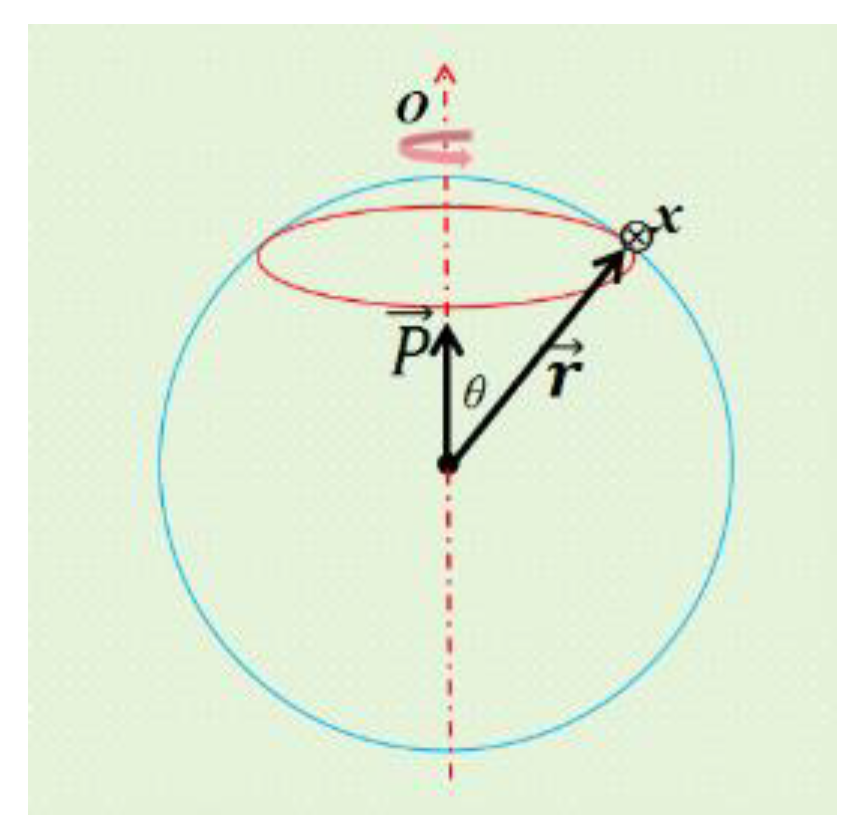
Figure 4.
Direction of rotational momentum and spin momentum. a: When a fundamental particle (positive charge or mass) rotates counterclockwise around a center with a position vector , the direction of its rotational momentum is upwards through the center and perpendicular to the plane formed by the position vector and the momentum . Conversely, for a fundamental particle ( negative charge) rotating counterclockwise around a center with the same position vector , the direction of its rotational momentum is downwards through the center and perpendicular to the same plane. b: When a fundamental particle (positive charge or mass) spins counterclockwise around its central axis, the direction of its spin momentum is upwards through the center and perpendicular to the plane formed by the position vector i and the momentum . Similarly, for a fundamental particle (negative charge) spinning counterclockwise around its central axis, the direction of its spin momentum Ps is downwards through the center and perpendicular to the plane formed by the position vector i to that point and the momentum of the particle’s part i. We assume that the fundamental particle is a perfect sphere, with its fundamental physical quantities evenly distributed across its surface. For any part i of the fundamental particle’s sphere, the momentum associated with its rotational motion is , and the position vector from the spin axis to that point is i .
Figure 4.
Direction of rotational momentum and spin momentum. a: When a fundamental particle (positive charge or mass) rotates counterclockwise around a center with a position vector , the direction of its rotational momentum is upwards through the center and perpendicular to the plane formed by the position vector and the momentum . Conversely, for a fundamental particle ( negative charge) rotating counterclockwise around a center with the same position vector , the direction of its rotational momentum is downwards through the center and perpendicular to the same plane. b: When a fundamental particle (positive charge or mass) spins counterclockwise around its central axis, the direction of its spin momentum is upwards through the center and perpendicular to the plane formed by the position vector i and the momentum . Similarly, for a fundamental particle (negative charge) spinning counterclockwise around its central axis, the direction of its spin momentum Ps is downwards through the center and perpendicular to the plane formed by the position vector i to that point and the momentum of the particle’s part i. We assume that the fundamental particle is a perfect sphere, with its fundamental physical quantities evenly distributed across its surface. For any part i of the fundamental particle’s sphere, the momentum associated with its rotational motion is , and the position vector from the spin axis to that point is i .
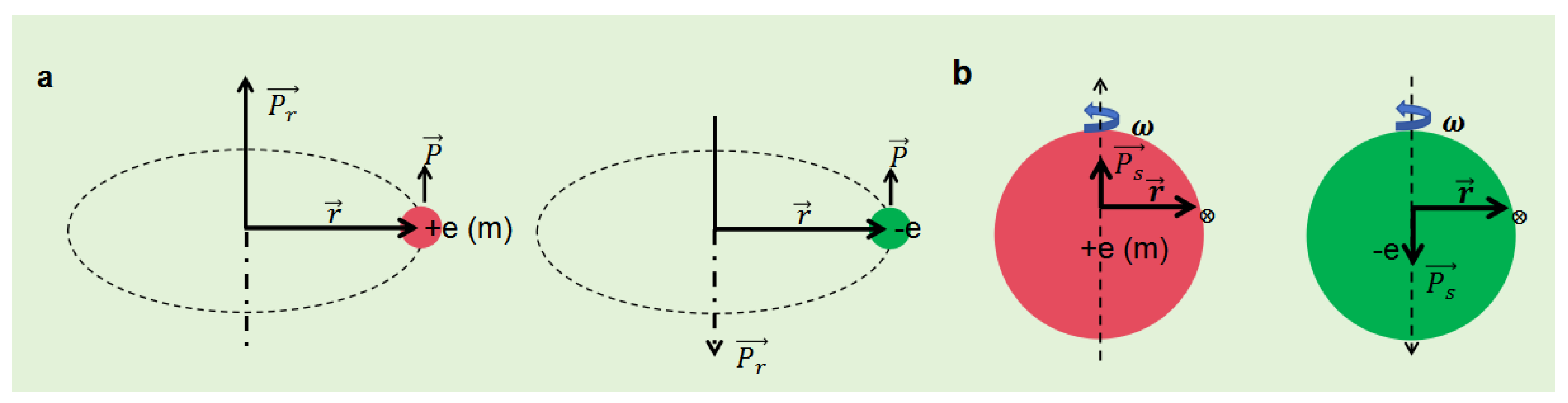
Figure 5.
Combination of elementary Particles. a: an electron and a proton; b: an electron and a positron; c: a positron with a subston; d: a proton and a neutron.
Figure 5.
Combination of elementary Particles. a: an electron and a proton; b: an electron and a positron; c: a positron with a subston; d: a proton and a neutron.
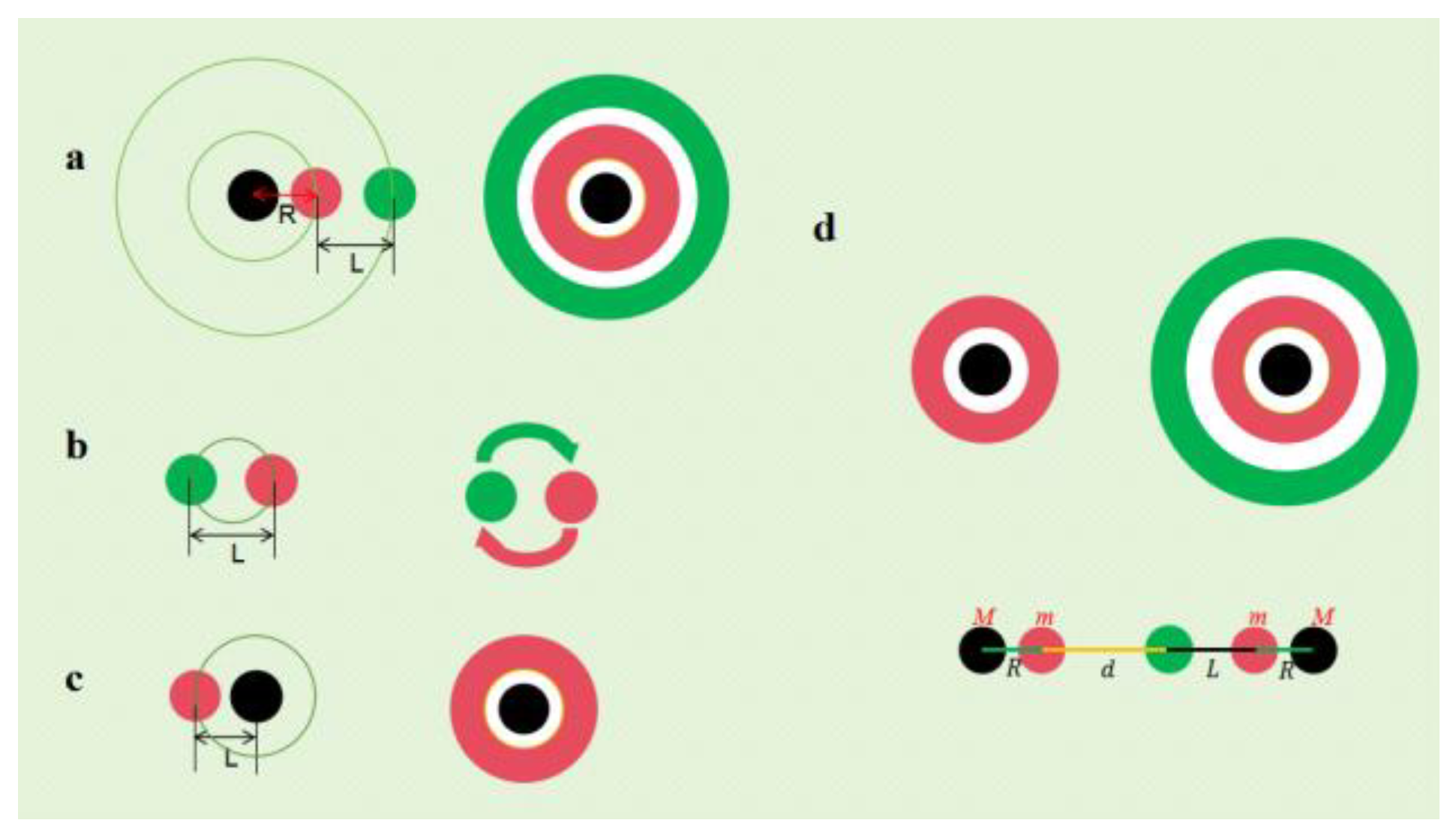
Figure 6.
The combination of Protons and Neutrons and the Structure of Atomic Nuclei. a: The combination of a proton and a neutron; b: The rotation of protons and neutrons; c: The structure of atomic nuclei((protons are represented by red balls, neutrons are represented by green balls)).
Figure 6.
The combination of Protons and Neutrons and the Structure of Atomic Nuclei. a: The combination of a proton and a neutron; b: The rotation of protons and neutrons; c: The structure of atomic nuclei((protons are represented by red balls, neutrons are represented by green balls)).
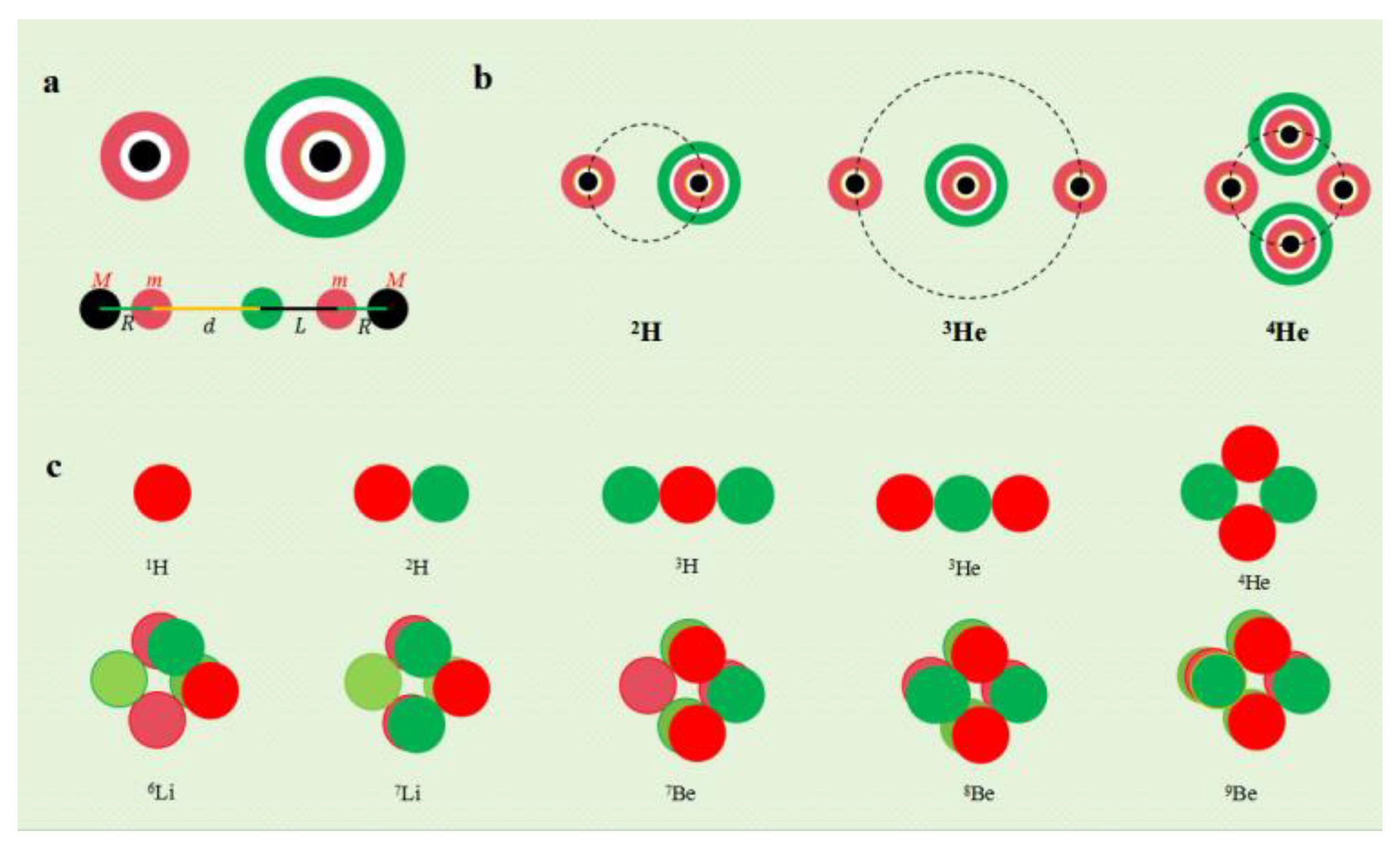
Figure 7.
Structure of celestial bodies and evolution of the universe.
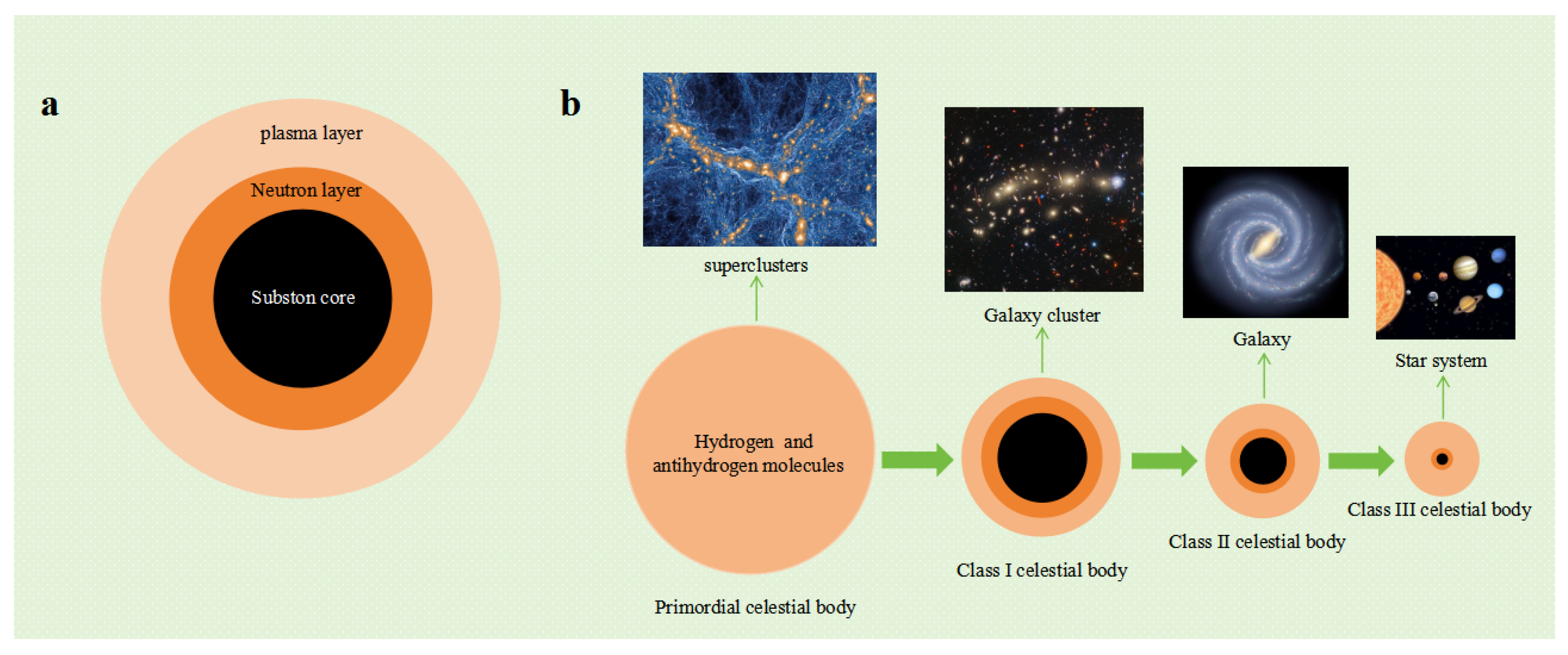
Figure 8.
Comparison between the Great Tao Model and the Standard Model. a: elementary particles in the Great Tao Model; b: elementary particles the Standard Model.
Figure 8.
Comparison between the Great Tao Model and the Standard Model. a: elementary particles in the Great Tao Model; b: elementary particles the Standard Model.
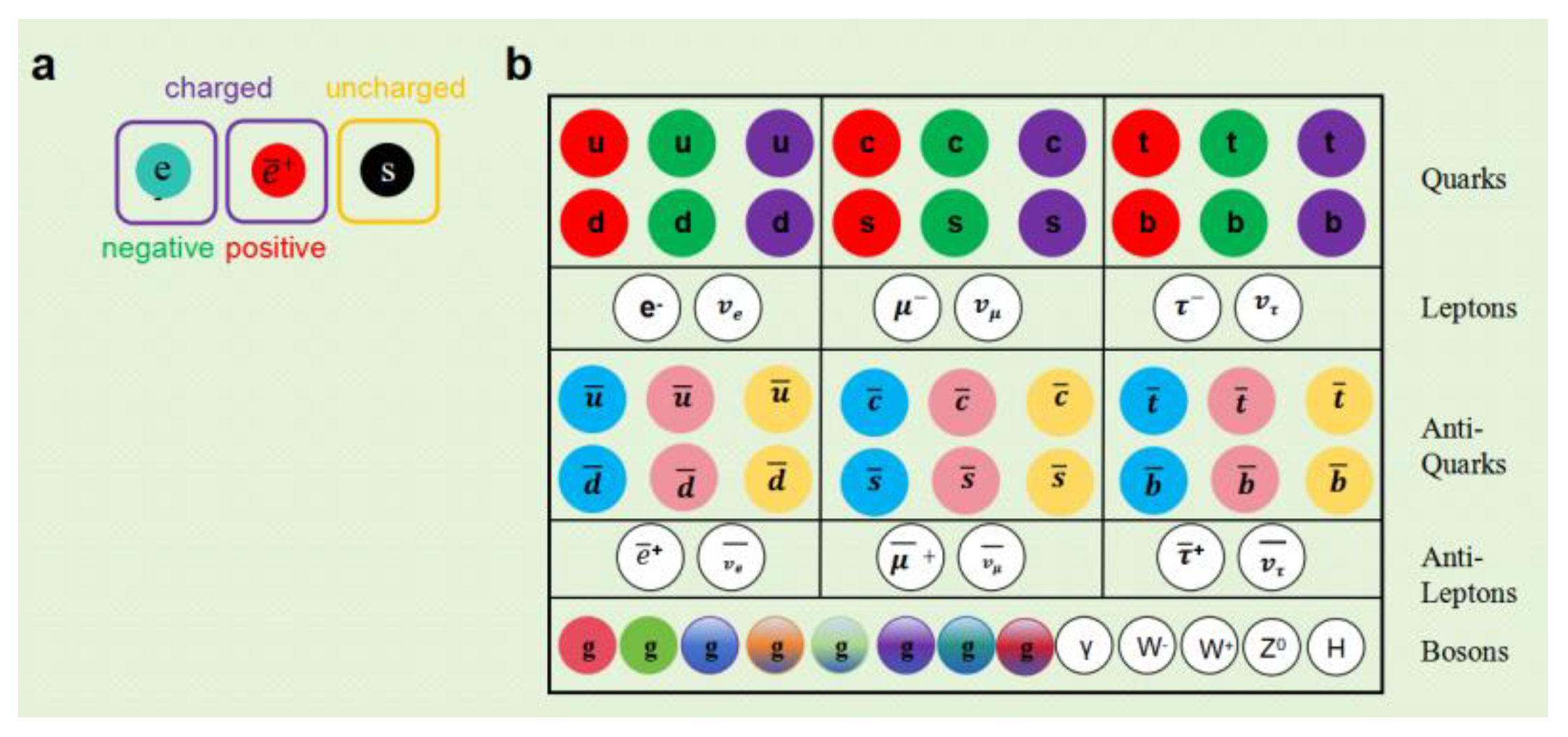
Disclaimer/Publisher’s Note: The statements, opinions and data contained in all publications are solely those of the individual author(s) and contributor(s) and not of MDPI and/or the editor(s). MDPI and/or the editor(s) disclaim responsibility for any injury to people or property resulting from any ideas, methods, instructions or products referred to in the content. |
© 2025 by the authors. Licensee MDPI, Basel, Switzerland. This article is an open access article distributed under the terms and conditions of the Creative Commons Attribution (CC BY) license (http://creativecommons.org/licenses/by/4.0/).
Copyright: This open access article is published under a Creative Commons CC BY 4.0 license, which permit the free download, distribution, and reuse, provided that the author and preprint are cited in any reuse.


